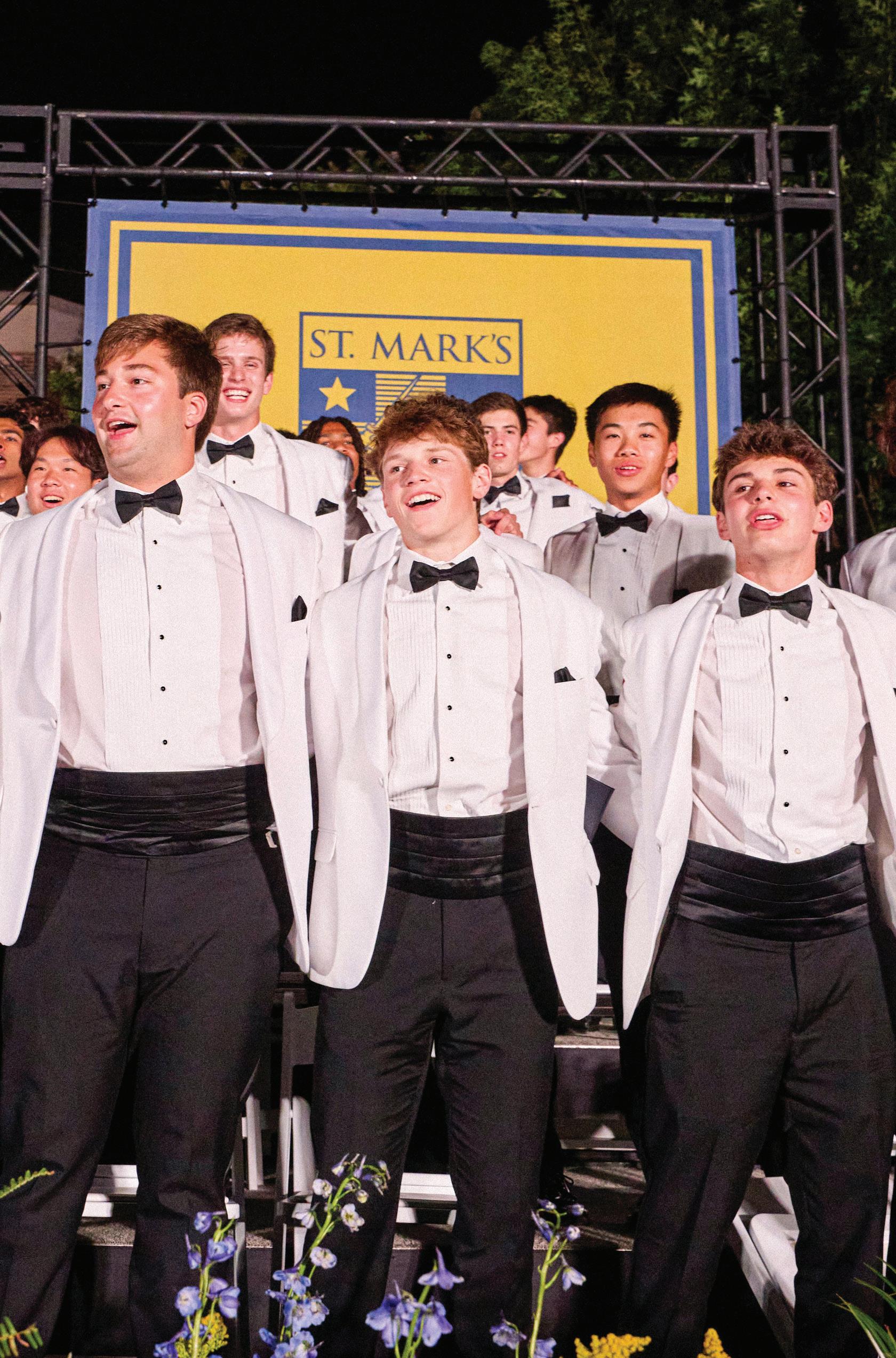
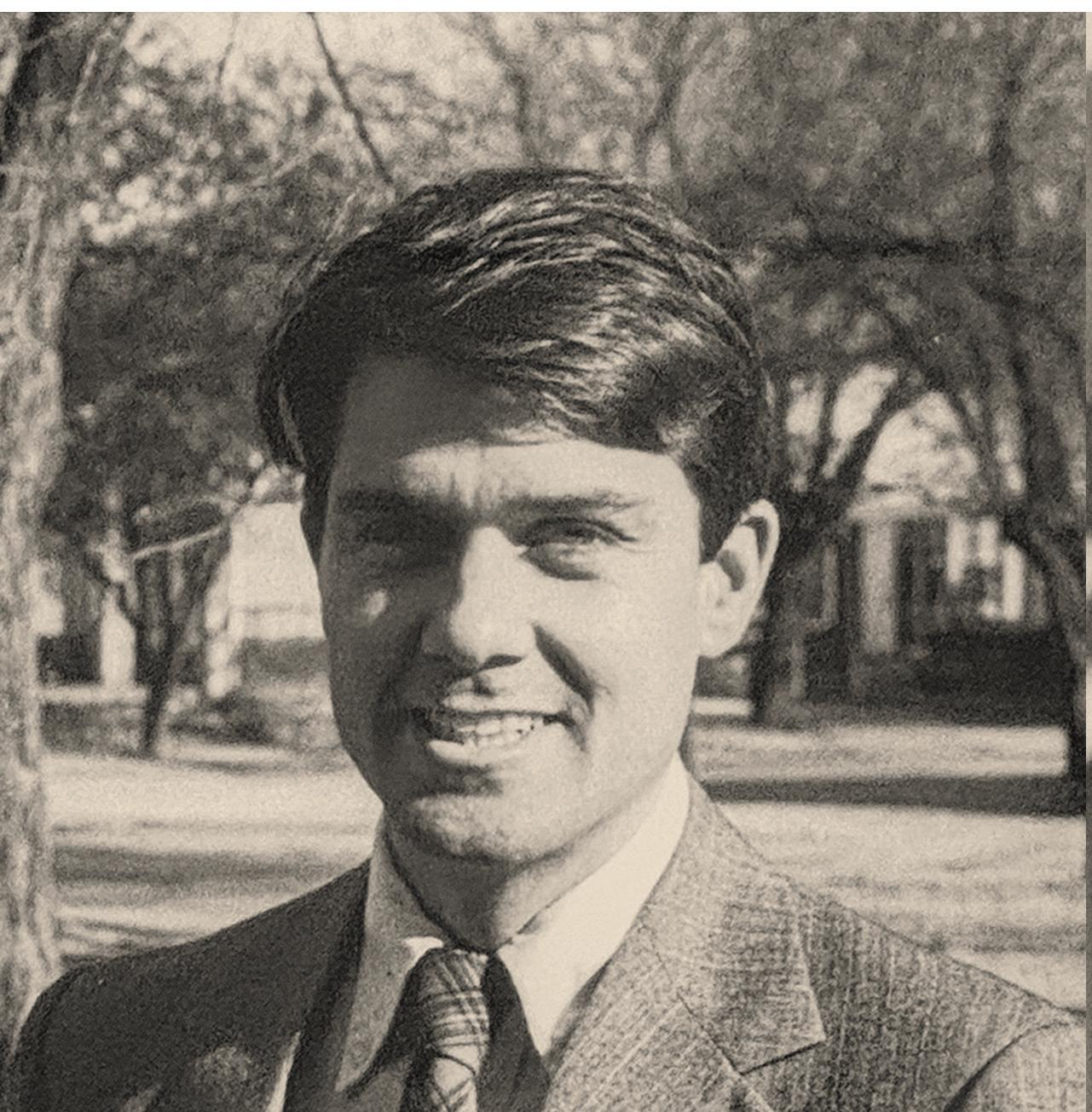
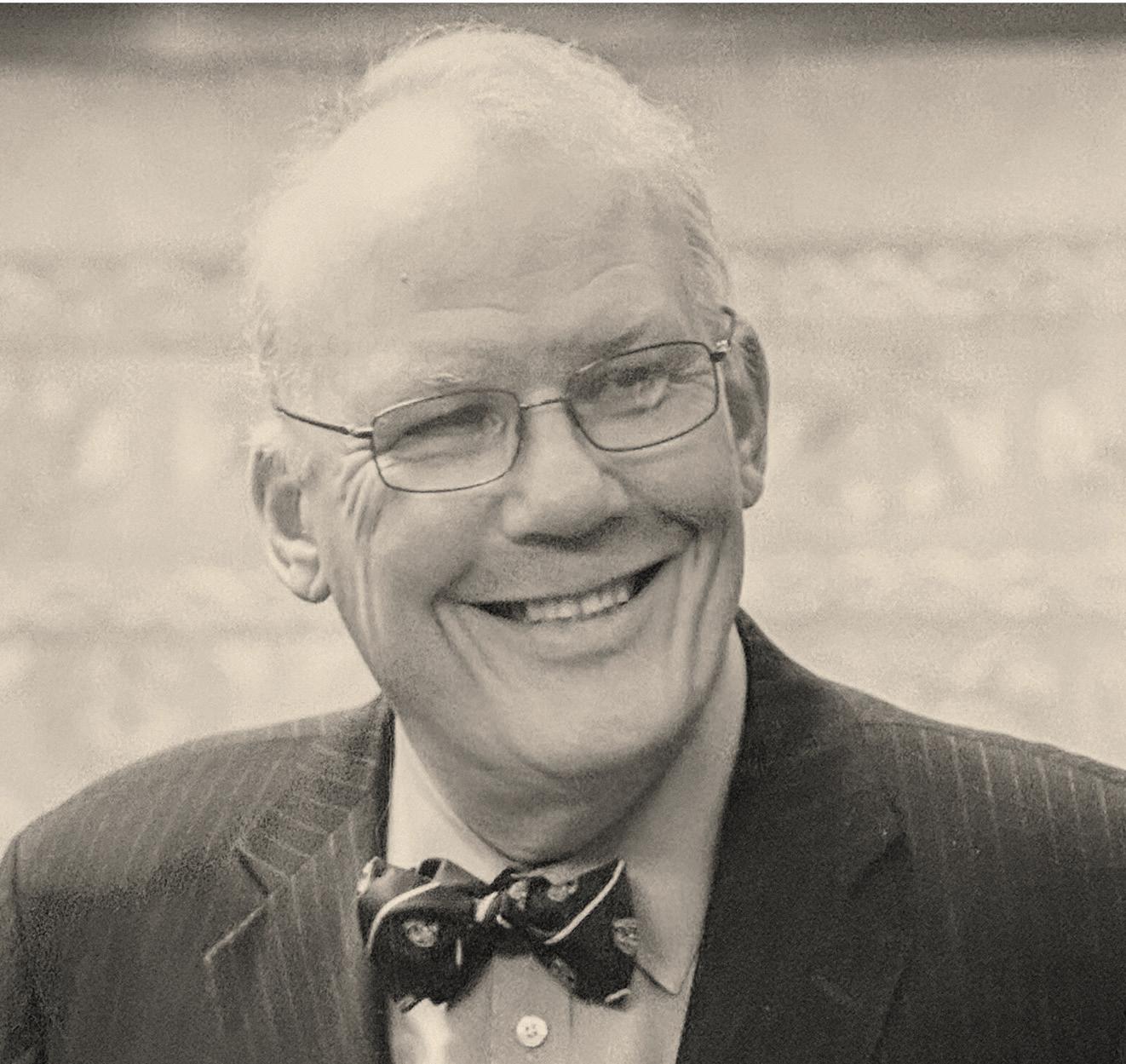
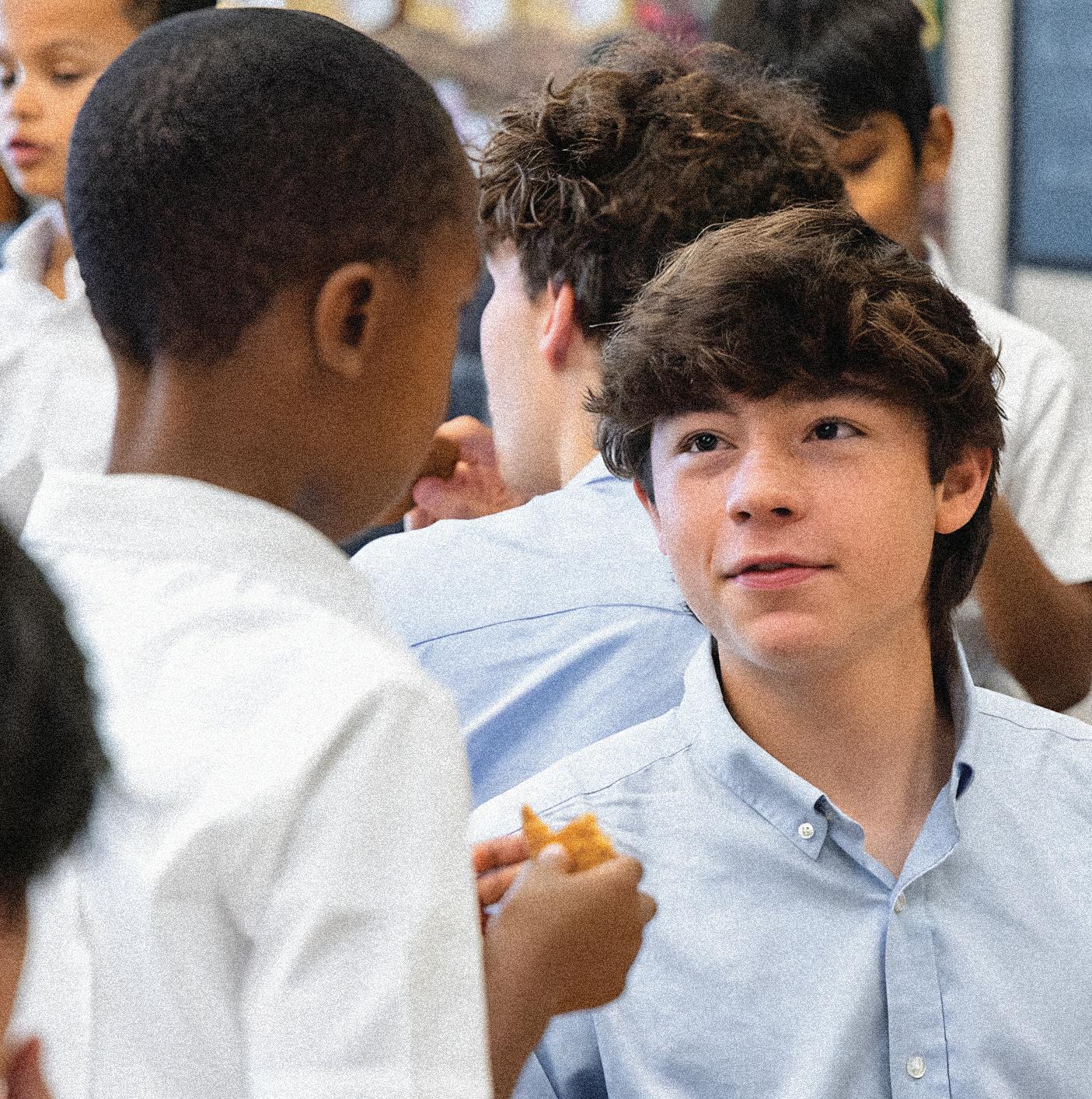
“Rule number one: if it’s important to you, it’s important to me. Number two is to make every minute matter. There are a lot of things in life that are worth more than money.”
Friday, February 6, 2026
Volume 72, Issue 4
St. Mark’s School of Texas Dallas, Texas
Shortcuts often lead to immediate successful outcomes but yield long-term failure. Marksmen are often tempted to cheat in response to pressure.
See coverage, Pages 16-17
Tony
Renato Bosita, parent
Photo Illustration by Sebastian Gonzalez and Joshua Goforth
Split, peel, bananas
Doan Nguyen Enterprise
Two weeks ago, a classmate walked in the senior lounge with an old, ugly yellow pouch that looked like it had survived multiple world wars. The zipper sagged. The fabric was stained. The hundreds of tiles that it contained were worn down.
I had heard of Bananagrams before. In my mind, it was always “Bananagrams: the poverty version of Scrabble,” the knockoff game your mom buys at the store because the real one was out of stock. A banana instead of a board.
What I was introduced to instead was “Bananagrams: the best game of all time.”
As a second-semester senior, my brain was in a dangerous place. Over the winter storm, I consumed hours of useless videos and random movies that I would never admit to watching. My screen time was impressive in the most embarrassing way possible. I was the embodiment of unproductivity.
But Bananagrams, chock-full of vitamins A-Z, nourished my brain, bringing yellow-tinted color back into my life.
The rules are simple. Each participant starts with 21 tiles and races to build a connected grid of words. There are no turns. No mercy.
Besides the usual taunting and the “Is ___ a word?” you only hear three words during the game: ‘Split,’‘Peel’ and ‘Bananas.’
‘Split’ is called when you don’t like one of the letters you got, like a ‘Q’ or ‘Z,’ so you put it back in the pot — the pile of face-down tiles in the middle — and take three in return. Pro tip: put all the trash letters that you ‘split’ in front of your most formidable opponent for them to draw next.
‘Peel’ means you’ve managed to connect all your letters. So now you (and everyone else) have to draw from the letters in the middle. Every ‘peel’ from you is usually met with groans from the other players.
‘Bananas’ means you’ve finished and there are no more letters to grab from the pot. And no one ever trusts you, so they inspect your board with Google in their right hand, making sure every word you formed is acceptable.
After my first game, which I lost without forming more than three words, I realized I was seeing words from other people that I never knew existed, like ‘ZA’ or ‘QI’ or ‘AA.’ Trust me, I don’t know what any of these “words” mean either. But according to the newest addition to my bookmark bar, ‘scrabblewordfinder.org,’ they are all playable and make regular appearances in every game.
Bananagrams has helped me stay off my phone and taught me not to panic when things don’t work out at first. Sometimes the word you’re forcing isn’t meant to be there. Sometimes the ugly Q that’s mocking you ends up being the letter you need at the very end. It’s a small reminder that not everything is supposed to make sense immediately. That struggling doesn’t mean you’re doing it all wrong.
And when the letters finally come together, it’s never the way you envisioned it beforehand. You don’t call it perfect. You call “Bananas.”
Springtime fragrances for your next night out
Here’s a list of four colognes and their top 3 notes according to ‘fragrantica.com.’ At four different price points, these scents will prepare you for any occasion.
By Michael Jimenez
Here
CITRUS, FRUITY, LEATHER Club de Nuit
Intense Man
Exceptional value for the price
Fruity with pineapple and black currant
Strong longevity and noticeable projection
One of the best Creed Aventus dupes
Mass-appealing and highly versatile
Great first fragrance (or fiftieth)
CITRUS, AROMATIC, AMBER
Coach For Men
Affordable, easy-to-wear everyday fragrance
Fresh “blue” scent made for spring
Notes of citrus, lavender, and grapefruit
Very mass-appealing and versatile
Short longevity (4–5 hours max)
Safe blind buy, often found under $50
FRUITY, TROPICAL, SWEET
God of Fire
Vibrant, fruity scent with a tropical feel
Dominant mango and citrus notes
Ideal for warm spring and summer days
Unique and bold without being overwhelming
Excellent all-day longevity
Expensive, best for experienced collectors
CITRUS, GREEN, FRUITY
Creed Silver Mountain Water
Clean, soapy scent ideal for spring and summer
Peppery opening that dries down to bergamot
Smells like stepping out of a fresh shower
Subtle and non-overpowering
Not very common in public
Moderate longevity (5–6 hours max)
For these web exclusive stories and more website content, visit smremarker.com and @remarkernewspaper on Instagram.
Editor
PAGE 8
Lack of student activism affects culture
In a time of rampant protests across the country, students have remained relatively quiet.
Alumni explore new opportunities in gap years
Taylor Hopkin ‘20 and Harrison Lee ‘19 have gained important experiences and lessons by taking time off in between studies.
The ReMarker
Faculty reflect on Challenger disaster
Friday, February 6, 2026 PAGE 7
Prediction markets surge in popularity
Allowing users to wager on everything from sports to elections, prediction markets have rapidly entered the mainstream.
By Holden Purvis and Jay Panta
This January, an anonymous user on Polymarket won over $400,000 after betting Venezuelan president Nicolas Maduro would shortly be out of office, placing the trade just hours before his capture.
Until recently, a bet like this would have been heavily regulated and far from mainstream. But although gambling once carried a clear stigma — something to be avoided, discouraged and restricted — its boundaries began to expand far beyond traditional sports as betting has become more digitally accessible, heavily advertised and socially normalized.
After decades of resistance, the industry has scaled quickly to the point where wagers are now legally being placed on elections, climate change and many other real-world events.
Today, a new kind of culture has emerged — one that wants to bet on everything.
through Kalshi and Polymarket, the two leading prediction markets in a rapidly expanding betting industry.
On the surface, these markets serve as tools which use the “wisdom of the crowd” to forecast upcoming events. Prices act as signals, rising and falling as users buy and sell contracts tied to specific outcomes.
I fear that, as with a lot of things, we’re commercializing it. We’re exploiting it for advantages that other people will use to their own benefit and not the society’s benefit.
David Fisher History & Social Sciences Department Chair
Individual users can buy “yes” or “no” contracts priced between 0 and 100 cents, reflecting the implied probability of a particular scenario. Those contracts may be sold as the market price trends up or down, or held until the event occurs, when correct positions pay out.
Economically, prediction markets differ from traditional gambling structures.
house, and it’s a rigged game that’s always rigged in favor of the house, whereas prediction markets are peer to peer,” History & Social Sciences Department Chair David Fisher said. “You’re betting against other people, and the more people that participate, the more certain it is that the outcome is what a percentage is indicating is going to happen.”
After the federal government lifted a longtime ban on sports gambling in 2018, the betting culture exploded. But with sports gambling still illegal in Texas, prediction markets stepped in as a gambling substitute. In fact, more than 90 percent of the trading volume on Kalshi was placed on sports according to the New York Times.
“My issue has to do more with what we do with our scarce amount of leisure time…I think objectively, the answer should not be to gamble, and up to a point, that’s where betting the prediction markets are a little bit as well,” Fisher said.
Among students, prediction markets blur that line between analytical forecasting and gambling. While some see the platforms as tools that foster economic and political understanding, others approach them primarily as a way to wager on outcomes with fewer legal and regulatory barriers than traditional gambling. PAGE 5
In 2025, tens of billions of dollars flowed
“Gambling, you’re playing against a
Job employment encourages student growth
By Luke Nguyen
Students have a lot on their plates. During the week, school from 8:30 a.m.–3:30 p.m., sports from 4:30–6:30 p.m. and homework for at least three hours.
But on weekends, some students brave an entirely different challenge: a real, professional job.
Having a job comes with many benefits: learning time management, earning money independently and gaining real-world experi-
ence.
Sophomore Lucas Herrera, a server at Taco y Vino, started working when he was 12, where he was originally just a busboy who cleaned tables. Since then, he’s taken on many more responsibilities at the restaurant.
“My dad worked when he was young and encouraged me to do the same to build in some responsibility and independence into my life,” Herrera said. His job grants him a lot of flexibility in the number of hours he
works, ranging from zero to 12 hours every weekend.
“A Sunday shift can take about six hours, where I’ll run up and down the restaurant with drinks, clean sets of dishes and food items,” Herrera said. “I also take orders and chat with patrons, which are often St. Mark’s students or alums.”
In addition to working at the restaurant, Herrera also has catering events that last around six hours. With all that time spent working, he has far less time to spend doing homework or main-
Forty years ago, seven astronauts died aboard the Challenger space shuttle, stunning the nation and leaving a lasting imprint on space travel.
NATIONWIDE PROTESTS
Protests have spread throughout the nation after two U.S. citizens were shot and killed by federal immigration agents in Minneapolis, Minnesota. Demonstrators continue to voice opposition to the tactics and widespread presence of U.S. Immigration and Customs Enforcement (ICE).
WARSH NAMED FED CHAIR
President Trump officialy nominated Kevin Warsh to be the next Chair of the Federal Reserve. Warsh is widely seen as someone whose views align with the president’s goal to drastically lower interest rates.
SOCIAL MEDIA BAN
Australia has passed a law banning children under 16 from using major social media platforms, aiming to improve youth mental health.
5 MINUTES WITH MARK ADAME
“(My cycling career) started out with triathlons, and I was terrible at swim. I’d pass all these people on the bike and then get passed in the run, so I just gave up that up and stuck to cycling. I raced for several teams in Little Rock, which was nice because we’d go out of state or out of town to do these bike races.”
“I do get to ride my bike home at least once a week this year. It’s 27 miles, but I usually do it if there’s a tailwind.”
“There’s a number of students I’ve kept in touch with. But it’s funny when graduates show up and just say hi. Sometimes I’m like, ‘I know your face, but I don’t remember your name.’ Or they sometimes look different. I don’t understand why I can’t always remember names or even remember that I had them in a class, except that this is my 30th year of teaching — so that’s my defense. It all blends together.”
taining a social life.
But surprisingly, he has no issue managing his time.
“Homework is no issue: I manage my time well,” Herrera said.
“Working hasn’t affected my school, and school hasn’t affected my work. I have time on Fridays to go out with my friends and attend various functions in Dallas.” Herrera considers himself lucky to have the opportunity to experience a real-world environment outside the St. Mark’s bubble. While students may commonly question
the purpose of a formal education in the working world, Herrera’s job has allowed him to see the value of a higher level of education. At the same time, the job has given him a sense of financial independence.
“I would especially recommend having a job if you like discretionary spending,” Herrera said. “I don’t really need the money for anything, but I enjoy having some extra money to spend on what I please and purchase gifts for people.”
Photo by Peter Clark
Instead of sports gambling apps, students can use prediction markets to find odds and potential bets for sporting events.
Mark Adame Biology Teacher
3
the month
Self-driving taxis appear across major cities
Autonomous vehicles are becoming more reliable and increasingly common, but their convenience may encourage a growing culture of laziness.
By Emiliano Mayo Mejía and Luke Nguyen
According to WIRED, automakers have promised automated vehicles since 1939. Since cars began to be mass produced in the United States, engineers have envisioned an innovative future where transportation is automated.
Today, automated cars such as Waymo are becoming commonplace in Dallas, making a dream from over 80 years ago turned into reality.
“From an engineering standpoint, I think it’s really cool,” engineering teacher Kevin Fine said. “It’s pushing the limits of technology and computing and sensors and putting all of those things together to make a very complicated application in the real world.”
Sophomore Hunter Dorrill, Programming Lead for the FIRST Tech Challenge Team, has closely followed the rollout of self-driving vehicles.
“Just by looking at a Waymo, you can see they have LiDAR sensors all over them,” Dorrill said. “LiDAR sensors are like radars, but it uses pulses of light, which allows it to see through fog or dust and pretty much see in pitch darkness.”
Despite the advances in technology, autonomous vehicles still struggle with what experts call “edge cases.” Many of these are unlikely to occur on a daily basis but in rather unexpected circumstances in which human drivers would have to think critically.
“The majority of problems that you see come from edge cases, especially interactions with humans outside of the vehicle,” Dorrill said. “Waymos can fail to respond to hand signals from construction workers. They’re not able to handle being pulled over by police.”
One issue stands out as more serious. Waymos consistently fail to stop behind school buses offloading children. The company released a software update claiming to remedy the issue, but Waymos continue to accelerate past stopped school buses. Thankfully, no children have been harmed yet.
Waymos also aren’t as versatile as traditional ride share apps. While Uber also offers UberEats, Waymo has no equivalent food delivery
service. Waymos have clear limitations at jobs that require human judgment.
“Waymos aren’t able to nondestructively go into a restaurant and pick up food,” Dorrill said. “Also, Waymos are not able to assist people in loading their luggage. Some riders like the extra service offered by a human driver, but most like being alone like in a Waymo.”
As technology continues to progress in other fields apart from transportation, Fine sees how many everyday activities are beginning to change. He believes that although this helps humanity move forward, there are still some downsides to the automation of many fields.
“I think when writing comes about, and then typing, and then computers, there’s always this moment that changes the way things are done,” Fine said. “And while it makes it more efficient to get things done, you lose some previous skills.”
The fact that tasks are so efficient nowadays makes him believe
It’s pushing the limits of technology and computing and sensors and putting all of those things together to make a very complicated application in the real world.
Kevin Fine Engineering Teacher
that technology could contribute to the creation of a culture of laziness — one that defaults to shortcuts before critical thinking.
“Humans are potentially giving up more skills in order to use these devices, and as an educational institution like here in St. Mark’s, and as a teacher, that’s something that I think about a lot,” Fine said. “I want my students to be able to operate in the new world, but I also want students to leave here with as many skills in their brain as possible. Because at the end of the day, that’s all you’ve really got, where you can get in your brain.”
However, when used correctly, technology still proves to be versatile and helpful in many fields.
For Fine, AI and the internet can help him improve his teaching, and he believes that it can also help students as well if used sparingly. Still, Fine does not want convenience to turn into laziness as technology can help people avoid putting in more effort into everyday ordeals.
CDC vaccine guideline changes cause confusion
By Alex Calder
The Centers for Disease Control and Prevention (CDC) recently changed its guidelines for required vaccines, reducing the list from 17 core vaccines to 11. While these changes may seem significant, local schools and states are not required to follow them, which has led to some confusion among parents.
These updates can be difficult for new parents to keep track of, especially since vaccine schedules already feel complicated. Because of this, many families rely on advice from their pediatrician when making decisions about their child’s health.
School nurse Julie Doerge says she takes CDC recommendations into account, but the school ultimately follows its own policies.
“The new changes that have come out are a guideline, so they are not something that we necessarily have to implement,” Doerge said.
The CDC’s role is to inform people about health issues on a national level, but each state and school maintains the authority to decide their own requirements. This means that even if national guidelines change, local policies could remain the same.
“The thing is, the CDC is national, and really where the control is is in the states,” Doerge
said. “And so our state has not made any comment or move yet to change anything.”
These changes will not have much of an effect on students who are already enrolled since most vaccines are given early in childhood. Instead, the impact is more noticeable for new parents with young children who are just beginning the vaccination process.
“Everybody who is in school now is fully aware of what the policy is,” Doerge said. “It may be a different conversation with incoming families, but nothing will change, and they will know up front when they apply.”
Another concern related to
vaccine requirements is cost. For families receiving financial aid, the school must ensure that required vaccines are covered by insurance so no student is prevented from attending.
“One of the concerns I had was that vaccines would not be covered by insurance when these changes were made,” Doerge said. “But so far it has come out that they will continue to pay for these vaccines, which is important, especially for kids in programs where it is paid for by the government.”
Even with insurance coverage, Doerge worries that shifting policies could still confuse parents, especially for those who are new
“I sometimes use AI as a tutor to help teach me things, and in that case, I’m actively using it to learn which replaces the role of maybe a textbook or another human being who could help me to teach,” Fine said. “So there’s a convenience factor there, but I’m using it to learn. So I feel like that’s a case where I feel pretty positive about the application of the technology.”
Still, Fine believes that there needs to be some sort of moderation for the use of technology so as not to lose the crucial skills that humanity has taken for granted.
“I think one place to start is to be a little bit conservative about the adoption of technology because there are skills that we as a society have decided that are important and have been important to us for decades, if not hundreds of years, and continue to develop those skills at the same time,” Fine said.
to the school or to parenting in general.
“The other thing I worry about is confusion for parents,” Doerge said. “If my pediatrician says I have to get it, is that what I go by? Or do I go by something else that just came out?”
Because health guidelines continue to adapt, parents are forced to make the best decisions they can with the information they have. .
“We will not change our vaccine policy or the number of vaccines that we request,” Doerge said.
Photo Courtesy Creative Commons
Waymo vehicles, one of the leading autonomous cars on the road, rely on many cameras and sensors to navigate the road without a human driver.
In an era of widespread national protest, public activism remains rare at the school. It reflects a culture where civic engagement is often expressed in quieter, less visible ways.
By Holden Purvis and Emiliano Mayo Mejía
Cries of “ICE out” echo their way through the nation, from Minneapolis all the way to Dallas.
In consecutive weeks, two Minnesota citizens were killed by Immigration and Customs Enforcement (ICE) agents, sparking outrage for many people across the country, including students.
These types of events have historically served as catalysts for nationwide protests and activism after long buildups of frustration.
But at St. Mark’s — even in a time where protest culture has been running rampant across schools — students have remained relatively quiet.
It doesn’t mean that students don’t care about current events, even if the culture seemingly appears disengaged at first glance. Rather there are many determining factors that contribute to a lack of public advocacy.
In particular, students can lack a personal catalyst that would make distant issues feel urgent, the school’s mission prioritizes teaching how to think over facilitating what to protest and when public activism isn’t the norm, private engagement becomes the easier path.
“At St. Mark’s, this is my seventh year teaching here, I see the least political activism of any school I’ve ever been associated with, either as a student myself or teaching,” history teacher Dr. Andrea Hamilton said. “That doesn’t mean individual students aren’t passionate about political issues or involved with them outside of school; it just means they don’t engage politically through St. Mark’s.”
It’s human nature to not deeply care about issues until they affect one personally. Nationwide, it often takes a specific event that hits close to home to spur a crowd to action.
“Sometimes there’s an event that personalizes a big, abstract issue, and then suddenly people are motivated,” Hamilton said. “Sometimes, I think big issues are so big and so overwhelming that it’s just kind of human nature to accept it because it doesn’t feel like it’s (affecting) you.”
Historically, protests typically arise from persistent feelings of anger and discontent with a perceived gap between a society’s ideals and reality.
“If you look at U.S. history, (activism) definitely comes from a sense of people who don’t have what the promise is,” Hamilton said. “You take a place like the U.S. that has very lofty ideals that we’re proud of
— equality, this rhetoric of opportunity — you historically have the groups who are left out of that.”
For many students who come from relative privilege and security, national issues may feel distant and abstract, making it harder to find that personal connection that drives public action.
While some schools will occasionally encourage specific forms of student activism, the school remains consistent in its mission to teach students how to think, not what to think.
“The school operates from a very mission-driven place which is principal neutrality…versus being an issue-driven school, we’re a mission-driven school which informs and prepares you guys to engage in the degrees that you want to around the issues that are very important to you all as individuals,”
Associate Headmaster John Ashton said.
Last week, students in Austin ISD organized walkouts during the school day, which the school district neither directly supported nor prevented.
St. Mark’s approach differs — the school focuses on developing students’ ability to think critically and discuss different perspectives while getting involved in ways that don’t disrupt the daily operations — as a walkout during the school day would.
“Some schools believe that: ‘let’s not only equip them to think about but let’s help them facilitate an expression of that,’ which is, again, perfectly fine for schools who choose to do that,” Ashton said. “We stop at, ‘let’s equip you all to engage.’”
The assumption that engagement only looks like one thing is a very limiting way to think about engagement. I think it misses the equal value placed on all the other ways people might engage.
John Ashton Associate Headmaster
Highland Park High School (HPHS), for instance, utilizes programs such as MAPS (Moody Advanced Professional Studies), a program that focuses on bringing students’ opinions to light and facilitating direct advocacy.
“We basically advocate for change,” HPHS junior Alexander Mandich said, “If we are upset with how any curriculum is being taught, we sit down at a table with our director who can actually make changes.”
St. Mark’s tends to channel engagement differently — through student-led initiatives such as service, dialogue and inclusivity rather than institutionally organized protest.
“St. Mark’s encourages students to volunteer and to be charitable trying to make a difference in that way,” Hamilton said. “So I do think St. Mark’s walks the walk with community service and opportunity, emphasizing that’s how you make a difference. And that is another form (of civic engagement.)”
When public protest isn’t established as the norm, private and non-confrontational forms of engagement become the typical route.
Compared to those other forms, some students believe protest could risk fragmenting a tight-knit community.
“There’s an equal emphasis on both: the expression of ideas, but also maintaining the integrity of the student body,” junior Jack Shepro said. “If you polarize, try to separate people via their opinions…you kind of lose the gel that we have. You kind of lose that sacred brotherhood aspect.”
For Shepro, confrontational forms of protest might serve as something to explore beyond the high school setting.
“As far as activism in the form of protesting, I would say that something more pronounced like that, in my opinion, might not be quite suitable for a high school campus,” Shepro said. “I’m not saying activism in general is bad, or protesting in general is bad, I think it’s a good and healthy thing, just not on St. Mark’s campus, although I haven’t really seen anything like that in my time here.”
Even in cases where students feel compelled to invoke change, students may still choose quieter forms of involvement throughout high school, especially when those approaches feel within a small community than organizing or participating in a protest.
“Even if you care passionately about the issues, do you feel like you’re going to really make a difference?” Hamilton said. “Is me going out, even if I care a lot, really going to change anything? And I think there’s a lot of people that just feel overwhelmed that their individual thing that they can do isn’t really going to matter.”
When this sense of powerlessness combines with a lack of stimulus and current school norms, the end result reflects a community that stays disengaged from national activism, even when interested or cynical.
“The assumption that engagement only looks like one thing is a very limiting way to think about engagement,” Ashton said. “I think it misses the equal value placed on all the other ways people might engage.”
And while public displays of activism directly convey interest, silence doesn’t always signal apathy.
“We shouldn’t make conclusions about the decisions other people make, and that’s why I think there’s an element to consider, which is someone impacted directly and significantly who just chooses not to outwardly demonstrate, show, respond and engage, we could unintentionally make a lot of conclusions about that person which would be wrong,” Ashton said.
Because St. Mark’s averages around 110 students in Upper School grades compared to large public schools, which can house thousands of students of both genders, the school’s smaller size can allow students to feel heard through internal channels without a need for an external outlet.
Ultimately, most students have the privilege to choose alternative pathways to engage with the issues they care about inside the school without the need to take a public stand.
While the school isn’t generally known for an activist culture compared to other schools, it doesn’t mean students don’t care.
It means they engage differently.
BY THE NUMBERS
300
500
540,000
2,000
Protesters use signs to express an active desire for change.
Photo by Bryan Li
Location sharing becomes central to modern apps
Popular applications such as Instagram, Snapchat and Life360 all have features to share a user’s location with others, prompting concerns over safety and privacy.
By Nicholas Huang
In 2016, Niantic, Inc. released Pokémon Go, a location-based augmented reality game where every user plays on the same virtual map. And notably, any user could place down “lures,” virtual points of interest that corresponded to real life locations, but other users could only use the lure when within a few meters.
This aspect of the game raised serious concerns over user safety and location privacy — users who were primarily children were rewarded for traveling to lures placed in sketchy locations by anonymous users. The “lures” from Pokémon Go were, ironically, being used as lures to attract the game’s young playerbase.
Niantic, Inc.’s extremely popular game was one of the first major applications to implement a location sharing system, but it also raised concerns about the dangers of users blurring the lines between online presence and physical location.
Specifically looking at modern applications, Snapchat has features where location can be shared both publicly and among friends. Life360 is another common app used mainly for location sharing among families Both applications have their own benefits, especially for coordinating events or ensuring a child’s safety.
“If you’re coordinating between a parent, another parent and a nanny, they might want to be able to locate the child,” Upper School Counselor Mary Bonsu said. “Or if you’re just concerned about safety issues around your child in general, knowing where they are actually helps them be safer.”
However, these location sharing applications like Snapchat can come with their own downsides; namely, users might be too watchful over their friends’ locations, leading to a fear of missing out on group events.
“If two or three people decided to get together, but a fourth person who very well thinks that they should be part of whatever this plan was, then that’s FOMO (fear of missing out),” Bonsu said. “It can make it very hard for folks to focus
on some of their other goals and desires.”
We’re pretty driven to make sure we hammer in the idea of digital citizenship when it comes to students. Starting as early as lower school, even in middle school, we still cover that stuff more specifically because the digital age is getting so complex.
Ivann Grande Computer Science Teacher
For users, there’s an overwhelming amount of data available at their fingertips, especially as more apps start to integrate other peoples’ location information; these applications, such as Snapchat, are continually evolving and shifting to fit its users’ needs.
“The reality is, if it comes to user consumption from the companies, the more you can get them to spend time on your application, the better,” computer science teacher Ivann Grande said. “Snapchat started as just literally an image sharing app. You take a picture, send it to someone else or to your friends, and that’s it. Now we’re to the point where even Snapchat has an integrated map feature where you can share your location. Was that truly necessary from a user standpoint?”
Aside from the safety concerns and doubts regarding location sharing, there’s also the factor that the online world is increasingly extracting more information and
data from users, and location data seems to play a part.
One noteworthy example is Google Maps. The app can tell where congestion is because it aggregates the location data retrieved by pinging the location of phones, a feature that turns on once the user allows Google Maps to use their location. According to Apple’s Location Services & Privacy: “While you are in transit (for example, walking or driving,) your iPhone will periodically send GPS data, travel speed and direction and barometric pressure information in an anonymous and encrypted form to Apple to be used for augmenting crowdsourced road traffic.”
Google Maps is an example of how much a user’s information is used on a daily basis. Between users voluntarily sharing their location and applications using location data, physical location is becoming a more and more common feature of online privacy, and companies can profit off of it.
Waze, a navigation and traffic
Prediction markets broaden betting beyond sports
MARKETS, from Page 3
One anonymous student, who has traded on Kalshi multiple times, argues that Kalshi should not be considered as betting or gambling so long as the individual performs educated trades without blindly engaging. He described his trading as stemming from research and probability rather than impulse, allowing his macroeconomic and political expertise to translate into profit.
“One of the recent futures I did was on the (Federal Reserve System’s) decision in January,” he said. “In December, it said there was an
80 percent chance they’d maintain rates. That trade went from an 80 percent likelihood to a 95 percent likelihood, and I chose to cash out with a 16 percent return.”
Other students engage with prediction markets without putting money on the line. Freshman Tanner Wolfson said his interest is more observational than financial, shaped by curiosity about how collective expectations are priced.
Despite finding the concept appealing, Wolfson remains cautious, citing age and maturity as decisive factors.
“As of now, I just look at it to stay up to date, and it’s a good way to fol-
low different topics because there are sources cited on it,” Wolfson said.
Other concerns abound regarding the ethical implications of betting on elections and creating incentives for civic events. And while markets can often reach efficient probabilities, in some cases even better than experts, there are specific events in which creating monetary incentives can stray from the integrity of an event such as the presidential election.
Insider trading also remains a prevalent issue — particularly for trades concerning political and economic activity — with it being
extremely difficult to regulate users suspected of insider trader.
For example, the bettor who made more than $400,000 betting on Maduro has been scrutinized by some for the impeccable timing of his trade, but it is virtually impossible to prove whether he had inside information.
“I think we run a very large danger in fetishizing market relationships,” Fisher said. “Markets are good, but they’re not for all things that are human interactions.”
Ultimately, while prediction markets can offer real analytical value, their rapid expansion raises questions about the limits of where
app, is an example of a company that utilizes user data. Users report police cars, traffic jams and car crashes.
“Waze is actually the one that benefits because you’re providing data for them,” Grande said. “See, Waze doesn’t have to set up posts on the street, cameras or whatever the case to say there’s an accident here. Instead, they let the user send the information in.”
Ultimately, the unknowns and dangers of location sharing all circle back to digital privacy. The Computer Science Department recognizes the importance of digital privacy and teaches students what the implications of each application are.
“Luckily, here at St. Mark’s, we’re pretty driven to make sure we hammer in the idea of digital citizenship when it comes to students,” Grande said. “Starting as early as lower school, even in middle school, we still cover that stuff more specifically because the digital age is getting so complex.”
markets should, and should not, apply.
“It’s an interesting tool, and if it were regulated, if we had a government that was very forthright in its ability to set boundaries around it so it could be just used as a tool, then I would be 100 percent behind it,” Fisher said. “But I fear that, as with a lot of things, we’re commercializing it. We’re exploiting it for advantages that other people will use to their own benefit and not the society’s benefit.”
Photo by Wyatt Gair
A student checks Snap Map, where many of his friends are sharing their location.
Gap years create new opportunities
Taylor Hopkin ’20 and Harrison Lee ’19 share their experiences and lessons from taking a year off from studies.
By Sebastian Garcia-Toledo and Ben Yi
Before his freshman year in college, Taylor Hopkin ’20 didn’t plan on running an IRONMAN or working at the school. But extenuating circumstances shaped Hopkin’s decision to take a gap year.
Most students move straight into college after completing their four years of high school, but for others, they choose to take a gap year, spending a year between institutions and seeking to reach other goals or spend time travelling around the globe.
Hopkin first considered taking a gap year due to the COVID-19 pandemic, which forced high schools and universities alike to restructure their curricula, often turning to online learning, with very few having the option of masked or alternate day classes. Hopkin was reluctant to go to college within this new environment, as he believed that it would only serve to complicate his learning rather than advance it.
His other reason was more serious and out of his control.
“In early August I found out I had a tumor in my jaw, it was totally benign, but I had to get a couple surgeries to remove it,” Hopkin said. “Navigating that mixed with COVID made considering a gap year obvious. There were so many other people already doing it, so I might as well do it too and then hit school running when it was more regular.”
The multiple surgeries that were needed to excise Hopkin’s tumor sidelined him for four months, which ultimately led to his decision to forgo his freshman year at college and instead stay in Dallas to recuperate, reconnect with his community and begin the process for other endeavors.
“When I had recovered to a point where I could move more regularly, I did two things that were relatively exciting,” Hopkin said. “I started training for an IRONMAN which was a big time commitment. Given I had so little going on it was a little easier for me to focus on. Also, when the alumni office heard that I was on a gap year, they offered me to stick around and help out there. I helped at the office and then in doing so, I ended up helping out at other things at St. Mark’s.”
An IRONMAN triathlon consists
of a 2.4 mile swim, a 112-mile bike ride and a 26.2 mile marathon. Hopkin’s IRONMAN journey was a major part of his work towards getting back to full health post-operation. He began training for it in Dec. 2020, with the race originally scheduled for April 2021, although delays eventually had the race postponed to Oct. 2021.
“The IRONMAN was a blast,” Hopkin said. “I had a buddy who was training for one and I had lost a bunch of weight because of the tumor, so it became a physical challenge for myself to get healthy again. It was a lot of fun, and the training wasn’t relatively extensive. It’s not an all day thing by any means and plenty of people do it while they’re working or while they’re in school so I still had a ton of extra time.”
His other work within the school brought him back to his roots and allowed him to connect with the community on a deeper level with both teachers and students. From running intramural basketball tournaments to planning campus events and hosting alumni, Hopkin made sure to involve himself deeply within the school.
I would encourage kids to think about the type of person they want to be and the things they want to focus on going into college and those are questions that are really difficult for them to answer. I think a gap year is a great year is a great way to start.
“I was tremendously grateful for the community,” Hopkin said. “I was one of the last people to join my grade, so I had, compared to everyone else, limited exposure to the community, but it was one of if not the most impactful things in my life during those very transformative years. So planning graduation, being involved with alumni and helping plan events felt like an opportunity for me to give back, but it ended up being another instance of where I felt I got 15 times more than what I gave from St. Mark’s.”
While most gap years occur between one’s last year of high school and first year of college, Harrison Lee ’19, who finished his undergrad from University of Texas at Austin in the spring of 2023, has been taking a gap year between his undergrad and medical school.
“I’m applying to med school, and that kind of takes a lot of planning, a lot of deliberation,” Lee said. “So I’d say the gap year was kind of necessary. Especially at the stage where I committed myself to medicine, I needed it.”
Although the decision to take a gap year was mostly Lee’s choice, conversations with family and friends still ultimately shaped his decision. For Lee, it was important to explain to his family and friends why he was making this decision and how he planned to spend his time productively.
“I talked to my parents a lot about it, and they just wanted to make sure that I was doing something with my life, not just taking time off for the sake of taking a break, because a year is a really long time,” Lee said. “My friends were all in agreement that in this day and age, a gap year is never a bad thing.”
During his time off school, he’s gotten a full-time job, and he personally believes that gap years can be extremely beneficial for those who need it, while acknowledging that expectations can differ from reality.
“I’m working at UT Southwestern and I’m doing basic science research here, and so I’ve learned a lot, hopefully putting out a paper by the end of this,” Lee said. “It’s helped me get to where I want to
be, which is ultimately med school. I’d say I was surprised in the regard (that) a gap year exceeded expectations with personal growth. I just had a lot of time to do things that I want to develop as a person. The gap year in general has been kind of unstructured, but definitely fulfilling.”
Although gap years can bring personal growth and development, Lee believes that a full year off can also affect professional development and can even be a disadvantage when looking for a job.
“I think that it could be an occupational hazard with taking a gap year,” Lee said. “But I think that’s definitely a con that is outweighed by the benefits of taking a gap year. It’s a whole year off, and so if you’re itching to get somewhere professionally, a year away can be a disadvantage.”
Regardless, Lee stands by his decision that gap years can be extremely productive, especially for those on a pre-professional track who need the time to find themselves.
“You can spend a bunch of time with yourself, with your thoughts and develop personally. Every once in a while I kind of have this existential dread. I think it’s almost too much time alone with my thoughts,” Lee said. “If you know you have a direction of how you want to spend your gap year, I think it’ll definitely help you in the long run.”
Yet, Hopkin believes that a full year off can prove to be beneficial for people if they spend their time wisely. While a year without school can appear as lazy, for Hopkin the gap year worked as a catalyst to help him decide what type of person he wanted to be.
“I think personally there were some parts of myself that I still needed some time to figure out before going to school,” Hopkin said. “I would encourage kids to think about the type of person they want to be and the things they want to focus on going into college and if those are questions that are a really difficult for them to answer, I think a gap year is a great way to start.”
Photo Courtesy St. Mark’s School of Texas
Alongside training for an IRONMAN, Taylor Hopkin ’20 (left) spent his part of his gap year interning at St. Mark’s
Photo Courtesy Anderson Lee
Harrison Lee ’19 (second to the left) is working at UT Southwestern and applying to medical school during his gap year.
Taylor Hopkin ‘20
Teachers reflect on the Challenger Disaster
The Challenger disaster, which occurred exactly 40 years ago, was a turning point for space exploration, leaving lasting effects on those who witnessed the deaths of the crewmembers.
By Nicholas Huang and Lucas Pei
Forty years ago, on Jan. 28, 1986, Headmaster David V. Hicks delivered two crucial announcements to the student body, announcements that Ken Owens ’89, Cecil H. and Ida Green Master Teaching Chair, remembers clearly.
The first was that the water line to the campus had broken. Without water, all of the fountains and toilets stopped working, and students were to be released early. The students, including Owens, cheered at the announcement.
The second announcement, however, was that the Challenger Space Shuttle had caught fire and exploded, leaving everybody onboard dead.
“We all walked out of there utterly silent,” Owens said.
The Challenger had already been launched nine times before, but this time in particular, NASA’s Teacher in Space Project introduced a special member to the crew: Christa McAuliffe, a teacher from New Hampshire.
This addition piqued the interest of many students and schoolteachers, and at around noon, millions nationwide watched as the space shuttle splintered off into two plumes of smoke 73 seconds after the launch at 11:38 a.m.
“Some (astronauts) probably were knocked unconscious, but they probably weren’t all dead immediately,” science teacher and Planetarium Director Michael Lane said. “There was just absolutely no way they could escape; there’s no escape mechanism. They just fell to their death and hit the ocean at about 200 Gs.”
The Challenger explosion shocked the American population; children and adults worldwide watched the broadcast deaths of seven to-be astronauts.
“You did not show people dying on TV, like on the news,” Lane said. “If someone got shot, they wouldn’t show it. You don’t show death on TV. And there are old Hollywood movies, but they wouldn’t show blood, of course. (If) they get shot, they would just fall to the ground.”
The mechanical cause of the disaster was with the O-rings sealing the fuel tanks together. On the morning of the launch, the weath-
er temperature was 36 degrees Fahrenheit, much lower than the minimum launch temperature of 53 degrees. Because of the cold, the rubber O-rings contracted and didn’t seal properly, allowing hot gases to escape from the rocket booster.
“That hot gas started to melt the strut (supporting the booster and fuel tank),” Lane said. “With that strut not there, the smaller rocket booster tilted and then rammed into the orange external tank full of liquid hydrogen and oxygen and kaboom, there was a ginormous explosion.”
NASA first introduced their Space Shuttle Program in 1972, and by 1986 it was up to tempo. They had six shuttles including Challenger and were launching a shuttle every two weeks. With this rapid schedule, there was a pressure to stick to the launch schedule — and the pressure to stick to schedule
was what ultimately caused the Challenger to fail.
“The company who built the boosters, Morton Thiokol, told NASA via call that if it gets too cold, the seals between segments are no longer tight and will no longer guarantee that the boosters will maintain integrity,” Owens said.“Some people at NASA said they shouldn’t launch, but the overriding consensus was that they should.”
In fact, it wasn’t just anybody who disagreed with the launch — the Morton Thiokol onsite representatives themselves voiced their disagreement to the launching of the spacecraft, citing a lack of testing and preparation. However, one of the NASA project managers pushed back against the engineers’ judgement, deeming the O-ring as safe enough to launch.
“The representative knew that this was risky, and he said, ‘I’m not going to sign off on this,’” Lane said.
That hot gas started to melt the strut. With that strut not there, the smaller rocket booster tilted and then rammed into the orange external tank full of liquid hydrogen and oxygen.
Dr. Michael Lane Science Teacher and Director of the Planetarium
Dallas schools face social media threats
By Eddie Stehel
Across the country, school shootings continue to occur at an alarming rate, making safety a legitimate concern for students and faculty members.
Especially with the publicity of large scale shootings across the country, the school’s safety remains the number one priority for the security team, with many protocols in place to protect students long before dangerous situations could arise.
“It is a pretty rare situation,”
Campus Security Officer Brian Feinstein said.“ I worked at Jesuit school before I came here for six years, and we never had a real-world lock out.”
Even with his 28 years of experience as a Dallas police officer, Feinstein has never responded to an active shooter or even heard of one in the Dallas area quite like the ones shown on news.
“Now, there’s been shootings at school campuses, but not like what you see in the news, that active shooter situation,” Feinstein said.
According to the Government
Accountability Office, around 25 percent of school shooters have no relation with the school and about 33 percent are gang related, which inherently means an area with more crime has a higher chance of either gang-related violence at school or a non-related aggressor attacking a school.
“A lot depends on where the school is located,” Feinstein said. “Downtown or inner-city areas might see more lockdowns just because there’s more crime in the area.”
And with the school being surrounded by a large neighborhood that is known for being one of the safer ones in Dallas where, relative crime in the area is low, the probability of dangerous situations is decreased.
“We’re in a good environment here,” Feinstein said. “Preston Hollow is mostly family homes and a well-established neighborhood with people who look out for each other.”
Even if there were to be a shooting, the security team, despite never
“‘You can’t launch it because I’m not going to sign off on this. It’s too dangerous.’ But that guy who was at NASA was in charge and put pressure on the vice presidents at (Morton Thiokol). ”
The Challenger disaster was a product of unfortunate timing, rough preparation and corporate disagreement — all of which could have been prevented. So, in response to the disaster, NASA made both mechanical and technical changes to the shuttle program.
“They redesigned everything — the solid rocket boosters, the O rings, the joints,” Lane said. “They also created this safety board, but it was criticized because the Safety Board for all of NASA’s launches was NASA employees themselves and people wanted a separate board.”
going through an active situation, has drilled for it many times.
“We have a clear protocol: if there’s a credible threat, we contact the administration right away,” Feinstein said. “They alert faculty, and everyone goes into lockdown mode.”
Although it is very rare, it is vital for security to always remain prepared to de-escalate a potential situation as soon as possible.
“It’s still rare,” Feinstein said. “But rare doesn’t mean it can’t happen. That’s why we stay ready.”
Photos Courtesy Creative Commons
The Challenger launched at 11:38 a.m. EST (Top). The space shuttle exploded into multiple pieces of debris approximately a minute later (Bottom).
PAGE 12
A
ACADEMICS
PAGE 11
Junior secures early admission to MIT
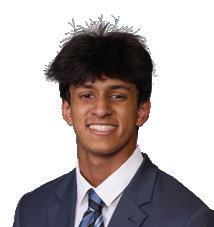
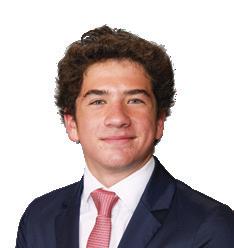
Tony Lu ’27, a devoted captain of the school’s math and Quiz Bowl teams, was recently accepted into MIT’s class of 2030.
Trade schools provide alternative to traditional college
With record high levels of student debt, many are now considering trade schools as a viable alternative to university.
The ReMarker
Seniors win YoungArts awards
Senior photographers Sebastian Gonzalez ’26 and Drew Wallace ’26 recently participated in the prestigious National YoungArts Competition. Both seniors were named winners out of over 12,000 submissions.
By Sebastian Garcia-Toledo
Seniors Drew Wallace and Sebastian Gonzalez were recently named winners in the photography category for the National YoungArts Competition. Their success represents the culmination of months of dedication since the fall of their junior years toward this project, a 10 photograph portfolio centered around a main theme that the photographers developed.
The process to obtain this award be-
PAGE TURNER
gan officially in January of their junior year, but for Wallace and Gonzalez, their planning began before then, attending the senior honors photography class during free periods and brainstorming themes months in advance. The early planning allowed Gonzalez to pass through the rigorous editing process with a bit more ease.
“I had a Notes app page where anything that came into my mind, I would write it down.” Gonzalez said. “I did that all over the fall and winter of junior year. And so I found that for me, I think I was a little more prepared than everybody else. But even then, you submit your original and you have a critique, and then you do another one next week, and you just keep rewriting it as you go along. Because even as you go along and make new images, you’re discovering new aspects of what you originally thought you were going to do.”
The shifting nature of turning the idea in his mind into a photograph was a major part of Wallace’s creative journey. He
“Hamnet ” Recommended by Librarian Teresa
TK: “Hamnet” is super fascinating. It’s set in the Shakespearean time and during the bubonic plague. The book talks about how he turned a huge loss into a great triumph for him. It’s historical fiction, but it’s very, very interesting. Spoiler alert, his son dies of the plague, and he uses that grief to create a play called “Hamlet” which is, of course, one of his most famous works. The author uses the names Hamlet and Hamnet very similarly.
Katsulos
indentified it as the biggest struggle he had on the way to completing his portfolio, along with the task of inserting identifiable meaning into his images.
“I think a lot of it is that it’s really hard to intentionally assign meaning to a piece of art before you make it, rather than just making something, looking at it and trying to think about how that might reflect you afterwards,” Wallace said. “This was the first time I consciously tried to insert meaning, and I think most of it was really learning everything before I started working on that. I think the hardest part was taking that idea that I had in my mind and distilling it into something more tangible.”
Both Gonzalez and Wallace drew from very unique topics to create the main theme for their portfolios. Gonzalez used current issues facing artists, namely AI and its ongoing threat to what it means to be an artist as the throughline for his ten image, two-part portfolio.
See YOUNGARTS, Page 12
TECH WATCH
Benjamin Yi: Grok AI is a generative AI chatbot developed by xAI, the artificial intelligence company founded by Elon Musk. An xAI statement described the chatbot’s responses as “witty” and “rebellious.” While Grok is extremely impressive in its AI video generation and voice model interactions, lawsuits have been filed against the company, primarily for the generation of many non-consensual, sexual deepfakes.
PAGE 13
Educators refine skills through advanced training
Although instructors are tasked with teaching students, they also have a responsibility to learn and grow in their respective fields.
Friday, February 6, 2026 9
Language lab supports students, faculty
By Jay Panta
The Language Lab, tucked away on the second floor of Hoffman, has quietly supported language learning at the school for nearly two decades. Used primarily by the language department for assessments, listening exercises and AP exams, the lab remains a specialized space designed to strengthen students’ speaking and comprehension skills across multiple languages.
Built around 2006, the Language Lab was created to meet a growing need within the department. Language Department Chair and Spanish teacher Zachary Erwin ’96 described how the functionality of the lab provided an added layer of convenience for faculty and students alike.
“(The Language Lab) was built so that we could do listening and recorded speaking activities, and also for testing,” Erwin said. “When I was a student, we had to go to Hockaday to use their lab to record our AP responses,” Erwin said. “It has been very helpful to have a language lab here.”
While the physical space has remained largely unchanged, the technology inside it has evolved. The lab, Erwin explained, originally relied on hardware from a company called Sanako, but that equipment has since aged and is no longer supported.
As a result, the department transitioned to Sanako Connect, an online language teaching platform, to allow for more accessible learning.
“(The Sanako hardware) is old, very expensive to replace, and no longer supported by the company, which is why we moved to the Sanako Connect, a webbased platform,” Erwin said. “We can still use it inside the lab itself, but students can also use it at home or in the regular classrooms.”
Gene and Alice Oltrogge Master Teaching Chair and Chinese Teacher Janet Lin said the lab continues to play a crucial role in her classes. Lin believes the lab is especially valuable for maintaining academic integrity during assessments.
“I use (the Language Lab) because of the equipment, the listening and speaking parts, because I can record right away, and then there’s the app, I can just lock your internet,” Lin said. “So (there’s) less worry about (students committing academic dishonesty).”
Despite its usefulness, Lin emphasizes that the aging technology and logistical challenges surrounding maintenance make the lab’s future uncertain.
“But again, the equipment there is pretty old: hardware, software, both are old,” Lin said. “And how we can keep it and maintain it, regarding the budget and manpower and IT, it’s beyond my control.”
As the equipment grows older and older, students and teachers hope that the lab will soon be remodeled and its equipment — headphones, keyboards and desktops — updated. For now, the Language Lab remains a dedicated space for language instruction and testing, with no immediate plans for removal.
“Since the Language Lab was installed when the Hoffman Center was built, it’s been the lab,” Erwin said. “Our plan for now is to keep it as the lab.”
Photo Courtesy Sebastian Gonzalez
Gonzalez’s YoungArts portfolio explores the role of the artist in a world where AI is rapidly developing.
Grok AI RELEASED
Clubs focus on discussion over division
Discussion-based clubs and groups on campus serve as outlets for students to engage in structured civil discourse.
By Rishik Kapoor
Across the U.S., schools are transforming into microcosms of a nation defined by deepening political and sectional division. As partisan ideals disperse nationwide, political clubs such as Club America and the rival group Dream for America represent the national movements that have rapidly expanded onto high school campuses.
At the school, however, political and social engagement takes a noticeably different form. Rather than affiliating with partisan groups, students are encouraged to participate in discussion-based clubs or groups that don’t focus on differences. These spaces are intentionally structured to foster open discussion and critical thinking without advancing a political agenda or sowing discord in the school community.
This emphasis on constructive dialogue is clearly reflected in clubs such as the Political Forum Club, a club in which students debate each other on current events and their implications through open, cordial discussion.
“Political forum is great because it provides an opportunity for students and faculty to openly voice their opinions without being afraid of backlash,” junior Azim Moosa said. “It’s a chance to share what you think while also learning from people with different viewpoints, and I think that open discussion is central to learning.”
Moosa emphasized that this openness is not just about sharing opinions, but also about how disagreement is handled within the community. Political Forum allows students to engage honestly with differing perspectives while maintaining mutual respect, an approach that encourages viewpoint diversity and strengthens the community.
“We aren’t afraid of disagreement. This open conversation is great for the band of brothers that is the school’s community because even if individuals have conflicting viewpoints on certain topics, we can accept our differences, and that isn’t something you see in partisan areas,” Moosa said. “We grow together, despite our differences, because we aren’t afraid to share our opinions. That is something that is unique to the school.”
We are all responsible for creating a sense of belonging for every boy and every adult on campus.
John Ashton Associate Headmaster
At the core of the school’s encouragement of conversation and its decision to avoid partisan or selective clubs is its mission of fostering a strong sense of community and brotherhood among its diverse group of students.
“The mission driven commitment that we have at the school informs the decision about activism, but it also informs the decision about affinity groups too, because our commitment is to the community,” Associate Headmaster John Ashton said. “If there’s an issue impacting one of us or a handful of us, it’s impacting all of us, and we all need to be around the table together.”
Ashton emphasized that this philosophy of “no affinity groups” places responsibility for belonging on the entire community rather than on specific individuals. In his view, fostering inclusion is a shared obligation of everyone on campus, not just small subsets of students.
“We are all responsible for creating a sense of belonging for every boy and every adult on campus,” Ashton said. “As a school, our commitment is to everyone on this campus and the school’s community as a whole. Everything we do is guided by strengthening that sense of community and belonging.”
The school recognizes the fact that affinity groups can be beneficial for other schools in fostering belonging. However, the school views affinity groups as a way for divisions to rise among students
that detract from the school community.
“Some schools believe affinity groups help strengthen community, and that can work in their context,” Ashton said. “For us, over decades, we’ve placed priority on the collective and everyone’s sense of well-being. Our approach has always emphasized community-wide responsibility rather than institutionalized subgroups.”
This emphasis on unity does not mean ignoring difference, but rather recognizing it within a shared institutional framework in places like clubs and Chapel. The school’s approach to religion as an example of how diversity is acknowledged without any forms of division.
“We’re a non-sectarian school, but all faiths are acknowledged, celebrated and taught about. That strengthens us as a community,” Ashton said. “We all find people with similar interests. We might gravitate, on our own, to guys who share things with us, where there’s hobbies and interests to identity, to background, to religion. Institutionally, however, our commitment is to everyone on this campus. We’re about the idea of us.”
This goal of acknowledging differences among students in the community led to the formation of the Inclusion and Diversity Leadership Council (IDLC), a student leadership body designed to promote belonging across the entire campus. Rather than organizing students into affinity groups, the
IDLC provides a forum for diverse perspectives to be represented.
“About six years ago, before IDLC existed, we sat with a group of mostly seniors and juniors and asked a mission-oriented question: What kind of leadership structure could strengthen belonging for everyone?” Ashton said. “IDLC was born from that conversation. Today, it is hugely impactful and reflects the full diversity of our community.”
Even with structures like the IDLC in place, students sometimes suggest creating affinity groups. Ashton believes these moments are great opportunities to guide the conversation and students towards helping achieve the school’s broader mission of community-wide inclusion.
“Students would ask about starting affinity groups from time to time. We would redirect them and ask, ‘Well, what are you trying to achieve?’” Ashton said. “‘How could we achieve that in another way that aligns with our mission, versus doing something that’s not consistent with our approach with regard to community building?’”
The school’s emphasis on collective responsibility shapes its ultimate goal of preparing students for manhood and being a providing member of society.
“Community over individual,” Ashton said. “As an individual, I have to think about how I steward so that everyone feels belonged and I make the world around me a more inclusive and better place.”
Musicians participate in all-state, all-region competitions
By Lucas Pei
Months of practice finally paid off after several students in the Upper School Band and Orchestra earned top rankings at the Texas Private School Music Educators Assocation’s (TPSMEA) All-State and All-Region Competitions, where private school music students auditioned for a limited number of spots in their acclaimed ensembles.
There are two bands in the Upper School: the concert band and the jazz band. Sophomore Jordan
Envani made All-State Jazz, junior Mihir Tare and senior Eric Zhang made All-State Concert and senior Oliver Geheb and freshman Cyrus Saberan made All-Region.
“For jazz band, there are three set pieces that (applicants) work on as a group,” band director Analisa Bergeron said.“For concert band, it is similar to orchestra. There are two sets of etudes, a lyrical one and a fast one.”
Students in both band and orchestra were given the audition music months in advance. They practiced their music individually at home for months, recorded
them and then submitted their recordings to their respective levels. The directors also hired other teachers for private lessons.
“The auditions are easier than public school because there are fewer people, but you still have to practice a lot and put in daily effort,” sophomore Larry Fan, who made second chair viola at AllState orchestra, said. “You have to be locked in from the start, right from when they first give you the (audition music).”
Those who make All-State and All-Region are assigned rankings based on chair placement, with
first chair being the highest. They are then given music to practice for concerts in late January and late February.
“The music is different for AllState and All-Region. Each group picks different concert pieces depending on the conductor,” Bergeron said.
During the days prior to the concert, students are busy preparing, rehearsing with their ensembles.
“For State concert band, they first do chair testing. Then they rehearse all day Thursday and all day Friday, with a performance
on Saturday,” Bergeron said. “For All-Region, it’s a rehearsal after school on Friday, then a quick rehearsal on Saturday, followed immediately by the performance.” For Fan, the All-State experience is more than just playing music.
“It’s great to come with a big group from a small private school and play alongside other students from similar schools,” Fan said. “Seeing friends, having a great time and enjoying playing music together is the best.”
Photo by Winston Lin
Organizations and clubs on campus like Political Forum allow students to discuss controversial topics in a constructive manner.
Junior receives admission to MIT
Junior Tony Lu was accepted into the Massachusetts Institute of Technology’s Class of 2030 after applying in the early action round in the fall of last year.
By Christopher Huang and Dominic Liaw
On Dec. 16, 2025, just before winter break was about to begin, Tony Lu got an update to his early action admission status.
He had been accepted into the Massachusetts Institute of Technology Class of 2030.
As a junior in high school.
Out of 11,883 applicants, Lu had made it into the small group of 655 students admitted in the early action round, with around a 5.5 percent acceptance rate.
Being admitted into one of the most prestigious universities in the world is already rare, but doing so a year early as a junior is an extraordinary feat and a first for a St. Mark’s student.
If you had asked Lu in August what his plans for college were, applying to the Massachusetts Institute of Technology (MIT) wouldn’t have even come to mind. Now, Lu considers countless options for the years ahead.
When Lu stepped onto the St. Mark’s campus in 2019 for his first day of school, he was a fifth grader new to both the school and the country. His yearslong journey that culminated in him being admitted to MIT as a junior has been one of talent, hard work and a lot of math. One of the teachers who saw this journey firsthand and even helped Lu in the process was Thomas B. Walker III ’73 Mathematics Department Chair Shane May.
“Teaching honors (math) courses, I get hundreds of guys that are incredibly gifted and talented,” May said. “But Tony, he’s a one of a kind, a really special talent.”
In his third year on the job, May helped place Lu, only in seventh grade at the time, on an accelerated track to advance through the math curriculum faster.
“The stuff he was doing was just clearly well beyond his years as a seventh grader, so I remember that moment after we got him on a path to fast-forward through some classes,” May said.
Four years later, in the fall of 2025, May was writing Lu a recommendation letter to get him into MIT a year early as a junior. As his teacher in the ninth grade for AP calculus BC and having previously written letters for Lu for competitive summer programs, May was well-equipped to handle the task.
“I just tried to share in my letters that yes, he’s a great student (and) a great person,” May said. “But 90 percent of the people that apply at MIT are probably great students and great people (too), but he’s really special in other ways.”
Though Lu had only come up with the idea to apply to MIT as a junior this fall, the groundwork for this decision had been set through his various mathematical accomplishments and other meaningful interactions that would eventually influence him into making the decision.
In fact, more than 12 months before being admitted in mid December, Lu had already visited the campus. With a curiosity and passion for STEM subjects, Lu joined top math enthusiasts and science whizzes across the country in the MIT PRIMES program — a program that May had written Lu a recommendation letter for.
“I went to that program as a sophomore,” Lu said. “And there’s a very strong precedent for students at that program to apply early (to MIT), and there’s a lot of support from mentors and other members
of that community.”
The renowned program was not his only motivator, however. By joining another community and culture of academically driven students at a different math camp, Lu felt challenged and uncomfortable. That was where the idea first popped up in his mind.
This is the place that really inspires me to believe –makes me want to become better and pushes me and makes me uncomfortable. And that’s always where I try to go.
Tony Lu Junior
“It was a camp I went to for several years, so I knew people well, and I think they really got that idea in my head,” Lu said.“If you feel like
you’re mentally, academically and emotionally prepared, it’s actually a great experience for some people.”
While applying as a junior is rare, it doesn’t have any negative implications for an application in senior year. With that in mind, Lu thought he might as well apply and see what happened. And throughout that process, Lu was supported not only by mentors and current MIT students but also by his parents.
“They weren’t really pushing me around, really wanting me to do it, but it was more like, ‘This is a thing out there,’” Lu said. “I think they were along the process to be as supportive as they can possibly be.”
However, Lu wasn’t always fixated on MIT, as he had considered many possible options for his future. But he did appreciate many things about the university and factors such as MIT’s beautiful environment next to the Charles River and the culture at MIT.
“I’ve never really been super decided on MIT,” Lu said. “It wasn’t that it was the one place I want to go. But I think it’s a place that fits me just as well as it could possibly fit
me. And in terms of the (St. Mark’s alumni) from high school (now attending MIT), these are people I’d love to hang out with.”
As a prestigious university, MIT offered many possibilities that drew Lu in, especially when it came to science and mathematics, Tony’s specialty.
“Their openness to research and openness to offering everyone the opportunity to do basically anything instead of being more hierarchical is something that I think I really would strive in,” Lu said.
Lu didn’t apply as a junior to just “streamline” the college process or relieve stress senior year. Ever since joining the school in fifth grade, Lu has been chasing a challenge. For him, MIT is just the next step.
“This is the place that really inspires me to believe – makes me want to become better and pushes me and makes me uncomfortable,” Lu said. “And that’s always where I try to go.”
Lu also pointed to former students who now attend MIT, like valedictorian Surya Dinesh ‘25, among others, who helped him decide to apply to MIT. The opportunity to spend more time with the upperclassmen who inspired him when he was younger by attending a year early was especially enticing.
“They’ve been really the core of why I want to do this,” Lu said. “It’s like, ‘I want to hang out with you guys.’”
Lu ties classmates in his class to core memories and connections during his experience in high school. He thanks his “irreplaceable friends” for everything from self-realization to learning how to study. But a new chapter of his life is fast approaching, with different people and experiences.
“I’ve sort of internally and personally moved on to this next step of ‘How am I going to play the bigger role? How am I going to focus on impact?’” Lu said. “Those things that are characteristic of college will then take center stage. Those people will be so important for me in that process.”
The decision to possibly leave the school early isn’t easy, however. Lu takes a deep interest in high school hobbies such as Quiz Bowl. Or in his brainchild, the Chamber Music Club that he started in his freshman year. Overall, Lu hopes to leave a lasting impact on the activities he was part of.
Lu may stay for his senior year, studying physics and chemistry. He may leave to join MIT’s Class of 2030. Regardless, he’s ready for the next couple of years ahead.
“I’m very willing to just kind of throw the dice, like, ‘This is the unknown, and we’re going to figure it out when we get there,’” Lu said. “And I think that kind of philosophy is something people have abandoned for a long time.”
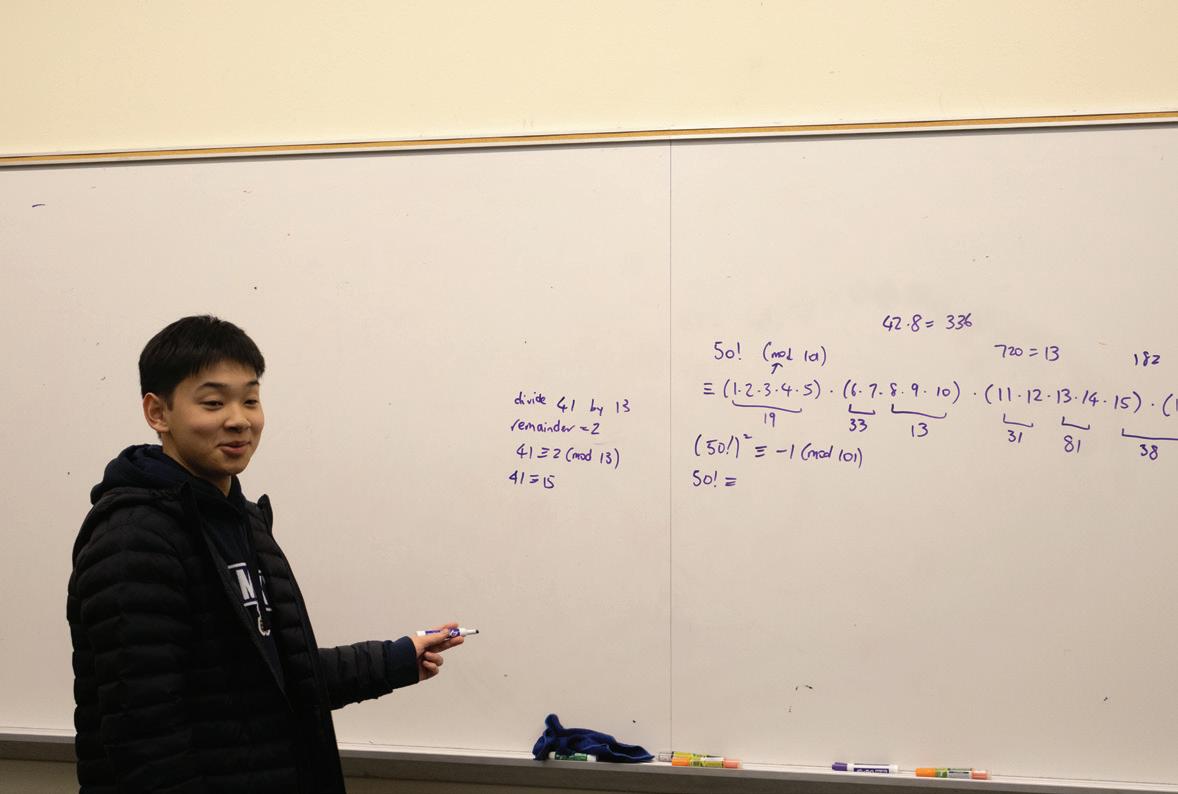
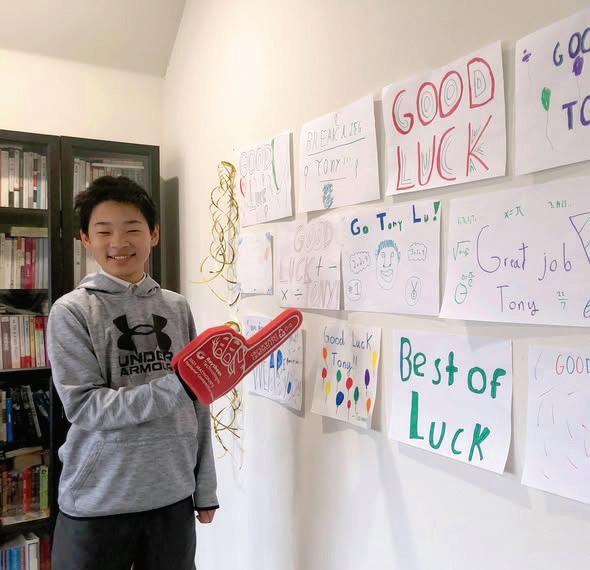
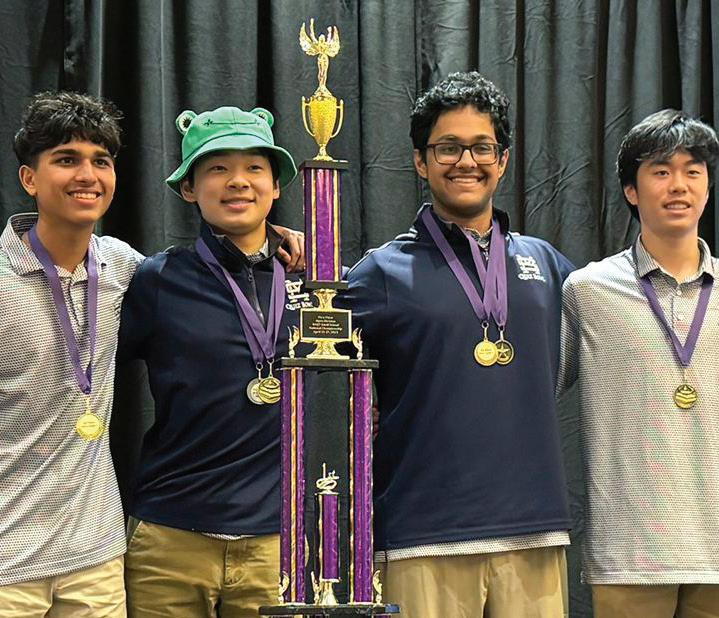
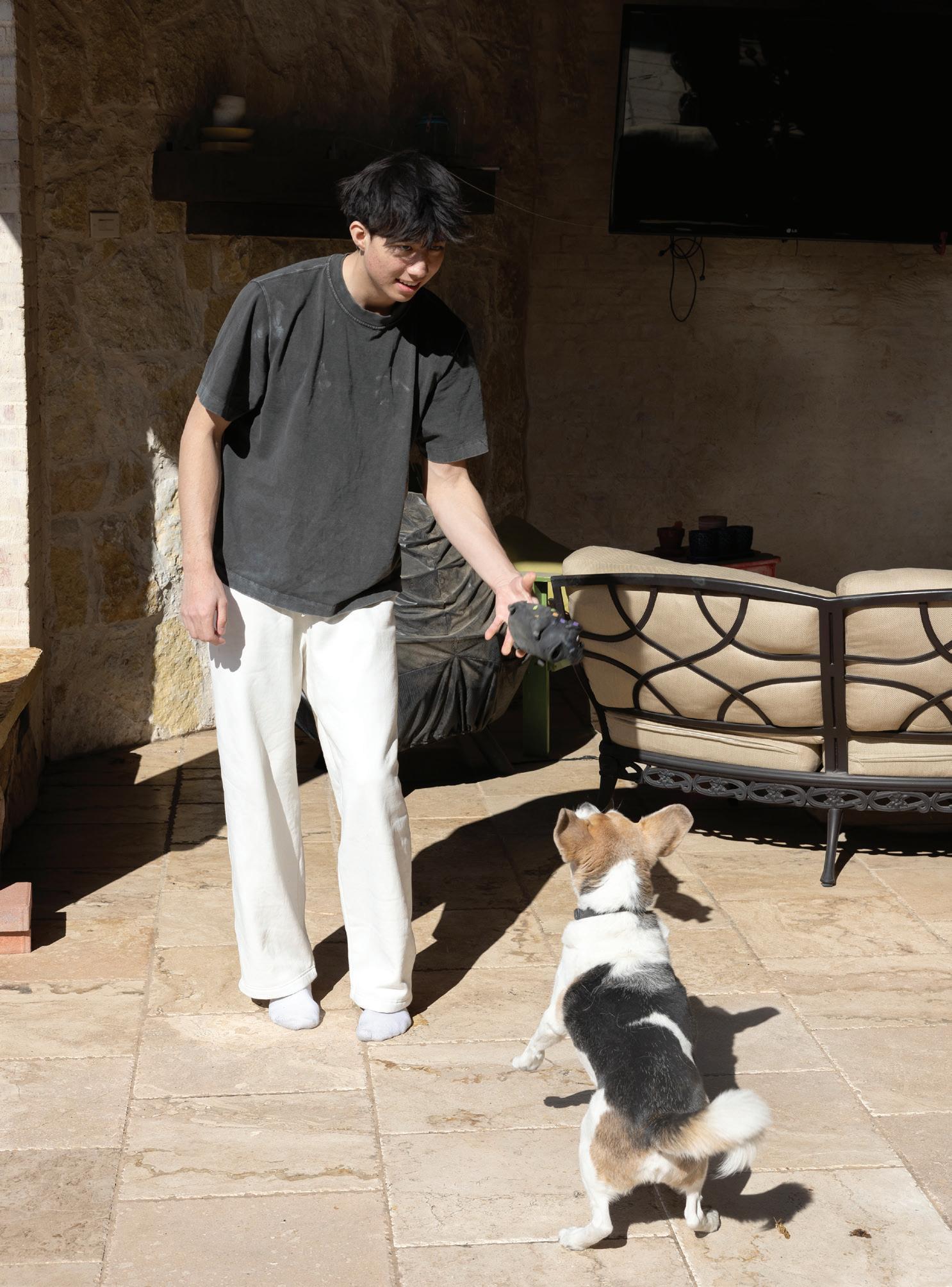
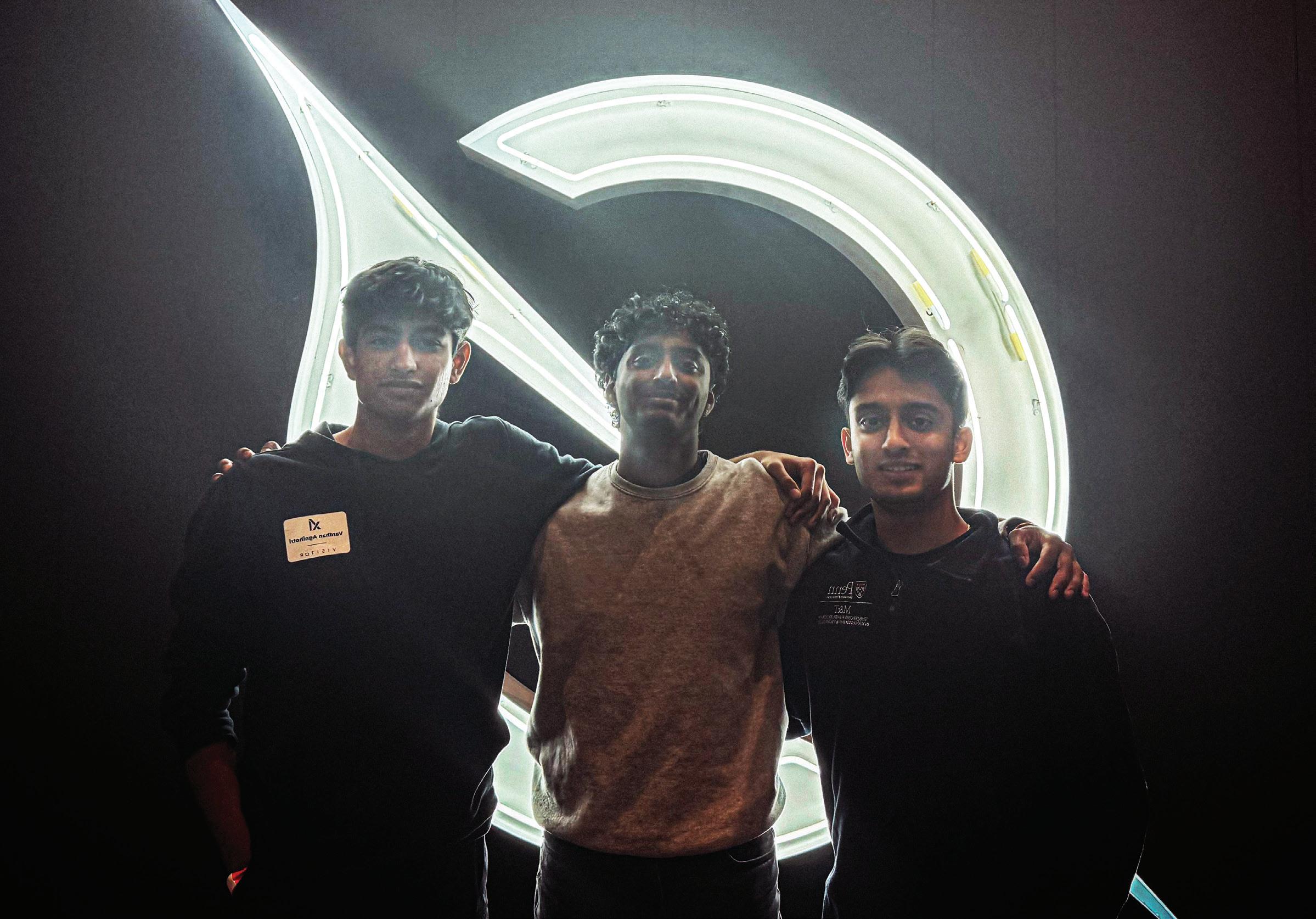
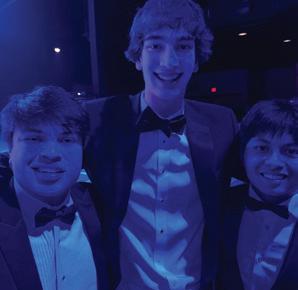
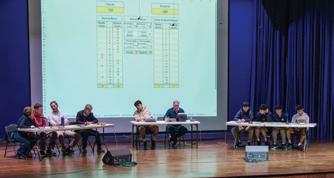
Lu takes the advanced topics course, the most advanced class in the mathematics curriculum, for a second time (Left). Lu points to drawings of support for his participation in the 2021 virtual MATHCOUNTS competition (Middle). Lu stands with his team after winning the 2025 Quiz Bowl Small School National Championship (Right).
Photos Courtesy Development Office and Shiv Bhandari
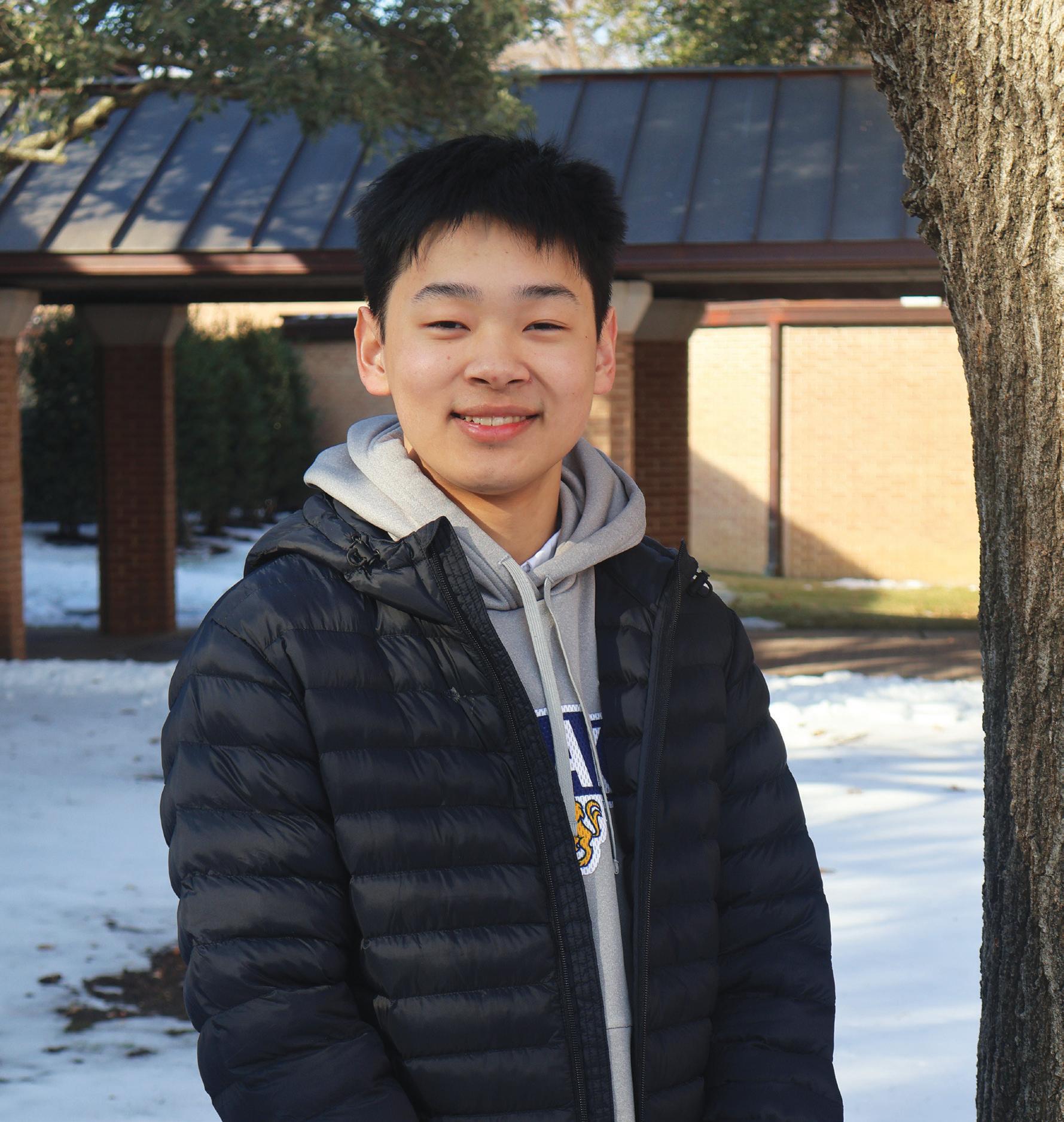
Photo by Christopher Huang
The 2025-26 school year marks Lu’s seventh year at St. Mark’s after joining the school in the fifth grade.
Trade schools offer job security without debt
Although society tends to regard four-year universities as the gold standard for higher education, many now see vocational school as a route to high-paying jobs in the trades.
By Christopher Huang and Michael Chang
On average, current college students face more than $35,000 in student debt after graduation, according to the Education Data Initiative.
That number only continues to grow.
In 2025, according to the Bureau of Labor Statistics, roughly 42 percent of college graduates were considered underemployed, working jobs that didn’t require a college degree. These individuals consistently experience higher unemployment rates than the national average.
And so in today’s economic climate, it’s not surprising that many are opting instead for trade schools that offer an immediate pathway to six-figure jobs without crippling debt.
Vocational schools, commonly known as trade or technical schools, are mostly post-secondary and sometimes secondary educational institutions that provide technical skills focused on a specific profession, and students usually take two years or less to complete their education. In many countries around the world, vocational school is a very common option, but in the U.S., four-year universities have been the dominant choice for higher education.
Historically, going to trade school and pursuing a trade has been seen as a less desirable option than going to university and gaining a bachelor’s degree or higher because the blue-collar jobs that tradespeople work in are seen as more labor intensive and less lucrative than the typical white-collar job.
“What we need to do is to encourage people to study things that are appropriate for them, and there shouldn’t be any kind of social stigma attached to it, which there is currently,” History and Social Sciences Department Chair David Fisher said. “If you have just an ‘AA degree’ and it’s in plumbing or HVAC maintenance and so forth, culturally, that’s not seen as achievement oriented as getting a bachelor’s degree.”
Malcolm K. and Minda Brachman Master Teaching Chair Mar-
tin Stegemoeller echoed this belief, recalling the stigma behind trade schools during his high school years.
“There was a sense that trade schools were unfair,” Stegemoeller said. “That you’re sending kids into ‘dead end jobs’ and not giving them the luxury of the sky. So a lot of trade schools were erased, shop programs in high schools were cut and the idea was that everybody’s supposed to go to a normal college. I don’t think that served people well.”
The true student still needs a great four-year college to learn their science, to learn their math and to learn how the world works. If you’re self-motivated to learn, and you’re going to a good college, you can just tear it up. It just seems fewer and fewer kids are actually in that category.
Martin Stegemoeller
Malcolm K. and Minda Brachman Master Teaching Chair
Even with lingering cultural sentiments, the attitude toward
trade jobs and trade schools is changing. Wages are climbing as the supply of workers continues to decrease, and the idea of blue-collar jobs being “dirty” has diminished as technology has made even the most labor-intensive jobs more technical. As people begin to question the value of a four-year university education that saddles students with mountains of debt with no guarantee of a stable job, the two-year trade school option with a quick pathway to a decently-paying job is looking more and more appealing.
“There’s also been a lot of chatter in the press and in the media about how ‘useless’ university education is,” Fisher said. “And on one level, it’s true that university education is in many ways inefficient.”
Although individuals attending trade schools miss out on the social aspect of university life — an aspect that many college students value greatly — at the end of the day, Stegemoeller believes that the majority of students do not benefit intellectually from going to a traditional four-year school.
“I would say that, in my opinion, for whatever it’s worth, the average kid going to college leaves college worse than when they entered,” Stegemoeller. “The professors care so little. There’s no coherence to the curriculum, and it’s so easy to game the system to get a good grade without learning anything.”
However, Fisher notes that pursuing a university education is still never a bad idea for those who can afford it, and it remains the most fitting option for most people, even if trade schools provide a good alternative for some.
“If you go to university, you will get a salary bump,” Fisher said. “It is worth it 99 times out of 100 to go to university and to get an advanced degree. Now, does that mean that we shouldn’t be encouraging more people to pursue trade school or pursue routes in tertiary education that aren’t necessarily academic? No.”
Ultimately, it’s the students’ responsibility to ensure that they make the most of their four-year education — and the unfortunate reality is that many college students simply aren’t motivated to study.
“The true student still needs a great four-year college to learn their science, to learn math and to learn how the world works,” Stegemoeller said. “If you’re self-motivated to learn, and you’re going to a good college, you can just tear it up. And that’s still possible today. It just seems fewer and fewer kids are actually in that category.”
As an economics teacher, Fisher also believes that from an economic standpoint, there should be more people pursuing trade schools and working in the trades to help the economy function at its best.
“Anything that improves your
Photographers explore identity through portfolios
PHOTOGRAPHERS, from Page 9
“I don’t think it’s unusual for AI to be something that an artist is worried about.” Gonzalez said.
“The hard part really was figuring out how to convey ideas that are pretty complex through individual images.”
To achieve this goal, Gonzalez expanded his boundaries, going past the content taught at the school and instead looking at more abstract, mixed media projects
that other students and previous winners had submitted in an attempt to find a way to communicate his thoughts.
“And in the end, what I have in the final portfolio is that I split it half and half,” Gonzalez said. “The first five are more abstract explorations of concepts related to the issue of AI and art, and a lot of them involved using Photoshop to do surreal things. And then the second five are experiments that I did (with AI) and then I laid out the results and the showing of those experiments on physical paper.”
Wallace’s project leaned much more into the personal side, depicting how one singular event in his life was able to seep into so many later aspects.
“The point of the portfolio was an exercise in introspection, and it was both a way of trying to portray how my mind works and my patterns of thought, and also a personal exploration of that to try to better understand it myself.”
Wallace said. “I had a concussion in seventh grade, and after that I was going to a psychiatrist and therapy. I’m still in therapy, I’ve been work-
productivity is good for you and good for the country as a whole, and if we can make access to education or training that allows people to increase their productivity in a manner that is as efficient as possible, that’s a good thing,” Fisher said. “So all else being equal, I would rather see people go into tertiary education and find a way to improve their productivity in areas where they’re likely to get a job.”
Another incentive for pursuing the trades in today’s world is the threat of artificial intelligence to white-collar jobs. In general, skilled blue-collar jobs seem to be much more secure.
As trade schools face a future where they stand to become more and more popular, Fisher hopes that the stigma around blue-collar jobs will decrease and that options will open up more for high school students to pursue vocational education in high school, where it is currently limited.
“If the incentives are very clear that getting a plumbing certification is going to ensure that you have a job, then eventually, even with the cultural stigma, you’re going to get more and more people who will do that,” Fisher said. “If we’re reforming education, let’s try to remove some of that cultural stigma. And also, let’s give people the opportunity to start studying those things as early as high school.”
Other than the general criticisms of ostensibly lower pay and increased labor intensity after graduating, one possible downside of trade school education is that it is very focused on a singular profession, allowing for less flexibility and causing some inconvenience if a student changes their mind. On the other hand, university degrees allow for a wider range of possibilities, and knowledge can be gained through job experience.
“See, the issue is (when) you get a bachelor’s degree, you’re getting a general education that allows you to be flexible, and you get the training once you’re on the job,” Fisher said. “But if, for some reason, that job should disappear or change dramatically, you might not have the academic background to be able to train yourself or to think about what you need to do to be able to adapt.”
Both Fisher and Stegemoeller believe that trade schools deserve a spot in the education system — the only real question is how much the government or society should support them.
“Are economists for or against technical education? I think every economist is going to say yes,” Fisher said. “The issue is if we are going to pay for it as a society.”
ing on that. I guess there was probably some underlying stuff that I think (the concussion) worsened.”
The effects of this severe concussion would later echo into Wallace’s high school experience, essentially framing how he went about his day-to-day life. It was especially important for him to find a functional medium to show the pervasiveness of the injury.
“A lot of stuff was going on, but it feels like that formed my framework of viewing the world,” Wallace said. “The way I tried to depict it with my photos was through the
primary visual metaphor that I used, which was this idea of noise and not being able to filter out what thoughts are important.”
Gonzalez and Wallace’s photo achievements are crowning points of the school’s photography department and show the clear progression pipeline within the program. Their impressive feats underscore both their individual dedication and stand as testament to their growth as photographers.
Photo Courtesy Creative Commons
Trade school graduates typically work specialized jobs as electricians, plumbers or HVAC technicians.
Teachers pursue professional development
The school actively supports teachers by providing professional development opportunities and workshops.
By Michael Chang and Jay Panta
There’s a trope that’s thrown around when you get older: that it’s too late to learn as an adult, that intelligence is fixed past a superficial age barrier and that new knowledge is somehow reserved for younger people.
But “lifelong learners” don’t see education this way — and the school, too, through its professional development programs, aims to inspire teachers not only to continue their education to advance their own careers but also to strengthen the learning environment for students.
For many faculty members, that support makes pursuing advanced degrees, such as a master’s degree or a PhD, both feasible and worthwhile. The school provides financial assistance for graduate programs that align with a teacher’s role at the school, reinforcing the idea that investing in educators ultimately benefits the entire community.
Associate Headmaster John Ashton, who, along with several other individuals, handles the professional development program, noted that the institution backs pursuits that fall into three major categories: guest speakers, faculty-identified pursuits and graduate school. Of course, each decision regarding professional development is governed by the belief that teachers, in addition to students, should continuously seek knowledge and skills for growth.
“At St. Mark’s, we’re fortunate we have resources available to fund summer professional development,” Ashton said. “The goal is to fund them to as high a degree as we’re able to. We also try to keep it sort of somewhat consistent, so we may have over 30 professional development pursuits in the summer.”
This institutional backing played a key role for Associate Director of College Counseling Josh Shandera, who recently earned his master’s degree while working full time at the school. His decision to return to school was one he had considered for years, especially given the nontraditional pathway into
his profession.
“I had thought about graduate school for a long time. I have a degree in biology, and there’s no preferred route to becoming a college counselor,” Shandera said. “The program I was looking at was very flexible. So all of those pieces fit together, and I decided to go for it.”
Shandera ultimately pursued a master’s program in educational leadership, a field closely tied to his work with students and families navigating the college process. He explained that the school’s financial support was contingent on the program’s relevance, ensuring that professional development aligned with faculty responsibilities.
Director of Inclusion and Diversity Lorre Allen has had a similar experience with professional development through her ongoing journey of obtaining a Doctorate of Business Administration (DBA).
Like Shandera, Allen remarked that she had set aside earning her DBA as a long-term, overarching goal.
“Getting my doctorate degree has been on my list of goals to accomplish,” Allen said, “I think I made the decision a couple of years in, working with students; I wanted to be my best that I could be for the St. Mark’s students that I work with. And to be honest, there’s some inspiration to continue to learn that came from being in a place like this.”
(The school) is really generous in professional development. They know that it’s important to the faculty. And benefitting the faculty, in turn, benefits the school, the community and the students.
Josh Shandera
Associate
Director of College Counseling
Beyond coursework, Shandera said graduate school offered a broader perspective on how educational institutions operate, giving him insight into leadership and decision-making at the administrative level.
“I was tasked as part of my program with getting some additional insight into school leadership, man-
agement and operations, so I was interviewing various faculty members, the CFO, directors and department chairs just to understand a little bit more about the school and how things functioned and operated here,” Shandera said. “I was given a lot of opportunity and access to get a little peek behind the curtain and understand more about the actual institution and how it’s managed.”
Balancing graduate studies with a full-time job, however, proved challenging. Shandera often found that the workload required careful time management and adjustment.
“It was harder for a year,” Shandera said. “I mean, it’s a lot to balance as far as going back to school, having to do homework, doing papers and group projects, scheduling Zoom meetings and readings and also getting my own work in some field.”
Although Allen never found juggling school and work too stressful, she believes that her colleagues’ backing played a critical role in encouraging her to persevere through her studies. The process was like a marathon, grueling, demanding — but with community support sprinkled throughout.
“I have my colleagues, my friends that are on my side of my life who are like: ‘keep going, keep going,’” Allen said.
And now in her mind, she is almost there. The finish line — the
Faculty debate pros, cons of annotations
By Nolan Driesse
For many years, there has been a debate about whether annotating books in schools should be continued or not. Teachers have discussed how they should make sure students read the material without taking away from the experience of reading in the process.
When philosophy and English teacher Martin Stegemoeller initially discussed this matter with his department, he thought copious marginalia would die as a whole.
“I had thought it was going in that direction, and then the depart-
ment doubled down,” Stegemoeller said. “Instead, they tried to make it impossible for students to just fill in annotations to meet the assignment requirements.”
However, the department didn’t take this as a sign that there was a huge problem with the amount of annotations assigned. Instead, they tried to fix it. Classes in the English department sometimes focus on preparing its students to become English teachers, which may cause reading to be a bit less enjoyable in the process.
“Our department is hamstrung between two goals,” Stegemoeller
said. “One is preparing you to be an English teacher and the other is to get you to read carefully and enjoy reading.”
While Stegemoeller may not think annotations are the best tool for all students, he believes they have some merit and can help one analyze the text more effectively. But on the other hand, he doesn’t annotate books he reads for fun.
“Learning close reading helps you read better. That’s my pro side,” Stegemoeller said. “My con side is that I don’t know of a single human being who annotates this way when they generally read a novel.”
month of May and the graduation stage — is nearing. The prize — two coveted letters in front of her name — shines ever so bright. But Allen remains thankful to everyone who has accompanied her along her multi-year run.
“It’s the motivational support that has been absolutely amazing,” Allen said.“The school has been absolutely amazing in supporting me, to the point where I could bounce questions off of colleagues.”
Despite the demands, Shandera emphasizes the broader value of professional development, both for individual educators and for the school as a whole.
“Professional development, to me, is a matter of continuing education, staying up with trends and learning more,” Shandera said. “(The school) is really generous in professional development; they know that it’s important to the faculty. And benefiting faculty, in turn, benefits the school, the community and the students.”
Allen echoed this sentiment, adding that she views lifelong learning as a means to strengthen both herself and the school.
“I consider myself a lifelong learner,” Allen said. “I thought I was strong before, but I guess I’m just a little bit more. Don’t let fear stop you (from) accomplishing your goals.”
BY THE NUMBERS
At the start of the 2025-2026 school year, the school had the following statistics for its faculty:
97
FULL-TIME TEACHERS
64
MASTER’S DEGREES
15
DOCTORATE DEGREES
While there is a disagreement on annotations in general, Stegemoeller believes that the problem isn’t with the overarching task of annotating, but with how it is done. Instead of assigning an excessive amount of annotations to students, it could be better to underline important sentences, star new words or highlight for tone.
“A lot of people, in academics, have their own annotating methods,” Stegemoeller said. “ ‘What was that great line from earlier — ‘Oh there it is because I marked it.’ ‘Ooh interesting word, I’m going to star that so I can remember it.’ It makes
total sense.”
This debate has gone on for ages, and probably will for longer. Annotations may feel like a waste of time or just a way to check a box for a homework assignment, but it is one of the only ways teachers can make sure a student at least read the book in the first place.
“If you teach somebody a skill and they stop doing it as soon as they’re not graded on that very skill, that’s a sign that the skill is misguided.” Stegemoeller concluded.
Photo by Michael Chang
Director of Inclusion and Diversity Lorre Allen will receive her doctorate this May.
LPAGE 18
Coping strategies for stressful times
The Wellness Office has suggestions to help students stay healthy and engaged amid a new semester. PAGE 19
Alumus pursues untraditional path
After winning a hackathon, Vardhan Agnihotri ’24 is leaving college to pursue a job with xAI.
Families sacrifice free time to connect
Whether eating a traditional dinner at the table or not, families still find ways to connect meaningfully with one another.
By Kiran Parikh and Lucas Pei
The kitchen clock reads 4:50 p.m. when junior Dylan Bosita cracks three eggs into a pan, sunny side up. The sizzle of frying cuts through the afternoon quiet. His backpack sits abandoned on the kitchen table, still stuffed with unfinished math homework and an essay he hasn’t yet started.
Those can wait.
His mom draws up her special chair to the kitchen island and asks about his day. His little brother, Brennan, joins them. For the next half hour, the Bosita kitchen becomes what it becomes every weekday afternoon: not quite a break, but something that the family has learned they need.
“It’s just a great way to decompress after school before we start homework and just dive into studying,” Dylan said.
The Bosita family doesn’t do traditional family dinners but none of them feel like they’re missing anything.
The question isn’t whether families need time together. It’s when and where that time occurs—if a kitchen counter after school ends can do the same essential work as a dinner table at 6 p.m..
For the Erick family, the answer has always been yes, the table matters.
Three nights a week, around 7, the Ericks sit down together for dinner. No phones. No TV unless they’re ordering takeout. Just 10 to 15 minutes of everyone sitting at the same place, talking.
“You got to have that kind of pause in the day,” Casey Erick, father of sophomore Henry and sixth-grader Arthur said. “You have got to have that time away from your phone, work, TV and all those things because otherwise we’re all just going to end up diving into our devices and kind of ignoring each other.”
The routine is simple but deliberate. They use Blue Apron, a meal delivery service that sends pre-portioned ingredients, so that dinner doesn’t require a grocery store run. When the food is ready, Mr. Erick announces it.
Sometimes he yells loud enough for the whole house to hear. Sometimes he uses Alexa to broadcast upstairs. Sometimes, he has to text Henry to come down to dinner from his room.
The irony of the situation isn’t missed on Mr. Erick — texting someone in the same house — but it gets everyone to the table. Once they’re sitting, the conversation flows easily.
School stuff. Weekend plans. Jokes — mostly about each other— but also conversation about sports, summer programs and things they’re studying too—nothing scripted, just the rhythm of a family checking in.
The meals themselves rarely last longer than 15 minutes. But for the Ericks, that brief window has been non-negotiable since their sons were young.
“I think it’s a good idea for every family to do that,” Mr. Erick said. “I think you lose something as a family if you (don’t).”
That instinct — that something vital happens when families sit down together — is backed by decades of research on child development.
Dr. George Holden, professor emeritus of psychology at Southern Methodist University, argues that family dinners are more important now than ever, especially as teenagers navigate academic pressure and the mental health impacts of social media.
“It’s the best vehicle for open communication around the enjoyable task of eating,” Holden said.
For Holden, mealtime allows conversation to unfold naturally. In his own family, his daughter uses dinner with her two young children to ask about “roses and thorns” — one good thing and one difficult thing from the day. It’s a simple ritual that opens up honest conversation and reveals what’s really going on in their lives.
“That open communication is fundamental for healthy family relations,” Holden said. “Parents are fundamental for helping children navigate through the challenges of growing up, which are ever more difficult with social media.”
PAGE 20
Students, faculty show off baking, cooking skills
Junior Tex Davison and History Teacher Michele Santosuosso have both dedicated themselves to refining their culinary craft.
Friday, February 6, 2026
The cost of a car accident
By Kiran Parikh
My dad always tells me that part of growing up and being a teen is learning to be independent and pulling away from our parents.
When I got my car last year, it felt like a rite of passage: no more rushing to be ready by 7:15 a.m., no more waiting after school, no more coordinating rides just to exist off campus.
Of course, that independence came with responsibilities. I became the default chauffeur for my sister, the goto for takeout runs, and the person sent out for last-minute groceries. But those errands felt like proof that I was trusted, not burdened. When my mom would text me to pick up milk or get a couple things for dinner on my way home from practice, it wasn’t an inconvenience — it was confirmation that I had finally crossed some invisible line into semi-adulthood.
My independence didn’t feel dramatic, it felt ordinary. That’s what made losing it so jarring.
During Christmas break, I was driving to pick up dinner from Mike’s Chicken. It was your average food run, one that I had probably done a dozen times before. Only this time, I never made it there.
I was T-boned in the intersection between Hillcrest Avenue and Royal Lane. I’ll never forget the sound of the metal crumpling, the airbags exploding or the way my body lurched sideways. There was nothing I could’ve done differently — I had the green and had been rolling through the intersection.
After crawling out of my front passenger door, I was helped to my feet by a couple bystanders. In the few quiet moments that followed, I sat on the sidewalk next to the road, watching other cars flatten broken-off pieces of my door and crush shards of my driver’s-side window. The first thing I did was call my parents. I needed them, and the irony wasn’t lost on me even then.
Realizing there was nothing I could’ve done somehow made losing my independence feel even more unsettling. One moment I had a car, and the next I had insurance calls and a growing awareness that the freedom I’d taken for granted was never really mine to keep.
When we came back from break, for the first time in about a year, I was downstairs and ready to go once more by 7:15 a.m.
I was back to adjusting to other people’s schedules, back to a rhythm of life I thought I’d already outgrown. I felt like a logistical burden again. What surprised me wasn’t just how inconvenient it was, but how quietly it happened. No announcement. No warning.
Just a return to dependence.
We talk about independence as something you earn, as if once you reach it, it belongs to you. But the truth is, teenage independence exists only as long as nothing interrupts it. One accident and suddenly that freedom you thought was forever feels no longer guaranteed.
The
Students
And maybe growing up means accepting that independence isn’t permanent. Maybe it’s accepting that sometimes you lose it through no fault of your own, and you just have to start over.
My dad is right about pulling away from our parents. He just didn’t mention we’d sometimes need to find our way back.
Elijah Kraus Senior Jack Shepro Junior Tex Davison Junior
Photo by Harry Sabogal
A family sits down together for quality time at dinner.
Clayton Sacha Sophomore
Streaming services overpower movie theaters
As streaming services gain popularity, movie theaters face a culture that prefers at-home viewing.
By Shiv Bhandari and Dominic Liaw
Ever since the COVID-19 pandemic, movie theaters have struggled with attendance. What used to be booming centers for the most recent blockbusters nearly completely shut down with the virus’ spread, dealing a critical blow to the once massive industry. More than five years later, attendance is not at its pre-pandemic levels, in part due to the rise of streaming services like Netflix and HBO Max.
And with the ongoing merger of Warner Bros. with a larger streaming service, theaters are at risk. Film studies teacher and producer Mark Scheibmeir attributes this shift away from theaters to many changes in society, particularly the shortened attention spans of consumers.
“We’ve used the phrase attention economy: the situation where there are now a lot more things competing for our attention,” Scheibmeir said. “You only have so many hours in the day, and there’s become this appetite for short-form content because we may only have 15, 20 or 30
minutes in a day. That doesn’t mean theaters are dead; it just means that our habits have changed because our attention’s shifting.”
With audiences constantly seeking new experiences, movie distributors are constantly trying new tactics to bring in cash, whether that means only releasing on certain streaming platforms or trying out quirky marketing campaigns. A recent hit, “Marty Supreme,” is an example of this experimentation that studios like A24 are testing out.
“For a movie like ‘Marty Supreme,’ it’s not even about the movie,” Scheibmeir said. “How many people are actually going to go see a ping pong movie, but when you have all the advertising Timothee Chalamet was doing, it was great. I saw all these marketing strategies, but what I didn’t see was a trailer.”
This innovation upon and departure from traditional film strategies can also be seen in the declining number of movie stars, which used to push admirers into filling theaters, just another example of the evolving landscape that is beginning to favor other forms of media over longform content.
“When I was a student, movie stars were everywhere,” Scheibmeir said. “Now, there’s been this slow and steady decline of them and what they do to help the box
When I was a student, movie stars were everywhere. Now, there’s been this slow and steady decline of them and what they do to help the box office. They were essentially a marketing invention to elevate an actor to the level where you’re not watching a movie but watching that actor.
Mark
Scheibmeir Film studies teacher
office. They were essentially a marketing invention to elevate an actor to the level where you’re not watching a movie but watching that actor. Hollywood is trying to find new ways to market and create demand.”
As sophomore film student Jack Wilson points out, many people either can’t or just prefer not to drive to a theater. For him, the process involved in watching a movie can be deterring. Pricing is another huge component. As theaters adjust prices to match inflation and labor, the cost gap between streaming service prices grows.
“Streaming services are absolutely growing.” Wilson said. “It adds to the fact that people don’t want to go to the theater anymore. It’s more expensive to go to a theater and buy a soda and a bag of popcorn than it is to sit at home with the same. It’s flat out more expensive.”
Some actors and directors, however, prefer their movies to be watched in theaters. Tom Cruise, for example, encourages people to watch his movies in theaters. With the “Avatar” film series, Wilson argues that movies with dramatic images and unique atmospheres can’t be replaced on the couch in a living room.
“When you sit at home and you watch these movies, you could be with a friend, you could
Group of students bond through pickup games
By Armaan Newaskar
The sounds echo through the halls of Hoffman before you see them: the rhythmic bounce of a basketball, the squeak of sneakers on hardwood, voices calling out for passes and screens. Follow the noise and you’ll find them—the Choopers.
The name is half joke, half badge of honor: Chill Hoopers, a group of students who’ve turned pickup basketball into something closer to ritual. What started two years ago as a handful of friends looking for an escape from the academic grind
has evolved into a daily gathering, a brotherhood built on fast breaks and fadeaway jumpers.
“We didn’t want to only be doing homework during our free periods, so we started playing pickup basketball, and that’s how this whole thing started,” senior Michael Yang, one of the group’s founding members, said.
It was that simple at first. A few guys, a ball and an open court during a shared free period. No uniforms, no coaches, no formal structure. Just a way to breathe.
But somewhere between those early games and now, something
shifted. The games got longer, the group bigger. The identity solidified. Basketball stopped being just a break from school and became a defining part of it.
“Once we realized we were on the court for like five hours a day, this became a real thing,” senior Andrew Zhang said.
Five hours a day. Between classes, during lunch, after school, whenever there’s time and an empty court. The commitment rivals the varsity team’s practice schedule, but without the structure or obligation. It’s driven entirely by want.
“We’re driven by passion and
be with other people, but you kind of lack that big experience,” Wilson said.
It’s an uphill battle, though. As theaters battle ever-increasing prices, it will be harder and harder for theaters to stay profitable.
“I think streaming services are going to continuously get better,” Wilson said. “The landscape is drastically going to change once Netflix fully owns Warner Bros. It’s really gonna change. But I still think that there’s always going to be a market.”
For Scheibmeir and other indie film creators, online services may be the only way for their movies to get published, and even then, the process is difficult.
“When you’re a filmmaker, getting your product onto Netflix or Amazon Prime is a herculean effort: that side of the business isn’t as friendly to filmmakers,” Scheibmeir said. “YouTube has been friendly to creators since the beginning; that’s what they rely on. There’s an opportunity there.”
This inherent difficulty and risk of a low return-on-investment has gradually pushed companies away from mid-budget movies, which now find themselves mainly on streaming platforms. This lack of a more consistent stream of new movies into theaters on a weekly or bi-weekly basis has resulted in viewers only coming in for the occasional blockbuster.
“One of the things about film is that it’s a risky business,” Scheibmeir said. “You can make a hundred-million-dollar movie and have people who think it’s terrible. The argument for middle-budget movies is that you get to take a lot more (chances). That’s one of the reasons for the rise of horror over the past few decades: that format allows for a little lower budget that can still way outperform.”
Still, though, even with the recent decline of attendance in the past decade, Scheibmeir believes that movie theaters offer a unique experience that their at-home alternatives cannot, and he encourages students not to write off the experience for the sometimes more convenient Netflix binge session or Amazon Prime deep-dive.
“There is a social aspect to leaving your house and going anywhere,” Scheibmeir said. “You are opening yourself up for conversation, for interactions. I think what’s lost on people sometimes is that they don’t realize that going to the theater still has that idea. You connect deeply with yourself and also all the people around you, and you leave the theater feeling a little bit more human.”
love for the game. Sometimes I feel like we spend more time playing basketball than the varsity team,” Zhang said. The games themselves are intense. Physical. Competitive in the way pickup games among friends can be—loose enough to laugh, serious enough that every possession matters. They’ve developed a rhythm, an unspoken system of who plays what role, who takes the last shot and who talks the most trash. And through all those hours on the court, they’ve built something beyond a basketball group.
“When I’m hooping I’m like with the boys, and it reminds me that this is what being a Marksman is all about. If I know we’re ‘chooping’ after school it’s just a good day to go to school and have fun,” Zhang said. “It just has a brotherhood and an honor to it.”
The Choopers have found each other. On the court, between classes and in the space where school stops being about achievement and starts being about community. The ball bounces. Someone calls next. The game continues.
Photo by Rohan Kakkar
Two friends watch a movie on their TV at home rather than going to theaters.
academic shortcu
Taking an undermines
Students are often tempted to bend or break the rules in order to achieve the grade they desire. This methodology only hurts someone further in the future and the reputation of oneself and their community. With the rise of AI, cheating only becomes easier and a larger problem for both educators and students.
By Doan Nguyen, Kevin Ho and Christian Warner
Atits most basic level, cheating seems easy to define. Cheating is breaking the rules. It could be bringing a phone into a test. Sending your homework to your friends for them to copy. Pretending to yawn in order to sneak a peek at the sheet from the person next to you.
As long as there has been required schooling, academic dishonesty has existed. Walking down the hallways, it’s not uncommon to overhear a conversation consisting of a ‘what was on the test?’ and a ‘was there a reading quiz?”
Some students rarely describe what they’re doing as cheating, instead describing it as problem-solving. Working smarter, not harder.
That shift didn’t happen overnight. J.J. Connolly Master Teaching Chair Nancy Marmion points out that cheating has always existed, but the ease of it has changed. Before the age of the internet, some cheating methods included bringing a cheat sheet into an exam and or writing answers on hands.
“With the internet, with tools like ChatGPT, it’s so easy to cheat, and in turn, so much more tempting,” Marmion said. “It also limits the amount of time you have to think about whether or not you should be cheating.”
In the language department, students are allowed to use the online dictionary ‘Wordreference.com,’ but not translation programs. The distinction starts off clear, but then looking up a word turns into translating a phrase.
“Before you know it, you’ve typed in an entire paragraph, and then your entire paper,” Marmion said.
As the faculty chair of the school’s Discipline Council, Marmion has seen how students justify themselves. In some ways, cheating has become less about dishonesty and more about coping.
“Some of (the students) the Discipline Council meets with do feel guilty,” Marmion said. “But others probably just are sorry because they got caught.”
St. Mark’s is a college-preparatory school — the workload students deal with is substantial. Students juggle demanding classes, athletics, leadership roles, all while feeling pressure to present a flawless version of themselves. To stay afloat in this academically stressful environment, students think they need perfect GPAs, perfect extracurriculars and a perfect SAT score. After all, the final goal is to get into their dream college. In that mindset, lying and cheating can start to feel justified and necessary.
“Some do whatever it takes to get
into that school,” Marmion said. “They believe that the ends justify the means. But if you cheat your way into your dream school, you’re not going to be prepared when you get there.”
When a student cheats, he doesn’t just compromise himself. The student on his right, who could’ve studied for hours last night doesn’t get the curve he needed. The teacher, who already suspects the cheater, needs to find other methods to assess students.
“What’s the value of the St. Mark’s diploma?” Marmion said. “Cheating hurts the actual cheater, current students, alumni, future students and ultimately, the institution as a whole.”
What’s the value of the St. Mark’s diploma? Cheating hurts the actual cheater, current students, alumni, future students and ultimately, the institution as a whole.”
Nancy Marmion
J.J. Connolly Master Teaching Chair
At an alumni gathering, one of Marmion’s former students spoke to her about his altered procedure in his writing classes. Every time he writes an essay, he runs it through an AI checker. It’s not like he used AI; he’s just spent too much time on it to get accused. Occasionally, the scans flag a couple of phrases and sentences, and he rewrites them so there’s no uncertainty when his teacher grades his work.
“It’s so sad that a student who’s not using AI has to go through all that,” Marmion said. “I don’t know how schools are going to deal with this.”
Thomas B. Walker III ’73 Mathematics Department Chair Shane May remembers when he was taking calculus as a senior in high school, and during an important test, his classmate in front of him turned around and tried to copy a couple of answers.
“I remember being offended and thinking,‘Why would you think I’d help you right now?” May said.
When May was in high school, there was no internet. No way to take pictures of tests. No way to cheat besides through word of mouth. For him, it’s easy to look back and know that he didn’t cheat on anything. But if he were born and became a student in the age
of technology, May doesn’t know how tempted he would be to cheat. Today, even he admits he sometimes uses shortcuts.
“If I want to find some factors of a large number, rather than sit for four or five minutes hunting for a factor, it’s easy to go to Wolfram Alpha and have it find a factor for me,” May said. “To me, that’s not cheating because I know how to find this factor — I’m just trying to save four minutes of my life.”
When dealing with a dishonest student, May hears various types of explanations.
“After catching a student cheating, they could say, ‘You just don’t understand what I’m going through’ or ‘You don’t understand how busy we are,” May said. “Yes, we’re at different places in life, but I’ve had stressful times, too.”
May recognizes that students are under pressure to perform, so before tests, he takes away some of the things that would make it easy to cheat, like phones and uncleared calculators.
He and Marmion know students will stumble and make mistakes. Everyone makes mistakes and, hopefully, learns from them. They don’t hold grudges against students who have cheated in the past, as long as they feel guilty and use the experience to become a better person in the long run.
“As a school, our goal is to help boys become good men,” Marmion said. “The consequences of cheating in high school are very small compared to the consequences of doing something illegal as an adult.”
Beyond the classrooms on campus, cheating extends beyond an isolated academic framework.
The conversation around character at school has expanded over the past two decades, increasing emphasis on bringing the culture of character development from the background to the forefront.
“The desire was for more consistency, clarity and intentionality of purpose,” Eugene McDermott Headmaster David Dini said. “A big part of what we’ve tried to do is to think carefully and intentionally about our mission and make sure we’re devoting the same level of effort and intentionality to character that we do to content.”
But early on, the initiative faced pushback. Some faculty questioned whether it would distract from core academic programs — diminishing the strength of the school.
“Resistance to the idea was like, ‘Now you’re asking me to do something I wasn’t hired to do,’ or ‘You’re asking me to focus on something when my focus is teaching my discipline,’” Dini said.
The administration found its answer through patience. Engaging Marksmen and faculty members, one discussion at a time, building pockets of momentum rather than forcing an immediate schoolwide overhaul.
And over time, those pockets grew. Deterrence of cheating through character — what once lived in the margins of the school’s education — has become central to its identity.
“It’s like learning a language,” Dini said.“You practice it, you do it more frequently. It becomes second nature. So if something happens and you’re in a stress situation, your cognitive experience kicks in. ‘I’ve seen this before. I’ve
I chatted all the math homeworks last year.”
I’ve used Chat on physics and math homeworks.”
I’ve never cheated before. Once, I put stuff in I don’t cheat to school not to learn new that within yourself person of character knowledge. Cheating you out of self benefit. It taints
We asked Marksmen if and how they’ve cheated in
Staff illustration
Upon graduation, students are handed a diploma that rewards an honorable completion of the St. Mark’s curriculum. Allowing them to remain anonymous in their responses,
undermines basic values
here is what some of them said:
because I think you come to get a grade but rather information and process yourself to become a character and skills and Cheating anything cheats self improvement and taints your moral character.”
I knew every single APUSH test before I took it.”
in my calculator, but I didn’t look at I helped so many people get As in history and math last year.”
felt this before. I’m going to be less in clined to make a bad decision.’”
But still, this system doesn’t guaran tee total buy-in. The language is taught and incorporated in lessons and activ ities on campus. But not every student becomes fluent.
“You can easily get in the condition of thinking, ‘If everybody’s going to cheat, everybody’s going to cut a corner, so I can too,’” Dini said.
And when this rationale takes hold, deeper conversations become neces sary.
“Usually what occurs is that people have gotten in trouble more than once, and it is upon being caught a second time,” Upper School Counselor Mary Bonsu said. “That’s when we process the stress, the psychology of being a student of integrity and the uncertain ty of all of the possible consequences that come with it.”
The bigger issue, she believes, boils down to a lack of tools. Strategies for managing anxiety. Ways to keep per spective when the stakes feel impossi bly high. Because everybody messes up. Falls short of their own personal standards. It’s just how they handle their next move.
don’t have a lot of empathy and justify a lot of their negative decisions.”
Because later in life, the arena has shifted. In high school, it’s grades and extracurricular activities. In adulthood, it’s more human connections. Careers. More opportunities for displaying integrity in the moments nobody else is watching.
And for Bonsu, ensuring that students cultivate behaviors to take the high road in their endeavors involves helping them recalibrate what’s actually on the line — beyond the next test or next application cycle, but across a
“I think the stakes are sometimes too high,” Bonsu said. “Kids need toolsets to ask themselves, ‘If I don’t get this, or if my life doesn’t go in this direction, will I still be okay? Happy? Content? Proud?’ Those are the outcomes
Because in her eyes, what defines fulfillment in life isn’t solely status or high marks or which company someone got hired into. Ultimately, the baseline is character. All built upon a preexisting track record of holding integrity.
The pressure to perform well doesn’t create dishonesty on its own, but it does present the temptation to cheat more clearly — a weight that might grow as people get older and involve themselves in a variety of avenues in life beyond the classroom habits formed in one’s youth.
To her, adolescence is a unique time where people are ego-driven. Obsession with image, with status, with getting ahead. And while that doesn’t necessarily mean most kids aren’t going to outgrow these tendencies, not actively working on them can make the patterns developed from youth carry over.
“We do see adults who continue to cheat in many areas,” Bonsu said. “You can see it in people who don’t really hold stable relationships,
“I would love for kids to see the full value of integrity throughout their entire lifespan,” Bonsu said. “If you make great choices and hold integrity high as a young person, then you can have a good level of confidence that you’re going to make moral, high-character decisions when consequences carry more weight.”
And at the core is self-perception. It’s accountability. Conviction.
“Accountability is tied to identity, like, ‘This is who I am.’ You start to inform who you are by how you’re held accountable throughout your entire childhood,” Bonsu said. “And then by 16, 17, you’re like, ‘This is who I am. I’m this kind of person. I can truly look at myself in the mirror.’”
Coping strategies help students stay healthy
With the numerous opportunities students can take on at the school, finding successful coping strategies for managing stress is essential.
By Shiv Bhandari and Luke Nguyen
Freshman Brennan Bosita, winner of the Middle School Cup, rates his stress on an average day as a six out of 10. He’s a member of the Quizbowl team, varsity and club fencer, member of the Community Service Board, staff for the Marque and pianist. Rather than succumbing to the responsibilities placed onto him by all of his activities, he takes a different approach.
“I do a lot, but I don’t think it’s too stressful,” Bosita said. “I feel very occupied, but I don’t really feel a lot of stress. I try seeing things, not so much as obligations or things you have to do, but as fun things that you get to do.”
That mindset separates him from the stereotypical overworked, constantly busy high school student. He sees his commitments as an opportunity to both better himself and enjoy himself, which lessens his strain.
Such a perspective, while certainly helpful, is not immune to the weight and pressure associated with all of his activities. When Bosita is stretched too thin to cope on his own, he has a strong support system lined up.
“Sometimes it’s hard to keep that mindset with so many things going on,” Bosita said. “I think whenever that fails to work, I have people who support me, like my friends and my family, and that definitely takes some of the load off as well.”
He emphasizes that everyone has agency to change his life, to take a step back and realize how much control they have over what they spend their time on. While changing one’s attitude is beneficial, there’s no fool-
proof way to eliminate stress entirely.
Instead of forcing himself to undertake projects and clubs he doesn’t personally find an interest in, Bosita prioritizes activites and extracurriculars that he finds a personal pasion in, making his work enjoyable.
“I think it definitely helps,” he said. “It might not solve all of your issues with stress, but it is very important, in my opinion, to take things from a view where you’re not forcing yourself to do anything.”
Upper School Counselor Dr. Mary Bonsu encourages students to understand the difference between unhealthy stress and healthy stress, the latter of which is actually a necessary and natural part of life.
“You will know that the stress you are feeling is good stress because it stretches you but doesn’t make you doubt having a recourse to deal with it,” Bonsu said. “If you have six tests, your body is supposed to feel that they’re important: that’s good stress. Bad stress is when it’s chronic, you don’t have skills to (remedy) it, you can’t bounce back and the anxiety is in great proportion to what the threat really is.”
Signs of unhealthy stress buildup include poor sleep quality, subpar functioning and unsteady moods. To deal with these, Bonsu encourages students to take proactive measures, such as journaling, talking with friends or relaxing with a favorite movie.
“I’m a big fan of strategic de-stressing things,” Bonsu said. “When you’re in the routine of self-care, you’re able to catch tension sooner.”
Another useful outlet can be interaction with family pets, who can often feel less intimidating and judgmental than people.
“People who have pets tend to live longer; they tend to be healthier,” Bonsu said. “It just brings down that stress and lowers that cortisol. Your dog doesn’t care if you didn’t get that last question right on that vocab quiz.”
Students will face stressful moments throughout their lives. What matters isn’t avoiding these situations but learning how to manage them.
FINDING GOOD COPING STRATEGIES WITH DR. BONSU
Shiv
Bhandari
: What are some suggestions you have for students to find coping strategies?
Dr. Mary Bonsu: Students should find something that brings them comfort, connection and care for themselves. These strategies should engage their mind, allow for rest, or improve their physical fitness. I recommend doing something calming before bed like relaxed breathing, progressive muscle relaxation or stretching.
SB: What should students do if they feel like they have to choose between their health and academic success?
MB: We recognize that this can be an issue and it’s tough— reach out to the Marksman Wellness Center. We have a team of experts that will help you achieve balance in a way that is tailored to your situation.
Dr. Mary Bonsu Upper School Counselor
Editor
DR. BONSU’S 5 TIPS FOR STUDYING EFFECTIVELY
1. Invest in the long-term goals. Most of us have personal goals that are worth our focus. When you are aware of the time it requires to reach your goal versus the potential time lost to algorithmic apps, you can make a conscious choice instead of an impulsive one.
2. Set a daily average screentime goal of below 3.5 hours. It could be fun to challenge your friends to compete for the lowest daily average screentime.
3. Keep devices that invite distraction far away from spaces you’ve devoted to thriving. It could help to use an app or browser or study in a public place or common area at home. Use limited scrolling time as a reward at the end of a focused, disciplined session.
4. See if you are more efficient or creative when you put off digital distractions until the end of an important session. Notice what it does for your mental flow, energy level and motivation. What you learn from doing this could help inform a mindful decision about distracting device use.
5. Plan your next 3-4 hours. Give each block of time an assignment that includes meals, homework and limited time to scroll or watch a show. You will gain a sense of ownership of your time.
Removal of community service award lessens incentive
By Alex Calder
In a day and age where résumés are top of mind for many high school students, giving back to the community can often fall to the bottom of an already packed todo list. With academics, athletics and extracurriculars competing for time, community service sometimes feels less important.
Until May 2025, the Presidential Volunteer Service Award (PVSA) helped motivate students by rewarding them based on the number of hours they spent serving the community. It acted as a clear goal to work toward by offering a tan-
gible award for time spent helping others. Because the program is on hold temporarily, students are now challenged to find motivation that goes beyond awards and recognition.
Assistant Director of Community Service Isabel Cisneros understands how demanding students’ schedules can be, but she believes that service should still remain a priority.
“We understand that our students have busy schedules trying to balance school, sports, extracurriculars and their personal activities,” Cisneros said. “That’s why the Community Service Office offers a variety of pre-approved service
opportunities during the week, but mostly on weekends.”
While it may be difficult to see the value of spending a Sunday morning at a food pantry or community center, the impact that someone can have on those being served is often significant. For families relying on donated meals or individuals seeking shelter and support, those few volunteer hours can make a real difference in their lives.
“Community service enriches lives, helps develop a variety of skills and strengthens connections with society, benefiting both our students and the community,” Cisneros said.
The school works to create an environment where service is accessible and encouraged, but it also knows that it can not force students to go beyond the 15 hours required each year.
“The Community Service Office is helping plant a seed, an interest in serving the community,” Cisneros said. “Therefore, we require 15 hours of service per school year. Sometimes this seed grows into a tree in the future, which we might not see until our students have graduated.”
This philosophy echoes in the St. Mark’s Community Service Brochure, which states, “The goal of our program is to foster empa-
thy, develop an appreciation for a broad range of backgrounds and experiences and to encourage students to step out of their traditional daily interactions.”
Whether at Genesis Women’s Shelter, Austin Street Center, Habitat for Humanity or the Wesley Rankin Community Center, showing up for a few hours can impact someone’s day or even their life in ways that are impossible to predict. In a culture so focused on achievement, community service offers students something unique. It offers them a chance to slow down, look outward and make a difference that goes far beyond any award or any résumé item.
Photo by Asher Ridzinski
Junior Sebastian Martinez relaxes by playing with his dog in his backyard.
Shiv Bhandari Life
Alumnus pursues untraditional path
Vardhan Agnihotri ’24 is leaving college to pursue a job with xAI after winning a hackathon.
By Kiran Parikh and Shiv Bandhari
Three days before his Accounting and Finance final exams, Vardhan Agnihotri ’24 had a choice to make.
He wasn’t that prepared for either of them. He knew that, if he studied as hard as he could for those next three days, he could probably manage to do well on both of them.
Or he could fail the finals and go compete against hundreds of other college students, professional engineers and professional researchers for a spot on the xAI team and an all-expenses-paid trip to a SpaceX launch.
“In my mind, I asked myself, ‘Why not take the risk?’” Agnihotri said. “When you’re young, it’s the time to take such risks. When you’re 35 years old, and you have a family to feed, you’re risking a lot of people’s lives or wellbeing as opposed to just your life or wellbeing.”
So he booked a flight to his hackathon and didn’t look back.
At the xAI hackathon, Agnihotri and his team built Vector, an AI-powered platform designed to turn user feedback into actual product features automatically. The system uses Grok, xAI’s artificial intelligence model, to monitor replies on X when developers announce new products. When users request features, a Grok agent chats with them in direct messages to understand their needs, and then a secondary coding agent deploys the changes.
The idea: users feel ownership over products they love, and developers don’t waste hours sorting through feedback manually.
It won.
Now, as a result of his success at the event, Agnihotri has been offered a job at xAI, for which he has paused his college education.
The willingness to take that kind of risk—betting on himself against professional engineers—wasn’t something Agnihotri always had.
During his time at the school, Agnihotri was a key member of the highly successful Quizbowl team, going to competitions across the country. But when he started in middle school, he was no better than anyone else. He learned that success came from showing up and putting in the work, not from natural talent.
“Nothing comes innately to anyone,” Aghinotri said. “Tom Brady wasn’t born good at football. He realized he really liked it, and then he built himself into a Hall of Fame quarterback.”
All you have to do is control your inputs, and then your outputs will speak for themselves. If you work hard, whatever the (doubters) say does not matter at all.
Vardhan Agnihotri ’24
The lesson that competence comes from effort, not innate ability, became the foundation for everything he’s done since graduation.
Agnihotri’s Instagram account, which now has over 60,000 followers, taught him another crucial lesson: how to handle rejection and public failure.
Today, he posts about his current projects and shares informational videos about his college experiences. At first, he was terrified.
“At first I was kind of scared,” Aghnitori said. “I didn’t want people to find out about it. But you have to not care about what anyone else says. There were people who were badmouthing me, but you just have to keep going.”
The account didn’t start smoothly. The early videos were rough— admittedly bad, even. Former classmates questioned what he was doing, and some criticized it openly. Agnihotri kept posting anyway, one video every single day.
That summer, while interning at a medical health tech startup in New York, he maintained the same relentless schedule. Working fulltime during the day, editing reels late into the night. Most nights, he didn’t go to bed until 3 a.m., sitting alone in his room overlooking the World Trade Center, cutting footage and writing captions.
It didn’t feel like a grind, though.
“For me that was fun and it didn’t feel like work,” Agnihotri said. “So in my mind, I told myself, ‘I’ll keep doing it.’”
By the start of sophomore year, the account had grown to around 20,000 followers. The criticism hadn’t disappeared—but his response to it changed. He learned to use the backlash to improve his work rather than let it shut him down.
“My confidence has definitely been built up as a result of posting,” Vaghinotri said. “Posting has no downside. People should understand that, no matter how normal you perceive yourself to be, you definitely have some interesting qualities that the world will appreciate.”
His confidence and his ability to put himself out there without fear of failure has reshaped how Agnihotri thinks about success.
“At first, I had a very one-dimensional mindset that I wanted to make a lot of money and be very famous, but I eventually realized that if you prioritize creative value and helping people, then the dollars will find themselves in your bank account,” Agnihotri said.
At xAI, Agnihotri sees an opportunity to apply his interest in robotics and computer science in ways
Students return from semester abroad
By Ben Yi
Every year, in early September, around 50 students leave their homes to travel to Zermatt, Switzerland for a semester. Every year, students question whether or not the semester abroad will ruin their studies or athletics. And every year, students come back from the semester in Switzerland and almost always have no regrets.
This year, four sophomores, David Alfalahi, Jack Bender, Graham
Selzer, and Ryan Zierk, attended the Swiss Semester.
The Swiss Semester is a study abroad program for high school sophomores, which begins in early September and lasts three months until early December, incorporating travel to Italy and France in its academic curriculum.
For Alfalahi, his journey to Switzerland began with his brother, Noah, who convinced him to go.
“Some of my best memories there would just be waking up, go -
ing to class, and then we’d have a break of about five hours, and we could just go out and ski, or do an activity with our activity group,” Alfalahi said.“It’s just a great opportunity to make friends, and I still talk to them to this day.”
A day for Alfalahi during the Swiss Semester would typically include him waking up at around 7 or 8 a.m. and going to breakfast, which was a five minute walk from his dorm. Next, he would go to school, starting with four, 50 minute classes.
“Our activity break was usually from 11 to 4. After that, we would usually hike or during ski season, ski. After that, we’d have two more classes, two more 50-minute classes, and then we’d have dinner,” Alfalahi said.
For many students debating whether or not to go to this semester in Europe, one of the biggest questions asked is of their limited technology use, which for many people, causes them to immediately rule out the program.
that actually affect people’s daily lives. He’s less concerned with job titles or salaries than with building things that matter.
“College is about experimenting and exploring, not about getting a good job that pays well,” Agnihotri said. “I hope that I can help people learn that they can explore something on their own and change the world.”
Agnihotri doesn’t know where he’ll be in 10 years. He’s interested in too many fields to predict which one will pull him in next. But he’s learned that uncertainty isn’t something to fear—it’s the point.
“All you have to do is control your inputs, and then your outputs will speak for themselves,” Agnihotri said. “If you work hard, whatever the (doubters) say does not matter at all.”
His advice to current students is the same advice he wishes he’d internalized earlier: take the risk.
“Follow your passions,” Agnihotri said. “Be unafraid to do things your own way. Be unafraid to post the first reel online. Be unafraid to go to a hackathon when you don’t know anything about coding.”
Three days before finals, Agnihotri placed a bet on himself. It paid off. But even if it hadn’t, he’d still tell you it was the right call.
“(When) you’re meeting with 50 new people, and having no phone, it’s an adjustment, but it was great because you’re with 50 people that are in the same situation as you, feeling that same sort of hard adjustment,” Alfalahi said. “So it was actually, it turned out to be, like, not as hard as expected, but it’s still hard.”
Photo courtesy Vardhan Agnihotri
Vardhan Agnihotri ’24 poses with his team after winning the xAI hackathon with his project Vector.
Bakers find footholds across, beyond community
Junior Tex Davison and history teacher Michele Santosuosso share their love for baking and cooking with the school’s community.
By Grayson Kirby and Nolan Driesse
For many people, their first experiences with cooking come at a young age. The smells and sounds of their home kitchen, family restaurant or outdoor grill create a special environment for them. But for junior Tex Davison, his journey began with making toast.
At 13, Davison’s cooking knowledge consisted of just cereal and toast. In his own words, he was not considered a cooking genius.
Coming to the school from Australia as a freshman, Davison didn’t know anybody or have his own community. He didn’t even have an advisory, until history teacher Michele Santosuosso picked him for her own. A new student without a place in the school, he was taken in by Santosuosso.
“I was the only kid left without an advisory,” Davison said. “(Santosuosso) was the person who integrated me into St. Mark’s. High school would have been a lot different if she hadn’t picked me.”
Davison’s interest in cooking grew after he listened to Santosuosso’s advice for how he could find his place at the school.
“I didn’t really care to learn how to cook,” Davison said. “Then Mrs. Santosuosso told me that I should say yes to every challenge that came my way in the following semester. She told me to join the Elevated Cooking Club, and that’s where I found my passion for cooking.”
Since its founding in 2017, Elevated Cooking Club’s presence on campus has grown, providing food for Coffeehouses, bake sales and more. Davison is now one of the cochairs, and he aspires to continue to bring in more members in the coming years.
“Joining Elevated is what you make of it,” Davison said, “We’re
one of the biggest clubs on campus, and there’s a bunch of guys who send us videos for Instagram and cook for coffehouses and get involved.”
Davison sees cooking as a hobby and skill that all students at the school should take the time to learn.
“We’re just trying to inspire more kids to cook because it’s really such a great skill to have,” Davison said. “Especially going into college, it will be a life skill that will help you down the way.”
Santosuosso’s journey to cooking and baking was a bit different than Davsion’s. What started as an interest turned into a passion. She began baking in high school, with her initial interest coming when she realized how mathematical baking was.
“I loved how baking was more like a science,” Santosuosso said. “Exact measurements, where if you don’t use enough or use too much of something, can completely mess up the cake.”
While the precise parts of bak-
I had a fascination with the flavors and presentation that came with cooking. At first, I wasn’t too good at it, but I was determined to become great at it.
Michele Santosuosso History Teacher and faculty sponsor of the Elevated Cooking Club
ing interested Santosuosso, she struggled with the creative aspect of it. In order to become better at the technique of decorating that comes with baking, she got a job at a local bakery, where she worked during the summers of her college career.
Although her coworkers attempted to teach Santosuosso how to correctly ice a cake, she just couldn’t get the hang of it.
“One day the owner of the bakery came in and asked me how I was doing,” Santosuosso said.“I told him I hadn’t been getting along so well with decorating. When he asked me to show him how I had been icing, it turned out that I had been taught how to decorate like someone who was right-handed, rather than left-handed.”
This revelation was all it took for Santosuosso to fall in love with baking. She continued branching out further into cooking throughout the following years.
“I had a fascination with the flavors and presentation that came with cooking,” Santosuosso said.“At first, I wasn’t too good at it, but I was determined to become great at it, so I practiced and remade dishes in my college dorm.”
Santosuosso’s first experiments with her dishes were given to her brother for him to taste test. After he was deployed overseas, she still wanted to keep him involved in her culinary life, so she made an Instagram account so he could see all her dishes: Naked Eye Food.
Once she made a separate account for her baking, the Instagram accounts began to gain traction, and people began asking Santosuosso to make cakes for their events.
Once Santosuosso was able to harness her skill for decorating cakes, she found ways to mix her creativity with specificity.
“When someone asks me to make them a cake, I ask for specific instructions on the design,” Santosuosso said. “It allows me to feel creative while still giving them exactly what they want, and it’s a super rewarding experience to be able to give that to someone.”
Whether it’s through a carefully decorated cake or a dish shared at Coffeehouse, both Davison and Santosuosso agree that baking is a passion worth pursuing.
Families deepen connections during personal time
FAMILIES, from Page 14
Of course, for Dylan, that traditional model has never been reality. He doesn’t see it as a loss.
“I don’t think I’m missing out on anything,” Dylan said. “Everyone has different ways they can connect with their family.”
Between his father’s schedule as a surgeon, fencing tournaments for his brother Brennan and Dylan’s own commitments to student council, choir and clubs, the Bosita family rarely finds itself in the same place at the same time—much less at dinner time.
Dinner happens in shifts. Food is prepped between school and activities, reheated after practice and grabbed on the way out the door.
But that doesn’t mean the vital connection isn’t happening. It’s just happening a little after 4:30 in the kitchen. Or on the way to a tournament. Or during that short window when everyone briefly overlaps before scattering once more.
“Every family has a little something different in the way that they connect with each other,” Dylan said. “I think the way we’ve done it is actually the best fit for our family.”
That thirty-minute window in the kitchen after school—the eggs, the talking, the decompression— has become something Dylan looks forward to every day.
Dylan’s father, Renato Bosita, has built his family’s rhythm around a simple philosophy: adapt. As a spine surgeon with four sons—two now in college at Stanford, two still at home—Mr. Bosita could be working longer hours, doing more surgeries or earning more money, but he and his wife made a different choice.
That choice means showing up. Making the time count, even when there isn’t much of it.
“Rule number one: if it’s important to you, it’s important to me,” Mr. Bosita said.“Number two is to make every minute matter. There are a lot
of things in life that are worth more than money.”
Whether it’s a five-minute drive to school, an hour-long trip to a baseball game in McKinney or a flight to Kansas City for a fencing tournament, Mr. Bosita treats that time as sacred. Those are the moments when his kids talk. When they open up. When connection happens.
“The car became our dinner table,” Mr. Bosita said.
And sometimes, those moments created memories that still make him laugh.
On long road trips, the Bosita family would play twenty questions. When his son Carson was younger and obsessed with animals, he’d always pick an animal. Every single time. And every time someone asked, “Is it an animal?” three-year-old Carson would confidently answer: “It’s not an animal.”
He thought that’s just what you were supposed to say.
Mr. Bosita knows exactly when
his family’s rhythm truly clicked into place. During COVID-19, when the world shut down and the family was forced home together, the constant motion stopped. No tournaments. No meetings. No rushing between activities. For the first time in years, they had time.
Dylan remembers it the same way. Learning to cook his grandmother’s dishes. Learning to bake. Time with his brothers that wouldn’t have happened otherwise.
“I’m really, really grateful, and I’m gonna be forever grateful that I was able to spend that time with my family in the way I did,” Dylan said. “I learned to love my brothers and my family in a different way that I never had before.”
That affection didn’t disappear when life sped back up. It adapted.
On most car rides now, the Bosita family doesn’t play games or have deep conversations. They blast music—the same songs on rotation, ones they’ve heard so many times they all know the words—and sing along together.
It’s not profound. It’s not the kind of meaningful dialogue parenting experts recommend. But it’s theirs.
Holden, who has spent decades studying family dynamics, acknowledges that the setting isn’t what’s sacred.
“It doesn’t have to be over a meal,” Holden said. “But open, honest communication is really fundamental to promoting good relationships, and good relationships are fundamental to promoting healthy development.”
Whether that communication happens at a dinner table at 7 p.m. or in a kitchen after school or in a car singing along to songs they’ve heard a hundred times, the answer is the same.
The table never mattered. The time and intention do.
Photo courtesy Tex Davison Davison enjoys making dishes for his family and for school events like Coffeehouse and bake sales as a co-leader of the Elevated Cooking Club.
Friday, February 6, 2026
Foundation bridges Dallas educational divide
The Brewer Foundation’s Future Leaders Program partners with private schools around the city to provide elite college prep to Southern Dallas students. Over 20 years, the program has sent many first-generation students to top universities.
By Ronit Kongara and Wes Jackson
When Emanuel Benitez first announced to his mother that he had received a full-ride scholarship to go to Columbia University, his mother broke down in tears. But, these were not tears of joy; instead, they were tears of fear. She thought her son was moving to Colombia, which was filled with news of violence at the time, instead of one of the top universities in the nation.
She had never dreamed of her child going to one of the nation’s most elite colleges due to their circumstances. But, through the Brewer Foundation’s Future Leaders Program, her son was now off to Columbia University.
The Brewer Foundation’s Future Leaders Program (FLP) emerged from an unexpected source: a legal case in the 1990s. When Brewer Storefront, the pro bono arm of Brewer, Attorneys & Counselors, decided to represent Dallas Independent School District (DISD) employees in a case, they came across issues in education spread across South Dallas.
“They came across the inequities in southern Dallas regarding education,” Ian Shaw, President of the Brewer Foundation, said.“Out of that case and learning more about the education of Southern Dallas … the foundation was formed.”
Bill Brewer, the founder and chairman of the firm, partnered with previous Headmaster Arnie Holtberg and Hockaday’s previous Headmaster Elizabeth Lee to create a solution. St. Mark’s became one of the first private school partners in what would become a unique public-private education initiative, now serving 15 DISD partner campuses around Dallas.
What makes FLP unusual is its structure. Unlike typical educational partnerships, where one party provides funding while the other provides services, FLP operates at no cost to either party. Additionally, the program partners public and private education. Every Saturday, DISD students attend classes on
private school campuses, taught by teams partnering a public school and private school teacher.
“Within each class is a public school teacher and a private school teacher,” Shaw said. “The instruction that a student at Lincoln High School would get when they’re in FLP is equivalent to what a student would get at St. Mark’s.”
Students are selected by campus liaisons based on strong academics and attendance, but Shaw also emphasizes flexibility.
“We also tell the teachers that if they have a student who may not be at a B average, maybe at a 79, 78 average but they’re special. They just need guidance,” Shaw said.
But, FLP’s curriculum extends far beyond standard academics.
While students do take regular courses in mathematics and science, the program aims to build essential life skills overlooked in traditional public education.
“A lot of times high schools, and I’m a DISD product, you’re taught you have to pass the STAAR Test,” Shaw said. “You’ ve got to learn how to do your geometry and your algebra. Coupled with that, though, they forget that these other skills need to be formed.”
According to Shaw, the program aims to future leaders who know how to learn, lead with a voice, ad-
vocate on behalf of their stance and disagree with someone while being respectful. But in order to do that, the program had to expand the students’ education.
“A future leader isn’t just someone who gets A’s in school. Scholastic skills can only go so far,” Shaw said. “A future leader is someone who can be an advocate for themselves and for others.”
In addition to building leadership skills, the program aims to set its students up for success in their futures, to succeed in high school, college and eventually in the workforce. As a part of that, Al G. Hill, Jr. ’63 Director of College Counseling Veronica Pulido has been a part of the program since its inception 15 years ago. She works with FLP students in the same way she does with St. Mark’s students, helping to guide them through the college process.
“I think the ultimate goal is for students to find success and give them additional resources,” Pulido said. “Its about how can we help maintain and guide students from beginning to end.”
And the impact this program has can be seen in stories of its alumni, one being Efraín Vera. Growing up in a low-income single-mother household, Vera’s plan heading into highschool were to
A future leader isn’t just someone who get’s A’s in school. Scholastic skills can only go so far. A future leader is someone who can be an advocate for themselves and for others.
Ian Shaw
President of the Brewer Foundation Future Leaders Program
enter the service after graduating. But, after joining FLP, his path was drastically altered. With some influence from Pulido, Vera instead ended up applying for the Gates Scholarship, being accepted to NYU as a Gates Scholar, attending Albany Law School, and is now working on partner track at Reed Smith, one of the world’s largest law firms.
Benitez represents the current generation of FLP success stories. As a Questbridge scholar heading to Columbia with a full ride, he will be the first of his family to leave Dallas.
For Shaw, who grew up in Oak Cliff and graduated from David W. Carter High School, the program represents something larger than just success stories. Shaw’s personal connection to the program runs deep. After losing both parents senior year of high school, he worked through law school while maintaining ties with FLP. His biggest lesson learned was gratitude.
“I got lucky that I was one that got an opportunity,” Shaw said. “But there are kids who are just as smart, just as talented, if not more (who did not get this opportunity).”
As president, Shaw’s vision extends beyond Dallas. The foundation hopes to replicate the model in New York and become a national leader in education equity.
Student’s fitness social media account gains following
By Sebastian Garcia-Toledo
At 6:30 a.m. on a Saturday morning, most students would be fast asleep in their beds. But rather than resting, sophomore Bruce Rosenfeld can be found driving to his local gym, camera in-hand, getting ready to film workout content for his new hobby: a fitness-influence and personal training account by the name of “bruceliftzz”.
“I usually try to wake up pretty early, even on the weekends.” Rosenfeld said “I like getting the day started early. I bring my camera and I record and have fun with it and then I spend about three to four hours doing coaching calls and ed-
iting videos.”
Surrounded by social media content of fitness influencers sharing their journey and driven by the possibility of being compensated for providing coaching services, Rosenfeld felt inspired to start his channel and share his own lifting story.
“I saw all these fitness influencers making pretty good money from coaching people and doing personal training online, and I just wanted to start doing it,” Rosenfeld said. “I’ve been working out for a couple years. So I thought I might as well start my own thing.”
The channel began solely as a way for Rosenfeld to share his prog-
ress on his weightlifting journey. Originally, he did not want to grow or be noticed; the account was only a way for him to share his growth, without being judged.
“At first, I was definitely just doing it for fun.” Rosenfeld said “I didn’t really see much potential, and I just wanted to share my progress. And, at first, I actually blocked everyone from St. Mark’s because I didn’t really want anyone finding out about it. But then, I realized if I really want to take this big, I might as well let everyone know that I’m doing it.”
Upon that realization, Rosenfeld shifted to posting publicly and received support from the commu-
nity. And while the initial phase of trying to build out a channel was difficult, the hardest part is over, and Rosenfeld is happy to keep going.
“I think, at first, people were kind of laughing about it in some ways. But then, once I got my first couple of viral videos, I feel like everyone’s kind of liking it now.” Rosenfeld said. “It definitely was pretty hard to get views and bring attraction to it, and I wasn’t making any money. But now, since it’s starting to kind of ramp up, I’m meeting all these fun people and really getting more value out of it.”
Rosenfeld’s work into the channel hasn’t been in vain, with it gain-
ing 2,000 followers on Instagram since August of 2025 and having multiple viral videos, the most popular of which has gained over four million views. However, Rosenfeld realized that content creation was not the final step in his channel’s story.
“Initially, I just wanted to be like one of these gym influencers.” Rosenfeld said. “And I thought that I could make money from things like sponsorships, but I figured out that the real money and the real value is from coaching people, and I feel I also benefit from helping out people, instead of going just for the money. I think helping people grow is a really fun part.”
Photo courtesy the Brewer Foundation
President of the Brewer Foundation Ian Shaw poses with two graduates of his program. The Brewer Foundation aims to assist underprivileged indivduals in their college journeys.
Later this month, Stephen Curry’s “Goat” animated movie stars an undersized goat named will as he pursues a professional career in roarball.
100 Meters: a movie for everyone
REVIEW
Using track as a centerpiece, the film 100 meters explores the question of what defines a person’s value. Released on Dec. 31 on Netflix, the movie quickly gained popularity due to its fantastic animation, characters, and message. For fans of track, this movie is absolutely for you; and for people who aren’t fans of track, this movie is still for you.
“100 meters” is centered around two young track runners: a prodigy named Togashi, and an obsessively hard worker named Komiya. Togashi runs because he is gifted, and the pressure of excellence weighs heavily on him. Komiya struggles socially, and he uses running as a means of escaping his problems. The movie depicts their journey from elementary school to professional life, covering topics such as anxiety, plateaus, and injury.
Both main characters are incredibly compelling and relatable, with stories that are inspiring and entertaining. They are supported by an amazing cast of characters who complement and elevate the core duo while also being fantastic in their own right. Some standouts are Kaido, a veteran pro who refuses to let age or expectations deter him’ Zaitsu, the country’s best sprinter and Komiya’s main inspiration; and Nigami, a talented young track star plagued by burn out and injury.
Despite the movie’s wide appeal, it isn’t for everyone. The animation style is very unique and can be off-putting despite its quality. There is also a lot of rotoscoping in the film, an animation technique where artists trace over live action footage, which can look jarring. The pace of the movie is also quite brisk, and some developments can feel too rushed as a result. Despite these things, “100 meters” is overall a fantastic success. It weaves complex characters and themes to create a powerful message about the importance of defining one’s own value and purpose. Regardless of whether you are a young athlete looking for inspiration or just someone trying to watch a fun sports movie with good animation, “100 meters” is for you.
Starring Margot Robbie as Catherine and Jacob Elordi as Heathcliff Wuthering Heights presents a new movie adaptation of the Emily Brontë novel.
The second season of “Monarch: Legacy of Monsters,” shifts focus to Skull Island and King Kong while continuing to explore the hidden history of the Monarch organization.
Friday, February 6, 2026
Marty Supreme: more than a sports movie
REVIEW
Jack Wilson Guest Writer
In 2019 the Safdie Brothers burst into the Hollywood mainstream with the release of the electric Uncut Gems starring Adam Sandler. In 2025, however, the brothers creatively split, each solo-directing his own A24-backed feature. Benny made “The Smashing Machine,” a biopic starring Dwayne Johnson about UFC legend Mark Kerr. Josh made “Marty Supreme,” a table tennis movie loosely inspired by the story of Marty Reisman.
With that being said, Marty Supreme is so much more than a table tennis movie. It’s an often inspiring, sometimes heartbreaking portrait of a young man who wants to be the best to ever do it.
Josh Safdie absolutely kills it in the directing chair: every single shot has so much going on, yet it always feels under control — on one hand due to Safdie’s direction, but on the other because of Marty’s often misplaced confidence that he is the best everywhere he goes.
Timothée Chalamet plays Marty perfectly. He loses himself in the role, portraying both egotistical and vulnerable traits, often at the same time. In my opinion, Chalamet’s performance is the best of the year, however the rest of the cast very much holds their own, especially Kevin O’Leary. The Shark Tank investor hasn’t acted in anything before, but he’s incredible at playing a ruthless business mogul (maybe he’s just playing himself) and in most of his scenes, holds his own with Chalamet.
O’Leary wasn’t the only surprising face to see in the movie, however. Tyler Okonma, A.K.A. Tyler, the Creator plays Marty’s best friend and fellow table tennis player. While I don’t think Tyler is at the same level as Chalamet or O’Leary, he got the most laughs out of the theater in which I saw the movie.
All in all, “Marty Supreme” is an incredible film. While you may not like Marty as a person, we all have a similar drive to be great at something.
Chalamet leads the film with a phenomenal performance that should get him his Oscar,
along with a beautiful score and two perfect needle drops, ushering in both the opening and closing credits of the film.
“Marty Supreme” is a sports movie, but more than that it’s a character study. It’s depressing yet inspirational, and it is
Other must-watch content:
Marcello Hernandez: American Boy
Comedian Marcello Hernández’s first major comedy special, “Marcello Hernández: American Boy” premiered Jan. 7 on Netflix. The one-hour, four-minute special is a solid first outing for the SNL alum; the jokes, mannerisms, and physical comedy all work together to deliver an overall enjoyable experience that leans into fun. The storytelling is enthralling and the deeper message on connecting with his roots, regardless of environment, is delivered very well through the comedy. “American Boy” is an entertaining watch, fit for anyone seeking a good laugh.
The Pitt: Season Two
The second season of “The Pitt” revisits the fastpaced excitement of the emergency room of a teaching hospital in Pittsburgh. The show follows Dr. Michael Robinavitch’s on July 4, a high-stress holiday for emergency room doctors, his last day before his planned three-month sabbatical. The 15 episodes span from 7 a.m. to 9 p.m. In addition to the the cast from the first season, the second introduces a new interim senior attending, Dr. Baran Al-Hashimi, as well as two new medical students. The first episode released on Jan 8, and the last is scheduled to release on April 16.
without a doubt one of if not the best films of 2025.
Photo Courtesy A24 Films
Marty Supreme official movie poster.
The ReMarker
Armaan Newaskar Reviews Editor
Photo Courtesy GKIDS
EDITORIALS
With the recent snow days at the end of January, the school’s lag in notifying families of the campus’ status came again into focus once again, highlighting a need to better communicate on the school’s part.
ReMarker
Student newspaper of St. Mark’s School of Texas 10600 Preston Road, Dallas, TX 75230 214-346-8000
Editor-in-Chief
Enterprise
Managing
Ho, Michael Jimenez
Digital Editor-in-Chief Rohan Kakkar
Editorial
Assignments
Digital
Art Director Joshua Goforth
Photo
Section Editors
Issues
Holden Purvis, Nicholas Huang, Emiliano Mayo (Digital)
Academics
Christopher Huang, Michael Chang, Rishik Kapoor (Digital)
Sports Diego Armendariz, Sam Morse, Marshall Sudbury (Digital)
Reviews Armaan Newaskar
Focus Editors Andrew Ye, Kayden Zhong Wyatt Auer (Assistant)
Head Writers Ronit Kongara, Christopher Guffey
Social Media Manager Archer Wilburn
Staff
Alex Calder, Nolan Driesse, Sebastian Garcia-Toledo, Wes Jackson, Dominic Liaw, Luke Nguyen, Jay Panta, Lucas Pei, Jake Pinnell, Eddie Stehel, Ben Yi
Adviser
Jenny Dial Creech
Headmaster David Dini
Audience
The ReMarker is intended for the students, faculty, staff and alumni community of St. Mark’s School of Texas. Press run is 3,800 copies, with more than 2,600 of those mailed out to alumni, courtesy of the school’s offices of External Affairs, Development and Alumni divisions.
Opinions and Editorials
Editorials present the views of the Editorial Board and are not necessarily those of the Board of Trustees, administration, faculty or staff. All personal opinion columns, bylined with the writer’s name and photo, represent the views of that writer and only and not necessarily those of the ReMarker, Board of Trustees, administration, faculty or staff.
Online www.smremarker.com
lnstagram: @remarkernewspaper
Reader Involvement
The ReMarker encourages reader input through guest columns and story ideas. Contact the appropriate editor for suggestions. Letters to the editor are welcomed and encouraged. They must be typed, signed and not exceed 300 words. Submissions are not accepted.
Membership The ReMarker maintains membership in the Columbia Scholastic Press Association, New York City, N.Y.; National Scholastic Press Association, Minneapolis, Minn.; and the Interscholastic League Press Conference, Austin.
The Texas state government has been busy changing how education looks in the state, from a new private school voucher system to university leadership changes, prompting new responsibility for voters to keep an eye on these evolutions.
The ReMarker Friday, February 6, 2026 23
The landscape of Texas education is changing
Texas and its government are known for being active, and recent years have been no exception. However, one of the more under-the-radar ways in which our state has been evolving has been in its education system, with changes affecting every level of public education from kindergarten all the way through university. These changes, many of which most voters are in the dark about, have a major potential to affect the state for decades to come.
See TEXANS, Page 25
Timing of messaging during bad weather days should be priority
For any Marksman with siblings at another school, it’s become somewhat of a common occurrence when inclement weather is coming.
“Dallas ISD won’t have school tomorrow.” “Greenhill.” “Hockaday.” Then, after a few more hours of waiting, “St. Mark’s” finally rolls by, announcing its campus closure, too.
Students can live with the annoyance of having to have to wait to know there’s no school tomorrow. But for parents, it can be a whirlwind of confused and anxious waiting when they have to set up their plans for the following day. Especially
when the forecast is obvious: ice is covering the roads, and it clearly won’t get above freezing, and our school was one of the last to announce a snow day. When weather forecasts are obvious, the administration should actively be working to announce plans early for the sake of the families who have to deal with the consequences.
First of all: yes, there’s something valid about our school’s hesitance to announce closures. St. Mark’s is an academic institution meant to teach students, and families collectively pay millions of dollars for their boys to be taught. As such, whenever school can be open, it should
See SCHOOL, Page 24
be. There’s nothing wrong with having an administrative spirit that frets from cancellation and tries to stay open as much as possible. The problem emerges, though, when these decisions are being held so far back that it simply becomes unnecessary and confusing. Take the most recent snow days, for example. It became painfully clear that icy conditions would last for multiple days. For this ice storm, the school was able to notify us by the afternoon before of the following day’s status, which was much better than with some previous snow days in years past.
Photo Courtesy Creative Commons
Music beyond the fame
COMMENTARY
Emiliano Mayo Mejía Digital Issues Editor
Ever since Puerto Rican artist Bad Bunny dropped his newest album, it feels like I’ve been seeing him everywhere.
Debí Tirar Más Fotos, released on Jan. 5, 2025, showing a more mature version of Bad Bunny reflecting on his past and the cultural changes Puerto Rico has been going through. The album took a more traditional approach in both its sound and instrumentation, aiming to showcase Puerto Rican roots on a global stage.
At first, it seemed like just another Bad Bunny album filled with high-energy music and the occasional emotional track. But after its release, Benito’s music completely took over both Latin America and the United States. The album generated millions of streams and reached audiences his music hadn’t fully connected with before.
He didn’t stop there. Benito launched an exclusive tour in Puerto Rico that brought nearly $400 million to the island’s economy. More than just a series of concerts, the tour sent a message to the U.S. and the rest of the world: a celebration and defense of Puerto Rican culture. At the same time, Benito became more vocal about his opposition to President Donald Trump’s immigration policies in the U.S.
Even after all that, he wasn’t done. The NFL announced him as the Super Bowl halftime performer, a decision that sparked controversy but also showed how big his influence had become. Despite criticism and petitions from people who wanted a different performer, Benito remained set to take the stage.
Still, 2025 was only part of the story. After the Grammy Awards on Feb. 1, 2026, it became clear that Bad Bunny had reached another level. For the first time in Grammy history, a Spanish-language album won Album of the Year. Along with two other Grammy wins that night, the moment proved that Benito can make music for a global audience without losing quality or cultural identity. It also showed that music outside the English-speaking mainstream deserves a place on the biggest stage.
Throughout all of this success,earning millions, boosting his country’s economy, and winning major awards, Benito continued to speak out against Immigration and Customs Enforcement (ICE) and its raids across the U.S. Whenever he had the chance, he used his platform to defend both Puerto Ricans and other Latino communities living in the U.S.
Honestly, I never took Bad Bunny to be this type of person. I always saw him as the guy who made music for parties and clubs, not someone who would speak up for his country or get involved in political issues. I thought he was the kind of celebrity who would just watch the world change and barely react.
At first, this shift felt strange to me. I wondered if he was just using the attention to grow his fame in the U.S. But I was wrong.
If anything, Benito using his influence and wealth to support his country and speak up for others shows how artists can create real impact beyond music. Bad Bunny went from being known as a party artist to becoming a voice for millions, and that transformation has been something beautiful to witness
School should clear confusion, notify families of closures sooner
RECENT from Page 23
There have been worse incidents throughout recent history, sometimes even nightmarish: for example, an email coming out at 5 in the morning letting parents know that they were actually free from taking their kids to school that day,
And ultimately, these hourslong delays just follow in the footsteps of other school’s better-timed announcements the vast majority o the time, as opposed to differing from them and keeping school open after a break in the forecast.
RECENT CLOSURES
Though school is usually open, there have been three notable school closures in the last three years that kept campus off-limits.
meaning parents had only a couple hours to reform plans that they may have made the night before without that information.
That might mean they’re unable to set up babysitters or a trip to daycare for their young kids at home, or that a parent’s work plans have now had a wrench thrown into them. This is the clear downside of waiting so long to break the silence, as St. Mark’s so often does.
And ultimately, these hourslong delays just follow in the footsteps of other school’s better-timed announcements the vast majority of the time, as opposed to differing from them and keeping school open after a break in the forecast.
And this makes sense: the current state of meteorology means that 24-hour weather forecasts are about 97-98% accurate to what actually ends up happening, meaning that there’s little variation between a well-informed decision in advance about school’s status and what ends up going
Jan. - Feb. 2023
Similar to the latest closure this year, icy conditions prevented classes from occurring.
May 2024
down as the right choice.
With the consequences for parents clear and an ever-decreasing need to wait and wait for the right forecast to decide on school’s status, St. Mark’s should try to help its families make decisions for their students here earlier, especially since so many schools in the area are making the calls earlier in the day.
The administration going forward should review its current policy and be more willing to simply make the call that every other school is making in the same time frame.
It’s admirable that the school does everything it can to open — the facilities crew is second to none at caring for the students and prepping the campus — but in a time where parents and families juggle childcare and transportation, time is precious when it comes to planing, and the school should try its best to give plenty of it.
In a unique and bizarre incident, a late set of severe storms in May prevented some final exams, making them optional for students in its wake.
Report Card
Snow
Although we can all appreciate the days off of school, the overwhelming amount of ice left roads dangerous and kept people in their houses.
Days Really great environment with lots of people. DJ played some good songs but had some questionable transitions. Latest JSB
Balloon Assembly
Very creative and original idea. Created a lot of excitement and intensity.
Quiz Bowl Assembly
A-
It was a dominant and frankly humiliating performance by the four Marksmen competitors, who trounced the faculty easily.
C
Jan. 2026
As we’re all familiar with, school was closed for three days in late January due to icy conditions.
Winfo Postponed
The reschedule to a Friday makes the event more complicated.
Fan Blizzard
Despite the ice and snow taking up most of the week and making travel hard, the event was still well-attended.
Greenhill Taken Down
Yet again, the Lions beat Greenhill, this time on their home court with a dramatic winning floater by senior Pranav Danda in the closing seconds to snatch a 50-49 victory.
Semester 2 Begins
Although the very start provides with some relief academically, the academics and activity intensity ramps up very quickly.
Texans should carefully monitor how government is impacting education
have its eyes on the wrong question: how to prevent funding of terror, apparently.
This has a devastating potential to promote flight of foreign faculty and researchers, putting a further drag on university education in the state. These workers often have a critical role in promoting research activities or teaching in their respective universities. THE LANDSCAPE from Page 23
Texans who have been on YouTube or TV lately may have been seeing lots of ads for the state’s comptroller election this year. Now, many Texans might not even know what a comptroller really even does. For those that do know about a comptroller’s CFO-role like in the state government, even more probably aren’t aware of the office’s control over Texas’ brand new school voucher system.
But actually, it seems candidates are almost eagerly using the fact that comptroller is an under-the-radar position: various primary candidates have run on issues of immigration, for example, despite the fact that the office has almost no policy relevance to the issue. Talk about K-12 education, which the comptroller can actually now impact, are seemingly absent.
The comptroller is just one facet through which Texas’ education landscape is changing: the state has been making a flurry of legislative changes that will affect every level of education in Texas, from pre-K through university. It’s more important now that voters are well-educated and what’s changing and not have situations like shady comptroller candidates go under their nose.
Previously just a discussed policy idea, the state’s new school voucher system for K-12 students has passed and is now underway to begin taking effect in the 202627 school year. The new program proposes to give families Education Saving Accounts that will have a budget to subsidize private school attendance and the idea of “school choice.”
While this means that parents do likely have some more options for their children’s education, it also means near-certain diversion of funds and students away from public schools, which would come at the detriment of the majority of students who won’t make the switch.
With many questions on how this program will actually be implemented to ensure the best results for students, the Texas government has unfortunately seemed to
To be clear, there is no evidence of Texas private schools radicalizing students or breeding terror. But for some reason, Attorney General Ken Paxton has stepped in to say that the state’s comptroller now has authority to revoke any voucher funding to a school that might violate anti-terror laws. Muslim schools, in particular, are expected to be scrutinized and even discriminated against by this potential policy.
But for a Texas parent hoping that state lawmakers would still keep their focus on actual issues of importance, the outlook seems bleak: Lt. Governor Dan Patrick recently placed “preventing sharia law” amongst his five legislative priorities for the Texas Assembly’s coming term. That’s despite the fact that there is no evidence of “sharia law” taking hold anywhere in the state. This confused paranoia and discrimination against religious diversity has already begun to negatively affect the state’s education, though, with new elementary school educational curricula of questionable religious neutrality soon to be instituted.
Only problem: the new curriculum seems to be hastily put together and the latest draft was riddled with something to the tune of 4,200 errors, according to the State Board of Education.
The government, for its part, assures that it is addressing the curricular issues. But it’s hard to have much confidence in the same authorities that would make it so problemladen in the first place, all while chasing around a nonexistent bugaboo of terror and extremism in schools.
Meanwhile, on the university front, all H1-B visa requests by the state’s public universities have been halted. This means the University of Texas and Texas A&M systems, amongst other important higher learning institutions in the state, no longer have the ability to request immigration visas for faculty and researchers who work there but are not citizens or permanent residents of the US.
This has a devastating potential to
promote flight of foreign faculty and researchers, putting a further drag on university education in the state. These workers often have a critical role in promoting research activities or teaching in their respective universities.
Then, there’s of course the firing of Melissa McCoul from A&M last year for teaching about gender in her classroom, which was highly pressured by state officials. Just like in the case of K-12 education, the state has seemed to place a heavier hand on the operation of its universities. Now, the new chancellor of the A&M system is actually the previous comptroller of the state and is known for his strong political opinions.
These are just a few among the many scattered changes that are currently looking to reshape the educational landscape in Texas. Whether it’s unscrupulous comptroller candidates, dubious elementary school curricula, a new school voucher system that might prompt more questions than answers, or state universities coming under fire and potentially losing out on some quality, it’s important that voters be aware of the changes that might be happening under their noses.
Whether that’s who they choose to elect as state officials or how they choose to engage with state politicians in other ways, voters can make sure that the future of the state’s education is in their control, and that it evolves in the way that they ultimately see fit. With all these recent changes, that’s become more important than ever.
In January, when I finally hit submit on my last few college applications, and then a couple weeks later wrote down the last scribbles of my first semester of senior year, I thought I had a wave of relief and fun coming right toward me.
Finally, finally, after all these months, I could sit back and relax a little with the stress of college applications off my shoulders. Now that those two obstacles were behind me, for better or for worse, my results would be out of my hands. Starting then, I could finally chill and enjoy my senior year like I was always meant to.
Or so I thought.
But the following two weeks were not really fun at all. In fact, they felt like they were… missing something. They were unfulfilling and empty. Not the endless and cathartic fun I had been waiting for after months of pain.
But that’s not because I secretly dearly missed staying up late at night, cranking out one more essay or studying for a multivariable calculus test. No, if my synopsis is correct, I think it’s because I abandoned too much of what I loved in pursuit of those things. When I was finally free of the cycle of work, I suddenly found myself unable to just jump back into the hobbies and little joys I had once cultivated. I had so engrossed myself in my work for a few months, denying myself the right to go outside as much as I should or do things that I wanted, that I began to slowly push those out of my daily equation and replaced them with the habits of the grind. So when that grind no longer needed to take up my whole day, I just had, well, an empty schedule.
Only time will tell whether or not I made the right move by focusing so much on my work during these last few months. But I do regret not keeping my fun habits alive, my hobbies, the things that I was so looking to enjoy again at the end of the tunnel. Now, it’s almost hard to remember what some of those things are. The work has become me, and I don’t know who to be if I’m not working.
I’m sure that, over these next few weeks, I’ll start to figure it out again. One thing that’s given me a little fun these past few weeks has been finally getting a Switch 2, something that I denied myself from doing in order to focus on my work for the first half of this year. Even though it’s meant I’ve probably spent more time and money than I should playing video games, it’s provided me a much-needed sense of respite and entertainment at a time when I’m still figuring out what I should do with my newfound free time.
But looking back on this bizarre episode in my life, I want to go forward with a new perspective: yes, it’s worth it to put my head down and lock in. But in doing so, I need to remain myself, and not lose who I was before for a temporary burst in focus. Whether that’s keeping smaller, daily habits alive just with better time management, or doing things like reflecting more during my day, I’m sure there’s ways I can get my work done without entering a nauseous mode of extreme focus and work, work, work where I morph into someone else altogether. So, next time I’ve got a big pile of work to do, I know what I want to do differently. That way, I’ll actually have a light at the end of the tunnel to look forward to, and not just fumble around in the confusion of ‘what do I do now?’
Okay. Honestly, though, I do not want to have to go through something as taxing as college applications again. But I’ll probably have to. Hopefully I can do it better next time.
COMMENTARY
William Kozoman Editorial Director
PAGE 28
SPAGE 29
Heavy expenses leave tax on sports industry
Even from a young age, investing in sports activities seems less and less enticing due to pricey sports equipment.
Choosing health over basketball
COMMENTARY
Coming off a personal best freshman basketball season, I was eager to get back on the court and play for the JV team. I just had to get through preseason. After completing a week of rigorous practices starting at 6:30 in the morning, tryouts began. It was nice to get into rhythm with basketball again – the pre-practice stretching, lacing up my basketball shoes, sprinting up and down the court.
Without warning, I took a blow that threw my life off-course, starting with an elbow to the top of the head. I can still picture myself stumbling around the court, hand on my head, sharp pain reverberating. A chilling feeling of queasiness wouldn’t let me be, lingering in the pit of my stomach. My mind racing in opposite directions, I splashed water on my face. I can’t have a fifth concussion, I’m fine. I shook it off and kept practicing.
I returned home to a gas leak that distracted me from the pain. Since it wasn’t safe to sleep at home that night, we went to a hotel and I struggled to fall asleep. During my first period English class, I felt suspended in time, staring into space with only a headache pulsating me back to reality.
A failed ImPACT test, four hours of sleep in the nurses office and a drive home later was when I realized the inevitable had happened – I had a fifth concussion. It took a month for my headaches to subside. I was swamped with make-up work, occupying my holidays. I just had to complete the returnto-play program and I would be back on the court.
Finally, my first practice back arrived. I was excited to get back into the flow of things and play my first game with the team. We were playing a three-on-three tournament near the end of practice and I was shooting well and having fun. I didn’t know it would be the last time.
When my teammate ran out of bounds to save the ball and throw it back in, the ball slammed straight into my forehead, sending me flying backwards onto the hard-wood floor. All I heard was my teammates’ laughter as I got back up. I felt that same chilling queasiness as I continued practicing, too scared to admit defeat and sit out. Later that night, I fought against the pain in my head, trying to study. Pain won.
That’s when I quit.
A month later, I’m struggling to make up my eight tests and multiple quizzes, while also dealing with the current work that keeps piling on. Instead of skiing over Christmas break, I did my homework.
It’s not easy watching my teammates play from the bench. I still show up because I want to feel like I’m still on the team, even though I know I’m not. I didn’t know something I loved so much could be taken away from me so abruptly. I know it’s better to protect my head, but when I watch my friends suit up before games without injuries holding them back, I would give anything in the world to cut all of my concussions out of my life and live like a normal person.
But it’s not the same. PAGE 27
Youth sports leave lasting impact on character
In the most formative years of life, the wins and, more importantly, the losses in youth sports provide for environments filled with teamwork, leadership and adversity.
Oliver Loehr’s work begins to pop on mat
With each practice and match, junior Oliver Loehr continues to excel on the mat, accumulating only two losses so far.
The ReMarker Friday, February 6, 2026
Junior steps into stardom
Following in the footsteps of basketball legends, junior Dawson Battie continues to impress on and off the court.
By Michael Jimenez and Nolan Driesse
Collective “ahhs,” applause and wide grins fill the stands at Hicks Gym as Dawson Battie wows the crowd once again.
This time, with 25 seconds left in the first quarter against St. Andrew’s Episcopal, the junior slammed a windmill dunk off a steal and fastbreak to stretch the Lions’ lead to 21.
They would go on to win the game behind Battie’s xx points.
The gym is brimming with excitement when the star forward steps on the floor, which has been common for the past three years, when Battie started his journey at St. Mark’s At 6-foot-9, the junior has been a sensation for the varsity basketball team since he was a freshman.
But basketball isn’t where the standout started.
“I grew up playing soccer, oddly and
HOT TAKES
We asked around campus for some hot takes. Here are our favorites.
was a wide receiver for a little while in football,” Battie said.
Once he picked up a basketball, he never looked back.
“In my first game, I did really well, and from there I was like this is probably something I should stick with,” Battie said.
Despite his natural prowess for the game, his love for the sport goes beyond his skills. With his dad, mom and brother all playing college basketball, Battie has had no shortage of support and inspiration from his highly-talented family.
“At that point, I would be dumb not to use that blessing of height and pedigree,” Battie said.
Along with his parents and brother, Battie’s uncle, Tony, led a very impressive basketball career. Following playing at Texas Tech, he was drafted fifth overall in 1997 by the Denver Nuggets and continues to serve as a key role model for Battie throughout his career.
“My uncle has definitely had the biggest influence on me. He was really successful in basketball, so I try to be like him,” Battie said. “He has always taught me to run my own race and that everything will work out.”
The hard work and attention to basketball have paid off as Battie has
WAS GOOD FOR
emerged as one of the top recruits in the country. With college hoops in sight, the junior is focused on accomplishing a lot more before his time as a Marksman is up.
His career has been filled with many bright moments, but Battie is still looking for his first Southwestern Preparatory Conference (SPC) championship after finishing second and third in previous tournaments.
The loss to Greenhill in the semifinals this past year was a heartbreaking loss for Battie and the team, but he didn’t come out of the game without learning something.
“We have to be more aggressive at all times,” Battie said. “I think a lot of times I defer to my teammates a lot, which isn’t a bad thing, but I realized the most selfless thing to do in that situation is to keep shooting.”
This shift in mindset has driven his current season and brought him a long way from where he was last year. Learning from the team’s mistakes in last year’s game against Greenhill led to an exhilarating buzzer-beater win over them this season.
EVEN THOUGH DJOKOVIC HAS THE MOST GRAND SLAMS, FEDERER AND NADAL ARE BETTER.
Hank Vig Senior
Jack Levy Senior
Peter Rubi Senior
MICAH PARSONS TRADE
COWBOYS.
Nolan Driesse Staff Writer
Dawson Battie pulls up on the right wing over two defenders (left). Battie scans the court on defense during Lions 63-51 victory against Jesuit College Preperatory School (top right.) Battie sinks a critical free throw also against Jesuit College Preparatory School (bottom right.)
Photos by Peter Clark
Sports affordability creates challenges
As athletes invest more of their time into their sports, they begin to invest more of their money, causing the afordability of pursuing sports more challenging.
By Wyatt Auer
Youth sports don’t get expensive all at once. They get expensive after you commit. Fees turn into travel, travel turns into lessons, and the pressure to keep up can burn kids out before they peak.
Parent Chris Dahlander, parent of senior Alex Dahlander has watched youth sports get more and more expensive across multiple seasons.
“As a parent, I have experienced sticker shock multiple times when having to pay for equipment, coaching, travel, and dues,” Dahlander said.
Sticker shock often hits after you’ve committed to the sport. You pay the first bill, then the cost piles up. You also start paying with your weekends.
“Baseball requires more equipment, more travel and higher dues,” Dahlander said. “We typically spend over $2,500 every season just to be on a team, not including private lessons.”
Once you reach the club level, these totals jump fast. Lessons often become the next cost because of the fear of falling behind.
“This is the biggest issue in my opinion,” Dahlander said. “From my perspective, multi-sport athletes are better teammates, less prone to injury, and have more confidence. Kids grow and mature at different times and will potentially miss out on a sport that better fits them physically and mentally if they specialize too early, not to mention the high likelihood of burnout before they peak.”
Early specialization shrinks choice. It also increases training volume, which raises fatigue and potential for burnout.
“Affordability of not just money but time,” Dahlander said. “If the team requires one to three practices a week plus a weekend tournament, there’s a good chance this time requirement is too much for a lot of families.”
Time becomes a gate. A heavy calendar favors families with flex-
ible work and transport. Cost and time work together to filter who stays.
“I don’t think these tournaments are worth the time or money,” Dahlander said. “College coaches are going to be more likely to consider an athlete by communication from their high school coach, local buzz, or a highlight reel sent directly to the coach. These are low cost options.”
If you want exposure, you need to know what produces results. Many families pay for events with unclear recruiting payoff. Lower cost routes rely on direct outreach and follow up. All of this pressure to perform with unclear benefit just weighs on the athletes and encourages burnout.
“Cost is one piece, but the biggest reason kids are leaving sports is because it’s not fun,” Dahlander said. “As parents, we put a lot of pressure on our kids to perform and that doesn’t help create a learning environment. Kids want to learn to play the game but at times we don’t afford them the opportunity to learn from their mistakes. When they can’t learn without the fear of disappointing their parents, they lose interest because we sucked the joy out of the game.”
High costs raise stakes and pressure. Pressure speeds up burnout, even when the athlete still loves the sport. Dahlander believes that these demands of club sports have taken away from the true purpose of youth athletics.
“Considering where these youth sports are headed, there should be more options for kids to just play,” Dahlander said. “To just play and learn to be in a team setting. To challenge themselves to improve. To respect the rules, opponents, officials, teammates and self.”
Parent Christina Jimenez has two sons who play lacrosse, and has seen a sizable increase in the cost in recent years.
“Within the last four years, there’s been a shift,” Jimenez said. “I think it’s gotten more expensive, especially the last year overall, because of flights and the cost of the club programs that we participate in.”
Lacrosse costs rise fastest with the cost of travel, with most of the tournaments taking place outside of Texas. Flights and hotels are a routine part of competing in the sport at a high level. This routine travel limits who can stay in the sport by running up the tab for exposure and playing time.
“It’s travel and club fees,” Jimenez said. “They charge you per tournament to participate. So you’re paying a fee to go play, and you’re paying a fee to travel on top of paying a fee just to participate in the season. We sat down and we added up what we’ve spent in the last year, you would be blown away. It’s thousands of dollars, and we think to ourselves, are we crazy? We’re crazy.”
All of these hidden costs and fees for the exposure and experience have become requirements for athletes serious about playing in college, pricing out a lot of families and putting the burden of college admissions on the athletic performance of young children.
“I don’t think school’s enough, especially here in Texas,” Jimenez said. “The season is only in spring. So if you’re not doing club, you’re not practicing enough.”
Short school seasons push kids into club. Club pushes kids into travel. Travel pushes costs higher.
“Christopher went to maybe 13 tournaments last year,” Jimenez said. “My husband’s afraid of the burnout, and I worry about when too much is too much. I honestly don’t have the right answer on that one.”
SPC championship weekend heads to campus
By Marshall Sudbury
The energy of a championship weekend is unmatched, from huge upsets to late-game drama. Behind the scenes, however, hosting multiple championships on a single campus takes a tremendous amount of work. As the school prepares to host the 2026 winter SPC championships, the athletic department has been preparing to create the best environment for athletes.
Due to district realignment and the upcoming addition of TMI-Episcopal and Saint Mary’s Hall, the SPC chose to switch the
championship-hosting rotation.
“This is the first year that Houston is doing both fall and spring (championships) and DFW is responsible for all of winter,” Assistant Athletic Director Josh Friesen said. “Then next year, Dallas will be in charge of fall and spring while Houston will do all of winter.”
When the metroplex hosts the championships, schools collaborate to determine which campuses have the best facilities for hosting each sport. Because St. Mark’s, Hockaday and Greenhill are the only 4A schools in the SPC north, these schools are expected to host most of the events
for the larger-schools division.
“We are hosting a bulk of the 4A teams for boys and girls soccer, basketball and swimming,” Friesen said. “ESD is helping host some. They’re splitting with Greenhill on boys soccer.”
One of the new spaces that St. Mark’s will utilize is the Levering Pool. As the only SPC school in the metroplex with a pool able to accommodate all aquatic events (except diving, which will take place at Jesuit), St. Mark’s agreed to take on the role of hosting all 3A and 4A championships for boys and girls swimming.
“This will be the first ever SPC swimming meet on a school’s
campus,” Friesen said. “It’s never happened before. It’s always been offsite at a rented pool… they were just renting a natatorium from an ISD.”
Just across the hall, Hicks Gym will serve as the center of the boys 4A basketball tournament. While St. Mark’s doesn’t host events to increase turnout from Lions’ fans, Friesen hopes that students will attend because of the close proximity.
“I think it’s more of a byproduct. It makes it easier for students to attend because it’s going to be in their backyard,” Friesen said. “Greenhill will have soccer so kids can go from here
More tournaments can mean more exposure. More tournaments also raise fatigue and stress. Parents weigh recruiting goals against long term motivation.
Junior Mac Saye plays lacrosse and travels for tournaments tied to exposure. He describes travel volume, why travel feels expected, and why many players still value it.
“It’s like five or six times a year,” Saye said. “Required, no, but it’s like an implicit you have to do it, because if you want to get that exposure, you need the exposure of playing somewhere else that is a hotbed.”
“Dallas right now is Texas, and the South is not a hotbed for the sport of lacrosse,” Saye said. “So if you want to get yourself out there and put your name in the ring with other guys that play in hot beds, then yes, you do need to travel.”
This frames travel as a visibility cost. Families pay to play better opponents. Families pay to be seen in the right settings.
“It’s been great,” Saye said. “It’s fun to spend time with my family. It’s usually my dad that takes me, and outside of travel we don’t have a ton of one on one time together.”
to there really easily to support our teams. It’ll be harder for our wrestlers to get support because they’re going to be an hour away at Fort Worth Country Day.”
Since most events will be after school on Friday or on Saturday, students shouldn’t be heavily affected. Besides keeping the campus clean and being aware of parking lot traffic, Friesen encourages students to display good sportsmanship.
“They shouldn’t be vocal against other schools, just be neutral spectators for games St. Mark’s isn’t in,” Friesen said. “And be a great cheerleader for St. Mark’s.”
Certain sports, like golf, require extremely pricy equipment, making the sport a risky investment for amateur players.
Photo by Terrence Cao
Juniors realize responsibility of coaching youth
When three upperclassmen agreed to coach a youth basketball team, they never tought they would learn as much as the players
By Marshall Sudbury
Coaches often shoulder the responsibility for a team’s success, earning praise for winning and blame after losses. But at the youth level, coaching goes far beyond a team’s record. Coaches are tasked with teaching the next generation of athletes how to be good teammates and responsible individuals. When juniors Anderson Lee, Braden Scott and Sam Morse decided to lead a sixthgrade basketball team, they quickly learned that mentoring players can be as hard as the game itself.
When Lee agreed to be a coach, he thought of his role as a fun side gig. He was going to be able to hang out with his friends, help some younger athletes and win a few games, nothing too serious. However, when he started working with the team, he saw just how important he and the game were to the players.
“I remember when I was in middle school and would look up to the varsity players, and now I am that varsity player,” Lee said.”
What helped me take this position seriously is to remember when I was looking up to those guys. I forgot how I thought of basketball and sports when I was in sixth grade. When you are young, it does matter to you at that moment.”
Scott also saw the team’s passion for the game, specifically through two athletes. One is a vocal leader and skilled player who tries to encourage teammates no matter the situation and always competes. The other is selfless, passing the ball, getting rebounds and making hustle plays.
“You can tell all they want to do is win,” Scott said. “It’s been really fun to see how they’ve grown in different ways.”
The coaches have tried to foster their players’ passion for the game. Growing up, Lee learned passion from his old coach, a tough, no-excuse kind of leader. While Lee has tried to stay between being overly harsh and too soft, he believes that passion comes from developing skills.
“The best way to enjoy the game is getting better, seeing your skills develop and then winning,” Lee said. “The kids enjoy seeing their improvements and seeing how that helps them win.”
Scott has focused on developing the team’s culture. Over his coaching tenure, he has seen how the players have grown closer through tough times.
“They go through hard practices together, they run together, they win together,” Scott said. “Those shared experiences help them bond. Sometimes there’s conflict, and it’s interesting to watch and help them learn to resolve their issues.”
Like any team, there are ups and downs. Once, the team blew a late lead to a rival before losing on a buzzer-beater. To make matters worse, it was one player’s birthday.
“You could see it just break the kids,” Scott said. “One kid was breaking down, it was hard to watch.”
The coaches tried to take all the blame for the loss, claiming that they had let their players
down. But the team still took their share of the responsibility.
“They said ‘No, we need to be better. We need to make more shots’” Scott said. “That was cool because at their age, I don’t know if I would be gracious enough to accept that loss and put that on myself, even though I’m given a scapegoat in the coaches.”
Afterwards, the coaches tried to find a way to teach the team a lesson and end the game positively. They had the player that was crying on his birthday break out the huddle.
“I thought it was a way to build camaraderie and leadership skills,” Scott said. “Where you’re there for your team no matter what, no matter how tough things get.”
In the week after the game, the players could have hung their heads, frustrated with their coaches and each other. Instead, they got back to work, practicing harder than ever.
“It lit a fire in them, because the next week we were going to play the same team again,” Scott said. “So they went super hard
At their age, I don’t know if I would be gracious enough to accept that lose and put that on myself, even though I’m given a scapegoat in the coaches.”
next practice to get better and put more work in. I feel like losing really brought out their competitive spirit.”
While competing is important, the coaches primarily want the players to enjoy the experience and the relationships that the players build with each other.
“They seem to have a lot of fun with each other,” Scott said. “It’s refreshing to see that any of the kids on the team can hang out together and they’ll be laughing. As a coach, their energy is infectious.”
Through their experiences, the three juniors have learned just as much as the players. Their role as coaches have taught them valuable lessons about leadership, relationships and facing adversity.
“I think a lot of times in high school you get bogged down with the stresses of academics and college,” Lee said. “Coaching these kids has changed my perspective to where I pay more attention to my relationships and things that will ultimately last longer in life.”
Cross country captain founds running club
By Eddie Stehel
What initially started as an offseason conditioning workout has turned into a weekly meeting club that has brought students even outside of cross country and track to their common love of running.
Cross country captain Ailesh Sadruddin ‘26 fell in love with cross country’s environment during freshman year when his friend asked him
In past years, the run club was exclusively for the upper school cross country and track team. This year however, senior cross country captain, Sadruddin was inspired to
open it up to all of upper school.
“This year, I just decided to open it up to the school to try and get more people to join,” Sadruddin said, “because I knew that there were quite a few people who were already running on their own who weren’t part of cross country or track, and I just thought we should create a place on campus where everyone could run together.”
The club isn’t just for students, it’s for anyone who enjoys running.
“We’ve had teachers like Mr. Mac, Dr. Moody, and Mr. Hillier come out and run with us whenever they can,” Sadruddin said. “It’s cool because it helps build bonds between
students and teachers.”
He doesn’t want to stop there; however, he hopes to schedule some official runs outside of school where they could get times, or maybe just some bonding events rather than weekly casual runs.
“I want to grow it out a little more so it’s not just daily runs,” Sadruddin said. “Maybe we can organize some 5k outside, or maybe a chocolate milk mile.”
He is currently working with middle school sports schedules to see if they would be allowed to join in on the clubs weekly after school runs.
Braden Scott Junior
Photo courtesy Braden Scott
Juniors Braden Scott, Sam Morse and Anderson Lee pose for a photo with their sixth-grade basketball team following a win against ESD.
Photo courtesy Ailesh Sadruddin
Various members of the running club assemble for a run.
Wrestler’s hardwork raises familial bar
By Sam Morse and Nolan Driesse
When Oliver Loehr joined the varsity wrestling team as a freshman, he thought he understood the game. But now, despite two more years of experience and numerous high placings, he feels like he has more to learn than ever.
Despite only two losses so far over his junior season, Loehr’s wrestling journey and knowledge is far from complete.
Loehr first enrolled at St. Mark’s in 5th grade and jumped straight into wrestling during his first year. He already notched a year of wrestling under his belt because his brother, Wyatt Loehr ‘25, was able to get him into the school’s younger wrestling program.
“I started in fourth grade mainly because (Wyatt) did it,” Loehr said. “And my dad did it and he wanted me to try it.”
He never thought wrestling would be more than an after school activity. Already preoccupied with lacrosse and soccer, wrestling was low on his list of priorities. But as he got more involved in the sport, the environment became more and more like home.
Loehr and his brother had always gotten along well, but now they shared a passion. Although he grew frustrated by getting beat up by his brother in practice, he became tougher. And as time went on, he became a more dominant force on the mat.
“He (Wyatt) just beat me up pretty much in practice,” Loehr said. “My brother and I have always been competitive. We’d always mess around, which is probably why we got sent to wrestling.”
When Loehr was a freshman (Wyatt’s junior year), they both placed third in a tournament. A brotherly rivalry was born.
Being younger and always working from behind, Loehr always wanted to be better than his brother, stemming his competitive nature. So, Loehr went all-in on wrestling.
“I came to like it the more I did it,” Loehr said. “I found a lot of friends who did it, and once you get past certain thresholds, you learn a lot about the sport,
the creativity, and it becomes really fun.”
As Loehr started traveling to all the big varsity tournaments, he began to notice the dedication and discipline of the other athletes there. He enjoyed seeing how their hard work paid off and it humbled him and inspired him.
“You see how good people can get,” Loehr said. “The levels of wrestling are absurd, really. Like gosh, you’ll think you’re good, then you go to some big tournament, and see some kid destroy everyone.”
As Loehr became more deeply involved at the varsity level, the bonds he made with teammates took him a long way. It was nice for Loehr to gain big supporters and close friends from wrestling. Him and his friends push each other to be great, often meeting up to practice. These frequent meetings and practices have been essential to Loehr’s understanding of the sport.
“During freshman year, I didn’t know what I was doing,” Loehr said. “I threw headlocks only to gas people out, and would finally win in some stupid way. Then later on, I began building an offense, understanding the sport, or thinking I understood it.”
Loehr thought it would all go up from there, but it didn’t.
Breaking his finger early on during sophomore year, Loehr experienced his first major setback. He was able to come back two weeks before the state tournament started. Going to practice with a cast on, working out, and doing stances in motion during practice made him realize how much he loved the sport.
Over the summer of junior year, Loehr put in a lot of work. Once summer lacrosse died down, it was back to wrestling, practicing every day and even sneaking into the Highland Park High School wrestling room to put more work in.
After countless hours of training, Loehr finally felt the satisfaction of winning at a high level throughout his current junior season, with only two losses on the season.
“It felt weird to actually win
During freshman year, I didn’t know what I was doing... Then later on, I began building an offense, understanding the sport, or thinking I understood it.”
and wrestle well, because I’m much more dominant in matches than in practice,” Loehr said. “In practice, I try to get better, and the growth isn’t always shown. But during a match, the work is just shown.”
Even with the wins piling up and the losses waning, Loehr continues to improve his game, constantly practicing new moves, techniques and strategies to grow his knowledge of the game.
“There’s so much to wrestling that every practice, I have one or two things I want to work on, and that’s all I think about because there’s so much,” Loehr said. “You can’t learn too much at a time or else you learn nothing.”
Whether he’s practicing a
Athlete impresses on national level
STARDOM, from Page 26
“We started off a little bit slow, but figured it out and that’s what good teams do. I love playing in those environments and that putback by Pranav literally saved the game,” Battie said. “But what happens in the playoffs is most important.”
Although Battie is seen by many as a natural scorer and someone who can take over a game, he still serves as a leader to the many underclassmen on the team. He encourages his teammates to keep shooting, and
he stays positive no matter what happens on the court.
“Who am I to tell someone they can’t shoot?” Battie said. “I feel like my teammates like being on the court with me because I share the ball and get everybody open. My goal is to make everyone better and make sure they’re having a good time too.”
That team-first mindset has built chemistry between Battie and his teammates.
“We have a good connection, where when we know he’s open, I can throw it to him and sometimes if he’s not open, I don’t throw it to him,” Danda said.
“Then there’s times where he’ll catch in the post and he won’t even look and he’ll know where I am.”
Despite how good the St. Mark’s team is as a whole - they sit at 19-8 with 3 games left until SPC - Battie continues to be the main focus for every opponent.
“Every team we play, the scouting report is basically stop him,” Danda said. “He’s too smart of a player to force up shots, but he’ll just play through the system. Against Bishop Lynch, we didn’t force him the ball, he scored 33. Against Greenhill, we didn’t force him the ball and he
scored 30.”
As the Lions’ season comes close to a wrap, Battie is preparing for his next round of basketball this year - with the Southern Ties AAU team in Puma’s PRO16 league.
“I played last year and it was good, so I’m going to run it back this year, but it’s just a lot different than high school,” Battie said. “The size of the players and all of that stuff. I’m excited for it, but I’ve got to win something here first.”
complex move or simply working on keeping his hands down when tying up with someone, Loehr realizes that everything he learns goes back to fundamentals. Although Loehr’s arsenal of moves keeps growing, his understanding of the sports seems to become simpler.
“There’s so many ways to win, but when you face someone who’s good, you’ll do two minutes of hand fighting, just for this one shot,” Loehr said. “That’s what I’ve learned recently, and it made me think, ‘wow, I really don’t know this sport too well.’”
For Loehr, he feels like there’s always something new to learn, and is continuing to chase mastery.
And all eyes will be on Battie, as he looks to lead his team to a strong showing.
Battie doesn’t take the spotlight for granted, though, and sees this as a time to be a role model for the young Marksmen across campus looking up to him.
“At the end of the day, it’s a lot of people’s dream to have that kind of status next to your name,” Battie said. “It is definitely a blessing from God.”
Battie will have his chance in a week as the school hosts the winter SPC tournament. The Lions will be in contention for the title.
Oliver Loehr Junior
Junior Oliver Loehr has stacked win after win while continuing to solve the puzzle of wrestling.
Loehr spars with an opponent in wrestling practice (left). Loehr poses for a photo in the school’s wrestling room.
Photos by Peter Clark
Consistency brings success for baseball coach
Head Baseball Coach Dennis Kelly dwells back on his sports career and his decision to become a coach.
By Emiliano Mayo Mejía and Grayson Kirby
Head Coach Dennis Kelly is abruptly woken up by the sound of his alarm.
4:30 a.m.
He musters up all his energy and gets ready before heading out to St. Mark’s for batting practice. Once he arrives on campus, he unloads his gear and waits for his players to arrive.
One hour and 15 minutes — that’s how long his commute is every morning. What may seem long to some people is just a fraction of the time Kelly has spent chasing baseball, a journey that began long before sunrise practices and head coaching titles.
From an early age, Kelly was instilled with the love for sports by his family. Whether it was baseball or basketball, sports were a core part of his childhood that ended up shaping Kelly as a man.
“I think it was just baked into the way my parents raised us,” Kelly said. “We all grew up playing soccer and I loved basketball, probably equally to baseball in Middle School, but my love for baseball just completely took over from late middle school through high school.”
But loving the game and excelling at it were two different things. His love for baseball was often not enough as Kelly had to overcome his physical disadvantages just to keep up with other kids.
“I was always this small kid,” Kelly said. “I would play extremely hard, love the game, and, you know, had some skill and talent. I was a very late bloomer, and I’d say that that had a lot to do with my formation as a baseball player, because I couldn’t rely on strength, because I didn’t have it when compared to a lot of my peers who were like grown men at 16, 17, 18, so I had to work really hard just to be average. I mean, really through high school, I did a lot of work just to be in the middle of the road.”
Although he did not excel in high school, he still earned an offer from
Austin College to play Division III college baseball. Nonetheless, the difference between Division One and Three in terms of scholarships showed Kelly how far he still had to go.
“Those are both D3 schools so ‘recruited’ is kind of a relative term, like they were interested in me,” Kelly said. “They wanted me to come there academically and play baseball, you know, but there were no scholarships being given to me, that’s for sure.”
Coming out of college as a business major, Kelly went on to become a stock broker for a year, but even in the office and far from the field, his passion for baseball kept calling him back to the sport he loved.
“There was nothing wrong with the path that I was going on in the business world,” Kelly said.“In stock brokerage, I really liked the company and I only have positive things to say about that experience, it’s just that my heart was clearly still in baseball and I knew that there was a window that was closing quickly. So like with any sport, especially playing professional level, as you get older, that window just closes faster and faster.”
I just think that wanting
to help people and coaching is what opened up the doors, because it’s fun and it’s a good opportunity to help other people.”
Dennis Kelly Head Baseball Coach
After he left his job, with help from a friend Kelly was able to go and play baseball overseas. He moved from Europe to Australia and played in several different countries. For Kelly, the teams he played for and the teammates he played with taught him a new side of baseball — one that focused on companionship.
“I loved (baseball), but just spending a whole bunch of time outside the baseball field with my buddies, playing cards and traveling with my friends, the relationships were proba-
SPRING SPORTS PREVIEW
BASEBALL
ReMarker: What can the team improve on going into this season?
Jake DeBoever: Definitely our defense. If we can play solid defense we can punch far above our weight.
ReMarker: What has been most important in the offseason?
Jake DeBoever: The lifting has been huge for the younger guys development, and the addition of the fieldhouse and Coach Kelly’s morning sessions have given kids opportunity to get way more work in.
LACROSSE
ReMarker: What can the team improve on going into this season?
Mac Saye: Our stick skills as a team. Right now we need depth, and the best way to make a positive impact is by improving their handle.
ReMarker: What are you most excited for going into the season?
Mac Saye: I’m most excited for the opportunity to finish better than last year. Last year we won the Class A State Championship, but this time I’m looking forward to the chance of making a run in the AA tournament.
bly the number one (thing),” Kelly said.
After playing for over five years in Europe, Kelly decided to move back to the U.S. to grow a family and start a new stage in his life, which led him to find a coaching job for a club baseball team and eventually, one at St. Mark’s.
“I was coaching with the Dallas Mustangs. And one of the Mustangs coaches that was also coaching at St Mark’s… got a job offer… So his position opened up, and Coach Carpenter helped me get in touch with Coach Hunter,” Kelly said.
Although he was not playing in the field anymore, Kelly found a great purpose in coaching younger men and helping them become better players and people.
“I just think that wanting to help people and coach is probably what opened up the doors, because it’s fun and it’s a good opportunity to continue to help other people,” Kelly said.
What made Kelly step away from his corporate job back to the game of his childhood was his undying love for baseball and his desire to help others grow. His experience at St. Mark’s has only strengthened the passion he has for coaching as he spends more time at the school.
“I don’t think that I would have accepted the position, nor would I have made the daily drive in if I didn’t love it,” Kelly said. “I love the school, the athletes that come there every morning dedicated to work because they’re getting up early to hit at 7:15 in the morning, and they want to stay after school and hit the field house. They want to go on the field and throw and I think that a lot of us, we just share this desire to see how good we can be together, and I can feel it, and it’ll be really fun to see this entire spring season come together.”
Kelly’s journey from being one of the smallest kids on his team in high school to eventually playing professional baseball overseas is a testament to how consistency and hard work can open doors to success.
“Consistency, like I mentioned a moment ago, a consistent ordering of good habits every single day towards a desired end to play and perform at a high level,” Kelly said. “That’s the advice I’d give my high school self.”
TRACK
ReMarker: What can the team improve on going into this season?
Albert Yan: Definitely injuries and staying in good condition. Several of our key sprinters were on and off the track last season.
ReMarker: What are you most excited for going into the season?
Albert Yan: I can’t wait to see the Bean brothers compete this year. I’m also looking forward to seeing Guru’s performance in the hurdles event as our lone solider.
GOLF
ReMarker: What can the team improve on going into this season?
Duff McKay: Course management and minimizing double bogeys. For SPC we will need every shot we can get to replicate last years success. I’d also say having bad shots not affect us.
ReMarker: What are you most excited for going into the season?
Duff McKay: I’m excited that we get the chance to come in as defending champs at SPC and that we have a little bit of a target on our back.
CREW
ReMarker: What can the team improve on going into this season?
Hewes Lance: We need more time on the water and in the boat. That’s definitely a start for improvement.
ReMarker: What are you most excited for?
Hewes Lance: I’m really looking forward to being a captain and all the new talent on the team. And of course nationals- being able to put our best foot forward in Sarasota later in June.
Photo by Bryan Li
Head baseball Coach Dennis Kelly stands next to the batting cages in the fieldhouse, bat in hand. Along with coaching baseball, Kelly also coaches P.E. as well as various other sports on campus.
Winter Olympics to relieve national tension
With the current divided political scene in the United States, the Winter Olympics provide a relief in tension, uniting to celebrate the success of the country’s athletes.
By Sam Morse and Alex Calder
As the Winter Olympics open in early February, millions of Americans are finding common ground again, rallying behind the red, white, and blue as U.S. athletes take the world stage in Milan.
In a country polarized by political tensions and social media conflicts, moments of genuine connection have become rare. The Olympics offer Americans a chance to unite behind a single cause.
The sense of unity is felt by fans all across the country including freshman Pierce Lee who echoes the belief that the Olympics can provide a break from the constant divisions all across the globe.
“Everyone in America is watching and rooting for the same team, which is something that doesn’t usually happen in our country.” Lee said. “We are so used to everyone having certain teams that we really like and really dislike, but in the Olympics us Americans come together and all have one team that we can really bond over and root for.”
Many watch the Olympics on television, but sports journalist for The Athletic Steve Buckley has a unique point of view given that he has covered the event previously.
“In one word, it’s very celebratory,” Buckley said. “People want to go and support and celebrate their country. People will also use the Olympics as an opportunity or platform to see a place they’ve never seen before.”
The Olympics are unique because they allow fans to watch sporting events that they don’t see on a regular basis. Seeing new sporting events like figure skating or curling brings an additional level of excitement and suspense to the everyday fan.
“If people to the right and people to the left can find common ground over figure skating and speed skating and down skiing, that’s a small victory for all of us,” Buckley said. “It doesn’t mean that we’re going to reach
this utopian ideal politically, but it’s at least a small step in that direction, and we need to look at all the optimism we can and embrace it.”
Beyond everyday sports fans, the Olympics also deeply affect athletes in less widely covered sports, who rarely see their sports on national television. While football players regularly watch their idols compete each week, skiers and other winter athletes only get the chance to see the athletes they look up to on the biggest stage every four years.
“I really enjoy watching ski jumping because it amazes me that human beings can do such amazing things.” Lee said. “As a skier, I can’t even imagine doing the things that Olympic skiers do.”
Sports in general are an interesting phenomenon because people of all different backgrounds can come together and completely understand what is going on, and that is part of the beauty of it.
“I think sports are universal and they can draw people with seemingly unrelated backgrounds together.” Lee said.
“There are no cultural or lan-
People want to go and support and celebrate their country. People will also use the Olympics as an opportunity to see a place they’ve never been before.”
Steve Buckley Journalist for The Athletic
guage barriers in sports and that really helps connect people from all over the world.”
The 2026 Milan event is not the first time the Olympics have been important in inspiring nationalism throughout the country.
“If you go back to 1980 when the U.S. hockey team beat the Soviets, and there’s that famous picture of Jim Craig, the goaltender with the American flag over his shoulder, and you can hear him mouthing the words, ‘where’s my dad?’” Buckley said. “There are so many examples of people who go to root for their team and also to root for their country.”
Pride, a word, a feeling that can describe how people across the world feel when watching the Olympics unfold firsthand.
Everybody has different reasons for that feeling, for some it comes from knowing a competitor, for others simply seeing their country win something and feeling a part of that.
Either way, it’s hard not to be impressed by the athletic feat of the olympic athletes.
“I was very proud to see a kid that I had covered in high school participate in the Olympics, just
Fan Blizzard results anticipate SPC playoff rankings
By Grayson Kirby
On the morning of Jan. 30, the bleachers on Spencer Gym were filled to the brim as hundreds of Lions’ fans roared in preparation for that night’s Fan Blizzard event.
The pep rally began with the SuperFanMen hyping the crowd up for the upcoming basketball and soccer games.
Following the built up excitement, a team of the junior and sophomore classes faced the senior and freshmen in a game of basketball.
That same afternoon, fans packed the bleachers despite the cold weather to support both the soccer and basketball teams in their matches against St. Andrews.
The night started off with an event known as Lion’s Share at 6:30 sponsored by the Student Council.
There were music, tacos and hot chocolate for all the students to enjoy before the games, as well as the annual Fan Blizzard shirts to promote school spirit.
Soccer kicked off the night against St. Andrew’s at 7:00 p.m. after coming off a dominant per-
formance against Oakridge the day prior.
David Dickson, who had a hat trick against Oakridge, started the game off aggressively, scoring a goal in the very first minute of the match that was called offsides.
The match was an intense battle of wills as both teams could not penetrate the opponent’s defense.
The game was an aggressive one as both teams received multiple fouls as the match progressed.
Although both sides came out with energy, the game ended in a scoreless draw which ended up
moving the Lions to 5-3-5 on the season.
Basketball tipped off at 7:30.
The Lions were coming off a resounding win against Oakridge the night before and were looking to bring that momentum forward for the rest of the season.
The Lions jumped off to a hot start, scoring 26 points to St. Andrew’s seven in the first quarter.
Led by Juniors Dawson Battie, AJ Thomas and a strong defensive showcase by Asher Collins, the Lions continued their domination throughout the first half, ending
six years later,” Buckley said. “That made me happy and made me proud that I got to see some of his career before he was well known.”
As for the outlook of the team this year Buckley reports that there is a lot to look forward to with this year’s events.
“From what I’ve seen, this could be just about the best speed skating team the U.S. has had since Eric Hyden.” Buckley said. “So maybe collectively, we can celebrate that, and the women’s hockey team, figure skating and so forth. If the United States and people from the United States can celebrate one of those winning events by the Americans, that would at least be something on which we can all agree,” Buckley said.
In addition to watching one’s own country, many people enjoy learning about other countries from around the world, and celebrating their athletes as well.
“I also like to see all of the other countries that compete because it reminds me that sports are truly universal.” Lee said.
it with a 22 point lead going into halftime thanks to a strong offensive effort by freshman Trevez McMiller, who ended the game with eight points.
Throughout the second half, the Lions continued tos score at will, however the Highlanders began to heat up, hitting several three-pointers in a row.
However, the Lions were able to protect their lead thanks to their tight defense and advantage on the boards, finishing the game with a resounding 70-59 win.
Photo courtesy Creative Commons
United States skiers celebrate their podium finishes in the 2010 Vancouver Winter Olympics.
Fan Blizzard Night showcases school spirit
On Jan. 30, students, parents and faculty gathered together to watch the varsity basketball and soccer teams take on St. Andrew’s Episcopal School. The basketball game ended in a 7059 win for the Lions while soccer finished their game with a 0-0 tie. 3
ST. MARK’S SCHOOL OF TEXAS
PRESTON ROAD, DALLAS, TX 75230
Photos by Peter Clark
1. Junior David Dickson attempts to dribble past two defenders 2. Spencer Hopkin pulls up to shoot a three-pointer. 3. Sophomore Trevez McMiller prepares to shoot a free throw as the crowd looks on. 4. Senior Max Bean sprints past his defender. 5. Junior Henry McGill jogs back on defense
6. Junior Asher Collins jumps above his defender and attempts to dunk the ball.
A Doorway to Honor
With an emphasis on Character and Leadership education, the school hopes to do its part to help every Lion on his path to manhood.
Photo by Dillon Kennedy
4 By Michael Jimenez and Holden Purvis
By Kiran Parikh and Kayden Zhong
Christian Warner and Sam Morse The school's history and past attempts of manhood education.
By Kevin Ho and Christopher Huang
Photo courtesy Henry Estes
EDITOR'S NOTE
Since the founding of the school, administrators claim to have placed an emphasis on character and leadership education, something promoted by only a few institutions in the country. As college applications and job markets become increasingly competitive, students face immense pressures to succeed in a way that looks nice on a resume. This environment affects the balance between character education and academic rigor.
Recently, the school refreshed its Character and Leadership program with a new handbook and plans to take a more influential role on a national level, hosting a large-scale event on campus next fall. Universities such as Wake Forest have raised millions of dollars to develop such initiatives in higher education.
This magazine explores the recent changes made to the St. Mark’s Character and Leadership program as well as greater national conversations about this type of education.
Christian Warner, Editor-in-Chief
CREDITS
Christian Warner Editor-in-Chief
Joshua Goforth Art Director
Michael Jimenez
Kevin Ho
Kayden Zhong
Managing Editor
Managing Editor
Writer
Kiran Parikh Writer
Christopher Huang
Writer
Sam Morse Writer
Holden Purvis
Jenny Dial Creech
Writer
Adviser
Friday, February 6, 2026
LOOK INTO THE PAST
For the past two decades, the school has worked to build a comprehensive program to help boys become leaders of character.
BY MICHAEL JIMENEZ AND HOLDEN PURVIS
Nearly a century after the school’s founding, the Character and Leadership program formally launched in 2005.
The decision marked a turning point — one for an idea that had long existed in principle but had never been institutionalized.
Since then, it has continuously developed and evolved through a sustained institutional commitment, but while the modern program officially began that year, its roots stretch back over a century.
When former headmaster Menter Terrill stood before the first class enrolled at the Terrill School for Boys in 1906, he told students they would leave as both scholars and gentlemen.
From the school’s founding, its mission prioritized academic rigor while also signaling the importance of character development.
“Even though it wasn’t under the banner of intention-
Photo courtesy St. Mark’s School of Texas
Terrill School for Boys founded
al programming around character and leadership development, it was certainly oriented in that way,” Eugene McDermott Headmaster David Dini said.
That longstanding vision began to take on a more calculated form decades later. In the late 1990s, several consultants, including West Point graduate and author Gus Lee, met with the members of the administration and former headmaster Arnie Holtberg. Through sustained visits over multiple years, they discussed how character education could become a more thorough and integral part of the curriculum.
Ultimately, a more systematic approach was deemed necessary.
“With time, we realized that character and leadership isn’t just something you can require and maybe put a poster on the wall for,” Director of Character and Leadership Education David Brown said. “It’s something that you needed to make intentional in a programmatic kind of way.”
And in order to truly transform the program, the administration stressed that it needed the same thought, dedication, and attention to detail as the academic side.
“In any organization, the focus on performance is important and necessary, and perhaps things like culture and mission live in the background a little more,” Dini said. “And a big part of what we’ve tried to do is think carefully and intentionally about the mission and make sure we’re devoting the same level of effort and intentionality to character that we do to content.”
With the foundational goals in place, the school began a 5-year process to develop a unique, comprehensive curriculum that included key vocabulary, goals and philosophical questions designed to help students live more fulfilling lives
“We made a clear decision early on that we weren’t looking to find something that we could just pull off the shelf and implement at St. Mark’s,” Dini said. “How do we learn from what other institutions have done successfully and then apply some of those principles and ideas and then make it our own?”
Along with building a curriculum, convincing faculty of the program’s merit was an essential first step. And although there was initial resistance to what some perceived as an unnecessary and dramatic cultural and educational shift, the school’s mission and goals became clearer — for all programs to exist in harmony and complement each other.
“Early on, there was a sense that perhaps it might detract from the other priorities of the school,” Dini said. “And part of what we had to do is slowly, patiently, engage Marksman, engage faculty and create momentum, pockets of momentum. But our goal has been how do we create sustainable growth and improvement that everybody buys into, everybody understands and embraces.”
And to ensure that all faculty fully buy into the mission, a focus on the program in the classroom is now a key part of the hiring process.
“For the last number of years, any positions that we fill on campus, whether it’s a veteran teacher who comes here or new young teacher, it is very clearly stressed to
With time we realized that character and leadership isn’t just something you can require and maybe put a poster on the wall for.
David Brown Director of Character and Leadership Education
them that this Character and Leadership program is one that is as important as anything else we do here,” Brown said.
Once the fundamental ideas were set, focus shifted to deeper expansion over the next 10 years, with new student and faculty summer workshops for understanding and increase implementation in the classroom.
As the program grew, leaders believed anchoring it in a specific course would help to further hone in on cornerstone lessons.
“We had decided that there needed to be one course on campus that was the curricular home for Character and Leadership, and we decided that English 10 was the best place for it,” Brown said.
Since 2015, the English 10 class, The Habits of Thriving, has included in-depth studies of vocabulary, ethics and philosophical questions to help guide students into living their most fulfilling life.
On Jan. 10, 2017, the school published Goals for St. Mark’s IV, which included six strategic goals, the first of which focused on students and learning and underlined the importance of expanding the reach, depth and influence of Character and Leadership Education.
The next year, the Path to Manhood: Character and Leadership Education handbook was published, and in the fall of 2018, the school introduced the Path to Manhood Portfolio project—an individualized portfolio for each student that includes their personal reflections over the years on various aspects of their character and leadership development.
Through deeper guides, videos and presentations, faculty have received enhanced training to implement in the classroom setting, all the way from first to 12th grade.
And in an ideal world, the lessons learned can transform the program into a sustainable culture over time.
“We already have some plans for the future of how to even augment this program more, to develop not just a program, but a culture of a school that when you walk onto this campus, there’s a genuine kind of band of brothers that has to do with being good men,” Brown said.
Looking towards the future, the program’s impact can extend beyond the campus in addition to developing and refining it inside the school.
“Our primary focus certainly is on our students here and on our mission here,” Dini said. “At the same time our ambition over the horizon is to turn, develop an ecosystem that’s public facing too, that would hopefully contribute to this effort at schools near and far.”
By hosting conferences and collaborating with other schools, Dini hopes to share the school’s approach to Character and Leadership Education and learn from educators worldwide.
“Our goal is to carry forth this commitment to carrying out leadership development and the advancement of education,” Dini said. “That’s not just St. Mark’s right, that’s thinking beyond the confines of this campus. How do we institutionally contribute to education more broadly, in ways that would be helpful and constructive?”
Marksmen to Marksmen
Beyond the classroom, the playing field, or the stage, seniors are challenged to engage with community through their interactions with younger boys, first grade through eleventh.
BY KIRAN PARIKH AND KAYDEN ZHONG
Senior Mason Bosco and his second grade little buddy Austin Burton share a cookie during their first classroom meeting.
Photo courtesy of
Passing Down the Torch
At commencement, Teri Broom sits in the crowd as the headmaster announces the winner of that year’s Headmaster’s Cup—one of the school’s highest honors for a graduating senior. The quad fills with polite applause. Then, beside her, a small voice cuts through the formality.
“Yay! He won the Masters Cup!”
Broom’s 6-year-old son doesn’t know what the award means. He doesn’t quite understand the years of leadership and service it represents, nor the admirable character of the young man shaking the headmaster’s hand. He just knows that the senior awardee is also his senior buddy—and that’s reason enough to celebrate.
Years later, Broom still remembers that moment. She noted her son’s cheers, of course, but in that instant, she also realized the importance of senior influence at the school.
That senior buddy had never given her son a formal lesson or coached him in any particular sport. He’d just shown up to the classroom visits, pointed out different animals on the zoo trip, and carried her son on his shoulders in the Great Hall during the Christmas Party. He’d answered questions about Middle School and Upper School and life as a teenager and likely hadn’t realized the impact of his teachings.
But to a 6-year-old, he was everything.
Seniors leave their mark on campus in many ways, but two programs in particular ensure that they connect meaningfully with younger generations of Marksmen. Through the buddy program, seniors are paired with Lower Schoolers for a year of activities and informal mentorship, and through chapel talks, they stand before the entire Upper School to share their meaningful experiences and hard-won wisdom.
The Little Things Matter
The buddy program is the older of the two, and in many ways, the simpler one. Every senior gets a first, second or third grader at the start of the year, and for the next nine months, they’re partners.
Throughout the year, seniors visit Lower School classrooms for short activities and sit with their buddies at Convocation, with a special organized zoo trip at the end of the year. The Christmas party in the Great Hall is when the bond becomes most visible. Seniors carry their buddies on their shoulders down the aisle, lifting them high enough to hang ornaments on the towering tree.
But the real work of the buddy program happens in the margins: the ice cream runs,
the texts, the wave across the quad. The moments when a senior chooses to show up, not because it’s required, but because it matters.
“Sometimes I’ll hear about somebody’s buddy taking them to get ice cream or to the yogurt place after school,” Broom said. “That’s kind of fun for the little guys, too.”
It’s informal, and according to Broom, that’s exactly what makes it powerful.
The dynamic between a Lower Schooler and a senior who has been through the ups and downs of school creates a natural opening for influence.
“When he sees him across campus, it’s like seeing a famous person,” Broom said.“It’s just bigger, larger than life. There’s a lot of things that they pass down to the little guys that are really powerful, that they probably don’t even think twice about. It’s just their daily life, but it’s special.”
The program doesn’t just shape Lower Schoolers. It changes the seniors, too.
“It really reminds them how to be a role model,” Broom said.
years ago in the Texas Hill Country, Schumacher made the trip down from Dallas with his father to attend the wedding.
“It’s a really special relationship that they have,” Broom said. “I’ve seen it on both ends.”
What started as a school requirement—a senior paired with a first grader, a handful of scheduled events throughout the year—became something neither of them probably expected: a genuine friendship that lasted into adulthood.
If the buddy program works through proximity and repetition, with seniors showing up, being present, and letting first graders watch and absorb, chapel talks require something different altogether.
They require vulnerability.
Stepping Up to the Podium
The fact that it’s students talking to students, us talking to us, makes it a really powerful experience.
Stephen Arbogast School Chaplain
Not every senior arrives naturally comfortable with kids. Some prefer the company of their peers, their sports teams, their close friends. The buddy program asks them to step outside that comfort zone anyway. There’s a responsibility that comes with being watched, especially if the person watching is small and impressionable.
The seniors feel it. They rise to it.
And many times, those relationships last far longer than a single school year.
Broom saw it with her own son. His senior buddy was a standout student, not only academically but also in his extracurricular and leadership involvements. But what mattered to her son wasn’t the accolades; rather, it was the way his buddy showed up.
Years later, when her older son became a senior himself, he was the one showing up. His first-grade buddy was a boy named Blaize Schuhmacher, now a junior. They had dinner together regularly—Mi Cocina became their spot. When her son graduated and went to college, they stayed in touch.
When her son got married a couple of
The senior chapel talk program is newer, only about three or four years old, but it follows a model the school already knew worked. For a number of years, the senior class had organized a chapel service at the end of the year, as one final gathering before graduation where they spoke before others about their experiences. It was meaningful enough that school Chaplain Reverend Stephen Arbogast and Eugene McDermott Headmaster David Dini decided to expand it, in order to allow seniors to speak even when not dealing with specific themes related to particular holidays.
Now, about once a month throughout the school year, seniors stand at the front of the chapel and speak to the entire Upper School about something meaningful to them, whether about problems or challenges that themselves faced throughout their time at the school or about something particularly meaningful that they believe would benefit others, such as a movie or a piece of art.
“It’s an opportunity for seniors to reflect upon their experience as students here and to reflect about their experiences both at St. Mark’s, but also within their personal lives and their family lives,” Arbogast said.
The process begins with a conversation. Arbogast and Dini discuss possible speakers throughout the year, considering teacher recommendations as well as student suggestions. Then Arbogast extends an invitation, and if the senior accepts they begin the process of developing a cohesive and compelling talk. Striking the balance between honesty and oversharing, between personal story and universal lesson, is key, according to Arbogast.
“It’s really a matter of refining, editing, revising, and helping them say what they want to say in a way that’s personal but not too personal,” Arbogast said.“I’m here to (ensure) that it turns out to be not just a workable or acceptable talk, but a good talk, and one that they are proud to give and that people enjoy
listening to and learning from.”
And when a senior steps forward before over a hundred pairs of watchful eyes and open minds, and relays his experience and knowledge—the impact can be profound.
For the senior himself, the talk stands out as a significant part of the senior year experience, and one that is memorable to them, their families, and their friends. Beyond his personal sphere, however, for students and faculty who may or may not know him well, it helps impart a more personal understanding of the senior and his lived experiences.
Arbogast, sometimes, hears about a talk after its delivery in passing. At lunch, weeks or months after a talk, a student will reference something a senior said. Not always quoting it verbatim, but carrying it, letting it shape how they think about their own lives.
“One of the things maybe seniors don’t realize is that there might be a freshman in that room who hears something, and several years later, may still be thinking about it because, as humans, we all are influenced by things that we don’t expect to be influenced by,” Arbogast said.“At the moment when you look at them, (they) may not appear to be focused or listening, but they are thinking and they are touched and are changed.”
The talks build on each other. Seniors reference chapel talks they heard as underclassmen, weaving past speakers’ wisdom into their own reflections. The influence passes from one class to the next, as a kind of collec-
tive memory.
What makes the program particularly powerful, however, according to Arbogast, is not just what’s being said, but the occasion and the identity of the speaker.
Chapel is one of the few common, recurring events throughout the year where the entirety of the Upper School, including students, faculty and staff, gather together in a common space and share in the same activity.
“This is the only time that we have dedicated to thinking about important topics together,” Arbogast said. “And there’s something important about us doing that together as a single community, (when) it doesn’t happen much in society. There will be very, very few experiences where your whole age cohort experiences the same thing at the same time in the same place, and I think it’s a really powerful bonding experience, just socially.”
With the senior talks, Arbogast believes that the fact that the speaker is familiar and of a similar age and situation for younger students enhances their impact. As one-off opportunities, students can be moved and changed in some way.
“There’s a significant and powerful learning experience from someone that we perceive to be similar to us by our age cohorts,” Arbogast said. “The fact that it’s students talking to students, us talking to us, makes it a really powerful experience.”
But even more significant is the habit of coming together to share in the knowledge
one individual senior wishes to communicate. Though not every talk will be perfect and entirely memorable, the cumulative effect of seniors standing up, week after week, year after year, trying to pass down something worth keeping creates a culture of reflection and mentorship that extends far beyond any single moment.
Leaving Their Mark
Behind the graduation stage on the quad stands a bronze statue.
It’s the image that the school chose to represent itself, a senior hoisting a younger student onto his shoulders so he can see farther and reach higher. Not a lone achiever, not a single leader, but two figures connected across generations.
The buddy program and chapel talks formalize what that statue symbolizes: seniors don’t just move through St. Mark’s and graduate. They lift others as they go.
The seniors may not always know which moments will stick—the zoo trip, the wave in the hallway, the chapel talk a freshman pretends not to hear but thinks about for years.
But something always does.
Senior Marshall Bagley delivers a senior chapel talk centering on the theme of opportunity.
LEADING THE BEYOND
SCHOOL
The Character and Leadership program developed into a formal curriculum only in recent decades. Current students and alumni believe its impact comes from daily experiences and school culture rather than classroom instruction.
BY CHRISTIAN WARNER AND SAM MORSE
Since its founding, the school has claimed to place a strong emphasis on the development of manhood. But only in recent decades did the character and leadership program officially take shape, emerging from a recognition that the school’s strengths had not always been matched by intentional character education. For many, course curricula fade from memory over time, yet the virtues and character developed in those classes and experiences at the school endure.
“St Mark’s did a good job of making sure that you feel part of something special,” Jon Morgan ’90 said. “But you are reminded that you, yourself, are not special just by virtue of being at the school. You’ve got to earn it, work for it, and that mindset positions people well to succeed as adults.”
“It’s not just something we talk about,” Zhang said. “Since Lower School, you’re constantly around older students who are leading something: clubs, teams, publications. You grow up watching what that looks like, and eventually you’re expected to do it yourself.”
Zhang traces that foundation back to Telos in Lower School and leadership loops in Middle School, programs he admits weren’t always engaging at the time, but proved impactful in hindsight.
“Even if you weren’t fully locked in as a middle schooler, you still remember what leadership is supposed to look like,” Zhang said. “It stops being this abstract idea and becomes something you can actually articulate.”
In Upper School, Zhang has found that the leadership education shifts from instruction to application. Students are given significant autonomy, often earlier than they expect, and are trusted to discover and develop their own leadership styles through experience.
You are reminded that you, yourself, are not special just by virtue of being at the school. You’ve got to earn it, work for it, and that mindset positions people well to succeed as adults.
Jon Morgan ‘90
Since Zach Gilstrap ’18 first attended St. Mark’s in sixth grade, he gravitated towards the strong sense of brotherhood, especially in areas of mentorship. For Gilstrap, programs like the Telos Program and the Community Service Board signify the school’s purpose and shape the school’s character and leadership environment as they are today.
“(These programs) might come off as obligatory, or preachy for some people, but I think it is ultimately really important,” Gilstrap said. “When I started St. Mark’s in sixth grade, something that shocked me was how much the older guys would come by and say ‘hey’ to us, come by and talk to us, or play games with us. That kind of culture is a really great thing about St Mark’s.”
Senior Andrew Zhang experienced the school’s character and leadership education as something built gradually through exposure and responsibility. As a tour guide through Lion and Sword, it’s one of the first things he highlights to prospective families.
“No one tells you exactly how to lead,” Zhang said.“That’s the point. You figure it out by doing it, by watching others, making mistakes, and seeing what actually works.”
Head of Upper School William Atkinson ’95 believes that the combination of academic rigor and emphasis on character development from a young age is key to molding students in their path to manhood. This exposure, in addition to the guiding principles of the school, creates a place where values can not only be taught but also tested.
“I think formal education for character and leadership is essential,” Atkinson said. “The set of experiences around it is what helps galvanize those concepts, through practice… And the way you try that out is through the rigors of St Mark’s.”
Atkinson sees this constant practice of character and leadership as preparation for the challenges students face after receiving their diplomas. Each task faced is like a repetition, working to fortify a student’s virtues until it’s a part of who they are. When marksmen enter new places and experiences after graduation, Atkinson wants to see them thrive rather than flounder.
“If you’re relying on, ‘Hey, one day, when I need this skill, this character and this leadership, I’ll rise to the occasion when I need it, even though I haven’t practiced it,’ it’s not going to happen,” Atkinson said. “That’s like showing up to a test without studying. That’s like showing up to a game without going to practice.”
Similar to Zhang, Henry Estes ‘’25 didn’t understand the school’s vision for student growth as a Middle Schooler. But as he began to put those teachings into action- stressful situations, late-night studying sessions with classmates- the school’s mission became clearer. For Estes, the unique balance between the school’s unifying brotherhood and competitive nature is what set his sense of self in stone.
“The competitive environment of St.
Photo courtesy Henry Estes
Senior Henry Estes addresses the crowd and his classmates as a part of the Class of 2025’s graduation ceremony.
Mark’s- in the classroom, on the sports field and in your extracurriculars- is what really cultivates the St. Mark’s ideals of character and leadership into what it is,” Estes said.
One of Estes’s most prominent takeaways from his experience is the importance of caring for one’s community.
“An aspect that was instilled in me was the ability to genuinely care for a community,” Estes said. “When you get the St Mark’s education, you begin to genuinely care for the community and the greater goal of a group.”
When Marksmen leave campus and encounter real-world challenges, they often use the virtues established at the school to navigate through them. Attending West Point and becoming a police officer, Atkinson felt prepared to thrive because of the experiences and lessons learned at the school. These val-
ue-based institutions not only reinforced his beliefs, but also tested them- holding Atkinson to a high standard, even when superiors disagreed.
Even in moments that Atkinson didn’t experience until later in life, he still relied on his beliefs to guide his actions.
“Until you do some things, it’s theory,” Atkinson said. “I didn’t know what it would mean to be a husband and a father. So those experiences add a lot of reality, and take education from the theoretical to the actual and practical.”
When Atkinson returned to 10600 in 2019 as a sixth-grade humanities teacher, he greeted each student wearing a suit and tie. His attire was not required or the standard. It was his standard.
“It was a big honor to come back,” Atkin-
son said. “My goal was to teach at St Mark’s. This school gave a lot to me as a student. They really took a lot of care for me, and I value that forever.”
Now as the Head of Upper School, Atkinson doesn’t see character education as a surplus to uniform academia, but as an integral aspect to a Markmen’s experience. For Atkinson, the internal goods emphasized at the school aren’t a badge to be obtained, but rather a foundational part of their being.
“When you receive the St. Mark’s diploma, when you walk across the stage, it’s not just a transcript, it’s not just the things you learn in the classroom: it’s all the things that happen around the classroom, around campus, with faculty, with your friends, with your peers,” Atkinson said.
English curriculum emphasizes ethics
Throughout the years, character and leadership education has found its way into the school’s curriculum, first starting with the English 10 course.
BY KEVIN HO AND CHRISTOPHER HUANG
In the summer of 2015, multiple teachers in the English department, including Associate Headmaster John Ashton, collaborated on a project that had been a long time in the making — one that would change the Upper School experience for all Marksmen. The project in question was the integration of character and leadership education into the 10th grade English curriculum.
This initiative would involve intertwining traditional English education with the concepts of the character and leadership program that had been formulated a decade earlier in 2005, and in Ashton’s eyes, it would change the English 10 experience in a profound, positive way.
The logic was practical. Few students enter the school after 10th grade, and unlike junior year — where English splits into AP and on-level tracks — every sophomore essentially sits in the same classroom. It was an ideal window through which an enriched character and leadership education could reach all students, old and new.
“Our character is a reflection of who we are at our best, and we as a school have valued that from the very beginning, back to 1906 when Menter Bradley Terrill said, ‘You will study like scholars and behave like gentlemen,’” Ashton said.
In practice, this shapes how texts are taught in class. Discussions turn to which characters lead fulfilling lives. How the three pillars of a good man in his head, heart and hands are incorporated. Where the vocabulary selected for character and leadership are embodied. What it
The school produced instructional handbooks with the goal to teach commonly covered works of literature in a uniquely characteroriented way.
Photo by Kevin Ho
takes to move closer to one’s telos, the highest form of self.
And those fundamental aspects espoused in the Character & Leadership program are, in part, what the books in English curricula are for: they reveal various paths to lead one’s life through analysis of characters’ decisions in their communities.
“When we study certain literature, we think about what it means to be a good man,” Ashton said. “We ask a different set of questions in addition to the literary questions — all within those papers, the things we’re asked to write and think about, the vocabulary implemented from 2015 forward.”
But English 10 can be viewed as a relatively controlled environment. The question is whether that character and leadership framework holds when the stakes shift a year later in 11th grade English classes. When earning all points on an AP English Lit essay or dissecting poetry become far more stressed. If the curriculum can successfully foster both technical and character and leadership goals without the two detracting from each other, as if in a zero-sum game competing for class time, then the 10th grade students will be well prepared to tackle 11th grade English.
Despite the step up from sophomore English to junior AP and on-level English courses introducing a primary emphasis on literary analysis and writing mechanics for college prep, Trustee Master Teaching Chair in Humanities Lynne Schwartz doesn’t see a disconnect.
While the 10th-grade curriculum cements the ideas
The
importance of character development in young people, particularly in K-12 education, is every bit as important as math, science, English, history, the languages — all the disciplines.
John Ashton Associate Headmaster
and vocabulary of character and ethics, she believes the upper-level courses are environments where every piece of literature examined leads to opportunities to raise moral questions and ideas.
“While students are gaining analytical skills, it’s very easy to mesh that with the process of using literature to help derive meaning out from your own life,” Schwartz said.
One such work unique to the AP English classroom is Shakespeare’s Hamlet. As a character, Hamlet finds himself confronted with the responsibility of cleansing the Kingdom of Denmark, putting in place a ruler who will care for the people instead of the corrupt regime they’d endured.
Initially, Hamlet resists that call to action — paralyzed and avoidant. But over the course of the play, he arrives at the realization that moral responsibility isn’t an optional path. As a human being, it’s his duty.
“And so how do you get those qualities of strength, of character, of courage, of integrity, of decisiveness, of being able to plan and have human relationships? That’s what Hamlet learns through the piece, because he starts out alienated,” Schwartz said. “He doesn’t want to get involved, and yet, over the course of the play, he realizes that it’s his duty, just like that’s everybody’s duty, right?”
In Schwartz’s eyes, balancing one’s character and writing craft tailored for an AP course isn’t forced at school but an intuitive extension of what the English curriculum has always been.
“I like to combine the two goals so that they just seamlessly arise out of the lessons that we do,” Schwartz said. “I’d say that the Harkness tables are something that are very helpful for discussions about all kinds of interesting questions — of good and evil, of life and death, of living a life of worth. I think it’s natural. It’s the way I’ve always taught English.”
Similarly, Ashton finds that a character and leadership-centered English 10 course adds on to the experience of achieving high-level writing, reading skills and proficiency — without coming at the cost of rigor.
“I would say (character and leadership) enhanced, honestly, the curriculum and the goals that we achieved in English 10. Literary analysis, critical thinking, writing skills, grammar, syntax, all of that is still embedded in the 10th grade English experience for sure. I would say the addition is an integration and a weaving into, but not a displacement at all.”
But while this augmented education holds a unique place in the sophomore curriculum, the school has aimed to expand the program into other parts of the community as well.
“It’s not that it should be incorporated in a way that’s only limited to those English classes,” Ashton said. “You’ll see it across the broader curriculum here. You’ll see it if you go to lower school, you’ll see so many places where very specific concepts and vocabulary and ideas are integrated in the curriculum.”
Ashton holds that this aspect of education is indispensable for one’s path to manhood. With hopes that its impact can be magnified over time at school, the goal is saturation–character and leadership becoming further embedded into the school’s cultural bloodstream.
“The importance of character development in young people, particularly in K-12 education, is every bit as important as math, science, English, history, the languages — all the disciplines,” Ashton said. “It’s an additional discipline. It’s not less important. It’s critical to who we are, and it can be developed. We’re just continuing to focus on what’s always been true at St. Mark’s in an even deeper and stronger and expanded way.”
Friday, February 6, 2026
Photo
The statue of a senior carrying a lower-schooler on the quad serves as a perpetual reminder of character and leadership.
Editor's Note
When I started at St. Mark’s in fifth grade, I thought the Character and Leadership program was small, with just the eighthgrade Telos representatives presenting to my advisory. Now, as a senior, I believe that the program itself doesn’t need to exist. Sure, it’s been helpful to learn the terminology and have a baseline understanding to tie my lived experiences to, but it is those experiences that have shaped who I am today. Without a doubt, the culture is what makes this place special. There’s a genuine brotherhood among peers that’s made me want to be better, as a man, friend, student, leader, brother. Every day on campus, I’m reminded that we have each other’s backs. There’s nothing cliché about it.
This past fall, I had the opportunity to give a senior chapel talk, and, for a crowd of sleepy students, I felt honored to have their attention. This very connection between one student and another has a unique intimacy that carries so much meaning, more than any textbook, definition, or traditional academic material could hold.
But up until halfway through my freshman year, I didn’t really appreciate the culture here. I was very much that kid who wanted the As and to go to a good college. My life (more specifically, my goals) was extremely superficial. It took the lowest point in my life to see that maybe I was missing the whole point.
I credit my least favorite class, at the time, English, for making things better. Up until this point, I’d always thought analyzing books and poetry was pointless: so what if this tree symbolizes some internal struggle? I’d become so consumed with my report card that I forgot to appreciate what surrounded me.
Yes, it did start with the trees. Looking out of the window of English class, I watched
leaves sway with the branches in casual harmony. For the first time in a long time, I wasn’t thinking about a grade. I wasn’t calculating what I needed on the next test. I was just there. And that scared me a little. It felt unproductive. But it also felt honest.
English didn’t suddenly make me love symbolism. It forced me to sit still long enough to notice that my life had narrowed into outcomes. Somewhere along the way, I’d conditioned myself to value achievement more than experience. That morning, staring out the window, I realized St. Mark’s had been offering me something much bigger than a transcript and diploma the entire time. I just hadn’t been looking in the right direction.
No, the Character and Leadership program didn’t invent that lesson. My classmates did. My teachers did. Every awkward advisory conversation, every late night before a deadline, every loss on the field, every quiet moment in chapel… those experiences built my understanding of what kind of person I wanted to be.
What I’ll remember most isn’t a single speech or class or achievement. It’s the simple fact that we belong to each other here. Seniors show up for underclassmen without being asked. Teachers treat us like we’re becoming, not finished. Failure isn’t your identity. That environment is rare, and I didn’t understand how rare until I nearly missed it.
If I could talk to my freshman self, I wouldn’t tell him to relax about grades. Honestly, he wouldn’t have listened. But I’d tell him to look up more often. To notice the trees. To notice the people sitting next to him. Because long after the grades and stress fade, what stays is the memory of a community that insisted you mattered.