Scotland Through An Orange Lens

Abroad 2023 Vol. 1
Spring Break Study
SCHOOL OF MEDIA & STRATEGIC COMMUNICATIONS College of Arts and Sciences
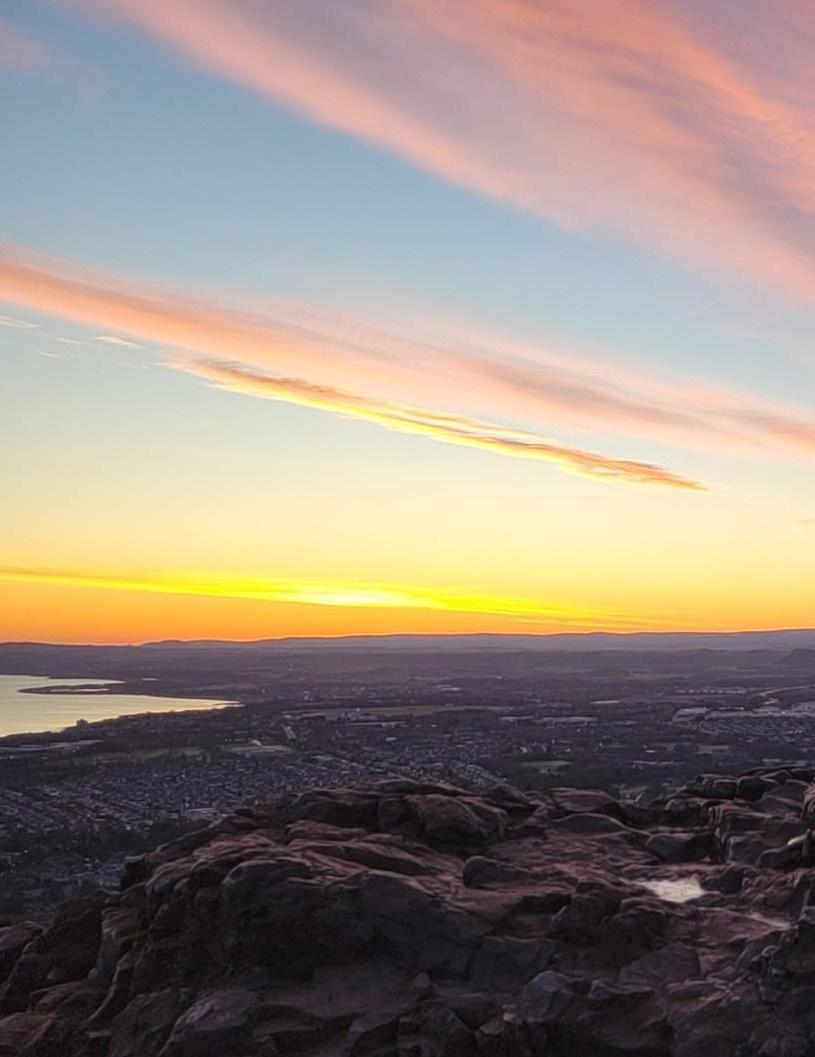
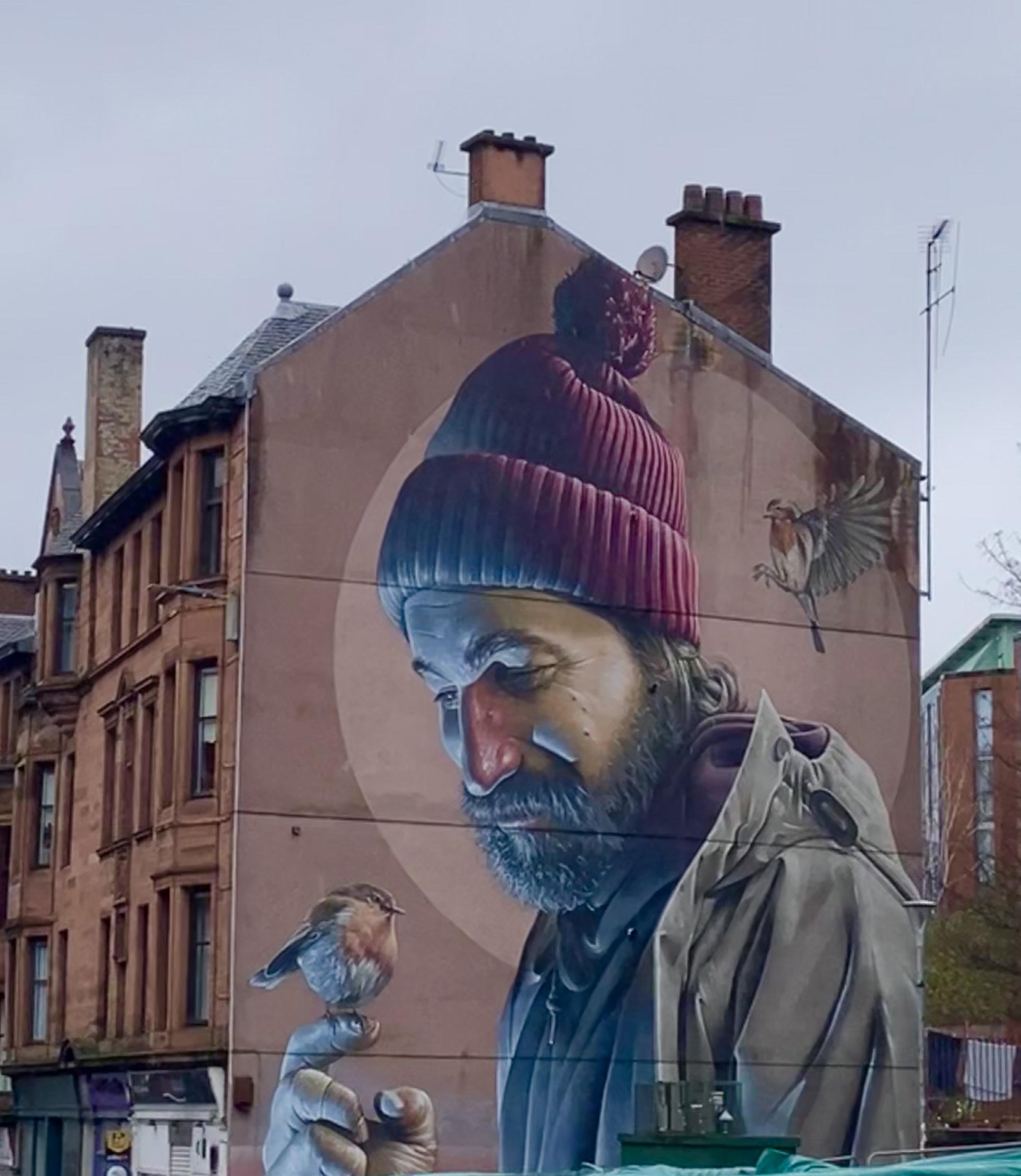
Photo Taken by: Tyler Tripdi
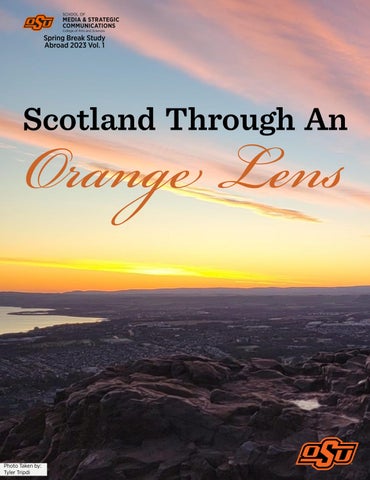

Arriving in Edinburgh at the dawn of spring break, we were unaware of the adventure awaiting us. During the next ten days, we embraced the warmth and charm of Scottish culture by indulging in traditional Celtic music and attire, savoring delectable haggis and forging lifelong friendships.
From our home base of Edinburgh to the mysterious Loch Lomond, we offer a glimpse into the heart of Scotland and its vibrant culture. By sharing Scottish legends, exploring historic castles and shedding light on impactful nonprofit organizations, we aspire to foster a deeper understanding of the Scottish identity.
Through the lens of 20 eager OSU students, Scotland became a place that ignites our passion for learning, cultural understanding and personal growth. With each article, a memory unfolds of a distinct Scottish experience. On behalf of our team, thank you for reading and we hope our articles inspire you to explore and embrace the spirit of Scotland.
Scan this QR code to view our team’s adventure in Scotland!

In the lush, evergreen nation of Scotland lies its share of legends and lore. As I explored the cobblestone streets of Edinburgh, murky lochs and historic castles, each landmark told a story of survival, adventure and, sometimes, mystery. With the help of friendly locals and historians, I began to unravel the truth behind a few of these well-known Scottish legends.
No. 1: Scotland is home to the Loch Ness monster, Nellie.
As children, we often learn stories of mysterious mythological creatures in movies or books. From dragons to leprechauns, each harnesses a lingering curiosity of the unknown and magical. One of the most popular yet ominous mythological creatures, the Loch Ness monster called Nessie, is said to reside in the waters of Loch Ness Lake in the Scotland Highlands.
An infamous 1934 photograph displaying what appeared to be a long-necked, dinosaur-like creature appearing from the waters was the first documented ‘sighting’ of Nessie. Since, Nessie has inspired countless movies, books and the tourism industry at Loch Ness Lake. Scientists and skeptics of the monster have found several explanations for the photo, however, many tourists who roam the area still claim to spot the legend living in the murky waters.
Scott, a tour guide, grew up in the Highlands in a rural region of “lumpy bumpy mountains” as he describes it, 4 SPRING BREAK STUDY ABROAD 2023
near Loch Ness.
“Even if you don’t believe there is a monster in Loch Ness, any large body of water in those surroundings makes the hair on the back of your neck stand,” Scott said. “So, I have no problem taking people to Loch Ness, even if they are convinced they will see a monster ‘cause even if they don’t, they all come back with that same eerie feeling.”
The real mystery of Loch Ness lies in the depth of the unknown dark waters, Scott said. Inside the Loch are steep mountains on both sides, extending like a beak for miles. If that wasn’t unsettling enough, Scott said heavy carbon soil affected the Loch’s water, producing its pitch-black water and hiding whatever may reside beneath.
“There is life that lives in Loch Ness that we aren’t aware of,” Scott said. “It’s a deep, dark body of water with caverns and caves humans have never managed to explore. That’s the magic.”
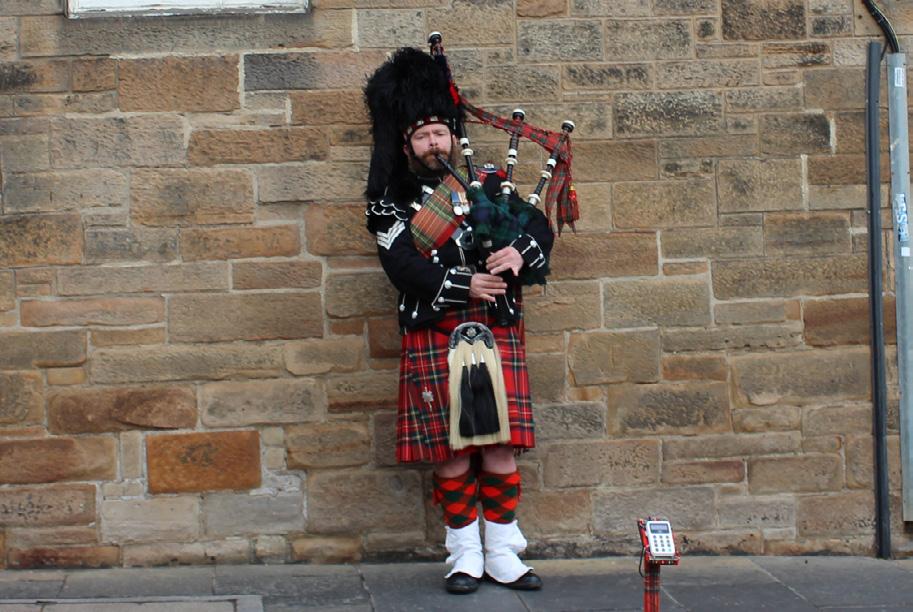
redheaded bagpipers are not flooding the streets of Edinburgh. According to the Scotland Info Guide, there are only 10,000 bagpipers in Scotland. However, multiple tourist spots in Edinburgh attract bagpipers, filling the air with entrancing Scottish music. As for Scottish attire, Edinburgh tour guide Graeme said it’s not unusual for locals to sport a kilt for special occasions.
“Most people actually hire kilts than buy a kilt now, ‘cause a Highland outfit now will cost you 5,000 quite easy,” Graeme said. “So, you’ve got a lot of kilt hires, traditional in weddings and such-like.”
No. 3: The Unicorn is the national animal of Scotland.
No.2: Most Scots wear kilts daily.
A typical American perception of the average Scottish man’s appearance may include bright red hair, pale skin and blue eyes, paired with a green plaid kilt and bagpipe. Although these traits may be held closer to Scottish Celtic roots,
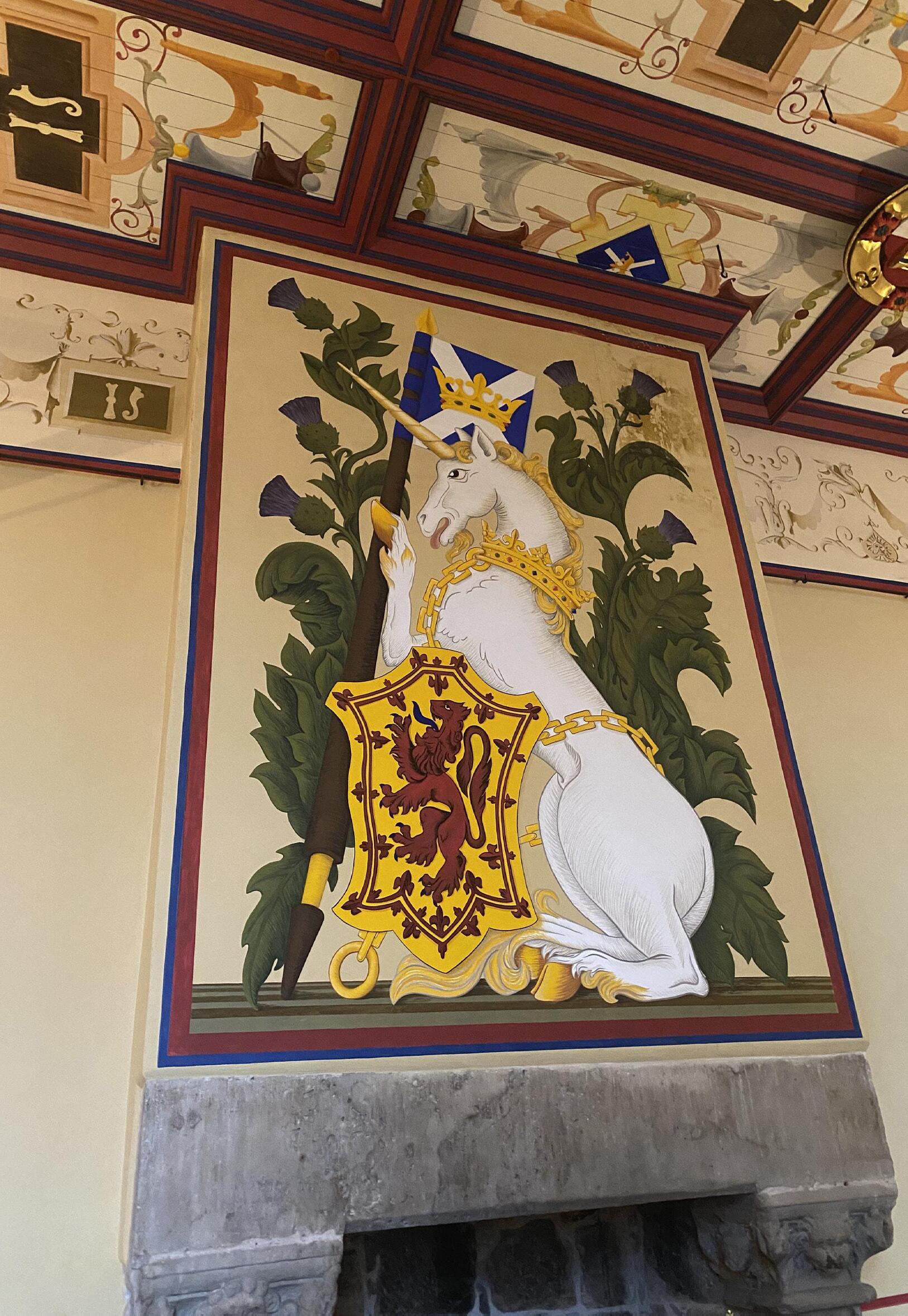
The bald eagle and bison are the national animals of the United States and inflenced early American culture. In Australia, the national animal is the kangaroo. In China, it’s the giant panda. In Scotland, it’s the… unicorn. Although this may seem highly unusual, this one-horned mythological creature has a rich history and represents purity and power. Scottish medieval legends suggested that only a king could hold unicorns captive due to their supposed power and nobility. This notion caused the magical creatures to
“There is life that lives in Loch Ness that we aren’t aware of. It’s a deep, dark body of water with caverns and caves humans have never managed to explore. That’s the magic.”
be highly respected, especially by those in patriarchy in the 15th century. A unicorn emblem appeared on Scottish coins, royal seals, and the Royal Coat of Arms (before 1603). Scotland embraces the unicorn as a unique part of their country– making it all the more magical. As we walked through Edinburgh and Glasgow, unicorns appeared as emblems on castles, statues, murals and tapestries.
“Legend actually claims that only a virgin could capture and tame a unicorn, and those who are lucky enough to touch one would have happiness for their lifetime, so of course, the kings wanted one,” Johnny, a Glasgow tour guide, said.
However, the mystery of whether the magical creature was ever found or captured remains.

“People may think it’s silly, but we’re proud of our unicorn,” Johnny said. “Just another thing that makes Scotland unique.”
Although many legends may linger in Scotland’s history, lochs and land, one thing remains certain: Scotland is truly the unicorn of the United Kingdom.
Scotland’s national animal is sprinkled throughout Scotland as statues, emblems and art peices, like this tapestry in Stirling Castle. Photo taken by Dru Norton.
Visiting a nonprofit may not seem like it would have been a highlight of the trip; however, our group was as interested to hear about the work Link Education had accomplished as they were to find out what was in our haggis. As the jet lag finally wore off on our third morning in Edinburgh, we began the now-familiar trek from our hotel to the Royal Mile.
At 9:30 a.m., this part of the city was bustling with people, tourists and locals. The Royal Mile is at the center of Old Town Edinburgh, hosting Edinburgh Castle on one end and the Palace of Holyroodhouse on the other. These features, alongside hundreds of shops lining the street, create a seemingly constant state of busyness in this part of Edinburgh. Amidst all of the commotion, we stepped through the doors of Link Education International. As those doors closed behind us, it felt like we had entered a calm within the storm of the busy city center. We didn’t realize that the building we entered was the hub for the largest educational charity in Scotland.
Link Education International’s work yielded impressive results. Link works across sub-Saharan Africa, specifically tailoring their approach to create long-lasting change for communities. The organization’s primary goals are strengthening educational systems, supporting education in emergencies, building climate change resilience, engaging community voices and accountability and transforming girls’ education.
During our visit to Link’s headquarters, we had the pleasure of
speaking with Dr. Samantha Ross, who earned her Ph.D. in International Development, and Lindsay Alexander. Ross works as Link Education’s international programs director and Lindsay Alexander is their communications liaison. We spoke with them about Link’s post-pandemic goals and brand updates, including their stance on climate change. They also spoke about their philosophy of how to best create lasting change within the communities they serve. Rather than working solely out of Edinburgh, Link has branches in Uganda, Ethiopia and Malawi. This means they always have people in the field in these communities, rather than leaving after the project starts. This model sets Link Education apart from other charities and gives them the opportunity to create long-lasting change, which does not end on the flight back to Scotland.
Link Education is the only single-sector non-governmental organization (NGO) in Scotland. This means they specialize in only one thing; for Link, that specialty is education. Education as their only focus allows them to perfect their knowledge of the subject and their methods of bringing meaningful change. It was evident when visiting with staff at Link that they have taken this sentiment to heart. They were highly knowledgeable about every piece
of the education process and their confidence in their work was inspiring.
During 2021-22, Link took great strides in the number of students benefiting from their services and the education quality of pre-existing schools and communities. In four countries, they reached more than 150,000 students and have worked with more than 300 learning centers. These are impressive numbers, even before considering post-pandemic changes and challenges. With this impact, they reach many students and teachers, conducting training with more than 28,000 teachers.
Teacher training happens within individual schools and higher educational organizations. Their theory is that, when their on-site work is finished, those in authority should be taught to maintain the same quality of training for years.
When we asked faculty members at Link about their philosophy for creating lasting, meaningful change, they referenced something called the “Shift the Power” movement. Shift the Power aims to transition from a top-down aid system to a more community-focused development. Instead of sending multiple volunteers to a community, Link
“They say if you give a man a fish, you feed him for one day. If you teach a man to fish you give him food for life, just like the project changed our lives forever. It brings change for a lifetime. They have given what cannot be lost, no one can take it away from us.”
Female Teacher from Ethiopia
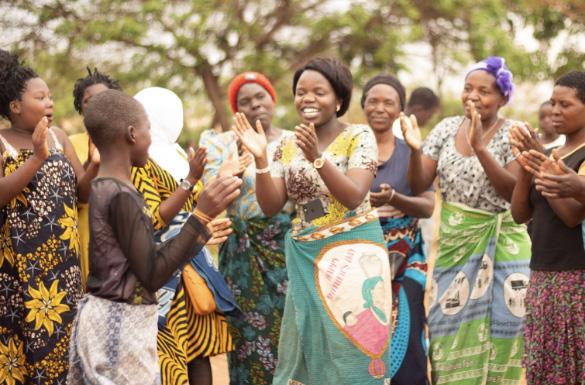
Community efforts like Mothers’ groups are necessary to ensure no one is missing class and all are supported. This picture was taken in Malawi in 2021. Picture courtesy of Link Education focuses on creating change by empowering locals. To accomplish this, Link trains members of communities to create their own change and gives them the support to concrete these improvements. For example, the videographers hired for the promotional videos are all local, thus supporting the community-building model. Through this model, Link has strengthened communities’ educational systems as a whole. Government leaders, teachers, parents and community members are integral to creating this change. These ideals have pushed Link Education to the forefront of community engagement and teaching quality.
By utilizing resources and individuals already existing in a community, Link built strong and lasting connections with those they serve and partner with. Global partnerships such as: “Girls Not Brides” and “Keeping Children Safe” work alongside the
team of community members. This communicates that they can maintain the quality of education, which Link instills long after a project’s conclusion. Instead of going to a school and training the teachers themselves, they will go to the head of a school and teach them to perform quality teacher training.
This enables otherwise under-resourced schools to conduct training in-house, rather than relying on a third party. This then trickles down to affect things such as literacy and numeracy rates. Establishing a training regimen for existing and new teachers will instill long-term positive outcomes in student academic rates and teacher satisfaction.
Not only is this outlook more effective for the communities Link serves, but it is also a more efficient method of utilizing resources. Enabling community members to continue the work
without direct supervision makes life more pleasant for both parties. For Link, this means they can cut back on expenditures such as travel costs and the cost of providing long-term housing for employees. For these communities, it means they can utilize the provided resources in the most comfortable ways, in their own language, with their teachers and on their timeframe. Link Education is an excellent example of how to successfully balance providing aid to a community while giving them the tools to maintain it.
One of Link’s proudest accomplishments is the work done to improve girls’ education. Multiple programs have been created to target challenges these communities face, such as helping girls become involved in sports and creating a smoother transition to secondary school. Although it may seem like a straightforward task, a multitude of factors hinder girls’
education in sub-Saharan Africa. Early marriage, menstruation, social stigma and other obstacles prevent fair education practices. In addition, indirect factors disproportionately affect girl’s education, like civil unrest, poverty and natural disasters. Although these problems are not specific to the female experience, girls are more likely to be disadvantaged in these situations. For example, a family facing financial strain is more likely to send their son to school than their daughter.
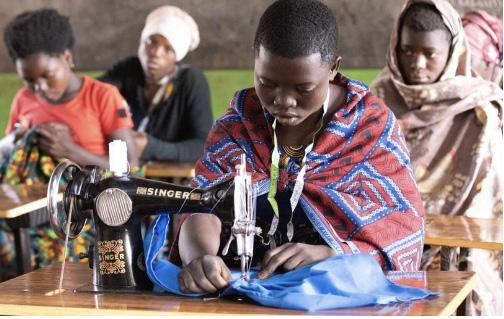
This may be because they see a brighter future for males and are less worried about them being harmed while attending school. Link has observed the depth of these barriers to create systematic approaches. Simply promoting girls’ education in the classroom isn’t enough. Work must be done to improve the models used by the government, community, educators and parents.
Teaching students social-emotional


learning is one model used to improve the accessibility of their education. This type of learning aims to create a more equitable environment for marginalized students, such as girls and those with disabilities. Socialemotional learning is crucial for students and educators to improve academic outcomes. It emphasizes skills such as responsible decision-making, relationship maintenance and kindness. When these are taught to teachers, they can provide a more comfortable environment for each student. At the basic level, comfortability can be shown as asking boys and girls questions equally, smiling when they see students in the morning or inviting struggling children to join a mentor program. Small actions like this can have a significant impact on the quality of a child’s education, especially if they are already marginalized.
Link Education International has offered insight into their unique and
effective charity model. Education is an essential factor for communities that are struggling with poverty. It can be easy to forget how powerful education is. With all their progress, even during the COVID-19 pandemic, it is exciting to imagine what future endeavors Link will be undertaking. We are proud to promote such an impressive group of individuals who genuinely care about the work they are a part of

As garlands of orange, white and green hung from the ceilings of bars and restaurants, the Little Ireland community in Edinburgh prepared to celebrate a Scottish St. Patrick’s Day. Although Scotland is home to a different Saint, St. Andrews, St. Patrick does have Scottish origins. According to the History Channel, St. Patrick was born in Scotland, and as folklore has it, Irish pirates kidnapped him as a teenager. He served as a shepard who herded and tended to sheep. While held captive, God came to him in a dream and told him to go to the coastline to escape Ireland. From there, he searched for a ship to reunite with his family. Patrick returned to Ireland in 432, and though it is unclear what happened to him next, he started to preach the Gospel throughout Ireland and converted the country to Christianity. March 17 marks the death of St. Patrick, and what started out as an Irish holiday became celebrated worldwide, regardless of religion.
In Scotland, St. Patrick’s Day isn’t a national holiday. However, the Little Ireland community along Cowgate Street celebrates it every year. According to the Edinburgh Expert, the Irish community settled there as they immigrated to escape the potato famine. Cowgate Street celebrates the holiday yearly, so that’s where we experienced and celebrated St. Patrick’s Day — the Scottish way.
St. Patrick’s Day festivities started the night before, on March 16, in bars along Cowgate Street. We visited the Pilgrim bar and noticed the Irish flags dangling from the ceiling across the
rooms and a banner covered in green glitter that read “Happy St. Patrick’s Day” was against the large window. St. Patrick’s Day Eve for them is similar to our New Year’s Eve countdown to the actual holiday. The bar concluded their trivia night, which college-aged students primarily participated in, so the actual event could occur. We called it an early night, so we would have enough energy to make it through the next evening. As we returned to our hotel room, we put on green pajamas so we wouldn’t get pinched overnight and noted where we wanted to celebrate the next day.
We woke up eager to celebrate St. Patrick’s Day. We walked Cowgate Street in the morning to see the Scottish policemen lining up guardrails that would later control the crowds along the narrow sidewalks that night. The Three Sisters bar had been up and running since 8 a.m. and had a line of partygoers waiting to go in the priority and general admission lines. According to Edinburgh News, some people were there waiting at 7 a.m. so they could be the first to go in. The Three Sisters is a multi-use club and one of the oldest surviving buildings of the historic Cowgate Street. The building’s original purpose was a Tailor’s Hall in 1621, which was turned into a playhouse in 1733. According to the Three Sisters website, sisters Cath, Kitty and Maggie Mackinnon, would sing, play music and act at the playhouse. However, this was outlawed in Scotland at the time. The sisters were
eventually imprisoned in the hall, and the current bar pays homage to them through singing, acting and playing live music.
Walking through the streets of Edinburgh, I noticed most locals did not wear green. Those wearing green were mostly tourists and a few locals celebrating the holiday. Because Scotland does not recognize St. Patrick’s Day as a national holiday, the only way you would know it was March 17 is from the mass amount of green attire, Irish flags hanging and crowds people going into clubs, pubs and restaurants at unusual times of the day.
A male shop employee said, “St. Patrick’s Day is an excuse for young adults to drink and get drunk with their friends and that’s pretty much it.”
Scotland is primarily aligned with the rest of the world regarding St. Patrick’s Day being culturally insignificant, besides a significant revenue stream for the clubs, pubs and restaurants.
Our choice for dinner landed us in the Grassmarket area, outside Cowgate Street. We ate at the Last Drop, a pub in front of where Scotland used to hold public executions. The name is a play on words of the last drop of blood and the last drop of a drink. The crowd inside looked intimidating, but as we went through the pub, we could sit almost immediately on a perfect three-seated table in the corner of the dining room. The place was filled with Guinness hats on people’s heads
…we went, experienced and celebrated St. Patrick’s Day —
Scottish way.”
and waiters rushing around, ensuring patrons were cared for. To obtain a Guinness hat, you must either buy a pint of Guinness or take it from someone’s head. We chose the latter.


As we chatted through our meal and drinks, we noticed the two long tables near us were full of French and Italian men who were there for the Six Nations games displayed on the flat screen. We overheard them speaking and guessed their origins before confirming with them. While it was unclear that everyone out on the town was not celebrating St. Patrick’s Day, the holiday complemented their celebration of watching the Six Nations game. We paid our check, grabbed our not rightfully earned Guinness hats, and made our way to Cowgate Street.
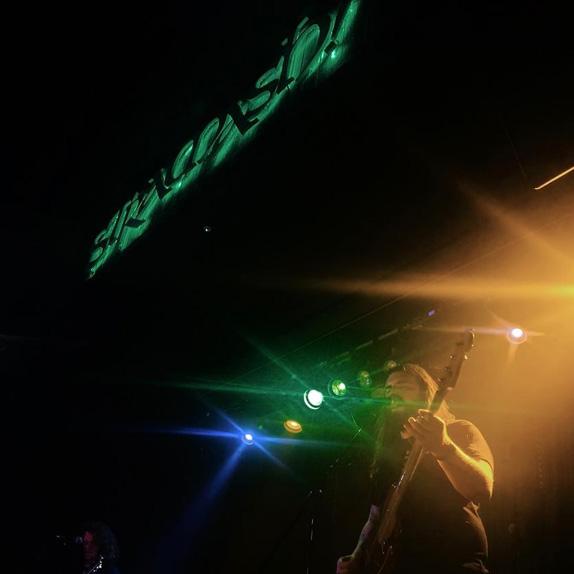
As we made our way onto the street, people were herded into the bar lines to wait to enter the doors so more people would not get in front of them. Our first stop was the live music venue, Stramash. Dignan, a classic and contemporary Rock band, played American song covers of “Sweet Child O’ Mine,” “Highway To Hell,” and more. A few moments later, we made our way to The Hive, a young adult club built into the side of a hill. We were the first people in the club, but we could pick up and wear fun holiday-themed party hats, find the giant inflatable Leprechaun and have our faces painted with the Irish flag. The music started, and more patrons entered to dance the night away.
The euphoria of singing ABBA’s “Voluez-Vous” with young adults from all over the world is something I will never forget. We were set for the remainder of the night, full of celebrating with music, friends and drinks. With his Scottish and Irish roots in Edinburgh, St. Patrick’s celebration makes this holiday unique and a day to remember. Slainte Mhath!
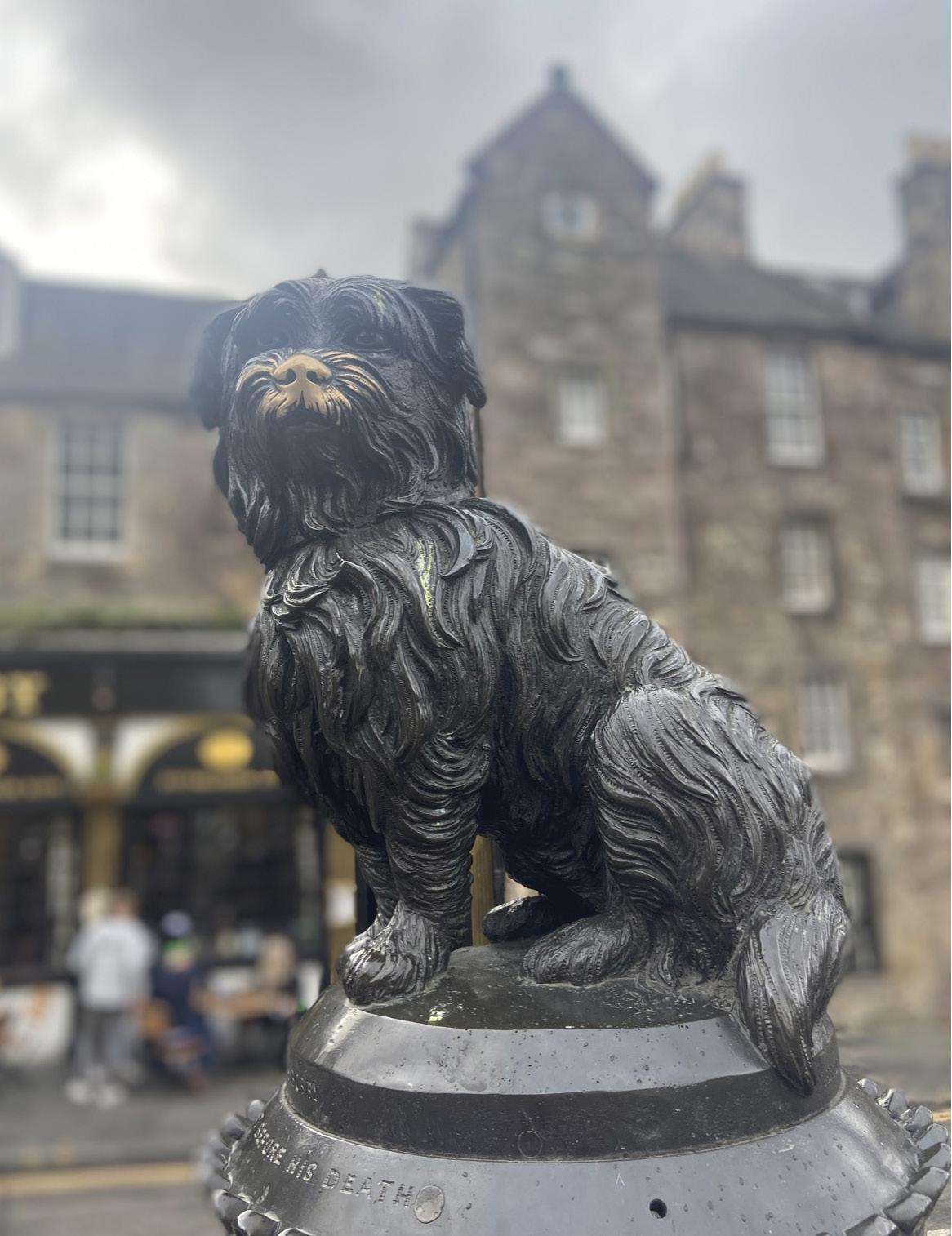 For vistors in Edinburgh, rubbing the statue of Greyfriar’s Bobby’s nose is a sign of good luck. Photo by Mandy Parli.
If you were a pet, where would you want to live? After visiting Edinburgh, I think I have my answer. The weather may not be ideal for long walks exploring the city or sitting in the window soaking up the afternoon sun, but the pets and pet lovers of Edinburgh seem to be okay with it. They simply put on their rain jackets and boots and head out the door to their favorite public park for their daily adventure. While walking, as their paws are stepping on centuries-old pavement, they can look around to see beautiful architecture that dates to the Middle Ages. Or, maybe they go to visit one of their favorite pet-friendly cafes that also serves yummy pup cups. Wherever I went in Edinburgh, there was always a dog enjoying its day with their owner. Other people seem to also notice the Scottish appreciation of their four-legged friends, as Edinburgh was named the UK’s most dog-friendly tourist location in 2021. I think it is apparent to anyone who visits Scotland that the Scottish people love their four-legged friends and would do anything for them.
Another intriguing aspect of pets in Scotland is the lack of stray animals I saw while in Scotland. In contrast, if I walked out of my house near downtown Stillwater, I would most likely see several stray cats and maybe even a few stray dogs. One of the reasons for this low number of strays could be the amount of trap, neuter and return programs in Scotland and how dedicated people in Scotland are to protecting and helping animals.
According to cat advocacy group Alley Cat Allies, trap neuter and return programs seek to humanely and effectively reduce the stray and feral

cat population. They help to ensure cats are spayed and neutered as well as vaccinated. After the cats recover, they are returned to their home colony. These types of programs can really help mitigate the number of stray cats in an area; this is precisely what the United Kingdom’s Cats Protection and many other animal rescues in Scotland do.
Cats Protection is a non-government organization (NGO) that has spay and neutering services and an adoption center. Across the United Kingdom, Cats Protection has 210 branches. As you can imagine, with this many branches they can make a big impact on the stray cat population. Along with Cats Protection, Edinburg has more than 12 rescues for cats and dogs. This one example of a rescue and nonprofit aimed at helping animals; it is no wonder why pets in Edinburgh seem so content.
Many of the stories I heard in Scotland seem to involve loyal pets. One of the most famous stories in Edinburgh is Greyfriars Bobby, which inspired a Disney movie of the same name. This is a story of a dog and his loyalty to his owner that inspired people worldwide. It involves a small dog named Bobby and his owner John. John and Bobby were as close as a dog and an owner could be, but unfortunately, John died. Like the loyal friend he was, Bobby would not leave the grave of John even in the worst weather conditions, which touched the hearts of residents and people everywhere. Soon, crowds gathered to see Bobby nearly every day and he became somewhat of a celebrity until his death 16 years after his owner’s. One of our tour guides, Scott, said the story might be a little
untrue.
“They had several Bobby’s,” Scott said. “What dog lives 16 years?”
This creates another element to the story and one that we might need to uncover the truth about. Theories aside, I think it is a touching story of how loyal pets are and how much the people of Scotland respect them. Another tour guide told us a story of another loyal canine, a black greyhound who swam across the loch to take food to her owner who was imprisoned on a small island in Linlithgow. This dog’s loyalty led to her being incorporated into Linlithgow’s coat of arms and a statue in the town center. Both these stories involve dogs acting as man’s best friends, showing their loyalty and love to their owners. Both stories are indicative of the Scottish attitude toward their fuzzy companions.
Fear not, the Scottish people also have a special place in their hearts for feline companions. While in Scotland, I went to a cat caf’e called Maison De Moggy. Although this was an establishment bustling with cats and people, they took the best care of their cats possible. While I was there, I asked the cat nannies if Scottish people loved cats as well, because I had not seen any. She said both animals are equally loved and adored.
“Look up while you are walking home, and you are sure to see cats lounging in the windows,” she said.
As I discovered more about Scottish history and culture, I also learned about something integral to the Scottish identity: animals.
“They had several Bobby’s. What dog lives 16 years?”
-Scott

Gooaaallll! This simple phrase is used to express excitement; heard for miles and miles in and around stadiums in Europe. But, for a select few, they prefer to hear TOUCHDOWNNNN instead.
Scotland has sporting traditions that are legendary; from being the homeland of golf to hotspots for Soccer and Rugby, but surprisingly, Edinburgh has a deep history in American Football.
While American football has been around for Americans since the 1880s, it was introduced to Great Britain when two American battleship members played a Thanksgiving Day
game on Nov. 23, 1910. The National Football League in the United States has been very influential to the growth of American football in Europe. There have been several games played in London and other locations which also led to the spark of creating American football teams and world leagues.
American football players in Europe have different inspirations or stories of how they got into the sport. Some players had played Soccer or rugby most of their lives and were ready for
a challenge in a new sport; some had seen the Super Bowl and were intrigued so they found a local team; and some had the inspiration and influence from their families or friends.
“This one was definitely inspired by my dad,” Jamie Morrison, starting Quarterback for the Edinburgh Wolves Senior Team, said. “He had grown an interest in the game as formerly in the military he would be stationed with American Soldier from time-to-time who would, of course, share their love
of the sport. So, I have a strong memory of just chilling in the living room with the NFL (game) on the TV some Sunday nights”.
Morrison continues by telling a story that he vividly remembers when he was on a camping trip with his family and his cousin happened to bring an American football along.
“The only real memory is my dad throwing the ball at my brother, which incidentally smacked him in the face,” Morrison said. “As brothers do, I found
this hysterical at the time.”
Morrison explains how it can be very interesting playing American football in Scotland since it isn’t one of the most popular sports and there are athletes with all different levels of experience varying. From someone who’s not really in shape thinking they’d like to give it a chance after watching the NFL on Sunday night to rugby or soccer players wanting to try something new.

Players like Ben Sykes, Cathal Caldwell, Karl Fanning and Marcell
Habermayer all played other sports and were ready for that change.
“I’ve played soccer, Gaelic football, hurling and when I came to Uni (University) I wanted to try something new,” Caldwell said. “I saw a practice taking place and decided to give it a go.”
Ben Sykes said American football was similar to the physicality of Rugby that he liked, but just different enough to spark his interest after he had watched a few times and his friends had suggested he try it.
Finlay Ramsay said it wasn’t just about something new, but also finding a group with a sense of culture that was
the right fit for him.
“Having previously played rugby at school, the rugby team at Uni didn’t appeal to me at all, whereas the American football guys were approachable and encouraged you to come along,” Ramsey said. “Some friends from school loved American football too so I got into it through them.”
Ramsey plays American football at Stirling University and his teammates at university encouraged him to come to Edinburgh and to give the Wolves football team a try.
“I spoke with the football (soccer) and rugby (teams) as well, but the American football guys were welcoming and encouraging so I chose to start this new journey,” Sorbie said.

Sorbie said.
Elliot Sorbie found American football in 2017 at the sports fair at Stirling University.
Morrison spoke more on his journey, saying it wasn’t until American football was an after-school option at his school did he think about giving it a chance; even with his family inspiration. After that, he became aware of the concept and joined the local U16 team the Edinburgh Wolves had provided at the time. Morrison said a big part of it was the mental side of the game that truly grabbed his attention.
Calum Davidson said the players are different and wonderful and American football is a niche sport, although the level of athleticism is lower than average than the mainstream sports of Scotland. However, the benefit of that dynamic creates a real sense of community between the players that have chosen to get involved with this sport.
For the players and coaches of the Edinburgh Wolves, they all had different drives and motivations for giving American football a try and why they joined this specific team. But their sense of culture and community within the team is what seems to bring them back.
Win One More!

“I spoke with the football (soccer) and rugby (teams) as well, but the American football guys were welcoming and encouraging so I chose to start this new journey,”

The country of Scotland is known for several things: kilts, golf, haggis, castles and the Loch Ness Monster, but one often overlooked aspect of Scotland is its art. Scottish art stretches back to the Neolithic age, around 10,000 to 4,500 BC, with some of the first examples of art being decorated stone balls. Since then, art has changed drastically in Scotland. From Pictish stones to metalwork and Insular art to jewelry, art has taken on many different forms over the centuries, but no type of art is more important to the history of Scotland than the simple painting. There is no better place to see these paintings and their significance than at the Scottish National Gallery in Edinburgh.
The Scottish National Gallery opened to the public on March 24, 1859, more than 150 years ago. Over time, the gallery has accumulated more than 96,000 artifacts in its collection and has been divided into three galleries: Modern, Portrait and the National (the biggest and most popular). While the Modern and Portrait galleries feature impressive artwork, the National houses many of the main attractions locals and tourists alike come to see. These include paintings by Sir Henry Raeburn, Alexander Nasmyth and William McTaggart, all regarded as some of Scotland’s most famous painters. Dorothy, a friendly guide at the Scottish National Gallery, confirmed this notion.
“Raeburn and McTaggart are considered the most well-known Scottish artists,” Dorothy said.

Although not mentioned in Dorothy’s quote, Nasmyth is still a prominent figure in the history of Scottish art and is recognized for his many landscape
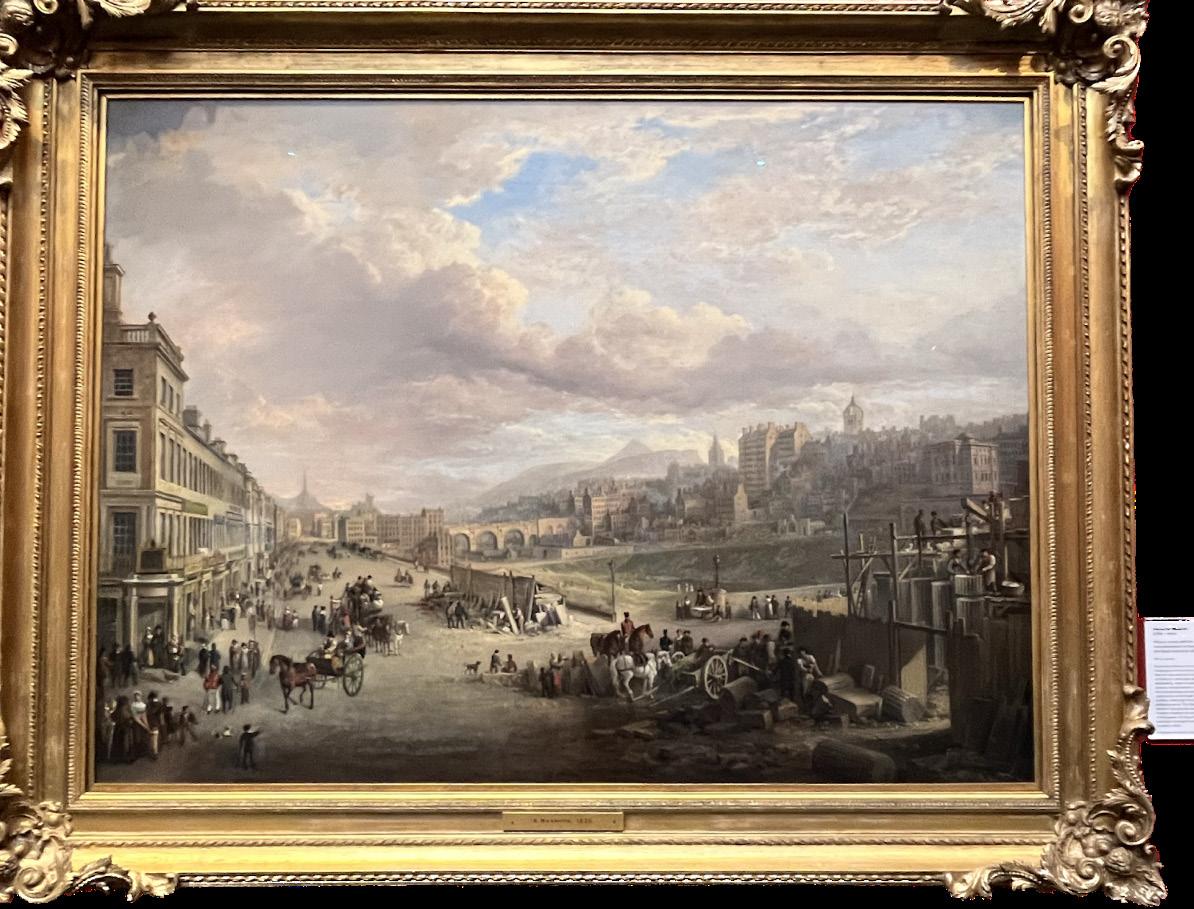
paintings of Scotland. Born in 1758, Nasmyth became a pupil of Allan Ramsay (an 18th-century portrait painter) at 16 and would later become one of the leading pioneers of Romanticism in Scotland. His most famous paintings are “Edinburgh Castle and the Nor’ Loch (1824),” “A View of Tantallon Castle with the Bass Rock (1816)” and “Princes Street with the Commencement of the Building of the Royal Institution (1825).” Ironically, another famous painting of Nasmyth’s is not of a dramatic Scottish landscape, but rather a portrait of his childhood friend, Robert Burns.
While Alexander Nasmyth was known for his landscape paintings, Sir Henry Raeburn was known for his portraits of the rich, famous and important figures in late-18th and early-19th century Scotland. Born in 1756, Raeburn, like Nasmyth, was also a leading pioneer in Romantic art. It is estimated that Raeburn, a self-taught painter, made more than a 1,000 paintings spanning over 50 years. His other achievements include becoming president of the Society of Artists in Edinburgh, a member of the Royal Scottish Academy and serving as Portrait Painter to King George IV in Scotland. Henry Raeburn’s most famous paintings include “Colonel Alastair Ranaldson Macdonell of Glengarry (1812)” and “John Wauchope of Edmonstone (About 1800-1805),” but arguably none of his works are as famous as “Reverend Robert Walker Skating on Duddingston Loch (1795).” This portrait of a minister ice skating across a lake is an icon of Scottish art
and is one of the more recognizable paintings in the gallery.
While Alexander Nasmyth and Henry Raeburn were Romanticists, William McTaggart was influenced by the Impressionist movement that began after the decline of Romanticism in the late-19th century. Most of his art is centered on the Scottish landscape and ranges from the quaint countryside to the harsh coastline. Born in 1835, McTaggart trained in Edinburgh at the Trustee’s Academy and would eventually become elected as an Associate of the Royal Scottish Academy at 24. His most famous works include “Spring (1864),” “The Storm (1890)” and “The Bait Gatherers (1879).”
The Scottish National Gallery is home to a variety of artworks across three galleries, with the National and its vast collection of paintings the most important. From dramatic Scottish landscapes to a minister ice skating on a frozen lake, the subjects of these paintings may differ, but they continue to impact Scottish art.
In America, high tea is seen as a special treat one participates in for special occasions or with the women in your family to celebrate. This practice features tea, cookies, cakes, finger sandwiches and sometimes cocktails. High tea stems from afternoon tea in Scotland, but is modeled to make you feel like royalty. Although this is a great experience, we have it all wrong: American high tea isn’t really “high tea.”
High tea refers to the height of the table at which you enjoy tea. High tea in Scotland is also another word for dinner and the term “high” comes from being served on a high dinner table. For traditional Scottish high tea, one can expect to see a full meal with meat, sides, baked goods and tea.
Afternoon tea is usually served on a coffee table with small finger foods to help hold you over for dinner. After World War II, afternoon tea was meant to hold women over for dinner time to wait for their working husbands to get home late in the day.
Tea has been around for centuries in Scotland and enjoyed by all, from commoners to royalty. Now, it is enjoyed worldwide largely due to the United Kingdom, specifically Scotland. However, this is an old custom with hundreds of years of history and culture.
Tea came to Scotland in the early 1600s because of Mary Modena, Duchess of York and it gained popularity throughout the 1700s and early 1800s. After, tea became so expensive because of Chinese export costs that only high-class citizens could enjoy it. But, in an effort to bring down the cost, the Britain East India Company traded and produced opium to exchange with China for tea because smoking was extremely popular there. This caused the Opium War, or First Chinese War, between Great Britain and China and led to Britain wanting to grow their own tea. A man named Robert Fortune managed to steal Chinese seeds and get them to India, creating the British tea empire boom.
Additionally, many famous tea strains come from Scotsman. For example, Thomas Lipton, as in Lipton tea, was born in Glasgow. James Taylor from Kincardineshire, Scotland, is responsible for the growth of Ceylon Tea, which is common in breakfast blends and black teas.
Another famous individual, Miss Cathrine Cranston, is extremely notable in her influence on afternoon tea where she created the first tea room in Glasgow. Her brother, Stuart Cranston, opened up a tea store, Cranston Tea, in Glasgow because their father was
a tea merchant. Because of the temperance movement in the late 1800s, Miss Cranston took over the tea store and devised an idea to create tea rooms where people could enjoy socializing. In 1903, the Willow Tea Room opened, along with three others.
“Miss Cranston owned it because women couldn’t go out unchaperoned by their husbands,” Yvonne, The Willow gift shop worker said. “Because of the temperance movement, she had a vision that this would be a good place for families and women to go without alcohol.”
Another notable feature of Miss Cranston’s tea rooms is her partnership with architect and designer Charles Rennie Mackintosh, famous for defining the “Glasgow Style” in the 1890s and had a large influence on all of the Cranston tea rooms.
“From uniforms, to cutlery, to the key to the door,” Yvonne said. “He designed the chairs and everything you still see today.”
Although there is so much history with tea in Scotland, not many people participate in traditional afternoon tea, unless you’re a tourist.
“You only go to a tea room if you’re with your grandma or mother,” Scott, a tour guide, said. “But the best places to experience tea are the Balmoral, Scotsman Hotel, The Hall of Edinburgh and Fingal Edinburgh.”
With hundreds of years of tea being enjoyed in Scotland, these days Scottish people still drink coffee.
“I start every day with coffee and then usually have tea in the afternoon
“You only go to a tea room if you’re with your grandma or mother, but the best places to experience tea are the Balmoral, Scotsman Hotel, The Hall of Edinburgh and Fingal Edinburgh.”
Scott, Tour Guide
with lunch or a snack,” Glasgow tour guide Johnny said. “If I do have tea in the morning then I drink English Breakfast Tea but Earl Grey after that.”
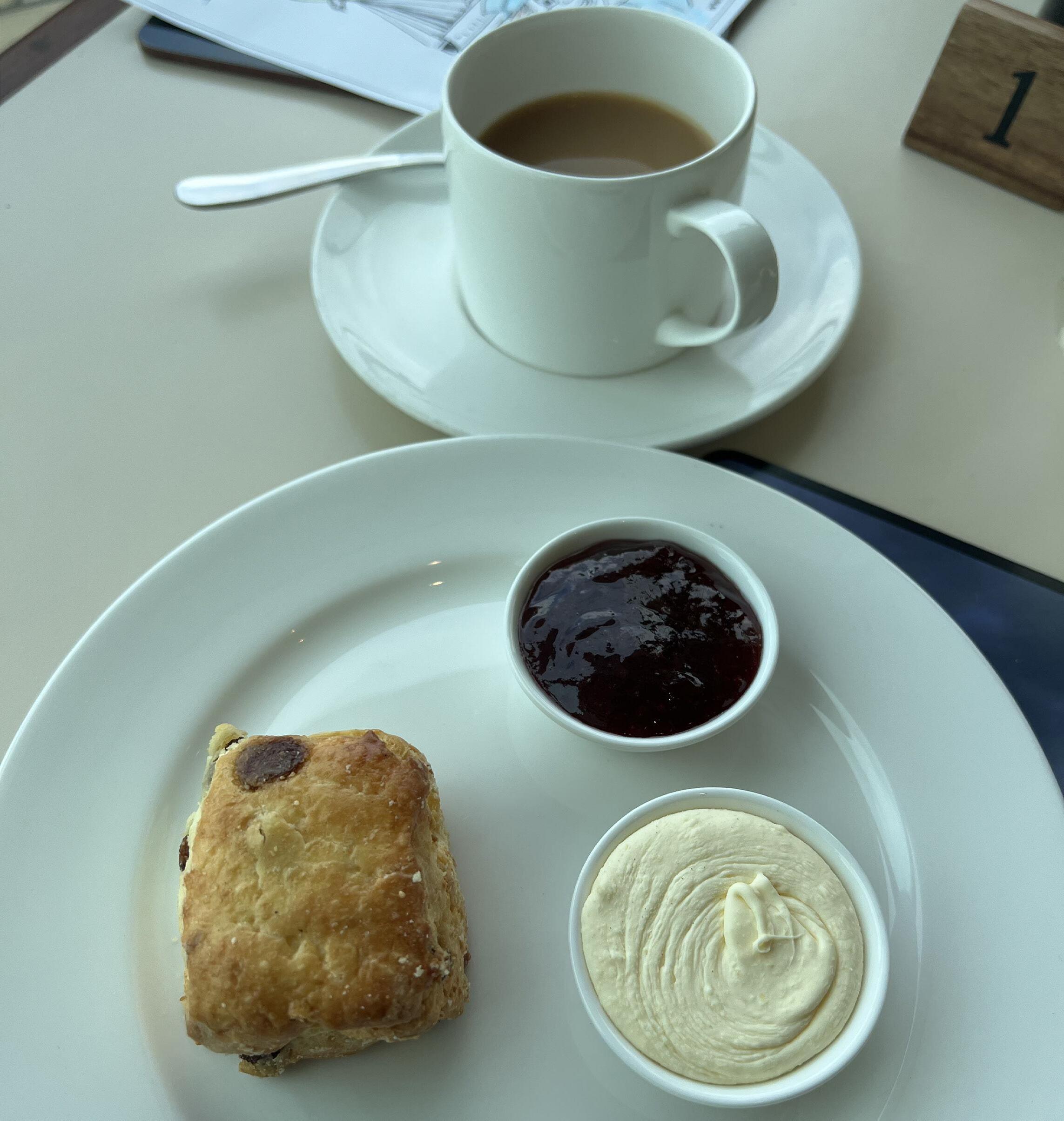
Hot tea is so common in Scotland that customers can enjoy tea almost anywhere. Most restaurants have tea on the menu, served in a tea kettle with milk and sugar cups that provide at least three servings. Our group
experienced two formal dinners or ‘high teas’ on our trip with at least four courses and they both served hot tea after dessert.
There’s no doubt that American high tea is a fun and unique experience that stems from Scottish afternoon tea. At the end of the day, enjoy your tea and cakes but remember the wonderful history and culture behind afternoon tea.

My father had the name Campbell picked out for me long before I was born. The name came from his own grandmother, a fact that he was always proud to share. Growing up, I was never particularly fond of my middle name, I found it bland when compared to my sister. In order to remedy this my father would frequently tell me stories about my name’s origin. About the great Campbell Clan and their beautiful castle. My family, like many other American families, are fairly disconnected from the culture of my ancestors. It is not unprecedented, given that the last of my family had immigrated to the United States by the 1830s. That feeling of disconnect leaves many searching for a sense of cultural belonging. For people with Scotch-Irish heritage, which is about 10% of the American population, clan names and culture are a strong source of identity. This is a very common theme for a lot of people whose family lineage migrated from Scotland in prior centuries. However, it has led to a highly profitable phenomenon for the Scottish people. Within the tourism industry, many Scottish markets and venues will heavily advertise clans and the potential for reconnection to better appeal to foreigners, specifically those with an ancestral connection to Scotland.
The day before I left for Scotland, I was sitting in my father’s kitchen talking to him about the trip. I asked him if there was anything I could bring back for him, and he told me that if I could find a sturdy book on the history of our family clans, that would be more than sufficient. I browsed bookstores and gift shops for over a week, but nothing I found was what my father had meant.
All I could find were cheesy pocket books, with the clan tartan slapped across the cover. Between content exposure and conversations with locals, I quickly began to get the idea that perhaps I had the wrong impression of clan culture within the twenty-first century. At first I thought the clans were still going to operate as an organization in one way or another with meetings, celebrations, and the like. However, the clan culture has turned into something of a way for the Scottish people to gain extra revenue from tourists and foreign people of Scottish heritage. Overall, this is not a bad thing, in fact, in terms of the Scottish economy, it is a rather good thing. It ensures a steady stream of revenue from tourism.
My initial plan was to research conservation efforts for clan culture. I was curious what was taught in schools, and how traditions were practiced in modern culture. What I got instead was a reality bomb from Professor Cameron of the University of Glasgow. Professor Cameron explained to me that nowadays the beating heart of clan culture is tourism, and that most locals often do not concern themselves with clan identity past names. Perhaps I have watched Braveheart too many times and had unrealistic expectations as a result. But I would be lying if I said I was not slightly disappointed with the truth.
Scotland is a small country on a small island, and without tourism, they would rely mostly on livestock and agriculture to support their economy. Tourism is one of the largest industries in Scotland, and one of the largest ways this is promoted is through clan history and culture. As of 2022, there
are more people with Scottish heritage living outside of Scotland than inside. So the significance of clan culture is overstated, playing into that feeling of disconnect, and thus encouraging tourism. Honestly it is quite clever, by simply tapping into the innate human desire for belonging, they have guaranteed a steady source of tourism.

After my conversation with Professor Cameron, I started paying closer attention to where I saw references to clan culture. And with the exception of a few locals having a jolly good time in the streets on Saint Patrick’s Day, I noticed that most literature and artifacts were strongly geared toward tourists. Almost every souvenir shop sold tartan products and clan memorabilia . From fullkilts to keychains, most kept the full spectrum of tartans and products fully stocked. Fridge magnets, pocket books, shot glasses, hoodies, the list goes on and on.
This is not to say that there is something wrong with Scotland’s tourism industry. The adjusting of my expectations was, well, unexpected. But I cannot help and applaud Scotland for recognizing its strengths and playing into them. There are tons of tours that can be booked online and are clan based, geared toward people looking to reconnect with their history.
“Nowadays the beating heart of clan culture is tourism . . .”
-Professor Cameron
Fists flying, the rumble of horse hooves and a bloody brawl are images that come to mind when thinking of the Scottish army. A gruesome, messy battlefield is sadly not far from the truth. The history and experiences of the Scottish people led to a robust national identity of tenacity, pride and unbreakable spirit.
Scotland has proud and determined people, evident in history since the 1700s. There are many documented uprisings within the Scottish Highlands. Rebellious men called Jacobites began these uprisings; fighting for their rightful leader, Prince Charles Edward Stewart, to regain the throne. The most influential uprising was the Jacobite Uprising of 1745, between the English and Prince Charles, which showed great promise. The Uprising of 1745 was an inspiration to the Scottish people, and also a complete failure.
Charles, known as “Young Pretender,” was backed by the Clans of the Scottish Highlands, the Jacobites. Jacobites were named in honor of Prince Charles’ ancestor during the first set of uprisings, King James the Second. There were three key battles: The Battle of Prestonpans (1745), the Battle of Falkirk (1745) and the Battle of Culloden (1746). The Battle of Culloden was a slaughter; with the Jacobites outnumbered and out of guns, the battle was over in less than an hour.
This battle was the climax of this rebellion and once all the men fell in the fields of Culloden Moor, the rebellion was over. According to the National Archives UK, there were a handful of survivors of the rebellion of 1745. However, they were separated and sent to different forts and prisons to be tortured and later forgotten about. Despite that failure, the Scottish

people look at the Uprising of 1745 with sadness, but also a great sense of pride. Highlanders going into the battle knew it would most likely be a slaughter, but they fought anyway and died for the hope of a free nation. The Scottish people did not abandon their culture on the battlefield, despite laws England enacted to suppress the Highland way of life.
You can feel the strength of Scottish pride when you visit. While in Glasgow, we talked with Johnny, our walking tour guide. Like any good Scot, he knew the history of his country like the back of his hand. He spoke with great pride and hope for a free Scotland in the future.
“You would be hard press to ever find a culture quite as loud and prideful as ours,” Johnny said.
His pride in his country led him to teach others all that creates Scotland’s lush, exuberant history. The Scottish people show their sense of pride in their knowledge of their history and traditions, embracing the traditional Scottish kilt and tartan as a uniform for situations ranging from formal, semi-formal and casual everyday use. Each family, or clan (as they call it), has a specific plaid print and color, as well as a crest. There are rituals surrounding how you wear the different layers of a traditional Kilt. In Scotland, you don’t have to be a part of a major clan to show this great national pride. While walking in Edinburgh on St. Patrick’s Day, we saw many Scottish people wearing traditional Scottish blue to match their flag, instead of the green associated with the Irish holiday. Not only do the Scots like to show their pride in their attire, they preserve it in the treatment of their cities. Many of the major cities are
made up of historic buildings preserved and maintained over time, as a way to showcase their beautiful artistry and rich history. The Scottish culture is a strong, and now, thriving one that can be greatly credited to the Jacobites.
This group of men’s actions had a lasting influence on the nation’s pride and culture. The Jacobites were fearless soldiers in a series of rebellions against the British crown, but they are more than their military failures. The Scottish people recognize the misfortune of the doomed Uprising of 1745, but Scottish residents see the inspiration behind these men’s actions. During the course of many generations, they secretly kept their way of life. They were able to preserve their sense of identity, heritage and history. As a result, the world can continue to learn about the rich, strong-willed culture belonging to the Scots.
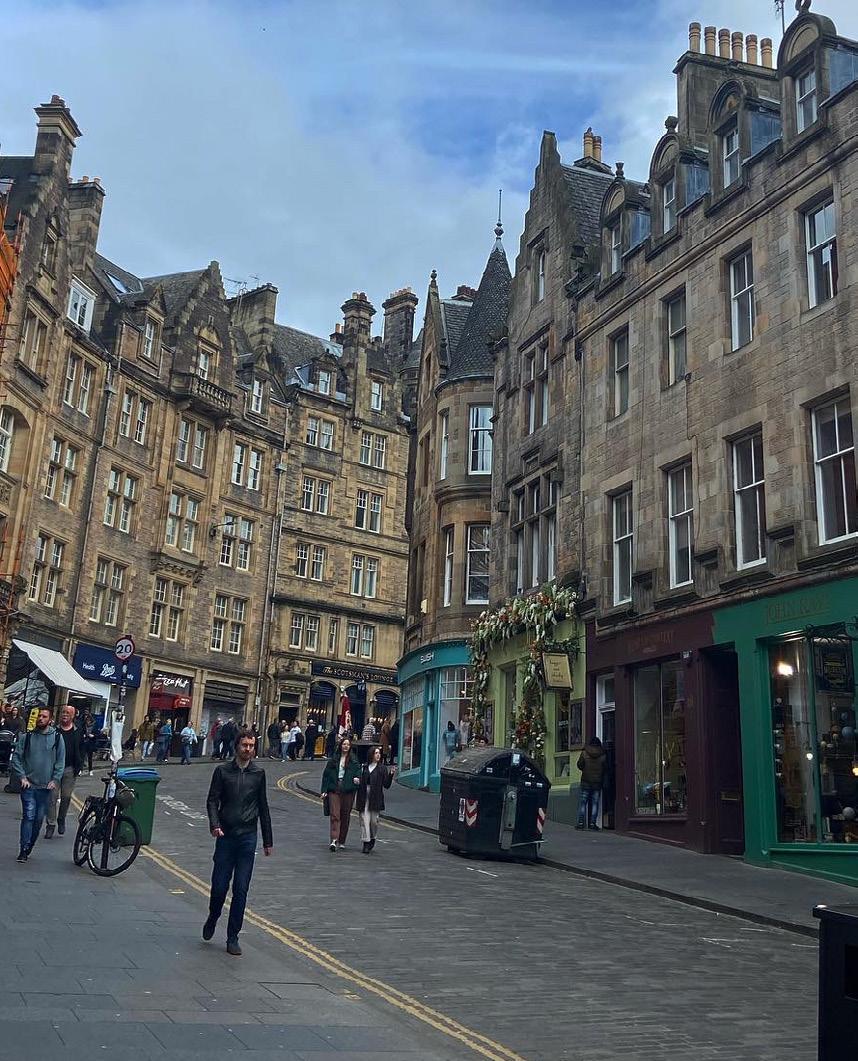
You would be hard press to ever find a culture quite as loud and prideful as ours,”
-Johnny, Tour Guide
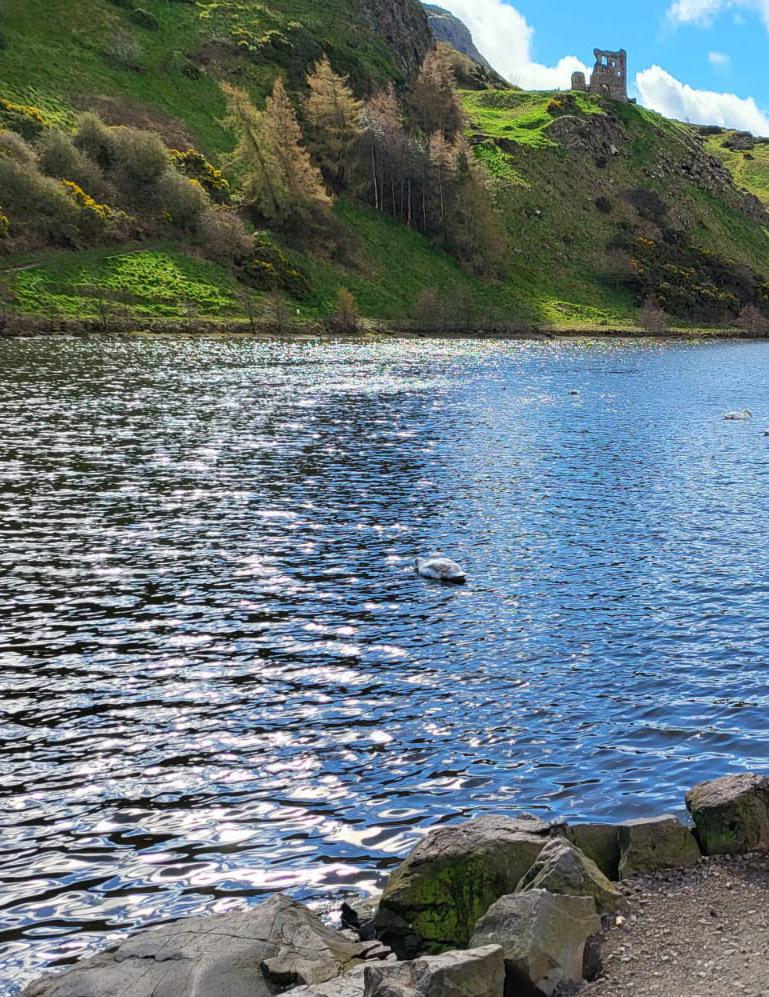 Located behind Arthur’s seat lies the remains of an old chapel overlooking the pond filled with swans. Photo by Michaela Cox.
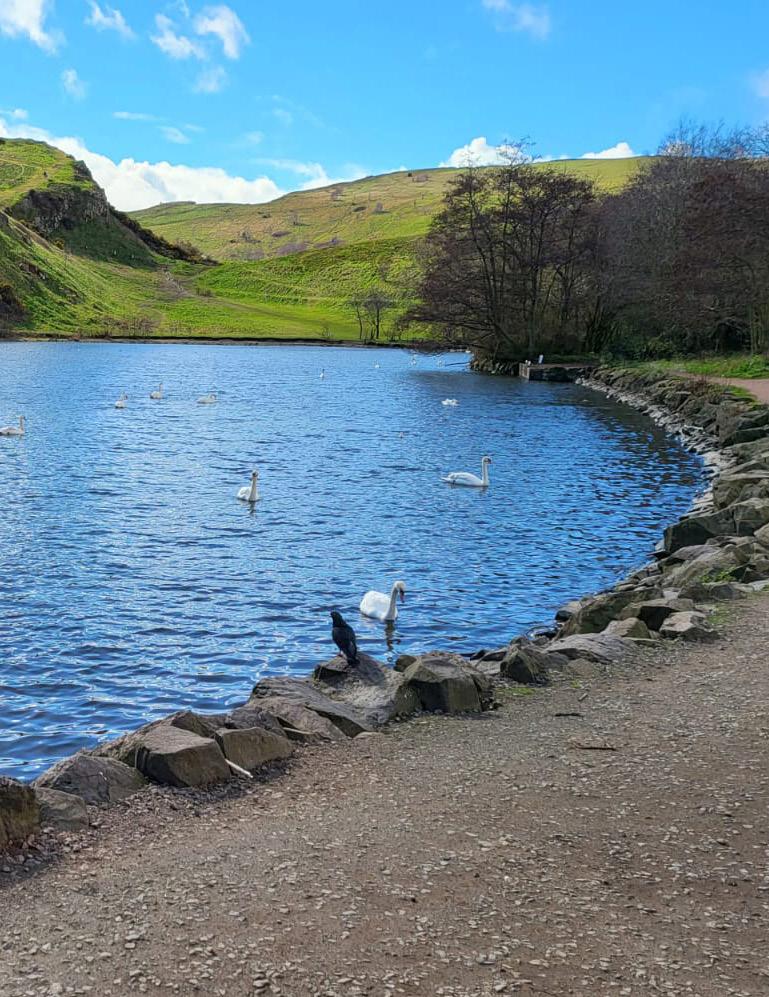
With the astounding Atlantic Ocean on its western border and the frigid North Sea on its east, lies Scotland. Located in the northern part of the United Kingdom, Scotland is home to more than 5 million people, setting itself as the second largest country in the United Kingdom. Although some may find the climate of Scotland nautical, with cool damp temperatures as rain and windy weather spends the majority of its time here. Scotland is well known for its vast beauty of hills, mountains and diverse landscapes. These landscapes were
created through natural or cultural forces from years of evolution that are still changing to this day. Its bewitching beauty leaves travelers breathless and yearning to discover more. For those in tune with nature and wildlife, you won’t have to go far to experience the outdoors. Regarded as one of the top locations in Europe to watch wildlife and a record of more than 90,000 species, Scotland draws in wildlife enthusiasts from all over.
To witness all of these species, it is recommended to visit national parks such as The Cairngorms National Park,
Glencoe National Nature Reserve and the 43 other National Nature Reserves. A few of my favorites are the Golden Eagle, which has a wingspan of 204220cm. Your best chances of seeing one are on calm, clear days; these conditions that make for good hunting. The Badger is known for having a distinctive black and white-striped face and bushy tails, unlike any other mammals in Scotland. The Grey Seal is seen yearround and the best chance to spot one is near the coastal waters of the Isle of Skye. The tiny European pine marten is known for being elusive and around the size of a house cat it is also one of the many beloved species from Scotland. Listed as one of their rarest endangered animal species, the Wildcat is the only native cat species in Europe that still remains in the wild. This is only a minuscule glimpse of the different species you may find in Scotland, it’s easy to see why wildlife enthusiasts love it. Conservation and reintroduction of
native species are other vital features one could take part in while visiting.
Wild Scotland is a website perfect for uncovering these opportunities, allowing its readers to find wildlife information related to anything one may wish to know. A key feature to remember when viewing wildlife is ensuring minimal disturbance and respecting the animal species’ boundaries. Although Scotland’s wildlife and scenery bring tourist attractions, this doesn’t mean they are without any threats. Habitat fragmentation and intensive land management torment the Uplands, while less than 1% of grassland is considered semi-natural. Its freshwater and wetlands are affected by water flow, contamination and nutrient leaching have led to these areas deteriorating. With only 20% of Scotland’s land mass able to support its woodlands, the increasing concerns of pesticides, invasive species and disease from climate change led to
several conservation efforts created to preserve what is left. Pollution and microplastics flood the coast and sea and have found its way into sea creatures’ bellies.

Although these threats feel distressing and haunting, it doesn’t mean Scotland has given up on fighting back. Highland Titles has dedicated preserving wildlife as a high priority and creating conservation opportunities to ensure this. Should one seek to find such opportunities while visiting, they should not experience any trouble finding them. From vast landscapes and rich history to viewing wildlife that is listed as critically endangered; Scotland leaves tourists engrossed and rummaging for more to be seen.
The Glasgow effect is a phenomenon seen across of the cities in the United Kingdom and some areas of Europe. The idea is that though this is one of the longest standing and most developed cities, there are still massive swaths of people who have poor life expectancies. This was best exemplified by the World Health Organization in 2008 when they found a man who grew up in Calton, Glasgow, had a life expectancy of 54 years; while just 12 kilometers away in East Dunbartonshire, that person would have a life expectancy of 82 years. A 30-year difference in life expectancy in a developed country is unacceptable and those who grow up in the less fortunate areas of the city have every right to be outraged by these injustices. The people I interviewed attributed the Glasgow effect to the historically overcrowded inner city, industrialized hazards, diet, weather, poor city planning and population booms associated with modernity.
“The Glasgow effect has had effects on the city for more than 200 years but was only ever realized in the late 80s early 90s,” Johnny, our walking tour guide in Glasgow, said.
In the heart of modern Scotland, there are areas with lower life expectancies than Iraq and Nepal.
However, this is not just an issue in Scotland. Glasgow sadly represents a prime example of a developed nation
with people living in industrial squalor. That said, there have been programs established and put into place to help combat the blatant inequalities. For example, the city center has been undergoing modifications since the 1950s to help improve the area.
Tourism is one of the most important factors in Glasgow’s economy. This was present during the 2014 Commonwealth games. Tourism has been one of the biggest factors to help combat the Glasgow effect by getting people to put money into the deprived areas. When there is a big sporting event, such as the Commonwealth games, there is a massive influx of people to the city. All these people need places to stay; this is where the poorer areas of the city can benefit. Profits gained from the weekend can help support the areas around the stadium, which are often more impoverished. During the event, people walk around spending money in the local shops and pubs while they are there. These influxes of people provide a jumpstart to local neighborhood needs.
This is a common practice in underdeveloped countries, where tourism is focused in poorer areas to attempt to help start economic development. It is theorized this same thing is occurring in Glasgow to make some of the less-developed areas more prosperous. The idea is called pro-poor tourism

and entails focusing tourism in areas that are impoverished. An advantage of such for a city like Glasgow, and other Western cities with issues of inequality, is that sporting venues are often locate in more impoverished areas on the periphery of the city.
Other programs have been launched to eliminate the Glasgow effect, such as the Scotland National Dental Inspection Program. Investigators noted the vast disparities in dental health based solely on socioeconomic differences and decided to do something about it. Concerted offering of free dental and hygiene care through the city helped reduce the disparities in oral health by 2012.
Since recognition of the problem took root in the 1980-90s, there have been, and continue to be, efforts to reduce urban inequalities that plague Glasgow. Notably, calls for reform in education access and a reassessment of wealth distribution have made inroads toward making change. The sense of community and commitment to improvement in Glasgow makes them a prime example of how to overcome their own legacies of poverty. Hopefully, this inspires change in other Western cities.
In the heart of modern Scotland, there are areas with lower life expectancies than Iraq and Nepal.
“Strikingly similar to a city near you”
ROBERT CARSON DALLAS, TEXAS PSYCHOLOGY
In early June 1939, Sir Jackie Stewart was born and would become a national icon for Scotland and for Formula One. As I spoke with Scottish locals, it was clear Scotland takes pride as the home of the iconic Sir Jackie Stewart, but isn’t as involved with the sport as the powerhouses England and Italy. Scotland isn’t known for Formula One, but with Sir Jackie Stewart, the United Kingdom has become more involved with the world of motorsports.

“Originally I’m from a small town in Italy, where Formula One is a prominent sport in one’s life,” Leonardo Palomba, sales associate of Johnstons of Elgin, said. “Growing up I had always heard of Sir Jackie Stewart, but didn’t pay much attention since I mostly focused on the Ferrari’s. After moving to Scotland, I started to understand the draw to him and why everyone loved him during his career.”
Last year, there was a Sir Jackie Stewart Classic at Thirlestane Castle. At the classic, more than 20,000 people came to view some of Jackie’s iconic cars on display. Although there is not a Grand Prix in Scotland, there has been in the past. With the growing popularity of formula racing, there has been some talk of returning to Scotland. Now, the classic will be in Scotland, generating more buzz.
“In 1971, [Stewart] worked for ABC TV as co-host for the big American network’s live coverage of the Monaco Grand Prix,” Gerald Donaldson said. “On the starting grid, where his Tyrrell was on pole, Stewart spoke to the camera explaining in detail how difficult the race would be. At the finish line, he pulled off his helmet and again addressed the camera, explaining how he had won.”

The Knockhill track has a deep history in the Formula One world, opening in September 1974, it has had multiple races and championships at the circuit. Although Scotland is not a hub for Formula One, having a FIA-approved circuit is essential for Scotland to keep moving up in the motorsport world.
“I’ve been working at the National Museums of Scotland for over 10 years now, and with each day more people come in looking for the Sir Jackie Stewart exhibit,” Taylor, an exhibit guide at the National Musuem of Scotland, said. “It’s amazing that I get to work here, growing up when Stewart was racing and seeing how he changed the way we race now.”
Although Stewart is an icon for Scotland, he also impacted Formula One with the implementation of more safety procedures. As as driver, Stewart recognized that more safety regulations should be necessary, making the sport less deadly. Stewart would push for
helmets that covered the whole face, seatbelts and emergency personnel on standby for when there was a crash during a race.
“It’s a dream come true that I get to spend my time at the museum telling young folks about Stewart and all his accomplishments,” Taylor said. “One thing I will tell you is that Sir Jackie Stewart has become a type of hero in Scot’s point of view, because in all honesty, we normally get overlooked in a lot of things. So, it feels quite nice that there has been development in Scotland regarding Formula One, even if I am a McLaren fan.”
“One thing I will tell you is that Sir Jackie Stewart has become a type of hero in Scots point of view...”
-Taylor, Exhibit Guide
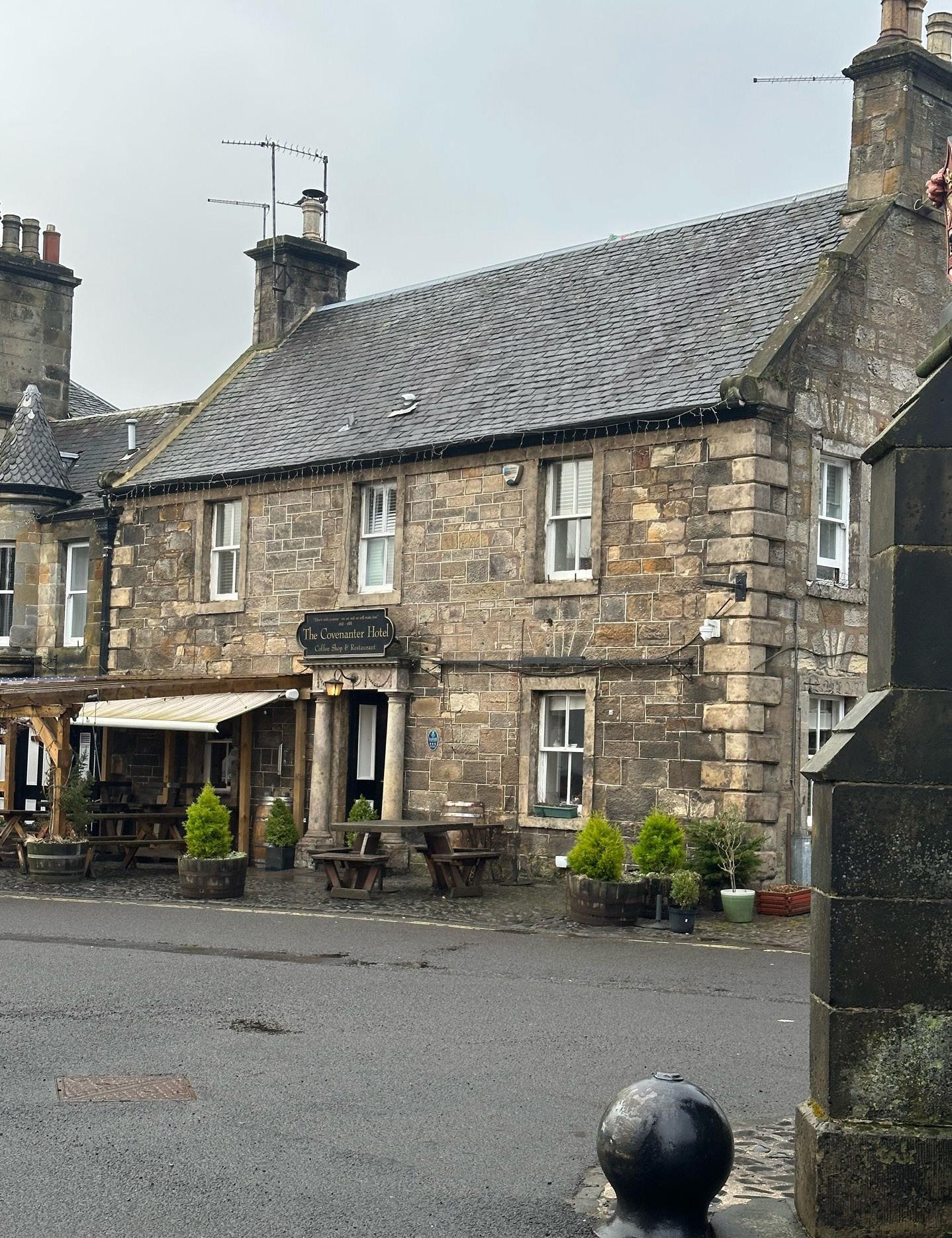 The Covenanter Hotel. Used as Jamie and Claire’s Honeymoon Hotel in Outlander. Photo taken by Tetye Holcomb.
Scotland’s identity is an integral part in gaining a deeper understanding of Scottish culture and people. Although Scotland is small, it is a proud country and is known for many different reasons. For example, most people think of Scotland and associate it with bagpipes, kilts, castles or maybe the famous television show “Outlander.” However, is there more to Scotland’s identity than one might think?
As we visited historic castles, our tour guide told an interesting story about the famous writer, Walter Scott, and his crucial role in establishing Scottish identity. The traditional kilt was typically worn by Scottish Highlanders, but when King George IV visited Edinburgh in 1822 and saw Scott wearing one, he proclaimed that all Scottish men should wear kilts. It is not uncommon to spot men wearing kilts in Scotland today, regardless of where they may come from.
Another factor that is important to Scotland’s identity is its history with England. When visiting Scotland, it was easy to tell what Scottish people thought of England. As with the Lowlanders and Highlanders, the distinction between England and Scotland is a point of contention for the Scottish people. Some Scottish people view England as an oppressor and feel that they would be better off without England. However, others can’t imagine a world without England in control.
In 1603, King James VI gained power over England and made it his goal to make one kingdom that contained England, Scotland and Ireland. In 1707, the Act of Union was signed
and effectively joined England and Scotland into one kingdom called Great Britain. During its continued fight for independence, Scotland gained another key element to its identity: heroes. Heroes and bravery became a central part of Scotland’s identity. The stories of William Wallace and Robert the Bruce became ingrained in Scottish history and contributed to the values of bravery and courage.
These stories of bravery and courage inspired various shows and movies including “Braveheart” and “Outlander.”
In “Outlander,” a Scottish man and a British woman fall in love after a unique set of circumstances that includes traveling back in time.
The series is set during the Jacobite rebellion and is a fictional retelling of life in Scotland during this time. “Outlander” depicts violence, love and courage. The series focuses on the struggles that Jamie and Claire Fraser face in their relationship and the struggles that Scottish people faced during their fight for independence.
In Scotland, we partook in an “Outlander” tour. The tour took us to many beautiful castles and several other beautiful locations used in the filming of the series. I was unsure how the Scottish people would perceive a show made to tell their history in such a unique way. However, both tour guides felt that “Outlander” was a show that was beneficial to Scotland.
“While the show does have an interesting perspective, it also does a good job of showcasing the Scottish people and our history,” Scott said.
The pride that the people of Scotland have for their country is a prevalent theme in the series. The show’s main character, Jamie Fraser, is a man who will fight for what he believes in and really values honor, courage and bravery. ALthough the show was set more than 100 years ago, the people of Scotland still feel limilarly about England.
“The fight between England and Scotland is never-ending and will always be an important story to tell,” Jonathan, a tour guide, said.
The show has become an important part of shaping Scotland’s identity through the eyes of a younger generation and throughout the world. Scotland is a beautiful country, full of history and heroic stories. It is shows like “Outlander” that these remarkable stories reach large audiences and allow others to see the true beauty of Scotland.

“While the show does have an interesting perspective, it also does a good job of showcasing the Scottish people and our history”
Scott, tour guide

the world’s smallest bite, my nose scrunched as I could not get over the thought of what I was eating. The taste of the dish was not bad, but the thought of what it was I was consuming had my stomach in a knot.
Ibroke my two-year-long vegetarian streak to try haggis. Going to Scotland presented me with the opportunity to reach out of my comfort zone and try a variety of foods. Before leaving for the trip, I researched all the kinds of foods that Scotland holds dear and made the choice that “when in Edinburgh,” I would try every traditional Scottish dish.
Due to my vegetarian status, I decided that one of the most difficult dishes to try is haggis– the national food of Scotland. Haggis is the most versatile dish, as it can be used in breakfast, lunch and dinner. The dish was created to ensure no part of a sheep would go to waste. It uses every part of the animal, commonly containing the chopped liver, heart and lungs, mixed with oatmeal, suet and seasonings. This is then combined and stuffed into a lining, often made of sheep intestines according to Brittanica in 2022.
The first opportunity for me to try this dish was at our hotel, the Hampton Inn located in West End Edinburgh, for a buffet-style breakfast. I scooped out the smallest portion that I could and placed it on my plate. After taking
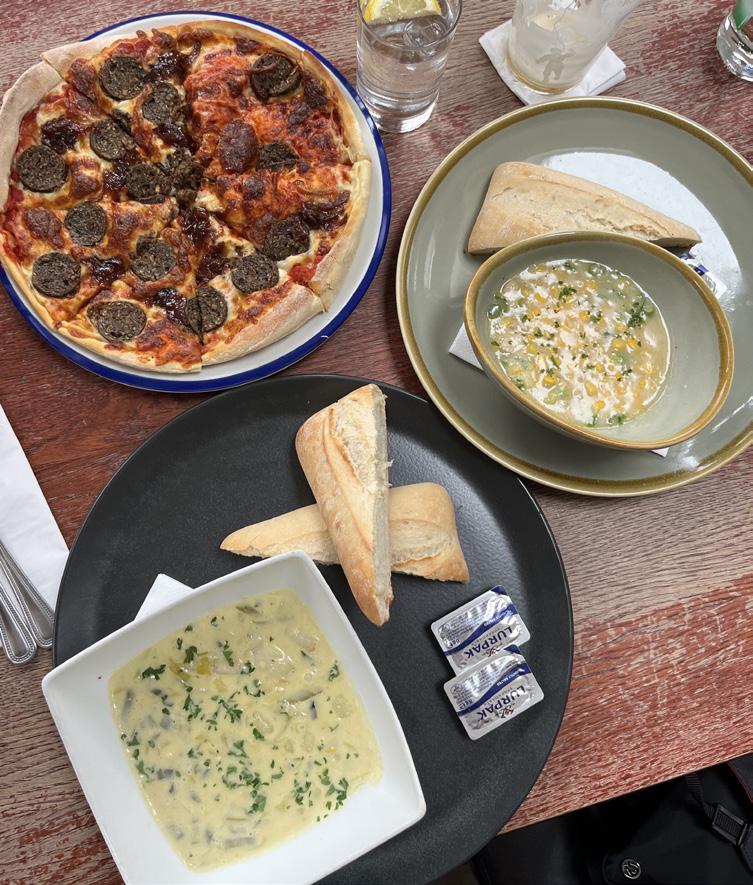
For the rest of that day, I could not stop thinking about the dish and decided I had to give it another try. This opportunity came a few days later in a pub in Aberfoyle called The Faerie Tree. The special that day happened to be the caramelized onion and haggis pizza, so my friends and I decided to split the pizza to try it. I seemed to be the only person that did not appreciate the pizza. The onions tasted amazing on the pizza, but I could not bring myself to enjoy the circular haggis pepperonis covering the top of the pizza.
It was at that point I decided to try cullen skink, which is a soup made out of smoked haddock, cream, potatoes and onions, served with a side of toasted bread. This dish was also outside of my comfort zone, but I genuinely did enjoy the flavors in the soup. It was warm, and provided me with a comforting feeling of home.
The next meal was at the Spirit of Scotland Show, which featured a main course of Highland Beef Stramash served with root vegetables and potatoes. This dish reminded me of the American-style pot roast dish my mom used to make for me; it was very good and flavorful. The meat was cooked perfectly and the white wine they served to complement the dish. This was one of my favorite meals I had for the entirety of the trip.
My personal favorite part of the dining experience when I was in Scotland were the foods from different cultures. Edinburgh had a variety of countries and ethnic foods
represented everywhere we went. I had some of the best Indian, Thai, Italian, Mediterranean, Middle Eastern- fusion and Ethiopian food during the trip. Each restaurant was amazing to visit and I was absolutely delighted to find a vast selection of vegetarian dishes at each restaurant.
On the last night of the trip, I tried Cranachan, a traditional Scottish dessert served in a glass containing whipped cream, scotch whisky, honey, oatmeal, and raspberries. Although this dish is typically served around Christmas, I tried it in March. The dish reminded me of a dish my dad makes at home for dessert sometimes, minus the oatmeal. It was a pleasant reminder of home and I asked my dad about the dish after and found that the dish he creates at home is from my Scottish grandfather. The connection I felt to my family while trying Cranachan for the first time was unparalleled and was a very sweet way to get in touch with my roots. I have since made my own version, inspired by my dad and the restaurant version at home.
On our final morning of the trip, I walked through the lobby to get our buffet-style breakfast, and at the far end of the area was the serving tray that had contained haggis all week. I looked more closely at the dish and was surprised to see that it was labeled as vegetarian haggis. For the last time, I loaded up my plate with the dish and attempted to eat a spoonful. I was pleasantly surprised that I enjoyed the flavor and could now say I liked the dish.
In the Heart of Scotland, Women and Children From All Over the World Having a second chance.
The UK is known for inviting immigrants from nearby countries who are in need of refuge, a chance to start over. However, coming from another country brings barriers for immigrants to succeed once they arrive. Shulamite Ezechi created ANYiSO to help provide resources to immigrants coming into the UK to be successful. Providing guidance, assistance and tools to incoming immigrants in just of the many ways ANYiSO gives back to their community. They are activists helping climate change by teaching classes on how to live sustainably.
Another major mission they work on is providing sanctuary options for women that face domestic abuse. ANYiSO works alongside other organizations to help provide the best support they can so different communities get the help and support they need. All alongside working with the Scottish government to change laws affecting the people. ANYiSO is on a mission for change.
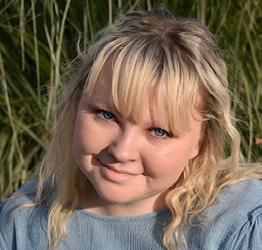
ANYiSO is successful because it has an amazing and strong leader, who started this foundation because she faced similar problems and discrimination firsthand and wanted to make change. I got the chance to sit down and talk to the amazing Shulamite Ezechi. When I asked her how she started this whole organization, she responded saying she prayed about it and God opened the doors for her to keep expanding until it grew into what it is today.
And this is just the beginning. They will continue to grow moving forward reaching more and more people. To explain more about Shulamite Ezechi’s activism, her book “Unveiling Your
True Potential” gives minorities a voice and encouragement. This book shares her journey and endurances of creating an entire organization from the ground up.
ANYiSO is known for providing opportunities for women, specifically focusing on issues facing minorities, women, abuse, hunger, children and climate change problems worldwide. Strong and inspiring groups across the world are doing something to contribute their voices and energy to not only build a better Scotland, but a better example for other countries all over.
ANYiSO provides many free in-person workshops teaching English to those who have no to little English skills. Anyone can join and their doors are open to anyone who needs this resource.
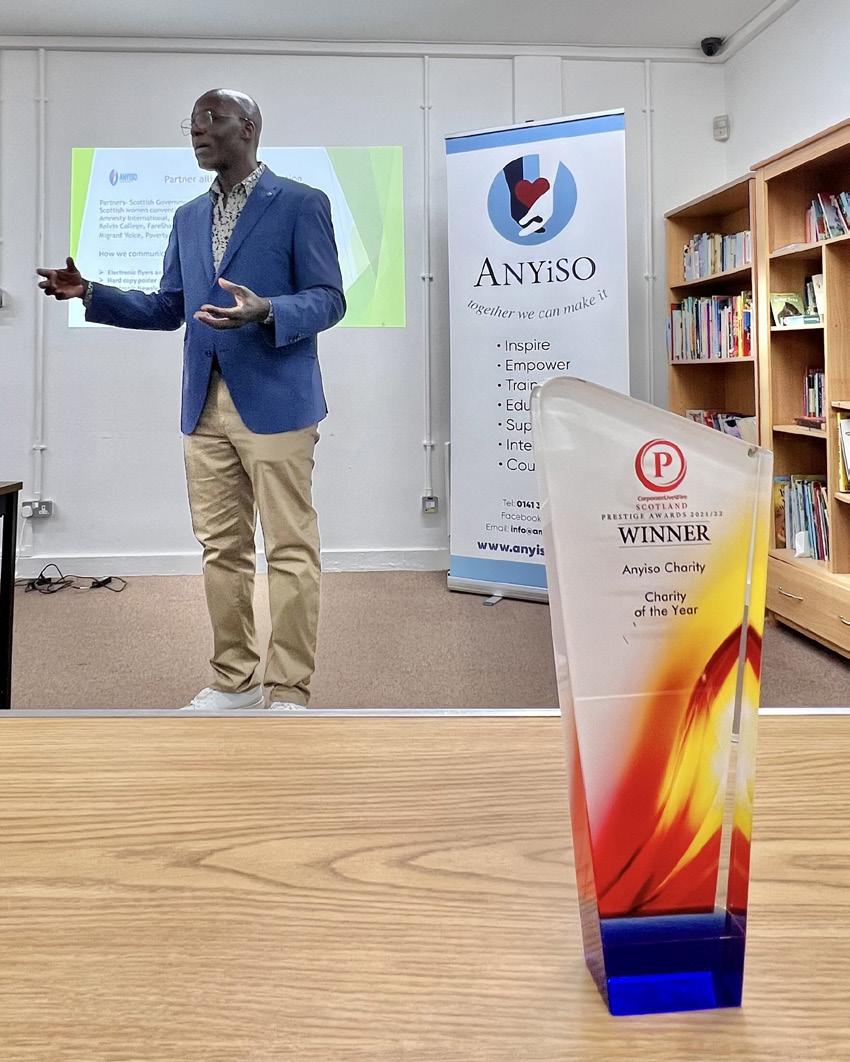
When visiting ANYiSO, I had the opportunity to speak with some of the people who attend classes in the program. These men and women love coming because not only are they learning English, but they also get to build community with people who are experiencing the same things. To help accommodate these mothers and families attending, they also provide childcare for families to ensure that no matter the obstacle they can show up and get the assistance they need.
Another major part of ANYiSO’s program is working toward helping women who are facing domestic abuse, as well as working alongside other foundations that focus specifically on helping women facing domestic abuse.
When a woman comes in, they
provide her resources and directs her to another organization to get her the help she needs and to move forward in life safely.
By getting local youths in Scotland to help out with any kind of group through ANYiSO, they are also contributing to building new and strong leaders for tomorrow.
The organization said this act helps to prevent children from staying on the streets and getting into bad habits while they are young. What a beautiful way to raise an upcoming community in the heart of Scotland.
Through all the ups and downs this organization has endured, its mission stays the same: To create a better tomorrow.
ANYiSO is known for providing opportunities for women, specifically focusing on issues facing minorities, women, abuse, hunger, children and climate change problems worldwide.
Setting atop castle hill, Edinburgh Castle was strategically placed as a military powerhouse that had an advantage over many other fortresses.
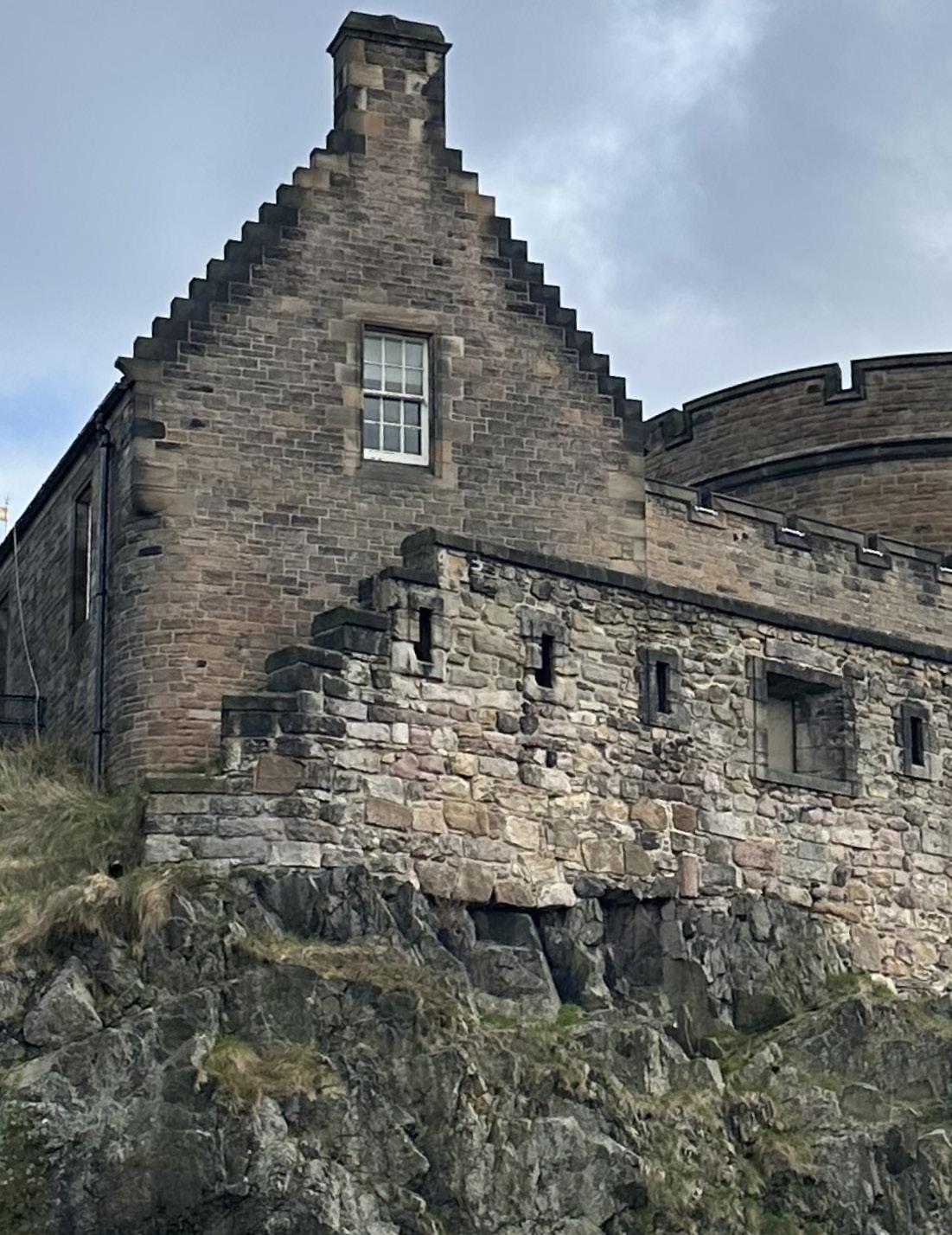 Photo by Teyte Holcomb.
For Centuries, Edinburgh Castle Remains a Staple in Scottish Culture.
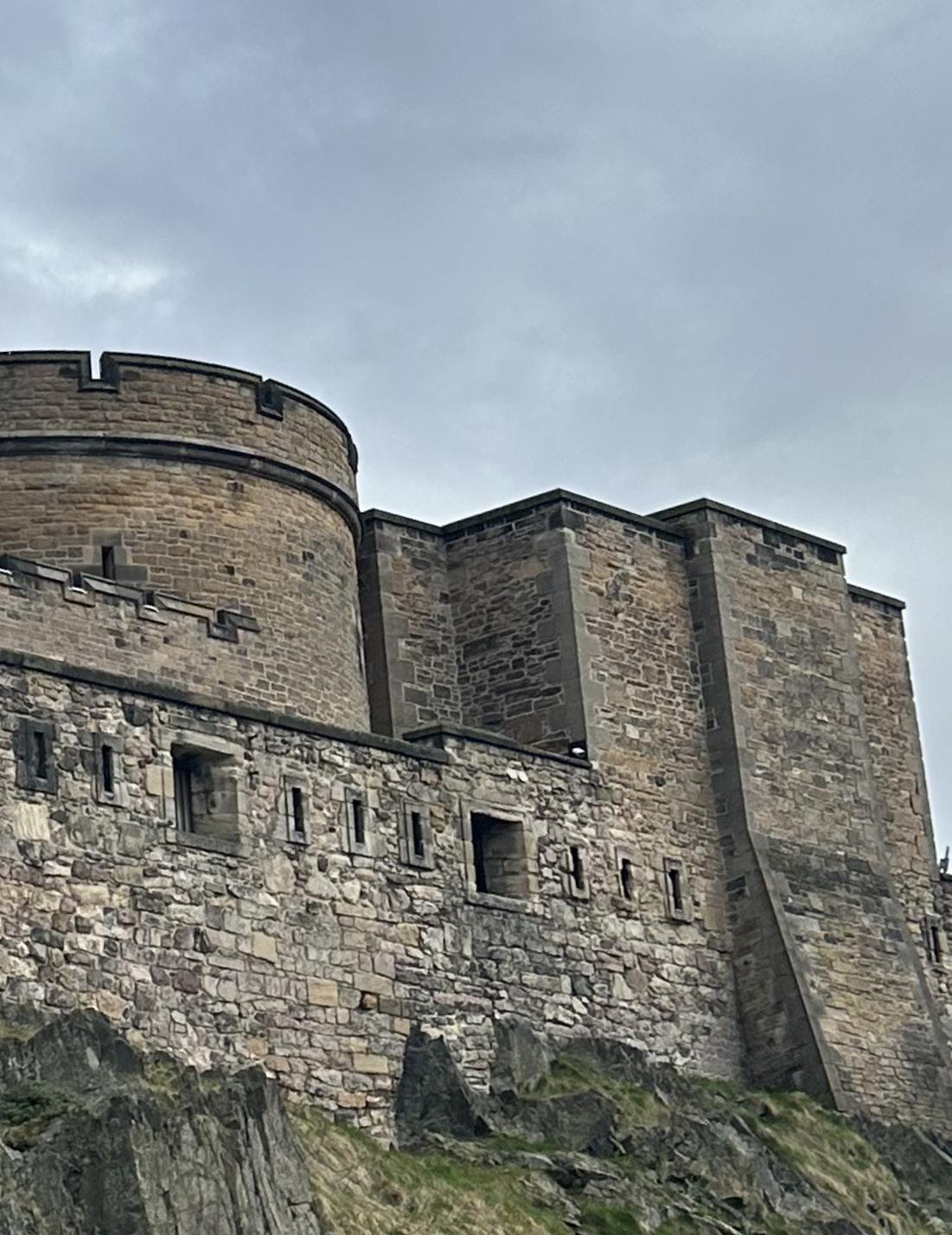
From a military fortress to a royal palace, Edinburgh Castle is a piece of history that has seen ebbs and flows, making it the globally-recognized monument it is today.
Setting its name as one of the oldest fortified places in Europe, Edinburgh Castle has a rich history that stems from royal residency to military prison and fortress. Positioned strategically on what is now Castle Hill, Edinburgh Castle’s original mission is clear: To become a military safe haven during the Iron Age.
Along with military bases and storage, Edinburgh Castle was home to kings and queens for many centuries. After Queen Margaret’s passing at the castle in 1093, her son King David I constructed what is now Edinburgh’s oldest building, which still hosts weddings and christenings in the 21st century.
Through all of the turmoil the castle has gone through, it is still a national treasure, our tour guide Scott said.
“Originally, Edinburgh Castle was meant as a military fortress,” Scott said. “Over the years, she has seen a great deal of transitions, but her importance still remains the same.”
Another classic piece of Edinburgh Castle history is The Great Hall.
Constructed for King James IV in 1511, this piece of the castle was meant to host the grandest of events and philanthropic banquets. Although this addition set new standards for luxury within the castle, the time was short lived as King James IV died at the Battle of Flodden two years after the completion of The Great Hall.
“King James never got to experience his most prized possession,” Scott said. “Even though it was still a prized possession, it was never quite how King James envisioned it. If you look today, you can still see remnants of what his vision looked like all those years ago.”
What was once a bustling royal palace almost 1,000 years ago, now sits as a memorial for the history of Scotland and the battles and triumphs that brought the castle where it is today.
According to Historic Environment Scotland, the castle set its military importance in the 1500s and is still an active base, even with its current tourist draw. Along with museums that tell the importance of the castle during the Middle Ages, Edinburgh Castle was a strategic point of interest for the Scots during World War II.
Military and Scottish residents used the castle’s placement as an advantage point for the war. Alhough the castle was originally built for those of the Iron Age, showers and beds were placed inside to provide a safe haven for the military fighting in World War II. Although the days of the World War are over, the castle still provides a space for military personnel.
Even as an active military base, the castle houses the Honours, or Crown Jewels, of Scotland and the famous 15th century gun at the National War Museum of Scotland. Guided tours allow visitors to understand the rich history of this castle and help tell the story of how this medieval castle has transformed during its lifespan.
“The Crown Jewels are some of the most treasured artifacts the castle has
to offer,” Scott said. “Cameras aren’t allowed in, so getting to see these in person is truly a once in a lifetime opportunity.”

The deep history of Scotland’s Edinburgh Castle is one that is filled with history, old and new. Altough this castle has a historical meaning, it also represents a bigger piece of Scotland’s history. Residents grew up with tales of the castle and what it means in Scottish culture.
From bedtime stories to old-time folktales, Edinburgh Castle is one of the staple locations for these tall tales. Although these stories are largely rooted in fairy tales or legends, part of the lure to the castle is that maybe these stories aren’t so far off after all.
Tour guide Graeme said hearing about the castle growing up is a part of Scottish culture and provides fond stories to travel from generation to generation.
“I always heard stories about it growing up,” Graeme said. “While now I know some of them were sort of tall tales, it (the castle) still lives in my memories of my childhood, and I’ve gone and passed those same stories down to my kids.”
Edinburgh Castle has occupied many positions, from military base to a royalty safe haven. Although the castle has seen a shift in its story, the journey has become a staple in Scottish storytelling, making it a forever piece of history easily recognizable anywhere.
“She’s become a staple in Scotland’s history. It’s hard to picture life without it.”
-Scott, tour guide

Scotland has a rich history in myths and the supernatural, acquiring many rituals and superstitions. Scotland is the home of superstition, a belief or ritual not scientifically proven. While in Scotland, we stayed in Edinburgh and spent a lot of time on the Royal Mile. With the old-timey feel of the town, history and architecture, there were bound to be a couple of superstitions around. While taking a walking tour of Edinburgh to learn more about its spots and history, I discovered many tales.
First, the statue of David Hume, which the people of Scotland believe rubbing the toes of the statue will bring good luck. You can see many tourists rub his toes as they walked past, this occurs so often that the toes are a different color of rust than the rest of his body.
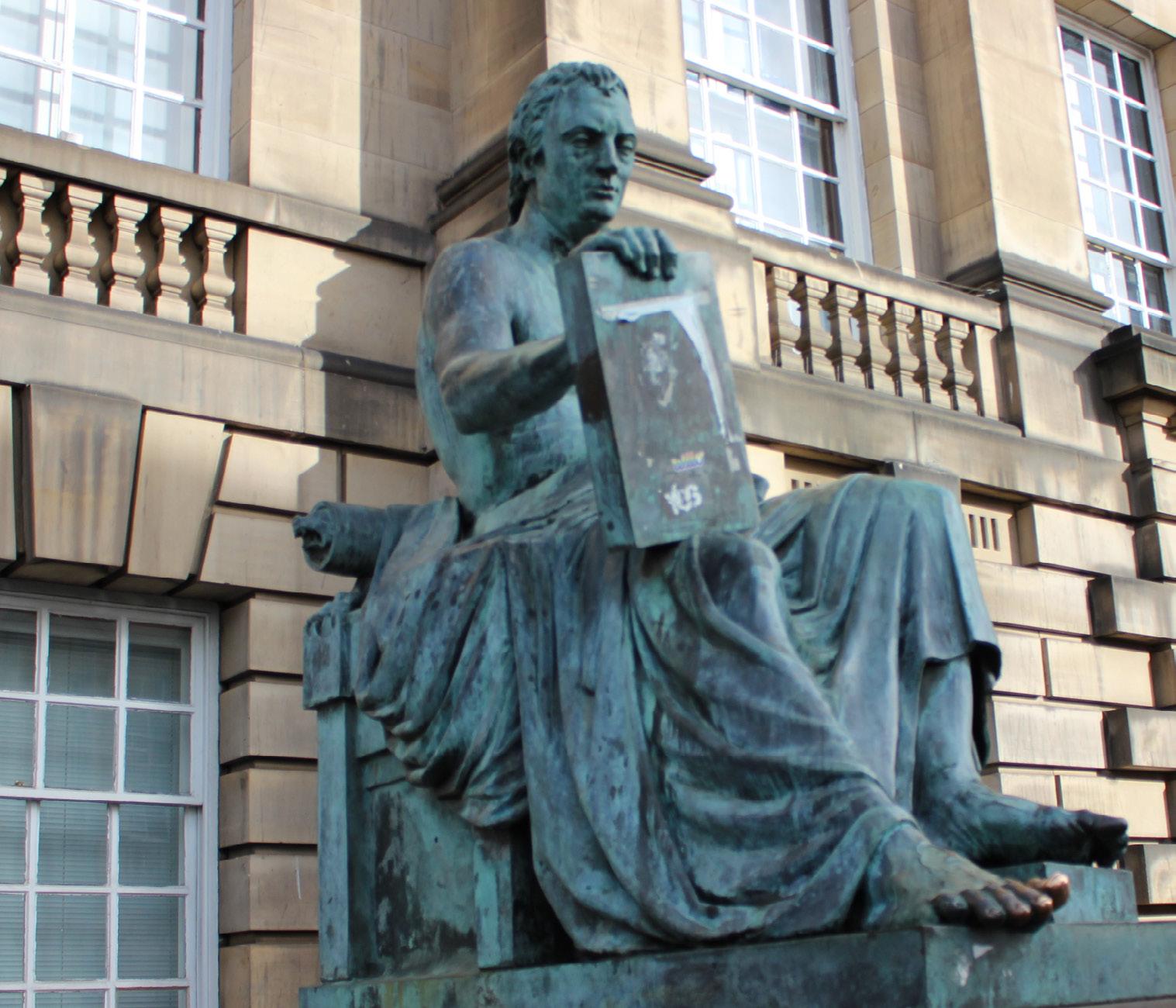
According to our walking tour guide Graeme, Hume was a well-renowned philosopher who was known for his rejection of religion and superstition. Graeme said the tradition started as a good luck charm for college students attending the nearby college, used as a way to spark luck on their exams. The Scotts found it so ironic and funny that they kept the tradition going, Graeme said.
Another Scottish superstition is spitting on the Heart of the Midlothian for luck. I was left shocked and disgusted when I saw someone hock a huge spit wad and spat it on the heart. I later found out this is what people do for good luck. However, how did this gross superstition start?
It started before the heart was even there, Graeme said. Before the mosaic gained its notoriety as the Heart of Midlothian, the infamous Tolbooth Prison once stood in its place. Tolbooth was so hated that a tradition started
where locals would spit in disgust at the entrance of the jail when they passed it. People still spit on that spot, hoping to bring good luck and a winning game for the Hearts of Midlothian football team.
The statue of Greyfriars Bobby is also a superstition born in Edinburgh. Greyfairs Bobby, a Skye terrior, was so famous that Disney made a movie about his life. After Bobby’s owner died, Bobby refused to leave his side. Bobby would stay by his headstone at the cemetery in the Greyfairs Churchyard, no matter the weather conditions. He stayed there for 14 years, only leaving for food until his death. The locals who heard about Bobby were touched by his loyalty and love for his owner that they built him a shelter by his owner’s grave. A statue was made in honor of Bobby’s loyalty.
Tourists began to rub Bobby’s nose for
good luck. His nose has been rubbed so many times that it deteriorated the nose on the statue and Edinburgh is on its third Bobby statue, with a sincere plea to all to stop rubbing his nose. While on the walking tour, Graeme said locals have stopped rubbing the nose to try help preserve the statue. Although that doesn’t stop the multiple tourists fromrubbing his nose.
There are many more superstitions in Scotland, the ones I mentioned are a smidge of superstitions in Edinburgh. It was a blast learning about some of Scotland’s history and traditions. There is plenty more to learn and explore in Scotland, enough that requires a trip back.

People still spit on the spot, hoping to bring good luck and a winning game for the Hearts of Midlonthian football team.David Hume’s statue in front of the St. Giles Cathedral on the Royal Mile. Photo by Katelyn Stafford.
What does Braveheart, The Outlander series, DisneyPixar’s Brave, Hogwarts School of Witchcraft and Wizardry and the Loch Ness Monster have in common? They are based in Scotland, particularly in the Scottish Highlands. They are known for their romantic and stunning scenery, but there is more to them than meets the eye.
The Highlands cover almost 10,000 square miles (about the size of Massachusetts) in the northern parts of Scotland. Following a geological fault, the Great Glen separates the area with the Grampian Mountains in the southeast and the Northwest Highlands to the northwest. Most of the Highlands were mountainous and hard to maintain for agricultural purposes. This did not stop Highlanders from taking up farming in small clusters called crofting and fishing, according to The Scotsman.
The Highlands were also a cultural boundary against the Lowlands in Scotland. Unlike the Highlands, the Lowlands were like the English in terms of their language and culture. Tour guide Sean McCormack said that the further North someone wanders, the more likely they were to hold onto traditions.
“Like with any country, the more remote you are, the less you are likely to adopt new ways,” McCormack said.
For Highlanders, the language that was commonly spoken was Scots Gaelic (pronounced gah-lic). McCormack explained that Scotland is part of what is sometimes known as the Celtic Nations that consisted of Wales, Ireland, the Isle of Man, Cornwall in the southwest corner of England, and Brittany in northwestern France.
A way of greeting in Gaelic is “Céad míle fáilte” (pronounced kee-mill-fallcher) which translates to “a hundred thousand welcomes.” McCormack also said that it is still seen in present day on signs amongst the Highland roads with English. A shorter way to greet someone would be to just say “fáilte” (“Welcome” or “Hello”).
The clan system is a well-known fact of Highlander culture and a way to differentiate between the Lowlands. A chief ruled each clan and its members claimed descent from a common ancestor, according to Scotland Info Guide. McCormack said that the clan system came from the Picts, an ancient group of tribal people who lived in northern Scotland before the Celts migrated over.
Because the inhospitable countryside separates the Highlanders, forming a community was essential to their everyday lives. “Cèilidh” or “céilí” (pronounced kay-lee) were social events where people get together and sing traditional songs, dance, and recite poetry.
The Highland games are a great example of a “cèilidh” and held all over Scotland and in parts of the world with a large Scottish diaspora. They were once thought to be held to find the best warriors for the clan chiefs, according to Scotland Info Guide. In modern times, the games are amateur and range from using farm instruments in sports arenas to Highland dancing.
“The Highland Games are a part of [céilí],” McCormack said. “It is all tied in with maintaining a way of life that was in some ways, tried to be eradicated by the English.”
Kilts are a distinct mark of Scotland and Scottish culture. According to Andrew Bolton from the Metropolitan Museum of Art, it was known to Gaelic-speaking Highlanders as “the little wrap” before it turned to “the big wrap.” Each Scottish clan has their own tartan pattern on kilts and other clothing items to distinguish between each other. The most well-known is the Royal Stewart pattern from the Royal House of Stewart and was used by the late Queen Elizabeth II as her personal tartan, according to The Scotland Kilt Company. Most may know the brighter side of Highland history, but it was not always that way. During the 16-18th century, Scotland was in a state of chaos. Clan chiefs were not only at war with each other, but also engaged in power struggles with the English.
Many Highlanders supported the Jacobite Rebellions of the 18th century due to the Jacobite belief in the divine right of kings, according to McCormack. This support made Highlanders targets to the English and those who supported them.
The oppression against the Highlanders also contributed to the Highland Clearances. Professor Ewen Cameron teaches Scottish History and Paleography at the University of Edinburgh and sees a direct connection between industrialization of wool-making and sheep farming in southwest Scotland and this dark time in Scottish history.
“It’s about essentially the commercialization of land and the eviction and,
“A lot of Highlanders felt that they had their land stolen from them.”
- Sean McCormack
ultimately, immigration of former communities who lived there,” Cameron said, “[The communities] were deemed to be sort of surplus to the requirements of that commercialized way of farming.”
Similarly, McCormack said this period is rightly considered as an important and emotional part of Scottish history.
“This was not all English landowners who were responsible for evicting Scottish tenants. This was quite a lot of Scottish landowners,” McCormack said, “A lot of Highlanders felt that they had their land stolen from them.”

Additionally, the crown banned Gaelic in 1616 to punish the
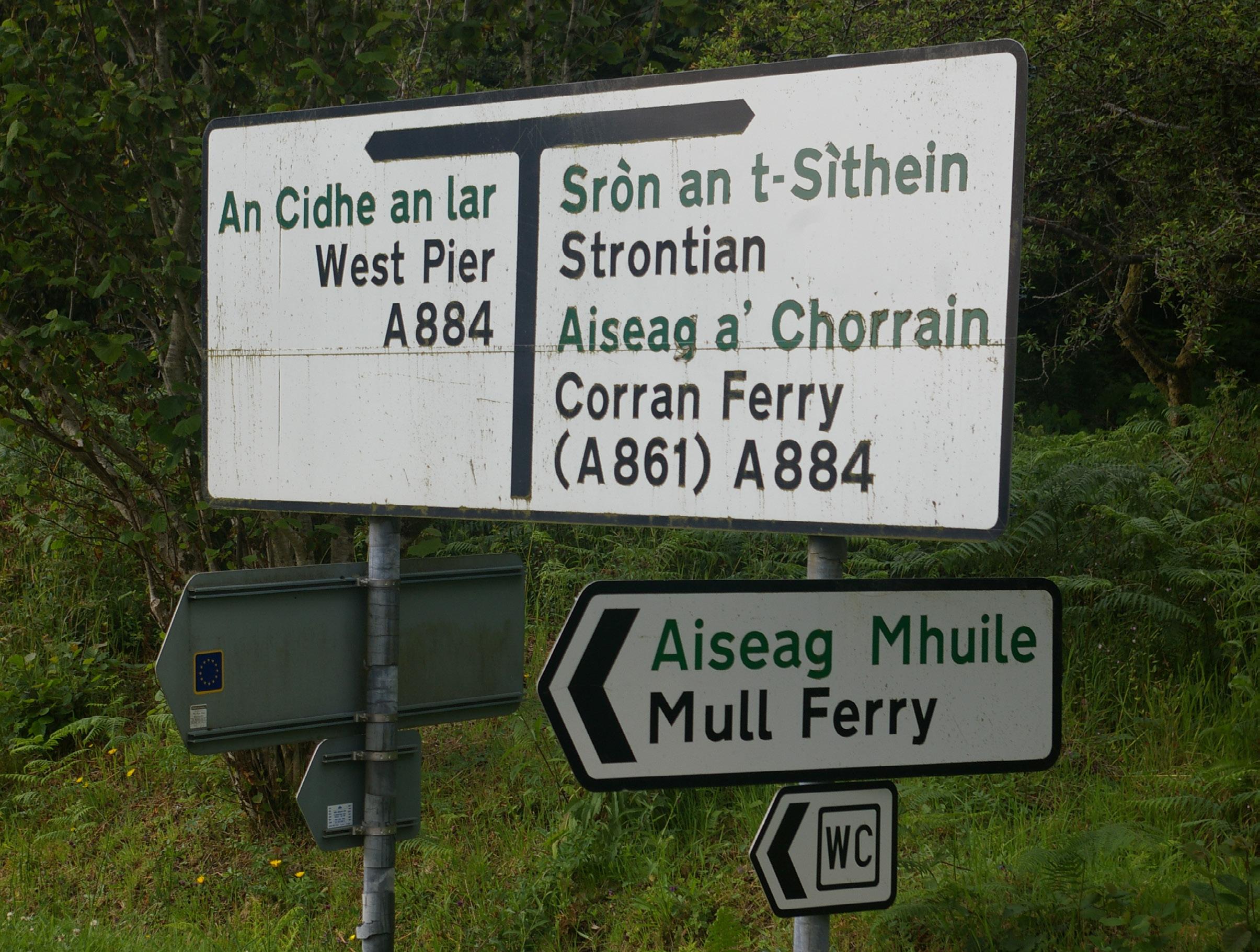
Highlanders for supporting Jacobite rebellions. This led to the number of native Gaelic speakers dwindling. In recent years, efforts to keep the language alive have steadily increased it back up. The Scottish government passed laws like The Gaelic Language (Scotland) Act of 2005 to secure the Gaelic language as an official language of Scotland and it is taught in schools and through annual events like The Royal National Mòd.
Cameron said that places of higher education like the University of Edinburgh teach Scottish history and the Celtic languages as part of their curriculum. Although the classes may
not be as rigorous as others, they still hold a lot of attention in the education system.
There is a growing interest in Scottish history and culture in our world. With the popularity of Scottishbased media and the Scottish education system prioritizing native languages like Gaelic, it shows that people (whether they are from Scotland or abroad) care about the country and what it has to offer.
something spectacular. Sitting there in its slip, a vessel known as the “Maid of the Loch” has a story of her own.
onnie Scotland” is referred to as such due to its natural beauty. Much of that beauty comes from the many lochs dotting Scotland’s landscape. Loch Lomond is one of the most famous of these lochs. Although Scotland is an English-speaking country, it is important to note some terminological differences. Many words the Scots use were once said to confuse the British. To ensure there is no confusion, let’s run through a few of them. For starters, bonnie means beautiful, a loch is a lake and ben means mountain. With the linguistic lesson covered, let’s continue on our journey of Loch Lomond.
Sitting in the shadow of Ben Lomond, formed by glaciers in the waning days of the last Ice Age, Loch Lomond sits upon the Highland Boundary Fault. With maximum depths reaching 620 feet, the loch may not be the deepest, but it is the largest by surface area. Loch Lomond is also the second largest loch by volume, after Loch Ness. Additionally, it is home to the largest freshwater island in Great Britain. This further proves that the list of geographical features surrounding Loch Lomond could stretch a mile long. However, Loch Lomond is more than a geographical feature; it is a piece of Scottish history, culture and identity. Every Scotsman is particular about their Scottish culture and history. After
being under consistent British rule for the past 300 years, the Scots are proud of their history and protective of what stories are told and illustrated. With songs like “The Bonnie Banks of Loch Lomond” and “Loch Lomond” being influential pieces of Scottish culture, it is easy to see that Loch Lomond represents a lot to the Scottish people. Beyond its prominent musical representations, Loch Lomond and the Trossachs also own the distinction of Scotland’s first national park. After one visit to the shores of the loch, it is easy to understand why. The coastline extends for miles, and every turn in the path leads to another breathtaking view of Ben Lomond towering over the loch. If you arrive at the right time, you can see the fog slowly creep over the peak of Ben Lomond and watch as the mountain disappears underneath the mist. With breathtaking sights and mystical music, the loch is worth the visit; however, it still has more to offer. Down at the southern end of the loch sits Loch Lomond Shores, a shopping mall with many boutiques and vendors. In addition to shopping, there is also a Jurassic-themed caf’e and the Sea Life Loch Lomond Aquarium next door. However, a short walk past this and around the bend will lead you to

Loch Lomond is more than a geographical feature; it is a piece of Scottish history, culture and identity.
As the last paddle steamer built in Britain, and the largest to sail on Loch Lomond, the Maid of the Loch is the last example of an “up and doon” ship in the United Kingdom. Originally built in the A&J Inglis shipyard in Glasgow, the Maid was taken apart in pieces and sent to Balloch where she was launched and currently resides. The process of building the ship, taking it apart, and re-building it in a new location is what earns the Maid the distinction of being an “up and doon” ship, otherwise known as a ship built twice. Launched on March 5, 1953, the Maid of the Loch served Scotland for 28 years before she was decommissioned in 1981. After many years of neglect, Dumbarton District Council purchased the Maid in 1992. However, it wasn’t until 1996 that the good men and women of the Loch Lomond Steamship Company came to the Maid’s rescue. Fully staffed by volunteers, the charity has raised more than $2 million and has slowly and methodically worked to restore the Maid of the Loch to her former glory.
The Loch Lomond Steamship Company welcomes visitors to see the progress. However, as restoration continues, the company finds itself in dire need of money. For volunteers to restore the Maid to her former glory, they need proper funding. Until then, like the rest of the loch, she will sit in her slipway as a reminder of the past, present and future of the loch and Bonnie Scotland.
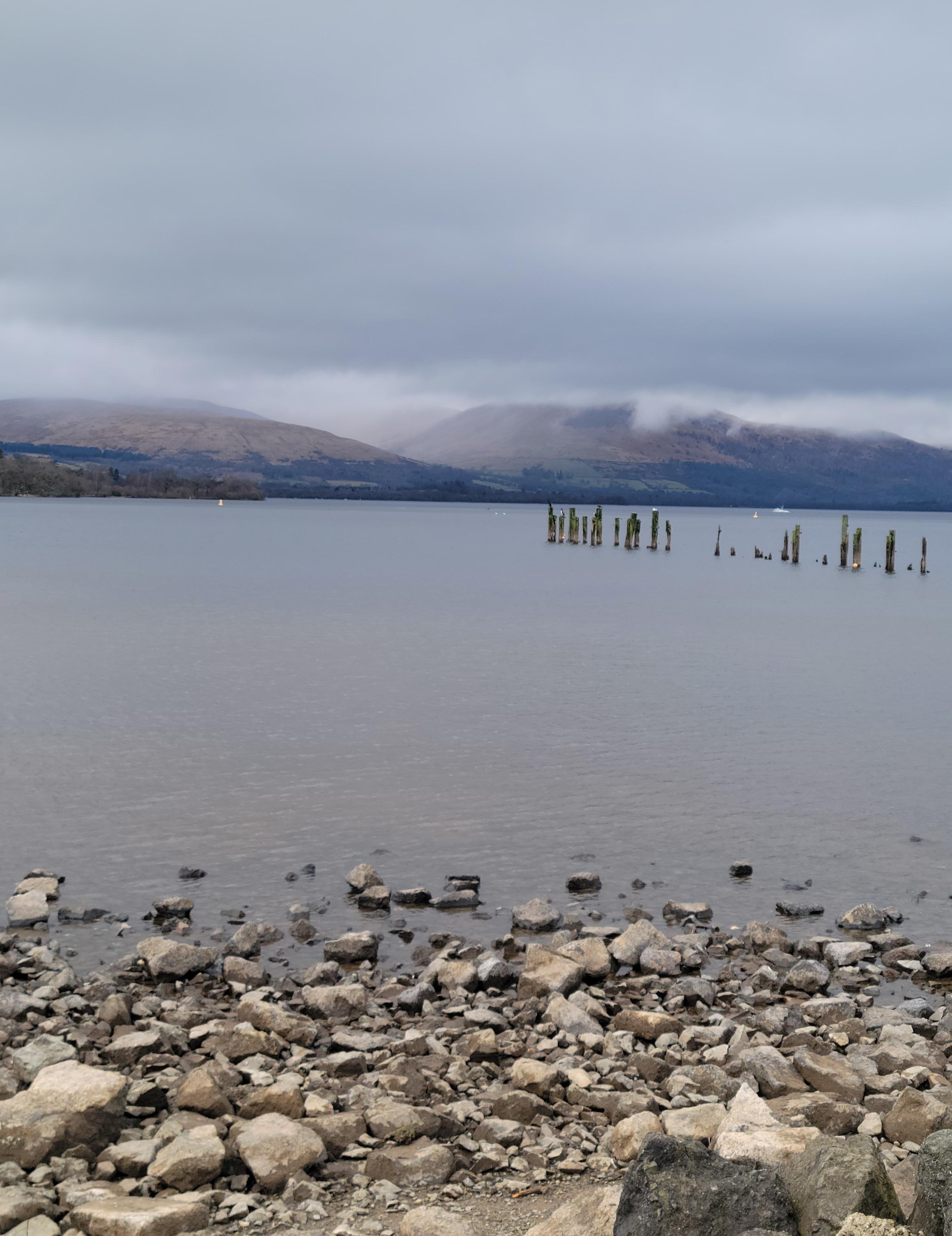 Fog is rolling on over Loch Lomond.
Picture taken by Tyler Tripodi.
Fog is rolling on over Loch Lomond.
Picture taken by Tyler Tripodi.
Sunday, March 12
Private Edinburgh Walking Tour
The Cauldron Co. Potion Making Scottish National Gallery
Monday, March 13
Day Trip Touring Loch Lomond, Stirling Castle and Kelpies
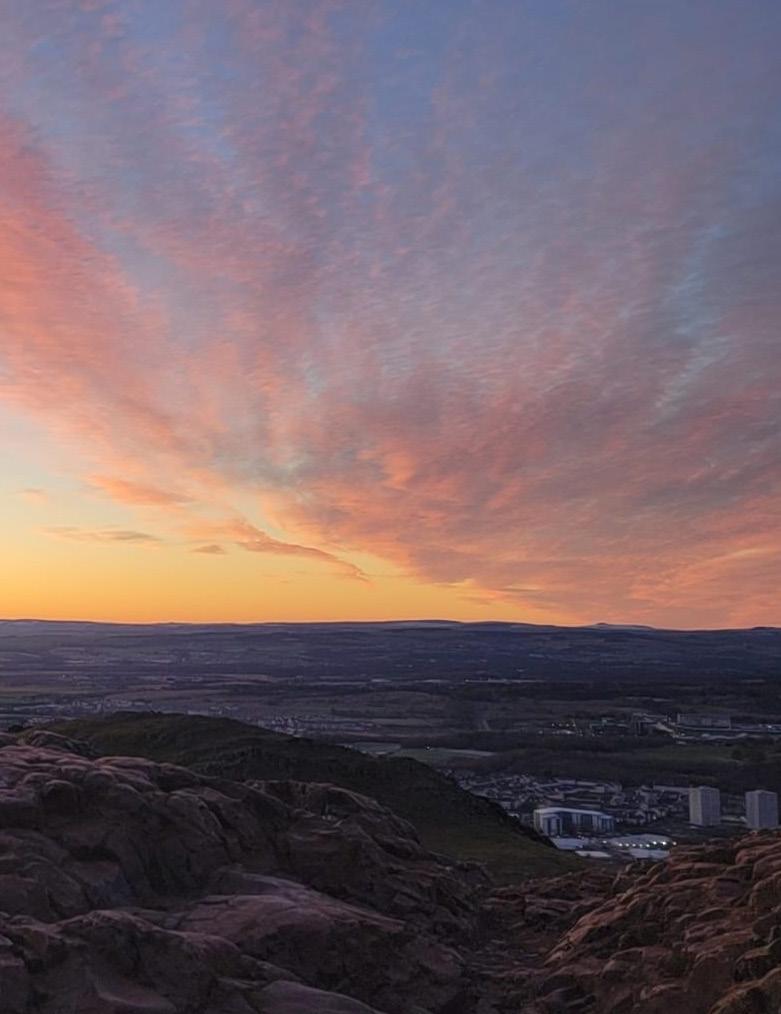
The Spirit of Scotland Dinner and Show
Tuesday, March 14
National Museum of Scotland Link Educational
Wednesday, March 15 Private Glasgow Walking Tour
ANYiSO
Thursday, March 16
Outlander Day Tour (Blackness Castle, Linlithgow, Culross and Falkland)
Friday, March 17 St. Paddy’s Day
Saturday, March 18
Storyteller Alice Fernbank
Edinburgh Castle Tour
Farewell Dinner at Tolbooth Tavern