Austria Through an Orange Lens

Page 1

AUSTRIA through an LENS

Spring 2024, Vol. 2

THE VOYAGE TO VIENNA

Off to the red and the white, With no time for lounges on an early morning flight

Still, hung in transition, with recorded renditions, of Mozart to listen …And yet, something’s missing

A passport delay

With an overnight, or two, stay St. Patty’s at a dumpling bar and walk along the river’s fray

Causally, the London eye, pubs, beer, and fish with fries Still, standing in the break of Monday morning’s sunrise Now comes Vienna…

And again, together we are, a thin line of orange and black flung out to the far Far reaches of sprawling palaces and metro lines with clean streets and violins

See the It Girls in silent grins as the night scenes shape and night begins

Did you not know that Austria is famous for its gin?

But not I, nor us, should dare partake, its at trip with children for goodness’ sake

Yet somehow ice in the glass for refreshment doth shake, And we dj, dance and sing karaoke in the Danube’s wake

And the eagles fly, and vultures vomit fury

Hawks split the air, and the owl’s dead lay unburied For shame, the castle was locked til we arrived, now we are hurried By old ladies in waiting, with stuffed souvenirs and the crutches they carry

But our photo-ops nay ere do we miss And local boys shoot their shots in broke English, hoping not to miss

…but of course they do For they know not our crew

Of academics, a future dentist, a few physicians, Students of fashion and merchandising, sports and advertising, Languages and literature

Numbers and figures

And even a lawyer to boot

And where do sit in this performed music-video shoot?

At the front row with the band

With electrified strings from the bearded man

Who offers translations of sensual strands

Of song sung from ecstasies ringing lips

In joke and jest

But it takes our breath

Like the hot steamed knudles set on the tables to rest

With the flash of phone, the performance almost gone wrong

And we laugh and sing along

With the cheers of local colas and white wines left to sip

There goes the O, off to museums of ornate and ornamental armor

There goes the S, off to Bratislava, or concentration camps horrors,

Or to finish off their interviews

Twenty-seven stars in Sisi’s hair, Her doppelganger along in the stories to share

Is there anything yet left of our trip to review?

There goes the U,

Spanish riders, but not as good as our own,

Elegant dinners and diners, schnitzels and pretzels, and phone calls to home

Dressed to impress, in sneakers nonetheless, and the grand opera tour

The vocals, the music, the incredible music galore

Oh, but if only the climate were warmer

Friendships and adventurers now, with each other we watch ourselves mature

Easter markets and drunken cherries,

A jacket over cold shoulders, with each other’s cares and dreams to ferry

We are of the place now, our feet and souls set down memories not to be lost

In time we are frozen here, as if some threshold of magic in photograph has been crossed

To hold on to one another, in our hearts, for Vienna is still Vienna, and forever shall endure.

LETTER FROM THE EDITOR

Dear readers,

In Austria Through an Orange Lens, 19 students document transformative experiences studying abroad in Vienna through words and photos. Immerse yourself in Austrian culture and identity through narratives of its history, landscapes, musicians, cuisine and more.

From exploring historic Austrian landmarks, like Schönbrunn Palace and the Spanish Riding School, to experiencing the vibrant cafe culture, each story captures the essence of studying abroad in one of Europe's cultural hubs.

Join SMSC's journey to Vienna through the lens of OSU student media. It is an adventure that will inspire, entertain and leave you longing for your own study abroad experience.

On behalf of our team, thank you for reading and enjoy our special Austria edition.

3 Scan this QR code to view our team’s adventure in Austria on our website!

TABLEOFCONTENTS

HISTORY ARTS The City Built From Dreams Shaping Vienna Confronting History Shadows of History Viennese Music The Imperial Crown Beyond The Kiss Vienna’s Vogue Journey Through Vienna’s Architectural Evolution The Lasting Influence of the Habsburgs Inside Mauthausen’s Dark Legacy Austrian Perspectives on World War II Waltzing Through History A Look at the Past and Present Exploring Gustav Klimt’s Timeless Influence A Blend of Traditional and Modern Fashion The Vienna Opera Ball A Fusion of Tradition and Modernity 6 16 21 36 8 15 24 38 48 Mozarthaus A Look Into Mozart’s Life and Influence on Vienna 44
Culture
The Wine and Cheese Culture of Austria
Unique Blend of Food Culture
Café
Biers
Viennese Charm
A
Decadence and Tradition Exploring the Delights of
Demel’s Desserts
A Glimpse Into Austrian Nightlife Exploring Freud’s Vienna Culture Erdapfel Oder Kartoffel Academic Opportunity
Through the Lens of the Spanish Riding School Exploring Austria’s Dialect Exploring University Life in Vienna 10 18 28 42 12 22 30 40 46
Connecting Austria to the Culture It Inspires The History of Freud’s Relationship With Vienna: The Cultural Influence On One Another

The City Built from Dreams: Journey Through Vienna’s

Architectural Evolution

Marvelous sights of intricate architecture and towering structures with a rich history as far as the eye can see fill the City of Dreams. Vienna has faced various battles, rulers and moments of death and rebirth that heavily influenced the development of its architectural movements. Vienna’s glorious architecture dates to the 13th century when it first blossomed into a city. The Romans influenced the first structures, and after its formal establishment as a city of Austria, the first movement into Gothic and Romanesque artistry began Each architectural movement has defined a new era in Vienna, starting from the spark of a historical event.

In the first century A D , the ancient Roman empire ruled over the land where current-day Vienna resides and established a military camp called Vindobona. The camp fell in battle several times during its five-century lifespan and faced its final fall in the fifth century to a devastating fire. Vindobona represents the roots of the current-day city and the origins of its first Roman architectural style Still today, an open-ground display shows the remnants of Vindobona’s structure for all to see. The emerging city eventually became known as Vienna, and nearly a millennium later, around 1200, the Babengurgs built the first city walls.

The Babenberg dynasty ruled Vienna during that time, and it significantly prospered under their rule when Vienna became an important trading center in central Europe and gained its first city rights in 1221. However, the Babenbergs didn’t rule Vienna long. When the family line ended in the latter half of the 13th century, the Habsburgs attained the city, which led to the first defining architectural movement.

Europe embraced Gothic architecture during the 13th century The Habsburgs welcomed this new architectural movement, and it quickly became integrated into Vienna’s structures Vienna’s most famous building, St. Stephen’s Cathedral, was constructed in the Romanesque architectural style in the 12th century. This grand cathedral has been rebuilt multiple times due to several devastating fires..

The first major fire destroyed most of the cathedral in the mid-13th century, and it was rebuilt in the popular Gothic style. St. Stephen’s Cathedral is one of the most significant Gothic buildings in Europe and is the most respected structure in Vienna. Since its construction, no other building in the city stands higher than the magnificent cathedral. The iconic Gothic style lasted throughout Europe in the 16th and 17th centuries until the rise of the Baroque style in the 1600s

Most of Europe experienced waves of the Black Plague from the 14th to 17th century. In 1679, The Great Plague of Vienna devastated the city, causing at least 76,000 deaths After the plague’s merciless impact, the Ottomans laid siege to Vienna in 1683, nearly overtaking the weakened population; however, it was unsuccessful with the help of the Holy Roman Empire. Vienna nearly saw its downfall because of the events, and naturally, the people and artists of Vienna felt the need to celebrate and honor the city’s survival. Vienna was rebuilt in a stunning new Baroque style, generating many glorious structures.

The Holy Roman Emperor Leopold I prayed and promised to God that he would build a statue honoring the Holy Trinity if Vienna survived the plague and Siege of the 17th century In 1694, the Baroque monument was finished and stands in the Graben square today.

St Stephen's Cathedral, reconstructed multiple times from fire devastation, towers over Vienna
AUSTRIA THROUGH AN ORANGE LENS
Photo taken by Brittney Purcell
6

St. Charles Church is another significant building constructed to celebrate Vienna’s survival. The glorious Catholic church is crafted with the most intricate Baroque details and is an iconic example of the beautiful artistic style

Most of Vienna’s architectural movements followed the rising styles and trends of greater Europe; however, one impactful movement began inside the city and was initially considered controversial. A group of artists who believed the state of design and architectural advancement in Vienna had come to a stagnant half started The Vienna Secession Design Movement in 1897. The movement resulted in a drastic turn in architectural style, and the change upset many people. However, the artists’ initiative led to additional marvelous buildings and a necessary change of pace in design, which nearly completes the incredible layout of today’s Vienna. The Secession movement started with the construction of the Secession Building, which the people of Vienna first considered an eyesore but now stands as a monument of one of the most significant architectural movements in Vienna’s history.

Standing in the midst of the Graben, the HolyTrinitylooksoverVienna'scitycentral incelebrationoftheirhistoricsurvival

Vienna has undergone various phases of design in the city’s architecture. Each phase corresponds with significant events in Vienna’s history, uniquely defining every era.

“It’s amazing how much history lives inside the walls of Vienna,” Sofia Marcel, an Italian student attending the University of Vienna, said.

Marcel elaborated that most of Europe is fascinating because of its extensive history, but people can feel the significance around them in Vienna. World War II is Vienna’s most recent major historical event, leading to extensive reconstruction. Bombings destroyed many major buildings and more than 80,000 homes, and Vienna spent the next century rebuilding from the devastation.

However, Vienna’s struggle with death and despair has grown into an opportunity for rebirth The astonishing City of Dreams carries its rich history in its beautiful structures, with every architectural design shining through. The walls of Vienna wait to tell a story, and it takes attention and a moment of listening to understand what Vienna has fought for.

AUSTRIA THROUGH AN ORANGE LENS
Intricate Baroque details fill every inch of St Charles'Church PhotostakenbyBrittneyPurcell
7

Vienesse Music:

Waltzing Through History

The chilly Austrian wind is not the only thing that sweeps through Vienna; music danced through the Danube River and Swiss Alps before Wolfgang Amadeus Mozart's birth in 1756.

Musicians like Mozart, Joseph Haydn, Johannes Brahms, Gustav Maher, Johann Strauss and Franz Schubert paved the way for Viennese music. Although these groundbreaking musicians died before the early 1900s, Viennese music has only grown.

Through musicians busking on the street, The Vienna State Opera House, live music on Danube River Cruises, statues erected of musicians in every park and the “Sound of Vienna” dinner and concert, I was able to see how Viennese music painted the past, present and future.

One can argue which Viennese musician has had the most impact, but it is evident that Wolfgang Amadeus Mozart was one of the most iconic artists. Our tour guide, Anastasia Nissner, said Mozart went through challenges to test his skills“Mozart first visited Vienna at six because he could already compose by himself,” Nissner said “The members of the imperial family did not believe he would be talented, so they tested him with many challenges until they were blown away by his abilities.”

Mozart lived in Vienna from 1784-87, and during these three years, he made significant impacts on the city. He created a hub of musical innovation, inspiring other artists and drawing more musicians to Vienna. Mozart contributed lively works such as “The Magic Flute,” “Don Giovanni” and “The Marriage of Figaro,” sharing the Opera scene in Vienna. His symphonies and concertos were as impactful as his operas, and he quickly made a place for himself in Vienna. Mozart's talent for writing music cemented Vienna as one of the world's music capitals.

Mozart's impact did not stop when he moved away from Vienna in 1787 Mozart’s statue, built in 1896, sits in the Burgartten, the past winter residence of the Imperial family. The Burgartten, known as the castle gardens, was private until 1919.

As we strolled through these gardens, Viennese citizens and tourists sat by his statue and took photos in front of it. As this statue has aged and Mozart's presence in Vienna grows farther away, his impact has only expanded, drawing more people to his works

A short 1,000 meters down the road from the Mozart statue lies the place where he and many other musicians made their impact: the Vienna State Opera House. The walls of the Opera House held many notable musicians, imperial family members and citizens of Vienna Opening in 1869, the Opera House paved the way for live music in Vienna. Built in a neo-renaissance style, the interior of the Opera House is breathtaking; however, that changed in 1945.

The Opera House tour guide said part of the Opera House was destroyed during World War II.

“During World War II, a bomb was dropped in the center of the Opera House,” the tour guide said. "Destroying almost 80% of the interior, leaving the staircase and a few rooms ”

AUSTRIA THROUGH AN ORANGE LENS
The beautiful architecture of the Vienna State Opera House Mozarts Statue at the Hofburg palace.
8
Photo taken by Brittney Purcell

However, this halt in production at the Opera House did not stop the live music production. When the doors reopened in 1955, the Opera House was filled with more modern technology but still held the rich history of Viennese Music

As we toured the Opera House, one of the original rooms we went into showcased statues of composers that impacted Viennese music, especially at the Opera House.

Among Mozart and Hayden is Gustav Mahler, who modernized the Opera in Vienna. As Gustav Mahler expanded orchestration, added more intense themes and blended genres, Vienna's opera and music scene grew.

Not only did music begin to flourish during Gustav Mahler's residency in Vienna, but also held onto older values from musicians that came before him. The Vienna State Opera House is a perfect example of Viennese music's past, present and future.

“The house now hosts over 400 performances a year, showcasing 70 different shows, bringing in 115 million in revenue,” our tour guide said.

Along with the copious amounts of shows, the Opera House does many tours, especially with young children and schools to begin the love for music and Opera young

Although the Vienna Opera House is an excellent source for live music, on the final night in Vienna, we went to the “Sound of Vienna,” which featured live performances of Mozart, Strauss, Schrammel and Lumbye

These Viennese artists formed Vienna’s musical culture, and centuries later, they are still performed nightly with full audiences at the “Sound of Vienna ”

Music is etched throughout Vienna, whether at the State Opera House, the remnants of Mozart's legacy, the “Sound of Vienna,” or walking down the streets of the city center. Viennese music is constantly evolving, and the past, present and future of music will forever live in the heart of Vienna.

The breathtaking ceiling of the State Opera House interior Photo taken by Brittney Purcell
AUSTRIA THROUGH AN ORANGE LENS 9
Mozarts Statue at the Hofburg palace Photo taken by Brittney Purcell

Coffeehouse Culture: Viennese

Charm

In America, drinking coffee is a daily habit for many. Chain and local coffee shops are all over the U.S., and their main service is to serve customers coffee quickly and efficiently. The American culture of these coffee shops differs from that of European coffeehouses.

Coffeehouses did not originate in Austria. The first coffeehouse in Austria was established in 1683. The first coffee shops were opened in Italy, Istanbul and Turkey. Jerzy Franciszek Kulczycki was a Turkish spy who essentially brought over and started the first coffeehouses in Vienna due to his knowledge of the culture in Turkey. The Siege of Vienna is also linked to Viennese coffeehouse culture. The Siege of Vienna, known as the Battle of Vienna, was the turning point and the decline of the Ottoman Empire, which “saved” Europe. They left many treasures like coffee beans.

Many of the coffeehouses in Vienna have remained the same since opening. The servers bring the coffee orders to the table, accompanied by a glass of water. Many types of games are open for the public to grab and play. Kramersches Kaffeehaus is a well-known coffeehouse that was

the first to distribute newspapers for guests in the 1720s One of the biggest reasons coffeehouses started becoming cafe restaurants was the increased price of coffee beans. This increase was because of Napoleon's Continental Blockade of England in 1808. For shops to stay open, they had to add food and alcohol to the menu.

Coffeehouses are a place to expand and unleash creativity Because of the influence of Vienna Modernism, many artists, poets and writers used coffeehouses to relax and work. These artists include the famous Ludwig van Beethoven, Sigmund Freud, Leon Trotsky and many others. Coffeehouses would host art exhibitions, music performances and author readings. This shows how much the Viennese people have cared about the coffeehouse culture over time; the environment inspires others to create.

A local from Vienna, Fabi Waltisberg, said cafes are the best places for various reasons Waltisberg is a college writer working on her next article for her job.

AUSTRIA THROUGH AN ORANGE LENS
Aida is a very common and popular place to get coffee Photo taken by Elise Gonzales This is the interior of a local coffeehouse called Jelinek Kaffee
10
Photo taken by Karen Christain

“The culture and relaxation of these shops definitely influences my writing,” Waltisberg said. “I can stay there for hours and get my best work done, but also it is a great place to catch up with friends, especially if you are going to be chatting for a long time.”

The interior of the coffeehouses is unique. They used the Thonet style for their furniture, with open chair backs and intricate designs. They incorporated marble countertops and fancy sofas. These sofas were made of velvet and had a royal feel to them. Some coffeehouses look like the inside of a 19thcentury palace, with tall walls displaying artwork. The walls also have mahogany paneling, which gives the coffeehouse a fancier feel These shops had waiters and waitresses dressed in tuxedos and white blouses who would serve patrons. Women were initially not allowed inside; if they were, they were viewed only as cashiers. Now, anyone is welcome to enjoy a coffee and pastry.

Over time, the culture became known as relaxed and did not put people in a rush. Cafes are cherished for time and luxury. In the U.S., countless drive-thrus and mobile order options exist to be as quick and efficient as to grab a coffee and go. European cafes usually have an inside where one can sit and do work or take their time sipping a coffee or tea.

However, compared to Viennese coffeehouses, they are not for relaxation. A tour guide explained that coffeehouses in Vienna and coffee in the U.S. are similar but different

“Although some places are aesthetically pleasing in the US, it is nothing compared to the atmosphere of the shops in Vienna,” the tour guide said Coffee shops have an aesthetic vibe, but coffeehouse owners overseas love to keep the culture and tradition to make them luxurious, like a palace. Although coffee shops in the U.S. may seem similar, Vienna's coffeehouses have a distinct purpose steeped in tradition. They are designed for relaxation, savoring leisure time and embracing the city's enduring culture of charm. These traditions are important to keep in a modern, fast-paced society

Elise Gonzales

Biology Pre-Med & Dance Minor
At Delia's coffeehouse in Vienna a vanilla café latte was served with a side of whipped cream and a strawberry Photo taken by Dru Norton
11

Symphonic Scenery:

Connecting the Landscape of Austria to the Culture it inspires

IThese buildings, however, are a welcome interference. The city is built of nothing but elegance, painstaking detail and gold Wealth drips from the city, whether in art, precious metals or history Craftsmanship of this degree will likely never be seen again. But does this architecture that leads to sore necks from gazing in wonder ultimately compromise the true beauty of Austria? Save for the view from a breakfast cruise on the Danube, Americans often romanticize the hills and mountains of Austria, which are out of sight and hidden behind homes, churches and palaces older than the Declaration of Independence All the beauty and wonder of Vienna ultimately shields the glorious countryside, where the only architect is time. The geography of Austria is as intriguing as the manmade art within Vienna.

A Historical Figure

The land beyond Vienna has played an active role in history, specifically World Wars I and II.

In World War I, the Alpine Mountain Range transformed into an epic battlefield for the Austrian and Italian border Austrian soldiers created tunnels, used advantageous high ground, splintered rocks as they bombed the mountainside and initiated avalanches to fight off Italian troops.

In World War II, the terrain proved a weapon for Austrian troops. Positioned between Austria and Allied Forces, Germany acted as a guard dog for Austria against most opposition, and the Alps were a wall of fortitude to protect the southwest region Left vulnerable in the lowlands and away from Germany's immediate protection, Vienna was most susceptible to downfall After the Battle of Stalingrad, Russia seized power in the City of Music. In Austria's history, the active role of geography is evident.

The beauty of the countryside has inspired art, music and philosophy, but modernization could contribute to a decline in appreciation, as well as Viennese values, of the crafted and carved rolling hills surrounding the city limits

The 50-story Millennium Tower protrudes from the Vienna skyline, as seen from the Danube River. Photo taken by Brittney Purcell n the streets of Vienna, buildings obstruct the view of Austria's magnificent landscape.

The City of Music

Vienna is a hub of different languages, backgrounds and art, but most everyone there has a commonality: their love for Vienna. For many, the big dream was to live in a glorious city of opportunity The city is essentially panoramic view of wealth displayed in imagery and architecture, with buildings so close and frequent that the sightline does not extend the street corner – an uncommon experience for an Oklahoman One's view is what is in front of them. White, detailed Baroque architecture is almost foreign to an American, whose home is likely red brick panoramic view of wealth displayed in imagery and architecture, with buildings so close and frequent that the sightline does not extend the street corner – an uncommon experience for an Oklahoman. One's view is what is in front of them. The Danube River, responsible for Austria's economy and trade with the Rhine-MainDanube Canal, is the little scenery seen in Vienna.

Small hills flank the river, with homes and chapels peppered through the horizon. The buildings along the river are more humble, allowing the land to shine. However, the magnificent tall buildings of the city are still in sight – the real reason why so many people from across the world flock to Austria, not for the musical hills or famous Alpines, but for the elegance of Vienna. For some, like Yans Lotter, Vienna is Austria's saving grace Lotter is a model and resident of Vienna for four years after moving from Johannesburg. "Out of all the states that I have been to, when it comes to Austria and which one is most beautiful and when you want that big city life, Vienna is the only option," Lotter said. "Can you imagine living in a country that only really has one city? Nine million people living in this country all live in the same city. [People in Vienna] don't often find [themselves] in the hillside of Austria, very rarely."

While traveling internationally for work, Lotter's home and heart are in Vienna The symphonic scenery depicted in art and film and romanticized by America is an afterthought to many like Lotter, who come to Austria purely for the Viennese lifestyle. To understand the magnitude of the Alpines and the geography of Austria, one must look beyond the City of Music.

A Day Trip to Hallstatt

In Hallstatt, the town tucks into the mountainside. The hillside village faces the Hallstatter See and the mountains containing it. The colorful structures appeal to any preconception a traveler would have about a small Austrian town. The sightline extends from border to border, uninterrupted by towering structures Rather than marble and gold details like those in Vienna, the buildings and homes in Hallstatt and the towns like it have been built sustainably, most of them constructed with lumber While impressive buildings surround the streets of Vienna, the Alps

engulf towns like Hallstatt, stretching to reach the clouds, which rest like fog on the mountainside. The clouds in Hallstatt look as if they could be reached from a day hike And if mountains do not fill the view, then it's greenery, like one would expect from the movies set in Austria Here, the glorified and romanticized scenery Americans know of Austria is confirmed.

The beauty is undeniable. The view is spectacular, whether in Vienna, studying the details of the regal palaces or gawking at the sheer magnitude of the Alps in Hallstatt. Seeing both at the same time, however, is unlikely. An active choice must be made to explore the city or witness the grandeur of the Alps.

AUSTRIA THROUGH AN ORANGE LENS
Houses in Hallstatt, Austria, are nestled like swallows' nests between the lake and mountainside Photo taken by Teyte Holcomb
14

The Imperial Crown:

A Look at the Past and

Present

The House of Habsburg is one of the oldest and most prominent royal dynasties, and it holds arguably the most important artifact in Austrian culture.

This centuries-old dynasty has seen changes in power, rule and location. The Habsburg Castle was built in present-day Switzerland and came from the creation of Radbot Klettgau, but the Habsburg family wasn’t always in Austria.

During the beginning days of the Habsburg dynasty, the kingdom ruled over areas in Germany and sat within the Holy Roman Empire However, some of the most important pieces of Austrian culture were created during the empire’s rule

One of the most prominent pieces of precious jewels from the Habsburg dynasty is the Imperial Crown. This crown holds tremendous monetary value and proves to be a testament to the prestige and elegance the dynasty once held.

According to Visiting Vienna, the Imperial Treasury holds some of the most important and timeless artifacts dating to the Holy Roman Empire These artifacts range from necklaces and clothing to arguably the most famous piece, the Imperial Crown More than 1,000 years old, this crown holds a history of its own, dating to the beginning of the Habsburg rule Vienna tour guide Anastasia Nissner said the crown is something that isn’t only part of Austrian culture; it is part of world history.

“This crown has seen countless rulers and periods of time,” Nissner said. “It is something that will continue to live through time, even hundreds of years from now.”

The crown features the most precious gems known to man, but one of the most important aspects of the crown is its significant influence on Austrian culture.

The crown signifies wealth and opulence, something that was missing from the everyday people of the Holy Roman Empire The Habsburg dynasty primarily ruled Austria during the Middle Ages, a time of turmoil and uncertainty for all humankind.

The Bubonic Plague killed nearly 75% of the population and destroyed any political and economic structure that Europe had at the time. Using the Imperial Crown as a symbol of wealth and dignity was especially controversial at this time, seeing as the general public was facing a deadly disease. According to a report from Britannica, the crown weighs nearly eight pounds and features everything from rubies to a line of pearls

These stones are undoubtedly precious today, but during the crown’s conception, these materials were nearly impossible to find and much less affordable The creator of the crown wanted to symbolize the art created

in the mid to late 900s and used Byzantine art as a starting point for the crown’s decor and jewels. The Imperial Palace tour guide said the crown was created primarily to symbolize power in the dynasty.

“This crown no doubt is symbolistic today, but during its prime this crown meant everything,” the guide said. “You must understand the importance it held to the Habsburg family and even the Austrian people.”

The crown saw its renaissance during the early 1600s, and according to The Court Jeweler, Rudloff II adorned the precious crown Rudloff held significant political power, and although he never married, he made his mark on the political sphere during the 1600s During his reign, he battled against the Ottoman Empire and established political conditions that led to war. The crown features a single arch and a large cross, especially symbolic during Rudloff’s reign. Each panel of the crown featuring distinct depictions of the king's rule is a testament to the Habsburg dynasty's political power at the time.

The Imperial Crown is one of the Middle Ages' most coveted historical objects. It stood as a symbol of elegance and power for the Habsburg dynasty Since its creation, it has seen the ebbs and flows of the Austrian people's political power, especially during a time of uncertainty and distress for humanity

Undoubtedly, the crown’s political and social importance continues to shape Austria’s identity today, and it still stands as one of the most powerful and impressive materials from the Habsburg dynasty.

Teyte Holcomb Political Science & Multimedia Journalism
The Habsburg family sat as one of the most powerful Austrian influences in history and members would be adorned with precious fabrics and jewels Photos taken by Teyte Holcomb The Imperial Crown sits in a glass case inside the Imperial Treasury, a clear difference from the crown’s past life
15

TheLastingInfluenceoftheHabsburgs Shaping Vienna:

The Habsburg Imperial family ruled Austria for more than 650 years, leaving a legacy and impact that few other European ruling families can match.

Today, Austria is a small country nestled in central Europe along the eastern edge of the Alps However, during the Habsburg Empire, Austria was a powerhouse. The family had enormous political power within Europe and vast territories. The primary land acquisitions were in central and eastern Europe, with the low countries of Spain and a few colonies.

The Habsburg's started as a fairly insignificant Swiss household. Still, Rudolf I of Germany was able to change the family's status when the Holy Roman Emperor elected him in the 1270s. He also seized lands from a rival, including the Duchy of Vienna, which would become the center of power for the family down the line.

The Habsburg family rule collapsed with its empire at the end of World War I in 1918, taking with it its political power and acquired territories However, even with the end of the imperial family coinciding with the embarrassment of losing all territories and the war, Austrians still remember the family’s history fondly. Vienna has ties that date to the Romans, but the city itself began to reflect the Vienna we know today in the 18th century.

Howard Louthan, director of Austrian Studies at the University of Minnesota, said there are three reasons the city began to develop during this time “One: The military threat of the Ottomans began to subside at this time in the 18th century. Two: The Habsburgers want to turn it into a worthy capital that rivals cities like London, Paris and Madrid. Three: There are a series of nobles connected to the Habsburgs court who start building palaces around town that reflect their status as important families,” Louthan said.

The first family member of the Habsburgs to begin expanding the city was Leopold I, Holy Roman Emperor, who ruled from 1658 to 1705.

The Ottomans besieged Vienna in 1683 before Lepold’s allied military force saved it.

“He is the emperor when the Ottomans are defeated and begin to retreat back along the Danube. The threat of the Ottomans had been prevalent for so long, and now, with it subsiding, Vienna finally had security,” Louthan said.

Without the threat of the Ottomans, Leopold invested resources into the city and began to give Vienna its baroque identity and importance as a known cultural center.

“The next family members to further expand the city and its baroque identity are the successive rulers Charles VI, Holy Roman Emperor, and his daughter, Maria Theresa, Sovereign of the Habsburgs domains.

They build [the city] in this baroque style which shows and reflects their identity as the defenders of Catholicism,” Louthan said. “Important buildings like the Karlskirche and Schonbrunn Palace are developed under them.”

A portrait of Maria Theresa, Habsburg ruler from 1740-80, lies in the Oval Chinese Cabinet of the Schönbrunn Palace
AUSTRIA THROUGH AN ORANGE LENS 16
Photo taken by Jenna Murff

The last family members to impact Vienna were Franz Joseph I of Austria and his wife, Empress Elizabeth. Under Franz Joseph, the city wall fortifications were taken down, allowing the city to grow outside of its original limits.

Buildings like the State Opera House, Rathaus, Kunsthistorisches Museum, Naturhistorisches Museum, the Parliament Building and many other popular tourist attractions that replaced the fortifications appeared along the Ringstrassen Another famous attraction built during Franz Joseph's reign is the Riesenrad, which was for the 50th anniversary of his coronation.

Franz Joseph and his wife are culturally significant to Vienna because they built many of its most recognizable places and created the environment that allowed the Viennese modernism movement to thrive

His wife, Elizabeth, or Sisi, is another greatly revered and beloved figure within the city today. However, her legendary status did not happen with her life but with her death.

“It may seem now that Sisi was always very loved by her people, but before her death, she was not very well-liked,” the tour guide said. “People thought she was not supportive enough of Franz Joseph because she was always traveling, but when her life tragically ended, things changed ”

Even without having the power of empire anymore, the Habsburg family has plenty of influence through its legacy and people’s nostalgia for the last great age of the emperor

“Franz Joseph was very well-beloved by his people,”Sisi Museum Tour Guide

A tour guide at the Sisi Museum said, “Franz Joseph was very beloved by his people, and he ruled for a very long time. He was always working and was very dedicated to his work.”

Franz Joseph was the last long-reigning emperor of Austria and generally led the country through a peaceful and prosperous period. Today, there is much nostalgia and respect for the time he ruled within Vienna.

From 1273 to 1918, the Habsburg family ruled Austria as one of Europe's most prominent and important dynasties. The family created much of the beloved architecture and structures within Vienna today, as well as influenced and defined key cultural identity points for the city and Austria.

Emperor Franz Joseph and his wife, Sisi, married when Sisi was 16 and Joseph was 23
AUSTRIA THROUGH AN ORANGE LENS
In Emperor Franz Joseph's office at the Schönbrunn Palace, a map depicts the area of his reign Photos taken by Jenna Murff
17

Wine and Cheese A Unique Blend

In the bustling streets of Vienna, there is a wide variety of fares. However, tucked away in specific parts of the city lie markets thriving with local cuisine and items suited to satisfy all visitors. OSU students had the pleasure of visiting a few of these places during their time in Austria Naschmarkt, a popular market selling various goods, was an outstanding location. Visitors and locals can find stalls lined in rows with people selling homemade products adorned with colorful signs and decorations The market was especially excellent for discovering cheese of all types.

In addition to many of Austria’s cheeses being manufactured in the mountains, hiking trails are also available throughout the different farms that create cheese. Two hundred dairy farms span the length of these hiking trails, known as KäseStrasse, or The Cheese Road

When discussing further with Rbee, she was asked about traditions surrounding cheese.

“Cheese is tradition It’s hundreds of years old,” Rbee said.

“Cheese is TRADITION.”

“I have a few favorite cheeses, uou know. Not just one. I like hard cheese, I like soft cheese, and I like truffle cheese,” Rbee, a worker at Käseland, a cheese and wine shop in Naschmarkt, said.

Many of the cheeses Rbee discussed were spread out in a glass case and along the walls Each cheese and its rind, ranging from cream to deep golden yellow, were stacked on top of one another and wrapped carefully. Even some wine and various jams were displayed in the shop.

Austrian cheese is divided into three categories: soft, semi-hard and hard. Additionally, many of Austria’s cheeses come from the mountains. In the past, when the Romans were in the area under Charlemagne’s reign, many cheeses were crafted in the mountains. Many cheeses served and created are believed to be from Caseus Alpinus, a famous cheese from the mountains during Charlemagne’s reign

“We have mountain cheese, small cheese, cheese that goes with the champagne, you have cheese that goes with special heavy wine, and you know, light wine,” Rbee said.

Although cheese is not the first thing that comes to mind when thinking of Austria, its history dates to the Stone Age, proving the craftsmanship of cheeses has been perfected for years and is a hidden gem within Austria’s food culture

Another popular food culture in Austria is wine culture. Wine's roots date to the First Iron Age with the Celts and Illyrians. Throughout the history of viticulture in Austria, there was a push-and-pull dynamic In the early years, vineyards were growing, but in 92 A.D., Emperor Domitian enforced a law to destroy the vineyards. Eventually, Emperor Marcus Aurelius overruled the law.

The struggle for viticulture to remain abundant in Austria did not end there. Many invasions from different countries, along with the louse, Phylloxera, hindered the growth of wine. However, today, Vienna is known as the capital of wine.

When dining in Restaurant Vienne, the topic of wine was discussed with Iaroslav, who works there. When asked about his preferences for various kinds of wine, Iaroslav said, “My favorite kind of wine is probably a grape.”

When asked how he got started in viticulture, Iaroslav said, “I just tried it.”

Lastly, on March 19, students ventured to a Tavern called Heurigen Hengel-Hasselbrunner. Upon entering, a cozy and friendly atmosphere with warm light dimmed the restaurant, and chatter from patrons awaited live music and delicious food. Here, one of Austria’s longstanding traditions was taking place: The Heuriger.

AUSTRIA THROUGH AN ORANGE LENS 18

Culture of Austria: of Food Culture

This tradition has existed for about 2,000 years. An interesting fact is that the name of the tradition does not have a translation from the Austrian German dialect. However, the Heuriger is when people come together to taste the wine from the most recent summer harvest.

This tradition took hold during Emperor Joseph II's reign in 1784 The emperor permitted those with vineyards to distribute their wine at the price they chose, with some exceptions, such as the wine cellar near where wine was traded. These were not the only rules put in place; today, it depends on the individual selling the wine to decide what to do.

During study abroad in Austria, the importance of food culture was prevalent. There were rows upon rows of markets selling various food items, especially mountains of cheese and walls of glittering wine. Participating in an authentic Heuriger put the uniqueness of this country's traditions into perspective, and it was a wonderful experience. It was truly an excellent time to learn about this aspect of another country’s identity.

A sampling of different cheeses and meats and their pairings of various wines at a local winery in Vienna During a wine tour, three students visited the cellar of a family winery in the Vienna outskirts Our group tried white wines while participating in the Heuriger tradition at Heurigen Hengel-Hasselbrunner
AUSTRIA THROUGH AN ORANGE LENS 19
Photos taken by Grace Norton

Confronting History:

Dark Legacy

Mauthausen is known as one of the harshest concentration camps during World War II. The Nazis used the prisoners in this camp to work in the rock quarry and treated them poorly, leading to many deaths during the labor Mauthausen also had the highest death toll, not only for the deaths from overworking but also from the gas chambers.

Because of its history, there was uncertainty surrounding the experience during the visit, but the remaining buildings and hills offered much to see and learn, and although they looked pretty during the tour, the solemn mood was a reminder that this was not a pretty place.

Upon arrival at the camp, the tour began at the Memorial Park There, each country had its memorial It was also interesting to see countries no longer independent, such as Yugoslavia, have a memorial. The children at the camp also had a memorial dedicated to them. One of the most intriguing memorials was Italy’s because it incorporated pictures of each individual who lost their life at the camp

Next, there were examples of how the barracks were orchestrated and how the prisoners lived in the camp. It was sad to see how small the living spaces were and imagine how more than 2,000 people lived in such a cramped area The original pictures were displayed inside; however, Austrians destroyed the camp after the war, leaving the original camp walls and the underground gas chambers.

Walking inside the gas chambers was an unsettling feeling During the audio tour, it was stated that more than 200 individuals lost their lives daily “In the gas chamber, in the cellar between the infirmary and the camp prison, at least 3,455 prisoners were gassed with Zyklon B since March 1942,” the audio tour guide said The gas chambers were about the size of two bedrooms, and had names carved on the walls. Because Mauthausen was a large camp, it held and killed large groups of individuals at a time. Because of this, it became where other camps sent their sick and weak prisoners to die

Mauthausen was known for The Stairs of Death, 186 steps up the granite quarry where prisoners in long rows were forced to carry granite rocks out of the mine on their backs Each day, they walked up and down the stairs without rest while being shot at and beaten. As mentioned, Mauthausen was known for its brutal treatment of the prisoners, and The Stairs of Death were no exception. If a prisoner fell during the climb, he or she would cause the entire row to fall to their death As an additional punishment for some, the SS, or Schutzstaffel, had a practice called the “parachute jump,” where they would throw a prisoner off the top of the stairs into the lake below. After seeing this , it was obvious that the Nazi’s treatment was worse than imagined

Although Mauthausen is near the outskirts of Vienna, some Austrians are unaware of the dark history that lies within. In a study conducted in 2019, 42% of Austrians did not know the camp existed, and only half of the Austrians knew that Hitler’s actions killed more than 6 million Jews during his reign While in Vienna, our walking tour guide, Anastasia Nissner, said World War II is a controversial topic in Austria.

“After the first war, Austria was in shambles, and when Hitler arrived to help, many welcomed him with open arms,” Nissner said “This led to the camp being opened originally as a working camp but then turned into a horrid prisoner camp. The Austrians were embarrassed by the events that happened at Mauthausen and turned their heads.”

At the end of the tour, it was a honorable and somber opportunity to see the horrors of Mauthausen and better understand what happened. Through firsthand experience, the realization of the Holocaust’s impact is more harrowing than words can convey.

The infamous Stairs of Death where prisoners were forced to carry large stones from the Wiener Graben quarry Photo taken by Katie Fox
21
The original photo of the concentration camp in 1945 Photo taken by Katie Fox

Freud’s Vienna:

The

history of Freud’s relationship with Vienna: the cultural influence on one another

Many famous musicians, artists, politicians and intellectuals walked the streets of Vienna. The city is known for the abundance of culture embedded in the food, architecture, music and history. In the late 19th century, Vienna was the second largest city in Europe after Paris. Hence, the cultural opportunities, renowned institutions and superior economy were attractive to many. Musicians, artists and academics flocked to Vienna to explore their muse. As a result, an abundance of art and theoretical work began to emerge, including theories from the widely-known neurologist and psychologist Sigmund Freud.

Sigmund Freud contributed multiple notable theories within modern psychology, specifically regarding psychoanalysis, a theory that explains how our unconscious drives our behavior. Because he is known as the father of psychoanalysis, Vienna, where he resided, is known as the birthplace of psychoanalysis. Although Viennese society and Western Europe deem Freud’s theories unorthodox, his research imprinted modern society and contributed to Vienna's intellectual legacy, literary and artistic influences and cultural diversity.

After a tour of the city with the helpful and knowledgeable tour guide, Nini Leydolt, in a coffee shop he frequented at the University of Vienna where he studied, we went through the arcaded courtyard, filled with monuments of hundreds of famous academics who studied there, including Sigmund Freud. Here, Leydolt emphasized the controversies that arose regarding the unorthodox and taboo topics within Freud’s theories and how his colleagues responded, including a professor and mentor of his, Theodor Meynert, who ultimately distanced himself from Freud as a way to condemn his theories. Many scholars saw his theories as distasteful, often because they contradicted traditional approaches to medicine commonly practiced in Vienna. In 1910, Professor Wilhelm Weygandt at the Hamburg Congress of Neurologists and Psychiatrists noted that Freud’s

theories would be better suited for the police rather than in a scientific setting. Most of Freud’s criticism stemmed from his theories of sexuality, which were deemed scandalous, pornographic and an affront to religion

Vienna’s unique culture was attained starting in the late 19th century, after the Hapsburg Empire, when it was viewed as one of the most predominant cultural institutions within the domain of influence The empire began to shift in dynamics as the Austro-Hungarian empire began to rumble. Many intellectual theories, including psychoanalysis, emerged as cultural elites abandoned thoughts of the outside world and looked inward toward themselves During this time, many of those in Vienna turned toward entertainment to distract themselves from the dismantlement of the once secure, traditional society they lived in. The entertainment industry sparked many scholars' curiosity, including Freud, as it depicted hysterics, narcissism and most importantly, sexuality

“Freud was inspired by the theater,” Leydolt said.

Freud often used scenarios portrayed on stage as a framework for these theories. An example of this is one of Freud’s most famous theories, the Oedipus complex, inspired by the play “Oedipus Rex,” also known as “Oedipus the King.” The cultural atmosphere within Viennese society prompted unorthodox thinking, which ultimately encouraged theories regarding sex and mental health, especially within the field of psychology. As a response to the criticism over his sexuality theories, he suggested that he must have hit a nerve because the Viennese were unequivocally preoccupied with sex

Leydolt said this is what makes Vienna special. With the abundance of creative and influential thinkers that emerged within the city, others were able to find inspiration and develop their own ideas. Many believe that psychoanalysis was not born in Vienna by chance.

AUSTRIA THROUGH AN ORANGE LENS 22

“Vienna is a melting pot,” Leydolt said. “There were a lot of immigrants in the 1800s, which is why so many theories, including psychoanalysis, were created.”

Leydolt concluded her tour at Freud's home, which has since transformed into a museum Here, a young woman, Anna, said this had been where Freud, his wife and one of his children had resided until the emergence of the National Socialist movement.

“Not only was Freud sought out by the Nazis because of his Jewish heritage, but because they did not like his creative thinking,” Anna said.

She further explained that the Nazis thought that academics like Freud were threatening their movement.

Austrian culture, specifically Viennese culture, greatly benefited from Freud’s contributions, including his intellectual legacy, literary and artistic impact, cultural diversity and tolerance. We can see this through the emergence of Viennese modernism, which emphasizes the importance of exchanging ideas and perspectives. Although Freud was often challenged and criticized throughout his lifetime, modern Vienna acknowledges Freud for his contributions to social and political sciences. It is proud to be the birthplace of psychoanalysis.

Rachel Atwood Psychology Displayed monuments of renowned academics are lined in the arcaded courtyard of the University of Vienna Photo taken by Rachel Atwood

Beyond The Kiss: Exploring

Gustav Klimt’s Timeless Influence

The beautiful and irreplaceable “The Kiss,” Gustav Klimt’s masterpiece. Courtesy of the Belvedere Museum Vienna.

Vienna is famous for its rich history of art and music, and with fame comes tourism. While walking the city streets, one is bound to notice the tourism that floods the streets, especially in the city center. Magnets, mugs and more with prints of Gustav Klimt’s “The Kiss” fill souvenir stores throughout Vienna. Although it may look tacky in the store, Klimt’s work is famous for a reason.

Klimt, as exhibited by the various souvenirs, is one of the most famous artists to have ever come out of Vienna. He was born there in 1862, lived, crafted his legacy and eventually passed away there in 1918. People worldwide recognize Klimt for his artwork, but what’s even more interesting than the gold-leafed, oil-on-canvas paintings that gave Vienna its souvenir decor is the legendary life of the man who once held the brush. Klimt is one of the primary leaders in the Vienna Secession Movement, a group best known for introducing modern and contemporary art to Vienna, which has proven controversial.

“There are many rumors about Klimt; there are many stories about him because he was such a mystical person,” Franz Smola, one of the Lower Belvedere Palace’s curators in charge of 19th and 20th-century pieces, said.

During the years, scholars and researchers have speculated most of what they know about Klimt. Klimt was allegedly involved in scandals with many of the women who modeled for his art; one of the only things known to be true about Klimt’s personal life is that he became a father to several children, though he was never married. He is said to have been a kind and loving father to his children, but he kept this piece of his life even more private.

The image of Klimt as a mysterious and shadowy figure is not new. Instead, many people alive in his day would agree with this idea, as society knew him for his solitary lifestyle. Klimt’s introversion is a big part of the legacy he is known for, but because of the controversy his art and lifestyle caused, the spotlight of society was constantly blinding him. As if the drama of his relationships and influence on the Vienna Secession Movement was not enough, 30 years after he passed away from the Spanish flu, the Nazi party stole “Adele Bloch-Bauer I” shortly after Germany invaded Austria. Various owners had passed the painting around for years, and after the war ended, the state of Austria claimed the painting, claiming that Adele, the woman in the portrait, had given it to the country in her will. After a dramatic few years of lawsuits, journalism and long-lost heirs, the painting was auctioned off in 2006 for a recordbreaking $135 million. This price set a new standard; “Adele Bloch-Bauer I” became the most expensive piece ever sold at that time.

One of the most fascinating things about Klimt is that he was particular about his work. He never did the same thing multiple times, using a landscape or model only once. This aspect can be seen across Vienna and in the museums surrounding the city that display his works

Although the world recognizes Klimt most for the gold-leaf-covered paintings he created toward the end of his life, he created almost 300 paintings. As Smola explains, Klimt was a reflective person, an aspect his artwork reveals clearly. Each piece is meticulously detailed, and how much of Klimt’s passion and heart

Gustav Klimt is in his painting smock how he spent most of his time
AUSTRIA THROUGH AN ORANGE LENS 25
Courtesy of Neue Galerie NY

went into each one is visible He dedicated months, even years, to each piece he created

“What’s always striking to me is that Klimt had such an abundance of original ideas,” Smola said. “He could have done much more than he really did, and he had so many wonderful compositions, which he only did once in one piece, and he never repeated himself. For instance, The Kiss, it’s such a wonderful composition; he could have done ten variations of Kisses.”

Learning and researching Gustav Klimt, specifically his work ethic and innovative nature, makes one reflect on the quality and innovation of work in today’s world. Times have changed drastically since Klimt’s career ended, and the American norm is to hustle and do as much as possible in as little time as possible The heart he poured into each of his pieces and the passion with which he went about his work made Klimt one of the faces of Vienna’s history.

The beautiful and irreplaceable “The

Church in Cassone,” another one of Gustav Klimts artworks.
AUSTRIA THROUGH AN ORANGE LENS 26

Decadence and Tradition:

Exploring the Delights of Café Demel’s Desserts

Nestled among the culture-filled walls and narrow European streets behind Hofburg Palace, the Winter Imperial Palace of the royal family, lies Café Demel. Infused with exquisite desserts and rich history, this iconic establishment symbolizes Vienna’s unique cafe culture and commitment to culinary excellence. Demel is filled with decadent cakes and pastries that offer tourists and residents of Vienna the opportunity to experience unique flavors and the traditions of Austrian cuisine.

“Kaiserschmarrn is my favorite dessert,” Anastasiia, Vienna City tour guide, said. “It is so traditional. You can try it at Demel because Demel is very traditional ”

Ludwig Dehne established Café Demel in 1786, and it gained its reputation for its delicious sweets and timely service. Over the years, Demel has hosted celebrities, dignitaries and royalty, cementing its position as a cultural institution of Vienna.

...a dense caramelized pancake cut into pieces and smothered with a berry compote and powdered sugar.”

In fact, Demel became a peaceful space for Emperor Franz Joseph I to write letters to his wife Sissi, who was fond of their violet sorbet. The company bears the title of a Purveyor to the Imperial and Royal Court, an honorary award given to companies as proof that the company’s products or services are appreciated by the Royal family. This is shown with the infamous k.u.k Hofzuckerbäcker (court confectioner) on its sign outside the storefront and on all other branding in the establishment.

Visitors who enter this one-of-a-kind establishment will be greeted with historic decor and old-world charm, enhancing the experience as they enter. Demel has two floors, an outdoor patio, and a to-go window where you can indulge in Kaiserschmarrn, a dense caramelized pancake cut into pieces and smothered with a berry compote and powdered sugar.

Kaiserschmarrn means “imperial mess” in German. Emperor Franz Joseph I and his wife went hiking in the Alps. They decided to have a break when this man invited them into his house to make coffee and pancakes The man was so nervous while making the pancakes that he was shaking and ended up ruining them. When he realized he didn't have any time to make some new ones, he covered up the mess. He did so with jam and powdered sugar. The emperor loved it, and the man was taken aback by the compliment. This dessert would soon become the favorite dessert of the emperor.

During COVID-19, Café Demel still wanted to make money and share Kaiserschmarrn with everyone, so they made it available for takeaway. Since then, they have kept it as a takeaway option, and hundreds of guests line up each day for a taste.

Demel’s desserts are as visually stunning as they are delicious. One cannot visit the cafe without indulging in a slice of its signature Sachertorte, a chocolate cake that has become a staple of Austrian cuisine. With a dense chocolate sponge cake and apricot jam glazed in dark chocolate, the Sachertorte is a must-have in Vienna.

“Sachertorte is a must when you visit Café Demel,” Margot, Café Demel pastry chef, said. “I love the intense chocolate flavor completed by the apricot.”

AUSTRIA THROUGH AN ORANGE LENS 28

Pastry chef Franz Sacher created the Sachetorte in 1832 in Vienna Prince Klemens von Metternich, an heir to a wealthy family of Jewish origin, asked Sacher to prepare a special dessert for a guest because the official court pastry chef was ill.

Sacher knew he loved chocolate, so he decided to use it in his recipe The result, the now-called Sachertorte, was such an extraordinary dessert that, legend has it, made Metternich rejoice when he tasted it for the first time.

In addition to the Sachertorte, Café Demel offers an assortment of delectable desserts, each with their own unique tastes and flavors. The Apfelstrudel, a traditional Austrian apple strudel, was my favorite dessert I had while at Demel. With its delicate layers of flaky pastry with chunks of cinnamon-coated apples sprinkled with powdered sugar on top, Apfelstrudel is eaten during any meal.

Apfelstrudel is often accompanied by tea, coffee or even champagne along with possible toppings such as vanilla ice cream or whipped cream

Apfelstrudel is one of the most popular treats in any traditional Viennese cafe. When entering Café Demel, visitors are immediately met with these delicious pastries. Apfelstrudel is often considered to be of German origin, with the oldest known strudel recipe dating to 1697. The recipe lives today in a handwritten cookbook in the Vienna Town Hall Library. The dessert gained popularity in the 18th century, particularly through the Astro-Hungarian Empire, but a possible collaboration of cultures helped in its creation.

Beyond its culinary delights, Café Demel will always hold a special place in the heart of the Viennese. For many, a visit to Café Demel is not just about enjoying the dessert but also about the history and tradition.

Many delectable cakes are displayed inside Café Demel. A common Viennese dessert, fresh apple strudel, is served with powdered sugar sprinkled on top The street view outside of Café Demel, established in 1786
AUSTRIA THROUGH AN ORANGE LENS
Photos taken by, Jillian Montemayor
29

Austrian Equestrian Culture:

Through the Lens of the Spanish Riding School

Equestrian culture dates back many centuries in Austria, notably taking its shape during the Habsburg Dynasty.

The 15th and 16th centuries witnessed equestrian management regarding military use, breeding development over time and the rise of communal arts performances Much has changed throughout Austria’s political history since the Habsburg Dynasty, but Vienna’s well-renowned Spanish Riding School is one constant that has endured since the mid-16th century The school, commonly called SRS, is known for preserving Viennese equestrian history and Renaissance art. The venue serves as a site for breeding and training white stallions, as well as hosting events such as jousting, carousels and masked balls.

Austrian equestrian culture has shifted its focus over time, yet the SRS continues to preserve its history through archives and performances while actively boosting the Austrian economy. According to the Spanish Riding School’s Marketing and Public Relations Department, the venue was officially founded in 1565 Historical documents suggest the existence of an open-plan riding arena at Josefsplatz, where the

school is located today, in the heart of Vienna.Modern renovations are done when necessary, particularly in close collaboration with authorities from local monument protection offices.

The SRS began breeding its horses in the 1560s, specifically Lipizzaner. Archduke Maximilian, later known as Emperor Maximilian I I, and his brother, Archduke Karl II, pioneered this methodical process. Maximilian founded the first imperial stud at Kladrub in Bohemia in 1564 (modern-day Czechia) and Karl founded the Imperial Karst Stud near Lipizza (modern-day Slovenia) in 1580 The Lipizzaner breed

Spectators gather for a lively equestrian performance at Vienna's iconic Spanish Riding School
AUSTRIA THROUGH AN ORANGE LENS 30
Photo taken by Jillian Montemayor

originated from Spain, hence the school’s name. Karl’s Lipizza stud farm continued breeding horses for more than 300 years with the Spanish Riding School as its leading supplier. Things halted in 1915 when Lipica and Italy left its Triple Alliance in World War I with Austria-Hungary and later declared war. This left the Lipizza farm alarmingly close to enemy territory. In response, Austria relocated the stallions to Laxenburg and Kladrub. After Italy acquired the Lipizza stud farmland via the postwar Treaty of Versailles, Austria opened a farm titled Piber, which is in use today. This stud farm is 136 miles from Vienna in Austria’s Styria State.

Although the SRS was founded in 1565, the modern facility known as the Winter Riding School was not constructed until 1729 Emperor Karl VI, formerly Archduke Karl II, ordered Austrian architect Josef Emanuel Fischer von Erlach to build the amenity. The architectural masterpiece was finished in 1735 and remains an iconic Viennese staple. It hosts modern equestrian performances and exhibits Haute Acole, a unique classical Renaissance art. The Spanish Riding School is the only institution in the world that preserves such art.

The historic SRS appeals to both tourists and locals. According to the SRS Marketing and PR Department, many facets shape its modern identity.

It’s a part of Austria’s imperial heritage, dates back to Ancient Greece, but experiencing the art of classical horsemanship is always rooted in the present moment: while observing a performance or a morning exercise, you are experiencing art in real time,” the department said. Additionally, the SRS states that people find the famous white horses appealing and fascinating, with their timeless and effortless beauty and grace.

The SRS has many departments, notably its stud management and veterinary clinic. Stud Manager Erwin Movia manages breeding processes at the Lipizzan Stud Piber. According to Movia, his main responsibilities include the upbringing of the Lipizzaners, team and facility management, as well as forestry and agricultural management.

“I am responsible for the upbringing and care of roughly 300 Lipizzaners. I’m also responsible for 550 hectares of agricultural land, two thirds of which are green areas,” Movia said.

Breeding processes are also constantly adapting over time.

“While we remain traditional when it comes to the breeding standard, we are more than open to modernity and positive changes when it comes to the wellbeing of our horses,” Movia said “We always keep up to date with that, making sure we provide them with the best living conditions possible.”

Stud managing is an essential department for the school’s success.

“[The school’s] efforts ensure the breeding and uproaring of the healthiest, strongest and best stallions for the school,” Movia said. “In Piber, [the school lays] the foundation for the stallions’ having a long and healthy life. Their unique upbringing [in Piber] also included summers up on alpine pastures. The so-called “Alpung” is an integral part of their youth and makes them strong and healthy. They develop strong muscles, tendons and joints, becoming surefooted.”

Dr. Sophia Sommerauer, the official SRS equine veterinarian, said much preparation is required to ensure the horses’ well-being.

A typical workday includes stable rounds at 7 a.m., physical exams, soundness evaluations and treatments, and depending on the time of year, vaccinations, dentals and farrier consultations,” Sommerauer said. “When everything’s done, paperwork and documentation [are completed]. [The veterinary school is] always prepared for emergencies.”

Ethical standards are essential in equine management as well.

“There is an ethical code of the treatment of animals in every voluntary school and every country. For sport horses, there are anti-doping guidelines to follow, which are annually updated by the FEI (International Federation for Equestrian Sports),” Sommerauer said.

AUSTRIA THROUGH AN ORANGE LENS 31

The SRS has a prestigious record of equestrian culture through military history, but modern society has guided a transition leading to communal events and performances. According to SRS Marketing and PR, the shift from military use to modern art performances stems from the downfall of the Habsburg Empire in 1918. At the end of the monarchy in 1918, [there was] less importance of

horses from an infrastructural point of view, and advanced technologies in transport in war,” the department said.

The SRS also claims its modern culture is an art form with roots in the military and festive riding This distinguishes the difference between equestrian arts performances and competitions. The SRS doesn’t participate in competitions.

Spectators gather for a lively equestrian performance at Vienna's iconic Spanish Riding School
AUSTRIA THROUGH AN ORANGE LENS
Photo by Allie Putnam
32
“I

couldn’t ever think of doing anything else.”

Stud Manager Erwin Movia

Aside from history, the SRS is a focal point in Vienna’s economy.

“Since [SRS is] the oldest riding academy worldwide that keeps up classical horsemanship in its purest form, [SRS has] a strong unique selling point, which is made even stronger through [its] connection to Habsburg history,” the department said. “When you look at a Lipizzaner, you are looking directly at a horse descending from the Habsburgs’ beloved horses. You are also looking at a part of Austria’s history, tradition and heritage that is alive ”

Tourists often plan their trip to Vienna centered on visiting the SRS. According to SRS Marketing and PR, many guests express joy when visiting and speak about how it’s their lifetime dream. This gives visitors a nostalgic sense, especially for watchers of the Disney movie Miracle of the White Stallions (1963).

“The historic events in the movie have influenced a strong cultural admiration for SRS in the United States,” the department said.

Vienna draws plenty of tourism annually, largely due to the SRS and its popularity. According to the organization, maintaining a competitive advantage is pivotal.

“[SRS makes] sure [its] core product [classical horsemanship] is at the highest level in harmony with [its] horses’ wellbeing are [its] top priorities. It’s also [its] job to market their perfection. Managing an effective media mix, carrying out strong and costeffective out-of-home advertising campaigns, being present on social media as well as in travel guides and blogs are all important,” the department said.

Austria’s love for equestrian culture is often lifelong. Managers Sommerauer and Movia say their passion for the industry began at a young age.

“I wanted to become a horse rider and veterinarian from the age of five years old,” Sommerauer said. “I couldn’t ever think of doing anything else.”

“I was inspired by the Lipizzaners, the beautiful minds of horses and this particular breed,” Movia said

The SRS in Vienna is undoubtedly an ageless wonder for locals and tourists. History and politics have shaped the facility’s purpose over many centuries, and generations have successfully preserved all vital artifacts, documents, art, etc. Military equestrian use led to forms of arts performances over time, including jousting, carousels and masked balls. The school’s remarkable marketing efforts have propelled the business into a mecca for Austria’s equestrian industry, thus consistently aiding a thriving economy.

Sports Media Griff McClellan
Emperor Franz Josef and his stallion overlook Hofburg Palace and Josefsplatz in downtown Vienna Photo taken by Griff McClellan

World War II is a topic commonly taught in history classes in America, and with this war, it is clear to see who is right and wrong.

With an ocean separating America and Europe, the U.S. could stay out of World War II until finally forced into it. On the other hand, Austria was a direct neighbor of Germany; the country had no option but to participate in the war. From an American perspective of the war, it seems obvious what the right decision was, and it makes no sense why anyone would support Hitler. However, this is why hindsight is necessary. In the midst of an unraveling mass tragedy, everyone involved believed they were making the right decision

To discuss World War II from the Austrian perspective, we must begin with the Great War or World War II. This war saw the Austro-Hungarian Empire on the same side as the German Empire. The reasons for this war are more convoluted than any other reason. Simply put, all the major European powers signed defense treaties with smaller, weaker countries. This means when one small country did something to another, an all-out war among more prominent countries was declared.

When the Treaty of Versailles was signed at the end of the war, Austria was one of its negative aspects, forcing the country into deep poverty. While the Great Depression was devasting in America, it was debatably more of an issue in Europe

Mauthausen was formerly a concentration camp during the war and home to some of the darkest aspects of World War II Photo by Robbie Carson

Austrian Perspectives on World War II Shadows of History:

When the U.S. economy crashed, so did Austria’s economy; the only thing that supported it was the American influence on the world economy.

This treaty left the country of Austria in rubble; what used to be one of the wealthiest and most pristine countries was now falling apart at the seams. In 1936, Germany had an influential Austrian political figure rising in popularity: Adolf Hitler. He was making waves in the country for his charismatic speeches. With his help, Germany transformed from a failing society into one of the world's most productive and economic countries The Austrian government noticed how well Germany was doing because of its new political leader, and there were talks of Hitler wanting Austria to be a part of Germany.

In many regards, the countries are culturally the same: the people speak the same language, eat the same foods and drink similar drinks.

When Hitler decided to come to Austria, 250,000 Viennese were waiting to greet him. Austria was not forcefully taken; it wanted annexation for a chance to rebuild Sadly, Adolf Hitler convinced Austrians he could rebuild their economically broken country.

The topic of World War II is a delicate subject within Austria. Today, people know Austria should not have allowed Hitler’s annexation. However, Austrians had two choices at the time: Either accept this new leader and rebuild or reject him and face the pain that would soon follow.

During that time, nobody knew how evil Hitler was. People only knew the economic benefits that he could bring to the country.

However, some things during the war questioned how deep Austria’s support was. Like many other countries Nazi Germany occupied, Austria had a concentration camp built within it called Mauthausen The camp is in the middle of a town called Linz, but not directly in sight of residents because it is on a hill. Mauthausen had sporting events for the guards, with residents in eyesight of the horror and allowed to watch. The camp was home to the ‘Stairs of Death,’ which is a staircase built into the side of a mountain, where Nazis forced prisoners at the camp to push each other off the ledge. In one event, 400 prisoners escaped and residents would take the victims back to the camp or shoot them because they were “dangerous prisoners.”

“In Austria, the rich community in power was, by part, mostly Jewish. The people of this country that were lower on the social ladder than Jewish people did not see many issues when that population started disappearing,” Ada, our Vienna walking tour guide, said. For many years after the war, Austria tried to excavate and dismantle the camp. However, this historical event must be kept intact so people can visit and educate themselves. Spreading awareness of mass devastation can prevent these kinds of events from recurring in society.

Robert Carson Psychology
The balcony where Hitler proclaimed the annexation of Austria, at the Neue Burg in the center of Vienna Photo taken by Brittney Purcell
AUSTRIA THROUGH AN ORANGE LENS 36

Vienna’s Vogue:

A Blend of Traditional and Modern Fashion

When exploring the streets of Vienna, one may notice a lack of individuality with locals' dulltoned attire.

Walking down the streets, one can only catch glimpses of bright colors in the beige, black and white sea. The few pops of color seen are usually soft baby pinks, light blues and light yellows, a testament to the timelessness of these pieces.

A local outside the boutique, We Bandits, said, “I buy clothes that I can wear with everything so that I can keep them for a long time. That's why prices are high in boutiques; the clothes are made well and will last a long time.”

Locals seek quality, versatile clothing that will last in their closets. One can tell the difference in quality when purchasing from a clothing chain in the U.S. For example, H&M is a popular retail chain in Austria and America. However, H&M in Vienna sells eco-friendly clothes made from higher-quality materials than those in America.

European H&M uses sustainable materials like organic cotton and recycled polyester. The clothes in the store also reflect the streetwear commonly worn in Vienna. Unlike the stores in America, brightly colored clothing and products are not available on every aisle. America also has a more significant demand for fast fashion. Because the Austrian style is so timeless, it eliminates the need for fast fashion Fast fashion is cheap clothing made in bulk to keep up with changing trends.

Using neutrals and basics in the Austrian style eliminates fast fashion because the pieces always stay in style.

Unlike America, Austrians are always well-dressed in business casual attire. The most common outfit choice in Austria for women in their mid-20s is a pair of trousers, a blouse, a trench coat and a pair of loafers or sneakers This attire differs significantly from America’s sentiment that comfort over elegance is the way to go.

H&M a popular clothing store in the U S and Europe was established in Sweden in 1947 Photo taken by Grace Norton Clothing stores display mostly beige clothing, the most common color of streetwear in Vienna Photo taken by Grace Norton
AUSTRIA THROUGH AN ORANGE LENS 38

The desire for fashion magazines began to spread, which caused trending clothing to become more popular and the demand to grow. This fashion revolution started a craving for fashion in the countries bordering Austria.

Vienna has always been the hub of flourishing traditions and modern fashion. Vienna's commitment to sustainability sets a precedent for other countries to follow their eco-friendly practices and embrace the rich history behind the clothes. The locals continue to embrace their traditional fashion with modern-day style, paving the path for other countries to prioritize sustainability in the fashion world.

The people in Austria, ranging from teens to 20s, follow the “trendy” clothes found online. They often follow American clothing trends while keeping the color palette of blacks, tans and whites. Teenagers in Austria stray from business casual looks and go for a more laid-back and comfortable look, including sneakers and jeans.

Over time, Viennese fashion has warped into what it is today because of societal changes, economy, culture and historical influences. In the 19th century, there was a rise in urbanization and industrialization, so mass production made fashion trends more accessible to the public Vienna was the center for these changes and was considered the hub for fashion and cultural exchange.

The use of luxurious fabrics and materials played a big part in the style of Vienna; locals show their social status and wealth through this. The lower class had more of a simplistic wardrobe consisting of plain trousers and shirts made of cheaper fabrics In the 20th century, the middle class started to increase, which caused a rise in department stores and made fashion more prominent to Austrians.

Grace Norton
Fashion Merchandising
Local teens tend to adhere to the trending edgier style Photo taken by Grace Norton Bright colors are sure to stand out among the sea of dark neutral attire worn by locals Photo taken by Grace Norton
AUSTRIA THROUGH AN ORANGE LENS 39

Erdapfel oder Kartoffel?

Exploring Austria’s Dialect

Being a language major means one would be asked many questions about the choice that was made For some, making that choice has a deep story that holds a special place in their heart, while others thought it might be fun.

Typically, Spanish is the second language chosen by most people in the U.S. due to it being the most common language Americans hear, followed by English. This language major, however, took a different route and decided that German would be the language of choice. German was an interesting language, and after many positive interactions with the language, which prim il stemmed from previous German professo the years and amazing classmates, the d was later made.

German is a fascinating language th confuse people with its sentence structu grammar rules. Most get put off by how har rough the language sounds compared fluidity of others. The highlight of this European language are the dialects. Ger estimated to have about 250 dialects, wh found not only in Germany but also in countries. This makes it a pluricentric lang language that is used in at least two coun which it has an official function and de national varieties English and Spanish are examples of pluricentric languages.

What if some words might get lost in translation or if it would be a struggle to understand the locals if they pronounced words differently than the “standard.”

What exactly made this dialect a dialect? Our Austrian tour guide, Anastasia Nissner, said there are a couple of reasons for the difference.

"What's different is their intonation," Nissner said.

This is one of the main factors separating Austrian German from typical German. Intonation is the rising and falling of someone’s voice when

Despite having a background in the language, German majors most likely don’t learn about its dialects, or the learning consists of many small facts. This is because learning German in the United States means that language learners typically learn Hochdeutsch or “High German,” which is the most common form of German used worldwide that many tend to learn. As this was the German students were used to, the question of how “Austrian German” differed from the normal perception of German came up.

Although understanding or at least inferring what someone said was possible, there was something a bit different from how Austrians spoke German compared to the neighbors up north. Austrians seemed to possess more emotion and friendliness in how they spoke compared to the rigidity of Germans The closest thing it can be compared to is Southerners and Northerners in the United States.

AUSTRIA THROUGH AN ORANGE LENS
Buildings and people crowd the Michaelerplatz in Vienna, Austria Photo taken by Annisa Clark
40

Another thing that separates Austrian German from standard German are the words. Although Austria and Germany use the same language, Austrians have different words for a specific term. An example is the word Erdapfel, which translates to “earth apple” and is a potato in English. In standard German, this word does not exist; instead, Kartoffel is used. Erdapfel is a bit funny as it implies that a potato is a ground apple. Austrians also use Servus to say both hello and goodbye Although Hallo and Tschüss were also used, Servus was more common and is not typically seen in standard German. Interestingly enough, Servus was one of the first few German words taught at an Oklahoma middle school other than the typical greetings and conversation starters. In the words of Austrians: Auf Wiedersehen!

Being in Austria can make someone love not only German more but also other languages. Listening to how many differences a person can catch when encountering another language variation is amazing as it makes one wonder whether there is anything else someone might have missed or if there’s something one might be able to dig a bit deeper into. Hopefully in the future, schools that teach German will also teach the dialects Those would be good to know, especially if someone plans to pursue a career emphasizing the language. Sometimes, words have a positive meaning in one area but a negative meaning elsewhere. However, who knows the future of language learning, for languages are constantly evolving.

A mountain towering over the small village of Hallstatt, Austria Photo taken by Annisa Clark
AUSTRIA THROUGH AN ORANGE LENS
418

The Beer of Biers: A Glimpse into Austrian Nightlife

Austrians take a lot of pride in their culture, just as many people around the world do. But, something that is integral to Austrians’ identity is their beer and alcohol From laws restricting how drinks can be made to how the drinks are consumed, beer and alcohol culture are essential to an everyday Austrian’s life.

In Austria, beer culture is one of the oldest in the entire world. It dates back to the Celtic tribes before they were influenced by the Roman culture. The evolution of these beer styles all date back to their specific historical, technological, and socioeconomic backdrop of the German region.

Anton Dreher found the lagering process in 1840 that produces the “pale, modified toasty malty style” with a “deeply satisfying deep golden/light amber-colored beer” (Alcohol Professor). Austrians also take pride in their Zwickelbier and malts. The Lager is comparable to many American beverages that are lagered at a large scale, like Coors products.

The Stillwater strip is a place of hustle and bustle on most Thursday, Friday, and Saturday nights. Most college seniors and those over the age of 21 love to go out into a social scene and enjoy a few drinks for him or herself. However in Europe, the drinking age is 18 - this means most of the Austrians going out are around high school senior to college freshman age. In fact, at “The Bermuda Triangle” (the Viennese equivalent of the Strip), one can expect to find only college students in this triangular section of town where the cheap college bars are located. Most beverages are around the three to five Euro rate.

“We want to make sure the beer and drinks we give to these students are at a good price. I wouldn’t want to come back as a customer if I overpaid, especially when I do not have that much money,” said Derek, a bartender at the Bermuda Triangle.

The Triangle contains over 40 bars and even a McDonald’s. An interesting part about Austrian culture is that a traveler or a native can find alcohol almost anywhere they go, which sheds a clearer light on just how integral beverages are. Derek also claims that it would be a rare occasion for an Austrian to not have at least one drink at almost every meal

Irish pubs are almost in every big city worldwide. Pubs have a deep history of their own Interestingly, the Irish pubs still play a key role in Austrian culture. On St. Patrick’s Day, Bockshorn, a pub located within the Bermuda Triangle, was simply packed. The bartender was serving gruhnbier, a beer with a green food coloring to provide a festive tint. The customers were haywire, glasses were thrown, Guinnesses were chugged, which provides an almost similar portrayal of an actual pub in Ireland.

The inside of a local Irish Pub on St Patricks Day
AUSTRIA THROUGH AN ORANGE LENS 42
Photo taken by Elise Gonzales

“You can’t get a more authentic experience than in a pub,” said Graham, a tourist from Scotland

Most importantly, anywhere a traveler may go in Austria, the locals made sure visitors feel at home, which contributes to an overall positive experience and atmosphere

Hallstatt is also a unique expenditure although the travel time was over seven hours to get to Hallstatt and back. A few streets, hardly any vehicles, and not a single person in sight (except for all the tourists and local shop owners). The Hallstatt climate provides the locals with an overall cold season almost year round. And, the lagering process is usually done in a cold room. Consequently, locals had kegs of beer fermenting outside their homes.

“The best beer is homemade beer, which we set outside, with some of our homemade Hallstatt honey of course. It’s some of the best alcohol I have ever had,” said Hannah, a local honey shop owner.

Seeing legs around the whole town is very interesting as the alcohol laws in the United States prevent such an occurrence.

A singular night out in Vienna highlights stark contrasts to the nightlife culture in Vienna versus America. A college club, U4, displays such differences with its atmosphere and patrons. Austrians do not take their partying and nightlife casually. The clubs open around 10 p.m., and the vibes are best to enter around midnight. However, unlike midwestern American bars, the Austrian clubs are open till 6 a m The Austrians also share a love for a peppermint liquor called Berliner Luft which translates to Berlin air. Supposedly, this beverage reminds the drinker of Berlin Air when they take the shot.

“Berliner Luft is what we sell the most,” said Max, the Bartender at U4

On Tuesday nights, U4 is packed with barely any space to move around. Rickie, the head DJ, has been a DJ since he was sixteen years old.

“American beverages are not worth anything compared to here. Austrian beer is like the beginning of human beings in Austria [a metaphorical Austrian saying that he directly translated to English to say it’s been around forever]. We feed a newborn baby beer. And sure, we may party till 6 a.m. Heck, we may go to an afterparty and party till 8 a.m. If you can party all night, you can go work or study after. Partying and working is very important to us. We will give up sleep to have a good time and still focus on our future,” said Rickie.

This narrative of Austrian beer and its cultural significance continued to unfold throughout the entirety of one’s stay. Whether discussing the historical depth of the lager with new friends or experiencing the communal joy at a local club, beer and alcohol is always more than just a beverage; it is a living history, a cultural ambassador and a unifying element of the Austrian experience.

The study abroad crew takes on Hallstatt!
AUSTRIA THROUGH AN ORANGE LENS 43
Photo taken by Sukesh Kamesh

Mozarthaus:

A Look Into Mozart’s Life and Influence on Vienna

From a household name in the late 1700s to a prolific influence in the present, Wolfgang Mozart's prestigious musical talent has spanned centuries. However, no city has felt this influence more than Vienna

Mozart was born in Salzburg, Austria, in 1756 but lived his most fruitful years in Vienna from 1784 to 1787. During this time, he composed The Marriage of Figaro, which is largely considered his most famous opera

While Mozart was successful in his adult years in Vienna, he was also successful as a child. Some even say it was the Viennese who discovered Mozart.

“He came to the king and queen as a child,” Anastasia Nissner, a tour guide for the city of Vienna, said “The monarch had heard of him and wanted to see if he truly possessed the talent they had been told about.”

Nissner said the king and queen were initially skeptical of young Mozart’s talent.

“As soon as they heard the first note, they knew Mozart was a once-in-a-lifetime talent,” Nissner said.

After his discovery, Mozart had great success worldwide, especially in Austria.

Mozart is linked to many places and items in Vienna, which draws in tourists worldwide. The most popular attraction is Mozarthaus, a museum in Mozart’s old apartment.

The museum consists of five floors, including a basement, that immerses its visitors in Mozart’s life. From his different compositions to the floor he lived on, visitors can see and feel like they are in the room with him.

The first floor of the apartment is the floor where Mozart and his family lived. Mozart’s musical memorabilia is dedicated to the second floor. This floor has copies of music Mozart wr videos of his operas performed worldw

The third floor displays Mozart's personal and social life in Vienna A multimedia installation shows the places Mozart lived in Vienna, while the fourth floor is a lounge that holds restored paintings from Mozart’s time in the city. Lastly, the basement is a concert hall where an orchestra performs Mozart’s most famous pieces. Mozarthaus attracts around a quarter of a million visitors each year

Along with Mozarthaus, there is a statue dedicated to Mozart. This statue sits in the middle of the park in front of the government building in the middle of the city. In front of this statue, flowers and bushes are planted in the shape of a musical note.

“This is by far the most popular picture spot on the whole tour,” Nissner said. “Not only is it a beautiful place, it is dedicated to Wolfgang Mozart, one of Vienna’s most influential people ”

There is even hazelnut chocolate made specifically for tourists with Mozart’s name and face on it.

With these tourist attractions centered around Mozart, it is clear that Mozart has created a lasting influence and impression on the Viennese. The Vienna Opera House still performs pieces specifically from Mozart.

“One would think that the visitors who attend our Opera House are mainly tourists, but around 60% of our audience is Viennese,” Elfriede Gruber, the Opera House tour guide, said “This is especially true on the evenings we show pieces from Austrian composers such as Mozart.”

For many people in America, Mozart is just one of the greats, not someone we feel an emotional connection to However, for people who live in the city that inspired him, Mozart’s influence prevails.

Kierstin Pigg Strategic Communications
44
The Mozart Statute stands in the City Center of Vienna, an ode to his lasting influence on Vienna Photo taken by Brittney Purcell

Academic Oppo

Exploring University Life in Vie

For more than 650 years, higher education has been a pillar of Vienna’s vibrant culture. At the center of this thriving academic scene lies Universität Wien, known as the University of Vienna, the oldest university in the German-speaking world.

Rudolf IV, the Duke of Austria from the House of Habsburg, founded the university in 1365 in hopes of surpassing his rival German king Charles IV, who founded the University of Prague in 1348. At one point, the University of Vienna enrolled only 30 students and teetered on the brink of abandonment However, Rudolf’s brother inherited the university in 1384 and expanded it to include a broader curriculum, earning high marks in medicine, lawf and theology. Over time, the increasingly prestigious university garnered many notable alumni and Nobel prize winners, including the father of psychoanalysis, Sigmund Freud, chemist Hans Fischer and physician Karl Landsteiner. Since then, the university’s enrollment and notoriety have grown exponentially; it currently houses about 90,000 students and includes 178 degree programs. Unlike a typical cohesive American university campus, the University of Vienna has 70 locations throughout the city. However, the university’s main building on the historic Vienna Ring Road, or Ringstraße, was built in 1884 It is most well-known for its size, neo-Renaissance architectural beauty and the many busts of significant alumni that line the Arcaded Courtyard. There, many students are engulfed in their studies or chatting with peers.

Stella Kucera, a guide at the University of Vienna, said the university values its diverse student body, with 28,000 international students from 120 countries

The first three female students were admitted in 1897, 60 years after the first female student was admitted to an institution of higher education in the United States Now, 63% of students at the University of Vienna are women. Kucera said this is partly due to the university’s strong emphasis on humanities studies.

“The university is known for its humanities, philosophy and education programs, and more women tend to want to study these. More men study the formal and natural sciences,” Kucera said. “But women have fought their way to get here, and we have come a long way since then.”

Although most Austrians can speak English, the country’s official language is German, so the university requires all students to be proficient in German. Kucera said all undergraduate courses at the University of Vienna are in German. However, one female exchange student from Ukraine, Nata Hrytsyna, said her master’s degree program in data science only requires proficiency in English.

“I speak Ukrainian, English and a bit of German,” Hrytsyna said. “But to be a data analyst and study data science, you do not have to know German. Which was great news for me ”

AUSTRIA THROUGH AN ORANGE LENS
Our group attempted to blend in among the students studying, socializing or relaxing at the university.
46
Photo taken by Grace Norton

Hrystyna said she chose to study in Vienna mainly because of its central location, culture and expert program in her area of study. Her favorite building to study in Vienna is the University of Economics and Business, a stunningly modern building near the Danube River, a sleek contrast from the main building's Italian Renaissance style. While discussing the differences between American universities and the University of Vienna, she noted that school spirit and collegiate merchandise are rare in Austria or Europe.

“One thing I always see in America is a lot of school spirit, like Harvard T-shirts and football jerseys,” Hrystyna said. “Here, it’s like, eh. We don’t care as much. We have more pride in our academics.”

However, lacking school spirit doesn’t stop

Austrian students from other (slightly more sophisticated) passions. Hrystyna said there are abundant activities for students in Vienna to explore while socializing.

“So, probably because it’s such a cultural city, you have basically every type of entertainment here,” Hrystyna said. “Students don’t always need to go to a bar; they go to museums. For example, we bought tickets for the opera, and we plan to do study sessions or just go for a coffee after class.”

For Hrystyna, the University of Vienna isn’t just a place to study; it’s a place to call home. With its historical relevance, thriving academic programs and lasting impact on students’ lives, it’s clear that the University of Vienna plays a crucial role in shaping Austrian identity.

Dru
Norton
Mass Communications
AUSTRIA THROUGH AN ORANGE LENS Although most sculptures in the courtyard are of male honorees, in 2016, the collection grew to include monuments for female academics like physicist Berta Karlik Photo taken by Grace Norton In 1884 Austrian architect Heinrich von Ferstel designed the main building of the University of Vienna, located in the heart of the city Photo taken by Grace Norton The Arkadenhof or arcaded courtyard is a central feature at the university showcasing sculptures of its many famous scholars Photo taken by Grace Norton
47

The Vienna Opera Ball:

A Fusion of Tradition and Modernity

The annual Vienna Opera Ball captivates audiences in Vienna, Austria, and worldwide.

The historic event showcases the country's enduring cultural legacy and evolution. Today, there are more than 450 balls in Vienna every winter, the most notable being the Vienna Opera Ball. The Vienna Opera Ball is a crown jewel of Vienna It is one of the world's most extravagant celebrations of music, dance and imperial Austrian tradition.

“Vienna is known as the capital of music in Europe,” Anastasiia Nissner, Vienna tour guide, said “Many famous composers lived and worked here. And that's why exactly behind you. The Vienna Opera House is so popular with opera and ballet performances with the building itself.”

The Vienna Opera Ball connects modern-day Austria to imperial Habsburg. These opulent balls date to the imperial Habsburg Empire, which held the first soiree in 1877 at the Vienna State Opera.

Since then, the ball continues to transport attendees to the bygone age of imperial elegance and remains an important cornerstone of Austrian culture. On the first Thursday of every February, the Vienna Opera Ball is the event of the season

Before festivities commence, the Opera House must undergo one of the most complex transformations. In an astonishing feat, 500person crews have two and a half days to transform the Opera House’s interior from opera house to dance hall.

"First, they remove the 1,000 seats from the auditorium and level out the raked flooring using hydraulic platforms," Elfriede Gruber, Vienna Opera Ball tour guide, said "Then on the stage, they add a raised platform extending 25 meters to create a 50-meter dance floor."

After preparing the dance floor, the Vienna Opera Ball transforms the iconic Vienna State Opera House into a lush 19th-century imperial dance hall.

Decorators work around the clock to dress the entire space in glittering decor. Yards of shimmering fabric cascade from the ceiling, while delicate crystal chandeliers cast a warm glow over the gilded accents that adorn the walls. Flowers enrich the building as each year requires 50,000 flowers, making 650 arrangements. Towering columns, vibrant flowers, and trees dripping with roses line the main staircase.

After the transformation of the Vienna State Opera, the festivities commence with an opening ceremony

The ball begins when Austria’s president, Alexander Van der Bellen, and his guests enter the imperial balcony heralded by trumpets at 10 p m Then, the Austrian national anthem plays, followed by the European national anthem. After that, an orchestra plays as dancers re-enact a 19th-century polonaise, signaling the grand entrance of the debutantes for the first waltz.

"In the opening ceremony, you will see the orchestra, the ballet and the debutantes, dressed in white and black,” Gruber said. “Originally debutantes were sons and daughters of aristocratic families. Today everybody can make an inscription to become a debutante, even people from outside of Austria. There are auditions to be a debutante, then the committee selects the couples. But debutantes must be between 18 and 25-years-old "

This is the auditorium before the big transformation; its ornate chandelier, gilded boxes and plush red seating provide an elegant and historic setting
AUSTRIA THROUGH AN ORANGE LENS 48
Photo taken by Britney Driskel

About 180 couples, young men and women, adorned in white gowns and tails, make their refined societal debut as debutante couples. Same-sex debutante couples have made their debut alongside avant-garde dance performances incorporated into the traditional program.

The last dance of the debutantes is always the “Blue Danube” Viennese Waltz by Johann Strauss II. After, the floor opens to guests for the midnight quadrille, a traditional dance for all guests.

The opera house offers rooms and lounges accessible to guests, where they can listen to different types of music and dance. In between dancing, guests can dine on an extravagant multi-course Austrian feast.

The ball runs until 5 a.m. and blends classical and contemporary performance elements. Alongside the waltzing and grand processions, guests are treated to avant-garde dance interpretations that add a fresh artistic flair.

The Opera Ball has become a global cultural phenomenon, with its pageantry and grandeur captivating audiences worldwide. While the event's lavish aesthetic and adherence to historic etiquette norms speak to its imperial heritage, organizers work hard to make the experience more accessible.

“I compare it to the Oscars in the United States,” Nissner said. “In front of the opera house, we have a red carpet and local Hollywood celebrities. Tickets are expensive, so a lot of people watch it on TV. They get together, drink champagne, make sandwiches and snacks, take photos together and post them on social media. This is a special event here, and many people are huge fans ”

The enduring popularity of the Vienna Opera Ball reflects its embodiment of Austria's rich cultural heritage in music, dance, history and cuisine. It is an immersive celebration of the nation's heritage and continues evolving to remain relevant to modern Austrian society. As a cherished annual tradition, the Vienna Opera Ball is a testament to its enduring elegance and cultural relevance.

The auditorium’s ornate chandelier, gilded boxes and plush red seating provide an elegant and historic setting Photo taken by Brittney Purcell The ceilings of the Vienna State Opera are adorned with an array of intricate stone carvings statues and other decorative elements
AUSTRIA THROUGH AN ORANGE LENS 49
Photo taken by Brittney Purcell

Turn static files into dynamic content formats.
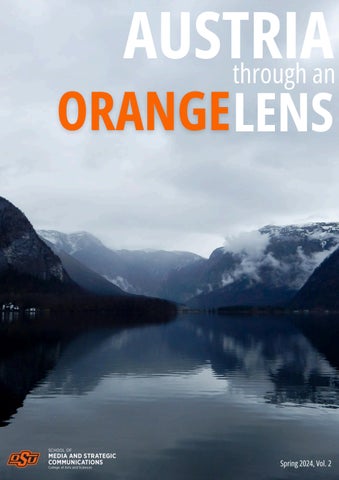
Create a flipbook
Issuu converts static files into: digital portfolios, online yearbooks, online catalogs, digital photo albums and more. Sign up and create your flipbook.