“We want one man to be always thinking, and another to be always working, and we call one a gentleman, and the other an operative; whereas the workman ought often to be thinking, and the thinker often to be working, and both should be gentlemen, in the best sense. As it is, we make both ungentle, the one envying, the other despising, his brother; and the mass of society is made up of morbid thinkers and miserable workers.”
-John
Ruskin,The Stones of Venice
Source:
COMPENSATORY FANTASY COMPENSATORY FANTASY
The final chapter inquires into the dynamic relationship between manufacturing and domesticity, which is a question towards the future in search of a new living model with manufacturing, asking about reconciliation between factories and the city.
Modernity is a separational force. The final chapter investigates the motives of the explicit segregation between workspace and home, which constructs a compensatory fantasy that renders the factories and houses as two opposites that mutually affect but cannot touch each other. The architecture was extensively employed to fulfil this compensatory fantasy.
Moreover, the thesis recognises that work and life are becoming indistinguishable and merging together in the contemporary city. In the last thirty years, the rise of the digital turn has demanded the re-
organisation of modes of production. The production space became an endless interior.
The reconciliation of manufacturing and domesticity beckons not only as a theoretical endeavour but as an imperative for the evolving urban landscape. It calls for a paradigm shift in our conceptualization of living spaces, one that transcends entrenched binaries and embraces the fluidity of contemporary existence. In this vision, factories and homes cease to exist in isolation but converge harmoniously, forging new possibilities for communal living and creative expression in the modern cityscape.
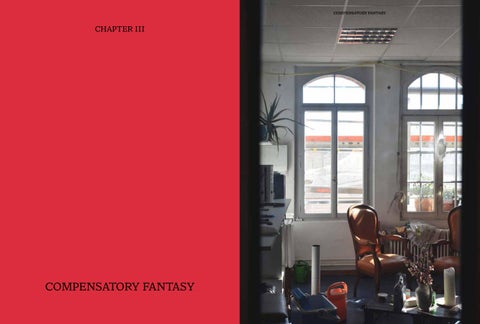
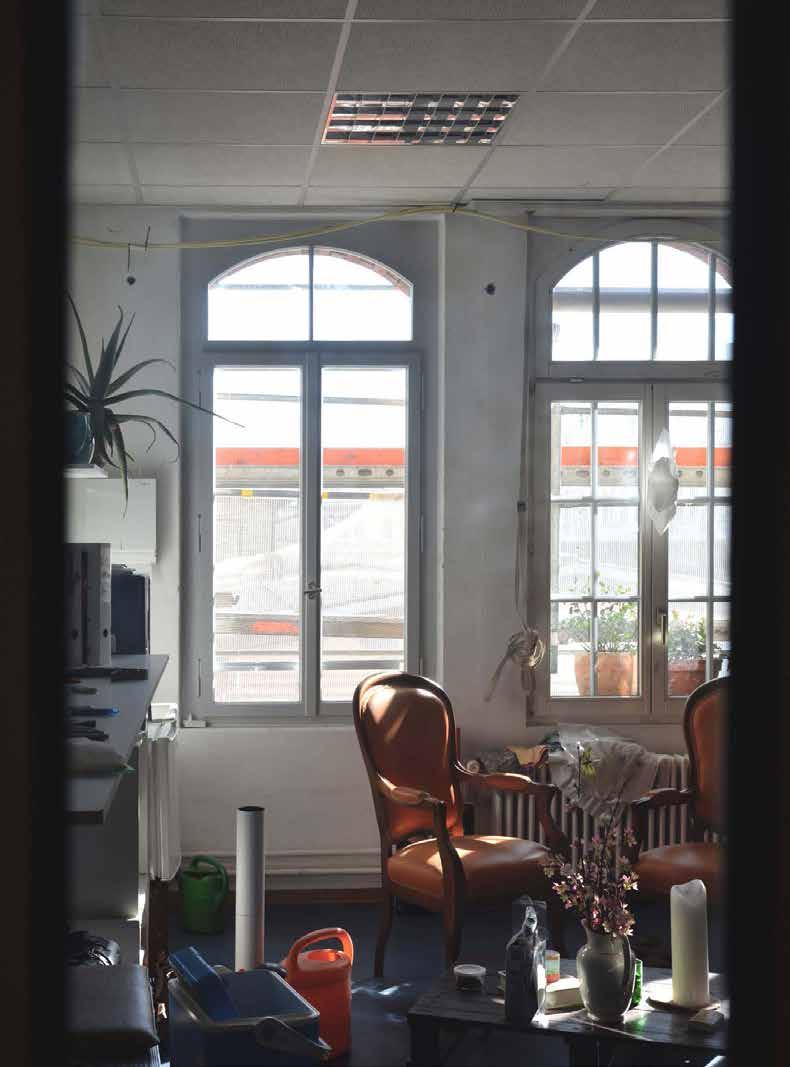
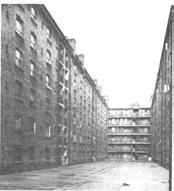
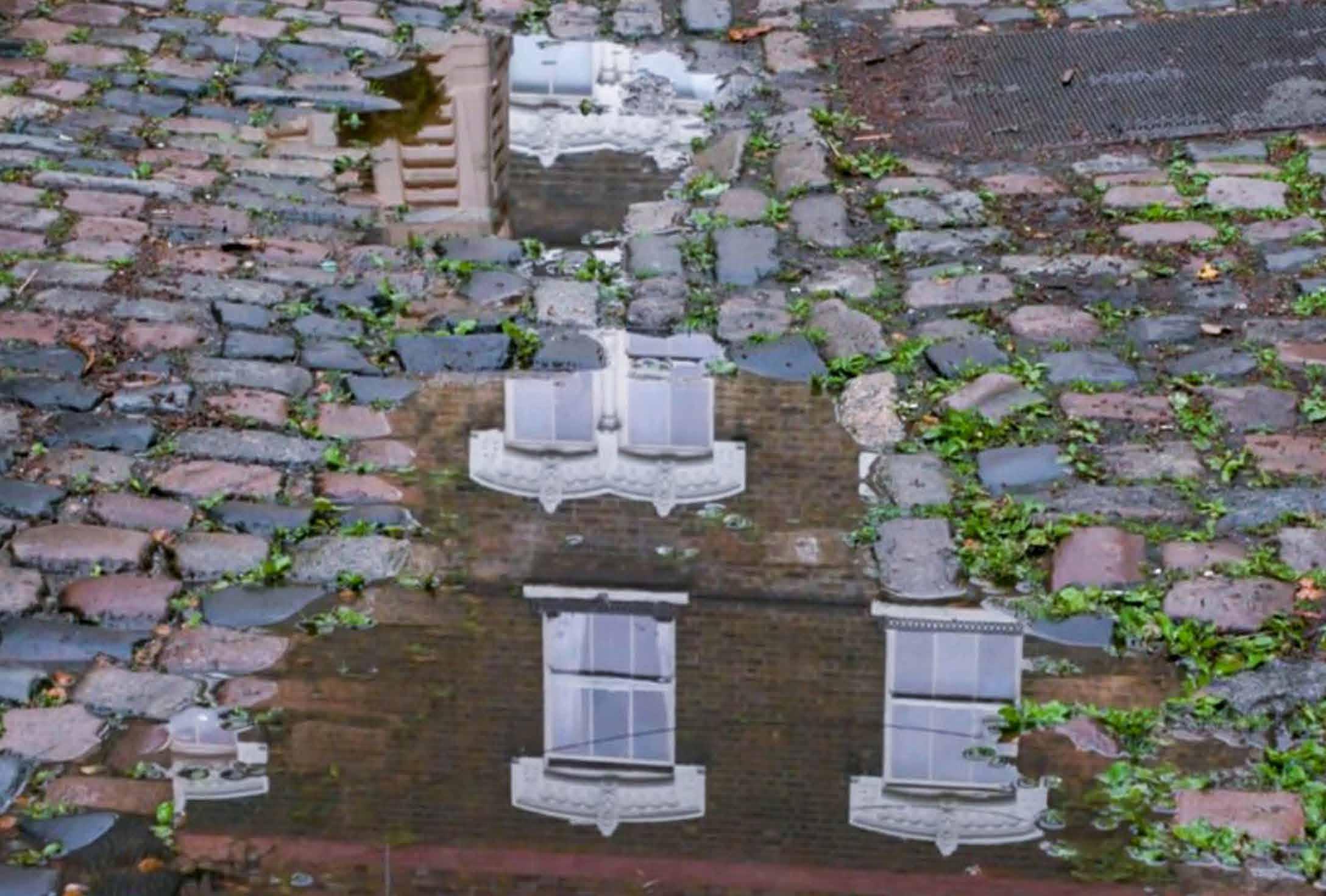
Fig 01. (Previous) A view of a living factory, Berlin.
Photograph of Silvia Frei.
DETACH WORK FORM HOME
MODEL DWELLINGS
(1880s)
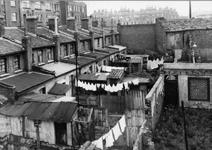
While numerous rural populations had been flushing into the city for many years, serious social problems such as bad sanity, immorality and overcrowding were no longer able to be neglected in the middle years of the 19th century.
At that time, social reformers and the public viewed those social issues as a result of the lousy sanitation in urban areas, which closely aligned with the significant housing shortage and miserable living conditions.1
This pressure in society has stimulated a new social responsibility: to educate the mass labouring classes not only on the scale of physical condition but, more fundamentally, on the scale of morals. As George Godwin, the editor of the Builders, put it:
“all those conveniences which whilst conducting to the 1. Friedrich Engels, The Housing Question, 3rd ed. (Moscow : Progress Publishing, 1970).
Source: RIBA Collections.
health and physical comfort of the inmates, tend to increase their self-respect, and elevate them in the scale of moral and intellectual beings.”2
In dealing with the growth of public concerns, some industrial towns began to take action. The first attempt at working-class model dwelling was at the Birkenhead Dock in Liverpool, where the severe problem of overcrowding in the town had grown from a population of 200 dockers in 1821 to 20,000 in 1847.
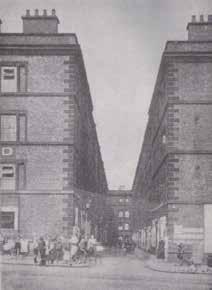
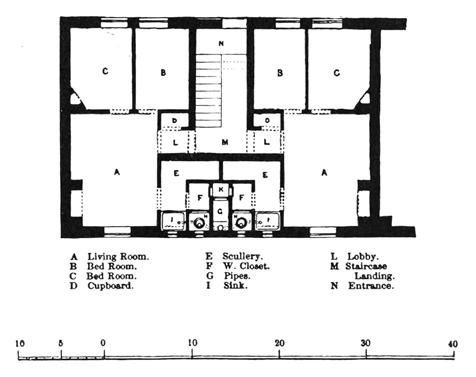
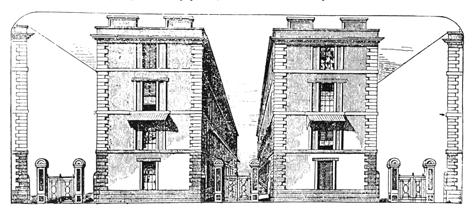
The working-class buildings were described as having the look of upper-class dwellings, a handsome four stories high, comprising distinct houses, each with a public staircase that communicates with the flats. Each flat was divided into two distinct family dwellings.
To introduce this novel archetype, the editor of Builders explained the new spatial settings by analogy with the space in the old rural setting. The editor used the term ‘yard’ to describe a concentrated scullery, compounded with the sink, coal hole, and dust hole, a domestic office he further articulated.3 What was clearly missing in that analogy is the truth that this new archetype is a device of sanitary, a place only for reproduction, within which production has a secretary detached from the enclosed ‘yard’.
This new working-class dwelling soon became popular across the entire country. However, there
2. Society of Improving the Condition of the Labouring Classes, Prospectus (London, 1857).
3. The Builder (London : [s.n.], 1842), 220.
Fig 02. The living condition in the East London before slum clearance in the end of the the nineteenth century.
Fig 03. Birkenhead Dock cottages, by Charles E. Lang, 1850s Source: The Builder, 1850.
were no building regulations or legislation to enforce the proper construction of the dwellings. The response from the authorities was fast, after introducing The Public Health Act in 1848, which was marked as the first significant step in the reform of housing.
There were two forms of society in the second part of the 19th century: the one seeking to invest with limited profit in the working-class housing movement, and the other set examples providing a housing model for others to follow. Both of them aimed to find an equilibrium between philanthropy and commercial sustainability.4
The Society for Improving the Condition of Labouring Classes(S.I.C.L.C.) was a kind of society that decided to experiment with the construction of various types of housing, and they set an example which other people with similar inclinations followed. They were pioneering not only in delivering a series of new kinds of working-class housing but also in conducting a new way of practice compared with the speculative builders. Its charter, obtained in 1950, limited each year’s dividend to only 4 per cent.
4. J. N. (John Nelson) Tarn, Five per Cent Philanthropy; an Account of Housing in Urban Areas between 1840 and 1914 (London, Cambridge University Press, 1973), 15.
Fig 04. Tenements building, by the Birkenhead Dock Company, Charles Lang, 1847
Source: Henry Roberts, The Dwelling of the Labouring classes.
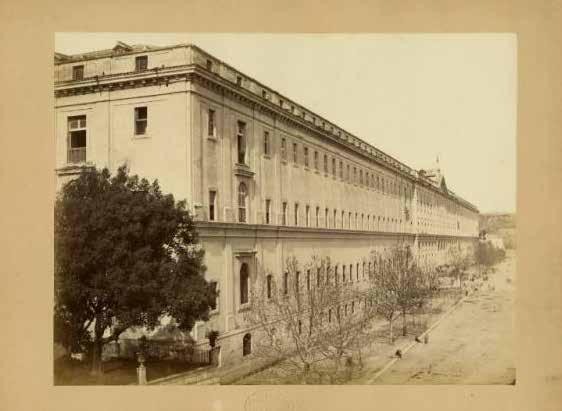
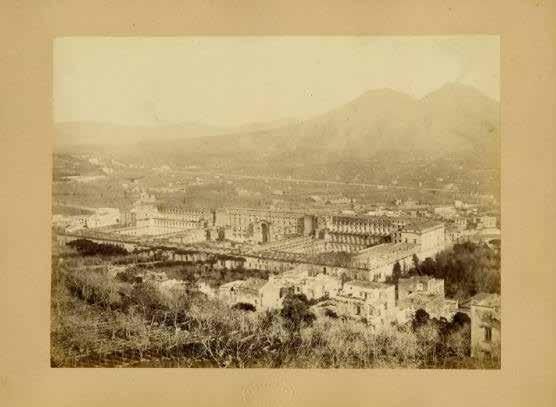
This vague charitable character of the society partly explains why its chief architect, Henry Roberts, viewed an almshouse at Naples as one of the most imposing case studies: The Albergo di Poveri at Naples, which, in its unfinished state, contained 2600 inmates within six stories. Workshops were provided on the upper floors, wherein persons of different ages and sexes were employed in weaving, shoe-making, tailoring and preparing coral. This massive structure’s initial ethic and social ambition was to act as a catalyst for human capital that needed to be transformed from a burden of the city into an invaluable workforce. Indeed, the almshouse trained numerous young craftsmen and became a craft centre at that time. Asked by Roberts,
“The important point, then, for consideration, is, in what manner can the advantages of this economic arrangement be kept retained without serious practical evils which have been referred to?”5
Although the major question for Roberts was to provide distinct housing units altogether in one working-class dwelling, he did realise the value of interaction, communication and collective living and working in the same place.
5. Henry Roberts, The Dwellings of the Labouring Classes (1855) (London: Society for Improving the Condition of the Working Classes, 1855), 10.
Fig 05. Two Photos of the ‘Albergo di Poveri’ in Naples, Italy, 1870s.
Source: Photograph by Rive Robert, accessed from Lombardy Cultural Heritage.
Source:
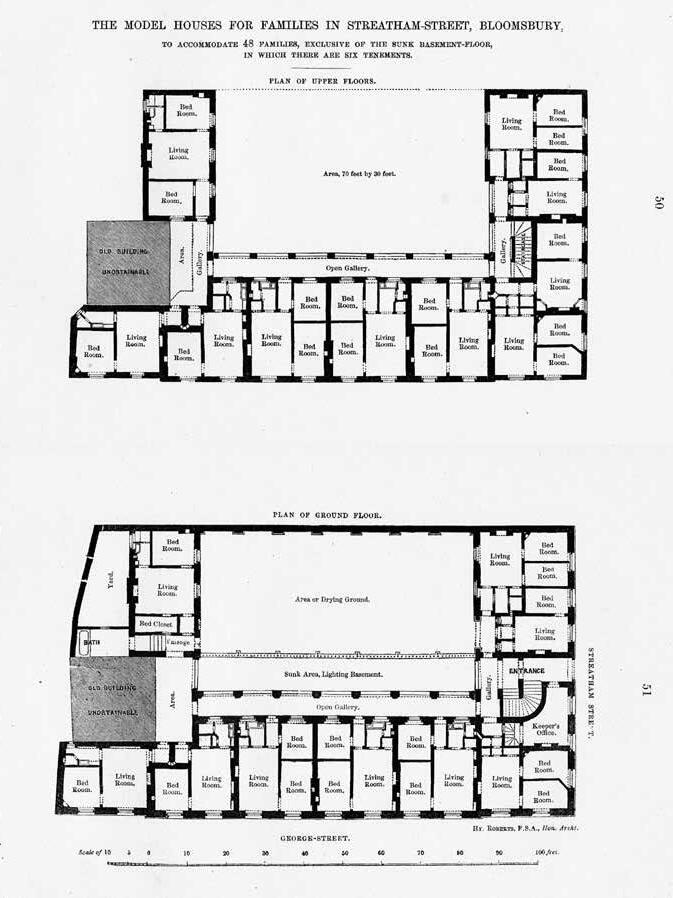
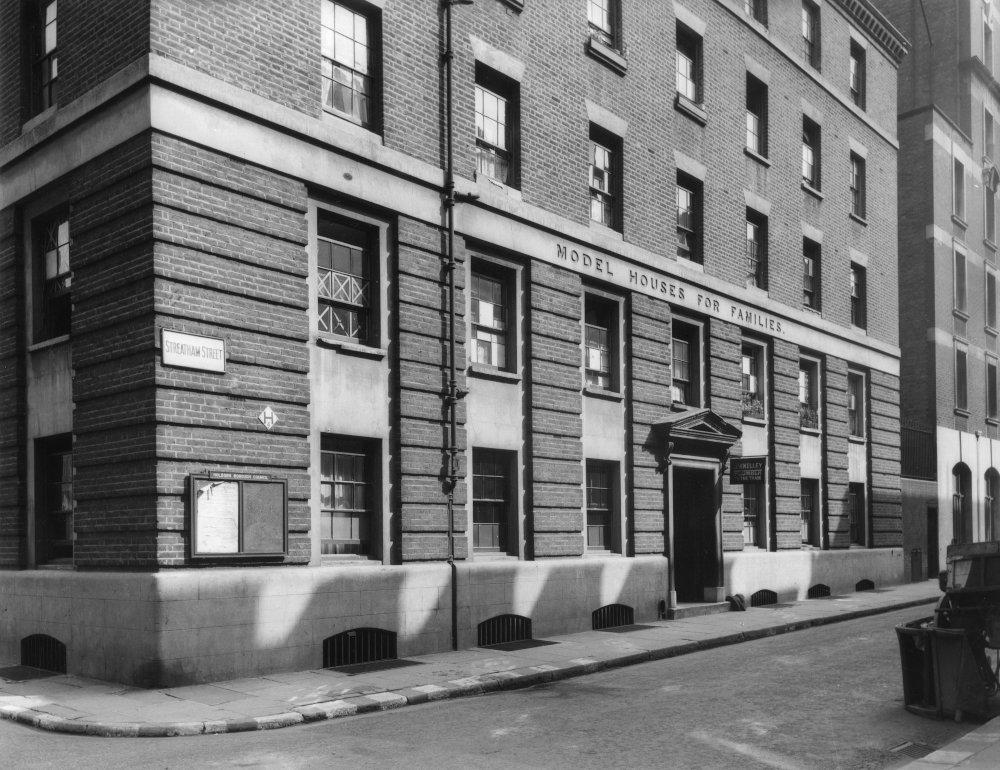
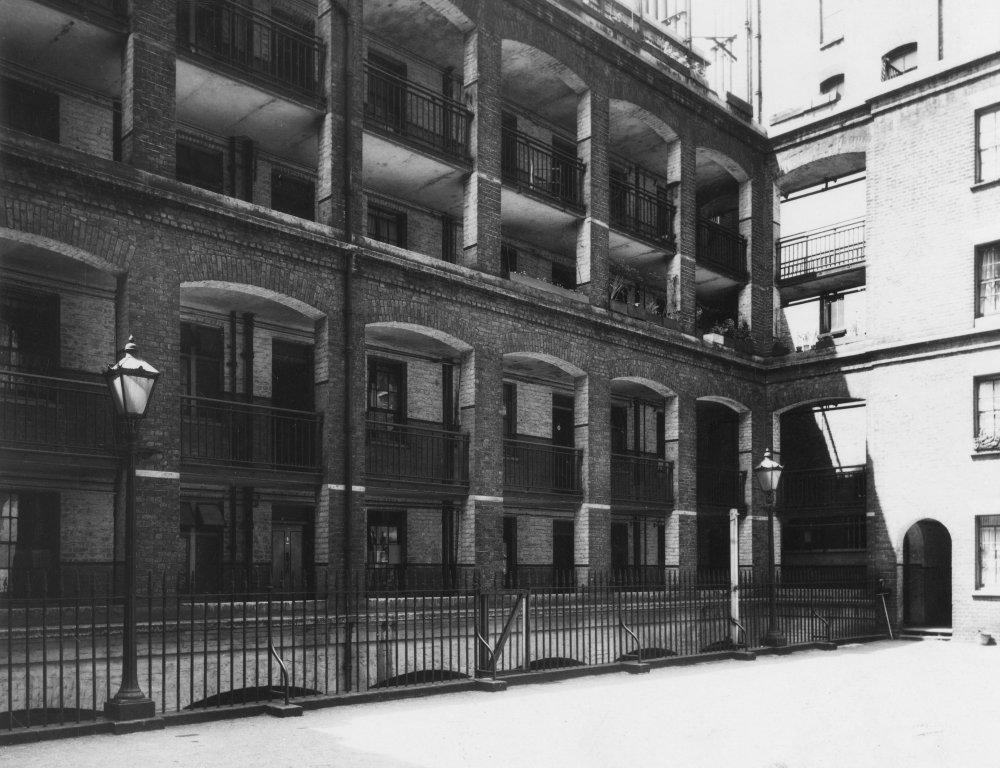
Manifested in his later work, the Model Houses for Families on Streatham Street, Bloomsbury, the choreography of the families were carefully designed. The open gallery and the area in the corner, which were justified as ‘elevated streets’ by the architect in appealing for the exemption of the window tax, provide a relatively generous space(5 feet width)for interaction and communication. On the ground floor, the area was used as a drying ground and playing ground for children. Connected with the sunken yard, several well-lighted and ventilated workshops in the basement story were provided to the tenants for common use, which was proved a great convenience to some of the tenants.6
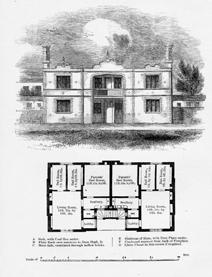
The knowledge deriving from those building experiments was later materialised in the famous model dwelling in the Great Exhibition, 1851. The building was designed as a prototype for four families, which is able to be extended to as many stories as necessary. These modular units, facilitating an independent scullery, water closet, fireplace and dust shaft, constructed a self-contained territory, a purely private space disconnected from neighbours.7
The Artisans and Labourers Dwellings Act in 1875 granted the local authorities rights to demolish any designated area under its control if the houses in it were considered unfit for human habitation, which was the first real action toward the slum clearance movement in the metropolis. The movement removed almost all existing social and economic structures, im-
Source: Henry
6. ibid, 11.
7. Robin Evans, Translations from Drawing to Building and Other Essays, AA Documents 2 (London: Architectural Association, 1997). 107.
Fig 06. (Opposite) Model Dwelling for Families, Streatham Street, Bloomsbury, 1850.
Henry Roberts, The Dwelling of the Labouring classes.
Fig 07. Model Dwelling for Families, For The Great Exhibition, 1851.
Roberts, The Dwelling of the Labouring classes.
Fig 08. Street View of the Model Dwelling for Families, Streatham Street, Bloomsbury, 1850.
Source: RIBA Collections.
Fig 09. Courtyard View of the Model Dwelling for Families, Streatham Street, Bloomsbury, 1850.
Source: RIBA Collections.
posing a pile of dense housing projects.8
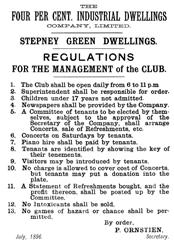
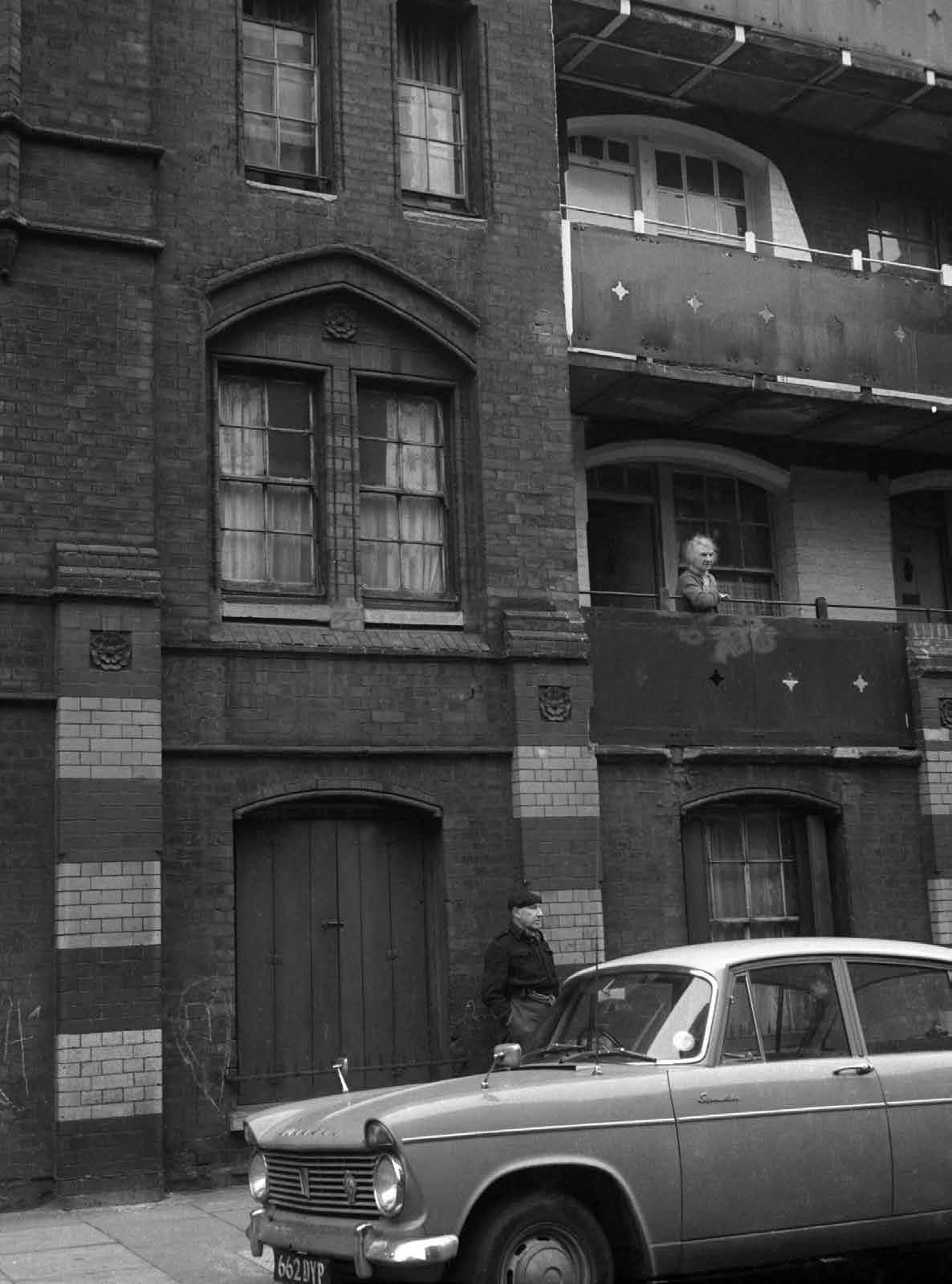
As a result, the city was filled with too many buildings under commercial philanthropy obligations: to accommodate working-class families as much as possible and to elevate their medical and moral condition by meliorating their sanitary and imposing imperative rules to define what is sanitary and what is moral. For instance, home-based work was no longer tolerated in almost all industrial dwellings for sanitary reasons. From there, detaching work from home became a written rule.
These projects materialised the fear, horror and anxiety in manufacturing, projecting a middle class illusion of ideal home to the vulnerable labouring man and inducing them to behave 'normally'.
The idea of equal care was disposed to each family through the ventilation, water supply and material quality. The previous concerns on the relationship between families and the idea of living while working were deliberately detached. These schemes were a radical way of life, which was shaped by the middle-class reformers and architects who sought to remould the poor in their crystallised image. Working classes were quarantined in philanthropic housing with a peaceful family pattern, being taken life off the street and detached from their work.
8. J. N. (John Nelson) Tarn, Five per Cent Philanthropy; an Account of Housing in Urban Areas between 1840 and 1914 (London, Cambridge University Press, 1973), 89.]
Fig 10. Charlotte de Rothschild
Model Dwelling: the first estate built by the Four Per Cent Industrial Dwellings Company Limited. Opened in 1887 it consisted of 228 flats after alterations to the original lay-out.
Source: Industrial Dwellings Society Archive.
Fig 11. Tenants Regulations by Four Per Cent Industrial Dwellings Company.
Source: Industrial Dwellings Society Archive.
Fig 12. (Opposite) Rothschild Buildings of Flower & Dean Street, 1950s..
Source: Photograph by Steven Rerkoff
A RADICAL FORM OF LIFE
In the pre-modern city, production and reproduction happened within the same realm, the house. The precondition of citizenship was highly related to the ownership of a house, private property, and the ability to possess a space for production. Therefore, the medieval house was both a house and a workshop, through which the household opened up to the city.
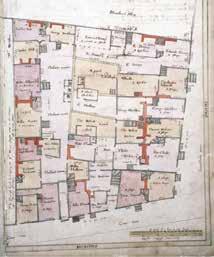
Illustrated by the plan of a city block by surveyor Ralph Treswell in 1612 for the Clothworkers’ Clothworkers Company, the permeability of the spatial configuration resonates with the life of the occupants in which the entertaining, recreating, cooking, eating, washing bodies and clothes, sleeping, procreating, weaving, making, serving and managing were not walled off from each other.9 Home and workplace, reproductive and productive work, were tightly interwoven in the fabric of the buildings and the city of the time.10
10.
Broadening our sight from the pervasive ‘working from home movement’ in the post-pandemic city, today’s labour with its totality renders work and life once again inseparable.11 However, in the second half of the 20th century, production encountered a paradigm shift from material production in the factory and offices to the immaterial production of knowledge, affection and culture. The production space has diffused to the city itself.
“ If labour was choreographed in the factory by order of the assembly line and in the office by the rigid managerial treatment of employees, today labour coincides with any aspect of life.”12
This evolution highlights a transformation where the physical and the conceptual spaces of work have merged, challenging the traditional boundaries that once defined them. As work spills over into every facet of urban life, it reshapes our cities into live-work complexes where the distinction between production and reproduction spaces becomes increasingly blurred. This shift is not merely a logistical change but a cultural shift that affects how individuals interact with their environments and each other, embedding labour deeply into the fabric of everyday life.
While labour becomes permeable, cities conand Urbanism ed. Katharina Borsi et al., (London: Routledge, 2022), 248.
11. In the broader historical development of production relations, working and living combination seems to be the norm of capitalism production rather than its exception. Instead, the separation of work and life was exceptional in the combination of Keynesian and Fordism to pursue maximum shortsighted productivity.
12. Pier Vittorio Aureli, Volker Bradke: Architecture Between the Generic and the Common.
9. David Vincent, Privacy: A Short History (Cambridge: Polity Press, 2016).
Frances Hollis et al., “Open City/Closed City” in Housing
Fig 13. Cow Lane, Smithfeld Pens, London, 1612.
Source: Redrawn by author, after Ralph Treswell, survey plan, Cowe Lane, London, 1612.
tinue to be developed around a clear distinction between the workplace and housing. The image of combining living with material production becomes a spatial device that produces space through imagery, norms, and everyday uses or practice.
Whilst the philanthropical housing project became pervasive in London, turning the city into an endless banality with self-proliferating cells, almost simultaneously, there was an alternative housing project that refused to separate work and house.
PULLENS BUILDING
& YARD (1900s)
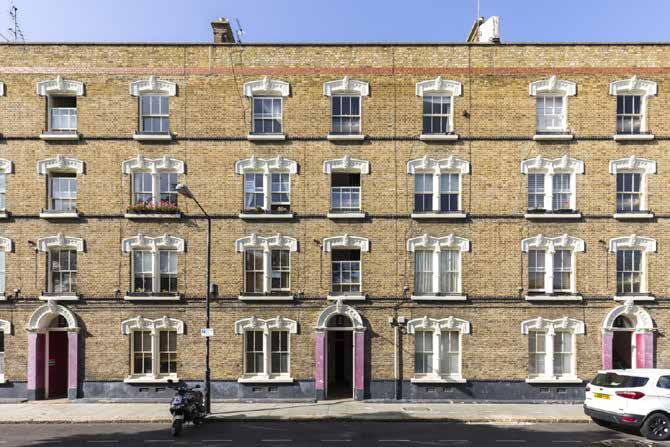
The Pullens Estate, near Elephant and Castle, London, was built at the end of the 19th century, providing more than 600 single-man dwellings within 12 tenement blocks across six streets. Combining workspace with housing, the estate allows artisans and craftsmen, small traders and their businesses to live in an intimate relationship.
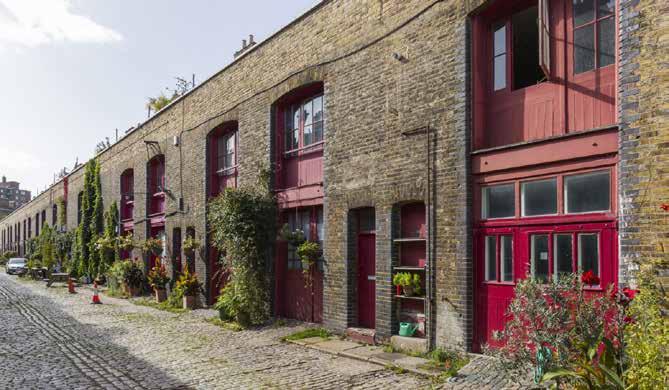
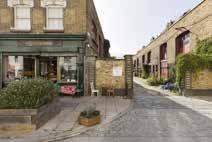
Each of the ground and first-floor flats in the block extended backwards into a contiguous workspace facing one of four cobbled yards. The industrial yards were purposefully designed for manufacturing work. Enclosed from one end and gated at the other end, it defines a clear boundary of the working area. Ground-floor shops with elaborate glazed timber frontages, facing outwards onto the street on either side of the gated entrance to each yard, also com-
bined with adjacent living space. Those yard spaces are shared spatially and timely among all the occupants, and, according to the residents, spatial provisions operate through constant negotiations without any written rules.13
The architect intentionally mimics the traditional London workshop mews to indicate a working scenario, using flat brick arches and blue brick quoins to alternate narrow doorways and double-height openings to maximise natural light and facilitate the movement of materials, machinery and goods.
13. Batchelor, R., ‘The Pullens Story’ (http://iliffeyard.co.uk/ gallery-view/guest-gallery---the-pullen-s-story).
Fig 14. Main Facade, Pullens Estate, Southwark, London, 1886.
Source: Anonymous Photographer.
The link between the home and workshop was established via transitional areas: a small groundfloor yard and a scullery and water closet on the first floor, facilitating their joint use during work and enabling the removal of accumulated dirt before returning ‘home’.
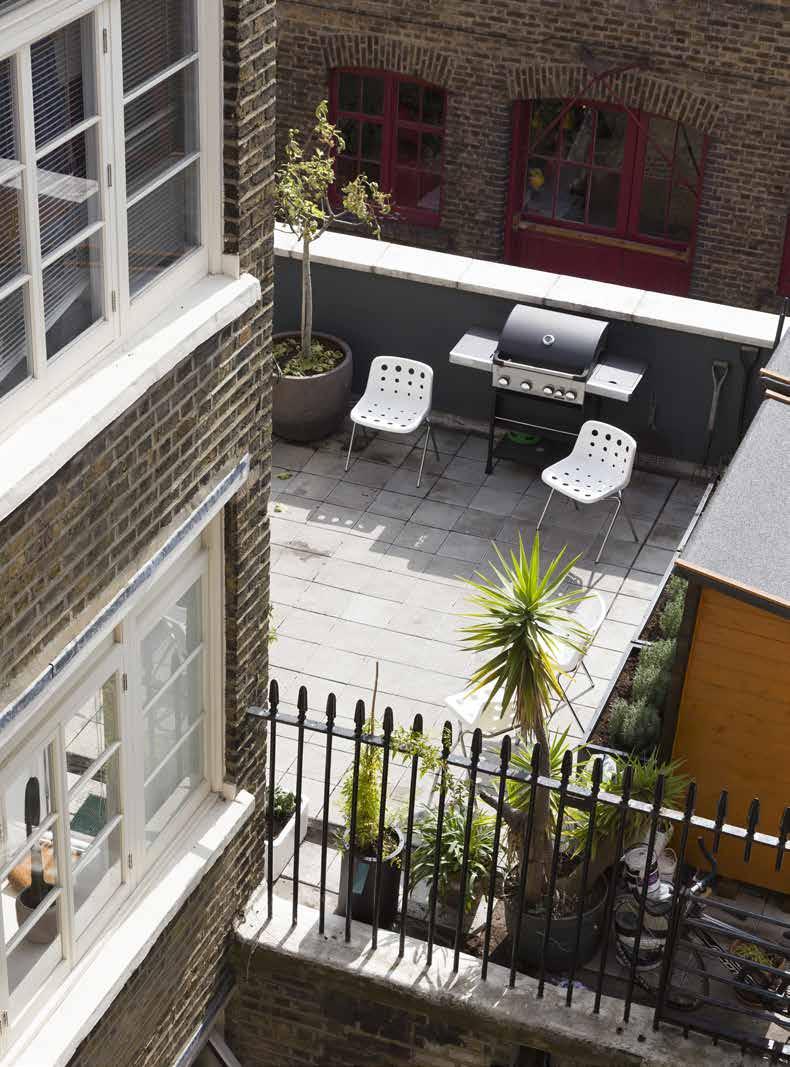
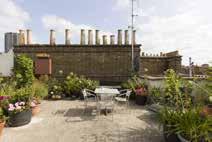
Each flat on the second floor gets access to a continuously shared terrace on the roof of the workshops with plants and outdoor furniture for recreation. Opening up to the sky, the configuration enables dialogues and communications between the workshop and residence by overlooking the yards, which adds another layer to the space.
Contrasting taller and broader streets for a dwelling appearance with the austere, narrow, and durable yards for manufacturing; clean and quiet living spaces with noisy and dirty working environments, the spatial configuration and the utilising of different materials reflected the daily confrontations rendered
Fig 16. The Manufacturing yards, Pullens Estate, Southwark, London, 1886.
Source: Anonymous Photographer.
Fig 15. Site Plan, Pullens Estate, Southwark, London, 1886.
Source: Drawn By Author.
with anxiety, conflict and tension between working and living.
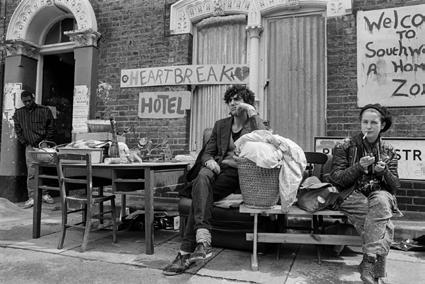
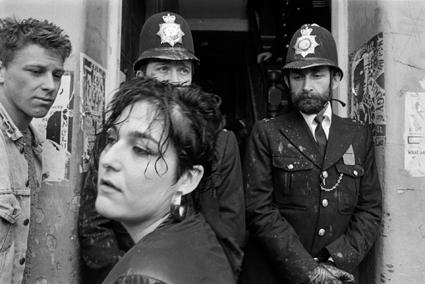
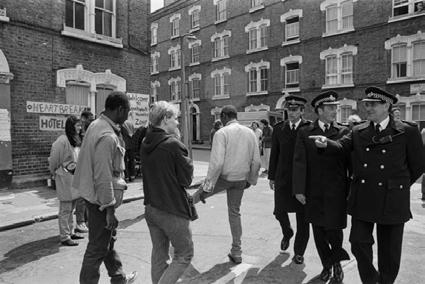
Evidently, in heterogeneous affinities and interdependencies of the estate, the association between working and living could form a strong sense of community. Instead of isolating individuals into peaceful interiors where self-determination reduces individual subjectivity, the building exposes and exhibits working and living to each other by removing the boundaries to open up dialogue. The unconventional spatial setting stimulates local social networking and gives its inhabitants a sense of identity. Its resonance was heard in the squatter movement in 1986 as a resistance to violent demolishing and gentrification.
Source: Anonymous Photographer.
Fig 17. (Opposite) Looking through the apartment window, Pullens Estate, Southwark, London, 1886.
Source: Anonymous Photographer.
Fig 18. The Shop front and the gate of manufacturing yard, Pullens Estate, Southwark, London, 1886.
Series of Photos illustrate the squatters attempted to repel the police in the Battle for the Pullens on the June 10th 1986.
Source: Anonymous Photographer.
Source: Photograph by Author.
Fig 20. (Opposite) A
Fig 21. (Following page) The Cobble Pavement of the Pullens Yard.
DWELLING IN THE PRECARITY
Fig 22. Proliferating forms of collective organizing and individual actions have blossomed. Many artists formed and worked with occupations, protests, and direct action. While others developed a language of revolt and social critique. These activities have had lasting effects in developing social movements in other areas of society and mark an important turning point in Japan. Source: Pointing at Fukuichi Live Cam, Kota Takeuchi, 2011.
BLOQS CO-MAKING SPACE
(2022)
In transitioning from an industrial to a post-industrial society, capitalism evolved. Initially, it relied on closed production forms and prescribed routines to maximise profits. However, it now adopts a mindset that values the individual’s creativity and indeterminacy as the fundamental labour subjectivity. Eulogising the human innovative nature, embracing the precarious condition and viewing it as the highest source of profit, today’s capitalists could further exploit this labour-power.
As Pier Vittorio Aureli put it, 'Doing more with less is what Capital demands from us': more productivity and less welfare, more creativity and less social security because creativity becomes more productive when our ‘given’ conditions grow harder and more unstable.14
The labour power, as noted by Marx, is a potential embedded in the workers’ faculties, which is not
14.
only physical but also mental and intellectual. However, in contrast, to mechanically processed and assembled raw materials, potential thrives as a collective force, surpassing the bounds of any individual, place, or moment in time, and as the ‘factory of precarity’15 spreads more widely through society, ironically negating its own physical presence and reducing its exploitative structures to prevent stifling or blocking the growth of this vibrant potential.
If labour power is characterised by man’s ability to adapt to any situation, and therefore by the total unpredictability of man’s actions and reactions, the only corresponding spatial form in such unstable conditions is space ready to use and occupy according to any foreseen and unforeseen situation.16
Therefore, the prevailing invitation of ‘Bring the
15. Francesco Marullo, ‘The Factory of Precarity. Generic Architecture, Freelance Labor, and the Art of Dwelling’, 2017, 102–21.
Pier Vittorio Aureli, The Theology of Tabula Rasa: Walter Benjamin and Architecture in the Age of Precarity
Industry Back to City’ given by the city’s authorities in essence is an invitation to precariousness, encouraging innovative ways of thinking, communicating, making use of the self and dwelling within uncertainty.
In the previous chapters, we have discussed how contemporary small manufacturing workers became vulnerable figures in the precarity. Now, we are focusing on contemporary workers’ attempts to resist, obligate, incorporate, adapt, compensate, compromise and live with it.
Among the many workers who accepted a life shaped by intermittent and hybrid employment, the self-employed autonomous worker, commonly known as a freelancer, stands out as an emblematic example of how precarity has evolved into a way of life.
Becoming a freelancer means detouring from the prescribed framework of work to an autonomous determination in the price of being excluded from most of society’s welfare like minimum wages, life-saving accounts, and easy mortgages, designed based on the wage system.
Salaried workers benefit from the ability to negotiate their contracts collectively, facilitated by their workplace environment and trade unions. In contrast, freelancers lack a cohesive professional trade association and are dispersed spatially.17 Therefore, the freelancer’s place of work is inseparable from their body. Without any prescribed routine or obligatory protocol, freelancers must organise their time, space, tasks, and deadlines while nurturing a resilient psychological mindset, productive habits, honed skills, and social connections.
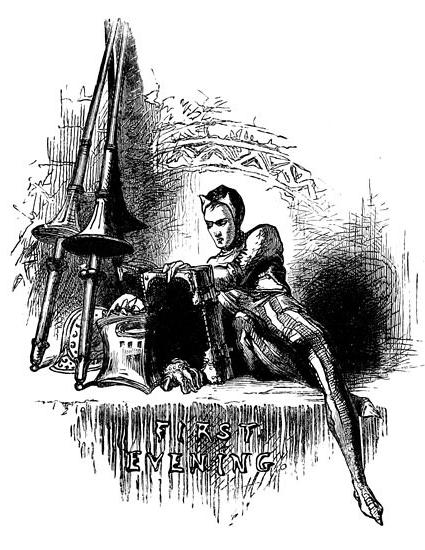
In short, the freelancer becomes an architect of self-design who functions as an enterprise constantly seeking opportunities to curate and exhibit himself/ herself. Precisely for such reasons, manufacturing freelancers are always romanticised, sometimes by themselves, as the traditional craftsmen and artisans who stand for the spirit of art and craft. While precarity becomes a form of life, freelancing is a way of dwelling in it.18
The Cultural Infrastructure map, according to ‘We Made That’, means physical spaces that regularly host and support creative of culture all activities as their main purpose.19 using the method of indexing, mapping and categorising the cultural buildings and facilities, one could visualise the tension between precarity and labour power. The map itself is a cultural infrastructure that helps us explore opportunities for place-based work. However, what is ironic is that a great number of the websites linked in the manufacturing catalogue could only return 404 web pages, which precisely reflects the precariousness of the industry.
In the London Cultural Infrastructure map, the open access fabrication workshop(Co-making space) has been identified and categorised as cultural infrastructure with theatre, cinema, concert hall and artists’ studio, which plays an influential role in creating the city’s economic vitality and wittiness a prominent growth during the last decade.
The Co-making spaces, built on top of the socie-
18. Francesco Marullo, ‘The Factory of Precarity. Generic Architecture, Freelance Labor, and the Art of Dwelling’, 2017, 102–21, 116.
19. We Made That, “London Culture Infrastructure map”, https://www.we made that.co.uk/projects/west-midlands-cultural-infrastructure-map.
Fig 23. The romantic free lance as portrayed in the book “A Festival of Song: A Series of Evenings with the Greatest Poets of the English Language,” 1876.
Fig 24. Training the cloth designer and maker as freelancer in Poplar Works, 2022.
Fig 25. West Midlands Cultural Infrastructure Map, 2021. Source: We Made That.
ty’s precarity, reappropriating the previous industrial shed and factory remains, enable alternative material production in the city through the permeable logistic network, sophisticated distribution and generic labour.
There are two ways of intervention: one incorporates with precarity, empowering makers with general facilities, cheap spaces and flexibility; the other, on the contrary, resisting the precarity by solidifying and uniting a bunch of makers with a maker’s community.
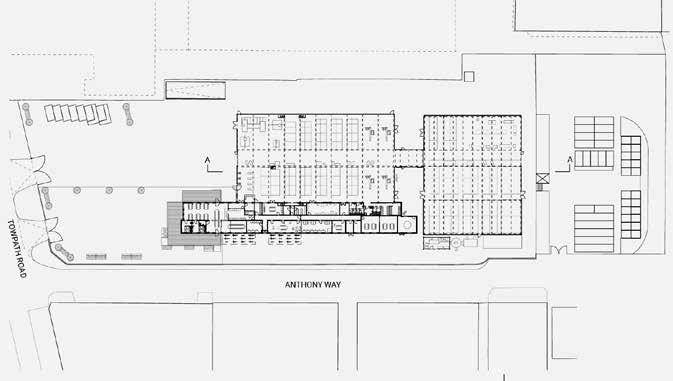
The case study for the first type of intervention is the Bloqs, the most successful commercial co-maker space in London. It provides affordable workspace for makers, artists and craftsmen with a pay-as-you-go strategy. The newly reformed building close to the river Lea navigation was the expanded workspace of Bloqs consisting of studios and workshops for different types of fabrication, two yards for parking and a cafe. It is a shed type building with cheap structures but
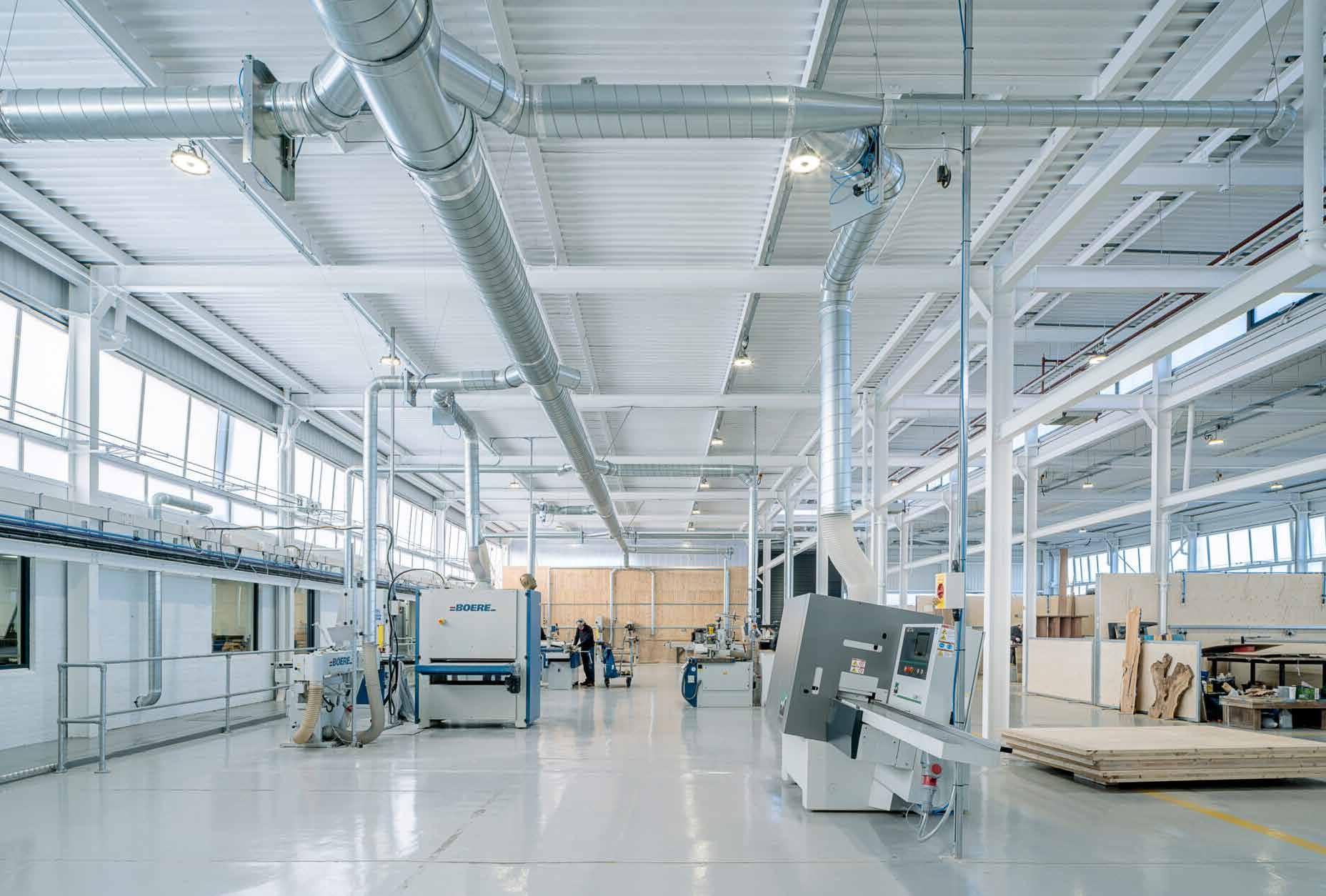
provides a warm and bright working environment. It provides shared facilities like CNC suite, laser cutting and saw-beds open access to all the users.20
The architectural outcome is a generic space: an apparatus for maximum flexibility through the strategical arrangement of the supportive structures and facilities in an enclosed envelope. Turning whatever it contains into measurable, commensurable and exchangeable commodities, providing facilities, supports and materials to enable the juxtaposition of various forms of material production and artistic expression, this architecture renders the act of making as an abstraction, which reinforces the image of the maker as a precarious individual then makes profit out of it.
20. For more detailed introduction about Bloqs, see: Lucy Bullivant, “Making it Happen – Bloqs’ open access factory launches at Meridian Water”, https://www.urbanista. org/issues/making-it-happen-bloqs.
Fig 27. Ground Floor Plan, New Co-Making Space for Bloqs, 2021. Source: 5th Studio.
Fig 26. Wood Workshop, New Co-Making Space for Bloqs, 2021. Source: 5th Studio.
Fig 28. (Following page) Machine Shop, New Co-Making Space for Bloqs, 2021. Source: 5th Studio.
BLACK HORSE WORKSHOP (2017)
Moving away from the shed of Bloqs, there are still some small-sized open access co-making spaces scattered in central London. Differentiating from the generic space of Bloqs, those co-making spaces are quite specific.21
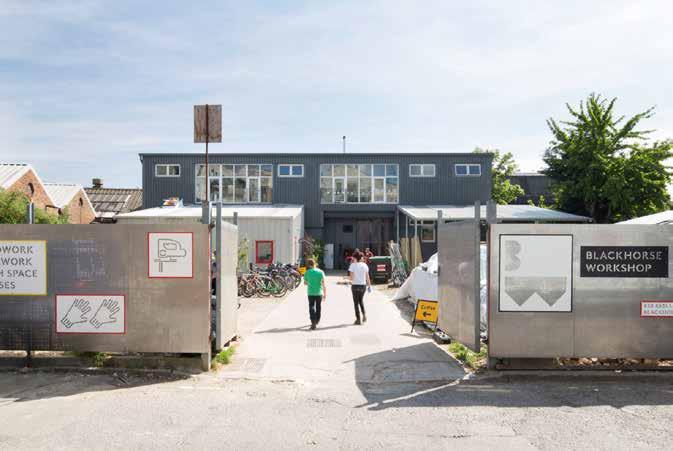
The black horse workshop occupies a light industrial building in a highly mixed urban fabric. The studio specialises in wood and metal processes, with affordable access to tools, space and on-site technical expertise. The compact workshop is compounded by
21. Workshop East, et. al., ‘Co-Making: Resarch into London’s Open Aaccess Makerspaces and Shared Workshops’, January 2015, https://www.london.gov.uk/sites/ default/files/makerspaces-jan2015.pdf.
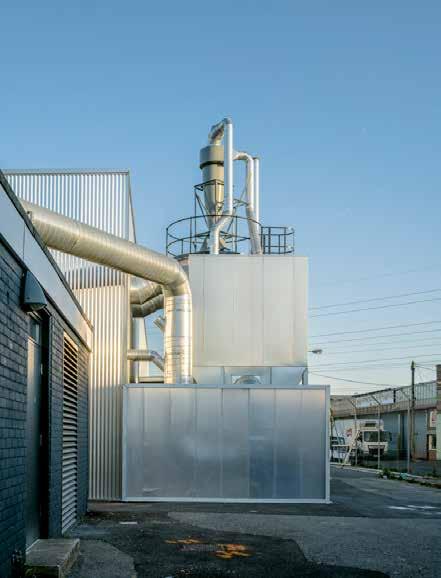
Fig 29. Waste disposal plant, New Co-Making Space for Bloqs, 2021.
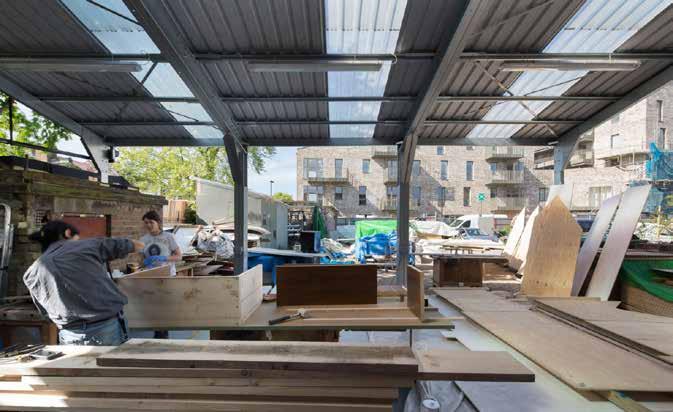
a bench room, mechanical room for wood and metal, spray room, loading bay, cafe and offices. After years of operation, the workshop extended a second floor for additional workspace. Meanwhile, they also reconfigured the yard with a canopy as an outdoor production space.
These initiatives remain us how designers can think creatively beyond the singular spaces and functions conventionally associated with manufacturing in cities, embedding accessible, flexible micro-infrastructures throughout the urban landscape and harnessing the capacity for local self-organisation –an entanglement of uses evoked in the image of the city as simultaneously a factory, prototyping lab, and showroom. With these performance infrastructures, an ecology of making could be built.
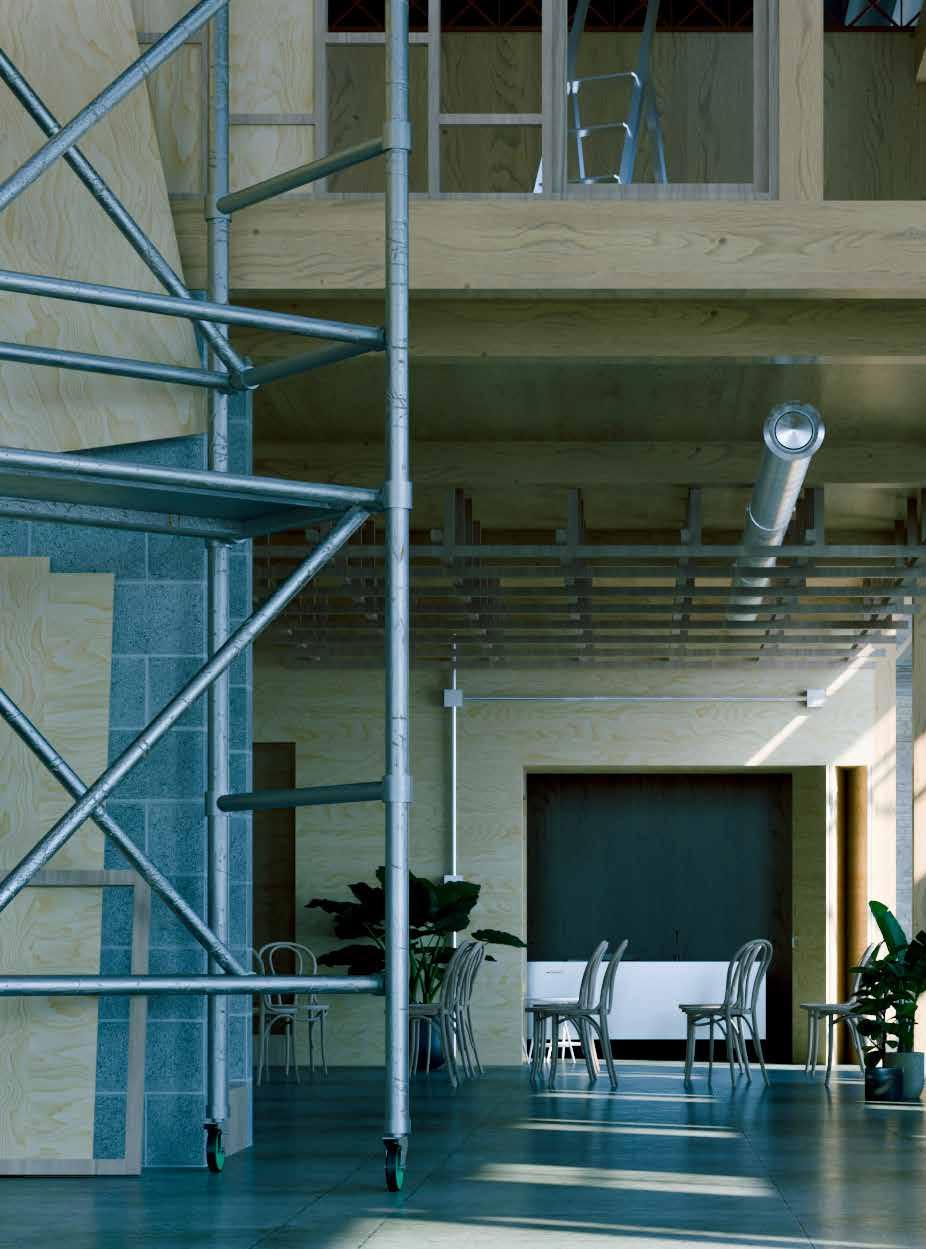
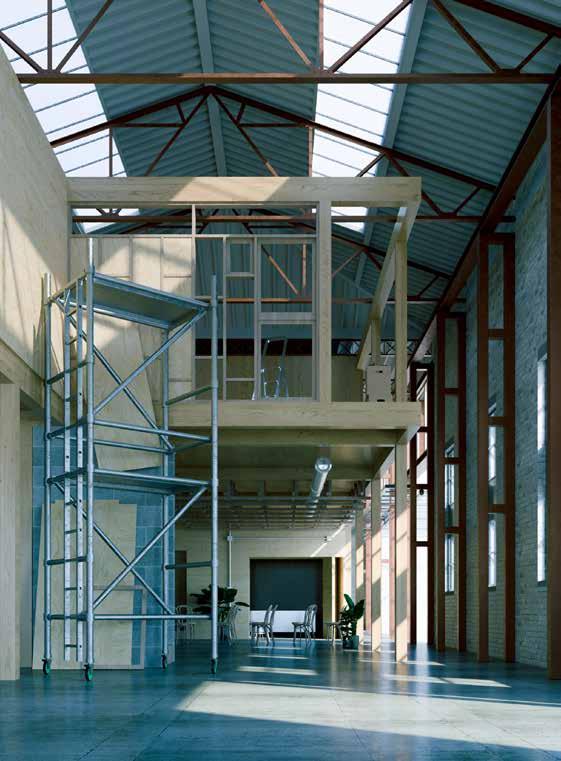
The name of the last design proposition is derived from William Morris’ famous work News From Nowhere, in which he envisioned a utopian future of living and working in a factory. Accordingly, the design transforms an existing bespoke furniture maker and its production yard into a worker-runs factory, providing a communal working and living space for 12 single workers to accommodate inside the factory. It sought to be an architecture that eliminates the distinction between buildings for work and buildings for living, moving away from the determinism of most buildings towards a manner of building that foregrounds collective social and urban interests. This design intervention works as an exemplary project introducing how one specific manufacturing business could operate in the Enclave Project mentioned in the previous chapters.
Removing the bounding walls, the production yard opens up to the city. All the noise work and heavy-duty are limited inside the yard-house on the top right corner of the yard. Being public means that daily transportation and other yard work are no longer the only protagonists that remove every obstacle they confront; instead, they should negotiate with other users within an operational framework and schedule. The accessibility transforms the yard from an enclosed production space to a public space. A simple structure pavilion and a garden are introduced to the yard, which is a multifaced communal space built col-
Fig 33. (Opposite) Existing Plan, The design transforms an existing bespoke furniture maker and its production yard into a worker-runs factory
lectively by all occupants, providing food and a quiet area for gathering.
The building façade towards the yard is partly opened, enabling easy access to raw materials and improving light conditions, at the same time, blurring the boundary and building a reciprocal relationship between interior and exterior.
The building is kept in its unfinished condition, reusing materials it once processed, like recycling the old window frames from the neighbourhood for constructing itself. Incorporating with its productive nature, the building is kept in a metabolism condition that constantly builds and rebuilds itself, providing adaptability to unforeseen needs, which is crucial in accommodating the work/live community. Timber is chosen as the central character of the design, a performative element, not only resonating with the historical context of the site but also serving this metabolism processes of learning, testing, negotiating, building and rebuilding with its material capacity in a dialogue of collective and continuous hybrid material production.
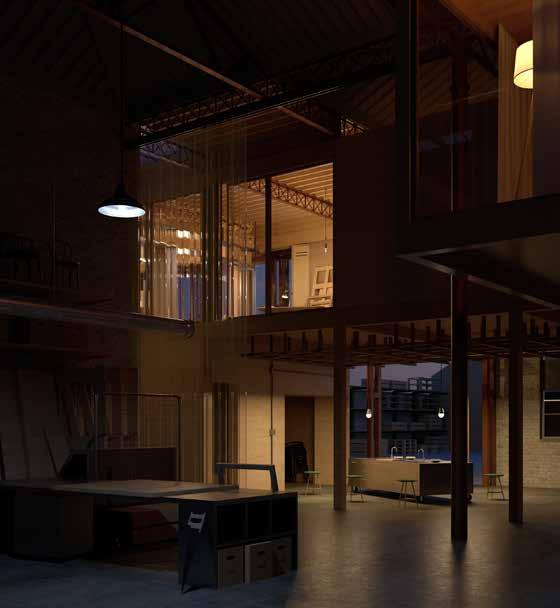
The ground floor plan describes an operational platform for working and living in which spaces and facilities could be shared across different times and uses. Illustrated in the render is a still frame of a regular evening after the working hour: Whilst finishing the daytime work, the light turning dim in the fabrication lab, occupants wheel out a communal kitchen from the storage cabinet, preparing dinner by utilising the same space of the production in the day time.
Fig 34. (Opposite) Existing / Reformed Condition, Removing the bounding walls, the production yard opens up to the city.
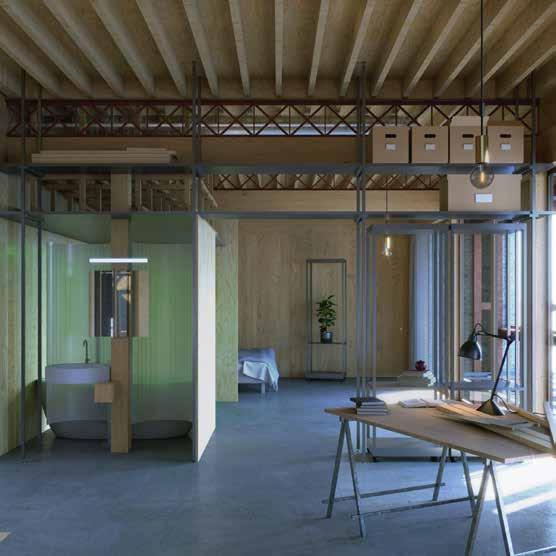
An imposed timber box floating in the middle of the factory shed is a residential space in which, instead of enclosed by fixed walls, individual living is defined through wheeled furniture, storage shelves and curtains, creating a multi-flexible layout of different constellations adaptive to the dynamic needs of a communal subject.
Privacy and intimacy shrunk into the individual body, and the occupants decide what to share and what not. The politics of interior is to challenge the perception of domesticity, the idea of comfort and retreat from work, exposing the dichotomy of two spatial functions to each other by constructing a harsh contrast which materialises the tension between production and domesticity. The design proposition challenges the prescribed frameworks that constitute normative habitual relations between occupant and spatial provision.
0
Fig 35. (Opposite) The Ground Floor Plan, The ground floor plan describes an operational platform for working and living
Alder, Ken. ‘Making Things the Same: Representation, Tolerance and the End of the Ancien Régime in France’. Social Studies of Science 28, no. 4 (1 August 1998): 499–545. https://doi. org/10.1177/030631298028004001.
Appadurai, Arjun, ed. The Social Life of Things: Commodities in Cultural Perspective. Cambridge: Cambridge university Press, 1986. https://doi. org/10.1017/CBO9780511819582.
Aureli, Pier Vittorio, Martino Tattara, and Dogma (Architectural office). Living and Working / Dogma ; [Pier Vittorio Aureli and Martino Tattara], 2022.
Borsi, Katharina, Didem Ekici, Jonathan Hale, and Nick Haynes, eds. Housing and the City. London: Routledge, 2022. https://doi. org/10.4324/9781003245216.
Carpo, Mario. Alphabet and the Algorithm / Mario Carpo. Cambridge, Mass. : MIT Press, 2011.
Corbin, Alain. The Foul and the Fragrant: Odor and the French Social Imagination. Harvard university Press, 1986.
Evans, Robin. Translations from Drawing to Building and Other Essays. AA Documents 2. London: Architectural Association, 1997.
Forty, Adrian. Objects of Desire. New York: Pantheon Books, 1986.
Gandy, Matthew. ‘Cyborg urbanization: Complexity and Monstrosity in the Contemporary City’. International Journal of urban and Regional Research 29, no. 1 (2005): 26–49. https://doi.org/10.1111/
j.1468-2427.2005.00568.x.
Girot, Christophe, and Albert Kirchengast, eds. Landscape Analogue: About Material Culture and Idealism: 6. Berlin: JOVIS Verlag, 2022.
Goodman, Percival. Communitas: Means of Livelihood and Ways of Life. 2nd Revised ed. edition. New York: Columbia university Press, 1989.
Heidegger, Martin. ‘The Question Concerning Technology’. New York 214 (1977).
Henshaw, Victoria. urban Smellscapes : understanding and Designing City Smell Environments / Victoria Henshaw. New York : Routledge, 2014.
Kirkham, Patricia Anne. ‘Furniture-Making in London c. 1700-1870: Craft, Design, Business and Labour.’, 1982. https://qmro.qmul.ac.uk/xmlui/handle/123456789/1472.
Marullo, Francesco. ‘The Factory of Precarity. Generic Architecture, Freelance Labor, and the Art of Dwelling’, 102–21, 2017.
Mitchell, William J. (William John). Me : The Cyborg Self and the Networked City / William J. Mitchell. Cambridge, Mass. : MIT Press, 2003.
Roberts, Henry. The Dwellings of the Labouring Classes (1855). London: Society for Improving the Condition of the Working Classes, 1855. http://archive.org/details/dwellingslabouringclasses.
Roberts, Henry, and England) Society for Improving the Condition of the Labouring Classes (London. The Model Houses for Families Built in Connection with the Great Exhibition of 1851, by Command of His Royal Highness Prince Albert, K.G., President of the Society for Improving the Con-
ditions of the Labouring Classes. London : Published by request and sold for the benefit of the Society for Improving the Condition of the Labouring Classes, at no. 21, Exeter Hall, Strand : also by Seeleys, Fleet Street, and Hanover Street, Nisbet & Co., Berners Street, J.W. Parker and Son, West Strand and Hatchard, Piccadilly, 1851. http:// archive.org/details/modelhousesforfa00robe.
Sennett, Richard. The Craftsman. London : Allen Lane, 2008.
Tarn, J. N. (John Nelson). Five per Cent Philanthropy; an Account of Housing in urban Areas between 1840 and 1914. [London] Cambridge university Press, 1973. http://archive.org/details/fivepercentphila0000tarn.
The Builder. London : [s.n.], 1842. http://archive.org/ details/gri_33125006201764.
Vincent, David. Privacy: A Short History. Cambridge: Polity Press, 2016.
Workshop East, Engel Hadly Kirk, and Rhianon Morgan-Hatch. ‘Co-Making: Resarch into London’s Open Aaccess Makerspaces and Shared Workshops’, January 2015. https://www.london.gov. uk/sites/default/files/makerspaces-jan2015.pdf.
Young, Michael Dunlop, and Peter Willmott. Family and Kinship in East London / Michael Young and Peter Willmott. Pelican Books. Harmondsworth : Penguin Books, 1957.
LIST OF FIGURES
Fig 01. (Previous) A view of a living factory, Berlin.Source: Photograph of Silvia Frei.
Fig 02. The living condition in the East London before slum clearance in the end of the the nineteenth century. Source: RIBA Collections.
Fig 03. Birkenhead Dock cottages, by Charles E. Lang, 1850s Source: The Builder, 1850.
Fig 04. Tenements building, by the Birkenhead Dock Company, Charles Lang, 1847Source: Henry Roberts, The Dwelling of the Labouring classes.
Fig 05. Two Photos of the ‘Albergo di Poveri’ in Naples, Italy, 1870s.Source: Photograph by Rive Robert, accessed from Lombardy Cultural Heritage.
Fig 06. (Opposite) Model Dwelling for Families, Streatham Street, Bloomsbury, 1850. Source: Henry Roberts, The Dwelling of the Labouring classes.
Fig 07. Model Dwelling for Families, For The Great Exhibition, 1851.Source: Henry Roberts, The Dwelling of the Labouring classes.
Fig 08. Street View of the Model Dwelling for Families, Streatham Street, Bloomsbury, 1850. Source: RIBA Collections.
Fig 09. Courtyard View of the Model Dwelling for Families, Streatham Street, Bloomsbury,
1850. Source: RIBA Collections.
Fig 10. Charlotte de Rothschild
Model Dwelling: the first estate built by the Four Per Cent Industrial Dwellings Company Limited. Opened in 1887 it consisted of 228 flats after alterations to the original lay-out.Source: Industrial Dwellings Society Archive.
Fig 11. Tenants Regulations by Four Per Cent Industrial Dwellings Company.Source: Industrial Dwellings Society Archive.
Fig 12. (Opposite) Rothschild Buildings of Flower & Dean Street, 1950s..Source: Photograph by Steven Rerkoff
Fig 13. Cow Lane, Smithfeld Pens, London, 1612.Source: Redrawn by author, after Ralph Treswell, survey plan, Cowe Lane, London, 1612.
Fig 17. (Opposite) Looking through the apartment window, Pullens Estate, Southwark, London, 1886.Source: Anonymous Photographer.
Fig 20. (Opposite) A Series of Photos illustrate the squatters attempted to repel the police in the Battle for the Pullens on the June 10th 1986.Source: Anonymous Photographer.
Fig 21. (Following page) The Cobble Pavement of the Pullens Yard.Source: Photograph by Author.
Fig 22. Proliferating forms of collective organizing and individual actions have blossomed. Many artists formed and worked with occupations, protests, and direct action. While others developed a language of revolt and social critique. These activities have had lasting effects in developing social movements in other areas of society and mark an important turning point in Japan.Source: Pointing at Fukuichi Live Cam, Kota Takeuchi, 2011.
Fig 23. The romantic free lance as portrayed in the book “A Festival of Song: A Series of Evenings with the Greatest Poets of the English Language,” 1876.
Fig 24. Training the cloth designer and maker as freelancer in
Poplar Works, 2022.
Fig 25. West Midlands Cultural Infrastructure Map, 2021.Source: We Made That.
Fig 26. Wood Workshop, New Co-Making Space for Bloqs, 2021. Source: 5th Studio.
Fig 27. Ground Floor Plan, New Co-Making Space for Bloqs, 2021. Source: 5th Studio.
Fig 28. (Following page) Machine Shop, New Co-Making Space for Bloqs, 2021.Source: 5th Studio.
Fig 29. Waste disposal plant, New Co-Making Space for Bloqs, 2021. Source: 5th Studio.
Fig 33. (Opposite) Existing Plan, The design transforms an existing bespoke furniture maker and its production yard into a worker-runs factory
Fig 34. (Opposite) Existing / Reformed Condition, Removing the bounding walls, the production yard opens up to the city.
Fig 35. (Opposite) The Ground Floor Plan, The ground floor plan describes an operational platform for working and living
ARCHITECTURAL ASSOCIATION SCHOOL OF ARCHITECTURE
GRADUATE PROGRAMMES
COVERSHEET FOR SUBMISSION 2024
PROGRAMME
MPhil in Architecture and Urban Design (Projective Cities)
NAME
SUBMISSION TITLE
Dissertation
COURSE TUTOR
Platon Issaias
Hamed Khosravi
DECLARATION
I certify that this piece of work is entirely my own and that any quotation or paraphrase from the published or unpublished work of others is duly acknowledged.