Nightingale Schedule Crashing Project Management مشاريع ادارة (King Abdulaziz University)
Chapter 9: Nightingale Project Case Study
Assignment:
Chapter 9 Case Study: Nightingale Project-- Part A & Part B
Background:
Assigned to assist in producing a project plan to be first to market with Nightingale, a nickname given to a project for the development of handheld electronic medical reference guide, available for use by emergency medical technicians. The goal is to produce 30 working handheld units in time to meet the October 25th deadline in order to showcase the devices at the MedCON event. Rassy Brown, in charge of the Nightingale project has called a meeting with the project team to begin work on a schedule to include a description of all activities, duration, and cost of production and miscellaneous expenditures to support project deliverables. The following schedule addresses the following questions:
Part--A
1. Will the project as planned meet the October 25th deadline?
2. What activities lie on the critical path?
3. How sensitive is this network?
Part--B
1. Is it possible to meet the deadline?
2. If so, how would you recommend changing the original schedule (Part A) and why? Assess the relative impact of crashing activities versus introducing lags to shorten the project duration.
3. What would the new schedule look like?
4. What other factors should be considered before finalizing the schedule?
1
Schedule:
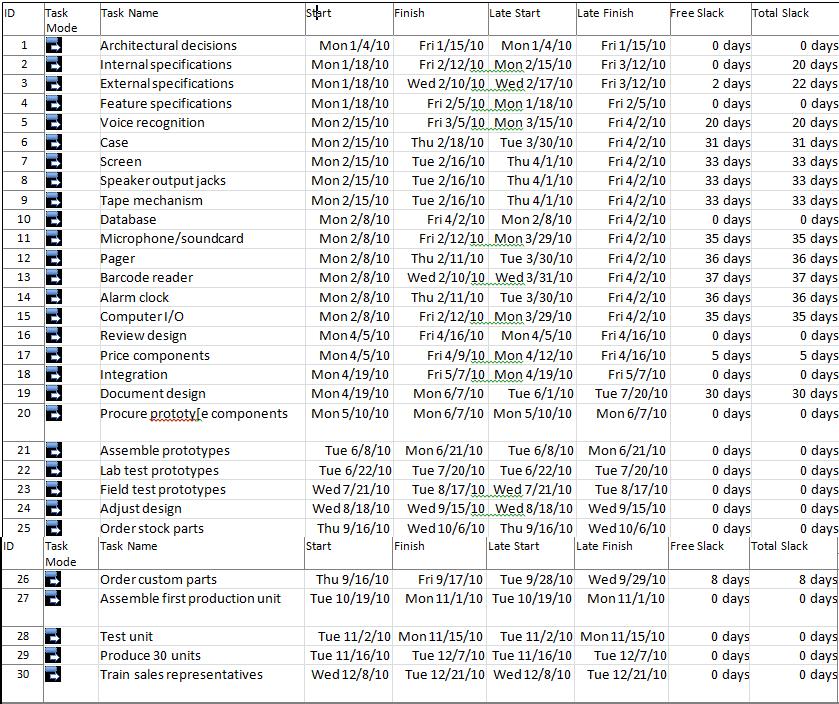
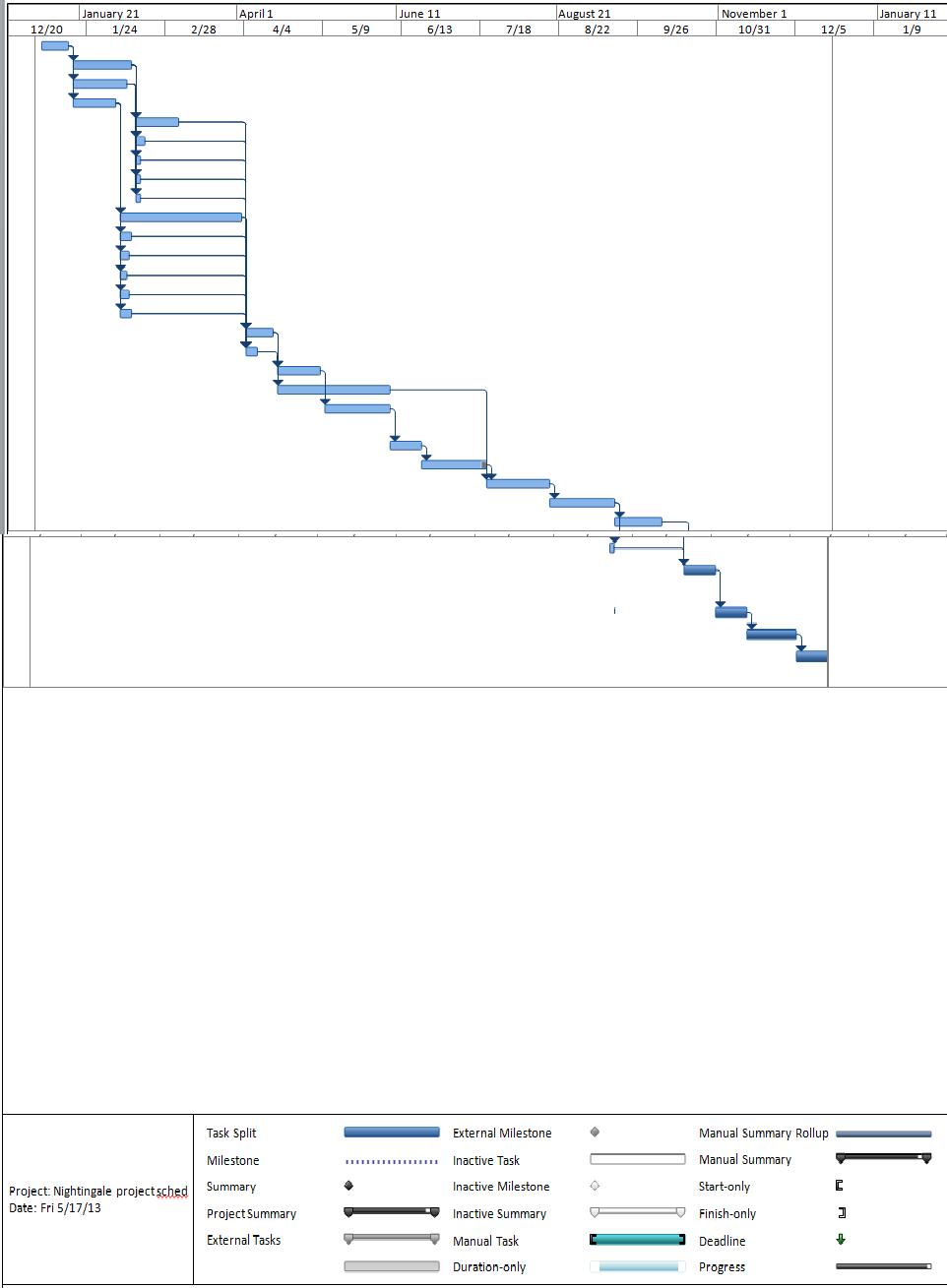
Schedule has been included to illustrate initial planning phase for Nightingale project. The project team will identify the critical path and network sensitivity to meet the project deadline date for the MedCON event.
2
Network Diagram
3
Part--A
1. Will the project as planned meet the October 25th deadline?
Answer: Analysis of preliminary data shows that the project will not complete until December 21, 2010.
2. What activities lie on the critical path?
Answer: The following activities define the critical path: 1, 4, 10, 16, 18, 20, 21, 22, 23, 24, 25, 27, 28, 29, and 30.
3. How sensitive is this network?
Answer: The network, as planned, is not considered sensitive due to the fact that it has one critical path.
Part--B
1. Is it possible to meet the deadline?
Answer: Yes, incorporating both crash activities and lags will allow the company to meet the project deadline constraint.
2. If so, how would you recommend changing the original schedule (Part A) and why? Assess the relative impact of crashing activities versus introducing lags to shorten the project duration.
Answer: Introducing all suggested schedule lags moved the schedule up to 11/15. Still behind deadline, but low (no) cost.
3. What would the new schedule look like?
Answer: Crash Analysis
Total $ 145,000.00
= critical path
Analysis: crashing these three activities on the CP brings the completion date to 11/30/10.
Activity Description Crash Time Crash Cost Slope 5 voice recognition 5 15,000.00 3,000.00 10 database 5 35,000.00 7,000.00 19 document design 5 25,000.00 5,000.00 3 external specificaions 6 20,000.00 3,333.33 20 procure prototype components 5 30,000.00 6,000.00 25 order stock parts 5 20,000.00 4,000.00
4
MS Project 2010 Schedule Combined
4. What other factors should be considered before finalizing the schedule?
Answer: Incorporating the three crashed activities with all suggested schedule lags meets the schedule deadline.
Stays below $100,000 cap also.
Task Mode Task Name Duration Start Finish Predecessors Auto Scheduled Architectural decisions 10 days Mon 1/4/10 Fri 1/15/10 Auto Scheduled Internal specifications 20 days Mon 1/18/10 Fri 2/12/10 1 Auto Scheduled External specifications 18 days Mon 1/18/10 Wed 2/10/10 1 Auto Scheduled Feature specifications 15 days Mon 1/18/10 Fri 2/5/10 1 Auto Scheduled Voice recognition 15 days Mon 2/15/10 Fri 3/5/10 2,3 Auto Scheduled Case 4 days Mon 2/15/10 Thu 2/18/10 2,3 Auto Scheduled Screen 2 days Mon 2/15/10 Tue 2/16/10 2,3 Auto Scheduled Speaker output jacks 2 days Mon 2/15/10 Tue 2/16/10 2,3 Auto Scheduled Tape mechanism 2 days Mon 2/15/10 Tue 2/16/10 2,3 Auto Scheduled Database 35 days Mon 2/8/10 Fri 3/26/10 4 Auto Scheduled Microphone/soundcard 5 days Mon 2/8/10 Fri 2/12/10 4 Auto Scheduled Pager 4 days Mon 2/8/10 Thu 2/11/10 4 Auto Scheduled Barcode reader 3 days Mon 2/8/10 Wed 2/10/10 4 Auto Scheduled Alarm clock 4 days Mon 2/8/10 Thu 2/11/10 4 Auto Scheduled Computer I/O 5 days Mon 2/8/10 Fri 2/12/10 4 Auto Scheduled Review design 10 days Mon 3/29/10 Fri 4/9/10 5,6,7,8,9,10,11,12,13,14,15 Auto Scheduled Price components 5 days Mon 3/29/10 Fri 4/2/10 5,6,7,8,9,10,11,12,13,14,15 Auto Scheduled Integration 15 days Mon 4/12/10 Fri 4/30/10 16,17 Auto Scheduled Document design 35 days Mon 4/5/10 Fri 5/21/10 16SS+5 days Auto Scheduled Procure prototype components 15 days Mon 5/3/10 Fri 5/21/10 18 Auto Scheduled Assemble prototypes 10 days Mon 5/24/10 Mon 6/7/10 20 Auto Scheduled Lab test prototypes 20 days Tue 6/8/10 Tue 7/6/10 21 Auto Scheduled Field test prototypes 20 days Wed 7/7/10 Tue 8/3/10 19,22 Auto Scheduled Adjust design 20 days Wed 7/28/10 Tue 8/24/10 23SS+15 days Auto Scheduled Order stock parts 10 days Wed 8/4/10 Tue 8/17/10 24SS+5 days Auto Scheduled Order custom parts 2 days Wed 8/4/10 Thu 8/5/10 24SS+5 days Auto Scheduled Assemble first production unit 10 days Mon 8/30/10 Mon 9/13/10 25FS+8 days,26FS+13 days Auto Scheduled Test unit 10 days Tue 9/14/10 Mon 9/27/10 27 Auto Scheduled Produce 30 units 15 days Tue 9/28/10 Mon 10/18/10 28 Auto Scheduled Train sales representatives 10 days Tue 10/12/10 Mon 10/25/10 29FS-‐5 days,28SS+5 days
5
Conclusion:
After the project team analyzed the project requirements, and then incorporated to activities into a schedule, they noted that the current project schedule did not meet the date of completion constraint. Further, analysis reveals that outsourcing activities is not an option, because most of the work was developmental in nature. Altering features would comprise quality and possibly undermine the product credibility within the marketplace. The project team opted to accelerate the project, crashing activities at higher overall cost to complete the project deliverables.
The team also, concentrated efforts on changing the relationship some activities from Finish--Start to Start--Start to create lag within the project, thereby gaining valuable time and cost savings.
6
