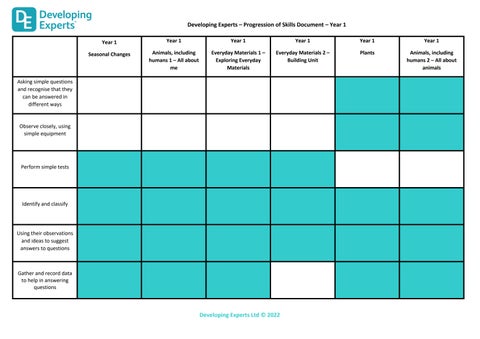

Asking simple questions and recognise that they can be answered in different ways
Observe closely, using simple equipment
Perform simple tests
Identify and classify
Using their observations and ideas to suggest answers to questions
Gather and record data to help in answering questions
Uses of everyday materials
2
Living things and their habitats
Asking simple questions and recognise that they can be answered in different ways
Observe closely, using simple equipment
Perform simple tests
Identify and classify
Using their observations and ideas to suggest answers to questions
Gather and record data to help in answering questions
2
Living things and their habitats – Habitats around the world
2
Animals, including humans 1 – Health and survival
2
Animals, including humans 2 – Life cycles
2 Plants
Ask relevant questions and using different types of scientific enquiries to answer them
Set up simple practical enquiries, comparative and fair tests
Make systematic and careful observations and, where appropriate, taking accurate measurements using standard units, using a range of equipment, including thermometers and data loggers
Gather, record, classify and present data in a variety of ways to help in answering questions
Record findings using simple scientific language, drawings, labelled diagrams, keys, bar charts, and tables
Report on findings from enquiries, including oral and written explanations, displays or presentations of results and conclusions
Use results to draw simple conclusions, make predictions for new values, suggest improvements and raise further questions
Identify differences, similarities or changes related to simple scientific ideas and processes
Use straightforward scientific evidence to answer questions or to support their findings
Ask relevant questions and using different types of scientific enquiries to answer them
Set up simple practical enquiries, comparative and fair tests
Make systematic and careful observations and, where appropriate, taking accurate measurements using standard units, using a range of equipment, including thermometers and data loggers
Gather, record, classify and present data in a variety of ways to help in answering questions
Record findings using simple scientific language, drawings, labelled diagrams, keys, bar charts, and tables
Report on findings from enquiries, including oral and written explanations, displays or presentations of results and conclusions
Use results to draw simple conclusions, make predictions for new values, suggest improvements and raise further questions
Identify differences, similarities or changes related to simple scientific ideas and processes
Use straightforward scientific evidence to answer questions or to support their findings
Year 4
Animals, including humans Year 4
Living things and their habitats
Year 4
Living things and their habitatsConversation Year 4 States of matter
Plan different types of scientific enquiries to answer questions, including recognising and controlling variables where necessary
Take measurements, using a range of scientific equipment, with increasing accuracy and precision, taking repeat readings when appropriate
Record data and results of increasing complexity using scientific diagrams and labels, classification keys, tables, scatter graphs, bar and line graphs
Use test results to make predictions to set up further comparative and fair tests
Report and present findings from enquiries, including conclusions, causal relationships and explanations of and degree of trust in results, in oral and written forms such as displays and other presentations
Identify scientific evidence that has been used to support or refute ideas or arguments
Plan different types of scientific enquiries to answer questions, including recognising and controlling variables where necessary
Take measurements, using a range of scientific equipment, with increasing accuracy and precision, taking repeat readings when appropriate
Record data and results of increasing complexity using scientific diagrams and labels, classification keys, tables, scatter graphs, bar and line graphs
Use test results to make predictions to set up further comparative and fair tests
Report and present findings from enquiries, including conclusions, causal relationships and explanations of and degree of trust in results, in oral and written forms such as displays and other presentations
Identify scientific evidence that has been used to support or refute ideas or arguments