
Animals, including humans
Living things and their habitats
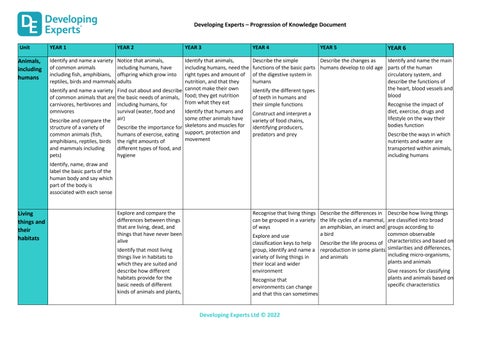
Identify and name a variety of common animals including fish, amphibians, reptiles, birds and mammals
Identify and name a variety of common animals that are carnivores, herbivores and omnivores
Describe and compare the structure of a variety of common animals (fish, amphibians, reptiles, birds and mammals including pets)
Identify, name, draw and label the basic parts of the human body and say which part of the body is associated with each sense
Notice that animals, including humans, have offspring which grow into adults
Find out about and describe the basic needs of animals, including humans, for survival (water, food and air)
Describe the importance for humans of exercise, eating the right amounts of different types of food, and hygiene
Identify that animals, including humans, need the right types and amount of nutrition, and that they cannot make their own food; they get nutrition from what they eat
Identify that humans and some other animals have skeletons and muscles for support, protection and movement
Describe the simple functions of the basic parts of the digestive system in humans
Identify the different types of teeth in humans and their simple functions
Construct and interpret a variety of food chains, identifying producers, predators and prey
Describe the changes as humans develop to old age
Identify and name the main parts of the human circulatory system, and describe the functions of the heart, blood vessels and blood
Recognise the impact of diet, exercise, drugs and lifestyle on the way their bodies function
Describe the ways in which nutrients and water are transported within animals, including humans
Explore and compare the differences between things that are living, dead, and things that have never been alive
Identify that most living things live in habitats to which they are suited and describe how different habitats provide for the basic needs of different kinds of animals and plants,
Recognise that living things can be grouped in a variety of ways
Explore and use classification keys to help group, identify and name a variety of living things in their local and wider environment
Recognise that environments can change and that this can sometimes
Describe the differences in the life cycles of a mammal, an amphibian, an insect and a bird
Describe the life process of reproduction in some plants and animals
Describe how living things are classified into broad groups according to common observable characteristics and based on similarities and differences, including micro-organisms, plants and animals
Give reasons for classifying plants and animals based on specific characteristics
and how they depend on each other
Identify and name a variety of plants and animals in their habitats, including microhabitats
Describe how animals obtain their food from plants and other animals, using the idea of a simple food chain, and identify and name different sources of food
Plants Identify and name a variety of common and wild and garden plants, including deciduous and evergreen trees
Identify and describe the basic structure of a variety of common flowering plants, including trees
Observe and describe how seeds and bulbs into mature plants
Find out and describe how plants need water, light and a suitable temperature to grow and stay healthy
Identify and describe the functions of different parts of flowering plants: roots, stem/trunk, leaves and flowers
Explore the requirements of plants for life and growth (air, light, water, nutrients from soil, and room to grow) and how they vary from plant to plant
Investigate the way in which water is transported within plants
Explore the part that flowers play in the life cycle of flowering plants, including pollination, seed formation and seed dispersal
pose dangers to living things
Evolution and Inheritance
Materials Distinguish between an object and the material from which it is made
Identify and name a variety of everyday materials, including wood, plastic, glass, metal, water, and rock
Describe the simple physical properties of a variety of everyday materials
Compare and group together a variety of everyday materials on the basis of their simple physical properties
Identify and compare the suitability of a variety of everyday materials, including wood, metal, plastic, glass, brick, rock, paper and cardboard for particular uses
Find out how the shapes of solid objects made from some materials can be changed by squashing, bending, twisting and stretching
Recognise that living things have changed over time and that fossils provide information about living things that inhabited the Earth millions of years ago
Recognise that living things produce offspring of the same kind, but normally offspring vary and are not identical to their parents
Identify how animals and plants are adapted to suit their environment in different ways and that adaptation may lead to evolution
Compare and group together everyday materials on the basis of their properties, including their hardness, solubility, transparency, conductivity (electrical and thermal), and response to magnets
Know that some materials will dissolve in liquid to form a solution, and describe how to recover a substance from a solution
Use knowledge of solids, liquids and gases to decide how mixtures might be separated, including
Seasonal changes
Observe changes across the 4 seasons
Observe and describe weather associated with the seasons and how day length varies
Rocks
Compare and group together different kinds of rocks on the basis of their appearance and simple physical properties
Describe in simple terms how fossils are formed when things that have lived are trapped within rock
through filtering, sieving and evaporating
Give reasons, based on evidence from comparative and fair tests, for the particular uses of everyday materials, including metals, wood and plastic
Demonstrate that dissolving, mixing and changes of state are reversible changes
Explain that some changes result in the formation of new materials, and that this kind of change is not usually reversible, including changes associated with burning and the action of acid on bicarbonate of soda
Recognise that soils are made from rocks and organic matter
States of matter
Compare and group materials together, according to whether they are solids, liquids or gases Observe that some materials change state when they are heated or cooled, and measure or research the temperature at which this happens in degrees Celsius (°C)
Identify the part played by evaporation and condensation in the water cycle and associate the rate of evaporation with temperature
Earth and space
Describe the movement of the Earth and other planets relative to the sun in the solar system
Describe the movement of the moon relative to the Earth
Describe the sun, Earth and moon as approximately spherical bodies
Use the idea of the Earth’s rotation to explain day and
Light
Recognise that they need light in order to see things and that dark is the absence of light
Notice that light is reflected from surfaces
Recognise that light from the sun can be dangerous and that there are ways to protect their eyes
Recognise that shadows are formed when the light from a light source is blocked by an opaque object
Find patterns in the way that the size of shadows change
Forces
Compare how things move on different surfaces
Notice that some forces need contact between 2 objects, but magnetic forces can act at a distance
Observe how magnets attract or repel each other and attract some materials and not others
Compare and group together a variety of
night and the apparent movement of the sun across the sky
Recognise that light appears to travel in straight lines
Use the idea that light travels in straight lines to explain that objects are seen because they give out or reflect light into the eye
Explain that we see things because light travels from light sources to our eyes or from light sources to objects and then to our eyes
Use the idea that light travels in straight lines to explain why shadows have the same shape as the objects that cast them
Explain that unsupported objects fall towards the Earth because of the force of gravity acting between the Earth and the falling object
Identify the effects of air resistance, water resistance and friction, that act between moving surfaces
Recognise that some mechanisms including levers, pulleys and gears
everyday materials on the basis of whether they are attracted to a magnet, and identify some magnetic materials
Describe magnets as having 2 poles
Predict whether 2 magnets will attract or repel each other, depending on which poles are facing
allow a smaller force to have a greater effect Electricity
Identify common appliances that run on electricity
Construct a simple series electrical circuit, identifying and naming its basic parts, including cells, wires, bulbs, switches and buzzers
Identify whether or not a lamp will light in a simple series circuit, based on whether or not the lamp is part of a complete loop with a battery
Recognise that a switch opens and closes a circuit and associate this with whether or not a lamp lights in a simple series circuit
Recognise some common conductors and insulators, and associate metals with being good conductor
Associate the brightness of a lamp or the volume of a buzzer with the number and voltage of cells used in the circuit
Compare and give reasons for variations in how components function, including the brightness of bulbs, the loudness of buzzers and the on/off position of switches
Use recognised symbols when representing a simple circuit in a diagram
Sound
Identify how sounds are made, associating some of them with something vibrating
Recognise that vibrations from sounds travel through a medium to the ear
Find patterns between the pitch of a sound and features of the object that produced it
Find patterns between the volume of a sound and the strength of the vibrations that produced it
Recognise that sounds get fainter as the distance from the sound source increases