NCLAWYERSWEEKLY.COM VOLUME 34 NUMBER 15 ■
Part of the
network
AUGUST 1, 2022 ■ $8.50
NC attorney elected to IADC board office ■ STAFF REPORT
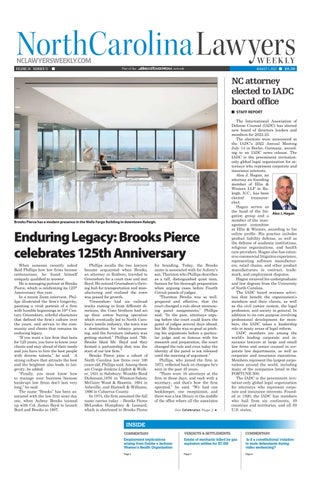
Brooks Pierce has a modern presence in the Wells Fargo Building in downtown Raleigh.
Enduring Legacy: Brooks Pierce celebrates 125th Anniversary When someone recently asked Reid Phillips how law firms become centenarians, he found himself uniquely qualified to answer. He is managing partner at Brooks Pierce, which is celebrating its 125th Anniversary this year. In a recent Zoom interview, Phillips illustrated the firm’s longevity, painting a vivid portrait of a firm with humble beginnings in 19th Century Greensboro, colorful characters that defined the firm’s culture over the years, and service to the community and clients that remains its enduring legacy. “If you want a law firm that lasts for 125 years, you have to know your clients and stay ahead of their needs and you have to hire the best people with diverse talents,” he said. A strong culture that attracts the best and the brightest also leads to longevity, he added. “Finally, you must know how to manage your business because bankrupt law firms don’t last very long,” he said. The name “Brooks” has been associated with the law firm since day one, when Aubrey Brooks teamed up with Col. James Boyd to launch Boyd and Brooks in 1897.
Phillips recalls the two lawyers became acquainted when Brooks, an attorney in Roxboro, traveled to Greensboro for a court case and met Boyd. He noticed Greensboro’s thriving hub for transportation and manufacturing and realized the town was poised for growth. “Greensboro had six railroad tracks coming in from different directions, the Cone brothers had set up their cotton buying operation which eventually led to North Carolina’s textile industry, the town was a destination for tobacco processing, and the furniture industry was getting started,” Phillips said. “Mr. Brooks liked Mr. Boyd and they formed a partnership that was the start of our law firm.” Brooks Pierce joins a cohort of North Carolina law firms over 100 years old, Phillips said. Among them are Craige Jenkins Liipfert & Walker, 1831 in Salisbury; Womble Bond Dickenson,1876 in Winston-Salem; McGuire Wood & Bissette, 1894 in Asheville, and Hartsell & Williams, 1896 in Cabarrus County. In 1974, the firm assumed the full name carries today – Brooks Pierce McLendon Humphrey & Leonard, which is shortened to Brooks Pierce
for branding. Today, the Brooks name is associated with for Aubrey’s son, Thornton who Phillips describes as a tall, distinguished quiet man, famous for his thorough preparation when arguing cases before Fourth Circuit panels of judges. “Thornton Brooks was so wellprepared and effective, that the court changed a rule about announcing panel assignments,” Phillips said. “In the past, attorneys arguing before the court could learn the panel of judges several days ahead, but Mr. Brooks was so good at pitching his arguments before a particular judge and so famous with his research and preparation, the court changed the rule and even today the identity of the panel is not released until the morning of argument.” Phillips, who joined the firm in 1973, reflected back on changes he’s seen in the past 45 years. “There were 16 attorneys at the firm in those days, and each with a secretary, and that’s how the firm operated,” he said. “We had one bookkeeper, one receptionist, and there was a law library in the middle of the office where all the associates See Celebrates Page 2 ►
The International Association of Defense Counsel (IADC) has elected new board of directors leaders and members for 2022-23. The elections were announced at the IADC’s 2022 Annual Meeting July 14 in Berlin, Germany, according to an IADC news release. The IADC is the preeminent invitationonly global legal organization for attorneys who represent corporate and insurance interests. Alex J. Hagan, an attorney an founding member of Ellis & Winters LLP in Raleigh, N.C., has been elected treasurerelect. Hagan serves as the head of the litiAlex J. Hagan gation group and a member of the management committee at Ellis & Winters, according to his online profile. His practice includes product liability defense, as well as the defense of academic institutions, religious organizations, and health care providers. Hagan also has extensive commercial litigation experience, representing software manufacturers, retail chains, and other product manufacturers in contract, trademark, and employment disputes. Hagan received his undergraduate and law degrees from the University of North Carolina. The IADC board oversees activities that benefit the organization’s members and their clients, as well as the civil justice system, the legal profession, and society in general. In addition to its core purpose involving professional development for members, the IADC takes a leadership role in many areas of legal reform. IADC members are among the world’s leading corporate and insurance lawyers at large and small law firms and senior counsel in corporate law departments, as well as corporate and insurance executives. Members represent the largest corporations around the world, including many of the companies listed in the FORTUNE 500. The IADC is the preeminent invitation-only global legal organization for attorneys who represent corporate and insurance interests. Founded in 1920, the IADC has members who hail from six continents, 49 countries and territories, and all 50 U.S. states.
INSIDE COMMENTARY
VERDICTS & SETTLEMENTS
COMMENTARY
Employment implications arising from Dobbs v. Jackson Women’s Health Organization
Estate of mechanic killed by gas explosion settles for $7.5M
Is it a constitutional violation to mute defendants during video sentencing?
Page 2
Page 5
Page 6
2 / COMMENTARY
N O R T H C A R O L I N A L A W Y E R S W E E K LY I Au gu s t 1, 2022
Employment implications arising from Dobbs v. Jackson Women’s Health Organization ■ BY LISA MICHELLE KOHRING AND WESTON J. MUMME The U.S. Supreme Court issued its decision in Dobbs v. Jackson Women’s Health Organization on June 24, 2022, overturning Roe v. Wade and Planned Parenthood v. Casey and holding that there is no right to abortion in the U.S. Constitution. In doing so, the court returned the authority to regulate abortion to the individual states. The Dobbs decision poses a unique set of challenges for employers, as state regulations on abortion will vary greatly from state to state.
Key Considerations for Employers
Employer-sponsored benefit plans are generally preempted by the Employee Retirement Income Security Act of 1974 (ERISA), but there are preemption exceptions included for state laws governing insurance coverage. Employers who purchase employee insurance coverage, as opposed to employers that self-fund employee insurance coverage, may see changes to reproductive healthcare coverage. It is likely that state-licensed insurance companies operating in states that prohibit or significantly restrict abortions will now limit or completely exclude employer coverage for abortion-related and other reproductive healthcare services. Other insurance companies may limit coverage for abortion-related services for employees in states that prohibit abortions, even if the employee is willing to travel to a different state where such services are permitted.
Employers should review their healthcare plans with internal decisionmakers and human resources professionals, educate them about the types of coverage offered to employees, and provide guidance about responding to employee inquiries about coverage changes. Employers also may wish to consult with their insurance brokers to confirm whether their insurance plans may be modified in the future to exclude or limit abortion-related services for all or a select group of employees. In the wake of the Dobbs opinion, some states have already imposed “trigger laws” imposing restrictions or outright bans on abortion. Others, such as Texas and Oklahoma, have additionally enacted laws criminalizing abortion. Importantly, some of these laws explicitly state that providing coverage or reimbursement of abortion expenses is considered aiding and abetting abortion. Employers considering increasing contributions for employee health savings accounts (HSAs), implementing health plan amendments or expanding plans that would cover travel and lodging expenses for employees who may choose to seek out-of-state reproductive and abortion-related services should consider whether doing so may expose the employer to civil or criminal liability. In the days ahead, there will undoubtedly be a wide array of emotional responses to the Dobbs decision. Employers should be mindful about how employees may react, the impact of differing viewpoints on employee morale and productivity, the possibility of an increase in requests for leave
and potential employee resignations. Reviewing handbooks, policies and procedures as well as retraining managers and employees on company policies governing codes of conduct and anti-discrimination, harassment and retaliation will remind employees of appropriate conduct in the workplace. Human resources professionals and supervisors should re-familiarize themselves with practices governing maintenance of confidential health information and the policies governing dress code and social media conduct. How will the company respond to an employee who comes to work with an anti-abortion message on his or her shirt? What about an employee who tweets out an offer to drive co-workers to get an abortion from a state that has criminalized such actions? Importantly, employers must ensure that policies and procedures are applied uniformly and that decision-makers know how to respond to these potential situations to mitigate potential liability and claims of discrimination. Employers should also be mindful that certain speech in the workplace may be protected, including speech about abortion. While the right to free speech under the First Amendment does not extend to private workplaces, other laws protect specific types of expression in the workplace such as the National Labor Relations Act (NLRA) and Title VII of the Civil Rights Act. The NLRA allows employees to seek better working conditions by discussing the terms and conditions of their employment without fear of retaliation. Traditionally, the NLRA’s protec-
tions are limited to employees engaging in protected concerted activity. Under the Biden Administration, however, the National Labor Relations Board (NLRB) has taken a decidedly pro-union view of what constitutes protected concerted activity. Accordingly, it is possible that employee discussions regarding topics – such as an employer’s policy providing fringe benefits to women seeking reproductive and abortion-related healthcare services – may fall under the rubric of concerted protected activity. Title VII serves to, among other things, protect employees from religious discrimination and requires employers make reasonable accommodations when necessary. Because the issue of abortion is closely intertwined with religious beliefs and practices, employers should take special care to ensure that no actions are taken against employees based on their religious beliefs for or against abortion and that all policies and procedures are applied equally irrespective of viewpoint. Next Steps Employment issues and laws will continue to evolve in the aftermath of the Dobbs decision. Employers should consult with legal counsel to stay abreast of changes to the legal landscape and for guidance in making informed decisions and creating clear and consistent messaging to employees and the public. Lisa Kohring and Weston J. Mumme are labor and employment attorneys at Holland & Knight, which has offices in Charlotte, N.C.
CELEBRATES / Enduring Legacy: Brooks Pierce celebrates 125th Anniversary C o nt inu e d f r o m 1 ►
and partners would gather around big tables and work when they needed to get away from the telephone.” The modern Brooks Pierce occupies offices in Raleigh and Wilmington, in addition to its main office in Greensboro, and it has expanded into one of the state’s largest law firms, with ;107 attorneys. Phillips anticipates establishing a presence in Charlotte soon. “Back in the day, we would all collaborate on cases, and it was a fun way to work together, and we really got to know each other,” he said. “Today people tend to sit at their desks or work remotely, and we don’t collaborate as much.” Brooks Pierce offers a diverse range of practice areas and services for clients, but business law is still at its heart. Some practice areas have evolved over time, largely due to growth in technology and the internet. “When I was in law school learning about property, it was real property we were talking about,” he said. “Today, we refer to intellectual property, trademarks and copyright laws, particularly as it pertains to our broadcast and media clients.” The internet also brought about the demise of the stately law libraries as attorneys turn to digital resources. Brooks Pierce’s has reduced its Raleigh library to just couple of shelves. “When the day comes that we renovate our Greensboro office, or move to a new location, the same thing will happen there,” Phillips said. “I’m excited about the future, but I know when I see those books discarded, I’ll also be a little sad, because those books contain case law that made a
Two former NC Supreme Court chief justices, Henry Frye (left) and the late I. Beverly Lake (right) are with the late Janet Reno, former United States Attorney General. After retiring from the Supreme Court, Frye joined Brooks Pierce as of counsel before retiring from the firm in 2016.
difference for clients.” Over the years, Brooks Pierce has welcomed notable attorneys to its ranks, including Henry Frye, former chief justice of the N.C. Supreme Court, and the state’s first Black justice. Currently the firm is home to Bill Ross, former secretary of the state’s Department of Environment and Natural Resources; Jennifer Van Zant, former chair of the North Carolina Business Court Rules Revision Committee, and Kearns Davis, past president of the North Carolina Bar Association.
Last year, Tony Copeland, former Secretary of Commerce, joined Brooks Pierce as senior economic development and corporate strategist and launched the firm’s new economic development practice area. Brooks Pierce also embraces diversity and inclusion, and has created a Diversity and Inclusion Committee. which recently established the Justice Henry E. Frye Diversity Fellowship, which awards an annual $10,000 scholarship to a student of color enrolled in a full-time JD program at an ABA-accredited law school. The firm has a long history of com-
munity service and encourages attorneys and professional staff to embrace volunteerism by serving on board and committees, doing pro bono work and even serving locally on kids’ sports leagues. While Brooks Pierce has a long and distinguished history, Phillips looks forward to the decades ahead. “I am excited about what our future holds and the impact current and upcoming generations of attorneys will have in shaping North Carolina and the practice of law,” he said. Teri Saylor is a writer in Raleigh, N.C.
NEWS / 3
N O R T H C A R O L I N A L A W Y E R S W E E K LY I Aug ust 1, 2022
LAWYERS IN THE NEWS Wilmington firm welcomes new attorney Block, Crouch, Keeter, Behm & Sayed, LLP in Wilmington has welcomed its newest attorney, Brittany Hall. Hall exclusively handles family law matters such as child custody, child support, equitable distribution, alimony, divorce, separation agree-
ments, premarital agreements, cases involving the Department of Social Services and contempt proceedings. She has been practicing law since 2013 and became a North Carolina Board Certified Family Law Specialist in 2021. Hall handled family law matters at The Nettleman Law Firm and then Cape Fear Family Law until she joined the firm in 2022. She is a native of North Carolina, born and raised in Reidsville. She
now lives in Wilmington with her family.
Ellis & Winters attorney named to NCADA board of directors Ellis & Winters attorney, Scottie Forbes Lee was appointed to the Board of Directors of the North Carolina Association of Defense Attorneys (NCADA). Lee will hold a three-year
role with the organization. Lee previously served as Product Liability Group Chair with NCADA in 2021. Over 800 attorneys and paralegals represent the interests of businesses and individuals for NCADA. Lee is among those who serve as a voice for defense counsel in civil litigation. These dealings consist of judiciary, public positions on matters of interest and participation in a variety of events connected with the bench, bar and business community.
How to tap into the source of inspiration ■ BY KAREN NATZEL BridgeTower Media Newswires I have had clients tell me, “Karen, it’s work. It’s not supposed to be fun.” I have heard employees lament, “Work is a 4-letter word.” And we have all heard the refrain “TGIF!” When I speak of fun in the context of work, I am not talking about happy hours or team-building activities (although, for the record, I have nothing against either of those). I am speaking to our relationship to our work — how it nourishes or drains us and how it inspires or deflates us. Joy can be found when our work brings us a deep sense of satisfaction — from learning, achieving, contributing, or connecting. For those of us who have followed organizing consultant Marie Kondo’s guidance on tidying up, “discovering what sparks joy for you” may already resonate with you. If so, you can think of it as Marie Kondo-ing your work life! When I sat down to write this column, I asked myself, “What are my clients facing?” I scribbled “Overwhelmed. Overextended. Overcommitted. Overstimulated. Overloaded.” No doubt, generally over it! What contributes to this and, more importantly, how can we regain some sense of balance, equanimity, or even enthusiasm? A good place to begin is examination of what gives us energy and what depletes us. I know I am energized by free thinking, the exploration of new places or ideas, opportunities for creative expression and a challenge. My energy dips when something feels overanalyzed, too detail-oriented or bogged down in process. I am also energized when I leverage my strengths and tap into my values — as living in alignment with them creates a sense of ease. Knowing that I value learning and am energized by discovery, I make sure to build in ways I experience that in my work. I have said “yes” to projects that stretched my comfort zone, I have researched ideas in my domain of organizational development to continue sharpening my knowledge, and I have attended workshops to build my skills. Knowing that I get stoked when a client flourishes in his/her leadership capacity tells me that cultivating the potential in others is a source of joy for me. Equally important is recognizing what kind of work or environment that is not conducive to helping you shine. You might find there are seemingly contradictory forces at play. For example, I can simul-
inspiration pic from depositphotos.com
taneously value autonomy and collaboration, making it important to understand the ingredients that are my unique recipe for joy. Knowing our specific motivators is a start in creating a work world that satisfies those needs. When I’m asked about training on time management, I like to dig deeper to discover the problems we are trying to solve. Often, we unearth challenges around managing the plethora of priorities we have (or our organization has) committed to; we struggle to focus — whether that’s a result of working from home or being swept up by the gravitational pull of electronic notifications; we struggle to delegate — whether that’s our need for control or lack of resources to whom to share the work; and we struggle to maintain healthy boundaries — whether that’s our desire to feel valued for our contribution, an overdeveloped sense of responsibility, or an unhealthy organizational cultural expectation. Finding flow In listening to a recent TED talk on “how to stop languishing and start finding flow,” I was riveted by Adam Grant’s spot-on explanation of a condition so many are experiencing. Grant tells us that the best prediction of well-being is not optimism (darn it, that’s my go-to!), but flow. In the zone. Total absorption in an activity. It’s where we build momentum. It is as if we are transported to another place.
Generation of peak flow requires our active participation. Grant maps out three criteria for manifesting that experience: Mastery: One of the strongest factors in daily motivation is a sense of progress – even small wins build momentum. Mindfulness: Focusing our full attention on a single task. Mattering: Knowing that you make a difference. In his talk, Grant notes that people check their email 74 times a day and switch tasks every 10 minutes! He coins the term “time confetti” — taking what could be meaningful moments of our lives and shredding them into useless, tiny pieces. He calls this the “enemy of energy and excellence.” Finding purpose in your work can also contribute to “mattering.” It’s knowing that what you do matters; that you are contributing to something greater than yourself. Finding flow requires creating space for it. That might mean securing blocks of time on your calendar that are sacred, uninterrupted, quality and focused. That requires clarity of what’s important, what feeds you and the courage and discipline to maintain that boundary. When our GPS waypoints are dialed in to what brings us joy, to what is aligned with our strengths and values, then our true north will guide us in creating flow — and peak performance.
Tips What brings you joy? You don’t have to confine your definition to your work; find what ignites your spirit, no matter how simple or small. Where/when do you experience flow? (Clue: you lose track of time, you feel energized, creative, engaged) What traits/strengths do you possess that add value? What nourishes you? What drains you? How can you grow in your craft? Block time on your calendar to give space and attention to a project, a task, a person. Try changing venues (I’m finishing this column at a local coffee shop!) Identify your motivators and purpose. See how and where you show up makes a difference. Have a bias for action. Don’t make it hard; make it happen. Reclaim your agency. Name the barriers that block your joy. Find the courage to create boundaries that break through the languishing and generate flow. If you can be deliberate about creating the conditions and criteria necessary in your work to thrive, you might just find the joy in your work. Karen Natzel is a business therapist who helps leaders create healthy, vibrant and high-performing organizations. Contact her at 503-806-4361 or karen@natzel.net.
4 / COMMENTARY NEWS
N O R T H C A R O L I N A L A W Y E R S W E E K LY I Au gu s t 1, 2022
What employers should know about predictive scheduling laws ■ BY CATHARINE MORISSET AND LISA NAGELE-PIAZZA, FISHER PHILLIPS Hospitality industry employers know that scheduling the right number of workers on any given day — or shift — is a challenge. In addition to unpredictable customer patterns, the ongoing COVID-19 pandemic, labor shortages, and record turnover rates add to the difficulty of keeping operations running smoothly. You might be tempted to rollout “on-call” scheduling polices to help respond to varying levels of customer traffic and resolve last-minute staffing shortages when workers call out sick or don’t show up for a shift. While these policies are permissible in many locations, some states and localities have “predictive scheduling” laws that limit such practices and impose penalties when employees aren’t given sufficient notice of schedule changes. What do you need to know about these laws, and how do they impact your scheduling practices?
On-Call Scheduling
Restaurant and lodging employers typically want their employees to be flexible so they can respond to staffing shortages or unexpected changes in customer traffic. An on-call scheduling system can help businesses meet customer service needs by designating certain employees to be available — either regularly or on a rotating basis — to report to work on short notice or with no advance notice, if needed. The designated employees will usually call at a certain time to see if they should report to work. Often “on call” workers are those that are sent home first if guest traffic is slower than expected. Such practices have come under fire in recent years, however, by worker advocates. They say on-call scheduling systems disproportionately affect low-wage earners who may work more than one job or have difficulty planning for financial, transportation, and childcare needs. Therefore, a growing number of jurisdictions have enacted predictive
scheduling laws. They generally only apply to large businesses and aim to provide workers with more predictability when it comes to their work hours and related income. Predictive scheduling laws, however, make it difficult for employers to quickly resolve staffing issues as they arise without triggering an obligation to pay “predictability pay” or other rules.
ures of public utilities, or shutdowns of public transportation. Additionally, you should note that some states and localities have rules on “reporting time pay.” For example, in California, an employee who is sent home after working less than half their scheduled workday must be paid for two to four hours of work, depending on the specific circumstances.
A Patchwork of Predictive Scheduling Laws
Tips for Employers
What legal limits may apply to an on-call scheduling plan will differ by where your business is located. San Francisco was the first location to enact a predictive scheduling law in 2015. Although the stated purpose of these laws is similar, they vary significantly in terms of which employers are covered, how far in advance employees must receive their schedules, and the penalties for making lastminute schedule changes. For example, San Francisco’s Formula Retail Employee Rights Ordinances applies to certain chain stores and businesses — including bars and restaurants — with at least 40 stores worldwide and 20 or more employees in San Francisco. The ordinance also applies to a covered company’s janitorial and security contractors. Among other obligations, San Francisco’s law requires employers to post schedules at least two weeks in advance and pay employees between one and four hours of additional “predictability pay” for last-minute changes. Seattle’s Secure Scheduling Ordinance applies to retail and food service establishments with at least 500 employees worldwide, including any employer within a franchise network that employs over 500 people. To be covered, full-service restaurants must also have at least 40 full-service locations worldwide. Under New York City’s Fair Workweek Law, covered employers are required to post schedules 72 hours in advance and changes thereafter are prohibited unless the employer cannot operate due to certain emergency conditions, such as natural disasters, fail-
The right scheduling approach for your operations will depend on many factors, including your location, company culture, and type of business. Although small employers may encounter scheduling and compliance issues, large employers that operate in multiple jurisdictions, in particular, may face significant challenges when attempting to apply consistent scheduling practices company wide. Depending on where you are located, you may need to create geographically specific policies. If you do business in locations with predictive scheduling requirements, you should consult with counsel to ensure you are complying with the various components of these complex laws. Look into any exceptions that might apply to predictability pay. For example, some of these laws allow you to create a list of employees to call about available shifts and allow them to decide whether to accept a shift without collecting predictability pay. But some may not, so it’s important to know the details about your local predictability pay laws. You might also allow employees to voluntary swap schedules or sign up for open shifts, consistent with any requirements of the local laws. Scheduling apps can help facilitate these programs. Train frontline managers on how to handle staffing shortages and comply with the applicable predictive scheduling laws. Catharine Morisset is a litigation partner in the Fisher Phillips’ Seattle office. Fisher Phillips has offices in Charlotte, N.C., and Columbia, S.C.
The importance of coaching ■ BY CHRISTOPHER F. EARLEY BridgeTower Media Newswires “A good coach can change a game. A great coach can change a life.” — John Wooden One of the best decisions I ever made was to invest in professional coaching. Since I began to receive coaching, it has been a shot in the arm for me. I have seen a significant increase in the growth of my firm, and because of that growth I have doubled down and now have two different business coaches (one is a lawyer and one is a non-lawyer) with whom I speak regularly. Here are some things to keep in mind if coaching interests you: It is an investment. Coaching is not cheap, but like with most things in life, you get what you pay for. I have found that my investment in coaching, as with any good investment, compounds over time. It is an investment in not only money, but also time. Receiving coaching one or two times may help, but I believe consistent, longterm coaching really moves the needle.
To me, it is a true long game instead of a quick win. Setting aside time for regular coaching calls has been a great investment. I find the more I invest my time and money, the more I get out of professional coaching. The right mindset. I believe coaching can be good for anyone but that it can be particularly effective if you have a growth mindset and want to be pushed. If you want to grow and advance professionally, then the right coach can help tremendously. Coaching also requires you to step out of your comfort zone. If you embrace the idea that true growth only comes from doing things outside of your comfort zone, then coaching can be a great lever. Alignment. If a coach is really good, that does not mean the coach will be really good for you. Factors such as personality and philosophy are important, because if you and the coach are not on the same page with these things, then it may not be a great fit. I spoke with a few different coaches and hired only those I felt greater affinity to, and alignment with. Accountability. A good coach will
see more potential in you than you see in yourself. Coaching creates accountability. It is easy to put things off and wait until tomorrow to get something done. But a coach can motivate and nudge you to do things that you on your own may not otherwise get done. You must do the work or else all the coaching in the world will not be of any help to you. Inspiration. I consider my coaching calls to be mini-mastermind sessions in which the coach and I put our heads together and brainstorm ideas. It is through these calls that great ideas and inspiration are born. After all, you can only get so much inspiration and creativity on your own. When you bounce ideas off a good coach who knows you and where you are trying to go, truly great things can happen. If you have any questions or comments on the topic of coaching, email me at cearley@chrisearley.com. I would love to hear from you. Christopher F. Earley is a Boston attorney and author who concentrates his practice on the representation of the seriously injured and their families.
"Helping lawyers practice better, more efficiently, and more profitably." ■ PUBLISHER Liz Irwin lirwin@bridgetowermedia.com ■ EDITOR Jordan Yount jyount@molawyersmedia.com\ EDITORIAL Heath Hamacher, Reporter hhamacher@nclawyersweekly.com Scott Baughman, Digital Media Manager sbaughman@mecktimes.com ■ ADVERTISING Sheila Batie-Jones, Advertising Account Executive sbatie-jones@nclawyersweekly.com ■ ACCOUNTING & ADMINISTRATIVE Michael McArthur, Business Manager mmcarthur@bridgetowermedia.com ■ CIRCULATION Disa Ehrler, Audience Development Manager dehrler@bridgetowermedia.com Circulation: 1-877-615-9536 service@bridgetowermedia.com ■ PRODUCTION & OPERATIONS Bradley Redmond, Director of Production Ryan O’Shea, Production Supervisor John Reno, Production Specialist ©2022 BridgeTower Media. Material published in North Carolina Lawyers Weekly is compiled at substantial expense and is for the sole and exclusive use of purchasers and subscribers. The material may not be republished, resold, recorded, or used in any manner, in whole or in part, without the publisher’s explicit consent. Any infringement will be subject to legal redress. Established 1988 919-829-9333 • 1-800-876-5297 Charlotte office: 130 North McDowell Street, Unit B, Charlotte, NC 28204 (704) 377-6221 • (704) 377-4258 fax: www.nclawyersweekly.com For subscription questions 1-877-615-9536 service@bridgetowermedia.com
North Carolina Lawyers Weekly [ISSN10411747] [USPS 002-904] is published biweekly every other Monday with General Statewide Circulation for $410.36 per year by North Carolina Lawyers Weekly, 130 North McDowell Street, Unit B, Charlotte, NC 28204 Periodicals postage paid at Charlotte, North Carolina 28228-9998. POSTMASTER: Electronic Service Requested. Send address changes to: North Carolina Lawyers Weekly, Subscription Services, P.O. Box 1051, Williamsport, PA, 17703-9940 North Carolina Lawyers Weekly is a publication of BridgeTower Media, 222 South Ninth Street, Suite 900, Minneapolis, MN 55402.
VERDICTS & SETTLEMENTS / 5
N O R T H C A R O L I N A L A W Y E R S W E E K LY I Aug ust 1, 2022
Estate of mechanic killed by gas explosion settles for $7.5M ■ BY HEATH HAMACHER The estate of a 21-year-old mechanic killed when a cylinder containing nitrous oxide exploded has settled several claims against the defendant company for $7.5 million, its attorneys report. James Roberts III and Matthew Quinn of Lewis & Roberts in Raleigh represented the decedent, who worked with his father in his father’s automobile repair shop. The attorneys report that the explosion occurred after the man attached a heating pad (a common practice, the plaintiffs assert) to the cylinder and was transferring the gas into a smaller bottle. “The cylinder violently exploded, dismembering the decedent and killing him instantly,” the attorneys wrote in an email to Lawyers Weekly. “Decedent’s wife, father, and stepmother were in the mechanic shop at the time of the explosion but did not suffer bodily injuries.” Many details of the case, including names of the parties, defense counsel, and venue, were withheld due to a confidentiality agreement. The attorneys said that it is customary for those involved in drag racing, as the plaintiffs were, to use nitrous oxide to significantly boost
the horsepower of gasoline engines. The defendant sold nitrous oxide stored inside cylinders it leased to customers, the attorneys said, and the cylinder at James Roberts Matthew the center of this III Quinn case was manufactured in 1979 but was recertified for use by the defendant in 2017. The plaintiffs argued that significant rust inside the cylinder violently reacted with the nitrous oxide when the cylinder was heated and that a “reasonable and proper” inspection in 2017 required that the rust be discovered and cleaned. The defendant argued that the decedent was contributorily negligent because he failed to heed the warning label stating that the cylinder may explode if heated and that the plaintiffs’ claims were barred by terms and conditions of the sale purporting to release the defendant from liability in the event of death or serious injury.
SETTLEMENT REPORT — PRODUCT DEFECT/ WRONGFUL DEATH Amount: $7.5 million Injuries alleged: Death, negligent infliction of emotional distress Case name: Withheld Court: Withheld Mediator: Robert Beason Date of settlement: April 5 Special damages: Approximately $1 million for loss of services to the estate; approximately $25,000 for medical expenses for mental health providers; and approximately $250,000 in property damage Most helpful experts: Thomas Eagar (metallurgist); Jonathan Balbi of Airgenics; Michael Maddox of Sisyphus Associates; J.C. Poindexter, Ph.D. (economist); Richard Roby of Combustion Science & Engineering; Michael Sutton of Accident Reconstruction Analysis; Dr. Bruce Capehart (psychiatrist); and Roger Moore, Ph.D., (clinical and forensic psychologist) Insurance carrier: Withheld Attorneys for plaintiff: James Roberts III and Matthew Quinn of Lewis & Roberts in Raleigh Attorney(s) for defendant: Withheld
Discipline & discharge: Best practices for avoiding litigation ■ BY NICK BALL AND BRUCE GARRETT BridgeTower Media Newswires Disciplining and terminating employees are realities of doing business, but by adhering to certain practices, employers can help reduce the risk of costly litigation. Discipline or termination, often referred to as “adverse employment actions,” can give rise to allegations of unlawful discrimination or retaliation. Discrimination involves actions taken because of a worker’s protected characteristic, such as race, color, religion, sex, sexual orientation, gender identity, age or disability. Retaliation, on the other hand, describes actions taken because of a worker’s protected activity, such as filing a workers’ compensation claim, complaining of illegal activity occurring at the workplace, or taking protected leave. When an employer takes an adverse employment action against an employee based on a protected characteristic or an employee who has engaged in protected activity — even when the adverse employment action is taken for legitimate
reasons — such action may allow an employee to argue that they were subject to discrimination or retaliation. An employee’s protected characteristic or engagement in protected activity, however, does not prevent an employer from taking corrective action or terminating the employee. By keeping a few simple principles in mind when dealing with disciplinary issues, employers may reduce the risk and cost of litigation. Document, document, document! Proper documentation can help an employer build a defense to a claim of unlawful termination. Employers should ensure that their managers are trained to document performance and disciplinary issues contemporaneously. Generally, efforts to discipline an employee or coach them on how to improve their performance should always be documented, even if it seems like a minor or insignificant conversation. Documentation should be objective and straightforward, generally record the facts giving rise to the discussion, and note who was
present, where and when the conversation took place, and identify the instruction given to the employee. The specifics of the conduct that led to disciplinary action are important, and documentation should use precise quotes when describing an employee’s words — even a note of the employee’s demeanor and reaction to the discipline might be useful. Contemporaneous documentation helps authenticate the accuracy of the note and it lends more credibility to such documents when used as evidence. Employee grievances — especially those involving perceived unfair or unlawful treatment by management — and any follow-up investigation into such complaints should also be thoroughly documented. Implement progressive discipline policies Having a clear policy on progressive discipline is another tool that employers can use to reduce the risk of being sued. Employees who are blindsided by a termination are more likely to feel like they have been wronged — i.e., more likely to file a lawsuit against their current or
former employer. Employees who are subjected to multiple rounds of progressive discipline, where expectations are clearly spelled out to the employee and the employee is given a reasonable chance to improve their performance, are less likely to cry foul when terminated. More importantly, progressive discipline can be effective in improving the performance of struggling employees. At each stage of progressive discipline, employees should be given the specific reason why they are being disciplined, the expectations for future conduct, and the opportunity to respond to the disciplinary action. It is worth noting that employers that wish to use a progressive discipline system should exercise care when drafting such policies for their employee handbooks. Promising that disciplinary steps will occur in a specific order may allow employees to argue that any deviation from those steps was unlawful. To avoid that risk, written policies should emphasize that the employer has discretion
MEDIATION TRAINING Approved by the Dispute Resolution Commission and the NC CLE Board!
MEDIATION, INC. MEDIATION, INC. MEDIATION, INC. MEDIATION, INC. MEDIATION, INC. MEDIATION, INC. MEDIATION, INC. MEDIATION, INC. MEDIATION, INC. MEDIATION, INC. MEDIATION, INC. MEDIATION, INC. MEDIATION, INC. MEDIATION, INC.
Superior Court Mediation Training
Superior Court Mediation Training
AUGUST 8 - 12, 2022 CHARLOTTE, NC
OCTOBER 24 - 28, 2022 RALEIGH, NC
Andy Little, Lead Instructor For more information, please contact us at:
1-888-842-6157 or info@MediationIncNC.com Visit our web site at www.MediationIncNC.com
See Page 6 ►
6 / COMMENTARY
N O R T H C A R O L I N A L A W Y E R S W E E K LY I Au gu s t 1, 2022
Is it a constitutional violation to mute defendants during video sentencing? ■ BY NICOLE BLACK BridgeTower Media Newswires The past few years have drastically impacted the way that the world operates. The shift to remote work was a sudden and drastic change, but whether it will be a permanent one remains to be seen. The overnight transition to virtual interactions was particularly impactful on our court system. Because a complete standstill was not an option, routine appearances and extended trials alike shifted to online videoconferencing platforms. That move to online proceedings was a bumpy — and interesting — journey. Since the start of the pandemic, I’ve written a lot about remote work and virtual court appearances, ranging from the ethical issues presented to the outrageous gaffes that occurred during online legal proceedings. Virtual court has provided ample fodder for my writings and I’m happy to say that it’s the gift that keeps on giving. Case in point: U.S. v. Braman, No. 21-1354. In this case, which was handed down by the U.S. Court of Appeals for the Eighth Circuit in May, the court considered whether the district court committed plain error by muting the defendant twice during his virtual sentencing hearing, once before he was sentenced and once afterward. The defendant asserted that by muting him before his sentence was imposed, the trial court violated his right to counsel and that the second muting negatively impacted his right to meaningful allocution. In reaching its decision, the court first addressed the rationale behind the trial judge’s actions. The court explained that the behavior of a defendant can affect his rights at trial, “The right to be physically present at trial can be lost if the defendant ‘insists on conducting himself in a manner so disorderly, disruptive, and disrespectful of the court that his trial cannot be carried on with him in the courtroom.’” Next, the court noted that, contrary to the defendant’s claim, his Sixth Amendment rights were not implicated when the trial court muted him during his virtual sentencing since muting is not akin to physical removal, “What this argument ignores is context — we C o nt inu e d f r o m 5 ►
when disciplining employees, that management reserves the right to skip steps in the progressive discipline process if warranted, and that employees may be immediately terminated with or without cause. Discipline consistently and uniformly Uniform application of policies and rules helps reduce allegations that employers have taken inappropriate disciplinary action toward employees because of protected characteristics or for engaging in protected activity.
Zoom pic from depositphotos.Com
are reviewing a sentencing proceeding during which Braman was not physically removed.” According to the court, it was the defendant’s Fifth Amendment due process rights that were potentially affected, not his Sixth Amendment right to confront witnesses. The court explained that “(a)s no witness was testifying and Braman did not object factually to the PSR, the Confrontation Clause was simply not at issue … ‘(T)he right to be present at proceedings that lack testimony (usually true of sentencings) comes from the Fifth Amendment’s Due Process Clause.’” Having determined that Due Process Clause analysis applied, the court turned to the assessment of whether muting the defendant prior to his sentencing violated his
Fifth Amendment right to due process. The court concluded that was not the case, “The matters discussed while he was muted were the § 3553(a) sentencing factors, the conditions of his supervised release, and his right to appeal. The muting did not adversely affect counsel’s ability to urge a favorable sentence.” Finally, the court analyzed the defendant’s claim regarding the second muting. The court determined that the post-sentencing muting did not impact his right to a meaningful allocution since the trial court afforded Braman two opportunities to speak. Even though the second allocution occurred after he was sentenced, it nevertheless provided an opportunity to be heard since it “retain[ed] the potential to affect
the sentence.” Once again, the pandemic’s effects on the administration of justice have provided a unique legal issue that otherwise might not have arisen. I have no doubt that there will be plenty more to come even as we return to a semblance of normal. While not everyone would agree, I, for one, think that many of the temporary effects of the pandemic, including virtual court proceedings for more routine appearances, will become permanent. Of course, only time will tell if I’m correct.
Employers sometimes have the urge to bend the rules for “good” or productive employees. But by allowing some employees to violate policies without any corrective action or with lighter discipline than others, an employer may give the appearance of applying policies in a discriminatory or retaliatory fashion. Be mindful of the timing of actions Employers should also beware of when they take adverse employment actions — especially in cases where employee misconduct coincides with an employee’s engagement in protected activity.
Disciplinary action that follows close on the heels of an employee’s protected activity may appear to be retaliatory. That proximity could create difficulty in overcoming allegations that the disciplinary action was taken to punish the employee for their protected activity. However, employees who have engaged in protected activity are not immune from discipline. Maintaining thorough documentation of the reasons for any disciplinary action may help employers’ counterarguments that an action was retaliation against an employee for engaging in protect-
ed activity. By getting the right policies in place, an employer can mitigate the risk of taking an adverse employment action against an employee who may raise claims of discrimination or retaliation. The risk associated with disciplining or terminating an employee, however, can only be assessed on a case-by-case basis, and it is advisable to seek counsel when taking such difficult actions.
Nicole Black is a Rochester attorney, author, journalist and the legal technology evangelist at MyCase legal practice management software. She can be contacted at niki.black@mycase.com.
Nick Ball and Bruce Garrett are attorneys with Barran Liebman LLP. Contact then nball@barran. com or bgarrett@barran.com.
OPINION DIGESTS / 7
N O R T H C A R O L I N A L A W Y E R S W E E K LY I Aug ust 1, 2022
Opinions Criminal Practice RICO – Gang Murders – Sentencing The defendant-gang members’ consecutive life sentences were not substantively unreasonable where their convictions arose from defendant Devine’s order that subordinate gang members kill the man who robbed Devine’s girlfriend (though his subordinates mistakenly killed the wrong man) and from defendant Mangum’s participation in killing a non-member who was selling marijuana in the gang’s territory. We affirm defendant’s convictions for murder, racketeering and other offenses, resulting in multiple consecutive life sentences. Defendant Mangum claims that, even if he did participate in the murder of victim Burrell, who was selling marijuana in the Black Mob Gangstas’ territory, the government failed to show that his “purpose in doing so was to maintain or increase his position in” the Gangstas, as required to prove murder in aid of racketeering in violation of 18 U.S.C. §§ 2 and 1959(a)(1) (VICAR murder). We disagree. Mangum offers no explanation other than service to the Gangstas to explain the Burrell execution. Dontaous Devine—defendant Devine’s cousin and the gang’s second-incommand—personally ordered Mangum to carry out the killing. Gang rules required subordinates to “put in work” when ordered by higher-ranking members and prohibited “backing out when G-work needs to be done.” Failing to follow Dontaous’ order to execute Burrell thus posed a direct threat to Mangum’s position within the gang. Moreover, Dontaous subsequently invoked the murder when threatening another recalcitrant dealer, making clear that the murder was explicitly carried out to terrorize any who dealt on Gangstas turf without paying rent for the privilege. And soon after the killing, Mangum was promoted to the rank of three-star general in the gang, which a fellow Gangsta confirmed could only have been based on his participation in the Burrell execution. The evidence leaves no doubt that Mangum carried out the Burrell murder to maintain or increase his position within the Gangstas and was therefore guilty of VICAR murder. Mangum also challenges his conviction for conspiracy to distribute cocaine and marijuana. Demonstration of a loosely-knit association of members linked only by their mutual interest in sustaining the overall drug-dealing enterprise is sufficient to establish a drug conspiracy under 21 U.S.C. § 846. The Gangstas were far more than “loosely-knit” and the protection of their Haywood Street, Raleigh, territory to maximize revenue from the sale of illegal drugs was their raison d’être. Trial testimony from nearly a dozen cooperating Ganstas emphasized the steps the gang took to
defend its territory, including hiding guns around Haywood Street, fighting off the rival 9-Trey gang, and murdering Burrell as punishment for dealing on Gangstas territory without paying rent. Gang witnesses also emphasized the critical role drug sales played in funding the gang and meeting each member’s required gang dues. The trial evidence painted a vivid picture of Mangum’s participation in the Burrell murder to secure Gangstas drug territory. The evidence also described his rise from purchasing drugs from other gang members to selling distribution quantities to lower-level Gangstas who had taken over his previous street-level position in the enterprise. Viewed in the light most favorable to the government, the evidence was more than sufficient to establish that Mangum conspired with his fellow gang members to distribute marijuana and cocaine. We reject defendants’ Double Jeopardy challenges to their RICO convictions in addition to their convictions for drug conspiracy, firearms murder and VICAR murder. Each offense includes at least one element that differs from the others. Moreover, Congress clearly intended in RICO to provide additional punishments for involvement in organized crime.
Sentencing
Defendants contend their consecutive life sentences are substantively unreasonable. We disagree. We reject the contention that defendants convicted of involvement in “only” a single murder may not receive consecutive life sentences. For one thing, we have repeatedly affirmed consecutive sentences in cases involving a single murder. For another, the imposition of a consecutive punishment over and above a life sentence wasn’t just permissible; it was legally required in this case. Mangum and Devine were both convicted of VICAR murder, which carries a mandatory sentence of life imprisonment. 18 U.S.C. § 1959(a)(1). They were also convicted of firearms murder which requires the imposition of a mandatory consecutive sentence in addition to the mandatory life sentence for their VICAR murder convictions. The district court’s extensive explanation of Devine’s sentence makes clear that it is justified by the factors set out in 18 U.S.C. § 3553(a). The court grounded the within-Guidelines sentence on three primary components: (1) the seriousness of Devine’s conduct; (2) Devine’s extensive criminal history and unremitting commitment to gang life; and (3) the need to deter other wannabe gangsters from following in Devine’s footsteps. Devine comes nowhere close to undermining the presumption of substantive reasonableness. Devine’s criminal culpability was literally off the charts, requiring his Guidelines offense level of 54 to be reduced to the level 43 maximum.
Throughout the case, he dripped with contempt for law enforcement, for the courts, and for his victims. While incarcerated, he continued to lead the gang, to organize criminal activity, and to threaten and intimidate witnesses against him. And during his sentencing hearing, he refused to accept an iota of responsibility. We accordingly reject Devine’s claim of substantive unreasonableness. Mangum’s sentence is reasonable for much the same reasons. Although Mangum requested a downward variance, the court concluded that a downward variance would not provide for sufficient deterrence and would not appropriately send the message to those “thinking about whether to join a gang, whether to put in work for a gang, whether to murder a child for a gang.” Finally, the court found that the only sufficient form of incapacitation was incarceration in a “maximum security penitentiary . . . until the day you die.” The district court did not err in refusing to vary downward based on these facts. Affirmed. United States v. Devine (Lawyers Weekly No. 001-085-22, 28 pp.) (Harvie Wilkinson, J.) Nos. 20-4280 & 20-4327. Appealed from USDC at Raleigh, N.C. (James Dever, J.) Randolph Alexander Aston and Eugene Ernest Lester for appellants; Kristine Fritz, Norman Acker and Jennifer May-Parker for appellee. 4th Cir.
Taxation IRS Investigation – FBI Referral – ‘Person’ – Suspect’s Agent When the court applies the relevant definition of “person” from the Internal Revenue Code, it is apparent that a “person” who is the subject of a Justice Department referral does not include that person’s agents. Therefore, the fact that an agent of the petitioner-limited liability company is the subject of a Justice Department referral does not prevent the IRS from subpoenaing the LLC’s records. We affirm the district court’s denial of petitioner’s motion to quash. Jack Fisher and several entities he controls are under investigation for a tax fraud scheme involving the overvaluation of land donated for a conservation easement. The Internal Revenue Service is barred from issuing a summons “with respect to any person if a Justice Department [criminal] referral is in effect with respect to such person.” I.R.C. § 7602(d)(1). The IRS issued a summons for information to petitioner Equity Investment Associates LLC. Equity sought to quash that summons, arguing that an existing criminal referral for its lone agent, Fisher, must be treated as a referral for Equity itself. Equity relies on an expansive definition of “person” found I.R.C. § 7343, which appears in a different chapter of the I.R.C. However, § 7343 explic-
itly states that its definition applies only to “’person’ as used in this chapter,” i.e., Chapter 75. Accordingly, the definition of “person” found in § 7343 does not apply to § 7602, which is in Chapter 78. Section 7701(a)(1) states, “When used in [Title 26 of the U.S. Code], where not otherwise distinctly expressed or manifestly incompatible with the intent thereof . . . [t]he term ‘person’ shall be construed to mean and include an individual, a trust, estate, partnership, association, company or corporation.” That definition does not consider members, officers, or employees of a business entity to be a part of the same “person” as the business entity itself. By omitting officers, members, and employees from the personhood of business entities in § 7701(a)(1) but including those same people in the definition it adopted for § 7343, Congress made an express decision that “person” for purposes of § 7602 only means the business entity itself. We note that the law in North Carolina – where Equity is organized – makes clear that LLCs are distinct persons from both their members and their managers. Indeed, § 7602’s text shows that the statute considers business entities as distinct persons from their agents. Under § 7602(a)(2) “the Secretary is authorized . . . [t]o summon the person liable for tax or required to perform the act, or any officer or employee of such person.” If “person” already included the officers and employees of a business entity, there would have been no reason for Congress to have provided for “any officer or employee of such person” in § 7602(a)(2), and Equity’s preferred definition as applied to § 7602(a)(2) would create surplusage. Thus, absent statutory direction—like that provided in § 7343—we refuse to treat a business entity as a part of the same “person” as its members, officers, and employees. Because “person” means the business entity itself as relevant here, Equity must show that a Justice Department referral is in effect for the LLC itself, not its agents. The government met its burden of showing that no Justice Department referral was in effect for Equity in the form of a declaration by IRS Supervisory Special Agent Mary Blackerby. Blackerby attested that a Justice Department criminal referral was not in effect for Equity. Equity failed to rebut the government’s showing. Equity provided no direct evidence that a Justice Department referral was in effect for it. The fact that the Justice Department has Equity’s tax records does not mean a referral is in effect. Affirmed. Equity Investment Associates, LLC v. United States (Lawyers Weekly No. 001-086-22, 14 pp.) (Julius Richardson, J.) No. 21-2001. Appealed from U.S.D.C. at Charlotte, N.C. (Graham Mullen, S.J.) Jeffrey Luechtefeld, Hale Sheppard and John Hackney for appellant; Kathleen Lyon, Jennifer See Page 8 ►
8 / OPINION DIGESTS C o nt inu e d f r o m 7 ►
Rubin and Dena King for appellee. 4th Cir.
Criminal Practice Probation Revocation – Drug Paraphernalia – Other Than Marijuana Even though the trial court declined to revoke defendant’s probation on the ground of possession of methamphetamine (because the state failed to produce lab test results), the trial court properly considered the factors set out in G.S. § 90-113.21(b) – the sheriff found scales, pipes and baggies all together in proximity; defendant’s prior conviction for possession of methamphetamine; and residue on electronic scales – in determining that the drug paraphernalia found in defendant’s residence was being used for methamphetamine and not for marijuana. The state thus proved an offense upon which defendant’s probation could be revoked. We affirm the revocation of defendant’s probation. We remand for the correction of clerical errors. Despite the trial court’s in-court announcement that it would not revoke defendant’s probation on the ground of methamphetamine possession, the court’s written violation report says defendant violated his probation by committing felony possession with intent to manufacture, sell or distribute methamphetamine and felony maintaining a dwelling or other place for use, storage or sale of controlled substances. Moreover, the written violation report says defendant violated the conditions of probation by driving while license revoked; however, the trial court did not include this offense as a basis for revocation when announcing its decision. We remand so the written judgment may reflect the trial court’s oral pronouncement. State v. Dotson (Lawyers Weekly No. 012-242-22, 10 pp.) (Toby Hampson, J.) Appealed from Randolph County Superior Court (Bradford Long, J.) Wendy Lindberg for the state; Drew Nelson for defendant. 2022-NCCOA-370
Trusts & Estates Declaratory Judgment Action – Clerk’s Original Jurisdiction Plaintiff, the biological father of the decedent, seeks a declaration concerning the validity of an alleged holographic will not yet offered for probate, his status as an heir, a declaration disqualifying the current administrator (the decedent’s maternal uncle) and appointing a public administrator for his daughter’s estate, and an accounting for the estate. These are all matters that are a part of the estate proceeding before the clerk of superior court and not proper subjects for declaratory relief in a collateral, declaratory judgment proceeding in superior court. Accordingly, the superior court properly dismissed plaintiff’s declaratory judgment action for lack of jurisdiction. Affirmed. While plaintiff also seeks monetary damages and injunctive relief, those claims are based on his requests for declaratory relief. Plaintiff did not assert claims for breach of fiduciary duty, negligence or fraud and did not move to transfer the estate proceeding to superior court under the statutory process that permits this type of
transfer to join an estate proceeding with other claims outside the clerk’s jurisdiction. G.S. § 28A-2-4. Since all of plaintiff’s claims are matters within the exclusive original jurisdiction of the clerk of superior court, the trial court properly granted defendants’ motion to dismiss. Pittman v. Wilkins (Lawyers Weekly No. 012-243-22, 5 pp.) (Richard Dietz, J.) Appealed from Nash County Superior Court (Quentin Sumner, J.) David Harris for plaintiff; Greg Crumpler, David Williams and Thomas King for defendants. 2022-NCCOA-363
Tort/Negligence Vehicle Collision – Proper Lookout – Affirmative Defenses Plaintiff cannot recall an accident that occurred when a driver, fleeing a state trooper, collided head-on with plaintiff, pushing plaintiff’s vehicle back into defendant’s vehicle, which had been traveling in the same direction as and slightly behind plaintiff in an adjacent lane. Defendant’s statement that she “did not see anything or know why [plaintiff] hit me” is insufficient to show defendant failed to keep a proper lookout. We affirm summary judgment for defendant. Defendant was entitled to assume, even to the last moment, that other drivers would comply with the law before entering her lane of travel. Defendant had no duty to anticipate that either plaintiff or the fleeing driver, John Campbell, would act in a negligent manner. Plaintiff alleges that defendant’s negligent failure to see or anticipatorily react to Campbell driving the wrong direction in the lane of oncoming traffic for as much as “[f]ive to ten seconds,” as the state trooper recalled, was a breach of her duty to keep a proper lookout and caused the second collision. However, even viewing the record in the light most favorable to plaintiff, there is no inference of negligence that can reasonably attach to defendant’s conduct that would not also attach to plaintiff’s with equal, if not greater, force. Plaintiff has no recollection of the accident; hence, she cannot and does not offer any factual basis to explain why the same inferences that support defendant’s alleged negligence would not, by the same logic, also implicate her own negligence. Plaintiff’s claim is thus vulnerable to defendant’s asserted affirmative defense of contributory negligence. Moreover, plaintiff’s evidence cannot overcome defendant’s asserted affirmative defense of sudden emergency. The collision between Campbell and plaintiff presented defendant with an emergency situation requiring immediate action to avoid injury, which situation was not created by any negligence on the part of defendant. It is undisputed that plaintiff’s car collided with defendant’s immediately after being struck by Campbell’s vehicle. The trooper averred that plaintiff’s car was pushed “backwards into the right[-]hand lane and into the path of travel of [defendant’s car]. As the collision had occurred so quick and sudden [defendant] was unable to avoid being struck by” plaintiff’s car. Our careful review of the record shows no evidence to refute that the second
N O R T H C A R O L I N A L A W Y E R S W E E K LY I Au gu s t 1, 2022
collision occurred immediately after the first, leaving defendant with very little time to reflect on the best course of action. Plaintiff has not shown that defendant failed to make such choice as a person of ordinary care and prudence, similarly situated, would have made in the sudden emergency that befell her. The record contains no evidence that defendant acted negligently, causing injury to plaintiff. Affirmed Briggs v. Markewicz (Lawyers Weekly No. 012-244-22, 12 pp.) (Valerie Zachary, J.) Appealed from Transylvania County Superior Court (Peter Knight, J.) Davis Whitfield-Cargile and Tony Dalton for plaintiff; Duane Jones and Austin Walsh for defendant. 2022-NCCOA-344
Workers’ Compensation Additional Medical Compensation – MMI – 2-Year Limit – Form 26 In unchallenged findings, the Industrial Commission found that (1) on 29 April 2013, Dr. West, who was treating plaintiff for her compensable left knee injury, “noted that there had been no significant changes to [plaintiff’s] symptoms” and “Plaintiff’s reports of pain were unaffected by conservative measures”; (2) that day, Dr. West signed a Form 25R, Evaluation for Permanent Impairment, stating that plaintiff was at maximum medical improvement (MMI) for her left leg injury; (3) the doctor released plaintiff to work without restrictions, and plaintiff returned to her pre-injury position; and (4) plaintiff remained in that position until she sustained a separate injury to her right foot in October 2013. These unchallenged findings of fact support the Commission’s finding that plaintiff reached MMI on 29 April 2013. We affirm the Commission’s denial of plaintiff’s claim for additional medical benefits, which she filed on 24 August 2015. Dr. West’s 29 April 2013 note mentioned a potential evaluation by Dr. Barnett, but Dr. West nevertheless clarified his belief that plaintiff had “reached MMI from my standpoint.” Dr. West also released plaintiff to work with no restrictions, plaintiff returned to full-duty work, and Dr. West completed the Form 25R indicating that plaintiff was at MMI. Moreover, the Commission found that Dr. West did not believe plaintiff required a knee replacement as of 29 April 2013. Plaintiff contends that the Commission should not have considered this opinion in determining when plaintiff reached MMI because it was based on Dr. West’s viewing of 2013 surveillance footage in 2019, prior to his deposition. Plaintiff argues that “the relevant opinion from Dr. West is the one made at the time the Form 26A in question was approved,” based only on the “evidence exist[ing] at that time.” We disagree. According to Malloy v. Davis Mechanical, Inc., 217 N.C. App. 549, 720 S.E.2d 739 (2011), in determining whether a settlement agreement is fair and just under G.S. § 97-17, the Commission must evaluate the agreement based strictly on the evidence available at the time the agreement was reached. Malloy did not prohibit the Commission from considering Dr. West’s opinion in determining when
plaintiff reached MMI. The Commission’s finding that plaintiff reached MMI for her left knee injury was supported by competent evidence, and therefore will not be disturbed on appeal. Affirmed. Kirby v. Mission Hospital, Inc. (Lawyers Weekly No. 012-245-22, 25 pp.) (Allegra Collins, J.) Appealed from the Industrial Commission. Thomas Ramer for plaintiff; Joy Brewer for defendant. 2022-NCCOA-394
Domestic Relations Parent & Child – Reunification Cessation – Parental Unfitness – Insufficient Findings The trial court found that the respondent-father “has acted contrary to his constitutionally protected status as a parent by failing to provide [DSS] with proof of employment and housing.” The respondent-father’s cluttered home and DSS’s inability to verify his employment were insufficient reasons to find respondent was an unfit parent. We vacate the trial court’s order ceasing reunification efforts between respondent and “Antoinette.” DSS never asserted that its home study had revealed respondent’s home to be “potentially dangerous” as found by the trial court. DSS did find that respondent’s home was “very cluttered.” However, a “very cluttered” home is not, ipso facto, a “potentially dangerous” home. Moreover, the home study occurred on 6 July 2021, and the hearing was held on 15 July 2021, less than a week and a half later. This left little time for respondent to clean his home and for DSS to return and inspect. Finally, even if respondent did not have suitable employment at the time of the hearing, the trial court found that Antoinette’s mother was a fit and proper parent, even though she was unemployment. This court has found employment instability cannot be used to determine parental fitness. The trial court’s findings and conclusions to cease reunification efforts with respondent are not supported by credible and competent evidence to meet DSS’s burden that continued efforts would clearly be unsuccessful. Vacated and remanded. In re A.C. (Lawyers Weekly No. 012-246-22, 15 pp.) (John Tyson, J.) Appealed from Cumberland County District Court (Luis Olivera, J.) Patrick Kuchyt for petitioner; Richard Croutharmel for respondent; Bruce Thompson for guardian ad litem. 2022-NCCOA-384
Domestic Relations Parent & Child – Termination of Parental Rights – Likelihood of Future Neglect The trial court’s findings concerning the respondent-Father’s drinking and domestic violence – and especially his failure to acknowledge the seriousness of either – support the court’s conclusion that there was a likelihood of repetition of neglect if “Briley” were returned to Father’s custody. We affirm the termination of respondent’s parental rights. The trial court’s unchallenged and properly supported findings of fact show a clear history of neglect, inSee Page 9 ►
OPINION DIGESTS / 9
N O R T H C A R O L I N A L A W Y E R S W E E K LY I Aug ust 1, 2022
C o nt inu e d f r o m 8 ►
cluding the fact that Briley was removed from the home in March 2019 and adjudicated neglected in June 2019. Furthermore, these findings show a probability of a repetition of such neglect: Even while Father was in substance abuse education “he did not stop drinking and there were further incidents of domestic violence”; Father tested positive for methamphetamines and alcohol in 2020; Father testified that he does not have a drinking problem and does not drink to the point of intoxication; “Father continues to have inappropriate conversations with the child such as facts about his criminal case” and “does not respond well when the child tells him her wishes”; “Father has continued to state that there is no violence” between him and his girlfriend but the child has observed the violence between the two; Father’s criminal record includes convictions for crimes related to alcohol and taking indecent liberties with a child; Father disrupted one of Briley’s foster placements with his aggressive behavior and “has exhibited anger towards” a social worker; Briley is in counseling to address what she witnessed while in Father’s home; “Father does not accept responsibility for his part in the removal of the child and has not made reasonable progress in the conditions that led to the removal as he continues to say he does not understand why the child was removed”; “Father is unable to identify what domestic violence is” and “does not see the need to change anything as he does not see a problem”; Briley “has witnessed
acts of violence” yet “Father continues to deny it”; and “[t]here is a high likelihood that substance use and domestic violence will continue to exist in Respondent Father’s life as he fails to see that it is a problem.” The unchallenged and properly supported findings of fact show that respondent does not provide proper care of Briley and that respondent “[c]reates or allows to be created a living environment that is injurious to the juvenile’s welfare.” G.S. § 7B101(15)(a), (e). The findings support the trial court’s conclusion that Briley was neglected and that it is probable that there would be a repetition of the neglect if Briley was returned to Father’s care such that grounds exist to terminate Respondent’s parental rights pursuant to G.S. § 7B-1111(a) (1). Affirmed. In re B.V. (Lawyers Weekly No. 012-247-22, 20 pp.) (Allegra Collins, J.) Appealed from Davie County District Court (Mary Covington, J.) Holly Grace for petitioner; Michelle Lynch for guardian ad litem; Kimberly Connor Benton for respondent. 2022-NCCOA-385
Civil Practice Involuntary Commitment – Danger to Self or Others – Insufficient Findings – Due Process Even though respondent was involuntarily committed after she hit two vehicles, fled from law enforcement – initiating a high-speed chase – attempted to ram the law enforce-
ment vehicle that pulled her over, and threatened to shoot officers, the trial court failed to make sufficient findings that respondent was a danger to herself or others. We vacate the involuntary commitment order and remand for further findings.
Due Process
Respondent argues her due process rights were violated when the state was not represented by counsel and the trial court elicited evidence in favor of committing respondent. The trial court asked the state’s witness, Dr. Fryml, to spell her name for the record and then to state what she wanted the trial court to know about the matter. The trial court asked Dr. Fryml to slow down during her testimony and explained it had to take notes. At the close of Dr. Fryml’s testimony, the trial court asked whether respondent “is a danger to herself” and whether she “is a danger to others.” Finally, the trial court asked Dr. Fryml how long she was asking respondent to remain at the Durham Veterans Affairs Medical Center. The trial court’s questions and conduct did not demonstrate it was acting as an advocate for either petitioner or respondent. Furthermore, the trial court’s questions to the state’s witness did not appear to prejudice either party or impeach any witness. Because this court has already decided this issue in multiple cases and our Supreme Court has not overturned our decisions, we are bound by precedent. Accordingly, we reject respondent’s arguments that the trial
court violated her right to an impartial tribunal.
Insufficient Findings
The trial court failed to make sufficient findings of fact to support its conclusion that respondent was dangerous to herself. The trial court’s findings that respondent “[c]ontinues to suffer from paranoid ideation,” has “[n]o clear insight as to why she was admitted,” “[c]ontinues to display paranoid behavior,” is “unclear [with] cognitive issues/behavior,” and has “[m]ixed insight into [her] medical condition,” tend to, at best, describe symptoms of respondent’s mental illness and relate to respondent’s condition at the time of the hearing. These findings do not demonstrate a “reasonable probability of [respondent] suffering serious physical debilitation within the near future.” G.S. § 122C3(11)(a)(11). Additionally, the findings that respondent was not compliant with her doctor’s recommended medication, refused to be treated, and had a treatment plan for stabilization, fail to draw a nexus between respondent’s previous vehicle incident or other past conduct and any future danger she presents to herself. Therefore, the trial court’s findings are insufficient to support its ultimate finding that respondent was “dangerous to self.” The trial court also made insufficient to support its conclusion that respondent is dangerous to others. The trial court made no findings of fact indicating that respondent inflicted, S e e P a g e 10 ►
The insider’s guide to selling a law practice, transferring ownership, and designing a great Life After Law, written by two of the top authorities in succession planning.
“
Practical. Readable. Motivating. “Designing a Succession Plan” is an invaluable resource and planning guide. Solo and small firm partners will be especially interested in the sections on valuing and selling a law firm. All lawyers will appreciate the practical, expert advice outlining the options that await lawyers in this next phase. — Joan H. Feldman, Editor/Publisher, Attorney at Work
Learn more and see additional resources at
WWW.DESIGNINGASUCCESSIONPLAN.COM
HELPING LEGAL PROFESSIONALS EVOLVE AND THRIVE
WWW.LAWYERSMUTUALCONSULTING.COM
1.800.662.8843
10 / OPINION DIGESTS C o nt inu e d f r o m 9 ►
attempted to inflict or threatened to inflict serious bodily harm on another or that she created a substantial risk of serious bodily harm to others. Thus, the trial court’s ultimate finding that respondent was dangerous to others is not supported by evidentiary findings. Vacated and remanded for further findings. In re D.G. (Lawyers Weekly No. 012-248-22, 26 pp.) (Jeffery Carpenter, J) Appealed from Durham County District Court (Pat Evans, J.) Elizabeth Forrest and Scott Stroud for the state; Hanna Love and Jillian Katz for respondent. 2022-NCCOA-386
Domestic Relations Parent & Child – Permanency Planning Order – Finding of Fact – Recitation It is true that the trial court’s Finding of Fact #18 begins with a summary of the contents of a psychological report and addendum reciting the respondent-Mother’s report of relapsing on cocaine and alcohol, Mother’s subsequent denial, her positive opioid tests, and recommendations for further substance abuse treatment. However, the trial court goes on in that finding to explain the context in which it considered this report by employing a process of logical reasoning to place these reports in the context of Mother’s extensive history of substance abuse problems. The trial court found that, in light of the recent reports, “The court continues to have grave concerns given Respondent Mother’s long-standing history of substance abuse, extensive history of testing positive for illicit substances, and history of relapse after short periods of sobriety.” Finding of Fact #18 reflects the trial court’s logic and reasoning in considering reports of Mother’s relapse and recommendations for ongoing treatment in the context of Mother’s extensive history of substance abuse and relapses. Therefore, Finding of Fact #18 is not a mere recitation of evidence and may be used to support the trial court’s ultimate findings and conclusions. We affirm the trial court’s permanency planning order awarding guardianship of “Joe” to Joe’s foster parents and waiving further sixmonth review hearings. In re J.C. (Lawyers Weekly No. 012-249-22, 19 pp.) (Toby Hampson, J.) Appealed from Cumberland County District Court (Caitlin Evans, J.) Patrick Kuchyt for petitioner; Michelle FormyDuval Lynch for guardian ad litem; Edward Eldred for respondent. 2022-NCCOA-387
Domestic Relations Parent & Child – Termination of Parental Rights – Failure to Pay Support In addition to evidence that (1) the respondent-mother’s response to juvenile J.C.M.’s threat to take his own life was to grow angry with school personnel and to threaten J.C.M. and (2) respondent refused to sign a consent form to allow J.C.M. to have dental surgery though she knew he was in pain, petitioner also showed that respondent was receiving child support from J.C.M.’s father but she paid nothing towards J.C.M.’s support while he was in foster care.
We affirm the termination of respondent’s parental rights. In re J.C.M. (Lawyers Weekly No. 012-250-22, 8 pp.) (Toby Hampson, J.) Appealed from Mecklenburg County District Court (Regan Miller, J.) Marc Gentile for petitioner; Sean Vitrano for respondent; Michelle FormyDuval Lynch for guardian ad litem. 2022-NCCOA-388
Domestic Relations Parent & Child – Neglect & Dependency Adjudication – Younger Sibling When the petition concerning “John” was filed, the respondent-parents’ older child was in the custody of DSS because of a prior adjudication, the respondent-Mother was not in compliance with her case plan regarding the older sibling, a domestic violence incident had occurred between respondents, and respondents’ drug screens repeatedly indicated substance abuse. Each of these factors supports the adjudication of John as neglected. We affirm the trial court’s adjudication of John as neglected and dependent. The trial court found, “Respondents had no lease or other legally enforceable right to their housing.” Moreover, Mother was living at a domestic violence shelter and taking John to the shelter with her because of a domestic violence incident that occurred between respondents. There was clear and convincing evidence and adequate findings of fact to indicate that respondents were unable to provide proper care or supervision for John at the time the petition was filed. The trial court also found, “Neither parent suggested an appropriate alternative care provider for [John].” We reject respondents’ challenge to the trial court’s adjudication of John as dependent. In re J.S. (Lawyers Weekly No. 012-251-22, 12 pp.) (Jefferson Griffin, J.) Appealed from Watauga County District Court (Hal Harrison, J.) Chelsea Bell Garrett for petitioner; Michael Spivey and Mary McCullers Reece for respondents; Michelle FormyDuval Lynch for guardian ad litem. 2022-NCCOA-389
Domestic Relations Parent & Child – Parent’s Head Injury – No GAL Hearing Needed The respondent-father had suffered a traumatic brain injury in the past. leaving him disabled. However, his statements and behavior before the trial court, as well as his psychological evaluation, did not tend to show that he was incompetent, in that he had sufficient capacity to manage his own affairs and to communicate important decisions concerning his family. Moreover, respondent demonstrated a reasonable understanding of the proceedings and was able to assist his counsel in defense of the DSS actions. Accordingly, the trial court did not abuse its discretion by declining to conduct a hearing to determine respondent’s need for the appointment of a guardian ad litem to assist him during the termination-of-parentalrights proceedings. We affirm the termination of respondent’s parental rights. In re N.C.F. (Lawyers Weekly No. 012-252-22, 11 pp.) (Valerie Zachary, J.) Appealed from Randolph Coun-
N O R T H C A R O L I N A L A W Y E R S W E E K LY I Au gu s t 1, 2022
ty District Court (Scott Etheridge, J.) Lauren Vaughan for petitioner; Robert Montgomery for guardian ad litem; Peter Wood for respondent. 2022-NCCOA-391
Domestic Relations Parent & Child – Abuse – Physical & Emotional Even if the trial court’s findings of fact pertaining to physical abuse are not supported, since the respondentFather does not challenge the trial court’s finding that the children are abused under G.S. § 7B-101(1)(e), which pertains to emotional abuse, the children are nevertheless abused. We affirm the adjudication of abuse. In re P.O. (Lawyers Weekly No. 012-253-22, 2 pp.) (Chris Dillon, J.) Appealed from Durham County District Court (Doretta Walker, J.) Robin Martinek for petitioner; Garron Michael for respondent; Michelle FormyDuval Lynch for guardian ad litem. 2022-NCCOA-392
Tort/Negligence Medical Malpractice – Rule 9(j) – Expert’s Deposition – Unread Notes – Subsequent Affidavit At his deposition, plaintiff’s expert said he had received an illegible copy of two pages of the defendant-chiropractor’s notes and was seeing them for the first time; moreover, he said he hadn’t realized those notes were important, but he admitted that the notes were a material record for him to review in order to develop opinions about the case. The expert later filed an affidavit in which he explained, “Due to the stress of the situation and the unfamiliar setting of a virtual deposition, I mistakenly stated that I could not read the three page note of January 2020. However, at that time I was remembering the two chart pages that were illegible, the Notice of Privacy Practices and the Authorization.” Defendants’ assertion that the expert failed to review “all medical records pertaining to the alleged negligence,” as required by N.C. R. Civ. P. 9(j), is supported by the expert’s own deposition testimony. The trial court properly refused to consider the affidavit’s contradiction of the expert’s deposition testimony. We affirm summary judgment for defendants. Johnson v. Nieland (Lawyers Weekly No. 012-254-22, 11 pp.) (Jeffery Carpenter, J.) Appealed from Wilkes County Superior Court (Richard Doughton, J.) Charles Rawlings for plaintiff; Dale Curriden for defendants. 2022-NCCOA-393
Domestic Relations DVPO – Harassment – Firearms Surrender Where (1) plaintiff sought a domestic violence protective order based on harassments via forms of communication and “emotional and financial distress,” (2) plaintiff presented no evidence concerning firearms, and (3) the trial court made no findings concerning firearms, there was no basis for the trial court’s order that defendant surrender his firearms pursuant to G.S. § 50B-3.1(a). We affirm the DVPO in part and
vacate the portion of the order requiring defendant to surrender his firearms. Markaj v. Markaj (Lawyers Weekly No. 012-255-22, 8 pp.) (Jeffery Carpenter, J.) Appealed from Wake County District Court (Julie Bell, J.) Trevor Brandt for defendant; no brief filed for plaintiff. 2022-NCCOA-395
Workers’ Compensation Temporary Partial Disability – Light Duty – Less Overtime Given plaintiff’s 41-year tenure with the defendant-employer and his pre-injury average of working 22.9 hours of overtime each week, the court rejects the employer’s argument that, while plaintiff was on light duty due to an on-the-job injury, he was capable but not desirous of earning overtime. We affirm the Industrial Commission’s award of temporary partial disability benefits for the period from 4 August 2017 to 9 February 2018. We also affirm the Commission’s award of permanent partial disability benefits. Plaintiff suffered a compensable thumb injury in 2015 and compensable finger lacerations in 2016, both on his right hand. Dr. George Edwards calculated a 26 percent disability to plaintiff’s whole right hand. When defendant asked Dr. Edwards to parse out his computation, Dr. Edwards testified that he would say “[p]robably around” 15 percent to the thumb joint, 3.5 percent each to the third and fourth fingers, and four percent to the wrist.” This court has determined that the hand “refers to the fingers and thumb, the hand proper and the wrist.” Thompson v. Frank IX & Sons, 33 N.C. App. 350, 235 S.E.2d 250 (1977). Dr. Edwards’ rating aligns with our court’s definition of the hand in Thompson. Rainey v. Goodyear Tire & Rubber Co. (Lawyers Weekly No. 012-256-22, 13 pp.) (Lucy Inman, J.) Appealed from the Industrial Commission. Robert Frey for plaintiff; Duane Jones and Matthew Ledwith for defendants. 2022-NCCOA-396
Criminal Practice Restitution – Insufficient Evidence – Civil Judgment or Parole Condition After defendant entered an Alford plea to one count of felony larceny, three counts of larceny of chose in action, seven counts of uttering a forged instrument, nine counts of obtaining property by false pretenses (OPBFP) and three counts of forgery of an instrument, the trial court ordered defendant to pay restitution to several victims; however, the state’s evidence did not support some of the restitution amounts. We vacate and remand the restitution orders from case numbers 16 CRS 53147, 18 CRS 51282, 18 CRS 51283, 18 CRS 51284, 18 CRS 51292, and 18 CRS 52366 for a new restitution hearing with instructions to correct the clerical error in the written portion of the judgments to be consistent with the trial court’s ruling. The state concedes there is no supporting or corroborating evidence in the record substantiating the trial court’s award of restitution in 18 CRS S e e P a g e 11 ►
OPINION DIGESTS / 11
N O R T H C A R O L I N A L A W Y E R S W E E K LY I Aug ust 1, 2022
C o nt inu e d f r o m 10 ►
53147, 18 CRS 51292 and counts two and three in 18 CRS 52366. In 18 CRS 51282, 18 CRS 51283 and 18 CRS 51284, the victim was CresCom Bank. The state’s evidence of stolen and forged checks deposited into defendant’s bank account fosters speculation as to the monetary loss CresCom Bank incurred resulting from defendant’s criminal conduct. The state must present some documentation or testimony establishing the appropriate compensation for the loss CresCom Bank suffered when defendant withdrew a portion of the amount deposited. In 18 CRS 52366 and 18 CRS 52365, Wal-Mart was the victim. However, the only evidence supporting both restitution awards was a single receipt for a $470.84 purchase. Defendant used an altered check to make the purchase and then returned a portion of the goods from that transaction and received cash. The total loss Wal-Mart incurred did not exceed the initial $470.84. Accordingly, the restitution award in 18 CRS 52366 is duplicative. Finally, on remand, the trial court should distinguish which restitution payments are to be docketed as a civil judgment and which are to be recommended as a condition of post-release supervision. Vacated and remanded. State v. Harris (Lawyers Weekly No. 012-257-22, 10 pp.) (Fred Gore, J.) Appealed from Wilson County Superior Court (Walter Godwin, J.) Jeanne Hill Washburn for the state; Dylan Buffum for defendant. 2022-NCCOA-397
Labor & Employment Preliminary Injunction – Covenant Not to Compete – Business Sale – Minority Shareholder Where defendant was both a high-level employee and a minority shareholder when plaintiffs bought the company that he worked for, and where defendant’s expertise was instrumental in plaintiffs’ decision to acquire the company, plaintiffs have shown a likelihood of success in their claim that defendant – in his current work for a competitor – is violating part of his covenant not to compete. The court grants plaintiffs’ motion for a preliminary injunction with respect to the non-compete covenant arising out of the purchase of defendant’s employer but not with respect to the covenant arising out of defendant’s employment. Plaintiffs bought the assets of Pureport, Inc. As part of the deal, defendant – Pureport’s chief technical officer – signed an “Employee Confidentiality and Covenant Agreement” (ECCA) with plaintiffs. Plaintiffs allege that defendant has violated the ECCA by going to work for a direct competitor, Itential, Inc. The evidence indicates that defendant was both a minority owner of Pureport and one of three employees the Pureport CEO considered to be his second in command. In both of these roles, defendant benefited from the sale of Pureport to plaintiffs. Further, defendant’s employment with plaintiffs was conditioned on and part of the larger transaction between plaintiffs and Pureport. The ECCA includes two covenants not to compete. ECCA § 8(a) is “in connection with” the asset purchase agreement (APA) while ECCA § 8(b)
is set out as a condition of defendant’s employment. ECCA § 8(a) provides, “In connection with the sale of substantially all of the assets of [Pureport] pursuant to the Asset Purchase Agreement, Employee agrees that from the Closing Date and for a period of three (3) years thereafter, Employee shall not, directly or indirectly, for or with a Competing Business, engage in any activity (as employee, owner, consultant, partner, or in any other capacity) that is the same as or similar to the Acquired Business as of the Closing Date. Employee understands that this restriction is limited to (a) the Restricted Territory or (b) anywhere in the world where Employee’s activities for a Competing Business will require Employee to use and/or disclose the Company’s Confidential Information or Trade Secrets.” Where (1) § 8(a) says it is “in connection with the . . . Asset Purchase Agreement,” (2) defendant played an important role in the development of particular technology that attracted plaintiffs and led to the acquisition, and (3) the ECCA was conditioned on the closing of the transaction, it is appropriate to review § 8(a) pursuant to the standard for business sale agreements rather than the more stringent standard applicable to pure employment agreements. Nevertheless, § 8(a) would survive scrutiny under either standard. Defendant’s leadership role, first for Pureport and then for plaintiffs, put him in a position of authority over Pureport’s developing technology – technology that plaintiffs considered to be an asset that transferred in the sale. Those circumstances, which gave defendant considerable power over an asset, equate to the power over assets that an owner would have in different circumstances. Pureport would obviously have been worth less if its experienced CTO had been free to terminate his contract and compete with plaintiffs. Plaintiffs have also met their burden of showing that Itential is a competing business. Plaintiffs have presented evidence that Itential is engaged in the development and sale of advanced network automation products and services designed to meet the challenges of the evolving “hybrid” environment in which customers store and use their data. At Pureport, defendant was involved with the development of some form of this same technology. Indeed, it was his expertise in this area that caught plaintiffs’ attention and, at least in part, cemented plaintiffs’ decision to acquire Pureport. While working for plaintiffs, defendant continued to work on and advance this technology. Thus, while the approach and details of the three companies’ development efforts may differ in some ways, all are on the same quest to capitalize on the market’s need for next generation network automation services and products. Plaintiffs intended for the ECCA to protect their investment. Plaintiffs have made a sufficient showing at this stage that the restrictions in § 8(a) limiting defendant from engaging in the activities that Pureport was performing when it was acquired by plaintiffs are not facially unreasonable and were needed to protect the assets that plaintiffs purchased from Pureport. While the geographical restriction in § 8(a) – North and South America, Europe, Asia, Australia and Africa – is expansive, plaintiffs presented evidence that their operations extend
throughout these areas. Defendant oversaw a division to develop products that would be used globally. Furthermore, a three-year restriction is relatively short, allowing for the territory to be somewhat broader than would be true if the time restriction were longer. Under the circumstances of this case and at this stage of the litigation, plaintiffs have made a showing sufficient to satisfy N.C. R. Civ. P. 65 that the territorial restriction in § 8(a) is necessary to protect their legitimate business interest in the assets it purchased. Given defendant’s commitment to plaintiffs in ECCA § 8(a), the court concludes that if defendant were permitted to engage in activity that is the same as or similar to Pureport’s business or activities at the time of the closing, the injury would be of such continuous and frequent recurrence that no reasonable redress could be had in a court of law. Therefore, plaintiffs have shown irreparable harm. The court also finds that the balance of equities and public policy favor a preliminary injunction enforcing § 8(a). However, § 8(b) is overbroad. First, it includes unnamed affiliates and subsidiaries. Second, it prohibits defendant from duties “upon which Employee worked or which relate to any direct or indirect responsibilities Employee had at the Company during the two (2) years prior to [his] Last day.” The ECCA does not define “indirect responsibilities.” Moreover, the phrase “which relate to,” modifying “indirect responsibilities” makes the prohibited conduct even more attenuated from the duties defendant actually performed while employed by plaintiffs. When the language describing the restricted duties strays from the employee’s own duties and essentially restricts him from taking positions with a competitor that would not harm his former employer’s legitimate business interests, it is too broad to be enforceable. Motion granted in part. Digital Realty Trust, Inc. v. Sprygada (Lawyers Weekly No. 020-031-22, 41 pp.) (Julianna Theall Earp, J.) Allen Thomas and Vanessa Garrido for plaintiffs; Steven Scoggan, Jonathan Sasser and Jeffrey Warren for defendant. 2022 NCBC 31
Corporate Standing – Individual Claims – Breach of Contract – Breach of Fiduciary Duty A mortgage company merger was approved by the North Carolina Commissioner of Banks, but not by the date required by the parties’ contract. Plaintiff has standing to pursue an individual claim that defendants breached the contract by failing to return his capital contribution. Defendants’ motion for summary judgment is granted in part and denied in part. Plaintiff’s claims for conversion, trespass to chattels, and action to quiet title all hinge on the validity of his breach of contract claim. In short, Plaintiff argues that defendants breached the parties’ contracts related to the merger and have subsequently refused to return the capital contribution of $1,000,000 that he made in connection with his disputed admission as a member of defendant Advantage
Lending LLC in 2014. The contracts contained a “clawback” provision that provided for the return of plaintiff’s contribution in the event the condition regarding timely approval by the NCCOB was not satisfied. As a result, plaintiff’s claims are unique to him and do not trigger the special relationship/special duty test set out in Barger v. McCoy Hillard & Parks, 346 N.C. 650 (1997), since these claims do not involve injury to Advantage and instead allege injury only to plaintiff himself. In short, plaintiff is seeking the return of his own property and, as a result, he possesses standing to assert not only his claim for breach of the contracts but also his accompanying claims for conversion, trespass to chattels, and action to quiet title that depend on his contract claim. However, plaintiff also claims that defendant Miklosko breached a fiduciary duty by transferring assets from defendant Cavalier Mortgage Group, Inc., assets to Advantage. Any injury arising from such a transfer would be to Cavalier, and plaintiff has not shown a special duty or special relationship that would allow him to pursue this matter as an individual claim. The court likewise holds that plaintiff lacks standing to assert a claim for breach of fiduciary duty against defendants Rabon and Miklosko regarding their alleged wrongful acts in connection with Advantage. Defendants correctly argue under Barger that plaintiff cannot show a special injury because any financial harm to the company stemming from the alleged tortious acts of Rabon and Miklosko that resulted in a diminution in the value of plaintiff’s ownership interest in Advantage is the classic example of a claim that must be brought derivatively. Plaintiff, Rabon and Miklosko each own a one-third interest in Advantage. Plaintiff seeks protection as a minority owner based on Rabon and Miklosko’s alleged collective exercise of a majority interest. However, precedents applicable to minority shareholders collectively exercising a majority interest do not apply to LLCs because minority members have much greater ability to negotiate for protections in an LLC operating agreement. The court declines to hold that Rabon and Miklosko owed plaintiff a fiduciary duty as a minority owner. Plaintiff has standing to assert claims for fraud and misrepresentation based on allegations of defendants’ intentional failure to disclose or misrepresentation of relevant and material facts, including the failure to receive timely approval from the NCCOB. Finally, since plaintiff alleges that Rabon and Miklosko intentionally refused to return assets that belonged to him, engaged in self-dealing, and misrepresented key information, defendants are not entitled to summary judgment based on the business judgment rule. Motion granted in part, denied in part. Norment v. Rabon (Lawyers Weekly No. 020-032-22, 28 pp.) (Mark Davis, J.) Robert Fields, Samuel Piñero and Caroline Trautman for plaintiff; Richard Farrell for defendants. 2022 NCBC 32 S e e P a g e 12 ►
12 / OPINION DIGESTS C o nt inu e d f r o m 11 ►
Tort/Negligence Breach of Fiduciary Duty – LLC Members – Conversion – Intellectual Property Even though members of a limited liability company are generally free to arrange their relationships via the LLC’s operating agreement, defendant Presley does not contend that defendant CPP International LLC’s operating agreement either narrowed or eliminated fiduciary duties owed by members and managers. The court therefore sees no reason not to consult traditional common-law rules in deciding whether plaintiff’s complaint alleges a fiduciary relationship. The court grants Presley’s motion to dismiss plaintiff’s claims of conversion and unfair trade practices. Otherwise, the motion is denied. Allegations Because of plaintiff’s designs, CPP’s business took off, and plaintiff was rewarded with a 10 percent membership interest in CPP. However, Presley later convinced plaintiff (1) that CPP was worthless and (2) to give up her membership interest. CPP was not in fact worthless, and its assets were sold. Plaintiff was wrongfully denied any share of the sale proceeds. Discussion Plaintiff cites Lazenby v. Godwin, 40 N.C. App. 487 (1979), to support her contention that she has alleged special circumstances giving rise to a fiduciary relationship between her and Presley, including that Presley had control over CPP’s finances and superior access to its financial information. Because the case that plaintiff cites comes from the corporate context, Presley argues that its rationale does not apply to LLCs. The court disagrees. It is true that an LLC is primarily a creature of contract and that members are generally free to arrange their relationship however they wish. This means that an LLC’s members could draft an operating agreement to narrow or eliminate fiduciary duties owed by members and managers. Or members could adopt comprehensive rules for transfers of membership interests, thus displacing default or background rules that might otherwise apply. But Presley does not contend that either is true of CPP’s operating agreement. The court therefore sees no reason not to consult traditional common-law rules in deciding whether the complaint alleges a fiduciary relationship. Construed liberally, the complaint alleges that plaintiff had minimal experience with corporate finance; that Presley affirmatively misled her regarding CPP’s financial position; that he asked her to abandon her membership interest; that he denied her access to books and records; and that CPP eventually sold its assets after Presley consolidated control. Such allegations tend to show special circumstances that might support the existence of a fiduciary relationship. The complaint also alleges fraud. Plaintiff claims that Presley committed fraud by falsely representing that CPP was worthless, that he and CPP’s other owners would forfeit their ownership interests, and that he would ensure the assignment of intellectual property rights to her once CPP stopped using her designs. Pre-
sley contends that plaintiff has not adequately alleged reasonable reliance on the first two representations because she could have discovered the truth about CPP’s financial condition and ownership by exercising her right to inspect company records. Construed liberally, the complaint alleges that Presley affirmatively misled plaintiff, dissuaded her from investigating, and “denied her access to books and records.” Moreover, plaintiff’s inspection rights were extinguished when she abandoned her membership interest, which would have limited her ability to investigate company records from 2013 onward. At this stage, the fraud claim cannot be dismissed based on a lack of reasonable reliance. The complaint alleges conversion, but North Carolina does not recognize a claim for conversion of intangible interests. Intellectual property rights and membership in an LLC are intangible interests. The same is true for the proceeds from the sales of CPP’s assets here. Although money may be the subject of a claim for conversion in certain circumstances, those circumstances are not present. In a nutshell, plaintiff alleges that her membership interest in CPP should have been restored and that, if it had been, she would have held a contractual right to proceeds from the asset sales. This is not a claim for conversion of specific funds belonging to plaintiff. It is one for deprivation of a contingent, intangible expectancy interest and, as a result, not subject to a claim for conversion. The court grants the motion to dismiss the claim for conversion. Since all the alleged wrongdoing was internal to CPP, the complaint does not state a claim for unfair trade practices. Presley also argues that most of plaintiff’s claims are time-barred. However, what plaintiff should have known is a fact-intensive inquiry not suited to a motion to dismiss under N.C. R. Civ. P. 12(b)(6). Motion granted in part, denied in part. McFee v. Presley (Lawyers Weekly No. 020-033-22, 20 pp.) (Adam Conrad, J.) William Terpening, Tomi Suzuki and Shaefer Shepard for plaintiffs; Kimberly Kirk and Katie Burchette for defendants. 2022 NCBC 33
Contract Subject Matter Jurisdiction – Asset Purchase Agreement – Choice of Law – Champerty When the assets of the plaintiffcorporation were sold to a Michigan purchaser, the sale included legal claims owned by plaintiff. Under these circumstances, North Carolina’s public policy against champerty does not bar enforcement of the asset purchase agreement’s choice of law provision, which states that Michigan law will govern the contract. The court grants defendant’s motion to dismiss for lack of subject matter jurisdiction as to all claims that arose prior to the execution of the asset purchase agreement (APA). The only remaining plaintiff, Vent Tech Corp., alleges that the only remaining defendant, Robert Martin (Vent Tech’s former CEO), misused company funds and allowed the company’s CFO to do the
N O R T H C A R O L I N A L A W Y E R S W E E K LY I Au gu s t 1, 2022
same. Plaintiff also claims that, after the sale of the company’s assets, the CEO and CFO continued to use Vent Tech credit cards for personal expenses. Defendant argues that, because the APA transferred all legal claims owned by Vent Tech to the purchaser, Vent Tech no longer has standing to pursue any claims against him. North Carolina public policy prohibits champerty. Champerty is a species of maintenance whereby a stranger makes a bargain with a plaintiff or defendant to divide the matter sued for between them if they prevail at law, whereupon the champertor is to carry on the party’s suit at his own expense. The public policy prohibiting champerty, as it has developed in the common law, is aimed at preventing clearly officious interference made for the purpose of stirring up strife and continuing litigation. But the law striking down attempted assignments that violate this public policy has not, to this court’s knowledge, been applied under the circumstances present here. Instead, where assignments have been held to be void as violative of North Carolina’s public policy, the facts have involved the attempted assignments of claims arising from personal injury, typically in the form of bad faith claims against insurers for allegedly mishandling the personal injury claims of their insureds. Such decisions appear to focus on both the personal nature of the injury and the lack of a relationship (other than as a result of the claim assigned) between the assignee of the claim and the alleged wrongdoer. The fundamental proposition is that a third-party stranger to the tort should not be permitted to capitalize on the personal injury suffered by the victim. The claims here result from economic harms Martin allegedly inflicted on the company, not from personal injuries suffered by an individual. Vent Tech alleges that Martin misappropriated money himself, allowed the CFO to do so, or both. The harm is to the company’s property, and no personal injury is at issue. Thus, while the claims sound mostly in tort, they are distinguishable from the claims in the cases cited by Vent Tech in that they involve alleged economic loss to a corporation and not physical injury to a person. Moreover, the transfer of claims to the purchaser here was made as part of a larger asset purchase between two commercial entities. Courts in other jurisdictions that adhere to the public policy prohibiting champerty have recognized an exception for claims that transfer as part of a larger transaction. Factually, this is simply not a case in which a third party has acquired a specific claim in order to pursue it for profit. Indeed, the purchaser here did not pursue the claims at issue at all and has not profited from this aspect of its purchase. To render foreign law unenforceable as contrary to public policy, it must violate some prevalent conception of good morals or fundamental principle of natural justice or involve injustice to the people of the forum state. On the facts of this case, the public policy in North Carolina does not compel the court to ignore the bargained-for choice of law provision in the APA. To the contrary, the public policy and established law of this
state promotes the freedom to contract and the enforceability of contracts as they are written. Accordingly, the court determines that North Carolina’s public policy against champerty does not apply to the facts here, and under these circumstances it does not outweigh the state’s public policy in favor of honoring the contracting parties’ choice of Michigan law. The court therefore concludes that Michigan law applies to determine whether Vent Tech’s claims against Martin were transferred to the purchaser as a result of the asset sale. The language of the APA was sufficiently broad to transfer Vent Tech’s then-existing claims against Martin to the purchaser. Consequently, Vent Tech lacks standing to pursue those claims here. To the extent that Vent Tech adequately alleges claims that Martin engaged in wrongdoing against it after the sale, those claims were not transferred in the sale; consequently, the sale does not affect Vent Tech’s standing to pursue them. Motion granted in part, denied in part. Lau v. Constable (Lawyers Weekly No. 020-034-22, 24 pp.) (Julianna Theall Earp, J.) William Terpening and Shaefer Shepard for plaintiff; Chad Archer, Peter Juran and Elliot Fus for defendant. 2022 NCBC 34
Criminal Practice Writ of Coram Nobis – Timeliness – Actual Innocence – Adverse Effect Shortly before the end of defendant’s incarceration for being a felon in possession of a firearm, this court’s ruling in a separate case made it clear that defendant should not have been convicted because the state convictions on his record did not qualify as felonies. Twenty-one months after defendant completed his sentence, this court made its ruling retroactive. Defendant had no reason to seek relief until, years later, his wrongful conviction was used to enhance his sentence for new charges. We reverse the district court’s rejection of defendant’s petition for a writ of coram nobis on the ground that he failed to show valid reasons for not attacking the conviction earlier.
Background
In 2002, defendant pleaded guilty to possessing a firearm after having been convicted of a crime punishable by imprisonment for a term exceeding one year (that is, a felony), in violation of 18 U.S.C. § 922(g)(1). He was sentenced in 2003. About three months before defendant completed his sentence on the 2003 firearm conviction, United States v. Simmons, 406 F.3d 242 (4th Cir. 2005), changed the way we decide what North Carolina offenses qualify as felonies under federal law. Under Simmons, defendant would not have been guilty of violating § 922(g)(1) because his prior North Carolina convictions would not be felonies under federal law. Twenty-one months after defendant completed his sentence, this court made the Simmons ruling retroactive. Miller v. United States, 735 F.3d 141 (4th Cir. 2013). S e e P a g e 13 ►
OPINION DIGESTS / 13
N O R T H C A R O L I N A L A W Y E R S W E E K LY I Aug ust 1, 2022
C o nt inu e d f r o m 12 ►
In 2019, defendant was indicted on multiple federal charges. He entered into a plea agreement, pleaded guilty and attempted an appeal, which was dismissed because of an appeal waiver in the plea agreement. While defendant’s 2019 proceedings were pending, his counsel determined that defendant’s 2003 firearms conviction was invalid under Simmons. On May 13, 2020, defendant filed a coram nobis petition, seeking to vacate the 2003 conviction. The government contended that defendant had failed to explain why he had not interposed an earlier challenge to his 2003 conviction. The district court agreed and denied the petition.
Discussion
We have used a four-prong framework in recent coram nobis decisions. Thereunder, a petitioner must show that (1) a more usual remedy is not available; (2) valid reasons exist for not attacking the conviction earlier; (3) adverse consequences exist from the conviction sufficient to satisfy the case or controversy requirement of
Article III; and (4) the error is of the most fundamental character. In this case, there is no question that defendant has met the first and fourth prongs. When a coram nobis petitioner presents a persuasive claim of actual innocence, a failure to explain a lack of effort in seeking relief earlier can be relevant, but will not categorically preclude the writ. Moreover, if the petitioner is clearly innocent of the offense being challenged, untimeliness should not ordinarily bar relief. Here, the district court erred in its conclusion that defendant should have sought habeas corpus relief as soon as we decided Simmons in 2011, which was three months before he completed his sentence on the 2003 firearm conviction. The rule of Simmons was not made retroactive to cases on collateral review until our August 2013 decision in Miller. And that ruling was made some 21 months after defendant had completed his sentence on his 2003 conviction. Defendant was therefore never entitled to habeas corpus relief based on the Simmons rule, in that he was no longer in custody when that rule was made retroactive by
Miller. And it would hardly be fair to deny defendant coram nobis relief because of his failure to initiate a doomed habeas corpus petition during the final three months of his sentence on the 2003 conviction. Additionally, defendant did not have a specific reason to challenge his 2003 firearm conviction prior to his 2019 criminal proceedings, in which — as he contends — that conviction was being used to enhance his sentence. We are satisfied that the second coram nobis requirement does not bar relief. Finally, the possibility that defendant’s invalid 2003 firearm conviction has actually impacted his sentence in the 2019 proceedings — or will affect a future one — is sufficient to satisfy the third coram nobis prong. Reversed and remanded. United States v. Lesane (Lawyers Weekly No. 001-087-22, 24 pp.) (Robert King, J.) No. 20-7144. Appealed from USDC at Raleigh, N.C. (Terrence Boyle, J.) Jaclyn Lee Tarlton and Alan DeBois for appellant; Lauren Ashley Miller Golden and Robert Higdon for appellee. 4th Cir.
Judges Rule 63 – Domestic Relations – Parent & Child – Termination of Parental Rights This court vacated the original trial judge’s order terminating respondent’s parental rights, the original trial judge then passed away, and the chief district court judge made additional findings of fact and entered a new order terminating respondent’s parental rights. Under these circumstances, N.C. R. Civ. P. 63 did not allow the chief district court judge to make additional findings of fact based on evidence from a hearing at which she did not preside. We vacate the order terminating respondent’s parental rights. N.C. R. Civ. P. 52 requires a trial court, sitting without a jury, to find facts and make conclusions of law. Rule 63 allows a substitute judge to step in an perform ministerial duties – like signing an already prepared order – when a presiding judge is unable to do so. However, “a substitute judge canS e e P a g e 14 ►
LAWYER TO LAWYER / Directory
COMMERCIAL & CONSTRUCTION LITIGATION John P. Marshall
Your business partner. Tough Times Require Trusted Lawyers
• All Chapters of Bankruptcy
Alternatives •• All Chapters to of Bankruptcies Bankruptcy Receivershipsto Bankruptcies •• Alternatives • Receiverships
106 S. McLewean Street P.O. Box 3169 Kinston, NC 28502-3169 252.527.8000 x245 Fax: 252.527.8128 jmarshall@whiteandallen.com
Serving Eastern NC 252.633.1930 www.olivercheek.com
Helping People Is What We Do.
Mesothelioma & Lung Cancer Serious Personal Injury Tractor Trailer Collisions Workers’ Compensation Defective Medical Devices Harmful Drugs & Products Medical Malpractice
We are always grateful for referrals and value our co-counsel relationships. Call John Alan Jones or Forest Horne to discuss a possible relationship at (800) 662-1234. All inquiries held in the strictest confidence. MartinandJones.com 800.662.1234
Serving all of North Carolina with offices in Raleigh, Durham and Wilmington.
14 / OPINION DIGESTS C o nt inu e d f r o m 13 ►
not find facts or state conclusions of law in a matter of which he or she did not preside.” In re E.D.H., 2022NCSC-70. Chief Judge Teresa Vincent engaged in distinctly judicial and not ministerial action by making findings of fact and conclusions of law despite not personally hearing the evidence, contravening Rules 52 and 63. Vacated and remanded. In re K.N. (Lawyers Weekly No. 010-082-22, 13 pp.) (Robin Hudson, J.) Appealed from Guilford County District Court (Teresa Vincent, J.) Mercedes Chut for petitioner; Erica Hicks for guardian ad litem; Jeffrey William Gillette for respondent. 2022-NCSC-88
Domestic Relations Parent & Child – Termination of Parental Rights – Failure to Pay Support The respondent-father’s sporadic provision of gifts, food and clothing did not preclude a finding by the trial court that respondent failed to pay a reasonable portion of the cost of care for his three children. During the six months before the filing of the petition to terminate respondent’s parental rights, the cost of care for each child was $14,000; respondent was employed, earning about $250 per week while he was out of prison; but he failed to pay any amount to DSS or the foster parents. We affirm the termination of respondent’s parental rights pursuant to G.S. § 7B-1111(a)(3). In re M.C. (Lawyers Weekly No. 010-083-22, 10 pp.) (Robin Hudson, J.) Appealed from Harnett County District Court (Resson Faircloth, J.) Duncan McCormick for petitioner; Marie Mobley for guardian ad litem; Wendy Sotolongo and Jacky Brammer for respondent. 2022-NCSC-89
The trial court identified the “minimal efforts” that the father could have made while incarcerated to have a relationship with his son: communicating with Karl by telephone or through mail by sending letters, cards, or gifts. The trial court looked to see if the father took actions that were available to him while he was incarcerated and made findings that he failed to make any efforts at communication. The court’s findings indicate that the father never called Karl and never sent a letter, card, or gift while Karl was in DSS care. While the father was aware of the actions he could take, the evidence and the findings of fact indicate that he was unwilling to take any action whatsoever to indicate that he had any interest in preserving his parental connection with Karl. The trial court’s findings of fact support the ultimate findings and conclusion that the father willfully abandoned Karl during the six months preceding the filing of the petition. Despite Karl’s behavioral issues and mental health problems, the trial court noted that Karl had maintained two placements for almost a year each; that once Karl was cleared for adoption, more resources would become available for DSS to aid in finding his forever home; and that an experienced social worker said it was feasible that Karl would be adopted. We reject respondents’ challenges to the trial court’s finding that Karl was adoptable. Affirmed. In re J.A.J. (Lawyers Weekly No. 010-084-22, 35 pp.) (Robin Hudson, J.) Appealed from Wilson County District Court (Pell Cooper, J.) Jennifer Benningham for petitioner; Matthew Wunsche for guardian ad litem; Sean Vitrano and Anné Wright for respondents. 2022NCSC-85
Domestic Relations
Domestic Relations
Parent & Child – Termination of Parental Rights – Failure to Pay
Parent & Child – Termination of Parental Rights – Mother’s Competence – Father’s Abandonment – Adoptability
While the respondent-parents provided sporadic gifts, clothing and diapers for their twin sons, the parents failed to make any payments towards the support of the twins. The parents claim they were not notified of a child support order, but they were aware that they had been referred to the county child support agency and neither of them attempted to look into the referral or ascertain the amount of child support that they needed to pay. Finally, the respondent-mother was able-bodied but chose not to work, and the respondent-father was steadily employed, had excess funds after paying his expenses, and could increase the hours he worked if he needed additional funds. The trial court did not err in determining that respondents had willfully failed to pay a reasonable portion of the cost of care for the twins although physically and financially able to do so. We affirm the termination of respondents’ parental rights. The parents argue that the trial court abused its discretion by terminating their parental rights without utilizing a “least restrictive disposition” test in order to make this determination. The parents assert that the trial court should have ascertained whether “continued contact with the birth family” would have benefitted the twins and that,
Where (1) a psychological evaluation opined that the respondentmother’s intelligence “appear[ed] sufficient, as evidenced by her vocabulary, reading ability, and manipulations”; (2) the mother’s testimony reflects her efforts to obtain help caring for her children and to provide “Karl” with therapy, as well as her attendance at parenting classes; (3) the hearing transcript reveals that the mother made repeated interjections demonstrating her clear understanding of the specific issues being discussed and her goal of obtaining custody of her children; and (4) the trial court had ample opportunity to observe the mother’s behavior and that she understood the nature of the proceedings, then the trial court did not abuse its discretion by not conducting an inquiry into the mother’s competency. We affirm the termination of respondents’ parental rights. In evaluating the respondentfather’s credibility and intentions, the trial court could consider the father’s request to be excused from attending a hearing because he preferred to work his prison job assignment.
N O R T H C A R O L I N A L A W Y E R S W E E K LY I Au gu s t 1, 2022
since the parents and the foster parents “worked together and shared parenting,” the trial court should not have “[e]nd[ed] all contact” between the twins and the parents. The parents urge us to “follow the lead of a number of other jurisdictions” by adopting a dispositional standard “that encourages contact between parents and children even when the parents cannot regain custody.” However, the purpose of termination of parental rights proceedings is to address circumstances where parental care fails to “promote the healthy and orderly physical and emotional well-being of the juvenile,” while also recognizing “the necessity for any juvenile to have a permanent plan of care at the earliest possible age.” G.S. § 7B-1100. When there is a conflict between the interests of the child and the parents, our courts consider actions that are within the child’s best interests over those of the parents. In light of these considerations, we have rejected arguments that the trial court commits error at the dispositional stage of a termination of parental rights proceeding by failing to explicitly consider nontermination-related dispositional alternatives, such as awarding custody of or guardianship over the child to the foster family. There is no basis for the use of a “least restrictive disposition” test in this court’s termination of parental rights jurisprudence. Affirmed. In re J.C.J. (Lawyers Weekly No. 010-085-22, 25 pp.) (Samuel Ervin, J.) Appealed from Beaufort County District Court (Regina Parker, J.) Edward Yeager for petitioner; Peter Wood and Benjamin Kull for respondents; Matthew Wunsche for amicus curiae. 2022-NCSC-86
Domestic Relations Parent & Child – Termination of Parental Rights – Likelihood of Future Neglect – Last-Minute Progress The trial court’s findings relating to the respondent-mother’s lack of success on her case plan until shortly before the termination hearing, her failure to show the sustained behavioral changes necessary to eliminate the substance abuse and parenting-related concerns that had led to “Rachel’s” removal from the family home, her failure to consistently visit with Rachel, the cessation of her visits with Rachel in June 2020, and her failure to maintain suitable housing, stable employment and consistent transportation provide ample support for the trial court’s determination that there was a likelihood that Rachel would be subjected to further neglect if she were returned to respondent’s care. The trial court did not err by concluding that respondent’s parental rights in Rachel were subject to termination on the basis of neglect. We affirm the termination of respondent’s parental rights. Respondent challenges the trial court’s finding that there was no bond between her and Rachel. Even if some bond remained between respondent and Rachel, the bond was lessened during the years that Rachel spent in foster care. The strength of the remaining bond was unlikely to change the trial court’s “best interests” decision in light of the nature and extent of the evidence concerning the remaining dis-
positional criteria. In re R.L.R. (Lawyers Weekly No. 010-086-22, 32 pp.) (Samuel Ervin, J.) Appealed from Cabarrus County District Court (Brent Cloninger, J.) William Esser for guardian ad litem; Garrison White for petitioner; Christopher Watford for respondent. 2022-NCSC-92
Domestic Relations Parent & Child – Petition to Terminate Parental Rights – Child Support & Order Registration During the six months preceding the petitioner-mother’s filing of the petition to terminate the respondent-father’s parental rights, respondent paid child support and attempted to register the parties’ Kentucky child custody order in North Carolina. The trial court also noted actions taken by respondent before the determinative six-month period – such as following the recommendations of the appointed friend of the court and asking for petitioner’s new address – aimed at reestablishing his relationship with the parties’ children. The trial court did not err in determining that respondent had not willfully abandoned the children. We affirm the trial court’s dismissal of the petition. There was conflicting evidence as to why respondent’s visitation with the children ceased. The trial court found a lack of clear, cogent and convincing evidence, so the court properly declined to make a finding of fact as to the issue of why visitation ceased. Although the making of child support payments as the result of a wage withholding process and the making of an attempt to register a foreign custody order in a particular state are not, standing alone, definitive indicators of a parent’s intent to remain a part of a child’s life, the trial court also found that respondent had the “intent to support the juveniles and seek contact and reunification with the juveniles.” The trial court’s finding to this effect is supported by both respondent’s testimony and the trial court’s findings concerning events that occurred outside the determinative sixth-month period that show respondent’s considerable, albeit unsuccessful, attempts to reestablish contact with the children and to become involved in their lives. Among other things, respondent testified that he did not abandon his children; that his lack of contact with his them was not willful because such contact had been precluded by Kentucky court orders; that he had done everything that he had been required to do in order to have contact with his children, including paying child support; and that he believed that he was required to register the Kentucky custody order in North Carolina as a precondition for seeking to have it modified. In addition, the trial court’s findings show that respondent had been prohibited from contacting petitioner and the children from April 2016 through the date of the filing of the termination petition and that he had been found in contempt and incarcerated as the result of violations of the protective orders that the trial court found to have stemmed from his efforts to have contact with the S e e P a g e 15 ►
OPINION DIGESTS / 15
N O R T H C A R O L I N A L A W Y E R S W E E K LY I Aug ust 1, 2022
C o nt inu e d f r o m 14 ►
children. Similarly, the trial court’s findings establish that respondent had complied with the recommendations of the friend of the court in an attempt to reestablish contact with the children and that he had made various filings in Kentucky between April 2016 and November 2018 as part of an unsuccessful effort to obtain the ability to have contact with the children. As part of his last effort to obtain supervised visitation in Kentucky, the trial court found that respondent had asked to be provided with petitioner’s new address so that he could “pursue a timeshare in the new jurisdiction.” Finally, the trial court’s unchallenged findings of fact address respondent’s continued attempts to be involved with the children after the filing of the termination petition, including his decision to relocate to North Carolina in November 2020 and his actions in contacting petitioner for the purpose of inquiring about and seeking to have contact with the children after petitioner unsuccessfully attempted to have the protective order renewed in North Carolina in December 2020. Affirmed. In re N.W. (Lawyers Weekly No. 010-087-22, 20 pp.) (Samuel Ervin, J.) Appealed from Guilford County District Court (William Davis, J.) Jeffrey Russell and Evan Horwitz for petitioner; Garron Michael for respondent. 2022-NCSC-91
Domestic Relations Parent & Child – Termination of Parental Rights – Prisons & Jails – Motions to Continue The incarcerated respondentfather’s counsel was making no progress with the Federal Bureau of Prisons in securing the father’s remote attendance at the termination-of-parental-rights hearing after eight months and three prior continuances. The trial court properly denied the father’s fourth motion to continue. We affirm the termination of respondents’ parental rights. During the brief time that the father was released from incarceration while this case was pending, he made minimal progress on his case plan and engaged in further domestic violence and drug trafficking, which in turn led to a new, longer period of incarceration. The trial court further determined that whenever the father’s incarceration ends, he is likely to return to his toxic relationship with the respondent-mother, despite their unaddressed problematic cycle of domestic violence that the trial court found “renders them unsafe to parent as a couple.” Based on these findings, the trial court properly concluded that the father’s parental rights could be terminated based upon the ground of neglect. While the mother achieved progress on her case plan during the nearly four years that her children were in DSS custody, nonetheless the mother did not make sufficient progress in order to demonstrate that there would not be a repetition of neglect. The mother remained prone to display angry outbursts, even as late as at a visit with her children during the termination hearing proceedings. Neither the
DSS social workers nor the guardian ad litem believed that the mother had developed the necessary skills to care for all of her children simultaneously by the time of the termination of parental rights hearing. Moreover, the mother does not challenge the trial court’s finding of fact that respondents will likely reunite after the father has served his prison sentence, despite respondents’ unaddressed domestic violence cycle that the trial court found “renders them unsafe to parent as a couple.” In light of these facts, the trial court properly concluded that there was a likelihood of repetition of neglect if the children were returned to the mother’s care, thus rendering her parental rights to be eligible for termination based on neglect. Affirmed. In re B.E. (Lawyers Weekly No. 010-088-22, 28 pp.) (Michael Morgan, J.) Appealed from Rowan County District Court (James Randolph, J.) Jane Thompson for petitioner; Maggie Dickens Blair for guardian ad litem; Christopher Watford and Thomas Diepenbrock for respondents. 2022-NCSC-83
Domestic Relations Parent & Child – Termination of Parental Rights – Neglect – Substance Abuse The respondent-mother’s children were adjudicated neglected on 4 April 2019, and the trial court took judicial notice of the juvenile case file. These findings suffice to establish prior neglect, and the trial court’s findings in the 2019 adjudication order show that respondent’s ongoing substance abuse was the cause of her children’s prior neglect adjudication. Given respondent’s continuing substance abuse issues, the trial court could find a likelihood of future neglect if the children were returned to her care. We affirm the termination of respondent’s parental rights. The findings of fact included in the termination order show that respondent had failed to resolve her substance abuse issues to a degree that would allow her to reliably care for “Johnny,” “Janelle,” and “Joel.” Despite intervals of treatment, respondent continued to use illicit substances, even during her pregnancy with her daughter “Renee,” resulting in Renee being born in May 2020 with cocaine in her system, thus forcing the infant to go through symptoms of withdrawal. Even at the time of the termination of parental rights hearing, respondent had recently tested positive for oxycodone despite receiving buprenorphine and gabapentin as part of her ongoing substance abuse treatment. Further, respondent periodically refused to submit to the random drug screens required by her case plan. Moreover, respondent tested positive in some drug screens when she knew what days she was going to submit to a drug screen. The trial court’s findings of respondent’s continued substance abuse—including her use of controlled substances in a manner harmful to her daughter Renee during the time approaching the birth of the child—combined with her refusal to regularly comply with her case plan’s requirement to submit
to random drug screens support the trial court’s conclusion pursuant to G.S. § 7B-1111(a)(1) that respondent was likely to subject Johnny, Janelle, and Joel to further neglect if these three children were returned to her custody. We have not previously recognized the theory of cumulative error in a termination of parental rights proceeding or in civil cases generally. We decline respondent’s invitation to expand this scarcely utilized doctrine beyond the criminal law. Our review of the record satisfies us that respondent received due process and a fundamentally fair proceeding. Affirmed. In re J.D.O. (Lawyers Weekly No. 010-089-22, 36 pp.) (Michael Morgan, J.) Appealed from Robeson County District Court (Gregory Bullard, J.) Edward Yeager for petitioner; Laura Greene for guardian ad litem; Benjamin Kull for respondent. 2022-NCSC-87
Domestic Relations Parent & Child – Termination of Parental Rights – Insufficient Findings – Parent’s Availability – Reunification Efforts In its permanency planning order, the trial court failed to make sufficient findings under G.S. § 7B906.2(d)(3) as to whether the respondent-father “remains available to the court, the department, and the guardian ad litem for the juvenile.” Aside from acknowledging respondent’s attendance at the permanency-planning hearing and noting his lack of attendance at the termination hearing on 4 December 2020, the trial court failed to make any other findings addressing respondent’s availability to the court, DSS, and the GAL. Although the court “found” that the GAL reported respondent had not had contact with her, the court did not make any determination regarding the credibility of the GAL’s reporting, and this “finding” does not constitute a finding of fact. We remand to the trial court for additional findings in the permanency planning order. Consequently, we do not reach respondent’s appeal of the trial court’s orders terminating his parental rights. We affirm the trial court’s order ceasing reunification efforts. Pursuant to G.S. § 7B-906.2(b), the trial court “may specify efforts that are reasonable to timely achieve permanence for the juvenile.” Here, the trial court’s findings describe respondent’s verbal abuse and hostile behavior toward DSS workers, his failure to cooperate with DSS, and his multiple daily phone calls to DSS in which he refused to listen to or accept what he was being told. Based on this behavior, the trial court did not err in determining that it was reasonable for DSS to cease efforts toward reunification with respondent. The trial court at that time could also have eliminated reunification as a permanent plan but chose instead to provide respondent additional time to demonstrate his ability to make progress on his case plan. Respondent failed to do so, and the court eliminated reunification at the next permanency-planning hearing. It was permissible for the trial court to cease DSS’s reunification efforts while allowing respondent an additional opportunity to demonstrate that he could comply with treatment
recommendations regarding his mental health and potentially be reunited with his children. In re C.H. (Lawyers Weekly No. 010-090-22, 26 pp.) (Anita Earls, J.) Appealed from Currituck County District Court (Eula Reid and Meader Harris, JJ.) Courtney Hull for petitioner; Keith Karlsson for guardian ad litem; Robert Ewing for respondent. 2022-NCSC-84
Domestic Relations Parent & Child – Termination of Parental Rights – Continuance Motion A continuance would have pushed the hearing on the petition to terminate the respondent-mother’s parental rights beyond the 90-day period prescribed by G.S. § 7B-1109(d); hence, respondent was required to show extraordinary circumstances to justify a continuance. Despite respondent’s incarceration, given the amount of time respondent and her counsel had to prepare her defense, respondent has failed to show such extraordinary circumstances. We affirm the trial court’s termination of respondent’s parental rights. Respondent was arrested the week before the hearing. In support of respondent’s motion to continue, her counsel said, “And they did not provide me an opportunity to really prepare [respondent] for today’s defense. . . .” While respondent concedes trial counsel “never identified the third party,” she suggests that counsel’s reference might indicate that it was the detention-center staff who impeded her counsel’s ability to prepare for the hearing. We decline to engage in such conjecture. The motion to terminate respondent’s parental rights was filed on 25 January 2021, respondent was incarcerated on 12 March 2021, and she remained incarcerated when the termination hearing was held on 16 April 2021. Without more, respondent’s incarceration for 35 out of 81 days between the filing of the motion and the hearing does not create extraordinary circumstances mandating additional time. The trial court did not abuse its discretion in denying her motion for a continuance. In re A.M.C. (Lawyers Weekly No. 010-091-22, 11 pp.) (Anita Earls, J.) Appealed from Henderson County (Kimberly Gasperson-Justice, J.) Susan Davis for petitioner; Kelsey Kingsbery for guardian ad litem; Christopher Watford for respondent. 2022NCSC-82
Domestic Relations Parent & Child – Termination of Parental Rights – Drug Rehab – Adoptability After an August 16, 2019, hearing on a petition to terminate respondents’ parental rights, the trial court found that the respondent-mother had made no progress on her case plan between May 2017 and February 2019, when she enrolled in a residential drug rehabilitation program. While the mother was compliant with the program, she was not schedS e e P a g e 16 ►
16 / OPINION DIGESTS C o nt inu e d f r o m 15 ►
uled to complete the program until February 2021 and would only be eligible for day visits with her children after 18 months in the program. At the time of the termination hearing, respondent lacked the ability to provide proper care, supervision, discipline and a living environment not injurious to the children’s welfare, despite having had ample opportunity and time to overcome the obstacles preventing her from doing so. The trial court did not err in determining that future neglect was likely if the children were returned to her care. We affirm the termination of respondents’ parental rights. It is true that a child over the age of 12 must consent to an adoption. Respondents’ twins were 11 years old at the time of the termination hearing, and their foster parents wished to complete the adoption of another child before they adopted the twins. Nevertheless, G.S. § 48-3-603(b) says a trial judge may dispense with the requirement that a child aged 12 or older consent to an adoption “upon a finding that it is not in the best interest of the minor to require the consent.” Hence, any refusal by the twins to consent to a proposed adoption would not preclude their adoption. In re M.R. (Lawyers Weekly No. 010-092-22, 20 pp.) (Philip Berger, J.) Appealed from Harnett County District Court (Resson Faircloth, J.) Duncan McCormick for petitioner; Marie Mobley for guardian ad litem; Peter Wood and David Perez for respondents. 2022-NCSC-90
Real Property Installment Sale Contract – Unrecorded – Trusts & Estates While plaintiffs’ decedent was still living, her attorney-in-fact entered into a “Property Rental Agreement” and “Offer to Purchase and Contract” with defendants as to the decedent’s property at 20 Perkinson Street in Kitrell. Read together, these documents constitute an installment sale contract. Since G.S. § 47H-2(d) requires the seller to record such a contract, the fact that the contract was not recorded does not transform the contract into a lease, nor does it entitle plaintiffs to rescind the contract. We reverse the declaratory judgment in favor of plaintiffs. Facts The two agreements noted above (the Writings) were executed on 15 January 2014. The decedent died in December 2014. Defendants continued paying the rent set out in the Property Rental Agreement to the attorneyin-fact (against whom plaintiffs have obtained a default judgment) until October 2017. Thereafter, defendants purportedly paid rent into an escrow account. Plaintiffs demanded that defendants vacate the property. Defendants refused. On 24 April 2019, plaintiffs filed this action. Because the Writings were not recorded, the trial court found they did not form an enforceable contract for purchase. The court entered a declaratory judgment in favor of plaintiffs, requiring defendants to vacate the property.
Discussion
Because the Writings do not state that the attorney-in-fact agreed to sell the property to defendants at defendants’ request within a specified period of time, as required by G.S. § 47G-2(b)(7), the Writings do not form an option contract. However, the Writings unambiguously formed an installment land contract, not a lease. Although not expertly drafted, the Writings unequivocally memorialize the then-present intent of the decedent, through her attorneyin-fact, and defendants to enter into a contract for the sale of the property. Under the Property Rental Agreement, defendants agreed to make monthly payments of $450 and “[a]ll monthly rents shall be credited to the purchase price of $50,000 at the time of closing. This shall be reflected in the purchase agreement.” The Property Rental Agreement specifies that defendants “shall lease the property with the right to purchase. See Offer to Purchase and Contract Agreement hereto attached.” In turn, the Offer to Purchase and Contract Agreement specifies a purchase price of $50,000 and indicates that per the “Residential Rental Agreement, all rents shall be credited toward the purchase price at the settlement date.” The Offer to Purchase and Contract further specifies that “[t]he deed is to be made to: [defendant] Ernest E. Fields.” The Writings formed an installment land contract. Pursuant to G.S. § 47H-2(d), within five business days after a land installment contract has been signed and acknowledged by both the seller and the purchaser, “the seller shall cause a copy of the contract or a memorandum of the contract to be recorded in the office of the register of deeds in the county in which the property is located.” The attorney-in-fact’s failure to record the Writings does not transform the purchase contract into a rental agreement, nor does it entitle the decedent or her heirs, successors or assigns to rescind the contract. To the extent the trial court concluded that, because the Writings or the Offer to Purchase and Contract alone was not recorded, it was not an enforceable contract for purchase and was “only a rental agreement,” the trial court erred. Moreover, while the buyer in an installment land sale contract is making payments to the seller, the buyer has equitable title to the property. Because defendants have equitable title to the property, the trial court erred by concluding that defendants “do not have an ownership interest in the [property]” and that the decedent’s estate “is the sole owner of the real property. . . .” The trial court thus erred by ordering defendants to vacate the property. Reversed. Matthews v. Fields (Lawyers Weekly No. 011-173-22, 17 pp.) (Allegra Collins, J.) Appealed from Vance County Superior Court (Cindy King Sturges, J.) Daniel Gibson for plaintiffs; Ajulo Othow for defendants. 2022-NCCOA-491
Civil Practice Personal Jurisdiction – First Impression – Contract – Consumer Protection – Choice of Law – Forum Selection Although running an advertisement in a national publication is not sufficient, standing alone, to
N O R T H C A R O L I N A L A W Y E R S W E E K LY I Au gu s t 1, 2022
establish personal jurisdiction, placing an advertisement in a publication which primarily circulates in a single state is sufficient for a defendant to reasonably anticipate being haled into that state’s court. We affirm the trial court’s denial of defendant’s motions to dismiss.
Facts
At her North Carolina home, plaintiff received a flyer advertising the South Carolina defendant’s car title loans. Plaintiff called defendant and was told she could receive a loan of $1,000 at one of defendant’s South Carolina locations. On March 31, 2020, plaintiff went to one such location, where she received a loan in the amount of $2,200 at an interest rate of 159 percent. The loan contract said it was to be governed by South Carolina law and that venue for any dispute would be in a court in South Carolina. Plaintiff made loan payments over the phone by calling one of defendant’s South Carolina offices. On May 18, 2020, plaintiff filed a complaint against defendant in North Carolina state court, alleging violations of North Carolina statutes G.S. §§ 53-165 et seq. – the North Carolina Consumer Finance Act (NCCFA) –, G.S. § 75-1.1 – Unfair and Deceptive Trade Practices Act (UDTPA) –, and alternatively G.S. §§ 24-1.1 et seq. – North Carolina usury laws. The trial court denied defendants’ motions to dismiss pursuant to N.C. R. Civ. P. 12(b)(2) and 12(b)(6).
Personal Jurisdiction
Defendant contacted plaintiff by sending her a publication to her North Carolina residence, soliciting her business; discussing the terms of the loan with her over the phone; offering her a loan amount over the phone; and accepting payments from plaintiff while she was in North Carolina. In addition to its contact with this state through plaintiff, defendant contacted this state through the following methods: 1) online advertisements directed towards North Carolina residents; 2) advertisements in Steals & Deals, a local North Carolina publication which primarily advertises therein; 3) telephone calls between defendant and North Carolina residents; 4) repossession of vehicles located within North Carolina; 5) discussion of terms of the loan over the phone; 6) written solicitation letters; 7) offers of referral bonuses to North Carolina residents for referring new North Carolina customers; and 8) receipt of loan payments made from North Carolina. Defendant’s website even included an ad directly targeting North Carolina. Defendant’s high interest car title loans would be void as a matter of public policy if offered by a company within North Carolina. Because defendant attempts to circumvent North Carolina’s predatory lending laws by operating from South Carolina while directly marketing to North Carolina residents, defendant’s internet advertisements satisfy the test for personal jurisdiction over internet communications as stated in Havey v. Valentine, 172 N.C. App. 812, 616 S.E.2d 642 (2005). Although running an advertise-
ment in a national publication is not sufficient, standing alone, to establish personal jurisdiction, this court has yet to address whether advertisements in a local publication can give rise to personal jurisdiction. Certainly, placing an advertisement in a publication which primarily circulates in a single state is sufficient for a defendant to reasonably anticipate being haled into that state’s court. Because defendant had direct contact with North Carolina through its business operations, internet advertisements, and local publication advertisements, defendant purposefully availed itself of the privilege of conducting activities within North Carolina.
Public Policy
G.S. § 53-190 says this state will not enforce any loan contract for $15,000 or less made outside this state for which charges exceed those authorized by G.S. §§ 53-173 and -176. In Skinner v. Preferred Credit, 361 N.C. 114, 638 S.E.2d 203 (2006), the majority concluded, “North Carolina courts lack personal jurisdiction over a nonresident trust that has no connections to this state other than holding mortgage loans secured by deeds of trust on North Carolina property.” A strong dissent said the “Court’s decision today aids in the exploitation of our state’s most vulnerable citizens,” and “the majority’s decision effectively undermines the right of unwitting victims of predatory lending practices . . . .” Less than four months after the decision in Skinner, our General Assembly enacted House Bill 1374, thus overturning Skinner. Based upon our General Assembly’s legislation prohibiting predatory lending, its swift response to Skinner, and our case law governing predatory lending practices within the State of North Carolina, the issue of predatory lending is clearly a question of fundamental public policy for this state. G.S. § 53-190 protects North Carolina citizens from predatory lending, and we conclude it constitutes a fundamental public policy of this state. By discussing its business and the terms of contracts by phone with North Carolina residents, defendant discussed and negotiated loans within North Carolina as defined by G.S. § 53-190. Therefore, we conclude defendant violated § 53-190, and in turn, violated a fundamental public policy of North Carolina. As such, we hold the choice of law provisions within defendant’s loan agreement and its acknowledgement and waiver form are void as a matter of public policy. Venue Enforcing the loan contract’s forum selection clause would lead to the violation of this state’s public policy. In any event, the forum selection clause is invalid under G.S. §§ 24-2.1 and 22B-3. Affirmed. Troublefield v. AutoMoney, Inc. (Lawyers Weekly No. 011-174-22, 30 pp.) (April Wood, J.) Appealed from Scotland County Superior Court (Stephan Futrell, J.) Jeffrey Peraldo and James Faucher for plaintiff; Michael Montecalvo, Scott Anderson and Lindsey Cooper for defendant. 2022-NCCOA-497