NCLAWYERSWEEKLY.COM Part of the
VOLUME 34 NUMBER 13 ■
network
JUNE 20, 2022 ■ $8.50
Asheville-based federal attorney to head up new post ■ BY JASON THOMAS jthomas@scbiznews.com
After GRTC was incorporated in 1973, the city of Richmond retained all shares of GRTC and authority to appoint all of its board members. GRTC sells ad space on its busses and advertisers must comply with GRTC’s content policy which prohibits “all political ads” with the stated “intent not to allow any of its transit vehicles or property to become a public forum for dissemination, debate, or discussion of public issues.” The policy, however, does not de-
United States Attorney Dena J. King has selected Assistant U.S. Attorney (AUSA) Caroline McLean of the U.S. Attorney’s Office in Asheville to serve as the Western District’s Environmental Justice coordinator. On May 5, the U.S. Department of Justice announced a series of actions aimed at enhancing the Department’s efforts to secure environmental justice for all Americans. Caroline In making the an- McLean nouncement, U.S. Attorney General Merrick B. Garland highlighted specific actions to strengthen the Department’s commitment to ensuring equal justice under the law by advancing the cause of environmental justice, a news release stated. Specifically, Attorney General Garland announced the creation of a new Office of Environmental Justice within the Department’s Environmental and Natural Resources Division (ENRD); the launching of a comprehensive environmental justice enforcement strategy to advance the cause of environmental justice through the enforcement of federal laws; and the issuance of an Interim Final Rule to restore the use of supplemental environmental projects when deemed appropriate. “Although violations of our environmental laws can happen anywhere, communities of color, indig-
See Restraint Page 6 ►
S e e F e d e r a l At t o r n e y P a g e 6 ►
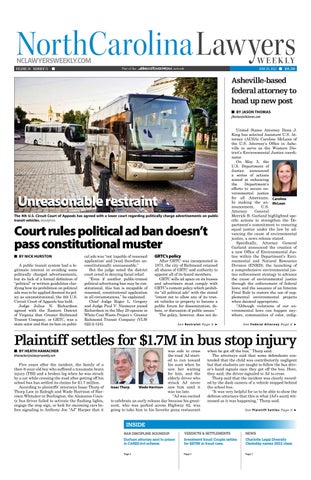
Unreasonable restraint The 4th U.S. Circuit Court of Appeals has agreed with a lower court regarding politically charge advertisements on public transit vehicles. depositphotos
Court rules political ad ban doesn’t pass constitutional muster ■ BY NICK HURSTON A public transit system had a legitimate interest in avoiding some politically charged advertisements, but its lack of a formal definition of “political” or written guidelines clarifying how its prohibition on political ads was to be applied doomed its policy as unconstitutional, the 4th U.S. Circuit Court of Appeals has held. Judge Julius N. Richardson agreed with the Eastern District of Virginia that Greater Richmond Transit Company, or GRTC, was a state actor and that its ban on politi-
cal ads was “not ‘capable of reasoned application’ and [was] therefore unconstitutionally unreasonable.” But the judge noted the district court erred in denying facial relief. “Even if another public-transit political advertising ban may be constitutional, this ban is incapable of reasoned, constitutional application in all circumstances,” he explained. Chief Judge Roger L. Gregory and Judge Paul V. Niemeyer joined Richardson in the May 20 opinion in White Coat Waste Project v. Greater Richmond Transit Company (VLW 022-2-124).
GRTC’s policy
Plaintiff settles for $1.7M in bus stop injury ■ BY HEATH HAMACHER hhamacher@nclawyersweekly.com
Five years after the incident, the family of a then-8-year-old boy who suffered a traumatic brain injury (TBI) and a broken leg when he was struck by a car while crossing the road after getting off his school bus has settled its claims for $1.7 million. According to plaintiffs’ attorneys Isaac Thorp of Thorp Law in Raleigh and Wade Harrison of Harrison Whitaker in Burlington, the Alamance County bus driver failed to activate the flashing lights, engage the stop sign, or look for oncoming cars before signaling to Anthony Joe “AJ” Harper that it
was safe to cross the road. AJ started to run toward his aunt when he saw her waiting for him, and the elderly driver who struck AJ never Isaac Thorp Wade Harrison saw him until it was too late. “AJ was excited to celebrate an early release day because his greataunt, who was parked across Highway 62, was going to take him to his favorite pizza restaurant
when he got off the bus,” Thorp said. The attorneys said that some defendants contended that the child was contributorily negligent but that students are taught to follow the bus driver’s hand signals once they get off the bus. Here, they said, the driver signaled to AJ to cross. Thorp said that the incident was clearly recorded by the dash camera of a vehicle stopped behind the school bus. “It was very helpful for us to be able to show the defense attorneys that this is what [AJ’s aunt] witnessed as it was happening,” Thorp said. See Plaintiff Settles Page 6 ►
INSIDE BAR DISCIPLINE ROUNDUP
VERDICTS & SETTLEMENTS
NEWS
Durham attorney sent to prison in CARES Act scheme.
Investment fraud: Couple settles for $875K in fraud case.
Charlotte Legal Diversity Clerkship names 2022 class.
Page 5
Page 5
Page 7
2 / NEWS
N O R T H C A R O L I N A L A W Y E R S W E E K LY I Ju n e 20, 2022
Charlotte firm relocates to new office This relocation supplements a concerted initiative by the firm to go paperless and reduce its carbon footprint, utilizing the space for green-friendly alternatives to bulky print equipment and document archives, the post stated. Additionally, the site features two outdoor patio areas for firm events and gatherings while providing a refreshing change of scenery for its occupants, the post stated. “Our partnership is very excited about the move to this great location. This space provides a welcoming and comfortable environment for our staff, attorneys and visitors,” Paul Lawrence, Hedrick Gardner’s managing partner, said in the post. “We are particularly pleased with the floor plan, which was intentionally developed to enhance workflow and synergy among our team.”
Charlotte-based Hedrick Gardner has moved into its freshly renovated facility in Charlotte’s Rotunda building at 4201 Congress St. Photos by Jeremy DeHart
Hedrick Gardner’s new office features an industrial vibe with open ceilings and exposed brick accent walls.
Hedrick Gardner’s new space was designed with a functional floor plan to enhance a collaborative feel.
■ BY JASON THOMAS jthomas@scbiznews.com Charlotte-based Hedrick Gardner has moved into its freshly renovated facility in Charlotte’s Rotunda building at 4201 Congress St. The new look features an industrial vibe with open ceilings and exposed brick accent walls, along with a functional floor plan to enhance a collaborative feel, according to a post on the firm’s website. Glass office partitioning and large-paned outer windows create an illuminating effect throughout the floor. Black framed office fronts further tie together the uniquely refined theme. This updated interior reflects the law firm’s forward-thinking attitude and modern appeal to provide a welcoming environment for visitors and clients.
NC firm acquired in major expansion ■ BY JASON THOMAS jthomas@scbiznews.com Milwaukee-based Michael Best has acquired North Carolina law firm Forrest Firm, adding 23 lawyers and 13 professionals that will expand Michael Best’s presence in the state. In addition to Michael Best’s established Raleigh office, the firm will gain seven offices throughout the state, in Asheville, Charlotte, Durham, Greensboro, Greenville, Wilmingto, and Winston-Salem, the release stated. With a deep bench of attorneys focusing on representing startup companies, Forrest Firm will serve as a natural complement to Michael Best’s Venture Best team, which helps counsel high-growth businesses on their financial, orga-
nizational, and regulatory needs, as well as investment fund formation, private equity investments, venture capital and growth capital financing, and forming and growing startups, the release stated. “Combining with Forrest Firm is the ideal match for Michael Best, as they share our vision and goals, with a clients-first focus,” said David Krutz, firm managing Partner of Michael Best, said in the release. “By adding 36 new attorneys and professionals, we will immediately become a market leader for providing legal services, market intelligence, and strategic advice to high-growth businesses and entrepreneurs across the state and across industries in the Southeast.” Forrest Firm is a full-service business law firm with offices
across North Carolina, according to the release. Since its inception in 2011, the firm has represented clients all over the globe in practice areas such as corporate transactions, intellectual property, litigation, labor and employment, venture capital and more. “We were drawn to Michael Best because of their rich history of success, along with their focus on client service, innovation, growth, and community service” said James Forrest, founder and CEO of Forrest Firm, in the release. “They are committed to many of the same things we have been committed to during the history of Forrest Firm, but on a much larger scale. We are thrilled with the combination and anticipate big things from the combined organization.” Michael Best had 260 attorneys
across 12 offices after launching its Raleigh office in 2017. The Raleigh office added six attorneys in 2021; now, with the Forrest Firm team from all regions of the state joining Michael Best, the firm will have over 60 legal and technical professionals across the state and nearly 400 across the country. “We’re impressed by Michael Best’s clear, intentional, and strategic vision for growing its presence in North Carolina, with a culture that reflects our state’s own spirit of entrepreneurship and innovation,” said Andy Jones,president of Forrest Firm, in the release. “Our deep client and community relationships throughout North Carolina will be a great accompaniment to Michael Best’s highly regarded breadth of expertise and level of service.”
NEWS / 3
N O R T H C A R O L I N A L A W Y E R S W E E K LY I June 20, 2022
Dean of NC law school dies unexpectedly was clear from Day One in leading the school as one that provides unique opportunities for diverse, talented future attorneys to be practice-ready Browne C. practitioners in their Lewis chosen legal careers. She accumulated numerous accomplishments for the university and School of Law in her short, nearly two years at its helm. “She began laser focused on reaccreditation with the American Bar Association (ABA), which was approved in full compliance with the ABA Standards in November 2020. Equally important, enrollment has
consistently increased year-over-year at a time when other law schools saw steady decreases. Additionally, Bar passage rates have been above average. “Under her leadership, the School of Law received a number of gifts from corporations and foundations and prestigious law internships and fellowships have been awarded to students. This includes a transformational $5 million contribution from Intel Corporation that created the NCCU-Intel Tech Law and Policy Center — the first at an HBCU and the only tech and law policy center that focuses on technology disparities and social justice. “Dean Lewis was extremely passionate about social justice and its in-
tersection with law. I encourage you to read an interview with her that was published by Attorney at Law Magazine in March 2022. In it, Dean Lewis shared: ‘The key value I want to imprint on the law school is overcoming the impossible through hard work, perseverance, and tenacity. It is important to overcome adversity and realize that you can accomplish any goal even if you do it in bite-sized pieces. I’m one of 12 children from a family in a small country town in Louisiana. I grew up knowing that you have to persevere, overcome adversity, and keep pushing forward. Likewise, NCCU School of Law is one of only six HBCU law schools in the country. We’re the underdog pushing forward.’”
New law strips Cooper of appointments at Berger home campus
Luong punished the victim when she disobeyed the defendant or otherwise failed to perform to the defendant’s satisfaction.
RALEIGH. N.C. (AP) — The North Carolina General Assembly has ended Democratic Gov. Roy Cooper’s appointment powers on the trustee board for the community college where Senate leader Phil Berger lives. The Senate voted on Tuesday give Cooper’s four appointments to the Rockingham Community College board to Berger and House Speaker Tim Moore. The House approved the bill last week, so it now becomes law because Cooper’s veto stamp can’t be used on local measures. Bill supporters say there needs to be more local input on the board, but Cooper’s office says the measure will harm the school in the long run.
Police, civil rights group in $336K accord over 2020 protest
ends in the next few weeks. Moore told reporters on Wednesday the political dynamics make it difficult to override a likely veto of the measure by Democratic Gov. Roy Cooper. Cooper and LGBTQ activists have condemned the measure, which in part would bar instruction about sexual orientation and gender identity in K-3 public school curriculum.
Carolina charter school violated female students’ constitutional rights by requiring them to wear skirts. A majority of the full U.S. 4th Circuit Court of Appeals found that the policy at Charter Day School in Leland violated the girls’ constitutional equal protection rights. The court sided with parents who had argued that their daughters were put at a disadvantage by the requirement. Public schools have long been banned from enacting such mandates, but the court’s majority concluded that public charter schools are also “state actors” and are therefore subject to the Constitution’s equal protection clause.
■ BY JASON THOMAS jthomas@scbiznews.com The chancellor of North Carolina Central University released a statement on the death of Browne C. Lewis, dean of the university’s School of Law. Lewis was attending a conference in Colorado with colleagues at the time of her untimely death on Thursday, June 2, according to Johnson O. Akinleye’s statement. Here is the statement in its entirety: “An accomplished legal scholar, attorney and author, Dean Lewis joined the Eagle family on July 1, 2020, and immediately made an indelible impact on the School of Law. Her vision
NEWS BRIEFS
North Carolina nail salon owner sentenced CHARLOTTE, N.C. (AP) — A federal prosecutor says a North Carolina woman has been sentenced to 15 years in prison for using verbal, physical and emotional threats to coerce a person to work at her nail salon for nearly two years. U.S. Attorney Dena J. King says Thuy Tien Luong of Charlotte was also sentenced to two years of supervised release and ordered to pay $75,000 in restitution to the victim. Luong was convicted of forced labor in January 2021. Evidence presented at her trial showed
RALEIGH, N.C. (AP) — A city and two law enforcement agencies in a North Carolina county will pay $336,000 to a group of plaintiffs in a settlement stemming from a 2020 get-out-the-vote rally in which peaceful demonstrators were peppersprayed. The American Civil Liberties Union of North Carolina, the Lawyers’ Committee for Civil Rights Under Law and a Chicago-based law firm announced the settlement on Wednesday. A news release says the agreement involved the city of Graham and its police department, as well as the Alamance County sheriff. Police had said participants in the rally in October 2020 were arrested and pepper-sprayed for blocking a street without permission.
NC speaker: Parents’ bill with LGBTQ limits might be shelved RALEIGH, N.C. (AP) — North Carolina House Speaker Tim Moore says a “Parents’ Bill of Rights” measure pushed by Senate Republicans recently may not get a final vote in his chamber before this year’s session
No charges for North Carolina police officers in shooting RALEIGH, N.C. (AP) — A North Carolina district attorney says she won’t press charges against Raleigh police officers who killed a knifewielding man after a wreck on Interstate 440. Wake County District Attorney Lorrin Freeman decided their fatal shooting was justifiable. The decision frustrates the man’s widow and activists who want officers to get more training to de-escalate such cases. Daniel Turcios was shot on January 11 after wrecking the family car. He then refused to follow police commands as Spanish-speaking bystanders tried to calm him down. His widow, Rosa Jerez, said police didn’t give her a chance to prevent the shooting.
Federal court: NC school can’t require girls to wear skirts RICHMOND, Va. (AP) — A federal appeals court has ruled that a North
Historic Black church in North Carolina destroyed by fire SALISBURY, N.C. (AP) — Officials say fire has destroyed a historic Black church in North Carolina that dates back to the 19th century. News outlets report the fire started just before midnight Thursday at Second Creek Methodist Church in Salisbury. When firefighters arrived, nearly three quarters of the wooden building was already on fire. Investigators say someone walking their dog spotted the fire. Rowan County Fire Marshal Deborah Horne says investigators have gone house to house and conducted interviews and surveyed the area. Horne says investigators were expected to survey the damage on Thursday.
LAWYERS IN THE NEWS Wilmington firm adds new partner Block, Crouch, Keeter, Behm & Saye, LLP in Wilmington, North Carolina has welcomed its newest partner, Dickson McLean. McLean is a business lawyer with over 30 years of experience, and he focuses on corporate and real estate law, including business transactions and commercial real estate transactions, according to a news release. He also provides general corporate representation of closely held businesses and business owners (including employment, tax, securities and estate planning law), and disputes among business owners and between businesses.
Dickson represents financial institutions and borrowers in loans and loan workouts, and he assists nonprofit organizations with formation Dickson McLean and corporate governance. Dickson practiced for many years with two large North Carolina law firms and a large international law firm in Charlotte and Wilmington before joining Block, Crouch, Keeter, Behm and Saye, LLP in 2022, the release stated.
Established Jacksonville, NC law firm is seeking an attorney to handle Plaintiff’s personal injury and general civil litigation. Ideal candidate has 3-5 years of litigation experience, a strong work ethic and strong written and verbal communication skills. Compensation is negotiable and includes salary and a bonus based on individual and firm performances as well as benefits. This position provides opportunity for growth with a busy firm located in coastal North Carolina.
Please send resume to raw@warlicklaw.com
4 / NEWS NEWS
N O R T H C A R O L I N A L A W Y E R S W E E K LY I Ju n e 20, 2022
Former economic development official joins firm’s Raleigh office ■ BY JASON THOMAS jthomas@scbiznews.com Nexsen Pruet announced in a news release that David Spratley has joined the firm as director of economic development. Spratley brings decades of experience to his new role with a background in economic development management and corporate finance. Spratley joins Nexsen Pruet in the firm’s Raleigh office from the North Carolina Department of Commerce, where he has served as the senior assistant secretary of Finance for the last three years, the release stated. During his time there, Spratley guided several economic development functions focused on business recruitment and incentives negotiations. “Joining Nexsen Pruet shows the evolution of my career. After 25 years
in economic development, I can drive through any community in the state and see a project that I have been a part of,” said Spratley in the release. “I’m looking forward to carrying David Spratley on that work with our clients at Nexsen Pruet as we continue to build North Carolina.” Spratley was part of the team that brought out the best three years for economic development that North Carolina has ever experienced, according to the release. As part of that work, Spratley was instrumental in bringing big names like Toyota, VinFast and Apple to the state. “We are thrilled to welcome David to our team. He brings a wealth of ex-
perience and a vast network of strong connections to this role,” said Tushar Chikhliker, head of Nexsen Pruet’s Economic Development Group, in the release. “David will be a tremendous asset in helping the firm leverage and grow opportunities to promote economic development throughout the Carolinas.” Spratley graduated from the University of North Carolina Wilmington. Earlier in his career, Spratley served in the site selection practice at KPMG in Charlotte, where he provided clients with guidance in the site selection process, business incentives and general economic development best practices. Prior to joining N.C. Commerce in 2019, he served as vice president of Business Recruitment at the Economic Development Partnership of North Carolina.
Commercial bankruptcy filings spike 34% ■ BY JASON THOMAS jthomas@scbiznews.com There were 330 commercial chapter 11 filings registered in May 2022, an increase of 34 percent from the 246 filings in May 2021, according to data provided by Epiq Bankruptcy, the leading provider of U.S. bankruptcy filing data. That’s according to a news release from ABI, a nonpartisan organization dedicated to research and education on matters related to insolvency. Overall commercial filings decreased 14 percent in May 2022, as the 1,738 filings were down from the 1,813 commercial filings registered in May 2021. Small business filings, captured as subchapter V elections within chapter 11, registered an increase of 21 percent to 123 in May 2022 from 102 in May 2021, according to the release. Total bankruptcy filings were 31,314 in May 2022, a 10 percent decline from the May 2021 total of 34,783. Noncommercial bankruptcy filings totaled 29,576 in May 2022, also registering a 10 percent decrease from the May 2021 noncommercial total of 32,970.
“The bankruptcy market continues to navigate uncharted waters as the effect of the global pandemic lingers and the uncertainty around the U.S. public markets enters the mix,” says Chris Kruse, senior vice president at Epiq, in the release. “As the economy declines, the bankruptcy market will likely become more active.” May’s commercial chapter 11 filings increased 32 percent from the 250 filings in April 2022, according to the relese. The commercial filing total represented a 2 percent decrease from the April 2022 commercial filing total of 1,775. Subchapter V elections within chapter 11 increased 23 percent from the 100 filed in April 2022. May’s total bankruptcy filings represented a 4 percent decrease when compared to the 32,518 total filings recorded the previous month. Total noncommercial filings for May also represented a 4 percent decrease from the April 2022 noncommercial filing total of 30,743. “Rising interest rates, inflationary price increases and global supply concerns are compounding the economic challenges for financially distressed families and businesses,” said ABI Executive Director Amy Quackenboss in the release. “Legislation currently
being considered in the House would expand the debt-eligibility limits for small businesses and individuals that would create greater access and a more efficient process for families and businesses looking for a financial fresh start.” The debt-eligibility limit for small businesses to elect subchapter V reverted in March to the original $2,725,625 threshold from the expanded amount of $7.5 million first established under the CARES Act of 2020, the release stated. Legislation was passed in the Senate in April to restore the eligibility limit back to $7.5 million and cover any subchapter V cases that were pending at the time of the March 27 sunset. Consistent with the recommendations of ABI’s Commission on Consumer Bankruptcy, the substitute also continues to push for the debt limit for individual chapter 13 filings to be increased to $2.75 million and to remove the distinction between secured and unsecured debt for that calculation, the release stated. Both of the expanded eligibility limits for small business subchapter Vs and consumer chapter 13s would sunset after two years.
"Helping lawyers practice better, more efficiently, and more profitably." ■ PUBLISHER Liz Irwin lirwin@bridgetowermedia.com ■ EDITOR Jordan Yount jyount@molawyersmedia.com\ EDITORIAL Heath Hamacher, Reporter hhamacher@nclawyersweekly.com Scott Baughman, Digital Media Manager sbaughman@mecktimes.com ■ ADVERTISING Sheila Batie-Jones, Advertising Account Executive sbatie-jones@nclawyersweekly.com ■ ACCOUNTING & ADMINISTRATIVE Michael McArthur, Business Manager mmcarthur@bridgetowermedia.com ■ CIRCULATION Disa Ehrler, Audience Development Manager dehrler@bridgetowermedia.com Circulation: 1-877-615-9536 service@bridgetowermedia.com ■ PRODUCTION & OPERATIONS Bradley Redmond, Director of Production Ryan O’Shea, Production Supervisor John Reno, Production Specialist ©2022 BridgeTower Media. Material published in North Carolina Lawyers Weekly is compiled at substantial expense and is for the sole and exclusive use of purchasers and subscribers. The material may not be republished, resold, recorded, or used in any manner, in whole or in part, without the publisher’s explicit consent. Any infringement will be subject to legal redress. Established 1988 919-829-9333 • 1-800-876-5297 Charlotte office: 130 North McDowell Street, Unit B, Charlotte, NC 28204 (704) 377-6221 • (704) 377-4258 fax: www.nclawyersweekly.com For subscription questions 1-877-615-9536 service@bridgetowermedia.com
North Carolina Lawyers Weekly [ISSN10411747] [USPS 002-904] is published biweekly every other Monday with General Statewide Circulation for $410.36 per year by North Carolina Lawyers Weekly, 130 North McDowell Street, Unit B, Charlotte, NC 28204 Periodicals postage paid at Charlotte, North Carolina 28228-9998. POSTMASTER: Electronic Service Requested. Send address changes to: North Carolina Lawyers Weekly, Subscription Services, P.O. Box 1051, Williamsport, PA, 17703-9940 North Carolina Lawyers Weekly is a publication of BridgeTower Media, 222 South Ninth Street, Suite 900, Minneapolis, MN 55402.
depositphotos
VERDICTS & SETTLEMENTS / 5
N O R T H C A R O L I N A L A W Y E R S W E E K LY I June 20, 2022
Couple settles for $875,000 in fraud case ■ BY HEATH HAMACHER hhamacher@nclawyersweekly.com A married couple coaxed into making ill-advised financial moves has settled their fraud claims for $875,000, their attorneys report. The plaintiffs were represented by Brooke Howard of Howard Law, and James Roberts III and Matt Quinn of Lewis & Roberts, all of Raleigh. The attorneys said that their clients were approaching retirement when they were persuaded by their trusted financial advisor to “redesign” their retirement portfolio by Brooke Howard selling securities and taking distributions from a qualified individual retirement account (IRA) to fund an unsuitable life insurance policy referred to as an “Alternative Tax-Free Plan.” The attorneys said that the couple was told that they could draw from a stream of tax-free income
from the insurance policy for the rest of their lives. Apparently, they weren’t told everything. “The plainJames Roberts Matt Quinn tiffs incurred huge tax burdens that they lacked the income to pay, and the IRS asserted a lien against their home,” the attorneys wrote in an email to Lawyers Weekly. Many of the cases details, including names of the parties, defense counsel, and the venue, have been withheld pursuant to a confidentiality agreement. The plaintiffs filed claims against the financial advisor, two registered investment advisor firms, and a life insurance company. Their causes of action included breach of fiduciary duty, constructive fraud, unfair and deceptive trade practices, viola-
SETTLEMENT REPORT — INVESTMENT FRAUD Amount: $875,000 Injuries alleged: Investment losses and excessive tax liability Case name: Withheld Court: Withheld Judge: Withheld Date of settlement: February 2022 Insurance carrier: Withheld Attorney(s) for plaintiff: Brooke Howard of Howard Law in Raleigh, and James Roberts III and Matt Quinn of Lewis & Roberts in Raleigh Attorney(s) for defendant: Withheld tion of the North Carolina Investment Advisors Act, negligence, and gross negligence. Follow Heath Hamacher on Twitter @ NCLWHamach
Durham attorney gets prison time for CARES Act fraud scheme ■ BY JASON THOMAS jthomas@scbiznews.com Durham, North Carolina attorney Tiffany Dawn Russell was sentenced to 63 months recently for her role in an extensive multi-year fraud conspiracy and was sentenced to 36 months for filing a false tax return. These sentences will be served concurrently, according to a news release from the U.S. Attorneys Office of the Eastern District of North Carolina. Earlier this year, Russell pleaded guilty to charges relating to her efforts to obtain more than $2.5 million from at least 12 financial institutions and the U.S. Small Business Administration. In addition to her prison sentences, Russell was ordered to forfeit more than $2 million in fraud proceeds. “This defendant spent years defrauding banks and the federal government, and now she’ll be spending years behind bars,” said U.S. Attorney Michael Easley in the release. “As Judge Dever noted at sentencing, this was more than a one-off mistake, it was a multitude of bad decisions by an attorney who knew better. This fraud scheme is even more egregious because the defendant falsely obtained more than $1 million in COVID-relief funds intended to help legitimate, hardworking business owners weather the pandemic. “Money intended to keep busi-
nesses afloat was instead used to purchase beach homes and support the defendant’s personal interests. I commend the many law enforcement partners on our EDNC Covid Fraud Task Force who helped to ensure that attorney Tiffany Russell faced justice.” Russell was originally indicted in November 2020 for conspiracy to commit bank fraud, bank fraud, access device fraud, and misuse of a social security number, according to the release. According to the indictment, Russell and her co-conspirators applied for loans and credit cards with social security numbers that were not issued to them by the Social Security Administration. By doing so, they created new credit profiles or synthetic identities for themselves to open financial accounts and make purchases from retailers without any intention of paying for the items and services obtained. Russell was charged with using a synthetic identity to purchase a BMW and to obtain a credit card which she used to pay for her 2016 butt augmentation surgery. In addition to using synthetic identities, Russell also embarked on a scheme of credit washing to remove legitimate debt accounts from her credit history by falsely claiming she was the victim of identity theft and had not opened those accounts, the release stated. Once the credit reporting agencies removed those
despositphotos
accounts, her credit score improved, enabling her to obtain credit. Russell also provided fabricated documents when applying for mortgages to purchase three properties, including an oceanfront residence in Nags Head, North Carolina, the release stated. Russell gave doctored bank statements and inflated pay stubs to make it appear she had substantial liquid assets and the ability to pay the loans. Finally, between March 30, 2020 and June 29, 2020, Russell and others fraudulently obtained more than $1 million in loans under the CARES Act, which was enacted by Congress
to provide emergency financial assistance to millions of Americans suffering from the Covid-19 pandemic. The 10 loan applications, including two for her law firm, contained false representations relating to the number of employees, monthly payroll, revenue, and expenses. Russell used these illegally-obtained proceeds to make the down payment on her Nags Head property and purchase five other properties in North Carolina, Maryland and Alabama, the release stated. Russell also used these ill-gotten gains to pay outstanding personal debt, unrelated to any business entity.
MEDIATION TRAINING Approved by the Dispute Resolution Commission and the NC CLE Board!
MEDIATION, INC. MEDIATION, INC. MEDIATION, INC. MEDIATION, INC. MEDIATION, INC. MEDIATION, INC. MEDIATION, INC. MEDIATION, INC. MEDIATION, INC. MEDIATION, INC. MEDIATION, INC. MEDIATION, INC. MEDIATION, INC. MEDIATION, INC.
Superior Court Mediation Training
Superior Court Mediation Training
AUGUST 8 - 12, 2022 CHARLOTTE, NC
OCTOBER 24 - 28, 2022 RALEIGH, NC
Andy Little, Lead Instructor For more information, please contact us at:
1-888-842-6157 or info@MediationIncNC.com Visit our web site at www.MediationIncNC.com
6 / NEWS
N O R T H C A R O L I N A L A W Y E R S W E E K LY I Ju n e 20, 2022
RESTRAINT / Political ad ban doesn’t pass constitutional muster C o nt inu e d f r o m 1 ►
fine what could constitute “political ads” or “public issues.” According to GRTC, an ad will be deemed political if it is “not viewpoint neutral.” GRTC also prohibits ads from “political action groups,” meaning any group that “engage[s] in a specific targeted policy advocacy that would be related to their one side of the political issue.” GRTC may review a group’s website to make that determination.
The ‘political’ ad
White Coat Waste Project, a nonprofit seeking to end taxpayer-funded animal experimentation, submitted an ad to GRTC that showed three dogs behind prison bars with the text, “Prisoners of Waste — McGuire VAMC: Stop Taxpayer-Funded Dog Experiments!” The group’s name appeared in small print at the bottom. GRTC reviewed White Coat’s website, determined it was a political action group and rejected the ad. GRTC said it might be able to run the ad as a “public service advertisement” if White Coat partnered with the local government.
Partial summary judgment
White Coat sued GRTC under 43 U.S.C § 1983 seeking a declaratory judgment that the policy violated the First Amendment, both facially and as applied to them. The Eastern District found that GRTC is a state actor and their policy is unconstitutional as applied to White Coat. The court enjoined GRTC from rejecting the ad, but rejected the facial challenge and granted only partial summary judgment. Both parties appealed.
Specific government creation Richardson cited the U.S. Supreme Court’s holding in Lebron v. Nat’l R.R. Passenger Corp. that Amtrak was a “government-created and -controlled corporation” because it was created by special law for the furtherance of governmental objectives and the government retained “permanent authority to appoint a majority of the directors of that corporation.” Richardson rejected GRTC’s arguments that a special law must actually create the corporation and lay out its unique rules. Such an interpretation, he said, “would undermine the core principle of Lebron: that the government cannot evade the Constitution by resorting to a corporate form.” “Created by special law,” he said, means that the government “must form the corporation under a particular grant of authority.” Here, Richardson found the city was empowered by special law to incorporate GRTC, and they did so “not as private citizens or as ministerial approvers of a private corporation, but as agents of the state.”
‘Unreasonable means’
Since GRTC is a state actor, the permissible scope of government control over First Amendment rights depends on the nature of the government property, or forum, in question. Unlike a traditional or a designated public forum, Richardson said ad space on GRTC busses is a nonpublic forum. “Richmond Transit’s expressed policy is not to open its advertising space for the discussion of public issues, and paid bus advertisements are not particularly compatible with the free flow of ideas,” he explained. “Thus, as the Supreme Court and our sister circuits
have concluded, transit advertising space is a nonpublic forum.” But the government lacks complete freedom even in nonpublic forums; restrictions on speech must be reasonable and viewpoint neutral, the judge pointed out. Reasonableness, Richardson said, is subject to “some form of so-called intermediate scrutiny, in which the government’s means and ends must both be ‘reasonable.’” While White Coat acknowledged GRTC’s legitimate interest in avoiding some class of politically charged advertisements, the judge said “even a reasonable end must not be pursued by unreasonable means.” Richard looked to the U.S. Supreme Court’s holding in Minn. Voters All. v. Mansky, which said that “nonpublicforum speech restrictions must be ‘capable of reasoned application’” in order to be reasonable. GRTC sought to ban all political ads, but has neither a formal definition of political nor written guidelines as to how the standard must be applied. “Faced with this broad, undefined standard and the directive to keep Richmond Transit’s buses from becoming a forum to discuss ‘public issues’ (whatever that might mean), employees have done their best to flesh out a reasonable test,” the judge wrote. “But those attempts have fallen short.”
‘Murky’ scope
The judge found GRTC doesn’t rely on the plain meaning of “political,” and has consistently run ads relating to the government or politics. Though a GRTC employee said an ad is political if it isn’t “viewpoint neutral,” Richardson said that provided little clarity. “Indeed, our need to search out alternative rationales to justify Rich-
mond Transit’s decisions reveal that its policy, as it stands, does not provide a ‘sensible basis for distinguishing what may come in from what must stay out,’” he noted. And even without direction on political content, GRTC may still reject an ad if they determine the advertiser is a political action group, and that rule is nowhere to be found in GRTC policy, the judge said. “Yet that is precisely why White Coat’s advertisement was rejected. And the precise scope of this rule is murky,” he wrote. The judge added that, “[w]hen taken together, Richmond Transit’s vaguely defined policies and even vaguer unwritten rules make it impossible for a reasonable person to identify what violates their advertising policy and what does not.” The heart of the problem, therefore, is that GRTC’s advertising policy “does not provide ‘objective workable standards’ by which a decision maker or would-be advertiser can distinguish ‘what may come in from what must stay out.’” Finally, the judge said, GRTC’s current political-advertising ban is simply not capable of reasoned application. The ruling is in line with two other federal circuits. “Today, we join our sister circuits and conclude that Richmond Transit’s policy violates the First Amendment as an unreasonable nonpublic-forum speech restraint,” the opinion concluded. “We emphasize that our holding is limited to this specific policy prohibiting political advertising, and we pass no judgment on whether better-defined political-advertising prohibitions or policies allowing only commercial advertising may pass constitutional muster.”
FEDERAL ATTORNEY / Asheville- PLAINTIFF SETTLES / Plaintiff based federal attorney to head up new post C o nt inu e d f r o m 1 ►
enous communities, and low-income communities often bear the brunt of the harm caused by environmental crime, pollution, and climate change,” Garland said in the news release. “For far too long, these communities have faced barriers to accessing the justice they deserve. The Office of Environmental Justice will serve as the central hub for our efforts to advance our comprehensive environmental justice enforcement strategy. We will prioritize the cases that will have the greatest impact on the communities most overburdened by environmental harm.” Attorney General Garland also directed U.S. Attorney’s Offices across the nation to designate an Environmental Justice Coordinator (EJC). As the Western District’s EJC, AUSA McLean will be responsible for developing and overseeing the Office’s environmental justice enforcement strategy; serve as legal counsel on matters related to environmental justice; prosecute criminal and civil environmental justice cases; and conduct public outreach and awareness activities related to environmental justice, according to the release. AUSA McLean will also serve as the point of contact for environmental justice matters and will create and participate in environmental enforcement task forces. She
will also be in charge of establishing a procedure for members of the public to report environmental justice concerns within the Western District of North Carolina. AUSA McLean joined the U.S. Attorney’s Office in August 2018 and serves in the Office’s Civil Division in Asheville, according to the release. AUSA McLean is responsible for handling civil defensive litigation in federal and state court, and affirmative civil enforcement cases on behalf of the United States. She is also a member of the Office’s recently-formed Civil Rights Team. In June 2020, AUSA McLean was selected as Buncombe County Bar Distinguished Young Lawyer for her contributions to the legal profession and the community as a member of the Bar. “AUSA Caroline McLean is an experienced federal prosecutor dedicated to serving the people of the Western District of North Carolina. As my Office’s Environmental Justice Coordinator, AUSA McLean will work closely with Department of Justice components, local, state and federal agencies, and stakeholders within the community to address concerns related to environmental justice, using all available legal tools to promote justice for communities historically harmed by environmental violations,” King said in the release.
settles for $1.7M in bus stop injury
C o nt inu e d f r o m 1 ►
There were challenges in proving that the TBI caused permanent problems, Thorp said. By the fifth grade, AJ was getting good grades and evaluations. “To figure out whether AJ’s grades were inflated, our expert administered a battery of standardized tests, which showed that for the most part, AJ was performing at second and third-grade levels,” Thorp said. “And while AJ’s behavior at school had improved, he still
couldn’t sleep alone, suffered severe separation anxiety, and was diagnosed with PTSD.” The attorneys said that after the case settled, they helped AJ’s family establish a special needs trust and an annuity that will make monthly payments for the rest of AJ’s life. “We wanted to make sure a little boy with a traumatic brain injury will have a better chance for a happy and successful life, and his family can be sure they have done all they can to take care of him even after they are gone,” Harrison said.
SETTLEMENT REPORT — MOTOR VEHICLE/PEDESTRIAN
Amount: $1.7 million Injuries alleged: Traumatic brain injury, broken leg Case name: Moseley v. Alamance County Board of Education et al. Court: Alamance County Superior Court Case No.: 20-CVS-00088 Judges: Kevin Bridges and Bryan Collins approved settlements Date of settlement: Jan. 26 Most helpful experts: Dr. Rebecca Smith (pediatric intensive care), Alanna Conder (neuropsychologist), Tina Lepage (psychologist), and Ann Neulicht (vocational counselor and life care planner) Attorneys for plaintiff: Isaac Thorp of Thorp Law in Raleigh and Wade Harrison of Harrison Whitaker in Burlington Attorneys for defendant: Dena Waters of Cary for the elderly driver, Matt Little and Megan Cook of Teague Campbell of Raleigh for the bus driver, and Special Deputy Attorney General Carl Newman for the AlamanceBurlington Board of Education
NEWS / 7
N O R T H C A R O L I N A L A W Y E R S W E E K LY I June 20, 2022
Diversity clerkship announces 2022 class ■ BY JASON THOMAS jthomas@scbiznews.com The Charlotte Legal Diversity Clerkship, a program of the Mecklenburg County Bar, is hosting 15 firstyear law students in the Queen City as part of its 2022 CLDC Class. This year clerks will spend their summer splitting their time between law firms and corporate legal departments, according to a MCB news release. The Class of 2022 will participate in an in-person summer calendar that includes professional and social activities, which provide insight into the lifestyle of practicing law and living in Charlotte. The 2022 program features, among other activities: luncheons with state and federal members of the judiciary, community-focused programming and extensive networking opportunities with CLDC alumni attorneys and members of the Mecklenburg County legal community, the release stated. These clerks were selected from nearly 100 applications. Each applicant provided a resume highlighting legal and undergraduate academic achievements and other professional experiences and grades, along with a statement explaining how the applicant would contribute to the goal of creating a more diverse legal community in Charlotte. The initial applicant pool was narrowed down to over 60 semifinalists, who were then interviewed by representatives from the CLDC firms and
The Class of 2022 will participate in an in-person summer calendar that includes professional and social activities, which provide insight into the lifestyle of practicing law and living in Charlotte. Photo provided by Mecklenburg County Bar.
corporations in February, according to the release Founded in 2006, the CLDC operates with one basic goal — to improve diversity in the Mecklenburg County Bar by attracting top first-year law students with diverse backgrounds to Charlotte through corporate and law firm summer internships, the release stated. To date, the CLDC program has hosted 131 first-year students from top law schools. Since 2010, 30% of the CLDC alumni have returned to Charlotte for either a second-year clerkship or full-time employment. The CLDC operates under the leadership of its chairs, Caleb Holloway, associate general counsel at Atrium Health and Zachary Smith, partner at Moore & Van Allen PLLC, as a program of the MCB’s Diversity, Equity & Inclusion Committee, the release stated. The following law firms and corporations are participating as an em-
ployer: Alston & Bird, LLP; Bradley LLP; Cadwalader, Wickersham & Taft LLP; Katten Muchin Rosenman LLP; Mayer Brown; McGuireWoods LLP; Moore & Van Allen, PLLC; Parker Poe Adams & Bernstein, LLP; Poyner Spruill LLP; Robinson, Bradshaw & Hinson, P.A.; Troutman Pepper Hamilton Sanders LLP; Atrium Health; Bank of America Corporation; Barings LLC; Duke Energy Corporation; Elevate Textiles; Honeywell; Husqvarna; Novant Health; SPX Corp.; Truist Financial Corp.; Wells Fargo & Company and XPO Logistics.
Here are the members of the 2022 class:
• Nathan Drum, Wake Forest University School of Law • Huma Khursheed, University of North Carolina School of Law • Kathryn Robinson, University of North Carolina School of Law • Peyton Bartley, University of
Kentucky J. David Rosenberg College of Law • Sofia Guiterrez Cuadra, University of North Carolina School of Law • Halie Mariano, University of North Carolina School of Law • Alaina Rodriguez, Wake Forest School of Law • Alexis Brock, Wake Forest University School of Law • Jessica Hobbs, University of North Carolina School of Law • Noah Matthews, University of Miami School of Law • Cara Shelhamer, University of Florida Fredric G. Levin College of Law • Benjamin Byers, Emory University School of Law • Christopher Hoffler, University of North Carolina School of Law • Elvis Mugisha, University of North Carolina School of Law • Jacob Showers, University of North Carolina School of Law
The insider’s guide to selling a law practice, transferring ownership, and designing a great Life After Law, written by two of the top authorities in succession planning.
“
Practical. Readable. Motivating. “Designing a Succession Plan” is an invaluable resource and planning guide. Solo and small firm partners will be especially interested in the sections on valuing and selling a law firm. All lawyers will appreciate the practical, expert advice outlining the options that await lawyers in this next phase. — Joan H. Feldman, Editor/Publisher, Attorney at Work
Learn more and see additional resources at
WWW.DESIGNINGASUCCESSIONPLAN.COM
HELPING LEGAL PROFESSIONALS EVOLVE AND THRIVE
WWW.LAWYERSMUTUALCONSULTING.COM
1.800.662.8843
8 / NEWS
N O R T H C A R O L I N A L A W Y E R S W E E K LY I Ju n e 20, 2022
College of Charleston school names new dean ■ BY JASON THOMAS jthomas@scbiznews.com College of Charleston’s School of Business will soon have a new leader. Paul H. Schwager been named dean of the school, effective July 1, 2022, according to a College of Charleston news release. Schwager is currently the dean and W. Howard Rooks Distinguished Professor in the College of Business at East Carolina University in Greenville, N.C., where he established the Copeland Diversity & Inclusion Fellows, the Cunanan Center for Professional Success and the Thomas D.
Arthur Graduate School of Business, according to the release. He also reorganized the school’s leadership structure, led a successful Association to Advance Paul Schwager Collegiate Schools of Business peer review and reorganized the Business Advisory Council with a focus on increasing diversity. Prior to being appointed dean in 2019, he served as the school’s interim dean, associate dean
and acting associate dean. “We are are honored to have Paul join the College of Charleston,” Suzanne Austin, executive vice president for academic affairs and provost, said in the release. “His leadership and administrative accomplishments, scholarly achievements and fundraising abilities will further elevate our School of Business and the overall academic distinction of the College.” Also at ECU, Schwager served as assistant dean and interim assistant dean for assessment, accreditation and curriculum, and as professor, associate professor, assistant professor and visiting assistant professor of
management information systems in the College of Business, according to the release Prior to joining ECU, Schwager was an assistant professor of information systems at Appalachian State University’s John A. Walker College of Business from 2000 to 2003. He previously worked in the private and nonprofit sectors. Schwager holds a doctorate in management of information technology and innovation from Auburn University, an MBA from Florida Atlantic University and a bachelor’s in business administration from Palm Beach Atlantic College.
AARP names new state director ■ BY MOLLY HULSEY mhulsey@scbiznews.com
The South Carolina branch of the AARP of has hired Charmaine S. Fuller Cooper as its new state director. Fuller Cooper brings two decades of experience in campaign strategy and management, government relations, and rural, multicultural and conservative advocacy to the table, including nine years at AARP. She served the company previously as a campaigns field manager working with her predecessor in the role and North Carolina’s advocacy director.
“For so many, financial security, affordable health care, housing and utilities are at the forefront of issues that greatly impact quality of life as we grow older,” Cooper said in a news release. “It is our duty to hear the concerns of our members and to drive the change and security they desire.” She has also served as the executive director of the N.C. Justice for Sterilization Victims Foundation after building the foundation and its clearinghouse from the ground up to reach victims of the forced sterilization eugenics program that operated from the 1920s through
the 1970s. Fuller Cooper’s leadership elevated the voice of victims to an international audience, ultimately resulting in $10 million in compensation for living victims, according to the release. Also, she has championed criminal justice reforms, led outreach for the American Heart Association and served on the Care 4 Carolina health care access coalition. In addition to leading both a nonprofit and government agency, Fuller Cooper has served as a court guardian ad litem, president-elect of the N.C. Coalition on Aging, co-chair
of N.C.’s Olmstead Plan Advisory Committee and on various boards including the state United Way. Cooper graduated from North Carolina Central University before pursuing her Master of Public Administration degree at North Carolina State University. The new state director says she looks forward to partnering with State Executive Council President Emma McGraw Myers and the staff and volunteer team in the Palmetto State. AARP South Carolina’s previous state director, Teresa Arnold, retired in December 2021.
LAW.ELON.EDU
Elon Law students graduate every December after they complete a full-time residency-in-practice with an attorney or judge as part of our 2 ½-year program.
Let us help you with: On-Campus Interviews (virtual or in-person) Job Postings Resume Collections Recruiting 1L & 2L Interns
IN A COMPLEX WORLD, WE MAKE IT EASY TO HIRE. OFFICE OF CAREER & STUDENT DEVELOPMENT lawcareers@elon.edu
336.278.9316
In your world – details matter. At First Indemnity we understand that lawyers need a reliable partner in the insurance industry to provide the best possible defense against claims.
Our Lawyers Professional Liability Program is a proven leader in national specialty insurance.
Other law firm coverages include: • Lawyer’s Malpractice
• Cyber Liability
• Umbrella Coverage
• Surety Bonds
Your defense is our focus.
• Copyright, Patent & Trademarks
“Our business is to underwrite and bind PL policies for lawyers in partnership with prime carriers.” – Andrew Biggio, CEO First Indemnity
Lawyers Professional Liability
See Video u email: abiggio@firstindemnity.net
fax: 781.595.2279
www.First Indemnity.net 781.581.2508 Boston • New York • Tampa • Chicago • Dallas • Los Angeles • Philadelphia
10 / OPINION DIGESTS
N O R T H C A R O L I N A L A W Y E R S W E E K LY I Ju n e 20, 2022
Opinions Domestic Relations
Tort/Negligence
DVPO Renewal – Parties’ Consent – Rule 60 Challenge
Wrongful Death – Insurance – Uninsured Motorist – Service of Process – Statute of Limitations
Before their original consent domestic violence protective order expired, the parties consented to a renewal DVPO without “a lot of findings of fact.” The lack of testimony and findings was beneficial to defendant because he was facing criminal charges related to his violation of the original DVPO. In this appeal of the denial of his motion under N.C. R. Civ. P. 60, defendant cannot use the lack of findings and conclusions as both a shield and a sword. We affirm the denial of defendant’s Rule 60 motion. Jabari v. Jabari (Lawyers Weekly No. 011-132-22, 18 pp.) (Donna Stroud, C.J.) Appealed from Wake County District Court (Lori Christian, J.) Deborah Sandlin for plaintiff; Scott Allen and Anton Lebedev for defendant. 2022-NCCOA-379
Plaintiff’s decedent was killed in a collision with two uninsured motorists. Plaintiff timely filed this wrongful death action and served plaintiff’s insurers within the time prescribed by our Rules of Civil Procedure. However, the insurers were not served within the statute of limitations. Although G.S. § 20-279.21(b)(3)(a) does not specify a time limitation for service of an uninsured motorist carrier, we are bound by Thomas v. Washington, 136 N.C. App. 750, 525 S.E.2d 839 (2000), and Davis v. Urquiza, 233 N.C. App. 462, 757 S.E.2d 327 (2014), to hold that the insurers were not timely served. We affirm the trial court’s grant of the insurers’ motions to dismiss. As we did to no avail in Powell v. Kent, 257 N.C. App. 488, 810 S.E.2d 241, disc. rev. denied, 371 N.C. 338,
INSPIRE THE PROFESSION. I N N O VAT E T H E P R A C T I C E . I M PA C T T H E W O R L D.
At Liberty University School of Law, we provide unparalleled skills training to produce practice-ready graduates who will become lawyers of distinction. We promote a culture that cultivates both integrity and high ethical standards to ensure our graduates are ready to lead in their communities.
Three consecutive years of high bar passage rate for first-time takers:
95% (2018)
92% (2019)
92%
(July-Oct. 2020)
� LawCareer@liberty.edu � (434) 592-6068 � Liberty.edu/Law /LibertyUniversityLaw
813 S.E.2d 857 (2018), we note that the rule established by Thomas and Davis seems inconsistent with our Rules of Civil Procedure and how the statute of limitations is evaluated in other civil matters. Thus, we once again request clarification and further guidance from either our Supreme Court or General Assembly. Dean v. Rousseau (Lawyers Weekly No. 011-133-22, 9 pp.) (Fred Gore, J.) Appealed from Forsyth County Superior Court (John Craig & Martin McGee, JJ.) John Taylor for plaintiff; Gary Sue and Spencer Hill for unnamed defendants. 2022-NCCOA-376
Tort/Negligence Contributory Negligence – Pedestrian – Schools & School Boards Plaintiff, a high school football player, admitted that he knew vehicles used the service road between the field house and the football film room, yet he was walking on the right side of the road, listening to music via headphones, and dancing when he was struck in the leg by the car of a student who was driving on the service road. The plaintiff’s own evidence shows he was contributorily negligent. We affirm summary judgment for the defendant-school board. Even if plaintiff had preserved the issue of gross negligence for appellate review, the football coach’s averments — that the school board lacked a policy regarding the service road and that coaches had asked students not to drive on the road but didn’t enforce this request – would be insufficient evidence of gross negligence to survive summary judgment. Archie v. Durham Public Schools Board of Education (Lawyers Weekly No. 011-134-22, 12 pp.) (Allegra Collins, J.) Appealed from Durham County Superior Court (Orlando Hudson, J.) Marlon Howard for plaintiff; Steven Bader and Donna Rascoe for defendant. 2022-NCCOA-375
Domestic Relations Parent & Child – Neglect Adjudication – Virtual Visitation Under the original visitation plan, the respondent-parents’ visits with “Janet” were to be terminated if either parent missed more than two visitation appointments. The respondent-Mother failed to exercise her visitation rights on multiple occasions. Additionally, Janet was placed with her paternal grandparents in California. By establishing a video visitation plan, the trial court provided for visitation that the parents would reasonably be able to comply with under the circumstances. Moreover, where the trial court found that supervised virtual visitation was in Janet’s best interest, the trial court necessarily concluded that in-person visitation
would not be in Janet’s best interest. Although the trial court did not expressly find that in-person visitation would not be in Janet’s best interest, express findings on a child’s best interest are not necessary when, as here, it is clear from the record that the court considered the child’s best interest in making its visitation determination. We affirm the initial disposition order but remand to the trial court with instructions to inform the respondentFather of his right to file a motion for review. Although the trial court’s initial disposition order did not specify the minimum length of visitation, since the order said “previous orders not inconsistent with this order shall remain in effect,” and since the initial disposition order incorporated the findings from the prior adjudication hearing, which said the parents were to receive one hour of visitation each week, the initial disposition order adequately specified the minimum length of visitation. Even though Janet’s removal was occasioned by domestic violence between the parents, the trial court was not limited to ordering case-plan services which directly addressed domestic violence. It could also order services which could aid in both understanding and resolving the possible underlying causes of the actions that contributed to the trial court’s removal decision. When police responded to the domestic-violence call, Father said Mother was upset because he had been drinking Accordingly, there was sufficient evidence for the trial court to conclude that a substance abuse assessment and drug screenings could aid in both understanding and resolving the possible underlying causes of domestic violence in the home. Moreover, Father only sporadically submitted to the random drug screens required by his case plan. The trial court considered no-shows as positive drug screens. Given Father’s inconsistent compliance with drug screenings and the possibility that his drinking could have led to domestic violence in the home, we hold that there was sufficient evidence to require Father to complete a substance abuse assessment and participate in drug screenings. Since the parents stipulated that domestic violence occurred in the home, that the parents refused to allow social workers access to Janet as required by the case plan, and that neither parent had completed the domestic violence classes they had been ordered to complete, these factors indicate that the parents might not be maintaining a safe and stable home environment for Janet. The trial court did not err by ordering Father to maintain stable housing. Affirmed and remanded. In re J.C. (Lawyers Weekly No. 011-135-22, 21 pp.) (Jefferson Griffin, J.) Appealed from Cumberland County District Court (Caitlyn Evans &
OPINION DIGESTS / 11
N O R T H C A R O L I N A L A W Y E R S W E E K LY I June 20, 2022
Cheri Siler Mack, JJ.) Patrick Kuchyt for petitioner; Richard Croutharmel and Jacky Brammer for respondents; Leah D’Aurora Richardson for guardian ad litem. 2022-NCCOA-377
Domestic Relations Parent & Child – Termination of Parental Rights – Stale Evidence Where the trial court’s findings of neglect, failure to make progress, and dependency were all based on evidence that was nearly 31 months old, the trial court failed to evaluate the evidence at the time of the termination of parental rights hearing. As a result, those findings cannot support the trial court’s conclusion that grounds existed to terminate the respondent-mother’s parental rights under G.S. §7B-1111(a)(1), (2) and (6). We vacate the order terminating respondent’s parental rights and remand for further proceedings. In re S.O.C. (Lawyers Weekly No. 011-136-22, 15 pp.) (Toby Hampson, J.) Appealed from Duplin County District Court (Robert Gilmore, J.) Elizabeth Myrick Boone for petitioner; Benjamin Kull for respondent; Brian Bernhardt for guardian ad litem. 2022-NCCOA-378
Real Property Rezoning – Standing – Neighbor – Diminution in Value When the subdivision across the road from plaintiffs’ large, rural fam-
ily property sought rezoning to allow the subdivision to build a new amenity center, plaintiffs’ filed this declaratory judgment action. Plaintiffs alleged the rezoned property would diminish the value of plaintiffs’ property; cause plaintiffs to suffer increases in noise, light, pollution and traffic; diminish the peaceful rural character of their neighborhood; and cause a loss of privacy and loss of the use and enjoyment of plaintiffs’ land. Plaintiff Kevin Violette’s testimony — which described their damages in essentially the same way, and opined that the construction of the amenity center would diminish the value of his property by $5 or $6 million — was insufficient to show the special damages required to give plaintiffs standing to challenge the defendant-town’s zoning decision. We affirm the trial court’s order granting defendants’ motion to dismiss. Given recent changes in our case law, in order to have standing to challenge a zoning decision in an action for declaratory judgment, neighboring property owners must suffer special damages from the zoning decision. General allegations that a property use will impair property values in the general area will not confer standing, and mere proximity to the site of the zoning action is insufficient to establish special damages. Instead, a neighboring property owner affected by a zoning change must suffer special damages distinct from those to the public at large to have standing to challenge the decision from which the change resulted. Additionally, for over 100 years it
was the law in North Carolina that the opinion of an owner of real property was presumptively competent evidence of its value, but our Supreme Court overturned that rule in United Community Bank (Georgia) v. Wolfe, 369 N.C. 555, 799 S.E.2d 269 (2017). North Carolina law no longer recognizes the right of neighboring property owners like plaintiffs to challenge a zoning change based on allegations and testimony like plaintiffs’. Affirmed. Violette v. Town of Cornelius (Lawyers Weekly No. 011-137-22, 12 pp.) (Darren Jackson, J.) Appealed from Mecklenburg County Superior Court (Daniel Kuehnert, J.) Kenneth Davies for plaintiffs; Steven Bader, Ryan Bolick and Drew Richards for defendants. 2022-NCCOA-383
Criminal Practice Murder – Jury Instructions – Defense of Another – Felon in Possession When he shot his cousin, defendant was committing a felony by being a felon in possession of a firearm. Nevertheless, under State v. McLymore, 380 N.C. 185, 2022-NCSC-12, defendant was entitled to a jury instruction (1) on defense of another under G.S. § 14-51.3(a)(1) and (2) that the state was required to prove an immediate causal nexus between defendant’s commission of a felony offense and the circumstances giving rise to his perceived need to use defensive force. Defendant is entitled to a new trial. Ciara Jackson testified that her boyfriend, Michael Williams, had a
history of violent and aggressive behavior towards her. Defendant had, on previous occasions, come to Ciara’s aid to protect her from Michael’s aggression. On one occasion, when Michael was beating Ciara and defendant had intervened to protect her, Michael pulled a gun on defendant. Leading up to the point when defendant shot Michael, Michael repeatedly attacked Ciara while she was driving, despite her pleas to stop. When Michael climbed on top of her in the car she feared for her life. Michael told Ciara he would “kill her” and she believed him. Defendant was present during this time and witnessed the aggression toward Ciara. In light of this evidence, there is a reasonable possibility that, had the jury been instructed on defense of others and the causal nexus requirement, the jury would have determined both that there was no causal nexus between defendant’s felonious possession of a firearm and defendant’s use of defensive force such that defense of others was available to justify defendant’s force, and that defendant acted in defense of Ciara when he used force against Michael. Accordingly, the trial court erred by failing to instruct the jury on perfect defense-of-another and failing to instruct the jury that the state was required to prove an immediate causal nexus between his commission of possession of a firearm by a felon and the circumstances giving rise to his perceived need to use defensive force. However, the trial court did not err in denying defendant’s motion to dismiss the murder charge. The state presented substantial evidence that
More than 60 attorneys have been recognized by the National Academy of Distinguished Neutrals for
Excellence in the field of Alternative Dispute Resolution
Virginia Adams Raleigh (919) 838-8873
M. Ann Anderson Pilot Mountain (336) 368-9621
William Blancato Winston-Salem (336) 793-4238
Hon. Sharon Barrett Asheville (828) 768-5124
Richard T. Boyette Raleigh (919) 863-8729
Joseph Chambliss Durham (919) 414-1808
Collins Barwick Raleigh (919) 480-8738
Jennifer S. Brearley Cary (704) 533-5025
Jacqueline R. Clare Raleigh (919) 755-9979
Robert A. Beason Durham (919) 419-9979
Robert A. Brinson High Point (336) 889-8733
Thomas M. Clare Raleigh (919) 805-5007
Asa L. Bell, Jr. Raleigh (919) 755-1068
LeAnn Nease Brown Chapel Hill (919) 968-1111
Jessie M. Conley Statesville (704) 871-1989
Donald H. Beskind Durham (919) 613-7085
Ken P. Carlson Jr. Winston-Salem (336) 721-6843
Richard D. Conner Greensboro (336) 691-9222
For a FULL roster of ADR attorneys and to check AVAILABLE DATES online visit www.NCMediators.org/dateselector and select your case criteria The NC Academy is the local chapter of the National Academy of Distinguished Neutrals, a nationwide association of mediators and arbitrators who have substantial experience in the resolution of commercial and civil disputes. All members have been recognized for their accomplishments through the Academy’s peer nomination system and extensive attorney-client review process. Membership is by invitation only and is limited to individuals who devote a substantial percentage of professional efforts to ADR practice. To access our FREE National Directory, please visit www.NADN.org/directory and select your preferred state.
12 / OPINION DIGESTS defendant did not act in defense of another: (1) Defendant fired his gun three times at Michael and Michael was shot twice; (2) Ciara’s injuries were not serious or consistent with the degree of attack described by the testimony; (3) Defendant did not act quickly to come to Ciara’s aid, instead taking his time before advancing; (4) Ciara and defendant’s girlfriend gave inconsistent accounts to the police of the events that transpired the night of the shooting; (5) Ciara lied to the police, telling them Michael had been shot in a drive-by shooting; and (6) defendant walked away from the car on the way to taking Michael to the hospital. New trial. State v. Williams (Lawyers Weekly No. 011-138-22, 14 pp.) (Allegra Collins, J.) Appealed from Guilford County Superior Court (Michael Duncan, J.) Mary Carl Babb for the state; Kathryn VandenBerg for defendant. 2022-NCCOA-381
Criminal Practice Probation Revocation – Appellate Jurisdiction – Writ of Certiorari – Contempt The initial term of defendant’s probation was modified and extended after the trial court determined that he had committed multiple willful violations. His sentence was not activated, nor did the trial court impose a special condition of probation. Consequently, defendant has no right to appeal the modification and extension of his probation. While this court may possess jurisdictional power to review petitions for writ of certiorari, that residual power does not compel this court to review defendant’s wholly frivolous petition, wherein defendant failed to show any merit or potential prejudicial reversible error. We dismiss defendant’s wholly frivolous petition for writ of certiorari asking this court to review the trial court’s order modifying and extending his probation. We grant the writ with respect to the trial court’s order holding defendant in contempt and affirm that order. Defendant was found to have “exhibit[ed] disruptive behavior during the proceeding; by speaking over the judge and using profane language at the time of sentencing, by verbally shouting f--k and [by] using the Lord’s name in vain.” The trial court concluded, and the transcript shows, defendant’s conduct interrupted the proceedings of the court and impaired the respect due its authority. The trial court did not err in holding defendant in direct criminal contempt. G.S. § 5A-11.
Concurrence
(Dillon, J.) Though defendant clearly has no statutory right to an appeal, this court has been granted the power/authority by our General Assembly to issue a writ of certiorari. Our General Assembly establishes our jurisdiction to review issues of law arising in our trial courts, and our General Assembly has conferred upon our court broad authority to issue writs of certiorari to reach those legal issues. Also, our Supreme Court can establish rules, instituting practices and procedures by which we are to exercise our jurisdictional authority, but such rules cannot otherwise limit our jurisdiction.
Concurrence
(Dietz, J.) I concur in the result of this case but I do not join the statement that this court is “without [statutory] authority to review, either by right or by certiorari, the trial court’s modification of defendant’s probation.” This is not a correct statement of the law. We have the authority to review this issue by certiorari. State v. Ore (Lawyers Weekly No. 011-139-22, 22 pp.) (John Tyson, J.) (Chris Dillon & Richard Dietz, JJ., concurring separately) Appealed from Davidson County Superior Court (Bradford Long, J.) N.S. Boykin for the state; Candace Washington for defendant. 2022-NCCOA-380
Real Property Zoning – 2014 UDO – Older House & Garage – Records Purge The respondent-county alleged a zoning violation because petitioners’ house violated the setback requirement in the county’s 2014 unified development ordinance. However, the house was built before 2014, and the county failed to carry its burden of producing the relevant ordinance and permit. The county failed to prove that the house was in violation of any setback requirement applicable to it. We reverse the superior court’s order upholding the county board of adjustment’s (BOA) finding of a zoning violation as to the house. We remand for further proceedings as to petitioners’ garage.
Background
In 2018, petitioners bought a house pursuant to a contract that said the house encroached on a private drive. Later that year, the county issued a notice of violation, which said both the house and a detached garage encroached on setback requirements set out in the county’s 2014 unified development ordinance (UDO). The house was built in 2004, and the garage was built in 2009. Petitioners contested the notice of violation before the BOA. The county could not produce any building permits because the county purges its records after six years. However, petitioner Earlene Thompson admitted that the garage was built without a permit. The BOA ruled in favor of the county. Petitioners sought judicial review. The superior court upheld the BOA’s ruling.
Discussion
First, we reject petitioners’ contention that the superior court violated N.C. R. Civ. P. 52(a)(1) by failing to make findings of fact. Rule 52(a)(1) does not apply to a superior court when it sits in an appellate capacity. The parties allege that different sections of the 2014 UDO support their respective positions. However, the 2014 UDO was not included in the record on appeal, and we cannot take notice of it. Also missing from the appellate record are the building permit for the house — which the county had purged — and the UDO in effect when the house and garage were built. It was the county’s burden to produce these items. With no evidence of terms of the permits or of the ordinance in effect when the residence and garage were constructed, the BOA and superior court had no factual or legal basis upon which to find that the struc-
N O R T H C A R O L I N A L A W Y E R S W E E K LY I Ju n e 20, 2022
tures were not in compliance with any permits and applicable provisions of the ordinance in effect when the structures were built. There is no dispute the structures were all completed long before adoption of the 2014 UDO and the first notice of violation was not issued until 1 June 2018. Given that the county has purged the relevant permits from its records, remand for further consideration as to the house would be futile. As to the garage, petitioners acknowledged it was constructed without a permit, so the garage could potentially be in violation under UDO § 1.120-B. But § 1.120-B is not in the record before us and the BOA failed to make findings of fact regarding the garage and the prior ordinance. However, there may be relevant evidence available regarding the garage on remand. The survey and testimony in evidence address the requirements of the 2014 UDO but do not purport to show whether the garage violated the ordinance in effect at the time of the structure’s construction and whether the garage is consequently a continuing violation under the 2014 UDO. Because there was no basis to apply the 2014 UDO to petitioners’ preexisting residence and garage, the superior court erred in affirming the BOA decision finding the structures in violation of the 2014 UDO. However, petitioner Earlene Thompson conceded at the BOA hearing that the garage was constructed without a permit, so we remand for further proceedings with respect to petitioners’ garage. Petitioners also contend they have a statutory vested right to maintain their house and garage in their current locations. Issuance of a building permit is a prerequisite to the creation of a vested statutory right under G.S. § 153A-344. On the record before us, we presume that a permit was issued for the house, so petitioners have a vested right to maintain the house where it is currently located. But since no permit was issued for the garage, petitioners have no vested right under § 153A-344 to maintain the garage where it is located. Reversed in part; vacated and remanded in part. Thompson v. Union County (Lawyers Weekly No. 011-140-22, 29 pp.) (Donna Stroud, C.J.) Appealed from Union County Superior Court (Hunt Gwyn, J.) Geraldine Sumter for petitioners; Ashley McBride for respondent. 2022-NCCOA-382
Criminal Practice Jury Instructions – Marijuana Possession – Prior Convictions – Authentication When instructing the jury on the offense of felonious possession of marijuana, the trial court erroneously omitted the essential element of quantity. Nevertheless, defendant admitted on cross-examination that he had five pounds of marijuana in his home. Considering this testimony, defendant has not demonstrated a reasonable probability that the outcome at trial would have been different had a complete instruction been given. We find no plain error in defendant’s convictions of trafficking in opium or heroin, manufacturing marijuana, felony possession of marijuana, maintaining a dwell-
ing, and possession of a firearm by a felon. The trial court erred by admitting several documents, which were unauthenticated in the manner prescribed by N.C. R. Evid. 901 or 902, as evidence of defendant’s prior felony conviction; however, defendant offers no argument contesting the authenticity of the erroneously admitted records. The admission of unauthenticated evidence does not amount to plain error when the defendants fails to demonstrate that the state could not otherwise authenticate the evidence at issue. When testifying on his own behalf, defendant acknowledged the legitimacy of his 1975 felony conviction for selling or delivering LSD. Thus, we discern no plain error. State v. Davis (Lawyers Weekly No. 012-204-22, 14 pp.) (Fred Gore, J.) Appealed from Lincoln County Superior Court (Forrest Bridges, J.) Mark Teague for the state; Sean Vitrano for defendant. 2022-NCCOA-326
Criminal Practice Sentencing – Probation – Special Condition – Substance Abuse Assessment Defendant argues that the trial court abused its discretion by imposing a special condition of probation that defendant comply with a substance abuse assessment and its recommendations where the only evidence she may have had a substance abuse problem was an 11-year-old out-of-state conviction for possessing narcotic equipment and that this special condition of probation is not reasonably related to defendant’s conviction offense of misdemeanor breaking or entering. However, the trial court, knowing defendant’s prior criminal history, including prior convictions for possession of narcotic equipment and theft, exercised its discretion by imposing as a special condition of probation that defendant submit to a substance abuse assessment. This special condition is reasonably related to defendant’s conviction, could reduce her exposure to crime, and is reasonably related to her habilitation. We find no error in defendant’s sentence for misdemeanor breaking or entering. State v. Ireland (Lawyers Weekly No. 012-205-22, 8 pp.) (John Arrowood, J.) Appealed from Henderson County Superior Court (Peter Knight, J.) James Baker for the state; Richard Croutharmel for defendant. 2022-NCCOA-327
Criminal Practice Indictment – Variance vs. Defect – Sentencing – Plea Agreement Although the indictment for injury to personal property alleged that defendant had damaged a door — which is real property and not personal property — since the indictment tracked the language of G.S. § 14-160, alleged all the essential elements of the crime charged, and provided reasonable notice so as to enable a defense, the state’s offer of proof — a door — is a variance from the core allegations of the indictment; however, that does not render the indictment itself
OPINION DIGESTS / 13
N O R T H C A R O L I N A L A W Y E R S W E E K LY I June 20, 2022
defective. Defendant’s argument is essentially reduced to that of a fatal variance. The indictment was not fatally defective, and defendant’s challenge to the trial court’s jurisdiction fails. We find no error in defendant’s convictions or sentencing for larceny after breaking and entering, safecracking, felony breaking and entering, and injury to personal property. While the parties’ plea agreement said they had agreed to a consolidated sentence in the presumptive range of 89 to 111 months the plea agreement also made it clear that the trial court retained the discretion to set the sentencing terms. Defendant’s sentence – 111 to 46 months’ imprisonment for one count of breaking and entering followed by a consecutive sentence of 89 to 119 months for the remaining consolidated charges – did not require the trial court to inform defendant of his right to withdraw his plea. State v. Taylor (Lawyers Weekly No. 012-206-22, 11 pp.) (Fred Gore, J.) (Donna Stroud, C.J., concurring in result only without separation opinion) Appealed from Duplin County Superior Court (Leonard
Wiggins, J.) Kayla Britt for the state; Sterling Rozear for defendant. 2022-NCCOA-328
Criminal Practice
for the state; Mark Hayes for defendant. 2022-NCCOA-329
Criminal Practice
Forcible Rape – Nonconsensual – Injuries
Jury Request for Transcript – Refusal – Judge’s Discretion – Recanted Confession
Defendant was acquitted of the victim’s murder but convicted of forcible rape and forcible sexual offense. Although defendant argues the state failed to prove nonconsensual contact, the state’s evidence showed that the victim had been severely beaten, cut and strangled; the victim’s pants were partially pulled down; and defendant’s DNA profile matched the sperm cells found inside the victim’s vagina and anus. Viewed in the light most favorable to the state, this evidence amounts to substantial evidence of nonconsensual contact. We find no error in defendant’s convictions. State v. Thomas (Lawyers Weekly No. 012-207-22, 9 pp.) (Fred Gore, J.) Appealed from Cumberland County Superior Court (James Ammons, J.) Joseph Hyde
During deliberations, the jury asked to review specific testimony, including defendant’s, but the trial court told the jury, “[W]e can’t provide a transcript as to that. . . .” This language from the trial court requires this court to find that the trial court did not exercise the required discretion in considering whether to grant the jury’s request. Defendant is entitled to a new trial. Defendant testified that he only confessed because he believed if he did so he would not be charged with murder. Whether the jury believed defendant’s testimony was determinative of his guilt or innocence. Defendant’s confession was the only evidence directly linking him to the victim’s killing; the remainder of the evidence was circumstantial and placed defendant
in the victim’s hotel room but did not link him to the actual killing. Further, the fact that defendant initially confessed and then recanted that confession on the witness stand makes his testimony an issue of some confusion or contradiction such that the jury would want to review the evidence to fully understand it. Therefore, the trial court’s error was prejudicial. State v. Vann (Lawyers Weekly No. 012-208-22, 8 pp.) (Fred Gore, J.) Appealed from New Hanover County Superior Court (Henry Stevens, J.) Sherri Horner Lawrence for the state; James Glover for defendant. 2022-NCCOA-330
Criminal Practice Search & Seizure – Motion to Suppress – Written Order – Insufficient Conclusions In its order denying defendant’s motion to suppress the fruits of a search, the trial court’s conclusions state relevant law but fail to apply the law to the facts of this case. Therefore, we are unable to conduct a meaningful appellate review.
LAWYER TO LAWYER / Directory
COMMERCIAL & CONSTRUCTION LITIGATION John P. Marshall
Your business partner. Tough Times Require Trusted Lawyers
• All Chapters of Bankruptcy
Alternatives •• All Chapters to of Bankruptcies Bankruptcy Receivershipsto Bankruptcies •• Alternatives • Receiverships
106 S. McLewean Street P.O. Box 3169 Kinston, NC 28502-3169 252.527.8000 x245 Fax: 252.527.8128 jmarshall@whiteandallen.com
Serving Eastern NC 252.633.1930 www.olivercheek.com
Helping People Is What We Do.
Mesothelioma & Lung Cancer Serious Personal Injury Tractor Trailer Collisions Workers’ Compensation Defective Medical Devices Harmful Drugs & Products Medical Malpractice
We are always grateful for referrals and value our co-counsel relationships. Call John Alan Jones or Forest Horne to discuss a possible relationship at (800) 662-1234. All inquiries held in the strictest confidence. MartinandJones.com 800.662.1234
Serving all of North Carolina with offices in Raleigh, Durham and Wilmington.
14 / OPINION DIGESTS We reverse the trial court’s order and remand for further proceedings. State v. Williams (Lawyers Weekly No. 012-209-22, 19 pp.) (Jeffery Carpenter, J.) Appealed from Johnston County Superior Court (Thomas Lock, J.) Phillip Reynolds for the state; Andrew Nelson for defendant. 2022-NCCOA-331
Workers’ Compensation Credibility – Cycling Accident – Location Explaining how he suffered a nasal laceration and fractured nasal bone, plaintiff initially said he was riding a bicycle to work, came around a corner to a wooden fence and hit a pipe that was sticking out. At the hospital, plaintiff said the pipe was on a truck. Later, plaintiff said he was in a parking lot owned and controlled by the defendant-employer when he hit the pipe. The Industrial Commission also noted that (1) the person who took defendant to the hospital saw the wrecked bike but no pipe and (2) plaintiff never gave defendant written notice of his accident. Based on this evidence, the Commission found plaintiff’s testimony – the only evidence of how his accident occurred – was not credible. Based on this finding, the Commission did not err by concluding that plaintiff failed to prove that he sustained a compensable injury by accident. We affirm the Commission’s denial of plaintiff’s claim for workers’ compensation benefits. Williams v. Helping Hands Mission (Lawyers Weekly No. 012210-22, 11 pp.) (Allegra Collins, J.) Appealed from the Industrial Commission. Jack Hardison for plaintiff; Steven Bader for defendants. 2022-NCCOA-332
Tort/Negligence Sexual Abuse – Revived Claim – Constitutional Defense – Transfer Order Plaintiff filed this suit — alleging he was sexually abused at defendants’ orphanage in the 1970’s — after the General Assembly revived such claims. When defendants challenged the constitutionality of the claim-revival statute, the trial court transferred this case to a three-judge panel in Wake County for a determination of the constitutionality issue, prior to a determination of a challenge to the trial court’s subject matter jurisdiction. In light of Lakins v. Western North Carolina Conference of the United Methodist Church, 2022-NCCOA-337, we vacate and remand. The trial court should also consider Cryan v. National Council of Young Men’s Christian Association of the United States of America, 2022-NCCOA-612, on the question of facial constitutional challenges. Braswell v. Western North Carolina Conference of the United Methodist Church (Lawyers Weekly No. 012-211-22, 6 pp.) (Valerie Zachary, J.) Appealed from Mecklenburg County Superior Court (Lisa Bell, J.) Richard Serbin and Matthew White for plaintiff; Kelly Hughes, Ashley Cuttino, Lorin Lapidus, Gray Wilson and Martin Warf for
defendants. 2022-NCCOA-343
Tort/Negligence Sexual Abuse – Revived Claim – Constitutional Defense – Transfer Order Plaintiff filed this suit — alleging he was sexually abused at defendants’ orphanage in the 1970’s — after the General Assembly revived such claims. Where defendants’ motions to dismiss asserted both that the claim-revival statute was unconstitutional and that the trial court lacked jurisdiction pursuant to the ecclesiastical entanglement doctrine, the trial court should have considered the jurisdictional challenge prior to transferring this case to a threejudge panel in Wake County for a determination of the constitutionality issue. Vacated and remanded. Doe GS v. Western North Carolina Conference of the United Methodist Church (Lawyers Weekly No. 012-212-22, 6 pp.) (Valerie Zachary, J.) Appealed from Mecklenburg County Superior Court (Lisa Bell, J.) Richard Serbin and Matthew White for plaintiff; Kelly Hughes, Ashley Cuttino, Lorin Lapidus, Gray Wilson and Martin Warf for defendants. 2022-NCCOA-346
Civil Practice Appeals – Interlocutory – Preliminary Injunction – Sales Proceeds in Trust In a dispute over plaintiffs’ loan/ investment to their defendant-nephew to build houses, a preliminary injunction requires that the proceeds from the sale of any such houses be placed in a law firm’s trust account. The sales proceeds would otherwise go into the nephew’s family trust, and defendants have not explained how placing the sales proceeds into the law firm trust account, rather than into the family trust, deprives defendants of the ability to use and control the assets, within the meaning of SED Holdings, LLC v. 3 Star Props., LLC, 246 N.C. App. 632, 784 S.E.2d 627 (2016), appeal dismissed, 373 N.C. 253, 853 S.E.2f 452 (2019). We dismiss defendants’ appeal of the preliminary injunction as interlocutory and not affecting a substantial right. Although operating one’s business can be a substantial right, the preliminary injunction allows the nephew’s company to engage in its business of developing, marketing and selling homes. It simply requires that the proceeds from the sales of such homes be deposited in a law firm trust account rather than in the family trust. The preliminary injunction does not deprive the company of the substantial right to engage in its business. Abedi v. Abedi (Lawyers Weekly No. 012-213-22, 19 pp.) (Hunter Murphy, J.) Appealed from Gaston County Superior Court (David Phillips, J.) Clay Campbell for plaintiffs; William DeVore and Brittany Conner for defendants. 2022-NCCOA-341
Domestic Relations Parent & Child – Neglect Adjudication – Abused Sibling Even though the trial court found that “David” and “Penny’s” baby
N O R T H C A R O L I N A L A W Y E R S W E E K LY I Ju n e 20, 2022
sister, “Amy,” was abused, since the trial court made no findings of any physical, mental or emotional impairment of David or Penny; of a substantial risk of such impairment as a result of the respondentmother’s failure to provide proper care, supervision or discipline; or that the environment in which Penny and David resided resulted in harm to the children or a substantial risk of harm, the trial court’s findings do not support its conclusion that David and Penny were neglected. We reverse the adjudication of neglect, and we vacate the trial court’s disposition as to David and Penny. In re A.R. (Lawyers Weekly No. 012-214-22, 10 pp.) (Valerie Zachary, J.) Appealed from Mecklenburg County District Court (Aretha Blake, J.) Marc Gentile for petitioner; Christopher Edwards for guardian ad litem; Christopher Watford for respondent. 2022-NCCOA-350
Domestic Relations Parent & Child – Termination of Parental Rights – GAL & Adjudication Order At trial, the respondent-father did not raise the issue of the court’s failure to appoint a guardian ad litem for the child, so respondent did not preserve this issue for appellate review. We decline to invoke N.C. R. App. P. 2 because respondent’s answer did not deny any material allegations of the petition to terminate his parental rights, meaning the requirements of G.S. § 7B-1108(b) were not met, and the trial court was not required to appoint a GAL. We affirm the termination of respondent’s parental rights. Respondent filed notice of appeal only from the order terminating his parental rights. On appeal, he challenges a conclusion in the trial court’s separate adjudicatory order. Since respondent did not appeal the adjudicatory order, we do not address any alleged errors in that order. In re J.B.D. (Lawyers Weekly No. 012-215-22, 6 pp.) (Fred Gore, J.) Appealed from Watauga County District Court (Warren Hughes, J.) Richard Croutharmel for respondent; Nancy Rivenbark for petitioner. 2022-NCCOA-353
Domestic Relations Parent & Child – Termination of Parental Rights – Failure to Support – Custody Decree The petitioner-mother sought to terminate the parental rights of the respondent-father under G.S. § 7B1111(a)(4), which required her to show that respondent had willfully failed without justification to pay for their son’s care, support and education as required by a decree or custody agreement. The trial court’s order terminating respondent’s parental rights does not mention any decree or custody agreement. We vacate the order terminating respondent’s parental rights and remand for further proceedings. In re J.A.W. (Lawyers Weekly No. 012-216-22, 5 pp.) (Richard Dietz, J.) Appealed from Burke County District Court (Mark Killian, J.) Garron Michael for respondent; no appellee brief filed. 2022-NCCOA-352
Domestic Relations Parent & Child – Neglect Adjudication – Single Night’s Events – Visitation Plan The trial court could adjudicate the respondent-Father’s son (Son) neglected based on the events of a single night when, on that night (1) Father exposed Son to heavily intoxicated adults for a number of hours; (2) Father was preparing to operate his vehicle with his blood alcohol contact at twice the legal limit with Son in the car; (3) Father shattered his friend’s glass door upon reentry to the residence, an act which was likely to cause and which did cause a violent response from his friend; (4) Father placed a loaded handgun on the car console between him and Son; (5) Father entered into an armed fight with his friend in front of Son; and (6) as a result, Father was shot in Son’s presence. We affirm the adjudication of neglect. We remand the visitation order for further proceedings. Where the trial court ordered Father to “enter into his case plan immediately,” the court was clearly referring to the case plan that had been entered into evidence at the dispositional hearing. Therefore, contrary to Father’s argument, the trial court did not delegate its dispositional authority to DSS. However, the trial court assigned Father a visitation schedule without mentioning the assignment of costs for the visits or whether Father was able to pay for the visitation. We remand for further proceedings and the assignment of costs of visitation. In re J.W.M. (Lawyers Weekly No. 012-217-22, 9 pp.) (Chris Dillon, J.) Appealed from Stokes County District Court (Marion Boone, J.) Kimberly Connor Benton for respondent; Leslie Rawls for petitioner; James Freeman for guardian ad litem. 2022-NCCOA-354
Attorneys Discipline – Suspension – Stay The trial court found the respondent-prosecutor (1) intended to commit acts where the harm or potential harm was foreseeable; (2) lacked honesty, trustworthiness, or integrity; and (3) committed actions that had a negative effect on the administration of justice. Although respondent argues the punishment he received “exceeded the discipline similarly situated prosecutors received,” the trial court was not required to follow the sanctions imposed in other cases and acted within its discretion by suspending respondent from the practice of law. We affirm the trial court’s imposition of a two-year suspension from the practice of law, with the possibility of a stay if certain conditions are met. Even though this matter was initiated by the trial court’s motion, which alleged in part that respondent’s actions constituted criminal contempt, since this is an attorney disciplinary matter, it is a civil proceeding. In a prior appeal, this court rejected one of the trial court’s findings — regarding a statement respondent made concerning the court docket — and remanded for reconsideration of the discipline imposed. Under these circumstances, the trial court did not
The iTracs Advantage Leverage our expertise for your firm. ®
TRUST ACCOUNT MANAGEMENT SERVICES RISK MANAGEMENT = PEACE OF MIND
iTracs helps you manage trust-account-related risk through ongoing account reconciliation, account activity monitoring, and daily reporting. Gain the peace of mind that comes from knowing your trust account is secure.
EXPERT SUPPORT
The iTracs platform automates daily account reconciliation and includes transaction monitoring, activity alerts, built-in reporting, and Positive Pay options. Professional account managers provide valuable customer support and assistance, lead product implementation, and deliver training. Courteous, knowledgeable, and responsive, they serve as partners in analyzing and managing your trust account.
VALUE-ADDED SERVICES
iTracs services don’t stop with the software. Account clean-up, audit preparation, consulting, and other services are available.
CUSTOMIZED SOLUTIONS
TOOLS
Several tools, including Positive Pay options, provide maximum visibility into your trust account activity and alert you to possible fraud in time for you to act.
CLIENT ONBOARDING
iTracs client onboarding and user training are second to none. Training plans, including Positive Pay automation training, are customized to meet your needs. Services are implemented quickly and efficiently.
COMPLIANCE, SIMPLIFIED
Fulfillment of compliance requirements are not easily outsourced – but we can help! iTracs reinforces best practices and has built-in protocols that assist you with meeting regulatory compliance requirements.
ELECTRONIC VERIFICATION OF RECONCILIATION
No need to wait until month end. With iTracs, your reconciliation status is confirmed daily from wherever you may be, including from your mobile device!
We don’t believe in “one size fits all.” We listen first. Then we develop customized, innovative solutions that meet your ongoing business needs.
itracs@invtitle.com | 800.326.4842 | myitracs.com
16 / OPINION DIGESTS abuse its discretion when it declined to allow respondent to present additional evidence. Although the original disciplinary order required a six-month waiting period before respondent could seek a stay of the suspension of his law license, in its order on remand, the trial court allowed respondent to seek a stay of the remaining period of suspension as soon as he fulfills certain conditions. Contrary to respondent’s argument, the order is unambiguous. Respondent is eligible to immediately seek a stay of the balance of the suspension contingent upon meeting certain conditions. In re Entzminger (Lawyers Weekly No. 012-218-22, 18 pp.) (Jeffery Carpenter, J.) Appealed from Pitt County Superior Court (Marvin Blount, J.) David Johnson for petitioner; Christopher Watford for respondent. 2022-NCCOA-351
Domestic Relations Parent & Child – Termination of Parental Rights – Willfully Left in Foster Care – Drug Abuse While the respondent-Mother has taken genuine steps toward stability, as evidenced by her securing and maintaining good housing and employment, her prolonged inability to resolve her issues with substance abuse, as evidenced by her positive cocaine drug screens, the most recent of which took place on 28 July 2021, supports a finding of willfulness. We affirm the trial court’s termination of respondent’s parental rights on the basis of willfully failing to make reasonable progress towards reunification with her three youngest children. In making its determination, the trial court considered the children’s ages, their foster parents’ desire to adopt them, the children’s bond with their foster parents, and their weakened bond with Mother. While being sensitive to Mother’s efforts towards overcoming her issues, the trial court properly considered the children’s best interests in its decision to terminate Mother’s parental rights. In re S.G.A.R.B. (Lawyers Weekly No. 012-219-22, 13 pp.) (Darren Jackson, J.) Appealed from Gaston County District Court (John Greenlee, J.) Elizabeth Myrick Boone for petitioner; Richard Croutharmel for respondent; Stacie Knight for guardian ad litem. 2022-NCCOA-357
Domestic Relations Parent & Child – Termination of Parental Rights – Dependency – Drug Abuse & Housing A year after learning that he was baby “Dorothy’s” father, respondent was continuing to use illegal substances, and his proposed alternative child care arrangements were unacceptable because his mother has a history with Child Protective Services and his grandmother (with whom respondent lives) has an extensive criminal history. The trial court did not err by determining that respondent’s parental rights were subject to termination on the ground of dependency. We affirm the termination of respondent’s parental rights. In re S.C.S. (Lawyers Weekly No. 012-220-22, 28 pp.) (Jeffery Carpenter, J.) Appealed from Cabarrus County District Court (Christy Wil-
helm, J.) Garrison White for petitioner; Leslie Rawls for respondent; Michelle FormyDuval Lynch for guardian ad litem. 2022-NCCOA-356
Domestic Relations Parent & Child – Custody Modification – Both Parents’ Relocation
N O R T H C A R O L I N A L A W Y E R S W E E K LY I Ju n e 20, 2022
Minier and Samuel Thompson for defendants. 2022-NCCOA-365
Tort/Negligence Sex Abuse – Revived Claim – Constitutionality Challenge – Subject Matter Jurisdiction
In the 2019 custody order in this case, the trial court ordered that, if the defendant-mother relocated outside the school district of the parties’ child, the child would move in with the plaintiff-father. Even if the trial court thus contemplated the defendant-mother’s potential relocation when it entered the 2019 custody order, the 2019 custody order clearly did not contemplate the father’s relocation outside the child’s school district. Although the father’s new Virginia residence is close enough to Elizabeth City to allow him to continue shared custody while the mother remains in Elizabeth City, since the U.S. Coast Guard is relocating the mother to Louisiana, the trial court did not abuse its discretion in concluding that the parties’ coupled relocations constitute a change in circumstances affecting the welfare of the child. We affirm the trial court’s custody modification order. Fields v. Fields (Lawyers Weekly No. 012-221-22, 30 pp.) (Hunter Murphy, J.) Appealed from Pasquotank County District Court (Meader Harriss, J.) Timothy Koller for plaintiff; Lloyd Smith for defendant. 2022-NCCOA-348
In this case involving a revived claim of sexual abuse that allegedly occurred in the 1970’s at defendants’ orphanage, defendants challenged the constitutionality of the statute reviving the claim. Before ruling on other matters, the trial court entered an ex parte order transferring this matter to a three-judge panel for consideration of the constitutional challenge. For the reasons set out in Lakins v. The Western North Carolina Conference of the United Methodist Church, 2022-NCCOA-337, we vacate and remand the trial court’s order. Vacated and remanded. We note that N.C. R. Civ. P. 42(b) (4) requires that the trial court dispose of all matters which are not contingent on the facial constitutionality of the statute in question prior to a transfer to a three-judge panel. Dillard v. Western North Carolina Conference of the United Methodist Church (Lawyers Weekly No. 012223-22, 6 pp.) (Valerie Zachary, J.) Appealed from Mecklenburg County Superior Court (Lisa Bell, J.) Richard Serbin and Matthew White for plaintiff; Kelly Hughes, Ashley Cuttino, Lorin Lapidus, Gray Wilson and Martin Warf for defendants. 2022-NCCOA-345
Civil Practice
Criminal Practice
Discovery Sanctions – Interlocutory Appeal – Insufficient Argument
Habeas Corpus Review – Prior Collateral Attack – Procedural Bar
Plaintiff admits that the trial court’s order sanctioning her, requiring her to produce certain discovery materials, and assessing costs against her is an interlocutory order. Although she cites to Feeassco, LLC v. Steel Network, Inc., 264 N.C. App. 327, 826 S.E.2d 202 (2019), she fails to explain why the facts of her case demonstrate that the challenged order affects a substantial right. Therefore, we dismiss plaintiff’s appeal. For an interlocutory order to be reviewed based on a substantial right the appellant must make factual arguments as to why the present matter affects a substantial right, even if a previous case reviewing a similar order was deemed to affect a substantial right. Here, the statement of the grounds for appellate review contains only an assertion that the appeal is interlocutory and a mere citation to Feeassco asserting that sanctions imposed under N.C. R. Civ. P. 37(b) are immediately appealable. Plaintiff makes no factual arguments nor points to any facts demonstrating why this particular case affects a substantial right. This is particularly problematic here, because while it is true the trial court ordered sanctions imposed against plaintiff in the form of attorneys’ fees, the trial court did not make any determination of the amount of fees to be awarded, leaving that issue open for a later determination. Dismissed. Singleton v. McNabb (Lawyers Weekly No. 012-222-22, 8 pp.) (Fred Gore, J.) Appealed from Vance County Superior Court (Alyson Grine, J.) Steven Lawrence for plaintiff; John
After petitioner was sentenced under the Armed Career Criminal Act and after Johnson v. United States, 576 U.S. 591 (2015), declared the residual clause of the ACCA unconstitutional, petitioner was allowed a second collateral attack under 28 U.S.C. § 2255 to review his sentence, and a district court determined that his prior convictions remained valid predicates under the ACCA. Although the Sixth Circuit declined to review the district court decision based on a procedural ground that the Sixth Circuit later admitted was erroneous, petitioner is not entitled to further Johnson review of his sentence. We affirm the district court’s rejection of petitioner’s habeas corpus petition. A federal prisoner may pursue habeas relief by way of a petition under 28 U.S.C. § 2241— like petitioner attempts to do here—only if it “appears that the [§ 2255] remedy by motion is inadequate or ineffective to test the legality of his detention.” 28 U.S.C. § 2255(e). However, the § 2255 remedy is not rendered inadequate or ineffective merely because an individual has been unable to obtain relief under that provision, or because an individual is procedurally barred from filing a § 2255 motion. Here, we know that § 2255 is up to the task of testing the legality of petitioner’s detention because he has already pursued his argument in a § 2255 motion and received a judgment on it. To allow a habeas petition under § 2241 for a constitutional claim that does not fit within the narrow confines of § 2255(h)(2) would read §
2255(h)(2)’s gatekeeping provisions right out of the statute. Section 2255 is not rendered inadequate or ineffective merely because an individual is procedurally barred from filing a § 2255 motion. The district court addressed the merits of petitioner’s Johnson challenge. Petitioner appears to insist that one round of merits review is inadequate, but that contention cannot be squared with the fact that Congress did not create an appeal as of right from a district court’s ruling on a § 2255 motion. Under petitioner’s approach, a constitutional claim adjudicated on the merits in district court would become “unavailable” to a prisoner any time a court denies a certificate of appealability. That is plainly not the scheme Congress created. Section 2255 is not inadequate or ineffective merely because an individual has been unable to obtain relief under the provision. The very fact that petitioner was able to pursue his Johnson claim in a second § 2255 motion demonstrates that § 2255 is adequate and effective to test his detention; the correctness of the Sixth Circuit’s ruling does not affect the adequacy of the remedial vehicle. To hold otherwise would convert § 2241 into an appeal from all § 2255 denials. Affirmed.
Dissent
(King, J.) Petitioner’s ability to satisfy the gatekeeping provisions of § 2255(h)(2) at some point in the past does not necessarily translate into his ability to satisfy those provisions at the present time. Petitioner has shown that he is unable to meet the gatekeeping provisions for a second or successive motion, which is clearly why he now seeks to proceed under § 2241. A prisoner who cannot meet the gatekeeping provisions of § 2255(h) (2) through no fault of his own may be able to use § 2255(e) to open the door to § 2241. Petitioner has never had an unobstructed procedural shot at pursuing his second § 2255 motion. That is because, after granting him a certificate of appealability to resolve his Johnson claim, the Sixth Circuit dismissed petitioner’s appeal by enforcing a collateral-attack waiver contained in his plea agreement. As a result, the court of appeals neither reached nor resolved the merits of petitioner’s Johnson claim. The court’s ruling that enforced the waiver and dismissed petitioner’s appeal, as the Sixth Circuit commendably acknowledged, was actually predicated on an erroneous interpretation of its own precedent. The Sixth Circuit’s admittedly erroneous enforcement of the collateralattack waiver has thus “obstructed” petitioner’s ability to pursue his second § 2255 motion. And that obstruction — imposed through no fault of petitioner’s — may well have rendered the § 2255 remedy inadequate or ineffective. I would remand to the district court for consideration of whether petitioner’s sentence now presents an error sufficiently grave to be deemed a fundamental defect. Slusser v. Vereen (Lawyers Weekly No. 001-076-22, 19 pp.) (Allison Jones Rushing, J.) (Robert King, J., dissenting) No. 19-7482. Appealed from USDC at Rock Hill, S.C. (Donald Coggins, J.) Reedy Charles Swanson for appellant; Leesa Washington and Peter McCoy for appellee. 4th Cir.