$500 Billion
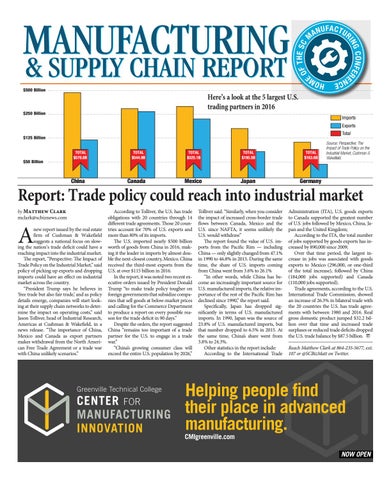
Here’s a look at the 5 largest U.S. trading partners in 2016
$250 Billion
Imports Exports Total
$125 Billion
$50 Billion
TOTAL $578.6B
China
TOTAL $544.9B
Canada
TOTAL $525.1B
TOTAL $195.5B
TOTAL $163.6B
Mexico
Japan
Germany
Source: Perspective: The Impact of Trade Policy on the Industrial Market, Cushman & Wakefield.
Report: Trade policy could reach into industrial market by Matthew Clark mclark@scbiznews.com
A
new report issued by the real estate firm of Cushman & Wakefield suggests a national focus on slowing the nation’s trade deficit could have a reaching impact into the industrial market. The report, “Perspective: The Impact of Trade Policy on the Industrial Market,” said policy of picking up exports and dropping imports could have an effect on industrial market across the country. “President Trump says he believes in ‘free trade but also fair trade,’ and as policy details emerge, companies will start looking at their supply chain networks to determine the impact on operating costs,” said Jason Tolliver, head of Industrial Research, Americas at Cushman & Wakefield, in a news release. “The importance of China, Mexico and Canada as export partners makes withdrawal from the North American Free Trade Agreement or a trade war with China unlikely scenarios.”
According to Tolliver, the U.S. has trade obligations with 20 countries through 14 different trade agreements. Those 20 countries account for 70% of U.S. exports and more than 80% of its imports. The U.S. imported nearly $500 billion worth of goods from China in 2016, making it the leader in imports by almost double the next-closest country, Mexico. China received the third-most exports from the U.S. at over $115 billion in 2016. In the report, it was noted two recent executive orders issued by President Donald Trump “to make trade policy tougher on foreign governments that subsidize companies that sell goods at below-market prices and calling for the Commerce Department to produce a report on every possible reason for the trade deficit in 90 days.” Despite the orders, the report suggested China “remains too important of a trade partner for the U.S. to engage in a trade war.” “China’s growing consumer class will exceed the entire U.S. population by 2026,”
Tolliver said. “Similarly, when you consider the impact of increased cross-border trade flows between Canada, Mexico and the U.S. since NAFTA, it seems unlikely the U.S. would withdraw.” The report found the value of U.S. imports from the Pacific Rim — including China — only slightly changed from 47.1% in 1990 to 46.8% in 2015. During the same time, the share of U.S. imports coming from China went from 3.6% to 26.1% “In other words, while China has become an increasingly important source for U.S. manufactured imports, the relative importance of the rest of the Pacific Rim has declined since 1990,” the report said. Specifically, Japan has dropped significantly in terms of U.S. manufactured imports. In 1990, Japan was the source of 23.8% of U.S. manufactured imports, but that number dropped to 6.5% in 2015. At the same time, China’s share went from 3.8% to 24.3%. Other statistics in the report include: According to the International Trade
Administration (ITA), U.S. goods exports to Canada supported the greatest number of U.S. jobs followed by Mexico, China, Japan and the United Kingdom; According to the ITA, the total number of jobs supported by goods exports has increased by 890,000 since 2009; Over that time period, the largest increase in jobs was associated with goods exports to Mexico (296,000, or one-third of the total increase), followed by China (184,000 jobs supported) and Canada (110,000 jobs supported). Trade agreements, according to the U.S. International Trade Commission, showed an increase of 26.3% in bilateral trade with the 20 countries the U.S. has trade agreements with between 1980 and 2016. Real gross domestic product jumped $32.2 billion over that time and increased trade surpluses or reduced trade deficits dropped the U.S. trade balance by $87.5 billion. Reach Matthew Clark at 864-235-5677, ext. 107 or @SCBizMatt on Twitter.
16
www.gsabusiness.com
MANUFACTURING & SUPPLY CHAIN REPORT
May 1 - 14, 2017
Lexington County looks to cash in on Volvo expansion Staff Report
colanews@scbiznews.com
A
mong Lexington’s attractions is the availability of quality jobs, and many of those are provided by industry in the surrounding county. Lexington County is home to a number of U.S. and international companies. According to the U.S. Bureau of Labor and Statistics, Lexington’s largest concentration of industry is in the automotive, health care, utilities, transportation and manufacturing sectors. Mike Eades, who has been the county’s economic development director since November, says he continues to hear positive comments from the companies that choose to do business in Lexington County. At a recent panel discussion on economic growth, a group of developers said there are a few criteria that every business looks for when deciding about building or relocating. They included a place to work, people to do the work and a way to transport that work to others. Lexington County is attempting to check off all three boxes. To ensure companies have a place to do business, Lexington County has either completed or is in the process of revamping three major industrial parks around the county. These parks will be used to attract new businesses to Lexington. The Batesburg-Leesville Industrial Park has 175 acres that were purchased
Lexington County officials are hoping they can capitalize on the Volvo expansion happening in Berkeley County. (Photo/Provided)
in 1999. The site has seen $3.5 million in infrastructure improvements including water, sewer, roadway, lighting and landscaping. “Batesburg-Leesville is finished and ready to be occupied, there’s just a few finishing touches,” Eades said. “There are currently 115 to 120 usable acres right now and interest in the site has been favorable. It’s good to have some available property in that area.” Eades said the widening of U.S. 1 into Batesburg-Leesville was a strong selling point. Currently, Fisher Tank
Co. is housed in the park. There are also plans for expansion of Saxe Gotha Industrial Park in Cayce. The park already features Amazon and Nephron Pharmaceuticals, but with the extension of 12th Street, Eades said it should open new land for future projects including Amazon’s Make on Demand Center. The county also plans to open more property once some wetlands can be mitigated, Eades said. “We hope to make room for a bigger site to attract another group like Amazon.”
Eades said he expects economic development to continue to grow in Lexington County, especially with the new Volvo plant opening in Berkeley County. “With (the Volvo) deal going in, we have a chance to get some auto supply business,” Eades said. “We don’t have an automotive assembly site, but it wouldn’t surprise me to see it happen sometime down the road.” The county’s newest industrial park, being built in Chapin, is targeted at becoming a technology hub for IT businesses. “The Chapin park is a little behind the Batesburg-Leesville project,” Eades said. “The roads have been paved and there is water and sewer along with cables for telecommunications.” Eades said the design for the area is expected to bring in software firms and research and development. It’s a different product from the other parks being built. AS more companies choose to locate in Lexington County, the population has increased. Mayor Steve MacDougall said Lexington’s population has grown by 80% in the last 10 years, and he expects another 80% growth over the next 10. The increased population has given rise to an experienced labor force that Eades says is one of the biggest factors in the expansion of new business. Transportation is also critical, and with three interstate highways in the county and access to the Port of Charleston, Lexington has been shown to be a good place to invest.
13,000-TEU ship heading for Port of Charleston in May Liz Segrist
lsegrist@scbiznews.com
T
he Port of Charleston will handle its largest ship to date when the Cosco Development arrives in
May. The 13,000-TEU ship — able to handle more than 13,000 20-foot equivalent containers — will make its last East Coast port call in Charleston Harbor before heading back to Asia, according to the S.C. State Ports Authority. The ship measures 1,200 feet long — as long as the Eiffel Tower is tall — and 158 feet wide. The previous largest ships to call on the port were the APL Yangshan and the APL Barcelona, 10,700-TEU ships that first called on the port in the fall, according to the ports authority. Larger ships are trending in the shipping industry, spurring major infrastructure improvements, terminal renovations
With the arrival of the 13,000-TEU Cosco Development in May, the APL Yangshan (pictured) and APL Barcelona, at 10,700 TEU apiece, will be replaced as the largest ships to call on the Port of Charleston. (Photo/Provided)
and equipment purchases. The Panama Canal expansion was needed to handle the bigger ships. Currently, 18 of the 24 container vessels calling on the Port of Charleston each week would not have fit through the Panama Canal without the expansion, the port
said. The Bayonne Bridge between New York and New Jersey is also being raised, and Charleston Harbor is set to be deepened to 52 feet. The deepening project has been approved by regulators and received state
funding; the project still awaits federal funding. Dredging for the project is set to begin this fall. The Cosco Development is deployed on the weekly Ocean Alliance South Atlantic Express service connecting Charleston with Hong Kong, Yantian, Ningbo and Shanghai in China via the Panama Canal, according to the port. “The arrival of the Cosco Development at East Coast ports marks a new era,” ports CEO Jim Newsome said in a news release. “Seeing a 13,000-TEU vessel in our harbor is a tangible reflection that our vision and capital investments to be big-ship-ready are absolutely critical.” Newsome said Charleston Harbor can handle the large vessel loaded with cargo, and the port’s new, 155-foot-tall cranes can work the ship. The ship is set to arrive in Charleston May 14. Track the ship’s voyage online. Reach Liz Segrist at 843-849-3119.
May 1 - 14, 2017
MANUFACTURING & SUPPLY CHAIN REPORT
www.gsabusiness.com 17
BMW Group records ‘best-ever March’ for global sales by Matthew Clark mclark@scbiznews.com
W
ith large increases in the sales of its X1, Spartanburg-produced X5, 7 Series and first full month of sales of the new 5 Series, the BMW Group recorded what is called its “best-ever March” with a 5.9% yearover-year growth in global sales. According to the company, sales of the X5 jumped 20.7% while sales of the X1 increased by 21%. Sales of the 7 Series model were up 74.8% and in its first full month of recorded sales, the redesigned 5 Series sold 35,000 in the first quarter. “We’ve achieved a strong start to the year, with our X-family models and the BMW 7 Series being the main growth drivers,” said Ian Robertson, member of the BMW AG Board of Management with responsibility for Sales and Brand BMW, in a news release. “March was the first full sales month for the new BMW 5 Series Sedan and the customer feedback for this benchmark car is already very positive.” In the first three months of the year, the company reported an increase of 5.3% on 587,237 vehicles sold — including BMW, Mini and Rolls-Royce. Another increase came in the sales of
Noting a 5.9% year-over-year increase in global sales, the BMW Group announced its “best-ever March.” Additionally, the company — largely due to marked increases in the X1, X5, 7 Series and new 5 Series — recorded its best first quarter of global sales with over 587,000 vehicles sold in the first three months of 2017.
A BMW i3 is delivered via air freight recently. The BMW Group recorded its “best-ever March” in sales as group sales increased 5.9% year-over-year in the month of March. (Photo/Provided)
the BMW i and BMW iPerformance vehicles where nearly 20,000 electric vehicles have been sold in the first quarter, according to the BMW Group. Over 10,000 BMW i3 vehicles have been delivered to Norway since the launch of the vehicle last April. “We’re on track to achieve our target
of 100,000 electrified vehicle sales this year,” Robertson said. Mini brand sales increased 8.7% for the month of March, making it the best March for the brand as 42,447 Mini vehicles were sold across the globe. First quarter sales of Rolls-Royce were up 33% year-over-year as 733 vehicles were sold
in the first quarter. “The MINI Clubman in particular has shown strong growth of over 21% in the first quarter, proving that its perfect blend of everyday usability and MINI-typical emotional characteristics is exactly what our customers want,” said Peter Schwartzenbauer, member of the BMW AG Board of Management responsible for Mini, Rolls-Royce and BMW Motorrad, in the release. Mainland China continues to be the strongest region for BMW as 50,783 vehicles were sold in the country in March. The company said it delivered its 3 millionth vehicle to a customer in China earlier in April. March sales in Asia were up 9.5% over the same time a year ago and 9.2% in the first quarter. The United Kingdom had a 7.1% increase in sales in March and sales in Germany were up 6.7% for the month as sales in Europe increased 5.2% for the month and 4.2% for the first quarter. The Americas region saw a 4.1% increase in sales in March thanks largely to a 22% jump in sales in Mexico and Latin America. The United States had a 3.5% increase in March. Reach Matthew Clark at 864-235-5677, ext. 107 or @SCBizMatt on Twitter.
18
www.gsabusiness.com
MANUFACTURING & SUPPLY CHAIN REPORT
May 1 - 14, 2017
‘Smart’ not the best idea for today’s manufacturing
S
omeone asked me recently my thoughts on smart manufacturing. The so-called IT revolution in the factory. They couldn’t believe that I didn’t see smart manufacturing as the salvation of American manufacturing. Don’t misunderstand me. Smart Manufacturing has a place in reviving American manuSteven L. facturing. I have a Blue smart factory. We employ the latest in pick to light systems, automated CNC machines and seamless integration from order inquiry to accounts receivable. But that isn’t where I started my revolution. And you shouldn’t either. The problem with many CEOs today is they have turned away from the astonishing potential of the workforce and turned toward automation instead. Big mistake. But I hear it all the time. What is the sense in spending millions on automating your factory if our workforce couldn’t care less? What is the sense in buying expensive machine tools if your workforce can’t wait to get to the bowling alley, yet drag themselves to work? I’ll tell you why. Because too many CEOs view their employees as expendable assets. They should view them as renewable resources. And renew them. Don’t bother with smart manufacturing if you have a dumb workforce. And if your workforce is dumb, it’s your fault, not theirs. Don’t bother with an IT revolution. Your revolution has to start with a “smart workforce.” You have to make a new compact with your employees. You need to ignite the human spirit in your workforce. Imagine this. What would happen if every day your employees came to work excited to do better today than they did yesterday? Imagine how your company would soar if your employees were absolutely dedicated to supporting the mission and each other in attaining it? Imagine what it would be like if your employees were like Cirque de Soleil performers? This is the place where I get blank stares from many CEO’s. They don’t like the “soft stuff.” “Give me the hard stuff,” they say. “Tell me how to build a smart factory, not a smart workforce,” is what I often hear. It has to be the other way around. Start by building a smart workforce. A workforce that is engaged, enlightened, and empowered. A workforce that
trusts in its leadership. A workforce that believes in its leadership. Tall order to be sure-especially if the leadership is a bunch of boneheads that care more about depreciation than employee engagement. Here are four key ways to start: 1. At the top. Build leadership credibility. The only way to have leadership credibility is if your leaders demonstrate key values of respect and integrity. 2. Leaders need to treat their employees with respect. But many don’t. In a recent Harvard Business School study of 20,000 employees half of them did not feel respected by their leaders. And respect was rated by the participants as more important than anything else, including compensation. Imagine how the company performance would skyrocket if you solved this one problem alone. 3. Leaders have to demonstrate integrity. In study after study, integrity is a key attribute in leaders that people admire-and want to follow. So integrity is a key part of building credibility. But leaders also need integrity in everything they say. You can’t be like many leaders and “tell half the truth, hoping the other half doesn’t show up”. You have to be bone honest all the time. You have to tell them what they need to know. If the company is headed for trouble, tell them. If the company needs to pivot into new markets or products, tell them. And tell them why. Tell them everything. You would be amazed at how smart your workforce can be if you give them half a chance. I always say “trust in truth”. 4. This is not just for the top. Your entire workforce has to embrace the values of respect and integrity. But you cannot expect “people below to do what the top will not”. You may have leaders that lost credibility long ago. They can’t get it back. You have to replace them. Smart manufacturing starts at the top, not the bottom. Smart manufacturing starts with creating a new compact with the workforce. Smart manufacturing starts with people, not machines. Steven L. Blue is the president and CEO of Miller Ingenuity, a global supplier of mission-critical solutions in the transportation industry and author of the new book, American Manufacturing 2.0: What Went Wrong and How to Make It Right. For more information, visit www. SteveBlueCEO.com, www.milleringenuity.com and connect with Blue on Twitter @SteveBlueCEO.
May 1 - 14, 2017
MANUFACTURING & SUPPLY CHAIN REPORT
Dallas elected SCMA chairman
Staff Report
gsanews@scbiznews.com
T
he vice president of a Spartanburgbased fiber optic manufacturer has been elected the new chairman of the South Carolina Manufacturers Alliance. According to a news release, Kurt Dallas is executive vice president at AFL and has been with the company since 1991 and a member of its management team since 2007. “I feel honored and privileged to become the next chairman of the South Carolina Manufacturing Alliance,” said Dallas, in the release. “This is a great time to be a manufacturer in South Carolina and leverage all the fantastic assets that our state has to offer.” Over his tenure, Dallas has led the U.S. business as well as management of cable operations in Swindon, United Kingdom, and Mönchengladbach, Germany. In 2013, AFL added Optimal Cable Services, based in Melbourne, Australia, and in 2015, AFC Group, also based in Australia. Additionally, he also has responsibility for AFL’s connectivity business with manufacturing in Monterrey, Mexico. During his time at AFL, the company has made five acquisitions and expanded to include its products in more than 120 countries. He said the SCMA will continue to be at the forefront of “representing the needs and interests of manufacturers.” “Our voice in the public sector plays a vital role in improving the overall environment for manufacturing health and com-
petitiveness,” he said. Prior to joining AFL, Dallas was a project engineer and manager of construction engineering at the Tennessee Valley Authority. Dallas is a graduate of Memphis State University, where he earned a bachelor of science in electrical engineering. He also holds a master of science in engineering management from the University of Tennessee. The SC Future Makers — a partnership between SCMA and STEM Premier — is a workforce development program that Dallas said is an important part of the future for manufacturing across South Carolina. “I am really excited about our activities with workforce development programs, in particular, SC Future Makers,” he said. “We should really start to see the returns on this program in 2017, as the business community embraces this initiative to address a key issue for our members.” According to its website, the SC Future Makers is a program made up of “individuals who use skills, talents, and abilities to make a better future for themselves and their community.” Those individuals use the STEM Premier platform to make virtual profiles and connect with schools, companies and various organizations. In addition to the election of the chairman, the SCMA elected the following board members: • Mark Elam, The Boeing Co. — first vice chairman • Max Metcalf, BMW Manufacturing Co. LLC — second vice chairman • Curtis Hutto, Thompson Industrial — treasurer
SCMA to hold Ops Summit in September Staff Report
gsanews@scbiznews.com
M
anufacturing plant managers from across South Carolina will take part in the annual Manufacturing Operations Summit Sept. 20-22 in Myrtle Beach. The South Carolina Manufacturers Alliance Plant Managers Division will hold the annual event at The Marriott in Myrtle Beach. According to SCMA, managers “will have the opportunity to meet fellow managers from companies all over the state, share issues and successes you’ve had while making a network of nearby peers.” A tentative agenda includes sessions on Occupational Safety and Health Administration’s Voluntary Protection Programs, reducing the carbon footprint, an update on health care, increasing morale in the workplace and workforce development. Ethan Ware, with Williams Mullen, will talk about manufacturing operations reducing their carbon footprint in South Carolina. Ware “represents businesses
and industries in environmental and health and safety legal matters. He has appeared on behalf of businesses in negotiations relating to environmental permits, in defense of environmental and OSHA enforcement actions by state and federal agencies, in defense of toxic tort lawsuits, and on behalf of industry in criminal and civil environmental actions,” according the SCMA. Brian Magargle, with Constangy, Brooks & Smith, will provide a health care update and how it relates to manufacturing. According to SCMA, Magargle has practiced employment law since 1993 and began practicing in the area of employee benefits and ERISA in 1995. He has experience with a wide variety of employment law issues, including all forms of discrimination litigation (Title VII, ADA, ADEA, Equal Pay Act, etc.); administrative charges of discrimination (EEOC and state level); employment law compliance and prevention practices; personnel policy drafting and reviews; and general employment advice. For more information in the summit, visit www.myscma.com.
www.gsabusiness.com 19
20
www.gsabusiness.com
MANUFACTURING & SUPPLY CHAIN REPORT
May 1 - 14, 2017
An aerial photo shows the 2.4-million pound module (right) that will house steam generators a reactor unit being built at the V.C. Summer Nuclear Station in Jenkinsville. (Photo/Provided)
SCANA to state: Options still mulled on V.C. Summer Staff Report
colanews@scbiznews.com
S
CANA executives told state regulators recently they’re still mulling their options on how to proceed with the new reactor project at V.C. Summer Nuclear Station now that the contractor — Westinghouse Electric Co. — has filed for Chapter 11 protection and wants out of the construction business. The V.C. Summer project, which is expected to cost $13.9 billion, is more than $2 billion over the original budget approved by the S.C. Public Service Commission in 2009, and about three years behind schedule. South Carolina Electric & Gas, SCANA’s principal subsidiary, owns 55% of the project and Santee Cooper’s share is 45%. The two companies operate a reactor unit at V.C. Summer that began commercial operation in 1984. Westinghouse recently informed SCE&G, principal subsidiary of Caycebased SCANA, that the V.C. Summer project’s share of the reserve for contract losses is approximately $1.5 billion. Of that amount, $825 million would be SCE&G’s 55% share of the additional cost, while the utility’s partner Santee Cooper would shoulder 45% of the loss. “That amount is largely associated with the fixed- and firm-price option negotiated for the V.C. Summer project,” the company said in a press release. The figures, though, are Westinghouse’s estimates and SCANA has not yet validated the amounts, the release added. The $1.5 billion figure is considerably less that Morgan Stanley’s estimate that projected $5.2 billion in additional construction costs and delay-related cost overruns in the V.C. Summer project. SCANA reported to the commission that SCE&G is in the midst of a 30-day evaluation period to assess the validity of Westinghouse’s cost estimates for the project. Additionally, the agreement with Westinghouse suspends the milestone payments established by the Dispute Resolution Board and provides a mechanism for the V.C. Summer project owners to continue
to pay for work performed on the site, the release said. These total payments have been approximately $30 million ($16.5 million for SCE&G’s 55% share) per week, or approximately $120 million ($66 million for SCE&G’s 55% share) per month. Westinghouse, which also is the contractor and designer for two reactor units under construction at Southern Co.’s Plant Vogtle near Waynesboro, Ga., filed for Chapter 11 bankruptcy protection on March 29. Toshiba, Westinghouse’s parent, said it was writing off $6.3 billion in business because of losses incurred by Westinghouse in nuclear construction projects in the United States and China. However, that figured climbed to $9 billion after it found Westinghouse had piled up $9.8 billion in debt. In December 2015, Toshiba’s credit ratings slipped into speculative grade and triggered a provision in SCANA’S contract requiring Westinghouse to establish a surety bond in the form of a letter of credit ranging up to $100 million, SCANA CEO Kevin Marsh said during a recent call with analysts. Additionally, SCANA began to escrow intellectual property and software for the reactor units, Marsh said. Westinghouse reported that substantially all of the required intellectual property is now in escrow, the SCANA release said. “SCE&G is attempting to verify that this information is present in useable form at this time,” the release said. SCE&G’s options for the project include: • Continue with construction on both units. • Focus on construction of one unit and delay work on the other. • Continue with one unit and abandon the other, seeking recovery of money spent on the project under the state Base Load Review Act. • Abandon the project altogether and seek recovery under the state law. • Marsh has said abandonment is the leastpreferred option because SCE&G still needs to add generation capacity to serve its growing customer base.
May 1 - 14, 2017
MANUFACTURING & SUPPLY CHAIN REPORT
Market maturity creating sustainability for larger spec buildings, report said
by Matthew Clark mclark@scbiznews.com
A
ccording to a recent report, demand for larger warehouse and distribution buildings in South Carolina is growing, thanks to an increased e-commerce market, already low vacancy and expanding major manufacturers in the region. Bryana Mistretta, research coordinator for Colliers International — South Carolina, said the demand is forcing retailers to “need larger distribution centers capable of holding a larger supply of product to fulfill customer orders quickly.” In her report, she said South Carolina is particularly attractive because of its access to a deep-water port and an inland port along with five interstates. She said 78% of the country’s population is within a 16-hour truck drive from Columbia. Demand in the state has also been spurred by expansions of Volvo, Daimler, Boeing, BMW and Michelin, as well as the five tire manufacturers in the state. “This demand, coupled with low vacancy, has increased the need for new and larger developments,” Mistretta said. However, the challenge comes with the fact that the availability for 200,000-square-foot industrial developments are limited to the Midlands. Mistretta said Greenville and Charleston are “limited” in their options for available large-scale buildings to meet the demand for larger space. The Midlands has three “mega sites,” or “sites with a minimum of 1,000 contiguous acres of developable land with access to utilities, a network of transportation infrastructure and the workforce to support a major employer.” The three mega sites available are the I-95 Mega Site in Clarendon County, I-26 Mega Site in Newberry County and the Central South Carolina Mega Site in Kershaw County. “These sites are attractive to major employers because they have the infrastructure to support manufacturing or distribution campuses over 1 million square feet with a readily available workforce,” Mistretta said, in the report. Despite a lack of mega sites, the Upstate and Charleston have seen their markets mature allowing development of those larger speculative buildings. Mistretta said in the last three years,
the Upstate has seen nine speculative buildings over 200,000 square feet be constructed. Six of those — including those in Flatiron, Wingo and White Horse industrial parks — were constructed in 2016. In Charleston, there have been industrial speculation buildings constructed at Omni Industrial Campus and the North Pointe Business Campus. “These larger buildings are valued by users supplying larger manufacturers or distributing large amounts of products throughout the region,” Mistretta said. “The rapidly growing demand for products just-in-time and the boom of e-commerce will continue to drive the need for larger buildings in the Upstate due to its efficient logistics system.” A shift in port traffic is another reason Mistretta said South Carolina continued to be positioned for continued industrial growth. Following the expansion of the Panama Canal and the population shift to the East Coast, larger ships are able to get goods and services to a larger portion of the American population quicker by using East Coast ports like the Port of Charleston. Mistretta said with the Charleston Harbor Deepening Project on track to make the entrance to the harbor 54 feet deep and the rest of the harbor 52 feet deep, Charleston will be the only East Coast port with the capability to handle the new postPanamax ships at full capacity. The Inland Port Greer and the Inland Port Dillon — which is expected to be completed in 2018 — add a new component to the industrial infrastructure of South Carolina, Mistretta said. “The expansion of the e-commerce market across the country has created a demand for consumer products on a faster timeline. Distributors are searching for larger distribution centers along the East Coast to fill consumer orders within two to three days,” Mistretta said. “The Port of Charleston provides companies an efficient logistics system by train, truck or container ship that can deliver products on time.” Looking ahead, Mistretta said combining the port growth and the potential for road infrastructure improvements “will continue to strengthen the South Carolina industrial market.” She said the rest of the year may see growth from foreign direct investment because of that infrastructure. Reach Matthew Clark at 864-235-5677, ext. 107 or @SCBizMatt on Twitter.
www.gsabusiness.com 21
22
www.gsabusiness.com
MANUFACTURING & SUPPLY CHAIN REPORT
May 1 - 14, 2017
Clemson manufacturing professor earns high honor Staff Report
gsanews@scbiznews.com
A
Clemson University professor recently earned a distinction only 2.9% of his colleagues have every received. Laine Mears, the BMW SmartState Chair in Automotive Manufacturing at the Clemson University International Center for Automotive Research, was named a fellow of the American Society of Mechanical Engineers — an organization with 120,248 members. Most recently, Mears, who became a founding faculty member of CUICAR’s automotive engineering graduate program in 2006, has been working on a project that brings together Clemson University engineers and Greenville Technical College students to work on a “prototype vehicle assembly line,” according to a release from Clemson on the honor. “It is a testament to his hard work, innovative approach and collaboration with industry. This is an honor not only for Laine, but for the department, CUICAR and the industry collaborators that have supported his efforts,” said Zoran Filipi, chairman of the automotive engineering department at Clemson, in the release. Mears helped establish eight courses in the program, many in conjunction with
Clemson University professor Laine Mears was named a fellow of the American Society of Mechanical Engineers. Mears is the BMW SmartState Chair in Automotive Manufacturing at the Clemson University International Center for Automotive Research in Greenville. (Photo/Provided)
personnel from original equipment manufacturers. The courses address core automotive industry needs and have produced automotive integration engineers who have been recognized widely throughout the industry, colleagues said. His research portfolio accounts for more than $6 million in funding. Mears has worked with more than 25 graduate students and postdoctoral researchers and more than 20 undergraduates. Mears’ awards include the 2011 SAE Ralph R. Teetor Educational Award, the South Carolina Governor’s Young Researcher Award for Excellence in Scientific Research and the Institution of Me-
chanical Engineers George Stephenson Gold Medal. He has generated more than 130 archival journal and reviewed conference publications. Mears also collaborated on the seminal textbook “Electrically Assisted Forming – Modeling and Control,” according to Clemson. Ralph Resnick, president and executive director of the National Center for Defense Manufacturing and Machining who wrote a letter of support for Mears’ nomination, said more than half of Mears’ research portfolio has been industry-funded and sponsors have come back to provide additional funding for the advancement of past projects.
“This continued funding directly demonstrates his power for translational research,” Resnick said. “These are solutions that impact a company’s bottom line, but require the generation of new knowledge in terms of modeling, control and information management. “Dr. Mears has demonstrated exceptional and unique capabilities in balancing these approaches.” According to the citation from the society, “Dr. Mears has an outstanding career bridging both industry and academia to support new evolutions in the automotive field. As an engineer and manager, he developed new tools and process approaches for the manufacturing of bearings and driveline parts, but more importantly understood key automotive manufacturing issues. “In his academic career, he has brought this real-world knowledge to learning as part of a core team that established the Clemson University International Center for Automotive Research, and the first graduate program and department in Automotive Engineering. He has contributed through manufacturing research for new lightweight vehicles, and educating future automotive engineers.” Clemson University’s Paul Alongi contributed to this report.