VOLUME 14 NUMBER 12 ■ COLUMBIABUSINESSREPORT.COM
Back in full swing
Part of the
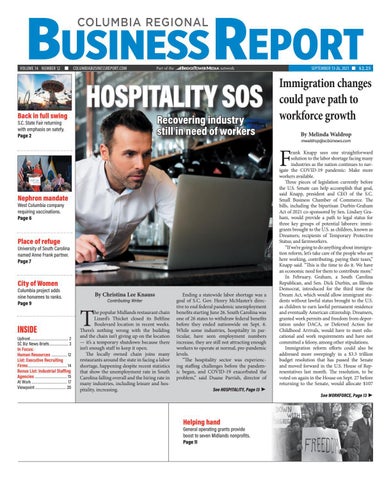
HOSPITALITY SOS Recovering industry still in need of workers
S.C. State Fair returning with emphasis on satefy. Page 2
SEPTEMBER 13-26, 2021 ■ $2.25
network
Immigration changes could pave path to workforce growth By Melinda Waldrop
F Nephron mandate West Columbia company requiring vaccinations. Page 6
Place of refuge
University of South Carolina named Anne Frank partner. Page 7
City of Women
Columbia project adds nine honorees to ranks. Page 9
INSIDE
Upfront................................. 2 SC Biz News Briefs................. 3 In Focus: Human Resources .............. 12 List: Executive Recruiting Firms.................................. 14 Bonus List: Industrial Staffing Agencies ............................ 15 At Work............................... 17 Viewpoint........................... 20
By Christina Lee Knauss
T
Contributing Writer
he popular Midlands restaurant chain Lizard’s Thicket closed its Beltline Boulevard location in recent weeks. There’s nothing wrong with the building and the chain isn’t giving up on the location — it’s a temporary shutdown because there isn’t enough staff to keep it open. The locally owned chain joins many restaurants around the state in facing a labor shortage, happening despite recent statistics that show the unemployment rate in South Carolina falling overall and the hiring rate in many industries, including leisure and hospitality, increasing.
Ending a statewide labor shortage was a goal of S.C. Gov. Henry McMaster’s directive to end federal pandemic unemployment benefits starting June 26. South Carolina was one of 26 states to withdraw federal benefits before they ended nationwide on Sept. 6. While some industries, hospitality in particular, have seen employment numbers increase, they are still not attracting enough workers to operate at normal, pre-pandemic levels. “The hospitality sector was experiencing staffing challenges before the pandemic began, and COVID-19 exacerbated the problem,” said Duane Parrish, director of See HOSPITALITY, Page 13
Helping hand
General operating grants provide boost to seven Midlands nonprofits. Page 11
mwaldrop@scbiznews.com
rank Knapp sees one straightforward solution to the labor shortage facing many industries as the nation continues to navigate the COVID-19 pandemic: Make more workers available. Three pieces of legislation currently before the U.S. Senate can help accomplish that goal, said Knapp, president and CEO of the S.C. Small Business Chamber of Commerce. The bills, including the bipartisan Durbin-Graham Act of 2021 co-sponsored by Sen. Lindsey Graham, would provide a path to legal status for three key groups of potential laborers: immigrants brought to the U.S. as children, known as Dreamers; recipients of Temporary Protective Status; and farmworkers. “If we’re going to do anything about immigration reform, let’s take care of the people who are here working, contributing, paying their taxes,” Knapp said. “This is the time to do it. We have an economic need for them to contribute more.” In February, Graham, a South Carolina Republican, and Sen. Dick Durbin, an Illinois Democrat, introduced for the third time the Dream Act, which would allow immigrant students without lawful status brought to the U.S. as children to earn lawful permanent residence and eventually American citizenship. Dreamers, granted work permits and freedom from deportation under DACA, or Deferred Action for Childhood Arrivals, would have to meet educational and work requirements and have not committed a felony, among other stipulations. Immigration reform efforts could also be addressed more sweepingly in a $3.5 trillion budget resolution that has passed the Senate and moved forward in the U.S. House of Representatives last month. The resolution, to be voted on again in the House on Sept. 27 before returning to the Senate, would allocate $107 See WORKFORCE, Page 13
Upfront
BRIEFS | FACTS | STATEWIDE NEWS
Yes, we’re ready for some football
A LA CARTE Photo/Forrest Clonts
State fair gears up for return with focus on safety
I
t’s still hot, and we’re still in the middle of a pandemic unwilling to let us go back to living our normal lives, but that doesn’t mean we’re not ready for college football. For a lot of college fans, the ebb and flow of football signals the actual change of the seasons. When the Tigers, Gamecocks, Chanticleers, Bulldogs, Paladins, Terriers, Bucs and Wolves take to the field, we’re fully expecting the temperature to instantly drop 10 degrees as our hearts skip a beat. Like many things, we just want to forget about 2020, so we grabbed data from NCAA attendance in 2019 to see what we might be in for in terms of attendance at home football games in South Carolina. We don’t expect the numbers this year to be the same as two years ago, but you have to start somewhere, and first-and-10 on the 50-yard line isn’t a bad place when you’re playing at home. For their part, the South Carolina Gamecocks opened the 2021 season with a 46-0 win against Eastern Illinois in front of 64,868 fans at Williams-Brice Stadium in Columbia on Sept. 4.
S.C. college football attendance 2019 College
Home attendance
Average
Clemson University
566,074
80,868
University of South Carolina
545,737
77,962
Coastal Carolina
90,112
15,019
South Carolina State
62,035
10,339
The Citadel
56,066
9,344
Furman University
35,883
5,981
Wofford College
25,867
4,311
Charleston Southern
17,762
3,552
Presbyterian College
11,810
1,687
Source: NCAA, Division I programs
Top 5 conferences by attendance Conference
Attendance
Average
Southeastern Conference
7.4 million
72,723
Big Ten
6.3 million
65,065
Atlantic Coast Conference
4.5 million
48,243
Big 12
3.8 million
57,467
Pac-12
3.6 million
46,080
Source: NCAA, 2019
HEARD IN THE
REPORT
“Everybody’s going to have an opinion. People may resign or hold out. But I think leaders have to make tough decisions. I’m the leader here, and I have to protect my own.” — Lou Kennedy, Nephron owner and CEO
WEBSITE: www.ColumbiaBusinessReport.com
FOLLOW US:
@CRBR
The S.C. State Fair is gearing up for a 12-day return in October, with rides, food, exhibits and competitions set to return to the Rosewood Drive fairgrounds with increased safety precautions. Nearly 70 rides and 90 food stands will be featured Oct. 13-24 at the fair, which offered a drive-through food and exhibits in 2020 because of the COVID-19 pandemic. Organizers emphasized at a news conference last month that the fair will follow Center for Disease Control and Prevention recommendations and local mask guidelines and will have more hand sanitation stations, limited contact payment options and ramped-up cleaning protocols. “The health of our guests is of the upmost importance, and we ask that each guest does their part by following our latest event policies,” Nancy Smith, S.C. State Fair general manager, said in a news release. “We strongly encourage all fairgoers to evaluate their own potential risk of exposure to COVID-19 before choosing to attend, knowing that vaccines remain the best protection from the virus.” In October 2020, more than 25,000 vehicles came through the six-day drivethrough fair, according to the release, with an additional 15,500 counted at a spring food drive-through in April 2021. A free daily Circus at the Fair event will return this year, featuring new acts and shows, while traditional favorites such as pig races, arts and crafts and livestock exhibits will also return. Discount admission and ride tickets go on sale Sept. 8 and will be available through Oct. 12 at SCStateFair.org or participating Circle K convenience stores.
facebook.com/ColumbiaBusinessReport
September 13 - 26, 2021
www.columbiabusinessreport.com 3
SC Biz News Briefs Helping South Carolina Companies Grow
Upcoming Training Opportunities In Columbia Include: Building a Better Supply Chain: A Strategic Sourcing Lunch & Learn
SEPTEMBER 23
Lean Six Sigma Green Belt
STARTING OCTOBER 7
Both Knudt Flor and Robert Engelhorn have overseen aspects of BMW’s preparation for the future of the electric vehicle, including this battery module assembly plant in Greer. (Photo/Fred Rollison Photography)
SPARTANBURG
GSA Business Report
Engelhorn new leader of BMW plant
R
obert Engelhorn is the new president and CEO of BMW Manufacturing. In a private ceremony at the BMW Zentrum on Sept. 1, Engelhorn took over plant leadership from Knudt Flor, who is retiring. Englehorn most recently was director for BMW Plant Munich in Germany, where he prepared the plant for production of the all-electric BMWi4. Installation of a new electric battery plant was among the highlights of Flor’s six-year tenure in Greer. The assembly plant supplies lithium-ion battery modules for two vehicles — the BMW X3 xDrive30e and the BMW X5 xDrive 45e. Flor was at Plant Spartanburg for a $600 million expansion, the 25th anniversary celebration of BMW in South Carolina and assembly of the 5 millionth car. His tenure also was marked by record production until the COVID-19 pandemic caused a worldwide supply slow-down that caused the Greer plant to halt production — 1,500 cars a day at the time — for a brief time in 2020. Flor oversaw that challenge as well as the return to production. The value of cars made for export at Plant Spartanburg exceeds the value of exported vehicles made by any other plant in the United States, according to the company. “Plant Spartanburg has been a critical part of BMW’s global production network for decades, and the plant’s impact is far reaching,” Engelhorn said in a company news release. “Their performance — both in quality and production — is impressive, and I am excited to lead this extraordinary team.” Engelhorn joined the BMW Group in 2011 and held various positions at the Munich and Regensburg plants in Germany. In 2016, he moved to the BMW Brilliance Automotive joint venture in China, where he led the technology and production division for the Dadong and Tiexi plants, the news release said. In 2018, Engelhorn took over as director for BMW Group Plant Munich. “Robert is the perfect match for Plant Spartanburg. He combines great international experience and broad technical expertise, especially for the manufacturing of electrified cars,” Milan Nedeljkovic, a member of the BMW AG Board of Management responsible for production, said in the release. “I’m sure he will successfully steer this plant into its great future.” Flor is retiring after 33 years at the BMW Group and nearly five years as president and CEO at BMW Manufacturing. He is the second-longest serving president of the Spartanburg plant. BMW Group Plant Spartanburg is the largest BMW Group plant in the world, again producing about 1,500 vehicles each day. The South Carolina factory exports more than two-thirds of its models to 125 global markets. BEST ADVICE Keegan Bird and Dan Rimer, Beech Restaurants.
PAGE 4 VOLUME 27 NUMBER 18 ■ CHARLESTONBUSINESS.COM
Part of the
SEPTEMBER 6 - 19, 2021 ■ $2.25
network
Lawyers help employers navigate vaccine mandates in SC By Teri Errico Griffis
Staffing struggles Retaining talent and safety protocols threaten manufacturing operations. Page 31
Van sales soar
Pent-up travelers lead to record Sprinter Van sales in Summerville. Page 34
$180M project
Kiawah Island welcomes Seafields, its first-ever 62+ community. Page 12
T
tgriffis@scbiznews.com
he Food and Drug Administration’s approval for the Pfizer vaccine has removed a major legal hurdle for companies looking to mandate COVID-19 immunizations as a condition of employment. Until Aug. 23, the Pfizer, Moderna and Johnson & Johnson vaccines were only approved for emergency use authorization,
giving further reason for people to stronghold their opposition, said David Dubberly, an employment and labor law group leader at Nexsen Pruet. In the near future, Dubberly expects more businesses to create mandate policies, especially as Moderna is on its way to approval as well. Dubberly, along with S.C. Chamber of Commerce President Bob Morgan and other top labor lawyers in the state came together on Aug. 26 to advise employers on what to expect
‘NOT A DONE DEAL’ For decades the Mark Clark Expressway project has been stuck in traffic. Now highway planners want help testing the viability of the latest effort. Page 6
should they mandate COVID-19 inoculations and how to respond — or not respond. Mike Carrouth, a lawyer at Fisher Phillips LLP in Columbia, said employers should prepare for medical and religious exemption requests, protests and, most severely, people withholding labor. Employers could potentially lose between 10% and 20% of their workforce, with See FDA, Page 9
Camp Hall plans mixed-use park near Volvo plant
New frontiers
Summer 2021
Upfront ................................ 2 SC Biz News Briefs ................ 3 Best Advice .......................... 4 In Focus: Manufacturing ................... 31 List: Manufacturers ............ 41 Bonus List: Industrial Staffing Agencies ...............43 At Work ..............................44 Viewpoint .......................... 46 Day in the Life .....................47 Signs indicate the end point of Interstate 526 West.
FOR MORE INFORMATION AND TO REGISTER VISIT
WWW.SCMEP.ORG SCMEP Greenville
250 Executive Center Dr. Suite 200 Greenville, SC 29615 (864) 288-5687
SCMEP Columbia
250 Berryhill Rd. Suite 115 Columbia, SC 29210
of Standards and Technology’s (NIST) Hollings Manufacturing Extension Partnership (MEP), a network of 51 MEP Centers located in all 50 states and Puerto Rico.
See CAMP HALL, Page 10
Forty Under 40
Meet some of the best and brightest in Charleston businesses. Page 13
SC Biz News 1802 Dayton St., Suite 101 North Charleston, SC 29405
County Spotlight: Oconee | Trending: Life Sciences in S.C. | S.C. Delivers
GSABusinessReport.com
DECEMBER 6-9
ang@scbiznews.com
here are currently about 1,500 employees working at the Volvo manufacturing plant in Ridgeville. If they want to step away for a quick lunch or run errands after work, most have to travel at least 20 minutes out for basic conveniences. Especially during a timed break, that commute adds up. But soon, workers’ will have food and retail options just down their street with the new Camp Hall Village Center, a master-planned community located in the heart of the industrial commerce park and adjacent to the Volvo plant in Berkeley County. In early August, developer Santee Cooper selected commercial real estate firm Lee & Associates to lead the sale of retail parcels at the village center. Lee & Associates will facilitate the request for proposal process to secure developers and tenants. While nothing is set in stone yet as they enter the final round of approvals, Lee & Associates have confirmed that multiple businesses have already
INSIDE
Management Systems Lead Auditor – ISO 14001:2015 & ISO 45001:2018
By Alexandria Ng
T
C is for cookie co.
Grey Ghost Bakery offers a behind-the-scenes look at its West Ashley factory. Page 47
OCTOBER 18-21
S.C.’s life sciences sector poised for growth, success
ELECTRONIC SERVICE REQUESTED
With publications in the Upstate, Columbia and Charleston, as well as a statewide magazine, SC Biz News covers the pulse of business across South Carolina. Above are excerpts from our other publications.
ISO 9001:2015 & ISO 14001:2015 Certified Lead Auditor
CharlestonBusiness.com
SCBIZmag.com
4
www.columbiabusinessreport.com
September 13 - 26, 2021
MIDLANDS NEWSROOM Editor - Melinda Waldrop mwaldrop@scbiznews.com • 803.726.7542 MIDLANDS ACCOUNT EXECUTIVE Senior Account Executive - Lucia Smith lsmith@scbiznews.com • 803.726.7547 MultiMedia Advertising Executive - Amanda Alford aalford@bridgetowermedia.com • 803.726.7540 LOWCOUNTRY NEWSROOM Executive Editor - Andy Owens aowens@scbiznews.com • 843.849.3142 Editor, Custom Publishing Division Steve McDaniel smcdaniel@scbiznews.com • 843.849.3123 News Editor - Alexandria Ng ang@scbiznews.com • 843.849.3124 Research Specialist - Paige Wills pwills@scbiznews.com • 843.849.3125 Staff Writer - Teri Errico Griffis tgriffis@scbiznews.com • 843.849.3144 Web Editor - Rob Lyle rlyle@scbiznews.com.com • 843.849.3119 UPSTATE NEWSROOM Editor - Ross Norton rnorton@scbiznews.com • 864.720.1222 Associate Editor, Custom Publishing Division Jim Tatum jtatum@scbiznews.com • 864.720.2269 Staff Writer - Molly Hulsey mhulsey@scbiznews.com • 864.720.1223
South Carolina’s Media Engine for Economic Growth Group Publisher - Rick Jenkins rjenkins@scbiznews.com • 864.720.1224 Director of Advertising - Robert Reilly rreilly@scbiznews.com • 843.849.3107
The University of South Carolina’s incoming freshman class features a record 4.4 average GPA and more in-state students than ever before. The class, estimated to be 60% women, features representatives of 44 states and the District of Columbia, Puerto Rico, and more than 25 other countries. (Photo/Melinda Waldrop)
Freshman class boasts record GPA By Melinda Waldrop mwaldrop@scbiznews.com
The University of South Carolina’s incoming freshman class features a record 4.4 average GPA and more in-state students than ever before. The university welcomed approximately 8,050 new undergraduate students last week, the second-largest group in the school’s 220-year history, with 53% from South Carolina, according to preliminary admissions numbers provided by the school. The freshman class, estimated to be 60% women, includes 75 high school valedictorians and 596 enrollees in the South Carolina Honors College. “We’re excited to welcome the Class
of 2025 to campus as they begin their journey,” Harris Pastides, interim university president, said in a news release. “They have already accomplished much to become part of our Carolina family, and they will contribute to a diverse set of perspectives, passions and experiences to our campus community.” More than 16% of the incoming students are first-generation college students. The class features representatives of 44 states, the District of Columbia, more than 25 countries. African American freshman enrollment has grown by 85% since 2016, with Hispanic freshman enrollment up 53% in the same time span. Including graduate students, the university’s overall enrollment is 34,700.
“We continue to attract the best South Carolina residents and students from all over, as they see the value of a UofSC degree and want to enjoy life as a Gamecock,” Scott Verzyl, vice president for enrollment management and dean of undergraduate admissions, said. “Our world-class education and tremendously vibrant and diverse campus culture give students an unparalleled student experience, giving them the opportunity to become future leaders, seek beyond-the-classroom experiences, develop strong relationships, master critical skills and grow as individuals.” The university’s Columbia campus was also ranked the 12th best employer in South Carolina in a Forbes survey released last month.
Creative Director - Ryan Wilcox rwilcox@scbiznews.com • 843.849.3117
SUBSCRIPTION INFORMATION
Events Account Executive - Melissa Tomberg mtomberg@scbiznews.com • 864.720.1220 Events Manager - Kim McManus kmcmanus@scbiznews.com • 843.849.3116 Accounting - Linda Burnette ar@bridgetowermedia.com • 704-247-2900 Subscription Services service@bridgetowermedia.com • 877.615.9536 CUSTOM MEDIA DIVISION Director of Business Development - Mark Wright mwright@scbiznews.com • 843.849.3143
Columbia Regional Business Report (USPS 8400) is published twice a month, except monthly in January, May, June, and August, with special supplements in July and December, by SC Biz News. 1612 Marion Street, Suite 301 Columbia, SC 29201-2938 Periodicals postage paid at Columbia, SC. Mailing address: 1612 Marion Street, Suite 301 Columbia, SC 29201-2938. Postmaster: Please send address changes to: Subscription Services PO Box 1051 Williamsport, PA 17703-9940
Annual subscribers receive the Business Report, including two special supplements: the Book of Experts and the Book of Lists. One year for $57.95; Two years for $92.95; Three years for $129.95. Subscribe, renew, change your address or pay your invoice by credit card online at www.columbiabusinessreport.com or call 877-615-9536.
NWS Company LLC A portfolio company of BridgeTower Media
The entire contents of this newspaper are copyright by NWS Company LLC with all rights reserved. Any reproduction or use of the content within this publication without permission is prohibited. SCBIZ and South Carolina’s Media Engine for Economic Growth are registered in the U.S. Patent and Trademark Office.
©2021 NWS Company LLC
September 13 - 26, 2021
www.columbiabusinessreport.com 5
Park Street project adding lighting, landscaping By Melinda Waldrop
A
mwaldrop@scbiznews.com
beautification project in the Congaree Vista will add lighting, landscaping, sidewalks and outdoor seating areas on Park Street between Gervais and Senate streets. The project, now underway, is scheduled to be completed by fall, according to Kristen Puckett, construction coordinator for the city of Columbia.
“This will be a delightful improvement for pedestrians in the area,” Rosie Craig, board member and founding member of The Congaree Vista Guild, said in a news release. “It’s a long-awaited project that has been in development for many years and is now going to happen. The city of Columbia staff have been incredibly helpful.” Nearby restaurants, including Oyster Bar Columbia, Republic Biergarten &
Kitchen, Pearlz Oyster Bar, Pot Smoker BBQ and Monterrey Mexican Restaurant, are open during the construction. Republic Biergarten & Kitchen opened last year in the space formerly occupied by Flying Saucer, a national bar chain headquartered in Texas. Flying Saucer was one of several business to leave the Vista several businesses to leave the Vista since 2019, including Casual Pint, Newk’s, Nonnah’s, World of Beer and Carolina Strip
Club steak restaurant. Local marketing and commercial real estate experts viewed the closings as part of normal ebb and flow of doing business in an area and said increased residential density would support new business openings. Popular Rosewood wing spot Peebles opened a Vista location this spring and was joined on Gervais Street last weekend by a new sneaker store, Harlem’s Closet.
Company’s Lugoff expansion to help increase broadband access By Melinda Waldrop
A
mwaldrop@scbiznews.com
n international digital networks integrator has expanded into South Carolina, leasing space owned by Cleveland-based commercial real estate owner and developer Weston Inc. in Lugoff. Sterlite Technologies leased 168,000 square feet at 2 Business Parkway on property owned by Weston, which expanded its S.C. portfolio in February with the purchase of three vacant indus-
trial properties in the greater Columbia market. Sterlite’s 5G-ready digital network provides end-to-end technology solutions for companies worldwide and will help expand high-speed internet access in rural areas in South Carolina, according to a news release. Colliers South Carolina’s Chuck Salley, Dave Mathews, Thomas Beard and John Peebles represented Weston in the 10-year lease. Colliers has also represented Weston in industrial leases at several Columbia locations, including two to
China Jushi. “Sterlite’s expansion into South Carolina is a direct response to the need for access to fiber-optic 5G networks throughout the United States that was exposed during the COVID-19 pandemic,” Salley said in a news release from Colliers. “In September 2020, the South Carolina General Assembly passed the Broadband Accessibility Act with the goal of expanding high-speed internet access to hundreds of thousands of people in rural areas. Sterlite’s presence in the state will help to meet this goal.”
Weston, which owns more than 220,000 square feet in 80 properties nationwide, has around 7 million square feet in assets in South Carolina, making it one of the largest private industrial landlords in the state. “We are thrilled to be a part of Sterlite’s expansion into South Carolina,” said Eilleen McConville, Weston asset manager. “The Sterlite team was a pleasure to work with, and 2 Business Parkway is an excellent building to accommodate Sterlite’s new facility and fulfill the initiative of the Broadband Accessibility Act.”
Protecting your most valuable resources. 54 Locations in South Carolina for Occ Med Services
Call today to inquire about on-site wellness solutions.
| On-site rapid COVID-19 testing | On-site biometrics and flu shots
Doctors Care Employer Health Services | DOT Physicals | Drug Screens | Injury Care
Employers.DoctorsCare.com
| Workers’ Compensation | Occupational Medicine | On-site Medical Centers
Jonathan Pent Business Developer
(803) 726-0477
(888) 845-6887 | Sales@DoctorsCare.com
6
www.columbiabusinessreport.com
September 13 - 26, 2021
Nephron to require employees, visitors to be vaccinated By Melinda Waldrop
N
mwaldrop@scbiznews.com
ephron Pharmaceuticals Corp. is requiring all employees to be vaccinated by the end of the month, with owner and CEO Lou Kennedy saying she hopes other private employers in the state will follow the West Columbia-headquartered company’s lead. “I believe this is what’s right to do and I really hope business colleagues of mine around the state will do the same,” Kennedy said during an Aug. 16 Zoom call with reporters. “I feel like it is a good move for the private sector to do this. I feel like we can lead the way if we show our ability to get vaccinated.” All Nephron employees must be fully vaccinated against COVID-19 or have at least received the first dose of a two-dose vaccine by Aug. 27, according to a company-wide email sent Monday morning, unless an employee has “an exemption or reasonable accommodation” provided to the company’s human resources department by that date. The second dose of a two-dose vaccine must be received no later than Sept. 30. All new hires at the generic respiratory drug manufacturer, which recently completed a $215.8 million expansion and announced the formation of a new company, Nephron Nitrile, to manufacture PPP equipment, must provide proof of vaccination before their first day of employment, and all visitors and vendors must be fully vaccinated to enter Nephron property. Employees who do not comply will be terminated, Kennedy said. “I’ll be very sad if we lose even the first person, (but) we need to be healthy, and I think the only way to do that is to get more folks vaccinated,” she said. As a manufacturer of generic inhalation solutions as well as pre-filled, sterile syringes used in hospitals nationwide, Nephron cannot afford to risk having to curtail its operations if employees get sick, Kennedy said. “This is what we have to do,” she said. “Our drugs are expected. ... We cannot shut down. It’s needed.” Kennedy, who said she made the decision to require vaccinations on Aug. 13, said she informed S.C. Gov. Henry McMaster of that decision on Aug. 15. “I wanted him to be aware of this bold move we’re making today,” said Kennedy, who said the governor told her it was her right as a private business sector owner to do what she thought best for her family and her business. “He appreciated the heads up. It was a very brief call.”
Nephron CEO Lou Kennedy is joined by Gov. Henry McMaster as Kennedy’s husband and Nephron founder Bill Kennedy looks on during last month’s announcement of the formation of Nephron Nitrile. On Aug. 16, Kennedy announced Nephron is requiring all employees to be fully vaccinated. (Photo/Melinda Waldrop)
McMaster, who attended July’s announcement of Nephron Nitrile, a new $100 million company which will manufacture nitrile gloves and create 250 jobs, has fought masks mandates in S.C. schools and said that health experts are exaggerating the danger posed by COVID-19 and the delta variant responsible for the majority of new cases. McMaster urged private businesses to help with vaccination efforts during a February visit to Nephron’s vaccination site, provided through a partnership with Dominion Energy. Kennedy said a conversation with the CEO of a local hospital convinced her of the danger not just of surging COVID cases but to other patients who may need hospital beds in increasingly short supply. According to S.C. Department of Health and Environmental Control statistics, 8,502 acute hospital beds were in use in the state of as Sept. 2, 1.8% higher than the previous week. Acute hospitals were at 86% capacity, with 2,339 COVID patients hospitalized, an increase of 8.1% from the week before. Additionally, 543 COVID patients were in intensive care units, up 6.9% from the previous week, while 371 were on ventilators, an increase of 15.2% from the week before. Twenty-three S.C. hospitals were expecting staff shortages within the week, 4.5% more than the previous week.
As of Sept. 2, 84 state hospitals reported 9,699 of 11,553 inpatient beds occupied, or 83.95%. Of those, 24.9%, or 2,414, were occupied by COVID patients. ICU beds were occupied at an 82.75% rate, with 22.5% of those occupied by COVID patients. And of the 821 ventilators in use in the state, 371 were being used by COVID patients. In Richland County, 835 of 1,105 hospital beds were occupied, 146 of them by COVID patients. Forty ICU beds were occupied by COVID patients, with 22 COVID patients on ventilators. In Lexington County, COVID patients occupied 178 of 500 hospital beds, 56 of 70 ICU beds and 50 of 61 of ventilators being used. Kennedy shared a personal hospital experience of staying with her mother, who died three weeks before the vaccine requirement announcement of an aortic dissection, saying she heard patients coughing and wheezing throughout the night. “It’s dire,” she said. Kennedy said lines at Nephron’s testing and vaccination sites near the company’s Saxe-Gotha Industrial Park facilities off Interstate 77 had stretched to 25 to 30 people in mid-August after tapering off to 10 people a day a few weeks earlier. Employees can be vaccinated on-site, which should streamline record-keeping, she said. Kennedy said she is not concerned about potential backlash, including any legal action, to her decision, compar-
ing vaccinations to the protective gear Nephron lab workers wear. “Nephron does have a legal right to protect the health and safety of its workforce,” she said. Nationwide, several large companies have mandated vaccinations for employees, including Walmart, Disney, Google and Facebook. In South Carolina, five Medical University of South Carolina employees were fired last month for not receiving vaccinations in accordance with a company policy established in April. CareFirst BlueCross BlueShield, the largest health care company in the mid-Atlantic region, announced Aug. 16 it would make COVID-19 vaccinations a requirement for its workforce, board of directors and guests. Nephron employs almost 2,000 fulland part-time workers, apprentices and interns, as well as participants in an educator program that provides afterhours jobs for state teachers. The company has an annual revenue of $196.85 million, according to Dun & Bradstreet. Kennedy said the company is working to obtain a firm number of employees who are already fully vaccinated. “Everybody’s going to have an opinion. People may resign or hold out,” she said. “But I think leaders have to make tough decisions. I’m the leader here, and I have to protect my own. We’ll just deal with whatever comes our way.” Reach Melinda Waldrop at 803-726-7542.
September 13 - 26, 2021
www.columbiabusinessreport.com 7
University of South Carolina chosen as Anne Frank House partner site By Melinda Waldrop
T
mwaldrop@scbiznews.com
he University of South Carolina has been selected as the only North American partner site of the Anne Frank House, becoming one of four such sites in the world to offer a permanent exhibition and educational program in partnership with the Anne Frank House in Amsterdam. The Anne Frank Center, located in the Barringer House, tells the story of the young Jewish girl who documented her family’s two years of hiding in Nazi-occupied Amsterdam during World War II in journals later published as The Diary of a Young Girl. Beginning next month, visitors can take guided tours through the exhibit, which features photos, videos, quotes and original artifacts to illustrate the Frank family’s experience. “As the fourth partner site of the Anne Frank House, we have a responsibility to share Anne’s life and legacy,” Doyle Stevick, executive director of the center and a College of Education professor, said in a news release from the University of South Carolina. “We hope that visitors to the Anne Frank Center will recognize our common humanity and appreciate our differenc-
es. We hope this is a starting place and that it will inspire people to continue to learn about the dangers of prejudice and discrimination and to recognize that we have the ability to stand up and make a difference.” The Frank family and four other people hid from the Nazis for 761 days, from July 6, 1942 to Aug. 4, 1944, before being discovered and sent to concentration camps, with only Anne’s father, Otto, surviving. Otto Frank later published Anne’s diary, which has been translated into more than 70 languages. The other official partner sites are in Berlin, London and Buenos Aires, Argentina. The Anne Frank House in Amsterdam also cooperates with additional organizations to share its mission globally through traveling exhibits, workshops, educational programs and teaching materials. “We’ve been working with an excellent group of people at the University of South Carolina — excellent Holocaust scholars and educators who share our mission — and that’s actually the reason why we have chosen South Carolina to become our fourth partner,” said Ronald Leopold, executive director of the Anne Frank House in Amsterdam. “I want to thank the center’s executive director, Doyle Ste-
“When my children were young, my wife and I took them to the Anne Frank House in Amsterdam, and I can remember the feeling of hallowed ground when we entered.” Harris Pastides Interim president, University of South Carolina
vick, and Interim President Harris Pastides, whose commitment helped us to bring to reality our dream of this beautiful center to spread Anne’s message all over North America.” Stevick has worked extensively with the Anne Frank House since 2013. Through that partnership, the College of Education tours six exhibits about the life and times of Anne Frank in S.C. schools and nationwide. Those traveling exhibits will increase, according to the news release, and will continue to be used for
educational programs and peer-guided training. Pastides, interim university president, also developed a relationship with Leopold, which led to a 2018 visit to the Columbia campus and eventually to the location of the Anne Frank Center at the university. “When my children were young, my wife and I took them to the Anne Frank House in Amsterdam, and I can remember the feeling of hallowed ground when we entered,” Pastides said. “We toured the home, learned the story and felt what it must been like for that young girl and her family. Today, you can have that experience at the Anne Frank Center at the University of South Carolina. It’s a gallery, a museum, a learning place and a beautiful garden for contemplation.” The Anne Frank Center is operated through a combination of funding from the Anne Frank House; the university; fund-raising, donations and grants; and training, rental and visitor fees. For more information about the Anne Frank Center, visit sc.edu/annefrankcenter. Tours of the center can be scheduled beginning Sept. 15 by contacting AFCUOFSC@sc.edu. Reach Melinda Waldrop at 803-726-7542.
SPECTRUM BUSINESS TAKES THE NONSENSE OUT OF BUSINESS INTERNET. Our competition can’t say the same.
SPECTRUM BUSINESS No Contracts, Ever
X
No Hidden Fees
X
No Added Taxes
X
Our Fastest Speeds Available Everywhere We Serve
X
24/7/365 U.S.-based, Dedicated Customer Support
X
VERIZON
AT&T
CENTURYLINK
FRONTIER X
Switch to Spectrum Business Internet and Phone Service today and you can get more speed+ and proven reliability˚ for half the price.^ 200 Mbps INTERNET
49
$ X
X
BUSINESS.SPECTRUM.COM | 844.310.2929 Based on info on competitors’ websites and through mystery chats, obtained 08/19/2021. Limited-time offer; subject to change. Qualified new business customers only. Must not have subscribed to applicable services w/ in the last 30 days & have no outstanding obligation to Charter. *$49.99 Internet offer is for 12 mos. when bundled w/ TV or Voice & incl. Spectrum Business Internet starting speeds. Actual speeds may vary. Speed based on wired connection. Wireless Internet speeds may vary. Spectrum Internet modem is req’d & included in price. **$19.99 Voice offer is for 12 mos. when bundled with Internet & incl. one business phone line w/ unlimited local & long distance w/ in the U.S., Puerto Rico, & Canada. Includes phone taxes, charges and fees. Other phone services may have corresponding taxes and rates. Standard pricing applies after promo. period. Installation & other equipment, taxes & fees may apply. +Speed claim based on Internet download speeds of competitors' current customers vs 200Mbps Internet starting speed from Spectrum Business. ^Based on average savings with Spectrum Business promo rates vs. competitors' non-promo rates for Internet & 2 phone lines. Actual savings may vary. °99.9% network reliability based on average HFC Availability, Jan 2019 - Jun 2021. Visit business.spectrum.com/network-reliability for details. Services subject to all applicable service terms & conditions, which are subject to change. Services & promo. offers not avail. in all areas. Restrictions apply. Call for details. © 2021 Charter Communications, Inc.
99 /mo. when bundled for 1 yr*
BUSINESS PHONE
$
19
99
/mo. per line when bundled with Internet for 1 yr**
8
www.columbiabusinessreport.com
September 13 - 26, 2021
Benedict College Women’s Business Center receives grant By Melinda Waldrop
B
mwaldrop@scbiznews.com
enedict College Women’s Business Center is one of 14 recipients of up to $200,000 from the U.S. Small Business Administration. The Women’s Business Centers Resiliency and Recovery Demonstration Grants will be used to support projects that provide services and training to women-owned businesses affected by the COVID-19 pandemic. The grants are made under the SBA’s Office of Women’s Business Ownership. “The growth and recovery of women-owned small businesses is essential to our nation’s economy,” Natalie Madeira Cofield, Assistant Administrator for the Office of Women’s Business Ownership, said in a
news release. “During the pandemic, our Women’s Business Centers have played an integral role in meeting the needs of women entrepreneurs during an especially challenging time. As resource providers, they have been impacted by the changing business landscape and have had to pivot to meet community needs.” The grant program, with approximately $2.7 million in total funding, was open to existing SBA-founded Women’s Business Centers that demonstrated innovative approaches to continue or establish support for women-owned businesses. Applicants were also required to provide counseling, technical and financial skill development, comprehensive businesses assessments and mentoring services to women interested in starting or growing a small business.
Benedict College Women’s Business Center launched in September 2020. The Columbia school is one of just two historically Black colleges and universities to house an SBA Women’s Business Center. The grant recipients are: • CWE Eastern Massachusetts - Women’s Business Center, Boston • Women’s Center for Entrepreneurship Women’s Business Center, Chatham, N.J. • WISE Women’s Business Center, Syracuse, N.Y. • Chatham University’s Center for Women’s Entrepreneurship Women’s Business Center, Pittsburgh • weVENTURE Women’s Business Center at Florida Tech Bisk College of Business, Melbourne, Fla.
• Benedict College Women’s Business Center, Columbia • WEOC Women’s Business Center, Fort Wayne, Ind. • WomenVenture WBC, Minneapolis, Minn. • Albuquerque Women’s Business Center, Albuquerque, N.M. • Arkansas Women’s Business Center, Little Rock, Ark. • Mi Casa Women’s Business Center, Denver • California Capital Women’s Business Center, Sacramento, Calif. • Women’s Economic Ventures Women’s Business Center, Santa Barbara, Calif. • Idaho Women’s Business Center Twin Falls, Twin Falls, Idaho
S.C. Philharmonic starting music education program By Melinda Waldrop
T
mwaldrop@scbiznews.com
he South Carolina Philharmonic will use grants totaling more than $121,000 from the South Carolina Arts Commission to support its next three seasons and to fund a new music educa-
tion program debuting in Richland County School District One this year. A general operating support grant of $37,013 awarded annually will help with production costs and day-to-day operations, while a $10,000 arts education project grant will help establish Phil the Music, according to a news release.
The general operating support grant provides three years of unrestricted funding for established arts organizations. In the 2021-22 season, the S.C. Philharmonic will produce six concerts at the Koger Center for the Arts, beginning Oct. 9 with Mendelssohn’s “Scottish” Symphony and including its popular Beethoven and Blue
Give the gift of awareness.
Jeans series on Jan. 15, 2022. Phil the Music, designed to offer students a safe learning envrionment, will partner with middle school music classes to provide complimentary audiovisual recordings of the S.C. Philharmonic and virtual interactions with musicians, composers and music director Morihiko Nakahara.
NG PIVOTI IN A MIC PANDE
s learn ded rofit war Anp tsno raarnea ardeded Gsland idn M*I nts Aw ate as ne Gayra n to oper s *I w new rges teful es su ously gra ists that rvic rop seare tremend ilanth teful for We get r. ’s ph ously gra strson tha ionnd iesist nitrop treme r comila our reg mu nth for We are ke ion onger. mareg ou ’s ph munit essstr he dnies forlpour your kin ke ou forr com k you he anma Thlp torgiv kine.dness essyou for willingn e. ur families an Thdank yougness to giv yo liesg. sh you an youroffagimivin ande wil wilin
Our Giving magazine is a special opportunity to support philanthropy in the Midlands. The articles tell the heartwarming story of the community’s generosity.
W eason giving. ppuy an of e wiyshhayo W a ver ppy eSpeascialonthanks to: a very ha
.org ndation yourfou ation.org nd yourfou
The winners of the Association of Fundraising Professionals Midlands Chapter Philanthropy Awards are also featured, with bonus distribution at their National Philanthropy Day luncheon. Your advertising dollars enable the Business Report to donate advertising space to Midlands charitable organizations in a section called “Nonprofit Spotlights.” Show your support of your favorite nonprofit in Giving, the magazine of philanthropy!
Your gu
ide to
commun
ity giving
in the Mi
dlands
| 2020
-21
For advertising information, contact Lucia Smith at 803-726-7547 or lsmith@scbiznews.com
September 13 - 26, 2021
www.columbiabusinessreport.com 9
New City of Women honorees include icons in law, education, health By Melinda Waldrop mwaldrop@scbiznews.com
N
ine new honorees have been added to Columbia’s City of Women project. In its third year, the project shares the stories of women who have made significant contributions to the city’s history, pushed boundaries and helped create opportunity. Those stories are featured in an interactive map accessible at https://www.columbiacityofwomen.com/#/map. The nine newest honorees were nominated by the community, selected by a committee and announced during She Did Day on Aug. 26, presented by
Historic Columbia and the Women’s Rights and Empowerment Network. The annual event marks the ratification of the 19th amendment, which guaranteed women the right to vote. The nine include Columbia attorney Malissa Burnette, one of the founders of Burnette Shutt & McDaniel, who has litigated landmark cases that have paved the way for women to attend state-supported military schools and led to marriage equality in South Carolina. “(Burnette) is indeed an inspirational woman whose contributions deserve to be documented, shared and celebrated,” Robin Waites, Historic Columbia executive director, said in a news release. Other living City of Women honor-
ees are Bambi Gaddist, a public health leader who championed HIV education in the 1980s; Mildred McDuffie, a longtime educator, Richland County councilwoman and summary court judge; and Keller Henderson Bumgardner Barron, who served as president of the South Carolina League of Women Voters when the organization was desegregated. Late honorees are Fannie Phelps Adams, a guidance counselor at Booker T. Washington High School and A.C. Flora during desegregation, co-founder of the Palmetto Cemetery Assocation and a Palmetto Richland Hospital board member; Clarissa Minnie Thompson Allen, a formerly enslaved
woman and author who wrote Treading the Winepress; or, A Mountain of Misfortune, a groundbreaking depictions of racism, poverty, and violence in the post-Emancipation South; Clara Kligerman Baker, a Jewish woman who immigrated to the United States from present-day Ukraine who became a business owner and operated a grocery store in a predominantly Black Ward One neighborhood for more than 40 years; Hilla Sheriff, the first female county health official in South Carolina who developed the state’s first maternity shelter; and Alice Spearman Wright, the executive director of the South Carolina Council on Human Relations and a champion for integration.
SBA awards grants to spur research and development By Melinda Waldrop
T
mwaldrop@scbiznews.com
he University of South Carolina is one of 33 nationwide recipients of U.S. Small Business Administration grants of up to $125,000 each to facilitate training, mentoring and technical assistance for research and development-focused small businesses. The Federal and State Technology Partnership program grants aim to improve outcomes in the SBA’s Small Business Innovation Research and Small Business Technology Transfer programs for underserved communities by increasing participation from women-owned, rural-based, and socially or economically disadvantaged small businesses. “Our FAST Partnership Program is designed to empower the innovation ecosystem at the local level and help underserved communities gain access to SBIR and STTR, or America’s Seed Fund - the largest source of early-stage capital in the
United States,” SBA Administrator Isabella Guzman said in a news release from the SBA. “FAST’s continued growth will strengthen the national innovation ecosystem and ensure all small businesses are better-positioned in this next stage of recovery to address unprecedented investments to reimagine our future economy that will be made available through the Bipartisan Infrastructure Framework and President Biden’s Build Back Better agenda.” The FAST program makes awards for a base period of 12 months plus two optional continuation periods of 12 months to eligible organizations. The University of South Carolina received a grant for the second year. Base year 2022 cohort grant recipients are: • Arizona Commerce Authority • Innovation Gateway at the University of Georgia • Kentucky Science and Technology Corp.
• Louisiana Business & Technology Center/LSU • The Curators at the University of Missouri • Puerto Rico Small Business and Technology Development Centers • South Dakota Biotech Council • Launch TN (Tennessee) • Center for Technology Commercialization (Wisconsin) • 2021 cohorts receiving grants for the second year are: • University of Arkansas at Little Rock-Arkansas SBTDC • The Colorado Office of Economic Development and International Trade • Connecticut Innovations Inc. • University of Delaware • Hawaii Technology Development Corp. • Enterprise Works at the University of Illinois • Wichita State University (Kansas) • Maryland Technology Develop-
ment Corp. • Minnesota Technology Association • Innovate Mississippi • Montana State University • Nebraska Business Development Center, University of Nebraska at Omaha • UNHInnovation (New Hampshire) • Arrowhead Center at New Mexico State University • First Flight Venture Center Inc. (North Carolina) • Ohio Aerospace Institute • OK Catalyst (Oklahoma) • VertueLab (Oregon) • Ben Franklin Technology Partners Corp. (Pennsylvania) • University of South Carolina • SWTXB SBDC Technology Commercialization Center (Texas) • Center for Innovative Technology (Virginia) • TechConnect West Virginia • University of Wyoming Small Business Development Center
10
www.columbiabusinessreport.com
September 13 - 26, 2021
Hundreds of images from photographer Cecil Williams documenting South Carolina's civil rights movement are on display at the Cecil Williams South Carolina Civil Rights Museum in Orangeburg. The museum was one of seven Midlands nonprofits chosen to receive unrestricted general operating support grants from the Central Carolina Community Foundation in August, which is nationally desginated as Black Philanthropy Month. (Photo/Courtesy of Cecil Williams South Carolina Civil Rights Museum)
Grants help nonprofits weather pandemic, look to future By Melinda Waldrop
I
mwaldrop@scbiznews.com
n the 75 years Killingsworth has been providing assistance to women in crisis, the Columbia-based nonprofit had never had to buy supplies. That changed during the height of the COVID-19 pandemic, when goods such as toilet tissue and paper towels, normally donated by supporters, became in critically short supply. “You couldn’t find this stuff for your home, so how are you going to now find it and donate it to an organization?” Schrendria Robinson, Killingsworth executive director, said. Killingsworth, which provides up to two years of housing for as many as 16 women in a stately, 18,000-squarefoot brick home in the University Hill neighborhood, also faced other magnified struggles as funding dried up and businesses shuttered. Robinson said all the residents employed in the hospital-
“We still have work to do to get back to the footing that we were on prior to the pandemic. We have faced 15 months of inability to raise money.” JoAnn Turnquist President and CEO, Central Carolina Community Foundation
ity industry lost their jobs, and those working from home struggled to find enough office supplies, as well as more basic needs. “Food was always donated here, and that became an issue as well,” she said. “The monies in our budget that we definitely had line-itemed for other things, now we were having to use those funds just for the daily operations.” Nonprofits throughout South Caroli-
na faced similar dilemmas, with a March 2021 survey by Columbia-based organization Together SC finding that 59% of state nonprofits believed they would only survive for six months or less without additional funding. Midlands philanthropy center Central Carolina Community Foundation has been helping link charitable people and businesses with areas of need in 11 counties since its 1984 founding. The pandemic intensified those efforts, further stressing already strained budgets and staff. “We still have work to get back to the footing that we were on prior to the pandemic. We have faced 15 months of inability to raise money,” JoAnn Turnquist, Central Carolina Community Foundation president and CEO, said. “We have faced 15 months of lack of volunteers who were able to help. We have faced 15 months of uncertainty. It will take time and it will take everyone. It will take everyone’s help in providing
time and treasure to these organizations who themselves are priceless treasures for our region.” In June, the foundation announced a targeted solution fueled by both the pandemic and a years-long effort to make its regional efforts more inclusive and equitable. Seven Midlands organizations were selected to receive portions of $70,000 in unrestricted general operating support grants. The grants, which can be used at the organizations’ discretion, were distributed among Black-led and Black-benefiting nonprofits as part of an effort the foundation embarked on in 2009. That focus was spotlighted during August, the 10th anniversary of Black Philanthropy Month, a campaign founded in 2011 by Jackie Bouvier Copeland and the Pan-African Women’s Philanthropy Network to highlight the transformative impact of generosity in Black communities. The month-long event culminated in
September 13 - 26, 2021
Give 8/28, a nationwide giving day. “We have been focused on increasing inclusion, equity and diversity at the Community Foundation since 2009,” Turnquist said. “We have to leverage the collective knowledge, creativity and resources of everyone throughout our community, and through collaboration, increase the impact of philanthropy for everyone, because that is the only way we will be able to achieve advancement of the common good.” The general operating grants are the latest example of that focus, which has also included foundation-funded exhibits at the S.C. State Musuem and Richland Library, the establishing of the foundation’s African American Philanthropy Committee and tracking begun in 2017 of grants made to Black-led and Black-benefiting nonprofits. “Our region’s Black-led and Black-benefiting nonprofits shared with us that the lack of general operating support is a barrier to fulfilling their missions, and their missions expanded, were strained, and were stressed during COVID,” Turnquist said. “So not only were they being asked to do more for more people, but they themselves, their staff, were also stressed. Fundraising was down, and that cuts into general operating support almost immedi-
www.columbiabusinessreport.com 11
Among the events of South Carolina’s civil rights movement documented through Cecil Williams’ photographs is Briggs vs. Elliott, the first 20th century case to challenge the constitutionality of racially segregated schools. (Photo/Courtesy of Cecil Williams South Carolina Civil Rights Museum)
“We provide housing. We provide a safe place for our residents. But (funding organizations) want to hear more about the life skills or if you do a budgeting class. We do all of those things, but at the end of the day, if we don’t have a safe place for our residents, then none of those other programs that we offer matter.” With the funding from the Central Carolina Community Foundation, Killingsworth residents’ rooms received a fresh coat of paint, Robinson said. Those improvements inspired Killingsworth’s
The Cecil Williams South Carolina Civil Rights Museum is a 3,500-square-foot building designed by Williams in an Orangeburg residential neighborhood. The museum houses hundreds of Williams’ photographs. (Photo/Courtesy of Cecil Williams South Carolina Civil Rights Museum)
ately. So what we are trying to do is provide grants that will help them overcome this challenge and expand their impact. “This is not charity. This is a grant to help improve the community by providing additional resources to strengthen organizations.” Killingsworth, one of the recipients of $10,000 for up to three years, had been soldiering along for years, making the best of situations that typical grants didn’t address. “For years, our paint has literally been peeling off the walls,” Robinson said. “For years, we’ve just been doing some type of patchwork as necessary if there was a leak, because we couldn’t get a $10,000 grant for painting. … People want your grants to be centered around programming, but what I try to explain to people is, the house is our programing.
board to find funding for similar improvements and repairs in downstairs administrative and common areas. “It just made a big difference in the morale and the pride that the residents took in the home,” Robinson said. “It wouldn’t have happened if we didn’t receive the $10,000 grant from the Central Carolina Community Foundation.”
Amplifying history
Funding from the foundation will enable Cecil Williams to continue to tell the story of South Carolina’s civil rights pioneers. Williams, 83, is the founder of Orangeburg’s Cecil Williams Civil Rights Museum, housed in a 3,500-square-foot building he owns and designed. A photographer since he received a camera at age 9 and a contributor to Jet
magazine since 1955, Williams has documented the history of a region he says was instrumental in the civil rights movement but is often overshadowed by more wellknown locales such as Montgomery, Ala., site of Rosa Parks’ arrest for refusing to give up her seat on a public bus and the resulting boycott organized by the Rev. Martin Luther King Jr. “They did such a significant job and their events were mostly known throughout the United States, but South Carolina’s people who engaged here in those activities were largely ignored or forgotten or just not really finding their stories in history books,” Williams said. Williams set out to increase awareness of events such as the Orangeburg Massacre, in which three Black students were shot and killed by police during 1968 protests, and the 1969 Charleston hospital workers strike in protest of the firings of 12 health care workers who advocated for patient safety and better employee pay and treatment. He published the first of five books featuring his extensive collection of photographs in 1996 before hitting upon the idea of consolidating those images into one, publicly accessible place. The Cecil Williams Civil Rights Musuem opened in 2019, funded initially by its namesake until it began to generate interest. The museum received a $100,000 private donation in December 2019 and was featured in National Geographic in September 2020, but safety concerns during the pandemic led Williams to close its doors in March 2020. With admissions income limited to contributions requested from online participants in the virtual tour Williams designed, the Central Carolina Community Foundation grant came at a welcome time. “I had not yet finished building the exhibits, purchasing exhibit material, and installing exhibits, and having no income to do this with, or very little income coming in, the grant funds received were a blessing in disguise,” Williams said. With the museum now accepting lim-
ited visitors, Williams is eager for more people to see hundreds of his photographs, along with artifacts such as the Briggs family Bible. Briggs vs. Elliott, later absorbed into Brown v. Board of Education, was the first 20th century case to challenge the constitutionality of racially segregated schools. The original S.C. case involved several Clarendon County families who wanted the county to provide a school bus for their children and resulted in repercussions including job losses that forced the families to relocate, Williams said. “They spread out all over America, which was one of the reasons they were not able to tell their own stories. Their family unit had been destroyed and disrupted,” said Williams, who photographed the families. He said the family Bible has been sought after by the Smithsonian and the National Museum of African American History and Culture, “but because mine is a South Carolina civil rights history, and because the Briggs family and the DeLaine families and the Pearson families of Clarendon County — they’re on my board, and they would rather keep their historical treasures right here at home.” Through its general operating grants, the Central Carolina Community Foundation hopes to support the museum’s ability to tell such stories, Killingsworth’s capacity to help women weather life crises, and the other recipients’ efforts to provide community services through the pandemic and beyond. “Each of those organizations and each of the leaders of those organizations have demonstrated tenacity and guts and courage, before and throughout the pandemic,” Turnquist said. “Like all of us, they were facing the same personal issues that COVID stirred up — families that were sick, homeschooling children, not being sure if your paycheck was going to happen, the lack of supplies and resources, and yet, they persevered.” Turnquist said nonprofits are beginning to see an uptick in volunteer hours and fundraising, pointing to the $3.3 million raised by May’s Midlands Gives campaign as a positive sign. But, she said, “That effort has to be sustained. I think now more than ever, individuals, residents across our region are much more aware of the benefit and impact that our nonprofits provide to their community in the same way they’re much more aware of the impact and importance of teachers, and grocery clerks, and doctors, and firefighters. “A benefit of COVID has been the increased awareness and appreciation of individuals and organizations who make our community the type of place we want to call home, and we hope our children and grandchildren want to call home.” Reach Columbia Regional Business Report editor Melinda Waldrop at 803-726-7542.
In Focus
HUMAN RESOURCES LISTS: Executive Recruiters, Page 14 | Industrial Staffing, Page 15
NEXT ISSUE’S FOCUS:
Commercial Real Estate
Illustration/File
Lawyers help employers navigate vaccine mandates in S.C. By Teri Errico Griffis
T
tgriffis@scbiznews.com
he Food and Drug Administration’s approval for the Pfizer vaccine has removed a major legal hurdle for companies looking to mandate COVID-19 immunizations as a condition of employment. Until Aug. 23, the Pfizer, Moderna and Johnson & Johnson vaccines were only approved for emergency use authorization, giving further reason for people to stronghold their opposition, said David Dubberly, an employment and labor law group leader at Nexsen Pruet. In the near future, Dubberly expects more businesses to create mandate policies, especially as Moderna is on its way to approval as well. Dubberly, along with S.C. Chamber of Commerce President Bob Morgan and other top
labor lawyers in the state, came together on Aug. 26 to advise employers on what to expect should they mandate COVID-19 inoculations and how to respond — or not respond. Mike Carrouth, a lawyer at Fisher Phillips LLP in Columbia, said employers should prepare for medical and religious exemption requests, protests and, most severely, people withholding labor. Employers could potentially lose between 10% and 20% of their workforce, with people who feel strongly about the vaccine leaving a company or going to work for a competitor. Carrouth counseled employers to be careful, remain calm and not fire someone simply because they don’t agree with their beliefs, given potential issues under the National Labor Relations Act and the National Labor Relations Board’s protected concerted activity
“However, the law does not allow them with this PCA to come to work and disregard your mandatory vaccination policy.” Mike Carrouth Lawyer, Fisher Phillips LLP
guidelines. “You can’t consider the employees’ actions to be inappropriate or insubordinate or in violation of a policy simply because you question the reasonableness of their opposition,” Carrouth said. If an employee opposes a vaccine mandate, they have the right to leave. “If they’re not going to continue working in those conditions, that’s their choice. That’s what the law allows them
to do,” Carrouth said. “However, the law does not allow them with this PCA to come to work and disregard your mandatory vaccination policy.” Kathy Dudley Helms, managing shareholder at Ogletree Deakins in Columbia, said the reason employers are able to mandate the vaccine, mask wearing, testing policies and other protocols are because the nation is in a pandemic and therefore under a direct threat, per the Americans with Disabilities Act. This could change when the pandemic ends, she added. For now, companies such as Nephron Pharmaceuticals Corp. and S.C. hospital systems including Medical University of South Carolina, Tidelands Health, Roper St. Francis and East Cooper Health have all mandated that employees get vaccinated. See VACCINES, Page 18
September 13 - 26, 2021
HOSPITALITY, from Page 1
the South Carolina Department of Parks, Recreation & Tourism. “When restaurants and hotels had to make decisions to close temporarily or reduce services during the height of the pandemic, many hospitality employees lost their jobs and found new work in other industries. South Carolina tourism has exceeded expectations this summer, which has helped propel our recovery, but the labor shortage in hospitality continues to be a real challenge.” The most recent data available from the South Carolina Department of Employment and Workforce showed a dip in the state’s unemployment rate from 4.5% in June to 4.3.% in July, below the national unemployment rate of 5.4%. According to DEW’s monthly household survey, July saw an increase of 10,217 employed people from the June estimate and an increase of 55,704 more people working this year than in July 2020. “July was one of the best jobs reports the state has had since last year,” said Erica Von Nessen, an economist with DEW. “Between June and July, that’s the highest month-overmonth growth rate since last August, and more than half of the new jobs added were in the leisure and hospitality sector. “Now that people are vaccinated, more people are feeling comfortable going back to work, and with schools opening. there are more parents who can move back into the workforce.”
WORKFORCE, from Page 1
billion to legalize the status of up to 7 million undocumented workers, including Dreamers, TPS recipients, and farmworkers. “These Dreamers have been here since they were children. A lot of them are in their 20s now,” Knapp said. “They’ve figured out how to go to school and pay for school. They’ve graduated. They’ve got jobs. Some of them have started businesses. They’ve got families. The United States of America is all they know. What purpose does it serve to keep them in a state of constant worry about their future status and about some policy change from the executive level to end DACA or simply to tell ICE go round up everybody? They could be contributing more to our economy if they could plan their future with certainty. “They can’t do that now. None of those three groups can do that now. Let’s do the right, fair, moral thing and give them legal status.” There are also practical considerations to the Durbin-Graham Act, along with the SECURE Act and the Bennet Crapo Senate companion bill to the Farm Workforce Modernization Act, Knapp said. With studies warning of a 40-year low in American startups for the past five years and other research pointing to more fam-
IN FOCUS: HUMAN RESOURCES
www.columbiabusinessreport.com 13
Von Nessen said it’s still too early to determine whether the increase in people returning to work was affected by the state’s early ending of federal unemployment benefits. A paper published last month by economists and researchers at Columbia University, Harvard University, the University of Massachusetts Amherst and the University of Toronto found that while states that withdrew from federal programs in June saw slightly higher job growth through early August, they also saw a $2 billion drop in household spending. Seven of eight people who saw benefits reduced or eliminated did not find employment, according to the paper, which used anonymized bank account data from financial services company Earmin to track 18,648 who were receiving unemployment benefits in late April. Researchers compared individuals in 19 states that withdrew benefits in June against those in 23 that did not. Von Nessen also acknowledged that even though the hospitality sector added jobs in July, it is still one of the industries struggling the hardest to return to normal after the pandemic. Other industries hit hard by COVID-19 were retail and the catch-all category “other services,” which includes dry cleaners, barbers, cosmetologists and other businesses offering in-person services. Von Nessen said the “other services” sector has recovered about 95% of jobs lost to the pandemic, while leisure and hospitality has recovered about 90%.
South Carolina is also still facing labor shortages in construction and manufacturing, but those shortages existed pre-pandemic and were only made worse by COVID-19, Von Nessen said. “These are relatively high-paid industries with high skills requirements, and they’re having to get really creative to attract employees,” Von Nessen said. She said some companies are offering training to help employees get the skills they need, while others are offering more flexible shifts and other incentives to fill employment rosters. Creativity is also key in the hospitality sector. The industry is trying everything from social media recruiting to virtual and in-person job fairs to attract workers. National chains such as McDonald’s and Bojangles, among others, have made headlines for raising wages and creating other financial incentives for new hires, and South Carolina restaurants are no different. Restaurants along the Grand Strand have tried raising wages and offering a wide variety of incentives to bring in more workers while tourism boomed this summer, according to Stephen Greene, president and CEO of the Myrtle Beach Area Hospitality Association. He said the area faced a labor shortage on two fronts: a shortage of locals applying for jobs as well as a pandemic-fueled sharp drop in the number of seasonal foreign workers. Some restaurants had to cut back hours or close on certain days because of the shortage. “We’re seeing all-hands-on-deck trying
to get the work done — restaurant owners doing the cooking and workers from all departments at hotels filling in to clean rooms,” Greene said. “Among the incentives, we even had one restaurant that put new employees’ names in a drawing for a trip to Hawaii if they worked a certain amount of time. We’ve had a wonderful tourism year, but it could have been better if workers had been at 100% capacity.” Parrish at PRT said the labor shortage also forces the hospitality sector to change daily operations to adapt. Some hotels have stopped offering daily cleaning services because of a lack of housekeepers, and others are moving toward keyless room entry so guests will be able to skip the check-in desk. Restaurants might ask for online reservations in advance so they know exactly how many people to expect each night, and others aren’t filling every open table so they can maximize available staff. Lizard’s Thicket is more than 100 employees short and has a referral bonus in place among other incentives, said Sara Krinow, community relations manager for the chain. “If one of our current employees refers a friend who gets hired, they will receive $200 after that new employee works 100 hours,” Krisnow said. “New employees also will receive a $200 bonus after they complete 100 hours. We are trying everything that we know to do to get people to come work. People are back out enjoying their time in our dining rooms and at the drive-through. Now we just need the workers.”
ilies not having or delaying having children, the country is facing a numbers problem. “We need more young adults to work in this country,” Knapp said. “We are in a demographic stagnation, which means we’re getting older, and it’s not just us. It’s China. It’s Russia. It’s European countries. It’s Central American countries. But people want to live here. People want to migrate here. People want to be involved in our economy, work here and contribute. Where’s the immigration demand for China and Russia or Central America? It’s all focused on the United States of America, who has the ability to take these people in legally and let them contribute to our economy.” The SECURE Act would allow people with Temporary Protected Status, afforded to nationals from countries affected by armed conflict or natural disaster, to apply for legal permanent residency, while the Bennet Crapo legislation, a companion bill to the Farm Workforce Modernization Act which passed the House in March, would overhaul the immigration system for farmworkers and alter the H-2A temporary agricultural visa program. The changes would provide more protections for laborers and, proponents say, a more stable workforce for employers.
Robert Boroff, managing director at RSI Executive Search Recruiters in Charleston, agrees that changes to immigration policy could help mitigate challenges faced by companies such as his, which fills jobs in Charleston, Columbia and Greenville. “People get upset about immigration, but we’re a country of immigrants,” Boroff said. “We’re going to have to import more immigrants to do these jobs. ... Do you want to go out and work in the lettuce field? I don’t. It’s back-breaking work, (but) there are people on the planet that want to work in these positions, and if we can’t find them here or in other states, you’re going to have to get them from other places.” Boroff and Knapp both say improved K-12 education and increased workforce training can help produce more, and better-qualified, workers. But once a person is prepared to enter the workforce, Knapp said, policies need to make it easier to remain there. “You can’t tell a single woman with kids ‘Go back to work’ if she says ‘I’ve got to pay the same amount of money that I would make on my job just paying somebody else to watch my kids. I might as well stay at home and watch the kids,’ ” Knapp said. “That is crucial, to build that work-
force that is out there, sitting on the sideline, mostly women. Get them back in the workforce by providing affordable child care for them.” That can also be addressed through legislation such as the Family and Medical Insurance Leave Act, Knapp said, which he said would also help leveling the playing field between big companies and small business that can’t afford a medical leave program for workers. Those businesses often struggle to provide benefits such as 401Ks, which Knapp believes can also be remedied at the federal level through incentive savings programs that only require an employer to offer payroll deductions. Such measures are necessary, Knapp said, to address a multifaceted issue that is only becoming more pressing. “People do not understand the severity of this problem,” Knapp said. “Every year we get further and further behind in producing young people who can take over jobs. We’re aging out. But the demand doesn’t go away for those jobs. We’re living longer, but I’m not doing that work that needs to be done. I’m not out there picking the (crops) and working in restaurants, and the big hue and cry is for those types of workers, but it goes on up the ladder. “Professionals at every level are not there.”
14
www.columbiabusinessreport.com
IN FOCUS: HUMAN RESOURCES
September 13 - 26, 2021
Executive Recruiting Firms Ranked by No. of Recruiters in the Midlands Company Recruiting Solutions 1441 Main St., Suite 890 Columbia, SC 29201 Roper Staffing 125 Outlet Pointe Blvd. Columbia, SC 29210 AppleOne Employment Services 1021 Pinnacle Point Drive, Suite 050 Columbia, SC 29223 Find Great People LLC 190 Knox Abbott Drive, Suite 3B Cayce, SC 29033 TRC Staffing Services 1218 Henderson St. Columbia, SC 29201 Spherion Staffing 4727 Sunset Blvd., Suite D Lexington, SC 29072 DP Professionals Inc. 3741 Landmark Drive, Suite 200 Columbia, SC 29204 Columbia Search Partners Inc. 7 Technology Circle, Suite 450 Columbia, SC 29203 Kudzu Staffing / Kudzu Medical 1221 Bower Parkway, Suite 106 Columbia, SC 29212 TM Floyd & Co. 1301 Gervais St., Suite 1700 Columbia, SC 29201 KG Workforce Solutions 141 Riverchase Way Lexington, SC 29072 Sanford Rose Associates Santee 90 Pintail Lane Elloree, SC 29047 Snelling Staffing Services of the Midlands 114 Haygood Ave. Lexington, SC 29072 Stephen Black & Associates 344 Oak Haven Drive Lexington, SC 29072
Phone / Website / Email 803-806-8125 www.recruitingsolutionsonline.com apply@recruitingsolutionsonline.com 803-798-8500 www.roperstaffing.com information@roperstaffing.com 803-699-9941 www.appleone.com jspeight@appleone.com 803-783-3636 www.fgp.com info@fgp.com 803-255-7267 www.trcstaffing.com
Top Local Official(s) / Year Founded Cam Varner, Trey Smoak, Drew Williams 1992
803-772-4928 www.spherion.com columbiabranch@spherion.com 803-738-0066 www.dppit.com info@dppit.com 803-719-8067 www.columbiasearchpartners.comia.com livey@columbiasearchpartners.com 803-217-3320 www.kudzustaffing.com info@kudzustaffing.com 803-765-1310 www.tmfloyd.com info@tmfloyd.com 803-470-2006 www.kgworkforcesolutions.com info@kgworkforcesolutions.com 414-322-7891 www.sanfordrose.com/santee jpmalloy@sanfordrose.com 803-359-7644 www.snelling.com/midlands snelling@snellingmidlands.com
Georgia Meeks 1946
803-920-4316 steve.black@mrggroup.us
Billie Dekle 1982 Jan Speight, Erin Vassallo, Jessica Elkins 1964 John Uprichard, Megan Graham, Betsy Anthony 1982 Elliott Wilson 2000
Barbara Blau, Chris Dickenson 1996 W. Lentz Lentz Ivey 1980 Chris Hall 2006 John Starmack, Henry Barnett, Tracey Worthey 1976 Kelli Morris Long 2016 John Malloy, Jeremiah Truax, Kathleen Truax 2001 Kayla Spann, Geena Wise 1982 Stephen Black 1998
Recruiters / Permanent Placements 2020 / Avg. Salary 38 115 $65,000 15 173 $65,000 14 294 $48,000 13 316 $78,402 8 73 $86,500 7 55 $85,000 6 4 $60,000 5 40 5 12 $45,000 4 42 3 15 $70,000 3 25 $100,000 3 10 $31,000 2 -
Placement Specialization Office professional, light industrial, info tech, executive search, direct hire, consulting Administrative support, accounting, executive management, project managers, engineers, skilled trades, management and custom recruiting Accounting, administrative, clerical, customer service, remote positions of all types, medical, legal and technical Office support, accounting and finance, information technology, professional placement, human resources, manufacturing and engineering, nonprofit, government Professional and managerial recruiting primarily for manufacturing, finance and HR; industrial staffing for distribution, assembly, machine operation; clerical and administrative staffing with emphasis on financial Recruit and staff professionals; experience in a number of industries: accounting, call center, customer service, education, engineering, finance, insurance, human resources, IT, legal, manufacturing, marketing, mortgage banking, non-clinical healthcare Insurance, health care, government, finance and banking, manufacturing, energy Nationwide permanent placement of exempt talent Construction, manufacturing, nursing, general labor, textiles IT in healthcare, state government, financial institutions, insurance and manufacturing Information technology, executive management, legal, clerical, administrative, nonclinical health care Manufacturing Consultative approach, years of industry experience, customized solutions Consumer products; automotive
Because of space constraints, sometimes only the top-ranked companies are published in the print edition. Although every effort is made to ensure accuracy, errors sometimes occur. Email additions or corrections to research@scbiznews.com.
Researched by Paige Wills
JOIN THE PARTY
2021
September 23, 2021 5:30 pm - 8:30 pm DoubleTree by Hilton Columbia
SC Biz News is pleased to present the Roaring Twenties. Join us in Columbia for a fast-paced countdown revealing the top 20 small and top 20 large high-growth companies in South Carolina. Ticket link: bit.ly/21r20tix Presented by:
Sponsored by:
For sponsorship information, contact Lucia Smith at 803.726.7547 or lsmith@scbiznews.com
#R20SC
IN FOCUS: HUMAN RESOURCES
September 13 - 26, 2021
www.columbiabusinessreport.com 15
Industrial Staffing Agencies
Ranked by % of Placements Made in the Industrial/Manufacturing Sectors in the Columbia Area % of Placements in Industrial/Mfg.
In-House Employees / Avg. Weekly Temp. Workers 2020
Kim Wallace, Charlie Isgette 2017
90%
6 120
Contact center, logistics and warehouse, light industrial, administrative
803-217-3320 www.kudzustaffing.com info@kudzustaffing.com
Chris Hall 2006
85%
7 150
Construction, manufacturing, nursing, general labor, textiles
Marathon Staffing 1314 Lincoln St., Suite 306 Columbia, SC 29201
803-753-1771 www.marathonstaffing.com columbia@marathonstaffing.com
Carolyn Zaleski 1987
85%
3 80
Industrial, janitorial, administrative, financial, technical, food service and event staffing
Alternative Staffing Inc. 110 Rodriguez Road Orangeburg, SC 29115
803-516-9433 www.alternativestaffing.com recruiting@alternativestaffing.com
Ruby Wallace 1993
80%
2 200
Light industrial, manufacturing, logistics, warehousing, distribution and clerical
Roper Staffing 125 Outlet Pointe Blvd. Columbia, SC 29210
803-798-8500 www.roperstaffing.com information@roperstaffing.com
Billie Dekle 1982
63%
28 980
Administrative support, accounting, executive management, project managers, engineers, skilled trades, management and custom recruiting
Express Employment Professionals 9557 Two Notch Road, Suite J Columbia, SC 29223
803-788-8721 www.expresspros.com jobs.columbiasc@expresspros.com
Northan Golden 2007
60%
6 120
Temporary and permanent staffing in administrative, light industrial and general labor fields
Spherion Staffing 4727 Sunset Blvd., Suite D Lexington, SC 29072
803-772-4928 www.spherion.com columbiabranch@spherion.com
Georgia Meeks 1946
50%
7 400
Recruit and staff professionals; experience in a number of industries: accounting, call center, customer service, education, engineering, finance, insurance, human resources, IT, legal, manufacturing, marketing, mortgage banking, non-clinical healthcare
TRC Staffing Services 1218 Henderson St. Columbia, SC 29201
803-255-7267 www.trcstaffing.com
Elliott Wilson 2000
48%
10 506
Professional and managerial recruiting primarily for manufacturing, finance and HR; industrial staffing for distribution, assembly, machine operation; clerical and administrative staffing with emphasis on financial
Snelling Staffing Services of the Midlands 114 Haygood Ave. Lexington, SC 29072
803-359-7644 www.snelling.com/midlands snelling@snellingmidlands.com
Kayla Spann, Geena Wise 1982
40%
4 115
Consultative approach, years of industry experience, customized solutions
Condustrial Staffing 1907 Sunset Blvd. West Columbia, SC 29169
803-454-0340 www.condustrial.com info@condustrial.com
Lane Flinn 2002
25%
7 45
Construction, industrial, manufacturing
Columbia Search Partners Inc. 7 Technology Circle, Suite 450 Columbia, SC 29203
803-719-8067 www.columbiasearchpartners.comia.com livey@columbiasearchpartners.com
W. Lentz Lentz Ivey 1980
5%
5 -
Nationwide permanent placement of exempt talent
Stephen Black & Associates 344 Oak Haven Drive Lexington, SC 29072
803-920-4316 steve.black@mrggroup.us
Stephen Black 1998
-
2 -
Consumer products; automotive
Company
Phone / Website / Email
Top Local Official(s) / Year Founded
Hire Dynamics - Midlands 720 Gracern Road Columbia, SC 29210
803-782-0126 www.hiredynamics.com laran.staniec@hiredynamics.com
Kudzu Staffing / Kudzu Medical 1221 Bower Parkway, Suite 106 Columbia, SC 29212
Specialization
Because of space constraints, sometimes only the top-ranked companies are published in the print edition. Although every effort is made to ensure accuracy, errors sometimes occur. Email additions or corrections to research@scbiznews.com.
Researched by Paige Wills
NOMINATIONS ARE OPEN We are now accepting nominations for businesswomen who are successful in their chosen field and have made significant contributions to the community through civic, nonprofit and philanthropic involvement.
Complete the online nomination form today:
bit.ly/crbr21woinoms
Presented by:
Sponsored by:
Nominations close October 4, 2021 at 5:00 p.m.
#CRBRWOI For sponsorship information, contact Lucia Smith at lsmith@scbiznews.com or 803-726-7547
16
www.columbiabusinessreport.com
IN FOCUS: HUMAN RESOURCES
September 13 - 26, 2021
Nursing shortage deepens as pandemic keeps students away By Jim Tatum
S
jtatum@scbiznews.com
outh Carolina’s nursing shortage began long before the global pandemic stretched health care resources to the limit. Like the rest of the nation, the state grappled with a shortage of registered nurses for a number of years. As early as 2005, studies conducted by various health care organizations have sounded the alarm. The U.S. Bureau of Labor Statistics reports registered nursing has been projected to be one of the top areas for job growth between 2019 and 2029, with some 175,000 new openings being created each year. However, the average age of a registered nurse in the U.S. is around 50 years old. That means over the next 10 or so years, the industry was already expecting to see a spike in the number of individuals leaving the profession, either via retirement or for other reasons. Another reason for the shortage of bedside nurses is a lack of nursing instructors, making it even more difficult to replenish a shrinking talent pool. Add the COVID-19 pandemic to the mix, and the entire situation takes on a whole new spectrum of challenges and an increased sense of urgency. Health care organizations across the state are working to come up with immediate and long-term solutions. South Carolina health care providers have worked to rise to the challenges that have been presented to them, both for immediate needs and for long-term solutions. Patti Hart, chief nursing officer for the Medical University of South Carolina in Charleston, noted that prior to the pandemic, MUSC, while performing above the national average, was experiencing many challenges described nationwide.
Hiring travel nurses, increasing salaries and bonus packages, attracting nurses who had previously left the patient care arena, either for other jobs or for retirement, are all options MUSC have undertaken. Revisiting the day-today routine is another. “We’ve had to get creative,” Hart noted. “We are looking at all the things that RNs do that don’t require an RN to do and making adjustments so that the RNs can do the job they need to do.” MUSC has hired more healthcare technician positions across the organization. Offering more flexible hours to support the units and creating roles that support those at the bedside has been an important area of focus. MUSC has also attracted some retired nurses and nurses who left patient care for other opportunities to handle admission work, freeing clinical nurses to concentrate on bedside care. Most important, MUSC has worked to help nursing staff maintain mental well-being, Hart said. “We are truly trying to give them the tools to help them take care of themselves and their leaders to take care of their teams,” Hart said. Christina Oh, the new CEO of Trident Medical Center, a HCA hospital system based in North Charleston, said that, like everyone in the health care industry, Trident has turned to traveling nurses to help alleviate staffing shortages. “Unfortunately, none of us are in this alone — we are all facing growing challenges industry wide,” Oh said. “But thinking beyond the immediate situation is very important to us. We had a very good running start. We took that bolus approach to our critical staffing needs — and the traveling nurses are heroes — leaving their families and coming here to help us. But we also really tried to make sure we have recognized and taken care of the staff who
have been with us, make sure they know they are appreciated and valued. We want to have the financial incentive for them as well. We don’t want to make a traveling contract more attractive.” The lure of travel nursing is strong. A traveling nurse can often make significantly more money working a shortterm contract than they would make as a regular staff nurse. Oh said she wants Trident to not only be a place traveling nurses want to work, she wants Trident to be a place that attracts them permanently. “The culture of an organization trumps everything,” she said. “You can pay competitively, you can offer all the benefits, but if you don’t have a culture that values people above everything else, you’re going to have very difficult time getting over the wall. So, my number one focus is to show employees and prospective employees, by example, that our culture is the one to choose because we value them.” Carolyn Swinton, senior vice president and chief marketing officer for Prisma Health, agreed. Prisma, like everyone in the industry, is using travel nurses to bolster staff shortages, as well as offering bonus packages for extra shift work and for employees who refer candidates to Prisma. She is a strong believer in developing and nurturing positive workplace culture. “The attraction for travel is strong,” Swinton said. “So Prisma works very hard to let our people know how much they are needed, and appreciated. We work hard to take care of our people. We try to market this area — it’s a wonderful place to live, work and play. We try hard to provide a good work/life balance.” The other important area being addressed is the challenge to replenish the talent pool. According to a report by the American Association of Colleges of Nursing, 2019-2020 Enrollment and Graduations in Baccalaureate and
Graduate Programs in Nursing, U.S. nursing schools turned away 80,407 qualified applications from baccalaureate and graduate nursing programs in 2019 because of an insufficient number of faculty, clinical sites, classroom space, clinical preceptors, and budget constraints. Most nursing schools responding to the survey pointed to faculty shortages as a top reason for not accepting all qualified applicants into their programs. The pandemic has added fear and uncertainty to the mix. Hart said a survey first conducted by the American Organization of Nurse Leadership in 2007 found that 63% of people surveyed in the U.S. would recommend a career in nursing. But when the survey was conducted again in 2021, only 27% said they would recommend a career in nursing. In South Carolina, efforts have been made to lobby for such benefits as student loan forgiveness for nurses and nursing students, as well as salary increases for nursing faculty. MUSC and others have been working statewide to identify and establish satellite campuses and bolster programs at the secondary school level, Hart said. MUSC is working with one school district on a pilot program that will start freshmen on a path to graduate from high school at nearly LPN level. Swinton said Prisma Health partners with school districts, technical colleges, and colleges and universities — and even has a K-12 program — to expose younger students to the possibilities and career opportunities across the entire health care industry, including nursing. But all agree that it will be some time before results will be seen. “It’s about course correction,” Hart said. “We’re behind the times, so we need to position ourselves now to change that course to meet those needs.” Reach Jim Tatum at 864-720-2269.
S.C. unemployment rate falls to 4.3% in July from 4.5% in June By Melinda Waldrop
S
Mwaldrop@scbiznews.com
outh Carolina’s unemployment rate fell to 4.3% in July from 4.5% in June, with the leisure and hospitality industry gaining 9,300 jobs, according to the S.C. Department of Employment and Workforce’s seasonally adjusted monthly household survey. The estimated number of South Carolinians working increased by 10,217 people from June to July to 2,299,509, according to DEW. That number also represented an
increase of 55,704 people from July 2020. Unemployment estimates decreased to 103,464 in July, a drop of 3,603 from June and a decrease of 80,006 from July 2020. The state’s estimated labor force, or people working plus unemployed people looking for work, increased to 2,402,973, an increase of 6,614 from June and a decrease of 24,302 from July 2020. Nationally, the unemployment rate decreased to 5.4% in July from 5.9% in June. South Carolina gained 20,100 nonfarm payroll jobs month-to-month, according
to the survey, and has gained 98,000 yearto-year. Other industries reporting gains from June to July included government (5,100) and construction (2,600). Trade, transportation and utilities lost 300 jobs. The Columbia Metropolitan Statistical Area gained 2,300 jobs from June to July and has added 9,000 jobs year-to-year. The Charleston/North Charleston MSA added 1,700 jobs month-to-month and 20,800 year-to-year, while Greenville-Anderson-Mauldin gained 3,800 from June to July and 18,300 year-to-year. Spartanburg added 200 jobs from June
to July and has gained 9,500 from July 2020 to July 2021. Unemployment rose in eight S.C. counties from June to July, including Bamberg, which has the state’s highest unemployment rate at 8.9%. In Richland County, unemployment dropped to 4.5% in July from 4.6% in June. Lexington County saw a drop from 3.5% to 3.3%. In July 2020, unemployment stood at 7.7% in Richland County and at 5.5% in Lexington County. Reach Melinda Waldrop at 803-726-7542.
At Work
PEOPLE, PLACES AND HAPPENINGS ACROSS THE MIDLANDS
People in the News ARTS AND ENTERTAINMENT
The Friends of African American Art & Culture, an affinity group of the Columbia Museum of Art, has four new community members on its 2021–2022 board of directors: Aprel Barnes, MD, is a pediatrician at Eau Claire Cooperative Health Centers who served on the board of the South Carolina African American Heritage Foundation. Carla Daniels brings experience in grant writing, research, and program implementation. C. Philip Toussaint, MD, is part of the Lexington Medical Center Network of Care and a former assistant professor of clinical surgery at the University of South Carolina’s Division of Neurosurgery. Latrice F. Williams is a communications professional with community and media relations experience. The group’s newly elected officers are Therese A. Griffin, president (Dominion Energy); Vanesha Perrin, vice president, South Carolina Department of Education; Nancy Tolson, PhD, secretary (University of South Carolina); and Charles Salley, treasurer (Carolina Office Systems, Xerox). Eight people were elected to the Columbia Museum of Art’s board of trustees for 2021–2022. Roslyn Clark Artis, JD, EdD, is president of Benedict College; Joseph Bruce spent his career with advertising and public relations firms in New York and Washington, DC; Suzanne Hulst Clawson is a corporate attorney and shareholder at Haynsworth Sinkler Boyd, where she leads corporate securities and financial institution regulatory Clawson practices; Hamilton R. Grant is president of Grant Business Advisors; Therese Griffin is Dominion Energy’s manager of energy efficiency and demand side management; she is in her second year as president of CMA’s Friends of African American Arts & Culture; Cathy Love, incoming board president, was vice president of marketing and communications at SCANA; Darrin Thomas, president of Thomas Media group, founded South Carolina Black Pages and hosts annual Black Expos in South Carolina, Georgia, and Florida; and Julian R. Williams is the University of South Carolina’s first vice president for diversity, equity, and inclusion.
development, and commercial real estate communities.
EDUCATION
Ledford and Padley
Molly Ledford and Rob Padley of Puppet Time Machine Theatre are new artists-in-residence at the Richland Library. Their residency runs through December 2021. They work with staff on program offerings, hold virtual and in-person office hours, curate content on the library’s website, and serve as a liaison between the library and area artists.
BUSINESS SERVICES The members of Multiplying Good’s 2021 Class of ChangeMakers in the Midlands are Aditi Srivastav (Children’s Trust of South Carolina); Jennifer Bowen (Columbia Skin Clinic); Christine Williams (University of South Carolina); Jennifer Wise (Lexington School District Two); Bailey Wolfe (community volunteer); Julian Wilson (JJE Capital Holdings/Wilson Kibler); Bryant Davis (Richland County Government); Keonye Johnson (Bank of America); Callie Price (South Carolina Council on Competitiveness); Lindsey Miles (Nephron Pharmaceuticals); Emily Fernald (Central South Carolina Habitat for Humanity); Maggie Dittmar (M. B. Kahn Construction); Emmylou Todd (Lexington School District Two); Steven Diaz (Northwestern Mutual); Jeff Lawler (Coldwell Banker Realty); and Zakiya Esper (Sowing Seeds into the Midlands).
CONSTRUCTION This year’s GroundBreaker Award recipients include Nichole Kopenhaver, assistant project manager with McCrory Construction. Kopenhaver is the immediate past president of National Association of Women in Construction Chapter #113 in Columbia. Kopenhaver GroundBreak Carolinas focuses on connecting design, construction, economic
High school seniors Jaylen Cocklin, A. C. Flora High School, and Peyton Parker-Smith, Blythewood High School, both selected for the Class of 2021 Columbia Bank of America Student Cocklin Leaders, completed their paid summer internship developing workforce skills, leadership, and civic engagement. Cocklin worked with United Way of the Midlands, Parker-Smith with Boys and Girls Clubs of the Midlands. The Midlands Technical College Foundation board added Eddie Goff, an asset-protection manager at Michelin North America; his first term runs through June 2024. In addition, the foundation re-elected two board members to their second terms: Goff Vaughn Reynolds, a wealth management and market executive for Merrill Lynch, and Chris Stormer, a certified public accountant with Bauknight, Pietras & Stormer.
FINANCIAL SERVICES The XT-10 Group appointed Beau Bennett as partner. Bennett, who played hockey for the National Hockey League’s Pittsburgh Penguins, got to hoist Bennett the Stanley Cup in 2016. After a nineyear professional career, Bennett retired from hockey in June 2021.
LAW Haynsworth Sinkler Boyd’s Suzi Clawson has been elected to the Columbia Museum of Art board of trustees. Clawson has experience representing clients with securities registration and reporting compliance and corporate
governance. She also advises public and private companies on merger and acquisition transactions. In addition, the firm’s Columbia office has a new associate: Alexander “Alex” Mende works with the civil litigation team representing clients in insurance and products liability matters. He served as a judicial clerk to the Hon. J. Mark Hayes II, South Carolina Mende Circuit Court, Seventh Judicial Circuit. Mende earned his bachelor’s degree and juris doctor from the University of South Carolina.
Myers
Stanley L. Myers Sr., managing partner and attorney at Moore Bradley Myers and a lieutenant colonel in the National Guard, completed the 64th Military Judge Course. He is the third military judge for the South Carolina Army National Guard and the first African American to hold this position in South Carolina. A 1998 graduate of The Citadel, Myers set several records as a four-year starting quarterback for the Bulldog football team. In addition, he is the Regional Defense Counsel and supervises young Judge Advocate Generals in South Carolina, North Carolina, West Virginia, Delaware, and Virginia. Myers graduated from the David A. Clarke School of Law in Washington, DC. His focus areas include criminal defense, personal injury, and workers’ compensation. New at the McKay Firm are associate attorneys Joe Catalano and Tony Ibarra. Catalano focuses on transportation and trucking law, government defense, and Section 1983 defense and general liability defense. He has handled jury and nonjury trials in municipal, magistrate, state and federal trial courts. Ibarra practices in personal injury, premises liability and insurance defense. His experience includes construction-defect litigation, employment discrimination, and cybersecurity.
Submit items using our online submission portal: www.SodaCityBizWire.com. Publication is subject to editorial discretion.
18
www.columbiabusinessreport.com
September 13 - 26, 2021
“Just because you don’t agree with someone and think their reality isn’t something to hang your hat on, you still go through the process.” Kathy Dudley Helms Managing shareholder, Olgetree Deakins
Target your market in an upcoming issue of the Columbia Regional Business Report
SEPTEMBER 27 COMMERCIAL REAL ESTATE List: Commercial Real Estate Companies
Advertising Deadline: September 13 OCTOBER 11 ARCHITECTURE, ENGINEERING AND CONSTRUCTION (AEC) List: Landscape Architecture Firms
Advertising Deadline: September 27 OCTOBER 25 THE INSURANCE CLUSTER
List: Employee Benefits Brokers
Advertising Deadline: October 12 NOVEMBER 8 HOSPITALITY AND TOURISM
List: Hotels w/Mtg. Facilities Special Section: Women of Influence
Advertising Deadline: October 25
For advertising information, call Lucia Smith at (803) 726-7547
VACCINES, from Page 12
More than 150 other health care systems around the U.S., as well as AT&T, Google, Bank of America and more, also have similar directives. Since June, cases in the U.S. have increased from 12,000 a day to 130,000 as of Aug. 23, which Dubberly said is alarming and about half as bad as at the peak in January when cases reached 250,000 cases daily. In late August, 62% of U.S. adults were fully vaccinated, putting the country in a “pandemic of the unvaccinated,” the Center for Disease Control said. That number is 47.5% in South Carolina, data from the S.C. Department of Health and Environmental Control show. The three main vaccines, with two others in the pipeline, work against the four discovered variants of COVID-19. The rush to get as many vaccinated as possible comes amid the fear that a new variant could be stronger. Should employers want to move forward with a mandate, which the Equal Employment Opportunity Commission gave the green light to do in May, Helms advised having a policy in place and communicating clearly with employees why you’re enforcing a mandate and why you think it’s important, in case employees push back, particularly with exemptions. Employers have a legal obligation to provide an exemption for people who have disability-related reasons for not taking the vaccine or a sincerely held religious belief against getting vaccinated. Unlike the flu shot that is egg-based and could see exemptions because of allergies, Helms said medical exemptions for COVID-19 should only be applicable to the smallest number of people. “I’ve looked and looked and looked at this, and there really are no conditions where a person is prevented,” she said. “A lot of people said they couldn’t wear masks because of asthma, but if you pay attention, a lot of what you’re hearing is because of medical conditions. Physicians are saying go, go now and get a vaccination.” Helms recently worked with an employer with had a 1,000-plus team members and saw zero medical exemptions and 20 religious exemptions, which she said speaks volumes. “The religious exemptions are where everyone’s gonna go,” she said. Religious exemptions come from Title VII, and state laws that can have further impacts.
For religious exemption, a “strongly held” belief doesn’t have to be an exact tenant of a church or even something an employer recognizes as a charge, Helms said. Employers are required to give religious exemption unless it causes direct threat, meaning it could cause harm to someone or undue hardship, such as having to relocate all staff members. “Just because you don’t agree with someone and think their reality isn’t something to hang your hat on, you still go through the process,” she said. Employees seeking accommodations can get forms from their physician and begin discussions about whether they can be reasonably accommodated without causing an undue burden. Accommodations include measures such as facemasks, social distancing, frequent testing or remote work. But Helms stresses that employees do not get to choose their accommodation and can’t take it upon themselves to work from home indefinitely to avoid the mandate. Helms added that it’s logical to look into questionable exemptions given situations like a preacher in California who has been writing religious exemption letters for anyone who asked. “As you consider whether or not do to a mandate or some other kind of approach, you want to think through the messaging, you want to think through if you’re requiring a vaccination, who’s going to keep track of proof of the vaccine, how confidentiality is maintained,” Dubberly said. For now, Dubberly imagines most companies will institute a hybrid model with vaccination requirements or incentives combined with mask wearing and other protocols. The downside of a mandatory approach is the risk of losing employees, while the downside of the hybrid model is extra paperwork, he said. “Employers have the ability to mandate vaccination. They have the right to require proof of vaccination in almost every state,” he said. Montana, where Gov. Greg Gianforte signed into law a bill making an individual’s vaccination status a protected category in May, is the only exception. Helms suggests employers visit www. eeoc.gov and read section K of the article What You Should Know About COVID-19 and the ADA, the Rehabilitation Act, and Other EEO Laws. Reach Teri Errico Griffis at 843-849-3144.
Viewpoint S.C.’s entrepreneurial ecosystem shaking off pandemic pause VIEWS, PERSPECTIVES AND READERS’ LETTERS
I
nnovation is alive and well in South Carolina and is having an increasing impact on our state’s economy. We at the S.C. Research Authority have a front-row seat to many of the exciting developments coming from our colleges, universities, technology startups and industry partners from across our state. We also have experienced the effects the panBOB QUINN demic has had on these institutions and sectors and how, during the lockdown, the dearth of activities and events led to a marked decline in innovation development and commercialization. However, in 2021, we are seeing things rapidly returning to normal. Thanks to factors such as events like the recent Dig South conference in Charleston and the NEXT Ventures pitch competition coming to Greenville in September, there has been a rapid increase in pipeline activities, early-stage companies looking for support and relocating to the state, and industry involvement in innovation assessment and adoption activities.
Growth in pipeline
Networking and interaction are critical activities for the entrepreneurial ecosystem. Entrepreneurs need a strong support network to help find the next big idea, support that idea’s development and fund its evolution into a viable product and/or service in the marketplace. Although we’ve become well-versed at virtual meetings during the last 18 months, it has become very clear that, for the innovation sector to thrive, constant interaction and networking are crucial for those moments of serendipity that allow innovation to be conceived, developed and delivered. As of March, we have seen a dramatic increase in the number of these interactions. From coffee meetings between entrepreneurs to larger state and regional conferences, new ideas are being developed, partnerships are being formed, and the innovation economy is becoming vibrant again. We are once again beginning to see the pre-pandemic volume of companies seeking support and funding, and we are discovering new ways to create economic value via increased interactions between and among industry, startups, and academia. It remains to be
Francis Marion University is participating in a $3.3 million, matching-grant initiative funded by the S.C. Research Authority to spark research projects facing S.C. business and industry. (Photo/FMU)
seen to what degree the recent increases in COVID-19 cases from the Delta variant will have a dampening effect on this trend.
Companies pitching
This increased activity in the innovation space has also led to a significant increase in early-stage startup company activity. Many of these companies went into a form of hibernation during the shutdown as they found it extremely challenging to acquire customers, hire people, obtain funding, and further develop their innovations. In the last few weeks, all these things became possible again, and as a result, SCRA has also had an increase in companies approaching us for our funding and business support programs. Much of this is pent-up demand from the previous months. However, we are also seeing new concepts and ideas, developed during the pandemic months, that resulted in the formation of startups. Many of these of these companies were created by first-time founders, new to the entrepreneurial process, and we are adapting our programs and more effectively teaming with our ecosystem part-
ners to better support these companies in their earliest stages.
Relocations expanding
Another positive trend is the growing desire of early-stage, technology-based companies to relocate to South Carolina. This year, SCRA has teamed with organizations such as the Upstate SC Alliance in multiple projects involving companies relocating from across the country. Our weather, thriving industry sectors, strong entrepreneurial ecosystem, lower cost of conducting business, and overall quality of life make our state a desirable relocation destination. We offer relocation grants to eligible companies to offset the cost of relocating and provide networking support to the companies seeking customers and partners.
Tech startups
We are also seeing an increase in the number of companies interested in partnering with startups to solve their own technological needs. Our team conducts tech scouting for large industry partners and those seeking assistance has increased. In many cases, we have demonstrated to our industry partners
that it is often more cost-effective and efficient to partner with a startup to solve a technological need than to hire an industry vendor or attempt to address it entirely inhouse. We offer demonstration grants to co-fund with the industry partners pilot projects to reduce the risk of adopting new technical solutions. In addition to these positive trends, we are part of an ever-growing innovation ecosystem. We’ve formed strong strategic partnerships with organizations that share our goal of fueling South Carolina’s innovation economy. I’m confident that this ecosystem can provide the resources a tech startup would need to grow and succeed in South Carolina. Bob Quinn is executive director for the S.C. Research Authority. Find more information about the organization online at www.scra.org.
We want to hear from you Write: Melinda Waldrop, Editor Columbia Regional Business Report, 1612 Marion St., Suite 301 Columbia, SC 29201 Email: mwaldrop@scbiznews.com
T:10" 20
www.columbiabusinessreport.com
September 13 - 26, 2021
Unexpected P s r s o e blem n i s : Bu
T:12.5"
AT&T Internet for Business helps protect you from cute videos that are actually malware. Get AT&T Internet for Business with Internet Security Suite powered by McAfee®. Call 855-432-1500 to learn more.
McAfee and the McAfee logo are trademarks or registered trademarks of McAfee, Inc. or its subsidiaries in the United States or other countries. ©2021 McAfee, Inc. All rights reserved. ©2021 AT&T Intellectual Property. AT&T and the Globe logo are registered trademarks and service marks of AT&T Intellectual Property. All other marks are the property of their respective owners. Geographic and service restrictions apply to AT&T Internet for Business services. Internet speed options not available in all areas. Call or go to www.att.com/smallbusiness/explore/internet.html to check qualification.