VOLUME 14 NUMBER 3 ■ COLUMBIABUSINESSREPORT.COM
Art afoot
Part of the
network
FEBRUARY 15-28, 2021 ■ $2.25
A SHIFTING LANDSCAPE Small S.C. businesses navigate changes wrought by COVID-19 with the help of state and federal funds while trying to chart a post-pandemic future
Third Cottontown Art Crawl set for March 15. Page 2
Luring industry
S.C. lands $4 billion in capital investment in 2020. Page 4
Changes at the top Chernoff Newman restructures leadership. Page 6
Research reward Irmo biotechonology company receives grant. Page 7
INSIDE
Upfront................................. 2 SC Biz News Briefs................. 3 In Focus: Banking and Finance ....................... 13 List: Banks.......................... 16 At Work............................... 21 Viewpoint............................23
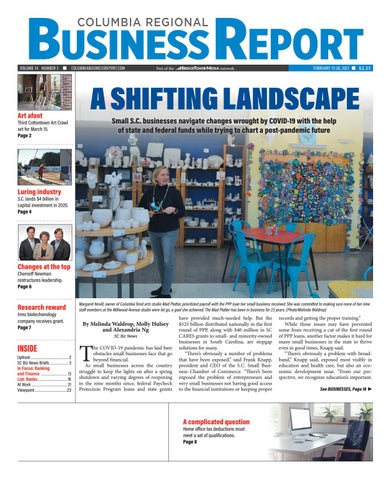
Margaret Nevill, owner of Columbia fired arts studio Mad Platter, prioritized payroll with the PPP loan her small business received. She was committed to making sure none of her nine staff members at the Millwood Avenue studio were let go, a goal she achieved. The Mad Platter has been in business for 23 years. (Photo/Melinda Waldrop)
By Melinda Waldrop, Molly Hulsey and Alexandria Ng
T
SC Biz News
he COVID-19 pandemic has laid bare obstacles small businesses face that go beyond financial. As small businesses across the country struggle to keep the lights on after a spring shutdown and varying degrees of reopening in the nine months since, federal Paycheck Protection Program loans and state grants
have provided much-needed help. But the $525 billion distributed nationally in the first round of PPP, along with $40 million in SC CARES grants to small- and minority-owned businesses in South Carolina, are stopgap solutions for many. “There’s obviously a number of problems that have been exposed,” said Frank Knapp, president and CEO of the S.C. Small Business Chamber of Commerce. “There’s been exposed the problem of entrepreneurs and very small businesses not having good access to the financial institutions or keeping proper
A complicated question Home office tax deductions must meet a set of qualifications. Page 8
records and getting the proper training.” While those issues may have prevented some from receiving a cut of the first round of PPP loans, another factor makes it hard for many small businesses in the state to thrive even in good times, Knapp said. “There’s obviously a problem with broadband,” Knapp said, exposed most visibly in education and health care, but also an economic development issue. “From our perspective, we recognize education’s important. See BUSINESSES, Page 18
Upfront
BRIEFS | FACTS | STATEWIDE NEWS
Are you planning to get the vaccine?
T
A LA CARTE
Takeaways
59%
The good news is, unlike neighboring N.C. or Georgia, the lowest county in South Carolina dipped just below 59%. Georgia hit 51.5% and N.C. hit 52.0%
77,186,384
The MIT data shows that 25% of Americans would not accept the vaccine if it were available to them at this moment. That’s around 77 million people.
48%
Terrebonne Parish, La., owns the stats for the lowest acceptance rate for the vaccine. Of course, this could change as more data and information becomes available to those in the Bayou State.
92%
Residents of Arlington County, Va., aren’t shunning the vaccine. The county has the highest percentage of people lining up to get the jab.
HEARD IN THE
REPORT
Photo/Provided
his question is bouncing around businesses and homes across South Carolina as people struggle with not only figuring out if they can get the coronavirus vaccine at this moment, but if they should. What happens if they don’t? Will their employer mandate getting jabbed? That issue is explored in the At Work section on page 21. Whether you’re in the group that wants the shot or the group that isn’t sure, what’s clear from a recent Massachusetts Institute of Technology analysis of South Carolinians shows that if you’re in Beaufort County or Charleston County, you’re more likely to be looking for the shot than residents in other counties. MIT used data from Carnegie Mellon University’s Delphi Lab, which is working with Facebook and the Centers for Disease Control and Prevention to analyze attitudes during the pandemic. The research took place during the first two weeks of January 2021. The researchers used data from surveys from the CDC and the Pew Research Center to verify their own results.
Will you get the vaccine in these South Carolina counties?
More than 60% of residents in 19 of South Carolina’s 46 counties said they would get the shot today if it was available. Researchers used nearby data for counties with fewer than 100 respondents, which is why 26 counties have rates of 59.6%.
County
Likely to get the shot
County
Likely to get the shot
Charleston Beaufort Georgetown Horry Berkeley Richland York Greenville Aiken Lexington Orangeburg Greenwood Laurens Dorchester Spartanburg Anderson
78.1% 77.2% 72.7% 69.4% 68.5% 68.2% 67.7% 67.6% 66.8% 66.3% 65.5% 65.1% 64.0% 63.0% 62.3% 62.2%
Florence Oconee Pickens Abbeville Allendale Bamberg Barnwell Calhoun Cherokee Chester Chesterfield Clarendon Colleton Darlington Dillon Edgefield
62.1% 61.7% 61.5% 59.6% 59.6% 59.6% 59.6% 59.6% 59.6% 59.6% 59.6% 59.6% 59.6% 59.6% 59.6% 59.6%
County
Likely to get the shot
Fairfield
59.6%
Hampton
59.6%
Jasper
59.6%
Kershaw
59.6%
Lancaster
59.6%
Lee
59.6%
McCormick
59.6%
Marion
59.6%
Marlboro
59.6%
Newberry
59.6%
Saluda
59.6%
Union
59.6%
Williamsburg
59.6%
Sumter
58.9%
Vaccine attitudes across the Southeast The Southeast has the county with the highest acceptance rate in the U.S. for the coronavirus vaccine and the county with the lowest acceptance rate. Welcome to the dichotomy of the South. *Denotes highest and State Highest Lowest State Highest Lowest lowest percentages Virginia 92.4%* 66.1% Louisiana 78.0% 48.4%* in the U.S. North Carolina 87.7% 52.0% Arkansas 77.1% 61.4% Kentucky 82.5% 64.2% Georgia 76.7% 51.5% Sources: MIT, Centers for Disease Control and Florida 81.0% 59.5% Alabama 75.2% 56.4% Prevention, Carnegie Tennessee 80.0% 58.6% Mississippi 70.8% 59.3% Mellon University, South Carolina 78.1% 58.9% Facebook
“Part of our mission as a bank has been to make sure we have a thriving, vibrant economy across all communities, and it happened that this pandemic has really highlighted the disparities between different communities when it comes to business success.”
Third Cottontown Art Crawl set for March 13 The third annual Cottontown Art Crawl will be held March 13, with 82 local artists selling their work at 40 neighborhood locations. The outdoor event encompasses several city blocks and will take place from 10 a.m. until 3 p.m. Social distancing and masks will be required. The art crawl was first held in 2019, when the Columbia Council of Neighborhoods named it its neighborhood program of the year. “The Cottontown neighborhood is looking forward to supporting the Columbia arts scene on March 13th,” event organizer Julie Seel said in a news release. “Artists will be selling their work throughout the entire neighborhood. Some of the artists are emerging, some are quite accomplished, and some are award winning, juried artists. So we truly have something for every level of art enthusiast.” The free event will also feature a scavenger hunt with prizes and live music at Indah Coffee’s outdoor stage. Information and maps will be available at the event host station at 2150 Sumter St.
— Dominik Mjartan, president and CEO, Optus Bank
WEBSITE: www.ColumbiaBusinessReport.com
FOLLOW US:
@CRBR
facebook.com/ColumbiaBusinessReport
February 15 - 28, 2021
www.columbiabusinessreport.com 3
SC Biz News Briefs
ZF’s Gray Court plant opened in 2012 and currently employs 2,200 people. The company is investing $200 million in a automatic transmission production line. (Photo/Provided)
GRAY COURT
GSA Business Report
Vehicle transmission manufacturer ZF plans production line in Laurens County
V
ehicle transmission manufacturer ZF plans to invest $200 million to launch its PowerLine eight-speed automatic transmission production line at its Gray Court facility in Laurens County by 2023. The investment is slated to create 500 jobs, according to a news release. “ZF is a 106-year-old technology leader that has been in the U.S. for many decades, and this investment in U.S. manufacturing of sustainable driveline technology further proves our commitment to the North American commercial vehicle market,” Martin Fischer, president and board of management member of ZF North America, said in the news release. “Together now with WABCO, ZF offers customers around the world an unrivaled product portfolio that includes driveline, steering, braking, ADAS technologies and telematics, coupled with a full-service network.” The 1,687,000-square-foot Gray Court plant, located at 2846 N. Old Laurens Road, is strategically located near BMW, Michelin and other top global suppliers in Greenville, according to the release. Since opening in 2012, the facility has produced 5.5 million automatic transmissions and employs 2,200 people. Worldwide, ZF Group has around 260 locations in 41 countries. “We started production in 2012 with our eight- and nine-speed automatic transmissions and quickly became a center of manufacturing excellence,” Thomas Joos, vice president of ZF Transmissions Gray Court, said in the release. “As a result, we’ve been expanding our manufacturing footprint since our grand opening. With the support of a dedicated workforce and collaborative regional partners, we are looking forward to adding the PowerLine to our facility.” The plant currently has the capacity to produce 1.2 million transmissions each year. ZF’s PowerLine transmission, first produced at its German plant in late 2020, will be used in medium-duty commercial vehicle trucks, buses and heavy-duty pickup trucks with the potential to be used in plug-in hybrid vehicles, according to the release.
FAST. UNFILTERED. FRESH.
SodaCityBizWire.com
Dedicated to serving up business announcements fast & unfiltered.
Get your message in front of the top decision-makers in the Midlands as they stay up-to-date on the people and businesses making moves in the Midlands.
BEST ADVICE
VOLUME 24 NUMBER 3 ■ GSABUSINESS.COM
Part of the
network
Bobby Cummings, founder, president Cummings Wealth Management
FEBRUARY 8 - FEBRUARY 21, 2021 ■ $2.25
PAGE 4 VOLUME 27 NUMBER 3 ■ CHARLESTONBUSINESS.COM
Part of the
FEBRUARY 8 -21, 2021 ■ $2.25
network
Bringing representation into STEM sector By Teri Errico Griffis
More consolidation Cummins to bring Memphis operations to North Charleston facility. Page 5
Greenville baseball team operators supplement lost season with events. Page 13
TOWERING STRENGTH
Genetic services in demand
Greenwood Genetic Center secures grant to help meet rising expectations. Page 6
Model engineers Clemson engineers encourage STEM for minority students. Page 12
Unemployment
Additional federal benefits begin reaching Palmetto State in January. Page 11
INSIDE
Leading Off .......................... 2 SC Biz News Briefs ................ 3 C-Suite ................................ 4 In Focus: Banking and Finance ............................. 17 LIST: Banks ........................ 18 At Work ..............................22 Viewpoint ...........................23
rowing up, Wysheka Austin loved drawing, and excelled in math and science. But she had no idea how to translate those skills into a career. She considered architecture. With few resources at home to guide her, Austin turned to her career center where her
principal, Pernice Adams, offered a life-changing intervention. Adams encouraged the teen to apply her skill set toward pre-engineering classes and connected her with a teacher that could provide hands-on experience. Austin admits she’d never heard of engineering before then. “You don’t necessarily have to see where you’re going in order to go, though,” she said of taking that first class. Trident Technical College plans to use space at the college’s Berkeley campus to provide a course for commercial driver training. (Photo/File)
By design
Report: Greenville to be decade’s most resilient county
Charleston’s new architect immersing herself in design of historic city. Page 8
Team designs bridges, light poles from turbine blades
Summerville metal company purchased by New Yorkbased company. Page 7
Growth, costs bode well for the 2020s. See page 8.
G
tgriffis@scbiznews.com
By Molly Hulsey
W
ind farmers face a colossal quandary that is only growing with the size of turbine blades, some that are now almost the length of a football field. Turbine blades have a maximum life span of 25 years, according to Russell Gentry, director of Georgia Institute of Technology’s Master of Science program in architecture and principal investigator of Project Re-Wind, an American-Irish-Northern Irish partnership seeking to bring new life to retired blades. Today, thousands of blades are being decommissioned after an eight or 15-year career as engineers are discovering that longer blades boost airflow and air resistance. The fiber-reinforced polymer used in the
massive blades — many reaching almost 165 feet long — is expensive, nonbiodegradable and, so far, not recyclable. “Unfortunately, they’re leaving a lot of wind blade turbines out there with no additional use,” said Vikash Patel, one of the founders of Greenville-based supply chain management firm, Logisticus Group. Often, it costs wind farmers $300 to $500 a ton just to dispose of the blades in a landfill even at their present size, Gentry said. “The upkeep and maintenance of wind energy assets is a huge issue because these turbines go into service for 25-plus years and no big machine runs forever,” he said. And that doesn’t even include the expenses incurred from transporting and grinding up the decommissioned blades — which is where Logisticus steps in to serve wind farms across
the country. The company has been searching for a way to make this process more cost-effective and sustainable for clients. “Already, we’ve seen a certain percentage of them shift from a landfill to renewable sources, and right now the major solution that’s kind of on the docket is using them in cement, so there’s a large portion of the blades that are now moving down that path,” Patel told GSA Business Report. He estimated that in 2020, 90% of all blades were trucked to the landfill. The new year has brought that percentage down to 25%. Most of these solutions are what industry professionals call “down grading.” The blades might be ground up or melted down to be used as filler in a concrete countertop or as See TURBINES, Page 14
In Focus
Leading the charge
One analyst tells why he thinks Spartanburg is poised for roaring back. Page 17
GSABusinessReport.com
New era
Chernoff Newman restructures, sees shifts in executive leadership team. Page 11
INSIDE
Upfront ................................ 2 SC Biz News Briefs ................ 3 Best Advice .......................... 4 In Focus: Architecture, Engineering and Construction ............... 13 List: Engineering Firms ......24 At Work ..............................29 Viewpoint ........................... 31
WINTER 2020
See ENGINEERING, Page 6
Home office tax deductions require more than COVID By Teri Errico Griffis
T
Metal merger
mhulsey@scbiznews.com
She described the moment she fell in love with engineering as a literal light bulb moment — connecting wires and batteries in class to make her first bulb illuminate. Today, Austin has carried that passion into a senior operations manager at General Electric and is one of two Clemson alumni being honored at the BEYA STEM Global Compet-
MOVING STUFF
Trident Technical College receives $1 million foundation grant for the Truist Transportation and Logistics Center, the first part of a multiphase plan to renovate the 38-year-old Berkeley campus into a training facility for high-demand jobs. Page 10
tgriffis@scbiznews.com
he IRS may have pushed the start of tax season to Feb. 12, but it’s never too early to start preparing — especially if you’re thinking about writing off your home office as a tax deduction. Millions of Americans have been forced to work from home for most of 2020 because of the pandemic shutdowns, but that doesn’t mean W2 workers can suddenly claim their home office — especially when it’s a makeshift set up on your dining room table, local tax professionals said. With the Targeted Jobs and Tax Cut Act of 2018, W2 employees can no longer write off their home office, said Clint Hulsey, tax director at Atlantic Coast Tax & Accounting Inc. in West Ashley. “It used to be that if you worked for an employer and had a W2 from them, and worked from home some of the time and out of that office, you were able to deduct some of those expenses, even working on behalf of your employer,” Hulsey said. “Things changed with the new tax laws in 2018.” While some may be disappointed they can’t
Home grown Consumer demand for local food surges as pandemic alters eating habits
See HOME, Page 9
CHARLESTON UNDER CONSTRUCTION
SC Biz News 1802 Dayton Street Suite 101 North Charleston, SC 29405
Driving into a new season
ELECTRONIC SERVICE REQUESTED
With publications in the Upstate, Columbia and Charleston, as well as a statewide magazine, SC Biz News covers the pulse of business across South Carolina. Above are excerpts from our other publications.
Who is building what in the Charleston area? Projects, companies, prices, projected timelines, photos and stories. Page 13
County Spotlight: Horry | Trending: Agriculture in S.C. | S.C. Delivers
CharlestonBusiness.com
SCBIZmag.com
For advertising information, contact Lucia Smith at (803) 726-7547 or lsmith@scbiznews.com
4
www.columbiabusinessreport.com
February 15 - 28, 2021
MIDLANDS NEWSROOM Editor - Melinda Waldrop mwaldrop@scbiznews.com • 803.726.7542
MIDLANDS ACCOUNT EXECUTIVE Senior Account Executive - Lucia Smith lsmith@scbiznews.com • 803.726.7547
LOWCOUNTRY NEWSROOM Executive Editor - Andy Owens aowens@scbiznews.com • 843.849.3142 Editor, Custom Publishing Division Steve McDaniel smcdaniel@scbiznews.com • 843.849.3123 Digital Assistant Editor - Alexandria Ng ang@scbiznews.com • 843.849.3124 Research Specialist - Paige Hardy phardy@scbiznews.com • 843.849.3125 Research Assistant - Anne Puckett apuckett@scbiznews.com • 843.849.3145 Staff Writer - Teri Errico Griffis tgriffis@scbiznews.com • 843.849.3144
UPSTATE NEWSROOM Editor - Ross Norton rnorton@scbiznews.com • 864.720.1222 Associate Editor, Custom Publishing Division Jim Tatum jtatum@scbiznews.com • 864.720.2269 Staff Writer - Molly Hulsey mhulsey@scbiznews.com • 864.720.1223
South Carolina’s Media Engine for Economic Growth
President and Group Publisher - Grady Johnson gjohnson@scbiznews.com • 843.849.3103
Nephron’s $215.8 million expansion was part of the $4 billion in capital investment recruited to South Carolina in 2020 and the state’s fourth-most lucrative project. CEO and owner Lou Kennedy signs a beam during a ceremony celebrating a construction milestone last November. (Photo/Melinda Waldrop)
S.C. recruits $4 billion in capital investment in 2020
I
Staff Report
n 2020, South Carolina won 126 economic projects, accounting for $4 billion in capital investment and 11,147 jobs. The S.C. Department of Commerce’s annual industry recruitment report (.pdf) showed an increase from 2019, when the state recruited $2.4 billion in economic investment. Mark Anthony Brewing Co.’s $400 million investment in a new production facility in Richland County topped capital investment projects landed in 2020 and is projected to bring 300 jobs to state. “Team South Carolina continues to cultivate a diverse economy in all corners
of our state,” S.C. Secretary of Commerce Bobby Hitt said in a news release. “To increase our recruitment to $4 billion in capital investment, particularly during an unprecedented year, takes a remarkable amount of collaboration and unwavering commitment from many partners across this state.” The Agriculture Technology Campus in Hampton County ranked second in capital investment $314 million and brought the most projected jobs to the state with 1,500, followed by Walmart’s new distribution center in Dorchester County, which is projected to create 1,000 jobs. The distribution center accounted for $220 million in capital investment,
while Nephron Pharmaceuticals Corp.’s Lexington County expansion accounted for $215.8 million (fourth) and 380 jobs (sixth). New projects made up 54% of the 2020 investment, with expansions accounting for 46%. The majority of investment was domestic, with 64% from U.S. companies, followed by 10% from Canada and 6% from China. Among specified industry sectors, agribusiness brought in nearly 3,000 jobs, and while urban projects represented 72% of 2020 investment, capital investment in S.C.’s rural communities nearly doubled year-over-year, topping more than $1.1 billion.
Creative Director - Ryan Wilcox rwilcox@scbiznews.com • 843.849.3117
SUBSCRIPTION INFORMATION
Events Account Executive - Melissa Tomberg mtomberg@scbiznews.com • 864.720.1220 Events Manager - Kim McManus kmcmanus@scbiznews.com • 843.849.3116 Accounting - Robin Tillotson ar@pbmbrands.com • 336.605.1025 Subscription Services service@bridgetowermedia.com • 877.615.9536 CUSTOM MEDIA DIVISION Director of Business Development - Mark Wright mwright@scbiznews.com • 843.849.3143
Columbia Regional Business Report (USPS 8400) is published twice a month, except monthly in January, May, June, and August, with special supplements in July and December, by SC Biz News. 1612 Marion Street, Suite 301 Columbia, SC 29201-2938 Periodicals postage paid at Columbia, SC. Mailing address: 1612 Marion Street, Suite 301 Columbia, SC 29201-2938. Postmaster: Please send address changes to: Subscription Services PO Box 1051 Williamsport, PA 17703-9940
Annual subscribers receive 20 issues of the Business Report, including two special supplements: the Book of Experts and the Book of Lists. One year (20 issues) for $57.95; Two years (40 issues) for $92.95; Three years (60 issues) for $129.95. Subscribe, renew, change your address or pay your invoice by credit card online at www.columbiabusinessreport.com or call 877-615-9536.
NWS Company LLC A portfolio company of BridgeTower Media
The entire contents of this newspaper are copyright by NWS Company LLC with all rights reserved. Any reproduction or use of the content within this publication without permission is prohibited. SCBIZ and South Carolina’s Media Engine for Economic Growth are registered in the U.S. Patent and Trademark Office.
©2021 NWS Company LLC
February 15 - 28, 2021
www.columbiabusinessreport.com 5
Belk Inc. enters debt restructuring agreement
B
Staff Report
elk Inc. has entered into a debt restructuring agreement with its majority owner, Sycamore Partners. Under the restructuring support agreement announced Jan. 26, Sycamore a private equity firm based in New York, will retain majority control of the Charlotte-based department store, according to a news release from Belk. Members of an ad hoc crossover lender group led by global investment firms KKR Credit and Blackstone Credit will acquire a minority ownership in the company. The transaction, to be completed through an expedited reorganization under
Chapter 11 of the U.S. Bankruptcy Code, is expected to be finalized by the end of February, according to the release. The plan will reduce debt by approximately $450 million and extend maturities on all term loans to July 2025, according to the release. Belk has received $225 million in financing commitments from Sycamore, along with KKR Credit and Blackstone Credit as well as first lien term lenders. Current suppliers will continue to be paid “in the ordinary course for all goods and services provided to the company,” which plans to continue normal operations throughout the restructuring process, according to the release. Belk, which opened its first store in
1888, has nearly 300 stores in 16 Southeastern states. In December 2020, it announced plans to invest $2.5 million in improvements to its Blythewood distribution center. “Belk has a 130-year legacy of providing quality products at great prices,” Belk CEO Lisa Harper said. “Like all retailers navigating COVID-19, our priority has been the safety of our associates, customers and communities. As the ongoing effects of the pandemic have continued, we’ve been assessing potential options to protect our future. We’re confident that this agreement puts us on the right long-term path toward significantly reducing our debt and providing us with greater financial flexibility
to meet our obligations and to continue investing in our business, including further enhancements and additions to Belk’s omnichannel capabilities.” Kirkland & Ellis LLP is serving as legal adviser, Lazard is serving as financial adviser, and Alvarez & Marsal North America LLC is serving as restructuring adviser to Belk. Latham & Watkins LLP is serving as legal advisor to Sycamore Partners. Willkie Farr & Gallagher LLP is serving as legal advisor and PJT Partners LLP is serving as financial advisor to the ad hoc crossover lender group, while O’Melvney & Myers LLP is serving as legal advisor and Evercore is serving as financial advisor to the ad hoc first lien lender group.
S.C. Senate confirms Simmer as DHEC director
T
Staff Report
he S.C. Department of Health and Environmental Control officially has a new director. The S.C. Senate on Thursday confirmed Dr. Edward Simmer as DHEC director. The agency’s board selected Simmer in Decem-
ber after a nationwide search to replace Rick Toomey, who resigned in May 2020. Simmer, selected from a pool of 83 applicants, was most recently the CEO of TRICARE Health Plan and previously served as the CEO and commanding officer at the Naval Health Clinic in Oak Harbor, Wash. He retired from the Navy on Dec. 31.
Simmer, a native of Cleveland, Ohio, received his medical degree from Saint Louis University and holds a master’s in public health with a focus in epidemiology from Eastern Virginia Medical School. He is board-certified in general and forensic psychiatry by the American Board of Psychiatry and Neurology and has an admin-
istrative psychiatry certification from the America Psychiatric Association. He was also COO of the Naval Hospital in Beaufort from October 2010 until May 2012. “It is an honor to be called on to serve the state that I proudly call home during this unparalleled moment in the history of our state and nation,” Simmer said.
D E V E LO P YO U R WO R K F O R C E W I T H ON-DEMAND TRAINING
Helping South Carolina Companies Grow
SCMEP now offers SCMEP Online, a new online training portal specifically for manufacturers. We realize time is valuable and flexible online learning provides critical training in a wide array of operational disciplines.
Learn how SCMEP Online can streamline your training program by visiting SCMEP-ONLINE.org COLUMBIA 250 Berryhill Road, Suite 512 Columbia, SC 29210 (803) 252-6976
GREENVILLE 250 Executive Center Drive, Suite 200 Greenville, SC 29615 (864) 288-5687
SCMEP is a not-for-profit 501(c)3 organization affiliated with The National Institute of Standards and Technology’s (NIST) Hollings Manufacturing Extension Partnership (MEP), a network of more than 60 MEP centers across the U.S. and Puerto Rico.
6
www.columbiabusinessreport.com
February 15 - 28, 2021
Chernoff Newman restructures with new leadership By Teri Errico Griffis
O
tgriffis@scbiznews.com
ne of South Carolina’s oldest marketing and public relations firms is undergoing a seismic shift as it prepares for a new generation of leadership. As it celebrates its 50th anniversary, Chernoff Newman has appointed new executive leadership over its advertising and public relations and agency operations. The restructuring went into effect Jan. 1. This is the third succession plan for Chernoff Newman, something Peter LaMotte, the new president of public relations, says plays to the company’s strengths to lead clients through disciplines that best serve them. “Only 2% of agencies survive a succession, and this is now our third. ... If we didn’t have this continual evolution, we wouldn’t be able to take our clients into the future,” he said. “We wouldn’t be as successful as we have been, not only this past year, but over the last few decades.” LaMotte has been with the agency since 2016 and will lead public relations services, such as issues management and social media resources. The company, which is headquartered in South Carolina, has offices in Charleston, Columbia, Charlotte and Orlando, Fla. The other major promotions include Heather Price to president of advertising, where she will oversee creative operations and client engagement teams, and David Campbell to COO. After 25 years on the finance and operations team, Campbell now oversees the agency’s finances, media/channel strategy and information technology. Together the three balance one another out, LaMotte said. “The reason why this matters in South Carolina is because it’s a legacy stalwart entity in the communication space,” LaMotte said. “When things go wrong, we’re there. When companies are trying to make an impact and become known, Chernoff Newman is the one that’s brought to the table.” Lee Bussell will remain chairman and CEO and an active member of the company along with vice chairmen Rick Silver and David Anderson. Together, the second-generation leaders established ownership of the agency in 1971. Price called the succession plan an expansion of leadership and said the company is always focused on growth.
Peter LaMotte (left) will serve as Chernoff Newman’s new president of public relations in a restructuring of the marketing and public relations firm’s leadership. Heather Price (center) is now president of advertising and David Campbell is COO. The statewide firm, celebrating its 50th anniversary, has offices in Columbia, Charleston, Charlotte and Orlando, Fla. (Photo/Provided)
“If we didn’t have this continual evolution, we wouldn’t be able to take our clients into the future.” Peter LaMotte President of public relations, Chernoff Newman
“It’s a part of our DNA to figure out ways to stay in business, to bring new peers in and to really look for ways to help our clients,” she said. Price has been with the agency for 24 years and was hired in the midst of the second succession. She saw the agency’s merger with Chernoff Silver, and watched it expanded from a single office in Columbia throughout South Carolina and Florida. All along, she watched as the agency solved clients’
issues in creative, strategic ways. “That’s something that’s a part of our history and something that will be part of our future going forward,” she said. The succession of leadership began rolling in 2019 when Chernoff Newman partnered with Prolific, a strategic consultant firm in Indianapolis, LaMotte said. The evolution will allow the company to expand its services as it grows its team and footprint beyond the Southeast. “When they invested, in large part, they were able to bring more shareholders, and we were able to have this transition of leadership,” he said. Chernoff Newman works with clients around the globe, specializing in food and beverage, health care, energy, real estate, workforce development and more. It’s been a part of major events with some of the biggest industries and agencies throughout the state, including the campaign to take the confederate flag off the capitol building, the road tax campaigns, Walmart and more. “You have this balance that you really don’t find anywhere else in the Southeast, in South Carolina. It is this
idea of having global agency in your backyard,” LaMotte said. “And that’s what we do. We make sure that we are partners with our clients and serve them in a way that really makes us integral to their success.” Campbell, LaMotte and Price will be joined in the new ownership group by Tye Price, executive vice president and chief brand strategist; Adam Bernstein, APR, senior vice president and general manager of the Charlotte office; and Prolific. “Our firm’s success and longevity have been anchored in an entrepreneurial, forward-thinking spirit that has served our clients well and created greater opportunities for our professional team members,” Bussell said in a statement. “As we mark 50 years in business in 2021, a new generation of leadership signals Chernoff Newman’s continued commitment to offering fully integrated and influential communications that serve the evolving needs of business and other key sectors across the Southeast and the nation.” Reach Teri Errico Griffis at 843-849-3144.
February 15 - 28, 2021
www.columbiabusinessreport.com 7
Rebranding complete for Cayce, West Columbia chamber
T
Staff Report
he Greater Cayce West Columbia Chamber & Visitor’s Center has been rebranded as the Greater CWC Chamber & Visitor Program. The three-month rebranding process was steered by a committee made up of appointed businesses leaders from Cayce and West Columbia. MPA Strategies CEO Ashley Hunter managed the project, while Black Barn Brand Designs’ Joe
Long served as graphic designer. “It speaks volumes that there was no need to look outside of our own Chamber members to procure all of the collateral items for the complete rebrand and to provide an array of new member services that focused both on keeping the cost of doing business low for Chamber businesses and bringing new visitors to the area,” Hunter said in a news release. The new look was presented to the chamber at a Jan. 26 meeting.
“We are excited to announce the culmination of the rebranding initiative,” said Tim James, Greater CWC president and CEO. “This three-month process has been led by partners who possess a pas-
sion to promote the unique spirit of our wonderful community. We know this re-fresh will positively affect our tourism and business programs.” Rebrand committee members were: Kathy Whetzel of Whetzel Automotive, Anastasia Manos of Zesto, Ashley Lambert of Steel Hands Brewing, Allison Brumfield of Lexington School District Four, Michael Mayo of Palmetto Outdoor, Chris Kueny of Sub Station II and Phil Blair of WECO Bottle and Biergarten.
Irmo biotechnology company receives $900,000 grant
I
Staff Report
ntegrated Micro-Chromatography Systems Inc., an Irmo-based biotechnology company known for developing recombinant proteins and enzymes, has been awarded a $900,000 Small Business Innovation Research FastTrack grant from the National Institutes of Health. The grant will fund research into the production of affordable gangliosides, biomolecules that contain sugars and a
type of lipid called ceramides and play critical roles in various biological processes. IMCS will synthesize and modify gangliosides to increase researchers’ understanding of how the biomolecules, well-suited for therapeutic and diagnostic applications, affect neurological functions. The grant will be headed by L. Andrew Lee, Ph.D., co-founder and Chief Scientific Officer of IMCS, in conjunction with Xi Chen, Ph.D., chemistry professor at the University of California, Davis. In
addition to its portfolio of enzymes, IMCS provides technologies to pharmaceutical companies, academic medical centers and contract research organizations to develop antibody and gene therapy. Ronald Schnaar, pharmacology professor at the Johns Hopkins University School of Medicine, likened the grant’s approach to building with Legos. Schnaar, who is not involved in the grant, said that the technology presented creates a flexible system that would allow scientists to use molecular building blocks called
glycans to create a library of gangliosides that could be used for a variety of research applications. “If you give us the pieces to build the Lego (structure), we can generate the tools to study anything from cell activity to testing potential therapeutics,” Schnaar said in a news release from SCBIO, an economic development organization focused on building and growing South Carolina’s $12 billion life sciences industry. “You can use this to build anything. You can build a mimetic library.”
Get back to business – safely. Call today about workplace entry solutions.
| On-site COVID-19 Testing | On-site Antibody Testing | On-site Flu Shots
Doctors Care Employer Health Services | DOT Physicals | Workers’ Compensation | Drug Screens | Occupational Medicine | On-site Biometrics | On-site Medical Centers
Employers.DoctorsCare.com
Jonathan Pent Business Developer
(803) 726-0477
(888) 845-6887 | Sales@DoctorsCare.com
8
www.columbiabusinessreport.com
February 15 - 28, 2021
Photo/File
Home office tax deductions require more than COVID By Teri Errico Griffis
T
tgriffis@scbiznews.com
he IRS may have pushed the start of tax season to Feb. 12, but it’s never too early to start preparing — especially if you’re thinking about writing off your home office as a tax deduction. Millions of Americans have been forced to work from home for most of 2020 because of the pandemic shutdowns, but that doesn’t mean W2 workers can suddenly claim their home office — especially when it’s a makeshift setup on your dining room table, S.C. tax professionals said. With the Targeted Jobs and Tax Cut Act of 2018, W2 employees can no longer write off their home office, said Clint Hulsey, tax director at PGI Financial Services in Mount Pleasant. “It used to be that if you worked for an employer and had a W2 from them, and worked from home some of the time and out of that office, you were able to deduct some of those expenses, even working on behalf of your employer,” Hulsey said. “Things changed with the new tax laws in 2018.” While some may be disappointed they
can’t write off a home office for 2020, especially when the inconvenience was forced upon them, most weren’t itemizing anyway, Russell Deal, partner at accounting firm McCay Kiddy LLC, said. So the 2018 changes were actually a “simplification” for them. “Most Americans are taking the standard deduction so they’re basically replacing that deduction that you have to calculate with a much larger standard deduction,” he said. For those who have an LLC or are a sole proprietor working out of their house, the deduction is still available. Those individuals can write off direct expenses, such as office supplies, a second phone line strictly for the business or any direct office expenses. Additionally, they can write off percentages of their home upkeep. “You can write off repairs or maintenance that are for that space in their entirety, and then you also can take repairs for the entire home in proportion to how much of that space is your home office,” Deal said. That’s to say if you have a 2,000 squarefoot home, and a 200 square-foot space dedicated solely as office space, you can write off 10% of your electricity bills for the year, your internet, lawn care — even
your HVAC repair. The space must be exclusively and regularly dedicated to an office space, however, not a makeshift dining table set up or a converted guest room that has dual use, Hulsey said. Were you to be audited, the IRS would disallow deductions of the improperly categorized space for however many years you’ve taken them. “What people don’t understand is it has to be a completely separate room, separated from the rest of the house and used only for the office and for earning money for the business. It can’t be shared in any kind of personal way,” he said. Another key point is that self-employed married couples are not allowed to take two deductions for the same space. Expenses can be split 50/50 on each Schedule C or all deductions can be listed on one. Should a married couple have two separate office spaces, however, then they can each claim their deductions on separate Schedule C forms. Though writing off a home office is advantageous, there are cons, including that you’re supposed to depreciate the cost of your house in proportion to the space, Deal said. “Because you’re getting a deduction for that depreciation, you could end up with
depreciation recapture when you sell your house, when normally if you’re exemption threshold, it would be a non-taxable event,” he said. Normally when you sell your house, if you’re single and have a gain of less than $250,000 on it, you don’t pay taxes, Deal explained. If you depreciated part of that house in prior years, however, you will pay tax on the gain that came from that depreciation. So you’re essentially creating a taxable event for yourself when you sell your house. “The other downside is that for your primary residence where property taxes were preferentially taxed, I’ve had a few people have the county come back to them and say 30% is a home office, therefore you can’t get that 4% rate, the homestead exemption, for the portion of your house,” he said. “They then have to pay the higher property tax rate on that percentage of their house.” Whatever deductions are applicable to your business, above all, Deal encourages everyone not to wait to file. Tax rates are “as low as they can be” and with a new administration, that could change, he said. Reach Teri Errico Griffis at 843-849-3144.
February 15 - 28, 2021
www.columbiabusinessreport.com 9
Benedict College president 1 of 13 scholarship recipients
R
Staff Report
oslyn Clark Artis, president of Benedict College, is one of 13 recipients of the Association of American Colleges and Universities -Cengage Inclusion Scholarship. The scholarship, presented with education technology company Cengage, recognizes currently serving college and university presidents whose leadership has reduced educational equity gaps, improved inclusion for minority students and reformed hiring practices to promote greater diversity. The recipients were announced Jan. 22. “We are so excited to be able to support these amazing higher ed leaders who are making a real difference by reducing inequities and increasing access to education,” Fernando Bleichmar, Cengage executive vice president and general manager for U.S. higher education, said in a news release.
“ ... the work of these leaders is so critical in giving students the opportunity to better their lives and in creating an educated, informed and just society.” Fernando Bleichmar Executive vice president, Cengage
“At Cengage, we believe learning transforms lives, and the work of these leaders is so critical in giving students the opportunity to better their lives and in creating an educated, informed and just society.” Dwaun Warmack, president of Claflin University in Orangeburg, joined Artis as an S.C. award recipient. The selected presidents will each receive a one-year AACU&U campus membership and a one-year membership in the organization’s Presidents’ Trust, a network of education CEOs, according to the release.
“AAC&U is proud to recognize and support these exceptional leaders in their efforts to advance equity and quality as hallmarks of a liberal education across a diverse range of campuses and student populations,” organization president Lynn Pasquerella said. The following college presidents received recognition: • Sandra Boham, Salish Kootenai College, Pablo, Mont. • Roslyn Clark Artis, Benedict College, Columbia, S.C. • Karrie G. Dixon, Elizabeth City
State University, Elizabeth City, N.C. • Harry E. Dumay, College of our Lady of the Elms, Chicopee, Mass. • Alicia B. Harvey-Smith, Pittsburgh Technical College, Oakdale, Pa. • Walter M. Kimbrough, Dillard University, New Orleans, La. • Valerie Roberson, Roxbury Community College, Boston • Ron Rochon, University of Southern Indiana, Evansville, Ind. • Christina Royal, Holyoke Community College, Holyoke, Mass. • Yves Salomon-Fernández, Greenfield Community College, Greenfield, Mass. • Ivy R. Taylor, Rust College, Holly Springs, Miss. • Dwaun J. Warmack, Claflin University, Orangeburg, S.C. • David Yarlott Jr., Little Big Horn College, Crow Agency, Mont.
Richland County completes 2015 flood buyouts
R
Staff Report
ichland County has completed property buyouts from the historic 2015 flood, acquiring and demolishing 57 damaged properties, and is now turning its focus to rebuilding and repair efforts. Through funding from the Federal Emergency Management Agency’s Hazard Mitigation Grant program, the county acquired property including substantially damaged homes in designated flood plains. The county has worked with property owners, the majority in the Gills Creek and Denny Terrace areas of Columbia, through the voluntary program since August 2018, according to a news release from the county.
The land affected properties occupied is being returned to its natural state to mitigate future flooding issues, according to the release. “While it is certainly a relief to have the buyouts and demolitions completed, what is most satisfying to our team is being able to provide relief, support, comfort and assistance to our residents who suffered unimaginable loss due to the flood event,” Mike King, Richland County’s local disaster recovery manager, said in the release. “We hope our efforts helped them, in a small way, return to a normal life.” The last of the eligible properties was demolished last month, the county said. The final properties were townhomes, and the owners of two chose not to par-
“We hope our efforts helped them, in a small way, return to a normal life.” Mike King, Richland County local disaster recovery manager
ticipate in the program. County crews carefully completed the demolition to leave those townhomes intact and added
exterior walls for the remaining structures, according to the release. Richland County is now completing the formal closeout process for the buyout program with the S.C. Emergency Management Division and FEMA. Its rebuilding and repair efforts utilize federal Community Development Block Grant-Disaster Recovery funds, which help low- to moderate-income families who were living in owner-occupied homes during the flood. To date, improvements have included 31 rebuilt homes, 81 repaired homes and 56 mobile homes replaced, the county said. A video detailing the impact of the 2015 flood and Richland County’s response is available online.
10
www.columbiabusinessreport.com
February 15 - 28, 2021
Prisma launches COVID units in response to surge By Molly Hulsey
G
mhulsey@scbiznews.com
reenville, Spartanburg and Richland counties counted the highest numbers of COVID19 deaths in the state since March 2020, according to a recent report from the S.C. Institute of Medicine and Public Health and the S.C. Department of Health and Environmental Control. The study, covering data from March 4, 2020, through Jan. 24, 2021, records 6,578 total deaths with 16% of the deaths occurring during the past month, starting on Jan. 3. Although those counties saw the most deaths, Pickens, Dillon and Florence counties had the highest prevalence of COVID-19 cases over the past year, according to the report. In response to the uptick of cases across the Upstate and Midlands, Prisma Health announced it will open three regional COVID-19 recovery units in partnership with the S.C. Emergency Management Division, S.C. DHEC, the National Guard and the S.C. Hospital Association. The recovery units will serve all hospital systems during a COVID-19 surge. The first unit opened at the Laurens County Hospital on Jan. 25 with 29 beds,
followed by a 12-bed unit at the Prisma Health Tuomey Hospital in Sumter on Jan. 27. A 12-bed unit at Columbia’s Prisma Health Baptist Hospital is slated for an opening as early as next week and could expand to 36 beds. “Laurens was chosen because it is between the two markets, the Upstate and the Midlands, and so if we have this surge — as we did — in the Upstate and the Midlands, we’re easily able to pivot and move patients to and from either of the markets from that central location,” Dr. Karen Lommel, Prisma Health physician lead for the regional recovery unit strategy, said during a Jan. 27 press conference. “So they were chosen based on need, location and where the current surge was or where we anticipate it based on the numbers we’ve received.” Lower acuity patients in recovery from COVID-19 who still require impatient care can be transferred to the units if they meet certain criteria to open up intensive care beds for those with more critical needs, according to Lommel. Alongside a team of 125 nurses, respiratory therapists, clinicians and support personnel, including S.C. EMD staff and 20 National Guard members will join Prisma in treating unit patients.
“This is not just about providing surge beds for COVID-19 patients,” Lommel said. She added that the units will be a temporary solution until March or April as needed but could undergird future health care needs during natural disasters such as hurricanes. “We’re thrilled to have been a part of the planning process for this new approach,” Thornton Kirby, CEO and president of the S.C. Hospital Association, said in a news release. “With it in place, we hope we can ease the burden on our health care systems and help them continue to provide the outstanding care that our communities depend on.” On Dec. 31, 81.8% of all inpatient beds across the state were occupied, according to the Institute of Medicine and Public Health and S.C. DHEC report. Out of 60 hospitals across the state, 42 reported a critical staffing shortage over the past year, exacerbated by cases among health care workers. Since March of last year, 43 health care workers and 28 senior care facility staff members have died from the virus. “More than 277,000 doses of vaccine have been administered in South Carolina and more than 313,000 COVID19 vaccine appointments are currently
scheduled,” Dr. Linda Bell, state epidemiologist, said in the release. “While we are happy, relieved and hopeful the COVID-19 vaccine is here, supplies are currently limited in South Carolina and across the country. “Our overarching goal is to save lives, and this important brief informs us of how the initial limited vaccine supply can be used for populations indicated to be at highest risk of complications and death due to COVID-19.” Dr. Saria Carter Saccocio, a family care physician with Prisma Health, noted that while the health care system is the largest distributor of the vaccine in the state at 82,428 distributed doses, the demand far exceeds the supply due to shortages in the national supply chain. More than 142,000 are pre-scheduled through Prisma to receive the vaccine. “As expected, our vaccine supply is now lower than we have requested,” she said. “Last week, we administered more than 42,000 doses and have exhausted all of that supply. This week, we have requested 58,600 doses but received 19,500. “That’s only a third of what we’ve requested.” Reach Molly Hulsey at 864-720-1222 or @mollyhulsey_gsa on Twitter.
AI technologies see gradual phase into recruiting toolkit By Molly Hulsey
A
mhulsey@scbiznews.com
rtificial intelligence isn’t just finding a home on the factory floor. It’s becoming a fixture of the industrial staffing world as well. Human resource professionals at large manufacturers like Volvo are actively developing effective AI solutions to screen extensive numbers of applicants before they build a relationship with a recruiter. Kevin Graham, director of plant engineering at Volvo Cars in Charleston, spoke on the company’s efforts at pioneering new data collection and processing software for their human resource departments at November’s SC Manufacturing Conference. “Automotive work is difficult yet rewarding,” Graham said during his opening keynote. “It takes the right person to handle the rigor of building vehicles, so attracting the right talent is critical. We’ve explored various AI tools to help us through the screening process and identify the right talent at the earliest stage.”
The company hasn’t yet started to use of the technology, but he said AI-driven tools will be critical in the future from a cost and efficiency standpoint, especially as Volvo ramps up its production and workforce. “Before we move forward with any of these tools for this specific function, we are learning how to properly utilize this capability and how it fits into our recruitment process,” he said. According to a 2019 national survey by CEIPAL, 73% of recruiters planned to adopt AI technologies to streamline their jobs by the end of 2021 if they hadn’t already. That’s 94% of all respondents who were aware of AI at all. All respondents agreed that that AI would help build relationships with clients while there was some strong disagreement on whether these technologies would eliminate human bias in the hiring process or not. Hiring companies with more than 100 recruiters led the way in plans to adopt additional AI technologies, but medium and small companies with under 50 recruiters didn’t lag far behind either. Still, while some firms are learning to adopt AI for tedious data-collection tasks,
they continue to prioritize the personal when it comes to screening candidates. Sean Thorton, principal owner of Kudzu Staffing, a 35-employee recruiting company with seven locations across the Carolinas and Georgia, received word from his insurance company and other recruiting cohorts that 2019 was the year to take his database to the cloud. Through a $15,000 investment, the Greenville-based company purchased hybrid AI and human-powered e-recruiting software TalentWorks in 2020, Thorton said. “It’s new staffing software that’s going to be housed in the cloud instead of on our site due to cyber security,” he said, adding that the company’s current database is hosted onsite with redundant servers. The software is an added safeguard against identity theft but will also help streamline paperwork processing for recruits and cuts down on in-person face-to-face time during a pandemic. The growth in popularity of Zoom interviews, while not automated, also underscores Kudzu’s rapid adaptation from the analog to digital over the past year under the new software.
“Instead of someone having to drive from Newberry all the way to Greenville to do a 30-minute interview … you can do all your paperwork and do your interview and we can check the background and reference checks all virtually,” he said. Kudzu Staffing is doing about half of their interviews virtually now. He expects that in five years, 90% of all interviews will be online, especially for the industrial staffing field. The company also uses an applicant tracking system to vet employee’s direct deposit information but believes that the system falls short for vetting candidates. It omits the personal relationship between the recruiter and candidate in favor of a few keywords, he said. “That’s one thing that Kudzu prides itself on is personal relationship — knowing the client’s birthday, knowing the employee’s birthday and knowing the client’s kids — actually learning about the person,” he said, adding that this touch is the key to learning whether a candidate will be a good fit for a client. Reach Molly Hulsey at 864-720-1222 or @mollyhulsey_gsa on Twitter.
February 15 - 28, 2021
www.columbiabusinessreport.com 11
3D-printing company to expand in York County
3
Staff Report
D Systems, a global additive manufacturing solutions company, is investing $13 million in an 100,000-square-foot expansion of its York operations. The expansion, to be completed in early 2022, is slated to create 50 jobs at plant. “We’re excited to expand 3D Systems’ presence here at our headquarters in York County,” Jeffrey Graves, president
and CEO of 3D Systems, said in a news release. “We look forward to enhancing our facilities and growing our workforce to not only accelerate our innovation but to contribute to the economic development of Rock Hill and South Carolina.” The company, founded in 1986, helped bring three-dimensional printing to the manufacturing industry. The company serves the health care, aerospace, defense, automotive and durable good markets with additive manufacturing solutions including 3D printing, software and business services. Its advanced materials have
applications in medical implants, space exploration and NASCAR. “The expansion of 3D Systems further emphasizes that Rock Hill fosters an atmosphere in which businesses can thrive,” Rock Hill Mayor John Gettys said in the release. “We strive to build business relationships that lead to success for the community as a whole, offering more opportunities to our citizens. 3D Systems is on the cutting edge of technology, and we are proud they call Rock Hill home.” The investment will increase man-
ufacturing capabilities at the Rock Hill facility, located at 333 Three D Systems Circle, with the construction of the new building. “We are thrilled to see this long-standing industry leader continue to grow and evolve their advanced manufacturing operations,” York County Council Chair Christi Cox said in the release. “We are thankful to have 3D Systems in our community, not only providing quality jobs, but showcasing York County’s strong manufacturing presence. This is great news for our county and our state.”
Southeastern Freight Lines recognized as top S.C. employer
S
Staff Report
outheastern Freight Lines, headquartered in Lexington, has been named the best employer in South Carolina by personal finance website GOBankingRates. The site used data from market research company Statista, media branding and technology company Forbes, and job posting and company review website Glassdoor
to compile information, including number of employees and how current and former workers view employers. Southeastern Freight Lines, founded in 1950 in what in now its Columbia service center with eight employees, has grown to 89 nationwide service centers in 13 states, Canada and Puerto Rico. The company would be recommended by 81% of an unspecified number of respondents to a friend, the rankings
found. “We are honored to receive this acknowledgment from GOBankingRates, compiled based off feedback from our current and past employees,” Richard Slater, Southeastern vice president of field sales, said in a news release. “It is the culmination of the over 8,500 people who work at Southeastern who represent our values, our brand, and our commitment to serving with excellence in all that we do. We
understand that in order to create this culture and standard of excellence across our organization, we must be invested in the well-being of each of those individuals, and this award is a testament that this commitment is real.” In addition to its corporate office in Lexington, Southeastern has regional service centers in Columbia, Greenville, Charleston, Florence and Augusta, Ga., which employ more than 1,100 workers.
Carolinas Project Center is a brand-new project leads database. You'll find well over 1,500 projects in a searchable, trackable database where fresh projects are loaded daily. It's simple: The more projects you see; the more you will bid on; and the more opportunities you will have to make money.
• Construction, government, and project • bid listings and documents • New bids uploaded daily • "View Projects" page allows you to search • "My Preferences" custom account criteria • "My Projects" track your projets
Carolinas Project Center is a new service brought to you by
CarolinasProjectCenter.com
Join today! Go to bit.ly/ProjectCenterNow
Take a tour! Sign up at bit.ly/projectcentertour
12
www.columbiabusinessreport.com
February 15 - 28, 2021
Team designs bridges, light poles from turbine blades By Molly Hulsey
mhulsey@scbiznews.com
W
ind farmers face a colossal quandary that is only growing with the size of turbine blades, some that are now almost the length of a football field. Turbine blades have a maximum life span of 25 years, according to Russell Gentry, director of Georgia Institute of Technology’s Master of Science program in architecture and principal investigator of Project Re-Wind, an American-Irish-Northern Irish partnership seeking to bring new life to retired blades. Today, thousands of blades are being decommissioned after an eight or 15-year career as engineers are discovering that longer blades boost airflow and air resistance. The fiber-reinforced polymer used in the massive blades — many reaching almost 165 feet long — is expensive, nonbiodegradable and, so far, not recyclable. “Unfortunately, they’re leaving a lot of wind blade turbines out there with no additional use,” said Vikash Patel, one of the founders of Greenville-based supply chain management firm, Logisticus Group. Often, it costs wind farmers $300 to $500 a ton just to dispose of the blades in a landfill even at their present size, Gentry said. “The upkeep and maintenance of wind energy assets is a huge issue because these turbines go into service for 25-plus years and no big machine runs forever,” he said. And that doesn’t even include the expenses incurred from transporting and grinding up the decommissioned blades — which is where Logisticus steps in to serve wind farms across the country. The company has been searching for a way to make this process more cost-effective and sustainable for clients. “Already, we’ve seen a certain percentage of them shift from a landfill to renewable sources, and right now the major solution that’s kind of on the docket is using them in cement, so there’s a large portion of the blades that are now moving down that path,” Patel told GSA Business Report. He estimated that in 2020, 90% of all blades were trucked to the landfill. The new year has brought that percentage down to 25%. Most of these solutions are what industry professionals call “down grading.” The blades might be ground up or melted down to be used as filler in a concrete countertop or as kiln fuel. And those options aren’t cheap either. “Finding a secondary solution is generally more expensive than landfilling by probably one and a half to two times the cost,” Patel said. “So, a big hurdle that a
Photo/File
lot of blade owners had to get over is the additional cost of finding a secondary use instead of landfilling them.” So when the Logisticus team met Georgia Tech’s segment of the Re-Wind team at an industry conference a year and a half ago, they became fast-friends. Re-Wind needed blades for its research in “upscaling” the polymer components into infrastructural products, ranging from soil stabilizers to light poles to pedestrian bridges. The group also needed supply chain experts able to hash out the costs and logistics of shipping these titanic parcels to-and-fro across the country when Re-Wind’s two pending patents hit the commercial market. “We’ve been in the industry for 15 years,” Patel said. “We pride ourselves in trying to be involved with the newest technologies and the newer solutions. And so that when this problem arose, we really took it as an internal challenge to see how we could really help the industry, but also at the same time, give ourselves a solution in the market that would keep us relevant for future years to come.” The link was solidified with a threeyear U.S. National Science Foundation Partnerships for Innovation grant awarded to Georgia Tech and Logisticus announced last November, adding to financial backing from the Science Foundation of Ireland and the Department for the Economy of Northern Ireland, which supports Re-Wind research at University College Cork and Queen’s University Belfast. The City University of New York faculty and students also contributed to the project. “Ireland is a great testbed for our research because they have a lot larger kind of commitment to wind energy,”
Gentry said, given the island’s limits on energy resources like timber or coal. The Re-Wind teams in Cork and Belfast are spearheading an initiative to use the blades as the weight-bearing component in 20- to 60-foot long pedestrian bridges, especially for use in the island’s rails-to-trails greenways, much like Greenville’s Swamp Rabbit Trail. Hundreds of bridges will be needed for those projects over the next 10 years, he said. Georgia Tech is backing Irish colleagues on the bridge program with engineering work, but research and development on this side of the pond tends to favor the vertical: “blade poles” used to hold electrical powers lines, cell phone equipment or signs. Gentry and Re-Wind co-founder Larry Bank have worked in the infrastructure composite field for 25 years, primarily researching the composite materials used for the aerospace industry but also for concrete reinforcement, structural elements in bridges or buildings or materials in golf clubs or bike frames. Composites similar to the fiber-reinforced polymers used to make turbine blades that, transport costs aside, would be relatively cost-free for a manufacturer to procure from a wind farm after they retire. In fact, wind farmers would pay the manufacturers a part of the decommissioning cost for the blade. “Of course, these materials are bespoke, they’re expensive, but they’re extremely high performance,” Gentry said. “So we can’t really build entire buildings or bridges out of them, but in certain conditions, especially highly corrosive environments, they’re really quite effective structural products just for everyday buildings and bridges.” The Georgia Tech team is expecting
a shipment of components from 10 GE 37-meter blades from Logisticus within a month or so, which will be used by faculty, lab staff and architecture and engineering students for structural, finite element and life-cycle analysis, as well as in full-scale prototypes tested in the school’s Digital Fabrication Library. Researchers have also developed a proprietary algorithm for a tool called the “blade machine,” according to a news release. Within a year, Gentry hopes to be able to show off his team’s work to Logisticus and other partners — including future investors — through a full-scale demonstration of a blade bridge and blade pole. “That will capture people’s imagination. If people can walk on it. People can see it in use,” he said. “Demonstrating the commercial viability of products from reused materials is a real challenge.” Still, the project already has hooked its first client, an independent power provider in the Midwest. Students have voiced interest in startup plans for commercialization. Fans have flooded voicemail boxes with ideas for the blades like those used in playgrounds in Holland or bus stops. And even after six years on the project, the scale of the blades and how they can be used still captures Gentry’s imagination too, he said. “I’m a professor in architecture and civil engineering. So, one side of what we do is about creating possibility, and the other side is about [the] pragmatic: does the material meet the requirements? I’d say the joy is in trying to combine both.” Reach Molly Hulsey at 864-720-1222 or @mollyhulsey_gsa on Twitter.
In Focus
BANKING AND FINANCE
NEXT ISSUE’S FOCUS: Health Care
LISTS: Banks, Page 16
Photo/File
Banks gearing up for 2nd round of PPP loans By Christina Lee Knauss
P
Contributing writer
hones started ringing and messages started flying at many financial institutions around South Carolina when the second round of funding for the federal government’s Paycheck Protection Program loans launched Jan. 11. Representatives from banks around the state say while there is not the overwhelming level of panic many business owners felt in the early days of the coronavirus pandemic, a lot of people are still in need of money to keep their businesses going. Some sectors of the economy have recovered to a point, they say, but others — particularly tourism — are still suffering from a lack of customers and
the ongoing uncertainty of when the pandemic might ease enough to get the economy back to full strength. To help alleviate long wait times and a backlog of applications, the Small Business Administration is working to streamline the application process for lenders and applicants. As of Jan. 26, anomalies which could slow down the process were found in about 4.7% of data submitted by lenders nationwide, according to the administration. By late January, the SBA had already approved more than 400,000 loans for about $35 billion. The workload has gone up dramatically in the past few weeks at Columbia’s Optus Bank, according to President and CEO Dominik Mjartan. During the first round of PPP funding in 2020, the bank received 700 appli-
cations and was able to fund 511 loans. By Feb. 3, less than a month into the second round, the bank already had 600 applications in the pipeline, many of them from first-round recipients still needing assistance. “We are overwhelmed with demand,” Mjartan said. “We are a bank of 25 employees, and we’ve hired 10 people in the past month just to handle the influx of requests for PPP loans. It’s taking a lot of effort but we want to make this process work for those we serve.” Optus prioritizes investment in low-income communities and offers loans to minority- and women-owned businesses, precisely the communities that need the bank’s PPP funds the most, Mjartan said. “Many of the businesses that we
have been able to serve through the PPP program have been those who are also the most vulnerable — black- and women-owned small businesses that also have employees who are most likely to be on the front lines during the pandemic,” Mjartan said. “Part of our mission as a bank has been to make sure we have a thriving, vibrant economy across all communities, and it happened that this pandemic has really highlighted the disparities between different communities when it comes to business success.” In the first round of lending in 2020, Optus Bank made 511 loans for a total of $40.5 million, with the median loan amount of $22,000. Mjartan said one business only needed See PPP, Page 15
14
IN FOCUS: BUSINESS AND FINANCE
www.columbiabusinessreport.com
February 15 - 28, 2021
THE NEWEST ADDITION TO THE SC BIZ NEWS FAMILY What’s new on SCBIZtv this week? Check us out on YouTube. With more than 100 archived videos (and counting), you’ll find a wide variety of businessrelated content, including: Virtual awards shows, Power Events, interviews with high-level business executives and several ongoing video series, including Coffee With…, 120 Seconds, Industry Trends and Coping with Covid. Here’s just a taste of what you’ll find on SCBIZtv this week
VIRTUAL AWARDS SHOWS
120 SECONDS
COFFEE WITH…
COPING WITH COVID
From Women of Influence in the Upstate to Forty Under 40 in the Lowcountry to Icons and Phenoms in the Midlands, you’re sure to find executives you know being honored in a variety of ways.
Business executives sharing insight about their business, the industry in which they work and the community in which they live.
CEOs answering as many questions as they can in two minutes. You’ll definitely learn something personal about the executive and get a thoughtful answer on a serious topic to boot.
Explores the impact the Coronavirus is having on our daily lives, both at home and at the office.
This is just a sampling of what you’ll find on SCBIZtv. Check us out on YouTube to find a complete library of archived videos.
IN FOCUS: BUSINESS AND FINANCE
February 15 - 28, 2021
www.columbiabusinessreport.com 15
PPP, from Page 13
$500, while one of the largest loans for $1.8 million went to an area nonprofit. While the bulk of Optus’ PPP funding went to small businesses, Mjartan said the bank also provided funding to nonprofits that experienced pandemic-related financial problems as they tried help many of the same communities that Optus does. Second-round loan applications have been steady but not overwhelming at the statewide branches of Charleston-based S.C. Federal Credit Union, said John Stanford, vice president for lending. As of Feb. 3, the credit union had received 92 requests for PPP loans, down from the 138 they had received at the same stage of the application process during the first round. The credit union, like thousands of other institutions across the country, was “bombarded by demand” from small businesses who are its core customers when the first round of funding went out last year. Stanford said branches immediately heard from service-oriented businesses like salons, gyms, spas and day cares who were forced to shut their doors, as well as restaurants whose revenue dried up when dining rooms had to close. During the first round, the credit union also provided loans to landscaping businesses, roofers, and other building-related companies who were facing uncertainty. They also helped several churches who lost vital revenue from collection baskets when Sunday services were forced to go virtual. By far the hardest hit among South Carolina Federal’s customers in the first round were seasonal and touristfocused businesses in the Charleston area, Stanford said. That hasn’t changed, he said, with the number of travelers visiting the state still way down. Tourism businesses are among those who have already reached out to the S.C. Federal Credit Union for help during the second round, he said, and consulting businesses and other sole-proprietor firms that rely on one-on-one meetings also are still hurting. The biggest difference in the second round? The dollar amount that businesses are requesting has gone up dramatically, Stanford said. “We’re finding that a lot of our larger businesses still need help, and the majority of the requests are second applications,” he said. “The tourism industry is still hurting badly, and as we’re relationship-based as a credit union, we’ve been trying to be proactive, reach out to the customers we served during the first round to check on them and see how they’ve done.” Demand for second-round PPP loans has been steady at Wells Fargo branches around South Carolina. As of Feb. 5, Wells Fargo had received 1,648 completed applications requesting a total of $83 million. The bank had booked 246
Dominik Mjartan, president and CEO of Columbia-based Optus Bank, said the bank made 511 loans in the first round of the Paycheck Protection Program, ranging from $500 to $1.8 million. He said demand for the second round of PPP loans has been overwhelming. (Photo/Jeff Blake/www.JeffBlakePhoto.com)
“This is a complex program and there are banks that have decided not to take part because they don’t have the luxury to spend two hours processing a $500 loan. They’re not able to work with the micro businesses, not because they don’t care but because they don’t have the resources.” Dominik Mjartan CEO, Optus Bank
loans for a total of roughly $8 million, and the average loan side was a little more than $33,000. “With this second round, the biggest difference is that we don’t have the mad dash for funding that we had when the first round of loans started, because back then there was a lot of panic,” said Mitch Graul, Wells Fargo’s small business segment leader for the Southeast. “Now we are seeing a good, steady volume of applications. The need is still there but the panic is not there.” Graul said that Wells Fargo is continuing to see many requests for new PPP loans from service-oriented businesses and the hospitality sector, particularly restaurants and businesses related to tourism. Wells Fargo is also giving a lot of attention to underserved communities being hit the hardest by the pandemic, Graul said. The bank has made an effort to reach out to minority and women-owned businesses through efforts like the Open for Business Fund, which was started with fees from the first round of PPP lending and now has targeted $400 million to help businesses in underserved communities.
“We’ve been looking at data like a recent survey that showed that about 50% of minority owned businesses in some areas were not able to pay their rent, and about 35% of those were women-owned,” Graul said. “With this second round of loans, we’re really trying to reach these communities and let them know that the program is back on and we’re here for them.” Banks are doing what they can to get information about the PPP program to customers who need it most. Wells Fargo in the Southeast has launched a targeted email outreach to 380,000 small businesses owned by minorities and women. Optus Bank has been working with the city of Columbia, Richland County and other Midlands organizations to provide webinars and other information for business owners. People who took out loans during the first round of PPP funding last year will have an idea of how the process works, but what about those who are new to the process? The key thing to remember is that while the application process can seem daunting at first, it’s workable, according to Stanford. “This time around, with this being the second round and with the demand
not being so overwhelming all at one time, the technology has caught up,” Stanford said. “While it’s important to get the application process going, there’s still time, and there’s plenty of money available.” Business owners seeking a PPP loan for the first time should get their information together and reach out to their primary financial institution first to see if they are doing PPP loans, Mjartan said. Not every bank or credit union is offering them because of staffing and logistical challenges. “This is a complex program, and there are banks that have decided not to take part because they don’t have the luxury to spend two hours processing a $500 loan,” Mjartan said. “They’re not able to work with the micro businesses, not because they don’t care but because they don’t have the resources.” Two things applicants should do at this point? Relax and have patience. Mjartan stressed the fact that there is still time to get paperwork together and make the contacts needed. Above all, he asks stressed-out applicants to take a deep breath and realize that it might take some time to reach someone by phone or email — but you will hear from someone. “Most institutions that are doing these loans are struggling right now to keep up with the demand,” Mjartan said. “A lot of friends I have in this field are mission-driven, and they are all working incredibly hard to get people what they need. Know that you have people that are genuinely committed to this cause who are still going to be able to help you.”
16
www.columbiabusinessreport.com
IN FOCUS: BUSINESS AND FINANCE
February 15 - 28, 2021
Banks
Ranked by Market Share Company
Phone / Website / Email
Top Local Official(s) / Year Founded
Bank of America N.A. 1901 Main St. Columbia, SC 29201
803-255-7555 www.bankofamerica.com -
Wells Fargo Bank N.A. 1441 Main St. Columbia, SC 29201
Market Share
Market Deposits
Market Offices
Kim A. Wilkerson 1904
26.85%
$7,211,640
15
800-869-3557 www.wellsfargo.com -
J. Holt Chetwood 1852
26.57%
$7,136,005
27
Truist Bank 1201 Main St. Columbia, SC 29201
803-251-1300 -
Kelly S. King 1891
10.65%
$2,858,889
24
First Citizens Bank & Trust Co. 1230 Main St. Columbia, SC 29201
803-771-8700 www.firstcitizens.com -
Sharon W. Bryant 1898
9.56%
$2,568,770
32
Synovus 1221 Main St. Columbia, SC 29201
803-929-2010 www.synovus.com info@synovus.com
John C. Griggs, C.W. "Chuck" W. Garnett 1905
6.23%
$1,673,905
13
South State Bank 520 Gervais St. Columbia, SC 29201
803-771-2265 www.southstatebank.com -
Jack Goettee, Montague Laffitte 1934
5.16%
$1,384,457
15
TD Bank N.A. 1501 Main St. Columbia, SC 29201
803-540-2750 www.tdbank.com -
Greg Braca 1852
3.21%
$861,992
13
First Community Bank 5455 Sunset Blvd. Lexington, SC 29072
803-951-2265 www.firstcommunitysc.com -
Michael C. Crapps 1995
3.14%
$843,895
13
First Palmetto Bank 407 E. Dekalb St. Camden, SC 29020
803-432-2265 www.firstpalmetto.com support@firstpalmetto.com
Samuel R. Small 1904
1.45%
$388,197
9
Southern First Bank 190 Knox Abbott Drive Cayce, SC 29033
803-223-6400 www.southernfirst.com btaylor@southernfirst.com
Cal Hurst, Mike Dowling, Art Seaver, Jr. 2000
1.29%
$345,834
3
Ameris Bank 1333 Main St., Suite 200 Columbia, SC 29201
803-765-1600 www.amerisbank.com -
H. Richard Sturm 1971
1.02%
$273,596
3
GrandSouth Bank 1901 Assembly St. Columbia, SC 29201
803-470-1000 www.grandsouth.com -
David Anderson 1998
0.68%
$181,552
2
Farmers & Merchants Bank of South Carolina 8624 Old State Road Holly Hill, SC 29059
803-496-3430 www.fmbsc.com info@fmbsc.com
John L. Hutto 1912
0.47%
$126,569
5
United Bank 1219 Knox Abbott Drive Cayce, SC 29033
803-404-5260 www.bankwithunited.com customerservice@bankwithunited.com
Kevin T. Adams 1839
0.47%
$126,610
2
Optus Bank 1545 Sumter St. Columbia, SC 29201
803-733-8100 www.optus.bank support@optus.bank
Dominik Mjartan 1999
0.43%
$114,758
2
Regions Bank 1010 Gervais St. Columbia, SC 29201
803-779-3836 www.regions.com -
John Sturm 1928
0.43%
$116,605
2
Security Federal Bank 1900 Assembly St. Columbia, SC 29201
803-739-3940 www.securityfederalbank.com bank@securityfederalbank.com
J. Chris Verenes, Philip R. Wahl, Scott Hagler 1922
0.42%
$113,611
4
First Horizon Bank 1320 Main St., Suite 175 Columbia, SC 29201
803-779-0411 -
Bryan Jordan 1864
0.41%
$111,287
3
Because of space constraints, sometimes only the top-ranked companies are published in the print edition. Although every effort is made to ensure accuracy, errors sometimes occur. Email additions or corrections to research@scbiznews.com.
Source: Federal Deposit Insurance Corp. deposit market share report as of June 30, 2020 Researched by Business Report staff
IN FOCUS: BUSINESS AND FINANCE
February 15 - 28, 2021
www.columbiabusinessreport.com 17
Banks
Ranked by Market Share Company
Phone / Website / Email
Top Local Official(s) / Year Founded
First Reliance Bank 2805 Sunset Blvd., Suite A West Columbia, SC 29169
803-936-4888 www.firstreliance.com customercare@firstreliance.com
The Bank of Clarendon 235 W. Wesmark Blvd. Sumter, SC 29150
Market Share
Market Deposits
Market Offices
Brent Mackie 1999
0.37%
$99,981
2
803-469-0156 www.bankofclarendon.com customerservice@bankofclarendon.com
J. Barry Ham 1939
0.31%
$82,863
2
The Citizens Bank 1225 Alice Drive Sumter, SC 29151
803-469-2626 www.thecitizensbank.cc info@thecitizensbank.cc
H. Blake Gibbons 1943
0.2%
$53,157
2
First National Bank of South Carolina 12181 Old No. Six Highway Eutawville, SC 29048
803-492-7727 www.fnbsc.com -
Laurie Dantzler 1905
0.2%
$52,672
2
Arthur State Bank 5051 Sunset Blvd. Lexington, SC 29072
803-951-2800 www.arthurstatebank.com -
Rhonda J. Hughey 1997
0.13%
$35,388
4
PNC Bank N.A. 701 Gervais St. Columbia, SC 29201
803-256-2731 www.pnc.com -
Will Holmes 1985
0.12%
$30,933
1
Coastal Carolina National Bank 1219 Assembly St., Suite 101 Columbia, SC 29201
803-733-2582 www.myccnb.com -
Eugene Massey 2009
0.1%
$25,906
1
Enterprise Bank of South Carolina 7222 Festival Trail Road Springfield, SC 29146
803-258-3211 www.ebanksc.com -
K. Reid Pollard 1920
0.07%
$18,278
1
Woodforest National Bank 10060 Two Notch Road Columbia, SC 29223
803-736-6165 www.woodforest.com info@woodforest.com
James Dreibelbis 1958
0.07%
$18,708
7
Because of space constraints, sometimes only the top-ranked companies are published in the print edition. Although every effort is made to ensure accuracy, errors sometimes occur. Email additions or corrections to research@scbiznews.com.
Source: Federal Deposit Insurance Corp. deposit market share report as of June 30, 2020 Researched by Business Report staff
We can help you get there from here. At Synovus, we combine valuable local insight with the financial strength and depth of services to meet almost any business need, large or small. Here is where we have the understanding to share your vision and the resources to help you get there. Let’s talk today. 1-888-SYNOVUS | synovus.com
Synovus Bank, Member FDIC.
18
www.columbiabusinessreport.com
BUSINESSES, from Page 1
Health care’s important. But there’s also the economic part of that. How can we expect these rural communities to actually develop good, successful business communities if there’s no broadband there? This is as much an economic development issue, statewide broadband, as it is a health care issue, as it is an education issue.” The second round of PPP loans were initially targeted to address those that might have fallen through the cracks in 2020. When the program re-opened in January, only Community Financial Development Institutions, which serve underrepresented communities, could apply for loans in its first week, and the U.S. Small Business Administration said it was prioritizing small businesses in the $284 billion allocated for job retention, property damage costs, operations expenditures, supplier costs and worker protection through March 31. “Many of the businesses that we have been able to serve through the PPP program have been those who are also the most vulnerable — black- and women-owned small businesses that also have employees who are most likely to be on the front lines during the pandemic, businesses such as food service, restau-
February 15 - 28, 2021
rants, service-oriented companies,” said Dominik Mjartan, president and CEO of Columbia-headquartered Optus Bank. “Part of our mission as a bank has been to make sure we have a thriving, vibrant economy across all communities, and it happened that this pandemic has really highlighted the disparities between different communities when it comes to business success.” In the first round of PPP, Knapp said only 16% of S.C. small businesses received loans. The S.C. Small Business Chamber of Commerce released a report last September analyzing available business closure data in three areas through the first week of September. The report found that 580 businesses in Horry County, Rock Hill and Hilton Head had closed, with 30.5% of closures in the personal services sector, 29.7% among contractors and 20.5% in the retail industry. Chamber research also found that statewide, new business license applications dropped by 946, a decline of 31.2%, from April through July 2020 as compared to the same period in 2019. Four of the nine S.C. counties that require business licenses, along with 13 municipalities, provided information for the business license analysis. “Obviously, we lost a lot of small businesses,” Knapp said. “A lot of the small
S.C. CARES relief grant programs
Nearly 3,000 small, minority owned businesses and nonprofit organizations in South Carolina received $65 million in relief aid to mitigate the impact of falling business and reduced donations.
Minority and Small Businesses
2,284
Number of minority and small businesses receiving grants under the S.C. Cares program
$40,000,000
The exact amount awarded to thousands of small and minority businesses.
$25,000
874 businesses received the largest amount, which was $25,000.
$2,500
12 businesses received the lowest awarded grants of $2,500.
$17,513.13
The average award was more than $17,500 under the minority and small business award program.
Nonprofit organizations
686
Number of nonprofit organizations receiving grants under the S.C. Cares program
$25,000,000
The exact amount awarded to nonprofit organizations in South Carolina.
$50,000
203 nonprofits received the highest awarded grants of $50,000.
$2,500
Seven nonprofits received the lowest awarded grants of $2,500.
$36,443.15
The average award was more than $36,000 under the nonprofit award program. Source: S.C. Department of Administration, S.C. Biz News
businesses, especially in the minority community, and very small businesses, especially in the hospitality industry, have gone away. How many totally? We’ll have to wait until somebody does some census work.” While Knapp said “the only way things will get back to some semblance of normal” will be when the spread of the virus is controlled by vaccines, he said there are concrete steps the state can take going forward. Public-private partnerships which help incentivize statewide broadband access must be pursued, and training and access to capitalization for small businesses increased. To help small, minority-owned businesses and nonprofit organizations, the General Assembly passed the SC CARES Act, which was signed by Gov. Henry McMaster in September. The act made $65 million available to small businesses and nonprofits to mitigate the impact of the pandemic. Grant applications flooded the S.C. Department of Administration, quickly exhausting the funds. “It’s almost like no-brainers,” Knapp said. “When there’s no crisis, (it’s) ‘We’re doing fine, we’re doing OK.’ Now we have a crisis, and we see, ‘Oh, we should’ve taken care of it.’ Hopefully, we will.”
Columbia arts studio adapting daily to a changing normal
Margaret Nevill’s first priority was paying her staff. Nevill, owner of Columbia fined arts studio The Mad Platter, was determined to keep all nine of her employees on staff as the COVID-19 pandemic forced changes to her business model at her 23-year-old store on Millwood Avenue. She used PPP loans to help meet that goal. “When you’ve lost more than 60% of your business for the year, you’re struggling to reach every month’s bills, every month’s payroll, and no, I did not let people go,” said Nevill, who also received $17,680 from the SC CARES Act. “I was making sure my staff was paid. … Payroll was my priority. After payroll, it was rent and utilities.” The Mad Platter was one of 2,284 S.C. minority and small business which received $40 million in SC CARES grants, according to data from the S.C. Department of Administration. Six hundred and eight-six nonprofits received $25 million. Nationally, the U.S. Small Business Administration coordinated the distribution of 5.2 million PPP loans worth $525 billion. Nevill said the process of obtaining the federal loan was “absolutely seamless,” once she found the right person to talk to. “I banked with a larger, big bank, someone that’s across many states. When PPP came out, they did not offer any assistance to me,” she said. “I got no notice. It was really hard. I have a personal banker who my husband and I have used for our home and for my husband’s busi-
Online database of SC CARES grants
Small, minority businesses and nonprofit organizations received $65 million through a relief program passed by the S.C. General Assembly last year. Use the QR code or the web addresses below for a searchable, sortable database from SC Biz News. Minority and small businesses Scan QR code or go to bit.ly/sc-msb
Nonprofit organizations Scan QR code or go to bit.ly/sc-np
nesses. He reached out to us immediately and said how can I help you? His bank, Security Federal, it’s a local bank, and they made it seamless for us.” Nevill was quick to share that bit of wisdom with colleagues in a national pottery association she belongs to, and when the big bank she had used for decades finally reached out to her as the second round of PPP funding geared up at the start of 2021, she was no longer a customer. “I talk about being a small local business and supporting small local business, and here I was banking with a national bank who offers no local business service to people, a bank that I’ve been with for 23 years,” she said. “No one at the branch that I banked with thought about reaching to the smaller, local people.” Knapp said that experience is not unusual in the anecdotes he’s heard from small business owners. “We’ve heard a lot about how the major national banks weren’t as friendly to the real small businesses as local community banks,” Knapp said. “The reason for that is these financial institutions are profit-based institutions, and when given the opportunity to either do something for their major, well-established clients that are going to ask for a million dollars or, hey, I got Joe Blow over here and he’ll probably only want $10,000 or $15,000 — they’re not going to be my priority of attention. “The law was written, literally, in the regulation, that it was first come, first served. That absolutely did not happen.” Knapp said the problem of larger loans being processed first seems to have been corrected in the second round of PPP loans. Nevill has already applied for a second round of loans as she keeps tabs on
February 15 - 28, 2021
www.columbiabusinessreport.com 19
Minority and small businesses: Midlands counties Richland County Number of businesses: 329 Total amount of money: $5,580,178.89 Average award: $16,961.03 Lexington County Number of businesses: 99 Total amount of money: $1,804,242.96 Average award: $18,224.68
Limestone University in Gaffney used $2.7 million in emergency educational funding, along with a PPP loan, to sustain its programming and reach out to students, including its online community. (Photo/Provided)
changing business regulations and community response. The Mad Platter, after a spring and early summer of to-go pottery sales only, began taking table reservations for indoor and outdoor seating for pottery creation and painting last fall. “For years, we were just an open studio. You walked in, we had a table for you, things were great,” Nevill said. “We had to pivot again and decide how to do more like a restaurant would do so that we could clean tables, clean chairs, clean paint containers, things like that. “There’s a whole other step to doing business now. … We’re an art studio, so we have to think outside of the box, traditionally. That’s what we’re doing. We’re just, each day, trying to figure out what might be better for us next week or a month down the road.” While the SC CARES grant and the PPP loan helped, Nevill said those things are not a long-term solution for struggling small business owners. “As a small business, you say, OK, I’ve got three to four months of backup that I can use for rent, I can use for payroll, I can use for X,Y,Z,’ and then all of a sudden, your three to four months is gone,” she said. “Those things did help, but I think people that don’t own businesses don’t understand that they decide the size of the loan they’re giving you. ... I think people think, ‘Oh, you got the money, you’re OK. You’re forgiven.’ If you don’t own a business, you don’t understand. It is an ongoing process. … These loans have been great, but it’s not the answer.”
Limestone College’s mission: Keep serving all its students
Cherokee County’s Limestone University is no stranger to virtual learning. “We have one of the largest online enrollments in South Carolina,” President Darrell Franklin Parker told GSA Business Report. “But our online enrollment is overwhelmingly made up of the students who were online before the pan-
demic.” So, as universities and school systems across the country witnessed an unprecedented uptick in online enrollment numbers over the past year — sometimes mandated, sometimes not — the Gaffney college was an anomaly. In the fall semester, about 60 formerly brick-and-mortar undergraduates moved online due to concerns about the pandemic or, for international students, because of an inability to get back in the country. During this semester, residential enrollment grew by 79 students yearover-year, while Limestone’s online student community dipped. This was no reason to celebrate, Parker said. Many of Limestone’s online students are adults, working to make ends meet while cramming for exams. They were more likely to be “economically vulnerable” during the shutdown last spring, or less likely to be able to keep up their courses when the pocketbook gets thin. “It’s easier if you’re taking term-toterm online to take a term off, to cut back from two courses to one course. There’s a lot of flexibility in the schedule, so those students have been impacted,” Parker said. “Most people think it’s only the faceto-face students that have been impacted, but because of the impact in the workplace and the impact across the state, our online students, who were mostly adults, have come under pressure from the pandemic. And I don’t think as many people appreciate the challenges those students have faced.” So when Limestone College took out a Paycheck Protection Program loan between $2 and $5 million through the First National Bank of Pennsylvania, it helped the school save up for services that help sustain its usual programming and keep these vulnerable students in the loop. “We would certainly have had to decide where to cut” without the loan, said Park-
Fairfield County Number of businesses: 3 Total amount of money: $59,954.43 Average award: $19,984.81
Minority and small businesses: Upstate counties
Nonprofit organizations: Midlands counties Richland County Number of businesses: 85 Total amount of money: $2,934,924.31 Average award: $34,528.52 Lexington County Number of businesses: 35 Total amount of money: $1,338,303.15 Average award: $38,237.23 Fairfield County Number of businesses: 3 Total amount of money: $90,221.60 Average award: $30,073.87 Source: S.C. Department of Administration, analysis by SC Biz News
Nonprofit organizations: Upstate counties
Greenville County Number of businesses: 188 Total amount of money: $3,236,590.22 Average award: $17,215.91
Greenville County Number of businesses: 39 Total amount of money: $1,352,160.01 Average award: $34,670.77
Spartanburg County Number of businesses: 105 Total amount of money: $1,799,364.26 Average award: $17,136.80
Spartanburg County Number of businesses: 56 Total amount of money: $2,169,946.77 Average award: $38,749.05
Anderson County Number of businesses: 38 Total amount of money: $715,991.59 Average award: $18,841.88
Anderson County Number of businesses: 20 Total amount of money: $853,737.45 Average award: $42,686.87 Source: S.C. Department of Administration, analysis by SC Biz News
er, who declined to say what programs may have been dropped. “There definitely would have had to have been some tough choices, and [with] the type of support we’ve gotten so far, we have spent every penny and then some on COVID-related and student support.” The loan has been a blessing but not a windfall, he said. The school could still use additional funds to cover pandemic-related expenses. “I don’t have a dollar figure, but I know the extra expense we have picked up has not all been covered,” he said. Half of the first-round PPP funding went directly to students, and much of the remainder helped the school refund money to students who had moved out of the dorms early or dropped the school’s meal plan, Parker said. Later, federal CARES Act funding enabled Limestone to launch COVID-19 testing and provide a space and meal service to quarantined
students. The school received $2.7 million in federal emergency educational funding appropriated in December. The school’s new amphitheater for outdoor classes and events was a costly-to-maintain investment, not to mention the gallons of disinfectant and cleaning solution the school procured for in-person classes when even household disinfectants were hard to come by, Parker said. Today, the fall-spring retention rate is more than 90% despite the pandemic, he said. “I think there is a recognition that if we had not invested in higher education and made sure that that would continue to fulfill its mission during the pandemic, we could lose a generation,” Parker said. “I feel troubled for the lost season of tourSee BUSINESSES, Page 20
20
www.columbiabusinessreport.com
February 15 - 28, 2021
BUSINESSES, from Page 19
ism and the lost season in sports, but if you lose a year of students being educated and graduating and entering the workforce, it’s hard to recover from that.”
Charleston limo company tries to keep the wheels rolling
Keeping a luxury car and limo service business afloat when Charleston tourism has taken a hit due to the pandemic, said Kenneth Hutchinson, owner of Marquee Limo Co. It has been just as hard finding the financial aid required to sustain the business, he said. “We’ve gone in debt by about $230,000,” Hutchinson said. “We’ve seen a tiny upswing, so it’s looking a little bit better than it did last year, but not a whole lot more. Currently, we’re still losing about $20,000 a month.” As a company that offers transportation services for airports, weddings, group gatherings and special events, Marquee Limo’s target market significantly dwindled as resorts and venues canceled events to limit the spread of COVID-19. Whereas the company might have fulfilled a little more than one million transportation requests on a normal year, it only had about 300,000 in 2020. After 60 days of being completely shut down last year and reducing its staff to three drivers from the original 18, Marquee Limo Co. reports being down 70% as compared to previous years. Hutchinson has looked to both local and national resources for help. Upon applying for the Small Business Administration’s Economic Injury Disaster Loan, Hutchinson was told that the company qualified for about half a million dollars. But they got caught in the waiting line, Hutchinson said. By the time it was their turn to receive the funds, they could only get $149,000 due to a cut-off amount. “We applied at the exact same time, with exact same numbers as some other guys that actually got the $500,000, but we just got caught,” Hutchinson said. “It kind of gives an unfair advantage if you’re giving half a million to one company and $150,000 to another in the same market, but you just have to get lucky in the right rotation.” Hutchinson had more success with the Paycheck Protection Program, having received $34,000 in loans on the first round. Those funds went toward catching up on interest-only payments, owner’s salary and utilities. Now, the company has applied for the second round of payroll protection. It generally takes around 60 days to get a response, if he even gets a definitive answer, Hutchinson said. “When you’re trying to get government subsidies loans, such as EIDL or payroll protection, you’re basically kind of standing in line and hoping that they get back to you, hoping that they send you an email,” Hutchinson said. “There’s
Charleston luxury car and limo service Marquee Limo Co. has struggled during the pandemic and is currently losing around $20,000 a month, owner Kenneth Hutchinson said. The service used $34,000 in PPP loans to catch up on interest-only payments, owner’s salary and utilities. (Photo/Provided)
“Taking out loans is like putting a Band-Aid on the losses, because eventually, you have to do enough business to pay the loan back.” Kenneth Hutchinson Owner, Marquee Limo Co.
no one that you can plead your case to that could make a decision. You just sort of put your applications in and hope for the best.” As Hutchinson prepares for a waiting game preceding the second round of PPP, he plans to keep his business running using the Charleston LDC’s revolving loan fund, from which he received a total of $73,000. The fund comes from an $850,000 grant from the U.S. Department of Commerce’s Economic Development Administration, authorized by the federal CARES Act. A total of $317,000 has been distributed so far to five Charleston-area businesses, with a 4% interest rate. Hutchinson said the loan will hold the business over for another six months. At that time, unless business picks up or the company secures additional capital, more tough decisions could have to be made, he said The LDC funds will go toward keeping drivers employed and trained as well as keeping up with the current inventory of cars and the accompanying insurance costs. The funds will help the company stay open during a time when it is having
Minority and small businesses: Lowcountry counties Charleston County Number of businesses: 330 Total amount of money: $6,437,662.65 Average award: $19,508.07 Berkeley County Number of businesses: 70 Total amount of money: $1,074,492.52 Average award: $15,349.89 Dorchester County Number of businesses: 64 Total amount of money: $1,216,985.30 Average award: $19,015.40
trouble finding loans elsewhere, Hutchinson said. “When we first got hit, our creditors and loan companies, and even our insurance companies, were willing to work with us,” Hutchinson said. “They did that for about six months, but now they’re not willing to work with us. If we don’t make payments, they’ll come repossess our vehicles.” Hutchinson said he expects recovery to happen by spring 2022 — a process that will happen with baby steps as the company is back open and making smaller drives while awaiting resumption of the large group events that bring in a majority of the profit. Until then and until the second round of PPP comes in, Hutchinson said he plans to look into available grants.
Nonprofit organizations: Lowcountry counties Charleston County Number of businesses: 114 Total amount of money: $4,518,042.36 Average award: $39,631.95 Berkeley County Number of businesses: 13 Total amount of money: $378,722.47 Average award: $29,132.50 Dorchester County Number of businesses: 15 Total amount of money: $558,889.32 Average award: $37,259.29 Source: S.C. Department of Administration, analysis by SC Biz News “Taking out loans is like putting a Band-Aid on the losses, because eventually, you have to do enough business to pay the loan back,” Hutchinson said. “We took down these loans because our backs were up against the wall, but we still have expenses sitting there that we can no longer defer anymore. You just have to keep reapplying.” Reach Columbia Regional Business Report editor Melinda Waldrop at 803-726-7542. Reach GSA Business Report staff writer Molly Hulsey at 864-720-1222 or @mollyhulsey_gsa on Twitter. Reach Charleston Regional Business Journal digital editor Alexandria Ng at 843-849-3124.
At Work
PEOPLE, PLACES AND HAPPENINGS ACROSS THE MIDLANDS
Forcing workers to get vaccine comes with risk By Bill Cresenzo
bcresenzo@nclawyersweekly.com
With the first round of COVID-19 vaccine shipments landing in South Carolina, employment law attorneys expect to hear from clients with the same questions that law firms will soon have to answer for themselves. Chief among them: Can they require their employees to get the vaccine? The answer: Yes, but with caveats that include exceptions to the law, pushback from employees, and the threats of workers’ compensation claims, and EEOC complaints. S.C. Department of Health and Environmental Control reported nearly 150,000 doses of COVID-19 vaccines had arrive in South Carolina by the end of 2020. “Operation Warp Speed” first provided vaccines to health care workers, nursing home employees and residents, and some federal workers. Heading into 2021, availability will be extended to the incarcerated, people older than 65, and people with chronic health conditions. By spring, if all goes to plan, vaccines will be available to the general population at doctors’ offices and pharmacies. But with COVID-19 being a political issue in addition to a public health issue, employers can expect some pushback. In fact, David Dubberly, who chairs Nexsen Pruet’s employment and labor law practice group in Columbia, said he can guarantee it, as one need only look at the controversy surrounding mask-wearing. Poll numbers back up Dubberly’s prediction: a Gallup poll released Dec. 8, 2020, found that 37% of Americans said they wouldn’t take the vaccine, while an Elon University poll released Dec. 10 found that 60% of North Carolinians surveyed said that they either won’t take it or aren’t yet sure if they will. A third of those who answered the Elon poll said they believed the vaccine could be more dangerous than COVID19 itself. Doctors at Johns Hopkins University School of Medicine said there were no scientifically based safety concerns resulting from the vaccine trials, and both vaccines had undergone rigorous Food and Drug Administration review.
Yes, no, maybe
That’s where things could get tricky. While employers can indeed make the vaccine mandatory, the American with Disabilities Act requires them to provide “reasonable accommodations” for
Legal experts say employers can require employees to get the COVID-19 vaccination, but there are caveats to consider, including religious exceptions. Vaccines can also have short-term physical side effects that may lead to workers’ comp claims, and some employees may push back against a mandate. (Photo/File)
employees who won’t take a vaccine because of medical reasons. Title VII of the Civil Rights Act of 1964 also allows employees to opt out of vaccines for religious reasons. The EEOC fined a hospital in North Carolina $89,000 in 2018 after it fired three employees for refusing to take a flu vaccine because of religious reasons. Employers can demand a letter from a medical professional attesting to a medical exemption. Religious objections are a different animal, but politics can’t be confused with religion and aren’t a legal standing for employees who refuse the vaccine, attorneys say. Dubberly points to guidance the EEOC and OSHA gave during 2009’s swine flu pandemic: The ADA forbids employers from requiring employees to take medical exams unless they are job-related, consistent with business, and no more intrusive than necessary. A vaccine is considered a medical exam; Dubberly said that requiring employees who don’t voice religious or medical objections to take the vaccines during a health emergency meets those
standards. But the fact that employers can do something doesn’t necessarily make it a good idea, and companies should consider how a mandate could affect morale, said Richard Rainey, an employment law attorney with Womble Bond Dickinson in Charlotte. Moreover, vaccines can have short-term physical side effects, and employees could file workers’ comp claims if they have an adverse reaction. “A mandate is not going to be popular with a certain subset of folks,” said Jay Babb, an attorney with Cromer, Babb, Porter and Hicks in Columbia, who also cautioned against an ultimatum.
Take me to your arm
Dubberly suggests that employers also consider the type of environment employees work in before requiring the vaccine. A hospital, for example, is different from a warehouse or an office, where people can easily keep their distances from each other. As far as law firms themselves are concerned, many haven’t yet discussed what their policies will be, as few expected a
vaccine to actually arrive at warp speed. Others, like Nexsen Pruet, won’t require its attorneys or staff to take the vaccinations. Still others, like Fox Rothschild in Raleigh, are now in the midst of those discussions. “We are actively considering what a full return to the office would look like,” said Matt Leerberg, a managing partner with the firm. “Vaccinations are just one piece of what we are thinking through.” History suggests that people will become more comfortable with the vaccines once they become widely available. The number of people who told Gallup that they’d get the vaccine is up by 13% since September, as news of their effectiveness has emerged. With former presidents publicizing receiving their shots and celebrities coming out in support of vaccines and getting them, Dubberly expects that number to rise. He noted that when the polio vaccine was introduced, people were reluctant to take it until Elvis Presley got vaccinated on live television, and “suddenly it was the cool thing to do.”
22
www.columbiabusinessreport.com
February 15 - 28, 2021
People in the News HEALTH CARE
NONPROFIT
Target your market in an upcoming issue of the Columbia Regional Business Report
MARCH 1
HEALTHCARE: THE BUSINESS OF ELDERCARE
List: Hospitals Bonus List: Retirement Communities Advertising Deadline: February 15 MARCH 15
EDUCATION AND WORKFORCE DEVELOPMENT List: Colleges and Universities Advertising Deadline: March 1 APRIL 12
ARCHITECTURE, ENGINEERING AND CONSTRUCTION (AEC) List: Home Builders Advertising Deadline: March 29 APRIL 26
LAW
List: Law Firms Special Section: Icons & Phenoms Advertising Deadline: April 12
For advertising information, call Lucia Smith at (803) 726-7547
nizations on issues ranging from employee policy implementation to claims of discrimination. Sara Svedberg, Columbia, advises businesses on employment law matters, including ADA, ADEA, FLSA, FMLA, and Title VII compliance.
Prohaska
Fitzgerald
The Lions Vision Services board of directors appointed Daniel Prohaska as president and chief executive officer, the fifth and youngest CEO in the organization’s 51-year history. Former CEO Winn Fitzgerald has taken on the newly defined role of executive vice president.
LAW The South Carolina Bar Solo and Small Firm Section gave its 2020 Solo and Small Firm Section Award to Michael Polk in recognition of his serPolk vice to the community and outstanding leadership. Polk, an attorney at Belser & Belser, focuses on probate administration and litigation, estate planning, and civil litigation. Carson Shealy has joined Baker, Ravenel & Bender as an associate. His practice areas include automobile liability, premises liability, insurance coverage, and general litigation. Shealy earned Shealy a business administration degree at the University of South Carolina and his Juris Doctor at the USC School of Law. Nexsen Pruet has elevated four South Carolina attorneys to members of its legal team. John Bruton, Columbia, focuses on matters involving securities, commercial real estate and renewable energy. Grant Close, Greenville, defends employers before federal and state courts in matters involving issues such as wages and hours, contracts, noncompete agreements, and leave laws. Matt Ormiston, Greenville, works with clients in the agricultural industry, particularly those within the Farm Credit System. Ashley Parr, Greenville, counsels businesses and orga-
The South Carolina Wildlife Federation board of directors welcomed six new members: Mallory Daily (Clemson), Cameron Foster (Lexington), Rosemary Martin-Jones (Ridgeway), Digit Matheny (Mt. Pleasant), Montgomery Spillane (Greenville), and Jim Taylor (Columbia). The emeritus board of directors added David Benjamin (Columbia), Jason Burbage (Columbia), Johney Haralson (Denmark), Trish Jerman (Columbia), Austin Jenkins (Camden), Ray Nelson (Columbia), and Betty Spence (Virginia). Susan Lovelace, PhD, is now the South Carolina Sea Grant Consortium’s executive director. She had been assistant director for development and extension. Lovelace earned a bachelor of science in science education also at East Carolina University, a bachelor of science in zooloLovelace gy at North Carolina State University, and a doctorate in coastal resource management at East Carolina University. Special Olympics South Carolina has named Ashley Johnson to its board of directors. An associate with Robinson Gray law firm, she also serves on the City of Columbia’s Design Development and Review Commission and is active in the South Carolina Bar’s Young Lawyer’s Division and Junior Achievement. Incoming board of trustees chair for Sisters of Charity Foundation of South Carolina is Andy Folsom, vice president, M&A, Strategic Investments, at Blue Cross Blue Shield of South Carolina. Other officers are Mitch Watson, vice chair; Gerald Smalls, treasurer; and Brian Murrell, secretary. Smalls, chair and associate professor of law and accounting of the Johnson College of Business and Economics at the University of South Carolina Upstate, is new to the board, as is Macon Lovelace, SIOR at Trinity Partners. New committee members are Tigerron “Tiger” Wells and Tracy S. Bailey.
Submit items using our online submission portal: www.SodaCityBizWire.com. Publication is subject to editorial discretion.
Viewpoint
VIEWS, PERSPECTIVES AND READERS’ LETTERS
$5 billion in jobless benefits was just the beginning
W
ith 2021 upon us, the S.C. Department of Employment and Workforce is looking back over the last 10 months to see not only how far we have come, but also a look to what’s in store for the new year. This pandemic, unlike more typical economic recessions, has brought unforeDAN seen challenges ELLZEY and while there are certainly lessons learned and things we could have done differently, the truth is, our agency has done a lot of things right.
$5 billion paid
Since March 15, 2020, the agency has paid out more than $5 billion in benefits. That is almost as much in unemployment benefits in the last 10 months as we paid out in the previous 10 years. Take a moment to let that really set in.
800,000 claims
The tidal wave of more than 800,000 unemployment claims that has flooded the system since March translated into an equally overwhelming landslide in workloads throughout the unemployment insurance process – adjudication, fraud, appeals, etc. In the last 10 months, DEW has received the equivalent number of initial claims as it normally receives in more than five-years. Five years of work handled in 10 months.
Five new federal programs
In addition to processing the unprecedented claim levels, our agency was tasked with implementing five new federal programs. In addition, we had to implement a new system for reimbursement of the first claim week without delay. We also supported legislation proposed by U.S. Sen. Tim Scott that allowed a financial break for nonprofits and other reimbursable employers, not only in South Carolina, but also across the country under the Protecting Nonprofits from Catastrophic Cash Flow Strain Act. If you look at the news around the country, you can get a sense of what other states have experienced with systems’ crashing, depletion of trust funds, rampant unemployment insurance fraud and identity theft, and more. While our agency had its own set of problems, South Carolina has fared better than most. This
is, in part, because of proper planning in the years leading up to the pandemic, quick and effective reactions that led to solutions and close partnership with the governor’s office, and the General Assembly throughout.
Call center
Our main problem in the beginning was helping claimants who could not get through the computerized system. While we rely upon our call center to help people through such issues in normal times, our staffing was nowhere near the level needed to handle the increased issues. That was solely because of the historic low unemployment our state was experiencing leading up to the economic shutdown. DEW is a federally funded agency. And, federal funding is reduced in times of low employment, which leads to a lean staffing model. The call center staffing level we had in March was appropriate for the workload at that time and was all we could afford under our federal funding. We knew hiring quickly was priority one. The agency ramped up the call center staff from roughly 50 to more than 550 people within a few weeks. In addition to adding many new faces to the team, we shifted existing staff to divisions to help manage the exploding workload as it moved through the different steps of the process. Simultaneously, staff has been conducting training to help these new employees and contractors gain experience in navigating the complexity of unemployment insurance, while educating all agency staff about the ins and outs of the radically overhauled process that are part of the federal programs. It was evident, almost immediately, that adding staff to assist on the phones was the right move. Our call center quickly became the lifeline for claimants to get a hold of our agency. We extended call center hours, added weekend hours during peak times, made improvements to our automated phone system technology and utilized the phone system’s hold functions to provide vital updates and education about processes, deadlines and eligibility. From mid-March through November, our call center staff answered more than 2.4 million calls.
Unemployment Insurance Trust Fund
The Unemployment Insurance Trust Fund was fully solvent and ready for a recession. While federal programs are fully funded by federal dollars, regular unemployment insurance benefits, or state UI, is paid for by South Caroli-
na employers. To help offset an already challenging year, the General Assembly approved up to $920 million of CARES Act funding. This allowed our agency to forgo employer tax hikes across the board in 2021. Many states were not so fortunate and are now facing further financial recovery after incurring considerable debt. Currently, 21 states are borrowing or have outstanding balances on federal loans. Meanwhile in South Carolina, as of late January, our UI Trust Fund balance is approximately $1.15 billion. Now, loan forgiveness is being pushed by several large states who were not prepared financially and had to borrow heavily. We oppose that. Any money from the feds to shore up the trust fund should be based on a benefits-paid basis rather than whether a state borrowed money.
a job posting available in SCWOS, we are sending a direct email to that claimant, who lives in that geographical area, notifying them about the job and how to apply. That is the power of connection and leveraging our technology. To date, we have sent more than 1.7 million re-employment texts and emails to claimants.
Coursera
Work Search
Our agency partnered with Coursera, the leading online learning platform, to launch the Coursera Workforce Recovery Initiative in South Carolina. This initiative was intended for worker retraining and reskilling for unemployed insurance participants who were displaced from work as a result of the COVID-19 pandemic. Due to our partnership with Coursera, the tuition was covered and claimants did not have to pay for access to courses. We communicated important registration information about the opportunity to claimants by email sent through their claimant portal. Nearly 4,000 South Carolinians registered for courses, which covered various skillsets including business, technology, data science, health, social sciences, and arts and humanities. Some of the courses included professional certificates designed specifically to train people to return to work in high-demand jobs. As we move into the New Year, massive upgrades and changes have and will continue to be made to enhance and improve the customer experience.
Project Job One
We launched this new program to help link job seekers with actively hiring employers. In addition to the more than 100 job fairs held since May and other free job-seeker services offered through our partners at SC Works centers statewide, we are now leveraging technology in the SC Works Online Services jobs portal. We are cross-referencing skill sets and similar job history provided during an initial claim filing, and if we see someone worked in machinery and we have
GED
Our agency has launched an effort to encourage unemployment claimants without a high school degree to earn their GED while on unemployment. This project is being conducted in conjunction with Adult Education. The training will not interfere with a claimant’s benefits. We know, and we are trying to explain to claimants, that a GED means an additional $7,000, on average, for a South Carolina worker. For South Carolinians looking for their next job, there are two things they can do. First, conduct a job search in SCWOS. It is the best method of finding good available jobs. Second, go to an SC Works Center and talk with a career coach to determine job opportunities, training, etc. We know that the best jobs go first. For all the claimants who are drawing benefits and not looking for a job, please remember that the best jobs may not be open when your benefits terminate. Our agency is offering various tools and free resources to help people with getting a job.
2021
As we propel into the new year of 2021, we have already implemented three new additional federal programs, and have one more to go. We will continue our attempts to overhaul the MyBenefits portal to make it more user friendly. In addition, we will concentrate intensely on the need for claimants to find a job. We are happy with the successes we have had and are working diligently to overcome our continuing challenges. Dan Ellzey is the executive director of the S.C. Dpeartment of Employment and Workforce.
We want to hear from you Write: Melinda Waldrop, Editor Columbia Regional Business Report, 1612 Marion St., Suite 301 Columbia, SC 29201 Email: mwaldrop@scbiznews.com
24
www.columbiabusinessreport.com
February 15 - 28, 2021
Presents
Join Jon Gordon as he hosts this monthly webcast featuring America’s top business minds and thought leaders.
BE OUR GUEST. REGISTER NOW.
Go to: businessforumusa.com/columbia RENÉE MAUBORGNE Renée Mauborgne is a professor of strategy at INSEAD and was named the No. 1 Most Influential Management Thinker in the World by Thinkers50. She is co-author of the international bestseller Blue Ocean Strategy, which has sold over 4 million copies.
MARCH 10
12 PM EST THANKS TO OUR SPONSOR
For sponsorship information, contact Lucia Smith at 803.726.7547 or lsmith@scbiznews.com