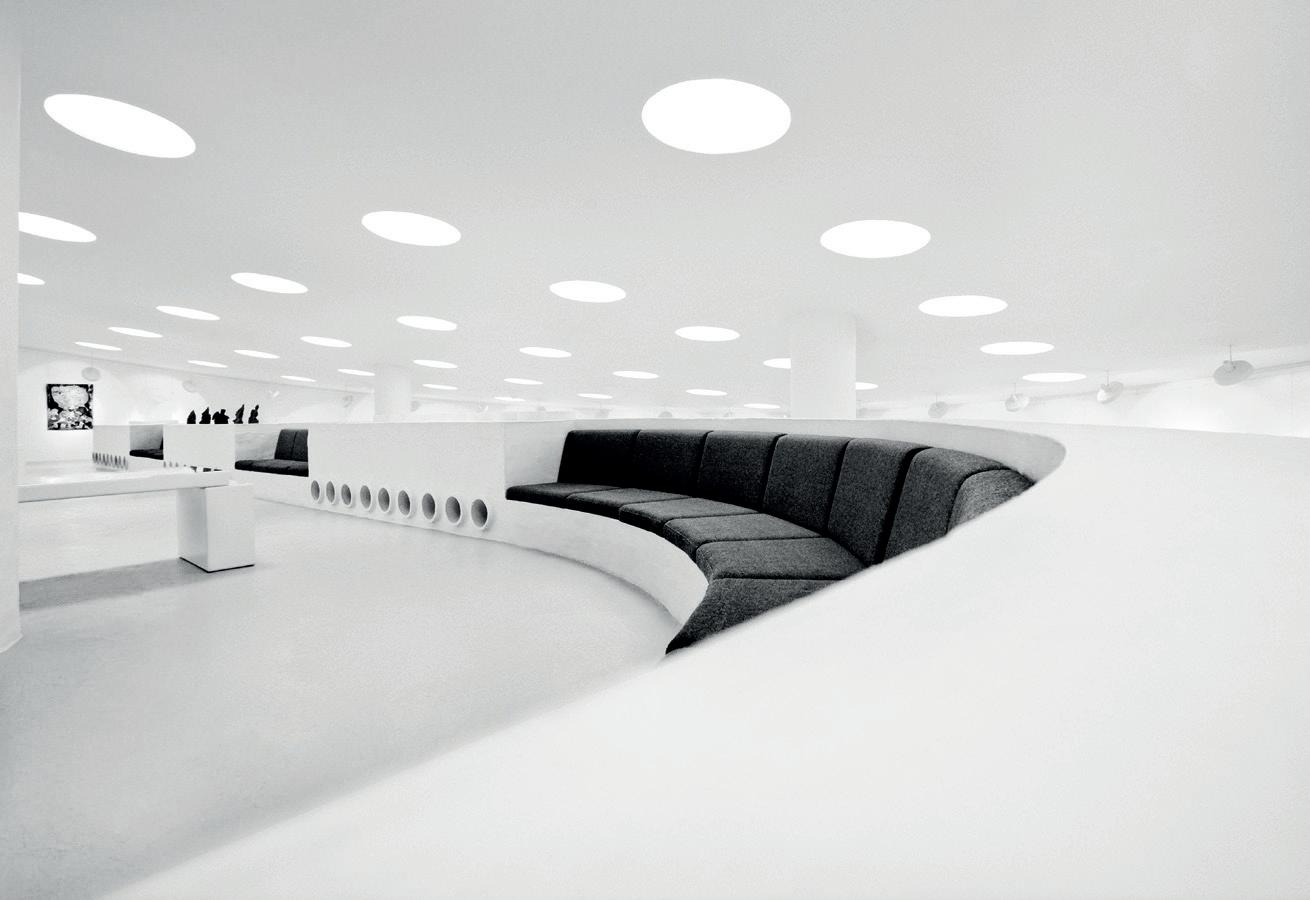
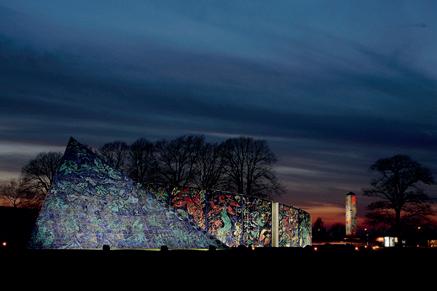
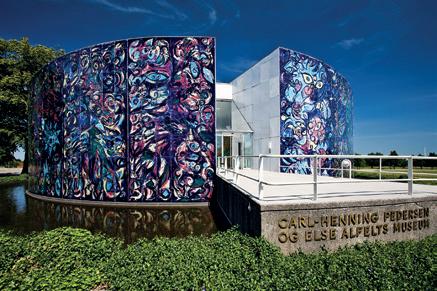
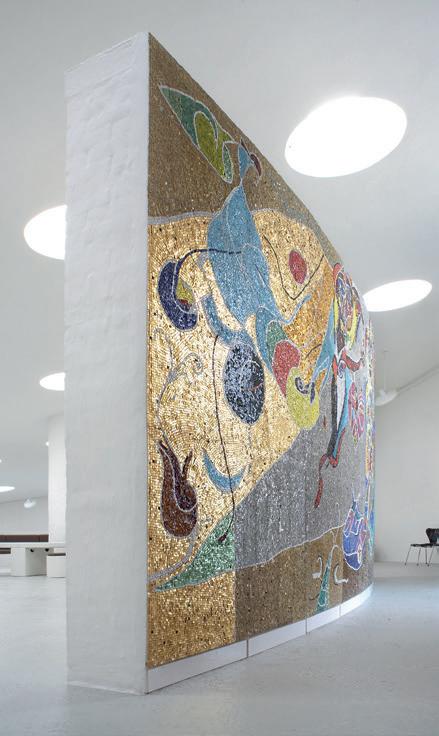
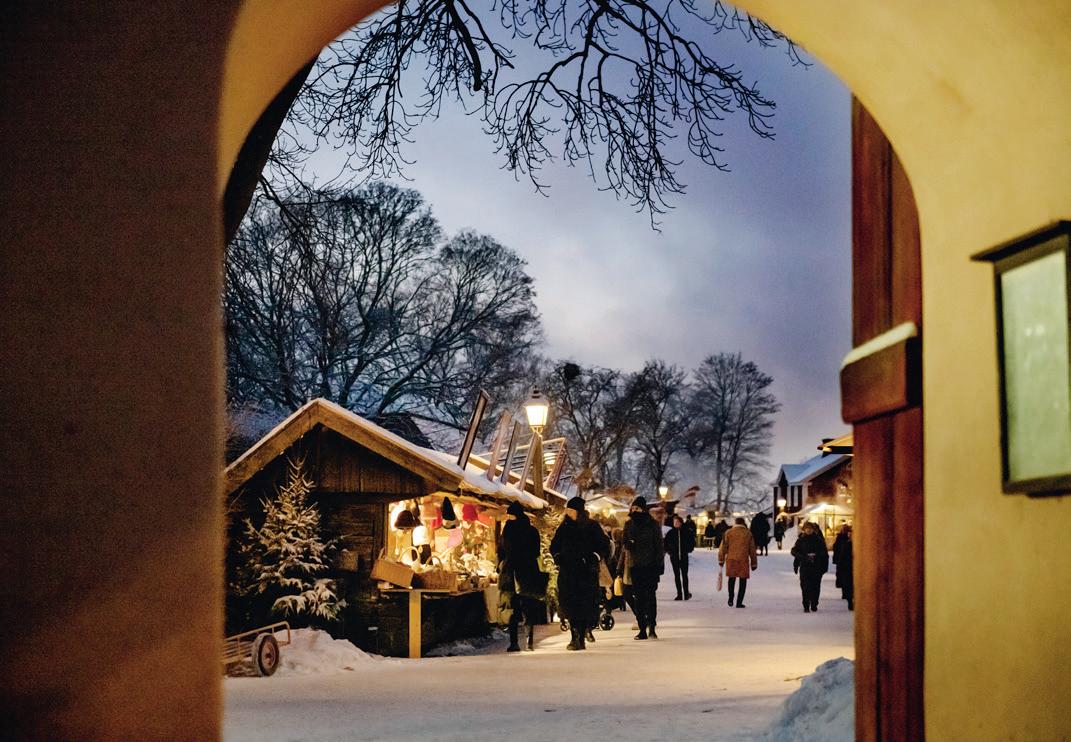
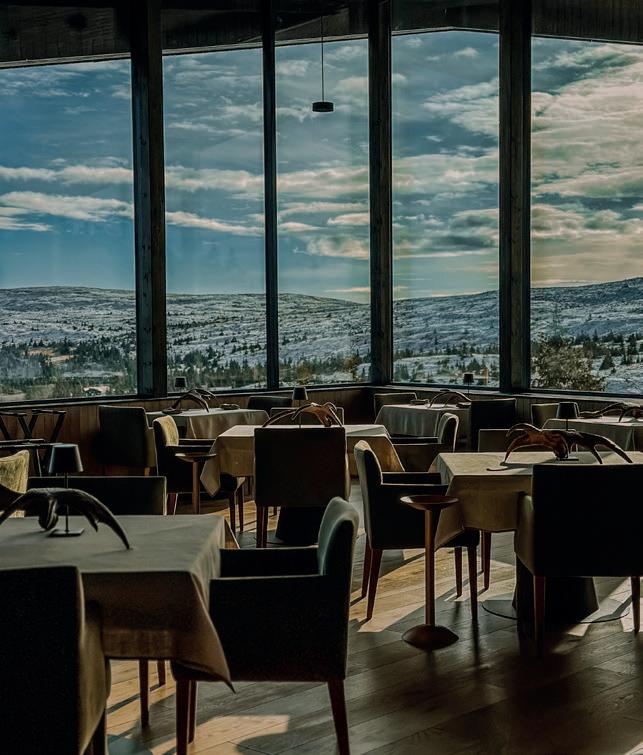
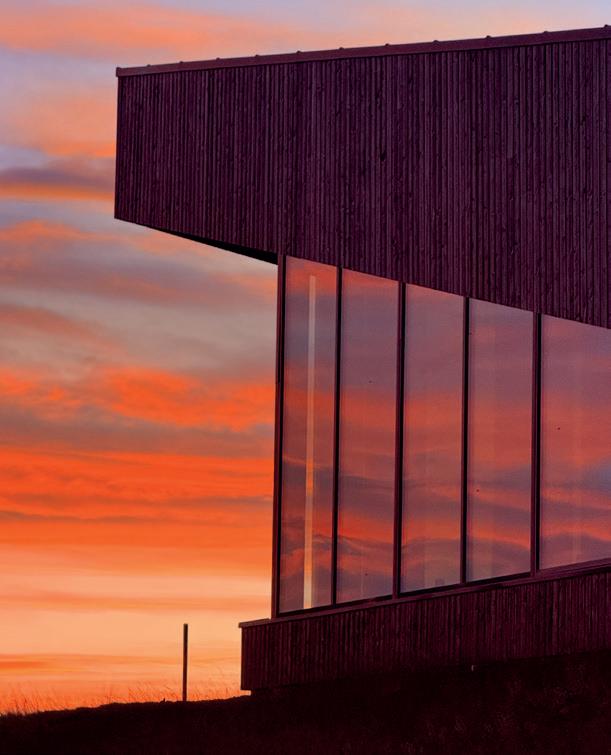
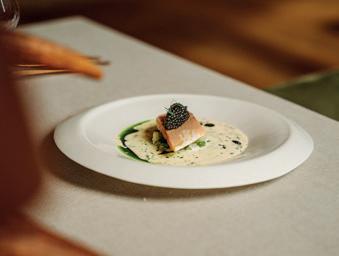
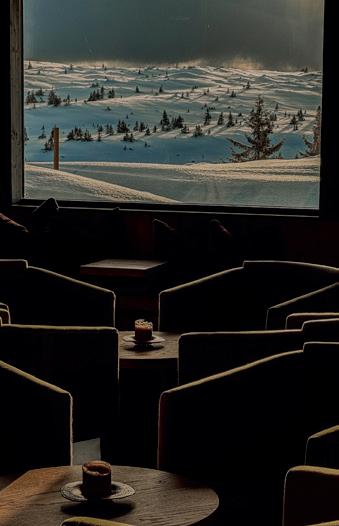
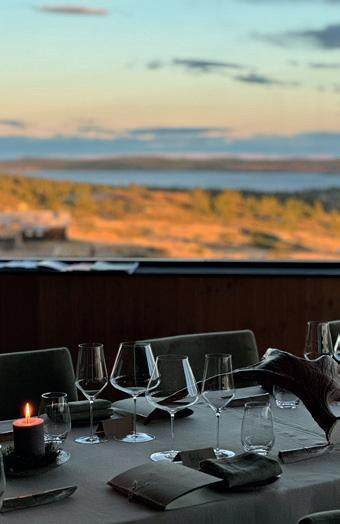
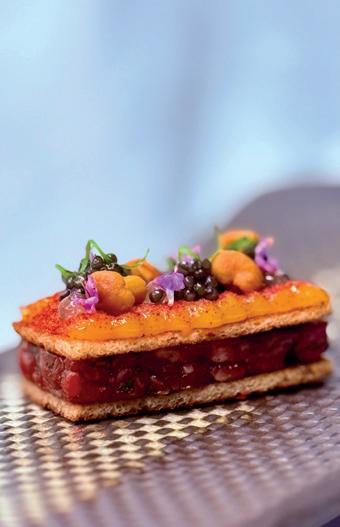
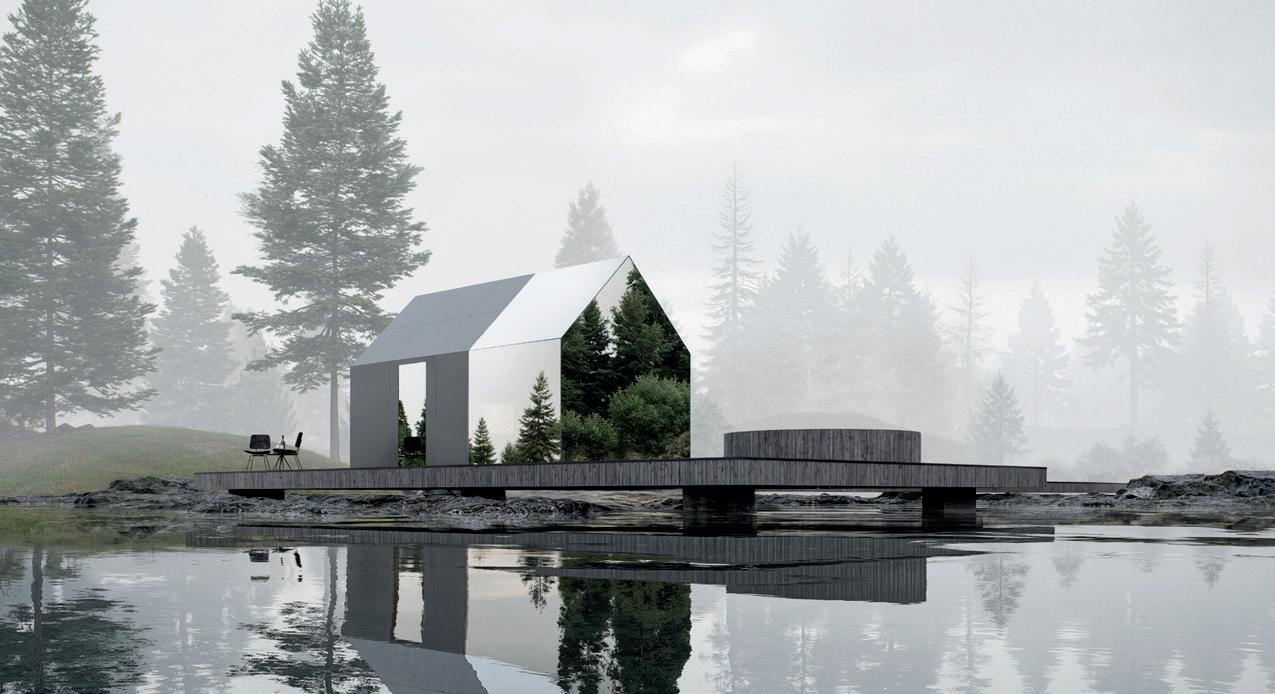
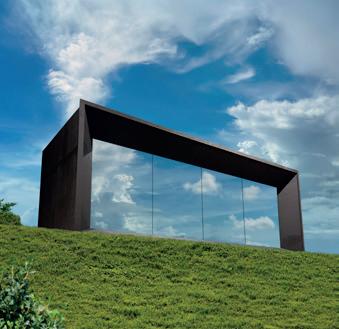
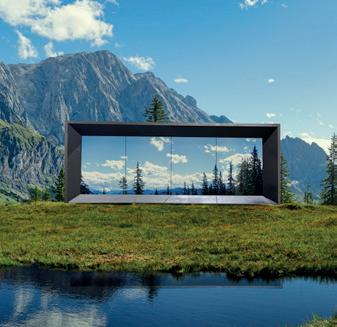
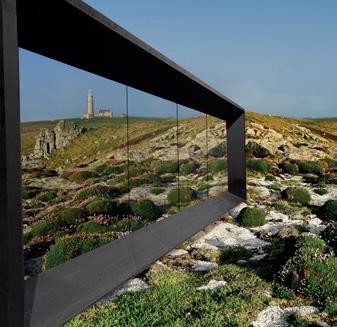
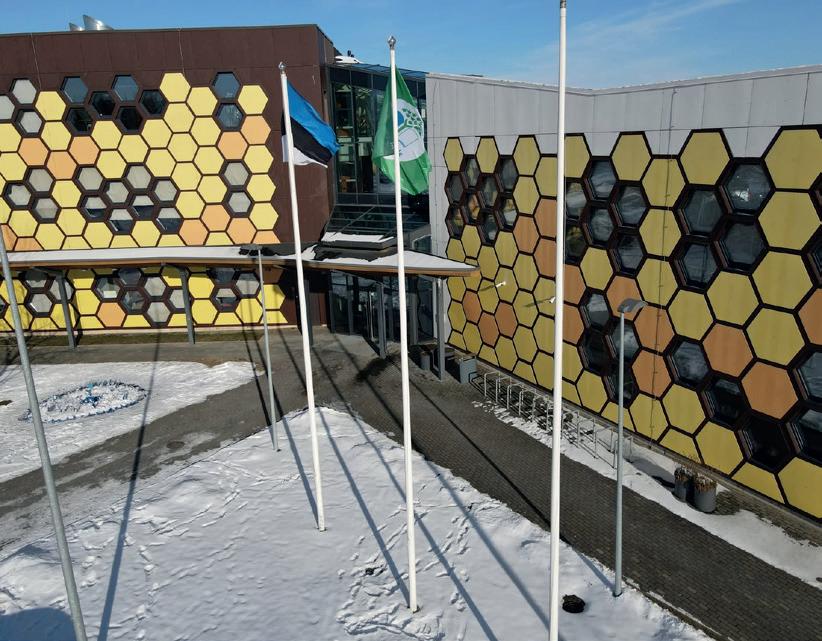
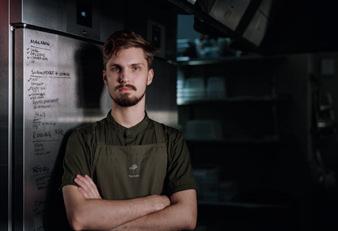
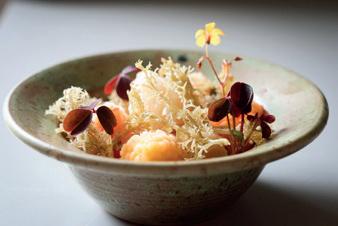
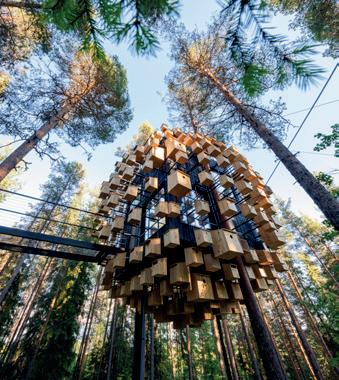
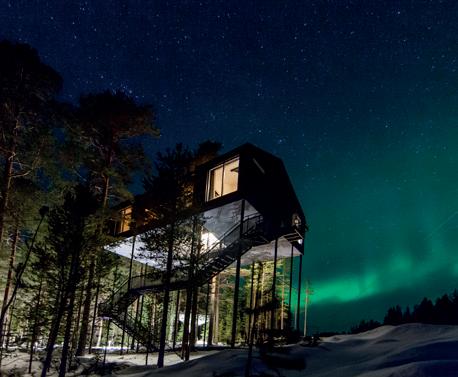
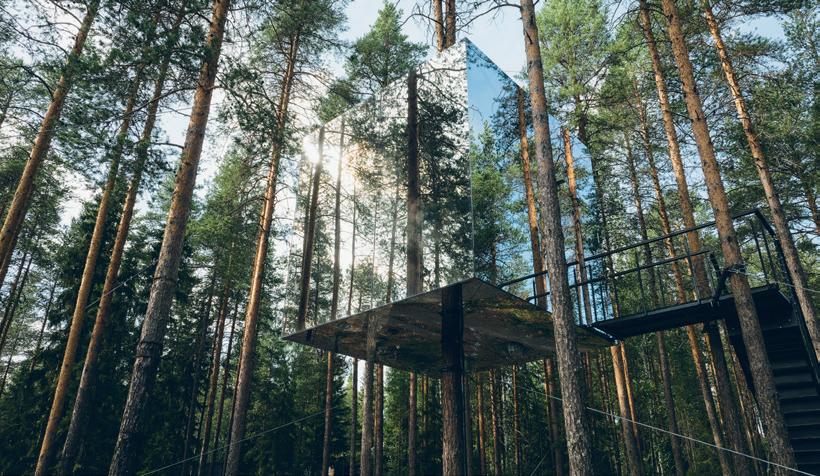
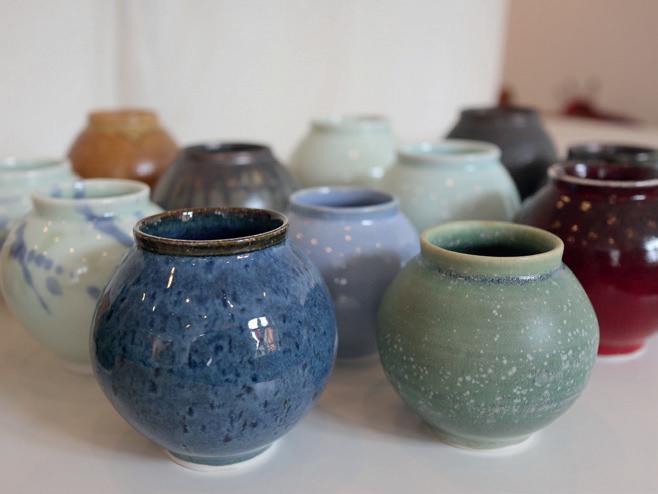
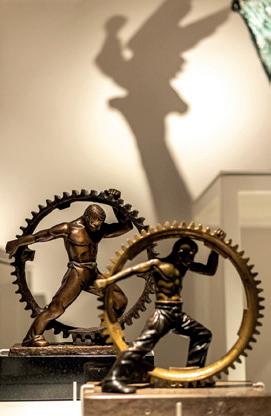
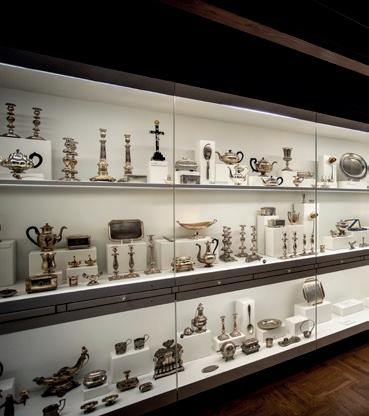
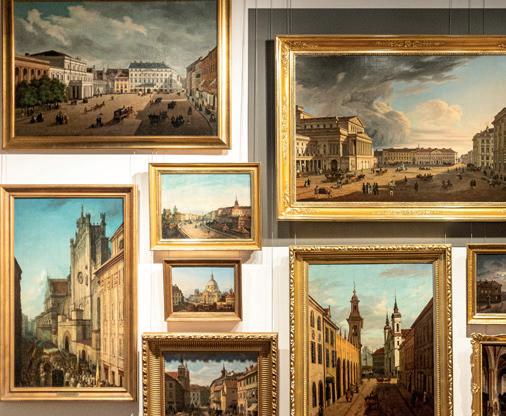
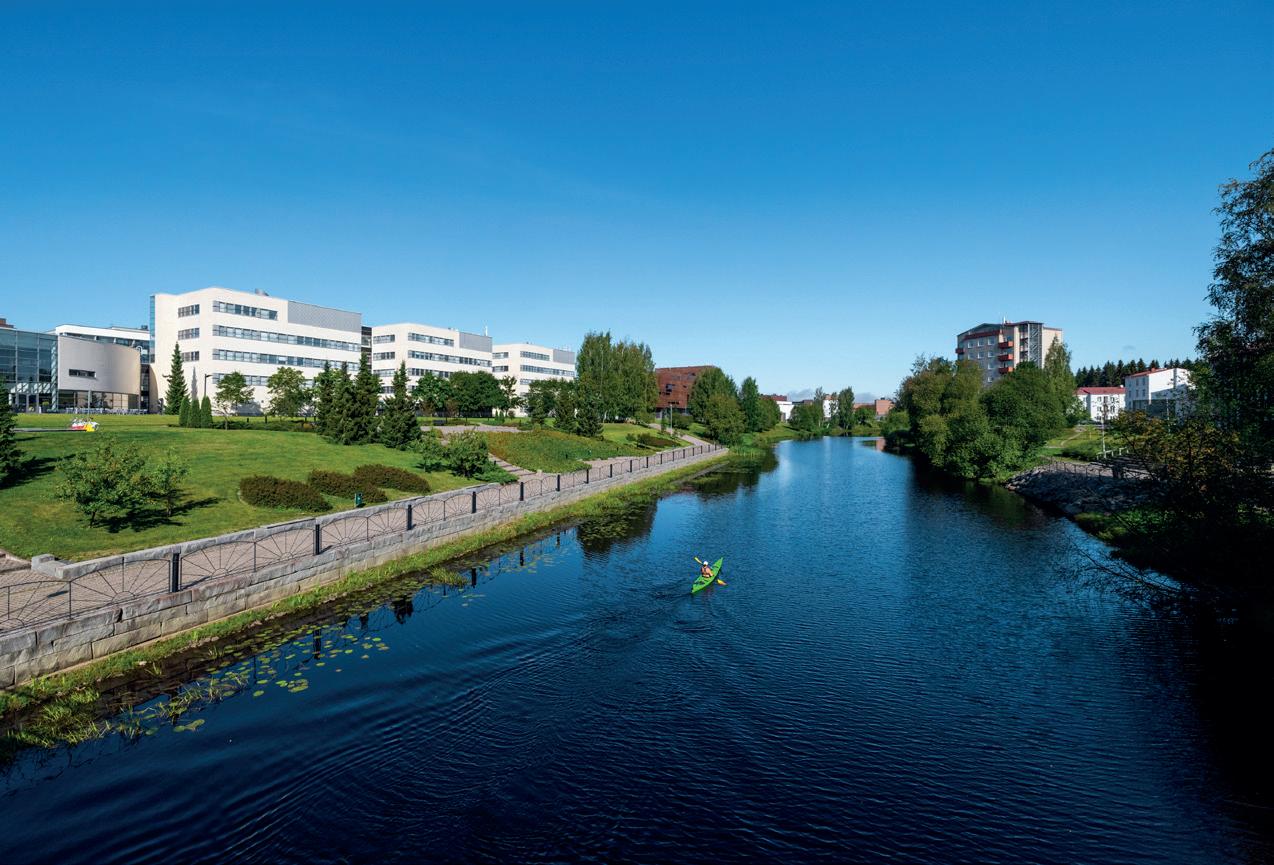
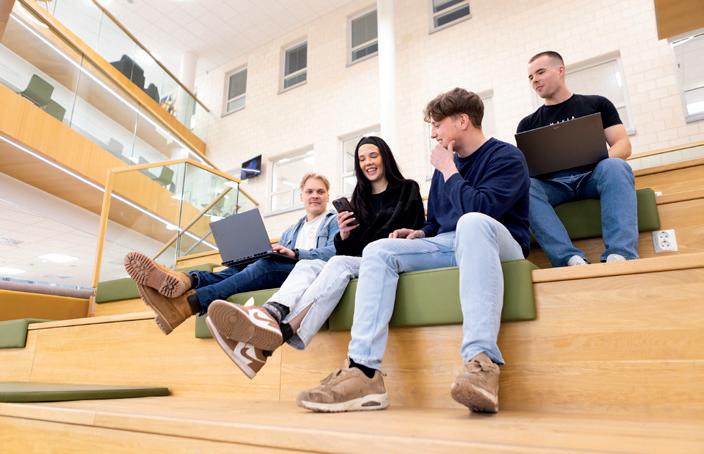
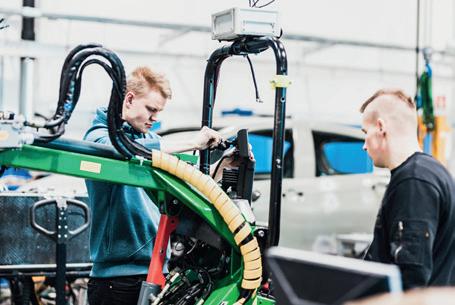
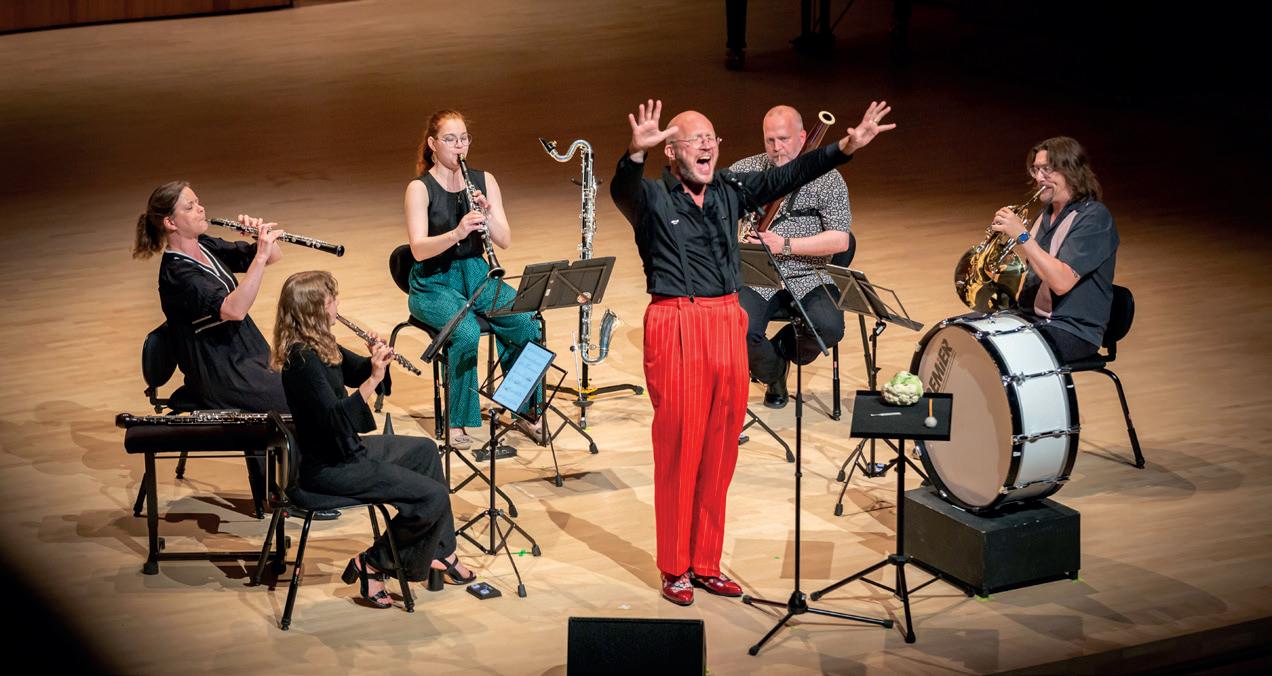
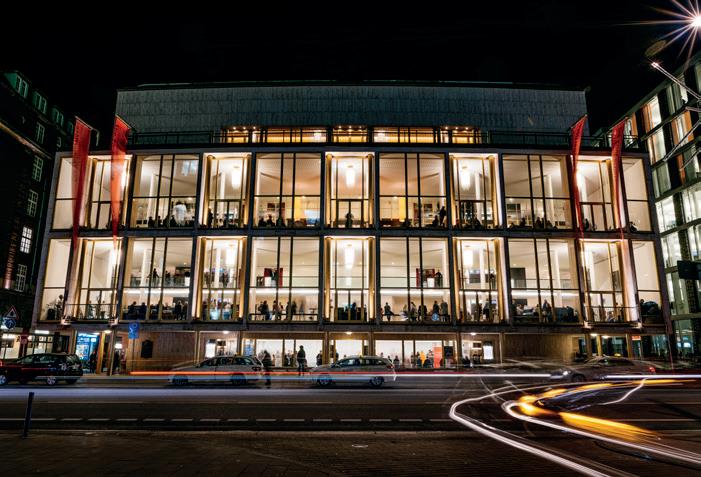
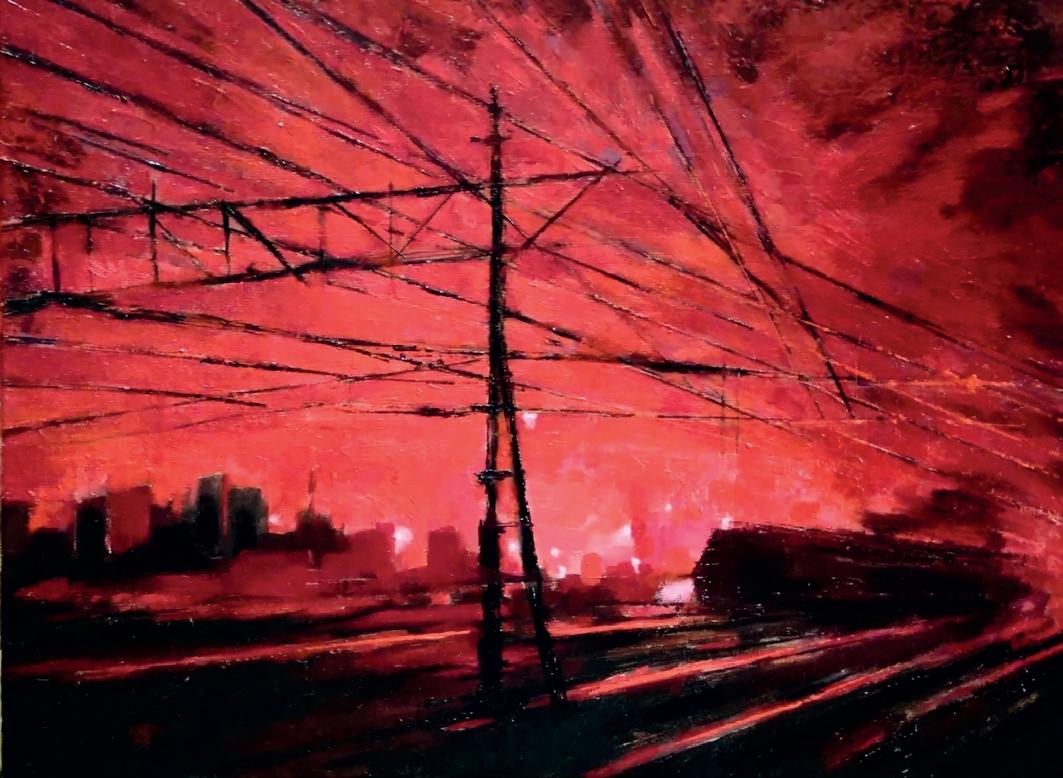
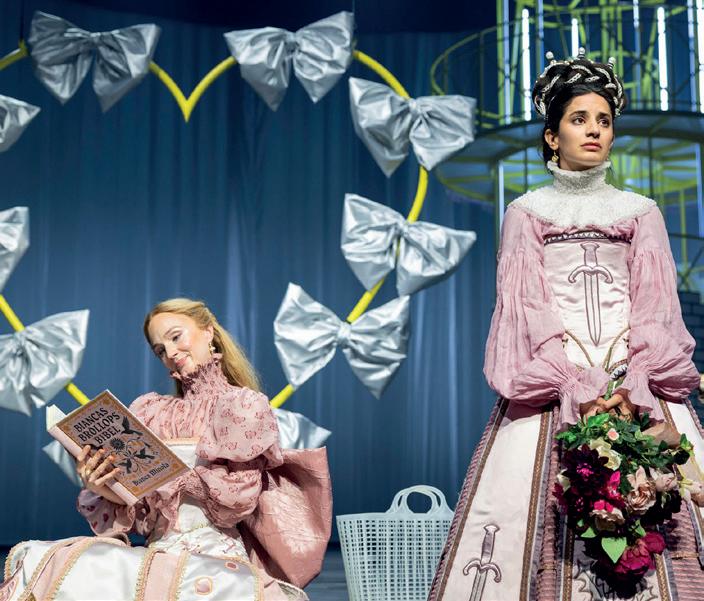
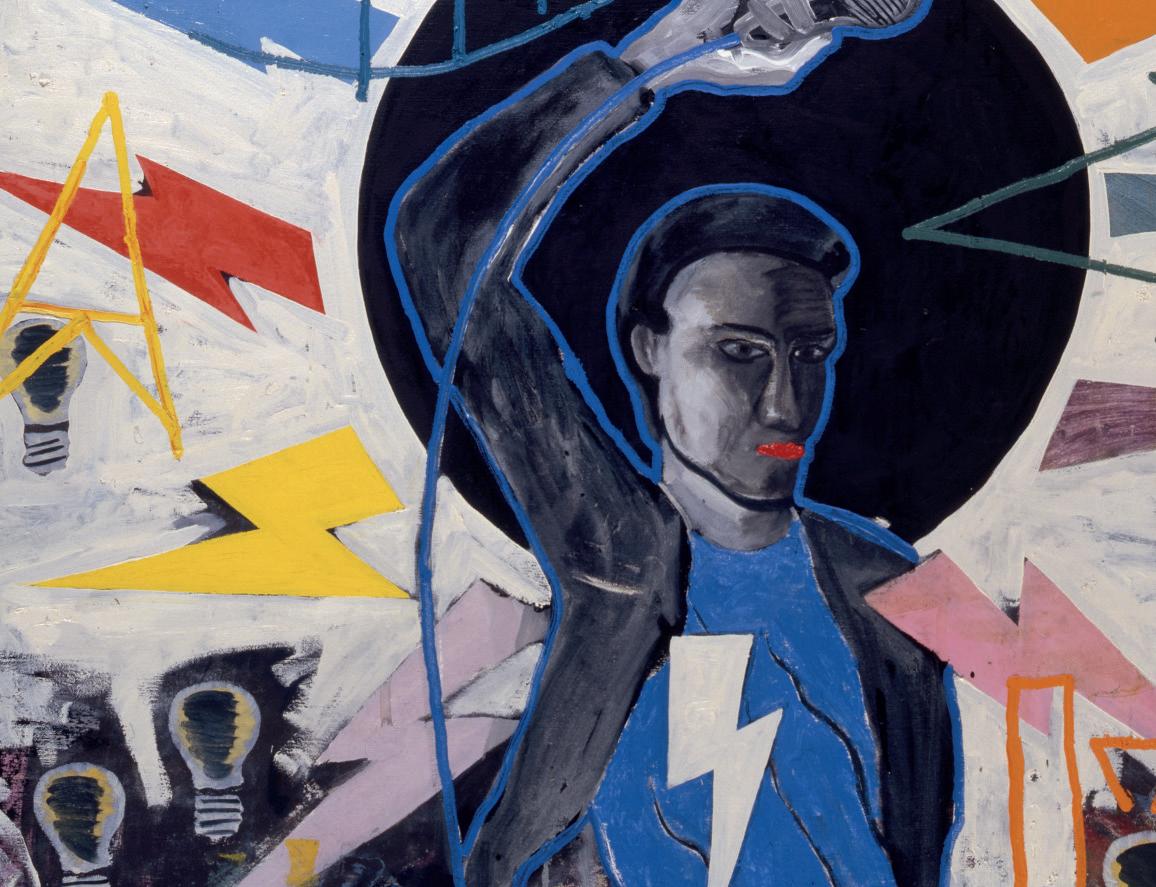
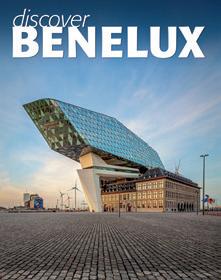
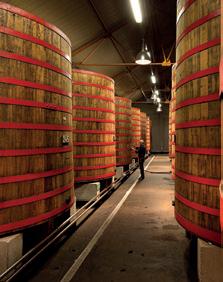
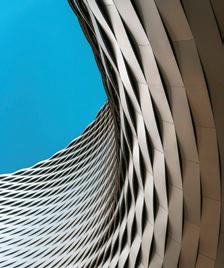
Carl-Henning Pedersen & Else Alfelts Museum is one of a small number of artist museums in Denmark. The iconic museum building opened in 1976 and was designed by the renowned C. F. Møller Architects.
The circular main building blends harmoniously into the area’s geometric landscape laid out by the landscape architect C. Th. Sørensen.
C. F. Møller Architects has overseen several expansions of the museum since it opened – most recently in 2015, when the museum was linked to the circular “Angli” building, originally built in 1965 as a textile factory by the same practice.
Carl-Henning Pedersen & Else Alfelts Museum
www.chpeamuseum.dk
Editor’s Note
Dear readers,
Snowy streets, candlelit windows and the scent of spice in the air – December in Scandinavia is all about light, warmth and togetherness. As the year draws to a close, we celebrate the people and places that make this season so special.
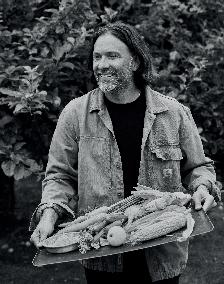
In our cover feature, we meet Claus Meyer, the visionary Danish culinary entrepreneur who changed how a nation eats and continues to inspire with his passion for taste, culture and community.
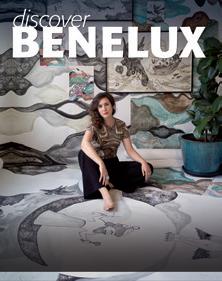
From Copenhagen to the Faroe Islands, we also shine a light on painter Sigrun Gunnarsdóttir, whose colourful, symbolic works have carried the spirit of her island home to galleries around the world.
Throughout the magazine, we delight in festive inspiration – from magical Christmas markets and winter getaways to designs that bring comfort and brightness to the dark season.
Whether you are dreaming of the Northern Lights or looking for inspiration for your Christmas gifts, there is something here to lift every winter mood.
As always, we hope you enjoy reading this issue as much as we enjoyed creating it.
Signe Hansen, Editor
SCAN MAGAZINE
In this issue
COVER FEATURE
6 Claus Meyer on changing the food habits of Danes
In this month’s cover feature, we speak with the iconic Danish TV cook, entrepreneur, and food revolutionary about his lifelong mission to transform how Danes eat, think, and connect through food.
DESIGN
12 Festive winter wear and designs to light up the winter
On our Design pages, we embrace the festive season with a combination of stunning and comfortable fashion picks, iconic Scandinavian lamps, unique designs from the Faroe Islands and dazzling, innovative brands from Finland, Sweden and Denmark.
LIFESTYLE AND FOOD
30 Rice pudding and balance in beer
This month, food columnist Sofia Nordgren presents the secret to the perfect risgrynsgröt, the creamy Scandinavian rice porridge, whilst inhouse beer expert Malin Norman ponders balance in beer.
SPECIAL THEME
32 Top winter getaways
In this special theme, we explore three breathtaking destinations in Scandinavia that make for the perfect winter getaway. Northern Lights, rustic charm and stunning landscapes, from the Faroe Islands to Finland and Norway, this theme is bound to make you long for something more than the usual skiing trip.
SPECIAL FEATURES
38 Magical Christmas markets
In this special feature, we visit enchanting Christmas markets all over Scandinavia and Iceland. From historic town squares to charming open-air museums, these markets will no doubt add an extra dash of magic to the season’s festivities.
48 Can we speak to Santa, please?
With its snow, mountains and reindeer, Scandinavia seems made for Santa Claus. But where does the real Santa reside? Is it in Finland, Sweden or Greenland? In this special feature, Scan Magazine sets off to find out.
CULTURE
89 The best new events, film and music in Scandinavia
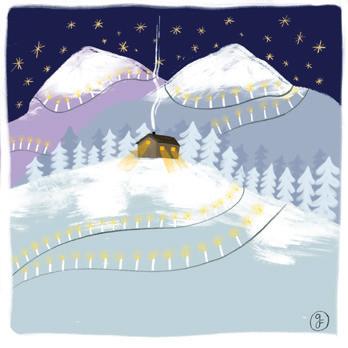
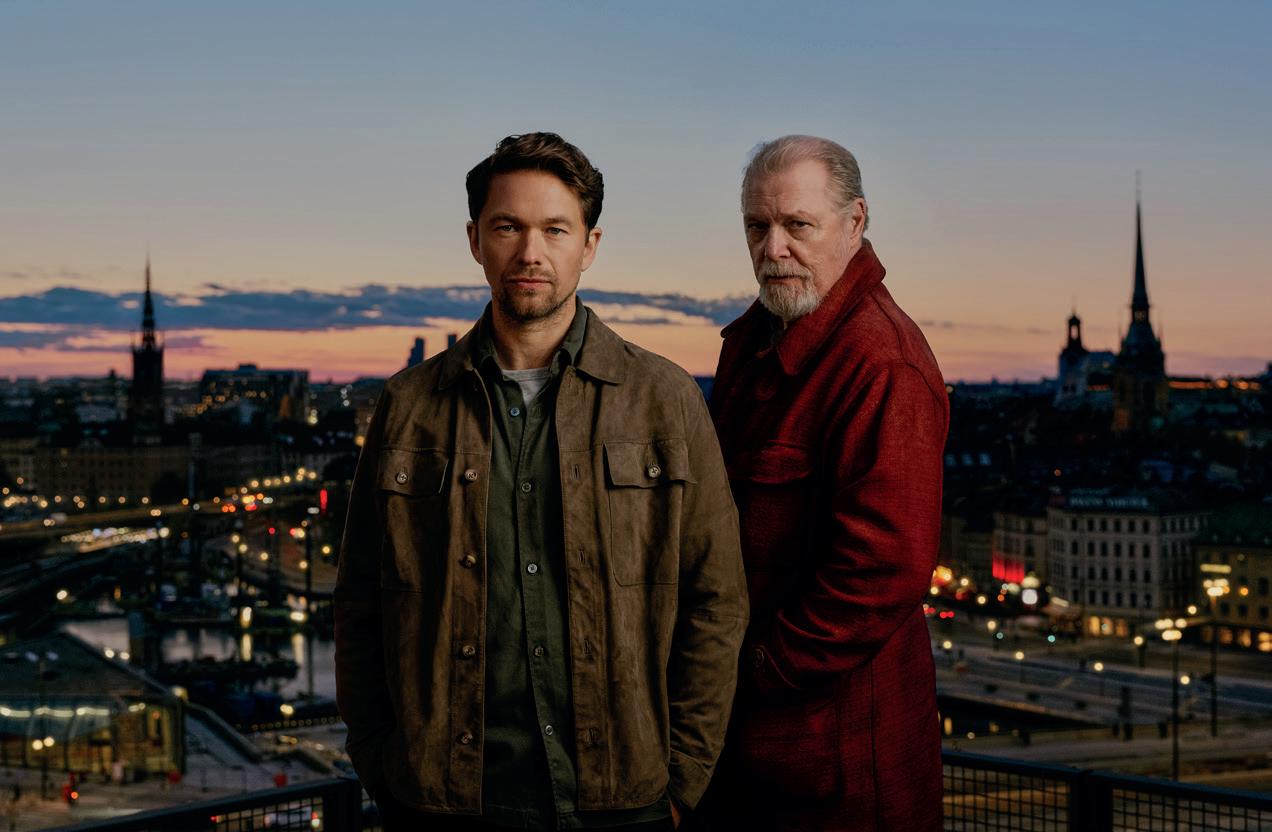
In this month’s Culture section, music columnist Karl Batterbee recommends new Nordic pop numbers for the festive season, and illustrator Gabi Froden ponders the magic of Christmas in Sweden. Film and TV columnist Anders Lorenzen presents a special selection of Scandinavian series to look out for in 2026.
Claus Meyer: Changing how Danes think about food
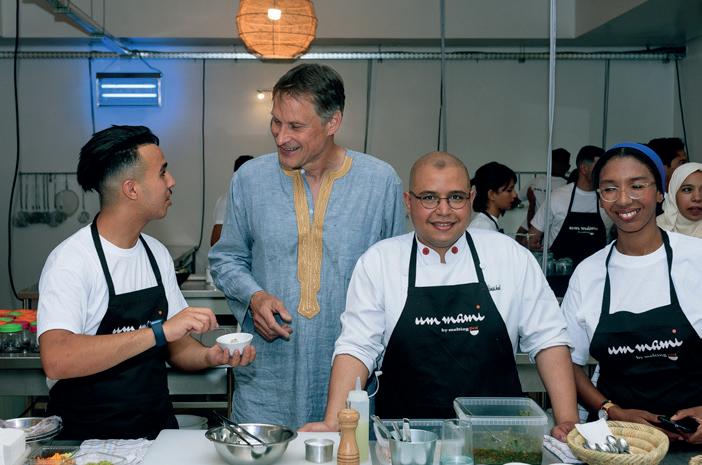
With an unshakable belief that food can change lives, Claus Meyer has spent more than four decades redefining Danish cuisine. From awakening a nation’s taste buds to co-founding Noma and championing social change through food, the TV cook, entrepreneur, and educator continues to stir both pots and minds. His mission remains simple yet profound: to reconnect people, nature and flavour.
By Anders Lorenzen
Photo: Christian Als
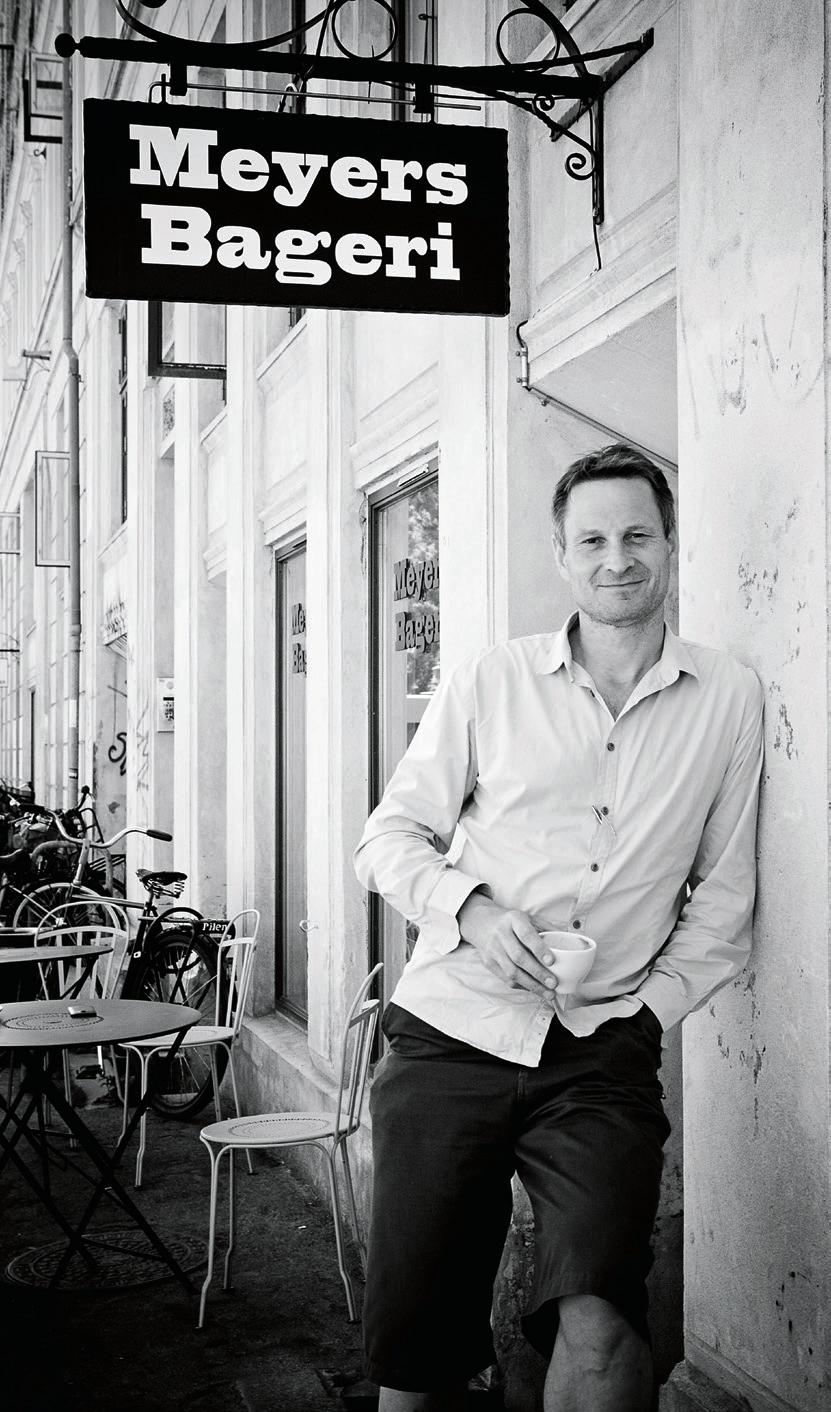
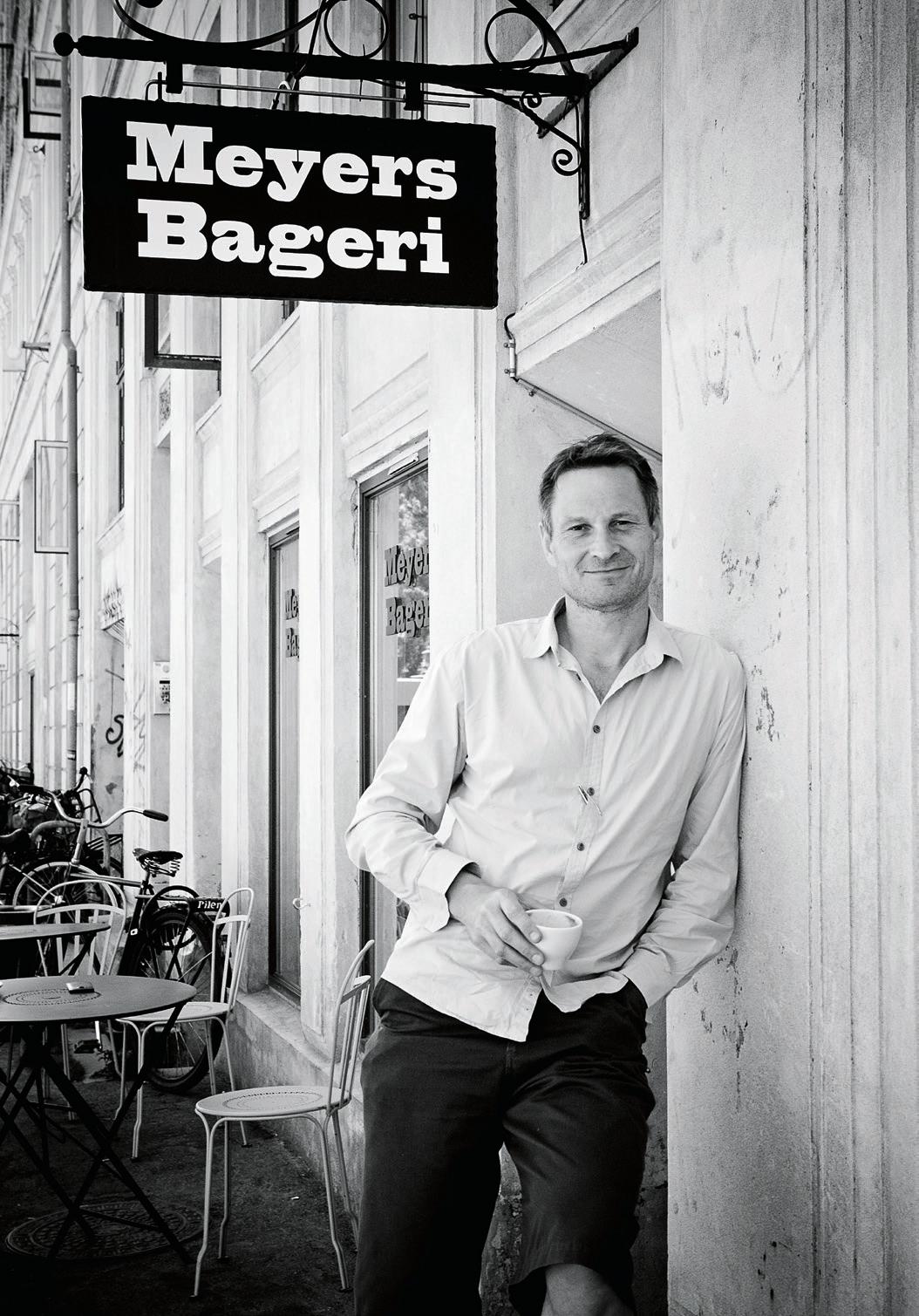
Meyer outside one of his three Meyers bakeries in Copenhagen, where organic Nordic grains are milled and baked in-house. Photo: Claus Meyer
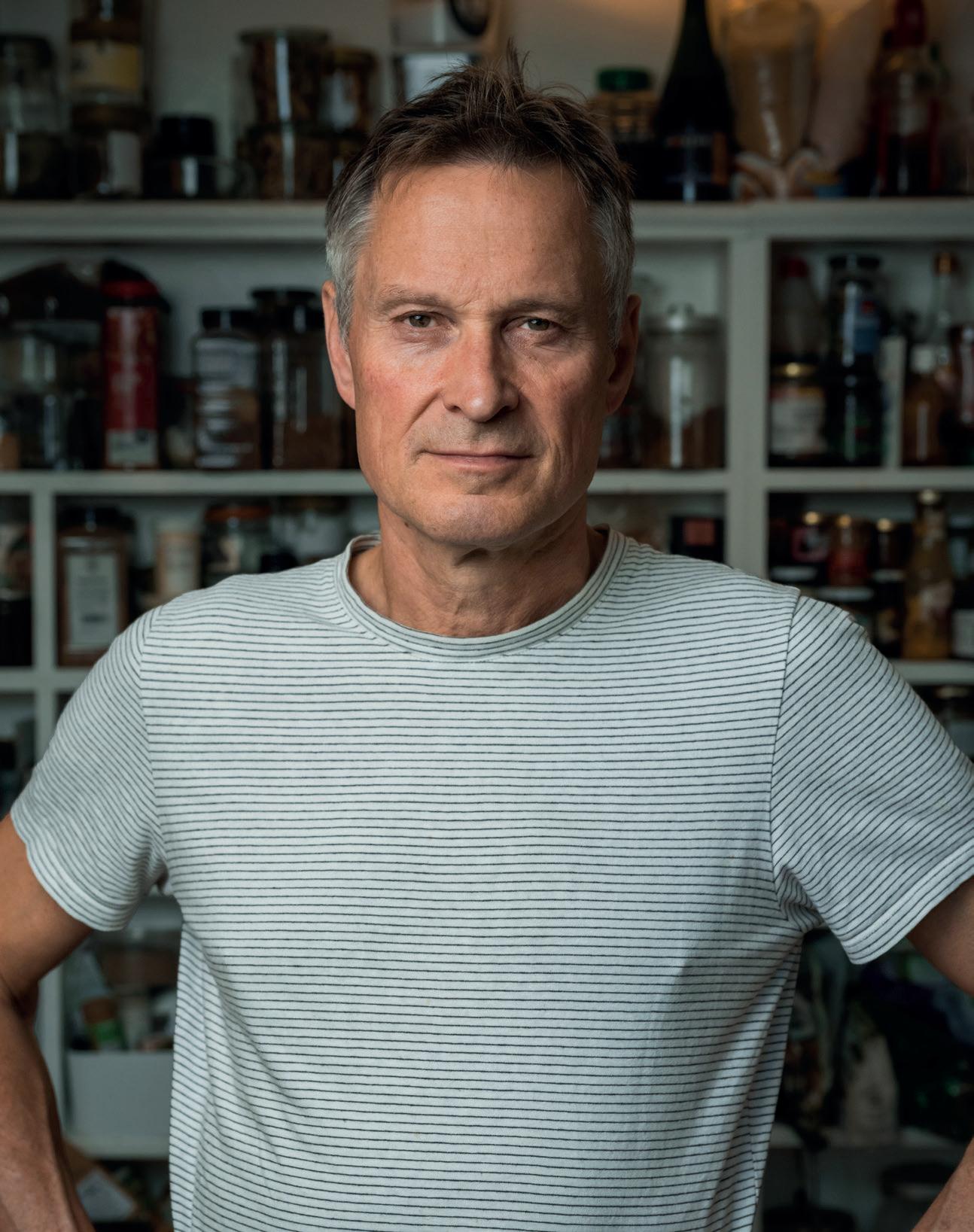
“It was almost like an out-of-body experience, I was reborn,” the legendary Danish culinary entrepreneur Claus Meyer recalls to Scan Magazine. He is remembering how at 19, during a stay in France, he experienced a beautiful connection between life, love and food, and felt a sudden awakening, immediately realising his purpose in life.
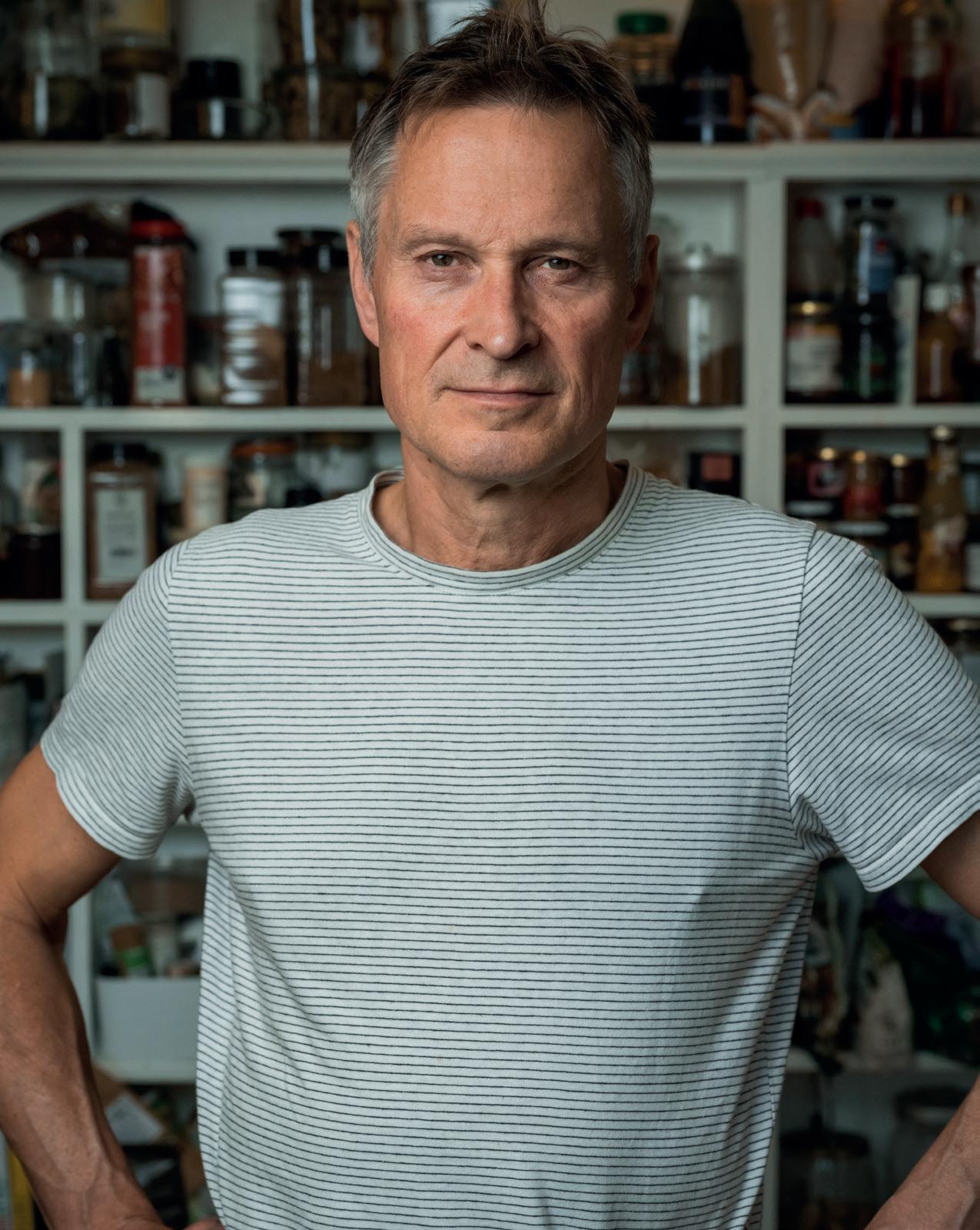
Today, at 61, Meyer is a household name in Danish food, television and culinary innovation, as well as a respected entrepreneur, educator and grassroots leader. This is a man still burning with passion and still struggling to sit still. When we planned this interview he was, in true Danish fashion, on his bike en route to a lunch meeting.
“There is something rotten in the state of Denmark”
Meyer’s French experience presented him with an awakening that there was something completely wrong in Denmark. He was perplexed that Danish society, though in many ways more advanced than the French – at least outside the cities – had a food culture that lagged so far behind. “I could not understand, nor could I accept, why Denmark consumed food that tasted so poorly, and lacked any form of taste, in contrast to what I experienced in France,” he says.
Meyer believes that his own family was a mirror of the whole nation. “Looking at my family’s approach to food, neither my mum nor my dad wanted to use money or time on the daily meal; it was just a chore that we had to get over and done with as quickly as possible, with no connection to or understanding of the seasons,” he reflects. “Coming from a divorced home, the absence of love coincided with the tasteless meals.”
“We taunted nature”
The state of seasonal fruit and vegetables was dismal at best. In Meyer’s words: “Much of the food was ultra-processed and unappealing, just pulled out of the freezer. Vegetables had been precooked in Eastern Europe and then frozen; they lacked any taste or love.”
“Unlike French cuisine, in Denmark there was no tradition of using herbs, spices and stocks,” he continues. “It was food produced without flavour and taste, made without love, effort and pride, and there was no consideration or appreciation for the soil that produced the vegetables and fruits.”
How Denmark valued, protected, and appreciated nature did not ease his frustrations. “We taunted nature,” Meyer proclaims. He adds; “Decades later, that
is clear for everyone to see, not only in terms of how we destroyed nature, but we added one industrial food process after another, and with that, a highly consumed meat culture.”
Vision and inspiration
When the 19-year-old Meyer arrived in Gascony in southwest France, he stayed with pastry chef Guy Sverzut and his wife, who introduced him to the region’s food, lifestyle and warmth. There, he sensed a deep connection between flavour, joy and love that would shape his life. “I felt as if I had been adopted by the family I stayed with, and truly seen. I formed a special bond with these two strong French people who couldn’t have children.”
Experiencing in France a completely different way of approaching and appreciating food, Meyer realised upon returning home that something was deeply wrong with Danish food culture. “The French had a connection to the land and the soil, a sense of time and place, the so-called terroir was embedded in the French food culture, and most meals were an expression of generosity and a tribute to life,” he explains.
“The naïve thought came to me that since I was given this experience in France, it was my duty to do something about it,”
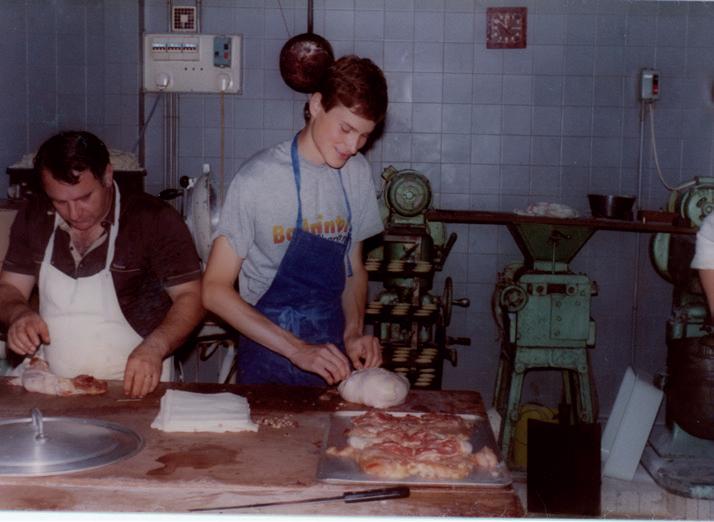
At 19, Claus Meyer travelled to Gascony, where living with pastry chef Guy Sverzut and his wife introduced him to the joy, flavour and love of French gastronomy. Photo: Claus Meyer Photo: Claus Meyer
Meyer recalls about the almost religious experience he experienced when he found his calling. “I wanted to change Danish food culture.”
“I wanted Danish food to be outstanding” Shortly after returning to Denmark, he undertook a master’s degree in combined language, economy and cultural understanding at Copenhagen Business School. But already at this stage, his flair for cooking and entrepreneurship was evident. He began producing sandwiches in his apartment and sold them at the school’s café. Shortly after, he owned his first business when he won his bid for the school’s canteen.
Meyer’s first objective when returning to Denmark was to “awaken the Danes’ slumbering sense of deliciousness,” he explains. He drew inspiration from a theory suggesting that within every human lies an innate sense of beauty. “But in many cases it lives in a withdrawn state inside our minds due to learned societal behaviours,” he adds. In that, he saw a direct parallel to Dane’s relationship to their food.
“My simple idea was to find ways to put something extraordinary inside people’s mouths,” Meyer says, about how he approached getting consumers paying attention to taste. He adds; “I quickly realised that if I could only succeed in getting
them to pay attention to the taste, regardless of whether it was a piece of chocolate, an aged vinegar or a piece of raw milk cheese, then this single taste experience could have a transformative power.”
Grassroots, development and Inclusive initiatives
In time, thanks to his hugely popular TV show Meyer’s Kitchen, his approach started to bear fruit. “Consumers discovered their longing for delicious food,” Meyer recounts. “It was all about giving it my own flair; this was what Meyer’s Kitchen was all about.”
But Meyer’s ambitions did not stop there. “What I really longed for was not only for consumers to discover the beauty of taste, but also for food producers to create outstanding food products.”
Meyer went on to educate Danes not only on TV but also through numerous other initiatives, including co-founding the internationally renowned Michelin-starred restaurant Noma, launching the highly successful New Nordic Cuisine movement, and establishing the Melting Pot Foundation.
Melting Pot leverages the power of culinary craftsmanship and the language of food as forces for community empowerment and social change. To give a snapshot of the kind of projects they get
involved with, Meyer highlights an initiative in Bolivia where young trainee chefs and waiters from low-income families built confidence and careers exploring their own food culture at the restaurant Gustu. He adds that so far, “every initiative of the foundation has reconfirmed how deliciousness and social responsibility can flourish together.”
One recent initiative is Det Længste Bord, a two-year project uniting Democracy X, Meyers and the municipality of Brøndby to normalise delicious, plant-rich meals via long-table events and local training – a community experiment inspired by EAT-Lancet. According to Meyer, the ultimate goal is “to make plant-rich diets the new norm, with all the gains this would imply for the health of each individual, for nature and for society in general.” If successful, Meyer wants to scale the findings both nationally and internationally.
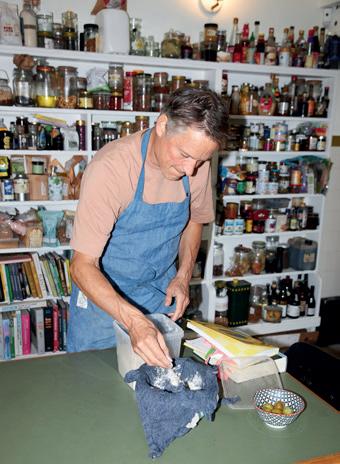
Indeed, even though Meyer’s mission is more than 40 years old, it is far from complete. There has been progress, but he believes that few households are bringing love, joy and connection into their everyday lives through home-cooked food. He aims to lead by example, often turning to his daughter to say: “What do we have in the veggie box?” Before long, they are in the kitchen experimenting with something they have never made before.
Photo: Santiago de la Vega
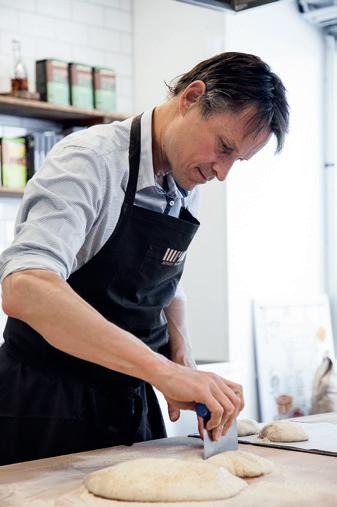
Through the Melting Pot Foundation Meyer works to create social change through craftsmanship and food. Photo: Claus Meyer
Christmas in the Meyer household
In the Meyer household – with his wife and their three daughters – Christmas remains firmly rooted in tradition, despite his day-to-day focus on innovation and change. “It is almost the only aspect of our family’s food lifestyle that is constant,” he says. “As one of our daughters is vegetarian, we take great care to make her a plant-based meal just as delicious as the one the rest of us enjoy – which, in fact, is not difficult at all.”
“We always bake cookies and æbleskiver (a typical Danish dish of round, panfried cakes) and brew an apple-based mulled wine several times through December.” He also bakes the same bread throughout December every year. A recent newbie is an Eastern European Christmas cake – Kozunak.
Photo: Christian Als
Fashion Diary
Just like that, it’s once again the season for skating dates, romantic strolls through Christmas markets, and tackling the long list of gifts for friends and family. While you’re enjoying the pretty lights and starry nights, make sure to wrap up and keep in mind the words of a certain famous winter song – Baby, It’s Cold Outside. As we prepare to leave behind yet another year, these beautiful pieces will keep you cosy and stylish for the season of seasons.
By Celina Tran | Press photos
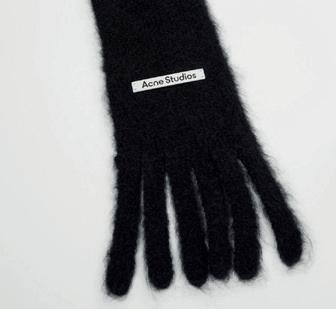
The best way to keep yourself healthy and warm is by protecting fingers, toes and ears, but perhaps most importantly, your neck. The ACNE scarf may be skinny, but its length and soft mohair blend will do more than enough to keep you warm (and fashionable).
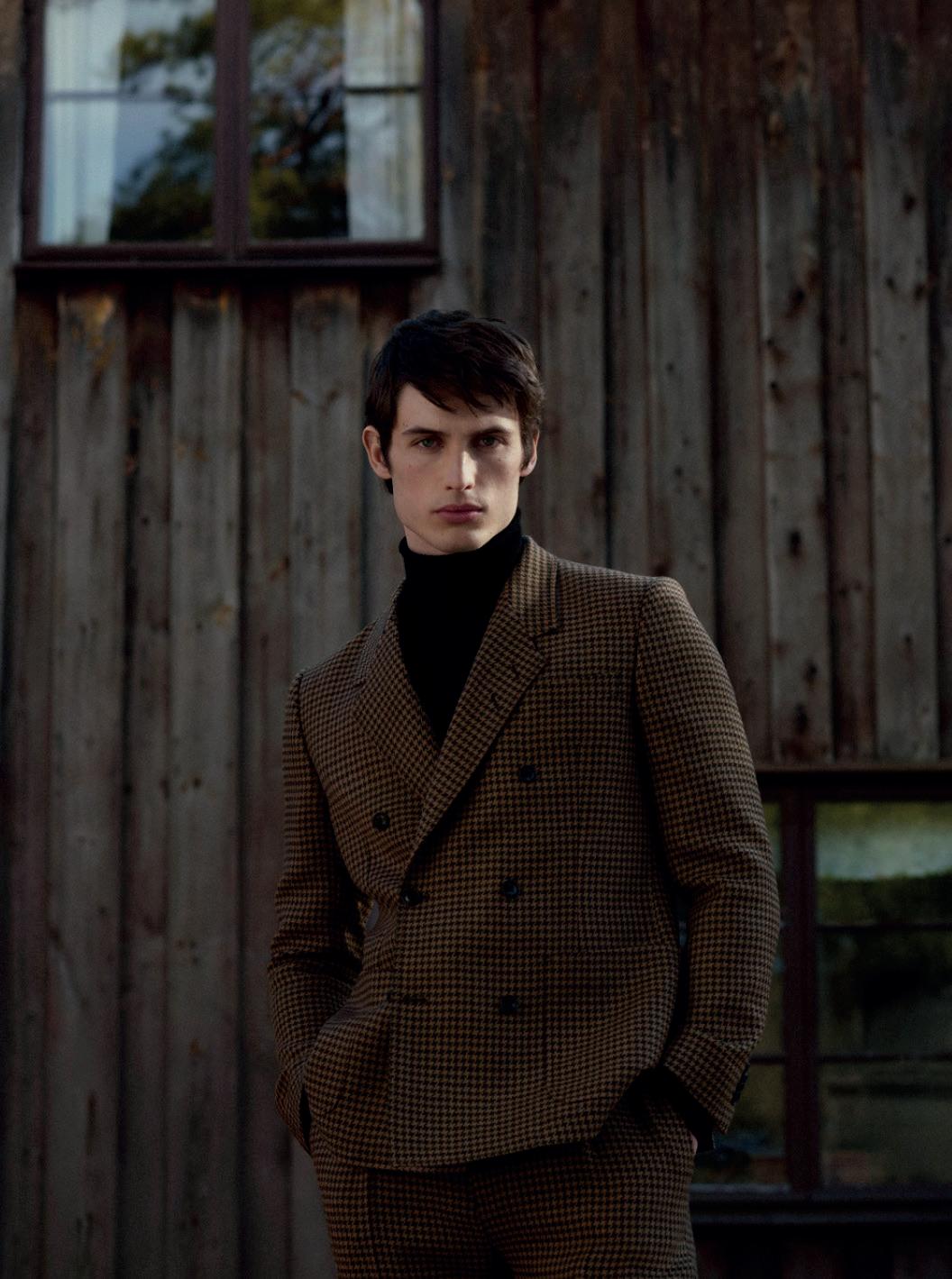
A notch lapel double breasted blazer, the Jeen jacket is made from 100 per cent Swedish Virgin Wool in a timeless, luxurious design, sure to draw attention when you enter a room. Wear alone with a simple pair of trousers or try the full set as you enter the season of giving.
Jeen Swedish wool jacket, EUR 699 www.tigerofsweden.com
Skinny Logo scarf in black, EUR 320 www.acnestudios.com
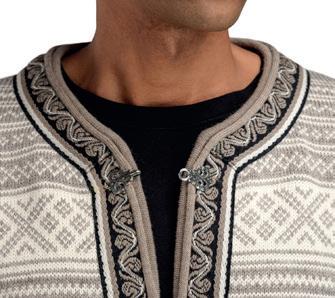
There is no such thing as too much knitwear, and no one does woolly sweaters like the famous Dale of Norway. In plain, minimalistic colours, this unisex kofte (jacket) is a modern take on a traditional pattern from Setedal, with plenty of nods to its heritage. The luse patterns featured were originally knitted to ward off evil spirits, making it both a thoughtful gift and good conversation.
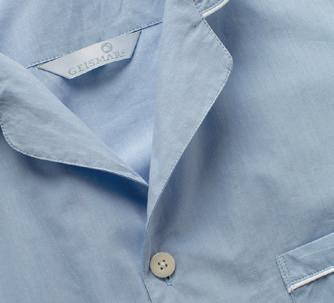
December is for cosying up by the fireplace in your best pair of pyjamas. Designed by Danish Geismars, the George pyjamas in vintage blue oozes classic luxury and comfort. Though you won’t exactly be going to any gala events in your sleepwear, you’ll surely be the belle of the PJ ball in these.
George pyjamas in vintage blue, EUR 190 www.geismars.com
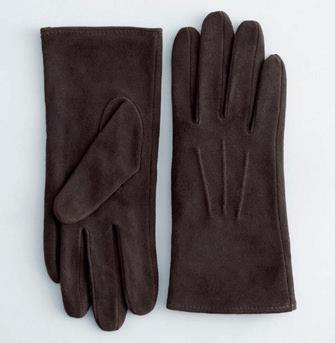
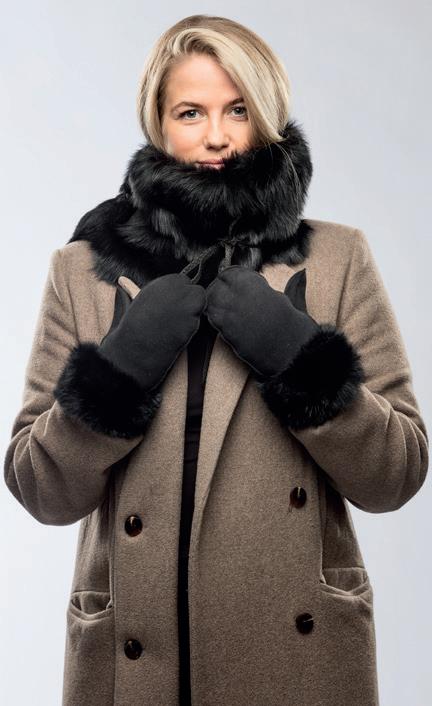
Crafted from suede with a soft viscose lining, these elegant gloves from & Other Stories go well with most outfits and will carry you through the bitter cold. Pair with matching leather boots or a full outfit of varying browns for a chic monochrome-esque look – think camel coat, sand trousers, plain dark brown sweater, and gold jewellery to bring it all together. Suede gloves, EUR 69 www.stories.com
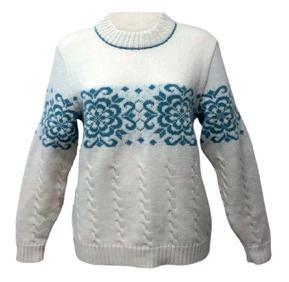
Based in a historical factory by the fjord, Norlender is a Norwegian family business that simply knows knitwear. As the name suggests, its 100 per cent Norwegian wool Frøya sweater is a thing of beauty, with soft floral detailing and a classic Aran cable knit. Perfect for the entire winter season, you can match this with any pair of trousers for a cosy, Scandinavian look. Frøya sweater in off-white, USD 227 www.norlenderknitwear.no
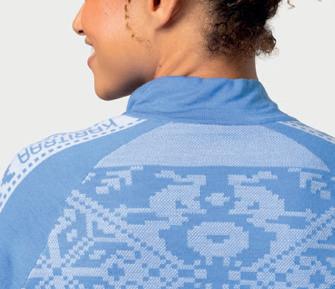
Whether you’re marching through icy cosmopolitan streets or flying down the slopes, the key to tackling a Nordic winter is layers, layers, layers. Kari Traa has long been a go-to in Norway, and not without reason – its Saga set thermals are not only warm and comfortable, but also incredibly cute!
Saga half zip in sea, EUR 119 Saga pant in sea, EUR 108 www.karitraa.com
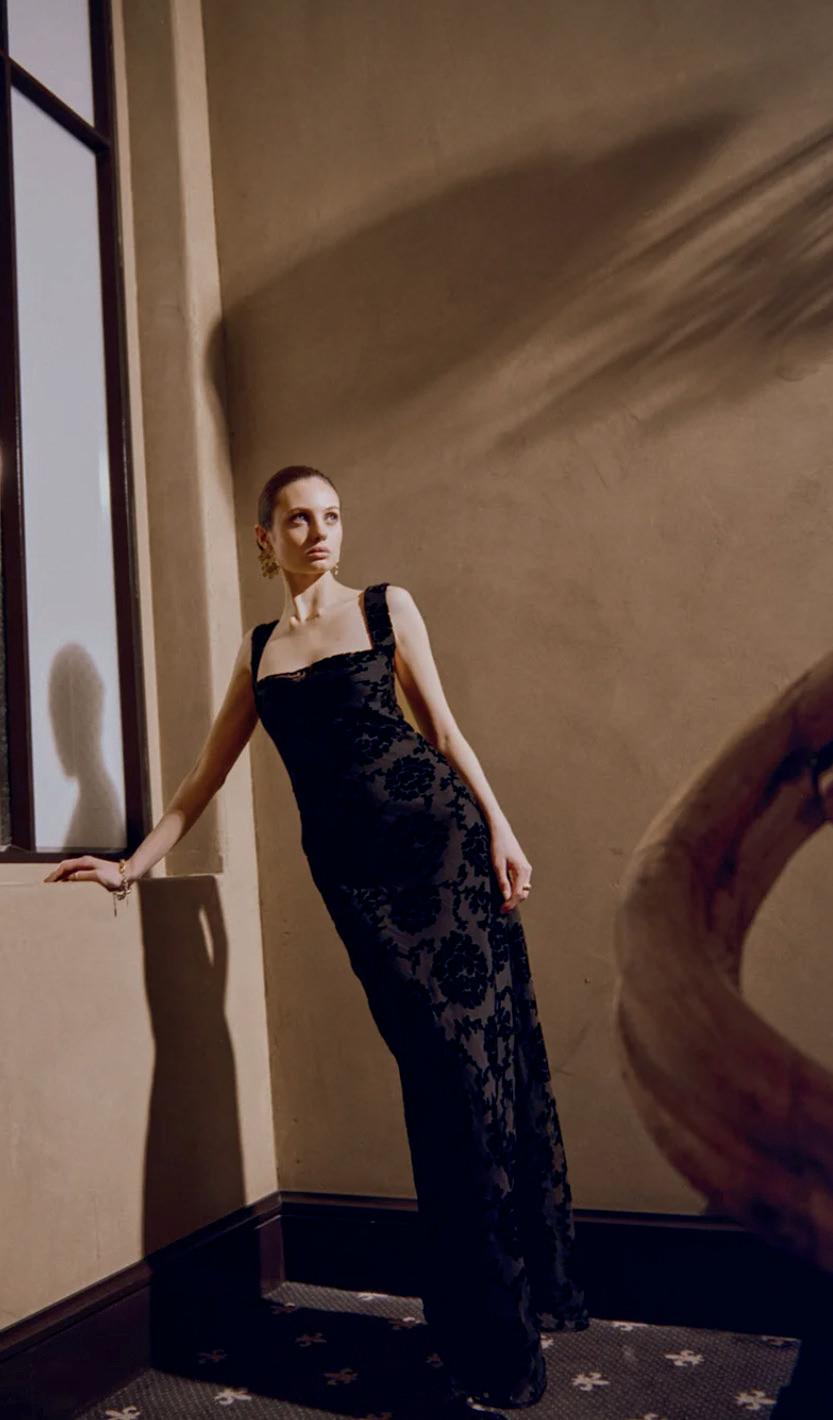
Best part of the end of the year, if you ask us? All the holiday extravaganza. Frills and flutters, jewellery and the opportunity to dress up. The black velvet strap dress from By TIMo will serve you well across December and into the new year. Indeed, with its long, fitted silhouette and classic velvet patterns, this timeless maxi dress can be worn for any formal occasions. Velvet strap dress, EUR 390 www.bytimo.com
Handcrafted Faroese treasures shaped by nature
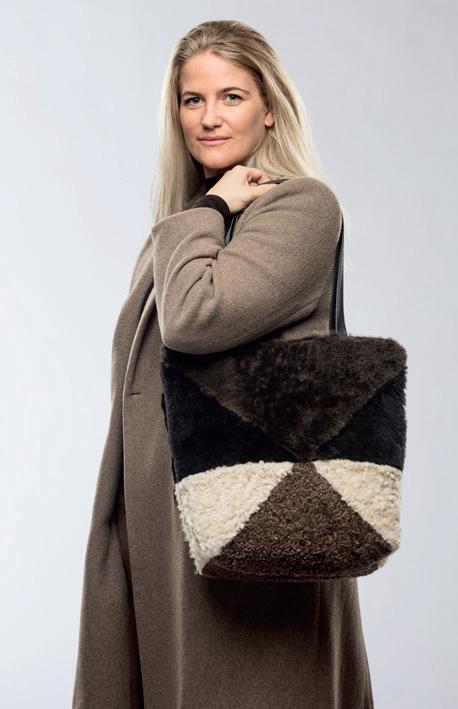
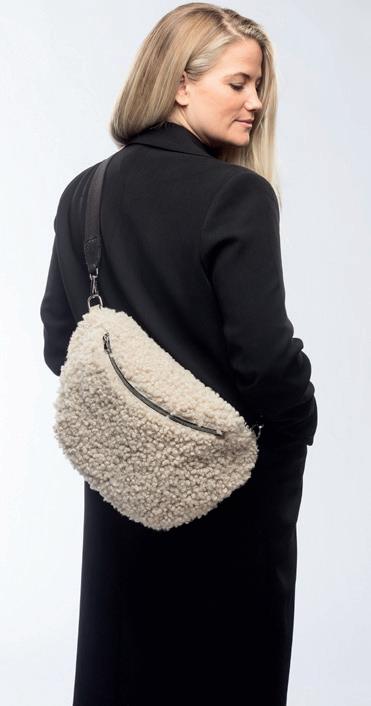
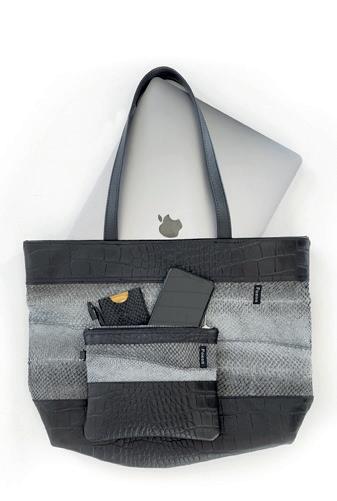
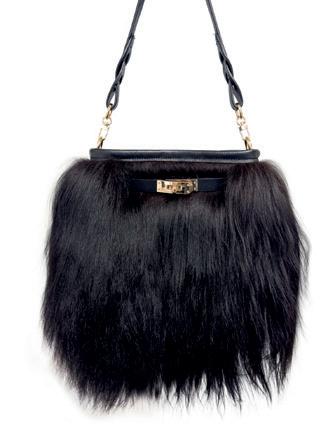
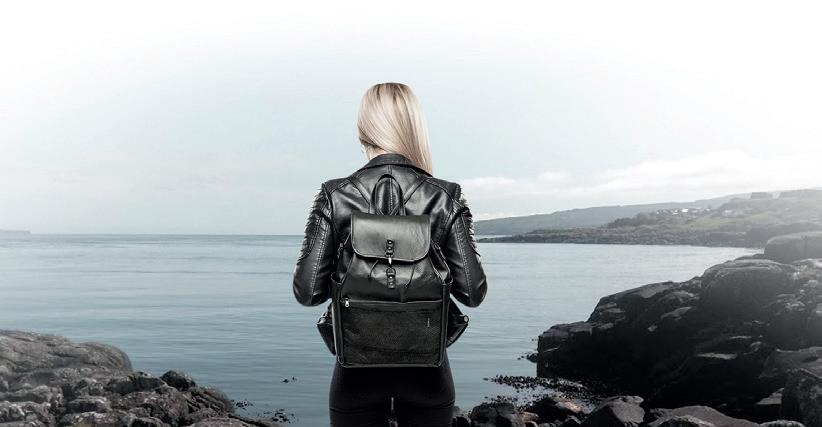
On the Faroe Islands, where rugged cliffs, restless seas and the ever-changing weather define life, two women are making one-of-a-kind accessories inspired by the landscape’s untamed beauty. At Fosaa Design, mother-and-daughter team Malan and Oda Fosaa handcraft bags, purses and jewellery using natural Nordic skins sourced from the islands and surrounding seas. Every piece is individually made in their Hoyvík workshop, and no two will ever be alike.
By Signe Hansen | Photos: Fosaa Design
Take a look at Fosaa Design’s web shop and you will be overwhelmed by the originality and creativity embedded in each of the many designs displayed. “We’re always making new designs,” explains Oda. “But we don’t create 20 identical bags and post them online at once; we make maybe two or three, and each one is finished when it’s ready. And because the materials are natural, no bag will ever be exactly the same. That’s part of the beauty – a lambskin might have a lighter patch or a tiny mark. It’s the animal’s story, and we keep it.”
The result has been an instant success; ever since the first line was introduced, the pair has continued to sell every single item produced.
Nature-born materials with a story to tell Every Fosaa piece begins with the raw materials. Using lamb, fish and seal sourced from the North Atlantic region, the designers honour traditional Faroese resourcefulness by turning natural by-products into enduring luxury. Salmon, cod and wolf fish skins are prepared without chemicals, resulting in striking natural patterns and extraordinary durability. “The salmon skin is incredibly strong and durable,” says Malan. “It’s perfect for bags meant to last.”
Fish skins are tanned in Iceland and lamb skins are prepared in Poland, as the Faroe Islands have no tannery. Once home in the workshop, the skins are shaped,
All designs by Fosaa Design are handmade in Nordic materials.
cut and sewn entirely by hand with every stitch and finish passing through the mother-and-daughter duo’s own fingers. “We work very much with a slow-fashion outlook,” says Oda. “Everything is created with purpose. There’s no mass production – and there never will be.”
A family craft shaped by tradition Malan learnt how to sew and work with animal skins and leather in Sønderborg, Denmark. When she finished her education there, she returned to the Faroe Islands and took up an apprenticeship in the timber trade. After decades there, at the age of 54, she founded Fosaa Design in 2012, determined to bring something distinctly Faroese to life. Her daughter Oda joined in 2013, and together they have built a brand grounded in heritage, integrity and a shared love of craftsmanship.
“I wanted to create something no one else was doing here,” says Malan. “And I don’t want our products made anywhere else.” Despite interest from investors and offers to scale up, the pair has chosen to remain hands-on.
Inspired by the fierce beauty of their island home, the creative process begins with nature and evolves through conversation, sketches and experimentation. Together, they develop each piece from idea to final stitch, adjusting shapes and finishes until the texture, function and feel are just right.
Design rooted in landscape – and loved worldwide
Today, Fosaa Design has customers across the world, with international orders shipping from the Faroese web shop. The pieces also feature in the newly reopened and expanded Östrøm Faroese Design Store – a landmark concept space in a historic building where carefully curated Faroese design meets outdoor living culture.
The store, five times larger after renovation, reflects a growing spotlight on Faroese craftsmanship and tourism, providing a physical home where visitors can encounter Fosaa Design’s work up close – and understand immediately why mass production was never an option.
Each piece from Fosaa Design is deeply individual, shaped by wild North Atlantic nature and the hands of two women who prefer tradition over trends and patience over production lines. However, these are not objects to collect –they are pieces to use, to carry, and to keep for years to come, bearing in them the resilience and endurance of their island home.
You can buy Fosaa Design’s products on the website or in the Östrøm Faroese Design Store.
www.fosaadesign.com
Facebook: Fosaa
Instagram: @fosaa_design
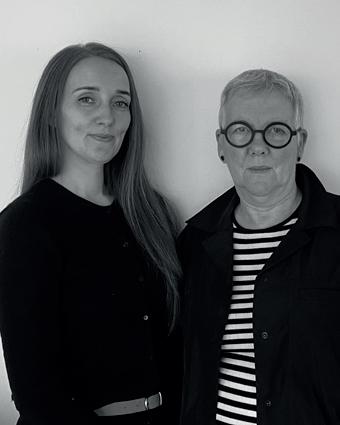
Mother-and-daughter team Malan and Oda Fosaa.
Celebrating Faroese humour, heart and heritage
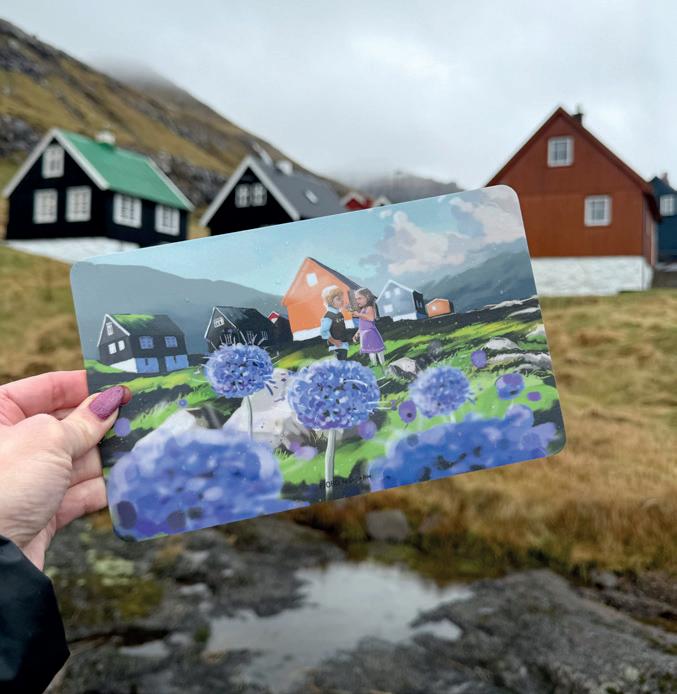
Cheerful, warm and quintessentially Faroese, FJORD has quickly become one of the islands’ most beloved design brands. Known for its nostalgic humour, whimsical animals, and affectionate nods to everyday island life, the brand has gathered a loyal local following as well as international interest, recently winning Brand of the Year.
By Signe Hansen | Photos: FJORD
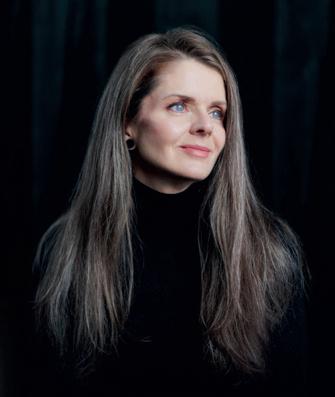
When speaking to founder, graphic designer Suffía Nón, it becomes clear that FJORD’s appeal lies as much in feeling as in form. Her drawings capture a kind of gentle comedy unique to island life – wry, affectionate and full of warmth. “What I love working with is humour – Faroese humour and nostalgia,” she says. “People often say that my designs warm their hearts because they make them remember specific details from their childhood –their grandmother’s dress or an old uncle’s smile. They are full of different perspectives and small things we did in the old days that people recognise and smile about.”
Growing up in Fuglafjørður, the harbour town that also gives FJORD its name, Nón absorbed the rhythms of a maritime community from an early age. The sea, the weather and the everyday resilience of island life shape her visual universe as naturally as the landscape shapes the Faroes themselves. “I grew up in a fishing environment,” she explains. “My mother, father, brother – they were all connected to the sea. That life shaped my eye and my drawings.” Today, she transforms these familiar scenes into prints, ceramics, homeware and seasonal designs that bring Faroese culture to kitchens and living rooms far beyond the islands.
Charm and quality
From posters and postcards to mugs, coasters, textiles and Christmas baubles, FJORD’s collection is unified by its cheerful hand-drawn universe and uncompromising focus on quality. “Good quality is
Graphic designer and Entrepreneur of the Year Suffía Nón.
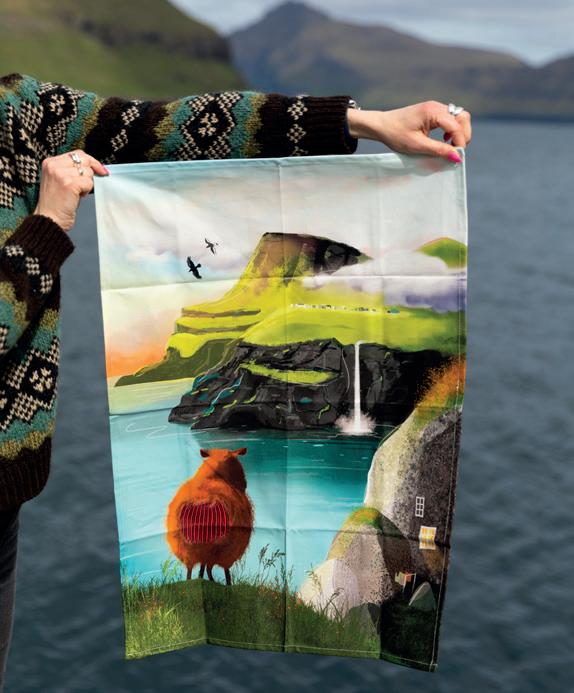
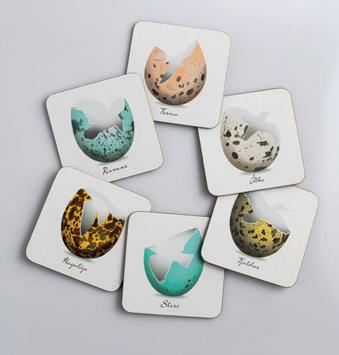
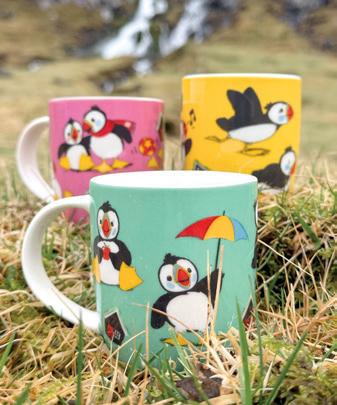
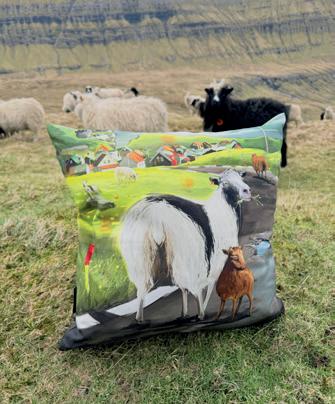
From tea towels and postcards to mugs and coasters, FJORD’s collection is unified by Suffía Nón’s humorous hand-drawn Faroese universe.
essential,” says Nón. “We spend a lot of time finding the right suppliers. Then, we get samples and test them in everyday life – mugs in the dishwasher, tea towels in the washing machine, again and again –and only when we are happy with the result do we move to production.”
Many products are made in the Faroes whenever possible: posters, postcards and packaging are, for instance, produced locally, while ceramics and textiles come from carefully chosen partners abroad. “Everything that can be made here, is made here,” explains Non. The brand’s most popular pieces are often those that distil Faroese life and nature with a twist of humour – sheep wandering into bus stops and tunnels, birds with clothes on, or folklore characters that one might meet in nature.
From a sketch on Facebook to award-winning brand
Though FJORD today stands as a celebrated design name, it began in the simplest of ways: a sketch shared for fun. “I posted a drawing of a bird holding a coffee cup on Facebook, based on the idea of inviting someone over for a coffee and a chat,” Nón recalls. “Someone asked if they could buy a print. That made me want to draw more.” More sketches followed, and by that first December, she had already made 15 different posters.
Soon, the kitchen filled with rolls of paper, boxes of prints and the hum of latenight packing sessions. “We packed post-
ers in the evenings, sometimes at night. I had a full-time job and we also had a baby with colic at the time, but it worked somehow,” she says. “It was stressful, but we had wind in our sails,” says Nón. “I realised that I could not continue with a full-time job, a full-time business, and children. So, in 2018, I took the leap — one year to see if it could work.”
Together with her husband Bogi, who now handles operations, Nón rented a space in town to store goods and open a shop. “We were so excited - and then Covid came,” she laughs. “But the web shop saved us. We were already set up, and many others had to start from scratch.”
Since then, the brand has continued to expand and thrive, and in the last two years, its success was cemented by two national awards. “When we won Entrepreneur of the Year and then Brand of the Year, those were big moments. I could hardly believe it,” smiles Nón.
Beyond the fjord
Today FJORD’s products are sold online as well as in stores across the Faroe Islands and recently also Iceland. “At first they bought the Faroese motifs,” says Nón. “But then they wanted something local too, so I travelled to Iceland to draw there as well.” The same is happening in Denmark, where exclusive Copenhagen-inspired pieces are in development.
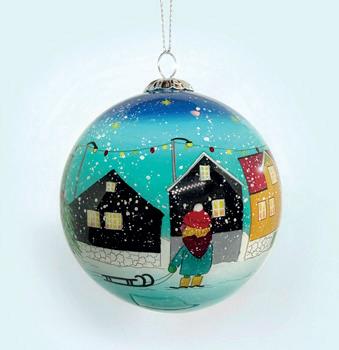
With Christmas coming up, FJORD’s pieces make thoughtful gifts that bring a little Faroese warmth into any home. Especially, perhaps, the brand’s annual hand-illustrated bauble, which has already become a cherished tradition, with a new design released every year and collected by fans near and far.
www.fjord.fo
Facebook: fjord.fo
Instagram: @fjord.fo
FJORD’s annual hand-illustrated bauble has already become a cherished tradition.
Coasters.
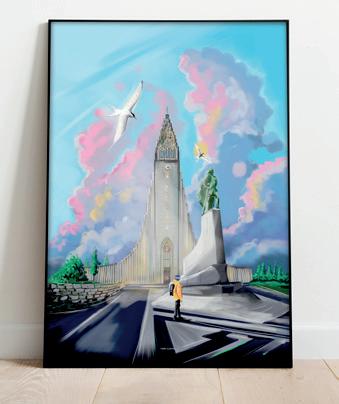
Poster of the Hallgrímskirkja church in Reykjavík.
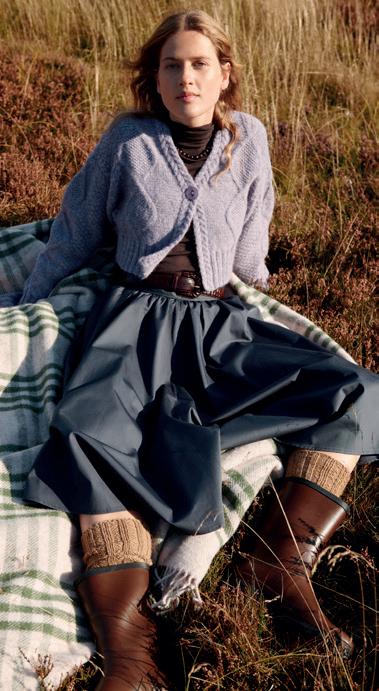
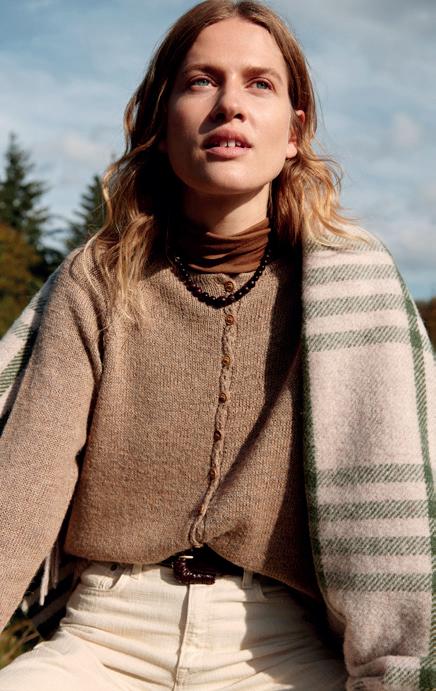
Isager Strik
–a legacy of Danish knit design
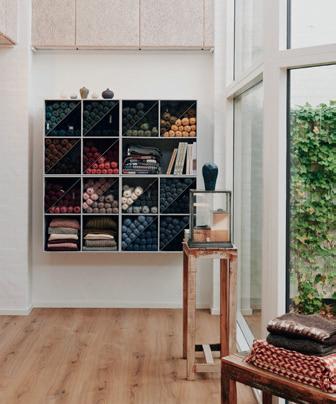
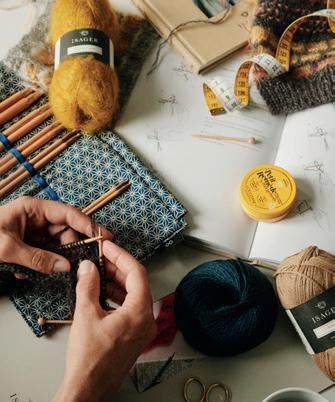
For more than half a century, Isager Strik has been a quiet cornerstone of Scandinavian knitwear design. Founded by designer Åse Lund Jensen and carried forward by Marianne Isager, who formally established the brand in 1977, the company has become synonymous with natural yarns, timeless patterns and an unwavering commitment to quality. Today, Marianne’s daughter, Helga Isager, carries the tradition forward alongside her mother.
By Signe Hansen | Photos: Katrine Rohrberg. Stylist: Marie Graunbøl
Over the past nearly 50 years, Marianne Isager has been at the forefront of Danish knit design through her extensive production of patterns and books. From the small coastal village of Tversted in Northern Jutland, Isager Strik continues to carry forward her work in developing the old craft. The company’s headquarters, housed in a converted village school, remains the creative heart of the brand, where courses, pattern development, and product testing take place.
In recent years, the resurgence of knitting – fuelled first by online communities
and later by the pandemic’s enforced pause – has brought remarkable growth, and Helga Isager believes that the benefits of knitting are truly worth sharing. “When I design, it demands concentration, but when I knit something simple, it’s like meditation,” she says. “You get into a flow. We all need a break from the digital –something analogue, whether it’s reading a book or working with your hands, and that’s what knitting gives you.”
From mother to daughter
When Marianne Isager took over the firm from Åse Lund Jensen in 1977, she
continued a Danish design tradition where structure, fit, and craftsmanship mattered as much as colour and pattern. “Åse had a background in tailoring, and that influenced everything,” Helga explains. “She thought about shape and fit in knitting at a time when many just knitted freely and hoped it would fit someone.”
Growing up among yarn cones and pattern sheets, Helga initially resisted following the same path. “It was the last thing I imagined doing,” she says. Yet the sense of texture, colour, and quality stayed with her. After studying Japanese and art history, she eventually felt the pull of design. In 2005, she opened a small shop in Copenhagen’s Nørrebro under the name Amimono – Japanese for knitted things. “I didn’t want to use my own name at first,” she recalls. “I needed to find my own voice before joining the family company.”
Forget itchy scarves and formless sweaters; for decades, the Isager collections have been bursting with stylish designs.
By 2008, she had joined the family firm, combining her own design sensibility with her mother’s deep technical experience. Today, she co-owns the company with her mother, who remains deeply involved. “My mother still lives and works in Tversted,” says Helga. “She’s incredibly productive – she’s published a large Strikkeliv book every year for the past few years, and I honestly don’t understand how she manages to produce so much.”
Natural fibres and thoughtful design
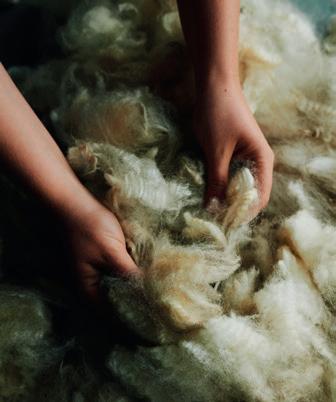
Isager’s yarns are known for their soft, natural feel and refined colour palette. Many of the core qualities – such as the iconic Jensen Yarn – have been produced in the same spinnery for decades. “We don’t work with seasonal collections,” Helga notes. “Some of our yarns go all the way back to Åse Lund Jensen, and we still spin and dye them in the exact same way.”
The range includes alpaca, mohair and fine merino, sourced from trusted suppliers around the world, yet dyed to harmonise within a consistent, earthy colour scale. Alongside these international fibres, Isager also runs its own small spinning mill in Tversted, where locally sourced Danish wool is washed, spun and dyed. For now, production is limited, and the yarn can only be purchased in the Tversted shop and online – but there are plans to expand in the future. “It’s important that the yarns are natural materials,” she says. “We only add synthetic fibres where durability demands it – for example, in sock yarns.”
Beyond the yarn itself, the company offers patterns, knitting kits, and courses held in its former village school in Tversted. Here, visitors can stay in the guesthouse, enjoy local food, and take workshops in knitting, weaving, or paper craft. “People come to learn, but also to slow down,” Helga explains. “It’s a place where you can immerse yourself and meet others who share your interest.”
Patterns, presence, and the joy of making Isager’s patterns have a reputation for sophistication, yet Helga is now developing a more beginner-friendly collection. “It’s a challenge,” she admits. “I’m very detail-oriented, so it’s about keeping the quality but making things accessible. The new patterns include video links and
guidance, because many younger knitters are used to visual instruction.”
As the company’s reach has expanded, so have the translations: patterns are now available in ten languages, with warehouses in both the USA and Japan to serve international retailers. Still, the heart of Isager Strik remains in Tversted, from where it continues to share the joy of knitting, whether through its enduring yarns, elegant designs, or thoughtful teaching.
Helga Isager’s five tips to get started with knitting
Choose the right yarn. Start with medium-weight wool or alpaca blends such as Jensen Yarn or Alpaca 3 – they have natural elasticity and are easier to handle.
Knit something that you truly want to wear. Motivation is key; it is easier to finish a project you look forward to wearing.
Work with one colour or stripes. For beginners, it is best to keep things simple – one yarn, one texture.
Do not ignore mistakes. If something feels wrong, start again; it saves frustration later and builds skill.
Seek help and community. Visit a local yarn shop, join a knitting café, or find tutorials online.
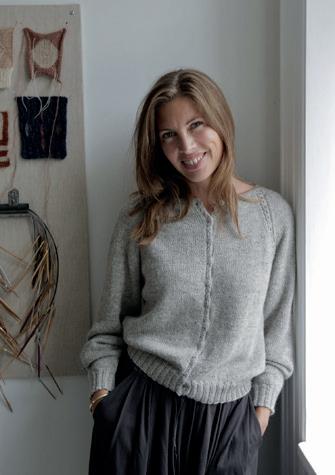
Today, Helga Isager heads the company alongside her mother, Marianne Isager.
The shop, guesthouse, and course centre are located near Tversted beach, making for a perfect knitting getaway.
Isager’s own spinning mill works to refine the quality of local Danish wool from a nearby farm.
Isager hosts a range of knitting and handicraft courses at a former village school in Tversted houses.
Crystal glasses that fulfil Champagne’s true potential
Swedish newcomer Altare Studios specialises in high-quality crystal glassware that pays homage to the art of fine dining and winemaking. Its Temple series with five different glasses for five styles of Champagne is tailored to showcase the very best of the bubbly beverage.
By Malin Norman | Photos: Altare Studios
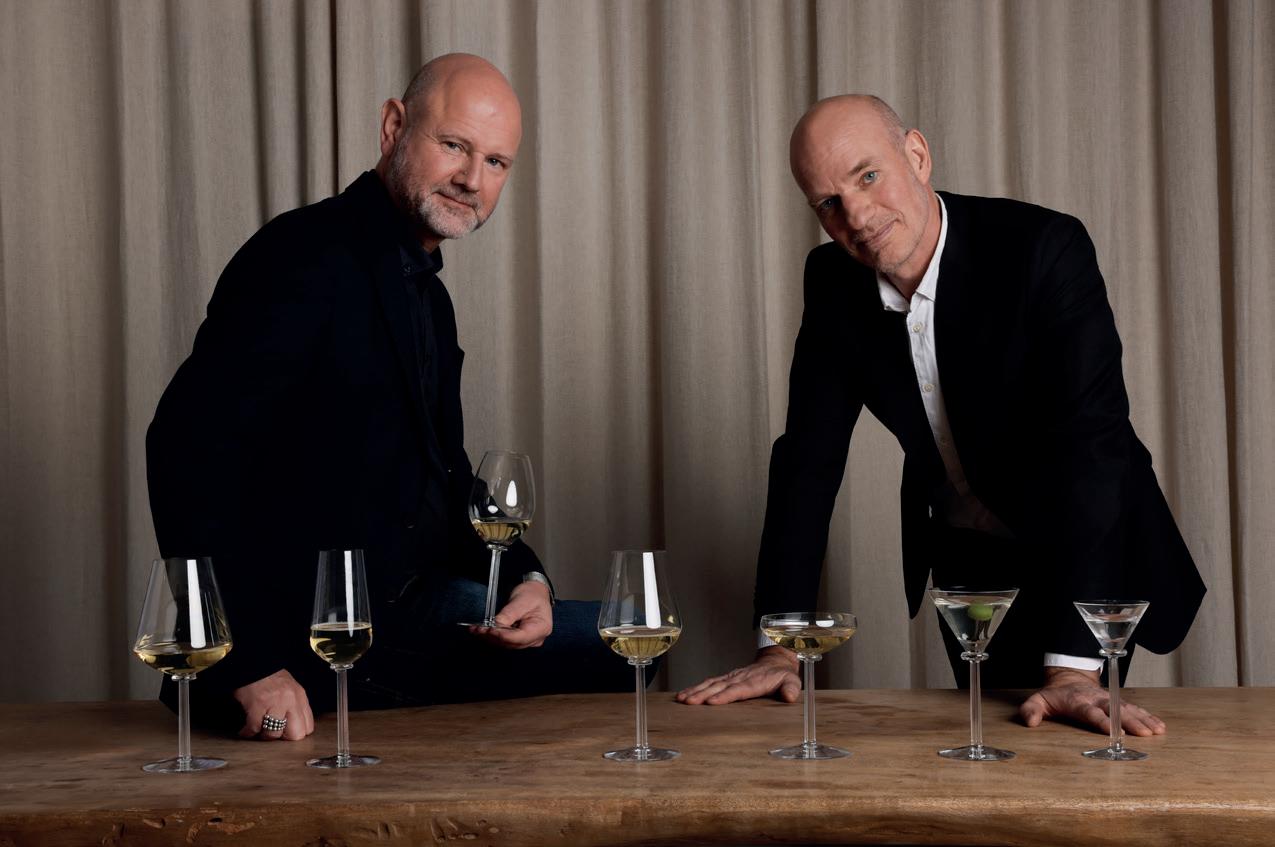
Born from a shared passion for glass artistry and design, Altare Studios was established last spring by Mattias Thoresson, sommelier and glass expert, and Anders Kumlien, artist and designer. Together, they came up with the idea for a groundbreaking glassware collection that honours both tradition and functionality.
With its custom-made design, the Temple series is optimised for Champagne’s
different nuances. Each glass unlocks the full potential of the aroma, acidity, and minerality. “We were missing a set of glasses that took Champagne seriously,” explains sommelier and CEO Thoresson. “Our mission is to design timeless pieces that enhance your sensory experiences.”
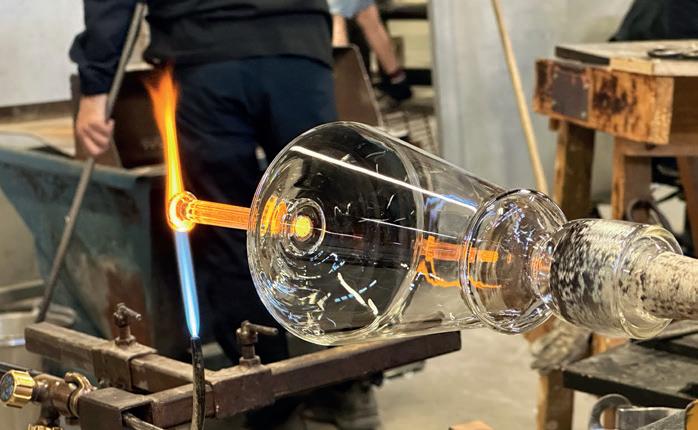
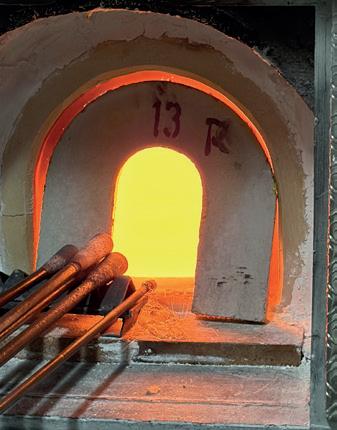
The glasses are mouth-blown from leadfree crystal at Reijmyre Glassworks in Östergötland, one of Sweden’s most re-
spected glassworks, and all production is carried out using furnaces powered by renewable energy.
Elegance and modern functionality
The design studio’s first collection is the embodiment of the duo’s combined expertise. Thoresson, with his deep knowledge of wine and glass functionality, envisioned pieces that would elevate the sensory experience of Champagne occasions. Kumlien, inspired by his background in art and design, crafted the aesthetic with a nod to classical architecture.
“Our Temple collection is the first, and so far only, series of glasses with a focus
Mattias Thoresson, CEO, and Anders Kumlien, creative director.
Photo: Jonathan Sosa. Creative direction: Samira Makhoul, Fig Studio
on highlighting the unique character of the different styles of Champagne,” says co-founder and creative director Kumlien.
The Prestige glass is the crown jewel of the Temple series. Its large bowl allows the most exclusive Champagnes to breathe and release their complex aromas. “Whether you’re enjoying a Prestige cuvée, a Rosé, or a Blanc de Noirs, this glass enhances both the power and elegance of the wine,” says Thoressson.
The Vintage glass is tailored for vintage-specific Champagnes, emphasising their complex flavour profiles, and the Non-vintage glass is aimed at win-
emakers’ most common Champagne style. Whilst the Coupe glass is perfect for celebrations, the Flute is a tribute to the soul of Champagne – aimed at those who love tradition, with a classic shape designed to preserve the bubbles and freshness of Champagne.
“The difference that the glass makes must be experienced first-hand, suddenly you can feel a magically delicious aroma and taste, which with another glass completely passed you by,” says Thoressson. “These glasses really are made for more enjoyment in life!”
A sparkling future awaits
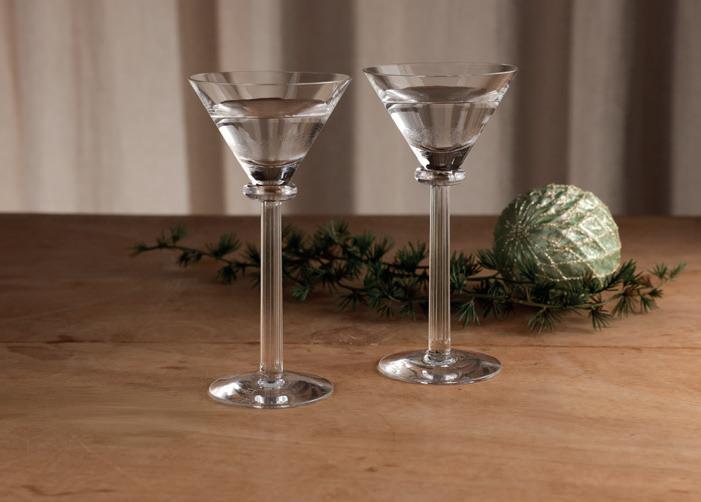
In September, Altare Studios launched two glasses in a new bar series: Temple Martini and Temple Snaps. Also mouthblown at Reijmyre Glassworks, these glasses are natural additions to the table.
The brand’s future is no doubt bright and sparkling. “Right now, we’re going through an exciting startup phase and we’re also looking for interesting partners to join our journey,” adds Kumlien.
Altare Studio’s Temple series is available in the brand’s online shop and at selected retailers.
altarestudios.se/en Instagram: @altarestudios
Temple Bar snaps glass. Photo: Jonathan Sosa. Creative direction: Samira Makhoul, Fig Studio
A Temple Champagne glass, handcrafted at Reijmyre Glassworks.
Furnace at Reijmyre Glassworks.
Temple Coupe glasses in a festive Champagne tower.
Nature’s super material: Crafting connection between people and the planet
Bonden, founded by designer Kati Hienonen, was born in 2016 with a vision of creating home textiles rooted in a fully circular economy. Every material that the brand produces is designed, manufactured, used and eventually recycled to minimise waste.
By Ndéla Faye | Photos: Taikavasara
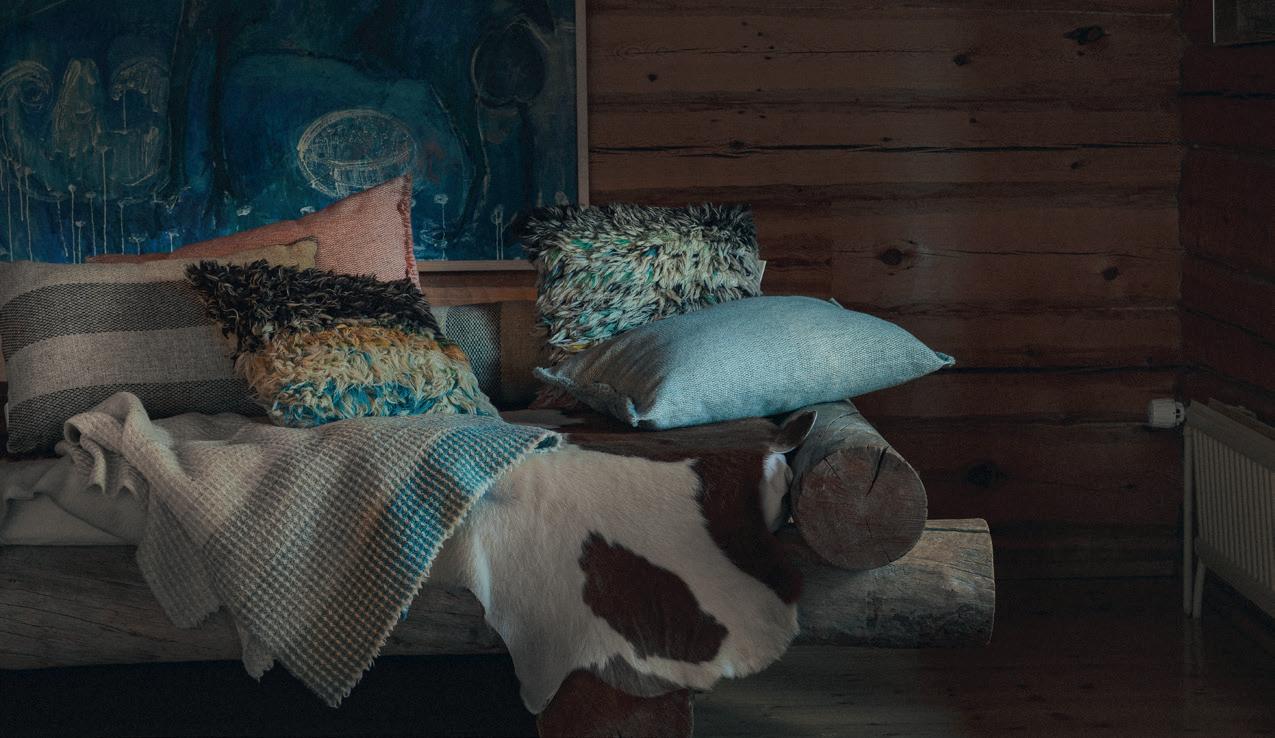
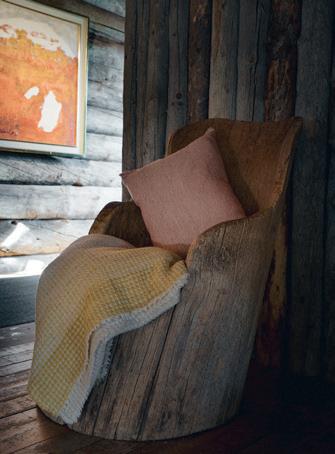
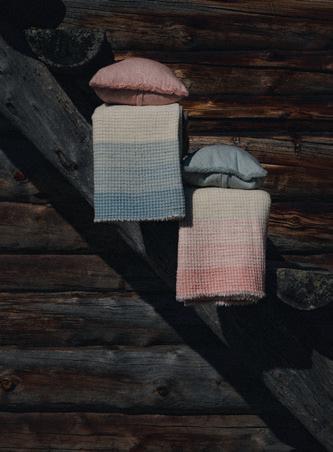
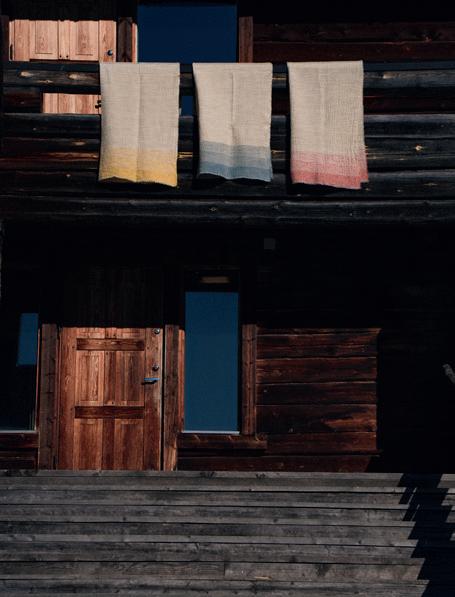
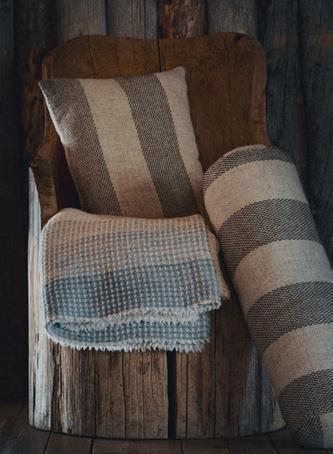
Bonden has transformed Finnish sheep’s wool into a versatile material for blankets, shawls, upholstery fabrics, pillows, and ottomans. Even the smallest offcuts and leftover pieces are treated as treasures, repurposed as patchwork textiles, bespoke rugs, and soft pillows.
Finnish wool is what Hienonen calls a super material. Retaining lanolin, the natural grease in wool, it is water- and dirt-repellent, antibacterial and self-cleaning – and it can be refreshed simply by airing.
The wool’s soft touch and the muted, earthy tones characteristic of Bonden reflect a philosophy that the brand truly lives and breathes. “We believe that the relationship between humans and nature is the most unique thing in the world. We want to help people create a responsible future where well-being and comfort are not achieved at nature’s expense,” Hienonen says.
Each Bonden product is designed with the idea that one day, all the material can
be fully recycled. The wool, which is a by-product of meat production, is an ideal circular resource, and its recyclability is exceptional: it can be returned to fibre five or six times.
A new life for Finnish wool
Hienonen’s career spans decades in fashion and textile design, product development, and research. She spent years in Hong Kong during the ‘80s and ’90s, witnessing first-hand the impact of globalised mass production. In 2005, she realised that forecasting trends without considering ecological, ethical and social responsibility was impossible. “That moment shifted everything for me,” she says.
Back in Finland, she worked with brands like Marimekko, Iittala and Visit Finland,
integrating sustainability into design forecasting, and joined Aalto University’s innovation teams exploring wood-based biomaterials. Eventually, she turned her attention to Finland’s underused natural treasure: sheep’s wool. “Because of the distances between farms and spinning mills, about 70 per cent of Finnish wool was discarded. The rest was turned into thick craft yarn. I wanted to change that,” Hienonen explains.
She built a network of local artisans with spinners, natural dyers, weavers and finishers, to develop a fine, versatile yarn suitable for industrial weaving. Only natural shades of white, brown and black were used, complemented by plant-based dyes, avoiding the environmental harm of synthetic dyeing, which accounts for around 20 per cent of global water pollution.
Inspiring creative, sustainable interiors
For Hienonen, sustainability is not just a process, it is a compass for living. Being a responsible decorator means embracing ecological materials and originality. According to her, the most beautiful interiors are not about following trends, but creating spaces filled with memories, personality and depth beyond fashion.
Every Bonden product, colour choice and material reflects this philosophy, cultivating both inner and environmental well-being. For the brand’s found-
er, it was clear that ecology in interior design means adopting responsibility in a holistic way. “It creates fascinating beauty around us and reminds us that respecting nature is part of creating larger comfort,” she adds.
Bonden’s Autumn/Winter 2025–2026 campaign was photographed at the Reidar Särestöniemi Museum in Lapland, the former home of the renowned Finnish artist known for his deep connection to the Arctic landscape. Särestöniemi often painted himself as a wolf, bear or seal, merging with the natural world, which is something that resonates with Bonden’s ethos. “Like him, we see ourselves as part of a larger cosmos,” says Hienonen.
Bonden’s products are sold in Finland, Central Europe, Japan and the United States. Bonden also has an online store and a showroom in central Helsinki, which is open to everyone, but visits are by appointment only.
The brand also collaborates with architects and interior designers on spaces, where pure, natural materials are integral to the experience, often using wool that retains its lanolin for natural waterand dirt-repellent qualities, and is naturally fire-retardant. “We believe in design where both humans and nature live in balance, which is why we want to be part of projects that align with our ethos,” says the founder.
Bonden’s textiles are made to last, therefore avoiding contributing to overconsumption. At its core, Bonden embodies a single elegant idea: beauty, responsibility, and longevity belong together. “Good design has always been about improving people’s lives. With Bonden, we want to show that good design can also do good for nature,” Hienonen concludes.
www.bonden.fi
Instagram: @bondenliving
Inventive Nordic design through craft and collaboration
In the small Finnish town of Halikko, Made by Choice brings its vision of modern Nordic design to life. Known for its bold aesthetics, exceptional craftsmanship and deep commitment to sustainability, the award-winning Finnish furniture brand has found its way into some of the most exclusive spaces around the world.
By Ndéla Faye
Made by Choice, founded in 2015, was born out of a desire to create alternative furniture; playful, characterful pieces that tell stories and bring joy to their owners. Each product is made in the company’s own Halikko factory, where around 40 artisans and engineers combine traditional woodworking methods with modern technology. “We want to make furniture that people can connect with: pieces that hold meaning, are made with care, and built to last,” says Antti Olin, the company’s CEO.
Collaboration is central to the brand’s identity, and Made by Choice works with designers, artists and creative thinkers from a wide range of fields. This openness has led to collaborations that push boundaries, producing furniture that is as conceptual as it is functional.
One standout is the Lieksa chair, created together with New York-based de-
sign practice Snarkitecture. The piece merges the warmth of Finnish wood with Snarkitecture’s sculptural minimalism, resulting in a chair that feels at once familiar and experimental.
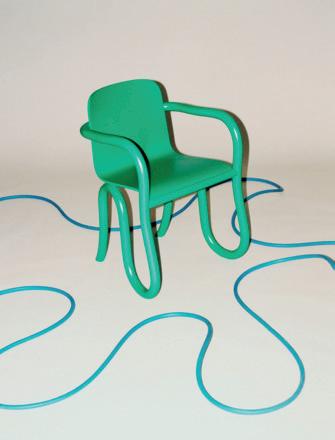
Another is Kolho, designed with American artist Matthew Day Jackson. Kolho is a striking collection, with its combination of right angles and serpentine curves. The collection has become a Made by Choice bestseller, featured in The New York Times, Forbes and Finan-
cial Times, and celebrated for its blend of artistry and function.
Each Made by Choice piece begins with a specific need – whether for a restaurant, private client, office, or public space – and evolves through an intricate creative process. “We have the ability to turn even the roughest concept into a finished product, without compromising on creativity or quality. This is where our expertise really shines,” Olin says.
Made by Choice’s reputation is now spreading far beyond Finland. The company’s expansion into the USA has opened the door to international projects, including furniture for a new restaurant in the Empire State Building, as well as commissions in London and Rome, among others.
“It’s rewarding to see our work grow from a small workshop in Halikko to projects in some of the world’s most recognisable cities, and to know that the quality of our craftsmanship resonates with people,” the CEO concludes.
www.madebychoice.com
Facebook: Made by Choice Instagram: @madebychoice
Kolho. Photo: Osma Harvilahti Lieksa. Photo: Matti Pyykkö
Kolho at Mount Street Restaurant. Photo: Simon Brown
Lieksa at Adopt Office Portland. Photo: Adopt Office Portland
52 Places to Go in 2025
The best art and architecture of 2024
Worlds Greates Places
A Must-Visit For European Art Lovers
experience the nordic
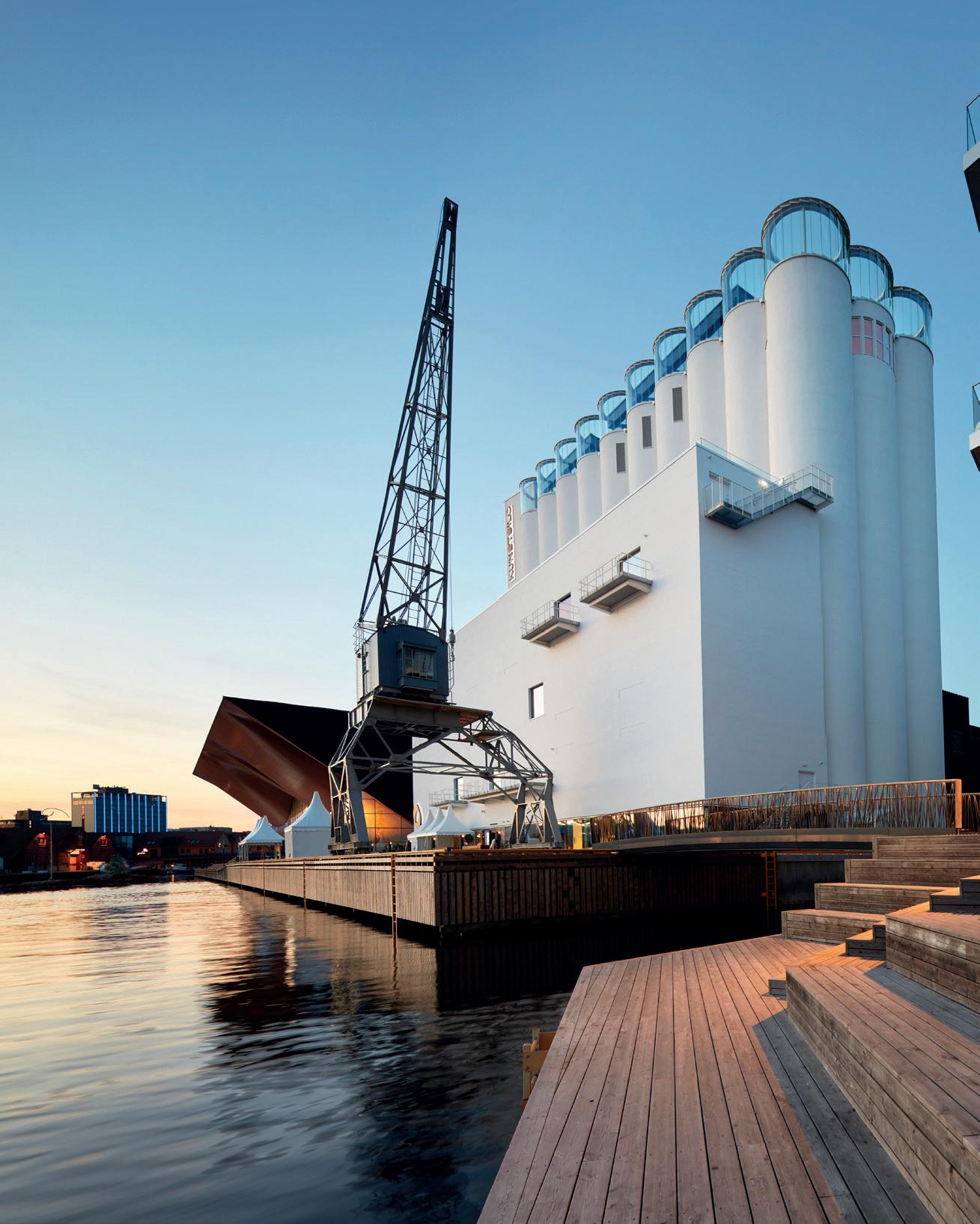
Kunstsilo is one of Northern Europe’s most innovative art museums located on Norway’s stunning southern coast. Housed in a reimagined 1930s grain silo it is home to the world’s largest collection of Nordic modernist art — the renowned Tangen Collection — and a dynamic programme of rotating international exhibitions.
Kristiansand, Norway kunstsilo.no
We Love This: Lamps to light up the new year
Scandinavian designers are world leaders in lamps, and not without reason. In a region where winter daylight is as scarce a resource as small talk in Finland, lamps that mimic the soft uplifting effects of natural light have become a speciality. As always, Scandinavian designers have turned a necessity into art, filling homes with warm, atmospheric illumination and beautiful shapes. Here are some of our favourite iconic and contemporary lamps, sure to light up even the darkest of winter days.
By Signe Hansen | Press photos
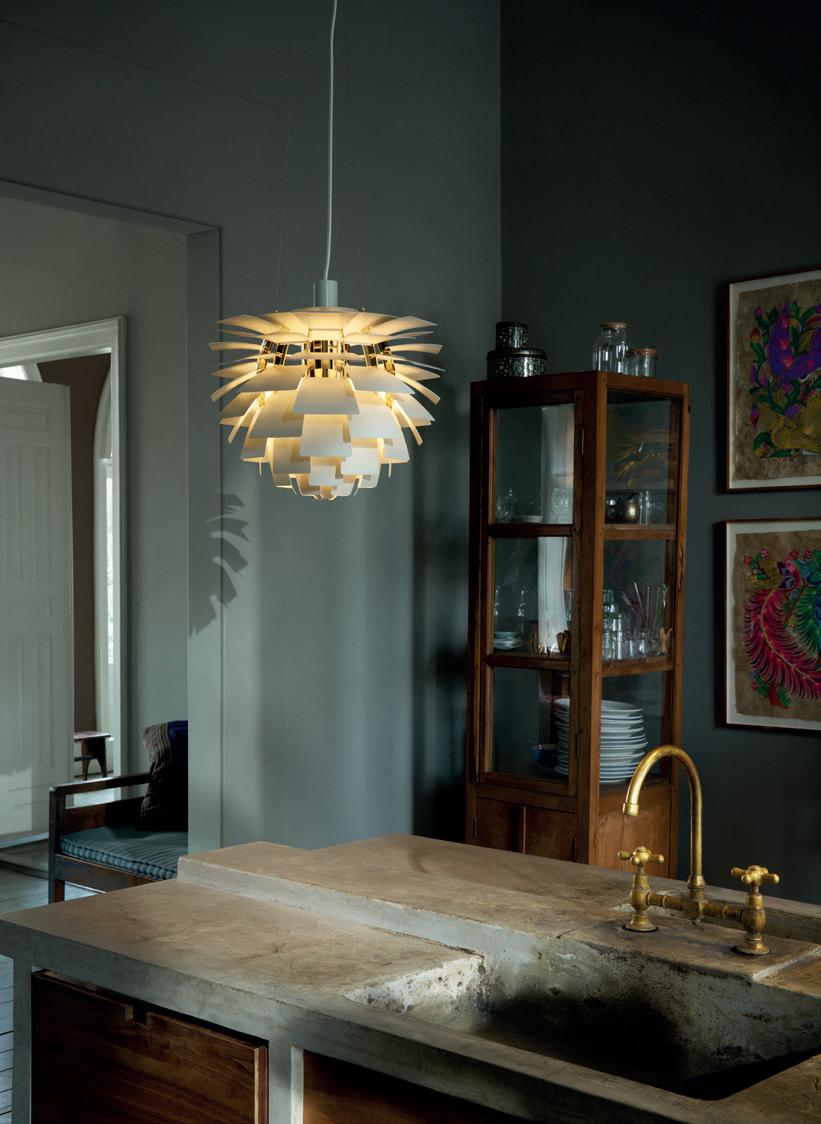
Artichoke – Poul Henningsen
An undisputed icon of Danish design, the PH Artichoke was created in 1958 by Denmark’s ultimate lighting master, Poul Henningsen. Composed of 72 meticulously hand-placed metal leaves, it emits a soft, glare-free light from every angle and remains one of the most technically sophisticated pendant lamps ever produced. Originally featuring a delicate rose-tinted interior, the sculptural silhouette still makes a striking statement today – an architectural masterpiece for lovers of timeless design.
Price: from DKK 77,500 www.louispoulsen.com
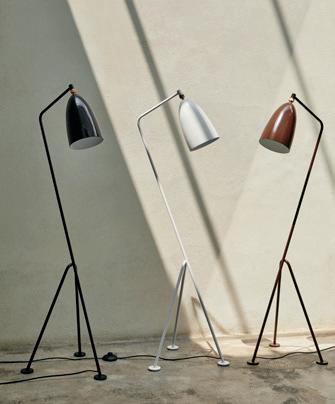
Gräshoppa Floor Lamp – Greta M. Grossman
Originally produced in 1947, the Gräshoppa lamp remains one of Swedish designer Greta M. Grossman’s most iconic designs. With its slender tripod legs tilted just off-centre, the lamp appears poised and almost animated – as if about to glide across the floor. A conical shade provides directional light, making it the perfect companion for a winter afternoon curled up on the sofa with a book, bringing the experimental spirit of the mid-century right into your living room.
Price: from DKK 6,999 www.gubi.com
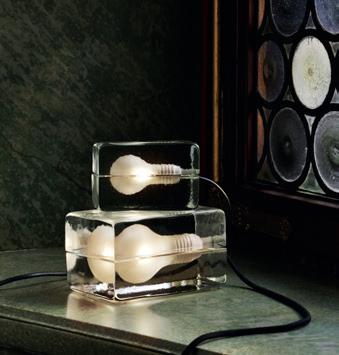
A modern classic since its debut in 1997, Finnish designer Harri Koskinen’s Block Lamp encases a bulb within two solid glass ice blocks – a poetic nod to Finland’s frosty winters and a masterclass in reduction. Produced by Design House Stockholm, the lamp is internationally acclaimed and was added to MoMA’s permanent collection in 2000. Playfully balancing industrial edge with soft elegance, it is perfect as a sculptural bedside light, an atmospheric accent on a bookshelf, or a striking conversation piece on a console or coffee table.
Price: from EUR 160 www.designhousestockholm.com
Block Lamp – Harri Koskinen
PH
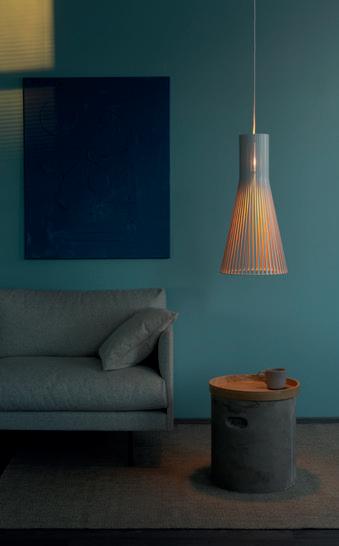
A pioneer of modern wooden lighting, the Secto 4200 by Finnish designer Seppo Koho was the very first lamp in the now-beloved Secto collection launched in 1999. Handmade in Finland from PEFC-certified birch, its warm glow and graphic slatted form aptly demonstrate the magic of natural materials, skilled craftsmanship and thoughtful restraint. The hidden bulb produces soft, patterned light and a soothing ambience – it is almost like bringing a piece of the softly lit Finnish Lakeland into your living room.
Price: from EUR 550 www.sectodesign.fi
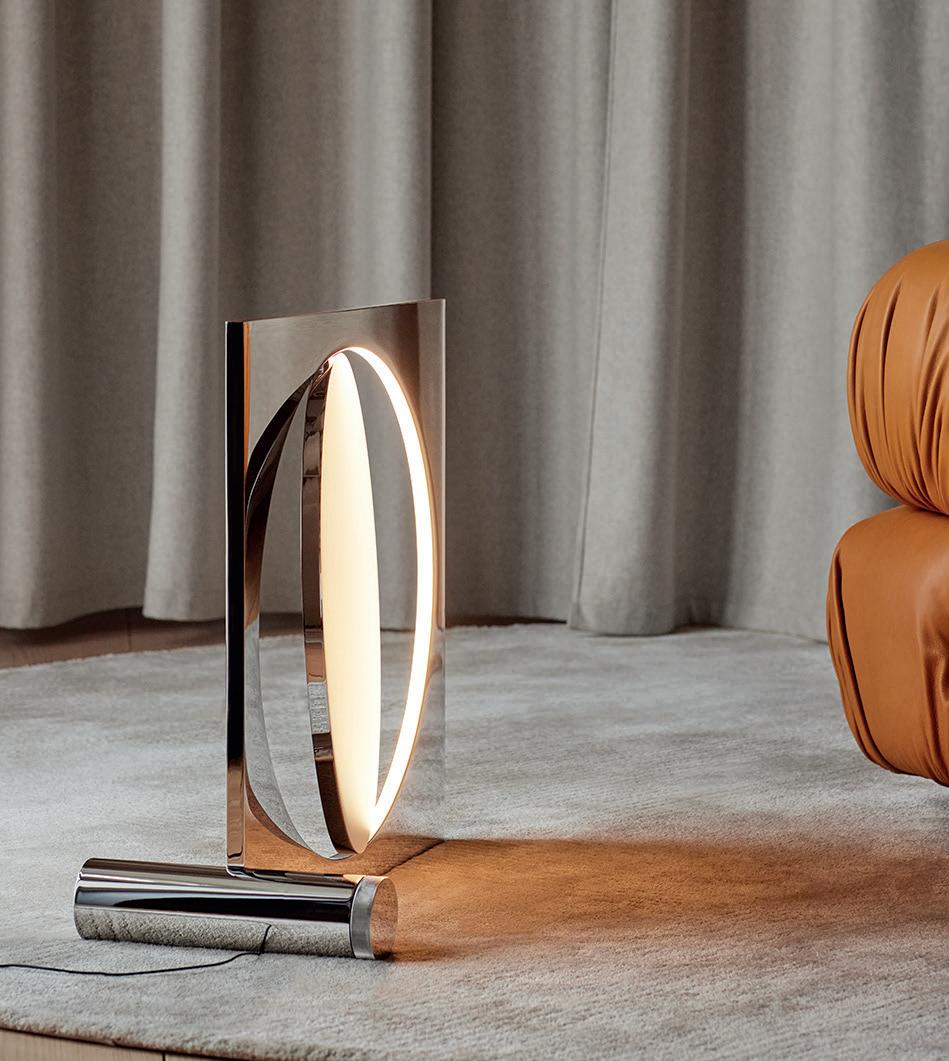
Moonsetter – Anne Boysen
Sculptural, serene and almost lunar in its presence, the Moonsetter has taken the design world by storm. Created in 2020 as Danish designer Anne Boysen’s winning entry in a TV show to find the next design classic, the lamp is produced by Denmark’s leading lighting specialist, Louis Poulsen. Its rotating circular disc and polished surfaces play with light and shadow, allowing you to sculpt the atmosphere as you wish. Minimal yet poetic, it is a lamp that feels as much like a piece of art as a functional object – a contemporary heirloom in the making
Price: from DKK 49,400 www.louispoulsen.com
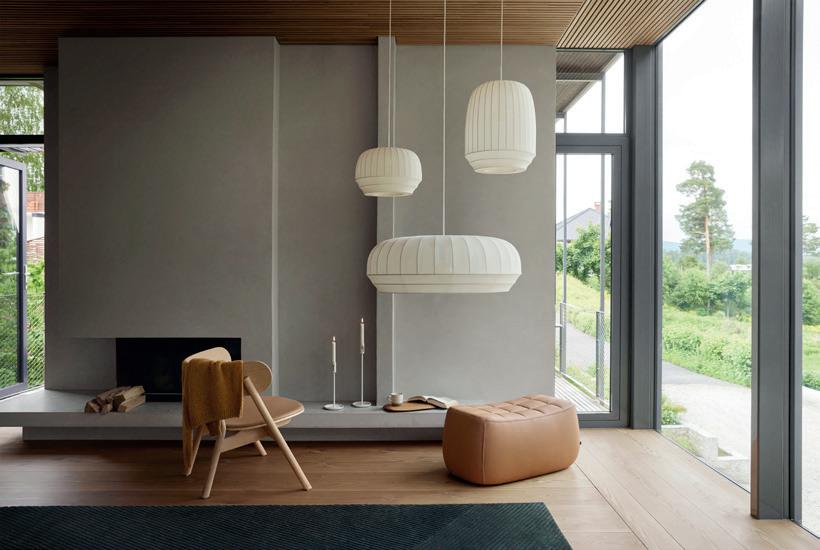
Tradition Pendant – Morten & Jonas
Soft, tactile and beautifully atmospheric, the Tradition Pendant from Norwegian design duo Morten & Jonas reimagines knitted craft for contemporary living. Its off-white knitted shade stretches elegantly over a clean metal frame, diffusing light gently through the textile structure. Available in three shapes –Small, Tall and Large Oval – it works beautifully alone over a dining table or clustered in a sculptural installation. Calm, cosy and unmistakably Nordic.
Price: from NOK 4,490 www.northern.no
Secto 4200 Pendant Lamp – Seppo Koho
Sigrun Gunnarsdóttir –a heart in colours, a world of warmth
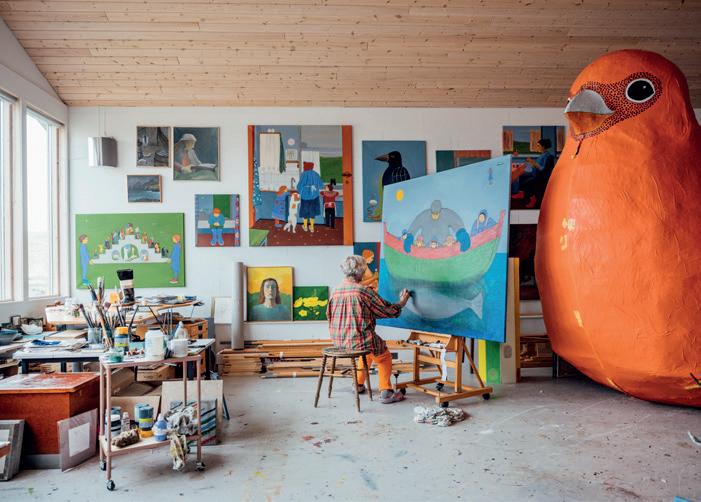
From the rugged coast of Eiði on the Faroe Islands, Sigrun Gunnarsdóttir (b. 1950) has shaped a visual language recognised far beyond the North Atlantic. Educated at the Royal Danish Academy of Fine Arts, her work is rooted in naivism, symbolism and a quiet surrealism, with warm, concentrated colours and pared-back forms meeting layers of emotions and memories. As she continues working from the village where she was born, exhibitions all over the world, numerous accolades, and the Knight’s Cross of the Order of Dannebrog testify to the impact of her art.
By Signe Hansen | Photos: Beinta á Torkilsheyggi
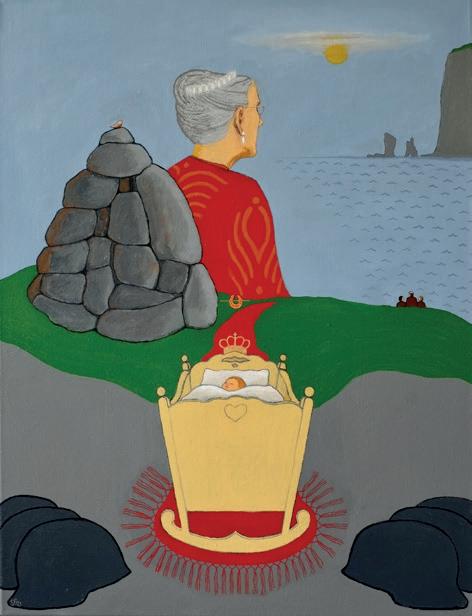
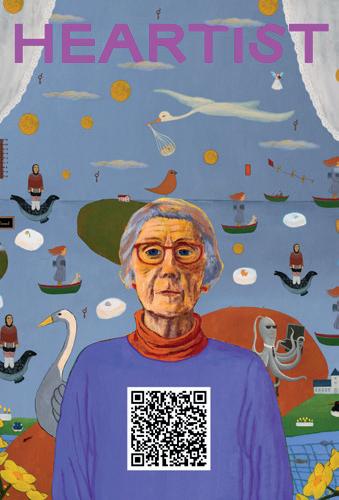
In 2021, Gunnarsdóttir was commissioned to paint Queen Margrethe II. The portrait – intimate yet symbolic – shows the Queen seated before a Faroese cairn, looking out across the sea and mountains, as a cradle glows gently in the foreground. It is a work grounded in belonging, history and warm respect, drawing Faroese tradition into the royal gaze. As all other works of Gunnarsdóttir, the portrait comes from her heart. “Every single painting means something to me. It has to – otherwise, I cannot put my name on it,” says Gunnarsdóttir in HEARTIST, a documentary about the artist and her
work. The title of the film, which won the Best International Documentary Award at DOC LA (Los Angeles film festival) 2023, echoes the artist’s own description of herself as a ‘heartist’. “Art is the heart I uncover and present to you; after that, I can only hope for the best.”
The hope was certainly fulfilled, as the artist’s royal standing was further cemented in June 2025 when King Frederik X and Queen Mary visited the Faroe Islands on their first official overseas tour. During their stay, they awarded Gunnarsdóttir the Knight’s Cross of the
Order of Dannebrog and visited her studio in Eiði, underlining her standing as one of the nation’s most treasured artistic voices.
From a small village to the world
Growing up in a small fishing community, surrounded by steep cliffs and sweeping views Gunnarsdóttir’s artistic inheritance is directly rooted in the Faroe landscape: her grandfather, Niels Kruse, was among the first Faroese painters to exhibit abroad with his naturalistic landscapes.
Growing up with his work on the walls, she began drawing confidently as a child and later trained at the Glyptotek Drawing School (1971–73) and the Royal Danish Academy (1973–80).
When I started, I was very confident in my drawing skills. But after six months, I thought, I don’t know anything,” she recalls. “Being a student was a real eye-opener. The more you learn, the
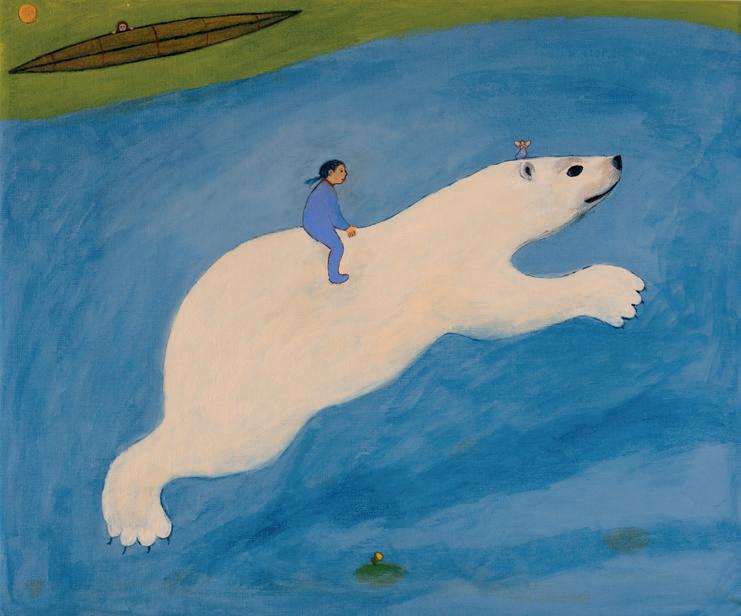
Left: Nukappiaraq nanorlu, the Polar Bear Boy, was part of Gunnarsdóttir’s Greenland exhibition in Nuuk in 2022. Right: De kom som et lys og er en varde (You Came as a Light and are a Cairn), portrait of Denmark’s former Queen Margrethe II.
more you realise how little you know. I slowly understood that I wasn’t particularly talented. At the same time, I could feel I was learning a lot – my eyes were trained in a new way, and I began to see everything differently.”
Her career paused when she became a mother, yet the call to paint did not fade, and she received vital encouragement from her husband, Tordur. “People will remember you – your paintings will live forever,” he told me, she says pensively. And so, she returned to her canvas.
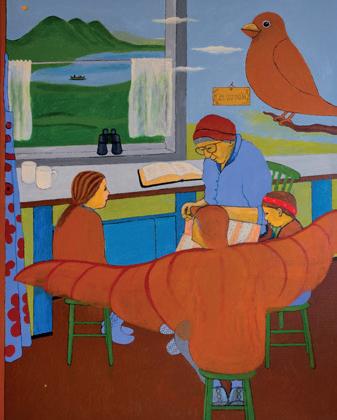
With the meaning of life at stake in the mid-1990s, Gunnarsdóttir went through a transition in her visual expression as illness and loss in the family introduced deeper symbolic threads into her art. Sparrows, cairns, guardians, the maternal figure, and the Faroese landscape became vessels for reflection on belonging, love and the fragile continuum of life.
“Sometimes inspiration comes from things you cannot predict or control –maybe a childhood memory triggered in adult life,” she explains. The result is art that blends tenderness with quiet gravity: children set against mountains, animals as guardians, figures gazing to distant horizons. The world feels distilled, as if softened through reflection.
Art critics have noted the sense of heart and narrative at the core of her practice, with art historian, author Dagmar Warming writing: “The deeper meaning of life is at stake here. The wonders of creation, often in the shape of a tiny flower or bird, put things into perspective. The motifs are assertive and direct, and never indifferent.”
Art for the future
Decades into her artistic journey, Gunnarsdóttir continues to explore new projects, with recent exhibitions in Greenland, Japan and New York. Yet her daily rhythm remains rooted in Eiði. Every morning, she walks with her dogs
through the steep cliffs of her home region. With the passing years has come not only wider recognition, but also reflection. “As I become older, I think more about life and how short it is,” she reflects. “You don’t always think that your art will be relevant for future generations – but I hope so.”
With her works living on in local Faroese homes, international collections and public institutions – a language at once intimate and universal – that hope feels well-placed.
In 2025, Sigrun Gunnarsdóttir was awarded the Knight’s Cross of the Order of Dannebrog by Denmark’s King Frederik X. Photo: Tordur J. Niclasen
Vingefang (wingspan) 2024.
The artist in her studio.
What if our appreciation of balance is a bit…boring?
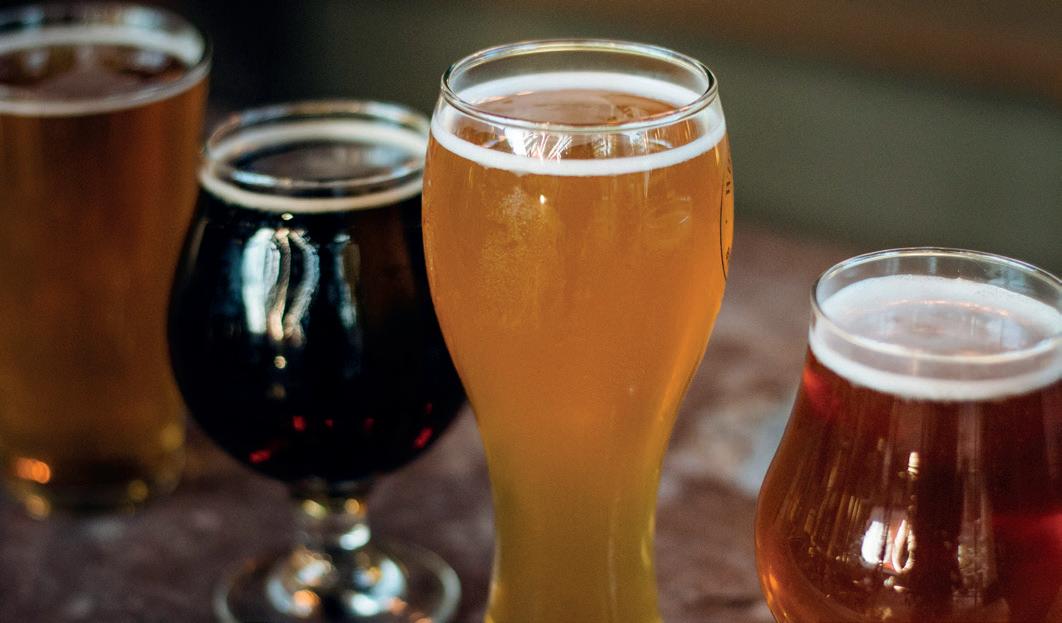
This autumn, I was evaluating a flight of American IPAs at a beer competition. Between us, the judges agreed on an excellent beer as a clear medallist. It was in-your-face hoppy and absolutely brilliant, the kind of beer that makes you smile and cheer because it’s so good. It certainly wasn’t balanced, a frequent descriptor of award-winning beers.
By Malin Norman
One of my colleagues at the table reflected on beer judges’ over-use of the word balance, and how sometimes this is not actually what you want from a beer. “People are often talking about balance as a good thing, but sometimes you just want to be surprised and overwhelmed,” he said. “Like this beer, it’s not balanced and it shouldn’t be.”
In a way, this discussion reminded me of Swedish filmmaker Jonas Åkerlund’s bold storytelling. If you don’t know, he’s also the guy behind notorious music videos for The Prodigy, Madonna and Lady Gaga, to name a few. His defiance to exist in the grey zone has also made him one of the most sought-after filmmakers in the world.
In an interview a few years ago, Åkerlund explained his creative approach and said something along the lines of; “It’s not worth it if you don’t cause a reaction. If you
want to communicate happy or sad stories, they should be clearly happy or sad. My ideas are always on steroids, in everything I do.”
In Sweden, the word lagom is commonly used in everyday life. It means not too much, not too little, just the right amount – many people, including myself, also think it means boring. Good enough, predictable, not spectacular. Åkerlund’s storytelling isn’t lagom, by any means, and maybe some beers shouldn’t be either.
With balance, beer judges might refer to all the elements being where they should be, for that particular beer style, which is not wrong as such. But perhaps we also need to remember that an American IPA should not in fact be “balanced” and have “a hint of hops” – it should be intensely, intentionally bitter. Because sometimes, as my colleague argued, don’t we want to be surprised and overwhelmed by what’s in our glass?
Malin Norman is a Certified Cicerone®, a certified beer sommelier, a BJCP certified beer judge, and a member of the British Guild of Beer Writers.
Photo: Unsplash, Adolfo Félix
Rice porridge
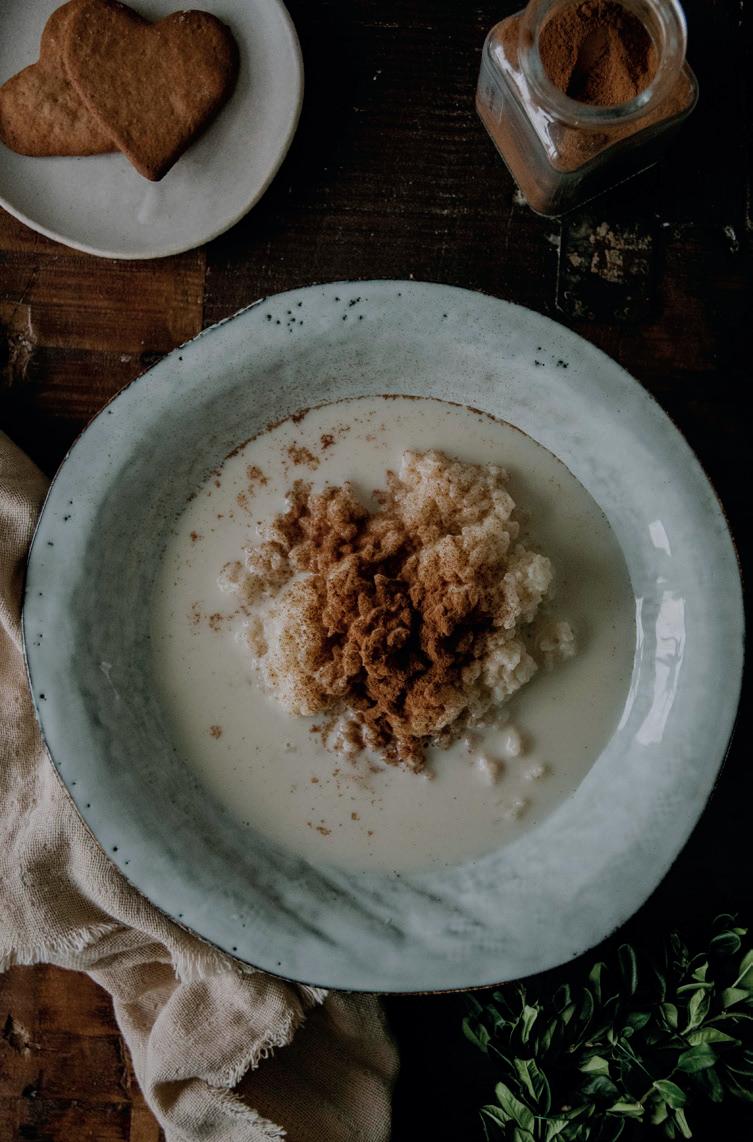
There’s something wonderfully comforting about a bowl of creamy rice porridge – or risgrynsgröt, as we call it in Sweden. It’s a taste of snowy and cold winter mornings, candlelight, and slow, cosy moments.
By Sofia Nordgren
Traditionally served at Christmas, this humble dish warms both heart and home. The soft, milky grains simmer gently with a hint of cinnamon, filling the kitchen with a lovely scent of Christmas. Serve it with a sprinkle of sugar and cinnamon, and some milk. As the tradition goes, an almond is hidden in the porridge before serving – and whoever finds it is blessed with good luck for the year to come. So make a pot and let the Nordic cosiness fill your day. Merry Christmas!
RICE PORRIDGE
Serves 4-6
2 dl | 160 g short-grain or long-grain white rice
4 dl | 400 ml water pinch of salt
2 tbsp butter
1 tbsp castor sugar
1 cinnamon stick
8 dl | 800 ml milk of your choice
1. A dd water, rice, salt, and butter to a saucepan and bring to a boil.
2. L ower the heat, cover the pan and let cook for about 10 minutes.
3. A dd sugar, a cinnamon stick and milk, and bring to a boil.
4. Reduce the heat again (to 1-2 if the scale goes to 9), cover the pan and let the porridge rest for about 30-40 minutes. This allows the rice to absorb the milk. Stir occasionally.
5. Remove the cinnamon stick and serve the porridge with cinnamon, sugar and milk.
Winner of the best Regional Cookbook at the Guild of Food Writers Awards 2022, Sofia Nordgren lives with her family in a small town in Sweden, working as a photographer, content creator and plant-based cookbook author. Cooking and baking have always been a hobby of hers and on top of that, she has a passion for nature, gardening and slow, seasonal living. Foggy mornings, cinnamon buns, and playing with her kids are among her favourite things in life. Sofia Nordgren also runs the successful blog, The Nordic Kitchen
Fall in love with Norway’s quiet winter haven
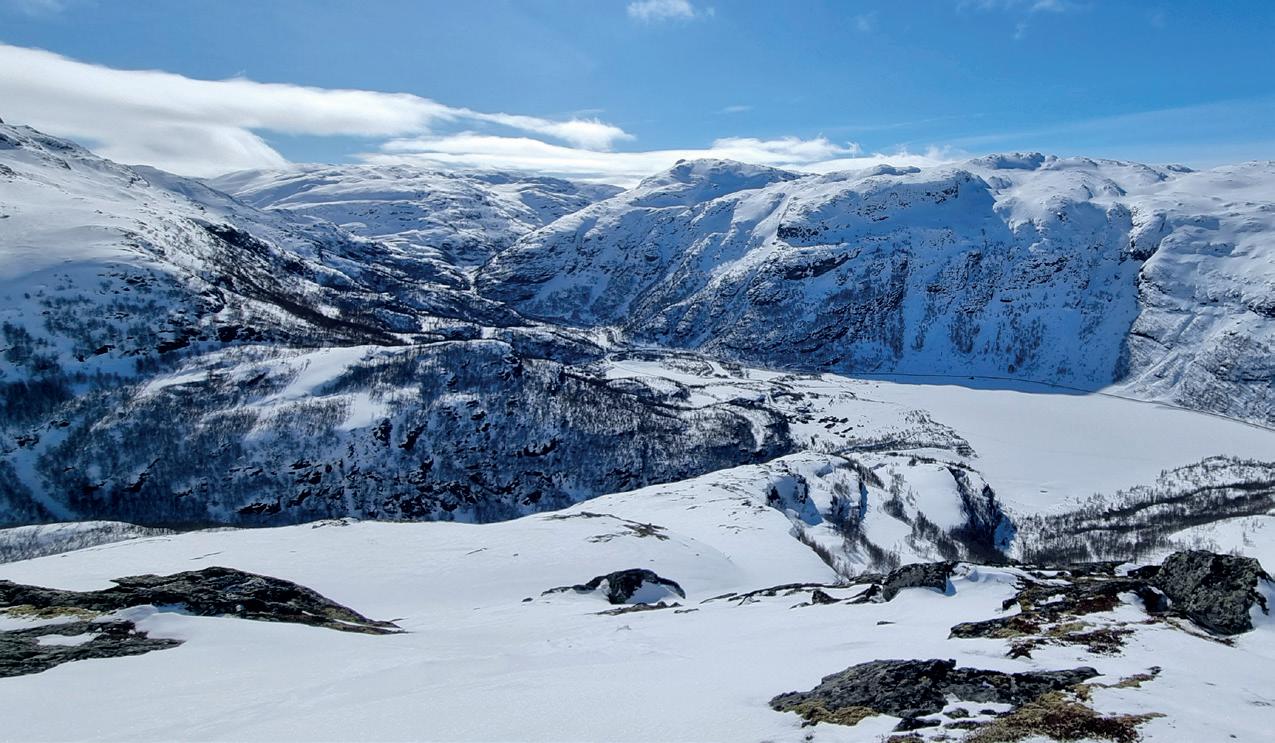
For the first time this year, Østerbø Fjellstove will welcome guests through the winter season, inviting visitors to experience the serene magic of Aurlandsdalen draped in snow. Here, high in the Norwegian mountains, the world feels hushed and slow, the air sharp and clear, and the landscape blanketed in stillness. With flickering log fires, creaking timber walls, and a history deeply rooted in mountain hospitality, the lodge offers the perfect base for exploring the landscape, snowshoeing, ice climbing, and stargazing.
By Signe Hansen | Photos: Sandra Johannsen
Set in the dramatic Aurlandsdalen valley between Oslo and Bergen, Østerbø Fjellstove has been a resting place for mountain travellers since the 1600s. But while Aurlandsdalen has long been celebrated as one of Norway’s most spectacular summer hiking destinations, the winter season is a different story – softer, slower, and profoundly still. “When you walk up on the mountain, it might be a bit hard in the snow, but at the top you’re met by a stunning view and complete silence –
you feel as if you have the whole world to yourself,” says Danish-born manager Sandra Johannsen.
Until now, few visitors have had the chance to experience it this way, as Østerbø traditionally closed after autumn. With its first year of full winter opening, the mountain lodge hopes to welcome curious travellers looking for an alternative to busy ski resorts.
Life at the fjellstove
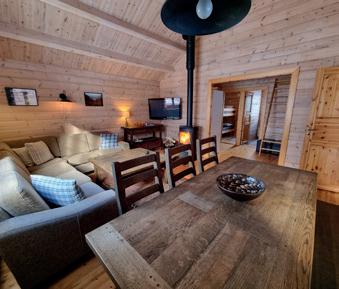
The fjellstove embraces its mountain heritage with pride. Accommodation ranges from simple hotel rooms to cosy old timber cabins with private saunas or fireplaces, and larger apartments for those wanting extra space. It is rustic in the most charming sense – warm wood, mountain history on the walls, with old tools serving as gentle reminders of life here before
Østerbø Fjellstove welcomes guests with rustic charm, cosy comfort and stunning surroundings.
tourists arrived. In the main lodge, beams and boards have held five centuries of footsteps, and a sign in the reception dates the building to 1722. “The feedback we get is that the moment people walk in, they feel at home,” Sandra says.
Meals are hearty and local, designed for long days outdoors and evenings by the fire. Guests can enjoy breakfast and dinner in the mountain dining room, order lunch to take into the hills, or, for those staying in the cabins, pick up homemade pizzas to bring back to their own cabin of flat. The aim, Sandra explains, is to make Østerbø a welcoming base for anyone wanting to explore. “We aim to connect with people searching for something different – a hidden gem in the mountains, a place to stay while exploring the mountains beyond the traditional resorts and tourist spots – far from the crowds and well-trodden routes.”
A winter for explorers
Those who wish to ski will find alpine slopes around forty minutes away, but Østerbø’s charm lies in the activities on its doorstep. Winter here is about a more
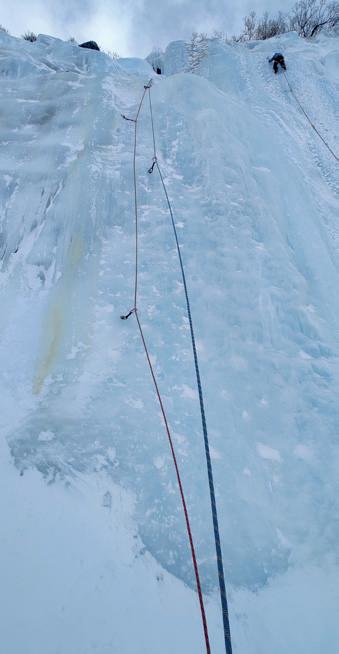
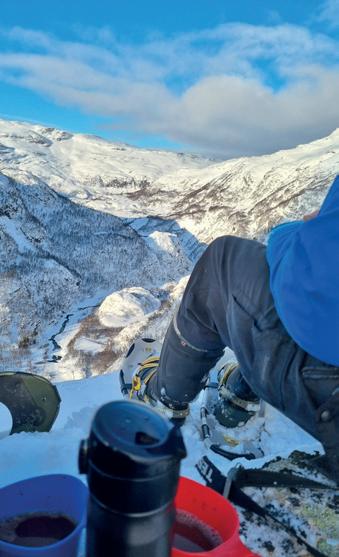
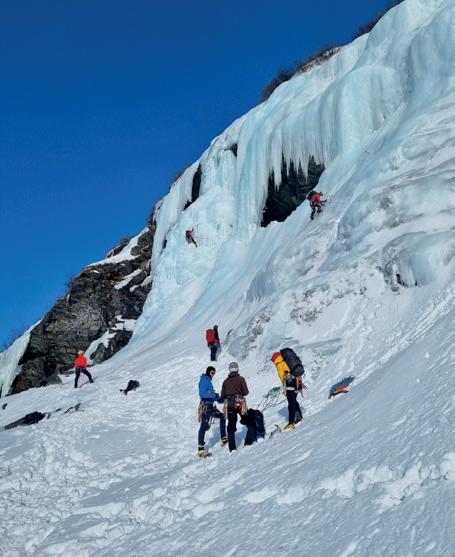
traditional Norwegian friluftsliv: skiing across open mountain plateaus from January, snowshoeing straight from the door, ice fishing on quiet lakes ice fishing in the lake at Østerbø, and simply stepping into crisp mountain air beneath a sky stretched with stars. “Most people use us as a base to go out in areas where there are no crowds, just nature,” Sandra explains. The area is also attracting a growing number of ice climbers. “I didn’t know how good the area was for ice climbing,” she admits with a smile, “but the feedback is that we’re in a perfect location.”
For those wishing to explore more of the area, the legendary Flåmsbana railway and Fjordsafari tours, located not far from Østerbø, offer unforgettable journeys through dramatic mountains and deep, tranquil fjords.
Fall in love with the mountains
Now firmly rooted in Norway, Sandra first arrived in 1999, intending to stay for what she thought would be a single year before returning to continue her studies in Denmark. Instead, she fell in love twice – first with the mountains, and then with a local man, settling in the village below Østerbø. “For a Dane, the mountains are amazing,” she laughs. “I love the nature here – I fish, I walk, I spend time in the mountains. Even
in summer, when there are many people around, you walk a little way out and there is peace.”
Now, after more than two decades in Norway, she and her team are shaping Østerbø’s next chapter: conferences, celebrations, Christmas gatherings, and Easter with snowy peaks all around (already almost fully booked).
No matter why you choose to visit, you may discover the same thing Sandra did all those years ago — that these mountains have a way of winning hearts.
www.aurlandsdalen.com
Facebook: Aurlandsdalen
Instagram: @osterbofjellstove
Booking: booking@aurlandsdalen.com
Exclusive winter offer
Book your stay in December or January using the code SCANM2025 and get every 3rd night free!
This special offer applies to all bookings for 2025 and 2026, as long as you book before 31 January, 2026.
For example:
Stay 9 nights, pay for only 7
Stay 6 nights, pay for only 4
Photo: Dansk Bjergklub
Aurlandsdalen has excellent conditions for ice climbing with numerous options for both beginners and advanced ice climbers within a short distance.
Photo: Dansk Bjergklub
Discovering the magic of frozen Saimaa
The frozen surface of Lake Saimaa stretches into the horizon. Your breath curls in the crisp air as you step onto a glistening tour skating trail, carved by nature and polished by silence. In the distance, pine trees stand like quiet guardians, wrapped in snow. This is not the crowded North – this is Finland’s serene southern Lakeland district in winter.
By Malin Norman | Photos: Visit Lake Saimaa
Just a few hours from Helsinki lies a world shaped by water and ice, where nature is not a backdrop, but the experience itself. The Savonlinna region in eastern Finland has two national parks, heritage landscapes, holistic resorts and soft, still snow that whispers rather than dazzles.
“Lake Saimaa becomes a playground of movement when it freezes,” says Sari Ahokainen, marketing co-ordinator for the Lake Saimaa 2.0 project. “The region is home to some of Finland’s longest maintained tour skating and winter hiking trails, where travellers glide across clear ice between resorts, islands, and forested ridges.”
In Punkaharju, one of Finland’s most iconic national landscapes, visitors can rent tour skates or kick sleds and take off on adventures through a living postcard. For those who prefer to stay on land,
e-bike trails wind through snow-laden forests and run alongside the skating route, offering a quiet thrill for active travellers. Groomed cross-country ski tracks and snowshoeing routes provide an easy and inspiring way to enjoy the surrounding nature.
A beloved winter tradition since 2011, the Torchlight Skating Evening in Punkaharju transforms the ridges and frozen lakes into a glowing wonderland. “On 20 February, a 5-6-kilometre stretch of the scenic skating route between Harjun Portti and Kruunupuisto will be illuminated with torches and log candles, creating a magical atmosphere under the winter sky,” says Ahokainen.
Nature wellness – the still side of winter Beyond activities on the ice, winter in Saimaa offers a different kind of luxury: peace. In this slower rhythm, wellness happens naturally. In Kruunupuisto and
Oravi, visitors can unwind with sauna yoga, warming the body while the snow falls softly outside. Here, the tradition of sauna meets mindfulness, giving you space to breathe deeply.
At PihlasResort, serenity becomes an experience in itself. This exclusive retreat in the woods offers high-end accommodation and spa indulgence with an emphasis on silence, slow living, and nature immersion. Think heated Jacuzzis under the stars, or a tasty dinner made from local ingredients. Perfect for winter reconnection.
Oravi, a charming village nestled between two national parks, becomes a hub for winter adventurers as the lake freezes. A 20-kilometre winter trail connects Oravi to Järvisydän across Linnansaari National Park. Hike, skate, ski, or kick-sledge your way across the lake, stopping at fireplaces to enjoy a packed lunch. You can also book a sleigh ride for a more relaxed journey.
From luxury resorts to lakeside cabins
Whether you are seeking a full-service winter escape or a tranquil retreat in nature, the Saimaa region offers accommodation for every taste. For the easiest access to winter activities and pampering, choose one of the region’s premium resorts: Järvisydän, Kuru Resort or PihlasResort. They offer everything you need for a seamless winter holiday, from guided adventures to spa indulgence and gourmet dining.
If your idea of a perfect winter getaway involves peace and privacy, opt for an authentic Finnish cottage. Experience all-season comfort at the family-friendly Kanava Resort or enjoy a more traditional cabin atmosphere in Oravi.
In Punkaharju, you can stay right next to the scenic skating tracks in a cottage or apartment hotel at Harjun Portti or Punkaharju Resort. For a touch of countryside charm, the Naaranlahti resort offers locally rooted experiences like ice fishing by snowmobile or a horsedrawn sleigh ride with a Finnish horse –an enchanting way to travel through the snowy landscape.
Christmas magic in the castle and beyond The festive season in Savonlinna begins on Finland’s Independence Day on 6 December, when the historic Olavinlinna Castle is bathed in a majestic glow. The castle’s festive illumination continues
until the St. Thomas Christmas Fair on 13 December. “Now in its 18th edition, this event fills the castle with local crafts, food, music, and a joyful Christmas spirit,” says Ahokainen. “The light art installation surrounding the fortress transforms the medieval landmark into a magical winter scene unlike anywhere else in the world.”
You might arrive for the ice, but stay for the silence. Lake Saimaa’s winter is not loud – it whispers. And once you hear it, you will never forget.
www.visitsaimaa.fi/en
Facebook: Visit Lake Saimaa
Instagram: @visitlakesaimaa_official
TikTok: visitlakesaimaa_official
This article was produced as part of the Lake Saimaa 2.0 project, which is co-funded by the EU with funding granted by the Regional Council of South Savo. The main goal of the Lake Saimaa 2.0 project is to develop the Saimaa region into a significant international destination that serves travellers year-round.
A cosy hideaway on the Faroe Islands
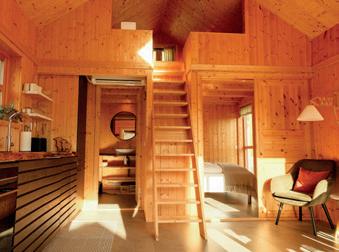
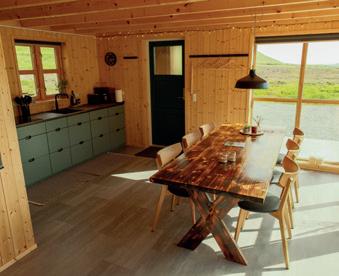
Múlafossur Cottages, family-owned and lovingly built, offers travellers a chance to experience the Faroe Islands in all their raw and breathtaking beauty.
By Ndéla Faye | Photos: Múlafossur Cottages
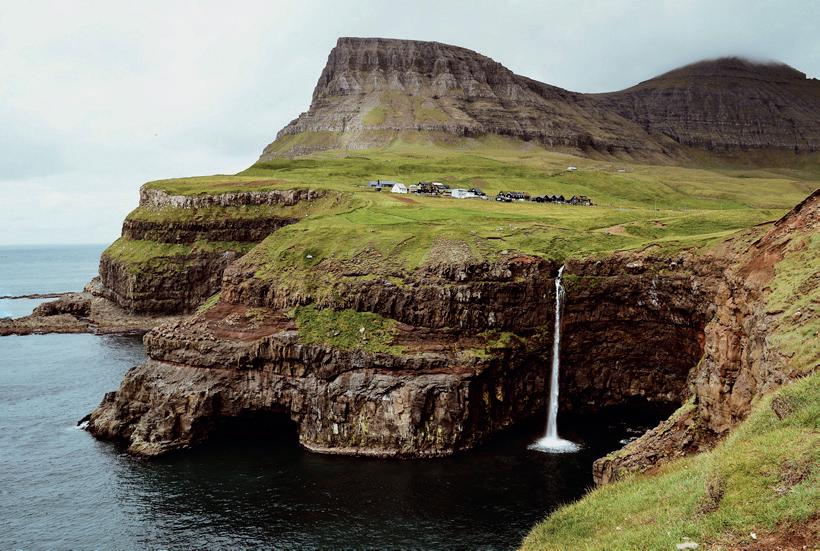
Located on the western edge of Vágar island, where emerald cliffs plunge into the North Atlantic, lies the tiny village of Gásadalur. It is home to the Múlafossur waterfall and the equally enchanting Múlafossur Cottages, owned by Jákup Suni Lauritsen, his wife Osla Lauritsen, and his brother Trøndur Lauritsen.
Brothers Jákup Suni and Trøndur Lauritsen grew up on the island of Vágar and have always felt a deep connection to Gásadalur, where the cottages now stand. Long before a tunnel connected the village to the rest of the island, the brothers would spend endless summer days and school holidays trekking over the steep mountain ridges to visit their friend who lived on the other side.
When the tunnel was completed in 2006, finally linking the village of Gásadalur to the rest of the villages on the island, it marked the start of a new chapter for the small community – and the beginning of a longstanding dream. “We’d always hoped that we would get to share this wonderful corner of the world with others. It just seemed selfish to keep it all to ourselves,” says Jákup Suni.
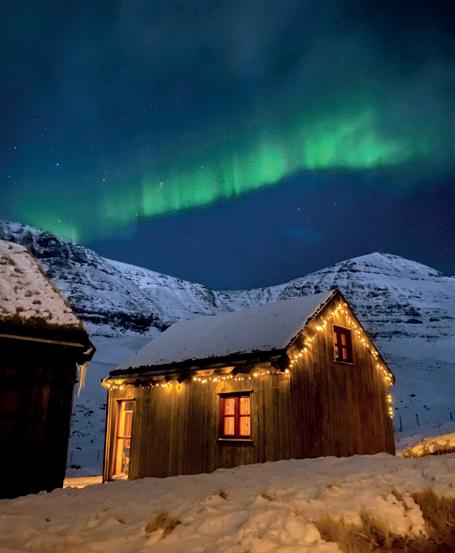
About six years ago, his company began building the first of the Múlafossur Cottages. Today, six of these cosy, turfroofed homes welcome guests throughout the year.
Set slightly apart from the main village of Gásadalur, they offer a rare sense of
peace and seclusion, and a chance to feel completely at one with nature, away from the bustle of other visitors. The cottages are just a ten-minute walk from the iconic Múlafossur waterfall, where, in summer, visitors can spot puffins and other seabirds swooping along the cliffs.
The perfect base for island adventures
When designing the cottages, the Lauritsen family wanted each one to blend seamlessly into its surroundings and capture the calm spirit of the valley. Built in traditional Faroese style, with distinctive turf roofs, they appear to rise naturally from the hillside itself. The cottages are heated with energy-efficient heat pumps, using electricity instead of gas to help reduce the environmental footprint.
Inside, each of the fully equipped cottages has its own character, accommodating different group sizes and needs, including wheelchair-accessible amenities in the
The island of Vágar is connected to most of the archipelago by underwater tunnels, making day trips simple.
largest cottage. While compact and inviting, they comfortably house between two and six guests.
Though the cottages are fully self-catered, the Lauritsen family is never far away. “Guests can enjoy complete peace and privacy, but we’re always happy to stop by, answer questions, and make sure everyone feels at home,” says Jákup Suni.
The family loves sharing their favourite hiking routes and local hidden gems – the kind of places visitors would never find in a guidebook.
Seasons of the Faroe Islands
Peak season on the Faroe Islands runs from May to September, but winter has a magic all its own, especially for adventurous travellers. “In winter, you see a completely different side of the islands,” says Jákup Suni. “The landscape feels wilder, the waves more powerful, and the colours turn beautifully moody. And if you’re lucky, you might even get snow or spot the Northern Lights.”
The island of Vágar, where the cottages are located, is often considered one of the most remarkable in the Faroe Islands – and for good reason, as many
of the archipelago’s most iconic natural landmarks are found here. Highlights include Sørvágsvatn, also known as Leitisvatn, famously dubbed ‘the lake above the ocean’ for the optical illusion that makes it appear to float high above the sea. Nearby, the dramatic Drangarnir sea stacks and the pointed islet of Tindhólmur are among the most photographed sights of the Faroe Islands.
The airport is just a 15-minute drive away, while the village of Gásadalur, home to just 15 year-round residents, is a short 10-minute stroll away. For those eager to experience the famous puffins of Mykines, the ferry from nearby Sørvágur offers an easy gateway to the island’s bird-filled cliffs.
And just a short walk from the cottages lies the spectacular Múlafossur waterfall itself. “We never imagined that tourism on the Faroe Islands would grow the way it has over the past decade. And never in our wildest dreams did we think that the Múlafossur waterfall, where we spent our childhood playing, would one day become a world-famous visitor attraction,” Jákup Suni says. It was only natural that the cottages would take their name from the waterfall that was such a big part of his and Trøndur’s childhood.
The warmth of the Lauritsen family adds a personal touch to the raw beauty of the Faroese landscape. Múlafossur Cottages invites visitors to slow down, breathe in the sea air, and take in the rugged splendour of nature in all its forms.
To discover traditional crafts, seasonal delicacies and plenty of festive atmosphere, look no further than these Christmas markets. From historic town squares to charming open-air museums, these markets will no doubt give you an extra dash of magic to the season’s festivities.
By Malin Norman
World-unique Christmas experiences in Sweden
Few Christmas markets are as atmospheric as Stortorgets Julmarknad, set in the heart of Stockholm’s Old Town (Gamla Stan). This is Sweden’s oldest Christmas market, first held in 1837. Around 40 stalls on the cobbled square entice with mulled wine, seasonal delicacies, and handcrafted goods. Open daily from 22 November to 23 December.
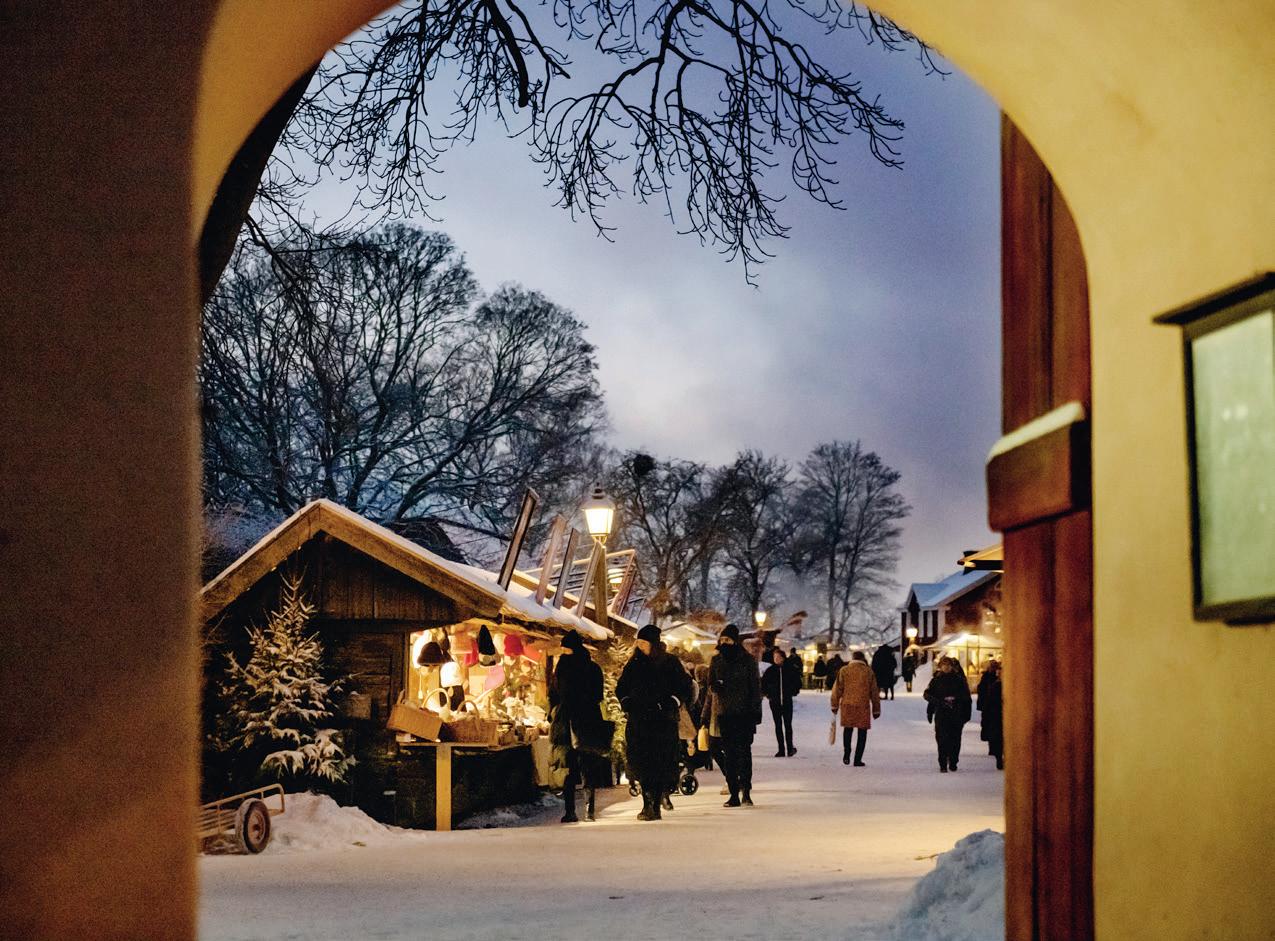
Another popular Christmas market in Stockholm takes place at Skansen, the
world’s oldest open-air museum on Royal Djurgården, a festive favourite since 1903. It features traditional food, crafts, and handmade gifts, many produced on-site by local artisans. Visitors can also dance around the Christmas tree to the tunes of the Christmas orchestra Julorkestern, listen to Lucia concerts, enjoy the bonfires, and participate in hands-on activities. Open every Friday, Saturday and Sunday from 28 November to 21 December.
For festive experiences a bit further north, visit Jamtli Christmas market in Öster-
sund, Jämtland. This charming market is set in an open-air museum, where traditions come to life in candlelight and snow. The market offers horse-drown sleigh rides, dog sledding, and Christmas traditions from times gone by. With nearly 200 exhibitors selling crafts and delicacies, the market draws thousands of visitors every year. Jamtli Christmas market is open 5-7 December.
The Christmas market at Skansen in Stockholm. Photo: Sara Kollberg
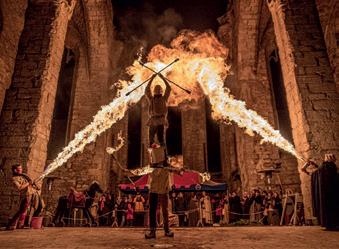
Medieval Christmas in Visby. Photo: Henrik Jensen, Medeltidsveckan.
In Visby, on the island of Gotland, Medieval Christmas brings history to life with a torchlight procession through the cobbled streets, concerts and performances, storytelling and fire shows – set against the backdrop of ancient ruins in the UNESCO World Heritage Site. Medieval Christmas takes place 5-7 December.
The world’s biggest gingerbread city in Norway
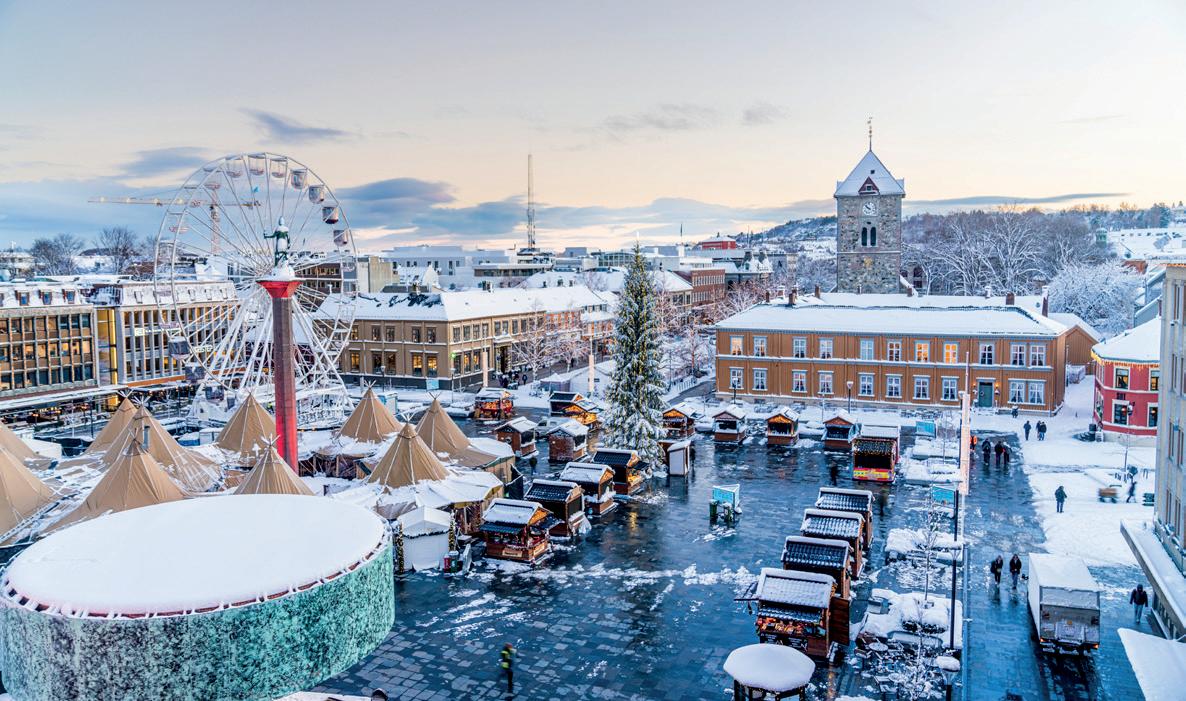
The Christmas market in Trondheim’s city centre promises a fantastic experience, with a traditional market, live music and plays for children. In the lavvo, visitors can enjoy food and beverages by the fire, whilst listening to troubadours and folk tales. With decorated stalls and thousands of small lights, this is like stepping into a fairy tale. Open every day 3-21 December.
A not-to-be-missed Christmas market is the one in Bergen, where Festplassen turns into a magical square with a Ferris wheel, carousel, indoor and outdoor stalls. When in Bergen, also check out
the iconic Bryggen, which is home to cosy restaurants, galleries and boutiques –including a Christmas shop. In Bergen, you can also visit the world’s biggest gingerbread city, for a real sweet treat. The Christmas market in Bergen is open from 21 November to 22 December.
From 29 November to 22 December, the Christmas market on Kristiansand’s main square offers an enchanting festive experience filled with local crafts and seasonal delicacies. Charming wooden stalls line the square, brimming with handmade textiles, ornaments and gifts, while the scent of grilled sausages, creamy hot chocolate and traditional shortbread fills the air. Just beside the market, visitors can lace up their skates and glide across the ice rink, adding to the city’s magical winter atmosphere.
For an enchanting winter paradise, Lillehammer is the place to go. The picturesque city features a Christmas market in the city centre 6-7 December and 13-14 December. You can also check out the
Trondheim. Photo: Fredrik Ahlsen, Visit Norway
The Christmas market in Trondheim is open every day 3-21 December. Photo: Fredrik Ahlsen, Visit Norway
Christmas market at Fabrikken, an arts and crafts hub. Not far from Lillehammer, which was host to the 1994 Winter Olympics, are ski resorts Hafjell and Kvitfjell, for those who appreciate worldclass skiing.
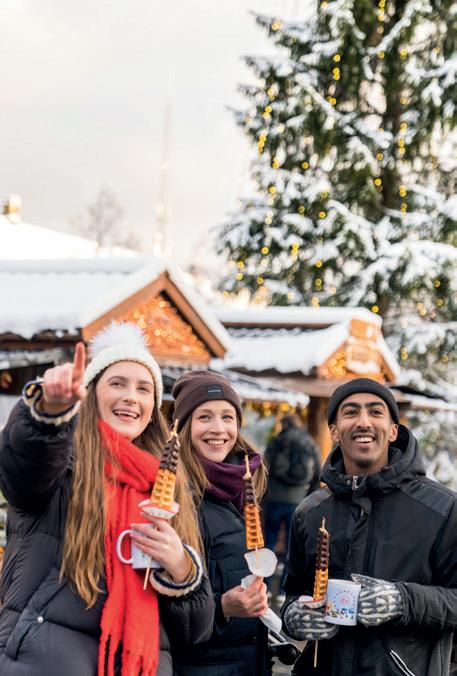
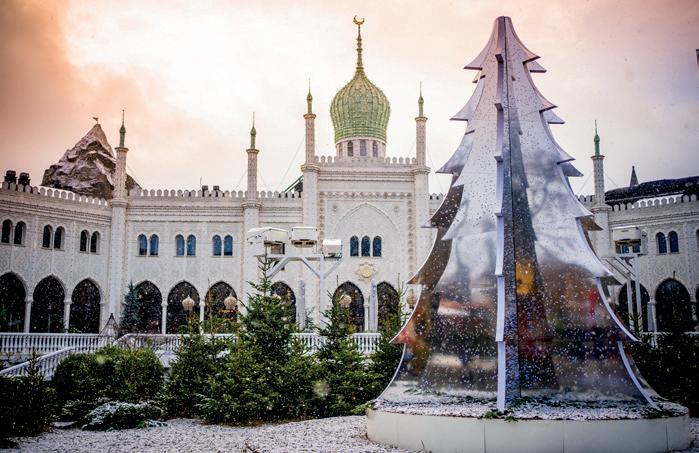
Sparkling Tivoli gardens and Denmark’s oldest town
One of Copenhagen’s main attractions is Tivoli Gardens, the second-oldest amusement park in the world. Christmas in Tivoli promises strolls among thousands of twinkling lights and the scent of pine trees, thrilling rides, joyful music, fireworks, and temptations from the many stalls. This market has been featured on CNN’s list of the world’s best Christmas markets, so make sure to plan a visit if you happen to be in Copenhagen. Christmas in Tivoli is open from 14 November to 4 January.
Odense’s Christmas market is also a must. During three weekends, the historic square Sortebrødre Torv in the old town features spruce-covered stalls filled with local specialities such as Christmas beer and homemade sausages, as well as Dan-
ish design, and much more. For the past 17 years, it has attracted around 50,000 visitors. Open 29-30 November, 6-7 December and 13-14 December.
Denmark’s oldest town, Ribe, also offers plenty of authentic Christmas atmosphere. Every weekend leading up to Christmas, the town has a range of activities for the whole family. The Christmas
market on Torvet features food and crafts in charming wooden cabins, the perfect place to buy Christmas gifts or decorations. Visitors can also indulge in delicious treats at the food stalls and in the Glühwein bar. Open 5-7 December, 12-14 December and 19-23 December.
An adventurous and unforgettable Christmas awaits at Skulpturparken Blokhus. In
Every year, Skulpturparken is transformed into a twinkling heaven with 2.5 million lights.
Photo: Skulpturparken
Christmas in Tivoli has been featured on CNN’s list of the world’s best Christmas markets.
Photo: Nicolas Tobias Følsgaard
north-western Jutland, the 20,000 square metre sculpture park is transformed into a twinkling heaven with 2.5 million lights, Europe’s longest light tunnel, Denmark’s tallest Christmas tree, and of course a Christmas market with plenty of temptations. Magical Christmas can be experienced every day from 1 November to 28 December (closed 24-25 December).
Lucia traditions and winter wonderland in Finland
Helsinki’s oldest and most popular outdoor Christmas market is located in the Senate Square, with the majestic Cathedral overlooking the scene. Last year, the market attracted more than 600,000 visitors in just over three weeks. On 13 December, the newly crowned Lucia descends the cathedral’s stairs for the procession, a tradition not to be missed. The market has more than one hundred stalls with beautifully crafted gifts and locally produced food, as well as a carousel for young and old. Open daily from 28 November to 22 December.
The small medieval city of Porvoo has a charming market. Here, you will feel as if you have stepped back in time, with preserved wooden houses and riverside
huts dressed up for the occasion. When it snows, Porvoo becomes a true winter wonderland. The Christmas Path in Porvoo invites you to step into a magical atmosphere, from the city centre to the alleys of the Old Town. The glimmering lights, Christmas music, market stalls and carousels create a memorable experience for the whole family. Open 6-12 December.
In Tampere, Finland’s second largest city, the Christmas market in the Central Square has an artistic vibe, but it offers much more than just arts, crafts and specialty foods. Held throughout December, visitors will have plenty of entertainment to enjoy, including concerts, theatre performances, glass blowing and forging demonstrations, and of course, daily visits from Santa Claus. Open from 29 November to 22 December.
Rauma’s old town, known as Old Rauma, is one of the best-preserved wooden towns in the Nordics and a UNESCO World Heritage Site. Its winding alleys and timber houses reflect centuries of coastal trading history and traditional craftsmanship. The Christmas market here takes place on Kauppatori (Market Square), surrounded
by narrow alleyways and centuries old wooden houses. The rows of stalls brim with local handicrafts and delicacies. Open from 29 November to 24 December.
The curious Christmas cat and Oslo tree in Iceland
If you happen to be in Iceland this December, a varied programme awaits. Reykjavík’s Christmas cat will be in place at Lækjartorg as always, and from 3 December the Oslo Christmas tree illuminates Austurvöllur – marking the beginning of the Christmas season and the friendship between Reykjavík and Oslo. A range of Christmas markets take place, in Reykjavík and further afield. For instance, the Christmas Village in Hafnarfjörður is sure to keep your Christmas sprits up, with live entertainment, Icelandic design, crafts, snacks and drinks, and visits from the Icelandic Yule Lads.
For information on what is happening in each country, see:
The Christmas market in Tampere. Photo: Visit Tampere, Laura Vanzo
The Christmas Path in Porvoo invites you to step into a magical atmosphere. Photo: Visit Porvoo
SWEDISH CHRISTMASGIFTSSpecialTheme:
Sweden –the land of commerce
The importance of Swedish commerce cannot be underestimated. Besides playing an important role in the lives of millions of people, our industry is crucial to the enrichment of Swedish cities and society. Now, we want to welcome you to the land of commerce as Christmas approaches!
By Sofia Larsen. CEO at Swedish Commerce
No matter where you are in Sweden, if you are visiting for a day, a week, or a month, you will notice that commerce is a central part of the country.
Whether you are into fashion, cosmetics, outdoors activities, or perhaps DIY, shops across Sweden are ready to welcome you as they are preparing for their favourite part of the year – Christmas!
Christmas is without a doubt one of the most important times of the year for
Swedish retailers. Last year, approximately Last year, approximately 24 billion SEK were spent in Swedish shops, as customers bought gifts for loved ones.
Whether you celebrate Christmas or not, I encourage you to take part in the Swedish retail experience. Hopefully, the gifts you buy will bring joy and happiness to friends and family for many years to come!
Read more about our services at www.svenskhandel.se
Svensk Handel (Swedish Commerce) is the business and employers’ association serving the entire trade and commerce sector. It represents commercial enterprises on issues concerning employment and economic policy. Svensk Handel is tasked with creating the best trading conditions for commercial enterprises, both large and small.
CEO Sofia Larsen. Photo: Swedish Commerce
Photo: Design House Stockholm
Simple, sustainable and long-lasting –for everyday life
Iris Hantverk has a long tradition of making brushes from natural materials, bound by hand by visually impaired craftsmen. Every product carries a story of skill, patience, and genuine Swedish craftsmanship.
By Malin Norman | Photos: Iris Hantverk
The story of Iris Hantverk began over 150 years ago, with a workshop for visually impaired craftsmen in Stockholm – a mission driven by The Association of the Blind in Sweden to create both employment and dignity through skilled work.
“Iris Hantverk is deeply rooted in craftsmanship and social responsibility, and the same values remain at the heart of everything we do today,” says Sara Edhäll, who owns and runs Iris Hantverk together with Richard Sparrenhök since 2012.
The brushes are still made by visually impaired craftsmen using traditional techniques, with the same emphasis on quality, function, and honest materials.
“We work with natural, sustainable components like FSC-certified wood, organic cotton, and pure bristles — and we collaborate with thoughtful designers to ensure
that our products are not only useful, but timeless,” says Edhäll.
When form meets function
Small details make a big difference. With beautiful design and natural materials, the handmade brushes from Iris Hantverk make everyday life a little smoother. “Our handcrafted products are made to last for generations, with honest materials, a comfortable grip, and long-lasting quality,” ensures Edhäll.
The collection includes many utensils for everyday life. The practical dustpan and brush set is one of the brand’s most popular products. With a long or short handle in oiled beech wood and handmade brushes made with bristles of horse hair, the set is convenient to have in the kitchen – and the timeless design is stylish too. The table brush set is another clas-
sic, great for getting the crumbs off the table in a flash. And in time for Christmas baking, the baker’s brush in birch and horse hair is a must.
The brand’s two boutiques in Stockholm breathe the tradition of the brush-binding craft, and Edhäll promises heaps of Christmas vibes: “When entering, you will immediately feel the atmosphere of craft heritage and modern design. If you visit the Christmas market in Stockholm’s Old Town, pop by our shop on Västerlånggatan and get some Christmas gifts sorted. In addition to our own products, we have a range of other brands – all Swedish crafts, of course.”
Iris Hantverk’s eco-friendly and sustainable products are sold in two shops in Stockholm, online as well as in Sweden and worldwide through selected retailers.
Design House Stockholm: A catalyst for creativity
Design House Stockholm pushes the boundaries for innovative Scandinavian design in its vision to democratise design. Since 1992, the premium brand has been collaborating with new and upcoming as well as established designers. Iconic products include Harri Koskinen’s Block Lamp, which celebrates its 30th anniversary this year, as well as Lisa Larsson’s Birds 1967 launched in 2024.
By Malin Norman | Photos: Design House Stockholm
Design House Stockholm is a publishing house for Scandinavian design, rather than a conventional producer. Currently with more than 60 designers in its network, the brand welcomes all designers, regardless of background, to come with their ideas – working with designers as publishing houses work with authors.
“For us, design and production make the heart of the organisation, where we act as a publisher and designers find an op-
portunity to be published,” says Anders Färdig, founder and former CEO. “In collaboration with our designers and skilled producers, we push the boundaries for the concept of design. It’s through the team’s collective knowledge that ideas are scrutinised, challenged and refined – and moments of creative magnetism arise.”
Design House Stockholm has been a strong brand for decades, both in the Nordic countries and internationally. The
company’s unique business concept, in close collaboration with well-known and emerging designers, has attracted attention, not least through product launches with MoMA Design Store (Museum of Modern Art, New York).
Scandinavian design philosophy
The ambition of Design House Stockholm is to offer a collection of the very best Scandinavian design, from designers around the world. Its portfolio includes furniture, lighting, kitchenware, tableware, design objects and fashion accessories – design classics with qualities that outlive fast trends.
“We strive to be a catalyst for creativity. We explore, refine and challenge the boundaries for what the natural resource
Lisa Larson’s birds have been nesting in her studio since 1967. Almost forgotten among so many gems by the celebrated Swedish ceramicist, they are now roaming free after being resurrected by Design House Stockholm.
of Scandinavian design can be,” says Anders. “This is our homage to creativity, where the term Scandinavian stands for a philosophy and an aesthetic perspective, and not a geographical location or nationality.”
Rather than selecting a designer to make a specific product, all designers are invited to bring their own ideas. Some of these ideas are selected for development and production. Anders explains the approach; “We look for products that add something new to their genre –designs that are highly functional while still expressing a strong personality and character.”
Birds 1967 and Block Lamp
A prime example is Lisa Larsson’s Birds 1967 collection, which was released in 2024. The wooden design Birds 1967 was originally crafted after a year spent in the USA during the 1960s, inspired by an era of hope, freedom, and flower power.
The colour collection spans from wooden sculptures to vibrant illustrated mugs, celebrating the creative legacy of Lisa Larson and bringing the energy of the ’60s into everyday life. “With bold, joyful patterns, influenced by Mexican folklore, Lisa Larson captured the spirit of the times –full of life and soul,” says Heddie Färdig, marketing & PR director.
Another icon is Harri Koskinen’s Block Lamp, which celebrates its 30th anni-
versary this year. One of Design House Stockholm’s most recognisable pieces and part of MoMA’s permanent collection, the Block Lamp can be found in homes around the world.
“When we first met Harri Koskinen, he was still an unknown student, but he had an amazing idea. An idea that would generate a worldwide success,” says Heddie. “It’s been three decades since that first introduction and what began as a student assignment in Helsinki – casting everyday objects in glass – became a design that has since travelled far beyond its origins.”
Mellow Clock, Nordic Light and Yoga
Mellow Clock by Joe Parr is another stand-out design, blending kinetic art and functionality into a bold, artistic statement, challenging our obsession with time. “Mellow Clock is more than just a clock – it’s a kinetic sculpture, with
influences from both past and present artists,” says Heddie.
The candle holder Nordic Light by Jonas Grundell has also become a design classic, thanks to its simplicity and flexibility; unfold the arms and shape it at will. When the lights have burnt down, you can fold up the candle holder, which then takes up a minimum of storage space. Perfect for Advent, naturally, this stylish piece also looks great any time of year. This season sees two new colours, vibrant red and green, for a playful expression.
New in the line-up this year is Fireplace Lamp by HYBE DESIGN TEAM, which is encased in a slotted cylinder. The transparency of the glass beautifully reflects the warmth of the light, while the small slits cast shifting light and shadow across the room. The team has crafted an object that goes beyond mere functionality, making memory and movement an integral part of its design.
And Lisa Larsson’s Yoga was also launched earlier this year. Four different sculptures play with light and shadows, embodying the urge to connect with oneself. Heddie adds; “Lisa Larson truly captured the essence of yoga in her unglazed and raw figurines, striving for that perfect balance.”
designhousestockholm.com/en-eu Facebook: DESIGN HOUSE STOCKHOLM Instagram: @designhousestockholm
Block Lamp – a modern classic! The contrast between the solid glass ice cube and the industrial Edison bulb creates a unique visual tension – part sculpture, part functional light.
Nordic Light by Jonas Grundell.
Lisa Larson’s sculptures Yoga represent her creativity at its most personal level. The four different sculptures play with light and shadows, embodying the desire to truly connect with oneself.
Mellow Clock by Joe Par.
Slakteriet Restaurant: A taste of the mountains
At Pellestova Hotell on Øyerfjellet, Slakteriet Restaurant offers a dining experience shaped by the mountains, the forest, and the traditions of the region. This intimate restaurant celebrates local produce, game, and handcrafted flavours, in a setting that feels both down-to-earth and exclusive.
By Celina Tran | Photos: Restaurant Slakteriet
High above the Gudbrandsdalen valley, where forest meets mountain plateau, a new culinary destination is quietly but confidently making its mark. Opened in late 2023, Slakteriet Restaurant is already turning heads for its distinctive blend of Nordic intimacy, elevated gastronomy, and a deeply rooted respect for nature. This is fine dining with a soul, where the glow of candlelight meets the wild Norwegian outdoors.
“Slakteriet is an intimate fine dining restaurant where cosiness and craft meet,” says restaurant manager and sommelier
Hilde Sofie Aaløkken. “We offer tasting menus rooted in local, short-travelled ingredients, many coming directly from our own butchery downstairs. With
huge windows facing Øyerfjellet, nature is part of the experience from the moment you sit down.”
With just 26 seats, this is a restaurant designed for presence and immersion. The limited seating allows the staff to keep everything top-notch, from food and wine to the service, giving the restaurant its luxurious dining feeling.
“Local produce is taken to its highest expression with techniques that I’ve learned at some of the world’s best restaurants. We want guests to feel close to nature while we do our part to preserve it,” says Ruben Martinez, head chef at Slakteriet Restaurant.
Slakteriet’s intimate nature also shapes its guest philosophy. To maintain the calm, exclusive atmosphere, the restau-
rant is not adapted for young children. There are no highchairs or children’s menu available, ensuring that the dining room remains a tranquil, refined space for those wishing to fully indulge in the experience.
From field to plate
The restaurant’s history is largely intertwined with Pellestova Hotel, a mountain lodge renowned for its celebration of local game, in which the restaurant happens to be located. The owner of Pellestova is a hunter, and thus the restaurant has sourced, processed and sold local game for over a decade.
For the restaurateurs, the goal was to always use what their surroundings offered. The on-site butchery sets the stage for a uniquely holistic dining concept, and on Boxing Day in 2023, Slakteriet Restaurant finally opened its doors to the public.
“One skilled butcher can receive a 300kg moose, handle it from skinning to precise cut, and now we complete the circle upstairs in the restaurant kitchen,” says Martinez.
Nature is present in every element of the dining journey, not just in the wild game. Combining local products with warm and
intimate interior, not to mention the expansive view, the atmosphere at the restaurant offers a sense of peace that can only be found in nature. “Location, craft, and care. Hilde and I are aligned on one goal: every detail is for the guest. We want them to step out of routine and into something special for the hours they’re with us,” says Martinez.
The tasting menu, too, is a culinary reflection of Øyerfjellet’s landscape and seasons, with one dish already reaching signature status. “The reindeer heart croustade is on the menu since day one,” sats Aaløkken. “It’s shaped like a reindeer antler and represents who we are: local, handcrafted, and a little playful.”
Martinez explains that the reindeer heart croustade has become part of Slakteriet’s identity, particularly because they use the heart, a rarely used cut that traditionally only hunters enjoy. “I’d also highlight our beetroot dessert. A special and unique way of using beetroot and other local produce as the main components of a dessert, which consistently surprises guests,” he adds.
More than just a meal
Norwegians are known for their good relationship and affinity for nature, and those working with their natural sur-
roundings have an even greater appreciation when it comes to the Great Mother’s many offerings.
“Here, sustainability leads the way. We respect the product, nature, and the community around us. That means using the whole ingredient, minimising waste, and cooking in a way that ensures we can keep doing this tomorrow. We also source from local producers and use their ingredients,” says Martinez.
And as they move forward, they want guests to leave feeling as if they have just dined at one of Norway’s finest restaurant. “Guests are at the centre of everything: we design the experience around them and take care with every detail, so that they feel genuinely cared for,” says Martinez. “Yes, a Michelin star is a goal, but never at the expense of what matters most: bringing nature into people’s lives through food.”
“I would like for guests to view the evenings as memorable and unforgettable,” says Aaløkken. “Though like Ruben, I would also love to see a Michelin star shining over Øyerfjellet one day.”
www.pellestova.no/slakteriet
Facebook: Slakteriet Pellestova
Instagram: @restaurant.slakteriet
With its snow, mountains and reindeers, Scandinavia perfectly fulfils the criteria for the perfect home – for Santa Claus that is. But where exactly does Santa live? Is it Korvatunturi in Finland, Mora in Sweden, or is his home in Greenland? Scan Magazine sets off to investigate.
By Signe Hansen | Photos:
Dreamstime.com
As we pick up the phone to call the Finnish Santa, we can’t help but wonder: does Santa really have a phone? It turns out that he does (apparently, even Santa needs to call his elves now and then) and he also has a very helpful PR manager. She explains that he does not actually reside in the building known as Santa Claus’ Office in the Arctic Circle; he lives at the foot of the mysterious mountain called Korvatunturi. But as Korvatunturi is very isolated, Santa travels to meet his visitors and collect mail at his office every day; it is a good thing that he does, because every year he receives more than 600,000 annual visitors at Santa Claus Village in Rovaniemi.
Well, back to the phone; the PR manager has managed to persuade Santa to give us his very secret phone number, but when we mention the controversy about him, his jolly voice turns a bit sad. “Oh no, we don’t care about that,” he says. “Santa is everywhere. As long as I can bring a smile to a child’s face, geography doesn’t matter.” Well there you go, this Santa is not up for fighting.
Still, though the Finnish Santa seems very nice, we have to keep digging and next on the list is Santaworld just outside Mora. “Santa Claus actually used to live at the North Pole, and many people still mistakenly believe he is. But because the North Pole was so cold and so far away from the children he loves so much, he moved to Mora,” says Santa’s
helper. When we ask if we can talk to Santa, his helper tells us that he is very busy preparing for Christmas. Though this sounds plausible, we still feel a little slighted and let out that we have already talked to the real Santa – in Finland. “Well yes, I thought you might mention that,” his helper quickly replies. “He is one of the biggest helpers that Santa has, he has helpers all over the world.”
Well, the Finnish and Swedish Santa actually seem quite friendly, but maybe they are just teaming up against Greenland’s Santa. However, the Greenland story turns out to be a festive tale with a few ups and downs. For many years, children around the world sent their letters to Santa’s Post Office in Greenland, which had its own postcode (2412) and even the world’s largest red post box. Though the post office has since closed, the giant post box now stands proudly in Uummannaq – a town that has embraced Santa’s legacy with joy (and fittingly, the setting for the beloved Nissebanden Christmas series). So, Santa in Greenland does not have an official home where we can call him (he is actually a little shy and that’s why he chooses to live in distant Greenland); but he is undoubtedly up there somewhere.
Every elf knows there is not only one Santa. So rather than quarrel over who is real, let us join in the Christmas spirit and delight in the magic they bring to children across the world.
SAGA Houses –blending architecture, nature and investment insight
Amid growing interest in slow travel and nature-immersive retreats, SAGA Houses’ design-centred approach has emerged as a perfect fit for the Scandinavian landscape. Its sculptural mirror cabins invite guests into close contact with the landscape and northern light, while a considered partnership model supports landowners and entrepreneurs in developing small-scale stays. The emphasis is on sensitivity and simplicity: architecture that opens to nature, and business models that reduce barriers to getting started, even in remote sites.
By Signe Hansen | Photos: SAGA Houses
Founded three years ago by investment-banking specialist Oleg Kryukovskiy and his partner, a modular-construction expert, Estonian-based SAGA Houses marries contemporary architecture with robust commercial thinking. Kryukovskiy’s background in regulated finance – he co-founded Singapore-based platform Kilde.sg – brings access to capital and scale, while his partner contributes more than 25 years’ experience in modular building.
“What began as a dream to create something beautiful and comfortable for nature settings soon became a mission,” explains Kryukovskiy. “We keep building new models, improving and re-thinking, because we want to be outstanding.”
In just three years, the company has delivered projects across Norway, Sweden, Finland, Latvia and Estonia, and recently opened a showroom in the Netherlands. The appeal, according to
head of sales and partnerships Vladimir Belov, lies in the emotional immediate connection guests feel. “The house basically doesn’t separate you from nature, but blends you with it,” he says. “You’re not just sitting in a cabin, staring out of the window; you’re present in the moment, becoming the place.”
Sense House – a sculptural hideaway SAGA’s portfolio counts more than eight refined models, each conceived to sit lightly in the landscape. The newest, the Sense House, was developed for northern Scandinavia and aurora viewing. With 180-degree glass walls and a mezzanine option, it is tailored to couples or families seeking front-row immersion in nature. “It’s designed for you to be able to just sit, be and sense everything around you,” explains Belov. “At one and the same time, you feel at home
With its clean lines and high functionality, the Sense House immerses guests in their surroundings.
and safe – and part of the environment around you.”
The Sense House is complemented by the studio-format Signature House with optional sauna and Jacuzzi, and the compact Luxury Retreat – the top seller, valued for its ease of transport and installation. “Each model has its own variations – for example, it can feature an extra sleeping area, an indoor sauna, or a larger layout. In short, we have readymade solutions to suit every taste,” notes Kryukovskiy. “But we are always focused on comfort, warmth and harmony with the environment.”
No matter the model, the emphasis is on calm, sensory presence. “We wanted to reinvent the mirror-house idea,” says Belov. “Not a cold cube, but a warm place to be with yourself and people you love.”
Partnership models designed for ease Alongside architectural ambition lies a clear business logic. “Our core clients use these houses for business,” says Kryukovskiy. “These are not passive assets –they earn money.”
SAGA Houses offers two principal partnership routes. First, a leasing scheme for landowners who can fund infrastructure and permissions. “We provide an option to pay within five years,” he explains. “You avoid bank loans, and one or two good rental days a month can cover the leasing fee.” In popular Northern Lights areas, even small cabins can earn 1,000 euros in a night or two, he notes, meaning that only a few bookings a month may cover a lease.
The second route is a full partnership. “If an owner has land but no funding or time, we can co-invest or fully finance, plan the concept, manage permissions, install engineering and build,” he says. “All in one.”
Projects already underway include a ten-unit Sense House glamping destination in Swedish Lapland under a leasing model, and a fully financed resort in Finland. SAGA aims to build 500 houses in five years, primarily across Scandinavia. “We see ourselves as an accelerator for nature-hospitality startups,” adds Kryukovskiy. “If someone has a strong vision but limited funds, we can support with expertise and financing.”
From fjords to forests
The surge in demand for boutique nature stays across the Nordic region has created fertile ground for innovation. SAGA Houses is expanding its reach from fjords to forests and mountain plateaus, also offering off-grid options by adding internal tanks, fireplace heating, batteries, and
solar support to the existing models. “It means that we are not limited by existing engineering systems,” says Kryukovskiy. “The most important thing is location. Show us an incredible place, and we can create and launch within months.”
Client profiles range from landowners seeking to diversify to adventure operators adding accommodation to husky safaris, kayaking bases or hiking lodges. “People offering experiences increasingly want hospitality too,” says Belov. “We can build something beautiful and long-lasting together.”
For those holding unutilised land or dreaming of a design-led cabin business, SAGA’s message is clear – they want their houses in the most beautiful places; if you bring the site and the vision, the company can co-create the rest.
SAGAhouses.com
Instagram: @SAGA.houses
YouTube: @SAGAHouses
Each model has its own variations with optional features, including an extra sleeping area, an indoor sauna, a larger layout, or off-grid features.
Competence and innovation, connected to the community
The Valga County Vocational Training Centre is a regional competence and innovation hub, closely connected to the local community. It offers hands-on learning, with an open and borderless mindset.
By Malin Norman | Photos: Valgamaa Kutseõppekeskus
Located just 200 metres from the Latvian border, in the twin town of Valga/ Valka, the unique geographic position makes Valga County Vocational Training Centre a true border school, where two cultures meet. The international atmosphere has shaped the school’s identity and created a strong foundation for cooperation with local businesses and international partners.
The school’s motto, ‘Comprehensive Skills from a Border School Without Borders’, perfectly captures its spirit: hands-on learning combined with an open and borderless mindset. “Our mission goes beyond teaching professions –it aims to help people improve their social position in society, empowering both young people and adults to build
meaningful careers close to home,” says director Margus Ojaots.
Founded in 2002, the Estonian school has grown together with its community and local industries. Modern work-
shops, real-life practice opportunities, and close ties with employers make studies practical and relevant.
Cooperation and multidisciplinary learning
The strength of Valga County Vocational Training Centre is its diversity and practical approach. The school offers a wide range of study fields, from catering and hospitality to automotive technology, healthcare and technical trades. All these areas are united within a compact, well-functioning campus that encourages cooperation and multidisciplinary learning.
One of the prides of the school is undoubtedly its culinary programme, which has gained national recognition. Chef and culinary teacher Erko Ruukel, together with students, has won several awards, proving that vocational students can compete at a professional level. “All our staff and students know that great food is not only about technique, but also about passion and creativity,” smiles Ojaots.
The school’s beehive-patterned campus in winter.
Cooking students mastering outdoor grilling, with award-winning BBQ chef and teacher Erko Ruukel.
The woodworking students’ final projects on display.
Another strong area is automotive technology, where the school has invested in up-to-date diagnostic tools and modern training equipment. Here, students receive a comprehensive education covering mechanics, electronics, and diagnostics. The school also emphasises the training of care workers, a profession of growing social importance, preparing skilled and compassionate people who make a real difference.
Students can choose from programmes such as cook, motor vehicle technician, carpenter, care worker, and logistics and warehouse management. For those starting without basic education, the school also provides hands-on vocational options like kitchen assistant, woodworker, assistant cook, and tyre and surface maintenance technician.
This is also the only vocational school in Estonia to offer an English programme, currently in the field of logistics. Beyond traditional education, Valga County Vocational Training Centre also provides adult training, seminars, and conferences, as well as accommodation and catering services, which makes the school much more than just a place to study.
New drone tech training and hacking ideas
The next year marks an exciting new chapter for Valga County Vocational
Training Centre, as it launches drone technology training. Equipped with cutting-edge technology, the school will offer students the chance to learn how to use drones across various sectors such as engineering, agriculture, mapping, and creative industries. “It’s a perfect example of how our school constantly evolves and embraces future-oriented skills,” reflects the director.
The centre also has a growing international dimension. For instance, recently it hosted representatives from colleges in Armenia to exchange ideas and explore potential cooperation. These partnerships demonstrate that even a small regional school can have a wide and meaningful international reach.
At the same time, the school is also playing an active role in cross-border cooperation through the Interreg Estonia–Latvia project Hack the Border. The project brings together Estonian and Latvian youth aged 15–20 to discuss issues that matter to their shared hometown and to co-create solutions for the better Valga/Valka. The leading partner of the project is Garage48, which has organised hackathons and promoted a Silicon Valley mindset in Estonia and abroad for 15 years.
“This is not just about hacking ideas, but about strengthening the ties of two communities and helping young people gain new knowledge, confidence and skills,” adds Ojaots. “They learn how to develop and pitch ideas, improve communication and teamwork, and practice foreign languages in a real environment. They also meet inspiring entrepreneurs and experts who share stories and professional experiences.”
Valga County Vocational Training Centre continues to work closely with local businesses and municipalities to ensure that students gain practical experience and job opportunities during their studies. The school’s virtual tour and active presence in community events showcase its facilities and invite future learners to discover the opportunities waiting in Valga/Valka, a border town full of character and potential.
www.vkok.ee/en
Facebook: Valgamaa Kutseõppekeskus
Instagram: @valgavkok
Culinary students presenting their creations.
The team at the Valga County Vocational Training Centre.
Quality and taste as the true compass
Since 1998, Polven Foods has been perfecting what professional kitchens need most. The company has a clear mission: to deliver reliable and high-quality mayonnaises, sauces, condensed milk and sweet fillings across the Baltics. Its products are trusted by local restaurants and European manufacturers alike, because quality speaks for itself and good partnerships last.
By Malin Norman | Photos: Polven Foods
Polven Foods holds a special place in Estonia’s food industry as the country’s only producer of condensed milk. Its assortment includes classic, chocolate and caramel varieties made from locally sourced milk. These products are valued by confectioners, ice cream makers and bakeries for their silky texture, stability and minimal sugar crystallisation – a true testament to the company’s technical expertise and deep respect for culinary tradition.
Back in 2001, Polven Foods turned a simple yet bold idea into reality – to bring the beloved, time-honoured condensed milk to the Estonian market in a revolutionary doy-pack, also known as a stand-up pouch. “At a time when tins still dominated the shelves, this soft, convenient pouch felt refreshingly modern: easy to use, easy
to store and, most importantly, easy to love,” says Kseniia Naumenko, business development director. “Estonian consumers quickly embraced it, taking pride in its local roots and homegrown quality.”
The team works closely with its clients, developing custom sauces and fillings tailored to their exact needs. From cosy cafés to large-scale food manufacturers, the company offers practical solutions and technical support that turn ideas into successful products. “From a local producer to a leading food manufacturer in the Baltics, Polven Foods has remained true to its founding vision – that quality speaks for itself, and good partnerships last,” says Kseniia.
Every product tells a story of the team’s dedication, from the careful selection of
quality ingredients to the modern technologies that bring them to life. The flagship product, Provencal mayonnaise, is a beloved classic with a distinctly Estonian soul. Made with local rapeseed oil, it comes in a range of textures and fat contents – from light 10 per cent to rich 67 per cent – and is equally cherished by home cooks and professional chefs.
The company is currently preparing to launch two exciting new brands – Legend Taste condensed milk and Chef Provans mayonnaises – expanding its presence and bringing a wider variety of flavours to customers across Europe. The new Chef Provans line will include mayonnaise with extra virgin olive oil, garlic and herbs, cheese, barbecue flavour, and lactose-free mayos. Kseniia adds; “These innovations reflect our commitment to innovation, quality, and partnership — the very principles that have driven the company’s success since its founding.”
www.polvenfoods.ee
Facebook: Polven Foods
Instagram: @polvenfoods
Beyond the net: Stingray’s high-tech approach to revolutionising fish farming
Aquaculture, once touted as the future of sustainable food production, now often faces intense scrutiny over its environmental impact and the welfare of farmed fish. Enter Stingray, the Norwegian company with the solution for an ethical, pescatarian future.
By Celina Tran | Photos: Stingray
Norway is known for many things, including high-quality fish which is used in everything from local cuisine to highend sushi restaurants in Japan. While its impeccable taste is undeniable, there is a central challenge – the pervasive issue of sea lice, a resilient parasite that poses risks to fish health, farmer profitability, and ecosystem stability. Con-
ventional lice treatments have often relied on chemicals, which may impact the delicate balance of marine environments and can cause distress to the fish.
Luckily, where oceans meet cutting-edge technology, a new frontier in sustainable fish farming has emerged. Stingray Marine Solutions is a company
at the forefront of transforming aquaculture through an innovative, non-invasive solution: lasers.
“Our mission has always been about finding a solution that puts fish welfare and sustainability first,” says John Arne Breivik, general manager. Through a decade-long journey of research, development, and persistence, Stingray has brought to market a laser-based technology that precisely targets and removes sea lice, all while preserving the fish’s well-being and leaving surrounding marine life untouched.
“By using lasers rather than chemicals or physical handling, our approach avoids the harmful side effects associated with traditional treatments,” says Breivik. Today, Stingray has introduced an era of fish farming that respects natural processes while utilising the latest advancements in artificial intelligence and underwater robotics.
Using science to turn the tide In the world of fish farming, few innovations have had as profound an impact as Stingray’s laser technology. The company’s growth and success has been ground-breaking, yet the journey has been far from easy.
Launched from a simple yet groundbreaking idea conceived by inventor Esben Beck in 2009, Stingray’s laser-based de-lousing system now represents the cutting edge of ethical and sustainable fish farming technology. With over a decade of persistence, expertise, and a dedication to environmental stewardship, Stingray has become a game-changer in aquaculture, focusing on fish welfare, growth, and environmental impact reduction. “We wanted to offer a solution that would be both effective and gentle for the fish as many of the existing solutions were
putting the welfare and lives of the fish at risk,” explains Breivik.
The team, initially composed of just three colleagues, sets out to address one of the aquaculture industry’s biggest challenges, salmon lice. At the time, fish farms relied on aggressive treatments such as medicated baths and cleaner fish, which often caused stress and harm to the fish.
Beck’s laser idea – targeting and removing lice with precision and without touching the fish – was met with scepticism, even laughter. But for Breivik and his team, this ‘impossible’ concept was just the beginning of a decade-long journey to build what is now an industry-standard solution.
“By 2014, after rigorous testing and rounds of prototypes, Stingray’s delousing lasers were finally commercially available,” says Breivik. “Today, we operate almost three thousand laser nodes across Norway, each system working around the clock to monitor and protect more than 110 million salmon and trout, ensuring their welfare and growth. If we think of that in terms of meals, that’s over 2.5 billion meals for families all over the world.”
The technology is remarkable in its precision: using AI-driven cameras and lasers to identify and remove lice with pinpoint accuracy in just milliseconds, leaving the fish unaffected and free to thrive.
The future of aquatic welfare
Since its commercial launch, Stingray has grown rapidly, scaling from a few prototypes to an expected 1,250 produced laser units in 2025. By end of 2025, it will have seen a tenfold in production since 2021, from 110 units to more than 1,200 units, and also a solid company profit. This growth has enabled the company to transform from a small start-up to a powerhouse with more than 250 employees and a robust presence in the aquaculture industry.
“We’ve gone from running on sheer determination to becoming a leader in intelligent aquaculture technology. For us, it’s about more than just removing lice; it’s about creating a sustainable and ethical solution where the fish can swim around and exist peacefully,” says Breivik.
Today, Stingray’s technology is present in approximately 25 per cent of Norway’s
fish farms. The online portal, Stingray Online, allows fish farmers to monitor fish health and growth in real-time. This approach has significantly reduced the need for traditional, invasive treatments, creating a more predictable and profitable fish farming process.
As fish farming expands worldwide, Stingray continues to innovate, proving that ethical, sustainable solutions can also drive industry-wide transformation. “We’re working on continuing development of The Fish Health Hub, Fiskens HelsestasjonTM, where we can monitor not only the lice levels, but everything about the fish’s health, from its speed to size and growth,” adds Breivik. This comes as a part of Stingray’s mission to support a higher yield of seafood on nature’s terms, protecting both the environment and animal welfare. “Everything we do aligns with Stingray’s core mission, to have a laser focus on fish welfare. We aim to support the growth of aquaculture responsibly, and hope that this will be the standard across the world in the future.”
www.stingray.no Instagram: @stingrayms
Right next to Odense railway station is the Danish Railway Museum – a living museum filled with trains, stories and experiences for both children and adults. Here you can explore historic locomotives and carriages, take a ride on the mini train and learn how the railway has shaped Denmark.
The museum is housed in a authentic engine shed and features atmospheric exhibitions, fun activities and plenty of space for curiosity and play. It is easy to find – just a few minutes’ walk from Odense Railway Station.
Open every day all year round.
The Danish Railway Museum –Unforgettable experiences in the heart of Odense
jernbanemuseet.dk
Hotel of the Month, Sweden
Treehotel: Tranquillity among the treetops
Hidden in the peaceful forests of Harads in northern Sweden, Treehotel offers guests much more than just a place to sleep. Indeed, as the name suggests, Treehotel is a collection of modern and ecologically designed treehouses paired with an innovative food offering on the ground. A visit here is best described as an immersion into nature and serenity, or just as a beautiful concoction of the best the area has to offer.
By Emma Roedin | Photos: Treehotel
The roots of this remarkable hotel trace back to the 2008 documentary The Tree Lover by Jonas Selberg Augustsén, about three men who build a treehouse to reconnect with nature. The film inspired a new kind of hospitality – one that would let guests experience the same closeness to the forest. One of the future founders of Treehotel, who had been inviting his architect friends on fishing trips for well over a decade, asked what they could imagine creating among the trees. Their ideas laid the foundation for what is now the world-renowned Treehotel.
Architecture in the canopy
Each of the hotel’s eight treehouses is uniquely designed by different Scandinavian architects, giving every stay its own story – an approach neatly tied to the founders’ wish to use local materials and celebrate Nordic design in every shape and form. More rooms have been added over the years, with the ninth one set to open in the summer of 2026.
Treehotel’s philosophy is simple: to let guests become one with nature while enjoying comfort, sustainability, and
calm. Each treehouse is ecologically built, with no traditional sewage system and minimal environmental footprint. “We want guests to feel harmony and connection,” says relationship manager Sara Eriksson. “From arrival to departure, our goal is always a seamless experience. Even far from home, things should feel personal and familiar.”
A typical stay might include a dogsled adventure, a snowmobile tour, or ice dining – a three-course meal served outdoors on the frozen Lule River. However, activities are always tailored to guests’ individual interests, from exploring Sámi culture to watching the mesmerising Northern Lights. “Winter, from December to March, is especially magical as even the short walk to the hotel feels like entering another world through the silent, snow-covered forest,” adds Eriksson.
A taste of the North
The gastronomic experience at Treehotel is just as carefully crafted as the rooms. Head chef Linus Lejon brings a deeply local and sustainable approach to his cooking. His vision is rooted in small-scale production, close contact with regional farmers, and the rhythm of micro-seasons – periods so short that some ingredients appear on the menu for only a few days. “We handpick everything,” he explains. “Some ingredients might only exist for a week, so we let them define the menu while they last.”
Guests can choose between a local threecourse meal or a gastronomic dinner experience – a three-hour journey which features a varying number of servings depending on season. The format allows Lejon to experiment with rare local finds: a handful of wild peas, cloudberries, or perhaps spruce shoots. “Our guests are curious and open-minded,” he says. “They appreciate tasting something unique that reflects the nature outside.”
Each dish begins as a concept, sometimes even as a simple drawing where Lejon sketches the plate and builds the dish around texture, colour, and landscape. For instance, a dessert might evoke the feeling of a northern bog, using berries, mossy aromas, and moist textures to recreate the sense of standing in the wild. Another starts as an idea
for a frozen mochi-inspired treat, later reimagined with spruce, wild roses, and arctic brambles.
Local first
Sustainability is woven into every aspect of the kitchen. The team works closely with local producers, minimising transport and choosing responsibly raised animals, which includes buying a whole retired mountain cow once a year to use nose-to-tail. During the busy winter season, Linus leads a small, tight-knit team that collaborates closely with the hotel staff to ensure a seamless service.
Meals are served in a beautifully restored 1930s building that once housed a retirement home. The dining rooms are separate and individually decorated, giving
each table a private and intimate atmosphere. Every course has its own intentionally designed ceramics and matching drink, with wine pairings and local craft beers selected by the in-house team. And between dishes, small but magical moments unfold – a drizzle of oil finished tableside, a whiff of smoke, or a surprise bite. The service is personal, sensory, and interactive.
Just like the treehouses above the forest floor, the dining experience at Treehotel is both refined and rooted – a place where innovation and nature marry, and where every detail is part of a bigger story that reflects the beauty of Sweden’s north.
www.treehotel.se
Instagram: @treehotel
Mirrorcube.
Photo: Agnes-Midbjer
Linus Lejon. Photo: Jonas Westling
Photo: Johan-Jansson
Scandinavian Experience of the Month
A celebration of Nordic folk music
Copenhagen’s VEGA is set for a musical takeover this January, when Danish-Swedish trio Dreamers’ Circus return with Folkets Festival. The two-day celebration transforms the venue into a buzzing hub of Nordic folk, where old traditions meet new sounds, and audiences can expect everything from intimate acoustic sets to bold, genre-bending performances.
By Ndéla Faye | Photos: Jesper Van
The idea behind Folkets Festival is simple: to create a space where people can discover just how alive and inspiring folk music can be. Taking place on 16-17 January 2026, the festival brings together an extraordinary mix of artists –from established names to emerging voices from across the Nordic region.
“We hope it will be a gathering place where both newcomers to the genre and longtime folk lovers alike can feel the energy of Nordic folk music. It’s about tradition meeting innovation under one roof,” says Ale Carr, one-third of Dream-
ers’ Circus, who are the masterminds behind the festival.
Dreamers’ Circus’ roots lie deep in traditional Nordic music, but their sound has evolved through encounters with classical, jazz, pop and the wider world. Their music lives in the space between structure and spontaneity, imagination and craft. Guided by a spirit of connection and collaboration, the trio has become known for constantly pushing the boundaries of Nordic folk. “We’ve always seen our music as a balance between the dreamers and the circus,” says Carr.
Building connections and collaborations Folkets Festival, now in its second edition, was born out of a desire to spotlight the richness and diversity of new Nordic folk. The line-up has been curated by Dreamers’ Circus, and the festival brings together some of the most exciting voices from across the region: Finnish kantele sensation Maija Kauhanen, Faroese artist Teitur, and Sámi artist Ánnámáret. The festival will also feature a special edition of The Nordic Alehouse Sessions with the show Microbrew, where musicians and dancers from Sweden, Norway and the UK will explore the links between baroque music and folk traditions.
Dreamers’ Circus are particularly excited about Tuvas Blodklubb – a boundary-pushing Norwegian club concept that’s become a cult hit among young audiences. Mixing live folk music, dance and nightlife energy, it has reimagined
Dreamers’ Circus band members Nikolaj Busk, Rune Tonsgaard Sørensen and Ale Carr.
Photo: Søren Lynggaard
how traditional sounds can thrive in a modern setting. “They’re bringing their wild, joyful take on folk music outside Norway for the first time,” says Carr. “It’s going to be incredible to see how they turn tradition into a full-on dance floor experience.”
As hosts, Dreamers’ Circus will open the festival with a performance that captures the spirit of the weekend. “Our opening concert will be full of surprises: musical encounters across generations and traditions,” says Carr. The band will be joined by a number of guest artists.
For Dreamers’ Circus, Folkets Festival is a statement. “It’s recognition that folk music belongs on the same stages as rock, pop or electronic music,” says Carr. “By bringing it to VEGA, we’re showing that Nordic folk has the same artistic depth and contemporary relevance. It’s about giving the genre the platform it deserves.”
Their genuine passion for the genre shines through in their work, and the band is constantly exploring new musical partnerships. “These collaborations keep our creativity alive,” Carr explains.
This winter, the band will be collaborating with actor Charlotte Munck for a spe-
cial Christmas concert, and they are also embarking on a new Beethoven-inspired project with the Finnish violinist and conductor Pekka Kuusisto. Throughout the years, the band has collaborated with a range of international artists, such as Irish folk musicians The Chieftains and Sharon Shannon, as well as Denmark’s and Sweden’s symphony orchestras, and Japanese video game composer Yasunori Mitsuda. “Each collaboration opens new doors and challenges us to reimagine what Nordic folk music can be,” Carr says.
The hope is that the Folkets Festival will spark a new era for Nordic music. “Our dream is for VEGA to come alive with the
sounds of the North. It’ll be a joyful, warm celebration of curiosity, spontaneity and togetherness,” the band says.
For Dreamers’ Circus, the festival is both a meeting place and a celebration, and a testament to craft, connection and imagination – and proof that Nordic folk is more vibrant and relevant than ever.
www.folketsfestival.com
Facebook: Folkets Festival
Instagram: @folketsfestival
www.dreamerscircus.com
Facebook: Dreamers’ Circus
Instagram: @dreamerscircus
Photo: Søren Lynggaard
Artist of the Month, Norway
Inside the colourful and curious world of Line Marsdal
In a light-filled corner of Oslo’s Grünerløkka, artist Line Elghøy Marsdal has built a world that blurs the lines between atelier, gallery, playground, and neighbourhood living room.
By Celina Tran | Photos: Line Marsdal
Born in 1974 and raised in Oslo, mostly in Grefsen, founder of Purenkel galleri and multidisciplinary artist Marsdal explains that she has always had the urge to create. “From a young age, I’ve felt this curiosity about what something could become, whether it was on a drawing sheet, with the little treasure-bits of wood in the shed, or a lump of clay, a rope end, or a piece of metal.”
“With both my mother and grandmother being entrepreneurs, it felt natural to think that I would make a living working for myself one day,” she says. This instinct carried her through years of experimentation – studies in photography and graphic design, creative jobs, and a period of artistic exploration that ultimately led her to printmaking disciplines such as collagraph, silkscreen, and pho-
topolymer techniques at Norske Grafikeres Verksted.
For about five years, relief- and intaglio-printing were her main focus. This period laid the foundation for what would later become a recognisable bridge in her work: a playful, art-meetsdesign sensibility. But in time, the press could no longer contain the ideas she wanted to pursue.
“After several wonderful years with the printing press, I needed to work with other materials, in larger sizes, and to spend more time exploring new ideas and ex-
WILD AT HEART.
pressions,” she says. “I also found the freedom I needed in working with processes without having a fixed end result. Painting allowed me to start a piece without knowing where it would end, starting a new adventure in my studio.”
A canvas full of tiny problems Marsdal paints in acrylic, often on larger canvases. Her works balance contrast and flow, or as she describes it, an energetic tension between chaos and calm. “I guess I’m hunting for a result where noise and peace work together in the painting,” she reflects. “It’s the thing that combines everything and gives the feeling of finding your favourite chocolate in the candy bag on a random Tuesday.”
The artist continues: “I often describe my paintings as a canvas full of small problems. They must all be solved individually, but also with the surrounding problems in mind. It can be frustrating –sometimes so much that the canvas must be put away for a while before the breakthroughs come.” And how does she know when a painting is finished? “When the candy bag has grown quite full, and it’s still only Tuesday.”
Stories, symbols, and the slightly surreal Marsdal’s artworks often contain several layers beneath the colourful surface. A viewer may first see something playful or
whimsical, only to discover satire, rebellion against conformity, or fairy-tale elements that nudge us slightly out of everyday life. Words, stories, and titles are integral to her creative process. Sometimes the words come first; sometimes they arrive as she paints.
Her Oslo pieces, for instance, are not literal cityscapes, but distilled sensations of urban living. Characters in her works often face away from the viewer. “I try to make the viewer less concerned with who
the person I painted is, and more with who the person could be in their own story. Perspective and scale follow the narrative, not realism. The chair can easily be larger than the house, if that’s what pulls a thread of thought.”
Alongside painting and DGA, Marsdal has, in recent years, devoted herself to a playful and evolving mixed-media project: The Reinvented Series. It began with a stack of misprints and test-prints. Throwing them away felt wrong, so she gave herself a challenge to transform existing finished motifs so they told a new story, perhaps even reinventing them several times with different results. She allowed herself to play around with acrylic, oil sticks, thread, pencil, ink, and so on, and the project reawakened a sketchbook-type freedom that is now seeping back into her paintings, too.
With two major solo exhibitions just finished, preparations for 2026 already underway, and possible international shows on the horizon, Marsdal has plenty on her plate. For now, however, she lingers in long atelier nights with a sketchbook nearby.
Representing over 30 artists, Purenkel offers a colourful, urban, and slightly whimsical world.
Grünersgate 3 0552, Oslo Norway
Line Marsdal in atelier.
BYENS SJATTERINGER.
GENERASJONSLAGRINGSENHET.
GOOD DOG.
Restaurant of the Month, Norway
Stranden 30: Bold, global flavours and fjord views in the heart of Oslo
Tucked up along one of the Norwegian capital’s most iconic waterfront locations, Stranden 30 is not just feeding Oslo – it is energising it. Kick back, relax, and watch boats glide past as the world’s most fantastic flavours vibrantly collide on your curated plate.
By Celina Tran | Photos: Stranden30
There is a particular magic to Oslo’s waterfront as the late afternoon light softens over the fjord. Along Aker Brygge’s boardwalk, the sea air carries the clink of glasses, the hum of conversation, and that unmistakable feeling that you have arrived somewhere special. It is here, right on the edge of the water, with its effortless blend of Nordic cool, global flavours, and Oslo’s vibrant social energy, that Stranden 30 has rapidly become
one of the city’s most interesting dining destinations.
“We want good energy, good food, good products, good people,” says Atli Már Yngvason, the Icelandic head chef and one of four co-owners behind the restaurant. Yngvason, who has lived in Norway for 18 years, is no stranger to the city’s culinary scene. After first coming to Norway work in the Baga-
telle kitchen, he eventually opened his own restaurant, Pjoltergeist, then later Katla. Stranden 30 is his newest playground, and perhaps his most personal yet. “The food is almost a bit schizophrenic!” he jokes. “My cooking is based on my travels! I go, I explore, and I come back full of inspiration. And then I bring those flavours home.”
A restaurant with three personalities See, the fun thing about Stranden 30 is that it is not just one restaurant. Hidden under one roof, you get three different unique experiences.
Vågen is the first space guests encounter: intimate, close to the open kitchen, and
rooted in the sea. Here, a curated tasting menu unfolds dish by dish, like tostadas with guacamole and razor clams, scallops in red curry, turbot with a Sichuan twist. “As of right now, it’s seafood-focused, but that will change soon. Next month, Vågen might become fully Chinese!” says Yngvason. “We’re not afraid to evolve, and each meal becomes a journey.”
The heart of the venue, Hekla, takes its name from the Icelandic volcano, and is an apt for a space that feels warm, raw, and full of life. With floor-to-ceiling windows that open onto the harbour, the restaurant flows between à la carte dishes and a chef’s selection of sharing plates. “Though with mostly Norwegian ingredients, we’ve got flavours from China, Thailand, Mexico, and of course the Nordics. We don’t follow one concept, but rather it’s a little of everything.”
And then there is the Rooftop, an open-air terrace with a 360-degree view over the marina and the fjord. This is where Oslo heads for sunshine, cocktails, snacks, DJ sets, and those endless summer evenings that stretch into golden night. You could come for the view alone, but you will stay for the atmosphere.
For more private occasions, Kjøkkenet, a chambre séparée for 25 to 40 guests, offers a fully equipped kitchen and the feeling of having your own restaurant for
the night, which is perfect for wine tastings, chef collaborations, or milestone celebrations.
Regardless of which experience you seek, expect a defiance of safe Nordic minimalism. Yngvason explains that it is flavour-first, unafraid to dial up heat and colour. “We’re bold,” he says. “We’re not scared of chilli, salt, strong flavours. A colourful palate is important to us.”
The menu moves with the seasons, constantly evolving, but one dish is non-negotiable. “The whole grilled turbot, that’s our signature. It’s not going anywhere,” Yngvason says. Served on the bone with a Sichuan-style sauce, it embodies what Stranden 30 is about: quality Nordic produce, kissed by a globetrotter’s touch.
The wine list, curated by fellow co-owner Jimmy, is equally expansive. With a cellar
that ranges from natural discoveries to elegant classics, the selection is big enough to please everyone from the curious to the connoisseur.
Presence, passion and place
What makes Stranden 30 stand out in a city where new openings come fast and fade just as quickly? Perhaps it is the soul that comes from ownership that is present, passionate, and hands-on. “We’re four owners, and we all work here. We’re on the floor, we’re in the kitchen. It’s a restaurant with soul,” Yngvason says. “We just want a full restaurant, to make good food, develop, and always get better. But we also want Stranden 30 to become a destination, somewhere people choose to travel to, not just somewhere they end up.”
Whether you are dropping in with friends, bringing your family around for a relaxed afternoon meal, booking a romantic dinner, or dancing by the sea long after sunset, Stranden 30 represents Oslo’s waterfront at its best: lively yet relaxed, sophisticated but never stiff, with the fjord glimmering alongside you as flavours from across the world collide on the plate, though always rooted in Nordic quality and a sense of place.
www.stranden30.no
Facebook: Stranden 30
Instagram: @stranden30.oslo
Restaurant of the Month, Denmark
Timeless Danish dining at Restaurant 1733
In a quiet corner of Copenhagen’s historic district, just by the canals on Nybrogade, lies Restaurant 1733 – a warm and welcoming ode to classic Danish gastronomy. Here, tradition is not just preserved; it is celebrated with heart, humour, and a modern touch.
By Signe Hansen | Photos: Restaurant 1733
At 1733, the focus is on honest cooking rooted in Danish heritage. The menu features familiar favourites such as herring, roast pork and seasonal smørrebrød, each crafted with care and the best local produce. Everything is made from scratch in the kitchen, from sauces and stocks to desserts – because flavour, like hospitality, should never be rushed.
While the restaurant’s atmosphere recalls the charm of old Copenhagen, the spirit is joyfully unpretentious. Guests are greeted by restaurant manager Nikolaj Laurits Høegh-Hansen and his team with the kind of warmth that makes locals return again and again – and travellers feel instantly at home. Down in the candlelit cellar, conversations flow easily, and time seems to slow just a little.
The restaurant’s philosophy is simple: quality, care and a dash of humour. “We want people to feel like they’re dining in a friend’s home – just with slightly better wine and service,” smiles Høegh-Hansen. And that spirit is evident in every detail, from the neatly ironed napkins to the relaxed laughter that fills the room.
Whether it is a cosy lunch, an intimate dinner, or a festive celebration in one of the private dining rooms, Restaurant 1733 invites guests to savour the essence of Danish hospitality – where the joy of good food and good company will always be the main course.
www.1733.dk
Facebook: restaurant1733
Instagram: @restaurant1733_
Facts about Restaurant 1733 Awarded Tripadvisor’s Travellers’ Choice for six years in a row.
Located in the old toy workshop of the famous Danish designer Kay Bojesen. Opened in 2018.
Open for lunch, dinner and takeaway seven days a week.
Can accommodate parties of up to 70 people.
Located in Nybrogade 14, 1203 Copenhagen K.
Restaurant manager Nikolaj Laurits Høegh-Hansen.
The menu at Restaurant 1733 includes a mouthwatering selection of traditional Danish smørrebrød.
Restaurant of the Month, Finland
A taste of southern France’s sunshine
Just a few steps below the legendary Restaurant Savoy, located in the heart of Helsinki, sits its southern France-inspired cousin, Café Savoy. The restaurant embodies the spirit of joie de vivre – the unhurried pleasure of good food, fine wine and great company.
By Ndéla Faye | Photos:
Anton Sucksdorff and Mikko Ryhänen
Though its roots lie in southern France’s cuisine, Café Savoy takes a broad and imaginative approach to its inspiration. The menu draws from the culinary traditions that span from Biarritz on the Atlantic coast, through the Pyrenees and Marseille, to Provence, Nice and the Italian border.
Behind both the iconic Savoy and Café Savoy, is chef patron Helena Puolakka, whose ability to combine refined elegance with genuine warmth has helped redefine contemporary dining in Helsinki.
“Our goal is to offer simple, delicious and beautiful food made from the best ingredients of the season. Rather than trends, we’re focused on taste, passion and authenticity,” says Puolakka.
Café Savoy’s menus follow the rhythm of the seasons: spring and summer bring light, fresh flavours that highlight simplicity, while autumn and winter embrace
slow-braised meats, rich sauces and deeper tones.
Led by chef Matias Poutiainen, the kitchen places emphasis on local and Finnish ingredients, complemented by select French specialties such as Bresse chicken and tender Sisteron lamb in spring. The à la carte selection includes beloved classics like salad niçoise with a velvety tuna cream, and there are always vegetarian dishes, crafted with the same care and creativity as the rest of the menu.
For the team at Café Savoy, wine is a joyful thing, and they hope that this spirit shines through both in the selection and in the service offered to every guest. “Our sommelier team takes pride in making wine exploration feel easy and pleasurable, encouraging guests to discover new flavours and pairings without pretence,” says Puolakka.
Designed for living
Café Savoy’s interior is designed by Studio Joanna Laajisto, whose team worked closely with local artisans to create a space that feels timeless yet lived-in. Oak floors, marble tabletops and counters have been designed to develop a rich patina over time. “We wanted to create a place that will last for decades to come, and that will grow even more beautiful with time,” the chef patron says.
Puolakka’s vision for Café Savoy blends a love of great food, fine ingredients and heartfelt hospitality, bringing a touch of southern European warmth and light to Helsinki year-round.
www.cafesavoy.fi
Instagram: @cafesavoy_
The restaurant’s menu includes classics like salad niçoise, served with a velvety tuna cream.
Straight from the sea - Fiskekompaniet in Trondheim brings the fresh taste of the Arctic sea right on to your plate.
Restaurant of the Month, Norway
Taste the Arctic Sea with Fiskekompaniet
On Tromsø’s harbourfront, where briny Arctic air meets the warmth of Nordic hospitality, a family-owned restaurant has become a culinary destination for travellers seeking the true flavours of the North. Fiskekompaniet is not simply a seafood restaurant, but a place to taste the Arctic.
By Celina Tran | Photos: Fiskekompaniet
Fiskekompaniet, a family-run seafood restaurant, has been part of Tromsø’s soul since it first opened back in 1996, and continues to showcase the riches of the surrounding sea with care, craft and a deep respect for nature.
Dining by the Tromsø waterfront has a certain poetry to it – the tang of salt in the air, fishing boats rocking gently on the Arctic tide, and the soft glow of harbour lights mirrored in the fjord. Other days, however, the wind and waves offer a more adventurous feel, but not to fret. Inside, guests are tucked away from the mighty tide and welcomed into warm, Nordic interiors softened by candlelight. While you peruse the menu, you can enjoy the delicate aroma of shellfish stock and freshly baked bread drifting in from the kitchen and then get a taste of how the sea decides the menu.
“In the words of my late father: In Northern Norway, it’s the forces of nature that decide. That’s why the menu, like the ocean, is in constant change – and always packed with fresh taste experiences,” says manager and sommelier Martin Blomkvist.
As the waters shift through the seasons, so do the flavours on the plate: winter skrei with snow-white flesh, sweet scallops from icy depths, halibut as soft as silk, and king crab with rich mineral salinity. Short Arctic summers are captured through pickling, curing and fermenting, allowing the brightness of the season to live on through the darker months.
Evenings at Fiskekompaniet invite diners on a journey through the region. Seasonal tasting menus of four or six courses, or a generous shellfish platter,
offer a full expression of the northern ocean, as well as ingredients and greens from the family’s farm on Kvaløya, Familiegården Nygård. In the adjoining seafood bar, walk-ins can enjoy relaxed à la carte dishes over lunch or dinner. With its 30th anniversary approaching, the family-run business hopes to only get better and better.
www.fiskekompani.no
Facebook: Fiskekompaniet
Instagram: @fiskekompani
Visit Fiskekompaniet!
Killengreens Gate 6
9008 Tromsø Norway
Restaurant of the Month, Finland
From nature to fork, the Finnish way
In the beautiful Katajanokka district of central Helsinki, Restaurant Nokka has long stood as a pioneer of Finnish gastronomy. Its philosophy is simple yet profound: serving food made from the finest seasonal ingredients and celebrating the richness of Finland’s forests, waters and small farms.
By Ndéla Faye | Photos: Restaurant Nokka
Restaurant Nokka presents the finest Finnish ingredients at their peak, offering a true taste of the country’s landscapes. The restaurant’s thoughtfully crafted seasonal menus highlight wild game, berries, mushrooms and herbs from Finland’s forests, and locally produced organic meat and vegetables.
Since 2010, head chef Ari Ruoho has led the restaurant’s kitchen with a meticulous, hands-on approach. “That means doing as much as possible ourselves, even to the point where I personally hunt some of the game we serve, and dive for the bladderwrack we use in the kitchen,” Ruoho says.
Nokka’s à la carte menu highlights the very best of each season, complemented by house specialities such as wild reindeer
tataki, king crab, fish roe as well as an array of salted and smoked fish. In addition to the extensive wine list and wine pairings, Nokka offers a selection of housemade non-alcoholic cold brew beverages, carefully paired with each dish.
For more than a decade, Ruoho has worked to ensure that the kitchen receives only fresh fish caught sustainably. Nokka serves only fish from Finnish waters, with the exception of Norwegian king crab, which is sourced from strictly regulated, sustainable fisheries.
Alongside its acclaimed seasonal menus, Nokka offers guests the chance to step into the kitchen themselves. The Kokka Dinner Experience invites diners to transform into chefs for the evening, guided by Nokka’s top professionals.
Participants cook their own multi-course dinner in the restaurant’s private upstairs kitchen and sit down afterwards to enjoy the fruits of their labour.
For those seeking something even more exclusive, Nokka’s Chef’s Table offers a truly intimate experience, where the restaurant’s top chefs are reserved entirely for your group.
From start to finish, Nokka embodies an ‘all the way’ philosophy that touches every aspect of the dining experience. “Serving delicious food made with the very best ingredients, paired with our beautiful location, atmospheric restaurant, and attentive service – that’s what we take pride in,” says Nokka’s restaurateur, Terhi Vitikka.
Nokka offers diners a chance to immerse themselves into Finland’s wild beauty, traditions and culinary soul that continues to evolve, season after season.
www.nokkahelsinki.fi
Facebook: Nokka Helsinki
Instagram: @nokkahelsinki
Restaurant of the Month, Norway
Experience sumptuous food and accommodation in Arctic Norway
Run by a young, passionate, multinational team, FANGST at Hattvika Lodge in Ballstad, northern Norway, creates modern bistro-style cuisine using locally sourced ingredients and flavours. Surrounded by the majestic Lofoten mountains and overlooking the entrance to Vestfjord – one of the world’s finest fishing grounds – FANGST invites guests to experience the true taste of Lofoten on their plate.
By Molly McPharlin
In 2016, Kristian Bøe and Guri Jentoft opened Hattvika Lodge. A sixth-generation native, Jentoft wanted Hattvika to be a destination where guests could experience a fisherman’s rorbuer, a traditional hut. The result was an exclusive boutique hotel that blends cosiness with Scandinavian modernity, offering a peaceful at-
mosphere and timeless, authentic Norwegian hospitality.
By 2021, Hattvika expanded to include seaside and hillside suites, a villa, a private island, and FANGST. Architecturally designed, FANGST also draws inspiration from the traditional Lofoten fish-
ermen’s rorbu cabins, with an informal elegance that lets guests lower their shoulders and enjoy Arctic cuisine beside the breathtaking waterfront.
Local ingredients at the centre
Food and drink are sourced from the surrounding region. This includes beer brewed in Lofoten, Norwegian-made spirits such as Akevitt, gin and vodka, and a selection of non-alcoholic drinks. FANGST’s wine list has developed and is a source of pride at the restaurant.
Food is always seasonal. “We follow the seasons, preserving fresh produce to
A bird’s eye view of FANGST. Photo: Steffen Fossbakk
use during the long cold and dark winter,” says Simon Liestol Idsø, head chef at FANGST. “From spring to autumn, staff participate in foraging trips every day before work. We pick local delicacies such as chickweed, elder, primula, sorrel, and meadowsweet. We use these in cooking, often in place of more traditional spices. We also pick our own onions, juniper berries, and pine shoots to enhance arctic flavours.”
In fact, the restaurant is 100 per cent committed to local ingredients with menus changing quarterly to shape dishes around the available ingredients. “If it doesn’t grow here, we don’t include it on our dinner menu,” Liestøl Idsø says. “We don’t use citrus or black pepper in the kitchen, for example, except for staff food every now and then. Instead of citrus, we use rosehip, vinegars, pickling brines, and fermented juices to balance acidity. When creating new menus, we need to substitute traditional ingredients with what is growing around us. This keeps things fun and makes us embrace creativity.”
From sea to table
Seafood is a cornerstone of Norway’s dining culture, and both the sea-to-table and farm-to-table concepts are taken seriously at the restaurant. “In a bigger city, the chef might go to a fish market every
day and select from an array of different fish,” says Liestøl Idsø. “Here, we get a call from Nic Haug, our angler, located just a few minutes away, letting us know what they caught that morning. When it comes to fresh fish, we use Nic’s bycatch (fish that is caught unintentionally) to be as sustainable as possible. This gives our chefs a challenge and helps the local fish monger reduce waste. If you stay at the hotel and dine with us over several evenings, you may get a different kind of fish each night.”
Many of Hattvika’s guests, coming from as far away as the USA and Australia as well as other parts of Europe, want to try whale while in the Lofoten region.
FANGST tries to accommodate when possible. “We buy our minke whale from local suppliers, following our ancestor’s traditions. Most recently, we were able to purchase a piece of smoked minke whale heart. We use all parts of the animals we buy, from nose to tail, so nothing is wasted.” To that end, FANGST also serves local meat, producing its own sausages and cured cuts. The team specialises in villsaulam – a particularly flavourful breed of coastal sheep – and relies on a grandmother’s recipes to create tender, succulent dishes.
An extraordinary place to explore
While FANGST is a Lofoten gem showcasing the region’s culinary treasures,
Butter poached halibut from Nic Haug with sour milk and tarragon sauce and sprouts from the restaurant’s own greenhouse.
Photo: Aleksander Nordahl
Head chef Simon Liestøl Idsø in the kitchen. Photo: Caitlin Long
Cured and grilled arctic char with deep fried nori. Primula and celeriac. Photo: Roland Hummer
A well-stocked selection of wine. Photo: Ilse Bosman
Hattvika Lodge offers warm, luxurious yet relaxed accommodation for every kind of guest – from couples and families to solo travellers, young and old. The lodge has also become known as a welcoming place for single travellers and serves as an ideal basecamp to explore the Lofoten Archipelago.
For those looking for an active holiday, Hattvika Lodge can direct guests to the best outdoor activities, such as sea kayaking, mountain biking, skiing, and fishing. “Whether you choose to relax in your cabin or enjoy a sport-filled day, our team is always ready to give you the best experience in Lofoten,” says Anais Hourat, manager of FANGST.
A current goal at Hattvika is to attract more guests during the dark winter months. “It’s such a special time of year to be here, enjoying the polar night and everything we have to offer.” Lofoten is not just a destination, but a community that welcomes newcomers and explorers as a place to call home. As Hourat
says; “What makes us stand out is that FANGST is a restaurant that our local community can experience and enjoy as well as travellers.”
www.hattvikalodge.no
Facebook: Hattvika Lodge
Instagram: @hattvikalodge
YouTube: Hattvika Lodge
Sous chef Emmett Houlihan Reilly and chef de partie Ines Steeland in the kitchen. Photo: Roland Hummer Sourdough bread with malt and kelp, and smoked butter. Photo: Aleksander Nordahl
International Museum of the Month, Poland
The Museum of Warsaw: History, art and an engaged dialogue with the city
The Museum of Warsaw is more than just an institution that looks after collections. Aside from presenting exceptional exhibitions and the atmospheric interiors of Old Town tenement houses, the museum actively participates in a conversation about the identity and future of the capital city. Its mission is to support dialogue about Warsaw as a dynamic community that never stops changing. Here, history is not a closed chapter but rather a starting point for reflection on the present.
Through exhibitions, educational programmes, city walks and debates, the Museum of Warsaw encourages conversations about memory, migration, urban transformations and everyday rituals. The exhibition spaces become a meeting place where the past meets the present, and Warsaw’s residents can find in the museum’s collections a fragment of their own stories.
This approach is highlighted by the ongoing participatory process connected with preparations for the 2026 jubilee exhibition marking the museum’s 90th anniversary. A shared reflection on the phenomenon of Warsaw is to serve as a
pretext for discussing what distinguishes the city today and what emotions we associate with it.
“We don’t want to talk about Warsaw solely from the perspective of curators and researchers. We want to listen to the voices of its residents – those who co-create the city every day”, says Karolina Ziębińska, director of the Museum of Warsaw.
One of the vital elements of this approach is the development of tools that make it easier to connect with the public. The new audio guide for the Things of Warsaw permanent exhibition, created in collaboration with the British Council as part of
the City Debate project, allows visitors to explore the exhibition in a more personal and interactive way. Everyday objects –cups, tickets, clothing or toys – become witnesses to the lives of the city’s inhabitants and, at the same time, an inspiration for conversations about the contemporary experience of the city.
Thanks to the network of ten branches scattered across Warsaw, the museum is always close to people and local stories. Each of the branches contributes a different voice to the urban dialogue, from reflections on memory to observations of everyday life.
The Museum of Warsaw is an institution which not only preserves the past but, first and foremost, takes an active part in the present – listening to the city and giving it a voice.
www.muzeumwarszawy.pl
Facebook: muzeum.warszawy
Instagram: @muzeumwarszawy
The Museum of Warsaw creates a meeting place between the captivating past and present of the Polish capital.
Festival of the Month, Norway
Tromsø International Film Festival: Cinema under the Northern Lights
Every January, as darkness still blankets the Arctic city of Tromsø and the sun has yet to return, thousands of film lovers from around the world flock north for one of Scandinavia’s most extraordinary cultural events. The Tromsø International Film Festival (TIFF) is Norway’s largest film festival, and undoubtedly the most atmospheric.
By Celina Tran
For a week in late January, Tromsø transforms into a bustling hub of cinephiles, filmmakers, students, locals, and international guests. Cafés and restaurants brim with lively discussions, while the city itself becomes a stage for surprising cinematic encounters. “People go straight from cinema to cinema – it’s intense, social, and magical,” says festival and programme director, Lisa Hoen.
The festival began in 1991, when local film enthusiasts and the Tromsø cinema team sought to broaden the Norwegian film landscape. At the time, film distribu-
tion was dominated by American titles, something this motley crew of cinephiles wanted to change. Aiming to bring audiences stories from the rest of the world –films that challenged, provoked, inspired, and offered new cultural perspectives –they planted the seed for what would become Tromsø International Film Festival.
From an audience of 5,200 in its first year, TIFF welcomed more than 62,000 visitors during the festival week in 2025, and reaches over 100,000 people annually through screenings and events year-round. “We want to show films that
expand the understanding of the world, and we’re not afraid to challenge our audience,” Hoen says.
Movie night(s) hosted by Miss Aurora Borealis
The festival takes place during the darkest period of the polar winter, when Tromsø has not seen daylight for nearly two months. The darkness does not limit, but rather furthers an even more unique and inclusive cinema experience, especially through the outdoor cinema. On Tromsø’s central square, films illuminate the winter sky from morning to night, creating a communal Arctic experience. In between screenings, festival-goers may catch the Northern Lights dancing overhead.
The sun finally returns on 21 January, often during the festival, turning the
Outdoor movie screening.
Photo: Tromsø International Film Festival
event into a joint celebration of cinema and Soldagen – the cherished local day of the sun’s return.
TIFF is as much about community as cinema. Accessibility and inclusion are core values, and all films are subtitled in English, making the festival completely international-friendly. Over the years, TIFF has become the most important meeting place for the film industry in the northern region, fostering Arctic film collaborations and serving as a bridge within the Barents area.
Further, youth engagement is a growing priority. A team of young curators now contributes directly to programming, offering fresh perspectives and shaping the next generation of film culture.
Another highlight: live cine-concerts. In 2026, the northern Norwegian classic Stella Polaris (1993) by Knut Erik Jensen will be reborn with a new live score – this time performed by a hardcore rock ensemble. “It will be loud, bold, and unforgettable,” Hoen says.
She explains that the festival aims to help people fall in love with cinema as an art form, as well as to bring the world to Tromsø through film. And for international travellers, it provides something truly rare: the chance to experience worldclass cinema, Arctic culture, and natural wonders all at once.
A programme that reflects the world
The festival’s programme spans fiction, documentary, experimental cinema, and bold artistic works designed
to spark debate. Each year includes international premieres, Norwegian premieres, and curated thematic sections. With the rise of authoritarianism and contemporary fascism across the world, the 2026 theme of fascism highlights the film industry, as well as the festival’s role as a platform for urgent global conversations.
Given its geographical and historical context, TIFF has always maintained a strong gaze eastwards. Situated close to Russia and established at the time of the fall of the Soviet Union, the festival has long showcased films from Eastern Europe. “We’ll be featuring films from Ukrainian and Baltic cinema, as well as try our very best to find independent voices from Russia,” says Hoen. “It’s important for us to view films that reflect the real world, while also giving stage to those voices often suppressed.”
For those seeking cinematic adrenaline, the beloved Overdrive section delivers
eccentric delights: wild horror, twisted comedies, and boundary-pushing genre films that electrify late-night audiences.
One of TIFF’s signature identities lies in Film from the North – a programme dedicated to stories from the Arctic region, including Sámi films and works from the Nordics, Alaska, Greenland, and the wider circumpolar area. “It gives audiences a real sense of what is happening in the Arctic,” says Hoen.
Whether attending your first TIFF or returning as a seasoned festival-goer, one thing is certain: no film festival feels quite like this.
www.tiff.no
Facebook: Tromsø International Film Festival
Instagram: @tromsofilmfest
Festival dates: 19-25 January, 2026
Photo: Mats Gangvik
Lisa Hoen. Photo: Jamie Michael Bivard
Photo: Jacob de Hoop
Outdoor cinema snowfall. Photo: Tromsø International Film Festival
Education Profile of the Month, Finland
Academic excellence and innovation with a global outlook
At Seinäjoki University of Applied Sciences (SEAMK), studies are closely connected to working life. With a vibrant campus and an active student community, international students find plenty of opportunities to learn, connect and feel at home.
By Ndéla Faye | Photos: Seinäjoki University of Applied Sciences
Finland’s reputation as a stable, innovative and nature-rich country makes it an ideal study destination. Seinäjoki is known for its entrepreneurial spirit and high quality of life, providing students with a welcoming atmosphere and a balanced lifestyle. “Finland offers an exceptional study-life balance. Students enjoy access to nature right from campus, while the city’s dynamic environment encourages creativity and entrepreneurship,” says Dr. Carita Prokki, manager of international affairs at SEAMK.
Seinäjoki is known as a top city for entrepreneurial spirit and municipal excellence, and provides plenty of opportunities for living, studying and launching
new ventures. Its strategic location and supportive environment make it an ideal place for students and entrepreneurs alike to thrive and succeed.
Located in the heart of Seinäjoki’s city centre, in the Frami Technology Park, SEAMK offers a wide range of opportunities for students from Finland and abroad. The university provides five bachelor’s and two master’s degree programmes conducted entirely in English, including sustainable food processing, automation engineering, international business, nursing, hospitality management, international business management as well as social services and health care development and management.
Every bachelor’s degree includes a practical training period, ranging from one to six months depending on the field of study. During this time, students participate in real-world work assignments within a professional community, applying what they have learned in the classroom to authentic situations.
“Trainees bring up-to-date skills and fresh perspectives to the workplace. They often engage in development projects and may even base their thesis on topics offered by their employers. This cooperation frequently leads to employment after graduation,” says Dr. Prokki.
SEAMK has over 200 partner universities across 50 countries and offers 15 double degree options, along with active student mobility and exchange programmes. SEAMK, together with eight other higher education institutions, is part of the HEROES alliance of Europe-
an universities. The alliance’s collaboration is extensive in both education and research and development activities.
International students receive extensive support, from guidance in finding accommodation to assistance with settling into life in Finland.
The campus itself has a lively and welcoming student community, with various events, clubs and shared spaces that encourage connection and collaboration. Surrounded by nature, which is accessible right at the doorstep, students can easily enjoy outdoor activities and moments of relaxation amidst their studies.
The future of sustainable food processing
One of SEAMK’s most forward-looking programmes is the Bachelor of Engineering in Sustainable Food Processing. The degree provides students with a holistic understanding of global food systems, from field to fork.
During their studies, students explore the production and processing of various raw materials, including vegetables, cereals, beverages, dairy and meat products – while gaining expertise in sustainability, automation, digitalisation and food hygiene.
“The agri-food industry is becoming increasingly global and competitive.
Finland’s food technology expertise is internationally recognised, and our graduates are well-equipped to work in production, quality control, research and development, management, or even to start their own companies,” explains Rebekah Luoma from the International Education Services department.
Learning beyond the classroom
SEAMK places strong emphasis on handson training through internships and student projects, where learning is guided by real industry needs. These projects often arise from challenges presented by local or international companies. Under the supervision of a lecturer, students collaborate to develop solutions that are both practical and innovative.
The university also offers a wide range of expertise services, from professional training and consulting to laboratory and testing services. Companies can make
use of SEAMK’s digital development tools to support business growth, marketing and internationalisation.
SEAMK has been awarded a quality label of excellence by the Finnish Education Evaluation Centre (FINNEC) and consistently ranks among the top universities of applied sciences in Finland, based on national student surveys. Students particularly value the quality of teaching, supportive learning environments and career readiness.
With its combination of practical learning, international outlook and supportive community, SEAMK continues to shape future professionals ready to meet the challenges of a changing world. “At SEAMK, students are truly at the core of everything we do. We take pride in offering a foundation for meaningful careers and lifelong learning in a supportive, student-friendly city,” the international affairs manager concludes.
www.seamk.fi
Facebook: SEAMK - Seinäjoki University of Applied Sciences
Instagram: @seamk_official
The next joint application period for SEAMK’s international degree programmes runs from 7 January to 21 January 2026, with studies beginning in autumn 2026.
Prospective international students are encouraged to prepare their applications well in advance and to familiarise themselves with residence permit and accommodation procedures.
Read more at SEAMK.fi.
A musical haven in eastern Finland
Set against the stunning backdrop of picturesque lakes and untouched, lush forests in eastern Finland, Kuhmo Chamber Music returns next summer for its 56th edition, bringing world-class music to this small but vibrant town.
By Ndéla Faye | Photos: Jonas Kukkonen
Kuhmo, known for its serene landscapes and welcoming atmosphere, offers the perfect setting for a festival that combines artistry, intimacy and a deep connection to nature. From 12 to 25 July 2026, the town, which is home to just 8,000 residents, will come alive with melodies and engaging workshops from morning until late at night.
The festival coincides with Midsummer, allowing guests to experience the enchanting midnight sun and days that stretch well into the night. Over the decades, Kuhmo Chamber Music has earned a reputation as one of the world’s most notable classical music festivals, attracting artists and audiences from across the globe. Its combination of extraordinary talent, intimate venues and a unique connection to nature has made it a landmark event in the classical music calendar.
Finland Festivals – an umbrella organisation that brings together nearly one hundred of Finland’s most prominent and diverse festivals across music, dance, theatre, literature, visual arts, film and children’s culture – has named Kuhmo Chamber Music the Festival of the Year 2026.
Kuhmo Chamber Music’s concerts take place in three stunning wooden venues:
the historic Kuhmo Church, renowned for its warm acoustics and timeless architecture; Kuhmo Arts Centre and the Tuupala School.
All venues are within walking distance of one another, though bicycles are a popular way for artists and audiences to move between performances.
Creating connections through music
Music fills every corner of Kuhmo, creating an intimate and immersive atmosphere that extends beyond the concert halls. “There will be concerts from morning to late at night. In the evenings, musicians and festival-goers gather around an open fire in the yard of the festival restaurant. Friendships are struck up, and the love of music fills the air,” says festival director Sari Rusanen.
The theme for the 2026 festival is ‘Celebrations & Ceremonies’, exploring festivities ranging from Easter and May Day to Midsummer, Christmas and even birthdays and anniversaries of composers and artists. “One person’s celebra-
Artists in the Lentua Hall at Kuhmo Arts Centre.
tion can be just a regular day for someone else. The festival will even explore the theme of consumerism. There will be surprising and wonderful performances that blend perfectly with the exquisite beauty of Finland’s summer,” Rusanen says, emphasising how the festival balances reflection with joy.
Spotlight on European culture
A key highlight will be the European Capital of Culture year for Oulu and its 39 neighbouring municipalities. Kuhmo Chamber Music will be closely involved, contributing to the Spotlight of Europe programme with three specially commissioned premieres, composed by Olli Mustonen, Krishna Nagaraja and Cecilia Damström.
Over the two-week festival, around 100 artists from Finland and around the world will perform in approximately 60 concerts. Alongside traditional chamber works, audiences can look forward to unexpected surprises, experimental compositions and musical experiences drawn from diverse cultures. Highlights include pianists Olli Mustonen and Heini Kärkkäinen, violinists Elina Vähälä, Sergey Malov, Johannes Meissl and Daniel Rowland, as well as the Meta4 String Quartet, Storioni Trio and the Orsino Ensemble, among others.
In addition to the main concerts, the festival will host around 20 side events, including children’s concerts, student
performances, talks, instrument demonstrations, art exhibitions, workshops and unexpected musical moments in the surrounding nature. “At Kuhmo, there is something happening constantly, at every hour of the day. There are many exciting experiences to enjoy, as well as just taking in the beauty of the surrounding nature,” the festival director says.
Kuhmo is easily accessible via Helsinki, with nearby airports in Kajaani, Kuopio or Joensuu. Between concerts, visitors can explore nearby national parks, hike along pristine trails, or enjoy guided excursions into wilderness areas with Wild Taiga, a network of mainly family-run businesses that showcase local traditions and culture.
Travel packages are available for those wishing to explore the region further. Options include trips combining Oulu – the
European Capital of Culture 2026 – with Kuhmo Chamber Music, or itineraries linking the festival with Savonlinna Opera Festival, passing through the Saimaa Archipelago and the scenic hills of Karelia en route to Kainuu. These curated journeys allow visitors to experience a wide range of culture and world-class music while enjoying the simplicity, tranquillity and warm hospitality of northern Finland.
“Whether you’re a devoted chamber music enthusiast or a curious adventurer, looking for new experiences and connections, Kuhmo Chamber Music 2026 promises a feast of world-class performances, natural beauty and a deep dive into the spirit of celebration,” the festival director concludes.
www.kuhmofestival.fi
Facebook: kuhmofestival
Instagram: @kuhmofestival
Kuhmo Chamber Music’s artistic directors Minna Pensola and Antti Tikkanen. Photo: Stefan Bremer
A concert in Kuhmo Church. Photo: Aki Niskanen
Cellist Maja Bogdanovic and violinist Daniel Rowland with their children at Lake Lammasjärvi. Photo: Juuso Westerlund
OpenArt: The outdoor biennial without an entrance ticket
The biennial OpenArt transforms Örebro’s city centre with thought-provoking contemporary art. The 10th edition will take place between 13 June and 6 September next year, with a focus on collective processes, democratic expressions and sustainability.
By Malin Norman | Photos: Sofie Isaksson
Initiated in 2008, OpenArt is a platform where urban space meets art and its visitors in a lively conversation. What began as an art exhibition in Örebro Konsthall has developed into one of Scandinavia’s largest outdoor biennials for contemporary art – an event in the urban space, which presents art in unconventional ways.
The biennial presents works that invite participation – art that is not just viewed, but experienced together. “We want to inspire people to imagine a different future: possible, unexpected, perhaps even radical,” says Johan Jedebert, exhibition producer.
“The role of contemporary art is not only to reflect and criticise our time, but also to open doors to new perspectives,” the
producer continues. “Art can be a trigger for change. We welcome art that challenges, surprises and engages – works that not only show what is, but what could be.”
10th anniversary edition
During 12 weeks next summer, spanning from 13 June to 6 September, OpenArt will once again transform Örebro’s city
centre with thought-provoking sculptures, displays and performances, as well as workshops and guided tours. “Art is everywhere and everyone talks about art during the biennial,” smiles Jedebert. “For our 10th anniversary edition, we’re hoping to offer something unexpected, for art lovers but also for those who don’t usually visit art galleries and exhibitions.”
As part of MagiC Carpets, an EU initiative that provides opportunities for emerging talent, four artists in residence will contribute to OpenArt 2026: Swedish artists Doris Apelqvist and Johan Ibrahim Adam, Kurdish-Syrian artist Bahzad Sulaiman, who is based in Germany, and Italian artist Gina Disobey, who lives in Austria. More will be confirmed in due course.
openart.se
Facebook: openartsweden
Instagram: @openartsweden
The 10th edition of OpenArt will take place in Örebro between 13 June and 6 September, 2026.
Left: Valeria Montti Colque, El rey gick Ovan el Rainbow blev en vacker Rosa, festmåltid på Ekekas Mantel. OpenArt 2024. Middle: Ai Weiwei, Think different (How to hang workers’ uniforms). OpenArt 2015. Photo: OpenArt. Right: Hanna Stansvik, typsikt tjejer. OpenArt 2024.
Marie Munk, Placenta. OpenArt 2024.
The sound of now
In Tampere, a city with a thriving cultural scene, one ensemble has made it its mission to ensure that contemporary music flourishes.
By Ndéla Faye | Photos: Jaakko Jaskari
TampereRaw, founded in 2001 by a group of musicians from the Tampere Philharmonic Orchestra, was born from a shared desire to create a platform for new concert music in the city. What began as a small initiative among colleagues has since evolved into one of Finland’s most vital advocates for contemporary music.
TampereRaw’s performances are curious, daring, and unafraid to explore the unfamiliar. “Without performing artists, art cannot live. We aim to create new opportunities and collaborations for the works we perform,” says Anna Angervo, violinist and TampereRaw’s artistic director.
TampereRaw’s projects have helped many Finnish composers get their foot in the door, ensuring that new music scores do not just exist on paper, but are brought to life on stage. “It’s a win-win: the musicians grow through these collaborations, too. Every performance is a chance to learn, experiment, and take risks,” Angervo says.
Art as a mirror of today
While performing classical repertoire is about preserving cultural heritage, Tam-
pereRaw sees contemporary art as equally essential. It is a reflection of the world as it is right now. “Art always mirrors society. “It’s just as important to show what’s happening today as it is to honour the past,” Angervo says.
“There’s comfort in the familiar. But with new works, there’s always the unexpected and even the possibility of failure. Sometimes a piece simply doesn’t work. But that’s part of the beauty of the process, too,” the artistic director adds. This kind of boldness, combined with an unwavering love for art, forms the foundation of TampereRaw’s identity.
A bold new collaboration, making culture accessible for all
Now, the ensemble is embarking on a new chapter with a concert series in collaboration with Tampere Hall, Finland’s largest and most versatile cultural and congress centre, promoting culture and the arts through a diverse range of events.
The concert series features themed performances and events – from panel discussions to free events – designed to make contemporary music easily ap-
proachable and inclusive for all. Each concert will feature a premiere composed for the occasion, and will introduce audiences to the latest trends in contemporary music.
At a time when cultural institutions across Europe face growing challenges, Tampere’s investment in the arts stands out as a hopeful sign. “Culture belongs to everyone, and it’s been wonderful to see the city recognise the value of music and culture,” Angervo concludes.
www.tampereraw.fi
Facebook: TampereRaw
Instagram: @tampereraw
Anna Angervo, violinist, and TampereRaw’s artistic director.
Tradition mixed with transformation: Inside the Hamburg State Opera, Hamburg Ballet and Philharmonic Orchestra
In the very heart of Hamburg, the city’s State Opera, Philharmonic Orchestra and the Hamburg Ballet form a cultural trifecta that masterfully balances reverence for tradition with an appetite for reinvention. Together, they embody the city’s vibrant spirit and artistic talent.
By Ndéla Faye
Elektra. Photo: Monika Rittershaus
Founded in 1678, the Hamburg State Opera is one of Europe’s oldest and most prestigious opera houses – a cornerstone of the city’s cultural life. Home to the internationally renowned Hamburg Ballet and Philharmonic State Orchestra, the Opera has long been a space where history and innovation flourish on stage.
Now, the Hamburg State Opera is entering a new chapter. With the 2025/26 season, two new artistic directors will lead the institution into what promises to be a thrilling era of artistic renewal. “With artistic directors Tobias Kratzer and Omer Meir Wellber, the Opera and Philharmonic Orchestra present themselves with a modern identity,” says Tanja Franke, press spokesperson. “We unite tradition and contemporary creativity, and we want music theatre to be an experience for all generations,” Franke states.
This new vision is already taking shape in the upcoming programme. The season will feature world premieres, including Monster’s Paradise by Olga Neuwirth and Elfriede Jelinek, as well as bold new stagings of works by Mozart, Schumann,
Bartók and Zemlinsky. A Strauss trilogy –Salome, Ariadne auf Naxos, and Elektra, directed by Dmitri Tcherniakov, will undoubtedly enchant audiences.
From children’s operas and innovative productions to interactive educational programmes such as CLICK in – an outreach initiative that brings music and
dance to schools, public spaces and communities – Hamburg Opera, Ballet and Orchestra open their doors to the entire city and for audiences of all ages and backgrounds.
The Hamburg State Opera is also a hub of education and civic engagement. Its 24-member soloist ensemble, International Opera Studio, and Orchestra Academy nurture the next generation of artists and young talent. “We want to tell stories and be socially relevant. Everything opera can, this is our motto,” Franke says.
From classic roots to contemporary vision
At the Hamburg Ballet, evolution is also part of the creative philosophy. The Ballet company rose to fame over the last five decades with its long-time artistic director and choreographer John Neumeier. Since summer 2025, Lloyd Riggins has been at the helm of the company.
This winter, Hamburg Ballet’s big premiere is the double bill ROMANTIC EVOLUTION/S, which combines La Sylphide, August Bournonville’s 1836 masterpiece,
The Nutcracker, in December. Photo: Kiran West
Hamburg Opera and Orchestra artistic directors
Tobias Kratzer (left) and Omer Meir Wellber (right). Photo: Stern / Anne Hamburger
with Äther (Ether), a world premiere by principal dancer and emerging choreographer Aleix Martínez.
When La Sylphide first premiered, it marked the dawn of a new art form: romantic ballet. The story tells the tragic tale of a Scottish farmer who abandons his fiancée to pursue a sylph, a spirit of the air. Aleix Martínez, an up-andcoming choreographer of the Hamburg ensemble, has fittingly titled his new creation Äther (Ether). Drawing inspiration from the same romantic themes of desire, nature and the unattainable, Martínez reimagines them through a modern lens. With this combination,
ROMANTIC EVOLUTION/S, which runs from 7 December 2025 until 4 July 2026, promises to be a fascinating dialogue across the centuries of dance.
The production has been commissioned by Lloyd Riggins, who was appointed new artistic director of the Hamburg Ballet in summer 2025. He has been with the company for over 30 years, first as principal dancer, later as ballet master and deputy director to John Neumeier.
“Taking over the artistic leadership of this outstanding company is both a great responsibility and a great opportunity for me. I’ll use all my experience, energy and
knowledge to lead the company and this institution into a bright future with passion and humanity,” says Riggins.
He aims to build on the Hamburg Ballet’s strong legacy of John Neumeier, while fostering new creations and collaborations that will keep Hamburg’s dance tradition vibrant and evolving.
In this spirit, ROMANTIC EVOLUTION/S signals the company’s forward-looking ethos, while audiences can also look forward to the timeless and familiar comfort of classics like John Neumeier’s The Nutcracker, which runs from 22 December 2025 to 6 January 2026.
Hamburg State Opera. Photo: Niklas Marc Heinecke
La Sylphide. Photo: Holger Badekow
Hamburg Ballet artistic director Lloyd Riggins. Photo: Kiran West
The Nutcracker. Photo: Kiran West
The city’s cultural heartbeat
Under the baton of Wellber, the Philharmonic State Orchestra of Hamburg plays a central role in both concerts and opera productions. It experiments with new formats, fostering exciting musical dialogues between past and present.
Opera lovers can also expect Italian classics by Verdi and Donizetti, alongside orchestral programmes under the motto ZeitSpiele (Time Games), the Blue Week festival, chamber concerts, and special events including Leonard Bernstein’s Mass and the much-anticipated New Year’s Eve concert. “The Philharmonic experiments with new formats and aims to make classical music feel alive, relevant and resonant today,” a spokesperson says.
Hamburg’s great institutions of music and dance remind us that tradition is a foundation from which new art can rise and evolve. The Hamburg State Opera, Philharmonic Orchestra and Ballet continue to welcome audiences from around the world to experience art in motion –and to witness the exhilarating transformations it inspires.
Hamburg State Opera: www.die-hamburgische-staatsoper.de
Monster’s Paradise by Olga Neuwirth and Elfriede Jelinek. Photo: Manuel Braun
Das Paradies und die Peri.
Photo: Monika Rittershaus
Das Paradies und die Peri.
Photo: Hilde van Mas
Jewelry with a unique blend of sustainability and self-expression - celebrating life’s milestones with creations that are both timeless and daring.
Scandipop for the season that’s more Slay than Sleigh
It’s that time of the year again. Wall-to-wall Christmas songs. Get your ear pods in, load these new Scandipop tunes up, and enjoy a welcome break from all those sleigh bells and ding-dong-merrily-on-highs.
Making a convincing bid to provide happy couples with their all-new wedding-firstdance anthem, Denmark’s Max Ulver has dropped a mighty fine feel-good bop; the aptly titled Surrender. With his velvety vocals paired with a funked-up production, he’s gonna have Bruno Mars feeling real mad he didn’t come up with this first.
Sweden’s Sophia Somajo has released her first single in seven years – and of course she’s made it so good that we’ll all have to realise just how much we’ve missed her. On Tarantino, Sophia ramps the beloved genre of the break-up anthem up to a cinematic scale. No one’s going to come out of this intact, but she’s made sure we’ll all enjoy experiencing the spectacle play out before us.
Monthly Illustration
Swedish artist Clara Mae has crafted a super-cute concept for a country-pop song… The urban legend of Dolly Parton’s nemesis Jolene is resurrected for a new musical outing. But this time she’s being used to mock the audacity of a wannabe femme-fatale who has designs on Clara’s happily committed man. On her new single No Jolene we’re treated to a cutting chorus opener of “darling no, you’re no Jolene.“ Ouch! It’s a masterclass in great country music storytelling with a Scandinavian twist.
2025 Scan Magazine cover star Omar Rudberg is an artist perfectly positioned to merge South American rhythms with Swedish pop melodies. And on the occasions, he deigns to indulge us in one of my favourite
By Karl Batterbee
musical flavours, he never misses. New single Malandro finds the Gen Z superstar dive deeper into his Venezuelan roots, bringing some much-needed heat to your speakers this December.
www.scandipop.co.uk
Dreaming of a Swedish Christmas
I miss Swedish Christmas. I do. I miss Lucia, I miss the lights everywhere, and I miss the snow. I found myself getting teary-eyed as I watched an online video of someone I don’t know, walking through snow. I miss that freezing, cold, dry air you get on a sunny winter day. I loved it as a kid. Strapping on my skis and going up and down the road, pretending to be an expert skier. The snow made the dark winters so beautiful. The quiet that comes with a deep layer of snow is just magical.
I sometimes daydream of becoming really wealthy and having a cosy hut somewhere where snow and the Northern Lights are guaranteed in December. Somewhere I could just pop to when I fancy a proper winter. My popping over to the hut whenever I fancy would inevitably contribute to the decline of our climate, and in the end, the hut would just be a sad little house in the rain. But I like to allow myself to dream as Christ-
mas approaches. I allow myself to think of the squeaky sound of my boots walking through glittery snow on a cold day. I allow myself to think of Lucia mornings, frozen and pitch-black, with the sound of distant singing coming closer. Candles flickering, breath hanging in the hair. There is some-
By Gabi Froden
thing otherworldly about the stillness of cold, snowy nights and singing together. I wish I could give the snowy winters of my childhood to my children; I wish I could experience them myself again.
So, I do what every self-respecting Swede will do. I wrap the twinkly lights around my windows, I roll the meatballs, I find a Swedish Christmas choir on Spotify, and if I close my eyes, I can see myself in that hut. And outside, it is snowing.
Gabi Froden is a Swedish illustrator and writer, living in Glasgow with her husband and two children. Her children’s and YA books are published in Sweden by Bonnier Carlsen and Natur&Kultur. www.gabifroden.com
Nordic film and TV blockbusters to watch out for in 2026
Even though there is still one month left of 2025, it is fair to conclude that the year was rich in Nordic Film and TV content. We are dedicating the last column of 2025 to looking ahead and exploring the releases to anticipate in 2026.
By Anders Lorenzen
The first-ever Nordic medical drama
First up, Netflix has announced what it says is its first-ever Nordic medical drama. It is early in the production stage as casting is still underway; hence, there is no title yet. What we do know is that Norwegian Sara Khorami leads the main cast, and Netflix expects it will land on its platform in the autumn of 2026.
The storyline in the show centres around the surgeon Sofia (Khorami), who is sent into an emergency ward to
save her own career; the chaotic environment is the last place she wants to be. There, she encounters disorder, resistance, and something she never expected: warmth, community…and love. Suddenly, she faces a choice: continue alone on her path to the top or become part of something greater.
Swedish crime drama, The Case Hopping across the border but staying with Netflix, The Case is a new Swedish crime series. The plot is based around the
highly regarded Lead Investigator Thomas Berg, who is on the hunt for a serial killer. In the wake of a series of brutal murderers targeting his police colleagues, Berg takes on a desperate gamble, turning to a once well-regarded but now out of favour, misanthropic ex-detective for help: his estranged father. Now, they must work together and put aside their personal differences if they are to stand any chance of protecting their fellow police officers and catching one of the worst serial killers in Swedish history.
The Chestnut Man returns
The wait for season two of the harrowing Danish drama series The Chestnut Man (Kastanjemanden) is almost over, as it is slated for release in February
Netflix, The Case. Photo: Adam Klingeteg
2026. Even though it was renewed for a second season all the way back in 2024. Firstly, it is worth noting that season 2 is a standalone season and not related to the storyline in season 1. In The Chestnut Man, series one, which was released in 2021, we witness the discovery of the murder of an entire family on an isolated farm in 1987. More than 30 years later, in present-day Copenhagen, a young woman is found murdered in a playground, her left eye cut out and one of her hands missing. The detectives investigate whether there could be a link between these two cases. Even though we are only months away from the release, Netflix has not released any information on the storyline, but we do know that The Killing star Sofie Gråbøl is a confirmed member of the cast.
Back to Norway – Jo Nesbø’s iconic detective Harry Hole is coming to Netflix in 2026. The series is based on The Devil’s Star, the fifth instalment in Nesbø’s bestselling crime series, where the troubled Oslo detective faces a gruesome serial killer while also confronting his corrupt colleague, Tom Waaler. The nineepisode drama will premiere on Netflix in 2026, though an exact release date has yet to be announced.
First Nordic features on Disney+
A partnership deal struck earlier this year between Disney’s streaming platform Disney+ and Nordisk Film will see a total of 90 Danish, Norwegian, Swedish and Finnish new feature films added to the platform, with the first arriving as soon as the autumn of 2026. It includes titles
such as the Danish comedy Klassefesten 4, the Swedish comedy Grannfejden, and the Norwegian drama The Murder of Benjamin (Drapet på Benjamin Hermansen)
Anders Lorenzen is a Danish blogger and film and TV enthusiast living in London.
Netflix, Emergency Room
Photo: Einar Aslaksen
Swedish megastar Lena Philipsson is joining Roxette’s Per Gessle on a tour of the band’s iconic collection of worldwide hits, which comes to Sweden and Norway in December.
Photo: Fredrik Etoall
Scandinavian Culture Calendar: December 2025
We’re going to assume that you already have your fill of Christmas concerts and markets scheduled in for the month of December, so here’s a deliberately un-festive round-up of cultural happenings that are taking place across the Nordics this month!
By Karl Batterbee
Roxette in Concert (4 – 13 December)
In 2016, Roxette performed what everyone thought would be their last series of concerts ever. Now, the duo’s frontman, songwriter and founder Per Gessle, is picking up the torch and taking the iconic catalogue of worldwide hits on the road again. Per and the Roxette band will be joined on stage by Swedish megastar Lena Philipsson who, like Roxette, rose to fame and acclaim in the ‘80s. The Roxette in Concert tour kicked off with a spectacular opening in Cape Town, South Africa in February, followed by further shows in Australia, and now across Europe.
It’s the lovable British comedian with the instantly recognisable Geordie accent. Sarah is one the UK’s and, in recent years, the world’s most highly-regarded touring
comedians. A hard-working live performer, Sarah has toured with six live shows since 2010; which, in total, have been seen by over 1.3 million people. In Late Bloomer, Sarah’s latest stand-up show, she explores how she went from being a shy schoolgirl with not many friends to a successful stand-up comedian with a buzzing social life. A surefire pick-me-up this December!
Stockholm, Sweden www.sarahmillican.co.uk
Impressions
From the Urban Landscape (until 14 December)
A city’s architecture creates a beautiful impression of history and elegance. This exhibition takes that idea and captures and interprets the Swedish capital’s unique blend of early modern and contemporary environments, while also drawing on impressions of steel constructions and urban settings from other parts of Europe. The works reflect fragments of the city; its structures, surfaces and atmospheres, offering visitors a fresh dialogue between past and present within the urban landscape. The artist behind the exhibition is
The beloved Geordie comedian Sarah Millican’s European tour comes to an end in Stockholm this month. Photo: Press image
Mikael Törnqvist. Raised in Lund and now residing in Bromma, Törnqvist primarily works with oil and watercolour, with a focus on urban environments inspired by train journeys. Stockholm, Sweden www.galleriverso.se
The Taming of the Shrew (until 31 December)
It’s Shakespeare ‘på svenska’! A classic comedy by William Shakespeare, The Taming of the Shrew is loved by many, but has also been criticised in recent years for being misogynistic and basically unplayable in our time. Now it’s being staged as Så Tuktas En Argbigga. It’s a newly written interpretation by director Farnaz Arbabi, who most recently staged the hugely successful Cabaret on the main stage at the Royal Dramatic Theatre. In its new guise, it’s said to be an explosive, boisterous and max-
Mikael Törnqvist’s new exhibition offers visitors a fresh dialogue between past and present within the urban landscape. Photo: Mikael Törnqvist
Shakespeare’s classic comedy
The Taming of the Shrew is presented in a newly written interpretation by director Farnaz Arbabi, at Dramten in Stockholm. Photo: Dramaten
imalist performance that takes us to a world where the 16th century meets the present – via the ‘80s. And that certainly sounds intriguing!
Stockholm, Sweden www.dramaten.se
Snow White - The Musical (until 6 January)
Dröse & Norberg’s critically acclaimed musical Snövit, which has seen over 200,000 tickets sold around the country over the years, is coming to a new home for its next run of dates. You’re invited to join a fairy tale world where everything
takes place in the unique atmosphere of a real circus tent, at Gärdet in the heart of Stockholm. And as well as a new venue, the show also boasts a new leading lady: up-and-coming pop talent Kiana Blanckert is taking on the iconic role. Snövit – The Musical is a modern interpretation of the classic fairy tale by the Brothers Grimm; you’ll therefore witness a queen competing against her own reflection, a cowardly herald sending Snow White to the depths of the forest, and a flock of small, colourful Konrads causing chaos.
Stockholm, Sweden www.drosenorberg.se
Frederiksborg Museum of National History is now presenting a more dynamic and nuanced insight into recent Danish histories.
Photo: Frederiksborg
75th anniversary of Stockholm’s subway (until 30 January)
This autumn, Stockholm’s subway turned the grand old age of 75 years old. On 1 October 1950, the first section was inaugurated, between Slussen and Hökarängen. And until the end of January, Stockholm Transport Museum (Spårvägsmuseet) is celebrating this milestone with gusto. Throughout December, a series of lectures, workshops, guided tours and much more has been planned. As well as a special exhibition where you’ll be able to peruse photography from down through the decades. Stockholm, Sweden www.sparvagsmuseet.se
New Perspectives on Danish 20th and 21st Century History (until 31 March)
Frederiksborg Museum of National History presents a newly adjusted section for art from the 20th and 21st centuries. The adjustment provides a more dynamic and nuanced insight into recent Danish histories. 71 works, most of which have never been exhibited before, have been retrieved from the mu-
seum’s storage. And there are six pieces that are entirely new acquisitions made in preparation for this exciting new adjustment. Another commendable focus of the change has been on increasing the representation of female artists and portraits, resulting in a rise from 14 per cent to 40 per cent.
Copenhagen, Denmark www.frederiksborg.dk
Snövit – The Musical is a modern reworking of the classic fairy tale by the Brothers Grimm, starring up-and-coming pop talent Kiana Blanckert in the lead role. Photo: Victoria Zahmatkesh
Scan Magazine Issue 185 December 2025
Published 12.2025
ISSN 1757-9589
Published by Scan Client Publishing
Print
Stibo Complete
Executive Editor
Thomas Winther
Creative Director
Mads E. Petersen
Editor
Signe Hansen
Copy-editor
Malin Norman
Graphic Designer
Mercedes Moulia
Cover Photo
Christian Als
Contributors
Anders Lorenzen
Celina Tran
Emma Rödin
Gabi Froden
Karl Batterbee
Malin Norman
Molly McPharlin
Ndéla Faye
Signe Hansen
Sofia Nordgren
Sales & Key Account Managers
Emma Fabritius Nørregaard
Evelina Duned
Mette Tonnessen
Advertising marketing@scanmagazine.co.uk
To Subscribe scanmagazine.co.uk/subscribe
Scan Magazine Ltd
3rd floor, News Building, 3 London Bridge Street, London SE1 9SG, United Kingdom www.scanclientpublishing.com info@scanmagazine.co.uk www.scanmagazine.co.uk
Scan Magazine® is a registered trademark of Scan Magazine Ltd.
This magazine contains advertorials/promotional articles
This autumn, Stockholm’s subway turned 75 years old; now, the Stockholm Transport Museum is holding a special exhibition in its honour. Photo: Spårvägsmuseet