I S S U E 7 3 | J A N U A R Y 2 02 0
SOUNDS
OF 2020 DUNCAN LAURENCE TOPS OUR LIST P ROMOTI NG B ELGI U M,
THE
PLUS
SPOTLIGHTS ON THE HAGUE BEST FRENCH WINTER DESTINATIONS TOP PLACES TO VISIT IN FLANDERS COACHING EXPERTS BUSINESS, DESIGN AND CULTURE NETHERLANDS
AND
LUXEMBOURG
Discover Benelux | Contents
Contents JANUARY 2020
82
40
COVER FEATURE 40
THEMES 12
24
60
France: Best Winter Destinations in 2020
BUSINESS 64
FEATURES 80
88
Maarten Heijmans sings Ramses Maarten Heijmans shot to fame playing singersongwriter Ramses in the eponymous miniseries of 2014, and recently released an album featuring his own versions of the late artist’s incredible repertoire. We caught up with the multitalented star to find out more.
Top Places to Visit in Flanders in 2020 Flanders has the perfect combination of beautiful nature, historic towns and charming seaside resorts. We present some of our favourite Flemish destinations for 2020.
Column, regulars and more We take a look at the month ahead in Benelux business, as well as profiling the companies you need to know about in areas including marketing, real estate and law.
Whether you are seeking adrenaline-boosting winter sports, tranquility surrounded by unspoiled nature or a vibrant city break — do not miss our inspiring travel guide.
34
Top Flemish Event Planning & Locations Are you hoping to make your next event exceptional? Then take a look at our guide to Flanders’ finest event planners and locations with the ‘wow’ factor.
All Spotlights on The Hague The Hague breathes an ambiance of culture, shopping and nightlife, boasting world-class museums alongside innovative exhibitions and artistic neighbourhoods. We profile some of the city’s top cultural spots, educational establishments and much more.
Top Coaching Experts Are you trying to achieve a particular ambition in your work or personal life? There are a host of experts in this month’s motivating guide who can help you achieve your goals.
Sounds of 2020 A new year means new music, and we are looking forward to all the artists from the Benelux that are bound to make a splash in 2020. Whether you are into pounding rock bands, suave rappers or amazing vocalists, we present the artists destined for big things this year. Heading up our list is the Netherlands’ Duncan Laurence, who was crowned winner of the Eurovision Song Contest last May with the powerful piano ballad Arcade.
32
44
DON’T MISS 8 82
Fashion Picks | 10 Desirable Designs Out & About | 90 Columns
Issue 73 | January 2020 | 5
Discover Benelux | Editor’s Note
Dear Reader,
Discover Benelux Issue 73, January 2020
Executive Editor Thomas Winther
Elodie Noel Ingrid Opstad Kate Harvey Laura Gozzi Lauren Walker Martin Pilkington Matt Antoniak Maya Witters Michiel Stol Myriam Gwynned Pierre Antoine Zahnd Stephanie Uwalaka Steve Flinders Stuart Forster
Creative Director Mads E. Petersen
Cover Photo © Paul Bellaart
Published 01.2020 ISSN 2054-7218 Published by Scan Group Print Uniprint
Editor Anna Villeleger Copy-editor Karl Batterbee
Sales & Key Account Managers
Mette Tonnessen Katia Sfihi Petra Foster Jan-Hein Mensink Jelien Moerman
Graphic Designer Audrey Beullier Feature Writer Arne Adriaenssens Contributors Bas van Duren Colette Davidson Debby Grooteman Eddi Fiegel Eline Joling
Publisher: Scan Group 15B Bell Yard Mews Bermondsey Street London SE1 3TY United Kingdom
We also want to encourage you to try new things in the new year, and one resolution that will be fun to keep is discovering new music. That’s why we’ve profiled a selection of the region’s most talented rising stars from the world of rap, rock and pop. Heading up our list is Dutchman Duncan Laurence, who was crowned winner of last year’s Eurovision Song Contest with the beautiful piano ballad Arcade. His victory means the Netherlands will host this year’s competition, with the big event happening in Rotterdam in May. We cannot wait! Another face you’ll probably be seeing even more of this year is Dutch actor Maarten Heijmans, who shot to fame playing singersongwriter Ramses in the eponymous miniseries of 2014, and recently released an album featuring his own versions of the late artist’s incredible repertoire. We caught up with the multitalented star to find out more on page 80. There’s plenty more to look forward to in the coming months, as our bumper-sized cultural calendar demonstrates. Featuring everything from music festivals to art expos and much more, it’s sure to tempt you away from your cosy living room on even the dullest of winter days. Whatever your goals are for 2020, I wish you a very happy and healthy new year. Enjoy the January issue!
Phone: +44 207 407 1937 Email: info@discoverbenelux.com www.discoverbenelux.com
We are a media you can trust. The print circulation of Discover Benelux is audited by the Audit Bureau of Circulation (ABC), which is the UK body for media measurement.
© All rights reserved. Material contained in this publication may not be reproduced, in whole or in part, without prior permission of Scan Group – a trading name of Scan Magazine Ltd. This magazine contains advertorials/promotional articles.
6 | Issue 73 | January 2020
Welcome to 2020. January is that time of year where we often set ourselves new goals in our careers or personal lives, so we thought it was the perfect time to profile the coaching experts that can help you achieve your ambitions. Read our special guide on page 44.
Anna Villeleger, Editor
Discover Benelux | Design | Fashion Picks
JANUARY FASHION PICKS
New year - time to shine With the start of the new year upon us, we suggest it is high time to start shining and standing out from the crowd. Add a bit of sparkle into your wardrobe and it will do just the trick. Go bold with reflective fabrics or incorporate shiny statement pieces into your 2020 wardrobe. TEXT: INGRID OPSTAD | PRESS PHOTOS
Shine all day Jeff is a collection from Brussels, refined and casual at the same time, as it doesn’t take itself too seriously. This metallic pleated skirt, which is available in both grey and black, will make you shine all day and all night as it can easily be dressed up or down depending on the occasion. Jeff, metallic pleated skirt, €139 Jeff, V neck mohair jumper, €115 www.jeff.be
Big trends We love this beaded bucket bag from Zara. It combines a shiny finish with animal print in a perfect way, both of which are big trends right now. Add this funky bag to any minimal outfit to make a statement in the new year. Zara, beaded bucket bag, €99.99 www.zara.com
Cause a scene Cause a scene in these sparkle boots from Dr. Martens. These hard-hitting boots are sprinkled with iridescent micro glitter particles which are then coated to hold them in place. They are available in teal or purple shade, and a great staple pair you will have for years to come. Dr. Martens, ‘1460’ sparkle boot, €169 www.drmartens.com 8 | Issue 73 | January 2020
Stand out The long and futuristic Gubl puffer coat from Dutch brand Daily Paper has a special feauture: the sleeves are removable so it can also be worn as a long body warmer. Padded with goose down and made from a holographic shiny black fabric, it will make you look cool and certainly stand out. Pair with a simple black outfit for the biggest effect. Daily Paper, black holographic ‘Gubl’ puffer coat, €649.95 www.dailypaperclothing.com
Lennon A discrete frame with a daring attitude, the Lennon frames are for those who like to try new things once in a while. They are designed by the Ace & Tate in-house design team in Amsterdam. The glasses come with anti-scratch lens coating, and each pair includes a premium case and cloth. Ace & Tate, ‘Lennon’ frame with singel vision lenses, €98 Ace & Tate, ‘Lennon’ frame with multifocal lenses, €298 Ace & Tate, ‘Lennon’ frame with no prescription, €98 www.aceandtate.com
Keep it simple Looking for an easy way to add a bit of sparkle to your outfit? This simple fine-knit black sweater with a turtleneck and long sleeves from Zara will do the trick, with its shiny striped details. Zara, striped turtleneck sweater, €39.95 www.zara.com Issue 73 | January 2020 | 9
Discover Benelux | Design | Desirable Designs
DESIRABLE DESIGNS
New Year’s resolutions The end of the year pairs up well with ending some bad habits. In January, tobacco sales drop, houses get organised and more gym subscriptions are sold than during any other month. But why not start improving your life at home this year? These five items put your good intentions straight into motion. So, let 2020 be the year in which you… TEXT: ARNE ADRIAENSSENS | PRESS PHOTOS
1.
1. … live more ecologically We live in a throw-away society and that must end. Enter the ‘pocketwear’ of Huff & Puff, the Belgian start-up who reinvented the fabric hankie. They are soft on the nose and come in a myriad of modern prints and colours (although all of them are ‘green’). €30 for two huffpuff.be 10 | Issue 73 | January 2020
Discover Benelux | Design | Desirable Designs
2.
2. … drink less coffee With your morning paper, while working, after dinner… it’s always a good time for a coffee. Yet, if you are trying to reduce your coffee intake, a cup of Chalo Chai is a great alternative. The brand’s funky tubes are filled with all sorts of delicious varieties of the Indian milk tea. Our favourite one is this intriguing pairing with turmeric. €16 chalo.eu
4.
3.
3. … have more family time
4. … see the world
Happiness can be found in the smallest of things but can come in big packages, too. Like this four-seat Sixten sofa, in which you can spend some quality time with the entire family. Great for a film, a chat or a group nap. €1,299 sofacompany.com
Travelling the world adorns many a resolution list. But not everyone can leave everything behind to roam faraway roads. This stunning jungle wallpaper turns your living room into a perfect holiday retreat for which you won’t have to fight jetlag. €300 kekamsterdam.com
5.
5. … get active With dripping sweat and flashy clothes, doing sports isn’t the most elegant of pastimes. That all changes, however, once you ascend the Craighton Pickup, a chic, vintage bike equipped with all luxury. Above the front wheel, you even have a carrier to take your luggage. So, what’s your excuse for still taking the car this year? Price upon request achielle.be Issue 73 | January 2020 | 11
ALL SPOTLIGHTS ON THE HAGUE
A state-of-the-art city The Hague is a shining example of the perfect mix between regal and robust. The seaside city breathes an ambiance of culture, shopping and nightlife, boasting world-class museums alongside innovative exhibitions and regal squares in he midst of artistic neighbourhoods. TEXT: CHARLOTTE VAN HEK | PHOTOS: NBTC
12 | Issue 73 | January 2020
Discover Benelux | The Netherlands | All Spotlights on The Hague
A cosmopolitan city by the sea The Hague is a city with many faces. On the one hand, it exudes a regal and political allure, while on the other hand the city is a bustling hub of culture, nightlife and trendy and multicultural areas. Add its proximity to the beach to that list, and you may have found the most diverse city in the Netherlands.
Zuiderstrandtheater.
Famous landmarks Most will think about the palaces of the Dutch Royal family and the city’s famous political landmarks such as the Binnenhof or the Peace Palace when mentioning The Hague. Yet the city has so much more to offer: the abundance of boutiques, art galleries, museums, restaurants, cafés and nightlife venues make The Hague a home to everyone, from the seasoned clubber to the curious art aficionado.
So much to discover Districts such as Schilderswijk (a cultural melting pot) and Zeeheldenkwartier (the ‘Venetian’ part of The Hague) beautifully contrast with the Archipelbuurt (a static 19th-century district) and Statenkwartier (full of monumental villas), making the city one big maze of interesting architecture and places to discover. Had enough of the city crowds? The nearby beaches of Kijkduin and Scheveningen provide the ideal backdrop for a relaxing beach walk.
Binnenhof.
Issue 73 | January 2020 | 13
Kunstmuseum Den Haag.
From fine art to architecture at Kunstmuseum TEXT: MAYA WITTERS | PHOTOS: KUNSTMUSEUM DEN HAAG
As one of the largest museums in the Netherlands, Kunstmuseum Den Haag boasts a diverse collection of modern art and wide-ranging exhibitions. But equally remarkable is the museum building itself, an Art Deco marvel so precious that it is actually catalogued as a collection item. In 2020, the museum is organising a major exhibition around the building’s history and design. The Kunstmuseum – known as Gemeentemuseum Den Haag until a recent name change – also has plenty of other interesting exhibitions coming up in 2020, as well as its usual state-of-theart children’s programme and permanent collection. Head of collections, Doede Hardeman, takes us through some of the highlights on the calendar, and begins: 14 | Issue 73 | January 2020
“With our exhibitions and the stories we tell, our aim is always to bring art closer to the people.”
Magnificent Mondrian The Kunstmuseum harbours a collection of over 160,000 objects on rotating display. “Rather than an encyclopaedic selection of historic art objects, our collection is centred around certain thematic cores: we have an extensive fashion collection, for example, and a lot of impressionist works,” explains Hardeman. Pride of place is given to the museum’s Mondrian collection, the largest in the world, with over 300 works, showing the painter’s evolution from figurative to abstract and geometric art. “Our Mondrian collection is on permanent
display in the museum, alongside a selection of highlights of modern art: Monet, Bacon, Schiele, Kirchner… In addition to this permanent collection, we organise 30 exhibitions every year, ranging from big, crowd-pleasing productions to more niche showcases for connoisseurs,” Hardeman enthuses.
Art Deco splendour One of the major exhibitions for 2020 has a very particular subject: the Kunstmuseum building itself. Built in 1935, the building is the last-ever designed by famed architect H.P. Berlage. “The museum is a pearl of late Art Deco. As it was built in the middle of an economic crisis, materials were expensive, but labour was cheap. This resulted in a building with sober brick walls, but a
Discover Benelux | The Netherlands | All Spotlights on The Hague
richly decorated interior full of handcrafted details.” Crucially, the Kunstmuseum was purpose-built as a temple for the arts. “It’s a daylight museum: it has windows in every room, cleverly integrated in the ceiling, so that the light is diffused and creates a bright and modern interior ideal for displaying artworks,” reveals Hardeman. “The exhibition will highlight features like these and give a unique insight into the history, design and execution of this magnificent building.”
Dior, Israels and Breitner The Kunstmuseum building isn’t the only local masterpiece to get a place in the spotlight next year. In spring, the museum houses an exhibition on the friendship and rivalry between Dutch impressionists Isaac Israels and George Hendrik Breitner. “These two contemporaries maintained a friendship, but they were also inspired and sometimes intimidated by each other’s work, a dynamic that helped them push their craft,” Hardeman explains. Autumn will be an interesting time for fashion fanatics, as the museum welcomes a major exhibition showcasing the designs of Christian Dior. “The col-
Pablo Picasso, La femme au pot de moutarde (Woman with Mustard Pot), 1910.
lection we display will focus mainly on the clothes designed by Dior himself between 1947 and 1957, but we will also highlight the history of this iconic fashion brand and its influence on subsequent fashion developments.”
Art for the people With its diverse approach, encompassing everything from modern painting and sculpture to architecture, fashion and photography, the Kunstmuseum explicitly aims to attract as diverse an audience as possible. “We want to welcome national and international visitors as well as local inhabitants of The Hague, from
George Hendrik Breitner, Girl in Red Kimono (Geesje Kwak), circa 1893.
every cultural background and of all ages,” says Hardeman. To make visiting the museum more attractive to families, it harbours ‘wonderkamers’ (treasure chambers), interactive exhibition spaces designed specifically for kids so that they can discover the artworks in an engaging and ageappropriate way. This feature is internationally renowned and attracts regular interest from other museums looking to adopt similar approaches. And as a bonus, museum entry is free for anyone under the age of 18. “With everything we do, we simply try to bring people closer to the arts and the arts closer to the people,” concludes Hardeman. “That’s why we don’t price our exhibitions separately: you buy one entry ticket and you get to see everything on display in the museum. That way, we encourage visitors to discover something new every time.”
Claude Monet, Blue Rain, 1917-1920.
Upcoming exhibitions: Breitner and Israels: 1 Feb – 10 May 2020 Royal Blue: 21 March – 16 Aug 2020 Dior: 21 Sept – 28 Feb 2021
Wassily Kandinsky, Bild met weisser Form (Painting with White Shape), 1913. On loan from Guggenheim Museum, New York
Runway Dior.
Visit www.kunstmuseum.nl for opening hours, ticket prices, current exhibitions and other practical information.
Issue 73 | January 2020 | 15
Brighten up with aluminium TEXT: BAS VAN DUREN | PHOTOS: KYLDO ART & DESIGN
When Dutchman Fred van Luipen discovered aluminium art back when he used to live in the Dominican Republic, he might not have foreseen the success it would bring by selling it in the Netherlands, but seven years after opening up his first shop, there are now six Kyldo stores. Five of them are based in the Netherlands (Naaldwijk, Spijkenisse, The Hague, Veenendaal and Oegstgeest), one in Hamburg, all specialising in predominantly aluminium art, while also offering a wide array of glass objects, vases, lamps, clocks and sculptures. Pieces that can really liven up any room, whether it’s at home or in an office space. It’s chilly, but that doesn’t stop people from shopping outside in Naaldwijk, a city just a stone’s throw away from The Hague. Those longing for a bit more warmth can find theirs at indoor shopping centre ‘De Tuinen’ where one’s attention 16 | Issue 73 | January 2020
is easily drawn by the vibrant colours that radiate from Kyldo Art & Design. A man who can’t be older than 25 enters the shop to buy a small but sweet statue of a dog and can’t help but comment on how much he enjoys everything that’s on display. It’s music to the ears of Fred van Luipen. “We’ve done market research to get some kind of grasp on what kind of customer our art attracts and although we thought it’d be in the age category of 35 to 50, we learned we really can’t put a label on it, as we get birds of different feathers, and we wouldn’t want it any other way.”
designs to workshops throughout the world and have the results back within a few months. Van Luipen: “It’s a process that involves using grinding wheels and brushes on a thin aluminium plate. That creates depth. By using airbrushes and
Aluminium art The ‘we’ Van Luipen refers to, is the core group of Kyldo that started out with him, two friends and two in-laws, who accumulated some additional entrepreneurs along the way. All of them create their own designs for the aluminium wall art that’s on sale, send said
Fred van Luipen.
Discover Benelux | The Netherlands | All Spotlights on The Hague
paint for the finish, you get the spectacle that is the end result. We get inspiration from existing designs, things we see on the internet and hold meetings with our team to decide who we send the ideas to. It’s even possible to have your own design made, provided it’s doable with the tools that are necessary for aluminium art. We’ve decorated offices, as well, such as Royal Dutch Shell in The Hague, and we’ve been featured in a Dutch lifestyle television show.”
Service Kyldo’s slogan is ‘new art with oldfashioned service’, and that’s no exaggeration, as the store provides the option to test their art out. Van Luipen: “We fully understand that a piece might look good in the store, but it has to match with the setting. That’s why we go out of our way to visit people at home with some selected works to try out. We don’t mind
if that’s in the evening and don’t charge travel costs or any other hidden fees. If the work matches, we can do the sale right there and if not, which rarely happens, that is okay. We are often recommended to others and that is still one of the best ways to get our name across. “We really do our best to bond with our customers, writing handwritten Christmas cards instead of standard ones.” He grins: “That did cost me quite a lot of time, but it’s worth it.”
Decorations Offering more than just aluminium art, all the other, smaller decorations on sale are items that Kyldo added at a later stage. Van Luipen smiles: “Back in the beginning when we sold just aluminium art, some people actually thought we were a gallery and asked how much the entrance fee would cost. But we did realise
that we needed something that was a bit more accessible for everyday shoppers. Take this mall for example; people could be shopping for jeans, stop here along the way and leave with something small while admiring the aluminium works. Those decorations are from outside labels, curated by the Kyldo team, and we make sure they’re unique to the region.” Asked if Kyldo wants to sell decorations under their own flag, Van Luipen replies: ‘We have been playing around with the idea of having decorations with the Kyldo brand, but there’s a lot to take account of. What we’re focusing on right now isn’t growth, but upping the quality even more across the board. If there’s a space in your home or office that feels empty, and our art can fill that gap, we’re more than happy to help.” Web: www.kyldo.nl
Issue 73 | January 2020 | 17
Ethical and ecological elegance TEXT: ARNE ADRIAENSSENS | PHOTOS: INTI FERREIRA
Looking good usually comes at an environmental cost. In fact, the fashion sector is the second-most-polluting industry in the world. Luckily, some designers create masterpieces which are as sustainable as they are stunning. inti ferreira (the label created by designer Semsa Ferreira) revolutionises the fashion industry, one dress at a time. Its collections are harmless for people and planet, and its production process is as transparent as they come. “Our clients can even visit our ateliers themselves.” Entering the boutique of inti ferreira (settled just off Noordeinde, one of The Hague’s cosiest high streets), you are immediately overwhelmed by elegant 18 | Issue 73 | January 2020
cuts, gorgeous colours and intriguing materials. Yet, what makes these pieces truly unique can’t be spotted by the naked eye. “Every piece we sell is ethical and sustainable,” reveals designer Semsa Ferreira, the creative mind behind the Dutch fashion label. “Our materials are certified by reliable ecological labels and are made to last. About 95 per cent of them are even produced in Europe.” When Semsa founded the brand in 2007, it was slim pickings at the ecological fabric market. With the break of the past decennium, all that changed. More designers started focusing on ethical and ecological fashion, and the fabric industry followed. Today, sustainable fabrics are just as beautiful and innovative as ‘conventional’ materials,
but without the mammoth environmental cost. That’s why ethical fashion lures more and more shoppers away from the mass-produced retail giants. “When I talked about ethical clothing 12 years ago, people looked weirdly at me. Today, they find it exciting. It seems that it’s becoming the new avant garde.”
Local production Yet, sustainable fabrics alone do not make your collection ecological. To keep a close eye on the production process itself, the team of inti ferreira creates every piece by hand in its proper ateliers. “Attached to our store in The Hague, I have a small studio where I design the collections. The actual production happens in our other atelier, in the city of Bihać,
Discover Benelux | The Netherlands | All Spotlights on The Hague
in Bosnia-Herzegovina.” This charming town in the northwest of the country is the hometown of Semsa and was once the beating heart of the nation’s textile industry. With the Ex-Yugoslavia civil war, many companies closed or got destroyed, leaving the city with many unemployed, yet talented seamstresses. “Our employees are very good at what they do. Nothing less-than-perfect leaves the workshop. We settled there to contribute to the city’s local economy. Bosnia-Herzegovina is a forgotten corner of Europe. Supporting such regions is also paramount when creating ethi-
cal fashion.” Every few weeks, Semsa heads to Bihać to visit the atelier herself. But, to keep the process as transparent as possible, customers are welcome, as well. “When clients of mine travel to Bosnia-Herzegovina, they often ask me if they can pay our atelier a visit. That is never a problem. I think it is important for people to realise where their outfit comes from.”
dience. “We design for the active woman; whether she is 18, 45 or 78. Our clothing is meant for women who feel alive, seize the day and have an open mind.” Its pieces are also very versatile. Combined well, a single item can be worn at work, at home, at the beach or at a party. “Our clothing suits you from the minute you wake up until it is time to go to bed again.”
A change of heart
Semsa’s creations also excel in standing the test of time, without them being boring or overly conservative. “Ethical fashion must still be fashion. We want our collections to be fabulous and unique, as well as sustainable. To achieve that, we must follow a few basic trends, of course. The slim-fit trousers that were fashionable ten years ago may not be trendy today, but that doesn’t mean that they don’t look just as good on a woman as they did at the big parties ten years ago. We believe in slow fashion, and we see that many young people do as well. I don’t have to become rich with my fashion. I simply hope to contribute to a change of heart.”
Guarding a unique balance between timeless, chic and exclusive; the collections of inti ferreira cater to a broad au-
The collection of inti ferreira is available at its boutique in The Hague (Annastraat 8), at the web boutique (www.intiferreira.eu/products) and at a selection of stores in Germany (www.intiferreira.eu/locator).
Issue 73 | January 2020 | 19
Discover Benelux | The Netherlands | All Spotlights on The Hague
A fantastic airport hotel in a green area TEXT: DEBBY GROOTEMAN | PHOTOS: BEST WESTERN PLUS ROTTERDAM AIRPORT HOTEL
Located close to the airport and the city centre of Rotterdam, with views over a peaceful park, the Best Western Plus Rotterdam Airport Hotel is an ideal place to stay while visiting the Netherlands – whether for a business trip or a vacation. “The assumption is often that a hotel close to the airport is busy and without parking space. Yet, we are located across the street from Rotterdam Airport, but with enough distance to offer a good night’s sleep,” begins commercial director Mariska Lourens. “Also,
we provide plenty of free parking space and a relaxing terrace.” The hotel is fully equipped and offers conference rooms and a restaurant with a great kitchen. Located in green, tranquil surroundings, it is a very efficient base for meetings and spending the night. Because of the central location of the hotel, other cities like Delft, The Hague and Brussels are just a short distance away. “We welcome many businessmen, as well as tourists and people who are going on holiday. We offer a ´Park, Sleep and Fly´ arrangement, meaning
guests can stay at the hotel the night before they take a plane from the Rotterdam Airport, have breakfast and leave their car at our parking facilities. After their holiday or business trip, they can take their own car to go home again,” adds Lourens. “To get to and from the airport, we offer a shuttle service to all our guests. This way, people can enjoy a smooth start to their trip and know their car is safely parked. The Airport Hotel team is always on the lookout to be of service.” Web: airporthotelrotterdam.nl
Discover Benelux | All Spotlights on The Hague | The Hague’s Top Schools
Acting locally on development TEXT: COLETTE DAVIDSON | PHOTOS: THE HAGUE ACADEMY FOR LOCAL GOVERNANCE
Real change and development starts at a local level. That’s why The Hague Academy for Local Governance is dedicated to creating comprehensive training for professionals looking to improve their understanding of local governance issues. The non-profit organisation welcomes people from around the world in teaching about economic development, social services, local finances, citizen participation and more. Creating more stability within communities by strengthening the knowledge and skills of governments and citizens are all essential components to leading a thriving society. And while national policies are important, strong local governance is a key factor in ensuring that governments operate in an effective and transparent way. At The Hague Academy for Local Governance, leaders from developing and post-conflict societies can benefit from inhouse and tailor-made trainings in order to learn better ways of governing.
The non-profit was founded in 2006 and began operations in 2008, in response to the demands of several regions in transition, such as Eastern Europe and Africa, where many countries were moving towards decentralised governments. “Many responsibilities [in these regions] devolved to the local level,” says Cecile Meijs, director of The Hague Academy for Local Governance. “But people didn’t have the skills or resources to take on the new responsibilities, so there was a large need for knowledge in those parts of the world.” Now, the non-profit holds between ten and 12 trainings in The Hague per year, for professionals from national and regional governments, local NGOs, donor and development organisations and those working on local issues within international NGOs. In addition, tailor-made training is given both in The Hague and abroad. The Academy’s staff of 20 international experts within the Hague, along with a
number of external international and local consultants, teach myriad topics on everything related to local governance: social services, economic development, gender responsiveness, inclusion governance and local finances. They also lead peace-building training, with the goal of creating more social cohesion. And even if the training welcomes participants from diverse backgrounds and cultures, it utilises universal concepts that can be applied to any leader in local government. “The people coming to our open courses are from all over the world,” says Ms Meijs. “What is special is that no matter if they’re from the Philippines, Zambia or Colombia, they all face similar challenges and come with similar goals. And they leave as friends.”
Web: thehagueacademy.com
Issue 73 | January 2020 | 21
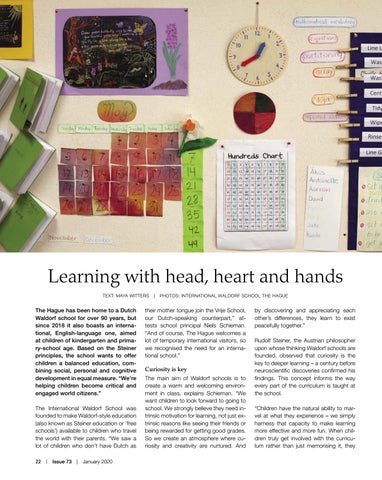
Learning with head, heart and hands TEXT: MAYA WITTERS | PHOTOS: INTERNATIONAL WALDORF SCHOOL THE HAGUE
The Hague has been home to a Dutch Waldorf school for over 90 years, but since 2018 it also boasts an international, English-language one, aimed at children of kindergarten and primary-school age. Based on the Steiner principles, the school wants to offer children a balanced education, combining social, personal and cognitive development in equal measure. “We’re helping children become critical and engaged world citizens.” The International Waldorf School was founded to make Waldorf-style education (also known as Steiner education or ‘free schools’) available to children who travel the world with their parents. “We saw a lot of children who don’t have Dutch as 22 | Issue 73 | January 2020
their mother tongue join the Vrije School, our Dutch-speaking counterpart,” attests school principal Niels Schieman. “And of course, The Hague welcomes a lot of temporary international visitors, so we recognised the need for an international school.”
Curiosity is key The main aim of Waldorf schools is to create a warm and welcoming environment in class, explains Schieman. “We want children to look forward to going to school. We strongly believe they need intrinsic motivation for learning, not just extrinsic reasons like seeing their friends or being rewarded for getting good grades. So we create an atmosphere where curiosity and creativity are nurtured. And
by discovering and appreciating each other’s differences, they learn to exist peacefully together.” Rudolf Steiner, the Austrian philosopher upon whose thinking Waldorf schools are founded, observed that curiosity is the key to deeper learning – a century before neuroscientific discoveries confirmed his findings. This concept informs the way every part of the curriculum is taught at the school. “Children have the natural ability to marvel at what they experience – we simply harness that capacity to make learning more effective and more fun. When children truly get involved with the curriculum rather than just memorising it, they
Discover Benelux | All Spotlights on The Hague | The Hague’s Top Schools
gain the capacity to be creative with their knowledge and use it for problem-solving later in life.”
Letting children be children Another underlying principle of the school is that children have the right to be children. “We believe that young children should be allowed to stay in their protective fantasy bubble for a while. We don’t start introducing news or current affairs into the curriculum until quite late. The grown-up world can be very scary, we don’t want children to become frightened of it,” explains Schieman. “Instead, we introduce the more difficult parts of life slowly and with a lot of context, so that children have a solid base of confidence in the world. We work with a lot of historical tales: these are often rich in imagery and morality. This principle is common to Waldorf schools around the world, and the stories are usually drawn from the local context or religion – but we see that the underlying morals and themes are the same, regardless of location.”
Language support Running an international school provides the additional challenge that children come from all sorts of backgrounds, and
many do not speak English as their first language. “We offer lots of individual support to make sure every child can participate in class,” says Schieman. “We’re a small school, so there’s plenty of scope for a personal approach – another guiding principle in Steiner teaching.” The school also makes sure the children get some exposure to the Dutch language. “It would be odd to completely isolate children from the context they currently live in, so we introduce them to Dutch through songs, poems and games. The main aim is not for them to become fluent or understand the grammar, but to give them a feeling for the differences between languages. We want them to experience language rather than learn it.”
Happy parents Schieman and his team want to make sure international parents in The Hague are aware of the existence of the International Waldorf School. “Many people don’t know we’re here, or perhaps they haven’t heard of Steiner education. But we’ve had tremendously positive feedback from parents so far, and some of them express sadness when they move away, because they see such positive development in their children.”
One parent, Jon Monastero, who is a performer in Cirque du Soleil, explained how happy he has been with the school. “We know that it is not easy to accept a student out of the blue, so to speak, and for such a short time, but everyone welcomed us with open arms and left such a warm and beautiful impression on our lives. It has been one of the most incredible experiences in our six years on tour.”
Compatibility While the Waldorf curriculum takes a different approach to learning, it is perfectly compatible with other education systems, and children can progress seamlessly to the international secondary school in The Hague. “Our curriculum is of equal academic value to that of any other school. The difference is simply that we have an added focus on helping children to become independent, confident and active global citizens,” Schieman concludes. For more details about the school or Waldorf schools worldwide, visit www.internationalwaldorfschool.nl. The school has open days, but parents and children are welcome at any time for a tour.
Issue 73 | January 2020 | 23
Grenoble.
FRANCE SPECIAL
The best winter destinations in 2020 Of course, France is beautiful all year around, but if you have never visited in the winter months then you are seriously missing out. Whether you are seeking adrenaline-boosting winter sports, tranquility surrounded by unspoiled nature or a vibrant city break – do not miss our special guide. TEXT: ANNA VILLELEGER | PHOTOS: PIXABAY
Vosges.
24 | Issue 73 | January 2020
Discover Benelux | France | The Best Winter Destinations in 2020
Postcard-perfect Eastern France is a true winter wonderland and could not offer more diversity, with its postcard-perfect towns and villages, vast mountain ranges and unspoiled countryside. This month we profile the magnificent Ermitage Resort in Ventron, which is surrounded by breathtaking landscapes, forests, villages and the rich cultural heritage of the Vosges National Park. There are countless local highlights waiting to be discovered, such as the Chapel of the Hermitage Frère Joseph and Vosges Textile Museum.
Culture We also take a look at the stylish Chalets de la Trinité in Gérardmer, which boasts stunning mountains and lakes almost on its doorstep. Gérardmer is also a must for culture vultures, with upcoming highlights including the 27th Gérardmer International Fantasy Film Festival (29 January to 2 February). Dedicated to the fantasy genre under all its forms — science-fiction, horror, and supernatural — it will see an international jury composed of celebrities awarding the Grand Prize and the Jury Prize.
Lyon.
Unspoiled nature Finally, do not miss our article on Le Bois Dormant Hotel, Restaurant and Spa in Champagnole. Surrounded by green woodland, this superb hotel is a haven of peace and tranquillity. Champagnole makes an excellent starting point for excursions into the Ain valley, the Joux forest and the beautiful lakes region. Unsurprisingly, hiking and outdoor sports are extremely popular in this unspoiled area.
Lyon.
Lyon.
Issue 73 | January 2020 | 25
Escape from it all at Ermitage Resort TEXT: ANNA VILLELEGER | PHOTOS: ERMITAGE RESORT
Located in Ventron, at the heart of the Vosges mountains in a preserved natural area, the family-friendly Ermitage Resort is the perfect place to unwind and reconnect with nature, whatever the season. Comprising two excellent hotels, L’Ermitage and Hotel Les Buttes, not to mention three 26 | Issue 73 | January 2020
superb restaurants, Ermitage Resort has all you need to enjoy a relaxing, stress-free stay surrounded by beautiful scenery.
Ermitage Resort. “And preserving that is very important to us.”
“Many of our guests lead busy, stressful lives where they are surrounded by noise and pollution. Here, it’s the complete opposite! They love the calm of the environment,” begins Thibaut Leduc, director of
The resort has been in Thibaut’s family for generations and has a fascinating history. In 1922, Thibaut’s grandfather Emile Leduc, a famous skier, came to settle at the Ermitage Frère Joseph (The
Family history
Discover Benelux | France | The Best Winter Destinations in 2020
Photo: Michel Laurent
Photo: Michel Laurent
Hermitage of Brother Joseph). Emile and his wife Marie raised their family here, and their 11 children grew up to become stars of national and international skiing, developing and managing the station at Ermitage Resort with equal success. The resort is still in family hands to this day, something which makes Thibaut extremely proud. “This place is so closely tied to our family. My grandfather is buried right behind my office. And my son has just begun working here, so now we’re in the fourth generation. We have protected the resort and always kept a long-term vision.”
Ermitage Resort is carrying on a tradition of calm and comfort that began in the 18th century, with the establishment of Frère Joseph’s hermitage and chapel. The chapel was built in 1757 by residents in honour of the kindness of Frère Joseph, who retired here in the forest.
come all year round to enjoy a variety of pursuits. Or, as Thibaut points out, they sometimes prefer to just take it easy. “Often, our guests just enjoy doing nothing,” he grins. “It’s the perfect place to just sit and contemplate, or listen to the birds, the sounds of nature…”
Outdoor activities
One of the advantages for families is that there are very few cars at the resort, so children can be left free to explore. “They love our cabin in the forest,” points out Thibaut, adding that there are an array of discovery trails for children and adults alike.
While activities such as alpine skiing, cross-country skiing and snowshoeing are still popular at Ermitage Resort during the winter months – there are slopes with ten pistes, from green to black, that also include beginner’s slopes – guests
Issue 73 | January 2020 | 27
Discover Benelux | France | The Best Winter Destinations in 2020
Guests can choose between the charming, family hotel, L’Ermitage, and the four-star Hotel Les Buttes. L’Ermitage features 35 spacious rooms, all with their own personal touch and excellent amenities. Guests can enjoy free access to the invigorating spa at the neighbouring Hotel Les Buttes, which boasts a covered pool, sauna and steam room. Hotel Les Buttes offers a range of tranquil rooms and suites, which are ideally suited to couples, groups or business travellers.
Gourmet delights Dining at Ermitage Resort is a mouthwatering experience, and guests can choose from three wonderful restaurants. At L’Ermitage, diners can enjoy French classics made using seasonal, fresh local produce. This is accompanied by local wines and a magnificent view overlooking Ventron and the Vosges. Meanwhile, at Restaurant Les Buttes there is a ‘Maître Restaurateur’ at the reigns, with gourmet dishes such as Lorraine 28 | Issue 73 | January 2020
beef and foie gras, quail fillets and veal mignon delighting foodies in a refined yet welcoming setting. Just two kilometres from Les Buttes is Restaurant La Ferme de Riant, which is housed in a former mountain farmhouse and provides a convivial setting for family, social or professional events. The venue is famed for its lunchtime buffets, and is a particularly popular choice for family get-togethers and professional events. “As well as offering exceptional views in a beautiful environment, the chef will take you on a gastronomic journey,” enthuses Thibaut. Ermitage Resort is also renowned for its musical evenings, which have attracted an array of leading musicians over the years, including Charles Aznavour’s pianist. “We welcome many amazing artists, and they all feel at home because they’ve often been doing concerts here for 20 years,” reveals Thibaut.
Wonderful all-year round Surrounding the resort, you can discover landscapes, forests, villages and the rich cultural heritage of the Vosges National Park. “It’s beautiful all year round,” beams Thibaut. If you enjoy water sports and fishing, you’ll adore the many streams, rivers and lakes. And in summer, you can make the most of the resort’s electric bikes or mountain bikes, or enjoy a guided hike where you can learn more about the environment. While it would be easy to spend the whole day relaxing in comfort at Ermitage Resort, there are many local highlights waiting to be discovered, such as the Chapel of the Hermitage Frère Joseph and Vosges Textile Museum. One of Thibaut’s top local tips is the nearby Mille Étangs plateau, whose name means ‘A Thousand Ponds’ in French. “It’s a real hidden gem,” he smiles. “Not many people know about it and everyone who goes there is amazed by its beauty.”
Discover Benelux | France | The Best Winter Destinations in 2020
Musical programme 2020 Saturday 4 April Love songs Trio ‘Sonans’ With Shigeko Hata (Soprano), Odile Abrell, (Harp), Jean-Michel Tavernier (Horn). Saturday 16 May Eternal Beethoven With Olivier Gardon (piano) and Yvan Chiffoleau (cello) as part of the celebrations of the 250th anniversary of the birth of the composer. Saturday 6 June From Bach to Bernstein, ` music from films and comedy Saxophone quartet Jean-Yves Fourmeau With Jean-Yves Fourmeau (soprano saxophone), Pierric Leman (alto sax), Stéphane Laporte (tenor sax) and Joël Batteau (baritone sax). Saturday 27 June Buenos Aires connection, from tango to tango nuevo Caliente Quartet With Lysandre Donoso, (bandoneon), Michel Berrier (violin), Eric Chalan (double bass) and Cédric Lorel (piano). Saturday 5 September Jazz feeling Thierry Amyot (trumpet, Wilhelm Coppey (piano), Florian Coppey (double bass), Alain Dumont (drums). Saturday 26 September Discovering brass through the ages Magnifica Brass Quintet With Michel Barré and Grégoire Mea (trumpets), Camille Lebrequier (horn) Pascal Gonzales (trombone) and Benoît Fourreau (tuba). Saturday 17 October Emotions With Philippe Depetris (flute) and Pascal Polidori (guitar), 30th anniversary tour.
Web: www.ermitage-resort.com www.ermitage-vosges.com www.hotel-les-buttes.com
Issue 73 | January 2020 | 29
A year-round delight TEXT: MARTIN PILKINGTON | PHOTOS: WILLIAM DIEUDONNÉ
With stunning mountains and lakes almost on its doorstep, the stylish Chalets de la Trinité in Gérardmer attract visitors all year round, whether that’s to exploit the landscape’s sporting opportunities, or just to bathe in its beauty (and eat patisserie!). Easily reached from the Benelux nations thanks to its accessible location and excellent motorway links, Gérardmer in the Vosges area of France’s scenic northeast is a magnet for winter sports enthusiasts in the cold months; and in the warmer ones, it’s great for discovering villages, vistas – and vineyards. It’s hard to imagine a better base for such breaks there than Chalets de la Trinité, four kilo30 | Issue 73 | January 2020
metres from the nearest ski station, and one kilometre from Gérardmer’s facilities. Family run When manager William Dieudonné says the chalets are a family affair he isn’t kidding: “My grandfather started the business in 1997,” he says, “and my mother has been running it for 20 years now. She’s also behind the design and décor of each of the chalets, which my father builds!” M. Dieudonné senior is being kept busy: two new chalets were added in 2019, and three more are planned for 2020, which will make eight in all. Mme Dieudonné has created an uncluttered contemporary look and feel to the
chalets, each with its balcony and/or terrace from which to take in breathtaking views: great places for a family to relax, or friends to meet up – for a short break or a long one, no matter the season. “People tend to associate this area with the mountains, but we’ve got fabulous lakes, too, like Xonrupt and Gérardmer’s own, great places for learning to sail and to rent motorboats. They’re wonderful spots for walks in the surrounding forests, too,” says William. “But in the winter it’s the skiing that’s the biggest draw – and skiing is a great way to take in the best of the scenery at a beautiful time of year – it’s no coincidence that this area has produced some of France’s best cross-country skiers.”
Discover Benelux | France | The Best Winter Destinations in 2020
Gastronomy All that activity merits some epicurean reward, and the Alsace region has a wealth of gastronomic delights to tempt you, not least traditional baked goods, where the influence of its Germanic neighbours blends deliciously with French culinary genius. On the sweet side, there are things like pain d’épices, filling but subtle, or kouglof, brioche-like, dotted with raisins and often laced with brandy; and the savoury tarte flambée – a sort of pastry pizza loaded with bacon, onions and cream: you won’t be able to stop at one slice. “As far as food goes, this area is probably most famous for choucroute,” William advises. “Maybe because there are lots of artisan pork products available to chefs and cooks. But I’d tell anyone
coming here to look out for the many different things made with locally grown bilberries and Mirabelle plums – cakes, pastries and the deceptively strong ‘eaux de vie’ that make the perfect end to a meal.” For cheese lovers there’s the famously forthright Munster to experience, among a very long list of others. You can try many such regional specialities in restaurants and cafes in and around Gérardmer, of course, but it’s tempting too, to buy them in local traiteurs, delicatessens and bakeries, and either put together a picnic to be sampled in the fabulous countryside, or enjoyed back in your home-from-home – and decidedly well-equipped – chalet, sitting at ease around the dining table with your comfy bed just ready to fall into when the day’s exertions take their toll.
Colmar and wine “It’s very easy to fill a week, two weeks, or more, within just a few miles of this place,” William enthuses, “but if guests feel the need to venture further, we have Colmar about 90 minutes away by road, famous for its untouched old buildings and beautiful canals; and for wine lovers, the vineyards of Alsace are a must-see. Turckheim is the nearest to us, but there are innumerable producers along a 170-kilometre trail for the true enthusiast!”
Culture too As if that wasn’t enough, William points out that Gérardmer has many cultural cards up its sleeve: “29 January to 2 February will see the 27th Gérardmer International Fantasy Film Festival, and through the year we have events for motorcycle enthusiasts, a Christmas market, big fireworks displays, culinary happenings… and every two years – the next is April 2021 – there’s the Fête des Jonquilles, the daffodil festival, a major thing here in the Vosges.” This is somewhere that’s good for the body, the mind, and the soul – with some great cakes to treat yourself with, too. Chalets de la Trinité is the perfect place at which to rest your head and prepare for another day’s exploration (and indulgence). Web: www.chaletstrinite.com
Issue 73 | January 2020 | 31
Discover Benelux | France | The Best Winter Destinations in 2020
A tranquil haven in the woods TEXT: EDDI FIEGEL | PHOTOS: LE BOIS DORMANT
“There are times when you just want to disconnect from the stress of everyday life,” says Elie Sclafer, manager of Le Bois Dormant (‘The Sleeping Wood’) Hotel, Restaurant and Spa in eastern France. “And that’s what our guests can do here, in our haven in the woods.”
There’s also a spa with a large swimming pool surrounded by picture windows looking out to the woods. Other facilities include a Jacuzzi, sauna and steam room, not to mention a wide range of well-being massage treatments such as reflexology and foot massage.
innovations, with dishes including risotto of baked scallops with saffron, the chef’s own secret recipe for ‘vendace’ (whitefish) with chanterelle mushrooms and grenoble sauce, as well as traditional favourites such as steak with cream and mushroom sauce and veal escalope.
Amidst some six hectares of green woodland just west of the French/Swiss border, and about two hours’ drive north of Lyon, the hotel aims to be a haven of peace and tranquillity. “Each of our 40 bedrooms looks out onto the wooded parkland around the hotel. We have a variety of rooms from twins and doubles to triple and family rooms which sleep up to four people, and they are all specially designed so that you can either see the sun rise or the sun set.”
For business guests, Le Bois Dormant’s meeting space, complete with audio-visual equipment, is suitable for a range of different-sized events from between ten and 140 people, such as team-building weekends and seminars to conferences and presentations.
There is also a wide selection of homemade ice creams and sundaes, as well as an extensively stocked wine cellar.
With a designated space for meetings, seminars and functions, as well as an outdoor children’s play area, the hotel is equally well-suited to both business, leisure and family visits. 32 | Issue 73 | January 2020
“Whether our guests are visiting for business or leisure, good food is also an aspect which is key for us,” says Sclafer. In the summer, lunches and dinners can be enjoyed on the outdoor terrace or, for business events, in the private function room. The menu features a mix of local specialities, traditional recipes and the chef’s
Web: www.bois-dormant.com
Nieuwpoort. Photo: Westtoer
TOP PLACES TO VISIT IN FLANDERS IN 2020
The ultimate destination Flanders has the perfect combination of beautiful nature, historic towns and charming seaside resorts. Whether you are seeking a relaxing holiday or an action-packed city break, we present some of our favourite Flemish destinations for 2020. TEXT: ANNA VILLELEGER | PHOTOS: VISIT FLANDERS
Hallerbos.
34 | Issue 73 | January 2020
Discover Benelux | Top Places to Visit in Flanders in 2020 | The Ultimate Destination
With a 42-kilometre-long stretch of golden sands, scenic towns and many Michelinstar restaurants, the Flemish coast in West Flanders is an ideal choice for your next holiday. You will find an array of charming seaside resorts, all with their own character and unique atmosphere. If cycling is your thing, then you will love the province of East Flanders, celebrated for its many rivers, wooded hilltops and, of course, the Tour of Flanders. Rivers like the Durme, the Dender and the Schelde have an important place in the breathtaking panoramic views of the region. Ideal for
Ypres. Photo: Thierry Caignie, Westtoer
a holiday are the hilly Flemish Ardennes, a favourite among climbers and hikers. Do not forget to take a walking tour through Meetjesland, a historic region home to the grand nature reserve Canisvliet.
D AT E S F O R Y O U R D I A R Y The Bayard Steed Parade 24 May, Dendermonde Between Brussels, Antwerp and Ghent lies the historical town of Dendermonde. Once every decade, this quiet and beautiful town becomes the roaring, folkloristic capital of Belgium, when tens of thousands of spectators witness the mighty Bayard Steed parade through its streets. On 24 May 2020, this legendary steed will ride once again.
The World’s 50 Best Restaurants Early June 2020, Antwerp The annual gastronomic extravaganza of events that is The World’s 50 Best Restaurants will be hosted in Flanders in 2020, with its famous awards ceremony taking place in Antwerp. Look out for a host of culinary collaborations, and full-on celebrations in Antwerp and the Flanders region, some of which will be open to the public. Oostende.
Word Choir Games 5 -15 July, Ghent and Antwerp The international choral world will descend on Flanders for the world’s largest international choir competition. In 2020, Antwerp and Ghent are the main hosts for The World Choir Games 2020 and there is a chance for all non-professional choirs of the world to join in.
Zwin Natuur Park – Zwinvlakte. Photo: Provincie West-Vlaanderen
MA Festival – Festival of Flanders in Bruges August 2020, Various locations in Bruges This is one of the oldest specialist early music festivals with an international reputation. Expect daily concerts, workshops and lectures. This year’s theme explores the fascinating link between god, man and machine. Issue 73 | January 2020 | 35
Bayard Steed.
Meet the legendary Bayard Steed! TEXT: MICHIEL STOL | PHOTOS: DENDERMONDE
Once every decade, the quiet and beautiful town of Dendermonde becomes the roaring, folkloristic capital of Belgium, when tens of thousands of spectators witness the mighty Bayard Steed parade through its streets. On 24 May 2020, this legendary steed will ride once again. Between Brussels, Antwerp and Ghent lies the historical town of Dendermonde. Its medieval city centre is one of the oldest in Belgium and is home to two UNESCO World Heritage sites: the 14th-century town hall with its belfry, and the 13thcentury St. Alex beguinage. Normally, the town is not crowded with tourists, making it an ideal spot for an interesting, inti36 | Issue 73 | January 2020
mate and alternative city trip. But every ten years, when the gigantic wooden Bayard Steed ‘gallops’ through town, the streets are amassed with onlookers, to show their love for this beloved animal. “Outsiders sometimes mock the excitement, but the moment it gallops on the main square, it changes everything,” emphasises Greta Van Acker from Tourism Dendermonde.
fist. So, Aymon brings him to the lockedup, frightful horse Bayard, which has never found a master,” Van Acker explains. Reynaud manages to tame this magical horse. Later, after a quarrel at the court of Charlemagne, the four sons of Aymon escape from his fury on the back of Bayard. “To restore peace at the court,
The magical steed The saga of the Bayard Steed dates back to the Middle Ages and the story goes as follows: “Aymon, Lord of Dendermonde, married the cousin of Charlemagne and had four sons. Each of them got a horse. The eldest son, Reynaud, was so strong that he killed his horse with one blow of the
Onze Lieve Vrouwekerk.
Discover Benelux | Top Places to Visit in Flanders in 2020 | The Ultimate Destination
Charlemagne agrees to make peace again if they hand over Bayard. Concerned about his father and his brothers and because of his mother, Reynaud gives in and sacrifices his horse. Heavy millstones are put around Bayard and he is thrown into the confluence of the rivers Dender and Scheldt. Thrice the steed breaks the stones and swims to Reynaud, who is standing ashore. Reynaud can’t stand it any longer and turns away. Thinking that Reynaud doesn’t want him anymore, Bayard gives a painful scream. If his master leaves him, he doesn’t want to live anymore. And he drowns…”
Thousands in the streets Back then, stories like these were spread by travelling troubadours. In many cities, similar legends about the Bayard Steed are cherished. Yet, nowhere else does the tale live on so prominently as in Dendermonde. The first Bayard Steed Parade was held as far back as 1807. In 1986, the building in which Bayard was stabled was about to be demolished. The transport of the beloved horse became a small parade on its own, with thousands of spectators in the streets. “When we saw how enthusiastically the horse was greeted, the city started organising the mythical procession every ten years, at the break of each decade.”
800 kilogrammes plus four children The Bayard Steed Parade is a succession of intriguing scenes. Where the theme
A trip to Dendermonde
Butchers’ hall.
of the first act varies with every edition, the second one traditionally acts out the saga of the Bayard Steed. In the last act, traditional characters like the guilds’ giants and the halberdiers prelude the arrival of the mighty stallion. A dazzling 2,000 characters play their part in the medieval festival. The wooden Bayard Steed, the showpiece of the cavalcade, is no less than 4.85 metres tall and 5.2 metres long. It takes three groups of 12 strong men, called ‘de pijnders’, to alternately carry the horse of 800 kilogrammes along the route, which takes six and a half hours. Not just in a casual trot forwards, but with an impressive prance every now and
Even when the parade does not cross the centre, Dendermonde is still a must-see for all city trippers. With a straight train from almost all the nearby cities, you can reach the town in a heartbeat. Discover the UNESCOprotected city hall with its bell tower and the 13th-century beguinage. Due to its humble size, the city can be explored in just one day and without the usual worming through the crowds. Beautiful buildings and fine arts (among which, two works by Antoon van Dyck) await you in the centre, while the green oasis just outside of the former city walls forms the perfect backdrop for a walk, a bike trip, or some relaxing family time.
then, as well. To do so, the first row of ‘pijnders’ lifts the front of the horse in the air while the last row bends their knees. The four sons of Lord Aymon are seated on Bayard’s back. “These roles are always played by four brothers aged between seven and 21 years old, who were born and raised in the city. The parts are very popular, since these boys remain local superstars for as long as they live here,” Van Acker smiles. The Bayard Steed Parade will take place on 24 May 2020.
Web: www.rosbeiaard.be
The guilds’ giants.
Issue 73 | January 2020 | 37
A city intertwined with the sea TEXT: BAS VAN DUREN | PHOTOS: WESTTOER
In Belgium, just a half hour drive away from Bruges, you’ll find a place called Nieuwpoort, that despite its name – which literally translates to ‘new port’ – is rich in history, events, shops and more. As one of Belgium’s ten seaside resorts, it has a deep relationship with the North Sea, having four ports and several highly regarded restaurants that have fresh saltwater bounty on their menu. For the outdoorsy types, to call Nieuwpoort lovely is an understatement, having unique spots of untouched nature and amazing bike routes in its surroundings. This is a city that has its roots in medieval times, saw Spanish and Dutch armies try to conquer it, and had its most devastating blow during the Great War. Despite 38 | Issue 73 | January 2020
inundating its surroundings during the Battle of the Yser against the German Army, not much was left of Nieuwpoort afterwards. But its inhabitants were adamant on restoring their city to its former glory, and brick by brick, rebuilt each house that is in use to this day, with the year they were rebuilt noted on the front. It’s a testament to the perseverance of the Nieuwpoorters and its city that has a history of coastal tourism and expanded on that after the Second World War.
Water ways “Nieuwpoort thrives on seaside tourism,” says Michelle Martens, head of the tourism department. “We have the largest marina in North Europe that is not only well-kept, but looks amazing and as such attracts sailing aficionados from
all across the continent, many from the Scandinavian countries and England. With 2,000 berths, it’s quite a sight and one that you can enjoy from the two wooden piers that lead to the marina and the fishing port. There’s a free ferry that can take you across and if you’re there, there’s so much unspoiled nature that you should definitely walk around in. There’s even a chance you will get to see seals who use Nieuwpoort as a rest stop and we have police around who make sure they get that much needed rest.”
Historic city Truly, water plays a big role in Nieuwpoort, as its city centre and the part that resides next to the shore (referred to as Nieuwpoort-Bad) are connected through a waterway, creating a vista that stretch-
Discover Benelux | Top Places to Visit in Flanders in 2020 | The Ultimate Destination
es on end. “But Nieuwpoort is more than just seaside tourism,” declares Martens. “Our history is on full display in the city, with several monuments that honour the fallen of the First World War, and there’s a visitor centre where there’s an interactive installation that covers the inundation.” She continues: “There’s always something to do in Nieuwpoort. There are events every season and the standout is the Feast of Saint Bernardus, named af-
ter the city’s parish. It’s a whole weekend that offers food, arts and entertainment and includes a stroll with over a hundred Saint Bernard dogs across our seawalls. It’s quite a sight to behold.”
Fish & Digs As mentioned, Nieuwpoort offers a lot for gastronomers, particularly those with a taste for finny things. There’s nothing quite like a stroll along the beach and
having some quality fish afterwards, and the city is happy to provide that. Martens singles out M Bistro: “It’s both a bistro and restaurant and was awarded a Michelin star last year and held on to it. They do wonders with local, seasonal products and it’s run by a husband and wife who are well acquainted with the area. The fish on their menu is caught the same day by our local fishers, so you can expect things like delicious plaice and shrimp.” And as for shopping? “We jokingly say that we have all the famous brands on the size of a stamp, but it’s true; we do have quite a lot of stores grouped into a small space.”
Surroundings With its central location in the western part of Flanders, Nieuwpoort serves as an excellent home base while venturing out into the surroundings. History buffs can go see the front lines that defined the Great War, while bike enthusiasts can enjoy the many routes that cross the Westhoek region of which Nieuwpoort is a part of. If you’re planning on staying for several days, there are more ways than one to spend the night in this seaside resort. With classy hotels, B&B’s and high-quality camping sites, you can find a happy stay in Nieuwpoort, whether you’re the outdoorsy or indoorsy type. Web: www.visit-nieuwpoort.be
Issue 73 | January 2020 | 39
Duncan Laurence. Photo: Paul Bellaart
The sounds of 2020 TEXT: BAS VAN DUREN
A new year means new music, and we are looking forward to all the artists from the Benelux that are bound to make a splash in 2020. Whether you are into pounding rock bands, suave rappers or amazing vocalists, here are nine names to look out for in the upcoming months. SONS If you like your guitars rowdy, punchy and with a twist of psychedelia, try Belgian band SONS (yes, all caps, all the time). Four young guns from Melsele bonded over their love for skateboarding and punk rock and it was a matter of course before they picked up an instrument. SONS toured all across the continent and have released the album Family Dinner — mashing a punk ethos with a love for seventies hard rock music, topped with exquisite guitar solos. 40 | Issue 73 | January 2020
SONS. Photo: Thomas ‘Richard’ Mertens
Discover Benelux | Cover Feature | Sounds of 2020
Duncan Laurence Most likely the most famous on the list, Spijkenisse-born Duncan Laurence was crowned winner of last year’s Eurovision Song Contest with Arcade. The song is a showcase of his amazing vocal chops, packed with emotion and intimacy. His popularity rose to stratospheric heights and he’s now set to perform at a soldout Ziggo Dome (Holland’s biggest indoor venue) and several festivals. 2020 is shaping up to be Laurence’s year.
Duncan Laurence. Photo: Paul Bellaart
Duncan Laurence. Photo: Paul Bellaart
Charlotte Adigéry If slick synths and otherworldly funk are your jam, you should listen to Belgium’s Charlotte Adigéry. She was discovered by the Dewaele brothers of Soulwax fame, who asked her to come lip-sync a song for their Belgica soundtrack. When they found out Adigéry is a very capable singer herself, they coupled her with producer Bolis Pupul. Their song, Paténipat, was used as the soundtrack for HBO’s trailer of The Pope, so it should only be a matter of time before the United States is hooked, as well. Naaz Born into a Kurdish family in the Netherlands, Rotterdam-based Naaz is the kind of wonderkid who could’ve had her big break early (guest vocals with Yellow Claw, performing on Holland’s Got Talent), but opted to take a break and commit to writing her own music. A wise choice, having streaming hits with songs like Words and TAPED. Her playful beats and soulful voice draw comparisons to Lorde, but Naaz is a star in her own right, having her first headline tour and receiving airplay from BBC Radio 1.
Naaz. Photo: Peggy Kuiper
Charlotte Adigéry. Photo: DEEWEE
Issue 73 | January 2020 | 41
Discover Benelux | Cover Feature | Sounds of 2020
Brutus. Photo: Geert Braekers
Brutus Possibly the loudest band on this list, Brutus is a three-piece group from the Leuven area fronted by Stefanie Mannaerts, who is both the drummer and singer of the trio. As a whole, Brutus loves to combine the complex rhythms of math rock with post-rock sensibilities, while not shying away from pure pop melodies. The result is as unique as it sounds and second album Nest, released earlier this year, is a testament to how Brutus are perfecting their own style.
TheColorGrey In a world where trap rappers dominate the charts, Antwerpian TheColorGrey likes to keep things ‘old-skool’. His blend of suave, laidback beats harken back to the days when rappers loved to sample jazz and funk artists and lyrics were used to evoke feelings and ideas, instead of bragging about all sorts of things. Will Michels (his real name) is much more of a crooner who raps in immaculate English and makes his own music.
Iguana Death Cult. Photo: Tom van Huisstede
TheColorGrey. Photo: Segraphy
Iguana Death Cult Come for the awesome band name, stay for the musical kaleidoscope that is Iguana Death Cult. This fivesome from Rotterdam started out as a band that loves their punk with acid and garage, but evolved into something much more complex, drawing inspiration from new wave, disco and krautrock. This frenetic concoction resonated with people across the Atlantic, with the band having performed at SXSW in Austin and released their latest album on the highly regarded L.A. label Innovative Leisure.
Altin Gun. Photo: Sanja Marusic
Pip Blom. Photo: Guy Eppel
Pip Blom Who can say they just turned 23 and have toured all around the globe, including New York and even Glastonbury? Pip Blom can. Hailing from Amsterdam, Blom has a knack for grungy indie pop music, owing her musical heritage to some degree to the likes of The Breeders, PJ Harvey and Courtney Barnett. Her fuzzy tunes gained acclaim from popular radio stations like KCRW and BBC Radio 1, and magazines such as Rolling Stone. 42 | Issue 73 | January 2020
Altin Gün Unbeknownst to many, Turkey had a lively psychedelic rock scene back in the late sixties, when local musicians mixed the genre with elements of their own folk music. This, in turn, inspired the youngsters of Amsterdam band Altin Gün to record covers of songs from that era, resulting in a crisp, trippy blend of styles that is simply amazing. They toured across the United States, opened for Tame Impala and are nominated for a Grammy Award, which they’ll hopefully win in 2020.
Photo: Pexels
SPECIAL GUIDE
Top coaching experts Are you trying to achieve a particular ambition in your work or personal life? There are a host of experts in this month’s motivating guide who can help you achieve your goals.
Photo: ChamoiX Coaching
44 | Issue 73 | January 2020
Discover Benelux | Special Guide | Top Coaching Experts
Meriam Slijkerman
Marlies Tousain
Meriam Slijkerman started as a business coach in 2016 and has already built up an impressive resume of successful clients whose lives she helped to transform.
By combining two decades of personal business experience with specific coach training aplenty, Marlies Tousain’s profile is unique.
Simone Noordegraaf, CEO of iPEC Europe.
iPEC At the European branch of the prestigious American coaching school The Institute of Professional Excellence (iPEC), you learn all the skills and insights you need to soar high as a coach and leader.
Bart van den Belt
Drukte Makers
Bart van den Belt is a renowned Dutch author, speaker and business coach. He now focuses his attention primarily on entrepreneurs and C-level executives, helping them to reach the same success in their personal lives that they enjoy professionally.
Many businesses looking to boost their potential often limit themselves by improving only one aspect of the working environment. Dutch business coaching firm Drukte Makers has helped companies on almost every continent achieve success by doing the opposite.
ChamoiX Coaching ChamoiX Coaching guides high performing leaders and teams in exploring the heart of their business. Based deep in the French Alps, an hour’s drive from Geneva Airport, ChamoiX Coaching is surrounded by stunning nature.
Elsbeth van Lienden, founder of The Pink Walnut.
The Pink Walnut
CoachingSchool Amsterdam
Ivonne van Dis
The first important lesson that The Pink Walnut teaches is that one’s decisions are driven by thoughts, feelings and emotions, which mostly originate from a subconscious level, so one believes them to be true.
As business culture gets more horizontal by the day, the leadership style of today’s managers must follow. At CoachingSchool Amsterdam, they turn yesterday’s managers into tomorrow’s coaching leaders.
Ivonne van Dis started her coaching bureau in 2009, when she became a certified coach, and expanded her training to become a certified ‘businessreader’ in 2013. Issue 73 | January 2020 | 45
Meriam Slijkerman.
Taking business to the next level TEXT: MYRIAM DIJCK | PHOTOS: NINA TULP
Trying to reach a business or financial goal can often feel like a never-ending struggle, whether it is more job satisfaction, working fewer hours a week, buying that dream house or simply reaching a higher income. But what if there is a way to achieve these goals? This is where high-end business coach Meriam Slijkerman comes in. Slijkerman started as a business coach in 2016 and has already built up an impressive resume of successful clients whose lives she helped to transform. From business owners who were able to multiply their income while cutting their working hours by half, to entrepreneurs who gained a renewed passion for their business and professionals who were finally able to quit their job and work independently. 46 | Issue 73 | January 2020
“It is incredible to watch clients as they rise above themselves and transcend their goals. It gives me so much satisfaction. Especially when I get that call from a client who says: ‘yes I did it, I bought my dream house’,” she says.
High-end guidance As a high-end business coach, she helps professionals push themselves to perform at the top level. “I work with experienced entrepreneurs and business owners who are ready to scale up or position themselves at a higher price point.” Slijkerman’s line of coaching focuses on smart, effective entrepreneurship and going beyond invoicing by the hour. “It’s about working less, but increasing your income level. I help clients develop high-value, high-priced programmes
and successfully position those in the marketplace.” Her clients are mainly fellow coaches, trainers and consultants, but also entrepreneurs from the creative and business services industries. “I am quite picky as to what clients I want to work with. This is not something for everyone – I look for someone who is committed and has real drive, so I know they will keep going despite the inevitable bumps along the way.”
Tools for success Slijkerman herself is a shining example of the transformation that can be achieved. She used to work as a project manager in the Dutch social services sector and developed innovative business ideas alongside it. “I was doing 60- to 70hour work weeks but I no longer expe-
Discover Benelux | Special Guide | Top Coaching Experts
rienced job satisfaction. I was ready to start a new phase of my life: I wanted to do something I felt passionate about and achieve better results. But I also wanted more time for myself and to not have to worry about my income,” she says. This became Slijkerman’s new challenge, to find a business model that would cater to her needs. The solution: high-end entrepreneurship. “But I was lacking the tools and the knowledge to position myself successfully at a higher price point in the marketplace. I had to learn how to do this.” Once she acquired the skills, it was her decision to commit that she was able to achieve her goals. She took the plunge and started her own high-end business coaching company. It gave her a new sense of purpose and also allowed her to live the life she wanted to live. “I now work on my own terms. I do a 20-hour workweek, I take 12 weeks of holiday and I don’t have to worry about my income. I want to show others that it is possible and inspire them.”
A lasting change
simultaneously. Slijkerman’s four-step coaching process typically lasts one year, but she often retains clients beyond that. “The first step is developing or refining the business idea itself: what makes it new and innovative, how do you position yourself in the marketplace and who is your customer. The second step is creating an effective marketing strategy and building the content. The third is implementation: actually selling it. And the fourth and final step is personal growth, so clients continue to enhance their leadership skills.”
Over the years, she has refined her business to what it is today. In order to maintain a high-quality service, Slijkerman only works with a limited number of clients
The power of her coaching strategy is Slijkerman’s focus on making the business transformation last. “It takes time to
build a solid foundation and connect all the different aspects. That’s why it takes a year. I don’t just offer my clients theory and knowledge, I actually help them implement these things in practice.” Slijkerman works with clients throughout the Netherlands as well as abroad. She is a certified high-end business coach, sales coach and innovation trainer. She is keen to arrange personal ‘sparring sessions’ with entrepreneurs and business owners to discuss opportunities for growth. She can be contacted via her website. Web: www.mslijkerman.nl
Photo: Marloe Pulles
Issue 73 | January 2020 | 47
Financially free but emotionally bankrupt TEXT: MAYA WITTERS | PHOTOS: BART VAN DEN BELT AND PEXELS
Bart van den Belt is a renowned Dutch author, speaker and business coach. He now focuses his attention primarily on entrepreneurs and C-level executives, helping them to reach the same success in their personal lives that they enjoy professionally. “Many top executives are financially rich but emotionally bankrupt.” Van den Belt is no newcomer to the world of business. As the founder of the Dutch ‘Zakelijk Succes Academie’ (Business Success Academy), a top-rated entrepreneurial degree course, he has plenty of first-hand management experience as well as ample coaching prowess. “My aim is to help executives find themselves again in the sometimes overwhelming maelstrom of their career,” attests van den Belt. 48 | Issue 73 | January 2020
Emotionally bankrupt “These people spend years working to gain success, status and money, only to find out that these are not the things that make them happy. I see so many highly successful people who are incredibly unhappy in their personal lives, or struggle to maintain good personal relationships outside of work,” Van den Belt explains. “There’s nothing worse than climbing a mountain for years, only to find that you’re on the wrong mountain when you reach the top.” Many executives have no trouble being decisive and directive, but that doesn’t always help them in their personal lives, explains van den Belt. “They tend to be strategically strong, but they don’t know how to stay emotionally connect-
ed – even though that can often get you further, especially in a family situation. It leaves them in a position of emotional bankruptcy, in stark contrast with their professional success.”
Letting go of ego To help executives escape this state of limbo, van den Belt’s aim is to help them find their sense of self again within the many demands placed upon them. “Often, people in leadership positions get the feeling they are literally unmissable: the company would be lost without them, so they can never switch off from work and, as a consequence, they underinvest in their personal and emotional development.” Van den Belt admits that this is a lesson he too has had to learn. “We’re having a
Discover Benelux | Special Guide | Top Coaching Experts
Bart van den Belt.
baby in May, and I’ll be taking four months off. I wouldn’t have been able to do that five years ago: my ego wouldn’t have been able to handle the feeling that I am, in fact, missable, and that my companies can run smoothly without me. It’s a learning process that many leaders have.”
Trust in the coaching environment To facilitate this learning process, van den Belt approaches the coaching relationship like that of good friends. “When working around vulnerable topics like these, maintaining trust is essential. Therefore, while I am not afraid to address issues head-on, I will always be
hard on the issue but soft on the person,” he explains. “Like a good friend, I will say things to my client that they don’t want to hear, but that everyone around them already knows. That’s what a friend would do, but I have the added benefit of an outside eye. And unlike everyone else around them, I have no demands or requirements for the executive: I am here to support them and their journey.”
You are the bottleneck Ultimately, van den Belt believes that his approach will not just help executives in
their personal lives, but that it will benefit their company, too. “When things aren’t quite right at a company, it’s often the top level you need to look at. My mentor John Maxwell calls it the Law of the Lid: a company can only grow as far as its top executive’s leadership abilities. If the executive is stuck, for whatever reason, the company cannot experience growth. I often tell my clients: you are the bottleneck.” “I am a great believer in serving leadership. To be a real leader, you have to be able to find your success in serving other people, instead of status,” van den Belt explains. “In the end, you want your company to work in service of its clients, but this is a process that needs to happen top-down. You need to set the example as an executive. If you serve your staff, you’ll set the example for your staff to serve your clients. Mahatma Gandhi once said: ‘The best way to find yourself is to lose yourself in the service of others’. I find that to be true.” Van den Belt coaches clients internationally and is happy to travel if there’s a need to be on location. “We can have coaching sessions via video call, or I can fly to wherever is convenient for the executive. I tailor my services to each client, in both content and form,” van den Belt concludes. To learn more, visit: www.bartvandenbelt.com
Issue 73 | January 2020 | 49
Discover Benelux | Special Guide | Top Coaching Experts
Elsbeth van Lienden.
Unleash the great leader within you TEXT: ARNE ADRIAENSSENS | PHOTOS: ALEXANDRA STRZELCZYK / PIXABAY
Leaders are successful people, by definition. With hard work and a clear vision, they have managed to climb up the ladder. Unfortunately, that isn’t always enough to reach the top or stay ahead at the top, however. A lot of leaders are held back by their – mostly subconscious – flaws and weaknesses, which may prevent them from living up to their potential. Coaching boutique The Pink Walnut helps people to overcome these obstacles, allowing you to keep improving your company, as well as yourself. “To break through your own barricades, you need a brutally honest outsider’s look on your work and on you as a person.” And that is exactly what Elsbeth van Lienden offers. As the founder of The Pink Walnut, she is specialised in helping leaders to live up to their potential. To her, every business is a people’s business. “When things go wrong in a company, most leaders blame the systems they use, whereas they should look at themselves first. Business structures and methods usually work, 50 | Issue 73 | January 2020
it is the people who don’t.” And those human flaws can come in a myriad of forms: a lack of deep listening skills, conversational skills or eye for detail, to name a few. “People are creators. Our decisions determine our future, not the methods we use or structures we work in.” The first important lesson that The Pink Walnut teaches is that one’s decisions are driven by thoughts, feelings and emotions, which mostly originate from a subconscious level, so one believes them to be true. To make wise and conscious decisions, you must be able to distinguish the fact that you have thoughts and beliefs, yet you are not those thoughts and beliefs. Context is key. “As a child, you absorb plenty of impulses which influence your decisions for the rest of your life. They brought you to where you are at today, but oftentimes withhold you from creating exponentially or stepping out of your comfort zone.” To help create the required small internal shifts necessary for exponential growth,
Van Lienden works through private sessions, group dynamics or a combination of both. “One-on-one sit-downs are great to talk about you; group sessions are better to reflect and inspire. That’s why I prefer combining them and coach C-suite executives both separately and together,” van Lienden reveals. How long a coaching cycle takes depends from person to person. “After one hour already, you will have more valuable and practical insights into what your obstacles are. Putting this knowledge to use will cost you more time; a few months, half a year perhaps. Our brain sabotages this self-improvement; that is the main hindrance to overcome.” By combining this ‘down-to-earth spirituality’ with result-driven actions in the present moment, The Pink Walnut creates tomorrow’s leaders. “I don’t improve businesses. I improve humans. The rest follows automatically.”
Web: www.thepinkwalnut.com
Happiness is when what you think, what you say, and what you do are in harmony. Mahatma Gandhi
Consciousness as the path to coaching TEXT: ARNE ADRIAENSSENS | PHOTOS: IPEC AMSTERDAM
In a time where many are now calling themselves a coach, it is excellent training, accreditation and a high level of consciousness that will set you apart from the rest. At the European branch of the prestigious American coaching school The Institute of Professional Excellence (iPEC), you learn all the skills and insights you need to soar high as a coach and leader. “We support coaches and leaders to tackle tomorrow’s leadership challenges.” ‘The leader as coach’: that headline adorned the latest issue of The Harvard Business Review. It describes a business 52 | Issue 73 | January 2020
landscape in which leaders don’t manage their teams from an ivory tower but in which they work together, using a coaching approach to leadership. This tendency is all but new to Simone Noordegraaf, formerly a leading lady in the global world of finance and business services. Since 2017, she has been both an executive coach and the CEO of iPEC in Europe and Asia. “Life coaches, sports coaches, business coaches, health and wellness coaches…we train them all,” explains Noordegraaf. “At iPEC, we teach our students excellent coaching skills and models, as well as principles of consciousness. As an individual, you view the
world through filters based on your experiences, values and assumptions – they either limit what you see or expand it. This affects how you act in different situations and holds you back from realising the full potential in yourself, your life and your career. The most liberating experience of our coach training is uncovering these filters and realising that you have choices that you didn’t know you had.”
Living inside-out One of the things that sets iPEC apart from other coaching schools is its signature Core Energy Coaching™ approach. Nearly all coach training schools focus
Discover Benelux | Special Guide | Top Coaching Experts
on teaching traditional coaching methods to clarify goals, create action plans and be accountable to them. Core Energy Coaching™ goes much further to uncover inner blind spots and cultivate new perspectives that support sustainable, individual success. “Our methodology empowers our coaches, their clients and their team members to dig deeply, honestly and objectively into their energy and mental programming in order to assess who they are and whom they want to become.” iPEC’s Energy Leadership™ Model – which comes with a not-personality-based and evidence-based assessment – categorises the seven types of energy a person experiences and expresses. These seven are not about ‘good’ or ‘bad’ energy per se, but all have inherent advantages and disadvantages that you can use to reach specific goals if you choose them consciously. It can be helpful to access a lower energy level to get things done, but it can be depleting to stay at it for too long. To remain balanced, you must consciously move to a more restorative level of energy once the lower level of energy has served its purpose.
A hybrid approach to training Reaching that level of awareness and choice does require more than attending a few classes. The Core Energy Coaching™
programme consists of three highly transformational and in-person modules with a strong, virtual follow-up programme in between the sessions. “During our inperson sessions, we work experientially and interactively; students build lasting relationships. In between, you follow webinars, digital group sessions and peer assignments to deepen and practice your knowledge. On top of that, we offer business building classes, a personal success coach who helps you to put your knowledge into practice and a mentor coach who prepares you for your exam.”
Leaders of tomorrow Nonetheless, iPEC does not only train coaches who aim to become entrepreneurs. Many of Noordegraaf’s clients are business leaders or business leaders to be. “Coaching is an answer to the leadership challenges of tomorrow. Traditional, top-down performance management is not working in today’s environment and even considered toxic. There is more need for continuous development dialogue based on the unique qualities of every individual in a team. Companies need leaders who are daring and caring, who are honest and transparent, to deliver in a business environment that requires speed, creativity and innovation. Many innovative companies already have a coaching culture, which lets these companies bloom.”
The big opportunity is allowing yourself to be more conscious as a leader and fully understand what drives your leadership choices and attitudes. But once you are there, the results are immediately noticeable. After the first three-day module – the life and leadership potentials training – participants look at the world differently, have more energy and reflect that new attitude in their companies. “Often, their companies ask us to work with individual executives or entire management teams afterwards. That demonstrates that our message resonates at every level, including the boardrooms. People usually come to us with a certain problem, but they don’t realise that, together, we will resolve far more than just that one. We change their entire attitude.”
Opportunities and choices Looking back at where her company stands today, after only two years, Noordegraaf is very happy. “Eight years ago, I took this training myself; a decision that has changed my life forever. Even though I was very successful in finance, I was not feeling fulfilled at all. Once I understood that I had a choice through Energy Leadership™ and Core Energy Coaching™, I was able to grab the opportunities and the choices laying in front of me. Our team – all iPEC graduates – is dedicated to allowing others that feeling of choice and success everywhere the sun is shining.” iPEC Europe After a success story of 20 years in the United States, iPEC coaching schools expanded its territory in 2017 to Europe. Today, iPEC has opened training centres in Amsterdam, London, Hamburg, München and Singapore, with more locations to come. In all branches, they provide the same, successful training that they offer in America, adapted to the European culture. “Our common mission is raising the consciousness of the world, one person at a time. So that we all may respond to our universal desire to be free and at choice,” explains Noordegraaf.
Simone Noordegraaf.
Web: www.ipeccoaching.com
Issue 73 | January 2020 | 53
Next level coaching – reaching the summit of business success with ChamoiX Coaching TEXT: LAUREN WALKER | PHOTOS: KAROL JAWORSKI-RICHARDS
Deep in the French Alps, an hour’s drive from Geneva Airport, lie several picturesque chalets typical to the scenery of the Mont-Blanc mountain range. Famous for its amazing powder skiing and summer alpine sports, for some lucky leaders and firms it might become the feeding ground for success. In contrast to the grey office buildings often used for leadership and team development programmes, coaching and development firm ChamoiX Coaching uses the extreme mountain environment to bring out the best in people. They consider it to be the perfect base to organise development programmes, working with senior management, executive board and high potential levels — leaders of the future. 54 | Issue 73 | January 2020
ChamoiX’s executive coaches (affiliated with IMD business university in Lausanne), guide teams to reach their summit, and will teach leaders how to take care of themselves and their teams. After all, how can you lead others if you can’t lead yourself? The peaks and valleys reflect the highs and the lows faced on this journey and the mountains mirror the state of mind encountered when embarking on it.
Care to dare First things first! Do you take care of yourself as a leader? ChamoiX is now introducing the ‘self-care leadership’ course. Executive coaches, mountain guides, sleep and nutrition specialists challenge leaders of today to do research on their
inner values, fears, dreams and drives. Most leaders already know whether they are introvert or extravert, green or red or a high ‘C’ or ‘D’. That’s good. But it would be better to recognise your ‘State of Mind’. You’re always such a friendly and inspiring leader, until you’re facing a deadline or budget, losing energy and focus because you’re always tired. By researching the complete spectrum of your intellectual, emotional, physical, spiritual and executional behaviours, you will learn who you are under different circumstances. You will learn to recognise your actions from various intelligences, related to different states of mind, and become an always inspiring and energetic leader who cares for a sustainable future.
Discover Benelux | Special Guide | Top Coaching Experts
Do you sleep well and enough? Do you eat healthily? If the answer is ‘yes’, consider yourself physical intelligent. But are you also capable of connecting with all team members to empower them to perform with success? Can you stay focused on purpose? To give just a few questions…
To improve team maturity So, as explained above… ChamoiX Coaching’s holistic approach recognises five levels of intelligence, which, when combined, help people to perform better. To improve team maturity all team members should connect four base intelligences to receive the key to the fifth, the executional Intelligence. This fifth intelligence enables teams to go the X-mile and climb up to a higher level of team and leadership maturity. Through solving sociological, technological and ecological questions and partic-
ipating in open discussions and guided walks, they create a culture which encourages vitality, a key driver for performance. Whilst also cutting down costs, living in the chalets as a family strengthens bonds and further supports the ‘Care to Dare’ culture. Participants are encouraged to take charge of their learning and development journey whilst having fun.
Agile and strong, like a mountain goat
After exploring and experiencing the X-mile model in the mountains, ChamoiX offers execution support after the programme by following up on the team’s daily practices. Through offsite training and shadow coaching sessions, the trust is reinforced on the deepest levels, allowing the team to design and build their own future. One participating leader said: “I was privileged to be part of this unforgettable experience and we have already implemented changes at a personal, team and business level as a consequence.”
Chamois never face struggles alone, instead recognising the strength of teamwork, supporting and challenging each other to survive in their ever-changing environment. ChamoiX Coaching aims to teach teams to do the same, whilst helping one another unlock their full potential. Just like the chamois, one can only be successful by collaborating, trusting others, learning from successes and failures and taking ownership of both, which truly is ‘Care to Dare’.
One of the programme’s goals is to become like the chamois, the strongest of all mountain goats, who are native to the Mont Blanc Valley. The light-footed climbing expert instinctively succeeds even when facing the steepest climbs and the sharpest drops, going places one couldn’t imagine, just like the participants.
The company’s name honours these creatures. The brand name’s X not only signifies the chamois’ ability to go the extra mile, or X-mile, to always chase the path to success and take ambition a step further, it also represents its natural environment by adopting the last letter of the resort area, and the place where it all begins, Chamonix. Web: www.chamoixcoaching.com Email: info@chamoiXcoaching.com Instagram: @chamoixcoaching
Issue 73 | January 2020 | 55
Discover Benelux | Special Guide | Top Coaching Experts
Annemarie van der Meer and Marianne van der Pool.
Turning yesterday’s managers into coaching leaders TEXT: ARNE ADRIAENSSENS | PHOTOS: COACHINGSCHOOL AMSTERDAM
As business culture gets more horizontal by the day, the leadership style of today’s managers must follow. In future-focused companies, vertical leadership makes room for self-management and coaching. To remain successful, organisations must be able to continuously adapt to changing circumstances. Marianne van der Pool and Annemarie van der Meer, both ICF master certified coaches, along with their team, help leaders embrace that new reality. At Coachingw Amsterdam, they turn yesterday’s managers into tomorrow’s coaching leaders. “There are many misconceptions about coaching,” says van der Pool. “Nowadays, almost everyone calls themselves a coach, while only few have the necessary skill set and knowledge.” At CoachingSchool Amsterdam, leaders learn professional coaching skills to expand their leadership repertoire. “With different conversations, 56 | Issue 73 | January 2020
you get different results. A coaching leader stimulates its staff to come up with ideas themselves,” explains van der Meer. “Not only does that make your employees feel more involved, but it also leads you to ideas that you might not have come up with yourself. Today’s workers want responsibilities of their own, and that can be good for both themselves and the company.” Teaching these skills, CoachingSchool Amsterdam does so through the incompany programme ‘Coaching in the Corporate Context’. “It consists of two levels. The first one – which takes a total of six days – helps leaders and internal coaches to take their coaching skills to the next level. Immersing yourself in the matter even more, you can do with the second level, which takes another four days.” With the entire programme being accredited by the International Coaching Federation, participants who have completed both levels can get certified by this prestigious institution.
‘Coaching in the Corporate Context’ provides you with a healthy mix of theory and practice, making it both substantial and concrete. “After completion, you are ready to implement these techniques in your daily work life. But practice makes perfect. As we usually offer trainings to groups of ten to 14 managers at once, we advise them to keep practising the techniques with each other,” says van der Pool. “Living in a VUCA world (short for volatility, uncertainty, complexity and ambiguity),” adds van der Meer, “the jobs for which schools train today might be obsolete by tomorrow. Therefore, life-long learning, employability and a high grade of adaptability are paramount. Our coach training teaches you how to be a great leader in these exciting times and how to keep your company on the path of growth and innovation.” Web: coachingschool.amsterdam
Discover Benelux | Special Guide | Top Coaching Experts
A boardroom revolution TEXT: ARNE ADRIAENSSENS | PHOTOS: MARLIES TOUSAIN
Today’s entrepreneurs are confronted with plenty of urgent challenges, such as climate and sustainability — to name a few. To ride these waves as a business leader, you need people around you who advise you, inspire you and even give you the occasional reality check. Marlies Tousain can be that voice. As an MT Sidekick, she is you and your company’s trusted partner, as well as playing devil’s advocate.
enthusiasm and uniqueness that had led me to the top had disappeared. That’s when I resigned.” After completing multiple professional coach and leadership trainings, Tousain specialised in helping business leaders to overcome similar downwards spirals and give their businesses purpose again. “Keeping the spirit alive drives me.”
As an MT Sidekick, Marlies Tousain makes sure both you and your business live up to your potential while also being a fly on the wall in the boardroom. “As a board member, it is difficult to swim against the stream,” explains Tousain, who made a career in multinationals like Red Bull and Unilever. “Leaders, therefore, hear way too little critical voices. Being an outsider, I don’t fear speaking up and being blunt to enlarge the impact of your organisation.”
Tousain’s work is based on three pillars: the person, the brand and the organisation. “The process always starts with human inner friction – business leaders who want to forge a change, urge for more impact. In one-to-one sessions, we pinpoint the problems and come up with solutions. These talks get very personal so as to look for what it is that bothers you, but always in a down-to-earth manner and in relation to your professional life. After one session already, this reflects on you as a person and as a leader.”
In 2014, Tousain founded her practice, after having worked in boardrooms for 20 years herself. “I was good at what I did, but more and more, I became my job. The
By combining two decades of personal business experience with specific coach training aplenty, Tousain’s profile is unique. This allowed her to ignite revolutions with-
in the walls of multinationals, small businesses and NGOs. “I am both a professional advisor and a personal coach. I train the leaders and make sure they have a clear vision, a strong story and the tools to put it all into motion. My goal is to unleash the power of people, brands and organisations and show and guide them that there is, indeed, another way. One with more purpose and impact, both socially and financially.”
Marlies Tousain.
Web: www.marliestousain.com
Issue 73 | January 2020 | 57
Discover Benelux | Special Guide | Top Coaching Experts
Drukte Makers: Helping businesses realise their full potential TEXT: LAUREN WALKER | PHOTOS: DRUKTE MAKERS
Many businesses looking to boost their potential often limit themselves by improving only one aspect of the working environment. Dutch business coaching firm Drukte Makers has helped companies on almost every continent achieve success by doing the opposite. Looking at the working environment in its entirety, from the organisational structures of the managing board to the workplace, its method ensures “dual integrality”. This means enabling strong alignment and co-operation between the top of a business’ chain of command all the way to the workplace and vice versa. Drukte Makers boasts an improved efficiency rate of 300 per cent, made palpable through its fact-based and tailor-made approach. Its fourstep plan, based on scientific insights, aims to strengthen execution within the firm and with clients to ensure growth.
Firstly, the goals of the project are set out, at which stage the coaches require commitment to the proposed changes from all participating colleagues. By mapping out the existing potential and skill sets within the firm, the coaches create a business case in collaboration with the managing directors’ board. The changes are implemented through training, mentoring courses and workshops, and on-the-job coaching, with the aim to develop a culture which encourages growth and improvement. This, in turn, will lead to durable corporate and financial improvement.
Mike Heijstee, Drukte Makers’ managing partner, addresses how performance coaching can completely transform a company: “It creates a positive environment, and at certain points during the project you can feel the energy running through a company, and people feel like everything is possible. A lot of our clients look back and say they felt surprised at what they had achieved.”
Mike Heijstee.
Raymond Nagel.
For more information, visit: drukte-makers.com
‘You’re not who you think you are’ TEXT: MICHIEL STOL | PHOTO: IVONNE VAN DIS
In addition to managing others, a good leader has to be able to manage him – or her – self equally well. That means understanding their way of thinking in their leadership. “Because only then are you able to change the patterns, and make those changes lasting,” says Ivonne van Dis, who coaches professionals and executives to understand themselves better. “People have a large capacity, but established routines often hold them back. By understanding these patterns, and therefore understanding how you think, it becomes much easier to use your full capacity,” she continues. To find out what effect these routines have, Van Dis provides ‘businessreadings’ in which she zooms in on the clients’ connection with the company and how their energy is related to their energy. Van Dis has been working with 58 | Issue 73 | January 2020
over 1,500 clients in this manner, from selfemployed people to CEOs. She started her coaching bureau in 2009, when she became a certified coach, and expanded her training to become a certified ‘businessreader’ in 2013. “People often act on instinct,” explains Van Dis. “I make my clients understand their instincts, without having any distractions from their daily routine. One way is taking my clients outdoors. To completely leave the routine behind and focus on the person themselves.” It is then, that clients start making conscious choices. “We are creatures of habit. Changing the habit and entering new experiences brings new energy, which translates into powerful decisions. So, do not be afraid of change. Be curious about the treasure hidden underneath.” Web: www.ivonnevandis.nl
Ivonne van Dis.
Randstad event. Photo: Grand Events
T O P F L E M I S H E V E N T P L A N N I N G & L O C AT I O N S
Exclusive events, priceless memories! Are you hoping to make your next event exceptional? Then take a look at our guide to Flanders’ finest event planners and locations with the ‘wow’ factor.
Photo: Handelsbeurs/Tim Fisher
60 | Issue 73 | January 2020
Discover Benelux | Top Flemish Event Planning & Locations | Exclusive Events, Priceless Memories
Embrace to CONNECT TEXT: ELINE JOLING | PHOTOS: THE EVENT PILOTS
All dressed up in a shiny new jacket, The Event Pilots have merged 20 years of experience into a new project focused on the future. Dedicated to organising events for people rather than businesses, The Event Pilots are ready to take you on a journey with their unique balance between human and digital. The Event Pilots originated out of a vision for the event sector’s future and the belief that human communication will gain importance in a world that is becoming increasingly digital. Their task? Bringing the right people together in the right place in order to make real human connections. “In the past, the emphasis has always been on quantity. The number of guests present or the amount of events hosted,” says Captain Sven Vanhemmens. “We believe that the need for qualitative connections will overtake. With digitalisation comes less personal interactions, and it is
our job as event agencies to reinforce the human element.” Of course, the evolution of technology can’t simply be ignored. This is why The Event Pilots have embraced it and are constantly looking for new, creative ways to use technology as a tool to emphasise human interaction – think using Virtual Reality or Artificial Intelligence in team-building exercises. It is finding the balance between human and digital that is central to the agency’s ethos. Across the agency’s three areas of events (Your Staff, Your Business and Your Brand), the team gives the option of two different formulas, ‘All-In’ or ‘Part-In’. As the name suggests, ‘All-In’ offers event organisation from A to Z, from concept to production. The ‘Part-In’ option, however, is what makes The Event Pilots unique. By providing several services, they support companies that might not have the expe-
rience, contacts or resources to organise their own event. Scouting the perfect location, taking care of all the technical support or sending an experienced ‘Event Officer’ to coordinate the process are just some of the options. Regardless of how big a part they play, The Event Pilots will put their full effort into organising innovative events with human connections at the centre. From translating your event’s message to the audience, to finding the perfect flowers to match the setting, The Event Pilots will always go the extra mile to transport you to an event to remember. Are YOU ready for take-off?! Web: www.eventpilots.be Social Media: theeventpilots Email: mayday@eventpilots.be Tel: +32 (0)3 491 02 90
Issue 73 | January 2020 | 61
Discover Benelux | Top Flemish Event Planning & Locations | Exclusive Events, Priceless Memories
BOXX Expat Solutions jubilee event.
GEMA Plastics jubilee event.
BoHo Chic wedding.
New opening event location Den Ast.
Randstad Employer brand research event.
Celebrating your story with an event TEXT: LAUREN WALKER | PHOTOS: GRAND EVENTS
Few people are lucky enough to make a living out of something that started as a hobby. For Esther Vandebroek, the founder of Grand Events, this is her reality. Starting as an occasional wedding planner for friends, she is now the head of her own event planning firm, organising personalised and unforgettable events. Clients are given full reign to create the special occasion they dream of, without having to deal with stress, instead allowing them to fully enjoy the momentous experience.
Larger in size, intimate in approach As an experienced event manager, Esther, who won the ‘Belofte Limburg WOMED Award’ for most promising businesswoman in 2017, has always put personal involvement and the customer’s wishes at the heart of her work. She listens to needs and expectations and builds on ideas to flawlessly and creatively organise tailor-made events. From working with renowned designers to create an original concept for Randstad 62 | Issue 73 | January 2020
Employer’s brand research event, to recreating medieval themed festivities for over 300 guests and organising Stad Hasselt’s New Year party, Grand Events always manages to impress, be it for high-profile firms such as Coca-Cola and Ted Baker, or intimate celebrations of anniversaries, birthdays and weddings.
Attention to detail Esther ensures all events are personalised to the individual clients, and that the identity of the host is recognisable in even the smallest details, including the invitations, theme colours and menus, making the event like a story to be told. She explains that the uniqueness and originality of an event is what makes it stand out: “Only when the DNA of the company or person is recognisable, will the event be one that is remembered by its guests.” Now organising around 40 events per year, Grand Events’ calendar has become rather packed, but Esther hasn’t forgotten the value of attention to detail at every occasion, and is always present at every event
from start to finish, to ensure everything goes according to plan, and to step in with a Plan B when necessary. Highlighting that this helps calm the minds of clients, she says: “If something were to go wrong, guests often don’t even realise, because we fall back on an organised structure.” With its strong network of professional organisers and caterers, Grand Events can save you a lot of money and time, allowing you to fully enjoy your event.
Esther Vandebroek.
For more information, visit: www.grandevents.be #wecelebrateyourstory
Discover Benelux | Top Flemish Event Planning & Locations | Exclusive Events, Priceless Memories
The Renaissance of Antwerp’s monumental bourse TEXT: LAUREN WALKER | PHOTOS: HANDELSBEURS/TIM FISHER
Some things are worth waiting for. In the case of the renovation of the Bourse of Antwerp, the historic site which was home to one of the world’s first stock exchanges, it has been a bumpy ride, and the wait for it to return to its original glory took over two decades. After being derelict for over 20 years, one failed attempt to recreate it and three years of renovations, the renowned building opened its doors to once again fulfil its original and century-old purpose as a place for activity and meeting people. The local landmark, known as the New Exchange ‘Handelsbeurs’, was originally built in 1531, inspiring the construction of other stock exchanges across Europe, including in London, but burned down twice after its construction. It was then rebuilt in 1872, and although it continued to be recognised as a pivotal part of Antwerp’s culture, it was closed for safety reasons and abandoned in 1997. Re-
markably for a building loaded with such history, most locals younger than 35 won’t know the building. However, what is seen by some as the building with the most beautiful interior in the northeastern city, can now be rediscovered following its launch as a luxury haven for locals and tourists. Following the completion of Q-park’s large-scale parking lot in May 2019, the grand project was finalised in October and the restaurant will open this month. The Marriott Autograph Hotel opens its doors in June 2020, helping to finance the restoration of the bourse, which has been a protected monument since 1983. It will become the home of the Diamond city’s first five-star hotel, allowing it to showcase her extraordinary interior, characterised by the grand halls and oriental-styled pillars. Although the construction received a building permit in 2015, the works were
stalled as an archaeological trove was discovered amidst the remnants of this stunning structure, containing urns from the Iron Ages, dating possible human presence on the grounds back to around 800 years B.C., alongside proof of habitation from the late Middle Ages. The site, grounded in history, has now started a new and refreshing chapter, with its imposing trades hall transformed into a stunning venue for events which can hold up to 1,600 guests. The galleries looking down on the grand hall further showcase several spaces for companies to hold meetings or give presentations. Whilst respecting and preserving the bourse’s past, the renovations are breathing new life into the previously hidden gem, and into Antwerp itself.
Web: www.antwerpsehandelsbeurs.com
Issue 73 | January 2020 | 63
Benelux Business BUSINESS COLUMN | BUSINESS CALENDAR | BUSINESS PROFILES
66
68
69
Upward disruption TEXT & PHOTO: STEVE FLINDERS
There is a growing realisation in the business world – something the rest of us have known for rather longer – that senior managers are dangerously out of touch. Even some of the managers themselves have got the message. They don’t have the IT skills of the average 12-year-old, they are clueless about social media, and – since they are mainly white middle-aged, middle class men (male, pale and stale) – they are dummies at diversity, too. If they were lower down in the pecking order, HR would send them for training, but since they are too busy and important to sit in classrooms, HR has to find a more exclusive, one-to-one approach. One answer is upward mentoring. While it is no doubt better for the share price when a corporation’s overpaid executives send out less risible tweets, this kind of instruction does nothing to address the issue which businesses should be confronting. That image is climate change. In November, the United Nations described the future as “bleak”, after a report showed greenhouse gases in the atmosphere at their 64 | Issue 73 | January 2020
highest-ever levels. We know that every commercial and industrial sector needs to initiate a process of profound transformation from current to zero net emissions immediately. And yet most businesses are failing to take the urgent action needed to avert climate catastrophe. We also know that it is the disempowered youth in our societies which is most aware of and concerned about this need.
the climate emergency an integral part of its culture. A legal requirement for every large company to have a director for climate emergency would also start to make a difference. If your company is not doing it already, press for the start of a pilot upward mentoring programme focused on carbon reduction, as soon as possible.
Empowering the young gets results. Research from the Rotterdam School of Management has established that business projects are more likely to succeed when led by more junior rather than senior managers, perhaps because participants feel more confident about speaking up and identifying problems. All this demonstrates that the young must be given a voice. The young see more clearly what kind of world they will inherit if it is two degrees warmer than today. The young should drive the reshaping of our business environment. This means turning corporate cultures upside down. Every business organisation should make upward mentoring on
Steve Flinders is a freelance trainer, writer and coach, based in Malta, who helps people develop their leadership and communication skills for working internationally: steveflind@aol.com
Discover Benelux | Business | Calendar
Business Calendar TEXT: ANNA VILLELEGER
Modefabriek. Photo: Reinier RVDA
Polyclose.
CPDP 2020.
Kickstart.
Polyclose
Modefabriek
Gevel
15 - 17 January, Ghent, Belgium Taking place every two years, Polyclose welcomes exhibitors from around the world and was established in 1991. This is the largest event in the Benelux in the area of window, door, sun-blind, façade and entrance technology. www.polyclose.be
26 - 27 January Amsterdam, the Netherlands Combining brand presentations, fashion shows, expos, talks and much more, this innovative business-to-business trade event is a must for those in the fashion industry. www.modefabriek.nl
28 - 30 January Rotterdam, the Netherlands For three days, visitors to Rotterdam Ahoy will be inspired as they learn more about ambitious plans, smart technical solutions and practical examples of state-of-the-art façade construction. www.gevel-online.nl
CPDP2020
KickStart Europe 2020
Cross-Border Distribution Conference
22 - 24 January, Brussels, Belgium The 13th international conference for CPDP (Computers, Privacy & Data Protection) will offer an arena to discuss emerging issues and trends with an array of experts from across the field, including lawyers, policy makers and academics. www.cpdpconferences.org
27 - 29 January Amsterdam, the Netherlands KickStart Europe unites investors, developers and designers who will provide insights on topics including connectivity, data centres and cloud computing. A great opportunity to speak to key players in the European digital sector. www.kickstartconf.eu
4 February Luxembourg City, Luxembourg The eighth Annual Cross-Border Distribution Conference will unite regulators, leading asset managers and industry experts. Themes for the 2020 edition include the EU Commission’s priorities for fund regulation in the next decade. www.cross-border.lu Issue 73 | January 2020 | 65
DEARDAN & FRIENDS Danny John Debisarun - DEARDAN & Irene Trimp. Photo: Chris & Mischa Bonis
Marketing with purpose TEXT: MAYA WITTERS | PHOTOS: DEARDAN & FRIENDS
‘Make it simple but significant’: that’s the motto of Rotterdam-based strategic and creative branding agency DEARDAN & Friends. Founder Danny John Debisarun, aka DEARDAN, started the agency almost six years ago in search of work that would give him a sense of purpose. Today, it creates campaigns for national and international companies who aim for more than just monetary profit. “We want to awaken people with a gentle kiss.” DEARDAN (41, creative strategy director) spent over a decade working for agencies but found himself facing a deficit of meaning in his work. “I was no longer happy working for clients who don’t 66 | Issue 73 | January 2020
use profits to make a significantly better product or service, so I started over from scratch. At DEARDAN & Friends, our common driver is to create meaningful and inspiring communication for brands that want to create a positive impact on people’s daily lives, the environment and society.” “I simply want to contribute to something meaningful with like-minded people and have fun while doing so,” DEARDAN attests. “I now co-manage the agency with Irene Trimp: a former client turned independent content marketing strategist. Our collaboration was so synergetic that we decided to join forces for other clients, as well. We work with a network
of specialists who are on the same wavelength to create campaigns with impact and heart.”
More meaning, less clutter To achieve said impact, DEARDAN is a firm believer in clarity and simplicity. “We want to move people with our campaigns and change their view in the long term – but not through loud, shocking statements. It’s not our style to grab people by the throat: we prefer to awaken them with a gentle kiss.” “I also believe honesty is key. We always search for the positive side and make people rethink their set beliefs,” explains DEARDAN. “But we don’t want
Discover Benelux | Business | Marketing Specialists of the Netherlands
driven. We like the data, but we mostly love contributing to the purpose of our clients.” “Our main focus is the sector on the interface between social impact and innovation,” continues DEARDAN. “For example, we created the brand activation campaign for Qlinker, the first entirely digital housing corporation in the Netherlands. And we have just started working on naming and branding Zenid®, jet fuel from air: an international consortium of tech companies who turn carbon dioxide from air, water and renewable electricity into carbon-neutral kerosene.”
National campaign Openjewereld.nu invites people to think about foster parenting without prejudice.
Diversity in a fluid world
Naming and branding world’s first kerosene from air together with Urban Crossovers.
to paint an unrealistically sunny picture either. With our campaign ‘Helden voor de klas’ (Heroes in the Classroom), aimed at attracting new teachers, we emphasised their position as important role models for the future generation. That’s not to say it’s an easy job, but it reminds people of the value inherent in that work.”
Diversity is another important topic for DEARDAN & Friends. “When we attend marketing events, we see that most of our colleagues are part of a homogenous group. We rarely meet people who look like us. The result is that in most brand communication, white heteronormative role models are still the norm. That’s probably not a conscious choice: everyone works from within their own established frameworks. But it would be nice if diversity felt more natural instead of a token.”
To create campaigns that work for each client, DEARDAN & Friends takes a fully collaborative approach. “Our clients don’t just wait for us to pull a rabbit out of our hat. We work alongside them to refine a campaign until it’s perfect for them. This means that the resulting strategy is supported by the entire company and its stakeholders.”
And it does come naturally for DEARDAN & Friends, as evidenced in their campaign for Pleegzorg Nederland, the national foster care organisation. “Our imagery included people of all sorts of ethnicities, because that’s the reality we see around us. The client told us that we had created something quite different from other agencies they had worked with. For us, diversity and fluidity are the norm.” Trimp adds: “It is something we work on consciously. We look for specialists who can push our all-inclusive communication to the next level in terms of ethnicity, gender and sexuality.” “The key to good communication is to focus on what drives your target group emotionally,” DEARDAN concludes. “People should be free to think for themselves: you don’t have to force-feed them your message, you just have to communicate things in a way that connects with them. Simplicity and positivity paired with intelligence – I’d like to think that’s our signature style, and I hope to keep it that way in partnership with many interesting clients to come.”
Between social impact and innovation The agency’s emphasis on purpose and meaning in its campaigns does not mean that its strategies are soft, DEARDAN emphasises. “We provide the analyses to show that what we create has a real impact. We work with for-profit companies, so the numbers have to add up.” Trimp adds: “Our way of working is both data-informed and purpose-
Heldenvoordeklas.nu motivates young people to be a hero in the classroom for the next generation.
Brand strategy and visual design for the first 100 per cent digital housing corporation in the Netherlands.
Find DEARDAN & Friends’ portfolio online at: www.deardanandfriends.com
Issue 73 | January 2020 | 67
Discover Benelux | Business | Marketing Specialists of the Netherlands / Real Estate Specialists of The Netherlands
‘Email marketing is still the best way to get new clients’ TEXT: MICHIEL STOL | PHOTOS: AUTORESPOND
Where social media is important to let people know that you are out there, email marketing is still the best way to generate business. With the three-in-one online marketing software from Autorespond, you can automate your marketing efforts and offer payment services, all in one system. “Managing your marketing, sales and CRM efforts all in one place; it saves you so much time and effort,” says Welmoet Babeliowsky, a specialist in email marketing and partner at Autorespond. “Email marketing has been effective for a long time because of the valuable content that ends up in the inbox, but is still developing,” explains Babeliowsky. “More and more often, the email ends up there automatically, via a sales flow. By targeted emailing, the profit can be increased even further. Our next step is to focus on ‘big data’ analysis, so that you get more insight into your data and identify potential target groups. In addition, we make
it easier for entrepreneurs to sell abroad, by becoming multilingual.” Autorespond’s three-in-one software is one of a kind. It offers you a system to create content and send it to your lists. It also allows you to create payment buttons for your products. This leads to a good overview of your customers, prospects, your ROI and daily insight into your turnover. “Our customers, often from SME or professionals, appreciate the fact that we are a local party that is flexible, offers tailor-made solutions and a fast helpdesk. It eases your admin and leaves you with more time for your core business.”
Welmoet Babeliowsky
Web: www.autorespond.nl
‘A new approach to finding your home’ TEXT: MICHIEL STOL | PHOTO: AMSTERDAM AT HOME
Where most real estate agents just place photos of available real estate online, Amsterdam at Home Real Estate actively markets homes to the demographic they are suited for. “Most of all, we want our clients to find that one place to call home,” says Wouter Thöne, who founded Amsterdam at Home seven years ago with his partner Anouk Monnik. “We want to be a true partner for our clients. One they can trust to either find the perfect new home, or to sell their current one,” explains Monnik. “To do that, we cast a really wide net, using listing sites here in the Netherlands and abroad: for instance, on Rightmove in the UK. We also use targeted social media campaigns.” This pro-active approach is proving itself to be very effective. “The chances are much 68 | Issue 73 | January 2020
higher to get larger numbers of viewings, better prices for properties, and faster sales,” adds Thöne. This new approach, along with their own data models to accurately predict market value developments on a hyperlocal level, has made Amsterdam at Home one of the top real estate agents in the capital, especially in the high-segment market. “We know the city. So, we know what a neighbourhood has to offer you and we know what our clients want. It creates the perfect match,” enthuses Thöne. “Trying our best to find that ideal match and to make you feel at home, both here at our office and especially in your new place, is what our clients value the most in us. It is why we do what we do,” smiles Monnik. Web: www.makelaaramsterdam.nl
Wouther Thöne and Anouk Monnik.
Discover Benelux | Business | Top Security Experts of The Netherlands
Exclusive and specialised protection tailored to your safety needs TEXT: LAUREN WALKER | PHOTO: YOUNG SECURITY
Security firm Young Security’s motto is: ‘We value your safety’: however, the emphasis here is on the situations it lends its protection services to. Its security squads offer a unique service in the Netherlands and surrounding regions, where they are deployed to environments where exclusive and specialised protection is required, from securing a ship which may sail through dangerous seas, protecting a convoy in hostile environments, safeguarding humanitarian services and assisting anti-poaching organisations in Africa, to offering personal security, both armed or unarmed. What makes the Dutch firm and its squads stand out, apart from the specialised environments they work in, is that they are composed by matching one close protection officer’s (CPO) individual strengths and
characters with those of others to create teams, meaning they are not only trained to react to danger, they also instinctively react to each other, working together as a well-oiled machine. To offer reassurance to clients and to ensure the officers are adaptable to all situations, they are trained by the organisation itself, often in tougher and specialised environments such as Poland and Bulgaria, to provide several services in all situations and react to varying environments. This also means that when a client hires a medic, the officer is also able to step in as a professional driver. Before every deployment, the Young Security team sets up a risk inventory and analysis of the situation to recognise potential threats. Based on the findings, a plan is developed to minimise the risks and extra safety measures are put into place, including the changing of passwords, installing protected
GPS signals, coding all correspondences and censored information, as a means to put the client’s safety and security first.
Web: www.youngsecurity.nl
Discover Benelux | Holland’s Top Co-Working & Meeting Spaces | TSH Collab
Dave van der Pol.
Blurring boundaries in work and life TEXT: COLETTE DAVIDSON | PHOTOS: TSH/MELISSA ASHLEY PHOTOGRAPHY
Physical boundaries are becoming less and less important in our lives, whether it involves work, study or travel. But despite our ability to move more freely than ever before, our desire for human connection remains just as strong. The Student Hotel – and its co-working space TSH Collab – aims to break down the borders that separate us and create a space for work, learning and play, in a fully connected, global community. When The Student Hotel (TSH) was founded by Scottish entrepreneur Charlie MacGregor in Rotterdam in 2006, the goal was to provide a better experience to students. MacGregor hoped that by offering higher quality accommodation and services, students would finally get what they deserved – a more exciting, enjoyable and communal living experience. But since its early days, TSH has morphed into a hybrid product, catering to an increasingly diverse audience. University students can benefit from long-term 70 | Issue 73 | January 2020
accommodation, while business travellers and digital nomads can enjoy short or extended stays. Meanwhile, its co-working spaces are a place for those working virtually to find community. Large tables and couches welcome those looking to come and go as they please, while a personalised desk and locker are available for those wanting a more permanent space. Larger companies can reserve office spaces and meeting rooms to recreate a true office experience. But what makes TSH unique is its willingness to go the extra mile for its guests, to connect people not just through work, but play, as well. Regardless of the type of stay – long-term students, business travellers or digital nomads using the co-working space – everyone has access to its long list of extra services. The swimming pool, bar, pool table, gym and regular events are just some of the ways guests can unwind and connect with one another.
“We really try to look further than the borders of the traditional co-working industry, to offer 24/7 hospitality and give a personalised experience,” says Dave van der Pol, director of co-working for The Student Hotel Group. “This is what differentiates us. No one has all of this under one roof.” This higher level of intimacy is paying off. The TSH brand is branching out to create 38 properties in major cities across Europe in the next few years, to add to its existing co-working locations in the Netherlands, Germany, Italy and Austria. “People want to work in a less static environment, to get inspiration from others,” says Mr. Van der Pol. “Everyone talks about community. But we have really created a hospitality environment that people actually like to stay in and where they will also find relevant business opportunities.” Web: www.thestudenthotel.com www.tshcollab.com
Discover Benelux | Business | Vanbelle
Jo Vanbelle.
A ‘boutique’ law firm in the heart of Europe TEXT: ANNA VILLELEGER | PHOTOS: VANBELLE
Ideally located on the prestigious Avenue Louise in Brussels, ‘boutique’ law firm Vanbelle provides highly specialised advice, assistance and solutions in the fields of corporate law, international tax and real estate. “Small is beautiful,” begins Jo Vanbelle, managing partner of Vanbelle. The international law expert is joined at his Brussels bureau by a team of several highly qualified, trained and experienced lawyers, all of whom speak multiple languages. “It’s a simple and efficient structure,” reflects the lawyer. “Everyone is equal and the whole team works together.” Thanks to the boutique size of the firm, along with its strong partnerships with specialists across numerous different areas and countries worldwide, Vanbelle 72 | Issue 73 | January 2020
offers a one-stop personalised legal concierge service to its clients. “You can compare it to buying a watch. If you go to a department store you can come away with a good model, but by going to a specialised boutique you will find something extra special,” points out Jo. The firm’s personalised approach is reflected in its welcoming office, which is a far cry from the often rather sterile environment which is typically found in offices. “Ours is a warm, welcoming place which feels more like a family home. That’s why our clients often end up staying here longer than they planned to,” smiles the lawyer. The firm keeps up with all the latest trends, and fully assists start-ups and young entrepreneurs in new or growing markets, such as crypto currencies, ICO
(initial coin offerings) and the analysis, compliance and transfer of virtual coins towards traditional bank accounts. As Jo remarks, many of the leaders in these emerging fields tend to be very young. “You could say we are rather like a life coach,” he adds. Whether looking after young start-ups, high-net-worth individuals or international enterprises, Vanbelle always aims for solutions to match the needs and the style of each individual case. “Like the concierge service of a luxury hotel, we’ll take care of everything our client needs,” ensures Jo. In addition to its Brussels office, Vanbelle has joint offices in cities including Barcelona, Madrid, Marbella and Mexico. Web: www.vanbelle-law.be
Discover Benelux | Business | Eivilux Luxembourg
HR solutions tailored to your needs TEXT: KATE HARVEY | PHOTO: EIVILUX
For bespoke human resource solutions throughout Luxembourg, look no further than consulting firm Eivilux. From HR consulting, interim management, training, coaching and team building, they draw on 20 years of industry experience to offer a fresh take on your HR strategy. Founded in 2017, HR specialist Céline CampiBlain realised many businesses wanted experts to manage their human resources. Having worked for high-profile companies such as one of the ‘Big Four’ accounting firms in Luxembourg, she now offers tailored solutions for businesses of all industries and sizes. “We make objective and ethical suggestions for recruitment and team structure that you may not notice internally,” she says. In an unexpected crisis, Eivilux can assess the immediate needs of a business; which might require a HR professional to temporarily take over and achieve a specific
goal. “In today’s climate, businesses must be reactive to change. Our services guarantee no interruptions in the case of a sudden absence.” Their flexible approach can be operational from day one for however long you need. Eivilux operates locally in the Luxembourg region, but also offers team-building packages in the sun-soaked destinations of Montpellier and Ibiza. “The White Isle is a desirable training destination, hence our hybridised name of Eivissa (Ibiza) and Luxembourg.” To strengthen employee relations, Eivilux offers interactive workshops, alongside various wellness and sports activities. Since 2011, Céline has also worked as a qualified coach developing team potential, and on top of that, offers two custom training courses: one for HR professionals and one for individuals in leadership roles. Eivilux is founder of the only HR exhibition dedicated to HR professionals in Luxembourg,
the HR LUX Trade Fair, which returns on 17 January 2020.
Céline Campi-Blain.
Web: www.eivi-lux.com
Discover Benelux | Hotel of the Month in Luxembourg / Travel Company of the Month | The Seven Hotel / Direct VIP Service
A unique boutique hotel TEXT: STEPHANIE UWALAKA | PHOTOS: THE SEVEN HOTEL
Nestled in Esch-sur-Alzette to the south of Luxembourg, The Seven Hotel offers a calm retreat immersed in nature, just a few kilometres from the centre of Luxembourg. With its four-star facilities, all the rooms in the hotel vary in colour and furniture, making each room one of a kind. Meanwhile, the stylish restaurant Bosque Fevi serves Mediterranean-Spanish cuisine, attracting clients from far and wide. During the week, the hotel is perfect for clients on business, with its meeting rooms. At weekends, however, it provides a romantic getaway for couples, hikers needing a place to recharge and foodies in search of seasonal, fusion cuisine at the hotel restaurant. Both from Barcelona, the hotel manager and head chef have channelled their Spanish roots into the idea behind Bosque Fevi. The head chef, Fernando Andreu, creates the
original taste fusions in each dish served, even carrying around a notebook and pen to note down his new bespoke creations: showcased especially in their nine-course tasting menu. “Given that we have just 15 bedrooms, our personalised services for clients is paramount,” says hotel manager Violant Tarrach. “We like to note down clients’ preferences on their profiles: for instance, which room they prefer, whether they like tea or coffee in the morning and if they prefer a shower or bath in their
room… and since all our rooms are different, we always do our best to satisfy our clients.” The Seven Hotel gives off a sleek, modern yet comfortable air, with a warm friendliness and smiling staff, who focus on creating a close relationship with clients; a muchappreciated welcome after a bracing walk in its green surroundings.
Web: thesevenhotel.lu
For Direct VIP Service, all clients are VIPS TEXT: DEBBY GROOTEMAN | PHOTOS: DIRECT VIP SERVICE
For personal transport that provides style and comfort, Direct VIP Service offers a variety of luxury Mercedes Sprinters. Located in Amsterdam, its specialty is the transport of groups between nine and 23 persons – meaning they don’t have to be split up into different smaller cars. Gaby Stroop, part of the management team, explains that the firm’s services are sought after by all kinds of people, from large families to management teams from international companies. “We treat everybody like a VIP, from families to the president of a global firm.” The company’s high-end transport offers something different. “We have a variety of luxurious Sprinters – all black with blackedout windows. Our chauffeurs wear a suit. And we provide water and snacks in the buses.” Another big advantage is that the luxury Sprinters can take guests to the door of their 74 | Issue 73 | January 2020
hotel. “We can provide transport from the airport to a hotel, and back again – even if the hotel is located in the centre of Amsterdam. The big tour coaches can’t go along the canals, but our buses can.” The company also offers its services for roadshows, where managers go and visit different places all over the Netherlands. “And we can even go abroad: for example, to Brussels,” adds Stroop. The transportation of luggage is no problem, either. “If the bus is full, we can place a trailer behind the bus.” Direct VIP Service does everything to ensure its guests are at their most comfortable in the luxury Sprinters.
Web: directvipservice.nl
Discover Benelux | Educational Profile of the Month | BEPS International School
E D U C AT I O N A L P R O F I L E O F T H E M O N T H
Connecting students with the world TEXT: ANNA VILLELEGER | PHOTOS: BEPS INTERNATIONAL SCHOOL
Located in the heart of Brussels, BEPS International School provides preschool, primary and secondary school students with stimulating learning experiences to ensure they reach their full potential, both academically and socially. BEPS is renowned for placing an emphasis on authentic learning experiences, ensuring youngsters develop skills which can be directly applied in the real world. BEPS International School provides authentic learning for its students. In the secondary school, students follow the International Baccalaureate (IB) Middle Years Programme (MYP), and thanks to exciting initiatives such as ‘Meet the Professionals’, they are discovering how their acquired skills will transfer into the world of work. Recently, the secondary students visited WIELS contemporary art centre to view famous sculptor Gabriel Kuri’s latest exhibition sorted, resorted, and meet the artist himself. Students followed Mr Kuri through the expo, reflecting on what they saw and asking questions about the meaning of
the artworks. They also got the chance to ask Mr Kuri about his artistic process and everyday life in the studio. Such an initiative goes beyond promoting academic success, as it also helps students to develop personal attributes. “For example, Mr Kuri described how his job can be challenging, yet rewarding. Listening to the artist talk about the creative aspect of his work from the initial idea, through the design, and to the realisation, stressed the importance of resilience for our students,” says school director Pascale Hertay. Another example of the school’s fresh approach is its new partnership with Professional Women International (PWI) Brussels, an association which aims to promote gender-balanced leadership. Together with PWI Brussels, BEPS wants to encourage a broader approach to Science, Technology, Engineering, Arts (including Design) and Mathematics (STEAM) among students, to break the perception of its gender specific nature. The first workshop with PWI Brussels took place recently and focused on work-
ing towards a sustainable bioeconomy world. It was led by Geert Maesmans, global R&D director at agricultural firm Cargill and Cristina Vicini, owner of Vicini Strategy. The experts took the students through the design processes used within Cargill’s R&D teams and explored the subject of meat replacements. “Our students saw a direct link with the MYP learning approach. They realised the design cycle used by Cargill is very similar to the inquiry and design cycles we use. They were able to quickly phrase hypotheses, design tests and begin to gather evidence using real tools from industry,” explains Mrs Hertay. “It helped them realise they are not just accumulating knowledge — they are gathering transferable skills for the workplace. Furthermore, they are learning not to follow the crowd but to ask critical questions, make their own decisions and take the right actions.”
Web: www.beps.com
Issue 73 | January 2020 | 75
Discover Benelux | Holland’s Top Grill & Steakhouses | Ortam BBQ
HOLLAND’S TOP GRILL & STEAKHOUSES
A unique luxury barbecue concept in Rotterdam TEXT: DEBBY GROOTEMAN | PHOTOS: ORTAM BBQ
Ortam BBQ in Rotterdam makes delicious barbecue meals on charcoal, in a luxurious setting that is possible the whole year round. The restaurant’s unique concept is the brainchild of Aydin and his wife Joyce. “We want to give our guests a real experience,” explains Joyce. “We offer ‘all-you-can eat’, so it is clear beforehand more or less how much a night out will cost.” The barbecue takes place at your table, with stylish gold and copper extractor hoods placed directly above it. Raw, fresh ingredients are brought to the table, and then people can prepare their meals on the charcoal barbecue. The barbecue restaurant offers a threecourse meal. The first course is a fresh, 76 | Issue 73 | January 2020
homemade lentil soup. “We serve this with Turkish bread and tapas,” explains Joyce. “For the barbecue, guests can pick their own dishes – shrimp and veal steak are popular choices. These will be served with fresh fries made in our kitchen and different vegetables, rice and salad. And for the desert, we use fresh products daily to make puddings such as tiramisu or baklava.” Ortam BBQ has two different locations in Rotterdam. “We opened our first restaurant in 2017 at the ´Rijnhaven´. At this location, you will only find 13 tables, so you can enjoy the barbecue in a small, more intimate setting. Our second location at ´The Kuip´ is a lot bigger. We switched the position of the numbers for the tables – here we offer 31 tables.”
Also, at ´The Kuip´, guests don’t spend the whole night at the same table. With the barbecue at the table, the temperature can rise. So in the new restaurant, Joyce made some changes to the interior. “At this restaurant we also have dessert tables. Once a table finishes with the barbecue they can relocate to the dessert table for the after-dinner. This way, they don’t have to leave and can finish the evening in a nice, relaxing style.”
Web: ortambbq.nl
Discover Benelux | Holland’s Top Grill & Steakhouses | Midtown Grill
Photo: Rene van Dongen
Photo: Rene van Dongen
HOLLAND’S TOP GRILL & STEAKHOUSES
Talk-of-the-town steakhouse redesigned in the heart of Amsterdam TEXT AND PHOTOS: MIDTOWN GRILL
After a full renovation and redesign over two months, the new Midtown Grill Restaurant has reopened. Midtown Grill is the talk-of-the-town steakhouse that offers an unparalleled dining experience with the finest steaks from the show kitchen, ‘Meat Experience Room’ and exclusive wine library. This upscale modern steakhouse is the newest hotspot in the heart of Amsterdam where you will experience a fantastic evening, together with friends and family, or during an important business dinner with colleagues and clients. The atmosphere is warm and inviting with contemporary elements in a striking design where you will keep discovering. Every part of the restaurant represents a different experience. The show kitchen offers the possibility to watch and interact with the enthusiastic, passionate chefs. The wine library offers a selection of wines from all over the world, where guests interact with each other at the communal table. The ‘Meat Experience
Room’ is a sensational experience where the chefs explain about the diversity of dry aged meat and which types of meat are the most tender or flavourful. Complete the experience by choosing from the variety of steak knives. The Midtown Grill Restaurant first opened in 2010 and quickly became known as the best steakhouse in Amsterdam. Inspired by the tradition of the quintessential American steakhouse, mouthwatering steaks are served complemented by a diverse wine list and craft cocktails. With the new high-end design, Midtown Grill distinguishes itself even in eclectic Amsterdam. With bold colours and attractive prints, luxurious materials, and a cosy seating, Midtown Grill Restaurant is the talk of-the-town. As the first Marriott hotel built in Europe in 1975, the Amsterdam Marriott Hotel is uniquely situated in the cultural heart of Amsterdam and is known for its proximity to notable landmarks including the
Vondelpark, Rijksmuseum and Van Gogh Museum, as well as, exclusive shopping and high-end restaurants. The hotel offers 396 rooms with a completely new interior from the Dutch designer Piet Boon, plus a redesigned ‘Great Room’ lobby, M Club Lounge and a 24/7 fitness centre that are carefully tailored to the needs of the modern traveler. State-of-the-art meeting and event facilities combined with popular food and beverage outlets, including Sorel’s Bar & Lounge with an extensive range of bourbons, whiskeys and cocktails, as well as, the best steakhouse, Midtown Grill, makes the Amsterdam Marriott Hotel the ideal destination for both business and leisure travellers. Midtown Grill Amsterdam Stadhouderskade 12, 1054 ES Amsterdam
Web: www.midtowngrill.nl
Issue 73 | January 2020 | 77
CULINARY PROFILE OF THE MONTH
Bee plus plus TEXT: MARTIN PILKINGTON | PHOTOS: DARD-DARD
Geoffrey Bette has used a favourite family recipe to establish a buzzing beverage business. Or should that be bee-verage? In his teens, Geoffrey Bette watched his Polish grandfather, Stanis, make up a dozen or so bottles of his delicious honey and spirit recipe every year, learning what made it special. It was time well spent, as at 25 he decided to make his own, and now Geoffrey’s version is the core of a new but rapidly expanding business, Dard-Dard – ‘Sting-Sting’ in English. “I spent a year developing and testing the recipe, eventually deciding to reduce the alcohol content to 30 per cent ABV from Stanis’ 40, to give it better balance and less fire!” Geoffrey explains. “The result is a perfect equilibrium between the dry spirit and the sweet honey. In 2006, I be78 | Issue 73 | January 2020
gan selling it at foodie markets and fairs. When by 2015 demand outstripped my ability to produce, I looked for a partner, and thus began working with Distillerie Gervin who, like me, have a familycentred and artisan ethos – they make it for me using exactly the same recipe as I did making it on a craft basis.” Geoffrey owes a great deal to Stanis, and speaks fondly of his late grandfather: “He liked my version, and shortly before he died, watched me on a national TV news programme talking about the product, and was extremely proud,” he recounts. It meant a lot to Geoffrey when Stanis gave his approval of the tweaked version, given the cheeky name BeePee’s by its creator. Just as his grandfather was, Geoffrey is fiercely proud of the product’s special nature: “It’s not mead, and it’s not Krupnik
Geoffrey Bette.
Discover Benelux | Culinary Profile of the Month | Dard-Dard
BeePee’s Sour – 1.5cl of BeePee’s liqueur – 1.5cl of Amaretto – 1.5cl of lime juice – 9cl of good-quality tonic Pour the well chilled ingredients into a frosted glass and decorate with a slice of lime
these recipes and ideas are being loaded onto Dard-Dard’s new website so home cooks can try them; and the mouth-watering menu for the company’s launch event this March brings together some of the best, from nibbles to dessert, at the same time featuring some of the myriad ways it’s served as a drink – in cocktails, mixed drinks, or neat as a digestif.
GinBee’s – the Polish honey-flavoured vodka,” he stresses. “Like my grandfather, I macerate the pure honey and marry it with alembic-distilled spirit – it’s not the artificial ‘honey-flavouring’ some big-name drinks brands employ.” That pure quality and fine flavour has led to the drink being taken up by a long list of chefs and traiteurs keen to harness its refined taste in their dishes. Many of
The success of the original has led to Geoffrey creating an additional product, GinBee’s, again made with his friends at Distillerie Gervin, where honey is once more at the heart of the product, though via a different method – BeePee’s uses maceration, in GinBee’s it’s actually distilled in the alembic. This being a contemporary gin, it also includes six punchy botanicals to add depth and complexity: juniper berries, thyme, rosemary, lemon
peel, bitter almonds and angelica root. “It can be drunk on its own as a stunningly delicious digestif, or included in classic gin cocktails,” he says. From humble beginnings as a craft product sold at small fairs and markets, BeePee’s has grown and grown, and now more than 100 retail outlets stock it across much of Belgium, from boutique drinks suppliers and fine-food shops to some major supermarket chains, where it can be found in the local specialities section. More and more bars and restaurants are taking it up, too. Currently, discussions are underway with distributors in Luxembourg and Switzerland, and it is now to be found more and more in France, too. “It’s good that I’ve got a workforce of 10,000 behind me,” says Geoffrey. And as they’re bees, the overheads are small!
Launch event
BeePee’s Granita
Dard-Dard SRL is holding a celebratory dinner and concert to mark the new company’s launch. Venue: Theatre Saint Luc in Tournai. Date: 21 March 2020. Tickets €49, book before 15 February. The menu showcases BeePee’s and GinBee’s in various drinks and dishes, including: smoked salmon with chicory and orange; salmon and BeePee’s foam; duck breast with BeePee’s jus; iced shot of BeePee’s served in a chocolate coupe.
Geoffrey recommends this for two gourmands or three gourmets! All the ingredients must be as cold as possible. Mix three scoops of lime sorbet with 10cl of very well chilled Cava. Pour 3 – 4cl of BeePee’s into a glass and cover with the sorbet and Cava mousse. Serve, and watch the magic as the granita slowly forms.
Web: www.dard-dard.com
Issue 73 | January 2020 | 79
80 | Issue 73 | January 2020
Discover Benelux | Culture | Maarten Heijmans
MAARTEN HEIJMANS
The actor sings Ramses Dutch actor Maarten Heijmans shot to fame playing the iconic singer-songwriter Ramses in the eponymous miniseries of 2014. It was a role that earned Heijmans an International Emmy Award, and one which he still holds closely to his heart. So much so, that the multi-talented star has released the album RAMSES, featuring his own versions of Ramses’ incredible repertoire. TEXT: ANNA VILLELEGER | PHOTO: MONA VAN DEN BERG
The album was released on 1 December – exactly ten years after Ramses’ death. It includes Maarten’s favourite Ramses songs recorded in new arrangements, and was unveiled at a special tribute concert at the Stadsschouwburg in Amsterdam. “We had worked on performing these arrangements live, but in my head I actually always heard a studio album; something more layered and nuanced and more detailed. When I realised in early 2019 that on 1 December it would be ten years since Ramses died, I knew that was the time to release the songs on an album,” explains Heijmans. Together with drummer and producer Viktor van Woudenberg, Heijmans went
back into the studio with the band at the start of 2019. “Re-arranging the songs was very organic with these people, it really felt like a playground. Precisely because the lyrics and the harmonies are already fixed, we were able to fill in the rest completely freely.”
running of the drama series and I have been able to add something personal to every track.” Maarten Heijmans and his band will perform RAMSES live in the spring. Dates:
The collection of songs that Heijmans has selected for RAMSES contains classic songs such as Sammy, Laat me, Zing vecht and Wij zullen doorgaan, but he certainly did not want it to be a ‘best of’ album. “The songs that have touched me the most are perhaps among his more unknown works, songs such as Als je niet bij me bent or Slaapliedje. Every song on this album meant a lot to me during the preparation and the
– – – – – –
29 March: Groningen, Oosterpoort 1 April: Rotterdam, Schouwburg 8 April: Utrecht, TivoliVredenburg 9 April: Tilburg, 013 14 April: Nijmegen, Sleeping Beauty 19 April: Amsterdam, Paradiso
For tickets see: www.maartenheijmans.nl
Issue 73 | January 2020 | 81
Eurosonic Noorderslag. Photo: Jorn Baars
Out & About What better New Year’s resolution is there than to enjoy more cultural events? Luckily, the coming months are packed with cinema and music. From film festivals and award shows to jazz extravaganzas… there will be no escaping world-class artists in the Benelux. Even living legend Nick Cave will roam the region to have a chat with his fans. Colour and joy can also be found in tulips, pastries and Chinese New Year decorations this month, making it almost feel like spring. TEXT: ARNE ADRIAENSSENS
Photo: IFFR
82 | Issue 73 | January 2020
Discover Benelux | Culture | Lifestyle Calendar Brussels Jazz Festival 9-18 January, Brussels, Belgium One week a year, an inspiring, jazzy soundtrack drowns out the hectic city noises of Brussels. In the cultural temple Flagey, Brussels Jazz Festival features international heroes as well as young, Belgian prodigies. This year, Charleroi’s greatest singer and flautist, Melanie De Biasio, opens the festival with a fundraising concert for her foundation: House for Talent. flagey.be
Eurosonic Noorderslag 15-18 January, Groningen, the Netherlands Hidden in the high-north of the Benelux, Eurosonic Noorderslag is a hotbed of undiscovered musical talent. The festival features solely European artists and was a big steppingstone for artists like Dua Lipa. Away from the main stage, the festival also hosts multiple award shows and an industry conference. esns.nl
Chinese New Year. Photo: Unsplash
Photo: Unsplash
National Tulip Day 18 January, Amsterdam, the Netherlands National Tulip Day is the traditional start of the Netherlands’ tulip season. During this day, Amsterdam’s Dam Square becomes a beautiful garden with nothing but the Dutch national flowers. During the morning, you can marvel at the colourful carpet of flora. Then, during the afternoon, everyone can pick themselves a free tulip to add a touch of spring to the cold winter days. iamsterdam.nl
Paradiso Choir Days 18-19 January, Amsterdam, the Netherlands The pure sound of choral symphonies never goes out of style. During the Paradiso Choir Days, over 140 performances take place at the atmospheric stage of the Paradiso concert hall. Every 15 minutes, a new choir takes over, delighting the audience with its soothing chants. paradiso.nl
International Film Festival Rotterdam 22 January – 2 February, Rotterdam, the Netherlands Rotterdam’s annual cinema celebration connects upcoming talent with established film-
BRAFA. Photo: A2pix-FBlaise-ECharneux
makers and even performance artists. This unique get-together from on- and off-screen prodigies is an ideal occasion at which to immerse yourself in the cinema of today, as well as that of tomorrow. iffr.com
Chinese New Year 25 January, Amsterdam, the Netherlands 25 days after we kick off ours, the Chinese are ready to start their new year, as well; the year of the rat. In Amsterdam, that means plenty of lights, colours and delicious food. You can celebrate it the traditional way, in the Buddhist temple, or enjoy the cheerful craze in the streets of the Chinese district while tasting some exotic treats.
BRAFA Art Fair 26 January – 2 February, Brussels, Belgium BRAFA is Europe’s finest fair for those hunting for antiques and art. In the picturesque setting of Tour & Taxis, art dealers present 10,000 to 15,000 ancient treasures and contemporary masterpieces to potential buyers. Even if you do not plan to invest yourself, a trip to BRAFA is just as amazing as an afternoon in a world-class museum. brafa.art
Conversations with Nick Cave 27-31 January, Eindhoven and Nijmegen, the Netherlands & Brussels, Belgium How often can you get close and personal with a living legend? During Conversations Issue 73 | January 2020 | 83
Discover Benelux | Culture | Lifestyle Calendar
Music Industry Awards. Photo: Jokko
with Nick Cave, the iconic frontman of Nick Cave and the Bad Seeds sits down on stage to answer the audience’s questions (regardless of the subject), play songs and read poetry. In the Benelux, he passes through Muziekgebouw Eindhoven, Concertgebouw de Vereeniging (Nijmegen) and BOZAR (Brussels). nickcave.com
Monsoon Melody 1 February – 26 April, WIELS contemporary art centre, Brussels There are plenty of inspiring exhibitions coming to WIELS, including Monsoon Melody, by Vietnamese artist Thao Nguyen Phan. Centred around the complex history of her native Vietnam, this cross-medium collection includes three videos as well as watercolour paintings, using historical and fictional narratives to explore her country’s social and political context. www.wiels.org 84 | Issue 73 | January 2020
Pateekes Week 1-9 February, Antwerp, Belgium No pastry compares to a Belgian one. For centuries, the country’s bakers have perfected their baking skills and now, they want to show the world what they’re worth. During the Pateekes Week (local slang for ‘pastry week’), you can try the finest creations of the city’s best bakers. Armed with the event’s economical coupon card, you get treated with the greatest sweet indulgences the city has on offer. antwerpenkoekenstad.be
arenas, so there is most definitely a spot left for you, as well. mias.een.be
Love. Hate. Debate. Start a Conversation Until 15 March 2020, ING Art Center, Brussels The Love. Hate. Debate. Start a Conversation with the ING Collection expo invites the public to reflect on the special relationship we can have with a work of art — one which goes far beyond aesthetics. ing.be/art
Music Industry Awards 6 February, Brussels, Belgium The Flemish Grammys, that is what the Music Industry Awards (or, MIA’s) are comparable to. The vibrant award show annually attracts the greatest musical talents of the region for concerts, surprise acts and – of course – to take those desired statues home. The show is set in Paleis 12/Palais 12, one of Belgium’s largest
ING Night Marathon Luxembourg 23 May, Luxembourg The ING Night Marathon has been a staple of spring Luxembourg nights for the past 15 years, during which its popularity has only grown; it now welcomes 17,000 people and sells out a number of months in advance. www.ing-night-marathon.lu
BEST EVENTS IN THE BENELUX 2020
Art without borders TEXT: PIERRE ANTOINE ZAHND | PHOTO: ALEXANDRA BERTELS/WIELS
Even for Brussels’ vibrant museum scene, WIELS is certainly one of a kind. Set on the grounds of the former Wielemans brewery from which it draws its name, the art centre does not contain a permanent collection, choosing instead to foster variety and cultural exchange, providing the best of Belgian and international contemporary art. From its fifth-floor panoramic terrace, WIELS offers a sweeping vista over the Belgian capital. This perspective finds a reflection in the goals of the museum itself: according to its director, Dick Snauwaert, WIELS outlook is an extension to the city’s strong international culture. To be so, WIELS offers nine residency studios, selecting up to 20 artists among hundreds of candidates each year. This mobility allows the art centre to address contemporary issues that lack representation in more traditional museums, such as the migration of
populations and the refugee crisis. In addition, it also functions as a community-orientated centre of learning, hosting workshops, seminars and other educational events. Among the wide range of future events, some 2020 highlights include a two-floor monographic exhibition of world-renowned German photographer Wolfgang Tillman. Grounded in scenes from everyday reality (from a London crossroads to depictions of the Iranian underground scene), Tillman’s work is both a political and a poetic meditation on what it means to experience reality today (running 1 February to 24 May 2020). WIELS is also broadening its horizons further in 2020, with new artists in residency from Korea, Peru, Norway and Romania, among others. And the exhibition Monsoon Melody, by Vietnamese artist Thao Nguyen Phan, is centred around the complex history of her native Vietnam. This cross-medium collection includes three videos as well as watercolour paintings, using historical
and fictional narratives to explore her country’s social and political context (running 1 February to 26 April 2020).
Web: www.wiels.org
Discover Benelux | Cultural Calendar 2020 | BRAFA
Samuel Vanhoegaerden Gallery James Ensor (Ostend, 1860-1949) La rencontre, 1912, Oil on canvas, 46.3 x 65.4 cm.
BERNIER/ELIADES Gallery.
Five segments of the Berlin Wall. Photo: Raf Michiels
BRAFA 2020
Where art lovers meet TEXT: ELODIE NOËL | PHOTOS: BRAFA
For its 65th edition, the major art fair will throw a unique charity auction of segments of the Berlin Wall. With 133 top galleries showcasing the diversity of art in all its forms, the annual BRAFA is set to attract all art lovers in the Belgian capital from 26 January 2020. This year, an auction of five pieces of the Berlin Wall will be a major focus for the public. “We wanted to celebrate our anniversary with a special charity event. BRAFA is a non-profit organisation, and even if it has a commercial character, it was good to reconnect with the spirit that prevailed at the creation of the event 65 years ago,” explains Bruno Nélis, head of communication. The segments, which are 3.8 metres tall and 1.2 metres wide, weighing 3.6 tonnes each, feature graffiti on both sides by anonymous street artists from different periods. “These are pieces that have a very strong presence, reminding us of a painful past. They are a symbol of suffering, of division, and being able to turn that into a contribution to a good cause feels particularly touching.” The proceeds from this historic 86 | Issue 73 | January 2020
auction will be split among five beneficiaries in the areas of cancer research, the integration of people with disabilities and the preservation of artistic heritage. This year, once again, the art selection will be notably eclectic at BRAFA, with pieces of ancient, modern and contemporary art. “Evidently, there is a strong presence of modern paintings, as an art fair is only the reflection of the current market”. Some of the exhibitors, coming from 14 countries, will present work and collections specifically curated for the fair. “The Samuel Vanhoegaerden Gallery will present about 30 pieces from James Ensor, a Belgian painter from Ostend. It’s the culmination of ten years of work and I think all visitors will rush to the stall,” Nélis adds. While art collectors, whether working for private collections or on behalf of museums, make the core audience of the fair, the event is open to general members of the public. “We have visitors who want to acquire beautiful works of art without the goal to constitute a collection. They simply want to treat themselves with a
painting, a sculpture, a drawing, or an archeological piece.” With a record attendance of 67,000 people last year, BRAFA has become an unmissable event, with art tours and art talks also taking place during the week. “Many come to spend the day, it’s like visiting a museum or exhibition. This audience is very important for us, as the word of mouth has been making the fair more and more successful throughout the years.”
Galerie Florence de Voldère.
BRAFA 2020 Sunday 26 January to Sunday 2 February 2020 11am - 7pm
For more information, visit: www.brafa.art
Discover Benelux | Cultural Calendar 2020 | ING Art Center
Anne Petre.
Stairway leading to upper floor of the ING Headquarters in Belgium. Sculpture by Nadine Effront: Fish, 1952. Photo © Luk Vander Plaetse
Join the conversation at ING Art Center TEXT: ANNA VILLELEGER | PHOTOS: VINCENT EVERARTS
“This is not an exhibition. And you are not just a visitor”. This is how guests to the latest inspiring exhibition at ING Art Center in Brussels are greeted. The Love. Hate. Debate. Start a Conversation with the ING Collection expo invites the public to reflect on the special relationship we can have with a work of art — one which goes far beyond aesthetics. The exciting and engaging art collection of the Belgian branch of the financial institution ING originated as a private collection in the early 1960s, and was founded by bank manager and art lover Léon Lambert. “We want to get our visitors to respond to the collection and we shall be giving them the tools to do that,” explains Anne Petre, head curator for ING Belgium. An ideal exhibition for both art aficionados and newcomers alike, attendees will be encouraged to interact with the art. For example, a web app will make it possible for them to listen to comments or read them at home, and they’ll be able to share their 88 | Issue 73 | January 2020
opinions via a web app, or by posting on Instagram. “We will collect their feedback and analyse it to feed our own thoughts about the collection.” As the curator emphasises, the exhibition touches on art’s “real raison d’être”. Artists deal with subjects specific to their time, and let their work do the talking. “You can’t replace a work of art with a description. It has its own language and triggers many and varied reactions. It questions us and forces us to be more alert, to look our society in the face.” The exhibition was designed in collaboration with the Netherlands, and showcases masterpieces from the Lambert Collection archives alongside current works and pieces purchased from young artists who have taken part in projects initiated by ING. Selecting works for Love. Hate. Debate. was no mean feat. Petre and her colleagues selected 60 works, some of which are large, majestic pieces, and others are smaller, delicate works. There are works by
famous artists and younger artists, while some are Belgian, and others are international. “We have taken account of all this diversity,” concludes Petre. “It’s not a ‘best of’. It’s a selection that takes the past, present and future into account. From what the artists say, the questions they ask, and the different sensitivities that are expressed.”
Top Left: Exhibition view of Love. Hate. Debate. Start a conversation with the ING Collection. From left to right: Allan McCollum, 240 Plaster Surrogates; Constant Permeke, Femme - Vrouw; Itamar Gilboa, The Food Chain Project; Christiane Baumgartner, Brugge I. © SABAM Belgium 2019. Top Right: Exhibition view of Love. Hate. Debate. Start a conversation with the ING Collection. From left to right: Arnaldo Pomodoro, La Colonna del Viaggiatore; Thomas Ruff, Portraits (S. Ergolovitch, L. Lahme, P. Knyrim, K. Eckert); Michelangelo Pistoletto, L’Uomo che Pensa. © SABAM Belgium 2019. Bottom Right: Exhibition view of Love. Hate. Debate. Start a conversation with the ING Collection.
Love.Hate.Debate. Start a conversation with the ING Collection runs until 15 March 2020.
Web: ing.be/art
Discover Benelux | Cultural Calendar 2020 | ING Night Marathon
Running in the dark TEXT: LAURA GOZZI | PHOTOS: ING NIGHT MARATHON
A special edition of the ING Night Marathon takes place on 23 May 2020 in Luxembourg – and you’re invited. For most of us, January is a month of hibernation, and spring but a distant date on the calendar. Though it might be hard to believe, however, those spring days will come again – and with them, outdoor exercise, fresh air, and lively evenings spent eating, drinking and strolling leisurely. If you’re already daydreaming of warmer days, and if you’ve ever wished you could beat your personal best while taking in the sights of one of Europe’s most charming capitals, the ING Night Marathon Luxembourg has the event for you. The ING Night Marathon has been a staple of spring Luxembourg nights for the past 15 years, during which its popularity has only grown; it now welcomes 17,000 people and sells out a number of months in advance. ING has been a partner of the New York marathon for some time, and the Night Marathon helped it gain visibility when it first set up in Luxembourg. Committed athletes will appreciate the novelty of completing a marathon at night-time, whereas first time marathon
runners might find the cover of darkness reassuring.
100 nationalities living in town,” say the organisers.
Bystanders are also in for a treat, says Erich François, managing director of ING Night Marathon Luxembourg: “Because it’s a night race, the atmosphere is very different – it takes place on a Saturday night, so people are out and about in restaurants, cafes and bars, and the race itself feels like a big party.”
This year, to celebrate its 15th anniversary, the ING Night Marathon will feature a special addition: a triathlon split over three days. “We’ve been preparing it for two years,” says François, “and we’re excited to launch it. Participants start on Thursday with long distance (3.6km) or half distance (1.8km) swimming, then tackle the cycling segment (180km or 90km) on Friday, and finally, on Saturday, they join the marathon to do the last part.”
The fairytale setting features the picturesque, historical buildings of Luxembourg City, while the addition of an art installation provided by the students from an art college in Antwerp will decorate the route with giant balloons. “The finish line, too, is different from most marathons: ours finishes in the great big hall of the LuxExpo, which we set up as a huge party for everyone.” The organisers say the event attracts spectators and participants from far afield, and that it’s the perfect setting for everyone to discover the Grand Duchy: “The marathon covers a great distance, forging links between the different parts of town, between sports and culture, and between the more than
Enrolment opened in September and won’t close until places are sold out; François predicts the triathlon will have spaces until April, while the marathon normally sells out by February. There’s nothing quite like the ING Night Marathon to shake off the winter cobwebs – so pack your swimsuit and running gear, throw in an outfit for a night on the town, and jet off to Luxembourg for a long weekend that will leave you feeling energised as you step into the summer. Web: www.ing-night-marathon.lu
Issue 73 | January 2020 | 89
Discover Benelux | Culture | Lifestyle Columns
STATES OF AR T
Garden painter TEXT: MATT ANTONIAK
Everyone knows Claude Monet. After all, he is one of the most famous artists of all time, and one of the most reproduced. Fashion designers have released Monet collections, we’ve seen Monet-inspired handbags, every homeowner has a Monet print on their wall, and half the people reading this will have just unwrapped their new Monet calendar for 2020. But despite this, the chance to see a Monet in real life is a rarity. The last Monet retrospective in the Netherlands was 30 years ago! Thankfully, the Kunstmuseum Den Haag has decided to right this wrong with its exhibition Monet - The Garden Paintings. Over 40 paintings from worldwide collections are brought together, showcasing the works of the painter’s later life. In 1883, at the age of 42,
Claude moved to the small village of Giverny and began constructing two extravagant gardens: a flower garden and a water garden (where his famed water lilies and Japanese bridge resided). Monet dedicated almost all of his time to painting these gardens, and to experimenting with technique and colour. Paint is applied in a breathtaking variety of ways, and the whole spectrum of colour can be seen in each canvas. However, when Monet died in 1926, these paintings were thought of as passé, old fashioned – the messy doodling of a cataract-riddled pensioner. It was not until 25 years later that Monet would get the credit he deserved, in an exhibition organised by the Kunstmuseum Den Haag. His Giverny paintings were shown as an important part of his career, and from here Monet’s legacy began. Not merely in the form of cheap museum gifts, but in the influence he had
on artists such as Pollock, Rothko and Kelly, and continues to have in the present day. Monet – The Garden Paintings is on show at Kunstmuseum Den Haag until 2 February 2020.
Claude Monet (1840-1926), Wisteria, 1917-1920, oil on canvas, 150,5 x 200,5 cm, Kunstmuseum Den Haag.
Matt Antoniak is a visual artist and writer living and working in Newcastle, UK. He works mainly in painting and drawing and is a founding member of the art collective M I L K.
BEER OF THE MONTH
St Louis Premium Gueuze St Louis Premium Gueuze is a fruity lambic style beer brewed by Vanhonsebrouck in Izegem, roughly 90 kilometres west of the Belgian capital. Traditionally, lambic beers are a product of spontaneous fermentation, in open vats, at breweries in the Zenne Valley near Brussels. It’s unusual to see this style being brewed elsewhere, yet St Louis Premium Gueuze is one of a series of lambic-style beers produced by Vanhonsebrouck at its modern Kasteel premises. Meaning ‘castle’, the brewery opened in 2016 with the capacity to brew up to 200,000 hectolitres a year. It has a visitor centre, hosts events, and has both a pub and a restaurant. The Vanhonsebrouck Brewery was founded in 1865, but it wasn’t until 1958 that St Louis Premium Gueuze was launched. It was brewed to coincide with the Expo 58 in Brussels, the world fair from which the Atomium is also a legacy. 90 | Issue 73 | January 2020
TEXT & PHOTO: STUART FORSTER
Caramel in colour, St Louis Premium Gueuze has an aroma reminiscent of apple cider vinegar. It has crisp fruity notes, dominated by apples, with a slightly sour undertone and a hint of yeast. It tastes like an apple cider, too. Initially sweet, it feels effervescent on the tongue and has a balanced finish. Blindfolded, many people tasting this beer might be tempted to think they’re sipping a cider. It’s easy to drink and ideal if you’re looking for something out of the ordinary to share at parties. Looking to pair St Louis Premium Gueuze with food? It goes well with rabbit and prune casserole, as well as roast pork served with gravy and herby stuffing. Brewer: Vanhonsebrouck Brouwerij Alcohol content: 4.5 per cent Stuart Forster was named Journalist of the Year at the 2015, 2016 and 2019 Holland Press Awards. Five generations of his family have been actively involved in the brewing industry.