I S S U E 7 1 | N O V E M B E R 2 019
LEONIE
MEIJER A
N EW
B EGI N N I NG
P ROMOTI NG B ELGI U M,
THE
PLUS
FLEMISH MASTER ARCHITECTS TOP PLACES TO VISIT IN THE NETHERLANDS CHRISTMAS MARKETS GUIDE BUSINESS, DESIGN AND CULTURE NETHERLANDS
AND
LUXEMBOURG
Discover Benelux | Contents
Contents NOVEMBER 2019 60
96
COVER FEATURE 60
BUSINESS 64
Top Flemish Master Architects We present our guide to the best of architecture and design in Flanders, as well as getting in the mood for the upcoming World Architecture Festival in Amsterdam.
28
FEATURES
44
76
Ten of the Best Dutch & Belgian Comfort Foods The Dutch and Belgians certainly know a thing or two about eating well when the temperatures drop, as proven by our list of the region’s most mouthwatering winter dishes.
The Netherlands in 2020: The Ultimate Destination From world-class exhibitions to gourmet experiences, not to mention stunning nature and unspoiled beaches, the Netherlands has it all, whatever the season. Plan your next trip with our tourism and culture guide.
Column, regulars and more We take a look at the month ahead in Benelux business, as well as profiling the real estate companies you need to know about.
THEMES 12
Christmas Markets Guide Get ready for the festive season with our guide to the must-visit Christmas markets in Wallonia and Northern France.
Leonie Meijer It has been almost ten years since Rotterdam native Leonie Meijer shot to fame as a finalist on the first ever season of The Voice of Holland. Since then, she has collaborated with musicians and composers from a variety of musical genres, but decided that for her latest album, Perfect Solitude, she would go it alone. We caught up with Meijer to find out more about the making of an immensely personal record.
15
90
DON’T MISS 6 80
Fashion Picks | 10 Desirable Designs Out & About | 98 Columns
Issue 71 | November 2019 | 3
Discover Benelux | Editor’s Note
Dear Reader,
Discover Benelux Issue 71, November 2019
Executive Editor Thomas Winther
Eline Joling Elodie Noël Emma Wesseling Ingrid Opstad Laura Gozzi Lauren Walker Matt Antoniak Michiel Stol Myriam Gwynned Paola Westbeek Pierre Antoine Zahnd Stephanie Uwalaka Steve Flinders Stuart Forster
Creative Director Mads E. Petersen
Cover Photo © Dario & Misja
Editor Anna Villeleger
Sales & Key Account Managers Mette Tonnessen Katia Sfihi Micha Cornelisse Petra Foster
Published 11.2019 ISSN 2054-7218 Published by Scan Group Print Uniprint
Copy-editor Karl Batterbee Graphic Designer Audrey Beullier Feature Writer Arne Adriaenssens Contributors Ariane Laurent-Smith Bas van Duren Debby Grooteman Eddi Fiegel
Publisher: Scan Group 15B Bell Yard Mews Bermondsey Street London SE1 3TY United Kingdom
As temperatures drop and the nights draw in, the November issue of Discover Benelux is here to help ease you into the winter. The holiday season is just around the corner, and we are getting ready for the festivities with a bumper Christmas markets guide. Whether you’re shopping for Christmas presents, tasty treats or decorations, there is no better way to get into the festive spirit. We also help beat the winter blues with our mouthwatering list of the top-ten winter comfort foods. With hearty stews, warming soups and spice-infused desserts, winter classics are an integral part of the Benelux region’s culinary culture and a delicious way to prepare for the season ahead. On the cover this month is Dutch singer Leonie Meijer, who shot to fame as a finalist on the first ever season of The Voice of Holland. Since then, The Voice format has been exported all over the world, while Meijer, now 34, has proven herself to be one of the Netherlands’ most talented recording artists. We caught up with the Rotterdam native to get the lowdown on her breathtaking new album, Perfect Solitude, which examines the power and beauty of being alone. Elsewhere in the magazine, we start the countdown to World Architecture Festival, which returns to Amsterdam next month, by taking a look at some of Belgium’s most inspiring master architects. There is also a real estate special within the business section and a guide to some of our favourite hotspots in the Netherlands. Happy reading!
Phone: +44 207 407 1937 Email: info@discoverbenelux.com www.discoverbenelux.com
Anna Villeleger, Editor We are a media you can trust. The print circulation of Discover Benelux is audited by the Audit Bureau of Circulation (ABC), which is the UK body for media measurement.
© All rights reserved. Material contained in this publication November not be reproduced, in whole or in part, without prior permission of Scan Group – a trading name of Scan Magazine Ltd. This magazine contains advertorials/promotional articles.
4 | Issue 71 | November 2019
Discover Benelux | Design | Fashion Picks
NOVEMBER FASHION PICKS
Time to layer up Winter is coming, but there is no need to sacrifice style just because of the cold. By layering up with different textiles and adding interesting patterns, not only will you stay warm, but you will also get to show off some of the latest trends while out and about. TEXT: INGRID OPSTAD | PRESS PHOTOS
Quirky and cosy An unexpected way to get more warmth is to layer jackets on top of each other, and we love how G-Star is using the classic denim jacket under a winter coat. By adding a smart shirt and tie underneath, you will look stylish in quite a quirky way. The coat is a limited edition item designed in collaboration with Max Verstappen – a great staple piece for your wardrobe this winter. G-Star, ‘Maxraw III Varve’ wool coat, €299.95 G-Star, ‘Scutar’ slim denim jacket, €149.95 www.g-star.com
6 | Issue 71 | November 2019
Retro elegance Retro is still a big trend, and this printed silk scarf from The Kooples offers a flamboyant dandy style. Made in Italy from silk with a silver metal ring at the front that keeps it in place with ease, this trendy scarf will give your laidback outfits a touch of vintage elegance. The Kooples, printed silk scarf with ring, €125 www.thekooples.com
Snakeskin The fashion world can’t seem to get enough of snakeskin print this year, and we are all in on the trend. By adding this pair of eye-catching shoes from Dutch brand Mascolori, your outfit will be spot on. Mascolori, ‘Snaky Bastard’ shoes, €239 www.mascolori.com
Sporty The red-hot ‘athleisure’ trend is still going strong, so why not bring it with you into the colder months, too? This cosy wool blend pile jacket offers superior protection from the cold. Combined with a sporty pair of running tights, it’s a match made in heaven. Arket, wool blend pile jacket, €115 Arket, alpaca fitted hoodie, €49 Arket, running tights, €49 Arket, crossbody nylon bag, €79 www.arket.com
Say it in stripes This stripey dress takes you from day to night and is easy to layer up with – whether over a pair of trousers or under a warm jumper. The knotted ribbon detail in the waist makes this shirt-dress unique – the perfect marriage of chic and casual styles. Frnch, ‘Abelinia’ dress, €99 www.frnch.fr
Shine on This year has been full of metallic accents. Available both in gold and silver, these metallic trainers from Shabbies Amsterdam are just right for adding a touch of this trend to your style. A bonus: the big white sole will make your comings and goings of the day that bit more comfortable. Shabbies Amsterdam, metallic sneaker gold, €179.95 www.shabbiesamsterdam.com 8 | Issue 71 | November 2019
Discover Benelux | Design | Desirable Designs
DESIRABLE DESIGNS
Reduce, reuse, recycle That’s the mantra of a sustainable future. Yet, design lovers like us are usually not the best at reducing spur-of-the-moment purchases. Luckily, there is plenty of green design out there that can spruce up your house without leaving a deep ecological footprint. TEXT: ARNE ADRIAENSSENS | PRESS PHOTOS
1.
3.
1. Big drops
2. Gym table
3. Comfortable jeans
Sadly, water is becoming more and more scarce. Therefore, it’s a good idea to install the Pure Raindrop on your downspout and catch every drop of rain that passes through it. Tap the water out into the complementary watering can and make your plants happy. €265 www.elho.com
If you don’t like leaving the sofa to go to the gym, just bring the gym to your sofa. The Gymfloor Line is made from a wooden gym floor that has served for 30 years in a Dutch sports centre. Now it gets to retire and start a quieter life as a tabletop. From €1,200 www.planqproducts.com
Few items are as comfortable as a pair of jeans. Unless, perhaps, a chair made from denim? The Unusual Chair uses pressed, old jeans as a comfortable seat and is therefore fully ecological. They are custom made and even come with matching tables. €425 www.rezign.com
4
4. Bottlebed With The Flying Dishman, Weltevree turns used plastic bottles and waste into a most comfortable UFO-like bed in which you can daydream of a better world. €1,995 www.weltevree.eu 10 | Issue 71 | November 2019
2.
5
5. Drinking from the bottle The next time you empty a bottle of rosé or white, don’t just throw it away. Instead, give it to the people of Rebottled, whose bus picks up empty wine bottles all over the city of Utrecht. They clean them, cut off the top and turn them into elegant, minimalist and unique tumblers, which you can use to empty the next bottle. €5.25 www.rebottled.nl
Discover Benelux | Design | From Victoria With Love
Candle-lit romance TEXT: LAUREN WALKER | PHOTOS: FROM VICTORIA WITH LOVE
With winter looming, the days are gradually beginning to grow shorter and the mercury is starting to drop, whilst woolly jumpers are being taken out of the cupboards. As the cold and dark force us to spend more time inside, it is the perfect excuse to reach for a big plaid blanket, snuggle up with a hot drink and fill our homes with candles, maybe even a scented one by From Victoria With Love. These striking home-made candles are all produced in Belgium and are individually crafted to bring light, warmth and amazing smells into your home, boutique store or hotel, whilst complementing your interior. Whether you prefer a contemporary marble white design, or a more daring leopard print, all styles are original, creative and will liven up your décor, especially during the darker days. Co-founder and CEO Vicky Callewaert returned to Belgium after studying economics and working in finance in Amsterdam, and dreamt of setting up her own busi-
ness. Since 2014, when she launched From Victoria with Love, she has been creating stunning candles in many shapes and sizes. Her inspiration to establish her brand came from her early childhood memories. “Ever since I can remember, there were always candles in my family home, lit day and night,” she recalls. “They just bring a sense of cosiness, wherever you are.” Vicky is inspired to help others make their house a home with her creations. From the start, she knew she wanted her candles to have a distinctive scent, one that would leave a lasting impression and would be recognised anywhere. After experimenting with various ingredients, she landed on her signature fragrance, a relaxing and romantic blend of aromas. She combined teak, an earthy product, with the sweet Tonka bean, known for its healing powers, and patchouli, with dark and sensual tints, considered by many as an aphrodisiac – staying true to her motto ‘made to discover romance’.
With winter and the festive periods approaching, Vicky has made cosiness and warmth central to her new collection, celebrating all the wonderful things that are synonymous with this time of year. Vicky Callewaert.
The latest candles will be available, alongside the current top sellers, on the website: www.victoriawithlove.be
Issue 71 | November 2019 | 11
A la Croisée des Chemins B2Ai Neder-Over-Heembeek Brussels.
TOP FLEMISH MASTER ARCHITECTS
World Architecture Festival comes to the Benelux World Architecture Festival (WAF) is the world’s largest annual, international, live architectural event. It is where the global architecture community meet to celebrate, learn, share and be inspired. From 4 to 6 December this year WAF will return to Amsterdam — marking the second time the Dutch capital has hosted the event — and there are a number of Benelux bureaux nominated in the festival’s prestigious awards programme. TEXT: ANNA VILLELEGER | PHOTOS: WORLD ARCHITECTURE FESTIVAL
LocHal Public Library Civic architects (lead architect), Braaksma & Roos Architectenbureau, Inside Outside Petra Blaisse Tilburg, Netherlands. Photo: Stijn Bollaert
12 | Issue 71 | November 2019
Discover Benelux | Top Flemish Master Architects | Designing the Future
Sustainable future WAF includes the world’s largest international architectural awards programme, dedicated to celebrating excellence via live presentations to an audience of highprofile delegates and international juries. This year’s shortlisted entries include designs that demonstrate how buildings can play a major role in a more sustainable future. Amongst the shortlist is an eco-airport in Singapore designed by Safdie architects, centred around a 15,000-square-metre state-of-the-art, indoor public garden, which features a 40-metre indoor waterfall falling through the centre of a doughnut-shaped glass roof, alongside 3,000 trees and 100,000 shrubs from around the globe. In the culture category, Helsinki Central Library Oodi by ALA Architects, heralds a new era of library design where traditional functions meet modern technology, to create an almost zero-energy building with panoramic views. While there are a number of major world architects shortlisted, there are also many smaller firms competing with the big names. The shortlist ranges from private residential, to education, infrastructure, healthcare, hospitality, cultural/civic, interior and landscape projects across 70 countries. Presentations of the shortlisted designs will be made to more than 100 international juries in front of festival
Pand Noord Hollandse Nieuwe architecture & interiors Amsterdam, Netherlands.
delegates. Category winners will then compete against each other on the final day of the festival, contesting for the ultimate accolades of World Building of the Year, Future Project of the Year, Interior of the Year and Landscape of the Year. “We have been inspired by the levels of innovation in this year’s entries, that show the incredible range of ways in which architects are responding to the global climate and biodiversity emergencies we face,” enthuses WAF programme director Paul Finch. Prison Haren CAFASSO nv with B2Ai EGM Architecten Brussels, Belgium.
Prison Haren CAFASSO nv with B2Ai EGM Architecten Brussels.
Skypark BusinessCentre South Aravia Design & +FUN Luxembourg.
“WAF has attracted more than 1,000 entries, for the second year in a row, from 70 countries, and we look forward to more than 500 live presentations at the Festival in Amsterdam, showcasing these exemplar projects from around the world.”
Interior design Meanwhile, INSIDE is the sister festival of WAF, and celebrates the world’s finest examples of interior design. All nominees will present their projects to distinguished international juries to compete for one of the nine INSIDE category awards. Open to all festival attendees, the presentations are followed by a live exchange between the designers and jurors. The overall winner of the World Interior of the Year will be announced at an exclusive gala dinner on Friday 6 December. Finch: “INSIDE has been a growing part of the overall World Architecture Festival programme since 2012 and continues to grow in terms of quantity and quality. We are delighted with the intriguing designs and geographical spread of this year’s entries and look forward to the live judging in Amsterdam.” Find out more about the WAF Awards and the festival at: www.worldarchitecturefestival.com
Issue 71 | November 2019 | 13
Discover Benelux | Top Flemish Master Architects | Designing the Future
DESIGNING THE FUTURE From decadent Art Nouveau creations to stunning skyscrapers and avant-garde urban developments, Flanders continues to be at the forefront of cutting-edge creativity. Read on for our guide to the region’s master architects.
Archiles architecten
BOfA Architects
Dial Architects
Archiles specialises in city planning, offices, public and industrial buildings, searching for ways to stimulate social interaction in every project.
Developing eye-catching buildings with just the simplest of outlines and sparing designs is where BOfA Architects flourishes.
From co-creative designs for the social and artistic fields to the development of complex buildings in public spaces, Dial Architects can do it all.
Compagnie-O
Architectenbureau Frank Gruwez
PVL Architecten
With versatility as its strong point, Compagnie-O exploits spatial potentials both in the public as well as the private realm.
From manors to apartment complexes, and from cottages to the most modern, minimalist houses, Architectenbureau Frank Gruwez does it all.
Located between the sea and France, the inspiration for PVL architects’ work is close-by.
PM Architecten
BF Architecture
GDesign
With offices in Ronse and Ghent, PM Architecten excels in sustainable urban development, master planning, feasibility studies, architecture and renovation.
Besides his work in traditional architecture and his theoretical contributions, Bobby Fogel, the founder of BF Architecture, is an expert in designing monuments in the open space.
GDesign is one of Flanders’ leading experts in designing everything from offices to factories and warehouses.
14 | Issue 71 | November 2019
Discover Benelux | Top Flemish Master Architects | Designing the Future
A design as promised TEXT: ELINE JOLING | PHOTOS: ARCHITECTENBUREAU FRANK GRUWEZ
From manors to apartment complexes, and from cottages to the most modern, minimalist houses, Architectenbureau Frank Gruwez does it all. Based in Oudenaarde and with a second office in Ghent, the firm has designed houses all over the Belgian coast, the GhentAntwerp-Brussels triangle and the south of the Netherlands. The standout element that makes Architectenbureau Frank Gruwez so popular with future home-owners is the accuracy of their planning and estimates. This is all due to a foolproof system developed by Gruwez over the years. From the getgo, the firm establishes the estimates for the build, and they have proven themselves to be extremely accurate – with only ever a slight difference in the final costs. After looking at pictures of designs their customers like and a breakdown of what they would like to see in their new house,
the team gets to work on the first draft. This is where the firm sets itself apart, as initial designs are always made by hand. “I see architects do everything on their computers, but you can see that in their designs from miles away,” explains Gruwez. “If you want to create something special, your computer can’t help you at the start. It needs to form in your head. The idea and the design need to come from your hand and with feeling – that is my vision.” As soon as all designs are finalised, the build gets requested and external companies get brought in to turn the designs into realisations. Throughout this process, the firm stands by the customer’s side and helps them find the best quality for their money by working with smaller companies that specialise in specific areas of the build. Here, they also help establish a set execution period with each firm, ensuring a smooth and rapid turnaround which they follow up by doing regular check-ups
and keeping a close eye on the project until the handover. From start to finish, Architectenbureau Frank Gruwez provides its customers with all the services and support they might need. With the ability to truly deliver what they have promised, it’s easy to see why many aspiring home-owners have sought their help and been more than satisfied with each realisation the firm has designed.
Web: www.gruwez.org
Issue 71 | November 2019 | 15
Office building Square One in Geel.
The quest to create spaces for modern societies TEXT: MYRIAM DIJCK | PHOTOS: ARCHILES ARCHITECTS
Modern life requires spaces to be increasingly versatile and allow for a variety of activities to take place. For architectural design to remain relevant, it has to cater to this need and create added value. To achieve this, Archiles architects is on a quest to match its architecture to our ever-evolving society. “Archiles architects specialises in city planning, offices, public and industrial buildings,” architect manager Koen Dergent begins. “In every project we search for ways to stimulate social interaction.” “Urban areas are becoming denser and there are shifts within society: more and more, young people are looking for expe16 | Issue 71 | November 2019
riences and social connection. The right architecture can help accomplish this.” As an example, Dergent discusses the layout of a residential area. “Instead of having classic, walled gardens for every house, you can build small, private terraces and have public areas in between. Shared green spaces create a sense of openness and allow for social contact, as opposed to buildings and walls that make people feel confined.” The urban project Peperstraat is part of a strategic renewal of public spaces in the centre of Geel.
De Factorij with, among other things, a public library and a theatre that seats approximately 700 people. An important point of interest during construction was the acoustic aspect which evolved the design into a shell-shaped hall. On the other hand, ‘sustainable construction’
New hotspot for culture
In Zaventem, an ‘abandoned’ site in the centre was transformed into cultural site
The OLV College in the centre of Antwerp. Photo: Dimitri Janssens
Discover Benelux | Top Flemish Master Architects | Designing the Future
Cultural centre De Factorij in Zaventem. Photo: Dennis De Smet
was also essential. The design limits the ecological footprint that will be left behind through the implementation of all kinds of technological advances and by making conscious choices from the very beginning. This cultural centre, a joint project of Archiles architects and ebtca architects, was recognised for its inventive design by winning the Publica Award in 2018.
Flexible workspaces Another project that shows the skill and imagination of the team at Archiles architects is the office complex Square One in Geel. Maximum effort was made to allow collaboration between its users. Dergent: “The first floor consists of polyvalent rooms. These are not enclosed offices, but open, interactive spaces and meeting rooms. Aside from an informal way to meet people, it allows for events such as seminars or business receptions.” An evolving society also affects the office landscape. According to Dergent, young professionals are now requesting more than just a decent wage; they also look
Cultural centre De Factorij in Zaventem. Photo: Dennis De Smet
for enjoyable work spaces. The design of a building can greatly influence this and help employers attract talented workers. He says: “A job has become part of people’s identity, especially for young professionals. This means that their work should reflect their ambition. On the one hand, there needs to be an attractive atmosphere to interact and meet new people. On the other hand, it should also have spaces to retreat to and allow for personal development.” These concepts were applied to the design of the headquarters of Swinnen NV. The flexible workspaces are situated around a patio providing maximum daylight and interaction.
Finding additional space Openness and versatility are reflected in the rebuild and extension of the OLV College in the centre of Antwerp. Archiles architects found an innovative way to make the best use of the limited space available. The primary school’s new play-
The Swinnen nv headquarters. Photo: Dennis De Smet
ground is placed on the first floor in order to create an interesting relation with the street and the existing playground on the main floor. With its materialisation in yellow tiles, the playground is the counterpart for the rather rational front facade. “While it is situated in between buildings, the school has a sense of openness. With glass on the front and back facades, the school is flooded in light and the students can look out over the treetops to the other side of the road,” Dergent says. “We have received many positive reactions to the building.” In the last few years, Archiles architects has grown gradually, both in the number of employees and in terms of its ambitions, and it is not showing any signs of slowing down. “Currently, we mainly work in Flanders. We would certainly like to expand abroad, but only in a steady pace. We just keep improving, day by day,” Dergent concludes. Web: archiles.be
The Swinnen nv headquarters. Photo: Dennis De Smet
Issue 71 | November 2019 | 17
Power Solutions.
Small in size, big in character TEXT: ELINE JOLING | PHOTOS: BOFA ARCHITECTS
Small and medium-sized enterprises might not typically be housed in the most inspiring of buildings, but the offices designed by BOfA are an exception. Developing buildings that catch your eye with just the simplest of outlines and sparing designs is where this architectural firm flourishes.
Time to get to work Work starts for BOfA when a client wants to expand or build a new office, but doesn’t know how to approach the project. Through word of mouth advertisement they often end up in front of Steven Winderickx and his team, who are ready to immerse themselves in the story of the company and its people, and design a building as if it’s their own. Even before a location is chosen, they start developing a virtual design. “As 18 | Issue 71 | November 2019
soon as that first virtual brick is laid, it starts to come to life,” Winderickx says. “People are getting involved and employees are motivated because they can see the progress – it starts to create a great dynamic within the company.”
painting,” says Winderickx. “When you look at a painting it gives you a harmonious feeling, and that’s something you can translate into architecture, as well. Even though it’s only a few simple lines, it makes you feel good inside.”
Part of the great reception it receives is due to how well the firm can place itself in the shoes of the client, with many of them being surprised at how BOfA managed to understand and translate the wants and needs of the company into its design so effortlessly.
Designing SME buildings
The architectural lines Winderickx refers to are part of the sparse designs that come with creating a timeless look for the buildings. Take, for example, the building BOfA designed for Bellerose. Image is very important, with Bellerose being a clothing brand, and despite the building being of a certain age, it still has a strong look that catches your eye.
While in its essence it is still industrial construction using typically industrial materials, BOfA prides itself in the way it steers away from the basic situation of having an office building and warehouse. “I look at every design like it’s an abstract
The seeming simplicity of the outer design often translates to the interior of SMEs as well. Here, BOfA works together with interior designers to play around with stunning, loft-like styles to retain
Discover Benelux | Top Flemish Master Architects | Designing the Future
the timelessness inside the building and create something completely personal to the company it hosts. For the outside, however, it’s a simple but strong front with big and powerful lines – that’s about all the room to play with.
A brotherly resemblance With over 30 years’ experience behind them, the team at BOfA has developed many SMEs that look vastly different despite working in a field that allows for limited decorative freedom. Most recently, the firm worked on two buildings that are part of a larger SME site in Wijnegem. Located at the entrance to the site, these buildings were designed to create a gate function with black buildings on either side of the street that you need to pass through to enter the site itself. The two buildings resemble and amplify each other by using the same black material and collaborating with ventilation experts Duco, but they each have their own personalised facing wall that gives each building a unique front. The first building designed was that for XL Boom, a company that develops contemporary living accessories. BOfA, in collaboration with Duco, created a oneof-a-kind front for the company that has both functional and aesthetic qualities. Using vertical blades of different sizes all
XL Boom.
along the building’s glass front, the blades act as a sunshade to prevent the indoor space from heating up too much, whilst also resembling a barcode that completely captures the identity of the company. The building designed for Power Solutions hosts a similar front. Rather than the straight-on blades of XL Boom, the Power Solutions building has curved blades made out of black perforated sheet – created specifically for the purpose of cutting down direct sunlight without compromising on the aesthetics of the design.
Together, the two realisations depict exactly what BOfA is all about – unique SME buildings that add more to companies than just functionality. Located themselves in a renovated factory, it only makes sense that this old industrial building inspires the team at BOfA to steer away from banal, run-of-the-mill office designs and instead allows them to create eye-catching SMEs over and over again.
Web: www.bofa-architects.be
Power Solutions.
Power Solutions.
Bellerose.
Issue 71 | November 2019 | 19
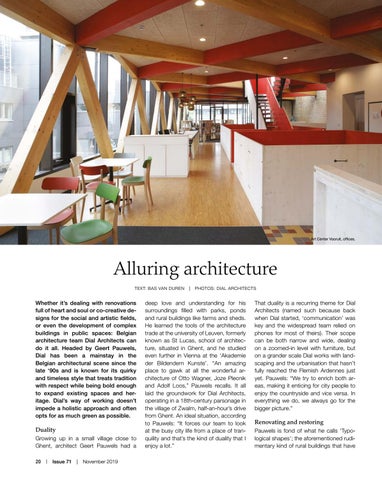
Art Center Vooruit, offices.
Alluring architecture TEXT: BAS VAN DUREN | PHOTOS: DIAL ARCHITECTS
Whether it’s dealing with renovations full of heart and soul or co-creative designs for the social and artistic fields, or even the development of complex buildings in public spaces: Belgian architecture team Dial Architects can do it all. Headed by Geert Pauwels, Dial has been a mainstay in the Belgian architectural scene since the late ‘90s and is known for its quirky and timeless style that treats tradition with respect while being bold enough to expand existing spaces and heritage. Dial’s way of working doesn’t impede a holistic approach and often opts for as much green as possible.
Duality Growing up in a small village close to Ghent, architect Geert Pauwels had a 20 | Issue 71 | November 2019
deep love and understanding for his surroundings filled with parks, ponds and rural buildings like farms and sheds. He learned the tools of the architecture trade at the university of Leuven, formerly known as St Lucas, school of architecture, situated in Ghent, and he studied even further in Vienna at the ‘Akademie der Bildendern Kunste’. “An amazing place to gawk at all the wonderful architecture of Otto Wagner, Joze Plecnik and Adolf Loos,” Pauwels recalls. It all laid the groundwork for Dial Architects, operating in a 18th-century parsonage in the village of Zwalm, half-an-hour’s drive from Ghent. An ideal situation, according to Pauwels: “It forces our team to look at the busy city life from a place of tranquility and that’s the kind of duality that I enjoy a lot.”
That duality is a recurring theme for Dial Architects (named such because back when Dial started, ‘communication’ was key and the widespread team relied on phones for most of theirs). Their scope can be both narrow and wide, dealing on a zoomed-in level with furniture, but on a grander scale Dial works with landscaping and the urbanisation that hasn’t fully reached the Flemish Ardennes just yet. Pauwels: “We try to enrich both areas, making it enticing for city people to enjoy the countryside and vice versa. In everything we do, we always go for the bigger picture.”
Renovating and restoring Pauwels is fond of what he calls ‘Typological shapes’; the aforementioned rudimentary kind of rural buildings that have
Discover Benelux | Top Flemish Master Architects | Designing the Future
Art Center Vooruit, backstage.
an everlasting quality. He explains: “I was growing up in a building that used to be a farm and after waves of modernism and post-modernism, the essence of what a building should be is what really stuck with me. I can lose myself in details, jetties and frames and use a lot of that in what we do with Dial. We thoroughly enjoy giving new life to existing buildings that are part of a place’s cultural heritage. It’s a balancing act between renovating and restoring that requires a lot of input from our specialists and a feeling for getting to know a building better and how it can fill the needs of its users.”
Art Center Vooruit, roof garden.
Vooruit One of Dial’s best examples of this would be Ghent’s centre of arts, ‘Vooruit’ (the Dutch word for ‘forward’). Designed by Ferdinand Dierkens and built between 1911 and 1913, Vooruit was the idea of local socialists who wanted to protect factory workers from the lability of big capital by providing affordable food, drink and cultural entertainment. The mere mention of Vooruit’s name fills Pauwels with unbridled joy. “It’s a fantastic piece of work; eclectic Art Nouveau with a complex structure and its bourgeoistic façade, keen brickwork and ‘pamphlettair’ nature
Art Center Vooruit, terrace.
just draws you in. As a centre of arts, its been in use for several decades but didn’t quite meet modern standards. We revamped the whole building with its complexity in mind, letting much more sunlight in, creating more outside spaces and adding green wherever possible using a sparse palette to enrich every facet. What was once a beacon of enlightenment is now a beacon of actualising historical buildings.” The work Dial did on Vooruit netted them the prestigious Belgian Building Awards and it’s the crowning of the effort Pauwels and his team put into it. Pauwels: “It’s rewarding to see how fruitful our way of working is, as we use rhythm in our architecture that’s built out of understandable components, use of regenerative materials and use of light. I think it’s important to be affordable and we have a social obligation to make alluring public spaces like Vooruit, but also the likes of the Kortrijk music centre and Nieuwpoort theatre in Ghent. Doing more with less, I think that’s the architectural way forward.” Book: Vooruit: Icon & Future Imprint of MER.Borgerhoff & Lamberigts
Private House Claeys, extension.
Web: dial-architects.be
Issue 71 | November 2019 | 21
Building by questioning TEXT: BAS VAN DUREN | PHOTOS: COMPAGNIE-O/TIM VAN DEVELDE
What began as a collaboration between architect couple Joke Vermeulen and Francis Catteeuw grew into a fullfledged international team known as Compagnie-O architects, based in Ghent. With versatility as its strong point, it exploits spatial potentials both in the public as well as private realm. They call themselves conceptual, but maintain a hands-on approach, as their realised projects attest. To find out more, we spoke to Francis Catteeuw of Compagnie-O.
Open platform Possibly the first noteworthy thing about Compagnie-O is its name; its underlying meaning perfectly reflects the office’s credo. “We wanted something different; most offices simply use the founders’ 22 | Issue 71 | November 2019
own names, but as we function more like a platform of equals, any individual’s name becomes secondary to the results we deliver as a collective. The letter ‘O’ was chosen for all the different meanings one may attribute to its shape, but I definitely count ‘Open’ as one of them as we are the type of architects that refuse to develop a signature style or typological building language.”
Maximalists These Belgian architects are fully aware that this kind of volatile flexibility isn’t always easy, but believe it to be an essential attitude in today’s ever-increasingly complex reality. Such complexity can hardly ever be grasped within the superficial vocabulary of one specific style. “If somebody comes along with a very
specific style of building in mind, we make sure to guide this client towards the understanding that they are cutting themselves short. There are always more forces at work than one would initially expect. We tend to question the client’s initial ideas to unveil the true inherent potentials that lay hidden. Getting an understanding of the motives that impel people to create a building project, whether that be a school, a prison, a religious or communal building, infrastructural, urban or landscape interventions, is often the key starting point,” explains Catteeuw. “It requires an open-minded and selfcritical client who can surrender to and trust that process. However in-evident it may seem, we always strive to establish such exciting and challenging collabo-
Discover Benelux | Top Flemish Master Architects | Designing the Future
rations with our clients. In the end, our maximalist-method is a means to create full customisation for any specific client whilst maintaining the building’s broad, societal relevance.”
Beach pavilion As the only real dogma within Compagnie-O is the strong belief in the absence of any, it is hardly relevant to look for one singular definition to represent their eclectic body of work. Without a leitmotif, they’d much rather talk about some recently finished projects as separate cases – the safety pavilion of Knokke-Heist on the Belgian coastline, for instance. The bureau designed this particular project in full collaboration with Dutch artist John Körmeling, whose presence is lauded by the architects: “He’s a very direct person who thinks freely and does so with irresistibly edgy humour. With some temperance and abundant creativity, we proposed this bright yellow pavilion that is, besides a high-tech safety device, also an invitingly open public space that sits playfully on the sandy beach. It houses the lifeguards logistics, emergency services, a first-aid room, a police station and public toilets. To ensure optimal internal operation, the spaces are intelligently compressed into a single-storey circular floor plan, safeguarding the views on the horizon from the elevated dike. As seen from the beach, the pavilion re-
mains highly visible: a perfect reference spot if a child should ever get lost. “People think the pavilion is made of concrete, but it’s actually a lightweight steel and wood structure with a negligible ecological footprint. It’s freed from any sharp edges to withstand the rough maritime climatological conditions and, for that same reason, resembles a beach toy.”
Sports School A different project ‘O’ proudly talks of is the Top Sports School in Antwerp; a seemingly monolithic school building that rests on a ‘black box’ concrete pedestal in which a variety of professional sports fields are incorporated (i.e. basketball, judo and taekwondo). Adjacent to the sports halls lay the school’s fitness area and canteen. On top of the concrete base sits a glazed, kaleidoscopic school volume which overlooks the surrounding landscape. The complex combines sports and academic education in a Spartan way: every second counts. Students move through the building on their own tight schedule focusing both on themselves and on each other potentially being rivals for the next Olympics, for example. Look-throughs, glazed walls and mirrors throughout the complex facilitate this top sports attitude. The school is set amidst a 19th-century military complex overgrown by nature making it virtually invisible in the landscape. Says the architect: “We inclined the concrete out-
er walls and used roughened wooden planks for the formwork so moss can change the way the building looks throughout the seasons. The silver-ish glass façade of the upper level reflects the skies and surrounding treetops. This ‘mimic of the surrounding’ re-enacts the intended military logic of the fortress but also questions this exclusive breeding place of our next golden medal heroes.” The architect emphasises the firm’s fascination for creating new public biotopes such as the school in Antwerp and the beach pavilion in Knokke-Heist: “The mere thought that hundreds of people are living, working and learning in spaces we helped establish is very humbling. We bare the ultimate responsibility of creating the spatial conditions within which individuals can strive and cohabit – of supporting a strong sense of self, healthy relations to others and, as such, inducing a kind of societal fitness.” Catteeuw concludes: “At Compagnie-O, we always stay mobile. We look beyond what has already been done, carefully ignoring the lines within which we are expected to colour. We maximise our impact by using surgical precision; always floating like a butterfly, stinging like a bee.”
Web: www.compagnie-o.be
Issue 71 | November 2019 | 23
Discover Benelux | Top Flemish Master Architects | Designing the Future
Unique homes inspired by and built in the dunes of Belgium TEXT: DEBBY GROOTEMAN | PHOTOS: PVL ARCHITECTS
PVL architects can be found at a unique location in Belgium, in Oostduinkerke. Located between the sea and France, the inspiration for its work is close-by. Most of the projects are realised along the coastline, and so this architect studio is used to building in the dunes: not only catering for local residents, but also for tourists who are looking for a second home. “We want to focus on working with clients at different scales,” explains owner Pieter Popeye. “We don’t only design buildings with lots of units, but also solitary residences and other projects here in the area. It’s
easy, as a design studio, to only focus on one style of project, but diversity makes it interesting. And for us, the small scale and residential part is also really important. It makes you keep you in touch with the individual and their desired ambiance.” Popeye was born and raised in the area. “That is why I know this region like the back of my hand. We always design from the details and our surroundings. We don’t only focus on the outside – for us it’s logical that we also include the interior in the design. That is where we can offer an added value. So, we don’t deliver a product that is half finished, we can realise the whole project
as it was supposed to be.” PVL Architects takes pride in designing beautiful villas and apartments in the region. “We want to design buildings that are unique and finished to the smallest details.” When speaking about the future of designing, Popeye mentions that, in his opinion, it is no longer just the technical condition of a design that is important. “The emotional aspect will become more and more crucial. The current generation is one where experience is key. We try to respond by creating that reality. We want people to come home and feel good. Get away from the busy day-to-day life to a contrasting world close to the sea.” Yet, this doesn’t mean that the technical aspect is not taken into account: “Everything should meet the requirements for dynamic use. We combine sleek architecture and warm realisation with a technically correct design.” Web: pvlarchitecten.be
24 | Issue 71 | November 2019
Discover Benelux | Top Flemish Master Architects | Designing the Future
Pursuing architectural excellence TEXT: BAS VAN DUREN | PHOTOS: PM ARCHITECTEN
You’d be hard-pressed to find a Belgian architect bureau more versatile than PM Architecten. With offices in Ronse and Ghent, this particular company excels in sustainable urban development, master planning, feasibility studies, architecture and renovation, often combining different disciplines for special projects that require an ‘out of the box’ mindset. Having all those disciplines available inhouse is what drives PM’s DNA, according to architect Bart Demeestere. He is part of the other name PM uses: ‘Architecten Demeestere + Garmyn & Partners’. “We work here with teams composed of architects, engineers and urban planners, all tailored to a project’s needs,” he explains. The Belgian particularly enjoys working
with monumental buildings and giving them a whole new meaning. “It really feels like taking a building out of a glass dome and breathing new life into it,” he reveals. “We turned Ronse’s oldest factory into a durable work and living space and in accordance with the BREEAM (Building Research Establishment Environmental Assessment Method) label.” Sustainability is a key component of PM’s work philosophy on all levels. Demeestere: “We love to use materials that have a low impact on our environment and personal health. It’s important that a building is able to breathe and if we’re renovating a building, we’ll always look for solutions where we can reuse materials in any way. Take, for example, a facade that we had to renovate; we had to
tear down some elements that then found new life in its garden.” But PM’s approach to sustainability goes beyond that. In the vein of his own personal architecture heroes Tadao Ando and Álvaro Siza, Demeestere and the PM team try to add more nature and colour to their creations, shunning hard shapes and adding flora whenever it is possible. “We’re pioneers when it comes to roof and park gardens,” says Demeestere. “A building can be as sustainable as it is, yet if it’s not properly placed in surroundings where you can breathe freely, it’s useless. I hope that someday we’re able to look at a city from above and not even recognise it as a city.” Web: www.pm-architecten.be
Issue 71 | November 2019 | 25
Discover Benelux | Top Flemish Master Architects | Designing the Future
Bobby Fogel.
From art to architecture TEXT: ARNE ADRIAENSSENS | PHOTOS: BF ARCHITECTURE
There’s a fine line between art and architecture. Bobby Fogel, the founder of BF Architecture, knows that like few others. Besides his work in traditional architecture and his theoretical contributions, he also is an expert in designing monuments for out in the open space. “We create things that people truly have to experience by themselves.” “Architecture is the art of living,” states renowned architect Bobby Fogel, who was recently listed in the book 30 of the most relevant world architects. To him, a building, just like any piece of art, should tell a story to those who look at it. “The late Oscar Niemeyer told me: the biggest museums in the world are the cities: and they are for free. Whether you have knowledge of architecture or not, everyone can walk around and enjoy the stories the buildings and monuments tell.” For him and his office, BF Architecture, 26 | Issue 71 | November 2019
a design should speak its own story. The choice of the materials and the concept should be rooted in its location. The ‘genius loci’ (or, the spirit of the place) is vital in the creation of any building with legitimacy. With this ambitious approach, Fogel often showcases his talent in the most prestigious designing contests in the world, even beyond the borders of traditional architecture. Recently, he designed Diamond Forest, a proposal for a monument honouring the 570th anniversary of Antwerp’s diamond industry. “It will be a forest of crystal prisms which magically reflects the light. We like designing things that you can’t just capture on a picture. To experience Diamond Forest, you have to stand in it and feel the magic yourself.” The same counts for Fort Intemporal, a work that Fogel made with artist Wendy Krochmal in the light of the Venice Biennale
of Architecture. “Here, we gave a deteriorated industrial complex a second life by filling up its cracks with gold and venetian glass; a Japanese technique called Kintsugi. The reflection of the daylight on the gold touched the spectators, some of them even cried. That is so beautiful about these projects: they really move people.” Because of its unique vision, BF Architecture attracts many students as well. “Our style and vision are much appreciated among younger talents. Therefore, we always have a few interns. They stimulate us to think more on an academic level.” The office even offers in-house student dorms for Erasmus students who want to come for a post-academic internship. “We work as an open institution with a strong and interesting programme.” Web: www.bfarchitecture.be
Discover Benelux | Top Flemish Master Architects | Designing the Future
When workflows and beauty collide TEXT: ARNE ADRIAENSSENS | PHOTOS: GDESIGN
Combining aesthetics with userfriendliness is hard to do. Yet, both are vital when creating a 21st-centuryproof industrial building. GDesign is one of Flanders’ leading experts in designing offices, factories, warehouses – the works. “Their ease-ofuse is paramount, but so too is their atmosphere. An ambitious company needs a work spot that attracts the best in business.” “Industrial design like ours is fairly young,” explains Paul Gijsemans, founder of GDesign. “Until recently, companies were afraid to build nice buildings as they would give their clients the impression that they were making loads of money off them. Today, however, the focus of commercial real estate is on attracting talent. Companies are constantly looking for those rare employees who own the perfect skill-set to take their businesses to the next level. Offering an amazing workspace definitely helps in attracting those.”
While creating delightful buildings, GDesign’s main focus remains the optimisation of the company’s workflow. “An industrial building is a tool that facilitates a smooth working process. To find out how a company’s perfect building looks, you must follow its workflow. In a catering company, ingredients are delivered, after which they must be stored, washed and prepared so they can head to the supermarket. This process is the essence of your building’s design.” Of course, these workflows vary from company to company. Therefore, GDesign analyses each company they work with thoroughly. For days, they are a fly on the wall during every step of the production process. Afterwards, they ask a series of questions and brainstorm on how all of this can be done more effectively. With that knowledge, they then start designing. Of course, not only products move through a company. Also, its staff has a workflow which must be considered. By
simplifying the employees’ most-common walking trails to the max, they make their lives easier and prevent chaos. “A great industrial building is one where man and machine collaborate seamlessly.” But GDesign also looks at the future. In a rapidly-changing economy, workflows can change in a heartbeat. Luckily, their buildings are well-equipped to handle such changes. “Whenever a company grows or the production rates increase, our buildings can easily transform to those new situations. Often, companies can make these changes themselves. Yet, we are always happy to help. Many of our clients return to us for other projects or to help them improve their building. We can build you an entire factory or help you hang a new awning. We are a partner on which you can always count.” Web: www.gdesignarchitecten.be
Issue 71 | November 2019 | 27
Amersfoort.
THE NETHERLANDS IN 2020
The ultimate destination From world-class exhibitions to gourmet experiences, not to mention stunning nature and unspoiled beaches, the Netherlands has it all, whatever the season. Get ready for your next trip with our jam-packed 2020 tourism and culture guide. TEXT: ANNA VILLELEGER | PHOTOS: NBTC
Leeuwarden.
28 | Issue 71 | November 2019
Discover Benelux | The Netherlands in 2020 | The Ultimate Destination
There are so many wonderful regions of the Netherlands that it can be difficult to know where to begin. Well, how about right at the top – in Friesland? This unspoilt northerly province boasts breathtaking coastal nature, not to mention the must-visit city of Leeuwarden. The capital of the province of Friesland, it has everything from vibrant shopping areas and cultural gems to great nightlife. There are also more than 600 monuments, so history buffs will not be disappointed, either!
Picturesque Next on your list should be Amersfoort, an attractive city to the west of Amsterdam which is full of history. Admire the city’s well-maintained medieval buildings as you stroll the beautiful and compact city centre. You can also enjoy walking by the picturesque canals and sampling local specialties in the city’s many charming cafés and restaurants.
Leeuwarden.
Heading into the centre of the Netherlands, the municipality of Vijfheerenlanden is full of hidden gems. Meaning literally ‘lands of five Lords’, the municipality was created on 1 Janu-
ary 2019, through the merger of the former municipalities of Vianen, Leerdam and Zederik. There’s plenty to see and do, with countless historical monuments and scenic towns aplenty.
History Also bursting with history is Nijmegen, a fascinating city in the province of Gelderland. Located close to the German border, Nijmegen is the oldest city in the Netherlands, and in 2005 celebrated 2,000 years of existence. Nijmegen and its surroundings form the perfect backdrop for hiking, cycling, and running. An annual highlight is the ‘Vierdaagse’ (Four Days March), which draws hikers from around the world every year. Down in the south of the Netherlands, lies the peaceful municipality of Halderberge. There is so much to see, enjoy and do, whether you want to visit monumental buildings or go hiking amid the wonderful countryside.
The great outdoors Meanwhile, don’t miss the opportunity to see Goeree-Overflakkee, the southernmost delta island of the province of South Holland. With expanses of dunes and sandy beaches, not to mention beautiful nature reserves, Goeree-Overflakkee is a paradise for lovers of the great outdoors.
Leeuwarden.
Discover more about the top places to visit in the Netherlands from page 32. Issue 71 | November 2019 | 29
Discover Benelux | The Netherlands in 2020 | The Ultimate Destination
Beach Noordwijk.
Beach Noordwijk.
30 | Issue 71 | November 2019
Discover Benelux | The Netherlands in 2020 | The Ultimate Destination
Rembrandt-Velázquez. Photo: Olivier Middendorp
D AT E S F O R Y O U R D I A R Y Daan Roosegaarde – Presence Until 12 January 2020 Groninger Museum, Groningen This must-see exhibition is Roosegaarde’s first major museum solo project, with the creative developing a new groundbreaking interactive artwork especially for the Groninger Museum. Unlike many exhibitions, which demand that art should be viewed from a distance, this inspiring installation encourages physical interaction.
Young Rembrandt 3 November 2019 – 9 February 2020 Museum de Lakenhal, Leiden This exhibition will show how Rembrandt’s incredible talent grew during the period 1624 to1634. Young Rembrandt will be presented in the completely restored and renovated Museum de Lakenhal (which was officially opened by King Willem-Alexander back in June).
Rembrandt-Velásquez Until 19 January 2020 Rijksmuseum, Amsterdam Admire an overview of paintings by the two great masters of the 17th century from Holland and Spain at the unique Rembrandt-Velásquez exhibition. Thanks to a collaboration between the Museo del Prado and the Rijksmuseum, the Spanish and Dutch masterpieces will be showcased in pairs.
Pieter de Hooch in Delft: From the shadow of Vermeer Until 16 February 2020 This is the first retrospective exhibition in Holland of the work of the famous 17thcentury painter Pieter de Hooch. Among the works on loan are many famous paintings, such as the exhibition’s key work The Courtyard of a House in Delft (1658), from the National Gallery in London.
Thierry Mugler Until 8 March 2020 Kunsthal, Rotterdam The Kunsthal presents the first exhibition to showcase the work of French fashion designer Thierry Mugler, with an array of haute couture creations, documents and photographs on display. Mugler’s designs are renowned for incorporating a variety of elements from fashion history and the punk movement. Read about more must-see art and culture spots from page 52.
Rembrandt-Velázquez. Photo: Olivier Middendorp
Issue 71 | November 2019 | 31
Photo: Erikjan Koopmans
LEEUWARDEN
‘You never stop being a European Capital of Culture’ TEXT: ARNE ADRIAENSSENS
The province of Friesland, in the upper north corner of the Netherlands, is amongst the prettiest regions in the country. Its water-infused landscapes, pure coastline and breathtaking isles have been attracting tourists for decades. Last year, however, Leeuwarden put the region on the map as a cultural Walhalla when it became the European Capital of Culture. And the spirit of that festive year still lingers in the city’s streets. Friesland has always received its fair share of tourists. The stunning Frisian Isles are the ideal spot for a brisk, windy stroll and the North Sea’s wild waves are a true 32 | Issue 71 | November 2019
sirens’ call to sailors who want to conquer the open sea. “The tourism we had was almost exclusively focused on the region’s unique natural beauty,” explains Sjoerd Feitsma, alderman of culture and marketing of Leeuwarden, the capital of the Northern-Dutch province. “But that changed in 2018 when our city became the European Capital of Culture.”
Art and biodiversity Every year, the European Union grants one city the honour of being the cultural epicentre of the continent for a year. In 2018, the commission chose Leeuwarden (and with it, the entire province of Friesland) to inspire and amaze Europe. “At first, Leeuwarden
might seem like an odd choice, as we are an intimate city of just over 120,000 citizens, but culture is strongly entangled in our Frisian DNA. Every year, Leeuwarden hosts plenty of festivals, featuring music, literature, performances, visual arts and much more. On top of that, the Frisian people strongly preserve the region’s folklore, traditions and crafts. This synergy between the modern city and its rich history gives Leeuwarden a unique and authentic atmosphere.” Yet, the main reason for the European committee to opt for Leeuwarden as its cultural ambassador was the city’s thought-through and layered plan on
Discover Benelux | Top Places to Visit in the Netherlands in 2020 | The Ultimate Destination
11 Fountains. Photo: Wietze Landman
how to give shape to that cultural year. Not only was it packed full of the best Frisian, Dutch, European and international cultural events, but it also had an interesting, socially engaged undertone. “One of the main themes of our programme was biodiversity. 120 years ago, the Netherlands had one of the most diverse biotopes of Europe. Today, you find our country at the other end of the spectrum, with those places in which biodiversity is the most endangered. By hosting such a big European project, we wanted to raise awareness for this problem and inspire people in all corners of Europe to help to change the tide. Because, like here in the Netherlands, many other biospheres in Europe are now jeopardised. And art and culture are a perfect medium to put these topics into the spotlight.”
11 fountains Those who visit Leeuwarden and the beautiful region around it today will surely stumble upon plenty of tangible souvenirs of that year-long festival of culture. Most obvious are the 11 beautiful foun-
Blokhuispoort. Photo: IMAZZO
tains which you can find in the 11 historic cities of the province. In the days of yore, these beautiful towns and their connection by streams and rivers were vital for the trade – and therefore the progression – of the region. By placing a fountain in each of these cities, they are once more connected through water. “The design of these 11 bubblers is made by 11 international artists who all belong to the topthree artists in their respective countries today. In front of Leeuwarden’s train station, the Spanish sculptor Jaume Plensa constructed Love, two giant statues of a couple, rooted in a sea of steam.”
The Giants. Photo: Marc de Fotograaf
The Giants. Photo: Marc de Fotograaf
Issue 71 | November 2019 | 33
Discover Benelux | Top Places to Visit in the Netherlands in 2020 | The Ultimate Destination
Photo: Lieuwe Terpstra
Triennale of Leeuwarden Aside from these sculptures, the city also hosts plenty of cultural events. Most of these happenings are not new, though, but since last year, they have managed to attract a bigger audience and better artists. “November is the city’s traditional festival month. In the autumn weather, we host a film festival, a literature and music festival focusing on the north of the Netherlands and the North of Europe, and plenty of other heart-warming events. We even have a so-called ‘nuit blanche’: a night of art in the unlikeliest of places. Besides professional artists, we also invite art students to take the stage here. As a city, we want to give our youth as many chances as we can.” For the city’s biggest event, we will have to wait until 2022, when the first edition of the Triennale of Leeuwarden will be organised. This triannual event is designed to keep the spirit of the European Capital of Culture alive. During this big, multidisciplinary event, national and international talents will present their works around a common theme. “In 2022, that theme will be ‘life at the bottom of the sea’, with which we refer to the early days of Friesland and the Dutch polder culture which gave it its shape.” In 2028, the Triennale will be even bigger, to celebrate the tenth anniversary of Leeuwarden’s magical cultural year. “It is important to keep that cultural spirit alive in the city. Because once you are named a European Capital of Culture, you never stop being one. You carry that legacy forever.”
Major conferences
Photo: Marc de Fotograaf
34 | Issue 71 | November 2019
Besides an amazing city for tourists, Leeuwarden is also a great location to host your event or conference. In the last few years, major events like the worldwide WTC conference and the ICAR summit about circular economy were organised in Leeuwarden. “Normally, big gatherings like these take place in major cities like London or New York. Yet, the big advantage of Leeuwarden is its walkable size. The activities take place in professional seminar halls, conference rooms and reception venues in all corners of the city but they are still in walking distance from each other. In between
Discover Benelux | Top Places to Visit in the Netherlands in 2020 | The Ultimate Destination
Into the Grave. Photo: Bart Lindenhovius
Writer’s Block Mural Art Festival. Photo: Simon van der Woude
sessions, the participants can enjoy a relaxing walk to the venue of its next activity.” Combined with the multitude of great hotels around and the picture-perfect backdrop that is the old city, this unique quality makes Leeuwarden very popular among businesses and event planners. On top of that, the university and research centres of Friesland have expertise galore in the respective fields of maritime technology, dairy and circularity. With its open sea, rural landscapes and strong will to preserve nature, these three fields are studied in both theory and practice here, making Friesland the front runner in all three of them. “During our time as the European Capital of Culture, we also made connections between these scientific fields and art, uplifting both disciplines. To us, they are not each other’s opposites but rather two strong ways to solve problems. In Friesland, science and culture go hand in hand, striving for their common goals.” Web: www.visitleeuwarden.com
Issue 71 | November 2019 | 35
VIJFHEERENLANDEN
The heart of the Netherlands: Beauty between the Lek and Linge TEXT: LAUREN WALKER | PHOTOS: GEMEENTE VIJFHEERENLANDEN
In the heart of the Netherlands flow two rivers, the Lek and Linge, forming natural borders which embrace a blooming region. When looking at a map of the area, the northern border is marked by the Lek and one of the area’s largest cities, Vianen. Drawing a straight line down, your finger would meet Leerdam, which is geographically located on the banks of the river Linge, hugging the municipality’s southern border. Between these two waterways, you will find countless attractions, from the beautiful water landscapes to forts which 36 | Issue 71 | November 2019
have been transformed into breweries. Known as the ‘Green Heart’ of the Netherlands, it showcases some of the most scenic cycling paths and walking routes in the country. Here, you can discover historical monuments and landmarks, and enjoy bird-spotting in the fantastic Zouweboezem natural parks.
The historical Vianen Less than half an hour from Utrecht, one of the country’s oldest cities, lies the historical Vianen. It is known for having over 190 national-listed monuments, which you will find on every other street corner. Most significantly, in the city’s old
town you can explore its medieval history and the significant defences such as the moat, the original city walls and the Lekpoort, which dates to the 15th century. Plan your visit to collide with one of the city’s many activity days, such as the ‘Horse Market’ or the ‘old-timer’ day. Or simply venture to the ambiant and buzzing Voorstraat and enjoy a cold drink whilst taking in the beautiful architecture of Vianen’s many listed buildings.
Fortified beer Is one drink not enough? How about trying a cold beer straight from the source? To the east of Vianen lies Fort Everdingen, a
Discover Benelux | Top Places to Visit in the Netherlands in 2020 | The Ultimate Destination
tower fort which was built in 1847 as part of the New Dutch waterline by the Lek. At one time it protected the river dikes from territorial ambushes. Now it is home to the Duits & Lauret brewery, where craft brews are produced on the banks of the water. Visit the tasting studio or relax on the fort’s terrace to try the local speciality. The site also boasts several attractions of military-importance for visitors to discover.
Fortresses of the New Dutch Waterline Explore more of this mass fortification defence line, around which Amsterdam and Utrecht are located. It is formed by over 45 fortresses and is 135 kilometres in circumference and has a protected status as a National Heritage Site. These
Photo: Hans van Vrouwerf
Fort Everdingen.
fortresses, which tell the age-old story of water as a means of defence, will appear while discovering the region’s pathways.
Bird-spotting
Uiterwaarden.
Between the two major cities lies one of the most beautiful and relatively undiscovered nature reserves in the area, the Zouweboezem. Mainly known for its cane-field grounds, it also showcases an impressive assortment of flora and is the home of several marsh birds, including the largest colony of purple herons in the Netherlands. The recently built wetland boardwalks allow visitors to get up close to the cane fields and the diverse birds you will find there. Issue 71 | November 2019 | 37
Discover Benelux | Top Places to Visit in the Netherlands in 2020 | The Ultimate Destination
Royal Leerdam Crystal.
Photo: Rederij Leerdam
Vianen.
Zouweboezem.
38 | Issue 71 | November 2019
Life by the water
Holey Leerdammer!
This area is known for its water landscapes, polders and rivers, the Lek and the Linge, which have a magnetic effect on tourists and locals. The waters are a great way to explore the region, either by boat or by walking or cycling on the pathways next to the streams, allowing you to visit the many significant sites located near the water, such as the dam in Hagestein. You can even camp beside the flowing beds at Fort Everdingen.
Most non-Dutch people would think of the creamy white cheese when hearing the word Leerdam, with most of the cheese produced at the city’s factory being exported abroad. Tourists hoping to try some of the holey produce will be accommodated at the Leerdammer Cheese tasting room in the heart of the city. Sample six different types of cheese alongside two delicious local beers, whilst learning more about the products and their history.
Discover Benelux | Top Places to Visit in the Netherlands in 2020 | The Ultimate Destination
Leerdam: not cheese, but glass!
Photo: Lekpoort Vianen
Leerdam is recognised by the Dutch as the country’s glass city. The industry settled here in 1765 and is the only remaining city in the country where visitors can view the artisan craft of glassblowing. Whilst wandering around the city, it is apparent that this industry is central to the community. In the city’s south, right on the banks of the Linge, lies the National Glass Museum, with its own glassworks, where visitors can see glass artists at work first-hand, creating the most beautiful works from hot liquid glass. To witness the traditional craft of crystal glass blowing, take a tour at the city’s Royal Leerdam Crystal, the only place in the country where crystal is blown by mouth. The attraction is moving from the 1878 Kristalfabriek to a new location in 2020. The city’s many glass galleries, including that of famous Dutch artist Bernard Heesen, also showcase modern examples of the glass artworks. Fast-track visit If you are an avid biker and want to enjoy the beautiful and idyllic scenery by the dwindling rivers, the newly built 53-kilometre bike route is the way to go. It connects both major cities and takes you to Everdingen and through the calming Zouweboezem, whilst allowing you to discover old farms and other unique locations. A great way to explore the whole region.
For more information visit: leerdamglasstad.nl and vrijstadvianen.nl
Photo: Nationaal Glasmuseum
Photo: Herman Suiskind
Issue 71 | November 2019 | 39
Koppelpoort. Photo: Sjoerd Mouissie
AMERSFOORT
History and hip hotspots in the same city TEXT: DEBBY GROOTEMAN | PHOTOS: MARISA BROEKHUIZEN
A beautiful historical city centre, lively squares and hip hotspots are just some of the reasons Amersfoort is worth a visit. Located in the middle of the Netherlands, the city is easily accessible by car and train. And with a calendar full with events and festivals, there is always something going on, whatever the season. Local Koen Overeem was born and raised in Amersfoort. He is now the owner of Rock City Brewery. “The name was inspired by the history of the city. The nickname of Amersfoort is ‘boulder city’. History says that a squire challenged his 40 | Issue 71 | November 2019
friends to bring a very large boulder over a distance of around ten kilometres from Soesterberg to Amersfoort by hand. They succeeded and this was celebrated with lots of food and beer.” Nowadays, that famous boulder is displayed along the city centre ring. There are five main attributes that distinguish Amersfoort from other cities, and Overeem is undoubtedly the perfect person to speak about them: “Amersfoort has a rich history with beer. At one time, the breweries here were even bigger than Heineken. Beer culture is part of the city’s DNA. And there is a great connection with
all the hospitality and welcoming terraces that can be found in the city. For tourists who are looking for something more than just a canal tour – although this can, of course, also be done here – Amersfoort has many things to offer.”
A beautiful city centre full of history
The first thing distinguishing Amersfoort from other cities is its beautiful city centre, full of history. One of the great things is that the old city wall is still visible. This was previously used as a protection against enemies. Overeem explains: “Since Amersfoort was a beer city, one of the things that was thrown over the wall
Discover Benelux | Top Places to Visit in the Netherlands in 2020 | The Ultimate Destination
against intruders was the beer they were brewing at that moment. Inside the walls, there are old mansions that are still being lived in. The surroundings are a lovely spot for a walk.” One of the top attractions in Amersfoort is the old tower. “In the old days, a church was connected to the tower. However, the gunpowder that was being stored there caught fire and burned down the whole church. Nowadays, only the contours of the church are visible, but the tower is still standing. From the top you can admire a great view across the centre of the Netherlands.”
Lively squares
“The old town of Amersfoort housed a lot of waterways in earlier days,” Overeem continues. “On the nodes you can find squares that now offer restaurants, bars and terraces. With the first rays of sunlight people can be found on one of the many terraces. But also in colder weather they are equally inviting, with heaters, candles and a roof protection formed by beach umbrellas. The first places open in the morning for coffee and breakfast, and then the last places for drinks and dancing close when the first places are almost ready to open again.” The squares are car free and even cyclists need to walk alongside their bikes. Every now and then, the terraces have to make room for a market, or a cultural event with live performances.
Muurhuizen. Photo: Bianca van der Aalst-Koedijker
Hip hotspots
Just a short walk from the city centre, a whole new centre can be found. Old warehouses are now being used for crafts and hospitality. According to Overeem, the old fabrics are still visible. “An old toothpaste factory at a hotspot called ´De Nieuwe Stad´ (The New City) is now the home of different restaurants. One has even mounted a pizza oven in the old factory chimney.” The ´Wagenwerkplaats´ is another hotspot – this was once a maintenance centre for the Dutch railroad company. Behind the yellow and black shutters, many different activities are constantly taking place, yet everything is visible and transparent to visitors. Overeem: “The hotspots are mostly visited by couples and young families who come here for a lunch or dinner.”
Kortegracht.
Koen Overeem. Photo: Robin Joshua
Issue 71 | November 2019 | 41
Discover Benelux | Top Places to Visit in the Netherlands in 2020 | The Ultimate Destination
The Onze Lieve Vrouwetoren.
Monnikendam, part of the city wall.
42 | Issue 71 | November 2019
Discover Benelux | Top Places to Visit in the Netherlands in 2020 | The Ultimate Destination
Stadscafé Amersfoort.
Local crafts Overeem is keen to highlight that there are also many different products produced locally. “Another one of the assets of Amersfoort is the local crafts. For example, there is a baker who makes the dough for bread here in the city. And a bicycle maker who welds bicycle frames in his open workshop. The local brewery also shows how its beer is being made, and this is visible from the connected restaurant. It is
great to see how a product is being made and be able to enjoy it at the same time.”
Friendly locals
Amersfoort has a lively centre. “A lot of young families live just outside the city centre, close to the schools. Amersfoort is not really a student city – but it is a very attractive place to live for young professionals. It is a city with the usual city elements, but the people know each oth-
er as though it were a village. Everybody is friendly and helpful to one another. This is noticeable when walking around the small, cosy streets and squares,” Overeem smiles. “The best way to discover it all is to visit Amersfoort. The locals love to show guests the best of the best of their city.” Web: www.visitamersfoort.com
Lieve Vrouwekerkhof.
Wagenwerkplaats.
Rock City Brewpub. Photo: Rock City Brewing
Issue 71 | November 2019 | 43
NIJMEGEN
Feel the history, feel the vibe TEXT: MICHIEL STOL | PHOTOS: GEMEENTE NIJMEGEN
Embraced by the majestic river Waal, the city of Nijmegen is the largest city in the east of the Netherlands, right on the German border. It is a city where the old collides with the new; history, innovation and vibrant culture meet in the heart of this former Roman stronghold. You might not see it at first, but you will immediately feel it. Nijmegen’s past has been one of war, prosperity, culture and innovation. It is the oldest city in the Netherlands, founded in 19 BC, when the Romans first settled 44 | Issue 71 | November 2019
on the natural moraine next to the river. The military outpost and adjacent village turned into a centre of trade, and by 98 AD, ‘Noviomagus’ had received city rights, the first settlement in modern-day Netherlands to do so. Throughout the late Middle Ages, the strategic position on the Waal fuelled the city’s economy, and the river beds provided fertile farmlands. This is also the period when the majestic Saint Stephen’s Church was built, at the highest point of the upper city. The church’s foundations still stem from the 1270s and, to this day, the church is
Nijmegen’s main architectural feature, rising large above the city.
Misfortune and prosperity By the 15th century, Nijmegen had become a city of prominence; it entered the prestigious Hanseatic trade league and was fortified with a stone wall. The wars of the Renaissance hampered Nijmegen’s growth, and the 1630s black plague epidemic halved its population. However, by the 19th century, political stability had returned to the region and Nijmegen began to flourish once
Discover Benelux | Top Places to Visit in the Netherlands in 2020 | The Ultimate Destination
again. The population grew quickly, and the confining defensive walls were all taken down in 1875 to create room. Around this time, the first vendors moved into the Hezelstraat, near the Grote Markt (central market). To date, it remains part of the best shopping area of Nijmegen, with many independent shops as well as cosy restaurants and bars. Existing for over 135 years, the Hezelstraat is proud to be the Netherlands’ oldest shopping street.
to be captured by the Nazis. Towards the end of the war, it was bombed several times by both German and Allied forces. In February 1944, 800 civilians died during the largest bombing of a Dutch city. Many of the historic buildings were lost, but were rebuilt in their original style, and now stand side by side with more modern buildings. Throughout the city you will find commemorations, where you will feel the impact the bombings had on the city and the lives of its citizens.
Word War II
Operation Market Garden
In the Second World War, Nijmegen took a turn for the worst. Being so close to the border, it was one of the first Dutch cities
Nijmegen was also one of the cities where Allied forces suffered huge losses during Operation Market Garden. After suffering
heavy losses in skirmishes with German forces in the heart of the city, American soldiers crossed the river Waal in peddle boats on September 20, 1944, which later became known as the Waal Crossing. 48 soldiers died during this crossing and it turned out to be too late to reinforce Allied troops in Arnhem. This led to a six-month delay of the liberation of the north of the country. In 2013, Nijmegen completed the construction of a city bridge called Oversteek (The Crossing), close to where the allies crossed the river. On the bridge are 48 streetlights, representing each of the soldiers that lost their lives. At sunset, the streetlights are lit up pair by pair at a slow marching
Issue 71 | November 2019 | 45
Discover Benelux | Top Places to Visit in the Netherlands in 2020 | The Ultimate Destination
46 | Issue 71 | November 2019
Discover Benelux | Top Places to Visit in the Netherlands in 2020 | The Ultimate Destination
pace. Every night – whatever the weather – a military veteran walks the ‘Sunset March’ at sunset, to honour the fallen. As the lights are turned on, the veteran walks along in pace with the lights being lit. Witnessing this daily ode to history, is something you simply must not miss.
Innovation to preserve nature As part of ‘Room for the River’, a national project to protect cities along major Dutch rivers against flooding, the river beds along the Waal were greatly expanded. The river embankments were moved 350 metres inland. This created a secondary river channel, running parallel to the main river with an island separating the two. Veur-Lent is the new hotspot in the city, where living and leisure unite. There is also plenty to discover when you step outside the city. Nijmegen is located next to the spectacular grasslands of the Ooij to the east, the hilly forests of the Groesbeekse Bos to the south, and the rich wetlands of the Overasseltse en Hatertse Vennen to the south-west. Avid hikers, as well as cyclists, can peacefully discover the stunning surroundings in all their glory. Just a couple of minutes from the city, the fields take visitors through seemingly endless pastures with curious cows and no cars in sight. As autumn transforms the leaves in the Groesbeekse Bos from green to red, amber and gold, it is the perfect time to explore this area and admire the myriad of colours.
Old city, young vibe The mix of old and new perfectly reflects Nijmegen’s character of today: room to remember and appreciate the city’s history, while at the same time feeling its cultural and young, innovative atmosphere. Discover the city and enjoy music, food and shopping in the centre, at the different museums, at the Honig Complex or at Doornroosje music venue. Explore Nijmegen as a local with the new USE-IT map, with hotspots in and around the city. Immerse yourself in this old city and be captivated by its fresh vibe! Web: www.centrumnijmegen.nl
Issue 71 | November 2019 | 47
HALDERBERGE
Welcome to the heartwarming municipality of Halderberge TEXT: EMMA WESSELING | PHOTOS: HALDERBERGE
People often look at Amsterdam or other centrally located cities when they think about visiting the Netherlands. But did you know that the south of this little country is filled with heartwarming, peaceful towns that will win you over in a heartbeat? The Halderberge municipality is most certainly one such place, whether you’re just stopping by for a short visit or intend on staying long-term. Halderberge is a small municipality that comprises villages like Oudenbosch, 48 | Issue 71 | November 2019
Hoeven and Oud Gastel. Located in the west of Brabant province, it’s just two short train rides away from Rotterdam and other central cities. The name Halderberge symbolises a collective past of when monks put down the base for the villages of Gastel, Hoeven and Oudenbosch in the Sint Bernard abbey. Stepping into Oudenbosch means stepping into the Roman-catholic world. The ambiance of previous centuries can still be felt in the air and tasted through the food. A special icon from this time
is the H.H. Agatha and Barbara basilica that was built between 1865 and 1892. One of the most striking buildings in Hoeven has its roots in the time when Hoeven itself was founded. The building Bovendonk, currently being used as a conference centre, was designed by world renowned architect P.J. Cuypers, who is very famous for designing the Rijksmuseum (Amsterdam) among others. The beautiful, Neo-gothic building is definitely worth a visit. Bovendonk was built right on the place where the
Discover Benelux | Top Places to Visit in the Netherlands in 2020 | The Ultimate Destination
monks of St. Bernard abbey built the abbey farm.
Autumn and winter hikes If you enjoy hiking, Halderberge is the place for you. The autumn is perfect for taking strolls through the seemingly neverending nature in areas like Gastels Laag, Hoevense Beemden and the Pagnevaartbos. The peat history of West-Brabant is still easy to see in some areas and there are specific walks and bicycle routes that will take you along this interesting past. Oudenbosch has city walks starting from the tourist information point (Stationsstraat 7). Your guide will lead you along the special buildings and museums in the town and tell you about the history and the rich Roman-catholic past of the Oudenbosch city centre and the municipality. The walks will take anywhere from 90 minutes to two and a half hours. Your preferences will be translated into a programme or arrangement, all depending on your needs and your group. The volunteers from the tourist information point will be waiting for you. In 2017, the municipality started working on a second trail through the town, that connects monuments through an industrial and commercial perspective. Oudenbosch is very rich in monuments, but many of the fascinating stories behind the town’s heritage are still largely unknown to its visitors.
This second tour, that has now opened for the public, tells a fascinating story of the local families in Oudenbosch, their history and the history of their homes, industries and other properties. It will guide you along places that you might not see if you were just merely visiting, like Kade 6, the former residence of Pieter Daverveldt. This house, dating from 1895, was built following a design by Van Genk, an architect from the nearby town of Bergen op Zoom. Daverveldt
was the owner of sugar factory Daverveldt, Binck & Co, located near the harbour of Oudenbosch. The house, that was rebuilt to be a shop with an apartment on top, was demolished in 1998, but the beautiful façade was preserved and restored to its original state.
Snuggling up to some live music Halderberge will be the place to be for some very exciting concerts in the coming months. These concerts will draw in visitors from all over the country. The impressive buildings in the municipality are the perfect décor for snuggling up and listening to some live music while enjoying the food and drinks the locations in the municipality have to offer. Why not go and hear the Carmina Burana on 14 November, for instance, or watch the piano recital by Nino Gvetadze on the 22 November. If you visit the Christmas concert by the Oudenbosch Men’s Choir on 15 December, you’re truly in for a festive treat. Information about tickets, booking or arrangements can be found on the tourist website: www.visithalderberge.com
Issue 71 | November 2019 | 49
GOEREE OVERFLAKKEE
An oasis of award-winning nature TEXT: MICHIEL STOL | PHOTOS: MERIJN KOELINK
The coastline of the isle of GoereeOverflakkee, in the southwest of the Netherlands, has won multiple international awards throughout the years. And this year, the island, along with Westvoorne, Schouwen-Duiveland and Veere, was voted number one Green Destination in the world, over the likes of Lake Tahoe in the US and Sani Isla in Ecuador, winning the Best of Nature award.
the villages, the beauty is everywhere here,” says Michel de Bruin, director of Island Marketing of Goeree-Overflakkee. De Bruin himself moved here over two months ago. “As an ‘outsider’, I immediately felt the respect for nature here on the island. And knowing that it is only 30 minutes away from Rotterdam and even Antwerp, made it even more attractive to come here.”
“When you take a walk or go for a bicycle ride and you look around, there are so many vistas that will take your breath away. From the dunes to the heritage in
Goeree-Overflakkee is filled with multiple nature reserves which are home to a rich flora and fauna. Seals, porpoises, deer, wild horses, Europeans sea-eagles; the
50 | Issue 71 | November 2019
Indescribable nature
island is home to several exquisite species. Each autumn and winter period, a group of flamingos make a home for themselves on the island. “I often send pictures to my friends, with the question: ‘where am I, Canada or Goeree?,’ grins De Bruin. “The diversity in nature here is indescribable; on the one hand the beaches and the dunes, that are synonymous with the Netherlands, and on the other hand these vast landscapes with beautiful animals and birds that will make you forget you are in the Netherlands.” A definite must-see is the bird observatory TIJ, on the edge of the Haringvliet estuary. This eight-metre-high building, shaped in
Discover Benelux | Top Places to Visit in the Netherlands in 2020 | The Ultimate Destination
the form of the egg of a big tern, will give you an amazing 360-degree view of the area. Spotting terns, spoonbills or sea eagles is a treat from here.
Respect for nature For years, the island has been working to preserve nature. Together with the municipalities of Westvoorne, SchouwenDuiveland and Veere, the area is known as the Dutch QualityCoast Delta. There are numerous eco-friendly activities and several accommodations are certified by Green Key. As one of only four destinations worldwide, Goeree-Overflakkee has won the prestigious QualityCoast Platinum Award. “Sustainability is in our DNA. During the next few years, we want to become completely energy neutral,” continues De Bruin. “We want to achieve this with windmills, sun energy, biogas
instead of electricity and there are plans for a tribal power installation. We are surrounded by water and there is almost always wind. So why not utilise that, so that we can preserve nature and future generations? Goeree-Overflakkee is about respect for the elements, whilst at the same time challenging the elements to preserve the island.”
Culture and leisure Of course, Goeree-Overflakkee offers more than just this amazing rich nature. “Over the island runs a great new bicycle route, that will bring you to picturesque villages, where you will find heritage from the Dutch Golden Age, and cosy marinas, perfect for lunch or dinner.” For those looking for a bit more excitement, the Brouwersdam is the place to be. The dunes and beaches here offer great
opportunities for kitesurfing and beach volleyball. “Around the island are numerous places to spend the night. “Whether you want to go camping or stay in a luxurious holiday home, there is a place for everyone.” Major cities, such as Rotterdam, Breda and Antwerp, are just around the corner. “You can enjoy the thrill of the city, and at the end of the day unwind in the serenity of nature in the blink of an eye.” Clean air, fresh sea and a laidback life; if you truly want to unwind from life’s stresses, surrounded by amazing flora and fauna, then there is no better place than Goeree-Overflakkee. “A true green oasis,” smiles De Bruin. Web: www.visitgo.nl
Issue 71 | November 2019 | 51
The revival of Dutch Delftware artworks TEXT: LAUREN WALKER | PHOTOS: PALEIS HET LOO/BART BRUSSEE
In the heart of the Netherlands stands a palace constructed in the 17th century by the House of Orange, called Paleis Het Loo. It was later transformed into a museum in 1984, and since 2016, it has become home to one of the country’s national treasures: a collection of Delftware garden vases. Now, in a unique collaboration with Amsterdam Airport Schiphol, some of these stunning garden vases are surprising travellers at the country’s largest airport, bringing Dutch Delftware vases to the foreground and back in the public eye once again.
grounds back to how they looked during the Baroque period, when the palace was home to the Orange family. Because they found remains of Delftware vases in the gardens, Paleis Het Loo decided these artefacts should once again adorn the gardens and be the cornerstone of the renovation project. Three original royal vases were found at various places in Europe – at Erddig Hall in Wales, at Schloss Favorite in Baden-Württemberg in Germany and in France. The French vase was bought by Paleis Het Loo in 2010. All three vases served as examples for the manufacturing of the new vases in the palace gardens.
During the restoration of the gardens which came to an end three years ago, Paleis Het Loo decided to bring the
Tradition and innovation
52 | Issue 71 | November 2019
For the regeneration project, traditional craft was combined with innovation.
Collaborating with the Industrial Design faculty of the Technical University Delft, experts used the latest technologies to scan the extant garden vases for the moulds. Production and hand-painting of the vases has been undertaken by Royal Tichelaar Makkum, using highquality 17th-century tin-glazing techniques. In this way, innovation and craftsmanship was combined. The production was very labour-intensive: it takes five days to paint just one vase! All 45 extraordinary replicate Delftware vases produced for this project were moulded. However, the surfaces were handpainted and the 17th-century artisan tin glaze applied by Royal Tichelaar Makkum. The first inhabitants of the palace, King William III and Queen Mary,
Discover Benelux | Top Art & Culture Spots in the Netherlands in 2020 | The Ultimate Destination
would gift large Delftware garden vases to noblemen who supported them during the Glorious Revolution of 1688, which explains why the remains of some vases were found found in castles and palaces across Europe. The patterns would depict symbols of the kingdoms receiving gifts, such as the Tudor rose of England or the Irish harp, often alongside the monograms of their names painted in calligraphy. Both the daughter of King James II, princess Mary Stuart II, and her Dutch husband William of Orange were avid collectors of Dutch Delftsware pottery and exotic plants and trees and combined both passions by arranging rare flora in their vases. These were often imprinted with orange trees, symbolic of the Orange dynasty, and myrtles. It is believed they would decorate both the gardens and their home with these vases, to draw a constant line between the indoors and outdoors. Few 17th-century Delftware garden vases have survived because they are very delicate. Freezing cold is disastrous, as these conditions could lead to cracks in
the artworks and the glaze to eventually burst. That is why the exhibition of the new Delftware vases in the palace garden runs exclusively from the start of June to the end of September.
A unique display However, the vases are not completely hidden away during the colder months. Paleis Het Loo, in collaboration with
Amsterdam Airport Schiphol, has created a unique display at the newly built E-pier, to surprise travellers with a 12-piece collection, showcasing all three designs. The garden vases stand in a modern space creatively designed by Dutch designer Mae Engelgeer, of which the pedestals and walls translate the colours of the palace’s gardens, complementing the Delft Blue artworks and mimicking the surroundings from their original home.
Paleis Het Loo on Tour Travellers will be able to learn more about the extraordinary collection of vases. The presentation of these distinctive pottery works at the airport is part of Paleis Het Loo on Tour, an initiative by the museum to showcase exceptional collections in unexpected places in the Netherlands during the renovations and construction of the grounds, and to excite national and international visitors about the reopening of Paleis Het Loo in 2021. Paleis Het Loo is undergoing a major renovation and expansion and will reopen in 2021. The gardens and stables are open from April 2020 to September 2020, where the Delft Blue vases will be showcased.
Amsterdam Airport Schiphol Bart Brussee.
For more info, go to: www.paleishetloo.com
Issue 71 | November 2019 | 53
Moshiel & Lady Sinagaga, New York USA (2019). Photo: Leon Hendrickx
DRAG POWER
Gender, pride & glamour at CODA Museum Apeldoorn TEXT: CODA
Imposing, flamboyant and eccentric are words that often come to mind when you think about drag queens. More and more often, drag is a topic of conversation on television, online, in series, documentaries and newspapers. RuPaul’s Drag Race has made drag well-known worldwide, and also into quite a commercial phenomenon. Drag, which was once mainly known in the ‘underground culture’ within the LGBTQI-community, has now almost become mainstream. But what exactly does drag stand for? Is the name as an acronym a precise representation of what drag means: 54 | Issue 71 | November 2019
‘dressed resembling a girl’? Is it only a game of dressing up as the opposite sex, all about appearance and fun? Or is there more to it? The exhibition Drag Power - Gender, pride & glamour showcases the exuberant looks, but above all, what is behind the sequins and under the wigs. Drag queens and kings use their body and appearance as a ‘living canvas’ to tell a story. Where one has an activistrelated message, others mainly enjoy the temporary change into their exuberant alter-ego. Dressing up as the opposite
Sander den Baas aka Lady Galore, from the series LAK! (2014). Photo: Jan van Breda
Discover Benelux | Top Art & Culture Spots in the Netherlands in 2020 | The Ultimate Destination
sex (cross-dressing) is not just something from the past decade(s). For many centuries, men and women have changed roles during folk festivals, in theatre, during wars and also outside of any of these contexts. Those in charge didn’t always allow this; disruption of gender classification was considered ‘disruption of the ruling order’. The people behind five drag acts active in the Netherlands, tell their personal story in Drag Power - Gender, pride & glamour. They reveal their backgrounds, experiences and the various reasons for starting with drag. Richard Keldoulis has been active as the – activist – drag queen Jennifer Hopelezz for 18 years, and is at the base of House of Hopelezz and important drag events such as the Drag Olympics and Superball. Sander den Baas has been active in the drag scene for many years and appeared as Lady Galore in the TV programme The Diva In Me last year, and also in the documentary Galore, about Lady Galore. The alter ego of Ante Joosten is Mason Tonight, the only drag
king amongst the main characters in the exhibition. Afif Shafit is from Malaysia and has been active for a relatively short time as a drag queen, named Licka Lolly. The enigmatic ChelseaBoy is the alter ego of Brian van der Heijden. The current scene and historical roots of drag are further explained in the exhibition: by means of visual arts, historical objects, photography, videos and outfits. The exhibition shows a rich and varied image of the past and present, but also the social and cultural structures through which drag was and is rejected and/or embraced.
Drag Power - Gender, pride & glamour has been curated by CODA together with Willem Hoogstede and Paul Derrez, owners of Galerie Ra in the city centre of Amsterdam. Derrez is a jewellery designer, Hoogstede a retired teacher, and they are both art collectors. Derrez and Hoogstede see drag as a powerful medium to talk about history, gender, personal stories, (in) justice and activism.
Micha & Snorella, Amsterdam, NL (2015). Photo: Leon Hendrickx
Drag Kings, Lee Marchetti (2011). Photo: Feriet Tunc
“The exhibition touches upon the history of drag, the diversity, its glamorous and theatrical side, but also its political, activist edges. When we started thinking about curating this exhibition, we thought: there’s a lot of attention on drag in the media, but it’s always quite superficial. Drag is usually very visual, and we wanted to dig deeper into the subject. There is a person beyond the glamour. So, we started with researching how drag manifested itself in history in, for example, theatre and in social life. In the exhibition, we tell this history in an international context and move towards contemporary drag in a Dutch context. Because drag is very visual, there is a lot of photography to be found about it. There are contemporary photographers who focus predominantly on the concept of drag in their photography practice. For instance, one of the participating artists in the exhibition, Léon Hendrickx, made a series of photos called Kings and Queens, in which he photographed drag queens and the people behind the drag personas, without their costume. Then, he morphed these two sides of the same person, so the drag persona is embracing the same body without being in drag,” reveals Derrez in an interview with Current Obsession. Discover the power of drag at CODA Museum Apeldoorn from 3 November 2019 till 1 March 2020 inclusive. For more information, visit: coda-apeldoorn.nl/dragpower
Issue 71 | November 2019 | 55
Barbara Hoppel, director of Space Expo.
We need more ‘space’ TEXT: MICHIEL STOL | PHOTOS: SPACE EXPO
Space is all around us, and not just literally, either; over the past decades, we have been relying more on space than ever before, to help us with communication, mobility and tackling problems like climate change. At Space Expo in Noordwijk, the official visitor centre for ESA ESTEC, you can learn all about space. “But we need more space,” says Barbara Hoppel, director of Space Expo. ESTEC is the European Space Research and Technology Centre of the European space agency ESA. Here in Noordwijk, roughly 2,800 people work in the technical heart of ESA. As space and spaceflight continues to expand with the possibility of more manned flights and even commercial space flights, Space Expo 56 | Issue 71 | November 2019
is looking towards its own expansion. Hoppel: “Each year, over 100,000 people visit us. They love our museum, but we want to give them more. We want them to experience more space and technology. That is why, in 2020, there will be an overhaul of the museum. We might want our visitors to even go on their own ‘mission’. As for the long term, we want to go a step further, even. Space Expo should become an experience centre full of knowledge, information and education.”
everything can be touched. The older the children are, the more information they will pick up. “They even get their own astronaut diploma afterwards.” Grown-ups will enjoy the museum as well. The main exhibition shows all that has to do with space travel, satellites and technology. “One of the main features is the Soyuz TMA-03M spacecraft that brought Dutch astronaut André Kuipers to the International Space Station (ISS) and back. Kuipers has been to space twice.”
The Soyuz capsule of André Kuipers
Apollo and the moon landing
Since its opening in 1990, Space Expo has been displaying a highly interesting space exhibition. The interactive museum has a lot to offer for all ages. Children are in an exciting environment, there are many interactive places and almost
This year is the 50th anniversary of the first moon landing. To commemorate that, Space Expo has an exhibition dedicated to this event. “That moment was of such importance. So, we are delighted that we have and can show original
Discover Benelux | Top Art & Culture Spots in the Netherlands in 2020 | The Ultimate Destination
items (and replicas) that were part of the manned space project, Apollo.”
A bright new feature Even though the museum is already fascinating, Hoppel is preparing for ‘more space’, both literally and figuratively speaking. “Our ambition is for Space Expo to become the window into the Dutch space community, with strong ties to space agencies, the universities of Leiden and Delft and other partners. And of course, to provide a unique experience with a great collection,” elaborates Hoppel. “We want to bring space travel closer to people, both for visitors of our museum as well as for businesses. Space Expo should be the place
where current affairs, history, research and knowledge come together. Where you can feel the excitement of space and where like-minded people can meet.” To realise this, Space Expo is currently getting in contact with businesses, investors and creative minds alike.
Building a Space Campus But it is not just Space Expo that is in huge development. Right beside the museum, the city of Noordwijk is creating the ‘Space Campus’. “This will be a high-tech cluster on an international scale,” Hoppel continues. “It will be the place where the aerospace industry will meet and cooperate.” Multiple space related companies have already made the
Space Campus their base, such as the Galileo Research Centre and the cluster of Space Business Park-companies. “We are closely involved in the developments of the Space Campus. And we are working on a feasibility study to see if we can create a new and modern Space Experience centre at the heart of the campus. These are plans that are tight-knit to the ambitions of the city of Noordwijk and the province of South Holland. So, keep a close eye on us. Amazing things will happen in the coming years. And there is still a lot of ‘space’ for companies to be part of this adventure.” Web: www.space-expo.nl
Issue 71 | November 2019 | 57
Discover Benelux | Top Art & Culture Spots in the Netherlands in 2020 | The Ultimate Destination
Pictura Veluvensis: An insight into early 20th-century impressionism TEXT: MICHIEL STOL | PHOTOS: NOORD-VELUWS MUSEUM
In 1900, the cities of Renkum and Nunspeet at the edge of the Veluwe National Park, were flourishing artist colonies and, in 1902, the artists created their own society: Pictura Veluvensis. A decade later, the society held its first exhibition outside the colony. Over a century later, the Noord-Veluws Museum is now recreating this impressive display of art. The exposition is based on the original catalogue of the 1913 display. Over 100 paintings, drawings and etchings, created by more than 50 artists such as Charles Dankmeijer, Hendrikus van Ingen and Xeno Münninghoff, are shown together again. It mainly shows landscapes, but there are also portraits and still-life paintings. The display gives a great insight into the year 1913 – a special year in painting and the start of artists experimenting with impressionism. Some artists painted crockery, made sculptures
Jan van Vuuren Schaapskooi te Vierhouten Oil on canvas.
Charles Dankmeijer, Huisje op de Noordberg, Oil on canvas.
from plaster or illustrated children’s books. Also, a number of sketchbooks that show what painters became fascinated with during their wanderings on the Veluwe are part of the exhibition. Highlights of the exhibition include a painting by Anton Smeerdijk in pointillist style and a symbolist work by Louise Blommestein. The Noord-Veluws Museum is organising the exhibition in cooperation with Museum Veluwezoom, to honour their respective fifth and 25th anniversaries. Both expositions are a tribute to the painters working on the Veluwe, expressing their vision of this majestic nature reserve. Pictura Veluvensis can be visited until 15 March 2020 at the Noord-Veluws Museum, and until 26 January 2020 at Museum Veluwezoom. Web: www.noord-veluws-museum.nl and www.museumveluwezoom.nl
60 | Issue 71 | November 2019
Discover Benelux | Cover Interview | Leonie Meijer
LEONIE MEIJER
A new beginning It is hard to believe that it has been almost ten years since Leonie Meijer shot to fame as a finalist on the first ever season of The Voice of Holland. Since then, The Voice format has been exported all over the world, while Meijer, now 34, has proven herself to be one of the Netherlands’ most talented recording artists. The Rotterdam native has collaborated with musicians and composers from a variety of musical genres over the years, but decided that for her latest album, Perfect Solitude, she wanted to do things a bit differently. An immensely personal record, it examines the power and beauty of being alone, and was written exclusively by Meijer marking a change in direction and proving the artist has what it takes for a long-lasting musical career. TEXT: ANNA VILLELEGER | PHOTOS: DARIO & MISJA
“It’s been quite a ride since then!” laughs Meijer, remembering her debut on The Voice of Holland back in 2010. “It feels like so much longer ago. It was such a different time. I was only 25. It’s been a rollercoaster ever since and I feel like I’ve changed a lot since then.” Meijer was mentored by Dutch singer Jeroen van der Boom on the series, which she describes as a “very meaningful experience”. “It was such a learning curve. It was the first time I was really in the business,” she recalls. “It was so different to what you
dream about when you’re eight years old and singing into your hairbrush.”
Musical identity Meijer studied at the Music Academy in Lelystad from the age of 18, going on to attend the Amsterdam Conservatory while performing as a singer with the band Material Spirits during her free time. The Voice of Holland launched her career as a recording artist and a string of hit records, although over the years an urge to explore her true musical identity grew stronger.
“It’s great to collaborate with others, but I had been in the industry for almost ten years and felt it was time to pull back,” she reveals. “You can get influenced by the media and record labels, but I don’t make music for money. I’m not interested if I make a hit.”
Perfect Solitude Convinced that the real motives for singing and composing are rooted deep inside, Meijer decided to withdraw herself from the industry and reflect for a while. At home with just her guitar, piano and Issue 71 | November 2019 | 61
Discover Benelux | Cover Interview | Leonie Meijer
recording equipment, she composed her beautiful new album, Perfect Solitude. “I wasn’t in a good place at the time, but writing the album brought me to a happier place,” she admits. “Writing alone was a nice experience. I always thought ‘at some point I’ll do this on my own, just to see what happens’. It’s my most personal work so far and very introspective.”
Emotional An album of two parts, Part One of Perfect Solitude was released at the end of September to rave reviews. “The first time I played it live was so emotional,” confesses Meijer, who is currently on tour with the new record. “I hadn’t talked to my friends about what I was up to, so I was happy to finally be able to share it. I somehow felt that I had nothing to hide. And if some people don’t like it, then that’s okay. You can’t please the whole world. You just have to be happy and stand by the choices you make, because it’s your name on the record.” Often, artists talk about a sense of catharsis that comes with the completion of an album, and this seems to be the case with Meijer. “Writing songs isn’t always a very happy experience, but when the songwriting is difficult it’s an experience in itself. When you perform you feel free, like ‘it’s done’,” she reveals.
Focused While the performing is a freeing experience for Meijer, she admits that the mo-
Photo: Mischa Muijlaert
ments before a show can be intense. “My sense of humour kind of disappears,” she grins. “I prefer being on my own in silence, I can’t handle a lot of people around me. I just like to concentrate one hour before a show. I’m very focused and just stay in my dressing room in peace and quiet.”
you. When you sing them they dive into your soul,” she explains. “I don’t care if it’s from another songwriter, as long as you make the song your own. Like when Adele recorded Make You Feel My Love by Bob Dylan. Everyone interprets songs in their own way and that’s what makes music so special.”
Diving into your soul
So are there any songs Meijer wishes she had written herself? “Oh well there’s quite a few actually,” she laughs. “I recorded Vincent by Don McLean. That song touches me so deeply. It’s beautiful. Every time I sing it it strikes a nerve, in a good way.”
Sharing this deeply personal record is a special experience for Meijer, although she points out that gigs can be equally intimate when performing covers. “Some songs are so meaningful and just touch
Finding her true path She may have experienced pain in the making of Perfect Solitude, but it is clear Meijer has never felt stronger. “The music I’m making feels like a new beginning. I just want to go on and explore writing more in this mode. There’s nothing greater than playing to an audience of people who love my music,” she concludes. “With this new experience I feel like I’m finding my true path.”
Photo: Austin Hein
62 | Issue 71 | November 2019
Leonie Meijer is on tour with her album Perfect Solitude until April 2020. Check out where you can see her perform next at leoniemeijer.com
Issue 71 | November 2019 | 63
Benelux Business BUSINESS COLUMN | BUSINESS CALENDAR | BUSINESS PROFILES
67
68
71
Leaders of the future TEXT & PHOTO: STEVE FLINDERS
I’ve just spent two weeks doing some leadership training with a group of 20-something bank employees from Germany. I had thought they might be more interested in partying than learning, but on the first morning, they all turned up before nine. “We are German,” they explained. They were a joy to work with. Courteous, good-humoured and attentive, I was also impressed by how much better they performed in the training than a lot of managers who are 20 years older. I premise leadership development work on the basic principle that good managers should know about themselves. I use the Johari Window to show that we can learn more about ourselves by getting feedback from others on how they see us. The objective of feedback is to improve performance. Older managers can find giving and receiving feedback difficult, but being open, positive and constructive came quite naturally to most of these young Germans and they were quickly able to establish a feedback culture within the group. 64 | Issue 71 | November 2019
Most of them are not yet managers and we did some work on influencing – important in managing peers and clients, and also your boss. Many older managers tend to think that influencing means telling rather than asking, but the Germans intuitively understood the maxim of Tom Daschle, a former US Senate majority leader, that “The best way to persuade is with your ears”.
They have the communication skills. I sincerely hope they will harness these to a massive determination to make life bearable for future generations.
Most of all, they took time to really reflect on the work we were doing. Older managers tend not to. Extroverts learnt from introverts about how far they can dominate discussion without realising it. They all learnt how important it is to really listen to each other in order to solve difficult problems collectively. I emerged from my two weeks feeling quite positive about their country passing into the hands of such as these. However, they will soon face challenges greater than any we have confronted since the Second World War. They will need vision and understanding to manage a rapid transition to a low-carbon economy, with all the radical upheaval which this will require for German industry and agriculture, and for the way we all eat, dress and travel.
Steve Flinders is a freelance trainer, writer and coach, based in Malta, who helps people develop their leadership and communication skills for working internationally: steveflind@aol.com
Discover Benelux | Business | Calendar
Business Calendar TEXT: ANNA VILLELEGER
The International Value Investing Conference 6 November Luxembourg City, Luxembourg The International Value Investing Conference (IVIC) will be held at the DoubleTree Hilton Hotel in Luxembourg. Wellknown speakers at IVIC 2019 include Alex Roepers, Léon Kirch, Kurt Kara and many others. internationalvalueinvestingconference.com
Think Digital Summit 7 November Brussels, Belgium Every year, 300 business and policy experts convene at the Think Digital Summit to network with fellow digital enthusiasts and discover the latest developments in the sector. The Think Digital 2019 Summit will take place at Egmont Palace in Brussels. thinkdigital.eu
TedxAmsterdam 8 November Amsterdam, the Netherlands The theme for the latest TedxAmsterdam event will be ‘Planet Act’, bringing together a group of people who are ready to take a stand and protect our planet. tedx.amsterdam
TEDxAmsterdam. Photo: Bas Uterwijk
Photo: ThinkDigital
European Women in Tech 26 - 27 November Amsterdam, the Netherlands Following three years of sold-out conferences, European Women in Tech returns to the Dutch capital for two days of inspiring content designed to provide attendees with applicable insights into the tech industry. www.europeanwomenintech.com
Onboard.Amsterdam 28 November Amsterdam, the Netherlands Discover the latest trends set to shape the future of HR & the employee journey at the Kromhouthal in Amsterdam. Guests can enjoy a day full of inspirational talks, outstanding demos and networking opportunities. onboard.amsterdam
TEDxAmsterdam. Photo: Bas Uterwijk
Issue 71 | November 2019 | 65
Discover Benelux | Business | IQ-EQ
Fèmy Mouftaou, chief commercial director at IQ-EQ Luxembourg. Photo: 360Crossmedia
Photo: Kowac S.C.
‘We know how and we want to know you’ TEXT: ANNA VILLELEGER
Bringing together a rare combination of technical expertise and in-depth understanding of clients’ needs, IQ-EQ offers a range of compliance, administration, asset and advisory services to investment funds, global companies, family offices and private clients. With offices all over the world, the brand was born in March this year, following the amalgamation of some of the world’s leading fiduciary and fund administration businesses. “Our respective experience and core service expertise have merged together, giving us the ability to offer an enhanced and comprehensive range of services across the globe,” explains Fèmy Mouftaou, chief commercial director at IQ-EQ Luxembourg. “The name IQ-EQ expresses exactly who we are and how we like to operate. We believe in the power of duality and that respecting both IQ and EQ is essential for our people, our clients and our business.” For example, IQ enables the firm’s people to understand complex information and provide perceptive solutions. Meanwhile,
EQ – emotional intelligence – ensures balance between the professional with the personal, allowing staff to engage with clients and create powerful connections. “Of course, we bring all the IQ elements you would expect such as accuracy and professionalism, as well as legal and technical knowledge – but we are about much more than that,” asserts Mouftaou. “We offer a personal service, understanding our clients’ individual needs and how they like to operate. It’s a much more human approach.” Mouftaou has over 20 years of experience in the financial services industry, and is proud of the Grand Duchy’s continued role as a major economic hub. Recently, he has observed an increasing demand for new service propositions due to the uncertainty surrounding Brexit. “Clients are keen for funds to be launched as soon as possible,” explains Mouftaou. Fortunately, IQ-EQ Luxembourg’s fund services department is able to launch an investment fund very efficiently: “Our fund services department is experiencing
very strong growth, and thanks to the team’s commitment and passion, is able to meet this market demand.” Luxembourg has been a key financial centre for many years, and its stability is particularly appealing in light of the ongoing uncertainty throughout the world. “A fund manager who recently came to us from the UK explained he was attracted to Luxembourg because he felt like it has had the same government for 30 years. This is, of course, not the case, but reflects the image of stability that attracts investors,” adds Mouftaou. Of course, it is not only the strength of Luxembourg’s economy that attracts investors to IQ-EQ – clients are continually impressed by the palpable passion of IQ-EQ employees. “Like our brand, the mindset here is positive and proactive. Our team really integrates the ‘EQ’, so our customers feel like they are being understood – in addition to getting a professional service,” he concludes. Web: iqeq.com
Issue 71 | November 2019 | 67
Where brains storm, strategies unfold and creativity flourishes TEXT: DEBBY GROOTEMAN | PHOTOS: LIQUID
A creative agency focused on defining strategies for brands and everything that comes with it – that is what Liquid in Bruges is passionate about. A team of nearly 20 talents helps businesses build their brand experience and stories, to create loyal relationships with their customers. “Without a well-defined strategy, you can’t be effective. You can have shortterm successes, but in the long term, you aren’t building a brand. Each company should start from that point of view,” begins agency director Nathalie Clauw. “For example, there are businesses that follow a sales strategy and forget to build 68 | Issue 71 | November 2019
a brand. So they have to fight each day to convince the same client. That is where we come in – helping businesses to create a brand and bring out their most valuable brand essence, to find a connection with their customers and build a valuable relationship. It’s about defining their values, and translating them into a strategic communication approach that appeals to each person of their target group.”
Creativity is more than just an aesthetic Most companies have a brand mission and vision. But according to Clauw, most of the time they are all the same; too difficult, not unique and, most importantly, not known or lived by their
employees. “In our approach, we dig deeper to find the real reason behind a company’s existence. The big ‘Why?’. This isn’t about the standard ‘unique selling points’, where in most cases quality and service are key. It is about a brand story, with a brand checklist that is unique and more attractive to live by. That’s how to make a difference.” In nearly 30 years of existence, the agency has built a strategic team with a common ‘Liquid way’ in strategic thinking and creating. One of the main Liquid beliefs is that every company has something unique that can create value – a real DNA. “It is important to look at a company: who they are, what they offer and what are – or
Discover Benelux | Business | Top Flemish Creative Agency
can be – the needs of its clients. You need to consider how to appeal to potential clients. A brand is more than just a look. It is an experience that tells a story. And if a company doesn’t have a competitive tale, Liquid is specialised in creating one.”
Perception is reality Alain Boone, managing director, explains it is all about creating a brand that clearly reflects what a company stands for, and the way it is perceived by their clients. “We always say ‘perception is reality’. What the outside world thinks of you is true. How do clients look at a brand? What do they think it stands for? And is that also what the company itself says it stands for?” But how can you position a brand in a competitive market? According to Boone, this goes way beyond how a brand looks. “It’s about a feeling and the story that goes with it. We work with different phases and step four is the creative part, not step one. We don’t want to create something just to be creative, or because we think it looks beautiful. We need input from the client to create a personalised brand for a company. It’s about making the right communication for our customer. Their outcome is our success.” Nathalie Clauw.
The journey to the result “In the end, the result is not just the result. It is foremost the journey, and that is also where Liquid stands apart from other communication agencies. We don’t just follow a brief – it is our responsibility to remain critical and to see things from another perspective than our clients. That is also what companies are looking for in a strategic partner. We are not ex-
ecutors. We question everything, whether a client asks for it or not. Strategy and thinking ahead are important to make sure a brand stays focused and current,” concludes Clauw. “Our tagline frames what we offer perfectly: we get brands into heads and hearts.” Web: liquidsociety.be
Alain Boone.
Issue 71 | November 2019 | 69
Discover Benelux | Business | Security
All-round security right around the corner TEXT: MICHIEL STOL | PHOTOS: STANLEY SECURITY
There is a lot of talk about the importance of security these days. But how well is your company protected today? With the total security solutions of STANLEY Security, you can be sure your company and home are well protected and your people can work safely. “No matter where you are, there is always someone close to help you out,” say sales directors Wauter Muys and Olivier Dewit. STANLEY Security has been active in Belgium and Europe since 2011 and has its headquarters in Mechelen, in the heart of the country. “Whether you are looking for a security camera, or a full security system to protect you from burglary, fire and unauthorised access; if it needs security, we will protect it.” STANLEY Security has taken over a large security company in Belgium, Connex Group, to confirm its market leadership in Belgium, 70 | Issue 71 | November 2019
alongside Germany, the Netherlands and France. “With this acquisition we can offer our customers even more flexibility and proximity. We draw on over 30 years of experience in security,” Muys continues.
With this, you have a clear insight in the cost of your security and, of course, full service.” All these services are connected to a control room, which will monitor your company 24/7.
Today, STANLEY security has technicians and vendors throughout the whole country. “We want to be as close by as possible to our clients. So that in the case of an issue, our technicians can be out as soon as possible. You do not want to have to wait a week or longer to get your camera fixed, right?”
STANLEY Security also provides a unique ‘Guard Service’. With this, you can easily connect with an emergency contact or rescue services, via an app. “If something is wrong, all you have to do is shake your mobile phone,” explain Muys and Dewit. “It will automatically contact them for help and will record audio and video if necessary. So, if you or an employee are working alone, in a remote location, you know someone is always close by to help.” STANLEY Guard is your bodyguard in your pocket.
24/7 protection of your property and people No matter the size of your organisation, STANLEY Security has a solution. This can be a standard package or a fully tailored solution. Dewit: “We are among the few companies delivering security as a service, based on a subscription model.
Web: www.stanleysecurity.be
Discover Benelux | Business | Real Estate
Investing in quality in Marbella TEXT: EDDI FIEGEL | PHOTOS: LAINER GROUP
With its year-long sunshine, exceptional beaches, chic boutiques and lively nightlife, Marbella, on Spain’s Costa del Sol, has long been one of the country’s most high-profile areas.
area for providing top of the range apartments and villas, built to the very highest specifications. These include properties in the area’s top locations with many featuring either a golf course or sea views.
Popular for both holiday homes and investment opportunities, the property market can be crowded and it’s often difficult to know where to start.
Lainer specialises in apartments and villas, all of which are spacious and built with Lainer’s team of top architects, engineers, designers and security experts.
“We help our clients to turn their dreams into reality,” says the owner of Lainer Group, Antonio Huertas. “Marbella is one of the most internationally prestigious and renowned cities in Spain, but our clients know that with us we can offer them not only quality homes but also honest, reliable expertise. As our motto says: ‘Simply the best quality in the area. Simply the best investment’.”
Lainer also works with Madrid-based asset management and property investment specialists Mazabi, ensuring that their clients’ projects are insured and guaranteed both during and beyond the purchasing period. This means that clients feel comfortable and secure from start to finish.
Since Huertas started the family-run property business more than 25 years ago, Lainer has gained a reputation in the
Lainer’s current projects include two particularly exclusive villa complexes: Light Blue Villas and Antik Villas, both located in the new ’golden mile’, just ten minutes from Puerto Banus.
These contemporary, stylish and comfortable villas are being built to the highest luxury specifications. With vast picture windows enabling panoramic views of the region, spacious terraces and roof terraces with 360 degree views, the villas are designed to make the most of the Costa del Sol’s sunshine. “We pride ourselves on providing the warmth, honesty and personal attention of a family business with the efficiency and streamlined service of a large, streamlined organisation, says Huertas. “That’s how we’ve built our reputation and that’s also how we’ve gained our clients’ trust.” Prices for villas start from €1,350,000. Web: www.lainer.es www.antikvillas.com www.lightbluevillas.com Facebook: Lainer Grupo Inmobiliario
Issue 71 | November 2019 | 71
Discover Benelux | Business | Real Estate
A ready-made home in the capital of Europe TEXT: LAURA GOZZI | PHOTOS: RAINBOW PROPERTIES/PIERRE GHYSBRECHT
Rainbow Properties started out as a small estate agents start-up cofounded in 1990 by Patrick Wellner with a friend from university. Within a decade, Wellner had branched out further into the real estate investment market: “It was more intellectually challenging because investors trusted me to oversee a project from beginning to end. All the while I was working as a broker, too,” he begins. When he turned 40, he bought his partner’s share in Rainbow Properties: “I specialised in two areas: I plan and build flats in the EU quarter. This means I can offer investors and private buyers the full package in a highly desirable area: I take care of the planning, the building works and the furnishings of any given home.” 72 | Issue 71 | November 2019
In time, Wellner was able to buy Home Properties, the agency he had previously outsourced the managing and renting of apartments to,which means that today he is able to take care of everything in-house. He is proud of the corner of the Brussels rental market he has been able to carve out for his company: “I have worked with private investors for years and have managed to build trust and a reputation with clients that go from family and friends to complete strangers,” he explains. Wellner believes the location of his office – a stone’s throw from the European institutions – has been key in developing his client base. Brussels often sees EU officials from across the continent arrive with entire families in tow: Rainbow Properties caters precisely to those who turn up with
little to no clue of how or where to find a ready-made home in a convenient part of the city. “I offer the expat community a full package,” he adds. There seems to be little reason to stray from the tried-and-tested business: next year will mark the 30th anniversary of Rainbow Properties, and although the company has grown from two employees to seven plus contractors, Wellner is proud to say that some things have stayed the same. “I have been in the very same office for 29 years, becoming a specialist of my core business. That’s what I consider my biggest token of trust.”
Web: www.rainbow-properties.eu
Discover Benelux | Business | Real Estate
RentMore takes care of everything TEXT: STEPHANIE UWALAKA | PHOTO: RENTMORE
Offering furnished apartments in Brussels and Antwerp, and boasting more than 20 years’ experience, RentMore offers the most comfortable stay possible for its clients, including cleaning services, TV, WiFi and technical support — not to mention carrying out all the necessary legwork. This year, RentMore has launched three new projects in Brussels, including Woluwe Promenade in Woluwe-Saint-Étienne, now available for rent, Park Avenue in the European Quarter and Ernest The Park in Elsene, as well as more upcoming apartments in Auderghem, named Park Sény, due in early 2020. For each of their new projects, they hold an opening event, which clients, estate agents and industry connections are invited to attend. All the needs of RentMore tenants are catered for, this includes a secure broadband service already linked into the apartment itself, which is particularly useful for its clientele; such
as businessmen, eurocrats and expats. The team always aims to be easily contactable for clients, ensuring they have little to worry about: essential to RentMore’s excellent service. Also key to its service is that RentMore is the sole point of contact with clients, for whatever they may need; which is highly reassuring when alone in a new city. This kind of support is rare and extremely helpful for clients. When the new tenant arrives in the apartment, everything has already been arranged, really making it their own. There are a range of monthly packages to choose from for particular services, such as parking and cleaning. RentMore has 500 apartments in total under its care, with new high-quality projects planned for next year. The company accepts the challenge presented in maintaining so many properties to such a high standard, and has just introduced new property managers for
its private apartments, and new administration staff to join the growing team – a promising outlook for RentMore in the future.
Web: rentmore.be
Discover Benelux | Hotel of the Month | Belgium
HOTEL OF THE MONTH IN BELGIAN LUXEMBOURG
Luxembourg’s most stylish conference location TEXT: EDDI FIEGEL | PHOTOS: HOTEL VAN DER VALK LUXEMBOURG-ARLON
Finding a quality hotel that’s well equipped for business events and also well located can sometimes be difficult, but in the Belgian province of Luxembourg, that isn’t a problem. Just half an hour’s drive from Luxembourg Findel Airport and similarly close to Luxembourg and Kirchberg, the stylish and modern Hotel Van der Valk Luxembourg-Arlon includes no less than
ten light and airy, purpose-built meeting and conference rooms, all of which feature natural lighting, beautiful views and state-of-the-art audiovisual equipment: not to mention large screens and projectors and a lightning-speed fibre optic broadband connection. The rooms are all housed on a dedicated conference floor covering some 1,200 square metres, and six of them can be
opened up to form larger spaces or closed to form smaller ones. “Successful business events also depend on quality food,” says the hotel’s marketing manager, Clara Doiteaux, and guests at the hotel can enjoy a top experience worthy of many fine-dining restaurants. “We work closely with our business clients,” she continues, “to create the perfect menu for their events. We can provide tailor-made, private catering or delegates can eat at one of our restaurants. We have the L’Oeuf brasserie, or there is Le Nid, where guests can watch chefs preparing quality, seasonal dishes in an open-plan kitchen using many ingredients grown in the hotel’s own kitchen-garden. We also offer an extensive buffet brunch on Sundays, so whatever style our clients are looking for, we can provide it.” Web: www.hotelluxembourg-arlon.be and www.valk.com
74 | Issue 71 | November 2019
Warme chocolademelk. Photo: Paola Westbeek
Ten of the Best Dutch & Belgian Comfort Foods TEXT: PAOLA WESTBEEK
When the weather starts to get colder and the days shorter, there’s nothing quite as comforting as savouring a hearty meal full of robust, warming flavours or sitting down with a steaming cup of tea and a freshly baked treat. With their rich stews, thick soups and spice-infused desserts, the Dutch and Belgians certainly know a thing or two about eating well when the temperatures drop. The following selection of winter classics are not only an integral part of their culinary culture (some dishes go back centuries), but they are also a delicious way to celebrate the season ahead.
1. Appeltaart Dutch ‘appeltaart’ is one of the most popular pies served at everything from morning coffee breaks to birthdays. You’ll even find it on most restaurant menus. A proper appeltaart has a thick, buttery crust with a dense crumb and apples that are juicy and tart such as ‘goudrenet’. Freshly whipped cream is a must! The first recorded apple pie recipe dates back to 1514 and was found in the cookbook Notabel Boecxken van Cokeryen. By the following century, six varied recipes were featured in the popular Dutch cookbook De Verstandige Kok (1669), accounting for one-quarter of the book’s pie recipes.
Appeltaart. Photo: Pixabay
2. Chocolademelk Drinking hot chocolate was introduced into the Low Countries by the Spanish Duke of Alva in the second half of the 16th century. At first, chocolate drinks were a luxury which only few could afford. The wealthy often treated guests to a cup of hot chocolate flavoured with exotic ingredients such as cinnamon, vanilla and other costly spices. Cacao beverages were also believed to promote good health. Until the 19th century, doctors would often prescribe drinking chocolate to their patients, firmly believing in the drink’s restorative properties. As if we needed an excuse to drink it today! 76 | Issue 71 | November 2019
Discover Benelux | Feature | Ten of the Best Dutch & Belgian Comfort Foods
3. Stoofvlees
4. Waterzooi
Dutch winter Sundays are practically made for slow-cooked dishes such as this one. Large chunks of beef are quickly seared before onions, herbs and wine, beer or stock are added. The dish is cooked on a very low heat for approximately three hours and should be served with boiled or mashed potatoes and red cabbage with apple or stewed pears. ‘Stoofvlees’ is sometimes called ‘draadjesvlees’, basically meaning ‘shredded meat’ and referring to the fact that the meat should be cooked until it’s so tender that it falls apart.
Waterzooi is a creamy soup made with chicken or fish, potatoes, carrots and celery. The dish dates back to the 13th century when it called for freshwater fish from the waters around Ghent, where it originates. Large amounts of fish such as eel, carp, pike and perch were attracted to the flour that landed in the river around the grain mill in Braempoort, becoming the perfect ingredient for an inexpensive meal. By the end of the 19th century, the waters had become heavily polluted as a result of industrialisation, and fish, now considered a luxury food, was replaced with chicken.
Erwtensoep. Photo: Takeaway
Stoofvlees. Photo: Paola Westbeek
Waterzooi. Photo: Visit Flanders
5. Erwtensoep
6. Witlofschotel
Colloquially referred to as ‘snert’, this stick-to-the-ribs soup is made with split peas, potatoes, pork and rookworst (smoked sausage). It is served with a slice of rye bread topped with smoked bacon and should be thick enough that you can stand a spoon in it! Dutch cookbooks first made mention of the smoked sausage used in the soup in the 18th century. At the time, it was only made during November (the butchering month). De Volmaakte Geldersche Keuken-meyd (1756) describes exactly how the sausages should be smoked using oak or beech wood, either by the fireplace or in special smoking rooms.
According to legend, witlof (Belgian endive) was discovered accidentally during the Belgian Revolution in 1830. Before being forced to leave his land in Schaarbeek, farmer Jan Lammers planted chicory roots under a layer of soil in a dark cellar. He was quite surprised when upon his return, he discovered they had sprouted and grown white leaves, hence the Dutch name (‘wit’ - ‘white’, ‘lof’ - ‘leaves’). Witlofschotel features the vegetable wrapped in ham and crowned with a thick béchamel sauce and a generous scattering of cheese. It is the classic way to enjoy Belgian endive and loved in both Holland and Belgium.
Witlofschotel. Photo: Visit Flanders
Issue 71 | November 2019 | 77
Discover Benelux | Feature | Ten of the Best Dutch & Belgian Comfort Foods
7. Gevulde speculaas
8 Carbonade Flamande
A Sinterklaas favourite, these aromatic cookie bars are filled with sweetened almond paste and topped with a scattering of almond slivers. It is believed that the spices used in the recipe (speculaaskruiden) were first introduced to the Netherlands by the Romans in the fifth and sixth centuries. During the Golden Age, and because of the United East India Company’s monopoly over the spice trade, they were a luxury reserved for the kitchens of the rich. The spice mix contains cinnamon, ginger, cloves, nutmeg, cardamom and white pepper.
Besides mussels, this carbonade flamande is one of the most popular Belgian dishes. The first recorded recipes date back to the 19th century and call for stewing beef, onions, herbs such as thyme and bay leaf, and dark beer. Towards the end of the cooking time, a slice of bread slathered with mustard is sometimes added to bind the sauce. Traditionally, the dish should be served with thick-cut chips and tangy Belgian mayonnaise. Don’t be surprised if you find the dish on the menu of restaurants in northern France – it’s very much appreciated there, too!
Boulets à a Liégeoise. Photo: Paola Westbeek
Gevulde Speculaas. Photo: Paola Westbeek
Carbonade Flamande. Photo: Visit Flanders
9. Boulets à la Liégeoise
10. Konijn met kriek
By now you may have noticed that Belgians love cooking with beer, and this dish is no exception. A brasserie favourite hailing from Liège, it consists of large pork and beef meatballs braised in a sweet sauce made with beer, raisins and thick, dark apple or pear syrup. They are usually served with chips and are a staple at Belgian ‘friteries’. The dish is also known by its Flemish name: ‘Luikse ballen’. Like the majority of regional specialties, there are many different recipes, as everyone likes to add their own unique touch to this delicious dish.
Known as kriek lambic, the beer used in this hearty rabbit stew was traditionally made with sour morello cherries (krieken) from Schaarbeek, a municipality located to the northeast of the city of Brussels. Today, other varieties of cherries (or even cherry juice) are used, but the results are still the same: an intensely fruity and aromatic beer. It not only makes the rabbit legs incredibly tender, but also makes the sauce luscious and fragrant. Serve the dish with pommes duchesse and not beer, but a light and earthy pinot noir with soft tannins.
78 | Issue 71 | November 2019
Konijn met krieken. Photo: Paola Westbeek
Winter in het park. Photo: Oostende
Out & About Winter is clearly on its way, which means that the nights are growing longer and longer. But the dark doesn’t stop the Benelux from enjoying the good things in life. Film festivals, light festivals, theatre festivals… This month is packed full of festivals for everyone’s taste. It also preludes the warm and fuzzy holiday period, with the first Christmas markets and the arrival of the holy Saint Nicholas. TEXT: ARNE ADRIAENSSENS
Winter in het park. Photo: Oostende
80 | Issue 71 | November 2019
Discover Benelux | Culture | Lifestyle Calendar
Christo – Walking on Water. Photo: Wolfgang Volz
Winter in het park. Photo: Oostende
Glow, Confluence - Ocubo Criativo (2018)
Barak Belgique
Glow
8 – 11 November, Brussels, Ghent and Liège, Belgium Although the theatre industry is flourishing in Flanders, Wallonia and Brussels, most plays are only performed at one side of the language border. Enter Barak Belgique! This Belgian theatre festival selects the best plays from all corners of the nation and programmes them on major stages in Brussels, Ghent and Liège. www.barakbelgique.be
9 – 16 November, Eindhoven, the Netherlands While autumn darkens the Benelux, Eindhoven still baths in light. The annual Glow-festival illuminates the city with over 30 installations from Dutch artists and international talent. That makes it one of the five biggest light festivals in the world. A walking trail brings you from one mesmerising hotspot to the next to brighten up those autumn blues. www.gloweindhoven.nl
Winter in het park. Photo: Oostende
Issue 71 | November 2019 | 81
Discover Benelux | Culture | Lifestyle Calendar
Glow. Photo: Bart Van Overbeeke
82 | Issue 71 | November 2019
Discover Benelux | Culture | Lifestyle Calendar Brussels Art Film Festival 14 – 17 November, Brussels, Belgium BAFF is Brussels’ annual rendezvous with the obscure world of art-house cinema. Spread over four days and three theatres, you can watch the best national and international films of the past year, each with an arty twist. This year, the festival opens with Christo – Walking on Water, a documentary about the quirky artist and his biggest project to date. www.baffestival.be
International Motor Show 15 – 17 November, Luxembourg, Luxembourg You may love them or hate them, but eccentric cars make everyone’s head spin. At the International Motor Show, many of these exceptional beauties are united under one roof. Watch and touch the most amazing cars and motorcycles and enjoy the multitude of demonstrations. www.euro-racing-show.com
Saint Nicholas. Photo: Wikipedia
The arrival of Saint Nicholas 16 November, Zwolle, the Netherlands and Antwerp, Belgium “He comes, he comes”! Dutch and Flemish children wave their banners at the docks while Saint Nicholas and his helper Black Pete approach the harbour. On his annual visit to the low countries, the Spanish holy man brings presents to all boys and girls who have been good this year. Go along to welcome him in Zwolle or Antwerp and – if you are lucky – he might even give you something sweet in return.
Photo: International Motor Show
International Documentary Festival Amsterdam 20 November – 1 December, Amsterdam, the Netherlands If you love documentaries, November is the month to travel to Amsterdam. As an annual tradition, docuphiles take over the city for the biggest documentary film festival in the world. Make your selection of interesting screenings out of the substantial programme and perhaps you will bump into one of the 2,500 international filmmakers who stop by every year, as well. www.idfa.nl
International Documentary Festival Amsterdam. Photo: Nichon Glerum
Issue 71 | November 2019 | 83
Discover Benelux | Culture | Lifestyle Calendar Night of the Proms 22 – 23 November, Antwerp, Belgium With its unique combination of pop music and a symphonic orchestra, Night of the Proms enchants thousands of people every year. Ronan Keating, Bart Peeters and John Miles are just a few of the artists joining the Antwerp Philharmonic Orchestra in the gigantic Sportpaleis-arena this year. Are you not in Antwerp? The Night of the Proms-circus passes Rotterdam and Luxembourg, as well, on 24 and 28 November. www.notp.com
Tenth anniversary of Magritte Museum Night of the Proms, John Miles. Photo: Freya Goossens
24 November, Brussels, Belgium “Ceci n’est pas une pipe”. This seemingly trivial sentence gained a central spot in the Belgian canon when surrealist painter René Magritte wrote it on one of his most legendary paintings. This month, the museum about his work, at the top of Brussels’ Mont des Arts, blows out ten candles, and that will be celebrated with free entries, interesting guided tours and workshops aplenty. www.musee-magritte-museum.be
Winter in het park
Winter in het park. Photo: Oostende
30 November – 6 January, Ostend, Belgium Few things say winter like the icy sea breeze. In Oostende, the most majestic of all Belgian coastal towns, you can enjoy that brisky wind with some mulled wine or hot chocolate at Winter in het park. For the occasion, the city park gets covered in twinkling lights and stuffed with wooden food stalls and an enchanting skating rink. www.winterinhetpark.be
Keith Haring 6 December – 19 April, Brussels, Belgium His figurines are legendary and his messages changed the world. Keith Haring is undoubtedly one of the most influential artists of the late-19th century. Together with Tate Liverpool, BOZAR now organises a retrospective of his adorable-yet-meaningful oeuvre. www.bozar.be Ignorance = Fear (1989). Photo: Keith Haring Foundation-Collection Noirmontartproduction, Paris
84 | Issue 71 | November 2019
Flanders’ last humanist city palace TEXT: ARNE ADRIAENSSENS | PHOTOS: MUSEUM HOF VAN BUSLEYDEN, SOPHIE NUYTTEN
In Mechelen, the legacy of the enlightened thinkers that were the humanists is still very tangible. At Hof van Busleyden, a museum which is housed in the city palace of the eponymous intellectual, they continue striving for progression by looking at the past. With their latest project – The Ground of Things – and its linked exhibition The Neverending Park, they implement this philosophy in the entire city and beyond. The 16th century was one of wealth and progress for Flanders’ most charming city, Mechelen. Aristocrats like Margaret of 86 | Issue 71 | November 2019
Austria and Margaret of York settled here at the exact moment that great thinkers like Thomas More and Desiderius Erasmus discovered Mechelen, as well. Another enlightened mind which was drawn to the city was the wealthy humanist Hieronymus van Busleyden, who built himself a city palace in the heart of Mechelen. “His house became a fascinating place to think, discuss and be inspired,” says Sigrid Bosmans, artistic director of Hof van Busleyden, the museum which is settled in the palace today. “These palaces were places where they collected art, which they then used to trigger the mind, as a conversation starter. While gazing at these historic artefacts, the
humanists philosophised about the future. They always actualised the past, connecting the future and the past, starting from the present.”
Past and future That same philosophy still lingers in the halls of Hof van Busleyden. Now a museum, the main goal of the institution is to inspire its visitors and project the humanists’ hunger for progression on the city. “Hof van Busleyden is a synthesis of what’s happening around us. It is about power and craftsmanship; about innovation and self-reflection.” Although it has plenty of amazing works against its
Discover Benelux | Culture | Museum Hof van Busleyden
walls, what makes Hof van Busleyden truly unique is the synergy between the museum and its visitors. “Experiencing art also means talking about it, finding a link with the actuality, learning from it… That is what we focus on. Where our biggest gem, Enclosed Gardens, is already spectacular by itself, we accentuate its brilliance even more by placing it next to contemporary art which is inspired by that 16th-century piece, like the work of Berlinde de Bruyckere. This exhibition, once more, has made a connection between the past and the future.”
The Ground of Things Underneath the elegantly restored Renaissance palace, lies a modern, concrete basement in which temporary exhibitions take place. From 6 December until 15 March, this minimalist bunker will be transformed into a lush, green park for the exhibition The Neverending Park. “This expo is part of a bigger project, The Ground of Things, for which we collaborate with ARSENAAL/LAZARUS, Mechelen’s biggest theatre company. Looking back in time, you see that there has always been a group of people responsible for the city’s progression.
Which made us wonder: who are those innovative minds today? To answer that question, we create a platform for citizens who want to make the city better. We give every citizen an imaginary square metre of land in the city on which they must make a difference. As one square metre is, of course, far too little to do that, they have to collaborate with others and combine their land and ideas with those of others.” Yet, the project isn’t purely theoretical. The city of Mechelen granted Hof van Busleyden and ARSENAAL/LAZARUS 20,000 square metres in the city to realise the most promising ideas on.
Grass, trees and plants In total, Hof van Busleyden received 206 project proposals. In a fully-democratic forum, they have selected the 80 most promising ones. In The Neverending Park, the citizens of Mechelen will assess the contenders and select which projects will really be executed. “A park is the perfect place to make such decisions. It is a place that brings people from all layers of society together to talk.” Hof van Busleyden will, therefore, make sure that their Neverending Park is as real as possible, even though it is located metres un-
derground. Decoratelier Jozef Wouters has designed this delightful place with grass, trees and plants. Artist Benjamin Verdonck turned the 80-project proposals into something concrete: visible objects which visitors can inspect amidst the greenery.“On Sundays, families can come to our park for a picnic, to play badminton or to enjoy street theatre. On other days, we offer a fixed programme. On Tuesdays, we will look for common ground between people, and on Thursdays, we will offer debates with both experts and politicians, et cetera.” Although the entire project may sound like an internal affair of Mechelen, it is part of a global movement. “All over the world, people question the way we live and how our cities function and try to improve that. We, in Mechelen, try to do that as well, by looking at great examples from around the world and by getting inspired by them. This way, we hope that other movements will, later, be inspired by us and continue this amazing trend.” Web: www.theneverendingpark.com www.hofvanbusleyden.be
Issue 71 | November 2019 | 87
Discover Benelux | Culture | Alsace Destination Tourisme
Photo: ADT
Photo: OT Mossig et vignoble
Photo: OT Mossig et vignoble
Photo: ADT
Photo: ADT, M. Levy
Alsace, a land of medieval wonders TEXT: ELODIE NOËL
If you are looking to travel back to medieval times, the north-eastern region of France is home to countless castles eager to tell their part of the Alsatian history. Famous for its wine route, its colourful half-timbered houses and its wonderful Christmas markets, Alsace is less known for its unique concentration of medieval castles. The region’s rich and tumultuous past has resulted in an unparalleled network of castles, boasting a wide variety of architectural vestiges. From the north to the south of the region, wedged between the Vosges and the Black Forest, 80 sites are open for visits. “Alsace is one of the regions of Europe where you can find the greatest number of castles,” says Guillaume Maciel, specialist in medieval castles at Alsace Destination Tourisme, the Alsatian Tourism Board. While most of these buildings are now in ruins, they are located in a preserved natural environment and can be reached through walkable paths. Set up recently, the Trail ‘Châteaux Forts d’Alsace’ connects 80 castles on a 450 kilometre stretch, from the German Palatina to the Swiss border. Divided into 88 | Issue 71 | November 2019
26 sections of 18 kilometres on average, the path brings you from ruin to ruin and allows hikers to combine nature and culture. “The discovery of castles through hiking is a new way of experiencing the Alsace region,” Maciel adds. “The castles are mostly romantic ruins, which can offer a dreamy atmosphere at sunrise and sunset when a light mist surrounds them.” The new adventurous trail allows you to visit two or three sites in a day, but it can also be the path of an extensive journey. “We have a passionate collaborator who did the 18 stages of the trail in full, it took him three weeks walking at a good pace!” For visitors looking for a steadier experience, the Alsace Castle and Walled City Route gathers 24 sites that provide yearround entertainment. These castles are still in relatively good condition, with drawbridges, walls, towers and keeps, bringing you straight back to medieval times. The crowning glory of the region is no doubt the Haut-Koenigsbourg Castle – built in the 12th century, and reshaped in the 15th century, it was restored before the First World War by the last German Emperor, William II. “Easily accessible by car, this iconic site attracts 530,000 visitors a year, which makes it one of the most visited in
France, right after the well-known castle of Chambord in the Loire Valley.” Also reachable by car, the Wangenbourg Castle, located half an hour from Strasbourg, is certainly worth a detour. So too is Ribeauvillé, a small wine-growing town in the south of Alsace with three castles, including Saint-Ulrich. Featuring a variety of architectural styles, joining Gothic, Renaissance and Romanesque characteristics, this castle is one of the most exciting sites in Upper Alsace: “These are all easily accessible castles, which can be visited over a weekend.” On your way, don’t forget to stop in a vineyard for some wine tasting, and enjoy the local gastronomy in one of the many restaurants serving Alsatian delicacies. If you are visiting the region with children, La Volerie des Aigles and its unique show with eagles, on the Kintzheim castle site, right beside the Haut-Koenigsbourg, is sure to be a hit with everyone. Learn more about the castles of Alsace at www.alsaceterredechateaux. com (mainly in French). For more information about the Alsace region, you can go to www.visit.alsace
Reims. Photo: Cyrille Beudot / Moment Factory
FESTIVE GUIDE
The most magical Christmas markets Get ready for the festive season with our guide to the must-visit Christmas markets in Wallonia and Northern France. TEXT: ANNA VILLELEGER
Colmar. Photo: Tourisme Colmar
90 | Issue 71 | November 2019
Discover Benelux | Culture | Christmas Markets Guide Reims 22 November - 29 December Reims, France With 145 decorated chalets, an Artisan Village and a Ferris wheel, the Christmas market at Reims has something to please everyone, whether they love marvelling at intricate jewellery, tobogganing or simply drinking Champagne while admiring beautiful illuminations. www.reims.fr
Colmar 22 November - 29 December Colmar, France In Colmar, a city infused in art and history, the traditional Christmas market boasts a unique atmosphere. With six different markets, nestled in the emblematic squares of the historic centre, each constitutes a small village with its own universe of passionate craftsmen. www.noel-colmar.com
Amiens. Photo: AWELTY
Lille 22 November - 29 December Lille, France Discover everything from regional products, gourmet treats and dazzling decorations at Lille’s enchanting Christmas market, which is this year celebrating its 30th anniversary with an array of highlights and entertainment for all ages. noel-a-lille.com
Strasbourg 22 November - 30 December Strasbourg, France With more than 300 stalls, kilometres of fairy lights and the majestic Great Christmas Tree, not to mention countless dazzling shows and concerts, visiting Strasbourg during the festive season is like stepping into a fairytale. noel.strasbourg.eu
Amiens 23 November - 30 December Amiens, France Reasons to visit Amiens during the most magical time of the year abound: alongside the traditional 15-metre-tall Christmas tree, the market will feature an ice-skating rink and a free supervised play and workshop-space area for parents to leave children in while they browse the market. fr.marchedenoel.fr
Séléstat. Photo: P-Mod
Sélestat 29 November - 29 December Sélestat, France The Christmas village in Sélestat hosts chalets that transform the square and create a magical atmosphere. This is a real Christmas market that takes place on the Place d’Armes and the Place du Dr Maurice Kubler, with plenty of inspiring gift ideas. www.selestat.fr
Plaisirs d’Hiver 29 November - 5 January, Brussels, Belgium The hugely popular Plaisirs d’Hiver (Winter Wonders) once again returns to Brussels with a Christmas market comprising over 200 chalets, countless animations, an ice-rink and a stunning Christmas tree on the famous Grand Place. www.plaisirsdhiver.be
Louvain-la-Neige 29 November - 21 December Louvain-la-Neuve, Belgium Located on the Grand Place and Place de L’Université, at this wonderful Christmas mar-
Photo: Charleroi
ket you can discover around 100 different exhibitors showcasing their handmade crafts, local products and tasty treats. www.louvainlaneige.be
Charleroi 30 November - 6 January Charleroi, Belgium Charleroi’s Christmas Village is the perfect place to pick up Christmas gifts from the wide range of artisan products and gifts available, such as wooden handmade Christmas trees or baskets of local produce. www.charleroi-noel.be
Dunkerque 8 December - 6 January Dunkerque, France Like in previous years, three of the town centre’s squares (République, Jean Bart and Charles Valentin) will transform into a magical winter wonderland. Meanwhile, the town hall is where you’ll find Father Christmas’ castle. www.ville-dunkerque.fr Issue 71 | November 2019 | 91
Discover Benelux | Culture | Christmas Markets Guide
A magical month of festivities in Reims TEXT: ARIANE LAURENT-SMITH | PHOTOS: VILLE DE REIMS/MOMENT FACTORY
’Tis the season to explore the third-largest Christmas market in the whole of France, which has delighted visitors since 1996. With 145 decorated chalets, an Artisan Village and a Ferris wheel, don’t miss the opportunity to visit Reims’ bustling Christmas market – only 45 minutes from Paris! From 22 November until 29 December, you can enjoy all of the attractions and amusements that are veritably illuminating the city of Reims. The court of the palace is dedicated to children’s activities, including a robot show — and they can even take a ride on a little train through the market. The adults, meanwhile, can relax with a glass, or several, of the delicious local Champagne. If you need to get a present for your family or even for yourself, visit the Village of 92 | Issue 71 | November 2019
Artisans’ jewellers, glassmakers, potters and embroiderers. Afterwards, you can take a ride on the 50-metre-tall Ferris wheel in the Place d’Erlon. Alternatively, if you are a fan of winter sports, you can skate on the gorgeous ice rink or slide down the 35-metre piste on a toboggan. Get lost in the beautiful maze of the illuminated Christmas trees, wandering around the recently renovated park in Reims with your family and friends. Alternatively, you can try and find all the 3D light installations placed at key points throughout the city. The market is held near the magnificent Reims Cathedral and the Palace of Tau. Both sites played a significant role in French history, as 33 French kings were crowned there. They are even featured on UNESCO’s list of World Heritage Sites.
For the Christmas market, the Cathedral will be illuminated by a spectacular installation called Regalia by Moment Factory, recalling the coronations of ages past. Reims has excellent travel links with two major train stations at your disposal. It is only a 45 minute trip on the TGV from Paris and only half an hour from RoissyCharles de Gaulle airport. There’s also a lot of free parking available in the town if you’re coming by car. The Christmas market at Reims has something to please everyone, whether they love marvelling at intricate jewellery, getting active on the toboggan or simply drinking Champagne while admiring some beautiful illuminations. Web: www.reims.fr
Discover Benelux | Culture | Christmas Markets Guide
The original Christmas tree TEXT: PIERRE ANTOINE ZAHND | PHOTOS: P-MOD AND VILLE DE SÉLESTAT
Home to the Humanist library as well as several historically important churches, the Alsatian city of Sélestat combines celebration with tradition to make the most of this rich heritage. And while it is well worth a visit year-round, the Christmas celebrations are one of the city’s big highlights annually. Christmas markets are a serious affair in the Alsace region of north-eastern France. At the end of each year, city centres are bedecked with lights and fitted with traditional wooden huts, creating a fairytale atmosphere where the present meets the past. But even in such a rich cultural area, the city of Sélestat bears a special status: in fact, the Humanist Library (built in 1452 and known as one of the three jewels of Alsace) displays the oldest written mention of the Christmas tree, one of the holiday’s most prevalent symbols today. Discovered in a registry dating back to 21 December 1521, the inscription marks the day when the city’s inhabitants would traditionally go into the forest to cut their own tree. 94 | Issue 71 | November 2019
This inscription, now almost five centuries old, has been one of the main thematic lines as the Sélestat Christmas tree nears its five hundredth anniversary. The striking, Gothic-style Saint George Church, for instance, is home to a display of ten fir trees that exemplify the evolution of Christmas decorations in the region. These trees are not placed on the ground, but rather suspended from the vaulting ceilings as they were back in the day, symbolising hope and renewal. But the Sélestat celebrations feature another foundational aspect of the holiday: the Christmas bauble. Originally conceived in the nearby town of Meisenthal, famous for its artisanship in glassworking, the Christmas bauble now has pride of place in the Sélestat celebrations. Each year since 1999, the Meisenthal International Glass Arts Centre has teamed up with a designer to create a new bauble, which is then exhibited in Sélestat. The pinnacle of this tradition is also displayed in the 12th-century SainteFoy church in the form of a stunning, 170-piece chandelier, entirely made up of Meisenthal
glass balls. This profusion of colour works in great harmony with the church’s traditional stained glass works, creating a striking balance between tradition and innovation. Beyond such cultural treasures, the event also features a wealth of other activities likely to please market-goers of all ages and interests, such as an ice rink, a ‘tree garden’, and countless stalls offering traditional foods and refreshments.
Web: www.selestat.fr
Discover Benelux | Culture | Christmas Markets Guide
A winter wonderland in Amiens TEXT: LAURA GOZZI | PHOTOS: AWELTY
On 23 November, the centre of Amiens and its pedestrianised areas will light up for five weeks, welcoming shopkeepers and shoppers, parents and children, and tourists from far afield, with the opening of the Christmas market on Place Gambetta. Amiens Christmas market is the largest in northern France and one of the last to be organised by the local shopkeepers’ association instead of the city council. “The difference is that we have the freedom to frame the market not only as an attraction for local residents, but also as a great attraction for visitors from outside the region,” says Isabelle Dheilly, delegate-general of the Amiens shopkeepers’ association, although she points out that “we will work closely with the city to provide free entertainment and activities for all our visitors.” Reasons to visit the city during the most magical time of the year abound.
Alongside the traditional 15-metre-tall Christmas tree, the market will feature a large ice-skating rink and a free supervised play and workshop space area for parents to leave children in while they browse the market. If this wasn’t enough, the Christmas market is traditionally set up a few steps from the cathedral of Amiens, a UNESCO World Heritage Site which celebrates its 800th anniversary next year; the home of Jules Verne is open to visitors and, as Isabelle Dheilly says, “we’re an hour away from the seaside, and the coast is a feast for the eyes.” It’s not a surprise that Amiens has long been on the radar of English and German tourists who tour Europe’s markets every December.
This year, visitors will be able to take part in a new challenge: the Fée Nomenale. “It’s an interactive app-based challenge which is essentially a ‘fairy hunt’. You download the app, use your phone to scan the fairies hiding around the town and collect points to win prizes. It’s a fun activity for children and grown-ups alike and it will help people discover not only the market, but also the shops and landmarks around the city centre.” For the third year in a row, the market will compete to win the title of Best European Christmas Market. It came 15th in 2017 — and the organisers vow to keep making the market bigger and better every year. This seasonal event is most definitely not one to be missed. Open from 23 November to 30 December (excluding 25 December).
Web: fr.marchedenoel.fr
Issue 71 | November 2019 | 95
Discover Benelux | Culture | Christmas Markets Guide
Colmar celebrates Christmas magic in Alsace TEXT: ELODIE NOËL | PHOTOS: TOURISME COLMAR
With six Christmas markets and a unique atmosphere, Colmar certainly comes into its own during the most wonderful time of the year. Christmas in Alsace is a time of wonder and emotion. In Colmar, a city infused in art and history, the traditional Christmas market boasts a unique atmosphere. With six different markets, nestled in the emblematic squares of the historic centre, each constitutes a small village with its own universe of passionate craftsmen. “The atmosphere is absolutely
enchanting,” comments Olivia GobilliardSchreck, from Colmar tourism office. “Our six markets have wonderful light displays, making you feel like you are walking into a fairytale.” For the event, the whole city centre is decorated, offering a magical vision that never fails to impress visitors — Colmar was voted the city with the best Christmas lights in Europe last year. Focusing on quality crafts, the markets host a total of 184 exhibitors, most of whom are locals. “The market is 77 per cent Alsatian stands, of which 30 per cent are Colmarians.”
While handmade Christmas tree decorations always get plenty of attention, the market is also the place to find meaningful gifts for loved ones. “There is a stand that sells candles and statues of beeswax that I particularly love: they are made locally and very affordable, like most of the products available in the market,” adds Olivia Gobilliard-Schreck. And, of course, a Christmas market experience wouldn’t be complete without a taste of the local delicacies, like hot apple juice, a traditional kouglof (a delicious brioche), or the famous pretzel served with hot red wine with cinnamon. “There is nothing better to warm you up!” The Christmas Market is open from Friday, 22 November to Saturday, 29 December from 10am to 7pm, except the Marché Gourmand which opens from 10am to 10pm: www.noel-colmar.com
Christmas cheer in Charleroi Immerse yourself in Christmas cheer at Charleroi’s bustling Christmas Village, with over 30 Christmas-themed stalls, local food and drink, and a 700-square-metre ice rink all on offer. Charleroi’s Christmas Village is the perfect place to pick up Christmas gifts from the wide range of artisan products and gifts available, such as wooden handmade Christmas trees or baskets of local produce. If you have younger children, they can listen to fairytale readings or enjoy watching a dance performance. While you are browsing, you can go via the bar and
96 | Issue 71 | November 2019
TEXT: ARIANE LAURENT-SMITH | PHOTO: CHARLEROI
relax with some mulled wine or Champagne. For lunch or dinner, you can pop by the Christmas Village’s restaurant and enjoy delicious, seasonal food, including classic dishes such as tartiflette and fondue Savoyarde. For a little snack, treat yourself to a chocolate waffle or crepe coupled with a Christmas-inspired beer. Every Friday, there’s a party on the ice rink until midnight, where you can dance on the ice to disco music, with your fluorescent accessories lighting up the rink and contributing to an allround fun atmosphere. If you’re nervous about taking to the ice, there are beginner sessions in
a private area of the ice rink that will have you skating around in no time. Even if the weather is bad, the ice rink is semi-covered so the fun can continue whatever the weather. Running from 30 November to 6 January, there is plenty of time to enjoy Charleroi’s beautiful Christmas Village. Join the 120,000 visitors who have experienced the wonders of the Christmas Village every winter since its inception, and see why so many of them keep returning. Web: www.charleroi-noel.be
Discover Benelux | Culture | Lifestyle Columns
STATES OF AR T
Romania at the heart of Europe TEXT: MATT ANTONIAK
Romania is currently one of contemporary art’s hotspots. You find that art sometimes works like this – the stars align and a particular geographic area at a particular point in time will have an exponential rise, and court the attention of the art world’s gaze. Leipzig, London, and New York have all had their time in the sun. But for a few years now, the focus of art’s great and good has been on one abandoned paintbrush factory in Transylvania – the Cluj School. Whilst the remarkable setting is worth some attention, this cohort of artists rose to fame thanks to a distinctly political and fantastical aesthetic, challenging Romania’s troubled past. And this idea of national identity is at the forefront of EUROPALIA: ROMANIA – a biennial arts festival celebrating a different nation each
year. A deep dive into the cultural, musical and folkloric history of Romania, the festival is set across various Belgian venues. BOZAR, Brussels, is hosting much of the festival, and it is here where many Cluj School artists feature in the group show, Perspectives. But at BOZAR, you will also realise that Romanian art did not start with the Cluj School. Indeed, there is no doubt that the flagship event of the festival is the huge survey show of Romania’s most famous artistic son: Constantin Brâncuși. A man whose vision was so extraordinary his sculptures still look avantgarde today, Brâncuși was a 20th-century pioneer. His famous columns are well known, but he was also a talented photographer, and in this exhibition the two strands of his practice come together in an enlightening insight into the artist’s life.
Brâncuși and Perspectives, at BOZAR, Brussels, run until 12 January 2020, whilst other events within EUROPALIA: ROMANIA run until February and April 2020.
Constantin Brâncuși, Muse endormie, 1910 © Centre Pompidou, MNAM-CCI, Dist.RMN-Grand Palais / Adam Rzepka © Sabam Belgium, 2019
Matt Antoniak is a visual artist and writer living and working in Newcastle, UK. He works mainly in painting and drawing and is a founding member of the art collective M I L K.
BEER OF THE MONTH
Delirium Tremens Delirium Tremens is a strong blond beer brewed in Belgium. Visitors to bars stocking craft beer may recognise the pink elephant and swirling font of the word Delirium, from metal signs that often adorn pub interiors. The beer shares its name with the medical condition brought about from withdrawal from alcohol, of which this brew packs a hefty amount. Often abbreviated to ‘the DTs’, the condition is characterised by symptoms including shaking, confusion and, in some cases, by seeing things. Hence the pink elephant on the eye-catching label of 33 centilitre bottles with a stone-like surface. The label also bears ‘Anno 1654’ below the name of the brewery, Huyghe. That refers to the year from which there’s evidence of brewing at the Appelhoek in Melle, approximately five kilometres south-east of Ghent. Leon Huyghe bought the brewery in 1906. 98 | Issue 71 | November 2019
TEXT & PHOTO: STUART FORSTER
Yet it wasn’t until 1988 that Delirium Tremens was first produced. Ten years later, it was awarded a gold medal at the world beer championships in Chicago. It’s subsequently won a raft of distinctions, including a gold medal at last year’s International Beer Challenge in London. The beer, as you’d expect from a blond, is golden in colour. When poured, it froths into a white head with a light, slightly malty aroma. I found that Delirium Tremens’ flavour opened up over the course of the glass. Brewed with three types of yeast, it has a crisp, refreshing flavour and a long, dry finish. It pairs well with mature cheeses such as Oude Postel, made at an abbey about 30 kilometres east of Antwerp.
Brewer: Brouwerij Huyghe Alcohol content: 8.5 per cent
Stuart Forster was named Journalist of the Year at the 2015, 2016 and 2019 Holland Press Awards. Five generations of his family have been actively involved in the brewing industry.