I S S U E 5 7 | S E P T E M B E R 2 018
NICKY
ROMERO BUILDING
A
MUSIC
P ROMOTI NG B ELGI U M,
EMPIRE
THE
PLUS
REAL ESTATE, DESIGN & HOME NETHERLANDS AUTUMN & WINTER SPECIAL DISCOVER BELGIAN BRANDING BUSINESS, TOURISM AND CULTURE
NETHERLANDS
AND
LUXEMBOURG
this is not on your bucketlist But it should be
autumn 2018
November, which is the last month of the cultural year, is not an end but rather a new beginning. A ReOpening. We immerse ourselves in the celebratory spirit of typical Leeuwarden autumn festivals such as Explore the North and the Northern Film Festival and provide a lot of surprises during this three-week autumn festival.
The Frisian Saskia Uylenburgh was the first great love of Rembrandt van Rijn. The couple married in 1634. Saske, her Frisian baptismal name, was born and raised in Leeuwarden. The most famous Frisian newlyweds ever are the theme of the exhibition Rembrandt & Saskia: Love in the Golden Age.
DATE: 5 until 21 November LO C ATION: Leeuwarden, Friesland DISCIPLINE: Music, Film, Festival, Light
DATE: 23 November 2018 until 17 March 2019
Must do’s in 2019
Rembrandt & Saskia
LO C ATION: Leeuwarden, Friesland DISCIPLINE: Exhibition
continuous
Sense of Place
Art in nature reserves
Friesland
continuous
Leeuwarden Free Tour
City tour
Leeuwarden
continuous
11Fountains
Art in public spaces
Friesland
continuous
Borrow a Frisian
Authentic acquaintances
Friesland
14 Okt until 13 Jan
Not Afraid of the New
Exhibition
Drachten
23 Nov until 17 Mar
Rembrandt & Saskia
Exhibition
Leeuwarden
3-5 May
Here Comes the Summer
Festival
Vlieland
24-25 May
Frisian Street Festival
Festival
Leeuwarden
30 May until 2 June
Oranjewoud Festival
Classical music festival
Oranjewoud
14-23 June
Oerol
Festival
Terschelling
21-23 June
Hooked
Festival
Workum
27-30 June
CityProms
Classical music festival
Leeuwarden
5-7 July
MadNes
Music
Ameland
18-21 July
Welcome to The Village
Festival
Leeuwarden
July/August
Opera Spanga
Opera
Spanga
August
Skûtsjesilen
Sailing event
Friesland
3-8 August
Sneekweek
Sailing event
Sneek
September
Into The Great Wide Open
Festival
Vlieland
November
Northern Film Festival
Film
Leeuwarden
November
Explore The North
Music
Leeuwarden
Photo credit: Rembrandt van Rijn, Saskia en profil in kostbaar kostuum (detail), 1633-1642, olieverf op paneel Museumslandschaft Hessen Kassel, Gemäldegalerie Alte Meister, Kassel
More information:
2018.nl/en
Discover Benelux | Contents
Contents SEPTEMBER 2018
38
COVER FEATURE 50
50
74
Holland has a longstanding history of inven-
Nicky Romero
tion, and our guide to the most exciting prod-
Dutch DJ and producer Nicky Romero rose to
ucts and services coming out of the Neth-
fame with the massive hit Toulouse in 2011.
erlands proves that this tradition is still very
From humble beginnings, he now runs his own
much alive today.
record label and radio show, and provides opportunities for other up-and-coming musicians.
BUSINESS
In our chat, Nicky reflects on some important lessons learned during the journey.
81
ness, as well as profiling the companies you need to know about.
Real Estate, Design & Home The autumn offers great opportunities to get
FEATURES
creative with your home. In this guide, we give tips on home, interior design and real estate in Belgium and Luxembourg.
14
18
98
ings from National Trust properties, a touring exhibition explores the presence that Dutch
The Westhoek region of Flanders tragical-
Golden Age artists have had in these large
ly became one of World War One’s biggest
British estates.
battlefields. We present some of the area’s activities.
102 Premium Pork from Livar Livar pork is a premium product produced in Limburg, in the south of the Netherlands. The centre
26 Autumn & Winter Highlights in the Netherlands
of operations is a farm on Lilbosch Abbey’s estate, at the narrowest point in the country.
From art and culture highlights to historical hotspots, our huge guide to tourism in the Netherlands proves there is no better desti-
104 Belgian Beer Weekend Brussels will host the 2018 Belgian Beer Week-
nation for a jam-packed autumn break. Start
end on 7-9 September, with around 60,000 beer
planning your trip right here!
54
lovers expected to participate in the annual cele-
Top Belgian Creative, Digital & UX Agencies
bration of brewing.
The creative and digital sector in Belgium is
DON’T MISS
booming. Looking for an agency to enhance
67
National Trust Dutch Masters Accompanied by 17th-century Dutch paint-
Discover Flanders Fields & Westhoek
numerous commemorative destinations and
Company profiles, regulars and more We look at the month ahead in Benelux busi-
THEMES 9
Made in the Netherlands
your brand experience? Be sure to check out our comprehensive guide.
6 87
Fashion Picks | 8 Desirable Designs Out & About | 106 Columns
Issue 57 | September 2018 | 3
Discover Benelux | Editor’s Note
Dear Reader,
Discover Benelux Issue 57, September 2018
Published by Scan Group
Karin Venema Lorenza Bacino Matt Antoniak Michiel Stol Simon Willmore Steve Finders Stuart Forster Xandra Boersma
Print Liquid Graphic Ltd
Cover Photo Marte Visser
Executive Editor Thomas Winther
Sales & Key Account Managers Mette Tonnessen Katia Sfihi Micha Cornelisse Petra Foster
Published 09.2018 ISSN 2054-7218
Creative Director Mads E. Petersen Editor Malin Norman Copy-editor Karl Batterbee Graphic Designer Mercedes Moulia Contributors Berthe van den Hurk Eddi Fiegel Ella Put Eva Menger Frank van Lieshout Isa Hemphrey
Publisher: Scan Group 15B Bell Yard Mews Bermondsey Street London SE1 3YT United Kingdom Phone: +44 (0)870 933 0423 Fax: +44 (0)870 933 0421 Email: info@discoverbenelux.com www.discoverbenelux.com
We are a media you can trust. The print circulation of Discover Benelux is audited by the Audit Bureau of Circulation (ABC), which is the UK body for media measurement.
© All rights reserved. Material contained in this publication may not be reproduced, in whole or in part, without prior permission of Scan Group – a trading name of Scan Magazine Ltd. This magazine contains advertorials/promotional articles.
4 | Issue 57 | September 2018
September always gives me a sense of new beginnings. Perhaps it relates to my school days with all the excitement of a new term starting, buying brand new stationary and getting the schedule for that autumn’s classes. I still believe that this month is a particularly good time for us all to try something new, perhaps enrol on an evening course, or maybe even start a new job. The fresh autumn air breathes opportunities. Someone with an eye for opportunities is our cover star Nicky Romero, who has been on quite a journey in his music career. From being a bright young talent working out of his parents’ house to a world-famous DJ travelling the globe, to running his own record label and clothes brand. Building a music empire, yet staying unpretentious and keeping his family, friends and colleagues close. His big hit Toulouse is actually one of my top running songs. Regularly pumping through the headphones, it is great for keeping the pace during long evening runs. And it turns out that this tune is a favourite of many others as well, as the music video has been viewed over 390 million times on YouTube. On the subject of running, in a previous issue we featured the popular Beer Lovers Marathon in Liège, which is considered one of the most fun marathons in the world. This month, we dig a little deeper into what else is on offer apart from tasty brews in this beery city. Other highlights in our September edition include top places to visit in the Netherlands this autumn and winter, plus a guide for discovering Flanders Fields and Westhoek in Belgium, and much more. Why not take the leap and plan to do something new, something you have never tried before? Hopefully you will find some inspiration in our brimming September issue! Malin Norman, Editor
new department of fine arts opening on October 13 & 14, 2018
musée des beaux-arts de Cambrai 15 rue de l’Epée | F - 59400 Cambrai | tél +33 (0)3 27 82 27 90 www.villedecambrai.com/culture/le-musee-des-beaux-arts
Discover Benelux | Design | Fashion Picks
SEPTEMBER FASHION PICKS
Keeping it classy After all those wild summer prints, it is perhaps time to calm down the tone of our style a little. Now that autumn is around the corner, we are getting a bit classier and a touch more elegant, and choosing shades of grey and blue combined with a subtle stripe or denim. How best to pull off this look? We will show you! TEXT: XANDRA BOERSMA | PRESS PHOTOS
Colour combinations There was once a time when people believed that blue and black did not go well together in fashion. They could not have been more wrong. The pairing of the two colours is fancy, classy and actually very easy to combine. Give it a try! Jacket €219, Knit €149, Shirt €119, Pants €159 www.samsoe.com
Classic, yet different Few fashion items are more classic than the striped blouse. Change it up a little with a different colour option than the usual simple blue or white. €29,99 www.hm.com
Button up A grey vest is always a good idea, both in terms of style and practicality. But try spicing it up a little by selecting this one with black buttons that really pop on the grey fabric. They make the item just a tad more special. €129,95 www.denhamthejeanmaker.com 6 | Issue 57 | September 2018
Discover Benelux | Design | Fashion Picks
In the details Who says a classic look is safe and boring? Not if combined with a unique print. A gold print on a classic black skirt, for example. Blouse €119,99, Skirt €119,99 www.fabiennechapot.nl
Hello waistline! By wearing a jumper that has a small waistband, you automatically accentuate that beautiful waist of yours. Mustard yellow is a real on-trend colour these days. €79,95 www.mbym-shop.com
Always accessorise A simple leather bag with creative detail makes a classic look that little bit spicier. And every woman needs a suitably spacious handbag, right? €155 www.stories.com Issue 57 | September 2018 | 7
Discover Benelux | Design | Desirable Designs
DESIRABLE DESIGNS
Something to cheer the home up! Summer is coming to an end. And for those who might be feeling a bit blue about that – not to worry, you can still keep some cherished summer vibes in your home. There is no need to say goodbye to colourful prints. Keep it calm and clean, yet still cheerful, by choosing slightly more subtle colours. TEXT: XANDRA BOERSMA | PRESS PHOTOS
1.
2. Clear the floor There is no better way to add a little colour to an interior than with a beautiful carpet. A big trend this season is round rugs instead of the traditional rectangular ones. €349 www.dutchbone.com
2.
3. 3. On a plate Even a very subtle hint of colour can do so much in a living room. Just like the little edge of pink in contrast to the black and white print on this serving dish. €2 nl.flyingtiger.com
1. A gift to yourself Custom made liquor bottles can be the perfect gift. But why not give yourself a little present every once in a while, also? Create the perfect label and when finished with the contents, do not throw the bottle away. Instead, use it as a small vase, unique to your home. From €34,95 www.makeyourownspirit.com
5.
4.
4. Autumn cleaning At the end of each season, many people decide to clean the house and throw out any unnecessary items lying around. Things that are still necessary to your life, but may not be very nice to look at, can be stored in these fetching boxes. €30 www.houseofproducts.nl 8 | Issue 57 | September 2018
5. Pastel print Adding print to an interior does not necessarily mean crazy colours and eye-catching designs will be making their way into your home. Proof of this are these pastel coloured pillows with an elegant marble print. €49,95 www.hinck.nl
Photo: Cocoon
R E A L E S TAT E , H O M E & D E S I G N
Living in the heart of Europe This autumn offers great opportunities to get creative with your home. For instance, Cocoon, a fair in Belgium dedicated to the art of living. And in Luxembourg, the Home & Living Expo is a must for anyone interested in interior design and architecture. Plus, the National Housing Week provides plenty of tips from the housing industry. All of which we are exploring here in this special theme. TEXT: MALIN NORMAN
Photo: Home & Living Expo
Photo: Cocoon
Issue 57 | September 2018 | 9
Discover Benelux | Special Theme | Real Estate, Design & Home
Photo: National Housing Week
Home & Living Expo Widely regarded as the most important exhibition in Luxembourg for all things related to home and design trends and lifestyle, the Home & Living Expo takes place every autumn. It was launched in 2014, replacing the Autumn Fair, which had been held at Luxexpo ever since 1976. Welcoming over 300 specialists in the field, it is a must for anyone interested in interior design and architecture. This year’s edition runs 13-21 October and unites the largest community of housing experts from sectors as varied as construction, renovation and furnishings to present market developments and consumer trends.
out everything one needs to know about the country’s housing industry. Bringing together banks, insurance companies, real estate agencies, housing developers and more, National Housing Week offers a comprehensive overview of Luxembourg’s flourishing property scene. Topics covered range from buying and renting to obtaining a mortgage, as well as sustainable housing.
Cocoon
National Housing Week
Cocoon is the most important fair devoted to the art of living in Belgium. Every year, it brings together the major players in decoration, design, furniture, textiles, tableware, the world of children and gardens. It takes place 17-25 November at Brussels Expo.
Organised by Luxembourg’s Housing Department, National Housing Week has been an integral part of the Home & Living Expo since 2014. The public can visit both National Housing Week and Home & Living Expo simultaneously, making them the ideal opportunity to find
This year, Cocoon is focused on three main themes. The first is based around curry, which means no more monochrome atmosphere and instead, colourful walls and fabrics. The second focus is when a decorative object becomes art.
10 | Issue 57 | September 2018
And finally, the last theme has the mirror at the centre, adding a feeling of space to any interior. Home & Living Expo and National Housing Week 13 - 21 October, Luxexpo Opening hours: Monday-Friday: 3pm - 9pm Weekends: 10am - 7pm www.semainenationaledulogement.lu www.homeandlivingexpo.lu www.luxexpo.lu
Cocoon 17-25 November, Brussels Expo Opening hours: Monday-Wednesday: 11am – 4pm Thursday, Saturday & Sunday: 11am – 7pm Friday: 11am – 11pm www.cocoon.be
A REAL ESTATE DEVELOPER REACHING YOUR EXPECTATIONS
www.besixred.com - 02 402 64 87 - info@besixred.com
Discover Benelux | Special Theme | Real Estate, Design & Home
Résidence Romeo & Juliet.
Get more from your rental with RentMore TEXT: SIMON WILLMORE | PHOTOS: RENTMORE.BRUSSELS
Long-stay visitors to Antwerp and Brussels who would like to stay in accommodation with more authentic local character than a hotel, might want to consider RentMore; the servicedapartment rental specialists.
parking. For example, the Romeo & Juliet apartments are sited in Wolvengracht, at the heart of the historical city centre near the city’s Grand Place. The complex faces the La Monnaie theatre and is around the corner from the Place des Martyrs.
Promising to “help you on your way in Brussels and Antwerp”, RentMore has over 20 years of experience in servicedapartment rental, and has particular expertise in serving expats, Eurocrats and employees of international companies.
Within walking distance are the Galeries Saint-Hubert for the shopaholics, Rue Dansaert for the fashionistas and the AB concert hall for the music lovers. Other locations include Roosevelt Square, the Residence Ernest ‘The Garden’, The Squares building in Rue de Bruyn and – coming soon – Universalis Park.
Operating under the umbrella of a wellestablished financial group, the RentMore team’s services include simple repairs such as changing light bulbs, car parking, regular cleaning plus towels and linen change, a digital television and high-speed wireless internet. All of this comes with a professional manner, as the company aims to ‘make life extra comfortable’ for its tenants. Talking of comfort, the accommodations are high-end, secured with badge systems and cameras, wonderfully located and well-equipped, including on-site car 12 | Issue 57 | September 2018
of everything for regular issues – and an emergency number is available around the clock for anything more urgent. Third, the rental company prides itself on ‘a high level of flexibility’ and allows rental terms of six months with the notice period limited to just one month. Vercarre echoes the team’s mantra: “Call today, book, and move tomorrow. The housewarming party can start at any minute!”. It looks like it might be time to get that party started.
The company operates under three missions, of which the first is ‘one price’. RentMore works with an all-in invoice to prevent hidden costs or unseen expenses. “There is so much more to life than combing through bills,” founder Robbie Vercarre tells me as we discuss the company’s approach. RentMore’s second mantra is ‘one point of contact’. This means that each tenant has just one person who takes care
Web: rentmore.be
Discover Benelux | Special Theme | Real Estate, Design & Home
A revolutionary new concept in furniture design TEXT: EDDI FIEGEL | PHOTOS: CUBE 33
For those who like to have bespoke shelving and have gone to the trouble of having pieces built specially for their home, there is nothing more annoying than having to leave them behind when moving house or apartment. This was the very problem which inspired cabinet maker Eric Meert to set up his groundbreaking furniture design company Cube 33. One of his regular clients had asked him ‘How can we avoid having to change furniture as many times as we change apartments?’, so Meert started thinking. The result was Cube 33, which launched in 2013. Meert’s solution was to create square or rectangular pieces of furniture which could be dismantled if the client moved home and easily adapted to fit in with their new home surroundings. These included bookcases, shelving units and TV
cabinets, to benches, bedside tables or bedheads. The goal was to make one-off pieces of high-quality, modular furniture of different sizes, specifically tailored to individual customers’ needs.
that is right for them, their taste and style and their way of living. You won’t ever see two pieces look the same.”
All Cube 33 pieces are available in a wide range of colours and wood veneers, so that each item created is entirely personalised. They also come with a delicate, bevelled finish – a refined touch that lends every piece of furniture a soupcon of additional elegance. “Each piece is completely unique,” says Meert. “In the client’s own personalised colour, shape and style, whether it’s linear and open, or closed with drawers or doors. Some people want something very classic and symmetrical; others want something highly individual and sometimes asymmetric. The wonderful thing about the Cube 33 system is that everyone gets the furniture
Web: www.cube-33.be
Discover Benelux | Special Theme | Real Estate, Design & Home
En Équilibre.
Joyce.
Temps de repos.
Sculpture and Painting TEXT: LORENZA BACINO | PHOTOS: PATRICIA TIMMERMANS
“People are often moved to tears when they see my female forms,” says Belgian sculptor and painter Patricia Timmermans. “I never thought it was possible to unleash such emotion through art.” Patricia Timmermans’ art centres around two main themes. Her bronze sculptures of the female form in all its glory and her abstract, colourful paintings. “I use acrylic and, although abstract, my paintings represent the sea, the land, the stars,” she explains. “I can express myself in a different way through my paintings. My bronzes on the other hand, are all covered in black patina. I do this as it balances well with most interiors.” All Patricia Timmermans’ sculptures are signed and created in series of eight, plus four artist’s proofs. They celebrate the female figure and all she encapsulates: femininity, family, love, togetherness. In contrast to the black of her sculptures, Patricia Timmermans’ paintings come in all formats and are colourful and large. She paints on commission and describes 14 | Issue 57 | September 2018
her paintings as ‘spontaneous and dynamic’. “I’m a dreamer,” she laughs, “I never have my feet on the ground.” Patricia is self-taught and comes from a long line of artists. Her father, grandfather and uncles – all of them were active artists, and she found herself immersed in this world from an early age. But for a shy reserved child, finding that confidence to go it alone did not come easily. “My family always told me I was talented, but I never dared trust in my own talent. I used to draw and paint for fun and one thing lead to another, I took confidence and I expanded my interest in art.” At first, Patricia was a secretary. She resigned after a few years to dedicate herself to her family. In 2002, when she was nearly 40, she realised she needed to fill her life with something new. Fortunately, she had a very supportive husband who encouraged her all the way. “He understood my needs and had faith in me,” she says. “Art was a way out of my shyness. I had to talk to clients and this helped me grow in confidence. People love what I do and I
have collectors who return for more. This path has exceeded all my expectations. I am nearly 56 and I’m happier than I’ve ever been. I feel valued. Being able to unleash such strong emotion through what I do is truly an amazing feeling.”
Éclosion, Acrylique.
Patricia Timmermans Avenue de l’Etang 20 1300 Wavre, Belgium E-mail: patriciatimmermans10@gmail.com Facebook: patriciatimmermans.artist Web: www.patriciatimmermans.be
Finding a living space at your own image
LIMPERTSBERG - Luxembourg City 2 PENTHOUSES +/- 200 m2
VILLA RAMELDANGE 600 m2
BERTRANGE Future construction 2 Apartments & 2 Penthouses
Founded in 2007, CASAvitae came to life out of love for architecture and the desire to helping customers finding a property that echoes with who they are. Based on trust, professionalism and a high quality service, the team strives to provide the best advice and service to its national and international clientele.
www.casavitae.eu
Discover Benelux | Special Theme | Real Estate, Design & Home
Dive right in with Desjoyaux TEXT: SIMON WILLMORE | PHOTOS: DESJOYAUX
For those with money to burn and outdoor space to fill, a swimming pool must surely come high on the list of future purchases. However, naysayers often point out one particular negative that comes with such a purchase – the level of maintenance that pools require. Enter: Desjoyaux. The French manufacturer has a brilliantly named approach to swimming pool installation: ‘Prêt à Plonger’. The pools come ‘ready to swim’, and the no-fracture concrete structures, which are made to measure and come with a ten-year warranty, have ‘pipe-free filtration’. This means that the entire filtration system is self-contained, in a permanent active casing inside the pool’s structure. This naturally makes the product quick to install – the whole unit can be completed in seven to eight working days, spread across four weeks – and much 16 | Issue 57 | September 2018
easier to maintain, compared to a traditional swimming pool set-up, which would have pipework on both sides. This is usually because water is removed on one side and then clean water is pumped back into the other side. And, even more inconvenient, this external pipework means a separate pool house is required to access the filtration system. “With these products, there is no need for the pool house and it’s much easier to access the filter, so there is no need for a specialist pool cleaner,” says Jean Ceuppens, the importer of Desjoyaux pools for Luxembourg and Belgium for the last 30 years. “It reduces the risk of leaks and it’s easier to access the pipework.” Ceuppens, based in Soignies – less than an hour south of the Belgian capital Brussels – is one member of a large network of importers and distributors employed by the manufacturer. He continues: “The company, established in France over
50 years ago and now active on five continents, is still the major player in its home market, now with over 150 distributors and concessions across the country.” Naturally, Desjoyaux pools have all the bells and whistles you would expect from a top-of-the-range pool, as well as the time- and money-saving technology required. The tailor-made products feature a choice of shape, depth, colour, step design, lining, surrounds such as decking, and cover. To add to that, customers can add another layer of luxury with a choice of multi-colour remote controlled LED lighting, and jets for exercise, simple relaxation or even hydrotherapy. All of a sudden, all those reservations anyone might have had about swimming pool maintenance seem to have been washed away! Web: www.desjoyaux.be
WORLD WAR I IN BELGIUM
Commemorative destinations and activities in Westhoek Between 1914 and 1918, the Westhoek region of Flanders was the scene of some of World War I’s biggest and most devastating battles. Read on for a selection of this beautiful area’s most poignant sites. TEXT: MALIN NORMAN | PHOTOS: VISIT FLANDERS
18 | Issue 57 | September 2018
Discover Benelux | Special Theme | Discover Flanders Fields & Westhoek
Menin Gate Memorial to the Missing & The Last Post The walls of this famous memorial in Ypres are engraved with the names of 54,896 British and Commonwealth soldiers whose bodies were never found. It is where the daily Last Post ceremony takes place. Every day since 1928 (apart from during World War II), a British Army bugle call has been played at exactly 8pm.
In Flanders Fields Museum Housed on the site of Ypres’ old Cloth Hall, once the hub of the booming textile industry, this must-visit museum uses interactive technology to tell the story of the war from a personal and international perspective.
Tyne Cot Commonwealth Cemetery This cemetery in Passchendaele is the largest military cemetery of the Commonwealth in continental Europe. The Memorial Wall lists the names of 34,957 soldiers whose remains were never identified.
The Trench of Death Located in Diksmuide, these preserved trenches offer an insight into the horrors of the Belgian First World War trench sys-
tem. Aside from the quiet and peaceful nature the site now exudes, visitors feel like they are stepping back in time.
German Military Cemetery In the village of Langemark you will find one of only four First World War German military cemeteries in Flanders. Over 44,000 soldiers lie here, half of them in a mass grave. A bronze statue of four grieving soldiers was created by German sculptor Emil Krieger.
Yser Tower The Yser Tower, or IJzertoren, is a memorial commemorating the Belgian, and particularly Flemish, soldiers killed on the Yser Front during World War I. Located along the Belgian Yser river in Diksmuide, this impressive monument for peace is also home to a museum.
Memorial Museum Passchendaele 1917
Essex Farm The Essex Farm cemetery in Boezinge contains over 1,100 graves and is the burial place of Canadian Lieutenant Colonel John McCrae. McCrae famously wrote the poem In Flanders Fields, forever enshrining the poppy as a symbol of the war.
Lijssenthoek Military Cemetery From 1915 to 1920, the hamlet of Lijssenthoek, near Poperinge, was the site of the largest evacuation hospital along the Ypres Salient. The adjacent visitor centre offers an insight into daily life in the hospital and the cemetery’s creation.
Talbot House Also known as Every-Man’s Club, Talbot House in Poperinge (part of unoccupied Belgium) was a safe haven for soldiers of all ranks during the war and is now home to a fascinating museum.
Situated in an area that was a major World War I battlefield, the Memorial Museum Passchendaele 1917 focuses on the Battle of Passchendaele, also known as the Third Battle of Ypres. The museum is also home to a series of outdoor trenches. Issue 57 | September 2018 | 19
Discover Benelux | Discover Flanders Fields & Westhoek | Flanders Fields Highlights
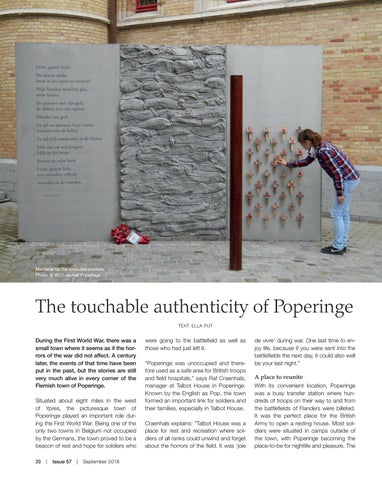
Memorial for the executed soldiers. Photo: © WO1-archief Poperinge
The touchable authenticity of Poperinge TEXT: ELLA PUT
During the First World War, there was a small town where it seems as if the horrors of the war did not affect. A century later, the events of that time have been put in the past, but the stories are still very much alive in every corner of the Flemish town of Poperinge. Situated about eight miles in the west of Ypres, the picturesque town of Poperinge played an important role during the First World War. Being one of the only two towns in Belgium not occupied by the Germans, the town proved to be a beacon of rest and hope for soldiers who 20 | Issue 57 | September 2018
were going to the battlefield as well as those who had just left it. “Poperinge was unoccupied and therefore used as a safe area for British troops and field hospitals,” says Raf Craenhals, manager at Talbot House in Poperinge. Known by the English as Pop, the town formed an important link for soldiers and their families, especially in Talbot House. Craenhals explains: “Talbot House was a place for rest and recreation where soldiers of all ranks could unwind and forget about the horrors of the field. It was ‘joie
de vivre’ during war. One last time to enjoy life, because if you were sent into the battlefields the next day, it could also well be your last night.”
A place to reunite With its convenient location, Poperinge was a busy transfer station where hundreds of troops on their way to and from the battlefields of Flanders were billeted. It was the perfect place for the British Army to open a resting house. Most soldiers were situated in camps outside of the town, with Poperinge becoming the place-to-be for nightlife and pleasure. The
Discover Benelux | Discover Flanders Fields & Westhoek | Flanders Fields Highlights
town, with only 10,000 inhabitants before the war, was suddenly home to 250,000 English-speaking soldiers, seeking refuge. “Poperinge was a place where people were reunited. It is a cross road in the history of the First World War. Many stories come together here,” Annemie Morisse of the Municipality in Poperinge explains. “However, it was also a town where court martials were held and executions took place. There were two elements, of fun and rest, as well as danger and war, that collided in this town. Therefore, it is an important historical landmark in history up until today.” The largest WWI-evacuation hospital was situated in a hamlet near the town. Those who did not survive were buried. Today Lijssenthoek Military Cemetery is an impressive hospital cemetery with almost 11,000 headstones. The adjacent visitor centre tells the story of this place. Almost a century has gone by, but the history remains untouched and can
Talbot House. Photo: © Westtoer
be found on every street corner of the Flemish town. Even the architecture is the same. “Poperinge was was bombed but not ruined. The town had not to be totally rebuilt after the war.” Morisse continues. “What is left are historic houses and churches, which is very unique for the region where other cities were bombed. This is something like ‘touchable authenticity’, in Poperinge.”
Little Paris Today, Talbot House, as well as the city of Poperinge, offers a warm and friendly welcome stop in Flanders Fields. With its stunning architecture, the city is a mustsee along the battlefields. Talbot House is now a museum, where visitors can get a lively and impressive overview during that time in history. A tour in Talbot House represents the liveliness of Poperinge during a time of political distress. The tour is given by actors, who play the roles of a British soldier and a Belgian civilian during that time. Show-
Lijssenthoek Military Cemetery. Photo: © Dingenzoekers
Market Place in Poperinge. Photo: © WO1-archief Poperinge
ing visitors around the old hop barn, which was converted into a Concert Hall during the First World War, as well as the neatly maintained gardens which provide access to the Old House itself, guests can indulge in the military past of Flanders Fields and Poperinge. Talbot House has kept the role of house of peace and rest for many years. In fact, it is still very much in use up until this day. Visitors can play the piano, step inside for a cup of tea, chat with one of the British wardens or spend the night in one of the rooms. Morisse emphasises: “the people and the city of Poperinge were here to help, not to fight.” And that mentality can still be found in Poperinge today. Telling the story of a time that once was, but is still so relevant up to today.”
Web: www.talbothouse.be www.toerismepoperinge.be www.lijssenthoek.be
Tubby's room. Photo: © Talbot House
Tubby's room. Photo: © Michaël Depestele
Issue 57 | September 2018 | 21
Discover Benelux | Discover Flanders Fields & Westhoek | Flanders Fields Highlights
Photo: © Kris Jacobs
Photo: © Westtoer
PA S S C H E N D A E L E :
A walk through history TEXT: ELLA PUT | PHOTOS: MEMORIAL MUSEUM PASSCHENDAELE 1917
The Flemish town of Passchendaele formed the backdrop of the most famous battle in the First World War. In the Memorial Museum Passchendaele 1917, the story of that significant time in history is being told. Close to Ypres is the rural village of Passchendaele. With its calm atmosphere, it may be hard to imagine that one of the most horrifying battles in the period of the First World War took place here. But, upon looking closer, there are traces to be found that can take visitors back to that time. In the Memorial Museum Passchendaele 1917, visitors can explore what happened in Flanders Fields during the infamous battle. “It’s a strange coincidence, but the name of the town couldn’t have been more suitable,” director of the museum Steven Vandenbussche explains. “Passchendaele was the dale of passion. In 100 days’ time there were more than 600,000 casualties. Young men lost their lives, went missing or were wounded. This place has become an international symbol of the violence of war in its most horrific form.” 22 | Issue 57 | September 2018
In the museum, visitors can also learn more about the battle through an interactive indoor and outdoor tour. Vandenbussche: “When you step into the museum, you step into a time machine. People say that it feels like going back a hundred years.” Visitors will be taken to the trenches, as well as to the dugout, an underground tunnel complex. Furthermore, they can learn about the landscape that played a significant role during the battle and experience the life of the soldiers.”
faraway places such as New Zealand or Canada, in order to discover their family history.” Vandenbussche: “Even though the battle of Passchendaele happened more than a hundred years ago, the history is still very much alive today. And the story will be told forever.”
“You can try on a soldier’s uniform along with the heavy backpack they would carry for days, but also touch different objects or get the opportunity to experience the odour of war. By letting visitors see, listen and try things, we hope to tell the story through all senses.” The museum also provides information about those who fought in the battle. “The battle of Passchendaele was fought by men of many nationalities, and people from all over the world contact us to find out what happened with their ancestors. Their curiosity sometimes takes them from
Web: www.passchendaele.be
Discover Benelux | Discover Flanders Fields & Westhoek | Flanders Fields Highlights
A tour into the rich history of Ypres TEXT: ELLA PUT | PHOTOS: STEVE DOUGLAS
With award-winning tour guides and a rich history of the area, Salient Tours promises to give its visitors a memorable tour of the region. Salient Tours is one of the oldest and most respected independent tour companies in the region of Ypres. Since the early ‘90s, the company has built a reputation for providing memorable tours in the area that take in some of Europe’s most incredible, historical landmarks along the Ypres Salient, the Somme and the Vimy Ridge. With great knowledge of the area’s heritage, the tour guides of Salient Tours are happy to take their guests on an adventure. “I think the success of Salient Tours lies in the passion of our guides,” says owner of Salient Tours, Steve Douglas. “They have a thorough understanding of the regional history as well as a love for showing others the war history of the area.” The tour guides are not only knowledgeable and passionate, but also very friendly and approachable, willing to accommodate the guests where and whenever they
can. There are several options available and when booking a tour along with a guide, Salient Tours will help decide which ones are suitable. According to Douglas, “we have guests from all over the world. It’s wonderful to see the enthusiasm of people and to read up on their reviews online.”
But the real hit amongst visitors remains a rare war machine, a Vickers machine gun, dating back to the time of World War I, in the shop’s front window.
For instance, there are tours around the former battlefields and cemeteries surrounding the region of Ypres as well as a day tour to the nearby Somme region, but explorers can also book a tour to visit both the Vimy and Somme regions in one day. Furthermore, there is also a special Canadian tour as well as an Anzac day tour. On request, tours to Normandy can also be arranged. All tours can be taken in the air-conditioned and comfortable minivan, and the tour guides speak Dutch, French and English. Salient Tours also has its own shop, called The British Grenadier Bookshop, with a wide range of military history books – this is therefore the perfect place to read more on the topics of World War I. The shop also offers unique souvenirs and jewellery.
Web: www.salienttours.be
Issue 57 | September 2018 | 23
Discover Benelux | Discover Flanders Fields & Westhoek | Flanders Fields Highlights
The city with an especially rich and diverse past TEXT & PHOTOS: GEMEENTE IEPER
Ypres was a flourishing place of commerce during the Middle Ages, when the city was one of the leading cloth centres in Flanders, along with Bruges and Ghent. The impressive Cloth Hall is evidence of those years of glory. St. Martin’s Cathedral and part of the superb ramparts also date back to this period.
the spot where the Last Post is sounded every evening at eight o’clock, an unforgettable experience.
The charming city of Ypres was reduced to a huge pile of rubble during the First World War. Despite being almost completely destroyed by four years of senseless violence, the people of Ypres succeeded in rebuilding their city with an appreciation for the history of the place.
Housed in the Cloth Hall, the In Flanders Fields Museum uses first-hand accounts and state-of-the-art techniques to tell the story and preserve the memory of the First World War. If you want to dig deeper in history, visit the renewed and child-friendly Yper Museum, which tells the story of the birth of the city and the many rebirths after yet another disaster that struck Ypres and its inhabitants. A thousand years of history in a ninety-minute visit for you, while kids can hunt for cats and play games via which to discover the museum.
Today, the city is surrounded by a green belt, ramparts and a superb area to explore on foot. The largest memorial of the First World War, the Menin Gate, is
Ypres is a beautiful city with a small-town feel that cannot fail to charm. So many spots and museums to discover, so many friendly cafés and splendid restaurants to
24 | Issue 57 | September 2018
try out and so many delightful accommodation options offering you everything you need for an unforgettable stay. Be sure to extend your visit to discover the Westhoek region. Explore the various options: the cycling network, the walks, bike and car trips, other historic cities. Be sure not to miss out on any of it!
Web: www.toerisme-ieper.be Facebook: Toerisme Ieper Instagram: @Visit_Ieper
Discover Benelux | Discover Flanders Fields & Westhoek | Westhoek Highlights
The flavour of the menu? Beer! TEXT: MICHIEL STOL | PHOTOS: RESTAURANT ‘T HOMMELHOF
“When you cook with wine, you have a choice between red or white. Beer has numerous varieties that all give an extra dimension to the food,” explains Stefaan Couttenye, owner and chef of ‘t Hommelhof restaurant in picturesque Watou, in the heart of the hop fields of Belgium. “I have always been a beer lover. And I was destined to become a chef. So I combined the two things I love,” says Couttenye. He became a pioneer in cooking with beer, and, with the help of some famous chefs, more than thirty years ago, Couttenye created the concept of a beer inspired menu and opened ‘t Hommelhof. “Beer has been used in the kitchen since the beginning of time, but I can say that my experimenting has often lead to pleasant surprises.” All recipes are inspired by different types of beers, both well-known brands and beers from the two local breweries in Watou. The menu changes with the seasons. “For one, we use local and seasonal ingredients all
from producers here in West-Flanders,” elaborates Couttenye. “But it also has to do with the weather and what beers go with that time of year. In the summer, people tend to want a lighter, more hoppy beer, and thus lighter foods. Whereas in winter, the heavier, amber beers and a good roast or stew are much more popular.” Asked about the chef’s specials, Couttenye laughs. “All of the dishes are my children. You wouldn’t ask a parent to choose between them, would you?”
Web: www.hommelhof.be
Discover Benelux | Netherlands Autumn & Winter Special | The Ultimate Autumn & Winter Destination
THIS SEASON IN THE NETHERLANDS
Where to go and what to see The Netherlands is a true country of seasons, and with autumn on the way, it is time to start planning how you will make the most of those crisp blue skies and the golden-tinged landscape. With our guide to the country’s top places to visit, you will find everything you need to plan an unforgettable day-trip or decadent weekend break. In the mood for a museum? Then do not miss the Netherlands’ must-see art and culture spots for autumn/winter 2018. From portraiture to fashion, there is something to suit all tastes. TEXT: MALIN NORMAN | PHOTOS: NBTC
26 | Issue 57 | September 2018
Discover Benelux | Netherlands Autumn & Winter Special | The Ultimate Autumn & Winter Destination
Top places to visit (read more from page 30) Whether cycling through a golden forest or enjoying a bracing stroll along the coast, the Netherlands is arguably at its most beautiful in the autumn. Think wide, impressive skies and trees ready to drop their golden leaves. Then, when it comes to wintertime, expect magical snowy landscapes and ice skating on the canals; a true winter wonderland. With that in mind, we have compiled a guide to some of our favourite autumn and winter destinations in the Netherlands. Get ready to step off the beaten track.
Gemeente Goeree-Overflakkee Read more on page 38 Goeree Overflakkee is one of the most sustainable regions in the Netherlands. This is the perfect place to relax and unwind, with city life just half an hour away.
Regionaal Bureau voor Toerisme Land van Cuijk Read more on page 30 Visitors in Liège can explore the historic centre and museums, check out the many events in autumn and winter, and, of course, try the local beers. After all, this is the beer lovers’ city. Gemeente Goirle Read more on page 34 Once in a while, one needs some peace and quiet. For that, you can head to Goirle, the tranquil destination with beautiful surroundings.
Gemeente Halderberge Read more on page 32 There is much to see, enjoy and do in the municipality of Halderberge, whether you want to visit monumental buildings, go skydiving, enjoy a concert or get totally lost in a botanical garden.
Gemeente Zutphen Read more on page 40 In Zutphen, on the edge of the national park Hoge Veluwe, you can unwind and get doused in a medieval ambience.
Gemeente Tilburg Read more on page 36 Tilburg is the city of art and creative talent, as well as lush green spaces, fun events and excellent restaurants to enjoy. It certainly deserves to be called a city in motion. Gemeente Winterswijk Read more on page 41 Winterswijk is calm and cosy, has hospitable residents, lots of idyllically located bed & breakfasts: the perfect getaway from city life.
Issue 57 | September 2018 | 27
Discover Benelux | Netherlands Autumn & Winter Special | The Ultimate Autumn & Winter Destination
Top art and culture spots (read more from page 42) Whether you want breathtaking World Heritage sites, quirky museums or internationally renowned art galleries, the Netherlands is brimming with first-class art and culture spots. Thanks to our bursting guide, you can delve into history, admire modern and classical masterpieces or even journey into space.
Museumwoning Huis Sonneveld Read more on page 42 Sonneveld House was once the house of the director of the famous Van Nelle factory and his family. It also offers a peek into the story of the beloved Dutch functionalist style.
Royal Delft Read more on page 45 Small in size, grand in history: it could only be the typical Delft Blue earthenware. Royal Delft offers an extraordinary insight into this great piece of Dutch heritage. Museum Helmond Read more on page 48 The museum is partly housed in a 700-year old castle. Inside, expect fascinating stories as well as outstanding exhibitions. Van Abbemuseum Read more on page 46 With an extensive collection of over 3,000 works of art, the Van Abbemuseum in Eindhoven is one of the most renowned museums of modern art in Europe. Chabot Museum Read more on page 48 Once you have seen the paintings of Dutch artist Henk Chabot, you will recognise them instantly. And it is this that makes the Chabot Museum so well worth a visit.
Museum MORE Read more on page 44 A cultural surprise awaits you in Gorssel, near the medieval city of Deventer, where this spectacular building is home to the largest museum for Dutch modern realism. Kröller-Müller Museum Read more on page 47 The exhibition For the love of art (Als kunst je lief is) in the Kröller-Müller Museum promises to be a sight for sore eyes for multiple different reasons.
Waterkant Amsterdam Read more on page 49 Waterkant is the largest sun terrace in the city centre, where locals and tourists hang out by the water – relaxing and enjoying a cold drink.
28 | Issue 57 | September 2018
Discover Benelux | Netherlands Autumn & Winter Special | The Ultimate Autumn & Winter Destination
Eregalerij. Photo: Erik Smits
Groninger Museum. Photo: Peter Tahl
T O P M U S T- S E E E X H I B I T I O N S I N A U T U M N / W I N T E R 2 0 1 8 : The Collection Illuminated by Charlotte Dumas Nederlands Fotomuseum, Rotterdam Until 9 December 2018 The Nederlands Fotomuseum has invited photographer Charlotte Dumas to act as guest-curator and make a personal selection of works from the museum’s rich and varied collection. The exhibition will include work by photographers of the calibre of Martien Coppens, Ed van der Elsken, Cas Oorthuys and Richard Tepe. The presentation casts new light on the collection while at the same time offering the public a clear idea of Dumas’ own motivations as a photographer. www.nederlandsfotomuseum.nl The Line Up: The Power of Drawing Centraal Museum, Utrecht 22 September 2018 to 18 November 2018 With The Line Up: The Power of Drawing, Centraal Museum Utrecht presents a wide selection of drawings by renowned artists and upcoming talent, both from Utrecht and beyond. Works from the museum’s own collection are displayed alongside loans and pieces created especially for the exhibition. www.centraalmuseum.nl
National Trust: Dutch Masters from British Country Houses Mauritshuis, The Hague 11 October 2018 to 6 January 2019 English country houses have traditionally been the home to Dutch Golden Age masters. Most of these paintings were acquired in the 18th century, the heyday of the English country house. The museum has selected the most beautiful Dutch paintings from houses managed by the National Trust. This will be a first for the Mauritshuis: never before has such a selection been exhibited in the Netherlands. www.mauritshuis.nl 80 Years’ War Rijksmuseum Amsterdam 12 October 2018 to 20 January 2019 This year is the 450th anniversary of the outbreak of the 80 Years’ War, and to mark the event, the Rijksmuseum is holding an exhibition entitled 80 Years’ War: The Birth of the Netherlands. Satirical cartoons, items of clothing, weapons and paintings by Bruegel, Rubens and Ter Borch will be our ‘eyewitnesses’, telling the story of how the Dutch nation was born. www.rijksmuseum.nl
Sensory Spaces 15 - Sol Calero Museum Boijmans van Beuningen, Rotterdam 13 October 2018 to 13 January 2019 The first Dutch museum exhibition of Sol Calero (Caracas, 1982) will open at Museum Boijmans Van Beuningen. The installation she is making for the museum will be the concluding presentation in the Sensory Spaces series that began in 2013. www.boijmans.nl CHIHULY Groninger Museum, Groningen 8 December 2018 to 5 May 2019 The sensational creations of the world-famous US glass artist Dale Chihuly will enchant visitors to the Groninger Museum. Specially curated for the museum in cooperation with the Chihuly Studio, this exhibition will be the largest European museum show of the artist’s work in the last 20 years. 16 installations inside and outside the museum will provide a comprehensive overview of the highlights of Chihuly’s oeuvre. www.groningermuseum.nl To find out more, visit: www.holland.com Issue 57 | September 2018 | 29
Discover Benelux | The Ultimate Autumn & Winter Destination | Top Places to Visit in the Netherlands
Land of Cuijk is known for its good life.
DISCOVER LAND OF CUIJK:
Enjoying the good life TEXT: ELLA PUT | PHOTOS: REGIONAAL BUREAU VOOR TOERISME, LAND VAN CUIJK
Known for its vast beautiful landscapes and rich history, the Land of Cuijk is a region that will sweep you off your feet. The Land of Cuijk has the best of worlds. Located in North Brabant, the area combines the warm hospitality that the region is famous for with a ‘bon-vivant’ lifestyle, where it is all about enjoying life through food, culture and living in the moment. The beautiful scenery forms the backdrop for this laid-back lifestyle and the green meadows and clear blue water of the river Maas will take your breath away. Nowhere in the Netherlands will one find such a diverse landscape on such a small amount 30 | Issue 57 | September 2018
of ground. One can go for a walk or a bike tour in the forests of Sint Anthonis and the Overloonsche Duinen. Furthermore, the Maasheggengebied is the oldest culture landscape in the Netherlands and has recently, as the only one in the country, been rewarded as a UNESCO biosphere area.
Idyllic getaway Consisting of 33 neighbouring towns and villages, the Land of Cuijk is the result of a collaboration to help bring out the best in the area: “It’s just a stone’s throw away from the German border as well as the oldest city in the Netherlands, Nijmegen, which makes it the perfect base for any trip to the Benelux,” tourism manager of
Regional Board of Tourism of the Land of Cuijk, Erik Jansen, explains. Here, visitors can be close to the hustle and bustle of big cities as well as stunning green countryside, ideal for a holiday or just a short weekend getaway. With accommodation varying from fancy and luxurious resorts to bed & breakfast at a farm, or do-it-yourself campsites. The Land of Cuijk is also a hotspot for lovers of sports, such as beautiful walking and cycle routes. But also, swimmers, surfers and divers will enjoy spending time here, as the area is home to several beautiful lakes, such as the Kraaijenbergse
Discover Benelux | The Ultimate Autumn & Winter Destination | Top Places to Visit in the Netherlands
Plassen in Linden. Perfect for swimming, surfing and fishing activities.
Explore the past Furthermore, there is even more to explore as the gorgeous surroundings are not only the perfect setting for a soothing break, but also tell the story of a time that once was. Shaped during different historical periods, each village has its own unique story and is well worth exploring. For example, the historical fortress town of Grave, which is known to be the most besieged town in Dutch history. There are plenty of churches (the basilica in Boxmeer, for example), monasteries (Sint Agatha and Velp) and castles
The Roman history of Cuijk.
(Tongelaar and Aldendriel in Mill) built centuries ago to discover. Used as a settlement by the Romans, the traces of that time can still be seen in the town of Cuijk, for instance.
Entertainment for all The Land of Cuijk also provides a lot of entertainment where locals and tourists can meet and mingle. During the carnival, the Four Day Marches and the international cycling event Daags na de Tour in Boxmeer, visitors from all over the Netherlands come to Land of Cuijk to party until the early hours. Jansen: “In the Land of Cuijk, there is always something to do.” This is also home
to Zoo Parc, as well as the well-known Oorlogsmuseum in Overloon, which unravels the history of the Second World War. The quaint villages and town squares provide a wide variety of restaurants and cafés for a bite to eat or an opportunity to try one of the local delicacies. Jansen: “The essence of a hearty lifestyle is evident in every element – the activities, the delicious and honest food, the hospitality, the laughter. In the end, it all comes down to relaxing and having a good time, in the region known for its Good Life (Een Goei Leven)!”
Web: www.visitlandvancuijk.com
Cycling through the Maasheggen UNESCO area.
Zoo Parc Overloon.
Historical fortress town Grave.
Kraaijenbergse Plassen in Linden.
Issue 57 | September 2018 | 31
Basilica Oudenbosch.
A municipality bursting at the seams TEXT: BAS VAN DUREN | PHOTOS: MUNICIPALITY OF HALDERBERGE
Down in the South of the Netherlands, approximately 45 minutes from Rotterdam, lies the municipality of Halderberge. Composed of five towns, the municipality houses just under 30,000 inhabitants which is quite small, even for Dutch standards, but do not let that number fool you. There is so much to see, enjoy and do whether you want to visit monumental buildings, go skydiving, enjoy a concert or get totally lost in a botanical garden. Though the towns of Oudenbosch, Oud Gastel, Hoeven, Bosschenhoofd and Stampersgat have been around for centuries, the municipality that they form together is fairly new. Established in 1997, Halderberge was part of a larger plan to 32 | Issue 57 | September 2018
reorganise several municipalities. Each town has its own uniqueness to it, but it is the Roman Catholic heritage – which is quite typical for the South of the Netherlands – that binds all of them together.
Oudenbosch Basilica One only needs to travel to Oudenbosch to see that heritage in action. The Oudenbosch Basilica is quite overwhelming, not just because of the sheer size of it, but mainly because it is a replica of the St. Peter’s Basilica in Rome. “Our basilica came to be thanks to father Willem Hellemons who used to study in Rome and absolutely adored that city and in particular St. Peter’s. He studied so many details of it, so he could create a replica in Oudenbosch that could capture the same feeling as the
one in Rome. A gigantic task that started in 1865 and finished in 1880, it’s now one of the Netherlands’ most famous churches, designed almost entirely by famous architect P.J. Cuypers who was also responsible for the Rijksmuseum and Central Station in Amsterdam,” reveals a spokesperson from the municipality of Halderberge.
Bovendonk That same Cuypers did not stop there in Oudenbosch and went on to build the monastery Bovendonk in Hoeven. He was given an assignment by the bishop of Breda in 1895 to build a new seminar. This marvellous building, characterised by its neo-gothic style, looks sober from afar, but up close, you will notice the stained glass windows (Cuypers himself drawn in one
Discover Benelux | The Ultimate Autumn & Winter Destination | Top Places to Visit in the Netherlands
of them), ornaments, high ceilings and it houses a beautiful chapel. “It’s a work of art built between 1905 and 1923 and is in use at the moment as a conference centre with hotel rooms and is the perfect spot for weddings and other parties. The stately library is still in use and just walking through the spacious halls and rooms is a real joy.”
Breda International Airport Do not think Halderberge is only about monumental buildings; thrill seekers can get their shot of adrenaline thanks to Skydive ENPC, situated at Breda International Airport; a private airport not far from the city of Breda, but located in Bosschenhoofd. “Skydive ENPC is founded by a very active parachutists club who will take you to nine to 10,000 feet. in the air and from there you tandem jump out of a plane. It’s quite a popular attraction and not the only one at Breda International Airport. The museum has a unique collection of historical aircraft and static exhibits related to aviation. All aircraft are airworthy
and are used on a regular basis, hence the name Flying Museum.
Mastboomhuis Oud Gastel Mastboomhuis Oud Gastel is the location of the Mastboomhuis complex. These buildings were owned for more than 150 years by family Mastboom-Brosens. The preservation of the complex started in 2005 and nowadays you can visit the museum in a form of suspended decay. All is left as it was when the last family member was still alive and it feels like you are visiting the family more than visiting a museum.
Outdoors For those who enjoy the outdoors, Halderberge is most certainly a good option. Not only are there a plethora of cycling and hiking routes, but there is a sizeable botanical garden in Oudenbosch as well. Housing many unique plants and just at the edge of the town’s centre, Hortus Oudenbosch is run by more than 70 volunteers who dedicate their time
Photo: Frans Bosch
Basiliek interior Oudenbosch.
to the upkeep of what used to be two monastery gardens. With over 60 types of aesculus (buckeye), viburnum and calycanthaceae (sweetshrubs), those with green fingers will have a field day. Just like kids will with water park Splesj in Hoeven, one of the Benelux’s biggest water parks and fitted with a large camping site next to it that has more than enough space for tents, RVs and such. But one does not have to do the outdoors stay to enjoy Halderberge: there are plenty of campsites, chalets, bed and breakfast spots as well as hotels. All that and still Halderberge has more to offer: an observatory, several museums, chapels and more. “We’re proud it’s all there and welcome anyone who wants to visit Halderberge. Short or long stay, you’ll find plenty to do in our city and in West-Brabant.” Web: www.visithalderberge.com
Bovendonk.
Breda International Airport.
Issue 57 | September 2018 | 33
Discover Benelux | The Ultimate Autumn & Winter Destination | Top Places to Visit in the Netherlands
DISCOVER GOIRLE:
Hidden from the crowd TEXT: BERTHE VAN DEN HURK | PHOTOS: GEMEENTE GOIRLE
The Dutch province of Noord-Brabant has a lot to offer; great cities, fun activities and many exciting job opportunities. But once in a while, one needs some peace and quiet. For that, you can head to Goirle, the tranquil destination with beautiful surroundings. Joep Horevoorts, civil servant at the municipality, believes that Goirle is unjustly unknown: “Goirle provides that sometimes much needed peace and quiet in a beautiful setting. The best feature of the region is the perfect combination of tranquility and accessibility to surrounding 34 | Issue 57 | September 2018
cities like Tilburg, Breda and Eindhoven, which have two theme parks; the Efteling and safari park Beekse Bergen. Even the Belgium city Turnhout is only a 30-minute drive away.” The municipality consists of two villages; Goirle and Riel, plus the hamlet of Breehees. The surroundings are rich in natural beauty with various walking and bicycle routes in several estates, such as Regte Heide, Riels Hoefke, The Stork’s Nest, Nieuwkerk, The Hoevens and many more. “The area is ideal for people who love history, flora and fauna. Birdwatch-
ers get their money’s worth at the special birdwatching cabin and nature lovers can discover all kinds of plants and animals.”
Discover Benelux | The Ultimate Autumn & Winter Destination | Top Places to Visit in the Netherlands
Archeology and war monuments According to Horevoorts, Goirle has a rich history that is unknown to many. It is an interesting location for archaeology, with its own Stonehenge-type prehistoric burial mound at de Regte Heide. “Also, the areas surrounding the municipality have all kinds of war monuments,” continues Horevoorts. “The trenches of the First and the bunkers of the Second World War are still present on the meadow. And, for instance, we have the Germans’ fake airport ‘De Kiek’, (also known as SF37), a former German airport which was built to ensure that no bombs hit the nearby airport of Gilze-Rijen. Plus, we also have ‘Bels Lijntje’, a former railway between the Dutch city Tilburg and the Belgian city Turnhout, now a popular tourist historical adventure cycle path. Goirle’s history can be found in many layers of nature and this is a protected area, so everything remains intact.” The industrial part of Goirle goes back more than two centuries. Textile manufacturer Van Puijenbroek started his company and created several buildings, the most striking feature of which was an immensely large chimney. At these grounds, an old swimming pool, a bunker and a historic water treatment facility can be discovered. “The various walking and bicycle
routes are a perfect way to discover all war remains and monuments.”
Proud ambassadors of Goirle The B&B’s in the municipality are the perfect base to come back to after a lovely bicycle trip, a visit to the village centre or the local cultural centre. Horevoorts: “The accommodation is not average; the old monastery has been converted into a B&B, and a beautiful historic farm offers unique overnight stays.” For the summer period, there are multiple camping sites where everyone can enjoy a holiday with their family. Goirle has many ambassadors, all of whom love to talk more about the area to any visitors. They are entrepreneurs of the municipality and can be recognised by ‘Goolse Geheimen’ signs outside their businesses. And you should always feel free to ask them for the best secrets to Goirle. Horevoorts concludes: “Goirle and Riel have a lot to offer, but not many people know how extraordinary the area really is. We are all very proud of the unique elements and want to share our best tips.” Web: www.goolsegeheimen.nl
Activities in the municipality of Goirle: Nieuwkerk golf course: This nine-hole golf course is surrounded by beautiful nature and regarded as a wonderful hidden gem by many golfers in the Netherlands. Climbing and adventure forest: Challenging climbing courses between the treetops for everyone above the age of nine. There is even a wheelchair accessible altitude course. Shopping: The centre of Goirle presents fashion for all ages, various specialty shops and a lively hospitality industry. Cycling and hiking: Several walking and bicycle routes show the beauty of the natural environment. All routes are available online. Jan van Besouw cultural centre: This cultural centre offers an extensive and varied programme of performing arts, film and literature. Cheese farm: Cheese farmer de Leyedaeler offers not only local cheese, but also provides excursions and workshops at the farm. Spa Thermen Goirle: This spa offers the perfect relaxation for everyone. It also has a snow cabin to cool down in after the heat of the sauna.
Issue 57 | September 2018 | 35
Discover Benelux | The Ultimate Autumn & Winter Destination | Top Places to Visit in the Netherlands
Photo: © Jean Philipse
The many reasons for a trip to Tilburg TEXT: XANDRA BOERSMA | PHOTOS: MARKETING TILBURG
It is the city of art and creative talent, as well as lush green spaces, fun events and excellent restaurants to enjoy. Tilburg has changed a lot over the years, yet is still evolving. It truly deserves to be called a city in motion. There are many reasons why Tilburg is an ideal destination for any upcoming city trip you might be keen on taking. Marketing director Marc Meeuwis confirms: “Tilburg is a creative, urban city. It’s kind of a rollercoaster actually, plenty of fun things to see and do. The ‘city in motion’ is what we call it.” Here, we have outlined the 36 | Issue 57 | September 2018
main reasons to visit this vibrant city in the south of the Netherlands.
Plenty of creative talent Art is displayed and showcased in multiple ways throughout this city. First and foremost, for example, in the creative educations that are available to so many. In fact, Tilburg was the first city to launch a rock academy and almost every musical star in the Netherlands has studied here. “We also have a renowned circus education,” says Meeuwis. “Every year in October we organise Circulo, a circus festival when former students who now work all
over the world come back to Tilburg. They perform in one of the many small circus tents at the festival.” Before artist Anish Kapoor rose to fame, he exhibited in Tilburg. “It was his first exhibition, around 25 years ago,” Meeuwis explains. And Tilburg is still in his heart. Museum of Modern Art De Pont – the same museum that hosted his first display – now has multiple sculptures of Kapoor in its standard collection. Meeuwis adds: “And to celebrate the 25th anniversary of De Pont, Kapoor created a special sculpture called Sky Mirror. It reflects the air in
Discover Benelux | The Ultimate Autumn & Winter Destination | Top Places to Visit in the Netherlands
what looks like a giant mirror.” The sculpture was placed in front of the museum in 2017 and has since turned into the most photographed part of the city. Tilburg is the third greenest city in the Netherlands and has many lush forests. Which means that it is easy to take a break and enjoy nature at any time. For instance, take a walk in Moerenburg, an area on the edge of the city centre that is filled with public art pieces.
Something for beer lovers Beer enthusiasts can indulge at Trappistenklooster. It is located a bit outside the city centre, but definitely worth a visit. This impressive monastery houses an indoor garden where a variety of beers can be enjoyed. Meeuwis confirms: “This is where the monks used to test the quality of the La Trappe beer. Very interesting to visit, and to taste too, of course!” Another great place for a beer or two is Piushaven. In addition to beer, visitors can have a bite to eat as well, but most of all
enjoy the beautiful surroundings. This harbour used to be a desolate are, but was turned into a cosy place with lots of restaurants, bars and designer shops on the waterside. Speaking of refurbished areas, Spoorzone is definitely one for the list. This used to be a workplace of the Dutch Railways, where they would work on trains. “They rebuilt this in a village nearby so we got the chance to use the area for another purpose,” says Meeuwis. These days, Spoorzone is an urban spot where people hang out in one of the restaurants or the skate park. “The place that was once used for locomotives will now be the home of a library as of December. And there’s actually still some old train wagons present, those are being turned into restaurants.”
Textiles, fairs and shopping For those who like to shop, Dwaalgebied, which means wander area, is the place to be. These side streets of the city centre are filled with unique boutiques and restaurants. Every month, there is a Sunday
market where the boutiques can present their goods, and it is also an opportunity for other businesses or individuals to rent a stall. Most definitely a great day out. Textile is an important part of Tilburg’s history. Many large fashion brands these days use the beautiful fabrics produced here. Jan Taminiau, for example, who is known for designing Dutch Queen Maxima’s dresses. “A visit to the TextielMuseum is the perfect way to learn more about the past and present of this industry that so consumes Tilburg,” Meeuwis says. With 225 attractions and over 1.5 million visitors, Tilburgse Kermis (Tilburg Fair) is the biggest in the Benelux. For ten days, young and old come to visit the city. “It’s a big spectacle every year. During those last ten days of July, the whole city is upside down, so be sure to add this date to your agenda!” Web: www.marketingtilburg.nl
Photo: © Benoît Martrenchar
Photo: © Jean Philipse
Photo: © Jostijn Ligtvoet Fotografie
Issue 57 | September 2018 | 37
Discover Benelux | The Ultimate Autumn & Winter Destination | Top Places to Visit in the Netherlands
The island of energy TEXT: ELLA PUT | PHOTOS: GEMEENTE GOEREE OVERFLAKKEE
Goeree Overflakkee is one of the most sustainable regions in the Netherlands, with lots of untouched nature. It was recently awarded for being the most sustainable coastal destination worldwide and also received a quality coast platinum award. Therefore, it does not come as a surprise that this is the perfect place to relax and unwind, with city life just half an hour away. The air is clean, the sea is fresh and life is laid-back. In the southernmost delta island of South Holland is the island of Goeree Overflakkee, with untouched nature aplenty, and yet not far from the vibrant city life of Rotterdam. Here, the local government, as well as several national and international companies, are working hard to make their island energy neutral by 2020. 38 | Issue 57 | September 2018
“As one of few municipalities in the Netherlands, we have set this deadline in order to really make ourselves work for our sustainable goals,” says Arend-Jan van der Vlugt, who is councillor of the municipality of Goeree-Overflakkee. “By 2020, we hope to obtain our own energy through windmills, sun energy, biogas instead of electricity and the new plans for a tribal power installation. With these natural resources, such as the sun and the sea, surrounding the island, we try to make the most of it,” Van der Vlugt explains.
Role model in sustainability The island tries to set an example for others. Van der Vlugt: “Sustainability can be quite a broad term, but we try our best to make a big change on this small piece of land in terms of energy.” In addition to be-
ing a role model in sustainable entrepreneurship, the island is also home to welcoming locals who are more than happy to receive visitors on their beloved island. And Goerree-Overflakkee is certainly the ideal place to relax and unwind in, whilst still being close to the vibrant city life in the so-called Randstad, a collective of the four
Discover Benelux | The Ultimate Autumn & Winter Destination | Top Places to Visit in the Netherlands
biggest cities in the Netherlands, as well as the Belgian city of Antwerp. With the calm energy of nature and the surrounding waters, it is great for a midweek break or short getaway. And visitors looking for somewhere to stay, can choose between various types of accommodation. “We offer something for each and every budget. Guest can enjoy a more luxurious stay in a hotel, a beach lodge or bungalow park, or camp on one of our many campsites. Or, choose to stay at a local B&B,” Van der Vlugt says.
Home for curious flamingos Thanks to its sustainability ambitions, the island is also home to several exquisite
animals. One of its best kept secrets is the special visit of a group of wild flamingos every year. In the autumn and winter seasons, the curious birds make a home for themselves on the island in order to unwind and relax, just like the island’s human visitors. Van der Vlugt: “Not many people know this. It’s quite wonderful and, most of all, a very special sight. They feel comfortable in the rich and untouched nature landscape.” The island is also home to some other varieties of bird, such as the spoonbill and the black tern. And you can often spot several seals along the shores. With the North Sea, Haringvliet and Grevelingen, the island is also a great place
to be for lovers of water sports. “Divers and swimmers come here to train or just for fun,” explains Van der Vlugt. And in fact, the European, as well as the World Championships in freestyle windsurfing, also take place here every year. A stay on the island can of course be combined with a visit to one of the nearby cities of Rotterdam, The Hague, Amsterdam or Antwerp. Van der Vlugt: “For those who are looking for a holiday in nature, but with a bustling city life at your doorstep, this is the perfect place to start.” Web: www.goeree-overflakkee.nl
Issue 57 | September 2018 | 39
Discover Benelux | The Ultimate Autumn & Winter Destination | Top Places to Visit in the Netherlands
Experience the medieval ambience in historic Zutphen TEXT: MICHIEL STOL | PHOTOS: GEMEENTE ZUTPHEN
The east of the Netherlands holds remarkable nature and some of the oldest and most historic cities of the country. Take Zutphen, on the edge of the national park Hoge Veluwe. Here, you can unwind and get doused in a medieval ambience. “It’s as if you are walking into a historic painting,” says Anke Asselman of Tourist Information Zutphen. Since its founding in the 12th century, Zutphen has been a major trading city thanks to the river IJssel. “When Amsterdam and Rotterdam were mere villages, Zutphen and surrounding cities were booming and became trade partners in the so called Hanze treaty, a European union ‘avant la lettre’,” Asselman explains. The prosperity it brought became tangible in the city’s architecture with its richly decorated merchant houses and churches. “The centre is full of idyllic streets and cul de sacs, with beautiful houses and build40 | Issue 57 | September 2018
ings. No matter where you look, you will always see one of the many towers that Zutphen is known for. With over 900 monuments, along with the laid-back atmosphere, it’s like you go back in time.” Many of the towers are open for visitors, and a visit to the City Museum Zutphen will give a historic insight to the city. “Or take a tour on a ‘whisper boat’ through the canals, and let the captain, or whisperer, tell you the secrets of the city.”
Rich culture and festivals But Zutphen is so much more than just its rich history. “Check out the shops and authentic bars and restaurants, where you can unwind from the day,” Asselman continues. “If you are a music lover, be sure to take a look at the unique collection of pianos at the Geelvinck Music Museum, where you can find the table piano once owned by Marie Antoinette.” On 12 September, the museum will open a new exhibition to honour the life and work of local composer Jan Brandts Buys, who
wrote the Die Schneider von Schönau opera in 1916. Every year, Zutphen becomes a Walhalla for chocolate lovers with the Chocolate Festival. “On this day, we are the sweet-tooth capital of the world,” smiles Asselman. “Throughout the city, there are demonstrations of making, cooking and painting with chocolate, as well as music and theatre. And have you ever tasted chocolate beer? On 30 September, you can!”
Web: www.inzutphen.nl
Discover Benelux | The Ultimate Autumn & Winter Destination | Top Places to Visit in the Netherlands
Every ingredient needed for a perfect weekend away TEXT: XANDRA BOERSMA | PHOTOS: 100% WINTERSWIJK
Positively surprised, is the general judgement of many guests who have visited Winterswijk. It is calm and cosy, has hospitable residents, lots of idyllically located bed and breakfasts: the perfect getaway from city life. Yet, this scenic, vivid place near the DutchGerman border is still relatively unknown to so many. Time for a change! Winterswijk may not be the first city that comes to mind when planning a city trip. A shame, according to Imke te Selle and Gienne te Gronde, who both work for the tourist department. “This town has so much to offer,” Te Selle emphasises. “It’s the perfect combination of an exciting town and peaceful countryside. An ideal village in which to wind down and relax.” This small town in east Netherlands has a busy annual agenda. A classic cars show, a marathon through the hills, valleys and woodlands in the area, and a major Christmas market are only some of the events organised by locals. “Yes, we
have a very active community,” Te Gronde nods. “Even off-season there are local activities every single day. Around Christmas time there’s also ice-skating in the centre next to the various stalls.” Walk the small streets of this town, where well-known retail shops and unique boutiques alternate, and you will no doubt reach the popular foods market filled with bustling terraces. Cooking and tableware shops, bookstores, exclusive shoe and clothing outlets; everything is available to the keen shopper. Including various nice restaurants at which to enjoy a break from all that shopping, of course. It sounds like a cliché, but there truly is something for everyone. Nearly six million people visit Winterswijk every year to enjoy the scenic surroundings with streams and hedgerows, appointed as National Landscape, either by foot, bike or car. A lot of people visit, yet it never feels too crowded. “That’s another benefit of our town,” Te Selle explains.
“Only 29,000 people live here, but it accommodates a significantly larger audience. So even if there are a lot of people visiting, like on any regular Saturday, being able to enjoy the peace and quiet is still guaranteed.” Even when the weather is not so good, there is plenty to do. Visit famous Dutch painter Piet Mondrian’s house for example – nowadays a museum showcasing his first paintings and drawings. Or you can visit the museum about the history of public transport or enjoy the high-quality restaurants that serve wild and other regional ingredients. Te Gronde says: “Especially at the end of the year, restaurants in the neighborhood will offer various dinner options. Another great day out is to visit the Vineyard Days in September, when the two vineyards of Winterswijk will open their doors and give tours accompanied by great live music and tastings.” Web: www.100procentwinterswijk.nl
Issue 57 | September 2018 | 41
Discover Benelux | The Ultimate Autumn & Winter Destination | Top Art & Culture Spots in the Netherlands
The history and essence of functionalism TEXT: ELLA PUT | PHOTOS: SONNEVELD HOUSE
If houses could speak, Sonneveld House would have stories to tell. Once the house of the director of the famous Van Nelle factory and his family, it now offers a peek into the lives of an influential Dutch family in the 1930s, as well as the story of the beloved Dutch functionalist style.
The Van Nelle factory was an influential factory in Rotterdam in those days, making Albert Sonneveld one of the best known men in town. Now on the UNESCO World Heritage list, the Van Nelle factory, as well as the villa, attracts visitors from all over the world who come to admire the unique building style.
Sonneveld House is not like any average museum, known as one of the best preserved houses in the famous Dutch functionalist style. The luxurious villa was designed in 1933 by architecture firm Brinkman and Van der Vlugt, especially for the director of the Van Nelle factory, Albertus Sonneveld.
The influence of Rotterdam
42 | Issue 57 | September 2018
“People nowadays see Rotterdam’s skyline and think of the city as a modern and sophisticated place, but one forgets that building new innovative architecture has always been the essence of this city. It’s what makes it so special,” explains Hetty Berens, conservator of Sonneveld House.
“Even in the 1930s, when this villa was built, Rotterdam kept inspiring and innovating new ways of building.” After the city was heavily bombed during the early days of World War II, most of the new buildings went up in flames. Berens: “It’s a miracle that this house survived. Therefore, it’s special that we have something left from that time, such as Dutch functionalism at the Sonneveld House. It tells the story of an influential family, but also the history of Rotterdam. It really gives an idea of the way of living back then, and it demonstrates the incredible development the city has went through.”
Discover Benelux | The Ultimate Autumn & Winter Destination | Top Art & Culture Spots in the Netherlands
The essence of functionalism Nowadays, the house is open for visitors who can explore the modern Dutch architectural style as well as take a tour through the house. “It’s an informal way of getting to know Rotterdam and functionalism, as well as the Sonneveld family who lived here,” Berens explains. The architects Brinkman and Van der Vlugt designed a concept where elements such as architecture, interior and furnishing would reinforce one another. Berens: “The light and space form the essence of this house. There are balconies as well as windows, and the house gives the feeling
that you can go outside whenever and wherever you want. Furthermore, in each room, you have a breathtaking view of the surrounding garden.” Almost all items, such as furniture and lamps, were made by the Gispen firm, and some were especially designed for the Sonneveld family. Berens: “This customisation reveals the luxurious living standards of the family. They had a special eye for comfort mixed with style. Sonneveld House is not only a museum and an example of functionalism, but also the very personal environment of a family.”
Every room in the house is decorated in a different colour and has its own function. And the technology was way ahead of its time. “They had a telephone in almost every room of the house. As this was in the early 1930s, you realise how much they were ahead in their ways of thinking. Sonneveld House has been an inspiration for so many Dutch housing styles ever since it was built. It is a leading example of the way we still live our lives, almost a century later.”
Web: www.sonneveldhouse.com
Issue 57 | September 2018 | 43
Discover Benelux | The Ultimate Autumn & Winter Destination | Top Art & Culture Spots in the Netherlands
Experience the largest museum for Dutch modern realism TEXT & PHOTOS: MUSEUM MORE
A cultural surprise awaits you in Gorssel, near the medieval city of Deventer, where a spectacular building is home to the largest museum for Dutch modern realism. Museum MORE is an initiative of the art collectors Hans and Monique Melchers. The museum contains more than 200 works by leading Dutch realists from the last 100 years, ranging from 20th century masters to young emerging talent. From Carel Willink to Pyke Koch and from Erwin Olaf to Marlene Dumas. Art aficionados and casual observers alike, are invited to come and be amazed by the technical perfection and original realism. In addition to the wealth of the museum’s own permanent collection, there are always temporary exhibitions showing the endless spectrum of realist art. This autumn, there are no fewer than three exhibitions for you to enjoy at Museum MORE in Gorssel. These include not only the idiosyncratic portrayal of people and animals 44 | Issue 57 | September 2018
painted by artist Kees Timmer, but also Johan Polets’ sculptures from the 1920s that are among the rare good examples of Dutch expressionist sculpture. The latest works by Paul de Lussanet, where the pure joy of painting leaps from the canvas as never before, will also be on show.
guests can combine top-quality art with a walk through the beautifully landscaped grounds of the castle. Magic, history and the beauty of nature all come together in Ruurlo Castle.
The Museum MORE building in Gorssel is an attraction in its own right. The design by the renowned architect Hans van Heeswijk emanates intimate grandeur. Hans van Heeswijk was also responsible for the renovation and adaptations of the Hermitage Amsterdam and the Mauritshuis in The Hague, as well as the new entrance of the Van Gogh Museum. In the richly wooded Achterhoek region of the eastern Netherlands, lies Ruurlo Castle, the second location of Museum MORE, which now houses the museum founders’ Carel Willink collection. The life and work of this master artist now takes pride of place in this princely building that dates back to the 14th century. And
Museum MORE Hoofdstraat 28 7213 CW Gorssel Open Tuesday to Sunday 10pm until 5pm
Web: www.museummore.nl www.museummore-kasteelruurlo.nl
Discover Benelux | The Ultimate Autumn & Winter Destination | Top Art & Culture Spots in the Netherlands
A history in blue TEXT: CHARLOTTE VAN HEK | PHOTOS: ROYAL DELFT
Small in size, grand in could only be the typical earthenware. Royal Delft extraordinary insight into piece of Dutch heritage.
history: it Delft Blue offers an this great
The Royal Dutch Delftware Manufactory Royal Delft, established in 1653, is the only remaining Delftware factory from the 17th century. Here, the world-renowned Royal Delftware is still entirely hand painted according to centuries-old tradition. “The fascination of the Dutch with earthenware started in the 17th century, when tradesmen with the Dutch East India Company brought back large quantities of Chinese porcelain,” explains Helen Taylor, PR and communications officer at Royal Delft. “This type of porcelain, which was decorated in blue on a white background, became massively popular among the Dutch.” After imports from China declined, the Dutch decided to take matters into their own hands by imitating the porcelain. Soon, many factories opened in the Netherlands. Though in the 19th century the industry seemed
past its highpoint, at around 1840 Royal Delft was the last factory standing. It was in 1876 that Joost Thooft bought the factory and revived the Delft Blue industry. You can still find his initials on every piece that is hand-painted. A visit to the Royal Delft Experience offers you a journey through the complete history and production process of Royal Delftware. During the Experience, feel the painters’ passion during a painting demonstration, wander through the factory where craftsmen are producing the products, or learn more about Delft icons such as Johannes Vermeer. Do not miss a glimpse into the chamber of the Royal Dutch Family, for whom a special collection of Delft Blue is created whenever a special occasion takes place. Always wanted to give a mockup of your very own office to your business relations? Or a plate with a personalised text? Royal Delft offers an extensive collection of (business) gifts, from traditional plates, dishes to modern design objects. You can give almost every gift a personal touch
through the addition of your own logo in the design. The method of creating the famous earthenware at Royal Delft has not changed since the 17th century. “Making Delft Blue is a process that requires an enormous amount of technique and craftsmanship,” Taylor enthuses. Are your hands itching after seeing so much glorious craftsmanship? Fear not, popular at Royal Delft are the workshops where visitors can create their very own Blue Delft tile, plate, or vase – because everyone needs a bit of Delft Blue in their home.
Web: www.royaldelft.com
Issue 57 | September 2018 | 45
Discover Benelux | The Ultimate Autumn & Winter Destination | Top Art & Culture Spots in the Netherlands
30 years of award-winning art TEXT: XANDRA BOERSMA | PHOTOS: BOUDEWIJN BOLLMANN & PETER COX
With an extensive collection of over 3,000 works of art, the Van Abbemuseum in Eindhoven is one of the most renowned museums of modern art in Europe. The museum, with its distinctive architectural design, lies on the edge of the city centre and is filled with works of art by world famous artists such as Pablo Picasso, Oskar Kokoschka and Joseph Beuys, to name but a few. From 14 July until 30 September, the museum also features the 30th anniversary exhibition of Dr. A.H. Heineken Prize for Art. It includes more than 75 extraordinary pieces by the 16 laureates of the Dr. A. H. Heineken Prize for Art. From the first laureate in 1988, Toon Verhoef, to Erik van Lieshout, whom the prize has been awarded to this year. The works range from paintings, sculptures and photography to graphics, vid46 | Issue 57 | September 2018
eo installations and design. They offer an overview of the Dutch artistic landscape in recent years, filled with contrast and diversity. New works by Erik van Lieshout and Yvonne Dröge Wendel have also been created especially for this occasion.
perience the world around them. A great way to discover the museum!
It is not a coincidence that this exhibition is shown in the Van Abbemuseum. Director Charles Esche explains: “We have a long relationship with the Dr. A. H. Heineken Prize for Art. Our former director Rudi Fuchs and conservator Steven ten Thije have both been members of the jury and the art of eight of the former winners belongs to our permanent collection.” With more than 3,000 works of art in its collection, a visit to the museum might appear overwhelming to some. So the Van Abbemuseum has created the 10+1 tour, composed by its own curators. It highlights 11 beautiful pieces that summarise the collection and show how artists ex-
Web: www.vanabbemuseum.nl and www.heinekenprizes.com
Discover Benelux | The Ultimate Autumn & Winter Destination | Top Art & Culture Spots in the Netherlands
Neo Rauch, Gewitterfront, 2016, Museum de Fundatie, Zwolle
Roni Horn, Opposites of white, 2006-2007, Kröller-Müller Museum, Otterlo. Photo: Marjon Gemmeke
F O R T H E L O V E O F A R T:
Discover 80 important acquisitions for 40 Dutch museums in a single exhibition TEXT: ELLA PUT
It is a place where exquisite artworks meet under the most unusual of circumstances. The exhibition For the love of art (Als kunst je lief is) in the Kröller-Müller Museum, promises to be a sight for sore eyes for multiple different reasons. In the midst of one of the most treasurable parks of the Netherlands sits the Kröller-Müller Museum, known for its erratic modern-art collection as well as its impressive sculpture garden. The museum is now home to a unique exhibition of precious pieces from the Dutch art world, For the love of art. For one time only, more than 80 important acquisitions from 40 Dutch museums are brought together, all of which were acquired with the support of the Rembrandt Association in the past ten years. For the love of art shows the full range of museum acquisitions: paintings, drawings, photographs, sculptures and so much more. The oldest work is about 3,000 years old, the
most recent dates from 2016. Together, the acquisitions give an idea of how Collectie Nederland (Dutch National Collection) – which is accessible to all – has been enhanced in the years 2008 to 2018.
Feast of unexpected encounters The 80 works, many of which are visitors’ favourites, are taken out of their usual context and displayed in surprising combinations. For example, a monumental 16th century religious painting from Alkmaar hangs next to a huge photograph by Andreas Gursky from the Stedelijk Museum, and a prototype chair by Rietveld from the collection of the Centraal Museum in Utrecht is flanked by a painting by AlmaTadema from Leeuwarden and a 17th century floral still life from the Mauritshuis. In short, the exhibition will be a feast of unexpected encounters that invite exploratory walking, viewing and comparing.
she purchased almost 11.500 works of arts. In Kröller-Müller Museum, things of beauty come together. The unique combination of art, nature and architecture guarantees visitors a truly unforgettable experience. An experience that arouses all the senses. The museum is a paradise for both seasoned art lovers and objective newcomers. Dates: 30 September 2018 to 3 February 2019. For practical information and e-tickets: www.krollermuller.nl About the Rembrandt Association The Rembrandt Association supports Dutch museums in important art acquisitions and is committed to the preservation of the public art collection. Since its establishment in 1883, the Rembrandt Association has contributed to the acquisition of many important and now indispensable works of art that have become accessible to all.
About the Kröller-Müller Museum The museum is the lifework of Helene Kröller-Müller. Between 1907 and 1922,
Web: www.alskunstjeliefis.nl
Issue 57 | September 2018 | 47
Discover Benelux | The Ultimate Autumn & Winter Destination | Top Art & Culture Spots in the Netherlands
A combination of art and cultural heritage TEXT: XANDRA BOERSMA | PHOTOS: MUSEUM HELMOND
When approaching Museum Helmond, visitors will be rewarded with an impressive view from the very start, as the museum is partly housed in a 700-year-old castle. Inside, expect fascinating stories as well as outstanding exhibitions. Kasteel Helmond is the biggest castle in the Netherlands and visitors can learn about its fantastic heritage. “Recently, we have renewed the exhibition inside the castle,” says museum director Marianne Splint. “Now, you can read all about the families that used to live here. Every generation has its own stories and struggles, which are interesting for kids to learn about, as well as adults.” Splint explains that the castle is only one part of the museum and that the second part is Kunsthal Helmond, the art hall next door, with multiple art collections. “On the ground floor, we alternate between two exhibitions: one with a focus on modern art and the other one is themed ‘humans and work’.”
The second floor is for temporary shows. As of 16 October, there will be a remarkable display of Czech–French photographer Josef Koudelka’s work of industrial landscapes. “It really is quite impressive; his photos are over three metres wide. And Koudelka takes his time with photographs, something we’re not used to anymore in these days of fast-paced social media. It will be the first time his work is shown in the Netherlands.” Museum Helmond houses an ideal combination of modern art, cultural heritage and impressive displays. The perfect getaway for a day.
Web: www.museumhelmond.nl
Dutch expressionism at its best Monumental landscapes in all seasons, penetrating images and almost caricature faces. Once you have seen the paintings of Dutch artist Henk Chabot, you will recognise them instantly. And it is this that makes the Chabot Museum so well worth a visit. In Rotterdam, the city where Henk Chabot (1894-1949) lived since he was a child, lies an impressive building. A monumental villa from the Modern Movement period, designed by renowned Dutch architects Baas and Stokla in 1938. It houses the Chabot Museum, which is part of Museumpark. “A very special location,” confirms Jisca Bijlsma, director of the museum. “It’s very light and spacious, giving an immediate view of the green surroundings, like a living room.” To celebrate its 25th anniversary, as of 27 November, a special collection will be shown at the museum, dedicated to Chabot’s work of refugees and people in hiding during the Second World War. “Chabot always said: ‘I paint people, 48 | Issue 57 | September 2018
TEXT: XANDRA BOERSMA | PHOTOS: CHABOT MUSEUM
animals and polders’. Dutch landscapes and figures were his favourite motif. This collection is a great summary of his work.” Chabot’s most famous painting is of the Burning of Rotterdam right after the bombings in 1940. “Also a very impressive painting, created near the river Rotte with a bright red sky. Painted from his imagination, which makes it very powerful.” Bijlsma concludes with a suggestion for visitors interested in the special architecture: “We offer some very interesting experience tours in collaboration with various other organisations. Like a tour through the Chabot Museum and the UNESCO Van Nelle factory, also built in the
Chabot Museum Rotterdam. Photo: Jannes Linders
30s, by Brinkman & Van der Vlugt architects. And you can also learn more about the surrounding white villas in Museumpark.” Web: www.chabotmuseum.nl www.museumparkvillas.nl
Discover Benelux | The Ultimate Autumn & Winter Destination | Top Food & Drink Spots in the Netherlands
Tropical vibes in the centre of Amsterdam TEXT: XANDRA BOERSMA | PHOTOS:KIRSTEN VAN SANTEN
You will notice when the sun is out in Amsterdam – not just because of the sky itself, but because Waterkant will be packed. This is the largest sun terrace in the city centre, where locals and tourists hang out by the water – relaxing, enjoying a cold drink. When visiting Waterkant, it may be hard to picture that this used to be abandoned territory. A place behind a petrol station where you would not want to be after dark. Now, it is quite the opposite. Colourful lights are dangling above the water, just like the legs of the people who are chilling by the edge. “It was a shame that the area was neglected for so long,” owner Brian Fernandes says. He discovered the location. “I used to go there with friends, bringing my own beer and food, and thought ‘why not give more people the possibility to enjoy this’?” Fernandes visited Suriname on a regular basis. “They have a place there where dif-
ferent cultures come together. I wanted to create a place in Amsterdam where everybody feels welcome.” That place is Waterkant. The Surinam inspiration is well represented on the menu –roti, saoto soup and chicken masala – and beer to enjoy together at the long picnic tables. “We hoped that the communal tables would make people who don’t know each other start talking – and they do.” Fernandes ensures that there is something for everyone on the menu: “It’s important for us that all cultures can come together here. That’s why we also serve burgers, Heineken beer and bitterballen. We’re not in Paramaribo, after all, we’re in Amsterdam.” As of last year, Waterkant also has its own beer brewed by a fellow Amsterdam based business: Brouwerij ‘t IJ. The beer is called Biri and has a tropical taste. According to Fernandes, it is “a craft beer
that’s sweeter and lighter than a regular craft beer – perfect for hot summer days.” Every Friday and Saturday night after 11, we push aside all tables and a DJ will spin some records. This September, Waterkant celebrates its fourth anniversary with a three-day festival called Friyari. “The vibe is amazing; it’s going to be a great party!”
Web: www.waterkantamsterdam.nl
Issue 57 | September 2018 | 49
Discover Benelux | Cover Interview | Nicky Romero
50 | Issue 57 | September 2018
Discover Benelux | Cover Interview | Nicky Romero
NICKY ROMERO
Building a music empire From humble beginnings, Nicky Romero has built himself a music empire. The famous DJ and producer rose to fame with the big hit Toulouse in 2011, the music video for which has been viewed over 390 million times on YouTube. Now, he runs his own record label and radio show, and in addition to releasing his own records, he also provides opportunities for other musicians to succeed. In our chat, Nicky reflects on some important lessons learned during the journey. TEXT: MALIN NORMAN | PHOTOS: SABINE METZ
Nicky Romero, real name Nick Rotteveel, is a Dutch DJ, record producer, musician and remixer. In 2011, he released his song Toulouse, which became a big hit and earned over 390 million views on YouTube. He was later named an EDM (Electronic Dance Music) artist to look out for by MTV and over the years, this talented musician has worked with other world-famous DJs such as David Guetta, Calvin Harris and Avicii, to name a few. In 2012, Nicky established his own record label called Protocol Recordings, in order to help other up-and-coming DJs and producers, and has recently launched his own clothing brand called PRTCL (short for Protocol). With millions of fans and fantastic collaborators all over the world, he has no doubt established a successful music business.
The artist also reflects on the benefits of starting out in a country such as the Netherlands. “Here, we get a fair chance of choosing what we want to do and work towards our goals. We are extremely lucky to have our basic needs satisfied, access to technology, and loving people around. It might sound cheesy, but for me it’s the base for everything.” Nicky also highlights Dutch DJs Armin van Buuren and Tiësto, for instance, who are great role models in the industry. Out of all his achievements, Nicky is particularly proud of producing the song I Could Be the One together with Avicii, which was released in 2013. “Still to this day, this is a special collaboration for several reasons.” It became a massive hit across Europe and in particular in the UK. “The record achieved number one in the hit
charts, and more importantly, I got to do this record with one of the best producers we have ever had on the EDM scene. He passed away too soon, and this song has a special place in my heart.”
Achieving a healthy lifestyle As his nearly three million followers on Instagram can see, Nicky has a busy lifestyle. Flying across the world to play at events, writing new songs, running his record label, doing the weekly radio show. But how does he maintain a healthy lifestyle? “There really is one simple answer to this question; the people you love and the people that love you,” he says, and reflects on how lucky he has been: “In my life, this would be my parents and my girlfriend. They are the ones that tell me the truth as it is. With all the pressure due to travel, to deliver the next record, to take
From humble beginnings Having had a number of massive hits, played at gigs all over the world, and with his own record label, Nicky has been incredibly successful so far. But despite his many accomplishments, he is also humble. “What I am most proud of is the fact that I started from nothing, literally in my own bedroom in my parents’ house, and built up a small empire,” he says, and elaborates further on the key to his success: “A few elements need to work together. In order to grow, you need dedication and eagerness to learn and try every day.”
Nicky Romero at Ultra Korea. Photo: Kevin Canales
Issue 57 | September 2018 | 51
Discover Benelux | Cover Interview | Nicky Romero
Nicky Romero at Protocol Studios. Photo: Hugo de Jong
the next photo and so on, it’s amazing to have people with you that care about you for all the right reasons.” Nicky also admits to working out and playing the occasional game of FIFA, to escape the circle of craziness for a while. Moving from a talented newcomer into an established artist with millions of fans around the world are two different things. Contemplating on what has been the biggest change in lifestyle in order to handle the situation, Nicky says: “The biggest challenge that I’ve had to deal with is my sensitivity. Throughout my career, I’ve found out that I’m quite a sensitive person. Every success has its reverse side, and I had to learn how to deal with the fear of losing what I had achieved.” For instance, if a record did well, he felt the need to make another record as good, so as not to ‘lose the grip’. This at times caused severe anxiety, which took some of the joy out of the experience. “The lesson I’ve learned is not how to make the next big record or how to play the next great set. Instead, it is how to enjoy and embrace the feelings I’m experiencing. In other words, I had to learn that it’s allowed to feel good at any time, unconditionally, and a great set or song 52 | Issue 57 | September 2018
might actually flow even better from that – and if not, that’s fine too, because the next one might.” This changed Nicky’s life around and lowered his stress and anxiety levels, ultimately making everything a bit easier. “A great record starts with a clear and rested mind, rather than a stressed and anxious one. Life lesson learned!”
Ongoing and future projects Now employing around 20 people, Protocol Recordings has a complete studio with a recording room, a radio room, multiple writer studios, a mix/master room and even its own bar. According to the founder, it grew naturally. “I really want to thank my partner in crime since day one, Jorik van de Pol (A&R/Creative), who helped me find the right people.” Jorik and Nicky were neighbours, became friends at the age of 12, and are still working together. “In the early days, Jorik was doing YouTube videos on his Saturdays off work, and we have grown together since then.” The sense of camaraderie and loyalty is expressed throughout all releases, signings, events and indeed, the brand itself. Nicky is particularly grateful for the new team on the management side, which opens up a lot of doors and breaks old thought patterns. “This has created new
opportunities, such as performing live on American TV shows, working with major radio artists and developing a ‘radio’ sound next to my club records. Shout out to Jack Minihan and Evan Winiker for bringing in these new elements.” So what does the musician and producer have in the pipeline? “I’m working on a lot of new songs with friends; Steve Aoki, W&W, Afrojack, David Guetta, Sunnery James & Ryan Marciano. And, of course, my own new clothing brand PRTCL which I’m proud to launch.” It certainly seems that the empire will continue to grow and we are excited to hear what comes next! Name: Nick Rotteveel Born: 6 January 1989 From: Amerongen, the Netherlands Profession: DJ, record producer, musician and remixer Company: Founder of Protocol Recordings, 2012 Biggest hit: I Could Be the One, by Avicii vs Nicky Romero
Facebook: djnickyromero Instagram: @nickyromero Online shop: shop.nickyromero.com
Issue 57 | September 2018 | 53
Photo: dreamstime.com
C R E AT I N G B R A N D E X P E R I E N C E S : T O P B E L G I A N C R E AT I V E , D I G I TA L A N D U X A G E N C I E S
Building your brand Belgium has a long tradition of creativity and innovation. Across the country, its vibrant cities such as Antwerp and Ghent are becoming hubs for the marketing sector, even more so thanks to the digital evolution of recent years. TEXT: MALIN NORMAN Photo: © flickr.com, Samuel Mann
54 | Issue 57 | September 2018
Discover Benelux | Special Theme | Belgian Branding
Creating brand experience An effective marketing strategy is at the core of business growth. Your brand image captures the heart of your business, summarising what you do and why you are significant. In the ever-advancing age of digitised media, digital content is becoming an increasingly important part of that strategy. However, there are so many tasks involved that it can be difficult to know where to begin. For example, many businesses focus on their visual identity when creating a marketing strategy, but perhaps you would like to come up with a new sound to reflect your company? Meanwhile, animated videos can be a good way of explaining your product and attracting new customers. But would you know what kind of animation would work for your brand? From 3D animation to logo and brochure design or video marketing to website optimisation, there are an array of expert creative and digital agencies operating out of Belgium that can help your business create the ultimate brand experience.
Living Stone.
MultiMinds.
Living Stone Living Stone has been serving clients for over a quarter of a century, creating and rolling out integrated B2B marketing campaigns for companies aspiring to be leaders in their field. mad about you.
MultiMinds Organisations can use data to optimise marketing campaigns. Digital analytics agency MultiMinds helps you to get insights out of the data and shows what the best strategy is. mad about you Sometimes a brand needs time to reflect on their vision and identity. And sometimes a brand needs an outsider to guide them through that process. This is where mad about you steps in.
Issue 57 | September 2018 | 55
Discover Benelux | Special Theme | Belgian Branding
Innovative digital design
Republic of Reinvention.
From online clothing adverts tailored to your taste, to a refrigerator telling you that you are out of milk: technology is more intertwined into our everyday lives than ever before. Our whole lives are changing by taking physical processes and enhancing them with a digital layer, created by the data trail we leave behind. Smart devices will process big data with advanced analytics and become increasingly involved in the decisions we make in our everyday lives. No need to hail a taxi when all you need to do is push a button; no need to go on a search for new music if a playlist is being tailored to your musical taste. Personalisation is all about delivering a tailored service or product to accommodate specific individuals, based on anything that is known about them. We share an extraordinary amount of personal data, something that is only increasing due to the development of wearable devices and location-based technology. ‘Personalised marketing at scale’ is not a new thing anymore. Instead of one single advertisement reaching millions of people, new technologies allow the combination of information about our demographics, preferences, previous purchases and mood, to give us personalised recommendations in no time. Next Apps
Next Apps.
Despite the huge leaps forward in speed, technology and versatility, the secret to building a great app has remained the same. According to Next Apps, it is all about keeping it simple. Republic of Reinvention Republic of Reinvention creates out-of-the-box solutions using vision technology. If you have a crazy idea, be it video or not, this is your partner in making it come alive. WE LIKE YOU Some businesses are reluctant to jump on the social media bandwagon. WE LIKE YOU, Belgium’s first social agency, is here to change that.
WE LIKE YOU.
56 | Issue 57 | September 2018
Discover Benelux | Special Theme | Belgian Branding
Boondoggle Founded on the breeding ground of intellectual progress, Boondoggle originates from genuine digital pioneering in an ever-changing world of marketing, advertising and digital service design. Clockwork Adding true creativity to its strategy and design, Clockwork is an ideal go-to partner for cutting-edge business innovation and digital solutions.
Boondoggle.
Aaltra Digital innovation studio Aaltra is based on a belief that software engineers need more creativity and designers need more technical knowledge. Pàu More and more businesses and governmental institutions are choosing Pàu as their partner for developing a digital environment that connects their customers. Clockwork.
Aaltra.
Innovative UX design User experience is perhaps the least tangible part of designing a killer product. UX refers to our emotions and attitudes about using a particular product, system or service. For example, when visiting a website, it includes the entire customer experience from when we first land on a website to
Pàu.
when we leave it for the last time. Or when filling out an online form for subscribing to a service or buying a product, it includes how easy it is for us to get an overview and fill out, and how well it actually functions. What do we as consumers need and what influences us to buy certain products and
services? UX design is the process of creating products that provide meaningful and relevant experiences to us users. Here, UX designers take into consideration our emotions, beliefs, preferences, perceptions, physical and psychological responses, behaviours and accomplishments that occur before, during and after use. Issue 57 | September 2018 | 57
Discover Benelux | Belgian Branding | Creating Brand Experience
“We share your ambitions” TEXT: FRANK VAN LIESHOUT | PHOTOS: LIVING STONE
Living Stone has been serving clients in the technology, engineering and healthcare industries for over a quarter of a century. With a strategic approach, creative solutions, streamlined project management and a global network of partners to develop content with, the Flanders outfit create and roll out integrated B2B marketing campaigns for companies aspiring to be leaders in their field.
brand identity is much more than that. It also incorporates what you sell, who you hire, how you communicate and even what your offices look like. A brand is the essence of what you are as a business, it expresses your unique story. Defining this story and communicating it in a compelling way is what we do. The brand story is the guiding principle for all your marketing efforts, and the basis for your business to thrive.”
“When people talk about the brand identity of companies, they often talk about the name, the logo or the colours that are used,” says Living Stone CEO and founding father Bart Verduyn. “But a
Long-term relationships and collaborative effort
58 | Issue 57 | September 2018
Verduyn set up Living Stone in 1992, together with managing partner Anne-Mie Vansteelant, to help businesses in IT, ICT,
engineering and healthcare solutions with their B2B marketing. “The first clients we worked for back then, are still on our books now,” Vansteelant reveals. “This tells you something about the nature of business to business marketing, but also about our personal commitment to our clients. We’re not just in it for quick results, but really feel responsible for their success in the long term as well.” Living Stone works with international healthcare organisations and leading tech companies such as Business & Decision, Nexans and Cerus. “But we also work with smaller businesses and startups, as long as we know they have the
Discover Benelux | Belgian Branding | Creating Brand Experience
ambition to be leading in their field, so we can make a difference.” After initial discussions with the client’s management, the Living Stone team talk to the client’s customers and with various people in the company to fully understand the client’s current market and brand position. “This research into what is driving the customer can flag up significant gaps between how the boardroom perceives their brand and how it’s perceived in the market and within the ranks of the company itself,” Vansteelant explains. “It is essential to take these perceptions on board to develop a realistic and effective strategy.” These market perceptions and the company’s values are then used to develop the brand story. “In B2B, crafting the right story is always a collaborative effort,” Living Stone’s Concept Director Bruno Termonia stresses. “We have the creative marketing skills, but our clients have a deeper understanding of what their business, products and services are about. We need them as much as they need us to develop the brand.”
The next step is to develop a content strategy to engage with the market and communicate the brand consistently through the relevant channels. “Often, companies create a new visual identity, launch it and then forget about it – which means nothing much will happen,” Vansteelant smiles. “In order to effectively claim your brand position, you need to continue communicating the story and monitor the outcomes of your efforts.” To deliver the content for this, Living Stone have the support of a broad global network of big and small partners. “We work with well-known organisations such as HubSpot for our inbound marketing and Showpad for sales enablement, but also with individual copywriters, illustrators, designers, video makers and other creatives. These are often people that we have had long standing relationships with, who understand what our clients are looking for. Not only do we know that
they will deliver excellent work, but we also know which partner will best match the client’s business culture and management team. The importance of these personal relationships are often underestimated, but they are vital for a smooth and positive creative process. After all, we don’t work for brands, we work for people who want to achieve something with their brands. And we are here to share their ambitions!” Recent projects Living Stone have worked on include: Tobania, one of Belgium's largest ICT specialists; Orsi Academy, who provide training and expertise in advanced robotic surgical techniques; and Nexans Data Center Solutions, a new business unit providing advanced network cabling solutions to hyperscale data centres; Make Your Mark, a new story for Living Stone.
Web: www.livingstone.eu
Content strategy and global network On the basis of the brand story, the visual identity and ‘go2market’ strategy are created and communicated internally, so everyone is reminded of what the brand entails and what their role is in creating value for the customer.
Issue 57 | September 2018 | 59
Understanding and monetising the potential of data TEXT: MICHIEL STOL | PHOTO: MULTIMINDS
Today’s world is driven by data. Organisations can use this data to analyse the behaviour of customers and optimise marketing campaigns. But how to know what works and what does not? Digital analytics agency MultiMinds helps you to get insights out of the data and shows what the best strategy is. “Companies have a lot of data from their customers, but often do not know 60 | Issue 57 | September 2018
what that data means,” explains Siegert Dierickx, co-founder of MultiMinds. “Moreover, they do not know how they can use that data in an effective way to create better marketing strategies or target individual customers with personalised campaigns. With our help, they will know.” Multiminds gives organisations insights in their data and helps create short- and long-term strategies. “It is important to
know not only what kind of data you have and what potential it has, you also want to have a clear view of what you want to achieve from it,” Philippe Vlaemminck, MultiMinds’ other co-founder, adds. “We see that companies have large marketing budgets, but often not a clear view of what their strategy is or how to analyse all the data. And believe us, they have a lot of it! That is why, together with our clients, we develop these strategies, using new
Discover Benelux | Belgian Branding | Creating Brand Experience
technologies and data integration to help reach that.” The company just celebrated its fourth birthday, by opening a new office. “The new office fits perfectly with our ambitions to grow steadily. It is still in Aalst, where it all began,” says Dierickx. He has over 15 years of experience in marketing and Vlaemminck has more than two decades in the IT industry. “We started with just the two of us, and now we have 12 employees. But at the end of the year, we hope to have 16 and a year from now, even 20.” International expansion is one of the other ambitions. “But only if it feels right to take that step.”
companies to take the next step in understanding and using the data it has, MultiMinds offers different kinds of training opportunities, both in its office in Aalst, as well as on-site at the premises of their clients. “There is a deficit of skilled data analysts and data scientists. With our classes, we share our knowledge and teach employees to analyse their data.” Training is suitable for people who have never analysed data, but also for people who are more advanced. “Onsite training is fully based on the clients’
business, data challenges and day-today issues. So employees can immediately use the training in practice and see the results.” “Basically, we want our clients to know what potential their data has,” summarises Dierickx. “Together with them, we define ‘success’, find out how to achieve that, and reach the goals.” Web: www.multiminds.eu
Now they know In the four years MultiMinds has been working with clients such as Colruyt Group, L’Oréal Benelux, Belgian Railroads NMBS and Lundbeck pharmaceuticals from Denmark, they have seen a shift in focus. “When we started, the focus was almost solely on digital campaigns and websites. But the market has seen a shift to more omnichannel strategies,” Vlaemminck continues. “There are a lot more factors involved in campaigns, like CRM and both online and offline sales numbers. Using smart technologies and integrating them with their own systems, we make sure our clients know what all this data means. The more they know and understand, the better the strategy,” Dierickx adds.
Siegert Dierickx and Philippe Vlaemminck.
MultiMinds’ unique methodology is still at the basis of every project: manage, measure and monetise. “Most companies are very eager to get to that third step, of course. But before you can get to that stage, you first need to understand the data that you have,” elaborates Dierickx. “That is our job, to show you and to say confidently: ‘Now you know.’ Once they do, and understand the potential, we can move on to the next step.”
‘Sharing our knowledge’ It is all about the level of knowledge in a company, as well as the willingness to take a good hard internal look,” explains Vlaemminck. To help get that knowledge to a higher level, and therefore help Issue 57 | September 2018 | 61
Discover Benelux | Belgian Branding | Creating Brand Experience
Team: Isabelle, Evert-Jan and Marieke.
Bringing back the human touch TEXT: BERTHE VAN DEN HURK | PHOTOS: MAD ABOUT YOU
Sometimes a brand needs time to reflect on their vision and identity. And sometimes a brand needs an outsider to guide them through that process. This is where mad about you steps in. The brand strategy and visual identity agency, mad about you, knows how to guide companies through times of transformation and change. mad about you consists of a strong team of three; Isabelle Leleux, Evert-Jan De Kort and Marieke Bueters. They dive into the world of their clients, helping brands to live up to their full potential. Bueters elaborates on the successful concept; “the three of us complement each other, as we have our own specialities but also know how to
62 | Issue 57 | September 2018
work together, give feedback and inspire each other.” De Kort explains how the team works on new projects; “we start by listening carefully to the clients. It’s really important for us to learn how management, employees and clients perceive the company. With the information gained, we organise our ‘pride’ workshop to establish what the core values of the brand are. The outcome of such a workshop is a true and engaging story. With that story as a starting point, mad about you then starts developing the visual identity for their client.” mad about you has built an impressive resume, with clients from all over the
world. SD Worx, PostNL, Solvay and Haribo are just a few of its international clients, but also large and influential companies in Belgium such as Telenet, Degroof Petercam and essent.be have asked for their expertise. “The best compliment is hearing our clients say that they feel proud to work for their company again,” says Leleux. “To achieve that, our main task is to bring back the human touch. We restore clarity and unity within a company. And in the end, we deliver a true and full identity.”
Web: www.madaboutyou.eu
You know what it feels like. You know what it smells like. But ever wondered what this magazine sounds like? Yes that’s right, magazines have their own sound. And so does your brand, even you as a person. Find out in the December issue. Sonhouse. Sounds like a good ID.
Discover Benelux | Belgian Branding | Innovative Digital Design
Guided by simplicity TEXT: MALIN NORMAN | PHOTOS: NEXT APPS
Despite the huge leaps forward in speed, technology and versatility, the secret to building a great app has remained the same. “It’s all about keeping it simple,” says Wim Van Buynder, co-founder of Next Apps. “The most important thing for any mobile app is for the back-end to run smoothly and the front-end to be easy to work with, intuitive and user-friendly,” says Van Buynder. As a professional iOS app builder and co-founder of mobile app developers Next Apps, he knows what he is talking about. Together with co-founder Christophe Todts and partner Sander Versluys, he has managed Next Apps since 2014. 64 | Issue 57 | September 2018
Throughout the company structure, approach and communication, simplicity is key. “Simplicity is in our DNA,” Van Buynder confirms. “We try to capture the essence of a client’s request and come up with a simple yet creative solution.” Todts elaborates further, and says: “Although we are a developer team, we are a partner in the process rather than just a supplier of software. This is where we add value to the project.”
A modern mindset The young team of 13 has a modern mindset and is flexible to change of direction. Whilst a client may have an initial solution in mind, it usually changes
after Next Apps comes into the picture. Instead of tackling the problem through a business only perspective, the team first looks at it from the end user’s point of view. “It mostly comes down to making things easy and understandable for the user,” explains Versluys. “The solution might be technically complex behind the scenes, but that should not be reflected in the user experience.” The team works with large corporate clients such as Barco and Samsonite, but also small start-ups with the ambition to make a real impact in the market. Most apps are either for new services or to streamline existing services, whether it
Discover Benelux | Belgian Branding | Innovative Digital Design
is a ‘Tinder for Jobs’ app for the Accent recruitment agency, or a complete app platform for car dealers and their customers, like Mobo and Mobo Pro, which allow customers to book appointments for maintenance and repair. “Dealers can streamline their booking and operation processes – which saves them significant amounts of time and money.” says Van Buynder.
The future of apps Next Apps also takes time to develop its own apps such as Colorcube, which became a big hit after Apple’s CEO Tim Cook mentioned it in his keynote in September 2016. The game was featured as Apple’s Free App of the Week, (out of the 75,000 that are published every week), resulting in more than one million downloads to date.
“It’s a fantastic recognition of our skills and dedication, but more importantly, it gives us valuable lessons and experience that we can use in our clients’ projects.” Some experts are predicting the end of mobile, however, Van Buynder is convinced that there is still room for growth. “I can’t see any new technology on the horizon that can overtake mobile. And although some people point to the rise of new technologies such as augmented reality, mobile will acquire an additional role as a central device to support new technologies and interconnect the digital and the physical worlds. As far as we’re concerned, it’s only just started.” Web: www.nextapps.be
Issue 57 | September 2018 | 65
Discover Benelux | Belgian Branding | Innovative Digital Design
“It’s about our love for video” TEXT: MICHIEL STOL | PHOTO: REPUBLIC OF REINVENTION
In ten years’ time, the internet will be one big television. At least, this is what Bram Biesbrouck of Republic of Reinvention believes. The company creates out-of-the-box solutions using vision technology. “We think in images,” confirms the founder. “We are a stubborn bunch of engineers who love video, always wanting to create solutions that go one step further,” explains Biesbrouck. “If you are looking for something that isn’t out there yet, we will help you create it. It’s not just coming up with completely new ideas, we also reinvent existing solutions.” One of those reinventions is a specially designed scanning table, the request for which was made by a supplier for BPost, the Belgian post office. BPost was looking for a table that recognises all the important 66 | Issue 57 | September 2018
information needed to send a letter. “When you put a letter on it, the table will weigh the letter to determine the postage needed. With smart cameras, it also reads the address so that it can be sorted immediately.” A similar solution already existed in the market, but it was too expensive and not tailor-made for BPost. “So we came up with this customised solution, and found a way to keep the production costs low.” Biesbrouck’s love for video and film stems from his childhood. “I grew up in a cinema along the Belgian coast. Working with images is great, it makes data tangible.” Starting out working for advertising agencies, Republic of Reinvention made a switch in 2015 to create video related software for industrial clients. “Working with our clients to come up with creative and innovative solutions; that is what we’re good at.”
Another example is Cinematek, the Royal Belgian Film archive which is over 100 years old. “They asked us what the archive should look like in the next hundred years.” Biesbrouck’s team of engineers, all with creative backgrounds, came up with a technical solution to interconnect all European film archives. “We approach film from a technical as well as an artistic point of view. The state of today’s film and video is both extremely technical – for instance, artificial intelligence and linked data – and highly artistic,” says Biesbrouck. “If you have a crazy idea, be it video or not, we are your partner in making it come alive.”
Web: www.reinvention.be
Discover Benelux | Belgian Branding | Innovative Digital Design
Poelmans & Ketels have both been in advertising for years.
Get in touch to get the WE LIKE YOU social treatment.
How to be social: the business edition TEXT: EVA MENGER | PHOTOS: KOEN MUTTON
Despite it being as ubiquitous as this summer’s heat, some Belgian businesses are still reluctant to jump on the social media bandwagon. Whether it is due to a lack of tangible profit or confusion around its actual impact: WE LIKE YOU, Belgium’s first social agency, is here to change that. “We were very young when we decided to just jump into the deep-end,” founding partners Joyce Poelmans and Eva Ketels admit. They were both working for the same advertising agency when they realised they wanted to purely focus on social, and that is how WE LIKE YOU was born. Offering everything from strategy building to devoted community management and branded content creation, the agency is invested in showing clients just how much social media can do for them. “It’s a common misconception that just being on social media is enough, but if no real thought goes into it, results will inevitably disappoint,” Ketels says. Having a plan in place is the key to success, as is being consistent in your brand-
ing. Customers should be able to recognise your brand from the copy you use to the memes you share – “and that’s another thing people forget,” Ketels continues, “that social media isn’t free.” Creating unique, quality content costs time, and so does actively engaging with your community. It’s not something you can just do in addition to another full-time role – it needs a lot of attention. Judging from the great success WE LIKE YOU achieved in its first two years, with clients ranging from Benecol to Kinder and Devos & Lemmens, this means that businesses are increasingly looking for expert agencies. For companies not sure if social media is for them, working with an agency that puts strategy first is essential. WE LIKE YOU’s young and experienced team always make sure they know exactly what they are doing and what impact it will have. “It happens that clients ask for a light version of our proposal as they think our ideas are a bit extreme,” Poelmans says, “but, however challenging, it is our goal to take away that restraint.”
So why should a company be social? Firstly, it is one of the best ways to reach a specific audience due to various targeting options. Also, there is a channel for every industry: if not on Instagram, your clients will be somewhere else. And lastly, it is simply a boat you do not want to miss. And if that is a boat that you do not just want to be on, but perhaps steering too, WE LIKE YOU is currently recruiting social talent! WE LIKE YOU social strategies are set up with the mobile user in mind.
Web: www.welikeyou.social
Issue 57 | September 2018 | 67
Discover Benelux | Belgian Branding | Innovative UX Design
Experience and excellence TEXT:ELLA PUT | PHOTOS: DE HOORN
Belgian Defence, Flanders DC and NATO. Boondoggle is also part of the international organisation Havas, a worldwide network with collaborations all over the world.
Founded on the breeding ground of intellectual progress, Leuven-based agency Boondoggle originates from genuine digital pioneering in an everchanging world of marketing, advertising and digital service design.
fit with the consumer, the business and the technology. Brands and businesses come to us because of this trinity. We apply the design thinking methodology to imagine, design and develop their brand experiences with the consumer in mind.”
Building brand personality
Boondoggle pride themselves on helping to bring out the best in brands. “Only meaningful brands will thrive,” explains Erik Meylemans, managing partner strategy and service design. “We create strong brands with a holistic approach that spans both product and service design and marketing. The customer experiences we imagine, design and build, need to
As one of the first digital marketing firms in Belgium, founded in 2001, Boondoggle has gained essential knowledge over the years to extend its offering towards customer experience consultancy. It has built a diverse portfolio of clients ranging from digital banks like Moneyou and Argenta.nl to international beauty brand NIVEA and governmental and public services such as
Building meaningful brands today can be a challenge. “In the first place, a brand’s product always delivers a functional benefit. But people are looking for personal and collective benefits,” Meylemans explains. “Especially the millennial generation and the gen X generation expect more from brands. And when brands are expected to have a higher purpose above functionality, that’s where our job begins.”
68 | Issue 57 | September 2018
Discover Benelux | Belgian Branding | Innovative UX Design
Beyond defining a brand’s purpose, we also shape a brand’s personality, based on its strong core values. Meylemans: “People relate to people, and if your brand feels like ‘people’, they’ll relate to you too. Through defining its personality, we will guide the brand in facing its consumers. Especially in creating products and services for a brand, its voice and its behavioural characteristics are key. Think e.g. of the importance of the tone-of-voice in how consumers interact with brands through chatbots.”
can give a competitive edge, but these experiences have no value without a fit with the consumer and the business.”
An innovation and marketing partner
An identity to remember
According to Meylemans, innovating brands’ experiences is more than just applying the latest tech to an existing experience. “Yes, a technology driven, innovative approach to an existing experience
What is in a name? Boondoggle means an activity or project that is deemed unnecessary and therefore a waste of time and money. “Our company’s name is derived from jobs created during the great
Meylemans continues: “our playing field is defined by this trinity of the consumer, the business and the technology. While some consultancies are good at business thinking and others in technology, we are best in combining those with human centric thinking and creativity. We give brands the competitive edge that consumers are expecting from them today.”
Depression in the 1930s in the US. The name is tongue in cheek, to remind ourselves not to take ourselves too seriously and really stay true to the core.” However, this does not mean that the company does not deliver serious work. On the contrary, the no-nonsense approach takes them all over Europe. “We try to go the extra mile for a client. Not just by offering them a full service approach, but also travelling to their location and developing the plan from there. Düsseldorf, Paris or London, we’ll make sure that we are there to demonstrate that only meaningful brands will thrive.”
Web: www.boondoggle.eu
Photo: Bernard Hermant
Issue 57 | September 2018 | 69
Discover Benelux | Belgian Branding | Innovative UX Design
Masters of innovation TEXT: FRANK VAN LIESHOUT | PHOTOS: CLOCKWORK
Adding true creativity to its strategy and design, Clockwork is an ideal go-to partner for cutting-edge business innovation and digital solutions. “These are exciting times for new business,” Clockwork manager Johan Steppe declares with a big smile on his face. “There is a real dynamic, and markets are in constant flux – which means organisations need to adapt, spot new opportunities and build new strategies. And that’s where we come in.” Clockwork is a young innovation and service design company that helps businesses to address complex problems which often require radical new business models and disruptive digital strategies. 70 | Issue 57 | September 2018
As part of Ordina Benelux, Steppe and his team serve a roster of large businesses and organisations, including Nike, Barco, KBC, the City of Antwerp, ADMB group and Eneco. “Clients come to us directly, or they are redirected to us through our mother company Ordina. Usually, they ask us to help them innovate their business using digital tools and platforms, whether it’s to reposition their business in the digital ecosystem, or to develop new digital products and services.”
Value-based process One of the things setting Clockwork apart from the competition is the extensive amount of research, analysis and data projections they conduct before they start working on a strategy and a solution. “We
call this ‘shaping the problem space’,” Steppe’s colleague, co-business unit manager Bart Haedens explains. “It’s the first phase in a process designed to add value to the market.” This process comprises a value discovery phase, a value delivery phase and, finally, a value acceleration phase. “The value discovery phase and, in particular, developing a clear and well-defined challenge for the design of a product or service, is vital in this process. It’s where we have to create awareness among the key business stakeholders and make sure they are all agreed and aligned.” Having set a clear challenge based on goals, KPIs and various analyses, the
Discover Benelux | Belgian Branding | Innovative UX Design
team combines this with extensive stakeholder and user research to develop their strategy and value proposition. Subsequently, a range of tools, including scenarios, flow charts, and visual design, as well as user, business and technical validations, are used to craft a concept and produce a minimum viable product. This includes the creation of a range of digital touch points such as websites, social media, mobile apps and chatbots.
Exciting new projects Recently, Clockwork has embarked on an exciting new project for one of these happy customers, the Belgian multi-channel bank and insurance company KBC. “Last year, we successfully completed a new digital proposition for their corporate banking division,” Steppe explains. “On the back of that success, we were asked to develop a new proposition for another of KBC’s divisions. At the moment, this is still in development and confidential, so I
cannot say too much about it. But what I can say, is that we are really excited. Our people have extensively researched the market and are now developing what promises to be a radical new business model. That’s the power of our process and approach,” he smiles. “We believe it will deeply disrupt the existing market and help our clients to reap the benefits.” Web: clockwork.ordina.be
“It’s an agile process,” says Haedens. “Which means we start testing the market as soon as we can and then continue to adapt, fine-tune and improve. Companies need to continually monitor and re-assess their products and services against new developments, and experiment with new solutions. It’s the only way to survive in this digital age.”
Design thinking Throughout this process, the Clockwork team apply a design thinking approach to everything they do. This means that the user and other key stakeholders always take centre stage, and strategists and designers take what is called an outside-in perspective. “We look from outside into our client’s business and its products and services. Taking this perspective, everything is geared towards understanding the key stakeholders’ needs: what they like and dislike, how they work, think, act, etc.” All Clockwork’s business innovation and service design solutions are approached from three angles: business, technology and people. “Our multidisciplinary teams comprise tech and domain specialists as well as super creative designers,” Haedens points out. “And, for any expertise we do not have in house, we can draw on Ordina’s 2,700 strong workforce at any time in the process, whether they are domain experts, data scientists, digital architects or privacy and security specialists. All these people work at the cutting edge of new developments, and being able to instantly mobilise their knowledge is one of the strong points our customers rave about in their feedback. That and our ability to quickly turn around sound, indepth analyses and creative solutions to complex issues.” Issue 57 | September 2018 | 71
Discover Benelux | Belgian Branding | Innovative UX Design
Growing businesses through digital innovation TEXT: MALIN NORMAN | PHOTOS: AALTRA
Digital innovation studio Aaltra was founded in 2008 by Pieter-Paulus Vertongen and Ciel Berings, based on a belief that software engineers need more creativity and designers need more technical knowledge. Merging both perspectives, they formed a team of creative developers and technical designers. “Together we help our clients to imagine, develop and grow innovative digital products,” says Berings. “These digital products can be, for example, mobile apps, online business applications or integrated Internet of Things solutions. Ultimately, our goal is to create products that make users happy and businesses grow.” Technology is evolving at an increasingly high rate and, at the same time, it is becoming more accessible. As much as the founders love new technology, they do not believe in it as a standalone solution. “As digital innovators, we believe that the connection with our audience, which is the end-user, is increasingly important,” explains Berings, and continues: “appli72 | Issue 57 | September 2018
cations that help people change the way they work or live are not a result of technology alone. We strongly believe that an explicit understanding of users, tasks, and environments is crucial to the success of each project we tackle. This is why we have developed our own user-centric design process.” Aaltra works closely with engineering companies such as Engie M2M, Daikin Europe, Novy, GE, Colruyt, and many more. A key value in its relationship with clients is ownership, and the team closely integrates with the engineering and development teams of it clients. “By involving the client’s team and the end-users from early prototyping, we achieve more creativity and shorter development times. And, by educating our clients, when our project is up and running, they can maintain their application independently and develop it further themselves. And that is an undeniable added value for our clients.” A recent example of one of Aaltra’s projects is an e-Care tablet and mobile app for Daikin, a provider of heating and cool-
ing solutions. E-Care is a digital toolbox for Daikin’s European installers, helping them prepare the installation and troubleshooting, if needed. It also includes necessary documentation and warranty registration options, as well as repair manuals and the possibility to order spare parts. Berings confirms: “it’s a user friendly solution, but it also connects to the client’s hardware on a high level.”
Web: www.aaltra.eu
Discover Benelux | Belgian Branding | Innovative UX Design
The perfect match for online success TEXT: KARIN VENEMA | PHOTOS: PAU
More and more businesses and governmental institutions are choosing Pàu as their partner for developing a digital environment that connects their customers. Pàu is a growing business that works with big names like BNP Paribas Fortis and Colruyt, but thanks to their internal studio, they can also serve smaller enterprises with the newest technologies. Pàu was founded in 2011 as a competence centre for online and digital professionals. After a few years, they added user experience to their services and the business started to grow further. Recently, Pàu has complemented their portfolio of consultants with 3D engineers and Blockchain specialists. The Antwerp-based company is known for its knack of understanding their clients as well as the personal development of its consultants. “We believe that our people are our biggest asset, they come first,” says Pieter Rahier, manager at Pàu. “We all work in a team, keep a healthy work-life balance and have an individual development plan and personal coach. This way, we can provide the
best possible match between a consultant and the job at hand.” Rahier explains how a project takes shape: “When a client requests our help, we first analyse the business profile thoroughly. What’s the story behind the request and what is really needed? After this, we look at which consultant would be the best fit. The client then chooses from a number of proposed candidates and meets them face to face. Only when all parties involved are convinced of the match, we start working with the client towards online success.” The consultants spend most of their time in the client’s office, to be able to work closely together with their in-house staff. At Pàu, they are organised in so called ‘tribes’, where the consultants discuss the latest in design, front-end development or agile technology. At the in-house studio, teams develop projects for smaller businesses, so they can benefit from the same techniques that large companies use. According to Rahier, there is still a lot of work to do “The B2B, health and trans-
port sector have been lagging behind in making their online business user friendly, and now it’s time for them to catch up! Customers expect modern websites and apps to make interactions simple and intuitive.” Pàu is ready to help businesses face those very challenges.
Thomas and Pieter Rahier.
Web: www.pau.be
Issue 57 | September 2018 | 73
MADE IN THE NETHERLANDS
Celebrating Dutch industry and innovation The Netherlands has a longstanding history of invention and is renowned across the world for its strong creative industry, not to mention innovation in technology and high-quality manufacturing. This month, we continue our guide to some of the most exciting products and designs currently coming out of the Netherlands. TEXT: MALIN NORMAN | PHOTOS: NBTC
74 | Issue 57 | September 2018
Discover Benelux | Dutch Industry & Innovation | Made in the Netherlands
Leaders of cutting-edge creativity The high tech and manufacturing industries in the Netherlands are among the most innovative in the world, thanks to superb facilities and leading research. Dutch technological know-how and products are highly sought-after across Europe and beyond.
such as Iris van Herpen, not to mention stylish brands including Scotch & Soda and G-Star RAW. In the design world, the Netherlands is a must-visit for architecture addicts with many of the globe’s most celebrated architects hailing from the Netherlands: from Gerrit Rietveld to Rem Koolhaas, the list is endless.
The Dutch creative industry is particularly renowned in fields such as interior design, gaming, fashion, and architecture. The Netherlands has countless internationally successful fashion designers
Both nationally and internationally, Dutch architects continue to make their mark with their innovative approach to building, while creatives such as Marcel Wanders epitomise Dutch conceptualism. Issue 57 | September 2018 | 75
Discover Benelux | Dutch Industry & Innovation | Made in the Netherlands
A solution to the 4,000 pieces of luggage that go missing every hour TEXT: XANDRA BOERSMA | PHOTOS: MOUSTAG
Every day, thousands of pieces of luggage are lost. They are found too, of course, but are not always returned to their owner. Fons van Acker and Peter Bierman have both travelled a lot and, as many of us have also experienced, have lost their luggage several times – which is why they went and created MousTag. The innovative luggage tags known as MousTag are durable and maintain privacy, yet still make it as easy as possible for luggage to be returned to its owner. “We register details on a secure website and free app,” Van Acker explains. “Users can log in using a code and you therefore no longer need to share your address on a card for everyone to see. We keep the data safe, yet are still able to connect you with the current holder of your bag. Only the parties with the required permissions will be able to view any relevant information.” 76 | Issue 57 | September 2018
The information you enter is primarily used to get lost luggage back, but can also be used as a useful travel diary. “If you want to visualise your journey, MousTag creates your very own page that keeps track of where you’ve been. Here, you can add photos and text to the locations and share this page with friends and family.” It may sound like it might be an expensive tool, but it is not. For only €14,95, users get their own MousTag with a fun print. Van Acker adds: “No subscription is needed. Instead, users make a one-time purchase for lifelong use. And you can also promote your company through our MousTag. Some business customers of ours are Ebags, Airbus 380, Accor Hotels, KBC bank and many more.”
Web: www.moustag.eu www.moustag.com
You are unique
so is your Auping mattress
Every person, each body is dierent. This calls for a tailor-made solution. For freedom of choice. The renewed mattresses by Auping are available in a variety of lengths, types of supports, and levels of comfort. As a result, there is always an Auping mattress that, no matter the bed base you choose, ďŹ ts you perfectly. Get inspired at the Auping store or visit www.auping.com/en/mattresses
Looking for a unique business gift? Looking a unique business gift? Surprise for your business relations with Surprise your business relations with a gift of eternal value: a crystal object. a gift of eternal value: a crystal object. Make it even more personal by having Make it evenwith more personal by having it engraved your company logo itorengraved with your company logo a text. or a text.
PURE DESIGN, DESIGN, PURE HANDMADE SINCE SINCE 1878 1878 HANDMADE
Visit www.royalleerdamcrystal.nl Visit to see ourwww.royalleerdamcrystal.nl collection or inquire about the to see our collection or inquire about the possibilities: info@royalleerdamcrystal.nl possibilities:+31 info@royalleerdamcrystal.nl 345 636 550 +31 345 636 550
Discover Benelux | Dutch Industry & Innovation | Made in the Netherlands
Hotel TwentySeven.
Beekwilder Lights.
Beekwilder building with facade decoration. Photo: Jan van der Horn
Beekwilder makes businesses extraordinary TEXT: KARIN VENEMA | PHOTOS: BEEKWILDER
When luxury hotel TwentySeven opened its doors in Amsterdam last autumn, they knew exactly who to ask for help in getting ready for the busy December month. Well-known decoration and presentation specialist Beekwilder managed to create a Christmas atmosphere as sumptuous as the hotel itself. After 95 years, this family business is still going strong. Beekwilder is a household name for any business that is serious about product presentation and visually supporting their brand. Since 1923, Beekwilder has been supplying products and services to companies and institutions that want to reach, inspire or visually seduce their audience. Their clients include supermarkets, museums, shops, restaurants, hospitals, hotels and schools. Big brands like Rituals and Vue Cinema are fans, but also small independent entrepreneurs too. “What characterises Beekwilder is the level of attention and perfection that goes into everything we do,” says Inge Wiersema, managing director. “We are constantly im-
proving and innovating the products and our own business. Prototypes are studied, criticised and improved until the right quality is achieved. We assist clients so that they can offer their customers a special experience. There is a choice of 4,000 products in stock, or clients can ask for bespoke concept development or product design by Beekwilder designers. Clients can choose to decorate themselves, or ask for our help with decorating on location. We always try to understand our clients really well so we can support them across the board. For example, when we found that our clients had a need to improve their in-store profits, we started the Beekwilder Instore Academy that organises workshops and tailor-made display and presentation courses.” Beekwilder applies sustainable business practices in their operations and supply chain. Most of their display and presentation materials are produced in China, where they make sure the children of factory workers are educated and looked after on the compound. Closer to home, they organise a second-hand market
where clients can buy and sell their used materials so they get utilised over and over again. The Beekwilder team firmly believes that an exceptional presentation will lead to better business results and they all work with great passion. Wiersema describes how after each holiday, the employees share photos of inspiring shop windows that they spotted abroad. She also confesses that she can not walk past a Christmas tree without unfolding the branches properly: “I can’t help it, making business extraordinary is in the Beekwilder DNA!” Beekwilder display.
Web: www.beekwilder.com
Issue 57 | September 2018 | 79
Discover Benelux | Dutch Industry & Innovation | Made in the Netherlands
For the love of soap Since the very invention of soap, it has become apparent that its power lies in the versatility of fragrance and the countless possibilities in terms of design. Makers of soap can be endlessly creative, and good quality soap gives users a sense of luxury and pampering. Harrie van der Steldt, owner of white-label soap producer Soap World, and Wout Willems of retail brand Soap & Gifts, teamed up in 2015 to co-create a new range of products based on their shared love of soap. In no time, the products became successful and were adopted by retailers throughout the Benelux. The key, according to Willems, is a business model where creativity and sustainability are paramount. “Soap is a wonderful product. Any scent, colour or shape is feasible, whether shaped like a palm tree, a heart or a sea shell. This allows us to play into contemporary trends and themes very easily and quickly.” Soap & Gifts is focused on retailers who wish to offer handmade products with com-
TEXT: BERTHE VAN DEN HURK | PHOTOS: SOAP & GIFTS
plete concept displays that are easy to set-up, innovative and trendy. The products are available in novel shapes, colours and fragrances, are of natural origin, not tested on animals and made by hand. In addition, the founders keep the environment in mind and instead of traditional plastic packaging, they use glass bottles and bio-based plastics wherever possible. In 2016, van der Steldt went on to introduce men’s brand Van Der Lovett, with special beard oils, soaps and aftershave balms, and a beer shampoo. The founder explains: “We saw there was a need for high-quality men’s products in the market. Men are paying more attention
to their appearance and are looking for highquality but affordable products.” The Van Der Lovett range is available for the end user via the online shop and at selected hairdressers, pharmacies and barber shops. Van der Steldt concludes: “Soap is multi-functional. It’s a great way to feel good, but it can also be a lovely addition to any interior or a wonderful present for friends, family or colleagues.”
Web: www.soapandgifts.com www.vanderlovett.com
Benelux Business BUSINESS COLUMN | BUSINESS CALENDAR | BUSINESS PROFILES
82
82
83
Smother them with service TEXT & PHOTO: STEVE FLINDERS
What should have been an uplifting experience, soon became a downer, when I recently got stuck in the lift which serves our three floor apartment block. As the mirror steamed up, I learned two useful lessons. The first is that some people get panicked just by the idea of being stuck in a lift: it took me a while to calm my neighbour who was on the outside trying to help. The second is about how not to handle customers. I called the fault line and a technician arrived after 25 minutes. Then, a few days later, it happened again. Another halfhour wait. Again, the technician said he had fixed the problem. Not hearing anything from the company, I wrote a formal complaint, suggesting that an apology, an explanation, and reassurance about the problem having been fixed would be in order. The operations manager replied two days later to say how busy he was and that he would respond properly by the end of the week.
He did not. He did call me finally, but he did not apologise. The third time it happened, I got through to the lift company’s boss. I was surprised when he suggested that it would take at least 30 minutes to get me out and that people who get stuck in lifts should do so during normal working hours. I started to feel irritated.
The other is to smother unhappy customers with service. One French client told us she was unhappy with her UK course so, the next time I was in Paris, I gave her a free day of one-to-one training, something she never remotely expected. An extra cost, yes, but our mildly grumpy customer became a great ambassador. It is the kind of thing you can think about when you are stuck in a lift.
I did get my apology, explanation and reassurance in the end, but it was hard work. It is not the mechanical failures that have turned me into a less-than-satisfied customer, it is this company’s inability to identify with how I was feeling that annoyed me. At the training company I co-ran in the UK, we attended closely to our clients’ needs and had mercifully few complaints. I have never received any customer service training but I do find two rules of thumb useful. The first is to accept, as far as possible, that the customer is right. It is better to think well rather than badly of your customers. Attitude shows.
Steve Flinders is a freelance trainer, writer and coach, based in Malta, who helps people develop their communication and leadership skills for working internationally: steveflind@aol.com.
Issue 57 | September 2018 | 81
Discover Benelux | Business | Calendar
Business Calendar TEXT: ELLA PUT | PHOTOS: © AGILE AMSTERDAM
field of tech and finance, this one-day event hopes to leave you feeling inspired. www.digitalfinanceeurope.com/DFE2018
Web Accessibility Live 27 September, Amsterdam, The Netherlands After the great success of last year, there will be a second edition of the web accessibilities event. It will provide tricks on how to make websites more accessible for an audience. With inspiring lectures and a ‘trend watcher’, this event is a must for anyone who wants to elevate their website to a higher level. www.siteimprove.com
Agile Amsterdam 21 September, Amsterdam, The Netherlands In today’s fast changing world, it is important that all branches of a company connect and work well with one another. Agile at Scale is about companies’ ability to adapt in our economy, with all of the multi-tasking challenges of running a business. With various speakers and workshops, companies are invited to develop their agility. www.agileamsterdam.nl/ agile-amsterdam-2018
Behavioural Design Fest 21 September, Amsterdam, The Netherlands Ever wondered what the power of influence is and how we let ourselves be influenced by certain content or messages? Eight speakers from various fields, including politics and psychology, will give a better insight into how our brain works and how we can adapt this knowledge to our work. www.behaviouraldesignacademy.com/ behaviouraldesignfest 82 | Issue 57 | September 2018
Digital Finance Europe 26 September, Brussels, Belgium Not just another financial tech conference, Digital Finance Europe is committed to bringing together European financial services and financial technology players to discuss digital transformation, technology and innovation within the industry. With top speakers from both the
European Banking Summit 27 September, Brussels, Belgium Europe awaits some interesting financial challenges and opportunities in the upcoming years. This event, organised by the European Banking Foundation, will focus on finance growth by bringing together leadership from both European as well as global public sector representatives. www.ebf.eu/europeanbankingsummit/ 2018-financing-growth
Discover Benelux | Business | Luxdates
A new way for internationally minded Benelux professionals to find love Following a successful career as an executive recruiter for Microsoft and Amazon, Claudia Neumeister needed a new challenge. She soon embarked on one with a difference! “My job made me a good listener and gave me an understanding of people’s desires and aspirations. I also have an excellent track record in matchmaking my friends! I had experienced firsthand how harsh online dating can be. With a Master’s in psychology, I decided to find a new calling for my skill set.” “Large numbers of highly educated, well-travelled professionals live and work in Luxembourg and the rest of the Benelux region: in banks, the EU institutions and with international corporations. But these communities don’t mix a lot, so I saw a niche in the market.” Claudia married her love of human interaction with her technical know-how and set up Luxdates in 2017. “I’ve initiated successful introductions in
the double digits in the last year. There are no algorithms at all,” she laughs, “just myself.” Using her professional skills as a recruiter and coach, combined with her psychology background, clients are interviewed in a 90minute free-of-charge initial meeting. Anonymous profiles are then written up, potential matches are approached and introductions made according to the client specifications. Contact can be via email, or Claudia will act as ‘MC’ during a face to face introduction. “I leave after the ice has been broken,” she says. “I then ask for feedback and the client decides how they would like to proceed.” Luxdates is discreet, anonymous and personal. All clients are professional, highly educated, and, most importantly, financially independent. “There are no gold diggers,”, says Claudia. “All my clients are in a certain income bracket, and therefore none are seeking financial support. They are looking for a soulmate to make their life complete.”
TEXT: LORENZA BACINO PHOTOS: LUXDATES
Claudia Neumeister.
Claudia Neumeister claudia@luxdates.lu +352 621 364 305
Web: www.luxdates.lu
Discover Benelux | Culinary Profile of the Month | Pâtisserie Hoffmann
The sweet smell – and taste – of success TEXT: MARTIN PILKINGTON | PHOTOS: PÂTISSERIE HOFFMANN
Luxembourgers enjoy the finer things in life. Master pastry chef and entrepreneur Jean-Marie Hoffmann has therefore built a very special business that aims to provide the finest. In his youth, Jean-Marie Hoffmann dreamed for a time of becoming a surgeon, but decided that such a life was not for him. Given the meticulous attention to detail demonstrated in his creations, his growing business empire, and his tireless drive to improve both, it is very possible he would have made a mighty medic. The path the now 51-year-old Hoffmann chose was to become a great pastry chef, learning his craft with some prestigious names before deciding that it was time to 84 | Issue 57 | September 2018
launch his own operation. “I looked seriously at Venice Beach in California as an option, but it wasn’t right for me or what I do.” He wondered about Dubai too, but finally saw that home was best. “Luxembourg has great gastronomic traditions, it’s an ever-more prosperous place where people are willing to pay for the best, and where they appreciate what top quality is,” says Hoffmann, “Like the French, eating well is a part of our culture, our heritage.” Thus, in 1991, he opened his first shop in Bonnevoie, making a name and setting it on the firm financial footing that enabled him to open a second, in Alzingen, in 2001. Making a name for himself included, in 1996, coming second in the pastry-chef world championships in
Paris, the perfectionism that yielded that result reflected in the products in his shops – ices, sorbets, chocolates, delicate pastries, gâteaux… “We set the highest standards, and use the best materials, including flour and fresh cream and milk from Luxembourg; but we also search the world for the topmost quality ingredi-
18 Avenue de la Porte-Neuve L-2227 Luxembourg.
Discover Benelux | Culinary Profile of the Month | Pâtisserie Hoffmann
ents, like cinnamon from Sri Lanka, and Madagascan vanilla.”
(News) bombe surprise For some people, that relatively simple business would have been enough, especially as it evolved into what is very much a family concern: “My wife has been very important to the company since the start, and my daughter Kelly joined after she became a master pastry-chef. And now my son Dustin is working on the marketing side,” he says. But M. Hoffmann had other ideas. As 2017 ended, it was announced that his company was acquiring the 16 shops, restaurant and production premises of long-established Luxembourg rival Schumacher, investing 16 million euros into upgrading their facilities. “We changed overnight from around 30 employees to 230,” he states, “And to be able to achieve what we want to do with the business, we expect to increase that to 280 or 300 before too long.” The bakery business is known for its anti-social hours, but to integrate the two parts and oversee the new investment
projects Jean-Marie Hoffmann has gone further, actually installing a camp bed in a windowless broom cupboard next to his office in his new production facility in Wormeldange, and spending most nights there.
Fresh ideas, fresh investment, fresh products Even early in the process, the signs were positive, sales good, and a good reaction from the workforce was evident. Because of the nature of what they produce, this is something that takes a very special approach – and Hoffmann is appreciative of production director Michael Weyland. “The scale of the operation, with 18 shops, and many catering companies and other outlets in addition, could be seen as industrial,” Hoffmann says, “But this has to be artisanal, what we do is a craft with so much done by hand, reliant on human skill rather than machinery.” And Hoffmann has no intention of losing what has always been – and remains – the trump card of his business: “If I have a new idea, if we come up with a new product
say, we can make it happen – and at the highest level of quality – within the day.” It’s a philosophy that matches the nature of the business. In the restaurant, the mouth-watering menu du jour is now truly du jour, changing daily and using the best seasonal produce. The wraps, sandwiches, quiches and salads that form the savoury basis of the traiteur business are truly fresh. The chocolates beneath their glass counters in the shops are miniature works of art, the great classics occasionally joined by new creations; and it is the same too with the pastries, handmade, as enticing on the shelves as they will be later in the day on the tables of Luxembourg’s discerning diners. The whole team is working tirelessly, and it is working successfully too. And they share a vision: “Our goal is to be one of the big names in our sector, not just in Luxembourg but beyond too,” Hoffmann concludes. Web: www.patisserie-hoffmann.lu
CEO Jean-Marie Hoffmann.
Issue 57 | September 2018 | 85
Discover Benelux | Culinary Profile of the Month | Bonbons à l’ancienne / Conserverie et Moutarderie Belge
SWEET MEMORIES:
Belgium’s iconic ‘old-style sweets’ If you could encapsulate an entire country in a single piece of confectionery, the cuberdon would be the best example. The cuberdon is a cone-shaped or nose-shaped sweet, made of gum arabic so that the outer shell is hard and crunchy while the centre is soft and gelatinous. It is one of the most characteristic and best-selling sweets in Belgium. There are various theories as to the origin of the sweet – possibly originally known as ‘cul de Bourdon’ or ‘chapeau de prêtre’ (priest’s hat). Christian Maenhout, director and artisan confectioner at Bonbons à l’Ancienne, explains more. “The world was created in seven
days, but to make a cuberdon takes time!” jokes Maenhout. “The first day is devoted to measuring ingredients and to mixing and boiling in copper cauldrons, then the syrup is poured into starch moulds.” There is a staggering number of flavours available, with Bonbons à l’Ancienne offering no fewer than 30 other options besides the original raspberry. Some of the rarer flavours include bergamot, champagne, kiwi, pistachio and speculoos biscuit, as well as more traditional choices like apple, cherry, orange and strawberry. Once the cuberdons are ‘ripe’ – over a week after pouring – the sweets are removed
Successful family business Conserverie et Moutarderie Belge is a specialist in mustards, sauces and ready meals. Its successful concept and tasty products have earned it the title of Family Business of the Year. Established in 1953 by Franz Schumacher, Conserverie et Moutarderie Belge first started its production with mustards. In 1983, son-inlaw Philippe Renson and his wife Elvira took over the business and extended its range with sauces and ready meals. In 2010, the third generation entered the company, giving it another wind of change. The range of products includes five prominent brands. Jefke The Belgian Chef is composed of vinaigrettes, mustards, cold sauces and mayonnaise. Yvalli consists of ready meals in larger packaging for wholesalers in the meat sector. La Délicieuse is the high-end product range. La vache qui regarde passer les trains is the organic brand created to meet the growing need for eco-friendly products. and finally, Filou 86 | Issue 57 | September 2018
TEXT: SIMON WILLMORE PHOTOS: BONBONS À L’ANCIENNE
Web: www.cuberdons.eu
TEXT: MALIN NORMAN PHOTOS: CONSERVERIE ET MOUTARDERIE BELGE
is the local brand. And the company is expanding its line-up even further, with salad dressings and spreads with new flavours such as mango curry and carrot ginger, as well as chutneys to go with foie gras. As the next project, a new factory will open its doors in order to handle larger volumes of production and the introduction of more new products. What makes Conserverie et Moutarderie Belge such a successful business? “Flexibility,” believes Renson. “We explore every possible venue for our clients, and our R&D department continuously develops products, recipes and packaging solutions. And even though we have grown over the years, we are still a typical family business.” As proof of its continuous success, the company has been named Family Business of the Year by Belgian business magazine Trends. This certainly is a promising business, and for generations to come. Web: www.moutarderie.be
from the moulds by hand and prepared for sale and savouring. Indeed, this savouring can be done on-site, as the factory-shop in Seraing, one hour east of Brussels, hosts guided visits that last an hour and a half. These tours show the production and hand-working of the confectionery – and there is more on offer than just cuberdons. Bonbons à l’Ancienne also makes boiled sweets, lollipops (whistle-shaped or round), sugar syrups for sauces, and gummy bears in four varieties: ‘oiled’, sour, sweet and ‘fried’.
Discover Benelux | Culture | Lifestyle Calendar
Out & About Summer is almost over, which means back to work and school. But the transition to a new season can be made a little bit easier with the festive parades, lovely markets and other events in the Benelux. TEXT: ELLA PUT | PHOTOS:
Issue 57 | September 2018 | 87
Discover Benelux | Culture | Lifestyle Calendar
Restaurant Rozengeur.
Restaurant Rozengeur Open all summer and beyond, Amsterdam, The Netherlands Known for its delicious and authentic Persian cuisine, Restaurant Rozengeur is the perfect place to visit during the transition from summer time. With dishes and spices inspired by the Shiraz, it is a unique experience for the senses. All dishes are authentic, with fresh ingredients and home-made bread. www.restaurantrozengeur.nl
Laundry Day 1 September, Antwerp, Belgium With more than 60,000 visitors, 11 stages and DJs from all over the world, Laundry Day is a big musical festival held in the bustling city centre of Antwerp. r&b, hardstyle, techno, house, drum and bass or electro – there is something for everyone. Leave your laundry at home but take those dancing shoes with you. www.laundryday.be
EAT Brussels 6-9 September, Brussels, Belgium This gastronomic event is organised for foodies by foodies. Explore the rich taste of Belgian cuisine as a local or a tourist, by going to different bars, restaurants, food corners or sweet and savoury stalls, who will all have special offers during the weekend. An experience not to be missed. www.brussel.be/eat-brussels 88 | Issue 57 | September 2018
Amsterdam International Fashion Week 6-9 September, Amsterdam, The Netherlands During Fashion Week, Amsterdam is turned upside down and changes into the European Capital of Fashion. Always with a special focus on upcoming talent, the shows offer a playful mix of new and young designers and well as renowned names. The Netherlands proves itself as a serious stakeholder in the world of fashion. www.amsterdamfashionweek.nl
World Port Days 7-9 September, Rotterdam, The Netherlands With one of the largest and well-known ports in the world, it comes as no surprise that the harbour of Rotterdam is the place to be during these magical days. Experience the port like you have never seen it before and get a glimpse of what happens behind the scenes with naval activities, demonstrations, seminars and, of course, ship tours. www.wereldhavendagen.nl
Funky Donkey 8-9 September, Clervaux, Luxembourg This music festival is truly funky. Located on a parking lot, visitors can dance to the upbeat drums of cheery songs from dusk until dawn. And whilst enjoying the music, there will also be a food court. Most of the profits will be donated to a good cause. www.funkydonkey.lu
Flower Parade Lichtenvoorde 9 September, Lichtenvoorde, The Netherlands Colourful flowers will cover the streets of Lichtenvoorde during this day in September, whilst dozens of large and small wagons roll past the cheering crowds. The parade is great for combining with a walking or cycling tour in the region of Achterhoek. www.bloemencorso.com
Ghent, Festival of Flanders 15 September – 6 October, Ghent, Belgium With over 180 different concerts from both national and international artists, this 61st edition of the renowned festival will bring a diverse spectra of performances that the festival is so famous for. With events such as KidsOdeGrand and the grand opening event, the festival will have something in store for visitors of all ages. www.gentfestival.be
Dam tot Damloop 22 September, Zaandam-Amsterdam, The Netherlands This is the biggest running course in the Netherlands and not an easy one, so come and cheer on those who are brave enough to take part. Thousands of entrants run ten miles from the Dam square in Amsterdam to Dam square in Zaandam. It is a spectacle every year for both the runners and those who join them for the festivities. www.damloop.nl
Discover Benelux | Culture | Lifestyle Calendar Scheveningen Kite Festival 29-30 September, Scheveningen, The Netherlands Over a hundred brightly coloured kites will fly high up in the sky with the beautiful beach of Scheveningen as a backdrop. Admire the world’s biggest kites whilst taking a final dip in the sea for the summer, or simply enjoy the kite shows with live music. www.vliegerfeestscheveningen.nl
Netherlands Film Festival 26 September – 5 October, Utrecht, The Netherlands Watch a large variety of new Dutch films during the national film festival in Utrecht. From the famous to the obscure and from small documentaries to big blockbusters: over 400 films will be shown in 15 venues around town. The highlight of the festival will be the award ceremony of the Gouden Kalveren, where the biggest prizes in the Dutch film industry will be awarded. www.filmfestival.nl
Issue 57 | September 2018 | 89
Discover Benelux | Culture | Tres Chic Luxury Lifestyle Event
Très Chic: leading in luxury TEXT: XANDRA BOERSMA | PHOTOS: TRÈS CHIC
Exclusives wines, live music and hundreds of luxury products to discover. Think exquisite timepieces, exotic travel destinations and the latest beauty products. Très Chic is the biggest luxury fair in Belgium. And this year’s event, taking place later in the year, is open to new attendees and exhibitors alike.
Chic for a reason: “These days, we encounter luxury products like the latest cars, finest food and beauty products online – a great way to discover new brands. The only problem though, is that through our phones or computers, we are not able to actually smell, try and actually experience the products, before deciding to indulge.”
In November, over 15,000 visitors will come to the city centre of Hasselt to see what is new in the world of luxury. Olya Fedorova, in charge of sales, explains the idea behind the fair, which is called Très
This very experience is offered at Très Chic. A unique event that gathers over 50 luxury brands in one venue. “The exhibitors can invite up to a thousand people from their own client base. So not only is
90 | Issue 57 | September 2018
it a great opportunity for visitors to get to know new brands and products, but also for business owners to expand their own network.”
Join fellow luxury brands Exhibitors are guaranteed to get the target audience they want. No wonder then, that this is already the 13th edition. “It’s a successful event, for sure,” Fedorova confirms. “We get great responses from visitors, as well as businesses exhibiting their products. And the list of big names grows with every edition.”
Discover Benelux | Culture | Tres Chic Luxury Lifestyle Event
Well-known luxury brands such as Bentley, BMW, HotSpring and LaurentPerrier are regulars at Très Chic. “Exclusive wines, the latest in beauty, delicious food; we want to give our visitors a unique experience. Not just to discover new products and brands, but to have a nice day or evening with friends or business connections. We also have live music with a band playing to add some more entertainment.” Of course, exhibitors are free to organise their own entertainment at their stand as well. Or offer their visitors a glass of champagne, accompanied by a small bite to eat. “The possibilities are endless, so to speak.”
Exclusive stand New this year, is the indoor location, as well as the date. “Usually we organise the event during the summer, in the open air. We thought it was time for something new though, so it has turned into a winter happening.” The location is the recent-
ly renewed Expo Hasselt. An all-black space that can be spiced up by exhibitors. “We provide the basics, like ecological cardboard-stand walls printed with the corporate identity of the business, and a tablet with which to do live sales. The rest of the interior is up to them, the possibilities are truly endless, like I said.” From 16-18 November, it is show time for Fedorova and his fellow organisers of Très Chic. By then, the Expo in Hasselts city centre will be filled by luxury brands presenting enchanting jewels, exquisite food, exclusive cars and many, many more products. And there is some good news for luxury business owners too: “We still have some space left. So if there’s more entrepreneurs that would love to expand their network and get exposed to thousands of potential new clients, let them give me a call!” Web: www.treschic.be
Issue 57 | September 2018 | 91
Discover Benelux | Culture | Office du Tourisme de Liège
Nightlife, art and history in the beer city TEXT: MALIN NORMAN | PHOTOS: OFFICE DU TOURISME DE LIÈGE
Liège is a destination in its own right, worth staying for a couple of days. Visitors can explore the historic centre and museums, check out the many events in autumn and winter, and, of course, try the local beers – or perhaps the beer marathon. After all, this is the beer lovers’ city. “I didn’t know that Liège is so beautiful,” is what many tourists say, according to Office du Tourisme de Liège. Visitors can check out the many museums and there are a lot of shopping opportunities and fun events. What surprises many is the quality of the historical centre and the many buildings. When walking around, 92 | Issue 57 | September 2018
you can really sense the heritage. Plus, the narrow streets and hidden places make you travel in time. Arriving by train is a nice way to take in the city when visiting for the first time. Gare des Guillemins was designed by Spanish architect Santiago Calatrava, famous in particular for his bridges, railway stations and stadiums. With its enormous glass roof that lets the light in, it is often called a ‘cathedral of the modern age’.
Discoveries in autumn and winter One of the highlights is La Nocturne des coteaux de la Citadelle on 6 October, when the city reveals its alleyways,
courtyards, staircases, terraces, paths, fields and meadows in the Citadelle with around 22,000 candles. Every year, some 30,000 visitors come to see the candlelit city centre, enjoy the festive atmosphere and perhaps also make their way up the 374 steps of the famous stairway of the Montagne de Bueren. Another festive event is the Christmas market, the first in Belgium and still one of the biggest with around 200 stalls. Visitors can also try ice-skating on Place de la Cathédrale, the toboggan run on Place Saint-Lambert, check out the sound and light show at Cathedral Saint Paul or the European Circus Festival in the d'Avroy
Discover Benelux | Culture | Office du Tourisme de Liège
park. Also worth visiting is La Boverie, the city’s fine arts museum and centre for international exhibitions in partnership with Le Louvre Museum. Similarly, Le Grand Curtius is a unique gem with more than 5,200 regional and international artefacts to discover, covering 7,000 years of art and history. And not to miss, is La Cité Miroir, the former thermal baths of la Sauvenière. The exceptional venue is dedicated to education, citizenship and culture right in the centre of Liège. From 10 November, it hosts World Press Photo 2018, a prominent photojournalism competition. The city is also home to no less than three international cultural institutions; Royal Opera of Wallonia, Liège Royal Philharmonic Orchestra and Théâtre de Liège.
A city for beer lovers The city is also brimming with beer venues. Brasseries, specialist shops, cafés, bars, restaurants, and courses in the study of beer. There certainly is a lot to explore when it comes to that particular
beverage. To help guide beer lovers, the label Liège Beer Lovers’ City has created a series of events and quality certifications for products and establishments. As proof of its status, Liège hosted Brussels Beer Challenge in 2013, the first time the competition left the capital. A highlight amongst events is the Beer Lovers’ Marathon. In addition to conventional water and energy supplies, runners have the opportunity to discover and taste 16 different Belgian beers along the way. The race understandably ranks as one of the seven most fun marathons in the world. This year, it had around 1,600 participants and many of them came from abroad. The next edition will be held on 9 June 2019. In April, Musée de la vie Wallonne hosts La Cité de la Bière, a festival with local microbreweries. And in May, Liège transforms into the capital of Walloon craft beers. In the heart of the city, craft breweries present their know-how and the fruit of their work. This annual festival is a fantastic opportunity to discover the diversity of the brewing
heritage. And if visiting in autumn, check out Hoppy Days: Fête de la Bière de Liège, with beery celebrations on 26-28 October. It offers bars serving the best beers in the world, live music and a great vibe.
Good quality of life In addition to its fantastic beer adventures, the city is famous for another treat; the waffle. It has been the delight of food lovers worldwide for many generations, and nowhere more so than in Liège. If you ask the question “where is the best place to taste a Liège waffle?”, then the obvious answer is “in Liège!” Liège is also known for the good quality of life and the friendly character of the people who live here. The locals are considered very sympathetic and also welcoming towards the many tourists. According to Office du Tourisme de Liège, “if you arrive here alone, you will go home with ten new friends.” Web: www.visitezliege.be
Musée Boverie. Photo: © Urbanisme Ville de Liège
Issue 57 | September 2018 | 93
Discover Benelux | Culture | Royal Museums of Art and History
HEROES AND RICHES:
Two exhibitions to look out for at the Art & History Museum, Brussels TEXT: SIMON WILLMORE | PHOTOS: ROYAL MUSEUMS OF ART AND HISTORY
Two very different, yet equally fascinating exhibitions, are on display at the Art & History Museum in Brussels, formerly the Cinquantenaire Museum, this season. First up, after an investment of 520,000 euros, one of the most famous Belgian Art Nouveau works – by architect Victor Horta – has been brought back to life. Open to the public since 29 November 2017, the original Art Nouveau and Art Deco interior of the elite Wolfers Frères jewellery shop can now be revisited, 105 years after the official inauguration of the business. 94 | Issue 57 | September 2018
Just as the Belgian nouveaux riches could walk around the real shop at the end of the 19th and start of the 20th century, museum visitors will once again be able to admire the property in its reconstructed form, thanks to a painstaking historical study into the showcases, counters and even the doors of the shop, as Horta designed them in his time. The red Cuban mahogany furniture has been refurbished; the dark green velvet of the soft furnishings has been rewoven; the patina of the bronze decorations has been refreshed. “The museum curator had done much research in the archives in order to find
the right furniture – with the right colours and the right atmosphere – to do the project justice,” says Denis Perin, communications manager at the Art & History Museum. “The furniture and the jewellery are just small examples of the extraordinary work done by Horta and Wolfers, and cannot be missed.” When architect Horta took on the project in 1909, he already enjoyed international renown, thanks largely to successes with other commercial buildings, including Le Grand Bazar in Brussels in 1903. However, he is perhaps best known as the man who led the dawn of the Art Nouveau era, par-
Discover Benelux | Culture | Royal Museums of Art and History
ticularly thanks to his work with the Hotel Tassel, completed in 1893. A number of Horta’s projects, also including the private homes of Armand Solvay, Octave Aubecq and others, have since been registered as UNESCO World Heritage sites.
Art imitating reality A second exhibition, created by the Editions Casterman, will celebrate the adventures and commercial success of comic book hero Alix. To mark the 70th anniversary of Alix’s creation, the exhibition The Art of Jacques Martin will run at the museum from 14 September 2018 to 6 January 2019. Since Alix’s first appearance, in Tintin magazine in 1948, the Gallo-Roman animated hero has been featured in 12 million books and translated into 15 languages. Alix’s creator Martin is recognised as a pioneer of the historical comic book format; he was the first cartoonist-storyteller to place emphasis on realism – as well as morality and spirituality – when crafting his animated tales. The influence of Tintin creator Hergé is visible in this work, but Martin’s approach to panel sequencing and page composition, as well as his broad range of subject matter, distinguished him from his peers. Instead of obvious good-versus-evil plotlines, Martin’s stories span society and
include the battle of the sexes, the love of power and the abuse of knowledge, conspiracies, religion and dreams. Following the exhibition’s inauguration at the Brussels Comic Strip Festival, which will run from 14 to 16 September, it will be completely moved and reinstalled in Brussels. 150 original works will be arranged into themes – including historical references, fantasy and the topics of women and homosexuality – to cover the work of Martin through the adventures of his legendary hero. “It is the style and the subject matter of Jacques Martin that made him so popular,” confirms Perin. “His work is heavily based on reality and real problems in historic scenarios – he was very well-researched on the issues of the day, as per the same school as the writers of Tintin. These influences have made him very well-known in Belgium the ligne claire style,” he continues, referring to the visual format that uses strong lines and strong colours – as per the Tintin series. “It is the style and the subject matter of Jacques Martin that made him so popular,” confirms Perin. “His work is heavily based on reality and real problems in historic scenarios – he was very well-researched on the issues of the day. This realism became
an archetypal factor in the ligne claire style, as made famous by the Tintin series; cartoon characters are drawn with clear lines and strong colours, but the background is incongruously realistic.” “The books have high visual impact, and visitors to the museum will enjoy the parallels between the historic collections in the museum, for example from the Roman era, and the cartoons,” Perin concludes.
Permanent exhibitions One of the biggest museums in Belgium, constructed by King Leopold II in the 20th century, the Art & History Museum is also home to a permanent collection of antiquities, which evoke ancient civilisations such as Egypt, Mesopotamia, Greece and Rome, plus archaeology archives featuring artifacts from pre-historic times to the Merovingian period. Also on display are a European Arts showcase, which retraces the major artistic trends that were developed across the continent from the tenth century to the present day, as well as a non-European collection that takes guests on a journey through India, South-East Asia, China and pre-Columbian America. Web: www.kmkg-mrah.be
Alix, by Jacques Martin.
Jacques Martin.
Issue 57 | September 2018 | 95
Discover Benelux | Culture | Musée de Berck Sur Mer
Fishermen’s lives at Musée de France de Berck sur Mer TEXT & PHOTOS: MUSÉE DE FRANCE DE BERCK-SUR-MER
Wandering through the sand dunes at Berck-sur-Mer on France’s Northern ‘Opal’ Coast, one of the largest shallow water marinas in France and renowned for its marine observation opportunities and community of seals, it is not hard to see why this town was once a favourite of Manet and other artists. The extraordinary body of work created by the followers of Manet can be seen at the Musée de France de Berck-sur-Mer, just a few yards from the beach. The museum houses the best permanent collections of 19th century sea paintings in the Hauts de France region, as well as a separate collection of fishermen’s portraits unparalleled elsewhere in the country. There are also temporary exhibitions offering a fascinating insight into the lives of these communities, such as the current show of paintings of fishermen’s wives. So how did Berck-sur-Mer become such a magnet for artists? More than a hundred painters, including Manet and Bou96 | Issue 57 | September 2018
din, came for working in the open air, and some of them even established themselves here, such as Francis Tattegrain, Charles Roussel, Jan Lavezari, Marius Chambon and Eugène Trigoulet. They were all entranced by the foreshore filled with fishermen and boats. Painters of the so called Berck School illustrated the daily lives of the fishing community in extraordinary detail, portraying their daily preparations for sailing, the departure and return of the boats and fishing at sea. With their colourful traditional costumes, the fishermen’s wives proved as much of an inspiration to the painters as their husbands, and the current exhibition, open until 22 October, features more than 100
paintings and studies of the women’s daily business and domestic chores. Tattegrain and his pupil Charles Roussel also completed an extraordinary series of 92 portraits of old sailors and fishermen’s wives in the Maritime Asylum, which is unique in 19th century painting. In addition to the 19th century and contemporary art, the museum is also home to a permanent collection of archaeological discoveries. The highlight is two rooms of jewellery from the 6th and 7th century Merovingian dynasty, which form one of the most impressive collections in the region. Musée de France de Berck sur Mer is open from 10am to 12pm and from 3pm to 6pm from September to June (closed on Monday mornings and Tuesdays). Admission, including the permanent collections and temporary exhibitions, is €3.50 and free on the first Sunday of every month.
Web: www.berck.fr
1-1076375 2-1076376 3-1076377 © Opéra de Dijon 2018
Minion & Dijon
Les Boréades Rameau
VITALI studio
Saison 18|19
Nabucco
Carmen
Jenůfa Janáček
La Finta Pazza Sacrati
Discover Benelux | Culture Feature | National Trust Dutch Masters
The National Trust has over 12,000 paintings and looks after 500 historic houses, castles, ancient monuments, gardens, parks and nature reserves. Photo: National Trust Images, John Millar.
PRIDE OF PLACE:
The cultural exchange of England and the Netherlands At the Holburne Museum’s Prized Possessions exhibition, you are summoned by a roar of colour in the far-right corner. Dutch painter Cornelis de Heem’s vanitas Still Life of Flowers and Fruit Arranged on a Stone Plinth in a Garden (circa 1685) shows a tangled labyrinth of flowers slumped on a stone floor surrounded by decaying fruit and inquisitive insects. Away from its usual spot at Dyrham Park, the bursting flora demands attention outside of its opulent home. Accompanied by other 17th-century Dutch paintings from National Trust properties, a touring exhibition explores the presence that Dutch Golden Age artists have had in these large British estates. TEXT: ISA HEMPHREY
The 17th century was turbulent for the Netherlands. Winning independence from Spain in 1648 brought prosperity, and the wealthier Dutch Republic’s middle class began collecting and commissioning art. Ergo, Dutch artists flourished throughout this Golden Age. But in 1672, ‘the year of disaster’, France led an invasion of the republic and the good times ended. Fortunately, the British monarchy and aristocracy had been captivated by Dutch art for many years and had been inviting the artists to settle in England. “With the economic malaise in the Republic, it was an offer 98 | Issue 57 | September 2018
seized by many painters and members of their families,” says Quentin Buvelot, chief curator of the Mauritshuis, where the exhibition will travel to next. While the Dutch had previously immigrated to England for religious refuge, now they were arriving to advance their careers. Consequently, a colony of Dutch artists had established themselves in London.
Great and small Soon after the year of disaster, Dutch painter Willem van de Velde the Elder was taking on commissions for Charles II and
had established a London studio. When the Third Anglo-Dutch War began, one would assume the exchange of art between the Netherlands and England would falter. Yet Van de Velde the Elder was hired to portray the war, resulting in The Battle of Texel (circa 1673) that hangs at Felbrigg Hall. “One moment they were working as ‘war reporters’ on the Dutch side, soon afterwards they were accompanying the English fleet to picture the various naval engagements,” says Buvelot. The artist’s large seascape of a swarm of ships, sails torn and vessels choked by smoke, is one
Discover Benelux | Culture Feature | National Trust Dutch Masters
of the widest paintings in the exhibition next to Aelbert Cuyp’s View of Dordrecht from the North (circa 1655). It swamps smaller landscapes like Frans Post’s A Village in Brazil (circa 1675). Measuring only around 24 centimetres wide, this is an example of a ‘cabinet piece’. “Where large Dutch paintings were seen at their best in grand reception rooms or special galleries, cabinet pieces were lost in these vast spaces and could be better enjoyed in the rooms in which people lived and went about their day-today business,” says Buvelot. In the 17th century, Frans Post accompanied artists and scientists to Brazil to record its people and scenery. A Village in Brazil is one of the first painted views of the new world by a European artist and can be found at Ham House. This foreign landscape would have displayed its owner’s importance. Indeed, Dutch Golden Age art attracted important collectors like Anthony de Rothschild who owned Cuyp’s painting of a busy Dutch dock, which remains at the family’s Ascott estate.
A story to tell While Post’s landscape mesmerised with its unfamiliarity, Cornelis van Poelenburgh infused his landscape with biblical stories. His piece Landscape with Tobias and the Angel (circa 1625), from Osterley House, presents the story of the angel Raphael accompanying Tobias to catch a fish that will cure his father’s blindness. Van Poelenburgh has placed the painting’s observer as a sort of voyeur beside dense undergrowth behind the figures. His teacher Abraham Bloemaert has placed the viewer in the middle of an abundance of idealised bodies of saints and devotees clambering for a view of their messiah in The Baptism of Christ (circa 1598-1600). Meanwhile, in Jan Lievens’ A Magus at a Table (circa 1631), the viewer creeps up on a lone holy man bending over a sacred tome in a softly lit room. These religious scenes are familiar to us, yet there are three paintings in the exhibition that are more conversation pieces as they present a story that is open to interpretation. For example, Gerard ter Borch
the Younger’s painting The Introduction (circa 1662), found at Polesden Lacey, shows a courtesan dressed in a shimmering white dress, being greeted by a soldier. It is up to the viewer to elicit the meaning of the scene and the intentions of the characters. For Gabriel Metsu’s piece The Duet (circa 1660), from Upton House, the exhibition suggests that the dog is a symbol of fidelity and is warning the woman of the man’s hidden and perhaps sordid purpose. The exhibition also attempts to decipher Jan Steen’s The Tired Traveller (circa 1660-1661), also found at Upton House, suggesting that the upside-down rose on the table between an inn waitress and a male traveller symbolises a blossoming romance. Two paintings displayed show figures playing a role, a form of portraiture called ‘tronies’. The first of these is Rembrandt van Rijn’s Self-portrait, Wearing a Feathered Bonnet (1635), which was only attributed to the famed Dutch artist in 2014. The other ‘tronie’ is Jan Lievens’ An Unknown Woman in a Green Velvet Hood
LEFT: Cornelis de Heem; A Still Life of Flowers and Fruit arranged on a Stone Plinth in a Garden; circa 1685; oil on canvas; 921 x 775 mm; Dyrham Park. Photo: National Trust Images, John Hammond. RIGHT: Pieter Jansz Saenredam; The Interior of the Church of St Catherine, Utrecht; circa 1660; oil on panel; 1168 x 959 mm; Upton House. Photo: National Trust Images, Christopher Hurst.
Issue 57 | September 2018 | 99
Discover Benelux | Culture Feature | National Trust Dutch Masters
(circa 1622-1632), who was believed to have shared a studio with Rembrandt. The piece, found at Castle Ward in Northern Ireland, depicts a woman lost in contemplation who has the appearance of a holy figure bathed in light.
A shared history As this exhibition moves to the Netherlands, one wonders how the interpretation of these paintings will change when viewed by a different audience perhaps unfamiliar with the National Trust. Buvelot states that hopefully the exhibition will change this. But the paintings reveal a shared history of England and the Netherlands. For example, Pieter de Hooch’s piece The Colf Players (circa 1658-1660)
shows two children playing a Dutch sport that is a forerunner of present-day golf. Another example is a portrait of Dutch stadtholder William III who, during the Glorious Revolution (1688-1689), overthrew James II and became the next King of England. Jan de Baen’s portrait of William presents him clad in gold and red so he appears as a strong leader.
elaborate costume that is so painstakingly detailed you can see the weight of the two thick tassels hanging from his chest. Meanwhile, Cornelius Johnson’s career as a painter for Charles I’s court was hindered by the civil war when he decided to return to the Netherlands. His painting of Duke William Hamilton and Duke John Maitland can be found at Ham House.
Dutch painters also bore witness to English history by painting some of its notable figures. After the English Civil War (1642-1651), when King Charles I was executed and England temporarily became a republic, Simon Pietersz Verelst painted a portrait of one of the war’s military leaders Prince Rupert of the Rhine. He wears an
Patronage
Sir Peter Lely; Elizabeth Murray, Countess of Dysart, later Duchess of Lauderdale (1626-1698); 1648; oil on canvas; 1219 x 978 mm; Ham House. Photo: National Trust Images.
100 | Issue 57 | September 2018
Many of the exhibited paintings are from Ham House, where Elizabeth Murray, Duchess of Lauderdale, accumulated an immense art collection. Peter Lely painted a portrait of her strolling through a woodland in a powder-blue dress. They were acquainted with both sides of the English Civil War, with Murray entertaining Oliver Cromwell at Ham and supporting Charles I’s Stuart monarchy, while Lely painted their portraits. The patronage of Dutch Golden Age art from estate owners is a key part of this exhibition that Buvelot points out: “The presence of so many 17th-century Dutch paintings in England is not simply explained by the great passion for collecting evinced by the British in centuries past, it is also the result of direct patronage − a fact often overlooked on the European continent.” At Dunham Massey, for example, art was used to display the magnificence of the estate. Adriaen van Diest’s topographical bird’seye view of the estate was commissioned while he resided in England. Another Dutch topographical painter, Pieter Jansz. Saenredam, was interested in how natural light floods interiors, and painted The Interior of the Church of St Catherine, Utrecht (circa 1660). David Taylor, the National Trust’s curator of pictures and sculpture, explains that this exhibition is an opportunity to observe the works up close and away from their houses where the lighting is imperfect and they compete to be seen with other pictures and furniture. “I think they have a very different impact by being in that museum space because they’re seen as museum objects, they are lit beautifully, interpreted individually, and people can get very close to them,” he says. Many details in the paintings become more apparent because of this. In the case of
Discover Benelux | Culture Feature | National Trust Dutch Masters
Willem van der Velde the Elder; The Battle of the Texel; circa 1673; oil on canvas; 1570 x 2260 x 110 mm; Felbrigg Hall. Photo: National Trust Images.
Saenredam’s piece, Taylor points out that there is a tiny white dove in the roof of the church that perhaps would not be seen by the viewer while exploring its usual home at Upton House.
In the detail Another detail one could miss wandering around a National Trust property is a tiny fly in the bottom right-hand corner of Ambrosius Bosschaert the Younger’s still life Blackbird, Butterfly and Cherries (circa 1635). This was a typical motif Bosschaert used in his work, as well as the highly detailed vegetation comparable to the precision of a botanical drawing. The meticulous and masterful brushwork is what both curators of the exhibition agree was key to why the English loved Dutch Golden Age art. “One can only conclude that the English have always been impressed by these painters’ observational powers and the astounding technical skills of their realistic compositions,” says Buvelot. “This is of a quality that they would be
proud to live with and be seen with,” says Taylor. “It was a huge status symbol to be seen to be so fashionable that you could buy and display Dutch art.” Accumulating these paintings away from their country homes highlights an Anglo-Dutch cultural exchange that has persevered. While some of these paintings were commissioned in the 17th century, others were collected throughout the 18th and 19th century. Now, a new exchange will occur once this collection crosses the North Sea to the Mauritshuis and is shown within its walls for the first time. Typical English National Trust country estates with their well-trimmed gardens, lavish rooms, expensive furniture, and manicured facades are familiar to the British and this exhibition could widen their image to the art lovers of the Netherlands. “This is still a strong and visible part of the British cultural landscape and I think Dutch visitors will be absolutely fascinated by it,” says Taylor.
Cornelis de Heem’s still life with its rotting fruit was about the reality of death and worthlessness of worldly possessions. An odd painting for a large mansion. But it has an intriguing place in this exhibition, because it shows that this cultural exchange is about more than the decadence of these properties or the status of the painting’s owners and patrons. It is about the admiration of another nation’s masterful craftsmanship and the will to support and welcome its artistic community. As Taylor sums up: “They’re expensive, they’re beautiful, they’ve been loved, they’ve been desired, they’ve been cherished and we just want to share that with different people.” The exhibition will be showing at the Mauritshuis, in The Hague, from 11 October.
Web: www.mauritshuis.nl/en
Issue 57 | September 2018 | 101
Discover Benelux | Culture Feature | Livar Pork
LIVAR:
Premium pork from a monastery in Limburg, the Netherlands TEXT & PHOTO: STUART FORSTER
Livar pork is a premium product produced in Limburg, in the south of the Netherlands. The centre of Livar’s operations is a farm on Lilbosch Abbey’s 150-hectare estate, near Echt, at the narrowest point in the country. “It’s less than five kilometres from Belgium to Germany,” says Frans de Rond, one of the founders of Livar, gesticulating with a right to left sweep of his arm while looking out at the lush countryside that surrounds the Cistercian abbey. 125 years ago, the land was a swamp. Monks drained the area and, in doing so, created rich farmland. Though the monks at Lilbosch do not eat meat, Frans and 102 | Issue 57 | September 2018
his business partners began cooperating with the abbey in 1999 with the objective of creating what he terms a ‘Grand Cru’ product. “We had a hard life. The social life was very hard. Making money was not easy,” says Frans de Rond, about existence as a pig farmer in Limburg in the late 1990s. Along with his fellow farmers, Frans began seeking an alternative to producing low-cost meat for sale in supermarkets: “We went to talk with a lot of people about how we could do it better in the future. We talked with owners of restaurants, chefs, butchers and consumers. In the discussions there was one common
line — get out of the circle of producing at cost price and in an anonymous way.”
Inspired by quality hams Frans remembers how inspiration came during a visit to a fine-dining restaurant. The establishment’s chef said that people did not want pork in a quality restaurant. Yet Frans opened the menu and saw prosciutto and pata negra listed — both, of course, are made with meat from pigs. It became apparent to Frans that the farmers should strive towards making a special product that made consumers happy. “We looked for a pig to make tasty meat,” he recalls. “Fat is the base of quality and
Discover Benelux | Culture Feature | Livar Pork
of taste,” explains Frans. The farmers selected Old Landrace, Duroc, British Saddleback and Swabian-Hall pigs because “all four have fat, but not too much — the base of the taste” and crossbred them to create the ancestors of the animals that can today be seen on nine farms in Limburg. The meat from the pigs is notable for the marbling of its fat, a factor that gives good depth of flavour. The animals are fed with pellets made from barley, wheat and rye that is grown organically in fields around Lilbosch Abbey. The grain is harvested each August and September, then stored in silos on the estate. The feed helps provide Livar pork with flavour, explains Frans, whose son Frank is the company’s managing director.
A free-range lifestyle Another factor, he suggests, is the quality of life enjoyed by Livar pigs. “People have to pay a lot for a mud bath but our pigs can have it for free,” jokes the man who has become known as Mister Livar. The pigs enjoy wallowing in mud as they
are unable to sweat so contact with mud helps cool them on warm days. The animals are free to spend time in their sties, which have straw bedding, or outdoors in pens and fields. Their free-range lifestyle is one of the reasons why Livar has been awarded three stars for animal welfare — the maximum possible. At first, just one pig was slaughtered every fortnight. “The taste of the meat was very good. People wanted it. We grew. We copied this concept on other farms in our region, Limburg. Now, besides the monastery farm, we have eight farms in the region,” explains Frans. Breeding, via artificial insemination, takes place on four of those farms. Nonetheless, the presence of a boar is required to make sows receptive. Lilbosch has 35 breeding sows. They bear two litters a year, resulting in between 700 and 800 piglets. Every week, approximately 200 Livar pigs are now taken to a slaughterhouse in Venlo, which is located less than an hour’s drive from all of the farms. The ani-
mals are aged 11 to 12 months and weigh between 140 and 150 kilogrammes. They are used from nose to tail. Ears are processed into dog food and trotters are transported to China. Their blood is made into black pudding. After skin and bone is removed, the carcasses weigh around 90 to 100 kilogrammes, of which one-third can be made into ham. A selection is dried in Parma, to create Livar’s Prosciutto de Monastere. 300 grammes of meat goes into each Livarano sausage, which weighs 160 grammes after drying: “We say it is 150 per cent meat. It is important to cut it very thin. It is better to take two or three slices than one thicker piece. You get more flavour,” explains Frans during a tasting. Livar meat is today sold to directly to restaurants and butchers but not to supermarkets. And to those that Livar do distribute to, demand for the popular meat frequently outstrips supply. Web: www.livar.nl
Issue 57 | September 2018 | 103
Discover Benelux | Culture Feature | Belgian Beer Weekend
Photo: Visit Flanders
A weekend celebrating Belgian beer in Brussels TEXT: STUART FORSTER | PHOTOS: VISIT BRUSSELS, JEAN-PAUL REMY
Brussels will host the 2018 Belgian Beer Weekend from 7 to 9 September. Around 60,000 beer lovers are expected at the Grote Markt (Grand-Place), the Belgian capital’s central square, to participate in the annual celebration of brewing. Tents serving beers brewed by members of the association of Belgian Brewers will be erected on the cobbled square, which was inscribed as a UNESCO World Heritage Site in 1998. The Belgian Brewers association is significantly older, tracing its origins to a guild founded during the 14th 104 | Issue 57 | September 2018
century. The organisation’s headquarters overlooks the square, bearing the gilded inscription ‘Maison des Brasseurs’. The building, which was designed by the architect Willem De Bruyn, is topped by a gleaming equine statue depicting Charles of Lorraine, who was once a benefactor of the guild. The Belgian Beer Weekend begins with an afternoon service at Brussels’ St Michael and St Gudula Cathedral, including a celebration of St Arnold, the patron saint of brewers, and a blessing of beer that will be drunk over the weekend. At the town
hall, select invitees can then attend a ceremony featuring the Ridderschap van de Roerstok der Brouwers — Knights of the Order of the Mash Staff — whose members wear red robes plus flat-topped black and red hats. Individuals who have played an outstanding role in brewing or promoting Belgian beer, are honoured by the order, by being knighted with one of the wooden paddles that are more commonly used to stir ingredients in the mash tub. The order’s grand master will be among dignitaries, including Brussels’ mayor, who will oversee the formal inauguration of the beer stalls on the Grote Markt.
Discover Benelux | Culture Feature | Belgian Beer Weekend
On the Friday evening, between 6pm and 9.45pm, the stalls will be serving beer to members of the public (if you plan on attending and want a drink, ensure you arrive at the cash desk before it closes, one hour and 45 minutes earlier). On the Saturday and Sunday, beer will flow from 11am until 8.45pm and 7.45pm respectively. Beers from Belgium’s six Trappist breweries will be among those available. Another 41 of the country’s breweries will also be serving their products over the weekend. Traditionally, beer was transported along urban streets in carts pulled by teams of dray horses. Wagons will gather at the Place du Nouveau Marché aux Grains, formerly one of Brussels’ grain markets. Neatly groomed horses wearing brasses and halters can then be seen pulling the wagons through the city’s streets in a procession that begins at 1.30pm on Saturday. Vintage carriages also participate in the parade, making it a popular event among photographers. On the Sunday, at noon, confraternities of brewers march through the city streets accompanied by bands. Unlike the horses, they tend to reward themselves with a glass of beer upon arrival at the Grote Markt. If you can not make it to the Belgian Beer Weekend this year, then do keep it in mind for the future. The event traditionally takes place on the first weekend in September. Web: www.belgianbrewers.be
Photo: Visit Flanders
Photo: Visit Flanders
Issue 57 | September 2018 | 105
Discover Benelux | Culture | Lifestyle Columns
STATES OF AR T
Oh I do like to be beside the seaside Long before Piet Mondrian started with the lines and primary colours, he spent much of his time painting the stunning Dutch landscape of the Zeeland coast. The vast expanses of beach, rolling sand dunes and the magical light provided the inspiration not only for him, but for a bunch of early 20th century painters. This group, including Mondrian, Jan Toorop, Jacoba van Heemskerck and Ferdinand Hart Nibbrig now have their work recognised in By the Sea – a group exhibition at Gemeeentemuseum, Den Haag. Long before Piet Mondrian started with the lines and primary colours, he spent much of his time painting the stunning Dutch landscape of the Zeeland coast. The vast expanses of beach, rolling sand dunes and the magical light provided the inspiration not only for him, but for a bunch of early 20th century painters. This group, including Mondrian, Jan Toorop, Jacoba van Heemskerck and Ferdinand Hart Nibbrig now have their work recognised in By the Sea – a group exhibition at Gemeeentemuseum, Den Haag.
By the Sea is a glorious display of Luminist art, exploring the effects of light upon a landscape. Rather than hiding their brushstrokes, like their American counterparts, these artists embraced a pointillist technique; dabbing and layering bright specks of colour onto the canvas in short, sharp strokes to convey the fleeting nature of light. Particularly interesting to notice, is the differences in approach between these artists. Between 1908-15, they went to Zeeland together regularly, and often even stayed in the same location, drawing and painting identical vistas. Yet the outcomes are dramatically different. Surprisingly (or not) considering his later works, Mondrian is the boldest and most confident with colour and was making the most dramatic compositions. In sharp contrast, is the work of Hart Nibbrig, who sought to faithfully recreate the landscape through subtle pastel tones. As the eldest of the lot, Toorop’s work is assured and experimental, whereas in Jacoba’s charming wonkiness you can already see the Cubist influence that would later
TEXT: MATT ANTONIAK
Piet Mondriaan (1872-1944) Seascape, 1909 Oil on cardboard 34.5 x 50.5 cm Gemeentemuseum Den Haag
permeate her work. An endearing exhibition on one of the Netherlands’ most endearing locations, By the Sea is on until 18 November 2018 at Gemeentemuseum, Den Haag.
Matt Antoniak is a visual artist and writer living and working in Newcastle, UK. He works mainly in painting and drawing and is a founding member of the art collective M I L K.
BEER OF THE MONTH
St Bernardus Abt 12 St Bernardus Abt 12 is an outstanding dark beer. This quadrupel style ale is brewed according to a recipe that originated at Westvleteren, one of the six Trappist monasteries brewing beer in Belgium. The beer is a product of Brewery Sint Bernardus at Watou, a village in West Flanders. It lies roughly a kilometre from the Belgium-France border and approximately 10 kilometres, as the crow flies, from the St Sixtus Abbey of Westvleteren, a place that is much-revered by aficionados of Trappist beers. St Bernardus Abt 12 has notable similarities to Westvleteren 12, but is more widely available. The abbey at Westvleteren granted a license for beer to be brewed at Watou in 1946, including the knowhow of its master brewer and St Sixtus yeast. And since 1992, when that licensing agreement ended, the St Bernardus brand has been on the market. 106 | Issue 57 | September 2018
TEXT AND PHOTO: STUART FORSTER
This strong beer is deep brown in colour and has a tempting, fruity aroma with a hint of caramel. As it swirls through the mouth, the flavour and complexity reveal themselves. You may get hints of chocolate and fruit before the maltiness presents itself. St Bernardus Abt 12 is a beer that pairs well with casseroles and roast meat, particularly game. If you enjoy eating cheese while drinking beer, it proves a good accompaniment to the likes of Old Amsterdam and mature Cheddar. Above all, this is a lovely beer to unwind with in a comfortable leather armchair after a busy week! Every mouthful of St Bernardus Abt 12 tastes like a treat. Brewer: Brewery Sint Bernardus Strength: 10 per cent
Stuart Forster was twice named Journalist of the Year at the 2015 and 2016 Holland Press Awards. Five generations of his family have been actively involved in the brewing industry.
Doesburg Top 10
of must see places to visiT Special Museums
The Lalique Museum, The Red Tower and the Mustard Museum.
The Martinikerk Church
This church, since 1228, stands at the place of its Romanic predecessor. (spire from the year 1959)
Gasthuiskerk Doesburg
Cultural center in Doesburg offering varied programs www.gasthuiskerkdoesburg.nl
Diverse Cultural Agenda
For cultural gourmets: ‘Culturele Zondag’ (First Sunday of the month) with open galleries and studios www.culturelezondagdoesburg.nl
The Doesburg Defensive Lines
This impressive system of defence walls, designed by Menno van Coehoorn in 1701.
Doesburg Mustard Soup
'Mosterdsoep' which if you have not yet tasted, is available in one of the many cozy restaurants in Doesburg.
F o r l if e enjoye rs
Historical Buildings
Buildings that must be seen: Doesburg holds the honour of having the oldest town beer house in the Netherlands, the 'De Waag', Arsenal and Commandery.
Modern Architecture by Adolfo Natalini
Doesburg on the River IJssel
Hansa Town Doesburg: city of culture Doesburg is an old fortified city steeped in history and culture, simply begging to be discovered. Doesburg offers you a blend of both old and new. A walk through the old city centre will take you through the days of long ago with it’s magnificent architecture and medieval streets. This same walk will show you how well Doesburg has blended both old and new, giving you a glimpse into the future of this city. Take advantage of the many splendid shops and lively terraces sure to make your stay even more enjoyable. All it takes is one visit to Doesburg and you will want to return again and again!
Contemporary architecture combines the IJssel quay with the medieval city center.
Historical City Centre
Experience and enjoy the lively atmosphere and discover the many different shops our city centre has to offer.
Chilling out down on the River IJssel Stroll along the quay taking a moment to enjoying a good drink in Stadshotel Doesburg, one of the most beautiful terraces in the province of Gelderland.
Plan your visit
www.visitdoesburg.com Tel: +31(0)313-479088
Celebrating our 25 anniversary th
Located on the famous Groenplaats, the Hilton Antwerp Old Town is the ideal base to discover the beautiful and historic city. Combining old-world charm and stylish sophistication, this landmark hotel in Antwerp, with its stunning classified facade is the perfect starting point for a journey to discover the capital of diamonds and home of Rubens. Get the lowest price when you book direct at antwerp.hilton.com or call +32 (0) 3 204 12 12