I S S U E 5 2 | A P R I L 2 018
ELINE VAN DER
VELDEN D O I N G
I T
H E R
P ROMOTI NG B ELGI U M,
THE
W A Y
PLUS
A TASTE OF THE NETHERLANDS MUSEUMS SPECIAL ANTWERP CITY GUIDE BUSINESS, DESIGN AND CULTURE
NETHERLANDS
AND
LUXEMBOURG
Your Shortcut to Benelux
S n a cks
Me al s
Dr inks
ba.com
Pap ers
Lounges
Smiles
Discover Benelux | Contents
Contents APRIL 2018
62
22
COVER FEATURE 62
world-class museums, top restaurants and an amazing fashion scene. Discover our favourite
Eline van der Velden
addresses in the city of diamonds.
After feeling uninspired by the roles on offer in Hollywood for female actors, Dutch funny-
BUSINESS
woman Eline van der Velden decided to create one of her own - coming up with comedy alter
77
ness, as well as profiling the companies you
rived on UK screens, with a brand new series
need to know about.
following Miss Holland’s ‘crash course in Britishness’. We caught up with the brains behind
FEATURES
one of 2018’s most provocative comedy creations to find out more.
82
92
centric sand rings has been drawing people to the beach at Scheveningen in the Netherlands.
Best Museums Guide
Rings by the Sea is the work of Bruno Doedens
Belgium and France are a haven for culture
and forms part of this year’s celebrations to mark
vultures, history buffs and museum lovers.
the 200th anniversary of Jacobus Pronk opening
Whether you have a passion for antiques, ce-
a small seawater bathhouse by the coast.
ramics or contemporary art, our special guide presents the establishments you will not want to miss.
32
98
Chino Ayala, frontman of Amsterdam-based four piece Indian Askin. As one of the Netherlands’ most exciting bands right now, they cre-
gin, our mouthwatering food and drink spe-
ate a sound that harks back to the golden age
cial proves there are a whole host of delicious Dutch delicacies to be devoured. Bon appétit!
of psychedelic rock, grunge and indie.
Antwerp Special
DON’T MISS
Whether you are into culture, fashion or night-
86
Benelux Beats Discover Benelux sat down for a chat with
A Taste of the Netherlands From cookies to tortillas and from juices to
66
Rings by the Sea in Scheveningen Over recent weeks, a vast sculpture of con-
THEMES 14
Company profiles, regulars and more We look at the month ahead in Benelux busi-
ego Miss Holland. The character has since ar-
life, there is plenty to keep you entertained in Antwerp this spring and summer thanks to
6 86
Fashion Picks | 8 Desirable Designs Out & About | 97 Columns
Issue 52 | April 2018 | 3
Discover Benelux | Editor’s Note
Dear Reader,
Discover Benelux Issue 52, April 2018 Published 04.2018 ISSN 2054-7218 Published by Scan Group Print Liquid Graphic Ltd Executive Editor Thomas Winther Creative Director Mads E. Petersen Editor Anna Villeleger Copy-editor Karl Batterbee Graphic Designer Mercedes Moulia Contributors Bas van Duren Cathy van Klaveren Eddi Fiegel Ella Put Lorenza Bacino Martin Pilkington
Matt Antoniak Michiel Stol Peter Stewart Simon Willmore Steve Flinders Stuart Forster Xandra Boersma Cover Photo James Westlake Sales & Key Account Managers Mette Tonnessen Katia Sfihi Micha Cornelisse Petra Foster Publisher: Scan Group 15B Bell Yard Mews Bermondsey Street London SE1 3YT United Kingdom Phone: +44 (0)870 933 0423 Fax: +44 (0)870 933 0421 Email: info@discoverbenelux.com www.discoverbenelux.com
We are a media you can trust. The print circulation of Discover Benelux is audited by the Audit Bureau of Circulation (ABC), which is the UK body for media measurement.
© All rights reserved. Material contained in this publication may not be reproduced, in whole or in part, without prior permission of Scan Group – a trading name of Scan Magazine Ltd. This magazine contains advertorials/promotional articles.
4 | Issue 52 | April 2018
Welcome to the April issue of Discover Benelux. This month we present another ‘Taste of the Netherlands’ special dedicated to all manner of Dutch delicacies. Foodies will not want to miss this guide, which proves there is a lot more to Holland’s food and drinks scene than cheese and beer. April is the perfect time to indulge in some delicious Dutch asparagus, for example, with the province of Limburg producing a white asparagus known locally as ‘white gold’. Other delights include seafood specialties from Zeeland, Texel lamb and New herring from The Hague. Talking of Dutch delicacies, our April cover star Eline van der Velden told me all about swapping her beloved ‘Appelstroop’ spread for Marmite when she moved to the UK to study performing arts at the age of 14. Born on the Dutch island of Curaçao, in the Netherlands Antilles, Van der Velden admits that her move to Hertfordshire, England, was somewhat of a culture shock. Head to page 62 to read my interview with the multitalented actor and comedian, whose new series, Miss Holland, has recently hit BBC Three. Described as a ‘crash course in Britishness’, the show follows Van der Velden’s alter ego Miss Holland as she attempts to navigate the complexities of modern British life. The original idea for the character was conceived after Van der Velden felt unimpressed by the roles on offer in Hollywood for female actors, and it was inspiring to hear her talk about successfully challenging the status quo. Finally, some personal (and happy) news: this month marks my final issue as Discover Benelux editor for a while, as I will soon be taking a hiatus to welcome a new addition to my family. So, I will say ‘au revoir’ for now, and wish you all a wonderful summer. In the meantime, happy reading!
Anna Villeleger, Editor
70% SOLD
Life in the city center has become an absolute must. Brussels-City and its neighborhood Dansaert / Sainte-Catherine, the most trendy of the capital, make no exception. The Cosmopolitan is made for you : an exceptional place for city dwellers seeking urban perfection.
WWW.THECOSMOPOLITAN.BE developed by
Info et sales
02 318 18 08
0476 87 97 46
Discover Benelux | Design | Fashion Picks
APRIL FASHION PICKS
The magic of minimalism When thinking of fashion, we often think about crazy designs in outrageous prints. But a simple blazer and blouse or beautiful pant suit can be just as stylish. Better yet, minimalism is a real trend this spring. So, shall we dress down? TEXT: XANDRA BOERSMA | PHOTOS: PRESS PHOTOS
Layer cake Springtime fashion is all about layering, and you cannot go wrong with a light sweater and long-sleeved T-shirt. It will give you instant class, without being overdressed. € 25,95 Tom Tailor via www.zalando.nl
Always on time The perfect man is never late. And how can you be, with a beauty like this around your wrist? Elegant yet functional, there is not much more to ask from your watch. € 139,95 www.komono.com
Square up Who wears a pocket square these days? Well, you should! It can make that simple blue shirt just a little bit more elegant. Try picking one the same colour, but in a different shade or with a print. € 89,95 www.scotch-soda.com
Discover Benelux | Design | Fashion Picks
Simply the best Who said dressing in black and white is boring? Not when you pick these slick culottes combined with an oversized polka dot blazer. Culottes: € 79,99 Blazer: € 89,99 Blouse: € 59,99 www.selected.com
Easy breezy You know how those sunny spring days can get quite cold in the evening? No need to worry! With a smart blazer like this one, you will be protected from the breeze. € 125,00 www.americanvintage-store.com
Get comfy Nowadays, sneakers are perfectly acceptable footwear, even when wearing a fancy outfit. This pair by Superga complete your minimalistic look perfectly. And you can walk on them all day without your feet aching. Win-win! € 59,95 www.superga.com Issue 52 | April 2018 | 7
Discover Benelux | Design | Desirable Designs
DESIRABLE DESIGNS
Sweet like chocolate! Continuing in the Easter mood, this month’s interior picks are sweet like chocolate. An explosion of pretty pastels and delicate designs, they are sure to satisfy your candy cravings and brighten up your home. TEXT: ANNA VILLELEGER | PHOTOS: PRESS PHOTOS
1.
1. So delicate Elegant yet playful, these Swango glass vases are beautiful on their own and even better when combined with one or two more styles from the collection. See the full range via the FEST Amsterdam website. From €42,00 www.fest.amsterdam
2. You are so sweet These charming wall flags are handmade by Netherlands-based label Match Set Love. A positive message on a pretty cotton flag is sure to lift the mood of anyone that enters your home. €36,00 www.matchsetlove.com
2.
4.
5. Cotton candy Candles are the perfect way to bring a touch of luxury into your home at an affordable price. This scented glass sweet jar candle looks almost good enough to eat! € 8,99 www.maisonsdumonde.com
3.
5.
3. Elegant lounging The Flair lounge chair effortlessly blends modern comfort and old-school elegance, and is available in four velvet colours: pink, dark brown, golden brown and dark green. Price on request www.dutchbone.com 8 | Issue 52 | April 2018
4. Pretty in pink This modern handmade ‘Grandma’ wall clock is made in the Netherlands. Available in an array of colours, we cannot resist this pretty pastel and gold version. €239,00 www.kloq.nl
Discover Benelux | Design | Dutch Design Profile
Breathing new life into second-hand scarves TEXT: BAS VAN DUREN | PHOTOS: @CS FOTOFOCUS
Most of us are familiar with thrift shops, rife with clothes that have outlasted the purpose for their first owners. Not happy with ‘just buying’ second-hand items, Ingrid Mulder and Nancy Buskoop decided to breathe new life into used luxury scarves by creating new ones out of them. It turned out to be a hit and under the monikor ‘Er Lolah’, the duo created a brand solely dedicated to their unique men’s scarves as ‘Heeren van Lolah’ (Lolah’s gents), and women’s scarves as ‘Madame Lolah’ (Lolah’s madams). Just seeing the expensive prices of good scarves is what pushed the two to the idea of combining second-hand luxury scarves to make new ones. Mulder: “It’s an adventure; travelling all over the world in search of suitable scarves.” Buskoop explains the process: “We’re not looking for specific scarves, instead, we put them next to each other and re-design the beautiful scarves. Once picked, we have them thoroughly cleaned, stitch them togeth-
er, have them cleaned again and do a quality check. The scarf is then ready for a new adventure: online, in shops or during a luxury event.” With Er Lolah, the two are not only capable of creating new scarves, they are just as versed in adjusting existing ones. Mulder: “We have seen our share of scarves that belonged to somebody close, like a grandmother. We can put those together with our vintage scarves for a fantastic new design.” Buskoop: “Custom made, on request and our collection: we can do it all and our scarves are classy and timeless, meaning we make them for no specific age group, but for those who want a nifty ac-
cessory for their whole outfit. Generations may pass but the love for vintage will stay.” Web: www.erlolah.nl
PURE SIMPLICITY. ELEGANCE. SEUREN TABLES.
www.seuren-tafels.nl
Affordable luxury for every body TEXT: XANDRA BOERSMA | PHOTOS: ANI ANI BEACHWEAR
Bikini shopping can be a tricky experience: nothing looks quite right, the top fits, but the bottom does not… Then when you do find just the right size bikini, it comes with an expensive price tag. But not if you choose a piece from Ani Ani, a brand that guarantees high quality, value for your money and a perfect fit thanks to the mix and match philosophy. The aforementioned predicament is one of the reasons Ani Muradian-Willekes launched her company, Ani Ani. “It used to take forever to find the perfect bikini,” she explains. “If I was lucky, I found it somewhere abroad. But even then, the 10 | Issue 52 | April 2018
bottom often had to be altered because its size didn’t match the top. I never found exactly what I wanted.”
Businesswoman As an Armenian woman born in Baghdad, Muradian-Willekes came to the Netherlands when she was 15 years old. Having gained an academic qualification in business economics, Ani decided to opt for fashion entrepreneurship and founded her own company Ani Ani. “Creating the perfectly fitting bikini is Ani Ani’s passion. Fashionable beachwear made of top-quality materials, with a unique mix and match formula. Ani Ani means ‘reflection’ in Hawaiian. Our
beachwear must be the reflection of your ideal image.” As an entrepreneur she is able to use her knowledge of marketing and economics, but also her creativity in designing. “Even though I knew nothing about the world of fashion, let alone swimwear, Ani Ani thrived through the economic crisis and has been growing fast over the years.”
Creating a European product A true businesswoman, MuradianWillekes started everything from scratch – that was where her education came in handy. “I knew no one, I had no network whatsoever. For 10 months I analysed
Discover Benelux | Design | Dutch Design Profile
the market, like an economist would do. I took the plane to Paris to attend the world’s greatest fabric fair and went to Portugal to visit factories.”
use the highest quality lycra from Italy. It’s certified to last five to ten times longer than other elastic fabrics.”
Effortless elegance Mix and match
She found an atelier in Portugal to produce her pieces which is also used by some of the world’s leading designer fashion houses. “Many brands go to China to produce their collection. You can see the difference in quality, though. Swimwear produced cheaply looks cheap and will start to fray quickly.”
Quality over quantity All Ani Ani pieces are designed by Muradian-Willekes personally and are close to her heart. Quality is top priority and everything has to be perfect, from the design to photography, customer experience and, of course, the fabrics. “We
for hours looking for the perfect bikini. They appreciate quality and a good fit.”
This is another reason why Ani Ani pieces are timeless, in colour as well as design. “We offer a lot of designs, because every woman has to be able to find her perfect bikini. Whether you want to accentuate your breasts, legs or bottom - or cover up any of those.” All women are different, which is why Ani Ani embraces the mix and match concept. “Even if they have the same cup size, their needs can be very different. We have customers aged from 20 to 60 in all kinds of sizes. Women on the move, who work hard and do not have the time to walk through busy shopping streets
Every design represents the effortless elegance that is Ani Ani. “A French customer called it ‘sexy yet chic’, and I like that expression for my creations.” A wide variety of designs are all made in a limited edition, so you know you will not be lounging on the beach in the same piece as your neighbour. “We want to stay exclusive. I’d rather design a new model than produce 10,000 of the same design. Which is also why the mix and match concept comes in handy. By picking a separate top and bottom, you create your own unique combination.” Web: www.aniani.eu
Ani Muradian-Willekes.
Issue 52 | April 2018 | 11
Discover Benelux | Design | Dutch Design Profile
P O C K E T- S I Z E D P E R F E C T I O N :
The Dutch leather industry’s greatest success story TEXT: ANNA VILLELEGER & ELLA PUT
In 2008, Dutch design brand Secrid approached a small workshop called Made In Holland Leather with a simple request: their recently developed Cardprotector needed a high quality leather exterior. At that time, Made In Holland Leather had no idea it would end up being one of the main manufacturers for a revolutionary new wallet.
Innovative design Compact in size and surprisingly large in storage capacity, Secrid wallets fit every pocket, and are available in an array of elegant styles and colours. Merging fashion, industrial design, functionality, and form, they allow for the ideal daily accessory. With such a slick design and a patented mechanism that allows for sliding out cards 12 | Issue 52 | April 2018
in one simple motion, it is no surprise that production rapidly increased from 10,000 wallets in 2012 to one million in 2017. From the start, Secrid has designed in a way that ensures local production is possible. Founders René van Geer and Marianne van Sasse van Ysselt admit that many people thought they were crazy when they initially discussed working with the manufacturer Made In Holland Leather, which has become a key link in the 200-member Secrid production chain. The designer couple were asked: why not manufacture your products in one of the lower-cost countries overseas? Yet thanks to their years of experience producing in Asia for their own design
agency, René and Marianne knew that the seemingly low costs of factories overseas could be misleading. For example, there are often hidden costs such as transport, long delivery times and insufficient quality control.
Putting people first Convinced of the benefits of producing their product on Dutch soil, Secrid reflected on the design process to ensure production ran as smoothly as possible. People, the environment, and product quality are all central to Secrid’s production process, and people who have a difficult time finding a job are given an opportunity to grow within the company. Secrid has a strong vision on local production and providing good working conditions, an ethos
Discover Benelux | Design | Dutch Design Profile
shared by its experienced production partner Made In Holland Leather.
Rapid growth From its start almost 25 years ago, Made In Holland Leather created protection covers for mobile phones, pagers and other electronic devices, as well as leather handbags and wallets. With the Dutch police being one their most important clients, the company had already made a name for itself as being one of the best in creating high-quality leather products when René and Marianne knocked on the door. Made In Holland Leather had not been making consumer products for a while, because the leather processing industry had largely disappeared to low-wage countries. To call the partnership with Secrid a success would be an understatement: Made In Holland Leather went
from two employees in 2008 to 15 in 2017 and even had to move to a new location in Vlaardingen. “We had no idea that the partnership would be such a hit. Almost 95 per cent of our current work is creating wallets for Secrid,” reveals Rob ter Braak, owner of Made In Holland Leather.
Providing opportunities The quick expansion of both companies has not meant an eye for craftsmanship has been lost - far from it. Both Made In Holland Leather and Secrid needed to hire people in a small amount of time, and they have always followed their principles: not hiring people based on their age, experience or education, but based on their motivation. “We want our employees to be happy with the work that they do. At the end of the day, this also has its effect on the product that you make. A shared value between our company and Secrid
is passionate craftsmanship. The process of making the products is all done in the Netherlands by a team of passionate employees,” Rob explains.
Indigo 5 Secrid is developing quickly and suppliers are growing: the Dutch wallets can now be found in more than 6,000 stores in 60 countries. For Spring/Summer 2018 the brand has launched a stylish deniminspired wallet, the Indigo 5, where leather is dipped five times in a bath with indigo to create the perfect shade of blue. Of course, the Indigo 5 is completely made in Holland. Discover the Secrid collection at; www.secrid.com Find out more about Made in Holland via; www.madeinholland.com
Issue 52 | April 2018 | 13
Discover Benelux | Museums Special | Belgium & France
C U LT U R E S P E C I A L
Must-see museums in Belgium and France The Benelux and its surrounding areas are a haven for culture vultures, history buffs and museum lovers. Whether you have a passion for antiques, ceramics or contemporary art, our special guide presents the establishments you will not want to miss. Musée des Beaux-Arts, Charleroi, page 20.
14 | Issue 52 | April 2018
Discover Benelux | Museums Special | Belgium & France
TOP LEFT: Fernand Léger, Le Cirque Médrano, 1918, Huile sur toile, 58 x 94,5 cm, Legs de la Baronne Eva Gourgaud, 1965, numéro d’inventaire : AM 4316 P, Collection Centre Pompidou, Paris Musée national d’art moderne - Centre de création industrielle, © Centre Pompidou, MNAM-CCI/Jacques Faujour/Dist. RMN-GP, © Sabam, 2017. BOTTOM LEFT: Benoït Piret, Flipch’art 075, 2015. ABOVE: Michel Mouffe, Thinking the Veil, 2018. Photo: © Courtesy of the artist and the Axel Vervoordt Gallery, Brussels Mix Media. BELOW: Lewis chessmen. Photo: © Trustees of the British Museum. TOP RIGHT: Fernand Léger, Les deux femmes debout, 1922, Huile sur toile, 65 x 54 cm, Don de M. Jacques Zoubaloff en 1933, numéro d’inventaire : AM 1956 P, Collection Centre Pompidou, Paris - Musée national d’art moderne - Centre de création industrielle, © Centre Pompidou, MNAM-CCI/Christian Bahier et Philippe Migeat/Dist. RMN-GP, © Sabam, 2017
A S U M M E R O F C U LT U R E Here are just a few important dates for your spring/summer 2018 cultural calendar… La Lumière et les choses Until 22 April Musée de la Photographie, Charleroi Calling all photography fans! The exhibition La Lumière et les choses covers about 30 years of famous Belgian photographer Marc Trivier’s work. Trivier’s portfolio includes portraits of artistic greats including Francis Bacon, William S. Burroughs and Samuel Beckett. www.museephoto.be A History of the World in 100 Objects 19 April - 22 July Musée des Beaux-Arts, Valenciennes Featuring 100 carefully chosen items from the British Museum in London, this exhibition retraces two million years of human history, showing how humanity has developed through its relationship with objects. www.histoiredumondeen100objets.fr
Fernand Léger, Beauty is Everywhere Until 3 June BOZAR, Brussels Conceived and organised by Centre Pompidou-Metz in partnership with BOZAR, Centre for Fine Arts Brussels, this must-see exhibition is dedicated to the French painter, sculptor, and filmmaker Fernand Léger. One of the 20th century’s best-known artists, Léger’s painting broke with artistic conventions, and this expo presents every facet of his creative genius. www.bozar.be From the Hotel Tassel to the Central station Until 24 June Horta Museum, Brussels The name most famously associated with the Belgian capital’s Art Nouveau delights
is – of course – Victor Horta (1861 – 1947). Why not head to the Horta Museum in Brussels for this inspiring exhibition, which revisits the work of the architect through the theme of light. www.hortamuseum.be Michel Mouffe, Thinking the veil Until 19 August Royal Museums of Fine Arts of Belgium, Brussels This exhibition presents a new series of works that Belgian painter Michel Mouffe has specifically created for the Royal Museums of Fine Arts of Belgium. His paintings take the visitor on a journey into the enigmatic world of colours, immersing them into creations that express the artist’s quest for colours and light. www.fine-arts-museum.be
Issue 52 | April 2018 | 15
Discover Benelux | Museums Special | Belgium & France
YOUR MUSEUM MAP There are so many wonderful museums in the Benelux and its surrounding areas that it can be hard to know where to begin. From world-famous institutions to hidden gems, we present our pick of some of Belgium and France’s most inspiring addresses.
Royal Museums of Fine Arts of Belgium, page 18.
seums is the largest repository of Fine Art in Belgium and is home to more than 20,000 drawings, sculptures and paintings from the 15th to the 21st centuries.
Musée des Beaux-Arts, Charleroi, Belgium Read more from page 20 In the historic Wallonian city of Charleroi you will find an exceptional art museum – la Musée des Beaux Arts (Fine Arts Museum). Housed in the grand Palais des Beaux-Arts alongside a concert hall and theatre, the collection contains more than 2,000 superb paintings, sculptures, ceramics and photographs.
Royal Museums of Fine Arts of Belgium, Brussels Read more from page 18 If you are planning a city break to Brussels in the coming months be sure to add the Royal Museums of Fine Arts of Belgium to your list of places to visit. Founded in 1801 by Napoléon Bonaparte, this impressive collection of muMusée des Beaux-Arts, Charleroi, page 20.
16 | Issue 52 | April 2018
Musée du Verre, Charleroi, Belgium Read more from page 21 The Musée du Verre (Museum of Glass) is one of Wallonia’s most unusual and fascinating museums. Located in the UNESCO-listed Bois du Cazier – the region’s historic mining area, the impressive museum explores not only the history of glass and glass-making but also traces the development of the industrial revolution in Belgium.
The city of Tournai, Belgium Read more from page 22 We could not pick just one establishment in this city brimming with cultural institutions. Take your pick from the Puppetry Museum, the Folklore Museum and the Military Museum, with its permanent exhibition on the 1745 Battle of Fontenoy.
The Village of Museums, Treignes, Belgium Read more from page 24 Known as the ‘Village des Musées’, the pretty Belgian village of Treignes boasts the highest concentration of museums per inhabitant in the world. Choose from Le Musée du Petit Format, L’Écomusée du Viroin, Le Musée du Malgré-Tout, L’Espace Arthur Masson and Le Musée du Chemin de Fer à Vapeur des Trois Vallées.
Château de Jehay, Liège, Belgium Read more from page 26 Belgium’s Château de Jehay is a château with a difference. Not only does the 16th century, Musée du Verre, Charleroi, page 21.
Discover Benelux | Museums Special | Belgium & France
The city of Tournai, page 22.
CENTRALE, page 30.
Van Buuren Museum & Gardens, page 26.
moated château in Liège contain Belgium’s largest collection of historic British furniture, but its extensive park and gardens are also the scene of some of the country’s most popular family events.
Van Buuren Museum & Gardens, Brussels, Belgium Read more from page 26 Only ten minutes from the centre of Brussels is the unmissable Van Buuren Museum & Gardens, home to the world-class collection of renowned Dutch art collector David van Buuren and the magnificent gardens so beloved by his wife Alice.
The Ceramics Museum, Andenne, Belgium Read more from page 28 The Ceramics Museum in the small Belgian town of Andenne opened its doors in 1933. There are more than 10,000 pieces that currently make up the collection and date from the first century. Thanks to the exhibits, visitors can have a greater understanding of how ceramics have shaped the life of this town and influenced its development.
Musée des Beaux-Arts, Valenciennes, France Read more from page 29 Have you ever wondered what shaped the world that we live in today? Well you can find the answer to this question and plenty more at the exhibition A History of the World in 100 Objects, being held for the first time in mainland Europe from 19 April until 22 July at the Musée des Beaux-Arts in the French city of Valenciennes.
CENTRALE, Brussels, Belgium Read more from page 30 Currently showing at CENTRALE, the City of Brussels’ contemporary art centre, the exhibition Private Choices offers a fascinating insight
into the universe of the art collector, showcasing some 250 artworks from an array of Belgian and international artists that are in the hands of private collectors.
The Museum of Photography, Charleroi, Belgium Read more from page 30 The Museum of Photography in Charleroi, centre of contemporary arts of the WalloniaBrussels federation, opened its doors to the public in 1987 in the old convent of Mont-surMarchienne. It remains one of the most important photography museums in Europe, with a collection of 80,000 photographs - 800 of which are exhibited across 6,000 square meters.
The Museum of Photography, Charleroi, page 30.
Issue 52 | April 2018 | 17
Discover Benelux | Museums Special | Belgium & France
LEFT: Gaston Bertrand, Portrait of Alla Goldschmidt, 1990 , Royal Museums of Fine Arts of Belgium, inv. 11071 © RMFAB, Brussels / Photo: J. Geleyns – Art Photography. RIGHT: Marc Chagall, I and The Village, 1912, Royal Museums of Fine Arts of Belgium, inv 11108 © Chagall © SABAM Belgium / Photo: J. Geleyns – Art Photography
Broaden your horizons at the Royal Museums of Fine Arts in Brussels TEXT: PETER STEWART | PHOTOS: ROYAL MUSEUMS OF FINE ARTS OF BELGIUM
Home to a treasure trove of western art, this iconic museum in the heart of the Belgian capital is hoping to woo visitors this year with a series of carefully curated exhibitions that will give art a whole new meaning. If you are planning a city break to Brussels in the coming months, be sure to add the Royal Museums of Fine Arts of Belgium to your list of places to visit. Founded in 1801 by Napoléon Bonaparte, this impressive collection of museums is the largest repository of fine art in Belgium and is home to more than 20,000 drawings, sculptures and paintings from the 15th to the 21st centuries. This pres18 | Issue 52 | April 2018
tigious family of museums comprises the Old Masters Museum (ancient art), where visitors can immerse themselves in Bruegel’s works via a wide range of virtual experiences; the Magritte Museum, home to the world’s largest collection of paintings by the Belgian artist; the Fin-de-Siècle Museum, which offers an artistic overview of Brussels around 1900 with masterpieces from Ensor, Rodin, Gauguin and Horta; the Modern Museum; and two artist’s studios, the Wiertz Museum and the Meunier Museum. The museums are also home to an extensive collection of Flemish works, with paintings by such greats as Bruegel the elder - including his iconic Fall of the rebel angels - Roger van der Weyden, Anthony van Dyck, and Jacob Jordaens,
as well as the ‘Rubens Room’, home to more than 20 paintings by the artist. The good news is that there is even more to see in 2018 as this Belgian institution will play host to some truly outstanding exhibitions this spring and summer. One exhibition not to miss is Promises of a face which retraces more than six centuries of portraiture, through a wide range of paintings, drawings, sculptures and photographs from artists including Rubens, van Dyck, Gauguin, Chagall and Bacon to name but a few. The exhibition, which opens on 23 March and runs until 15 July, starts by exploring the birth of the individual in 15th century art
Discover Benelux | Museums Special | Belgium & France
and goes on to chart its development through the ages, from the individual as a show of power or protest to the rise of the selfie. Another highlight in the museum’s calendar is the Still Life exhibition drawing on works by Japanese photographer and artist Hiroshi Sugimoto, who is renowned for combining western art with eastern mysticism and his seascapes, which he began to photograph in the 1980s. This new exhibition, running from 20 April until 19 August, will feature a series of 40 photographs that will interact with works of ancient art that are displayed nearby. By carefully considering the pieces on display, visitors will see how Sugimoto’s work is reminiscent of that of iconic Flemish primitives – true precursors of photography – with com-
mon characteristics including richness in detail and depth, striking light effects and unique takes on nature. Another exhibition to add to your list this spring is My Queens, which will run from 20 April until 19 August. This collection has been assembled by multidisciplinary Belgian artist Jan Fabre, who draws on works by Baroque Master Jacques Jordaens including a series of marble bas-reliefs and a statue of Her Royal Highness Princess Elizabeth, Duchess of Brabant. This exhibition is an ode to all the important women in Fabre’s life and stems from a conscious move to put women centre stage in Belgian society. The last of the museum’s major exhibitions this spring is Thinking The Veil, which will focus on the works of contem-
Michel Mouffe, Thinking the Veil, 2018 Photo: © Courtesy of the artist and the Axel Vervoordt Gallery, Brussels Mix Media.
porary Belgian artist Michel Mouffe and will run from 23 March until 19 August. The Brussels-based artist is renowned for exploring the foundations of painting by challenging its limits, with his works made up of many thin coats of paint and glaze, resulting in translucent layers that blend into an almost immaterial surface. Through a series of monochromatic paintings that Brussels-based Mouffe has created especially for the Royal Museums of Fine Arts of Belgium, he takes visitors on a journey into the enigmatic world of colours, offering them insight into his unique research into colour and light and how he incorporates this in different ways in all of his works. For more information on the museum, visit www.fine-arts-museum.be/en
Michaël Borremans, Amy, 2017 © Courtesy Zeno, X Gallery, Antwerp, Photo: Peter Cox
Hiroshi Sugimoto, The Last Supper, 1999. Photo: © Hiroshi Sugimoto
Issue 52 | April 2018 | 19
Discover Benelux | Museums Special | Belgium & France
LEFT: Paul Leduc, Le Grand Canal à Venise, s.d. RIGHT: Charley Case, Encirculatura, 2010. BOTTOM: Benoït Piret, Flipch’art 075, 2015.
Magritte and more at Charleroi’s Musée des Beaux Arts TEXT: EDDI FIEGEL
Just under an hour’s drive south of Brussels lies the historic Wallonian city of Charleroi and an exceptional art museum – la Musée des Beaux Arts (Fine Arts Museum). Housed in the grand Palais des Beaux-Arts alongside a concert hall and theatre, the collection contains more than 2,000 superb paintings, sculptures, ceramics and photographs. Spanning art from the 19th and 20th centuries to the present day, the impressive displays take in major movements such as impressionism, post-impressionism, surrealism, abstraction and social realism. There are works by local, regional and international names including nine major works by one of Belgium’s most famous artists – René Magritte. Other renowned names include Magritte’s fellow surrealist Paul Delvaux and earlier fellow Belgian James Ensor, whose work was a major influence on the surrealists. 20 | Issue 52 | April 2018
The collection was originally the brainchild of Walloon lawyer, cultural critic and politician Jules Destrée. With a passion for local and new international art, he began buying bronzes and neoclassical artworks and in 1911, after holding two major Salons des Arts in the city, suggested creating a permanent art museum in Charleroi. Over the following decades, the collection grew and, in the 1980s, the Musée des Beaux Arts was opened to the public. The Museum however, is not solely dedicated to artists from the 19th and 20th centuries. New pieces are regularly acquired and there is a strong emphasis on contemporary art with video and installation works by international as well as local names. “What’s special for me about the museum,” says Coraly Aliboni, curator at the Musée des Beaux Arts, “is that visitors have the opportunity to explore the cultural heritage of the area, as well as finding different ways
of discovering the broader history of art, through the major artistic movements of the 19th and 20th century. Then, through the contemporary art collection, we invite them to consider the big questions which affect our current society today.” The Musée des Beaux Arts also has activities for children of all ages, from sensory experiences for babies to dance collaborations with the adjoining Cultural Centre for teenagers. Entrance to the permanent collections is free whilst tickets for temporary exhibitions are €5 for adults and €2.50 for 12 – 16 year olds.
Web: www.charleroi-museum.be
Discover Benelux | Museums Special | Belgium & France
LEFT: Egyptian flask, 13th century BC. Photo: © IRPA. MIDDLE: Bottle of Maurice Marinot, France, 1930. Photo: © Paul Louis. RIGHT: Venetian Tazza, 17th century. Photo: © Paul Louis. BOTTOM: Dish of Marius Sabino, 1925-1930. Photo: © IRPA
Stepping back in time through glass at the Musée du Verre TEXT: EDDI FIEGEL | PHOTOS: MUSÉE DU VERRE
Less than 15 minutes’ drive south of Charleroi, the Musée du Verre (Museum of Glass) is one of Wallonia’s most unusual and fascinating museums. Located in the UNESCO-listed Bois du Cazier – the region’s historic mining area, the impressive museum explores not only the history of glass and glass-making but also traces the development of the industrial revolution in Belgium. The glass tradition in the area dates back to the 17th century, when the first local glass factory was opened in 1621, and the museum’s 700-piece collection retraces some 5,000 years of art, history and technology. Spanning the different glass-making techniques which evolved over the following centuries, the museum includes glass from the Venetian school, as well as the Far East, Middle East and Russia. There are also masterpieces by individual luminaries
from Émile Gallé – star of the Art Nouveau École de Nancy to German contemporary master glassmaker Erwin Eisch. The collection focuses on three main areas: the history of glass in Wallonia, in particular the specialist local techniques such as cylindrical glassblowing; the development and history of glass internationally and contemporary glass. “We wanted to create a display,” says Dr Catherine Thomas, curator at the Museum of Glass, “where you can explore the history of glass through a broad range of unique pieces representing the evolution of the art form over the centuries, observing its development not just in Belgium, but all over the world.” In a break from tradition with the usual museum presentation, the collections are presented in an innovative reverse chronology, working backwards from the present day to glass’s earliest designs.
Every visit concludes with a glass-blowing demonstration with a blowtorch in one of the workshops in the woods and parkland surrounding the museum. Children’s activities and fun-packs are available and guided tours can also be arranged in English, Dutch, French or Italian, although these need to be booked in advance. Entrance to the Musée du Verre is €8 for adults and €4.50 for children.
Web: www.charleroi-museum.be
Issue 52 | April 2018 | 21
Discover Benelux | Museums Special | Belgium & France
Beaux-Arts. Photo: Horta WAPICT
B AT S A B O U T T H E B E L F R Y ( A N D T H E B E E R )
The city with a museum for everyone TEXT: MARTIN PILKINGTON
Tournai has some amazing museums, but you can soak up history in its centre just by looking around you – and looking up. When UNESCO granted World Heritage status to Tournai’s magnificent cathedral and belfry in 1999, it boosted the city’s tourist industry hugely. And visitors coming for those landmark sites found them surrounded by a host of others too. “It’s a great honour for any city to be recognised by UNESCO in this way,” says Eva Demeulemeester of Visit Tournai, “and the twin buildings are emblematic of Tournai, but it would be sad if people coming to enjoy them didn’t find time to explore what else we have to offer.” 22 | Issue 52 | April 2018
The 12th century cathedral of Notre Dame is a place once seen, never forgotten. Its five towers are an architectural wonder from the outside, and the massive nave likewise from within. Just across the Grand Place from the cathedral stands the equally imposing belfry, the oldest in Belgium: “The belfry is a great spot – if you’re fit enough to climb the 257 steps to the top – from which to get an overview of the city,” continues Mme Demeulemeester. One of the sights not to be missed from that viewpoint, or from any tour of Tournai, is the Pont des Trous that straddles the river Scheldt, the watergate built in the 13th century and therefore a mere youngster compared to the cathedral. English visitors will be intrigued by the vestiges of Henry VIII’s five-year
occupation of the city, which include a tower named after the monarch, and an ‘English chapel’ with links to Cardinal Wolsey (once bishop here).
Charm and character Beneath the belfry the Grand Place itself is lined with fine old buildings of a style only found in the Low Countries, giving the area a huge charm and an atmosphere that is clearly enjoyed, along with a glass of beer and maybe a local delicacy, by the eclectic mix of visitors, students and locals who flock to it. As might be expected of a town with a wealth of history (and a history of wealth) behind it, Tournai has an enviable range of museums to educate and entertain
Discover Benelux | Museums Special | Belgium & France
its many visitors. The Fine Arts and Tapestry museums have some splendid collections – the latter offering an insight – through the vibrant colours, superb craftsmanship, and ingenious design – of another great contribution that Tournai has made to European culture; and the Natural History Museum too is a must see.
A museum for everyone “There are plenty of other, often smaller, more specialised places that have their own great stories to tell,” Demeulemeester says, “so we think there’s a museum for everyone here. For example, children love the Puppetry Museum, where frequently there are shows and creative activities for them to take part in; the Folklore Museum paints a picture of grass-roots creativity over the centuries; and the Military Museum with its permanent exhibition on the 1745 Battle of Fontenoy.”
Tournai is somewhere that lives its history too. Every year since 1092 (with one exception) The Great Procession has taken place through Tournai on the second Sunday in September. Plus, in early January, Lost Monday sees special meals and dishes enjoyed throughout the city, a tradition that dates back at least 700 years. And talking of culinary traditions, there are plenty to be savoured here year-round. “Craft beer is not a new trend in Tournai – several breweries here can trace their origins back centuries, and one local brew is based on a recipe from 1096,” says Eva. Given the strength of some (most) of those beers, visitors would be well advised to pair them with food, which is another passion of the Tournaisiens. They clearly have a sweet tooth, as evidenced by the waffles, cakes, biscuits, special chocolates, and typical local brioche buns to name but a few of the delicacies. To balance
up all that sweetness, and recover from strolling the historic streets, you could sit and enjoy the fine regional cuisine. Try the carbonades (the English word ‘stew’ really does not do them justice) with frites, or the Tournai speciality of rabbit cooked in beer, perfectly complemented in both cases, naturally, by a glass of beer – local of course. To make life easier, Visit Tournai has city plans with themed walks – like Tournai Gourmande, which helpfully indicates the best places to find the best local products; and they have launched a range of City Pass options that offer savings on entry to many of the main attractions. “There’s so much to see – and taste – and the maps help people get the absolute maximum from a visit,” Eva concludes. Web: www.visittournai.be
Le pont des Trous de Tournai. Photo: WAPICT
Musee d’Histoire Naturelle et Vivarium, Tournai. Photo: Jan Dhont
Grand Place. Photo: visittournai - WAPICT
Issue 52 | April 2018 | 23
Discover Benelux | Museums Special | Belgium & France Photo: © Pixabay & Arnaud-Ghys
Photo: © B-Carbonneaux
Photo: © L’Écomusée du Viroin & JV-Biron
TREIGNES:
Village of museums and outdoor pursuits TEXT: LORENZA BACINO
Known as the ‘Village des Musées’, Treignes boasts the highest concentration of museums per inhabitant in the world – with a population of around 600, there are five. This pretty village lies in Namur province in the south of Belgium, a stone’s throw from the French border in the stunning Ardenne region of Viroinval. There is something for everyone, including 300 kilometres of walking trails, endless mountain biking options, beautiful valleys and woodlands, lazy boat trips on the river and cosy restaurants.
Le Musée du Petit Format
Everything in this museum is on a small scale. Each item could fit into a suitcase – and frequently does, as a travelling museum, where exhibits can easily be transported into schools to give children fun hands-on workshops. It is about bringing art to the people. The vast permanent collection comprises more than 3,850 sketches, drawings, paintings, photographs and more. 24 | Issue 52 | April 2018
L’Écomusée du Viroin Plunge into the atmosphere of rural life at the Chateau de Treignes, Ecomuseum. This space showcases the social and cultural changes to rural village life from the 18th to 20th centuries. Find out how wooden clogs were made or how longlost crafts such as tanning, shoemaking and forestry contributed to creating wealth for the region.
Le Musée du Malgré-Tout
Local archaeological remains from Neanderthal man to the end of the RomanGallic period are displayed and tents in the grounds of the museum use reconstructions to show how people used to live. Children can enjoy the interactive handson experiences and workshops can be organised for groups, including: fire before the era of matches, painting in prehistoric or medieval times, and learning how prehistoric man used bows and arrows.
signed to take you on a tour of 1930s life in the Ardennes. One building houses the café, Chez Toine, where visitors can sample delicious local delicacies. Another building has been reconstructed to show the unforgiving atmosphere of local school life, or ‘L’École d’Autrefois’. Visitors can experience a 1930s school day – complete with plume and ink and a stick-wielding teacher.
Le Musée du Chemin de Fer a Vapeur des Trois Vallées
Travel back in time to the age of steam at the Railway Museum. Great for all the family, with a fantastic array of beautifully preserved locomotives from the 1950s. Climb aboard a working train to experience train travel from a bygone era. Visitors can choose from a variety of experiences including specially designed school trips, corporate events, or tour groups.
L’Espace Arthur Masson
The Espace Arthur Masson is made up of three former school buildings – all de-
Web: www.treignes.info
Discover Benelux | Museums Special | Belgium & France
Family fun and culture at Château de Jehay TEXT: EDDI FIEGEL | PHOTOS: CHÂTEAU DE JEHAY
Château de Jehay is a château with a difference. Not only does the 16th century, moated château in Liège contain Belgium’s largest collection of historic British furniture, but its extensive park and gardens are the scene of some of the country’s most popular family events. The gardens date back to the 18th century and spread over several acres with elegant, chestnut tree-lined drives and gardens landscaped in the Italian Renaissance style complete with sculptures of nymphs and water features, extensive woodland and a kitchen garden. A series of events take place in the gardens, the most famous being the ‘Nuit Sorcière’. “This is one of the Château’s most popular events,” says director Catherine Allard. “It is based around Halloween and last year attracted more than 5,000 visitors. From 5pm until midnight, children and adults are entranced as they follow a torch-lit, mystery trail through the woods, en-
countering ghosts, ghouls and wizards. Expect puppet shows, live music and storytelling.” Another family favourite is ‘Children First!’ on 5 August in which the entire château park is dedicated to children for the afternoon with games, music and storytelling. Events are not solely geared towards children: the Spring Gardens weekend on 26 and 27 May offers a plant fair on a majestic scale. 9 -10 June sees the ‘Beer Heritage’ weekend when the château joins forces with local breweries and microbreweries for two days of tastings, concerts and fun. “These events are a wonderful way to enjoy the beautiful surroundings. We’re delighted to see so many people visiting us and enjoying nature in this way.” The park and kitchen garden are open to visitors throughout the year. There are also regular exhibitions in the park’s pavilions showcasing the château’s impressive collection of British furniture, including pieces by Chippendale and Georgian master Thomas Sheraton.
Photo: © Province de Liège
Entrance to the gardens is €2.50 while a combined ticket for the gardens and exhibitions is €5. For event tickets, visit: www.chateaujehay.be
A hidden cultural gem in Brussels TEXT: ANNA VILLELEGER | PHOTOS: MUSÉE & JARDINS VAN BUUREN
Only ten minutes from the centre of Brussels is the unmissable Van Buuren Museum & Gardens, home to the world-class collection of renowned Dutch art collector David van Buuren and the magnificent gardens so beloved by his wife Alice. Born in Gouda, Holland, in 1886, Van Buuren settled in Brussels in 1909. He and his wife’s stunning Art Deco home, now the museum, was built in 1928. There, you will find a wide range of antiques and a breathtaking collection of works by renowned artists from the 16th to the 20th century. “Van Buuren was the only patron of Belgian expressionist painter van de Woestyne. The house possesses 32 of his paintings, making it the largest collection in the world,” explains curator Isabelle Anspach. The magnificent gardens surrounding the mansion boast an Art Deco rose garden by 26 | Issue 52 | April 2018
Belgian landscape architect Jule Buyssens and a romantic heart-shaped secret garden and Labyrinth by René Pechère. “David was passionate about art and Alice loved looking after the gardens, so they perfectly complemented each other,” smiles Anspach. “When David died, Alice commissioned the heart-shaped garden as a homage to her husband.” In perfect timing for spring, restoration of the gardens will be fully complete at the end of April. From mid-June to mid-September, visitors will be able to enjoy the sculpture exhibition Comme si de rien n ‘était taking place in the grounds. The museum is also well adapted for families, with a special children’s route and outdoor games area.
The museum and gardens are also available to hire for private events. To find out more about upcoming cultural events including concerts and contemporary art classes email info@ museumvanbuuren.be Web: www.museumvanbuuren.be
E XHIBITION CID GR AND-HORNU 25.03.2018 - 01.07.2018 Tuesday-Sunday: 10am > 6pm
W W W.CID-GR AND-HORNU.BE An exhibition of the Vitra Design Museum Curated by Ilka and Andreas Ruby; EM2N
Sponsors / Funded by :
Songpa Micro-Housing, Seoul. Jinhee Park /SsD, New York /Seoul, 2014. © SsD
Montag Stiftung Urbane Räume G+B Schwyzer-Stiftung Hannes Henz Architekturfotograf, Zürich Wohnbaugenossenschaften Zürich
Discover Benelux | Museums Special | Belgium & France
Discover the ceramics tradition of Andenne TEXT: LORENZA BACINO | PHOTOS: VILLE D’ANDENNE
For nearly 2,000 years, the small Belgian town of Andenne (Wallonia) has been making its living from clay. The iron and lead-rich soil lends itself perfectly to the production of pottery: glazed-terracotta, pipes, white earthenware, porcelain and stoneware. . The town was founded around 690 in the Meuse valley by Charlemagne’s great-grandmother, Begge, with the construction of a Merovingian monastery. After the more local production dating from the sixth to tenth centuries, the High Middle Ages saw the rapid expansion of the pottery industry, and today’s renowned ceramics tradition was born. The river Meuse ensured the Andenne ceramics trade was able to spread to the North Sea and thus across to Northern Europe. Archaeological excavations have unearthed an array of objects of great historical significance, many of which can 28 | Issue 52 | April 2018
now be viewed in the Ceramics Museum in town. These include refined highquality mid-18th and 19th century white earthenware and porcelain masterpieces, as well as a selection of industrial technical ceramics or clay pipes, examples of which were exported worldwide. There are masterpieces by sculptors Arthur Craco, from the interwar period and Antonio Lampecco, from the ‘50s. The Ceramics Museum opened its doors in 1933. There are more than 10,000 pieces that currently make up the collection and date from the first century. Thanks to the exhibits, visitors can have a greater understanding of how ceramics have shaped the life of this town and influenced its development. In 2018 Ceramic Art Andenne celebrates its 30th anniversary from 11 May to 10 June. From its early and modest beginnings, Ceramic Art Andenne has grown in influence
and now attracts an international crowd of artists and ceramics enthusiasts. The exhibition runs for a month and is a time for the whole town to display the full range of its ceramics tradition with pride, including in the Ceramics Museum. Whit Sunday and Monday (20 - 21 May) mark the highlights of the event, when the heart of Andenne beats to the rhythm of a dazzling array of live performances, workshops, conferences and its international ceramics fair. These take place at various locations across town, bringing contemporary art to the people and ensuring visitors can enjoy and be reminded of the vitality of the ceramics tradition that encapsulates the very essence of this town. More about Andenne: www.andennetourisme.be More about Ceramic Art Andenne: www.ceramicartandenne.be
Discover Benelux | Museums Special | Belgium & France
Travel back in time at the Musée des Beaux-Arts in Valenciennes TEXT: PETER STEWART | PHOTOS: © TRUSTEES OF THE BRITISH MUSEUM
Learn just how the past has shaped the future at a unique exhibition being held at the Musée des Beaux-Arts in Valenciennes. Have you ever wondered what shaped the world that we live in today? Well you can find the answer to this question and plenty more at the exhibition A History of the World in 100 Objects, being held for the first time in mainland Europe from 19 April until 22 July at the Musée des Beaux-Arts in the French city of Valenciennes. Featuring 100 carefully chosen items from the British Museum in London, the exhibition retraces two million years of human history, showing how humanity has developed through its relationship with objects. From a 200 million-year-old Tanzanian stone chopping tool to a famous Viking chess set found in Scotland dating back to the 11th century, the 100 objects on display will make visi-
tors reflect on how our different societies were created, how they have developed through the ages and how much they have in common. “It’s a fascinating exhibition that we hope our visitors will love,” says Vincent Hadot, director of the museum. “After doing the world tour, this unique exhibition is now coming to Valenciennes thanks to the support of the British Museum, the Hauts de France region and the Valenciennes Intermunicipal Council, and we couldn’t be happier,” he adds.
Web: www.histoiredumondeen100objets.fr
Discover Benelux | Museums Special | Belgium & France
Delve into the world of the art collector at CENTRALE TEXT: ANNA VILLELEGER
Currently showing at CENTRALE, the City of Brussels’ contemporary art centre, the exhibition Private Choices offers a fascinating insight into the universe of the art collector, showcasing some 250 artworks from an array of Belgian and international artists that are in the hands of private collectors. “Without art collectors there would be no collections,” points out Carine Fol, curator of the Private Choices exhibition and art director at CENTRALE. “I experienced a fascinating journey as I went on the discovery of works, collections and the many fascinating personalities behind them.” There are 11 different collections on display in thematic categories such as ‘A surrealistic cabinet’, ‘To Life, to Death’ and ‘Once upon a time…’. Within each collection visitors can admire works from both up-and-coming names and famous artists like René Magritte, Cy Twombly and Louise Bourgeois.
In addition to viewing the artworks – which range from small pieces to monumental works – visitors to the exhibition can discover a selection of books chosen by each collector and a piece of music they have picked. There are also interviews with each collector, offering a real insight into their passion for collecting and their personal taste. To conclude, Private Choices is the perfect opportunity to learn more about the important role of the collector in today’s art world and discover artworks which are not normally on show to the public. “These collections contain
works of art that would make most museum directors jealous,” enthuses Fol. Carlos Aires, Llorando, 2010. Photo: © Arcades
Inaugurated in 2006, the CENTRALE contemporary art centre is located in Brussels’ first electric power station. The centre promotes emerging and renowned artists from across Belgium whilst privileging an international dimension. The exhibition Private Choices will show until 27 May.
Kader Attia, Ghost, 2007. Photo: © Philippe DeGobert Brussels
Web: www.centrale.brussels
Storytelling through powerful images TEXT: BETTINA GUIRKINGER & SIMON WILLMORE | PHOTOS: MUSÉE DE LA PHOTOGRAPHIE CHARLEROI
The Museum of Photography in Charleroi, centre of contemporary arts of the WalloniaBrussels federation, opened its doors to the public in 1987 in the old convent of Mont-sur-Marchienne. It remains one of the most important photography museums in Europe, with a collection of 80,000 photographs – 800 of which are exhibited across 6,000 square metres. Discovery. Wonder. Awe. These are what one experiences when seeing the stories portrayed by the skilful photography on display at the museum. A place of memory and life, gathering both Belgian and international works in a coherent timeline where the visitor learns about the history and evolution of photography through time in its many shapes and forms. The thematic arrangement of the museum’s collection varies between a specific artist’s work or around a certain topic. Temporary ex30 | Issue 52 | April 2018
hibitions bring to life contemporary creations, with great support being given to young talents. Eager to bring the wonder of photography to a younger audience and beyond, the museum cultivates partnerships with different educational institutions and groups. Group visits are available on request. Running from 24 April until 16 September, (opening hours Tuesday to Sunday 10-6pm) this year’s exhibitions are A Love Supreme by Liliane Vertessen, the Emosong series by Giancarlo Romeo, and a joint show by 60 photographers dedicated to the varying companionship and mysteriousness of the humble household cat. Vertessen was a runaway by 15 and in a travelling band shortly after. Her images capture the neon lights and the provocative dress of New York in the 1970s. Romeo’s subject are the men and women of The Lighthouse day centre for the Royal Institute for the Deaf and Blind, who were given the chance to experience a photo shoot perhaps for the first time.
Web: www.museephoto.be
Musée du Sapeur-Pompier D’Alsace 12-14 rue de Luppach, F - 68480 VIEUX-FERRETTE
+33(0)3 89 68 68 18
|
ecrire@musee-sapeur-pompier-alsace.fr
|
www.musee-sapeur-pompier.fr
A TA S T E O F T H E N E T H E R L A N D S
Dutch and delicious Of course one’s mind springs to Gouda cheese and famous beer producers such as Heineken and Grolsch when thinking about food and drink in the Netherlands. However, as our mouthwatering food and drink special proves, there are even more delicious Dutch delicacies to be devoured! PHOTOS: NBTC
32 | Issue 52 | April 2018
Discover Benelux | Food & Drink | A Taste of the Netherlands
Seafood specialities from Zeeland.
TOP FOOD AND DRINK TIPS We asked NBTC Holland Marketing for their top five foodie tips:
Dutch asparagus Asparagus season lasts around two months in Holland, with the first crops peeking through the ground from late February/early March onwards. They are traditionally harvested from the second Thursday in April until 24 June. Several regions grow asparagus in Holland, but Limburg is the main producing area. The white aspar-
agus is grown here and is locally referred to as white gold. In Limburg there is even a 47-kilometre cycle route which takes in the asparagus fields which goes past quality restaurants serving the local speciality.
Texel lamb On the island of Texel you can see the many pastures used as grazing ground
for sheep and lamb. The soil has a special quality to it due to its proximity to the sea and the maintenance by the local Texel farmers. Texel lamb spend 100 days in the pasture with their mothers and these conditions give the lamb a unique taste. There are many restaurants on the island specialising in serving lamb and foodies travel especially to Texel to enjoy it on the island. Issue 52 | April 2018 | 33
Discover Benelux | Food & Drink | A Taste of the Netherlands
Herring stall.
Genever Genever, or jenever, is probably the best known gin among many typically Dutch alcoholic beverages. Originally, it was a malt wine to which extracts of juniper berries were added. However, since the late 19th century, producers often add neutral ethyl alcohol. Virtually every bar in Holland sells it as ‘jonge jenever’ (young) or ‘oude jenever’ (mature). The city of Schiedam was the capital of jenever production and it is still produced there today. The city also has a museum dedicated to the spirit where you can learn all about its distilling process, flavour development and its part in Dutch culture.
Seafood specialties from Zeeland Oysters, lobsters, mussels, cockles and periwinkles: Zeeland is famous for these delicious salty flavours. The fruits of the sea can be sampled in many of Zeeland’s excellent restaurants. Zeeland is home 34 | Issue 52 | April 2018
to two types of oyster; flat oysters are somewhat more exclusive, and are primarily eaten raw with a pinch of pepper and some lemon juice. The wild oyster can be served both grilled and raw. You can taste the oysters from September up to and including June.
New herring from The Hague The Hague and the seaside resort of Scheveningen has wonderful seafood restaurants. If you are looking for a traditional snack or Dutch treat, you should really try the Hollandse Nieuw Herring, sold at Simonis. This is brought in straight from the early morning fish auction and is enjoyed with onions and pickles. To really experience Dutch herring culture, visit Scheveningen on ‘Vlaggetjesdag’ (Flag Day), held each year in June. With this event, the city celebrates the start of herring season and the first barrel of herring is auctioned off. It may sell for tens of thou-
sands of euros and each year the profit is traditionally donated to charity. Herring stands can be found across the city. Genever Museum.
Discover Benelux | Food & Drink | A Taste of the Netherlands
A TA S T E O F T H E N E T H E R L A N D S We present our pick of the food and drink brands you need to know about in the Netherlands:
Venco Read more from page 36 Much of the liquorice consumed in the Netherlands comes from Venco; for decades the market leader and with a rich history rooted in Dutch ground and part of the country’s culture.
Jimmy Joy Read more from page 46 Founded in 2014, Jimmy Joy ships its nutritionally complete shakes and bars to 86 different countries.
JKV Read more from page 54 JKV Chocolate Moulds and Machines is a family business with a history as rich as the chocolate it helps to create.
Konnekt Smartdrinks Read more from page 47 Innovative, healthy and hip: a recently launched line of beverages from Konnekt Smartdrinks looks set to shake up the health drinks sector.
Billy’s Bakehouse Read more from page 56 Australian Darren Handley decided to bring a taste of home to the Lowlands and created pie brand Billy’s Bakehouse.
POTVERDORIE! Read more from page 48 Potverdorie!’s jams and chutneys are sold at more than 50 delicatessens in and around Amsterdam and throughout the Netherlands.
Buffalo Foods Read more from page 56 Founded in 2011 by Jan Seerden and John Probst, Buffalo Foods produces milk from Dutch buffalo herds and an array of high quality, animal-friendly products.
Distillery Onder de Boompjes Read more from page 38 Using all natural ingredients and produced completely in-house, you could say the Genever made by Onder de Boompjes Distillery in Schiedam truly offers a taste of the Netherlands.
Big Green Egg Read more from page 40 The Big Green Egg is not just a barbecue or a cooker. It is part of a community of food lovers, devoted to enjoying high quality food that they cook themselves.
Tortillería Taiyari Read more from page 42 Established in 2016, Taiyari became the first traditional tortilla bakery in the Netherlands, crafting fresh organic corn tortillas, completely made from scratch.
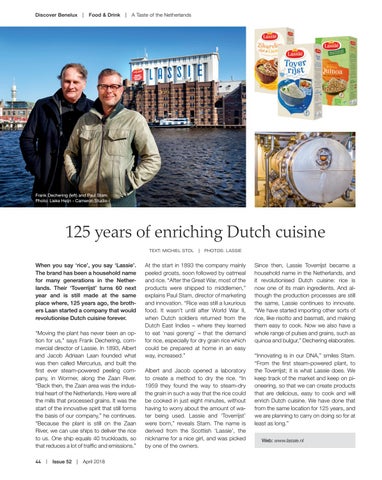
Lassie Read more from page 44 Lassie has been a household name for many generations in the Netherlands and next year their ‘Toverrijst’ will turn 60.
QARC Read more from page 45 Produced from start to finish at a dairy farm, Qarc’s quark is as pure as it comes and with a delightful taste to boot.
Queal Read more from page 58 With their mixture of whey and soy proteins, oats and all kinds of flavours, Queal offers powders for shakes, nutrient bars and boosters.
Chocing Good Read more from page 49 Ever wanted to sink your teeth into a wrench, a claw hammer or a paint brush and just eat a piece of it? Chocing Good make edible versions using dark, rich, Belgian chocolate.
juiz~s Read more from page 50 With more than 12 different flavours and a ratio of around 70 per cent vegetables and 30 per cent fruit, the juices from juiz~s are delicious and healthy.
Black & Bianco Read more from page 51 Wine and prosecco brand Black & Bianco is taking the Benelux by storm thanks to its fresh, innovative tastes and stylish packaging.
Twisted Jams Read more from page 58 The tasty jams and chutneys made by Twisted Jams will not only contribute to the wellbeing of your tummy, but also to a healthy, sustainable economy.
Kanti Saus Read more from page 60 We caught up with Gillie Melchiot, the man behind the genius that is Kanti noodle sauce.
YAYA Kombucha Read more from page 60 Kombucha has been around for over 2,000 years and is making a serious comeback. YAYA Kombucha is the leading Kombucha brewery in the Netherlands.
Banketbakkerij Maris Read more from page 52 Established in 1972, Banketbakkerij Maris are specialists in making pure, honest and delicious butter and almond paste cookies.
Bocca Coffee Roasters Read more from page 53 Sourcing the highest quality beans and latest roasting technologies, Bocca Coffee Roasters craft exceptional coffee like no other.
Issue 52 | April 2018 | 35
Discover Benelux | Food & Drink | A Taste of the Netherlands
Sweet and salty goodness TEXT: BAS VAN DUREN | PHOTOS: VENCO
Cheese, windmills and clogs: there are things that will always be associated with the Netherlands. But if you are not from the country itself, something you might not instantly think of is liquorice - or ‘drop’ as it is known in the Netherlands. Still one of the country’s most popular treats, with an average consumption of over four pounds per person, per year, not a single other country’s volume of consumption comes close. Much of the liquorice consumed in the Netherlands comes from Venco; for decades the market leader and with a rich history rooted in Dutch ground and part of the country’s culture.
Cough medicine If you are looking for the beginnings of Venco, you have to dig deep. The ground36 | Issue 52 | April 2018
work was laid in 1878 when Gerrit van Voornveld opened a shop in Amsterdam, selling cough medicine comprised of liquorice root, gum arabic, spices and sugar. The concoction was a hit, especially since the Netherlands, and Amsterdam in particular, was struck by a flu epidemic. Long lines formed at Van Voornveld’s shop and before long the medicinal aspects of his liquorice and peppermint were eschewed, making way to sell the products as confectionary. The company was sold to the Dieperink brothers, who christened the brand ‘Venco’ (a combination of ‘Voornveld’ and ‘co.’). Its growth was unstoppable after World War II and with Amsterdam incapable of providing more space, the factory now resides in Roosendaal, with their office in Oosterhout, both in the south of the Netherlands. Since 2000 it has been part of Swedish confectionery giant Cloetta.
Typically Dutch Despite having Swedish owners, Venco is about as Dutch as brands come, having a brand awareness of 98 per cent and dominating the liquorice market with a share of 30 per cent. “The fact our liquorice is passed on from generation to generation is what really makes us proud,” starts Bob Postma, Cloetta Holland’s marketing manager in Oosterhout. “If your brand exists for this long, it starts to become cultural heritage with specific types of our candy etched in people’s brains.” Postma takes their chalk for example; a small piece that resembles actual chalk, but is in truth a roll of liquorice, stuffed and coated with peppermint. “That is still the most favoured type of liquorice among our customers and we think part of that is its appeal to our culture. We create liquorice in the form of our clogs, cargo bikes
Discover Benelux | Food & Drink | A Taste of the Netherlands
and other items that recall scenes from the Netherlands, and our brand is without a doubt the first one advised to tourists who want to try out some liquorice.”
New flavours Like the famous Dutch footballer Johan Cruijff once said: ‘stagnation means decline’ and at Venco they are adamant on producing new types of candy with new flavours. A process that can happen twofold: either consumer research culminates into completely new ideas, or the innovation department comes with a breakthrough idea by itself. Postma: “In the case of the former, there’s a panel we ask questions like ‘what are your candy needs?’, our innovators are asked ‘can you make this work?’ and then we get back to the
panel with a sample. If it’s a hit, release it unto the market. This process is what got us our much beloved liquorice-fruit duo that started with a person wondering if a combination of the two flavours could work. We also own wine gum brand Red Band, making the realisation of the treat possible almost 20 years ago. It is still without a doubt one of our highlights.” As for products from their own innovation department, Postma points at the Venco Tikkels that are hard on the outside, soft on the inside. “A unique taste experience that is a mainstay of the liquorice shelves. We keep innovating that particular brand with new flavours such as a salmiakliquorice combination. By constantly surprising our customers, we see a commitment that’s really worth the effort.”
For anyone With the level of commitment Venco sees, it comes as no surprise the brand is well-liked by people of all ages, even the younger ones, despite the company explicitly not marketing to them. Postma: “We signed a covenant with other confectionery companies to not advertise to kids under the age of 13, putting a brake on child obesity. For anyone above that age, we hope to be a high note of the day. We are a proud brand with a rich history and as a name that is associated with Dutch culture, we will always try to outdo ourselves.”
Web: www.venco.nl
Issue 52 | April 2018 | 37
Discover Benelux | Food & Drink | A Taste of the Netherlands
Genever, the way it should taste TEXT: XANDRA BOERSMA | PHOTOS: ONDER DE BOOMPJES DISTILLERY
Did you know that the juniperflavoured liquor Genever used to be known as ‘Dutch gin’? Using all natural ingredients and produced completely in-house, you could say that the Genever made by Onder de Boompjes Distillery in Schiedam (founded in 1658), truly offers a taste of the Netherlands. In their words: “The only thing we outsource is transportation.” “Van de korrel tot de borrel,” laughs owner Jean-Paul Batenburg. Roughly translated, this means ‘from the grain to the drink’, highlighting the company’s strong involvement in all aspects of production. “It’s our signature. To us, the most important thing is quality, so we don’t use artificial ingredients like flavourings or dried fruit. Instead, there are three people peeling 100 kilogrammes of fruit twice a month and our 38 | Issue 52 | April 2018
botanicals are carefully selected from various suppliers around the world.” Only the best available is good enough.
Genever, the authentic way Of course, the story does not stop there. The Maltwine is also homemade, in a process perfected by the master distillers of Onder de Boompjes. There are very few distilleries left in the Netherlands that distill their own Maltwine. “We make Genever the old fashioned way, the way it was meant to be made. We use the mill next to our distillery in Schiedam to make the malt and rye, and create the batter ourselves as well.”
Genever, called ‘Holland Gin’ or ‘Dutch Gin’ at the time. After the increasing popularity of gin on the rising cocktail scene, more bartenders started to show an interest in the mother of all gins – Genever. That put it back in many famous cocktail recipes.
Taste the difference
The cocktail scene
You can distinguish the good Genever from the bad by checking the percentage of Maltwine, Batenburg explains. “In the supermarket version you’ll find one, maybe two per cent Maltwine content. Our Genever contains 10 per cent and our Maltwine Genever even up to 98.5 per cent. You can taste the difference. Pure malt wine can be compared to single malt whiskey, it tastes like rye and barley.
Back in the olden days there were lots of Genevers like this. But that was then. Many cocktail ‘classics’ were originally made with
“The challenge for the Dutch distilleries is to build the category again and explain to
Discover Benelux | Food & Drink | A Taste of the Netherlands
bartenders and consumers what a beautiful product it is, and that our complete heritage of travelling and trading can be found in these products - all the botanicals used in our Genevers were traded by the VOC (Dutch East India Company) at that time. That’s why we make Genever the way it was meant to taste.”
New techniques for cocktails This unique Gastro Gin is suitable for your everyday gin and tonic, but was created for another purpose. “We developed new methods regarding cocktail making, using fruit and vegetable juices, foam, and other things that are new in the cocktail scene and are techniques that come from
the world of gastronomy. To create this, we will bring the chefs and bartenders together and create new flavours and styles. It’s turning out very well already.” Well, we cannot wait to have a taste ourselves! Web: www.onderdeboompjes.eu
Experience the process Batenburg and his team also organise exclusive ‘experience’ tours. Once a month, people can take a look behind the scenes and see how the Genever is created. “It helps in getting people to understand the process and the product. And see why they have to pay more for a quality product like this. It’s fun to notice that they don’t mind the price as much after they’ve seen what goes into producing a bottle.”
A unique Gin called ‘Gastro Gin’ There is another product Batenburg is very passionate about: a new gin formed as a result of a collaboration between Onder de Boompjes Distillery and renowned chef Jonnie Boer of the three Michelin starred restaurant De Librije. This special co-production resulted in a next-level gin. “Gastro Gin, we call it. It’s a whole new product that I think will make a lot of people very happy.”
Issue 52 | April 2018 | 39
Discover Benelux | Food & Drink | A Taste of the Netherlands
‘It is not just a cooker, it is part of a lifestyle’ TEXT: MICHIEL STOL | PHOTOS: BIG GREEN EGG
Beautiful dishes, slow cooked to perfection: it is what most of us desire and what we all deserve. This passion and drive for good, tasty food started a revolution in cooking. It began in the US – when Big Green Egg Inc. created its iconic green, egg shaped slow cooker – and has spread all over world. “The EGG has become part of a lifestyle; a community of food lovers,” says Wessel Buddingh’, owner of Big Green Egg Europe. From top chefs to home cooks: we all want the meat and fish we prepare to be as juicy and tasty as possible. “If you don’t control the heat properly, you risk the meat becoming dry and losing its 40 | Issue 52 | April 2018
taste,” says Buddingh’. “Thanks to our iconic design and heat resisting ceramics, there is virtually no heat loss or any outside temperature influence that will dry out the meat, no matter if you cook it for 20 minutes or 20 hours.”
A long history The concept of the Big Green Egg is not new. In fact, the principle of cooking meat in wood-fired, dome shaped clay ovens goes back several millennia, especially in Southeast Asia. It was there that the founder of Big Green Egg, Ed Fisher, was inspired to create the best possible version. “Fisher was a Marine Lieutenant stationed in Pearl Harbour, Hawaii. There, he saw the local population use these Kamado ovens,
and tasted the perfect meat that they produced. He brought this idea back to Atlanta, Georgia where in 1974, he opened the Big Green Egg store and sold these clay cookers based on the same design and materials that had been used thousands of years ago,” Buddingh’ explains.
‘Out of this world’ quality Even though people loved the EGGs, the quality of the cookers was not optimal. The search for better materials and higher quality coincided with NASA’s Space Shuttle program. “Fisher went to NASA and was allowed to use a commercial type of the ceramics used to protect the space shuttles,” Buddingh’ continues. Fisher and his team also kept on working to find ways to
Discover Benelux | Food & Drink | A Taste of the Netherlands
improve the design. The result was a far superior cooker that is stronger, more durable and provides better heat insulation than anything else on the market. “Because of this, it also uses far less charcoal than a regular barbecue or cooker.” Buddingh’ has been head of the European division of Big Green Egg since 2001, from their headquarters in De Lier, in the west of the Netherlands. “From here, we ship to 44 countries in Europe.” The cooker caught on quickly, especially when renowned master chefs started to use them to prepare courses in their restaurants.
A community of food lovers “The Big Green Egg is not just a barbecue or a cooker. It is part of a community of food lovers, devoted to enjoying high
quality food that they cook themselves,” explains Buddingh’. Because the Big Green Egg contains its heat and has an easy-to-use thermostat, you can cook anything at 70-350 degrees Celsius. “When you cook celeriac for two and a half hours at 150 degrees Celsius, the heat loss is 0.03 per cent. So the celeriac won’t dry out, keeping all the flavours inside. And thanks to the charcoal, it gives it that smoky taste that makes it even better.” The EGG is not just for slow cooking meat or fish. You can make excellent vegetarian dishes and even make pizzas with it, thanks to its temperature range. With more than 140 different accessories, you can personalise and professionalise your cooker. “They range from cast iron cooking trays to tableware and everything in between.”
The company actively helps its community and on the website you will find recipes for all kinds of dishes. People can leave their own suggestions or can ask for help when they are cooking. “And every year we organise the Big Green Egg Flavour Fair, where thousands of food lovers come together to enjoy food, learn about new cooking techniques and food trends, and follow inspiring workshops and masterclasses. Of course, you can taste all kinds of slow cooked foods,” smiles Buddingh’. Everybody who loves high-quality food that is full of flavour - and wants to be able to make it themselves - has the opportunity to do so with the Big Green Egg. “Once you have tried it, you will understand why so many people use nothing else.” Web: www.biggreenegg.eu
Issue 52 | April 2018 | 41
Discover Benelux | Food & Drink | A Taste of the Netherlands
A love for Mexican gastronomy resulted in the idea to create a traditional tortilla bakery in the Benelux.
T O R T I L L E R Í A TA I YA R I :
A taste of Mexican gastronomy TEXT: ELLA PUT | PHOTOS: TORTILLERÍA TAIYARI/WHERETHEFOODIS/CULINESSA
Established in 2016 out of a love for Mexico’s rich culture and gastronomy, Taiyari became the first traditional tortilla bakery in the Netherlands, crafting fresh organic corn tortillas, completely made from scratch, using only certified organic and non-GMO corn. Founders Kelly van Harten (from the Netherlands) and Karla Plancarte (from Mexico) travelled to Karla’s hometown of Mexico City where they learned the craftsmanship of making fresh corn tortillas in a local tortilleria. “The original idea was to open a Mexican taqueria, but because there were no authentic corn tortillas available, we decided to start from there and focus on fresh corn tortillas first,’’ explains Kelly. ‘’We 42 | Issue 52 | April 2018
wanted to introduce a high-quality tortilla made from organic ingredients and without any preservatives.’’ The corn tortillas made by Taiyari are naturally gluten-free, salt-free and vegan.
Mesoamerican superfood The story of the corn tortilla originates more than 3,000 years ago, to the ancient Aztecs and Mayas, who nixtamalised corn and stoneground it with volcanic stones to make fresh corn dough. By cooking the corn in a bath with slaked limestone, an alkaline connection was made for the body to absorb the created nutrients. ‘’It can be seen as a Mesoamerican superfood,’’ explains Kelly. A good analogy was once made by Mexican chef Gerardo, who said that a
real corn tortilla made from scratch can be compared to freshly brewed coffee from whole beans, while an industrial tortilla can be compared to instant coffee. “By using real corn instead of cornflour, we protect the natural nutritional value of the corn.”
Discover Benelux | Food & Drink | A Taste of the Netherlands
It comes as no surprise that the name Taiyari can be traced back to Mexico. In the Western part, where the native Wixaritari people have their sacred land, Kelly and Karla met each other for the first time in the city of Guadalajara. Taiyari means ‘our heart’ or ‘our essence’, referring to the culture of the Wixaritari people. “With the corn tortilla being the heart of Mexican gastronomy, we found a name that perfectly characterised our project.”
Cultural heritage The traditional techniques used to make corn tortillas are, together with Mexican gastronomy, part of the UNESCO list of Intangible Cultural Heritage. These traditions are mostly threatened by industrialisation. Taiyari is proud to represent these traditions and keep them alive, while promoting Mexican gastronomy within the Benelux.
Since the introduction of the authentic corn tortilla, Taiyari even found their way to famous Michelin-star restaurants in the Benelux. “The Jane Antwerp, Restaurant Rijks, Benoit Dewitte, De Kromme Watergang, Mos Amsterdam and Ron Gastrobar have all worked with our product,’’ smiles Kelly.
Bakker (Pure C) and Edwin Vinke (De Kromme Watergang), who will create highend tacos in a pop-up taqueria.
Furthermore, the bakery supplied Tomorrowland, one of the world’s largest electronic dance events, with their tortillas during the 2016 and 2017 editions.
A final thought: Why are the tortillas so popular in the Benelux – a region known for its love for chocolate and cheese? “I would say it is the renewed love and appreciation for craftsmanship, which is the essence of our work. Together with the increasing demand for fresh and pure products, and the fact that Mexican cuisine is booming in Europe.’’
Michelin-star chefs After two years in business, the future looks bright for Taiyari. ‘’We have new customers weekly and sometimes it is hard to keep up,’’ says Kelly. This summer, the bakery will team up with a number of Michelin-star chefs during the festival WECANDANCE in Belgium. Among the chefs are Syrco
Also, the DoubleTree by Hilton in Amsterdam has approached the bakery. ‘’Next month we will be part of their menu as well,” says Kelly with pride.
Web: taiyari.nl
Issue 52 | April 2018 | 43
Discover Benelux | Food & Drink | A Taste of the Netherlands
Frank Dechering (left) and Paul Stam. Photo: Lieke Heijn - Cameron Studio
125 years of enriching Dutch cuisine TEXT: MICHIEL STOL | PHOTOS: LASSIE
When you say ‘rice’, you say ‘Lassie’. The brand has been a household name for many generations in the Netherlands. Their ‘Toverrijst’ turns 60 next year and is still made at the same place where, 125 years ago, the brothers Laan started a company that would revolutionise Dutch cuisine forever. “Moving the plant has never been an option for us,” says Frank Dechering, commercial director of Lassie. In 1893, Albert and Jacob Adriaan Laan founded what was then called Mercurius, and built the first ever steam-powered peeling company, in Wormer, along the Zaan River. “Back then, the Zaan area was the industrial heart of the Netherlands. Here were all the mills that processed grains. It was the start of the innovative spirit that still forms the basis of our company,” he continues. “Because the plant is still on the Zaan River, we can use ships to deliver the rice to us. One ship equals 40 truckloads, so that reduces a lot of traffic and emissions.” 44 | Issue 52 | April 2018
At the start in 1893 the company mainly peeled groats, soon followed by oatmeal and rice. “After the Great War, most of the products were shipped to middlemen,” explains Paul Stam, director of marketing and innovation. “Rice was still a luxurious food. It wasn’t until after World War II, when Dutch soldiers returned from the Dutch East Indies – where they learned to eat ‘nasi goreng’ – that the demand for rice, especially for dry grain rice which could be prepared at home in an easy way, increased.” Albert and Jacob opened a laboratory to create a method to dry the rice. “In 1959 they found the way to steam-dry the grain in such a way that the rice could be cooked in just eight minutes, without having to worry about the amount of water being used. Lassie and ‘Toverrijst’ were born,” reveals Stam. The name is derived from the Scottish ‘Lassie’, the nickname for a nice girl, and was picked by one of the owners.
Since then, Lassie Toverrijst became a household name in the Netherlands, and it revolutionised Dutch cuisine: rice is now one of its main ingredients. And although the production processes are still the same, Lassie continues to innovate. “We have started importing other sorts of rice, like risotto and basmati, and making them easy to cook. Now we also have a whole range of pulses and grains, such as quinoa and bulgur,” Dechering elaborates. “Innovating is in our DNA,” smiles Stam. “From the first steam-powered plant, to the Toverrijst; it is what Lassie does. We keep track of the market and keep on pioneering, so that we can create products that are delicious, easy to cook and will enrich Dutch cuisine. We have done that from the same location for 125 years, and we are planning to carry on doing so for at least as long.” Web: www.lassie.nl
Discover Benelux | Food & Drink | A Taste of the Netherlands
Photo: Jenny van Gompel
Getting your just desserts TEXT: BAS VAN DUREN | PHOTOS: QARC
The Dutch are known for the many wonders they can do with dairy products and that definitely includes quark. With its creamy texture and zesty flavour, ‘kwark’ – as they call it in the Netherlands – is a culinary staple and one such producer is the aptly named Qarc in Bladel, near the Belgian border. Produced from start to finish at a dairy farm, Qarc’s quark is as pure as they come and with a delightful taste to boot. The beginnings of Qarc read as something of a fairy tale. As the daughter of dairy farmers, Leonie van Zuilichem worked with cows from a young age. As a student, she studied business economics, but that did not make her happy. What did make her happy, however, was working months on end at dairy farms in Norway, Ireland and Denmark, a time she describes as ‘almost utopic’. Back home in Bladel, her parents’
farm had the space to do something new and Leonie came up with business plans. Thoughts were put into ideas for a theme park or a karting circuit, but the love of dairy never left Leonie. In 2012, Qarc was born. With a dairy farm that has a little over 70 cows that are fed by GMO-free homegrown crops, the foundations were laid for Qarc. With parents Wim and Mieke running the dairy farm and even grandpa Cor helping in the summertime, the family company is small and flexible. With Qarc, Van Zuilichem produces yoghurt, ‘hangop’ (Dutch curd) and mainly quark, the latter starting with nothing more than a pan and some milk. Fast forward five years and Qarc is expanding its work space, as well as delivering to several supermarkets, meal box companies and care institutions. Leonie now runs Qarc together with husband Roel
and they will take over the dairy farm in the near future as well. The secret to Qarc’s success is, according to Van Zuilichem, the taste. “We use fresh milk from our own cows and pure fruits instead of compotes or aromas. The cookie crumble crust is made each week by a local baker and all our desserts are free from additives. “We have our proven hits with natural, strawberry, raspberry and forest fruits. There’s a limited edition each season with favourites like poached pears, passion fruit and even ginger, all neatly packed with an eye to detail. Our nifty sleeves designed by Jan van der Asdonk have little fruits in their logo and small things like that are what makes Qarc tick.” Web: www.qarc.nl
Issue 52 | April 2018 | 45
Discover Benelux | Food & Drink | A Taste of the Netherlands
Easy meal solutions for busy people TEXT: BAS VAN DUREN | PHOTOS: JIMMY JOY
What started out in the bedroom of a young entrepreneur became meal replacement producer ‘Jimmy Joy’; a brand that started in 2014 and quickly rose to fame. They were the first to introduce nutritionally complete meal replacement shakes in Europe, and the media quickly picked up on it. The bedroom was traded in for a warehouse in Amsterdam, from where the company now ships its nutritionally complete shakes and bars to 86 different countries. A ready-to-drink variant will soon hit stores. Friends Sam Rohn and Joey van Koningsbruggen got the idea for nutritionally complete shakes and bars after hearing about the meal replacement craze in the United States. The product would have been a godsend for them as they were either going for a quick, unhealthy meal or skipping dinner altogether because their busy lives did not allow time for cooking dinner. The only problem was, that it was not available in 46 | Issue 52 | April 2018
the Netherlands. But, instead of ordering the product from overseas, they decided to create their own. Rohn: “As it is a whey and soy-based powder, the formula itself wasn’t that complex, but determining the right dosage and finding the right ingredients was. Nevertheless, we pulled through and took 24 orders in the first month, with demand only growing. By the following month, we had 500 packages to ship out and before a year was gone, we had over 20 foreign customers. Within the first 22 months, we had a revenue of five million euros with just our (Plenny) shakes. In 2016 we launched our (Twenny) bars, and later this year we’ll launch our ready-to-drink meals, that come pre-mixed and will be available at supermarkets, gas stations, and office canteens. ” Turning a profit in such a short time period is unheard of in the Netherlands, but Rohn knows why Jimmy Joy has made such an impact: “It’s a nutritionally complete product that is produced under the
supervision of professional food technologists and one that fits perfectly into any diet, although it’s not necessarily designed to be the only thing you consume. We’re there for when you don’t have time for breakfast or lunch. But we’re also there for people who need a large intake of calories, like (professional) athletes.” But most of all it is the taste of the product that sells itself. “There’s something for everyone, from our standards like banana and strawberry, to the limited edition flavours such as gingerbread and apple. It’s not just aromas we put in there, but dried fruit as well, meaning you have a much more pronounced taste. We offer a vegan variant where the whey is substituted by a rice protein. “We also work together with healthcare professionals and clinics to provide complete nutrition for those in need, and we look forward to what the future brings in this regard.” Web: www.jimmyjoy.com
Discover Benelux | Food & Drink | A Taste of the Netherlands
James Russell Reid.
A game-changing range of new ‘Smartdrinks’ TEXT: ANNA VILLELEGER | PHOTOS: KONNEKT SMARTDRINKS
“Amino acids form the basic building blocks for any life on earth,” begins the entrepreneur. Helping to build tissues, organs, muscles, skin and hair, our bodies need 22 types of amino acids, each with their own specific function.
In collaboration with renowned scientists, Reid came up with a unique product formulation, and the first three Smartdrinks were born. The ‘Focussing’ flavour contains amino acids which help provide enhanced concentration and alertness – a good alternative to endless cups of espresso during board meetings. Next up is ‘Enduring’, designed to ensure optimal performance and recovery after physical exertion and perfect for fitness fans. Meanwhile, the ‘Relaxing’ flavour helps promote a good night’s sleep. “You could have one or two of these before a flight to help you nod off,” points out Reid.
As a sports fanatic, Reid began searching the internet to find a health drink rich in amino acids. He was disappointed to find only one product, which was also sugary and high in caffeine. “So I decided I should create my own healthy version,” he explains. “I’m not a scientist, but for two and a half years I dedicated entire days and nights to reading everything I could find about amino acids.”
Smartdrinks proudly contain 100 per cent natural ingredients, including a natural sweetener from the stevia plant. Almost all sugars release energy in the mouth, which results in the notorious ‘sugar rush’ and subsequent slump. However, Reid and his team discovered isomaltulose, a healthy substitute for unhealthy sugars which slowly releases energy in the intestines, rather than the mouth.
Innovative, healthy and hip: a recently launched line of beverages from new Dutch brand Konnekt Smartdrinks looks set to shake up the health drinks sector. Company founder James Russell Reid had the idea in 2014, pursuing his dream to formulate a range of refreshing Smartdrinks containing health-boosting amino acids.
Having successfully produced the first large scale batch of Konnekt Smartdrinks in October last year, the brand has already received a great deal of interest from restaurants, sports clubs and hotels in the Netherlands, including NH Hotels. Drinks are sold in trays of 24, and come in aluminium cans or bottles. The light packaging has earned kudos for both its slick design and environmentally friendly properties. With the potential to go global, Reid is already planning expansion into countries including the UK, US, Dubai, China and India. “It’s lift off!” he smiles.
Konnekt Smartdrinks - 100 per cent natural ingredients - Healthy amino acids - Natural energy addition - Kosher & Halal certified
Web: www.konnektsmartdrinks.com
Issue 52 | April 2018 | 47
Discover Benelux | Food & Drink | A Taste of the Netherlands
Making delicious products from leftovers TEXT: MICHIEL STOL | PHOTOS: POTVERDORIE!
Did you know that nearly a third of all the food that is being produced each year is thrown away? And that of all the mangos that are grown, only two per cent are consumed? A lot of the food is thrown away by supermarkets and wholesalers. When Charlotte Heine saw this happening at a supermarket in her hometown of Amsterdam, there was only one thing she could think: ‘Potverdorie!’ (‘By golly!’). “Of course, I already knew it was happening, but when I saw it with my own eyes, I couldn’t believe it,” says Heine of the time she witnessed an employee take out seemingly fine looking fruit to the back of the supermarket in 2015. The fruit was not rotten, but it no longer looked perfect. “When I asked if I could take it with me to make new products, I was referred to the store manager, who was very positive about the idea. From that moment on, we started to collect the fruit every week.” Along with a friend, Joep Weerts, Heine started to make jams and chutneys, using and combining the leftover fruits. 48 | Issue 52 | April 2018
“Potverdorie! started in our kitchen. Together we would come up with recipes for good, tasty products. We are not cooks by trade, we just like good food and new flavours,” smiles Heine. Soon afterwards, it was no longer just that one supermarket that donated fruit. “We started to look for more places where they throw away food, like markets and such. Then we boldly went to the Food Center Amsterdam, a wholesale market, and told them about Potverdorie!. They were very enthusiastic about the idea. Now we receive whole pallets of fruit,” reveals Heine. More than a year ago, they moved in with another sustainable food producer, in neighbouring Zaandam. “This a professional and certified kitchen, so the production is up to standards. We still make all the jams, chutneys, jelly and pickles ourselves – sometimes with the help of friends.”
ing to make some of the products more permanent because people like them so much. That is why we are talking with producers,” Heine explains. “When they harvest, a lot of the produce is discarded because it doesn’t have the right shape, size or colour, even though there is nothing wrong with the quality. It can still be used to create tasty, high quality products.” Potverdorie! products are sold at more than 50 delicatessens in and around Amsterdam and throughout the Netherlands. “Large caterers are finding us now, proving that people care as much as we do about wastage and want to help us grow, so that everyone can enjoy our products.” Heine concludes: “There is too much food wastage. We want to put a stop to that, and create delicious jams and chutneys in the process.” Potverdorie! - less waste, and a better taste.
The Potverdorie! product range varies, depending on the fruit that is donated. “It gives us the chance to come up with new recipes each week, but we are also look-
Web: www.potverdorie.nl www.instagram.com/potverdorienowaste
Discover Benelux | Food & Drink | A Taste of the Netherlands
Tools you can nibble TEXT: BAS VAN DUREN | PHOTOS: CLAUDIA WAGEMAKERS
Ever wanted to sink your teeth into a wrench, a claw hammer or a paint brush and just eat a piece of it? Thanks to chocolatier Conny Augspurger, you actually can. That is; if you do not mind that the aforementioned items are entirely made out of dark, rich, Belgian chocolate. With her venture ‘Chocing Good’, Augspurger is capable of recreating almost anything with chocolate and as such, these pieces of confectionary are great for business gifts, promotional items and more. A bona fide hit that has seen her business increasing year after year. Anyone setting foot inside Chocing Good’s factory in the Dutch city of Dordrecht, near Rotterdam, will have no reason to mistake the business’s core product. The nutty fragrance of dark chocolate is unmistakable and everywhere you look there
are stacks upon stacks of molds that are used to make the confectionary. Owner Conny Augspurger showcases the whole system, where the melting of the chocolate is the only mechanical part of the course. Items that are to be recreated are put in a polycarbonate mold. The hardened molds are then filled with chocolate, put in a freezer and when cooled, the chocolaty goodness gets given a finishing touch with edible paint. Augspurger herself came up with the idea when she and some friends wanted to sell food and drinks at Dordrecht’s Christmas market, but were not allowed due to arrangements made between the local government and catering companies. “We were allowed to sell chocolate and my mind went to the Christmas markets in Cologne where you have these stalls where industrial tools made out of chocolate are
sold. I loved that idea so I reached out to a German woman who makes those tools and before long, we were selling her candy at the market and elsewhere.” The Dutchwoman eventually decided to start her own business altogether as Chocing Good, got all the necessary equipment and made, among other items, trowels, handcuffs and even a complete windmill out of Callebaut’s famous dark chocolate. “It would be weird if I was to make something pretty that didn’t taste equally as good. With a touch of vanilla, their chocolate is a bit more accessible for those who claim they ‘don’t like dark chocolate’. There’s less fat as well, making it easier for us to paint the objects and it has a shelf life of more than two years.” Web: www.chocinggood.nl
Issue 52 | April 2018 | 49
Discover Benelux | Food & Drink | A Taste of the Netherlands
Juice that is worth the squeeze TEXT: BAS VAN DUREN | PHOTOS: JUIZ~S
Getting your daily dose of vitamins and other nutrients can be a hassle, especially when we are all used to cooking our dinner - which results in a loss of vitamins. Enter cold-pressed juices where raw vegetables and fruits are used as the basis for a drink that contains all the powerful stuff in a bottle. It is instantly drinkable, a time-saver and has all the benefits of a complete meal. One such expert on cold-pressed juices is juiz~s in The Hague, a company that provides juices through its webshop and delivery system. A busy job, taking up sports and aspiring to a healthy lifestyle: sometimes it is best if you not only own a business, but are also exactly the type of person that your company caters to. Take Sylvia van Alphen for example, who founded juiz~s by rebranding an existing line of cold-pressed juices. She explains: “I was doing yoga in The Hague and the owners of the school had 50 | Issue 52 | April 2018
their own brand of juice. They asked me to do the sales and before long asked me if I wanted to take over. I took that leap of faith; quit my job, rebranded the product to juiz~s and retrained myself to become a fully licensed nutrition consultant.” Van Alphen took the business to another level, greatly increasing the production and using technology to improve the juices. “Take for instance the shelf life: with raw vegetables and fruits, the juices used to be preservable for up to two days. Now with high pressure processing, the oxygen gets removed from the juice, leaving no room for bacteria and increasing the shelf life to four weeks at most, making it that much more suitable for businesses and commuters.” With more than 12 different flavours and a ratio of around 70 per cent vegetables and 30 per cent fruit, the so-called ‘liquid salads’ from juiz~s are low in sugar and
have attracted the attention of Michelin chef Niven Kunz. “We keep developing new flavours and the Niven line is one with extra vegetables. There’s also variant for kids we concocted with children in elementary schools, making it easier for them to get the necessary veggies,” explains Van Alphen. “It’s fun to come up with new things and we’re not shy to help others gain access to our healthy juices.”
Web: www.juizs.nl
Discover Benelux | Food & Drink | A Taste of the Netherlands
Owners Coen Scholder and Jesse Vermeer.
Have a glass of class TEXT: ELLA PUT | PHOTOS: BLACK & BIANCO
Wine and prosecco brand Black & Bianco is taking the Benelux by storm thanks to its fresh, innovative tastes and stylish packaging. Black & Bianco was launched five years ago by owners Coen Scholder and Jesse Vermeer – a viticulturist - after a year of preparation. “We tasted the most incredible wines from all over the world. But with so much on offer it can be challenging to find the perfect wine. So, we wanted to create a high quality wine brand with a recognisable aesthetic and an affordable price,” Coen explains. “We realised that we buy and even taste with our eyes. Stylish product packaging is a must. However, Jesse and I were missing a wine brand with a fresh and hip look, especially for a younger audience.” This resulted in the innovative and unique idea that made Black & Bianco into the
success it is today, with their wine, prosecco and cocktails on sale in beach clubs from Scheveningen and Knokke to Curaçao. Black & Bianco can also be found at Albert Heijn and on the website Wijnvoordeel.nl. Each bottle, from the newest Porto Tonic to prosecco, has its own special and creative packaging relating to its taste, aroma and colour. Furthermore, the bottles are always black and white, making them recognisable everywhere you go: you buy what you see. From its winterish red wine, perfect for a cosy night by the fireplace, to the dazzling Red Ritz, the brand offers something for all tastes and all seasons. And with summer coming up, it is the perfect time of year to go out and enjoy the first beams of sunlight on the terrace with a good bottle of Black & Bianco. Selected Côtes de Provence rosé and white
Chardonnay are best enjoyed while socialising, dancing or relaxing. A big hit in the upcoming months will undoubtedly be the brand’s Limonsecco. A delicious mix of prosecco and limoncello, it should easily create that ‘bare feet in the sand at sundown’ feeling. Black & Bianco’s smart and stylish packaging also has a bonus sustainable touch. “We often hear that people like to take our bottles home with them from restaurants. That means the restaurant avoids waste and people use the bottles as decoration. They wonder how packaging can be this beautiful.” Black & Bianco: the ultimate way to experience a glass of class.
Web: www.blackandbianco.com
Issue 52 | April 2018 | 51
Discover Benelux | Food & Drink | A Taste of the Netherlands
Taste the love for pure and honest cookies TEXT: MICHIEL STOL | PHOTOS: MARIS BAKERY
You will find them in almost all the bakery departments of Dutch supermarkets and retailers: the pure and honest butter and almond paste cookies of Maris Bakery in Middelharnis, in the southwest of the Netherlands. “Our whole team loves to make the best cookies,” smiles owner Ronald Maris. Maris Bakery has been around since 1972, when Ronald’s father founded the company. “At first it wasn’t my intention to take over the bakery, even though the passion for making cookies was already there,” explains Maris. After talks with his father about which course the bakery should take, Ronald did end up running the company in 2006, making it into the success it is today. “My father was a true market baker, I wasn’t. So we shifted the focus to retail. Now our cookies are sold all over the country. And we still cater for market bakers as well.” The company has grown 52 | Issue 52 | April 2018
significantly over the years. “We started with a 280-square-metre space, this year we will be in a 1,700-square-metre space. And over the years, our team has grown to 16 employees.”
Combining flavours The bakery produces butter cookies and almond paste cookies. “We only use 100 per cent almond paste, without any additives. It is the only way to get that true traditional flavour everybody knows and loves,” says Maris. He also works a lot on new recipes. “It is about combining flavours: you try new things, putting this and that together. Then, you see if it works, and also if you can produce it in larger batches. “We work a lot with suppliers of our raw materials, to get the best recipes. We also work with suppliers of our production machines, to be as innovative as possible.” The Maris team comprises a combination of Dutch and Polish employees. “It
is a very versatile and professional team, which brings a lot of inspiration for new recipes. They really share my passion for cookies,” grins Maris. Although a lot of the production is automated, Maris still likes to work on the cookies manually. “We decorate the cookies by hand. So we can make them really personal and customised to our clients’ wishes. Besides that, we are also able to produce smaller batches. With a lot of bakers you have to order hundreds of boxes, whereas we can deliver orders from 50 boxes.” Maris concludes: “Everybody who has ever tasted our cookies, feels the passion the whole team has for making these authentic, pure products. It’s that extra ‘flavour’ that makes our cookies so tasty!”
Web: www.koekjesvanmaris.nl
Discover Benelux | Food & Drink | A Taste of the Netherlands
BOCCA COFFEE:
Love at first taste TEXT: BAS VAN DUREN AND ANNA VILLELEGER | PHOTOS: BOCCA COFFEE ROASTERS
The Bocca Coffee story began almost two decades ago in Ethiopia, when founder Menno Simons – then working as a trader of organic sesame seeds – stumbled across a hillside of beautiful coffee trees ripe with red cherries. It was love at first taste, and the start of a lifelong pursuit of coffee perfection. Sourcing the highest quality beans and using the most innovative roasting technologies, Bocca Coffee Roasters craft coffee like no other. Guided by his passion for premium quality, Simons founded Bocca Coffee in 2001. “I was enormously excited by everything that encompasses the flavour of coffee. That depends on so many factors, including the type of farmer, the altitude of the harvest, processing, fermentation, compost usage, transport, and so on,” he explains. Making the finest coffees accessible for those who truly care, Bocca is commit-
ted to making a difference, with responsible farming being a top priority: “The foundation for our coffee starts with knowing the source and having good relationships.” Bocca receives its high quality, traceable coffee from green coffee importers including Trabocca – also founded by Simons – and known worldwide for its excellent Ethiopian coffees. Bocca then uses its advanced roasting technology to supply roasted coffee to an array of high-end restaurants, bars, speciality coffee shops and offices in the Netherlands. There is something to suit all tastes at Bocca, with the brand offering seven yearround coffees, as well as seasonal ‘specials’ which are available for a limited time and come in very small lots. The brand’s first and most popular coffee is the delicately balanced ‘Full Blend’, with notes of date, caramel and lemon.
Bocca also has a partner in high quality tea, called April Tea, which specialises in pure and natural white, green, jasmine, oolong and black teas. The first Bocca flagship store opened in 2015 at Kerkstraat 96 in downtown Amsterdam; a spot where you can not only buy freshly roasted specialty coffee or sit down with a good cup, but where courses are given to catering staff and consumers. “The Kerkstraat is a place where we would like to demonstrate what’s possible with coffee, and how we feel it should be served. It is also an innovation centre, ensuring we remain at the forefront of the specialty coffee business.” In May the Bocca Barista School will also open, offering even more possibilities and customised training. To find out more head to www.bocca.nl
Issue 52 | April 2018 | 53
Discover Benelux | Food & Drink | A Taste of the Netherlands
Passion for making chocolate TEXT: BAS VAN DUREN | PHOTOS: JKV
JKV Chocolate Moulds and Machines is a family business with a history as rich as the chocolate it helps to create. Based in the southern town of Gilze in the Netherlands, three generations of the Koenen family are, as a reliable partner, responsible for supplying machinery that is necessary for SMEs in the chocolate industry, educating on the usage of the equipment, and supplying an astounding amount of moulds that are on display in what could easily be the Netherlands’ largest chocolate mould exhibition. Picture this: it is 1947 and chocolate is, right after World War II, becoming increasingly popular in Europe, partly due to American soldiers handing out food rations that included confectionary bars. It was around this time that Dutchman Jan Koenen 54 | Issue 52 | April 2018
founded JKV in Gilze, becoming the expert in metal and Bakelite moulds that gradually changed to plastic throughout the years. Now with son Peter and grandson Luca running the business, JKV sports not only an incredible collection of moulds, posters, tin storage cans and much more, it is also the place to be for using their own line of machines that are key in the process of making your own pieces of chocolate. Manager Margriet Brand, who has been with JKV for 35 years, shows the fabrication room where multiple machines are whirring and give off the sweet smell of chocolate. “This is our very own JKV Hermes line that we sell. It melts small chocolate pellets into one liquid mass and keeps it at exactly the same temperature. That’s for preventing the forming of crystals which in turn are lethal for getting the choc-
olate out of the mould. This way, you can be sure the chocolate comes out exactly the way you want it, without any bits and pieces breaking off.” Said moulds are fabricated by JKV themselves and there is not much they cannot do: from the usual tablets imprinted with company logos, to three-feet-high Easter bunnies and from kitchen cutlery to the standard bonbon forms, anything is possible at the company in Gilze. “It’s a great idea for promotional gifts or as a company outing to come over here and make these chocolate creations yourself. It’s a sheer pleasure to work with chocolate or see the exhibition with Peter Koenen as your guide, because every mould has its own story.” Web: www.jkvnl.com
Discover Benelux | Food & Drink | A Taste of the Netherlands
B I L LY ’ S … T H E O R I G I N A L A U S T R A L I A N P I E
TEXT: LORENZA BACINO | PHOTOS: BILLY’S BAKEHOUSE
Taking on the big boys of pie production Australians abroad yearning for a delicious meat pie often end up disappointed. So long-term Leiden resident, Australian Darren Handley, decided to bring a taste of home to the Lowlands and created Billy’s Bakehouse. “I wanted to make affordable, great-tasting meat pies that you bake yourself. A pie that would compete with the big boys of pie production: straight from the freezer to the oven to the plate, and in the shortest of times.” Something made from good quality minced meat, a light shortcrust base and a fluffy puff pastry lid. It could not be that difficult. Or could it? Darren could not find a single pie available for the consumer that fitted the bill. Son of a butcher and pie lady, but builder by trade, Darren approached the process without baking experience, allowing him to think outside the box. “Two years of research followed and with a simple change of ingredients and an even simpler change in the production process, I launched the final product,
giving the consumer the freshest baked pie on the planet.” In January 2017, Pierates (independent pie reviewers and judges of The British Pie Awards) took a delivery of an assortment of pies, and wrote the review Billy’s Bakehouse had been waiting for, leading the way for export to the UK. Darren’s unique combination cooks perfectly in about 20 minutes straight from the freezer, making it ideal for rugby and football clubs, cafés, bars and restaurants. And with proven results from steady growth in supermarkets and retail outlets, the future is looking bright at Billy’s. Darren Handley.
From the guys at Pierates: www.pierate.co.uk/2017/01/ billys-bakehouse.html E-mail: info@billysbakehouse.nl Web: www.billysbakehouse.nl Facebook: www.facebook.com/ australianpie
BUFFALO FOODS LIMBURG:
TEXT: CATHY VAN KLAVEREN | PHOTOS: BUFFALO FOODS
Innovative, high quality and animal friendly Mozzarella cheese is loved all over the world, and has been around for centuries. Real mozzarella is made from buffalo milk, which according to two gentlemen in the Dutch province of Limburg, is more versatile than you might think. Their company, Buffalo Foods, have set out to prove this. Founded in 2011 by Jan Seerden and John Probst, Buffalo Foods produces milk from Dutch buffalo herds and an array of high quality, animal-friendly products. Mozzarella is their number-one selling product, but Buffalo Foods also makes a type of feta cheese, and even yoghurt. “The girls do all the work,” exclaims Seerden, when he talks about the water buffalo. A notable claim, as Seerden makes it very clear that nature is not rushed when Buffalo Foods makes its various types of products. “At the buffalo farms, they don’t use anything to manipulate 56 | Issue 52 | April 2018
the animals into giving milk. It’s at their pace. You could say our products are slow food.” Seerden and Probst work with almost every buffalo farmer in the Netherlands. This collaboration ensures a production process which is as uniform as can be. “Our products have a ‘clean label’, which means we only use those ingredients the recipe requires. It means our cheese makers are perfectly skilled in making the product we want everyone to know. It’s for our customers to decide if they want to add their own personal flavour in the kitchen.” In the mood for a recipe involving mozzarella that differs from the traditional ‘caprese’? Seerden can offer some inspiration: “Instead of tomatoes and basil to complement the mozzarella, why not try raspberries and mint?” Discover more exciting recipes at www.buffalofoods.eu.
Photo: D&R fotografie
COCOA & CHOCOLATE PROCESSING Turn-key solutions from bean to bar
ROASTING
GRINDING
PRESSING
REFINING
Royal Duyvis Wiener B.V. P.O. Box 10, 1540 AA Koog a/d Zaan, The Netherlands, T. +31 75 6 126 126, F. +31 75 6 158 377, sales@duyviswiener.com
CONCHING
Discover Benelux | Food & Drink | A Taste of the Netherlands
Shakes, bars and boosters When Soylent hit the market years ago as the ultimate answer to meal replacement products, many others followed in its footsteps, creating their own take on what is one of the latest revolutions in the way we live. One such company is Rotterdam-based Queal, who make shakes, bars, and a booster, all of which focus on sustainability.
boosters. As a pick-me-up, the Queal ‘Flow’ is a nootropic that consists of mainly guarana and L-theanine. With the energy of the former and the soothing properties of the latter, you can reach a perfect flow state (hence the name) during work hours. Just like their shakes and bars, it contributes to a more effective way of living. Wolswijk: “Aside from all our products, we also create awareness. We provide as much
TEXT: BAS VAN DUREN | PHOTOS: QUEAL
information about our product and its properties as possible, not just its ingredients but the carbon footprint as well. Most meals, as well as flying regularly, leave a large carbon footprint, our products can help you compensate that with ease.” Web: www.queal.com/inflight
To call their product a total means of meal replacement is a bridge too far for Queal founder and CEO Floris Wolswijk, but it most certainly helps for those that lack the time for a fully realised meal and are quick to resort to instant pizzas and other unhealthy snacks. Wolswijk starts: “We at Queal have always looked at meal replacements as the type of nutrition that’s for people who don’t always have the time for a wholesome meal. Changing your habits can be really difficult, with Queal we believe you can take the first step.” With their mixture of whey and soy proteins, oats and all kinds of flavours, Queal offers powders for shakes, nutrient bars and something not seen at every meal replacement company:
The super power of sustainability TEXT: ELLA PUT | PHOTOS: TWISTED JAMS
The tasty jams and chutneys made by Twisted Jams will not only contribute to the wellbeing of your tummy, but also to a healthy, sustainable economy. Twisted Jams give fruit and vegetables a second life - with an even tastier touch. This might sound funny at first, but behind the brand lies a strong message. Its founders Angela Vlot and Mirjam van der Werff decided to come up with a sustainable plan against food waste by buying fruits and vegetables which - according to strict laws and regulations - could not be sold by regular supermarket chains and restaurants. “There is so much good food that goes to waste,” co-founder and owner Mirjam explains. “It’s almost offensive to call it waste. By working closely with local growers, farmers cooperatives and fruit and vegetable merchants, we make chutneys and jams using food that would normally be destroyed.” 58 | Issue 52 | April 2018
Their sustainable approach and creative touch has resulted in jams with a unique twist, for example their typical Dutch liquorice combined with oranges or pear-vanilla jam which is perfect with all kinds of cheese. “This is much more than your average strawberry jam. You can basically use our jams and chutneys with any kind of food. At breakfast, lunch or dinner, make it as twisted as you like!” The company, which was founded only two years ago, has been expanding ever since. By engaging in successful collaborations, such as with local restaurants and hotel branches, Twisted Jams is open to more creative partnerships with other entrepreneurs. Mirjam: “In the end, it is all about contributing to help solve the problem of food waste. And we challenge everyone to be part of the solution, instead of the problem - and enjoy great taste while doing that!”
Web: www.twistedjams.nl
Looking for a unique business gift? Surprise your business relations with a gift of eternal value: a crystal object. Make it even more personal by having it engraved with your company logo or a text.
PURE DESIGN, HANDMADE SINCE 1878
Visit www.royalleerdamcrystal.nl to see our collection or inquire about the possibilities: info@royalleerdamcrystal.nl +31 345 636 550
Discover Benelux | Food & Drink | A Taste of the Netherlands
’So good, you will forget your diet’ Simply pour Kanti Saus in the pan, wait for it to heat up and – voilà – your dish is served. We caught up with Gillie Melchiot, the man behind the genius that is Kanti noodle sauce. People go to work until 5pm and have their dinner 6pm, right? Wrong, according to Melchiot. “People don’t have time to cook anymore,” he points out. With Kanti Saus, he wanted to create something that tastes good and is easy to use, with nothing else needing to be added. He had been passionate about cooking since he was a little boy and had seen his mother cook for parties of more than 200 people, yet Melchiot still did not imagine he would ever go on to create his own variety of sauces for noodles and rice. “During one of my trips to Suriname, I met a man who sold his own sauces. In hindsight, I really learned a lot from him.” Melchiot decided to let people taste his signature sauce specifically made for noodles,
(bami in Dutch), just to see what they thought. “A lady tried some, even though she was on a diet. Let’s just say her diet didn’t go very well after she tried my sauce!’’ After this, Kanti Saus only got bigger, to the point where one of the biggest delisupermarkets in the country showed an interest. “I visited those stores and made deals with them without having any help.’’ The noodle sauce is the bestselling product, but there is also one for rice (nasi), for chicken, and for meat. There is even a saoto
TEXT: CATHY VAN KLAVEREN PHOTOS: KANTI SAUS
soup. Everything is bottled and ready to go. Kanti Saus is available at numerous delis (called tokos) all over the Netherlands.
Web: www.kantisaus.nl
Launching a 2,000-year-old drink in the Netherlands TEXT: MICHIEL STOL | PHOTOS: YAYA KOMBUCHA
Kombucha has been around for over 2,000 years and is making a serious comeback. According to the legend, Genghis Khan and his warriors took this ‘life elixir’ everywhere with them. It has since travelled all over the world, from Asia to Eastern Europe and the United States. Now two brewers hope to introduce this special drink to the Netherlands. “We want everyone to enjoy this pure, authentic soda,” says Charlotte Krijger, co-owner of YAYA Kombucha, the leading Kombucha brewery in the Netherlands. “Kombucha is a naturally fermented soda, made with tea, sugar and a live culture called a SCOBY (Symbiotic Culture of Bacteria and Yeast). The result of the fermentation is a refreshing, tangy and fizzy drink that has young people raving. “Kombucha is as pure as it gets. We don’t use artificial flavours or other additives,” she explains. The idea of the brewery started when her business partner Tom Vollebregt discovered 60 | Issue 52 | April 2018
Kombucha in the US in 2014. “It is really popular there, as it is in Bali and Ibiza. We both fell in love with it. After about a year of getting the recipe and process just right, we started the brewery in 2017 here in Amsterdam.” YAYA Kombucha is now sold at more than 100 locations in the Netherlands. The YAYA Kombucha brewery currently produces four flavours. “Our ‘Original’ is how Kombucha always has been. People who know the drink will recognise it immediately, and for those who have not yet tried it, it is a
good way to learn to drink it.” They also produce a blueberry peppermint flavour, a ginger flavour and a citra hop flavour. Only organic, non-treated ingredients are used to ensure the best possible flavours. “Kombucha is authentic and organic. It has been around for millennia and YAYA Kombucha hopes to contribute to its staying power,” Krijger smiles. Web: www.yayakombucha.com
You are unique
so is your Auping mattress
Every person, each body is dierent. This calls for a tailor-made solution. For freedom of choice. The renewed mattresses by Auping are available in a variety of lengths, types of supports, and levels of comfort. As a result, there is always an Auping mattress that, no matter the bed base you choose, ďŹ ts you perfectly. Get inspired at the Auping store or visit www.auping.com/en/mattresses
Discover Benelux | Cover Interview | Eline Van Der Velden
62 | Issue 52 | April 2018
Discover Benelux | Cover Interview | Eline van der Velden
ELINE VAN DER VELDEN
Doing it her way After feeling uninspired by the roles on offer in Hollywood for female actors, the Netherlands’ Eline van der Velden decided to create one of her own. Following in the footsteps of her idol Sacha Baron Cohen - the man behind the likes of Ali G and Borat - she came up with a ‘rude, crude alter ego’ in the form of Dutch beauty queen Miss Holland. In 2012 the actor/director began filming spoof clips around Los Angeles which she uploaded online. They racked up millions of views, and even scooped a Lovie Award, but that was just the beginning. Now, the character has come to BBC Three, with a brand new series following Miss Holland’s ‘crash course in Britishness’. We caught up with the woman behind one of 2018’s most provocative comedy creations to find out more. TEXT: ANNA VILLELEGER | PHOTOS: JAMES WESTLAKE
“I was in LA auditioning for all these ‘damsel in distress’ roles. It wasn’t really me,” recalls 31-year-old Van der Velden. “I was never going to be the perfect size for those roles either. I was told to lose weight at every single audition and I was probably already at my thinnest, so there was no way I could have lost any more.
a camera guy and me editing, producing, directing. Everyone was so lovely; helping me out and doing things for free. So now, being able to pay people and get the show made professionally, and be able to pull all the same people back on board is just wonderful. It’s so exciting to see it come to life!”
“I thought; ‘No, I need to do something funny. Nobody had done a female version of Ali G or Borat, so I came up with Miss Holland. Then we just started filming it on the boulevard in Venice.”
In the series, reality TV stars, former royal household staff and religious leaders are left astonished by Miss Holland’s mischievous questions as she attempts to navigate the complexities of modern British life. “None of these people have any clue that I’m not real,” grins Van der Velden. “I was really nervous before filming, but I love it. It’s like a thrill. It’s the biggest acting challenge to see if these people will buy that you’re this person.”
How (not) to be British While Miss Holland’s early adventures took place stateside, the latest series, which hit BBC Three last month, tells the story of the Dutch beauty queen coming to the UK to ‘find herself a ginger husband like Meghan Markle’. “She learns to be British, basically,” smiles Van der Velden. “Getting Miss Holland commissioned was a really big milestone for me. I created those early clips by myself in LA just with
Culture shock Exploring ‘Britishness’ is something which appealed to the actor, who was born on the Dutch island of Curaçao, in the Netherlands Antilles. Aged 14 she left the Caribbean paradise for the small market
town of Tring in Hertfordshire, England, to attend the prestigious Arts Educational School, whose alumni include film stars Thandie Newton and Daisy Ridley. “I was a very overambitious young girl. I wanted to move to New York and go to the stage school that Britney Spears had gone to, join the Mickey Mouse club…all that stuff. My parents were like; ‘Absolutely not!’ So they introduced me to the musical theatre world in London. They took me to all these things and I was mesmerised,” she remembers. “That’s why I wanted to come to the UK, because performing arts are just so well explored. I was very pushy and when I found out about the Arts Educational School I told my parents I wanted to audition. That’s sort of how it got started.” Van der Velden admits the move was a ‘massive culture shock’, with an unusual early memory relating to the salty British food spread Marmite – renowned for its powerful taste. Issue 52 | April 2018 | 63
Discover Benelux | Cover Interview | Eline van der Velden
Van der Velden in character as Miss Holland. Photos: Pal Hansen
“We have this thing in Holland called ‘Appelstroop’, which you spread really heavily on bread. So I saw the Marmite and I thought, ‘Yes!’ and I got a massive spoonful of it and put it all over my bread. People just looked at me in horror but I carried on with it, thinking that they were being weird. Then I took a massive bite and everyone laughed!”
Where it all began As a student, making her peers laugh was commonplace for Van der Velden, whose talent for comedy emerged at a young age. “I was a bit of a klutz and a disaster my whole life. Everybody always thought that I was funny without me realising I was funny,” she smiles. “I used to knock over glasses on the table all the time. My mum said it was ‘cos my arms were still growing. Unfortunately, when I stopped growing I was still just as clumsy.” The actor cites her time at the Arts Educational School as fundamental in developing her passion for entertaining people. “I studied musical theatre but I was a terrible singer,” she admits. “In order to get 64 | Issue 52 | April 2018
through a song I had to really act my way through it and make people laugh. You can forgive a bad singer if they’re doing a comedy song, you can’t forgive a bad singer if they’re doing a very serious ballad. I think that’s where it all started.” A woman with many strings to her bow, Van der Velden also spent four years studying physics and graduated with a Master’s degree from Imperial College in London. “The fascination for science is still there and I hope to incorporate it into my work as much as I can,” she explains, revealing plans to make a Big Bang Theory style show inspired by her fellow female physicists. Last year, she also presented a popular science street experiment programme on BBC Three called Putting It Out There. “But I also love just silly comedy – which Miss Holland definitely is!” she points out.
There’s something about Eline So what else is next on the agenda for Van der Velden? “I really want to make a romantic comedy. I really love the era of Cameron Diaz romantic comedies. I know nobody wants to say it, but I really loved
those films. I guess I’m one of those people that’s really not snobby.” Having started making comedy sketches at the age of 22, Van der Velden says a kind of epiphany came when she realised she would never please everyone. “I’ve made more than 100 sketches. I just make them for myself and whether people find them funny or not, well, that’s not my problem. As long as I’ve enjoyed myself!” Well, many people clearly do find Van der Velden’s work hilarious – the millions of YouTube views are testament to that – although she finds it interesting how the appreciation of her work varies from country to country. “Not everybody is gonna like you,” she concludes. “There are so many different types of humour. You’ve got British humour, you’ve got Dutch humour…Even when I take my comedy to Curaçao people laugh at different jokes. And within a country not everyone likes the same thing. Once you are at peace with the fact that you can’t please everyone, it becomes a lot more fun!”
Discover Benelux | Cover Interview | Eline Van Der Velden
Issue 52 | April 2018 | 65
Discover Benelux | Tourism | Antwerp Special
Harmoniepark.
AT Y P I C A L A N T W E R P
The capital of cool Whether you are into culture, fashion or nightlife, there is plenty to keep you entertained in Antwerp this summer - and beyond. With its world-class museums, top restaurants and amazing fashion scene, Belgium’s second city shines bright. TEXT: ANNA VILLELEGER | PHOTOS: VISIT ANTWERPEN
Photo: © Frederik Beyens
66 | Issue 52 | April 2018
Discover Benelux | Tourism | Antwerp Special
Photo: Dave Van Laere
Fashion Map, Dries Van Noten. Photo: © Johannes Vande Voorde
Celebrate top fashion Antwerp is home to one of the world’s oldest academies and one of the most prestigious fashion colleges. Many alumni from the Antwerp Fashion Department of the Royal Academy of Fine Arts have made a name for themselves on the international fashion scene: think Dries van Noten, Ann Demeulemeester and Dirk Bikkembergs to name just a few. Considered one of the region’s top shopping destinations, the city is brimming with hip
Fashion Map, Modenatie. Photo: © Johannes Vande Voorde
flagship boutiques and unique concept stores, while the MoMu | Fashion Museum is a must for fashionistas.
Art aficionados Antwerp is where world-famous Flemish artist Peter Paul Rubens called home, and there are numerous places where you can admire his masterpieces across the city. Your first port of call should be the Rubenshuis (Rubens House), the artist’s former home and studio which is now a museum.
Antwerp Zoo. Photo: Jonathan Ramael
Do not miss Other cultural hotspots include the Museum aan de Stroom, known as ‘MAS’, which means ‘Museum at the River’ in Dutch. From the museum’s 60-metre-high rooftop, you can admire Antwerp in all its glory. Meanwhile, there is the Middelheim Open Air Sculpture Museum, ideal for sunny days in the city, and the Plantin-Moretus Museum, which specialises in the works of 16th century printers Christophe Plantin and Jan Moretus.
Issue 52 | April 2018 | 67
Discover Benelux | Tourism | Antwerp Special
Photo: Stadsbrouwerij De Koninck
V I S I T A N T W E R P ’ S D AT E S F O R Y O U R D I A R Y: Sunday Shopping First Sunday of every month Many shops in Antwerp’s historical city centre open on the first Sunday of every month, with musical performances and pop-up events adding to the festive experience. Shop till you drop in areas such as De Keyserlei, Meir and Wilde Zee, and do not forget the Diamond District!
famous Antwerp Six, all alumni of the Antwerp Fashion Department, who made a name for themselves in the early 1980s with their contrarian views on fashion. The annual fashion show of the Royal Academy of Fine Arts is undoubtedly the most important fashion event in Antwerp. Tickets go on sale from the end of April.
Antwerp Baroque 2018. Rubens inspires 1 June 2018 - 13 January 2019 From June Antwerp will pay tribute to Peter Paul Rubens and his Baroque cultural heritage with the Antwerp Baroque 2018. Rubens inspires festival. Rubens is still one of the most influential artists of all time, as well as being Antwerp’s most famous resident. He personifies the Baroque and is an important source of inspiration for contemporary artists, and the atypical lifestyle of the city of Antwerp and its people. Antwerp Baroque 2018 tells a story of the Baroque then and now, and brings the historical Baroque into dialogue with contemporary art. Discover the full programme at www.visitantwerpen.be/en/barok/baroque
Grand opening of DIVA | Antwerp Home of Diamonds 5 May - DIVA, Suikerrui Antwerp has of course been known as the diamond capital of the world since the Golden Age. Opening from 5 May in Antwerp’s historical city centre, this is a unique new public experience focussing on the mesmerising world of diamonds, jewellery and goldsmithing.
The annual fashion show of the Royal Academy of Fine Arts 1 - 2 June at Park Spoor Noord Founded in 1963, the Fashion Department of the Royal Academy of Fine Arts is renowned across the world. It began with the rise of the
68 | Issue 52 | April 2018
Antwerpen Proeft (Taste of Antwerp) 10 -13 May Waagnatie, by the river Scheldt in the Eilandje district Foodies will not want to miss the 13th edition of the culinary festival Antwerpen Proeft (Taste of Antwerp). Sample an array of local delights and international flavours, as well as enjoying cooking demonstrations, food trucks and a guide to beer and food pairing. Start planning your trip to Antwerp now at www.visitantwerpen.be
Central station.
Discover Benelux | Antwerp | Top Food, Drink & Sleep Spots
Wake up to the best view in Antwerp TEXT: CATHY VAN KLAVEREN | PHOTOS: HOTEL O KATHEDRAL
The Cathedral of Our Lady is the pride of Antwerp, and a must-see for tourists visiting the stunning Flemish city. It is hard to stop gazing at the centuries-old architectural gem, but guests at Hotel O Kathedral can even do it from their own bedroom window. The name sounds like a sigh of relief: ‘Oh, cathedral, at last we meet!’ This magnificent structure has been around since the 16th century, and truly is the heart of Antwerp. Also at the city’s heart is Hotel O Kathedral, where 25 out of 33 rooms offer views of the cathedral. “Some of them have a sloping roof, giving guests the impression of sleeping beneath the tower. It’s very romantic,’’ smiles hotel manager Charline Kreusch. She and her colleagues do their utmost to ensure guests feel at home. “The person checking you in might be the same person serving you drinks, because our front desk is integrated into the bar. We think this type of personal contact is very important, and we’ve noticed our guests appreciate it.’’
O Kathedral makes sure the last thing every guest sees before falling asleep is a work of art, with rooms showing reproductions of works by Flemish artists - particularly Peter Paul Rubens. Some of the depictions are so large, they also cover the ceiling. “The rooms revolve around the art pieces. We also use mirrors, so there’s a spacious feeling,” explains Kreusch.
Rubens’ works can be found in renowned cultural centres all over the world, and he has his own famous museum in Antwerp: the Rubenshuis. One of his masterpieces could be seen right from your hotel room window, though, inside the cathedral. Web: www.hotelokathedral.com
Discovering refined, authentic Italian flavours TEXT: MICHIEL STOL | PHOTOS: LA SCOPERTA
Whenever she left her second home in Tuscany to return to Antwerp, Inge Boets would have a car full of local food, wine and passionate stories. She was told by her children: “Mum, with all your stories and passion, you should open a shop.” Taking the advice on board, in 2010 Boets opened the doors of La Scoperta, to share her passion for authentic flavours from Italy, right in the heart of Antwerp.
why our philosophy is: ‘Alla scoperta di antichi sapori’ (‘discovering authentic flavours’).” In the ‘enoteca’, people can taste artisanal wines and foods from different regions in Italy. “We have wines made from local grapes, not the international ones,” elaborates Boets. All the wines can be ordered by the glass or bottle, or can be bought via the webshop and delivered to your home. “We also started organising wine trips to visit regions and produc-
ers, because people want to experience Italy first hand.” Once a month La Scoperta holds a tasting of wines and authentic Italian foods, centred on the theme of a specific region. “The stories that come with the products makes the experience of the flavours even more beautiful.” Web: www.lascoperta.be
La Scoperta offers customers wines and foods from artisanal producers. “I wanted to bring a piece of the real Italy to Antwerp: full of passion, flavour and authenticity. We find these producers by reading about them or meeting them at trade fairs. I always visit them, to see how their products are made and what their story is. It is not just about the flavours of the region, it is also about the discovery and the experience of the flavours,” smiles Boets. “That is Issue 52 | April 2018 | 69
Discover Benelux | Antwerp | Top Food, Drink & Sleep Spots
Culinary excellence and a low-key vibe Good food, trendy design, and a welcoming, low-key vibe where everyone can come as they are. All these ingredients make Sensunik the perfect location for a relaxing night out after a day in the city of Antwerp. The Sensunik adventure all started when former flight attendant Sophie Raemdonck put her previous work experience into a dream plan. “I missed the international contact you have as a flight attendant. It is a wonderful feeling to have people of all nationalities and ages interacting and feeling at ease.” With that idea she took over the restaurant Sensunik, giving the place a profound facelift and adding her own personal touch. “I wanted everyone to feel welcome here. Sensunik is what I like to call an ‘all-generation’ restaurant,” explains Sophie. “I wanted to create a place where everyone could enjoy time in their own rhythm at a custom-made table.” From the cosy café on the ground floor to the business rooms and Wintergarden glasshouse, Sensunik lives up to its name. “If you
would like to go to dinner with the kids at weekends, as from Friday night Sensunik offers your children a playroom on the second floor where they can eat and play under the supervision of nannies. That means you can enjoy a nice, quiet meal in the restaurant.” And of course, the food served is the best of the best. Chef Amber De Wispeleir, winner of the culinary Belgian TV show Mijn Restaurant in 2011, prepares mouthwatering dishes in the French-Belgian tradition. Sensunik also offers a selection of veggie, vegan and gluten-free dishes as well as a fine
TEXT: ELLA PUT | PHOTOS: SENSUNIK
selection of beautiful wines and champagnes, accompanied by exquisite bites, which you can order at your table or at the lovely bar on the first floor. Web: www.sensunik.be
Discover Benelux | Antwerp | Celebrate Top Fashion
The perfect place for a mother-daughter shopping spree TEXT: XANDRA BOERSMA | PHOTOS: COMME ÇA
When going shopping for the perfect outfit, the sheer number of different boutiques can be overwhelming. Would you prefer to go to one shop that has it all? Comme ça is the place to go. Every year Belgian designer Karin De Cleir designs two collections for Comme ça. What each and every one of them has in common is enthusiasm, passion and a sense of style - although the exact style differs to offer something for all tastes. You can go for the casual look with jeans and a t-shirt, or pick a pencil skirt and silk blouse to create a classy aesthetic. “We like to make women feel good,” explains marketing coordinator Sara Morillo. “Looking good contributes to that, whether you are at home, at work, or at a party.”
Size does not matter The not-so-secret formula behind Comme ça’s success is keeping current trends in mind, while focussing on what modern women desire from their clothing and maintaining their own sense of style. “Our
collections always feature feminine silhouettes, chic prints and beautiful colours that epitomise elegance and class.” There are no age restrictions at this Belgian brand. Nor any size limitations, for that matter. “It’s the perfect place for a mother-daughter shopping spree, for example. Comme ça is there for everybody, no matter how old you are or what size you wear. Our team consists of ladies of all shapes and sizes, they reflect on the clothes we design. We know how to accentuate the right parts of your body.”
And all this does not even come with a hefty price tag: “We deliberately keep our prices low without compromising on quality.” Sounds good? Comme ça is not hard to find, with 12 boutique stores and parts of the collection spread throughout various other stores in Belgium.
Attractively-priced quality Of course, after finding that perfect outfit, you want it to stay as beautiful as the day you bought it - so you can wear it at least a couple of hundred times. Not to worry, quality is something the designers of Comme ça do not take lightly. “We only use strong and sustainable fabrics. Our clothing is meant for real women. Active women, who are on the move and need clothes to accompany that lifestyle.”
Web: www.commeca.be
Issue 52 | April 2018 | 71
Discover Benelux | Antwerp | Celebrate Top Fashion
Men’s fashion that speaks volumes of class TEXT: BAS VAN DUREN | PHOTOS: ALEXEY SHLYK
Walking into Guy-David Lambrechts’ men’s fashion shop in Antwerp is like being transported back to Victorian times. With its mosaic floor, dark mahogany furniture, 19th century portraits and stained glass, the whole building exudes timeless class only rivalled by the clothes worn by the mannequins inside. As one of Antwerp’s most soughtafter men’s fashion designers, Guy-David Lambrechts dresses people of all sizes in made-to-measure garments all over the world. But his creations are not only made to measure; in designing them, Lambrechts also deeply considers the personality of the wearer. That way, he has come to dress politicians, musicians, DJs, actors and businessmen, as well as any young men looking for a wedding 72 | Issue 52 | April 2018
suit or simply a comfortable outfit of denim jeans and a sweater made in the perfect size for him.
The Guy-David Lambrechts style Guy-David Lambrechts has learnt the skill of fitting and styling to make someone
Discover Benelux | Antwerp | Celebrate Top Fashion
taller or slimmer from his family tailor. His style is built on the man of today. You see it in his shirt collars, which he makes round so that the wearer feels more comfortable when wearing a tie or bow tie. His jackets combine different fabrics on collars and the covered buttons, giving the wearer the option of a second pair of trousers in the fabric of the decorative details. For casual men, he adds a decoration of real denim so that they can wear the suit jacket with traditional denim jeans. For keen travellers, he has designed a fabric that is super light and will not wrinkle when taken out of the hand luggage.
the bow tie – perfect for showing them off at weddings when the jackets come off. The scarves and ties are all made of 100 per cent cashmere. A new thing in Lambrechts’ design is the shirt for wearing over your trousers in a way that makes it look like a waistcoat. The entire collection is made in his own atelier in Europe.
Cufflinks Guy-David Lambrechts is known all over the world for his antique collection of cufflinks. This passion was passed down through the generations since Lambrechts’ great-grandfather saw a cuff with a button at the World Exhibition in London in 1862, which is when the
Guy-David Lambrechts trousers are always made for wearing with braces in the same fabric as the trousers. The braces are not only a fashion moment; they provide the reassurance that your shirt will always stay tucked into your trousers, even after stretching for your hand luggage in the cabin storage on the plane. The fit of the trousers ensures that they will always reach exactly the right place on your shoe, while also supporting the back for those who spend most of their day at the desk. Moreover, short men look taller when wearing braces. The Guy-David Lambrechts summer braces are made from the same fabric as
cufflink first got its name. His 19th century collection is one of his most important, and his exhibition in Antwerp and Luxembourg was a great success. There, he presents his book about 100 years of cufflinks, covering 1860 to 1960. You can read more about the collection and book on the website, where there is a video presentation in the cufflinks section. To find out more about his most recent creations, follow him on his Instagram.
Instagram: @guy_david_mens_tailor Web: www.guydavid.com Email: info@guydavid.be
Issue 52 | April 2018 | 73
Discover Benelux | Antwerp | Celebrate Top Fashion
Far from your average handbag TEXT: XANDRA BOERSMA | PHOTOS: OH MY BAG!
A handbag is the perfect accessory, giving even the most casual outfit instant class. That is, if you choose the right design. Luckily, Patricia Ramet is here to help. At her boutique, Oh My Bag!, she will most certainly have the perfect one for you. You will find much more than the average handbag at Oh My Bag! Ramet selects her collection with great care. “Of course, quality is very important to me,” she begins. “So I only sell brands that I know deliver quality every time.” Quality is not the only requirement though - a handbag has to be special. That does not necessarily mean extravagant, but unique and eye-catching nonetheless. “I want people to find something here that they won’t find in a regular store. I get that a lot from my customers. Recently there was a woman who travelled more than 30 kilometres to visit my boutique.” But let us go back to that quality for a moment, because it is not only the bags that 74 | Issue 52 | April 2018
must meet Ramet’s high quality standards. “Quality is in everything. I strongly feel that the service every customer receives needs to be perfect too. I always offer them a cup of tea or coffee and a nice conversation. I want Oh My Bag! to be a pleasant place to be. Even if you only want to check the collection and not buy anything at all.”
but I get very good reactions.” No wonder, because whatever the crowd, the bags at Oh My Bag! have something special about them and are always incredibly stylish. That will most definitely never change.
Located near Antwerp central station and the diamond district, Oh My Bag! is not a new boutique, although Ramet is fairly new - she took over the business a year and a half ago. As a newcomer to the fashion industry, it took some adjusting in the beginning. “I especially had to watch that I didn’t just purchase the designs that I loved. It’s important that there’s a market for it. I have to sell, of course.” To attract a younger audience as well as the regulars, she modernised the interior and the collection. “I added some new brands popular with a younger crowd. And I also started selling bags for men. It’s a smaller selection and a little bit more pricey,
Web: www.ohmybag.be
Discover Benelux | Antwerp | Celebrate Top Fashion
Knitwear that is honest and fair TEXT: BAS VAN DUREN | PHOTOS: LN|KNITS
Making knitted hats since she was 15, Belgian Ellen Kegels took the knitting wear game to a whole new level and launched her own knitwear label LN|KNITS seven years ago. Expanding her collection and championing a type of fashion that shuns mass production, Kegels instead opts to have an honest and fair brand, with the soft wool of Peruvian baby alpacas as a base fabric. Her collection is for those looking for comfort, style, and uniqueness, all packed neatly together. Making knitted hats well through her college years, at one point Kegels would make six hats a day. It was only a matter of time before she decided to expand the production and soon found her groove in the South-American country of Peru. “I was looking for a fair-trade fabric supplier that shared my norms and values, and found a compatriot who matched.
He was based in the Peruvian city of Ayacucho, where the wool of baby alpacas is the standard. It’s downright perfect for the hats, scarves, sweaters, T-shirts and everything else I want to offer with LN|KNITS. Everything we sell is handmade, honest and all about making a difference against the mass consumption of fashion. You can call it ‘slow-fashion’,” she smiles. For her collection, Kegels stresses the importance of comfort: “It should be something you can wear to cocoon on the couch, work behind a desk, go on a beach hike or take a long flight. The beauty of the fabric is these little loops that are knitted by hand thanks to the more than 350 Peruvian families we fully support. It’s lightweight, yet temperature-regulating and feels amazing on the naked skin. It’s anti-allergic and isn’t the type of prickly wool you can get with the regular variety. Then, there’s also the fact we have limited clothing items for those looking for some-
thing truly unique, because with the way our label’s set up, that isn’t a problem.” With her label sold through her flagship store in Antwerp and in over 30 stores throughout Belgium, those who do not live in her country can still buy her knitwear through the webshop. There are also agents working for her in New York and Los Angeles, and Kegels is also looking at the Asian and Eastern-European market. And as for Peru? “I still travel there two to three times a year, because our alpacas are adopted rotationally with different families. They can keep all the revenues those animals can generate outside the wool.” And in return? She smiles: “We just want to hug them and take selfies.” Visit the LN|KNITS flagship store: Leopoldstraat 22, Antwerp Web: www.lnknits.com
Issue 52 | April 2018 | 75
Discover Benelux | Antwerp | Celebrate Top Fashion
Agents of fashion As a sales agency between factories, fashion brands and retailers, ARTFASHION is one of Antwerp’s newest ventures for streamlining the journey of clothing, from being made from scratch to being made available in shops. Spearheaded by Belgians Charlotte Nollet and Gunther Levi, ARTFASHION has quickly made a name for itself as a trustworthy matchmaker, seeking out the most compatible fashion brands for women’s boutiques in particular. Working as a gymnastics teacher, an account manager and as a representative for a fashion brand, there was something nagging at Charlotte Nollet: “My parents and husband are independent entrepreneurs and after the birth of our first child, it was a ‘now or never’ moment.” “I decided to start ARTFASHION and have a showroom in Herentals, near Antwerp. My team and I are on the road for prospective clients and have an ever-growing portfolio of suitable brands. We love to work with Scandinavian fashion brands such as Rut & Circle, Kaffe
TEXT: BAS VAN DUREN | PHOTOS: ARTFASHION
and Cream. They’re an upcoming market with high-quality clothing and competitive pricing.” According to ARTFASHION, finding out which brand best matches a store is a matter of getting to know the store: “We always get a good idea of where somebody’s priorities are. They usually are a mix of margin, appearance and price. The store’s owner always has the last say, but we’re more than capable of giving good advice on which lines to purchase. The same goes for the brands we approach for our services. If our vision on fashion matches, we’d love to become an agent for that brand, not just
by getting them in stores, but also through our network of influencers and social media usage.” Web: www.artfashion.be Instagram: artfashion.sales.agency
Your Partner in Anglo Dutch Business The Netherlands British Chamber of Commerce (NBCC) is the only bilateral non-profit membership organisation solely dedicated to promoting Anglo-Dutch trade and investment. From our start in 1891, we helped thousands of companies and entrepreneurs expanding their business abroad. The Netherlands-British Chamber of Commerce, 125 years experience in Anglo-Dutch trade and investment promotion. Contact us now for: • Access to interesting network events • Participation in NBCC events and working groups • Exclusive access to our intranet membership area • Up to date economic information and market sector intelligence • Market research • Partner searches • Company formation • Virtual office services • Sales support NL Tel.: 070-205 5656 UK Tel.: 03333-440 779 Email: info@nbcc.co.uk Or visit:
www.nbcc.co.uk
Discover Benelux | Business | Column
Benelux Business BUSINESS COLUMN | BUSINESS PROFILES | BUSINESS CALENDAR
78
82
84
Training with a German theme TEXT & PHOTO: STEVE FLINDERS
In my ideal world, vocational and academic education would be seamlessly integrated. For example, it would be perfectly possible to combine a study of literature with a course in bricklaying, should you so wish. As it is, vocational education is too often the poor relation, not a proud equal. The voice of HR in the UK, the Chartered Institute of Personnel and Development, argues that Britain’s low productivity is due to poor management resulting from a lack of focus on managerial and technical competences which derive from vocational training. I recently met a couple of German business people whose training - one on the receiving end, the other a deliverer - has left me wanting to find out more about Germany’s training culture. First, Jürgen is a talented, 40-something executive in the bank where he has worked since he left school. He started as an apprentice and has worked his way up to a senior position over the last 20 years. What I like about his story is the fact that, as in Switzerland, a white-collar apprenticeship
is an entirely legitimate first step to a fulfilling career. Jürgen did not go to university and does not feel at a disadvantage because he does not have a degree. My other encounter was with Dieter, a German management consultant who has developed a simple, dramatic and effective way for companies to improve their productivity.
This is made possible by ruthless time management. He shows managers how to become leaders by cutting all inessential tasks - like time wasted on emails and in meetings; and by delegation and better work allocation. And a final word. They are both incredibly nice guys. Hats off to German training!
Dieter says that the average German corporate investment in human capital of 534 euros per person per year is less than what he spends on music lessons for one of his children. His training focuses on getting business leaders to invest more in human capital by spending more time with their people. Most managers spend rather little time actually talking to the people they manage. Dieter guarantees a return on the investment that companies make in him in terms of improved output and performance and higher employee engagement. He achieves this by getting managers to commit to spending at least 50 per cent of their time in direct contact with the people they manage.
Steve Flinders is a freelance trainer, writer and coach, based in Malta, who helps people develop their communication and leadership skills for working internationally: steveflind@aol.com.
Issue 52 | April 2018 | 77
Discover Benelux | Business | Eurostar
All aboard Eurostar’s new London-Amsterdam service PHOTOS: EUROSTAR/DMD
This month sees the launch of Eurostar’s eagerly anticipated UKNetherlands service, with its slick, city centre to city centre offering, Wi-Fi connectivity and plenty of space to work or relax. This seems like the perfect opportunity to celebrate the collaboration between Scan Group (publisher of Scan Magazine, Discover Germany, and Discover Benelux) and world-leading distributor DMD, which circulates Scan Group’s publications in Eurostar’s business premier check-in office, among many other locations.
Onboard entertainment
At the end of last year, Scan Group passed the five million mark of the number of magazines distributed across flights, ferries, trains and airports in collaboration with DMD. “We work with over 120 airlines across 115 airports worldwide and manage more than 130 million daily newspapers and magazines a year, and we’re delighted to partner with Scan Group to reach a great network of the travelling public,” says Anya Ahmad, head of Europe at DMD.
After huge preparation, including a full programme of testing on the Dutch high-speed network, and the building of Eurostar terminals in Rotterdam and Amsterdam, Eurostar will begin its commercial service from 4 April, with two trains per day, departing at 08.31 and 17.31. With highly competitive fares from just £35 oneway, a journey time of 3hr01 to Rotterdam and 3hr41 to Amsterdam, Eurostar will revolutionise the connection between these top destinations.
78 | Issue 52 | April 2018
DMD delivers newspapers and magazines directly onto aircrafts and into business and first class lounges across all major UK airports and across a wide global network. “Eurostar has been a key customer for DMD for more than 10 years and in that time we have been keen to develop their lounge and onboard offer with both printed and digital media. Newspaper and magazine copies are picked up or downloaded and enjoyed for free by the travelling public.”
A fast, comfortable connection
“We are looking forward to providing customers with a fast, comfortable connection from London to Amsterdam and transforming travel between these important capital cities,” explains Nicolas Petrovic, Eurostar’s chief executive.
DMD (Dawson Media Direct) in numbers: - Over 2.5 million newspapers and magazines handled each week - 120 airline and international rail customers - Over one million flights and trains serviced per year - Servicing 115 airports across 47 countries globally - Team of 140 staff - 14 global consolidated contracts
For more information or to book Eurostar tickets visit www.eurostar.com
by
MAY 28 - JUNE 2 LUXEMBOURG-VILLE EN VOL G A S T RONOMIQUE Dinner in t he Sk y vous envoie
avec 7 CHEFS É TOIL É S
dans le ciel de L u xemb ourg
A G A S T RONOMIC SOA RING Dinner in the Sky is sending you
wit h 7 MICHELIN S TA R CHEFS
in t he sk y of L u xemb ourg
Infos & booking:
WWW.DINNERINTHESKY.LU
Discover Benelux | Education | BEPS International School
BEPS extends its teaching philosophy for secondary aged students TEXT: ANNA VILLELEGER | PHOTOS: BEPS INTERNATIONAL SCHOOL
This September, the renowned BEPS International School in Brussels – currently catering for pupils aged two and a half to 12 – will expand with a new secondary department. We spoke to the head of school Pascale Hertay to learn more about how the establishment will extend its well-recognised educational approach, which advocates international mindedness and personal learning, from its primary school to the next level. “We will continue to promote our core values for the secondary school students,” explains Ms. Hertay. “These core values include creating a family-like environment, considering the individual needs of the student, using rigorous international curricula for each phase of development and providing them with the values and attributes they need to become global citizens.” At primary level, BEPS follows the International Primary Curriculum (IPC), a comprehensive, thematic, creative curriculum, offering a clear process of learning and specific learning goals for each 80 | Issue 52 | April 2018
subject. International mindedness and personal learning are high on the agenda. Deciding upon a secondary school curriculum that was in line with the school’s vision and values was fundamental, and the Middle Year Programme (MYP) and the Diploma Programme (DP) of the International Baccalaureate (IB) emerged as the perfect choice. “The IB is an ambitious curriculum offering access to renowned universities around the world,” enthuses Ms. Hertay, pointing out that it will be implemented in a way that fits in with the school’s ethos.
into the attributes of the IB Learner Profile for the students to become well prepared for adult life. For this reason, at BEPS ‘teachers’ are ‘learning facilitators, mentors or coaches’ who can challenge, support and guide students. This means students are encouraged to engage in authentic learning experiences. “For example, art classes will include visiting a working artist in his or her atelier and P.E. lessons will involve going on a real trek,” concludes Ms. Hertay. “This ensures students make sense of what they are learning.”
The width of the IB programme means students continue with subjects ranging from the arts and humanities to maths and science right up to the age of 18, as opposed to the British A-Level system, for example, where students reduce the number of subjects they study. In keeping with BEPS’ principles to develop the whole child not only academically, the IPC personal goals transfer smoothly
Web: www.beps.com
Discover Benelux | Fitness | Fitality Group
Fitness to take back control TEXT: BAS VAN DUREN | PHOTOS: FITALITY
When it comes to health, the story of gym membership cards that are left to collect dust are all too familiar. That is not the case with Fitality, a Flemish chain of fitness centres that started over two decades ago and, as opposed to the budget variants, puts much more emphasis on exact goals, coaching and constant motivation. With centres in Deurne, Antwerp, Berchem, Londerzeel, Merelbeke and Aartselaar, there are more than enough opportunities to get in shape. Owner Alain van Koeveringe of Fitality fitness centres cuts right to the chase: “We cater to people that are on average somewhere around 40 years old. They don’t care about muscle mass, instead, they’re all about fitness, posture and stamina. It’s the kind of workout that benefits a lot from personal coaching. We adjust all the different training apparatus to our clients’ needs and when they arrive, all of the focus of our trainers can be aimed at moti-
vating them to ensure they get the most out of their workout.” With a track record of over 20 years as a personal coach, Van Koeveringe knew from an early age he wanted to help people with their fitness. He recalls: “When I did physical education at high school, I felt great; stronger and healthier then ever before. Being able to help others feel the same way is my own motivation.
burnouts, depression or extra weight. “We work with the idea that we’re the cause and the member is the effect. Taking back control over your life is what you should do here, and to have somebody get off their meds because they feel comfortable in their own skin, or someone who loses 60 pounds in about a year’s time, that’s worth all the effort.”
“We work at Fitality with what we call the ‘member journey’. It means we plot a course for you from day one, do a fitness test and set realistic goals. All of our trainers have the necessary certifications and will work with you either on a personal level, or with our so-called ‘small group training’ where eight to 12 members are coached intensively.” The Belgian is proud of what Fitality has achieved throughout the years, citing different people who came to the gym with
Web: www.fitalityclubs.be
Issue 52 | April 2018 | 81
Discover Benelux | Profile | Recor Home
Masterfully crafted furniture that is built to last TEXT: BAS VAN DUREN | PHOTOS: RECOR HOME
If you are looking for timeless and comfortable furniture that is fit for all kinds of settings and with the kind of everlasting quality that is not only ensured by the base materials, but also comes with a five-year warranty, then Recor is a name to remember. The Belgian thirdgeneration family business is a wellknown brand in the world of furniture. With a history spanning around 70 years, Recor has seen trends come and go, and is more than able to discern fads from permanent fashion. “Our most important goal with Recor Home, our new furniture concept, is to give customers an experience instead of just a showroom where it’s just seat after 82 | Issue 52 | April 2018
seat, cupboard after cupboard. That’s why we invest in shop-in-shops where our own interior designers create a whole living environment with our furniture, inspiring people to really think about how they want to furnish their own house. “To get people that far, we think of all the details: from matching carpets to the colours of leather and fabrics, the decoration, the structure of the walls; all that to create a homely feel. With our augmented reality app, you can imagine your living room with the furniture of your choice.”
History Apps and shops-in-shops: Recor has come a long way. The story began in
Flemish Hasselt in 1949, with the company manufacturing mattresses. Grandfather René Corthouts (hence the name ‘Recor’) founded the business and saw how his son Philippe took the company to new levels, expanding their product range to furniture, sofas and sofa-beds. Today, Recor has four labels: Recor Home as the design brand, Recor Originals for the traditional furniture range, Sofa-Bed for sleeper sofas, and Recor Bedding for mattresses, box springs and slatted bases. All furniture is made following strict regulations and designed by a large team of internal and freelance designers, making high-quality goods which are exported to more than 50 countries.
Discover Benelux | Profile | Recor Home
Inspiration Drawing inspiration for their furniture is what the family describes as ‘an ever continuing process’. “Much inspiration comes from research performed by our teams, be it sales, marketing, design or production. We analyse trends in order to keep the finger on the pulse and to take in how the world evolves around us.” The company carried out extensive market research two years ago with other shopkeepers, consumers and consultants, and they have been analysing items, markets and price segments. Based on that study, a whole new collection for Recor Home was conceived, which is both innovative and competitively priced. “Our research also adds to the quality of our furniture. We are constantly looking for new materials and techniques, which in effect is also what made our furniture sharply priced and with the kind of quality that can easily withstand the test of time,” adds creative director Frederik.
Recor Home Browsing through the Recor Home collection, you immediately get what the
company is going for. From thoughtfully finished armchairs to comfy sofas and stylish tables; comfort, relaxation and class are the words that come to mind. With fabric, leather and exclusive materials such as quartz featuring highly in the Recor Home line up, it is no wonder this particular collection is Recor’s flagship. Supplying exclusively to selected retailers, Recor Home consists of five different lines. There’s Expo, which is all about contemporary design, Dansaert for urban life and maximising what space you have, Ardenne for those looking for much needed peace and relaxation, Zoute for maximum comfort, and Hermitage, which is all about class and luxury. The line up is constantly evolving, and is made at self-owned production units in Belgium, Slovakia and Hungary, ensuring everything meets Recor’s high standards.
up to 500 square metres. “Design furniture is still seen as something unaffordable, but we have proven otherwise. Our items have shown they can last for a lifetime and it’s the kind of price/quality ratio that should do well not only in Belgium, but in the French, German, Dutch and even the Asian and African markets as well. We are convinced we are offering our consumers true value for money,” concludes third generation family member Adrien. Web: www.recorhome.com
Ambition With their excellent track record and ten shop-in-shop concepts throughout Belgium so far (the target is 25 in September), Recor is setting its sights across the land’s borders. None of these will be a pop-up feature, but a permanent fixture, stretching
Issue 52 | April 2018 | 83
Discover Benelux | Business | Calendar
Business Calendar TEXT: ANNA VILLELEGER
Ecommerce Summit 20 April Brussels, Belgium Taking place at The Hotel Brussels, the fifth edition of Ecommerce Summit will welcome more than 350 attendees. Expect to gain insights into the hottest Ecommerce trends in 2018 including voice shopping, product subscriptions and personalisation from an array of industry experts. www.digimedia.be/forum/ECS
Photo: HACK BELGIUM
Dairy Innovation summit 4 - 5 April Amsterdam, the Netherlands Organised by Arena Events and now in its fourth edition, the Dairy Innovation summit features a packed program that will examine areas such as ingredient developments, consumer trends and product development. www.arena-international.com/dairy/ programme
HITEC AMSTERDAM 11 - 13 April Amsterdam, the Netherlands Organised by the Hospitality Financial and Technology Professionals, HITEC AMSTERDAM will take place at the Amsterdam Rai convention centre. It will cover areas such as finding solutions to industry problems more efficiently. www.hftp.org/hitec/amsterdam
EARMA Conference 16 - 18 April Brussels, Belgium Each year the EARMA (European Association for Research Managers and Administrators) conference moves around 84 | Issue 52 | April 2018
Europe, and the 24th international edition will take place in Brussels. The packed programme provides an excellent opportunity to discover new practical skills. www.earmaconference.com
Zorg & ICT 17 - 19 April Utrecht, the Netherlands An annual highlight for management, healthcare professionals and IT professionals who work within healthcare institutions. The exhibition Zorg & ICT takes place in Hall 1 of Jaarbeurs in Utrecht, and is the perfect opportunity to exchange knowledge and network with colleagues. www.zorg-en-ict.nl Photo: Ecommerce Summit
ARCHITECT@WORK 25 - 26 April Luxexpo The Box, Luxembourg Bringing together everyone from interior architects and designers to engineering bureaus and project developers, ARCHITECT@WORK is the ideal place to discover innovative new products, applications or services. www.architectatwork.lu
HACK BELGIUM 26 - 28 April Brussels, Belgium The three-day program at HACK BELGIUM will include projects to bring new opportunities, new business and new perspectives. Expect 140 workshops and consultation sessions on topics including design, business and technology. More than 200 experts will be on hand to answer your questions. www.hackbelgium.be
INTELLIGENCE IN MANAGEMENT FOR INTELLIGENT BUSINESS OUR COMPETENCES
Diagnostic • Strategy Advices • Transmissions • Coaching for Managers Interim Management • Due Diligence • BREXIT solution - set up your company in Luxembourg
OUR VALUES
Human Talents • Self Discipline • Commitment • Independence • Strength of Conviction STRATEGY AND CHANGE MANAGEMENT EXPERTS SINCE 2003
Henri Prevost
“Collective emotional intelligence is key to the future wellbeing of SMEs – there’s great truth in the dictum ‘Leaders who don’t listen will eventually be surrounded by people with nothing to say’.” Henri Prevost, C.E.O & Partner.
Phone: +352.66.1616.666 | Email: info@bespoke-management.lu Web: www.bespoke-management.lu
Out & About April is a wonderful month to be in the Benelux, with an array of sporting, music and cultural events to help you make the most of the longer and hopefully sunnier days. With the region in full bloom, look out for the famous Tulip Festival in the Netherlands. The Dutch will also be celebrating the largest national party of the year: King’s Day! TEXT: ANNA VILLELEGER
Tulip festival 2016. Photo: NBTC
86 | Issue 52 | April 2018
Discover Benelux | Culture | Lifestyle Calendar
Bloemencorso.Photo: NBTC
BIFFF 3 - 15 April Brussels, Belgium BIFFF (Brussels International Fantastic Film Festival) is one of the biggest fantasy film festivals in the world. More than 50,000 film fans gather here together each year to enjoy a unique cinematic experience. There are also plenty of non-film events to enjoy, such as the annual Vampires’ Ball. www.bifff.net
NN Marathon Rotterdam 7 - 8 April Rotterdam, the Netherlands The 38th NN Marathon Rotterdam is set for the weekend of 7 April. More than 950,000 spectators are expected to come and cheer on top level athletes, as well as those who simply run as a hobby. Expect top sporting action and a festive atmosphere! www.nnmarathonrotterdam.nl
Brussels Short Film Festival
Issue 52 | April 2018 | 87
Discover Benelux | Culture | Lifestyle Calendar National Museum Week 9 - 15 April Various locations, the Netherlands Calling all museum buffs! During National Museum Week, special activities such as guided tours, workshops and lectures will take place in museums across Holland. More than 300 Dutch museums will participate including the Groninger Museum, the Kröller-Müller Museum and Museum aan het Vrijhof in Maastricht. www.holland.com
Leuven Beer Weekends 13 - 28 April Leuven, Belgium Beer aficionados will not want to miss this festival in the Flemish city of Leuven. Taking place over three weekends, the lineup includes beer tours, tastings and brewery visits. No wonder Leuven has a reputation as ‘the place to be(er)’. www.visitleuven.be/en/beerweekends
Art Brussels 19 - 22 April Brussels, Belgium Art Brussels will this year celebrate its 50th anniversary. Bringing together 147 galleries from 32 countries, it is an unmissable event in the art world calendar. The artistic project for the 2018 edition, Mystic Properties, has been developed in collaboration with HISK (High Institute for Fine Arts) in Ghent. www.artbrussels.com/en
Bloemencorso, the Annual Flower Parade 21 April From Noordwijk to Haarlem This event is all about flower power! The annual Flower Parade (Bloemencorso in Dutch) sees an array of huge floats and extravagantly decorated cars travel the 42 kilometre route from the seaside town of Noordwijk to arrive in the city of Haarlem at night. A colourful spectacle that will leave you in awe. www.bloemencorso-bollenstreek.nl
BIFFF Vampires’ Ball. Photo: Charles Six
88 | Issue 52 | April 2018
Tulip Festival + Tulip Route 21 April - 6 May Various locations, the Netherlands Holland’s longest tulip route can be found in the Noordoostpolder in Flevoland. Each spring, there is a spectacular ‘Flower-bulb route’ en-
Discover Benelux | Culture | Lifestyle Calendar
Kingsday. Photo: NBTC
Issue 52 | April 2018 | 89
Discover Benelux | Culture | Lifestyle Calendar
NN Rotterdam Marathon. Photo: Luka de Kruijf
compassing more than 100 kilometres through nearly 2,500 acres of flowering fields. www.holland.com
Brussels Short Film Festival 25 April - 6 May Brussels, Belgium The Brussels Short Film Festival (BSFF) celebrates the beauty of short films. Held for the very first time in 1998, every year it organises screenings of the best Belgian and international short films, complemented with open air séances, workshops and much more. www.bsff.be
King’s Day 27 April The Netherlands On 27 April the Dutch celebrate Koningsdag (King’s Day) to honour the birth of King Willem Alexander. The king himself travels through the country with his family, while there are street parties, flea markets, and funfairs galore. www.holland.com 90 | Issue 52 | April 2018
Festival Aan Zee 28 - 29 April De Panne, Belgium Bart Peeters, DJ Yolotanker and indie band Portland are just some of the names on the ec-
BIFFF. Photo: Philippe Vernaeve
lectic lineup of this free music festival. Taking place on the beautiful beach at De Panne, this is the perfect event to get you in the mood for the summer. www.festivalaanzee.be
Enter a world of experiments
Enjoy tulips in all the colours of the rainbow on NEMO’s rooftop square. Foto’s: DigiDaan
Freely accesible
Discover Benelux | Culture | Rings by the Sea
92 | Issue 52 | April 2018
Discover Benelux | Culture | Rings by the Sea
Rings by the Sea on Scheveningen’s beach Over recent weeks, a vast sculpture of concentric sand rings has been drawing people to the beach at Scheveningen. Ringen aan Zee (meaning ‘Rings by the Sea’) is the work of Bruno Doedens and forms part of this year’s celebrations to mark the 200th anniversary of Jacobus Pronk opening a small seawater bath house by the coast. TEXT: STUART FORSTER | PHOTOS: COURTESY OF THE HAGUE MARKETING BUREAU/FLORIS LEEUWENBERG
During intervening years, Scheveningen has flourished into the Netherlands’ principal seaside resort. To mark the bicentennial anniversary of the resort’s foundation, the World Sand Sculpting Championship will be held in June at the Lange Voorhout in The Hague. Later that month, yachts participating in the Volvo Ocean Race will dock in Scheveningen’s harbour. By then Rings by the Sea will be long gone. The temporary artwork measures 300 by around 150 metres, standing 2.50 metres tall at its centre and 1.20 metres high on its periphery. Even before the work was officially unveiled, on 17 February, 5,000 people had viewed Rings by the Sea from both the promenade and beach.
Beautiful to see The industrial diggers that shifted the sand, utilising 3D models during the creation of the work, were coloured silver prior to the outset of the task. “The people who are working in the digging machines, they, for me, are the artists, along with nature. I’m only at the side and control if everything is going well. They made
it and feel like artists in these machines. It was really beautiful to see,” says the Amsterdam-based Doedens, who trained as a landscape architect and co-ran a successful practice before focusing on art. “I wanted to do more about the social and cultural part of the landscape. That led me to develop a new direction, what I call ‘landscape theatre’. It’s my way of looking at landscapes. In Holland all landscapes are made, so it’s all about the rules you make together: how it will work and how you transform it,” says the artistic director of Stichting Landschapstheater en Meer (SLeM.org). SLeM’s work is characterised by largescale projects, including a sand sculpture on the island of Terschelling in 2006. Typically, they are “not something that you look at, but are part of,” explains Doedens.
Dancing a tango “Landscapes have a lot do with the dynamic of the coast: the power of the wind and the water. I often do my projects on the coastline. For me that is also repre-
senting Holland, because we are living in this delta country where we are always conscious about the water level. I try with my projects to show that dynamic,” he adds. Doedens likens the relationship between humankind and nature to dancing a tango. Even while Rings by the Sea was being sculpted, the wind whipping off the North Sea was impacting its form. “That’s what I call ‘erosion art’. We need to see the possibilities of that power and not see it as damage: it’s constantly developing and changing, and that’s about life,” says Doedens, who believes we should do more to embrace and cherish temporary forms.
Poetry and mystique At weekends, 20 glass shells have been placed among the Rings by the Sea. MP3 players inside the shells tell snippets from Scheveningen’s history and about the health-giving properties of the resort’s sea water. People were invited to lay their ears on the shells and listen to old songs, stories about fishermen and poems. Issue 52 | April 2018 | 93
Discover Benelux | Culture | Rings by the Sea
Additionally, Rikke Munkholm Laursen, a Danish artist, has sculpted faces in the sand on the beach. Within a couple of days however, wind erosion erased those works. “It’s really a playground for a lot of people. Some people are having fun. Others are walking through looking at the poetry and mystique of the thing,” says Doedens. “It’s a kind of 3D beach...When there’s a little bit of sun and you are out of the wind, it is beautiful: like dancing on a terrace. A lot of people have been lying there, relaxing and simply having fun,” he adds. “If you walk in the ring it is an illusion of reality. You can’t see how the future is. The past: you see just a little bit. So it’s 94 | Issue 52 | April 2018
also a symbol of life itself,” suggests the artist, who counts Marina Abramovic and Mark Rothko among his artistic inspirations. Doeden’s future plans include a 20-hectare work in the salt marshes of Terschelling, based upon the form of a Piet Mondrian painting. Films being shown at Scheveningen’s Beelden aan Zee sculpture museum provide visitors with insight into Rings by the Sea. The beachfront work can be seen and experienced until 8 April. “Anyone who wants to help demolish it can come. I hope that there will be a big storm at that moment so nature and mankind work together,” says Doedens inviting participation.
Discover Benelux | Culture | Rings by the Sea
Issue 52 | April 2018 | 95
Discover Benelux | Culture | Nuit des Choeurs
NUIT DES CHOEURS:
A magical night of music Founded in 2000, Nuit des Choeurs is a magical, one-of-a-kind choral extravaganza that takes place every year in the ruins of the abbey of Villers-la-Ville in Belgium. We spoke to director Benoît Meurens ahead of this year’s edition, taking place from 24 - 25 August. “From the unique open-air setting to the magnificent illuminations, not to mention the worldclass line-up of choral singers, this is the only event of its kind in Belgium - even in Europe,” enthuses Meurens. Nuit des Choeurs sees six professional choirs singing on a loop throughout the evening on different stages. The lineup is the same for both the Friday night and the Saturday night. Each concert begins at the same time and lasts 20 minutes, allowing for the public to move between performances without disrupting the music. At the end of the night all the singers come together for a grand finale, topped off with a breathtaking fireworks display. “Everything
TEXT: ANNA VILLELEGER | PHOTOS: NUIT DES CHOEURS
makes for an enchanting atmosphere,” smiles Meurens, adding that attendees frequently return year after year. “We also welcome many international spectators.” Conceived to make choral music accessible to the wider public, Nuit des Choeurs invites everyone over the age of ten to attend. Ticket prices are affordable, and the programme has a universal appeal. “It’s an opportunity for people to hear music they are familiar with, but have never heard sung live before. That can be quite an emotional experience.” The 2018 Nuit des Choeurs lineup includes Golden Globe winner Lisa Gerrard accompanied by Le Mystère Des Voix Bulgares, vocal group The Swingles, and the Slovenian female choir Carmen Manet, named Eurovision Choir of the Year 2017.
Web: www.nuitdeschoeurs.be
Discover Benelux | Culture | Lifestyle Columns
STATES OF AR T
Modern art 2.0 TEXT: MATT ANTONIAK
Set amongst the impressive halls of Eindhoven’s Van Abbemuseum, some curators have set themselves a difficult task: to rethink how we look at modern art. Over the past 150 years, modern art has been influenced by influential collectors and exhibitions within the Western world. Galleries and museums have built up huge collections of artwork that has determined the canon of modern art and public perception. The Van Abbemuseum, as one of the first museums for contemporary art in Europe, has had a part to play in this. We are now a globalised society; a technologyled interconnected society. The days of the ‘traditional’ museum are under threat. We do not
need museums to act as the exclusive opinion makers any more, but to respond and react to the contemporary world. This is the task that the Van Abbemuseum have set themselves. Using the whole ground floor of the museum, The Making of Modern Art is an adaptive exhibition that will alter and change over the course of its run until 2021. Rather than shy away from its past, the Van Abbemuseum will examine its own collections, and the murky colonial history that is tied up within it. Throughout eight rooms, the viewer will be presented with the history of modern art including works by Mondrian, Picasso and Kandinsky amongst a plethora of others, and also be provided with a series of radical and experimental designs for the museum’s future.
Installation view The Making of Modern Art. Photo Peter Cox. Van Abbemuseum 2017
The Making of Modern Art is on view at the Van Abbemuseum, Eindhoven until January 2021. Matt Antoniak is a visual artist and writer living and working in Newcastle, UK. He works mainly in painting and drawing and is a founding member of the art collective M I L K.
BEER OF THE MONTH
Texels Bock TEXT AND PHOTO: STUART FORSTER
The Texels Brewery is based on Texel, the largest of the Netherlands’ West Frisian islands. The brewery’s labelling depicts a lighthouse and seabirds, hinting at its coastal provenance. The brewery opened 19 years ago at the site of a former dairy. The premises stand close to the boundaries of the Hoge Berg (meaning ‘high mountain’) nature reserve, where the highest point of land rises to an altitude of 15 metres above sea level. The brewers make use of water from the island’s dunes during the brewing process, something you can learn more about during a brewery visit that includes a tasting flight of beers. Bock beer, traditionally, is an autumn drink but its rich flavour slips down well after walks on lengthening spring days. Similar beers, packed with calories, were traditionally supped by
monks during their Lent fast. To maintain energy levels, of course. Texels’ brewers trained in Munich, which hosts a Starkbierfest (meaning ‘strong beer festival’) during Lent. This particular bock beer is unfiltered, meaning that bottles contain the sediment of a yeast strain only found on Texel. The colour of the brew is dark brown. Its aroma is malty, with a hint of chocolate. The flavour has hints of chocolate, caramel and fruits of the forest. The finish is reminiscent of coffee’s roast. Texels Bock is a beer that pairs well with red meats. If you are feeling adventurous, serve it with a freshly baked malty bread and some of the sheep’s cheese for which the island of Texel is renowned. Brewer: Texelse Bierbrouwerij Strength: 7.0 per cent
Stuart Forster was twice named Journalist of the Year at the 2015 and 2016 Holland Press Awards. Five generations of his family have been actively involved in the brewing industry.
Issue 52 | April 2018 | 97
Discover Benelux | Music | Benelux Beats
B E N E L U X B E AT S
Musically discovering…Indian Askin TEXT: BAS VAN DUREN | PHOTO: KAREN ROSETZSKY
One of the Netherlands’ most exciting bands these days is Amsterdam-based Indian Askin. The four-piece create a sound that harks back to the golden age of psychedelic rock, grunge and indie, culminating in something irresistible that will have you tapping your feet at home and rocking out during their frenetic live shows. We sat down to chat with frontman Chino Ayala. How did the name of your band come about? There’s a bit of Native American blood in me and I got the nickname ‘Indian’ when I was in high school. Friends of mine would ask me on play dates and the guys would say ‘ask the Indian’. With a bit of tweaking, I came up with the name, which kind of stuck. Was it easy for the band to settle on the sound? 98 | Issue 52 | April 2018
That kind of evolved. I penned the songs myself for our debut album Sea Of Ethanol, the band joined me afterwards. That’s why we sound different on stage than on a record, with each band member pouring their background into it. For instance: our drummer loves classic rock like Deep Purple and Toto, while our keyboard master is very much into psychedelic and garage rock. Myself, I’m a big fan of Nirvana and the like, so when all is combined, you get this balanced sound of rocking guitars with warm organ sounds.
surfing, despite constantly pointing to the stage. We had a laugh with that one!
What has been your most memorable show yet?
What can we expect from Indian Askin in 2018?
That would be the shows at Lowlands Festival and Best Kept Secret festival. The latter because everything just clicked for us at that point, the former because at one point our keyboard player did a stage dive and was carried out of the tent crowd
New singles, much in the vein of our first album, but produced with better equipment and therefore a more grown-up sound. We we will be releasing new music real soon and I can’t wait to hit the road again.
You are known for your stage antics as well, like stage diving and taking your shirt off mid-show, how much of a difference is there between you on and off stage? A lot. It’s a cliché, but performing is my way of venting all that happens in my private life. I sometimes look back at what I did during a concert and realise a lot of that what I do is an accident waiting to happen. But I love performing so, so much!
3,0 0 0
H E C T A R E S
O F
H O S P I T A L I T Y
Het Roode Koper with its monumental guesthouses, English landscape garden, Michelin-starred restaurant, tennis court, heated outdoor swimming pool and private villa, is one of the most outstanding getaways in The Netherlands. New at the estate is The Poolhouse, a culinary pavilion next to the swimming pool with luxury sunbeds and a lounge terrace, where seasonal summer dishes are served. This gorgeous estate is in the woods in the Veluwe region, the largest uninterrupted area of nature in the Netherlands. Not far from cultural highlights such as Het Loo Palace and De Hoge Veluwe National Park with the world famous Kröller-Müller Museum, and just an hour ’s drive from Amsterdam.
HET ROODE KOPER, JHR. DR. C.J. SANDBERGWEG 82, 3852PV
LEUVENUM, THE NETHERLANDS. TEL: +31 (0)577-407393, WWW.ROODEKOPER.NL, E-MAIL: INFO@ROODEKOPER.NL