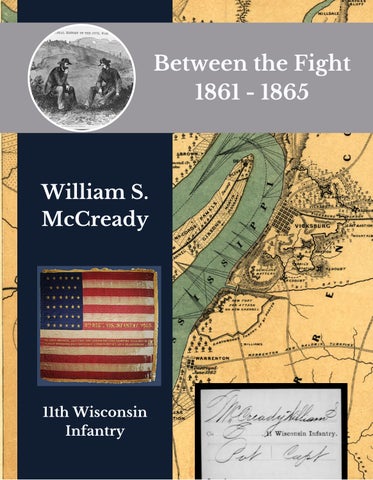
Between the Fight 1861 - 1865
William S. McCready
11th Wisconsin Infantry
II
©2024 Sauk County Historical Society
Student Book William S. McCready Between the Fight 1861 - 1862
Compiled by Beverly Vaillancourt, M.Ed The William S. McCready video and accompanying Student Booklet are dedicated to Wisconsin soldiers who fought in the American Civil War. Their dedication and sacrifice for what they firmly believed to be true will forever be remembered. We honor the fortitude and resolve of all Union soldiers of the Civil War, and recognize the strife that beset the country during those very difficult years. Brother against brother, father against son, families forever changed by the political, social, and economic forces that sparked the Civil War. Special thanks to Civil War historian Marc Storch and Beth Young of the Historical Society of Quincy and Adams County for their ongoing assistance with the Voices of the Civil War video series.
©2024 Sauk County Historical Society
III
This student booklet accompanies the video: William S. McCready: Between the Fight 1861 - 1862.
https://vimeo.com/914504214 Student Outcomes 1. to learn what occupied a soldier’s life between and to prepare for battles 2. to learn of the immigrants’ contribution to the Union Army 3. to gain an understanding of the consequences of the 1850 Fugitive Slave Law 4. to view battle strategy from the perspective of the enlisted soldieer 5. to gain a perspective of the impact of surrender on Confederate soldiers
Common Core Reading Standards in Literacy in History/Social Studies, Grades 9 - 10 Key Ideas and Details Cite specific textual evidence to support analysis of primary and secondary sources, attending to such features as the date and origin of the information. Determine the central ideas or information of a primary or secondary source; provide an accurate summary of how key events or ideas develop over the course of the text Analyze in detail a series of events described in a text; determine whether earlier events caused later ones or simply preceded them.
IV
©2024 Sauk County Historical Society
Contents William S. McCready: Between the Fight ����������������������������������������������� •3 Why Sharing Personal Civil War Stories is Important �������������������������������������������������������� •5 11th Wisconsin Regiment ����������������������������������������������������������������������������������������������������� •6
William S. McCready’s Story �������������������������������������������������������������������� •7 Battle of Bayou Cache (Cache River) ������������������������������������������������������� •7 First Hand account of the Battly of Bayou Cache (Cache River) �������������������������������������� •8 The Story Continues ������������������������������������������������������������������������������������������������������������ •11 Think About It ���������������������������������������������������������������������������������������������������������������������� •19
Eastern Theater compared to the Western Theater �������������������������•22 Think About It ���������������������������������������������������������������������������������������������������������������������� •24
Primary Source Documents �������������������������������������������������������������������•25 Fugitive Slave Act 1850 ������������������������������������������������������������������������������������������������������ •25 Compromise of 1850 ���������������������������������������������������������������������������������������������������������� •28
The Underground Railroad �������������������������������������������������������������������� •29 Key Features of the Underground Railroad: ���������������������������������������������������������������������� •29 Dr. Richard Eells (1800 - 1846) and the Underground Railroad, Quincy, Illinois ������������ •31
Role of the Underground Railroad in the Civil War �������������������������•32 The Memoirs of Dr. Robert J. Christie �������������������������������������������������•33 Narrative of Henry Watson, a Fugitive Slave ������������������������������������ •36 Essay Suggestions ������������������������������������������������������������������������������������ •44 Project-based Learning �������������������������������������������������������������������������� •44 ©2024 Sauk County Historical Society
V
To the Student Study of the Civil War evokes images of the clash of armies at such major battles as Antietam, Gettysburg, and Vicksburg. Yet, much of a soldier’s life happened between the fight with hours of drill, the building of fortifications, miles of marching, and days of simply waiting. In his diary entries, William S. McCready reflects on the daily life of a soldier, as well as on the hard work and difficult losses of the 11th Wisconsin Volunteer Infantry. It is a story told in chapters of courage, resilience, bravery and honor, and fatigue so great that it could only be overcome through deep personal conviction and strength of purpose that framed the soldiers of the Civil War, both Union and Confederate. It is often thought that soldiers joined the Union Army solely to fight for the end of slavery. It is often believed that soldiers joined the Confederate Army to preserve slavery. Yet, to view the Civil War simply as a conflict over slavery misrepresents a war framed by complexity. We are not sure of McCready’s experiences or undestanding of slavery in America, but we can discern his commitment to fighting for what he believed to be a noble cause–as he stated it in his diary entry, “to fight for the Union.” What he meant by that we cannot be certain, yet we can surmise that he believed all states should remain as one country. Confederate soldiers’ views on the Civil War were deeply felt and multifaceted, shaped by a range of motivations and experiences. Their perspectives evolved throughout the conflict and continued to influence Southern identity and memory in the post-war years. Many Confederate soldiers saw themselves as defending their homes and way of life from what they perceived as Northern aggression. The movement of Union forces into Southern states strengthened this belief. For some, it was seen as an invasion that had to be stopped. A significant number of soldiers were motivated by the principle of states’ rights. They believed that the Southern states had the right to secede from the Union and govern themselves without federal interference. This perspective was deeply rooted in a desire for political autonomy and resistance to perceived overreach by the federal government. Moreover, while not all Confederate soldiers were slave owners, the institution of slavery was a fundamental part of the Southern economy and social structure. Many soldiers fought to preserve this way of life, viewing slavery as essential to their economic interests and social order. As you read though the several primary sources, consider what motivaters are at play that drive the actions of the soldiers, both Union and Confederate. What makes them “soldier ©2024 Sauk County Historical Society
1
on” through days of drill, and then follow orders that seem illogical at best. For McCready and others, some orders appeared reckless in the face of their consequences. Yet, many re-enlisted when the chance to leave the war and return home was within reach? The soldiers who fought in the Civil War had time between the fight to deepen or abandon their initial conviction for enlisting. The individuals with whom they came into contact gained a lasting and at times perplexing impression of the “North” or “South” based the actions of soldiers, especially as Union soldiers plundered Southern resources to feed thousands of soldiers. As Sarah Morgan Dawson notes in her diary in 1862 when Union soldiers initially occupied Baton Rouge, the place she called home, “Fact is, these people have disarmed me by the kindness. I expected to be in a crowd of ruffian soldiers, who would think nothings of cutting your throat...and I find, among all these thousands, not one who offers the slightest annoyance or disrespect.” Her opinion would later change when Union soldiers were given freedom to plunder Baton Rouge. (A Confederate Girl’s Diary, Big Byte Books 2018) As you read through this student book and watch the video, consider the following: • • •
What did soldiers do between the fight to prepare for the next battle? How did encountering runaway slaves impact Union soldiers unfamilair with slavery? Why would Southerners characterize the Civil War as an invasion?
1889 veteran reunion of the Wisconsin 11th Volunteer Infantry: photo courtesy Wisconsin Historical Society
2
©2024 Sauk County Historical Society
William S. McCready: Between the Fight Who was William S. McCready, and why is his story important to tell? What we know about William S. McCready comes from his Civil War diary and official military records. However, as an immigrant from Ireland, McCready’s story helps to tell the story of the wave of immigrants coming to America from Europe in the mid 1800s and their willingness to volunteer to serve in the Civil War. Why did they volunteer? Why would they risk their lives for a country that was in many ways still foreign to them, especially since for many Civil War soldiers the journey from Europe to America was not taken by their choice, but by the choice of their parents. Immigration during the Mid 1800s Immigration to the United States during the mid-1800s was marked by significant growth and profound changes in the demographic landscape of the nation. Several key factors and events influenced the patterns and characteristics of immigration during this period: The Irish Potato Famine (1845-1849) was a pivotal event that led to the emigration of over a million Irish to the United States, escaping starvation and economic despair. Many Irish settled in urban centers like New York and Boston, working in factories and infrastructure projects, Other Europeans, particularly Germans following the revolutions of 1848, fled political instability and repression seeking freedom and opportunities in the United States. Germans often moved further west to farm or establish businesses. Moreover, widespread poverty and lack of opportunities in rural Europe prompted many to seek a better life in America, where the promise of land and work was more accessible due to industrialization. Impact of Immigration on the Civil War During the American Civil War, a significant number of immigrants served in both the Union and Confederate forces. It is estimated that about 25% of the Union Army was composed of foreign-born soldiers. This diverse group included large numbers of Irish and German immigrants, who were among the most numerous. Other groups, such as Canadians, English, Italians, Poles, and those from various other European nations, also contributed to the Union’s ranks.
©2024 Sauk County Historical Society
3
The motivations for these immigrants to join the Union Army varied. Many saw military service as a pathway to citizenship, a chance to earn a regular salary, and/or as an opportunity to demonstrate their loyalty to their new country. Additionally, political and nationalistic reasons also played a role, especially among those who had fled political oppression in Europe. Union Army: A substantial number of Irish immigrants enlisted in the Union Army. The Irish Brigade, commanded by Brigadier General Thomas Francis Meagher, is one of the most notable units. This brigade distinguished itself in several major battles, including Antietam and Fredericksburg. German-Americans formed a significant part of the Union forces. Units such as the 9th Ohio Infantry and the 52nd New York Infantry had a large number of German soldiers. German immigrants were prominent in the Western Theater and played crucial roles in battles like the Battle of Stones River. Other Nationalities: Immigrants from other countries, including Italy, Poland, and Scandinavia, also served in the Union Army. They often joined ethnic regiments or integrated into regular units. Memorial inscription Antietam National Battlefield
4
©2024 Sauk County Historical Society
Confederate Army: While the Confederate Army had fewer immigrants compared to the Union, there were still notable contributions. Irish and German immigrants joined the ranks, with some units like the Louisiana Tigers comprised of a significant number of immigrants. Despite their contributions, immigrants faced significant challenges. They often encountered prejudice and discrimination, both within the military and in civilian life. Language barriers and cultural differences added to their difficulties. However, their commitment and sacrifices earned them a measure of respect and integration into American society.
Why Sharing Personal Civil War Stories is Important Sharing the stories of Civil War soldiers, both Union and Confederate, is essential for several reasons. Importantly, sharing stories enriches our understanding of the past and its implications for the present and future. Sharing stories also provides an unfiltered look at history, not through those who retell it, but by those who lived it. Personal stories and narratives help bring the human voice to the battles that framed the Civil War. By learning about individual experiences, we gain insights into the personal struggles, motivations, and daily realities of those who lived through the conflict. The Civil War was fought over complex issues including states’ rights, economic interests, and foremost, the institution of slavery. Understanding the diverse perspectives and reasons that soldiers fought for helps to clarify these complexities beyond the simplified narratives. Soldiers’ stories reflect the values, beliefs, and norms of their time. Exploring these stories can help us understand how societal values have evolved and how conflicts have shaped a national identity. The personal accounts of soldiers on both sides of the Civil War offer profound lessons in sacrifice, loyalty, and the costs of war. These stories can serve as poignant reminders of the human cost of conflict and the resilience of individuals. As time passes, firsthand accounts and the memories of these soldiers become invaluable for historical preservation. They provide future generations a window into the past, serving as primary sources that offer depth and context to the historical record.
©2024 Sauk County Historical Society
5
Moreover, these stories allow readers to engage empathetically with the past, promoting a deeper appreciation for history and its ongoing impact on contemporary society. Soldiers’ stories highlight the diversity of experiences during the Civil War, including those of African American soldiers and Indigenous Peoples.Telling the stories of both Union and Confederate soldiers from the first person ensures a balanced understanding of the Civil War, honoring all experiences and recognizing the multifaceted nature of history. This is the true value of using primary source documents in the study of history.
11th Wisconsin Regiment The 11th Wisconsin Infantry was rganized at Madison, Wisconsin. The regiment mustered into service on October 18, 1861, and mustered out on September 5, 1865, in Mobile, Alabama. The 11th Wisconsin Infantry participated in several significant campaigns and battles throughout the war. Early in the war, the regiment was deployed to various locations in Missouri and Arkansas, engaging in operations to control key territories and supply lines. One of the most notable engagements for the 11th Wisconsin was the Siege of Vicksburg (May 18 – July 4, 1863). The regiment played a crucial role in the Union’s efforts to gain control of the Mississippi River, which was a strategic objective. The 11th Wisconsin Infantry also took part in the Red River Campaign (March 10 – May 22, 1864), a series of battles along the Red River in Louisiana aimed at securing control over the region. In the latter part of the war, the regiment participated in the Mobile Campaign, including the Battle of Spanish Fort and the Battle of Fort Blakely (March – April 1865). These actions were part of the Union’s final push to capture the last major Confederate stronghold on the Gulf Coast. Original strength, 1,029. Gain—by recruits in 1863, 72, in 1864, 263, in 1865, 24 ; by substitutes, 62 ; by draft in 1865, 147; veteran reenlistments, 363 ; total, 1,965. Loss—by death, 348; deserted, 25; transferred, 9; discharged, 319; mustered out, 1,264. (source: Quiner’s Military History of Wisconsin, 1866)
6
©2024 Sauk County Historical Society
William S. McCready’s Story William S. McCready was born in Ireland in 1836 and emigrated to the United States with his parents in 1850. Given that many Irish faced with starvation in 1850 due to the Irish Potato Famine (1845 - 1852), it is possible the famine in Ireland was the motivator for why the MCCready family came to the United States. They settled on farmland in Black Hawk, Sauk County, Wisconsin. William, then age 14, helped on the family farm. McCready enlisted in the 11th Wisconsin Infantry, Company G, on September 16, 1861, at the age of 25. He began as a private and over the course of the war, rose to the rank of captain. The featured video “Between the Fight” shares McCready’s diary entries from enlistment until he was shot in the leg at the Battle of Cache River.
Battle of Bayou Cache (Cache River) William S. McCready was wounded at the Battle of Cache River, also known as the Action at Cotton Plant or Round Hill, on July 7, 1862. While history books refer to this battle as a minor skirmish, to the men who fought there, it was a major conflict with casualites they would long remember. This engagement occurred in Woodruff County, Arkansas, near the Cache River and Cotton Plant. The Battle of Cache River was part of the Union’s efforts to secure control over Arkansas, This area was strategically important for its river systems and as a gateway to the deeper South. The Union aimed to disrupt Confederate supply lines and secure a foothold in the state. Brigadier General Samuel R. Curtis led a Union force that had recently captured Helena, Arkansas. As Curtis moved his army through Arkansas, he sought to engage and neutralize Confederate forces in the area. Confederate troops under the command of Colonel Albert Rust were tasked with harassing and delaying Curtis’s advance. Rust’s forces consisted of various detachments, including cavalry and infantry units, who were familiar with the local terrain.
The Story Continues Much of what McCready writes of the war in his diary is basic information regarding location, orders for where to report, who is in command, available provisions, and battle consequences. Early on, he refrains from criticism of officers and the war. This would change. ©2024 Sauk County Historical Society
7
First Hand account of the Battly of Bayou Cache (Cache River) as told in Quiner’s Military History of Wisconsin (Chicago, 1866), pages 36-37. On the 6th [July], General Steele’s command left Augusta at eight o’clock, A. M., and passed over a low, level country, to Bayou Cache, near Cache River, where another formidable timber blockade was found. Soon after camping in a dense canebrake, they were greeted by rebel shots from the other side of the river. The enemy was easily silenced by a few shells from the brigade battery. Working parties were sent forward in the morning to clear the blockade. Company D, Captain Miller, Company I, Lieutenant Doane, Company H, Captain Christie, apd Company G, Captain Partridge, of the Eleventh, with three companies of the Thirty-third Illinois, and a mountain howitzer, all under command of Colonel Harris, were ordered to make a reconnoissance in advance of the pioneers, in the direction of Peach Orchard Bluft. Company D was in advance, deployed as skirmishers. Reaching Hill’s plantation, the skirmishers were fired on. The command confiscated a ready cooked dinner, and also a couple of wagon loads of bacon and molasses. Taking the road to Des Arc, Colonel Harris, with the four companies of the Eleventh and the howitzer, moved rapidly forward. Proceeding half a mile, the enemy were encountered near a turn in the road. They fired a volley at the skirmishers. Companies D and I were immediately deployed on the right and left of the road, with the howitzer on the extreme left. Companies H and G were in the road. The skirmishers Avere soon engaged with the enemy, and it was ascertained that a heavy rebel force was in front. Colonel Harris and Adjutant Lincoln were at the front, in the hottest of the fire. Companies H and I were ordered forward at a double quick. An order for the skirmishers to fall back on the battalion, was mistaken for an order to retreat. While Colonel Harris endeavored to rally them, he was wounded in the arm and leg, but still sat on his horse. The daring courage of their Colonel assured the retreating companies, and they rallied, aud retreated in very good order, fighting, and doing good execution upon the ranks of the rebels. The enemy had his force on each side of the road, concealed in the underbrush. The rebels made a dash to capture the howitzer, but Captain Partridge, who had it in charge, rallied his men around the piece, and brought it off in safety. A short distance to the rear, the battalion halted, where, with the detachment of the Thirty-third Illinois, which had been brought up by Colonel Hovey, it again formed across the road. Here the pursuing rebels were met by a tremendous volley, which emptied many saddles, and caused them to retreat. At this time, a detachment of the First Indiana Cavalry came up, having heard the firing when some miles oft”, and charged the rebels with such determination and energy, that they broke and fled, and were pursued by our cavalry several miles, killing and wounding a large number of them. The ground was held, and 8
©2024 Sauk County Historical Society
reinforcements arriving, the force camped on the battle field. The enemy’s force is variously stated at from 1,500 to 2,500, under the command of Colonel Albert Rust. Next day our forces buried over one hundred and fifty dead rebels. Their wounded had been borne from the field. They were armed with smooth bore rifles and shot guns, which were not available against the superior arms of the Union forces. This is known as the battle of Bayou Cache. This being their first fight, the soldiers and officers of the Eleventh are entitled to great credit for their coolness and courage in facing such overpowering numbers.
Inscription on the Battle of Cache River historical marker, found in Cotton Plant, Arkansas. Photo by Mark Hildon. The inscription reads: July 7, 1862, the 11th Wisconsin Infantry of the Federals, commanded by Colonel Hovey, met the Confederate Texas Cavalry commanded by General Rust at Hills Plantation and engaged in a bitter fight. The Battle of Cache River or Cotton Plant is conceded by the Federals to have been one of the most remarkable and hard fought battles of the War Between the States. Erected by Cotton Plant Chapter, United Daughters of the Confederacy. source: https://www.hmdb.org/m.asp?m=116454
©2024 Sauk County Historical Society
9
The casualties, as reported, were: KILLED OK DIED OF WOUNDS.— Company D — Orderly Sergeant Nathan Hoyt, Corporal G.C.White, Private Joseph Brace. Compani^ G—Corporal Wm. M. Hayden. Company ff—Orderly Sergeant A. A. C. Bacon, Corporal B. P. Benson, Private Wm. Powderly — 7. WOUNDED. —i^’icW Offl.ce^—Colonel C. L. Harris, in leg and arm. Company J)—Corporals D. W. Thomas and G. N. Mickel, Privates C. McArthy, in three places, Andrew Snider, D. Fogo, John Reesbeck, P. Acton and D. Burnett. Company G —Sergeant W. S. McCreedy, Corporal Jerome Calkins, L. H. Parks, C. B. Jacobs, S. W. Jones, I. S. Welsh and Jacob Shedle. Company H— Captain A. Chrystie, Privates H. H. Laith, J. L. Levine, O. B. Lyon, J. S. Dickinson, John Hauey, E. D. Bidwell and Robt. Murray. Company I— Lieutenant N. R. Doan, Sergeant H. H. Hopkins, Corporal L. W. Medley, Privates Peter Everson, G. F. Hamer, Amos Shepard, A. Nash, H. C. Harrington, S. Marvin, George Grordon, O. Parmalee, S. C. Benjamin, W. W. Coon and James Bedient—38. **************** The Battle of Cache River was a tactical victory for the Union. It allowed General Curtis to continue his advance through Arkansas without significant Confederate resistance. This engagement demonstrated the Union’s ability to conduct effective operations in the Trans-Mississippi Theater. The skirmish at Cache River highlighted the challenges faced by Confederate forces in defending the vast and often remote territories of the Trans-Mississippi region. The defeat forced the Confederates to reconsider their defensive strategies. General Curtis continued his campaign in Arkansas, eventually leading to more significant engagements, such as the Battle of Prairie Grove later in 1862. The Union’s persistence in the region contributed to its overall strategy of dividing and conquering the Confederate states.
10
©2024 Sauk County Historical Society
McCready returns to his company after his recovery from a gunshot wound to his leg. His diary entries continue to share locations, reports on supplies and weather, and descriptions of events. However, McCready now views the war with a deeper sense of reality and urgency. We pick up McCready’s story following his leg wound at the Battle of Cache River, Arkansas, on July 7, 1862. Sund. Sept. 28th (1862) after an absence of two months but not the regiment that we left for ther there only 300 men for duty in this regiment and men are not excused for ague [illness involving fever, such as malaria]. During my absence they have been employed in making excursions in H___ippis and stealing cotton for some of the officers. Col. Hovey and Lt. Col. Wood have profited most by these excursions. The men do not speak the truth. Col. Harris has recovered from his wounds and has returned to duty. He put a stop to cotton stealing by his regiment when he returned. Vicksburg Campaign (1863) McCready writes of the ongoing battles that lead up to the Surrender of Vicksburg - a key accomplishment for the Union Army. The victory also elevated General Grant’s growing reputation as a more than capable general.To many, his war strategy and leadership were considered essential to a final Union victory and the end of the Civil War.
Siege of Vicksburg, print created 1888: Library of Congress
©2024 Sauk County Historical Society
11
Sat. May 2nd, 1863 We were up and advancing in line of battle at Sunrise this morning. We soon found out that the enemy had returned during the night. We soon entered Port Gibson and we were put on patrol duty. We find 400 of the rebels wounded in town and about 1,000 stand of arms. The rebels threw away many arms, etc. their retreat. They burned the bridge over the Bayou Pierre, but our pioneers had the new one bulit and McPherson’s Corps had crossed over it by 4 o’clock p.m. The rebel general Tracy was killed in battle yesterday and he was burried in the cemetery here last night. Our regiment has 18 killed. The weather is now very warm. Port Gibson is a beautiful town. The flowers in the dooryard are the most beautiful that I ever saw. During the afternoon we were ordered to fire off our muskets into the hill by our camp and clean up our arms. In doing so some of the men fired over the hill, and the bullets went into the town wounding some of the people. Gen. Grant occupied by Col. Rawlins galloped up and stopped the firing. The general was furious. His words just gurgled out of his mouth, when he demanded to know by what authority we were out there firing off our arms. We told him by order of Lt. Col. Wood. “Where is he?” he then asked. We pointed to Col. Wood’s quarters under a rubber blanket that was fastened against a fence. The general rode up to him and was told that Col. Harris, who is again in command of the Brigade, had ordered the firing. I saw the general then ride up to Col. Harris, when the blame was laid to the chart of Gen. E. A. Carr, who was soon called, he was told the general that the firing was by order of Gen. McClernand, who was just gone out nine miles to the advance posts. Gen. Grant then rode out to the center of our camp and called out that yesterday we were calling for more ammunition and today we are wasting it. It is somewhat remarkable to see two men in such a great rage as Gen. Grant and Col. Hawkins were in today and neither of them used any profane words. What irony is found the May 2, 1863, diary entry? Fri. July 3rd. We marched back to our quarters in front of Vicksburg during the forenoon and we were surprised to hear no cannonading as we came. All was still along the lines. We were informed upon our arrival that Gen. Pemberton had sent our a flag of truce, offering a conditional surrender of the garrison. Gen. Grant had refused all but an unconditional surrender. We gave three cheers for unconditional surrender and then broke ranks. Preparations for another assault on their works are a making. We will be ready for the attack at 10 o’clock a tomorrow. The bombardment has not been resumed.
12
©2024 Sauk County Historical Society
Gen. Pemberton has requested an interview with Gen. Grant this afternoon which has been granted and accounts for the continued inactivity of our army. they met between the lines of breatwork in the shade of a tree. Grant smoked a cigar during the interview. The were attentively watched by both armies until they separated. Soon after we were informed that it has been General Grant meeting General Pemberton at Vicksburg: Library of Congress
agreed between them that at 10 o’clock a.m. tomorrow the rebel army at Vicksburg will surrender by marching out of their works and stacking their arms on the outside and placing their colors on their sacks, and then a column of men designated by Gen. Grant will enter their works and take possession of them. The surrender is not conditional and we are all happy tonight. Vicksburg is our Independence Day. Why do you think McCready calls July 3rd their Independence Day? Sat. July 4th Early in the morning Co. G was called out to go on rear picket guard so we shall not witness the surrender. It took place at 10 o’clock as agreed upon. I hear the Garrison surrendered today , numbers 32,000 men, stand of small arms of 60,000 and 227 pieces of cannon. When the mail was brought to camp our letters were brought to us on the picket line, and many of us had the pleasure of reading letters from home, still we are not pleased after we worked so hard and suffered and fought so much against Vicksburg that we were hindered by picket duty from seeing its surrender, and so many regiments of troops lay in the army during the whole time and did not fire a shot. We think some of them might have been called upon guard duty today. During the seige ten of Co. G, were killed in action or died of wound, ten others are severly wounded and four others slightly wounded but still on duty.
©2024 Sauk County Historical Society
13
Mon. July 13th. This morning we were entrenched, but had no tools, a report was soon current that a troop of rebel calvary had made a dash on our train of wagons in our rear and captured our spades, mattocks, etc. In a very short time we tore down three large frame dwelling houses and built their material into a line of breastworks. We carried out the nice furniture, and libraries of books and built them into the breastworks. The organs and pianos were stuffed full of cotton and put in the works and were probably spoiled. Our battery of artillery is having a regular dual with the rebel battery which is entrenched in our front. Sat. Aug. 15th. Sailed at daylight and passed Port Hudson at 7 a.m. where we saw some large guns in 1864 pre-election print by M.W. Siebert contrasting the Republican candidate Abraham Lincoln’s advocacy of equality and free labor in the North to Democratic opponent General McClellan’s alleged support of the Southern slave system. (Library of Congress)
position. A large alligator followed our boat for a short distance. It was the first one I ever saw. We passed Baton Rouge at 9 a.m. We are not sailing past beautiful plantations on the Mississippi. The planter’s houses are large and beautiful... Oct. 9th. Marched at 6 a.m.and reached St.Martins at noon, having marched 15 miles, where we remained until 4 o’clock p.m. when we marched six miles further and encamped by a creek or Bayou. While we remained at St. Martins we were on Provost Guard. The steamboats are following us to Bayou Teche and they are carrying the sugar found on the plantations, to Brasher where it is sent by rail to New Orleans. Sun. Nov. 1. A few of our soldiers were caught foraging this morning and they were placed under guard and compelled to carry their burdens of forage all day. Nov. 8th. Broke camp early and reached Berwich Tues. the 10th where we went into camp, having marched over 250 miles since we left it on the 3rd day of Oct. through wet and stormy 14
©2024 Sauk County Historical Society
weather. We suffered much from exposure as our knapsacks were left in New Orleans by order of our commanding general. Had we had our tents and knapsacks along we could have made ourselves comfortable during the chilly rain weather. As far as I can see our expedition has been a fruitless one. William McCready is headed home on furlough. Mon. March 23rd [1864] I arrived at home about 11 o’clock after an absence of two years, two months and ten days, anf found our family all at home and well, except a brother who is buried in the battlefield of Arkansas Post. My father met me at the Depot at Spring Green about 8 o’clock and we drove home in the night. Our 30 days of furlough soon expired. It seemed good to be at home again, visiting or being visited by friends, No duty calls by a bugle or drum. No revile in the morning, no taps at night. The men who re-enlisted and returnd on furlough are all healthy. All who were sick were transferred to the 23rd Wis. Inf. We find the cool weather of Wis. quiet invigorating. We would all be but too happy to remain here. I attended the Town meeting of the Town of Troy, and I saw more able-bodied men there than I have seen in one place during my service in the south. The town votes money and hires substitufes from other towns to fill its quota of soldiers, so there are no drafts in Troy. October 25th Companies absent when Capt. Wyman returned. They seem to have pillaged some plantation called Palfrey’s. I fear that there is trouble ahead for someone. Tobacco and sugar are very abundant in camp. We have not been paid for six moths. Sweet potatoes and oysters are plenty and cheap, but the men have no money to buy with. The orange crop is poor. At this point, what do you think the morale of the soldiers is? Why? Tues. Nov. 8th At the election in our regiment today there was 318 votes for Lincoln for President, and 82 votes for McClellan. Company D voted unanimously for Lincoln, 62 votes. Co. G gave Lincoln 29 votes and McClellan 2 votes. On the day McCready writes this next diary entry, General Sherman had just surrendered the Army of Northern Virginia to General Grant at Appomatox Courthouse. However, McCready and the men of the 11th Wisconsin Infantry would not learn of this news until April 19th. Though the Eastern Theater of the Civil was nearing its end, war still raged in the Western Theater . ©2024 Sauk County Historical Society
15
Sun. April 9th (1865, near Mobile, Alabama) The regiments of our brigade were formed about 600 yards from the rebel lineof breastworks. At 5 o’clock the line advanced, the 11th in advance of our Bridage. The crossed a space of about 400 yards covered with fallen timber that had been cut down without suffering much loss. Then the distance which remained, about 200 yards, was clear of everything except [two lines of trees laid in a row, and sharpened, wrapped with wire], which had to be crossed and also some wire that was stretched across the stumps in front of their works, to trip and retard our men. The loss was great and continued to increase until the works were taken...If all accounts are true, we have probably fought our last battle. Probably Lee’s army has been captured by Grant’s army. After the surrender at Appomattox on April 9, 1865, several battles and skirmishes in the Western Theater of the Civil War occurred before the final cessation of hostilities. These battles took place in various locations as Confederate forces continued to engage. Notable battles in the Western Theater after Appomattox include: 1. Battle of Columbus, Georgia: Fought on April 16, 1865, this battle is often considered the last significant land battle of the Civil War. Union forces under Major General James H. Wilson defeated the Confederate defenders, leading to the capture of Columbus, Georgia. 2. Battle of West Point, Georgia: Also known as the Battle of Fort Tyler, this engagement occurred on April 16, 1865. Union forces attacked and captured the fort, which was one of the last remaining Confederate strongholds in Georgia. 3. Battle of Selma, Alabama: Although it took place slightly before Appomattox, on April 2, 1865, the capture of Selma was crucial in the Western Theater. Union forces under Major General James H. Wilson defeated Confederate troops, leading to the destruction of the Selma Arsenal and other military resources. 4. Skirmishes in Texas: Confederate forces in Texas continued to engage Union troops in several skirmishes. The most notable was the Battle of Palmito Ranch, fought on May 12-13, 1865. This engagement is often considered the last battle of the Civil War, where Confederate forces under Colonel John S. Ford defeated Union troops near Brownsville, Texas, even though the war had effectively ended. Wed. 19th The column marched about 20 miles. I took a small detail of men and went out in the country to the left of the line of march and got 7 mules. On our appraoch the people hide their cattle in the swamps or drive them away. Seven negroes came to camp with us. We have received the news of the surrender of Gen. Lee to Gen. Grant on April 9th at Appomattox VA. 16
©2024 Sauk County Historical Society
May 13th. Prisoners of the rebel army who have been paroled pass daily in large numbers. As they pass along they eat nearly all of the food on the plantations. Gen. Bernhard Taylor has surrendered his army which was the last one of the enemy east of the Mississippi River. The only troops remaining at Montgomery now are the divisions of Carr and Gerrard. We still depend chiefly on the plantations for forage. The railroad to Mobile will soon be repaired when we weill receive sufficient supplies for both men and animals.
Jeff’s last shift. Capture of Jeff. Davis, May 10th, 1865, at Irwinsville, Georgia, drawing by John Henry Bufford: Library of Congress
Tues. May 16th Intelligence of the capture of Jeff Davis by some of the first regiment Wis. Cavalry, Capt. Herndon commanding, received, and the soldiers are jubilant.
Jefferson Davis, President of the Confederacy, was captured in Irwin County, Georgia, on May 10, 1865, by soldiers from the First Wisconsin and Fourth Michigan cavalries. Union forces had been in pursuit of Davis after his quick departure from Danville, Virginia. The belief, though unfounded, was that Jefferson Davis had been complicit in the assassination of President Abraham Lincoln. A $100,000 reward had been posted for his capture.
©2024 Sauk County Historical Society
17
Rumors abounded that Jefferson Davis was dressed in women’s clothes to avoid detection by Union troops in pursuit as he attempted to escape from Virginia to Texas. Texas was considered a potential refuge where Davis hoped to continue the fight or regroup, possibly linking up with Confederate forces in the Trans-Mississippi Department. Today the account of him dressed as a womain women’s clothing is disputed, with a rethinking that Jeff Davis was only wearing his wife’s shawl for warmth due to personal illness. Yet, at the time the rumor provided artistic opportunites to portray Jefferson Davis in a cowardly-like manner. How do you think prints portraying Jeff Davis wearing women’s clothes at the time of his capture were viewed by Northerners? by Southerners? Sat. June 3rd John T. Bradley, John Bywater and Eleazar Moore, non-veterans of my company who were taken prisoner while serving the 23rd Regt. Wis. Inf. at the Battle of Sabine Cross Roads in April 1864 and who have been held prisoners of war at Camp Tyler Texas since, have reach us today. If we shall fight any more in Texas, they are ready to re-enlist and go with us. They were kept 13 months in an open lot without shelter from sun or rain except each as they could erect from clothing etc. from men who died there. John Bradley being late at Roll Call one morning was punished by having to stand on one foot for an hour. A rebel guard stood by with his lanced rifle to shoot him if he put his other foot to the ground. Aug. 31st The 11th Wis. Veterans. Vol. Inf. incluidng its entire force of veterans, non-veterans, recruits, substitutes and consripts was mustered out today at Mobile by Cpt. Howell, of the 31st Regt. of Massachusetts. Our organizaton as a regiment is to be maintained until we are paid off in Wis. Benj. Owen of Co. “G” died in hospital today. Oct 2nd Paid off today and returned home. My Military connection with the government was four years and fourteen days. The 11th Wis. has passed into history and memory.
18
©2024 Sauk County Historical Society
Think About It Between the Fight: William S. McCready video (1861 - 1862) Diary entries of William S. McCready (1862 - 1865) Video Questions: 1. Why do you think some soldiers found the Articles of War not to their liking? 2. Why might men think joining the Union Army would be an enjoyable adventure? 3. Why were railroads essential to the success of troops and military campaigns? 4. What is meant by the title “Harsh Reality”? 5. What might have been the impact on soldiers from Wisconsin when they came face to face with the realities of slavery? 6. What does “between the fight” include? 7. Civil War nurses were exposed to horrific conditions yet prevailed in their efforts to bring comfort and healing to soldiers, Yet it was considered scandulous to be a Union nurse. Why do you think Society found this to be so? 8. Why did men continue to fight in the face of such chaotic fighting where death seemed inevitable? 9. What caption would you write for the photo of the men shown at point 13:56 in the video? 10. What does McCready mean when he states, “Fighting is just a small part of a soldier’s duties or troubles”? Diary Entry Questions: Find the following questions posed between diary entries. Answe each one. 1. Who was William S. McCready, and why is his story important to tell? 2. What irony do you find in the May 2, 1863, diary entry? 3. Why do you think McCready calls July 3rd their Independence Day? 4. At this point, what do you think the morale of the soldiers is? Why? 5. Why do you think prints portraying Jeff Davis wearing women’s clothes at the time of his capture became a powerful p;oltical statement?
©2024 Sauk County Historical Society
19
General Sherman’s letter regarding the upcoming 1864 presidential election General William Tecumseh Sherman is best known for his “March to the Sea” during the Civil War, where he led Union forces in a destructive campaign through Georgia, significantly weakening the Confederacy’s war effort. Here, in a letter written to his family, he gives his opinion (often expressed without hesitation) about the upcoming presidential election. Gaylesville, Ala., October 27, 1864 ....I expect very soon now to attempt another feat in which I think I shall succeed, but it is hazardous and you will not hear from me for months. The War Department will know my whereabouts, and the Rebels, and you will be able to guess... You mask my opinion of McClellan. I have been much amused at similar inquiries of John and others in answer to a news paragraph that I pledged ninety-nine votes of the hundred to McClellan. Of course this is the invention of some knave. I never said such thing. I will vote for nobody, because I am not entitled to vote. Of the two, with the inferences to be drawn at home and abroad, I would prefer Lincoln, though I know that McClellan, Vallandigham or even Jeff Davis if President of the U.S. would prosecute the war, and no one with more vigor than the latter. But at the time the howl was raised against Mcclellan I knew it was in a measure unjust, for he was charged with delinquencies that the American People are chargeable for. Thus, how unjust to blame me for any misfortune now when all the authorities and people are conspiring to break up the Army till the election is over. Our armies are merely paper armies. I have 40,000 Cavalry on paper but less than 5,000 in fact. A like measure runs through the whole, and so it was with McClellan. He had to fight partly with figures. Still I admit he never maifested the simple courage and manliness of Grant, and he had too much staff, too many toadies and looked to much to No. 1. When I was in Kentucky he would not heed my counsels, and never wrote me once, but since I 20
©2024 Sauk County Historical Society
Little Mack, in his great two horse act, in the presidential canvass of 1864, Howard Del, artist, published by T.W. Strong, New York 1864: Library of Congress
1) Create a table that contrasts Sherman’s positive and negative opinions. 2) Who is featured in the cartoon? What message is the artist sending to the public? ©2024 Sauk County Historical Society
21
Eastern Theater compared to the Western Theater The Civil War (1861-1865) was primarily divided into two main theaters of operation: the Eastern and Western Theaters. The Eastern Theater encompassed the area east of the Appalachian Mountains, including Virginia, Maryland, Pennsylvania, and the coastal regions of North Carolina. This theater saw some of the war’s most famous and significant battles, such as those at Bull Run, Antietam, Fredericksburg, and Gettysburg. They involved the Confederate Army of Northern Virginia under General Robert E. Lee and the Union Army of the Potomac. The Western Theater spanned the region between the Appalachian Mountains and the Mississippi River, including the states of Tennessee, Kentucky, Georgia, Mississippi, and Alabama. Key battles in this theater included Shiloh, Vicksburg, Chickamauga, and Atlanta. Union forces in the West, led by generals Ulysses S. Grant and William Tecumseh Sherman, focused on gaining control of the Mississippi River and cutting off Confederate supply lines, which were crucial to the South’s ability to sustain its war effort.
Geography and Scope Eastern Theater
Western Theater
Region: Primarily focused on Virginia, Region: Spanned a much larger area, Maryland, Pennsylvania, and parts of North including Kentucky, Tennessee, Missouri, Carolina. Mississippi, Alabama, Georgia, and parts of the Mississippi River. Main cities: Washington, D.C., Richmond (Confederate capital), Baltimore, and Philadelphia.
Main cities: Nashville, Memphis, New Orleans, Atlanta, and Chattanooga.
Terrain: Characterized by forests, rivers, and the Appalachian Mountains, which influenced military movements and logistics
Terrain: Included diverse landscapes such as the Mississippi River valley, plains, and mountain regions, affecting supply lines and strategies.
22
©2024 Sauk County Historical Society
Key Battles and Campaigns Eastern Theater
Western Theater
Major Battles: First and Second Bull Run (Manassas), Antietam, Fredericksburg, Chancellorsville, Gettysburg, and the Siege of Petersburg.
Major Battles: Shiloh, Vicksburg, Chickamauga, Chattanooga, and the Battle of Atlanta.
Notable Campaigns: The Overland Campaign, culminating in the Siege of Petersburg and the eventual fall of Richmond.
Notable Campaigns: The Vicksburg Campaign, which gave the Union control of the Mississippi River, and Sherman’s Atlanta Campaign followed by his “March to the Sea,” which devastated the Confederate heartland.
Strategic Importance Eastern Theater
Western Theater
Political and Symbolic Significance: Economic and Logistical Significance: The proximity to the capitals of both the The Western Theater was crucial for Union and the Confederacy made the controlling major rivers and railways, vital Eastern Theater symbolically and politically for the movement of troops and supplies. significant. Objective: Capturing Richmond was a primary objective for Union forces, while Confederates aimed to protect their capital and threaten Washington, D.C.
Objective: Union strategies focused on dividing the Confederacy by gaining control of the Mississippi River and key transportation hubs, thus crippling Confederate supply lines and communications.
©2024 Sauk County Historical Society
23
Commanders and Leadership Eastern Theater
Western Theater
Union Commanders: Notable leaders Union Commanders: Key figures included included Major Generals George McClellan, Major Generals Ulysses S. Grant, William Ambrose Burnside, Joseph Hooker, George Tecumseh Sherman, and George H. Meade, and Ulysses S. Grant. Thomas. Confederate Commanders: General Robert E. Lee was the dominant Confederate leader, supported by
Confederate Commanders: Prominent leaders were Generals Albert Sidney Johnston, Braxton Bragg, and John Bell
commanders like Stonewall Jackson and James Longstreet.
Hood.
Outcome and Impact Eastern Theater
Western Theater
High Casualties: Many of the bloodiest battles occurred in the Eastern Theater, with significant casualties on both sides.
Decisive Union Victories: Key victories at Vicksburg and Atlanta were turning points, significantly weakening the Confederacy and boosting Union morale.
Symbolic Victories: Union victories, such as Gettysburg, provided crucial morale boosts and political leverage for the North.
Strategic Gains: The capture of key locations and the splitting of the Confederacy were pivotal to the Union’s overall strategy, contributing significantly to the eventual Union victory.
Think About It Given the information provided in the tables, do you tihnk a Union victory was inevitable? Why or why not? Support your argument with information from the tables.
24
©2024 Sauk County Historical Society
Primary Source Documents Fugitive Slave Act 1850 The Fugitive Slave Act of 1850 was a significant and controversial piece of legislation passed by the United States Congress as part of the Compromise of 1850. This act mandated that all escaped slaves, upon capture, were to be returned to their enslavers and that officials and citizens of free states had to cooperate in this law. It imposed severe penalties on anyone aiding escaped slaves, including fines and imprisonment, and denied alleged fugitive slaves the right to a jury trial or to testify in their own defense. The law was met with strong resistance in Northern states, where abolitionist sentiments were growing. Many Northern states passed “personal liberty laws” to counteract the act, aiming to protect free blacks and escaped slaves from being forcibly returned to slavery. The Fugitive Slave Act intensified the sectional conflict between the North and South, contributing to the tensions that eventually led to the outbreak of the Civil War in 1861. What follows are two of the ten sections of the 1850 Fugitive Slave Law. These two sections are specific to enslaved African Americans who escaped their enslavers. Other sections of the law define who is capable of hearing a case against a fugitive slave in court, the types of court where hearings took place, and directions for payment of court services. In 1864 Congress repealed the Fugitive Slave Acts of 1793 and 1850 based on the 4th, 5th, and 6th Amendments to the Bill of Rights.
1850 drawing by Theodor Kaufmann condeming the Fugitive Slave Act: Library of Congress
What message is being conveyed by the artist?
©2024 Sauk County Historical Society
25
1850 Fugitive Slave Act (Sections 6 and 7) A bill to amend the act entitled “An act respecting fugitives from justice, and persons escaping from the service of their masters.” Be it enacted by the Senate and House of Representatives of the United States of America in Congress assembled... Sec. 6. And be it further enacted, That when a person held to service or labor in any State or Territory of the United States has heretofore or shall hereafter escape into another State or Territory of the United States, the person or persons to whom such service or labor may be due, or his, her or their agent or attorney, duly authorised, by power of attorney, in writing, acknowledged and certified under the seal of some legal office or court of the State or Territory in which the same may be executed, may pursue and reclaim such fugitive person, either by procuring a warrant from some one of the courts, judges, or commissioners aforesaid, of the proper circuit, district or county, for the apprehension of such fugitive from service or labor, or by seizing and arresting such fugitive, where the same can be done without process and by taking or causing such person to be taken, forthwith before such court, judge or commissioner, whose duty it shall be to hear and determine the case of such claimant in a summary manner; and upon satisfactory proof being made, by deposition or affidavit, in writing, to be taken and certified by such court judge or commissioner or by other satisfactory testimony, duly taken and certified by some court, magistrate, justice of the peace, or other legal officer authorized to administer an oath and take depositions under the laws of the State or Territory from which such person owing service or labor may have escaped, with a certificate of such magistracy or other authority, as aforesaid, with the seal of the proper court or officer thereto attached, which seal shall be sufficient to establish the competency of the proof, and with proof, also by affidavit, of the identity of the person whose service or labor is claimed to be due as aforesaid, that the person so arrested does in fact owe service or labor to the person or persons claiming him or her, in the State or Territory from which such fugitive may have escaped as aforesaid, and that said person escaped, to make out and deliver to such claimant, his or her agent or attorney, a certificate setting forth the substantial facts as to the service or labor due from such fugitive to the claimant, and of his or her escape from the State or Territory in which such service or labor was due to the State or Territory in which he or she was arrested, with authority to such claimant, or his or her agent or attorney, to use such reasonable force and restraint as may be necessary under the circumstances of the case, to take and remove such fugitive person 26
©2024 Sauk County Historical Society
back to the State or Territory from whence he or she may have escaped as aforesaid. In no trial or hearing under this act shall the testimony of such alleged fugitive be admitted in evidence; and the certificates in this and the first section mentioned shall be conclusive of the right of the person or persons in whose favor granted to remove such fugitive to the State or Territory from which he escaped, and shall prevent all molestation of said person or persons by any process issued by any court, judge, magistrate, or other person whomsoever. Section 6 Questions: 1. What rights does this section of the 1850 Fugitive Slave Act give to the enlaved? 2. How does the law define where hearings can take place? 3. What rights does this section of the 1850 Fugitive Slave Act give to enslavers Sec. 7. And be it further enacted, That any person who shall knowingly and willingly obstruct, hinder, or prevent such claimant, his agent or attorney, or any person or persons lawfully assisting him, her, or them, from arresting such a fugitive from service or labor, either with or aforesaid; or shall to rescue, such fugitive or labor, or from the custody of, his or her agent or attorney or other persons or persons lawfully assisting as aforesaid, when so arrested, pursuant to the authority herein given and declared; or shall aid, abet, or assist such person, so owing service or labor as aforesaid, directly or indirectly, to escape from such claimant, his agent or attorney, or other person or persons legally authorized as aforesaid; or shall harbor or conceal such fugitive, so as to prevent the discovery and arrest of such person, after notice or knowledge of the fact that such person was a fugitive from service or labor as aforesaid, shall, for either of said offences, be subject to a fine not exceeding one thousand dollars, and imprisonment not exceeding six months, by indictment and conviction before the District Court of the United States for the district in which such offence may have been committed, or before the proper court of criminal jurisdiction, if committed within any one of the organized Territories of the United States; and shall moreover forfeit and pay, by way of civil damages to the party injured by such illegal conduct, the sum of one thousand dollars for each fugitive so lost as aforesaid, to be recovered by action of debt in any of the District or Territorial Courts aforesaid, within whose jurisdiction the said offence may have been committed. Section 7 Questions: 1. What were the consequences for those found guilty of assisting in the escape of a fugitive slave? 2. How did the 1850 Fugitive Slave Act benefit enslavers?
©2024 Sauk County Historical Society
27
Compromise of 1850 The Fugitive Slave Act of 1850 was a crucial component of the Compromise of 1850. The Compromise of 1850 sought to balance the interests of both slave-holding Southern states and free Northern states. While the North gained the admission of California as a free state and the abolition of the slave trade (but not slavery itself) in Washington, D.C., the South received a strengthened Fugitive Slave Act, which was stricter and more punitive than previous versions. The Fugitive Slave Act of 1850 was designed to placate Southern concerns about the loss of runaway slaves by making it easier for slave owners to reclaim escaped slaves. It mandated severe penalties for anyone aiding fugitives and required citizens and law enforcement in free states to cooperate in capturing and returning escaped slaves. The Act was a concession to the South, intended to secure their agreement to other provisions in the Compromise that were more favorable to the North. By ensuring a more robust mechanism for retrieving fugitive slaves, the South was more amenable to compromises on other contentious issues. While intended as a measure to ease sectional tensions, the Fugitive Slave Act of 1850 actually intensified them. Northern resistance to the Act was fierce, with many states passing “personal liberty laws” to counter its effects. The Act galvanized abolitionist sentiment and increased the activities of the Underground Railroad, further polarizing the nation. Why is this important? The Fugitive Slave Act of 1850 as part of the Compromise of 1850, was a key element in the broader attempt to maintain the fragile balance between free and slave states and to stave off the looming threat of civil war. Instead, the law heighted anger among abolitionists who felt it was their moral duty to aid runaway slaves in all ways possible and those in slave holding states who viewed the law as an infringement on their personal right to own slaves. The Compromise of 1850 temporarily postponed the inevitable conflict, giving both sides time to deepen their personal commitments and political positions, and prepare for the eventual outbreak of the Civil War. 1. Why was it difficult for the Compromise of 1850 to be a lasting solution to the political conflict that existed prior to the outbreak of the Civil War? 28
©2024 Sauk County Historical Society
The Underground Railroad The Underground Railroad was a covert network of routes, safe houses, and support systems established in the United States during the early to mid-19th century to help enslaved African Americans escape from the Southern slave states to freedom in the Northern states and Canada. It was not an actual railroad but rather a series of clandestine operations involving abolitionists and sympathizers who risked their lives and freedom to assist those escaping slavery
Key Features of the Underground Railroad: The Underground Railroad consisted of numerous secret routes and safe houses in Union States. These were maintained by “conductors” (guides) and “stationmasters” (people who provided shelter), who helped the fugitives move from one place to another, often under the cover of night to avoid detection.
Underground railroad by Charles T. Webber_ Library of Congress
©2024 Sauk County Historical Society
29
Participants used a code language to maintain secrecy. For example, safe houses were called “stations” or “depots,” and those who guided the escapees were known as “conductors.” The escaping slaves themselves were often referred to as “passengers” or “cargo.” The network spanned across several states, with key routes leading to the Northern free states and into Canada, where slavery was prohibited. Major cities like Philadelphia, Cincinnati, and Detroit were crucial hubs in the network. Several notable individuals played significant roles in the Underground Railroad. Harriet Tubman, a former enslaved woman, is perhaps the most famous “conductor.” She made numerous trips back to the South to guide some 300 slaves to freedom. Other key figures included Levi Coffin, known as the “President of the Underground Railroad,” and William Still, a free black man who documented the stories of many escapees. The Underground Railroad was supported by a diverse group of abolitionists, including free blacks, white Northern sympathizers, religious groups such as Quakers, and other anti-slavery activists. These individuals provided financial support, legal assistance, and logistical coordination.
Harriet Tubman: Harvey Lindsley photographer: Library of Congress
The Fugitive Slave Acts of 1793 and 1850 posed significant risks for those involved in the Underground Railroad. These laws mandated the return of escaped slaves and imposed severe penalties and the potential of financial and political ruin on anyone aiding their escape. Despite these risks, many continued their efforts, driven by a moral conviction against the institution of slavery. Once such individual was Dr. Richard Eells of Quincy, Illinois. If you were to interview a member of the Underground Railroad, what three questions would you ask that they could answer without compromising their own safety and well-being? What information would you hope to gain?
30
©2024 Sauk County Historical Society
Dr. Richard Eells (1800 - 1846) and the Underground Railroad, Quincy, Illinois Dr. Richard Eells was a prominant physician and college professor, and also a staunch abolitionist who had a secret role in Quincy’s participation in the Underground Railroad. In 1842, Charles, a runaway slave, made his way across the Mississippi River from Missouri to Quincy, Illinois, and then to the door of Dr. Eells. At the time, Dr. Eells enjoyed a prominant place Quincy’s high society. Dr. Eells was quick to provide Charles with a dry set of clothes. Dr. Eells knew better than to harbor escaped slaves, for the consequences were grave. Yet, he felt a stong moral directive to assist in their escape. Quickly, Dr. Eells hid Charles in his buggy and hurried away to the next group to help, only to be pursued by slave catchers. Charles jumped from the wagon and was eventually caught. Dr. Eells eluded the captors and returned home. When confronted by authorities, Dr. Eells denied helping Charles escape. Yet, the authorities found the wet clothes Charles had left behind at Dr. Eells’s house. Dr. Eells was arrested and charged with “harboring and secreting a fugitive slave,” a crime in Illinois in 1842. Circuit Jdge, Stephen A. Douglas (of the famed Lincoln-Douglas debates) fined Dr. Eells $400. Dr. Eells apealled his case to the Illinois Supreme Court in 1844, only to lose his case once again. Dr. Eells then appealed his case to the United States Supreme Court, where his conviction was upheld. Dr. Eells was financially ruined as a result of his conviction and subsequent court battles. He died on a riverboat on the Onio River in 1846. (Read more of this story.) Based on a petition brought to him by then Quincy mayor Chuck Shultz, in 2014 Governor Pat Quinn pardoned Dr. Eells. Over the years the home of Dr. Eells fell into disrepair. In 1992 the Friends of the Dr. Richard Eells House purchased the home and restored it to its original look. Today the home is the Quincy Underground Railroad Museum.
©2024 Sauk County Historical Society
31
Role of the Underground Railroad in the Civil War By aiding in the escape of thousands of slaves, the Underground Railroad deprived the Southern economy of its plantation labor force, undermining the institution of slavery and weakening the South’s economic structure. This loss of labor further strained the Confederacy’s resources during the war. The existence and success of the Underground Railroad served as a powerful moral argument for the Union cause. It highlighted the inhumanity of slavery and the bravery of those who fought against it, bolstering support for the Union both domestically and internationally. The Underground Railroad became a symbol of resistance against oppression and injustice. It demonstrated the solidarity and bravery of abolitionists and free African Americans, inspiring continued efforts to support the Union cause and fight for the emancipation of all enslaved people.
The Role of the Union Army in the Underground Railroad By the time of the Civil War, the Underground Railroad was well-known in the Northern states, especially among abolitionists and those sympathetic to the anti-slavery cause. Union soldiers, many of whom hailed from these regions, were likely familiar with the concept and purpose. The efforts of the Underground Railroad were often publicized in abolitionist literature and speeches. Frederick Douglass and Harriet Tubman were widely known, and their stories contributed to a broader awareness among the Union ranks. As the war progressed and particularly after the issuance of the Emancipation Proclamation in 1863, the Union Army became increasingly involved in the liberation of enslaved people. Soldiers encountered escaped slaves and freedmen in the South, and some Union officers and soldiers actively assisted them. Some former slaves who had escaped via the Underground Railroad enlisted in the Union Army. Their firsthand experiences and knowledge about the network contributed to the soldiers’ understanding and sometimes direct engagement with the cause of emancipation. Union forces often relied on local knowledge and intelligence provided by escaped slaves and free African Americans. This information was critical for navigating Southern terrain, identifying Confederate positions, and planning military operations. The connections and networks established by the Underground Railroad played a role in facilitating these exchanges.
32
©2024 Sauk County Historical Society
The Memoirs of Dr. Robert J. Christie Dr. Robert J. Christie served as a surgeon to the Missouri 10th and 12th Infantry regiments, both Confederate. He moved to Quincy, Illinois, following the war and practiced medicine. His memoirs offer a window into the camp of Confederate soldiers. Disclaimer: This document contains historical content that some may find offensive; however, it is presented solely for informational and educational purposes to provide a deeper understanding of the past. “About this time we heard of the assassination of President Lincoln, and I well remember it created a feeling of dread for the future. I have never heard any one express any word of approval of the assassination. As the details were given us later, I think nearly all sensible confederates saw, that so far from helping our cause, it could only be an injury, and as we had time to consider the fate of Lincoln, a sympathy was felt amongst us for him. In the long years that have passed Dr. Robert Christie, Memoirs and photo used with permission: Michael Flanagan
since that terrible crime, all intelligent confederates will agree that Lincoln did his duty as ‘God gave him to see it’, and that he is now recognized as one of America’s greatest men. All the greater as his career is thought of from the cabin to the White House. Who can help but admire and honor a man, in whose mind and heart there were the qualities, from which, unaided by birth, prestige, wealth or favoring environment, he alone, by force of his innate virility and will, could work out such a strength of mind and commanding force of character, as to meet the highest demands of statesmanship, and quietly control the men and measures concerned in the progress of the greatest events in American history. Surely a wonderful character! Desertions began to be common and disintegration was felt to be near at hand. After all the years of hardship and dangers in battle, endured generally without much complaining, the men began to think of home, as they felt that the struggle was about over. What was in ©2024 Sauk County Historical Society
33
store for them in the future, was wrapped in uncertainty. Now that Lincoln was murdered, they thought their conquerors might be vengeful, and render their lives miserable. Some thought of going to foreign countries, as some really did, later. The irregular conflict in Missouri had left much bitterness; and for many wrongs that were done, the Missourians feared they would have to suffer. Thus, with much sadness and uneasiness, the time was passing, and the end drawing near. And now, at last, Lee had surrendered, and we knew the fighting was over. He, the incomparable soldier and gentleman, was a paroled prisoner of war. Our strongest and surest hope was gone. His glorious career was ended. Our cause was lost. There were many sorrowful thoughts of those who were sleeping in unmarked graves, and though these brave ones who had given their lives for the cause would not be forgotten, there was not a man who wore the grey, and marched under the Stars and Bars, living or dead, who would not have given his life to protect this ideal leader. His right to be ranked with the greatest military commanders was established in many campaigns. And if all his lieutenants had been as reliable, in all cases, as Jackson and Gordon, there would have been no occasion for him to claim, out of the goodness of his generous heart, the failure as his own. His plans were above criticism, and his courage to carry them out, without thought of himself, was sure. America has produced no stronger, purer, better model for emulation than Robert E. Lee. Every Confederate who survived the war has felt that the name of Lee made the Lost Cause illustrious. Happily, that name is now honored by those whom he fought as one that brightens American history. We took an interest in the attempt to run the gunboat, Webb, out to Cuba. After Vicksburg and Port Hudson had fallen, she was run up Red River. She was a very swift craft and had done some gallant feats on the Mississippi River. Now she was loaded with cotton and only waited for a favorable opportunity to make the dash, and run the gauntlet. Her chance of escape was to run past forts and gunboats with a speed, in the hope that she would be mistaken for one of the enemy’s craft and thus reach the gulf, where nothing afloat could catch her; but far down on the Mississippi River she was discovered and headed off, so, at last, she was run aground and captured. This was the last forlorn attempt, of any kind, in the Trans-Mississippi Department. We knew our time to surrender was near at hand. There were no more drills; no more dress parades; only reveille, rations, roll-call and taps. Our surrender had been consummated, on terms like those given the eastern armies, and we only awaited the arrival of those authorized to complete the surrender, by taking our paroles, and receiving our arms and equipments. I saw one lieutenant sitting alone, crying pitifully. Our chaplain, R. Painter’s, horse had 34
©2024 Sauk County Historical Society
strayed away or been stolen, and he in the same manner was overcome by the added loss. Some of us were employed in selecting such things as we could use, and in writing letters, that could now, for the first time in years, go through U.S. Mails. There was not much to select from; our clothes were almost all we had, and they had been turned and worn smooth on both sides. I had left, $2.50 in silver, and over $3,000 in pay vouchers on confederacy, then nothing. I invested my real money in a pistol, as being the most needful thing at that time. Soon the U.S. Army quietly took possession of Shreveport, established Department headquarters there, and sent to our camp proper officers to receive our surrender, and take possession of our arms. Those officers were exceedingly considerate for our feelings, and tried to make the surrender appear as common-place as possible. The officer who took possession of my medicine chest, told me to take what I wanted, as they had no use for its contents; also instruments which I offered him. He said he would not take them and I must take them. Through his kindness, I retained some of the most useful of them. They were very useful to me after I engaged in civil practice. But the boys had to stack arms and surrender their rifles, which they had carried through the war. How defenseless they felt, and how at the mercy of their merciful captors! There was one thing which the old 10th Regiment saved. That was the old Battle Flag. They cut it up in small pieces, and in that way divided it amongst the soldiers of the 10th. How carefully my brother, David, kept his as long as he lived! No doubt, with those things which are kept so reverently and sacredly in memory of the dead will be found amongst the effects of the departed of our old regiment, those little pieces of the flag, under which they bravely marched to battle. I’m sure the soldiers of the union will not grudge them, while loyal citizens as they were, that little unsurrendered relic. To the triumphant armies of the union it was nothing. To them it meant so much! So much! As I was coming out of the city of Shreveport, I met Company A marching down the principal street, to take the boat for home; in proper form, with cadence step, through force of habit, I suppose, with the regularity of veterans. How different it was! Before, they marched proudly through the same street, to inspiring music, with arms in their hands; now with empty but willing hands, to take hold of the implements of civil life. As we met, they broke ranks and came around me, to bid me a silent goodby. It was a very affecting parting. I felt, in that expression of their esteem, an ample reward for all I might have done for them... I began again the life of a physician in Missouri, with just enough means to outfit for business. The unfriendly feeling between those who wore the blue and the grey, soon passed away. Amongst the best friends I had were some who had served in the federal army.” ©2024 Sauk County Historical Society
35
Narrative of Henry Watson, a Fugitive Slave One day, this gentleman, my deliverer, who had become quite well acquainted with me, overheard some remarks of mine, which caused him to ask me the following questions: “Are you a slave?” to which I replied, I was. He said that he had all along thought me to be a free man. He then asked who my master was? I told him. “Why don’t you run away?” said he. I told him, with a laugh, I knew not where to go. At this moment, the bell which called me to my duty, rang, and I had to leave him; but with the determination to renew the conversation at the earliest opportunity, for it was what I had been long looking for,—a friend to consult with on the subject of freedom. The same night I had another opportunity to converse with him; and, finding that I was determined to escape, he informed Boston : Published by Bela Marsh, 1849.: Library of Congress
me of the security the northern states afforded for free slaves, the feeling of the free people of color living there, and of the great anti-slavery movement there, a subject which I was entirely ignorant of before; and he then offered me the means of escape. He told me that there was a ship lying at the wharf, that would soon sail for the North, and that he was acquainted with some persons on board, whom he could get to interfere in my behalf. I had hoped that he would be able to make all arrangements without my going on board, but I was disappointed; for he told me that at twelve o’clock the same day, in case of not seeing him before that time, to go; on board, and inquire for the captain; on seeing 36
©2024 Sauk County Historical Society
him, to make my bow to him, to look up unabashed, and ask him for a passage. He will ask you where your home is? You must tell him, in Boston; for I have told you so much about it, that you can give him the information he will ask for. I told him, I thought I could. Should he ask you where in Boston you live, you may tell him at the North End. Should he ask you what street in Boston you live, tell him, in Ann street. Should he ask you, how Ann street runs, tell him it runs parallel with Commercial street; saying this, run away with a laugh from the captain, telling him he needs no information about the streets of Boston, as he knows as well as you do of their situations. These questions he made me answer to him many times; and fortunate for me that he did, for I found them of great value to me. He then left me, charging me to go on hoard precisely at twelve o’clock, if I did not see him before that time. I spent all the rest of the morning in repeating my simple, but important catechism,...and thinking of the hour, waiting with impatience its approach, and yet dreading its coming; for I had seen so many slaves brought; back, and witnessed the dreadful punishment they had received for attempting to get their freedom, that I shuddered at the consequences of detection. The hour at last arrived. My friend had not returned, and I started for the ship; but, as I came in sight of it, my courage forsook me. I feared that I should not be able to appear manly and fearless. Had I not been brought under the lash of the white man? had not everything of a manly nature been beaten out of me? had I not been taught that I was a slave,—that I was ever to remain as a slave? that it was the wish of Almighty God that I should be content with my situation? But my readers will excuse me for deviating from my narration to excuse the cowardly feelings which then induced me to turn back. But as I did so, I paused for a moment;and the thought of freedom—delicious freedom—came rushing over me, and filled my soul with pleasure, and I determined to persevere. Conning over my catechism again, I retraced my steps for the ship; and as it again came to my view, I felt like a new man, and that I would attempt it if it costme my life. I went on board with a firm step, and inquired for the captain. I was shown him, and about the same questions were asked me that my kind friend had prepared me to answer. About the close of our interview the idea came to me, that, should he ask me for my free papers, what could I say,—what should I do? for I had none; and these thoughts came very near making me forget how to answer my last question, which was, the situation of Ann street. I however answered as I had been instructed, and took a step or two forward. On returning, I met the steward, who had just come out of the cabin, whom I had never seen before; and to my surprise he came up and addressed me in a manner that would indicate his having known me from boyhood, and asked me when I had heard from, and when I was going, home? I told him that I had just ©2024 Sauk County Historical Society
37
applied to the captain for a passage. At this, he turned to the captain, and told him that he should want some assistance on the home passage; and, as I was an old acquaintance of his, he would like to have me go with him. The captain, seeing the supposed familiarity that was between us, replied that he would take me for halfprice, which was fifteen dollars. This was another blow, which I did not know how to avert; but the kind steward, seeing the dilemma that I was in, kindly offered to become responsible for the money. Oh! how joyful I then felt. I was lighter in body and mind, as if some crushing weight had been lifted from my shoulders. I left the ship and ran home, half crying and laughing, to think the day of my liberty was so near at hand. I reached the hotel in a state of mind impossible to describe. I however saw the necessity of suppressing my extraordinary joy, so that it would not be observed and lead to questioning me. I accordingly went to work concealing my thoughts, and looked eagerly for the day that the ship was to sail; for the captain had informed me when he would be ready to leave. The day at length arrived for the sailing of the ship; and one hour before she sailed I went on board, with the clothes I was at work in, not daring to take a thing with me, although I had plenty at the hotel, for fear that it would excite suspicion. I stood upon the deck looking at every person about me, thinking that the excuse I could give if interrogated there would be more plausible than if I were in the cabin or any other part of the ship. Finally, the steamboat which was to take us down the river came up alongside and was made fast. As tiffs was going on I ventured to turn my head, and on the boat saw a man, whom I thought I had seen at the hotel. The thought came to me, should he see me, he might inform my master. I immediately feigned sickness, and stooped down over the rail of the vessel and made a piteous moaning, which attracted the attention of the captain, who ordered the steward to come to my relief, He came and assisted me down between decks, and laid me upon some old sails and ropes, telling me to remain there until he called me. In a short time he came and brought a glass half full of brandy, thick with cayenne pepper, for me to drink. I drank it,and for some minutes it made me think that I was all on fire within. This was to avoid suspicion. The steamer took us down the Mississippi, passed the city of New Orleans, and left us at the outside the Balize, at which time I had not appeared, on deck, nor did I until the boat had left the ship and she had set her sails for sea; then I left my hiding-place, with my hands on my stomach. The captain then came up to me, and looking me full in the face, asked me if I had got well? I told him I was better. He said that I had better do some light work, and it would probably wear off. I then busied myself aboutthe ship, endeavoring to make myself as useful as I could. We had a pleasant 38
©2024 Sauk County Historical Society
passage of twenty-nine days, and arrived in Boston without anything special happening. I have taken care to suppress the captain’s name, and the name of his ship, knowing that should it be known, it would cause him difficulty; and I never have given either since I have been a free man. The money which the steward paid for my passage I was able to refund to him in about a year afterwards. Thus twenty-six years, the prime of my life, had passed away in slavery, I having witnessed it in all its forms; and I can with safety say, that there is no good in it; and I can never hear any person apologizing for it without pronouncing them to be meddling with that they know nothing of. I remained concealed for three weeks in the house of Mr. Wright, fearing to trust William Lloyd Garrison: Library of Congress
myself with anyone, not knowing who was my friend. But, finding myself destitute, I at length ventured out, and my case became known among the people of color. I was directed to that friend and champion of the slave, William L. Garrison, who ever stands ready to assist and advise the panting fugitive. To him I told my history; and, after giving me pecuniary assistance, he advised me to leave the country and go to Canada, or England. As I considered his advice wholesome, I determined to follow it; and left the office in company with Mr. Nell, a gentleman of color, who had accompanied me there... As I proceeded down street, we met a gentleman whom Mr. Nell knew. This gentleman was inquiring for some one to work for him on board a vessel. I was introduced to him and accepted his proposals, and stayed with him a sufficient time to accumulate enough to leave the land of Bibles and whips, where there is no place for the fugitive to rest his weary feet... Once more I set sail for the land of freemen; and, when I touched the soft of Britain, I felt that I was safe,—that I then was, in reality, free. On my passage out, there was a gentleman by the name of Hodges on board, who, having found that I was going to leave the ship, he hired me to travel with him. I accordingly entered into his service, and travelled over a large portion of England with him; and wherever I went, I was treated like a man. They looked not ©2024 Sauk County Historical Society
39
at the color of my skin, but judged me from my internal qualifications.But, as I have been more lengthy in this little narrative than I intended, I will bring it to a close; sincerely hoping that it will interest my readers, and tend to ameliorate the condition of my three millions of brothers and sisters in bondage, as well as throw some light upon the condition of the slaves in Mississippi; the narratives of other fugitives having for their scenes other States. After remaining a few months in England, I judged it best for me to return to America, which I accordingly did.This Narrative by no means covers the whole ground of my experience under slavery’s iron protection; for I could easily fill a much larger space than this with accounts of what I have seen and felt of the kindly influences of that patriarchal institution... Perhaps, hereafter, I may furnish some more facts respecting its heavenly character. Before closing this little Narrative, by the request of a number of friends, I will state some facts in relation to the escape of my wife.She was a slave in Maryland; was born about one hundred miles from Baltimore. Her mother was liberated at the death of her master, and left five children in slavery, including my wife. Her mother removed to the North, where she had six other children...My wife remained at her birth-place until she was old enough to be hired out, then was taken to Baltimore and put to work. There she remained until she made her escape. The circumstances connected with her escape I will not repeat, lest I should block up the way, or affect the business of the underground railroad.As she lived in a State where slavery subsisted in its mildest form, her experience in it was far different from many. She knew nothing comparatively of the grossest form of it; but not withstanding this she cordially detests slavery, and is an earnest anti-slavery worker. When toil-worn and care-worn, when well-nigh disheartened from all this care and toil, I have invariably been sustained by the sympathy and kind words of my wife. Truly, in the language of Scripture, she is “an ever present help in time of need.” When, saddened in spirit by a reflection that my brethren axe still groaning in bondage, I have found—from her former situation as a slave, being equally a sufferer with myself—she could enter into my feelings and cheer me with hopes of the approaching time of their liberation.By the advice of my wife I destroyed the advertisement of my master, thinking my safety was endangered by it. Had it been in my possession now, I would have given the form without the name in connection with it. EXTRACTS FROM THE AMERICAN SLAVE CODE.The following are mostly abridged selections from the statutes of the slave States and of the United States. They give but a faint view of the cruel oppression to which the slaves are subject, but as trong one enough, it is thought, to fill every honest heart with a deep abhorrence of the atrocious system. Most of the important provisions here cited, though placed under the name of only one State, 40
©2024 Sauk County Historical Society
prevail in nearly all the States, with slight variations in language, and some diversity in the penalties. The extracts have been made in part from Stroud’s Sketch of the Slave Laws, but chiefly from authorized editions of the statute books referred to, found in the Philadelphia Law Library.
Library of Congress
The cardinal principle of slavery, that the slave is not to be ranked among sentient beings, but among things—is an article of property, a chattel personal—obtains as undoubted law in the slave States.The dominion of the master is as unlimited as is that which is tolerated by the laws of any civilized country in relation to brute animals—to quadrupeds; to use the words of the civil law. Slaves cannot even contract matrimony. Louisiana. A slave is one who is in the power of his master, to whom he belongs. The master may sell him, dispose of his person, his industry and his labor; he can do nothing, possess nothing, nor acquire anything, but what must belong to his master. Slaves are incapable of inheriting or transmitting property. Slaves shall always be reputed and considered real estate; shall be as such subject to be mortgaged, according to the rules prescribed by law, and they shall be seized and sold as real estate. ©2024 Sauk County Historical Society
41
No owner of slaves shall hire his slaves to themselves, under a penalty of twenty-five dollars for each offence. No slave can possess anything in his own right, or dispose of the produce of his own industry, without the consent of his master. No slave can be party in a civil suit, or witness in a civil or criminal matter, against any white person. A slave’s subordination to his master is susceptible of no restriction (except in what incites to crime,) and he owes him and all his family, respect without bounds, and absolute obedience. Every slave found on horseback, without, a written permission from his master, shall receive twenty-five lashes. Any freeholder may seize and correct, any slave found absent, from his usual place of work orresidence, without some white person, and if the slave resist or try to escape, he may use arms, and if the slave assault and strike him, he may kill the slave. It is lawful to fire upon runaway negroes who are armed, and upon those, who, when pursued, refuse to surrender. No slave may buy, sell, or exchange any kind of goods, or hold any boat, or bring up for his own use any horses or cattle, under a penalty of forfeiting the whole. Slaves or free colored persons are punished with death for wilfully burning or destroying any stack of produce or any building. The punishment of a slave for striking a white person, shall be for the first and second offences at the discretion of the court, but not extending to life or limb, and for the third offence, death; but for grievously wounding or mutilating a white person, death for the first offence; provided, if the blow or wound is given in defence of the person or property of his master, or the person having charge of him, he is entirely justified. A slave for wilfully striking his master or mistress, or the child of either, or his white overseer, so as to cause a bruise or shedding of blood, shall be punished with death. 42
©2024 Sauk County Historical Society
Illus. from: The illustrated London news, 1856 Sept. 27, p. 315.: Library of Congress
©2024 Sauk County Historical Society
43
Essay Suggestions 1. Most of a soldier’s time is spent preparing for battle. Why Is it important to learn about the experiences of Civil War soldiers “between the fight,” as well as to know the outcomes of the battles in which they fought? What can be learned from reading diary entries that describe the marches, living conditions, and work performed by both Union and Confederate soldiers? 2. Reread General Sherman’s letter home. Summarize his opinions. Why does he conclude that Lincoln should be re-elected? Support your statements with quotes from his letter. 3. Considering the Fugitive Slave Act, the actions of conductors such as Dr. Eells, and the Slave Code, present an argument that supports of rejects the following statement: The existence and success of the Underground Railroad served as a powerful moral argument for the Union cause. 4. Re-read Dr. Christie’s account of the end of the Civil War. Choose three descriptions you found most impactful? Explain why. Be sure to quote from his memoir as you explain why you found the descriptions so impactful.
Project-based Learning Work with a team of 3 to 5 classmates to research a topic of your choice. Determine how the topic will be studied and presented. Who will manage the research? Who will design the presentation? Who will manage the research timeline and plan the presentation? Who will write the script for a media presentation or develop a paper to present? How will the presentation be evaluated? Begin by listing 5 ideas for research. As a team, determine which topic would be the most interesting to research and present. Then determine a timeline for your research and presentation. Be sure to meet as a team at particular times to share your progress. Share your learning. How will you present your information to others?
44
©2024 Sauk County Historical Society
Vicksburg and its defences. Constructed and engraved to illustrate “The war with the South,”by Charles Shull, 1863: Library of Congress
©2024 Sauk County Historical Society
45
Resources Library of Congress Civil War Collection https://www.loc.gov/search/?in=&q=civil+war+collection&new=true The Sauk County Historical Society Civil War Collection https://saukcountyhistory.org/voices-of-the-civil-war Wisconsin Historical Society https://www.wisconsinhistory.org/ Wisconsin Veterans Museum https://wisvetsmuseum.com/ Granpa Christie’s Memoirs, compiled by Michael Flanagan, April 1998. https://flanaganfamily.net/genealo/memoirs.htm#chXXI The Historical Society of Quincy and Adams County https://www.hsqac.org/
Questions? For information about the Voices of the Civil War series, please email education@saukcountyhistory.org.
46
©2024 Sauk County Historical Society
Notes
©2024 Sauk County Historical Society
47
48
©2024 Sauk County Historical Society