Your dentist’s role beyond the sparking smile
Beyond helping you achieve a sparkling smile; your dentist is a vital resource to support your overall wellness. You may think you’re going in for just a cleaning, but your dentist is also examining your bite, tongue, gums, cheeks, jaw joints, and lymph nodes!
Stress and teeth grinding
Stress not only affects your mental health but can also cause unconscious grinding of teeth. Continuous grinding can cause your enamel to wear down faster than normal and can cause tooth loss from a cracked or broken tooth that cannot be treated. Your dentist can suggest ways to protect your teeth with a device like a mouthguard and connect you with resources.


Heart disease and diabetes
During regular cleanings, your dentist screens for signs of chronic illnesses like heart disease and diabetes.
Preventing or treating dental risks like gum disease can decrease the risk of heart disease. Oral bacteria can enter the bloodstream, causing inflammation and increasing heart disease risk. Early tooth loss from gum disease is a sign of uncontrolled diabetes. Together with your medical team, dentists can extend the life of your teeth.
Win an electric toothbrush
Every patient who completes a dental visit at Saban is entered into a raffle for a new electric toothbrush. Electric toothbrushes can be more effective at removing plaque than manual toothbrushes.
Make an appointment today
• Chat with us at sabancommunityclinic.org
• Call us at 323.653.1990
• Message us on MyChart
Meet our PhysicianAssistants
During your medical care, you may receive care from a Physician Assistant (PA). From hospitals to street medicine, PAs are trained to work with diverse patient populations of all ages with a range of acute and chronic conditions. They can diagnose illnesses, prescribe medications, and treat patients under the supervision of physicians. Meet some of our Physicians Assistants and learn how their experiences have shaped their passion for providing care in their community.

Negeen Farmand
All my experiences while working with different communities throughout my training really affirmed that the community health setting is where I wanted to practice as a primary care Physician Assistant. From volunteering in a mobile clinic serving individuals experiencing homelessness, to traveling to Mexico to learn medical Spanish, to traveling to Vietnam for a medical mission, my calling for this work was truly affirmed. The joy I feel at the end of the day is tremendous!

Michelle Le
To see the direct change and the positive impacts we provide in others' lives is extremely rewarding and affirms my purpose and role as a PA. Throughout the day, I find myself sharing many laughs, tears, and deep connections with my patients. Working in healthcare gives us a unique opportunity to better the community and provide quality, compassionate care to those in need while building a strong connection with others.

Allison Nuques
Growing up, I didn’t have access to preventative health services. I often found going to a medical office anxiety inducing. While completing my PA training in Chicago, I was fortunate enough to serve members of the community with similar upbringings as myself. After finishing my training, I knew I had to return to LA to serve my fellow Angelenos.

Quinn Tang
My interest in healthcare began at a young age. I was raised with a strong connection to Eastern medicine due to my cultural background. Combining my training in Acupuncture, Chinese Medicine, and Western medicine, I use a holistic approach to whole person care. My goal is to use my skills as an integrative medicine practitioner to help patients with pain in the HAPI clinic.
Learn more about our Physician Assistants and their specialties at sabancommunityclinic.org/patient-resources/our-providers or use this QR code.
Ask theDoctor
Screening for colorectal cancer: Early detection saves lives
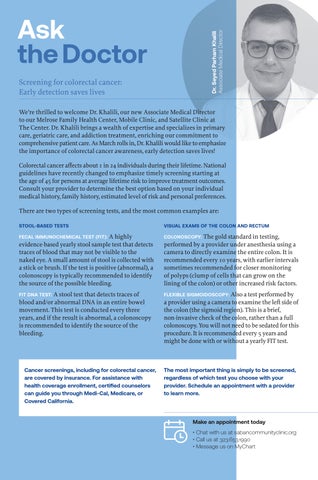
 Dr. Seyed Parham Khalili Associate Medical Director
We’re thrilled to welcome Dr. Khalili, our new Associate Medical Director to our Melrose Family Health Center, Mobile Clinic, and Satellite Clinic at The Center. Dr. Khalili brings a wealth of expertise and specializes in primary care, geriatric care, and addiction treatment, enriching our commitment to comprehensive patient care. As March rolls in, Dr. Khalili would like to emphasize the importance of colorectal cancer awareness, early detection saves lives!
Colorectal cancer affects about 1 in 24 individuals during their lifetime. National guidelines have recently changed to emphasize timely screening starting at the age of 45 for persons at average lifetime risk to improve treatment outcomes. Consult your provider to determine the best option based on your individual medical history, family history, estimated level of risk and personal preferences.
There are two types of screening tests, and the most common examples are:
STOOL-BASED TESTS
FECAL IMMUNOCHEMICAL TEST (FIT): A highly evidence-based yearly stool sample test that detects traces of blood that may not be visible to the naked eye. A small amount of stool is collected with a stick or brush. If the test is positive (abnormal), a colonoscopy is typically recommended to identify the source of the possible bleeding.
FIT DNA TEST: A stool test that detects traces of blood and/or abnormal DNA in an entire bowel movement. This test is conducted every three years, and if the result is abnormal, a colonoscopy is recommended to identify the source of the bleeding.
Cancer screenings, including for colorectal cancer, are covered by insurance. For assistance with health coverage enrollment, certified counselors can guide you through Medi-Cal, Medicare, or Covered California.

VISUAL EXAMS OF THE COLON AND RECTUM
COLONOSCOPY: The gold standard in testing, performed by a provider under anesthesia using a camera to directly examine the entire colon. It is recommended every 10 years, with earlier intervals sometimes recommended for closer monitoring of polyps (clump of cells that can grow on the lining of the colon) or other increased risk factors.
FLEXIBLE SIGMOIDOSCOPY: Also a test performed by a provider using a camera to examine the left side of the colon (the sigmoid region). This is a brief, non-invasive check of the colon, rather than a full colonoscopy. You will not need to be sedated for this procedure. It is recommended every 5 years and might be done with or without a yearly FIT test.
The most important thing is simply to be screened, regardless of which test you choose with your provider. Schedule an appointment with a provider to learn more.
Make an appointment today • Chat with us at sabancommunityclinic.org • Call us at 323.653.1990 • Message us on MyChart
AROUND THE CLINIC

Thanks to our friend and renowned origami artist, Robert Lang, our dental suites have come to life, delighting patients with the larger-than-life Koi fish and colorful birds. His mastery of origami is noted as some of the most complex origami designs ever completed! Check out the art at your next dental appointment.
See one-of-a-kind art at your next dental visit
FUN FACT
Robert and his wife, Diane, are longtime friends of Saban. If you look at the Saban Kids Library at Melrose Family Health Center or Virgil Family Health Center, you will find wonderful children’s books like Fur Feather Fin, All of Us are Kin and others written by Diane that have been donated to our Saban Kids!
To request an appointment, log in to MyChart:
Additionally, you can call us at 323.653.1990 or chat with us at sabancommunityclinic.org @sabanclinic

Our locations:
Beverly Health Center 8405 Beverly Blvd., Los Angeles, CA 90048
Hollywood Health Center 6043 Hollywood Blvd., Los Angeles, CA 90028
Melrose Family Health Center 5205 Melrose Ave., Los Angeles, CA 90038
Virgil Family Health Center 137 N. Virgil Ave., Los Angeles, CA 90004
Satellite Clinic at The Center 6636 Selma Ave., Los Angeles, CA 90028
sabancommunityclinic.org
←