Cytogenetics Chromosome Analysis for Genetic Disorders Test Purpose
: Evaluation of chromosomes for numerical and structural aberrations under the following conditions: u An individual with congenital abnormalities/ developmental delay/ dysmorphic features/ ambiguous genitalia/ suspected chromosomal defects/ neurological disorders/ mental retardation or other conditions indicating genetic disorder. u Family members of a child with chromosomal defect. u Hematological malignancies. u Adult males with delayed or incomplete puberty. u In case of primary amenorrhoea and secondary amenorrhoea. u In case of infertility or recurrent abortions.
Methodology : Karyotyping. Testing Procedure : This test includes culture of blood lymphocytes/ bone marrow cells, followed by banding and analysis of metaphase cells. Turn Around Time : 14 working days. Specimen Type
: Peripheral venous blood / bone marrow.
Specimen Volume : 3-4 ml sample in green top heparin vacutainer (a minimum volume of 2 ml in case of very young babies). Collection instructions : Label the vacutainer with patient’s name and specimen type. Specimen Transport : The specimen should be shipped at 18-25°C, do not freeze. It should reach the lab within 24 hours of collection (preferably at the earliest). In case of delay, sample to be stored on the door shelf of the refrigerator. Mandatory Requirements
Detailed clinical history, date & time of sample withdrawn : should be specified on test request form*.
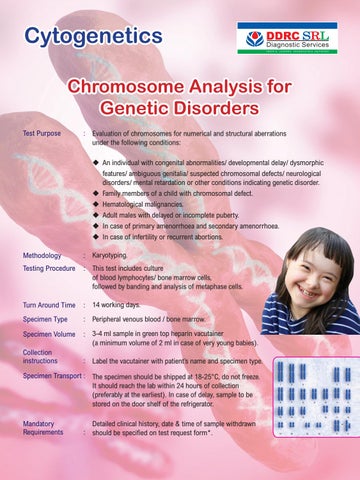
Highlights of the Test: ¤ Karyotypes are described as per the InternationalSystem for Human Cytogenomic Nomenclature (ISCN)2016 guidelines. ¤ It can detect numerical abnormalitiesin syndromes like: Trisomy 21 (Down Syndrome) - Pure / Translocation / Mosaic Trisomy 13 (Patau Syndrome) Trisomy 18 (Edward Syndrome) Turner Syndrome (X0) “I’m unique with my Klinefelter Syndrome (XXY) chromosomes” ¤ It can also detect Structural abnormalities like: Translocations, deletions, additions, inversions, derivative chromosomes, marker chromosomes, ring chromosomes etc. ¤ Useful in detecting Mosaicism: Condition with more than one type of cell in an individual. ¤ Helping to prevent the transmission of abnormal genes to future generations. ¤ Karyotype analysis reveals whole genome perspective in a single shot.
Note: A repeat sample may be needed in case of culture failure. If further testing is required, additional charges may be incurred. *Samples shall be rejected if above details are not provided.
94977 17850 94977 17842
Corporate Office & Referral Laboratory, DDRC SRL Towers, Panampilly Nagar, Kochi-682 036 Ph: +91 484 2318222, 2318223 email: info@ddrcsrl.com www.ddrconline.com, www.ddrclab.com