Impact Statements for 2020 COMMUNITY WELLNESS The Community Wellness team hosts a variety of programs, seminars, and events to improve chronic disease management and prevention, encourage a healthy lifestyle, and increase the community’s knowledge of health-related topics through education and outreach. In 2020, Community Wellness recorded over 27,626 encounters with individuals in the community. Nearly half of those (46%) made via the team’s physical education classes. Health education and senior health education classes were also common sources of outreach, accounting for 21% and 18% of encounters, respectively.
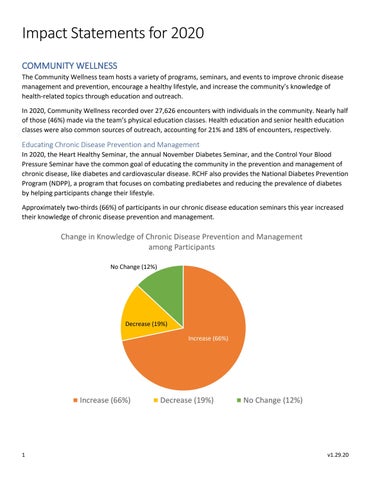
Educating Chronic Disease Prevention and Management In 2020, the Heart Healthy Seminar, the annual November Diabetes Seminar, and the Control Your Blood Pressure Seminar have the common goal of educating the community in the prevention and management of chronic disease, like diabetes and cardiovascular disease. RCHF also provides the National Diabetes Prevention Program (NDPP), a program that focuses on combating prediabetes and reducing the prevalence of diabetes by helping participants change their lifestyle. Approximately two-thirds (66%) of participants in our chronic disease education seminars this year increased their knowledge of chronic disease prevention and management.
Change in Knowledge of Chronic Disease Prevention and Management among Participants No Change (12%)
Decrease (19%) Increase (66%)
Increase (66%)
1
Decrease (19%)
No Change (12%)
v1.29.20
Participants also found the seminars useful. •
•
98% of participants in the seminars indicated that they were at least somewhat likely to use what they learned. Seventy-one percent (71%) indicated that they were “very likely” to use the information they learned during the seminars. 59% of participants rated the seminars as “Excellent”.
Practicing a Healthy Lifestyle The National Diabetes Prevention Program (NDPP), My Hair, My Health, and physical activity classes, such as Tai Chi, Zumba Strong, U-Jam, and Aqua Zumba, seek to help participants improve their health make healthy lifestyle changes. • • • •
82% of those participating in Community Wellness physical activity classes indicated that the classes helped them improve their health “a lot”. The remaining 18% said the classes helped “some”. Of the 26 individuals that completed NDPP, 51% of participants completing the NDPP program on diabetes reduced their body weight by at least 5%. Nearly three-quarters (74%) of participants completing NDPP were physically active at least 150 minutes a week. Attendees of the My Hair, My Health virtual conference increased the number of healthy meals they ate each week and the number of days each week they were physically active for at least 30 minutes.
Improving Infant and Maternal Health In 2020, the Community Wellness Program began a doula program for pregnant mothers and a doula training program to prepare individuals to be more effective doulas. • • • •
•
• •
2
All (100%) attendees of the doula training gained a better understanding of how to be a more effective doula, including maternity care during the COVID-19 pandemic and knowledge of community resources for mothers. 75% of attendees of the doula training strongly agreed that completing the training gave them a better understanding of how cultural competency and humility relate to working as a doula. Nearly all mothers participating in the Doula Access Program (96%) had a post-partum check-up, which is higher than the 90% recorded nationally by the CDC. Only 3.4% of babies born to mothers participating in the Doula Access Program were born prematurely (before 37 weeks), compared to the national average of 11.7%. Of the 2 mothers in the program that gave birth in 2020, only one had a baby born before 37 weeks gestation. The percentage of low birthweight babies (below 2500 grams or 5.51lbs) born to mothers in the Doula Access Program in 2020 was also well below the national average – 3.4% compared to 8.3% nationwide. One out of 29 mothers completing the program in 2020 had a baby born at 5.2 pounds. 89% of mothers participating in the Doula Access Program agreed strongly agreed that having a doula increased their satisfaction with the labor and delivery process. 86% of mothers participating in the Doula Access Program agreed strongly agreed that having a doula increased their sense of control during the birthing process.
v1.29.20
The Community Wellness Program also continued its Maternal Wellness Retreat that educates mothers about available resources, provides young mothers with the tools to cope with the COVID-19 pandemic, helps them develop a personal self-care plan, and teaches mothers to identify mental health concerns. Results from our evaluation of these activities indicated that they had a positive impact, with 57% of Maternal Wellness Retreat attendees improving their understanding of maternal wellness issues.
Change in Knowledge of Maternal Wellness among Participants
No Change (21%)
Decrease (21%)
Increase (57%)
Increase (57%)
Decrease (21%)
No Change (21%)
Increasing Community Members’ Knowledge of Behavioral Health Two educational seminars – one covering stress management, the other addressing depression – addressed issues related to mental and emotional health. Eighty-nine percent (89%) of participants to these seminars increased their knowledge of mental health issues.
3
v1.29.20
Change in Knowledge of Mental Health Issues among Participants No Change (4%) Decrease (8%)
Increase (89%)
Increase (89%)
• • •
Decrease (8%)
No Change (4%)
97% of participants indicated that they were at least somewhat likely to use the information they learned at the seminars. 90% of attendees of the stress management seminar agreed that what they learned will help them identify and help someone with anxiety. 62% of participants of the seminars rated them as “Excellent”.
COMMUNITY EMPOWERMENT Through its Eastside HEAL Zone initiative, conferences, clinic services, and health education classes, the Community Empowerment team aims to increase resident engagement and leadership and improve health knowledge. In 2020, the Community Empowerment team recorded over 13,800 encounters with participants and residents in the community. Over half (52%) of these encounters were made through Community Empowerment’s health education classes, followed by clinic services (36%).
HEAL Zone Since 2017, Eastside HEAL Zone has asked residents about their attitudes toward Patterson Park, including perceptions of safety and their use of the park. The first Eastside resident survey was conducted in 2017 before major park and neighborhood improvement initiatives were undertaken by HEAL Zone. In 2020, 84 residents completed the survey. Results from this year’s survey showed that 65% of residents believe that crime is a “somewhat serious” or “very serious” problem at Patterson Park. 4
v1.29.20
How Serious is the Overall Level of Crime at Patterson Park? Not at All Serious 7%
Very Serious 21% Not too Serious 28% Somewhat Serious 44%
Not at All Serious
Not too Serious
Somewhat Serious
Very Serious
Even so, 43% of residents surveyed believed that crime and quality of life issues at or around the park have declined in the past year. Residents reported that garbage dumping, assaults, drug-dealing and use, sexuality activity/prostitution, vandalism, graffiti, fighting, and drinking were down this year compared to 2017.
Has the Level of Crime and/or Quality of Life Issues at Patterson Park Increased, Decreased, or Stayed the Same?
Stayed the Same 40%
Increased 43%
Decreased 17%
Increased
5
Decreased
Stayed the Same
v1.29.20
Use of the park has also increased. Three-quarters (75%) of residents indicated that they use the park at least once a month, compared to 64% in 2017. Over two thirds of residents surveyed (68%) indicated that they participate in activities at the park at least once a month, but a majority (56%) would like to see more activities at the park.
F.A.C.T.S. (Teen Health) The Fueling Adolescent Communities with Trust and Strategies (F.A.C.T.S.) program provided education presentations and conferences to teens through the Best SELFie Conference virtually and presentations in Riverside-area high schools on sexually-transmitted infections, healthy relationships, drugs, and reproductive health. Best SELFie Conference On November 5th, we held our first ever virtual BestSELFie conference to 24 youth. The annual conference, designed for women ages 14-19, aims to “Empower young womxn’s self-exploration journey’s by providing [them] with the tools and resources to expand [their] personal and professional success.” Attendees enjoyed the virtual conference. One youth remarked, “Since it was online, I was able to attend and not feel rushed in heading to another location.” Another, commenting on the topics addressed at the conference remarked, “I loved ever thing with these meetings. they were inspirational, encouraging and helpful. I loved the little videos we had access to like the Dancing one and the hair products those were fun and very helpful.” Overall, 89% of attendees agreed or strongly agreed that they learned something new about resources available to them in the community. Eighty-eight percent (88%) also believed that the conference will help them make better decisions about their future.
The BEST SELFie Conference Will Help Me Make Better Decisions About My Future Strongly Disagree (11%)
Strongly Agree (44%) Agree (44%)
Strongly Agree (44%)
6
Agree (44%)
Strongly Disagree (11%)
v1.29.20
Youth Presentations The FACTs teams provided health education classes to youth at local high schools in Riverside Unified, Alvord Unified, and Jurupa Unified school districts. Youth learned about healthy relationships, reproductive health, sexually transmitted infections (STIs), and illicit and non-prescription drugs. Based on 1,147 matched pre- and post-surveys conducted during the program, a large percentage of youth benefitted from the instruction. Seventy percent (70%) of youth increased their knowledge of reproductive health, 65% increased their knowledge of healthy relationships, 62% increased their knowledge of illicit and prescription drug use, and 69% increased their knowledge of STIs.
Change in Knowledge of STIs, Drugs, Healthy Relationships, and Reprocitive Health among Youth Participants
STIs
20%
Illicit & Prescription Drugs
11%
15%
Healthy Relationships
13%
Reproductive Health
24%
10%
62%
22%
65%
12%
19%
0%
69%
20%
70%
30%
Decrease in Knowledge
40%
50%
No Change
60%
70%
80%
90%
100%
Increase in Knowledge
Pink Ribbon Place In 2020, The Pink Ribbon Place recorded over 44,000 encounters, with a large share of those contacts made though its community events (73%) and physical education classes (20%). Through a variety of community conferences and seminars, physical activity classes, individual and group counseling, and resources, the Pink Ribbon Place provides support and education for cancer survivors and their families at no cost. These programs aim to increase the community’s knowledge of cancer and cancer7
v1.29.20
related issues, empower cancer survivors by building confidence and improving their ability to advocate for themselves and navigate resources, increase survivors’ feelings of support and connectivity, and motivate survivors to engage in regular physical activity.
Increasing Knowledge of Cancer and Cancer-Related Issues Through the SoCal Women’s Cancer Conference (WCC) and the educational support group on self-love, 78% of participants increased their knowledge of cancer and cancer-related topics.
Change in Knowledge of Cancer and Cancer-Related Topics Among Women's Cancer Conference Attendees Decrease (7%)
No Change (15%)
Increase (78%)
Increase (78%)
No Change (15%)
Decrease (7%)
At the Women’s Cancer Conference, participants indicated that they learned something new about a wide variety of topics – ranging from proper nutrition to cannabis use for cancer. Increases in knowledge were greatest for the following topics: • • •
How eating well affects cancer treatment and recovery (64% of participants increased), Unforeseen side effects of cancer treatments (66% of participants increased), and How to communicate about body image and intimacy issues (62% of participants increased)
Sixty-five percent (65%) Participants attending the virtual conference strongly agreed that the conference motivated them to learn more about the topics discussed.
Building Confidence and Empowering Survivors Building confidence and empowering cancer survivors were important elements of The Pink Ribbon Places’ Client Navigation services and the Look Good Feel Better workshop, a public service program that teaches beauty techniques to people with cancer to help manage appearance-related side effects of cancer treatment.
8
v1.29.20
• • • •
Eighty percent (80%) of clients receiving navigation support were more confident navigating health resources after receiving support from The Pink Ribbon Place. Eighty-three percent (83%) of participants attending Look Good Feel Better increased confidence in their ability to apply the beauty techniques discussed. Another 83% of Look Good Feel Better participants indicated that they were “Very Likely” to use what they learned during the workshop. Seventy-five percent (75%) of Look Good Feel Better participants also increased their knowledge of beauty and self-care techniques.
Increasing Feelings of Support and Connectedness Several support groups were offered by The Pink Ribbon Place as way for cancer survivors and their loved ones to connect with others who understand what they are going through, share resources, and discover hope. These included Hope for Women and Esperanza para Mujeres, Metastatic Cancer Support Group, and Oasis Ovarian Support Group. The Pink Ribbon Place also assisted survivors connect to local resources they could access for help on their cancer journey. After attending one of more of these groups or receiving client navigation services, clients were asked about their support network and if they felt lonely or socially isolated. • • • •
85% of clients believed that they felt they had a supportive network of people to help them. 85% of clients indicated that they had people they can talk to who understand their situation. 88% of support group clients felt that the group was a safe environment to share their personal experiences. 69% of support group clients believed that they felt less isolated after attending the support group.
Encouraging Regular Physical Activity Aquamotion, a pool aerobic class, and Iyengar Yoga help cancer survivors re-build strength and encourage regular physical activity. • • •
Seventy-five percent (75%) of class attendees indicated that they were more motivated to exercise regularly and be physically active after participating in either program. Seventy-five percent (75%) of participants also believed that they had increased their skill level at either yoga or pool aerobics. All participants (100%) rated the classes as “Excellent”.
Miles of Smiles In the first quarter of 2020, Miles of Smiles held presentations and oral health screenings at several Alvord Unified, Jurupa Unified, and Riverside Unified schools. A survey of youth during the dental screenings found that the need and demand for oral health education remains high. • • • •
9
Over half of 2nd (54%) and 6th (53%) graders never floss. 57% of youth surveyed either haven’t been to a dentist in over a year or have never been to a dentist. Of the 90 teachers surveyed, 94% said that it was “very important” to have Miles of Smiles at their school. Teachers felt that the Miles of Smiles program is “a valuable service." and "an excellent program that is greatly needed”.
v1.29.20
The Miles of Smiles program also had an impact on one of the greatest barriers kids have to going to a dentist – fear. Over 90% of 2nd, 5th, and 6th graders indicated that Miles of Smiles staff made them feel more comfortable about going to a dentist.
Community Settlement Association In the first quarter of the year, CSA implemented its ASP BEST, a program for youth from K though 8th grade that helps youth build life skills, increase self-confidence, and develop a positive outlook. The program, through guest speakers and diverse topics, teaches youth useful skills. This year, for example, youth were instructed in the basics of computer science and coding. Below are highlights from 2020. • •
10
After participating in the ASP BEST program, 52% of K-3rd grade youth and 42% of 4th-8th grade youth increased their self-confidence and outlook. 75% of K-3rd grade youth and 68% of 4th-8th grade youth believed that they were somewhat likely or very likely to use the information they learned during the program.
v1.29.20