Impact Narrative for 2019 Annual Report COMMUNITY WELLNESS The Community Wellness team hosts a variety of programs, seminars, and events to improve chronic disease management and prevention, encourage a healthy lifestyle, and increase the community’s knowledge of health-related topics through education and outreach.
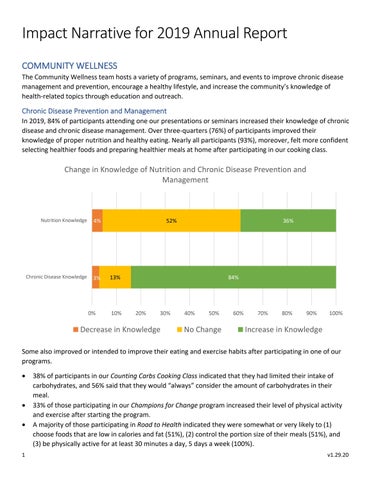
Chronic Disease Prevention and Management In 2019, 84% of participants attending one our presentations or seminars increased their knowledge of chronic disease and chronic disease management. Over three-quarters (76%) of participants improved their knowledge of proper nutrition and healthy eating. Nearly all participants (93%), moreover, felt more confident selecting healthier foods and preparing healthier meals at home after participating in our cooking class.
Change in Knowledge of Nutrition and Chronic Disease Prevention and Management
Nutrition Knowledge
4%
Chronic Disease Knowledge
3%
0%
52%
36%
13%
10%
84%
20%
30%
Decrease in Knowledge
40%
50%
No Change
60%
70%
80%
90%
100%
Increase in Knowledge
Some also improved or intended to improve their eating and exercise habits after participating in one of our programs. •
• •
1
38% of participants in our Counting Carbs Cooking Class indicated that they had limited their intake of carbohydrates, and 56% said that they would “always” consider the amount of carbohydrates in their meal. 33% of those participating in our Champions for Change program increased their level of physical activity and exercise after starting the program. A majority of those participating in Road to Health indicated they were somewhat or very likely to (1) choose foods that are low in calories and fat (51%), (2) control the portion size of their meals (51%), and (3) be physically active for at least 30 minutes a day, 5 days a week (100%). v1.29.20
Health Knowledge Community Wellness educates the community through its various programs, seminars, and conferences. These activities address several health-related topics important to the community, such as developing a healthy and active lifestyle, heart health, maternal wellness and women’s health, mens’ health, and mental wellness. Overall, nearly 80% (506 out of 637 participants) of participants attending these activities increased their health knowledge (regardless of the topic), with an average knowledge improvement of 44%.
Change in Health Knowledge among Participants No Change 7%
Decrease 14%
Increase 79%
Increase
Decrease
No Change
Some highlights: • • •
•
90% of Heart Healthy Dinner attendees increased their knowledge of heart health and the prevention of heart disease. 90% of Women’s Health Seminar attendees increased their ability to manage and reduce stress. 89% of attendees to our Navigating Your Healthcare System panel discussion increased their knowledge of the healthcare systems, including ways to access affordable care, eligibility requirements for IEHP/MediCal, and resources available to Medi-Cal and Medicare patients. 87% of Maternal Wellness Seminar attendees increased their ability to identify the symptoms of maternal mental health issues and their awareness of prevention and treatment options.
The information that participants learned though these health education seminars and programs was considered useful and applicable to their lives. In fact, 84% of participants of these health education programs indicated that they were “very likely” to use the information they had learned. Community Wellness programs also motivated residents to make a change to improve their physical and emotional well-being. Eighty-seven percent (87%) of participants attending any of our physical activity classes (e.g., Zumba and Tai Chi) believed that the class improved their overall health “a lot”.
2
v1.29.20
Physical Fitness Classes: How Much Has the Class Improved Your Overall Health? None 1% Some 12%
Very Little 0% A Lot 87%
A Lot
Very Little
Some
None
Participants believed that the programs improved their mental and emotional health as well. Ninety-two percent (92%) of participants attending May’s Salud Integral de Mujer conference felt a lot more motivated to do something to improve their emotional and mental well-being, and nearly all of the attendees believed that attending the conference benefitted them by increasing their confidence and morale (98%), motivating them to learn more about women’s health (99%), and helping them connecting to others with similar problems (94%).
COMMUNITY EMPOWERMENT HEAL Zone For the last 3 years, Eastside HEAL Zone has asked residents about their attitudes toward Patterson Park, including perceptions of safety and their use of the park. The first Eastside resident survey was conducted in 2017 before major park and neighborhood improvement initiatives were undertaken by HEAL Zone. In 2019, 84 residents completed the survey. Results from this year’s survey showed that 65% of residents believe that crime is a “somewhat serious” or “very serious” problem at Patterson Park.
3
v1.29.20
How Serious is the Overall Level of Crime at Patterson Park? Not at All Serious 7%
Very Serious 21% Not too Serious 28% Somewhat Serious 44%
Not at All Serious
Not too Serious
Somewhat Serious
Very Serious
COMMUNITY EMPOWERMENT HEAL Zone Even so, 43% of residents surveyed believed that crime and other problems at or around the park have declined in the past year. Residents reported that garbage dumping, assaults, drug-dealing and use, sexuality activity/prostitution, vandalism and graffiti, fighting, and drinking were down this year compared to 2017.
4
v1.29.20
Has the Level of Crime and/or Other Problems at Patterson Park Increased, Decreased, or Stayed the Same?
Increased 17% Stayed the Same 40% Decreased 43%
Increased
Decreased
Stayed the Same
Use of the park has also increased. Three-quarters (75%) of residents indicated that they use the park at least once a month, compared to 64% in 2017. Over two thirds of residents surveyed (68%) indicated that they participate in activities at the park at least once a month, but a majority (56%) would like to see more activities at the park.
FACTS (Teen Health) Young Women’s Conference/Best SELFie Conference The BestSELFie Conference addressed a variety of mental/behavioral health issues facing young women and helped them explore their career opportunities. Of the 61 surveys we collected, 62% of respondents “strongly agreed” and 28% “agreed” that the conference will help them make better decisions about their future.
5
v1.29.20
The BEST SELFie Conference Will Help Me Make Better Decisions About My Future Neutral/No Opinion 10%
Strongly Agree 62%
Agree 28%
Strongly Agree
Agree
Neutral/No Opinion
Over half (53%) of attendees agreed strongly that they learned something new about resources and services available in the community. Parent Presentations The FACTS team offered presentations on social media, self-esteem, and sexually-transmitted infections (STIs) to help parents and caregivers support their teens in making healthy decisions.
• • • •
6
65% of parents increased their knowledge of social media and their ability to set limits on its use. 68% of parents increased their ability to communicate with their teen. 100% of parents increased their knowledge of STIs. Two-thirds (67%) of 52 parents attending one or more of the parent presentations increased their understanding of these topics.
v1.29.20
Parent Presentations: Percent of Participants Improving Knowledge of Teen-Related Issues
STIs
100%
Self-Esteem/Communication
33%
Digital Era/Social Media
10%
All Presentations
26%
65%
27%
6%
0%
68%
10%
20%
Decrease in Knowledge
67%
30%
40%
50%
No Change
60%
70%
80%
90%
100%
Increase in Knowledge
The presentations were also considered very helpful by nearly all parents that attended. Ninety-four percent (94%) felt that they were “very likely” to use what they had learned during the presentations. Youth Presentations FACTS educators addressed the topic of sexually transmitted infections (STIs) at local area high schools this year. In all, they surveyed 2,429 youth to evaluate the impact of the teen health presentation on teens’ understanding of STIs. Improvements in teens’ knowledge of this topic improved substantially, with 87% of teens improving their knowledge. Teens’ knowledge increased on average by 36% after participating in the presentation.
7
v1.29.20
Change in Teens' Knowledge of Sexually Transmitted Infections Decreased Knowledge 7% No Change 6%
Increased Knowledge 87%
Increased Knowledge
No Change
Decreased Knowledge
Pink Ribbon Place In 2019, The Pink Ribbon Place surveyed participants attending its various presentations and seminars held throughout the year as well as at its Breast Cancer Professional Panel and its annual Southern California Women’s Cancer Conference. An important objective was to increase the community’s knowledge of cancer-related issues. We measured participants’ knowledge levels before and after several activities and found that 88% of participants attending the Pink Ribbon Place’s presentations and Breast Cancer Professional Panel increased their knowledge and understanding breast cancer topics.
8
v1.29.20
Change in Knowledge of Breast Cancer No Change 6%
Decreased Knowledge 6%
Increased Knowledge 88%
Increased Knowledge
No Change
Decreased Knowledge
The Pink Ribbon Place also aimed through various seminars and professional panels to help cancer survivors become more effective advocates for their own health. Forty-three percent (43%) of attendees increased their confidence in their ability to advocate for their own health. Forty-four percent (44%) of participants of The Pink Ribbon Place’s Connect & Learn seminars also improved their ability to manage stress, while 86% learned about advance planning and their rights to medical treatment and care. Attendees of these events also indicated that they were likely to use what they had learned. For example, 92% of attendees of the 2019 Women’s Cancer Conference said that they were likely or very likely to use what they had learned at the general sessions and the various breakout sessions. A similar percentage of attendees at Pink Ribbon’s other events indicated that they were likely or very likely to use what they had learned. In fact, 92% of participants
Miles of Smiles The need for the Miles of Smiles program is suggested by our survey of teachers and youth in the school districts we serve – Alvord Unified, Jurupa Unified, and Riverside Unified. • • •
Nearly one in five youth (19%) in grades 2, 5, and 6 admitted that it has been at least a year since they have been to the dentist. Five percent (5%) indicated that they had never been to a dentist. When it comes to oral hygiene, over a third (34%) of youth in grades 2,5, and 6 brush just once a day. Forty-three percent (43%) of the youth we surveyed – and half of all 2nd graders -- never floss. Of the nearly 400 teachers surveyed in 2019, 371 (96%) indicated that it was “very important” to have Miles of Smiles at their school.
In addition to offering the education and dental screenings in schools, Miles of Smiles held its first Oral Health Seminar in October to adults this year. The seminar, which served Spanish-speaking residents, aimed to improve adults’ knowledge or oral health care, including the relationship between nutrition and oral health 9
v1.29.20
and the development and treatment of dental caries. The seminar was not only highly rated by attendees, but 81% of 52 adults also left the seminar having increased their knowledge of oral health.
Change in Knowledge of Oral Health among Oral Health Seminar Attendees Decreased Knowledge 14% No Change 5%
Increased Knowledge 81%
Increased Knowledge
10
No Change
Decreased Knowledge
v1.29.20