Impact Statements for 2021 Annual Report 1 COMMUNITY WELLNESS In 2021, RCHF’s Community Wellness team provided classes, seminars, and workshops promoting health and wellness in the following areas: § § § § §
Chronic disease prevention and management Maternal and infant health Behavioral health Oral health Nutrition, physical activity, and general wellness
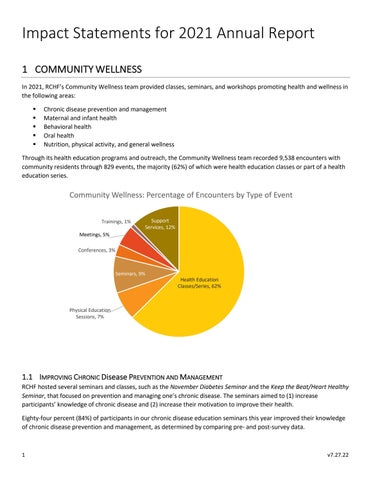
Through its health education programs and outreach, the Community Wellness team recorded 9,538 encounters with community residents through 829 events, the majority (62%) of which were health education classes or part of a health education series.
Community Wellness: Percentage of Encounters by Type of Event Trainings, 1%
Support Services, 12%
Meetings, 5% Conferences, 3%
Seminars, 9%
Health Education Classes/Series, 62%
Physical Education Sessions, 7%
1.1 IMPROVING CHRONIC Disease PREVENTION AND MANAGEMENT RCHF hosted several seminars and classes, such as the November Diabetes Seminar and the Keep the Beat/Heart Healthy Seminar, that focused on prevention and managing one’s chronic disease. The seminars aimed to (1) increase participants’ knowledge of chronic disease and (2) increase their motivation to improve their health. Eighty-four percent (84%) of participants in our chronic disease education seminars this year improved their knowledge of chronic disease prevention and management, as determined by comparing pre- and post-survey data.
1
v7.27.22
Percent of Participants Improving Knowledge of Chronic Disease Prevention and Management
Decrease (3%)
No Change (14%)
Increase (84%)
Increase (84%)
Decrease (3%)
No Change (14%)
Attendees of the annual November Diabetes Seminar also increased their motivation to improve their health. Sixty percent (60%) of respondents increased their motivation to make changes to prevent or manage diabetes.
1.2 PRACTICING A HEALTHY LIFESTYLE The Community Wellness Program also held sessions that encouraged participants to make healthier lifestyle choices through physically activity, proper nutrition, stress management, and mental wellness techniques. Several of these sessions served specific populations in Riverside – for example, the Latina population (Salud Integral de la Mujer), seniors (Health and Wellness in the Golden Age), and those with special needs (Nutrition for Children with Special Needs). The series of presentations for Riverside Unified (e.g., Grow Your Own Food, Road to Health, and Starting an Exercise Routine) and the National Diabetes Prevention Program (NDPP) also promoted a healthier lifestyle. Among these programs, 58% of participants increased their knowledge of healthy lifestyle choices, with some sessions, such as those serving seniors and those serving parents of children with special needs, demonstrating improvements among 71% and 100% of participants, respectively.
2
v7.27.22
Percent of Participants Improving Knowledge of Healthy Choices
Decrease (3%)
No Change (14%)
Increase (84%)
Increase (84%)
Decrease (3%)
No Change (14%)
1.3 IMPROVING INFANT AND MATERNAL HEALTH In September 2021, Community Wellness hosted the Black Maternal Health Series, a series of four weekly workshops for medical and health professionals designed to increase awareness of health disparities in maternal health and promote an interdisciplinary approach to improving maternal health outcomes. •
• •
•
After completing the four-part series, 85% of participants indicated that they were knowledgeable (i.e., “somewhat knowledgeable” or “very knowledgeable”) about interdisciplinary approaches to health care, up from 72% after the first session. After completing the four-part series, 75% of participants indicated that they were knowledgeable about historical and present practices in terms of maternal outcomes, up from 55% after the first session. After completing the four-part series, 85% of participants were “somewhat confident” or “very confident” in their ability to implement culturally aware, best practices when serving Black birthing families. This was an increase over results observed after the first session, when 64% of participants felt similarly. An average of 72% of participants believed that what they learned at the sessions was very useful for their own work and/or practice. An average of 53% of participants indicated that they were “very likely” to use or apply what they learned to their own work.
1.3.1 Doula Training and Doula Services Community Wellness continued its doula program for pregnant mothers and its doula training program this past year with some encouraging results.
• •
• 3
Only 3.8% of mothers completing our follow-up survey reported that their babies were born prematurely (before 37 weeks), compared to the national average of 11.0%. 73% of mothers in the program indicated they were currently breastfeeding, with another 23% indicating that they were using a combination of breast milk and formula. Only 1 out of 29 mothers completing the program in 2021 had was using baby formula exclusively. 89% of mothers responding in 2021 indicated that they had a postpartum checkup (4-6 weeks after childbirth). v7.27.22
•
Mothers receiving doula services reported high levels of satisfaction with the doula services they received, with most mothers believing that the services benefitting them substantially, as shown in the figure below.
The Doula Access Program also continued in 2021. Results from our follow-up with participants suggest the program had a positive impact.
• • •
All (100%) attendees of the doula training gained a better understanding of how to be a more effective doula, with an average increase in knowledge of 38%. 100% of participants of the doula training indicated that they “strongly agreed” that the training improved their cultural competency as it relates to being a doula. A large percentage of participants also attributed increased satisfaction, control, and comfort during the birth process to doula services.
Doula Participants' Perception of the Benefit of Having a Doula on the Birthing Process and Delivery
12%
Increased level of comfort during the birthing process
8%
Increase sense of control during the birthing process
8%
80%
12%
80%
20%
Increased satisfaction w/my labor and delivery experience
0%
Strongly Disagree/Disagree
4%
20%
Not Sure
76%
40%
60%
80%
100%
Agree/Strongly Agree
1.4 INCREASING COMMUNITY MEMBERS’ KNOWLEDGE OF BEHAVIORAL HEALTH Community Wellness offered seminars and workshops addressing mental and behavioral health issues for men and women. Participants’ knowledge of general mental health issues, such as managing anger, anxiety, or stress, increased for about a quarter of participants overall, but was as high as 63% of participants for the Men’s Health Seminar.
4
v7.27.22
Percent of Participants Increasing Knowledge of Behavioral Health Issues 63% of participants in the Men's Health Seminar increased their knowledge of behavioral health issues.
Increase (23%)
No Change (69%)
Increase (23%)
Decrease (8%)
Decrease (8%)
No Change (69%)
1.5 IMPROVING ORAL HEALTH The Oral Health Seminar, held in English and Spanish in October, sought to increase participants’ knowledge of proper oral health and to increase the likelihood that participants would practice healthy oral health habits. The goals of the session were to (1) increase awareness on the importance of oral health and (2) increase participants’ knowledge of proper oral care – that is, techniques and best practices, such as brushing and flossing. Regarding participants’ knowledge of proper oral health care techniques, most participants did not significantly improve –perhaps because participants felt they already knew a lot about brushing and flossing. Only 18% of participants increased their knowledge of how to brush and floss properly, with 73% not changing their level of knowledge. Participants, however, did improve their knowledge of proper oral health care overall by attending the seminar. Seventy-three percent (73%) of participants responding increased their overall understanding of the importance of oral health.
5
v7.27.22
Percent of Participants Increasing Knowledge of Oral Health
No Change (18%)
Decrease (9%)
Increase (73%)
Increase (73%)
Decrease (9%)
No Change (18%)
2 COMMUNITY EMPOWERMENT In 2021, the Community Empowerment team recorded 663 encounters with community residents through 163 events, conferences, clinic services, and health education classes and seminars, such as the Best SELFie Conference, Teen Vibe, and HEAL Rx food sustainability program.
2.1 BEST SELFIE CONFERENCE RCHF’s second annual BestSELFie conference was held on November 5, 2021 and hosted virtually on Zoom. The conference, designed for women ages 14-19, consisted of two workshops: “Menstrual Cycles Workshop”, where attendees learn about natural medicine and “Awakening Youth Inner Wisdom”, which encouraged participants to tap into their tuition through meditation. • • •
By end of the conference, 100% of participants were familiar with techniques to manage rage, up from just 14% of participants before the conference The percent of participants familiar with sound bowl meditation increased also increased -- from 31% (pre-survey) to 62% (post-survey). Participants also found the workshops useful, with 100% indicating that they were somewhat or very likely to use what they learned at the workshops.
2.2 HEAL RX PROGRAM The Heal RX Program was developed to address the lack of healthy food options in Riverside by providing access to fruits and vegetables to residents at reduced cost. Those receiving discounted produce from the program were asked whether 6
v7.27.22
they had been diagnosed with a chronic illness and how likely they were to use the produce. In 2021, 211 participants completed the short survey with these questions. • • • •
A large percentage of participants (44%) had a diagnosed chronic illness. Nearly all participants (96%) were very likely to use the produce they received. All (100%) of those with a chronic illness said they were at least somewhat likely to use the produce. 98% of those with a chronic illness were very likely to use the produce they received. A small percent (3%) of those without a chronic illness responded they were not likely to use the produce they received.
How Likely Are You to Use the Produce You Receive? Somewhat Likely (2%)
Not Likely (2%)
Very Likely (96%)
Very Likely (96%)
Somewhat Likely (2%)
Not Likely (2%)
3 PINK RIBBON PLACE Through community conferences and seminars, physical activity classes, and individual and group counseling, the Pink Ribbon Place provides support and education for cancer survivors and their families on cancer-related issues, encourages physical activity, and empowers cancer survivors to advocate for themselves. In 2021, these activities involved nearly 11,900 encounters with community members across 540 events. Almost 90% of these encounters were made through health education classes or a health education series.
7
v7.27.22
The Pink Ribbon Place: Percentage of Encounters by Type of Event Physical Education Sessions, 3%
Support Services, 8%
Health Education Classes/Series, 89%
3.1 INCREASING KNOWLEDGE OF CANCER AND CANCER-RELATED ISSUES The 2021 SoCal Women’s Cancer Conference (WCC) was held as two conferences -- one in English and one in Spanish – with each conference offering several workshops addressing issues ranging from testing and screening to treatment. The conferences not only attracted cancer survivors but also their caregivers and health care professionals. In fact, across the English and Spanish sessions, less than half (46%) were identified themselves as cancer survivors. Although they differed in content, the Spanish and English conferences had a similar goal: To increase attendees’ knowledge of cancer-related issues. Among the topics addressed at the conferences were the following: • • • • • • • • •
How COVID has impacted cancer screening and treatment Things that can help prevent cancer or its recurrence How important testing is for establishing cancer risk The long-term effects of cancer treatments Emotional healing techniques that can be used at home during and after cancer treatment Physical effects of cancer surgery and treatment on cancer survivors How to access resources and information on new treatment options What to ask the doctor to ensure effective treatment Ways to tell if cancer treatment is working
We asked participants to estimate how much they knew about each of the above topics before and after the conferences. Results from the pre- and post-conference survey illustrate improvements in knowledge across all topics.
8
v7.27.22
Percent Saying "Yes" (Yes, a little + Yes, a lot) They Increased Knowledge of Cancer-Related Topics 100%
100%
90%
80%
80% 70% 60%
96%
100%
96%
100% 92%
92%
92%
92%
83% 71%
70% 61%
60%
50%
43%
40%
47% 34%
30% 20% 10% 0%
COVID-19 Prevent Impact Recurrence
Genetic Testing
Long-Term Emotional Effects of Tx Healing
Pre-Survey
Physical Effects of Surgery
How to Ask Doctor Can Tell if Access to Ensure Treament is Resources Effective Working Treatment
Post-Survey
At the Women’s Cancer Conference, participants indicated that they learned something new about a wide variety of topics. The conference reminded attendees of the services that the Pink Ribbon Place offers: •
“I learned so much there was so much information and I wish it was longer. I learned that these women are not alone and they can get all the help they need at the Pink Ribbon Place with all the resources that they have.”
•
“The Women's Cancer Conference reminded me of the importance of the kind of support that you provided for participants.”
3.2 BUILDING CONFIDENCE AND EMPOWERING SURVIVORS The support groups, counseling, and client navigation services that survivors are connected to while a Pink Ribbon Place client, improve survivors’ ability to communicate their own health needs, navigate the network of care and resources available to cancer survivors, and increase their confidence and sense of community. • • • • 9
83% of counseling participants were more confident that they could actively participate in treatment decisions, and the same percentage were more confident that they could ask their physician questions. 67% of counseling participants were more confident that they could share their concerns than they were before they started the counseling sessions. 67% of participants in the support groups indicated that they felt connected to other individuals in the group and 83% felt that they felt safe sharing their personal experiences. 94% of survivors receiving client navigation services rated the services as helpful (31%) or very helpful (63%). v7.27.22
3.3 ENCOURAGING REGULAR PHYSICAL ACTIVITY Aquamotion, a pool aerobics class, and Iyengar Yoga help cancer survivors re-build strength and encourage regular physical activity. These classes were appreciated by participants. One participant remarked, “This has been the very best exercises for me especially in the water at the pools. The staff have all been friendly and comforting. The classes are excellent!” Results from the feedback survey also revealed that participants benefitted from the classes. • •
All (100%) of participants indicated that they improved their aerobics skills by being a part of the class. All (100%) of participants indicated that they were motivated to make exercise and physical activity a regular part of their life after participating in the Pink Ribbon Place’s programs.
4 COMMUNITY SETTLEMENT ASSOCIATION (CSA) In 2021, CSA implemented its ASP BEST program, a program for youth from K through 8th grade that helps youth build life skills, increase self-confidence, and develop a positive outlook. The program, through guest speakers covering diverse topics, teaches youth life skills. CSA also implemented its food pantry program, a component of which involves hosting several workshops on financial literacy and nutrition for adults in the community.
4.1 RESIDENT WORKSHOPS The two workshops on financial literacy -- 10 Steps to Financial Success and Better Budget – and the three on nutrition – Salt and Sodium, Healthy Snacks, and Fruits and Vegetables – aimed to increase residents’ knowledge of these topics, as well as to encourage participants to apply the skills and knowledge learned to their daily lives. • • • •
10
100% of participants in the financial literacy workshops increased their knowledge of budgeting and money management. 100% of participants were somewhat likely (25%) or very likely (75%) to use what they learned in the financial literacy workshops. 100% of participants indicated that they were likely to make a budget after they completed the workshop on budgeting, when only 25% on the pre-survey had indicated that they follow a monthly budget. 90% of participants of the nutritional classes increased their knowledge of nutrition overall, as illustrated in the chart below.
v7.27.22
Percent of Participants Increasing Knowledge of Nutrition Decrease (5%) No Change (5%)
Increase (90%)
Increase (90%)
Decrease (5%)
No Change (5%)
4.2 BEST (BETTERING EVERY STUDENT FOR TOMORROW) AFTER-SCHOOL PROGRAM In 2021, CSA implemented its ASP BEST program, a program for youth from K through 8th grade that helps youth build life skills, increase self-confidence, and develop a positive outlook. The program, through guest speakers covering diverse topics, teaches youth life skills. CSA also implemented its food pantry program, a component of which involves hosting several workshops on financial literacy and nutrition for adults in the community. The BEST program this year involved virtual field trips to introduce youth to unfamiliar cultures and a gardening club session designed to teach youth about gardening and encourage youth to plant fruits and vegetables for themselves. CSA also held a workshop with guest speakers to discuss diverse topics and issues applicable to youth, such as healthy eating habits, careers, choosing the right friends, and making healthy decisions. Some findings from our survey of youth participants this year include the following: •
• •
4.3
1,150 youth were served and of those 75% of participants who attended the field trips indicated that they learned something new by attending, with 100% indicating that they learned a little (25%) or a lot (75%) about history, culture, or traditions. All participants of the gardening club classes thought they would use what they learned. Among those that attended the guest speaker presentation, all participants (100%) indicated that they learned something they did not know before, and 50% indicated that they learned something that will help them in the future.
FOOD PANTRY
Food Pantry operations offer services to the community twice weekly. The residents receive nutritious fresh fruits and vegetables, along with eggs, meats, dairy products, and non-perishable foods. The pantry also prepares food bags for those residents who are vegetarian, vegan, and gluten free. The CSA food pantry also distributed much needed food via home delivery to seniors who are home bound, and otherwise physically unable to pick up food for themselves. Every day at least one person tells staff how grateful they are for the food they received and they “don’t know what my children would do without the food pantry.” • 11
Food pantry handed 8,140 residents vital and nourishing food bags to help fill gaps in access to food. v7.27.22
4.4
ICARES
ICARES is the Drinking Driver Program (DUI) & Family Guidance Counseling offered at CSA. Education is provided on the impact of alcohol use in the family, alcohol use while driving, and the effects on society. Services are offered through individual counseling sessions, and interactive group sessions for DUI clients. Family Guidance Counseling services are provided on a sliding fee scale for both adults and children and are available in English & Spanish. Insurance is not accepted at this time and services are by appointment. • 213 members of the community have enrolled in the ICARES program. • 230 members of the community completed the ICARES program in 2021.
4.5
SOCIAL SERVICES •
• • •
12
Our social services program offers a variety of bi-lingual services, including food assistance referrals such as SNAP/EBT, and WIC, bus tickets, diapers, and bilingual services. Tickets are limited and available on a first come, first serve basis. Services also include referrals to health, housing, and other financial resources. We also have a community garden which helps to supplement the Food Share Program that is run by the REAL (real eating active living) members of the Eastside community. 8,140 number of residents received referrals for community services not offered at CSA. 171 number of residents received 150 packs of diapers. 2,551 bus passes were distributed to community members.
v7.27.22