Storyboard 1
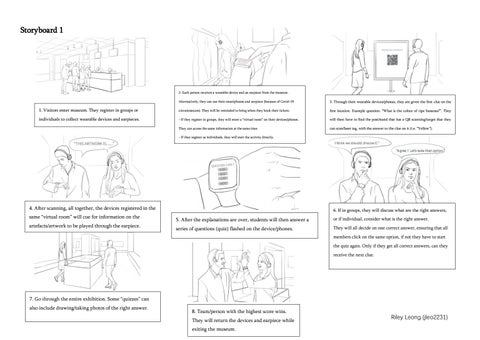
2. Each person receives a wearable device and an earpiece from the museum. Alternatively, they can use their smartphones and earpiece (because of Covid-19
3. Through their wearable devices/phones, they are given the first clue on the
1. Visitors enter museum. They register in groups or
circumstances). They will be reminded to bring when they book their tickets.
first location. Example question: “What is the colour of ripe bananas?”. They
individuals to collect wearable devices and earpieces.
- If they register in groups, they will enter a “virtual room” on their devices/phones.
will then have to find the post/stand that has a QR scanning/target that they
They can access the same information at the same time.
can scan/laser tag, with the answer to the clue on it (i.e. “Yellow”).
- If they register as individuals, they will start the activity directly.
4. After scanning, all together, the devices registered in the same “virtual room” will cue for information on the artefacts/artwork to be played through the earpiece.
6. If in groups, they will discuss what are the right answers,
5. After the explanations are over, students will then answer a
or if individual, consider what is the right answer.
series of questions (quiz) flashed on the device/phones.
They will all decide on one correct answer, ensuring that all members click on the same option, if not they have to start the quiz again. Only if they get all correct answers, can they receive the next clue.
7. Go through the entire exhibition. Some “quizzes” can also include drawing/taking photos of the right answer.
8. Team/person with the highest score wins. They will return the devices and earpiece while exiting the museum.
Riley Leong (jleo2231)
Storyboard 2
1. Visitors enter museum. They will each
2. For the specific exhibition, they will have to enter
3. Assuming the exhibition is about animals, the animals can
collect a pair of 3D glasses and Leap Motion
an enclosed area surrounded by screens. Behind the
“step out” of the screens. Music of the jungle/sounds of the
device.
screens is where speakers and smell diffusers will be
animals can be played. If it is a jungle setting, there can be
placed.
mist/water droplets sprayed, or smells of freshly cut grass.
4. Users can interact with the animals and “touch”
5. Multiple people can interact with the
6. There can be different exhibitions for different
them based on gestures (Leap Motion). Information
same animal, and the virtual animal can
time slots (e.g. other exhibitions can be
about the animal will also appear in front of the
react accordingly.
‘Impressions of Greece,’ ’Egyptian’)
user where s/he can scroll to read.
Riley Leong (jleo2231)
Assignment 3: Design Brief and Storyboards Riley Leong (jleo2231) & Ashley Hu (xihu5009)
Introduction Through our previous context-mapping research, we have identified the success and weaknesses of existing museums. From that, we have identified three main insights that will be the focus of our project: 1. Strong and visible narrative: The exhibitions have to tell a story. 2. Interactive: The exhibitions have to be responsive to visitors’ input. They should have minimal reading and possibly facilitate group activity. 3. Unique setting: The exhibitions have to be thoughtfully curated within the space. The setting should align to the purpose and narrative of the exhibitions. Individuals’ senses should be stimulated.
Vision We aim to design a Chau Chak Wing Museum experience for visitors that is like no other, that is playful, and that initiates adventure and learning. Alongside this, we aim to be inclusive in the staff’s involvement in the visitors’ museum experience, and to spread the word of the museum for the marketer and curator.
“Learn to play, Play to learn.” Traditionally, museum exhibitions tend to be static in nature. Artefacts or artworks are displayed plainly; information on them displayed in long-texts at the side; exhibitions lack context; and the flow of the museum is not carefully mapped out. Therefore, to many casual museum-goers, this may not be an inviting experience. Hence, we want visitors to create their own experience by interactivity. By putting them at the centre of their own experience - that is, interact with the exhibitions and have an hands-on experience from a first-persons’ perspective, we hope to encourage “play-based learning”. With the incorporation of modern technology for play, we aim to ensure that the museum is up to the times and future-proof, yet also relevant and relatable to visitors, encouraging a sense of curiosity and adventure. We want the museum to be self-sustaining too. Besides visitors, we understand that the creation and maintenance of the museum are reliant on its staff, curators and marketers. Therefore, by incorporating technology and planning the points of
intervention between the staff and visitors, we hope to reduce the need for the staff to be physically running the museum, attempting to fix any errors with regard to the exhibitions, or regulating visitors. Additionally, by allowing visitors to share their experience through social media platforms, we hope to use the word-of-mouth to maintain the flow of visitors into the museum - perhaps intrigue visitors to visit again. This supports marketing efforts.
Justification Play-based learning Extending from our previous research, we believe that visitors visit the museum with the intent of learning, or to gain a new perspective on the subject matter. Hence, the need for interactivity is important to facilitate this. Jean Piaget believed that children are born with no knowledge, but construct it from their perception of the world and their actions in the world (constructivism). He believed that the individual is a self-driven learner. Lev Vygotsky’s theory suggests that social interaction is fundamental for children’s cognitive development. He felt that children grew into the intellectual and cultural life of those around them - that is, they are heavily influenced by their environment alongside their inner drive. Therefore, combining the ideas of Piaget and Vygotsky on knowledge acquisition for children, we extrapolated that such theories are possible for adults too. We deduced that learning is best facilitated through play, whether for children or adults. As many empiricists would believe, we gain knowledge through our senses and how we observe the world. Play promotes exploration and hands-on learning, and this encourages us to make sense of the sensory experience. This is how we can gain knowledge. Play is: - Meaningful: We find meaning in new experiences and connect them to what we already know.
-
Joyful: There is enjoyment, motivation, thrill and pleasure. Actively engaging: We can be deeply involved, combining physical mental and verbal engagement. Iterative: Play and learning is not static. We practice skills, try out possibilities, revise hypotheses and discover new challenges. This leads to deeper learning. Socially interactive: Play allows us to communicate ideas, empathise with others through social interaction, and to build collaboration and teamwork.
Therefore, a possible way of interactivity is playing games.
The 12 Senses The 12 senses was first proposed by Rudolf Steiner in the 1920s. Aligned with empiricism, he believed that sensory perception helps to create a sense of self, build relationships with others, and to understand our surroundings - or, build our realities. He believed that there is a strong relationship between sensory perception, and healthy and vitality. Steiner’s twelve senses can be categorised into the “lower” senses (physical senses), “middle” senses (feeling senses) and “higher” senses (spiritual senses). 1. Lower senses (physical) relates to the perception of our own bodies: touch, life, movement and balance. 2. Middle senses (feeling) relates to the perception of the external world: smell, taste, sight and temperature. 3. Higher senses (spiritual) relates to the immaterial and metaphysics: hearing, speech, thought and ego. Hence, the joy in any experience can be derived best from integrating senses from all three categories. Therefore, we want to design a 4D experience for our visitors, which largely plays with the sense of touch, movement, smell, sight and hearing.
Word-of-mouth Today, social media is vital in spreading the word. Whether good or bad, visitors can now express their opinion openly and anonymously on the Internet. The visitor-to-visitor interaction happens even before and after they visit the museum. The Internet also allows the museum to receive feedback about their exhibitions and the visitors’ experience. This data is crucial in allowing museums to make revisions so as to cater best and initiate interest in the general population. The most popular social media platforms today include: Facebook, YouTube, Instagram and TikTok. Hence, we want to incorporate physical technology within the museum that allows photos of the exhibition to be shared live online. It is important to promote and sustain the interest of the community, and to urge visitors to visit the museum. The museum can consider creating their own account across multiple social media platforms.
Portability of information From our primary research, there has been loopholes regarding the way information on the exhibitions is presented. They are often lengthy and lack context, which led to a lot of confusion. Additionally, there is little interaction with the exhibitions - many visitors felt their visits were uneducational and boring.
Therefore, ideating from the core issues of little interaction and desire for self-sustainability, we want to create an all-encompassing digital product (app) that allows visitors to navigate in the museum, get a gist of or detailed content within the museum and allow interactivity with their own personal handheld devices. There are some situations that can render this app to be successful. For example, visitors have limited time and only want to visit exhibitions that they are interested in; visitors see the value of the app as an alternative to the conventional method of presentation; visitors are conscious of the current Covid-19 pandemic and want to use their own device as a way of accessing information. Hence, the app contributes to the journey that visitors go through, and becomes part of the experience. By encouraging information to be in the hands of users (portable), this creates a greater sense of ownership in their visit.
References Matthews, G., & Mullin, A. (2018). The Philosophy of Childhood (Stanford Encyclopedia of Philosophy). Stanford.edu. https://plato.stanford.edu/entries/childhood/ Most used social media 2021 | Statista. (2021). Statista; Statista. https://www.statista.com/statistics/272014/global-social-networks-ranked-by-num ber-of-users/ Siegel, H., Phillips, D. C., & Callan, E. (2018). Philosophy of Education (Stanford Encyclopedia of Philosophy). Stanford.edu. https://plato.stanford.edu/entries/education-philosophy/ Tom van Gelder. (2021). The 12 senses - The twelve senses. Antrovista.com. http://tomvangelder.antrovista.com/the-twelve-senses-123m50.html UNICEF. (2018). Learning through play Strengthening learning through play in early childhood education programmes 2 Learning through play Strengthening learning through play in early childhood education programmes Acknowledgements. https://www.unicef.org/sites/default/files/2018-12/UNICEF-Lego-Foundation-Lear ning-through-Play.pdf ResearchGate Forum. What is the difference between Rationalism & Empiricism, give your opinion ? (n.d.). ResearchGate. https://www.researchgate.net/post/What_is_the_difference_between_Rationalism _Empiricism_give_your_opinion Leap Motion. https://www.ultraleap.com/ Group 2 Miro Board (Primary Research) by Amber Linz (alin7345), Ashley Hu (xihu5009), Rachel Amin (rami4179) and Riley Leong (jleo2231): https://miro.com/app/board/o9J_lN3z6S0=/?utm_source=notification&utm_medium=em ail&utm_campaign=daily-updates&utm_content=go-to-board
Appendix (Ideation only) Insights that we want to work on: 1. The exhibitions have to tell a story - strong narrative 2. The exhibitions have to be interactive - responsive and encourages a sense of adventure + can be done together as a group + minimal reading 3. The exhibitions have to be put together to create a unique setting - interior design + proper curation
Storyboards(Riley) For “2. Making the experience more fun…” (Interactivity -> context that it is compulsory to go for school trips -> bonding session) Inspiration: Amazing race + Laser tag -> Gamification *Important that there is a storyline to this -> what is the entire narrative? 1. 2.
3.
4. 5. 6. 7. 8. 9.
Enter the museum -> register in groups or individuals Each person has a wearable device and a earpiece (or alternatively, their smartphones and earpiece -> reminded to bring when they book slots/tickets) 1. In groups, they can register into a “virtual room” on the device/phones, so they will access the same information at the same time. 2. If individuals -> start the activity directly Through their wearable device/phones, they are given the first clue on the first location. Example question: “What is the colour of ripe bananas?”. They will then have to find the post/stand that has a QR scanning/target that they can scan/laser tag, with the answer to the clue on it (i.e. “Yellow”). After scanning, all together, the devices registered in the same “virtual room” will cue for information on the artefacts/artwork to be played through the earpiece. After the explanations are over, students will then answer a series of questions (quiz) flashed on the device/phones. If in groups, they will discuss what are the right answers, or if individual, consider what is the right answer . They will all decide on one correct answer, ensuring that all members click on the same option, if not they have to start the quiz again. Only if they get all correct answers, can they receive the next clue. Go through the entire exhibition. Some “quizzes” can also include drawing/taking photos of the right answer. Team/person with the highest score wins.
For “3. Immersive 4D experience” (Interactivity -> context that there is minimal reading and they can put themselves in the context of the exhibition)” Inspiration: Shrek 4D experience (Universal Studios) + Leap Motion/AR + National Gallery exhibition 1. 2. 3.
4. 5. 6.
Enter the museum -> each to collect one pair of glasses/Leap Motion device For the specific exhibition, they will have to enter an enclosed area surrounded by screens. Behind the screens is where speakers and smell diffusers will be placed. (Assuming the exhibition is about animals), the animals will step out of the screens. Music of the jungle/sounds of the animals can be played. If it is a jungle setting, there can be mist/water droplets sprayed, or smells of freshly cut grass. Users can interact with the animals and “touch” them based on gestures. Information about the animal will also appear in front of the user where s/he can scroll to read. Multiple people can interact with the same animal, and the virtual animal can react accordingly. Different exhibitions for different time slots (e.g. other exhibitions can be ‘Impressions of Greece,’ ’The Egyptian Galleries’)
Storyboards(Ashley) Face tracking-Taking photos 1. 2. 3. 4. 5.
6.
A female college student carrying a canvas bag entered the lobby of the museum with a camera in hand. She walked into an exhibition room with her camera (for example the theme of the exhibition is animal gods and there were butterflies, insects and other specimens displayed in the showcase). She picked up the camera in her hand and wanted to take a picture of those butterfly specimens in the display case while the staff came to her and said “no photo please!”. The museum staff took her to the front of the electronic display screen in the exhibition room, and the screen showed lots of options of specimens of this exhibition. She chose the first option (for example specimen 01), and a butterfly specimen appeared on the left side of the screen with her face on the right side. She clicked “capture” at the bottom right corner and the picture was taken. After the photo was taken, the following text “Share you photo to Instagram and @chauchakwingmuseum” was displayed on the screen, and the staff next to her gave a thumbs up “good job!”.
Museum App “CCWM explore” 1. 2. 3. 4. 5. 6.
A boy wearing glasses entered the museum lobby and saw “please download our app ‘CCWM explore’ to explore your journey with us” on the wall behind the front desk. He successfully downloaded the museum application on his phone and opened it. The boy came to an exhibition room (for example the exhibition theme is animal gods) and he saw lots of exhibition themes displayed on the interface. Once he chose an exhibition theme of the room (for example animal gods), the museum app displayed the question “which of the following exhibits is not in this room?” with four options below. He carefully visited the exhibition room and scanned the QR code next to each exhibit to see the 3D image with an introduction displayed on the app. After visiting the whole room, he went back to the question interface on the museum app and chose his answer. Then he moved to the next exhibition room for other themes that he was interested in.