“…broad sheets of fire and leaping flames blazed at several points, their bright glare emphasised by the darkness of night”, which explains what this phase of the eruption must have looked like. Pliny described the events of the second day saying “… you could hear the shrieks of women, the wailing of infants, and the shouting of men; some were calling their parents, others their children or their wives”. The population at the time was estimated to be between 6,400 and 30,000 people who were a mix of Oscans, Etruscans, Pelasgians and other groups. The story of the eruption is so devastating, to think that one eruption could kill so many people, as well as bury a whole city to be forgotten over time.
Travelling through the Italian countryside of the Campania region on a tour of great archaeological sites in Italy, I realise how lucky I am to be visiting the next city. Our next stop is Pompeii, a town that is twenty-three kilometres south-east of Naples. I’m ready to see what all the fuss is about. The town of Pompeii was first settled in the sixth century BC, possibly by Greek traders from either Cumae or Parthenope, which were both Greek colonies in Italy. Visiting Pompeii, as I came to find, was not just another stop on the tourist route; what I discovered was a thriving ancient civilisation preserved and frozen in time. Pompeii gives an insight into ancient life and how the threads of ancient Roman life have been sewn together to form part of modern society.
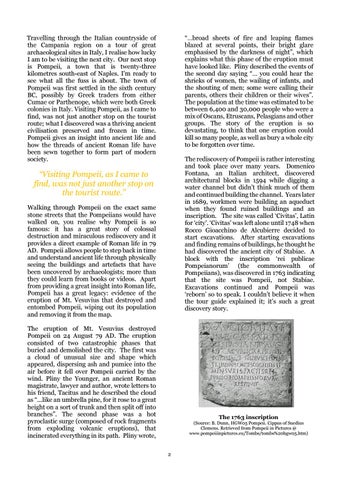
The rediscovery of Pompeii is rather interesting and took place over many years. Domenico Fontana, an Italian architect, discovered architectural blocks in 1594 while digging a water channel but didn’t think much of them and continued building the channel. Years later in 1689, workmen were building an aqueduct when they found ruined buildings and an inscription. The site was called ‘Civitas’, Latin for ‘city’. ‘Civitas’ was left alone until 1748 when Rocco Gioacchino de Alcubierre decided to start excavations. After starting excavations and finding remains of buildings, he thought he had discovered the ancient city of Stabiae. A block with the inscription ‘rei publicae Pompeianorum’ (the commonwealth of Pompeiians), was discovered in 1763 indicating that the site was Pompeii, not Stabiae. Excavations continued and Pompeii was ‘reborn’ so to speak. I couldn’t believe it when the tour guide explained it; it’s such a great discovery story.
“Visiting Pompeii, as I came to find, was not just another stop on the tourist route.” Walking through Pompeii on the exact same stone streets that the Pompeiians would have walked on, you realise why Pompeii is so famous: it has a great story of colossal destruction and miraculous rediscovery and it provides a direct example of Roman life in 79 AD. Pompeii allows people to step back in time and understand ancient life through physically seeing the buildings and artefacts that have been uncovered by archaeologists; more than they could learn from books or videos. Apart from providing a great insight into Roman life, Pompeii has a great legacy: evidence of the eruption of Mt. Vesuvius that destroyed and entombed Pompeii, wiping out its population and removing it from the map. The eruption of Mt. Vesuvius destroyed Pompeii on 24 August 79 AD. The eruption consisted of two catastrophic phases that buried and demolished the city. The first was a cloud of unusual size and shape which appeared, dispersing ash and pumice into the air before it fell over Pompeii carried by the wind. Pliny the Younger, an ancient Roman magistrate, lawyer and author, wrote letters to his friend, Tacitus and he described the cloud as “...like an umbrella pine, for it rose to a great height on a sort of trunk and then split off into branches”. The second phase was a hot pyroclastic surge (composed of rock fragments from exploding volcanic eruptions), that incinerated everything in its path. Pliny wrote,
The 1763 inscription (Source: B. Dunn, HGW05 Pompeii. Cippus of Suedius Clemens. Retrieved from Pompeii in Pictures @ www.pompeiiinpictures.eu/Tombs/tombs%20hgw05.htm)
2