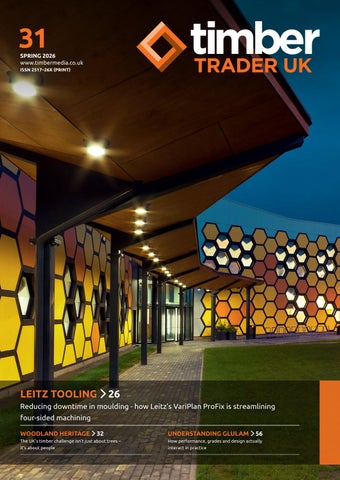
Timber Trader UK Issue 31 (Spring 26)

Page 1


SPRING 2026

www.timbermedia.co.uk

ISSN 2517–26X (PRINT)

LEITZ

TOOLING  26

Reducing downtime in moulding - how Leitz’s VariPlan ProFix is streamlining four-sided machining

WOODLAND HERITAGE  32

The UK’s timber challenge isn’t just about trees –it’s about people

UNDERSTANDING GLULAM  56 How performance, grades and design actually interact in practice

A range of news and views from across the timber industry. Appointments, investments and policy moves shaping the months ahead.

26 Cover Story: Leitz Tooling

Cutting downtime out of four-sided moulding – how VariPlan ProFix combines planing and profiling to speed up throughput. What it means for productivity, tooling life and overall running costs.

28 Forecast: British Woodworking Federation 2026 outlook

Unlocking opportunity for timber in 2026 – BWF on standards, skills, demand and where the joinery market is holding up. A practical view on what will matter most for the year ahead.

30 Feature:

PEFC certification in practice

Championing PEFC-certified timber and sustainable supply – how Travis Perkins is embedding Chain of Custody in practice. How procurement, training and processes support credible claims.

32 Feature: Woodland Heritage

The UK’s timber challenge isn’t just about trees – it’s about people. Why skills and capability are now the pinch point. What capacitybuilding could look like, and why it needs long-term commitment.

36 Report: Wood Protection Association trials

UK softwoods durability trial delivers decade-long evidence on performance and treatment – what the data is starting to show. We unpack early findings and what they mean for specification decisions.

40 Case Study: James Latham

Birch plywood brings contemporary life to a historic co-workspace –a heritage interior refreshed with engineered timber. How material choice and detailing do the heavy lifting in the finished space.

42 Review: Structural Timber Awards 2025Supply Chain Partner of the Year

Supply Chain Partner of the Year – OSKOP and Timber Innovations’ blueprint for compliant, low-carbon delivery. Why the judges rated delivery discipline and technical support so highly.

56 Guide: Understanding Glulam GL20 or GL24 – are we over-specifying glulam? How performance, grades and design choices actually interact. A clear guide to stiffness, sizing and where strength really drives decisions.

Specialised Timber Services and Solutions

⟩ Timber structural surveys

⟩ Historic buildings inspections

⟩ Bespoke training courses

⟩ Cladding, decking, joinery & flooring inspections

⟩ Engineered wood & panel products

⟩ Expert witness

⟩ Timber product evaluation

⟩ Timber framecheck

⟩ Design evaluation

www.filros.co.uk

email: ask@filros.co.uk

Philip O'Leary
Dr. Andy Pitman

Advertising Opportunities

For all advertising enquiries contact: Julie Williams, Account Manager, Radar Media Ltd

T: 01743 290042

E: julie.williams@radar-media.co.uk

Print

Printed on FSC Mix paper by Buxton Press Ltd, Palace Road, Buxton, Derbyshire, SK17 6AE

T: 01298 212000

W: www.buxtonpress.com

Welcome to the new era of Timber Trader

Contact Us

Circulation: Sian Hawkins

T: 01743 290006

E: info@timbermedia.co.uk

Production: Design Team

T: 01743 290001

E: info@timbermedia.co.uk

Accounts: Debra Brooks

T: 01743 290016

E: accounts@structuraltimbermedia.co.uk

Timber Trader UK Magazine is produced and published by Timber Media Ltd, Suites

A & B Hermes House, Oxon Business Park, Shrewsbury SY3 5HJ

T: 01743 290001

Subscriptions and back issues visit W: www.timbermedia.co.uk/timber-trader-ukmagazine

Disclaimer: The content of Timber Trader UK Magazine does not necessarily reflect the views of the editor or publishers and are the views of its contributors and advertisers. The digital edition may include hyperlinks to third-party content, advertising, or websites, provided for the sake of convenience and interest. The publishers accept no legal responsibility for loss arising from information in this publication and do not endorse any advertising or products available from external sources. The publisher does not accept any liability of any loss arising from the late appearance or non-publication of any advertisement. Content including images and illustrations supplied by third parties are accepted in good faith and the publishers expect third parties to have obtained appropriate permissions, consents, licences or otherwise. The publisher does not accept any liability or any loss arising in the absence of these permissions for material used in both physical and digital editions. No part of this publication may be reproduced or stored in a retrieval system without the written consent of the publishers. All rights reserved.

This issue of Timber Trader also marks my first as Editor – and I’m looking forward to what comes next for the title and the sector.

It is a real privilege to take on this role. Timber Trader has long occupied a unique position within the UK timber sector, providing informed, practical coverage for merchants, manufacturers and suppliers across the supply chain. My aim is to build on that strong foundation, not reinvent it.

What readers can expect going forward is continuity where it matters - accuracy, relevance and a clear understanding of how the timber market actually operates - alongside a renewed focus on depth, clarity and strong storytelling. Timber remains at the centre of some of the most important conversations in construction and manufacturing today, from sustainability and regulation to skills, logistics and long-term supply. Timber Trader should continue to reflect that reality, without hype or unnecessary noise.

This issue reflects that approach. Alongside timely industry news, you will find considered features that look beyond the headline and explore how businesses are responding to shifting market conditions, evolving standards and new opportunities. Where possible, we will continue to foreground real projects, real products and real expertise from across the sector.

I am also keen for Timber Trader to remain a publication shaped by its readers. If there are topics you feel deserve greater attention, or developments you believe the wider industry should be aware of, I would genuinely welcome those conversations.

Thank you for reading – and I hope you enjoy this issue. 

Email: vincent.bolton@radar-media.co.uk | Tel: 01743 290024

We are always looking for the latest industry news, people appointments and project case studies using all types of timber systems and products. For use both in print and online, please send them to me at the contact email above.

UK-grown C16 specified in affordable housing prototype

UK-grown C16 structural timber has been specified as the primary structural material in a recently completed affordable housing prototype in Inverness, supplied by BSW Timber to Scottish homebuilder MAKAR.

The project highlights the role that domestically produced C16 can play in modern, precision-manufactured housing, supporting cost efficiency, predictable performance and reduced embodied carbon when compared with imported alternatives.

C16 timber supplied by BSW forms the core structural element of the prototype, sitting within an off-site manufactured wall panel system. According to the project team, the use of UK-grown material helped avoid the financial and environmental impacts associated with long-distance transport and international supply chains, while offering a well-understood structural solution suited to factory-based manufacture.

MAKAR, which has delivered more than 250 timber-rich homes since 2002, specialises in the use of Scottish-sourced timber and natural construction systems. The prototype incorporates a hygroscopic ‘breathing wall’ build-up designed to manage moisture naturally, reducing the risk of damp and mould while supporting healthy internal environments. Heating costs for the home have been modelled at £5–£7 per week, with performance to be validated through independent monitoring.

Despite challenging winter conditions, the home was assembled to wind- and watertight stage within one week. All wall panels were installed within hours on the first morning, with the full external envelope completed by the end of the week, demonstrating the speed and predictability achievable through modern methods of construction.

Steven Cairns, Scotland Area Sales Manager at BSW Timber, said: “It was fantastic to be involved in the supply of the exciting MAKAR prototype. We were thrilled to be able to supply this C16 used in the build and the project serves as an excellent example of the versatility and benefits of using timber grown and sawn right here in Scotland.”

The project also drew on 27 rural supply-chain partners, underlining the wider economic contribution of specifying domestic timber, including support for forestry, processing and skilled employment in rural areas.

The home will now be monitored over a 15-month period by an independent organisation to assess energy use and validate anticipated heating costs across two winter seasons. The data is expected to strengthen understanding of how UK-grown timber can contribute to durable, efficient and genuinely affordable housing at scale.

Scott Reid, Head of Design at MAKAR, said: “With this project we are demonstrating that it is possible to deliver affordable and sustainable homes, using homegrown timber. With careful specification, selection and detailing, we can cut out harmful and unnecessary chemicals in construction and eliminate any risk of damp and mould.”

The project aligns with the objectives of the Trust UK C16 campaign, which promotes increased confidence in UK-grown structural C16 timber and its role in delivering a more resilient, low-carbon construction sector.

Image © Makar
Image © Makar

Confor urges next Scottish Government to back homegrown timber

Confor has launched a new manifesto ahead of the 2026 Scottish Parliament elections, calling on the next Scottish Government to place forestry and homegrown timber at the centre of its economic, housing and climate strategy.

Released in December and targeted at all political parties contesting the Holyrood elections in May 2026, the manifesto is built around a clear message – “Timber is the Future” – and sets out five priority actions for the forestry and wood industry. These include creating a homegrown timber industrial strategy for Scotland, meeting tree-planting targets, increasing the use of Scottish timber in construction, developing a new long-term forestry strategy, and delivering a dedicated skills plan for the sector.

Introducing the document, Confor chief executive Stuart Goodall said the industry is uniquely placed to help address multiple national priorities at the same time.

“Building more and better homes, delivering economic growth and new jobs, and tackling climate change, are three of the biggest political priorities for the next Scottish Government,” he said. “These priorities are often viewed as trade-offs, but Scotland’s forestry and timber industry can deliver all three at the same time.”

would help tackle immediate pressures in housing, climate and the cost of living, while also supporting growth in rural areas.

However, the organisation warns that progress is at risk unless planting rates recover. New woodland creation fell back to around 8,500 hectares in 2024-25, after peaking at 15,000 hectares the previous year. Confor is urging the next government to restore confidence and get planting back on track, with a target of 18,000 hectares per year by the end of the decade, in line with Scotland’s Climate Change Plan.

Timber is the future

Confor points to the scale of the sector’s existing contribution, with official figures showing that Scotland’s forestry and wood industry supports around 34,000 jobs and delivers £1.1 billion in annual economic benefit. The manifesto argues that building on this base

A central plank of the manifesto is a call for a dedicated Scottish timber industrial strategy, similar to those already adopted by the UK and Welsh governments. Confor argues that such a framework would provide clarity for long-term investment in planting, harvesting, processing and manufacturing, while supporting innovation and new timber-based

The document also highlights the opportunity within housing. While more than 90% of new homes in Scotland already use timber frame construction, much of the timber is imported. Confor is calling for specific targets to increase the proportion of homegrown timber used in buildings, and for timber to be specified as a material of first choice in new public

Concluding, Goodall said the sector was ready to work with policymakers across the political spectrum. “Our forestry and wood industry is a modern-day success story,” he said. “By building on that success, we really can deliver on a range of economic and environmental priorities at the same time.”

UK softwood trade weighs up 2026 prospects

The UK softwood market has entered 2026 in a state of cautious uncertainty, with conditions varying sharply across the supply chain and no settled view yet on how the first quarter will develop. While some pockets of the trade are reporting firmer activity, others continue to face subdued demand and ongoing price pressure.

For some merchants, the final weeks of 2025 delivered a strongerthan-anticipated finish. Demand was said to have improved during the last four to five weeks of December, providing some relief after a challenging year. That momentum, however, did not carry cleanly into January. Severe winter weather disrupted activity on many construction sites, slowing progress and delaying call-offs.

Despite those conditions, some importers reported renewed interest from merchant customers early in the New Year. This was linked largely to re-stocking, as well as the need to accommodate rescheduled site requirements that are now being brought forward. In these cases, buying was described as practical rather than speculative, with merchants focused on maintaining continuity of supply rather than building stock aggressively.

Elsewhere in the market, trading remained difficult. Some merchants were still struggling to secure consistent sales volumes and, further up the chain, certain importers were continuing to clear landed

stock by offering material at below-market prices. These discounted offers were said to be holding back the price increases needed to improve softwood values more broadly. As a result, frustration is growing among suppliers keen to see the market move towards a more sustainable pricing position.

Looking ahead, many shippers believe supply-side factors will play a more influential role as 2026 progresses. Production cuts introduced over the past six months, combined with firmer demand and improving price structures in markets such as Belgium and Holland, are expected to tighten availability. This is likely to push the British market towards a more supplydriven position, with price rises increasingly anticipated towards Q2.

Scandinavian supply has also been affected by severe weather. In early January, storms caused widespread disruption to forest stands, adding further pressure on availability. In Sweden, a storm locally named Johannes led to significant windthrow, with early assessments indicating damage running into billions of Swedish kronor.

The wider market context is supported by data presented by the UNECE Committee on Forests and the Forest Industry at its meeting in Geneva in November 2025. Taken together, current conditions suggest a market balancing uneven demand against tightening supply, with the direction of travel for prices likely to become clearer as the year unfolds.

Welsh Government commissions local timber supply chain review as new data highlights gaps in sawmilling statistics

The Welsh Government has commissioned Woodknowledge Wales to deliver a Local Timber Supply Chain Review, following growing recognition that parts of Wales’s timber processing sector – particularly small and medium-sized sawmills – are poorly captured in existing national statistics.

The contract, formally awarded on 18 November 2025 and commencing later that month, will support the Welsh Government in developing a clearer, more structured understanding of how local timber supply chains currently operate. The work will focus

on consolidating existing evidence rather than generating entirely new datasets, with the aim of improving the quality and usefulness of information used to inform policy, investment and support under the Timber Industrial Strategy.

Addressing long-standing data gaps

While national forestry statistics provide a reliable picture of large-scale timber processing, evidence suggests that smaller sawmills remain largely invisible in official datasets. These businesses are often dispersed, operate at relatively low volumes,

and fall below standard reporting thresholds, despite their importance to rural employment and local timber markets.

The newly commissioned review will examine a range of existing evidence, including forestry availability forecasts, timber sales data, sawmill capability information and the limited data available on post-harvest timber movement. A particular focus will be placed on small and medium-sized processors, which are frequently under-represented in national figures but play a central role in short supply chains and local value creation.

Survey

evidence from Wales’s small sawmills

The commission builds on recent survey work carried out by Woodknowledge Wales, which provides one of the clearest quantitative snapshots to date of small and medium sawmilling activity in Wales. The Small and Medium Sawmill Development Survey gathered responses from 20 sawmills drawn from a wider network of around 60 identified operations across the country.

Although modest in sample size, the findings suggest that the sector is larger and more active than official statistics indicate. Collectively, the responding mills reported processing approximately 5,360 green tonnes of timber per year. While this volume is small in national terms, the survey highlights the sector’s strong local orientation, with respondents sourcing an average of around 80 per cent of their timber from within Wales, and several reporting exclusive reliance on Welsh-grown logs.

Capacity and operational constraints

Capacity utilisation emerged as a recurring theme in the survey findings. Respondents reported an average annual processing capacity of 329 tonnes per mill, compared

with average throughput of 234 tonnes, equating to around 70 per cent utilisation. Individual utilisation rates varied widely, ranging from 25 per cent to full capacity.

The survey did not seek to identify definitive causes for this under-utilisation, but several commonly cited constraints were noted. These include limitations in log supply, seasonal fluctuations in demand, restricted access to drying and finishing equipment, limited stock-holding capacity and challenges in reaching wider or more consistent markets. The findings suggest that many mills have headroom to increase output if these barriers can be better understood and addressed.

Products, species and local markets

Nearly all surveyed mills reported processing larch and Douglas fir, reflecting both resource availability and customer demand. Smaller volumes of oak, beech, western red cedar and other species were also reported. Product output was dominated by cladding and fencing, with most mills supplying relatively short-lived outdoor applications.

However, the survey also identified a pattern of occasional higher-value output, including bespoke beams, frames and joinery supplied on a cut-to-order basis. While these products account for a small share of total volume, they deliver significantly higher value per unit of timber and contribute to long-lived carbon storage, particularly where used in construction or building extensions.

Employment impact beyond the statistics

Employment data underline the sector’s importance to rural economies. The 19 core respondents to the survey reported employing 43 full-time equivalent staff, an average of 2.3 jobs per mill. When scaled across the estimated population of small and medium sawmills in Wales, this suggests that around 150 skilled, year-round jobs

may currently sit outside official forestry employment statistics.

These roles are typically located in rural areas where alternative employment opportunities can be limited, and where small-scale processing provides a direct link between local woodland management and local markets.

Implications for policy and strategy

A key finding of the survey is the limited engagement between small sawmills and official data collection. None of the respondents reported submitting production data to Forest Research within the past five years, highlighting the scale of the information gap facing policymakers.

The Welsh Government review aims to address this by bringing together fragmented evidence, assessing its strengths and limitations, and identifying where targeted new data could realistically improve understanding. Rather than attempting to measure every activity in detail, the focus will be on producing a consolidated picture of how local timber supply chains function and where policy intervention could be most effective.

Wider relevance for the UK timber sector

Although the review is Wales-specific, the challenges it addresses are familiar across the UK. Small and medium sawmills often sit below the radar of national statistics, despite their role in processing locally harvested timber, supporting rural employment and maintaining short supply chains.

By linking recent survey evidence with a formal government-commissioned review, the Welsh approach highlights the importance of evidence-led policy that reflects the full breadth of industry activity. As pressures on timber supply chains continue to evolve, improved visibility of smaller processors may prove increasingly important in supporting resilience, investment and long-term sector planning.

Glennon Brothers acquires Pontrilas Group

Glennon Brothers has confirmed the acquisition of the Hereford-based Pontrilas Group, a move that adds £120m in turnover to the business and significantly increases its UK processing footprint.

The Pontrilas Group was founded in 1947 by the Hickman family and operates as a timber processing business located on the Welsh border. The company’s annual sawn timber capacity is understood to be around 200,000m³.

Pontrilas is regarded as one of the UK’s leading independent sawmill and packaging operations. Its Hereford site is described as the largest timber processing mill in England and Wales. The business employs more than 530 people and is run by a long-serving and

experienced management team, generating turnover of £120m.

Commenting on the acquisition, Glennon Brothers joint managing director Mike Glennon said: “We are delighted to welcome the Pontrilas Group into the Glennon Brothers family.”

He added: “This is a significant milestone in Glennon Brothers history, which dates back to 1913. This provides our customers with an enhanced product and service offering, as well as increased overall production capacity for the future. This acquisition allows us to continue fulfilling our commitment to our customers of offering a one stop shop solution for sawn softwood across the UK and Ireland”.

Joint managing director Pat Glennon highlighted the strategic fit of the business, saying: “The opportunity to add value to our established supply chain and core business is extremely exciting.”

He continued: “By adding Pontrilas to our existing business, it further enhances our capability to operate fully from forest to front door”.

From the Pontrilas side, chairman Jeremy Hickman said that he and the Hickman family were pleased to wish Glennon Brothers and the Pontrilas Group every success in the future.

Jonathan Poynton, CEO of Pontrilas, said: “The team at Pontrilas are delighted to be joining the Glennon Brothers family of companies, and we look forward to exciting times ahead for the enlarged business”. 

The Pontrilas sawmill, Hereford

Combilift milestone raises €100,000 for global children’s charity

Combilift has marked the production of its 100,000th forklift by raising and donating €100,000 to UNICEF, supporting children affected by conflict, displacement and natural disasters worldwide.

To celebrate the manufacturing milestone, the global materials handling specialist transformed its 100,000th machine into a oneoff “Golden Forklift” and launched its largest-ever international competition. All proceeds from the initiative were pledged to UNICEF Ireland’s Children’s Emergency Fund.

The campaign generated €56,500 in ticket sales, with Combilift confirming it had topped up the total contribution to €100,000 at a cheque presentation ceremony held at the company’s headquarters in Monaghan, Ireland. The initiative reflects the company’s continued focus on corporate social responsibility alongside its manufacturing growth.

Speaking at the handover, Combilift CEO and co-founder Martin

McVicar said: “This campaign was designed not only to celebrate a major manufacturing achievement for Combilift, but also to make a meaningful difference beyond the factory floor. By supporting UNICEF, we are supporting one of the world’s most effective humanitarian organisations and helping children who need it most.”

UNICEF Ireland welcomed the donation, noting that the funds would support urgent humanitarian responses, including access to warm clothing, safe shelter and continued education for children affected by emergencies.

The winning ticket holder received the unique 100,000th CombiCBE “Golden Forklift”, which was formally handed over in Monaghan. The machine was previously unveiled at the UK’s IMHX exhibition before appearing at a series of European trade events, reflecting Combilift’s international customer base and market reach. 

For 25 years, Combilift has been revolutionising the way companies handle and store goods. Our pioneering product range of multidirectional, articulated and pedestrian forklifts, straddle carriers and container loaders allows you to manoeuvre long loads safely, reduce aisle widths and increase the amount of space available for storage.

To find out how Combilift can help you unlock every inch of your storage space.

Beatsons acquires Orchard Timber Products

Beatsons Building Supplies has completed the acquisition of Orchard Timber Products, securing the future of the business and safeguarding jobs following Orchard’s recent administration.

The deal sees the Scottish-based independent merchant expand its footprint and strengthen its timber offer, while ensuring continuity for Orchard’s employees, customers, and suppliers. Orchard Timber Products was previously part of the National Timber Group.

Established in 2004 and headquartered in Forfar, Orchard Timber Products has developed a strong market presence supplying housebuilders, contractors, and joiners across the UK. Its product range includes solid wood flooring, doors, and bespoke timber solutions – areas that will now complement Beatsons’ existing portfolio.

Two branches in Forfar and Livingston have now resumed trading following the acquisition. All existing employees have been retained as part of the deal, with staff made redundant prior to its completion being

offered the opportunity to return. In total, 50 jobs have been safeguarded.

John Marshall, Chairman of Beatsons Building Supplies, said: “We are delighted to welcome Orchard Timber Products into the Beatsons family. This acquisition aligns perfectly with our strategy to expand our geographic reach and broaden our product offering. Orchard Timber’s expertise and established customer relationships make it a

perfect fit, and we look forward to supporting its continued growth.”

He added: “As with any acquisition, there will be a short period of transition as we move Orchard over to our processes and systems.”

The acquisition further strengthens Beatsons’ position across Scotland while maintaining Orchard Timber Products’ established reputation for quality and service in the timber supply sector. 

Premier Forest Products acquires Arnold Laver Hull operation

Premier Forest Products has completed the acquisition of the Arnold Laver Hull operation, further strengthening its timber distribution, manufacturing and logistics capability across the north and northeast of England.

The Hull acquisition builds on Premier Forest’s recent purchases of Arnold Laver sites in Manchester and Reading, which were formerly part of National Timber Group UK and entered administration in November.

The purchase safeguards 18 jobs, following the safeguarding of more than 36 roles at the Manchester and Reading operations. Plans are now underway to recruit across all three branches, with total staffing numbers expected to reach 150.

Together, the acquisitions significantly extend Premier Forest’s product offering, geographic reach and delivery capacity, enhancing service levels for housebuilders, contractors and construction customers across the north of England and beyond.

Commenting on the acquisition, Terry Edgell, cofounder and chief executive officer of Premier Forest Products, said:

“This latest acquisition is another important step in strengthening Premier Forest’s presence across the north and north-east of England.

“The Hull operation significantly extends our geographic coverage and delivery capability, enabling us to better support customers across Yorkshire, the Humber and the wider north-east with a broader range of timber products and faster, more resilient supply.

“Alongside our recent acquisitions of the Arnold Laver sites in Manchester and Reading, this reinforces Premier Forest’s long-term commitment to investing in high-quality operations that enhance our offer and service for customers across the UK.”

Premier Forest Products is headquartered in Newport and is one of the UK’s leading independent timber distribution and manufacturing groups, supplying customers nationwide across the housebuilding, construction, manufacturing and modular sectors. 

MKM expands network with new Congleton branch creating 18 local jobs

MKM Building Supplies has continued its UK branch expansion with the opening of a new builders’ merchant in Congleton, creating around 18 new jobs for local people.

The new Congleton site, which opens its doors on Monday 19 January 2026, becomes MKM’s 137th branch nationwide. Further recruitment is expected as the branch becomes established, adding to MKM’s growing regional footprint.

The branch is led by Branch Director Ric Bauer, who brings three decades of experience across the builders’ merchant sector. Bauer began his career working in a yard before progressing through trade counter and senior management roles, most recently serving as Head of Building Materials at MKM.

Having lived in nearby Wilmslow for more than 15 years, Bauer said his familiarity with the area made Congleton a strong fit for MKM’s locally run operating model.

“Congleton has a brilliant community spirit,” he said. “People are proud of where they live and genuinely care about supporting local businesses. That really matters to me and it aligns closely with how MKM works. We want to be part of the community rather than just another merchant.”

The Congleton branch is designed as a one-stop destination for both trade and retail customers. It will stock a full range of building materials alongside specialist areas

including landscaping, plumbing and heating, wood burning and multifuel stoves, and kitchens and bathrooms. Timber will be a key focus, with a wide range of treated C16 and C24 products available.

An 18,000 sq ft covered warehouse and timber storage facility forms part of the site, helping to keep materials dry and in good condition year-round. The branch will also carry products from established national brands alongside selected local suppliers.

Bauer said the local decision-making structure would allow the branch to tailor its offer to customer demand. “If our customers need it, we’ll stock it. We’ll be listening to local trades from day one and shaping our range around what people actually use, rather than following a one-size-fits-all approach.”

Once fully recruited, the Congleton team is expected to bring more than 200 years of combined industry experience. MKM said training and product knowledge remain central to its branch model, with customers supported by dedicated points of contact, flexible credit terms and free local delivery.

The branch also plans to support local charities and community organisations, alongside involvement in sports teams and community initiatives.

“MKM Congleton will be about great people, great service and great products,” Bauer said. “We’re looking forward to opening our doors and becoming a trusted local partner in the town.”

NORDIC PREMIUM TIMBER

Forklift market shipment growth tops 7% in 2025

A “significantly more optimistic outlook” is forecast for the global forklift market from 2026 onwards, according to Interact Analysis. Its latest report sees the company revise its growth forecast for the forklift market upwards, as both the short-term trajectory and long-term potential improve.

The global supply chain automation market intelligence specialist predicts a strong yearon-year growth rate of 5% between 2024 and 2034. Market growth rose from 3.4% in 2024 to reach 7.1% year-on-year in 2025, with Interact Analysis stating its revised forecast “shows a consistently higher growth path through 2034, indicating sustained structural improvement rather than a short-term bubble.”

predictions. Almost 80% of this growth is driven by Chinese and Indian markets, forecast to be at the forefront of global demand for material handling equipment over the next decade. China accounts for over 70% of anticipated growth, with forecasts showing a widening contribution over time, particularly between 2030 and 2034.

Increasingly optimistic investment plans among end-customers

There are growing signs of optimism in the market, with 50% of end-customers anticipating increasing their investment in material handling equipment by more than 10% in 2025. This enthusiasm for automation

China and India lead surge in global forklift orders

The global forklift market is expected to exceed 3.6 million units in annual orders by 2034, an increase of 400,000 from earlier

in manufacturing and logistics is driven by factors including rising labour costs and the increasing maturity of material handling solutions. However, many automation equipment manufacturers maintain a more

cautious outlook due to challenges such as macroeconomic volatility, geopolitical uncertainty, global supply chain disruptions, and component shortages.

The bigger picture

Forklifts have seen renewed growth in recent years, driven by the rapid development of smart manufacturing and intelligent warehouses. External factors such as stricter emission standards and rising labour costs are also fuelling demand, as the trend toward electrification becomes more significant in the global forklift market.

According to Maya Xiao, Interact Analysis APAC Research Manager, rising demand for automation in manufacturing and logistics is driving increased investment in advanced material handling solutions, while the accelerating shift towards electrification is also speeding up the replacement of ageing fleets.

“Strong emerging market demand in regions such as Southeast Asia, the Middle East, and Africa is adding further growth momentum,” she says.

Xiao adds that longer-term demographic and labour pressures are likely to reinforce this trend. “An ageing population, rising labour costs, and ongoing challenges around recruitment and retention have become acute problems globally, with automation increasingly seen as a way to offset shortages of human labour. This will be a long-term driver for the forklift industry,” she explains, pointing to a favourable environment for the next decade as supply chains reorganise, technology advances, and infrastructure investment continues. 

CITB awards £430k to boost timber construction skills and low-carbon delivery

The Construction Industry Training Board (CITB) has awarded £430,000 of impact funding to support the development of a comprehensive training programme aimed at accelerating lowcarbon timber construction across the UK.

The funding, provided through CITB’s Industry Impact Fund, will be used to create new and improved learning pathways for people entering the construction sector, while also helping to upskill and reskill existing workers to meet growing demand for timber-based modern methods of construction (MMC). The programme is intended to address well-documented skills shortages while supporting the wider transition to lower-carbon building systems.

The bid was developed by a consortium of industry partners led by Donaldson Offsite, a CITB levy-payer, bringing together education providers, industry bodies and innovation organisations spanning the timber and construction sectors. Partners include Edinburgh Napier University, the New Model Institute for Technology and Engineering (NMITE), BE-ST (Built Environment – Smarter Transformation), the Structural Timber Association (STA) and Timber Development UK (TDUK).

CITB said the initiative aligns closely with the Timber in Construction Roadmap, the Government-industry partnership launched earlier this year to increase the use of timber in the built environment while supporting decarbonisation objectives.

Vanessa Freeman, Head of Grant and Funding Projects at CITB, said the funding reflects the growing importance of timber construction within the wider industry skills agenda.

“Timber construction is one of the fastest growing construction sectors, driven by the need for carbon reduction across the built environment,” she said. “This funding will help bridge the skills gap that exists in this and other parts of the construction industry, enabling the timber sector to achieve its potential.”

The project was due to begin in October 2025 and will run for 24 months. An initial phase will focus on identifying gaps in existing learning materials and delivery, with the aim of developing accredited,

industry-relevant courses and clearer career pathways. Training will cover both management and on-site delivery of offsite-manufactured structural timber systems.

Alex Goodfellow, CEO of Donaldson Offsite and Chair of the Confederation of Timber Industries (CTI), said collaboration across the supply chain was central to the project’s ambitions.

“Meeting the UK Government’s ambition for sustainable housing will only be possible if we tackle the growing skills gap,” he said. “This project has the potential to make a lasting impact by establishing a more joined-up approach to skills development across the timber construction sector.”

Over the course of the programme, new courses will be established and integrated with existing accredited provision through regional training centres, colleges and universities. The consortium said the approach would build on recognised initiatives such as NMITE’s Timber Technology Engineering and Design courses and the STA Installer Training Scheme, while supporting future regulatory drivers including the Future Homes Standard and PAS 8700 for MMC in new-build housing. 

Image
Image

Milwaukee Tools opens flagship UK Experience Centre in Aylesbury

Milwaukee Tools has opened a new flagship UK Experience Centre in Aylesbury, representing the company’s largest investment to date in UK training infrastructure and underlining a long-term commitment to skills development within the trades.

The 13,250 sq ft, carbon-neutral facility has been established as a permanent training and testing hub, with Milwaukee confirming a 10-year commitment to the site. Rather than operating as a traditional

showroom, the centre is designed to provide extended, hands-on access to tools and equipment in realistic working environments.

The facility includes indoor training spaces alongside dedicated outdoor testing areas, allowing trade professionals to trial products before making purchasing decisions. It will also be used to upskill approximately 300 Milwaukee employees each year through structured training programmes, while supporting closer engagement with end users through demonstrations and application-led training.

Visitors will be able to access Milwaukee’s established M12 and M18 cordless platforms, as well as the expanding MX FUEL light equipment range. The centre will also showcase the company’s latest battery technology, including REDLITHIUM FORGE batteries, alongside power tools, hand tools and outdoor power equipment.

Dan Stringer, Head of Training at Milwaukee Tools UK, said: “We’re just getting started. Since our founding in 1924, MILWAUKEE has been driven by a commitment to solving the real-world challenges faced by professional tradespeople. This Experience Centre embodies that heritage while spotlighting the innovations that will define the next century of our industry.”

The opening comes at a time when skills shortages continue to affect the UK construction sector, with increasing emphasis on practical, trade-ready training. 

PEFC publishes The Timber Truth to challenge misconceptions around timber construction

PEFC has published The Timber Truth, a new evidence-based publication intended to address long-standing misconceptions that continue to influence decision-making around timber construction across the built environment.

Written by Dr Pablo van der Lugt, an architectural engineer and researcher specialising in biobased construction, the publication provides a concise and technically grounded examination of issues that frequently arise in debates around timber use. These include fire safety, structural performance, material availability, carbon storage, sustainable forest management, and the circular use of wood.

While interest in timber construction has grown significantly in recent years, PEFC argues that misinformation and oversimplified assumptions still present barriers to wider adoption. These challenges are particularly evident among policymakers, insurers, developers, and parts of the construction supply chain, where uncertainty around performance, risk, and long-term availability can influence material choices. The Timber Truth is positioned as a reference resource designed to support informed, evidenceled decision-making rather than advocacy.

on peer-reviewed research, European building practice, and recent policy developments.

Andrew Waugh, founding director of Waugh Thistleton Architects, authors the foreword and describes the book as both a reference point and a call to action for the sector. “We know how to build better,” he writes. “This book reminds us why we must.”

Professor Gert-Jan Nabuurs, senior researcher at Wageningen University and Research and a contributing expert to the Intergovernmental Panel on Climate Change, also highlights the importance of linking timber construction to responsible forest management. “The entire chain is important for sustainable forest management, and the highquality use of wood is a prerequisite,” he said. “That’s why this book is important.”

The publication is structured around four core themes relevant to the timber trade and wider construction sector: construction quality and performance; environment and climate impacts; forest management and resource availability; and economy and market developments. Together, these sections examine sixteen commonly cited claims and counterclaims surrounding timber buildings, drawing

According to PEFC, the publication draws on insights gathered through its Tomorrow’s Timber Talks programme, which has engaged thousands of participants across Europe and internationally. The initiative is intended to address knowledge gaps in timber construction while sharing the latest developments in wood products, standards, and best practice.

Published in November 2025, The Timber Truth is aimed at professionals across the construction supply chain, including architects, engineers, developers, merchants, and policymakers. PEFC says the publication seeks to provide clarity in areas where uncertainty or conflicting narratives continue to affect confidence in timber as a mainstream construction material, particularly as the sector responds to net zero targets and increasing scrutiny of material choices. 

Structural Timber Awards 2026entries close 5pm, 11 July 2026

delivery excellence

The Structural Timber Awards are back for 2026, shining a spotlight on the projects, products and teams pushing timber construction forward, from standout buildings to the systems, detailing and collaboration that make them work.

If you’ve delivered a structurally complete project, or driven meaningful organisational change, completed after 01 January 2026, now is the time to put it in front of the judges. Entries are made online, you can save and return as you go, and every category is free to enter.

Each company can submit up to three entries, with a separate form required for each category. Support your submission with a clear

story, your company logo, and strong imagery. Around four photos is recommended. The judging panel may move entries into a more appropriate category, helping strong work land in the right place.

The key date: entry submissions must be completed by 5pm on 11 July 2026. If your business is delivering safer, faster, more efficient or lower-carbon outcomes through structural timber, don’t leave it on site - get it recognised.

Queries: 01743 290 005 or ellie.guest@radar-media.co.uk

Recognising
in action. Walker Timber Engineering, Keon Gomes and Midland Heart take Project/Construction Manager of the Year for the Port Loop Development, Birmingham.
Moments that matter. The Structural Timber Awards recognise achievement in front of the peers, partners and clients who shape the sector.
Guests arriving at the Structural Timber Awards 2026

MEDITE SMARTPLY prepares MDF panels for new EU REACH formaldehyde restriction

MEDITE SMARTPLY, a leading engineered wood panel manufacturer, has announced its full transition to the revised EU Registration, Evaluation, Authorisation and Restriction of Chemicals (REACH) formaldehyde restriction, known as E05. The updated requirement halves the existing formaldehyde emission threshold for wood-based panels and will come into force for affected products on 6 August 2026.

The revised limit reduces allowable formaldehyde emissions from the current E1 threshold of 0.124mg/m³ to 0.062mg/m³ air concentration, designated industry wide as E05. The restriction applies across the EU market to all formaldehyde-emitting products, including medium-density fibreboard (MDF) panels.

From early April 2026, all MEDITE MDF products affected by the restriction will comply

with the E05 emission limit. This includes a wide range of panels used across joinery, cabinetry, interior fit-out and construction applications.

Products manufactured using no added formaldehyde MDI resins already meet the stricter emission limit and are not subject to additional transition requirements.

Formaldehyde is a naturally occurring volatile organic compound present in all wood products at very low levels and is widely used in resin binders during panel manufacture to deliver strength, durability and machining performance. Under the revised REACH requirement, manufacturers must ensure that formaldehyde emissions from wood-based panels meet the stricter E05 limit before products are placed on the EU market.

Formaldehyde emissions will continue to be verified using the EN717-1 chamber test

Forestry Commission appoints Paul Brannen to senior role

The Forestry Commission has appointed Paul Brannen as a non-executive commissioner, tasking him with promoting sustainable forestry and making a stronger case for the use of UK-grown timber in construction.

The appointment began on 01 December 2025 and will run for three years. It brings a prominent advocate for timber and low-carbon construction into a senior advisory role at the government body responsible for managing England’s forests and woodland policy.

Brannen is a former Member of the European Parliament for the North East of England and has held senior public affairs roles across the timber and wood products sector. Since 2020, he has represented the European Confederation of Woodworking Industries, the European Organisation of the Sawmill Industry,

and the UK Confederation of Timber Industries, and has been a consistent voice on forestry, construction timber and climate policy.

In his new role, Brannen will support the Forestry Commission’s work on sustainable woodland management and the production and supply of home-grown timber - with a particular focus on demand from the built environment.

Explaining why he applied, Brannen said: “I believe it is vital that there are voices at the heart of the Forestry Commission consistently making the case for more UK wood to be used in UK construction.”

He argued that increasing timber use is a practical climate response because it reduces reliance on higher-carbon materials while locking up carbon in the built environment. “Wood substitutes for products that have

method, as recommended by the European Chemicals Agency for wood-based panels, with test reports available on request and able to be shared through the supply chain, provided panels are not altered with additional layers or coatings that could affect formaldehyde content. Updated Declarations of Performance, safety data sheets and product datasheets confirming E05 compliance will be issued as part of the transition, and while Construction Product Regulation markings will continue to reference E1 for CPR purposes, supporting documentation will confirm alignment with the revised EU REACH requirement where applicable.

“We’ve been preparing for the revised EU REACH restriction for some time,” says Guillaume Coste, Technical Services Manager at MEDITE SMARTPLY. “We have been investing in testing and production readiness so that customers can expect the same dependable performance from MEDITE MDF as the industry moves to the lower E05 threshold. While compliance is changing, the standards our customers expect from the board are not.”

Although the REACH revision is an EU requirement and does not directly alter Great Britain’s product regulation, MEDITE’s transition ensures continued access to the EU market for exporters. The restriction will also apply in Northern Ireland under ongoing alignment with relevant EU chemical regulation. 

large carbon footprints and, beneficially, wood also stores carbon,” he said, adding: “It is one of the most effective ways in which we can tackle climate breakdown.”

Brannen also pointed to the scale of housing demand as a major opportunity for the domestic supply chain. “Given we need to build many more homes this is a massive opportunity for UK commercial forestry,” he said. “I will be ‘round the table’ making that case - repeatedly.”

Alongside his policy and advocacy work, Brannen is the author of Timber! How Wood Can Help Save the World from Climate Breakdown, published in 2024, which was widely praised for setting out a positive and accessible case for timber’s role in addressing climate change.

For the UK timber supply chain, the appointment signals a stronger constructionfocused voice within the Forestry Commission at a time when domestic timber availability, carbon reduction and housing delivery are increasingly interconnected priorities. 

Cutting downtime out of four-sided moulding

In joinery and moulding manufacture, productivity is increasingly defined by how little time machines spend standing still. Leitz Tooling’s VariPlan ProFix system brings planing and profiling together in a single operation, helping manufacturers reduce set-up times, increasing throughput and cut costs.

In the competitive landscape of UK timber manufacturing, efficiency is no longer just about how fast a machine runs; it is about how little it stands still.

For joinery and moulding manufacturers, the traditional “tool change” has long been a necessary bottleneck, a period of non-productivity, where machines idle, and skilled labour is tied up. Typically for short runs, four-sided moulders are used to square dress (PAR) the component and then profiles are added on a spindle moulder – Leitz VariPlan ProFix eliminates this second operation.

With the VariPlan ProFix system, Leitz Tooling is offering a hybrid solution that effectively eliminates the “set-up tax.” By allowing manufacturers to plane and profile simultaneously. The system streamlines complex workflows into a single, low-cost and high-speed operation.

Engineered to Reduce Downtime

The VariPlan ProFix is a favourite of joiners, timber merchants and sawmills across the UK. Designed to streamline planing and profiling processes, this multi-use tool reduces manufacturing costs and cycle times. By combining planing and profiling into one application, the system reduces the number of passes required, doubling throughput for standard moulding applications.

Suitable for both softwood and hardwood, the high-grade solid carbide VariPlan knives offer high quality finishes for solid wood with one pass machining. Heavily reducing rework.

Minimal Set Up Times

The VariPlan system offers more than just downtime reduction. It also features fast profile knife changes, ideal for manufacturers running limited meterage on a single profile or batch producing multiple profile types. Profile knife changes can be completed in under a minute once the tool body has been taken off the machine, with the Leitz Tooling record being just 47 seconds.

Designed with a constant diameter for reduced chatter and tool wear, the VariPlan system benefits from increased precision when machining. The profile also remains constant, ensuring that your finished products are uniform and the perfect fit. This means no adjustment is required to the machine after tool changes and the system offers a higher runout accuracy than most planing systems.

VariPlan Enables Lower Costs

Engineered for improved tool economy and sustainability, VariPlan planing knives achieve up to 50% lower cutting material costs compared to standard grindable tooling and knives, thanks to a 1mm resharpening area. The VariPlan planing knives can be sharpened 3 times and have 8 times longer tool life compared to traditional one-way knife systems. Without the loss of diameter. The Profix Profile knives, can be sharpened up to 30 – 40 times, again without the loss of profile and diameter.

Leitz Tooling profiles
Expo 2000 Roof Timber Construction

Power consumption is often overlooked by machinists. As power costs rise, it’s more important than ever to maximise machine efficiency. Featuring a lightweight aluminium tool body, the VariPlan ProFix reduces power consumption when machining compared to heavier steel alloy tools. This results in reduced electricity costs when machining. Leitz cutter head systems feature a lightweight tool body, and our tool designs are aerodynamic to ensure minimal power consumption and to assist chip extraction.

Don’t Take Our Word for It

Charles Yorke is a manufacturer of premium high-quality furniture. Aaron Benford, Production Manager comments on the impact that VariPlan Profix has had on their business operations thanks to reduced downtime. “Leitz’s VariPlan ProFix system is saving us approximately £30,000 a year in labour, hours, and downtime for an investment of less than a third of that saving.”.

Charles Yorke hasn’t just benefited from the system’s cost efficiency, its downtime reduction has also played a major role in increased productivity at the Charles Yorke factory. Aaron discusses the impact on downtime “With the Variplan ProFix, there is no more measuring tool diameters or adjusting machine heights. It’s straight off, straight on. We’ve gone from a 20-minute setup time down to just a few minutes, allowing us to keep the machines running and the product moving”.

The VariPlan ProFix is a valuable addition to any manufacturer’s tooling line-up. Suitable for multiple applications and engineered to work on hardwood, softwood

“The VariPlan ProFix is a favourite of joiners, timber merchants and sawmills across the UK. Designed to streamline planing and profiling processes, this multiuse tool reduces manufacturing costs and cycle times. By combining planing and profiling into one application, the system reduces the number of passes required, doubling throughput for standard moulding applications.”

and thermoplastics; the system offers major flexibility. Ideal for all conventional planing machines ad 4-sided moulders, the system is available with high seed steel or tungsten carbide knives.

Regardless of your business, this system supports joiners, timber merchants, mouldings manufacturers and sawmills across the United Kingdom to increase margins and cut costs. 

Contact Leitz Tooling UK Ltd to learn more about this unique tooling solution.  www.lexicon.leitz.org

The Leitz Tooling VariPlan ProFix F
The Financial Park Offices
Brian Maddox, National Sales Manager for Leitz Tooling UK Ltd

Unlocking opportunity for timber in 2026

Against a backdrop of regulatory pressure, subdued demand and skills reform, Helen Hewitt, CEO of the British Woodworking Federation, looks ahead to why raising standards, protecting competence and championing timber clearly will be key to unlocking growth in 2026.

As we move into 2026, the UK woodworking and joinery sector is entering a more cautious and complex trading environment. Businesses are navigating tightening regulation, weakening demand, and increasing margin pressure, alongside a slowdown in housebuilding and domestic repair, maintenance, and improvement (RMI) activity. This environment will require businesses across our sector to come together to successfully navigate challenges and champion timber to drive growth.

Unlocking pockets of opportunity Forecasts such as the Construction Products Association’s State of Trade Autumn Forecast suggest UK construction growth of 2.8% in 2026. While this provides some optimism, many timber traders and woodworking and joinery manufacturers recognise that headline growth figures do not always reflect day-to-day trading conditions. Growth is uneven, and for many businesses

across the sector, market conditions remain challenging and increasingly competitive.

Despite this, opportunities remain. Highvalue commercial refurbishment, specialist joinery, and technically demanding fit-out projects continue to show resilience.

To secure projects in a competitive landscape, businesses need to be able to demonstrate technical expertise, reliable delivery, and professional credibility, with growing emphasis on professionals and products supported by independent certification, traceability, and membership of reputable industry associations.

Our latest research report ‘Championing Timber in the Home’ highlights the growing importance of professionalism in a cautious market. Forty-two percent of housebuilders prioritise suppliers who belong to a recognised industry scheme, while 39% of homeowners and 40% of housebuilders value membership of a professional body. In practical terms, accreditation and scheme membership are increasingly becoming

commercial differentiators, not optional extras. Businesses and manufacturers who align themselves with recognised standards are better placed to maintain credibility, reduce risk, and build trust with customers.

Through BWF membership and adherence to our Code of Conduct, businesses are able to signal their professionalism and provide reassurance to their customers and industry partners. This reassurance not only supports current contracts but also strengthens longterm relationships.

Advocating for the sector and the next generation

To help our sector navigate the coming 12 months, the BWF will continue to advocate for timber at a Government level, helping to shape the regulatory environment. A strong recent example is our leadership of the Construction Coalition, a 30-organisation alliance formed to challenge proposed government reforms to construction apprenticeships. By spearheading this initiative and bringing together

stakeholders from across the industry, we secured a pause to changes affecting all construction-related apprenticeships, including carpentry and joinery, and gained a seat on the new Skills England Task Force. This will enable a much-needed review and reset of the proposed apprenticeship reforms, ensuring high standards are maintained for this vital pathway into our profession and that the next generation is equipped with the skills required for a lifelong career.

Protecting apprenticeship pathways is critical for the long-term health of the sector. Skills, competence and technical knowledge underpin quality, compliance and safety. In 2025, the BWF launched and consulted on the proposed ‘Route to Competence for Specialist Fire Door Installers and Carpenters and Joiners. This included updating key National Occupational Standards and beginning implementation changes to Level 2 vocational qualifications, ensuring individuals are trained to install members’ products to the highest standard. Maintaining high standards of training

The BWF will continue to provide guidance, advocacy and technical support for members throughout 2026. By elevating standards, influencing policy and championing professionalism, we can help businesses navigate change while reinforcing timber’s central role in the built environment.”

will also help the sector address ongoing labour shortages and support consistent performance across the supply chain.

The BWF will continue to provide guidance, advocacy and technical support for members throughout 2026. By elevating standards, influencing policy and championing professionalism, we can help businesses navigate change while reinforcing timber’s central role in the built environment.

Positioning for long-term success

In today’s operational climate, market insight is vital for helping direct our sector’s efforts. Our Championing Timber in the Home report revealed a misalignment with homeowner ambition and their understanding of how timber can meet their needs. For example, while homeowners prioritise aesthetics (91%), durability (92%), and environmental impact (77%) when considering material choices in the home, these strengths are not yet strongly associated with timber. In fact, only 14% view it as energy-efficient and

just 12% consider it to offer the best lifespan compared with other materials.

Added to this, homeowners are also unsure what to look for when selecting sustainable products - 41% admit they are uncertain which sustainable products to choose, and over a quarter are unclear which certifications to trust. This provides a timely opportunity for our sector to showcase timber’s strengths, particularly its inherent sustainability credentials. By aligning on clear, evidence-based messaging, we can help homeowners and the wider market make wellinformed choices.

As the sector looks ahead to 2026, businesses that invest in skills, uphold professional standards and align with recognised schemes will be best placed to secure opportunity and growth.

By working together to raise standards, showcase best practice and champion timber with clarity and evidence, the woodworking and joinery industry can strengthen its position and unlock new opportunities. 

More at  www.bwf.org.uk

Championing PEFC-Certified Timber and Sustainable Supply

PEFC certification and its Chain of Custody process is central to the on-going requirements of responsibly sourced and sustainable timber. It is also central to Travis Perkins, the UK’s leading builders’ merchant.

Travis Perkins is committed to securing a resilient, sustainable timber supply for the construction sector.

Central to this approach has been a strong emphasis on PEFC certification, supported by a robust accredited chain of custody system, supplier engagement and customer education. The PEFC Chain of Custody (CoC) system underpins Travis Perkins’ responsible sourcing programme and since 2021, the majority (62%) of its timber purchases have been PEFC-certified. This reflects market availability of PEFC products and also the need to support a sustainable, scalable supply of certified timber for the construction and merchant sectors.

Assurances and confidence

“Maintaining PEFC Chain of Custody is so important to support the timber supply chain,” says John Kirkby, Executive Director of PEFC UK. “It is essential for ensuring products come from legal, sustainable and responsibly managed forests and provides full traceability from forest to end user. It gives confidence that certified material is correctly identified, segregated and controlled throughout the supply chain. By reducing the risk of illegal or unsustainable timber entering the market, PEFC Chain of Custody supports regulatory compliance, strengthens supply chain resilience and helps businesses meet growing customer and sustainability expectations.”

For Travis Perkins, regular internal audits, alongside annual external audits, ensure clear identification, segregation and traceability of certified products. “This process is managed by a dedicated threeperson CoC team reporting directly into the Responsible Sourcing department,” says Barry Pollock, Timber Chain of Custody Manager at Travis Perkins. “This team manages an extensive network of timber suppliers and branches that we have on our certificates.”

Beyond sourcing, Travis Perkins actively promotes the benefits of certified timber and has a detailed strategy with many customerfacing initiatives, explaining the benefits and importance of purchasing certified material both across the construction industry and aimed at wider timber users and purchasers.

“A cornerstone of our strategy is the provision of accessible online resources, including a dedicated ‘Responsible Sourcing’ page on our website, which outlines our commitment to legal and sustainable timber,” adds Barry. “We also integrate certification details directly into product descriptions and where applicable, specify if a product is certified, allowing customers to identify and choose certified options at the point of purchase.” Travis Perkins invests heavily in training its staff on sustainability and the importance of certified materials, enabling in-branch and customer service teams to provide knowledgeable advice on the environmental and ‘qualitative’ benefits of choosing certified products.

Customer trends and expanding PEFC products

Market trends continue to evolve, driven by sustainability goals and carbon reduction targets alongside the growing emphasis on procurement, transparency and traceability. Travis Perkins remains focused on expanding its PEFC-certified offering over the next few years.

“Expanding PEFC certification simplifies stock management at branches and reduces the risk of product segregation issues, making it easier for branches to control product claims,” says Barry. “Operationally, it facilitates smoother inter-branch stock transfers, cuts down on manual reporting for audit teams, and reduces time spent on detailed invoice checking for certification, ultimately lowering the risk of non-conformities and nonconforming products.”

Customer demand for PEFCcertified timber continues to grow, driven by regulatory requirements and demanding ESG reporting and corporate sustainability targets. By strengthening its PEFC-certified offering and working closely with partners such as PEFC UK, Travis Perkins continues to demonstrate leadership in responsible timber sourcing and its commitment to supporting a sustainable construction industry. 

The UK’s timber challenge

just

isn’t
about trees - it’s about people

With domestic timber ambitions rising, the UK faces a quieter challenge behind the headlines – whether it has the skills needed to manage, process and confidently use its own resource at scale. A new initiative from Woodland Heritage puts that challenge into sharp focus.

For much of the past decade, debate around the UK timber supply chain has focused on familiar territory: import dependence, planting targets, harvesting volumes and long-term resource availability. These remain legitimate concerns. Forest Research data shows the UK is still one of the world’s largest net importers of forest products, while increasing the use of home-grown timber is now a stated policy and industry ambition.

Increasingly, however, attention is turning to a quieter but equally critical constraint: skills. It is this challenge that sits at the heart of a new initiative from Woodland Heritage, backed by National Lottery Heritage Fund support, which aims to rebuild practical understanding of woodland management and timber use. The programme reflects a growing recognition that the UK’s timber ambitions will not be realised through planting alone.

The challenge is not only how much timber the UK grows, but whether it has the skills and capability required to manage, process and confidently use that timber at scale.

Employment figures illustrate the issue clearly. Around 21,000 people work in UK forestry, with even fewer employed in primary wood processing when measured in full-time equivalents. This relatively small workforce is expected to deliver increasingly ambitious outcomes around domestic production, sustainability and material substitution. Timber supply depends on skilled decision-making at every stage – from woodland management and harvesting through to processing, grading and specification.

Without sufficient people with the right skills in the right places, additional trees alone will not deliver the resilient, high-quality domestic supply the industry increasingly expects.

A structural skills gap, not a short-term disruption

The pressures facing forestry and timber processing mirror a wider skills challenge affecting construction, manufacturing and landbased industries across the UK. Forecasts from the Construction Skills Network point to workforce pressures driven by growth demand and the retirement of older workers.

Forestry may not always feature prominently in construction skills discussions, but it competes directly for many of the same capabilities: practical technical skills, machine operation, site experience and applied

material knowledge. In an already tight labour market, this places additional strain on forestry and timber businesses seeking to recruit and retain skilled staff.

Forest Research has also highlighted the ageing profile of the forestry workforce and the difficulty of attracting new entrants. Routes into the sector are often fragmented and poorly understood, while forestry and timber processing roles can struggle for profile compared with more visible construction or engineering pathways.

The result is a skills pipeline that has not expanded at the same pace as policy ambition – a long-term risk rather than a short-term inconvenience.

Unmanaged woodland – a skills issue as much as a resource one

One of the clearest consequences of this imbalance is the scale of unmanaged woodland across the UK. Despite rising interest in domestic timber supply, large areas of productive woodland remain unmanaged or under-managed.

This is often framed in terms of land ownership or incentives. In practice, it is frequently a skills and confidence problem. Active woodland management requires long-term planning, technical knowledge and continuity of expertise. As experienced foresters retire and fewer new entrants replace them, that continuity becomes harder to sustain.

Managing woodland for productive timber involves decisions around thinning, species selection, harvesting cycles and environmental stewardship, all of which influence yield, quality and future value. Without sufficient skills on the ground, woodland can become technically available but practically unreliable as a source of construction-grade material.

From skills to confidence – the market impact

Skills shortages do not only affect production; they influence confidence across the market. For specifiers and buyers, consistency, grading reliability and technical assurance are critical. Where domestic timber supply appears fragmented or unpredictable, imported material often becomes the default choice.

Skills therefore act as market enablers. They support better grading, clearer information flows and stronger relationships between producers and users. A lack of skills can suppress demand even where material exists, limiting the impact of initiatives aimed at increasing domestic timber use.

A practical response – Woodland Heritage Skills

It is against this backdrop that the Woodland Heritage Skills programme has been launched. Backed by a £238,442 grant from the National Lottery Heritage Fund, the two-year initiative will deliver workshops, digital learning assets and collaborative activity through the charity’s Open Woods & Workshops programme.

Led by Woodland Heritage, the project builds on a successful pilot delivered in 2025 and is supported by matched funding from corporate and individual members, including furniture manufacturer Gaze Burvill. Its emphasis on experiential learning is central – providing direct exposure to woodland management and timber use rather than relying solely on classroom-based training.

John Orchard, Chief Executive of Woodland Heritage, explains:

“Although the importance of planting trees and protecting ancient woodlands is widely understood, the importance of growing trees and using our home-grown timber is less well recognised. That presents

a significant challenge to how we respond to climate change and resource use in the UK.”

The programme seeks to reconnect people with the practical realities of forestry and wood use, creating clearer pathways into skills that are currently under-represented.

From heritage to industry relevance

While Woodland Heritage operates as a charity, the implications of this work extend well beyond education or conservation. The project reinforces a broader message for the timber sector: skills investment must be treated as strategic infrastructure.

Domestic timber ambitions will not be delivered by planting targets alone. They depend on people who can manage woodlands competently, process material efficiently and communicate its value clearly to the market. Without that human capability, efforts to strengthen domestic supply risk stalling before they reach scale. 

More at  www.woodlandheritage.org

Timber takes centre stage at Osaka Expo 2025

From record-breaking structures to national pavilions, Osaka Expo 2025 offered a high-profile demonstration of timber’s growing role in large-scale, design-led construction on the world stage.

Timber featured prominently across Osaka Expo 2025, reinforcing its growing role as a credible construction material for large-scale, high-profile projects on the global stage. The six-month event, which welcomed close to 30 million visitors, showcased how wood can be deployed not only as a sustainable option, but as a structural and architectural material capable of meeting complex design briefs.

At the heart of the Expo site was the Grand Roof, officially recognised by Guinness World Records as the world’s largest wooden architectural structure. Measuring around 2km in circumference and nearly 700m in diameter, the structure incorporated more than 61,000m² of timber, primarily Japanese cedar and cypress, demonstrating the material’s suitability for major civic-scale construction.

Beyond the central structure, timber was widely used across national pavilions and public spaces. Of the 60 pavilions at the Expo, 24 incorporated timber as a core construction material, reflecting broad

international confidence in wood-based building systems. Several pavilions combined traditional timber species with modern engineered products such as CLT and prefabricated timber panels, highlighting the versatility of wood across different architectural styles and national approaches.

Standout installations included large-scale timber façades, sculptural elements, and modular structural systems, many designed to showcase precision manufacturing and contemporary timber engineering. In several cases, timber structures were assembled using mechanical fixings rather than permanent bonding, underlining how modern timber construction can balance performance with adaptability. While sustainability and certification were part of the conversation, the Expo’s timber story was ultimately about visibility and legitimacy. Osaka Expo 2025 provided a rare opportunity to demonstrate timber’s capabilities to a truly global audience, positioning wood not as an alternative material, but as a mainstream solution for ambitious, designled construction. 

German Pavilion © PEFC International
Austrian Pavilion © BWM Designers & Architects
Czech Pavilion © Office of the Czech Commissioner General
Italian Pavilion © PEFC International
Forest Of Civilisations © PEFC International Osaka Ring © PEFC International

UK softwoods durability trial delivers decade-long evidence on performance and treatment

A long-running field trial led by the Wood Protection Association (WPA) is providing some of the most comprehensive real-world performance data yet on the durability of preservative-treated UK softwoods, as the project reaches its ten-year milestone.

Conceived and commissioned by the WPA in 2015, the 15-year field trial was established to evaluate the decay resistance of fence posts manufactured from Britishgrown pine, spruce, larch and Douglas fir. The trial – the largest of its kind undertaken in the UK – is managed independently by the Building Research Establishment (BRE) and is backed by a coalition of forestry, sawmilling and wood preservation organisations from across the supply chain.

According to the WPA, fencing remains one of the most important end markets for preservative-treated softwoods, but longterm, independent evidence has historically been limited. “Fencing is an important market for treated softwoods and a long-term, independent, field trial is the only credible way to establish if homegrown softwoods can perform reliably when used for fence posts,” said WPA Chairman Steve Young.

The scale and duration of the trial were deliberately designed to reflect commercial reality rather than laboratory conditions. A total of 1,200 fence posts were installed

across two contrasting UK sites, alongside 160 untreated control posts and 300 EN252 site control reference stakes. The test locations were BRE Watford, with London clay loam soils, and Birnie Wood near Elgin in Scotland, characterised by sandy loam over gravel deposits.

Alongside monitoring in-service performance, BRE also verified that the fence posts were produced in line with normal commercial practice. Crucially, the trial was designed to reflect realworld commercial conditions, with posts manufactured, treated and installed in line with normal industry practice rather than laboratory-controlled assumptions. This included audits and observation visits to assess incising processes, the use of three different copper organic preservative systems, and compliance with British Standard BS 8417 requirements for ground contact (Use Class 4) applications.

“We knew that all eyes would be on the data generated, so we have been meticulously thorough in documenting our procedures and findings at every stage,” said BRE’s Ed Suttie.

The Birnie Wood test site near Elgin, Scotland
WPA Benchmark is a quality assurance scheme that independently verifies that a wood product is correctly treated for its application and compliant with UK standards

RUNNING RINGS AROUND THE COMPETITION

Earlier this year, BRE completed the ten-year inspection of both sites and reported its findings to the WPA and trial sponsors. WPA field trial consultant Neil Ryan described the results as the most significant to date, providing measurable insights into both species performance and the impact of correct preparation and treatment for ground contact use.

One of the clearest findings to emerge from the ten-year inspection is the contrast between treated and untreated material. BRE data shows that most untreated control posts at both sites have now failed completely due to fungal decay, with the data indicating a service life of less than five years. According to Ryan, this demonstrates that softwood species with low natural durability should not be used for ground contact applications unless properly treated.

The performance of untreated larch is particularly notable. Trial data shows that untreated larch posts are failing faster than any other species included in the study, contradicting a widely held perception that larch offers sufficient natural durability for ground contact use without preservative treatment. Ryan said the findings clearly dispel this assumption and reinforce the importance of evidence-based specification.

By contrast, BRE reports that all treated pine, Douglas fir and spruce posts continue to perform well after ten years in the ground. This includes incised and treated spruce posts, which have maintained structural integrity despite some opening of incisions and elevated moisture content at ground line. BRE states that these moisture levels have not resulted in structural deterioration of the wood.

For the WPA, the value of the trial extends beyond the immediate findings. Young confirmed that, alongside reporting results for the exclusive use of sponsors, the data collected will also inform any future changes to preservative treatment specifications promoted by the association. These specifications are intended to achieve the 15-year service life for treated wood set out in BS 8417 and are verified through the WPA Benchmark quality assurance scheme.

“In this way the investment by sponsors will have a lasting benefit for the UK forestry and wood treating industries as a whole,” Young said.

Industry stakeholders have also highlighted the broader significance of the project for the UK timber supply chain. Confor Chief Executive Stuart Goodall described the strong backing for the trial as “a much-needed collective commitment to advance commercial opportunities for homegrown softwoods,” while Timber Development UK technical manager Nick Boulton emphasised the importance of transparency. “Fully transparent performance data from a real-time scientific study like this is vital to building trust in preservative treated softwoods,” he said.

As the field trial continues toward its full 15-year duration, the WPA expects the data to play an increasingly important role in shaping guidance, standards and market confidence. For an industry seeking to maximize the performance and credibility of UK-grown timber, the findings underline the importance of long-term evidence, correct treatment processes and realistic assumptions about durability in service. `

More at  www.thewpa.org.uk

Typical sound condition of below ground sections of treated pine posts at Birnie Wood after 10 years
(Left) Typical sound below ground condition of spruce (KD) incised and preservative treated post at the more challenging Birnie Wood site. (Right) Incised spruce showing some opening of incisions at the ground line but no structural deterioration of the wood
Larch posts have been deteriorating and failing due to fungal decay at both the Watford and Birnie Wood test sites

New Forest Fencing Invests in a Postsaver Pro-Shrink Machine

Family-owned New Forest Fencing is installing a Postsaver Pro-Shrink Machine at its Southampton facility, enabling the company to offer an in-store sleeving service and supply Postsaver-protected timber posts at scale to customers nationwide. The investment reflects the company’s ongoing commitment to high-quality timber fencing solutions.

Designed for efficiency, the Pro-Shrink Machine can sleeve up to 90 posts per hour and is operated by a single user, maximising productivity. Its plug-in and go design allows for minimal setup, while its compact footprint makes it suitable for sites with limited floor space. According to Postsaver, these features make it particularly appealing to smaller manufacturers and contractors seeking to streamline operations without investing in complex machinery.

“Investing in the Pro-Shrink machine was the natural next step in our partnership with

Postsaver. It reinforces our commitment to delivering premium, long-lasting timber products that our customers can rely on for years to come.” Said Jack Wateridge, Director, New Forest Fencing.

“Businesses want practical and affordable solutions that improve margins, efficiency and product reliability,” said Tony Young, Postsaver Head of Sales. “The Pro-Shrink Machine allows posts to leave the yard, protected with Postsaver and ready for installation.”

Customers purchasing the machine also benefit from discounted Postsaver sleeves, helping reduce costs for those producing posts at scale. For New Forest Fencing, the investment aligns with a broader strategy of supplying durable, high-quality fencing products that are ready for customers to install.

With factory-applied protection now an option, Postsaver Pro-Posts supplied by New Forest Fencing are expected to reach contractors faster and with greater assurance of long-term performance, a seemingly small change that

could have a significant impact on efficiency and post longevity across the market. `

The compact, lightweight Postsaver ProShrink Machine can sleeve multiple post sizes and is available for £2,300 + VAT and delivery. More information is available at  www.postsaver.com

Birch plywood brings contemporary life to a historic co-workspace

Set within a Grade II listed building, this James Latham case study shows how carefully specified birch plywood can support modern workspace requirements while respecting historic character.

Creating a modern co-working space within a 16thcentury Grade II listed building is a careful exercise in balance. Contemporary expectations around durability, performance and finish must be met without undermining historic character. At Mount House in Dorking, Surrey, that balance has been achieved through the considered specification of birch plywood.

Southspace founder Matt Livey set out to create a flexible workspace for local creatives within the constraints of a protected heritage setting. Having previously worked with birch ply, he was drawn to the material for both its appearance and its adaptability. “We wanted to use materials that would sit happily in a historic location and, most importantly, age beautifully,” he explains.

After assessing a number of premium options, Livey specified WISABirch plywood, supplied by James Latham. The product’s long-grain finish and consistency made it suitable for a project where precision was critical, while its natural appearance allowed new interventions to complement rather than compete with the existing structure. “As soon as I saw WISA-Birch with its striking long grains, I wanted it to be the foundation of the material palette,” Livey says.

Birch plywood went beyond a purely background role within the fitout, influencing colour choices and detailing throughout the space. “Its influence drove the wider design decisions and helped create the calm, cohesive atmosphere we were aiming for,” he adds. “It also finishes beautifully, whether you’re using oils, stains or varnishes.”

In total, 10 sheets of 18 mm birch plywood were supplied and fabricated locally using CNC processes. The panels were used to create desk surfaces, storage systems, pegboard walls and bespoke display elements. According to David Briggs, Birch Plywood expert at James Latham, the material’s structural performance was key. “What sets WISA apart is the manufacturing process,” he explains. “Each sheet is produced to EN636-2 and EN314-2 Class 3 standards, delivering dependable performance time after time.”

That performance was particularly important in a commercial workspace environment. “The robust cross-banding provides the strength and stability needed for multiple furniture and finishing applications,” Briggs adds, “especially where precision and durability are non-negotiable.”

Sustainability also influenced the specification. The birch plywood is PEFC certified, manufactured in Europe and meets E1 formaldehyde emission requirements, supporting healthy indoor air quality. Offcuts generated during fabrication were reused across secondary features, reinforcing a low-waste approach.

Completed in late 2025, Southspace demonstrates how carefully specified timber products can bridge heritage and contemporary use. “It captures what can be achieved when you push plywood to its limits in an unusual space,” Livey concludes. “The material, and the technical support behind it, made that possible.” `

More at  www.lathamtimber.co.uk

Delivering efficiency and competitive advantage for manufacturers of offsite systems and technology

As specialists in industrialised construction technologies – our objective is to increase productivity and profitability by making offsite manufacturing operations leaner, safer and more efficient.

We offer:

Manufacturing logistics assessments

Manufacturing controls systems

Management systems implementation

Manufacturing process improvement

Offsite manufacturing audits and gap analysis

Digital factory simulation

Manufacturing systems integration

Supply Chain Partner of the Year 2025OSKOP and Timber Innovations’ blueprint for compliant, low-carbon delivery

Ahead of this year’s Structural Timber Awards, Timber Trader takes a closer look at the 2025 winner of the Supply Chain Partner of the Year category, and the approach that set a clear benchmark for compliant, low-carbon delivery.

On a modern public-sector school project, the supply chain is not a backdrop. It is the delivery system. When clients expect clear evidence on fire, structure and materials, the difference between a smooth programme and a stalled one often comes down to how well the chain is set up and coordinated.

That is why OSKOP (Open Source Kit of Parts) was named Supply Chain Partner of the Year at the 2025 Structural Timber Awards, recognised for its work alongside Timber Innovations on Abbey Hill Academy and College in Stoke-on-Trent. The project is a new-build, two-storey Special Educational Needs (SEN) school for the St Barts Multi Academy Trust, delivered for the Department for Education (DfE) with Tilbury Douglas Construction as main contractor and Timber Innovations as specialist subcontractor, operating from its Redditch factory.

Open-source

standardisation, applied in the real world

OSKOP is an open-source framework of engineered timber components, developed to optimise material efficiency, reduce embodied carbon, and simplify compliance across design, manufacturing and construction. Timber Innovations acted as alliance partner, designer, fabricator and installer, using digital fabrication and offsite assembly methods to translate the framework into manufactureready timber elements.

Abbey Hill also underlined a point often lost in debates around MMC. The build used a closed-panel system within a hybrid approach, integrating precast concrete floors and steel structural elements alongside the timber package. The value of a shared framework lay in coordinating those interfaces through common standards and test-backed evidence, while avoiding client concerns around closed, proprietary MMC systems.

Procurement with visibility and intent

The award-winning approach put early engagement, transparency and shared goals at the centre of the supply chain strategy. Selection focused on sustainability credentials, material provenance, technical capability, digital readiness, and a commitment to risk management and quality. Digital tools were used to map suppliers, track material flow and maintain compliance documentation, giving parties across the chain visibility of quality benchmarks and material assurance.

Compliance-first, with traceability built in

A key theme was that compliance depends on all materials, not just the timber package. On education projects, the DfE and many local authorities expect non-combustible boards supported by rigorous fire and structural test evidence, meaning insulation, boards, steel posts and timber grading must align precisely with certified data. C16 versus C24 is a simple example of how specification detail has to match the evidence base.

ENTER THE AWARDS

The STRUCTURAL TIMBER AWARDS entry platform will open in February ENTRY DEADLINE FRIDAY 10 JULY 2026

Material traceability included the use of PEFC- and FSC-certified timber to support chain-of-custody requirements. OSKOP was also positioned as a tracking platform intended to align timber, steel, insulation and boards to specific test data requirements, supporting confidence under the Building Safety Act where undocumented substitutions now carry significant risk.

Risk management that protects the critical path

Risk controls combined early design and procurement workshops with joint risk reviews, alongside factory-based quality assurance layered over the OSKOP framework. By coordinating just-in-time deliveries from the Redditch factory, the project reduced site storage and congestion, helping sequencing run cleanly and protecting programme certainty.

Carbon outcomes with clear benchmarks

The project reports 222 kgCO2e per m² for the superstructure, compared with a 2030 Net Zero Carbon Buildings target of 395 kgCO2e per m², and compares this with traditional builds cited at around 560 kgCO2e per m². Factory production is credited with minimising waste and supporting lower embodied carbon outcomes.

For businesses considering an entry this year, Abbey Hill is a reminder that the strongest supply chain stories are often the ones that make delivery look straightforward, because the hard work was done early and evidenced properly. `

For more information on the STRUCTURAL TIMBER AWARDS, contact Ellie Guest on 01743 290005 or ellie.guest@radar-media.co.uk

Featuring compelling examples of what can be achieved using the most natural and sustainable of materials, the STRUCTURAL TIMBER AWARDS will be taking place on the evening of 07 October 2026 at the National Conference Centre, following on from the Conference. Heading into the twelfth year, the Awards will celebrate outstanding projects, inspiring individuals and the coming together of an industry.

SUPPLY CHAIN PARTNER OF THE YEAR

The timber supply chain is long and complex, taking material from the forest to primary processors, product manufacturers, merchants and end users. Entries can be an individual, small business or group supplier that have worked on a specific project or a multiple site scheme, large and small scale, both in footprint, scope and budget.

SPONSORSHIP OPPORTUNITIES

The sponsorship packages are already selling fast –limited opportunities remaining for 2026!

For more information contact Julie Williams on julie.williams@radar-media.co.uk or 01743 290042

Precast concrete floors laid ahead of timber frame erection

Flame-retardant treated timber –are suppliers meeting their legal responsibilities?

Regulatory scrutiny of flame-retardant (FR) treated wood products has moved from guidance to active enforcement, with the Office for Product Safety and Standards (OPSS) now reviewing how such products are being placed on the UK market. Several timber businesses have already been contacted to verify compliance, signalling a more hands-on approach from the UK Construction Products Regulator.

Regulatory scrutiny increases

For timber merchants, importers and distributors, the issue is particularly relevant. FR-treated products – including timber cladding – are considered safety-critical, and regulators are placing increasing emphasis on traceability, substantiated performance claims and the correct application of the Construction Products Regulation (CPR). While the regulatory framework itself is not new, enforcement activity suggests some parts of the supply chain may still be underestimating where legal responsibility ultimately sits.

The Declaration of Performance in focus

At the centre of OPSS’s current focus is the Declaration of Performance (DoP). Under the CPR, any construction product placed on the market with a declared performance characteristic must be supported by a valid DoP. In the case of FR-treated timber, this requirement can catch suppliers out, particularly where treatment is outsourced to specialist third parties.

Where a business sends untreated wood to a third-party facility for flame-retardant treatment and then supplies that product to market with an enhanced fire performance claim, the supplier is legally classed as the manufacturer of the treated product. This applies regardless of whether the business operates a factory, warehouse or distribution hub. In practical terms, this status brings with it a defined set of obligations, including issuing a new DoP, affixing the correct CE or UKCA marking, and maintaining a certified Factory Production Control (FPC) system.

What compliance involves in practice

Compliance goes well beyond paperwork. Before any FR-treated timber product can be placed on the market, valid product performance evidence must be in place. This takes the form of a fire classification report issued by a UK Approved Body or EU Notified Body. The report must accurately reflect the product being supplied, including species, thickness, profile and end-use. Any mismatch between the treated material and the classification report invalidates the performance claim and undermines compliance.

A certified FPC system is also required to underpin traceability. This system must be capable of tracking treated products through the supply chain and typically includes batch identification, staff training

records, stock documentation, archiving of treatment certificates and procedures for handling non-conforming materials. These requirements apply even where treatment is subcontracted and the supplier does not operate a production facility themselves.

Once the treatment process, traceability system and fire classification evidence are in place, the supplier must issue a DoP in accordance with Annex III of the CPR. The DoP supports the application of the appropriate CE or UKCA marking, which must be correctly affixed before the product is placed on the market.

Understanding the treater’s role

It is also important to understand the role – and limits – of the FR treater. The treatment provider does not own the product and does not assume manufacturer responsibilities. Instead, the treater acts as a specialist subcontractor, responsible for validating the physical characteristics of the supplied timber, ensuring alignment between the product, classification report and end-use specification, and applying approved FR formulations under controlled plant conditions. Treaters must also operate their own certified FPC systems and undergo regular audits by approved or notified bodies. Where supplied material does not match the classification report, treatment should not proceed.

Implications for the timber trade

For the trade, the implications are clear. Suppliers involved in FRtreated timber routes to market should review their processes carefully, particularly where third-party treatment is involved. Failure to meet manufacturer obligations can expose businesses to enforcement action, product withdrawal and reputational risk. Ensuring responsibilities are clearly understood and documented within supply agreements is increasingly important in a tightening regulatory environment.

The Wood Protection Association, working in collaboration with Timber Development UK, has produced a suite of detailed guidance notes covering FR treatment responsibilities across the supply chain, including WPA FR 9. For businesses supplying FR-treated timber, reviewing this guidance and auditing current practices may be a timely and proportionate step as regulatory oversight continues to tighten. `

More at  www.thewpa.org.uk  www.timberdevelopment.uk

Timber Media Products & Services Directory

The Timber Media Products and Services Directory provides the industry with a comprehensive listing of top suppliers and manufacturers operating in the timber sector, all in one place on the www.timbermedia.co.uk website.

A listing provides a highly effective, cost-efficient way to promote your products and services online, alongside the industry’s top brands. Generating inbound leads and enquiries, as well as backlinks through to your own website!

Your company profile will include:

The directory will also be promoted regularly via eshots, newsletters, magazines and social media channels – providing additional exposure to a large, specific network.

Thermally modified timber –from niche specification to trade-ready category?

This Market Focus examines the growing role of thermally modified timber, exploring why a once niche specification is increasingly becoming a trade-ready category for UK merchants and processors.

While parts of the UK construction market continue to experience subdued demand, one specialist timber category is quietly gaining momentum. A recent global market study published by Research Intelo suggests that thermally modified timber is entering a period of sustained growth – but what does that mean for UK merchants, importers and processors?

According to the report, the global thermally modified timber market was valued at around $1.8bn in 2024 and is forecast to reach approximately $3.4bn by 2033. At current exchange rates, that equates to roughly £2.6bn, although market size and growth projections vary notably between research publishers. What is consistent across studies, however, is the direction of travel: demand for modified, chemical-free timber products is rising.

For the UK trade, the significance lies less in the headline number and more in what is driving that growth.

Durability without preservatives

Thermal modification is not a new technology, but it is one that has matured considerably over the past decade. The process involves heating timber to elevated temperatures – typically in the region of 160–260°C – within a controlled atmosphere such as vacuum, inert gas or steam. This alters the wood’s cellular structure, reducing moisture uptake and removing the sugars that attract fungi and decay organisms.

The result is a timber product with improved dimensional stability and enhanced biological resistance, achieved without the use of preservative biocides.

For UK merchants, this characteristic is becoming increasingly relevant. While chemically treated timber remains widely used, regulatory compliance, product stewardship and customer perception are playing a greater role in purchasing decisions. Certain preservative treatments, such as creosote for many applications, are already restricted under UK REACH, and the broader GB biocides framework continues to place obligations on suppliers and users.

Thermally modified timber does not replace all treated products, but it offers a credible alternative in applications where chemical-free durability is either preferred or required.

Stability that reduces risk

From a trade perspective, the most tangible benefit of thermally modified timber is not sustainability messaging – it is performance consistency.

Independent studies indicate that thermal modification can significantly reduce timber movement, with reported reductions in swelling and shrinkage typically in the 40–60% range, depending on species, process and test method. In a UK climate characterised by frequent moisture cycling, that improved stability can materially reduce the risk of cupping, distortion and site callbacks.

Abodo’s Vulcan timber cladding is made using thermally modified FSC® certified timber. Credit: Abodo

For merchants supplying cladding, decking and exterior joinery markets, this predictability matters. Contractors may not always be interested in the science behind modification, but they are acutely aware of materials that perform reliably once installed. In that sense, thermally modified timber addresses one of the most persistent pain points in exterior timber applications.

A renewed role for UK-grown timber

The timing of this growth also aligns with wider policy and industry direction in the UK. The Government’s Timber in Construction Roadmap places increased emphasis on the use of timber to support net zero ambitions, while also highlighting opportunities to add value to domestically grown species.

Historically, many British hardwoods have struggled to compete in exterior applications due to durability limitations. Thermal modification is now being positioned as a route to overcome those constraints. Species such as ash, sycamore and poplar can, when modified, achieve performance levels suitable for cladding and other exposed uses –reducing reliance on long-distance imports for certain applications.

Industry data supports this shift in emphasis. While volumes of standard softwood softened slightly in early 2025, demand for engineered and modified timber products has shown greater resilience, reflecting a broader move toward higherperformance, value-added categories.

Technology drives confidence

Earlier iterations of thermally modified timber were sometimes criticised for brittleness or inconsistent quality. Advances in kiln design, temperature control and monitoring systems have largely addressed these concerns.

Modern modification systems allow for far greater precision, improving yield and consistency while reducing the risk of overtreatment. For the trade, this translates into products that are easier to machine, easier to handle and more predictable in service – all factors that influence whether a product becomes a stocked line rather than a special order.

As the technology has become more industrialised, confidence in the category has grown accordingly.

Education remains key

Despite its progress, thermally modified timber is not yet universally understood within the UK supply chain. For many customers, it still sits in an unfamiliar space between untreated softwood and pressure-treated alternatives.

This places responsibility on merchants to communicate clearly where thermal modification adds value – and where it does not. Staff training and product knowledge will be critical as modified timber

becomes more widely specified. Those able to explain performance benefits in practical, site-relevant terms are likely to gain an advantage, particularly as contractors look to reduce chemical use without compromising durability.

A category coming of age

The projected multi-billion-pound global market may attract attention, but the more meaningful development for UK Timber Trader readers is consolidation. Thermally modified timber is no longer an experimental material or an architectural niche. It is becoming a defined product category with clear performance characteristics and growing commercial relevance.

Whether sourced from established European producers or developed from homegrown species, thermal modification is increasingly positioned as a practical response to durability, compliance and performance challenges facing the timber trade. For merchants looking to balance risk, regulation and opportunity, it is a category that is moving steadily from the margins toward the mainstream – and one the UK trade can no longer afford to treat as peripheral. ` More at  www.researchintelo.com

Thermally modified Vulcan timber from Abodo. Credit: Abodo
Rhino Wood thermally modified pine.
Credit: International Timber/Rhino Wood
Sustainability drive sees JELD-WEN accelerate progress on carbon, waste and responsible timber
Beyond targets and ambition, JELD-WEN’s 2024 Sustainability Report shows how sustainability is increasingly being embedded into everyday manufacturing decisionmaking across the timber supply chain.

As sustainability reporting moves from a voluntary exercise to an expected part of doing business, manufacturers across the timber supply chain are under increasing pressure to demonstrate measurable progress – not just long-term ambition. From emissions and energy use to waste, sourcing and product transparency, customers, regulators and specifiers are asking harder questions about how timber products are made, not simply where they end up.

For large-scale manufacturers, this shift has sharpened the focus on operational performance. Reducing carbon, cutting waste and improving efficiency are no longer abstract environmental goals but commercial imperatives, particularly in a market where cost control, compliance and credibility increasingly intersect.

It is against this backdrop that JELD-WEN has published its 2024 Sustainability Report, released in 2025, setting out how the global doors and windows manufacturer is translating ESG commitments into practical action across its manufacturing footprint, including several sites supplying the UK timber market.

From reporting to delivery

JELD-WEN’s latest Sustainability Report charts a year of progress across its global manufacturing operations, with momentum in emissions reduction, waste elimination and responsible timber sourcing – areas under growing scrutiny across the construction supply chain.

Covering performance during 2024 and published in July 2025, the report confirms a 10% reduction in Scope 1 and 2 greenhouse gas emissions since 2021, driven by energy efficiency upgrades, renewable energy adoption and targeted operational investment. The figures point to sustainability becoming part of everyday manufacturing decision-making, rather than a parallel corporate exercise.

For a business whose core products include timber doors, windows and doorsets, the emphasis on reducing operational impact while strengthening product performance is particularly relevant. JELDWEN operates 79 manufacturing and distribution facilities across 14 countries, supplying both new-build and refurbishment markets.

Progress on the factory floor

While long-term targets - including net zero Scope 1 and 2 emissions by 2050 and zero manufacturing waste to landfill - set the strategic direction, the report places equal emphasis on near-term delivery. During 2024, JELD-WEN recorded a 12% reduction in waste sent to landfill year-on-year, alongside a 7% reduction in energy consumption.

Eight sites are now certified to the ISO 50001 energy management standard, reflecting a more structured, data-led approach to monitoring and reducing energy use. Across Europe, facilities have continued transitioning to renewable electricity purchasing, supported by efficiency projects and on-site generation.

As environmental scrutiny intensifies across the timber supply chain, JELD-WEN’s 2024 Sustainability Report offers a clear case study in how established manufacturers are responding with measurable, operational change.

A notable example is JELD-WEN’s Penrith facility in Cumbria, which has already achieved zero waste to landfill and now operates on 100% renewable energy. Biomass boilers fuelled by timber by-products allow manufacturing waste to be repurposed as a low-carbon energy source.

The site’s wider sustainability strategy has also been recognised through Cradle to Cradle Certified® Bronze status for selected door ranges, reflecting progress on material health, circularity and responsible sourcing.

Modernising manufacturing capacity

Alongside incremental improvements, the report highlights longerterm capital investment designed to lock in efficiency gains. In the UK, JELD-WEN is relocating its Sheffield operations to a new, purposebuilt facility at Bessemer Park, developed to support more sustainable manufacturing and improved operational flow.

Elsewhere across the group, energy-saving measures introduced during 2024 included LED lighting upgrades, smart energy monitoring, more efficient process equipment and electrification of materialhandling fleets, delivering meaningful reductions in energy use while improving resilience against rising energy costs.

Responsible timber sourcing

Beyond operational emissions, the report places increasing emphasis on the origin and use of timber. JELD-WEN has committed that by 2030, 100% of wood used in production will be responsibly sourced in line with its Global Wood Sourcing Policy. As of 2024, 63% of suppliers were already compliant, with the remainder subject to ongoing engagement and transition plans.

The report also provides greater transparency around certified and recycled content. At the Penrith site, fire doors now contain an average of 92% recycled or renewable material, while hollow-core doors achieve around 90%, reflecting the use of recovered wood fibre and internal by-products.

Across Europe and North America, JELD-WEN maintains FSC and PEFC chain-of-custody certification, supporting traceability for specifiers and merchants operating under increasingly stringent procurement requirements.

Product performance and compliance

Alongside sustainability metrics, the report reinforces the importance of product performance, safety and certification, particularly in regulated sectors such as fire doors. JELD-WEN continues to invest in testing and third-party certification to ensure compliance with evolving standards.

The introduction of digital data pin technology within Certifire doorsets provides instant access to certification, installation guidance and inspection records, improving traceability and supporting compliance under tighter fire safety regimes.

People and governance

The report also highlights progress on workforce safety and governance. In 2024, JELD-WEN recorded a 5% reduction in lost time injury rate, supported by training, leadership programmes and site-level safety initiatives. In the UK, this focus was recognised with a Health and Safety Award at the 2024 British Woodworking Federation Awards.

At group level, emissions data for Scope 1 and 2 is externally assured, with board-level oversight and ESG governance structures intended to strengthen accountability and transparency.

A wider lesson for the timber sector

For Timber Trader readers, the value of the report lies less in headline targets than in the practical detail behind them. From biomass systems fuelled by timber waste to higher recycled content in doorsets and structured energy management at site level, the report shows how sustainability commitments translate into manufacturing reality.

As environmental scrutiny intensifies across the timber supply chain, JELD-WEN’s 2024 Sustainability Report offers a clear case study in how established manufacturers are responding with measurable, operational change.

More at  www.corporate.jeld-wen.com/responsibility

A crossroads for Europe’s wood resources: What the Supply Crunch Really Means for the Timber Sector

Pressure on Europe’s wood resources is no longer abstract. New analysis from the European Panel Federation points to a widening gap between demand and sustainable supply – with direct consequences for material users across the timber industry.

Pressure on Europe’s wood supply is no longer a distant or theoretical concern. Multiple strands - rising demand, climate and energy policy, and geopolitical disruptionare converging to create what some analysts describe as a “perfect storm” for wood-based industries.

Recent analysis from the European Panel Federation (EPF), supported by modelling from AFRY Management Consulting and the Swedish University of Agricultural Sciences (SLU), suggests that without a recalibration of policy priorities, Europe faces a growing mismatch between wood demand and sustainable supply over the coming decades.

For timber processors, panel manufacturers and merchants, this debate goes beyond abstract climate targets. It directly affects fibre availability, competition for residues, and the long-term security of raw material supply.

A widening gap between supply and demand

At the heart of the EPF’s analysis is a simple but troubling projection. Studies commissioned from AFRY and SLU indicate that European demand for wood could increase substantially by 2040, even under conservative growth scenarios. AFRY estimates an additional

requirement of between 112 and 190 million cubic metres (solid wood under bark) compared with current levels, depending on how markets and policies evolve.

Meeting this demand domestically appears increasingly unrealistic. Harvesting potential is constrained by forest protection measures, carbon sink targets and biodiversity policy, while the scope to increase imports has been reduced by geopolitical developments, most notably the loss of Russian and Belarusian supply following EU sanctions.

The SLU analysis reinforces this picture. Using the European Commission’s wood resource balance methodology, it shows that fellings across most European regions are already approaching net annual increment (NAI), the basic indicator of long-term sustainability. In some scenarios, fellings exceed increment well before 2040, turning forests from carbon sinks into net carbon sources.

The cascade principle under strain

One of the most significant implications for the timber sector lies in how wood is used, not just how much is available. Both the EPF and SLU analyses highlight mounting pressure on the cascade principle - the idea that wood should be used first for long-life material applications, then reused or recycled, with energy recovery as the final step.

In practice, current policy and market conditions are eroding this hierarchy. Large volumes of wood that could be used in construction products, panels or furniture are instead being diverted directly into energy generation. The SLU study shows that between 2009 and 2019, the use of woody biomass for energy in the EU increased by almost 50%, far outpacing growth in material uses over the same period.

This shift has profound consequences. Energy use consumes wood in a single step, eliminating opportunities for reuse or recycling and reducing the overall efficiency of the resource. By contrast, material uses generate products that can store carbon for decades while also creating residues that feed secondary markets, including energy.

Policy tensions and unintended consequences

A central theme running through both analyses is the interaction - and in some cases contradiction - between different strands of EU policy. On the demand side, initiatives linked to the European Green Deal, including construction decarbonisation strategies, actively promote greater use of wood-based products. On the energy side, the revised Renewable Energy Directive (RED III) raises the EU’s renewable energy target to at least 42.5% by 2030, significantly increasing demand for biomass.

At the same time, supply-side policies such as the revised LULUCF Regulation, the Biodiversity Strategy and the Nature Restoration Law place additional constraints on harvesting, particularly in regions where forests are already intensively managed. The SLU modelling suggests that even under relatively favourable assumptions, meeting carbon sink targets while increasing fellings to satisfy demand would be extremely difficult in most parts of Europe.

The result is a policy environment that simultaneously drives demand for wood and limits the ability of forests to supply it - a tension that is increasingly visible to material users.

Regional impacts and market realities

The impact of these trends varies significantly across Europe. Northern Europe, with its relatively abundant forest resources and higher reliance on material uses, is better positioned than other regions, although even here forest carbon sinks are projected to decline under most scenarios.

Western Europe, which includes the UK, faces a more acute challenge. The SLU analysis shows high levels of energy use, heavy reliance on imports and limited headroom to increase fellings without breaching sustainability thresholds. In this context, competition for residues and lower-grade material is likely to intensify, with direct implications for panel producers and processors dependent on secondary fibre streams.

Southern and Eastern Europe face different structural issues but share the common problem of high proportions of primary wood being used directly for energy, further undermining cascading use.

What rebalancing could mean in practice

The EPF’s policy paper sets out three broad recommendations: prioritising wood for high-value, long-life products; reinforcing the cascade principle; and promoting non-wood biomass feedstocks for energy and biofuels.

For the timber sector, the significance of these proposals lies less in their political framing than in their practical implications. Redirecting suitable wood away from energy markets and back towards material applications would ease pressure on primary resources, support circularity and improve carbon outcomes across the value chain. At the same time, accelerating the use of alternative feedstocks - agricultural residues, waste-derived biomass and other non-wood sources - could help meet energy and fuel targets without further crowding out material users.

Neither analysis suggests that there are easy solutions. Increasing net annual increment through forest management or afforestation is a long-term endeavour, while expanding imports carries both geopolitical and environmental risks. What they do make clear, however, is that current trajectories are unlikely to deliver secure raw material supply for Europe’s wood-based industries.

Implications for Timber Trader readers

For Timber Trader readers, the message is straightforward. Fibre availability is becoming a structural issue, shaped as much by policy choices as by forest biology or market demand. Competition between energy and material uses will remain a defining feature of the landscape, particularly for residues and secondary wood streams.

Understanding how these pressures are evolving - and how policy frameworks influence them - will be critical for businesses planning investment, procurement strategies and long-term capacity. As the EPF and SLU analyses show, the challenge is not simply one of producing more wood, but of using existing resources more intelligently, and aligning policy priorities with the realities of the timber supply chain.

In that sense, rebalancing Europe’s wood resources is not just a policy debate. It is a commercial one, with direct consequences for the future shape and resilience of the timber sector. `

More at  www.europanels.org

NMITE CATT: building the skills behind timber’s next phase

Scaling timber construction is no longer just a question of supply and technology. NMITE’s Centre for Advanced Timber Technology is focused on the people, training and applied research needed to support the next phase of timber use.

Timber construction has moved beyond early adopters and pilot projects. The next hurdle is capacity - not only in factories and forests, but in people. Design teams need deeper timber literacy, site teams need confidence with engineered systems, and clients want assurance that performance and buildability are understood from day one. Put simply, scaling timber means scaling capability.

NMITE’s Centre for Advanced Timber Technology (CATT) has been set up to address that skills gap through training, applied research and industry collaboration. Based at NMITE’s Skylon campus in Hereford, the centre positions itself as supporting a more sustainable and resilient built environment, and as a practical bridge between education and industry.

The scale of the workforce challenge is

not disputed. CATT points to Construction Industry Training Board estimates suggesting the construction sector will need over a quarter of a million new workers by 2027. At the same time, net zero targets and wider sustainability goals are pushing construction towards more sustainable materials, methods and technologies, including biogenic offsite manufactured systems with an emphasis on timber. CATT’s premise is that innovation will only land if the skills pipeline keeps pace.

Three strands, one purpose

CATT describes its offer in three strands: research and knowledge transfer with industry partners; professional courses and degrees in the sustainable built environment; and a role in setting the skills agenda for timber in construction.

It also argues that construction needs to become more collaborative and

interdisciplinary. Timber’s advantages are well understood, but its successful deployment depends on teams that understand detailing, interfaces, moisture management and sequencing - and can apply that knowledge consistently across projects, from early design through to handover.

Research with a supply-chain lens

CATT’s research programme is framed around improving the carbon footprint of UK construction, but it also leans into supply chain thinking, describing a seed-tobuilding approach that links forestry, product development and construction delivery.

Two Forestry Commission England projects are highlighted. Building from England’s Woodlands is described as a threeyear £300k project designed to boost the use of English hardwood forest products across the built environment, improving the carbon

footprint of buildings while supporting diverse woodland ecosystems. Commercialisation of Woodfibre Insulation is described as a twoyear £200k project designed to demonstrate the commercial viability and opportunity of the UK’s first homegrown woodfibre insulation manufacturing facility.

Partners listed include Edinburgh Napier University, dRMM Architects, Ecosystems Technologies and BE-ST. Taken together, the work reflects a growing focus on domestic resource utilisation, product development and the practical skills required to specify and scale bio-based solutions effectively - linking forest resource, product performance and buildability.

Training for modern timber delivery

On the training side, NMITE says CATT is expanding its skills and training provision, supported by collaborative partnerships and an expanding portfolio of research projects with academic credibility and sector impact.

Its Timber Technology Engineering and Design (Timber TED) short courses are pitched as a route to upskill and reskill for modern methods of timber construction, delivered from the Skylon campus. NMITE says Timber TED learning is endorsed by the CIOB, CIAT and Timber Development UK, and that the course bundles have been credited with an Accelerate to Zero Green Skills Award.

Beyond short courses, NMITE highlights a BSc (Hons) Construction Management programme, described as helping learners utilise timber in built environment designs with an understanding of materials, sustainability and context. For retrofit, it promotes its Enhanced Retrofit Fabric Improvement Training (ERFIT) course, a threeday, industry-endorsed programme focused on insulation and fabric improvements.

From theory to practice: CATT within the

Skylon campus

CATT operates within NMITE’s wider Skylon campus in Hereford, and the relationship between the two is deliberate. Skylon is not simply a teaching facility, but a working demonstration of the principles that underpin NMITE’s approach to sustainable construction - and, by extension, CATT’s work on timber skills and capability.

NMITE describes Skylon as one of the most advanced collaborative workspaces in the UK, designed and delivered as a timber-led, low-carbon building. For CATT, the campus provides more than a backdrop. It functions as a live learning environment where research, teaching and real-world performance intersect.

The building has been conceived as a living lab, with sensor and monitoring technology embedded into the structure and fabric. NMITE says moisture sensors have been

used to track the drying process following construction, while further monitoring supports the assessment of structural and material performance, user experience and occupancy, and energy efficiency and use.

NMITE also states that Skylon stores 330,000 kg of CO2e, and notes external recognition for the project, including a Constructing Excellence Social Value Award in 2023. For CATT, Skylon anchors its work in something tangible, generating evidence and experience that can feed back into teaching, guidance and best practice.

Building confidence, not just awareness

CATT positions its team as a blend of industry and academic expertise, citing outputs published in the TRADA Timber Yearbook and presentations at events including the SEFI Annual Conference and the World Conference on Timber Engineering.

For the timber supply chain, the point is straightforward. Timber’s next phase is less about proving it can work and more about delivering predictable outcomes repeatedly, at scale, across multiple project teams. That requires a bigger pool of people who understand timber, trust it and can deliver it properly. CATT is positioning itself as one of the places building that capability. ` More at  www.nmite.ac.uk

Nineteen Group and Montgomery Group enter strategic partnership for Professional Woodworking Expo

Nineteen Group has announced it has entered into a strategic partnership with Montgomery Group for the forthcoming Professional Woodworking Expo further strengthening its portfolio of events serving the built environment and manufacturing.

As part of the move, Professional Woodworking Expo will be co-located with InstallerSHOW 2026, taking place from 23–25 June 2026 at the NEC Birmingham, alongside the Painting & Decorating Show. The co-location reinforces Nineteen Group’s long-term commitment to creating connected platforms that support the full construction and interiors supply chain.

Professional Woodworking Expo will retain its established brand identity at the NEC, while benefiting from the scale, reach and audience strength of InstallerSHOW and Painting & Decorating Show. Together, the three events will create a powerful, integrated destination for manufacturers, furniture makers, production teams, woodworking professionals and contractors working across interiors, fit-out and construction.

The co-location presents a significant opportunity to grow and diversify the audience for Professional Woodworking Expo, leveraging strong relationships and data within the kitchen and bathroom sector, timber in construction, and a broad multi-trade visitor base already attending InstallerSHOW.

“This co-location opens up exciting opportunities for Professional Woodworking exhibitors to connect with the major brands and decision

makers already committed to attending InstallerSHOW. It creates a genuine opportunity to showcase woodworking on an international scale, from individual tradespeople discovering the latest innovations, to the UK’s largest manufacturers of furniture, shopfitting and interior fit-out sourcing new machinery and solutions.” Comments Mike Costain, Managing Director of Nineteen Group

David Todd, Event Director, Montgomery Group adds “We’re delighted to be working with Nineteen Group on the next chapter of Professional Woodworking Expo. Co-locating the event with InstallerSHOW and the Painting & Decorating Show reflects how the sector is evolving, bringing together woodworking, installation and finishing in a way that mirrors real-world project delivery. This partnership allows Professional Woodworking Expo to retain its strong identity while benefiting from a broader, more diverse audience, creating greater value for exhibitors and visitors alike.”

By bringing together woodworking, installation and finishing disciplines under one roof, the co-located events will reflect how projects are delivered in the real world, creating a complete ecosystem for the sector, from manufacturer to end user. `

More at  www.professionalwoodworkingexpo.com

GL20 or GL24 - are we overspecifying glulam?

GL24 has become the go-to glulam grade for many projects. But as UK timber supply and manufacturing capability develop, the case for questioning that default is becoming harder to ignore.

For many designers, engineers and buyers, glulam specification still starts from a familiar default. GL24 is often selected almost automatically - a hangover from decades of reliance on imported C24 timber and established European supply chains.

But as UK timber supply, manufacturing capability and sustainability priorities evolve, that default is being questioned. In practice, the difference between GL20 and GL24 is often far less significant than assumed, particularly once deflection, availability and sourcing strategy are properly considered.

Understanding when higher grades genuinely add value can unlock cost, carbon and procurement benefits without compromising performance.

Strength, stiffness - and what really governs beam size

Glulam grades are defined by characteristic bending strength, expressed in N/mm2. GL20, GL24, GL28 and GL32 simply

indicate increasing strength. On paper, that can imply that higher grades automatically lead to more efficient structures.

In reality, beam sizing is frequently governed not by strength but by deflection - the requirement to limit visible movement under load.

Stiffness increases with the cube of beam depth, while strength increases with the square. The result is that relatively small increases in depth can deliver large gains in stiffness. Where a design is deflection-limited, upgrading the grade may have little or no impact on overall beam dimensions.

In many scenarios, a GL20 beam with a modest increase in depth can perform equivalently to a slimmer GL24 section. In some cases, the same section size can be retained.

What the grades actually mean

Beyond the headline numbers, glulam grades also include construction type:

• h (homogeneous) - the same grade of lamellae are used throughout the section

• c (combined) - lamellae are placed in the outer zones, with lower grades in the core

For higher grades such as GL28 and above, combined construction is generally preferred. It reflects how stresses are distributed within the beam, avoids unnecessary use of high-grade material, and is typically more cost-effective. For GL20 and GL24, homogeneous construction is more common and readily available, particularly for UK-grown material.

Availability matters more than many specifications acknowledge

A key issue raised by manufacturers is that specification often ignores what different species and supply chains can realistically deliver.

British-grown softwood typically aligns with C16 which, when laminated, produces GL20 glulam. Achieving C24 from UK timber is possible, but not straightforward at commercial scale, and availability remains limited.

The Vinery © Buckland Timber

LDCwood® provides a solution for every need with a wide range of wood types and patterns. LDCwood® ThermoWood® can be pre-aged, oiled, brushed and varnished. Producer of

Our wood species

LDCwood® is a member of the International ThermoWood® Association (ITWA)

Why LDCwood® ThermoWood®

Easy to maintain & dimensionally stable

Long lifespan up to 25 years

CE-certified in-house fire retardant treatment Wood from sustainably managed forests

LDCwood® ThermoWood® is imported & marketed to the UK by

« We take pride in trading timber globally and responsibly. Developing and nurturing clients and suppliers is critical to our success.»

Contact NHG Timber

44(0)20 8651 4030

sales@nhgtimber.co.uk

Find out more about NHG Timber on www.nhgtimber.co.uk

Fraké Ayous
Pine Spruce Poplar Ash

Imported spruce glulam is widely available at GL24 and above. That historic pattern has shaped specification habits, sometimes without engineers stopping to ask whether the higher grade is actually required. Species availability also plays a role:

• Spruce offers the widest range of glulam grades, particularly from continental Europe

• Larch and Douglas fir, especially UKgrown, are generally limited to GL20, with GL24 more achievable for imported material

• Oak glulam is currently assigned conservatively to GL24 due to Eurocode limitations

• Pine glulam is most commonly supplied as GL24

Specifying beyond what is realistically stocked can lead to longer lead times, higher costs or late-stage design changes.

The size difference is often smaller than expected

When grades are matched for stiffness rather than strength, section sizes often change less than many specifiers expect.

In practical terms, a GL24 beam at 100 x 440mm may be matched by a GL20 beam at 120 x 440mm - or, depending on the case, the same depth and width. Across a structure,

those marginal differences rarely alter architectural intent, but they can significantly affect sourcing flexibility.

Solid timber grades vs glulam grades

The relationship between solid timber grades and glulam performance is not linear. Laminating timber improves structural consistency by distributing loads across multiple lamellae and reducing the influence of weaker spots in individual boards.

That is why C16 timber can reliably produce GL20 glulam. At higher grades, however, glue lines and finger joints become increasingly critical, and strength gains depend as much on manufacturing quality as on timber strength alone.

One grade does not have to fit an entire project

There is no requirement to specify a single glulam grade across all elements of a structure. Strategic sourcing - using different grades and species where appropriate - often delivers better outcomes.

Internal beams, curved elements or visually exposed features may suit locally manufactured GL20, while longer spans or highly loaded elements may justify imported higher grades. The visual finish is controlled by visual grading, not strength grade, meaning exposed GL20 glulam can be finished to the same aesthetic standard as GL24.

Transport emissions also matter. Manufacturing large or curved elements locally can significantly reduce carbon associated with haulage, particularly when compared to importing oversized sections.

Engage early, question defaults

The common thread running through successful projects is early engagement. Bringing manufacturers and suppliers into the conversation while designs are still flexible allows grades, species and sourcing strategies to be tested properly.

Rather than defaulting to GL24, specifiers who ask whether a beam is strength-limited or deflection-limited often discover more options than expected.

A supplier-informed perspective

This article is informed by manufacturer experience, including analysis shared by Buckland Timber, which produces glulam from both UK-grown and imported material.

The takeaway is not that GL20 should replace GL24, but that better questions tend to produce better outcomes. Grade is only one variable among many, and when considered alongside deflection, availability and sourcing strategy, it can support performance, sustainability and a more resilient domestic timber supply chain.

Clifford’s Tower © Buckland Timber

Your source for all things Timber, packed with news, features and resources. Whether you’re a reader, advertiser, marketer or work in the timber sector, Timber Media is for you.

Whatever your LEV demands Extractly will tick all the boxes

When it comes to dust and fume extraction, Extractly delivers the complete package...

From the wide choice of filter types and technologies available, we source the most appropriate and cost-efficient system to meet your requirements and, from initial consultation and design, all the way through to installation and commissioning, we will be with you at every stage of the process.

The wealth of practical experience within the company, together with an extensive range of proven products, allows Extractly to offer extraction systems which are individually tailored to customers’ specific needs.

Whether you need a small mobile extractor, or a high-capacity modular filter unit, an energy-efficient shredder or briquette press, or perhaps a modern spray booth or enclosure… from simply adapting ductwork to suit a new machine installation, to commissioning a complete waste-to-energy system, Extractly’s experienced engineers deliver the optimum solution.

Extractly is the Master UK Distributor and Installer of the Ecogate® energy-saving system, and an Authorised Dealer and Installer of Nordfab Quick-Fit® ductwork
Dust & Fume Filtration
Shredding & Briquetting Energy-Saving Technology Control Panel Engineering Spray Booths,

Turn static files into dynamic content formats.

Create a flipbook
Issuu converts static files into: digital portfolios, online yearbooks, online catalogs, digital photo albums and more. Sign up and create your flipbook.