AS WE CLOSE OUT T h E y EAR , we look both backward and forward. There are three parts to our lives, Past-Present-Future. The Past is full of memories the Present being the Here & Now and the Future is yet to come. As, in all generations we live in a time of changes, there is nothing more permanent than change. That saying, “Remember the Good Old Days”, these will be those days for the next generation.
Our new publication, PULSE of the Heartland, in Florida is getting established with its second issue coming out this month. Tiffanie, Tony and crew are doing an excellent job.
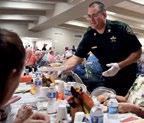
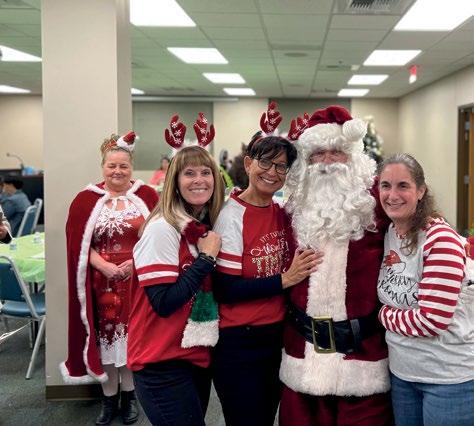
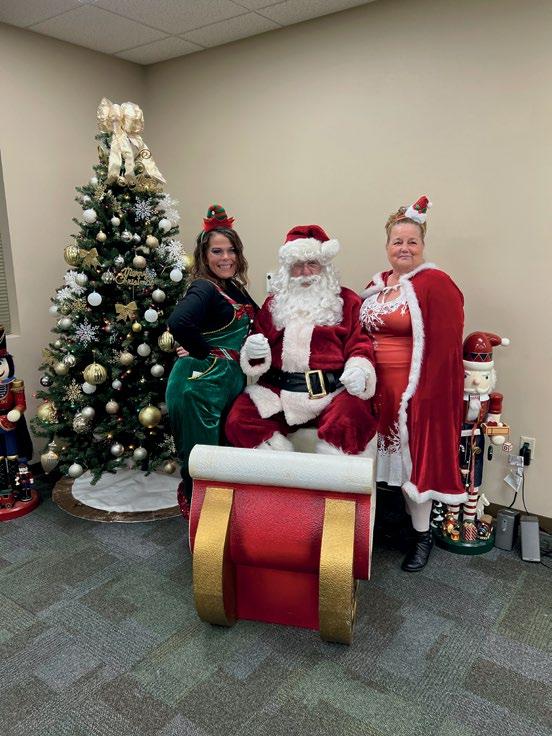
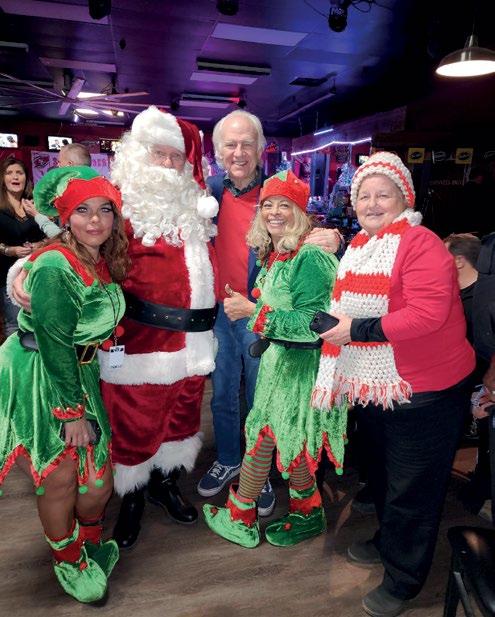
As many of you know it is my pleasure to be Santa at many of your events. There is more to just putting on a Santa suit and saying HO HO HO. Without the help and assistance of my wife, other PULSE Team members and the support from the community the joy of Christmas would not be possible. To see the faces and feel the happiness, of all ages, we bring to these events makes it all worthwhile.
Remember always to support our advertisers. Without them there is NO PULSE newspaper.
We wish you a MERRy ChRISTMAS & A hAPPy NEW yEAR from all of us at PULSE MEDIA.
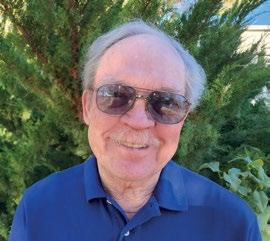
Jim Conkle
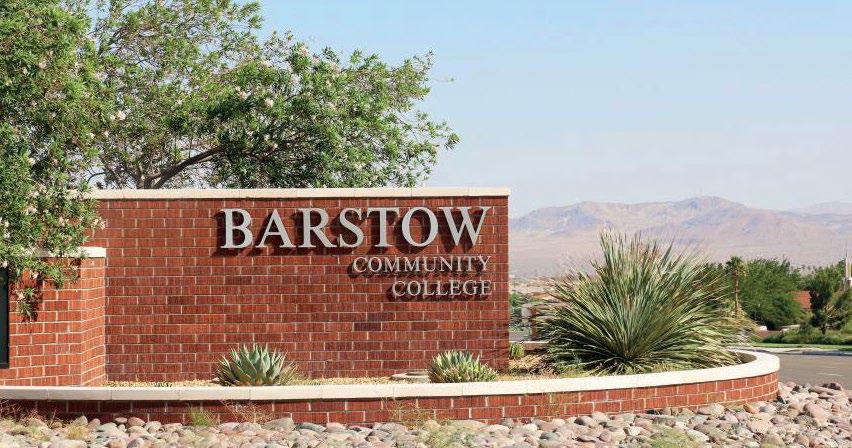
College Corner: The BCC Trustees are the Ship or the Wind
By J.P.Garner
Th ERE ’ S FIVE OF T h EM
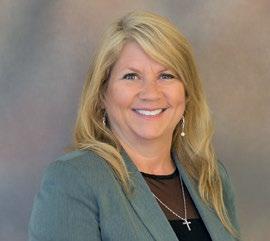
They’re elected to their jobs and they sit in judgment of one employee: the President of the college. Of the five, three are women. That’s a first in the history of the Board of Trustees. According to Julie Hackbarth, the Board’s President, the new configuration has a “nurturing” effect on the policies they support and enact.
They care about people and not simply outcomes.
The timing of this historical anomaly is perfect because the school’s President cares about people as well. The students specifically. Dr. Eva Bagg wants to see everyone graduate, and that vision is shared by the entire staff at Barstow’s little college.
It’s been at the southern end of the city since the 60’s. But only now is it in the remarkably unique position to impact the community in a way it maybe dreamed of back in days of paisley print and lava lamps . . . but never thought possible.
They can do that now because of BNSF.
The railroad is preparing to invest billions of dollars in our town by expanding the railyard into the Hub of the West. Which is not too surprising given Barstow's origins
in the industry, beginning with the arrival of the Santa Fe Railway in 1888.
Today, it is a vital hub in the movement of goods and products because of its strategic location in the High Desert. The planned BNSF Rail Facilities and Barstow International Gateway projects are designed to significantly expand our city’s role in the national supply chain, making it an even more critical hub.
And, as such, more in need of critical skills.
Because of it, there’s big doins’ at Barstow Community College. New ways of thinking and new goals to achieve.
According to Julie, “ … the college is ready to educate and train people for what [the community] needs.”
The community needs translate into the skills BNSF will need to fill the 3,000 jobs the expansion will create. But those jobs will reportedly explode into 21,000 ancillary jobs whose skills are being identified by Dr. Laura Alvarado’s staff. Those feasibility studies will help the faculty develop the programs that will teach the skills needed in those jobs.
This targeted approach to education is in keeping with BCC’s commitment to support students from enrollment to employment.
While the Trustees are the policymakers, Julie says, “We have to make sure that when we set the budget, we are supporting the goals of the school’s President. It’s a team effort,” she explains.
“[Our] attitude conforms to that of Dr. Bagg who wants her staff to provide our students with the means and the environment in which they can succeed. Our number one goal is for students to graduate or earn the workforce skills credentials they are seeking”
1,151 students graduated in two ceremonies last spring because there was more people than could fit in the room. That’s the highest number of graduates ever.
Because of the current configuration of the board and how it is different from those in the past, I asked how does it impact policy making, if at all. Julie leaned back in her chair and smiled as if she expected that question.” Is there an attitude that women have that men don't,” I probed.
Julie stopped smiling and leveled her gaze on me. “I think women are more nurturing and seek positive outcomes, where men instill structure and rules. [But even with those differences,] we're respectful of each other, of our ideas, and we [have] such a positive vibe at board meetings. When you have that, it resonates throughout the whole college.”
That’s important given the responsibilities of the Board. Google says that the “ . . . Trustees provide governance and strategic direction by setting mission and longterm goals, approving budgets and major financial decisions, hiring and evaluating the president,[and] establishing key policies for academic and administrative affairs.”
Immersing myself in that description, I imagined Barstow Community College as being a ship on a long journey to a place unknown. I wanted to know if the Board of Trustees was the Captain of the ship or the wind in the sails?
Without hesitating, Julie answered, “We’re the wind in the sails.”
Marcy’s Musings
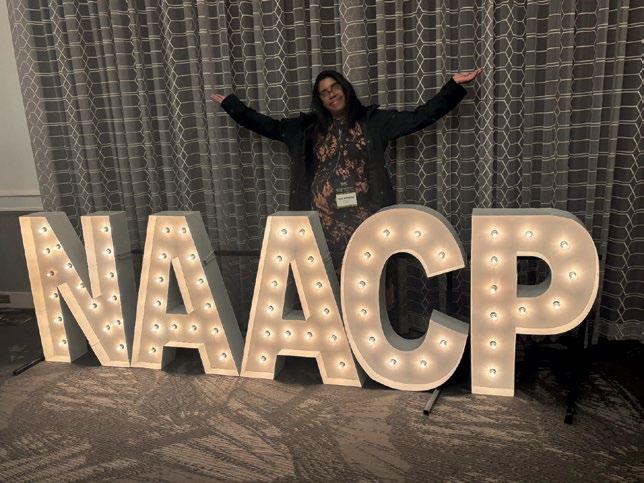
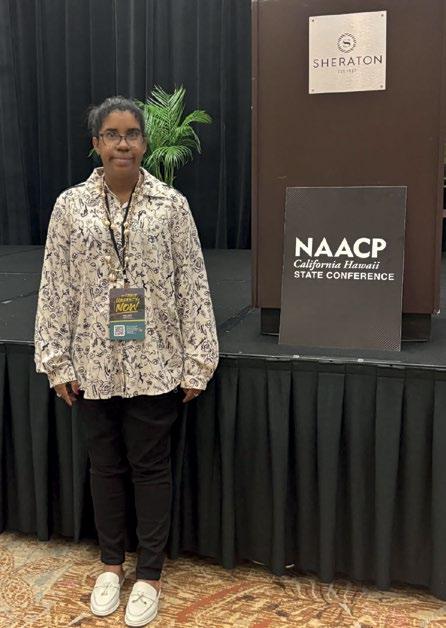
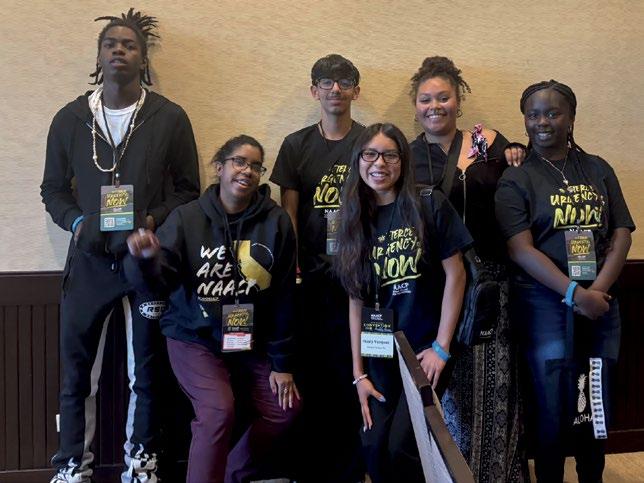
NAACP California / Hawaii State Convention 2025
Th E COMBINED C ALIFORNIA
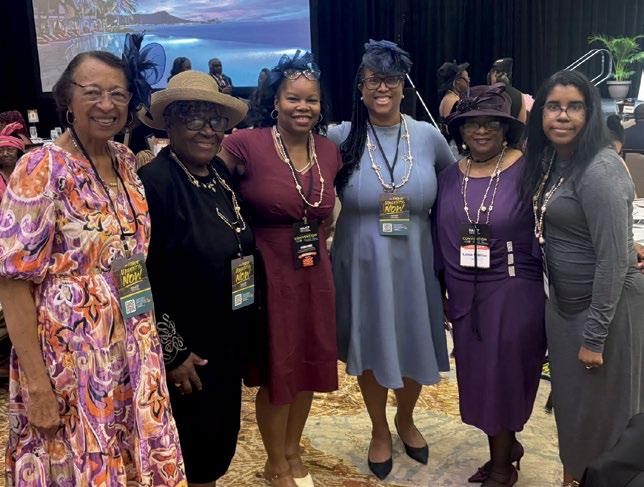
/ hAWAII S TATE NAACP Convention 2025 was held in the scenic city of Honolulu October 26-26. Our local Victorville Branch 1082 representative was long-time member and Executive Committee member Ariel Lattimore. At the Convention President Rick L. Callendar, Esq. was re-elected to serve another term. In his words, "The organization is committed to protecting the civil rights and dignity of all people, focusing
on justice, equality, and accountability."
In her role as Delegate, Ariel facilitated two youth activity sessions, voted on important measures, attended the WIN luncheon, and networked with Delegates from other organizations, such as the Stockton Branch.
The local Branch 1082 meets the second Monday of the month at 6:00 PM at 14240 St. Andrews Drive, Victorville, Ca. All are welcome and invited to attend.
Ghosts and Goblins Share Local History
"Mh S M EMBERS : Get your costumes and Halloween spirit ready to share in the fun and spread the word!"
In the week leading up to All Hallow's Eve (later shortened to Halloween), which began as a blending of the ancient
Celtic festival of Samhain and the Christian observance of All Saint's Day on November 1, many of us were very busy with fall events. Modern customs have added "anything goes" costumes and lots and lots of candy!
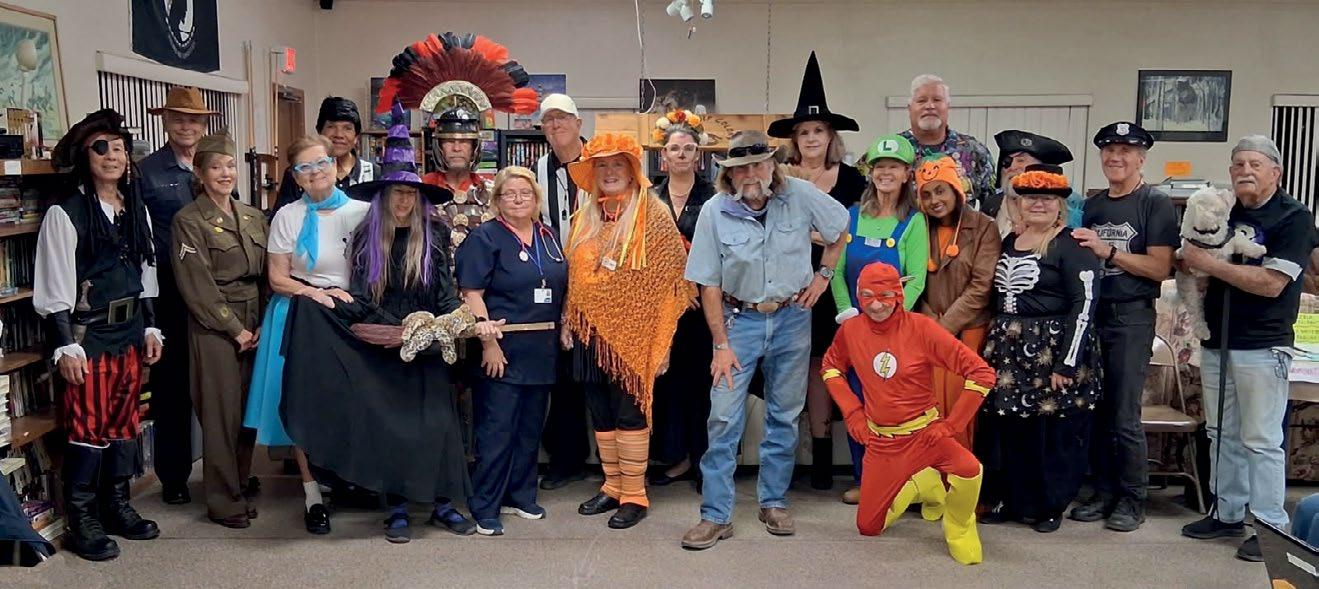
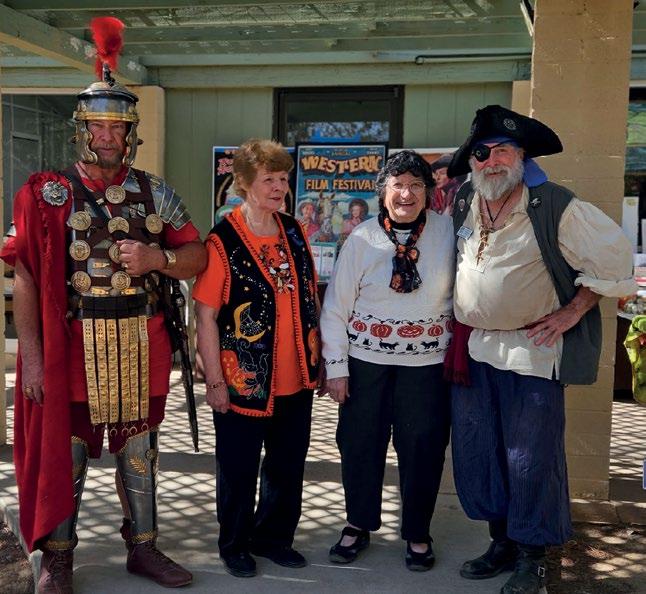
At the October Mohahve Historical Society meeting, many members showed
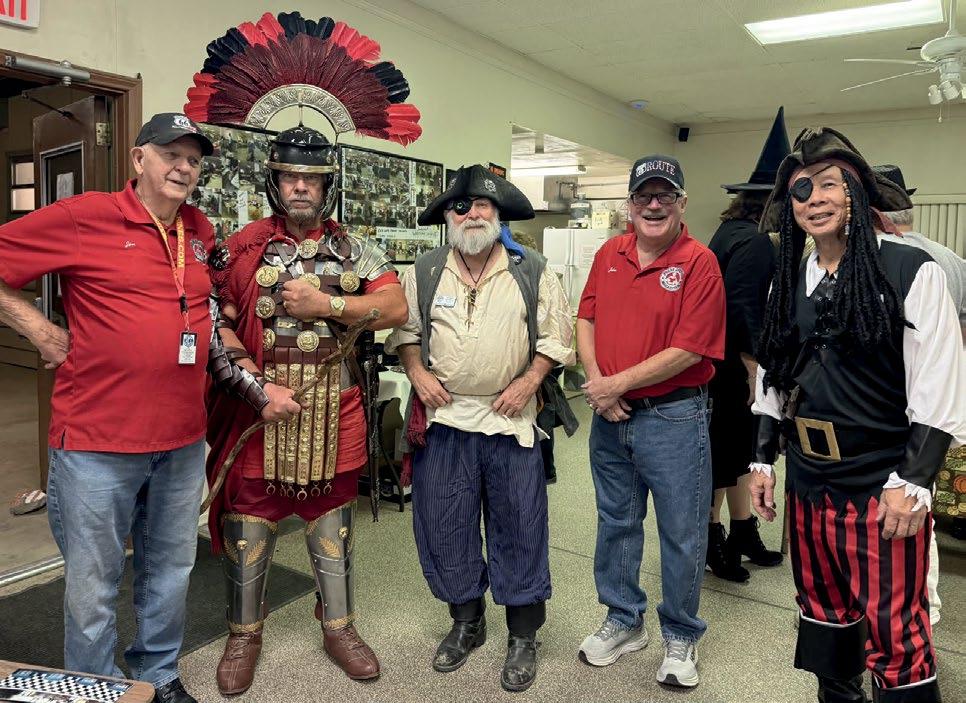
their spirit by arriving all decked out in interesting and creative costumes, ranging from an ancient Roman in armor, to witches, pirates, cowboys, and a 1950's era couple ready to jitterbug. Loaner hats and custom made Halloween cookies added to the fun.
Two days later, a group of seven MHS
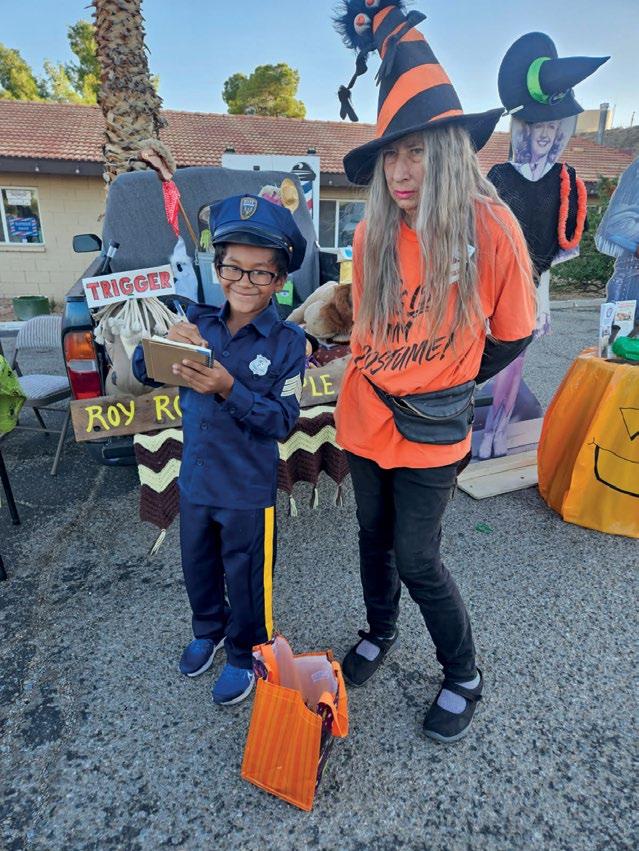
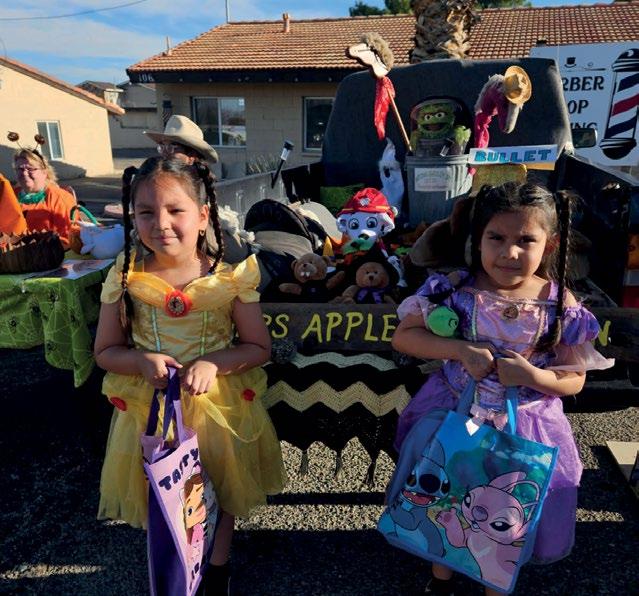
members and Apple Valley Legacy Museum volunteers were ready for all the little ghosts and goblins and other creatures who arrived at the Trunk or Treat event at the Historic Apple Valley Inn.
Sponsored by CASA (Court Appointed Special Advocates), an important organization that supports foster youth in 52 California counties, the parking lot was full of excitement and activity. What a wonderful event on a beautiful fall evening, as the DJ played festive tunes and the spirited children and families visited various booths, trunks, and displays set up by local organizations, businesses, and non-profits. MHS member Shaun Adame created a beautiful Dia de Los Muertos exhibit, while Frank Kelly, Mr. "No Drugs America," shared his important message. Our tribute to the Roy Rogers Apple Valley Inn was complete with the famous couple themselves, as well as Trigger, Buttermilk, Bullet, Oscar the Grouch, and other Halloween creatures. A great big thank you to Angela and the CASA staff for inviting us to participate.
And we weren't finished yet. The very next day five MHS members staffed the Bell Telephone Museum at the Lone Wolf Colony Fall Festival. You have to see this event to believe it! Hundreds of cute
and creepy characters, food vendors, games, an inflated playground, a costume contest, a raffle, and museum tours keep guests busy. No, I wasn't brave enough to enter the spook house, but we did enjoy hearing the screams and shrieks all day long! Proceeds from this annual event go towards scholarships for Apple Valley and Lucerne Valley students. Thanks Shannon, Billy, and staff for letting us participate. We hope to be back next year.
A Memorable Victor Valley Patriotic Event
Th E A PPLE VALLE y R OTAR y
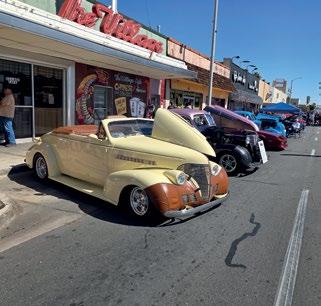
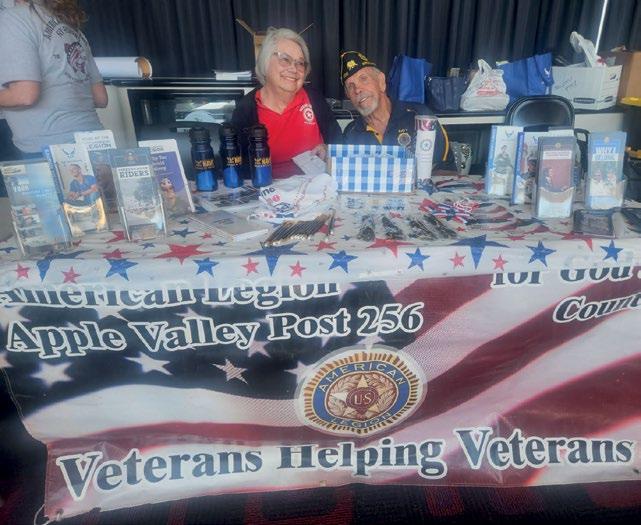
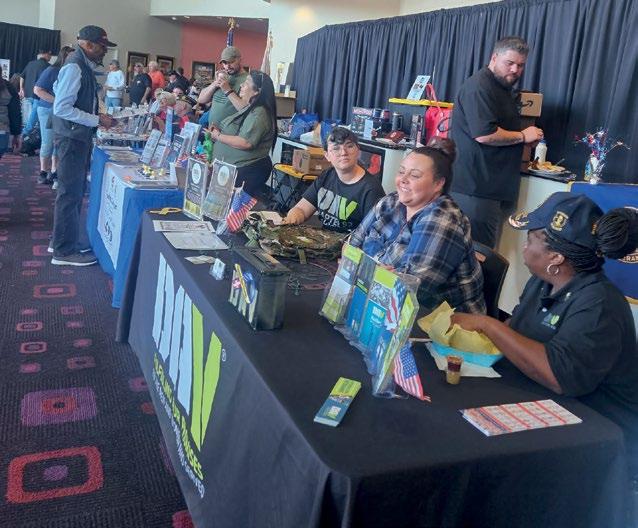
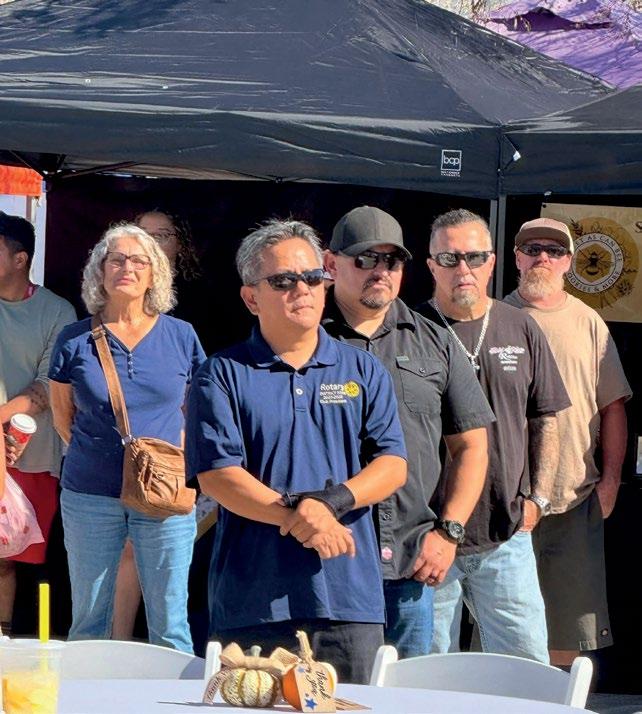
C LUB hosted an outstanding event honoring our United States Military members, on November 8, 2025, the Saturday before Veterans Day. The Singh Center for the Arts in Apple Valley was packed both inside and out with people attending the Veteran's Car Show and Resource Fair. Early in the morning sparkling antique and vintage vehicles, food trucks, and organizations setting up booths pulled into the parking area, while many Veteran's support groups set up tables inside the main lobby.
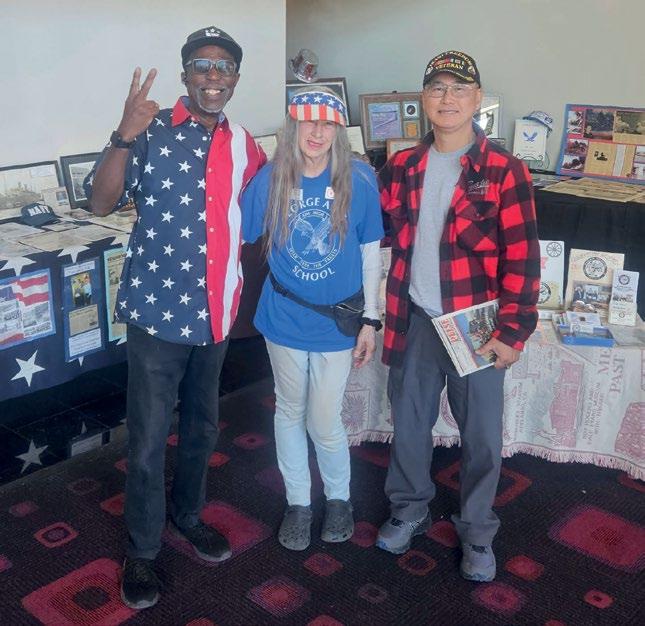
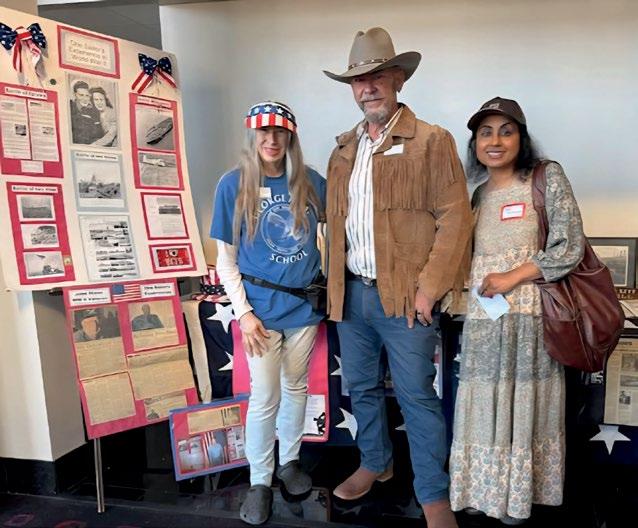
A large military zisplay, compliments of the Apple Valley and Victor Valley Legacy Museums, and Mohahve Historical Society, greeted attendees. Memorabilia on display included World War I postcards
and a large framed World War I ship photo, World War II practice bombs and ration tickets, several collections of Navy and Air Force memorabilia donated by Veterans or their families, and tributes to local heroes Captain Joseph McConnell, Jr. and General Chuck Yeager. Roy Rogers and Dale Evans contributions, and George Air Force Base housing and schools were also represented.
Thanks to MHS member Eric Mandeson for helping staff the display, and for the other members and supporters who stopped by. A great big thank you to Rotary President Rick Bui and his volunteers for a successful second annual event, as well as all the vintage car guys and gals, and the many supporting organizations who participated. And most of all, thanks to
our local Veterans and active military of all branches who served and continue to give back to the community.
Honoring Our Veterans - 2025
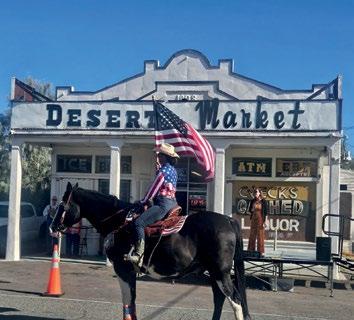
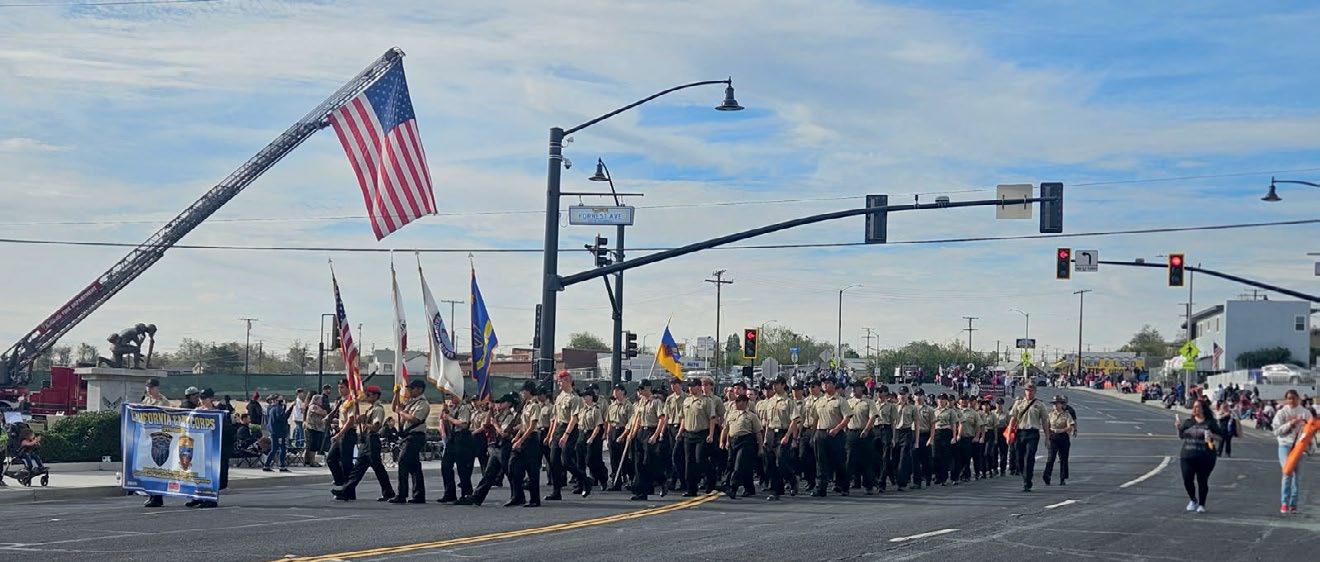
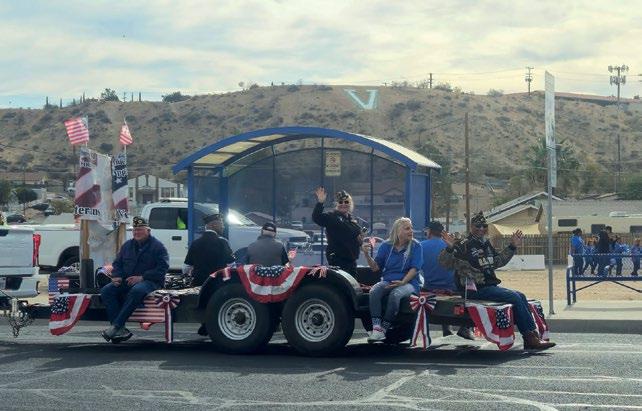
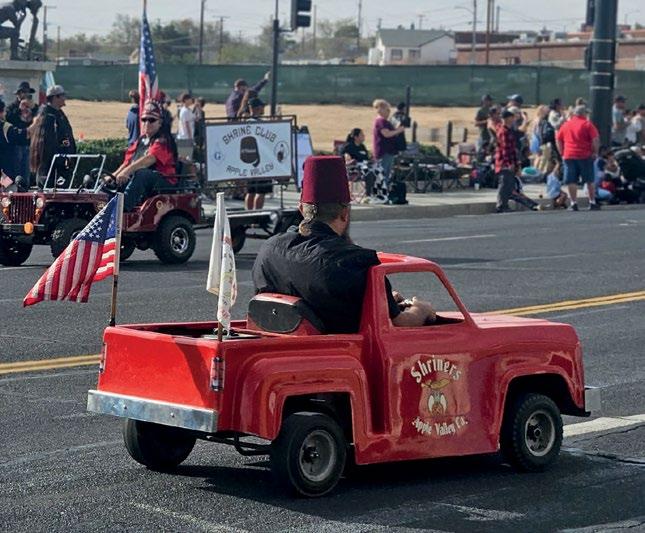
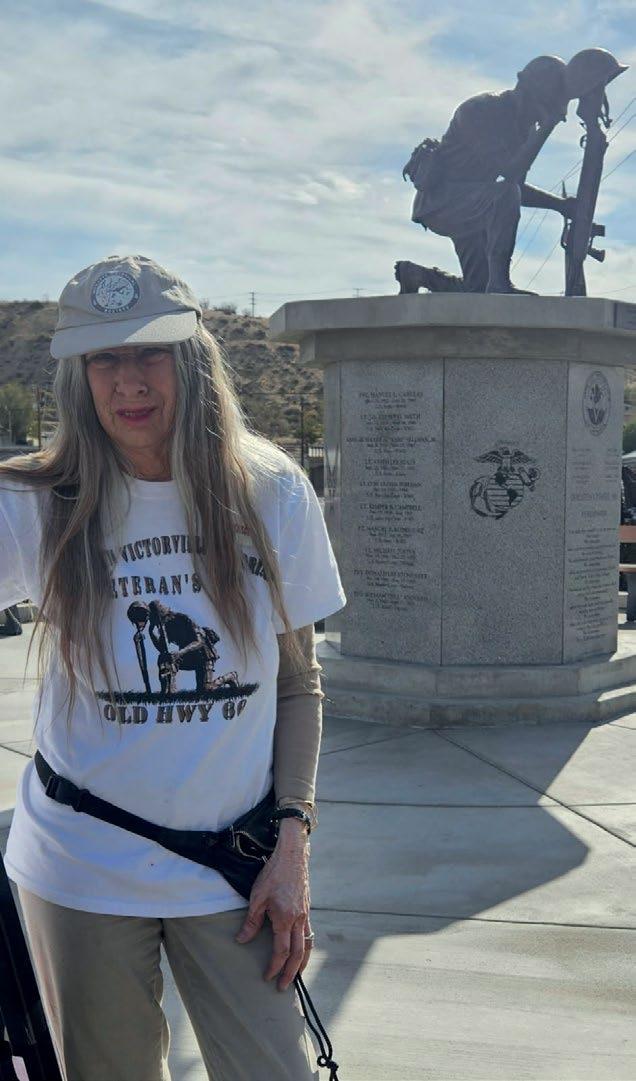
VETERANS D Ay WAS CELEBRATED in style in both Victorville and Apple Valley Tuesday, November 11. Starting at 9:00 AM, the 29th Annual Veterans Day Parade rolled, marched, and danced its way down Seventh Street, the old Route 66, ending at the Veterans Statue at Forrest. Student groups included Air Force and Army Jr. ROTC units, a large combined California Cadet Corps marching group representing several schools, Young Marines, and four marching bands. Other groups represented were two American Legion posts, DAV, Jeepers, and Tuskegee Airmen, as well as Shriners, Corvettes for Vets, Victorville City Council members, and representatives from various city departments.
The touching ceremony following the parade kicked off with the flag raising and National Anthem. Tributes to each military branch, and Veterans of every war from World War II through the post-911 era, as well as active military, were interspersed with musical numbers including the Armed Forces Medley. A video tribute to Victorville Vets was another highlight.
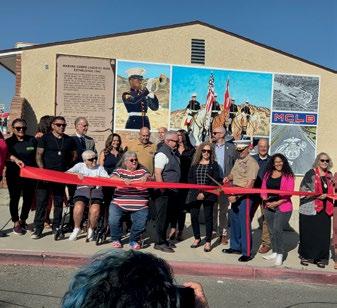
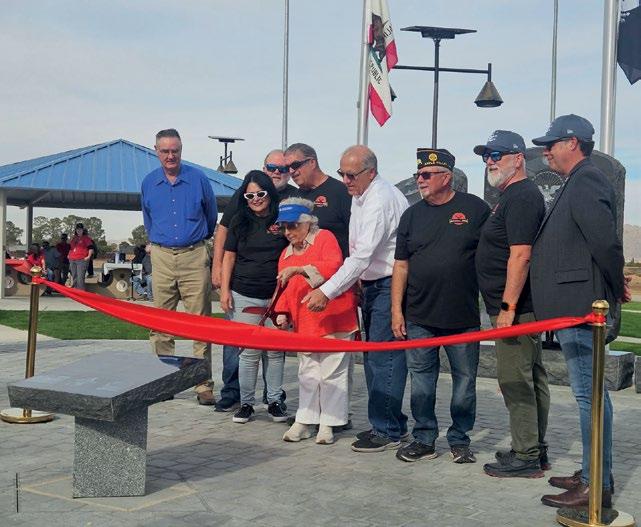
The party continued in Apple Valley at the afternoon opening of the Captain Joseph McConnell, Jr. USAF Park. Residents of Apple Valley and surrounding communities turned out in force for the
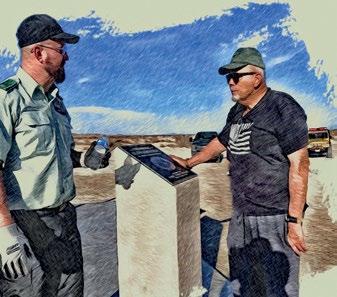
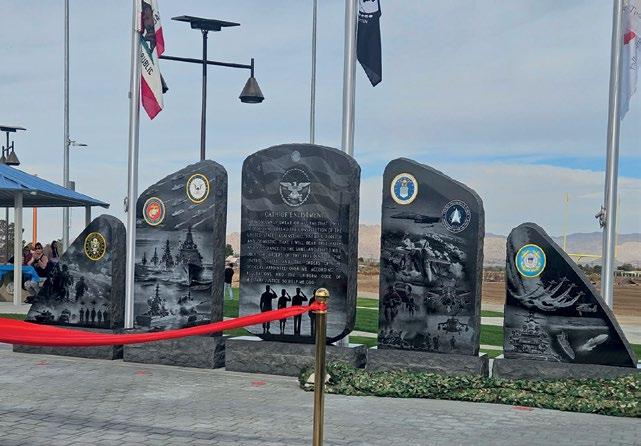
ribbon cutting of the Town's first dedicated Veterans Tribute area. The Academy of Academic Excellence Space Force Jr. ROTC presenting the colors, and Granite Hills High School Chamber Singers singing patriotic tunes set the mood on an absolutely gorgeous fall day.
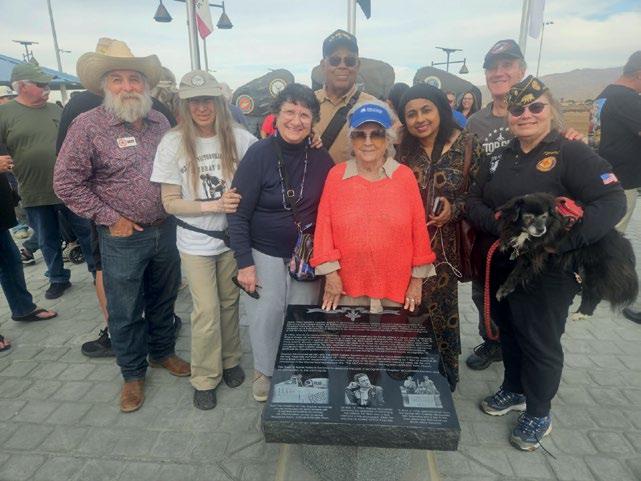
Event highlights included Trish McConnell, Captain McConnell's eldest daughter, first accepting a case holding her father's reissued military medals, and then cutting the red ribbon with a large ceremonial scissors to dedicate the beautiful five piece monument, that pays tribute to all military branches. The area also includes two benches and a separate plaque honoring Captain McConnell and his amazing accomplishments as the
Korean War's Triple Jet Ace pilot. The fun continued all afternoon with families taking advantage of the new picnic area, and children thoroughly enjoying the brand new playground equipment. Thank you Town of Apple Valley, and everyone else who contributed, to make this dream park a reality.
On the Road Again
IT WAS AN ENTERTAININ g AND EDUCATIONAL
Mohahve Historical Society meeting the night of October 23, when Jim Conkle, sometimes referred to as "The Mayor of Route 66," presented at the Lone Wolf Colony. Three members of his Pulse Publications staff, Frances Conkle, John Kafides, and Debbie Walker, were along for the ride.
Jim's armchair tour of the Mother Road took us through all eight Route 66 states, from Chicago, Illinois, to the Santa Monica pier, highlighting iconic sites along the way. And that's not all! Every attendee received two postcards commemorating the late well-known Route 66 artist Bob Waldmire, and some lucky folks won cool Route 66 raffle prizes.
Thanks to Jim and staff for your great presentation, and for furthering the mission of MHS of preserving and sharing local history.
Grave Issues at Barstow’s Cemetery – Part Two
By J.P.Garner
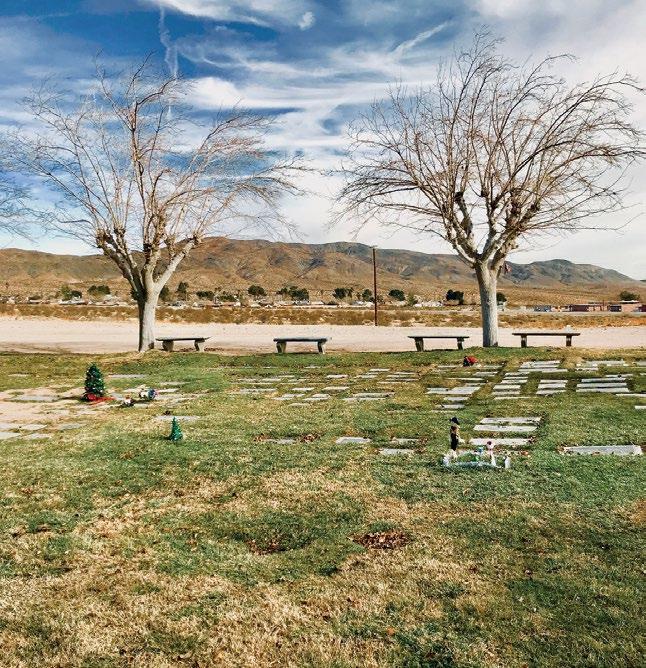
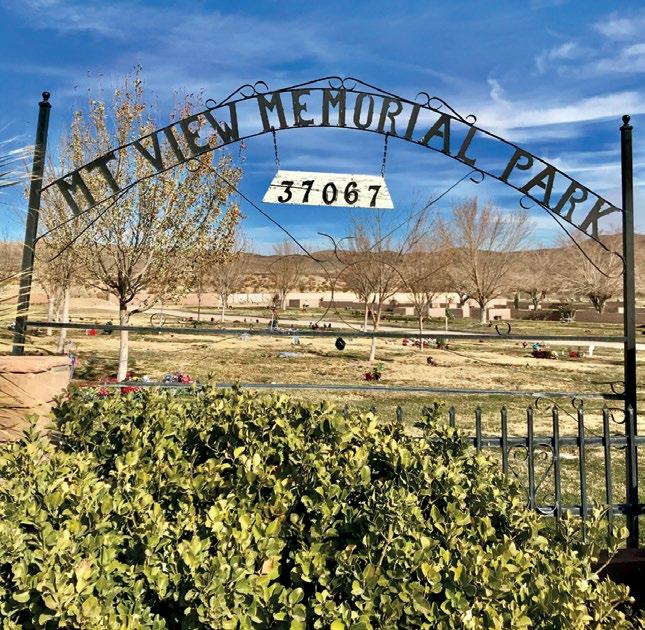
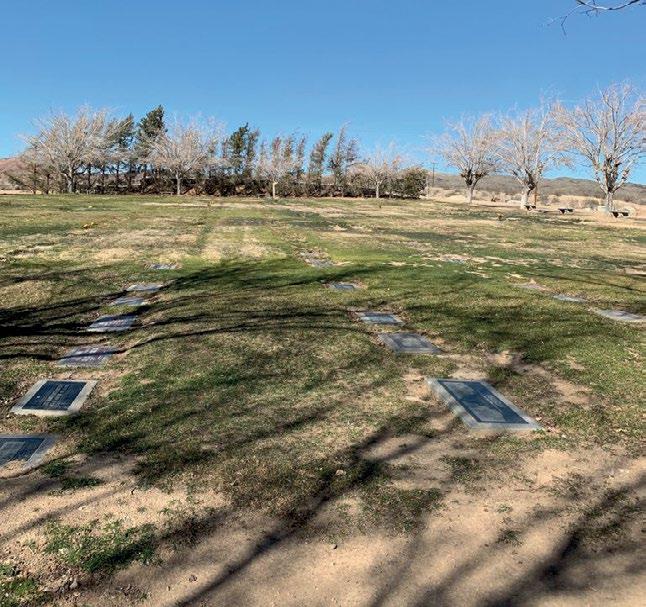
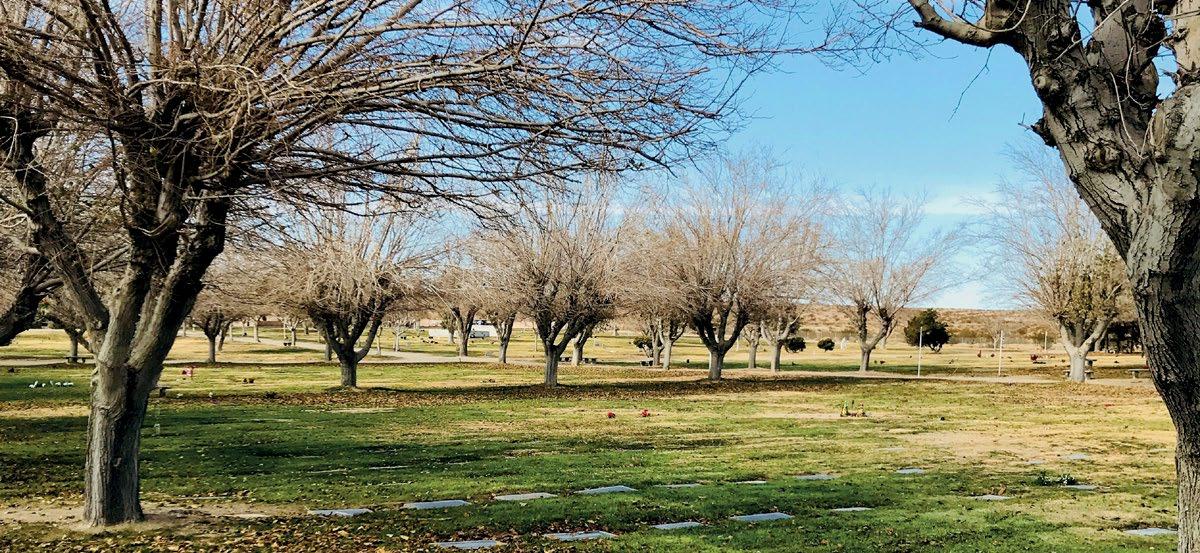
BARSTOW ’ S CEMETER y USED TO BE A MESS . Not so much anymore.
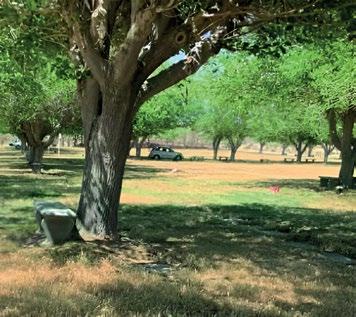
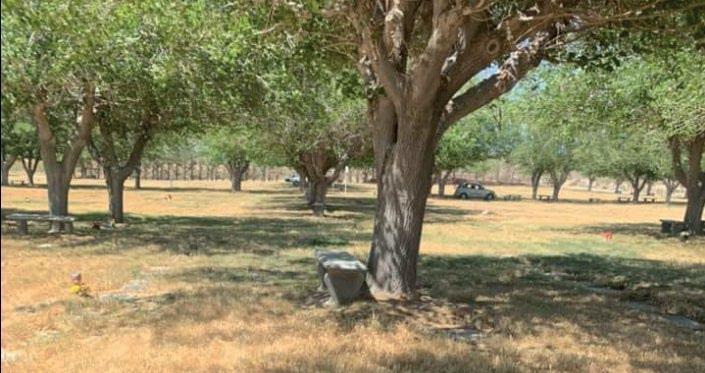
Ashley Tarpley, the big dawg at the Mountain View Memorial Cemetery, is a pit bull when it comes to solving problems. She gets results through dogged determination. One of the issues confronting her is currently being fixed. The operation is going from green to lean and only because it has to. Water is too damn expensive, and we all know that. Who among us that owns a house hasn’t already changed over to a desert landscape because of the steep increase in costs or at least thought to do so.
The cemetery really had no choice. It’s being fiduciarily responsible by doing so. Any business would. And most residents have.
The other issue—the money—is the biggest concern. The cemetery doesn’t get enough of it and that’s primarily because the facility is a “special district.” It’s like the Vatican. It’s little, it’s holy, and it operates within a city but is it’s own little entity. It just doesn’t have as much gold.
To understand what the designation means specifically, I googled it and found that, “in California, a special district is a local government agency that provides a specific public service or function not covered by a city or county. These districts are formed by residents to address specific community needs and are governed by a locally elected or appointed board of directors. Funding for a special district typically comes from a combination of property taxes, special assessments, fees for services, and sometimes state and
federal grants.”
Ashley Tarpley, the cemetery’s capable General Manager, clarifies the issue: “We’re not part of the city, [so] we’re not funded by them. And we’re not a part of the county, [so] we’re not funded by [them either.] We only get funding from what we sell here on the cemetery as far as sites go.”
She pauses to consider her next statement. When she proceeds, it is with a somber tone. “But [our situation here] is that if people don't pass away, we have no income. So it's a terrible thing to need.”
After another pause in which she appears to regroup, Ashley adds, “[We also] get a small tax apportionment from property taxes because we're a special district. [But] it's not enough to run the cemetery. And we don't get them every month and the amounts vary. I don't actually even know what the amounts will be until we receive them.
[“There are] several months in a row that we don't get any tax apportionments,” she reveals. That translate into no money, and as Michael Jackson’s father, once declared, “It’s all about the money.” [When that happens], Ashley has to make ends meet as best she can until they’re paid.
So, how does the cemetery manage to stay in business, I ask? Well, for starters, to proceed forward, Ashley looks backward to last year’s figures because the amounts “will be around [as] much. [But we] can’t stabilize that because [the figures] change every year with the [rise in interest] rates and drops in property taxes.
“And there are grants that give us the access to larger sums of money. {But] problem is, is that one, you're not guaranteed a grant just because you apply for it. They're extremely tedious, and they take a long time to fill out. I’m seeing that a lot of them are doing a pre-applications. You're not even actually doing the grant exactly. You’re doing a pre-application to see if they'll even let you apply for the grant. [And then there’s] cost sharing. [where] they go, if we put up $500,000, you have to put a $500,000. We can't do that.
“And, lastly, we're also not a nonprofit.”
That’s an important and often disqualifying distinction because most grants are designed to target non-profits. As a Special District, the cemetery earns “service fees” for burial services, making it a “for profit” business.
But, according to Ashley, the only way that this project will be completed is with outside funding. The cemetery has no way, itself, to fund it. Outside funding likes grants
are essential. But, as was reported, a lot of businesses or charitable organizations in a position to help only work with nonprofits, so the cemetery is limited.
In this context, then, I asked if any attempt was made to get the city involved in the funding. Ashley immediately perked up. “Yes,” she replied. “We have reached out to the city. Obviously, they are not responsible for it. I know people say, well, it's in the city but, technically, we're not. We’re outside of the city lines. We're more county
“So, it's kind of a weird place that we're at. But the city is trying to see what they can do to help. Yeah, they have stepped up. And I've been in communication with the City Manager, Rochelle Clayton, and Tim Silva, the Mayor. And then Councilman Tex
Williams is a very supporter, while Barbara Rose has stepped forward and made a proclamation, while Carmen Hernandez is on the board for the Mojave Desert Air Quality Management. They gave us a grant for a utility vehicle to help our maintenance personnel.
“So, there's been multiple ways that people are trying to help. I've seen more involvement from the city now than there ever has been before. But the city has its own issues. They have things that they're trying to take care of, too. So I reached out to the railroad. We put a grant in for them, but unfortunately we were denied. And then we submitted another grant and we were again denied. So, I don't know if the reasoning is because they’re trying to get
back on their feet, but I have put in another grant but for a much smaller [amount thus time.]
“I'm just going to keep trying.”
Fall down seven times; get up eight. Ashley Tarpley is the embodiment of the Chinese proverb. There’s no quit in her. The word is not in her vocabulary, which should make believers out of any resident who favors what she and her coworkers are seeking to achieve. She only needs a little help and more time.
Monday mornings are when most people just go to work. But for Ashley Tarpley, Monday is one day closer to her vision of a cemetery where Barstow’s citizens want to be buried alongside family and friends.
Senior Care Professionals
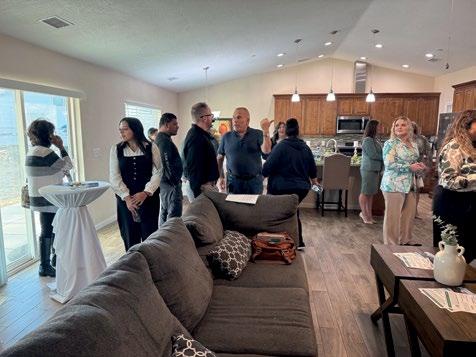
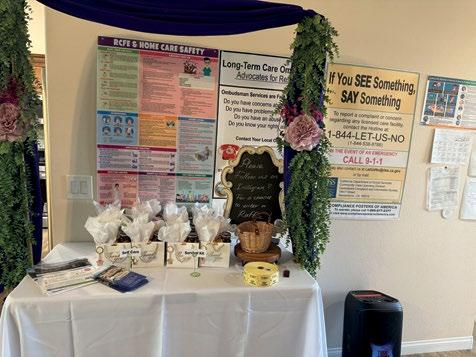
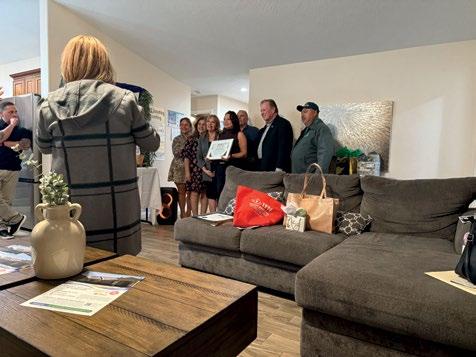
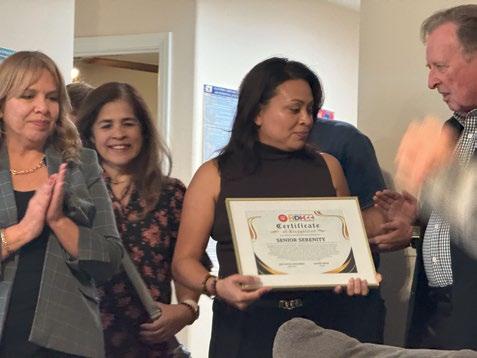
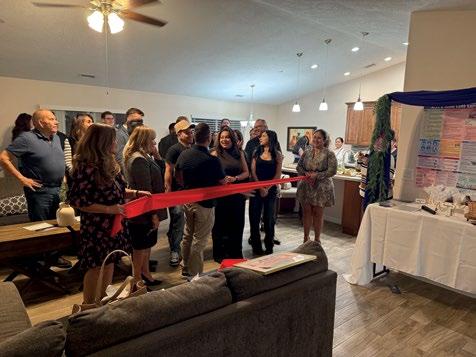
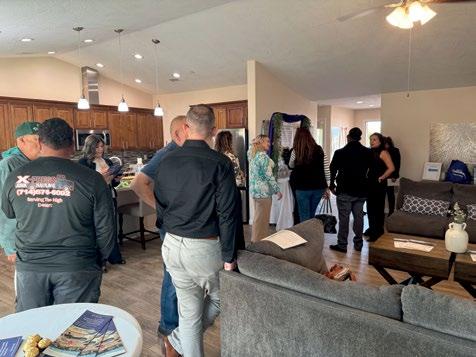
FRANCES AND I attended the Ribbon Cutting on November 13th at The Senior Serenity Family’s new Residential Care Facility in Hesperia. This event was an official Hispanic Chamber of Commerce event.
The attendees, that there were many, were greeted by the staff and given a tour of the home. This new concept of providing a real home for seniors is fast catching on within the High Desert.
The staff and owners are ready to give you a tour and discuss how this type of facility might fit your family needs, now or in the future. (see their ad below)
Old Camp Cady
By John Wease
Ih AVE LON g BEEN FASCINATED by our local historic Camp Cady Army post. Camp was a good name as the original location was a wellused camping spot. For hundreds of years, it was used by the Mojave Indians who traveled from their tribal lands near present day Fort Mohave, across the Mojave Desert to trade with tribes on the coast. And Arizona spells it with an “H” unlike here in California where we use the Spanish phonetic spelling with a “J.” Both are accepted, both are incorrect. The tribe calls itself “Aha Makhav.”
In 1776, Spanish Father Garces traveled north from Mexico seeking a land route to the coast. The friendly Mojaves guided him across the desert from water source to water source. The future Camp Cady site was one of his camps. It was also a stopping place in 1826 by famous mountain man Jedediah Smith, in the 1840s by John Fremont and Kit Carson, and General Beale in the 1850s. Beale established the Beale Wagon Road along the Mojave Trail. It is now generally called the Mojave Road.
The wagon road made it possible for many more travelers to reach California during the Gold Rush. The increase in travelers, led to mistreatment of the once peaceful Mojave Indians. Attacks on travelers by the Mojaves were stopped by an army force of five hundred and Fort Mohave was built in 1859 to maintain peace. The closest supply source for this fort was in Los Angeles. The Mojave Road was then more commonly called the Government Road. The Government Road connected nearby with the Old Spanish Trail that became known as the Salt Lake City Road or the Mormon Wagon Road. This junction of wagon roads was referred to as “Forks of the Road.”
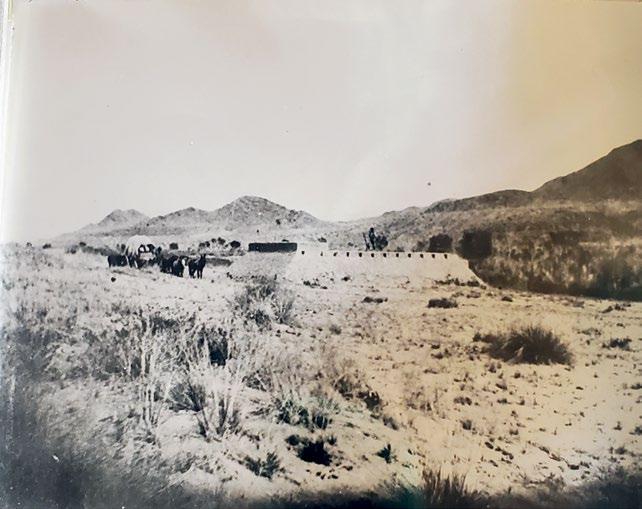
Paiute attacks along both roads caused the army to order Major James Carlton to establish a base near “Forks of the Road” to seek and punish the Paiutes responsible for these attacks. He established Camp Cady in April 1960 and named it after his friend, Major Abermarle Cady. It was manned by 80 men of Company K of the First Dragoons. The Dragoons were an elite mounted force trained to fight on foot or on horseback with sabre, carbines, or pistols. All mounted forces were reclassified in 1861 as cavalry. The First Dragoons became the First Cavalry. The men lived in dug-out shelters covered with brush and mud. There is a record of only one building, “a central building which could lay claim to fortress-like attributes, a 40 foot square that stood man high.”
The only known photo of this building was taken by Rudolf d’Heureuse in 1863 or 1864. The building was made of adobe and had a ditch around the perimeter. I have been told the floor was dug out as well. Nothing remains today of this building except the vague remains of the sand covered foundations.
After several skirmishes, Major Carleton arranged a peace treaty with the Paiutes and Camp Cady was abandoned after three months. In 1862, the camp was reactivated briefly by a small force assigned to watch the Government Road and report Rebel troop movements. Civil War Rebel forces were seen gathering near the Colorado River and it was feared they would try to raid California to acquire some much-needed gold. The camp was abandoned again some ten days later.
After increased Indian depredations, Captain John C. Cremony and his Company B of the Second California Cavalry were ordered in July of 1864 to patrol from Camp Cady to Rock Springs
to “protect travel and clear the road of thieving, troublesome Indians.” In March of 1865, Camp Cady was manned by Regular Army Cavalry and in April, Company C, Fourth California Volunteer Infantry arrived and manned the camp until July 1866. Records tell of them rebuilding collapsed shelters, “quarters made entirely of brush and intended for shelter from the sun only.” He was commended for building thirty-five small adobe houses. The camp was abandoned soon after.
Old Camp Cady was manned off and on as needed before finally being abandoned in 1868. At that time, Camp Cady was relocated to the west about seven tenths of a mile. The new location had sufficient flat ground to have a large parade ground surrounded on three sides by more substantial adobe buildings. Some of the Old Camp Cady structures continued to be used and crude cottonwood buildings are said to have been used as barracks. Perhaps during the times when 120 men were stationed there. Camp Cady was abandoned permanently in 1871.
All of the adobe buildings were washed away by floods in 1938. The four square mile site was divided and sold. Camp Cady Ranch, now a wildlife preserve, is on the site of the New Camp Cady. A five-stamp mill was built in 1889 at the old camp to process gold ore from the nearby Alvord Mine. Only an old boiler remains of that. A stone wall near the boiler is thought to be the remains of a redoubt or guardhouse. Narrow grooves in the hard clay deposits are believed to be wagon wheel ruts. A giant, gnarled cottonwood trunk is said to be the remains of the old hanging tree.
The last private owners of the old fort location were the Wilhelm and Burrill families. I had the good fortune of meeting John Burrill in August. John spent a good part of his life there and at the Camp Cady Ranch. He has a wealth of knowledge of the history of the area and the oral history passed down by the family. I can’t thank him enough for the hours we spent walking the Old Camp Cady site and for the pictures he has shared. Hours of research through old reports can provide a lot of information. For me, nothing compares to actually walking along the Old Government Road and experiencing the isolation the Dragoons must have felt back in 1860.
Christmas in the High Desert: A Season Built on Tradition, Community, and Resilience
By
Ch RISTMAS IN T h E hI gh D ESERT has never looked like a classic postcard.
There’s no blanket of snow, no evergreen forests, and no crackling fireplaces beside frosted windows.
But what the High Desert does have is something far more lasting: a community that has built its own Christmas traditions over decades shaped by wind, grit, and the kind of neighborliness that defines life above the Cajon Pass.
From Victorville to Apple Valley to Hesperia, the season officially kicks off with events that have been part of the region for generations. Apple Valley’s Annual Christmas Parade, one of the longest-running holiday parades in the Mojave, brings marching bands, classic cars, equestrian teams, and local clubs down Highway 18. In Victorville, the Festival of Lights & Tree Lighting at City Hall draws families from all corners of the desert, continuing a tradition that dates back to the early 1990s.
Local history plays its part too.When George Air Force Base was still active, holiday ceremonies on base were a community staple including open-house light displays, special chapel services, and toy drives that supported families across the Victor Valley. Even after the base closed in 1992, many of those traditions moved into surrounding neighborhoods and churches, where they’re still carried on today.
Small businesses remain at the heart of the season. The High Desert has always been a place where mom and pop shops outnumber major chains, and December is when those shops see the most support. Local bakeries roll out heritage recipes, desert artisans fill holiday markets with handmade goods, and family run restaurants serve Christmas tamales, pozole, and cinnamon-dusty buñuelos a tradition rooted in the region’s strong Hispanic influence.
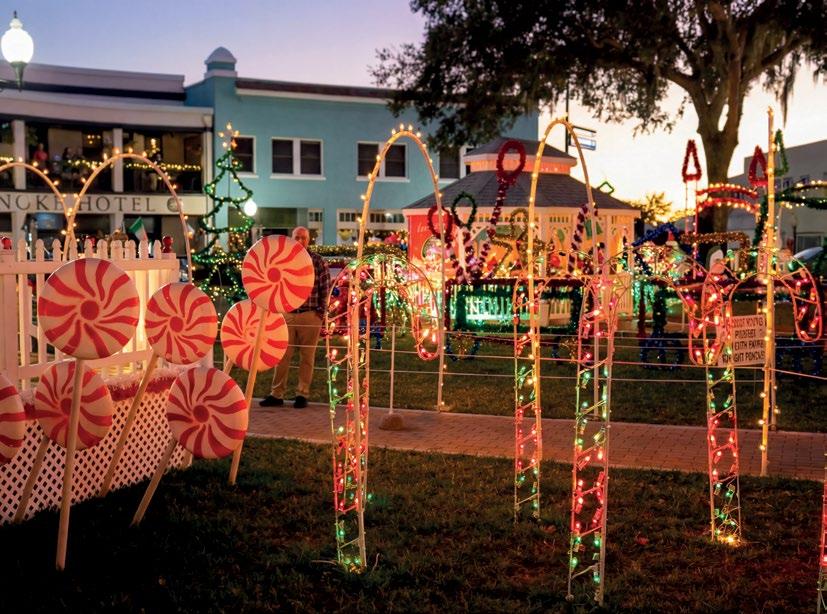
Another defining feature of Christmas in the High Desert is the light displays.
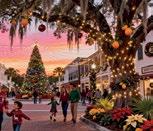
Without snow, residents rely on creativity Joshua trees wrapped in lights, Desert yards transformed into glowing dioramas and Classic car groups decorating their vehicles for nighttime cruises
Entire neighborhoods like the famously festive areas around Eagle Ranch and parts of Spring Valley Lake have become known for their annual displays, drawing cars line-by-line through the streets every December.
Churches, nonprofits, and veteran organizations also play a major role. From the Victor Valley Rescue Mission’s Christmas meal for families in need, to toy drives hosted by local fire stations, Marines, and community centers, the season has always been a time when giving outweighs receiving. It’s part of the High Desert’s character when hardships hit, neighbors step up.
In a region shaped by wide-open horizons, military heritage, and working-class determination, Christmas isn’t defined by weather it’s defined by community. Year after year, families come together not because conditions are perfect, but because traditions matter.
The High Desert makes its own kind of Christmas: bright, warm, generous, and unmistakably homegrown.
Tiffanie Williams
Tiffanie Nicole – Pulse of the High Desert
Road Runner's Retreat on Route 66: A Light to Remember
By Jaylyn And John Earl www.thedesertway.com
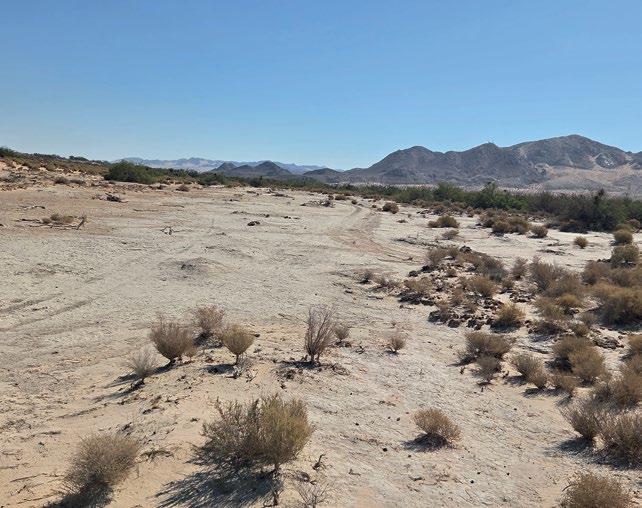
Ch AMBLESS , C ALIFORNIA , located about ten miles east of Amboy, is a ghost town now. But travel a mere mile and a half west of where the settlement used to be, and you would have found the Road Runner’s Retreat, a true desert landmark on Route 66.
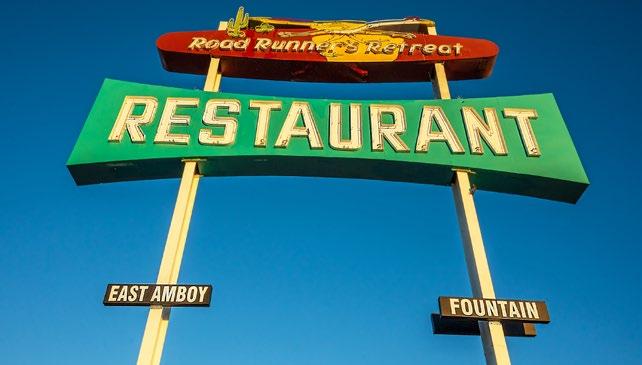
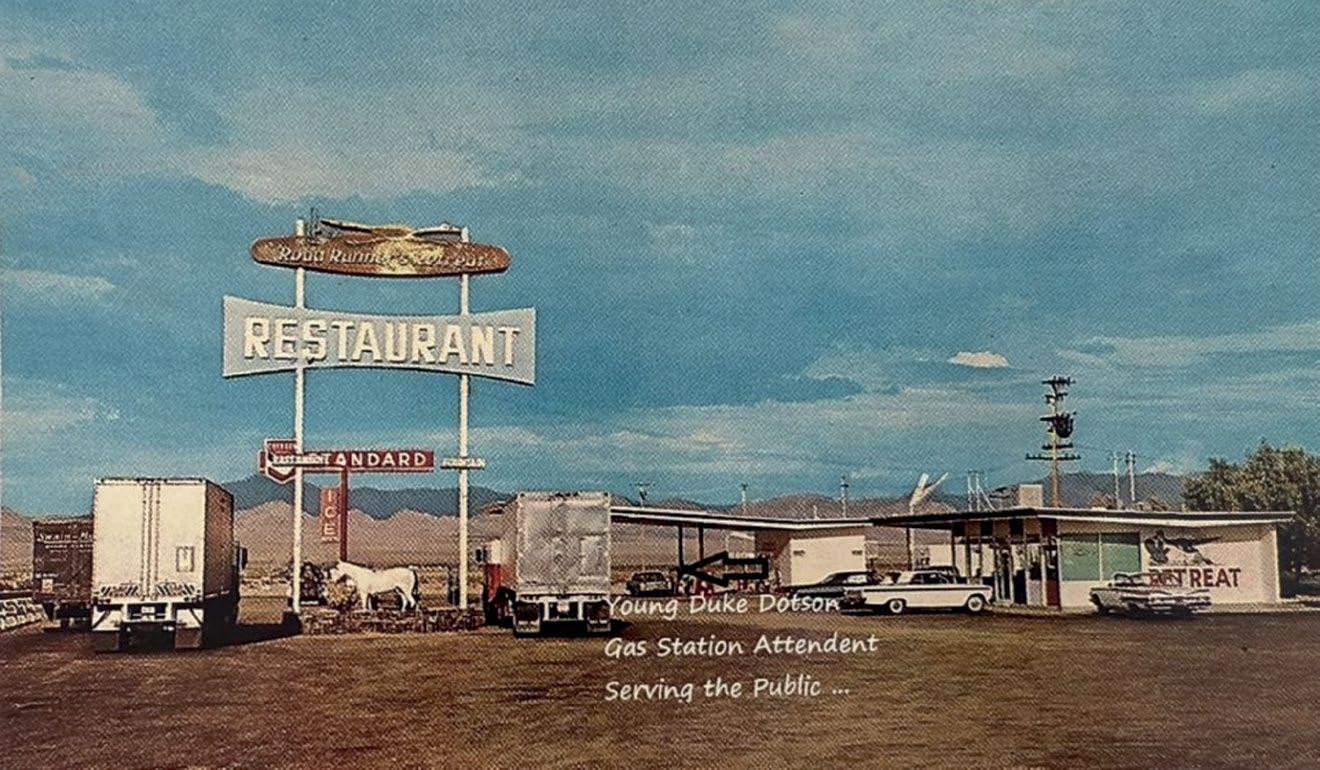
Dominating the landscape was a massive 30-foot-wide sign, its 12-foot-high neon letters and a majestic roadrunner standing guard like a towering sentinel. Here, patrons could fill up their automobile gas tanks at the fuel pumps, as well as their growling bellies at the diner.
Nowadays, follow the stretch of Route 66 at Kelbaker Road, past the closure signs to through drivers, past demolished Cadiz Summit and what remains of the old gas station and sign appear magically in the distance on your right.
Ryan Anderson, the current owner of Road Runner's Retreat and grandson of previous owners, the Murphys, collaborated successfully with others to restore the historic masterpiece. Key partners in the project included the California Historic Route 66 Association, the National Park Service, and Benjamin Moore Paints through the National Trust for Historic Preservation.
Legend has it that before its grand
restoration, the head of the stately roadrunner blew off in a storm then someone came along and apparently stole the head as a keepsake.
Beth Murray is the current president of Historic California 66 Association (CHR66A), a nonprofit established in 1990. She is the former vice president, but became president when Scott Piotrowski retired from the position after seven years. As president, Beth leads the association's efforts to foster public awareness of the history and significance of Route 66.
Jo Murray, Long Beach Press Telegram columnist, and Beth Murray are a tour de force. Although they share the same last names, they are not related. What bonds them is their mutual love for Route 66 and in particular, Roadrunner’s Retreat. For what many had once deemed impossible, this dynamic duo has forged a way.
Roy H. and Helen M. Tull bought the vacant property in 1962 and built a flamboyantly styled prefab cafe, a structure constructed off-site and assembled on the property. Initially, the gas station was Standard Oil. Roy was a truck driver and planned to build a truck stop between Needles and Barstow.
Years later, no one recalled it was a prefabricated building until an unfortunate fire occurred in the old diner on July 30,
2020.
It burned for hours without notice in the remote desert. What remained of the building had to be demolished a few months later.
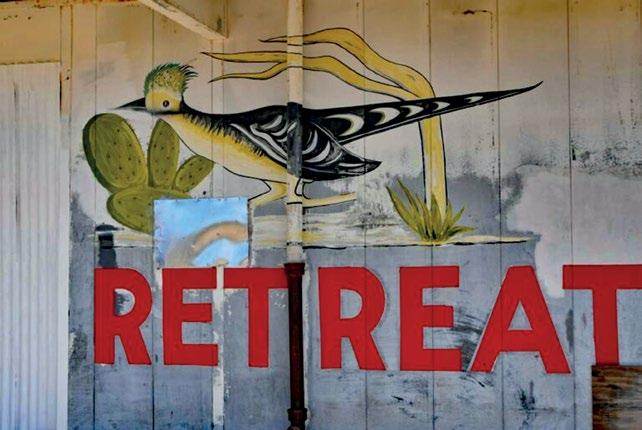
Fortunately, the aged RRR sign in front was unaffected by the fire. The filling station and mural was unharmed but would in time, with the aid of artistic tenacity and historic appreciation, rise again like a Phoenix from the flames.
Helen served on the Amboy elementary school board for several years. Roy Tull was a board member in the 1950s. Helen also ran for the Needle's Unified School District Board in 1972.
According to The Silence and The Sun (2nd Ed., 2012) at its peak the Amboy school had fewer than 50 students and four full-time teachers, including the principals, who also taught classes.
The couple reaffirmed their marriage vows after thirty years of wedded bliss, along with another couple, the Langdons, before 300 guests at Al's Barn on Route 66 in Newberry Springs in 1975. Dave Anderson of Newberry Springs, officiated.
The Langdons, former owners of Al's Desert Inn in Lenwood, were the owners of Al's Barn since 1969. By then, Roy Tull owned a salt mine on Cadiz Lake, mining salt and chloride.
The Road Runner's Retreat Restaurant and service station featured googie architecture, with a large awning in front of the building. Googie is a midcentury American architectural style that flourished from the 1940s to the 1970s.
It was characterized by a futuristic, space-age aesthetic for roadside businesses, including diners, motels and fast food restaurants to attract curiosity, thus sales from potential customers.
After repairs. The old sign is all dressed up and ready to impress
Neon Comes back to a lonely stretch of Route 66. (The Desert Way photograph)
Key features of the googie style include dramatic cantilevers, sharp angles, large plate-glass windows, quirky neon lighting, and bold, attention-grabbing signs.
Roy's Motel office in Amboy is also notable for its googie style.
Businessman Frida "Duke" B. and his wife, Virginia, bought the Road Runner's Retreat and its 40-acre property from the Tulls in 1962. The Dotsons also applied for a fictitious business name for Duke's Western Wear on Holt Boulevard in Montclair, California the same year.
The couple was active with the Calico Rompers Square Dance Club in 1962. Frida served as president, and his name often appeared in local newspapers. Virginia served as a director.
The Dotsons also operated a towing company with the assistance of John Gwen, originally hailing from Texas. Five out of six trucks had names which involved the name "Bear" except their first tow truck named "King of the Road."
In July 1962, the Dotsons, residents of Upland, announced the engagement of their daughter, Linda Dotson, to Kenneth Lee Cattell of Cucamonga but the betrothal was ill-fated.
According to the Daily Reporter, Kenneth Cattell and a female companion, Gloria DePalma, were later involved in a brawl with another patron on February 7, 1970 at The-Hide-Awhile Lounge on Foothill Boulevard in Cucamonga. At the time, Cattell was AWOL from the military. Cattell busted a pool cue over the head of the victim, Hubert F. Garner, who later died at San Antonio Community Hospital of complications from a fractured skull. Cattell was charged and later convicted of
murder. He was found guilty and received a 99-year sentence.
The neon Road Runner's Retreat sign was erected in 1965. They also applied for a liquor license that same summer. They gave their support in the Desert Needles Star to former RRR owner, Mrs. Tull, when she ran for the Needles Unified School District Board in 1972. The Dotsons ran the property until August 1973.
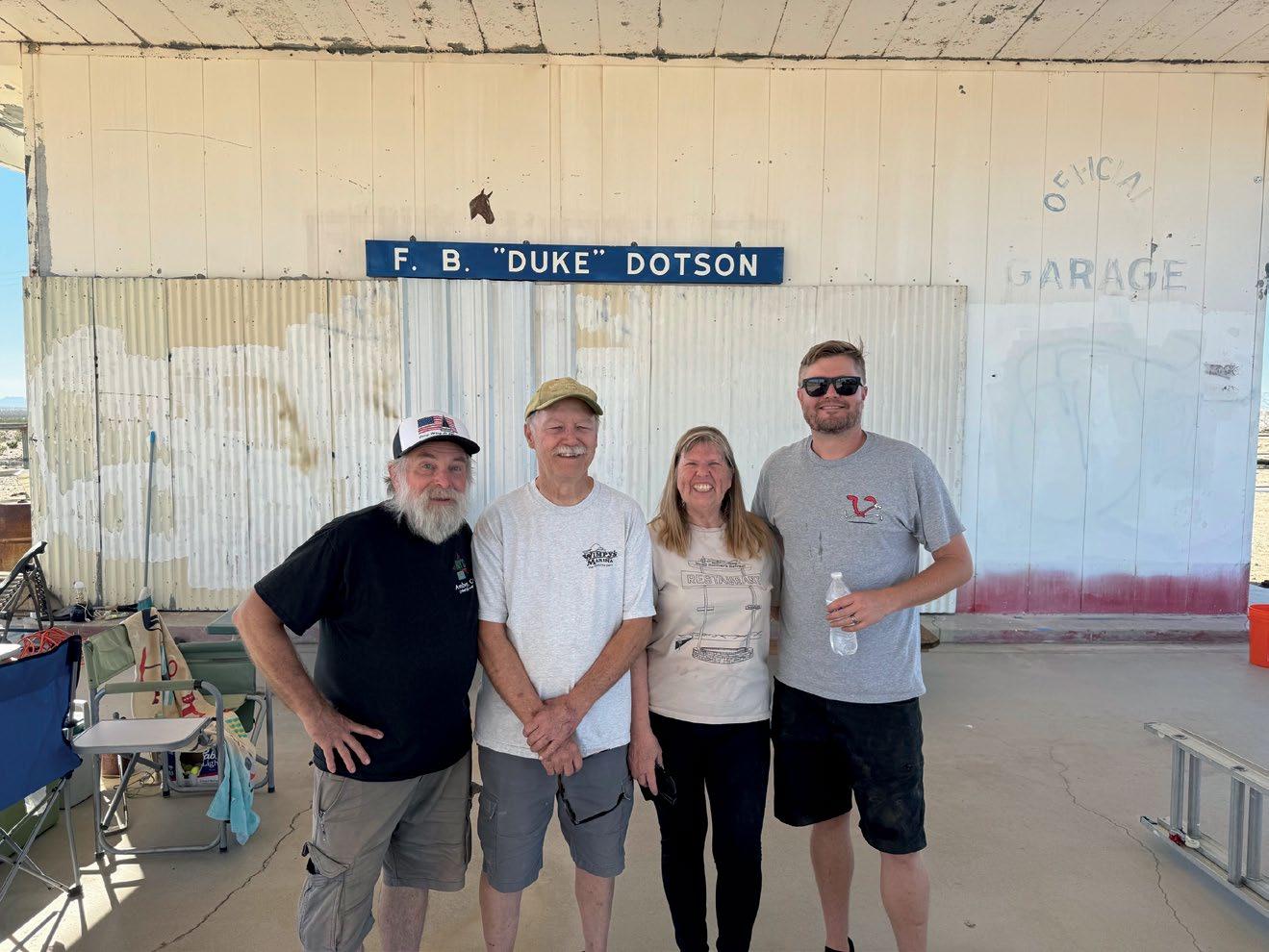
The Dotson's son, Duke, was delighted to attend the recent sign re-lighting and witness the historic event with his grandchildren by his side.
Duke recalled his family moved from Ontario to Chambless when he was just a kid between sixth and seventh grades. It was quite the culture shock but there was no time for regret. His father encouraged him to be productive by putting on an apron and bussing tables. Duke found out that keeping busy helped ease the sting of isolation.
In 1968, Duke Sr. received approval from the San Bernardino County Planning Commission to establish a labor camp located on property on the south side of Highway 66 about one a half miles west of Cadiz Road.
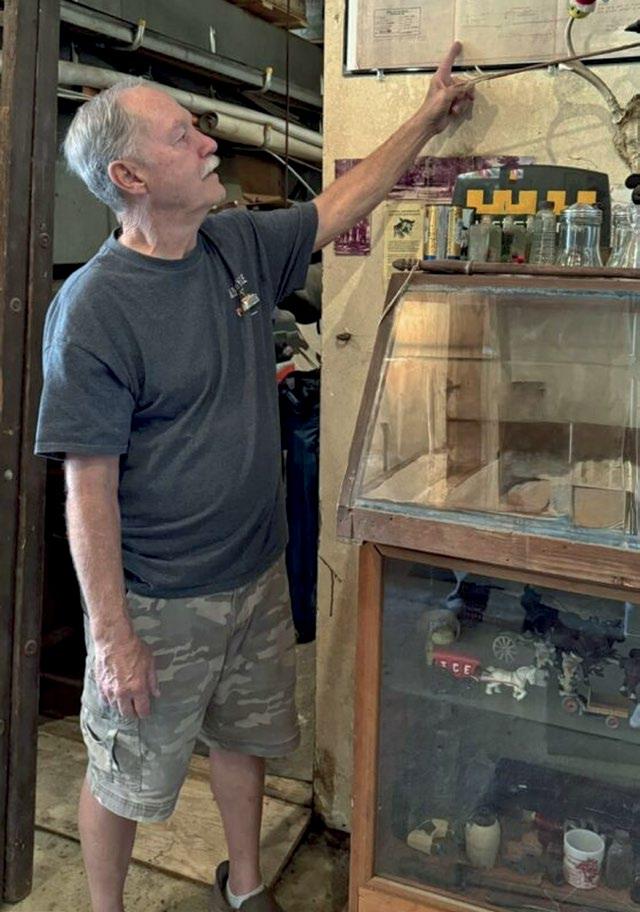
His son believes the approval was actually for the trailer park behind the restaurant where employees lived. Young Duke eventually managed mobile home parks in the Inland Empire for 35 years. Duke brought along a lot of family memorabilia about Road Runner's Retreat and graciously displayed it on a table for mesmerized attendees to pore over during the event.
Among his collection, he showcased scrapbooks of RRR menus, photographs,
Christmas cards, receipts, even a chair and glassware from the diner. What a special treat.
We were honored when Duke invited us to his lovely home in the Inland Empire to give us a personal tour of his impressive collection of RRR keepsakes.
Duke regaled us with interesting stories related to Road Runners Retreat. He recalled it wasn't unusual for celebrities to gas up or eat at the Road Runner's Retreat on Route 66 before the interstate was opened.
As a kid, Young Duke pumped gas for Elvis Presley when he passed through a couple of times. Duke recalled that Robert Kennedy liked to eat Road Runner's Retreat cheeseburgers. Johnny Cash stopped at the RRR for food and cigarettes. Duke recalled all were congenial men who appreciated not being fussed over.
Perhaps they were driving the "back way" on Route 66 from Palm Springs, Las Vegas, Phoenix or other cities.
After the Road Runners Retreat closed, Duke Sr. and family moved to Ontario, California. He and partner, John Guinn, opened Auto Craft Enterprises, a custom hot rod shop. Guinn later returned to Texas after Duke passed away.
The younger Duke, by now in his sixties, was surprised when he received a phone call from Jo Murray following a recent RRR clean-up. Beth had noticed ghostwriting on the wall that read Duke Dotson in faded paint. It was a clue she had wondered about.
Jo was hot on Duke's trail. She researched genealogy sites and archived newspaper articles to find new leads. Jo was surprised when she found Duke's name in a phonebook. She figured Duke must be very elderly, since she was unaware his son carried the same moniker.
Jo was interested in Road Runner's Retreat history. As it turned out, she struck pay dirt. Duke was delighted to hear the current owners were interested in cleaning up and restoring the Road Runners Retreat. Looking back, Jo described the whole Road Runner's Retreat project as serendipitous.
Earlier in the day of the event, we met The Silence and The Sun author Joe de Kehoe, who autographed his book for us. It was our first meeting although we have been emailing each other for over seven years about the Bagdad Cemetery. Joe just released the third edition of his popular book for the One Hundred Year Anniversary of Route 66. You will find names of Chambless and Cadiz families starting on page 338.
It was also a pleasure meeting Four Miles East of Bagdad author, Steve
From L to R: Delvin, Duke, Beth and Ryan. Thank you for your hard work and dedication throughout the years. Photo courtesy of Beth Murray.
Reyes again. We had met Steve, a board member with Twentynine Palms Historical Society, at the Amboy monument and mural dedication last year. The book centers around a killing in Bagdad in the late 1800s.
During his research, Steve discovered the names of everyone buried at Bagdad Cemetery. They ranged in age from birth through 76 years old. They were not Chinese railroad workers who died in a cholera epidemic, as popularly rumored. We highly recommend both books to all erstwhile Route 66 desert lovers.
William "Bill" Ross Murphy bought the closed Road Runner's Retreat property in 1974. He did not intend to re-open. The new Interstate 40 bypassed Route 66, essentially killing off all businesses along the old highway, including the RRR.
Ryan went with his grandparents to visit the closed Road Runner's Retreat and was instantly smitten. Roadrunner's Retreat and service station used to be open 24 hours a day. Employees lived in nine trailers behind the restaurant.
In 1984, Lloyd Bartel, a U.S. Marine veteran and former preacher in Amboy, found a Purple Heart medal belonging to Abel Silva, in rubble behind the abandoned business. In 2002, an effort was made by the McGhee's of Newberry Springs, to return the medal to its rightful owner. Mary McGhee was a former resident of Amboy for ten years.
Joe de Kehoe compiled a list of former Amboy residents from 1890-1994 in his book from records by Dennis Casebier and San Bernardino Public Library. There is a Sam Silva, perhaps a relative, listed on page 334. Silva lived in Amboy in 1958. Bartel is listed on page 318.
Ryan is humble and prefers to stay in the background. He met with historian Dennis Casebier at Goffs Schoolhouse Museum to discuss the Road Runner
Retreat's history but resurrecting the Road Runner's Retreat was a mere seed in the back of his mind that in time with the help of others, would bloom.
Beth Murray learned Ryan was looking for volunteers for an annual RRR project in 2017. Ryan had a dream of cleaning up the former gas station and Beth volunteered. In 2018, the first volunteer clean-up commenced.
They removed 200 tires and a pile of gas tanks. San Bernardino County has supplied a large dumpster for refuse every year since. Burrtec recycled the tires.
Beth dreamt of the sign re-lighting for the next six years.
On October 21, 2019 several talented individuals including Jo Murray, Patrick Soileail and Giesla Hoelscher repainted the Retreat part of the mural and touched up other parts of the roadrunner. Jim Conkle taped the outline of the letters. On October 18, 2021 the letters were re-painted by Patrick, Mike and Jessica. Lynne Miller also helped restore the mural.
Dennis Casebier wrote a recommendation letter for the grant to replace the historic sign. Roy's Motel in Amboy also gave their support for the project, as did author Joe de Kehoe and others.
E Clampus Vitus (ECV), specifically the Billy Holcomb Chapter, dedicated a historical marker to the Road Runner's Retreat site in October 2023. Many thanks to the Clampers for all they do to preserve desert history.
Ryan offered commemorative RRR pins for sale as a fundraiser, which instantly became in high demand and sold out two weeks before the event.
Beth recalled in October of 2019, Karl Score was working on the re-lighting of Roy's Motel sign. By chance they happened to bump into each other at a Ludlow hotel. The rest was kismet. Beth
asked Karl for an estimate for re-lighting the Road Runner sign. Carl informed Beth it would cost an astounding $32,000, and divided into four phases.
On the night of the Roy's Motel wellattended sign re-lighting in 2019, Ryan and a few others drove down to the Road Runner's Retreat. They were curious if the Road Runner's sign still worked.
To their surprise, when Ryan switched on the sign, some parts of the neon lights flickered. The sign still had life. On another occasion, volunteers were surprised when they discovered a squatter had broken through the fence and jury-rigged the electrical wires to partially re-light the sign himself.
During our interview, Beth excitedly talked about the National Park Service grants that Roadrunner's Retreat received to make the sign re-lighting come to fruition. In 2020, Beth wrote a grant asking for $5,500 and matched it so well they went over in 2021.
In 2022, another grant was submitted for $10,000, which was also matched into a surplus. Fundraisers continued and merchandise was sold to raise funds.
Paint for the sign proved to be enormously expensive for a total of $5,000 dollars. Benjamin Moore paint company donated the paint through the National Trust for Historic Preservation.
In 2023, a grant of $17,000 was awarded to the project and matched, with help from the Clampers. Considering the sign was supported by half cash and half in-kind funds, the sign ended up costing nearly $50,000 dollars.
Like Duke Dotson, Ryan Anderson is proud to carry his family's legacy forward at the Road Runner's Retreat and share it with others. Both men share a passion for preserving the past for future generations. Ryan still owns his grandfather's 1965 TJ5 with its original paint and bodywork. Ryan doesn't plan to restore it and joked that the old Jeep proudly earned those dents and scrapes. It was kept in his parents' garage for many years before it became one of his prized possessions.
Route 66 aficionados were excited about
Aftermath of the 2020 fire. (Courtesy of Jo Murray)
Famous Road Runner's Retreat postcard. The horse statue came from Duke's Western Wear. Duke Dotson Collection.
the Road Runner's Retreat re-lighting which took place 50 years after its original lighting.
Although Route 66 is still closed at Cadiz due to flash flooding affecting bridge safety, organizers checked with local law enforcement beforehand and were informed it was alright for drivers to go around the road closure signs at Kelbaker Road to continue to Chambless.
Be wary of flash floods, and desert tortoises on the roadway. The bridges past Cadiz have been out for the past six or seven years. At least one bridge has completely collapsed.
Flash flooding about 10 years ago destroyed or damaged dozens of Route 66 bridges in the region. San Bernardino County has been slowly replacing them.
Granite Construction recently announced it secured a contract of about $24 million to replace 10 aging bridges along Route 66 in Amboy, California. Two bridges were recently repaired. You will encounter shoofly diversions which are temporary bypass routes (dirt roads) to go around construction work zones.
The term shoofly diversion was borrowed from railroad jargon and is commonly used in civil engineering and construction to avoid an obstruction.
The work is being funded by state and federal sources, and it is expected to take place in phases. It cost $2.5 million dollars to replace one bridge. It is likely it will take years to complete the project.
There are plans to replace a total of 62 bridges on the National Trails Highway (Route 66) in San Bernardino County, California, due to aging infrastructure. These projects are being undertaken by San Bernardino County Public Works to address structural issues and to reopen closed sections of the road, especially after flash floods.
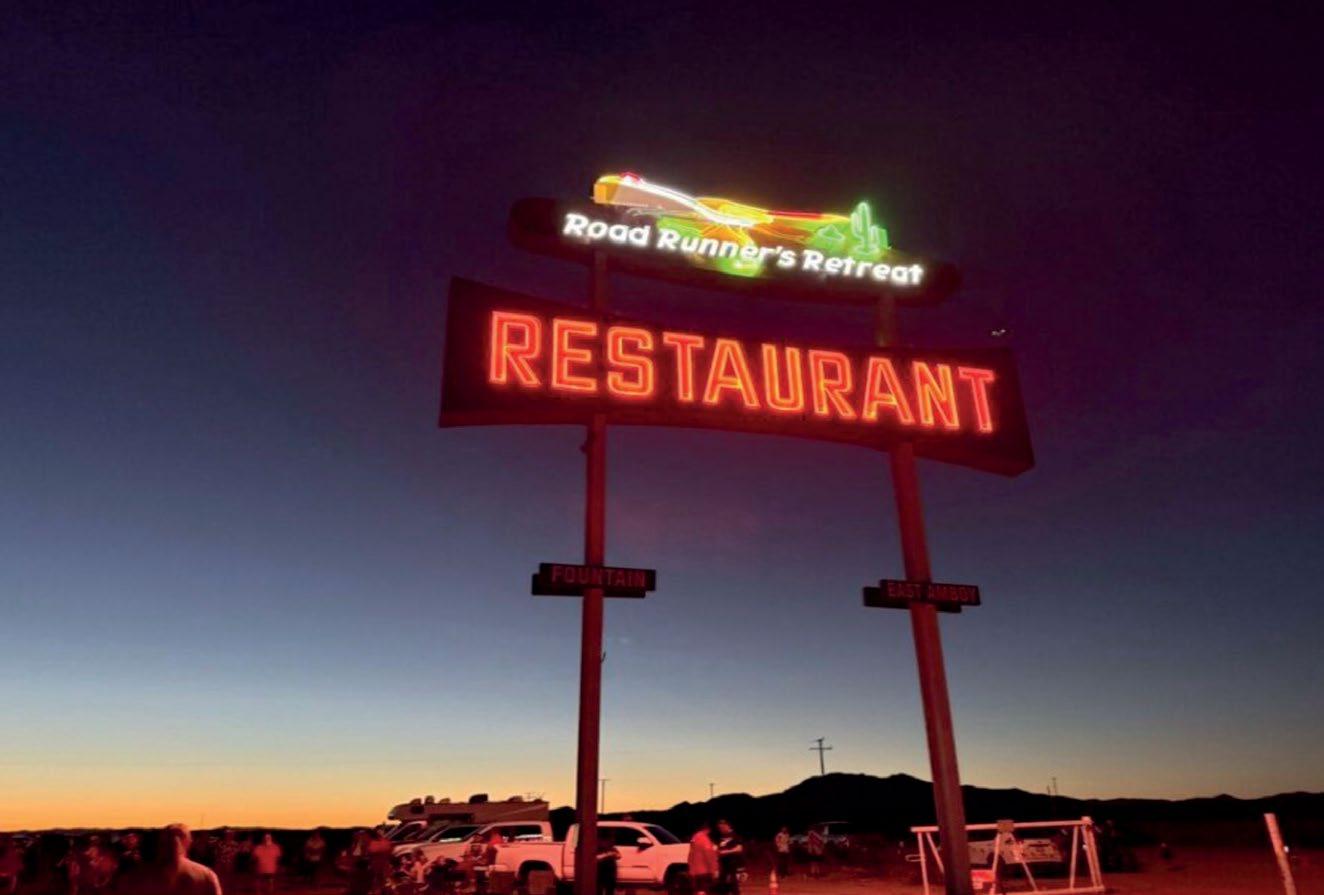
You will notice "East Amboy" on the Road Runner's Retreat sign. It was a marketing ploy created by Duke's father. Although not an actual town, East Amboy appeared on
Triple A trucks and business cards.
Duke figured nobody heard of Chambless, but everybody seemed familiar with the town of Amboy, so the name of East Amboy seemed fitting. Placards stating "East Amboy" and "Fountain" were carefully installed on the RRR sign the day of the signrelighting event, as the proverbial cherry on the cake.
At dusk, as the enthusiastic crowd held its breath in anticipation, the sign was switched on for the first time in over 50 years to a raucous countdown. The air went wild with cheers from those gathered at the historic event.
Beth Murray has been helping the Road Runner's Retreat from the first trash ever picked up all the way through the evening when she said into the microphone, "Ryan, light up that sign."
Very few people expected to see the sign animated. The giant roadrunner's legs look like they are running, bathed in the nostalgic glow of neon red, yellow and white.
What a sight to behold. Meep! Meep!
Others who attended the re-lighting was Rhys Martin, president of the Oklahoma Route Association, photographer Robbie Green, YouTuber Sarah Jane Woodall of Wonderhussy Adventures, YouTuber Joe Bui of Desert Trippin, Aaron Perry from Gearhead Curios from Galena, Kansas, YouTuber Mr. Mojave Guy Bill Inglehart with his two beloved dachshunds, Lewis and Clark, author Jay Farrel of Route 66 Roadscapes: Stories Through the Lens, a friendly throng of
References
red-shirted Clampers (E Clampus Vitus) and many others too numerous to mention.
Also, a special shout-out goes to Delvin Harbor, CHR66A Vice President East, who participated in RRR clean-ups from 20182023. Delvin camped out in his tent this year and three years prior to 2024. He said it was a great experience helping get the property looking better than what it was prior, and it sure shows.
In addition, our appreciation goes to Mike and Jessica May, who also serve on the CHR66A board, and have been to many of the RRR cleanups from Las Vegas in their Tesla!
What draws so many special people from diverse backgrounds to achieve the same goal is the love of the Road Runner's Retreat. California Historic Route 66 Association survives on membership dues and is grateful for your support. Please visit route66ca.org for information about membership and events.
CHR66A https://www.route66ca.org/ The Silence and The Sun https://www.trailsendpublishing.com/the-silence-and-the-sun Four Miles East of Bagdad https://fourmileseastofbagdad.com/ Jo Murray, Press Telegram https://www.presstelegram.com/author/jo-murray California to Chicago Travel Blog https://www.facebook.com/californiatochicago Wonderhussy Adventures https://www.youtube.com/channel/UCRkyWI1tbWchz0uHfCMXK0w
The Relighting of the Roadrunner's Retreat Song https://www.youtube.com/shorts/rtwD6fkeqgw https://thedesertway.com/amboy-ca/ https://www.thedesertway.com/amboy-monument-murals/ https://thedesertway.com/newberry-springs-ca/ https://thedesertway.com/bagdad-cafe/ https://www.thedesertway.com/bagdad-cemetery-ca/
The beautifully restored mural. Photo courtesy of Jo Murray
Duke points to a framed Road Runner's Retreat original blueprint.h)
Second Annual Veterans Car Show and BBQ
By John Wease
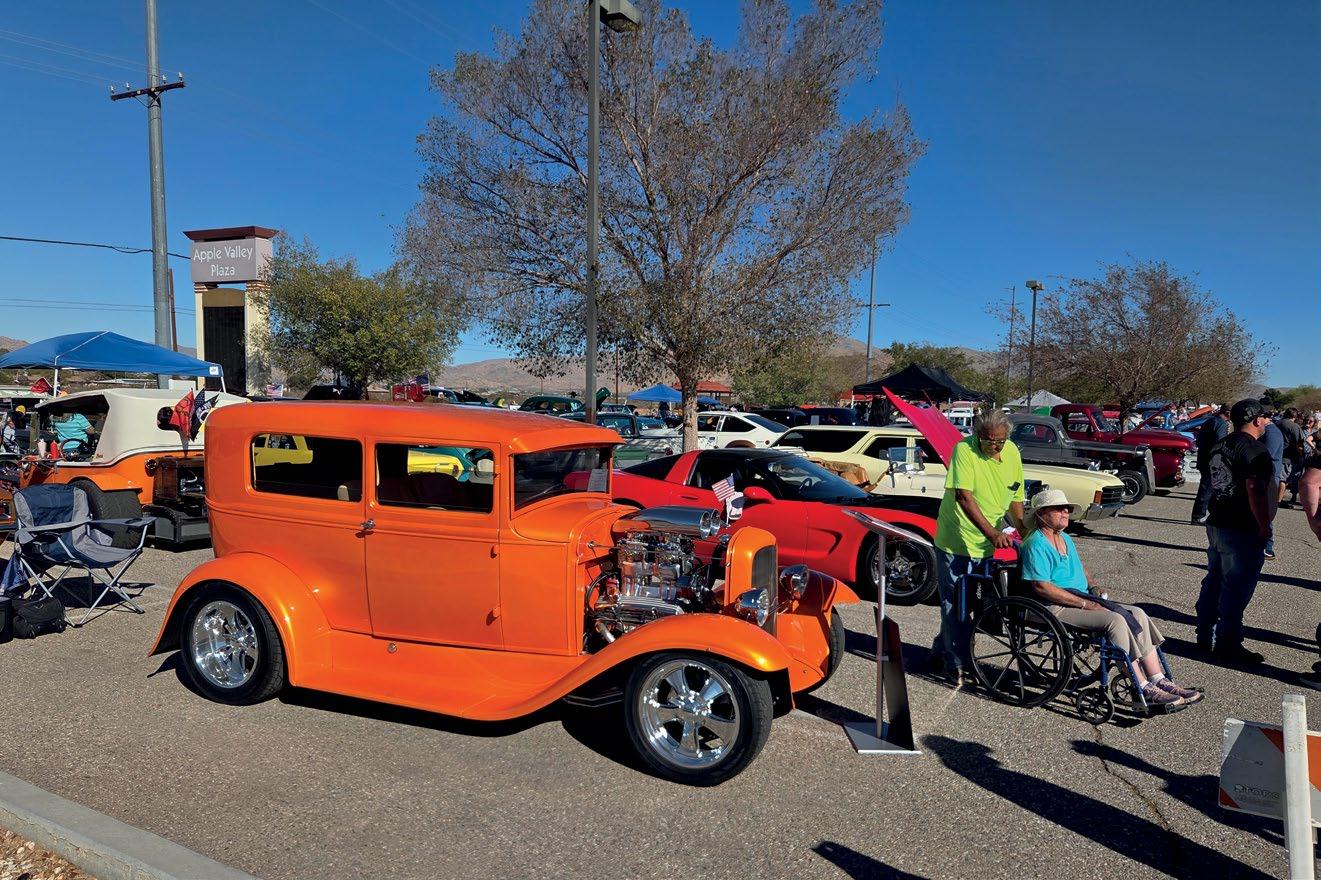
ON N OVEMBER 8, the Apple Valley Rotary held their 2nd annual Veterans Car Show and BBQ. Held at the Singh Center for the Arts in Apple Valley, attendance was estimated at 2500 people. Some 200 veterans registered. It is possible many were not aware of the sign in table inside the building. There were hundreds of veterans outside. Inside there were many organizations providing resources for veterans. Those who registered received tickets for a free lunch, desert, and for a number of raffle prizes.
Rick Bui with the Rotary Club told me last year that the 2nd annual event would be even bigger and better. He certainly was correct. Rick is an energetic participant in
activities honoring veterans and he put his heart and soul into this one. Along with the Rotary Club, the Town of Apple Valley’s Tony Schondel was a big help. Of course, none of it would have been possible without the generous support of sponsors.
An additional food truck helped prevent the long line of last year. There were more vendors this year selling a variety of cottage foods and other items. Haven For Horses was there again giving horseback rides to children. Tom Nemec of Haven for Horses told me they were inspired after last year’s event to begin offering free horse therapy sessions for veterans.
About thirty nursing students from Azusa Pacific University volunteered to help with taking blood pressures and assisting wherever they could. Air Force veteran, Laura Dvareckas served as M.C.
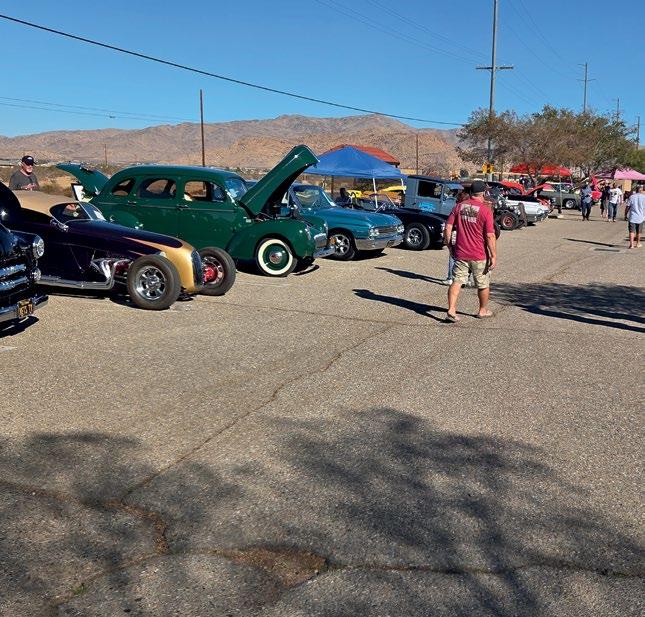
The car show, of course, was an important feature. Once again organized by Sylvia Romo, it doubled in size this year to two hundred vehicles. Open to all vehicles, entries included classics, rat rods, low riders, and hot rods. With so many different vehicles on display, and so many congenial owners to speak with, you just couldn’t be a car guy and not enjoy yourself.
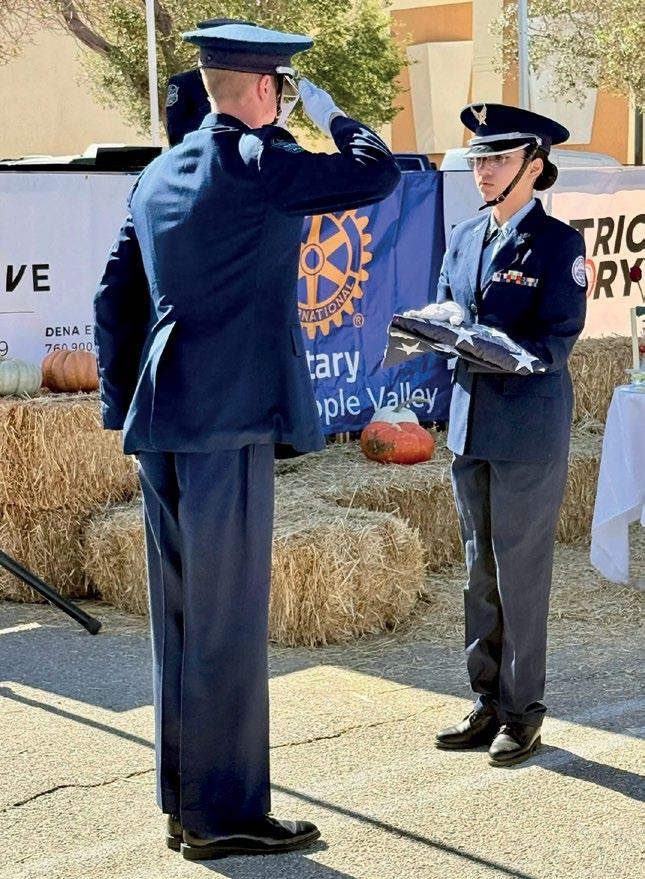
Another group to be applauded was the Sultana High School AFJROTC, the Air Force Junior Reserve Officer Training Corps. If you can’t imagine teenagers
without a cell phone in their hands you would have been pleased to see the discipline and dedication as they performed the color guard duty for the opening ceremonies. A presentation about Old Glory, and the events she has witnessed throughout our history was extremely moving. As it was read, other cadets demonstrated the ceremonial folding of the flag, passing it, and saluting as seen during military honors at a veteran’s funeral. I am sure there were no dry eyes in the audience. Equally moving was the “Missing Man”
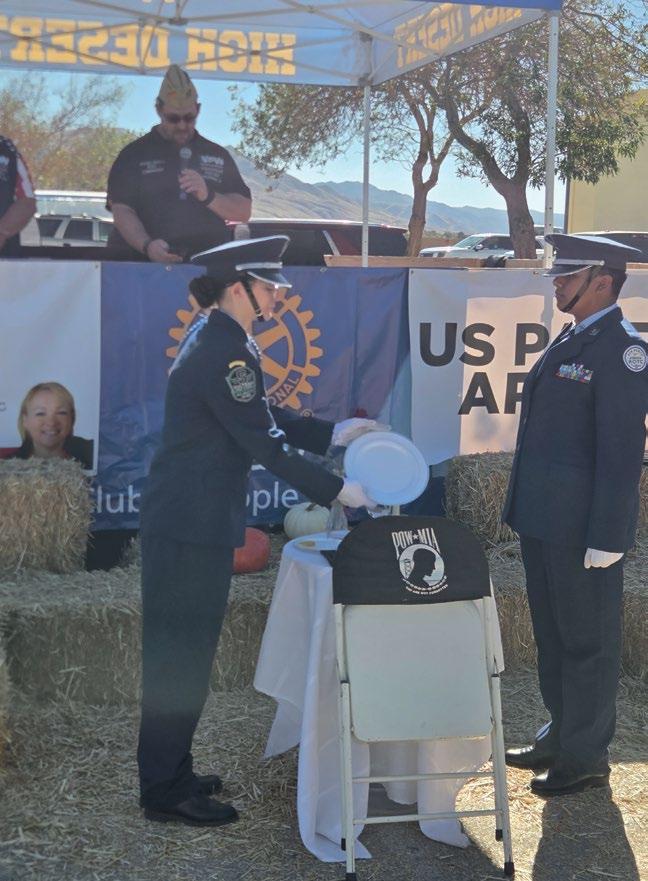
POW-MIA table explanation.
Narrated by VFW Commander Michael Croy, a pair of cadets took turns holding up each article on the table as its significance was explained. And all while at attention
with dignity and reverence. You may have seen the missing man table at events or at a restaurant for Veterans Day. The missing man or fallen comrade table is placed to honor the fallen, missing, or imprisoned military service member. Its use began during the Vietnam War to commemorate the large number of POW-MIA troops.
It is a small table set for one. It is round, signifying everlasting concern. The tablecloth is white, signifying the pure intentions of the missing. A single red rose symbolizes the blood shed in sacrifice. On the plate is a slice of lemon, symbolizing the bitter fate of the missing. Salt sprinkled on the plate symbolizes the tears shed by the families and comrades left behind. The glass is inverted because the missing cannot join us in a toast. A candle is there to light their way home. The empty chair is obvious.
The entire event was a great success. Most of the hundreds of men wearing caps or shirts with military branch names were around my age. I think I can speak for these Vietnam War era veterans. We were not shown much appreciation fifty-some
years ago. It is wonderful to be honored finally. The next time you see a missing man table, stop and give thanks to all who served and made the ultimate sacrifice. Thank a veteran for their service. If you are a veteran, come to the 3rd annual event next year. Rick is already promising it will be even bigger and better. I have no doubt.
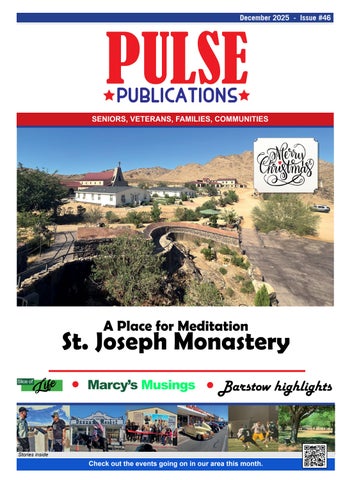
A Place for Meditation St. Joseph Monastery
“IT
’ S OKAy TO DOUBT.
We don’t master God, and sometimes doubt plays an important role in our faith,” Brother Minh (pronounced Ming) said.
We were sitting in a very comfortable kitchen for visitors at the Saint Joseph Monastery in Lucerne Valley. I had just met the Cistercian monk a few moments before, and it was very easy to talk with him about all things, spiritual or secular.
My friend, Paul, and I had traveled northward along Highway 247 in search of a place we had both watched on a YouTube video. We were hunting for a supposed abandoned nuclear launch pad located somewhere near the Sandwinder Gold mine.
What we learned was two things. Number 1: Don't believe everything on the internet. There was no missile silo standing anywhere near where we had traversed, searching for hours across the Mojave Desert.
“Hey,” I said. “Why don’t we film a couple of buildings from Bodie and post them on YouTube and tell viewers that they are located in Holcomb Valley. That could be fun.”
I would not do that.
The second thing we learned on this new adventure was that in Lucerne Valley, not far off Highway 247, was a most beautiful place for meditation and worship.
“We often have many visitors come and spend time with us,” Minh said. “In fact, if people come here, we will offer to celebrate a mass with them, no matter the time of day.”
The Cistercian order, to which all nine current resident monks belong, is a very old part of the Roman Catholic Church. The name for the order comes from the place it was founded, the Citeaux Abbey in France, in the year 1098. The monks follow the beliefs of St. Benedict - embracing a life of manual labor, contemplation, prayer,
and spiritual pursuits.
Minh smiled. “For us, monk means to pray and work.”
And these monks have worked since the monastery opened its doors 17 years ago in a secluded canyon in the Mojave Desert.
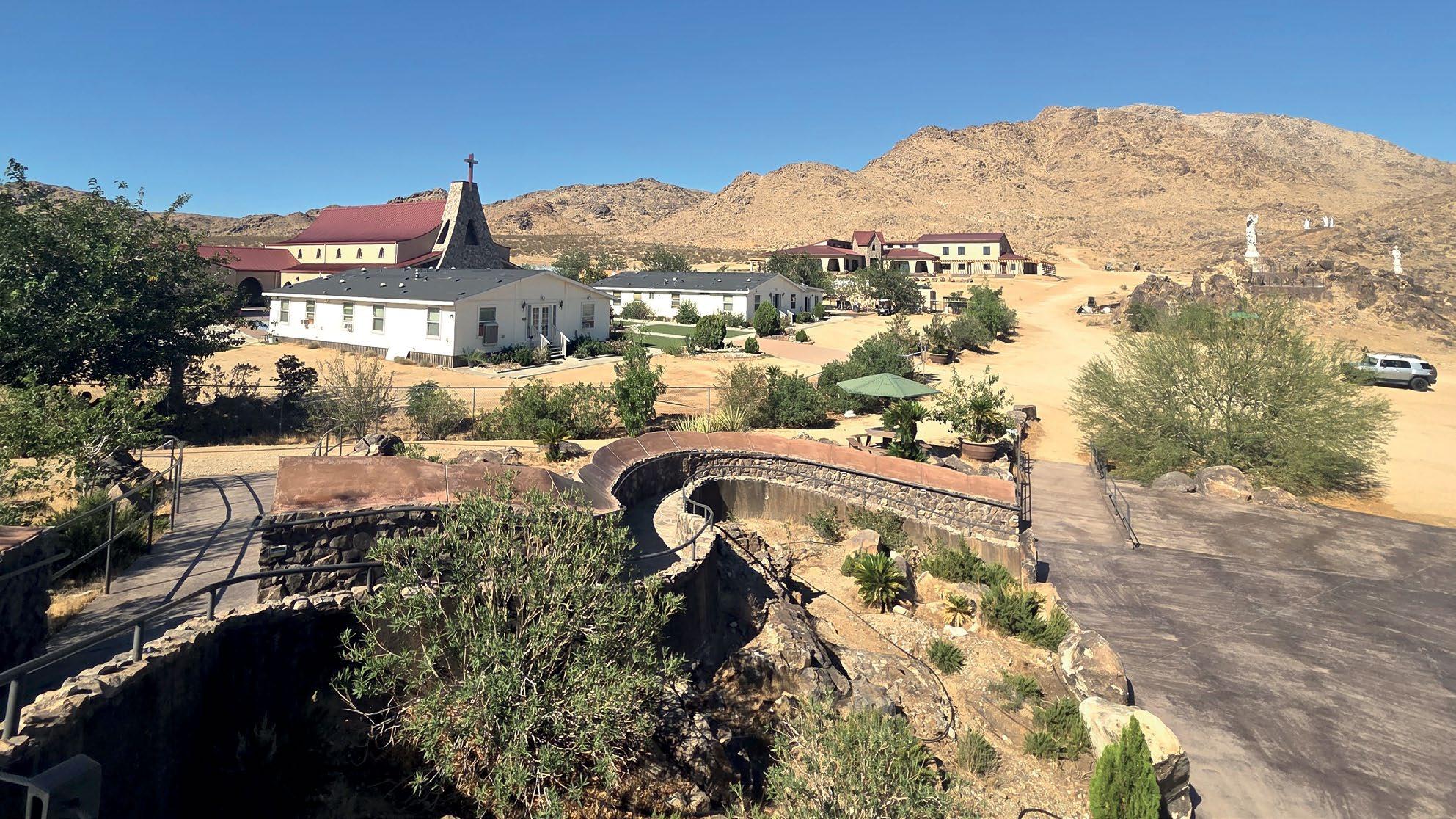
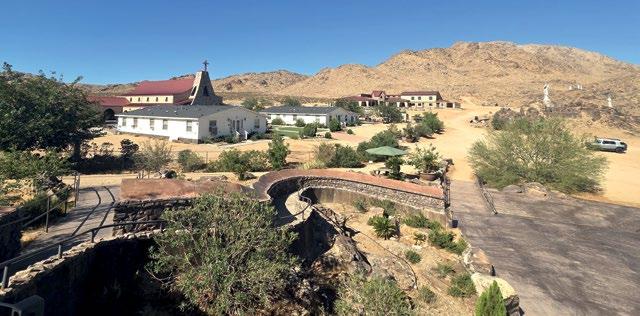
All the work seen, including the multitude of buildings, storage sheds, beautiful intricate concrete walkways, pagodastyle sitting areas located everywhere, and the multitude of carefully handcrafted sculptures, was all done by the monks.
“Now, we do have volunteers that assist us, but most of the work is done by the monks here,” Minh stated.
Prior to meeting Brother Minh, Paul and I had spent an hour walking around the grounds of the monastery, taking in the elaborately paved walkways leading the visitor to dozens of statues of Jesus Christ and Saints.
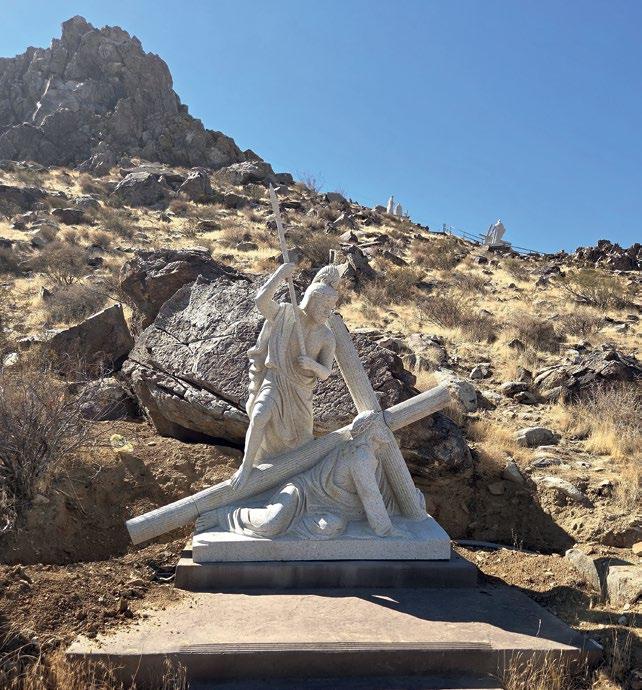
One trail, rather steep and long, wound up a small hill, and every few yards was a sculpture indicating one of the Stations of the Cross - that’s Catholic speak for the 14 stations that point to key events of Christ’s passion and death on the way to Calvary, including his burial.
I remember those stations very well from
By John Beyer
attending St. Catherine’s Elementary and then Notre Dame in Riverside, California. All the monks are part of the Congregation of the Holy Family of Vietnam, and Minh has been a resident at the monastery for 13 years.
“Do you ever get bored?” I asked.
“Yes, we are bored sometimes, and being human, we’re not always happy, but always peaceful. Happiness is short, but peace is long-lasting and from God.”
Paul brightened up. “I’m happy when a cold beer is near, but not so much when it’s empty.”
“But peace is knowing that there are more at the store,” I said.
Minh smiled. “Exactly.”
It was interesting sitting with Minh in the coolness of the kitchen, just talking. He was cheerful, at times funny, and at other times, serious.
I asked him about the turmoil in the world and how everyone in our country seems so divided against one another.
“When people fall away from God, we divide and only think about ourselves. But with God we learn to love others, and perhaps love ourselves a bit more.”
He was one smart and spiritual guy, this Brother Minh.
“If a person smiles at you while walking by, how does it make you feel?”
“Better,” I said.
“Imagine if we smiled more and complained less?” Minh replied.
Our discussions continued, and while we sipped on bottles of cold water (yes, water), we moved into the idea that more and more young people seemed to be moving toward a more heartfelt faith in
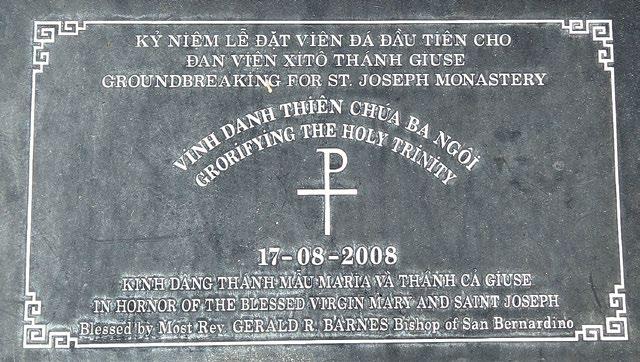
Dedication plaque in front of the Saint Joseph Monastery
Overview of Saint Joseph Monastery in Lucerne Valley
One of many beautifully sculptured statues at Saint Joseph Monastery
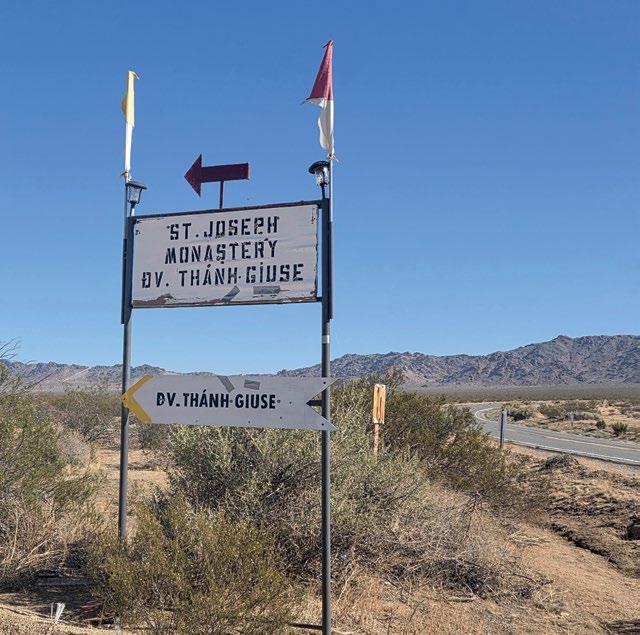
Saint Joseph Monastery is easy to find along Highway 247 outside of Lucerne Valley
God than in the near past.
“Do you believe there is a resurgence in young people coming back to church?” Paul asked.
“Yes, I think young people are looking for something,” Minh said. “They are tired of social media, trying to keep up with one another, and then learning that most things they are hearing are not true. There’s a lot of emptiness out there in people’s hearts,
and they are looking for true answers to fill that emptiness. God is doing that for them.”
I found it strange that this monk would know about social media.
“We keep up on modern events,” Minh smiled. “It's hard to assist others if we do not know what is going on.”
The monastery currently encompasses 300 acres of land, with plans to increase to 600 acres, a nearly one square mile of respite from the outside world.
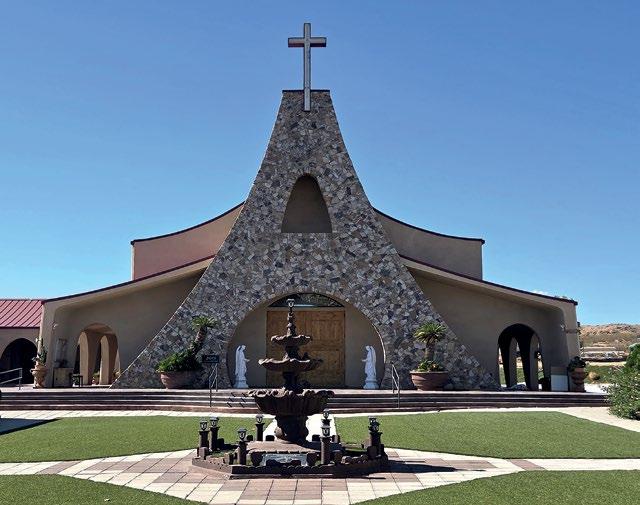
We were given a tour of the chapel, which was actually designed by a Buddhist Monk and has the entry in the image of praying hands - it is a masterful work of art that visitors pass through on their way to services.
The public, all denominations, are welcome to the daily masses, and as stated earlier, the monks will have a mass or prayer services for visitors whenever the need or desire arises.
These monks are true men of their word
when they state they are here to serve their fellow citizens in search of peace and harmony.
Before leaving, Brother Minh said, “We will never fully understand God, even the angels don’t understand God, so how can we? And, that is fine - that is faith.”
For more information: http://www.saintjosephmonasteryca.org/
John can be contacted at: beyersbyways@gmail.com
The main chapel at Saint Joseph Monastery
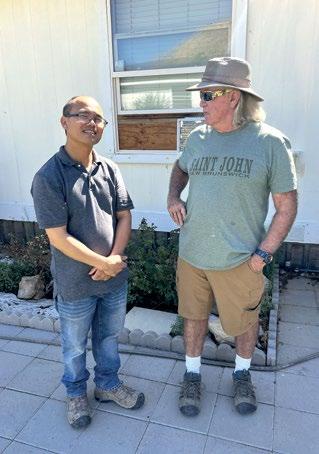
Brother Minh and John R Beyer discussing the issues of life and faith
Patrick Chatelier, photographer
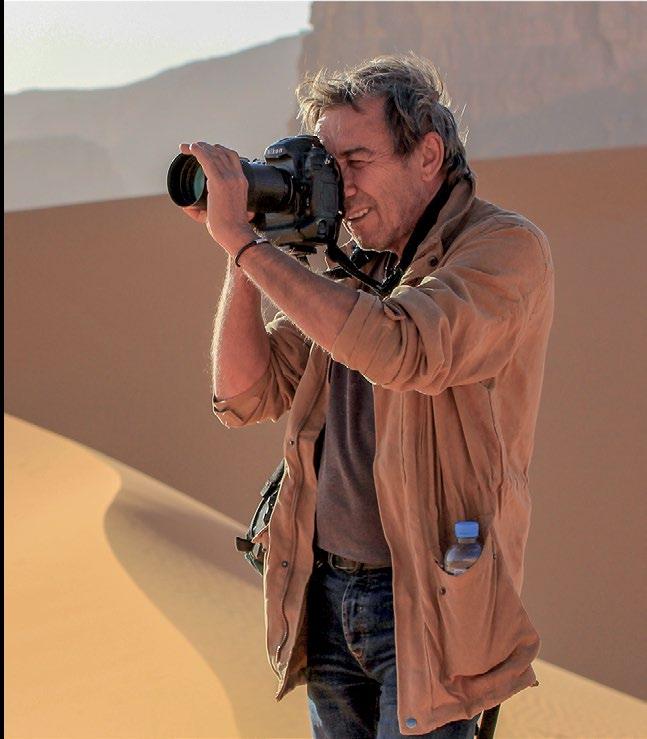
hE RECEIVED h IS FIRST CAMERA as a gift at the age of twelve. It was a Kodak Instamatic 50 equipped with a Kodachrome X charger (64 ASA) allowing 20 slides in a square format. It was the birth of Patrick Chatelier’s passion for photography. It was later, around the age of eighteen, that he acquired his first reflex camera, thus discovering the multiple creative possibilities offered by changing focal lengths, from wide-angle to telephoto. It was shortly after that he discovered his second passion which went wonderfully well with photography: the travels.
Born and living in France, he never stopped capturing the beauties of our world with his camera which accompanied him everywhere.
Having worked all his life in the sector of Graphic Arts, he never sought to become a professional photographer, largely preferring the freedom of independence. Now 69 years old and always thirsty for discoveries, he has traveled more than
forty countries with a predilection for vast wild and desert regions. In order to reconcile his two passions while sharing his experience, Patrick founded his own photographic travel organization in 2004. Its aim will be to form small groups of photographers wishing to learn more about photographic techniques, while discovering the most beautiful places on our planet.
Among his favorite destinations are the Sahara, Iceland and China. But the West US and Route 66 took pride of place thanks to the expertise and professionalism of James Conkle with whom Patrick became friends. They made several trips together with groups of French photographers and each time, they were successful. Today, Patrick Chatelier continues to travel and photograph with the same enthusiasm as when he started.
“Nothing great in the world has ever been accomplished without passion.”
Among his favorite destinations are the Sahara, Iceland and China. But the West US and Route 66 took pride of place thanks to the expertise and professionalism of James Conkle with whom Patrick became friends. They made several trips together with groups of French photographers and each time, they were successful. Today, Patrick Chatelier continues to travel and photograph with the same enthusiasm as when he started.
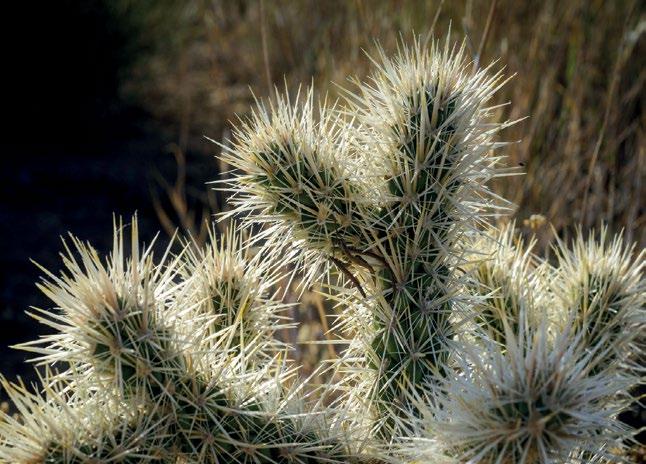
“Having the patience to wait for beautiful light is one of the fundamental qualities of a photographer.”
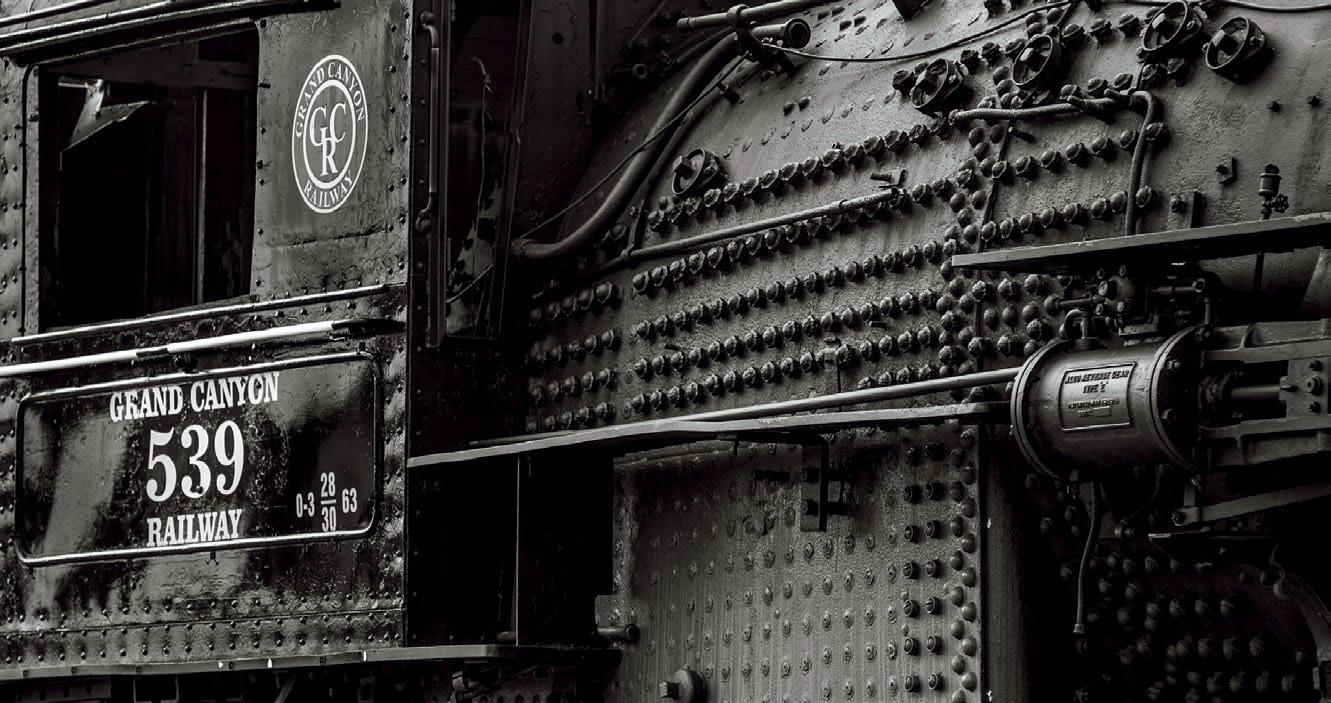
“The photography processed in black and white with warm tones gives a vintage feel.”
“The famous photographer Robert Capa said: «If photography isn’t good, you’re not close enough”
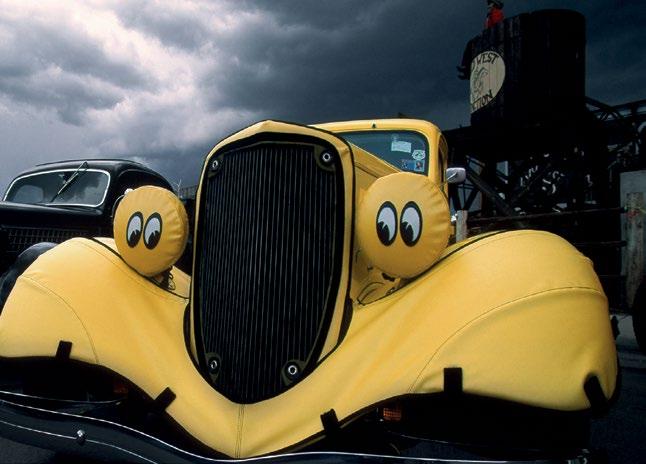
“Unlike the telephoto lens, the use of a wide-angle lens brings dynamism to the image like this vintage car at a carshow in Williams, just before a storm.”
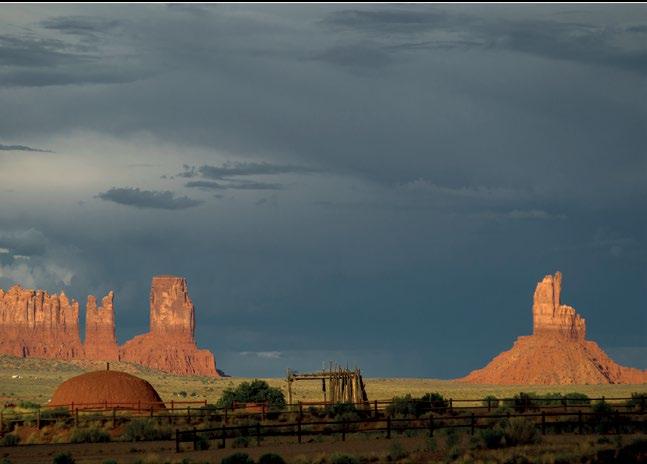
“The use of the panoramic format gives the image a sense of stability, space and depth.”
Victorville Senior Citizens Club
14874 S. Mojave St. Victorville CA 92395 760-245-5018
BINGO: Saturday November 8 th & 22 nd, BUY IN $25 Pay Out $75-$200
Doors open 10:15am / game start 11:00am The Way World Outreach Ministry
Thanksgiving Banquet: Saturday November 15, 9am-12pm , (Free)
ALL EVENTS OPEN TO PUBLIC
For additional information regarding Membership & Hall Rental Availability call 760-245-5018
UpcomingCommunity Events
• Dec. 2- 5-7:00 Apple Valley Tree Lighting- Civic Center Park
• Dec. 6- 10:00 Victorville Christmas Parade- Seventh Street
• Dec. 9- 11:15 Friends of the Apple Valley Library Christmas Party and Installation
• Dec. 9- 5-6:20 Apple Valley Town Council Christmas TeaTown Hall
• Dec. 18- 5:00 Mohahve Historical Society Christmas Party and Installation- Lone Wolf Colony
Piñon Hills Chamber of Commerce
Join
Sign up for upcoming Art Shows
hERBIE J P ILATO was born into humble beginnings in Rochester, New York, in 1960 to Frances Mary Pilato and Herbert Pompeii Pilato. His parents were of Italian decent. They raised Herbie to appreciate family values and the simple way of life.
As a young boy, Herbie was fascinated by such classic TV shows such as Petticoat Junction, Mission Impossible, The Brady Bunch, The Partridge Family, etc. The list goes on. He loved the wholesome values that these shows portrayed. He especially loved the classic Christmas cartoons like Rudolph the Red-Nosed Reindeer, Frosty the Snowman and A Charlie Brown Christmas
Growing up watching these shows had a great impact on his life and instilled a desire to keep these shows alive. It created a very positive attitude that Herbie lives out in his daily life. He is always kind and supportive; never negative.
In fact, in 2013, he established the Classic TV Preservation Society (CTVPS), a formal 501(c)3 nonprofit organization that celebrates and advocates for the positive social effect of classic TV shows.
In the early 1980s, Herbie moved to Burbank, California. He was hired by NBC Studios and worked as a Page on The Tonight Show staring Johnny Carson from May 1984 to December 1985. From time to time he made guest appearances on such shows as General Hospital, The Bold and the Beautiful, Highway to Heaven, and The Golden Girls, among others. He also appeared as a stand in dancer on the
musical-variety series, Solid Gold.
By Debbie Walker
In 1992, he published his first book, The Bewitched Book, about the classic 1960s TV series. Since then he has written several other books featuring Mary Tyler Moore, Elizabeth Montgomery, Sean Connery and Diana Rigg. He also wrote about The Six Million Dollar Man, The Bionic Woman, The Kung Fu TV series and Life Goes On. All of his books can be found on Amazon.
Herbie J Pilato will be the featured speaker at the December meeting of the High Desert Chapter of the California Writer’s Club. He will be speaking about his two Christmas books, The 12 Best Secrets of Christmas and Christmas TV Memories: Nostalgic Favorites of the Small Screen.
Please set aside the date and come join us for a fun, positive experience as Herbie takes you back in time to the days when Christmas was about Jesus, Family and Love.
The group meets at the Community Church at Jess Ranch, 11537 Apple Valley Road, Apple Valley, California 92308. December 13, 2005 from 10:00 am to 12:00 pm.
Re-live Classic Christmas Memories with Herbie J Pilato MerryChristmas