I n c o r p o r a t i n g A U S T R A L A S I A N F O R E S T L O G G E R & S AW M I L L E R MAY 2015 • P: (03) 9888 4834 • www.timberbiz.com.au
Parliament backing industry page 10
Farm forestry potential page 14
$1.5M fuel reduction trial page 18
Govt wants leaner and meaner Forestry Tasmania
F
ORESTRY TASMANIA will continue years, despite significant Government funds to operate as a Government Business to support them. Enterprise – the Government is not “In fact, in 2012-13 and 2013-14, the two intending to roll Forestry Tasmania into a years following the signing of the TFA, the Government department or ‘blow it up’ as total amount paid to Forestry Tasmania from some scaremongers the budget was have suggested. nearly $100 million. “It is an unfortunate fact that if “We want not just “As promised, the Forestry Tasmania, Forestry Tasmania is to be put on Hodgman Liberal but the entire forest has a long-term sustainable footing, it Government industry, to stand on stopped this support will need to be smaller and more to Forestry Tasmania its own two feet. We strongly believe that efficient, increasingly focussed on from the budget, the forest industry instead providing its core business and more can - and will for a $30 million commercially agile. grow into the future equity transfer without the need for from TasNetworks ongoing Government financial support,” said to allow the time for a complete review the Minister for Resources Paul Harriss. and rethink of the way Forestry Tasmania “We all know there is a lot more to be done, operates to put it on a pathway to long-term but the Government is committed to growing sustainability,” the Minister said. the economy and creating employment, and “We established a Steering Committee the indicators show that we are heading in the to oversee the review with representatives right direction. from Treasury, Forestry Tasmania, and the “One of the commitments of the Departments of State Growth and Premier Government to grow the forest industry was and Cabinet. to ensure a sustainable future for Forestry Clear objectives Tasmania.” “We set some clear objectives for the Hit with perfect storm review: The Minister said Forestry Tasmania has • To examine the most appropriate options been hit with the perfect storm, the three Gs to deliver economically viable and - the GFC, the collapse of Gunns, and then sustainable forest management and wood finally, the Greens/Labor government and the production outcomes for the State; Tasmanian Forest Agreement. • To consider the Forestry Tasmania At the time when Gunns withdrew from operating model, commercial native forest harvesting, the forest industry arrangements and constraints and the and Forestry Tasmania needed careful support impact on its financial performance; and from the Government. Instead the TFA retired more than 150,000 cubic metres of sawlog • To identify options for the short term to limit the losses and consider the current production, halved Forestry Tasmania’s and future role of Government in the production forest, and forced significant public production forests. write-downs to Forestry Tasmania’s balance sheet. “As a result, Forestry Tasmania has recorded consecutive operating losses which have progressively worsened over recent
“We also established some clear parameters for the review based on our commitments to continued on page 8
Editorial and Pictorial Coverage of the 7th Industry Development Conference
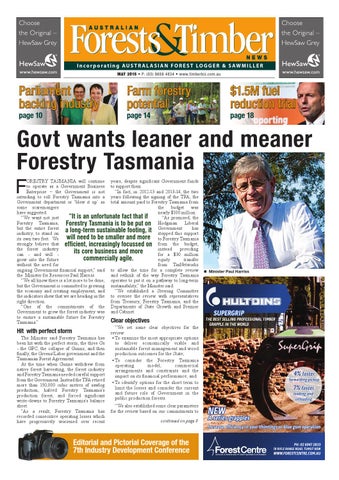
n Minister Paul Harriss
So quiet
IT WON’T SEEM LIKE WORK
You’ll have to go to the racetrack if you want to hear the roar of the engines. You won’t get that sitting in the cab of the Cat® D Series Skidder. Performance without the noise. Advanced hydraulics speed up cycle times and lift more. Six-speed transmission, lock-up torque converter and independent front and rear differential locks give you more control. Tilting cab, smart hose routing, new grapple and more, cut downtime for maintenance. Operator comfort and more productivity — that’s what the new D Series is built to deliver. The D Series comes with Product Link™ to track fuel, idle time, maintenance and more. Look to your Cat® dealer for financing and all the machines you need for sustainable harvesting and land management, forestry road construction, hauling and millyard. Total support from one source. www.cat.com/en_AU
© 2015 Caterpillar. All Rights Reserved. CAT, CATERPILLAR, BUILT FOR IT, their respective logos, “Caterpillar Yellow,” the “Power Edge” trade dress as well as corporate and product identity used herein, are trademarks of Caterpillar and may not be used without permission. www.cat.com www.caterpillar.com
Proud Supporter of
In the news
Australian Forests & Timber News
I n c o r p o r a t i n g A U S T R A L A S I A N F O R E S T L O G G E R & S AW M I L L E R
May 2015 Issue 3 Vol. 24
Next chapter about to begin
Les ready to impart years of knowledge to those learning the industry
A
FTER ALMOST a lifetime working in the forestry industry Les Allen wants a bit of a change. “I’m getting a bit too old for this,” he jokes, but what he wants is to be able to help others making their way in the industry. He is willing to impart some of that knowledge; that expertise he has gained through training courses. Back to the beginning, though ... Les was born in Gippsland, Victoria, and educated at Morwell and Ballarat then started in forestry aged 18 with his own firewood supply business in Ballarat. “I progressed on to cut clear fall pine for Lorry Matheson, then moved my young family to the Sunshine Coast in Queensland were I cut hoop pine in the Mary Valley in the Sunshine Coast hinterland working cutting clear fall pine and thinnings and working on the Thunder Bird Skyline up in the hills which was the biggest
VAFI Annual Dinner THE VAFI Annual Industry Dinner will be held on Friday, 20 November 2015 at Crown Melbourne. As the key industry event held in Victoria, the dinner showcases the Victorian forest and wood products industry and its importance to key Government and political representatives and industry stakeholders. The VAFI 2015 Annual Industry Dinner is an opportunity to continue to cultivate the strong ties with key stakeholders across all sectors, whilst recognising the hard work from everyone in the industry. Sponsorship opportunities for the dinner are now available. The dinner brings together key stakeholders in the forest and wood products industry and is an excellent way to showcase your organisation and support of the industry. For further information please contact Jillian Roscoe on 03 9611 9000 or jroscoe@vafi.org.au
skyline in Australia in its day. “With pine cutting slowing down I started in the hardwood industry at the age of 24 and worked in this part of the forestry industry until a few months ago,” Les said. “With over the 30 years in hardwood industry I cut many different species of trees. I cut saw logs, power poles, and most other forestry products and also ran my own small logging company and operated most forestry machinery . “In the last few years I’ve done chainsaw and tree felling courses from beginner to advanced For the Queensland TAFE , railways , councils and private companies .I have also assessed individual’s on forestry machinery . “Put it this way, I have competency in most forestry machinery and some of the training certificates I have include Cert 4 TEA, Diploma Forest And Forest Products, Cert 3 Harvest And Haulage, Cert 3
VicForests on the move. Read more on page 10
Features FWPA 12-13 Development Conference 18-21 Industry Gala Dinner 22-28 The Essentials 29 Forwarders 30-31 Mulchers 32 Harvesting 34-37
n Les and Joe the cutter having a laugh.
Civil Construction Plant Operations,” he said. Which brings us to the present ... “Since closing down my logging company I now plan to move to northern NSW were I will start full time training covering all sorts of clients from the Sunshine Coast to Newcastle and west inland. “I am prepared to travel and supply all training resources required to deliver
courses in, for example, chainsaw and tree felling and machinery assessments. With chainsaw training I can cover up to 10 trainees at a time,” Les says. “I’ll be ready to train in NSW by mid-May. Just building a new training trailer before I move.” So, the next chapter of Les’ life is ready to begin. If you require his services give him a call on 0400 458 731.
MEDIA
INDEPENDENT & AUSTRALIAN OWNED
Publisher and Chief Executive: Hartley Higgins General Manager: Elizabeth Bouzoudis Editor: John Hudswell Advertising: Michael Dolphin Production: Luke Westle Advertising: m.dolphin@ryanmediapl.com.au
Off the shelf solutions, customised for your mill For over 100 years, we’ve been engineering solutions for the timber industry. In that time, we’ve designed and built a range of equipment proven to improve mill productivity. But we’ve yet to meet a client who didn’t need some modifications to make even the best equipment fit their particular space and needs. Contact us for a quote to make your mill even more productive.
• manufacturing • sawmilling equipment • log carriages • resaws • multisaws and board edgers • automatic sorters and stackers • transfers and conveyors. Complete turnkey projects.
Melbourne Office (03) 9888 4834 Trader classified: m.dolphin @ryanmediapl.com.au Melbourne Office (03) 9888 4834 Editorial: j.hudswell@ryanmediapl.com.au Adelaide Office (08) 8369 9512 Subscriptions: subs@forestsandtimber.com.au Adelaide Office (08) 8369 9522 Subcription rates One-year (8 editions) $55 Two-years (16 editions) $95 Accounts: Adelaide Office (08) 8369 9555 Postal Address: 630 Regency Road, Broadview South Australia 5083 Phone: (08) 8369 9555 Fax: (08) 8369 9501 Melbourne Office: Suite 103, 486 Whitehorse Road, Surrey Hills, Victoria, 3127, phone (03) 9888 4822
From major start-ups to retro-fits, if you want professional service and advice, contact us.
AE Gibson & Sons Phone 02 6559 4001 Email: info@aegibsonman.com.au www.aegibsonman.com.au
Conditions: Opinions expressed herein are not necessarily those of the editor/publishers; information is published in good faith and we do not accept responsibility for damage which may arise from any possible inaccuracies. All rights reserved, none of the contents may be used in any other media without prior consent from then publishers. Published by Ryan Media Pty Ltd. Print Post No. PP 767324/00002
May 2015 – 3
Australian Forests & Timber News
In the news
Government keeps regional sawmillers in State
T
HE TASMANIAN Liberal Government’s plan to keep sawmillers in the industry has been a resounding success with at least eight regional sawmillers now staying in Tasmania, securing dozens of jobs. “The original LaborGreen sawmillers package was used to shamefully buy sawmillers out and make them exit the industry. In stark contrast, this Government is using that same fund to not only retain jobs, but create more, and all without putting in any extra money,” said Paul Harriss, Minister for Resources. “In the case of Barbers
in Launceston, this scheme has not only protected jobs at the mill but will allow the operators to put on more staff. “Barbers was one of the mills that took a deferred exit package under the Labor-Green Government after they shut down the industry, forced Tasmanians out of a job and deprived the private sector of processing options and local markets,” the Minister said. “In stark contrast, this Government offered sawmillers a choice – take the money and leave or take just a portion of it and stay and help us rebuild the industry.
“Barbers is doing exactly that, staying in the industry and I’m pleased to announce that the operators have won an open tender process to secure supply of an additional 6000m3 of high quality sawlogs per year for at least the next five years.” The Minister said this was excellent news and a good win for Northern Tasmania. “By building the capacity of sawmillers, like Barbers, we are growing the industry from the ground up. Barbers already employs around 20 people and winning the tender gives them security to invest
in and continue to grow their business.” Managing Director, Graham Barber said winning the tender gave the business better certainty of supply. “We’re planning to purchase some new equipment and we might possibly need more people – up to six more people,” Graham said. Forestry Tasmania ran the competitive tender process after previous contracts were surrendered. The Tender was open to all local industry participants including existing FT sawmill customers, in an open, competitive and transparent process.
To date four sawmillers have taken the Structural Adjustment Buyback program with another four opting for the Low Level Commercial Processing option. Decisions on the remaining sawmillers are expected soon. “We are now heading in the right direction to reverse the Labor-Green damage and rebuild the industry by securing these sawmillers and keeping that capacity in the market. The Liberal Government has a plan and we are implementing our Plan – unlike Labor who still have no policy, no plan and no credibility,” said Minister Harriss.
Tasmanian RFA review
Certification process ongoing
WORK HAS started on the third review of the Tasmanian Regional Forest Agreement (RFA) to assess progress in implementing commitments under the RFA and ensure the agreement is delivering the right balance of environmental, economic and social outcomes for Tasmania. Parliamentary Secretary to the Minister for Agriculture, Senator Richard Colbeck, and Tasmanian Minister for Resources, Paul Harriss, welcomed the review saying it was an important step in the governments’ progress towards negotiating an extended agreement and establishing a 20-year rolling life for the RFA. “Both the Australian and Tasmanian Governments consider that the Tasmanian RFA continues to provide the right framework for balancing the competing demands on Tasmania’s forests,” Senator Colbeck said. “Our forest industry plays a vitally important role in many regional communities. A 20-year rolling life will provide ongoing resource security and investment certainty to the industry, driving employment and growth in regional areas. “Once the review has been completed, we will commence formal negotiations with the Tasmanian Government to extend the Tasmanian RFA which is due to expire in 2017,” Senator Colbeck said.
FORESTRY TASMANIA is currently working through the draft report provided by Forest Stewardship Council auditors in a bid to gain certification under that banner. The outcome of the audit is yet to be made public. Achieving FSC certification is seen as critical for Forestry Tasmania’s future as it will allow it to access new markets. Early in April Resources Minister Paul Harriss confirmed Forestry Tasmania was working through the draft report from FSC auditors and would release the report when the process was complete.
4 – May 2015
AFS new Chief Executive Officer n Dr Glen Kile.
The Australian and Tasmanian Governments have jointly prepared a report on implementation of the Tasmanian RFA and invite public comments on the report. Minister Harriss said he was looking forward to the outcomes of the review, and to getting on with the business of negotiating an extended agreement. “We are pleased to announce that Dr Glen Kile, who has a wealth of experience and an extensive background in forestry issues, has been appointed to undertake the review,” Minister Harriss said. “Dr Kile will consider the progress that’s been made implementing the agreement, along with feedback from stakeholders, and will deliver his recommendations in a report to be tabled in the Australian Parliament later this year.”
SIMON DORRIES has been appointed as Chief Executive Officer of Australian Forestry Standard Ltd. Based in Brisbane he will start the new role on May 18. The appointment has been made following a comprehensive recruitment process conducted by the Australian Forestry Standard Ltd Board after the tragic passing of previous National Secretary, Richard Stanton. “Simon is well qualified to lead the company through its next stage of growth and development,” said Kate Carnell AO, Independent Director and Chair of Australian Forestry Standard Ltd. “With over 30 years experience in the wood product industry, Simon is well regarded as a leading international expert in the manufacture, quality control and product certification of engineered wood products.” Simon joins Australian Forestry Standard Ltd after nine years as Chief Executive of the Engineered Wood Products Association of Australasia (EWPAA) with extensive experience in product certification, technical promotion, education and training, standards and codes development, brand promotion and recognition, and research and development. He has been actively involved in standards development for two decades and is currently chairperson of Standards Australia Committee TM-011 Engineered Wood Products, governing product standards for a range of glued wood products including plywood, laminated veneer lumber, particleboard, medium density fibreboard and glue laminated timber.
“One of Simon’s key successes as EWPAA Chief Executive is the highly successful brand awareness campaign, establishing product differentiation between locally manufactured wood products and inferior low-cost substitutes,” said Ms Carnell. “This campaign established EWPAA branded products as the ‘gold standard’ for product quality and reliability.” The Australian Forestry Standard Ltd Board looks forward to working with Simon to continue to promote the benefits of certification both in Australia and internationally through the company’s Programme for the Endorsement of Forest Certification Scheme endorsed Australian Forest Certification Scheme.
n Simon Dorries
WARATAH recalibrated
WORKING HARD. DAY AND NIGHT.
When you get up and running, we know how important it is to keep running. That’s why Waratah is determined to keep you working by providing second-to-none customer support. Whether you need a simple recalibration or you’re really up against it, you can contact our service team through our 24/7 contact lines. No matter what time you need us, we’ll find a solution that keeps you working. And earning.
Melbourne 24/7 Hotline 03 9747 4200
Bunbury WA 24/7 Hotline 08 9726 0411
www.waratah.net
Australian Forests & Timber News
DRESSTA AT ONETRAK
Onetrak showcases Dressta Dozers
C
USTOMERS AND industry representatives were out in force at the Onetrak Dandenong branch on 16 April to celebrate Onetrak being the new dealer for Dressta in Australia and to showcase the Dressta Dozers TD14M and TD20M. Onetrak was first established in Tasmania 10 years ago and started as a dealer for Hyundai construction equipment. Over the years Onetrak has grown to incorporate five different branch locations spreading between Tasmania, Victoria, New South Wales, South Australia and Western Australia. Today Onetrak employs more than 50 people and represents quality brands such as Hyundai construction equipment, Tigercat forestry equipment, Furukawa rock breakers, Rotobec material handling attachments,
Berco undercarriage components and now Dressta Dozers. Moving to represent the Dressta Dozers was a natural decision since neither Hyundai nor Tigercat manufacture dozers. Dressta machinery fits Onetrak’s existing target markets and has a lot to offer these customers, with a pedigree that spans back to its origins with International Harvester. David Hazell, MD, said that it was a great opportunity for Onetrak to represent another global brand. Dressta Dozers are powered by a range of American manufactured Cummins Tier III engines that enjoy a high level of after-sales support in Australia. Dressta also manufactures the remainder of the powertrain themselves from the torque converter, power shift transmission, two-speed steering and final drives.
It is this unique two-speed track drive system that sets the Dressta Dozer apart from its competitors allowing true full-power to each track on a turn, plus effectively splitting each of the 3 forward and 3 reverse gears out of the transmission producing 6-forward and 6-reverse speeds – thus ensuring there is an optimum cog for every push. Dressta Dozers also boast class leading draw-bar pull which is where the job counts and with excellent serviceability due to the machines modular component design. It is really no wonder the contractors who have loyally followed this brand continue to purchase these machine over and over again. The Dressta brand has not had true national service coverage since the 1980s. Onetrak has five service outlets and 20 field service vehicles
spread across five States which will ensure existing and future Dressta owners will have reliable dealer support for their machines. The Onetrak Dandenong branch will hold a considerable parts inventory in order to support the Dressta users further. The team at Onetrak is skilled in the sales and servicing of heavy equipment and understand the commercial pressures of contracting. To prepare for the new Dressta franchise the Onetrak staff has undergone sales and service training held by representatives from the Dressta factory in Stalowa Wola, Poland. For more information visit: www.onetrak.com.au
n (l-r) Jason Izzard (Service Director, Dressta), David Hazell (Managing Director, Onetrak). 6 – May 2015
L855C fitted with FC5185
FELL-SHOVEL-BUNCH WITH TIGERCAT New to the Australian market are the versatile Feller/Shoveller options with the Tigercat FD5195 Directional Felling Head or the Tigercat FC5185 Fixed Rotation Bar-Saw Head mounted to the ever popular levelling 855C carrier. These machines are now working in Australia with outstanding feedback. Enjoy the benefits of the base machine and felling head being delivered from factory ready to work. Fell and shovel wood off steep slopes to the landing and watch your overall productivity increase.
LS855C fitted with FD5195
TASMANIA
NEW SOUTH WALES
SOUTH AUSTRALIA
VICTORIA
WESTERN AUSTRALIA
11 Midland Highway, Brighton
208-216 Snowy Mountains Highway, Tumut
17 Crouch Street North, Mount Gambier
226-228 FrankstonDandenong Rd, Dandenong South
12 Sherlock Way, Davenport
Give us a call or visit our website to see how we can be of help.
1300 727 520 – WWW.ONETRAK.COM.AU
Australian Forests & Timber News
In the news
Govt wants leaner and meaner Forestry Tasmania At a glance • Responsibility for export sales and value added products will transition to the private sector. • Consider the Forestry Tasmania operating model, commercial arrangements and constraints and the impact on its financial performance. • Forestry Tasmania will be required to optimise opportunities for private sector participation in bringing timber to market. • Tasmanians owe a great deal to the dedicated staff of FT who have maintained their professionalism and commitment. Tasmanians. This included our rock-solid commitment to grow the industry and create employment, particularly in regional areas, and it also included our commitment to end the reliance of Forestry Tasmania on support from the Budget for its commercial operations at the expense of front line Government services,” he said. The Steering Committee, in preparing advice for Cabinet, was supported by independent commercial advice provided by Deloitte. Both Deloitte and the Steering Committee made a number of key findings, including: • Forestry Tasmania’s current business model will not provide a long term financially sustainable approach to manage and make commercially available Tasmania’s production native forest resources; • The current operating model has not delivered a profit for many years; • The current model exposes Forestry Tasmania, and therefore the Government, to significant financial risk through direct exposure to international residues markets and currency movements; • There is an opportunity to support
the transition to a financially sustainable operating model by capitalising on some of the value in Forestry Tasmania’s hardwood plantation estate; and • Forestry Tasmania’s operating model needs to be changed to improve the bottom line. F rom these findings, the Government has made a number of strategic decisions. These are: • Forestry Tasmania will continue to operate as a Government Business Enterprise – the Government is not intending to roll Forestry Tasmania into a Government department or ‘blow it up’ as some scaremongers have suggested; • The Board will be supplemented by a representative from Treasury to help maintain momentum from the review and support the transition process; • There will be no change to the legislated requirement to make available a minimum of 137,000 cubic metres of high quality sawlog each year; • We will not create sovereign risk by over-riding Forestry Tasmania’s commercially negotiated contracts;
• Forestry Tasmania’s activities in future will be focussed on growing trees, managing land and selling wood to domestic customers responsibility for export sales and value added products will transition to the private sector; • The Government will, through an Expression of Interest process, look to the private sector for an industry-led solution to the lack of an effective southern residues outlet - be it for export or on-island use; • The existing financial support to industry for transport of southern residues will be phased out in conjunction with the development of an industry-led southern residues solution; and • The Government also will encourage private sector participation in the proposed laminated wood facility in the South. Minister Harriss said changing the way Forestry Tasmania operated would underpin this transition. In the future, the Government sees FT focussing on what it does best - growing trees, managing public production forests, and selling the logs which provide the raw material for our current and future processing industries. “The Government therefore also has made an in-principle decision to restructure Forestry Tasmania’s operating model. We want Forestry Tasmania to be focussed on growing trees and managing land, and contracting for wood supply to the private sector. “As part of this change Forestry Tasmania will be required to optimise opportunities for private sector participation in bringing timber to market.
continued from page 1
Wide-ranging impacts
“The Steering Committee has noted that change on these lines may have wide-ranging industry impacts if not undertaken carefully. It is important to note that decisions on Forestry Tasmania’s operating model are in-principle only at this stage and designed to inform detailed discussions with industry and other stakeholders.” The Minister said a final decision by Cabinet will be informed by the outcome of stakeholder consultations, which will take place over coming months. “We are very conscious that we need to engage industry and other stakeholders in the detailed timing, nature and structure of this process. We intend to engage the broad representation of the Ministerial Advisory Council and other relevant stakeholders in this consultation. “The public debate which has surrounded forestry issues in Tasmania over many years has created great uncertainty for staff at Forestry Tasmania. “Tasmanians owe a great deal to the dedicated staff of FT who have maintained their professionalism and commitment to an outstanding level of forest management despite all of that uncertainty. “It is an unfortunate fact that if Forestry Tasmania is to be put on a long-term sustainable footing, it will need to be smaller and more efficient, increasingly focussed on its core business and more commercially agile. “Forestry Tasmania will determine the final organisation structure and staffing numbers to fulfil its ongoing obligations. Staff and their representatives will be fully engaged in this process. “It would be remiss not to highlight the fact that, as activities are transferred from Forestry Tasmania to the private sector, there will be new employment opportunities in those businesses which take up the opportunity. “It is obvious that it will take time for Forestry Tasmania to return to a sustainable operating position and in the meantime there is a need to provide an interim financial solution. “The Government has given careful consideration to how this can be achieved, cognisant of the need to cease funding the commercial operations of Forestry Tasmania from the Budget at the cost of front line service delivery. “The advice of the Steering Committee and the consultants is that Forestry Tasmania’s hardwood plantations provide a saleable asset with the potential to generate
continued next page
8 – May 2015
Australian Forests & Timber News
In the news significant revenue in the immediate term. “Any sale will need to be assessed against the requirement to maintain contractual wood supply obligations and against any potential impact on forest management certification. “There will be a detailed due diligence process over the next few months, led by Forestry Tasmania, to determine the nature, scope and timing of the plantation divestment and how it can be structured to deliver the maximum value within any sawlog supply and other constraints. Key in this regard will be potential off-take arrangements covering the sale, use of Future Potential Production Forest land, and the contribution of the private forest estate,” Minister Harriss said. Sale proceeds will be used to fund transition costs as Forestry Tasmania moves into a sustainable commercial position.
Bring sale forward
“Forestry Tasmania is in the business of selling trees, what we are proposing is that they bring forward the sale of some of those trees.” Pending the completion of the sale process, Forestry Tasmania will be authorised to increase borrowings to fund its operations in 2015-16 and 2016-17. These borrowings will be repaid from proceeds from any plantation sale. “These are complex and difficult issues which remain to be resolved. Forestry Tasmania’s commercial challenges have built up over time and have not been seriously tackled by Government previously. “Transitioning Forestry Tasmania to a sustainable financial position and an organisation more keenly focussed on its core business of growing trees and managing land will take time and require the private sector to have confidence in the enduring nature of this approach. “It is in the interests of everyone employed in the forestry and related industries – and indeed in the interests of all Tasmanians – to put politics aside and to implement an enduring sustainable future for FT as a key element of growing the industry,” the Minister said. “We have already taken steps to strengthen the industry after it was decimated by Labor and the Greens. “Our legislation to rebuild the Forest Industry was approved by both Houses of Parliament and has put a halt to the lock-up of forest resources which had been going on relentlessly for 40 years. With more than half of our entire state already protected, we have turned back the tide of history by converting land previously earmarked for Future Reserves into Future Potential Production Forest land.
Protection from protesters
“Parliament also has approved new laws to protect Tasmanian workers from protesters who seek to make a point by damaging or destroying the livelihoods of others. As we promised before the election, the Government has made sure that Tasmania has the strongest laws in the country to protect workers’ rights, while ensuring the right to free speech and legitimate protest have been protected. The position is now crystal clear: everyone is entitled to have a say, but people can’t stop others from earning a living in the process. “We have established a
Ministerial Advisory Council to bring 50 employees, avoided downstream key groups together to help grow the impacts on dozens more, and saved industry and create jobs in regional almost $2.5 million of taxpayers’ Tasmania. money in the process. “And after two out of every “Make no mistake, this Government three jobs in our forest industries remains strongly committed to our disappeared over the five years to forest industries and convinced that November 2013, we have saved they can again contribute much more jobs and saved money through substantially to jobs and our economy commonsense amendments to the than has been the case in recent times,” Sawmill Assistance Program initiated Minister Harriss said. by the previous administration. Instead of paying sawmillers to lay We welcome your opinion: off their workers, decommission their Email your feedback to mills, shut up shop and walk away, j.hudswell@ryanmediapl.com.au we have secured the future for at least
SP 591 LX
Purpose built for harvesting and debarking of plantation grown eucalyptus.
The SP 591 LX is purpose built for harvesting and debarking of plantation grown eucalyptus. It offers an unrivalled productivity, feed speed and debarking efficiency. Together with the over all super duty design that guarantees also maximum reliability and uptime the SP 591 LX truly offers all you need for a profitable harvesting operation.
Head Office Victoria Randalls Equipment Company 8 Wallace Avenue, Point Cook, Melbourne VIC Contact: Peter Randalls Ph: 03 9369 8988
Randalls Equipment Company Pty Ltd
Email. randalls@randalls.com.au www.randalls.com.au
Western Australia (NEW) Randalls Equipment Company 9B Charles Street, Albany WA
Contact: Adam Bremmer Ph: 0437 059 477
May 2015 – 9
Australian Forests & Timber News
In the news
VicForests relocating to Woori Yallock
V
ICFORESTS has signed a lease which will see its Healesville regional office relocate to Woori Yallock during the second half of this year. VicForests’ Chief Executive Officer Robert Green said the move would initially see approximately 30 staff from VicForests’ Healesville and Melbourne offices working out of Woori Yallock. “We are very happy to have signed a long term lease which will see our staff based in Woori Yallock and working alongside other land management organisations such as Parks Victoria, the Department of Environment, Land, Water and Planning and the Country Fire Authority,” he said.
“We have been located in Healesville since 2008 and have built strong links to the town and the broader community over the last seven years. “This move allows us to base ourselves long term in the Yarra Valley and remain part of its community. We look forward to continuing to have a presence in the region and contributing to the local economy,” he said. “We believe this is a good outcome for Woori Yallock and will see the town benefit from additional economic activity. “The new office on Symes Rd provides a bigger space and allows the opportunity for VicForests to base more of our
Replanting to start following bushfires FORESTRYSA is to replant 150 hectares of the historic Bundaleer Forest, south of Jamestown, to replace tree losses from bushfires in January 2013. Minister for Forests Leon Bignell said ForestrySA would start planting radiata pine trees in the coming months, following on from 60 hectares of forest that were replanted in 2014. “The bushfire in January 2013 destroyed 450 hectares of the Bundaleer forest,” the Minister said. “The region suffered n SA Minister for Forests Leon Bignell. again with the Bangor fire last year which burnt many hectares of agricultural land, forests, conservation and national parks, and commercial plantations in the Wirrabarra forest,” he said. “This replanting will occur during autumn and winter. Resources will be allocated from within ForestrySA’s existing operational budget.” The Minister said the decision to replant 150 additional hectares would maintain the State’s forests until decisions were made about the long-term future of the Mid North forest plantations. “At the current rate of supply, we have about five years of logs remaining. Replanting the forests will start to produce commercial-size logs in 22 years’ time at the earliest. Planting larger areas will not change that timeframe,” he said. “That’s why we need to consider a range of options for the future management of the forests. This includes the possibility of the private sector owing the forests.” He also released potential land use maps as part of the ongoing public consultation. “These maps will help local communities come up with new ideas for alternative uses for the Bundaleer and Wirrabara forests,” the Minister said. “It’s important anyone who is interested in the future of the Mid North has the chance to have their say, particularly the people who live in the area and know the land intimately.” 10 – May 2015
staff in the Yarra Valley in the future. “Refurbishment works are currently taking place on the site and we hope to be able to move in by July/August,” he said. “The timber industry remains an important part of the Yarra Valley region and we want the community to be reassured that we are here for the long term. “VicForests is Australia’s one of the largest suppliers of high quality Australian hardwood timber for which demand in Victoria continues to grow with more than two million additional dwellings expected to be built across the State by 2050 - people need houses and they need timber products,” the CEO said.
n V icForests’ Chief Executive Officer Robert Green.
Parliament backing industry VICTORIAN MEMBERS of Parliament have shown their support for the State’s forest and wood products industry at the launch of the Forest and Wood Products Support Group. The support group is co-convened by Gary Blackwood (Member for Narracan) and Philip Dalidakis (Member for Southern Metropolitan). The Chief Executive Officer of the Victorian Association of Forest Industries, Tim Johnston, welcomed the commitment from members of parliament and said the response to the support group had been encouraging. “There has been a great amount of interest shown by the Parliament to learn more about the forest and wood products industry in Victoria, and the businesses and communities that rely on it. “The industry in Victoria is a dynamic sector of the economy that uses wood – a renewable, biodegradable, recyclable product – to create materials for new homes,
buildings and furniture, paper and fuel for green energy,” Tim said. “In addition, the industry directly employs more than 21,000 workers and indirectly supports another 40,000 to 50,000 jobs, providing a sustainable future for suburban, rural and regional communities across Victoria.” The Forest and Wood Product Support Group provides a platform for members of the Victorian Parliament to work with industry and learn more about the importance of forest and wood products businesses to their electorates, and the Victorian economy. “I want to thank both Gary Blackwood and Philip Dalidakis for adding this important work to their extremely crowded agendas in Parliament. “As the peak body for the industry in Victoria, VAFI is ready to assist in any way we can to ensure that members of Parliament gain a better understanding of the forest and wood products industry in their electorates,” said Tim.
n T im Johnston (CEO VAFI), Jane Calvert (CFMEU), Minister Jaala Pulford, Gary Blackwood MP and Philip Dalidakis MP.
Meet the team beyond the ordinary! Eco Log gives you the ultimate in harvesters and forwarders the Eco Log 590D Harvester and the Eco Log 594D Blue Forwarder Eco Log
590D
Meet the ultimate in harvesters the Eco Log 590D Harvester - never retreat!
With its 326hp power plant, versatile boom configurations and exceptional clear view with the crane mounted on the cab – the 590D has been bred for high-productivity and ultimate reliability. See our other harvesters: the 550D, 560D, 570D and the 580D for the complete range.
LOGMAX MD0187
With 300hp, 19.5 tonnes of loading capacity and 24.5 tonnes of tractive effort, the Eco Log 594D dominates all other forwarders. The Eco Log 594D Blue Forwarder with its massive 19,500kg loading capacity rules the forest. See our other forwarders: the 554D, 564D and the 574D for the complete range.
Meet the ultimate forwarder the Eco Log 594D Blue - the beast-of-burden!
House Ad
Contact Johan from Scandinavian Forestry on (02) 6947 4505 or 0408 614 503; or visit our website: www.scanforestry.com Lot 10, Snowy Mountains Highway, Tumut NSW 2720
Eco Log
594D Blue ÂŽ
Australian Forests & Timber News
FWPA
Laser scanning softwood plantations brings cost benefits By Matthew Lovering
F
OR SOFTWOOD growers to get the best from the investment in their trees, accurate assessment and ongoing measurement of their plantations is vital. Previous FWPA research had identified that using aircraft mounted, laser scanning equipment (LiDAR) is an effective way to manage estates. However, up until now, incorporating the LiDAR sourced information into plantation management production systems had not been readily implemented, and consequently there is an opportunity for further efficiencies. Now, six companies (the Forestry Corporation of NSW; the Forest Products Commission (WA); ForestrySA (FSA); Hancock Victoria Plantations (HVP); Hancock Queensland Plantations and Timberlands Pacific) have come together in an FWPA-funded research project to develop a practical range of analytical and software solutions that will enable plantation management companies to integrate LiDARderived information into their production management systems. A research team from the NSW Department of Primary Industries, ForestrySA and Silmetra has overseen the project’s focus on five subject areas: (1) analytical techniques to extract individual tree attributes from LiDAR point clouds, (2) development and evaluation of nearest neighbour imputation models, (3) optimisation
n Radiata pine. 12 – May 2015
of field sampling designs, (4) building of an operational prototype and (5) overall evaluation of the solution, including financial analysis. The research project’s objective was not to produce commercial software but rather to establish ways that available and accessible data processes can integrate with existing software infrastructure. As plantation management companies have different operation systems and practices, a modular approach was found to be the best way to proceed, whereby each module could either stand alone or be integrated with the other modules. ‘It’s about harnessing the LiDAR data so that it is very useable for softwood plantation managers,’ says Dr Christine Stone from the Forests Management Program, NSW Department of Primary Industries, who was the team leader of the project. Ultimately, the research findings demonstrated that imputation models are able to predict many commercially valuable parameters, appear robust and produce predictions that make sense. Since models are central in a model-based inventory system this provides confidence that a LiDAR based inventory system will be able to match the accuracy of conventional systems. The researchers developed a method to accurately detect individual trees from the ‘cloud’ of laser points collected during the
n M ike Sutton, Manager, Forest Information and Planning, Forestry Corporation NSW (FC NSW).
surveys of plantations. (In essence, the data cloud is a collection of points in 3D space generated from the returns (reflections) of laser pulses from the ground or forest canopy.) Using the method, (ITD or Individual Tree Detection) researchers could accurately predict that a particular laser point was the top of a tree based on a knowledge of the trees, some of which was obtained from LiDAR, such as tree crown size, density and clustering, and some which was already known, such as tree age and thinning status. As a result, researchers could create tree maps for each plantation plot specifying plot locations and height of each tree.
As a result, LiDAR point cloud data was used in the development of three project modules. These models allowed researchers to: optimise the automatic detection of tree crowns so as to simplify accurate tree count estimates; implement efficient sampling design strategies so as to reduce the sampling intensity of inventory plots; and deliver a data workflow prototype that can estimate volume and product yield. One of the issues in using LiDAR data is understanding that it is a sampling of the plantation. If the plantation manager is to use the sampled information to its best advantage, they have to use the
Australian Forests & Timber News
FWPA At a glance • Modular approach was found to be the best way to proceed • Biennial and triennial LiDAR surveys are clearly cost effective • Research findings demonstrated that imputation models are able to predict many commercially valuable parameters, appear robust and produce predictions that make sense. method that best interprets the samples with regard to their situation. As a consequence, the study considered plantation data from NSW and SA to investigate various issues relating to plot sampling, and found that a number of sampling methods, especially the methods related to balanced sampling, were quite efficient. The research also conducted a cost-benefit analysis of the feasibility of deploying LiDAR-derived information into yield regulation systems. Using data from South Australian softwood plantations, the study found that the costs for LiDAR based inventory surveys ranged from $9.28 to $12.00 per hectare (survey every three years) to $11.65 to $15.46 per hectare for (two-yearly survey) to $16.11 to $22.29 for an annual survey. In comparison, a conventional inventory survey costs $17.75 per hectare. The conclusion is that biennial and triennial LiDAR surveys are clearly cost effective and provide greater flexibility and efficiencies for management production systems.
Correct strategy Incorporating LiDAR into production planning and management depends on plantation managers not only having the correct strategy to model the samples that are acquired, but also determining what output variables need to be maximised. Even amongst the softwood growing corporations that collaborated for the study, there was significant diversity in the information outputs expected from their existing inventory systems. Some of these differences came from marketing and sales decisions, while others stemmed from each company’s history
and its focus. The study demonstrated that LiDARbased methods are able to predict mean tree volume, volumes by size assortments, sawlog volumes by size class and diameter distributions. However, volumes of round wood could not be predicted precisely as these are highly dependent on tree form (straightness, branching, defects), which LiDAR data used in the study could not fully assess. Nevertheless, LiDAR methodology can predict product mix at an estate level, which shows that the approach certainly appears fit for purpose.
Relatively inexpensive The research team found that they could process the data to create valid and useable models using relatively inexpensive computers. Assuming that growers already have and are using GIS (Geographic Information System) and yield prediction systems, the cost of new software is quite modest (around $5,000 in 2014). The research team stressed that probably the hardest part for managers in taking on board the process would be their need to go beyond the prototype developed in the study and to deepen their analysis and to try different things before settling on a final model. Plantation managers would also have to develop and scrutinise a new version of the model for each survey, and accept that model development and improvement is part of their ongoing operating procedure.
More knowledgeable “Managers are so much more knowledgeable now about these technologies than they were three years ago. Participating in this research has really helped everyone be better informed of the benefits of
“Objective was not to produce commercial software but rather to establish ways that available and accessible data processes can integrate with existing software infrastructure.”
the application of this technology,” says Christine. “While growers can now roll out the technology to improve softwood plantations, future research is looking at applying the approach to bring benefits to both native forest and eucalyptus plantations.” “FC NSW already has around 1.5 million hectares of LiDAR coverage, which is mostly across the native forest estate. As such, benefits of standard LIDAR products such as Digital Terrain Models (DTM), shaded relief and canopy height models are well recognised,” says Mike
Sutton, Manager, Forest Information and Planning, Forestry Corporation NSW (FC NSW). “This research project has demonstrated the significant benefits and efficiency gains that can be realised from utilising the LiDAR for plot imputation. It was particularly useful that the project was developed in such a way as to link in with existing resource management processes and systems such as YTGen. FC NSW has already started to investigate the operational application of the plot imputation in radiata pine inventory, which can significantly reduce the number of on-ground plots that need to be measured. The understanding gained from this project is also being used by FC NSW to extend the plot imputation
process to regrowth native forest in Eden.” The study also identified that other companies are developing specialist skills in the field of LiDAR-based forest inventory applications, and concluded that some forest growers may prefer to rely on such companies rather than develop in-house capabilities. Additional benefits such as safety issues associated with on-ground inventory systems and rapid data collection times also make LiDAR an attractive alternative management tool. To read the research findings, please visit the FWPA website (www. fwpa.com.au) to download the report, PNC305-1213 ‘Operational deployment of LiDAR derived information into softwood resource systems’.
A Quarter Century of Performance Smithco is the only company in the world exclusively dedicated to kiln fan propellers. Smithco’s 4-, 6,- 8-, and 12-bladed propellers are designed and manufactured exclusively for lumber drying operations like yours. Smithco advantages include: • 100% reversible flow • Pitch-adjustable blades • Hub and blades made from high-strength, heat-treated Aluminum alloy • Stainless steel assembly hardware • Any size from 760 mm to 2,130 mm (30” to 84”) • Operation up to 175 oC (350 oF) and 870 Pa (3.5 inch W.G.) static pressure • Most items in stock to minimize order turn-around time • Industry leader in reliability for 25 years • Expert customer service specific to the lumber industry
7911 N.E. 33rd Dr. • Portland, OR 97211 Phone 503-295-6590 • 800-764-8456 U.S. Fax 503-295-6822 www.smithcomfg.com • sales@smithcomfg.com May 2015 – 13
Australian Forests & Timber News
In the news
Field day demonstrates commercial potential of farm forestry plantations
M
ORE THAN 40 farm foresters journeyed to Cedar Pocket to see a commercial plantation thinning operation under way at Kay and Sean Ryan’s property. The field day was presented by Private Forestry Service Queensland (PFSQ) with support from the Australian Forest Growers’ south east Queensland branch and the Queensland division of the Institute of Foresters Australia, and provided an opportunity for people with an interest in small-scale eucalypt timber plantations to see the results of 15 years of good management and hard work. In the past, the Ryans have thinned their plantation twice, with most of the logs being used onfarm for fencing and shed building. The Gympie messmate and spotted gum plantation is now over half-way through a 25-30 year rotation and the trees that are being removed are suitable for small power poles, piles and fencing material. Thinning is the process of
removing the less valuable trees from a plantation to make room for the retained trees to grow. Field day participants learned of the importance of pre-commercial thinning and pruning in maintaining a healthy and productive forest, capable of achieving financial returns in the future. A range of presenters from across the industry contributed to a lively discussion about timber markets, product specifications, tree health, cutting and processing logs. Sean carried out a live demonstration of felling a defective tree, determining the best product option in the log, topping, de-barking and presenting the resulting 9.5 metre power pole for sale. The day provided a good balance of theory and practical demonstration; providing participants with the confidence and skills to realise commercial returns in their own plantations. Sean said he was gratified with the support from foresters from HQP, Ergon Energy, IFA and AFG members
who attended the field day. “The field day showed what commercial returns are achievable through a well managed forest,” he said. Comments from some of those attending: Len Sivyer – DPI&F [retired]: “It was real ‘where the rubber meets the road’ stuff and a reality check for most attendees.” Paul Paskins: “Very informative and answered a lot of questions. Raised another hundred but the knowledge base is growing in the right direction.” PFSQ holds regular free field days and workshops for the public to improve understanding and capacity for sustainable forest management. For more information visit their website www.pfsq.net or join the mailing list to find out about coming events. We welcome your opinion: Email your feedback to j.hudswell@ryanmediapl.com.au
n O wen Thompson (Forest manager, cutter, processor and grazier). Owen explains the process of presenting poles for inspection and looking after your logs in the paddock.
n S ean Ryan discusses the specifications of poles and piles. Standing on a batch of small poles and piles that have been inspected and approved by the buyer.
n A ttendee viewpoint: “It was real ‘where the rubber meets the road’ stuff and a reality check for most attendees.”
n Debarking a Gympie messmate (Eucalyptus cloeziana) that has been thinned.
n S ean Ryan (PFSQ), Cliff Raddatz (PFSQ) and David Wood (Consulting Forester). Measuring the D-line to determine suitability for a 9.5 metre pole.
14 – May 2015
Australian Forests & Timber News
In the news
Abbott Government to be congratulated for thinking outside the bushfire square AFPA chief executive officer Ross Hampton has lauded government moves to back mechanical fuel removal techniques in our forests. In this special opinion piece for Australian Forests & Timber News, Ross outlines the need, the change, and the expected outcomes from such a move.
I
N SUMMER I drive around with the window open. Why? I want to sniff the first drift of smoke in the wind. I am lucky enough to live in the country but that also means all summer I am glancing towards the horizon for black plumes. Anyone who lives in the bush, or on the fringes of our cities, does the same ‘sniff test’. Our summer bushfires are as regular as swimming pools and sunscreen. For years the fire crews have done a brilliant job beating back the flames when the fires get going, and working all winter reducing the volume of fallen and small material in the bush through burning off. Now, thanks to a breakthrough in policy thinking in this nation, the
fire authorities job may get a little easier - at least in a few places. At the forest industries Gala Dinner in the Great Hall of Parliament House in Canberra recently, Prime Minister Tony Abbott made a watershed announcement. The Prime Minister said that, for the first time in a federally supported program, ‘mechanical’ fuel removal techniques would be combined with burning off and the impact on reduced fire intensity would be assessed. ‘Mechanical’ just means that machinery is used instead of setting a match to the scrubby, dense lower undergrowth. The Australian Government will provide $1.5 million to conduct the trials. A working group, which includes the Australian Forest Products
Association, will take the process forward. Fires affect us all. The loss of life is devastating. Habitat, native animals, biodiversity all fall victim. Then there is the loss of property and possessions. And for our forest industries the costs are also enormous with the impact felt for decades. On average over the last 10 years we have seen around 1 million hectares of forest a year go up in flames, including both natural regrowing and plantations. The area available to industry to use for all the wonderful things we gain from timber is tiny. When fires hit those areas it also effectively burns jobs and the incomes of whole communities.
Which is why it is so sensible to add mechanical removal to burning off to try to get a better result. AFPA recently commissioned Deloitte Access Economics (DAE) to investigate, in a scoping study, the economics of ‘mechanical fuel removal’. DAE found that, if the location and forest was well chosen, removing fuel loads, combined with burning off, could dramatically reduce the intensity of a bushfire which might occur and therefore save the community tens of millions of dollars each year. In fact the study said the benefit was six times the cost of doing the fuel reduction process! We are about a decade behind some other countries. The United
TCA preparing feedback to industry’s future By Helen Murray National Coordinator, TCA
INFORMED BY a member survey in January, TCA is progressing with 2015 priorities which are: certification, advocacy, communications, networking and expanding the national reach. Equally, a big effort is going into building the funding base to make sure there’s capacity to achieve these things. During May TCA members are invited to contribute input into TCA’s formal submission in response to the Forest Industry Advisory Council’s (FIAC) Strategic Directions Issues Paper. The FIAC Co-Chairs, Senator Richard Colbeck and Rob de Fegely, have hit the nail on the head in their foreword, “In addition to being a vital contributor to many regional economies, the sector is also a vital part of the social fabric of these communities”. As the only national group solely focussed on the community perspective, TCA’s role is an important one in the “triple bottom line” era of sustainable timber supply chains. This is an important opportunity to bring TCA member views into the future planning process for the industry. A member information sheet can be found at www.tca.org.au and the paper is available http://www.agriculture.gov.au/forestry/ industries/fiac To borrow the sentiments of the FIAC CoChairs again, “in determining what the future may look like … we need to look ahead and, importantly, to emerging opportunities and future demand for forest products”. Consistent
with that outlook TCA is leading a new National Regional Community Engagement Innovation Working Group, supported by the ForestWorks’ Industry Skills Council. The aim is for group members to share experiences and work together on fresh angles and ideas for improving community engagement in ways that suit their own circumstances. Community engagement is an important factor in sustainability and social licence. It’s incumbent upon us to work with members to ensure TCA itself evolves to suit the times ahead and to be alert to new opportunities. The individual, affiliate and sponsor member network continues to grow under TCA’s national umbrella. Membership is becoming more diverse. We are pleased to acknowledge among the expanding affiliate fold, the Melbourne and Brisbane Hoo Hoo Clubs, as well as regional timber groups and the Australian Forest Contractors’ Association. Tens of thousands of people, and their families, perform different types of services and contracting, including forest establishment and silviculture and management, harvesting and haulage services, milling and other wood, paper and pulp production activities right across Australia. The diverse interests of those people intersect at a common point – the shared desire to foster a healthy and sustainable future for those local communities and their associated forests. That is the TCA mission. We welcome and encourage all interested people to join (or re-join) and support TCA. If you haven’t heard from us – please get in touch on email: contact@tca.org.au or phone
States is so convinced that biomass removal is part of the solution that they are spending $400 million on a 10 year program to remove excess fuel in the landscape. It is very welcome news indeed that Australia may finally be catching up. Ross Hampton, Chief Executive Officer, Australian Forest Products Association PO Box 239 Deakin West, ACT 2600 (+61 2) 6285 3833 ross.hampton@ausfpa.com.au
contact@tca.org.au
02-6282-2455. Membership fees are very modest and a member newsletter comes out four times a year. Members recently endorsed as one of TCA’s highest priorities, its formal stakeholder involvement under the triple bottom line systems of forest production certification schemes in Australia. This is with both the Australian Forestry Standard (AFS), under the PEFC international banner; and Forestry Stewardship Council (FSC- Australia) under the FSC International banner. A vibrant local community depends upon a dual base of a healthy surrounding landscape (environment) and a healthy local economy. Well-managed, sustainable forestry production systems are at the very heart of a sustainable sector and it is logical for TCA to devote considerable time to accreditation matters. Advocacy support for members is another priority activity. TCA is back working in the public arena, as well as behind the scenes, to build understanding on issues. We are in the process of refreshing TCA’s public and member communications channels including updating the website and social media. We still need more resources to do that. It is encouraging and fortuitous that sponsor members are prepared to lend support. TCA, like many not-for-profit organisations, relies upon this to exist. The funding drive is an ongoing challenge and a much more sustainable financial footing is necessary to gain breathing space. We appreciate all contributions and any amount that supportive sponsors, big or small, can contribute makes a positive difference. May 2015 – 15
Australian Forests & Timber News
In the news
Muir backs sustainable forest industries
S
ENATOR RICKY Muir, the Victorian Senator representing the Australian Motoring Enthusiasts Party in Federal Parliament, is the voice of a new video praising the renewable virtues of Australia’s sustainable forest industries. Senator Muir agreed to provide the Aussie voice-over for an Australian Forest Products Association (AFPA) 1 minute, 47 second video, ‘The Forestry Carbon Cycle’, which explains in simple terms the positive role the industry plays in the carbon cycle. The video reveals that while the industry uses sustainably sourced timber for end products such as fine flooring or high quality paper, it also makes use of the offcuts and organic waste from these processes to largely power these operations. Senator Ricky Muir said, “I’m very happy to be providing support for Australia’s timber industry. Not only is it an industry that put food on the table for my family and I for many years, but it also provides income for some 21,000 Victorian’s,” said Senator Muir. “I strongly believe that all sides of politics need to be supporting Australia’s sustainable
timber industry which is bound by a strict code of practice. “If Australia does not support its own sustainable forestry industry, we will end up with no choice but to purchase foreign products which have no code of practice or strict chains of custody which the Australian forestry industry is governed by,” the Senator said. AFPA Chief Executive Officer Ross Hampton said that internationally it was broadly accepted that well-managed, sustainable forest industries were the environment’s best friend. “Senator Muir’s background in the industry has given him this insight. We hope many other of our political leaders also add their weight to promoting this industry which delivers some 120 000 direct jobs- largely in regional Australia. As the video says, ‘The industry’s use of its primary raw material to manufacture high value products and produce biomass-based energy is highly efficient, and is part of the solution to maintain jobs and a healthy environment for generations to come’.”
Illegal grazing in local pine forest
A MAN has been fined $400 plus costs and had a conviction recorded for unlawfully grazing cattle in a newly-established pine plantation in Eden Creek State Forest near Kyogle. Forestry Corporation of NSW Grafton District Manager, Matthew Pope, said the conviction in Kyogle Local Court demonstrates illegal grazing is an offence that the courts take seriously. “Grazing is an activity we generally welcome in State forests but, just like many other crops, there is a critical period early on in the life of a pine plantation when it needs to get established and cattle can do a great deal of damage during these important early years,” Mr Pope said. “Late last year, Forestry Corporation staff found cattle grazing in a newly established plantation in Eden Creek State Forest and damaging young trees on more than one occasion, despite the area being behind a closed gate. “We invest thousands of dollars per hectare in preparing sites for planting, controlling weeds, cultivating and hand planting seedlings and nurturing them through the first few years so that they will establish into thriving timber plantations that deliver a return to the local community. “Grazing at the wrong time can undo all of this investment, as cattle not only graze and trample on the newly planted trees but they also disturb the soil which can encourage the growth of weeds –that’s why we issue permits that control when and where grazing can take place.
Two-day course keeps local timber harvesters on cutting edge of technology MORE THAN 30 local timber workers have come together with Forestry Corporation of NSW and equipment manufacturers Waratah in Oberon for a two-day course on using new harvesting technology to reduce waste and maximise production. Forestry Corporation of NSW’s Bathurst-based Value Recovery Coordinator Nick Firth said the course was developed in collaboration with Waratah Forestry Attachments, who will be providing experienced trainers from Australia and New Zealand. “Because each tree can produce a range of different products, there is now technology in every harvesting machine that allows operators to communicate with the supply chain in real time and determine which products they need and how to cut each tree to produce them,” Mr Firth said. “This is cutting edge technology in the most literal sense, in that it has effectively made harvesting machines mobile production control centres where operators can determine whether they need more sawlogs, for products like house frames and furniture, or more pulpwood, for producing cardboard and paper products, and cut the trunk in the 16 – May 2015
right place to deliver the precise mix. “This is the first time we’ve teamed up with an equipment manufacturer to offer specialised training on the new technology and, as a timber harvesting hub with a large number of experienced operators, Oberon is a logical place for us to test this program out. “This course in Oberon follows a two-day course we delivered earlier this year in partnership with the Tumut campus of the TAFE NSW Riverina Institute”. Brendon Satchwell, Eastern Australian Manager for Waratah Forestry Attachments said he was excited to provide this specialised training to Waratah customers in conjunction with Forestry Corporation of NSW. “Waratah continues to invest in the latest technology to ensure our products remain industry leaders. We work closely will each of our customers to provide the highest level of support so they can minimise downtime and maximise productivity. The advanced operator training is the next step in enabling our clients to meet the growing requirements of forest managers and extract the most value from their equipment,” he said.
n Learning about the latest technology
Australian Forests & Timber News
In the news
Work continues to protect Leadbeater’s Possum
V
ICFORESTS has acknowledged the Federal Minister for Environment’s decision to list the Leadbeater’s Possum as ‘critically endangered’. Robert Green, VicForests CEO, said the organisation hopes this announcement will maintain the necessary focus on action to ensure the long term survival of the species. “We have been well aware of the challenges the Leadbeater’s Possum is facing as a result of impacts on its population and habitat, particularly following the 2009 Black Saturday fires,” Mr Green said. “The change in status of the Possum is not something that has happened overnight. “We share everyone’s concern over the future of this important species and have listened to feedback from scientists and the community about ways we can modify our operations in order to protect the Possum. “We recognised we needed to make changes to the way we operate and have been involved in implementing a range of measures which have reduced harvest levels and resulted in more than 20 000 hectares of potential habitat being set aside,” he said. These measures include: • reducing harvesting in Victoria’s ash forests by 30% since the 2009 fires • implementing revised guidelines for the identification and protection of Leadbeater’s Possum Zone 1A habitat • applying 200 metre buffers around all Leadbeater’s Possum colonies detected in the past 15 years
• a pplying 100 metre buffers around all ‘modelled old growth forest’ across the range of Leadbeater’s Possum • a two-year moratorium on timber harvesting within 14,800 hectares of forest that is anticipated to have a high probability of Leadbeater’s Possum occurrence to allow surveys to take place • replacing traditional clearfell methods with retention harvesting in 50% of the area harvested across the Leadbeater’s Possum’s range - the biggest change to harvesting practices ever implemented by VicForests
• i nitiating research to look at ways to enhance future habitat and monitor the effectiveness of new measures “We haven’t sat on our hands,” Mr Green said. “Only in the last week VicForests has commenced a program of remote camera surveys using new techniques to look for Leadbeater’s Possum colonies in specifically targeted areas and protect these colonies if they are found." We welcome your opinion: Email your feedback to j.hudswell@ryanmediapl.com.au
Unreserved public equipment auctions Exclusive offer – get pre-approved financing before the auction
Diamond DZH7000 Inline | Brisbane
2012 Caterpillar 329DL | Brisbane
Equipment includes
Forestry excavators, grinders, forestry trailers, compaction, mulchers, crawler tractors, prime movers & much more.
Inspection hours
Bid in person or online ▸ ▸ ▸ ▸
No minimum bids or reserves Test and inspect on-site Open to the public Free registration
2006 Van Gelder Inline | Brisbane
2007 Diamond DZH5000TKT-4 | Brisbane
Brisbane, QLD – Jun 23
Geelong, VIC – Jun 25
More items added daily
More items added daily
1-57 Burnside Rd., Yatala, QLD
Call about selling: 07.3382.4444
200 O'Briens Rd., Corio, VIC
Call about selling: 03.5245.3333
Mon–Fri, 8 am–5 pm Auctioneers & Motor Dealing Corporation License No. 210 2095 / Auction License No. 04799L / Motor Car Traders License No. LMCT9101
See complete listings at rbauction.com May 2015 – 17
Australian Forests & Timber News
7th Industry Development Conference
Industry-wide need for strong policy settings
Emphasise on the importance of relationships in and outside business as a key enabler of innovation. n S enator Richard Colbeck addresses delegates at the ForestWorks conference. Forum chairman Rob De Fegley, President of the Institute of Foresters Australia and Co-Chair of the Forest Industry Advisory Council (FIAC), is pictured at left.
M
ORE THAN 130 people attended ForestWorks’ 7th Annual Industry Development Conference in Canberra that fixed its attention on innovation and collaboration. The innovation forum was chaired by Rob De Fegley, President of the Institute of Foresters Australia and Co-Chair of the Forest Industry Advisory Council (FIAC), who introduced Senator Richard Colbeck, Parliamentary Secretary to the Minister for Agriculture to open the conference. Senator Colbeck, in his role as the other Co-Chair of the Forest Industry Advisory Council (FIAC), described the work of the council in determining what advice should be provided to Government on building a positive future for the forestry industry in Australia. The first part of the session focused on the industry’s ‘Strategy for the Future’. It was facilitated by Ross Hampton, AFPA’s CEO, and Andrew Metcalfe, Partner, Ernst and Young. Presentations highlighted the need for policy settings to recognise the fully integrated nature of all components of the value chain to enable industry to move forward effectively. Professor Swee Mak , Director of the RMIT Design Research Institute, stressed the need for
18 – May 2015
increasing connectedness and described key megatrends of our future world. He highlighted the fact that companies who innovate do better in terms of a range of indicators including increased profitability. The final part of the “Expert Session” focused on how to ‘Innovate to develop your Business’, presented by ForestWorks’ CEO, Michael Hartman. The session emphasised the importance of relationships in and outside business as the key enabler of innovation.
Communication
In wrapping up the morning forum Rob De Fegley highlighted the importance of opportunities like this event which provide the platform for industry to continue to communicate and to share innovation. Innovation in Action was the theme for the afternoon session that focussed specifically on examples of innovation that have been applied through the industry, including case studies of collaboration and innovation for the Frame and Truss Sector, Engineered Wood Products sector and the Pulp and Paper sector. Chaired by Bill Watson, CEO of First Super, the first session of the forum, looking at “Innovation
in Practice”, presented Australian experiences from Latrobe City Council and how they have grown their idea of a Wood Encouragement Policy [Rotorua Lakes Council in NZ has adopted a Wood First Policy and action plan. The policy, aimed at encouraging use of wood products and supporting the district’s vital wood industry], and from Timber Training Creswick on the Creswick community and the Significant Tree Project.
Working Group Project is raising issues and concerns within the industry, the business users of the products, consumers and through to government. The Innovation Skills Project in the Pulp and Paper sector has provided opportunities for companies to consider ideas and find solutions for common problems around work force development.
Appreciation
Using the innovation process has provided a process to open doors to industry learning and collaboration. The final session of the forum, “Collaboration for Success” was facilitated by Tim Woods, the Innovation Practice Leader for the Innovation Skills Project, and consisted of a panel discussion on the modern innovation journey. It identified that soft skills such as listening, asking the right questions, encouraging others to contribute their thoughts and ideas and openness to interact are critical for collaboration. Collaboration and the value of networking can’t be underestimated as key elements for identifying, designing and implementing innovative solutions.
Both examples demonstrated how communities can develop an appreciation of trees and wood products through local supply. These presentations were followed by a panel discussion with case study examples of collaboration and innovation within industry sectors, assisted through the Innovation Skills Project. In the Frame and Truss sector, the Innovation Working Group has assisted in establishing innovative ways to deal with waste, including the manufacturing of waste into pellets to be burned as biofuel. Within the Engineered Wood Products sector there is a significant challenge due to substandard imports of panel and construction material. Through collaboration within the sector, the Innovation
Process opens doors
For more information visit the ForestWorks website: www.forestworks.com.au
Australian Forests & Timber News
7th Industry Development Conference
Innovation across the supply chain is crucial
T
HE IMPORTANCE of collaboration in achieving innovation across the supply chain was highlighted during the ForestWorks 7th annual Industry Development Conference: Innovation in Action. “At this year’s conference we had a really interesting range of speakers who were able to engage with participants, and provide their own unique insight on the importance of collaboration in achieving innovation across the supply chain,” said ForestWorks Chief Executive Officer Michael Hartman when issuing a special thanks to everyone who attended the conference, particularly the presenters and speakers.
Opportunities
“The presentations, across seven sessions, really helped people to think about opportunities for our industry’s future and explore the essential role collaboration and innovation play in paving the way forward. “Opportunities and challenges for the industry and the fundamental role innovation needs to have in driving our industry forward was a key focus of the conference, with
participants also hearing the latest key findings out of the Innovation Working Groups, established out of the ForestWorks Innovation Skills Program,” he said. “It was fantastic to hear from leaders of the Innovation Working Groups, on how they were progressing in working together to develop innovative solutions to address challenges within the industry’s value chain. “By collaborating with others in their sector they have been able to identify opportunities for innovation that would never have been apparent before they started working together. They all agreed that they should have been taking this approach years ago but they didn’t know how.
Collaborative
“Through the collaborative approach taken by the Innovation Working Groups, we’ve been able to take steps toward opportunities, opportunities that were not available by individual enterprise actions, but required innovation through the supply chain. “Through the ForestWorks Innovation Program it had become very clear what could be achieved
n ForestWorks Chief Executive Officer Michael Hartman
if the industry did things differently, and this issue is what my presentation at the conference focused on. I explored the elements required to address the gap between where the industry is now and where the opportunities lie,” said Michael. “The gap between where we are now and where the opportunities lie can only be closed by innovation. This won’t happen through individual
companies operating alone – innovation to improve the whole industry cannot take place without collaboration across the value chain. “We learnt how important the Innovation Skills Program has been in assisting the innovative capabilities of industry, as well as ForestWorks’ role in being the independent facilitator and bringing all of the parties together.
“Our challenge now is to make sure that more
and more people start Innovation Working Groups, but we suspect that without the support of ForestWorks this will not happen, if history is any guide to our industry’s capacity to support activities across the value chain.” The Innovation Skills Program is supported by the Department of Education and Training until 30 September 2015.
Innovation Working Group “achieving tangible results” KERSTEN GENTLE, Executive Director of the Frame and Truss Manufacturers Association (FTMA), spoke at the 7th Annual Industry Development Conference about the successes her Innovation Working Group had achieved through the Innovation Skills Program and by collaborating with one another. Leader of the Innovation in Frame and Truss Technologies Working Group, Kersten said the Innovation Skills Program was the best program she had been involved in during her 20 years working in the industry. “The program is so important for our industry because it is actually achieving tangible results. “Every frame and truss plant around the country has issues with disposing of offcuts and this is costing the industry millions of dollars every year. Our innovation working group, after considering lots of issues we could be working
“This is the first time anybody has made energy pellets from frame and truss offcuts in Australia” on, decided to focus on this one, and with rapid results. “Geoff Baxter, Co-Founder and Joint Owner of BB Truss & Timber in Bendigo, and a member of our Innovation Working Group, has been turning waste product from their operations into briquettes since 2013. However, since his involvement in the Innovation Working Group, he has realised the higher potential and value for his resources and has started to make pellets for bio energy for domestic and commercial markets,” said Kersten. “This is the first time anybody has made energy pellets from frame and truss offcuts in Australia, and what is really exciting is that he has just had his first order from Bunnings for domestic sale. “Geoff is now also taking waste
from one of his competitors – a collaboration that is benefiting both parties.” “It was inspiring to be contacted by VISY following my presentation who were excited about this project as they can now see an opportunity for them in taking waste from fabricators. They are currently in discussions with fabricators who can provide their waste to VISY’s Tumut, Coolaroo and Brisbane plants, where it will be burnt for biomass energy. “Topcoat in New Zealand also approached me following my presentation at the conference to say they have another process for disposing fabricators’ waste that involves shredding it and putting it back on the forest floor to help the growing process.”
n K ERSTEN GENTLE, Executive Director of the Frame and Truss Manufacturers Association (FTMA) May 2015 – 19
Australian Forests & Timber News
7th Industry Development Conference Conference quotes “The gap between where we are now and where the opportunities lie can only 0be closed by innovation. This won’t happen through individual companies operating alone – innovation to improve the whole industry cannot take place without collaboration across the value chain.” -- Michael Hartman, Chief Executive Officer ForestWorks.
n R oss Hampton (CEO AFPA), Michael Hartman (CEO ForestWorks) and Andrew Metcalfe (Partner, Ernst and Young).
n R ob Rule (Manager, Timber Training Creswick).
“The Innovation Skills Program is the best program I have been involved in during my 20 years working in the industry. The program is so important for our industry because it is actually achieving tangible results.” -- Kersten Gentle, Executive Director FTMA. “Pleasing to hear such a positive message around timber being the product of the 21st century and the importance of industry to work together to prepare for this; the innovation projects demonstrated what can be achieved when we do work together.” -- Stacey Gardiner, General Manager, Australian Forest Contractors Association
n T im Woods (Managing Director IndustryEdge and Principal of parent company Fitzpatrick Woods Consulting) and Rob de Fegeley (President of the Institute of Foresters of Australia and Co-Chair of the Forest Industry Advisory Council).
n P rofessor Frank Stagnitti (Deputy Vice Chancellor Research and Innovation, Federation University Australia) and Dr Harry Ballis (Federation University Australia).
“I find the conference is a great place to meet with people from all over Australia and across the supply chain. The one-day format is good. The chance to gather together with everyone afterwards at the gala dinner adds a buzz.” -Helen Murray, National Coordinator, Timber Communities Australia “Some sectors of the industry presented on the future of the Forest & Fibre Industry which left me perplexed. What happened to the Forest, Paper & Wood Products Industry?” -- Kersten Gentle, Executive Director FTMA “We must not view the future of the forest industry through the rear view mirror”…… meaning we will not return to the “good old days” and we need to develop a new vision of the future for the industry! - Senator Richard Colbeck “Wood and cellulose are this century’s product.” – Senator Colbeck “Well managed forests have a whole range of values many of which are not priced.” -- Senator Colbeck.
n John Paton (Oak Tasmania). n Adan Taylor (GMT Logging).
n E ric Siegers (Executive Officer, TMA).
“The Big Picture is connected to the Local Picture – jobs and regional development are key.” – Ross Hampton and Andrew Metcalfe “Best Practice Change Management involves three main cogs – Business, Government and Policy.” – Ross Hampton and Andrew Metcalfe “Staying still is the fastest way backwards in a rapidly changing world.” – Professor Swee Mack “Companies that innovate do better.” – Professor Swee Mack “FAIL – First Attempt In Learning” – Professor Swee Mack “Capturing value along a long supply chain requires good communication, transparency and trust.” – Professor Swee Mack “Innovative companies are 30% more profitable.” – Michael Hartman
n J acquie Tracey (Natural Resources Commission) and Alan Stewart (First Super). 20 – May 2015
n Craig Tunkin (KCA) and Jane Young (Box Hill Institute).
“Innovation is largely about people and it is learnable, do-able and teachable.” – Michael Hartman
Australian Forests & Timber News
7th Industry Development Conference
n S hirley Smith (DW&SA Smith) Laurie Martin (General Manager AUSTimber) and Dennis Smith (DW&SA Smith).
n A light-hearted moment during the conference … Diana Lloyd (ForestWorks Contracts & Projects Manager), Mark Kelly (AusIndustry) and Lorraine McNamara (ForestWorks Skills Advisory Manager, Tasmania).
n Councillor Michael Rossiter (Latrobe City Council), Councillor Sandy Kam (Latrobe City Council) and Laurie Martin (General Manager AUSTimber).
n Candice Fennell and Gavin Dohnt (LV Dohnt & Company).
n Cathy Fraser (Mitek)
n K aren Hall (AFCA), Kersten Gentle (Executive Officer FTMA) and Shelena Serrano (Vekta Automation).
n P rofessor Swee Mak (Director of the Design Research Institute, RMIT).
n R ichard Brooks (CMDA) and Dean Brakell (Furnishing Industry Association of Australia).
n I ain Harris and Terry McDonald (Visy Pulp & Paper).
n P anel discussion case studies of collaboration and innovation… Simon Dorries (EWPAA), Paul O’Loan (Big River Group), Kersten Gentle (FTMA), Jim Henneberry (former CEO Australian Paper), Adele Elice-Invaso (APPITA) and chairman Bill Watson (CEO, First Super). May 2015 – 21
Australian Forests & Timber News
Industry Gala Dinner trees
wood
paper
Forest industry applauds new thinking on bushfire prevention $1.5M mechanical fuel reduction trial
F
OREST AND forest product industries have applauded the Abbott Government for taking an innovative approach to fighting bushfires, which cost the industry hundreds of thousands of dollars in lost trees each summer. Speaking at the forest industry Gala Dinner in Canberra on 25 March, Prime Minister Tony Abbott announced a $1.5 million project to conduct a series of trials to physically remove some shrubs, smaller trees and undergrowth from state forests rather than solely relying on burning off in winter. “There are a number of benefits from this practice as an alternative to controlled burning, including community concerns over air quality, not being limited by weather conditions and managing fuel loads that are close to built-up areas,” said Parliamentary Secretary to the Minister for Agriculture, Senator Richard Colbeck. The Chief Executive Officer of the Australian Forest Products Association (AFPA), Ross Hampton said told the gathering that hotter and more frequent fires driven by a changing climate were costing the nation dearly. “The loss of native animals is devastating. Massive amounts of greenhouse gases go into the atmosphere when big fires get away from us. “And of course we often lose hundreds of thousands of hectares of plantations or native forests . If it can be demonstrated that a sensible, sensitively managed reduction of the density of the bio-matter in key areas will reduce the intensity of mega-fires, this trial will be
n Prime Minister Tony Abbott at the forest industry Gala Dinner in The Great Hall at Parliament House.
priceless. “We are about a decade behind some other countries. The United States is halfway through a 10 year $400 million similar program and it is time we caught up. “Last year AFPA commissioned Deloitte Access Economics to conduct a scoping study of biomass removal which found that, in locations close to cities, adding some mechanical removal to winter burn offs had a benefit cost ratio of 6 (p.4, DAE Report),” Hampton said. “We are allocating funds for
this trial as part of our $15 million National Bushfire Mitigation Program, which aims to implement long-term bushfire mitigation strategies and better fuel reduction programs,” Senator Colbeck said. “There are number of benefits from this practice as an alternative to controlled burning, including community concerns over air quality, not being limited by weather conditions and managing fuel loads that are close to built-up areas,” he said. “The mechanical removal method
will also create the potential of utilising a market from the sale of biomass fuels – this will provide additional benefits the community, the industry and the environment.” Senator Colbeck said the Coalition was committed to a competitive and sustainable Australian forestry sector and is working to revitalise the industry. The trial will be run over three years and coordinated by forestry agencies around Australia and the Australian Forest Products Association.
Renewed hope for industry future THE RELEASE of the Strategic Directions Paper at the ForestWorks/AFPA gala industry dinner in Canberra seems certain to foster industry discussion. Michael Hartman, ForestWorks CEO, in a special thank you message following the function, said the Paper could and should be the start of significant changes forward for the industry. “It was great to hear from Senator Richard Colbeck, Parliamentary Secretary for Agriculture, and encouraging to have Prime Minister Tony Abbott attend and present to the Industry Gala Dinner, along with a record number of MPs, Ministers, Parliamentary Secretaries, Advisers and senior Department heads,” Michael said. “Their attendance demonstrates the 22 – May 2015
importance of events like this for our industry, in shaping positive thinking for our industry’s future and its importance for the Australian economy. “It also provided a unique opportunity for members of the forestry industry to engage with decision makers at the highest level.” A new feature at this year’s event was a rolling slide show (each loop about 40 minutes), showcasing people and productivity in the industry. Guests were able to see images of the industry that were not often seen. It was designed to leave a lasting impression about the diversity and importance of the industry to Australia. Michael said he also welcomed the release of a Strategic Directions Issues Paper for the forestry industry, by Senator Richard
Colbeck. “We appreciate Senator Colbeck’s strong commitment to our industry and the hard work he has done through the Forestry Industry Advisory Council to release this Paper. “This Strategic Directions Paper will stimulate much needed discussion about our future. We trust that the final discussion paper, which is due to be released later this year, recognises the fundamental role collaboration, innovation and skills development play in our industry’s future. “Collaboration and skills development will lead to innovation across the value chain, and in turn will help our industry to access more opportunities, strengthening our ability to adapt to the changing environment,” Michael said.
Australian Forests & Timber News
Industry Gala Dinner trees
wood
paper
It’s time to embrace future opportunities
I
T IS imperative that the policy settings for Australia’s forest products sector are innovative, flexible and responsive to align with changing times. This was the clear message when Parliamentary Secretary to the Minister for Agriculture, Senator Richard Colbeck, launched an issues paper Meeting future market demand: Australia’s forest products and forest industry on behalf of the Forest Industry Advisory Council (FIAC) at an Industry Gala Dinner in Canberra. “This issues paper is the first step in developing an industry-led discussion paper which will guide the future of the forestry industry in Australia,” Senator Colbeck said. “I am pleased that work is well underway to ensure the industry is well placed to embrace future opportunities to grow and expand the industry. “We are committed to revitalising the Australian forest industry and it is my expectation that FIAC’s work will influence future forestry initiatives.”
Ideas sought Senator Colbeck encouraged stakeholders to put forward their ideas about the future of this important industry by making a submission to FIAC. He said the Coalition understood the importance of forestry, particularly to regional communities and was working alongside industry to ensure a revitalised future. “Just as wood processing, forest management and conservation practices have improved in response to new developments in science and technology, it is important that the policy settings for Australia’s forest products sector are innovative, flexible and responsive to align with our changing times. We are certain there are yet-to-be realised opportunities for high-quality, high-value forest products for Australia. These products are renewable, recyclable and an excellent substitute for more carbon-intensive materials, offering us a positive and sustainable future,” said
Senator Colbeck and Rob de Fegeley (Co-Chairs FIAC) in a foreword to the issues paper. “However, in determining what the future
"We cannot look to the future through the rear-view mirror." may look like for our forest products sector, we cannot look to the future through the rear-view mirror—we need to look ahead and, importantly, to emerging opportunities and future demand for forest products. There are challenges in doing so and our collective response requires fresh, clear thinking.”
Encourage innovation They stressed there was a need to encourage more innovation, more productivity and more investment to drive more trade and more jobs. Greater productivity and improved competitiveness offers the opportunity for a vibrant future. “As Prime Minister Tony Abbott stated on 4 March 2014: “... we want the timber industry to have a vigorous and dynamic future, not just a past. We want the timber industry to be a vital part of Australia’s economic future, not just something that was a relic of our history (Abbott 2014)”. Australia’s forests have long played a part in the national identity. Indigenous Australians have had a long history of involvement with our forested landscapes and many Australians today can identify family members who have worked, or continue to work, in our forests. All Australians use forest products in their daily lives, in our buildings, homes, workplaces and schools. We each used about 0.81 cubic metres of logs in 2012–13 (ABARES 2014a). The sector yields over $2 billion worth of exports and over $20 billion worth of manufacturing sales and services domestically (ABARES 2014a). Today, over 70 500 Australians (ABARES 2014a) are
employed in industries associated with the forest products sector, with many of these people located in regional Australia. In addition to being a vital contributor to many regional economies, the sector is also an important part of the social fabric of these communities. In forming the Forest Industry Advisory Council (FIAC), the government established an expert group from which it could seek advice on the future of the Australian forest products sector. To assist FIAC in this role, a discussion paper on a national wood and fibre plan is being developed. This issues paper is the first step in this process. FIAC’s issues paper and guidance on how to make a submission are available at the Department of Agriculture’s website at w w w.agricult ure.gov.au / fiacissuespaper. Submissions close June 5, 2015.
At a glance • Committed to revitalising the Australian forest industry • Important that the policy settings for Australia’s forest products sector are innovative • We want the timber industry to have a vigorous and dynamic future • Australia’s forests have long played a part in the national identity
n Senator Richard Colbeck.
Are you looking to better your business? The Innovation Skills Program assists businesses across our industry value chain to be innovative, increase efficiency and profitability.
Call us today
1800 177 001 www.forestworks.com.au
This program has been produced with the assistance of funding provided by the Australian Government through the Department of Education and Training.
ABN 39 946 785 543 ACN 130 528 291 May 2015 – 23
Australian Forests & Timber News
Industry Gala Dinner trees
wood
paper
Two obvious facts to consider when planning for the future
Y
OU’VE QUITE often heard it said ... I’ve got good news and I’ve got bad news, well, that was the approach taken by AFPA Chair Greg McCormack in his address to the Gala Industry dinner in Canberra. “I have two facts for you to ponder – one the cause of great optimism and the other the cause of great concern,” he had told diners. He said fact 1 was that fibre was the material of the 21st century. “In a carbon constrained global economy, which is placing a premium on the renewable and recyclable - fibre is the future. “Housing upwardly mobile citizens of India and China alone will require 280 million more dwellings in the next 10 years. “There are new markets for cellulose-based plastics, chemicals, and fuels. “Tissue and paper consumption is surging as vast numbers in India and China start to use the household items we all take for granted – and, yes, start to purchase newspapers! “So, fact 1 is that the forestry, timber and fibre market is massive and is only going to get bigger,” McCormack said. However, on a sobering note, he outlined his second fact ... “we risk missing the boat”. “Our operations are world class but too often below globally competitive scale. “All our naturally re-growing
“We are all in this together – the growers, processors, tissue and paper makers and yes the Government and other members of Parliament.” commercial forests carry globally accepted certifications but still face enormous challenges gaining acceptance in some quarters. “Our plantations are shrinking as poorly placed trees are not replanted. “I expect we will actually go backward from about 2.1 million hectares to about 1.7 0r 1.8 million hectares. “It takes eucalypt plantations 10 years to become a functional resource, softwood takes at least 30 years, and native forests have a 60-80 year turnaround period for the fibre to be useful.” Continuing on his ‘bad news’ side of the coin, he said Australian sawmills can’t get sufficient softwood to run faster and feed timber into the currently booming house building market. “Exports are growing but imports are growing faster – we bring in 4.6 billion of fibre product and export just 2.5 billion. Imports are fine, but really in a country with as many comparative advantages in forestry and forest industries as Australia we should be doing better than that. “Our universities have almost all abandoned forestry research. Our CSIRO has whittled the number
involved to a footy team. “We have seen scores of sawmills close and many jobs lost over the last decade. We clung on desperately through the GFC and with white knuckles rode the dollar’s surge to a searing 108 cents against the greenback. At 79 cents we are breathing again and picking ourselves up off the floor. But where we are is not where we can stay. “We are too integrated an industry, too vital to regional towns such as Oberon or Maryvale or Mt Gambier, which would probably fold without us - and our raw product takes too long to grow - for us to be treated like just another loose group of farms and factories. “We are the seventh most forested country in the world, with 149 million hectares. We have 78% of the forested area of our region. We have an obligation to use this resource. “That is why I stood here last year and pleaded with all sides of politics to agree to stop using us in political donnybrooks and instead agree that we need a national forestry and fibre plan. All of us in this room are very pleased that the Government listened. We now have a Forest Industry Advisory Council. We have just heard Parliamentary Secretary Senator
n AFPA Chair Greg McCormack.
Colbeck announce a ‘discussion paper’. “The conversation is commenced. We in this room vow to put our shoulder to the wheel,” McCormack said. “But, just like our cousins in agriculture more generally and their White Paper process, we will also be looking for Government to synthesise all these inputs into a plan, a plan that will weave together the multi-stranded challenges of getting sufficient trees in the ground, solve back-breaking input costs such as skyrocketing gas, and bring national co-ordination and funding to R&D. “There are about 120,000 of us (if we include those who process timber into such things as doorframes and floors) which equates to about 300,000 Australians who indirectly gain a living from our industries. These are jobs underpinning regional economies right around the nation. “We are all in this together – the growers, processors, tissue and paper makers and yes the Government and other members of Parliament,” he said.
Highly credentialed team helping to shape industry future THE COLLECTIVE experience of Forest Industry Advisory Council (FIAC) members and observers covers: native forests and plantations; forestry on public and private land; farm forestry; community and Indigenous forestry; sawmilling; pulp and paper manufacturing; timber imports; research and development; and training and education. Members of FIAC are:
Co-chairs
• S enator Richard Colbeck is Parliamentary Secretary to the Minister for Agriculture. • Rob de Fégely is the President of the Institute of Foresters of Australia.
Members
• K arina Coombes is a cultural, employment and training advisor on the Tiwi Islands and has had exposure to forestry management and development issues in the wider community. • M ichelle Freeman is a PhD Candidate, School of Botany, University of Melbourne. Michelle has held Harvesting and Planning Forester roles in Victoria. • Linda Sewell is the Chief Executive Officer 24 – May 2015
of OneFortyOne Plantations, which is the consortium which purchased the harvesting rights to the SA Government’s Green Triangle softwood estate. • Ron Adams is the Managing Director of WESPINE Industries Pty Ltd, a softwood sawmilling company producing products for construction, renovations and furniture manufacturing. • Dr David Brand has over 30 years of experience in timberland investment, forest management, science, and public policy. In 2005, Dr Brand founded New Forests Pty Ltd. • Ian Dickenson AO has been influential in farming and forestry in Tasmania. He is a member of the Tasmanian Farmers and Graziers Association forestry reference group. • A ndrew Hurford is the Managing Director of Hurford Hardwood Pty Ltd. • Vince Hurley is the Chief Executive Officer of Australian Sustainable Hardwoods, a company based in Heyfield, Victoria. • Nils Koren is the Managing Director of Gunnersen Pty Ltd, an Australian owned distributor of wood-based panel products,
timber and decorative surface materials. • A ndrew Leighton is the Australasian Regional President for Norske Skog, which is one of the world’s largest suppliers of newsprint and magazine paper.
Observers • G avin Butcher is the Director of Policy and Strategy at the Forest Products Commission of Western Australia. • Ross Hampton is the Chief Executive Officer of the Australian Forest Products Association (AFPA). AFPA is the peak industry body for the pulp and paper, and wood processing and resources industries. • M ichael Hartman is the Chief Executive Officer of ForestWorks Ltd, which provides expert services to industry and government in the areas of forestry skills development, employment and training. • R ic Sinclair is the Managing Director of Forest and Wood Products Australia Limited (FWPA), which is the industry owned services company for the forest and wood products sector.
Australian Forests & Timber News
Industry Gala Dinner trees
wood
paper
Issues Paper: questions for consideration
T
HE COMING decades are expected to bring significant changes that will result in both opportunities and challenges for Australia’s forest products sector. The questions that follow seek your views about issues that will affect the productivity, competitiveness and sustainability of the sector in responding to future demand over the coming decades. Your responses will assist FIAC in providing advice to the Australian Government about policy settings and the role of industry in supporting the sector into the future. Vision and objectives 1. What should the vision be for the forest products sector in the coming decades? 2. What specific objectives should underpin this vision? Issue 1: Market trends and pressures 3. What forest products does Australia have a local and/or international competitive advantage in producing? 4. What is the potential demand for forest products in the coming decades? 5. How can Australia best position itself for this demand, both nationally and internationally? 6. What are the other drivers or disruptions that will potentially affect supply and/or demand? Issue 2: Emerging uses and markets 7. Which emerging forest products have the greatest potential for Australia? 8. What are some of the barriers to the development and/or uptake of these emerging forest products in Australia? 9. What opportunities exist to better utilise wood resources? Issue 3: Forest resources 10. What is required to ensure the plantation estate is able to meet future demand for forest products? 11. What is required to ensure the native forest estate is able to meet future demand for forest products? 12. What opportunities are there to increase wood supply from farm forestry, private native forestry and Indigenous owned and managed lands?
The same industry-leading news, views and ad’s you’re reading in this issue are now available on-line as well. While we know print is the most convenient form for reading in the cab, lunchroom or highlighting an important point for the next reader, we also know that many of our readers want to go straight to websites or send emails from the articles and ad’s they’re reading.
INDEPENDENT & AUSTRALIAN OWNED
Issue 4: Innovation, research and development 13. What are the future research and development needs for Australia’s forest products sector, and which of these needs are specific to strengths and opportunities in the Australian context? 14. What are the current inhibitors to private sector investment in research, development and extension and what role, if any, does the Australian Government potentially have in addressing these? 15. How can the framework for coordinating Australian forestry research and development be strengthened? Issue 5: Consumer and community engagement 16. How can domestic and international consumers be better engaged on the environmental, economic and social credentials of Australian forest products? 17. How important are consumer awareness programs to the future prosperity of the sector? 18. Can forest certification be better leveraged to achieve stronger demand and better prices for Australian forest products and, if so, how? Issue 6: Strengthened regional approaches 19. How could forestry hubs better utilise resources and promote greater efficiencies and innovation? 20. What have been the barriers to the establishment and efficient operation of forestry hubs to date, and what might be the role of the Australian Government in addressing these? 21. If additional forestry hubs are to be established, where would they best be located?
Issue 7: Infrastructure 22. What infrastructure will be required to respond to future demand for Australian forest products? 23. What can be done to ensure better recognition and understanding of the sector’s infrastructure needs? Issue 8: Industry skills and training 24. What are the skills and training needs of the sector over the coming decades, and where are the current gaps? 25. Are Vocational Education and Training and university training providers wellpositioned to meet the future skills and training needs of the sector? 26. What improvements are required at an enterprise level to support the recruitment, development and retention of the sector’s current and future workforce? Making submissions Organisations and individuals are invited to provide written submissions by 5 pm Australian Eastern Standard Time on Friday 5 June 2015. Submissions can be made by post, email or online.
FIAC Secretariat Forestry Branch Department of Agriculture GPO Box 858 CANBERRA ACT 2601 Telephone: 02 6272 5229 Email: fiacsecretariat@agriculture.gov.au Web: agriculture.gov.au/fiacissuespaper Contact the secretariat if you need to make alternative arrangements for your submission.
Now available on-line Visit www.timberbiz.com.au/aft today to view your copy online May 2015 – 25
Australian Forests & Timber News
Industry Gala Dinner trees
26 – May 2015
wood
paper
Australian Forests & Timber News
Industry Gala Dinner trees
wood
paper
May 2015 – 27
Australian Forests & Timber News
Industry Gala Dinner trees
wood
paper
Bipartisan “friends” working for a better future
I
N TONY Pasin’s electorate of Barker in South East South Australia, the forest industry is one of the major economic drivers and employers. There are five major plantation owners with around 150,000 hectares of forest plantations, and there are several major processors, including saw millers, particleboard and laminated veneer lumber manufacturers and paper manufacturer. But it wasn’t just in his capacity as an MP that he addressed the almost 500 people who attended the Gala Forest Industry Dinner (hosted by ForestWorks and AFPA) at Parliament House, it was as a co-convenor of the Parliamentary Friends of Forestry. “Plantation management and forest product manufacturing employs around 4,200 people directly and a further 6,700 indirectly, indeed South Australia’s second largest city, Mount Gambier, the industry provides almost 11% of total employment, or 1,225 jobs, with the share of employment in smaller towns such as Tarpeena (25%), Nangwarry (22%) and Millicent (15%) even higher,”
he said. He highlighted the fact that the forest and forest products sector was one of the most sustainable, industries on Earth. “In the new low carbon economy, it is the only carbon positive sector.
“Firstly, the group had to give forestry a clear and distinct voice in the national conversation because too often when people thought about primary production, they didn’t think of forestry. Too often it
“We owe it to the 80,000 people and their families across Australia reliant on forests and forest products and to our nation’s future prosperity to ensure that we adopt a genuinely bipartisan approach to policy making in this important sphere,” “But I address you tonight not as the Member for Barker but rather as a co-convenor of the Parliamentary Friends of Forestry, which I am proud to say had more than 40 Members of Parliament from across the political spectrum attend the inaugural meeting in October. “When my fellow co-convenor Joel Fitzgibbon and I were initially formulating the concept of a Friends of Forestry group we were adamant that the group tick certain boxes.
became lost in the myriad of other competing voices in the agricultural space.“Secondly, it had to be bipartisan. Forestry has been, for too long, a contentious policy area. We owe it to the 80,000 people and their families across Australia reliant on forests and forest products and to our nation’s future prosperity to ensure that we adopt a genuinely bipartisan approach to policy making in this important sphere,” he told dinner guests.
“Thirdly, we wanted to make sure that industry leaders such as the people in this room can have direct and regular access to decision makers both in the Government and in the Opposition so they could have confidence they were being listened to. “Ladies and Gentlemen, we have made a good start.” He said the ABARES report from November last year indicated why -- more than 10,000 new jobs have been created in the last 12 months; the value of Australian wood product exports have increased by 23.7%to $2.5 billion; exports of Australian woodchips have grown 25.7% to $767.7 million. He said the volumes of roundwood exports had reached a new high of 2.4 million cubic metres or $292 million. “Meanwhile, saw millers can’t cut enough structural timber as the housing boom continues apace and paper and paperboard exports also performing strongly, contributing $852.5 million. “Clearly, forestry in Australia has a strong future,” Tony said.
Make It Wood – Do Your World Some Good!
n Member for Hunter Joel Fitzgibbon (coconvenor of the Parliamentary Friends of Forestry) shares a light-hearted moment with Member for Barker Tony Pasin (co-convenor of the Parliamentary Friends of Forestry). 28 – May 2015
“I’M NOT in the habit of quoting Environmental awareness group Planet Ark, but something it said last year caught my attention ... Make It Wood – Do Your World Some Good. At a time when the one-line grab seems to be our preferred form of communication, it’s an effective line,” said Member for Hunter Joel Fitzgibbon (co-convenor of the Parliamentary Friends of Forestry) during an address to guests at the Forest Industry Gala Dinner in Canberra. “I quote Planet Ark’s ‘Make It Wood Campaign’ because it highlights both the renewable nature of wood and its valuable capacity to store carbon. “The campaign rightly points out that substituting wood for energy intensive products like steel, concrete and bricks is good for our planet. Hard to argue with that! “But it’s also good our economy and for jobs. “All of us here want Australia to continue to be a country that makes things and Australia is well placed to be a major provider of wood and fibre products to an increasingly wealthy and product-hungry Asia. But it will only happen if we are smart about it,” he said. “I’ve long talked a lot about the Asia-led ‘Dining Boom’ – the opportunity to capitalise on Australia’s clean, green and safe food image and our proximity to the main source of booming food demand, but it is now also timely to talk about the ‘Fibre Boom’ – the opportunity to deliver wood products into a market hungry for just about everything. “The things we manufacture in Australia will now never include things like T-shirts -- which
others can make paying people $1 per day -- but we can continue to make things in areas where we have, and can build upon, comparative and competitive advantages. “In the wood products industry, these advantages are significant. •
The first of them is our proximity to a growing Asia market.
•
The second is the local presence of both a skilled workforce and global woodproduct based companies.
•
The third is the potential to leverage off global carbon markets and biofuels incentives.
•
The fourth is our well known and recognised capacity to innovate.
•
The fifth is our capacity to responsibly source from naturally re-growing forests and to produce plentiful plantation forests.
“The friendship group is determined to ensure the forest and forest products industries are given the best chance of making the most of the opportunities ahead,” he said at the function. We welcome your opinion: Email your feedback to j.hudswell@ryanmediapl.com.au
Australian Forests & Timber News
THE ESSENTIALS
Tips for loggers from Caterpillar and Cat dealers
Want more on the bottom line? Start by timing tasks
The key to improving your bottom line is efficiency - reducing cycle times and streamlining tasks that are necessary but don’t add to profit.
Saving 5 minutes a day over 50 weeks (5 day work week) equals approximately 21 hours of increased production time By Marcello Lirusso, Applications Specialist Caterpillar Forest Product Global Solutions Team
W
E ALL want to maximize the time we spend on activities we like and limit time we spend on tasks we don’t like. The best way to do this is to improve efficiency. Take grocery shopping. If you plan your route before hand so your trip is systematic and travel times are streamlined, you could reduce your grocery shopping “cycle time” and spend the time you save with your family. A logging operation is no different. The key to improving your bottom line is efficiency — reducing cycle times and streamlining tasks that are necessary but don’t add to profit. For example, with a feller buncher, the value added task is cutting trees, while maintenance, fueling and travel times are all non-profit making tasks. Start by documenting your typical day and timing your tasks (e.g. leave house, stop at fueling station, arrive on site, start machine, fill machine, grease machine, travel, cut, etc.). Then take the items and group them into a handful of buckets (e.g. commute, daily maintenance, harvesting, skidding, loading, etc.). Understand how long it takes to perform the tasks in each bucket. Let’s say you find that daily maintenance on your loader takes an average 45 minutes: 15 to grease, 10 to clean windows, 10 to blow out radiator, 5 to check oil levels and 5 for a general inspection. Once you know your cycle time for a task and how long each step takes, you can look at areas for improvement. Maybe you find that if you added a power grease gun, kept it in the cab and greased just after lunch when the grease and the machine were warm, you could save 5 minutes a day. And you bring spares of high-risk hoses to the woods and that saves you 15 minutes a week. These incremental changes can make a considerable difference by the end of the year. Just saving 5 minutes a day over 50 weeks (5 day work week) equals approximately 21 hours of increased production time. Now add in the time saved by having spare hoses (12.5 hours) and you’ve got 33.5 hours of increased production. You don’t think of five minutes as significant until you look at a whole year and see that you’re adding almost a week of production.
Same goes for the harvesting process. Once you have broken down the cycle times for bunching, skidding and loading, analyze them and try to reduce. Here are tips to consider for improving machine cycle times:
a really steep hill and the landing is at the top. You could claw and grab your way to the top or you could go down the hill and around to an area less steep, traveling further but getting to the landing quicker.
• Look at travel times for harvesting equipment, especially machines on tracks. Unnecessary travel time is very expensive due to undercarriage replacement costs and production loss as travel speeds tend to be slower.
• Optimize skid distances to eliminate unnecessary loader moves and road building, but know at what point a move is worth your time. You need to understand your cycle times, so when your skid distances get over a certain point you know you’ll make up the lost time moving with quicker skidder cycle times.
• Plan your cut ahead of time. Take a few minutes to walk the plot. You can assess the ground conditions and terrain much easier on foot. • Avoid unnecessary trips for fueling. If you are cutting close to the landing and have half a tank, fill up. If you don’t, you know you’ll need fuel when you are cutting at the furthest point from the landing. You’ll have to track back to fill up and all the way back to where you were cutting. • Work at having your harvesting machine about a day ahead of your extraction unit to keep the wood flowing smoothly. If you are cutting in a mixed stand and the feller buncher doesn’t have a buffer between what is cut and what the skidders are dragging, you can have a situation where there may not be enough of a particular species on the ground to fill a truck. With the truck driver waiting, the buncher has to find and cut more of the species needed to finish the load — rather than harvesting systematically. • Always keep your cutting edges sharp. Dull edges reduce your cut cycle times, can damage saw disks and cost you extra money in increased fuel consumption. Dull feller buncher saw teeth can increase fuel consumption as much as 15%. • Invest in appropriate equipment. For example, tire chains can help reduce skidder and feller buncher cycle times by increasing traction and reducing the need for the feller buncher to move trees to an area that is accessible to a non-chained skidder. Likewise for floatation tires. • The quickest way to the landing is not always a straight line. The path of least resistance is likely the fastest. For example, you’re the skidder operator on the front face of
• Have appropriate maintenance tools on site as well as replacement fluids and parts for components more likely to fail (hoses, seal kits). • Post performance metrics for employees. Keep score. This provides the employees the opportunity to see their improvements and ignites their competitive spirit.
• Use technology. In the past measuring cycle times, machine down time and production levels was done manually with stop watches, weigh scales and tape measures. Today there are affordable telemetric systems that can provide most of this information through onboard computer systems. Having this information at your fingertips is worth the investment. If you’re not measuring and understanding what you’re doing, you’re not able to focus on improvements that will help you be more efficient and add to your bottom line. Then set a schedule for review. If you are not consistently reviewing, you don’t know if your changes are effective. That’s the whole thing. Caterpillar’s Global Solutions Team works with loggers and millyards to improve their bottom line by analyzing the total cost of their current operation and recommending improvements.
Tough, Professional Tools Australia-wide delivery!
Cant & Peavey Hooks
Haglof Tree Calipers Strong, lightweight Swedish made aluminium tree calipers 40cm - $165, 50cm - $170 65cm - $180, 80cm - $220 102cm - $280 127cm - $310
US made Logrite Cant and Peavey hooks - aluminium handles stronger and easier to use than timber. 42” - $214, 60” - $245. Log stand to suit - $70
Spencer Logging Tapes Tough US made logging tapes 15m - $95, 25m - $115 30m + diameter - $154
Diameter/Girth Tapes
Large range of steel and fibreglass diameter tapes from $20
Tree Planting Equipment
Clinometers & Height Meters
Suunto Tandem Nikon Compass/Clino Forestry Pro $290 $580 Also stock Haglof Vertex IV/Laser, Haglof CI/ECII and Silva clinometers
Pro-Pruner
Swedish made Pottiputki tree planters Models 45/55/63/75 The most advanced New Zealand Kidney trays, planting belts, lopper available. Designed specifically Bushpro spades & Hamilton planters for lift pruning of pine & eucalypts. Up to 65mm cut - $225. Also Razorback, Felco & Barnel Tel: 02 9417 7751 Fax: 02 9417 7426
Over 1600 products at
www.forestrytools.com.au or call for our 2015 catalogue
PO Box 870 Willoughby NSW 2068
May 2015 – 29
Australian Forests & Timber News
FORWARDERS
Cat® 584HD Forwarder: productive now and rebuild-worthy later
C
ATERPILLAR MAKES larger than what you’ll find in machines that are structurally other forwarders. Our expertise superior. Looking at the with cooling systems comes from Cat© 584HD, you can see that the many years of experience designing forwarder lives up to that promise. hydrostat systems for wheel feller “When we set the criteria for bunchers, where constant flow the design of the 584HD, first and reversing comes into play in high heat foremost was the goal to uphold conditions,” Brown explained. Caterpillar’s reputation of building Besides the oversized cooling structurally superior carriers,” said fan that turns more slowly, other Glenn Brown, Caterpillar Forest “parasites” that can waste power Products. “That meant a forwarder needlessly were removed from able to haul large loads long distances the system to further increase fuel over rugged Australian terrain; a efficiency. For example, pumps are for wa rder mounted built for inline as “The most important factors for extended opposed to productivity are a fast loader and on a gearbox. hours of usage and tractive effort that can move large, And the large worthy of hydraulic heavy loads uphill, cycle after a rebuild pump doesn’t cycle.” when the have to rotate time came as much as a to give it a second life.” smaller pump to keep oil flowing. Manufactured in North America, The 584HD was built with operator the 20 metric ton capacity, 8-wheel safety in mind. “Safety is extremely drive forwarder is solid and important at Caterpillar and operators stable. The rugged front and rear tell us they feel really safe in the 584 frame structures, heavy duty cast forwarder,” Brown said. Stability is articulation and large oscillation one reason. The 584HD has a wider bearings are built for long service stance than many other forwarders, life in demanding forest applications. giving it better stability on steep hills. High stress areas have been Hydraulic lift stairs reinforced for more durability. The Research shows the majority of optional blade with wear resistant equipment-related injuries occur front cutting edge is purpose-built while entering and exiting cabs or for clearing trails and pushing forest from falling from machines. The debris out of the way. hydraulic lift stairs and cab walkway “In addition to a robust machine and platform of the 584HD provide bestcarrying capacity, the most important in-class access to help prevent these factors for productivity are a fast injuries. “The operator does not have loader and tractive effort that can to climb onto the tires to access the move large, heavy loads uphill, cycle cab and the steps are wide enough for after cycle,” Brown said. The crane is work boots,” Brown said. one of the fastest, strongest and most The cab structure has been reliable on the market. A field-proven designed and ROPS (roll-over hydrostatic propel system provides protective structures) certified for the maximum power on grade through entire weight of the machine, not just a wide engine rpm and ground speed the front tractor section, resulting in a range, resulting in infinitely variable more robust cab. speeds at peak power and dynamic Cab comfort braking on steep terrain. The comfortable, quiet cab features The forwarder is powered by automatic temperature controls, lowthe 147 kW Cat® C7 engine with effort ergonomic joystick controls ACERT™ Technology providing and storage compartments. Side fuel efficiency through high torque windows extend below seat level for in the 1400 to 1600 rpm range. Fuel ground visibility close to the cab. The efficiency is enhanced by the over- cab is roomy enough for the operator sized cooling fan, which has its own to easily swing around in the seat to hydraulic pump that includes a speed run the loader. control modulated by the forwarder All major components and systems control system. The fan requires less are accessible through the forwardhorsepower and cools more quickly, tilting engine canopy and hydraulic allowing loggers to haul bigger loads, tilt cab. The valve banks are located faster. The variable-speed cooling beneath the rear window where fan also helps to maintain component they’re easy to access. life. Cooling system in a class of its own For more information visit: “Our cooling system is much www.australia.cat.com/forestry.
30 – May 2015
Machine Specifications Operating weight
23 088 kg (50,900 lb)
Load capacity
20 000 kg (44,092 lb)
Engine
Cat C7 ACERT
Gross engine power
204 kW (274 hp)
Tractive force
226 kN (50,864 lb.f)
Loader lifting moment
159 kNm (111,975 ft lb-f)
Loader swing torque
45 kNm (33,190 ft lb-f)
Loader reach
8.0 m (26.25 ft)
Fuel tank capacity
255 L (67.3 gal)
Hydraulic oil tank capacity
174 L (46 gal)
Australian Forests & Timber News
FORWARDERS
Outstanding service and confidence in a machine
T
HERE ARE a couple of things you just can’t beat .... first class service and confidence in a machine to do the job you want. That’s the way Malcolm Beveridge sees it when it comes to summing up how he feels about his new Komatsu 895 forwarder. The new machine has been working in blue gum near Bendoc in Victoria (on a contract for South East Fibre Exports) and it’s been doing it with ease, but it’s the service that Malcolm has really been impressed with. “Their (Komatsu Forest’s) service is another thing,” he says, “as far as I am concerned their service sets the benchmark for everybody else. They’ve (Komatsu Forest) got a local mechanic up this way who helps keep things going.” However, there’s more to these forest giants than that. “I’ve already got another three of them and I’ve had an exceptional run out of all of them,” he says. When asked for standout points, Malcolm said there were quite a few but concentrated on the crane (it’s a good, strong crane”) and the smoothness of operation. “They’re easy to operate and they’ve got a good payload. That’s why we’ve bought the Komatsu forwarders. “The bunk wideners are also a plus,” he says. Beveridge’s Logging, based in Newmerella (near Orbost), is a family concern operated by Malcolm and
his wife Pam. They’ve been in the forestry business since back in 1985. The business currently has 21 employees. Two of their three sons are in the forestry business. Brenton (the youngest) heads the crew in the blue gum pine plantation work (about 60,000 tonnes per annum) and Travis operates a Komatsu PC3008 for DELWP (roadside clearing). Elder son Luke is a boilermaker based in Sale who also works on the drill rigs at sea. Brenton is also a qualified boilermaker and Travis is also a qualified farmer. The Beveridge crews were once synonymous with native logging but in recent months their work has centred on plantations ... “we’ve gone to 100% plantations on private land,” says Malcolm. {Their pine work near Bombala is for Primary Securities, which is a 40,000 tonnes per annum contract}. Over in South Australia it’s a similar story from Kevin Boult. Kevin started K.C & M.R. Boult in 1972 with a NM Mack carting 4 foot pulp for ForestrySA. The company has grown to now employ 55 people. “We purchased a Komatsu 865 Forwarder in late 2014 for the reason that it is a strong quality piece of equipment with a carrying capacity of approximately 18 tonnes,” says Kevin. The machine is currently in pine first thinnings on flat terrain working for
Technical Specs.
n Malcolm Beveridge’s Komatsu 895 Forwarder.
n K.C & M.R. Boult’s 865 Forwarder.
OneFortyOne Plantations. K.C & M.R. Boult’s current operational base is Mt Gambier but the business operates all over the Lower South East of South Australia and Western Victoria.
865
895
Manufactured to endure the most extreme & demanding terrains
Weight from (6WD/8WD) 17,300/ 19,100 kg (38,140/42,108 lb) 20,700/23,750 kg (45,636/52,360 lb) Gross load
15,000 kg (33,069 lb)
Minimum width with 600 2,756 mm (9'1") tyres (8WD) 74 AWi. 6·cylinder,turbo with Engine Commonrail.EU Stage 1118 and EPA Tier 4i. 158 kW (212 hp) at 1,700·1,800 Power, max rpm 1,000 Nm (740 lbf) at 1,200·1,500 Torque rpm
20,000 kg (44,092 lb) 3,160 (10'4") 4 AWl 4V,6·cyl. diesel engine with turbo and Commonrail. EPA Tier 4i and EU stage 111B.
Terra
Grouser
Rocky
Flotation
TXL
TXCL
193 kW (258 hp) at 1,700 rpm 1,100 Nm (811 lbf) at 1,500 rpm
Maximum driving speed
0·23.6 km/h (0·14.3 mph)
0·21 km/h (0·13.1 mph)
Pulling power, max
193 kN
255 kN
Loader
Komatsu CRF 11 with ProTec
Komatsu 165F with ProTec
Grapple
Komatsu G28
Komatsu G36
Control and information system
MaxiXplorer
MaxiXplorer
Example options
Comfort Ride, LoadFlex, boom tilt Comfort Ride, LoadFlex, boom tilt
Clark Tracks specialise in providing a wide range of forest machine tracks to suit numerous applications for the worldwide forestry market that we serve.
CLARK TRACKS high performance for maximum work life
www.clarktracks.com
B.A. Viccars Pty. Ltd P. 61 (02) 4295 5881 Mobile: 0418 266 731 vchain@chainpro.com.au
Tasmania Chaffey’s Chains Mobile: 0428 140 466 admin@chaffeyschains.com.au
May 2015 – 31
Australian Forests & Timber News
MULCHERS
Cat© Site Prep Tractor runs cool, stays clean and powers high flow attachments
T
HE CAT© 586C Site Prep Tractor is a multi-purpose, heavy-duty machine with the muscle to run power-hungry mulchers and brushcutters. “The tractor runs cool and doesn’t collect debris, so you’ll spend less time cleaning and more time working,” said Matt McDonald, Caterpillar Forest Products product application specialist. “Plus, you can tackle a variety of projects with one machine, lowering your owning and operating costs.” Applications include residential/ commercial development, land management, right-of-way construction and maintenance, wetlands and wildlife habitat management, plantation reclamation and management, and clearing for flood control and firebreaks. New Cat work tools have been developed to match the powerful
capability of the 586C. The Cat HM825 Mulcher and the Cat BR624 Brushcutter are available from the factory and supported by Cat dealers.
Powerful performance
The PowerDirect Plus system optimizes performance by monitoring operator and attachment hydraulic demand and delivering power where and when it is needed. The 350hp engine and oversized hydraulic system push more flow to the attachment for faster recovery without slowing other functions. “You’ll see strong performance in all applications. Simultaneous lift-tilt and lift-steer functions and attachment recovery are significantly faster than major competitive machines,” McDonald said. PowerDirect Plus also helps with fuel efficiency by maintaining a consistent load on the engine.
Clean, cool operation
“This tractor is often working in hot, dry and dusty environments, so it’s important to have a machine that runs cool and doesn’t collect debris,” McDonald said. The high capacity cooling system and on-demand reversing fan keep the machine running cool. The oversized, hydraulically driven fan spins at a slower speed overall and only turns as fast as needed to maintain proper hydraulic and engine temperatures. In colder weather or when the machine is first started, for example, the fan spins more slowly to conserve power and fuel and reduce noise. The machine is segmented into separate compartments that are pressurized to prevent debris from entering. The pressurized airflow also keeps electronics, sensors and other key components cool during long workdays.
Comfortable cab
The cab is positioned between the axles for a stable, smooth ride. A clean three-piece front windshield, standard back-up camera and skylight provide a 360° view. The standard air suspension seat with neck and back support and high capacity HVAC system add to operator comfort. Operator controls are fully adjustable. Special functions that enhance operation and reduce operator fatigue include Creep Mode, Terrain Selection Mode, Road Steer Mode and optional Attachment Float Control. Creep Mode gives the operator the ability to adjust speed up or down on the fly with joystick buttons, instead of with just a foot pedal. “Pushing through thick vegetation or mulching and back dragging can be hard on the operator if speed is controlled strictly with the foot pedal. Creep Mode makes it a lot easier on the operator,” McDonald explained.
Stays in the field
Robust box section frames and a field-proven center hitch design with large dual-tapered roller bearings
and 76.2 mm (3 in.) diameter pins provide a solid foundation. The control valve, pumps and cylinder seals were “torture” tested to ensure reliability. Steering cylinder mounts and chrome plated lift arm and tilt link pins are two more examples of structural features built into this tractor to increase uptime and machine life.
Rock-solid stability
With the engine at the back of the machine, the weight of the tractor is distributed evenly over the axles for rock-solid stability. The rear engine also acts as a counterbalance for heavy mowing and mulching attachments. The center hitch is positioned between the front and rear axles to facilitate tire tracking.
Easy maintenance
Daily service points are in easy reach. Hydraulic oil is added at ground level with the standard electric hydraulic oil fill pump. Oil is pumped through the filtration system before it enters the tank, safeguarding the hydraulic system. The fuel fill is also at ground level. Other components are easy to reach with the tilting cab, hinged panels and three-sided access to the engine and hydraulic pumps.
Attachments
Both the HM825 Mulcher and the BR624 Brushcutter are durable and reliable. Rugged structures, reinforced skids and internal abrasion-resistant plating minimize downtime and repairs. All daily service points are at ground level and adjustments are easy to make. The operator has clear visibility around the attachments. Discharge is directed down and away from the tractor. When the attachments are turned off, the tractor’s hydraulics slow the attachments’ moving parts to a safe stop. For more information visit: www.cat.com/en _ AU.
Machine Specifications
32 – May 2015
586C Engine Power
261 kW (350 hp)
586C Attachment Power
378 L/min @ 37 921 kPa (100 gpm @ 5,500 psi)
HM825 Width
2900 mm (114.2”)
HM825 Optimum Hydraulic Requirement
378 L/min @ 37 921 kPa (100 gpm @ 5,500 psi)
BR624 Width
2474 mm (97.4”)
BR624 Power Requirement
246 L/min @ 37 921 kPa (64 gpm @ 5,500 psi)
BE PART OF THE BIGGEST INDUSTRY EXPO IN AUSTRALIA ...and Get 10% up front on your investment! AUSTimber2016 will give you a world-class context of demonstrations, conferences and field trips in which to tell your story face to face with thousands of forestry and timber industry people from across Australia. It’ ll be bigger than ever before with a major focus on timber processing and prefabrication. With a strong communications program through our industry media partners, Ryan Media and a television advertising campaign on WIN in the major timber regions around Australia, AUSTimber2016 will attract serious wood products industry people to Traralgon, Victoria throughout the week of 11-16 April, 2016.
Traralgon is in Latrobe City – home of Australia’ s first Wood Encouragement policy. Check out our website for updates and general information but contact us direct to receive our current prospectus and to discuss how you can use this event to meet and mix with the industry people who can help you meet your sales targets. Do it now and secure the first reward for taking action to boost your sales in 2016. Book and pay for your exhibition space at AUSTimber2016 before 30 June, 2015 and get a 10% discount on the rate. Email our General Manager Laurie Martin on: laurie@austimber.org.au
Expo days will run on Friday 15 and Saturday 16 April, 2016. Sponsored by
Supported by MEDIA
INDEPENDENT & AUSTRALIAN OWNED
www.austimber.org.au
Australian Forests & Timber News
HARVESTING
John Deere’s M-series tracked harvesters and tracked feller bunchers now available in Australia
H
CA HAS announced the release of the new John Deere M-Series Tracked Harvesters and Tracked Feller Bunchers in the Australian market. “Backed by more than a half-century of experience in the woods the next generation 800M and 900M -series tracked harvester and tracked feller bunchers are changing the game,” according to details released by the company. The new models feature enhancements developed after extensive input from customer advocate groups resulting in more productive and reliable machines. The new series features a variety of common boom sets already proven on the 900K-series. These K2 booms are specifically designed to increase the number of attachment choices to suit a broader range of applications. This field-proven boom design has been developed with thicker plates and larger pins and bushings to ensure a stronger and more robust boom than ever before. Other features include high torque swing – standard on harvesters, optional on feller bunchers – to provide increased power and boost productivity. With new 800M-series the customer now has the choice of dedicated track drive which increases tractive effort by up to 45% and enhances the ability to multi-function while tracking. The 800M-series robust levelling system and track options are the same as the 900M which gives greater durability and increased efficiency. The undercarriage is wider and longer to maximise stability in all terrain conditions. The new Rapid Cycle System (RCS) option combines automated felling-head arm cycling with simple boom control — dramatically reducing operator fatigue while increasing efficiency and productivity. RCS is adaptable to preferences and environments, tailoring to individual skill levels and specific harvesting conditions. The single touch operation engages RCS mode, and with another touch of a button, RCS is turned off. Operator specific settings can also be saved according to individual operator preferences. (Standard on 800M and 800MH series). Other options include through-nose plumbing to route hoses up and out of harms way, extending hose life, increasing uptime and reducing operating costs. An undercarriage-mounted toolbox provides convenient storage for tools, additional saw bars, and other spare parts, minimising trips back to the service truck. Easy access to service components helps ensure daily checks and preventative maintenance gets done on schedule, minimising costly repairs down the road. Reversing fan automatically reverses airflow to clean debris from the cooler cores. Fans runs at preset intervals, or if conditions demand more frequent cleaning, simply press a button to actuate the reversing cycle. Fast,
The new Rapid Cycle System (RCS) option combines automated felling-head arm cycling with simple boom control. 34 – May 2015
accurate remote diagnosis, rapid service response with the right part the first time, and dealer service are always within easy reach with a JDLink™ subscription. And let’s not forget the operator who can now sit in a cab which has 17% more room and the floor to ceiling front window expands the cutting view by 44% . Fully adjustable armrests, including mounted keypads, provide fingertip control of all machine functions. The fully adjustable aircushioned seat with four point harness in levelling models provides exceptional day long comfort for improved productivity. For more information visit: www.hcma.com.au u Tracked harvester 859MH. q Tracked feller buncher. q Tracked feller buncher 853M.
// G A M E C H A N G E R S
John Deere M Series Tracked Harvesters and Feller Bunchers The strongest most productive forestry machines we’ve ever offered have arrived. Designed with customer input the M Series are proven game changers. For more information visit www.hcma.com.au/game-changers Sold and supported by Hitachi Construction Machinery Australia
Australian Forests & Timber News
HARVESTING
Attention to detail pays dividends
M
Whittakers Timber Products at Greenbushes Western Australia has now completed all production on site, everything is now on the market and must be sold. View our website www.whittakersequipmentsale.com.au All plant & equipment is being offered at super low prices on an as is where is basis! The Company Directors say, “SELL IT ALL” Complete near new 2006 MEM sawmill 1 x band saw head rig and carriage 3 x one man bench saws 1 x 6 blade edger 3 x fault dockers Assorted green mill transfer decks, chain and spares Complete automated stacking line Comprehensive saw shop 1 x complete fulgrum 525HP chipping plant 4 x 120m3 HB conventional kilns (installed 2006) Kiln sawdust/thermal oil heating system 3 x Weinig 22B moulders including infeed/outfeed system 4 x manual up-cut fault dockers Assorted dry mill outfeed decks 2 x MPB endmatchers max width 150mm 1 x MPB endmatcher max width 200mm 1 x optimizing docker Grecon/Dimter 350 model Tool grinding shop, assorted heads and profiles Assorted dust extraction systems including cyclones and all pipe Assorted forklifts from 2.5ton to 17 ton (14 x machines in total) 4 x Loaders with log grabs, standard bucket and oversize chip bucket Compressors, air storage vessels, air line and refrigerated dryers Huge inventory of smaller items
ECHANISED LOGGING minimises the level of damage to started from small surrounding trees that represent beginnings in 1994 but a future resource,” Anthony said. through the application of solid Mechanised Logging’s equipment business and forestry practices, and is the most modern harvesting by embracing equipment c h a n g e s available. It “Environmental care is within the embraces new industry that technology to maximized with the create greater maximize the advanced technology of efficiencies and r e c ove r y- r a t e p r o d u c t i v i t y, harvesters." percentage the business from each tree, has steadily grown. and also assists the long-term In fact, the business is widely sustainability of the Tasmanian known and highly respected for plantation timber industry. its operations throughout northern Seventeen highly trained and Tasmania. skilled personnel perform A great part of the success of operations with a strict adherence the company can be attributed to standard operating procedures to hands-on involvement of the and compliance with both the leadership team. Mechanised Forest Practices Code and Forest Logging is a family-owned Safety Code. business and the combined Recent additions to the machine experience of the directors, who all line-up include two Tigercats ... continue to work in the business on an LH855C decked out with a a daily basis, ensure the security Waratah HTH625C head and also for their growing number of an L855C Feller Buncher with the forestry teams, and a very specific Tigercat 5185 fixed bar head. attention to quality control and The machine has been on the customer service for all clients. job for almost 12 months .... “it’s Mechanised Logging principal big enough to carry the 25 inch Anthony Brown said the business Waratah and for the size of the selected their equipment based on wood we run into its doing a good high productivity, low operating job,” says Anthony. costs, innovative technology and He said access for maintenance an excellent operator environment. was good; visibility is good; it’s “Forests are an essential and stable (the terrain covers anything fragile element of the Tasmanian from flat to 30 degrees and “the ecology. This is why every new Onetrak mechanic down here is machine, and all its component great”. parts, are examined with an eye to The Feller Buncher was both the short-term and long-term commissioned n January and again environmental effects,” he said. Anthony focused on the machine’s “This provides Mechanised maintenance access, great Logging real environmental visibility, and ease of operation. improvements such as highly- “The head has a 340 degree effective exhaust emission control rotation. It’s a bigger machine than and low, evenly-distributed ground we had before and it’s more stable pressure in all our equipment. and handles the bigger wood more “Environmental care is easily,” he said. maximized with the advanced technology of harvesters For more information email: that offer a greater degree reception@onetrak.com.au of control when falling the or phone 1300 727 520 trees. This approach further
View our website www.whittakersequipmentsale.com.au or telephone Chris on (08) 9459 6877 – mobile 0409 083 977 or Geoff on (08) 9302 2022 – mobile 0409 302 200 n Mechanised Logging L855C 36 – May 2015
A NEW GENERATION OF
FOREST MACHINES NOW IN AUSTRALIA!
RANDALLS EQUIPMENT COMPANY is proud to be associated with PONSSE Plc Finland by introducing the full range of PONSSE forestry machines to Australia. PONSSE is the world leader in supplying the logging industry with productive and environmentally friendly cut-to-length harvesting systems. CONTACT US FOR MORE INFORMATION RANDALLS EQUIPMENT COMPANY PTY LTD email: randalls@randalls.com.au www.randalls.com.au HEAD OFFICE VICTORIA Randalls Equipment Company 8 Wallace Avenue, Point Cook, Melbourne VIC Contact: Peter Randalls Ph: 03 9369 8988 WESTERN AUSTRALIA (NEW) Randalls Equipment Company 9B Charles Street, Albany WA Contact: Adam Bremner Ph: 0437 059 477
FORWARDERS: From 10.000 to 20.000 kg load capacity. HARVESTERS: PONSSE offers a full range of wheeled harvesters for the most challenging logging conditions. Six impressive models that range from the Beaver to the heavyweight Bear, including the new and very impressive ScorpionKing. The product range includes both six and eight-wheel harvesters in all size categories. Application ranges from harvesting softwood saw logs to harvesting & debarking eucalypt pulpwood.
A logger´s best friend www.ponsse.com
Australian Forests & Timber News
Classifieds
Sell your used equipment, advertise your tender, offer your real estate or find your next employee. For rates and deadlines call John on (08) 98369 9512 or email: j.hudswell@ryanmediapl.com.au
FOR SALE
- Valmet Feller-Bunchers - Business with machines -
FOR SALE
Forest Equipment Specialist
2013 Komatsu XT430L Harvester
Hyundai R210LC-7 $82,500 inc. GST
Kobelco SK260LC-8 Excavator $82,500 inc. GST
P.O.A.
with a Komatsu 378E Head, 2400 hrs.
$655,000 + GST
2014 Komatsu 895 Forwarder 2250 hrs.
$560,000 + GST
$190,000
plus Gst
plus Gst
Valmet feller-buncher 430FX Valmet feller-buncher 425EX 2008 with 5600 hours. 2006 with 8370 hours.
- Business for sale Tigercat 1075 Forwarder
Tigercat H845B Harvester
$165,000 inc. GST
$93,500 inc. GST
Harvesting operation with feller-buncher, skidder, excavator and dozer in the Taree area with forest resource and markets for more than ten years work.
POA.
Ph: 0427 454 315 Timberjack Skidder 560D
Tigercat L830C Feller Buncher
$77,000 inc. GST
$313,500 inc. GST
END OF CONTRACT
SALE
2008 Mack Trident Prime Mover
with 2008 Kennedy Mini B Trailers. Mack MP8 Engine, 500hp, 590 000km, 19m extendable to 22.5m, low profiles on rear, CTI on Drive, Pacific Scales, EXTE Binders and 2 Spare Bolsters. $160,000 + GST
All machines currently working and available for inspection at harvesting site in Southern NSW. Prices negotiable. 0418 633 715
Dressta Dozer TD15M
Timberpro 840B Harvester
$275,000 inc. GST
$203,000 inc. GST
2000 Kenworth T650 Prime Mover
$150,000 + gst Tigercat L830 feller buncher with Rosin FH885 directional felling head. In good working order, 18,500hr.
Timbco T425C Harvester
Tigercat 1065 Forwarder
$55,000 inc. GST
$165,000 inc. GST
$62,000 + gst
Hitachi ZX230 excavator with VHLC log grab and 3/4in x-cut saw. In good working order, 16,700hr.
BUNCHING GRAPPLES
$72,000 + gst
grapples have just arrived and are now available from Onetrak.
www.onetrak.com.au
38 – May 2015
Contact: Mick Strange Ph: 0428 337 028
FOR SALE Goldsmith Saw Sharpener Good Condition
If you are looking for a heavy-duty grapple that will sort, bunch and load all day, everyday, then you
1300 727 520
with 2002 Kennedy Mini B Trailers. Gen 2 Signature Cummins, New Crate Engine, 1,000 000km, Big Foot CTI, Pacific Scales, 19m extendable to 22.5m Hydraulic Fold, EXTE Binders. $140,000 + GST
Cat 527 track skidder with winch, an excellent snigging machine. In very good condition, 10,400hr.
$9,000.00 plus GST Call Glen: 0418 969 810
Australian Forests & Timber News
Log on Today! Visit www.timberbiz.com.au/dtn to sign up today.
CLEARANCE
Milling & Processing Machinery Wadkin XE220 moulder
Complete in good condition with cutters and blower. Was $28,000+GST Now $22,400+GST
20% OFF
Biesse twin head
Point to point automatic machine centre. Was $28,000+GST Now $22,400+GST
20% OFF
Ph: 0266 447 262 | E: sales@masmith.com.au
FOR SALE
Nicholson 54� 6 knife chippers including electric motors, knife grinders, vibratory infeed and rotary screens 5ft & 7ft. All as is or fully refurbished.
FOR SALE
Wolfenden Twin Circular Resaw
30kw, ideal for high production of sawn battensfrom 150x38 feedstock, (or similar operation), Hydraulic feed. Was $18,000+GST Now $14,000+GST 20% OFF
Dankeardt multisaw
$18,000+GST
30kw, (takes up to 8 blades).
Profiled moulding sander High capacity, multi head, give away
$10,000+GST
Western Star 4800fx
525hp; 632,391 kilometres; Build date 9/2008; 19 Metres combination; Kennedy fold-up A Trailer; Drop-deck B Trailer; EXTE Air Winches; EXTE Bolsters; Tare 17.500ton.
Price $170.000 inc GST
Anthon 1.8m wide belt sander Very heavy duty, high production machine.
Ahlstrom
High production board edger, chip&saw.
BHB Yard Crane
$15,000+GST
$12,000+GST
SKDDER- H 67
Grapple Ranger-Skidder with logging winch; 7172hrs. 10T, Good Condition, 3392hrs, Cab with ROPS, Telescopic Boom, daily use in steel yard and well maintained, Perkins Diesel. Price reduced from $32,000 to $22,500 to sell.
$70.000 inc GST
Contact: 0427 584 564
FIREWOOD MILLS
For Information, please, call 0419-536 804 or email your postal address to info@firewoodmills.com.au
Austral Timber Group
Contact: Ken Baker 0438 643 992 or ken.baker@ubteam.com
The premier forest and timber industry web portal Latest industry news
Industry event calendar
Buyers guide of industry suppliers
Employment postings
New model Easy50 available now!
Different sizes of mills with optional feeding table and drum cleaner. Tractor, Diesel Power Pack or Electric Power Pack driven models.
May 2015 – 39
The real BIG forwarder…
NEXT NEXT NEXT BIG BIG BIG STEP STEP STEP
NEW NEWADVANTAGES ADVANTAGES NEW ADVANTAGES WITH WITHKOMATSU KOMATSU WITH KOMATSU
Komatsu
Introducing Introducing
Komatsu Komatsu
Introducing
Komatsu
The all new Komatsu Forest big forwarder for softwood and hardwood logging providing; • Larger 20T capacity for increased production
• Improved fuel economy for lower cost
• Powerful transmission for steep terrain
• Largest Wheels for increased capacity
Komatsu Forest sets new standards in forwarding plus local factory support offering real benefits to contractors.
www.komatsuforest.com.au www.komatsuforest.com.au www.komatsuforest.com.au
Komatsu Forest Pty Ltd. 11/4 Avenue of Americas Newington NSW 2127 Australia T: +61 2 9647 3600 E: info.au@komatsuforest.com