I n c o r p o r a t i n g A U S T R A L A S I A N F O R E S T L O G G E R & S AW M I L L E R JUNE 2015 • P: (03) 9888 4834 • www.timberbiz.com.au
Forester wins Scholarship
Don’t bury the problem
page 3
page 20
Biovision edger retrofits page 34
It’s time to get RET decision right A
USTRALIAN SOLAR Timbers (AST), which has led Australia in utilising solar technology to dry hardwoods and produce fine quality timber floors, has called on the Australian Parliament to restore common sense and reinstate native forest wood waste in the Renewable Energy Target. “At AST, in Kempsey, we were poised to innovate again with an Australian designed 10 megawatt co-generative power plant that could supply the entire Macleay Valley with renewable electricity, as well as produce bio char for use as a sustainable agricultural soil enhancer. Regrettably in 2011 the politics of the hung Parliament derailed us, and indeed other similar regional projects designed
to reduce carbon emissions sustainably,” AST Chairman, Dr Douglas Head said. “Despite the unanimous findings of a 2011 Parliamentary Inquiry, set up and Chaired by Labor, the Greens/ Labor Government decided to remove native forestry operations wood waste from the Renewable Energy system,” he said “This action damaged Australian innovators, my workers and was an affront to common sense. “We had been in an advanced stage at that point but we took it off the agenda,” he said, and added that if all was restored then it would put AST back to where that type of thinking was possible again. Dr Head claimed the 2011 change
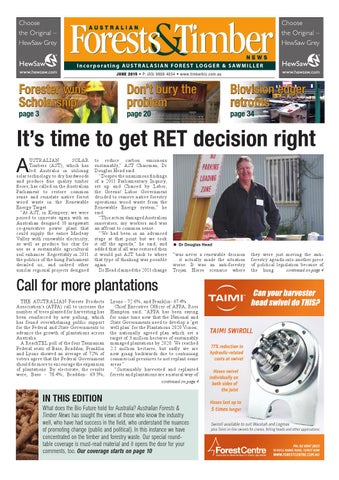
n Dr Douglas Head
“was never a renewable decision ... it actually made the situation worse. It was an anti-forestry Trojan Horse scenario where
Call for more plantations THE AUSTRALIAN Forests Products Association’s (AFPA) call to increase the number of trees planted for harvesting has been reinforced by new polling, which has found overwhelming public support for the Federal and State Governments to advance the growth of plantations across Australia. A ReachTEL poll of the four Tasmanian Federal seats of Bass, Braddon, Franklin and Lyons showed an average of 72% of voters agree that the Federal Government should do more to encourage the expansion of plantations. By electorate, the results were; Bass - 78.4%, Braddon- 69.5%,
Lyons - 72.6%, and Franklin- 67.4%. Chief Executive Officer of AFPA, Ross Hampton said, “AFPA has been saying for some time now that the National and State Governments need to develop a ‘get well plan’ for the Plantations 2020 Vision; the nationally agreed plan which set a target of 3 million hectares of sustainably managed plantations by 2020. We reached 2.1 million hectares, but sadly we are now going backwards due to continuing commercial pressures to not replant some areas.” “Sustainably harvested and replanted forests and plantations are a natural way of continued on page 4
IN THIS EDITION What does the Bio Future hold for Australia? Australian Forests & Timber News has sought the views of those who know the industry well, who have had success in the field, who understand the nuances of promoting change (public and political). In this instance we have concentrated on the timber and forestry waste. Our special roundtable coverage is must-read material and it opens the door for your comments, too. Our coverage starts on page 10
they were just moving the antiforestry agenda into another piece of political legislation because of the hung continued on page 4
UNLOAD FASTER,
LIFT MORE, REACH HIGHER
Now working in Australia, the new Cat ® 990K unloads tree length trucks in a single pass and lifts 26% more than the 988H. Reach up 6.7 metres to stack more in a smaller footprint or feed high decks. Climb ramps effortlessly with the threespeed planetary transmission and lock-up torque converter. Get full hydraulic power at 1600 RPMs, so you burn less fuel but keep the speed and productivity. Keep your operator happy, too. The cab features the Cat Comfort III seat with integrated controls and a sound level lower than his ute cruising down the highway. Productivity and your operator’s comfort — that’s what we’re built to deliver. Look to your Cat dealer for financing and all the machines you need for sustainable harvesting and land management, forestry road construction, hauling and millyard. Total support from one source. www.cat.com/en_AU
© 2015 Caterpillar. All Rights Reserved. CAT, CATERPILLAR, BUILT FOR IT, their respective logos, “Caterpillar Yellow,” the “Power Edge” trade dress as well as corporate and product identity used herein, are trademarks of Caterpillar and may not be used without permission. www.cat.com www.caterpillar.com
In the news I n c o r p o r a t i n g A U S T R A L A S I A N F O R E S T L O G G E R & S AW M I L L E R
Tumbarumba forester wins Geoff Green Scholarship
T
HIS YEAR’S Geoff Green Scholarship has gone to Forestry Corporation of NSW forester Billie-Jo Brown, who is based at Tumbarumba. The Forest Industry Council’s scholarship honors the late managing director of Greenfreight Logging Geoff Green who was a great supporter of educational excellence in the forest industry. Mrs Brown has been employed by the Forestry Corporation since 1999 in various roles across the State and is presently Production and Stewardship Supervisor for the Hardwood Forests Division based in
Tumbarumba. She said she was very pleased to win the Geoff Green Scholarship because it would help her to complete a Masters of Natural Resources Management course, which she is currently studying via distance education at Charles Sturt University. Mrs Brown said the completion of a Master’s degree would further enhance her skills in the forest industry. “It will build upon knowledge I have already gained through a Bachelor of Science (Forestry) undergraduate degree obtained in 2005 from the Australian National
June 2015 Issue 4 Vol. 24
University and my 16 years of on-the-job experience,” she said. Mrs Brown said she had been born and bred in Tumbarumba, and had made her start in the forest industry by choosing the State Forests’ office in Tumbarumba as her workplace of choice for Year 10 work experience. “During the following two years, while studying for my HSC, I undertook the subject ‘Work Studies’, which enabled me to work one day a week, once again with the State Forests’ office in Tumbarumba,” she said. “I am very proud of my achievements to date and want to thank the Forest
Prestigious medal awarded to Dr Hans Drielsma. Read more on page 6.
n Billie-Jo Brown at work near Tumbarumba.
Industry Council for helping me to further my skills in an industry that means a lot to me and my family.” Mrs Brown’s maiden name is Goldspink - a family with deep connections to the timber industry in the region.
www.timberbiz.com.au
and prosper in our industry. “This is especially so in terms of resource security. At the moment, current and future resource supply is not available to the level needed to encourage an adequate level of investment capital in a large number of new operations and new employment opportunities. “Security of resource is paramount for a successful forest and wood products
industry in future. Government must recognise that this security is required if the industry is to invest in new innovations and valueadding processes,” he said. “VAFI continues to work with the State Government here in Victoria to reach a suite of stable policy settings. Ultimately we would like to see investment from Government in the future of the industry, so that the
General Manager: Elizabeth Bouzoudis Editor: John Hudswell Advertising: Michael Dolphin Production: Luke Westle n VAFI CEO Tim Johnston.
21,000 direct employees in Victoria alone can be assured of a strong, sustainable future for the industry.”
For over 100 years, we’ve been engineering solutions for the timber industry. In that time, we’ve designed and built a range of equipment proven to improve mill productivity. But we’ve yet to meet a client who didn’t need some modifications to make even the best equipment fit their particular space and needs. Contact us for a quote to make your mill even more productive.
Australian Forests & Timber News
MEDIA
Publisher and Chief Executive: Hartley Higgins
Off the shelf solutions, customised for your mill
• manufacturing • sawmilling equipment • log carriages • resaws • multisaws and board edgers • automatic sorters and stackers • transfers and conveyors. Complete turnkey projects.
Bio 10-16 Plantations 17-19 Forestry Roading 20-21 Forwarders 22 The Essentials 23 AUSTimber 2016 24 Heads 26-30 Skidders 32-33 Sawmilling 34-35 AgroForestry 36
INDEPENDENT & AUSTRALIAN OWNED
Urgent need for clarity and commitment THE FORESTRY and timber industry needs clarity and commitment from all levels of Government if it is to be given a chance to succeed, according to Tim Johnston, VAFI chief executive officer. He was speaking after budgets had been brought down by Federal Government and also the Victorian Government. On the positive side, Tim said VAFI welcomed the federal budget commitments that support the forestry industry Australia wide, including strengthening the approach to illegally sourced timber entering Australia, the matched contributions to Forest & Wood Products Australia (FWPA), and the policy to allow immediate tax deductions for small businesses for each item purchased up to $20,000. On the negative side, he said that despite these broader budget measures, there were no strong commitments nor direct investment in the future of the forest and wood products industry from either the Federal or State Government. “What our industry needs from Government, both State and Federal, is clarity of decisions around the future of the forest and wood products industry in this country. Forward estimates and four year time horizons do not do sufficient justice to the investment, employment provided, and level of patience required to succeed
Features
From major start-ups to retro-fits, if you want professional service and advice, contact us.
AE Gibson & Sons Phone 02 6559 4001 Email: info@aegibsonman.com.au www.aegibsonman.com.au
June 2015
Advertising: m.dolphin@ryanmediapl.com.au Melbourne Office (03) 9888 4834 Trader classified: m.dolphin @ryanmediapl.com.au Melbourne Office (03) 9888 4834 Editorial: j.hudswell@ryanmediapl.com.au Adelaide Office (08) 8369 9512 Subscriptions: subs@forestsandtimber.com.au Adelaide Office (08) 8369 9522 Subcription rates One-year (8 editions) $55 Two-years (16 editions) $95 Accounts: Adelaide Office (08) 8369 9555 Postal Address: 630 Regency Road, Broadview South Australia 5083 Phone: (08) 8369 9555 Fax: (08) 8369 9501 Melbourne Office: Suite 103, 486 Whitehorse Road, Surrey Hills, Victoria, 3127, phone (03) 9888 4822 Conditions: Opinions expressed herein are not necessarily those of the editor/ publishers; information is published in good faith and we do not accept responsibility for damage which may arise from any possible inaccuracies. All rights reserved, none of the contents may be used in any other media without prior consent from then publishers. Published by Ryan Media Pty Ltd. Print Post No. PP 767324/00002
3
In the news
In Brief Practical forestry operations management FORME CONSULTING Group and CMO will run a course on introductory road construction, road maintenance and harvest cost and production training that is practical and focused on the challenges facing modern harvesting supervisors. The course will be held in Mt Gambier 20-24 July. Forest supervisors, managers and planners increasingly need to multi-task. Communities to have a say in bushfire fuel management THE VICTORIAN Government will begin consulting with community and stakeholder groups on the future direction of bushfire fuel management on public land in Victoria. Minister for Environment, Climate Change and Water, Lisa Neville, and Minister for Emergency Services, Jane Garrett, have released the Review of Performance Targets for Bushfire Fuel Management on Public Land by the InspectorGeneral for Emergency Management. World demand for forestry equipment to reach $9.3 billion in 2019 WORLD DEMAND for forestry equipment (including both purposebuilt and converted machinery) is forecast to climb 4.5 percent annually to $9.3 billion in 2019. This will represent a moderation from the 2009-2014 pace of increase, a period during which market gains were spurred by a rebound in roundwood production from lows posted during the 2009 global recession, as well as by the institution of new engine emissions standards in the European Union (EU) and US, raising average equipment prices and total spending. Analyst Ken Long further notes that “sales advances will be driven in part by the ongoing mechanization of forestry operations in developing regions.” These and other trends are presented in World Forestry Equipment, a new study from The Freedonia Group, Inc., a Cleveland-based industry research firm. 4
Has the forestry industry turned the corner?
T
HE FOURTH DANA Melbourne Conference -- “The Australian Forestry and Forest Products Sector: Its Situation in 2015 and Trends Going Forward” -- will debate the Australian domestic forest industry sector and its wider role in the Pacific Rim as a wood products import market and as an export supplier. The conference will be held at the Melbourne Sheraton on 13-14 August. Topics will include: • Keynote speaker on key Australian forest strategic issues in 2015. • Has the industry turned the corner? And comments on the new Australia/ China FTA. • The plantation sector: Is restructuring complete? • SW and HW log export industry. • Chinese log and lumber import demand trends.
• Saw milling industry sector and its direction. • [Possible] Case study of a major new Chinese wood processing complex. • A merchants perspective of domestic and imported wood products. • Technological advances in wooden building design/construction. • Tertiary education requirements and training. • International EWP developments. • Asian/Australian wood panel D/S trends. • Global pulp industry trends. • Asian/domestic paper industry trends. • HW resource and woodchip/log exports. • Chinese WC demand outlook. • Other N. Asian WC demand outlook • Vietnamese plantation industry and WC supply outlook
continued from page 1
n The plantation sector: Is restructuring complete?
• Non-Vietnamese WC Supply competition. • Interest rate and FX trends and projections • Global/Asian/Australian wood pellets. Full Conference dinner with speaker, Ross Hampton, CEO of Australian Forest Products Association: Turning the debate back on the eNGOs. Why a truly global, ‘green’ perspective demands we do more not less. http://danamelbourne2015.com/
continued from page 1
It’s time to get the RET Call for more plantations decision right Parliament. It’s been a state of ridiculousness for some time”. Now, what AST and like innovators are looking for is demonstrable bipartisanship on the RET policy that takes it back to pre-November 2011. “It is my hope that Labor in 2015, no longer constrained by the accord with the Greens, can return to its original support for the scientific environmental position, Australian innovation and workers,” said Dr Head. On the subject of fear-mongering with claims that forests will be cut purely for electricity, Dr Head said this was laughable. “You wouldn’t get people cutting down trees just for electricity. It quite simply doesn’t add up,” he said. Kempsey Shire Mayor, Liz Campbell said Council supported the recent move to have the Australian Government reinstate native forest wood waste as a renewable energy source. “In recent years, Council supported the initiative proposed by Australian Solar Timbers to use waste timber offcuts as a renewable energy source in building a co-generation plant. “Promoting clean energy alternatives not only helps to make our environment safer for future generations, but also helps to grow vitally needed sustainable local businesses within the Macleay,” said Councillor Campbell. The Australian Forest Products Association also weighed in to the argument with CEO Ross Hampton saying it would be common sense to “reverse the crazy decision made in 2011 which said that offcuts from trees planted in rows (plantations) is somehow renewable but offcuts from trees in sustainably run natural forest is not”. “Until we grow square trees we will have mountains of offcuts and waste timber,” he said. “Use of the waste residues from harvesting operations or sawmilling operations would not see a single additional tree cut down. The 120,000 Australians who work in our forest and forest product industries, many in rural communities such as those in the Macleay Valley, are hoping the national Parliament finally corrects this anomaly.” Australian Forests & Timber News
managing carbon, and Australia’s industry is world class. With increasing international demand for sustainably sourced fibre, Australia is well placed to become a global leader. What is missing is a comprehensive suite of policy settings to secure this fibre. The release of the Forest Industry Advisory Council Issues Paper, led by Senator Colbeck, is a great step in the right direction. Industry will be looking to the Government to respond with a National Forestry and Fibre plan,” said Mr Hampton. A plantation expansion target forms a key element of AFPA’s industry wide submission to the Forest Industry Advisory Council (FIAC) Strategic Directions Issues Paper./ Other major priorities identified by industry through AFPA are: • A dedicated Minister for Forestry and Forest Product Industries- the reappointment of a dedicated Minister for this $22 billion industry that supports 120,000 direct jobs • Regional approaches- greater emphasis on building upon the strengths of key industry regions through long-term infrastructure and investment incentives for plantation and wood processing expansion • New forest, wood and paper products- positioning the industry to take advantage of opportunities to diversify production and increase value adding in new products such as in engineered wood products, biomaterials, biochemicals and bioenergy • Research and Development initiatives- addressing the dramatic decline in forest industry R&D through greater incentives to build a critical mass of researchers and co-fund priority R&D activities We welcome your opinion: Email your feedback to j.hudswell@ryanmediapl.com.au
June 2015
www.timberbiz.com.au
ALL WORK AND NO PLAY. SOUNDS ABOUT RIGHT.
When you get up and running, we know how important it is to keep running. That’s why Waratah is determined to keep you working by providing second-to-none customer support. Whether you need a simple recalibration or you’re really up aganist it, you can contact our service team through our 24/7 contact lines. No matter what time you need us, we’ll find a solution that keeps you working. And earning
Melbourne
24/7 Hotline 03 9747 4200
Bunbury WA
24/7 Hotline 08 9726 0411
www.waratah.net
In the news
Prestigious medal awarded to Dr Drielsma
A
USTRALIAN FORESTRY Standard Ltd (AFS Ltd) congratulates Dr Hans Drielsma who was awarded the Norman W. Jolly Medal at the 8th Joint Conference of The Institute of Foresters of Australia and the New Zealand Institute of Forestry. The Norman W. Jolly Medal is The Institute of Foresters of Australia’s highest and most prestigious honour and is awarded for outstanding service to the profession of forestry in Australia. Kate Carnell AO, Independent Director and Chair of AFS Ltd, wass delighted Dr Drielsma had been awarded the medal and said he was a “very worthy recipient”. A professional forester with post-graduate qualifications from Yale University in forest policy and natural resources sociology, Dr Drielsma has held key positions in the forest industry as Managing
Director of Forests NSW and Executive General Manager of Forestry Tasmania and was a member of the CRC for Forestry Board for seven years. An Independent Director of AFS Ltd Board, Dr Drielsma has played a vital role in the development of the Australian Forest Certification Scheme and its endorsement by the Program for the Endorsement of Forest Certification (PEFC). Dr Drielsma is internationally renowned, being appointed to the PEFC Council as a Board Director in 2006. In this role he has been instrumental in the development of a more active multi-national promotion of the PEFC in the Asia region, and has served on the PEFC International Governance Review Panel. AFS Ltd congratulates Dr Drielsma on his welldeserved award and his contributions nationally and internationally to the forest industry.
n Dr Hans Drielsma.
State-wide forum proves successful FORESTWORKS’ Forestry Industry State-wide Forum in Tasmania attracted 30 participants for the two-hour forum to network and discuss a number of industry matters, including accreditation in our industry and the new Better Business Program, currently in development via ForestWorks. The forum was facilitated by Tim Woods from IndustryEdge and included: A welcome and introduction by ForestWorks’ CEO Michael Hartman – Michael discussed ‘how people are critical in the wood and timber products industry’ and that ForestWorks works with industry, government, associations and training providers to support a wide
range of industry initiatives that build a productive, skilled, trained and inclusive workforce. ‘A look at Forico – Future Directions’ by Forico’s CEO, Bryan Hayes – Bryan explained Forico’s work as a private forest management company operating in Tasmania, and is a subsidiary of New Forests. He highlighted how the company works across the full supply chain – from tree breeding and seedling propagation to tree growing and maintenance, with timber facilities at Surrey Hills and Longreach – and how it is solely focussed on plantation fibre. A presentation on the Better Business Program, by ForestWorks’ Skills Advisory Managers, Eva Down and Lorraine McNamara – The presentation was an opportunity for ForestWorks to share the program’s background, developments to date and the services/benefits expected for the wider industry. Eva and Lorrain discussed the program’s aim, which
n Michael Hartman.
p Tim Woods. t Bryan Hayes.
6
is to develop and implement an efficient, best practice, voluntary business program for use by forestry businesses (contractors) and forest managers. They discussed how: The program will provide confidence for businesses involved in the supply chain, to demonstrate that they meet business, consumer and community expectations. The program is underpinned by an industry-agreed set of ‘best practice standards’ that are grouped under the pillars of safety, environment, economic and social. It will provide a web-based portal, where information around a contractor’s business can be uploaded, managed and maintained in a database that outlines businesses’ performance against industry ‘best practice’. The program’s tools and resources will also be available to assist businesses to progress against the standards as required. The program is a whole-ofindustry service that will grow the skills and develop forestry contractor businesses. And importantly, this program will recognise forestry businesses who are providing services to forest managers at best practice standards, acknowledging their professionalism within the industry. It is also an industry led solution to some of the challenges facing the sector, with funding support from the Australian and Tasmanian Governments. The program’s development is being driven by an industry steering committee, to ensure the program finds workable solutions for lifting business performance, acknowledging best practice, building collaboration and improving efficiencies of the value chain. How the program is designed to reduce:
Australian Forests & Timber News
June 2015
• The risk of business failure • The risk of environmental damage • Workplace Health and Safety incidents • Community relationship damage • The risk of loss of certification • And designed to provide: • Increased opportunities to lift business performance • Increased transparency in the value chain • More opportunities for collaboration • Increased opportunity for innovation • Efficiency gains in individual businesses • Efficiency gains in the value chain. The seminar concluded with a panel discussion with Adrian Bennett, of TP Bennett and Sons, and Darrell Clark, of Timberlands – The panel discussion opened up further discussion about the Better Business Program. Adrian gave perspectives from a forestry contracting business, indicating how the Better Business Program could ‘bring about more stability in the sector’ and could ‘give recognition to those businesses that are performing well and delivering a quality service leading to a more secure arrangement on service delivery’. Darrell spoke from the perspective of a forest manager, indicating how forestry is a partnership between the forest managers and forestry contractors. He highlighted how the program could ‘reduce the risk exposure of the industry and provide a platform for contractors and managers to build on what is already there, and streamline the way business is done’. www.timberbiz.com.au
e! on days t a d the trati 015
e ns 12-13 2 o v m a e S cat d gust u
Tiger mania, A s in Ta
L855C fitted with 5185
FELL-SHOVEL-BUNCH WITH TIGERCAT New to the Australian market are the versatile Feller/Shoveller options with the Tigercat 5195 Directional Felling Head or the Tigercat 5185 Fixed Rotation Bar-Saw Head mounted to the ever popular levelling 855C carrier. These machines are now working in Australia with outstanding feedback. Enjoy the benefits of the base machine and felling head being delivered from factory ready to work. Fell and shovel wood off steep slopes to the landing and watch your overall productivity increase.
LS855C fitted with 5195
TASMANIA
NEW SOUTH WALES
SOUTH AUSTRALIA
VICTORIA
WESTERN AUSTRALIA
11 Midland Highway, Brighton
208-216 Snowy Mountains Highway, Tumut
17 Crouch Street North, Mount Gambier
226-228 FrankstonDandenong Rd, Dandenong South
12 Sherlock Way, Davenport
Give us a call or visit our website to see how we can be of help.
1300 727 520 – WWW.ONETRAK.COM.AU
In the news
Transformation from a traditional, resourcedriven, low-technology base to an innovative, market-driven industry
T
ASMANIA’S ROLE as national centre for research around forestry and wood products has helped deliver a significant Federal grant which will drive its standing further. Announced by Minister for Education Christopher Pyne, the University has attracted funds from the Australian Research Council (ARC) for an Industrial Transformation Training Centre, which will be led by Professor Jim Reid. ARC funding of $3.6 million will be matched by industry and University contributions, bringing its total value to about $14 million. “This is recognition
again that the University of Tasmania is regarded among the very best in the country, and especially where our research effort intersects with industry,” University of Tasmania Vice-Chancellor Professor Peter Rathjen said. “We need to be very clear that the focus of our research effort and training will be upon new forest industries, approaches and products, not the industry which Tasmania understands historically. “The capacity to create value around forestry and timber is one of the keys to unlocking economic renewal in Tasmania, but we understand the sector of the future will look very
different to the industry of the past.” The training centre is a collaboration between the University of Tasmania and seven industry partners. It involves nine countries and will span a range of academic disciplines including Plant Science, Computing and Information Systems and Architecture. Its thrust will be to enable the forestry and wood products industry to transform from a traditional, resource-driven, lowtechnology base to an innovative, market-driven industry. The centre will produce industry-ready PhD
students and postdoctoral research fellows with broad perspectives of the forest industry from the forest landscape to the supply chain. Deputy Vice-Chancellor Research Professor Paddy Nixon said the University of Tasmania is leading the country with four Industrial Transformation Training Centres and three Industrial Transformation Research Hubs, attracting funding totaling $50 million. Professor Mark Hunt will be Deputy Director of the Centre, with a particular focus on industry links, ensuring the activities of the centre bring about impacts
“The focus of our research effort and training will be upon new forest industries, approaches and products, not the industry which Tasmania understands historically.” n Deputy Vice-Chancellor Research Professor Paddy Nixon.
n University of Tasmania Vice-Chancellor Professor Peter Rathjen.
for industry and national economic benefits. “This is a very strong result that recognises the outstanding researchers we have here in Tasmania and the important collaborations we have with our industry partners,” Professor Hunt said. “This latest announcement builds on an unbroken period of 25 years as a national leader in the field, through three co-operative research centres and most recently the National Centre for Future Forest Industries.” Professor Reid said while the Centre would be based in Tasmania, it would have an outlook that was both national and global in scope. “We are committed to developing innovative ideas and creating tangible change that benefits the Australian economy,” he said. “The promise of this venture is that Tasmania is well placed to lead the world in this field.” Professor Nixon added: “The Industrial Transformation Training Centres are particularly worthy of celebration. This funding supports the young researchers of tomorrow they are truly an investment in the future of Australia.”
Inaugural FWPA Chairman announces retirement
n Ron Adams.
8
THE INAUGURAL chairman of Forest and Wood Products Australia Limited (FWPA will step down from the Board following the company’s annual general meeting on 12 November. Ron Adams has been chairman of FWPA since its formation in September 2007 and was previously a director, and then chairman, of the predecessor organisation (FWPRDC). As chairman and an active industry participant, he has played a key role in the transition of the organisation from a statutory authority of the Australian Government with a singular focus on R&D investment to a broader industry-owned services company. Ric Sinclair, FWPA’s managing director, said that Ron’s departure from the Board is one year earlier than expected due to a requirement in the company’s Constitution that
at least one third of directors must retire each year. This year, John Simon and John McNamara complete their first three-year term on the Board and both have expressed their interest in seeking re-nomination. One additional director is required to stand down early to meet the “one third requirement” and Ron Adams volunteered to retire early and will have completed the maximum of three consecutive terms as specified in the Constitution. “Ron has had a seminal influence on the establishment of the company and its ongoing evolution,” Mr Sinclair said. “Ron has a tireless focus on aligning the company to stakeholder interests and ensuring best practice corporate governance. There is no doubt that he has left an indelible mark on the company.”
Australian Forests & Timber News
June 2015
“On a personal note, I would like to thank Ron for his support and invaluable mentorship during my time with FWPA,” Mr Sinclair said. Ron is currently managing director of Wespine Industries Pty Ltd, a major softwood sawmilling business and is immediate past president of the Forest Industries Federation of WA, director the Australian Forest Products Association, a member of the Forest Industries Advisory Committee, and a Trustee of J.W. Gottstein Memorial Trust. He holds an associateship in Mechanical Engineering, is a graduate of the Harvard Business School International Advanced Management Program and a Foundation Fellow of the Australian Institute of Company Directors. www.timberbiz.com.au
BIO
Science is clear on the benefits of biomass
C
OMMENTS FROM Federal Labor and Greens that they would attempt to block biomass from being included in the Renewable Energy Target (RET) shows they are clinging to last century ideology, according to Senator Richard Colbeck, Parliamentary Secretary to the Minister for Agriculture. “You really do have to wonder if Labor and the Greens genuinely want to reduce CO2 emissions,” he said. “The science is clear when it comes to the environmental benefits of biomass as a source of energy and is even recognised by international environmental groups such as the World Wildlife Fund,” Senator Colbeck said. “Federal Labor and the Greens need to stop basing their policy on superstition and get up-to-date with the latest science.” The environmental benefits of biomass are widely recognised, including:
Future Science journal found that biomass can reduce CO2 emissions by up to 96% when calculated on a life cycle basis. Senator Colbeck said the Coalition supports wood biomass as a source of renewable energy and recognises the benefits it could bring to the environment, the forest industry and the economy. “The Coalition took a policy to the last federal election
to re-introduce renewable energy initiatives using wood biomass – it was a key element of our forestry policy and it is a complete sham for Labor to describe this is a last minute push,” Senator Colbeck said. “Wood biomass is making use of an otherwise wasted product, such as timber offcuts, bark and branches that would otherwise be discarded. You wouldn’t slaughter a cow for the prime eye fillet
and leave the rest – and the same principle applies for the forest industry.” Senator Colbeck said in 2011 then Labor MP Dick Adams endorsed a Parliamentary report recommending the use of wood biomass for renewable energy – but just
days later yielded to please the Greens. “This anti-forest industry action was reflected strongly at the last federal election, when Dick Adams experienced an almost 13% swing against him and lost his seat in a forestry dependent seat,” he said.
We welcome your opinion: Email your feedback to j.hudswell@ryanmediapl.com.au
SP 591 LX
Purpose built for harvesting and debarking of plantation grown eucalyptus.
• A report by the World Wildlife Fund (WWF) and the European Biomass Industry found that replacing coal generated energy with biomass would significantly reduce carbon emissions. • The Food and Agriculture Organisation (FAO) support the use of wood-based energy and state that “The challenge for the forestry profession is to communicate the simple idea that the best way of saving a forest is to manage it sustainably and to benefit from its products and ecosystem services. If the principles of sustainable forest management are applied and forest products and ecosystems services play an increasing role, the global economy will become greener” • The Intergovernmental Panel on Climate Change (IPCC) states that “In the long term, a sustainable forest management strategy aimed at maintaining or increasing forest carbon stocks, while producing an annual sustained yield of timber, fibre, or energy from the forest, will generate the largest sustained mitigation benefit” • Research by a compilation of scientists published in the www.timberbiz.com.au
The SP 591 LX is purpose built for harvesting and debarking of plantation grown eucalyptus. It offers an unrivalled productivity, feed speed and debarking efficiency. Together with the over all super duty design that guarantees also maximum reliability and uptime the SP 591 LX truly offers all you need for a profitable harvesting operation.
Head Office Victoria Randalls Equipment Company 8 Wallace Avenue, Point Cook, Melbourne VIC Contact: Peter Randalls Ph: 03 9369 8988
Randalls Equipment Company Pty Ltd
Email. randalls@randalls.com.au www.randalls.com.au
Australian Forests & Timber News
June 2015
Western Australia (NEW) Randalls Equipment Company 9B Charles Street, Albany WA
Contact: Adam Bremmer Ph: 0437 059 477
9
BIO ROUND TABLE
What does the bio future hold for Australia?
Australian Forests & Timber News sought the views of those who know the industry well, who have had success in the field, who understand the nuances of promoting change (public and political). In this Round Table we have concentrated on timber and forestry waste.
W
e have enlisted the support of Andrew Lang, Dr Stephen Schuck, Daryl Scherger, Sohum Gandhi, Rob de Fegeley and Mick Stephens. Our special roundtable coverage is must-read material and it opens the door for your comments, too. Long time bio advocate Andrew Lang prefaced his comments by saying .... what is not covered in the questions is the fact that ‘bioenergy’ includes many feedstocks, many technologies and at least three products (cooling being an often ignored fourth). I am guessing that this list of questions is primarily aimed at woody biomass out of forestry and timber processing operations at various points, but I’m answering more about biomass across the board, as the real issue is that there is a connection between them all. What I am seeing elsewhere is that these different bioenergy technologies often using different feedstocks all operate loosely in step with each other from the viewpoint of legislative or other supportive policy, and that where the actions to block use of one feedstock (native forestry residues) seems to have effectively blocked development of the lot. Biomass is presently the source of between 50-
75% of renewable energy in Australia, but is rarely mentioned. Energy from biomass can be as heat (thermal energy), electricity or transport biofuels. Bioenergy is the only renewable energy form that can produce these three forms of energy, all of which have their place in the Australian system whether at household, commercial, industry or institutional level. In the paper on potential for bioenergy in Australia I was a co-author of and which was published in a international publication we estimate that Australia’s economically and sustainably available biomass could produce up to 30% of the country’s energy needs. At the same time there would be a range of real social, environmental and economic benefits – for rural and regional municipalities, for permanent job creation, for farm incomes, for improved peri-urban fire control, and in better forestry management Dr Stephen Schuck, Bioenergy Australia Manager, likewise prefaced his comments, saying ... Australia is well endowed with biomass, which could be used for the production of heat, power, liquid fuels and biochemicals. Various analyses
have investigated liquid biofuels, especially for the aviation industry. Some years ago the Clean Energy Council produced a roadmap for stationery bioenergy which showed that with current and projected resources, without any great leap of faith, that bioelectricity could expand to in excess of 73,000 GW hours per annum by 2050; a compound growth rate of over 10% per annum. Several policy measures would need to be put in place to nurture a future bio economy. For instance, targets and mandates would be required to stimulate such industries. Biomass and bioenergy are well recognised for stimulating rural and regional economies. Unlike wind energy and solar, bioenergy requires ongoing collection of fuel and feedstocks, providing ongoing jobs. Indeed, biomass has been used for stimulating local employment.
Rob de Fégely
Andrew Lang
Sohum Gandhi
Dr Stephen Schuck
Daryl Scherger
Mick Stephens
President, Institute of Foresters of Australia
Vice President of the World Bioenergy Association and the board member representing Australasia-Oceania.
General Manager ENERGENCE
Bioenergy Australia Manager Stephen Schuck and Associates Pty Ltd
Bioenergy Project Manager Pyrenees Shire Council
Deputy CEO Australian Forest Products Association
10
Australian Forests & Timber News
June 2015
continued page 12
We welcome your views: Email your feedback to j.hudswell@ryanmediapl.com.au or phone the editor on (08) 7127 6370
www.timberbiz.com.au
The early bird catches the worm Get 10% up front on your investment! AUSTimber2016 will give you a world-class context of demonstrations, conferences and field trips in which to tell your story face to face with thousands of forestry and timber industry people from across Australia. It’ ll be bigger than ever before with a major focus on timber processing and prefabrication. With a strong communications program through our industry media partners, Ryan Media and a television advertising campaign on WIN in the major timber regions around Australia, AUSTimber2016 will attract serious wood products industry people to Traralgon, Victoria throughout the week of 11-16 April, 2016.
Traralgon is in Latrobe City – home of Australia’ s first Wood Encouragement policy. Check out our website for updates and general information but contact us direct to receive our current prospectus and to discuss how you can use this event to meet and mix with the industry people who can help you meet your sales targets. Do it now and secure the first reward for taking action to boost your sales in 2016. Book and pay for your exhibition space at AUSTimber2016 before 30 June, 2015 and get a 10% discount on the rate. Email our General Manager Laurie Martin on: laurie@austimber.org.au
Expo days will run on Friday 15 and Saturday 16 April, 2016.
Early Bird discounts to 30 June, 2015
Sponsored by
Supported by australasian
I n c o r p o r a t i n g A U S T R A L A S I A N F O R E S T L O G G E R & S AW M I L L E R
www.austimber.org.au
BIO ROUND TABLE continued from page 10
Q: Where do you think Australia currently sits in relation to bioenergy?
Wind and solar are well accepted and supported Q: Do you feel it has missed the boat in to varying degrees by Government. Bioenergy exploring and utilising opportunities? remains the “Cinderella” of renewables. Rob: A long way behind Europe and even some Bioenergy is already cost effective for some Rob: No, but Solar and Wind seem to have more Asian countries such as Korea. applications but the lack of a fuel supply chain influence in Government than biomass and yet Andrew: Australia is among the only countries and limited biomass heating system suppliers we have considerable volumes of biomass that that are industrialised, have copious amounts means there has been limited uptake to date. The is currently being produced as a byproduct of of biomass available annually, and yet have no limited number of users means there is no driver harvesting operations or could be utilised from coherent development of bioenergy within the to develop a fuel supply chain. A classic chicken urban and vegetation management zones (i.e. suite of renewable energy sources. There may be and egg situation. Unless there is a change in firebreaks) but most is wasted purely because there another country that is in this group but I don’t the economics of energy supply or Government is no supportive Government policy to develop know of it. Possibly some states of the USA or support to install systems, the shift to bioenergy projects. provinces of Canada might qualify to join us. will be slow. Andrew: Australia was very reliant on biomass Most countries in Europe began development Mick: Globally, renewable energy will continue for energy up until the 1960s and had some of bioenergy after the 1970s oil price spike due to increase in importance as part of the long term significant programs in CSIRO even into the 1980s to OPEC embargos. Even the UK is now full transition to clean energy sources. Bioenergy and 1990s. Even now there are some cutting edge steam ahead in development of bioenergy having has historically been an important part of the R&D programs that are up with world leading commenced about 5-10 years ago in line with EU renewable energy mix, accounting for around technologies, including for production of pyrolysis legislation. Japan, China, South Korea, Indonesia, 80% of world renewables, mainly from the use oil, production of lipid rich microalgaes, and Malaysia, Thailand, New Zealand, all have of traditional fuelwood in developing countries. investigation of agave, pongamia, and jatropha for significant development of bioenergy and wastes Woody biomass as a feedstock also accounts for production of biofuel feedstocks. Australia plays a to energy. around 90% of global bioenergy. In Australia, significant role in a number of the IEA bioenergy Sohum: Australia would be behind many bioenergy generates around 4% of total primary task groups, coordinated by the Bioenergy Australia advanced economies in relation to bioenergy. energy supply, which takes into account the organisation. But, yes, the country lags way behind Australia has a low cost and abundant coal small amount used for electricity and the 4 to in implementing any of these opportunities, largely resource which often makes bioenergy a poor 6 million tonnes of firewood used for heating. due to lack of political leadership. return on investment in comparison… this could However, by comparison with the rest of the Sohum: No, there is still abundant opportunity perhaps be one reason that Australia has been world, Australia would sit at the lower end of the and there is still positive momentum towards late to develop in this sector. Sohum prefaced international league table for bioenergy uptake, growth in the bioenergy sector. his response by saying ... my comments are in particularly in relation to other highly forested Stephen: No. Research and development and relation to biomass (specifically combustion) per capita countries such as Finland and Sweden. development of business cases has been going on as that is where our expertise is. Bioenergy as In many parts of the world bioenergy is growing behind the scenes in Australia. Companies such a whole can include many other technologies as a proportion of total energy supply, including as Licella have been developing technology for which I have not commented on. for electricity, thermal energy (i.e. heating) producing bio crude which can be upgraded to, for Stephen: Bioelectricity currently provides and biofuels. This is particularly so for global instance, aviation fuel. Microbiogen has developed a meagre 0.9% of Australia’s electricity and bioenergy heat production, which has doubled a specific yeast for converting sugars in both liquid biofuels (ethanol and biodiesel) similarly over the past decade as a result of increased cellulose and hemicellulose into ethanol. Various provide under 1% of our transportation fuels. co-firing in coal plants and the installation of projects have been announced or completed for Globally liquid biofuels provide some 3.4% dedicated cogeneration power plants. In Denmark producing electricity from agricultural wastes, such of needs. Globally bioenergy accounts for bioenergy accounts for over 14% of electricity use as grape marc, sugarcane bagasse, macadamia nut approximately 88GW (88,000 MW), while while in Finland it is 16%, compared to Australia shells and almond wastes. To date bioelectricity has Australia has approx. 900 MW of installed where bioenergy represents just 1% of electricity accounted for just under a quarter of all renewable capacity, mainly in the sugar and landfill gas generation. The uptake of biofuels is similarly energy certificates acquired in Australia. While industries. limited, with 98% of transportation fuel use in progress has been slow, especially thwarted by Daryl: Australia has largely ignored what could Australia still sourced from fossil fuels. unsupportive policies towards bioenergy, there has potentially be a major renewable energy industry. been significant progress.
12
Australian Forests & Timber News
June 2015
www.timberbiz.com.au
BIO ROUND TABLE Daryl: While it hasn’t completely missed the boat, without changes in Federal Government policy on renewable energy and carbon, Australia will lag behind the rest of the world in developing bioenergy. The opportunities are there and will remain but without some form of leadership, the wider Australian community won’t see the benefits. Mick: Australia has not missed the boat but has certainly lagged in the development of longer term bioenergy opportunities. There are large volumes of biomass and organic waste in Australia that could be converted into bioenergy if given the right policy settings, including animal and municipal waste, crop residues, wood waste from forestry and processing operations and purpose grown energy crops. Governments have largely ignored the potential for bioenergy to complement other major forms of renewables such as wind and solar. In the various national energy white papers over the years, it has been hard to find any long term vision or reference to bioenergy as part of the renewable energy mix. This is despite bioenergy offering considerable scope for reliable base load power that is well suited to small scale and decentralised energy options. Bioenergy can suit many rural and regional centres where there is ready access to biomass feedstocks. Part of the problem has been a predominant focus on electricity in the Renewable Energy Target (RET) scheme, which has tended to favour wind and solar. There are many opportunities for the utilisation of renewable thermal energy in industrial processes, such as the utilisation of steam in paper making processes. Unfortunately the RET does not recognise renewable heat in the large scale component of the RET, despite recognising solar hot water in the small scale scheme. Better recognition of large scale thermal energy could potentially generate new investment in several thousand GWh of renewable energy per annum over the next five to ten years. The eligibility of some feedstocks, such as wood waste sourced from sustainable managed native forests and associated processing, is also presently not recognised in the RET. These issues have stifled potential investment in the bioenergy sector. Another major factor that has inhibited investment and uptake has been the general uncertainty in the political domain over the longer term RET target by 2020 and beyond. Despite these immediate impediments, we are seeing the first signs of an emerging bioenergy industry through a number of small scale heating projects in regions such as in Ballarat and the installation of a number of boilers for power production or energy pellet plants adjacent wood processing facilities. In order to generate larger scale adoption of bioenergy, there will need to be a range of better targeted policies. These could include, for example, increased R&D and commercialisation of biotechnologies adapted to Australian conditions, amending the RET to include thermal (i.e. heat) energy and inclusion of all relevant biomass feedstocks, and the use of targeted incentives for the establishment of bioenergy projects and facilities.
Rob: An acceptance by all levels of Government that biomass from most sources is a legitimate feedstock for renewable energy. Australia has built its economy over the last 50 years on mining but this cannot last (even though it could take many years to run out) but smart economies realise that at some point they need to shift from non-renewable resources to renewable ones. Energy production from woody biomass is a renewable industry.
Andrew: A concerted campaign against some aspects of bioenergy by the Greens and some related groups (The Wilderness Association, Markets for Change) and a general spread across the policy makers, media, other groups working in the fields of conservation, sustainability, renewable energy and environmental protection. These include some respected think tanks and university bodies, other groups including GetUp/, Australian Youth Climate Change Coalition, and many others. Lack of policy and legislation at both State and Federal level A general ignorance of the array of bioenergy feedstocks, technologies and products and of progress with bioenergy elsewhere The repercussions of the ‘dumbing down’ of the renewable energy debate, mainly thanks to a lack of expertise among journalists and commentators. Too often they just repeat simplistic information even when the terminology or facts are wrong. Sohum: • Cheap coal • Public perception • Lack of incentives for using renewables • Expertise in the industry (successful project delivery is very important in early stages otherwise the “bioenergy” brand can get quickly tarnished) Stephen: There are numerous barriers facing the bioenergy industry. These range from unsupportive policies (for instance, feed-in tariffs are available for photovoltaics, but not bioenergy at any reasonable scale), to lack of recognition of what bioenergy can deliver, to complexities in managing fuel supply requirements to meet regulatory requirements. Another barrier is that renewable heat is unsupported, unlike renewable electricity. For instance, in the UK there is a Renewable Heat Obligation, which is similar in concept to our renewable energy target. Another barrier is the complexity and cost of connecting a bioenergy plant to the electricity system. A report for the Clean Energy Council, conducted by Sinclair Knight Merz (now Jacobs) covered barriers relating to connecting into the power system. Another issue facing bioenergy is securing long term fuel and feedstock supplies for the economic life of the plant which could be as long as 30 years. Daryl: The major hurdles are cheap electricity and natural gas and a lack of legislative support (carbon tax). Low cost energy form fossil fuels means the economics of developing a bioenergy facility doesn’t stack up at present. Without some form of Government support there will be limited growth. Replacing LPG heating is the most economically viable option at present and even growth this area has been limited due to a
www.timberbiz.com.au
Australian Forests & Timber News
Q: What do you feel are the major hurdles facing the growth of a bioenergy industry?
June 2015
lack of knowledge amongst users about potential alternatives, a lack of a fuel supply chain and limited numbers of system suppliers. Simply banning combustible material from land fill would create a powerful driver for bioenergy.
Q: The benefits of securing a bioenergy industry in Australia? Rob:The development of a renewable and clean energy industry and provide opportunities to economically manage some vegetation types that need thinning and/or utilise a resource that is often wasted whether it is a byproduct from a range of sources such as traditional timber harvesting/agricultural, urban, special vegetation management zones etc. Andrew: Reduction of Australia’s GHG emissions from fossil fuels by up to 30% Utilisation of up to 50 million tonnes a year of various biomass streams – which mostly are presently free-burned or allowed to rot or degrade Generation of 10,000-20,000 permanent, mostly rural jobs, in supply chains, in installation, management and maintenance of all sorts and scales of biomass and waste to energy plants Significant stimulation of farm forestry (5-10 million ha across more productive Australian farm land, and the associated carbon sequestration) A range of associated industries including biomass to biochemicals, R&D into advanced composites utilising carbon and microcellulose fibres. Sohum: Renewable, carbon neutral or carbon responsible energy sources are important for all the reasons associated with climate change. From an economic standpoint, renewable energy reduces Australia’s dependence on fossil fuels and hedges against exposure to rising fuel costs. Stephen: There are numerous benefits from bioenergy. These include mitigating greenhouse gases, addressing energy security, managing wastes, diverting material from landfills, stimulating local economies, and managing invasive weeds. Another benefit as investigated for the Australian Forest Products Association by Deloitte Access Economics is reducing the fire hazard in semi-urban areas by mechanically harvesting biomass, including it for energy. Bioenergy has consistently been shown to provide the most jobs for any renewable energy industry. Biomass is the only renewable energy source that can address all of heat, power and transportation fuels. continued next page
13
BIO ROUND TABLE
continued from last page
Daryl: The most important benefit in developing a bioenergy industry is job creation. According to a recent UK report titled - UK jobs in the bioenergy sectors by 2020 - around 1.2 EFT jobs are created per MW of capacity. These are permanent jobs in the operation and maintenance of the plants as well as in fuel supply and delivery and are generally low or semi-skilled positions. Most will be in rural and regional areas were jobs are often in short supply. High transport costs and the availability of fuel mean bioenergy plants will be spread across regional Australia creating a distributed energy supply and greater energy security. Bioenergy could also be used to offset the cost of fire hazard reduction and environmental weed control. Lower heating costs for industries currently using LPG would also help boost the economy. Mick: The benefits of securing a bioenergy industry in Australia include not only the direct benefits of cleaner energy, but also the investment and economic activity that can be created by bioenergy facilities in many rural and regional centres. Bioenergy can generate higher jobs relative to other renewables due to the need to manage supply chains including biomass harvest, collection and transport. This is well borne out by international experience, with the latest 2014 report from the International Renewable Energy Agency showing that the bioenergy sector is the single largest employer of all the renewables at almost 2.5 million people, taking into account liquid biofuels, biomass and biogas. Another considerable benefit of a bioenergy industry in Australia is that it can complement and add
The same industry-leading news, views and ad’s you’re reading in this issue are now available on-line as well. While we know print is the most convenient form for reading in the cab, lunchroom or highlighting an important point for the next reader, we also know that many of our readers want to go straight to websites or send emails from the articles and ad’s they’re reading.
INDEPENDENT & AUSTRALIAN OWNED
14
value to existing land based industries such as agriculture and forestry, by utilising low value waste streams for energy. It can also cluster with existing industrial activities such as food processing, sawmilling and paper making through the integration of on-site bioenergy facilities.
Q: Would collection hubs (biomass depots) around the country help to reduce costs, or is there another system that could/should work? Rob: It may do but this seems like a second stage development as I would start where the biomass is and develop systems for harvest and transport to the closest energy plant. Andrew: Biomass sites have their place. For example, they are a common site in Austrian towns, where it is common that firewood, pellets and woodchip are all in demand for various scales of heating systems in the town and neighbouring villages and farms. For larger-scale biomass to energy plants the costs of aggregation of the large amounts of fuel is a key part of the economics. So, since about 10,000 tonnes of feedstock is required per MW of electrical capacity and the economics of boiler/steam turbine generation systems has a threshold of workable economies of scale at over 15 MW-e, this entails bringing 150,000 tonnes of biomass to the site over the year – or 410 tonnes a day year-round. The logistics involved with trucking this amount of material to a site dictates if some sites are feasible. Obviously it is quite a different situation where the purpose of the fuel
supply is for industrial or institutional heating, the furnace is under a megawatt heat output capacity, and it only runs for six months of the year. Sohum: Yes, this could work for some applications. Ideally the collection hub would be at the biomass heat / power plant location. For many large industrial applications there is simply one biomass producer that needs to be partnered up with one biomass user. And even better if the user and the producer are the same entity. Stephen: Collection hubs would need to be considered in conjunction with the locality and size of any specific bioenergy plants. To a large extent this is a chicken and egg situation. A proponent would be reluctant to commit to a large bioenergy plant without a clear indication of where the fuel would come from, while a fuel aggregator would need to be assured of a market before establishing collection hubs. Daryl: Collection hubs or a network of fuel brokers would insure lower fuel costs by allowing small and seasonal quantities of feedstock to be amalgamated. They would ensure fuels were produced and stored correctly and give potential users confidence to install bioenergy systems knowing that a reliable fuel supply was available. The problem will be finding enough users to justify the development of the hubs (the chicken and the egg situation). A possible solution would be to build on an existing industry or market such as animal bedding or garden supply or broaden an existing supply chain. E.g. a sawmill produces fuel for its own boiler could increase its fuel production to supply another user. Mick: An important issue relevant to the development of the bioenergy industry is the
Now available on-line Visit www.timberbiz.com.au/aft today to view your copy online Australian Forests & Timber News
June 2015
www.timberbiz.com.au
BIO ROUND TABLE
collection and sorting of suitable biomass material. Biomass quality is an important consideration as well as economies of scale and efficiencies that can be obtained from aggregation. The idea of biomass hubs offers some real opportunities that requires further investigation into appropriate scale and location, so as to minimise transport costs and better match available feedstocks with bioenergy production opportunities.
Q: The impact on regional centres if biomass was utilised? (social and financial) Rob: Biomass can be particularly helpful for communities that do not have high grade power from their existing electricity grid. That is towns that are at the extremities of the network (i.e. Orbost, Cann River, Bombala etc) often have poor, fluctuating or limited base load power. Biomass could be a valuable addition to their current base load power sources. Waste wood from normal harvesting operations, thinning of forest areas for fire protection and/or agricultural residues (straw) could be utilised for combined heat and power options or even tri-generation which would allow cooling as well. The utilisation of existing biomass around regional centres could provide additional energy security. In particular biomass can provide power for heating and cooling (through cogeneration and tri-generation) of public amenities such as local government buildings, hospitals, schools, sports complexes such as swimming pools and indoor arenas. In many regions this resource exists but is just not utilised. Andrew: When imported fossil fuels are replaced (or part replaced) by locally or regionally sourced biomass then there are immediate benefits to the local or regional economy. Jobs are created, usually significant savings are made by the user of the energy – particularly if the energy is as heat, and when the delivered cost of the biomass is relatively low. The reduction in GHG emissions may be of direct or indirect value to the business. The source of the biomass will make some net revenue from providing the biomass, and this may make that business more financially stable or robust. It may also be the beginning of a new type of biomass supply contracting in the region. For example, in Denmark, local combined heat and power (CHP) plants use straw or woodchip from regional farms or forests within a 20km radius of the plant. Contractors have a forward arrangement to supply, and they buy straw or chip from a number of farmers or forest owners. The CHP plant employs people who live locally, and some of these are in maintenance and may be engaged in the connection of heat supply from the plant to industry and institutions nearby. The ash product after combustion is returned to the fields and forests www.timberbiz.com.au
by contractors who transport, treat, and spread it. In the end all the ‘energy money’ that previously completely left the community or regional economy, now continues to circulate within it, and this involves to the indirect beneficiary businesses including plumbing, machinery supply, vehicle sales, etc. Sohum: There would be financial benefits to the businesses that offset higher cost fossil fuels with lower cost biomass. There would be potential job creation in the biomass supply chain logistics and plant management. Stephen: As mentioned, bioenergy is an impressive economic multiplier, with direct, indirect and induced jobs associated with any
plant. Benefits would be derived from stimulating local rural economies, providing additional sources of income for farmers and foresters, and having benefits such as weed control and fire hazard mitigation. Depending on the diversity of feedstocks, biomass supply would be a yearround operation. For instance, some sugar mills in Queensland have been set up with energy plants that operate year-round. Daryl: The ability for bioenergy to create local jobs and a local economy would greatly benefit regional centres. Unlike using fossil fuel, the money spent on bioenergy stays in the local economy creating growth and more jobs. It creates a more circular economy that is more resilient and less effected by global events. It would help reverse the decline of many rural centres and support decentralisation. To use the Beaufort Hospital installation as an example; I’ve calculated there are 17 jobs that provide some level of input into the fuel supply and maintenance of the boiler. It’s only a very small part of each job but it adds up to approximately 0.25 of a person year additional work. Each of those jobs is a little more secure because of the boiler installation and the money the hospital now spends on boiler fuel stays in the local area. We welcome your views: Email your feedback to j.hudswell@ryanmediapl.com.au or phone the editor on (08) 7127 6370
Are you looking to better your business? The Innovation Skills Program assists businesses across our industry value chain to be innovative, increase efficiency and profitability.
Call us today
1800 177 001 www.forestworks.com.au
This program has been produced with the assistance of funding provided by the Australian Government through the Department of Education and Training.
ABN 39 946 785 543 ACN 130 528 291
Australian Forests & Timber News
June 2015
15
BIO
Altus Renewables sends more pellets overseas
B
RISBANE-BASED wood pellet producer Altus Renewables Limited completed loading its first shipment of wood pellets at Queensland Sugar Limited’s wharf at the Port of Bundaberg on 26 September. That cargo was destined for South Korea. This month (June) another vessel will be heading to the UK and trial shipments will be going to customers in Japan in July with more in November. Altus Managing Director Ian Sandeman said the first shipment was a significant milestone for the company following the successful commissioning of its pellet facility in late 2013. The Altus facility, located in the Tuan Forest near Maryborough, is located alongside the Hyne Tuan Sawmill and utilises sawmill residue to manufacture the wood pellets, adding significant value to a by-product from the sawmilling process. “We are currently building a dedicated storage building at the Port of Bundaberg and are undertaking some expansion work to allow us to move to an annual production capacity of 125,000 mt per year. “We are also pursuing other project opportunities in Australia at the moment, “ Ian said. Wood pellets are used extensively in Europe for the generation of renewable energy and Korean and Japanese power companies are beginning to adopt the same strategy. Ian said that Altus had made a significant capital investment in the region over the past two years resulting in the construction
16
Australian Forests & Timber News
June 2015
of a state-of-the-art wood pellet processing facility at Tuan which has created employment directly and through the use of many local contractors. Altus Chairman Denis Waddell said the company’s first shipment to Korea marked the ramp-up of a sustainable, long-term export industry for Queensland through the provision of renewable fuels. Altus is an unlisted public company with its head office based in Brisbane, specialising in the production and marketing of biomass-based densified pellets. The pellets are used extensively for the generation of renewable energy in both domestic and industrial applications. The company’s strategy focuses on the utilisation of a proven and effective waste to energy process through wood-based waste being converted into pellets. In addition, Altus also produces high quality absorbents targeting equine bedding, kitty litter and industrial absorbent markets.
www.timberbiz.com.au
PLANTATIONS
Heartwood Plantations celebrates 20 years in the forest industry By Philip Hopkins
J
ON LAMBERT has spent more than 20 years working in forestry - a period when the industry has undergone massive upheavals. When his company Woollybutt was formed in 1995 (it was later changed to its current name, Heartwood Plantations), there were few private forestry businesses. State Governments owned most of the resource – both hardwood and softwood. Over the next two decades, that changed: most State Governments sold off their plantations; the Plantations 2020 Vision to triple the amount of plantations was launched; regional forestry agreements were ratified and undermined, leading to big cutbacks in the native hardwood resource; managed investment schemes sprang up on hundreds of thousands of hectares with shortrotation hardwood plantations; the global financial crisis (GFC) struck, leading to the collapse of MIS and major public companies such as Gunns, Timbercorp and Great Southern Plantations; and international pension funds moved in, becoming the main owner of Australia’s plantations.
Innovation During this time, Lambert’s small private company survived, a minnow navigating the storm. Now, Heartwood Plantations has learnt the lessons of its experience and is forging a new path for private forestry: it aims to grow and process durable hardwoods using innovative sawing technology - something that nobody in Victoria has ever achieved. The company’s business model uses farming’s ‘‘Paddock to Plate” approach: growing three or four tree species in a forestry region for private investors, backed by professional financial advice, and then processing the timber through a local partner saw mill that has a stream of readily saleable products. The region Heartwood has chosen to concentrate on is the Victorian province of Gippsland, which stretches east from Melbourne to the New South Wales border. With high rainfall and good soils, it’s classic forestry country – and the home of Australia’s biggest hardwood processor, Australian Sustainable Hardwoods, and the biggest paper manufacturer, Australian Paper, both in central Gippsland. Heartwood is based in Warragul, www.timberbiz.com.au
just 100 kilometres from Melbourne, where most clients are located, while the partner processor, Radial Timber Australia, is another 120 kilometres away at Yarram, near the south coast.
Three species “In Gippsland, we have focussed on three species – yellow stringybark, southern or red mahogany, and spotted gum. All are endemic to Gippsland and importantly they are naturally durable – lasting 15plus years above ground without treatment. We are now also dabbling in silvertop ash,” says Lambert, a Melbourne University forest science graduate, who grew up in Melbourne but was drawn to forestry when spending school holidays in ‘farm stays’. “Being in the outdoors, visiting national parks – that gave me my love of forestry,” he says. He started the business in Bairnsdale in East Gippsland in mid1995, after some work in Tasmania. There was little opportunity for private forestry businesses – the Government virtually owned all the forests. However, the then Victorian Premier, Jeff Kennett, began the privatisation boom, selling off the State’s plantations and outsourcing many tasks, creating work for the fledgling Woollybutt that Lambert formed. This soon led to the employment of his university forestry mate, Clinton Tepper. The Government work dried up when the Bracks Labor Government came to power at the end of the decade. Woollybutt began to offer farm forestry services, establishing and maintaining hardwood plantations for farmers just as the MIS schemes began to take off. “We were offered work in the Green Triangle – there was little work elsewhere. We moved there to service that part of the world, and Clinton stayed in Gippsland and looked after our private plantations. We had east and west offices for a number of years,” says Lambert. The farm forestry business had its problems. It was hard to service plantations that were so far apart, with plantations in the west, northeast and Gippsland. It was also hard to find clients. “We advertised in doctors’ and lawyers’ magazines, but this did not amount to anything. You never knew where the next person would come from,” says Lambert. “People were not that interested in the economics, they just wanted to put in the trees.”
n Spotted gum high pruned
GFC struck then MIS collapse Often the farmer wanted to grow different species, or grow small plots, which did not make it economically feasible to plant and harvest. Then the GFC struck and the MIS collapsed. “This really hit. Unfortunately the whole industry was painted with the same brush. It was a terrible time,” says Lambert. “The stories kept rolling out – and still are.” At the same time, Lambert had got to know Chris McEvoy, a wood scientist and former CSIRO employee who had recently commercialised radial sawing technology initially developed by Andy Knorr. Radial sawing involves cutting a log into wedge pieces like a cake, creating less waste wood. The technology is unique in Australia and also probably internationally. McEvoy wanted to develop a hardwood plantation resource for his business Radial Timber Australia. Some Heartwood clients were coming back for additional plantations, Gippsland was not covered in MIS and had an extensive, experienced forestry workforce. With the demise of MIS, work in
Australian Forests & Timber News
June 2015
the Green Triangle dried up. “From 2009, I realised the future was in Gippsland,” says Lambert, who moved to Warragul with his family in January 2011. Clinton Tepper already lived in the town. McEvoy came on board – forming a strategic alliance with Heartwood, the company’s new name since 2009. He is now the biggest plantation owner.
Closing the gap The last piece of the puzzle was how to close the gap on the investor side. Few accountants looked on private forestry with much interest or knowledge. Enter Dr Steven Enticott, an adviser with his business CIA tax located in Melbourne’s southeastern suburb of Moorabbin who had been a Woollybutt customer since 2007. The two forged closer ties; Dr Enticott and Heartwood began to buy up blocks hitting the market, including assets that had belonged to the collapsed Great Southern. “Then Steve started to bring in some of his clients who wanted
continued next page
17
PLANTATIONS continued from last page
land, and we started to look more seriously – not just ad hoc, but in a more formalised way,” says Lambert. The result was the creation of a unit trust investment model, where investors – many with self-managed super funds - have units in a trust that buys the land. A separate entity (often themselves) then funds the forestry activity, picking up on both the tax effectiveness of superannuation and the tax deductibility of forestry. “What we are doing is matching clients. He has clients who are interested, he explains the model and how it could work well for them, and it’s about us matching the client with a forest investment opportunity – which I love, because I don’t have to sell them the economics, or the structuring. All I have to do is find them the land and put together the project,” says Lambert.
Different model “It’s a different model because they own it all – the land and the trees. We are paid to set it up and manage it – that’s where we make our money. Their security is, they have the land and the trees. If Heartwood ceases to exist, they still have the things they paid for.
n Chris McEvoy (Left) and Jon Lambert (Right) at Radial Timber Sawmill in Yarram
They would have to find another manager, but that’s better than losing the investment. If they really want, we can give them a forward sale agreement for the wood, to Radial Timber Australia.” The big advantage, given the MIS furore and the controversial role of financial advisers who received money to recommend the schemes, is that Enticott has got skin in the game. So, too, do Lambert and McEvoy, who also own plantations. “This creates a lot more confidence for investors,” says Lambert. The ideal age group for investors is 30-50 years – people who can reap the financial rewards in their superannuation after 20-25 years of growing the trees. Says McEvoy: “By having a business model, we get consistency – in species, how we grow them, when we grow them and how they are planted, eliminating the unknowns and variables.”
40 properties
n Clinton Tepper in 4.5 year old southern mahogany
18
Heartwood’s inventory now totals about 40 properties in Gippsland, with an average size of 30-40 hectares – 1,500 hectares all up. In the rest of Victoria, there are about 350 ha in the north-east and 250ha in the Green Triangle. “The most common size we buy is 200-250 acres. (80-100 hectares) in Gippsland – that’s not an uncommon parcel of land to buy,” says Lambert. With transport a killer cost, the aim is to buy land within 150 kilometres of the Yarram mill. Heartwood often plants two or three eucalypt species on the one block. “We always knew the mill liked yellow stringybark, but when we tried on fertile ground, it branched and had terrible form – it didn’t like it,” says Lambert. “We planted red mahogany on those sites and it loved it. Red mahogany is also very frost tolerant, so in those gullies where it’s sheltered and there are lot of nutrients, they performed beautifully.” In contrast, yellow stringybark loved less fertile, shallower soils where it was drier, but red mahogany did not perform as well; it attracted insects and the form was not as good. “Because you have a lot of hills in Gippsland, we tended to adapt and site accordingly. So if you have a really flat square block, you could plant one species. As soon as you introduce hills and different aspects and slopes, it’s less likely one species would suit the whole property,” he says. Australian Forests & Timber News
June 2015
Durable hardwood plantation rotations are 20 to 25 years, depending on the site, which is shorter than pine. “It might be easier with pine, but we are past all that. The pine industry is not expanding because the money is not in it, and the blue gum industry is contracting at a rapid rate,” says Lambert. With the best pine prices in the $80-100per tonne range, and the best blue gum log price $50-$70, depending on market, durable hardwood sawlogs offer better returns. “Good quality spotted gum sawlogs fetch $220-$250 a tonne. The numbers stack up, because you are aiming for the highest quality product,” says Lambert. “My biggest frustration is, with such high labour costs and all the constrains and regulations, OHS and environmental - why does Australia’s plantation industry have its primary focus on the lowest value products, pine and blue gum? It makes little sense.”
Loyalty Heartwood has a small, close-knit group of subcontractors who work for them. “We tend to be very loyal; we look after them and they look after us. One sub has been with us since the mid-1990s. At times I have been known to send back a quote – ‘It’s too cheap, you’re not going to make any money out of that. I need you to be profitable so you stay in business, so that you have good equipment and good staff. You’re no use to me if you are going to go broke’,” says Lambert. “That’s met with, ‘I’ve never had that before’. Unfortunately that’s not a common attitude in our industry. Sadly – there is too much greed and short-term thinking.” Heartwood has not gone down the certification path, but “we have tried to run the business as if it were”. “The day will come when we go down that path – but it’s expensive. Some schemes are better than others,” says Lambert. The radial timber mill currently processes about 4,000 cubic metres of log a year. The company still buys some logs from VicForests, which sells the State’s native hardwood timber, while Radial waits for the plantations to mature. Heartwood plants about 1,000 stems per hectare, with two thinnings at five and 12 years, bringing the tree numbers down respectively to 500 and 250. With each tree expected to be 4045cm in diameter when mature, that’s about one cubic metre, or one tonne per tree. “Thinning leaves the best trees, which are also pruned,” says McEvoy. “Heartwood measures growth www.timberbiz.com.au
PLANTATIONS
n Silvertop wedges cut and ready for back sawing, Radial Timber Sawmill in Yarram
rates each year. Basically most trees seem to be on track. We have also undertaken some preliminary trials sawing plantation logs. The results have been very encouraging.” Radial Timber’s main products are decking, screen boards and cladding – weatherboard (the distinctive ‘wavey’ or ‘wonky’ weatherboard pattern) and Shiplap cladding – and batten boards. Screen boards are thin bits of timber used in both external and internal screens.
Premium product “Shiplap is really popular, a premium product, with 70% of sales to the high-end Melbourne market,” says McEvoy. “The market loves naturally durable appearance products.” Both spotted gum and silvertop ash also have the advantage of being in a small group
of recognised and approved bushfire-resistant timbers. Radial cutting creates various board widths, such as 50 millimetres, 75mm and 125mm, making them ideal for random patterns. “It’s quite fashionable to do it that way. It works well for recovery, and the timber performs better,” says McEvoy. Also, “instead of having a lot of wide boards, you have boards expanding and contracting at different rates”. “With wider boards, you get a lot of shrinking, whereas smaller boards compensate for each other. That works really well, and also when there is a market for smaller boards, you can use smaller logs.”
McEvoy is bullish about tripling production. “We are not looking at interstate let alone exports. We are only looking at Victoria, but we could easily sell to NSW and South Australia if we had more resource,” he says. Heartwood, Radial and CIA tax are innovators. Their aim - to grow and produce durable hardwood timber using unique radial sawing technology – promises to take forestry where it has not been before.
Box-heart trial Radial and Heartwood are also involved in a trial to ‘box-heart’ the plantation thinnings to make fence posts that can compete with Cypress pine posts. McEvoy plans an expansion to be phased in over two years that will triple output at the radial mill, which now has 12 employees, with more to be hired. That will involve more automation, including automated waste control. That in turn will require more plantations to feed it. Woodchips generally go to Australian Paper’s mill, but McEvoy’s long-term aim is to develop a closed loop, bioenergy plant. This would process all the sawmill waste and some of the plantation thinnings on site, generating its own electricity that could be used to power the mill’s kilns and also pump energy back into the grid.
n Silvertop ash as shiplap
LEGENDARY POWER, PERFORMANCE & PRODUCTIVITY www.dressta.com
ROADING QUARRY SITE PREP AT HOME IN THE BUSH TAS (ONETRAK)
NSW (ONETRAK)
SA (ONETRAK)
VIC (ONETRAK)
WA (ONETRAK)
QLD (TERREQUIPE)
130 Brighton Road, Brighton
208-216 Snowy Mountains Highway,Tumut
17 Crouch Street North, Mount Gambier
226-228 Frankston-Dandenong Rd, Dandenong South
12 Sherlock Way, Davenport
1 Featherstone Street Parkhurst
07 4936 3577 WWW.TERREQUIPE.COM.AU
1300 727 520 WWW.ONETRAK.COM.AU www.timberbiz.com.au
Australian Forests & Timber News
June 2015
19
FORESTRY ROADING
Gravel road repair: don’t bury the problem, crush it By Del Williams Del Williams is a technical writer based in Torrance, California.
A
COMMON gravel road repair and road building approach is to remove oversize rocks and bury subgrade problems, such as potholes or protruding rock, under additional gravel. But this “band aid” approach, which does not deal with underlying problems, is costly. It can require hauling in 200-300% more material than truly necessary to resurface a gravel road, only to have the problems resurface. About 50% of the cost of any gravel road project comes from hauling in material; and the roughly $10,000 it costs to get a mobile crusher into a local pit can quickly rise if pit permitting and development is required. While using a pit crusher makes sense on massive freeway projects and where stringent aggregate specifications for structures like bridges are well justified, there are better, more economic options for gravel roads, particularly remote ones.
Pit mining v linear crusher Sweet Grass County, Montana, depends on good gravel roads for much of its timber, oil, mining, and agricultural transportation. But maintaining these gravel roads was becoming too costly and difficult with traditional pit mining. “Previously, we used pits or when the haul got too far, we’d push shale rock on the road and run it over with vibratory rollers, trying to break it down to make a drivable surface,” says Cory Conner, Sweet Grass County, Mont. Public Works Director. Instead of burying near-surface subgrade problems under excess gravel from a pit, a growing number of counties, road contractors, as well as timber, oil, or mining companies are discovering that linear crushers can repair a gravel road for significantly less money, while correcting the
20
underlying subgrade problems. Unlike mobile rock crushers which are stationary when operating, linear crushers move along the road being repaired, crushing oversize rock along it in a crushing chamber. The oversized rock, existing gravel/ crushed rock, and natural fines (soils) are all windrowed together and processed through the crusher in one pass, which leaves the reduced material in place as a stable crushed
and gabbro, as well as quartzite, granite, and dense limestone. “The tow-behind also did not blend fines or crushed rock so we would’ve had to do that manually,” says Conner. “The Vanway, however, can uniformly crush rock to the size we need, and blend it with fines so we can just blade it, roll it out, and call it a finished product.” According to Conner, properly blending fines and crushed rock with
“Compared to our typical gravel road cost of about $20,000 per lane mile hauling from a pit, we expect to rehab the same road for about $5,000-$7,500 per lane mile.” layer. When used in on-road repair, it can help achieve “aggregate lock”, a natural binding of soil and gravel when wet, that can prolong the life of the road surface beyond that of cleaner gravel from a pit that typically lacks soil mixed in as a binding agent. Unsatisfied with the traditional approach to maintaining gravel roads and concerned about shortening the lifespan of the county’s vibratory rollers, Conner favored the linear crusher approach. After comparisonshopping and watching demonstrations of two on-road crushing systems, he chose a front loader-based design over a tow-behind design. “The tow-behind design would’ve required us to buy a dedicated tractor for about $400,000, while the Vanway linear crusher works with the front loaders we already have,” says Conner. Vanway International (vanwaycrushers.com), a linear crusher manufacturer, makes machines capable of crushing any rock including construction grade rock (110-210 MPa compression strength) such as trap rock like basalt
the linear crusher is critical for Sweet Grass County to achieve the good gravel road surface sought. “Without blended crushed rock and fines, you’ll get rock pockets, rocks kicking out, washboard, or potholes,” says Conner. “Half your road will be a muddy mess, half will be nothing but rock because the fines will turn to mud or slime when really wet. When you lay crushed rock and fines in the right blend, you get a good, lasting driving surface that won’t easily dust up, kick off rocks, or allow water penetration and damage to the road surface.” After purchasing the linear crusher, Conner says that, “We can take existing roads that are wearing out and rehab them without having to open a pit and do a whole DEQ pit process, then the whole reclaim process. We’ll save a lot of money using existing material on the road shoulder and surface. “Compared to our typical gravel road cost of about $20,000 per lane mile hauling from a pit, we expect to rehab the same road for about $5,000$7,500 per lane mile with our Vanway
Australian Forests & Timber News
June 2015
n D el Williams is a technical writer based in Torrance, California.
At a glance • Linear crushers can repair a gravel road for significantly less money, while correcting the underlying subgrade problems. • Front loader-based design chosen over a tow-behind design. • When you lay crushed rock and fines in the right blend, you get a good, lasting driving surface that won’t easily dust up, kick off rocks, or allow water penetration.
linear crusher,” says Conner. “We should be able to do about 2-3 times the road repair we’d done previously with the same crew, while extending the lifespan of our roads and vibratory rollers.” Travis Clark, Operations Manager for Roadtech, a contract road construction firm based in St. Maries Idaho, also relies on a linear crusher for cost-effective gravel road repair and construction. “Compared to burying a road’s subgrade problems with gravel from a pit crusher, we can often repair the wear surface and correct subgrade problems for up to 66% savings with our Vanway linear crusher,” says Clark. “All that material that’s been pushed off the edge of the road for years – from ditches, berms, subgrade, oversize – becomes our lift material,” adds Clark. “Our linear crusher usually runs at a cost comparable to a pit crusher, but doesn’t need a pit, have set up costs, or need to be permitted.” According to Clark, when building remote gravel roads for timber, oil, mining projects, the cost of hauling in gravel can quickly escalate the cost. “The farther away the road from the pit, the higher cost; and the more remote the road, the fewer the pits,” says Clark. “That’s when your price per mile of gravel road goes through the roof. “Fortunately, with a linear crusher your price stays constant,” adds Clark. “Without the material hauling cost, it costs the same per mile. This allows our Vanway linear crusher to do remote projects for the same price you would pay for a local project.”
www.timberbiz.com.au
FORESTRY ROADING Better roads for less According to Clark, the linear crusher has performed well for customers, ranging from logging, oil, and mining companies to county public works departments, that require building or maintaining good gravel roads at lower cost. Clark relates that for years a timber company in St. Maries, Idaho had been struggling to keep a steep, twomile stretch of single-lane, gravel road in shape with traditional blading and dust abatement. “For heavy logging truck use, the consistent 15+ road grade was challenging, the road profile was off, the aggregate was loose, and a big outcrop of rock near the top of the hill required lifting the road profile to go up and over it,” says Clark. “There weren’t enough fines in the road to bind the aggregate together, so dust abatement didn’t work very well.” The traditional approach to address the challenge would be to haul dirty gravel onto it, but that would have been costly, about $35,000 per mile of lane including dust abatement, according to Clark. Instead, Roadtech did the rock hammering, proper grader work, then used the linear crusher to break down oversized material and blend in the fines. “With the linear rock crusher, we were able to get the fines back in so dust abatement would hold in better,” says Clark. “They’ve been running on that road for three years now, and it’s holding up beautiful for them.” Compared with the cost of hauling in dirty gravel from a pit, at about $35,000 per lane mile including dust abatement, with the linear crusher,
The chance of coming Down Under We’ve run the story on this North American-based roading system to show what is utilised elsewhere. We also wanted to know a little more about the system operating Down Under so we asked ... Have any of these units been sold overseas? To date, none of these units have been sold overseas, but the units have been modularly designed for overseas shipment. All major components have worldwide support. Do these units conform to standards in countries other than US? Yes, the engines can be configured to meet any country’s emission standards or even sourced from that country. The quick coupler mount is an interchangeable piece, so the unit can be mounted on any manufacture’s wheel loader of the correct size. How the training regime works? We strongly believe in hands-on training with the exact machine the client will be using, so we provide 20hrs of training upon delivery of the unit to the client. The training includes basic instruction on material processing and detailed instruction on operation of the unit and in-field servicing. Additional process training is also available. Are you looking for an agent in Australia? Yes, we are seeking agents for overseas markets to help us increase our support and distribution network worldwide. For more info, call 208-245-9628; email getinfo@vanwaycrushers.com; or visit www.vanwaycrushers.com; or write to Vanway International at 932 Couer D’Alene River Road, Kingston, ID 83893. Roadtech was able to restore the gravel road for about $18,000 per lane mile, including dust abatement. “Using the Vanway linear crusher, we saved the timber company about $12,000 per lane mile in gravel road restoration cost, and thousands of dollars each year in road maintenance,” says Clark. “Plus the logging trucks are now able to keep a higher average speed on the road, which has increased work turnaround times on their trucks.”
Improved road repair Roadtech has found that the linear crusher also cost-effectively performs gravel road repair in Ferry County, Washington. According to Clark, traditionally the county only bladed many gravel roads with a grader because they lacked the funding to re-gravel them, and a grader’s capabilities are quite limited. “Traditionally with a grader when
you pull out large rocks, it makes a mess, you’ll never get it compacted right again, and you’ll get ruts forming in your road,” explains Clark. “After pulling out the large rocks, you have to cast them over the side of the road, which widens your road and costs more to maintain.” As an alternative, the county now runs its own grading crew, and Roadtech follows with its Vanway linear crusher. “With our Vanway linear crusher, we can typically re-gravel and rehabilitate from 2-6 miles of gravel road for essentially $36,000/week, plus crew cost,” says Clark. “With the traditional way of burying the problem, it would cost over $100,000 a week for a similar project.” According to Clark, this approach has allowed Ferry County to put in a new maintenance protocol for their roads. “The linear crusher allows the county to work on roads they would normally have to wait 5-10 years to
re-gravel,” says Clark. Clark explains that the county not only gets to reuse the material on the road, but also gets to correct the road. Essentially this allows the county to pull the big rocks out, and utilize the grader to actually correct the road. This improves the road profile and water drainage, which lowers road maintenance costs, so they don’t have to blade it as often. Clark compares the use of the linear crusher vs. traditional gravel road repair for typical county gravel road projects. “On a typical county road project, you’ll save roughly $15,000 per lane mile, plus about $2,500/year per lane mile in gravel road maintenance,” concludes Clark. “With proper subgrade preparation, instead of burying the problem, you can gain an additional 3-5 years of road life. A linear crusher can also decrease how frequently you do general blade maintenance by about 50%.”
Forest roads - a liability or an asset?
F
OREST ROADS; often the most neglected part of forestry management influence cost/ outcomes in all parts of the forestry business including operations productivity and freight to market. Forest roads can also pose significant environmental risks. Poor management of roads is often closely linked to poor environmental outcomes and profit losses. Two special courses (Managing and Maintaining Forest Roads), presented by Forme and CMO, will enable supervisors, managers and foresters to manage the key aspects of forest roads that will enable: cost optimisation, optimum access for the variety of management needs, the reduction of environmental risk. The first of the courses will be held in Timaru (27/28 July) with a course in Rotorua (30/31 July). Foresters are not trained to be civil engineers. However, this does not have to result in poor road management. If forest road managers have an understanding of the key aspects of forest road management, significant improvements will be seen in the road network. At the end of the two-day course, each participant will have the knowledge to complete the following:
www.timberbiz.com.au
• Identify the key financial and environmental risk areas regarding forest roads • Implement plans to address the key risk areas • Understand what is making the road surface behave in a certain way • Understand and supervise different road maintenance activities • Understand the importance and danger of water and its relationship with forest roads. • Understand and supervise road surfacing and regravelling activities • Understand road machine productivity and cost management. Forme and CMO have put together a course that has proven to be effective around the globe. They provide forest road management training that is practical and focussed on the challenges surrounding forest roads. For more details contact: Sandy Scholtz - Tel +64 4 232 7155: Email: info@forme.co.nz or John Schrider - Tel +64 27 446 9296: Email: john@forme. co.nz Australian Forests & Timber News
June 2015
21
FORWARDERS
Tigercat forwarders break new ground The first 1075B Forwarder fitted with the low-wide bunks + hooked crane is due to arrive into Australia shortly.
T
IGERCAT IS taking forwarder design in a new direction with the new lowwide™ bunk and hooked crane system complimenting the exceptional carrying capacity of the 1075 and 1085 model machines. The low-wide bunk angles the load down toward the front and reduces the gate height. This improves the operator’s sight to the top of the log load and provides maximum load capacity without the need for a vertical slider. This makes loading and unloading easier and reduces the chance of contact between the crane and the gate. The low-wide bunk system expands to accommodate loads up to 6,25 m² and comes standard with Tigercat’s unique hooked F195T85 heavy-duty crane and the Tigercat FG43 grapple. (The larger FG53 grapple is optional.) The new crane profile has a slight curve or “hook” in it that allows the crane to more easily clear the gate and stakes reducing the risk of damage to the machine or the crane hydraulics. The new crane and grapples have increased production in some applications more than 30% over competitive machines. Designed and built by Tigercat, the new heavy-duty F195T85 crane is capable of lifting 20 to 30% heavier loads and has 22 to 66% more slew torque than any other competing crane on the market. It is also the only crane that can
handle a 0,53 m² grapple, a great advantage in smaller diameter log applications. The F195T85 is the only crane with standard end-of-position dampening sensors on the stick and main booms to prevent impact loads. The tapered roller bearing in the slew base is designed to last the life of the machine, a vast improvement over the plain bearing and spherical rollers used in other cranes. It is also the only crane with swivels on the pillar hoses for extended hose life, thick walled bushings used at all pivots and a cushioned telescopic cylinder. The new Tigercat FG43 and FG53 series grapples compliment the new crane with larger load area capacities at 0,43 m² and 0,53 m² respectively. The grapples are fitted with thick walled bushings for extended service life. The link has a patent pending hose routing design to better protect the hoses and the swing dampener has been specially designed for heavy duty application. On the 1075 and 1085 forwarders, the oscillation joint is situated on the wagon frame. With this unique design, the weight distribution of the machine and other critical design factors combine to make the rear wagon very stable, thereby increasing the overall stability of the machine when turning, operating on slopes and when loading with the crane at extension.
The Tigercat forwarder centre section is based on the legendary Tigercat skidder design which ensures long life through the use of pre-loaded, tapered roller bearings in the articulation and oscillation joints. As with all Tigercat products, components are laid out for easy access to service points, making for quick and painless daily maintenance routines. Key access points for daily service points and major components are under the hood and under the cab. All components can be lifted out as opposed to dropped from underneath the machine. The operator station is large and comfortable with optimized sightlines and ergonomics. Sound levels are under 66 db at full 2,200 rpm engine speed, which is equivalent to the sound level of normal human speech and less than the average interior noise of a modern car. Lighting, operator controls and interface and the climate control systems are carefully engineered, contributing to high productivity and reduced operator fatigue during long shifts. The first 1075B Forwarder fitted with the lowwide bunks + hooked crane is due to arrive into Australia shortly. Contact your nearest Onetrak branch for an inspection.
Tigercat 1075B with FT195T85 crane Load Capacity
20 tonne
Machine Weight
23 491 kg
Tractive Effort
261 kN
Engine output
205 kW @ 2,200 rpm
Crane Lift Torque
195 kN-m
Crane Slew Torque 55 kN-m Reaches
22
Australian Forests & Timber News
June 2015
8.5 m
www.timberbiz.com.au
THE ESSENTIALS
Tips for loggers from Caterpillar and Cat dealers
Tips to keep the mechanic idle
Y
OUR FORESTRY equipment – fellers, skidders, loaders, trucks, etc. – are what you rely on every day to produce. Yet forestry is one of the toughest applications for a machine to run in. Extreme temperatures, long running hours, rough underfoot conditions and dusty air combine to increase the likelihood of a breakdown. Whether you fix it yourself or call in a mechanic, repairing a machine costs you time and money. What can you do to prevent the need to call a mechanic out in the first place? It boils down to preventive maintenance. Good maintenance habits will prolong the life of your machine, reduce both the frequency and severity of repairs and maximize the amount of uptime your machine has. Poor maintenance habits can lead to catastrophic failures, resulting in downtime, lost revenue and major repair bills. Here are some key tips to make sure your machine stays productive:
reduce the amount of time it takes to prime the fuel system. Bad idea. Modern diesel engines have extremely tight tolerances to get the fuel economy and emissions required today. If you make a habit of prefilling your fuel filters you are much more likely to see premature wear and failure in your injectors and other fuel system components than if you are careful to keep contaminants out of the system.
Keep radiator and coolers clean. During the summer months, logging jobs get dusty – real dusty. Add the slight amount of dew that forms on machines in the early mornings and you have a recipe for a plugged radiator or coolers. Plug a radiator with dust and engine, hydraulic and transmission temperatures will shoot up in no time. Modern electronically controlled machines will sense coolant and oil temperatures, and even air intake temperatures, and derate the engine to reduce the chance for catastrophic failure. However, derating costs you production. When dust is a major issue, it’s imperative to clean out your radiator and coolers with air pressure, not water. Dust can cake up on a wet cooler that has been sprayed with a water hose.
Pay attention to warning lights. Manufacturers have put more and more electronics on their machines to help operators and owners avoid problems, but warning lights and buzzers can’t help if you don’t pay attention to them. Many faults have a progressive warning system, which may include a light, then a light and an alarm sound, and finally derating the engine or even machine shutdown. However, manufacturers have to put operator overrides into the system in case the failure happens while the machine is in a dangerous position. If you choose to override the warning you could be risking a catastrophic failure just like this real life example, where a customer had an engine warning light occur just before his operator had completed his work for the day. He decided to keep going and finish the job. It turned out a bottom radiator hose had failed and drained the radiator. Those few minutes of extra production cost this customer a complete new engine.
Don’t prefill fuel filters. Old habits die hard. Many people are used to prefilling a new fuel filter with diesel fuel before spinning it on to
Manufacturers have to put operator overrides into the system in case the failure happens while the machine is in a dangerous position.
Perform preventive maintenance at the recommended intervals. Waiting for the machine to tell you that your fuel filter is restricted before you change it is a bad idea. So is extending your maintenance intervals without the validation provided by regular fluid sampling reports. Once again you stand a good chance of increasing internal wear on components. It won’t show up right away, but running dirty filters and overused oil will cause cumulative damage that will increase the frequency and severity of repairs. Hydraulic cycle times can slow as much as 10% before the operator will notice the difference because it happens gradually. That means an hour of lost production a day for a machine that operates 10 hours a day. You could wind up spending hundreds of dollars a week in wasted fuel due to slowed cycle times – all as a result of running dirty oil due to extended change intervals. And remember if oil is leaking out dirt can get in. Use good-quality filters. Sometimes you can spend dollars to save cents. A cheap filter that fails and allows dirty air, oil or fuel to contaminate your expensive components can be one of these situations. Using good quality filters might cost a bit more, but save you from spending much more in repairs later on. Again, this is something that won’t show up right away, but it will cause wear over time. Leverage your dealer’s skills and experience. Equipment manufacturers’ dealers have a wealth of knowledge, special promotions and programs to help you maintain your equipment to maximize your productivity and uptime. Whether you’re a “do it myself” customer or you want the dealer to do it for you, you’ll find a wide range of service packages on offer. Relying on your dealer may leave you more time to get on with logging.
CUTTING WITH THE BEST All our products are designed for efficiency and built for toughness. No matter what your cutting application, you can turn to OREGON and our harvester components for a solution.
Australian Distributor
OREGON is the world’s leader in advanced
For all your Oregon Harvester sale enquiries, contact Trent Vaughan, our PLP Oregon Harvester Manager
trent@rgs.com.au - 0414 995 431
1300 363 027
Copyright © Roy Gripske & Sons Pty. Ltd. 2014. All rights reserved.
www.timberbiz.com.au
Australian Forests & Timber News
June 2015
23
AUSTIMBER 2016
Finlease books sites at AUSTimber 2016 AFTN TALKS about equipment finance with Finlease’s Mark O’Donoghue and the fact that Finlease has already booked two sites at AUSTimber 2016. Tell us about what you do. We have spent 25 years arranging equipment finance for business owners all around the country and from many different industries however with very clear similarities in that they all require expensive equipment to operate their businesses. How did you get started? I started as a one-man band in the late ‘80s, offering business owners better arrangements than they could get from their banks. Now, 25 years later, we have a team of 60 spread out around Australia, funding $400 million per year for clients in most of the major industries that have an ongoing need for equipment. Why would a client use Finlease instead of their bank? There are lots of reasons. We have many clients who have been with us for 20 years because we make it easy, we look after them, we make sure they get the right finance on time and we spread their equipment finance across a number of lenders so they don’t get tied up to just one bank who has them by the proverbial. Why not have all of your debt with your bank? There are three significant issues here. Your bank usually has more than just your equipment debt as they also provide property loans and overdrafts etc and all of this debt typically gets wrapped up as a master security via ‘cross collateralisation’ clauses, so you have houses cross securing equipment and most clients need to keep those bricks and mortar assets clear to secure ‘non equipment’ debt. The more debt you have with one bank, the more conditions they will typically apply to your overall debt. Conditions that wouldn’t be there if you had your ‘equipment debt’ spread across several other lenders. Machinery finance should stand on its own feet and should not be linked to your property securities. If you ever wanted to change banks your outgoing bank would usually insist you pay out any equipment finance you had with them and that would incur ‘early termination’ penalties which would not be there if the debt was elsewhere. It is often better to have several great relationships instead of one potentially bad marriage! Is it difficult to spread your equipment finance across many lenders? Not at all. Once your company is well represented in a finance submission, it is simply a matter of seeking expressions of interest from two, three, of the dozen or so competitive, capable lenders in the equipment finance market. As each year rolls on, it is easy to update that submission to fund any future growth. That is why Finlease focuses on long-term relationships with our clients as it is the best for everyone. We encourage our clients to allow 24
us to put pre-approved lines of credit in place so they have the finance well in advance and it costs them nothing to have these ready for them. Do they need someone like Finlease to do that? No, they can do it themselves, if they have the time, know which lenders are best for their requirements and the expertise to negotiate the right outcome. The reality is that many companies don’t have the time and finance industry knowledge to do this. The reason small business owners keep using organisations such as ours is they are busy running their businesses and are happy to leave it to an expert who has a long term view towards the relationship. If a company wanted to go direct to market, are there any tips? Remember that lenders are human beings just like the rest of us. They will read a submission and form an initial view; it’s called the law of primacy. To put it another way, you never get a second chance to make a first impression so a company must ensure their submission is well presented and places their business in its best – but accurate – light. Business owners have already ‘approved’ the equipment in their own minds as they will be the ones paying for it for five years, so it’s just a case of getting the ‘why’ down on paper and in a way that lenders understand. It’s what we call ‘financiers speak’. Doing this well makes your company attractive and lenders will compete for this business, which will result in better outcomes. What do you mean by negotiating better outcomes? Finance is an agreement between two parties. The lenders offer terms and the client decides whether or not they will accept those terms. The trick is to know when the terms are fair – relative to what the market is offering – or need to be slightly adjusted. Often we find that a client accepts terms from their bank which are not as good as the market is offering, because they simply are not aware of the broader market offerings and take the banks terms as gospel. Is Finlease cheaper than the banks? We are typically the same on average as the banks, but it’s not about saving $10 here or there, it’s about getting the job done, making the whole process easy and looking after the client’s needs for the long haul. Who’s your typical client? It really varies, from sole traders who may spend $200,000 to $300,000 every few years, to larger private companies who spend over $5 million each year just on new gear. Although most of our work is looking after companies that need traditional equipment finance, we also fund arrange partial and full debt restructures including “whole of banking” relationships. Australian Forests & Timber News
June 2015
n Mark O’Donoghue.
Why the interest in Forestry? To be honest, we were not aware of the industry until one of our regional offices started assisting a well-known company with harvesting & haulage gear and in the process of doing this, we became familiar with the industry and saw that we could add real value as an alternative to the traditional financiers in this space. From a standing start less than 2 years ago, we are very focused on making a difference and have already assisted in a number of significant transactions with many more to come. As a part of our commitment to this industry, we have brought into the team Mark Sealy who has had 20years + experience in funding Forestry from startups to mature significant businesses. Mark adds excellent industry skills to our existing finance skills. Are you participating in AUSTimber 2016? Absolutely, we are bringing five of our team members from around Australia to attend and will have two trade stands (1 in the forest and the other at the processing exhibition). We have a number of long term clients who operate significant timber mills and this is an important area in addition to the “in the field” equipment. We are very keen to invest in this industry, we know it takes time to become known and be given opportunities to show how we can make a difference so AUSTimber 2016 is a crucial part of this process. What is one important piece of advice you would give to business owners? Change the way you think about finance. Business owners need to see finance for what it is, just another raw material and service needed to run a business. It should be accessed in the most flexible, useful form with the least amount of constraints and conditions and it should be competitively priced and backed with good customer service. Unlike many other raw materials or assets, the brand of the money provider is somewhat irrelevant; money or debt all looks the same in a bank account or on a loan document. www.timberbiz.com.au
Max Range | Max Uptime | Max Value
Logging to the Xtreme!
Heads above the competition
W
ith its large, high-torque feed motors, the 7000XT gives you up to 45kN / 11,600-lb. of feed force and delimbing power. The Log Max 7000XT is available with two different feed motors: The standard motor has variable displacement axial piston motors, 660-1320 cc and the optional has fixed displacement motors, 1259 cc. Harvester: The Log Max 7000XT Harvester configuration is built for extreme CTL operations. A durable harvesting head is available with or without a top saw. Processor: The processor configuration of the Log Max 7000XT is equipped with a top saw plus a processor link and processor knives. The 7000XT is part of the Xtreme series and has been developed to provide the logging industry with a durable head and to produce wood at the lowest cost per tonne possible.
Contact Johan from Log Max Australia on (02) 6947 4505 or 0408 614 503, or visit our website: www.scanforest.com
HEADS
Designed to handle the tough stuff
T
HE NEW Ponsse H10 processing head offers unbeatable quality and productivity to a new size class. The H10 has been designed and built for heavy duty processing work in hard conditions. “Its robust structure, strong grip and powerful feeding guarantee high efficiency and reliability through the years,” says Peter Randalls, managing director of Randalls Equipment Company, the Australian agent for Ponsse. “The Ponsse H10 is specially designed to work effectively as both harvesting head
and processing head. Wide geometry of feed rollers and knives support even big trees from under that enables a lower pressures to be used with better feeding ... and a resultant lower fuel consumption.” The Ponsse H10 harvesting head is suitable for track-based machines weighing over 25 tonnes.
PONSSE H10 TECHSPECS Dimensions
Contact, Randalls Equipment Company. 8 Wallace Avenue, Point Cook, Melbourne, Vic, 9 B Charles Street Albany, WA . Phone (03) 9369 8988. http://www.randalls.com.au
Weight from (depending on the equipment)
5,732 lbs (2,600 kg) excl. rotator
Length
83.5 in (2,120 mm)
Width
82 in (2,080 mm)
Height without rotator
93 in (2,360 mm)
Power consumption
175 hp (130-140 kW)
Operating pressure
31 Mpa
Feed roller Feed system
3 feed rollers
Feed force
Max. 9,667 lbf (43 kN)
Feeding speed
Max. 17 ft/s at 90 gpm (5,3 m/s at 340 l/min)
Maximum opening
35.2 in (895 mm)
Delimbing unit Number of knives
1 floating, 1 fixed, 2 or 3 moving knives
Maximum opening of front knives
35.4 in (900 mm)
Maximum opening of rear knives
36.6 in (930 mm) optional
Delimbing knives and feed rollers are Yes separately controlled
Measuring and control automatics Measuring device
Opti4G
Still keeping a-head of the game SP MASKINER harvesting heads, based in Sweden, is regarded as one of the developmental leaders in this tough and highly competitive field. In fact, the business had its beginnings almost four decades ago and is still going strong. Today, the SP Maskiner brand harvester heads are in operation all over the world, from debarking eucalyptus and pine harvesting on excavators and wheel harvesters. SP Maskiner has the longest experience of all in the field of development and design of harvester heads The business was founded in 1978, in the small village of Lillarp, located in the middle of the vast south Swedish forestry district. Activities started with service and repair of all kinds of forestry machines but soon switched to improvement of the existing logging equipment as well as to the design of new techniques. After a clever idea and many months at the drawing board and in the workshop SP in 1980 presented the world´s first ever single-grip harvester head, the SP 21. The new technique revolutionized the forestry industry and made the mechanization of commercial thinning operations economically 26
viable. The success for the new technique continued during the eighties, more head models were designed and co-operation with FMG Timberjack was launched. SP then supplied harvester heads to Timberjack carriers for seven years until the co-operation came to an end in 1991. Randalls Equipment Company has been the SP Maskiner distributor in Australia since 2012, and works very close with the company to support and install the SP harvesting heads for the Australian logging contractors. “We have a very close
relationship with SP Maskiner and find that nothing is too difficult. All markets are different and the company understands this. This attitude has made it easy for us to work with,” says REC managing director Peter Randalls. Randalls Equipment Company. 8 Wallace Avenue , Point Cook, Melbourne , 9B Charles Street Albany WA. Phone 03 9369 8988. http://www.randalls.com.au u S P761LF Pine Harvesting head, Fitted to SANY SY235C (23.5 Ton) Excavator Build up
n SP591LX G2 Blue Gum Debarking HARVESTING HEAD. Fast and very reliable .
Australian Forests & Timber News
June 2015
www.timberbiz.com.au
A NEW GENERATION OF
FOREST MACHINES NOW IN AUSTRALIA!
RANDALLS EQUIPMENT COMPANY is proud to be associated with PONSSE Plc Finland by introducing the full range of PONSSE forestry machines to Australia. PONSSE is the world leader in supplying the logging industry with productive and environmentally friendly cut-to-length harvesting systems. CONTACT US FOR MORE INFORMATION RANDALLS EQUIPMENT COMPANY PTY LTD email: randalls@randalls.com.au www.randalls.com.au HEAD OFFICE VICTORIA Randalls Equipment Company 8 Wallace Avenue, Point Cook, Melbourne VIC Contact: Peter Randalls Ph: 03 9369 8988 WESTERN AUSTRALIA (NEW) Randalls Equipment Company 9B Charles Street, Albany WA Contact: Adam Bremner Ph: 0437 059 477
FORWARDERS: From 10.000 to 20.000 kg load capacity. HARVESTERS: PONSSE offers a full range of wheeled harvesters for the most challenging logging conditions. Six impressive models that range from the Beaver to the heavyweight Bear, including the new and very impressive ScorpionKing. The product range includes both six and eight-wheel harvesters in all size categories. Application ranges from harvesting softwood saw logs to harvesting & debarking eucalypt pulpwood.
A logger´s best friend www.ponsse.com
HEADS
Productivity and versatility define new Waratah head
C
ONTINUING TO build on their long standing tradition of customer driven solutions, Waratah recently introduced a new four-wheel-drive harvesting head into the Australian and New Zealand markets, the HTH622C. At 2736 kg, and engineered for both harvesting and processing applications, the robust and highly productive model compliments the popular HTH622B in the Waratah line-up and provides the latest in advancements in technology for this model size. “We see a great opportunity for this new 622C product in the mid to large clearfell, the steps taken to improve energy efficiency with this new hydraulic valve matched with increased tractive effort we have witnessed from our North American success in delivering lower running costs for the harvester and the carrier,” said Jules Larsen, General Manager Distribution, Waratah Asia Pacific and Africa. “The larger mainframe and pivot points specifically designed to withstand forces of carrying and feeding multiple stems gives the
622C a substantial and formidable platform when used as a single stem harvester. While we may not see many applications immediately suitable for multi stemming in the region the 622C has already affirmed its place in the processor portfolio,” he said. “Productivity and performance were the main focus when designing new H622C. The heavy duty four-wheel-drive unit has improved feeding characteristics for larger logs, and is engineered to get to the needed minimum diameters - providing more feed wheel contact throughout the range, providing the best in traction.” Jules said that, depending on the application, the H622C could be configured for single stem harvesting or single and multi-stem processing, providing versatility and performance needed for all applications. In multi-stem processing applications, the four roller design permits paired logs to be individually trimmed, or using new advancements in automated control - automatically shuffled to align log ends increasing ease of use and operational productivity, all-the-while maintaining measuring accuracy,
and minimizing waste. In single stem processing or harvesting applications, the new standard auto tension ¾ pitch saw reduces servicing time and 360 degree continuous rotation feature improves log handling, delivering more uptime and machine availability. Included in the updates, the H622C incorporates a new high flow hydraulic valve for faster feeding, sawing, and crisp responsiveness and functionality. “A new, cleaner valve layout and design bring forward all the 40-plus years of innovation and industry know-how paying particular attention to hose layout and routing directly for improving serviceability,” said Jules. The user-friendly and proven TimberRite system drives all the advancements needed to supplement the head operation including dual log diameter measuring in multi-stem mode, and an updated laser photo eye improves servicing intervals with more durability in the harsh environment. For more information on building the specifications of your ideal 622C please contact Waratah.
New option provides versatility and performance improvement for already proven performer Product Support Technician Waratah Forestry Attachments is the leading distributor of forestry attachments in the Asia Pacific Region. We are looking for a field based Product Support Technician. Relocation may not be required. Waratah are looking for applicants that have strong forest industry knowledge, are Customer focused and are driven to have the customer needs as their priority; this position is an ideal opportunity for an existing Harvester Operator or Service Technician to grow and develop their skills in a team environment while working for a leading distributor of Forestry Attachments, technical product knowledge is not essential, all training will be provided. Waratah is focused on employee development and this role could be an exciting stepping stone to other roles within Waratah distribution worldwide, as well as the John Deere Forestry organisation. As the successful applicant, you will provide technical support on all Waratah attachments; and you will also assist in the commissioning and deliveries of new attachments. Specifically, you will: • Develop and maintain excellent communication and relationships with Customers, Carrier Companies and forest owners. • Visit customers to resolve attachment problems and promote service programs. • Conduct basic, intermediate and advanced technical training as required for all service technicians • Develop customer follow up programs. • Assist and participate in customer clinics, trade shows and demonstrations. You must hold a current Open Driver’s Licence without restrictions to be considered for this role. Waratah established a Distribution Center in Melton, Australia, in 1986. This facility provides sales and product support to all Australian regions, as well as to the African and Asian forestry markets. The facility has earned a reputation as being the pre-eminent market leader in the region for innovation, market response, and customer satisfaction. Waratah employees are dedicated to providing the highest standards in both forestry attachment products and service. "Waratah...Built to Work." If a career with a strong, stable and solid market leader appeals to you please submit your application to 23HR@johndeere.com, by 4.00pm Tuesday 7th July 2015.
Waratah Forestry Attachments 5 Collins Road, MELTON VIC 3337 Waratah Forestry Attachments is an Equal Opportunity Employer
28
WARATAH HAS announced a new valve option for the highly productive HTH616C model, the Parker EVO. In response to overwhelming customer request, the proven 200/400 Series valve option will now be a factory fitted option to the HTH616C harvester head. This new valve configuration permits attachment of the head on various machine configurations including wheeled and track applications and offers improved performance and efficiency in many applications. Already installed on several machines in the region, the addition of this new valve option has helped also develop a new hybrid concept for the AUS market - the heavy duty harvester on a wheeled carrier. This high flow valve will also provide greater efficiency and output performance when fitted on the smaller 20 ton tracked size class carriers. The Parker EVO purpose built harvester valve can deliver greater balance to the pressure and flow demands of the harvester when fitted to this carrier class. Customers interested in the new option are encouraged to contact their local Waratah retailer.
Australian Forests & Timber News
June 2015
www.timberbiz.com.au
HEADS
Reliable harvester head for demanding felling operations
K
OMATSU FOREST is now launching the S172 harvester head, the largest two-wheel fed head in the S-series so far from the company. The harvester head is highly efficient and reliable and built for demanding felling operations. “The Komatsu S172 is designed for our largest harvester, the Komatsu 951, and is the heaviest head that can be delivered together with a 10-metre crane,” said Mike Jones, Marketing Director, Komatsu Forest. The head weight starts at 1675 kg. Mike said the Komatsu S172 was an extremely effective and reliable head, designed for harvesting large diameter trees. “It offers effective delimbing with three hydraulically-controlled delimbing knives and a
fourth, moving vertical knife. The head features Flex Friction Control, which means that the stem’s position in the feed path is regulated by a sensor in the vertical knife. The result is low friction without sacrificing delimbing quality.” The feed system is based on two powerful feed rollers that can handle truly large trees. The head provides high feed force thanks to the special motor design. When great force is required to feed a tree the motors slow down in order to deliver more power. Likewise, if less force is required to feed a tree the motors speed up – everything to maximise productivity. The Komatsu S172 is highly reliable, the result of many different factors spanning everything from the sturdy design with a high-strength steel frame to specially protected head components.
Harvester head redefines productivity in debarking apps Early this year Waratah introduced the next generation in new debarking technology, the new H215E harvesting head. Driven with a customer focus in mind, Waratah tailored refinement of the H215E debarking head with productivity advancements dedicated to specifically serving the Australian harsh application and machine availability requirements. “The first test H215E debarking unit was delivered in the Colac region of Victoria and has performed extremely well straight out of the box. A second H215E unit was recently sold to the same customer endorsing the performance and efficiency of the first,” said Jules Larsen, General Manager Distribution, Waratah Asia Pacific and Africa. “Productivity and durability complement
www.timberbiz.com.au
each other in the design of this robust two roller head developed for tracked or wheeled machine use,” he said. The heavy duty hanging bracket is suited for the tracked application, and includes a high torque rotator with dual swing damper for precise control when tree grabbing for productive harvesting. The H215E has the latest design in efficient valve technology providing needed responsiveness to precisely control the debarking head functions and power the twin 780cc motors through the rigorous debarking sequence with appropriate torque, acceleration, and speed. Jules said the debarking feeding sequence was enhanced utilizing four delimbing arms, wide feed rollers, and several fixed debarking knives - with all components performing in unison to efficiently cut and remove the bark for optimum debarking quality, improving operational productivity and length accuracy. “The responsive heavy duty length measuring unit has ample travel, and positively adds advantages to operational efficiency with measuring accuracy - reducing loss of measurement from reversals, or need for zeroing to establish the measurement. “The latest in sensor technology was not overlooked on the H215E, as several new sensors are included in the model. The measuring unit has a non-contact design, diameter sensors integrated within the cylinders, and the integral saw unit has new cut control sensors with increased durability – all reducing wearing parts and increasing durability and uptime,” said Jules. He said that uptime and low daily operating costs were a focus with increased durability in service parts, reduced servicing times through, common components, replaceable bushings, sealed pins, and improved maintenance procedures. “In addition, the Waratah TimberRite Measuring and Control system software has been upgraded to continue to add to its debarking capabilities, and a new phone app, WaratahMate, assists to export vital machine performance data and wood supply logistics.” Australian Forests & Timber News
In order to minimise downtime, the head is fitted with protected hose routing. Another advantage is that the head is equipped with ORFS couplings to minimise hydraulic oil leakage. Moreover, the Komatsu S172 is easy to service with good access to service points, the valve block and other vital components. Options and customisation capabilities encompass everything from measurement, protection, feed rollers and saw units to colour marking and stump treatment. The Komatsu S172 has just gone into production.
Forestry Attachment Specialists Pupmate Forestry Heads
Grab/Saw combinations
5 Jersey Road BAYSWATER VIC 3153 Ph: (03) 9729 0744 Fx: (03) 9729 1844 Email: info@hardwoodforestproducts.com.au www.hfpaust.com.au June 2015
29
HEADS
SATCO gets major tick of approval
D
ESPITE COUNTLESS years in the demanding forestry harvesting business, Jason McKinnell (harvest manager for Forestree Pty Ltd) had never operated a SATCO head ...that was until recently. Now, he’s a strong SATCO supporter! “We chose a SATCO 630 directional head for our Cat® 324D FM,” he says, “and they’re both great.” Jason said the decision to go with SATCO came after seeing his brother Michael’s SATCO in action. “I liked it and I liked the simplicity of its design,” he says. “It’s very user friendly. Maintenance is easy, and it’s got easy greasing points. The hosing is very tidy and out of the way. It’s great not having any wires going to the head, and only six hoses,” says Jason. The SATCO® 630 Felling Head and Loading Grapple saw unit is supported by a large 30cm (12”) diameter slew bearing making it a very robust unit, especially when felling. The saw adjuster is a heavyduty manual adjuster unit running a 43” bar with a 3/4” chain. SATCO also uses a unique locking system for the saw sprocket to prevent broken drive shaft keys and damaged saw motor shafts. Weighing in at 2000kgs (4400lbs), and requiring 200lpm at 3300psi (230bar) this grapple can be pinned on to any base machine in the range of 20 – 35 tonne. Because the SATCO 630 can be run on a small carrier the horsepower requirement is minimal compared to running a fixed disc saw head. These factors all amount to less base machine stress and great fuel efficiency.
“The head looks after the sawlog well when falling and doesn’t stress the boom and stick on the machine when shovelling,” says Jason. “We like the 324D FM, too. High, wide and a very stable machine in steep country. It works well and its got very good vision and it’s comfortable to operate. It’s got plenty of lift and slew power, too.” The country they work in -anywhere from Toolangi to Matlock and surrounds -- varies from flat to steep, up to and over 30 degrees. Forestree currently operates 5 Excavators, 2 Skidders, 1 Harvester and 7 Trucks ... a long way from its beginnings. At the age of 12, Jason’s father Robin McKinnell started working weekends for the Errinundra Timber Company in Club Terrace, making palings. Three years later he started fulltime employment in a harvesting coupe and sawmills. Looking for greener pastures he moved to Healesville, still working in harvesting and sawmills, where he met and married Sue. Together they have three children Shane, Jason and Michael. Around 1982 he joined forces with Terry Goss to form McKinnell and Goss Timber Harvesting, now known as Forestree Pty Ltd. About six years ago Robin and Sue purchased the Dindi Sawmill, which they have built into a thriving business with a loyal and varied client base. Robin has now turned his attention back to the harvesting side of the business and it is also showing considerable growth. All in all Robin now has over 50 years in the timber industry. When Jason was 16 he left school and started work at the Murrindindi
n SATCO 630 and the CAT 324B... Both real workhorse.
Sawmill, and some 12 months later moved into the harvesting side of the family business. When Jason turned 18 he acquired his driving licence and then three months later his truck driving licence. That started a career spanning over 20 years so far in harvesting and hauling timber. He and his wife Roz have four children with the eldest being Jesse. Earlier this year Jesse realized his lifelong dream and started working with
his father in the timber harvesting business ... and you still can’t wipe the smile off of his face! Robin and Sue’s youngest son, Michael, has also forged a very successful career in the timber industry harvesting all around the Central district of Victoria. Their eldest son Shane, some years ago, moved to Brisbane where he is carving out a career in road transport.
FOR SALE
SKIDDER - H 67
Grapple Ranger-Skidder with logging winch 7172hrs.
$70.000 inc GST
2005 950 Kenworth
approx 1million kms; 600hp Gen 2 Cummins; Big Foot CTI and in excellent condition.
3 sets of 19m mini B trailers
1 x 38ft Vawdrey drop-deck B trailer
EXTE air winches and EXTE bolsters.
ALL REASONABLE OFFERS CONSIDERED
Contact: 0427 584 564 30
Australian Forests & Timber News
June 2015
www.timberbiz.com.au
// G A M E C H A N G E R S
John Deere M Series Tracked Harvesters and Feller Bunchers The strongest most productive forestry machines we’ve ever offered have arrived. Designed with customer input the M Series are proven game changers. For more information visit www.hcma.com.au/game-changers Sold and supported by Hitachi Construction Machinery Australia
SKIDDERS
John Deere introduces its game-changing L-Series Skidders New machines redefine expectations of what a skidder can accomplish for a logging operation
B
ACKED BY over a half-century of experience, inspired by loggers and proven in the toughest conditions imaginable, the new John Deere L-Series Skidders have officially entered the forest with features that promise to increase uptime and productivity, while lowering daily operating costs for loggers. These game-changing machines are John Deere’s most reliable and productive ever, redefining expectations of what a skidder can accomplish for any logging operation. The introduction of the L-Series also marks the celebration of 50 years of manufacturing skidders for John Deere, a major manufacturing milestone that demonstrates John Deere’s forward thinking and ongoing commitment to developing solutions for the type of challenges loggers face in the woods. To design the game-changing L-Series Skidders, John Deere collected invaluable input from loggers and dealers around the world to form Customer and Dealer Advocacy Groups (CAG and DAG). The CAG and DAG provided realworld insights on what loggers need in a skidder to be successful. Engineers then devoted 250,000 hours designing prototypes based on these fresh ideas, and continued to refine the machines until they got them exactly right. “Since 1965, when we introduced our 440 Skidder, John Deere has continued to change the game for loggers with safer and more comfortable machines to increase productivity and make a tough job just a little bit easier,” said Brandon
O’Neal, Product Marketing Manager, John Deere Construction & Forestry. “Today, that customerinspired commitment to quality lives on in the L-Series Skidders with advancements that came from the brightest minds in the industry – our customers who live in these machines every day.” Validated by over 11,500 hours of testing in realworld conditions, the L-Series Skidders are built for the way loggers work, and they seem to agree: “Over the last few years, we’ve seen our brainstorms and ideas transformed into a machine that has conformed to the high standards we set. We helped create a machine that’s even more durable, more efficient and more operator friendly than we ever imagined.” – Jack McFarland, McFarland Timber, Winnfield, Louisiana “They’ve done pretty much everything we discussed. A big improvement is the size of the cab. Loggers will work longer and happier without strain.” – Roger Ferguson, Sika Logging, Taupo, New Zealand. In the forest, uptime is the name of the game, and the L-Series Skidders have several innovative features that deliver more uptime at a lower cost that will help loggers reach new levels of productivity like never before.
Power when you need it John Deere has always focused on adding the right engine technologies at the right time built on enterprise wide experience and expertise, which
is why the L-Series Skidders are the first John Deere Forestry machines to launch with Final Tier 4 engines. This smart approach to meeting emission regulations optimizes performance, is fluid efficient and doesn’t compromise on power, reliability or ease of operation. Powered by John Deere Final Tier 4 engines in North America and Europe and Tier 2 for other markets allows the introduction of an innovative new John Deere designed Continuous Variable Transmission (CVT) and drivetrain. This industry exclusive enables a constant engine speed, reducing engine wear while ensuring excellent fluid economy. What this means for loggers is there is no need to shift gears. The operator sets his or her desired speed range and then lets the CVT transmission select the most efficient operating point. This allows the operator to focus on production and safety versus shifting gears.
Additional CVT highlights include: Works with the engine operating at a constant speed, which provides better engine efficiency, as well as improving durability Constant engine speed enables more robust and consistent hydraulic, cooling and electrical system performance as they are always running at their designed speeds Delivers the smoothness and operating ease of a hydrostatic transmission with the fuel efficiency of a torque converter
n John Deere’s L-Series Skidders will be arriving into overseas countries soon in a 640L, 648L, 748L, 848L and 948L model (depending on country of destination not all models may be offered)
32
Australian Forests & Timber News
June 2015
www.timberbiz.com.au
SKIDDERS
Built for the long haul All L-Series Skidders feature more robust heavy-duty axles, including a rugged new Outboard-Extreme™ axle (standard on the 848L and 948L, optional on the 748L) that sets a new standard for reliability. These robust heavy-duty axles improve machine durability and extend life – with life expectancy up to 15,000 hours. Additional features that increase machine durability include: • Tougher grapples that feature box-style tongs for maximum strength and harder wear surfaces for long life. This design also simplifies service as components are easier to access. • Straight bushings with grease-thru pins at all grapple, arch, boom and blade joints deliver longer, trouble-free life and are easier to replace. • More durable components include a beefier roller-bearing articulation joint that has been
designed for longer life. Arch hoses have been routed inside the arch where they are betterprotected and easier to access for fast repair. John Deere ForestSight™ and Ultimate Uptime are also available as an option on all L-Series machines. This integrated suite of technology solutions brings the machine, technology and the dealer together to help loggers better manage their equipment and operations with fast, accurate remote diagnostics, rapid service response and on-demand dealer support.
Drag more wood The L-Series Skidders boast significantly more horsepower, stability and grapple options for superb responsiveness and steady multifunction performance. These new larger grapples – up to a massive 22.3 sq. ft. on the 948L – gives loggers more flexibility to configure a skidder to best match their application. A newly designed arch and boom configuration also provides a better view to the grapple for easier and more efficient operation. The L-Series machines combine best-
Milestone for skidder development Milestones achieved by John Deere skidders over the past 50 years:
1965 – John Deere enters the skidder business with the 440 cable skidder, which used a 41kW (59 hp) engine. It allowed loggers to extract trees with more operator comfort, better safety and productivity. 1973 – At 107 kW (145 hp), the 740 becomes John Deere’s largest skidder to date. It features new blade and winch options, along with a larger grapple for increased productivity. 1983 – The D-Series is produced. It uses a new dual-function grapple with a 300cm (120 in) opening, which makes the 640 well suited for work with bigger bunches. It features a larger clutch and thicker radiator to improve reliability and longevity. A new oscillation damper also keeps the grapple under control during transport. 1991 – The E-Series is launched. A sealed, isolation-mounted operators’ station reduces engine noise and heat. An electronic monitor provides information on vital machine functions. It has a wider wheel base for increased stability. It makes use of load- and speed-sensing power steering for quick response, and the 90 degrees of articulation improves manoeuvrability. 1995 – G-Series is introduced: This new skidder is wider and has a longer wheelbase for unmatched stability. A new differential lock switch can be engaged while on the go. A new grapple with individual tong cylinders provides up to 50% more clamping force. All G-series grapples provide continuous 360 degree rotation. Closed centre hydraulics provides quick response and secure clamping force. 2008 –The H-Series machines use 6.8L Tier 3 engines for reduced emissions and increased productivity. Automatic load detection adjusts and maintains the grapple’s clamping force if a load is jarred. 2015 – John Deere’s latest skidder is released, the L-Series. It contains heavy-duty axles that can extend life up to 15,000 hours. The skidders use Continuous Variable Transmission that is capable of delivering more power to the ground and prolong engine life. The cycle times of the boom, arch, and grapple are claimed to be up to 40% faster. The largest grapple available for the L-Series is 25% larger. www.timberbiz.com.au
Australian Forests & Timber News
in-class horsepower and an impressive power-toweight ratio with a constant engine speed. This allows for superb responsiveness and maximum efficiency. Finally, better machine balance optimizes pulling power, while improving stability when climbing hills, navigating adverse terrain or hauling bigger payloads.
Operate in comfort The new operator station on all L-Series machines was designed by loggers for loggers. The best-in-class cab is 25 percent roomier and more than 50% quieter than John Deere’s previous models. Other fatigue beating comforts include a more efficient HVAC system, more ergonomic controls and plenty of storage space. Finally, an optional rotating seat with joystick steering helps reduce strain on the back and neck for less fatigue. To learn more, view model-specific features and hear real customer feedback, visit www. JohnDeere.com/GameChangers.
Tough, Professional Tools Australia-wide delivery!
Cant & Peavey Hooks
Haglof Tree Calipers Strong, lightweight Swedish made aluminium tree calipers 40cm - $165, 50cm - $170 65cm - $180, 80cm - $220 102cm - $280 127cm - $310
US made Logrite Cant and Peavey hooks - aluminium handles stronger and easier to use than timber. 42” - $214, 60” - $245. Log stand to suit - $70
Spencer Logging Tapes Tough US made logging tapes 15m - $95, 25m - $115 30m + diameter - $154
Diameter/Girth Tapes
Large range of steel and fibreglass diameter tapes from $20
Tree Planting Equipment
Clinometers & Height Meters
Suunto Tandem Nikon Compass/Clino Forestry Pro $290 $580 Also stock Haglof Vertex IV/Laser, Haglof CI/ECII and Silva clinometers
Pro-Pruner
Swedish made Pottiputki tree planters Models 45/55/63/75 The most advanced New Zealand Kidney trays, planting belts, lopper available. Designed specifically Bushpro spades & Hamilton planters for lift pruning of pine & eucalypts. Up to 65mm cut - $225. Also Razorback, Felco & Barnel Tel: 02 9417 7751 Fax: 02 9417 7426
June 2015
Over 1600 products at
www.forestrytools.com.au or call for our 2015 catalogue
PO Box 870 Willoughby NSW 2068
33
SAWMILLING
Biovision edger retrofits: Hyne Timber achieves its goals The global financial crisis wreaked havoc on many in the industry, and it distinguished the resilient. One company that is standing tall today is Hyne Timber, operating from 11 sites across Australia’s eastern seaboard. Like many companies it had to curtail its capital investment plans, but now it is back in the game of keeping up with the evolution of advancements being offered by forward-thinking, worldclass vendors like USNR.
C
OMING OUT of the crisis, the company immediately looked to grade scanning technology for its edger lines, investing wisely to extract the greatest value from its green mill process. And as this recent major investment project was nearing completion, Jon Kleinschmidt, CEO of Hyne Timber, emphasized the importance of remaining competitive in a company newsletter. “Sawmill technology developments have advanced significantly and we need to reinvest to ensure that we can remain viable and competitive. The BioLuma scanner upgrade to the green mill (at Tumbarumba) will enable visibility of knots in each board to assess for knot size, knot location and dimensional properties so as to make a better edging decision. This will maximize the value we extract from each board.” Hyne Timber is a progressive, privately-owned company, and one of the largest manufacturers of dimensional timber products in Australia. Its operations are situated in the eastern regions of
At a glance • Maximising the value extracted from each board • Support is a very important aspect of any supplier-customer relationship • Training performed on site allowed Hyne Timber to have more people involved • Modern, progressive approach will keep it at the forefront
n Left to right: Jack Galvin, site electrician, and Mat Thomsen, project manager, both from Hyne Timber; Bob Arnold, manager for sawmill grading systems, Paul Kangas and Mark Mellow, service technicians, all from USNR.
Australia, and comprise two modern sawmills, a laminated beam plant, as well as several sales and distribution centres. Hyne was established in 1882 in Maryborough, Queensland, processing hardwood at small sawmills in the region. It gradually expanded to truss plants, retail outlets and distribution centres. In 1986 it built a new sawmill at Tuan to take advantage of stands of slash pine (Southern Yellow Pine) in the region. And in 2001 it expanded its holdings when it purchased the Tumbarumba sawmill, subsequently investing in major capital upgrades to the mill. At Tumbarumba the company operates a log yard, sawmill (supplied by USNR), dry kilns, planer mill, treatment plant and storage/ distribution facilities. The mill focuses its efforts on producing high quality structural timber for construction, and its lower grade material is exported to Asian markets or used domestically in pallet plants. The USNR-supplied sawmill was installed and started up in 2002-2003, comprising a doublelength infeed with a reducer quad bandmill, a horizontal shape sawing line, two edger optimization lines, and two 72-bin trimmer/sorter/ stacker lines.
Wise investment As vision technology matured, Hyne Timber realized that gains could be achieved utilizing this new method for detecting defects in its green material. Chris Skeels-Piggins, Manufacturing Manager for the company, explains: “For radiata pine, knots and stiffness define 80% of the downgrade reasons in structurally graded products. With our edgers cutting mostly sap (outer) wood, knots are our primary reason for downgrades. The BioVision system allows us to see these knots and make an informed decision on what to do with them.” Hyne Timber and USNR have developed a solid relationship over many years, and this was a key reason the company chose to work with USNR on this project. Chris commented: “We already had USNR optimization throughout the mill, and a strong relationship for support. The decision was an easy one.” Support is a very important aspect of any supplier-customer relationship, as Chris well knows. “Being on the opposite side of the world, having someone on call 24/7 is essential to our business.” Chris commented there are individuals in the USNR service organization that his team has come to know, and who are well versed about the Hyne Timber systems and processes, and this facilitates quick resolutions when issues arise.
Upping the ante The edgers process material from raw sizes of 2.4 to 6.0 M (8-20’) lengths, 75 mm to 600 mm (3-24”) widths, and 25 mm to 75 mm (13”) thicknesses. The edger lines operate at 32-36 ppm, and include USNR’s Maximizer positioning infeeds, two 5-saw edger machines – one with reman head, and short-coupled tipplefinger outfeeds. Optimization is MillExpert and, when first installed, scanning utilized Smart TriCam sensors for geometric measurements. In this recent project, the transverse scan frames were replaced with new USNR BioVision frames that each accommodates 22 BioLuma 34
Australian Forests & Timber News
June 2015
www.timberbiz.com.au
SAWMILLING 2900LV sensors. For this application the two rows of sensors are arranged above and below the flow, for 2-sided scanning which is typical for an edger process. The BioVision systems at Hyne Timber are predominantly required to grade for knots over 10mm in diameter, as well as wane. The systems offer additional features, defect recognition and classification attributes.
Improved grade yields Chris said he was very satisfied with both grade uplift, and the progression of the projects. “We are very happy with the results. Grade yield improved by about 4% across all products.” Chris was not surprised that the mill lost a small amount of solid fibre recovery. He commented that the optimization system features parameters that quantified the volume loss for them ahead of time. “Because of the knot sizes and configuration of the wood we are processing, we fully expected we would reduce the volume of fibre recovery. The simulations we did told us that would happen, it did happen, and we got the subsequent grade uplift that we needed.” He also explained that the system is performing as expected; the task for Hyne Timber is to ensure they utilize the systems’ capabilities to get the best possible value from their investment. In addition to improving grade uplift and value, BioVision in the sawmill allows for focused sorting and specialized handling, drying and treatment of certain grade products as defined by the mill and identified by the BioVision system.
ATM_2015-04_USNR-BlockLogix.indd 1 www.timberbiz.com.au
n This screen demonstrates how the BioVision system allows the mill to produce higher grade products by locating the edge and trim solutions for optimum value extraction from each piece.
Achieving value Chris reported that the MillExpert system is similar to what the mill’s personnel had been using prior to the upgrade, and the major focus for training was on the new sensors. Training was performed on site which allowed Hyne Timber to have more people involved. Hyne Timber personnel who were key to the success of the project included Steve Kerr, Mat Thomsen and James Davies as project managers for the two lines. Jack Galvin, site electrician, managed the electrical requirements of the new scanners, which included installing the new computers, pulling cables and minor PLC code changes. A local fabrication firm was on contract to remove the old scanning system and install the new frames. On the USNR side were Bob Arnold, sawmill grade scanning manager; Shawn Devantier, project manager; and Mark Mellow and Paul Kangas were on site to oversee installation of
Australian Forests & Timber News
June 2015
n The BioVision solution screen shows the top solution using visual defect optimization compared with the bottom solution which uses laser profile data only. Having the optimizer switch the position of the 100mm product, the mill is able to obtain a higher grade board.
the new scanners and start-up the system. The key driver for Hyne Timber’s business is ensuring it extracts the maximum value from the resource that has been entrusted to the company. It’s modern, progressive approach will keep it at the forefront of competitive advantage through ongoing investment to effectively meet the needs of its customers. Jon Kleinschmidt concluded in his newsletter, “We’ve progressed a long way in 20 years, from (manual) visual grading, to laser-based geometric scanning, to full (machine) vision scanning. The changes we’ve seen over the last 20 years will occur at a much faster rate as new technology evolves.” USNR has been a front-runner in advancing this technology, and we are proud that the strong relationships we’ve forged with customers like Hyne Timber have allowed us to provide the tools our customers need today to meet their goals.
35
3/16/2015 5:42:24 PM
AGRO-FORESTRY
Opportunities for farmers and land owners in agro-forestry By John Kennedy
T
R A NSFOR M AT IONA L CHANGES that seem likely to emerge in the forestry industry worldwide over the next few years are suggesting that farmers and landowners should be investigating opportunities in agro-forestry according to Taggerty Victoria based consultant forester John Woodley. Woodley has dramatically changed his 40 hectare (100 acre) farm property from its original run down and unproductive grazing block into an attractive and productive agroforestry demonstration farm over the last 20 years. With about 10,000 trees planted Woodley says his four objectives were to grow high quality saw logs and veneer logs for the timber industry, to create a valuable superannuation scheme, to demonstrate the many ways trees can be grown on farms and finally to make it a nice place to live. But he adds that he can see opportunities opening up for agroforestry because native forests worldwide are being over logged and timber products are being sold for very low returns and the economic cycle will inevitably turn around. There is also evidence of increasing demand emerging locally for high quality timber products for high value added uses including furniture, internal finishes and veneers. An additional positive is that Australia has over recent decades accumulated a valuable resource of experience and hands on expertise that should ensure that new agroforestry plantings have a high chance of success. For a land owner a woodlot on a property will create a visual and aesthetically pleasing result potentially creating a realisable capital gain, will add to biodiversity and in all probability help in rehabilitating the landscape. Another important consideration is as a carbon neutral offset while agro-forestry also holds appeal as a long term superannuation investment where at a future point, probably 20 years, when the trees as a resource could be harvested and sold. Woodley says much more is now known about the best tree varieties to plant, the importance of understanding soil types and especially the nutrient resources and needs of trees. “I think we have to accept that climate change is happening, so a key factor will be the right choice of tree varieties to plant, particularly drought tolerant varieties and Australia’s eucalypts are likely to be some of the best choices.
36
“My practical experience gained over the past 20 years tells me that understanding soil types is a critical factor. “Before any agro-forestry project is commenced I recommend the excavation of test pits, most likely by back hoe, to gain an understanding of the soil type and its profile. “Secondly, soil tests should be done to establish the inherent values and enable the pH to be established and to ensure any nutrient deficiencies like zinc, boron or other trace elements are addressed before any planting is done.” Woodley says that while he believes a minimum size for an agroforestry lot to achieve economies of scale would be of the order of 20 hectares most farmers and property owners will readily identify areas on their land along contours, slopes or drainage lines where a tree planting program will be beneficial. Another important opportunity is to provide wind breaks for stock shelter. He says a lot of rural properties have a lack of biodiversity and the opportunity usually exists to combine an understorey of vegetation with a woodlot. Woodley consults to farmers and landowners throughout Victoria and he says it pleases him to see the landscape transformation that his agro-forestry consultancy work has achieved in the north east and central Victorian regions over the last two decades. “I am also actively involved in the restoration of bushfire damaged properties where the owners are keen to reinstate the trees they lost to recent fire events.” Woodley says his experience has also involved three tree varieties Pinus Radiata because it is easy to grow and sell with a well established market; Shining Gum (Eucalyptus Nitens) a fast growing tree that mills well as large logs and is easy for cabinet makers to use when kiln dried and Monterey Cypress a versatile timber that is also easy to work and is popular with builders and cabinet makers. The latter two choices are now superseded by more suitable species. Shining Gum proved to be unsuited to clay soils and were not drought tolerant while the Cypress varieties have been impacted by a canker. Woodley says he has moved to planting a New Zealand clone which appears to be canker resistant but there are many species of natives that he would grow in preference to Cypress while he remains enthusiastic about Pines. Preferred Eucalypt species for farm plantings would include Southern
Bluegum, Messmate, Spotted Gum, Southern Mahogany, Red Ironbark and Red Box with the final choice made after determination of soil types and rainfall. John Woodley can be contacted for more agro-forestry information on
0427 747 393 or 03 5774 7393 or by email to john@farmforestry.com.au or see the website www.farmforestry. com.au John Kennedy, JKPR, Email: jkprmel@gmail.com
n John Woodley, of Farm Forestry Services with a Messmate (Eucalyptus Obliqua) one of many tree varieties grown on his Taggerty, Victoria, agro-forestry demonstration farm. The tree established 18 years ago now measures 40cm in diameter at the base and has been managed to provide a six metre log length likely to be milled as two three metre butts. Woodley, an experienced log grader, says that the tree will likely grade as highly millable hardwood timber.
FIREWOOD MILLS
For Information, please, call 0419-536 804 or email your postal address to info@firewoodmills.com.au
New model Easy50 available now!
Different sizes of mills with optional feeding table and drum cleaner. Tractor, Diesel Power Pack or Electric Power Pack driven models.
Australian Forests & Timber News
June 2015
www.timberbiz.com.au
FOL SYSTEM
Helping industry meet high standards of practice in safety and environmental care
F
ORESTWORKS is continuing to support enterprises in our industry to work safely and efficiently through the new national Forest Operator Licensing System (FOLS). FOLS helps to ensure individual workers hold current and nationally recognised qualifications, and that they are using the latest knowledge and work practices to ensure the highest level of safety and environmental care. FOLS is a national system that aims to secure consistent operating standards across the industry, and provides a pathway for skills development and recognition.
Who needs a FOLS Card and why? Many forest managers require operators to hold a FOLS card in order to carry out work. Holding a FOLS Card certifies that you have undertaken relevant nationally accredited training for your job role, with a recognised training provider.
What are the benefits for industry? For operators, a FOLS card is a quick and easy way to demonstrate anytime and anywhere that you are competent, qualified and experienced to operate in your job role. The system also provides a more efficient way of keeping all
your records in one safe place, and ensuring your qualifications remain current. The benefit to employers is that they are able to manage their workforce’s skills development, ensuring employees’ qualifications are up-todate. Forest growers, employers and contractors can also benefit by a reduction in risks and the likelihood of injuries, as a result of being able to ensure work is carried out by operators that hold current and relevant qualifications. Training providers that are part of the system will benefit by being recognised as a competent and experienced training provider. They are able to list units of competency that they deliver and be linked as the training provider to those operators who hold a FOLS Card. Further background about FOLS and forest licensing in Australia: Although our industry has used various forms of licensing in different states and territories for many years, FOLS is the first national system for the certification of safe and effective forest operations in Australia and has been in operation since 2014. FOLS is an online system and record of operators who are qualified to safely carry out activities in their job role. It is also a database of RTOs/assessors who deliver nationally recognised training relevant to job roles. FOLS brings an efficient way of renewing and issuing FOLS cards, with ongoing moderation
of assessment tools. It replaces the previous Victorian THOL System and Tasmanian Forest Operator Assessment and Licensing Scheme with one national system. Read more on the ForestWorks website: forestworks.com.au/ltd/our-work/fols Visit the FOL System: fols.forestworks.com.au
Melbourne | Australia 13 & 14 August 2015
The Australian Forestry & Forest Products Sector
Sheraton Melbourne Hotel
This fourth DANA Melbourne Conference follows on from a very successful meeting held in 2014. The 2015 Conference will debate the Australian domestic forest industry sector and its wider role in the Pacific Rim as a wood products import market and as an export supplier. 11 international and 10 Australian speakers and panellists will present. A premiere Event in 2015 for forest industry networking.
Topics and speakers confirmed already include:
• [Possible] Case study of a major new Chinese wood processing complex
• Asian/Australian wood panel D/S trends
• A keynote speaker on key Australian forest strategic issues in 2015
• [Possible] The rapidly changing structure of the wood products supply chain in Australia
• Asian/domestic paper industry trends
• Has the industry turned the corner? And comments on the new Australia/ China FTA • The plantation sector: Is restructuring complete? • SW and HW log export industry • Chinese log and lumber import demand trends and impact on Australia • Sawmilling industry sector and its direction
NEW & CONFIRMED
• Building the future with timber and engineered wood construction systems • Australian economic and housing outlook: Impact on the Australian wood sectors
• Global pulp industry trends • HW resource and woodchip/log exports • Chinese woodchip demand outlook • Other North Asian woodchip demand outlook • Vietnamese plantation industry and woodchip supply outlook
• Tertiary education requirements and training
• Non-Vietnamese woodchip supply competition
• International EWP developments
• Global/Asian/Australian wood pellets
Full Conference dinner with speaker, Ross Hampton, CEO of Australian Forest Products Association: Turning the debate back on the eNGOs. Why a truly global, ‘green’ perspective demands we do more, not less.
For programme, speakers, sponsorship & to register go to http://danamelbourne2015.com/ www.timberbiz.com.au
Australian Forests & Timber News
June 2015
International Forest Industry Advisors
37
Visit www.timberbiz.com.au/dtn to sign up today.
Classifieds
CEMPAC
Sell your used equipment, advertise your tender, offer your real estate or find your next employee. For rates and deadlines call John on (08) 98369 9512 or email: j.hudswell@ryanmediapl.com.au
FOR SALE Whittakers Timber Products at Greenbushes Western Australia has now completed all production on site, everything is now on the market and must be sold. View our website www.whittakersequipmentsale.com.au
2013 Komatsu XT430L Harvester
with a Komatsu 378E Head, 2400 hrs.
All plant & equipment is being offered at super low prices on an as is where is basis!
$655,000 + GST
The Company Directors say, “SELL IT ALL”
2014 Komatsu 895 Forwarder 2250 hrs.
$560,000 + GST
2008 Mack Trident Prime Mover
with 2008 Kennedy Mini B Trailers. Mack MP8 Engine, 500hp, 590 000km, 19m extendable to 22.5m, low profiles on rear, CTI on Drive, Pacific Scales, EXTE Binders and 2 Spare Bolsters. $160,000 + GST
Complete near new 2006 MEM sawmill 1 x band saw head rig and carriage 3 x one man bench saws 1 x 6 blade edger 3 x fault dockers Assorted green mill transfer decks, chain and spares Complete automated stacking line Comprehensive saw shop 1 x complete fulgrum 525HP chipping plant 4 x 120m3 HB conventional kilns (installed 2006) Kiln sawdust/thermal oil heating system 3 x Weinig 22B moulders including infeed/outfeed system 4 x manual up-cut fault dockers Assorted dry mill outfeed decks 2 x MPB endmatchers max width 150mm 1 x MPB endmatcher max width 200mm 1 x optimizing docker Grecon/Dimter 350 model Tool grinding shop, assorted heads and profiles Assorted dust extraction systems including cyclones and all pipe Assorted forklifts from 2.5ton to 17 ton (14 x machines in total) 4 x Loaders with log grabs, standard bucket and oversize chip bucket Compressors, air storage vessels, air line and refrigerated dryers Huge inventory of smaller items View our website www.whittakersequipmentsale.com.au or telephone Chris on (08) 9459 6877 – mobile 0409 083 977 or Geoff on (08) 9302 2022 – mobile 0409 302 200
FOR SALE - CHAINBAR OILS
2000 Kenworth T650 Prime Mover
with 2002 Kennedy Mini B Trailers. Gen 2 Signature Cummins, New Crate Engine, 1,000 000km, Big Foot CTI, Pacific Scales, 19m extendable to 22.5m Hydraulic Fold, EXTE Binders. $140,000 + GST
200L - $286 + FREIGHT 1000L AVAILABLE (SAMPLES CAN BE SUPPLIED)
Contact: Mick Strange Ph: 0428 337 026
MADE FROM GEAR OILS
FOR SALE
PH: 0408 921 669
(02) 6496 1433 or jodi@cempac.com.au
1984 M.A.N 8x8 320HP, 15 spd R/R gearbox & Prentice 410E Loader (4155 Hours) Reg: 1AS-5J2 $180,000 + GST
2013 NLS Isuzu 4X4 86,000 Kms, 800L fuel cell and pump, air hose. Like new! $32,000 + GST 2001 Evans Mini B-Double 19M Low tare, pressure gauges, alloy wheels and pins, EXTE bolsters. C/W truck head board. $30,000 + GST
2005 Kennedy / 2001 Low trans 2001 19M Mini – B-Double C/W all truck gear, air winches, auto-grease, pacific scales, can tow two or three axles B trailer. $50,000 + GST
38
| 9 Storey Avenue EDEN NSW 2551
Australian Forests & Timber News
June 2015
www.timberbiz.com.au
Tigercat 1065 Forwarder
Tigercat H845B Harvester
$165,000 inc. GST
$103,565 inc. GST
Timberjack Skidder 460D
Timberpro 840B Harvester
$44,000 inc. GST
$203,000 inc. GST
2006 Kennedy 19 mtr Mini B Chip Trailer. Approx 98 cubic metres. Electric Roll Back A Trailer Bin; Hendrickson Comet Axels and Airbag Suspension; 8 5/8th inch brakes. Electric Landing Legs; Not used since Dec 2012 due to end of contract, and In A1 condition. $70,000 + GST 1994 Caterpillar powershift D6H Dozer Semi U Blade; Cat 56 winch; Fully enclosed a/c cabin; Hours 17855; Tracks 25%. $65,000 + GST CALL PHILLIP MATHIE 0408 429 166 OR (02) 4476 7501
Timberjack Skidder 560D $77,000 inc. GST
Hyundai R250LC-7 $104,500 inc. GST
CLEARANCE
Australian Forests & Timber
Forest Equipment Specialist
2001 Caterpillar 525 Skidder Duel Arch Grapple with winch; Tyres approx. 80%; Excellent condition; Hours 11992; Serial No. 1DN02197. $95,000 + GST
Classifieds
- FOR SALE -
Milling & Processing Machinery
Hyundai R210LC-7
Dressta Dozer TD15M
20% OFF
$242,000 inc. GST
Biesse twin head
Point to point automatic machine centre. Was $28,000+GST Now $22,400+GST
Dankeardt multisaw
$18,000+GST
30kw, (takes up to 8 blades).
Tigercat 1075 Forwarder
Kobelco SK260LC-8 Excavator
$220,000 inc. GST
$82,500 inc. GST
Profiled moulding sander High capacity, multi head, give away
Sawdust blower
BUNCHING GRAPPLES
4 Tonne Side loader forklift Perkins Diesel $9,000 + GST
If you are looking for a heavy-duty grapple that will sort, bunch and load all day, every day, then you need a Rotobec. Onetrak offers the complete range of Rotobec Bunching Grapples, Heavy-Duty Log Grapples and Multi-Stem Grapple Saws. Give us a call for more information.
www.timberbiz.com.au
$32,000+GST $8,500+GST
with cyclone, approx. 30KW
1300 727 520
$10,000+GST
Tilt Hoist pack destripper with multi Bundle infeed and strip conveyor, very good unit.
www.onetrak.com.au
20% OFF
in PRINT & ONLINE
$72,500 inc. GST
Complete in good condition with cutters and blower. Was $28,000+GST Now $22,400+GST
Sell your used equipment, advertise your tender, offer your real estate or find your next employee. For rates and deadlines call Michael (03) 9888 4834 or email: m.dolphin@ryanmediapl.com.au
Wadkin XE220 moulder
Austral Timber Group
Contact: Ken Baker 0438 643 992 or ken.baker@ubteam.com
Australian Forests & Timber News
June 2015
39
The real BIGContinuing forwarder… Evolution
XT430-3
XT430L-3
XT445L-3
XT460L-3
NEW Komatsu XT-3 Series Komatsu’s next generation XT-3 Series Track Feller-Bunchers and Harvesters offer significant improvements by providing increased: • Operator Comfort
New Market Leading Cabin
• Productivity
New Digital IQAN-MD4 Control System
• Durability
New Design Undercarriage
• Reliability
Upgraded Implement Pump
• Cost Reduction
Lower Fuel Consumption
In addition a new model; XT460L-3 with 37% increased lift capacity over old XT450L-2. Komatsu Forest continues to set new standards in forest machines plus local factory support offering real benefits for contractors.
www.komatsuforest.com.au
Komatsu Forest Pty Ltd. 11/4 Avenue of Americas Newington NSW 2127 Australia T: +61 2 9647 3600 E: info.au@komatsuforest.com