Choose the Original
I n c o r p o r a t i n g A U S T R A L A S I A N F O R E S T L O G G E R & S AW M I L L E R
Choose the Original
www.hewsaw.com
JUNE 2016 • P: (03) 9888 4834 • www.timberbiz.com.au
www.hewsaw.com
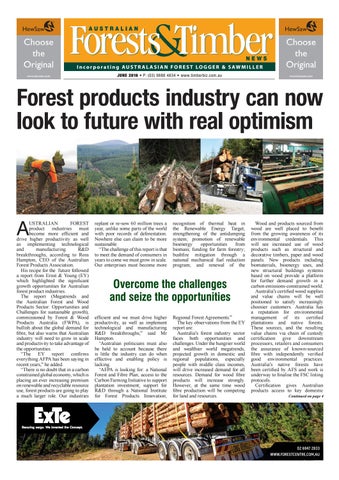
Forest products industry can now look to future with real optimism
A
USTRALIAN FOREST product industries must become more efficient and drive higher productivity as well as implementing technological and manufacturing R&D breakthroughs, according to Ross Hampton, CEO of the Australian Forest Products Association. His recipe for the future followed a report from Ernst & Young (EY) which highlighted the significant growth opportunities for Australian forest product industries. The report (Megatrends and the Australian Forest and Wood Products Sector: Opportunities and Challenges for sustainable growth), commissioned by Forest & Wood Products Australia (FWPA), is bullish about the global demand for fibre, but also warns that Australian industry will need to grow in scale and productivity to take advantage of the opportunities. “The EY report confirms everything AFPA has been saying in recent years,” he added. “There is no doubt that in a carbon constrained global economy, which is placing an ever increasing premium on renewable and recyclable resource use, forest products are going to play a much larger role. Our industries
replant or re-sow 60 million trees a year, unlike some parts of the world with poor records of deforestation. Nowhere else can claim to be more sustainable. “The challenge of this report is that to meet the demand of consumers in years to come we must grow in scale. Our enterprises must become more
recognition of thermal heat in the Renewable Energy Target; strengthening of the antidumping system; promotion of renewable bioenergy opportunities from biomass; funding for farm forestry; bushfire mitigation through a national mechanical fuel reduction program; and renewal of the
Overcome the challenges and seize the opportunities efficient and we must drive higher productivity, as well as implement technological and manufacturing R&D breakthroughs,” said Mr Hampton. “Australian politicians must also be held to account because there is little the industry can do when effective and enabling policy is lacking. “AFPA is looking for: a National Forest and Fibre Plan; access to the Carbon Farming Initiative to support plantation investment; support for R&D through a National Institute for Forest Products Innovation;
Regional Forest Agreements.” The key observations from the EY report are: Australia’s forest industry sector faces both opportunities and challenges. Under the hungrier world and wealthier world megatrends, projected growth in domestic and regional populations, especially people with middle class incomes, will drive increased demand for all resources. Demand for wood fibre products will increase strongly. However, at the same time wood fibre production will be competing for land and resources.
Wood and products sourced from wood are well placed to benefit from the growing awareness of its environmental credentials. This will see increased use of wood products such as structural and decorative timbers, paper and wood panels. New products including biomaterials, bioenergy uses, and new structural buildings systems based on wood provide a platform for further demand growth in a carbon emissions-constrained world. Australia’s certified wood supplies and value chains will be well positioned to satisfy increasingly choosier customers. Australia has a reputation for environmental management of its certified plantations and native forests. These sources, and the resulting value chains via chain of custody certification give downstream processors, retailers and consumers the assurance of known-sourced fibre with independently verified good environmental practices. Australia’s native forests have been certified by AFS and work is underway to finalise the FSC listing protocols. Certification gives Australian products access to key domestic
Continued on page 4
OPERATOR SUSPENDED IN COMFORT REDUCING FATIGUE CAT® ARM FEATURES INNOVATIVE "SEMI-ACTIVE" TECHNOLOGY
LOCK-UP TORQUE CONVERTER MAXIMIZES PRODUCTIVITY AND SPEED
EXPERIENCE A SMOOTH RIDE EVEN WITH HIGH PLY TIRES
Maximize Operator Efficiency and Profit Potential with
Cat Advanced Ride Management System ®
“I never feel the seat hit the stops anymore, which helps my back feel a good deal better at the end of the day.” Casey Bowan Bowan & Sons Logging Danville, Georgia
Loggers first impressions after experiencing the Cat® Advanced Ride Management (ARM) System tell the story. The ARM system virtually eliminates "end stop" events and reduces accelerations the operator may be exposed to by up to 80%. The result is unparalleled operator comfort and the opportunity to consider extended shifts or even high ply tires, potentially improving tire life while maintaining a superior ride. Look to your Cat dealer for financing and all the machines you need for sustainable harvesting and land management, forestry road construction, hauling and millyard. Total support from one source. www.cat.com/forestry
© 2016 Caterpillar. All Rights Reserved. CAT, CATERPILLAR, BUILT FOR IT, their respective logos, “Caterpillar Yellow,” the “Power Edge” trade dress as well as corporate and product identity used herein, are trademarks of Caterpillar and may not be used without permission. www.cat.com www.caterpillar.com
In the news I n c o r p o r a t i n g A U S T R A L A S I A N F O R E S T L O G G E R & S AW M I L L E R
June 2016 Issue 4 Vol. 25 Established 1991 Features In The News IndustryEdge Bioenergy Tyres Technology Kilns Head-Lines
3-16 10 18-19 20 21 22-23 24-25
Publisher and Chief Executive: Hartley Higgins General Manager: Peter Muscet Editor: John Hudswell j.hudswell@ryanmediapl.com.au Adelaide Office (08) 8369 9512 Advertising: Michael Dolphin m.dolphin@ryanmediapl.com.au Melbourne Office (03) 9888 4834 Production: Luke Westle Trader classified: m.dolphin @ryanmediapl.com.au Melbourne Office (03) 9888 4834 Subscriptions: subs@forestsandtimber.com.au Adelaide Office (08) 8369 9522 Subcription rates One-year (8 editions) $55 Two-years (16 editions) $95 Accounts: Adelaide Office (08) 8369 9555 Postal Address: 630 Regency Road, Broadview South Australia 5083 Phone: (08) 8369 9555 Fax: (08) 8369 9501 Melbourne Office: Suite 103, 486 Whitehorse Road, Surrey Hills, Victoria, 3127, Phone: (03) 9888 4822 Website www.timberbiz.com.au Printed by Lane Print, Adelaide, SA Conditions The opinions expressed in Australian Forests & Timber News are not necessarily the opinions of or endorsed by the editor or publisher unless otherwise stated. All articles submitted for publication become the property of the publisher. All material in Australian Forests & Timber News copyright © Ryan Media. All rights reserved. No part may be reproduced or copied in any form or by any means (graphic, electronic, or mechanical including information and retrieval systems) without written permission of the publisher. While every effort has been made to ensure the accuracy of information, the published will not accept responsibility for errors or omissions, or for any consequences arising from reliance on information published.
MEDIA
INDEPENDENT & AUSTRALIAN OWNED
www.timberbiz.com.au
Forest industry vision for the future
A
S S I S T A N T MINISTER for Agriculture and Water Resources, Senator Anne Ruston, has welcomed the release of a Forest Industry Advisory Council (FIAC) paper that maps out priorities and goals for the future of the Australian forest industry. Minister Ruston said she would carefully consider the recommendations of the FIAC report in consultation with other relevant state and territory counterparts and industry stakeholders. “The forest industry is vital to our regional communities, with its direct value to Australia’s gross domestic product having risen 10% to $7.7 billion between 2012/13 and 2013/14, and it’s an industry that employs 64,300 people, mainly in regional Australia,” Minister Ruston said. “Our forests provide significant economic and environmental benefits to all Australians—so we need a clear plan for how we manage our forests into the future to capitalise on the opportunities before us. “The FIAC paper looks to the future with its vision: ‘the forest industry will lead the transition to a bio economy of which Australians can be proud.’ The report also lays out three objectives, eight strategies and 19 recommendations to industry and government to achieve this vision. “It looks at the industry’s goals and objectives out to 2050, and the Coalition will now carefully consider FIAC’s recommendations.” Minister Ruston congratulated FIAC in preparing and driving this national plan. “FIAC has done an outstanding job in preparing and presenting this work,” Minister Ruston said. “They consulted widely and stimulated discussion and ideas from industry, government and key stakeholders, and their issues paper received almost 80 submissions. “While there will be a role for government to play in assisting industry in positioning itself for a vibrant future, ultimately the industry must work together to achieve the vision for Australia’s forest industry—and FIAC has been critical in bridging
Bid to triple economic value of forest industry by 2050 the gap between industry and government. “The Coalition’s objective is to create a stable, sustainable business environment that encourages innovation and investment in the future of this carbon-positive industry. “We are achieving that by investing $4 million in the National Institute for Forest Products Innovation, continuing our commitment to rolling 20 year Regional Forest Agreements, making funds available for research and development, implementing our threeyear $15 million Bushfire Mitigation Program and working to combat illegal logging at home and abroad.” Rob de Fégely, Co-Chair of FIAC, said the goal of the plan was to triple the economic value of the forest industry by 2050. “We will achieve this by implementing three major objectives. “First, we will have the right trees in the right place at the right scale. The forest industry has not always developed its forest resources as sympathetically as we should have, and
we are keen to ensure that new development is wisely integrated with agriculture and rural communities. “Second, we will produce bio-products using all parts of the tree to a cellular level. It is critical that we maximise the use of all the wood that is harvested to not only optimise returns but limit waste. Almost any product that is made from fossil fuels can be made from wood and we see an exciting future for new bio based products such as fuels, solvents, plastics and pharmaceuticals as well as innovations in more traditional wood products such as engineered wood. “Third, we will distinguish ourselves by being environmentally friendly, socially responsible and valued by the community. Our production forests are very public and we are keen to continue improving our environmental management and communication so that our rural neighbours and the Australian community at large understand and appreciate what we can do for our economy and the environment.”
¢ Rob de Fégely, Co-Chair of FIAC.
FIAC developed eight strategies and 19 targeted recommendations that will transform the industry, leading to a new bio-economy that will assist Australia’s current and future challenges to 2050. The Forest Industry Advisory Council was set up by former Parliamentary Secretary for Agriculture Senator Richard Colbeck and later capably taken on by Senator Anne Ruston. FIAC was designed to bring together a group of forest industry participants with a wide range of experience to provide a blend of thought and insight on where the industry can provide economic, environmental and social value to the community.
Off the shelf solutions, customised for your mill For over 100 years, we’ve been engineering solutions for the timber industry. In that time, we’ve designed and built a range of equipment proven to improve mill productivity. But we’ve yet to meet a client who didn’t need some modifications to make even the best equipment fit their particular space and needs. Contact us for a quote to make your mill even more productive.
• manufacturing • sawmilling equipment • log carriages • resaws • multisaws and board edgers • automatic sorters and stackers • transfers and conveyors. Complete turnkey projects.
Australian Forests & Timber News
June 2016
From major start-ups to retro-fits, if you want professional service and advice, contact us.
AE Gibson & Sons Phone 02 6559 4001 Email: info@aegibsonman.com.au www.aegibsonman.com.au
3
In the news
Industry can now look to future with real optimism and international markets. It also helps to make Australian-sourced products more attractive to the choosier customers found in these markets. However, certification doesn’t generate price premiums. Domestic and international producers are also keen to emphasise wood’s other benefits to choosier customers. Wood’s excellent environmental and carbon credentials relative to other building products is being better promoted and accepted in the marketplace. Transformative technologies offer the prospect of improving forest management and wood fibre processing. Some companies are using technologies to create and share data on key wood attributes as a way to extract maximum value from the wood resources available to the value chain. Examples include new structural products that extend the reach of wood products into uses currently dominated by steel and concrete. New technologies will also create new uses for wood fibre and hence new markets. These new markets can then create new value for forest owners. Globalisation and the bumpier ride megatrends expose Australian consumers and industries to increasingly volatile international markets. While Australia is a net exporter of wood fibre (by volume), it remains a net importer (in value terms) of manufactured wood fibre products. The challenge for the domestic forest industry sector will be to respond to the resulting increased demand and changing product mix. Australian consumers will face increased competition (and prices) for imported wood fibre products. Consumers and domestic producers will also be affected by increased competition for domestic fibre. Many of the precursor requirements for key industry participants to be able to respond are not in place. Some of these, such as increasing softwood log supply, will take decades to have an impact. While there will be strong demand for wood fibre, the key question is how much of this will be processed domestically? There is sufficient supply available to potentially service scale manufacturing plants for a variety of products including panels, sawn wood and bioenergy (pellets). However, other uncommitted fibre supplies, such as in Tasmania, are mainly hardwood pulpwood that does not fit well with the product/ scale processing opportunities to service the domestic market. Australia has not been able to create needed investment to expand plantations in key wood supply areas to maintain industry competitiveness. The strong growth in domestic and regional fibre demand has not led to a 4
commensurate growth in fibre sources within Australia. The area of public native forests designated for wood supply has continued to be reduced by respective state governments. The rate of plantation forest establishment has also declined over the last decade. The rate of new softwood plantation expansion has been low for several decades. The rate of new hardwood plantation expansion has turned negative with up to an estimated 40% of the ex-MIS hardwood plantation estate returned to other land uses over the next decade. Despite this conversion, New Forests estimated the Australian industrial plantation estate could again reach 2 million ha by 2030 if circumstances combine to make greenfield plantation projects more attractive. Achieving this outcome would require planting of up to 400,000 ha of new plantations to replace the areas progressively lost from the exMIS estate. This equates to an annual planting of 26,000 ha for the next 15 years. However, there are currently no large scale planting programs in place, and no government (Commonwealth, State or Territory) frameworks to foster such programs. The TIMO model as currently practised, with mainly closed-end 10-15 year investments, is unsuited to taking on the longer rotations required for softwood plantations. However, the TIMO model may already be adapting to the lack of new candidate timberland acquisitions, and these changes may extend investment horizons. This raises questions such as: • How can Australia attract the capital or long term investments that at best yield between 4-7% over the life of the rotation? • How can returns be improved to make the investment more attractive? • Reduce land value return expectations (via farm forestry?) • Increase plantation productivity, especially of more valuable stronger, parts of the log yield profile. • Improve utilisation, capture all the fibre produced and direct logs to highest and best uses to maximise the returns per unit area. • Concentrate new plantings in areas accessible to existing processing hubs, especially those constrained by fibre shortages. • Diversify the sources of income from (especially plantation) forests to include carbon sequestration, wildlife habitat and other environmental services that hitherto have not been paid for. Responding to the opportunities and challenges from the megatrends will require changes in operating models for key value chains. Australia’s forest industry value chains would benefit from
strengthening lines of communication among stages of the chain and with customers. The decisions as to where to plant, what to plant and how to manage the resulting stands of trees all have a significant bearing one, two, or more decades later on the types, qualities, and quantities of logs yielded. These factors drive
Continued from page 1
the options for products, scale of processing plant, and ultimately the economics of downstream processing. The most successful chains share an understanding of key value drivers, and of the opportunities to manage them. Flexibility to adapt, and a commitment to innovation are also key attributes.
Key points • Asia will experience a growing fibre deficit as the region’s middle class population exceeds 3.2 billion people within 15 years. • Asia has very limited opportunities to expand fibre supplies from domestic sources. • Growth in Australia’s population will itself create incremental demand for wood fibre-based products. However, imported wood products will continue to capture significant shares of this growing market. • Expansion of existing domestic manufacturing capacity is often constrained by a lack of incremental fibre supplies, making it difficult for investments to achieve competitive scale and technology and limiting companies’ ability to pay for fibre.
Australian Forests & Timber News
June 2016
• Australia’s domestic processors have been unable to capture opportunities to add value to export-oriented fibre supplies that are now shipped in relatively unprocessed forms (chips and logs). • Available, accessible land will be increasingly directed to food production. • There are areas with incremental fibre supplies and forest owners are seeking to identify possible manufacturing partners to invest in new processing capacity. Owners in the Green Triangle Region have combined resources to create a competitive ongoing quantity of fibre.
www.timberbiz.com.au
THE NEW H415X
YOU ASKED. WE LISTENED.
Purpose-built for tracked harvesters, the durable H415X is everything you asked for – and more. It features a rugged main saw box, extra component guarding and increased drive arm durability to maximize uptime. The feed arm geometry ensures the right grip in all diameters, and coupled with a high performance valve and the new TimberRite™ H-16 system, it provides unprecedented tree processing performance – especially in large timber. Additionally, an upgraded multi-tree handling device and integrated top saw options are available to maximize operational productivity. You asked, and we’re delivering with more uptime and productivity. www.Waratah.com
Melbourne
24/7 Hotline 03 9747 4200
Bunbury WA
24/7 Hotline 08 9726 0411
www.waratah.net
In the news
Tasmanian Regional Forest Agreement delivering for the State
T
A S M A N I A’ S REGIONAL Forest Agreement (RFA) has been found to be delivering on its major commitments, and continues to provide a sound framework for the sustainable management of Tasmania’s forests. However, in NSW it’s a totally different case with one report claiming the RFAs were deemed to be a failure as a model for native forest management. Assistant Minister for Agriculture and Water Resources, Senator Anne Ruston, and Tasmanian Minister for Forestry, Peter Gutwein, released the joint Australian and Tasmanian Government response to an independent review of the RFA, and said both governments agreed, in part or in full, to all recommendations presented in the independent review. “The review, conducted by Dr Glen Kile, a wellrespected former CSIRO scientist, found that this RFA has been working as it should and is providing a sound framework for managing Tasmania’s forest resources sustainably,” said the Senator. “Today’s response also
6
“This review process has shown that we’ve been managing this resource sustainably, and with the widest possible benefits to the Tasmanian community." concludes the third fiveyearly review of this agreement, and allows us to begin the process of extending this RFA to a rolling 20-year agreement, in line with our election commitment. “The review will inform our approach to establishing a rolling 20-year agreement, which will deliver resource security and investment certainty to the industry. “We are absolutely committed to achieving a balance of economic, environmental and social outcomes for Tasmania through our management of forests, and the RFA is providing the mechanism to achieve those outcomes,” Senator Ruston said.
¢ Senator Anne Ruston.
¢ Dr Glen Kile.
“As an industry that contributed $7.7 billion in direct value to Australia’s gross domestic product in 2012–13, it is important we continue to support the forest sector into the future. “The Australian Government recognises the significant contribution the industry makes to Tasmania, and Australia as a whole, and we’re committed to providing the right environment for the industry to continue to flourish.” Minister Gutwein said this was another important milestone in Tasmania’s management of its forest resources. “It’s clear the forest industry is a major contributor to the State’s economy as well as providing employment opportunities in regional areas,” Minister Gutwein said. “This review process has shown that we’ve been managing this resource sustainably, and with the widest possible benefits to the Tasmanian community.” The Australian Forest Products Association (AFPA) has welcomed the joint Federal and Tasmanian Governments response to the independent review of the Tasmanian Regional Forest Agreement (RFA) and their commitment for its renewal. “AFPA welcomes the Federal and Tasmanian Governments’ agreement to the independent reviewer’s recommendations and their strong commitment to extend this RFA to a rolling 20-year agreement,” said Ross Hampton, AFPA’s Chief Executive Officer. “RFAs provide a framework for the sustainable management
of Australia’s forests that ensures best practice environmental standards flourish, while providing a level of certainty of supply to industry that underpins investment, supports innovation and creates jobs. “Every year our industries only access half of one percent of the naturally regrowing forests of Australia. Forest managers are determined that everything they do will be sustainably managed to the highest standards. RFAs provide a world-class, science-based framework to achieve that. It is good news that this third independent review has been completed in Tasmania and it is important that our political leaders implement a renewal process for all the RFAs without delay,” said Mr Hampton. “It must be noted that RFAs in Victorian, New South Wales and Western Australia are well behind the review schedule. The NSW report, developed by the National Parks Association and the NSW Conservation Council, said the agreements had failed, wholly or substantially, to meet any of their goals. RFAs have formed the basis for native forest management in NSW for the past 17 years. The report’s author Dr Oisin Sweeney said the agreements had allowed logging to take place in some of the most biologicallydiverse forests in the world. “To log forests with such extraordinary environmental values is completely contrary to the aims of the RFAs in terms of sustainable forest management,” he said. “We’re logging two global biodiversity hotspots and
Australian Forests & Timber News
June 2016
there are only 36 of them worldwide. “This should be enough to make us sit up and realise logging is really incompatible with those biodiversity values.” The National Parks report comes just one month after analysis by the Australia Institute found native forest logging would be more profitable if the trees were left standing. “Every effort that a logging company makes to protect the environment, such as looking for koalas or protecting habitat features, adds a cost to the wood that they produce,” Dr Sweeney said. “The number of jobs is continuing to decline and demand for wood products is in terminal decline. “Really, across the board, economically and environmentally the RFAs are a failed model.” Dr Sweeney said if the Government chose to extend the RFAs in 2019 without a thorough review, the decision would be purely ideological. Ross Hampton was quick to point out that the RFAs were the result of years of scientific study, consultation and negotiation covering a diverse range of interests. “RFAs provide a framework for the sustainable management of Australia’s forests that ensures best practice environmental standards flourish, while providing a level of certainty of supply to industry that underpins investment, supports innovation and creates jobs. “Regional Forestry Agreements (RFAs) are 20year agreements between the Federal and State Governments, intended to underpin the balancing of wood production, conservation and other forest values and uses in Australia’s managed native forests, while ensuring the sustainability of forest management practices. “Industry continues to urge all major political parties to extend the life of the RFAs, by establishing a 20-year rolling life for each agreement,” said Hampton. www.timberbiz.com.au
LH855C
M726E
635D
630D
LH830C
Built for Australian loggers.
LS855C
1075B
Full range of equipment. Supported by forestry specialists. 855C + DT2003
TASMANIA 130 Brighton Road, Brighton
L830C + 5185
220D
NEW SOUTH WALES
SOUTH AUSTRALIA
VICTORIA
WESTERN AUSTRALIA
208-216 Snowy Mountains Highway, Tumut
117 Crouch Street North, Mount Gambier
1-5 Marlo Place, Hallam
12 Sherlock Way, Davenport
Give us a call or visit our website to see how we can be of help.
1300 727 520 – WWW.ONETRAK.COM.AU
In the news
Try a Skill highlights wood and forestry work
S
KILL, ACCORDING to the dictionary, is the ability, coming from one’s knowledge, practice, aptitude, etc., to do something well. However, it’s how and when you get the chance to hone those traits that makes a world of difference. And that leads to one of the latest “enticers” for the future workforce. Try a Skill, a series of events held around Australia organised by World Skills, (which is a global careers awareness program) was held recently in Burnie, Tasmania, and from a forestry perspective it was somewhat of a hit. “Student interest in what forestry has to offer was inquisitive to start but certainly during our presentation that curiosity quickly turned into further questions on pathways and further education options for entry into our Industry,” said Col McCulloch, Project Manager, Arbre Forest Industries Training and Careers Hub. “We have utilised information on pathways and industry sector jobs and careers provided by ForestWorks, and this information, in conjunction with the ability to try a skill
through the Simulators, is a very easy way to explain not only the size of the forest industry in Australia through each of the six sectors, but also the ability to talk with teachers and students about how much more there is to career and job opportunity and what the expectations are from employers in our industry,” he said. “To our best knowledge, this was the first such event to include forestry as a career and certainly the first time students at these national events have been able to actively try their
skills on a simulator. “The organisers of this event were excited at what we had to offer and we were acknowledged to have been the best exhibit at the show. “We were invited to appear at the next event, which will be held in Hobart on 29 June,” Col said. He said that Tasmania’s wood and forestry industry had changed and now needed more people equipped with the right skills and attitudes than has been required in the past.
¢ Sarani Woodhouse, from Woodhouse Transport, discussing how to integrate learning and training options while working through the ForestWorks chart on all six sectors of industry.
Vale David Drane
Communications role with AFPA YELENA RAMLI has joined the AFPA team as the new Communications and New Media Officer from 9 May 2016. A Malaysian at heart, she comes on board with a diversified background in online and print publication, advertising and corporate communications, having worked with one of Malaysia’s largest infrastructure companies in her previous role before making the move to Canberra recently. She graduated from the University of Canberra in 2011 with a Bachelor of Journalism and can be contacted at yelena.ramli@ ausfpa.com.au or 0409 962 250. 8
¢ Sam Hall, Arbre Hub coordinator, discussing with students the processes for operating machinery through Simulators.
¢ Students are given options on higher education levels as well as career and job advice at the Arbre Hub stand.
FORMER AUSTRALIAN Forest Contractors Association (AFCA) General Manager David Drane passed away in May after a long battle with cancer. David was employed as general manager of AFCA from 01/07/08. However, he did do some administrative work with AFCA for at least a few months before then. After retiring in February 2014 David was involved in the initial organisation of the 2016 Hall of Fame dinner. He worked on getting as many inductees identified as possible and the success of the night was due in part to his preliminary work. “Unfortunately, David’s health deteriorated early this year and he was unable to attend the HOF function where he was to be presented with a certificate of appreciation for services to our in industry by AFCA. This award was announced on the night and I presented the certificate to David a few days later,” said AFCA Chairman Ian Reid. “Having also been apart or the initial process in bringing AUSTimber2016 to Gippsland he followed the event closely and was pleased to hear of its success.
Australian Forests & Timber News
June 2016
¢ David at AUSTimber 2012.
“David was one of nature’s true gentlemen and he will be remembered for having our industry at heart. His diligence and organisational and administrative skills were always appreciated by both the AFCA directors and members alike.” www.timberbiz.com.au
A NEW GENERATION OF
FOREST MACHINES NOW IN AUSTRALIA!
RANDALLS EQUIPMENT COMPANY is proud to be associated with PONSSE Plc Finland by introducing the full range of PONSSE forestry machines to Australia. PONSSE is the world leader in supplying the logging industry with productive and environmentally friendly cut-to-length harvesting systems. CONTACT US FOR MORE INFORMATION RANDALLS EQUIPMENT COMPANY PTY LTD email: randalls@randalls.com.au www.randalls.com.au HEAD OFFICE VICTORIA Randalls Equipment Company 8 Wallace Avenue, Point Cook, Melbourne VIC Contact: Peter Randalls Ph: 03 9369 8988 WESTERN AUSTRALIA (NEW) Randalls Equipment Company 9B Charles Street, Albany WA Contact: Adam Bremner Ph: 0437 059 477
FORWARDERS: From 10.000 to 20.000 kg load capacity. HARVESTERS: PONSSE offers a full range of wheeled harvesters for the most challenging logging conditions. Six impressive models that range from the Beaver to the heavyweight Bear, including the new and very impressive ScorpionKing. The product range includes both six and eight-wheel harvesters in all size categories. Application ranges from harvesting softwood saw logs to harvesting & debarking eucalypt pulpwood.
A logger´s best friend www.ponsse.com
INDUSTRY EDGE
Wall of wood hits harvest and wharf
A
USTRALIA’S LONG-awaited ‘wall of wood’ has finally arrived and is now being harvested and exported at record pace and volumes. While the focus is on hardwood pulpwood, softwood has not been left behind. In the March Quarter of 2016, almost 1.6 million bone dry metric tonnes (bdmt) or something close to 3.2 million green tonnes of hardwood chips were exported from Australia. To place this quarterly record export volume into context, exports were almost 17% higher than the prior quarter’s 1.4 million bdmt, which was the highest quarterly export volume in more than seven years. As Figure 1 from IndustryEdge’s monthly Wood Market Edge shows, exports of hardwood chips have been growing steadily for more than two years. Fig. 1: Australian Hardwood Chip Exports: MQ’09 – MQ’16 (kbdmt) 1,600
In the March Quarter, Japan received 520.8 kbdmt (37.7%) of Australia’s hardwood chips, while China received 857.9 kbdmt (62.3%). In MQ’15, Japan’s proportion was 46.4%, demonstrating that China has continued to grow its position as the major destination for Australia’s hardwood chip supplies. Diversification is proving to be invaluable for Australia’s exporters, especially as their higher-yielding fibre is particularly sought after. Supporting the export explosion, more and larger woodchip ships are making their way to and from Australian ports each quarter. Using vessel tracking systems confirms that since the September quarter of 2013, the number of ship movements plying the Australian woodchip trade has doubled and seems to be continually increasing. Figure 3 shows the rapid growth in the number of woodchip ships that have departed Australian ports in each quarter.
At a glance Tim Woods is Managing Director of IndustryEdge, Australia’s leading market analysis firm in the forestry and wood products sector. The firm is publisher of the monthly Wood Market Edge and the biannual Forest & Wood Strategic Review. The 2015 edition of the Strategic Review has just been released. Go to www.IndustryEdge.com.au or call +61 3 5229 2470.
Fig. 3: Woodchip Vessel Departures from Australian Ports: MQ’09 – MQ’16 (No.)
1,400 1,200
70 65
800
60
Fig. 2: Australian Hardwood Chip Deliveries by Country: MQ’09 – MQ’16 (kbdmt) Taiwan
1,400
China
1,200
Japan
kbdmt
800 600 400 200
Quarter
Source: GTIS & IndustryEdge research 10
6 '1 Q M
5 '1 JQ
'1 4
3
3 '1
'1
SQ
DQ
Q
2 '1 JQ
M
'1 1 SQ
0 DQ '1
'1 0 Q
'0 JQ
M
9
0
600
Quarter
500 400 300
Source: IndustryEdge research
200
June 2016
100
'1 6
4
5 '1
Q M
JQ
'1
3
2
1
'1 3
'1
SQ
DQ
Q
'1
M
JQ
0
'1 SQ
'0
9
0 JQ
While the trend growth in the number of ships carrying Australia’s woodchips is significant, it has likely peaked or come close to peaking in the March quarter. This shipping data is confirmed by recent assessments of the pace of the harvest in certain regions of Australia. Our analysis indicates that in most regions, the harvest is faster than the current harvestable age of the trees suggests it would be. This most likely means that after several slow years, plantation owners are harvesting trees that are past their maturation and preferred harvest date, but for which the markets (and harvest and export infrastructure) have only recently made harvesting an appropriate option. IndustryEdge is aware of at least two regions in which the rate of harvest and export of hardwood chips is still growing. In at least one case, peak harvest will only be reached at the end of 2017 and will then be sustained at that rate for up to 10 years. While softwood chip exports are generally consistent (though there were none recorded for the month of March 2016), they are an arising from softwood log processing and are therefore fundamentally limited. However, the same is not the case for softwood logs, exports of which have also been very high in recent months. As Figure 4 shows, softwood log exports peaked at 822.9 km3 in the December quarter of 2015, falling back to a still very large 741.6 km3 in the March quarter. Australian Forests & Timber News
km3
'1 6 Q
M
5 '1
'1 5
DQ
'1 5
'1 5
SQ
JQ
Q
M
4 '1
'1 4
DQ
'1 4
'1 4
SQ
JQ
'1 3
Q
M
'1 3
30 SQ
Most of the export volume is from purpose grown plantations, with native forest supply now significantly and permanently reduced. The plantation hardwood estate – largely established through the Managed Investment Schemes – has optimal harvest years between 12 and 15 years depending on location and species. There is undoubted pressure to get trees out of the ground, through the chipped and onto ships as soon as trees reach maturation. However, demand is also a driver and for Australia’s high quality supply of plantation eucalyptus woodchips (both E.Globulus and E.Nitens), that demand remains very strong. Over the years, demand has diversified from a single destination – Japan – to include China. As Figure 2 shows, Australia’s hardwood chip supply is now split between Japan and China.
1,000
700
35
Source: ABS & IndustryEdge research & estimates
1,600
800
40
0
Quarter
900
45
'1
6
5
'1 Q
'1 JQ
M
4 '1
3 '1
SQ
'1
3
DQ
2
M
JQ
Q
1
'1
'1
0 '1
SQ
DQ
Q M
JQ
'0
'1
9
0
0
Fig. 3: Australian Softwood Log Exports: MQ’09 – MQ’16 (km3)
50
DQ '1
200
55
Q
400
M
Departed Ships
600
DQ
kbdmt
1,000
Quarter
Source: ABS These logs are deployed for solid wood products, including sawnwood and veneers for plywood. End-use is the interesting distinction between Australia’s booming raw wood exports. Hardwood chip exports are destined for the manufacture of pulp and ultimately paper, in general. Softwood logs are destined for houses and industrial products such as pallets and container floors. The nation’s wall of wood is being harvested and much of it is being exported. The important question is what proportion will be replanted, to supply future domestic and global markets and product needs. Expectations are that the softwood plantations from which the logs are derived will almost entirely be replanted. The hardwood pulpwood plantations are a different matter and by some estimates, as much as half will not be replanted. Booming raw wood exports seems a boon right now, but the implications for the future are less certain. www.timberbiz.com.au
INTRODUCING THE NEW & IMPROVED
SP 591 LX G3
The G3 is the third generation of the popular SP 591 LX purpose built debarking head. With an increased protection of hoses and cylinders as well as an improved hose routing the G3 offers an improved uptime and reliability. The G3 also offer a separate length measuring unit for operations requiring very accurate length measuring results. The length measuring unit can be combined with the standard measuring in the feed roller, offering the possibility to instantly switch measuring type by the press of a button. tree forms from the G2 version not have been changed on the G3, we promise!
Head Office Victoria Randalls Equipment Company 8 Wallace Avenue, Point Cook, Melbourne VIC Contact: Peter Randalls Ph: 03 9369 8988
Randalls Equipment Company Pty Ltd
Email. randalls@randalls.com.au www.randalls.com.au
Western Australia (NEW) Randalls Equipment Company 9B Charles Street, Albany WA
Contact: Adam Bremmer Ph: 0437 059 477
In the news
Woodchip port severely damaged in storm
W
AVES OVER 17 metres high, associated with the once-in-a-lifetime storm event that hit the coast of NSW early in June caused catastrophic damage to the port facility at Twofold Bay in Eden. The wood chip loading facility, operated by Allied Natural Wood Exports (ANWE) was extensively damaged, with most of the jetty and conveyor structure washed away. “Until sea conditions subside we will not be able to establish the total extent of the damage, including whether any further damage has been inflicted on the ship loader and mooring buoys,” said ANWE Chairman Malcolm McComb. The operation at ANWE is a major contributor to the regional economy, generating approximately $1 million per week of much needed economic activity. “The export facility is at the end of a supply chain that supports around 600 jobs in the local region. The disruption to our operations will not just affect the ANWE workers, but also harvest and haulage contractors, allied service industries and sawmills in the region,” said Mr McComb. This major disruption to the woodchip loading facility will have a huge impact on the local community of Eden and surrounding areas. “Government assistance is urgently needed to help to keep this important local industry working. Up to 80 immediate jobs are in jeopardy, with a possible 4060 jobs also at risk in the coming weeks. “Planning is under way to develop a temporary repair of our existing loading facility, but this could take up to 3 months. The company is also looking at options to load non-conventional woodchip vessels from the nearby multipurpose wharf using a mobile loader and truck shuttle,” Mr McComb said. Local member for the State electorate of Bega, Andrew Constance, and Federal member for Eden-Monaro, Dr Peter Hendy, have visited the facility. Both have been extremely proactive at government level to get the woodchip loading facility operational as soon as possible. The need for action is urgent, as the loss of capacity to export woodchip from the ANWE facility has coincided with a period of very high woodchip stock levels, with three vessels scheduled to be loaded over the next six weeks. At this juncture the company is unable to take delivery of harvested feed stock from either
12
¢ Damage to jetty and conveyor at Allied Natural Wood Exports facility.
Forestry Corporation of NSW or VicForests. Other businesses in the region rely on the continued integrated logging operations undertaken by ANWE contractors for their survival. The export woodchip facility first commenced operations in 1970 and over the past 45 years has exported more than 36 million tonnes of wood chips to Asian countries, generating over $2 billion of economic activity in the local regional economy. The storm damage has also increased the urgency to finalise the Eden and East Gippsland Regional Forest Agreements (RFA) and bring stability to the forest industry, particularly in the South East of the state.
“The RFAs provide a framework for the sustainable management of Australia’s forests that ensures best practice environmental standards flourish, while providing a level of supply certainty to industry that underpins investment, supports innovation and creates jobs,” said Ross Hampton, Chief Executive Officer of the Australian Forest Products Association (AFPA). “RFAs provide a science-based framework that represents world’s best practice in the sustainable management of our native forests. It is important that the RFAs continue to ensure forest management practices are not just sustainable, but also achieve high environmental outcomes for our forests. “With the East Gippsland RFA and
Australian Forests & Timber News
June 2016
the Eden RFA nominally expiring in 2017 and 2019 respectively, there is increasing uncertainty around the future of the native forest industry in the southeast of the State,” Mr Hampton said. It is essential that the two RFA reviews get back on track and are finalised, so that the renewal process can begin. “While the disruption to the ANWE woodchip loading facility at Eden provides significant short-term challenges to the forest industry in the South East of NSW, it is important that the RFA reviews are finalised and rolled over for another 20 years to provide certainty for the industry to allow them to invest and grow this sustainable industry into the future,” Mr Hampton said. www.timberbiz.com.au
In the news
Australia’s three-fold increase in China log market
C
HINESE LOG imports have trended upward in early 2016 with Australia increasing its market share the most, according to the Wood Resource Quarterly. Increased demand for wood products and declining log inventories in China has resulted in higher importation of logs to China in the 1Q/16. Australia has increased its shipments almost three-fold in three years and currently, 10% of all softwood logs unloaded in Chinese ports are from Australia. Softwood log imports to China picked up in March to the highest level in 12 months. The total import volume for the first quarter of 2016 was just over seven million m3, which was about 2% higher than in the 1Q/15. With declining log inventories at the Chinese ports (about
40% lower this year than the same time last year), and an uptick in demand for wood in the domestic market, importation of logs has been trending upward since last fall when import volumes were the lowest in almost three years. The real estate market in China has been strong so far in 2016, and the sector has been the fastest-growing sector in a relatively shaky economy. Newly built houses in the largest cities in March were up almost 30% as compared to the same month of 2015. Although China does not use as much wood per housing start as is the case in North America, Europe or in Japan, there are still large volumes of wood consumed, particularly lumber for concrete forming. New Zealand and Russia continue to be the major
suppliers of logs to China, together accounting for almost 70% of all imports. In the 4Q/15 and 1Q/16, New Zealand fell behind Russia after having been the major supply source for almost three years. Perhaps the most interesting development the past few years has been Australia’s increased presence in the Chinese log market. In three years, Australia has increased its log shipments almost three-fold to China and the country now has a ten percent market share, equal to that of the US. Over the past three years, Australian logs have consistently been at the low-end of the cost curve with the 1Q/16 CIF average prices being slightly lower than for Russian logs and 12% below the average price for imported logs.
FIN COM AN PE CE TIT AV IVE AIL AB LE
NOW DISTRIBUTED IN AUSTRALIA
proudly made in
NZ
SINCE 1965
Fully Rotating Grapples
Bunching Grapples
Ensign Log Forks and Log Grapples can be custom made to suit customers requirements.competitive finance arranged* Standard Grapples Contact us to develop a customised solution that will meet your needs. The first ENSIGN Log fork was produced in 1965. ENSIGN Log Forks are now manufactured for all Wheeled (FrontEnd) Loaders from machines weighing just 2-3 tonnes to the largest 80 and 90 tonne machines. All Log Forks can be custom made to suit exact customer log handling situations. Design options include fixed and pivoting tines, hydraulic log kicker arms, auxiliary clamp arms, bucket locking mechanisms, high lift models and Quick Coupler mounts.
The first ENSIGN rotating grapple was produced in 1995. Fixed Top Grapples Since then hundreds of rotating grapples have been Saw Grapples competitivefinance available* produced mainly for log handling but the ENSIGN range Log Forks also covers grapples for materials such as greenwaste, rocks Pallet Forks and scrap steel. ENSIGN can supply any grapple type for Pipe Handling Forks machines from 8 tonne up to the largest available machines Buckets proudly for high capacity log handling operations.
For product and sales enquiries contact GB Forestry P: 03 8353 6655 E: office@gbforestry.com.au or visit us at... www.gbforestry.com.au
www.timberbiz.com.au log_grapple_hp_1.indd 1
Australian Forests & Timber News
EXCLUSIVE AUSTRALIAN AGENT & DISTRIBUTOR OF ENSIGN GRAPPLES & LOG FORKS
LOG FORKS
June 2016
N.Z.
in Hydraulic Quickmade Couplers
13
17/06/2016 12:52:59 PM
In the news
Aussie crowned Champion of Champions with axe and saw
T
HE 2016 winner of the STIHL T I M BE R S P O RT S ® Champions Trophy was 20-year-old Australian Brayden Meyer. He competed for the first time in what is the toughest competition in the extreme sport of competitive logging and fought hard throughout the day of gruelling competition against a field of seven other top athletes. Even record world champion Jason Wynyard had to admit defeat with the Australian taking about 1.08 minutes to cut up four wood blocks with the axe and saw. Second and third place were taken by Jason Wynyard of New Zealand and Marcel Dupuis of Canada. An estimated 1,300 spectators followed the STIHL TIMBERSPORTS® Champions Trophy live on the mountain plateau, 1,700 metres above St. Johann in Tyrol, Austria. “The final was really tough but I got the ring! Jason is an exceptional athlete so I’m thrilled to get the result I did,” said Brayden. “Brayden deserved to win. He simply showed more endurance today than me. I was affected by the altitude more than I thought I would,” said Jason Wynyard The best-placed European was Martin Komarek of Czechia who reached the mini-final after a close
semi-final. He came fourth after the Canadian Marcel Dupuis and pronounced himself satisfied: “I achieved my aim, to become the best European, and I succeeded to do so”. The other participants had to be satisfied with places five to eight: Armin Kugler of Austria followed by Frenchman Pierre Puybaret, Christophe Geissler of Switzerland and Dirk Braun of Germany. The Champions Trophy competition format is -Lose once and you are out! In the Champions Trophy the athletes compete against one another in knock-out rounds in four of the total of six STIHL TIMBERSPORTS® disciplines, one after the other without a break. That’s what makes the Champions Trophy the toughest contest in logger sports. The seamless transition from one discipline to another requires supreme stamina, precision and tactics and pushes the athletes to their absolute limits of performance. The previous day the upcoming international young loggers showed their speed and skill in this sport with the axe and saw in the Rookie World Championship. This competition was won by the Canadian Ben Cumberland ahead of the Australian Andrew Kelly and Ben Kniceley from the US.
¢ In the Champions Trophy the athletes have to compete in four disciplines with the axe and saw without a break. In his favorite event, the Underhand Block Chop, Australian Brayden Meyer showed his skills in front of about 1,300 spectators on the sold-out Harschbichel mountain station above St. Johann in Tyrol, Austria. Picture credit: STIHL TIMBERSPORTS® Series (PRNewsFoto/STIHL TIMBERSPORTS Series).
¢ The world’s top eight competitive loggers ¢ (photo shows Marcel Dupuis from Canada at the Standing Block Chop) demonstrated what extreme sport with the axe and saw looks like in the Champions Trophy in St. Johann in Tyrol on May 26. Picture credit: STIHL TIMBERSPORTS® Series (PRNewsFoto/STIHL TIMBERSPORTS Series).
$25,000 donation to support education and employment for rural youth YOUNG PEOPLE from rural and regional NSW engaging in university studies, completing apprenticeships or entering employment will benefit from a $25,000 donation to the Country Education Foundation from Forestry Corporation of NSW. The Country Education Foundation is a notfor-profit organisation assisting disadvantaged rural and regional school leavers to transform their lives through education and training. Forestry Corporation of NSW CEO Nick Roberts said the donation was made as part of the corporation’s centenary celebrations. “Forestry Corporation is proud to support the great work of the Country Education Foundation to help young people from the bush further their education and training and 14
build their careers,” Mr Roberts said. “Over the past 100 years, forestry has proven to be a great career path for young people in rural and regional NSW and, as a key member of an industry that employs around 22,000 people throughout NSW, Forestry Corporation continues that legacy today. “We’re celebrating our long history of creating jobs in the bush by helping the Country Education Foundation provide more opportunities for education and employment beyond forestry to the next generation.” The CEO of the Country Education Foundation Sarah Taylor said the not-for-profit was delighted to welcome Forestry Corporation of NSW as a supporter of CEF’s work with rural and regional students. Australian Forests & Timber News
June 2016
Czech Martin Komarek (here at the stock saw) became best placed European athlete and took fourth place. Picture credit: STIHL TIMBERSPORTS® Series (PRNewsFoto/STIHL TIMBERSPORTS Series).
“Forestry Corporation’s generous donation will go a long way towards boosting the Country Education Foundation’s capacity to help disadvantaged rural and regional students across NSW. Education, training and career support for country students and families is vital to ensuring that rural and regional Australia continues to thrive,” Ms Taylor said. Since 1993, the CEF family of local foundations has given almost 4000 grants to disadvantaged young people across Australia buying toolkits for apprentices, laptops and textbooks for TAFE students, and helped remote students travel to capital cities to study at university. Through its local grants program the Foundation is enabling 360 school leavers across NSW to reach for their dreams in 2016. This year over $500 000 in financial assistance has been allocated to NSW students to help them fund traineeships, apprenticeships, work expenses or university study. www.timberbiz.com.au
Max Range | Max Uptime | Max Value
Logging to the Xtreme!
Heads above the competition
W
ith its large, high-torque feed motors, the 7000XT gives you up to 45kN / 11,600 - lb. of feed force and delimbing power. The Log Max 7000XT is available with two different feed motors: The standard motor has variable displacement axial piston motors, 660 -1320 cc and the optional has fixed displacement motors,1259 cc. Harvester: The Log Max 7000XT Harvester configuration is built for extreme CTL operations. A durable harvesting head is available with or without a top saw. Processor: The processor configuration of the Log Max 7000XT is equipped with a top saw plus a processor link and processor knives.
T
he 7000XT is part of the Xtreme series and has been developed to provide the logging industry with a durable head and to produce wood at the lowest cost per tonne possible.
Additional models of the XTreme Series Harvesting Heads range include: Log Max 7000XT Fixed Head, Log Max 10000XT and the Log Max 12000XT Contact Johan from Log Max Australia on (02) 6947 4505 or 0408 614 503, or visit our website: www.scanforest.com
In the news
New data shows Koondrook State Forest flooding a success
R
IVER RED Gums, frogs and waterbirds all benefitted from 1.5 billion litres of environmental water that flowed to Koondrook State Forest using private irrigation infrastructure, according to the results of intensive monitoring completed by Forestry Corporation of NSW. Forestry Corporation District Manager Andrew McCurdy said the 1500 megalitre environmental flow was provided to an area known locally as ‘the Pollack’, an Aboriginal word for swamp, situated north of Barham. “Environmental water was delivered to Koondrook State Forest last Spring and Summer to relieve stressed River Red Gums and provide refuge for water birds,” Mr McCurdy said. “While this was the fourth managed flood to the forest wetland, we were able to direct water to the Pollack for the first time by channelling water through a dam on a neighbouring property. “River Red Gums were particularly grateful for the drink, with bright green foliage clearly visible from the air. In addition to the response from the forest trees, aquatic plants such as Duckweed, Azolla and Giant Rush proliferated and a lush, green carpet emerged.” Forestry Corporation oversaw the delivery of the water, and monitored the response by local flora and fauna.
“Wildlife has responded exceptionally well. We recorded five species of frog calling in the wetland, and eggs, tadpoles and young frogs were identified during night-time surveys,” Mr McCurdy said. “Aerial surveys detected hundreds of waterbirds taking advantage of the wetland refuge including Egrets, Herons and Spoonbills, which is a great sign for forest health.” “It was particularly pleasing to see the number of waterbirds feeding at the neighbour’s recycled water dam, through which the flows were delivered. “The waterbirds demonstrate the value of farm irrigation infrastructure to the environment, not just for delivering water to wetlands, but also providing habitat in their own right.” The project was a collaborative effort between Forestry Corporation, the NSW Office of Environment and Heritage and the Bringan Irrigation Trust, which provided the pumps and channels to deliver the flows. Community members also provided assistance to control feral pigs that threatened the fresh, new growth. Water was provided by the NSW OEH Adaptive Environmental Water allocation and environmental surveys were funded by the MurrayDarling Basin Authority.
¢ S poonbills and Ibis.
¢ Optimized.
¢ Optimized inlet.
¢ White Faced Heron.
First step towards a modern EPA in Victoria AN INDEPENDENT inquiry has come up with 48 recommendations aimed at establishing a modernised Victorian Environment Protection Authority (EPA) with a clear focus on environmental and human health. The inquiry focused on what a growing Victoria would need from the EPA in the future, including responding to public health concerns with water and air quality, contaminated industrial sites, while having the flexibility to work with emerging industries. It is the first comprehensive examination of the agency since its 16
establishment in 1971. The Labor Government will now consider the report’s findings alongside all 48 recommendations and will provide a comprehensive response, to be released later this year. As an immediate response to some of the report’s recommendations, the Labor Government will act to enhance the EPA’s capacity by: establishing an interim board with a range of skills and expertise to guide the EPA in delivering reform, with Cheryl Batagol continuing to chair the EPA
employing a Chief Environmental Scientist to strengthen the EPA’s focus on science improving their environmental health capability by working with the Department of Health and Human Services to shift their environmental health functions to the EPA overtime While the Labor Government supports the concept of polluter pays and having appropriate licence fees, it does not support the specific proposal to move away from funding the EPA through the landfill levy. It is not proposed to make major
Australian Forests & Timber News
June 2016
changes to these arrangements and the government will consult industry on how these funds are used. Minister for the Environment, Climate Change and Water, Lisa Neville, appointed a Ministerial Advisory Committee to undertake the inquiry, which commenced on June 1 2015. The committee, chaired by former Department of Justice Secretary Penny Armytage, with members Jane Brockington and Janice van Reyk, received more than 200 submissions from the public. www.timberbiz.com.au
N
W E
TimberPro TL765C
Fast & Strong . . . The TL 765C is the latest development from TimberPro combining their existing unique technologies with many new features. • Energy recovering swing and boom systems … New Smart Valve and Hydrostatic Swing • Powerful and strong swing … Twin Motors with External Slew Bearing • Heavy duty undercarriage … HD D7G Track Pads & Chain • Powerful Track Drive … New Rexroth GFT 8190 Motors with 50.0t tractive effort • Two Boom Configurations … Feller-Buncher and Long Reach Harvester Booms With its proven features and Crawford history TimberPro have led the way in track forest machines
Komatsu Forest Pty Ltd. 11/4 Avenue of Americas Newington NSW 2127 Australia T: +61 2 9647 3600 E: info.au@komatsuforest.com
www.komatsuforest.com.au
BIO ENERGY
Forestry bioenergy must be part of Queensland’s renewable energy future
T
HE QUEENSLAND timber industry has called on the Queensland Government to ensure forestry biomass is fully utilised and promoted in the State’s renewable energy future. Timber Queensland Chief Executive Officer Mick Stephens said, “Bioenergy already represents over 65% of the State’s renewable energy output, mostly from the use of bagasse from the sugar industry. Biomass from timber processing such as sawdust and forestry waste can also
offer significant potential to further contribute to the States renewable energy future.” The Queensland Minister for Energy and Biofuels Mark Bailey has announced the release of an Issues Paper into assessing pathways to a 50% renewable energy target for Queensland by 2030. “With the right policy settings, the timber industry can play a complementary role in delivering renewable energy pathways for the State. This is the case in many other parts of the world with existing forest industries, such as in Finland and Sweden.” “The Queensland timber industry produces a large amount of biomass from processing operations with only some of it put into local or regional bioenergy facilities,” Mr Stephens said. “Not only can bioenergy deliver baseload power 24/7, it can support greater jobs compared to other renewables and is well suited to many existing timber milling sites in rural and regional areas.” “To meet higher targets,
there will be a need for better enabling policies to support renewable energy investment. Some of the policies that have worked elsewhere in the world for bioenergy projects include more attractive feed-in tariffs, capital financing assistance, infrastructure support and reducing regulatory barriers to available feedstocks.” “Timber Queensland will be pursuing these bioenergy opportunities with the Queensland Government,” Mr Stephens said.
Set to lead Morbark to the next level DAN RUSKIN is the new Chief Executive Officer of Morbark LLC. His appointment coincides with the recent sale of Morbark to Stellex Capital Management, a private equity manager that invests in both U.S. and international corporations. “Dan is an excellent fit for Morbark,” said Ray Whiteman, Chairman of the Board and Managing Partner of Stellex Capital Management. “We have known Dan for close to 20 years, and his experience across multiple industries, in particular industrial markets such as heavy equipment, automotive, truck, and transport vehicles, have prepared him well for this position. One of Dan’s core strengths is his ability to build strong teams that can help organizations quickly meet their goals and enhance their profitability.” Mr Ruskin has an extensive 18
management background in lean manufacturing, corporate turnarounds and restructurings. He has broad experience in helping companies by growing revenue, improving systems and operations, and institutionalizing practices to increase productivity. “I’m excited, honored and humbled to have the opportunity to lead Morbark as we enter a new era of innovation and productivity,” said Dan. “We will continue to fulfill our promise to our customers by capitalizing upon our strengths ── innovative, robust and reliable products, a world-class dealer network, and the relentless practice of continuous improvement.” Ruskin began his career as an industrial engineer in the aerospace and defence industry working on state-of-the-art defence projects, and his contributions helped make those projects more efficient and less costly.
¢ Morbark’s new Chief Executive Officer Dan Ruskin.
A former entity principal and practice leader for Plante & Moran AFME (PMAFME) Management Consulting and Restructuring practice, Ruskin worked to expand its industrial and manufacturing operations capabilities. He founded and managed Anchor Resource Management and Anchor Holdings
Australian Forests & Timber News
June 2016
– professional service firms that provide world-class company revitalization solutions and interim management services. Ruskin will be relocating from Nashville, Tenn., to Winn, Mich., with his wife. He has three children and three grandchildren. www.timberbiz.com.au
BIO ENERGY
Better use of entire biomass of willow
V
TT TECHNICAL Research Centre of Finland and Aalto University have found that when processed correctly, willow is eminently suitable as a source of sugar in the production of ethanol. The ethanol yield improved substantially when the willow bark was first separated from the biomass before steam explosion and yeast fermentation. A lignin-containing residue is produced in the ethanol manufacturing process from which various bio-based chemicals and materials can be manufactured. It will be possible to utilise the results of the new research on using willow in ethanol production in industry using existing technology, especially if industrial or farm scale equipment suitable for debarking is available. The project aimed to make complete use of the biomass without producing material side streams. For this reason, the composition and structure of the bark was analysed carefully.
The researchers identified a number of compounds in the bark. These may include physiologically active components or natural antimicrobial compounds, which in the future could be utilised in bioprocesses to prevent the growth of harmful bacteria. The fibres of the bark component differed from those of the wood component in terms of composition and structure. In addition to sugars suitable for ethanol fermentation, various fractions can be separated from willow: lignin, bark component fibres, and bioactive and antimicrobial compounds. The properties and their most suitable application areas require further studies. It is important to also investigate the environmental impacts of cultivating and processing willow as well as the economic profitability of processing. There is an increasing global demand for environmentally friendly chemicals and plant-based raw materials for renewable
fuels. With these, the aim is to reduce carbon dioxide emissions, replace oil-based components and produce renewable energy. These challenges can be met by using willow. Fast-growing willow has not been widely utilised as a raw material in industry. In addition to its low price, it has numerous advantages compared to other forest or agriculture based raw materials. Willow can be grown, for example, on flood susceptible and nutrient poor land, i.e. in areas that are not suitable for forest or field cultivation. As it grows willow uses nutrients efficiently, therefore it reduces the nutrient load on water courses caused by agriculture or peat production areas. The project on the controlled deconstruction of willow biomass started on 1 August 2014 and ended on 31 December 2015. It was implemented as a joint project of VTT and Aalto University and was funded by both research institutes.
Bioenergy policies, programs and projects AUSTRALIA’S PREMIER bioenergy conference, Bioenergy Australia 2016, will be held at the Mercure Brisbane (in the CBD) 14-15 November with a technical tour on 16 November. The program will cover policies and programs, projects and project development case studies and emerging opportunities. The conference will consider the many facets of bioenergy, including having some 80+ presentations on: • Biomass resources, feedstock preparation and supply chain aspects • Algae and other future feedstocks • Conventional and advanced liquid biofuels • Pyrolysis, hydrothermal processing and gasification • Biogas production and utilisation • Energy-from-waste • Heat and power • Biochar, biorefining and biochemicals • Overarching aspects of bioenergy, such as policies, finance and investment, markets, life cycle emissions and sustainability. In past years this conference has been attended by 200300 delegates and it is expected there will be an excellent attendance this year. The program will include a trade exhibition and technical posters and will also include a tour to a number of bioenergy facilities in the Brisbane area. Conference details will be periodically posted on the Bioenergy Australia 2016 Conference Website.
Got something to
buy, sell or tell?
TRY OUR CLASSIFIEDS PAGES
Woodchip conference to beheld in Vietnam RISI’S 9th International Wood Fibre Resource and Trade Conference will be held 13-15 February, 2017 (with an optional field trip 16-17 February) in Vietnam at the Furama Resort in Danang. Known by many long-term attendees as “The woodchip conference,” this unique conference is the only one that focuses on the international trade in woodchips and biomass, covering the entire supply chain from plantation forest through ocean transport and to overseas end-users. The past several conferences (Savannah, GA in 2015, Chile in 2014, Turkey in 2013 and Singapore in 2011) attracted professionals actively involved in this trade from www.timberbiz.com.au
more than 30 different countries. From plantation owners to exporters, shippers, end users, timberland investors and wood pellet or woodchip producers, the conference provides an opportunity to network and to learn about geographic and industry sector trends. As with the previous eight conferences, this event will feature presentations by woodchip suppliers and buyers from around the world, as well as providing insight from experts on the outlook for the pulp and biomass markets, trends in shipping and supply chain logistics, as well as plantation investment and management to supply wood fibre for this trade. Australian Forests & Timber News
Now you can check our classifieds in the paper - and online www.timberbiz.com.au/aft/Classifieds
IN PRINT & ONLINE!
(03) 9888 4834 June 2016
19
TYRES
New range of forestry skidder tyres
N
OKIAN LOGGER King LS-2 is the ultimate workhorse for full-tree forestry work. The completely new design provides brilliant features in a very robust form. Logger King is targeted for use on skidders and comes in five sizes of 23.1-26, 28L26, 24.5-32, 30.5L-32 and 35.5L-32. The two largest sizes also have an extreme version available for the most demanding forestry work when normal is just not enough. “We wanted to renew and update our previous product family for the fulltree forestry application. We have strong knowledge of forestry applications and we wanted to make the best product for the market,” says Teemu Vainionpää, Product Manager, Forestry Tyres in Nokian Heavy Tyres. “Logger King has already been tested for a couple of years in the hardest conditions all over the world reaching from New Zealand to the US. With this product, we wanted to focus on durability and a long service life without compromising traction capabilities. These machines often operate in very distant locations and the tyres must be troublefree. The new product comes in two versions: Logger King LS-2 and Logger King LS-2 Extreme. The standard version is suitable for the majority of the environments and machines starting from small to medium sized skidders.
20
Both versions feature a new rubber compound resulting from a test period of many years in the most demanding conditions all over the world. Logger King LS-2 Extreme has a more robust carcass structure and extra steel layers giving it a high ply rating and ultimate protection against punctures. The extreme version is for the most severe environments and the strongest and heaviest machines. The biggest size in the range, 35.5L32, is available only in the extreme version. “When the rain gets really heavy we just have to stop working. The soil type here is such that when it gets wet, the trucks can no longer come and get the timber. These slippery slopes are not so easy for us either,” says Caleb Haney, Meridian, Mississippi, USA. Caleb is just pulling the day’s last truck (Mack E7-460) off the site due to the pouring rain. “I really wouldn’t need to quit just yet because my tyres work just fine. The problem is that not everyone has these same tyres on their machines,” Caleb grins. The tread is open and aggressive with shovel shaped lugs for the best possible self-cleaning and traction. The high tread depth together with wide and sharp lug design on the shoulder give excellent lateral grip and protect the tyre well when chains are used. The tread has special tyre protectors on the groove bottom for better
protection in chain use. Traction and balance have been improved by designing the tread to be straighter thereby enabling wider contact with the ground. The new design also features straighter sidewalls. The new lug design together with the sidewall structure form a wide and strong “push bar” to the side of the tyre against impacts. Nokian Logger King LS-2 has a very high strength textile carcass with wide
Australian Forests & Timber News
steel reinforcements under the tread. The Extreme version has an even stronger carcass structure enabling high ply rating figures and extra layers of steel breakers under the tread for ultimate protection against punctures. Logger King features proven and tested single wire bead design. The unique hexagon shape bead wire distributes the load evenly to the rim flange and prevents tyre slipping on the rim. Single wire
June 2016
construction also makes the tyre installation easier than the conventional design and prevents the tyre from being damaged during installation. The bead area of the Logger King has specially designed rubber which is very stiff and sturdy. Special attention was given to rim protection when designing Logger King. There is a unique rim protector against sticks and stumps which tend to go between the tyre and the rim during operation.
www.timberbiz.com.au
TECHNOLOGY
Revolutionary seat suspension technology
C
ATER PILLAR FOREST Products is introducing a revolutionary seat suspension technology for D Series wheel skidders that will provide unmatched comfort for machine operators and help improve the bottom line for logging contractors. The Cat® Advanced Ride Management (Cat ARM) seat suspension system is a semi-active suspension that dampens vibration and minimizes end stop events, significantly improving operator comfort. Semiactive means the suspension can adjust the rate of damping in real time, a breakthrough technology. The suspension senses the suspension motion and adjusts its rate of damping in response to changing ground conditions. Cat ARM automatically applies higher damping in rough ground conditions like those found in clear-cut applications and applies lower damping under smoother conditions, such as well-kept skid trails. The benefits of Cat ARM include: • The operator is stabilized and experiences a smoother ride, reducing fatigue. • End stop events are virtually eliminated, reducing accelerations the
operator may be exposed to by up to 80%. • High-ply rated tires may be considered to potentially improve tire life while maintaining a smoother ride for the operator. Caterpillar’s new seat suspension technology can directly help maximize profitability for logging contractors because improved operator comfort and efficiency and reduced fatigue enable: • Increased utilization of the skidder • Extended shifts • Potentially faster cycle times • Potentially longer skid distances A traditional air ride suspension system has limitations, noted Matt McDonald, product specialist for Cat wheel skidders. When a skidder hits a stump or dips into a hole, for example, this causes the seat to move fast enough that a traditional air ride suspension system may not fully dampen the movement, allowing the seat to hit a physical end stop. These end stop events cause fatigue, and they normally are the reason that operators attribute for a poor or uncomfortable ride. The semi-active feature of
the Cat ARM seat suspension system virtually eliminates end stop events and greatly reduces vertical acceleration (g-force). An analysis by Caterpillar comparing Cat ARM and a traditional air ride seat suspension measured vertical displacement and vertical acceleration for both. Cat ARM greatly outperformed the traditional air suspension. The tests showed that Cat ARM virtually eliminated end stop events, reducing acceleration by up to 80 percent. Cat ARM clearly stabilizes the operator and provides a smoother ride. Besides greatly improving operator comfort, the new Cat ARM seat suspension system delivers value for logging contractors. In addition to increasing durability of the seat suspension structure, improved comfort and reduced fatigue for operators allow them to remain in the machine for longer periods of time. Increased utilization of the skidder increases revenue and profit potential, particularly in the case of long skids, when return speed and cycle times are critical. Skid distances potentially could be extended, minimizing operating costs for the job site. In addition, many logging
contractors use the lowest ply rated tire possible on wheel skidders in order to improve ride quality since a lower ply tire provides more of a cushion or “give.” High ply tires can increase load carrying capacity and potentially improve tire life, but they typically cause a stiffer ride. The introduction of the Cat ARM suspension, however, will allow logging contractors to consider high ply tire options while keeping the operator more comfortable. Casey Bowman, of Bowman & Sons Logging in Danville, GA., U.S.A., is one of the first loggers to have a
www.timberbiz.com.au
Most tyre recycling requires up to six steps, including removing the steel beading from tyres, cutting the tyres into small pieces, then shredding or grinding the tyre cuttings. The final step in the recycling preparation is to perform magnetic sorting to remove any remaining steel for crumb rubber sales. Crumb rubber is commonly used in athletic surfaces, playgrounds and equestrian footings. In order to extract oil and carbon from old tyres, an additional process is required using pyrolysis reactors. The current recycling process is timeconsuming, energy intensive and expensive. The larger the tyre, the more costly, maintenance intensive and difficult each step becomes. And that's where the new company comes in ... "The Destructive Distillation process used by Tytec Recycling allows a whole OTR tyre to be recycled in a single step," says Fennell. "We’re using continuous heating technology that’s incredibly energy efficient and results in extremely low emissions." Australian Forests & Timber News
For more information about Cat ARM, contact your nearest Cat dealer.
Forestry Attachment Specialists Pupmate Forestry Heads
There's now some real value in old OTR tyres TYRE RECYCLING has always been difficult but it’s been nearly impossible for off the road (OTR) tyres used in mining and agriculture. However, Tytec Recycling, a new company launching in Perth, has developed an innovative solution to address the disposal of worn OTR tyres. Using Edison Award-winning technology from Green Distillation Technologies Corporation (GDTC), Tytec Recycling offers a one-step process to convert OTR tyres into high-quality steel, diesel oil and carbon. "We’ve been working on a way to efficiently recycle OTR tyres for the past nine years," says Brett Fennell, chairman of Tytec Recycling. "Tytec Recycling is collaborating with GDTC to establish an environmentally friendly way to turn old earthmoving tyres into a renewable energy source." Currently, used OTR tyres are buried under mining dumps or stacked in EPAapproved areas around mine sites. "There are plenty of ways to break down tyres but none of them are effective for OTR tyres," says Fennell.
Cat D Series wheel skidder retrofitted with the Cat ARM suspension system. “I never feel the seat hit the stops any more, which helps my back feel a good deal better at the end of the day,” said Bowman. All Cat D Series wheel skidders can accept the new suspension. Cat ARM will be standard on 545D and 555D wheel skidders, and it will be an option for the 525D and 535D models.
Grab/Saw combinations
5 Jersey Road BAYSWATER VIC 3153 Ph: (03) 9729 0744 Fx: (03) 9729 1844 Email: info@hardwoodforestproducts.com.au www.hfpaust.com.au June 2016
21
KILNS
Solarkilns continues innovation – Mega kilns
I
F NECESSITY is the mother of invention then ingenuity must surely be the father ... an old adage that rings true, especially for Victorian-based Solarkilns. They wanted a solar kiln control concept that absorbed and used available solar heat during the day (when it is abundant) and ideally stored it at night. Many kilns run venting at night and consume auxiliary heating to keep the kiln at set points while sucking in cold ambient air. A solar kiln is ideally not set up that way, instead close all venting at night and letting the humidity rise in the kiln. “This allows the drying to slow, preserving the free energy gathered ready for the next day’s top-up solar contribution and accelerated drying,” said Solarkilns General Manager Kevin Long. “This has been the catalyst and basis for our unique Advanced Cyclic drying practises using a high humidity treatment each night that applies higher daytime temperatures and faster drying during the day and reconditioning for the timber every night,” he said. Now, after 16 years and $3.2m of its own research and development one of the keys to Solarkilns’ energy efficient operation is an innovative (and patented) highly developed control system that is programmed to work with the cycles of day and night. “The controls take advantage of daylight hours and the superior capture of sunlight by increasing daytime drying capacity and then conserving and better managing thermal energy at night,” Kevin explained. “This ‘cyclic’ control method produces less waste and degradation in almost all of the large number of species dried by Solarkilns in past years and that’s without compromise to process times.” Kevin says this claim is backed by results from Sydney University research conducted in collaboration with Solarkilns with assistance from a prestigious Australian Research Council grant. The Solarkilns integrated system is exceptionally carbon and greenhouse friendly. The kiln controls are programmed to primarily operate using solar contribution prior to any auxiliary heating, turning the timber drying schedules into an almost thermalenergy free process. “This is in stark contrast to a conventional timber drying kiln process that typically consumes 60% of the considerable amount of energy required to convert a tree into a piece of dry timber,” says Kevin. Solarkilns has just released
22
its latest Mega kiln range, with capacities ranging from 75m3 to 300m3 in a single charge. These units are capable of ultra-low cost timber pre-drying and/or final drying because the primary heating source is the sun. “Additionally, the expensive and sophisticated electronics package is amortised against a larger load capacity. This superior technology costs a fraction of that of a conventional pre-dryer and its associated boiler and fuel feed systems,” he says. The first of Solarkilns’ Mega units have been installed in NSW, with 2 x 150m3 units currently drying high quality north coast hardwood flooring and decking. These units are being used to dry from green off the saw as well as final drying with exceptional results from all batches dried. “Over the summer period no auxiliary heating has been required to final dry these hardwoods to 1012% moisture in as good a time as any traditional kiln. These kilns are now charged with green sawn loads which during the cooler months have not required auxiliary heating in the initial ‘pre-dry’ stages of drying from green to fibre saturation point. “For continued guaranteed productivity during winter these Solarkilns may optionally use minimal supplementary heating during the final stages of drying, always maximising solar contribution in the first case,” Kevin says. Notable points regarding the innovation and two blocks of patents that protect this all-Australian invention: • The technology well exceeds
the performance of earlier flat collector systems due to an array of unique, smarter-drying features. • The kilns are installed in a north/ south orientation so that the sun hits the dome shape of kilns at an optimal angle from sun up till sun down -- maximising solar collection. • Whenever the sun is shining on the kiln free energy is being absorbed directly into the kiln without the costs, losses and energy inputs associated with heat exchangers. • The triple skin design with black inner layer transfers heat immediately to the kilns recirculation air flow. And at night the triple skin provides twin double-glazed insulation barriers to conserve energy. • A huge area -- the large surface of the kiln that is always facing the sun -- is absorbing energy from sun up to sun down. • The control system has been specifically designed to maximise thermal energy conservation within the kilns. The ‘cyclic’ schedules likewise run in collaboration with the day night cycles always maximising solar contribution and conservation in the first case. “Not only does the controller work with the daily energy cycle, it works with the climate cycles, constantly making calculations about the comparative state of
Australian Forests & Timber News
June 2016
the kiln set points and outside absolute humidity and temperature conditions. “It then makes intuitive controller decisions that avoid energy wastage that no other known technology is capable of avoiding,” Kevin says.
Recent achievementssmarter drying: a. Solarkilns have dried a range of species including collapsing eucalypts faster, at lower cost, with less environmental carbon impacts and in the same or lesser process time, to higher standards than ever before. Some examples are: b. P re-dried Mountain Ash (E.Regnans) regrowth 27mm boards to 25% ready for final drying in 14 days with minimal collapse. c. Pre -dried & final-dried (greenfully dry) silvertop (E.Sieberi) 40mm boards to 12% in 52 days with minimal collapse or drying degrade without steam reconditioning. d. S pecies of plantation timber that are currently impossible to dry to economical standards may now be utilised due to smarter drying.
Knowledge breakthroughsa. T he underlying cause of collapse and checking in many hardwoods is linked to critical moisture differential. That is stress caused when one part of a board falls below fibre www.timberbiz.com.au
KILNS
¢ 2 x 150m 3 Solarkilns Maga units drying North Coast Hardwoods in NSW.
saturation point and shrinkage begins to occur whilst another part of the board (usually the centre section) is not shrinking because it has not dried as fast and is wetter. Air seasoning, conventional drying or even comparatively superior basic low temperature cyclic drying simply cannot avoid divergence; a situation where the quickest drying parts initially dry much faster than the slowest drying parts of individual boards. This results in the slowest parts of boards only reaching a point of shrinking well after the quickest drying parts of boards have dried too much, or well below 25% and have shrunk considerably.
Opposing forces then cause stress that makes collapse an inevitable outcome. b. W ith this knowledge, Solarkilns over the past 16 years developed and refined solutions for a host of problems that currently confront the international timber industry. “Solarkilns’ superior advanced cyclic drying or “equalisation drying” method is able to avoid divergence and to equalise all parts together around the critical point near fibre saturation point. The wood constituents- both the fastest and slowest drying parts can then dry and shrink together so that damaging stresses between
excessively wet and dry zones may be avoided.” c. Advanced cyclic drying is not simply about the high night time humidity providing reconditioning for the wood for half a day, every day. It is much more about the rate of change of the drying conditions and internal effects (and their chain of effects) that are now well understood and exploited by Solarkilns.”Solarkilns believes that the internal re-saturation effects created by its currently refined drying prescription are as much as 4-6 times more powerful than the external effect.”
d. E qualisation drying is best conducted at higher than conventional temperatures so that drying speeds can be greatly accelerated beyond convention without degradation. Solarkilns method is in contrast to a generally accepted long term belief that temperatures above 20°C applied to the collapsing eucalypts during the pre-drying phase causes increased drying degradation. While this is true for conventional drying, Solarkilns advanced method loves it- indeed requires it in order to dry faster, at lowest possible cost and with superior yield and quality than ever before.
• Triple skin design is both thermally efficient as well as providing the most direct heat transfer into the kilns. • Provides superior stress relief and quality in the same drying timeframes as traditional kilns, a method proven by eminent Australian researchers and on the ground operating kilns. • Solarkilns caters to both small & large operations with MiniPro kilns from 16m3-20m3 capacity and the Mega kiln range from 75-300m3 capacities. • Best “Bang for buck” capacity for your investment Dollar due to our unique design and minimal infrastructure requirements
R TE
• Incorporating unique cyclic drying controller that works with the daily energy cycle to maximise kiln efficiencies
CH R A
AF
BREAKTHROUGH. Superior Results For Collapsing Eucalypt species. Larger capacity = lower unit cost and increased efficiency; a fraction of the cost of conventional kilns and heat plants. Capable of the lowest production cost for pre-dried timber from any known fully controlled system in the world.
RS OF APPLIED YEA RE 0 1 SE
INTRODUCING SOLARKILNS SOLAROLA MEGA-KILN
Contact Solarkilns on 0447 567 005 – email: info@solarkilns.com – web: www.solarkilns.com www.timberbiz.com.au
Australian Forests & Timber News
June 2016
23
HEAD-LINES
Specialist heads honed in-field
T
IGERCAT FELLING heads in Australia have proven to be very reliable, very productive, and popular, and as Tigercat continues to evolve these units in-field here in Australia with full Tigercat factory product support in some of the most demanding forest harvesting applications on the planet, in some cases this evolution is for the rest of the world, but most specifically the Southern Hemisphere Plantation Eucalyptus, Pine and Acacia operations. Following is a brief summary of the main heads currently being used in Australia, and also some brand new heads that Tigercat is developing which will prove very popular once the traditional native hardwood industry returns to its rightful productive self. The current status of Tigercat’s relevant heads for the Australian industry (not all nine Tigercat felling attachments on offer are appropriate for the Australian Industry) is: DT2002 Shear Head. Although the original head was designed back in the mid1990s for North American pine operations, it has been transformed over the years, and now evolved into what is universally considered the premium plantation
eucalyptus felling head for the blue gum applications in Australia. High cutting production, reliability, low maintenance, and longevity have been proven over and over again in the local conditions, where disc saws have been avoided mainly due to highly abrasive soil conditions, rocky terrain, and the higher risk of associated bushfire dangers. The series “2” DT2000, has evolved through thorough and well designed in-field prototype testing and evaluation with local contractors back in 2008 in Australia, and is now close to the magical “zero maintenance” felling head that this application requires and demands. The revolutionary shear arm pivot bearing design is extremely reliable, strong, and by far the best in the industry. The robust, hardened steel chassis design, bronze alloy bushings in the grab and accumulate arms and the toughest shear blades on the market make this a “must have” tool for our ever demanding Feller Buncher conditions. Replaceable hardened steel wear strips for the very sandy Mount Gambier/Portland, and southern Western
DT2002 shear head specs: • Height (without skiis) track: 2540mm (100in) • Width: 1900mm (75in) • Depth: 1730mm (68in) • Base weight (track): 2560kg • Hydraulic cylinders • Accumulating (cushioned) 90mm (3.5in) bore • Clamp (cushioned) 90mm (3.5in) bore • Shear blades: 165mm bore (6.5in) • Wrist options (track carriers) • 30° wrist • 1 cylinder 127mm (5in) bore • Weight with wrist, boom adapter: 3200kg • 340° wrist • 3-motor drive: Optional • Weight with wrist, boom adapter: 3625kg • Operating capacities • Single cut capacity: 510mm (20in) diameter. • Bunching area • Over buttplate: 0.50m2 (5.4ft2) • Over blade: 0.62m2 (6.7ft2) • Bunching 15 cm (6in) trees: 12
24
¢ ST5702 Disc Saw.
Australian regions, and daily greasing is basically all that’s required. Commonly specified for this head on the marketleading Tigercat 855C carrier is the 340 degree high rotation wrist. Weighing just over 3600kg, it’s Tigercat’s strongest and heaviest head
made to date. Typically this combination with the 855C can see production rates of around 600 stems per hour, with the very high flow rates from the base carrier and clever hydraulics accounting for this previously unseen speed for a shear head. The massive 0.62m2
accumulation pocket allows for larger bunches, subsequently boosting skidder production and reducing fuel consumption as the skidder can more quickly accumulate a load. The shear improves the flow of the whole tree to roadside operation.
FC5185 fixed bar saw felling head specs:
FD5195 directional bar saw felling head specs:
• Height: 1830mm (72in) • Width (arms open): 1860mm (73in) • Depth (arms open): 2010mm (79in) • Base weight less wrist: 1950kg • With 30° wrist: 2500kg • Cutting • Saw bar: 1020mm (40in) • Saw motor: piston, high pressure, 40 cc • Mounting: spring mount • Chain tension: standard manual chain tensioner, optional auto tensioner. • Maximum cut: 850mm (33in) diameter • Chain: 19mm (0.75in) pitch, 11h • Wrist options • 30° wrist: 1-cylinder; 127mm (5in) bore • 340° wrist: 3-motor drive (optional) • Grapple arms • Maximum tip-to-tip opening: 130cm (51in) • Minimum closed diameter: 10cm (4in) • Grapple capacity: 0.49m2 (5.3ft2) • Hydraulic cylinders • Grapple arms: 2 x 95mm bore, cushioned • Chain oil capacity: 23 litres, filtered
• Height (to boom pin): 2045mm (80.5in)
Australian Forests & Timber News
June 2016
• Width (arms open): 2020mm (79.5in) • Depth (arms open): 1945mm (76.5in) • Weight: 2510kg • Cutting • Saw bar: 1140mm (45in) • Saw motor: piston, high pressure, 60 cc •C hain tension: manual chain tension standard, auto chain tension optional • Maximum cut: 950mm (37.5in) • Chain: 19mm (0.75in) pitch, 11h • Chain oil capacity: 23 litre, filtered • Grapple arms • Max opening: 1380mm (54in) • Minimum closing: 110mm (4.3in) • Grapple capacity: 0.56m2 (6.0ft2) • Hydraulic cylinders • Grapple arms (2) 95mm (3.75in) bore, cushioned. • Tilt (2) 70mm (2.75in) bore
www.timberbiz.com.au
HEAD-LINES
¢ Tigercat L830C feller buncher with 5185 inplantation
This head is void of complex electronics and valving on the head, and relies on the base machine to supply all the hydraulic flow and pressures to run it, again meaning reliability and simplicity is enhanced. The Tigercat base unit supplies fully proportional and operator adjustable pilot control for all head functions, giving very smooth activation and deactivation of all head circuits. The 855C/DT2000 combination is now being used very successfully in the ever-growing South American market but
the whole concept was conceived, pioneered and evolved in Australia, with extensive customer participation, great dealer back-up and full Tigercat factory product support. ST5702 Disc Saw. Tigercat recently made a number of design enhancements to the 5702 felling saw aimed at increasing versatility and performance in a wider variety of felling conditions. Although the 5702 is well known and widely used throughout the world for big timber felling applications, the next generation 5702 features an all-new accumulating arm design.
¢ t igercat LS855C shovel logger with 5195 in native hardwood
The arms are longer with a revised profile to improve accumulation of small trees, increased accumulating capacity and a reduced incidence of crossed trees in the accumulation pocket. (For contractors wanting to upgrade older model heads, a complete set of arms will fit earlier heads using the same link.) Also in a move to increase accumulating capacity and performance, the front saw motor cover which formerly protruded into the accumulating area is now a flat cover. This increases the accumulating area and allows trees to move into the
pocket more easily. The left ski and saw housing exit have been modified to improve chip exhaust and to reduce plugging when felling large trees or when operating in deep snow or heavy undergrowth. Service access and hose routings have also been improved.” FC5185 Fixed Bar Saw Felling Head. The new FC5185 fixed bar saw felling head was designed when North American contractors working in niche hardwood
operations complained of a void in the marketplace for a reliable and productive fixed bar saw head. This head has very quickly has proven to be popular with the owners of this attachment, who were heavily involved in the design process. The main criteria that Tigercat was given was to build a tough, strong, and manageable head that would allow for the superior control of felling large high value trees.
ST5702 disc saw specs: • Height (without skiis) track: 2820mm (111in)
• Accumulating flexible: 2
• Width: 1620mm (64in)
• Clamp fixed: 2
• Depth: 1700mm (67in)
• Wrist options (track carriers)
• Maximum front opening: 1320mm (52in)
• 30° wrist
• Base weight (track): 2625kg (5,790lb)
• 1 cylinder 127mm (5in) bore - Standard
• Cutting blade
• Weight with wrist, boom adapter: 3200kg (7060lb)
• Disc diameter: 1450mm (57in) • Standard disc (series 74): 1-piece, 57mm (2¼in) kerf, optional. Wide kerf and narrow kerf blades available
• 110° wrist
• Teeth: 18 rotatable; carbide or hardened steel.
• Weight with wrist, boom adapter: 3280 kg (7,225lb)
• Motor: 160cc
• 340° wrist
• Blade speed: 1150rpm
• 3-motor drive - Optional
• Saw drive: Direct drive; variable displacement saw motor connected directly to blade drive shaft.
• Weight with wrist, boom adapter: 3320kg (7,320lb)
• Hydraulic cylinders • Accumulating (cushioned) 90mm (3.5in) bore, optional 95mm (3.75in) bore. • Clamp (cushioned) 90mm (3.5in) bore, optional 95mm (3.75in) bore. • Arm configuration www.timberbiz.com.au
• Adjustable - twin-cylinder • 115mm (4.5in) bore - Optional
Manufactured to endure the most extreme & demanding terrains
Terra
Grouser
Rocky
Flotation
TXL
TXCL
• Operating capacities • Single cut capacity: 585mm (23in) • Bunching area
Clark Tracks specialise in providing a wide range of forest machine tracks to suit numerous applications for the worldwide forestry market that we serve.
• Over buttplate: 0.36m2 (3.9ft2) • Over blade: 0.50m2 (5.4ft2) • Bunching 15cm (6in) trees: 8-10 Australian Forests & Timber News
CLARK TRACKS high performance for maximum work life
www.clarktracks.com
June 2016
B.A. Viccars Pty. Ltd P. 61 (02) 4295 5881 Mobile: 0418 266 731 vchain@chainpro.com.au
Tasmania Chaffey’s Chains Mobile: 0428 140 466 admin@chaffeyschains.com.au
25
ABARES
Australia’s forestry sector shows solid growth
T
HE AUSTRALIAN forestry sector grew strongly overall in 2014–15, as a result of several positive trends, in particular high rates of residential building activity and exports, according to the latest Australian Bureau of Agricultural and Resource Economics and Sciences (ABARES) Australian forest and wood products statistics: September and December quarters 2015 report. “In 2014–15 the value of logs harvested increased by more than 10% to above $2 billion for the first time,” said ABARES Executive Director Karen Schneider. “Housing activity was the basis for stronger domestic demand for wood products. Total dwelling commencements increased by 18% to 214,000 units in 2014–15. “This is the highest level of dwelling commencements recorded in Australia, and the strong residential building activity has continued into the second-half of 2015. “This activity supported demand for Australian
FOR SALE
Waratah HTH 412 Harvesting attachment – ex demo Attachment has been used for 2000hrs Complete with extra feed motor Guarding, Supercut 100 Main Saw, In wheel measuring. TimberRite Light operating system with Danfoss Levers.
As is Condition. Priced @ $35,000.00 +GST
wood products in 2014–15, leading to sawnwood production increasing by 6% and wood-based panel production increasing by 7%.” Wood product exports have also grown. The value of exports increased by 10% to $2.8 billion in 2014– 15, led by a 24% increase in woodchips. This growth continued in the second-half of 2015, with the value of exports increasing by 16% compared with 2014. This was supported by an increase in exports of roundwood logs, woodchips and miscellaneous forest products. “Our latest data show that native forest harvesting, and hardwood sawnwood production have declined, as has demand for some paper products,” Ms Schneider said. “Activity in Australia’s forestry sector remains contingent on key markets, such as housing and international trade. Developments in these sectors will determine whether this recent strength is sustained.” Tim Johnston, CEO of Victorian Association of Forest Industries (VAFI), said the Australian forest and wood products statistics: September and December quarters 2015 report shows that demand for timber continues to be strong, and highlighted the competitiveness of the sector in both domestic and international markets. “These figures are extremely positive for the forest and wood products industry, both Australia wide but also locally for Victoria. “We continue to see an increase in the value of the logs harvested in the State, particularly across the hardwood and softwood plantation sector, and with strong domestic demand we can hope to see this continue,” he said. The forest and wood products industry is an important economic contributor in Victoria, generating more than $6 billion of sales and service income annually, and provides opportunities for encouraging growth, population diversity and maintaining a sustainable local industry. Much of the income generated by the industry remains in local communities, particularly so in regional areas. The industry also creates and supports a large number of jobs, directly employing around 21,000 people across Victoria and indirectly supporting another 40,000 to 50,000 jobs through flow on economic activity. “Timber is renewable, recyclable and an excellent substitute for more carbon-intensive materials, offering us a positive and sustainable future and it is encouraging to see the industry continue to be strong and I look forward to seeing more growth in the future,” Mr Johnston said.
Then, on top of the ‘good news’ report came news of additional R&D funding for the sector. The Australian Forest Products Association (AFPA) welcomed the Government’s investment in farm forestry research and development (R&D) under the second round of the Rural R&D for Profit Program. The Government allocated $520,000 of funding to Forest and Wood Products Australia (FWPA) for an R&D project that will develop new approaches and decision support tools for the introduction of commercial trees on agricultural land. , “Farm forestry is yet to realise its full potential in Australia. It deserves greater attention from policy makers due to its role in diversifying farm income and providing multiple economic, social and environmental benefits such as carbon sequestration,” said Dr Kevin Harding, President of the Australian Forest Growers. AFPA CEO Ross Hampton said the expansion of existing wood and paper processing industries was constrained by the available resources. “Farm forestry, through the planting of commercial trees on agricultural land, can provide a valuable addition to the current available resource, enabling wood and paper processing industries to expand and take advantage of new opportunities in domestic and international markets.” AFPA’s new Policy Proposal ‘Plantations … the missing piece of the puzzle’ identified that more could be done to support farm forestry, through cooperative arrangements that support land owners to develop farm forests and facilitate the aggregation of the resource at a local level. “Many other countries have a long history of supporting farm forestry, including New Zealand, the United States and Sweden, among others, and are realising the significant positives that can accrue from these sustainable activities,” said Mr Hampton.
Forestry specifically for schools Contact Brendon Satchwell 0438 445 550 or 03 9747 4200 brendon.satchwell@us.waratah.net
26
THE SHEFA Education Office will soon be rolling out its newly launched forestry program to primary and secondary schools in Vanuatu. This program aims to fight against climate change and to educate children on the importance of growing and protecting forests. It was initiated between the Ministry of Agriculture, Livestock, Forestry, Fisheries and Bio-Security (MALFFB) and the Ministry Australian Forests & Timber News
of Education and Training (MOET) following the International Day of Forests marked recently in Port Vila. The programe has three components which will be observed annually -- Tree Planting Week will be observed from August 21-27, the Tree Planting will be held on June 21 and the Decade of Reforestation started this year and will run until 2025. The Acting Principal Education Officer (PEO) at the Shefa Education Office, June 2016
Jonathan Yonah, declared that his office plans to introduce tree planting to schools as part of its forestry program. The International Day of Forests noted that a lot of the youth today have no interest in forestry or agriculture sector but are more interested in fields such as law or IT. It was emphasised that teaching children earlier would allow them to grow up loving the sector. www.timberbiz.com.au
Classifieds
Sell your used equipment, advertise your tender, offer your real estate or find your next employee. For rates and deadlines call Michael Dolphin on (03) 9888 4834 or email: m.dolphin@ryanmediapl.com.au
WANTED
USED DUAL SIDE GRINDER, MANUAL OR AUTOMATIC, UP TO 1400MM CAPACITY.
0431 169 772
LOGGING BUSINESS
FOR SALE
Hardwood Harvest contract until June 2019 with a possible extra 2 years. 45,000 m3 annually in Toolangi, Marysville, Alexandra region.
Call 0427 803 570 to discuss further.
Business for Sale & Premises (Optional) Saw & Other Tooling Services - location Sydney area Unique opportunity to purchase a highly successful 25 year old family owned and operated business. With state of the art equipment, this business would be ideal for an individual or partnership with metal worker, fitter and turner, saw doctor, tool making or woodworking industry skills. This company could also sit well within a larger business offering a range of services to the building and manufacturing industry. • Earn $250k+ per annum. • Profitable History. • Numerous and Diverse range of Clientele. • Niche market and service. • Outstanding Industry Reputation. • State of the Art Robotic Equipment. • Price includes Equipment, Stock and 2 delivery vans. • No Capital investment required for the next 10 - 15 years. • Free From Overseas Discount Pricing. • Growth Potential. • Long lease or purchase the premises. The owner is willing to work with the new owner for a period of up to 6 months to ensure a smooth transition to new ownership or long term contract.
FOR SALE - CHAINBAR OILS 200L - $286 + FREIGHT 1000L Available (Samples can be supplied) Made from gear oils. Hydraulic oil also available from $1.32/L
- Call for freight quote Now also delivering to Canberra and Newcastle.
PH: 0408 921 669
Forest Equipment Specialist
Madill 2850C
Tigercat 1075 Forwarder
$198,000 inc. GST
$187,000 inc. GST
Tigercat 635D Skidder
Valmet 445EXL Log Harvester
$308,000 inc. GST
$209,000 inc. GST
Komatsu PC270-8 Harvester
Timberking TK722A
$302,000 inc. GST
$110,000 inc. GST
Tigercat L830C
Dressta TD15M
For further information on this impressive business Contact Amanda Rogers on 02 9221 7777
FIREWOOD MILLS
For Information, please, call 0419-536 804 or email your postal address to info@firewoodmills.com.au
CLEARANCE
Milling & Processing Machinery Wolfenden Twin Circular Resaw
30kw, ideal for high production of sawn battensfrom 150x38 feedstock, (or similar operation), Hydraulic feed. Was $18,000+GST Now $14,000+GST 20% OFF
Profiled moulding sander High capacity, multi head, give away
$10,000+GST
Anthon 1.8m wide belt sander
Very heavy duty, high production machine. $15,000+GST
Loser - Dowell cut off machine x 2
$3,500+GST Each
No. 220
Loser - Dowell rod sander
$4,000+GST
4 Tonne Side loader forklift Perkins Diesel $9,000+GST
Tilt Hoist pack destripper
with multi Bundle infeed and strip conveyor $32,000+GST very good unit.
Rex Planer
600x200, VG condition $35,000+GST
MK Impianti
RF continuous laminated timber press line, (came out of Door component factory), good sound condition $42,000+GST
Austral Timber Group Contact: Ken Baker 0438 643 992 or ken.baker@ubteam.com
www.timberbiz.com.au
New model Easy50 available now!
Different sizes of mills with optional feeding table and drum cleaner. Tractor, Diesel Power Pack or Electric Power Pack driven models.
$242,000 inc. GST
$220,000 inc. GST
Dressta TD14M
Rosin CF850 Felling Head
$328,900 inc. GST
$55,000 inc. GST
-BUSINESS OPPORTUNITY-
SAWMILL
A once in a lifetime opportunity to own an established and growing timber sawmill operation. It has an established customer base and efficient production facility located just one hour out of Melbourne. All the hard-work has been done by existing owners and the business is ready for an astute investor to reap the rewards. The business consists of adequate annual log volumes, land and buildings, sawmill and other general plant & equipment. The vendors offer this business for sale on a WIWO basis and the purchaser will be provided with suitable support and training. All enquiries treated with the strictest confidence and directed to;
Glenn Ingram Phillipsons Accounting PO Box 859, SALE, VICTORIA 3850 (03) 5144 4566 Australian Forests & Timber News
June 2016
BUNCHING GRAPPLES
If you are looking for a heavy-duty grapple that will sort, bunch and load all day, every day, then you need a Rotobec. Onetrak offers the complete range of Rotobec Bunching Grapples, Heavy-Duty Log Grapples and Multi-Stem Grapple Saws. Give us a call for more information.
1300 727 520
www.onetrak.com.au 27
THE GIANT A new era in a wheel harvester
A NEW ERA IN: SIZE PRODUCTIVITY OPERATOR ENVIRONMENT ECO-FRIENDLINESS MANOEUVRABILITY
Komatsu Forest Quality Wheel Harvester The new Komatsu 951 is the market’s largest wheel harvester with tons of new technology for increased production capacity, operater comfort and friendly to the ecology. Features such as; • New 3-pump hydraulics regulated with the engine for more power and work capacity. • New power-optimised transmission and bogie for improved climbing and crawling speeds. • New noise reducing cab with superb visibility, keyless system,media hub and auto level. • New Stage 4/Final engine with low emissions and fuel consumption. (Stage IIB for Aust & NZ). All do wonders for your profitability.
www.komatsuforest.com.au
Komatsu Forest Pty Ltd. 11/4 Avenue of Americas Newington NSW 2127 Australia T: +61 2 9647 3600 E: info.au@komatsuforest.com