Choose the Original
I n c o r p o r a t i n g A U S T R A L A S I A N F O R E S T L O G G E R & S AW M I L L E R
Choose the Original
www.hewsaw.com
FEBRUARY 2017 • P: (03) 9888 4834 • www.timberbiz.com.au
www.hewsaw.com
Temporary lifeline for Heyfield Mill Fight continues for better log quota and retention of jobs
ASH CEO overwhelmed at community support Page 10
A
INSIDE
1200-strong community meeting at Heyfield has sent a clear and unequivocal message to the Victorian Government that Australian Sustainable Hardwoods' Heyfield Mill needs to stay open. The Heyfield Mill is a massive employer in the area and if it closes the economic impact on the area would threaten the viability of the town and the community. “Council is relieved that there are now discussions occurring between the government and the owners of the mill in terms of trying to find a way forward. However, we understand that, as yet, the Government hasn’t confirmed that they will find the timber supply needed to ensure the mill doesn’t close, nor have they committed to assisting ASH transition to plantation timber as a
long-term solution," said Wellington Shire Council Mayor Carolyn Crossley. Under the current deal with State-owned logging company VicForests, the mill receives about 150,000 cubic metres of native regrowth timber each year; over the next three years it was only being offered between 60,000 and 80,000 cubic metres of timber, which would make the business unviable. “The owners of the mill have confirmed they will hold off on closure for four weeks to give the Government time to try and find a solution. Stopping the closure of the Mill is a matter for the Government and Agriculture Minster Jaala Pulford, but we are urging them to work in a constructive and positive manner so that the future of the mill can be secured. "Now that ASH has met with the Minister, Council is also seeking a meeting
$6m to boost skills Page 3
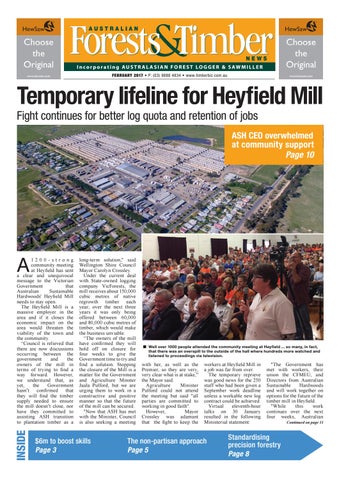
¢ Well over 1000 people attended the community meeting at Heyfield ... so many, in fact, that there was an overspill to the outside of the hall where hundreds more watched and listened to proceedings via television.
with her, as well as the Premier, so they are very, very clear what is at stake,” the Mayor said. Agriculture Minister Pulford could not attend the meeting but said "all parties are committed to working in good faith". However, Mayor Crossley was adamant that the fight to keep the
workers at Heyfield Mill in a job was far from over. The temporary reprieve was good news for the 250 staff who had been given a September work deadline unless a workable new log contract could be achieved. Virtual eleventh-hour talks on 30 January resulted in the following Ministerial statement:
The non-partisan approach Page 5
"The Government has met with workers, their union the CFMEU, and Directors from Australian Sustainable Hardwoods and will work together on options for the future of the timber mill in Heyfield. "While this work continues over the next four weeks, Australian
Standardising precision forestry Page 8
Continued on page 11
A NEW GENERATION OF
FOREST MACHINES NOW IN AUSTRALIA!
RANDALLS EQUIPMENT COMPANY is proud to be associated with PONSSE Plc Finland by introducing the full range of PONSSE forestry machines to Australia. PONSSE is the world leader in supplying the logging industry with productive and environmentally friendly cut-to-length harvesting systems. CONTACT US FOR MORE INFORMATION RANDALLS EQUIPMENT COMPANY PTY LTD email: randalls@randalls.com.au www.randalls.com.au HEAD OFFICE VICTORIA Randalls Equipment Company 8 Wallace Avenue, Point Cook, Melbourne VIC Contact: Peter Randalls Ph: 03 9369 8988 WESTERN AUSTRALIA 9B Charles St, Albany WA Contact: Kegan Powell Ph: 0437 059 477
FORWARDERS: From 10.000 to 20.000 kg load capacity. HARVESTERS: PONSSE offers a full range of wheeled harvesters for the most challenging logging conditions. Six impressive models that range from the Beaver to the heavyweight Bear, including the new and very impressive ScorpionKing. The product range includes both six and eight-wheel harvesters in all size categories. Application ranges from harvesting softwood saw logs to harvesting & debarking eucalypt pulpwood.
A logger´s best friend www.ponsse.com
In the news
$6m service to help boost skill levels Seven decades in business McKay Timber is a major manufacturer and supplier of timber to the Tasmanian, Australian and international marketplaces. It is the second largest hardwood processing company in Tasmania and operates at three locations around the State, employing in excess of 100 people. Proudly family owned and operated, McKay Timber is currently in its third generation of family ownership and this year will celebrate its 70th anniversary.
T
HE LAUNCH of a new $6 million Forestry Training and Skills Development Service, to be delivered by ForestWorks, highlights current confidence in the resurgent forestry sector in Tasmania. Tasmanian Minister for Resources, Guy Barnett announced the new service to support the rebuilding and reskilling of the Tasmanian forest industry workforce. Minister Barnett announced the new Training and Skills Development Service at a launch event hosted by McKay Timber in Launceston. The Tasmanian Training and Skills Development Service is funded by the Australian and Tasmanian Governments. This industry-owned notfor-profit organisation will offer vocational training services that will support skills development in the forest, wood, paper, timber and furnishing industries. “The training and development of workers, and ensuring there is a reliable workforce into the future, is a key element in supporting the strong growth in the industry and locking in the jobs that are being created,” the Minister said. “This program is a direct response to industry needs and will provide training opportunities where the industry itself has recognised a need. “With the current growth in the forest industry, the Tasmanian Forestry
Training and Skills Development Service will be available across the board to current and new employees as well as potential new employees. “This is just one part of our commitment to supporting this vital Tasmanian sector as well as forest workers and harvest and haulage contractors, their families and our local communities,” he said. “It comes at a time when total wood production in 2015-16 reached its highest level for five years at 4.4 million tonnes, and exports have more than doubled from just a few years ago. “It also follows the announcement of a new export joint venture deal for Southern Tasmanian forestry products between TasPorts and Qube Ports - another example of a resurgence of the forestry industry and the creation of 25 jobs on the wharf and hundreds more in the community.” Minister Barnett said the Training and Skills Development Service fund would assist Tasmanian forestry workers adjust to changing job requirements, brought about by advances in technology and new product development. ForestWorks will deliver the Training and Skills Development Service. Diana Lloyd, General Manager of ForestWorks, said funding is available to current and new workers in the Tasmanian forest and timber industry. “Funding is available Continued on page 4
“Training is fundamental to a safe, productive and innovative workplace”
www.timberbiz.com.au
¢ (l-r) Eva James (Skills Advisory Manager at ForestWorks), Guy Barnett (Tasmanian Minister for Resources), Diana Lloyd (Brett McKay (General Manager of McKay Timber), and Karen Hall (Chair of the Tasmanian Forest Contractors Association).
Off the shelf solutions, customised for your mill For over 100 years, we’ve been engineering solutions for the timber industry. In that time, we’ve designed and built a range of equipment proven to improve mill productivity. But we’ve yet to meet a client who didn’t need some modifications to make even the best equipment fit their particular space and needs. Contact us for a quote to make your mill even more productive.
• manufacturing • sawmilling equipment • log carriages • resaws • multisaws and board edgers • automatic sorters and stackers • transfers and conveyors. Complete turnkey projects.
Australian Forests & Timber News
February 2017
From major start-ups to retro-fits, if you want professional service and advice, contact us.
AE Gibson & Sons Phone 02 6559 4001 Email: info@aegibsonman.com.au www.aegibsonman.com.au
3
In the news I n c o r p o r a t i n g A U S T R A L A S I A N F O R E S T L O G G E R & S AW M I L L E R
February 2017 Issue 1 Vol. 26 Established 1991 News
3-11
Productivity 12-13 In Profile
14
Bio
16-21
Skidders
22-23
Certification
24
Fire Suppression
25
Safety Summit
26
Classified
27
Publisher and Chief Executive: Hartley Higgins General Manager: Elizabeth Bouzoudis Editor: John Hudswell j.hudswell@ryanmediapl.com.au Adelaide Office (08) 8369 9512
$6m service to help boost skill levels Continued from page 3
for training courses that will benefit industry, that are relevant to current and future job roles, and provided by a registered training organisation. “We encourage all Tasmanian forestry businesses to take part in this fantastic opportunity. A qualification that consolidates practical experience and knowledge is a reward for both employees and employers,” she said. Brett McKay, General Manager of McKay Timber, said the new training fund was a fantastic opportunity for all sectors of the Tasmania forest industry.
¢ Resources Minister Guy Barnett being interviewed.
Advertising: Michael Dolphin m.dolphin@ryanmediapl.com.au Melbourne Office (03) 9888 4834 Production: Luke Westle Trader classified: m.dolphin @ryanmediapl.com.au Melbourne Office (03) 9888 4834 Subscriptions: subs@forestsandtimber.com.au Adelaide Office (08) 8369 9522 Subcription rates One-year (8 editions) $55 Two-years (16 editions) $95 Accounts: Adelaide Office (08) 8369 9555 Postal Address: 630 Regency Road, Broadview South Australia 5083 Phone: (08) 8369 9555 Fax: (08) 8369 9501 Melbourne Office: Suite 2262, 442 Auburn Rd, Hawthorn VIC 3122 Phone: (03) 9810 3262 Website www.timberbiz.com.au Printed by Lane Print, Adelaide, SA Conditions The opinions expressed in Australian Forests & Timber News are not necessarily the opinions of or endorsed by the editor or publisher unless otherwise stated. All articles submitted for publication become the property of the publisher. All material in Australian Forests & Timber News copyright © Ryan Media. All rights reserved. No part may be reproduced or copied in any form or by any means (graphic, electronic, or mechanical including information and retrieval systems) without written permission of the publisher. While every effort has been made to ensure the accuracy of information, the published will not accept responsibility for errors or omissions, or for any consequences arising from reliance on information published.
¢ Jason Towns (TAS TAFE) and Ray Walker (AFCA).
¢ Jason Towns and Rachael Holland (TAS TAFE), Sandy Hodge (ForestWorks).
“Training is fundamental to a safe, productive and innovative workplace, and something we value highly at McKay Timbers. “This fund provides Tasmanian businesses with the financial support to upskill our workforce. With this funding we have the opportunity to identify any skills gaps, train staff in new activities for the future, and recognise the skills of our existing employees with formal qualifications,” said Brett. For more information visit www.forestworks. com.au/tsds or contact ForestWorks on 03 6331 The Hodgman Liberal Government is committed to ensuring a sustainable and vibrant forestry sector to boost local economies and support jobs in regional Tasmania.
MEDIA
INDEPENDENT & AUSTRALIAN OWNED
4
Australian Forests & Timber News
February 2017
www.timberbiz.com.au
In the news
Parliamentary Friends of Forestry and Forest Products The non-partisan approach
By Tony Pasin MP Federal Member for Barker
G
ROWING UP in a timber community as I did you know almost by osmosis what a significant contribution the timber industry makes to our Nation and its economy. That might be because your uncle runs an engineering firm repairing and maintaining harvesting equipment or because you play cricket with a mill hand and an apprentice saw doctor or because your next door neighbour hauls woodchips to the port. Whatever your experience, you get it. These were my experiences growing up. Living in Mount Gambier in our Nations green triangle it’s hard to avoid conversations involving the forestry or forest products industry.
That is why I was dismayed upon being elected in 2013 at the lack of discussions taking place within our Nation’s Parliament regarding the industry and its contribution to our economy. Worse still, I observed that to the extent these conversations did take place they focused on the hyperpoliticised non-plantation forest sector. It was this environment and the desire to improve my parliamentary colleague’s appreciation for and understanding of the industry that caused me to investigate the establishment of the Parliamentary Friends of Forestry and Forest Products. Along with my fellow convener, the Hon. Joel
Fitzgibbon, I was thrilled to see more than 40 members and senators join our newly established friendship group in the 44th Parliament. In our likely carbon constrained future the forest and forest products industry is one of very few carbonpositive industries and enjoys bullish prospects. The creation of more than 10,000 forestry jobs since 2013 serves to re-inforce this sense of optimism. An industry with enormous potential to meet domestic and global demand for fibre, timber and paper products is one that will continue to provide the economic backbone of many communities Australia wide. The industry contributes over $22.2 billion of economic activity each year to the Australian economy and employs more than 64,000 people in the forest, logging and processing sectors. This is why it is critical that policy makers have a deep and objective
understanding of industry, one which is informed by the commercial reality and avoids emotive misinformation. Over and above this, the industry needs to operate with strong bi-partisan support leaving behind it the boom bust policy cycle that has plagued the industry for generations. In order to take full advantage of the industry’s future prospects, Government need to get the policy settings right. Part of this includes taking the political sting out of forestry policy, to find a path that all sides of politics feel comfortable with so that industry can plan and invest with certainly for the future without the shocks that can come from a short electoral cycle. The establishment of a parliamentary friendship group has shown that this is possible. The group has a membership from across the political spectrum including Liberal, Labor, Greens and
independents with a renewed focus on our nation’s plantation resource. The purpose of the Parliamentary Friends of Forestry and Forest Products group is to raise awareness of the issues facing the industry. It is a vehicle for forest related groups to speak directly to members and senators, but more importantly it represents a chance to help get the policy settings right and take the sting out of the often turbulent political cycle when it comes to forest policy. It is no coincidence that the last election was the first in living memory that did not involve a toxic and ultimately harmful policy battle between the major political parties around forestry. In achieving this outcome our friendship group has served the industry well and I look forward to what more we can achieve together over the next few years in the term of the 45th parliament.
Forico shows that it’s in the business for the long haul 7 million seedling planting program completed FORICO HAS demonstrated its long-term commitment to the plantation forestry sector in Tasmania as it completed its extensive 2016 planting program with a total of 7 million seedlings having been planted during the season from September to early January. That means more than 6,300ha of fallow land and recently harvested plantation land has been replanted to create a new crop of high-quality wood fibre for the future. “This is perhaps the largest current plantation establishment program by a single company in Australia,” said CEO, Bryan Hayes. More than 60 people were engaged by Forico and its contractors to achieve the target area of reforestation at a cost of $15m. “We are especially grateful for the contribution of all of our service providers and our staff in achieving this historic result,” said Mr Hayes. Since its establishment by forestry investment manager New www.timberbiz.com.au
Forests in September 2014, Forico has planted 3,582ha in 2015 and now 6,300ha in 2016, clearly demonstrating that it is here for the long term. All Forico land and forests, both plantation (100,000ha) and native forests (81,000ha) are certified against the Forest Stewardship Council (FSC) Forest Management standard and PEFC Australian Forestry Standard. Forico provides high-quality wood fibre to Asian pulp and paper producers from its 100,000 hectare plantation estate. All native forest is managed for conservation and ecological services under the unique Forico business model. Forico Pty Limited is the management company established by New Forests to manage a 181,000 ha estate in Tasmania, comprising 100,000 ha of plantations and 81,000 ha of natural vegetation. The annual sustained yield of wood fibre from the plantations is 1.5 M gmt pa. The assets include 2
woodchip mills, a seedling nursery and a fibre technology laboratory. Forico is based in Launceston, Tasmania. New Forests is a sustainable real assets investment manager offering leading-edge strategies in forestry, timber processing, infrastructure, land management, and conservation. Founded in 2005, the company’s investment
Australian Forests & Timber News
February 2017
programs focus on the Asia-Pacific region and the United States, with more than $A3.6 billion in funds, assets under management, and committed capital. New Forests’ clients include pension funds, superannuation funds, and other institutional investors. The company is headquartered in Sydney, with offices in Singapore, San Francisco, and New Zealand. 5
In the news
News Briefs Social forestry project
Indonesian President Joko Widodo has issued a license for the cultivation of 12.700 million hectares of land as a social forestry program aimed at improving the welfare of people living around the forests. According to the President, about 10.2 million villagers living in forestry areas are still poor. He said the spirit of the social forestry program was to create social justice for the people living around the forest areas while preserving the existence of forestry resources; the way to achieve these goals is to cultivate forest areas through smallholders forestry, peoples forest, customary forestry and partnership forestry schemes.
Million dollar forestry boost
A new state-run program backed by nearly $1 million in federal funding will enlist southern Indiana landowners to plant 3,000 acres of new forests. The state Department of Natural Resources says its Division of Forestry will oversee the five-year Southern Indiana Young Forest Initiative. The program will provide about $960,000 in costshare funding to eligible landowners in 43 southern counties to plant new forests. DNR foresters will help landowners apply for the funding and develop forest management plans for their properties. State Forester John Seifert says land use changes during the past century had left Indiana lacking in young forest habitat.
It’s enough to make you green with envy!
Ireland boasts some of the best forest growing conditions in Europe and farmers can take advantage of that fact. A recent report from COFORD estimates that over the period to 2035, the roundwood supply from Ireland’s forests will double to 7.9m cubic metres. Almost all of this increased supply will be harvested from privately-owned forests. Irish forestry expertise has been recently enhanced through inclusion and participation in the SIMWOOD EU Seventh Framework Program (FP7) which researches methods of maximising the revenue for forest owners while protecting the environment and the productive potential of their forests. The SIMWOOD project has two pilot projects underway in Ireland. The pilot project aims to increase knowledge of this harvesting method through demonstrations and a decision support tool. This is to lead to increased adoption of this method and consequently increased
profits for Irish forest owners and more wood mobilisation. The annual Government forestry budget is 112m which covers all grant aid in planting new forests, forest road construction grants, forest premia payments to forest owners and other supports to the sector.
6
Total involvement needed to ensure industry transformation By Colin McCulloch Project Manager Arbre Forest Industries Training & Careers Hub
T
HE ARBRE Hub and Business Action Leading Tasmania brought together 140 Industry delegates in Launceston to hear a series of presentations from political and industry leaders on working through the body of work produced by the Forest Industry Advisory Council on “Transforming Australia’s Forest Products Industry”. The program sought to identify three stages of delivery for the transformation to be able to take effect. The political will, the policy framework and finally, a can do attitude backed by financial stability and investment in the people that will effect the change. Guy Barnett Tasmanian Minister for Resources, gave a clear undertaking of full Government support for all facets of forest industry development. He referred to numerous industry developments in Tasmania, including further downstream processing opportunities, funding for research programs and facilities to be located in Tasmania, and the necessity for industry-centric programs to be focused in the education system as well as at school leavers.
Positive political will identified
Rob De Fégely, the CoChair of FIAC, and the Chair of Forestry Tasmania, spoke on the three objectives, eight strategies and the 19 recommendations outlined in the FIAC document, Transforming Australia’s Forest Products Industry. He took advantage of rapidly changing face of the forest industry in Tasmania to open discussions on transformation, the constant clamour for continuous improvement transformation will demand, and the ability to cover the objectives that the FIAC paper delivers to an audience that is smack bang in the middle of transformation, and that this very experience is easily translated to all of Australia at present.
Policy Framework outlined
David Brand, CEO of New Forests, gave an overview of the transformation of our forest ownership structure. He said the confidence generated by global investment companies putting faith into forest ownership and processing has stabilised our industry. This has re-focused investment heavily in replanting the estate, and given stability to existing global markets, whilst opening up new opportunities for further downstream processing
¢ Rob De Fégely.
¢ Colin McCulloch. ¢ Bryan Hayes.
and development. David emphasised the necessity to bring the people along for the ride, “without investment in our people and our practices, the transformation remains just a good idea”.
Can do attitude exists
The second session heard from our next generation of forest industry participants through a series of presentations working through leveraging our Education system, the delivery of the highly successful “Bloody Legends” program into our forestry sector, activity sampling to take advantage of technology to boost the expectations of productivity through technology, and how to work with the constant clamour for continuous improvement, not against it. Genevieve Cother, from the Action Learning Institute, presented on a collaborative approach to industry improvement. A key statement from the FIAC paper is “the forest industry must take the lead
in determining its future. It must improve collaboration within and outside the industry as it pursues greater productivity through innovation”. Genevieve outlined programs currently under way through the manufacturing base in Tasmania that produce the very results that the FIAC seek to achieve. Bryan Hayes, Arbre Hub Chairman, rated the day as an enormous step forward for the Tasmanian forest industry. “One of our main objectives at the Arbre Hub is to contribute to a change in the conversation about our industry through our programs within the education system and community-based programs. We have laid a framework that does give confidence in investment and development. It’s now up to us through the Arbre Hub to help deliver that message and create the outcomes necessary for transformation through investment into our people.”
Institute keeping abreast of innovation and change THE INSTITUTE of Foresters of Australia Biennial Conference later this year will be themed “Tropical Forestry: Innovation and Change in the Asia Pacific Region”. This allimportant gathering will be held in Cairns from 14-17 August. The theme taps into IFA’s broadened vision and reach promoted by the Foresters without Borders Initiative and recognises the rich history of Australian Foresters who have contributed to the development of the professional practice of Forestry in South East Asia and the Pacific. “There are few countries in our region that have not been influenced by forestry leaders who have trained in Australia or Australian Foresters who have worked in the region,” said Dr Kevin Harding, Chair of the
Conference Organising Committee. “The conference location and focus also calls us to focus on Northern Australian Development and how and why forestry should be part of development initiatives that are canvassed in the 2015 Northern Australia White Paper,” he said. Conference session themes to be developed by the organising committee to focus on forestry issues in northern Australia and the tropics will include: • regional interconnections in managing tropical forests and commercial tropical forestry as well as the diversity of tropical and subtropical plantation species including southern pines, Araucaria, African mahogany, sandalwood, eucalypts and acacias • Indigenous forestry opportunities
Australian Forests & Timber News
February 2017
and Northern Australian development • early Savanah burning regimes and carbon and climate change initiatives • conservation management in the tropics • mining and forestry potential synergies • biomass energy production in remote (off grid) locations • processing and industry development activities. Sessions for the conference are designed to present and discuss challenges and provide a platform to launch new horizons for the forestry profession to contribute to and influence the practice of forest management in Australasia and the Pacific. www.timberbiz.com.au
GENUINE DURABILITY.
TOTAL CONFIDENCE.
Introducing New 600 Series Parts Warranty Terms Waratah heads are Built to Work™ and our competitively priced genuine Waratah parts are built to last – so we’ve doubled our 600 Series parts warranty terms to prove it. As a logger, you value uptime and know that using substandard parts can be costly. Only genuine Waratah parts are engineered with the exact fit, thoroughly tested and certified for your application, and backed by our unparalleled support — delivering the uptime performance you need. Now you can work with more confidence than ever using genuine Waratah parts. · New 180-day parts warranty coverage from the date of purchase. · Competitively priced parts, manufactured to exact tolerances with the right fit. · Durable, proven parts for maximum performance and productivity. · Backed by unparalleled Waratah support and a global dealer network. Talk to your local Waratah dealer today about the new 600 Series 180-day Parts Warranty terms. www.Waratah.com
Melbourne
24/7 Hotline 03 9747 4200
Bunbury WA
24/7 Hotline 08 9726 0411
www.waratah.net
In the news
Standardising precision forestry using LiDAR technology
A
S THE human population rapidly increases, the demand for natural resources understandably rises too, but with this comes more of a responsibility to maintain our delicate eco-system. As with most industries, there has never been more pressure on forestry operations to produce more with less, including less land, man-made pesticides, herbicides and fertilisers, and a smaller pool of qualified workers. Despite these challenges, forestry workers must still keep up with growing demand of domestic and international needs. Automation technologies are currently revolutionising other agricultural operations, such as satellite driven positioning systems for planting and harvesting, and remote sensors which measure changes in soil fertilisation. With many traditional forestry practises having been used for over a century or more, is it time to fully standardise the technology used to manage one of the earth’s most vital resources? Carlos Gonzalez, general manager of 3D Laser Mapping, explores this issue.
Embracing automation ‘Precision Forestry’ is defined by the use of intelligent, information based forestry systems which use tools and
technology to make datadriven decisions based on accurate data collected in a range of ways. This includes remote sensing, navigation systems and Geographic Information Systems (GIS). These automated technologies measure, record, process and analyse multi-source data which can then be used for more efficient management of operations including reducing waste and improving profitability. One technology which is starting to see widespread use in forestry data acquisition is Light Detection and Ranging systems (LiDAR). These allow operators to measure in three dimensions with the added benefit of being able to scan above and below dense vegetation. This gives critical business information such as forest inventory calculations, Diameter at Breast Height figures and even detection of changes in both the canopy and wider physical landscape. In 2013, Dr Jim O’Hehir was awarded a Gottstein Fellowship to investigate the adoption of precision forestry in South Australia by studying the systems used in South Africa. With similar considerations to be made to address disease protection, plantation and water legislation, comparisons could be made as to the benefits of standardising the approach
¢ Pointcloud of a forest stand to calculate DBH and LAI.
8
¢ Digital terrain models are a key tool in precision forestry, enabling calculations for wood inventory and harvest planning.
to precision forestry using LiDAR. “Precision forestry basically collects data to help make more informed plantation management decisions”, explained Dr O’Hehir. “We now have the capability through advanced GPS systems to collect significant amounts of data, but unless we can organise and use this data to assist in our decision making it’s not much use.”
A problem shared
The key to making precision forestry technologies more accessible lies in analysing and applying the data collected in a way which is meaningful to all stakeholders. LiDAR systems allow for the collection of accurate data which can then be used to create a comprehensive terrain model. As technology has now progressed, mobile LiDAR systems are making it easier to cover large areas quickly, with enhanced accuracy. Airborne systems penetrate the tree canopy, enabling the underlying terrain to be assessed rapidly and remotely to assist in harvest planning, regeneration works and volume calculations. The same data can then be used in condition monitoring projects, biodiversity studies and forest fire behaviour models. Many tools currently being used in precision
agriculture can be applied to precision forestry, but with less funding and more restrictions, there is a distinct need for collaboration on projects with other organisations. A good example of this is the Protecting Our Coastal Communities (POCC) project, which was primarily intended for analysing flood risk and urban development issues along the Queensland coastline. The data collected from this state and local government funded project was shared to allow for the monitoring of coastal forests in the area, without additional scans being performed specifically for this application. The Land and Property Management Authority based in Bathurst, NSW, has an ongoing LiDAR project where data is continually being acquired and shared with Forests New South Wales. LiDAR data covering over 43% of the total native forest of the state now exists with widespread coverage amounting to over 1,000,000 ha.
Thinking outside the square
Embracing automation technology such as LiDAR can not only benefit operations in terms of efficiency, it also has a large effect on the sustainability of forestry operations outside of the obvious. Many see automation simply as
a threat to job security, but high levels of advancement in this kind of technology actually give the opportunity to optimise existing operations, rather than exploring expansion and new opportunities. Creating a sustainable industry also relies on attracting skilled workers to the sector. Automation technology brings the opportunity to attract a new skill-set to the industry, without having to rely on agricultural or environmental training to bring about positive change. Our need to obtain a balance between conservation and production in Australia’s native forests is key to the industry and ecosystem’s sustainability. Many already use remote sensing practices to calculate wood inventory and canopy heights, though there is room for a more widespread use of systems such as LiDAR to assist with more sustainable management of forests, addressing issues such as forest fires and parks management. The potential benefits that the acquired data can bring to all stakeholders far outweighs the learning curve which may be needed in the first instance. For further information on 3D Laser Mapping, visit www.3dlasermapping.com
¢ Screenshot of LiDAR data showing topographical information referenced by a fallen tree.
Australian Forests & Timber News
February 2017
www.timberbiz.com.au
In the news
VicForests’ sustainability certification extends to western Victoria
V
¢ S election harvesting operation.
I C F O R E S T S has extended its certification to the Australian Forestry Standard (AFS) to include community forestry operations in western Victoria. Nathan Trushell, Acting CEO VicForests, said that it was the first time VicForests had sought certification for its community forestry operations. “VicForests’ have been certified to the AFS for 10 years now and we are very pleased to officially include our western Victorian operations within that certification. “With more than 60
VicForests welcomes new Biodiversity Conservation Research Manager WILDLIFE CONSERVATION expert Tim McBride recently joined VicForests as the new Biodiversity Conservation Research Manager. He has been working in the forestry industry for more than 22 years with a strong focus in forest ecology and wildlife conservation. Tim is looking forward to using his knowledge to further develop conservation plans that balance the protection of the environment and animals with sustainable forestry. “I’m looking to create more flexible plans to meet the needs of both the native timber industry and the protection of species and their habitat,” Tim said “VicForests are committed to ensuring sustainability; they aim for long-term environmental, economic and industry-wide sustainability and I want to be a part of that. “In my role, I hope to further improve existing conservation plans and work with industry stakeholders to help change some perceptions other organisations have of VicForests,” he said. Tim is looking forward to contributing towards the many research projects that VicForests is involved with and working closely with the educational institutions leading them. “The results from the Leadbeater’s Possum surveys, Hollows Development project and Regrowth Retention Harvesting trials are very encouraging. “I have already began meeting with fellow academics and experts in this field and hope to build long-term relationships and share knowledge and learnings with them during my time here. “I am planning on being with VicForests www.timberbiz.com.au
customers in western Victoria we saw it as essential to extend our certification to cover our community forestry operations. “All VicForests’ customers will now be able to purchase timber from us with the independent assurance that it comes from sustainably managed forests,” Mr Trushell said. There are nine criteria that forest managers must meet to receive certification including the need to protect biodiversity, maintain forest health, protect soil and water and to maintain and enhance social and economic benefits. VicForests is audited every nine months by accredited auditors in order to maintain its certification. The most recent surveillance audit took place in September 2016. “Our staff should be very proud of the audit results,” Mr Trushell said. “The report stated that excellent progress has been made in training and our systems have been enhanced to support the taskforce
process and updates regarding threatened species detections,” he said. The auditors also commended VicForests staff for showing strong support for the certification process and actively improving practices both in the field and in their system. It was suggested that VicForests should improve on its documentation and procedures for assessing and recording risks. “We have updated our risk assessment instructions for staff and will work on improving our procedures over the coming months,” Mr Trushell said. The AFS is internationally recognised by the world’s largest forest certification scheme, the Program for the Endorsement of Forest Certification (PEFC). VicForests is responsible for the sustainable harvest, regrowing and commercial sale of timber in Victoria. VicForests supports thousands of jobs state wide and plays a vital role in sustaining the economy in rural areas.
Tough, Professional Tools Australia-wide delivery!
¢ Tim McBride, Biodiversity Conservation Research Manager at VicForests.
for a long time,” he said. Tim has joined VicForests after many years researching forest ecology and wildlife conservation across the west coast of America working predominantly with Port Blakely Tree Farms and Hancock Natural Resource Group during his career. He recently moved to Victoria with his Australian wife to develop his skills in a new environment. “I spent a lot of time researching amphibians by looking into drivers of population trends and what their preferred habitat looks like,” he said. “I hope to help VicForests better understand the habitat requirements of Victoria’s threatened species including possums, gliders and owls as well as other lesser knowns species such as frogs and toads. “I also hope to gain a deeper understanding of Australian eco-systems and learn more about Victoria’s native species,” he said. Tim will manage the Research and Development across all regions VicForests operates in. Australian Forests & Timber News
Cant & Peavey Hooks Logrite Cant & Peavey hooks Light but very strong Made in USA 42” - $245, 60” - $300. Log stand to suit - $85
Haglof Tree Calipers Strong, lightweight Swedish made aluminium tree calipers 40cm-$165, 50cm-$170 65cm-$180, 80cm-$220 102cm-$280 127cm-$310
Spencer Logging Tapes Clinometers/Height Meters Tough US made logging tapes 15m - $110, 25m - $130 30m + diameter - $154
Diameter/Girth Tapes
Large range of steel & fibreglass diameter tapes from $22
Tree Planting Equipment
Suunto Tandem Nikon Compass/Clino Forestry Pro $320 $580 Also stock Haglof Vertex IV/ Laser & Haglof CI/ECII
Pro-Pruner Swedish made Pottiputki tree planters Models 45/55/63/75 Kidney trays, planting belts, spades & Hamilton planters
Tel: 02 9417 7751 Fax: 02 9417 7426
February 2017
New Zealand made lopper designed for lift pruning of pine & eucalypts. Up to 65mm cut - $260 Also Bahco, Felco & Barnel
Over 1600 products at
www.forestrytools.com.au or call for our 2017 catalogue
PO Box 870 Willoughby NSW 2068
9
In the news
ASH CEO Overwhelmed by support for mill
Continued from page 1
V
INCE HURLEY, Australian Sustainable Hardwoods (ASH) Chief Executive Officer, has been overwhelmed at the level of support to retain operations at its Heyfield mill. “As the CEO of ASH it has been frustrating not being able to plan for the long term and I was shocked when told how little logs VicForests was prepared to provide us in the coming three years. “A little over six months ago I was informed by VicForests that they had sufficient supply of suitable sawlogs available for 10 to 15 years. I have been in this industry for over 30 years and for VicForests to turn around and say the best they can do is less than half of our current contracted volume over three years, just six months later, doesn’t make any sense at all. “The fact is that the commercial size of our operation simply does not work with half the contracted volume,” he said. “I am proud of the mill, the staff and the community and I do hope that a solution is found in the next four weeks. “Our Directors will meet in early March to consider any new commercial offers of supply that may become available from the Government. “I know the Government is discussing changing the supply from larger regrowth timber to smaller regrowth
Temporary lifeline for Heyfield Mill
“I hope the Government comes good on its promise to resolve this crisis” timber and eventually to plantation. “Should this be feasible, it will mean a fundamental and costly change will be required to the business. “I do hope the Government comes good on its promise to resolve this crisis,” he said. The strongly attended public meeting in Heyfield unanimously passed a motion calling on the Premier to keep his word when he said he would fight for every job. “I supported that motion and I, like everyone else who works at ASH, plus all of our customers and suppliers, will be holding our breath to see if Mr Andrews does keep his word. We would all like to keep our jobs,” Mr Hurley said. The motion moved from the floor and unanimously supported was:
We call on Daniel Andrews, Premier of Victoria, to keep his word that he will fight for every job so that: • It’s 250 staff will keep their jobs • The town of Heyfield and the surrounding areas, businesses and communities have a future • The thousands of businesses that rely on ASH’s products will also have a future • Australian made high quality hardwood timber products from Australian grown, environmentally sustainable and commercially managed regrowth forests, are not replaced by imported products • Over 7,000 jobs and families in Victoria that rely on the flow on effects of ASH will be saved.
Sustainable Hardwoods has committed to suspend steps to close the Heyfield mill. "The meeting was constructive and focussed on the need to identify viable arrangements for the mill which protect local jobs, given reduced timber availability. "All parties have committed to work together in good faith and with the necessary urgency throughout February." In mid-January Heyfield Mill staff had been told that as a result of the failure of the Victorian Government to offer a volume of timber that would enable the mill to continue to operate, the mill would be closing. Significant lay-offs would begin from September. “The only thing that will change this trajectory is if there is a new supply agreement offered by the government that is respectful of our business needs," ASH CEO Vince Hurley said. The official VicForests' stance was that the current ASH agreement could not be continued. "VicForests’ current contract with Australian Sustainable Hardwoods (ASH) expires at the end of June 2017," said
Accent Equity steps in as co-owner of Eco Log to accelerate growth THE CURRENT owner and founder of Eco Log, Stig Linderholm, has invited the investment fund Accent Equity 2012 to become a coowner. The intention is that Accent will help Eco Log expand further in Sweden as well as internationally. The company’s net sales in 2016 amounted to approximately SEK 400 million. Eco Log develops, manufactures and markets forestry machines designed for cut-to-length (CTL) harvesting. Based in Söderhamn, Sweden, the company serves a global market through approximately 60% export sales. 10
The product portfolio today comprises nine models of Harvesters and Forwarders and the company has a strong position in some of the world’s biggest markets for CTL harvesting. The company has been developed by Stig since 2004 following the acquisition of Caterpillar’s product lines of forestry machines. “Accent views Eco Log, with its competitive product portfolio and strong management, as a solid platform for further growth”, says Niklas Sloutski, CEO of Accent Equity Partners, investment advisor to Accent Equity 2012.
“We are very impressed by the management team’s ability to develop its business and the foundation is in place to allow for rapid expansion both organically and through acquisitions.” “I am happy to invite Accent as co-owners, and I look forward to continue developing the company with them,” says Stig. “We are excited to have the new owners on board and feel confident that we will be able to leverage on the work we have done so far and create significant growth going forward,” says Joel Schönning, CEO of Eco Log.
Australian Forests & Timber News
February 2017
Nathan Trushell, acting CEO of VicForests.. "VicForests has notified ASH that it can continue to supply timber to the Heyfield mill but not at the same levels as in the current agreement. "Improved modelling of the available future timber resources shows the level of supply of ash timber needs to be reduced from the current levels. We are currently in discussions with ASH regarding a future sales agreement. "Any future sales agreement offered to ASH will be based on lower supply levels to ensure this aligns with available timber resources. "VicForests will continue to meet its contractual obligations with all of our contractors and customers," Mr Trushell said. It's not just the Heyfield area that would be decimated by the closure of the mill but it has been estimated there are 7,000 downstream jobs that would be impacted by ASH’s closure, mostly small companies in Melbourne that use ASH’s products, together with all the suppliers of services and those in the timber industry itself.
Founded in 1994, Accent is one of the buy-out investment pioneers in the Nordic region. For the Eco Log dealers around the world it will be business as usual,and there will be no changes among the employees at the factory in Söderhamn. “Going forward Accent and Stig will support the improvements Eco Log need to make in order to make ensure our customers are satisfied,” said Johan Jaktman of Scandinavian Forestry, Australia’s Eco Log distributor.. “Eco Log can now find ways to be even stronger and aim at being a clear number 4 in the global forestry market for CTL machines,” Johan added.
www.timberbiz.com.au
In the news
Firsts happen at Elphinstone
E
LPHINSTONE ENGINEERING is renowned for its ‘firsts’. The first self-loading road train; built the world’s first folding skeletal trailer; designed and built the world’s first self-loading B-Triple and many other innovative log transport solutions. The latest ‘first’ is an employee retiring! Cheryl Arnol started working for Graeme Elphinstone in May 2005 as his personal assistant. When Graeme went to Antarctica in December 2005, Cheryl started talking to customers and pretty much hasn’t stopped since but she is about to. She is retiring from Elphinstone’s on 10 February; the first employee in the 40year history of the company to retire! With a long history of indirect involvement in the forest industry, working for Graeme was a natural progression after selling the small engine repair business she ran with her husband, Glenn. They bought the Stihl chainsaw dealership, ironically from Graeme, around 30 years ago and operated it until September 2004. The plan then was to retire.
¢ C heryl Arnol
Cheryl was Mayor of the local Council at the time and thought that would be enough to keep her occupied but that soon changed. “There’s really only so much housework you can do and sitting around doing not much else was not on my agenda,” she recalled. After a conversation with Graeme she joined Elphinstone Engineering in May 2005 and the rest, as they say, is history. Progressing from talking to customers to actually doing quotes was a bit of a long haul but a necessary one when Graeme went to Antarctica in 2011. With Graeme working out of Elphinstone’s Melbourne facility and greynomading during the last five years, the ‘talking’ has involved selling trailers.
“Elphinstone’s have many long-standing loyal customers who will normally only speak to Graeme. Imagine my excitement when one of them phoned me up and ordered not one but two B-Double sets,” Cheryl said. During a trip to Western Australia, Cheryl was informed by one of her shooting colleagues that she was ‘the unlikeliest looking logging trailer salesperson they had ever seen’. But then she is probably the most unlikely looking shotgun shooter, too! All of 5’ nothing, Cheryl has been a competition clay target shooter for more than 40 years. A former National Ladies Champion and winner of various ladies’ championships as well as the occasional open
championship, she plans to continue shooting during her retirement with a trip to Darwin to a competition planned for her and Glenn as well as local competitions. Cheryl is retiring from Elphinstone’s but as she said she is not retiring from life. Her pride in all things Elphinstone, the trailers and other equipment, especially the Antarctic products, is evident whenever anyone talks to her. One of the simplest tasks that she will miss most is the guided tours through the workshop at Triabunna. There’s no doubt Cheryl will miss all the customers and the interaction with the great team that is Elphinstone Engineering but there comes a point when time has to be called and so she becomes
another ‘first’ for Elphinstone; the first employee to retire. Might not be a record that Cheryl particularly wants to hold but then retirement life is calling and there’s still a fair bit on the bucket list. Now, the current Deputy Mayor at Glamorgan Spring Bay Council, a Director of the South East Trade Training Centre and a Director of the Forest Practices Authority, put things in perspective when interviewed recently ... “I’m really looking forward to being able to read agendas and prepare for meetings at midday; not midnight!” Over and above the agendas, though, there’s a new man in her life to keep her occupied as well -- seven-month-old Oliver, Cheryl and Glenn’s first grandchild.
More than forest and timber publications MEDIA
INDEPENDENT & AUSTRALIAN OWNED As publisher of Australia’s leading forest and timber industry publications, it would be easy to think we are only ink on paper.
But these are more than magazines. They are brands. Timber industry brands that readers and suppliers trust, quote and repond to. Brands that are growing across all platforms - in print and online. It’s become a two way relationship - online industry offerings, including articles, news, advertising and photos. And we are adding more in Events, Classifieds, including Jobs, Used Equipment, Services and Suppliers. Take a new look at Ryan Media’s forests and timber products services today and ask about our special subscription. For business solutions across all platforms, call + 61 8 8369 9500 or go to www.timberbiz.com.au australasian
I N C O R P O R AT I N G A U S T R A L A S I A N F O R E S T L O G G E R & S AW M I L L E R
www.timberbiz.com.au
magazine
Australian Forests & Timber News
February 2017
11
PRODUCTIVITY
Have we seen the end of productivity improvement with mechanised harvesting?
R
ESEARCHERS BELIEVE that the next wave of productivity improvement will come from human factors. There has been recent concern that the continuous improvement of forest harvesting has stagnated or possibly decreased in the Nordic countries. A modern problem is not the lack of knowledge, but the inability to put the knowledge into practice. Through a literature review, researchers examined whether human factors can improve the performance of harvesting systems by simulating continued performance improvements. Researchers focussed on mechanized cut-tolength (CTL) operations, with specific reference to the operation of the single grip harvester and the harvester-forwarder system. The researchers created a conceptual framework to allow the analysis of human, technology, organization and environmental interrelated elements. The researchers discovered that the correct abilities, skills, techniques and training alone are not sufficient to ensure the high performance of a logging system. It was discovered that education, training, semi-automation, shift scheduling, harvesterforwarder cooperation and inter- and intraorganizational knowledge exchange were all very
12
important in order to obtain improvement and development. Automation specifically will introduce a system change that will have a similar effect on the forestry industry as that change which occurred when mechanisation was introduced into logging. Semi-automated solutions
and increased decision support will pre-empt the move to automation, which is already a stated goal for countries such as Sweden. In order to gain productivity benefits, research is required into methods, interfaces, forms of interaction, risk analyses and automation technology.
Australian Forests & Timber News
The research was published in the International Journal of Forest Engineering, Vol. 27 (2), 2016. The authors are C HäggstrÜm and O Lindroos. Source: http://dx.doi.org/10.108 0/14942119.2016.1170495
February 2017
www.timberbiz.com.au
PRODUCTIVITY
Still room for human and machine improvement
T
WO MAJOR players in the forest machine business don’t entirely agree with the researchers’ findings. While there is some acceptance that more is possible from human factors both are adamant that there’s more to come in the way of technological advancements. For Brett Jones, Komatsu Forest Managing Director, the research piece offered a perfect springboard for a concern he has had for some time now..... training -- the human factor! “The main concern I have with the industry in Australia is that we are not willing to invest the right amount into operator training. In many cases there is a lack of understanding of what a skilled operator actually involves. Production may be important but maintaining a machine in a good condition and knowing how to carry out minor repairs is just as important to the overall production cost,” says Brett. Despite the in-depth research Brett said it seemed this research overlooked the need for a skilled operator to have a good level of maintenance skills
¢ Norbert Schalkx of Ponsse
www.timberbiz.com.au
and a good understanding of the equipment. When a harvester can cost up to a million dollars I believe there should be a bigger focus placed on training the person who is going to sit in the seat on a daily basis. “If you were to combine this technical training with our MaxiFleet management system, then I believe the machine owner / operator would be well prepared for anything that may occur on any given day. “MaxiFleet offers the owner all the basic data of the machine like most other systems but it actually goes one step further by allowing us to access the machine control system from the office. In this situation a KF tech or an owner can access a machine and carry out diagnostic testing through the control system without going to the machine. The only restriction is that there must be an operator sitting in the seat to allow you access and there must be mobile phone coverage to be able to have this level of access. “I strongly believe this functionality will save a lot of time and money
while increasing the overall production. This overall approach to being able to maintain the machine in a more managed fashion may be the next biggest step to actually reducing production costs.” Regarding Harvesters, Brett strongly believes that there will always be further advances with the technology that will provide further increases to the current production rate, every year there is new technology being introduced and this will always be the case. “As far as Forwarders are concerned, the capacity has increased over the last few years so these benefits are currently being experienced. Once again there will also be further technological advancements with the Forwarder, like automatic crane positioning. “There are already many forms of semi-automatic systems currently in operation or are being developed even further. We will eventually see semi automation in the coming years taken to a whole another level,” he said. “During a recent visit to the Komatsu factory it was very interesting to see what was in the development pipeline. We may not be going to the moon but there are some real advancements not that far away,” Brett said. Norbert Schalkx, Ponsse’s Area Director - Asia-Pacific, Africa, Spain & Portugal, said that while the article is an interesting literary review on human factors implications on productivity, some of the quoted material was rather outdated. “This says more about the research world than about the inability of manufacturers to put existing knowledge into practise! On the claim -the next wave of productivity improvement will come from human factors -Norbert agreed and added that it will be more and more challenging to increase productivity through basic machine design. “However, the Ponsse Scorpion harvester, launched at the Elmia Wood in 2013, was designed around the machine operator, taking into consideration the “internal performance
Australian Forests & Timber News
¢ Brett Jones of Komatsu
shaping factors” and the “stressors”, affecting the human factor which the article talks about. “With the operator being literally in the centre of the harvester, with its unrestricted visibility, excellent machine stability, ergonomic cabin, crane control, reduced shaking, trembling and noise, minimised distraction and fatigue factors, the operator can maintain high production levels throughout long working shifts. Due to its design features, the Ponsse Scorpion harvester model certainly leads to a big step in improving the productivity in e.g. Nordic spruce thinning,” he said. “The article further states that human factors can improve the performance of harvesting systems by stimulating continued performance improvements. This is exactly what Ponsse is doing with its Ponsse EcoDrive Harvester & Ponsse EcoDrive Forwarder programs. “EcoDrive continuously analyses the work efficiency of the operator for every work phase. It compares this to average values and it keeps track of the productivity trend and fuel economy. The machine operator can compare and improve his
February 2017
working behaviour instantly and gets reported on this.” Norbert said while the researchers discovered that the correct abilities, skills, techniques and training alone were not sufficient to ensure the high performance of a logging system, he pointed out that Ponsse had further developed its Simulator Training methods and exercises for e.g. experienced operators. These operators can still increase productivity, by e.g. optimising the felling sequence of trees, positioning of processed assortments and subsequently reducing boom movement. “Work organisation (and its human-technology interactions)”, as mentioned in the article, plays a big role in Ponsse Manager, which is the machine owner’s real-time tool to manage daily harvesting operations. Ponsse Manager was first launched in September in Finland, at the FinnMETKO exhibition. This year it will be available for Australian customers. “Further semi-automated solutions and increased decision support will be available from Ponsse in the foreseeable future,” Norbert said. 13
IN PROFILE
Randalls and Ponsse striding forward together
I
T’S NOW two and a half years since Randalls were appointed as the exclusive distributor in Australia for the full line of Ponsse wheeled harvesting equipment. During that time, a number of contractors are experiencing the world class quality, reliability and productivity that comes with the purchase of a Ponsse Harvester or Forwarder. There are now more than 15 units in the country with a steady supply coming from Ponsse’s single manufacturing facility in Vierema, Finland. Randalls Sales and Service Manager, Davin Frankel spoke to us about his experiences to date with supporting Ponsse equipment. “I’ve had the good fortune of working on and around machines of many different colours since my first job in the forestry business back in 1997. I cannot think of another company I’ve worked with that displays the level of commitment to their customers, their dealers and their business than the people from Ponsse do. “They are a true forestry equipment manufacturer in every sense of the word. It’s all they do so they know
they better be damn good at it. In some ways they are a lot like us at Randalls. We have been in the forestry business for 50 years now and it’s all we do. We live or die on the quality of the products we sell and of course the customer service we provide. In my eyes there is nothing more important than that.”
Personalised approach
Randalls remains a privately owned family business which can adapt and act quickly when needed. Due the comparable size of the company and the management structure, customers receive a very personalised and rapid level of support. We spoke to Peter Randalls about his philosophy relating to customer service... “Customer first” he replied, “it’s as simple as that. Let’s not make this any more difficult than it needs to be. We sell high quality, high cost items that our customers utilise to make their livelihoods so we cannot let them down. Myself and those I employ will and do go to extraordinary lengths to ensure we don’t let our customers down. It helps a great deal too when we are
¢ Davin Frankel (left) and Peter Randalls.
partnered with a world class supplier such as Ponsse who are able to respond very quickly to any issues and support us through it. “Randalls will to continue to grow our sales and service network to keep pace with the growing interest and demand for Ponsse products.” Danny Richards (Richards Harvesting & Haulage based in Morwell, Victoria) is one Ponsse/Randalls client who is rapt with both man and machine.
Ponsse and Randalls had had their Bear Harvester doing demonstrations and, as luck would have it, at that time Danny was interested in going to wheel harvesters. “I must admit I was pretty impressed with it (the machine) and at that stage I was n negotiations with HVP to go into another contract, so that was the option I took. “To me the Ponsse equipment is built superior to the opposition. They’re very well built. Their
¢ The Ponsse H8 debarking head.
¢ Ponsse’s ground-breaking Scorpion King harvester.
¢ Ponsse’s largest harvester the Bear.
¢ Ponsse’s largest forwarder the 20t Elephant King.
14
Australian Forests & Timber News
February 2017
serviceability is great. Generally a good machine especially for what I was doing. “In our pine operation at Ballarat I’ve got an Elephant King Forwarder and a Bear Harvester. “In Gippsland I was awarded a contract (started in July) to do blue gum and I’ve put two wheeled harvesters in there -- an Ergo (with an H7 euca head) and a Bear (with an H8 euca head) and also an Elephant Forwarder there,” Danny said. And, apart from the machines, Danny is impressed with Randalls ... “They’ve been great. The back-up and support provided is a big part of the purchasing decision, as these machines are a big investment and need to be working” “They’ve been very good. They’ve been very proactive.” Not a bad recommendation from a bloke who has been connected with the forestry game for a long, long while. In fact, when he was a kid he used to go bush with his father Tom (a logger) and learned pretty quickly about the do’s and dont’s of this tough business. It wasn’t entirely unexpected when he opted to complete a trade as a mechanic but after that it was back to forestry in a big way. Richards Harvesting & Haulage now employs 73 people --- yet another example of an essential business for rural Australia! www.timberbiz.com.au
A cut above SP 591 LX G3
High speed debarking for extreme jobs.
Purpose built for harvesting and debarking of Blue Gum, it has become renowned in Australia as the first choice when it comes to reliable and efficient debarking. It's an extremely tough harvesting head built to endure rough conditions, and its robust design in combination with lightning fast feed speed, unparalleled fuel efficiency and excellent handling of crooked trees makes it a perfect choice for harvesting Australian Blue Gum.
SP 761 LF
Compact, heavy duty and versatile. It’s high capacity in combination with a compact design gives the SP 761 LF superior ability to handle a variety of different harvesting applications with great performance either on excavator or purpose built carrier. Thanks to options like top saw, processing knives, find-end sensor or the ability to easily convert to a eucalyptus debarker, the SP 761 LF is right at home harvesting pine at the stump, processing out of a pile or debarking Blue Gum.
“CUSTOMER FIRST” Of course each SP head comes with Randalls renowned customer service. Our factory trained service team on the East and West Coast stand ready to support every head we sell including a full range of parts stocked in Melbourne and Albany. Head Office Victoria 8 Wallace Avenue, Point Cook, Melbourne VIC Office contact: 03 9369 8988 Randalls Equipment Peter Randalls - 0418 356 306 Company Pty Ltd Davin Frankel - 0437 541 154 Email. randalls@randalls.com.au www.randalls.com.au
Western Australia 9B Charles Street, Albany WA Contact: Kegan Powell - 0437 059 477
BIO
European Biomass Power conference Seville, Spain Spain bio-power conference highlights Australian need to ‘bite the bullet’
A
reas where biomass is recovered have up to 70% less risk of fire. Another benefit of dispersed regional bioenergy plants is that it allows turning marginal or non-productive land into energy crop fields. This allows the economic revitalization in rural areas • More employment • Spanish expertise • Economic revitalization • Export scope • Enormous growth potential THIS CONFERENCE about production of electricity from biomass contained much information that is very relevant to Australia. Participants included people from sectors and businesses producing energy plants designed for straw, wood chip, municipal waste, or were providers of specialist equipment including flu gas filtering systems, detectors of hotspots in feedstocks, and transport and storage systems, or were involved in various aspects of biomass supply, delivery and management, or in R&D. Spain, with its population of about 46.3 million, is a major agricultural and forestry producer. About 47 million ha of its arable land is planted to permanent horticultural crops – mainly citrus, wine grapes and olives, but also almonds, stone fruit and figs. As well there is production of major amounts of straw and stalk from annual crops, and residues from forestry production including eucalypts grown for paper and cellulose, as well as
16
forestry (mainly of pine species) managed for timber production. One figure for the residues available from this sector plus forestry land is of 15.7 million tonnes/year while another figure for wood removal from agricultural land alone is of 16 million tonnes a year. Annual crops are grown
reached 16.2%. This 20% figure breaks down as 37% of electricity, 11.3% of transport fuels and 17.3 as heating and cooling, coming from renewable sources. Much of this can obviously come from biomass, and overall the amount of unutilized biomass available, plus up to 15 million tonnes a year of
development of bioenergy to reduce significant expenditure on imports. About 20% of the total money Spain spends on imports is spent on US$80 billion worth of fossil fuels imported annually. Development of bioenergy could reduce this significantly through use of biomass for domestic
Spain’s climate, agriculture, forestry and energy use are similar to our own in many respects ANDREW LANG - World Bioenergy Association vice president and board member representing Australasia-Oceania, attended the European Biomass Power conference in Seville, Spain, but now he’s wondering just who in Australia in positions of power and influence knows about what is happening in this sector in Europe. Spain’s climate, agriculture, forestry and energy use are similar to our own in many respects. Andrew attended the conference and pre-conference tour, and gave a presentation on energy densification of biomass and the potential for densified biomass supply into Europe from more distant sources including Australasia. He was asked to act as chair for the second day of the conference, and led panel discussions and the final summing up. Here’s Andrew’s coverage of that conference and of the similarities between the two countries. Maybe it’s time now for Australia to ‘bite the bullet’ when it comes to bio-power. across more than 70 million ha, and the amount of agricultural residues baled and removed thus totals well over 70 million tonnes (with much of this presently used for animal feed and bedding). One figure for the amount of biomass available overall for energy production is of more than 88.5 million tonnes/year.
Renewables target
Spain has a target to produce 20% of its energy from renewable sources by 2020, and by 2014 had
non-recyclable combustible municipal wastes plus urban putrescible wastes, could be used to produce up to 15% of Spain’s installed 60 GW capacity of on-demand electricity (this includes from hydro and biomass. There is an extra 40 GW of installed capacity of wind and solar power). In addition it would produce more than 18 GW of industrial heat. This scale of development of bioenergy has the potential to permanently employ up to 40,000 people. There is also scope for
Australian Forests & Timber News
and industry heat, and production of cellulosic ethanol and bio-methane to provide 10% of transport fuel needs. The production of electricity in Spain in 2013 was over 261 TWh, with about 113 TWh coming from renewable sources (37%). In 2015 renewable sources provided about 37.4% of total electricity demand. This breaks down by percentage to: 19.1 wind, 11.1 hydro, solar PV 3.1, solar thermal power 2.1, renewable thermal
February 2017
(biomass) 2.1. However, the split in Spain between the three forms of energy is almost exactly as 33% each for electricity, heat and transport fuels. In 2014 the figures for sources of the 15.2% of primary energy produced from renewables were: biomass and ‘renewable wastes’ 5.8%, hydro 2.9%, wind 3.8%, solar (electricity and heat including CSP) 2.7%. The proportions of contribution of the renewable sources within the final energy figure will be similar though the percentage contribution will be a higher figure than for primary energy. Predictably, biomass plays the greatest role of the renewables within the heating/cooling sector, supplying over 13% compared with 0.9% from solar energy. Similarly it plays the greatest role in the transport fuel sector, supplying over 1 million tones-oil-equivalent compared with about 120,000 toe from renewable electricity.
Significant investment On the pre-conference tour about 40 people travelled by bus to visit a biomass-fueled 50 megawatt generator at Huelva that is producing about 350 GWh/ year. The plant, costing 125 million Euro when built in 2012, is owned by ENCE, Spain’s biggest pulp and paper company (producing about 1 million tonnes of pulp annually), and also the biggest producer of electricity from woody biomass, with 220 MW of capacity connected to the
www.timberbiz.com.au
BIO
national grid and producing about 1600 TWh/year, with 1360 TWh supplied to the grid in 2015. While policies favouring development of renewable electricity, including payment of high feedin tariffs, meant heavy investment in wind turbines and solar technologies, biomass to electricity and heat has also seen significant investment and development of Spanish industrial expertise. Spanish companies that are leaders across the renewable energy sector include Abengoa (CSP and WTE), Acciona (wind and straw) and Gamesa (wind). However it was power generation and industrial heat production from biomass that saw
continuing investment after the Spanish government withdrew from obligations to pay the high feed-in tariffs when the GFC hit. The major Spanish renewable energy companies are now established internationally with activity in Australia, USA, South America and elsewhere in Europe.
Greater use of residues encouraged
While the other three biomass-fueled plants owned by ENCE are using residues from the pulp and paper production and the heat is consumed in ENCE’s plants, the one we visited was designed for using biomass from energy crops, and Spanish renewable energy policy in 2015
encouraged greater use of residues from agricultural and horticultural crops. About 17% of the biomass now used is residues from the horticultural industry of the region – including stumps and trunks of orange trees and olive trees, and the balance of 83% is forestry residues from pine and eucalypt production, with 30% of the total being crushed eucalyptus stumps. Overall the biomass supply to this plant is about 50% as stumps, forestry wastes 20%, agricultural residues (including some cotton waste) 5%, and energy crops 25%. Production of 50 MW-e using biomass as a feedstock means about 400,000 tonnes a year (1500 t/day at average
28% MC) has to be sourced and delivered on a justin-time basis, crushed or chipped to specifications, and held in the 20,000 m3 holding storage for the last short period before entering the furnace. The plant, along with another older biomassfueled 40 MW-e plant on the same site, has created about 950 permanent jobs for the area, including biomass supply, plant management and maintenance. One environmental benefit claimed by ENCE is that ‘areas where biomass is recovered have up to 70% less risk of fire’. Another benefit of dispersed regional bioenergy plants is that ‘it allows turning marginal or non-productive land into energy crop fields.
This allows the economic revitalization in rural areas’.
97% operational capacity with biomass feed
The steam for the single 50 MW turbine is produced in two boilers. ENCE says that the energy efficiency of this plant is over 92% (conversion of fuel energy content to utilizable heat). The biomass feedstock is delivered into the furnaces through a number of points. The furnaces also have a number of points where injectors can deliver a backup supply of either fuel oil or natural gas. These can be instantly used if the woody biomass supply is interrupted somehow due
Continued on next page
IF PRODUCTIVITY COUNTS, COUNT ON VERMEER.
INCREASE PRODUCTION AND LOWER RUNNING COSTS WITH THE VERMEER HG6000TX HORIZONTAL GRINDER. Transport width of 2.5m gets you to the job site at any hour and pilot-free. Access the steepest, most remote jobsites on high clearance double grouser tracks with sealed rollers—via wireless remote if required. Maximise uptime with an automatic radiator purge system that clears debris while you work. Diversify your applications with the optional fuel chip drum. And keep costs down with replaceable wear plates and a low-maintenance hammer mill. Want to be more productive? Contact your local Vermeer solution specialist to learn how we can help. WWW.VERMEER.COM.AU /HORIZONTAL-GRINDERS | 1300VERMEER Vermeer and the Vermeer logo are trademarks of Vermeer Manufacturing Company in the United States and / or other countries. © 2017 Vermeer Corporation. All Rights Reserved.
www.timberbiz.com.au forest-and-timber-news-150x220mm.indd
1
Australian Forests & Timber News
February 2017
17
2/02/2017 4:44 PM
BIO
Continued from previous page
to system break-down, or at start up after a maintenance period. In 2015 this plant operated at capacity 97% of the time using the biomass feed. The plant consists of two bubbling fluidized bed furnaces with integrated boilers made by Andritz. These produce 180 t/hr of steam at 500 C and 100 bar. The steam feeds a Siemens SST 600 condensing turbine and generator. Flue gases pass through an electrostatic precipitator to minimize dust, and a non-selective catalytic reactor to reduce nitrogen oxides. Cooling of the steam cycle is done using a 5-cell water cooling system with induced airflow with a capacity of 12,000 m3/ hr. Biomass chipping and crushing is done using systems supplied by the Finnish company BWH Technology. As well as being the Spanish leader in generating power and industrial heat from biomass, ENCE is involved in several significant areas of research. It is a partner in the 9.3 million Euro EU-wide CASCATBEL program (17 partners from 10 countries) focused on commercial production of biofuels from lignocellulosic biomass using three tailored catalytic reactions. The processes involved are pyrolysis, deoxygenation and hydrogenation. This program began in November 2013 (www. cascatbel.eu). ENCE is also playing a leading role in another 2.5 million Euro project that commenced in September 2015 on the potential for production of higher value industrial chemicals from lignin (black liquor) produced in the Kraft pulping process. 18
Directly relevant to Australia
Another group of speakers were involved with supply of biomass of all types into Europe. These forms of biomass included palm kernel shell, chipped over-mature rubber trees, crushed olive pit and olive pomace. The issues of shipping low energy density, less conventional biomass, that may only have occasional demand as a
jobs particularly in rural and regional areas, where The two-day lack of good employment conference included many prospects may have been presentations directly forcing people to move to relevant to Australia. cities. The topic of straw-toAs with most conferences, energy was covered by the while the presentations Denmark-based company provided much good and Burmeister & Wain Energy useful information and (BWE), which has been a contacts, it was the chance leading player in the supply contacts over the breaks of furnaces for strawand discussions on the fired plants in bus or at dinner Denmark, the that provided UK and Spain. some of the best BWE supplied “Biomass plays the greatest role of information and the boiler island insights into how the renewables within the heating/ to Denmark’s things are done biomass-f ueled in Europe. One cooling sector” Averdoere 2 Italian person I met combined heat gave information and power on a 25 MW-e plant which, after bring small component of biomass straw-fired power plant in commissioned in 2002, feed into an industrial- southern Italy at Apolia, held the record for having scale plant, depending another was a Dane looking the highest efficiency of on delivered cost, applies at growing the tropical any conventional furnace to the Australia biomass woody legume Leucaena in power plant world-wide producers who face this Zambia as a biomass source fueled by any fuel, with critical issue of shipping and animal feed and who electrical production economics, with one was wanting an Australian efficiency of about 48% solution being achieving source of improved seed, in condensing mode. greater energy density. another was from the Another speaker was from Other speakers were people Spanish company Abengoa, Doosan Babcock, the who were procurers of who was keen to talk company retrofitting the biomass for larger and about the scope for export coal-fired furnaces at the smaller plants in Europe. to Australia and north UK’s DRAX plant, which Speakers included leading Africa of that company’s is now the largest user people from the R&D concentrating solar power of pellets for electricity sector, and from the market (‘power towers’) and waste production in Europe. intelligence and consulting to energy technologies. Doosan (previously area. And an Italian man working Babcock Wilcox) had with Global CCS revealed supplied the furnace Biomass-to-energy that this world carbon geoislands for the Hazelwood ramps up sequestration organization plant in Victoria and the Overall the development was initiated by Australia’s speaker suggested that of biomass-to-energy past prime minister John retrofitting these for use in Europe is developing Howard, and that bio-CCS of biomass was feasible. strongly across many (bioenergy systems with Other speakers were from countries and at all scales. capture of CO2 from the companies from specialty The drivers for this include flue gas) is now seen as one areas including the Italian the ready availability of real option for reduction flu gas treatment company biomass, the benefit of of atmospheric CO2 levels. REDECAM Group. producing an on-demand or Two men from the Hanes This was the company baseload form of renewable underwear company in responsible for installation energy, the ability to switch the Dominican Republic of the flu gas treatment biomass use between lamented that the invasive at the Vantaa WTE plant production of heat, biofuels acacia species originally which has resulted in that and electricity, the ability from Australia (A.longifolia plant having emissions to densify and transport or A. mangium) was such comparable to those from a biomass, and the significant a problem that they were natural gas-fired plant. creation of permanent utilizing it as a fuel for the Australian Forests & Timber News
February 2017
steam production for cotton processing in the plant. They wanted suggestions for more efficient harvesting and transport options. The final words (following), summarizing this conference and the potential for bioenergy development more generally, are taken from ENCE website (www.ence. e s/i ndex.php/e n /e ne rg y. html):- “As a result of continuous efforts in R&D and the experience gained in the effective use of biomass, Ence has managed to develop 100% Spanish technology and created a situation where the group could lead a global project in the field of utilization of biomass for energy production. Renewable energy from biomass has enormous growth potential in Spain, a country which has the EU’s second largest wooded area. In fact, bioenergy is the only form of renewable energy that has shown sound economic results on account of the benefits generated; due to its capacity to create jobs, develop rural areas, and contribute to improving the environment, both through the capture of CO2 , and the care and cleaning of the woodlands which reduces the risk of fires by up to 70%. In addition, it is the only manageable and most stable renewable energy, not having to depend on variables such as sunlight, wind, or the availability of certain agricultural wastes. Biomass could be part of the progressive substitution of domestic coal, creating employment in the collieries affected due to the proximity of these coalfields to the forested areas that have the potential for biomass production.” www.timberbiz.com.au
FA CT NE O W (L RY M IM O IT ED D D I O SC E FF L ER O ) U N T
Onetrak
SIZE MATTERS
FORWARDING TRANSFORMED.
Tigercat’s exclusive low-wide bunk system combined with the powerful hooked crane introduces efficiency and performance gains for the high capacity 1075C forwarders. Designed for quicker loading and unloading times, this innovative configuration provides clear sight lines to the top of the load and substantially increases the working range of the crane. Contact Onetrak to find out how the low-wide bunk system and hooked crane can improve the efficiency of your forwarding operations. Load capacity Machine weight Tractive Effort Max Engine kW/rpm Crane Lift Torque Crane Slew Torque Reach Dampening Snesors Pillar Hose Routing Crane Weight
Tigercat 1075C
Komatsu 895
John Deere1910E
CAT 584 (HD)
20 ton (25ton)* 24,500kg 260kN 230kW@2000 195kN 55kNm 8.5m Sensors Swivels 3180kg
20 ton 23,800kg 255kN 193kW@1700 165kNm 42.5kNm 8.5m Optimal Fixed 2200kg
19 ton 21,800kg 220kN 186kW@1900 151kNm 41kNm 7.2, 8.5m None Fixed 2150kg
18 ton (20 ton) 22,500kg 240kN 204kW@2100 159kNm 45kNm 8.0m None Fixed 2120kg *Approved in certain applications
Onetrak 1300 727 520 • www.onetrak.com.au
BIO
Morbark has even more bite!
M
O R B A R K ’ S WOR K HOR SE , the 40/36 MicroChipper, is a longlasting, durable machine backed by a world-class parts and service support team in Lincom Group. The 40/36 Whole Tree Drum Chipper is a compact, affordable, productive drum chipper designed with the biomass industry in mind. Equipped with the same internal drive perfected on Morbark horizontal grinders, along with an extra wide feed opening, the 40/36 aggressively feeds brushy tops and limbs, quickly and effortlessly filling a chip van to maximum legal load capacity. Morbark’s Advantage 3 Drum decreases downtime while providing higherquality chips. The feed system is more efficient due to a staggered knife configuration and contains
20
fewer moving parts, reducing maintenance. With low fuel consumption per ton produced, this unit is economical. The Integrated Control Systems (MICS) automatically adjusts feed rates and monitors pressures and feed wheel position to maximize production and engine efficiency. The Advantage 3™ drum creates more uniform chips, and reduces operating and maintenance costs. The 40/36 is widely utilised in the production of small chips that suits production of pellets as a new and increasingly popular fuel in Asia, Europe and now developing in Australia. Justifiably proud of the build of the 40/36, Morbarks factory team didn’t hesitate in offering an opinion ... “It is designed for both in-woods and wood yard
applications. The Morbark 40/36 is the industry leader in fuel chip (boiler chips) and microchip production (for making pellets), and for general land clearing; the best chip quality in the market, with up to 98% acceptable chips!
“The 40/36 was redesigned and built to meet the high North and European demand for fuel and pellet chips. A lot of people here at Morbark had a hand in the design and development of the redesigned 40/36.”
Australian Forests & Timber News
Another who was quick to highlight the workhorse nature of the new machine was Lincom Group Sales Manager Mathew Wass. “The Morbark 40/36 MicroChipper effectively and efficiently produces a high volume top quality micro-chip with minimal oversize; no other machine on the market can match the performance. One of the great features of the machine is the ability to change from producing microchip to a larger fuelchip which will increase the throughput.It doesn’t matter which way you look at it, the 40/36 is a genuine workhorse designed for optimum output.” The Advantage3 Chipper Drum has been put to the test by Louisiana-based Halley Timber and, by all reports, it came through with flying colors. The company kept detailed logs of the new
February 2017
machine’s performance compared to a previous machine with the old Morbark drum. According to Kenneth Halley, owner of Halley Timber, the approximate life of the knife holder increased from 250 hours (old drum) to 2,000 hours (Advantage3), the approximate life of the knife clamp increased from 100 to 1,000 hours, and the approximate life of the knife bolts increased from 100 to 250 hours. “The difference has been incredible,” Halley said. The Advantage3 improves quality by reducing frequency of sticks and twigs getting through; its higher inertia tightly controls RPMs for better chips; and the adjustable Babbitt-style counter-knives help ensure consistent chip length.
www.timberbiz.com.au
CARBON MARKETS
Long-term income via forest carbon market
A
GROUNDBREAKING new deal has secured the sale and permanent retirement of an Alaskan coal field, while also ensuring long-term income for an Alaskan Native community. The deal will see the Chugach Alaska Corporation (Chugach) sell its Bering River coal rights to New Forests, a sustainable forestry and conservation investment manager. New Forests will retire those rights by transferring them to The Nature Conservancy and the local Native Conservancy land trust, while generating revenue through the California cap-and-trade carbon market. The transaction illustrates how land can be managed in a way that yields both financial and environmental benefits. It also provides an investment model that shows how conservation finance can create new opportunities for landowners, investors and non-profit partners
seeking to balance long- structure will enable Field is situated on the term land stewardship and Chugach to manage the eastern edge of Alaska’s development. Bering River Coal Field Copper River Delta – the “As a community-owned and regional timberlands largest contiguous wetlands organisation, Chugach’s in a manner that delivers on the Pacific Coast of mission is to provide long-term financial North America and one meaningful of the world’s o p p o r t u n it ie s most productive “The combination of creative and benefits wild salmon to our Alaska fisheries. private investment and a price on N a t i v e The Copper carbon pollution can deliver shareholders River Delta and descendants positive financial, environmental e c o s y s t e m today and for c ombi ne s and social returns. ” generations to glaciers, rivers, come,” said rainforest and Josie Hickel, Chugach security for the Chugach ocean, constituting critical shareholder and Senior shareholder community as habitat for a vast range Vice President of Energy well as significant climate of wildlife. The region and Resources. “A coal sale benefits,” said Brian has been designated as and carbon offset project Shillinglaw, Director of a Western Hemisphere is a unique opportunity New Forests’ United States Shorebird Reserve Network to deliver long-term, investment programs. Site of Hemispheric sustainable economic and “Our partnership Importance and its annual financial value for our demonstrates that the shorebird festival is a shareholders and region.” combination of creative world-class ecotourism New Forests currently private investment and a destination. manages more than 1.8 price on carbon pollution Surveys show 90% of the million acres of timberland can deliver positive local community rely on the internationally and is one financial, environmental Copper River Delta’s wealth of the largest developers of and social returns while of natural resources such as carbon offset projects for supporting long-term salmon for employment and California’s cap-and-trade sustainable resource subsistence needs. system. management.” The Bering River “This novel investment The Bering River Coal Coal Field is located
approximately 50 miles southeast of Cordova, Alaska. Chugach was conveyed 73,000 acres of land and mineral rights comprising a large portion of the Bering River Coal Field in 1983, pursuant to the Alaska Native Claims Settlement Act. This announcement represents a critical step towards achieving the objectives laid out in Chugach’s 100Year Plan. As part of the agreement with New Forests, Chugach will actively manage and maintain the land to retain high carbon stocks in the forests in exchange for the opportunity to sell carbon credits to businesses regulated under California’s greenhouse gas pollution reduction program. The coal rights were transferred in fee to The Nature Conservancy, a non-profit conservation organisation, with a restrictive covenant against development held by the local, NativeAlaskan controlled Native Conservancy Land Trust.
MORBARK 40/36 TRACK WHOLE TREE CHIPPER Morbark Integrated Control Systems (MICS) This ultimate diagnostic system monitors hydraulic pressures, temperatures, clutch systems and engine efficiency to maximize performance. Drum The Advantage 3™ drum creates more uniform chips and reduces operating and maintenance costs. Discharge Directional flow discharge chute is hydraulically adjustable by remote control for maximum chip loads. Sloped Infeed System Aggressive, sloped live floor and large top feedwheel ensure positive feed of brushy tops and limbs. Northern NSW, QLD & NT Matt Wass · 0488 422 099 Southern NSW, VIC, TAS, SA & WA Mark Malone · 0438 880 810
SALES
HIRE
SERVICE
PARTS
Free Call 1800 182 888 www.lincom.com.au sales@lincom.com.au OFFICE LOCATIONS
www.timberbiz.com.au
|
QLD
|
NSW
|
VIC
|
WA
|
NT
|
NZ
Australian Forests & Timber News
February 2017
21
SKIDDERS
Game-changing L-Series Skidders New machines redefine expectations of what a skidder can accomplish for a logging operation
B
ACKED BY over a half-century of experience, inspired by loggers and proven in the toughest conditions imaginable, the new John Deere L-Series Skidders officially entered the forest in April 2015 with features that increase uptime and productivity, while lowering daily operating costs for loggers. These gamechanging machines are John Deere’s most reliable and productive ever, redefining expectations of what a skidder can accomplish for any logging operation. The introduction of the L-Series also marked the celebration of 50 years of manufacturing skidders for John Deere, a major manufacturing milestone that demonstrates John Deere’s forward thinking and ongoing commitment to developing solutions for the type of challenges loggers face in the woods. To design the gamechanging L-Series Skidders, John Deere collected invaluable input from loggers and dealers around the world to form Customer and Dealer Advocacy Groups (CAG and DAG). The CAG and DAG provided real-world insights on what loggers need in a skidder to be successful. Engineers then devoted 250,000 hours designing prototypes based on these fresh ideas, and
continued to refine the machines until they got them exactly right. “Since 1965, when we introduced our 440 Skidder, John Deere has continued to change the game for loggers with safer and more comfortable machines to increase productivity and make a tough job just a little bit easier,” said Brandon O’Neal, Product Marketing Manager, John Deere Construction & Forestry. “Today, that customerinspired commitment to quality lives on in the L-Series Skidders with advancements that came from the brightest minds in the industry – our customers who live in these machines every day.” In the forest, uptime is the name of the game, and the L-Series Skidders have several innovative features that deliver more uptime at a lower cost that will help loggers reach new levels of productivity like never before.
Power when you need it
John Deere has always focused on adding the right engine technologies at the right time built on enterprise wide experience and expertise, which is why John Deere offers Final Tier 4 engines in North America and Europe and Tier 2 for other markets which has allowed the introduction
POWER kW@rpm
of an innovative new John Deere designed Continuous Variable Transmission (CVT) and drivetrain. This industry exclusive enables a constant engine speed, reducing engine wear while ensuring excellent fluid
economy. What this means for loggers is there is no need to shift gears. The operator sets his or her desired speed range and then lets the CVT transmission select the most efficient operating point. This allows the operator to focus on production and safety versus shifting gears. Additional CVT highlights include: • Works with the engine operating at a constant speed, which provides better engine efficiency, as well as improving durability • Constant engine speed enables more robust and consistent hydraulic, cooling and electrical system performance as they are always running at their designed speeds • Delivers the smoothness and operating ease of a
WHEELBASE ARCH TYPE GRAPPLE AREA mm m2
MAKE
MODEL
John Deere
648L
157@1800
3680
Dual
1.24
6F/6R
John Deere
848L
198@1800
3975
Dual
1.77
6F/6R
John Deere
948L
210@1800
3975
Dual
2.07
6F/6R
22
SPEEDS
Australian Forests & Timber News
hydrostatic transmission with the fuel efficiency of a torque converter
Built for the long haul
All L-Series Skidders feature more robust heavyduty axles, including a rugged new OutboardExtreme™ axle (standard on the 848L and 948L, optional on the 748L) that sets a new standard for reliability. These robust heavy-duty axles improve machine durability and extend the life of the power train. Additional features that increase machine durability include: • More horsepower in each model with the 648L & 748L models powered by the reliable John Deere 6068 (6.8 l) engine and John Deere the first to offer an the extremely reliable 9 liter engine in the 848L and 948L model skidders with the 948L producing 281 horsepower . Both the 6068 and the 6090 highly efficient John Deere PowerTech Plus engines are standard throughout the John Deere range of forestry machines. • Tougher grapples that feature box-style tongs for maximum strength and harder wear surfaces for long life. This design also simplifies service as components are easier to access. • Straight bushings with grease-thru pins at all grapple, arch, boom and blade joints deliver longer, trouble-free life and are easier to replace. • More durable components include a beefier rollerbearing articulation joint that has been designed for longer life. Arch hoses have been routed inside the arch where they are better-protected and easier to access for fast repair. • JDLink is now standard with five years subscription with all new John Deere forest machines. This integrated suite of technology solutions brings the machine, technology and the dealer together to help loggers better manage their equipment and operations with fast, accurate remote
February 2017
diagnostics, rapid service response and on-demand dealer support.
Drag more wood
The L-Series Skidders boast significantly more horsepower, stability and grapple options for superb responsiveness and steady multifunction performance. These new larger grapples – up to a massive 22.3 sq. ft. on the 948L – gives loggers more flexibility to configure a skidder to best match their application. A newly designed arch and boom configuration also provides a better view to the grapple for easier and more efficient operation. The L-Series machines combine best-in-class horsepower and an impressive power-toweight ratio with a constant engine speed. This allows for superb responsiveness and maximum efficiency. Finally, better machine balance optimizes pulling power, while improving stability when climbing hills, navigating adverse terrain or hauling bigger payloads.
Operate in comfort
The new operator station on all L-Series machines was designed by loggers for loggers. The best-in-class cab is 25 percent roomier and more than 50 percent quieter than John Deere’s previous models. Other fatigue beating comforts include a more efficient HVAC system, more ergonomic controls and plenty of storage space. Finally, an optional rotating seat with joystick steering helps reduce strain on the back and neck for less fatigue. John Deere’s L-Series Skidders are produced in five models the 640L cable skidder and, 648L, 748L, 848L and 948L grapple models (depending on country of destination not all models may be offered) . For more information contact your local Hitachi Construction Machinery Australia branch on 1300 448 2244 or www.hcma.com.au www.timberbiz.com.au
SKIDDERS
Specifically designed for tough timber extraction New high visibility arch means a 10% improvement in visibility to the ground through the arch
T
IGERCAT’S NEW 632E has taken the capabilities of Tigercat skidders to a whole new level with larger rear axles, hydraulic cylinders and main pump. “The 632E features the largest grapple available in the industry today and sets a new standard for extreme productivity in timber extraction in the toughest conditions,” says David Hazell, Managng Director of Onetrak, Australian agent for Tigercat. The 632E can be equipped with the largest grapple offered on any four-wheel skidder on the market. The larger 2,1 m² (23 ft²) option has a tip-totip opening of 3 860 mm (152 in). The 632E is powered by the simple and reliable
Tigercat FPT N67 Tier 2 engine with peak power of 290 hp (216 kW) at 2,000 rpm and rated power of 288 hp (215 kW) at 2,100 rpm. David said that complementing the higher horsepower and larger grapple, the hydraulic system and driveline had been extensively upgraded. Several components and structures have been upsized for improved durability. The 632E uses a larger main hydraulic pump and valves for faster operation and better multifunctioning. The hydraulic cylinders are larger allowing the machine to run pressures that are 10% lower while increasing performance by 10% on average. Cylinder rod
sizes have been increased by 25%. Load sensing control and a simplified steering circuit lead to more responsive and adjustable steering control. A newly enhanced EHS®
transmission produces 11% more torque - with the same top speed as the previous generation of EHS. The new OB20 rear axle - specially designed for the 632E - provides 47% more torque capacity and
nearly twice the life on all bearings. The service brakes and park brake are incorporated into the new axle. The axle mounting has been redesigned to use four high-strength 30 mm (1.18 in) bolts and two 30 mm studs on each side mounted to a massive 77 mm (3 in) thick steel frame. The new design transfers the force to the skidder chassis and can better handle the higher torque load of the new axle and uprated EHS drive. Rear drive shafts have been increased in size to 8.5C from 7C. Operators will see additional improvements in the cab starting with the automatic, air-ride seat. A new instrument panel layout improves placement of electrical outlets and the
electronic control system display. Operators will enjoy finer joystick control of the travel speed. The new high visibility arch means a 10% improvement in visibility to the ground through the arch. LED lights, improved boom light location and a new arch light further enhance visibility to the grapple area. For more information Contact 1300 727 520 or www.onetrak.com.au
¢ Tigercat’s 632E Skidder ... designed to tame the tough conditions.
www.timberbiz.com.au
Australian Forests & Timber News
February 2017
23
CERTIFICATION
Cost-competitive certification a boon to many in timber industry
C
ERTIFIED TIMBER is becoming an important recognition of the legal and responsible sourcing of timber and wood products. Many small and medium sized enterprises have been priced out of the certified timber market due to the high compliance costs of obtaining and maintaining certificates. All of the three most important certification schemes that operate in Australia, Forest Stewardship Council® (FSC®), Programme for the Endorsement of Forest Certification (PEFC) and Australian Forestry Standard (AFS) have provision in their scheme rules for small enterprises to band together and share certificates. This option has been slow to get to the market but this has recently changed. A privately owned and operated Group Scheme has recently been established and is now holding certificates for Chain of Custody for FSC® and PEFC which mutually recognises AFS. “There have been several attempts to get cooperative certification going in Australia with limited success. A privately operated group allows a business-tobusiness connection to drive the relationship and makes certification more affordable to members,” said Group Manager Gary Featherston who operates the small consultancy business that is offering group scheme membership for both forest management and chain of custody. “I started a forest management group in 2008, working with a small group of western district farmers who had their sugar gum windbreak plantations certified to the Forest Stewardship Council® standards and a small sawmill cutting this wood. We added a chain of custody certificate to the group to allow the sawmill to sell certified timber to his customers. Recently we added a PEFC chain of custody certificate, and are now ready to take the group to the wider market,”
24
Critical part of the timber economy GARY FEATHERSTON is a forester trained at Creswick and Melbourne University. He worked as a public sector forester for 29 years managing and caring for the forests of Gippsland in Victoria. During this time he was surprised by the entrenched opposition to the use of native forests for productive use. “I was amazed that two groups with many shared values were always in opposition. Both groups love and value forests as places to visit, or work and for their intrinsic value. Both recognise the benefits of timber as a building product and for its natural qualities. I see forest certification as a way to recognise these values and get the groups together to find solutions to the common problems,” says Gary. The two forest certification schemes operating in Australia provide a competitive framework that offers choice between the strengths and weaknesses of both schemes. “ My aim of establishing the group schemes was to ensure that more certified timber can be generated and more certified timber can get to market. Small growers and producers are a critical part of the timber economy but struggle to keep up with regulatory and compliance systems of certification. Group schemes provide access to the benefits with the costs shared,” he said. Australian forestry is some of the best in the world but gets very little recognition as such. Gary’s work life has been trying to address this issue via his consultancy work, roles with the Institute of Foresters Australia and more recently through his support of certification.
¢ Certified Sugar Gum plantations near Lismore, Victoria.
¢ Gary Featherston, Forester and certification supporter.
¢ Nests in remnant trees are critical.
Mr Featherston said. The original driver for the company to get certification was to demonstrate that good forestry practices were possible in Australia and they could be demonstrated to independent auditors that the highest environmental and social standards could be met. Membership of the forest management group is available to forest or plantation owners willing to comply with the standard and to get access to the growing markets for certified timber.
logging. Mr Featherston said PEFC has endorsed the forest certification schemes in 33 countries and has 300 million hectares certified. The Australian Standard for Sustainable Forest Management AS 47082013 has been endorsed by PEFC and is a scientific and technical standard developed according to the Australian standard setting procedures. Timber buyers can be assured that buying from either scheme provides
FSC® operates in 82 countries and is a st a keholder- ow ned system for promoting the responsible management of the world’s forests. There are more than 190 million hectares certified around the globe. Certification allows forest growers to label their products with the prestigious FSC® logo. Consumers buying products with the label can be assured that the timber has come from responsibly managed forests. Certification is the best tool to stop illegal
Australian Forests & Timber News
February 2017
confidence that good forestry has been practiced and environmental harm is minimised. Timber processors can now pre-empt or meet their customer’s needs for certification in a simple and affordable manner by joining a group scheme. For more information available from Gary on 0428 408 144 or email gary@foreststrategy.com.au
www.timberbiz.com.au
FIRE SUPPRESSION
Common fire safety mistakes that may be putting forestry vehicles at risk By Steve Oxley, National Product Manager – Vehicle Systems, Wormald
V
EHICLE FIRES are a significant risk for the forestry industry and can be costly when they occur. Owners and operators of forestry equipment are urged to be vigilant, especially as Australia has experienced a series of heatwaves over the summer and severe bushfire danger periods. It is imperative that fire risks are contained and managed to help minimise the serious social and economic impacts of large scale fire loses. These go beyond timber plantation owners: a fire can destroy crops and valuable assets, result in costly downtime and affect local employment, and put the lives of staff, drivers and surrounding communities at risk. As an industry that relies
Steve Oxley, Wormald’s National Product Manager for Vehicle Fire Suppression Systems. Steve is responsible for vehicle system design and development, troubleshooting, fire risk assessments and sales and training both nationally and internationally.
heavily on mobile plant, it is important that plantation owners and operators implement checks and balances to identify and address common issues that may increase the risk of fire. These may include: Failing to undertake routine and regular maintenance. Equipment can operate for up to 23 hours a day, leaving little time to inspect and maintain vehicles. This may mean a burst hydraulic hose or faulty fittings in an engine compartment go undetected, which can quickly cause a fire. Introducing a system of checks for downtime periods can help to ensure vehicles are adequately maintained. It can also raise staff awareness of human errors that may increase fire risk, such as
leaving cleaning cloths on hot surfaces. Operating a vehicle beyond the manufacturer’s recommended time to do so. Always observe the specifications set out by original equipment manufacturers. This includes ensuring fuel and oil lines and hydraulics are installed and routed in accordance with the manufacturer’s specifications so that, in the event of a burst or leak, flammable fuels are less likely to come into contact with a hot surface. Taking an irregular or cursory approach to assessing fire risks, which can increase the chance that hazards may be missed. As part of a broader fire protection strategy, plantation managers are advised to undertake a thorough and
documented assessment of vehicle fire risks. Working in conjunction with a fire protection specialist and relevant stakeholders, they should aim to identify both common fire hazards and less obvious ones. These may include fuel, coolant or oil leaking onto hot exhaust manifolds or turbochargers; engine or turbo failure; tyre pyrolysis; or hot vehicle exhaust igniting exposed fuels. More discreet hazards may include areas where combustible or flammable gases may build up or human error. Failing to install suitable vehicle fire suppression systems. Vehicle fire suppression systems can reduce the impact of fire in vehicles, yet some operators are not vigilant about installing these systems.
Vehicle fire suppression systems are designed to suppress fires which occur in high risk areas, such as the engine and transmission compartments and hydraulic areas of a vehicle. By providing early detection and warning, the systems allow the operator time to safely evacuate from the vehicle, while also suppressing the fire to help minimise damage to the vehicle. Wormald offers a range of proven and flexible vehicle fire suppression systems to protect mobile plant, equipment and vehicles across the forestry industry. Using risk assessment processes that are based on Australian Standard AS5062-2016, Wormald works with forestry operators to determine an appropriate vehicle fire suppression system. For more information visit www.wormald.com.au or call 133 166.
Rappel crews bolstering Victoria’s first attack RAPPEL FIRE fighters have been deployed 16 times so far this summer, supporting fire fighting efforts in remote parts of Victoria. There are currently four Forest Fire Management Victoria rappel crews each comprising eight fire fighters, two crews are based at Heyfield in Gippsland and another two at Ovens in the state’s north-east. Rappellers are small groups of highly trained fire fighting specialists who descend by ropes from a helicopter, they are often first on the ground attacking fires in remote forest areas of Victoria. Victoria’s rappel crews have been deployed over
¢ Wormald suppression system on forestry vehicle.
www.timberbiz.com.au
Australian Forests & Timber News
February 2017
the past six weeks to fight remote lightningsparked fires in Gippsland including the Licola Cobb Spur Track fire, six kilometres south-west of Licola in early January. In addition to aggressive initial attack on fires, rappel crew members may also prepare helicopter landing sites in remote areas so that additional ground crews can be flown in when there is no other access available. When they are not fighting fires the rappel crews are also required to maintain their rappelling skills and undertake regular training to ensure they are always ready to be deployed. 25
SAFETY SUMMIT
Safety ... it really is everyone’s business!
T
HE FOREST Industry Safety Summit in March has a great line up of inspiring and practical speakers, many who have already delivered safety outcomes for their teams and clients. Forest Industry Engineering Association manager, Gordon Thomson, said the case studies they bring are sure to bring results at the conferences to be held 1-2 March in Rotorua and then 7-8 March in Melbourne. “The forest industry has developed major new safety improvements
in both culture in the workplace and technologies to reduce harm on the forest floor,” said Gordon. “For the first time FIEA has teamed up with the Forest Industry Safety Council (FISC) to organise a workshop as part of the Safety Summit.” These two-day specialist conferences will cover (among other things) leadership and safety culture case studies; moral and legal obligations in practice; the importance of CEOs walking the talk; Health and safety initiatives around forestry and wood transport
operations, plus: “Ten Years On” – Experiences from Forest Safety Council veterans in British Columbia “Primary Industries Safety Leadership – You don’t have be big to make a difference” – Mavis Mullins Innovations in Steep Slope Harvesting – Leadership from Contractors Chainshot – A technology paradigm shift coming soon The last Safety Summit, held back in 2015, attracted more than 500 forestry representatives.
Other FIEA events for 2017 22-23 March 2017 MobileTECH 2017, Rotorua, New Zealand 20-21 June 2017 HarvestTECH, Rotorua, New Zealand. wwwharvestTECH.events 20-21 September 2017 WoodTECH. Melbourne 26-27 September 2017 WoodTECH, Rotorua, New Zealand 15-16 November 2017 ForestTECH, Rotorua, New Zealand www.foresttech.events 21-22 November 2017 ForestTECH, Melbourne, Australia www.foresttech.events
HVP and AFCA endorsements see more companies adopt FOLS SEVERAL FORESTRY contracting businesses have completed a move over to FOLS following the initiatives of HVP Plantations (HVP) and the Australian Forest Contractors Association (AFCA), who recently endorsed FOLS. The following businesses have officially signed on all of their operators to the skills verification program.
Austimber Harvesting Gippsland Forestry Services Logging Pty Ltd Galzon Logging Retreev Pty Ltd Richards Harvesting & Haulage All five companies undertake work for HVP Plantations, which last year endorsed FOLS as
their preferred tool to manage operators’ high risk competencies. John Dodson, HVP’s Human Resources General Manager, said a further 13 forestry contracting businesses were also well advanced in the process of moving their operators on to FOLS, which will see a total of 18 contracting businesses with over 140 operators ¢ Austimber Operator Michael Jordan with Stephen Wentworth from HVP.
SKIMP ON SOMETHING ELSE. BUY QUALITY, BUY .
LO G S K E LS
CHIP BINS
DROP DECKS
Ever asked where your chassis rails, axles and suspension are made? It’s a question every buyer should ask. Rest assured, Barker Trailers is a major semi-trailer manufacturer that uses only quality components and Australian steel, as standard. For goodness sake, skimp on something else. Buy quality. Buy Barker. Call us today – 03 5427 9999.
barkertrailers.com.au 26
Australian Forests & Timber News
moving over to FOLS in a six month period. “HVP has assisted contractors financially and by working one-on-one with them to bring their training and currency records on to FOLS. “With FOLS, we now have a consistent and accessible tool for working with contractors on their training and workplace health and safety requirements,” said Dodson. The first HVP contractor to complete their transition to FOLS was Austimber, which is also a member of AFCA. Ian Reid, Director of Austimber and former Chairman of the AFCA Board, said he was very pleased with the service FOLS provided the business. “In a world where systems and processes tend to be made more complicated it is pleasing to see a system become available that is easy and simple to use. It is such an effective system for managing the skills of employees and supporting safety in the workplace. February 2017
“A key benefit is how it has helped us to manage risk. Through FOLS we are able to quickly know who is trained and skilled to undertake particular activities,” said Reid. AFCA became advocates of FOLS last year, signing an agreement with ForestWorks to provide their members with discounted FOLS fees. Diana Lloyd, General Manager of ForestWorks, said the interest in FOLS had increased following the endorsement by HVP and AFCA. “Word is spreading about the benefits of FOLS and we are pleased to see so many businesses getting behind the initiative. “We are committed to further developing FOLS, to provide a national platform for industry to demonstrate their safe practice standards and professionalism,” said Lloyd. FOLS is a national industryled program, managed by ForestWorks. For more information about the FOLS Skills Verification Program, visit fols.forestworks.com.au www.timberbiz.com.au
Classifieds
CLEARANCE
Milling & Processing Machinery
Steel Logger Tyres 28L x 26 23.1 x 26 16.9 x 30 18.4 x 30 18.4 x 34 24.5 x 32 30.5 x 32 18.4 x 26
20 Ply 16 Ply 10 Ply 10 Ply 12 Ply 16 Ply 18 Ply 12 Ply
Anthon 1.8m wide belt sander
$2,550.00 $1,950.00 $1,100.00 $1,395.00 $1,450.00 $2,470.00 $3,150.00 $1,200.00
Very heavy duty, high production machine. $15,000+GST
Loser - Dowell cut off machine x 2
$3,500+GST Each
No. 220
Loser - Dowell rod sander Rhinbold offcut chipper Very good condition.
$16,000+GST
with multi Bundle infeed and strip conveyor very good unit. $32,000+GST
FOR
600x200, VG condition $35,000+GST
Lots more tyres.
All Transport arranged or yourself.
FOR SALE
SALE John Deere 848H Skidder 2,237 hours with new spare tyre & rim
$320,000.00 inc.GST
D CE DU RE
Rex Planer
8 Steel Street Narangba Qld 4505 Email: rodlynch@icloud.com Phone: 0412 727 342 – 7 Days See: rodlynchtyres.com.au Also: Maxim Galvanised Trailers See: maximtrailers.com.au
TIGERCAT 635D Skidder $323,700 inc. GST
$4,000+GST
Tilt Hoist pack destripper
Rod Lynch Tyres
Forest Equipment Specialist
Madill 2850C
$165,000 inc. GST
Komatsu PC300-7
$264,000 inc. GST
D CE DU RE
MK Impianti
RF continuous laminated timber press line, (came out of Door component factory), good sound condition $42,000+GST
Komatsu PC270-8 Harvester
Hitachi Zaxis 280L-3
$275,000 inc. GST
$165,000 inc. GST
Including head
Not including head
D CE DU RE
Austral Timber Group Contact: Ken Baker 0438 643 992 or ken.baker@ubteam.com
FIREWOOD MILLS
For Information, please, call 0419-536 804 or email your postal address to info@firewoodmills.com.au
Caterpillar 320BLL
Valmet 445EXL Log Harvester
$71,500 inc. GST
$198,000 inc. GST
D CE DU RE
Including head
HYUNDAI R210LC-7 & Southstar Processor $198,000 inc. GST
Komatsu 2007 220LC--8 Excavator Talon log forks with DJM ¾ cut-off saw (new) tracks, HYG pump. rebuilt slew, motor 13,136 hours
$130.000.00 inc. GST
ALL REASONABLE OFFERS CONSIDERED
Contact: 0427 584 564
New model Easy50 available now!
Different sizes of mills with optional feeding table and drum cleaner. Tractor, Diesel Power Pack or Electric Power Pack driven models.
Australian Forests & Timber News
Classifieds Sell your used equipment, advertise your tender, offer your real estate or find your next employee. Valmet 378 Processing Head 12,700 hours – in good working order. Comes complete with Maxi Computer System. Many spares including Hardwood and Pine Rollers.
$38,500 + GST
Rosin 395 Processing Head 3,400 Hours – 2012 Ex display model, it has only been worked for 2 years. Comes with DASA Computer.
$75,000 + GST
Contact: Kevin Muskett 0428 144 984 - Tasmania
For rates and deadlines call Michael (03) 9888 4834 or email: m.dolphin@ ryanmediapl.com.au
In PRINT & ONLINE
BUNCHING GRAPPLES
If you are looking for a heavy-duty grapple that will sort, bunch and load all day, every day, then you need a Rotobec. Onetrak offers the complete range of Rotobec Bunching Grapples, Heavy-Duty Log Grapples and Multi-Stem Grapple Saws. Give us a call for more information.
1300 727 520
www.onetrak.com.au
TRADE MARK FOR SALE
Ecotreat® ` Registered no 1187877 for non-cca timber treatment This is an exceptional opportunity for a national timber co or retailer to develop an iconic brand similar to the coloured roofing iron people.
Enquiries to phildwyer53@gmail.com
The real BIG forwarder…
NEXT NEXT NEXT BIG BIG BIG STEP STEP STEP
NEW NEWADVANTAGES ADVANTAGES NEW ADVANTAGES WITH WITHKOMATSU KOMATSU WITH KOMATSU
Komatsu
Introducing Introducing
Komatsu Komatsu
Introducing
Komatsu
The all new Komatsu Forest big forwarder for softwood and hardwood logging providing; • Larger 20T capacity for increased production
• Improved fuel economy for lower cost
• Powerful transmission for steep terrain
• Largest Wheels for increased capacity
Komatsu Forest sets new standards in forwarding plus local factory support offering real benefits to contractors.
www.komatsuforest.com.au www.komatsuforest.com.au www.komatsuforest.com.au
Komatsu Forest Pty Ltd. 11/4 Avenue of Americas Newington NSW 2127 Australia T: +61 2 9647 3600 E: info.au@komatsuforest.com