DECEMBER 2014 Issue 8 Vol. 23 • P: (03) 9888 4834 • E: m.dolphin@ryanmediapl.com.au • www.timberbiz.com.au
AUSTimber 2016 launch gets thumbs up!
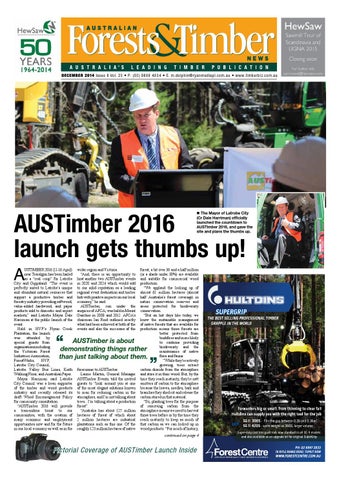
n The Mayor of Latrobe City (Cr Dale Harriman) officially launched the countdown to AUSTimber 2016, and gave the site and plans the thumbs up.
A
USTIMBER 2016 (11-16 April) near Traralgon has been hailed as a “real coup” for Latrobe City and Gippsland. “The event is perfectly suited to Latrobe’s unique and abundant natural resources that support a productive timber and forestry industry providing softwood, value-added hardwood, and paper products sold to domestic and export markets,” said Latrobe Mayor Dale Harriman at the public launch of the event. Held in HVP’s Flynn Creek Plantation, the launch was attended by special guests from organisations including the Victorian Forest Industries Association, ForestWorks, HVP, Latrobe City Council, Latrobe Valley Bus Lines, Keith Walking Floor, and Australian Paper. Mayor Harriman said Latrobe City Council was a keen supporter of the timber and wood products industry and recently released its draft Wood Encouragement Policy for community consultation. “AUSTimber 2016 will provide a tremendous boost to our communities, with the creation of many economic and employment opportunities now and for the future in our local economy as well as in the
wider region and Victoria. “And, there is an opportunity to host another two AUSTimber events in 2020 and 2024 which would add to our solid reputation as a leading regional event destination and timber hub with positive impacts on our local economy,” he said. AUSTimber, run under the auspices of AFCA, was held in Mount Gambier in 2008 and 2012. AFCA’s chairman Ian Reid outlined exactly what had been achieved at both of the events and also the successes of the
forest, a bit over 36 and a half million (or a shade under 30%) are available and suitable for commercial wood production. “We applaud the locking up of almost 61 million hectares (almost half Australia’s forest coverage) in nature conservation reserves and areas protected for biodiversity conservation. “But on hot days like today, we know the sustainable management of native forests that are available for production means those forests are better protected from bushfires and more likely to continue providing biodiversity and the maintenance of native flora and fauna. “While they’re actively growing, trees extract carbon dioxide from the atmosphere and store it in their wood. But, by the time they reach maturity, they’re nett emitters of carbon to the atmosphere because the leaves, needles, bark and branches they shed rot and release the carbon stored in that material. “So, planting trees for the purpose of removing carbon from the atmosphere means we need to harvest those trees before or by the time they reach maturity to keep as much of that carbon as we can locked up in wood products. “For much of history,
AUSTimber is about demonstrating things rather than just talking about them. forerunner to AUSTimber. Laurie Martin, General Manager AUSTimber Events, told the invited guests to “look around you at one of the most elegant solutions known to man for reducing carbon in the atmosphere, and I’m not talking about trees... I’m talking about a production forest”. “Australia has about 125 million hectares of forest of which about 2 million hectares are industrial plantations such as this one. Of the roughly 123 million hectares of native
continued on page 4
Pictorial Coverage of AUSTimber Launch Inside
OUT PULLS THE OTHERS
Pull a full drag up a steep grade with the new Cat ® D Series Skidder and feel the power. Tires stay on the ground, so it won’t dance with you on turns. Six-speed transmission, lock-up torque converter and independent front and rear differential locks give you more control. Advanced hydraulics speed up cycle times and lift more. Watch your drag through tall windows in cool, quiet comfort with seat-mounted grapple joysticks at your fingertips. Runs cool and debris can’t find a home. Tilting cab opens up a whole new world of service access. Lower operating cost and more productivity — that’s what the new D Series is built to deliver. The D Series comes with Product Link™ to track fuel, idle time, maintenance and more. Look to your Cat dealer for financing and all the machines, attachments and parts you need for road construction, logging, millyard and forest management. Total support from one source. www.cat.com/en_AU
© 2014 Caterpillar. All Rights Reserved. CAT, CATERPILLAR, BUILT FOR IT, their respective logos, “Caterpillar Yellow,” the “Power Edge” trade dress as well as corporate and product identity used herein, are trademarks of Caterpillar and may not be used without permission. www.cat.com www.caterpillar.com
Proud Supporter of
Australian Forests & Timber News, December 2014 – 3
continued from page 1
AUSTimber 2016 launch
The Mayor of Latrobe City (Cr Dale Harriman) officially launched the start of site works at the in-forest site, and the first trees were dropped in the live demonstration sector. Site preparation will continue over the next year to ensure visitors get great views of the working machinery while everyone's safety is being protected. The Komatsu 450XLT (Komatsu 398 head), supplied by Leesons Logging & Cartage, was operated by Gary Hegarty. The John Deere 1270 (John Deere 480 head) was supplied by Austimber Harvesting and operated by Chris Smith. The drone was operated by Heinz de Chelard (Australian UAV).
continued on page 4
Off the shelf solutions, customised for your mill For over 100 years, we’ve been engineering solutions for the timber industry. In that time, we’ve designed and built a range of equipment proven to improve mill productivity. But we’ve yet to meet a client who didn’t need some modifications to make even the best equipment fit their particular space and needs. Contact us for a quote to make your mill even more productive.
• manufacturing • sawmilling equipment • log carriages • resaws • multisaws and board edgers • automatic sorters and stackers • transfers and conveyors. Complete turnkey projects.
From major start-ups to retro-fits, if you want professional service and advice, contact us.
AE Gibson & Sons Phone 02 6559 4001 Email: info@aegibsonman.com.au www.aegibsonman.com.au
4 – December 2014, Australian Forests & Timber News
ISSN 1444-5824
December 2014
Building community awareness of fire risks. Page 28.
Features AFCA 8 VAFI 10-13 Log Loaders 18 Head-lines 19-21 Software 24 Bio-energy 25-26 Forwarders 27 Fire Prevention 28-29 Classified 30-31
MEDIA
INDEPENDENT & AUSTRALIAN OWNED
Postal Address:
630 Regency Road, Broadview South Australia 5083 Phone: (08) 8369 9555 Fax: (08) 8369 9501 Advertising: m.dolphin@ryanmediapl.com.au Melbourne Office (03) 9888 4834 Trader classified: m.dolphin @ryanmediapl.com.au Melbourne Office (03) 9888 4834 Editorial: j.hudswell@ryanmediapl.com.au Adelaide Office (08) 8369 9512 Subscriptions: subs@forestsandtimber.com.au Adelaide Office (08) 8369 9522 Accounts: Adelaide Office (08) 8369 9555 General Manager: Elizabeth Bouzoudis Editor: John Hudswell Advertising: Michael Dolphin Subcription rates One-year (8 editions) $55 Two-years (16 editions) $95 Production: Luke Westle Publisher and Chief Executive: Hartley Higgins Suite 103, 486 Whitehorse Road, Surrey Hills, Victoria, 3127, phone (03) 9888 4822 Conditions: Opinions expressed herein are not necessarily those of the editor/publishers; information is published in good faith and we do not accept responsibility for damage which may arise from any possible inaccuracies. All rights reserved, none of the contents may be used in any other media without prior consent from then publishers. Published by Ryan Media Pty Ltd. Print Post No. PP 767324/00002
AUSTimber 2016 launch gets thumbs up! continued from page 3 we haven’t managed to use 100% of each harvested tree given the fact they’re round while lumber is square and there wasn’t much use for small branches and leaves. “Local manufacturers such as Australian Paper at Maryvale and Australian Sustainable Hardwoods at Heyfield have been doing excellent work in replacing energy from fossil fuels by using their own by-products to generate power or heat boilers. “In fact, Australian Paper is the largest industrial generator of base load renewable energy in Victoria. “But now there’s considerable work being done internationally to better use all parts of the tree; uses such as exploring the properties embodied in Nano crystalline cellulose (or NCC). “With eight times the strengthto-weight ratio of stainless steel, NCC is a relatively inexpensive material made from wood pulp after other things such as lignins have been removed. NCC is excellent for replacing metal and plastic car parts so could eventually make nonorganic plastics obsolete. “And Lignin itself is currently being researched for use as an alternative renewable energy. The fact it burns at about one and a half times the temperature of ethanol is of huge interest to aircraft manufacturers and operators looking for ways to reduce the carbon footprint of flying,” Laurie said. Lignin is also useful for producing carbon fibre making it possible to avoid using fossil fuels in making that very important material. “When we were researching where AUSTimber should be staged in 2016, we were encouraged by Latrobe City being prepared to consider introducing a Wood First policy. “We extend our thanks and admiration to the council officers, councilors and people of Latrobe City for their foresight and willingness to roll up their sleeves to make things happen rather than just talk about them. “So what does all this mean when it comes to the AUSTimber event itself?
“Like the good people of Latrobe City and Gippsland, AUSTimber is about demonstrating things rather than just talking about them. “In April 2016, we will have conferences on sustainably growing the right trees for the right application through to how to build more environmentally sustainable buildings that are also good for the economy. “But the activities that may have greatest appeal to most people already in the industry (or perhaps those considering getting into it) will be our demonstrations and exhibitions where the latest technology will be on display. “We’ll have the jet pilots and legends guiding harvesting equipment such as these two machines that will fell the first trees on this, our live inforest demonstration site. “And there’ll be other technology such as that which Heinz is demonstrating today showing aerial surveillance platforms that can generate important growth data for forest managers. “At our added-value site in the Traralgon Showgrounds we’ll build a house to lock-up stage during the week of the event. “This will demonstrate what can happen when good architectural design and advanced manufacturing deliver pre-fabricated timber panels that can be quickly and accurately connected on site. “With no bad weather days holding up construction on building sites, buildings can be constructed to millimetre perfection under cover in factories prior to final assembly on site. “With far greater control over costs and timing, this method of construction generates real economic advantage. “Given pre-fabricated timber panels that can fit on a truck can also fit in a container, this is the sort of design and manufacturing productivity that can spring from government encouragement of the
timber industry that will not only deliver local housing but also help develop export markets. “And given a house made largely from wood has a significantly lower carbon footprint than one built with the materials most commonly used over the past century, there is also a big environmental advantage as well. “So, welcome to the start of our year and a half of site preparations for
what is recognized as one of the top three or four forest expo’s in the world,” said Laurie. Two harvesting units worked in tandem to cut the first trees on the site and apart from a strong battery of still and movie cameras drone footage was shot as well. A perfect start to the countdown to April 2016!
MD0126
38x5
MD0126 - Randalls Equipment Co Pty Ltd - Ponsse - A new generation MD Randalls Equipment Co Pty Ltd RAND02
A NEW GENERATION OF
FOREST MACHINES SOON TO BE ARRIVING IN AUSTRALIA
RANDALLS EQUIPMENT COMPANY is proud to be associated with PONSSE Plc Finland by introducing the full range of PONSSE forestry machines into Australia. PONSSE is the world leader in supplying the logging industry with productive and environmentally friendly cut-to-length harvesting systems. CONTACT US FOR MORE INFORMATION RANDALLS EQUIPMENT COMPANY PTY LTD email: randalls@randalls.com.au www.randalls.com.au HEAD OFFICE VICTORIA Randalls Equipment Company 8 Wallace Avenue, Point Cook, Melbourne VIC Contact: Peter Randalls PH: 03 9369 8988 WESTERN AUSTRALIA (NEW) Randalls Equipment Company 9B Charles Street, Albany WA Contact: Adam Bremner Ph: 0437 059 477
FORWARDERS: From 1O,OOO kgs load capacity to 20,000 kgs load capacity. HARVESTERS: PONSSE offers a full range of wheeled harvesters with an impressive six models in the range from the Beaver to the heavyweight Bear with the new and very impressive Scorpion King for the most challenging logging conditions. The product range includes both six and eight-wheel harvesters in all size categories. Application ranges from harvesting softwood saw logs to harvesting & debarking eucalypt pulpwood.
A logger´s best friend www.ponsse.com
6 – December 2014, Australian Forests & Timber News
Looking back on 2014 and good tidings for the New Year I
T IS now coming up to two calendar years since the former Forests NSW was corporatised, forming Forestry Corporation of NSW, and it has been a significant period of change for NSW’s largest commercial forest manager. In the face of tough trading conditions, we have taken some difficult decisions to restructure the business and transform Forestry Corporation’s performance. As a result, we are becoming a more streamlined operation with a firm focus on delivering on our commitments to our customers and the communities we work in. We received some acknowledgement of our renewed community focus during the 2014 financial year, with the NSW Government increasing funding for community services by $5.2 million. This funding goes towards activities like maintenance of facilities such as recreation areas and roads not used for timber haulage. Recent changes in our Hardwood Forests Division have separated land management responsibilities from sales and production in order to clarify responsibilities and improve responsiveness. Forestry Corporation is the largest commercial forest manager in NSW,
but we are just one part of this State’s timber industry and working with our customers and contractors to ensure the industry remains competitive is crucial for the industry as a whole. We expect that customer service will continue to improve following changes we’ve been making over the past two years. Looking ahead, there’s plenty of work to be done but we will go into the New Year with renewed confidence. Our latest Annual Report, released in November, indicates we are heading in the right direction with the recovery of the Hardwood Forests Division a notable achievement. The division had recorded notable losses in recent years but is now on track to return a small profit in 2015, which should give the broader industry confidence that forestry has a strong future in NSW. We wish all our friends and colleagues in the forestry sector a safe and happy Christmas season and look forward to continuing to work together into 2015. Nick Roberts CEO, Forestry Corporation of NSW
Forestry Corporation staff celebrate safety with donation to Careflight
Long-nosed potoroo bounces back into Booderee After 10 years of planning, Booderee National Park has welcomed back a small population of long-nosed potoroo. Fifteen of these tiny members of the kangaroo family were reintroduced into the park after being extinct in the area for many years, and more will be released in Booderee. Parliamentary Secretary for the Environment, Senator Simon Birmingham, said the 15 potoroos were captured from State forests near Eden before being delivered to Booderee further up the South Coast of NSW. “The trapping has been a great success, with 15 potoroos already settling into their new home in Booderee National Park,” Senator Birmingham said. “These wily potoroos have had us guessing – a few months back, the team tried trapping them for a full week without success, so it’s great to see so many captured in a single day.” Dr Nick Dexter, Senior Project Officer with Parks Australia said the release of the charismatic native species was made possible by Booderee’s extensive fox control program. “After all the gloomy stories about the extinction of small mammals, we’re proud to be reversing the trend for this species,” Dr Dexter said. “Small mammals are vulnerable to predators like the introduced
red fox. Our intensive fox control program over the past 10 years has paid off – predator numbers have been significantly lowered to the point that the reintroduction of the long-nosed potoroo is possible. “But we couldn’t do this on our own - it’s a great story of scientific collaboration across a range of agencies.” The animals brought to Booderee were previously living in the vast State forests south of Eden, where a number of threatened species are now flourishing thanks to predator control by the Forestry Corporation of NSW. “In 2008 we changed our baiting from a traditional seasonal program to ongoing landscape control over 100,000 hectares,” Forestry Corporations Senior Field Ecologist Peter Kambouris said. “The long-nosed potoroo was one of the first species to increase. “I was aware that Booderee wanted to reintroduce long-nosed potoroo into the park, so when our monitoring suggested that our numbers were robust enough to support a translocation, we gave them a call.” Teams from Booderee, the Forestry Corporation, the Australian National University and the Southern Ark team from DEPI Victoria set traps in several areas in the State forests around Eden known to be inhabited by the species. “We were specifically after a
Vitally important function Small mammals such as bandicoots, bettongs and long-nosed potoroos perform a vitally important function in forest ecosystems. They consume large amounts of hypogeal fungi which are better known as truffles. The truffles are high in nutrients and have a strong smell. The small mammals are attracted to these truffles and eat them and then deposit the spores from the fungi in their faeces. As the scattered spores grow into fungi they form a mutually beneficial relationship with forest trees. When the fungi infest the roots of trees, the trees provide water and carbon to the fungi and the fungi extract nutrients from the soil for the trees. Scientists believe this is probably the reason why large trees were able to grow at Booderee despite the very poor soil. Reintroducing the potoroos may help spread these beneficial fungi further and more efficiently through Booderee’s forests. It is unclear when the long-nosed potoroo disappeared from the Jervis Bay region. However, we know they were present in the area for thousands of years before the introduction of foxes because of their abundant presence in Aboriginal middens dating back to historic times. Adult long-nosed potoroos weigh up to 1.6kg and have a head and body length of about 360mm and a tail length between 200-260mm. Their fur is greyish brown on their backs and light brown on their belly.
n Forestry Corporation of NSW-Potoroo trapping.
particular male to female ratio, reproductive status, age and condition,” Dr Dexter said. “Once trapped, the animals were given a health check by a specialist vet from Taronga Zoo before being fitted with micro chips and radio trackers to ensure we can track their movements and monitor their health in their new environment. “These potoroos were trapped, checked, and released into Booderee on the same day in order to minimise any stress on the animals.” Over the next three years up to 36 long-nosed potoroos will be reintroduced into Booderee National Park where they should thrive once more. Tony Carter, a member of the Wreck Bay Aboriginal Community and Booderee staff member, said the long-nosed potoroo were once an important and abundant species for the local traditional owners. “Our people recognise the important role these animals play in the health of our country. I am glad to see introduced pests managed to a level where important native species can be returned,” Tony said. NSW Department of Primary Industries Invasive Species Officer, Paul Meek said it was a real credit to the Forestry Corporation and Parks Australia teams to have seen their predator control programs through to this stage. “This reintroduction of the long-nosed potoroo from State Forests back into the park is a pivotal milestone in the strategic management of pests and the species in New South Wales,” Paul said.
FORESTRY CORPORATION of NSW staff chose to donate to the Careflight Rescue Helicopter instead of receiving individual rewards as a means of celebrating no lost time injuries during 150,000 hours of work in the State-owned pine forests around Walcha, Grafton and Bathurst. Forestry Corporation’s Regional Manager Jason Molkentin said staff celebrated meeting their safety target by donating to Careflight in recognition of the service it provides to the local community and within State forests. “Safety is a priority for Forestry Corporation and our target is to ensure people involved in our industry go home to their families at the end of their working day,” Jason said. “Achieving targets such as no lost time or recordable incidents is an important indicator that staff are working hard to focus on safety in what can be a difficult workplace. While we’re pleased to have met this important safety target, the real reward is people not being hurt or injured. “The Careflight Rescue Helicopter is a lifeline for local communities and provides a valuable service to remote locations such as State forests when things go wrong. “While every single one of us benefits from doing our job safely, this donation to Careflight is a great way to ensure even more people benefit from our local staff’s commitment to maintaining a safe workplace. “Hearing from Careflight about the difference this donation will make in the lives of the people they support has also renewed the team’s commitment to putting safety first at work.”
nB athurst Careflight donation: Dallas Ninness (Walcha), Steve Whitehead and Dave Anderson (Bathurst), John Ebbott (Careflight) Jason Molkentin.
MD0123
38x5
MD0123 - Onetrak - MD Onetrak ONET02
OVER 250 MACHINES SOLD IN
AUSTRALIA HARVESTERS. FORWARDERS. SKIDDERS. LOGGERS. FELLER BUNCHERS. ATTACHMENTS. Quality, purpose-built forestry equipment designed and built to deliver processed wood to roadside at the lowest cost per tonne. Supported by 5 branches equipped with an extensive inventory of genuine parts, workshops facilities and staff passionate about the product and delivering the best customer service.
NEW BRANCH
TASMANIA
NEW SOUTH WALES
SOUTH AUSTRALIA
VICTORIA
WESTERN AUSTRALIA
11 Midland Highway, Brighton
208-216 Snowy Mountains Highway, Tumut
17 Crouch Street North Mount Gambier
226-228 FrankstonDandenong Rd, Dandenong South
12 Sherlock Way, Davenport
Contact us today and let us help you and your business.
1300 727 520 – WWW.ONETRAK.COM.AU
8 – December 2014, Australian Forests & Timber News
AFCA
Contractors get through a swag of business I
AN REID was returned as Chairperson and Joanne Wilson as deputy Chairperson when the Australian Forest Contractors Association (AFCA) held its annual meeting. All existing members of the Board were re-elected with one additional new member, David Lodge from Western Australia. The inclusion of David means that the association now has effective representation from every State in Australia. The association’s multi-purpose function (AFCA board meeting, AFCA Forum entitled “What happens when the boats are full”, AFCA AGM, the AFCA Annual Dinner and AFCA Hall of Fame Induction), was also David Keenan’s first as the newlyappointed General Manager of AFCA. The Industry Forum started with an address by Hancock Victorian Plantations Gippsland General Manager Simon Gatt. He provided an overview of how Hancock operated domestically and internationally, where the major plantations were located in Victoria and what he believed were the major challenges in the future. Simon provided some very interesting statistics in relation to truck movements at different times of the day and night, directly
relating these movements to productivity and in essence falls in productivity in the afternoon in comparison to higher levels of productivity in the morning. There were some excellent questions relating to truck movements and the co-ordination of opening times at various facilities. Simon’s presentation was extremely informative and created some real points of discussion. The second speaker was Managing Director of Australian Bluegum Plantations, Tony Price. Tony outlined some of the challenges of the sector, especially after recovering from MIS issues. Tony also contrasted the challenges of doing business in China and Japan. The information that was presented based on Tony’s wealth of experience and in-depth knowledge, was informative for anyone considering undertaking business in either country. Tony outlined the considerable growth occurring in China in both the domestic and industrial areas. He believes that the growth in China will continue to increase, creating new opportunities, while the Japanese economy will remain steady. An enlightening presentation was delivered by Dallas Frost from Crowe Horwath. Dallas provided a frank and fearless presentation
outlining the realistic costs of operating a contracting truck. In his presentation, Dallas outlined the risks and challenges involved in deriving a sustainable income that would cover the costs. His presentation outlined how marginal a business can be and the potential risks that can impact on cash flow. He highlighted how the repairs and serving of a vehicle could impact on cash flow, putting an operator further behind in payments, as well as increasing the potential for skilled staff to find alternative employment. There was some good feedback on the figures and different scenarios that Dallas presented. The presentation was a “reality check” for operators thinking about expanding or maximizing the utilisation of their current fleet. The final presentation was by Peter Ryan (Peter G Ryan & Associates Industrial and Employee Relations Consultants). As most contractors know, managing employees and the various different issues is a complex area. Peter gave an overview of the different parts of legislation that apply to the sector, many of which are currently under review. He provided some information in regard to dealing with time in lieu and rostered
n MC, Marty Field.
n Laurie Martin, AUSTimber General Manager, addresses the function.
days off. The issue of random drug and alcohol testing was raised, with Peter indicating that this is now an existing issue but likely to emerge as a major issue in the future. Peter suggested that rather than being “random” testing, it is more likely that in the future it will be “mandatory” testing. Peter encouraged all businesses to ensure that they had the appropriate policies
and procedures in place. Peter’s presentation was really informative, especially in an area where there are often multiple answers to single questions. The Industry Forum was sponsored by the Linx Australia Group. It was great to see a number of members of the Linx Australia Group involved in the Forum and the Hall of Fame Dinner.
n Ian Reid and Greg Coverley.
n Ian Reid, Senator Richard Colbeck, Max Jones and Dale Mitchell
Special recognition THE AUSTRALIAN Forest Contractors Association conducted its annual Hall of Fame dinner and inducted two outstanding contractors into the Hall of Fame. Prior to inducting the contractors it was the decision of the Board to a present a Certificate of Appreciation to Greg Coverley from Collie Western Australia. Greg is a former Board member of the association and has made a huge contribution to the sector in Western Australia. In the presence of Senator Richard Colbeck, Parliamentary Secretary to the Minister for Agriculture and Liberal Senator for Tasmania, Max Jones and Dale Mitchell were inducted into the Australian Forest Contractors Association Hall of Fame. Max, from Scottsdale, Tasmania, started in the industry in the early 1970s as a 22-year-old when he bought his first log truck to work in the Tasmanian timber industry. In 1973 he married Deidre and slowly started growing his business by expanding into harvesting as well as haulage. At the peak of his business in early 2000s he operated a cable harvesting operation, two ground based operations and two trucks employing around 25 people. With the industry downturn in Tasmania Max worked in Queensland and is now back working around Burnie. He is a
passionate Tasmanian and is also very passionate about the timber industry in general. Dale lives in Carboor, North East Victoria. He comes from a farming background and started with a hard hat and Stihl chainsaw like many in the industry in the 1970s. Like many he got into the industry by accident when the fellow he was working for hurt himself in an accident. After doing fire salvage work after the 1983 Ash Wednesday fires he bought his first skidder in 1984 when interest rates were 19%. By the early 1990s he employed 18-20 hand-fallers and then took the next plunge in 1993 by buying his first harvester. Dale has always been an innovator and his home has become a mini Sweden with normally at least one operator from Sweden working for him on a working holiday. This connection has meant that these operators have become one big extended family with constant communication via social media when they return home. Dale’s other achievement was the development of modified harvesting head feed wheel rollers which are better suited to the Australian conditions. The dinner was well supported and the association thanks the generous sponsorship of William Adams, Komatsu and MHL Insurance.
There’s a definite need to plant more trees now AUSTIMBER 2016 will showcase not just the forestry and timber industry but what the future holds in the way of innovative use of timber . That was the message from Australian Forest Contractors Association chairman Ian Reid to the organisations annual general meeting and dinner “We are a sustainable industry and we must go out and sell ourselves, plus the fact we are regional and employ in country areas,” he said. AUSTimber general manager Laurie Martin gave a presentation on plans for the event including a number of new initiatives. “AUSTimber will be a game changer
for the new timber manufacturing paradigm,” he said. Senator Richard Colbeck addressed the members and stressed that after the Government had made changes he saw some common sense returning to the forestry industry after disruption by negative regulatory policies and the GFC affecting markets. “There is a need for positive market options for contractors to move forward. The LNP coalition is looking to turn the industry around with sound policies. “The first meeting of the Forest Industry Council was held recently which made a commitment to the Forests and Fibre plan framework for the industry future but we need to plant more now,” he added. Senator Colbeck said he believed demand for timber products would grow. One example he highlighted was General Motors looking to 30% of a car componentry being made up of cellulose. “But there is a need to plant now for the next 15-35 years. People are better informed but we have to get the message out that timber is the product for building,” he said.
10 – December 2014, Australian Forests & Timber News
VAFI
Industry sets itself on securing the future “SECURING THE future is currently one of the most important objectives for the industry. We all need to consider how to respond to the challenges ahead,” Victorian Association of Forest Industries chief executive officer Tim Johnson said in his address to the organisation’s annual dinner and awards night.
T
he theme for the function -Securing The Future -- was very apt considering it was held just six weeks prior to the Victorian elections. “We all know that resource security will remain an issue for the foreseeable future, as will our industry’s social licence to operate. “Are we ready for employment where Generation Y comprises 42% of the workforce, workers stay in a job for three years and annual turnover approaches 20%? One in three workers will be employed on a casual basis. “How will we attract the next generation into the forest and wood products industry? “We face a future of emerging complexity and uncertainty, It is based around common themes: our ageing population, globalisation, the growing dominance of Asia, the
increasing take up of technology and a need for Australia to grow our stock of qualified workers.” By now the industry is familiar with the call for innovation. A recent survey undertaken by Forest and Wood Products Australia had almost 90% of respondents identifying innovation in products or processes as ‘important’ or ‘very important’. But as The Australian Financial Review reported last year “in manufacturing, Australia’s output specialises in low and medium technology intensity sectors”. “I believe the best days for Victoria’s forest and wood products industry are still ahead of us. How we get there is
our challenge. But there is good news. “The future will be both resource constrained and carbon constrained, and it is our industry and our products that are best
twenty first century,” he said. “More than 21,000 Victorians work in the forest and wood products industry, and they will work with us to secure the future and their livelihoods. That is why now is the time to secure the future for the Victorian forest and wood products i n d u s t r y. “Many of us nervously await State elections. Historically, they haven’t been kind to our industry. “Promising a national park or another forest lock up is the easiest thing a politician or political party will ever do. Unfortunately, revealing the economic and social costs and the details to industry and impacted communities is
A secure future for the forest and wood products industry starts with bipartisan support across the parliamentary aisle. placed to address those challenges. “The city of Melbourne will need to construct a million new dwellings by 2040, and it is our industry that has the resource and technical capacity to deliver this. “Wood and wood products are both sustainable and sought after. We are the material of the
barely even an afterthought. “This approach isn’t sustainable for the industry or indeed from a public policy standpoint. It is simply unrealistic to expect the industry to invest in the future when they are held to ransom every four years. “A secure future for the forest and wood products industry starts with bipartisan support across the parliamentary aisle. “A secure future is being proud of our local forest and wood products industry – an industry that is sustainable, that provides economic security and supports community wellbeing. “A secure future also acknowledges our comparative advantage in the quality of resource and skills we have. “That is our challenge. I look forward to seeing everyone in the industry work together to make it happen.”
C
M
Y
CM
MY
Now Timberbiz gives you more industry information to build your business Featuring: § Latest industry news and archives § Forest and timber trades and services directory § Online access to leading industry publications, Australian Forests and Timber News and Australasian Timber § Industry events calendar § Forest and timber industry jobs site
CY
CMY
K
NEW WEBSITE
Discover the benefits of visiting Timberbiz for all your information needs: § Up-to-date industry news and events calendar ensures you don’t miss out on important industry developments § Trades and services directory saves you search time § Find relevant candidates through industry specific jobs site
Visit Timberbiz today for all your industry information needs. .com.au
Ryan Media Pty Ltd 630 Regency Road, Broadview SA 5083 Phone: +61 8 8369 9555
Meet the ultimate Beast-of-Burden! The Eco Log 594D Blue Forwarder with its massive 19,500kg loading capacity rules the forest.
Eco Log
594D Blue
Technical specifications in short: Loading capacity
19,500kg
Weight
20,300 kg
Width (A)
3,075 mm
Length (C)
10,465 mm
Height (B)
3,855 mm
Ground clearance (D)
720 mm
Engine Type
6cyl. MB OM 926LA - 7.21L
Max. Power
301 hp
Torque
1200Nm @ 1600 rpm
Fuel tank capacity
220 litres
Hydraulic Pump
180 cc
Wheels
Standard
Pressure
750/45-30.5”
B
235 bar
Optional
Tank
180 litres
800/50-26.5”
D
750/50-26.5” 750/55-26.5” Loader - Cranab
Lifting 165kNm
Reach alternatives 8.5m/10m
E
A
C
With 19.5 tonnes of loading capacity and 24.5 tonnes of tractive effort, the Eco Log 594D forwarder dominates all other forwarders. The Eco Log 594D cab is spacious and comfortable and provides excellent viewing for the operator. The cab has tinted polycarbonate windows for maximum security and is approved according to ROPS/OPS/FOPS. Ergonomically designed seat combined with an efficient ACC and CD player further enhances operator comfort. All forwarders actions are executed with easy-to-control mini levers. Travel and working brakes are hydraulically operated oil-immersed multiple disc brakes, identical on both axles. Spring actuated parking and emergency brakes on both front and rear bogies.
Contact Johan from Scandinavian Forestry on (02) 6947 4505 or 0408 614 503; or visit our website: www.scanforestry.com Lot 10, Snowy Mountains Highway, Tumut NSW 2720
®
12 – December 2014, Australian Forests & Timber News
VAFI
nD avid Galloway (First Super), Greg McNulty (Ryan & McNulty Sawmillers) and Minister Peter Walsh.
nM inister Walsh, Dave Gover (Australian Sustainable Hardwoods), Janice Lacy and Phil Lacy (PF Olsen).
n I an Guss (RDV), Kathleen Raymond (RDV), Scott Brandon (Alpine Community Plantations Inc), Lou Coutts (HVP Plantations), Minister Walsh, Brian Walsh (RDV).
n Ross Hampton, Bob Humphreys, Senator Richard Colbeck
n Terry Hayes (CFA - Special Recognition Award winner) with Kunihiko Kashima (Australian Paper).
nP eter Ryan, Jacqui Commans, Louise Adams, Jim Child, Jan Adams, Graham Taylor, Martha Gardener
nR ichard Hill, Tony Walker, Alan McGreevy, Phil McCormack
n Cameron McDonald, Lara Wilson, Jason Wilson.
n Bob Humphreys presented the Industry Achievement Award to Garry Squires pictured with Tim Johnson (CEO VFIA)
n Nick Murray, Peter Ryan, Joanne Eastman, Ewan Waller
nM ark and Nicole Gibson, Gary Blackwood (MP) and Jemimah Walsh.
Australian Forests & Timber News, December 2014 – 13
VAFI
Above and beyond Sustainability Award the call of duty EACH YEAR, VAFI recognises members who have gone beyond compliance and made strategic improvements in their business, helping to build and secure the future of the Victorian forest and wood products industry. The VAFI Awards were presented during a ceremony at the Annual Dinner on 17 October. This year the three award categories of economy, community and sustainability reflect the importance of VAFI members to industry, and the association’s focus ahead of the State election. The award winners were presented with a commemorative award plaque by the Minister for Agriculture and Food Security, Peter Walsh. Economy (Sponsored by First Super): Ryan & McNulty Sawmillers Community (Sponsored by Regional Development Victoria): HVP Plantations Sustainability (Sponsored by PF Olsen): Australian Sustainable Hardwoods Lifetime Achievement: Garry Squires. A former senior bureaucrat in the former Department of Sustainability and Environment, Garry is passionate about using native forest residues from local East Gippsland sawmills to generate power for local communities such as Orbost. After leaving the Department of Sustainability and Environment, he became chief executive of East Gippsland Logging. Since 2007 he has run a timber industry consultancy, specialising in the forest industry; OH&S, business planning, tender submissions, and research projects. Special Recognition: Country Fire Association. VAFI acknowledged the Country Fire Authority for its outstanding, ongoing efforts in bushfire management through prevention, preparation, response and recovery which supports the forest industry across Victoria. In particular, for the CFA’s ability to work with the forestry industry to develop active and adaptive fire and forest management across all land tenures, to help mitigate the risk of future catastrophic wildfires. This award was sponsored by Australian Paper on behalf of all VAFI members, and the industry more broadly. Terry Hayes, Executive Manager Community Capability, accepted the award on behalf of the CFA.
A snapshot of diversity in Australian forestry industry THE VARIED nature of forestry in Australia is highlighted in the 2014 Australia’s forests at a glance 2014 booklet, released by the Australian Bureau of Agricultural and Resource Economics and Sciences (ABARES). Senator Richard Colbeck, Parliamentary Secretary to the Minister for Agriculture, welcomed the booklet and said it gave a detailed snapshot of Australia’s forestry and forest products manufacturing sectors. “Australia’s 124.7 million hectares of forest covers about 16% of the continent. This includes native forests and industrial plantations of various softwoods and hardwoods,” he said. Senator Colbeck was travelling to Kalgoorlie, Western Australia, to meet with the Forestry and Forest Products Committee to tour the Western Australian goldfields woodlands which contain the highly valuable sandalwood.
“Sandalwood extends across the southern half of Western Australia, from beyond the border with South Australia and up to the Hamersley Ranges. The sandalwood industry is more than a century old with sandalwood extracts used in the production of incense, perfumes and soaps,” he said. “The timber is also highly valued by Indians for use in funeral pyres, which would have to be one of our more unusual export industries.” It is a great example of the diversity of Australia’s forestry industry which makes a significant contribution to the Australian economy and regional communities, with more than 61,000 people employed in the industry in 2012-13.” The Coalition is committed to revitalising the forestry industry and creating a sustainable longterm future with benefits for the industry, community and environment.
AUSTRALIAN SUSTAINABLE Hardwoods (ASH) received the 2014 VAFI Sustainability Award. ASH has undertaken significant improvements in regards to sustainability over the past two years. Traffic management works across both ASH sites have been implemented in order to provide greater health and safety for all employees, visitors and contractors. These improvements have contributed the health and safety of ASH employees, as well as the ongoing efficiency and sustainability of the business through improved practices. In addition, they have introduced
new machinery to increase reliability and reduce emissions, downtime and waste. A focus on traffic management has required considerable thought and effort to be put into how the ASH site can be modified to reduce risk. Examples of much improved vehicle and pedestrian separation. VAFI congratulates ASH on their continuing commitment to the sustainability of their business, the health and safety of their employees, and the environment.
Community Award HVP PLANTATIONS has received the 2014 VAFI Community Award for its role in developing the Alpine Community Plantation Inc. initiative. The Alpine Community Plantation Inc. is an independent community based organisation that was established in 2013 as the result of an innovative public, private and community partnership. The partnership between HVP Plantations, Alpine Shire Council and the local community, with
funding from the Victorian Government, is responsible for the recreational, educational and community use of almost 20,000 hectares of HVP Plantations land within the Alpine Shire. The aim of the organisation is to enhance the relationship between the community and the forestry industry through the development of a nature-based tourism precinct. It hopes to increase tourism in the Alpine region, and attract investment to stimulate economic
investment, ensuring that the local community is resilient and sustainable. The Alpine Community Plantation Inc. is a nature based tourism precinct with a difference. It is a community-run recreational space with walking and mountain bike trails, and hosts both national and local events. It is a space that was created by and for the visitors and residents of the Alpine Shire.
Economy Award RYAN & MCNULTY Sawmillers received the 2014 VAFI Economy Award for its ongoing investment in the development of new technology and markets for timber. Ryan & McNulty’s aim of continual growth has been achieved by developing innovative approaches to productivity, value added products and the exploration of new markets. The objective of Ryan & McNulty’s investments are to increase their ability to add value to timber, and create new markets through investment and innovation. Ryan & McNulty have sought to reduce the amount of wasted low grade timber by developing new ways to utilise it. The development of a prefinished solid overlay laminate floor has proven successful using low grade material, and has given Ryan & McNulty a new product to enter into the market. The use of the low grade timber topped by a select grade timber is aligned with VAFI’s goal of growing the “value-add” of the Victorian forest and wood products industry. Product developments in pre finished flooring have attracted the attention of overseas buyers, with Ryan & McNulty leading the way in innovation in this field.
14 – December 2014, Australian Forests & Timber News
Federal Parliament embraces forestry and timber industries I
N A dramatic illustration of cross-party support for the nation’s sustainable forestry and forest product industries, the Australian Labor Party and Coalition Parties have agreed to the creation of a Federal Parliament “Friends of Forestry and Forest Products” group.
The new group will be co-convened by the Shadow Minister for Agriculture, Fisheries and Forestry Joel Fitzgibbon from the ALP and Tony Pasin the Liberal Member for Barker in the South Australian Green Triangle area. And, in a show of industry acceptance of the move, the Australian Forest Products Association says it is “ready to assist in any way we can as the participating MPs and Senators seek to better understand the Australian tree growing, replanting, milling and associated manufacturing industries in their electorates or states”. “Our world renowned forestry and forest products industries provide year round jobs for some 80,000 Australians - many in regional areas. It is vital that national policy settings acknowledge this fact and address some of the urgent challenges we face as a nation if we are to catch the ‘fibre boom’. In a carbon constrained global economy the world is looking more and more to renewable wood fibre,” said AFPA Chief Executive Officer Ross Hampton. “We will only get those appropriate policy settings if our national leaders are well informed. “I congratulate the Member for Barker Mr Pasin and the Member for Hunter Shadow Minister Fitzgibbon for adding this vital work to their extremely crowded agendas in Parliament House,” Ross said. In stressing the importance of the group, Mr Pasin said: “The forestry sector in the south-east of South Australia is the fundamental driver of the economy so raising awareness among my parliamentary
colleagues of the importance of forestry and forest products in particular is something I’m pretty keen to achieve”. Mr Fitzgibbon said: “A critical sector for our economy, and a sector which has been held back too often by conflict between the economy and the environment – it’s unnecessary and we can get that balance right” Senator Richard Colbeck, Parliamentary Secretary to the Minister for Agriculture, said that when the group idea was first talked about back in March the aspiration then was to take forestry out of the political cycle and to make the industry one that didn’t have to be concerned about when the next election was coming around ... “to make it an industry that could get on with the job and not have to continue coming to government for assistance because it was being readjusted”. “I agree with Joel, Australia is probably 10 years behind Europe, a long way behind Canada and also behind New Zealand. My aspiration would be to bring us up to the lead and the products that we have available in Australia I think provide us with the opportunity to take some of the next steps in the development of products out of timber. For example, Australian hardwood going into CLT could take that whole concept to another design level. “There are huge opportunities that exist here in this country, so it’s really great to see such strong support from across the Parliament. I look forward to engaging with you all under the leadership of Joel and Tony. I congratulate both of you on the work that you’ve done putting this together; it’s really fantastic. But more importantly I look forward to being able to put in place strong policies that provide for what is an important future for a very important industry for the country, but particularly for regional Australia,” said Senator Colbeck.
Blueprint for a safer future
SPONSORS OF New Zealand’s Independent Forest Safety Review see the review panel’s major recommendations as a blueprint for change. “We accept that safety needs to be given highest priority in the day-to-day operations of the industry,” says Forest Owners Association (FOA) spokesperson Bill McCallum. “It is unacceptable to have any forestry workers seriously injured and killed on the job. Everyone who works in our industry has the right and responsibility to return home safely at the end of the day. “By adopting the report’s recommendations and continuing to drive the safety initiatives we already have under way, I am convinced we can transform our industry into a safety success story.” He says the sponsors – the FOA, the Forest Industry Contractors Association (FICA) and Farm Forestry Association (FFA) – commissioned the review in late 2013, after a terrible year for forest fatalities. “Despite the best efforts of many people over many years, workers continued to be injured and killed in our forests. It was clear that we needed an outside expert review in order to achieve our target of zero serious harm injuries.” He says the FOA executive and the boards of the two other sponsoring organisations, are now studying the report. Once they have discussed the findings with their members, decisions will be made about who takes responsibility for implementing the recommendations. “These decisions will need the involvement and support of government, Worksafe NZ, training organisations, ACC, Federated Farmers and others. Forest safety involves many players outside the industry itself.” FICA spokesperson John Stulen says the industry has champions who put safety first. Their initiatives have saved many lives. “But what we haven’t achieved is a cultural change across the industry from ‘can do’ to ‘can do safely’. Making this cultural change is probably the most important message in the report. “Fine words will not be enough,” he says. “Safe working practices will now need to be agreed with contractors right along the supply chain and documented in contracts or by reference to the Approved Code of Practice and Best Practice Guidelines. “Compliance needs to be rewarded and non-compliance penalised. Carrots and sticks if you will.” FFA spokesperson Peter Berg says smaller forest owners tend to harvest infrequently, so tend to hire contractors based on word-of-mouth. “The panel’s support for the accreditation of contractors, as well as workers involved in safety-critical work, will help to reassure owners of smaller forests that they are hiring a contractor with the appropriate skills and that they are also meeting their obligations under health and safety legislation.” He says the report highlights incidents and case studies which are both positive and negative for the forest industry. “It is now important that we focus on the positive … those are the examples that we can all draw inspiration from. They show that we can transform our industry so it is seen as a great place to work – safe, rewarding, and professional.”
At the time of prepping this piece for our editorial pages it was Melbourne Cup day, so, to use a little racing parlance this opinion piece by Ross Hampton, chief executive officer of the Australian Forest Products Association (AFPA), is right on the money!
Fight fire with forestry ANOTHER NOVEMBER and again the air in the Blue Mountains is rent by sirens and smothered in smoke haze. Ground hog day. As the story unfolded and a house was burnt to its foundations while 100 families fled to the local showground, a reporter opined that “this is a signal that the Federal Government really needs to do more on climate change”. Ground hog day again. My prediction is that as soon as the fire is out we will hear that it would be a good thing if the ‘authorities’ did more ‘winter burning off’. Ground hog day again, again. In Australia our major cities are surrounded, and indeed crisscrossed, by beautiful bushland. Wonderful to live beside but also very dangerous in summer. And we also have vast areas of bush and forest stretching across sparsely
inhabited parts of the country - all up about one hundred and twenty five million hectares. Despite all that clearing for agriculture and towns since 1788, it’s estimated that we still have about 87% of the forest cover which confronted Captain Phillip and crew when they stepped ashore. That we still have such abundant bushland is a credit to our early planners and current tight rules on clearing. But we frankly have to get better at managing the risks. To generate a burst of angry letters to the editor of any newspaper, all I need now do is say two words; ‘biomass removal’. Most average people won’t even know what I am talking about. But to those who see our bushland as a vast cathedral which should not be touched, ‘biomass removal’ is the evil which can’t be spoken. Biomass removal just means the taking away of some of the fuel load from our bush. It is exactly what we do when we burn off. It is also exactly what happens, but on a massive and out-of-control scale, whenever we have a major bushfire.
The biomass is certainly removed then. In the USA it happens all the time with barely a raised eyebrow. President Obama is part way through a four hundred million dollar ‘forest landscape restoration’ program, which has as a core mechanism, paying operators to take machines in and carefully and strategically take out some of the crowding trees and shrubs. The landscape becomes more open, the remaining trees grow higher and stronger and the bushfire threat is reduced. But here? Oh no not here. Biomass removal is too hot to touch. This is despite evidence of tree overcrowding in parts of the country which, combined with drought, creates a recipe for mega-fire. My friends in the green movements who are implacably opposed to touching our forests in this way cry, “it’s the thin end of the wedge!” They say, “if we let folks remove any trees they will go for the lot”. I try to explain that we can put parameters around what can be used. I tell them there are
already laws and regulations around harvesting practices and sound forest management which protect soils and water, habitat and environmental amenity. And the tragedy is that if the bush is not thinned out in this careful way, it will happen in a far more uncontrolled way when a mega-fire rushes through. The Coonabarabran fire in January scorched 95% of the Warrumbungles National Park and it will be decades before it fully recovers. The thousands of hectares containing dead gums down Kosciusko way still stand like armies of barren sentinels almost a decade after the Canberra fires. Victorians will of course never truly recover from the catastrophic deaths of 173 people on Black Saturday in 2009. I tell my green friends that the mega fires push our national greenhouse gas emissions through the roof. The Blue Mountains fire last year alone pumped another 350 million tonnes into the atmosphere. I add that these huge fires destroy habitat, like the 45% of the
n Ross Hampton.
reserves set aside for the Victorian Leadbeaters Possum which went up in flames in 2009. I try to explain that forestry as an industry is put at risk every year as we never know when a huge fire will bear down, destroying part of our 2.1 million hectares of gum trees and pine trees in plantations. So as the flames still lick the escarpment around Katoomba and the fire crews ready themselves all over Australia, I live in hope that this will be the year we agree to have a rational discussion about carefully managed fuel reduction. Can ‘biomass removal’ perhaps speak its name? Maybe this will be the summer we finally agree with Einstein who said to repeat the same activity over and over and expect a different result is insanity.
Australian Forests & Timber News, December 2014 – 15
FSC Australia CEO takes on new international role FSC AUSTRALIA chief executive officer Natalie Reynolds has been promoted to a new role as Transformation and Development Director for FSC International, beginning in the New Year. The growth of the Forest Stewardship Council (FSC) across the globe in recent years, particularly in Australia, has been unprecedented in the organisation’s 20 year history. “Natalie has made a remarkable impact on FSC Australia over the past three and a half years. Most significantly, the organisation has matured to the point that we have the capacity to develop a locally owned National Forest Stewardship Standard,” said FSC Australia Chair Jonathan La Nauze. He said that under Natalie’s leadership, there had also been consistent growth of FSC certification to more than 1.7m hectares of Australian plantations and forests and a 172% increase in product certification. “In her new international role, Natalie has been tasked with leading a dedicated team in the creation of a strategy that will
prepare the FSC to tackle the challenges of the next 20 years and assist the organisation in its mission to drive environmentally appropriate, socially beneficial and economically viable forest management. “While we will miss Natalie at FSC Australia we recognise that her strategic and transformation management skills make her the perfect candidate for this important new position. “The Board has begun the process to recruit Natalie’s successor and we’re committed to ensuring a comprehensive handover of the FSC Australia CEO position can occur. We look forward to making further announcements in due course,” said Jonathan. At the FSC General Assembly last month, FSC members delivered a clear mandate to develop a more efficient organisational set-up and
governance model. Natalie’s role will help formulate a clear way forward for the FSC to tackle the many challenges it faces and continue to thrive in the many global markets where it operates. The transition will begin from January 1, 2015 and Natalie will remain based in Melbourne while working full-time in the new position with FSC International.
Background on FSC Australia: •
FSC Australia, which also oversees a regional FSC office in New Zealand, manages a trademark program for wood and paper products – the FSC logo is a mark of approval that tells consumers, retailers and businesses if a product is forest-friendly.
nN atalie Reynolds ... taking on international role in the new year.
•
•
FSC Australia is a national office of an international non-government, nonprofit organisation that promotes responsible forest management practices through multi-stakeholder standard setting and an inter nationally-recog nised certification labelling program. Globally certified
the FSC more than
has 180
million hectares of natural and plantation forests in more than 90 countries. •
When you buy an FSC certified product you know every stage of its lifecycle has been assessed to ensure it’s sourced from a responsibly harvested natural or plantation forest, which meets the FSC’s rigorous economic, environmental and social standards.
AnothEr PrECision ProduCt, thE
Powered by a Cummins 600 HP or CAT 580HP engine, this machine produces more than 75 tons per hour and is totally dedicated to biomass. To see it in action, go to www.youtube.com/watch?v=IJ9cPHrHyQ8.
Contact: Andrew or John Ph: 03 5156 4243 Fax: 03 5156 4125 Email: info@jondod.com
16 – December 2014, Australian Forests & Timber News
It may be small but it packs a punch! P
RIVATE FORESTS Tasmania has been “punching well above its weight”, according to Deputy Chairman Mark Leech. He made the observation in the organisation’s annual report. He said PFT was a clear demonstration of how a well lead, restructured small organisation can punch well above its weight and deliver value, first to the private forest estate and to the State as a whole. “It is a new day and this has been clearly demonstrated in the brief time that the new Government has been in place. The new Minister for Resources, Paul Harriss, has welcomed input from PFT, recognising the knowledge and skills within the organisation and the importance of the private forest sector in the new forestry landscape. “While we are not completely out of the uncertainty that pervaded our recent past, there are definite signs of an improving forest economy,” Mark said in his message. “Total sales have significantly increased from 2013, predominantly from some of the former MIS and industrial private plantations as their new owners consolidate. “PFT has continued to provide advice both at the highest level with the Ferguson Hardwood Plantation inquiry with significant input from CEO Tom Fisk, to continued unbiased advice to all affected parties. “The private native forest estate, more significant than ever, managed on a sustainable long term basis provides for multiple values and high value outputs. “Of continuing concern is the closure and buy out of local and regional sawmills that have provided
for relatively close cart sales for private native forest sawlog over the history of our industry. “The lack of a southern opportunity for residue sales due to the closure of the Triabunna export facility has had a significant effect on the private forest sector in the east and south of the State. “The support of the Huon and Dorset resource groups continued and was underwritten by the private estate resource modelling, a PFT initiative. “These groups have shown tremendous initiative in providing leadership, innovation and hope to their communities,” he said. Mark explained that the new PFT structure demonstrated that “vision gives pain a purpose”. “The organisation has delivered an exceptional financial result with particular thanks to CEO Tom Fisk and the Finance and Administration Manager Jeff Battersby. “The continuum of restructure has seen some services contracted out providing increased benefits to the organisation, State and Federal Governments and the grower base. “PFT’s role as a facilitator of information and liaison with innovators is to be commended,” Mark said. He stressed there were emerging opportunities for resource use from innovation in building construction including cross laminated timber panels, a potential user of lower quality sawn plantation wood, to the bio-economy: biofuels, bioenergy, biochar and bioplastics, all potential users of wood fibre. “These need an entrepreneurial driver and risk capital to establish, supported by resource models and a sustainable resource management.”
New Forests completes purchase of GT hardwood plantation estate NEW FORESTS has acquired a 7,000-hectare blue gum plantation estate, which will be managed as part of Limestone Plantations, a hardwood estate previously acquired by New Forests’ Australia New Zealand Forest Fund 2 (“ANZFF2”). The acquisition includes 28 properties with approximately 5,500 hectares of net planted area located across south-western Victoria. ANZFF2 closed in March of this year with more than AU$700 million of capital from institutional
clients. Since then New Forests has completed three Australian and three New Zealand transactions on behalf of the ANZFF2 investment fund. This includes the acquisition of the original 21,000 hectare Limestone Plantations in March and purchase of a 175,000-hectare Tasmanian forestry estate in September of this year. “These are attractive, highproductivity forestry properties,” said New Forests’ Chief Executive Officer David Brand. “The Green Triangle is a premier forestry region, with low operating costs,
proximity to processing and ports, and excellent forestry management capacity.” The combined estate of Limestone Plantations now comprises 28,000 hectares and offers high-quality forestry land with a mix of leased and unleased properties. As part of the company’s Social and Environmental Policy, New Forests will seek to certify the forests with the Forest Stewardship Council as third-party verification of the sustainable environmental, social, and economic management of the plantation.
TCA wraps up a year of change By Helen Murray National Coordinator TCA A MERRY and peaceful Christmas to readers from all at Timber Communities Australia. As thoughts will soon turn to Santa and the chance to put one’s feet up, switch off the phone and relax over New Year, we can look back on a year of genuine milestones achieved for TCA. At the top of the tree – will be a newly appointed Board, endorsed by members at the November AGM, ready to set and pursue a new set of priorities in 2015 under the new Constitution. A new communications agenda is a high priority for TCA to support grassroots community members in their local activities. The carbon friendly qualities of timber are unrivalled. Our starting point for developing TCA’s new public messaging is that timber must play a pivotal role in reducing carbon emissions, not only through the dynamic natural growing cycle of trees in sustainably managed forests and plantations but also through the harvest and utilisation of timber products which continue to store carbon for life. These facts are well accepted within timber related communities but are clearly not well understood in the wider community – especially in urban populations which heavily influence political decisions. TCA members understand that a vibrant local community depends upon a dual base of a healthy surrounding landscape (environment) and a healthy local economy. In common with some other organisations in the sector, TCA is looking at how it can help to educate the public with messages that long term protection and enhancement of precious ecological and cultural values within forests can co-exist with sensible utilisation of timber products. TCA is an interface between local communities and industry. It’s worth getting back to basics for a moment to remind ourselves why it makes sense for commercial operators to build relationships and have a good reputation in the local communities where they operate. Any smart business knows that communities are astute judges of what is genuine good citizenship. At grassroots level people are up close and see the truth of how things operate – they know what is spin and what is real. They know whether there is integrity in how companies go about their business or when lip service is paid to doing the right thing. They know whether management is fair and whether bills are paid on time and staff and local suppliers are respected. They see up close whether environmental and employment practices are best practice. TCA grassroots members have high expectations of commercial operators in the industry and TCA provides companies with an access point to community leaders in different parts of Australia. We welcome approaches from companies who seek to improve their own local engagement practices and our members can refer them to successful examples. It is stating the obvious that commercial operators have a responsibility to respect the local communities in which they operate. In many cases company and community are deeply linked – with staff and suppliers and customers living in the surrounding local communities. Those linkages provide an incentive to do the right thing and failing to do the right thing burns up community goodwill that won’t be won back in a hurry, if at all. The old adage ‘from little things big things grow’ is a nice note to end the year on. Communities all have their own nature, they all differ and taking the time to get it right at local level will flow through your entire business. Special thanks are extended to the Sponsor Members who contributed financially to enable TCA to proceed with the 2014 restructure. Without that leap of faith TCA would no longer exist. Now TCA grassroots members have a far more inclusive and democratic say in the direction of TCA under the new Constitution passed in 2014. That has to be a good Christmas present - Merry Christmas to all.
Forestry Tasmania loss an indictment on Labor and Greens THE IMPACT of the previous LaborGreen Government’s disastrous Tasmanian Forest Agreement has been laid bare in Forestry Tasmania’s annual report. Forestry Tasmania recorded an after tax loss of $43.1 million for the 2013-14 financial year, with the single largest factor being a cut of $18.9 million in the valuation of its forest asset. “This was a direct result of the 400,000 hectares of land locked-up under the jobdestroying Labor-Green forest deal,” said Tasmanian Resources Minister Paul Harriss.. “In fact, the significant loss comes in spite of a six per cent increase in high quality sawlog sales, a 43% increase in pulp wood sales and a big jump in revenue from $56.3 million in 2012-13 to $95.8 million in 201314. “These figures make a lie of Labor claims that their slash and burn mentality with
regard to forestry was somehow necessary,” said the Minister. He said the new Government was working with Forestry Tasmania to put the company on a sustainable footing so it can play a key role in the rebuilding of this industry. “We have repealed the job-destroying forest deal and unlocked the 400,000 hectares Labor and the Greens locked-up. “We have established a review overseen by me and the Treasurer with a steering committee including representatives from Treasury and the Departments of State Growth and Premier and Cabinet. “Importantly, Forestry Tasmania also has a seat at the table, rather than being locked out of the room as it was under the previous Government.” The Minister said the review would provide a clear path to a long-term financially
sustainable model for the management and commercial operation of the State’s public production forests. Bob Annells, Chairman of Forestry Tasmania’s Board, described the 2013/14 financial year as another very challenging year for the business with the continuation of very difficult trading conditions. “In addition to major policy and legislative changes affecting the business during 2013/14, Forestry Tasmania continued to be negatively impacted by a range of external factors, including the high exchange rate and restricted access to critical processing and export sites “Forestry Tasmania is determined to improve its financial performance as we have a very important job to do on behalf of all Tasmanians. In addition to sustainably managing the Permanent Timber Production
Zone for the benefit of current and future generations, Forestry Tasmania continues to provide the essential foundation for the Tasmanian forestry industry. “The Forestry Tasmania Board is firmly focused on delivering a commercial return from the business, and welcomes the Government’s statement that it is committed to working with Forestry Tasmania to ensure that the business is sustainable over the longer term. “We also welcome the Tasmanian Government’s announcement that it will be working with industry to develop and implement a comprehensive and coherent strategy to guide and secure the long term future of the Tasmanian forestry industry. Forestry Tasmania looks forward to contributing to this much-needed industry strategy,” said Mr Annells.
Australian Forests & Timber News, December 2014 – 17
Revamped ForestLearning site goes live T
HE NEW look www. forestlearning.edu.au website is now live and is meeting the needs of both primary and secondary teachers. Feedback on the new site suggests that resources are easier to find (most of the traffic on the old site was not to resources) while the national curriculum templates can be downloaded and printed to form part of the teacher’s lesson planning necessary for ongoing teacher registration; something that teachers have said
makes the new forestlearning site a ‘cut above the others’. So, what is so great about the new site? All resources are now categorized by the new Australian curriculum number – so if you know the relevant number to what you are teaching, plug it in – it’s that simple. The new easy to use navigation system is designed to get you to the most relevant resource as quickly as possible. Also a new curriculum template
is downloadable for each resource meaning you have the relevant curriculum subject, strand, number, descriptors, cross curriculum priorities and connections. Making it easier for you to align lessons to the curriculum. This means using ForestLearning resources helps you with identifying, delivering and administering lessons. On top of that, all the relevant information about Australian forests is contained within the FAQ section. ForestLearning is the result of the
forest industry collaborating with best-practice resource developers and website designers. The aim of the site is to provide teachers with the best possible information about forests and their products. In addition the resources showcase how forests are essential to our cultural, environmental and economic prosperity. To drive teachers to the site, a competition has been launched. Teachers can win an iPad by registering when they visit the
Publisher’s Christmas Message
CHRISTMAS IS nearly upon us, a New Year is ready to dawn and with that timeframe in mind we look in the rearview mirror and also take a good, close look ahead. This year has again been di fficult but the industry is now showing signs of improvement. In fact, increased harvesting in the Green Triangle and Tasmania, to name but a few, paint a very positive picture for 2015 and beyond. So too has the change of attitude in the corridors of power in Canberra. With a change of Government has come a modicum of sensibility toward forestry and its associated activities. The launch of the Forest Industry Council was indeed proof that at least the groundwork was being done - and done properly - to ensure the industry had a united voice that would be listened to by the decision-makers. Then came the “Friends of Forestry and Forest Products” group, a cross Party organisation with the aim of taking forestry out of the political cycle and to make the industry one that didn’t have to be concerned about when the next election was coming around ... “to make it an industry that could get on with the job and not have to continue coming to government for assistance because it was being readjusted”. For too long Australia has been looking enviably at Canada and Europe and also New Zealand but now is the time to make the adjustment to being a leader. We have the expertise, we have the source, and we have the will. Opportunities abound in a carbon constrained world and our industry can set the agenda. Timber is a good regional development story to tell and it should be embraced at all levels. I would like to thank the many contributors and industry organisations who are integral to this publication, plus the advertisers who have supported us to bring it to our readers. Our sales, editorial production and support team remain passionate about the industry and we look forward to serving our customers and readers in 2015. After all, we print your industry details on a product that you produce. Best wishes to all for a Merry and Safe Christmas followed by a Prosperous New Year. Hartley Higgins Publisher
CLEAN ENERGY FROM
forestlearning website. The competition will close on 28 February 2015. ForestLearning is developed by the Australian Forest Education Alliance whose members include Forest and Wood Products Australia, Forest Education Foundation, Forest Corporation, Forest Products Commission WA, Australian Forest Products Association, Primary Industries and Resources SA, VICForests and Southern Cross University.
What is
SLP?
SMART LOG PROCESSING Thin kerf bandsaws – widths: 40mm, 50mm & 75mm Breakdown and Multihead Resaws. Portable – Stationary – Diesel – Petrol – Electric
AUSTRALIA Colin: 0407 662 866
Brian: 0407 440 669
MD0127
19x5
MD0127 - Recycling Technologies Group (RTG) - MD Recycling Technologies Group (RTG) RECY03
WOOD WASTE 40 kW to 240 kW Units Thermal heat production of 100kW to 600kW. 1 kg of waste timber will produce 1kW of power Compact footprint of 4500 x 1200 x 2500 mm high Suitable for residential, horse studs & industrial. Complete system implementation from initial analysis to project management of turn key project offered Feedstock conveying systems and specialist biomass drying options available
02 64961133 www.recyclingtechgroup.com.au
18 – December 2014, Australian Forests & Timber News
LOG LOADERS
Reliability a proven feature since day one T
HE NAME Pedersen has become synonymous with expertise in providing whatever you need from forest to mill. For almost four decades this New Zealand-based company has earned and honed its reputation as a key partner in paper production mills in its home-site of New Zealand, in Australia and in Fiji. [After successfully building a brown field chip export facility on the very challenging Fijian Island of Viti Levu and after successfully loading the first export chip vessel on Viti Levu it was decided to sell the operation back to the Fijian Government.] With that expertise has come an appreciation of what works and where it works well. Take the case of its log handling operations at Australian Paper’s Maryvale Mill site (about 160km east of Melbourne). Back on 1 February 2011, Pedersen started its Maryvale stint ... and it’s still there! And it was the same year when two Cat® 988H log loaders were commissioned in the logyard ... and they’re still there! The Cat machines have steadily been logging up the hours and the tonnes and all with seemingly little effort and no major problems. According to Pedersen’s Maryvale General Manager Vern Locke, the contract means they are shifting about 3,500 tons of ash and 2,500 tons of pine a day -- 24 hours a day, seven days a week. “We’re taking it off the trucks and either stockpiling it or putting it through the chipper. “It’s a lot to be moved so we
need reliable machines. “We’ve been running with the 988Hs since August 2011. We had one unloading the pine logs and one unloading the eucalyptus logs on each side of the plant,” Vern said. The grabs on the 988Hs are Ensign 7.2cubic metre grabs (New Zealand made). But, when it comes to the nitty gritty on the machines, Vern says it as it is ... “They’re pretty serviceable. “They’re very operator friendly machines; comfortable, extremely roomy, no issues at all. “They’ve got good visibility. We put cages on the front but there’s no issues at all.” Cat Large Wheel Loaders offer a number of standard and optional features to enhance job site visibility. Standard and optional features include long life LED lights, articulated wiper/washer system with intermittent features, optional rear vision camera, optional high intensity discharge lights, optional warning beacon and optional turn signals.
forest owner in New Zealand at the time. Producing roundwood for the treatment plant for subsequent sale to market, Pedersen’s model was to take all the fibre, conversion and capital risk. With a staff of just 28, the company quickly earned a solid reputation for finding innovative capital solutions. In 1988 Paul Pedersen, the current Managing Director of Pedersen Group, aligned its business model to incorporate the pulp and paper companies. Eric took a backseat role as a shareholder while Paul expanded the business in new directions, taking on export debarking plants and export chip mills in the 1990s. Paul Pedersen continued to grow Pedersen Group to its present day status, employing more than 180 people across three countries. Today, Pedersen works with major global forestry organisations, and handles more than eight million tonnes of fibre annually.
nS cott Pattie (Pedersen’s Operations Supervisor at Maryvale site) and machine operator Paul Collison.
n Portion of the massive yard
n Massive take-up of materials with the Ensign grab.
n Unloading.
“They’ve been working at 100% of their capacity all this time. “They’re very reliable machines. We’ve had minimal issues with them. We’re unloading heavy logs on the eucalyptus side and they’ve performed very well. They’re a very good, reliable machine,” says Vern. “We ran them both until about a year. Now the second 988 is a backup on the eucalyptus side. “We handle total of about 1.8 million tones of logs and chip per annum. It’s the biggest single line chipping operation in Australasia.” Vern started with Pedersens at Kinleath back in 1983 then transferred to his role as General Manager at Maryvale four years ago. “As well as the operation here we’ve got one in Albury (Norske Skog), two in New Zealand (Kinleath, Carter Holt Harvey) and (Kawerau, Tasman Mill),” he said. Established in 1978 by Eric Pedersen, ‘A.E. Pedersen Ltd’ started as a roundwood contractor for New Zealand Forest Products, the largest
n The Cat 988H from a log perspective
Australian Forests & Timber News, December 2014 – 19
HEAD-LINES
Caterpillar offers purpose-built and multi-purpose debarking heads C
ATERPILLAR FOREST Products offers three processing heads designed for debarking. The Cat® HH44 DE and the SAT422 DB are purposebuilt specifically for debarking eucalyptus and acacia, and the SAT322 is a versatile head that can be configured for debarking or processing pine. Built for productivity and reliability, the HH44 DE head features a monobloc hydraulic valve design with mobile-grade hydraulic valves, which are rated for more cycles and a more rugged work environment than industrial valves. The HH44 DE features Poclain roller motors that are proven to withstand rigorous processing. Their bolt-on and re-buildable design extends motor service life and reduces downtime. The saw system offers automatic chain tensioning and a saw tension relief valve for quick chain replacement; no tools are needed. A patented design for the measuring system eliminates the mechanical coupling of the measurement sensors to the motor and the knives. Without moving parts, the measuring system is more reliable and needs less maintenance. The head features four largediameter cushioned knife cylinders — compared to two smaller cylinders in other heads. The larger diameter allows lower hydraulic pressure to the knives, increasing piston and seal life. The pins connecting the cylinders to the chassis are surface hardened and chromed to resist corrosion and extend wear. The combination of
large, cushioned cylinders and the extended life pins reduce the shock load on the structure and bearings, increasing the reliability of the joints and preventing early bearing failures and structural cracking. The chassis design has been proven in a high cycle debarking application. The solid, one-piece C-frame does not have any welded structural joints, making it more durable and reliable for processing eucalyptus compared to the multipiece welded frames of other heads. This is especially important if the head is mounted on track harvesters and excavators which can put more stress on the head than wheeled harvesters. Cat ToughGuard hoses are used in critical locations on the harvester head. These hoses are designed to take abuse. They resist abrasion and are more flexible than hoses used in other heads, so they can be routed through tight spaces. The head’s control system, the Dasa4, is a mobile, purpose-built computer system equipped with a 12inch color screen. The operator can adjust settings simply by touching the screen on this space-saving unit. Heavy-duty, double-hinged covers allow easy access for maintenance. The self-aligning covers snap into place after servicing — no heavy lifting or struggle to position the covers. SATCO heads Caterpillar provides parts and support for the complete line of SATCO processing and directional felling heads through select Cat dealers worldwide. SATCO heads are built to handle
the rugged logging conditions in New Zealand and Australia. The beefy heads are constructed using high-grade materials with 60-80 mm (2.38-3.15 in.) pins for strength and durability. SATCO’s “DEADLOCK” pin retention system prevents the pins from moving, extending service intervals and bushing life. The heavy-duty drive hub system of both the SAT422 DB and the SAT322 increases the life of the drive motors because the weight and loading of the tree are absorbed by the drive hub instead of the motor bearings. The feed roller motors are synchronized, rather than being driven independently. Flow from the main valve travels through one motor and then the other, so they operate in unison and rotate the feed rollers at the same speed preventing slippage or damage to the stem. Motors are bolted on externally and can be serviced easily. Hoses are protected from damage and over-bending by SATCO’S “HOSE THROUGH CENTRE” design. Main valves are rated at 420 bar (6100 PSI) and easily handle carrier pressures. Both heads can be paired with the Cat 320D FM, 324D FM, the B Series track harvesters and the 541 Series 2 track harvesters. SAT422 DB Debarker The SAT422 DB was developed and built with the eucalyptus logger in mind. Capacity range is from 50560mm (2-22 in.) in diameter. The primary advantage is the fourroller system. The feed rollers are offset for more contact with the stem
n The SAT422 DB Debarker.
and better control. The roller design also allows the operator to feed the stem down to the butt without dropping it for a completely clean stem, included the butt. The SATCO Plus-1 measuring system, designed and supported by SATCO, is easy to set-up and navigate. SAT322, SAT322T and SAT322T SC The SAT322 medium capacity
processor is a three-roller head with a debarking stem capacity of 50560mm (2-22 in.) in diameter and for processing pine 75-560 mm (322 in.). The 3/4 in. main saw system features a 45 cc saw motor and large diameter bearing for smooth cross cutting and felling of large diameter trees. The SAT322T is equipped with a topping saw and the SAT322T SC has a topping saw and 404 in. main saw.
Manufactured to endure the most extreme & demanding terrains
Terra
Grouser
Rocky
Flotation
TXL
TXCL
Clark Tracks specialise in providing a wide range of forest machine tracks to suit numerous applications for the worldwide forestry market that we serve.
CLARK TRACKS high performance for maximum work life
www.clarktracks.com
n The Cat® HH44.
B.A. Viccars Pty. Ltd P. 61 (02) 4295 5881 Mobile: 0418 266 731 vchain@chainpro.com.au
Tasmania Chaffey’s Chains Mobile: 0428 140 466 admin@chaffeyschains.com.au
20 – December 2014, Australian Forests & Timber News
HEAD-LINES
Simple way to cover all bases K
OMATSU’S 378E (C202E) and the 398 heads have received ticks of approval from many contractors ... and they’ll work on almost all bases, not just Komatsu! Starting with the 378E (the E signifies debarking), Hoffman Forest Harvesting, owned by brothers Allan and Grant, have five of the 378Es at work in Victoria (mainly in the Green Triangle). HFH has two cut to length blue gum harvest groups in south west Victoria and currently cuts about 300,000 ton of blue gum a year, so they know the value of a virtually trouble-free head “We moved down here 18 months ago from south east Queensland,” says Allan. “Things up there got pretty quiet after the GFC hit so we moved down here (based in Portland). We secured work down here with a couple of mills and basically haven’t looked back since. “The big reason (we chose the Komatsu 378E) was for the service and support right through from sales to the guys on the ground; out bush, in the field, technicians ... it’s fantastic. Nothing ‘s ever an issue. “That was one of the big reasons
and we’ve been with Komatsu Forest now for the past four or five years. We have a good relationship with those guys and we were looking for something in a harvesting head ... we’re production based so we were looking for something that was going to be a high production harvesting head. “The debarking is a standout feature with the head. Actually, the debarking is fantastic compared to a lot of the others. The feed speed is good. They’re a productive head for what they are and they are a large enough head to take a bit of punishment from a lot of then blue gum which is pretty rough and you rattle it backwards and forwards all day as opposed to doing pine so they’re a pretty robust little head and productive. “The EME joystick is probably what you would consider a good feature for operator comfort. Helicopter switches. Toggle switches .... just with two thumbs you pretty much do the majority of your work. “They’ve given us a pretty good run so far,” says Allan of the 378Es. Maintenance wise ... we had a few little issues but we’ve worked
through these with Komatsu and their support. They’re pretty trouble free,” he says. Ricky Leeson, Director/General Manager of Leeson’s Logging & Cartage, has two 398s (mounted on Komatsu XT450Ls) and two 378Es mounted on Komatsu PC200LC-8 and a PC 220LC-8 working in both flat and steep clearfall pine operations. The Komatsu 398 is designed and built for large timber. Whether it is selective harvests, clear cuts working as a harvester, or processing pre-felled timber, the 398’s well thought out design is based on tried-and-tested components and a strong main fame. “In the initial startup we had some measuring issues but have worked with Komatsu Forest to overcome them. Since then they have been very good. “Right from the start we were impressed with the feed speed and delimbing ability. The production we are getting from both machines is very good. “With the 378’s they have been very good heads. We find they are able to debark the blue gum very well and handle the small diameter trees well. The reliability
we are getting is very good.“Our employer requires us to gather a lot of information with the harvesting machines and the KF systems is able to do that. “The reason we went with Komatsu Forest for the purchases was their ability to service our requirements with machinery and also the back-up support we get is very good. We have had a long standing relationship with KF that has been based on quality of the product, after sales support and the ability to work with us to make sure we are being supplied the right equipment for the job,” says Ricky. Mick Strange, from Strange’s Logging, matched up a 378E to a Valmet 425EX two years ago while still in the Riverina harvesting red gum mainly because it was purpose built for hardwood and is very short in its chassis which is great for the bendy wood that was so common. “We also wanted to have the flexibility to have a machine that could go straight into blue gum once we wiggled our way into the industry. “We find the 378E very reliable, strong, easy to maintain. I like the fact that there are minimal moving parts as opposed to other heads on the market which is a big thing to look at considering the punishment they receive. “We have two 378’s working,
one with around 4500 hours on it and it still performs as good as the newer one. “I’m happy enough with them to keep buying em!,” he says. The 398 has come in for some strong support from Paul Rosin (Rosin Developments) and that’s certainly a huge tick of approval because RD manufactures their own heads. “We got a 398 two and a half years ago. It was a prototype then. We were going to build our own head and the 398 was available for trial so I trialled it and I was very impressed,” says Paul. “It’s still operating. I drive that machine myself. “I’m not sure of the hours on it before we got it but it has actually done 5000 hours on my machine and it’s been in predominantly in mature clear fall and it’s given us no trouble whatsoever. “Its measuring accuracy is exceptional; probably one of the best in regard to accuracy and measuring. “We got another 398 for a John Deere that we bought to work inn the same type of mature clear fall. That’s been running almost 12 months now it’s (398) has been fine as well,” says Paul. Rosin developments has been operating since 1990 in the Tumut area and harvests 540 000 tons annually for Forest Corporation NSW and Global Forest Products.
From left to right / Top to bottom n (Rosin) 398 head on Valmet. n (Leeson) 378 on Komatsu PC200LC-8. n (Hoffman) 378E on Timberpro TB630. n (Hoffman) 378E on Timberpro TB630. n (Rosin) 398 head on John Deere. n (Leeson) 398 on Komatsu XT 450L. n (Strange) 378E on XT430L. n (Shanbe) 378 head.
Australian Forests & Timber News, December 2014 – 21
HEAD-LINES
Hard to beat when it comes to productivity W
ARATAH”S NEW H415 gives unprecedented tree-processing performance, especially in large timber. New feed-roller-arm geometry ensures feed rollers grip solidly and reliably carry trunks in all diameter ranges. The H415 offers a solution for all different kinds of clear-felling with its three options for variable stem types: standard (narrow stem), buttress (wide stem), and top saw (processing and hardwood). The 415 Fourwheel-drive system with high feed force and grip maximize delimbing efficiency is hard to beat when it comes to productivity, uptime, and low daily operating costs. • • • •
Designed primary for softwood. New Top saw option available Buttress saw frame available Multispeed feed motors option available
•
Grease lubrication option for saw chain available • The H415 is ideal for 15t to 25 ton wheeled or 20 to 30 ton track harvesters The main improvements compared to H480C are: • New frame structure (Based on H414 frame) • Improved stem handling features • New main valve, P Evo higher flow lower demand • Contactless length and diameter sensors This new head will be in production January 2015 and also offers: • Improved stump treatment (nozzle urea coverage) • Improved Super Mark adjustment • Serviceability improvements
New purpose built eucalyptus harvesting head is a winner WARATAH IS looking forward to the launch of the first purpose built debarking head for eucalyptus this month. The Waratah 215E is the first of the new generation purpose built eucalyptus debarking harvesting heads designed ideally for 20 to 30 ton track or 15t to 25 ton wheeled harvesters. The new head boasts a number of innovations that combine to boost productivity including: • Purpose built eucalyptus debarking design • Excellent debarking quality • Excellent length measuring accuracy • New automation features – Stem end debarking – Eucalyptus sequence for butt logs bark • High utilization rate: – High lifetime of hoses, cylinders, pins and bushing – High lifetime of saw bar and chain – Excellent serviceability
Harvesting success with winning combination ONETRAK, A leading supplier of construction and forestry equipment, recently demonstrated the new SATCO 318 processor with the Hyundai R210LC-9 high chassis excavator base in Bessiebelle (VIC) with gleaming reviews. The SATCO 318 is recognised as a processor with credentials to excel in the harsh blue gum harvesting application in Australia. “Many customers have been experiencing shorter service life from competing heads. The SATCO 318 overcomes this problem – it has been designed from the ground up to work in the challenging blue gum harvesting application to ensure it serves its prime purpose efficiently and effectively,” said David Hazell, Managing Director of Onetrak. The drive motor in the SATCO 318 can get up to an astonishing 10,000 operational hours as the heavy-duty hub system successfully supports the dive wheels, meaning that the motor only has to rotate and side loads are eliminated. Manufactured in New Zealand, the SATCO 318 has already been proven within Chile across several species of hardwood and is sure to make an impact across the
Australian landscape. Key features of SATCO 318 include: •
Twin tilt cylinders make it easier for head to stand up compared to single cylinder.
•
SATCO ¾” rugged and simple saw system. Same system used in SATCO 420 felling Grapple with 45cc saw motor.
•
Oversized pins with SATCO unique “Dead Lock” system to retain pin solid. Adds extra strength to chassis, whilst remaining field friendly when servicing pins.
•
Oversized rotator bearing and large 80mm diameter drive arm pins.
•
The hi-flow and hi-pressure rated Rexroth valve.
The Hyundai R210LC-9 is no stranger to the rigours of the timber industry, with multiple units working in the harvesting application across WA, NSW, VIC and TAS. Driven by the powerful Cummins 6-cylinder QSB6.7 Tier III engine, this machine was proven to be sure-footed at the demonstration. Sitting underneath the R210LC-9
high chassis excavator, is a heavy duty high-wide platform, which is an excellent base for the machine’s intended application. For the demonstration the Hyundai R210LC-9 was modified to include off-line hydraulic oil cooler, polycarbonate windscreens, 4-post FOPS guarding and general machine body guarding conducted by Onetrak’s own fabrication department. The new Hyundai R210LC-9 high chassis excavator weighs in at 23.5 tonnes before additional forest guarding and the processor were fitted. As an overall package the overall machine weight is approximately 27 tonnes. “On demonstration day, customers commented on the build quality of the overall package of the Hyundai R210LC-9 high chassis teamed with the new SATCO 318 processor. “Onetrak is pleased to be a professional provider and supporter of high quality, innovative machinery for harvesting,” said David. n (Top) The SATCO 318 at work. n (Bottom) Close inspection of the SATCO head and the Hyundai R210LC-9.
22 – December 2014, Australian Forests & Timber News
NEW ONETRAK BRANCH
Onetrak opens Mt Gambier branch W
ITH ITS official opening on 23 October, forestry and earthmoving heavy equipment specialist Onetrak opened its new branch in Mt Gambier. Valued customers and supplier representatives attended the official launch party at the new branch to celebrate the milestone. Managing Director, David Hazell expressed his excitement of Onetrak being part of the Mt Gambier community. “Onetrak is very focused on improving customer support in this region to our large existing and growing Tigercat customer base and we have invested heavily to obtain this objective. “We look forward to building strong and rewarding business relationships through our commitment to forest industry growth as well as being able to expand our product offerings with our large range of Hyundai construction equipment in the area,” said David. Established in 2006, Onetrak has rapidly grown into a major supplier of quality equipment within the construction, mining and forestry industries of Australia. It proudly represents brands such as Tigercat forestry equipment, Hyundai construction
equipment, Furukawa and Alicon rockbreakers, Berco undercarriage components, as well as Rotobec and Satco material handling attachments. Today it employs 60 people in five branches across Australia. Like its other branches, the Onetrak Mt Gambier branch is equipped to provide sales, parts and service support. “Beyond offering sales of an extensive range of equipment for each brand, we are committed to ensuring the equipment produces valuable results for our customers and is well matched to its chosen application as well as supporting it with professional after sales parts and service,” David explained. All Onetrak branches hold a significant parts inventory including an array of specialty attachments, such as grapples and felling heads. “We have numerous Tigercat clients in the area that expect parts provision that are readily available, hence our stock inventory at the Mt Gambier branch will be sufficient to ensure there are no unnecessary delays in getting that part on time. We also offer a wide choice of undercarriage components and systems for track type machines for all makes and
Australian Forests & Timber News, December 2014 – 23
NEW ONETRAK BRANCH models. “Our staff are well versed in the products and at the Mt Gambier branch we have invested in additional tooling and speciality equipment to offer further field services such as air conditioning servicing and mobile track repairs. We have three significant workshop areas with easy access for heavy haulage trucks to deliver the machines,” said David. The Mt Gambier branch will staff
a dedicated parts interpreter and service coordinator, as well as three specialised field service technicians. The new showroom and service outlet for Onetrak is located at 117 Crouch Street North, Mt Gambier. For further enquiries regarding product and services provided by Onetrak please visit the new branch, call 1300 757 520 or visit their website www.onetrak.com.au
nA driano Ricci (Onetrak, National Parts Manager), Gerald Harvey (C3), Jodi Widdison (Heavy Mechanical Services).
nD iane Mayor, James Rutherford (National Sales Manager, Hyundai Construction Equipment Australia), Ryan McEwen (McEwen Contracting).
n David and Jaime Hazell (Onetrak).
nL ambert Verhoeven (MTG Excavations), Barry Fennell (Fennell Forestry), Steve Green (Tigercat, Product Support), Wendy Fennell (Fennell Forestry).
nJ essica Verhoeven (daughter of Karen), Karen Dohnt (LV Dohnt), Jaime Hazell (Onetrak).
nA ndrew Nagel (Clearwater Logging), Damien Ambrose (Onetrak, Product Support Specialist).
Tigercat continues to grow in NZ
A
ARON GREGAN has joined the Tigercat product support team in the position of Factory Sales and Support Representative for New Zealand. Based in Geraldine NZ, Aaron will focus on providing after-sale technical and commercial support to Tigercat’s New Zealand dealer, AB Equipment, and customers. Aaron will work closely with Tigercat’s Sales Representative for Australasia & Southeast Asia, Glen Marley, and for n Aaron Gregan. Australasian Product Support Representative, Steve Green, to further grow Tigercat’s market share in New Zealand. Aaron has more than five years of experience working with AB Equipment where he has quickly built a reputation among his customer base as an extremely motivated and committed support representative. Being a third generation mechanic, Aaron brings exemplary technical skills, an excellent work ethic and sound diagnostic skills to the Tigercat team. “Aaron joins Tigercat with a wealth of experience in the service and repair of a wide range of heavy-duty equipment including equipment used in the industrial, mining, construction, environmental and forestry sectors,” says Glen.
Innovation Skills and practices that work 25 March 2015, Canberra
Register now! The 7th Annual Industry Development Conference, followed by the Industry Gala Dinner hosted by AFPA and ForestWorks at Parliament House.
www.forestworks.com.au/2015IDC
This program has been produced with the assistance of funding provided by the Australian Government through the Department of Industry. ABN: 39 946 785 543
24 – December 2014, Australian Forests & Timber News
SOFTWARE
Remsoft helps clients reduce waste and prevent loss of investment W
ASTE IS a situation in which something of value— such as trees that have taken decades to grow to maturity—is being used in a way that is not appropriate or effective. Doug Jones, vice president, forestry, for Remsoft (Remsoft.com), the eastern Canadian-based, global software solutions company, has a four-letter word for wasted trees in the forest industry: loss or lost, as in lost revenue, lost opportunity, lost competitiveness, and perhaps even lost customers. In his role with Remsoft, Jones travels the world, working closely with numerous companies in the forest industry. His firsthand knowledge of how things work in different countries has given him a unique perspective on the potential and challenges for companies. “There are a lot of inefficiencies out there, and it’s an opportunity for companies if they recognize it and are willing to do something,” says Jones. Trying to achieve the sweet spot in forest industry operations is like trying to hit a small, fast-moving target in the dark, in high winds. There are so many variables, both known and unforeseen—from nurturing, managing and harvesting a tree at the right moment, transporting it to arrive at the best time at the mill door, and running a well-tuned mill that consistently processes the wood fibre into a high-quality product, all at minimum cost. All considered, it may seem impossible. But, Jones says when everything is working together, not in silos, the waste can be eliminated and the sweet spot may be attainable. “We know you can shave anywhere from one to 10% of your operational costs if you have the analytical and operational planning tools to optimize your planning and management,” says Jones who is a forester with a deep appreciation for modern technology. He joined Remsoft in (2002) because he believed information technology and specialized software could be the answer for the forest industry he saw struggling globally. He has an unusually broad understanding of and feel for the industry around the world, having immersed himself in the business, regulatory and operational aspects of forest companies in North and South America, Africa, Europe and Asia. He has witnessed the cultural and other differences that now seem to be defining areas like Brazil, Ireland, Latvia, New Zealand and Australia—regions which, Jones says, are leading the acceptance of planning optimization technology into the forest industry. “The more advanced thought and
interest in making a difference is in South America,” he observes. “They have a much greater focus on process and they are newer companies.” They are purely export driven, competing with the world. So they have to be lean and constantly looking for efficiencies in their processes—finding and removing the waste. South America, Latvia, Australia, New Zealand and Ireland are countries where forestry companies have reached out to Remsoft, particularly for its product SOP—the Sales and Operational Planning software solution. Like the mystical Greek seer who could gaze into a glass ball and read the future, SOP pulls together and analyzes all the relevant, vital pieces of information and develops a go-forward plan that encompasses every phase, every level of the operation, knocking down traditional silos that historically, have contributed to waste. Silos, explains Jones, limit the planning process to a handful of foresters, to the exclusion of others in the company that have something to contribute to the planning and operations.
Now, that’s progress
The forest industry grew up using a manual approach to planning and operational activity. Senior foresters in a company would eyeball forest stands and a very few would be involved in creating cumbersome spread sheets to determine how the forest asset would be managed and scheduled for harvesting. Today’s advanced analytics, which is the use of advanced techniques and mathematics to solve complex problems, enables modeling and optimization across the entire value chain of forestry, from the tree to the end product. The key to success lays not so much in the mathematics of optimization or the speed of computing, but in the scope of modeling which allows planners to deal with every type of problem that could arise and still have a shot at making money. By taking account of all factors, including growth rates, distances to roads and mills, legal restrictions on access and remediation, and of course commodity prices (current and future), SOP allows foresters to bring their expertise to bear when deciding exactly where and when to deploy crews and equipment. The SOP supply chain solution for forestry brings all the necessary groups together, eliminating silos and increasing transparency across the organization so everyone understands and can contribute to the crucial operational plan. “The plan ends up
being proactive, not reactive which is where the inefficiencies happen,” says Jones. “Even in the best-run companies, there is likely some waste. It has been our experience and our clients’ that SOP can help reduce waste and improve profitability.”
Costly mistakes
SOP can help in the critical nurturing of the raw material that drives the industry—the trees in the forest. SOP can guide decisions on when certain trees and stands need treatments to nurture their growth such as thinning, so they will grow straight and tall. Also, with SOP, the right decision can be made on when it is best to cut the valuable tree that has taken, in the Canadian climate, decades to grow. SOP enables a company to have a comprehensive, workable plan for its timber resource, removing the possibility of making the wrong decision or a bad decision such as cutting trees at the wrong time. “This mistake can eliminate a company’s hard work, investment, and potential profits in a flash,” says Jones. “But when well-groomed trees are cut at the right time and used to feed the process from transportation to the mill for production into a quality, endproduct delivered to customers, the risk of waste is significantly reduced. The industry relies on a good quality raw product at the front end, and SOP helps to make that happen.” The art of forest management began hundreds of years ago and in the beginning, was focused on meeting the specific objectives of the landowner. Historically, management plans have been developed by people. Planning became increasingly complex as other stakeholders demanded a voice in what happens to the forests, such as recreational aspects, wildlife habitat and larger, environmental concerns. Today’s companies also need for their planning to consider other elements like fluctuating currencies and the impact of fire and insect infestations. “There is no doubt that forest planning and management will continue to be more and more challenging,” says Jones, “and the old way of doing it with spread sheets is just too tedious, cumbersome and mundane. The end result is a plan that does not allow adjustments to be made in a timely way when an unforeseen situation occurs. Based on current analytics and created by fast-working computer technology and software, SOP provides a better plan in the beginning with less risk of mistakes and opportunity for quick adjustment when necessary, thereby
enhancing potential for greater return on investment.”
They “get it”
Jones points out that Remsoft is particularly dedicated to and focused on the forest industry. From its beginning, two decades ago, Remsoft was founded with the sole focus of providing leading edge innovative technologies in the forestry sector. “Most of our staff are foresters and innovative thought leaders,” says Jones. “We ‘get it’ in terms of forestry. We can take the real world and put it into a framework, a system, to use the
best analytics. It’s all about analysis and planning.” It’s also about looking to the future and challenging a global industry to function differently, to let go of old methods and processes that just don’t work anymore. Jones points once more to Brazil. “The older generation of foresters has to let go of that fear of new ways of doing things, particularly using computer technology to do the complicated planning they once tried to do in their heads. If you look at areas like Brazil that are working hard to be competitive and dominating the global forestry stage, the new, younger generation is there, using the new tools, finding ways to be cost competitive.”
Australian Forests & Timber News, December 2014 – 25
Bio energy
Ryan’s Mulching expands business further with new Vermeer F
LEXIBILITY AND the capacity to take on challenging jobs, backed by more than 20 years of experience and a quality fleet, stand behind a business philosophy “to make it happen when customers call”. Ryan’s Mulching was established to meet a commercial opportunity within the green waste industry, starting with a Vermeer TG 400 tub grinder. The family owned and operated business, headed by Darren Ryan, has since grown to meet the increasing demands throughout Australia. With an extensive fleet of trucks, floats, dozer excavators, grinders, loaders, bobcats and the most recent investment – a Vermeer HG6000TX Horizontal Grinder. Darren manages the Logan Village-based business (Queensland) with his wife Kate, two sons and a great team of 14 highly qualified staff. Darren attributes much of the business success to the great team behind him; staff who are willing to put in extra hours when required, care about the customer and care for the machines. “Testament to this is the amount of repeat business received and referral from our customers,” says Darren. Darren and his team take pride in providing consistent customer satisfaction and an environmentally conscious solution to projects using state-of-the-art equipment, meeting all site safety and spec requirements for commercial, mining and Government. The HG6000TX has proven to be a valuable investment to add to the fleet of grinders. The HG6000TX works particularly
well on steep, rocky terrain and ease of accessibility within confined spaces. Additional benefits in regards to life cost, return on investment, compactness of the unit and ability to handle
vegetation like Palm without clogging all stacked up in its favour. Ryan’s Mulching can move the machine to any site, at any time without a pilot or prior notice due to its unique 2.5 metre width.
The productivity of the machine is impressive for its size. Other features of the HG6000TX such as the purge fan “used every five minutes on some jobs” the ease of changing screens, robust
chip drum design and great service rounds off their list of noted features that have made the Vermeer a key member of the Ryan’s Mulching’s increasing fleet.
IF PRODUCTIVITY COUNTS, COUNT ON VERMEER.
INCREASE PRODUCTION AND LOWER RUNNING COSTS WITH THE VERMEER HG6000TX HORIZONTAL GRINDER. Transport width of 2.5m gets you to
the job site at any hour and pilot-free. Access the steepest, most remote jobsites on high clearance double grouser tracks with sealed rollers—via wireless remote if required. Maximise uptime with an automatic radiator purge system that clears debris while you work. Diversify your applications with the optional fuel chip drum. And keep costs down with replaceable wear plates and a low-maintenance hammer mill. Want to be more productive? Contact your local Vermeer solution specialist to learn how we can help. WWW.VERMEER.COM.AU | 1300VERMEER
WWW.VERMEERWA.COM.AU | 1800 195 558 (WA & NT)
Vermeer and the Vermeer logo are trademarks of Vermeer Manufacturing Company in the United States and / or other countries. © 2014 Vermeer Corporation. All Rights Reserved.
26 – December 2014, Australian Forests & Timber News
BIO ENERGY
Biomass waste to watts I
N FINLAND 30% of all energy consumed is generated from waste biomass. Their abundance of forest waste is viewed as a valuable resource as a fuel for waste to energy systems. These systems range in size from 30kW to over 30MW. The industry is broadly classified into three sectors: micro systems that are between 30kW to 200kW, mid range systems between 200kW and 2MW and large systems 2MW +. Over the past two years Recycling Technologies Group P/L (RTG) based in Eden, NSW, have seen a rapid rise in the interest levels of micro and mid range systems. Wood waste is now being viewed as a valuable resource. The cost to dump waste wood is now approaching $130/tonne in Sydney. If it is clean dry material then it may be suitable for use in small scale waste to energy systems. One such system popular in Europe is the Volter 40kW gasifier -- a complete package system comprising the gasifier, gas cleaning system, ash removal, I.C. engine and generator. The Volter runs on dry biomass material less then 18% moisture content and chip size between 10 and 60mm. It will produce 40kW electrical and 100kW thermal energy for every 38kg of fuel consumed. “If you have a need for heat energy and electrical energy the Volter 40 unit is ideal and measures just 4500mm x 1200mm x 2500mm high and can fit into small spaces. The units can be run in multiples of 40kW to provide up to 200kW if required,” says RTG’s Tony Esplin. “We are about to install two Volter 40’s into a CBD building basement. They run on dry biomass waste material and will provide energy for the multistorey building. Some of the heat energy will be used to pre-dry the fuel to ensure the correct m.c. and the balance of the heat will be used for hot water in the building.” One of the most important aspects of running these gasifiers is ensuring the fuel feeding system
is simple, reliable and sized correctly. The moisture content of the fuel is critical to successful operation. The chip size is also very important. Good fuel will enable the gasifier to consistently operate in its target temperature zone of 1000 – 1050 degrees C. This will produce clean gas that will be combusted in the I.C.E. and in turn drives the generator. Volter systems are PLC controlled and every aspect of the process
is monitored and controlled via a touch screen display. AHT – an innovative firm from Germany – design and build mid range waste to energy systems from 200kW up to 2MW. These systems are physically larger and suit industrial estates and housing estates. Biomass feedstock is used as a fuel source. “If you are considering a waste to energy system one of the most important things you need to do
first is test your feedstock material to make sure it is suitable. Forestry waste can be used – but it must also be dried to the right moisture content,” says Tony. “This can be done in specially designed containers that use waste heat to dry the material very quickly. Material must be sized correctly; too many fines will block critical air ducts in the gasification process. Too large particles will not flow in the fuel
delivery mechanism. So there is a lot to get right. “RTG have visited many installations throughout Europe and know what works and what doesn’t – and why.” If you have a reliable, continuous biomass waste source and a desire to generate renewable energy then contact Recycling Technologies Group today on 02 64961166 or visit their website at www. recyclingtechgroup.com.au
n Internal look at the Volter Energy System (images showing different angles).
nF eedstock Specification: Diagrammatic demonstration of biomass feedstock sizes for the Volter 40 Energy System.
nV olter system showing feedstock supply and hotwater and electricity out.
Support for Australian participation in global bioenergy research ARENA (Australian Renewable Energy Agency) is providing $360,000 to Bioenergy Australia to help shape the global research and knowledge agenda for the developing bioenergy industry. The funding will enable Bioenergy Australia to extend its participation in the International Energy Agency’s Bioenergy program. Bioenergy Australia will participate in five key areas: 1. Energy from Biogas 2. Climate Change Effects of Biomass and Bioenergy Systems 3. Commercialising Conventional and Advanced Liquid Biofuels from Biomass 4. Biorefining: Sustainable Processing of Biomass into a Spectrum of Marketable Bio-based Products and Bioenergy 5. Biomass Feedstocks for Energy Markets. The two-way information sharing will be invaluable to the international bioenergy industry and research community as well as benefit bioenergy projects being deployed across Australia. Bioenergy Australia will be holding a series of knowledge sharing activities in the coming months.
n Fliegl Biomass Drying System.
Australian Forests & Timber News, December 2014 – 27
FORWARDERS
Operator input results in first class machines E
CO LOG’S D-series Forwarders are genuine work horses, according to Scandinavian Forestry principal Johan Jaktman ... and he should know! Johan has seen the brand become the finely tuned machines of forestry and not just the Forwarders. “The brand is widely recognised, well respected and it truly does offer forestry machines that have been designed with operator input and that really makes a difference,” he says. Johan was quick to point out that one of the main points of Eco Log’s D-series was the fact that they are powered by Mercedes-Benz engines. “These engines are known for providing low fuel consumption and high power output.” The 14 tonne 574D and 19.5 tonne 594D, are powered by Mercedes Benz 6 cylinder OM926LA engines with an output range from 261 to 301hp. Johan explained that the transmission was hydrostaticmechanic. “The hydrostatic part is powered by Bosch Rexroth pump and motor; the mechanical side is guaranteed by reliable NAF components. “A significant setting concerns the maximum driving pressure provided by Bosch Rexroth’s new high-pressure series, which can be set at 475 bar, offering an impressive tractive force. “The tractive pulling forces are 195 kNm and 245 kNm, respectively, for 574D and 594D. The bogies can be either f loating (standard) or balanced (optional),” says Johan. Another standout point is that the hitch is extremely robust, with double lock cylinders (on 574D and 594D). Johan said Cranab loaders remained the premium choice for Eco Log forwarders. “An interesting option is the possibility of mounting a Cranab FC16 (165 kNm) on Eco Log 574D and including an implement pump upgrade to 180-cc. The Eco Log 564D and 574D share the same extendable bunks: 2.57-m retracted, up to 2.97-m when fully extended. Johan said the redesign of the bunks enabled a narrower machine without losing the versatility of the loading area. “It remains possible to have wider bunks, especially to carry biomass, offering a loading surface up to 6.1m2.” The 574D has a load capacity of 14 000 ton with reach capacity of 8.0/8.5/9.2/10. The 594D has a load capacity of 19 500 ton with reach capacity of 8.5/10. “As I said, they’re genuine workhorses. “All the D-series machines feature spacious, well-laid out cabins, offering great visibility and comfort ... and that’s important,” says Johan.
n The D-series Forwarders hard at work in all conditions
Tough, Professional Tools Australia-wide delivery!
Cant & Peavey Hooks
Haglof Tree Calipers Strong, lightweight Swedish made aluminium tree calipers 40cm - $165, 50cm - $170 65cm - $180, 80cm - $220 102cm - $280 127cm - $310
US made Logrite Cant and Peavey hooks - aluminium handles stronger and easier to use than timber. 42” - $214, 60” - $245. Log stand to suit - $70
Spencer Logging Tapes Tough US made logging tapes 15m - $95, 25m - $115 30m + diameter - $154
Diameter/Girth Tapes
Large range of steel and fibreglass diameter tapes from $20
Tree Planting Equipment
Clinometers & Height Meters
Suunto Tandem Nikon Compass/Clino Forestry Pro $275 $550 Also stock Haglof Vertex IV/Laser, Haglof CI/ECII and Silva clinometers
Pro-Pruner
Swedish made Pottiputki tree planters Models 45/55/63/75 The most advanced New Zealand Kidney trays, planting belts, lopper available. Designed specifically Bushpro spades & Hamilton planters for lift pruning of pine & eucalypts. Up to 65mm cut - $225. Also Razorback, Felco & Barnel Tel: 02 9417 7751 Fax: 02 9417 7426
Over 1400 products at
www.forestrytools.com.au or call for our 2014 catalogue
PO Box 870 Willoughby NSW 2068
28 – December 2014, Australian Forests & Timber News
FIRE PREVENTION Building community Call to share the responsibility during awareness of fire risks fire season
S
CION’S RURAL Fire Research Team has been running hot this past year with the fire research program again receiving Gold status in the Ministry of Business, Innovation and Employment’s (MBIE) annual reporting round, one of only 18 awards over 250 contracts. Scion is a New Zealand Crown Research Institute (CRI) that specialises in research, science and technology development for the forestry, wood product and wood-derived materials and other biomaterial sectors. This is a huge achievement for the team. The success is due in part to the development of new technologies, particularly fire behaviour tools such as smart phone ‘apps’, and a range of tools and recommendations for end-users based on sound science. It’s also reflective of the extensive collaboration undertaken by team members with researchers, industry groups and communities, both nationally and internationally. Photo guide makes it easier to identify fuel type Over the years Scion has developed a range of fire behaviour models and prediction tools to help fire managers calculate how fast a fire is likely to spread and how best to control it. In the heat of the moment, choosing the wrong fuel type could prove a costly decision. Scion’s recently published Guide to New Zealand Fuels contains 110 pages of images and technical descriptions of the different fire fuel types in New Zealand, making it easier for fire managers to choose the most appropriate behaviour model to use in prediction tools such as the Fire Behaviour Field Manual or smart apps. “There are currently 18 individual fuel types recognised in New Zealand, with 18 fuel load and nine rate-of-spread models available to predict fire behaviour,” explains fire researcher Veronica Clifford. “Selecting the proper fuel model that represents the fuel types present is one of the most important decisions to make when choosing which fire prediction model to use. For example, a fire in a forest or sparse scrubland with a grass understory may be supported entirely by the grass rather than the trees themselves and their behaviours are very different. “Fire managers have to assess the physical characteristics of the fuels present too – like quantity, moisture content, condition and arrangement. Environmental aspects and site conditions also play a major role in fire behaviour.” For added versatility, a condensed version of the photo guide for field use is available along with an electronic version that has been added to Scion’s Fire Behaviour Toolkit calculator software. The photo guide and prediction tools are already being widely used by fire managers. Mapping the high-risk zones At a more strategic level, the research team has developed a way of mapping the risk of wildfire in rural-urban areas. Areas that are particularly vulnerable are where flammable vegetation borders people and property, jeopardising people’s lives should fire break out. The methodology will have enormous benefits for rural fire managers. “Knowing areas that have a high fire risk means fire authorities can prioritise their activities – like
fire prevention measures, or creating fire breaks, reducing vegetation and promoting FireSmart communities,” says fire researcher Grant Pearce. “Councils and fire agencies can also use this information to strengthen planning and building regulations in high fire risk zones.” This information will be collated with similar studies on other natural hazards as part of Scion’s work with the ‘Resilience to Nature’s Challenges’ science challenge to help communities build resilience to the forces of nature. Keeping firefighters fit and well Following a thorough review of the National Rural Fire Authority (NRFA) health and fitness guidelines for volunteer firefighters, our Fire Research Team has proposed a new ‘fit for purpose’ approach to fitness standards. Fighting forest and rural fires is physically demanding and a high level of fitness is required to minimise fatigue and to work competently and safely. The study provides recommendations for minimum fitness standards for different firefighting tasks, based on discussion with firefighters and fire agencies, and a review of international approaches. Building community resilience to wildfires Around 3,000 wildfires occurred each year between 1992 and 2007, and research suggests that many rural communities are unaware of the risk of causing rural fires and ill prepared to protect themselves should one occur. “Communicating with communities in wildfire areas is not a simple one size fits all approach,” says social scientist Lisa Langer, who has recently completed a study aimed at increasing community awareness, careful use of fire and preparedness for wildfire. “Communication needs to be targeted, with messages tailored to suit the audience. Fire users and non-users within rural communities need different messages, and various methods of communication are appropriate in particular situations. For example, rural or semi-rural fire users need to be kept aware of fire risks, restrictions (such as permits and fire seasons), and prevention and preparedness should a wildfire occur. “Similarly, recreational fire users, such as those lighting campfires and fireworks, need tailored communications on awareness, fire restrictions and fire prevention, whereas non-users just need messages on awareness and how to be prepared for wildfires to ensure everyone in the community is safe.” The ‘Effective Communication’ study is part of a wider Australasian Bushfire CRC program, ‘Communicating Risk’, led by RMIT University in Melbourne and Lisa hopes to combine her research with studies undertaken in Australia. She is currently providing rural fire communication recommendations for New Zealand agencies based on her findings. Lisa has also been working with the Technical University of Lisbon to adapt the study for use with rural Portuguese communities and provide a wider international perspective. Information gathered as part of all these studies will be used to explore the nature of community networks and help communities be better prepared for natural disasters in the future.
Firefighter fitness foremost for forestry FORESTRYSA’S firefighter fitness testing program in readiness for the bushfire season has been on in earnest.. The Government agency requires all firefighters to complete an annual “walk” fitness test, as well as medical assessments. As part of this testing, firefighters were required to walk
3.2 kilometres within 30 minutes while carrying an 11 kilogram pack, and fire support staff walk 1.6 kilometres within 16 minutes. Walk testing was undertaken at Mount Burr and Nangwarry for staff based in these areas and Blue Lake Sports Park for Mount Gambier-based employees. So far, ForestrySA has
completed fire fitness testing for 58 permanent staff, 11 fire season temporary staff, seven casual staff and 32 contractors. The next step for ForestrySA will be fire truck driver training, following by the preparation of new firefighters during a Basic Fire Fighting course run by the Country Fire Service (CFS).
SOUTH AUSTRALIANS have been asked to be ready and share the responsibility to deal with bushfires. During the launch of Bushfire Action Week, Minister for Emergency Services, Tony Piccolo said there were at least 150 towns and communities in South Australia that were in bushfire prone areas, in addition to 35 suburbs in Adelaide’s fringe areas. Bushfire Action Week featured activities to encourage people to take measures to help prepare them for bushfires. The Country Fire Service (CFS) is appealing to every South Australian who will be in a bushfire prone area this Fire Danger Season to help reduce the likelihood of a fire occurring and improve their chances of surviving one. Chief officer at the CFS, Greg Nettleton said another central theme for this year’s campaign was “The Ultimate Firefighter”. All share responsibility, says CFA “We want to demonstrate that the humble lawnmower or grass trimmer and even a battery-powered radio are some simple items that could ultimately prevent you from dealing with a fire on your doorstep,” the CFS chief officer said. The Minister said research showed that half of the people who live in high-risk areas aren’t even aware of the threat that bushfires pose to them and their families. “The Country Fire Service does a magnificent job protecting lives and property but they cannot do it alone - they need your help,” he said. “Bushfire safety is a shared responsibility and every South Australian who lives, works or is likely to travel through a bushfire prone area should be making at least some effort to prepare for the season.” ForestrySA is also readying itself for the 2014-15 fire season, with preparation activities in the Mount Lofty Ranges and Mid North. To ensure ForestrySA can meet its fire protection commitment, 12 experienced fire fighters were engaged to begin work from early November.
Australian Forests & Timber News, December 2014 – 29
FIRE PREVENTION
Second Blue Mountains fire in two years demands new thinking T
HE FEDERAL Government has been urged to trial the effectiveness of machinery removal of understory bush and competing trees in an attempt to find new solutions to reducing the intensity of bushfires. “For the second time in as many years the Blue Mountains are going up in smoke. With many authorities citing climate change as a driver of more and deadlier bushfires, it is vital that we look at all options for decreasing the fuel load,” said Australian Forest Products Association chief executive officer Ross Hampton when calling on the Government to act. “The Australian Government allocated $15 million in the May budget to bushfire mitigation measures. I call on the Government to set aside $1.5 million of that fund to fund trials so we can ascertain if machinery removal can combine with the usual winter burn-offs to make a more dramatic impact on risk reduction.” A Deloitte Access Economics scoping study, commissioned by
AFPA, found that removing fuel from as little as five per cent of a dangerously dense area could dramatically lessen the chances of out of control fires. The study found that if fuel reduction had occurred before last year’s Blue Mountains fires, for example, the blaze would have been far more manageable and saved NSW $34 million. The study also found major community benefits such as fewer days off work for those affected and reduced health impacts such as asthma. “Every year at this time all over Australia, our bush fire fighters prep their gear and keep the fire trucks idling in readiness for the inevitable call out. But this is really akin to parking the ambulance at the bottom of the cliff. It is past time we had a more rational discussion about reducing fuel load,” Ross said. “Winter burn-offs are useful but are often limited because of their smoke impact on the community. Forestry industries in this country rely on the trees in State managed native forests
and our two million hectares of hardwood and softwood plantations. Every time a fire in a National Park or on private land crosses into a plantation or State Forest these precious assets, which take up to 60
years to mature, are damaged or destroyed. Often regional jobs go up in smoke as well. “Australia should follow the lead of the United States. President Obama is midway through a decade long program
of landscape restoration in public national forests, spending $400 million on reducing the density of the forest to create a more manageable environment and reduce the severity of wildfires,” Ross said.
Protecting People and Property Wormald® is an expert in forestry fire safety. Our knowledge, skills and advanced technologies are integral to the safety of forestry and timber sites across Australia, and backed by 125 years of experience. We have a range of fire protection solutions for heavy vehicles that range from fire detection and suppression systems, to portable fire equipment, personal protection gear and staff fire training; our end-to-end tailored solutions help protect major forestry operations. You can get on with the job, confident that your people, resources and machinery are protected by a leading fire protection company. Call your Wormald Forestry Fire Specialist on 1300 556 015 or visit wormald.com.au/vehicles
FOR SALE Lucrative Harvest & Haul Business Contract in place until 2017. Located in the Central Highlands of Victoria.
For Sale Volvo Excavator Base EC29 (13841 hours) with Waratah 624C harvesting head with optimiser computer (3800 hours) $220,000 plus GST
COntACt: DAViD COuttS 0409950828
NOW in PRINT & ONLINE
Sell your used equipment, advertise your tender, offer your real estate or find your next employee. For rates and deadlines call Michael (03) 9888 4834 or email: m.dolphin@ryanmediapl.com.au
30 – December 2014, Australian Forests & Timber News
Experienced Forwarder and Harvester operators required in WA.
Tony Knell - 0437 958 008 tony@totalharvesting.com.au
Samsung Excavator Base 29 Ton 1999 year (10,833 hours) with LAKO 950 harvesting head (3,000 hours approx.). $80,000 plus GST
Yes – It’s true, Whittakers Timber Products is closing down! Our Sawmill at the Greenbushes site in Western Australia has already closed and the dry mills and kilns will close towards the end of this year.
ROTTNE SMV Forwarder 2008 year, 8 wheel 7,694 hours plus spare wheel. $150,000 plus GST
All plant & equipment is being offered at super low prices on an as is where is basis!
Classifieds
Australian Forests & Timber
The Company Directors say, “SELL IT ALL” Complete near new 2006 MEM sawmill 2 x other comprehensive hardwood mills 3 x moulding lines 15 x conventional kilns Kiln sawdust/thermal oil heating system 2 x optimising docker lines 2 x chipper lines Loaders & forklifts Edgers Cherry picker, scissor lifts Tool grinding shop Log debarkers Compressors Gang saws Maintenance work shop equipment & spares Weigh bridge Large clam shell storage bin Dust extraction systems Comprehensive sawshop Office equipment & furniture Huge inventory of materials handling gear
ROTTNE F18 2010 year model forwarder, 8 wheel 5,723 hours. $350,000 plus GST
Everything must go! We are even selling the buildings! View our website www.whittakersequipmentsale.com.au or telephone Geoff on (08) 9302 2022 – mobile 0409 302 200 or Chris on (08) 9459 6877 – mobile 0409 083 977
M&D LOMAS and Sons Pty Ltd Mt Gambier SA Ph: (08) 8738 4056 Mobile: 0429 838 360
Australian Forests & Timber News, December 2014 – 31
Log on Today!
Visit www.timberbiz.com.au/dtn to sign up today.
FOR SALE
For Sale
Isles Forge 54”
Hitachi 2008 ZX 250-H rops fops log grab ¾ cut off saw, 8500hrs $85,000 + GST
Chipper and infeed. $5,500.00 + GST ONO.
Debarker with or without Deck, infeed, conveyor etc, $8,800.00 + GST ONO.
Griggio 3m panel saw complete,
John Deere 2008 648H Grapple Skidder Direct Drive New rear tyres, 6650hrs $128,000 + GST Komatsu 2007 D65-15EX Dozer fitted with hyster W6F Winch, 2800hrs $220,000 + GST Log Grab $5,500 +GST
FIREWOOD MILLS
For Information, please, call 0419-536 804 or email your postal address to info@firewoodmills.com.au
$3300.00 + GST ONO.
Mobile - 0408 505 474 Echuca Victoria
New model Easy50 available now!
Different sizes of mills with optional feeding table and drum cleaner. Tractor, Diesel Power Pack or Electric Power Pack driven models.
FOR SALE Komatsu PC220 Series 5 with Log Max 7000 harvesting head, in good working order. $60,000.00 +GST Located in Lismore Victoria, can inspect working.
Forest Equipment Specialist Contact: Rob Horner Mobile: 0418 170 735
PH 0407 511129 EMAIL hardwood.harvest1@bigpond.com
AVAILABLE NOW Processing Machinery
END OF CONTRACT
SALE
Complete in good condition with cutters and blower. $28,000+GST
$28,000+GST
Timberjack Grapple Skidder
Tanguay TG975 Feller Buncher
$93,500 inc. GST
$154,000 inc. GST
CAT 322CL Harvester
Tigercat H822 Harvester
$57,200 inc. GST
$192,500 inc. GST
$15,000+GST TimberJack 460D 2002 mod dual arch grapple and winch. In excellent working condition and good tyres, 13,800hr.
Dankeardt multisaw $18,000+GST
Rhinbold offcut chipper
$45,000 + gst
$16,000+GST
4 Tonne Side Loader fork truck Austral Timber Group Contact Ken Baker 0438 643 992 ken.baker@ubteam.com
$93,500 inc. GST
$63,000 + gst
$10,000+GST
Anthon 1.8mwide belt sander
Perkins Diesel.
$165,000 inc. GST
Hitachi ZX230 excavator with VHLC log grab and 3/4in x-cut saw. In good working order, 16,700hr.
Profiled moulding sander
Very good condition.
Tigercat H845C Harvester
$62,000 + gst
30kw, ideal for high production of sawn battens from 150x38 feedstock, (or similar operation), Hydraulic feed. $18,000+GST
30kw, (takes up to 8 blades).
Tigercat 1075 Forwarder
Tigercat L830 feller buncher with Rosin FH885 directional felling head. In good working order, 18,500hr.
Wolfenden Twin Circular Resaw
Very heavy duty, high production machine.
$165,000 inc. GST
$150,000 + gst
Biesse twin head
High capacity, multi head, give away.
Madill 2850C
$82,500 inc. GST
All machines currently working and available for inspection at harvesting site in Southern NSW. Prices negotiable. 0418 633 715
Wadkin XE220 moulder
Point to point automatic machine centre.
Hyundai R210LC-7
Cat 325L excavator heavy duty log grab and 404 cut-off saw. Good working order, 15,100hr.
$72,000 + gst
$12,000+GST
Cat 527 track skidder with winch, an excellent snigging machine. In very good condition, 10,400hr.
BUNCHING GRAPPLES If you are looking for a heavy-duty grapple that will sort, bunch and load all day, everyday, then you need a Rotobec. Efficient and versatile, these quality grapples have just arrived and are now available from Onetrak.
1300 727 520
www.onetrak.com.au
HARVESTER NEXT NEXT NEXT SOLUTIONS
BIG BIG BIG STEP STEP STEP
NEW NEWADVANTAGES ADVANTAGES NEW ADVANTAGES WITH WITHKOMATSU KOMATSU WITH KOMATSU
KOMATSU HARVESTERS
For Maximum Productivity with precision and reliability Komatsu Forest offers a diverse range of carriers; wheel, converted excavator and purpose-built track matched with a full range of harvesting attachments for:
Introducing Introducing
Komatsu Komatsu
Introducing
Komatsu
• Debarking • Thinnings • Clear Fall Komatsu Forest sets new standards in harvesting solutions plus local factory support offering real benefits for contractors.
www.komatsuforest.com.au www.komatsuforest.com.au www.komatsuforest.com.au
Komatsu Forest Pty Ltd. 11/4 Avenue of Americas Newington NSW 2127 Australia T: +61 2 9647 3600 E: info.au@komatsuforest.com