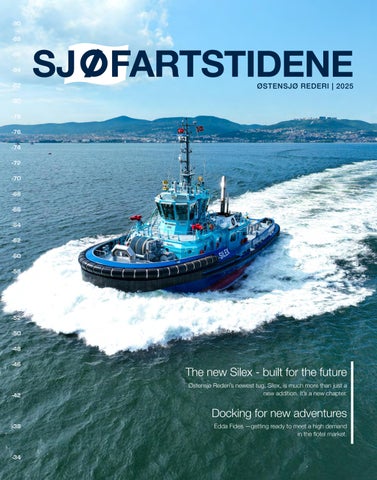
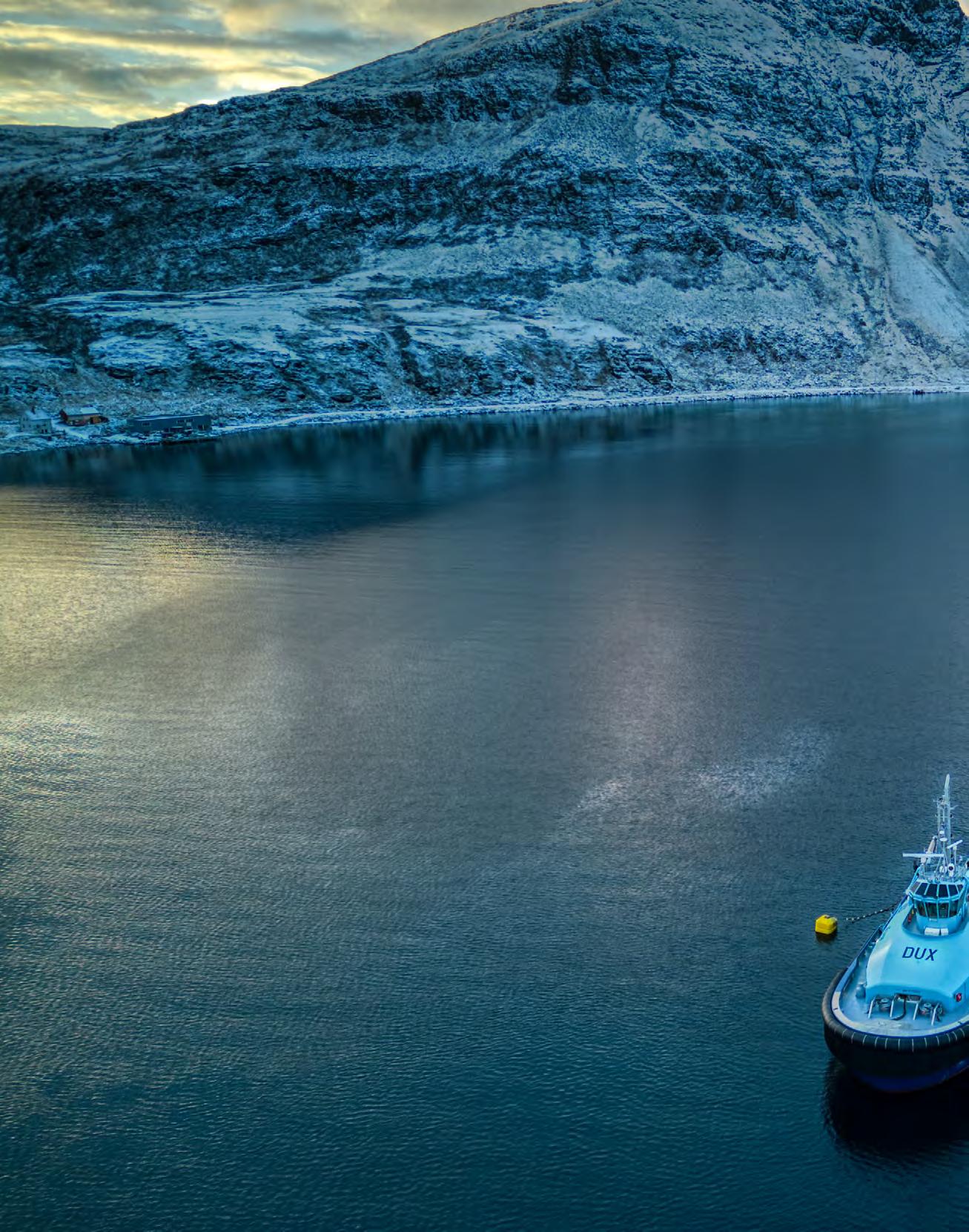
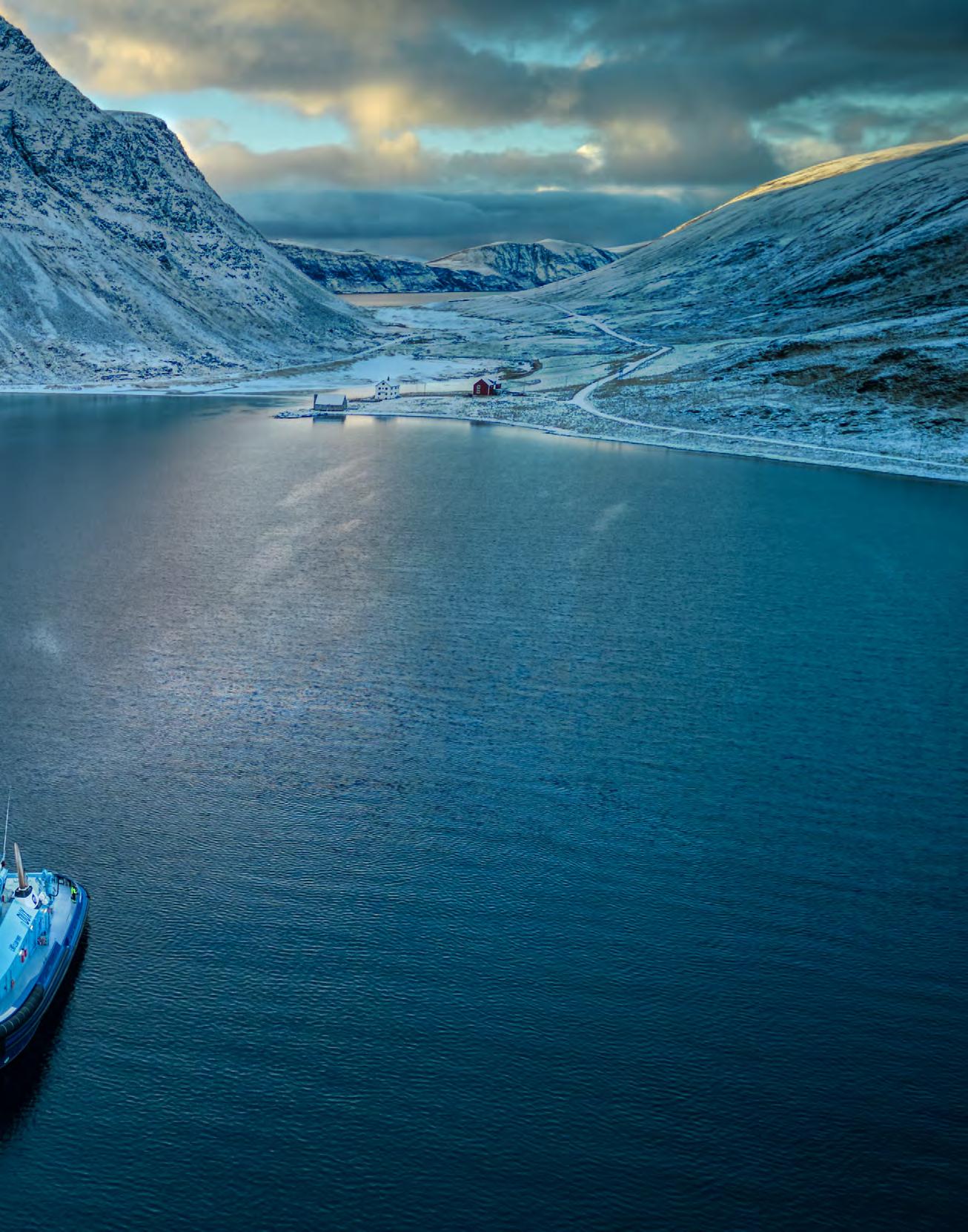
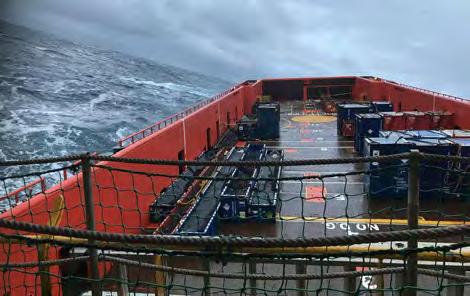
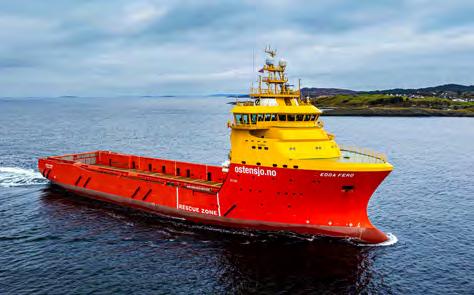
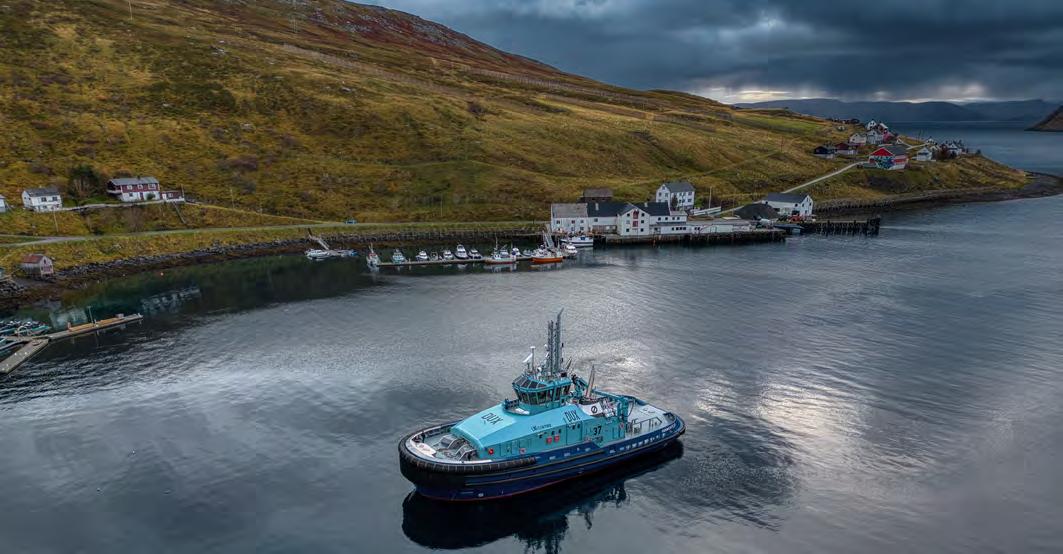
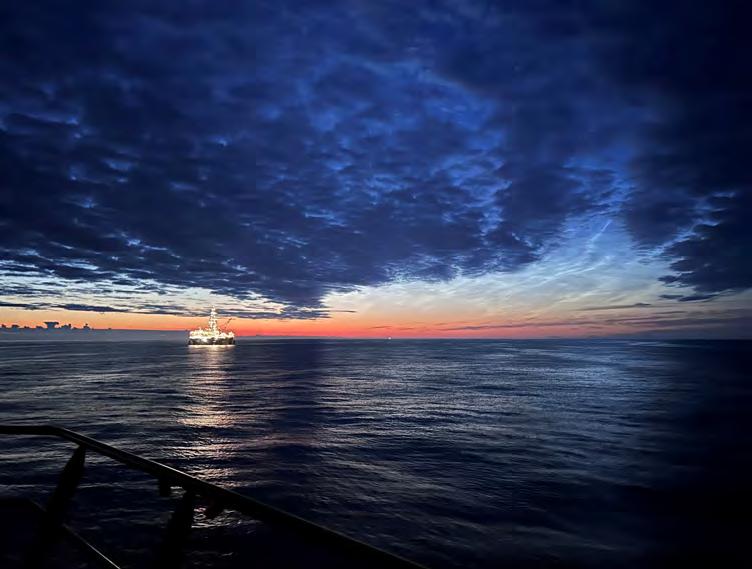
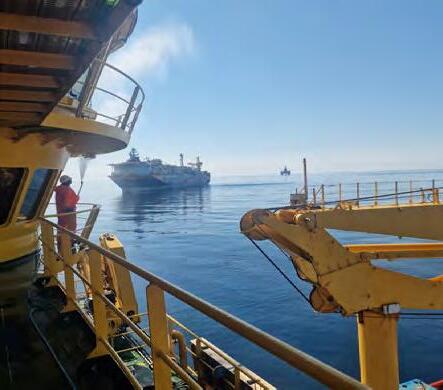
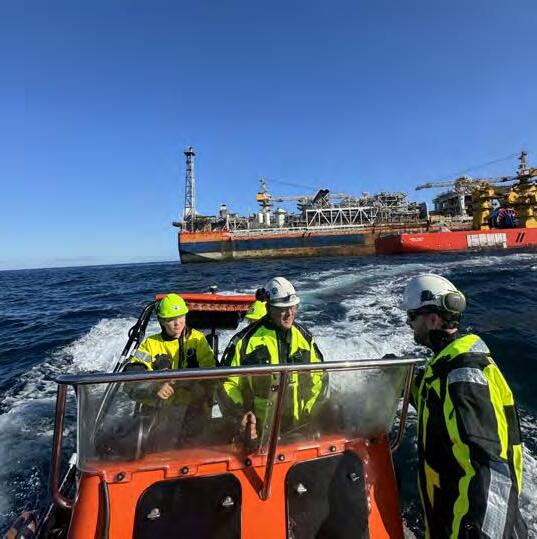
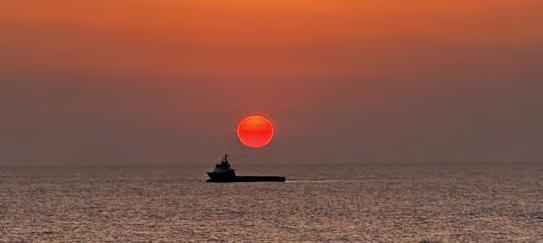
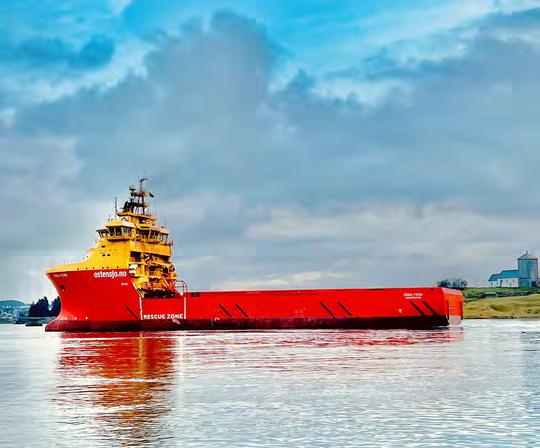
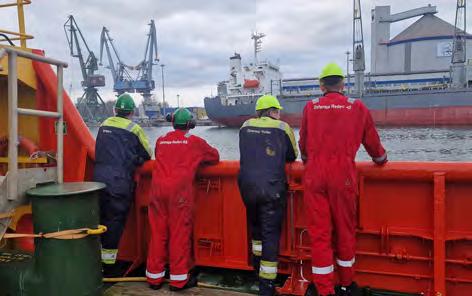
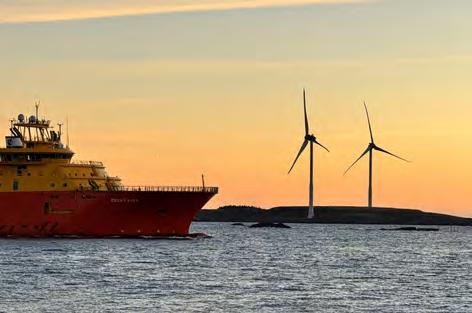
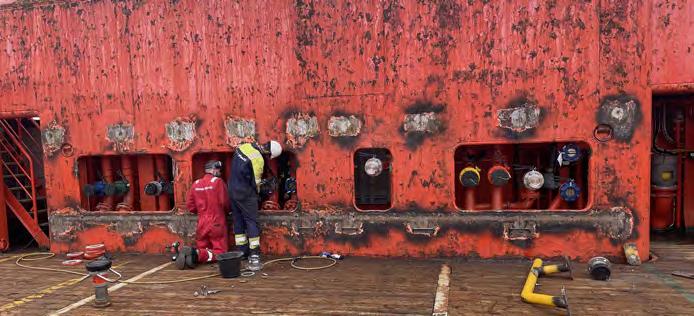
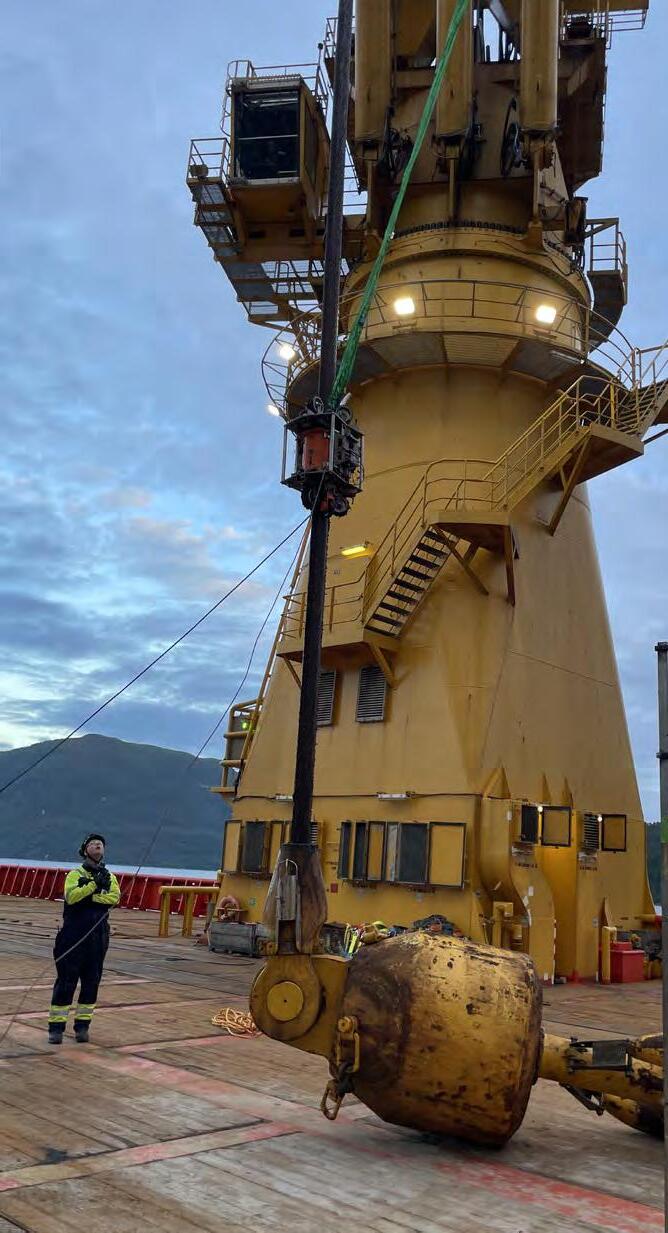
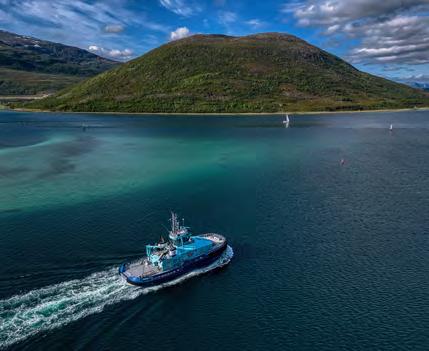
Østensjø Rederi’s newest tug, Silex, is much more than just a new addition. It’s a new chapter.
Docking for new adventures
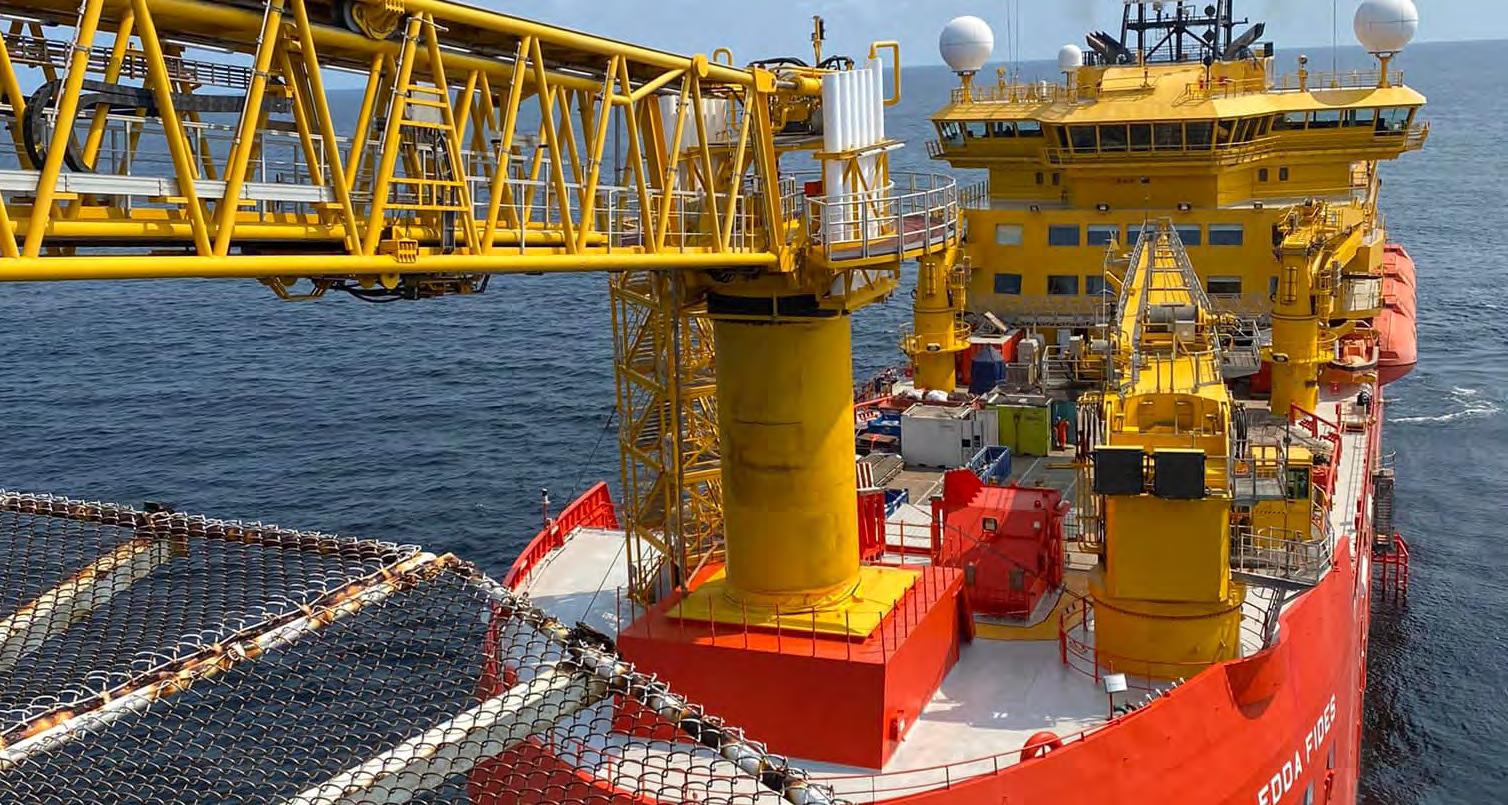
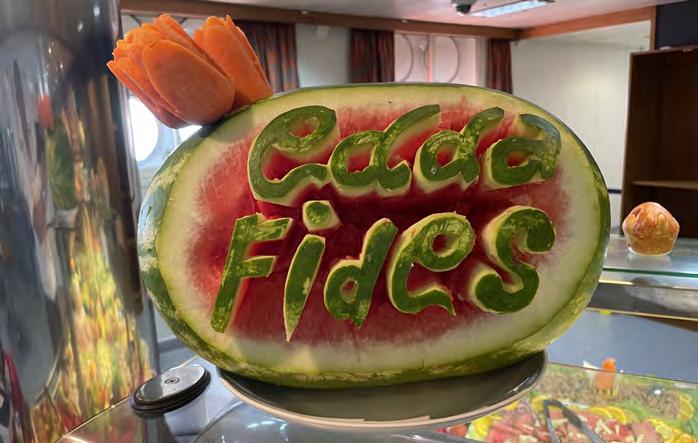
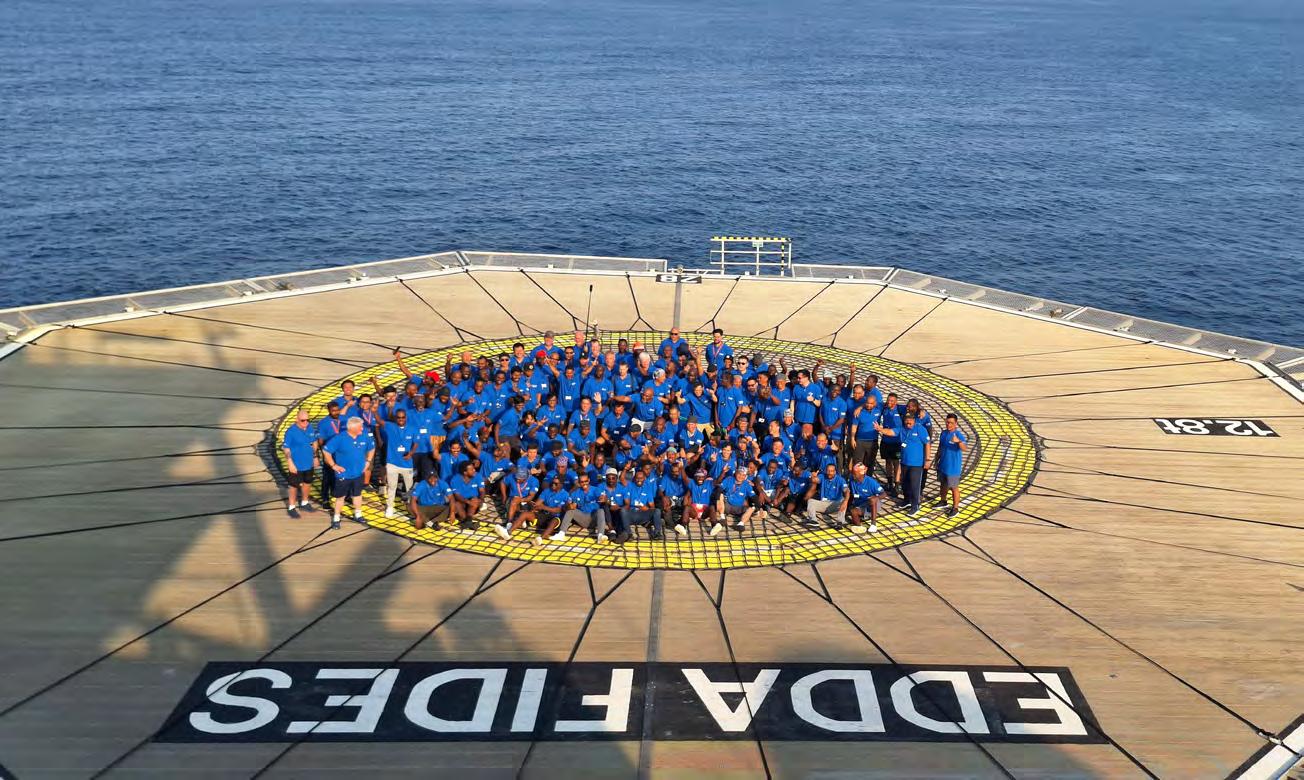
Edda Fides —getting ready to meet a high demand in the flotel market.
SUSTAINABLE PAPER
We are still using PaperWise for our magasine.
PaperWise paper is made from agricultural waste and reduces the environmental footprint by 20% compared with FSC paper and 45% compared with recycled paper.
Once upon a time, the world was perfectly sustainable. Today, things are very different. We’re running out of raw materials, biological diversity is decreasing, environmental pollution is increasing and the climate is developing negatively. Østensjø Rederi wants to contribute to a positive change and the UN’s Sustainable Development Goals will be our compass in this endeavor.
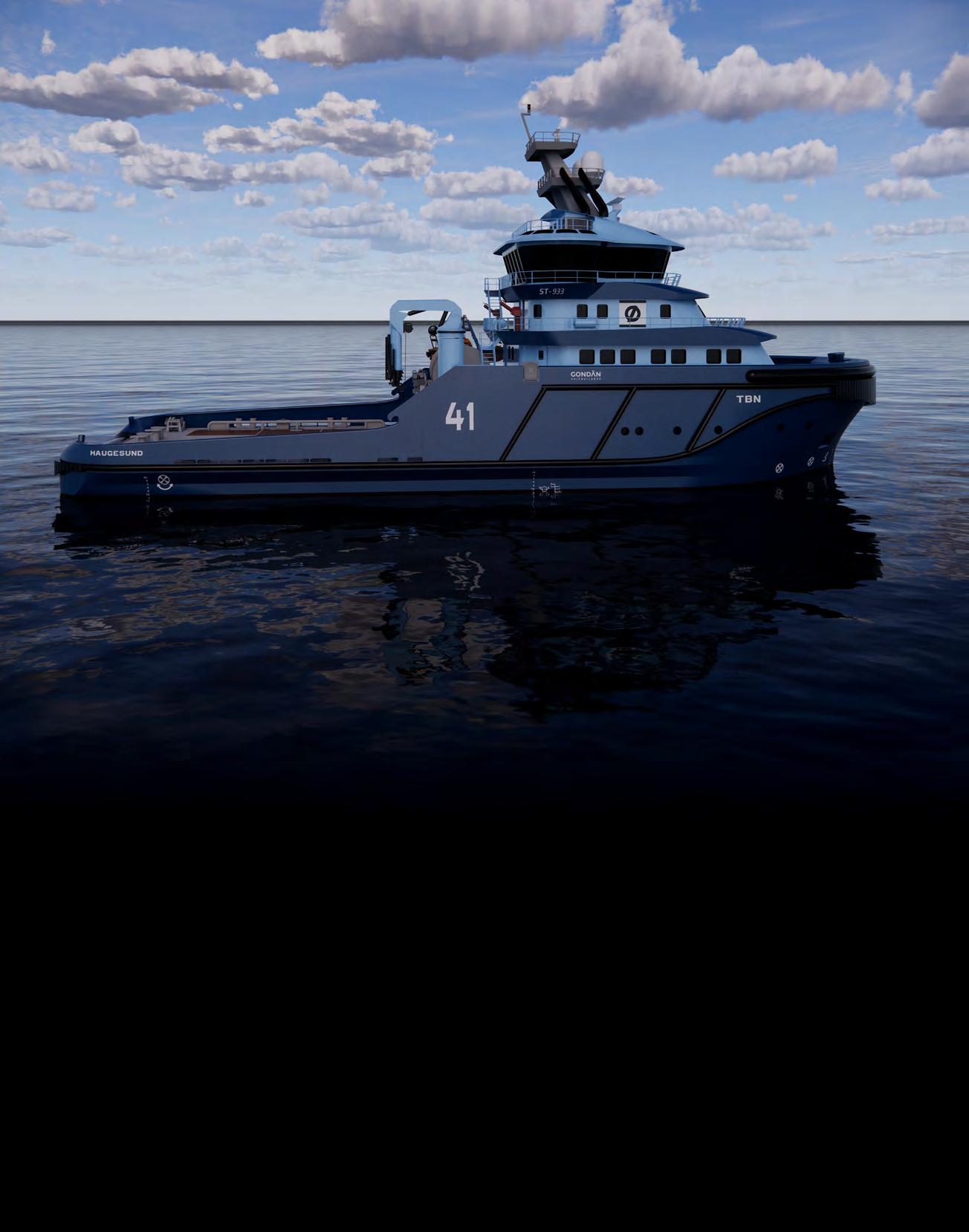
Newbuild contract for state-of-the-art offshore tug
Østensjø Rederi has signed a contract with Astilleros Gondan in Spain for the construction of a new offshore tug, scheduled for delivery in Q1 2028.
SPECIFICATIONS:
• 150 tonnes bollard pull
• Dynamic Positioning system DP-2
• High-standard accommodation for 14 crew (10 single cabins and 2 double cabins).
• Diesel Mechanical Hybrid Propulsion system including DC Grid drive system
• High speed engine package:
– 2 × 1,901 kW gensets variable speed
– 2 × 3 MW diesel engines mechanical shaft line
• 2 x Super Silent Rim-Drive bow thrusters
• 2 x 4,5MW Main propulsion with dual input gearbox
• 2 x side by side towing arrangement for fiber and wire rope working over bow and stern.
• 1 secondary winch and 2 independent storage winches
The design has focused on delivering a reliable and powerful tug able to handle demanding operations— covering tasks that often require two vessels. The vessel will also be built structurally ready for Methanol fuel according to class regulations from Bureau Veritas.
Crew comfort has been a key priority, and particular attention has been given to the cabin layout and the interior arrangement to enhance comfort and create good working and living conditions on board. The super silent Rim-Driven bow thrusters will significantly reduce noise and vibration, targeting comfort class 3 for the vessel.
EDITORIAL
Tradition in an industry constantly evolving
As we move through 2025 and into 2026, we continue to develop. “I Forkant” (“Ahead of the Curve”) has become something of a motto for us, fittingly echoed in Johannes Østensjø’s book written for Østensjø Rederi’s 50th anniversary. We’ve always worked to stay ahead, and that won’t change. But we also make a point of looking back, learning from our history, and holding on to the principles that have shaped us for over fifty years.
We are investing in the future through new vessels, innovative technology, and, above all, our people. Our people are the backbone of what we do, and keeping strong maritime competence is a priority. We now have 42 training positions in our fleet, and we value passing on seamanship and decades of experience from colleagues.
At the same time, we experience that recruiting at sea is becoming increasingly challenging. We acknowledge that we as an industry need to adapt, listen, and evolve.
In 2025, we took delivery of the new tug Silex, continued construction of our new building C513, Ocean Energy Support Vessel, and just recently signed a shipbuilding contract for a new state-of-the-art offshore tug. We are grateful for the opportunity to make these significant investments, strengthening our fleet and ensuring we remain well-positioned for the future. Strategic investments like these are essential to deliver reliable operations and staying ahead in a changing industry.
Safety and sustainability are cornerstones of our operations. We
work continuously to strengthen our safety culture, ensuring that every decision prioritizes the well-being of our crew and clients. We are also committed to reducing our environmental footprint through innovative solutions and responsible practices. These efforts go hand in hand with our values: Active, Open, Courage, and Caring. For us, success is not only measured in performance but in how we uphold these principles every day.
Going into 2026, we will continue to stay true to what defines Østensjø Rederi: delivering reliable and flexible operations, being forward-thinking, and relation-oriented, while caring for our people and partners. Keeping our traditions and principles matters, even in an industry that never stands still.
Thank you to all employees, clients, and partners for your trust and dedication. I wish everyone a joyful Christmas season, and I send extra warm greetings to those celebrating Christmas at sea, away from their families and friends.
Kristian Helland Vea CEO
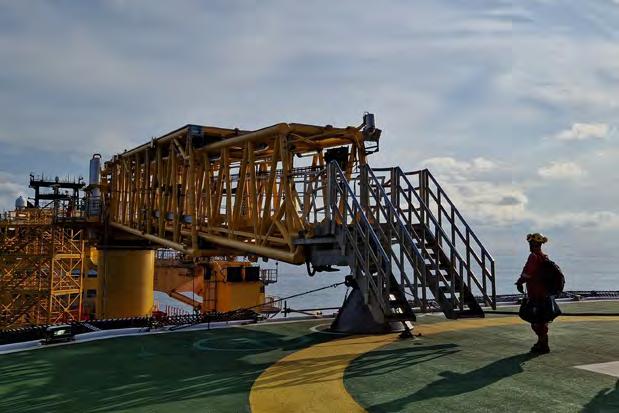
Our new innovative Ocean Energy Support Vessel - NB513
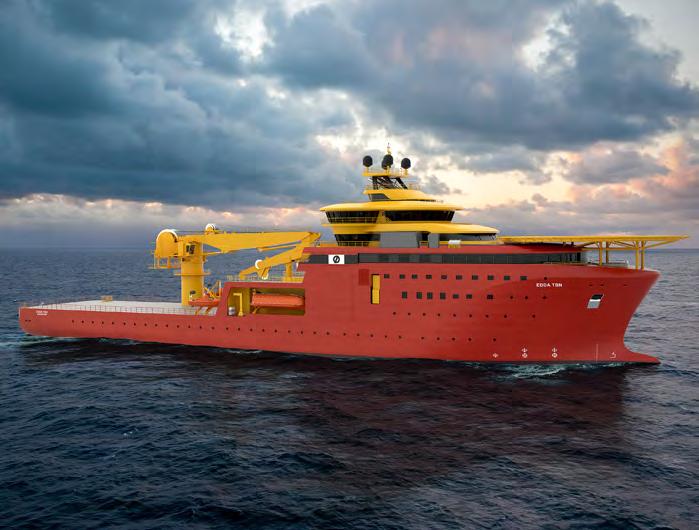
In an unpredictable market, a diversified fleet, tailored to operate in and across several segments, is an advantage. Østensjø Rederi’s new Ocean Energy Support Vessel (OESV) is designed to support a wide range of operations - unlocking market potential.
BY PYX // BJARNE LAASTAD PHOTO HAAKON NORDVIK
Originally designed as a supply vessel, Edda Fjord (2002) quickly proved its commercial versatility thanks to a powerful offshore crane and expansive deck space. Its ability to operate across multiple segments, including offshore accommodation and offshore wind, allowed it to remain competitive even during challenging market conditions.
Following its sale in January 2024, Østensjø Rederi continues to see demand for flexible, multipurpose vessels. The newbuild OESV, NB513, currently under construction at Gondan Shipbuilders in Spain, represents a bold step forward in this segment.
– Our goal is not just to replace Edda Fjord, but to redefine what a multipurpose vessel can offer to the market. The design is entirely new, packed with innovations tailored to meet evolving operational needs across a wide range of industries. Østensjø Rederi has been heavily involved in the development from day one, says Chief Project Officer, Egil Arne Skare.
Built to perform, engineered to save energy
The equipment package draws parallels with what Østensjø Rederi developed for the offshore wind market when 14 vessels were designed and built for Edda Wind. This experience has been further refined and optimized for broader purposes. Especially in terms of energy efficiency, significant progress has been made.
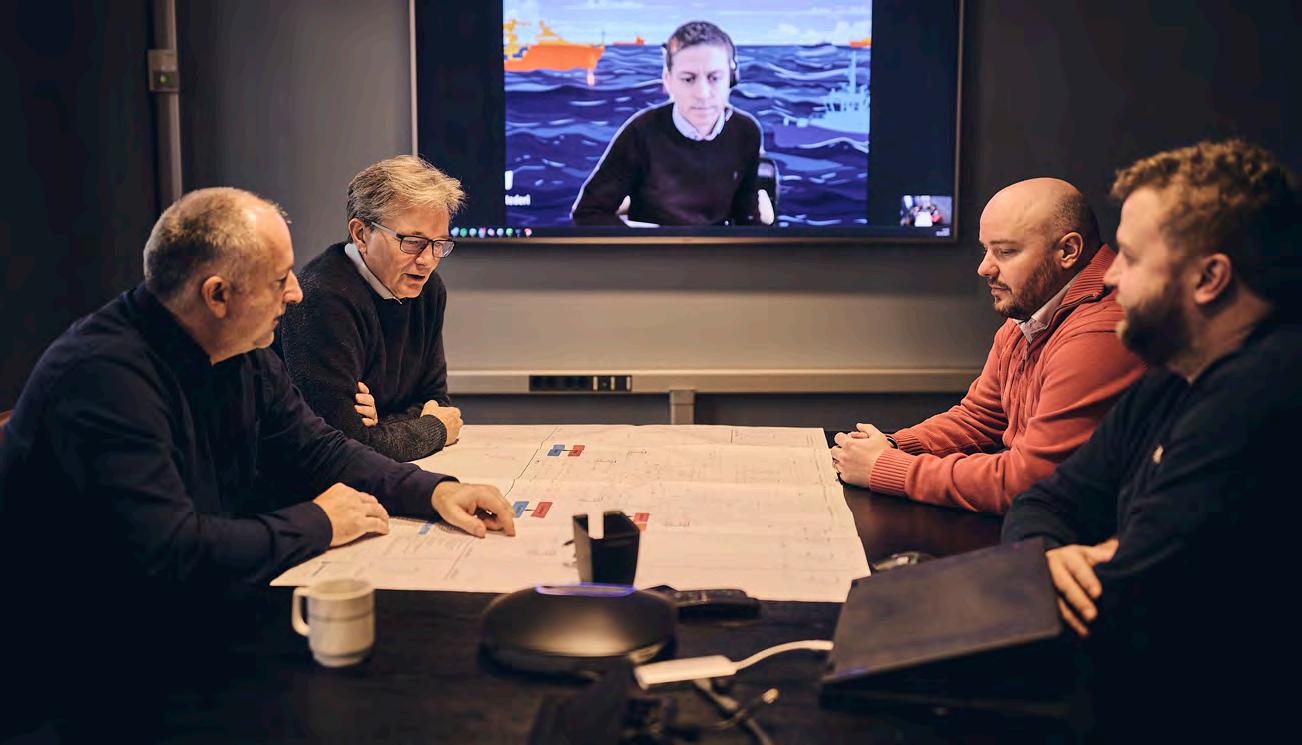
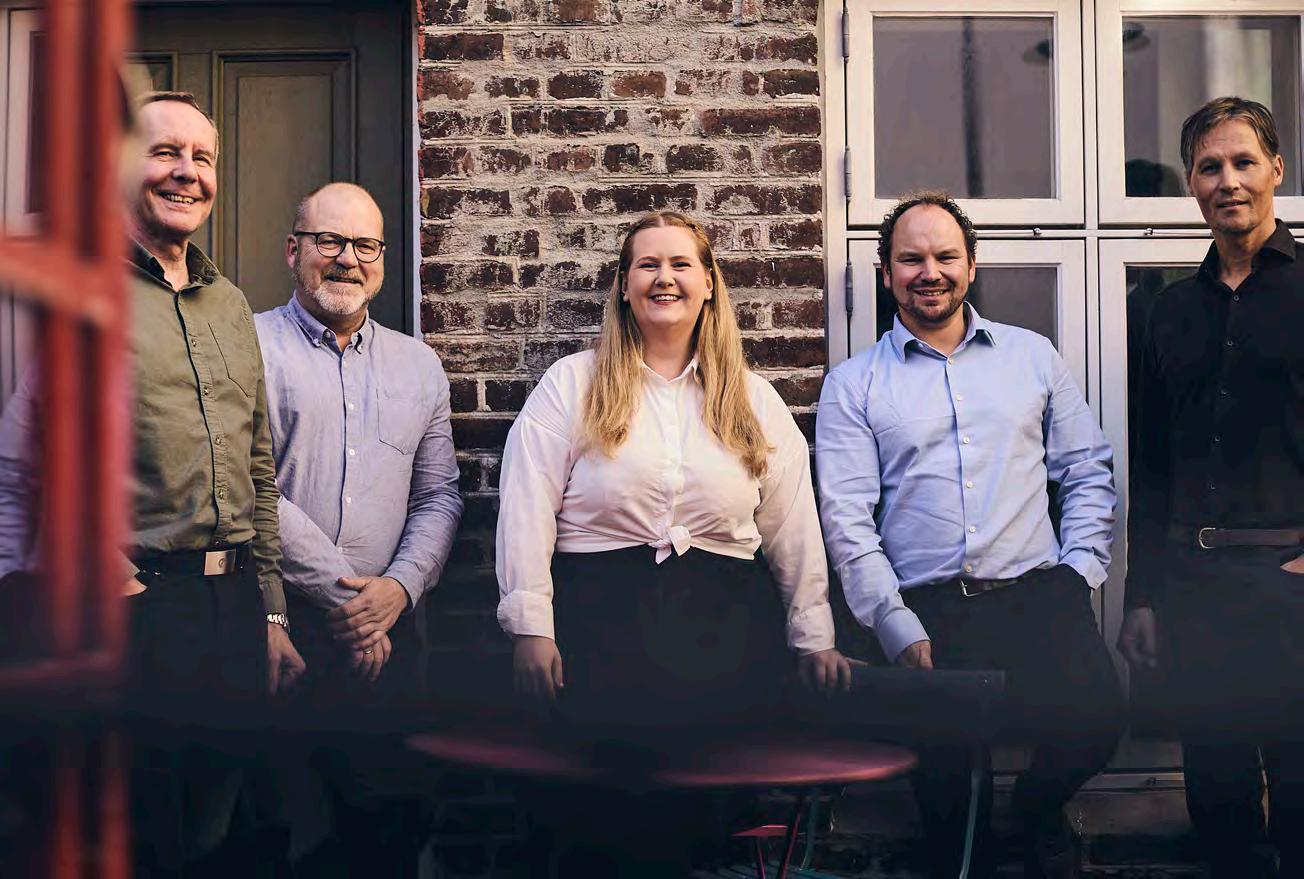
From left Øyvind Sævik, Egil Arne Skare, Arne Jakob Eide (Teams), Vidar Håheim and Erlend Jæger Espeland.
– We’ve included just about everything you can imagine. The vessel will be equipped with comprehensive systems that tick virtually every box on the list of technologies aimed at reducing fuel consumption, says Skare.
Comfort for crew and client Østensjø Rederi maintains a clear profile in the high-end market, and significant effort has been put into ensuring top-tier comfort for both crew and clients.
– They should always experience the very best in onboard comfort. The vessel must retain its value even after 20 years of operation, Skare adds.
Markets are constantly evolving, but with a multipurpose vessel like this, Østensjø Rederi will be well-positioned and versatile, with a single vessel capable of serving many functions.
Plan
The vessel is scheduled for sea launch in summer 2026, with delivery from the yard expected in late 2027, and operational deployment from early 2028.
Multipurpose capabilities
- AT A GLANCE
Vessel classification
Ocean Energy Support Vessel – designed for versatile offshore operations.
Deck design
Optimized for rapid and efficient mobilisation.
Cable capacity
• Total: 5,000 tonnes
• Two below-deck carousels
Crane capacity
Heavy-lift capability up to 250 tonnes – ideal for IMR (Inspection, Maintenance, Repair) tasks.
ROV operations
Equipped with LARS systems for safe and efficient ROV mobilisation. Additional Infrastructure
• Helideck for offshore personnel transfer
• Deck foundations ready for gangway installation
• Optional: full-scale cable-laying equipment available advanced winch systems
• High-speed winches matched to DP capabilities
• Enables operations in harsher weather conditions than most vessels
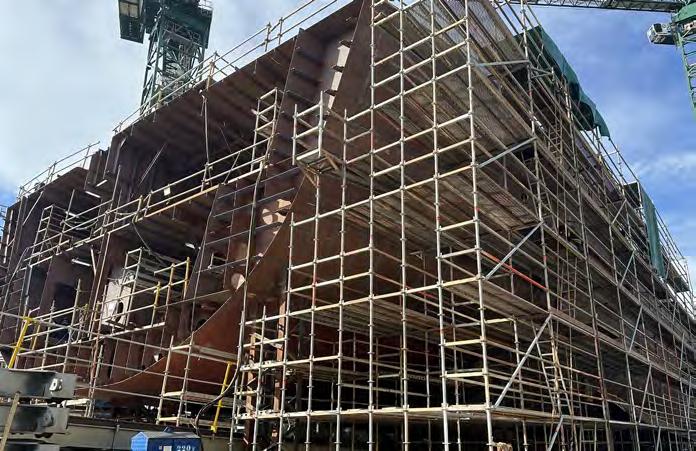
Blocks being assembled at Gondan Shipyard
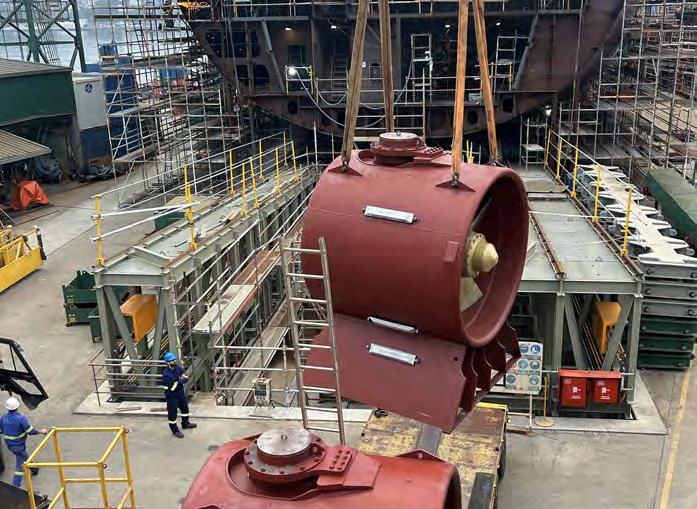
Retractable Azimuth Combi Thruster
NB 513 – Salt Ship Design
Docking for new adventures
Following the completion of a project for SBM in Angola, Edda Fides has spent the fall in dry dock for upgrades and maintenance—getting ready to meet a high demand in the flotel market.
BY PYX // BJARNE LAASTAD
For nearly two years, Flotel Edda Fides has been on contract with SBM (with Exxon as end client), marking it the longest assignment to date.
– It originally started as a four-month firm contract plus a three-month option period, but the option period was quickly declared, and then additional extensions kept coming, says Fleet Manager Alf Helge Lyngholm.
The extension of the contract made it challenging to plan ahead and maintain the necessary equipment and supplies, as the preparations were based on a shorter timeframe. Carrying out essential maintenance while the vessel remained in operation also proved challenging; however, through a few short operational pauses, the crew was able to complete the most critical tasks. Ultimately, adapting to changing circumstances is one of our key strengths.
Navigating new waters
Entering the Angolan flotel market was relatively uncharted territory for Østensjø Rederi and Edda Accommodation. – Working with a new client in a different region and culture
requires mutual understanding and alignment with regards to communication and operations. It’s worked extremely well — we’ve maintained high uptime, ensured a skilled crew, and delivered excellent service on board. The feedback has been overwhelmingly positive, and the results have fit seamlessly within the charterers’ operations, Lyngholm says.
The main contributor to the success factor was having Jon Klepsvik as a Country Manager in Angola, who knew the region, the culture, and worked as “our man on the ground”, facilitating all operational challenges that arose. Jon has many years of experience working in Angola and knows the culture and people very well.
Previously, Edda Fides had only been connected to fixed installations. In Angola, however, she was linked to a Floating Production Storage and Offloading (FPSO) unit for the first time. Tidal variations of up to 12 meters presented operational challenges - compounded by the FPSO being turret-moored, allowing it to rotate with the weather and wind. This meant Edda Fides had to remain connected to the stern of the unit and follow its movements.
Edda Fides in operation block 15, Angola, for SBM/Exxon
Uptime for the gangway connection was 99.6%, which is extraordinary for this type of operation.
Mission accomplished
The Fleet Manager was present for the “End of Project” ceremony on board Edda Fides in Angola this August.
– Many of the same people have been working on the project for the past two years, and we’ve built strong relationships. It’s been smooth, collaborative teamwork, and the feedback we’ve received has been outstanding. It’s been a very positive experience for all of us at Østensjø Rederi and Edda Accommodation, Lyngholm reflects.
Delivered in March of 2011, Edda Fides is getting close to her 15-year mark, a point at which many components require renewal or upgrades. After completing the SBM project, Edda Fides spent an extended period in dry dock at Gibdock in Gibraltar.
– Many components have a set lifespan, and on an accommodation vessel, the wear and tear is intensified, especially with over 500 people on board during daily operations. The docking scope is extensive, but it will do the vessel good.
A team effort
The successful completion of the extensive dry dock period in Gibraltar would not have been possible without the dedication and hard work of everyone involved. Completing such a massive scope requires close follow-up and expertise.
Our diligent Technical Superintendent team, spearheaded by Elise Nesse and Bjørnar Eikeland, along with the crew, ensured that all tasks were carried out efficiently and to the highest standard. Their hands-on presence and collaboration across departments have been key to the project’s success.
Together, this strong team effort has ensured that Edda Fides is ready for new adventures ahead.
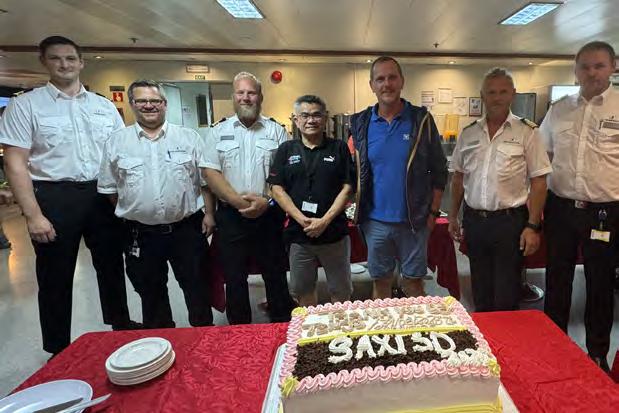
Closing Ceremony on board Edda Fides – End of Project
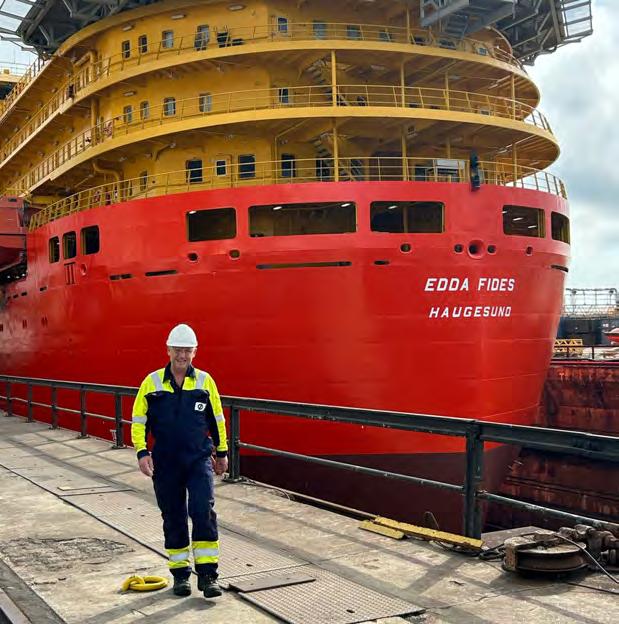
Master Inge Hansen Brekke at Gibdock, Gibraltar
Connected by gangway
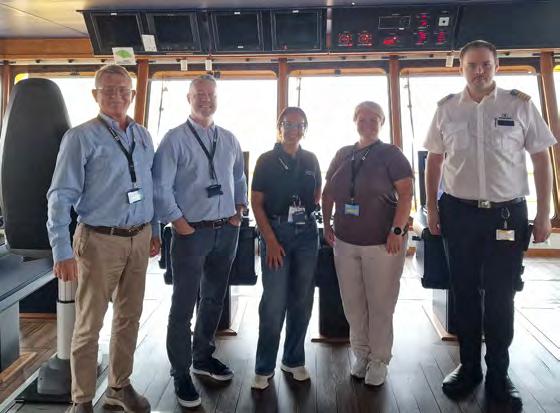
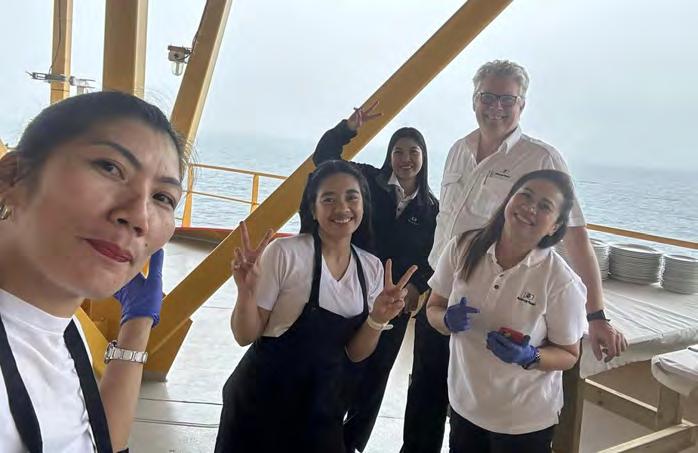
From left: Jon Klepsvik, Alf Helge, Márcia Carvalho, Vivian Steinsvik and Victor Valdal during “End of contract celebrations” on Edda Fides.
The new Silex - built for the future
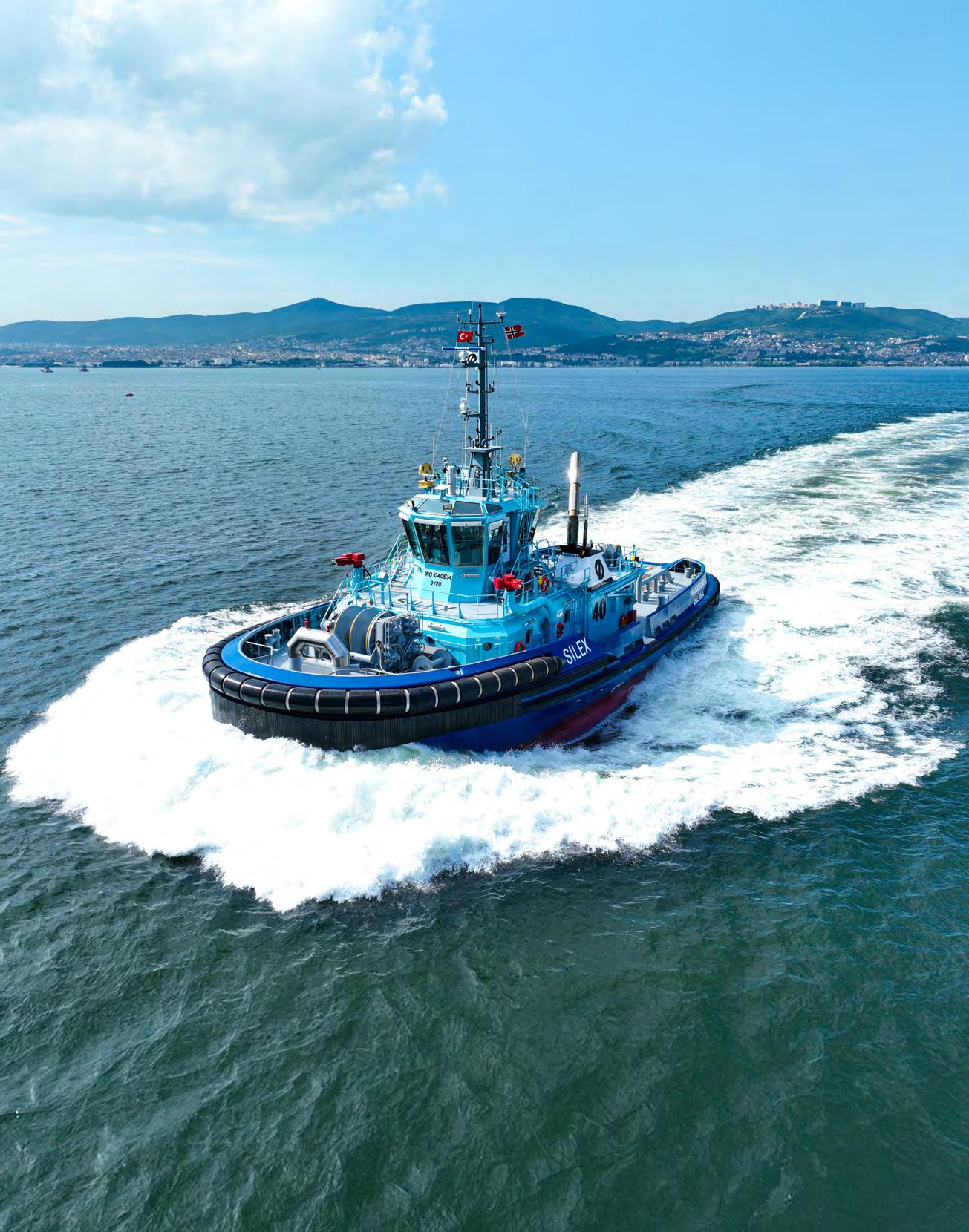
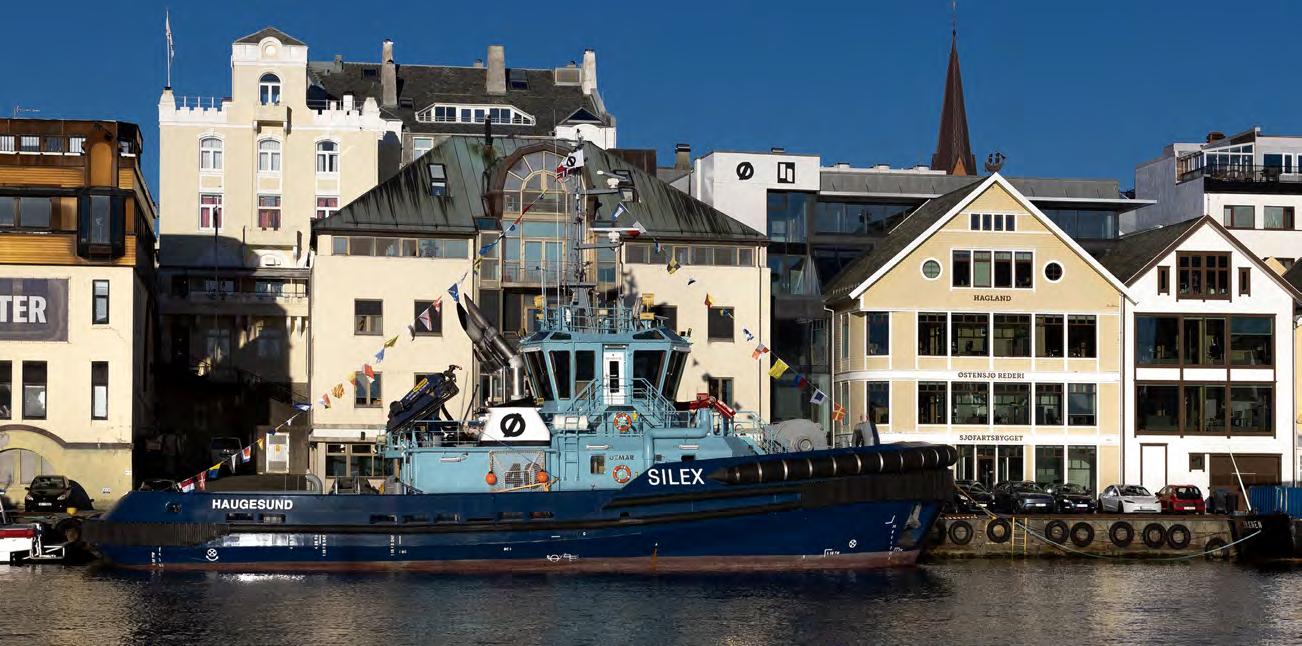
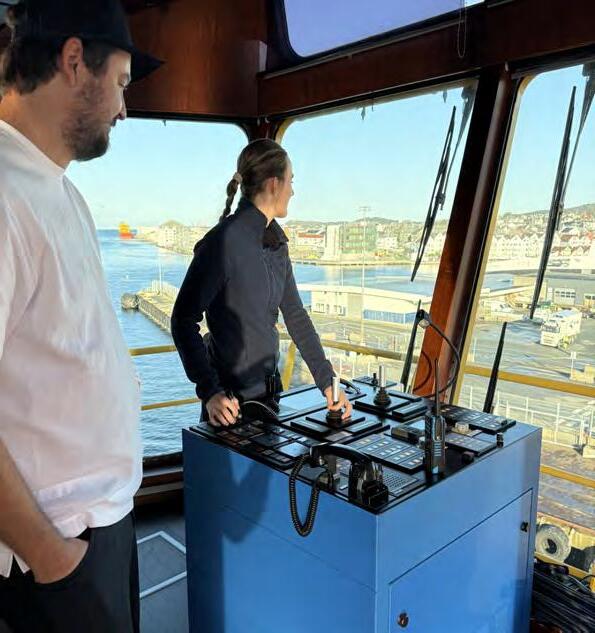
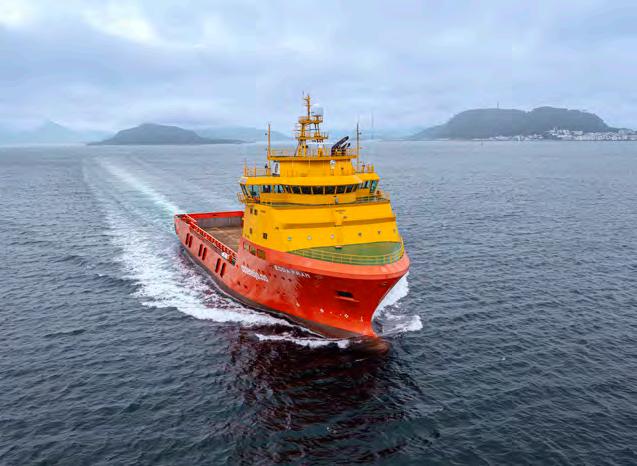
With nearly 30 custom modifications and a clear vision for operational excellence, Østensjø Rederi’s newest tug, Silex, is much more than just a new addition. It’s a new chapter.
In the spring of 2021, Østensjø Rederi sold the original tug Silex. In May 2025, a brand-new tug bearing the same name was delivered from Uzmar Shipyard in Turkey. Built on a proven standard format and heavily tailored to Østensjø Rederi’s specific requirements, this vessel reflects both innovation and continuity.
From standard to Østensjø Rederi
– There was a clear ambition to build a new Vivax-type tug - and that quickly led to a slightly different construction process than Østensjø Rederi usually follows. We started with a standard tug from Uzmar, designed by Robert Allan Ltd., based on the RAstar 3200-W design, and then implemented nearly 30 modifications to ensure the vessel would best suit our operational needs, explains Martin Borg.
Borg served as Project Manager for the newbuild in Turkey, overseeing the construction on-site, acting as the main liaison between Østensjø Rederi’s project department and Uzmar, and ensuring the vessel’s design reflected the intended operational use. When Borg is not a Project Manager, he works as a Chief Engineer in the Østensjø Rederi fleet of vessels. He has wide experience from both the offshore and tug segments.
Operational enhancements
– The modifications include improved ergonomics for crew members, a remote-controlled crane, and a towing winch. Towing pins and a stern roller make stern operations possible, and we’ve added an extra deck above the aft winch for improved equipment storage, Borg notes.
This marks Østensjø Rederi’s first collaboration with Uzmar, a shipyard located just east of Istanbul and the Bosphorus Strait.
– The shipyard has been very accommodating, and the team there has been a pleasure to work with, Borg adds.
Ready for the spot market
The new Silex is Tier III compliant with exhaust gas treatment to reduce emissions and forms part of Østensjø Rederi’s ongoing commitment to maintaining a modern, high-quality tug fleet capable of handling demanding and diverse operations. It will operate in the spot market in the southern North Sea.
– This vessel will be a valuable addition to our fleet. We look forward to offering her to the market and meeting demand with reliable, high-quality tug operations, says Kristian Helland Vea, CEO of Østensjø Rederi.
BY PYX // BJARNE LAASTAD
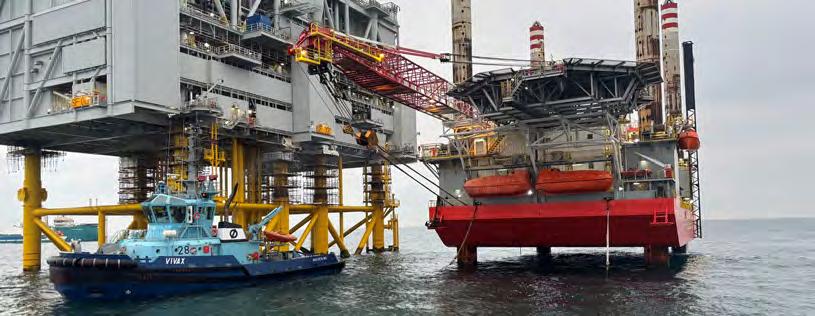
Tug Silex with homeport in Haugesund
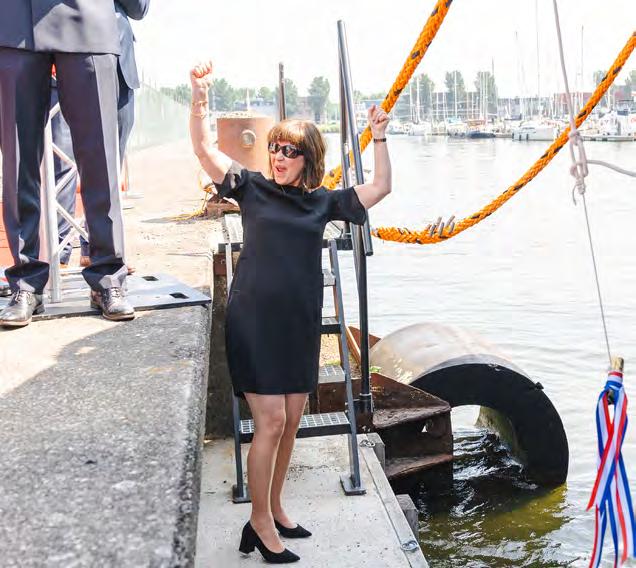
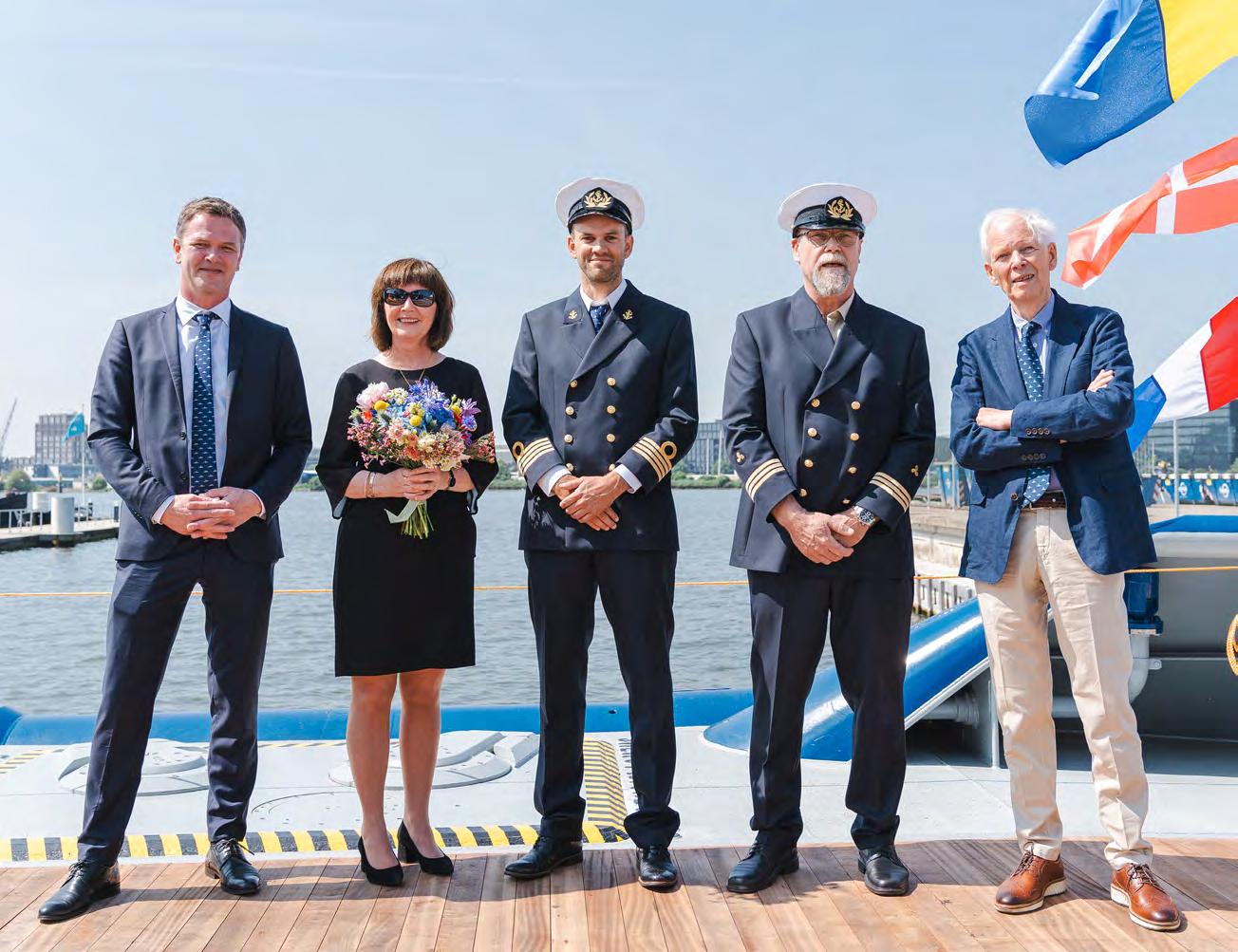
“I name this ship Silex. May she sail safely across all seas and bring good fortune to all who sail on her”. Competency and Requirement Manager and Silex’s Lady Sponsor, Jorunn Henriksen, successfully broke the bottle on the first attempt
From left: CEO Kristian Helland Vea, Lady Sponsor and Recruitment Manager Jorunn Henriksen, Master Johan Ydstebø, Chief Engineer Jostein Gjerde and Owner and Founder, Johannes Østensjø
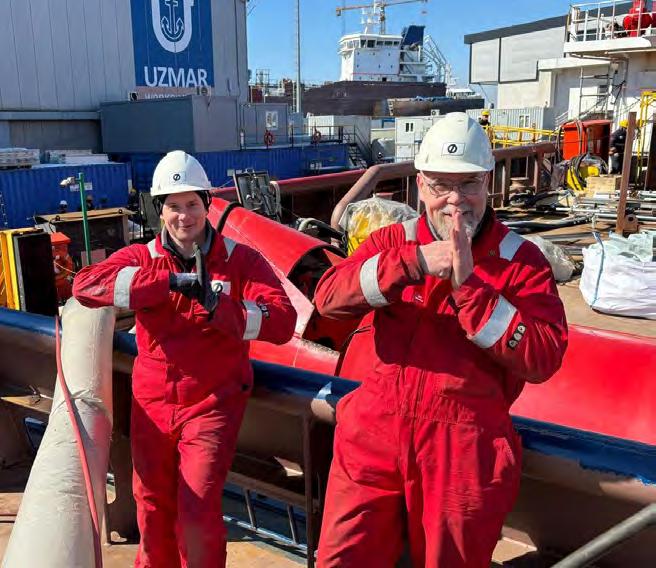
Martin Borg and Jostein Gjerde at Uzmar Yard during construction period
Sharing her life at sea
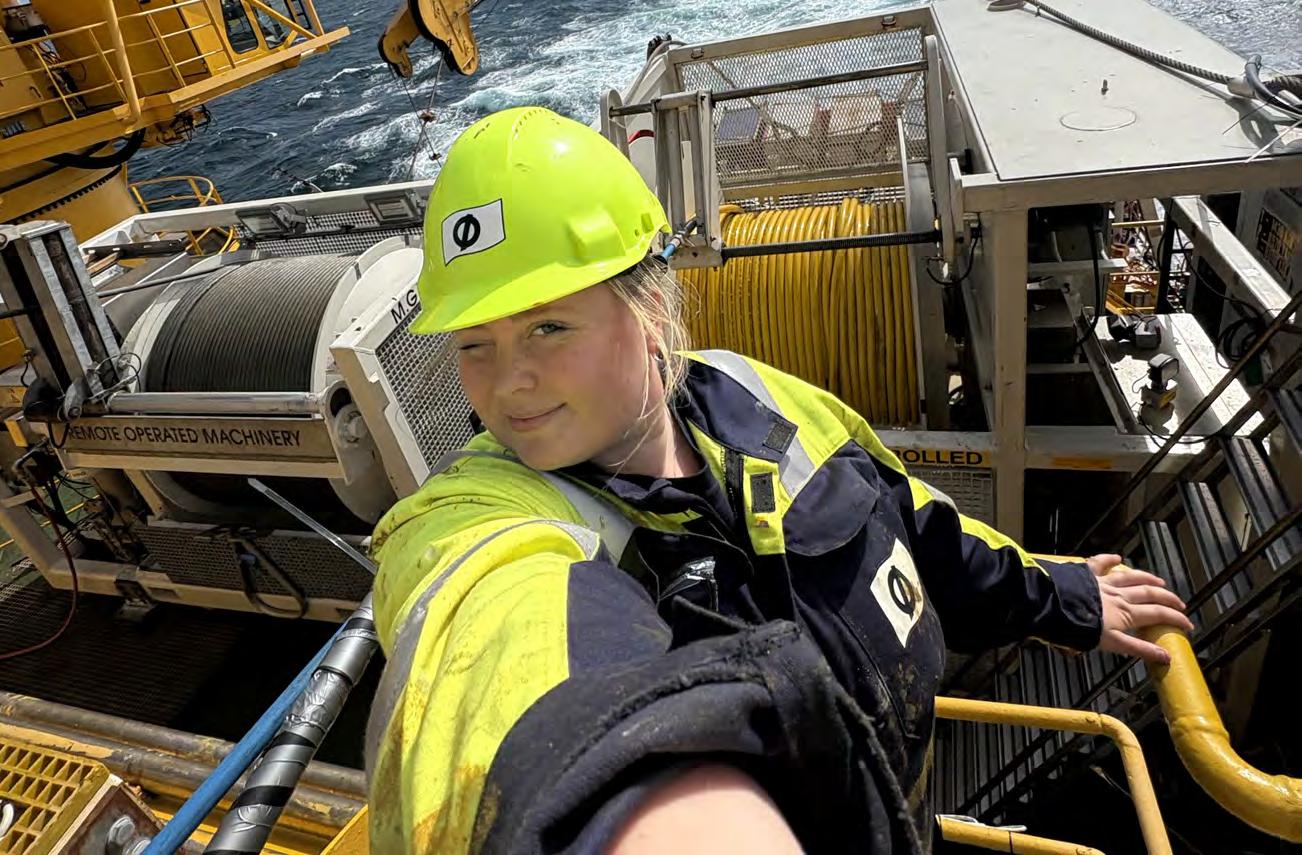
Meet Østensjø Rederi Apprentice and Maritime Career ambassador Gunvor Amalie Krakhellen.
BY K-HUSET // HELENE JORDBREKK
When Gunvor Amalie Krakhellen from Florø stepped on board the school ship Gann for the first time, she didn’t yet know it would set the course for her career. – I was at my most uncertain about what direction to take, she recalls. – But once I was on board, I just knew this was something for me.
That sense of belonging has followed her ever since. Today, she’s a deck Apprentice with Østensjø Rederi and one of only five young people across the country chosen as Maritime Career ambassadors this year— a national initiative by the Norwegian Shipowners’ Association and Maritimt Forum to showcase career opportunities in the maritime industry.
Finding her bearings
Growing up in a small coastal town, the sea was always present in Gunvor’s life. But it wasn’t until she started her maritime
studies that she discovered how wide the world of shipping really is.
When the time came to choose a company for her apprenticeship, the decision wasn’t difficult. – I had a neighbour who worked for Østensjø Rederi and spoke warmly about the company, and when they came to present at our school, I really liked what I heard, she explains.
Life on deck
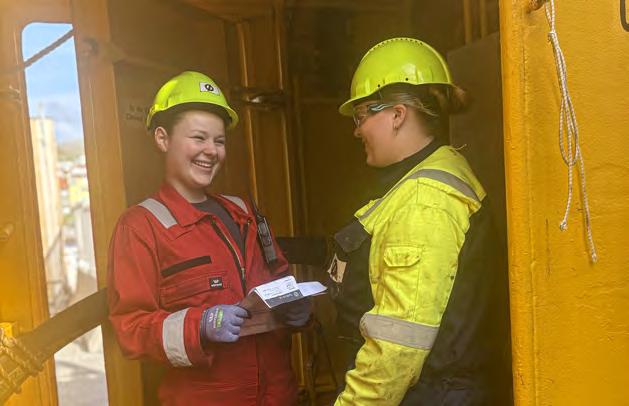
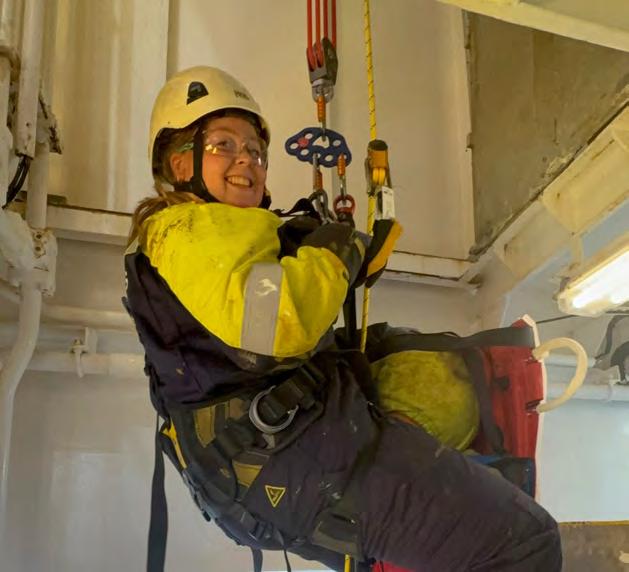
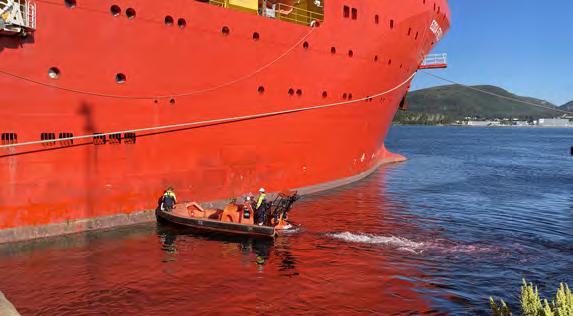
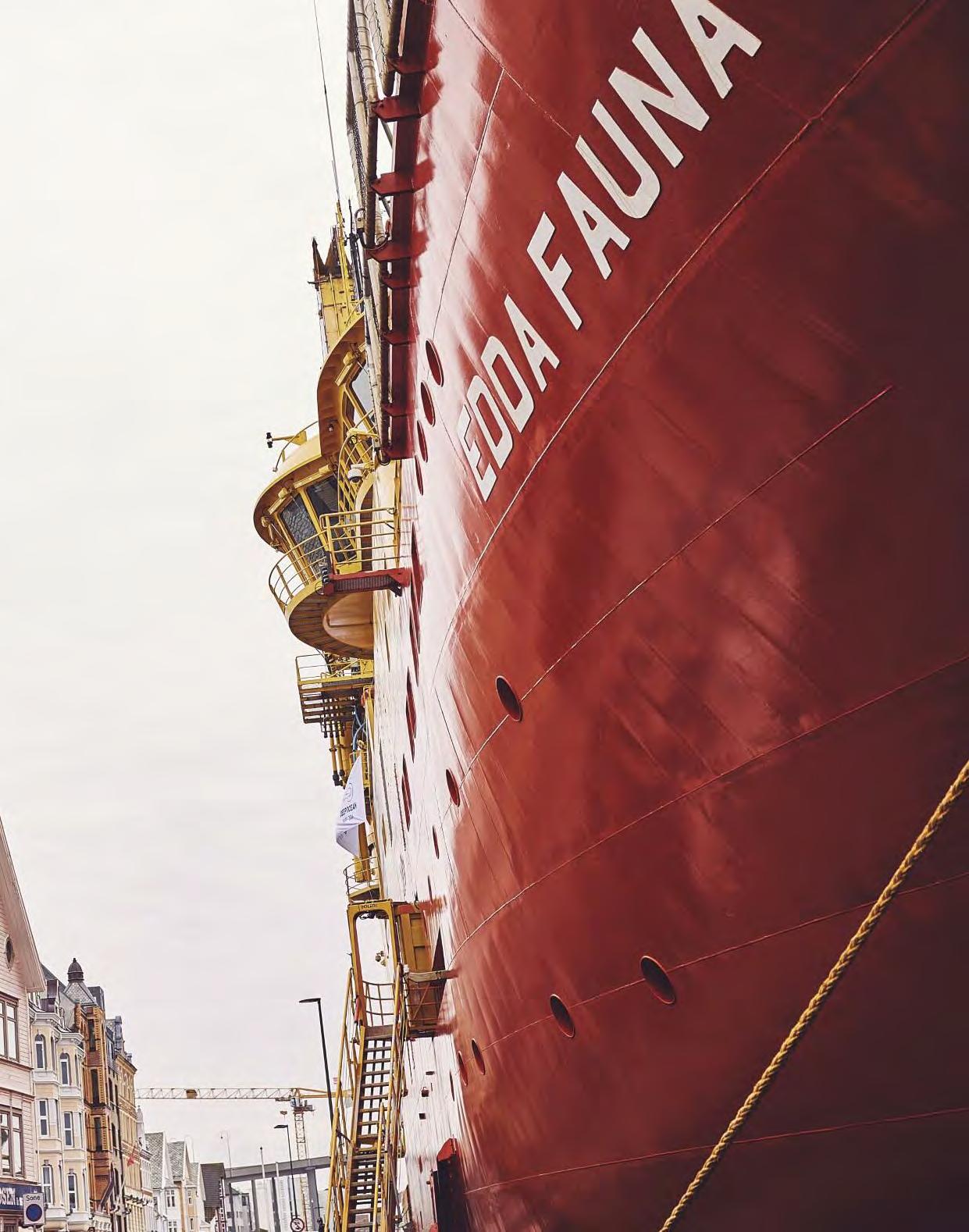
Onboard Edda Fauna, her workdays are varied - from maintenance and crane operations to safety drills and mob boat exercises.
– I’ve been lucky to have such a good crew around me, she says. – They took me in right away and made me feel welcome.
She also appreciates having other women on board. – It gives a sense of security and belonging, she says. – We support each other.
Safety and quality are values she quickly recognized as central to Østensjø Rederi’s culture. – Everything is done properly, with permits, protective gear, and routines, Gunvor says. – If someone sees you without the right equipment, they tell you — not to criticize, but because they care. That kind of culture makes a huge difference.
An ambassador for the sea
As a Maritime Career ambassador, Gunvor will mainly contribute through social media, sharing stories from everyday life at sea and participating in maritime conferences. – It’s an opportunity to connect with people across the industry and learn from those with more experience, she says.
Her goal is to show young people what the maritime world really looks like. – Many don’t realize how many different roles there are at sea, from deck to engine, and from catering to navigation, she explains. – I want to show the real side of life on board, both the hard work and the rewarding moments.
On course for the bridge Gunvor’s ambitions stretch far beyond her current role. After completing her apprenticeship, she plans to study at the Maritime Academy in Ålesund to become a Deck Officer, perhaps even a Master one day.
– It’s a dream to earn those stripes, she says. – To work my way up and carry that responsibility.
Malin Langeland and Gunvor Amalie Krakhellen
Navigator – Østensjø Rederi’s new digital hub
With the introduction of “Navigator”, Østensjø Rederi benefits from easier access to information, improved oversight, and greater control.
BY PYX // BJARNE LAASTAD PHOTO HAAKON NORDVIK
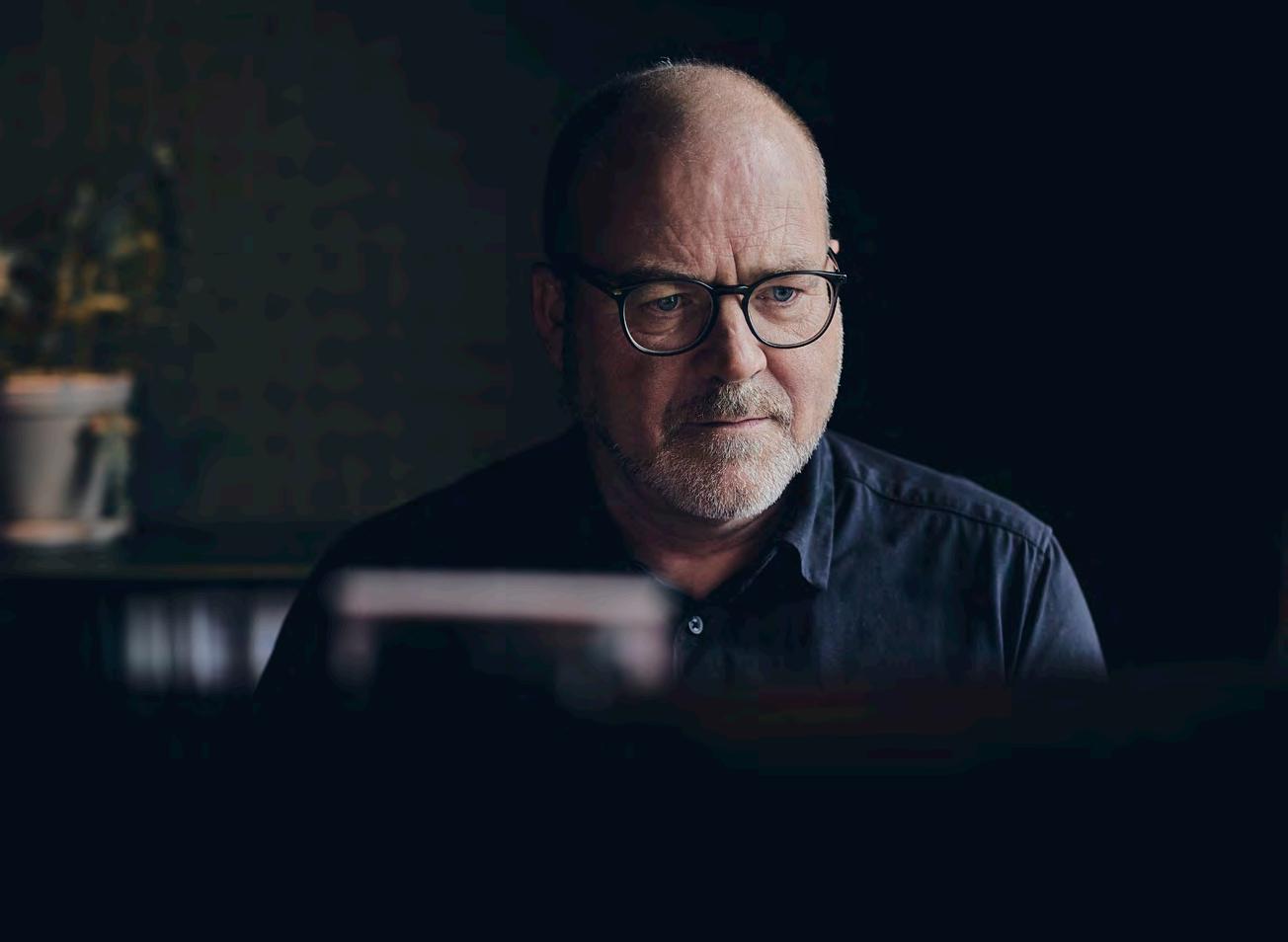
Østensjø Rederi has been undergoing a comprehensive digital transformation in recent years. The aim is to improve information flow and implement more efficient solutions. At the heart of this digital journey - both onshore and offshore - is the SharePoint-based system “Navigator”.
– In many ways, digitalisation is a form of sustainability, says Elias Nornes, Chief Sustainability Officer at Østensjø Rederi with a smile.
Designed to meet future needs
– We’ve tried to look into the crystal ball to get an image of what our future needs will be. We mapped out our internal requirements, considered relevant reporting obligations, and explored various available solutions. I’ve attended countless
conferences, met with consultants and software providers, and we’ve focused on developing a solid roadmap for Østensjø Rederi’s digital transformation, Nornes explains.
The starting point was a need for a new document library.
– Our previous system was custom-coded and gradually became outdated. We decided to base our new solution on Microsoft’s robust standard offerings, with no custom coding. By using Microsoft’s standard building blocks, we ensure the system remains up to date with new features and improvements as they are released, he adds.
Emphasis on internal resources
The system is built on Microsoft’s SharePoint Online, which
“In many ways, digitalisation is a form of sustainability”
Elias T. Nornes, Chief Sustainability Officer
is ideal for shared libraries, document collaboration, and integration with other useful Microsoft tools. Given that Østensjø Rederi has its own in-house IT resources, Nornes was keen to make utilize their resources and competency.
– We’ve enhanced our in-house Microsoft expertise and brought in external consultants for support. These consultants were given two clear objectives: to advise us on how best to use Microsoft solutions tailored to our needs, and to eventually make themselves redundant. We want to manage the system independently, with minimal external support, he says.
An internal naming competition gave the platform its name: Navigator. All employees now have access to the documents, systems, tools, and certifications they need. Each department - and every vessel - has its own dedicated site.
Simpler and more efficient
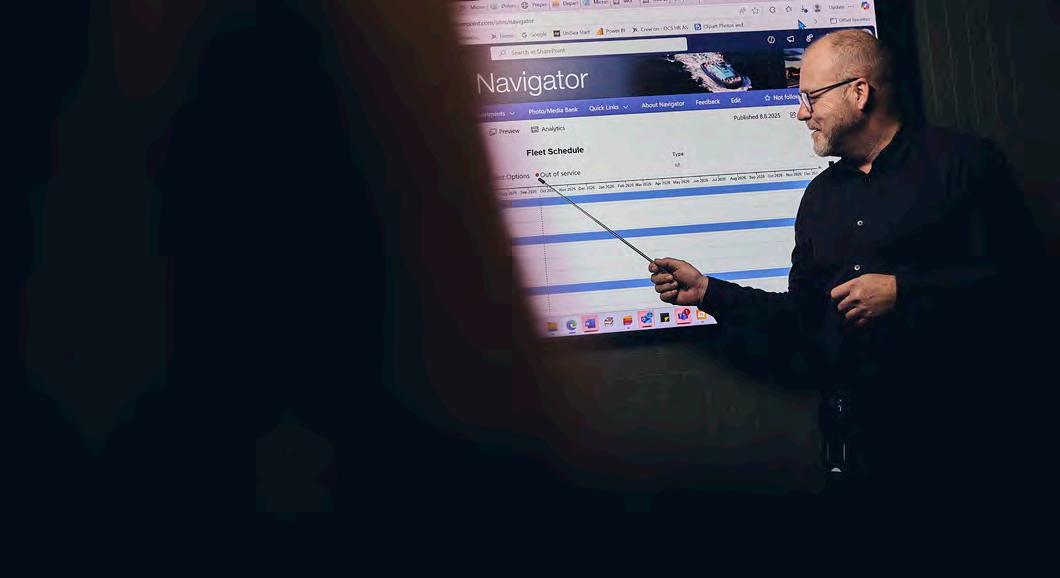
– Now we can easily identify who is responsible for what, see who’s currently on board each vessel, check when services are scheduled, and track vessel schedules in relation to contracts and options. We have clear overviews of costs, fleet movements, crew changes, and real-time fuel data, Nornes explains.
The overall aim is to automate as much as possible and eliminate redundant systems. The data will be easy to visualise, making it more manageable and useful. All this contributes to making daily worklife easier.
– Most employees, on sea and land, will not have to know everything, but everyone benefits from the features relevant to their role. For crew offshore, the whole idea is to reduce screen time- they should be focusing on maritime operations, not office tasks, he emphasises.
Combining data
Østensjø Rederi is now building an internal data warehouse that collects information from various sources and systems, enabling cross-analysis and more effective planning.
– When information is made accessible in this way, we become less dependent on one another. With Fleet Schedule, for example, we can now - for the first time - share updated information about future vessel activity, says Nornes.
With Navigator, Østensjø Rederi has a flexible digital platform that can be easily scaled and adapted to evolving needs. Since the system is owned and developed in-house, Østensjø has complete control and freedom.
– Our goal is to integrate AI solutions before Christmas, he says, acknowledging that identifying the best solution for the entire organisation has been challenging.
– But above all, it has been a truly interesting and rewarding process. We’re only at the beginning of our digital journey, with many exciting plans ahead. Navigator was launched at the beginning of the year, and many employees quickly discovered its benefits. That’s been incredibly encouraging to see, says “Mr Navigator” with a smile.
Getting to know our colleagues
Kaja Anfinsen Lillian Ørke
Svein Arne Kaspersen
Contract Controller Accountant
What made you choose a career in the maritime industry?
I chose a maritime career after hearing stories from my family and wanting to experience it for myself. Even though I didn’t spend many years onboard, I really enjoy being a part of the industry onshore.
What motivates you the most in your job?
What motivates me most in my job is definitely the people I work with. We have a great team, and that makes even the busiest days enjoyable. I also really enjoy working across different departments. It gives me a broader view of the company and keeps things interesting.
What do you appreciate most about your colleagues?
I appreciate my colleagues for their teamwork and the fact that I learn something new from them almost every day, whether it’s work-related or just random facts during coffee breaks.
Which vessel in the Østensjø Rederi fleet is special for you?
Vivax and Edda Frende are special to me – they were the first ones I was responsible for as a Crew Coordinator, so they hold a special place in my heart.
Catering Project Manager
What made you choose a career in the maritime industry?
I’ve always felt a connection to the sea – there’s something calming and powerful about it. I started my work at sea when I was 15 years old.
What motivates you the most in your job?
What drives me is when everything flows smoothly. When catering runs well, the crew and clients are happy, and we’ve got routines that make life easier for everyone. I enjoy seeing people thrive and knowing I’ve played a part in that.
What do you appreciate most about your colleagues?
Definitely the humor and the team spirit. Even when things get busy or challenging, people stand up for each other. It’s comforting to work with colleagues who are skilled, down-toearth, and genuinely care.
Which vessel in the Østensjø Rederi fleet is special for you?
I feel it’s a little hard to say one ship, I have been on almost all the orange vessels in the fleet. If I have to pick one, it has to be Edda Freya.
What made you choose a career in the maritime industry?
I felt very lucky and proud the day I got the job in Østensjø Rederi´s account department 25 years ago. And feel the same way today!
What motivates you the most in your job?
To have a nice and busy job, working with great colleagues, in a great environment, and having a good and solid employer.
What do you appreciate most about your colleagues?
I appreciate the good teamwork in the account department and working with colleagues in different departments.
Which vessel in the Østensjø Rederi fleet is special for you?
I think all the vessels in the Østensjø Rederi’s fleet are important, so for me it`s not possible to choose.
Harald Andreas Fosse Antonisen
ETO Edda Flora
What made you choose a career in the maritime industry?
Growing up with boats in Haugesund/Karmøy and the fjord in Strandebarm, it makes you connected to the sea. From a young age, I have built an interest in how things work and the technical aspects behind them. Going the marine way as an electrician gives me all of it, combined with its rotation, which fits for me and my family and friends’ projects at home.
What motivates you the most in your job?
Making a difference - whether it’s helping the crew with everyday issues or performing advanced fault-finding on critical machinery. The boost after finding the fault, especially after hours, is super rewarding!
What do you appreciate most about your colleagues?
There is always a helping hand and team spirit in everything we do. The movie and Nintendo nights are also great gatherings, and I really appreciate contributing to setting them up.
Which vessel in the Østensjø Rederi fleet is special for you?
I found the “Old” Edda Fjord’s versatility interesting, but I sadly never got to see it. The Edda Freya is also a truly impressive vessel! But I think I must say Edda Flora and the team there. I like the built-in helideck design and the daily mystery projects it has given me throughout the years
Einar Linga
Master Edda Fides
What made you choose a career in the maritime industry?
Growing up near the sea, I was fascinated by boats and from an early age I always knew my path would be something connected to the maritime world.
What motivates you the most in your job?
The way we come together as a team to deliver what our clients need is something I truly value. Receiving positive feedback is not only satisfying but also strengthens our sense of teamwork when shared. Working with people who care about the vessel and equipment keeps me motivated and proud of what we do.
What do you appreciate most about your colleagues?
Honesty and reliability, along with having colleagues who have both the ability and the interest to solve problems and overcome challenges.
Which vessel in the Østensjø Rederi fleet is special for you?
I have been onboard Edda Fides since her delivery from the yard in Vigo in 2011. After all these years, she has become special to me. That said, Edda Fjord deserves equal mention. I was fortunate to be part of her story from the very beginning, working with an excellent ØR team during her construction in Flekkefjord. The months at the yard, followed by nine years of exciting contracts onboard, have made her just as meaningful to me. The ”title” must be shared between the two ladies!
THE CREW BEHIND THE OFFSHORE OPERATIONS
Supplying the offshore industry, one voyage at a time
Platform Supply Vessels are the lifeline of the offshore industry. For 27 years, Able Seaman Kurt Andre Karlsen has kept the operations steady, quietly supporting and supplying various rigs and installations out at sea.
BY K-HUSET // HELENE JORDBREKK
It’s a job that puts you right at the center of offshore operations. Whether delivering equipment, cargo, or supplies, PSVs play a vital role in keeping platforms running safely and efficiently. For those on board, it’s hands-on work that combines seamanship, logistics, and cooperation.
It’s the challenges that make it interesting.
Kurt Andre Karlsen has been with Østensjø Rederi since 1998; for nearly three decades, he’s been working on some of the company’s best-known platform supply vessels. From rig supply operations in the North Sea to pipe runs in the Mediterranean, he’s seen the job from every angle, and he’s still just as invested in the work as the day he started.
– It’s the challenges that make it interesting, he says. – When the unexpected happens and you have to make quick decisions, that’s when the job becomes most engaging.
Today, he sails on Edda Ferd, and like most PSVs, its main task is to support offshore platforms with everything from containers and pipes to equipment and provisions. Depending on the job, the route, and the weather, each voyage is different.
– In recent years, we’ve moved more into the spot market, he explains. – Different customers, different platforms. That means we’re always adjusting, but two things remain the same: the core of the job and the crew.
Days at sea
Life on board a PSV has its routines, but it’s the people who shape the atmosphere. At sea, the crew works in shifts and shares responsibility for keeping the vessel running safely and efficiently. Alongside the operational work, maintenance is a constant part of the job. Equipment is checked, gear is repaired, and the deck is kept in good condition—whether there’s an active delivery or not.
A/B Kurt Andre Karlsen Edda Ferd
– You spend a lot of time together, so it’s important to have a good tone, Kurt Andre says. – And we do. People look out for each other.
When the workload allows, there’s space for rest and downtime. Among the amenities on board, the gym is a popular choice, something the crew often uses between shifts as part of the small routines that help make life at sea more balanced.
With relatively small crews, the social dynamic plays a big role in daily life.
– These ships don’t need huge crews, so you get to know the people around you well. And Østensjø Rederi has always had good people, he says. – That makes a difference.
Learning by doing
Like many others in the maritime industry, Kurt Andre didn’t come to the job with all the answers. What he knew, he learned at sea.
– I was quite young when I started, and I learned everything on board, he says. – That’s how it works, those with more experience show you the ropes, and over time, you pass that knowledge on.
It’s a way of learning that’s deeply embedded in life on board. While manuals and procedures are part of the job, much of the training happens through observation, repetition, and conversation between crew members.
– There’s always something to pick up from the people around you. You see how others do things, and you figure out what works.
Today, he finds himself in the teaching role more often than not, especially when cadets or younger able seamen join the vessel. Østensjø Rederi’s supply ships often host crew across generations, and that dynamic is something Kurt Andre values.
– We’ve had everything from 18-year-olds just starting out to seafarers over 60. It makes for a good mix. Everyone brings something different to the team.
Ports,
platforms and the people in between
After sailing on Edda Frigg, Edda Fram, Edda Frende, and Edda Ferd for Østensjø Rederi over the last three decades. Kurt Andre has gathered more than his share of stories—some from far-flung ports, others from quiet days at sea. He recalls months spent near Svalbard, where the vessel served as accommodation during the shutdown of the Svea mine, and a pipe run in the Mediterranean that ended with a short break in Malta. One voyage even brought him through the Suez Canal, sailing all the way to Malaysia ahead of a vessel handover.
But what stays with him isn’t just the rare destinations or the unusual jobs, it’s the rhythm of the work, and the people he’s
shared it with. The shift rotations. The trust built on deck. The quiet routines that hold it all together.
And it’s that rhythm and steady work, shared responsibilities, and quiet trust, that continues to make life aboard a PSV both challenging and rewarding.
Part of the Edda Ferd crew; Chief Officer Claus Dame, 2nd Officer Karsten Lie Brun, Master Joar Andre Øyre and 2nd Officer Kristian Iversen
A/B Kurt Andre Karlsen with his daughter visiting him on board.
Focus on food and wellbeing on board
At Østensjø Rederi, nutrition is more than a practical necessity – it is a priority and a vital part of crew welfare. Systems, standardization, and a strong focus on quality ensure healthy, varied, and tasty meals.
BY PYX // BJARNE LAASTAD PHOTO HAAKON NORDVIK
In recent years, Østensjø Rederi has professionalized catering across the fleet. An updated catering manual provides a shared framework for hygiene, menu planning, and routines, while digital ordering and Teams meetings allow close coordination between shore and vessel.
– We’ve standardized processes to make it easier to deliver good results without losing flexibility. Technology lets us follow up quickly, provide support, and maintain quality, Kaspersen says.
The approach ensures consistency while still accommodating local adjustments and crew preferences.
Meals as a social arena
Mealtimes are not just breaks from work; they are a social arena where everyone meets during the day.
– When a meal begins, the mess hall fills quickly. If people are happy, they tend to stay longer. The casual conversations around the table have an impact that lasts far beyond the meal itself, Kaspersen explains.
The mess hall is also a key arena for inclusion, especially for new crew members and apprentices. From day one, they experience being part of the group, building trust and a sense of belonging.
Svein Arne Kaspersen
Healthy food – with balance
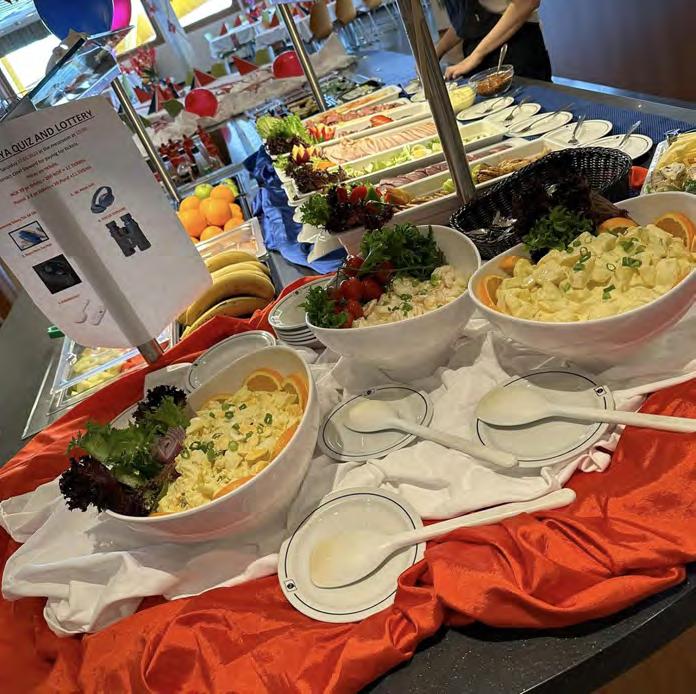
Meals include both meat and fish at dinner, two lunch options, night meals, and bread-based alternatives. Fruit and vegetables are available around the clock, and salad bars make healthy choices accessible. Special occasions feature traditional dishes and festive touches.
– We tried cutting back on sweets for a while, but the feedback was very clear. We can’t control everything, but we can make it easy to choose well. Balance is key, Kaspersen says with a smile.
Creative use of resources
Cooking for crews with many nationalities and dietary needs is demanding.
– It’s impossible to make everyone happy every single day. But through planning, dialogue, and variety, we aim to meet most needs within the span of a week, Kaspersen explains.
Leftovers are regularly transformed into new dishes – from stews and salads to home-baked bread.
– We waste very little. The Stewards are creative and skilled at making the most of what they have, he adds.
Delivering quality through safe galley practices
Hygiene, food safety, and well-documented routines are fully integrated into the company’s quality systems. Digital follow-up supports Stewards and ensures compliance across vessels.
– This is HSE at work. Clear routines and standardization make it easier to ensure safety, hygiene, and quality, Kaspersen underlines.
Meals have a direct effect on motivation, collaboration, and safety.
– The importance of meals cannot be overstated. When people are well-fed, they don’t get irritated over small things. The mess hall is much more than a dining room – it is a social hub that strengthens teamwork, builds trust, and helps the crew function better, also when facing demanding situations, Kaspersen says.
17 of May on Edda Flora
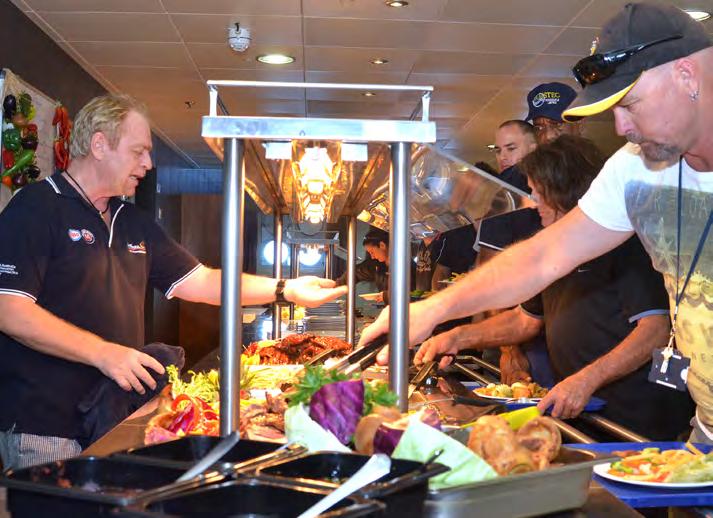
Lunch at Edda Freya
Competition rules
Do you have pictures of our company, our employees or our vessels? Send your photos to post@ostensjo.no.
Enter the name(s) of the person(s) and place displayed in the picture and/or its theme in the subject field. Include your full name and contact information in the e-mail. Enter as many pictures as you want. Photos must be at least 1 MB. We publish the winning photos in our next issue. Østensjø Rederi reserves the right to use all submitted photos.
Prizes
1st place: NOK 2000,2nd place: NOK 1500,-
3rd place: NOK 1000,-
AND THE
WINNERS
ARE: Jury Østensjø Rederi editorial staff.
Photos: The winner and a sample of the pictures that entered the competition
LARS DENIZ SKJOLDAL From Dux
Photo: Akkerfjord Harstad
CLAUS RINGA DAME
From Edda Ferd
Photo: Edda Fauna
LEIF ARNE SØRNES
Edda Frende
Photo: Gale
MARTIN BORG
ROY W. GJERDE
Edda Fides
OLE CHRISTIAN WALLE Vivax
SUNNIVA FATLAND Haugesund office
MARIUS HUSTELI
Edda Flora
JOAR-ANDRE ØYRE
Edda Ferd
ADRIAN STEINHAUG
Edda Freya
TERJE H. HAGEN
Edda Ferd
Four decades at sea
From his first voyages along Norway’s west coast to serving as Master at Østensjø Rederi, Jan Atle Steinsland has spent over four decades at sea.
BY PYX // HELENE SKEIE ØSTHUS
A career at sea ran in the family. In 1982, he joined his first vessel – a small 250-tonner carrying gravel and asphalt. After maritime college in Haugesund, his path was set for a life offshore.
A career at Østensjø Rederi
Steinsland joined Østensjø Rederi in 2002, starting on the tug Thorax working off the coast of Angola. Over the next 23 years, he served on six different vessels in the fleet, beginning as First Officer on Edda Frende (later Edda Sprint), advancing to Chief Officer, and taking command as Master in 2013.
Tradition meets technology
He has witnessed the industry evolve – from paper charts and long night watches to digital systems and dynamic positioning.
– Østensjø Rederi has always been ahead of the curve, and it’s been exciting to be part of that. At the same time, technology can be overwhelming. We mustn’t forget the basics: looking ahead and navigating, he says.
He also emphasizes the next generation: – The company invests in young professionals, giving them training and opportunities. But this isn’t just a job – it’s a lifestyle, and you must be fully invested.
A life between Copenhagen and Bømlo
While sailing internationally in the late 1990s, Steinsland met his wife in Copenhagen, which became their home base. His ties to Norway’s west coast remain strong, with summers on Bømlo where the family has a house by the sea.
– Our children and grandchildren love it there. We’ve spent many summers on Bømlo, and now there will be even more, he smiles.
With his spouse retired since May, they look forward to more family time, travel, and leisure activities.
– I’ve missed a lot of birthdays and concerts over these 40 years. Now it’s time to catch up, he says.
Jan Atle Steinsland at the annual officers conference
Edda Accommodation’s new headquarters
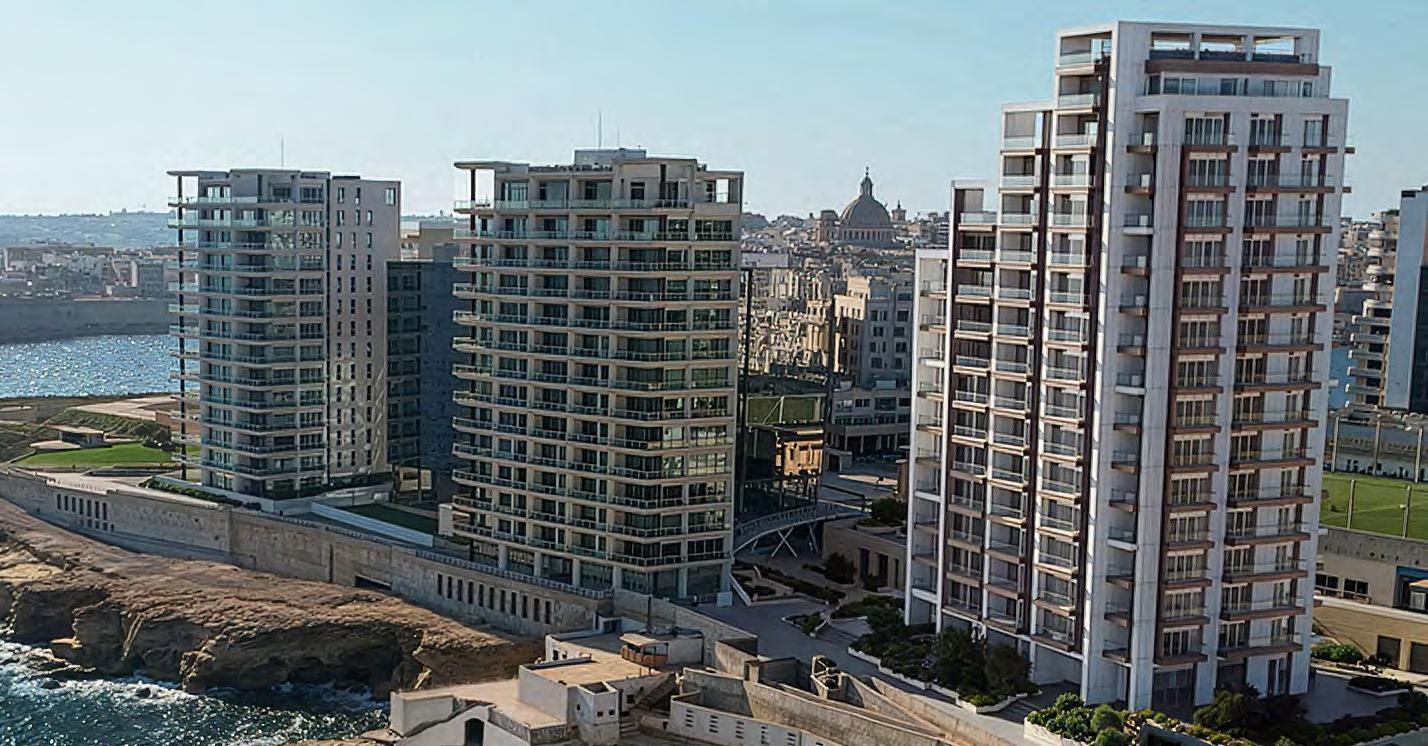
Next summer, Edda Accommodation will move into new offices in the modern Tigné Point area of Malta.
BY PYX // BJARNE LAASTAD
Doreen Gatt, a Maltese national and General Manager for Edda Accommodation, has been with Østensjø Rederi since 2011.
– I originally worked as an auditor, but I was looking for a change. I applied for a financial controller role at Edda Accommodation – Malta, and I haven’t looked back since! In the early days, Gatt worked alone from a small office in historic Valletta. While charming, it was too small for growth. When the team expanded, they moved to St Julian’s, which provided more space but still felt somewhat isolated from the business community.
The new office at Fortress Gardens spans nine stories and over 15,000 m², offering a central, modern space with restaurants, gardens, and sea views.
– I’m really looking forward to moving in! It’s open, modern, and convenient, with financial institutions nearby. The on-site gym and amenities will also help maintain a healthy work–life balance, Gatt says.
The Malta office manages corporate and financial matters for Edda Fides, assisting with Edda Fortis, and supporting
commercial activities such as tenders, cost estimates, and projections. Gatt has even learned some Norwegian to better communicate with colleagues in Haugesund.
The move reflects a desire to strengthen Edda Accommodation’s brand, meet the company’s standards, and provide a more efficient, inspiring workplace. The team hopes to complete the relocation by June 2026.
Tigne Point, Malta
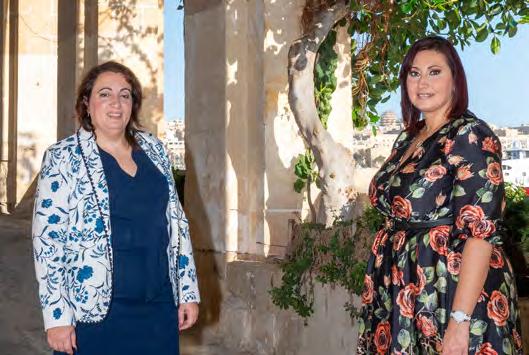
Doreen Gatt and Claire Grima from the Edda Accommodation Malta office
Vessels in operations
SUPPORTING FLEET OPERATIONS THROUGH COOPERATION
In the flow of maritime logistics with Torstein
When you ask Torstein Bjelland what motivates him in his job, the answer comes quickly: creating flow. That is—making sure the right things are in the right place, at the right time, to keep operations running smoothly. As Senior Procurement Advisor, he plays a central role in securing exactly that.
BY
K-HUSET // HELENE JORDBREKK
PHOTO HAAKON NORDVIK
With more than 27 years of experience in the maritime industry, Torstein’s career spans continents, contracts, and countless logistical challenges. What’s helped him navigate it all is clear communication and strong cooperation.
– It’s about finding the right rhythm between people. When everyone is pulling in the same direction, that’s when things start to flow, Torstein explains.
His work could be described as logistical diplomacy—carefully balancing the needs of vessels, suppliers, and Østensjø Rederi’s administration in a field shaped by complex global supply chains It’s about navigating different requirements, time zones, and expectations to ensure that the right items are sourced, priced, and delivered exactly when and where they’re needed.
With a mechanical engineering degree in his back pocket, Torstein’s technical background gives him an edge when dealing with complex procurement tasks. – It helps to understand what you’re actually purchasing, he says. – Especially when you’re dealing with specialized equipment. You need to be able to ask the right questions.
The people behind the process
While much of Torstein’s work revolves around systems, contracts, and logistics, he’s quick to point out that it’s the people who make the job meaningful.
– Building relationships, understanding needs, creating good dialogue—that’s what makes it all work, he says. – The best outcomes come from good cooperation.
With more than three decades of experience in procurement and supply chain roles—including international postings in Canada and Germany—Torstein has worked with people from all around the world. Whether he’s aligning with Masters, coordinating with suppliers, or collaborating with colleagues on board, he’s learned that clear communication is often more valuable than the most detailed contract.
A life anchored in family—and the sea
While office life often means long hours in front of a screen, Torstein usually starts his weekdays on a different note. Three to four mornings a week, he heads to the gym for a workout— always followed by coffee and a good chat with the same group of familiar faces. – It’s a nice way to begin the day, he says. – You get your body going and get to solve some world problems while enjoying your morning coffee in good company.
Outside of work, Torstein’s life continues to be shaped by the same things that drive him professionally. Connection, reliability, and flow. He’s a family man through and through—with three daughters and three granddaughters, there’s always someone to catch up with, pick up from kindergarten, or invite along for a quiet weekend at the family cabin by the fjord.
– There’s always something that needs fixing out there, he says with a smile. – But it’s also where we come together.
Enjoying his free time on the fjord
The sea that frames his professional life is present here too, both in the view from the cabin and in the boat he takes out for fishing trips or excursions on the fjord during the summer. That love of boats and coastlines has also shaped how the family travels. Over the years, Torstein and his wife have made a habit of exploring the Greek islands, often with children, grandchildren, or friends.
– We enjoy the slower rhythm, the local food and of course, getting around by boat, he says. – It’s still the best way to explore.
This summer, Torstein celebrated his 60th birthday by bringing the entire family to Greece for a trip together to the island of Kea.
Supporting the fleet from shore
Whether he’s on a ferry in the Aegean or following up a supplier agreement in Norway, Torstein approaches the task in front of him with the same steady focus. He thrives in the space where people, process, and problem-solving meet—a dynamic that suits the ever-changing nature of procurement.
His experience, technical understanding and eye for practical solutions make him a valued presence in Østensjø Rederi’s dayto-day operations. Although much of the work happens behind the scenes, it plays an important part in keeping the fleet running smoothly.
SUSTAINABILITY STARTS WITH SAFETY
Østensjø Rederi’s integrated approach to HSE
Innovation at Østensjø Rederi doesn’t always mean launching a new vessel or advanced technology. Sometimes it’s about rethinking long-standing habits. In an industry where dedicated HSE departments have become the norm, Østensjø Rederi has taken another path, where safety works better because it is owned by everyone.
BY PYX // BJARNE LAASTAD
PHOTO HAAKON NORDVIK
Instead of isolating safety into a single department, the Company believes in a structure where Health, Safety, and Environment (HSE) is part of everyone’s daily work. The philosophy is simple but powerful: responsibility and follow up for safety should not live in one department — it should be part of the company’s everyday decisions.
A change in philosophy
– The idea was never that one department should own safety, explains Elias T. Nornes, Chief Sustainability Officer at Østensjø Rederi. – It’s something everyone should work with, every day. It needs to sit in the backbone of every employee.
Phill Brown, Elias Nornes, Sunniva Fatland, Knut Fredrik Slåke and Thomas Wiig
Over the years, HSE work in the maritime industry has grown increasingly complex, often leading companies to establish large, specialized HSE teams. Østensjø Rederi believes that this, in practice, created distance between safety goals and day-to-day operations. By integrating responsibility directly into the operational line, the company is bringing ownership back to where it belongs, on board the vessels, in every department, and across every role.
The former HSEQ department has been restructured into the new Risk & Compliance Department, and the HSEQ Engineers now hold the titles of Marine Superintendent.
– The department supports operations, Elias explains, – While the operational teams are responsible for safety on their vessels, our role is to assist, guide, and provide technical and regulatory support.
Sustainability as a guiding principle
The decision to rethink HSE at Østensjø Rederi goes beyond organizational charts. It’s about sustainability, in every sense of the word.
– For us, sustainability isn’t just about the environment, Elias explains. – It’s about running safe, efficient, and economically sound operations. If we can’t operate safely and responsibly, there’s no long-term future for the company. Safety is sustainability.
This philosophy has shaped Østensjø Rederi’s broader strategy, where HSE, digitalization, and operational efficiency are connected under one umbrella. By linking these areas, the company is creating a more holistic framework for sustainable operations, one where safety, quality, and efficiency reinforce each other.
Making safety practical
An essential part of the change has been reducing administrative burdens and making HSE work practical, visible, and actionable.
– Digitalization plays a huge role, Elias says. – For us, digitalization in the long run means automating repetitive reporting and administrative tasks, Østensjø Rederi is freeing up time for employees to focus on what matters most: operating vessels safely and effectively.
The company is also implementing a Performance Management System, where every department sets its own measurable targets. Progress is tracked using clear, color-coded KPIs, giving teams ownership of their results. Traditional HSE metrics are now integrated into the operational KPIs, aligning safety directly with performance and accountability.
A cultural shift takes time
Changing processes is one thing. Changing mindsets is another. Elias acknowledges that building a stronger safety culture across the organization takes time, – It’s like planting seeds, he says. – You have to water them, again and again.
And yet, the shift is already visible. Crew and office teams alike are taking more ownership, discussing hazards and risks openly, and still thinking about safety as part of their everyday decisions. – It’s about creating a culture where safety isn’t something you turn on and off, Elias explains. – It’s always there, at work, at home, everywhere.
Safety as a shared future
For Østensjø Rederi, the ambition is to set the standard. By weaving HSE into the very fabric of the organization, the company is building long-term strength and ensuring a fleet that operates with both safely and efficiency at its core.
Feeding up to 600 people from all corners of the world
Feeding up to 600 clients daily requires a great deal of logistics. On Østensjø Rederi’s accommodation vessels, this is just everyday life.
BY PYX // BJARNE LAASTAD
Edda Fides was the first floating hotel and monohull service vessel in the world, purpose-built for the offshore energy industry. Edda Fides can accommodate 600 workers in a home away from home, offering hotel-standard catering, recreation, and high-quality cabins. After completing operations in Senegal, the flotel spent two years off the coast of Angola, connected to a Floating Production Storage and Offloading (FPSO) unit. Since then, Edda Fides has undergone her 15year class in dry dock in Gibraltar.
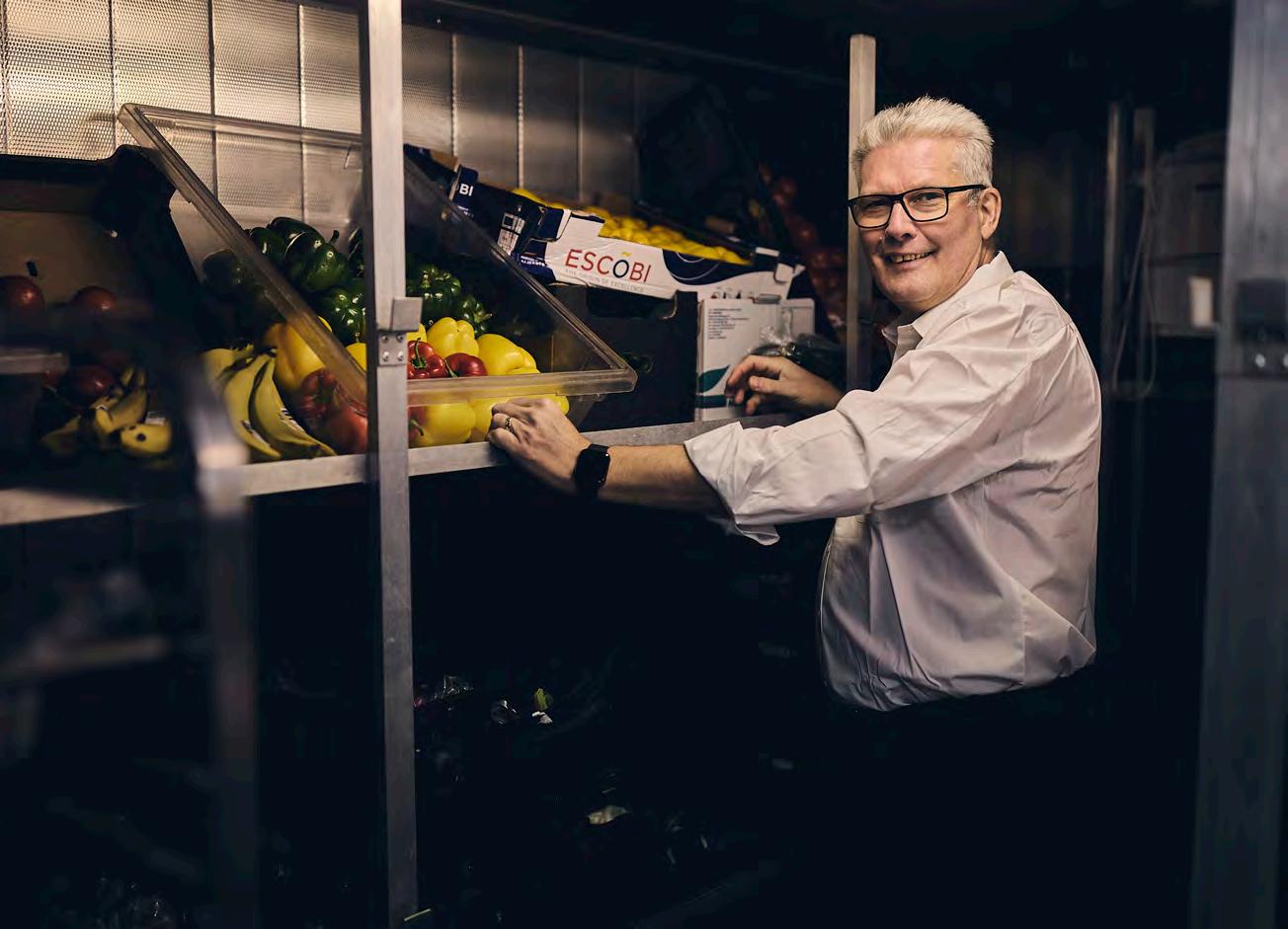
Running full hotel operations on board means many mouths to feed. To ensure Edda Fides is well stocked with food, Hotel Manager Vidar Hansen coordinates with local catering companies at each location.
Meal service every six hours – around the clock – All meals are prepared on board, including all baked goods. Four hot meals are served every day, with food available every six hours. While Catering Project Manager Svein Arne Kaspersen handles liaison with the catering companies from onshore, my main responsibility is ensuring compliance with Østensjø Rederi’s current procedures, restocking supplies before we run low, keeping accounts for the number of people onboard, monitoring our onboard systems for quality and food safety, and providing feedback and evaluations, Hansen explains.
The number of people onboard usually ranges from 390 to 420, but Edda Fides has sleeping quarters for 600 – meaning it gets crowded at full capacity.
– It can be hectic feeding up to 600 people a day, and although not everyone is on board simultaneously due to shift rotations, the vessel is always busy. For the Angola operation, 52% of the clients were African, 40% were from Asia, and 8% were European. It can sometimes be a challenge to provide food that suits everyone’s preferences, but we do our best with what is available, smiles the hotel manager.
Food is delivered weekly in two to three 10-foot containers. A typical monthly consumption onboard includes:
Milk: 2,350 liters
Eggs: 22,000 (61 cartons of 360 eggs)
Coffee: 100 kg
Chicken: 3,400 kg
Beef: 1,800 kg
Pork: 1,100 kg
Fish: 900 kg
Rice: 1,400 kg
Flour: 1,400 kg
Vegetables: 700 kg
Bottled water: 55,000 bottles
Hand soap: 60 liters
Planning for bad weather
There is also a constant need for laundry services, both for workwear and personal clothing. The onboard washing machines run 24/7. The biggest challenge is provisioning during bad weather. Supplies are delivered by container in ship-to-ship operations, so high seas can make it difficult.
– We can’t control the weather, unfortunately, but it generally works out fine. Occasionally, we have short periods with more limited supplies, but we do our best to avoid such situations, says Hansen.
Well-equipped for leisure
A vessel focused on hotel operations is, naturally, well-equipped for leisure.
– Many enjoy the comfortable lounge, and we also have a cinema, sauna, table tennis room, and two popular gyms – one for cardio and one for strength training. We also have access to a pool, and many of us use the helideck as an outdoor area for sun and fresh air. And with so many people around, it’s great to have the option of retreating to your cabin for a bit of peace and quiet, smiles Hansen.
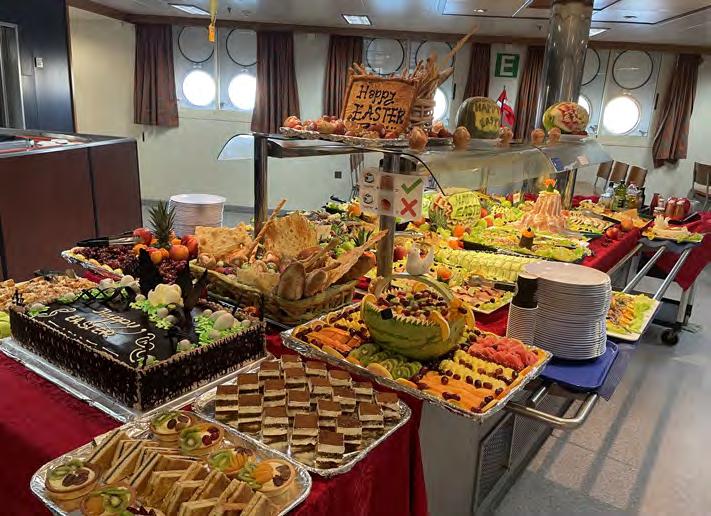
Easter dinner
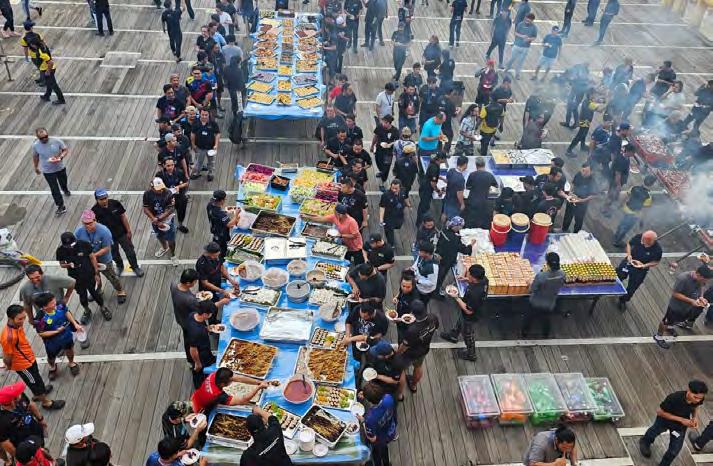
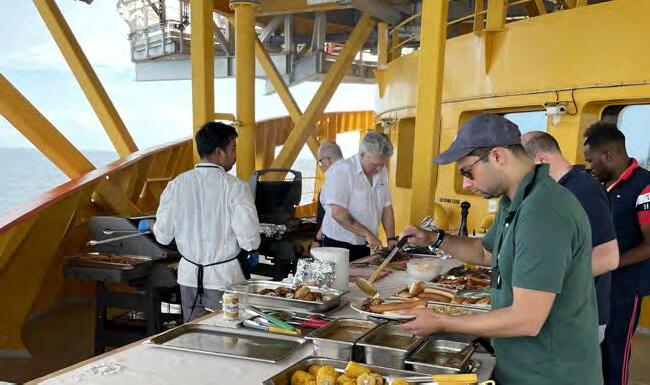
BBQ and food gathering for crew and clients
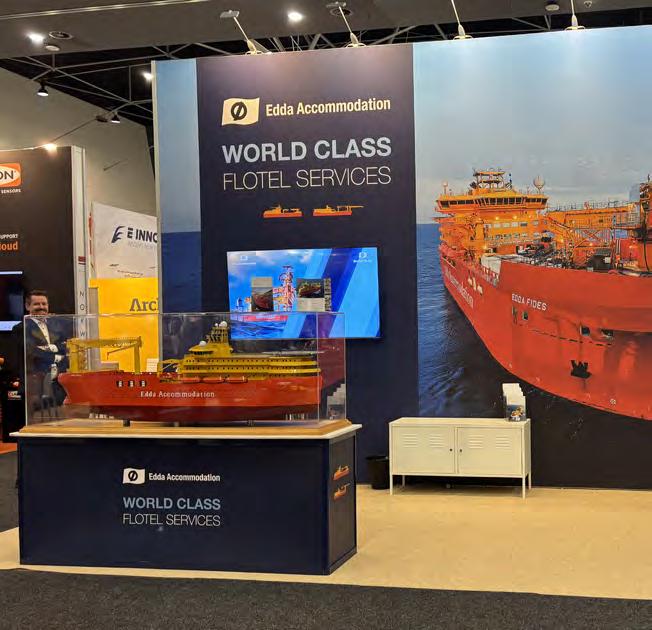
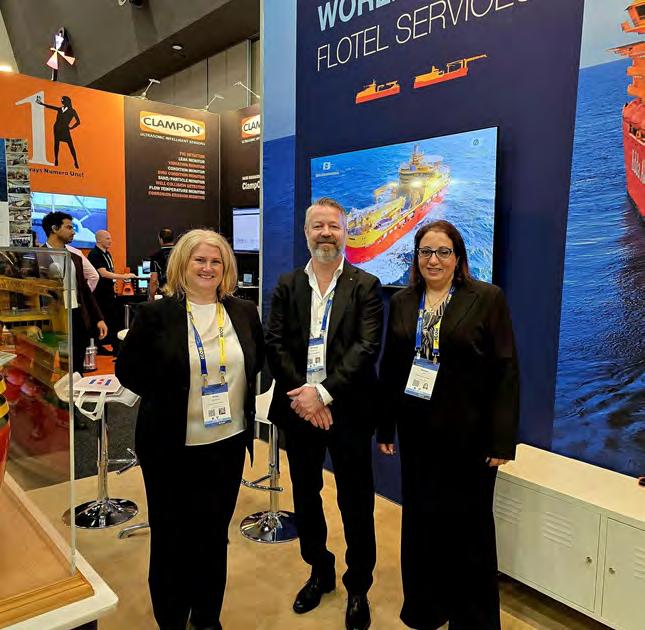
Østensjø Rederi and Edda Accommodation at EXA 2025
When Senior Charterer Vivian Steinsvik boarded her flight to Australia in March 2025, she was heading for new ground. It was her first time attending the EXA Exhibition (formerly AOG Energy), one of Australia’s main offshore industry arenas. Traveling with Fleet Manager Alf Helge Lyngholm and General Manager Doreen Gatt from Edda Accommodation’s Malta office, she joined a team well aware of the value of being present in Perth.
BY K-HUSET // HELENE JORDBREKK
Østensjø Rederi has attended EXA for several years. With a strong offshore track record in the region and growing interest in the Australian market, the event remains an important arena for strengthening visibility and relationships.
– It’s a market we believe in, says Vivian. – EXA is where we meet clients and partners and build relationships that might become tomorrow’s contracts.
The 2025 exhibition reflected the industry’s shift toward a broader energy landscape, with renewables taking a larger role alongside oil and gas.
– We noticed more talk about wind energy and decommissioning of old rigs, says Doreen. – More visitors from the renewables side were showing interest.
For Østensjø Rederi and Edda Accommodation, whose vessels are designed for demanding, long-term operations, the trend opens new opportunities.
– Our vessels—built for safety, comfort, and flexibility—are gaining relevance across more segments, Doreen adds. Despite the focus on technology and markets, relationships remain at the heart of EXA.
– An exhibition is really about people, Vivian says. – Meeting face-to-face builds trust, and that can make all the difference. After a week of engaging conversations and new connections, the Østensjø Rederi team left Perth encouraged by the interest shown—and ready to build on the opportunities ahead.
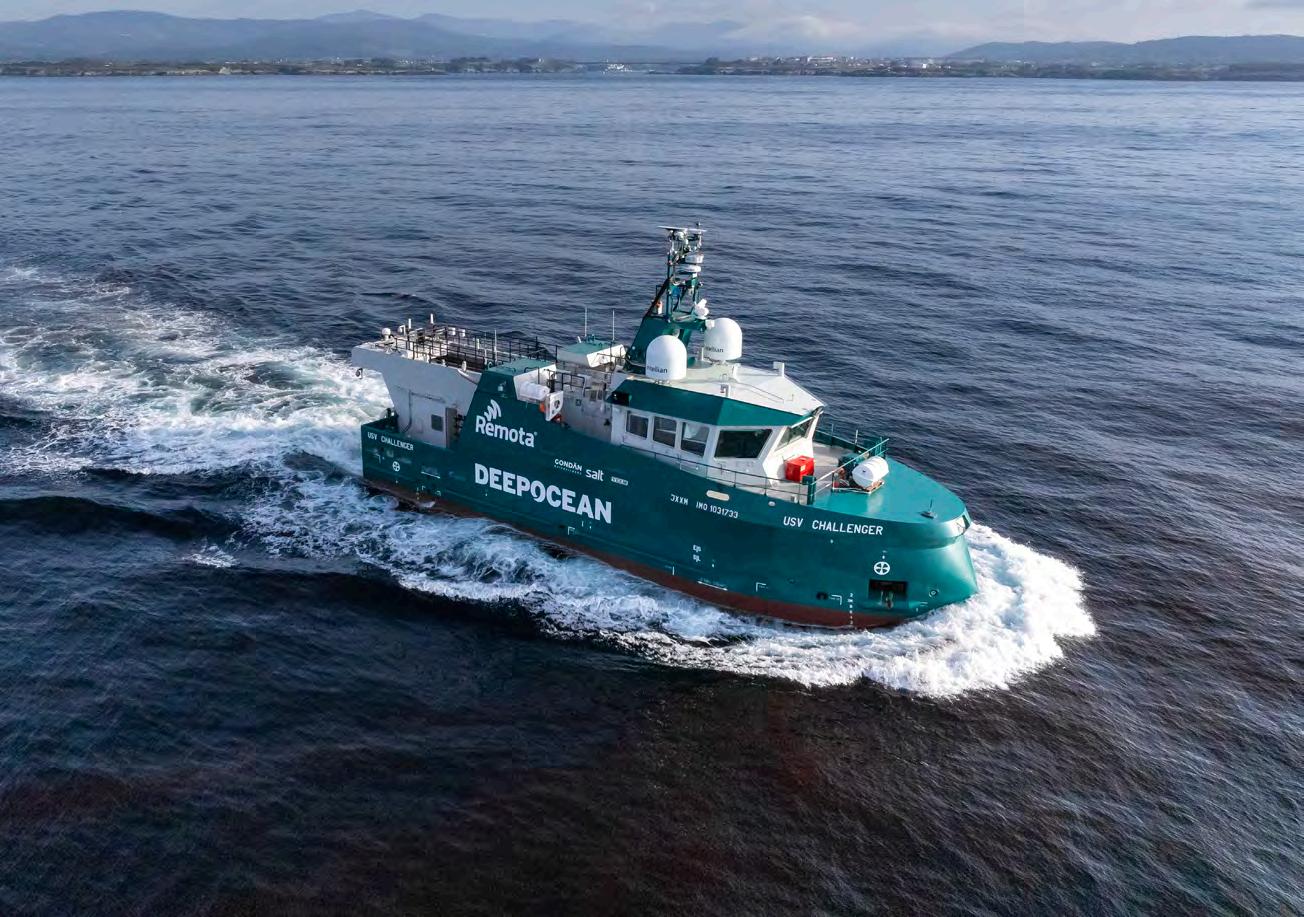
USV Challenger: Lower emissions and new shore-based opportunities
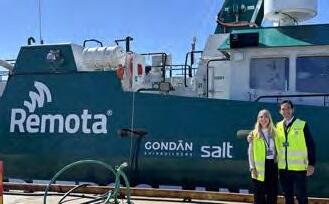
Launched from Gondan Shipyard in March 2025, USV Challenger is paving the way for unmanned offshore operations. Operated by Remota for USV AS—a joint venture between Østensjø Rederi, Solstad Offshore, and DeepOcean—the vessel began manned and is now transitioning to remote control.
BY PYX // BJARNE LAASTAD
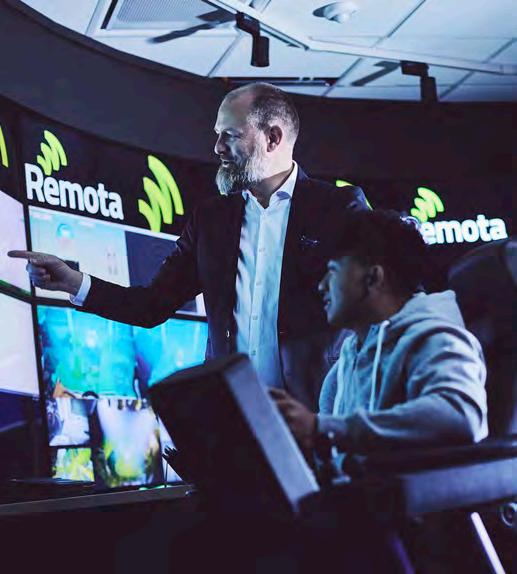
– We’re developing new technology under a framework that doesn’t yet exist, says Sveinung Zahl, COO of Remota.
Built for complex survey operations, the USV Challenger combines safety, efficiency, and innovation. The shift to remote control could cut emissions by up to 90% and create new shore-based maritime careers.
With partners including DeepOcean, Maritime Robotics, and DNV, the vessel is set for approval later this year before starting subsea work for Aker BP— ushering in a new era of offshore operations.
USV Remota
COO Sveinung Zahl at Remota Control Center
Senior Project Engineer Erlend Jæger Espeland from the Project department and Technical Superintendent Geir Vestvik from the Technical department. The Edda Fram project demonstrated strong cross-department collaboration.
Repowering Edda Fram
BRINGING NEW LIFE TO A PROVEN WORKHORSE OF THE FLEET
After nearly two decades in service, the platform supply vessel Edda Fram recently underwent a major transformation. What began as a planned engine replacement developed into a comprehensive repowering project—one that extends the vessel’s lifetime.
BY K-HUSET // HELENE JORDBREKK
PHOTO HAAKON NORDVIK
– Engine replacement was just the starting point, says Erlend Jæger Espeland, Senior Project Engineer. – We saw the chance to invest in making the vessel more efficient, more reliable, and better aligned with today’s operational standards
A needed renewal
Built in 2007, Edda Fram is the oldest PSV in Østensjø Rederi’s fleet. But despite her age, the vessel has proven to be a strong performer. Still, the original main engines had become increasingly unreliable and difficult to maintain, with spare parts hard to come by. The time had come to make a decision.
Østensjø Rederi has a clear focus on maintaining a strong presence in the PSV segment, and Edda Fram has long been an important part of that. When the vessel began experiencing repeated engine failures and mechanical issues, the company carefully weighed its options of selling or upgrading the vessel. A newbuild was not an option, and so the choice became clear: to invest in existing tonnage. It was a significant investment, but one that resulted in more environmentally friendly engines, improved reliability, and continued value for both crew and clients.
More sustainable
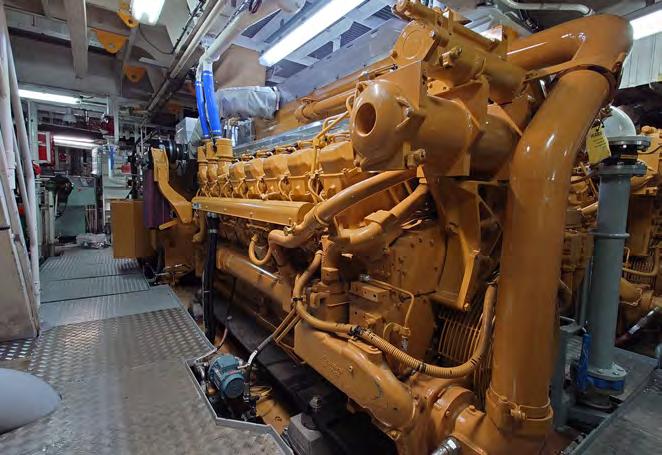
The upgrade centered around replacing all four main engines, as well as the harbour generator, with modern Caterpillar generator sets, a trusted engine type already in use on other Østensjø Rederi vessels. A key element of the upgrade was the integration of SCR (Selective Catalytic Reduction) systems. These systems inject a urea solution into the exhaust stream to reduce NOx emissions, significantly improving the vessel’s environmental profile.
– It was never a question of whether we’d install SCR units once we were already replacing the motors, says Geir Vestvik, Technical Superintendent at Østensjø Rederi.
From a sustainability perspective, the benefits didn’t stop at cleaner exhaust. Several systems and components, such as pipework, cabling, and parts of the control infrastructure, were reused where possible. Even the old engines found a new purpose, having been sold on for potential reuse or spare parts abroad.
A secondary upgrade added dynamic valves to the freshwater cooling system, allowing for more precise temperature control and further fuel savings.
A technical puzzle
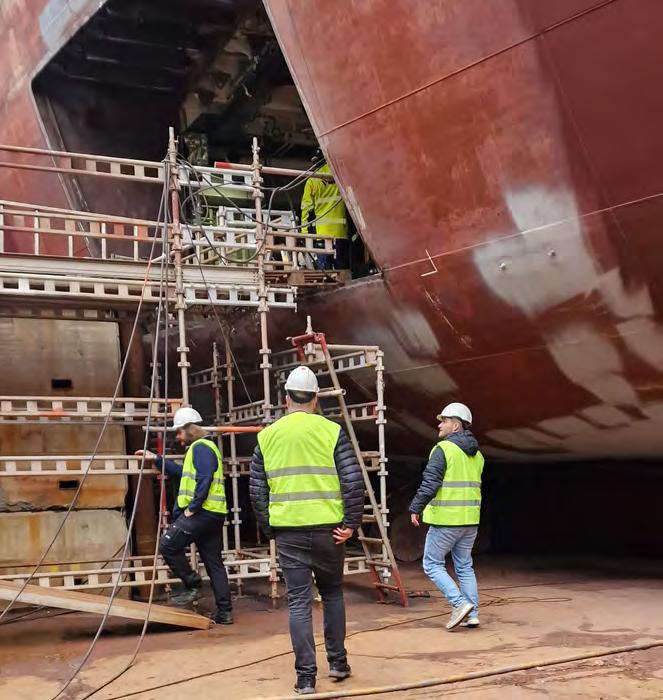
Executing a retrofit of this scale on a nearly 20-year-old vessel was no small task. The original exhaust system had to be removed and rebuilt entirely to make room for the larger SCR units. To remove the old engines, parts of the hull had to be cut open, and the entire engine room was stripped back before new components were installed.
– The space was incredibly tight when fitting the new engines and exhaust, but thanks to great planning and a proactive yard, it all came together, says Vestvik.
The yard, Halsnøy Dokk, was a key partner throughout the project. Erlend, who was on-site daily, describes the collaboration as one of the highlights of the process. – They were flexible, solution-oriented, and fast. Every challenge was met with teamwork.
The vessel also received upgrades to its switchboard systems and equipment enabling remote operations. As part of this, cameras and remote-control functionality were integrated with the vessel’s DP system, developed in collaboration with Remota. During testing, Edda Fram was successfully operated remotely from Killingøy, marking an important step in exploring future digital capabilities.
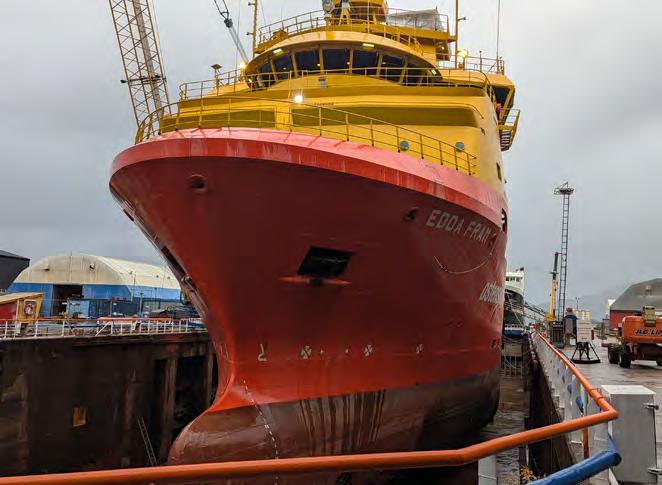
Edda Fram in dock
Caterpillar retrofit Edda Fram
FOUR-YEAR INTEGRATED BACHELOR’S
From classroom to bridge
Next spring, the very first class of the new four-year integrated bachelor’s degree in nautical studies will graduate. For the students, it means they can step straight into work as deck officers. For the industry, it means a new generation of seafarers ready to take their place on the bridge.
BY K-HUSET // HELENE JORDBREKK
The pilot program, introduced at Høgskulen på Vestlandet in Haugesund, is the first of its kind in Norway. Combining studies with four separate internship periods at sea, it gives students both academic knowledge and practical experience. Already as first-year students, they set foot on board and get to test life at sea.
Østensjø Rederi is among the local shipping companies that have joined the program and has made our vessel available to students. By offering internship opportunities, we give people a chance to experience everyday life at sea in a professional setting.
Lone’s choice
Lone will graduate in June 2026 as part of the pilot project class. But her path towards a maritime career wasn’t a straight line. After finishing her first bachelor’s degree, she realized the path she was on wasn’t the right fit. The ocean, however, had always been close. Her father worked in aquaculture, and from the age of fifteen, she spent summers helping out at his job. When the opportunity came to study nautical science, Lone seized it. The integrated bachelor offered the chance to start
building experience right away.
– I didn’t want to wait three years before stepping on a ship, she explains. – With this program, I got to test life at sea from the beginning, and I quickly confirmed that it was something I enjoyed.
When it came to choosing a practice company, Lone ranked Østensjø Rederi as her first choice. – Østensjø Rederi, represented by Jorunn Henriksen, visited the school early on, and I was impressed by how professional and innovative the company seemed. I wanted to be part of that, she says.
Learning at sea
Her instincts were right, and so far, Lone has spent three practice periods offshore.
– Every day is unique, she says. – You might plan your day in
Lone Ness
Lone Ness
the morning, but then something changes, and you have to adapt. It teaches you flexibility, and it shows how important teamwork is.
Life on board also comes with its own rhythm. With the crew living and working closely together, bonds form quickly.
– You get to know people in a completely different way than you would in an office, she explains. – It creates a strong sense of community.
Quality and care
Lone highlights Østensjø Rederi’s high standards as one of the most valuable parts of her experience. – Procedures are followed closely, and things have to be done properly. If something isn’t right, you go back and do it again. It’s demanding, but in a way that builds confidence in the skills you learn.
She has also felt looked after as a cadet. Before each crew change, she was contacted and briefed on what to expect, and on board, she was encouraged to ask for tasks she wanted to be part of. – I felt respected and listened to, she says.
As one of the few women on board, she had been advised to be prepared for challenges but found the opposite. – I had heard stories about harassment in the industry, but I never experienced anything like that in Østensjø Rederi. On the contrary, I felt safe and supported.
Lessons beyond the bridge
Beyond seamanship, Lone has learned much about herself. – As a cadet, you want to join everything, but you also need to know when to step back. That’s something I’ve had to practice, she admits.
Ready for the future
Now, with one final offshore practice period ahead of her, this time on one of Østensjø Rederi’s platform supply vessels, Lone is looking forward to graduating. – I know what I’m heading into, she says. – The routines, the demands, the teamwork — I’ve already lived it.
She is convinced that the integrated bachelor’s is the right way forward. – It connects theory and practice in the best possible way, and it lets you find out early if this is the life for you. And honestly, it’s been both a great learning experience and a lot of fun.
For Østensjø Rederi, supporting students like Lone is an investment in the future. And for Lone, it’s been a stepping stone into a career she feels ready for. – Østensjø Rederi has been a fantastic place to learn, she says. – I know that anyone who gets their internship here will come away with valuable experience.
Tobias Ljosnes, Bjørn Magnus Sæther and Tor Inge Lindanger
Lone is currently on PSV Edda Fram
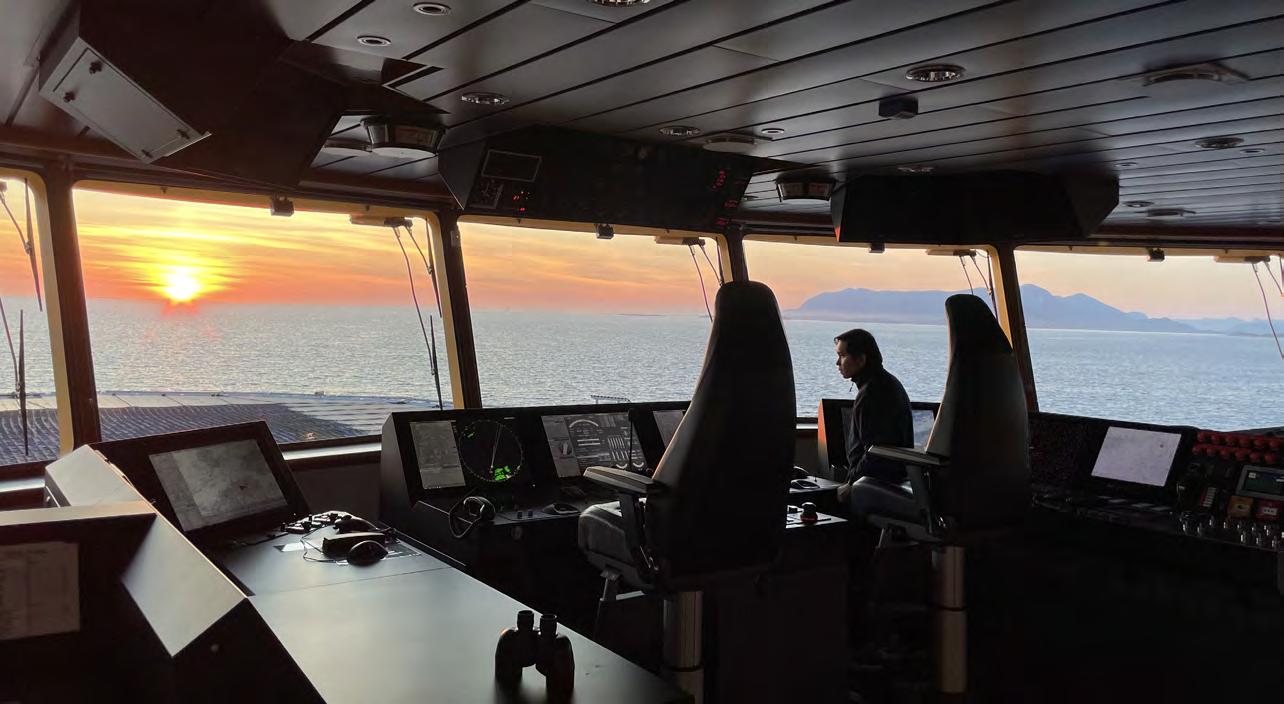
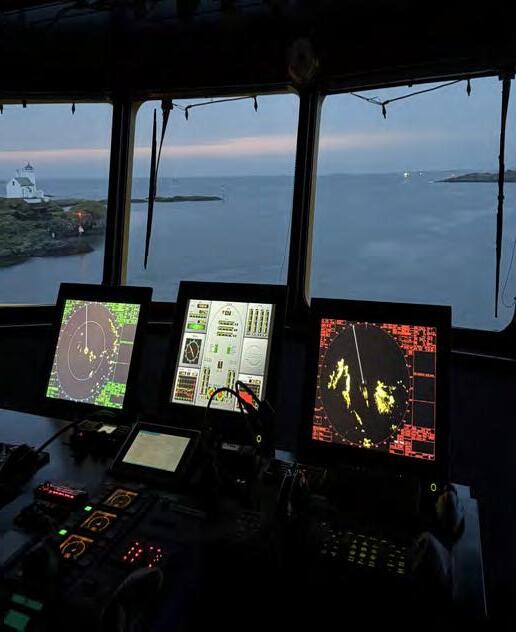
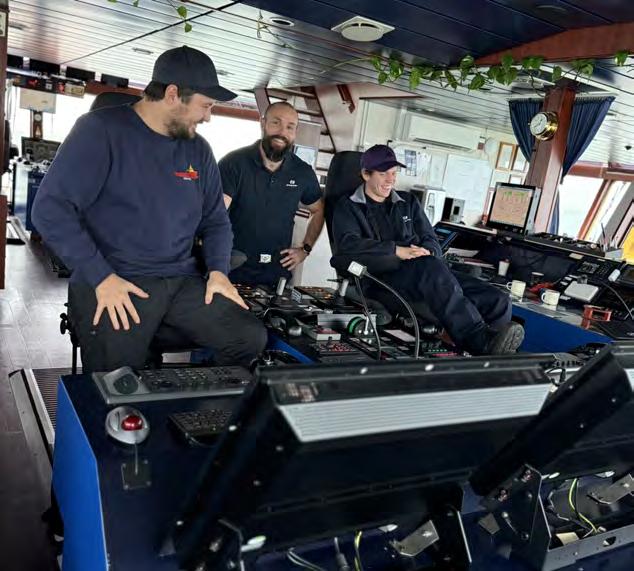
Evening at the bridge
A DAY OF DIALOGUE, INSIGHT AND TEAM SPIRIT
Østensjø Rederi’s annual operations conference brings sea and shore together
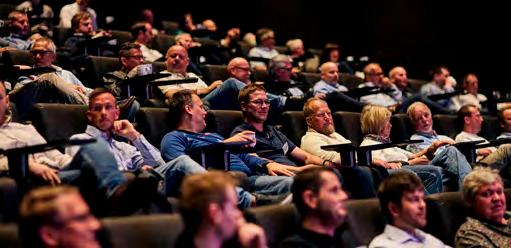
Walking into Østensjø Rederi’s annual Operations Conference, participants were met with warm greetings, a generous coffee spread and a steady stream of handshakes from familiar and new colleagues.
BY K-HUSET // HELENE JORDBREKK
PHOTO: HAAKON NORDVIK
Over the quiet hum of conversations, a welcoming atmosphere settled in. The stage was set for a conference focused on company developments, knowledge sharing and valuable dialogue between colleagues at sea and ashore.
For many participants, the conference offered a chance to gain insight and meet colleagues they’d previously only known by name.
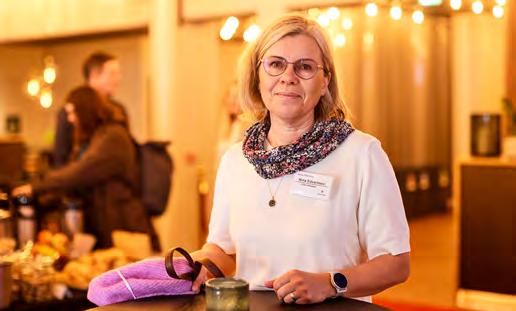
– I’m looking forward to hearing about future prospects and getting some inspiration, said Chief Steward Nina Edvardsen from Edda Flora, attending for the first time. – It’s also nice to meet colleagues in person, many of them I’ve only spoken to by email until now.
The conference, held in Haugesund, gathered employees from
across the fleet and company, from crew working at sea to administrative staff ashore. The Operations Conference has become a valued event that helps strengthen ties across roles and responsibilities.
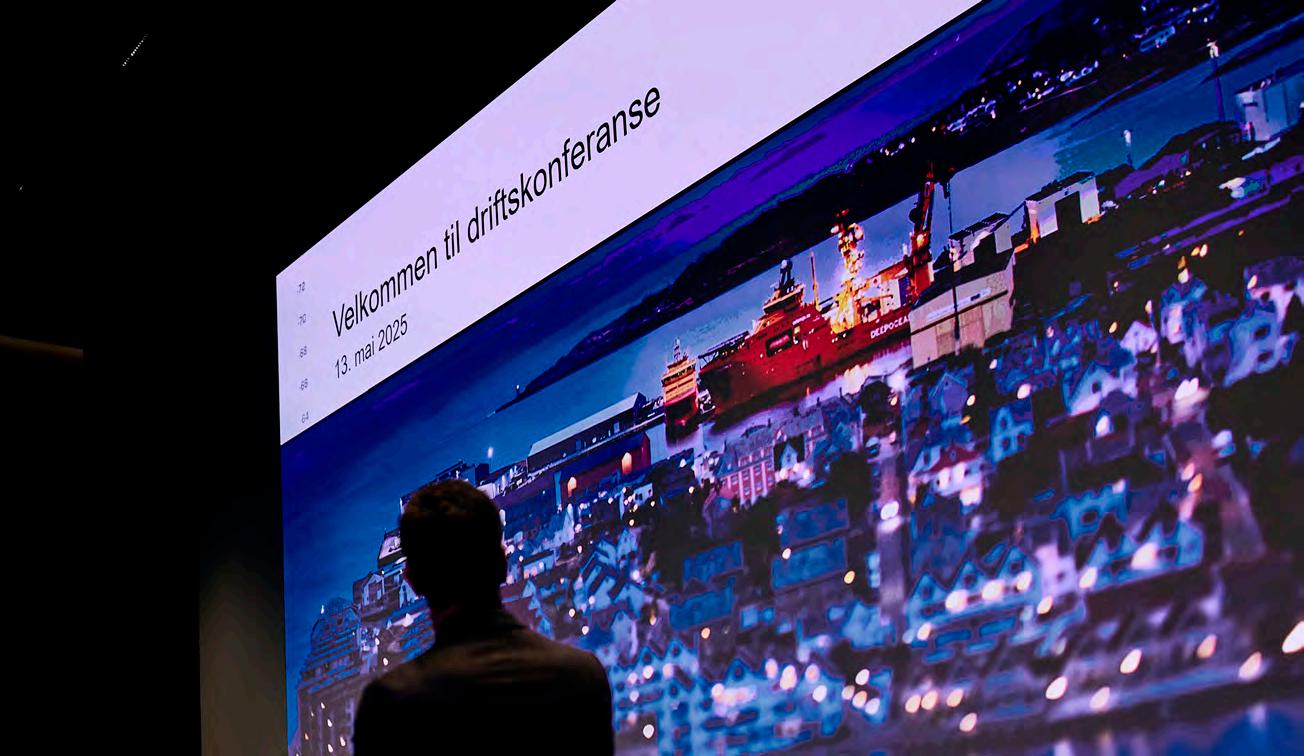
The conference was held at the movie theater in Haugesund, Edda Kino
“Status on deck”
CEO Kristian Vea kicked off the day with a company update titled “Status on Deck.” His presentation highlighted the company’s continued focus on being a forward-leaning, progressive company — without compromising its core value of delivering high quality in every step.
Much of the focus, however, was on the people behind the work. Vea highlighted Østensjø Rederi’s long-term commitment to health, safety and wellbeing, and pointed to the importance of creating good working environments onboard. He also addressed challenges across the maritime industry related to mental health and psychosocial factors and made it clear that this is something Østensjø Rederi takes seriously and will continue to work on alongside their continued HSEQ goals.
The session also included updates on several key development initiatives, from fleet renewal to sustainability and digitalization. These projects are central to ensuring Østensjø Rederi remains ahead of the curve and a preferred supplier and employer. Later in the program, CFO Ervin Horn shared a financial update and CSO Elias T. Nornes followed with a presentation on current digitalization efforts, providing a broader view of Østensjø Rederi’s direction and long-term focus.
Bridging sea and shore
One of the most engaging moments of the day came when the
floor was opened for questions and dialogue between crew and management team. The Q&A session provided space for participants to share thoughts, ask questions directly, and raise ideas based on their own experience at sea.
The session reinforced a message heard throughout the day: input from the fleet is essential to the company’s development. Creating quality across the company starts with listening and continues with collaboration.
First impressions and familiar faces
This year’s conference welcomed many first-time participants. For several of them, the chance to step ashore and meet colleagues outside their own crew and vessel was a valuable experience.
Chief Stewards Nils Rikard Haukø (Edda Ferd) and Håvard Volden (Edda Fides) both emphasized how much they looked forward to meeting people and hearing more about the company’s direction.
– It’s my first time attending, said Haukø. – I’m excited to connect with colleagues from other vessels and share experiences.
Volden agreed, adding: – I’m curious to hear what’s ahead for the company and to get input from others in the company.
For Chief Officer Jarle Vestre from Edda Fauna, the conference offered a welcome opportunity to connect across the company, both professionally and socially.
– It’s a great opportunity to meet the administrative team whom we don’t see every day, and also colleagues from other vessels, he said. – I’m looking forward to the presentations and to the dinner tonight, where we can continue the conversations in a more relaxed setting.
Bringing together both new and familiar faces contributed to the open tone throughout the day. Whether attending for the first time or returning, everyone shared the same goal. Staying informed, connected, and part of a professional community at Østensjø Rederi.
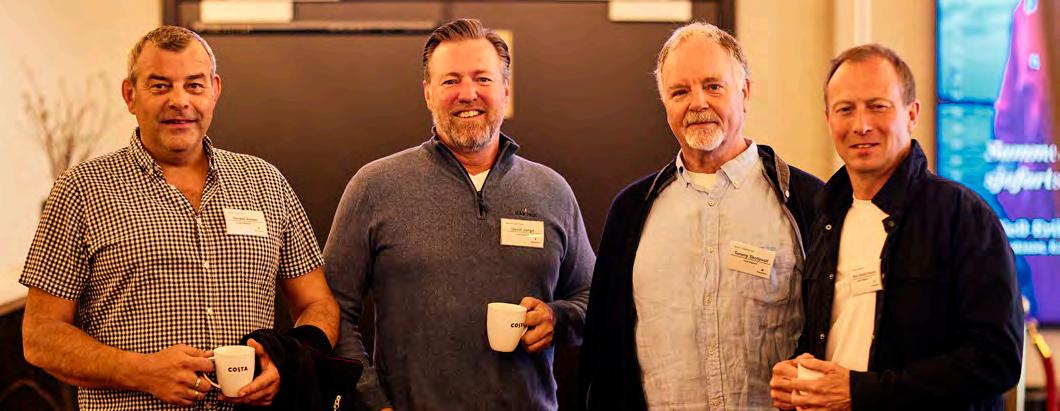
From left Håvard Volden, David Junge, Tommy Skollevoll and Nils Rikard Haukø - Chief Stewards
Nina Edvardsen - Chief Steward Edda Flora
On the social side
Glimpses from 2025
Edda Freya - Measuring
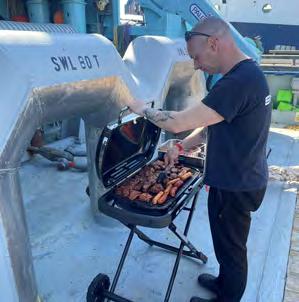
BBQ with Vivax and VB Brent
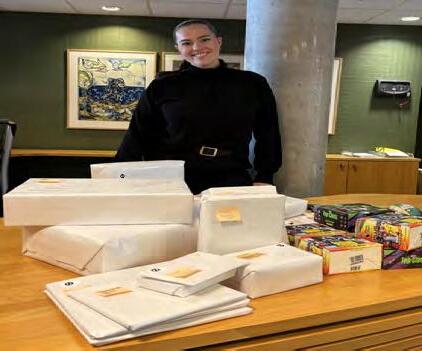
Risk and Compliance at the Maritime Safety Conference Ane Dunkley wrappig presents for the Childrens Department at the hospital
Jostein Gjerde celebrates birthday onboard the new Silex
Office family day with FKH match
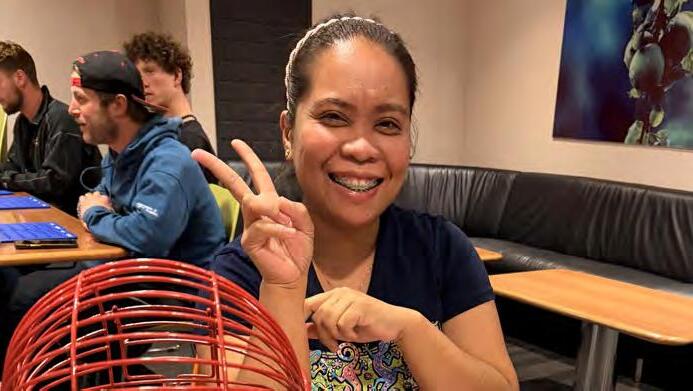
Edda Freya - bingo night
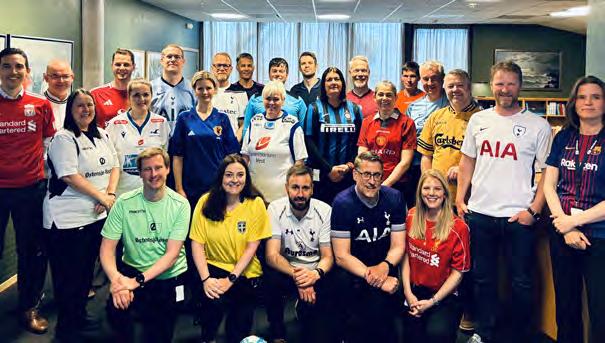
Football Jersey Friday. Initiative by the Childhood Cancer Association.
Line and Astrid on mob boat exercise
Katrine Hustvedt and Ervin Horn visiting USV Challenger BBQ Arne Jakob Eide
Edda Freya - Gibraltar
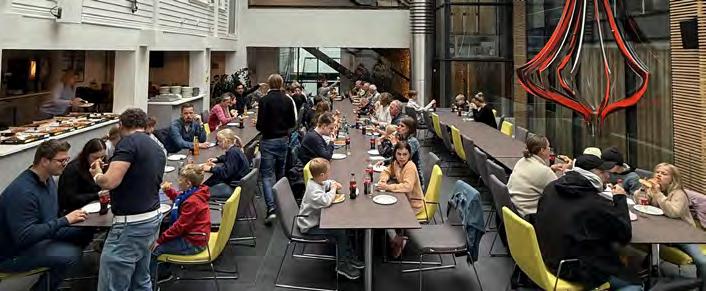
Pizza night, Edda Fauna
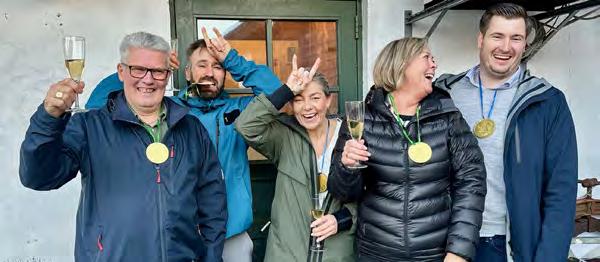
Winners of Kick Off game
Ole Christian Walle - BBQ Vivax
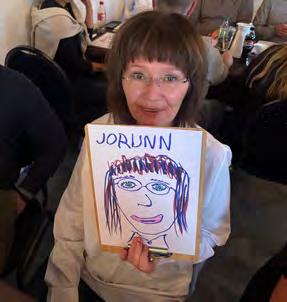
Jorunn Henriksen
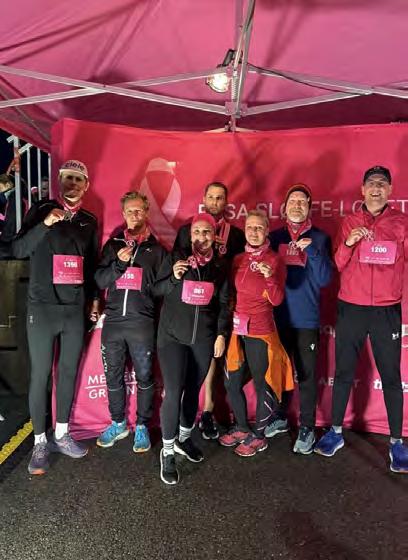
Pink ribbon charity run
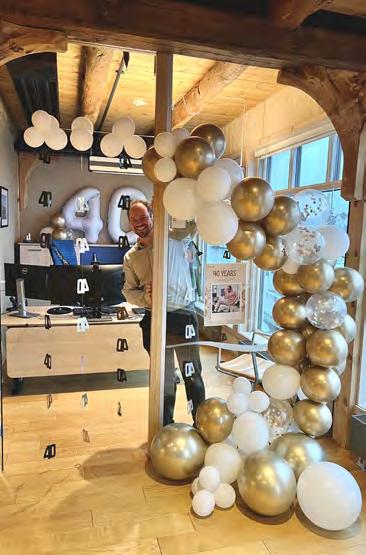
Knut Fredrik Slåke celebrating 40th birthday
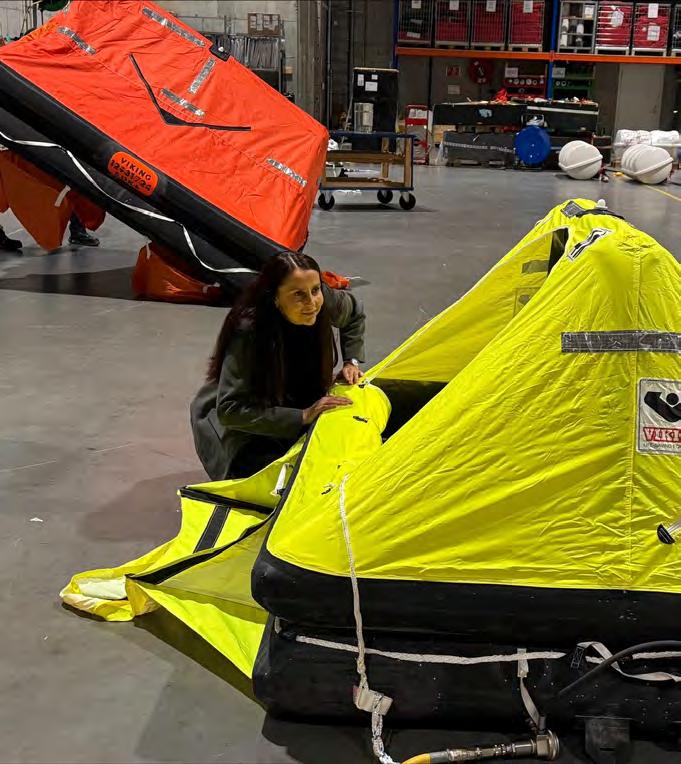
ØSTENSJØ REDERI AND VIKING LIFE-SAVING EQUIPMENT NORWAY AS
A lifesaving partnership
Walking into VIKING’s facilities at Husøy on Karmøy, it’s immediately clear that the local department of the global safety company is doing well. The sound of tools, testing equipment, and quiet conversation fills the workshop. In the middle of it all, Jan Eide greets us with a big smile, ready to share the story behind a partnership that has lasted for nearly three decades.
BY K-HUSET // HELENE JORDBREKK
What began with a simple life raft delivery in the late 1990s has grown into a close collaboration built on mutual respect, trust, and shared values. In a maritime industry defined by precision and preparedness, the long-standing partnership between Østensjø Rederi and VIKING Life-Saving Equipment Norway AS continues to demonstrate the value of close cooperation and local presence.
Anchored in Haugesund
This partnership began with Jan Eide back in 1997, when he was a young technician at Sjur Lothe Skipshandel, a company that delivered safety services to Østensjø Rederi at the time. When VIKING decided in 2006 to establish a local department in Haugesund and expand its service offering, the ambitious and unafraid Jan jumped at the opportunity to continue supporting local shipping companies like Østensjø Rederi, under the VIKING banner.
– We started small, just two people and a few life rafts, says Jan Eide, Vice President Service Region North Europe at VIKING. – Now we’re a team of thirty, covering all disciplines of VIKING’s services from our local base.
Over the years, the Haugesund branch has grown alongside Østensjø Rederi. Both companies have expanded, modernized, and adapted to new technology — yet both have kept their roots firmly in local soil. From the first service station at Bøneset to today’s bustling facility at Husøy, soon to move into larger premises, the collaboration has been a constant.
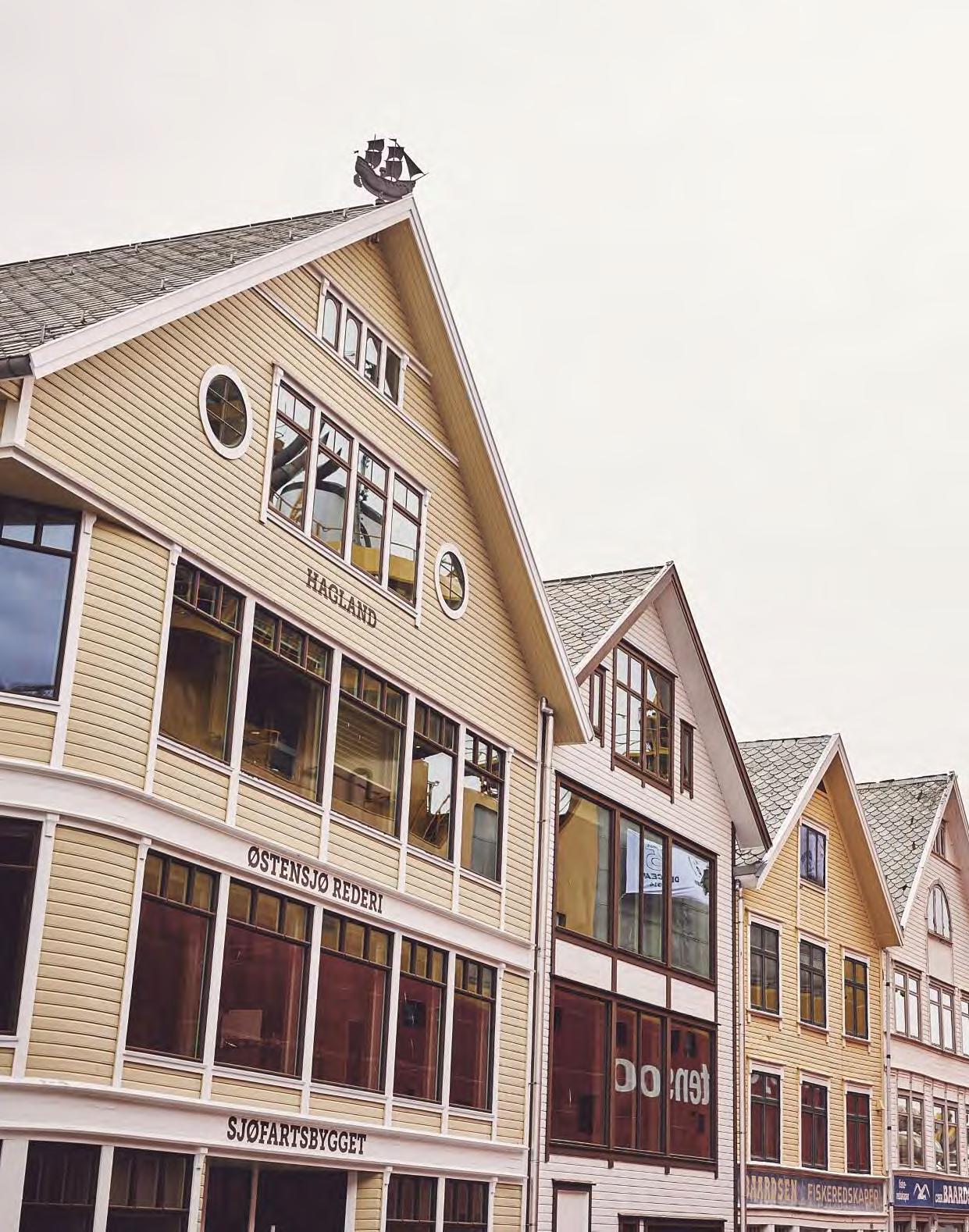
– The cooperation has been excellent from day one, says Tor Velde, Technical Manager at Østensjø Rederi. – Many of us in the technical department have known Jan and VIKING for years and have followed their journey from just two to a team of thirty people. In fact, back in 1997, Sjur Lothe Skipshandel operated out of what is now our headquarters in Sjøfartsbygget, they
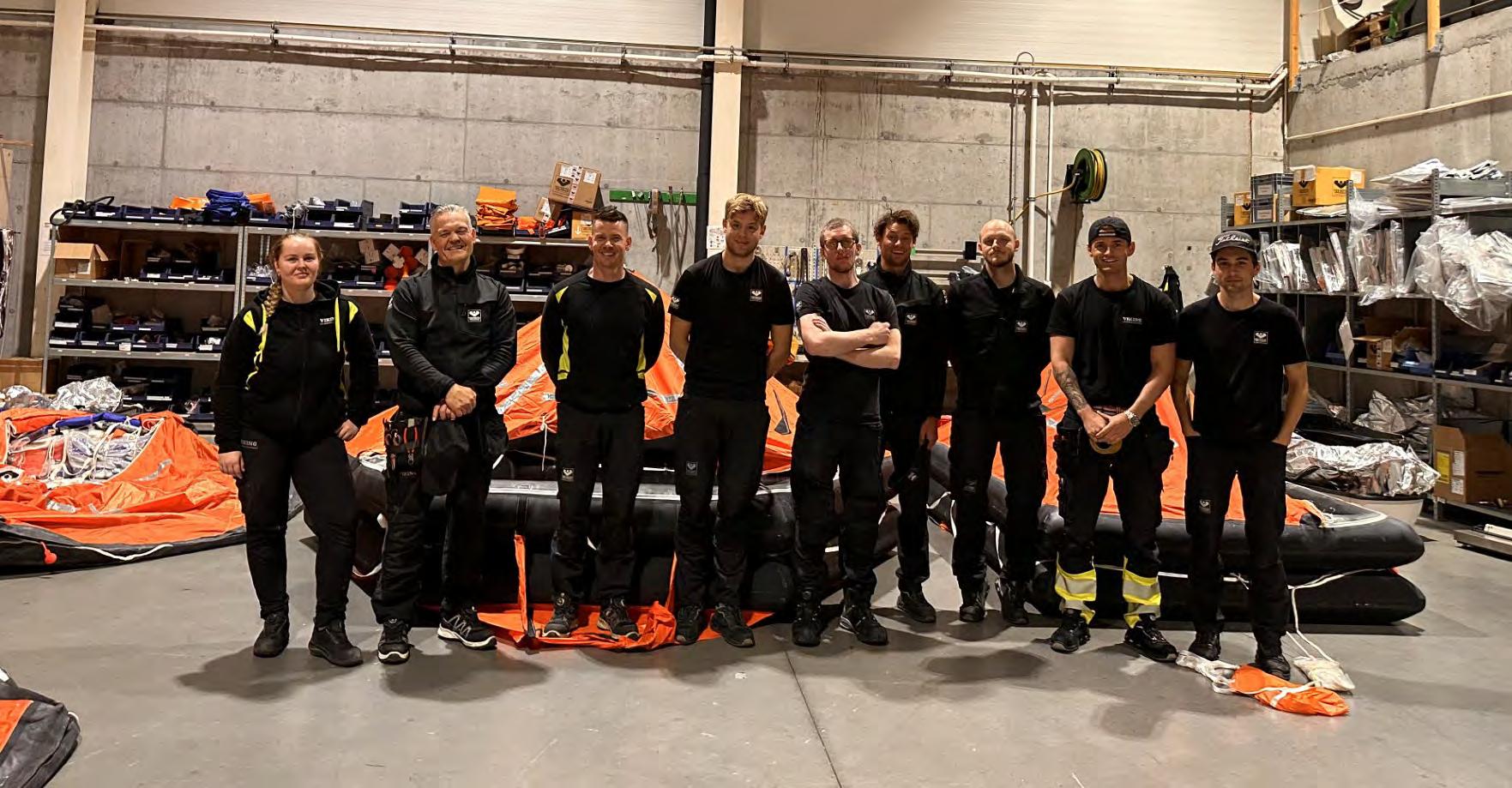
From left: Bianca Dale, Gisle Vigre Nes, Jostein Fossum, Øystein Ytreland, Jan Birger Vikra, Ørjan Eide, Morten Båtsvik, Tommy Steinsvik, Morgan Østenstad
serviced their equipment on the top floor of this very building!
Today, the partnership is deeply embedded in both companies, with VIKING having eight dedicated people following up Østensjø Rederi’s fleet — from direct contact with the procurement department, Masters and crews on board, to traveling across the world to perform inspections and deliver updated safety equipment wherever the vessels are operating.
Supporting safety at sea VIKING delivers and services a wide range of safety products for Østensjø Rederi’s fleet — from life rafts and immersion suits to fire safety systems and the servicing of life-saving appliances. The cooperation extends far beyond Haugesund.
VIKING’s technicians frequently travel across the world to meet Østensjø Rederi’s vessels wherever they are operating — from the Norwegian coast to the Gulf of Mexico, West Africa, or even Sri Lanka. One of their service specialists, who has followed Edda Fides since her first voyage in 2013, still travels globally to handle her service calls.
– That kind of commitment says everything about the relationship, Jan notes with pride.
– We’ve sent them all over the world to support our vessels, Tore adds. – It’s always been a very close cooperation with a low threshold for contact, easy communication, and genuine trust both ways. You really feel they’re part of the team.
In an industry that operates around the clock, flexibility and availability are everything. Vessels don’t wait, and both partners know it. – The key is being available, Jan says. – Østensjø Rederi’s vessels can be anywhere, anytime, and when they need assistance, we’re there.
A partnership in motion
The partnership has evolved naturally over the years, shaped by experience, mutual learning, and shared ambitions. When Østensjø Rederi plans a newbuild, VIKING is often brought into the process early to help identify the right safety solutions. And when challenges arise, the teams work side by side to resolve them.
– It’s been a learning process for both sides, Jan says.
– We’ve grown together. Østensjø Rederi has high expectations, and that’s something we appreciate — it keeps us sharp.
That collaboration has also helped shape the local VIKING department itself. – Østensjø Rederi has been a key part of our growth here in Haugesund, Jan adds.
– They’ve believed in us from the start.
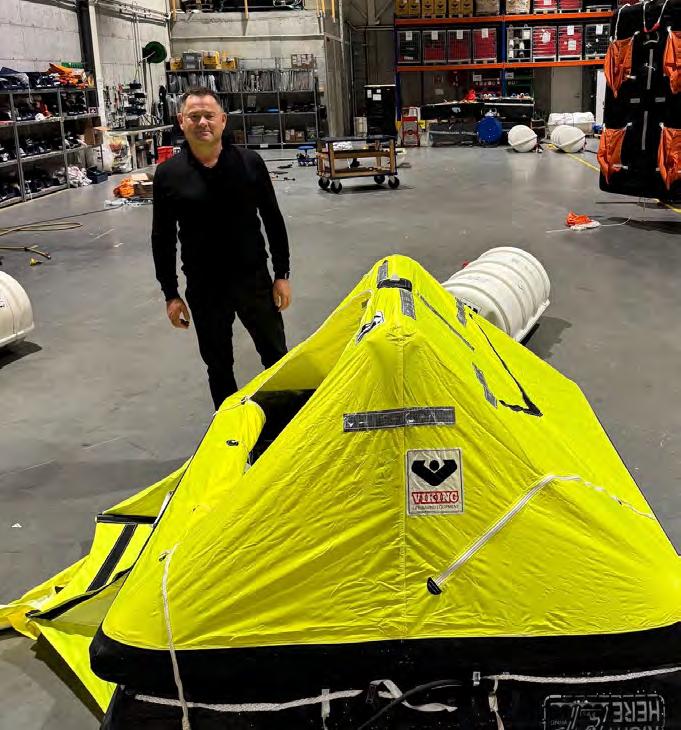
Jan Eide, VP Service North Europe
Agnieszka Kowalczyk, Service Manager Haugesund
ØSTENSJØ REDERI AT NORTH SEA CUP
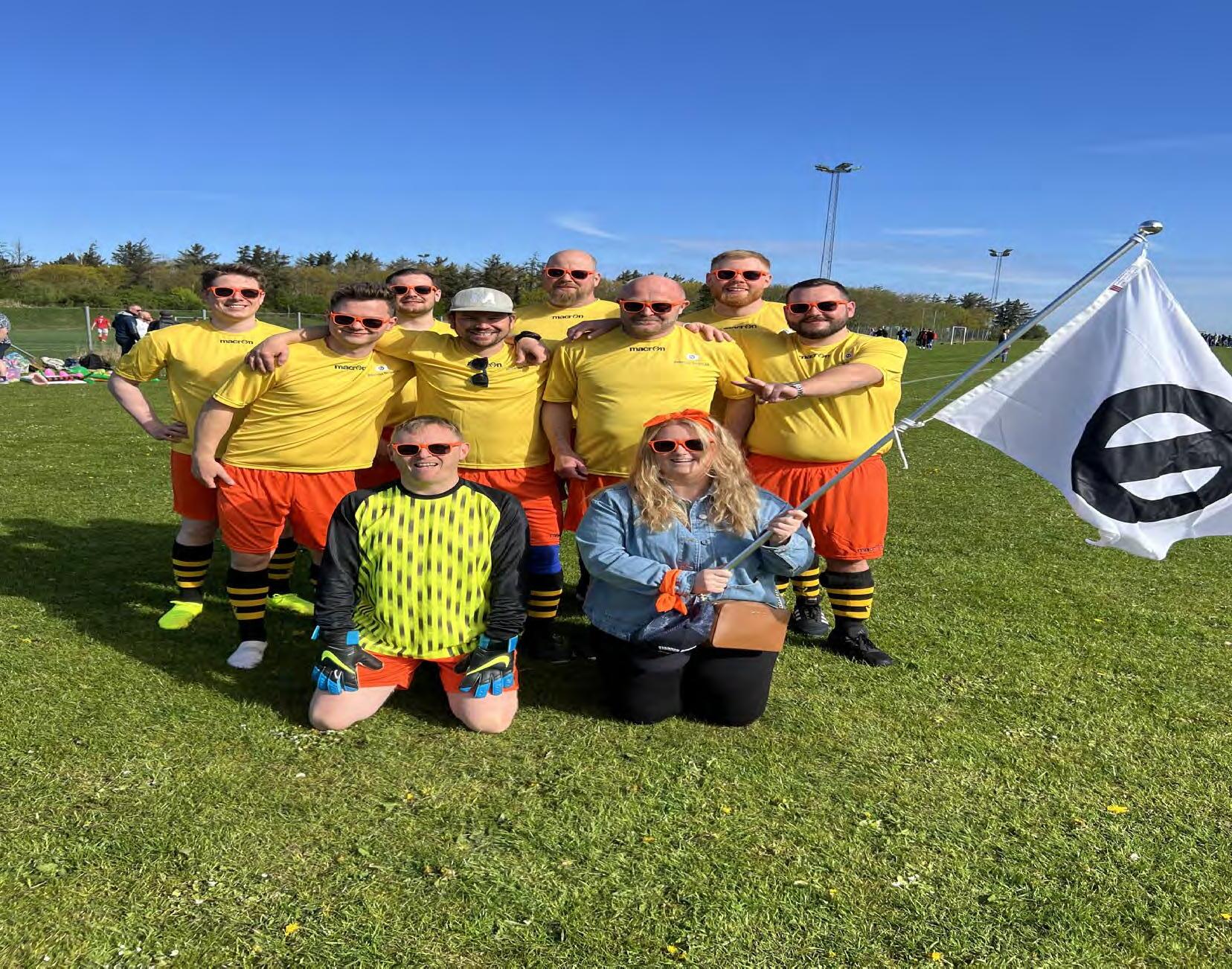
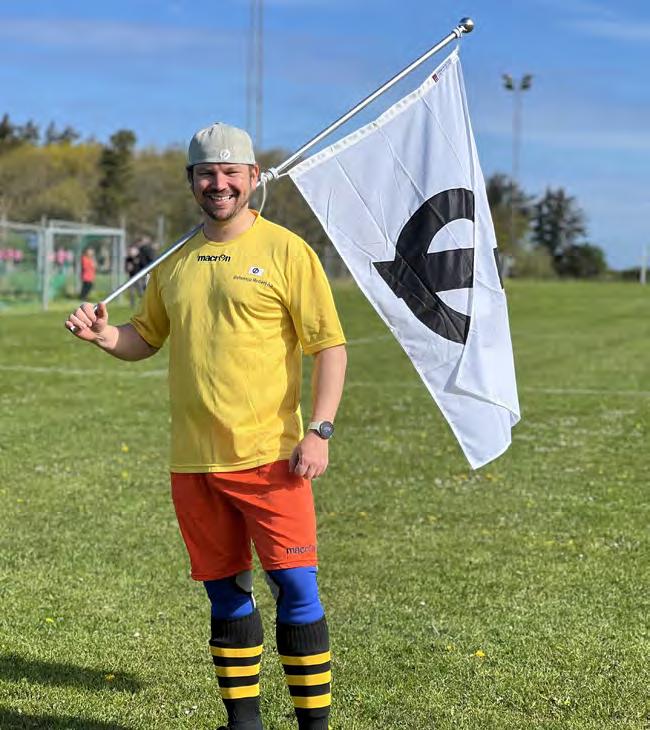
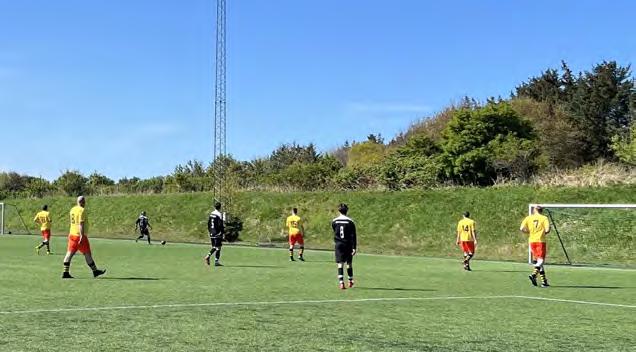
Ten colleagues, one team
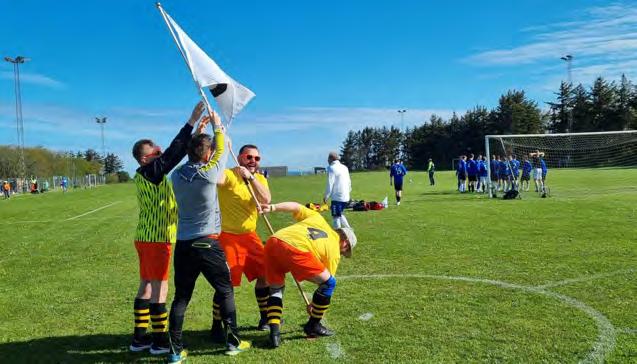
Every May, crews and colleagues from across the maritime industry board the ferry from Bergen or Stavanger with one shared destination, the annual North Sea Cup. What awaits on the other side is a celebration of maritime colleagueship and camaraderie in the form of a football tournament. And this year, Østensjø Rederi was proud to be part of it.
BY K-HUSET // HELENE JORDBREKK
Team Østensjø Rederi: Jon Harald Stødle from Edda Freya, Håkon Eknes Kallekodt from Edda Fortis, Onar Bø from Edda Fauna, Anders Olsen from Edda Fauna, Christian Høyland from Edda Fauna, Cato Molland from Edda Fauna, Roy Are Longva from Edda Fauna, Stig Bjarte Syre from Edda Frende, Sunniva Fatland from Office Haugesund and Knut Fredrik Slåke from Office Haugesund
Ten employees from the company made the trip to Hirtshals, where the Norwegian Maritime Authority’s long-running tournament took place in brilliant May weather. Among them were both seasoned seafarers and land-based colleagues, many of whom had never met in person before.
– It was such a great way to get to know the people behind their job titles, says Sunniva Fatland, Quality Assurance Engineer at Østensjø Rederi. – We work together, but don’t often cross paths. This gave us time to talk, laugh, and really connect.
Ship and Shore United as Østensjø FC
This was Sunniva’s first North Sea Cup. For Chief Officer Jon Harald Stødle, it was his second. Both were clear: the trip exceeded expectations. From smooth logistics and sunny skies to the electric atmosphere on the pitch, the event left a lasting impression.
– The whole thing was just incredibly well organized, Sunniva says. – We knew where to go, who we were playing, and everything ran like clockwork. That made it easy to focus on having fun.
And while the Østensjø Rederi team didn’t win many matches, they did find their rhythm off the pitch.
– We may not have scored many goals, Jon Harald laughs, – but we definitely won the cheering contest. Armed with a full-sized Østensjø Rederi flag and an enthusiastic sideline crew, the team threw themselves into the tournament with heart and humor. –The football was fun, but the atmosphere was even better.
Building bonds across
departments
For a company like Østensjø Rederi, where employees are spread between vessels, office spaces and ports, events like North Sea Cup are more than just a social outing. They’re a way to bridge the gap between sea and shore.
– Getting to know someone outside the work context makes a huge difference, says Sunniva. – When I go on board to perform audits in my role as Quality Assurance Engineer, it’s a much more fun experience if we’ve already met in a social setting. It changes the whole dynamic for both sides.
Jon Harald agrees. – It becomes easier to call the office when you know who’s on the other end, he says. – That familiarity builds trust.
The group represented a wide range of ages and roles, something both Sunniva and Jon Harald see as one of Østensjø Rederi’s strengths. – Everyone’s equal when they show up for work, Sunniva says. – And that was definitely the case here. It didn’t matter whether you were a new hire or had decades of experience, on the pitch, we were all just teammates.
More than football
Both participants praised Østensjø Rederi for prioritizing social events like this one. – Not every company sets aside time and resources for things like this, says Sunniva. – But it matters. It creates joy, it strengthens the culture, and it helps us work better together.