94
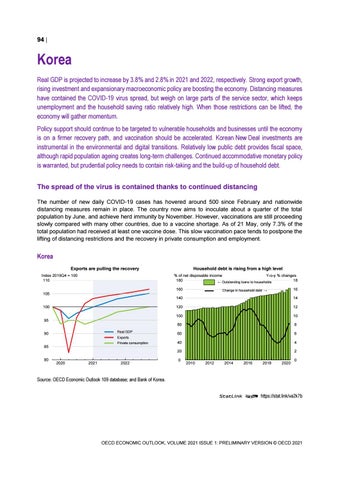
Korea Real GDP is projected to increase by 3.8% and 2.8% in 2021 and 2022, respectively. Strong export growth, rising investment and expansionary macroeconomic policy are boosting the economy. Distancing measures have contained the COVID-19 virus spread, but weigh on large parts of the service sector, which keeps unemployment and the household saving ratio relatively high. When those restrictions can be lifted, the economy will gather momentum. Policy support should continue to be targeted to vulnerable households and businesses until the economy is on a firmer recovery path, and vaccination should be accelerated. Korean New Deal investments are instrumental in the environmental and digital transitions. Relatively low public debt provides fiscal space, although rapid population ageing creates long-term challenges. Continued accommodative monetary policy is warranted, but prudential policy needs to contain risk-taking and the build-up of household debt. The spread of the virus is contained thanks to continued distancing The number of new daily COVID-19 cases has hovered around 500 since February and nationwide distancing measures remain in place. The country now aims to inoculate about a quarter of the total population by June, and achieve herd immunity by November. However, vaccinations are still proceeding slowly compared with many other countries, due to a vaccine shortage. As of 21 May, only 7.3% of the total population had received at least one vaccine dose. This slow vaccination pace tends to postpone the lifting of distancing restrictions and the recovery in private consumption and employment.
Korea Exports are pulling the recovery
Household debt is rising from a high level
Index 2019Q4 = 100 110
% of net disposable income Y-o-y % changes 180 18 ← Outstanding loans to households 160
100
16
Change in household debt →
105 140
14
120
12
100
10
80
8
60
6
40
4
20
2
95 Real GDP
90
Exports Private consumption
85 80
2020
2021
2022
0
0
2010
2012
2014
2016
2018
2020
0
Source: OECD Economic Outlook 109 database; and Bank of Korea. StatLink 2 https://stat.link/va2k7b
OECD ECONOMIC OUTLOOK, VOLUME 2021 ISSUE 1: PRELIMINARY VERSION © OECD 2021
95
Korea: Demand, output and prices 2017
Korea GDP at market prices Private consumption Government consumption Gross fixed capital formation Final domestic demand Stockbuilding1 Total domestic demand Exports of goods and services Imports of goods and services Net exports1
2018
Current prices KRW trillion
1 835.7 872.8 283.0 578.5 1 734.3 14.3 1 748.5 751.4 664.3 87.1
Memorandum items GDP deflator Consumer price index Core inflation index2 Unemployment rate (% of labour force) Household saving ratio, net (% of disposable income) General government financial balance (% of GDP) General government gross debt (% of GDP) Current account balance (% of GDP)
_ _ _ _ _ _ _ _
2019
2020
2021
2022
Percentage changes, volume (2015 prices)
2.9 3.2 5.3 -2.2 1.7 0.3 2.0 4.0 1.7 1.0
2.0 1.7 6.6 -2.8 1.1 0.1 1.1 1.7 -0.6 1.0
-0.9 -4.9 4.9 2.8 -0.7 -0.7 -1.4 -2.4 -3.8 0.5
3.8 2.1 3.6 3.6 2.9 -0.4 2.5 9.8 5.8 1.7
2.8 3.2 4.5 4.0 3.7 0.0 3.7 1.9 2.2 0.0
0.5 1.5 1.2 3.9 7.2 3.0 41.9 4.5
-0.9 0.4 0.7 3.8 7.1 0.9 40.9 3.6
1.2 0.5 0.4 4.0 12.0 -4.0 43.8 4.5
1.8 1.8 1.0 4.0 9.7 -4.1 47.2 7.2
1.7 1.4 1.5 3.5 7.8 -3.5 49.7 7.1
1. Contributions to changes in real GDP, actual amount in the first column. 2. Consumer price index excluding food and energy. Source: OECD Economic Outlook 109 database.
StatLink 2 https://stat.link/4rzwho
Exports are surging, but services lag behind Strong overseas demand for IT products, which account for about a fifth of total exports, and automobiles is lifting exports. Private consumption is recovering gradually, with retail sales up 11% in March (year-onyear) – and online shopping up 26% (year-on-year). A gradual easing of distancing measures and government relief packages have helped vulnerable households and firms, thereby supporting consumption and jobs. Even though employment is gradually recovering, restrictions on activity in large parts of the service sector are keeping unemployment relatively high.
Fiscal policy should remain expansionary until recovery is underway The government has introduced massive support programmes, such as relief cash distribution to households, job retention schemes and financial assistance to businesses, to mitigate the pandemic’s impact. The latest supplementary budget of KRW 15 trillion (0.8% of GDP), passed by the national assembly on 25 March, is better targeted at vulnerable households and small businesses than previous relief packages, which will enhance its impact on the economy. Altogether, the underlying fiscal deficit is projected to increase by a further 0.7% of GDP in 2021, following a rise of 3.4% of GDP in 2020. The country’s expansionary fiscal stance is appropriate, as the service sector still struggles and government debt remains relatively low.
OECD ECONOMIC OUTLOOK, VOLUME 2021 ISSUE 1: PRELIMINARY VERSION © OECD 2021
96 Monetary policy is also accommodative. The Bank of Korea has kept its policy rate at 0.5% since May 2020 and has provided abundant liquidity. Headline CPI inflation rose to 2.3% in April (year-on-year), but this mainly reflected a low base effect in 2020 and soaring agricultural and oil prices. Core inflation rose to 1.1%. With inflation projected to be below the 2% target in 2022, monetary policy needs to remain accommodative.
Robust and stable economic growth is expected through 2022 Real GDP is expected to grow by 3.8% and 2.8% in 2021 and 2022, respectively. Expansionary macroeconomic policy, a gradual lifting of distancing restrictions and pent-up demand, notably from higher-income groups, will prop up private consumption and revive the service sector. Robust business and government investment, notably in the context of the Korean New Deal, will boost growth. As Korea’s major trading partners are growing faster and the digital transition continues at a fast pace, the demand for Korean products is expected to rise further. However, slow vaccination and global trade tensions could hamper the recovery. Volatility in house prices and high household debt, which amounts to more than 160% of net household disposable income, could threaten financial and macroeconomic stability. In April, the financial regulator decided to tighten lending rules and strengthen risk management of financial institutions to slow household debt growth to 6% in 2021 and 4% in 2022. Recent government measures to increase housing supply are also welcome, but likely will take time to affect prices, due to construction lags.
Targeted public support and productivity-enhancing investments are needed Given differences in the pandemic’s impact and persistence across sectors, the government needs to continue providing targeted support to the most affected households and businesses until the economy is back on a solid growth track. Targeted support is more effective than universal assistance in holding up growth and helps preserve fiscal resources, even as ageing increasingly puts pressure on public finances. Korea needs to take advantage of the acceleration of the digital and green transitions, and the large Korea New Deal investments, to enhance the diffusion of digital tools and boost productivity and competition throughout the economy.
OECD ECONOMIC OUTLOOK, VOLUME 2021 ISSUE 1: PRELIMINARY VERSION © OECD 2021