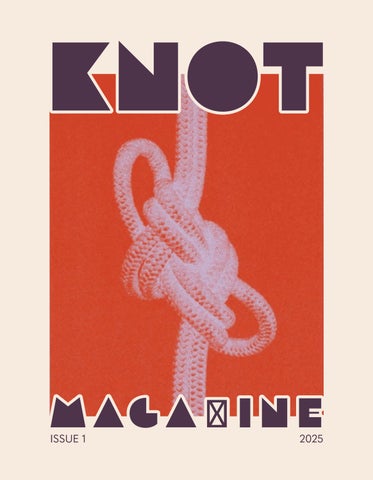
KNOT
M AG A Z I N E ISSUE 1
2025
C O N T E N TS 1. 2. 3. 4. 5.
INTRODUCTION
2
HISTORY
5
HAIR
12
ART
22
PROCESS + PROJECT
28
Abstract — Prospectus
Site — Black Women
How — Where — Why
How — Where — Why
Ideation — Making — Sections — Renders
A B S T R A C T & P R O S P E C T U S
The complex ideas of femininity—what it looks like, who has it and who does not—have long contributed to an onslaught of violent rhetoric and action globally against Black women who, for all intents and purposes, are diametrically opposed to the traditional, western definition of it. The dominant definition of femininity has been shaped by Eurocentric ideals, misogyny, and thoughts that are based in white supremacy. By investigating historical and modern instances of Eurocentrism disrupting and manipulating the identities of Black women, such as the story of Sarah Baartman, also known as Hottentot Venus, in the early 19th century, to the prolific harassment of tennis champion Serena Williams, we get a better understanding of how Black women are not seen as women, but as other.
This begets the question, if Black women are not women, what are they? What does society want them to be? In response to greater society stripping Black women of their femininity, how can design facilitate the reclamation of identity that Black women can experience through the cultural mediums of textile art and hair? My research will be informed and led by Black feminist studies including Mikki Kendall’s Hood Feminism and Ruby Hamad’s White Tears, Brown Scars: How White Feminism Betrays Women of Color. I will also be exploring fictionalized stories such as those from the prolific author Toniy Morrison seeing as her work, specifically The Bluest Eye, highlights the critical intersections of race and identity. Additionally, I will use historical case studies such as the treatment and portrayal of Black women during the Antebellum period and pop culture references like the different attitudes towards Taylor Swift and Beyoncé. This project explores the importance and significance of Black hair in the representation of Black women, and examines the connections between hair and art. Knots form in yarn and string in the same fashion that they do in hair. We deal with these things in the same way, with delicacy and patience, or with aggression and irritation. This harkens back to the dichotomy between femininity reserved for white women and that reserved for Black women. My research explores the studies and learnings from academics who have studied the phenomenon of Black women being barred from partaking in “traditional” femininity, as well as primary sources from Black women in the town of Montclair, New Jersey and my own personal experiences having grown up there. While the address of my site has no specific historical significance such as an inciting event or meeting place of sorts, its placement in the town of Montclair, New Jersey—a town which was previously heavily redlined and continues to reflect those ideals—questions the meaning of identity and how, at times, it clashes against reality. 2
HISTORY
Montclair, New Jersey positions itself as something of an oracle of acceptance, unity, and progress. Plastered around town are signs reading, “stigma free town,” to promote m e n t a l health awareness, real estate listings boast about the various schools having bountiful amounts of diversity, and historical records tell a story of the town spearheading all types of social progress and change. In spite of what the town claims to be, it is still a wealthy suburb in northern New Jersey that was originally populated by white people thanks to them fleeing New York
City generations ago during the white flight, and got most of its diversity—the town’s current claim to fame—from Black and brown people that had to live in town to work under said white people. Montclair, New Jersey ranks as the 89th most wealthy town in the state and eighth in the county. The 2023 census reported that almost 60% of the population is white while 18% of the population is Black and another 14% is mixed race. Despite the claims made by town officials and individuals alike, the population of Black people in Montclair has slowly decreased since 2009 after plateauing for a decade according to census data. Still, for a suburb in one of the northern states of America, this racial breakdown is considered to be adequate in providing people with diverse social and cultural experiences. While the northern states in the country do not hold the same turbulent past with slavery byway of fighting for the union during the
5
Civil War, there has always been racism, albeit performed in a different way. Montclair’s adequacy when it comes to the racial makeup of the town comes from white people remaining the majority—other races are allowed in, but they will never truly hold power in the political or economic arena. I can recall one example when this was brought to light—in high school, I told my white friend that Montclair is, in fact, a white town despite how it advertises itself and she replied, “No, it’s not. There are two black families on my block.” This is how they like it in the north. “We are diverse, we are welcoming, we are not equal.” That, in a nutshell, is Montclair. That pervasive way of thinking alongside the town’s historical and current struggle with segregation is why Montclair’s identity of being a shining beacon of diversity and inclusion is muddy and tarnished. Of course, segregation laws never existed to the extent that they did in the American south
during Jim Crow, but that did not mean there were no white people in the north who wanted to keep themselves and their children separated from anyone who they considered to be “other”. Because of this, other discriminatory race based laws and practices came into play, one of the most famous and effective being redlining, which was the practice of offering worse rates or refusing to offer mortgages to certain people, irrespective of their income level, in order to keep specific neighborhoods “pure”. A 1939 redlining map provided by the University of Richmond shows Montclair and surrounding neighborhoods, dissecting them into regions with different grades, A through D. One town could have multiple grades depending on the region. This is what happened in Montclair’s case. Grade A is labeled as “best,” Grade B is “still desirable,” Grade C is “definitely declining,” and, lastly, Grade D is “hazardous.” I could find my own home in a Grade A space only a few blocks away from what is
still considered to be the dividing line between the north side and the south side. My middle school was in the south side and there was always chatter among parents about how they were afraid to send their children there because it was a “bad part of town,” and they would call it the ghetto. In the 1939 map, the very space of my middle school
as well as other schools in lower graded areas have higher populations of Black and brown students. The division between races becomes clear to all of the children living there because of this reason, but unless sent to a private school, everyone from the three middle schools in town is funneled into one high school. This, of course, led to some issues for those who had been seeking out purity and, in turn, forced them to find a solution which came in the form of small learning communities: Civics & Government Institute (CGI) and Center for Social Justice (CSJ). I do not think the idea of having small communities of students who volunteered for more niche and specific learning paths is unique to Montclair, nor can I assume the same thing in terms of the idea being used as a form of segregation. Unique or not, CGI and CSJ are kind of like institutions at Montclair High School, they speak to your status and dictate who you hang out with. There were specific jokes about each group, the ones lobbed at CSJ always feel ing more racist and
“contain[ing] a few houses that have been occupied by negroes for many years, but there is no apparent possibility of spreading.” is in a Grade D district, which was described as a part of Montclair, “contain[ing] a few houses that have been occupied by negroes for many years, but there is no apparent possibility of spreading.”. To this day, most Black families live in the south side of Montclair and my middle school
SUBURBIA harsh than anything ever said to people in CGI. The rumor of CGI having been started to keep the white kids away from everyone else had already been widespread by the time I got to high school. There has never been any investigative reporting into whether the rumor was true or not, but, regardless, seeing a bunch of white faces in CGI and then a bunch of Black and brown faces in CSJ year after year helped volley that narrative to new heights. The local news reported that in 2020, the interim principal reported that, “people are feeling uneasy with the fact that those two small learning communities have very different populations,” in an article stating that CGI was undergoing a name change in hopes of reimagining and revitalizing the small learning community. These institutional and
systemic instances of racism do not even begin to cover the town’s current problems with discrimination. From what I can remember during my time in high school, we had instances of Black sports players hearing gorilla noises from the crowd, swastikas drawn on the backs of chairs and in bathroom stalls, Black girls almost constantly getting called ugly and aggressive, blackface, white girls saying the N-word with the hard ‘R’ to a camera, and those are only the moments I can remember. I still have a video from online learning during COVID in which one of the known conservatives in our grade (there were very few) went on his second tirade of the year in which he proclaimed that slavery was good since it benefited the economy and that if we had existed at that time, we would have all owned slaves, so it is not our place to critique
those of the past. He also very helpfully pointed out that slavery had existed all over the world in different forms, so why is it seen as such a negative when America does it? He was met with “mans probs thinks the civil war was about states rights,” and “can’t believe what I am witnessing,” in the chat. This site is six blocks down from my high school and seven blocks up from my middle school, both places that have been profoundly affected by racism and racist systemic tactics, but also places that have permanently shaped me into a person who has been harmed and affected by these very same things. Montclair has and will continue to exist in two fragmented identities.
There are two types of violence that come about from Black women constantly being seen as ugly, undesirable, or not feminine. One is loud and obvious: we see the news reports of another Black woman slaughtered for no good reason or publicly tormented just because. The other is silent: the cancer that comes from the relaxers people have been using for years and years, attempting to get pinstraight hair, or the melancholy that drops over them as they look into the mirror and wish to see something else, these thoughts stemming from a time they can’t even remember. There is often a deeply embedded layer of self-hatred within Black women that has been placed there by outside forces and takes years of work to deconstruct. Where that self-hatred can often be seen most obviously is through hair. Social media posts starring Black girls with improperly kept or badly done hair always explode with a litany of degrading comments. The same can be said for Black girls who have been deemed to be “whitewashed” which is the phenomenon of when a Black girl, usually one who has grown up in the suburbs, affects her mannerisms, speech, and presentation to better align with the expectations of white society. There are obvious issues with this term—speaking does not necessarily give indication of where you are from or even your class, how you dress is a personal choice, and the same goes for straightening one’s hair. Still, this term points out an obvious and worrying trend. While being “whitewashed” is a
stereotype, it is one that many Black girls fit into perfectly in every suburb across the country. The fried hair, the accent that has been tailored not even from the white people surrounding them but from those on social media, the chalky foundation due to their insistence on wearing the lightest shade they feasibly can. Being “whitewashed” comes from being surrounded by only one thing and from being repeatedly told—not only from those in your town but from the entire world—that who you are will never measure up because you are not them. I and most Black girls I know have been told to change ourselves, but, perhaps, not in certain words. One of my friends from school was constantly told to change how she dressed and how she presented herself. That she was too buoyant and peppy, that she needed to tone it down. I don’t think a week passed throughout my entire elementary school career in which I was not asked, “when are you going to straighten your hair?” To exist in a suburb, in a place where there is really only one phenotype, means that you will be placed into Black stereotypes while being questioned as to why you are not abiding by white standards. Toni Morrison touches on this feeling of self-loathing that gets foisted upon Black women and girls in her novel, The Bluest Eye. The title refers back to the aforementioned phenomenon of Black girls wishing to 8
adopt attributes of white girls in an attempt to become prettier or more desirable. In the second chapter of the book, the main character thinks to herself, “if her eyes, those eyes that held the pictures, and knew the sights—if those eyes of hers were different, that is to say, beautiful, she herself would be different... Maybe they’d say, “Why, look at pretty-eyed Pecola. We mustn’t do bad things in front of those pretty eyes.”” Morrison is able to paint how our physical appearances alter the amount of violence we must endure and bear witness to, and allows her readers to understand that Pecola does not hate her appearance because of her race, but because of the circumstances it places her in. The gentility and fragility white girls are afforded with also gets them safety. Black girls existing on the other side of that spectrum have known this from birth.
10
non-racist caricature familiar to most Australian readers.” Knight also went on to say himself that, “I drew her as she is. As an African-American woman, so this whole business that I am some sort of racist, calling on racial cartoons from the past, it’s just made up. It’s not there.” Obviously, these two claims blatant-
ly contradict themselves—the the piece, and the same thing afcartoon is either an exaggera- fected the publication when detion or a one-to-one depiction fending it. of Serena Williams. Seeing as Williams never jumped up and down stomping on the court while pouting, nor does her face look how Knight drew it, I would argue that misogynoir heavily colored his vision while making
1800s
BEYONCE
full-body cast was made of her body before she was completely dissected with parts of her brain, skeleton, and genitals placed in jars to be preserved and presented in Paris’s Museum of Man. If being fully nude was “beneath her dignity,” then what would it have meant to her to know that her genitals were pickled and presented to the world for the following 159 years? The cast made of Baartman’s body, while disgustingly inappropriate and disrespectful in the nature of its creation, reveals that all of the drawings of her body greatly exaggerated her form. They displayed her as an almost larger than life figure, with her backside larger than all of the rest of her. This trend of taking the bodies of Black women to ridicule and exaggerate them for mass entertainment is something that has remained popular even up to the present day. We have seen it with cultural icons such as Serena Williams and Beyoncé. It happens at least once a month that Beyoncé is compared to a man or physically degraded on X, formally known as Twitter. Serena Willaims’ gender has been constantly attacked as she has had her identity questioned because she doesn’t “look like” or “act like” a woman while on the court. The cartoonist Mark Knight depicted her as violent and aggressive for the Herald Sun, and the publication made the claim that, “the cartoon uses exaggeration and absurdity to make its point but accepts the publisher’s claim that it does not depict Ms Williams as an ape, rather showing her as ‘spitting the dummy’, a
SERENA WILLIAMS
European beauty standards influenced thinking and how people treated Black women is the story of Sarah or Saartjie Baartman who is also known as Hottentot Venus. She was thought to be from South Africa and allegedly signed a contract presented to her by William Dunlop and Hendrik Cesars agreeing to move to England in order to perform, even though from what we know, she was illiterate. Today, Baartman would have been diagnosed with steatopygia which is when fat accumulates in large quantities on the buttocks—back then, however, she was simply thought of as a circus freak. In a historical recollection of her life, the BBC reported that, “on stage she wore skintight, flesh-coloured clothing, as well as beads and feathers, and smoked a pipe. Wealthy customers could pay for private demonstrations in their homes, with their guests allowed to touch her,” which only emphasized how they looked at her as a toy, as something they could play with at their leisure. Her body and, in turn, everything else about her was treated with disrespect during her time in London’s Piccadilly Circus, but she also wasn’t allowed any dignity in death. It also should be noted that she never appeared fully nude in any of her performances, always wearing the costuming previously described, and when asked to by scientists and artists, Baartman declared that it was “beneath her dignity”. One year before her death, she moved to Paris and that is where her remains stayed until 1974, not to be buried in their rightful place until 2002. A
HOTTENTOT VENUS
Beauty is inextricably linked with ideas of femininity. Embedded in the definition is the presumption that whoever possesses femininity is beautiful, and the more beautiful you are, the more feminine you are. Unfortunately, beauty as it currently is understood, is not one size fits all. Different parts of the world have different standards, and while all of those ideas feed back to the larger ideas of femininity and beauty, one dominant standard has been pushed and has largely taken over: European beauty standards. They have a bias towards, “narrow-shaped faces with round eyes and small noses and lips, but with a high zygomatic bone combined with a slim figure and white skin complexion,” which happens to be diametrically opposed to features that appear largely across the Black diaspora, such as wider noses, larger lips, rounder faces, and, of course, darker skin. European beauty standards have become the default when thinking of beauty not because any features are actually better than the other, but because Europe and the Global West has positioned itself as not only a global superpower, but a leader in thought. They dictate narratives and paint themselves as correct while everyone else is somehow incorrect. So, slim noses and pale skin may not have become the global standard of beauty on purpose—though that definitely could be debated—but its harsh opposition to phenotypically black features has created the stark dichotomy between pretty and ugly. An early example of how
2024
2019 11
I A R H Cry, yell, whine, squirm. My hair is getting done. The knots being pulled between the bright orange teeth of the comb, the splatters of product on every surface, the oil dripping down my neck, hot. My hair is getting done. Ten barrettes stapled across the front of my head. Five poufs held together by double the amount of hair ties, most pastel colored and with balls clacking together at each end. Baby hairs curling at the nape of my neck, around my ears, framing my face. My hair is getting done. “But when are you going to straighten your hair?”
13
B L AC K HAIRSTYLES BANTU KNOTS
RELAXED
AFRO
BOX BRAIDS
CORNROWS
LOCS
Hair continues to be an ever present indicator of the fracture between Black and white, between what is seen as pretty and what is not. The complete difference between the two hair types only serves as a magnifying glass over how Blackness will never fit itself into western beauty standards. The stark differences between straight hair and kinky or curly hair has greatly affected the Black community, especially Black women, and, oftentimes, the effect is silent. The pressure to conform to western beauty standards most often presents itself in Black women through their desire to acquire length, by any means necessary. For the longest time, some Black women and girls would be told they have “good hair” thus creating the ability to have bad hair. “Good hair” is when your hair is tamable, curly or straight, it is soft to the touch and when it has the ability to retain length— something many Black women have been taught or convinced is an impossibility for them and their hair type. Most people with “good hair” are mixed race seeing as they are predisposed to having loser hair textures, only emphasizing the “white is right” mentality that has swept across the globe. In an effort to have “good hair” or to retain the ever-desired length, Black women have turned to chemical hair relaxers which operate by “breaking disulfide bonds.” This causes long term damage to the hair but, for the longest time, this did not matter. What mattered was having tamed hair, straight hair, hair that does not defy gravity. Length is not only re-
tained through chemical relaxers, however. There are silk presses which is a grueling and damaging process of straightening hair and then the myriad of different styles that are almost always done with extensions to provide length, such as box braids, passion twists, cornrows, and the list goes on. Then, of course, there are wigs. It feels preternatural to desire long hair, to do anything to get it. It feels like that is the default, not the hair that grows out of all of our heads. We all desire something different, even the girls with “good hair,” because good hair will never really be good enough. Black women never chose to have a strong subconscious desire to, at best, have long hair and, at worse, have short hair. This was something foisted upon them by greater society and something that continues to be pushed byway of hair discrimination. The CROWN Act, for example, was passed in California in 2019. This piece of legislation was created because, “black women are 1.5 times more likely to be sent home from the workplace because of their hair,” and, “80% more likely than white women to agree with this statement,” which makes hair discrimination a systemic issue that suppresses Black women from educational and/or professional opportunities. These reactions help further the belief that Black hair is unkempt, unprofessional, and dirty, but this messaging is also perpetuated at home by families and communities. It is a common trope that people of older generations will look at young people and question if they really want to go out with 17
their hair—“like that” meaning in its natural state. Mikki Kendall describes this common phenomenon in her book Hood Feminism : Notes from the Women That a Movement Forgot, writing, “... the few pictures I’ve seen of me as a toddler make it clear that my family always did something to tame my hair. No wild-haired pictures of a running baby with an Afro. I can’t remember one time when my hair was allowed to just be the way it grew out of my head.” The concern from older generations is not unfounded. They have had face hair discrimination without any attempts at legislation that would cure the issue, and the hair discrimination went beyond being fired from a job or withheld opportunities. For some reason, many feel that it is appropriate to invade a Black person’s personal space byway of touching their hair. When people do this, they often say that it is because the hair looks soft, that they can’t resist even though, somehow, they stop themselves from touching anyone else nonconsensually. I and every other Black person I know has had this happen to them an innumerable amount of times. It is such a well-known phenomenon that when I read Ruby Hamad’s White Tears/Brown Scars : How White Feminism Betrays Women of Color, I thought she had taken a page out of the book of my life: ““I feel like they’re trying to show me who’s boss because I’ve already said no, and they just do it anyway and they pet me—like they actually pet me like you pet a puppy... if I turned around and pet her head, she would not accept it. She would swipe at my
hand, or step back, or she would have a reaction... they are taking charge of the situation. It doesn’t really matter if I say yes or if I say no, it’s just not a part of the discussion. She wants to do this, she’ll do this.”” This behavior has a line that traces back to the 1800s and connects to the then commonly held belief that Black people were more animal than human. The aforementioned quote from White Tears/ Brown Scars touches on how white people do not just touch Black people’s hair, but pet it, demeaning them down to something akin to one of their household pets. While this action may seem small and insignificant, it is eerily similar to the treatment Sarah Baartman experienced in her time performing for white audiences. Only now, people are finding entertainment from Black people existing, and are enhancing their experience by stripping Black people of their dignity and personhood in order to invade their personal space. Sarah Baartman’s treatment was more severe and more humiliating than being nonconsensually pet, but it shows that while culture might have become more “politically correct” as time has moved on, we, as a society, have not moved away from viewing Black people as fodder, from questioning their personhood in order to fulfill personal fantasies and desires.
“I feel like they’re trying to show me who’s boss because I’ve already said no, and they just do it anyway and they pet me—like they actually pet me like you pet a puppy... It doesn’t really matter if I say yes or if I say no, it’s just not a part of the discussion. She wants to do this, she’ll do this.” Hair is meaningful across the Black diaspora, and that importance has been carried over from Africa. Across the continent, “hair was a physical way to convey messages such as marital status, age, religion, ethnic identity, wealth, and communal rank. It was believed that hair acted as a means of communicating with gods and spirits that passed through the hair to a person’s soul. Hair was also viewed as containing the person’s spirit and could be powerful enough to be used to cast spells, offer protection, add potency to medicine, or summon a mate.” Hair
in African countries and in the United States continues to display status in some cases and is largely used to display personality traits. It acts as an ornament and as another limb, as something necessary but also something frivolous. It has always been artful, from the tactful and geometric parting to the painstaking styles from different braids to locs to being picked out. The respect hair was and continues to be treated with across the Black diaspora volleys it up to more than a superficial aspect of someone’s appearance, but a form of artistic expression and art in itself.
TONI:
I had a major, major question in my mind at that time, which was how does a child learn self loathing for racial purposes? WHERE
DOES IT COME FROM? Who enables it? How is it infectious? WHAT MIGHT BE THE CONSEQUENCES?
CHARLIE: TONI: CHARLIE: TONI:
And what are the answers? You learn it from the society at large-
THE INSTITUTION. THE INSTITUTION. But more importantly than that, at a
certain time the self loathing can be reinforced by one’s own family, one’s own community. You know, that THE CONCEPT OF
WHAT IS UGLY CAN JUST BE REINFORCED BY PEOPLE NEXT DOOR. I remember girls who weren’t blonde who were- who longed for that and felt terrible about themselves.
[ CHARLIE:
CHARLIE ROSE INTERVIEWS TONI MORRISON 1993
.
.
.
]
Most of us have no idea of the pain that causes people because this society and the culture and the media and the magazines and the televisions and all the commercials bombard them with what it is to be attractive and they define attractiveness in our culture and they define what’s good and what’s bad. So, that all of a sudden, if you don’t look like that you say, “I DON’T
LIKE MYSELF. HOW DO I CHANGE MYSELF?”
TONI:
Oh
yeah.
It’s
death.
IT’S INTERIOR 21
DEATH.
A R T somet h i n g inscribed into our genetic code. Women can be docile, women can be fierce. Women can be emotional, women can be stoic. Women can be gentle, women can be aggressive. Women can not be Black. Black women are stripped of their femininity and womanhood in a myriad of different ways, but one of the dominant forces comes in the form of attacking phenotypically Black traits and, very often, hair is the subject of most of the vitriol. White women and Black women are diametrically
“One is not born, but rather becomes, a woman. No biological, psychic, o r economic destiny defines the figure that the human female takes on in society,” argues Simone De Beauvoir in her mid-twentieth century feminist philosophy book, The Second Sex. While she lists what does not define a woman or womanhood, she is clear to leave out one characteristic that predetermined almost everything about a person, from their social standing to their economic status: their race. But she is correct, as womanhood is a concept created by man, not 23
HAIR AS ART opposed when it comes to their physical traits. It’s light skin versus dark skin, wide noses versus skinny ones, and straight hair versus curly. These two physicalities could co-exist peacefully but, unfortunately, they don’t. In a society that is dictated by beauty standards created by the global north and that provides status to people partially based on how they look as well as their identity, seemingly small attributes like hair matter. Hair has always mattered, and will continue to matter, not just in the global north but around the world. It is a class symbol, it is an expression of personal identity, it is an outlet for creativity.
KNOTKNOTKNOTKNOT Traditional African hairstyles present themselves across the world today. Bantu knots and cornrows are pictured on tribal women and are popular styles to this day. Hair was often decorated with bands, rings, and beads, all of which are omnipresent in the hair of little Black girls and often makes an appearance when someone is having extra fun with their hair. Everyday, Black people everywhere are paying homage to their ancestors while finding new ways to express themselves and turn a disparaged part of their identity and culture into something beautiful. In thinking about this cultural practice, the ways Black women have been denigrated for centuries, and how hair is the connecting string through it all inspired me to create a space where women can be and make in safety and in community. Cementing hair as art led me down a path of thinking about art forms that reflect hair-doing, and allowed me to approach fiber arts. Most fiber arts practices closely replicate different aspects of doing one’s hair—the grab and pull of knitting, the repetitive knotting of macrame, the
stacking and twisting of crochet, the meticulous threading of weaving. Their physical similarities are not the only thing that join them, however. The language surrounding textile art harkens back to hair in a significant way. Think of the art of weaving and how Black women notoriously call different hair pieces and wigs “weaves.” It extends even farther than this with the term nappy, a belittling term usually directed towards Black hair, also exists as, “a term for the raised fibers on a fabric. Nappy, then, may have originated in pejorative reference to the frizzy texture of cotton picked and prepared by people who were enslaved.” While this term negatively associates cotton with tighter hair textures, their similarities also offer another similarity between hair and textiles as cotton is one of the most widely used textiles for art. Much of what captured my attention, however, has been macrame, also known as the art of knotting. Knotting becoming an artform in the way it has with macrame forced me to acknowledge that we do not offer our hair the same amount of dignity. We pick at our knots with
“an interlacement of the parts of one or more flexible bodies forming a lump or knob (as for fastening or tying together)... something hard to solve… a bond of union… a protuberant lump or swelling in tissue… a cluster of persons or things… an ornamental bow of ribbon.”
lump or knob (as for fastening or tying together)... something hard to solve… a bond of union… a protuberant lump or swelling in tissue… a cluster of persons or things… an ornamental bow of ribbon.” Yet, it intrigues me most as a verb. “to unite closely or intricately: entangle.” It encapsulates the actions of textile art, especially macrame in specific, but also doing hair. It is connection in every form and that has led not only my process but the title for my interior project. In this space, I want people to knot together, to tend to the knots in their hair, to make knots, to release knots.
tenacity and aggression, they are something to be rid of and ashamed of. Even so, there are some forms of knotting that are acceptable within the Black community, like locs. The only thing separating locs from knots is the amount of intention placed behind them and, maybe, we as a community should put intention into allowing our hair to exist in the way it wants, and not being angry when it does. The word “knot” has many definitions. As noun it exists as either a problem or a connection in one form or another: “an interlacement of the parts of one or more flexible bodies forming a
“to unite closely or intricately: entangle.”
KNOTKNOTKNOTKNOT 26
27
P R O C E S S + P R O J E C T
2 2 0 S. P A R K
West-Facing Section
Front Elevation
S ITE ANALYSIS T R E E T 33
7 5
6
4
3
5
6 4
open to above open to above
open to below
open to below
2
1
3 1
FIRST FLOOR
SECOND FLOOR
1. Entrance & Waiting Area
4. Salon
1. Educational Area
4. Artist’s Workspace
2. Retail
5. Gallery
2. Recording/Photography Space
5. Employee Lounge
3. Storage
6. Bathroom
3. Bar/Lounge
6. Artist’s Lounge
7. Storage
38
39
2
FIRST FLOOR
REFLECTED CEILING PLANS
SECOND FLOOR Pendant
Spot
40
Sconce
41
SIDE
AXON - BAR FRONT
TRANSVERSE SECTION
EXPLODED AXON
AXON - GALLERY DISPLAY
PLAN
AXON
PERSPECTIVE
CALLOUT DRAWING
GALLERY DISPLAY / BAR 43
PLAN
FRONT
SIDE
EXPLODED AXON
FRONT VIEW
CALLOUT DRAWING PERSPECTIVE
SALON PARTITION W/ MIRROR AND LIGHT TRANSVERSE SECTION
AXON
45
SOUTH-FACING SECTION
open to above open to above
WEST-FACING SECTION
open to above open to above
KNOT HAIR AND ART STUDIO
AMARA MBALEWE THE NEW SCHOOL: PARSONS SCHOOL OF DESIGN 2025
68