4
NEWS & OPINION
31 July 2018
PROFILE LUIGI MARINUS, PORTFOLIO MANAGER AT PPS INVESTMENTS
How did you get involved in financial services – was it something you always wanted to do? A career guidance assessment in Standard 9 (or grade 11 nowadays) suggested that – based on my strengths – I should consider pursuing a degree in actuarial science. At that point I never even knew what actuarial science was, but after doing some research I applied for Actuarial Studies at UCT. While studying for the degree, I realised that this was not entirely for me, but completing it would open opportunities in the investment industry. My first real job was on an investments grad program. So yes, I always wanted to be in financial services. Working in investments specifically, though, evolved over time. What makes a good investment in today’s economic environment? For most people the important decision is simply to invest. This, in conjunction with having a disciplined investment approach, is half the battle won. That may sound like a cliched response, but the hustle and bustle of life often makes it hard to be diligent about investing, so having a plan is key. There is a second consideration to bear in mind though, which is to invest with the appropriate level of risk. Most investors tend to invest too conservatively. While volatility may be hard to stomach at times, not beating inflation over time is often the bigger risk for most. The current economic environment should carry very little weight in most investors’ decision-making. What was your first investment, and do you still have it? I’m happy to say that my first discretionary investment was in an aggressive unit trust fund (true story).
My wife and I used it to pay the deposit on our house in 2014. My initial retirement savings are still untouched. What have been your best – and worst – financial moments? The first time I joined an asset management team was in 2007. For a while (as markets were going up in a straight line), I was convinced that asset management was the perfect career for me. A few months later, the US housing bubble burst, sending ripple effects worldwide. This was a real eye-opener for the new guy in the investment team. I’m more balanced in my views and emotions now, and even though I have more grey hairs than I care to admit, I still think this is the perfect career for me. What’s the best book on investing that you’ve ever read – and why would you recommend it to others? The timing of the financial recession relative to my career (as explained above) has meant that The Black Swan by Nassim Nicholas Taleb is my favourite investment book. It’s not a book about ‘how to invest’, like The Intelligent Investor, but it does make one question models and assumptions in investment perspectives. The lesson I learned from the book is that you cannot simply accept that the modelled outcome will play out. The results may be far better – or worse – than you initially envisaged. And even though investment outcomes are not predictable, being mindful of this can broaden your investment perspective. Do you own Bitcoin? If not, why not? No, I do not. I can see the value in what Bitcoin attempts to achieve, but my view is that the hype around cryptocurrencies is making them trade like commodities at the moment, which at the best of times are hard to value. When or if Bitcoin functions like an actual currency and less like an avenue for speculative activity, I might reconsider it.
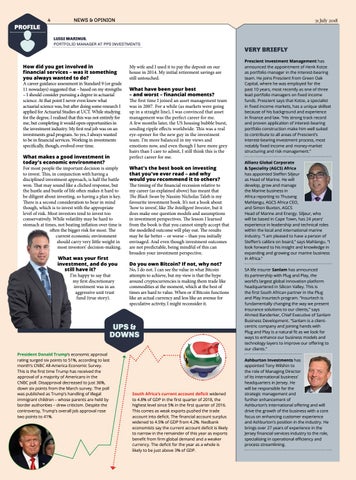
UPS & DOWNS President Donald Trump’s economic approval rating surged six points to 51%, according to last month’s CNBC All-America Economic Survey. This is the first time Trump has received the approval of a majority of Americans in the CNBC poll. Disapproval decreased to just 36%, down six points from the March survey. The poll was published as Trump’s handling of illegal immigrant children – whose parents are held by border authorities – drew criticism. Despite the controversy, Trump’s overall job approval rose two points to 41%.
South Africa’s current account deficit widened to 4.8% of GDP in the first quarter of 2018, the highest level since 5% in the first quarter of 2016. This comes as weak exports pushed the trade account into deficit. The financial account surplus widened to 4.5% of GDP from 4.2%. Nedbank economists say the current account deficit is likely to narrow in the remainder of this year as exports benefit from firm global demand and a weaker currency. The deficit for the year as a whole is likely to be just above 3% of GDP.
VERY BRIEFLY Prescient Investment Management has announced the appointment of Henk Kotze as portfolio manager in the interest-bearing team. He joins Prescient from Green Oak Capital, where he was employed for the past 10 years, most recently as one of three lead portfolio managers on fixed income funds. Prescient says that Kotze, a specialist in fixed income markets, has a unique skillset because of his background and experience in finance and law. “His strong track record and proven application of interest-bearing portfolio construction make him well suited to contribute to all areas of Prescient’s interest-bearing investment process, most notably fixed income and money-market structuring and risk management.” Allianz Global Corporate & Speciality (AGCS) Africa has appointed Steffen Siljeur as Head of Marine. He will develop, grow and manage the Marine business in Africa reporting to Thusang Mahlangu, AGCS Africa CEO, and Simon Buxton, AGCS Head of Marine and Energy. Siljeur, who will be based in Cape Town, has 24 years’ experience in leadership and technical roles within the local and international marine industry. “I am pleased to have a person of Steffen’s calibre on board,” says Mahlangu. “I look forward to his insight and knowledge in expanding and growing our marine business in Africa.” SA life insurer Sanlam has announced its partnership with Plug and Play, the world’s largest global innovation platform headquartered in Silicon Valley. This is the first South African partner in the Plug and Play Insurtech program. “Insurtech is fundamentally changing the way we present insurance solutions to our clients,” says Ahmed Banderker, Chief Executive of Sanlam Business Development. “Sanlam is a clientcentric company and joining hands with Plug and Play is a natural fit as we look for ways to enhance our business models and technology layers to improve our offering to our clients.” Ashburton Investments has appointed Tony Wilshin to the role of Managing Director of its international business’ headquarters in Jersey. He will be responsible for the strategic management and further enhancement of Ashburton’s international offering and will drive the growth of the business with a core focus on enhancing customer experience and Ashburton’s position in the industry. He brings over 27 years of experience in the Jersey financial services industry to the role, specialising in operational efficiency and process streamlining.