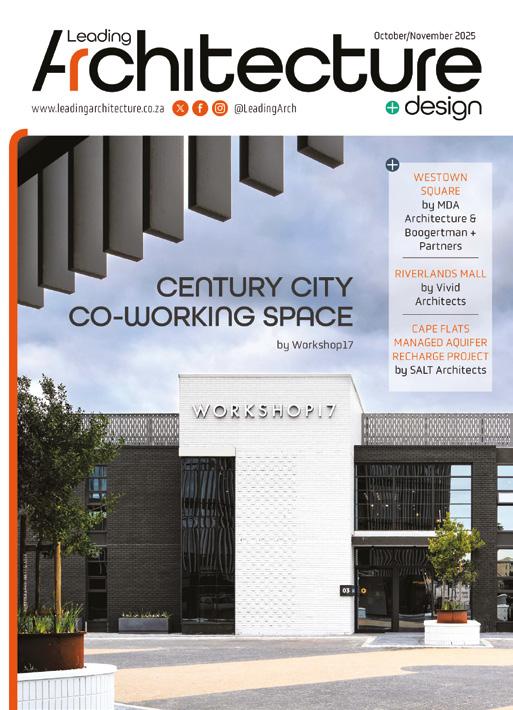
Leading Architecture + Design December 2025 / January 2026
by heneghan peng architects
05 EDITOR’S NOTE & BOOK REVIEW
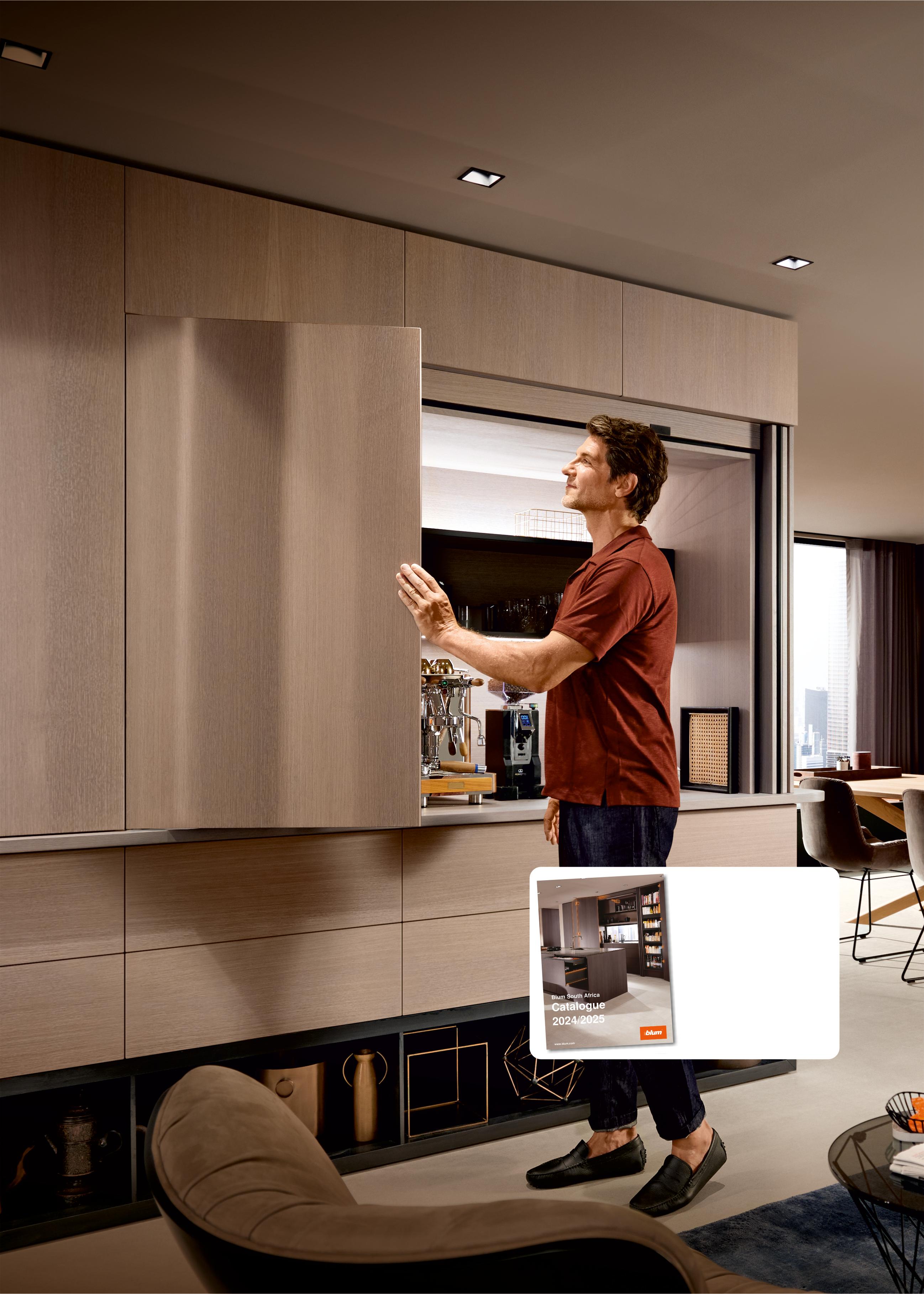
06 OPINION Brought to you by Blum South Africa
PROJECTS
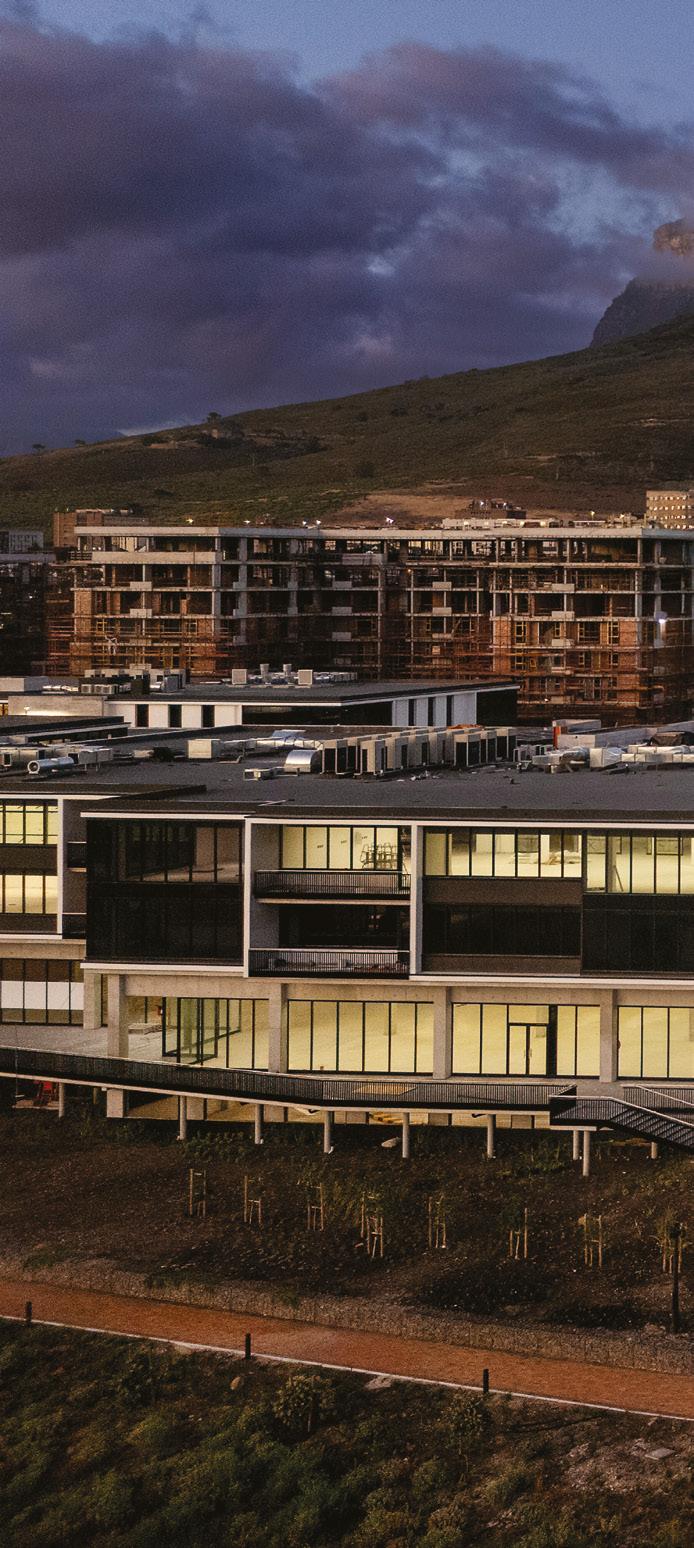
08 FIRST NATIONS HERITAGE CENTRE, CAPE TOWN
Contemporary space honours the First Nations Collectives legacy, by Noero Architects.
16 96 RISSIK STREET, JOHANNESBURG
Transnet HO transformed, by Osmond Lange Architects and Planners.
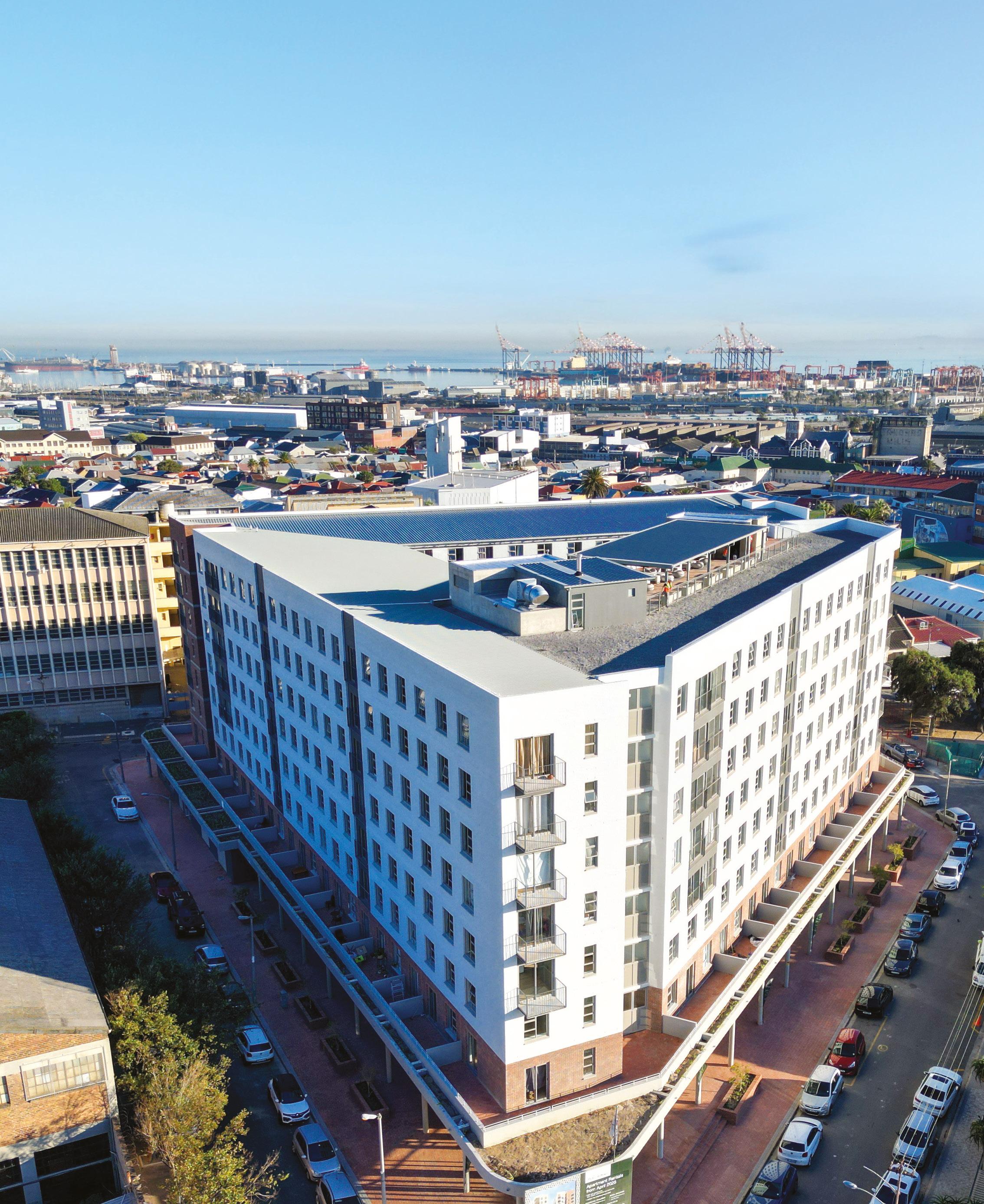
22 THE HERRINGBONE, SALT RIVER
New mixed-use development with an in industrial edge, by GASS Architecture Studios .
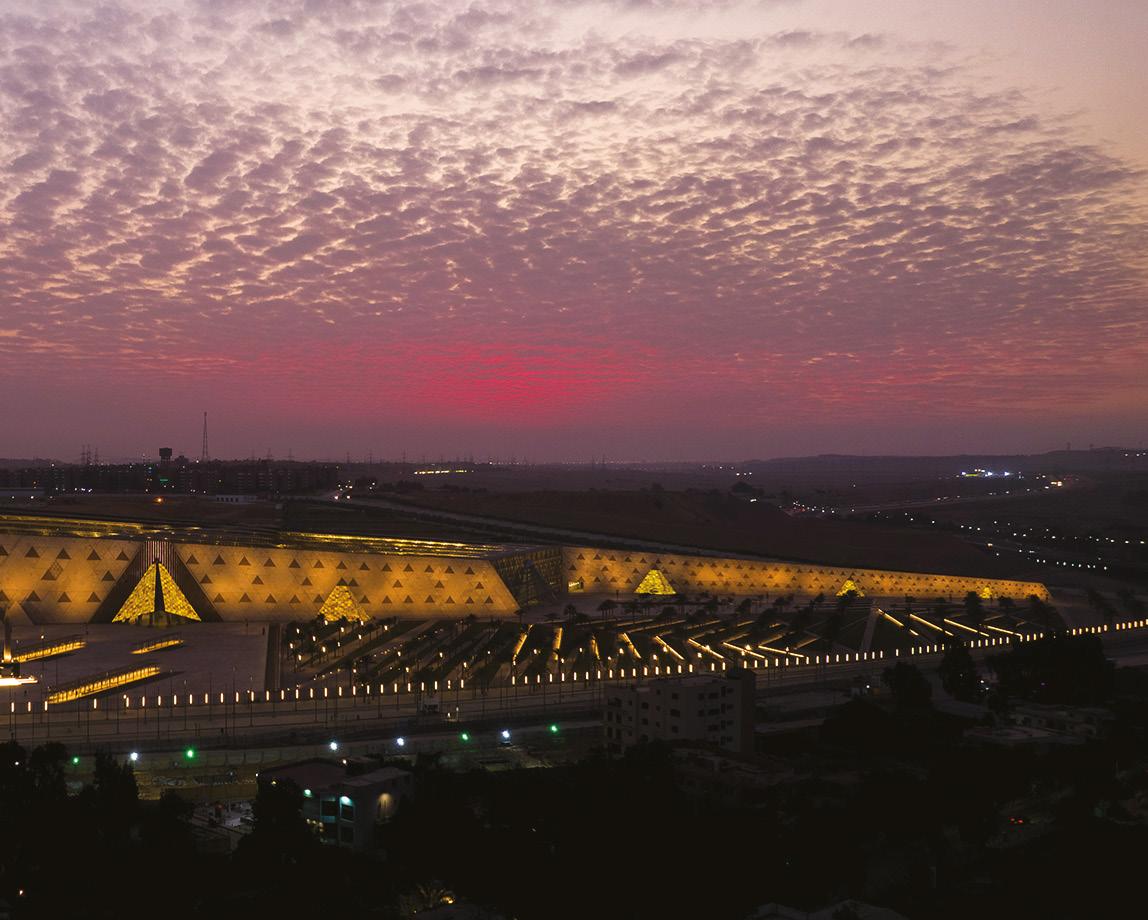
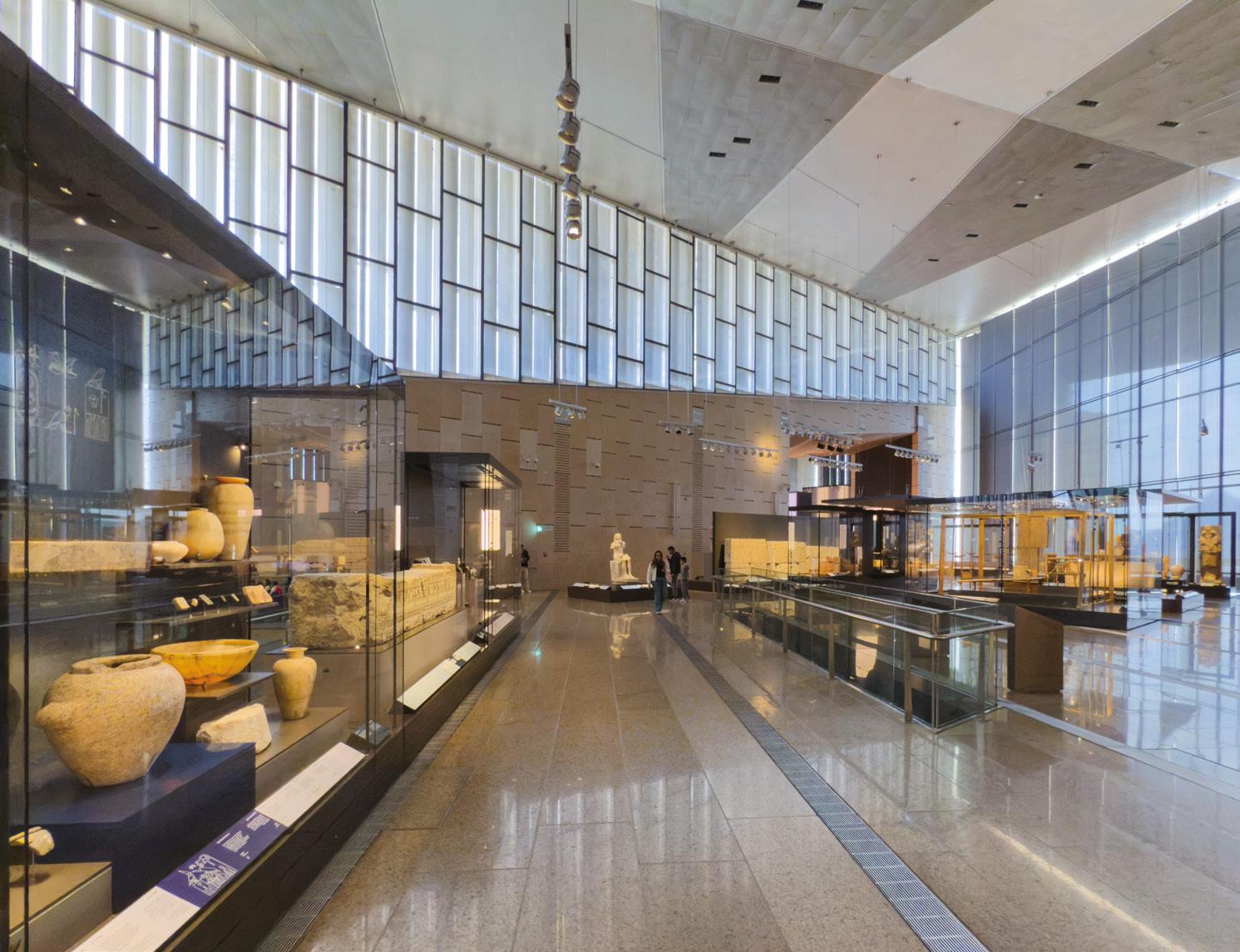
26 GRAND EGYPTIAN MUSEUM, CAIRO
Modern architectural marvel in the desert, by heneghan peng architects.
NEWS Contents
SPECIAL FEATURES
36 Interior design for context, not Pinterest.
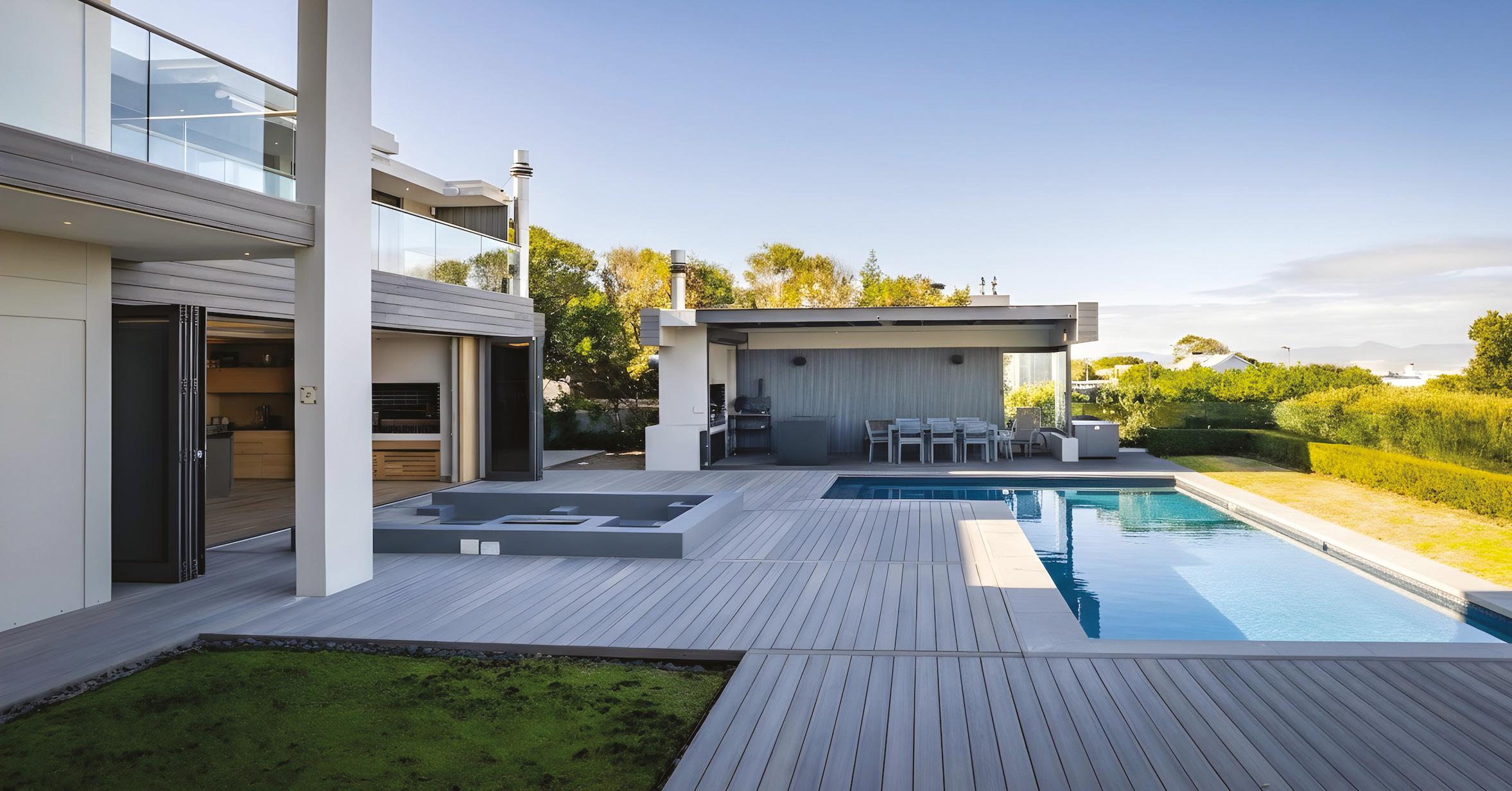
40 Outdoor alchemy: redefining exterior spaces.
42-50 NEWS
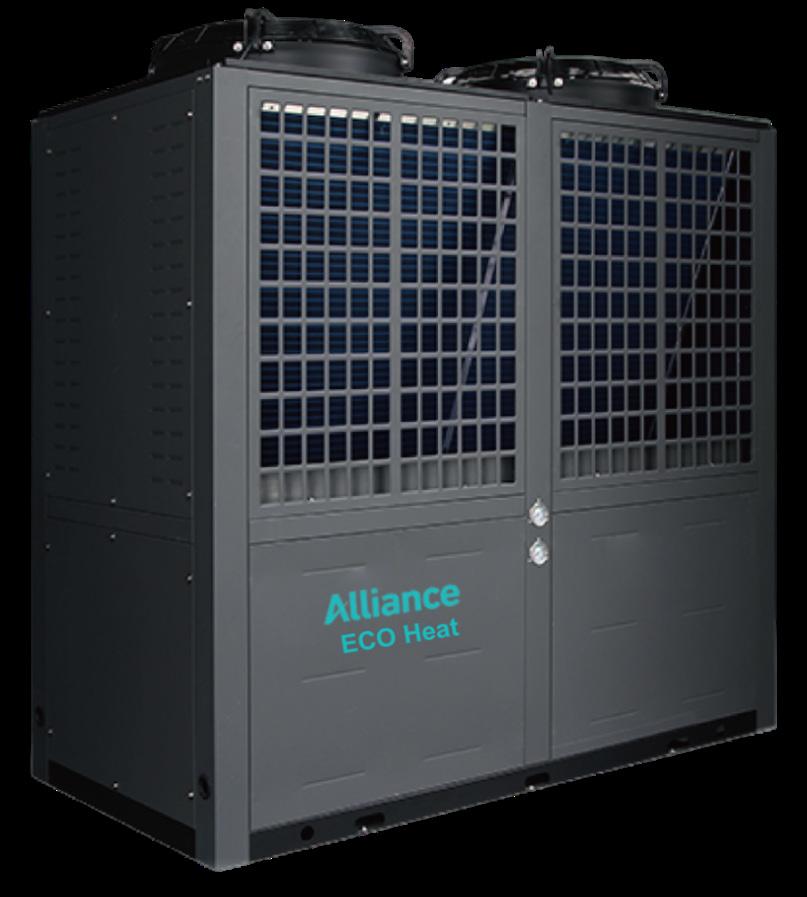
Samsung and Alliance airconditioning solutions; new industrial-grade insulation product from Alucushion Thermal Insulations; fire safety peace of mind by Chubbsafes; B.I.L
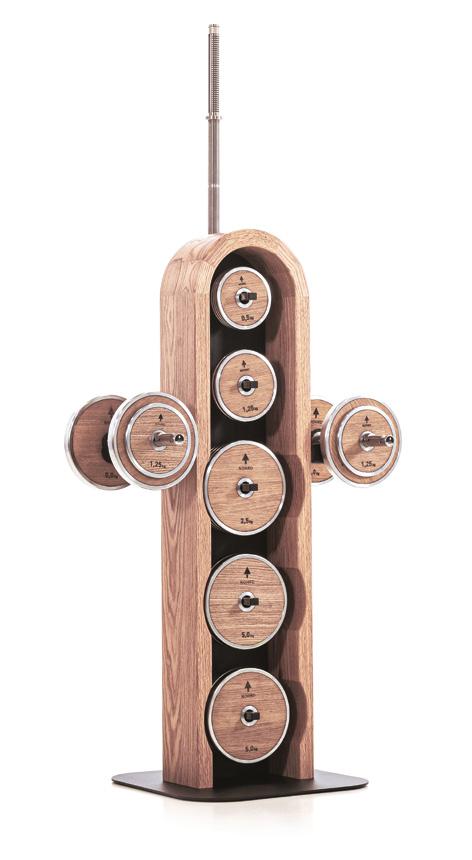
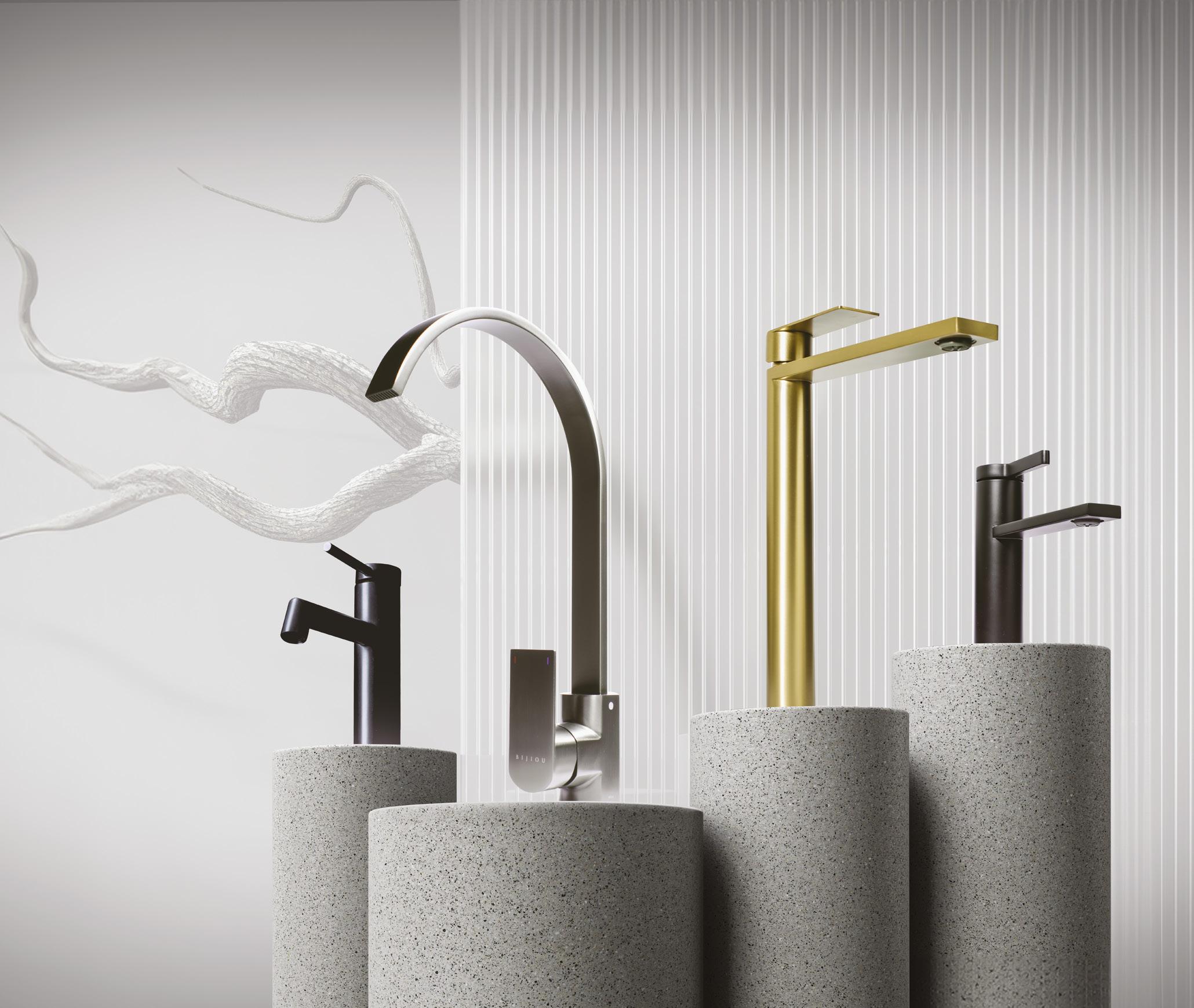
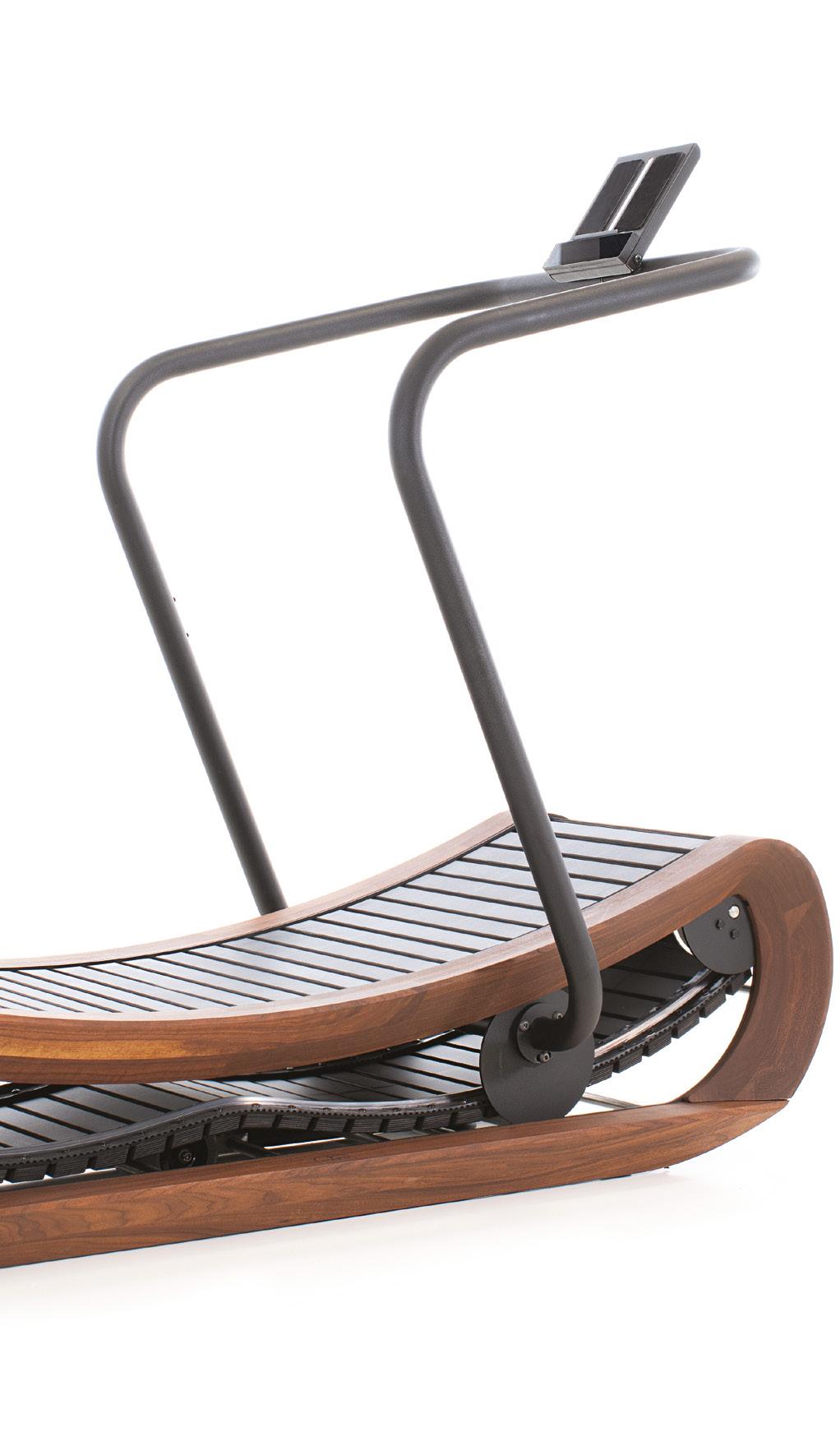
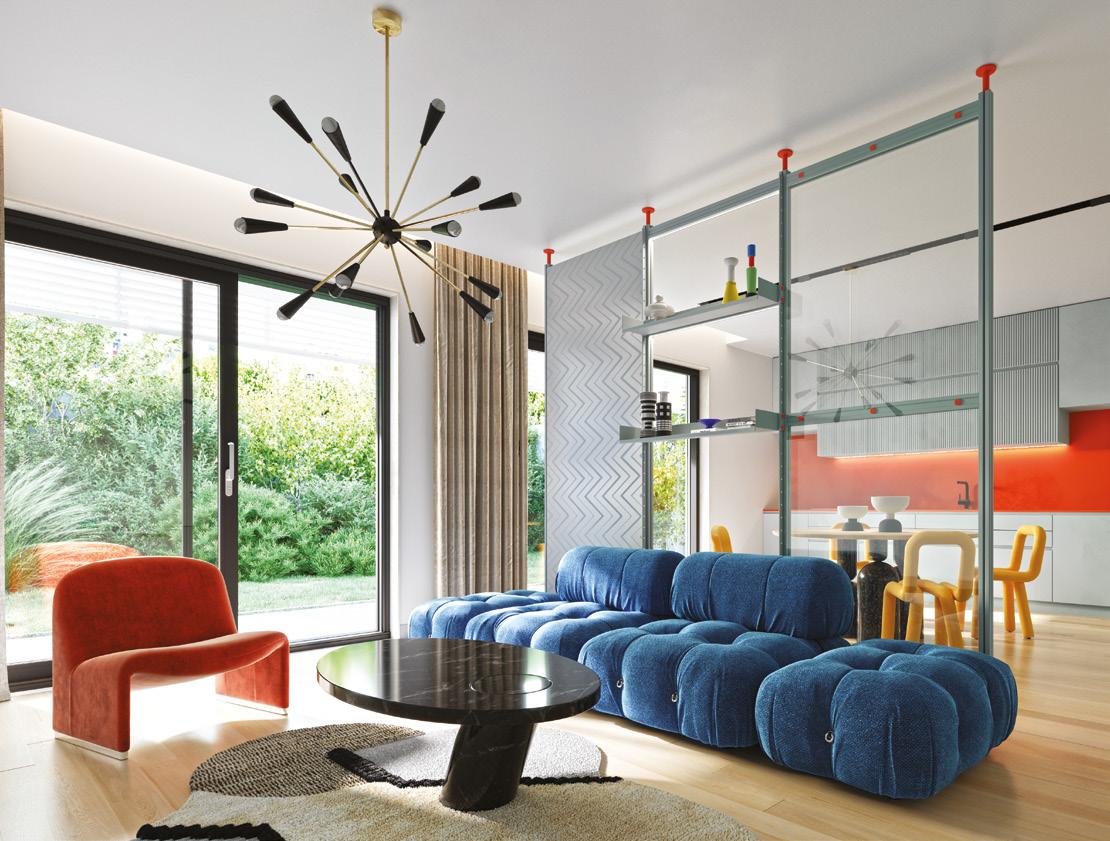
Architects tech adoption; insulation solutions by Starlite; new corrosion management product from Plascon; Pratliperl fireproof aggregate; luxe tent structures by Bushtec; Grohe’s Heart of Your Bathroom campaign; security barriers as architectural assets; Bijiou's sophisticated new bathroom range; private gyms as design statements by WaterRower NOHRD; magnetised modular wall system by Luconi.
EDITORIAL
EDITOR: Tracy Greenwood
email: tracy.greenwood@media24.com
SUB EDITOR: Anita van der Merwe
ART DIRECTOR: Julia van Schalkwyk
ADVERTISING
KEY ACCOUNT MANAGERS: Nolusindiso Mbambo
Email sindi.mbambo@media24.com
+27 (0)11 877 6011 | +27 (0)64 677 0110
Erika Sparks
Email: erika.sparks@media24.com
+27 (0)11 715 8503 | +27 (0)83 644 8532
PHOTOGRAPHY
Unless previously agreed in writing, LeadingArchitecture+Design owns all rights to all contributions, whether image or text.
SOURCES: Shutterstock, Getty Images, supplied images, editorial staff. COVER PHOTOGRAP H: Courtesy of the Grand Egyptian Museum
Architecture has always been about dialogue – between past and present, between community and place, between aspiration and pragmatism. In this issue we are proud to present four remarkable projects that exemplify how contemporary design can honour heritage while addressing the urgent needs of our time.
In South Africa, architecture is often an instrument of social transformation. GASS Architecture Studios’ Herringbone development in Cape Town’s Salt River Triangle demonstrates how affordable housing can revitalise dormant industrial precincts while respecting their historical significance. Similarly, Osmond Lange Architects’ restoration of 96 Rissik Street in Johannesburg proves that heritage preservation and modern functionality can coexist beautifully, breathing new life into a 122-year-old Edwardian landmark.
Cultural architecture takes centre stage with Noero Architects’
remarkable First Nations Heritage Centre in Observatory, Cape Town, where indigenous heritage meets contemporary expression through collaborative design. The building speaks to the future while honouring the First Nations Collective’s rich legacy – a powerful statement about architectural reconciliation.
Finally, we journey to Cairo, where heneghan peng architects’ Grand Egyptian Museum creates an unprecedented dialogue between ancient civilisations and 21stcentury design. Located near the Pyramids of Giza, this architectural achievement demonstrates how contemporary buildings can enhance our understanding of history while maintaining profound respect for archaeological heritage.
These projects remind us that great architecture doesn’t merely occupy space – it transforms communities, preserves memory and builds bridges between yesterday and tomorrow.
Editor’s bookshelf
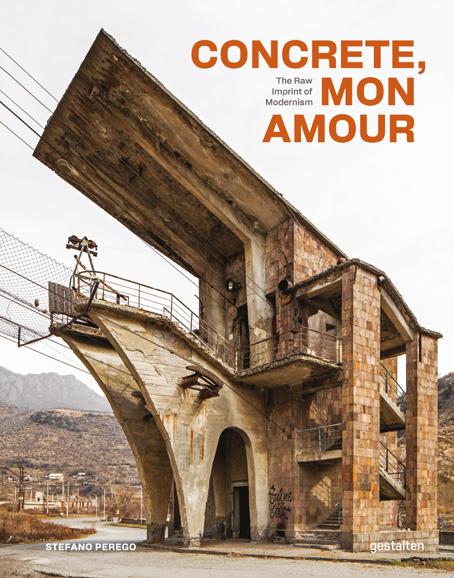
Concrete, Mon Amour
BY STEFANO PEREGO (GESTALTEN)
This comprehensive visual survey by Italian photographer Stefano Perego documents 98 buildings across 29 countries, taking readers on an odyssey that stretches from the Balkans to Japan, from the Caucasus to the Baltics.
Perego’s lens captures an impressive architectural diversity: civic centres that embody governmental authority, religious structures that reinterpret sacred traditions, residential complexes that promise utopian living, and infrastructural projects that showcase engineering ambition. The scope encompasses everything from iconic Brutalist monuments to examples of Soviet modernism and Japanese Metabolism. Rather than presenting these structures in their pristine, newly-built glory, he photographs each building in its current state – whether lovingly maintained or weathered by time and neglect. Perego explores the layered meanings embedded within these modernist structures, revealing how concrete became both a material of progressive vision and an instrument of political power.
Breaking barriers: Women in plumbing in South Africa
BY CORRIE STRIDE, LEADER, SOUTHEAST AFRICA, LIXIL IMEA
When I first began working in the building and construction industry, I quickly realised that very few faces around me looked like mine.
South Africa’s plumbing industry, like much of the technical and construction world, has long been seen as a man’s domain – a space of physical labour, mechanical expertise and ‘hard hats’. Yet every day, I see more women stepping into this field, proving that skill, precision and professionalism have no gender. Their courage and determination are quietly reshaping how we think about plumbing.
CHALLENGING PERCEPTIONS
For many years, the idea of a woman plumber raised eyebrows. It was unusual, not because women lacked ability, but because the trade was never presented as an option. Our education system and social expectations often guided young girls toward ‘softer’ professions.
But plumbing isn’t just about fixing leaks. It’s a profession rooted in precision engineering, sustainability and water management – areas demanding intelligence, care and foresight. The modern plumber is a key player in water conservation and public health.
At GROHE, part of LIXIL, we say that ‘water is at the heart of every home’. If that’s true, then plumbers, men or women, are the custodians of that heart, ensuring water is delivered, managed and conserved safely and efficiently.
THE COURAGE TO BEGIN
One inspiring woman I’ve met is a young plumber from Johannesburg. When she first started, people assumed she was an apprentice or assistant. Clients would look past her to speak to a male colleague, even when she was leading the job. ‘At first it was discouraging. But once they
saw my work, their tone changed.’
That line, ‘once they saw my work’, stayed with me. It captures the experience of so many women who must constantly prove their capability in industries where they’re underrepresented. But it also reflects extraordinary strength: the quiet power of persistence and pride in one’s craft.
Women in plumbing aren’t asking for special treatment. They’re asking for fair opportunity, to be recognised and respected for their skills. Once that door opens, they’re transforming the trade with technical precision and empathy.
FACING THE REALITIES
The path for women in plumbing isn’t easy. Many face challenges beyond societal perception – from lack of mentorship and training access to safety concerns on worksites not designed with women in mind.
Imagine being one of two women in a workshop of 50, or arriving at a job site without proper changing facilities. Imagine balancing home responsibilities with a demanding physical trade requiring long hours.
Yet despite these obstacles, women persevere. They understand this isn’t just a career; it’s a statement. Every pipe they fit, every valve they install is a meaningful act of rewriting an outdated story.
THE POWER OF COMMUNITY
Progress doesn’t happen in isolation. Behind every woman who succeeds in plumbing is often a network of support – other women, mentors, organisations or brands who believe in her.
In South Africa, associations like Women in Plumbing South Africa are creating powerful ecosystems of learning and mentorship. They’re proving that when women are given access to training and business education, they thrive.
One of LIXIL’s initiatives is An Introduction to Basic Plumbing and Entrepreneurial Ignition. Every Saturday, LIXIL’s Igsaan Hugo trains women in practical plumbing skills and entrepreneurial thinking. Many participants are mothers, so a childfriendly corner was created.
When we combine such programmes with mentorship, the results are exponential. Each success story encourages more women to step forward.
CHANGING THE NARRATIVE
Change begins when a young woman sees another woman in uniform holding a wrench and realises: that could be me.
Representation is powerful. When girls in technical colleges see women succeeding in plumbing, it breaks the illusion that skill has a gender. This is why brands and leaders must continue using their platforms to spotlight women professionals.
FROM AWARENESS TO ACTION
Awareness is only the beginning. What matters most is creating lasting systems supporting women plumbers through education, opportunity and recognition.
We cannot treat gender inclusion as a ‘nice to have’. In a country facing high unemployment and skilled trades shortages, empowering women to enter plumbing is both socially responsible and economically smart.
A FUTURE WORTH BUILDING
I’ve met extraordinary women who remind me why this conversation matters. Women who juggle families and careers, who arrive on-site before sunrise, who manage small businesses and lead teams with compassion and efficiency. They’re changing perceptions not by talking about it, but by living it.
Their stories aren’t about competing with men; they’re about complementing the trade with qualities that enrich it: empathy, precision, patience and a long-term view of customer relationships. I often think of one plumber in Durban who told me, ‘Plumbing is not about pipes, it’s about people.’ That simple sentence captures the heart of this movement.
If we want to see more women in plumbing, we must focus on three areas: visibility, access and respect. Visibility means giving women plumbers the spotlight. Access means removing structural barriers from education to job opportunities. Respect means ensuring that once women are in the field, they’re treated as professionals first.
As leaders, we have a responsibility to advocate for inclusion – not just in our words, but in how we design policies, select partners and shape our brands. The future of plumbing depends on diversity of thought and experience.
When I look at the growing number of women entering the plumbing trade, I feel proud but also responsible. We’re at the beginning of this transformation, but I’m optimistic. The courage of these women, the support of their peers and the commitment of brands like GROHE give me confidence that the future will look very different.
Someday soon, we’ll stop referring to ‘women in plumbing’ as an exception and simply celebrate plumbers for their skill, passion and integrity, regardless of gender. Until then, my hope is that every woman who picks up a wrench knows she’s not alone. She’s part of a growing community redefining what’s possible – one connection, one installation, one drop of water at a time.
www.grohe.co.za
www.lixil.co.za
Heritage and
har
mony
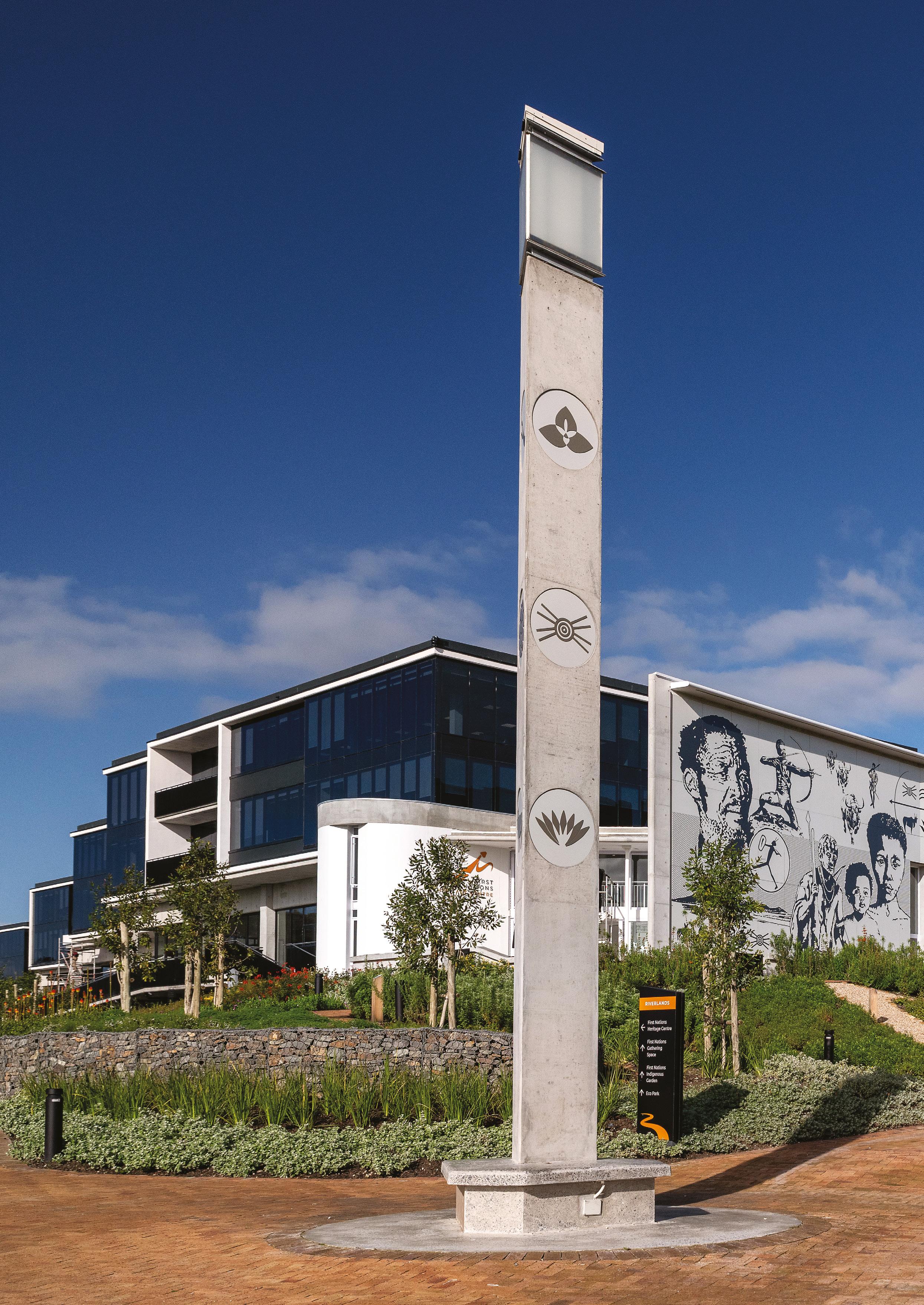
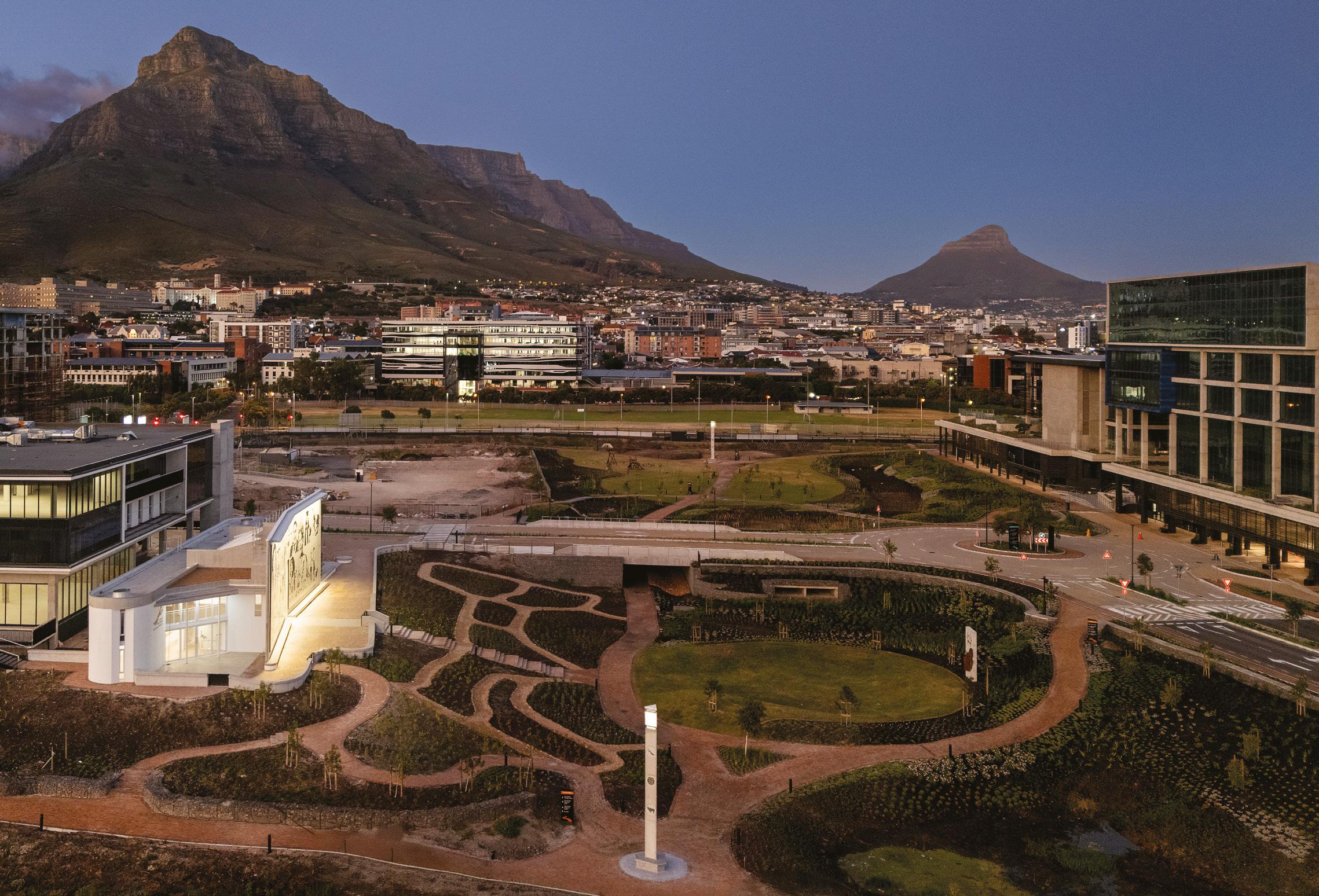
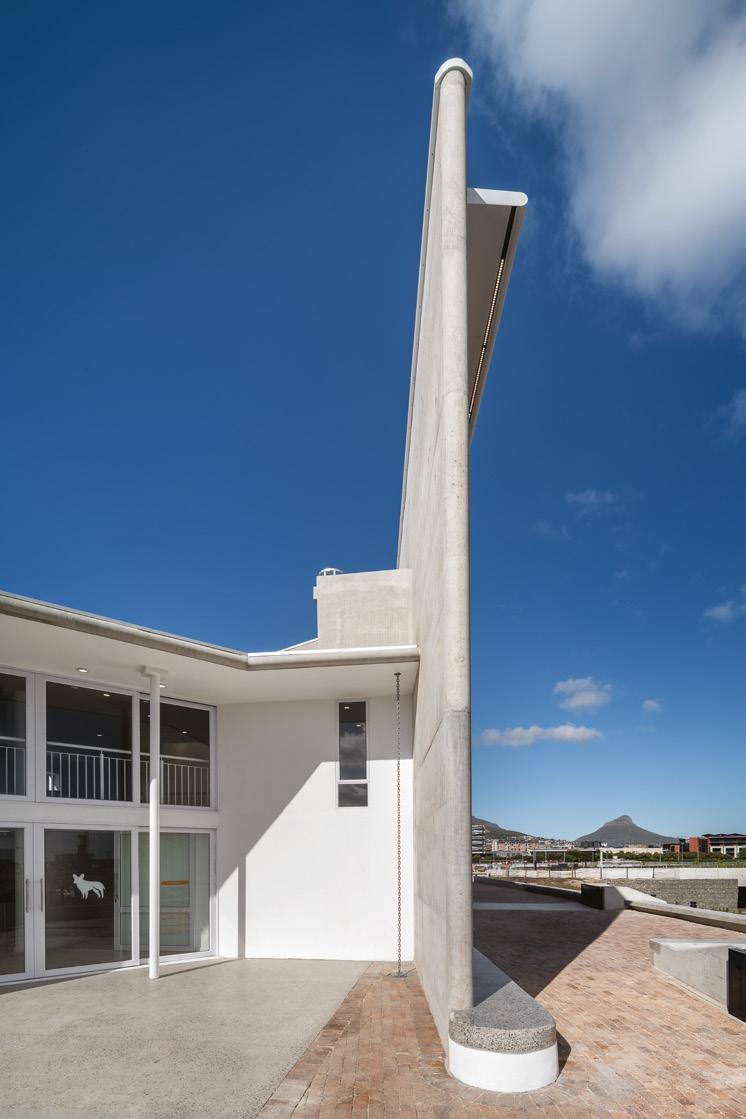
In the rapidly evolving landscape of Riverlands, Observatory, Cape Town, a remarkable architectural project stands as a testament to the power of collaborative design and cultural reconciliation. The First Nations Heritage Centre, designed by Noero Architects, represents far more than a conventional cultural facility – it embodies a profound dialogue between indigenous heritage, environmental restoration, and contemporary architectural expression.
PHOTOGRAPHY: Paris Brumme and Dave Southwood
BALANCING PAST AND FUTURE
The journey to realise this 600m 2 heritage centre began with a simple yet complex challenge: how to create a space that honours the First Nations Collective’s rich cultural legacy while embracing a decidedly modern aesthetic. Chief Zenzile, chair of the Western Cape’s First Nations Collective, says the collective was clear in its vision – they wanted a building that would speak to the future rather than retreat into symbolic representations of the past.
The community was very specific about not wanting a structure that resembled a cave or traditional dwelling. They sought something that would be uncompromisingly modern while remaining deeply respectful of their heritage and connection to the land.
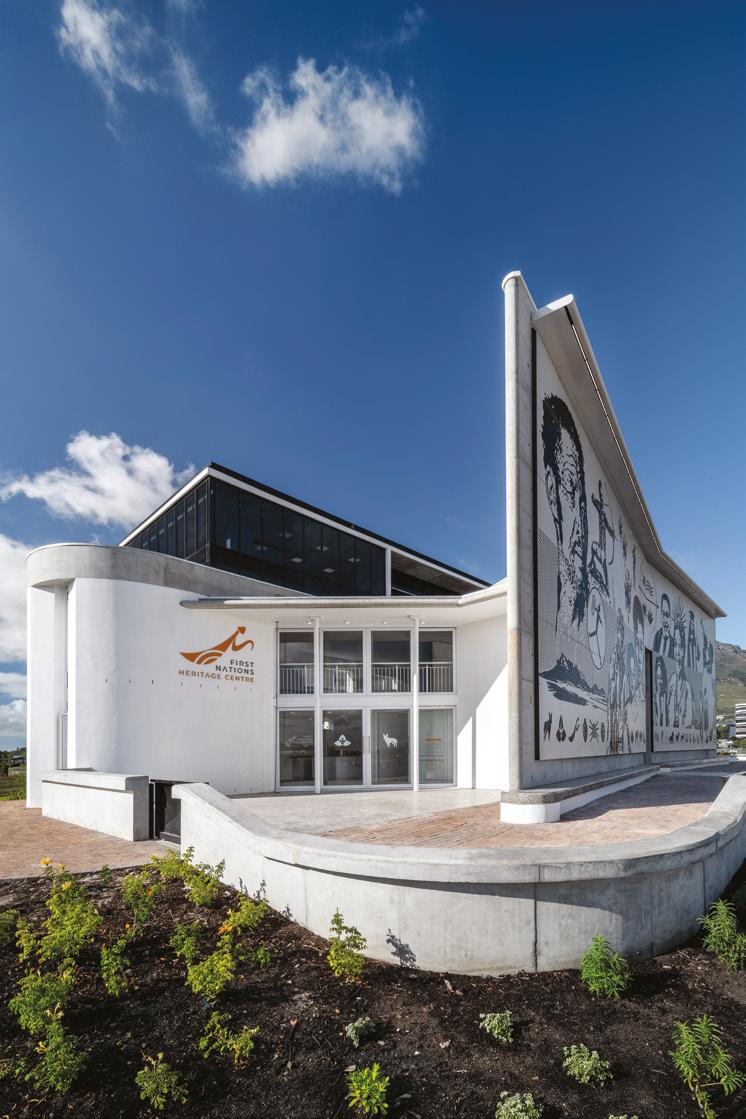
This philosophical foundation guided the architects toward what they term ‘modesty in the right proportion’. The resulting design achieves a delicate balance between commanding presence and contextual sensitivity, creating a structure that feels both substantial and harmonious within its landscape setting.
ARCHITECTURAL INTERVENTION AS LANDSCAPE RESTORATION
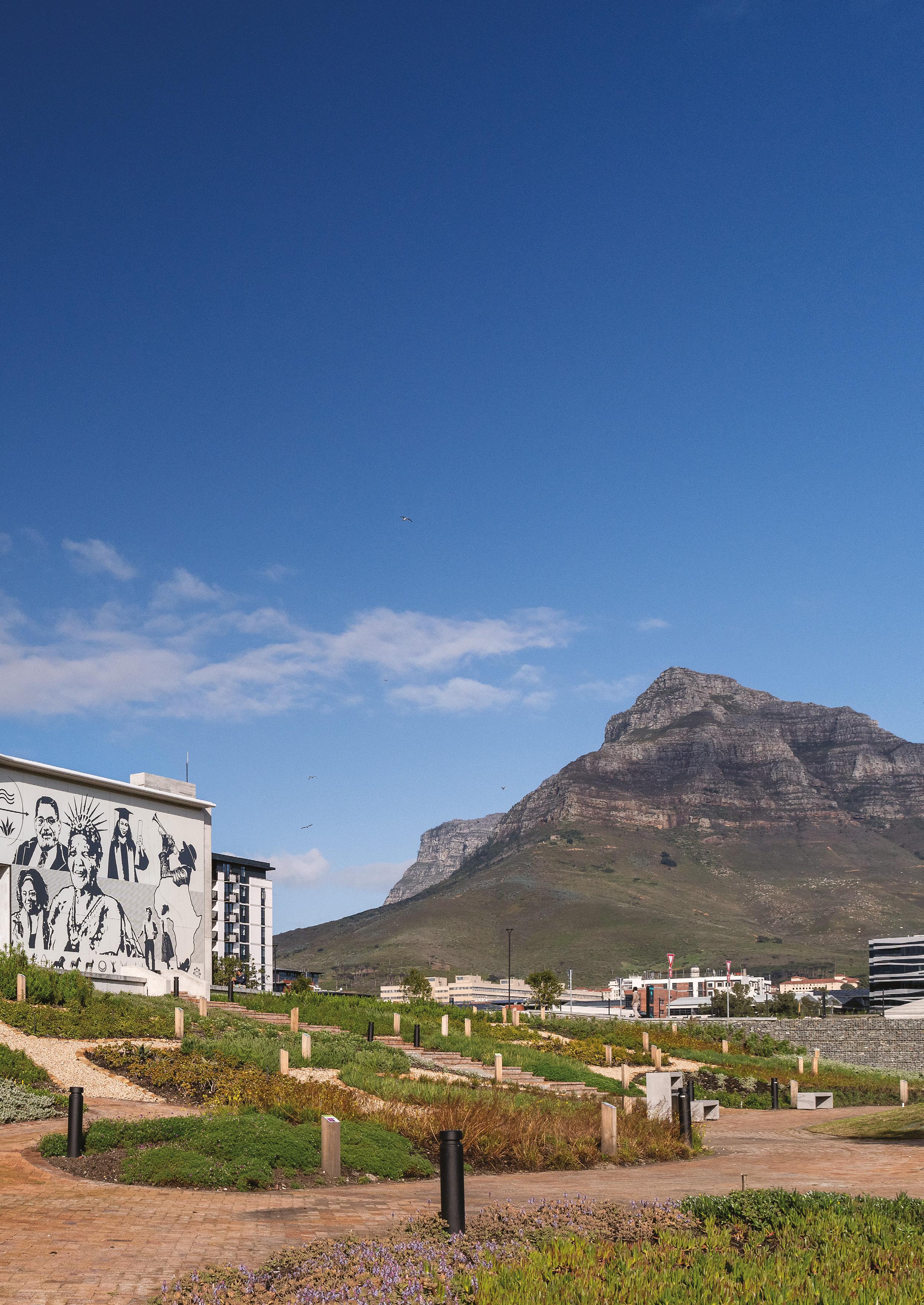
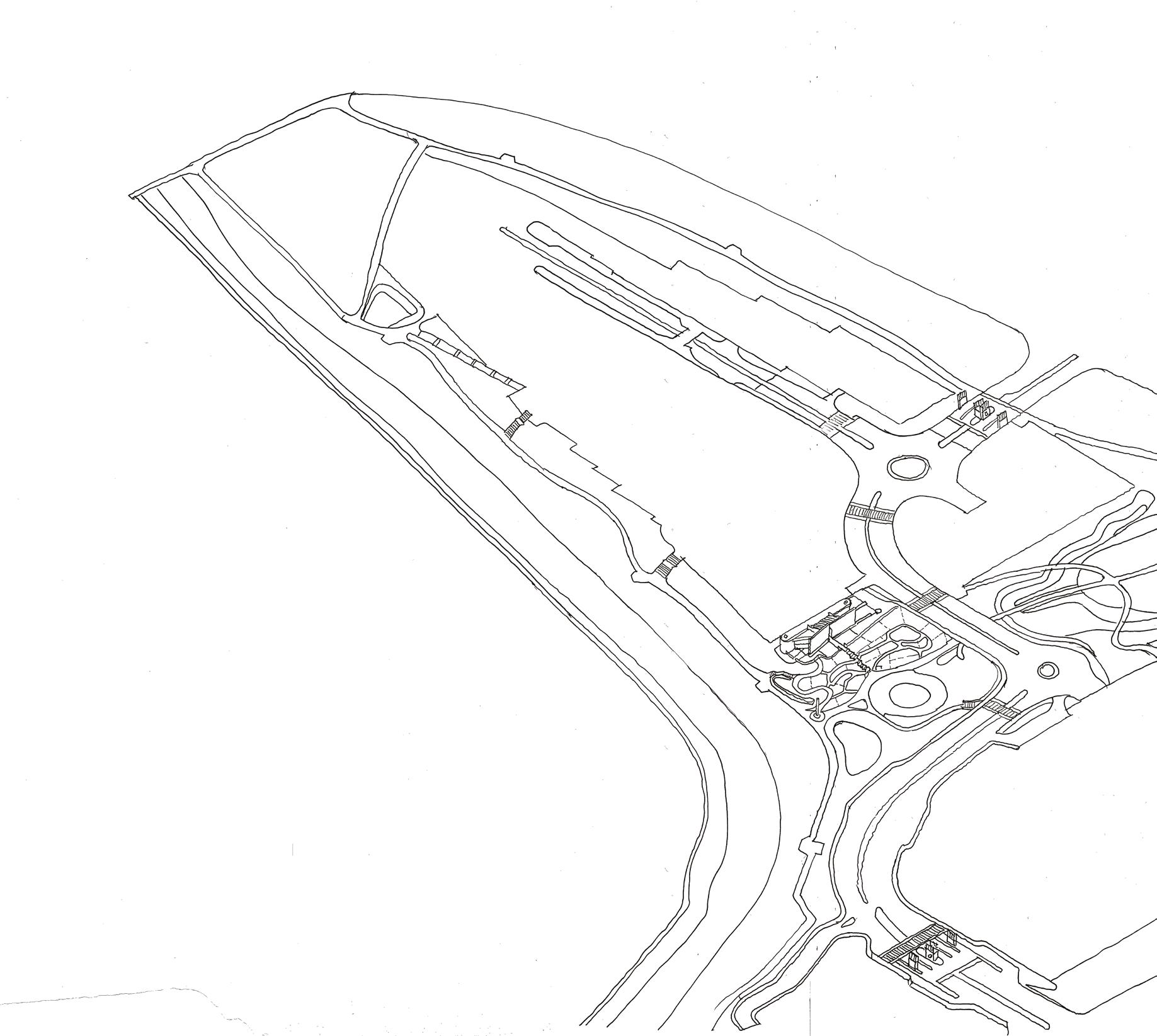
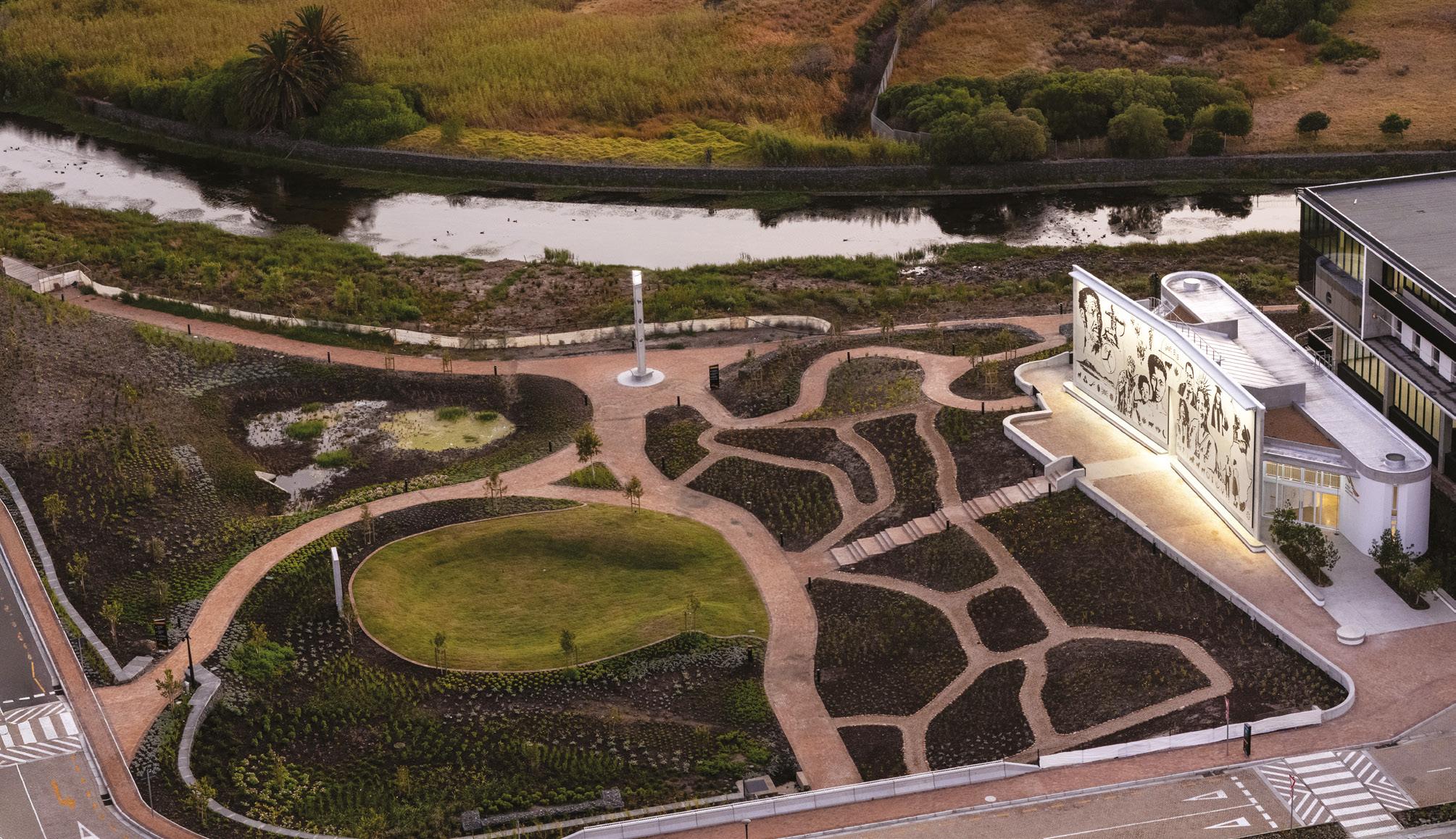
Perhaps the most striking aspect of the project lies not just in what has been built, but in what has been restored. The site’s transformation from a canalised waterway back to its original floodplain represents a bold act of environmental reconciliation that parallels the cultural healing the centre seeks to foster.
Noero Architects, recipients of 19 awards of merit, 18 project awards and three awards of excellence, all from the SAIA, approached this restoration with characteristic rigour. The practice, established in 1985, has built its reputation on creating what they describe as ‘practical art’ – architecture that satisfies purpose while integrating profound ethical considerations.
The reinstatement of the Liesbeek River’s natural flow patterns has created an eco-corridor that serves as both an environmental asset and a cultural metaphor. Indigenous medicinal gardens now flourish where concrete channels once contained the waterway, creating a north-facing landscape that connects directly to the heritage centre’s programming and philosophy.
A BUILDING THAT TELLS STORIES
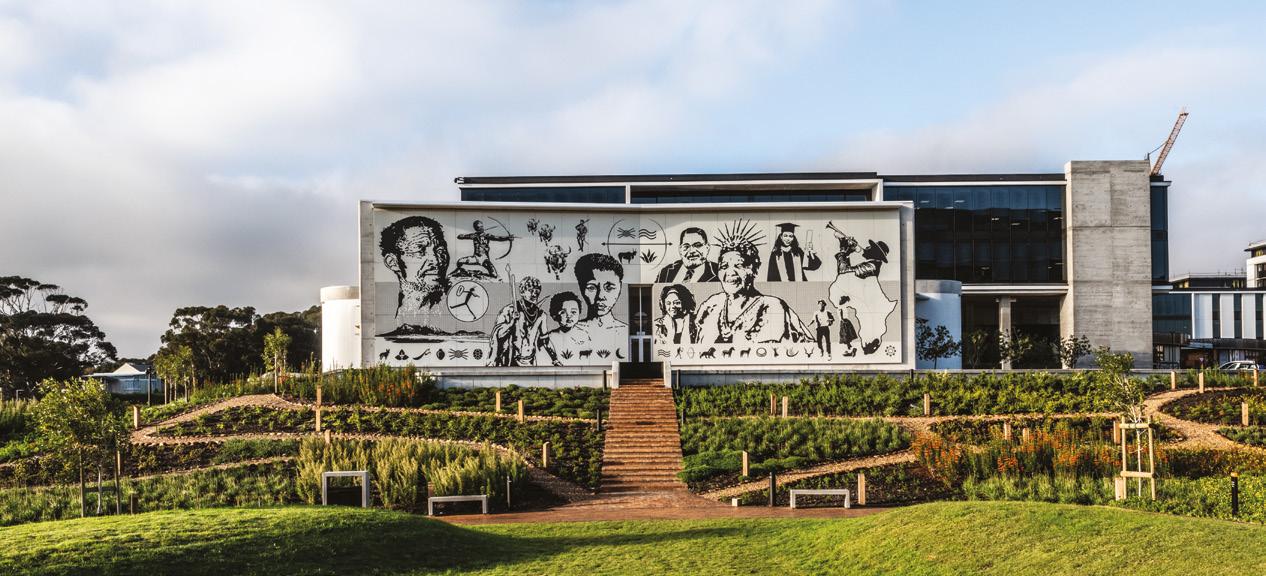
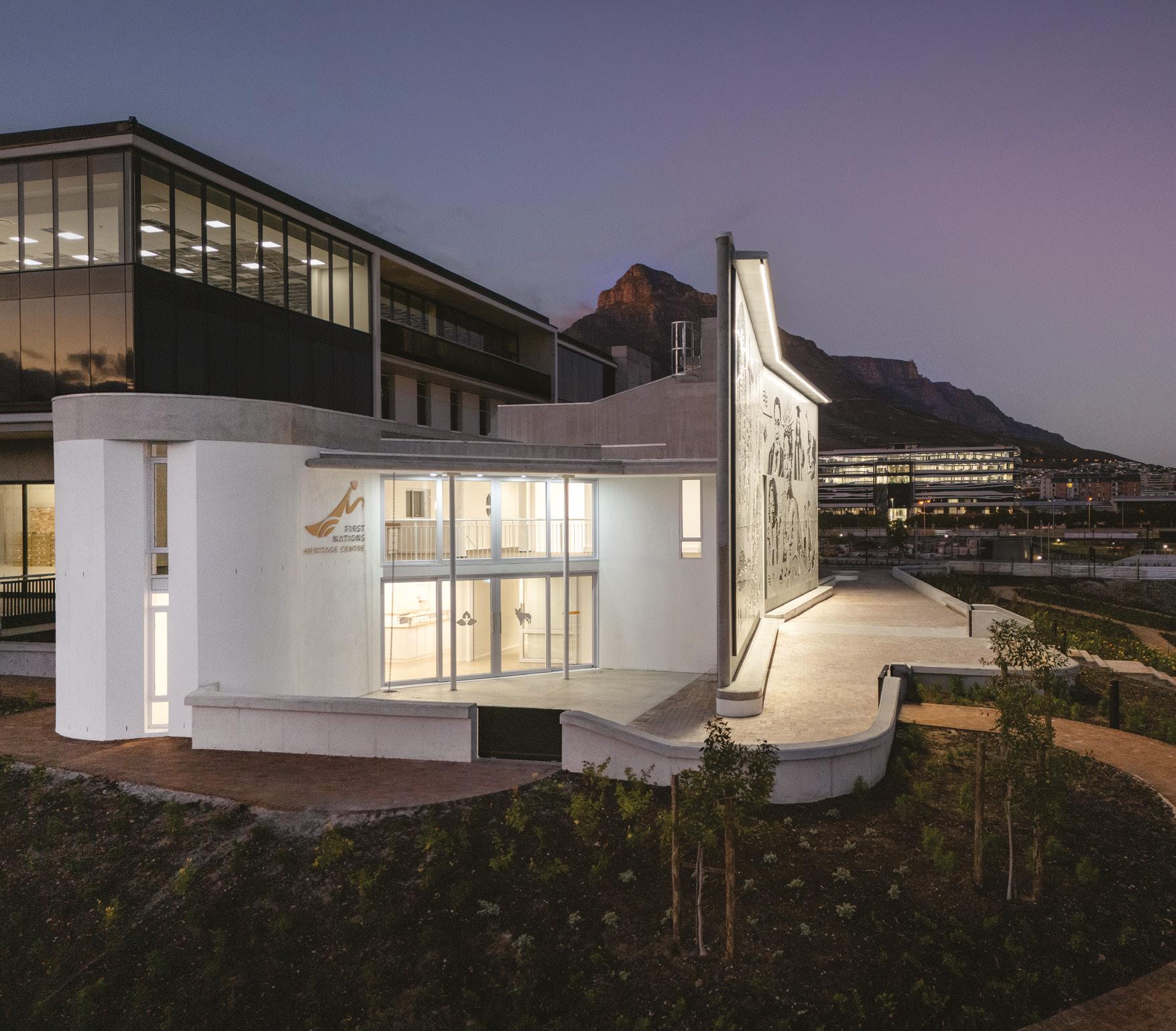
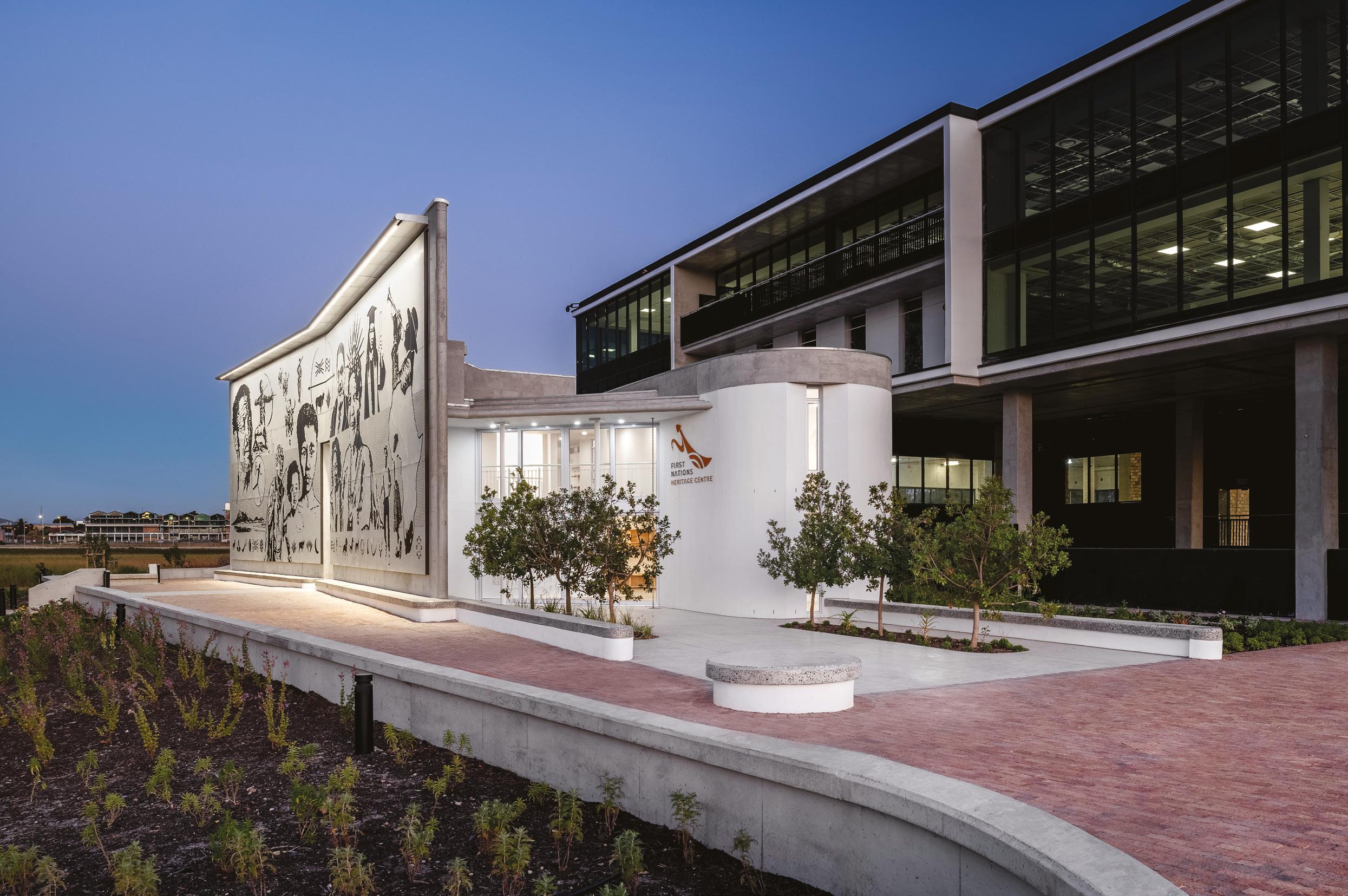
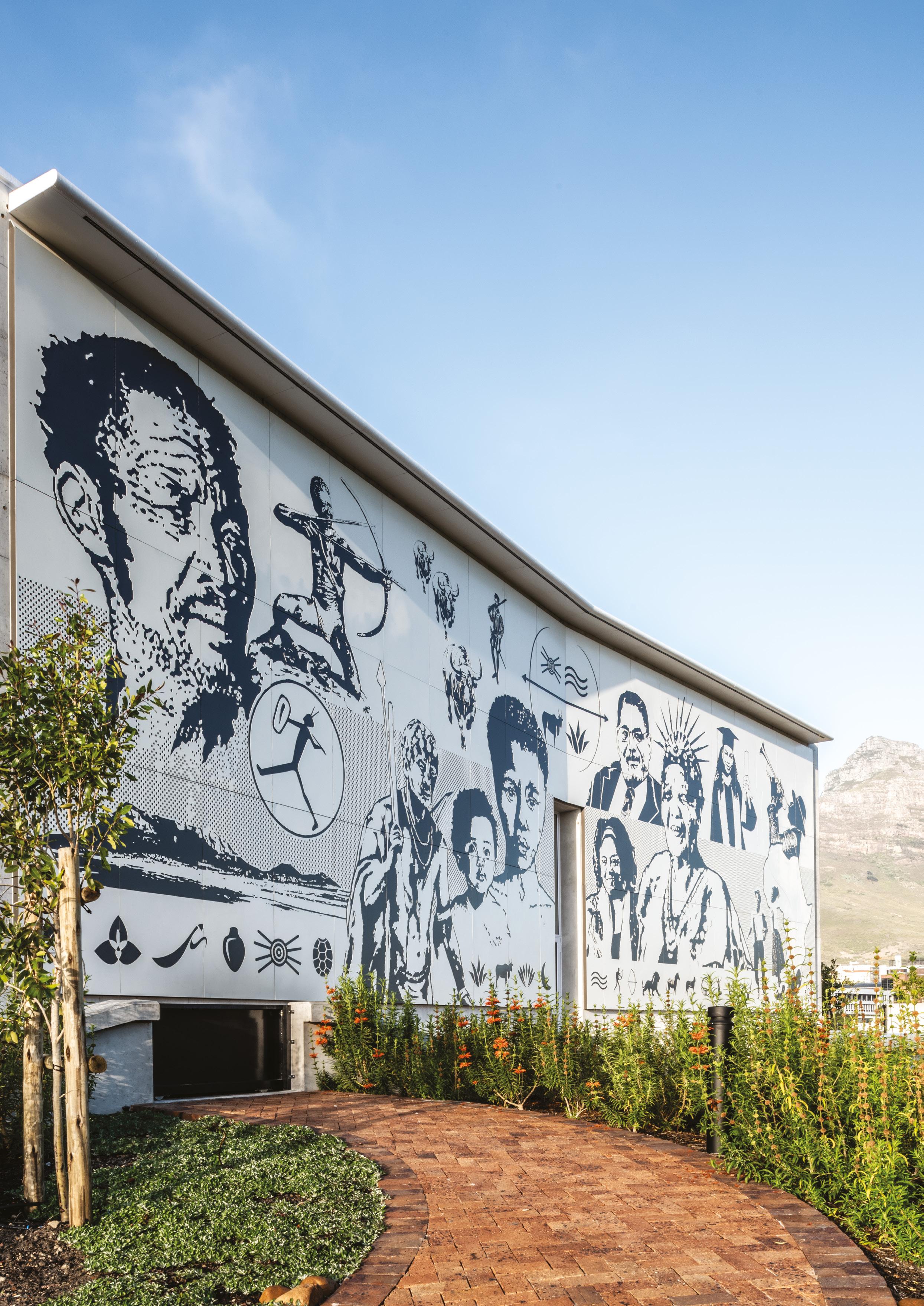
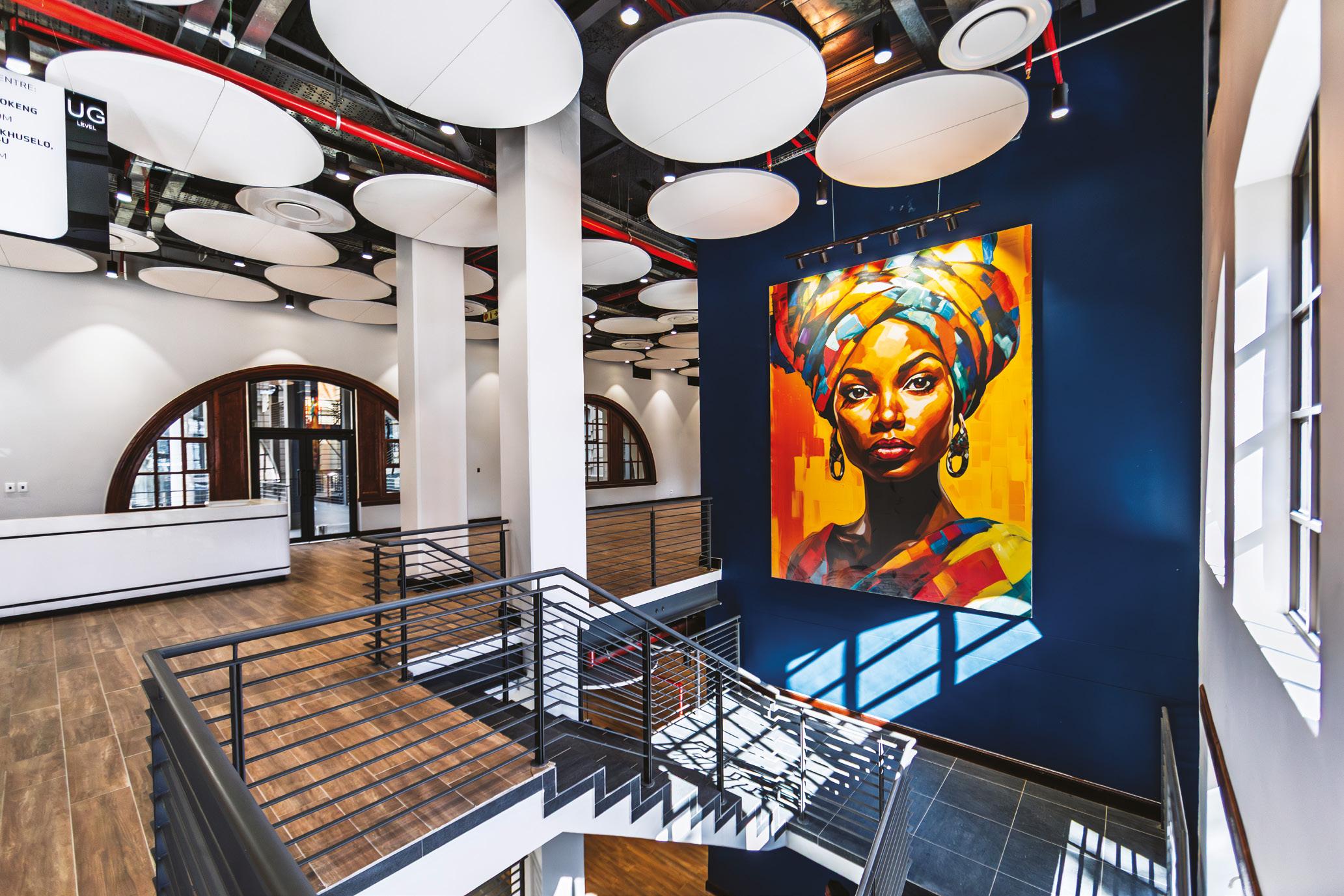
The architectural centrepiece of the project is undoubtedly the monumental mural wall – a 9m-high, 27m-long surface that functions as both screening element and narrative canvas. This feature serves as the visual anchor for the two-storey structure, creating a dialogue between the building’s contemporary form and the indigenous community’s historical journey.
The building’s 600m 2 footprint accommodates a sophisticated programme across two levels. The ground floor houses the primary public functions: a double-volume exhibition space that opens onto terraces, a coffee shop, temporary exhibition areas, meeting rooms and reception facilities. These spaces flow seamlessly into the exterior gathering areas and medicinal gardens, blurring the boundaries between indoor and outdoor cultural programming.
The first floor provides more specialised facilities including offices, a recording studio, boardroom, and reception space for dignitaries. This vertical organisation allows for both public engagement and private cultural work to occur simultaneously, supporting the centre’s role as both community facility and working cultural institution.
TECHNICAL INNOVATION MEETS CULTURAL SENSITIVITY
The project’s technical achievements are as noteworthy as its cultural aspirations. Working within the constraints of a heritage site while accommodating the restoration of natural floodplain dynamics required innovative approaches to foundation design and water management.
The construction methodology had to address multiple, sometimes competing, demands for preserving archaeological sensitivities, enabling seasonal flooding, supporting a substantial above-ground structure, and creating spaces suitable for contemporary cultural programming. The architects’ solution demonstrates how technical innovation can serve broader cultural and environmental goals.
Material selection reflects this same integrative approach. Rather than defaulting to either traditional or high-tech solutions, the architects chose materials and techniques that could support the building’s complex identity as both heritage facility and contemporary cultural centre. The result is a structure that feels both rooted in place and engaged with current architectural discourse.
COMMUNITY-LED DESIGN PROCESS
The project’s success stems largely from the genuine partnership established between Noero Architects, the First Nations Collective, the City of Cape Town, and the development team. This collaboration required navigating complex negotiations around heritage requirements, development economics and community aspirations.
The design process extended from May 2022 to the project’s completion in December 2024, allowing time for meaningful consultation and iterative design development. This extended timeline proved crucial in achieving the balance between the collective’s vision for a modern facility and the site’s heritage and environmental constraints.
‘The most significant challenge was reconciling different stakeholder priorities while maintaining the integrity of the community’s vision,’ notes architect Jo Noero. ‘Every decision required careful consideration of cultural, environmental and economic factors.’
LOOKING FORWARD
The First Nations Heritage Centre represents a new model for heritage architecture in South Africa – one that embraces contemporary expression while fostering deep connections to place and culture. Rather than treating heritage as a constraint, the project demonstrates how historical consciousness can drive innovative design solutions.
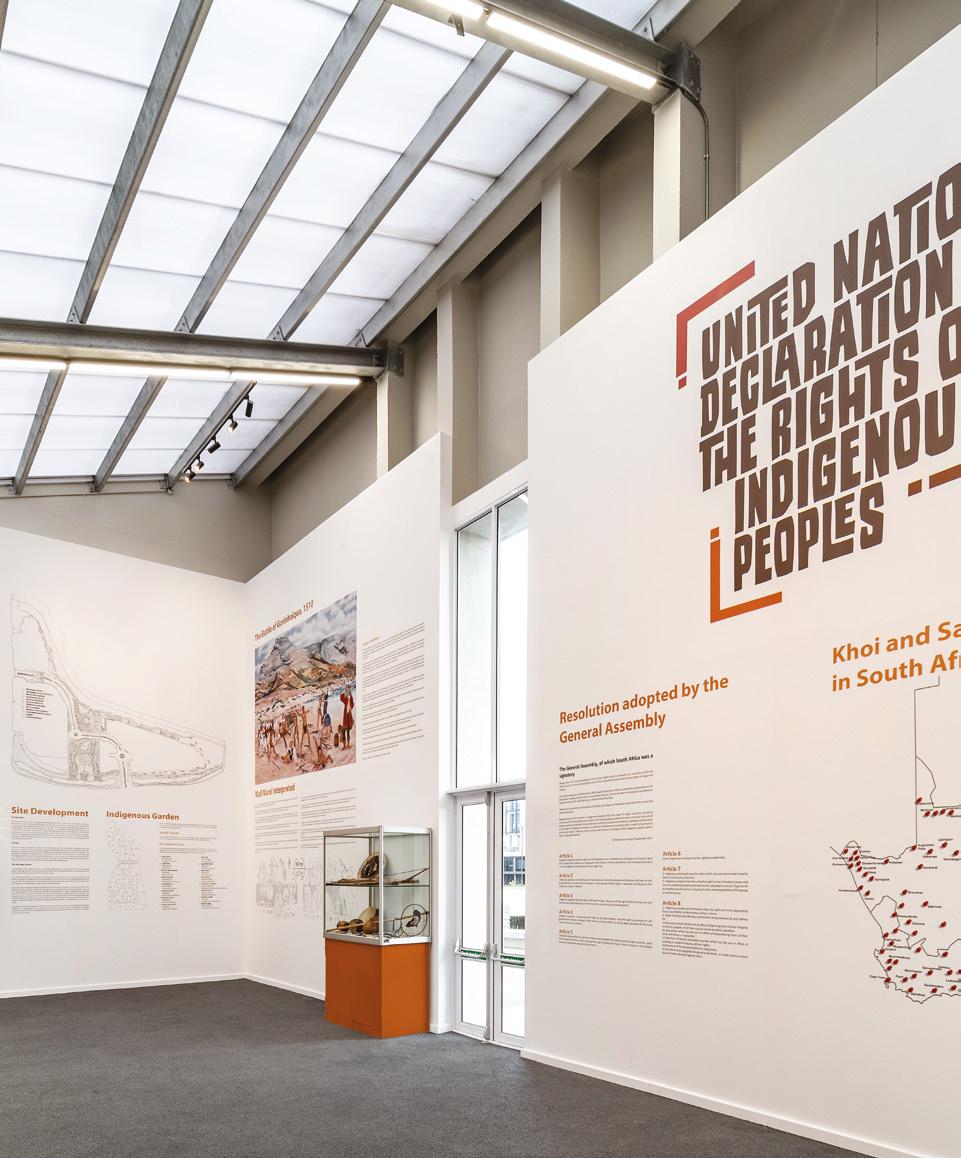
The centre’s programming reflects this forward-looking approach. Permanent exhibitions chronicle the indigenous community’s history –including significant events such as the Battle of Gorinhaiqua – while flexible temporary exhibition spaces enable dynamic cultural programming. The integration of recording studio facilities acknowledges the importance of contemporary cultural production alongside historical preservation.
The eco-corridor and medicinal gardens extend the building’s cultural mission into the landscape, creating spaces for outdoor programming that connects visitors to indigenous knowledge systems and environmental practices. These features ensure that the centre functions as both repository of cultural knowledge and active site of cultural production.
A NEW PARADIGM
As climate change and social justice increasingly influence architectural practice, the First Nations Heritage Centre offers a compelling vision of how buildings can serve multiple environmental and cultural objectives simultaneously. The project’s integration of river restoration, heritage preservation and contemporary architecture suggests new possibilities for culturally responsive design in sensitive contexts.
For Noero Architects, the project represents a continuation of their decadeslong commitment to what they describe as ‘architecture with ethics and poetics’. Drawing inspiration from Ludwig Wittgenstein’s philosophy, their approach treats building design as fundamentally concerned with creating spaces that serve practical, spiritual and ethical needs.
The completed centre stands as more than architectural achievement – it represents a physical manifestation of reconciliation, environmental restoration and cultural continuity. In a continent where colonial histories continue to shape urban development, the First Nations Heritage Centre points toward more inclusive approaches to place-making and architectural practice.
Through careful attention to proportion, material and landscape integration, Noero Architects has created a building that honours the past while embracing the future – a structure that demonstrates how contemporary architecture can serve as a bridge between heritage and progress, between individual community needs and broader environmental responsibility.
The project’s success will ultimately be measured not in architectural awards, though these will undoubtedly follow, but in its capacity to support the First Nations Collective’s ongoing cultural work and to inspire similar approaches to heritage-based design across southern Africa and beyond.
Project team
Client: First Nations Collective and Liesbeek Leisure Properties Trust Architects: Noero Architects cc Landscape architects: Planning Partners Project managers: PCPM Quantity surveyors: MLC Structural and civil engineers: Zutari Electrical engineers: Selkirk and Selkirk Contractors: Boshard Construction and WBHO
New
Osmond Lange Architects’ restoration of 96 Rissik Street, Transnet’s head office in Johannesburg, safeguards one of the city’s most prominent Edwardian landmarks, while celebrating the city’s architectural legacy.
Photography: Supplied
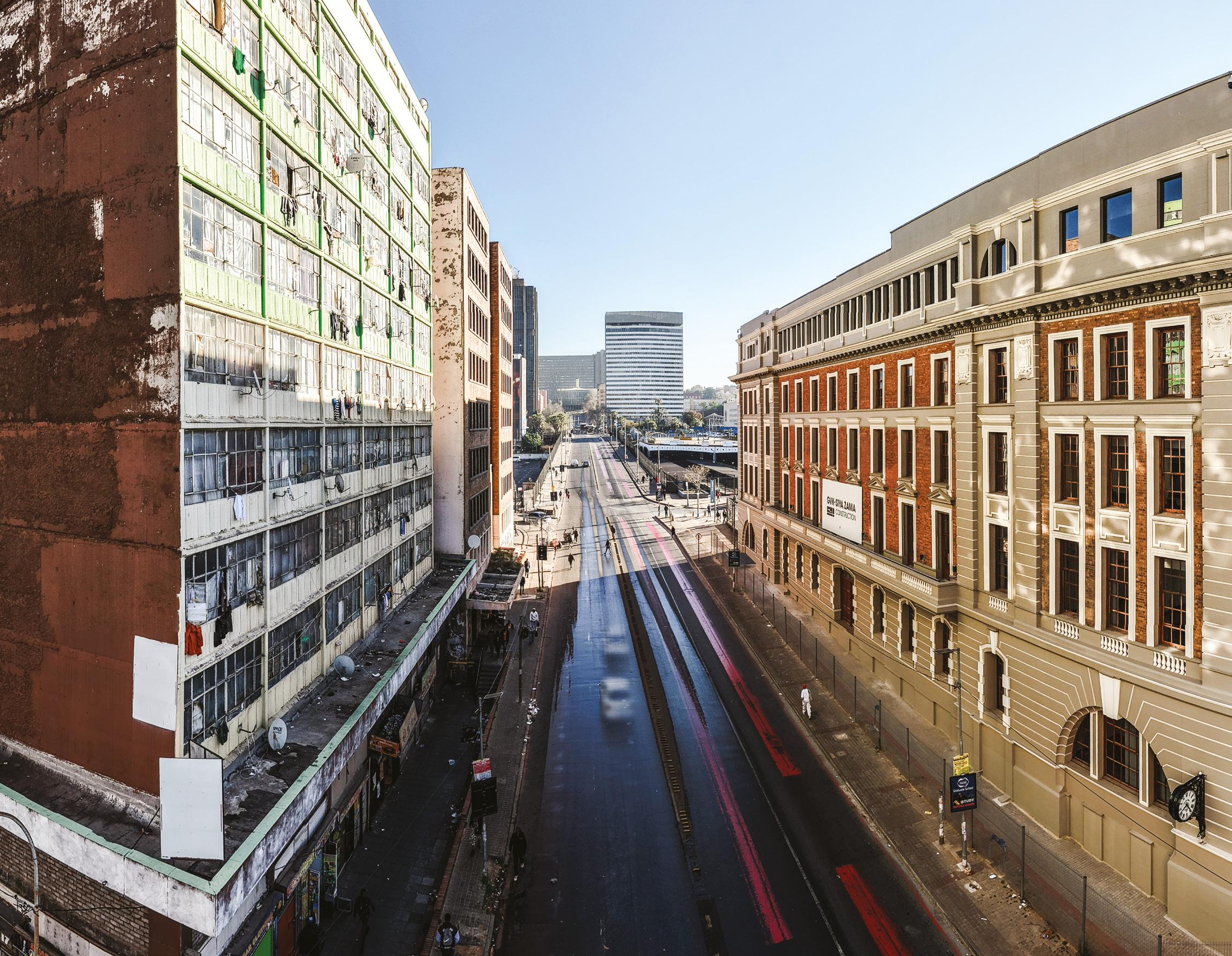
In the heart of Johannesburg’s inner city, a transformation that exemplifies the power of adaptive reuse in urban regeneration has taken place. The restoration of 96 Rissik Street, a prominent 122-yearold Edwardian landmark that has served as Transnet’s headquarters, is a testament to how heritage preservation can be integrated with contemporary design to meet the demands of modern workspaces.
Completed by Osmond Lange Architects just before Heritage Month 2025, the project has breathed new life into one of Johannesburg’s most significant historical buildings, simultaneously establishing a new paradigm for heritage-led urban development in South Africa. What sets this restoration apart is its philosophical approach to heritage conservation. Rather than attempting to return the building to a single historical
moment, the project team embraced the structure’s evolution over more than a century, allowing it to ‘tell its story’ through the various layers of history embedded within its fabric. This approach, guided by the principles of the Burra Charter, emphasises minimal intervention while ensuring that new additions are clearly distinguishable from original elements.
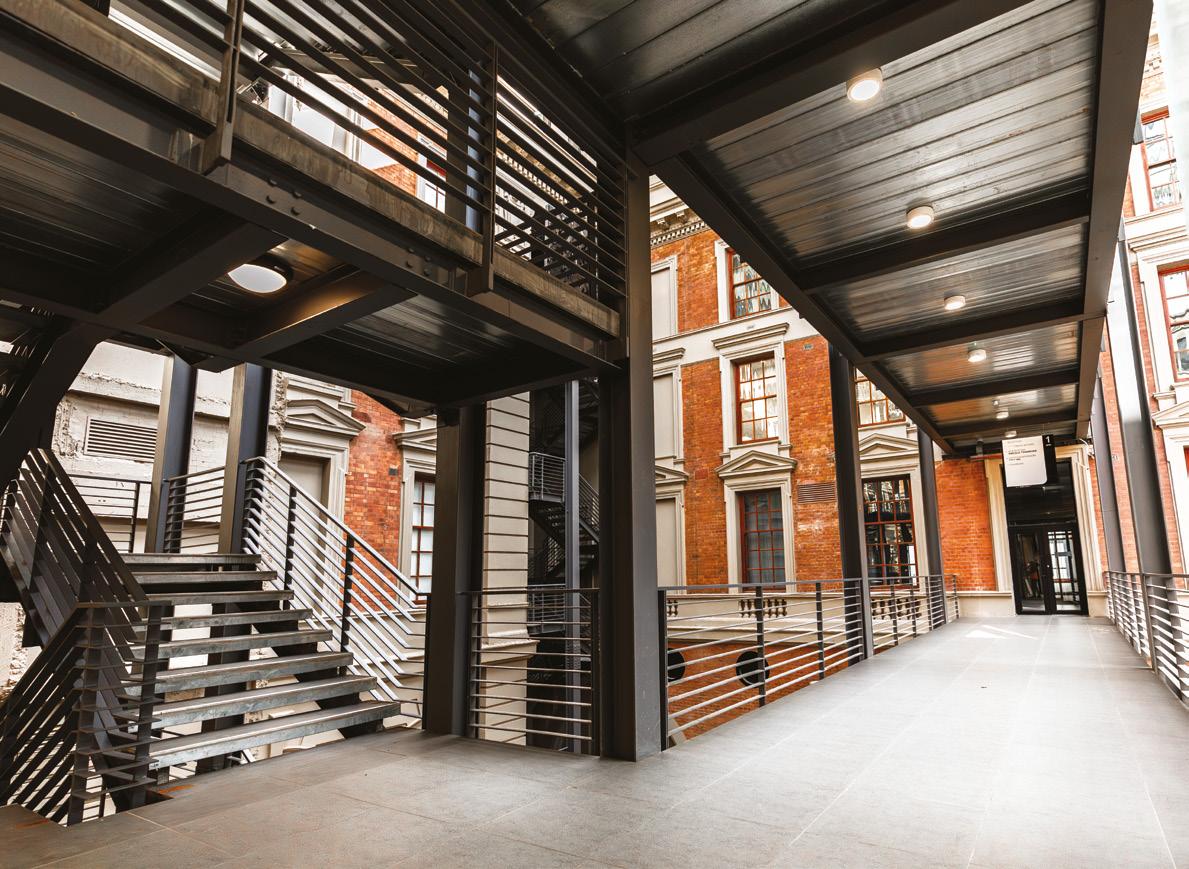
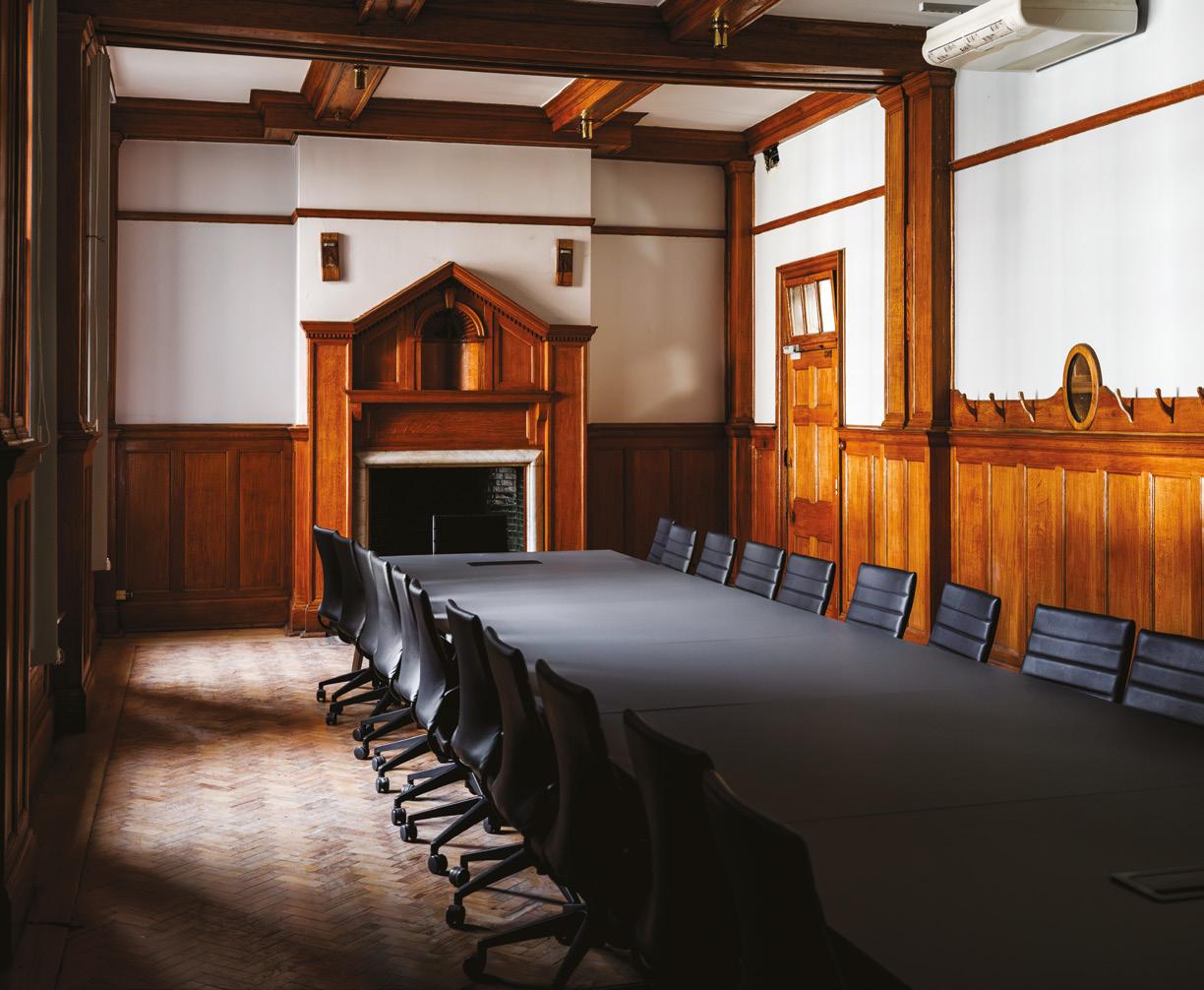
The building’s Edwardian heritage is evident throughout its ornate plasterwork, high arched windows and original Burmese teak timber windows. These historical features have been carefully preserved alongside later additions from different construction periods, including the 1937 south block with its concrete column structure. The team’s decision to maintain these historical layers creates a narrative that speaks to the building’s journey through South Africa’s architectural evolution.
BALANCING PRESERVATION WITH INNOVATION
The restoration presented numerous technical challenges requiring innovative solutions that did not compromise the building’s heritage significance. The integration of modern systems – including HVAC, IT infrastructure and fire safety equipment – within the constraints of low floor-to-ceiling heights and irregular layouts demanded creative engineering approaches.
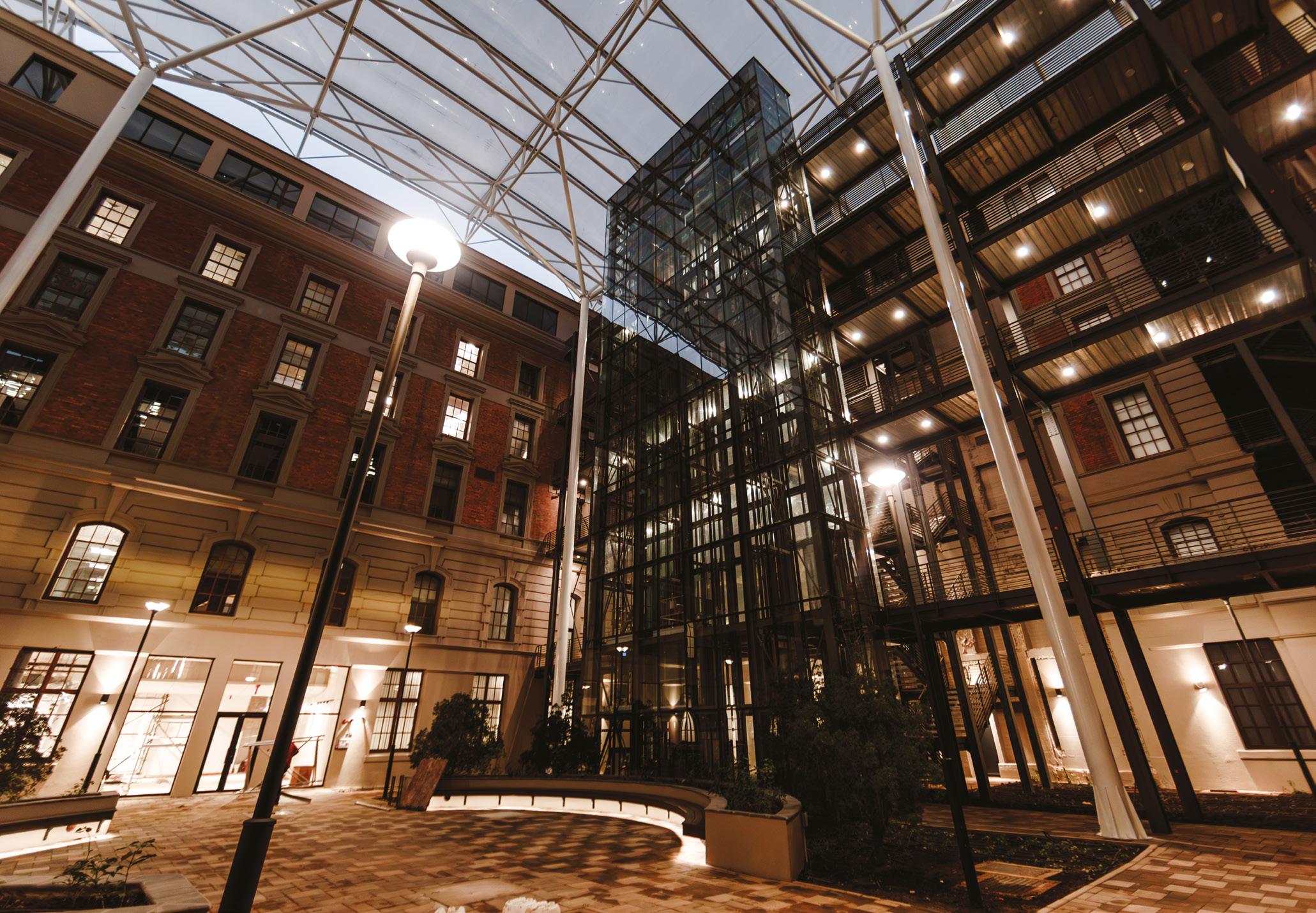
One of the most significant interventions was the introduction of a central atrium featuring a steel circulation spine and ETFE roof, creating a dramatic focal point that brings natural light into the heart of the building. Glass-fronted meeting rooms have been strategically positioned to maintain visual connectivity while respecting the original architectural rhythm. These contemporary additions, deliberately crafted in glass and steel, provide a clear visual distinction from the heritage fabric while complementing the Edwardian aesthetic.
The restoration also addressed longstanding infrastructure issues, including the implementation of a sophisticated roof drainage system and underground stormwater tanks. Previous unsightly external modifications were either removed or repurposed, including the transformation of service trenches into underground tunnels that improve both functionality and urban streetscape quality.
ADAPTIVE REUSE FOR CONTEMPORARY NEEDS
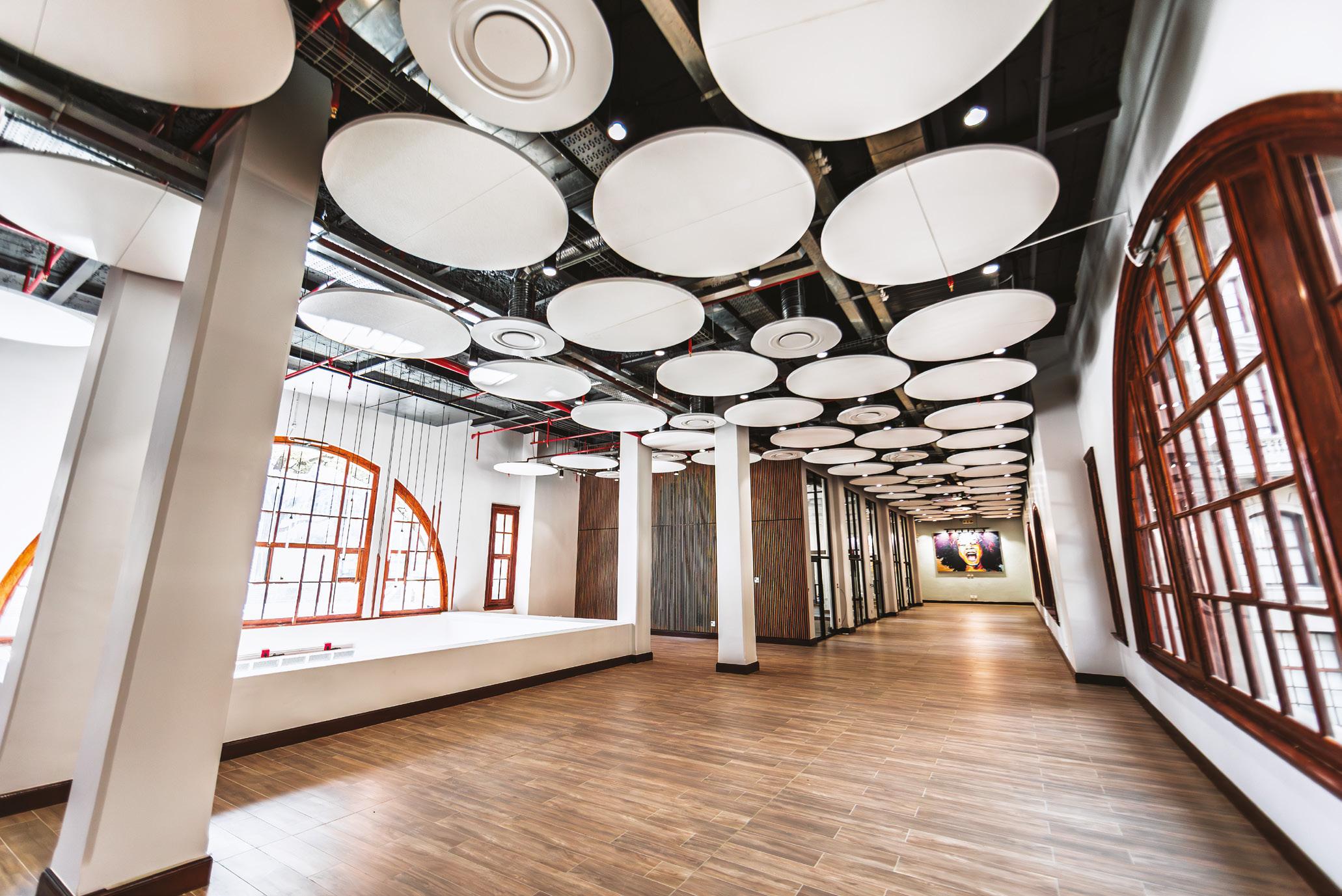
The project shows how adaptive reuse can address contemporary workplace requirements without sacrificing cultural heritage. The restored building now accommodates flexible, post-Covid workspace layouts designed for up to six departments per floor, complete with chill areas, meeting pods and modern service infrastructure. This transformation demonstrates the economic and environmental benefits of heritage restoration compared to demolition and new construction.
The preservation of original timber windows proved particularly successful, with the team discovering that light sanding was sufficient to restore the Burmese teak to excellent condition. Similarly, the decorative plasterwork was largely maintained in its original state, with conservation decisions influenced by both budget considerations and the limited availability of skilled traditional craftspeople in the region.
SKILLS DEVELOPMENT AND COMMUNITY IMPACT
Beyond its architectural achievements, the restoration project has made significant contributions to skills development within South Africa’s construction industry. Built-environment students received hands-on training in heritage restoration techniques, addressing a critical skills gap in traditional building conservation. This educational component ensures that knowledge of heritage restoration practices is passed to the next generation of construction professionals.
The project team also implemented various community upliftment initiatives, including uniform donations to local schools and winter relief programmes. These initiatives reflect a broader commitment to social responsibility that extends the project’s impact beyond architectural preservation.
A CATALYST FOR URBAN REGENERATION
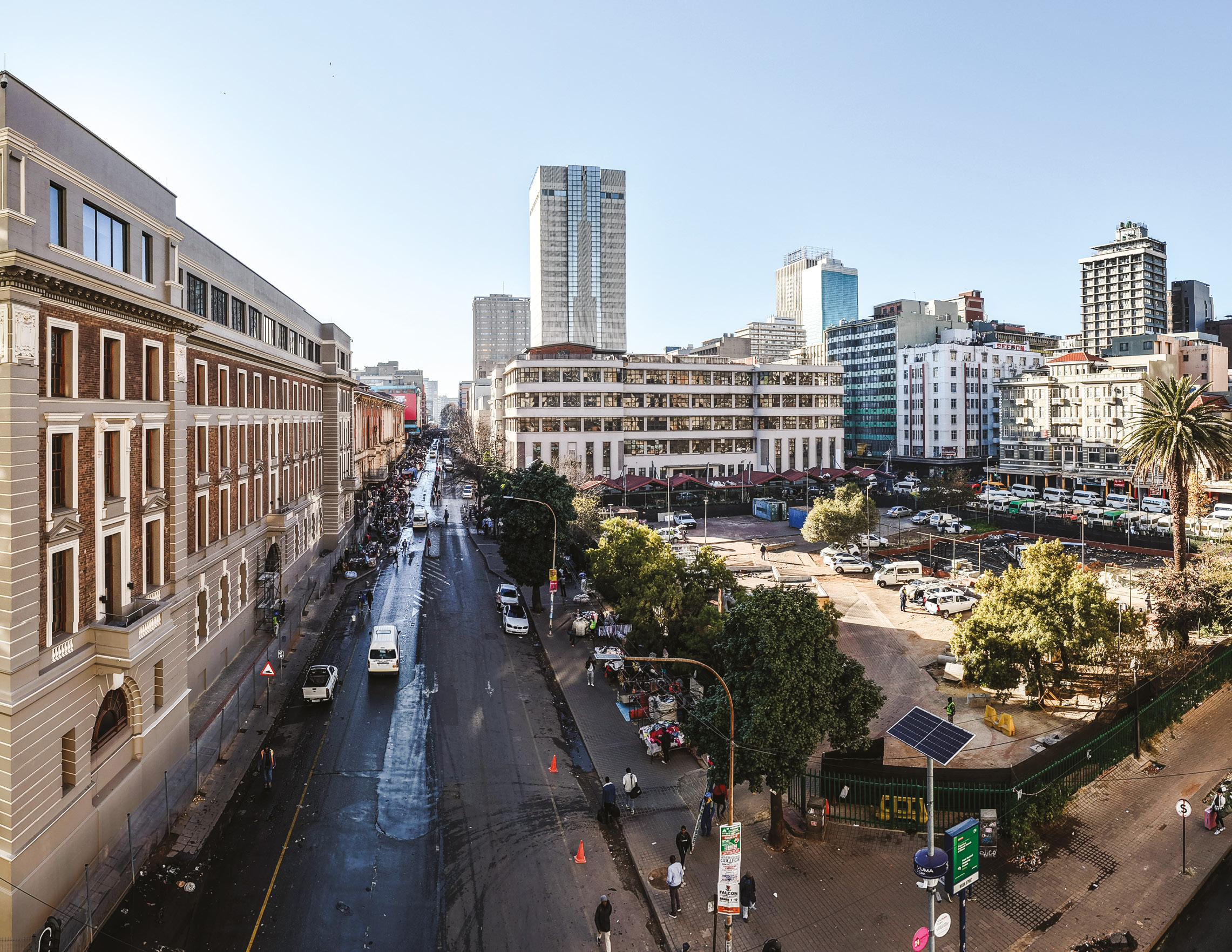
The restoration of 96 Rissik Street serves as a crucial anchor point in Johannesburg’s broader inner-city regeneration strategy. Located adjacent to Park Station, one of the city’s major transport hubs, the building occupies a strategically significant position within the urban fabric. Its restoration signals confidence in the inner city’s future while providing a model for other heritageled development projects.
The project’s approach to creating a ‘welcoming public edge’ contributes to streetscape improvement and demonstrates how heritage buildings can enhance rather than constrain urban vitality. By maintaining the building’s civic presence while adapting it for contemporary use, the restoration supports long-term economic sustainability and reinforces Johannesburg’s cultural identity.
TECHNICAL EXCELLENCE MEETS HERITAGE SENSITIVITY
The technical complexity of the restoration cannot be overstated. The building’s multiple construction phases, spanning from the Edwardian era to 1970s additions, created a complex structural puzzle that required careful analysis and innovative solutions. Variations in structural systems – from early steel framing to later concrete columns – demanded adaptable approaches to modern service integration.
Water damage, vandalism and decades of deferred maintenance had taken their toll on the building’s fabric, requiring extensive remedial work. The restoration team’s commitment to ‘repair rather than replace’ ensured that original materials were preserved wherever possible, maintaining the building’s historical integrity while ensuring structural soundness for future generations.
SETTING NEW STANDARDS FOR HERITAGE CONSERVATION
The success of the 96 Rissik Street renovation lies not merely in preserving historical architecture but in demonstrating how heritage buildings can be viable, sustainable and economically productive while maintaining cultural significance.
The project’s emphasis on environmental sustainability through adaptive reuse, combined with its contribution to skills development and urban regeneration, creates a compelling case study for similar projects throughout South Africa. As cities grapple with the challenges of urban decay and the loss of historical character, this restoration provides a roadmap for heritage-led development that serves contemporary needs while honouring the past.
Project team
Client: Transnet Properties Architects: Osmond Lange Architects
Project manager and consulting engineer: Lodemann Quantity
surveyor: Takgalang Consulting
NEXT LEVEL
THERMAL BARRIER INSULATION ENGAGED
ALUFOIL® FR DOUBLE-SIDED HEAVY INDUSTRIAL GRADE
ALUFOIL® FR WHITE HEAVY INDUSTRIAL GRADE
ALUFOIL® FR LITE DOMESTIC GRADE
In Cape Town’s historically rich Salt River Triangle, a mixed-use development is redefining how contemporary architecture can honour industrial heritage while addressing urgent urban housing needs.
PHOTOGRAPHY: Paris Brumme
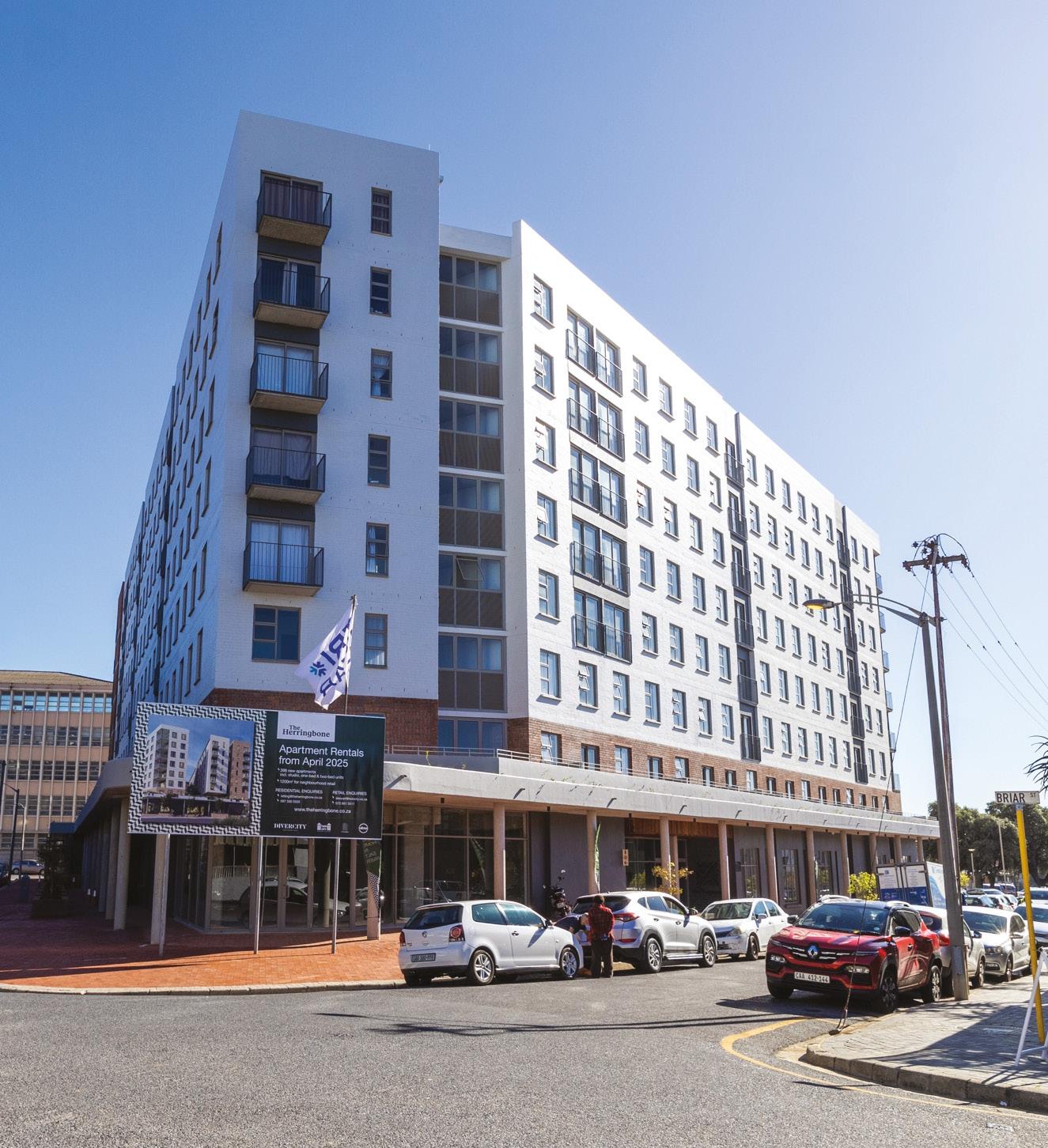
The Herringbone, a 398-unit affordable rental housing complex designed by GASS Architecture Studios, represents a thoughtful response to both the city’s housing crisis and the pressing need for neighbourhood revitalisation.
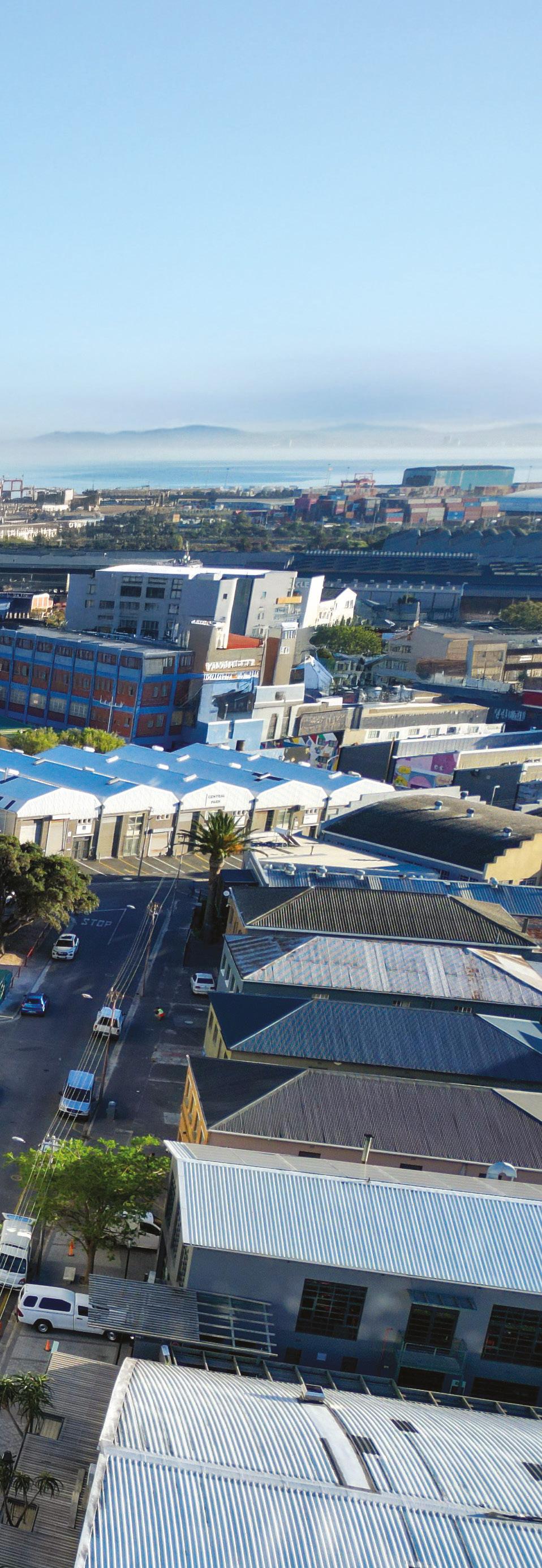
Located at 9 Hopkins Street, The Herringbone occupies a pentagonal site that once formed part of the city’s textile and clothing industry hub. This historically significant precinct, anchored by the iconic Rex Trueform building, had grown dormant over recent decades. The challenge facing GASS Architecture Studios was not merely to create housing, but to reactivate an entire urban environment while respecting its industrial past.
The 18 000m 2 development, completed within an impressive 15-month timeline, demonstrates how responsive design can transform underutilised urban land into vibrant community spaces. Principal agent and architect GASS Architecture Studios, working alongside landscape architects Changuion Landscape Design Studio and interior designers ACRE Studio, conceived The Herringbone as more than residential accommodation – it’s a catalyst for broader urban renewal.
THE ART OF CONTEXTUAL INTEGRATION
The Herringbone’s design philosophy centres on creating an understated background building that complements rather than competes with its surroundings. This approach reflects a mature understanding of urban design principles, where new developments enhance existing urban fabric rather than overwhelming it.
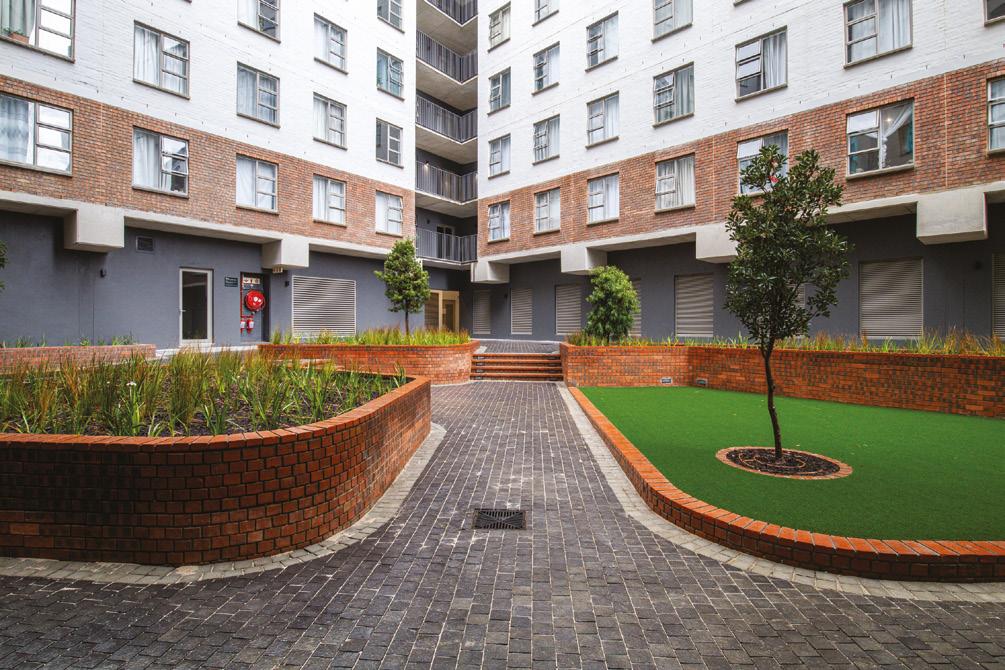
The building’s perimeter structure wraps around a central courtyard that opens to the north, maximising natural light and airflow – a passive environmental strategy that reduces reliance on mechanical systems. This courtyard design not only serves environmental functions but creates opportunities for community interaction within the development.
At street level, the design deliberately evokes historical urban patterns through colonnades, corner shops and active public interfaces. These elements recall the pedestrian-friendly streetscapes that once characterised Salt River, while meeting contemporary safety and accessibility standards.
PROJECTS
The building’s façade treatment demonstrates sophisticated contextual sensitivity. Drawing inspiration from the adjacent Rex Trueform building and smaller industrial structures throughout the area, the design balances face-brick elements with flush-jointed painted façades. This material palette creates visual continuity while allowing The Herringbone to maintain its own distinct identity.
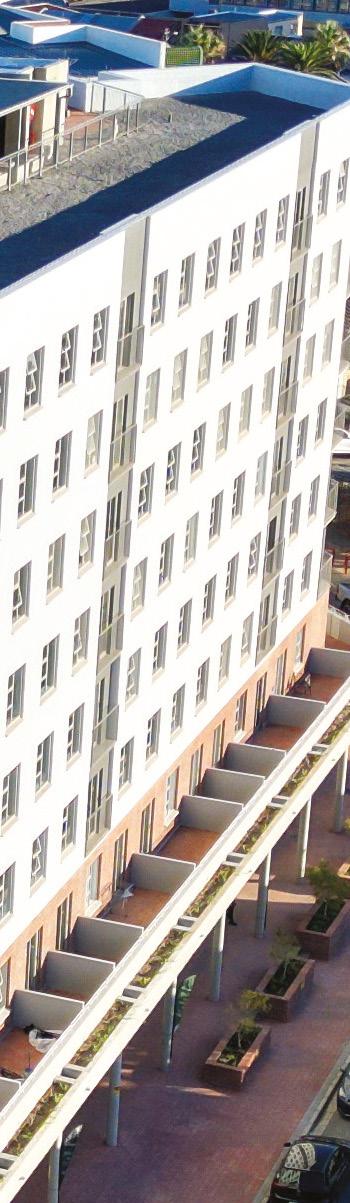
Upper levels feature carefully articulated massing through recessed and floating elements that enhance urban scale. Pop-out balconies and wraparound balconies provide residents with outdoor space while enabling passive surveillance of surrounding streets and the adjacent public park – a key principle in creating safer urban environments.
The project’s commitment to sustainability extends beyond passive design strategies to include material reuse. Timber reclaimed from existing buildings on the site has been incorporated into cladding elements, demonstrating how thoughtful resource management can reduce environmental impact while preserving historical connections.
ADDRESSING URBAN HOUSING CHALLENGES
With nearly 400 affordable rental units, The Herringbone makes a significant contribution to addressing Cape Town’s housing shortage. However, the project’s impact extends beyond mere unit count. By integrating retail and restaurant spaces at ground level, the development creates economic opportunities for small businesses while ensuring streetlevel activation that enhances neighbourhood vitality.
This mixed-use approach reflects contemporary best practices in urban planning, where residential developments are designed to support broader community needs rather than function as isolated housing estates. The retail spaces connect with public sidewalks, creating a pedestrian-friendly environment that encourages local economic activity.
Sustainability considerations permeate every aspect of The Herringbone’s design. The north-facing courtyard cutout maximises natural lighting and ventilation, reducing energy consumption for lighting and climate control. Integrated greenery throughout the development improves the urban microclimate while enhancing biodiversity –crucial factors in creating resilient urban environments.
Energy-efficient materials and passive solar strategies, which earned the project an EDGE post-construction certification, demonstrate its environmental credentials. These features align with global net-zero trends while ensuring long-term operational cost efficiency for residents.
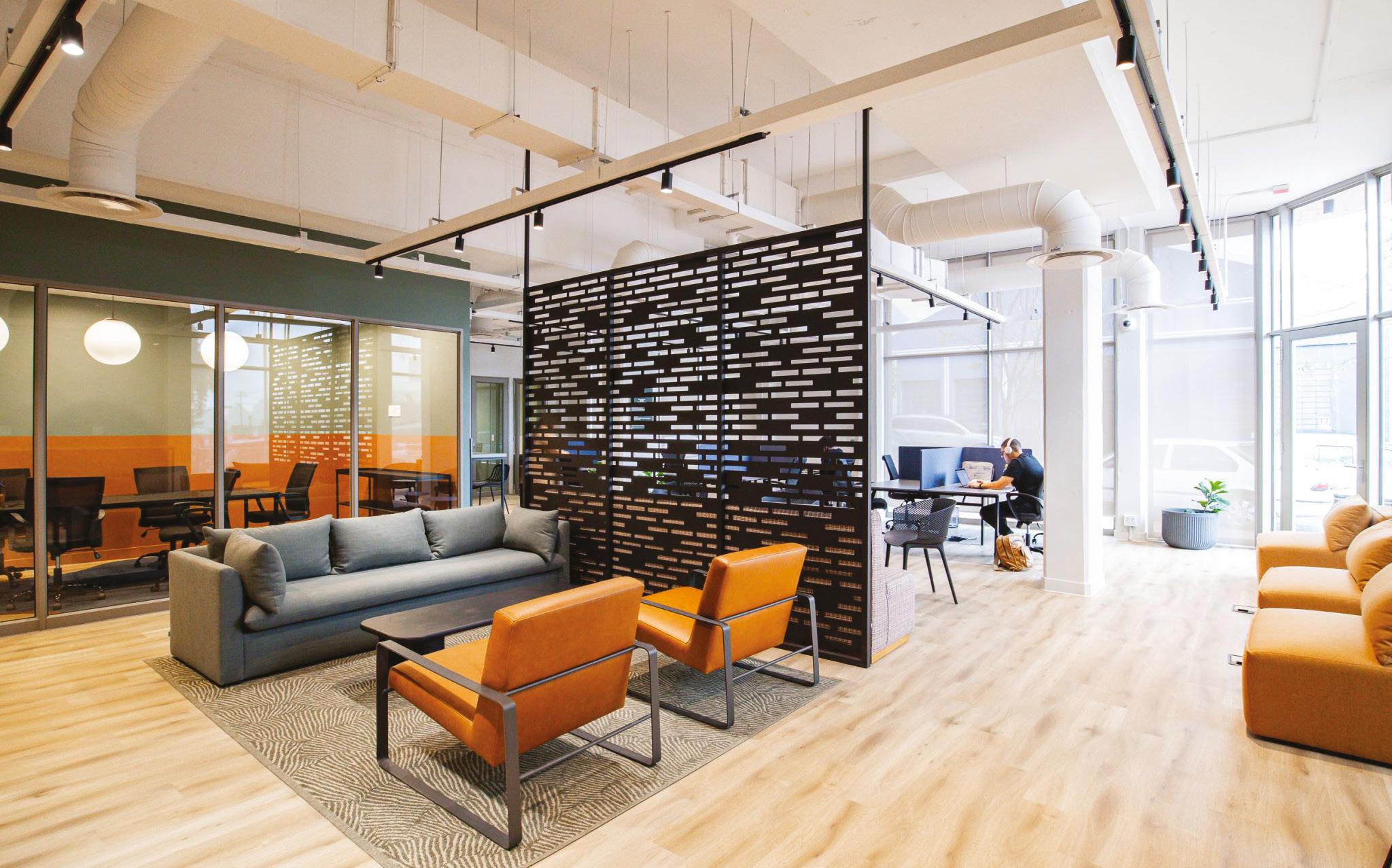
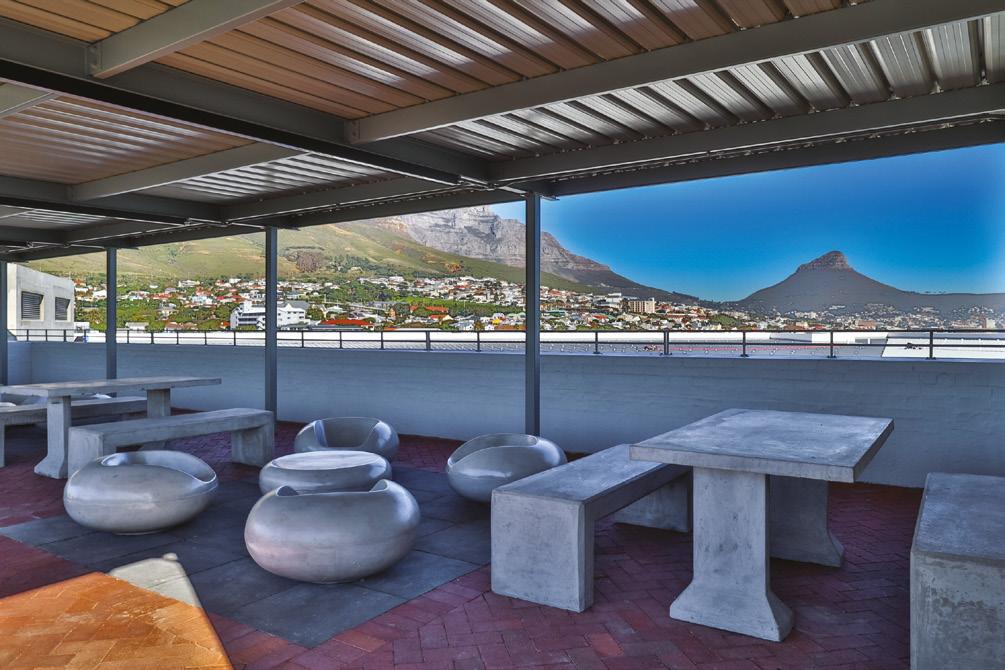
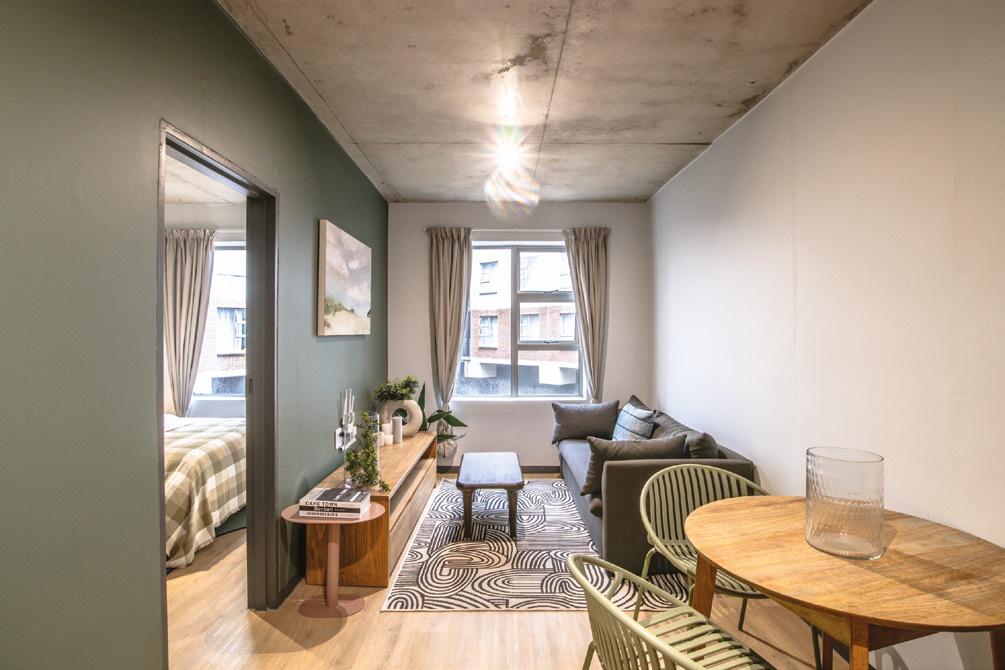
Perhaps most significantly, The Herringbone demonstrates how thoughtful design can strengthen community bonds. Amenities including co-working spaces, a clubhouse, and communal terraces provide opportunities for social interaction that extend beyond individual residential units.
The development’s design enables what urban planners call ‘passive surveillance’. Residents naturally observe surrounding public spaces, contributing to neighbourhood safety without creating fortress-like barriers. This approach reflects urban writer and activist Jane Jacobs’ theories about ‘eyes on the street’ as a foundation for urban safety.
SETTING PRECEDENTS FOR FUTURE DEVELOPMENT
The Herringbone’s success lies not merely in its architectural achievement but in its demonstration that affordable housing can be architecturally sophisticated while contributing positively to urban environments. By addressing housing needs without sacrificing design quality or community integration, the project establishes new benchmarks for South African urban development.
The development’s mixed-use programming, sustainability features, and contextual sensitivity provide a replicable model for other South African cities facing similar housing and urban regeneration challenges. As cities across the continent grapple with rapid urbanisation, The Herringbone demonstrates that thoughtful design can address multiple urban challenges simultaneously.
The Herringbone’s impact on the Salt River Triangle continues to unfold. The development has succeeded in reactivating public spaces, supporting local businesses, and providing quality affordable housing – three crucial elements of successful urban renewal.
More importantly, the project demonstrates that contextual architecture need not sacrifice innovation or environmental performance. By honouring Salt River’s industrial heritage, The Herringbone proves that the future of South African cities lies not in wholesale redevelopment but in thoughtful, community-centred design that builds upon existing urban assets.
For the architecture and design community, The Herringbone represents a mature approach to urban development – one that recognises architecture’s social responsibility while delivering exceptional design quality.
As South African cities continue to evolve, projects like The Herringbone will undoubtedly influence how we think about housing, community and the built environment’s role in creating more equitable, sustainable urban futures.
Professional team
Architect and principal agent: GASS Architecture Studios Quantity surveyor: MATLA Quantity Surveyors Structural engineer: EDS Engineers Civil engineer: EDS Engineers Electrical engineer: One Zero Consulting Wet services engineer: IZAZI Consulting Engineers
Mechanical engineer: IZAZI Consulting Engineers Fire engineer: FENCO Fire Engineers and Consultants Health and safety agent: Cairnmead Landscape architect: Changuion Landscape Design
Studio Interior designer: ACRE Studio Heritage practitioner: Prof. Em. Walter Peters Main contractor: Tristar Construction EDGE consultant: Ecolution Consulting
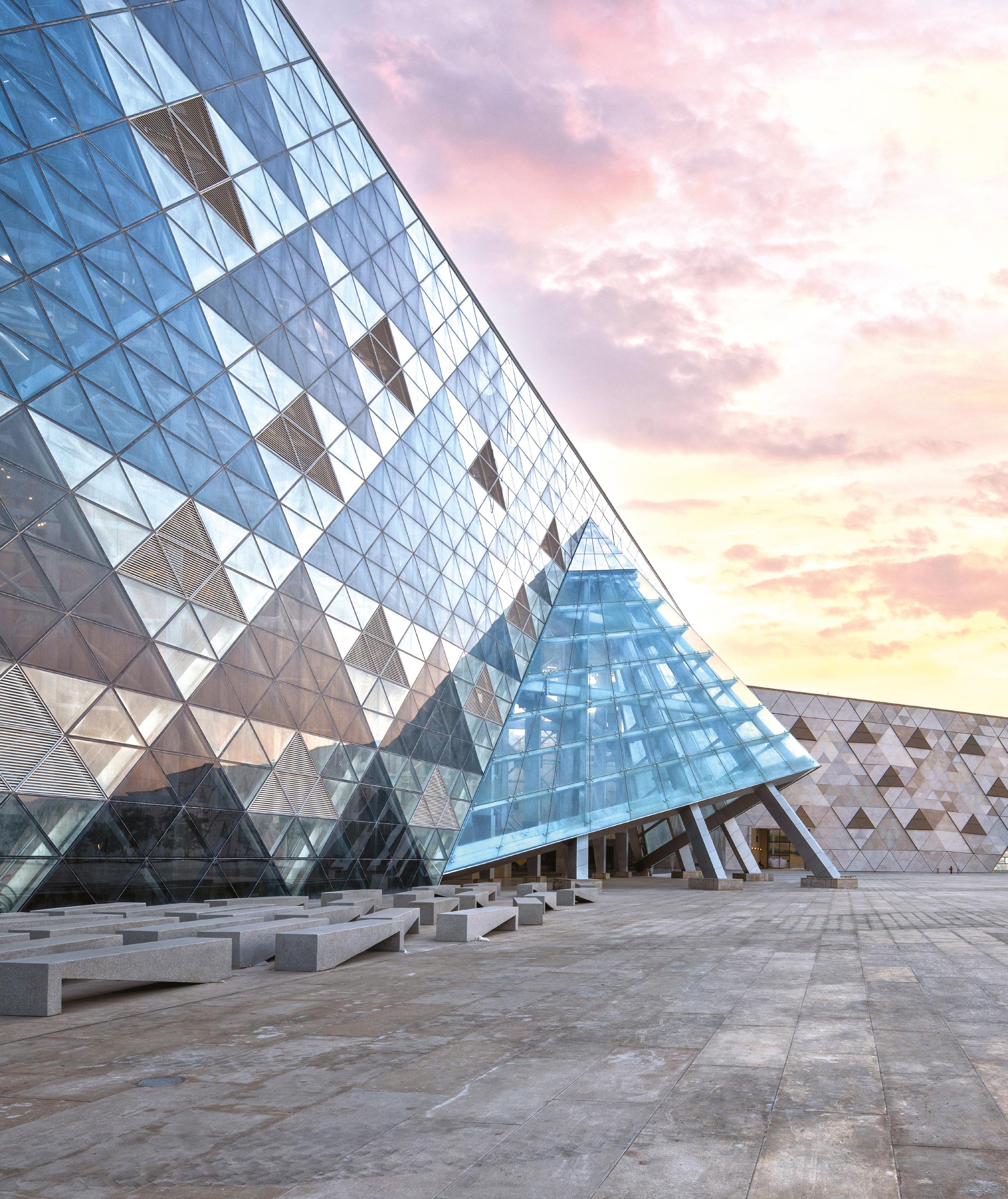
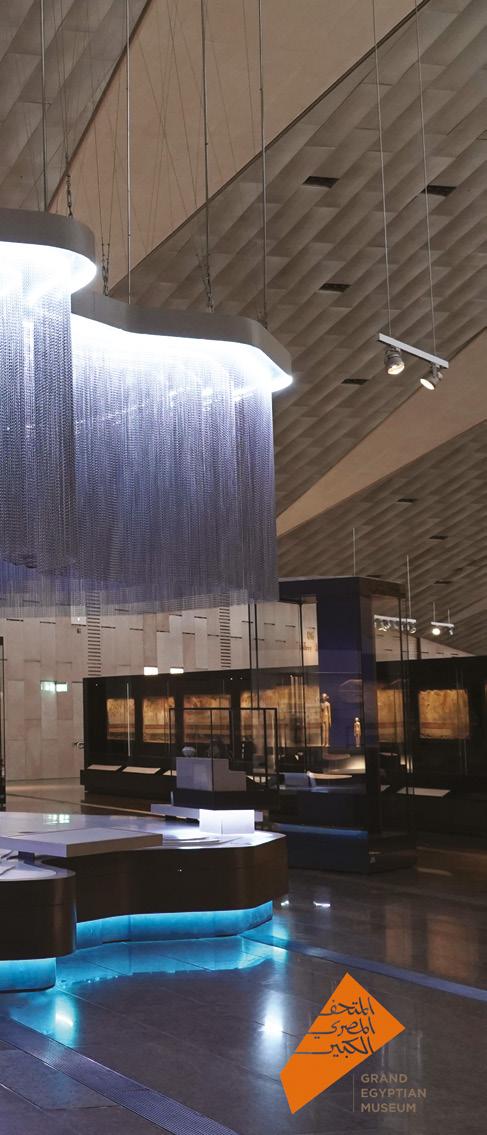
The completion of the Grand Egyptian Museum in Cairo represents one of the most significant architectural achievements of the 21st century, demonstrating how contemporary design can honour and enhance our understanding of ancient civilisations.
Monument to
modern
museology
PHOTOGRAPHY: Supplied
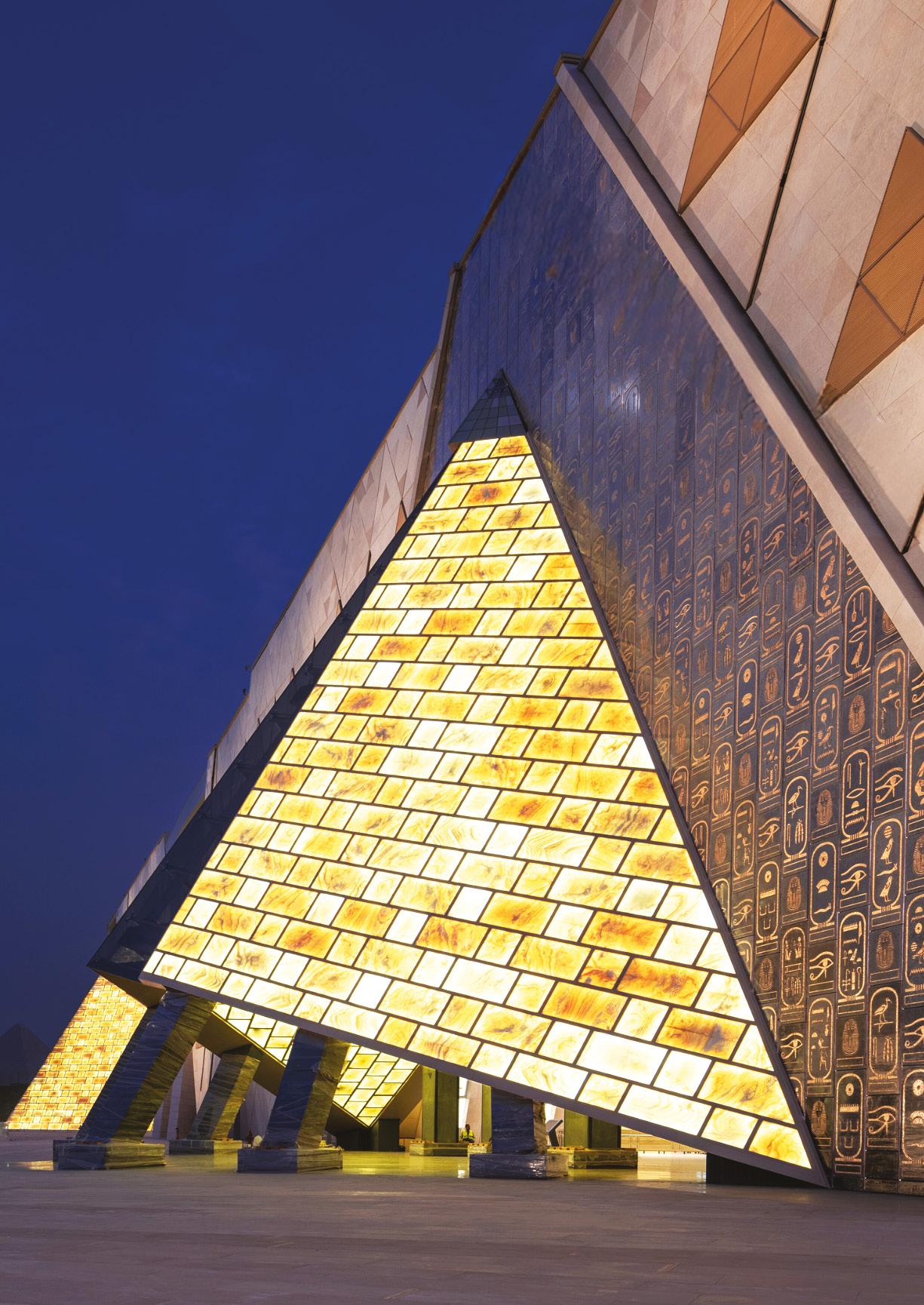
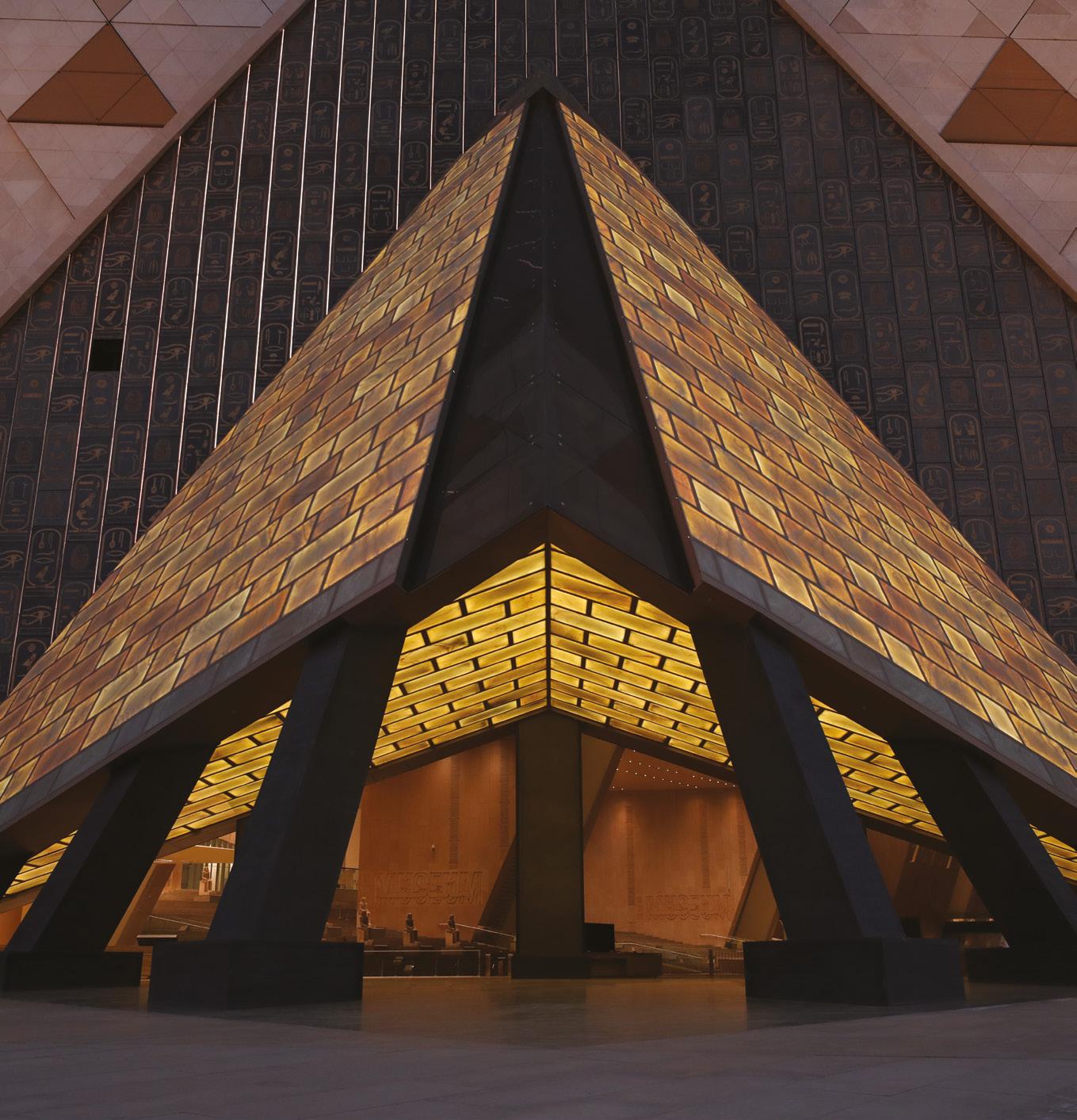
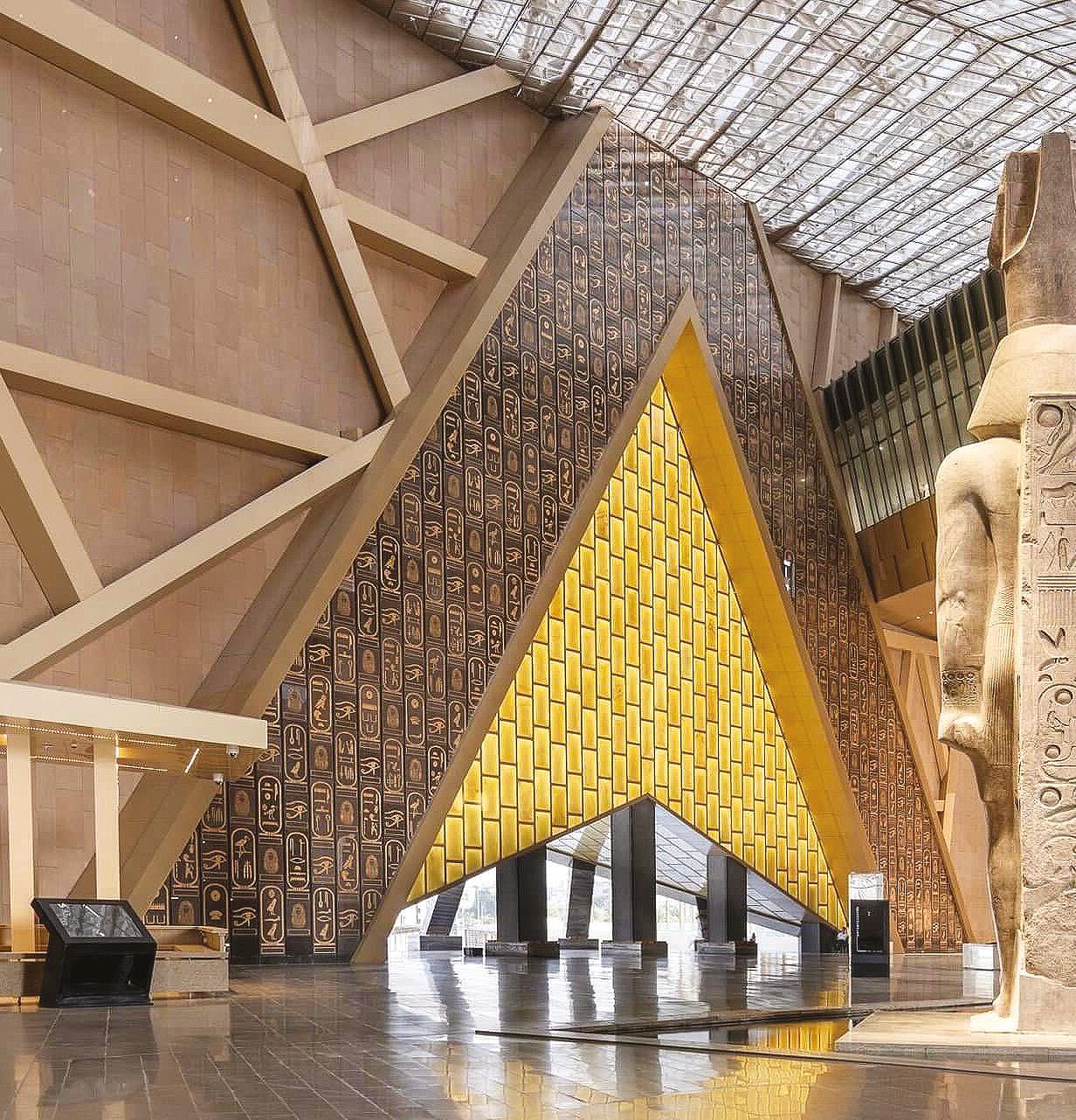
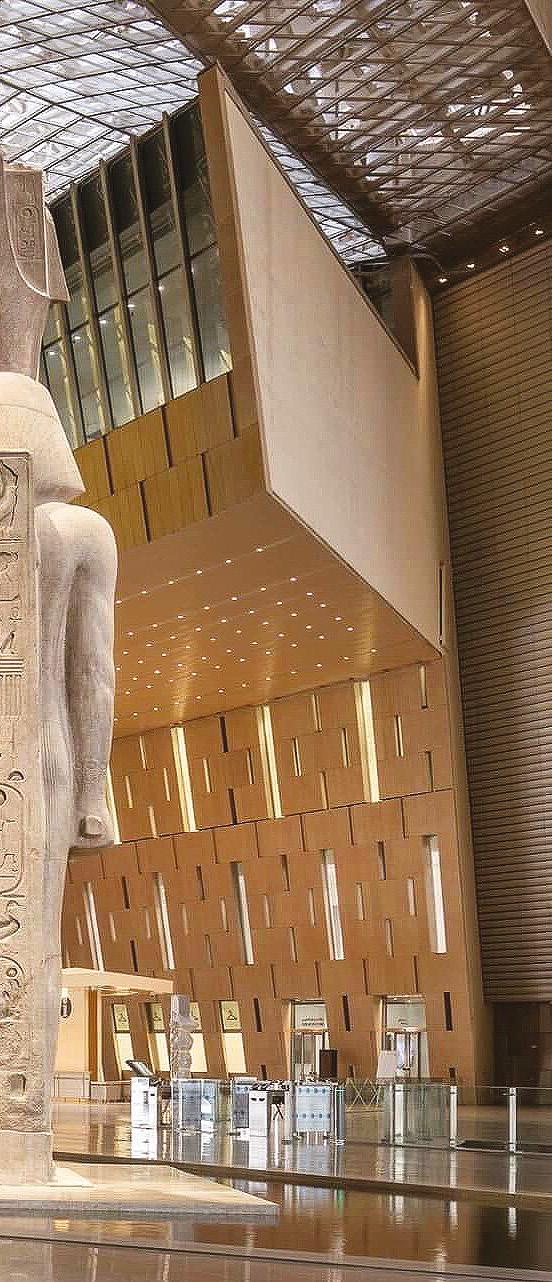
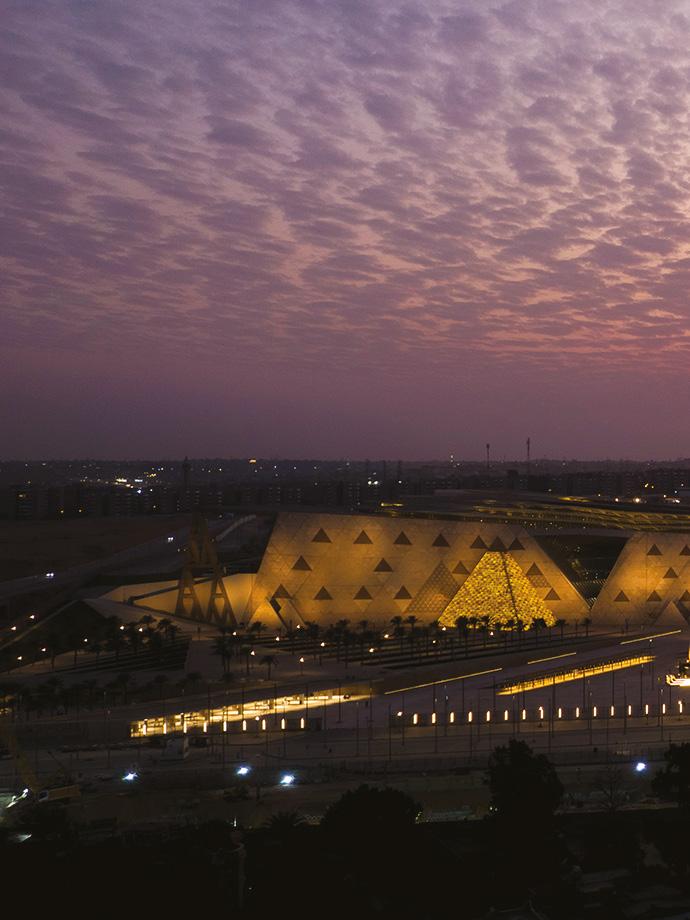
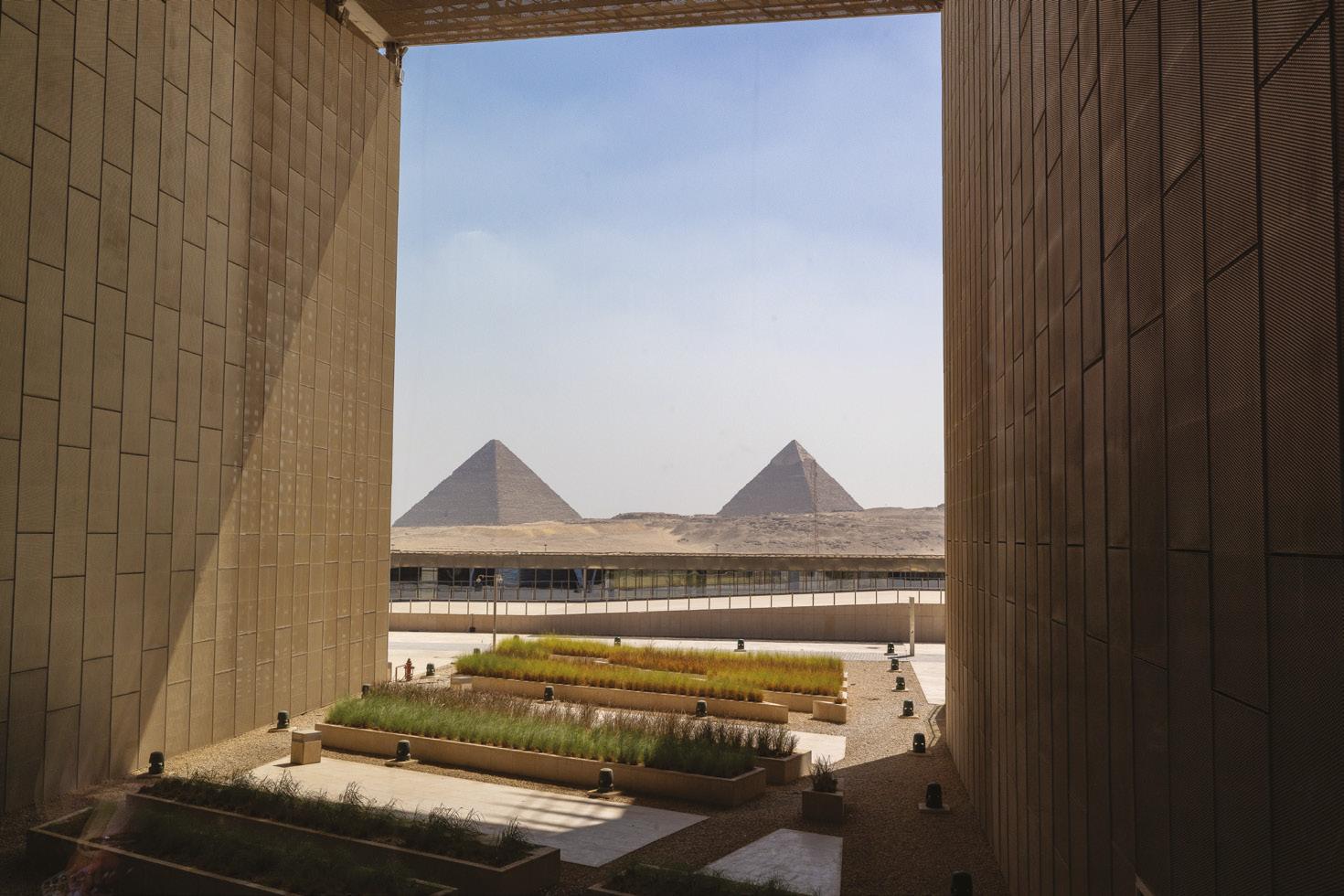
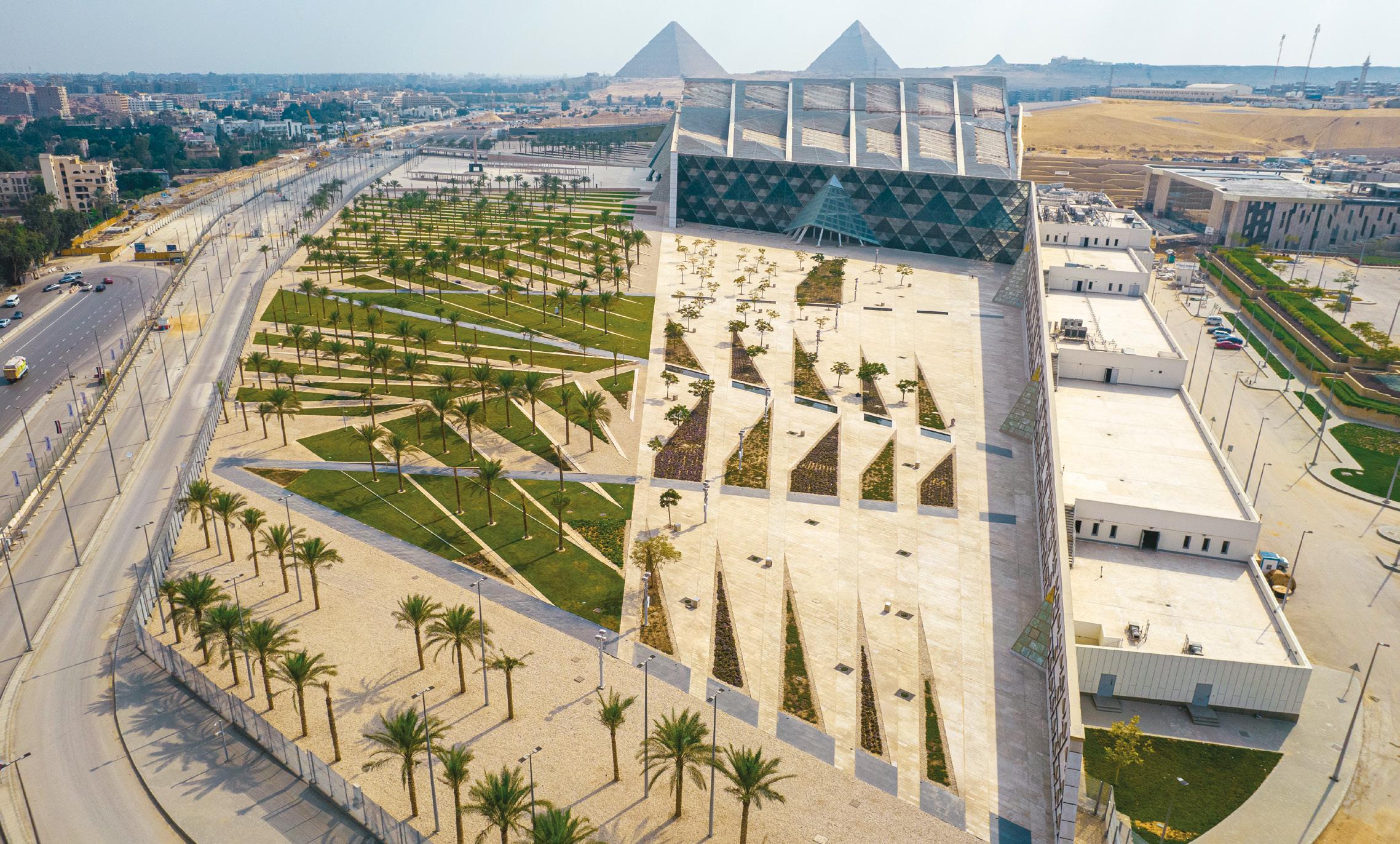
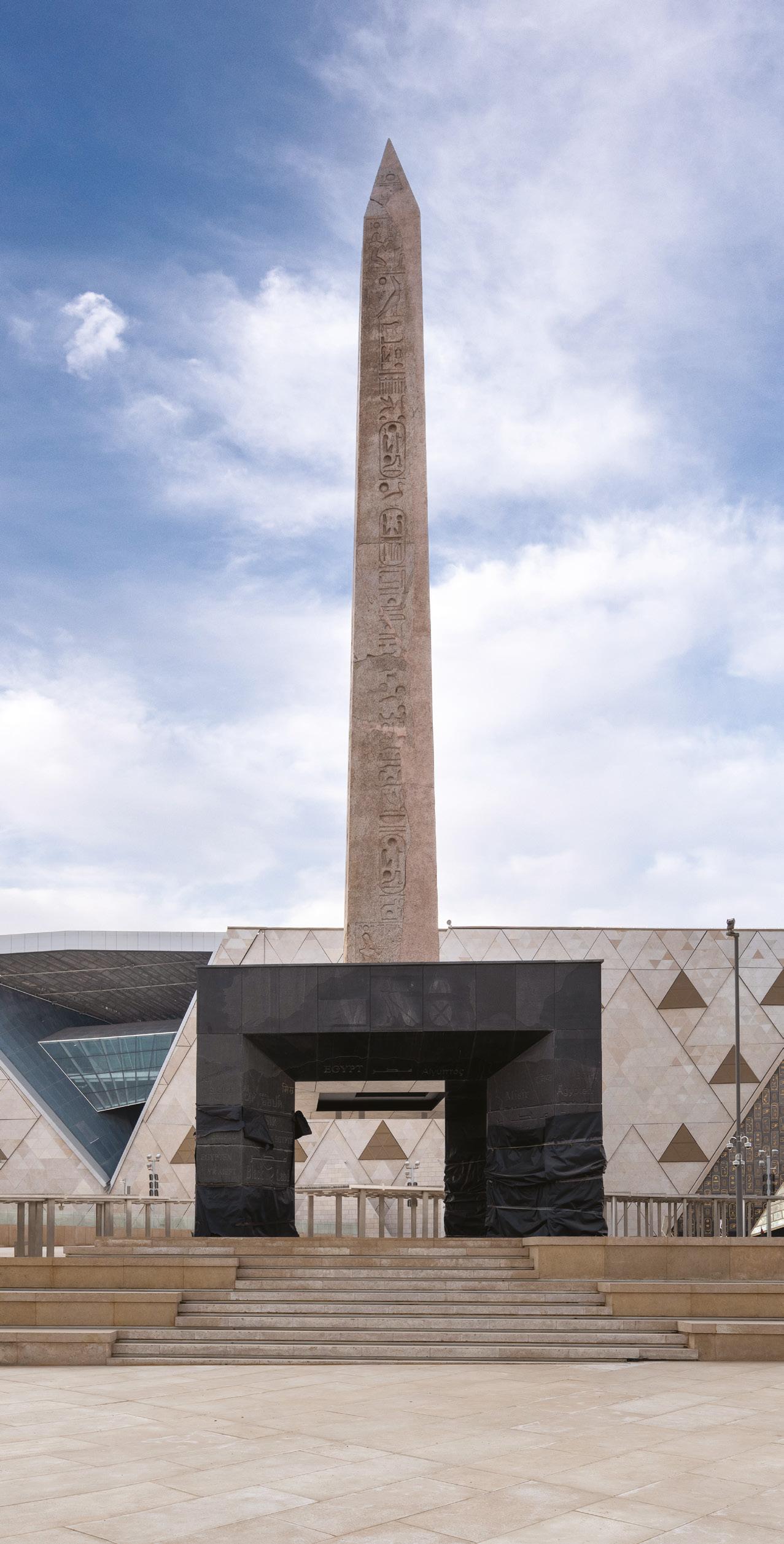
Located less than 2km from the iconic Pyramids of Giza, the Grand Egyptian Museum (GEM) establishes an unprecedented dialogue between ancient monuments and modern architectural expression. The building’s design philosophy centres on creating visual and conceptual connections with the nearby pyramids, ensuring that visitors experience a seamless journey through time while maintaining profound respect for Egypt’s archaeological heritage.
The museum’s architectural language speaks directly to its setting on the Giza plateau. Róisín Heneghan of Ireland-based heneghan peng architects explains: ‘Our design works to strengthen the connection to history and place, providing a home for some never-before-seen artefacts that rest upon the very land from which they were created. The result is an experience that evokes a sense of awe at the breadth and depth of ancient Egypt’s fascinating history in a way that feels both modern and timeless.’
This philosophical approach manifests in several key design elements. The museum’s walls radiate outward from a central focal point near the entrance, creating a distinctive fanning structure that echoes the sacred geometry found in ancient Egyptian architecture. Perhaps most dramatically, the building’s roof slopes upward along lines that point directly toward the highest pyramid yet never surpasses its height – a gesture of architectural humility that acknowledges the enduring supremacy of these ancient monuments.
The story of the GEM began in 2003 when the Egyptian Ministry of Culture launched what would become the largest architectural competition in history. From an extraordinary field of 1 556 entries representing 82 countries, heneghan peng architects emerged victorious with a design that promised to revolutionise museum architecture while preserving the sanctity of one of the world’s most important archaeological sites.
This victory was not merely about architectural innovation but represented a commitment to creating a new paradigm for museum design – one that integrates cutting-edge conservation technology with visitor experience design, sustainable practices, and deep cultural sensitivity. The competition’s scale reflected the project’s global significance and Egypt’s determination to create a world-class institution worthy of its incomparable cultural treasures.
ENGINEERING EXCELLENCE AND COLLABORATIVE INNOVATION
The realisation of such an ambitious vision required a collaborative effort involving leading international consultancies. Arup provided structural, façade, and environmental engineering expertise, whilst Buro Happold contributed sustainability consulting and building services design. The project also benefited from the museological expertise of Metaphor and Cultural Innovations, landscape design by West 8, and crucial local knowledge from Egyptian firms, including Raafat Millier Consulting and Arab Consulting Engineers.
‘Through close collaboration with the architects, deeply engaged engineers helped deliver technical performance, environmental resilience, and long-term utility alongside immense beauty,’ says Francis Archer from Arup. This integration of technical excellence with architectural vision proved essential in creating a building capable of protecting priceless artefacts while providing an inspiring visitor experience in Egypt’s challenging desert climate.
The building’s construction utilises concrete as its primary material – a choice driven by both practical and environmental considerations. This material selection helps reduce temperature variations within the museum environment, thereby minimising energy consumption while providing the thermal mass necessary for stable conservation conditions in the desert setting.
SUSTAINABLE MUSEUM DESIGN FOR THE 21ST CENTURY
Sustainability forms a cornerstone of the GEM’s design philosophy. Stephen Jolly of Buro Happold notes: ‘GEM is a state-of-theart exemplar of sustainable museum design, integrating a low-carbon conservation strategy into a striking architectural concept.’ This approach addresses the growing global imperative for cultural institutions to reduce their environmental impact while maintaining world-class standards for artefact preservation.
The museum’s passive design strategies work in harmony with the desert environment rather than against it. The building’s orientation, thermal mass and natural lighting systems combine to create optimal conditions for both visitor comfort and artefact preservation while minimising energy consumption. This sustainable approach ensures that the museum can fulfil its mission as a guardian of ancient heritage without compromising the environmental heritage of future generations.
THE VISITOR JOURNEY: CHRONOLOGY MEETS SPECTACLE
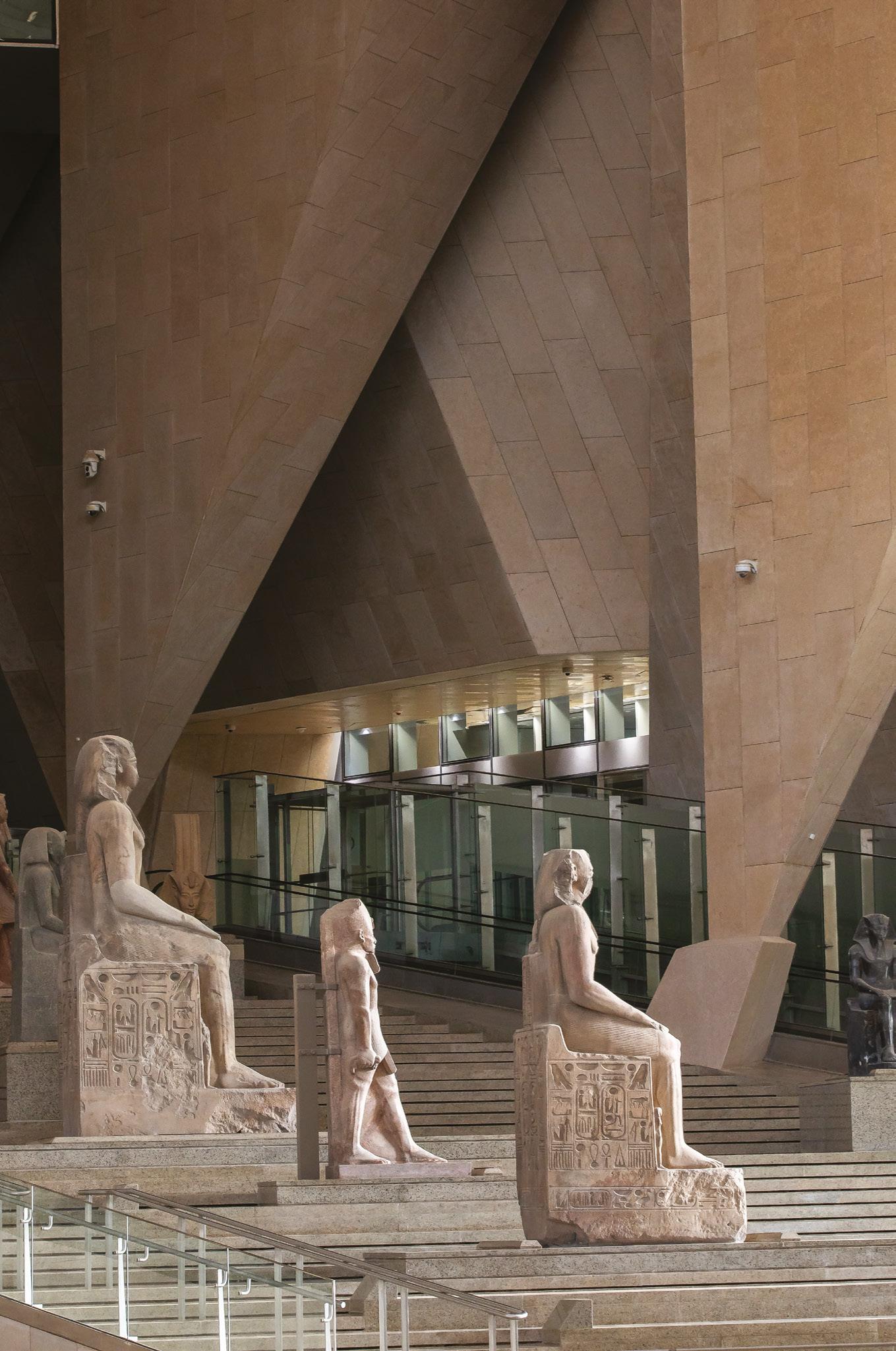
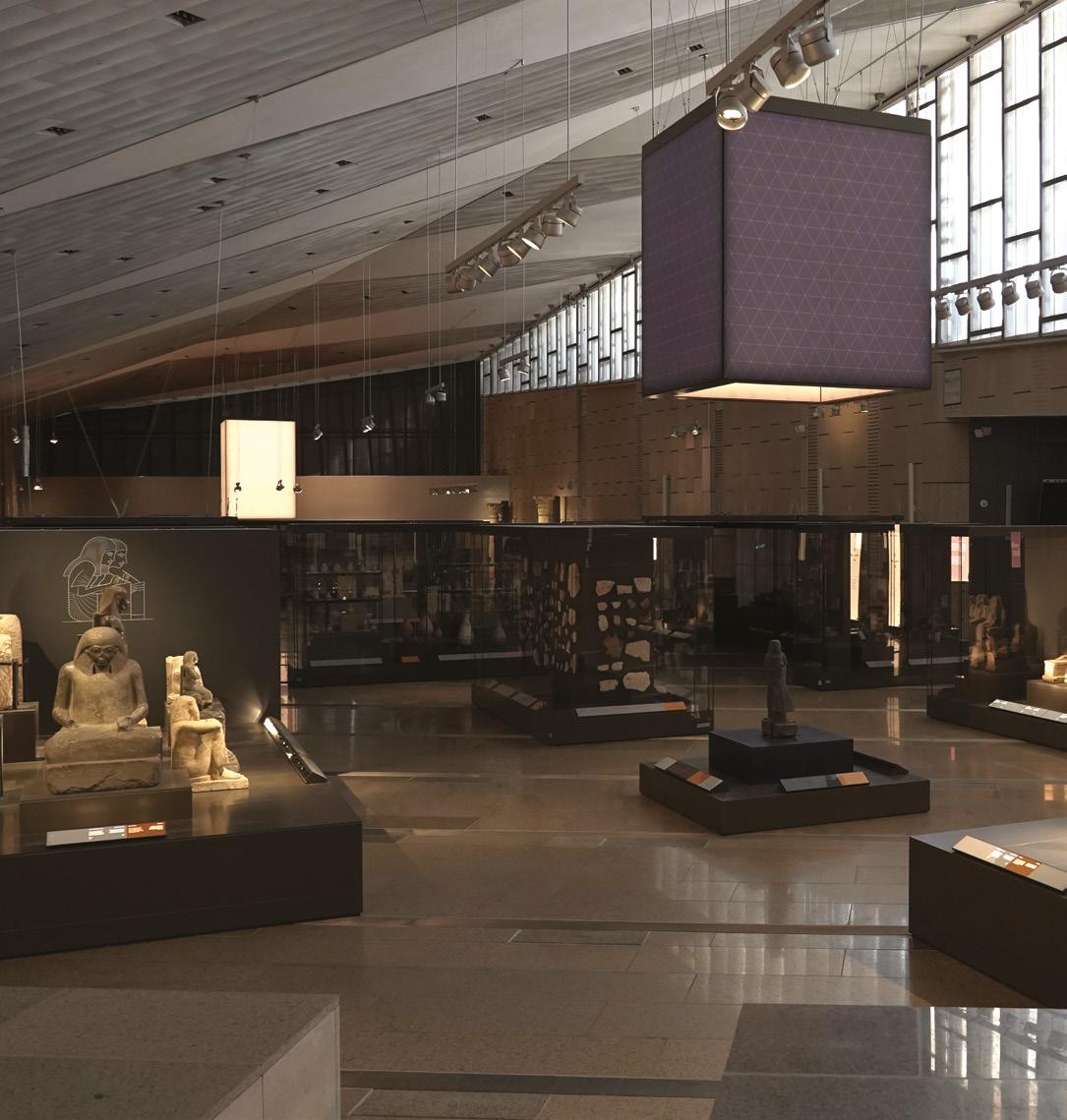
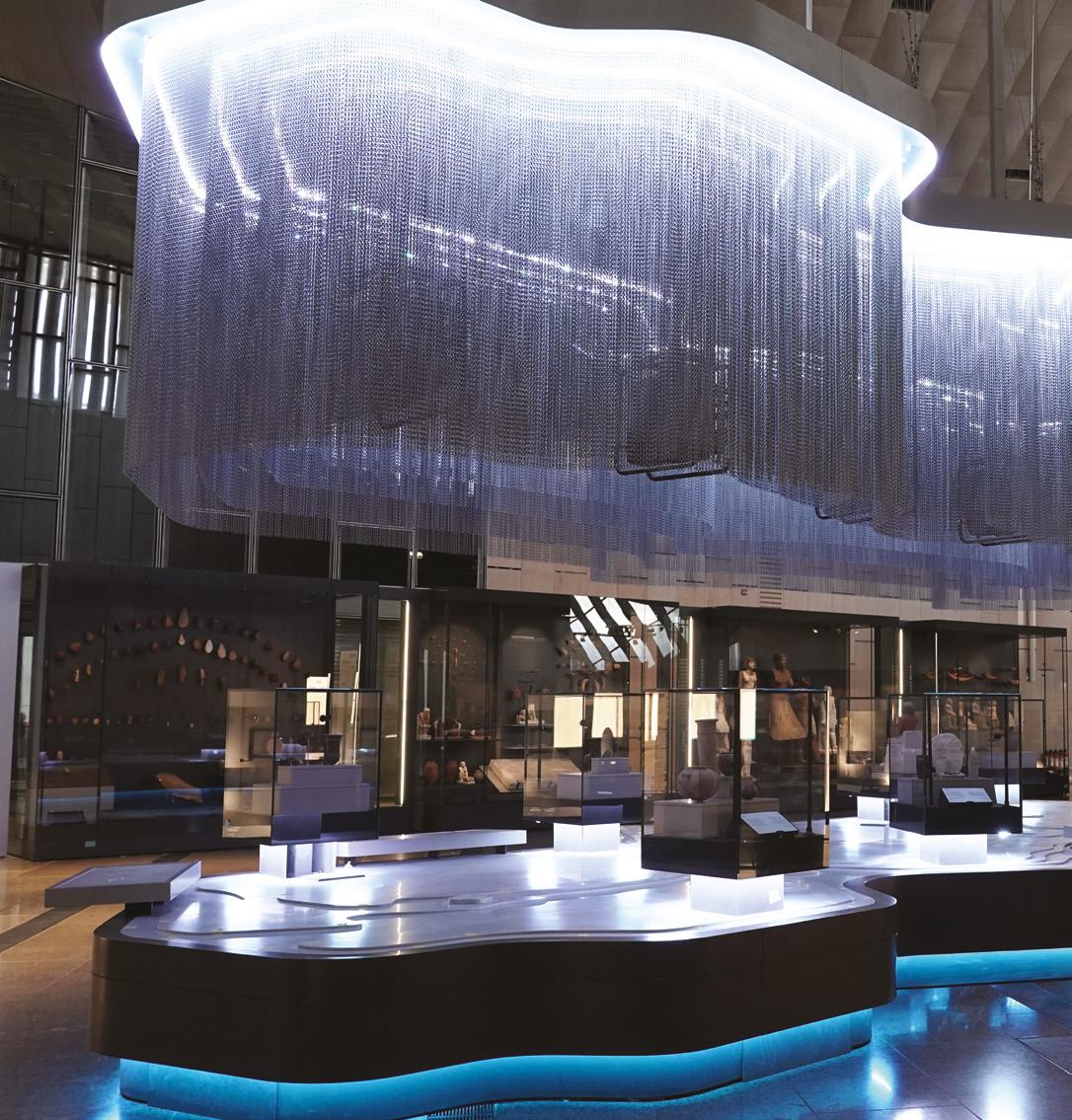
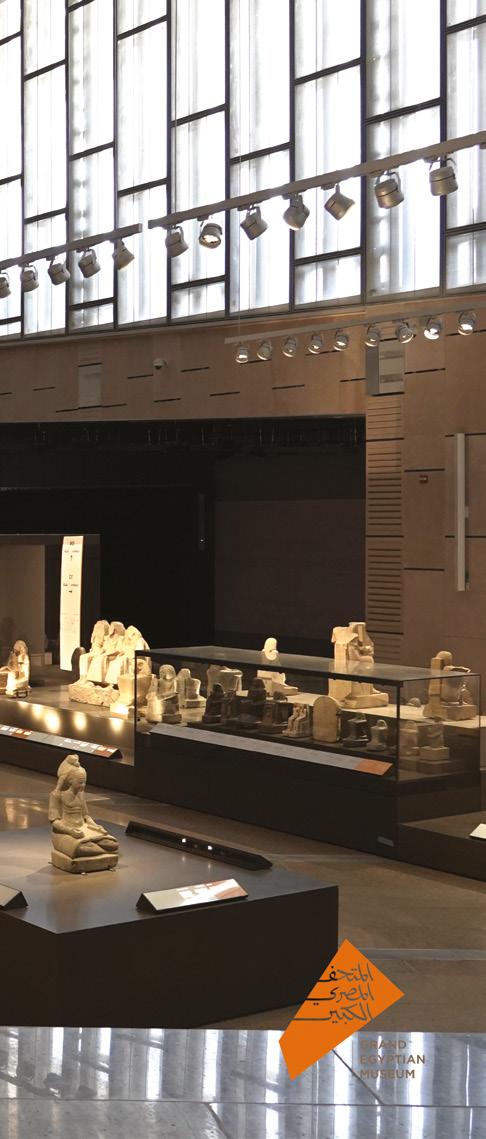
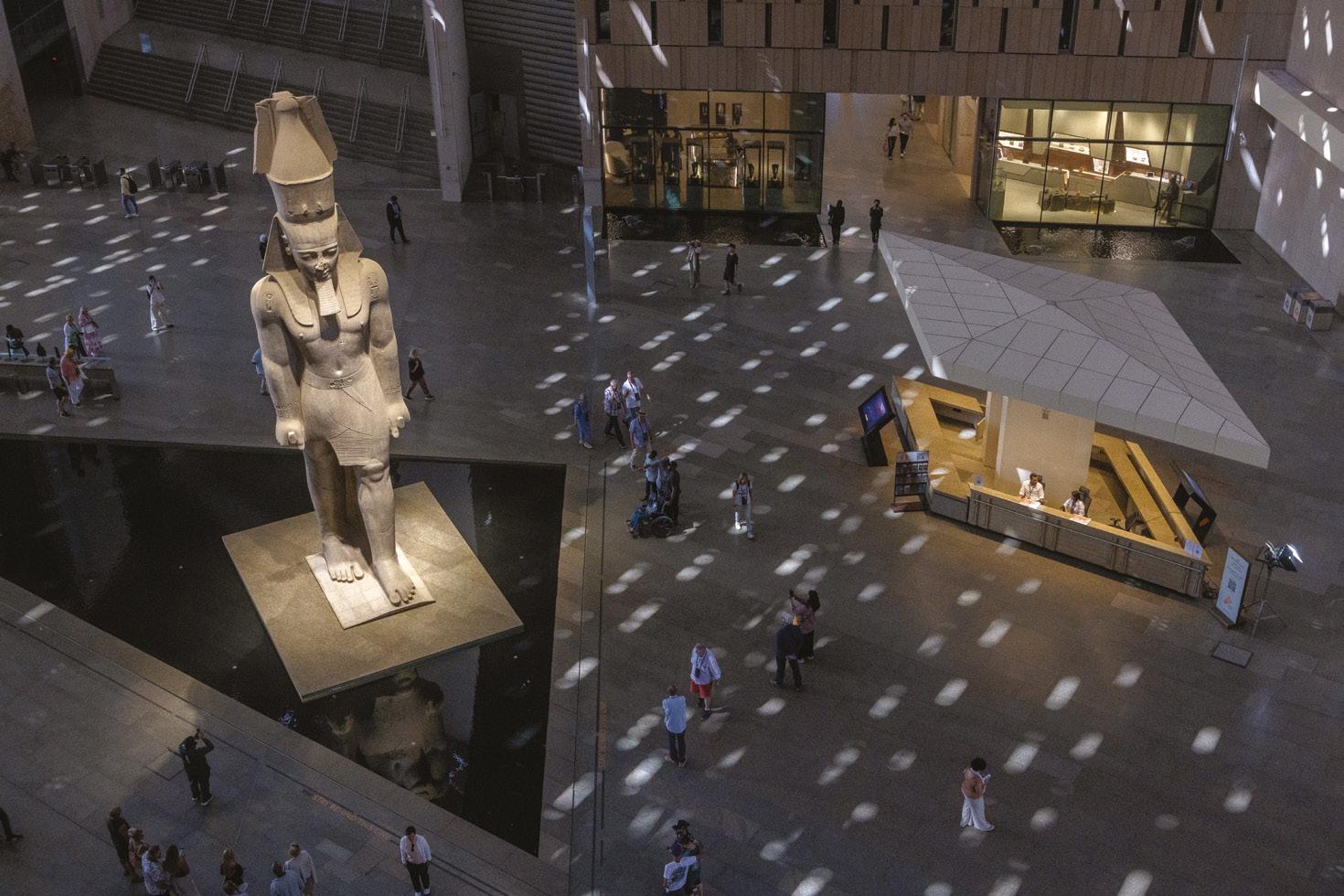
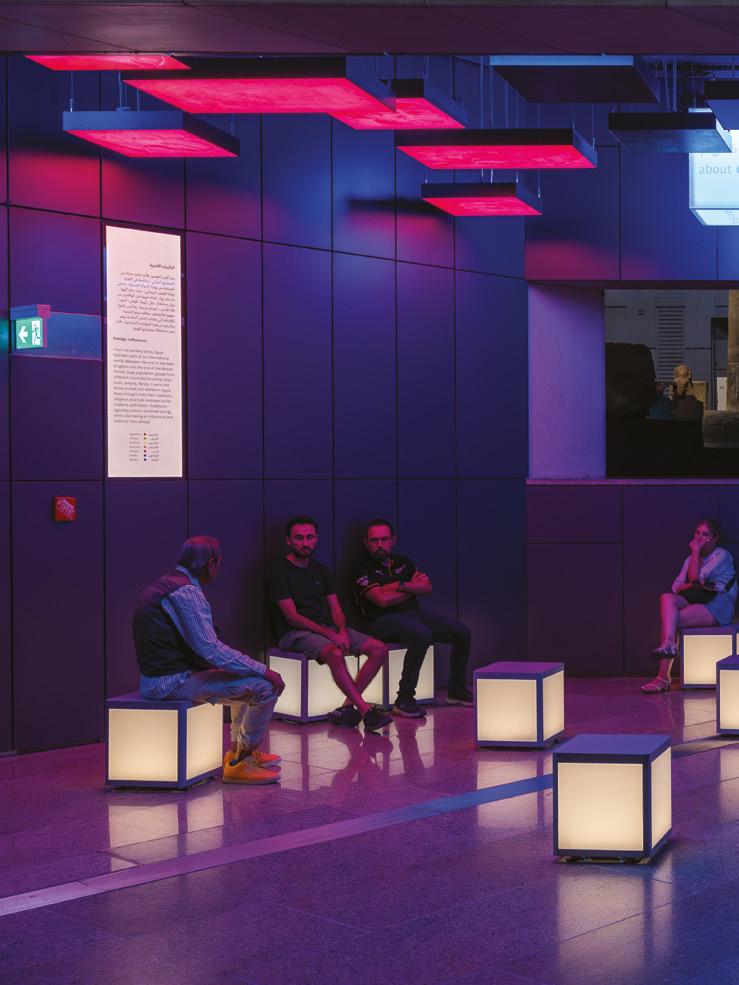
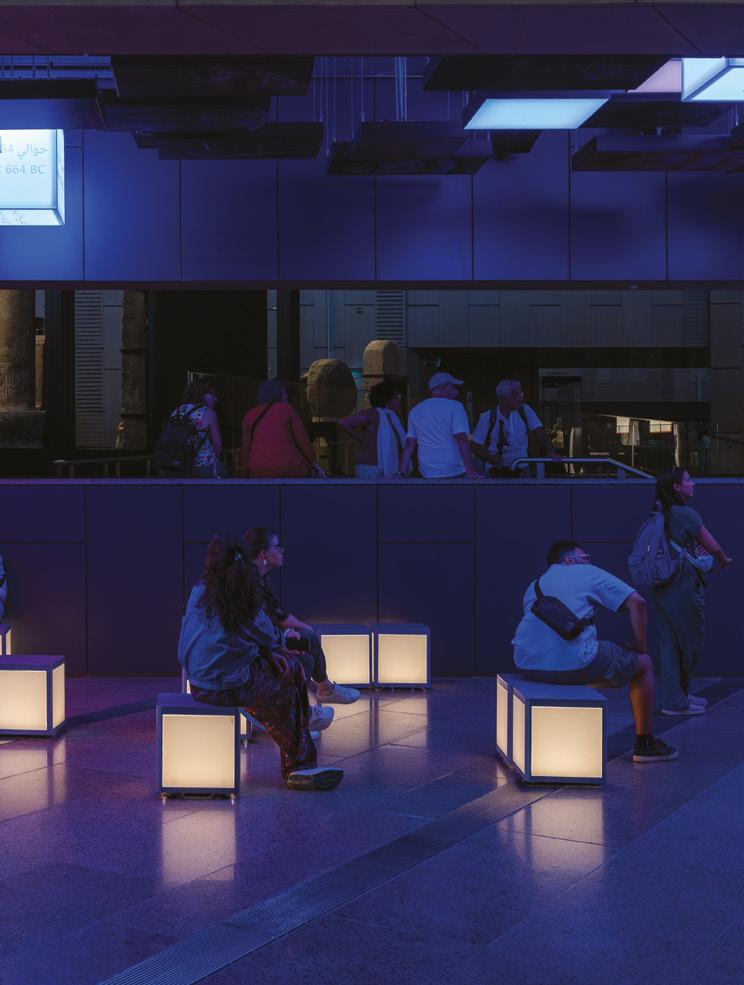
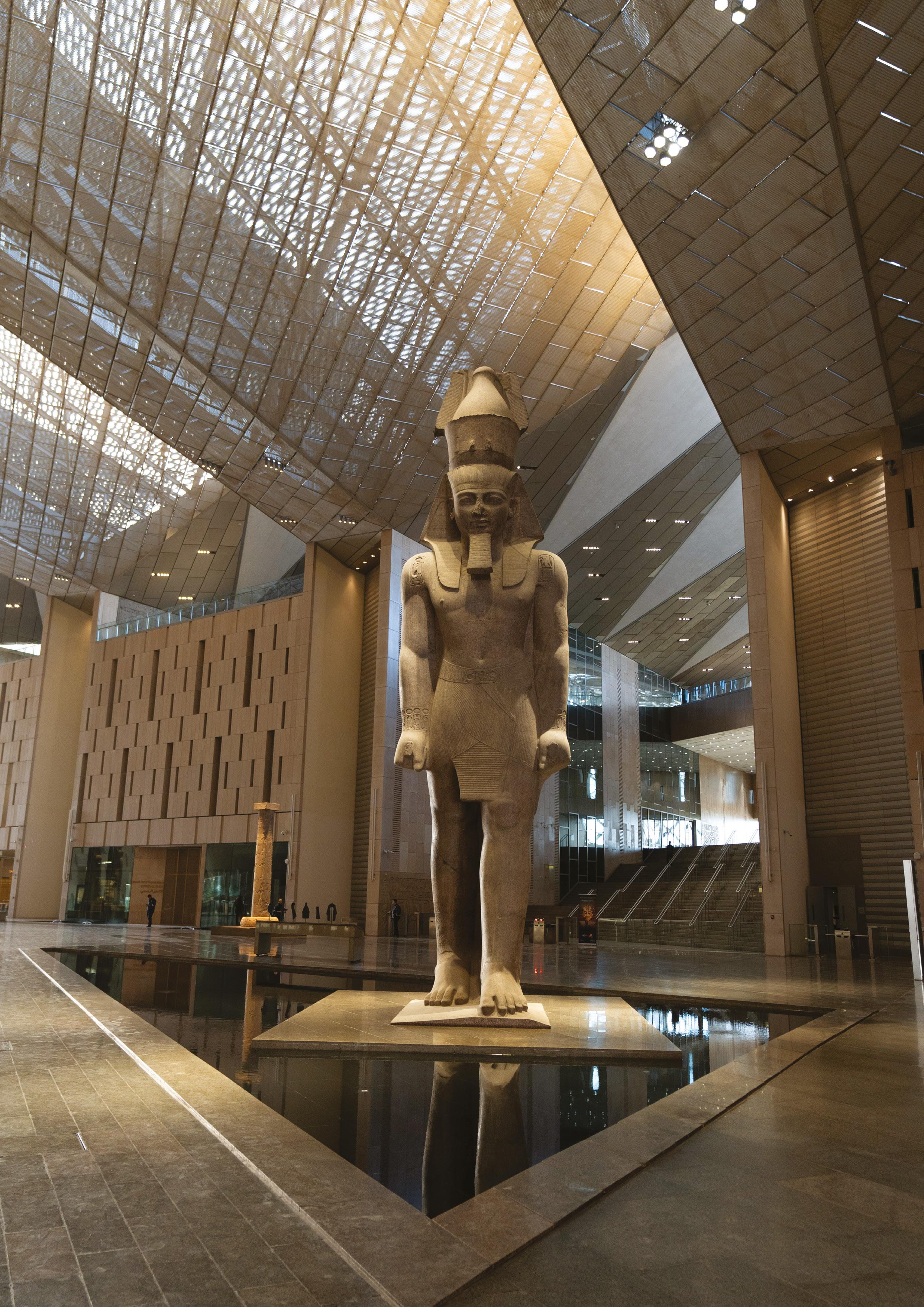
The museum’s interior design creates a carefully orchestrated journey through ancient Egyptian civilisation. The centrepiece of this experience is a magnificent six-storey grand staircase that serves as the primary route through the galleries. This architectural promenade features significant artefacts, including statues of King Senusret I, creating a chronological narrative that guides visitors from the Predynastic Period through to the Coptic era.
The staircase culminates in a dramatic view of the Pyramids of Giza, creating a powerful moment where visitors can contemplate the continuum of Egyptian civilisation, from ancient monuments to the treasures housed within the museum.
This carefully planned visual connection reinforces the museum’s role as both a guardian of the past and a bridge to contemporary understanding.
The recently opened Tutankhamun Gallery represents the crown jewel of the museum’s exhibition spaces. Housing more than 5 000 artefacts from the boy pharaoh’s tomb – many displayed publicly for the first time – this gallery demonstrates the museum’s capacity to present familiar treasures in entirely new contexts while revealing previously unseen aspects of ancient Egyptian culture.
LANDSCAPE AS CULTURAL NARRATIVE
The museum’s relationship with its landscape extends far beyond mere architectural placement. West 8’s landscape design, led by Adriaan Geuze, creates outdoor spaces that echo the authentic character of the Nile floodplain. ‘The beauty of the green foreground spaces is that they strongly echo the authentic floodplain of the Nile,’ he says.
These carefully designed gardens, spanning five hectares of outdoor exhibition areas, feature date palms and plantings that reference the agricultural foundation of ancient Egyptian civilisation. The landscape design transforms the museum experience into a comprehensive cultural journey that encompasses both built and natural environments, reinforcing the connection between Egypt’s monuments and the fertile land that sustained its civilisation.
CONSERVATION EXCELLENCE AND RESEARCH INFRASTRUCTURE
Behind the public galleries, the GEM houses world-class conservation facilities, including 17 specialised laboratories connected to the main building via underground tunnels. These facilities represent a significant investment in archaeological research and conservation science, ensuring that Egypt’s cultural treasures receive the highest standard of care while remaining accessible for scholarly research.
This infrastructure positions the museum not merely as an exhibition space but as a centre for advancing knowledge about ancient Egyptian civilisation through cutting-edge research methodologies.
The integration of conservation, research, and exhibition functions creates a holistic approach to cultural stewardship that serves both immediate visitor needs and long-term preservation goals.
GLOBAL CULTURAL IMPACT AND LEGACY
As Martyn Best of Cultural Innovations observes, ‘The GEM is both a world heritage asset and a national symbol of 21stcentury Egypt.’ This dual identity reflects the museum’s significance as both a guardian of universal human heritage and an expression of contemporary Egyptian cultural ambitions.
The museum’s completion represents more than an architectural achievement; it establishes a new benchmark for museum design in the 21st century. By successfully integrating environmental sustainability, technological innovation, visitor experience design, and profound respect for cultural heritage, the GEM provides a template for how cultural institutions can serve both their communities and global audiences while maintaining the highest standards of conservation and scholarship.
The project demonstrates that contemporary architecture can enhance rather than compete with ancient monuments, creating spaces that inspire wonder while facilitating deep engagement with cultural heritage. As visitors ascend the grand staircase toward their culminating view of the pyramids, they experience a carefully crafted dialogue between past and present – one that honours the genius of ancient builders while celebrating the continuing evolution of architectural expression.
This remarkable achievement stands as testament to the power of collaborative design, international cooperation, and sustained commitment to cultural excellence. The GEM has set a new standard for museum architecture that will influence cultural institution design for generations to come.
PROJECT #4: GRAND EGYPTIAN MUSEUM, CAIRO
Professional team
Architect: heneghan peng architects Museology: Cultural Innovations Structural/civic/traffic/façade engineering: Arup Building Services IT/security/fire/acoustics : Buro Happold Landscape Public space and master planning: West 8 Exhibition Master planning: Metaphor Local architect: Raafat Millier Consulting Local structural/civil traffic: Arab Consulting Engineers Local building services: Shaker Consulting Engineers Local landscape: SITES International Egypt Design team management/quantity surveying: Davis Langdon Specialist lighting: Bartenbach Lichlabor Signage and wayfinding: Bruce Mau Design
Backed by Group Nationwide branches. Full technical support.
Designing for context, not Pinterest
By Lisa Bridgeford, Director, dhki
Scroll through any designer’s phone today and you’ll find carefully curated folders overflowing with images of inspired lighting designs, room layouts, fabrics and textures, showcased in hotels, restaurants, homes and office blocks all over the world. On one hand, this offers an immense resource of inspiration and access to global design excellence. On the other, the relentless pursuit of something new and interesting, drawn from designers’ Pinterest boards anywhere and everywhere in the world, translate
into Instagrammable interiors, has created a universe of sameness in our industry.
I recently visited the Venice Biennale and a trade conference in Dubai. My camera roll filled up in the same way, with images of immaculately finished bathrooms, bedrooms, bars and lounges. Back home, I reflected on what I’d seen, and I was struck by how much these spaces all look the same. Despite the variety of locations and designers, there is a distinct predictability in these schemes.
The colours, textures, configurations and shapes in one design are mimicked in countless others. But here’s the thing: design driven solely by trends doesn’t always elevate a project. While a space might photograph well for the Pinterest or Instagram algorithm, this homogeneity can lack emotional depth, longevity and integrity.
We’re seeing this play out in venues across South Africa, too, where the same neutral palettes, industrial starkness and rounded corners are found everywhere
ABOVE LEFT: The restaurant at The Paradigm in Cape Town for Vantage Properties. ABOVE RIGHT: MySpace Residences in Stellenbosch.
– turning even exceptionally conceived concepts into something that could be anywhere. Replicating global formulas without asking whether they make sense in their context serves noone, least of all the clients paying for it.
RENDER CREDIT: VISOO; IMAGE: SEAN GIBSON
LISTENING TO WHAT’S ALREADY THERE
Spaces become places not with the ubiquitous palette of the moment, but through meaningful human interaction. The idea of designing for context means to allow the story of a place to lead the design narrative. It’s about listening and responding to what already exists in and around a building, drawing in the most meaningful elements of landscapes, cultures, history and community, rather than imposing something borrowed from elsewhere. In South Africa, where our landscapes and cultures are so profoundly diverse, that listening becomes essential.
One of the most important commodities in today’s alwayson world is attention; the ability to capture people’s imaginations and to compel them to action in
mere seconds on a screen. In this commercial context, the temptation to create spaces that look like they belong in Melbourne, or Shanghai, or Dubai, is very real. However, places in our own backyard like Cape Town and Johannesburg are so rich in heritage, culture, history and natural beauty, design and local craft. The unique climatic and social conditions and architecture of those places are the physical considerations that determine what a space needs and should be.
Then comes the human context:
how people live, move, gather and express themselves in their environment. These aren’t abstract considerations. It’s a delicate balance of tangible and intangible layers of design, topography and materials, alongside cultural rhythm and emotional tone. Pretending otherwise, taking a shortcut to whatever’s currently trending on Instagram, is a failure of imagination and responsibility. Pinterest boards show what’s beautiful elsewhere; context shows what’s meaningful here.
CONTEXT AS A COMMERCIAL IMPERATIVE
For clients, context-led design enables them to tell their own story, not someone else’s. Their authenticity becomes the mark of luxury, rather than of algorithm-fed repetition. It adds to the experience of their spaces, stepping beyond the generic to create sophisticated, distinctive places of character that add to their brand identity and create deeper emotional connections with the people who live, work, play and visit there.
South Africa is an extraordinary place, with layers of culture, craft, creativity and indigenous memory. We should celebrate that, prioritising authenticity and diversity in our designs over the pursuit of whatever is trending. In an increasingly uniform world, that distinction has never been more important. And in this country specifically, where our identity is so bound up with place and the meaning we attach to places, it’s not just good practice, it’s essential.
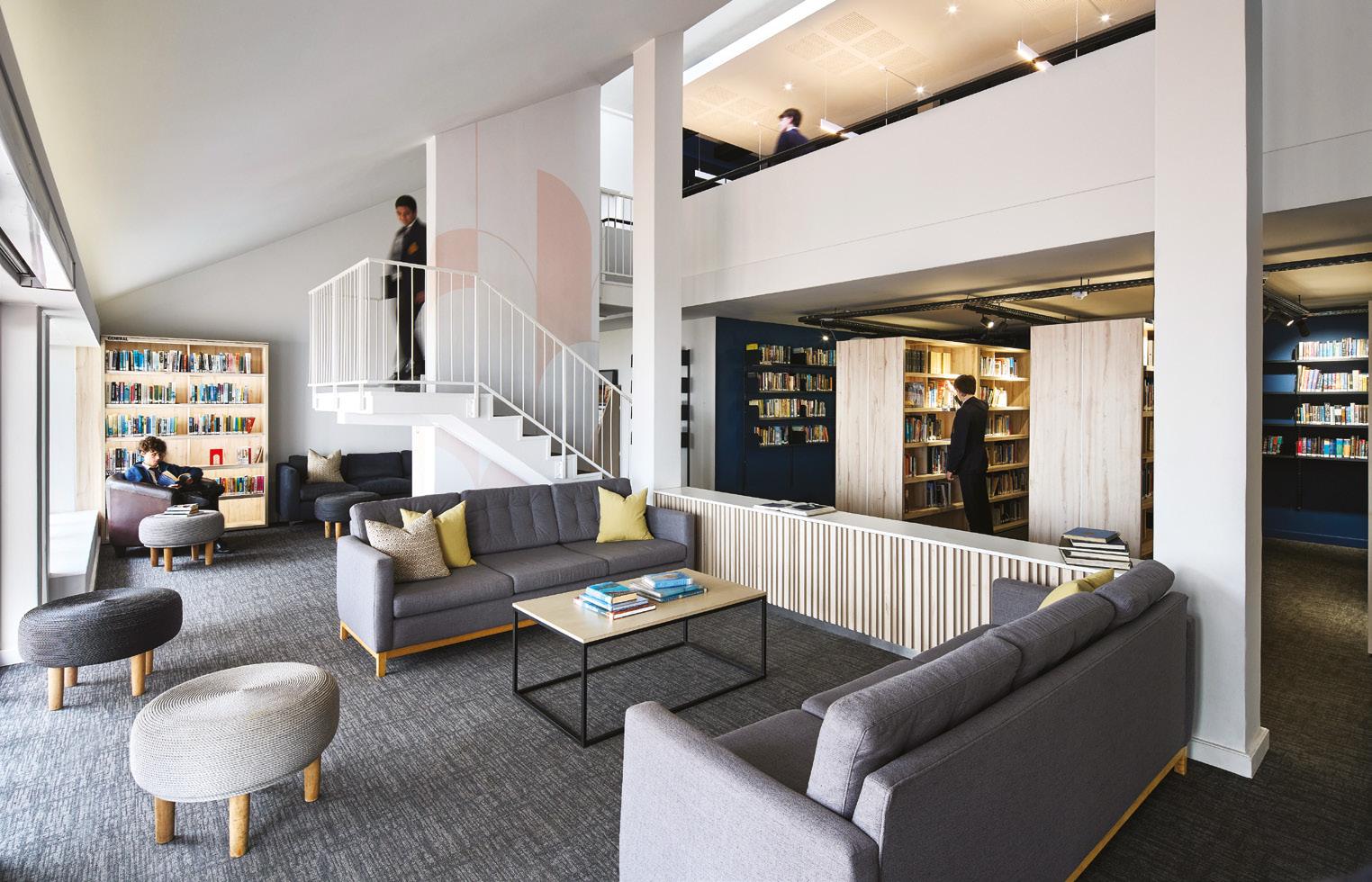
Multimedia academic learning centre at Bishops Diocesan College in Cape Town.
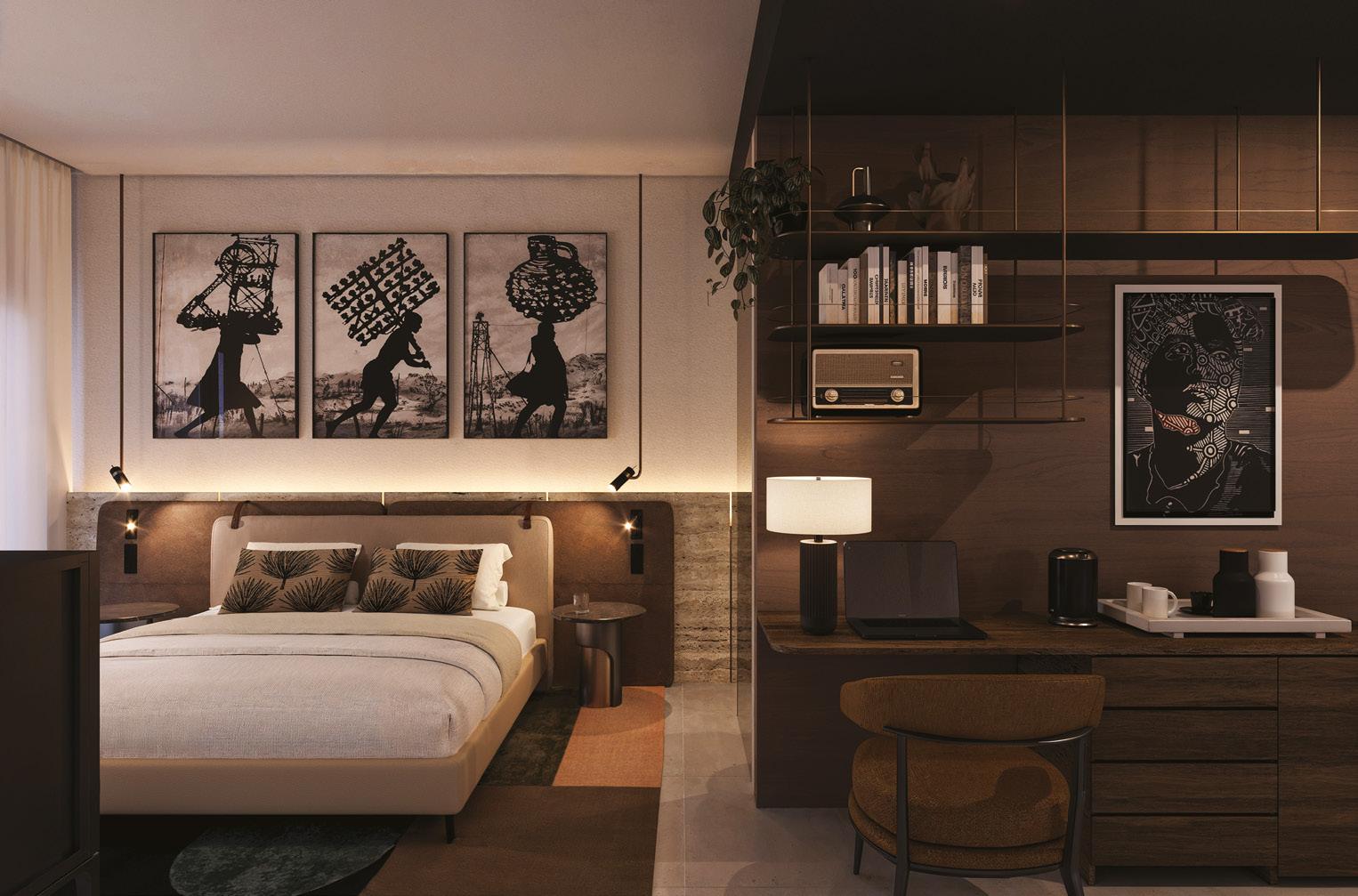
Concept development for a hotel in Mozambique.
CONTEXT AS A CREATIVE FOUNDATION
When the environment guides material and spatial choices, something shifts. When an installation feels ‘of its place’, it celebrates its present condition and ages more gracefully, both aesthetically and ecologically. This is especially important now, as we grapple with energy constraints and climate realities. Climate-responsive design can soften reliance on mechanical systems; local materials reduce
embodied energy and root the project in its landscape. This is design that understands South African conditions and works with them intelligently.
In hospitality, retail or commercial spaces, the designer’s understanding of the people who’ll use the space is rooted in symbols, rituals and a sense of what feels like ‘home’. These subconscious clues transform a workplace into a space where people can optimise their productivity, a hotel where people can feel anchored, or apartment
complexes that foster community.
It is important to emphasise that sensitivity to context doesn’t restrict creativity. This isn’t about nostalgia or pastiche. Nor is it about sticking blindly to tradition that does not evolve. Contextual design grounds our work in humanity, to create environments that resonate on an instinctive level because they’re true to their purpose and to their location. This is where design becomes genuinely exciting, pushing beyond replication towards reinvention.
RENDER CREDIT: VISOO; IMAGE: SEAN GIBSON
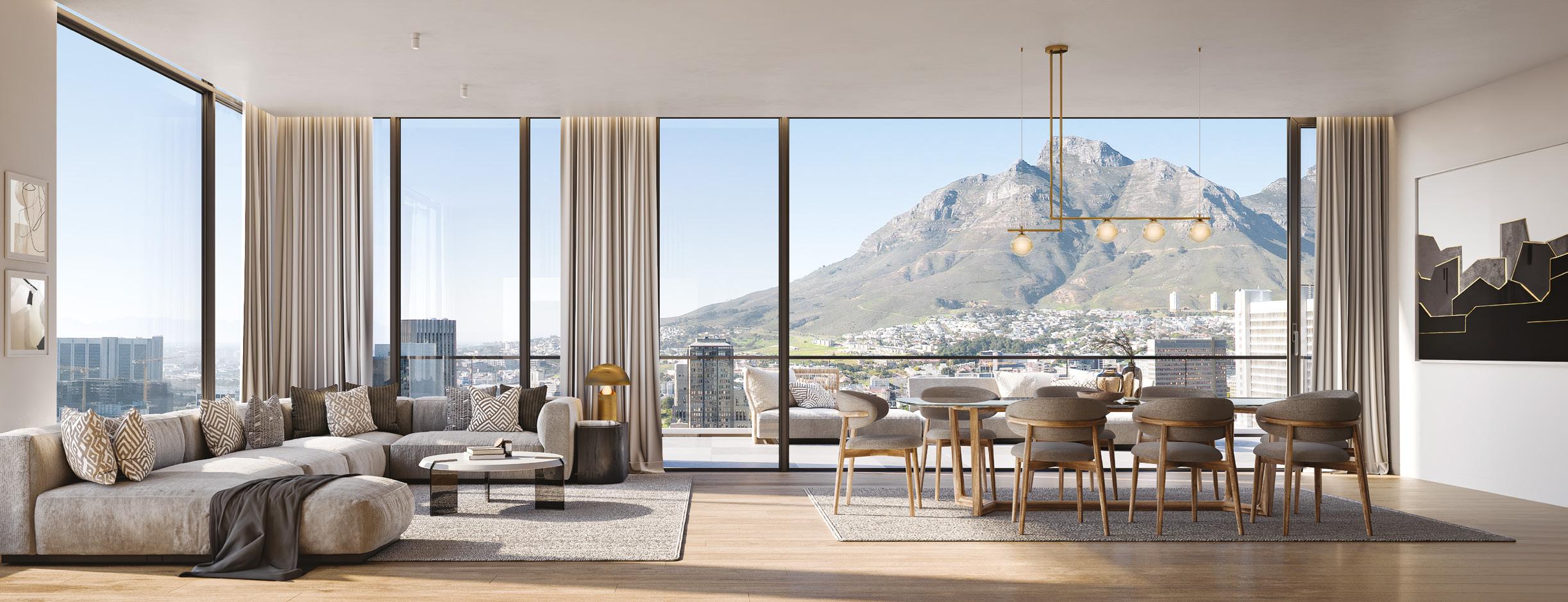
CLOCKWISE FROM TOP: The penthouse at The Paradigm.
Grand Hotel at GrandWest Casino and Entertainment World in Cape Town.
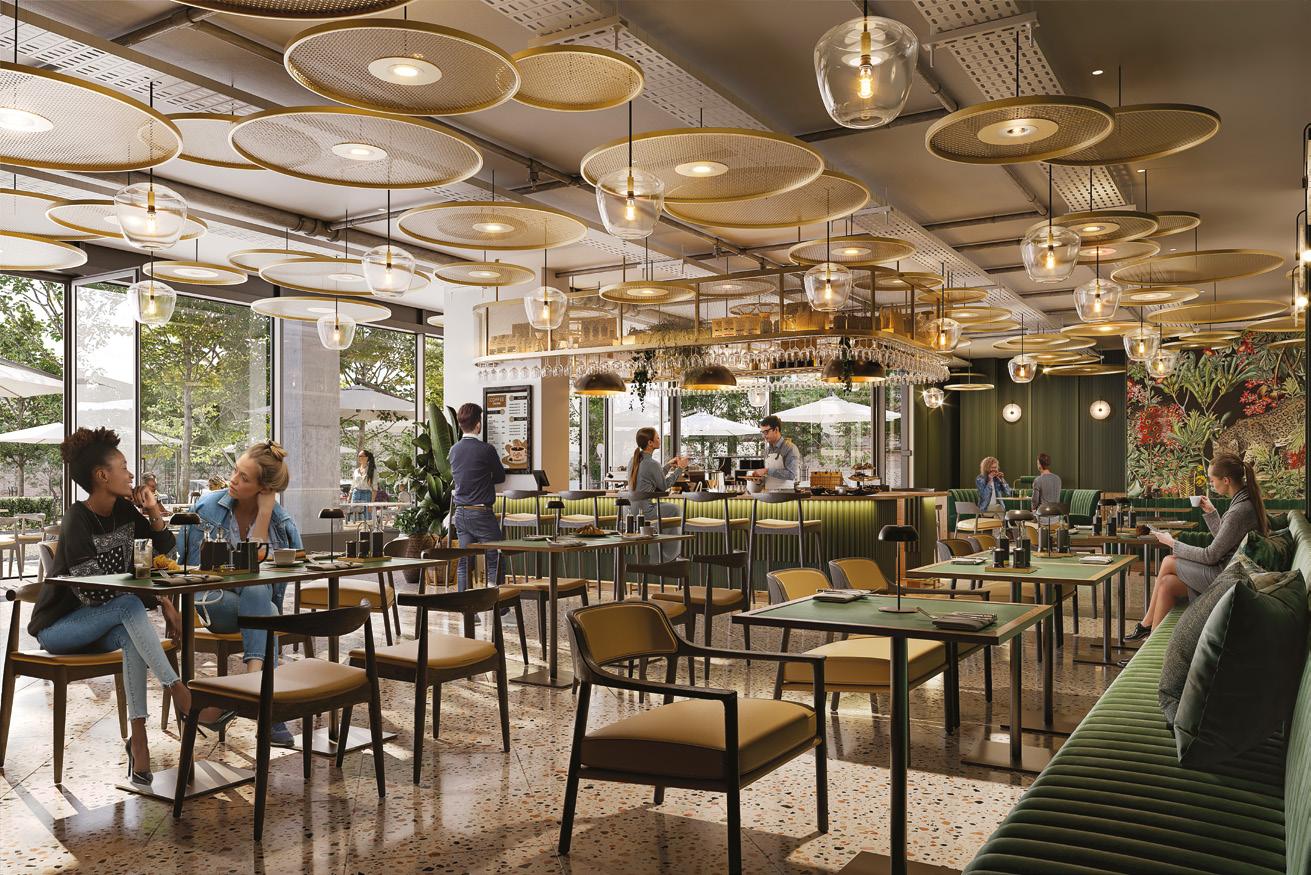
The restaurant at The Paradigm.
Outdoor alchemy: When architecture meets artistry
Contemporary designers are redefining exterior spaces as creative canvasses, merging aesthetic ambition with sustainable performance to deliver environments that enhance both property value and quality of life.
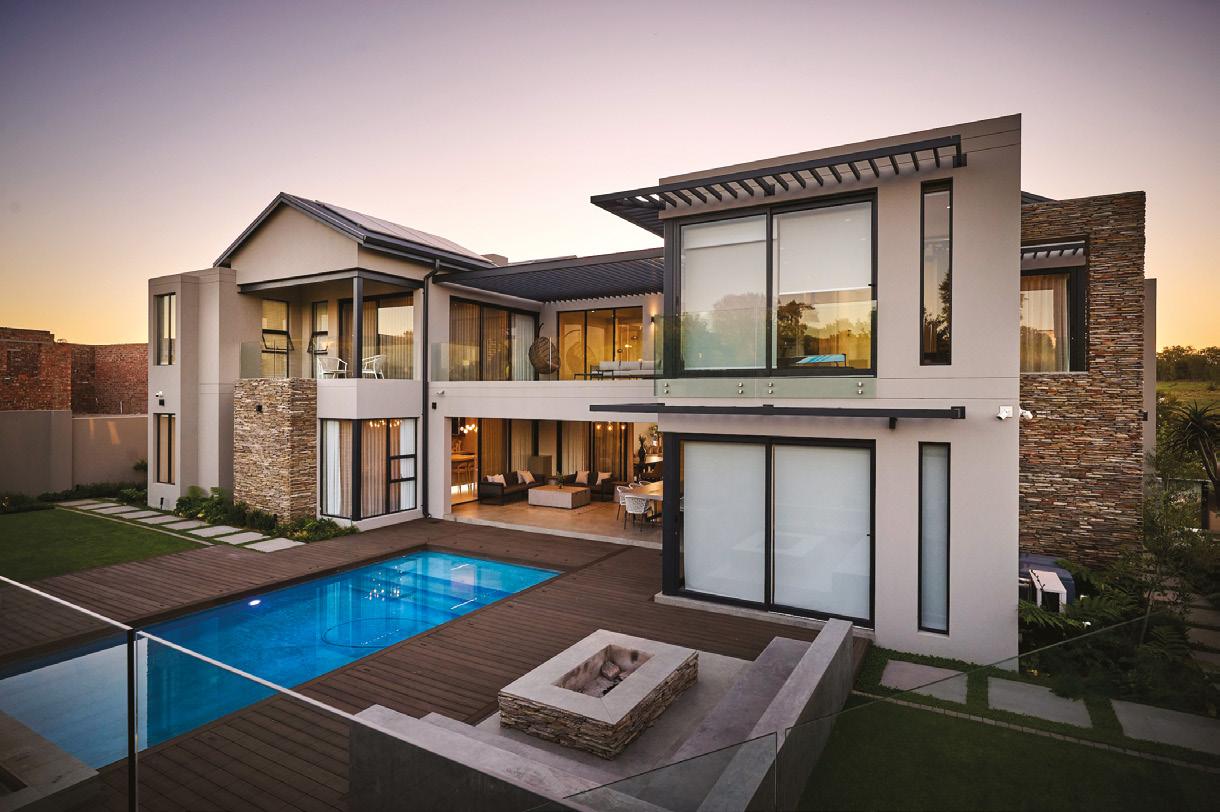
When art transcends traditional galleries and studios, it finds expression in unexpected places. Today’s outdoor spaces represent one such frontier – where landscape architecture, material innovation and spatial design converge to create environments that function as both practical living extensions and artistic statements.
Recent industry research reveals compelling evidence for this shift in priorities. According to homeowner surveys, 83% believe well-designed outdoor spaces significantly improve quality of life, while 72% report that visually appealing exteriors increase property values. These statistics underscore a fundamental change in how we perceive and invest in our built environments.
Yet achieving this balance between beauty and functionality presents considerable challenges. Successful outdoor design demands materials that withstand environmental pressures while maintaining aesthetic integrity, layouts that accommodate diverse activities without compromising visual coherence, and detailing that elevates utilitarian spaces into memorable experiences.
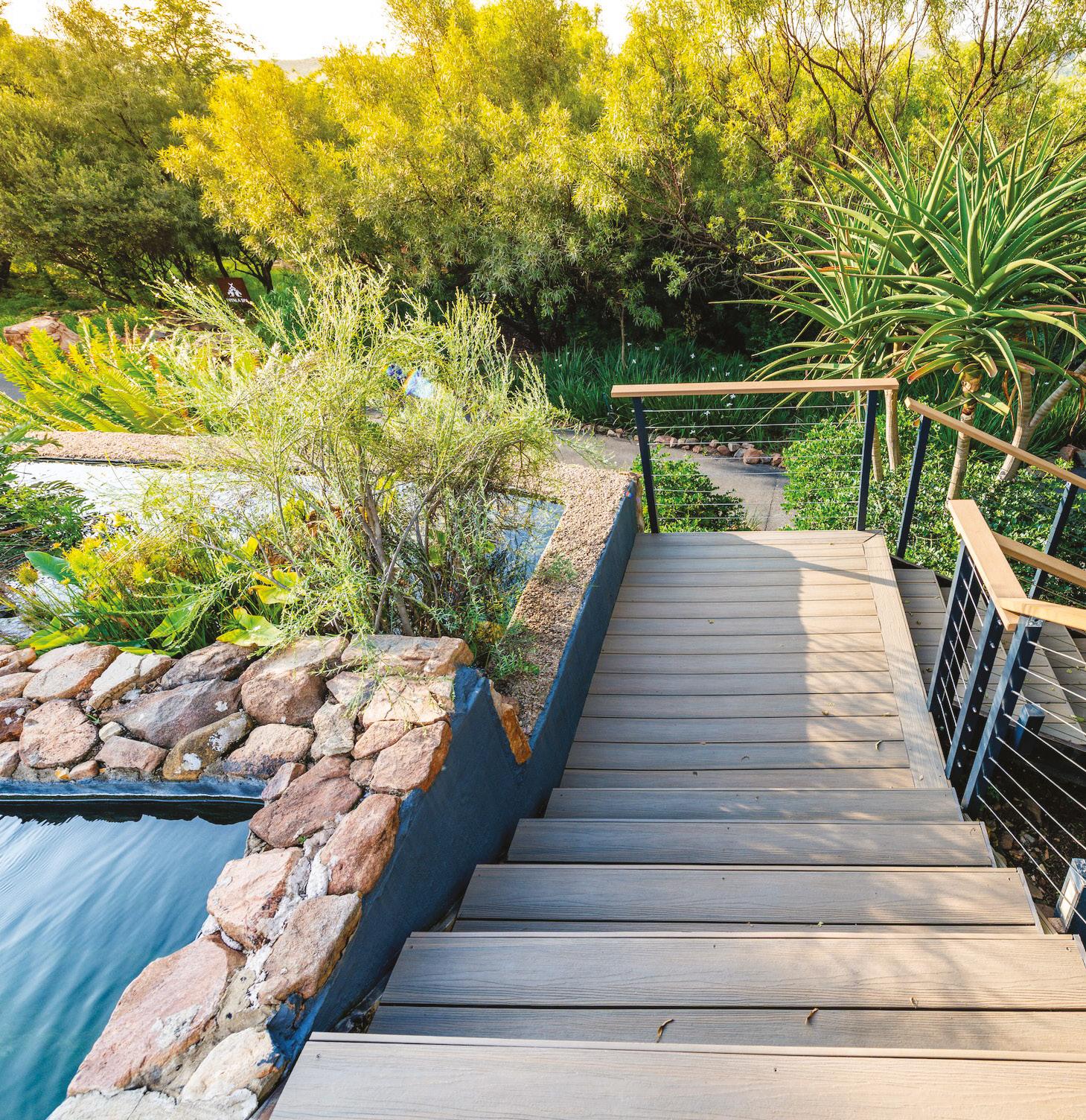
Eva-Last, a specialist in sustainable bamboo composite solutions, has positioned itself at the forefront of this movement. The company’s approach combines high-performance materials with design-forward thinking, enabling architects and homeowners to
realise ambitious exterior projects that prioritise both environmental responsibility and visual impact.
DEFINING EXCELLENCE IN OUTDOOR ARCHITECTURE
Balance of form and function Outstanding outdoor spaces achieve seamless integration between aesthetic appeal and practical usability. This requires careful consideration of material properties, spatial flow, and user experience. Successful projects demonstrate that functionality need not compromise design ambition – indeed, the most effective solutions enhance both simultaneously.
Seamless flow
Contemporary outdoor design prioritises continuity between interior and exterior environments. This approach creates cohesive living experiences that extend indoor comfort zones while capitalising on natural light, ventilation, and views. Strategic material selection and detailed planning enable smooth transitions that feel intuitive rather than forced.
Material excellence
Durability and sustainability have become non-negotiable criteria for exterior applications. Modern composite materials, particularly those derived from bamboo fibres, offer compelling alternatives to traditional timber. These engineered
solutions provide superior weather resistance, reduced maintenance requirements, and consistent performance across varied climatic conditions.
Details that inspire
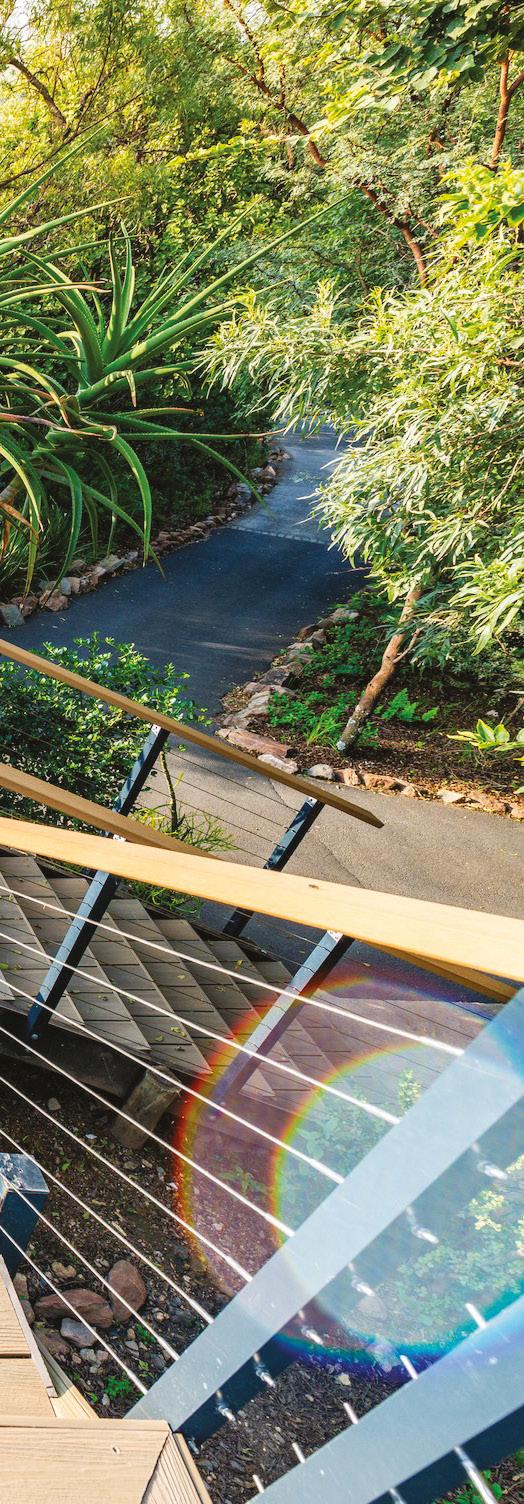
Thoughtful detailing distinguishes exceptional projects from merely competent ones. Elements such as integrated lighting, custom railings, built-in seating, and carefully selected finishes contribute to spatial character and user experience. These components often represent relatively modest investments yet deliver disproportionate impact on overall project success.
STRATEGIC APPROACHES TO OUTDOOR DESIGN
Focus on long-term sustainability
Specifying eco-conscious materials delivers both environmental and economic benefits. Bamboo composites exemplify this approach, combining renewable resource utilisation with enhanced performance characteristics. Such materials reduce ongoing maintenance burdens while supporting broader sustainability objectives.
Incorporate statement features Strategic focal points anchor spatial compositions and create memorable experiences. Fire pits, pergolas, feature walls and built-in planters serve dual functions as practical elements and
design statements. Positioning these features to maximise visual impact from multiple viewing angles enhances their effectiveness.
Blend indoor and outdoor living
Open-plan integration between interior and exterior spaces requires careful coordination of materials, levels and environmental controls. Extending interior flooring materials outdoors, incorporating retractable opening systems, and designing outdoor kitchens and dining areas all contribute to seamless living experiences.
Layer textures and colours
Sophisticated material palettes combine natural tones – rich browns, deep taupes, soft sand, olive greens – with selective accent colours. For projects requiring bolder statements, designers incorporate vibrant elements such as burnt orange, emerald green and navy. Successful schemes demonstrate restraint yet achieve visual interest through texture variation rather than colour complexity.
Multi-level spaces
Tiered arrangements maximise spatial potential, particularly on constrained or sloping sites. Staggered decking levels, terraced planting areas and varied floor heights create visual dynamism while defining functional zones. This approach enables smaller sites
to accommodate diverse activities without compromising user comfort.
Shelley Galliver, VP Group Marketing & Brand at Eva-Last, articulates the company’s philosophy: ‘With the right design, materials and attention to detail, outdoor spaces can become more than just functional –they become experiences, expressions and works of art.’
This perspective reflects broader industry trends towards holistic design thinking, where environmental performance, aesthetic achievement and user experience receive equal consideration. As outdoor spaces assume greater importance in contemporary living, the integration of innovative materials with thoughtful design becomes increasingly critical to project success.
The evolution of outdoor architecture represents more than aesthetic preference – it signals fundamental changes in how we inhabit and value our built environments. Through careful material selection, strategic planning and attention to detail, today’s designers are creating exterior spaces that function as true extensions of architectural vision, delivering lasting value through the marriage of performance and poetry. www.eva-last.co.za
Designing comfort, delivering performance
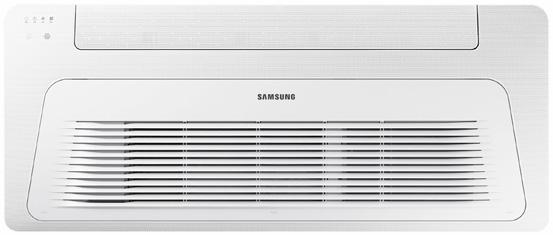
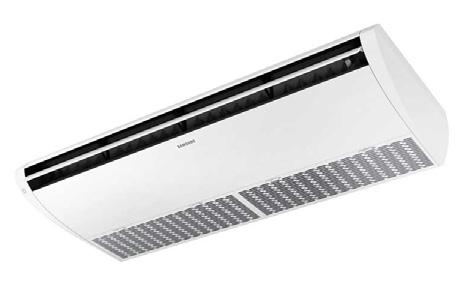
Fourways Group is South Africa’s leading distributor of Samsung and Alliance air conditioning solutions and a trusted supplier of heat pump and appliance brands. With a 26-year legacy and a nationwide network of branches, the company has built its reputation on delivering quality, reliability and innovation.
The company’s strength lies in the brands it represents and the partnerships it fosters. By working closely with dealers, contractors, architects and developers, Fourways brings projects of every scale to life, ensuring each installation is backed by expertise, technical support and commitment to long-term performance.
FOURWAYS JOHANNESBURG OFFICE: THE FUTURE OF CLIMATE CONTROL
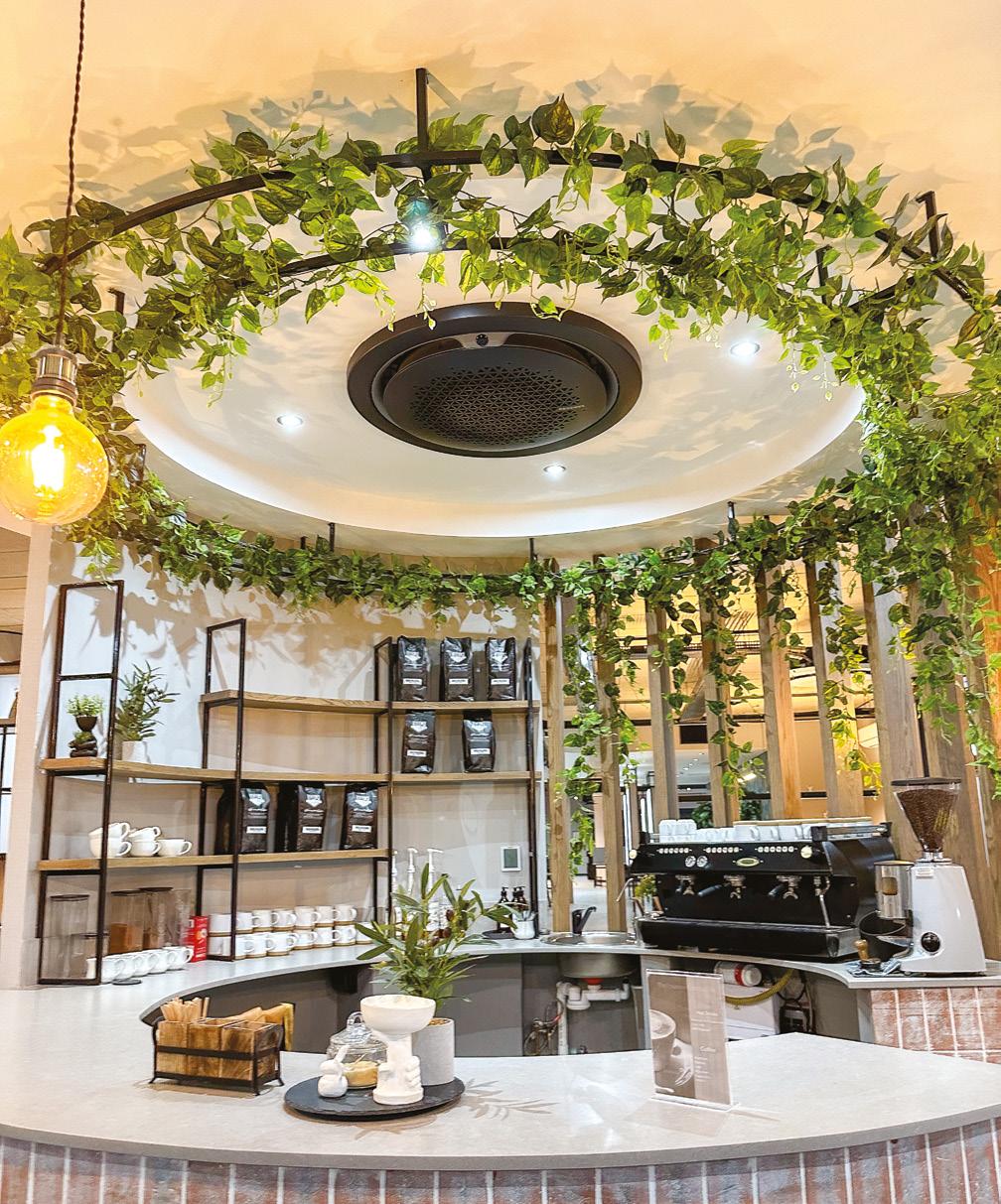
The vision for Fourways Group’s Johannesburg office was to create more than a workplace – a fully operational showroom reflecting the possibilities of modern climate control.
Powered by Samsung’s advanced DVM S technology, the office demonstrates how efficiency, aesthetics, and performance can coexist. Four compact outdoor modules drive 24 indoor units and three outdoor airprocessing systems, demonstrating the scalability of Samsung’s solutions for diverse environments, including hotels, retail centres and gyms.
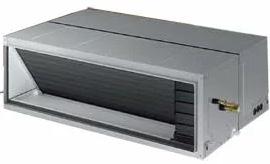
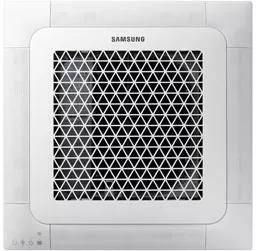
Visitors experience Samsung’s range first-hand, including the sleek 360 Cassette, WindFree™ cassettes, discreet ducted units and commercial wallmounts. These are paired with fresh-air systems and smart controls, allowing zoning, scheduling and real-time energy monitoring.
MANCOSA: MODERN COMFORT FOR EDUCATION
Mancosa, a higher education provider, faced an outdated cooling tower system that no longer met demand. Constant breakdowns, high repair costs and energy inefficiency left staff frustrated.
In collaboration with L.M. Air Solutions, Samsung’s DVM system replaced the legacy setup across all five floors. The combination of 4-way and 1-way cassettes proved ideal for open-plan layouts and partitioned offices, providing staff with individual temperature control.
The impact was immediate: energy bills dropped significantly, maintenance issues disappeared, and staff reported far more comfortable conditions.
NAUTICA MALL: COMFORT THAT SHAPES RETAIL EXPERIENCES
Langebaan’s Nautica Shopping Centre required a climate solution supporting its vision of creating a vibrant retail destination.
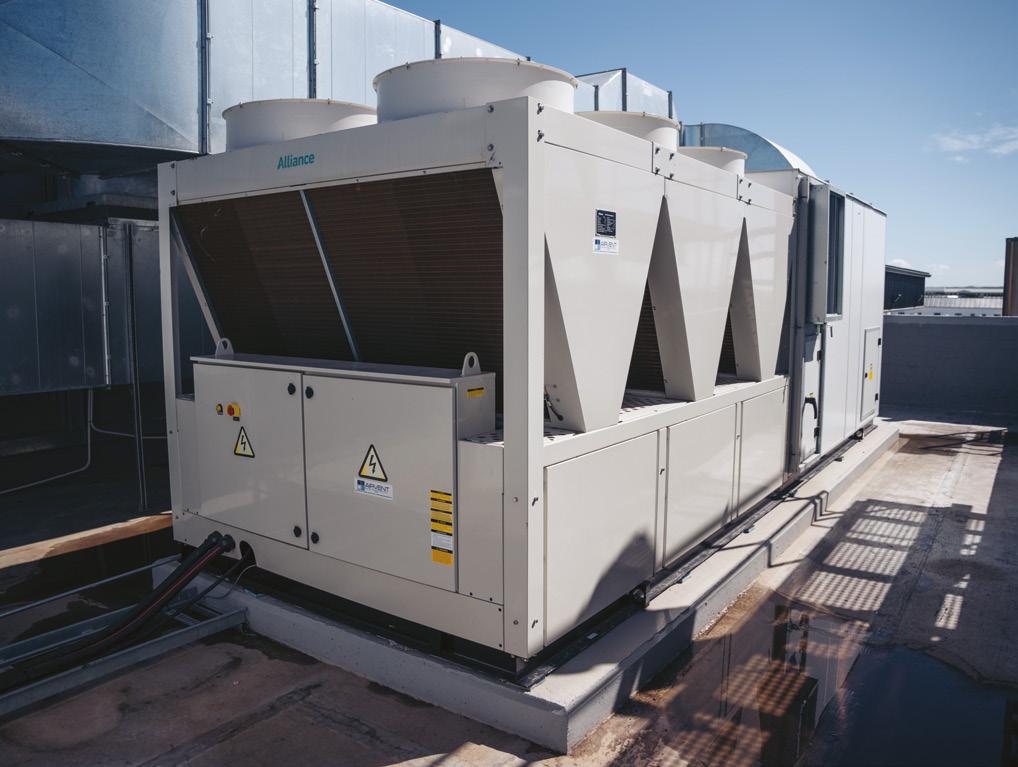
The installation featured eight Alliance Air Curtain units and a central Alliance Rooftop Non-Inverter unit, designed to optimise customer comfort and reduce operating costs for tenants. Air curtains maintain consistent indoor temperatures, limiting energy loss at entrances, providing reliable, centralised control.
The project succeeded through strong collaboration between ESB Construction & Building, Airvent Airconditioning & Ventilation Cape, Smith Architects, building owner Riccardo Scarpiline, and Fourways Group as equipment supplier.
BROOKLYN HOUSE: SMARTER HOT WATER SOLUTIONS FOR STUDENT LIVING
Brooklyn House student accommodation in Pretoria aimed to raise the sustainability bar for high-density living. With 297 students on site, hot water demand was significant, and traditional solutions would have strained budgets and energy supply.
A hybrid system using Alliance Direct Heat Pumps and Solar Heat Exchangers was installed. Four 80kW Alliance heat pumps paired with two 15,000-litre solar accumulator tanks offer 320kW total heating capacity. This approach ensures constant 60°C supply, reduces grid demand, and achieves up to 70% savings in water heating costs.
Success resulted from collaboration between developer Mile Investments, WF-P Consulting Engineers, Boogertman + Partners architects, Solar Heat Exchangers, and Fourways Group.
SETTING THE BAR
For 26 years, Fourways Group has collaborated with contractors, architects, and developers to provide climate solutions balancing performance, efficiency, and design. These projects demonstrate the strength of collaboration and versatility of Samsung and Alliance technologies.
The company’s focus remains clear: supporting partners with reliable solutions, expert guidance, and long-term value on every project. www.fourwaysgroup.co.za
Next level
From the makers of Alufoil® FR
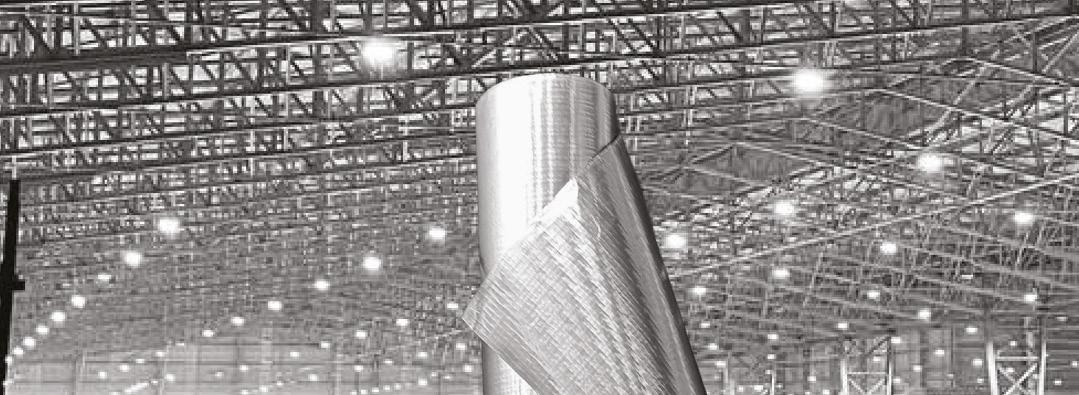
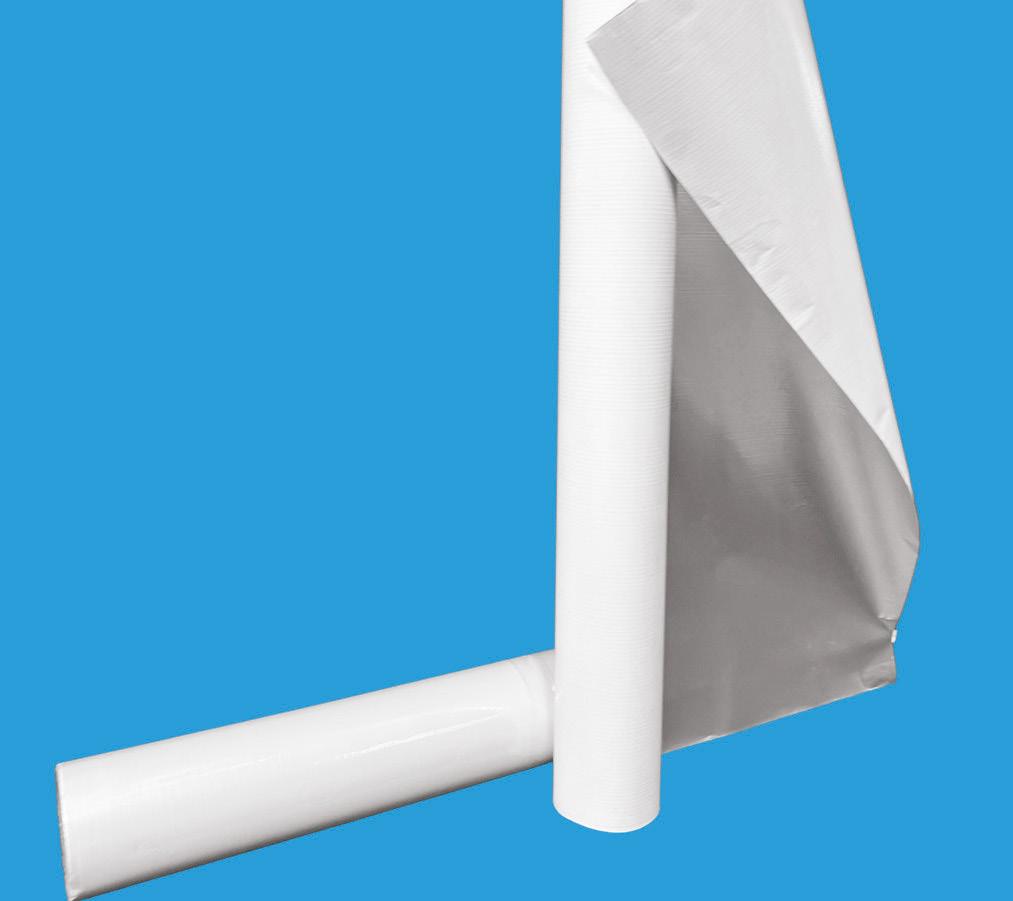
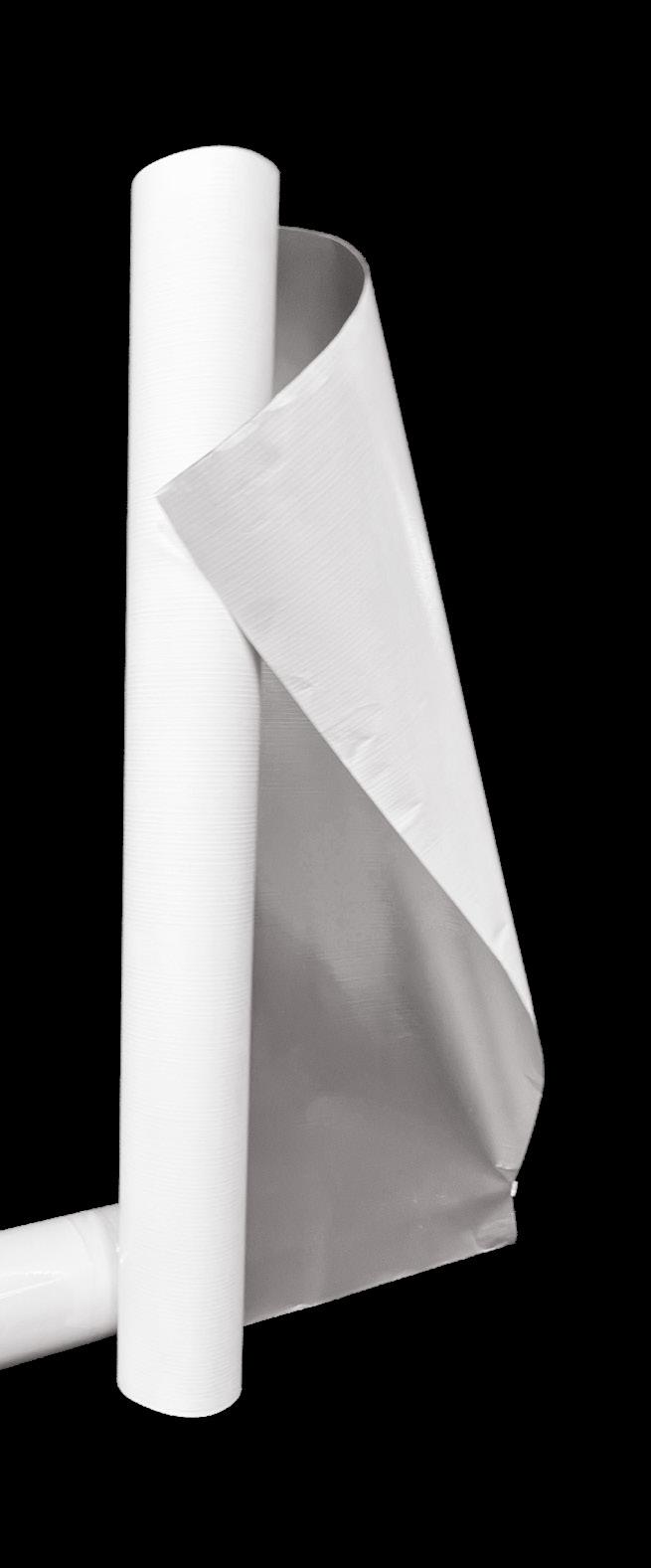
Heavy Industrial Grade thermal roof insulation comes the new Alufoil®FR WHITE Heavy Industrial Grade. The industry asked and they delivered.
With 35+ years of experience in the aluminium foil laminate roof insulation industry in South Africa, Alucushion Thermal Insulations is proud to launch the next generation of its Alufoil® products. Following the success of the Alufoil® FR Double-sided Heavy Industrial Grade roof insulation product – which is widely used in industrial applications – the new white version offers the aesthetic appeal many specifying professionals have asked for, without making the product thinner or less usable for heavy industrial applications.
Alufoil® has always been the professionals’ choice thanks to its six-layer construction, which results in a product that is dimensionally strong and therefore easier to install. The multi-layer reinforced Alufoil® products provide contractors with the highest pace-to-area ratio installation methodology, saving time and, of course, costs.
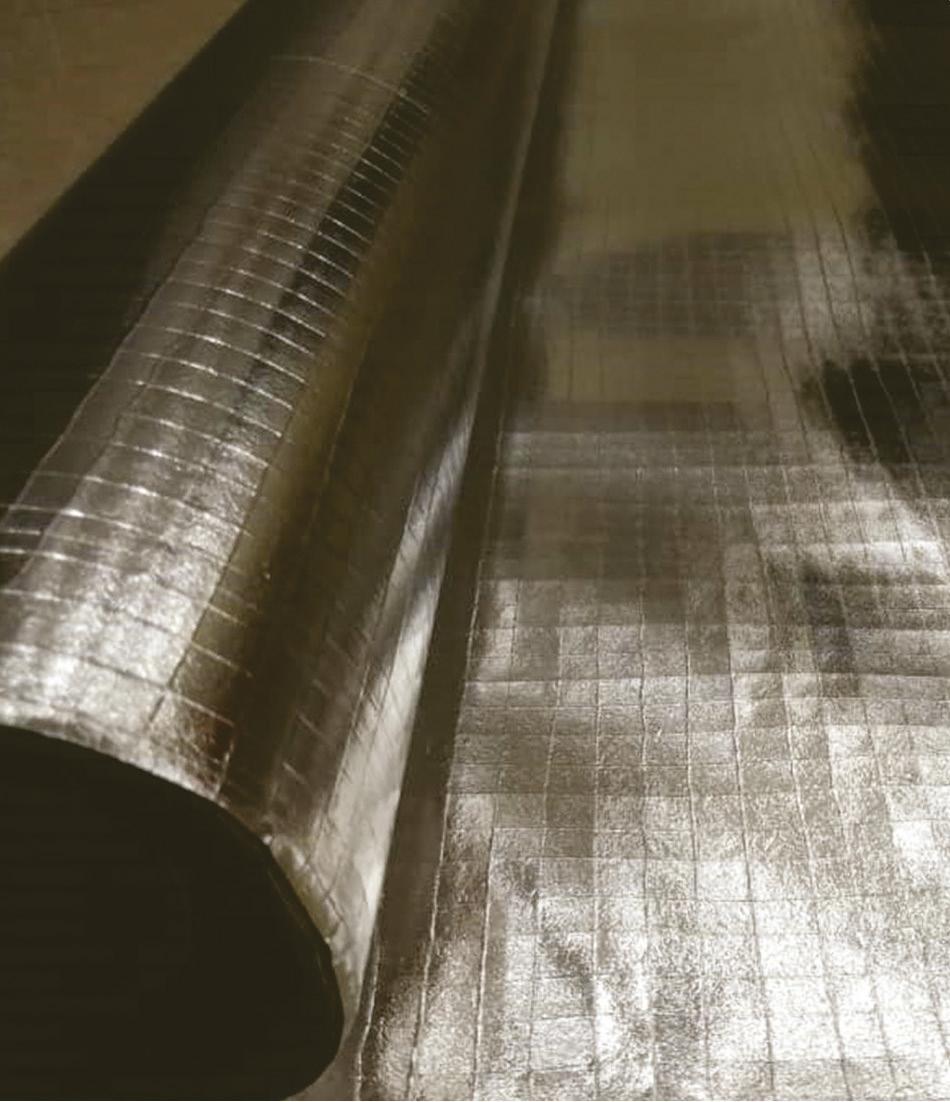
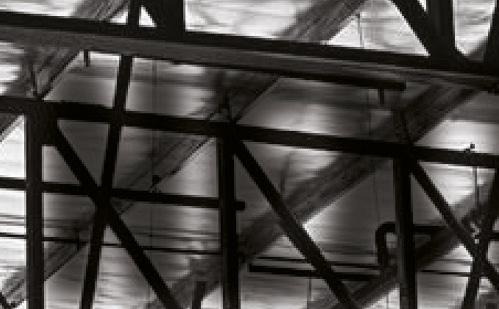
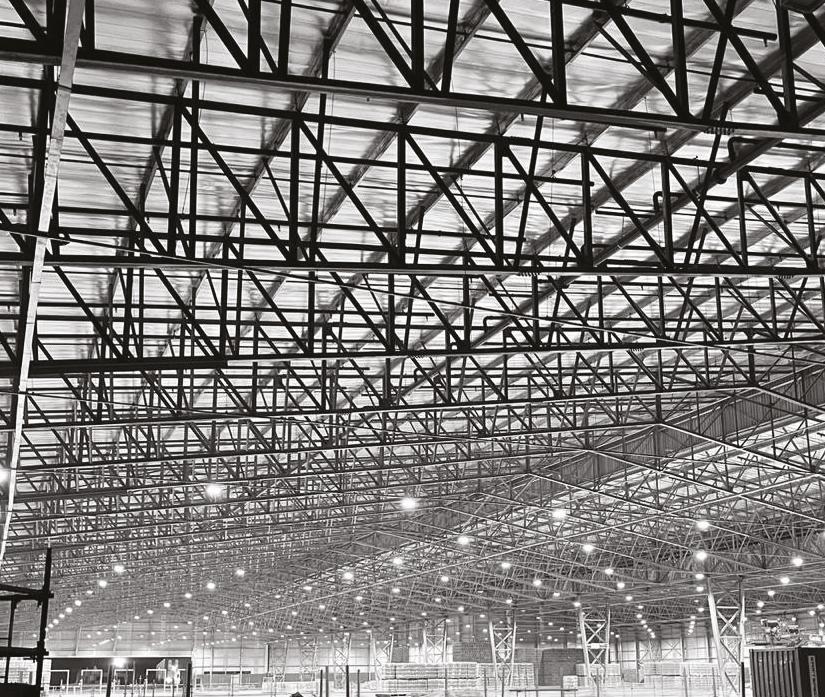
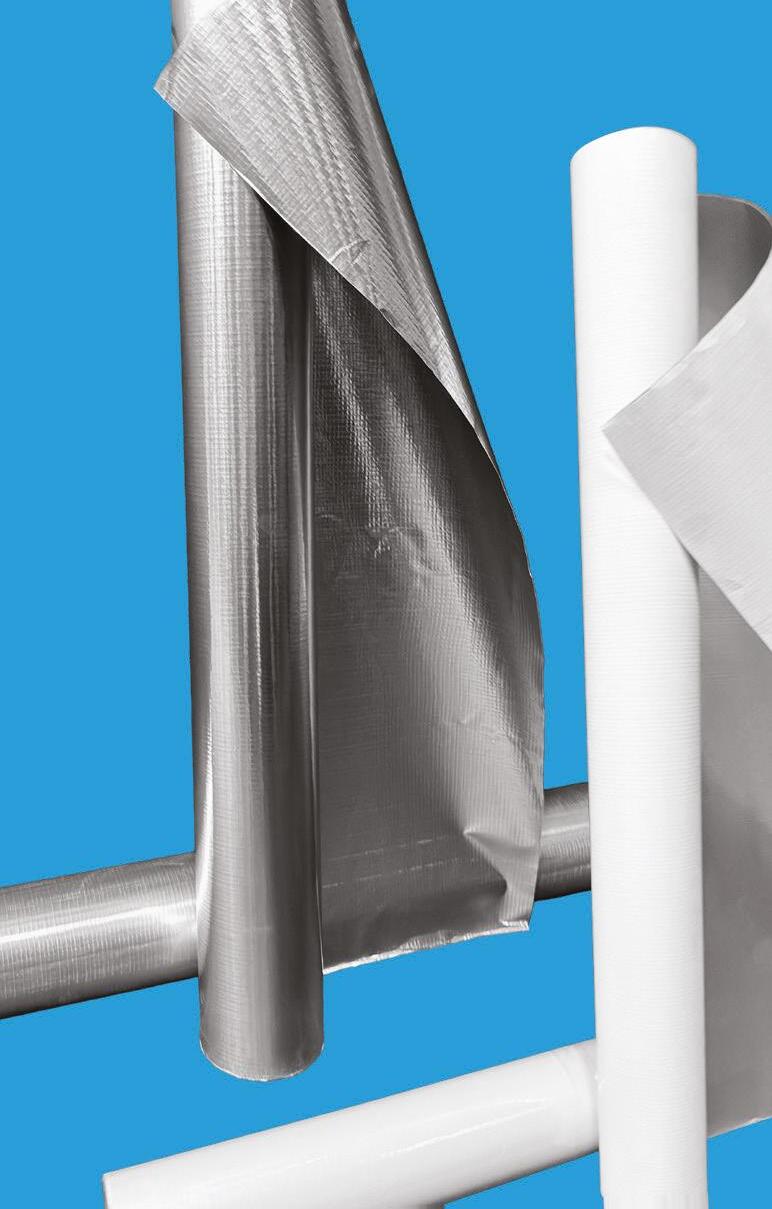
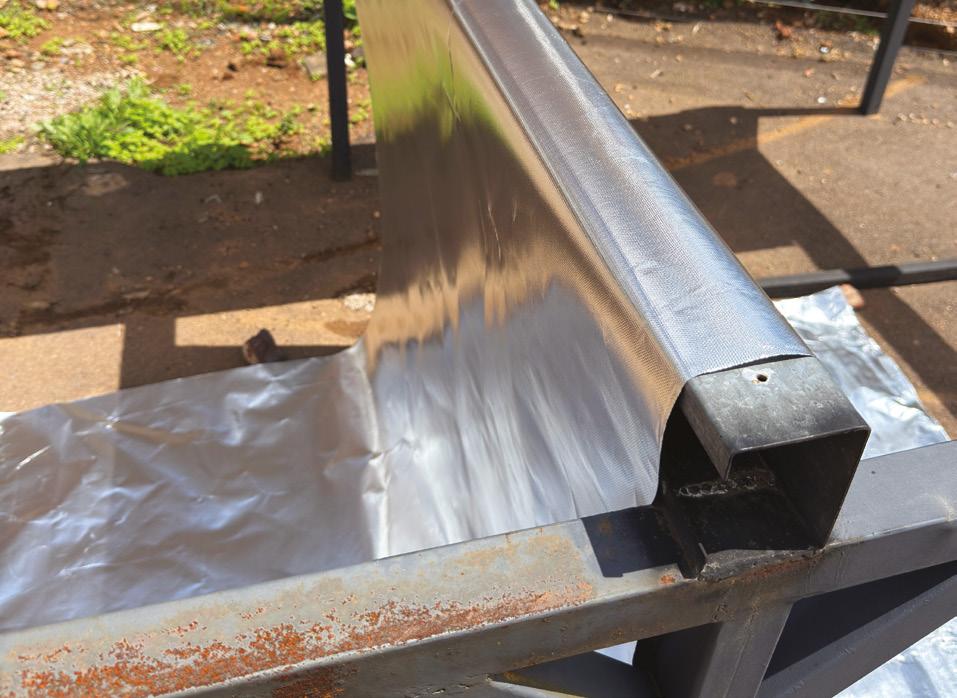
An example of the difference between a Heavy Industrial Grade foil roof insulation and the many woven or cloth reinforced foil insulations is shown in the images below. These were just placed over the purlins without any fixing or holding or support, and the dimensional rigidity is obvious to see. The non ‘rigid’ foil products are more suited to domestic applications with wooden trusses where the application methodology is different to over-purlin industrial.
The latest Alufoil® product versions have all been tested to the new SANS 53501-1 Reaction to Fire Classification, in accordance with SANS 10400-T:2024 Ed 5 Fire protection, and achieved the highest rating possible for these Heavy Industrial Grade aluminium foil roof insulation products. www.alucushion.co.za
The role of safe storage in mitigating burglary and fire risk
Household burglary and fire remain among the most common threats to household assets in South Africa. Statistics South Africa’s 2024 Victims of Crime Survey reported approximately 1.5 million housebreaking incidents, affecting nearly one in sixteen households. Urban and tourist regions experience elevated crime rates, particularly during festive seasons when homes are unattended.
Gail Carew, Sales Director at Gunnebo Safe Storage South Africa, notes how certified safe storage solutions provide homeowners with practical options for securing assets at home and off-site.
HOME SAFES
Modern home safes combine mechanical strength with advanced features to resist burglary and fire. Reinforced steel walls and fire-rated interiors protect against forced entry and high temperatures. Anchoring systems prevent removal, and electronic locks offer programmable access codes, timedelay functions and audit trails.
Models integrate biometric options and remote monitoring, ensuring only authorised users gain access. Certified safes should carry SABS or international ratings and be installed in discreet locations allowing rapid access to essentials.
OFF-SITE STORAGE
For higher-value assets, professionally managed offsite storage provides controlled vaults, continuous monitoring and environmental management. Facilities offer fire-rated vaults, controlled access and 24/7 surveillance. Entry logs and condition reports ensure assets remain protected and verifiable, supporting insurance compliance.
Separating daily-use items from high-value possessions creates a layered security strategy balancing accessibility and resilience.
STANDARDS-BASED PROTECTION
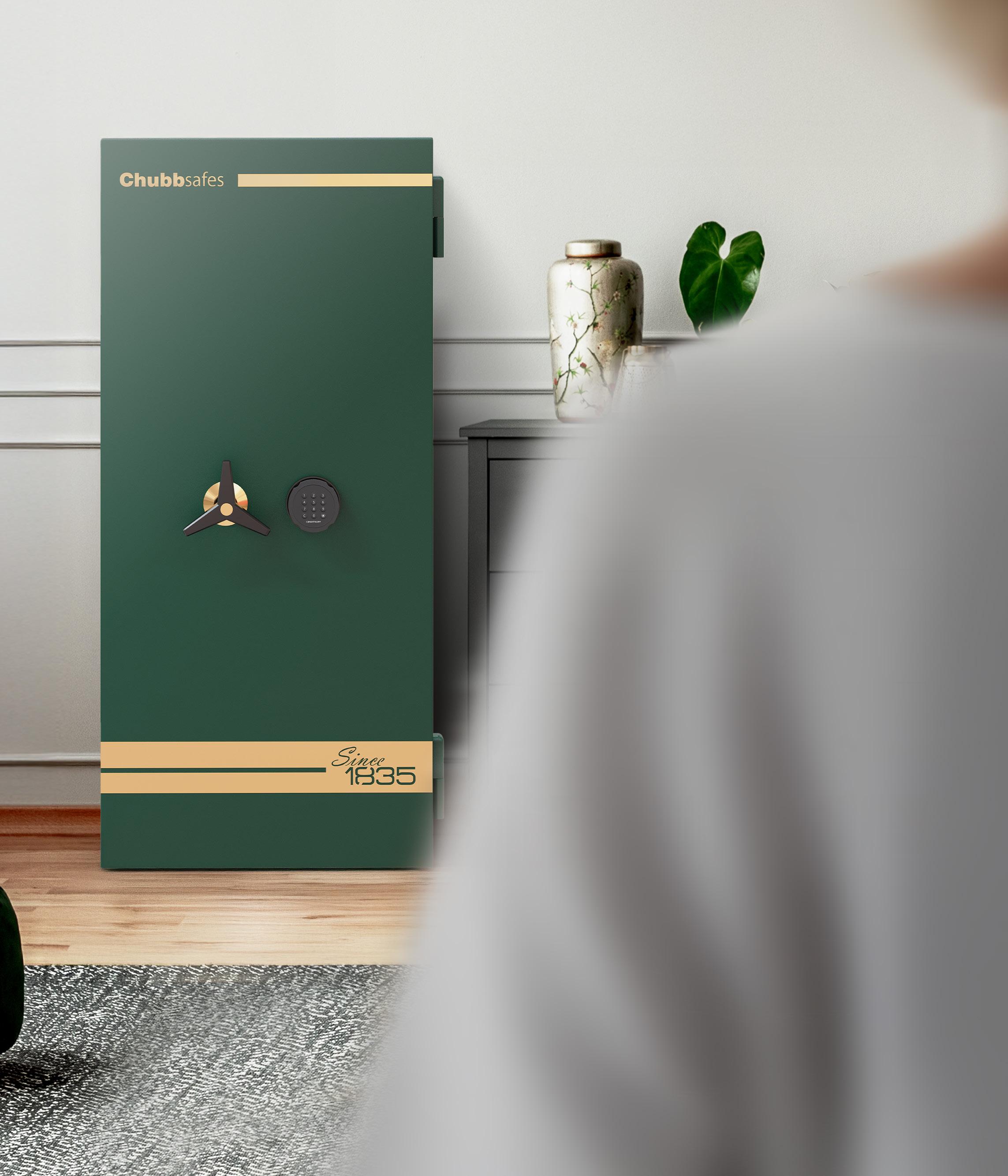
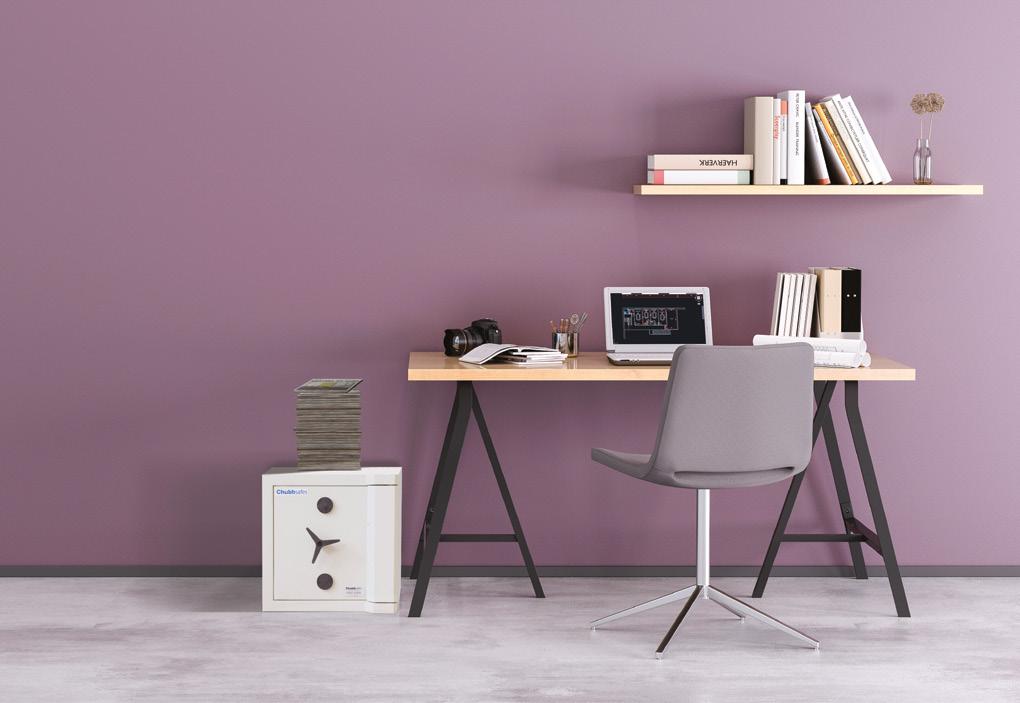
Chubbsafes, part of Gunnebo Safe Storage, has defined safe engineering standards for 190 years. Solutions are independently tested and certified according to SABS and international standards. Contemporary safes integrate mechanical durability with digital connectivity, enabling remote access management and real-time monitoring.
Homeowners can select certified home safes or professional off-site storage to protect valuables and critical documents. Both options provide independently certified, standards-based security with digital monitoring capabilities. www.gunnebosafestorage.com
Building innovation
one digital step at a time
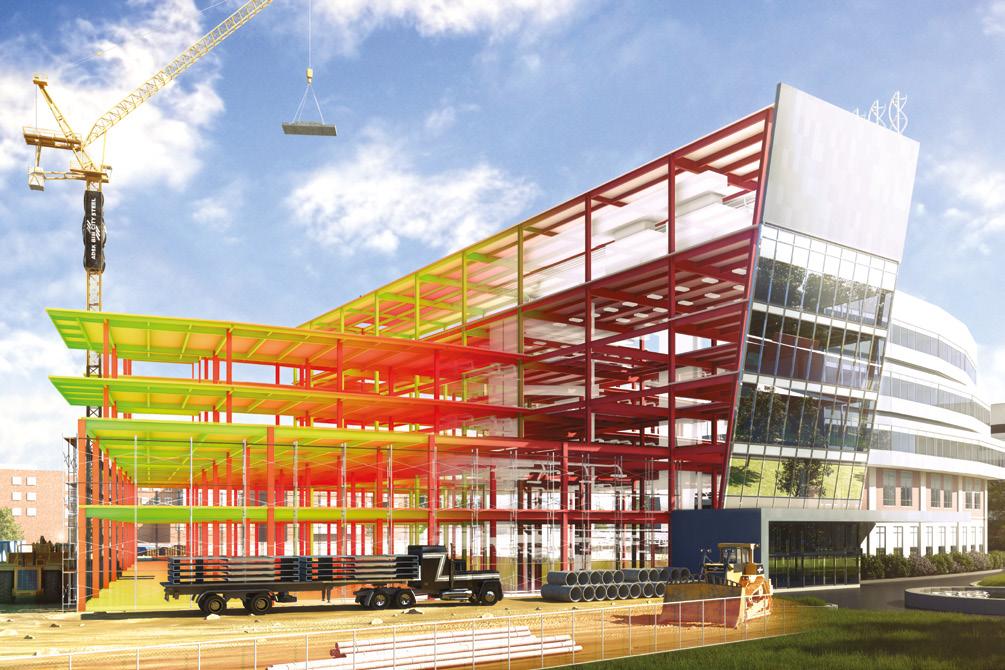
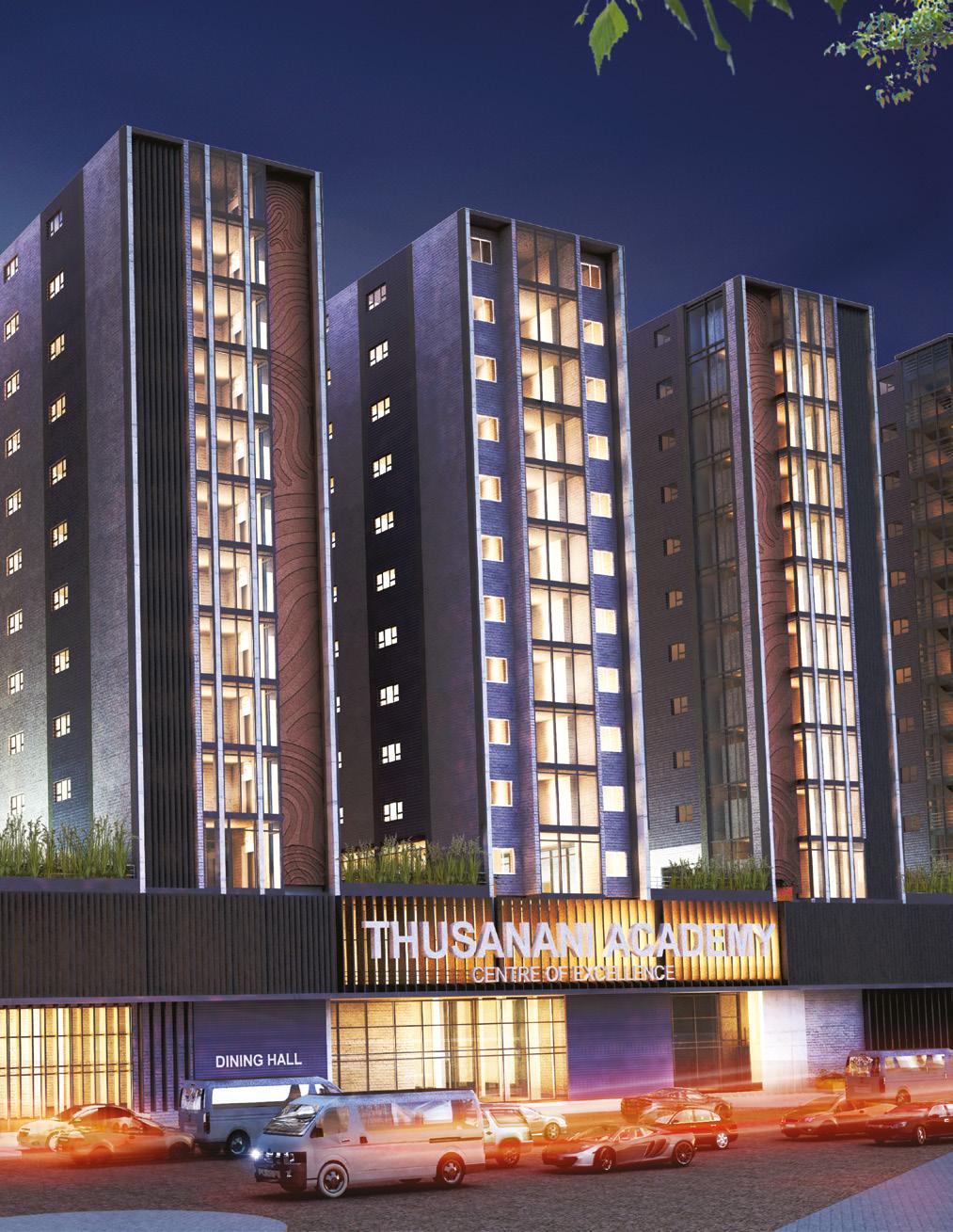
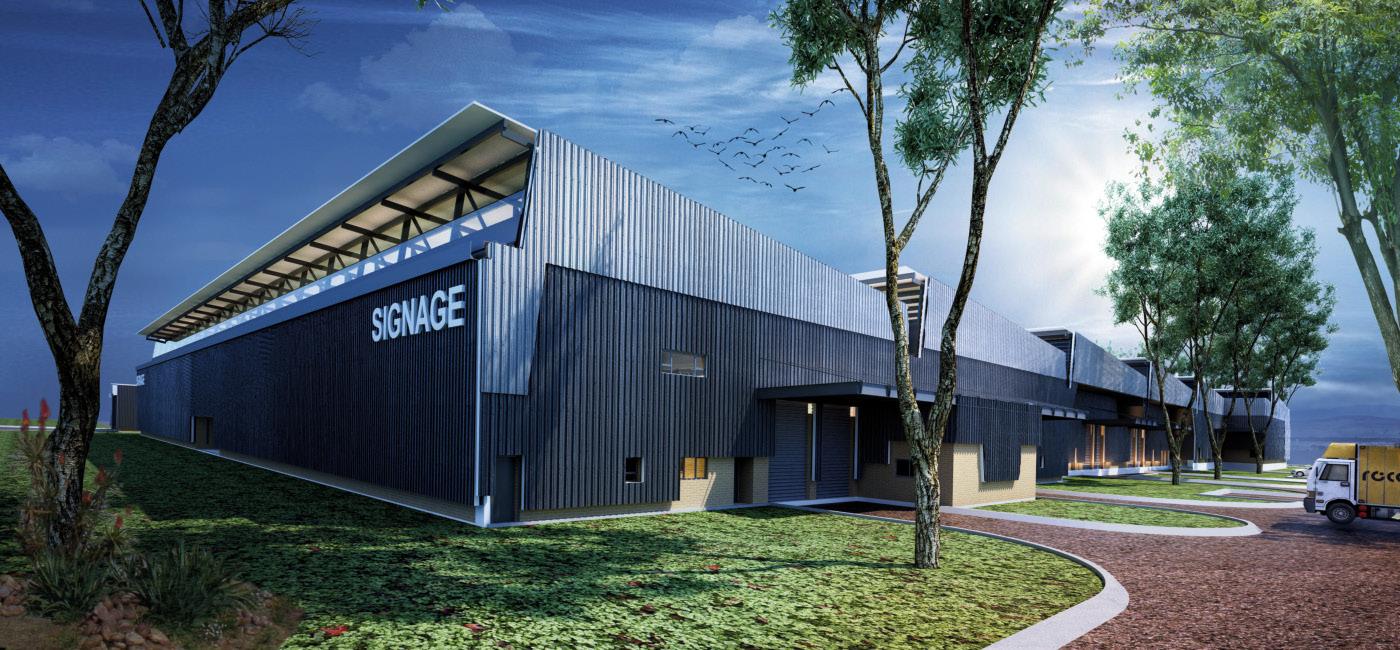
B.I.L Architects is transforming South African design through digital collaboration and technology adoption.
In an industry often defined by tradition and tight deadlines, one architectural practice is proving that meaningful innovation begins with the courage to embrace change. B.I.L Architects, led by Karabo Pitsoe, is reshaping the way design practices approach technology, creativity and collaboration in South Africa’s built environment.
What started as a small firm with big ideas has evolved into a studio where digital tools and design thinking merge seamlessly. By implementing the Autodesk AEC Collection, B.I.L Architects unlocked a new level of efficiency and accuracy, transforming how their team conceptualises, coordinates and delivers projects.
‘The AEC Collection has allowed us to work smarter, not harder,’ explains Pitsoe. ‘With Autodesk products like Revit at the core of our workflow and complementary tools such as 3ds Max and InfraWorks, we’ve been able to explore our designs more deeply, visualise ideas more clearly, and collaborate more effectively with consultants and clients.’
the software, what truly stands out is the mindset behind the adoption. Rather than investing in technology for technology’s sake, B.I.L Architects focused on understanding and maximising the tools they already had, proving that innovation doesn’t always require new systems, but rather a new approach.
By tapping into training, research and collaboration opportunities, the team has grown their capabilities exponentially. The result? A more connected, agile and creative workflow that enhances both design quality and delivery speed, without compromising vision or integrity.
B.I.L Architects’ story is a powerful reminder that digital transformation is not just for the biggest players in the market. With the right mindset and support, any practice can leverage digital design tools to enhance their impact and stay competitive in an evolving landscape. www.bakerbaynes.co.za
Beyond
Advanced insulation solutions for modern buildings
Starlite® flexible glass wool insulation represents a significant advancement in building performance technology, specifically engineered for architects and builders seeking superior thermal and acoustic solutions. This non-combustible insulation material delivers exceptional fire safety ratings while maintaining environmental responsibility.
The product achieves A2-s1, d0 fire classification under SANS standards, making it suitable for diverse architectural applications including industrial, commercial and residential projects. Its glass wool composition with inert thermosetting binder ensures chemical stability, preventing corrosion of steel, aluminium and copper building components.
Environmental credentials remain paramount in contemporary design practice. Starlite® contains zero ozone-depleting substances and global warming potential compounds, supporting sustainable building strategies. The material’s CFC and HCFC-free formulation aligns with green building certification requirements.
Technical performance specifications demonstrate impressive thermal resistance values ranging from 1.28 m2K/W at 50mm thickness to 3.46 m2K/W at 135mm thickness. These R-values enable architects to achieve stringent energy efficiency targets while minimising installation depth requirements.
Acoustic performance delivers a noise reduction coefficient of 0.70 at 50mm thickness, effectively attenuating rainfall and hail noise transmission. This capability proves particularly valuable in exposed roof applications where occupant comfort remains critical.
Available in 1200mm width configurations with thickness options of 50mm, 75mm, 100mm and 135mm, the material accommodates diverse architectural specifications. Facing options include foil, white and black coated scrim-reinforced variants, enabling co-ordination with different aesthetic and performance requirements.
Installation benefits include lightweight handling characteristics at 12kg/m 2 density, reducing structural loading considerations. The material operates reliably up to 230°C working temperatures, ensuring long-term performance stability.
For industry professionals concerned with prioritising fire safety, energy efficiency and acoustic comfort, Starlite® provides a comprehensive insulation solution that addresses contemporary building performance standards while supporting sustainable design objectives. www.roofinsulation.co.za
Rust be gone
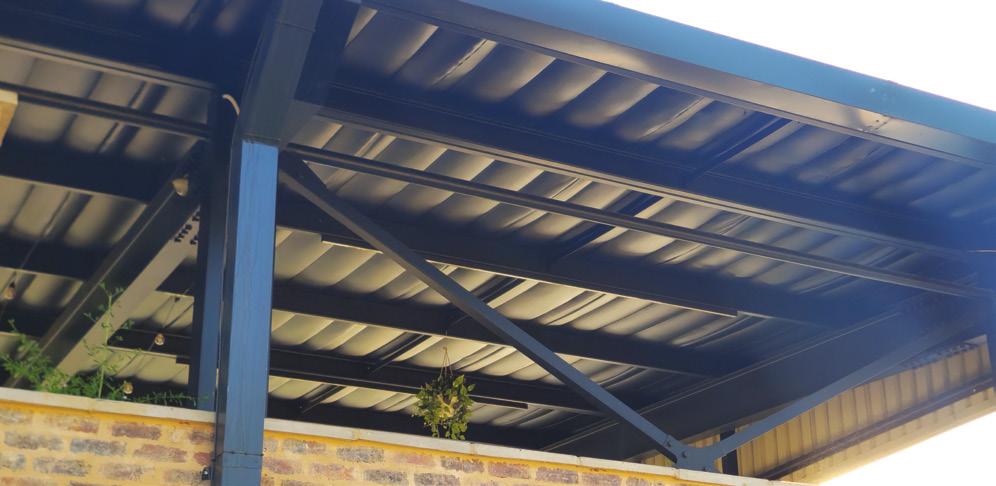
A 2016 study by NACE International estimated the global cost of corrosion at $2.5tn, with potential savings of 1535% possible through proper corrosion management. Our harsh South African climate means that rust is a perennial problem. According to the SABS, effective corrosion management could save the country an estimated R26bn per annum.
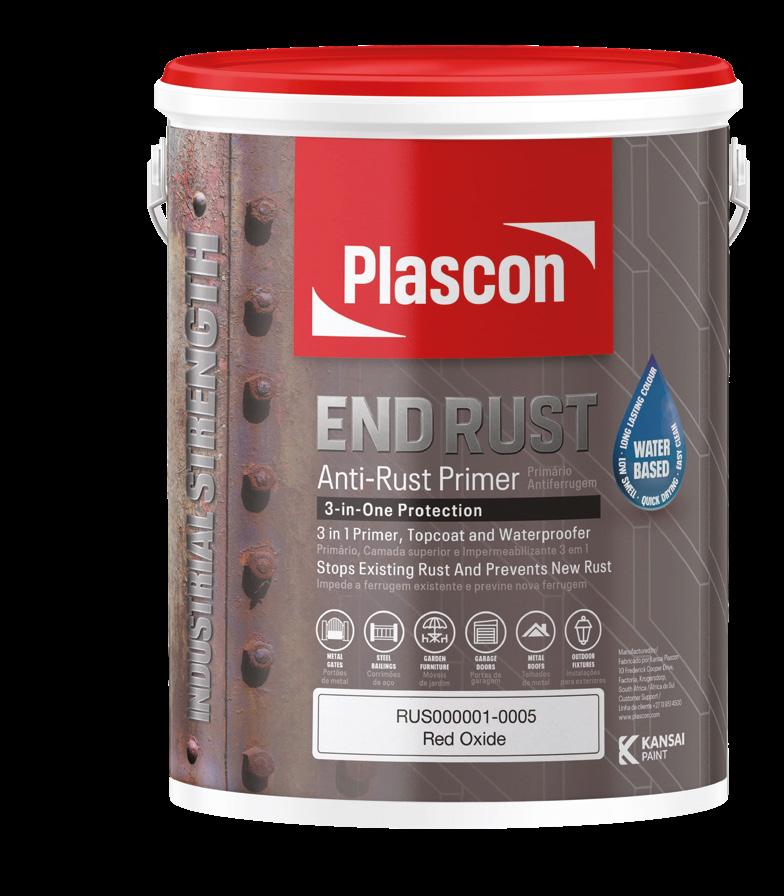
To help put better preventive and corrective measures in place, Plascon has launched its new EndRust Anti-Rust Primer, which provides a simple, reliable solution. It’s a handy 3-in-1 coating that primes, protects and acts as a waterproofer, giving metal surfaces longlasting protection and a professional finish. It treats existing rust while preventing new corrosion before it starts.
This product represents a significant advancement. The solution it provides is set to benefit trade professionals in the construction, metal-working and architectural industries, as well as DIY enthusiasts who are invested in preserving the value of their homes.
‘We are thrilled to introduce this innovative 3-in-1 product to the market,’ says Leslie Frank,
head of marketing at Plascon. ‘There have been a lot of calls for Plascon to release an anti-rust primer, and we’re proud to respond agilely to our customers’ needs – both professionals and consumers. This new release is particularly suited to projects that are located close to the ocean, where rust is even more of a problem. It will help members of the trade improve their offering and will aid homeowners in protecting their residential assets for longer.’
The product is easyto use, and delivers professional-grade performance with consumer-friendly convenience. Designed to simplify maintenance while providing long-term value, Plascon EndRust Anti-Rust Primer is ideal for a wide range of applications. You can use it on gates, railings, roofs, garden furniture, garage doors and outdoor fixtures. And it’s so fast-drying that it takes only an hour until it is touch dry. Plus, the product is low odour, making it convenient and userfriendly. Both lead-compliant and low VOC, this product innovation supports Plascon’s eco-friendly commitment. www.plascon.co.za
Integrating modern luxury into naturally inspired spaces
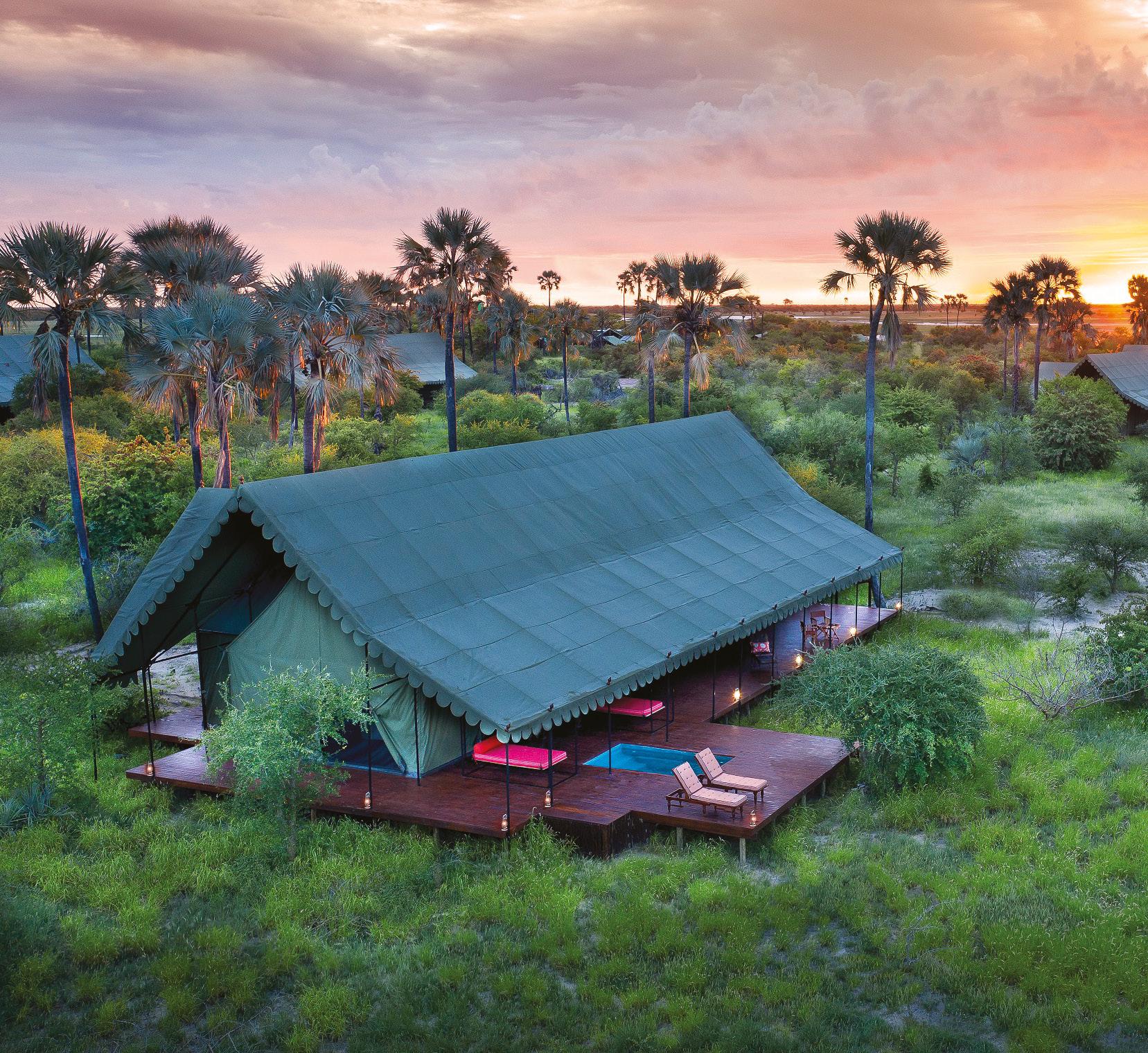
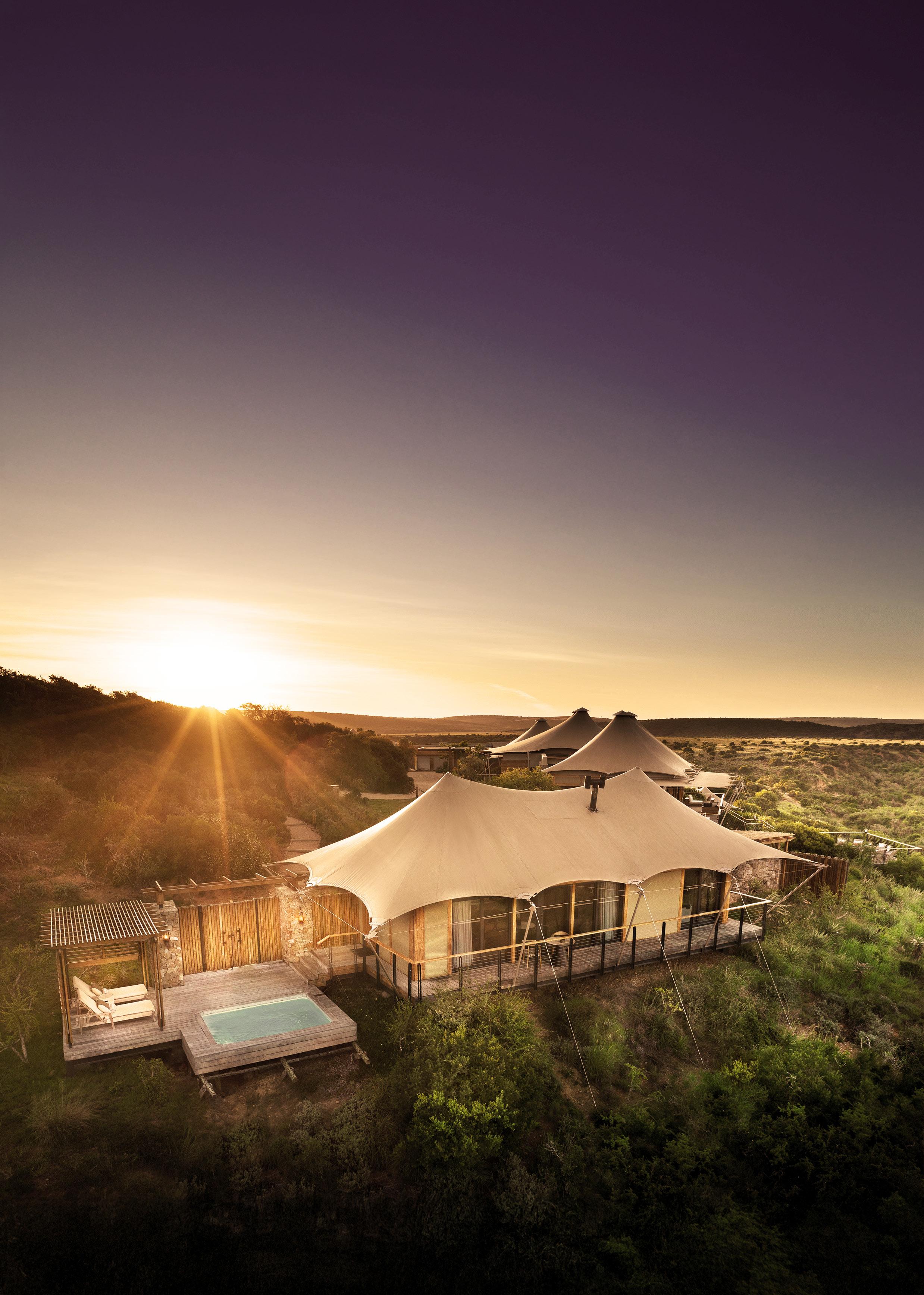
Today’s luxury travellers want comfort without losing the sense of immersion that comes with being close to nature. Bushtec Creations has refined the art of blending modern amenities with natural surroundings, designing tented structures where sophistication and simplicity co-exist seamlessly.
A key element of this approach is softening the divide between indoors and outdoors. Large openings, sliding glass panels, generous decks, and fluid circulation create spaces that celebrate views while maintaining privacy and comfort. Guests feel connected to the landscape without compromising on luxury.
Inside the structures, modern conveniences are incorporated thoughtfully and discreetly. Spa-like bathrooms, contemporary kitchens, refined lounge areas and integrated lighting or climate systems are designed to enhance comfort while maintaining a clean, natural aesthetic.
Materials play a central role in achieving this balance. High-performance roofing and structural fabrics offer durability and weather protection, while organic textures – timber, stone and woven surfaces – create warmth and harmony within the interior.
Bushtec also extends the experience outward with elevated decks, firepits, outdoor showers and stargazing areas that invite guests to enjoy the environment in comfort. These features enhance the sense of place and form part of the signature luxury lodge experience. Through this combination of engineering, thoughtful design and material expertise, Bushtec Creations continues to deliver tented destinations that feel both modern and deeply connected to nature – setting a benchmark for contemporary outdoor hospitality. www.bushtechcreations.co.za
Fireproof aggregate for screeds, walls, and floors
The growing number of residential and industrial photovoltaic systems with battery storage, combined with new building legislation, has increased demand for fireproof and energyefficient building materials. Pratliperl from Pratley delivers both exceptional fire resistance and thermal insulation, making it ideal for modern construction projects.
‘Walls plastered with a 30mm layer of correctly mixed Pratliperl plaster have a two-hour fire rating,’ says Eldon Kruger, Marketing Manager at Pratley. This two-hour fire-rated capability prevents fire spread for at least two hours, making the product perfect for battery rooms and similar applications.
The material also significantly improves building insulation. With just 16mm plaster applied to both interior and exterior wall surfaces, thermal insulation essentially doubles. Pratliperl’s hard bead structure makes it an excellent aggregate for cement mixtures, maintaining integrity while adding lightweight, energy-efficient characteristics.
Pratliperl can be used as a floor or roof covering that serves multiple purposes – it insulates against heat loss, helps water drain properly off roofs, and weighs less than conventional materials. It’s essentially a multi-functional building material that replaces heavier, less efficient traditional options.
Despite being lightweight, Pratliperl concrete supports heavy equipment like air-conditioning units with compressive strength of 10-15 MPa, though it’s not intended for structural applications. ‘For internal screeds, we recommend using hardwearing surfaces like tiles for durability,’ says Kruger. Unlike polystyrene, Pratliperl doesn’t emit toxic fumes during fires, and unlike ordinary concrete, it doesn’t spall when cooled with water post-fire. As a non-toxic, ‘green’ product, it’s gaining popularity with architects locally and internationally. www.pratleyminerals.com
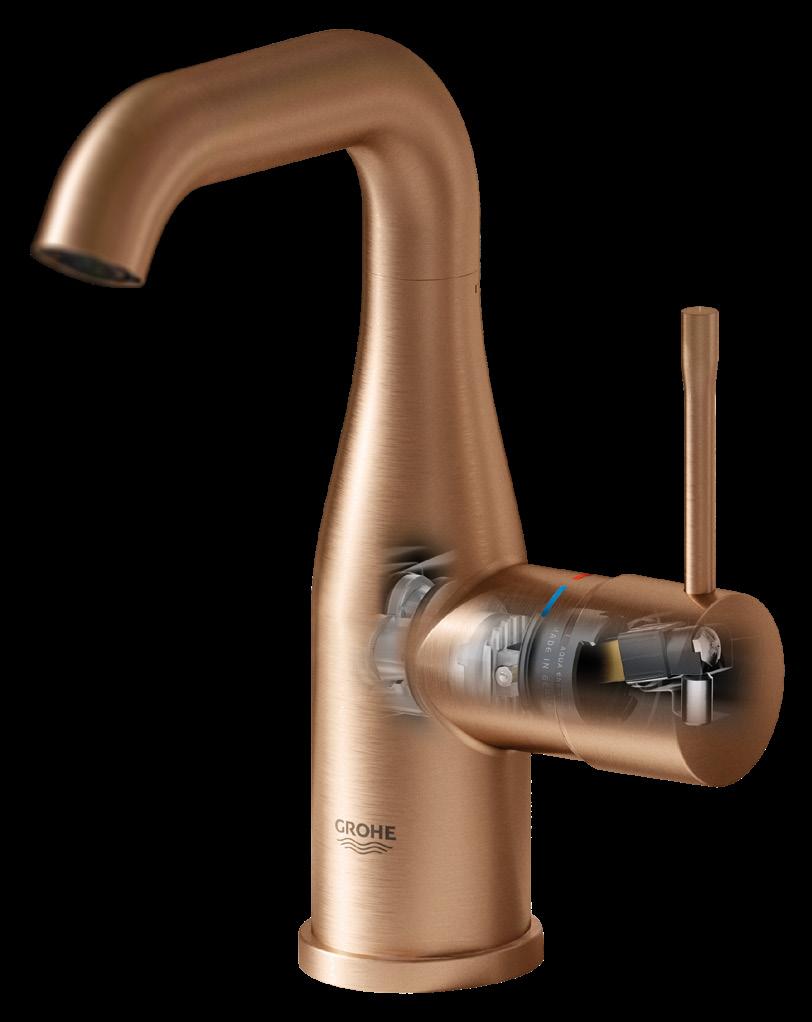
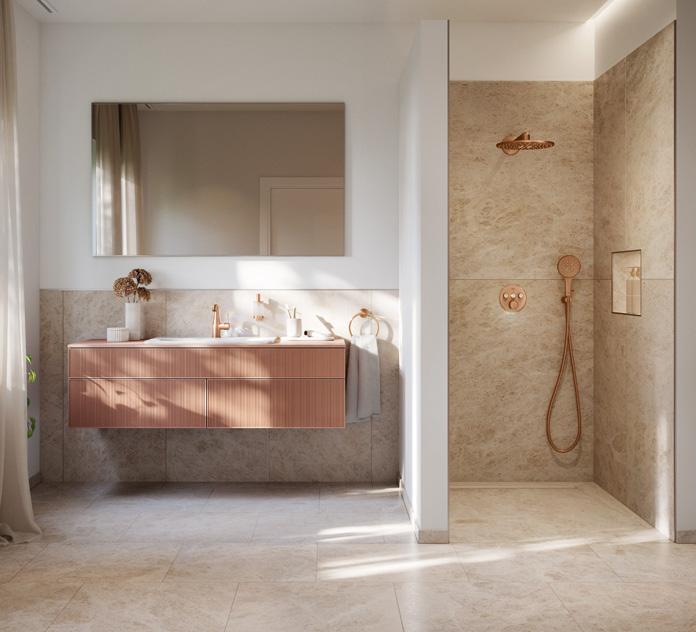
Redefining bathroom luxury
Grohe’s Heart of Your Bathroom campaign transforms the modern bathroom from a functional space into an intelligent sanctuary, where advanced technology works seamlessly behind the scenes to deliver unparalleled comfort, hygiene and sustainability.
The German manufacturer’s latest initiative centres on the philosophy that true luxury lies not in what you see, but in what you experience. This approach challenges traditional design thinking, positioning cutting-edge engineering as the foundation of contemporary bathroom aesthetics.
At the campaign’s core are innovations such as Grohe’s SilkMove cartridges, which provide effortless control of water flow and temperature through precision engineering. SmartControl shower systems offer personalised experiences with intuitive controls, and TurboStat thermostats maintain consistent temperatures for enhanced safety and comfort.
The EcoJoy technology demonstrates how sustainability can be seamlessly integrated without compromising performance. These water-saving features reduce consumption by up to 50% across taps, showers
and cisterns, addressing growing environmental concerns while maintaining a luxurious experience.
Touchless taps and flush systems represent another significant advancement, improving hygiene standards through sensorbased functionality. The Rapid SLX concealed cistern systems complement this technological evolution with space-saving designs that enhance both aesthetic appeal and installation efficiency.
The Heart of Your Bathroom campaign acknowledges the bathroom’s transformation into a personal retreat where wellbeing takes precedence. This shift reflects broader design trends towards spaces that prioritise both physical comfort and environmental responsibility.
Rather than relying on visible technology features, GROHE emphasises the invisible components that create superior daily experiences. This design philosophy aligns with contemporary minimalism, where clean lines and uncluttered surfaces conceal sophisticated engineering solutions.
By positioning advanced functionality as fundamental rather than additional, Grohe has established new benchmarks for bathroom design excellence, proving that true innovation often works best when it remains unseen yet consistently felt. www.grohe.co.za
Are security barriers an architectural asset?
Property developers across South Africa are increasingly viewing security barriers as architectural assets rather than defensive afterthoughts, according to Trellidor’s Sales and Marketing Executive, Damian Judge. As urbanisation accelerates – with 70% of South Africans now living in cities and this figure expected to reach 80% by 2050 – developers face mounting pressure to balance aesthetics, affordability and safety.
‘Security barriers are no longer just crime deterrents, they are architectural assets,’ says Judge. ‘They enhance a property’s longterm value, reduce insurance risk, and give developers a tangible way to future-proof homes against changing urban threats.’
The financial case for early integration is compelling. Research by Brivo shows that retrofitting physical security post-build can add 20% to overall construction costs, whereas specifying barriers from the outset lowers total expenditure, ensures aesthetic consistency and aligns with insurer expectations.
Modern barrier technology offers sophisticated alternatives to traditional fortress-style security. Clear guards, mesh screens and reinforced louvre shutters provide protection while maintaining sightlines, light and airflow. ‘These aren’t temporary add-ons,’ says Judge. ‘They’re permanent safety features that form part of the property’s capital value.’
Beyond cost benefits, thoughtful barrier design supports community connection rather than isolation. Judge advocates for Crime Prevention Through Environmental Design (CPTED) principles, emphasising natural surveillance and defensible space. ‘Good design should never make people feel trapped,’ he explains. ‘Wellintegrated safety barriers can promote natural surveillance and community connection rather than separation.’
This approach represents a defining shift for South Africa’s property sector. ‘Smart developers are designing for longevity, and that includes the realities of crime and risk,’ Judge concludes. ‘Security barriers should empower homeowners, not remind them of danger. With the right approach, they become a mark of thoughtful, future-ready design.’ trellidor.co.za
New mixers and accessories from Bijiou
Contemporary living drives Bijiou’s approach to sophisticated bathroom design. The brand sets new standards for modern luxury with its latest stainless-steel mixer ranges and complementary bathroom accessories. These new collections celebrate individuality and refinement in every detail. They’re designed for those who appreciate elegance, functionality and enduring quality.
THE NEW MIXER RANGES
Bijiou continues to elevate bathroom design with the launch of Évon, Lavoé and Clévo. Each range embodies French-inspired design principles. Think timeless elegance, effortless form and meticulous attention to detail that balances beauty with performance.
These mixers are crafted from premium stainless steel. They’re built to last, offering exceptional resistance to corrosion and wear while maintaining a luxurious aesthetic.
Each range allows homeowners to express their personal style. Choose from sleek brushed tones to bold metallic finishes. Whether you prefer Évon’s minimalist appeal, Lavoé’s graceful curves, or Clévo’s contemporary edge, every fixture becomes a statement piece.
Quality sits at the heart of Bijiou’s promise. Each mixer combines precision engineering with refined craftsmanship. This delivers both aesthetic appeal and reliable performance.
All colour-finished mixers come with a five-year warranty. Chrome-finished mixers are covered by a 10-year warranty against manufacturing defects. This reflects Bijiou’s commitment to creating products that endure beautifully over time.
THE NEW ACCESSORY COLLECTIONS
Bijiou’s two new bathroom accessory collections complete the contemporary look. Brunel and Serein extend the design language of the mixers, creating harmony throughout the bathroom.
Both ranges are available in chrome, gold, gun metal and matte black finishes. They pair seamlessly with the Évon, Lavoé and Clévo mixers. Every towel rail, soap holder, and robe hook features the same meticulous attention to form and finish. Functionality never compromises elegance.
CONTEMPORARY CLASSICS
These new collections demonstrate Bijiou’s mastery in combining elegance with innovation. They exemplify a forward-thinking approach to design where timeless French-inspired beauty meets modern-day performance and durability.
Bijiou invites you to explore these collections. Experience how thoughtful design and superior craftsmanship can transform your bathroom into a space of true contemporary classicism. Every detail reflects your vision, your lifestyle, and your love for enduring quality. www.bijiou.co.za
Chameleon: Meeting the needs of contemporary indoor spaces
Gym equipment that transforms
Premium German wellness brand WaterRower | NOHRD has opened its first brand store in Woodstock, Cape Town, showcasing equipment that transforms private gyms into design statements.
The company’s mission, says Kyle Fuchs, MD of WaterRower | NOHRD South Africa, is to create a fitness experience that enriches wellbeing and quality of life through meticulously crafted, thoughtfully designed fitness equipment.
‘As home gyms become integrated into interiors, consumers want fitness pieces that reflect personal style and complement living spaces,’ he says. ‘Our products sit at the forefront of this trend, creating equipment as visually striking as it is effective.’
CONSCIOUS CRAFTSMANSHIP
The brand embraces conscious design, using sustainably sourced oak, ash, walnut and cherry, repurposing all wood waste, and overseeing production from sawmill to finished product.
Italian manufacturer Luconi, renowned for its glass and aluminium door and partition systems, has launched Chameleon, a modular wall system that transforms spaces with unprecedented flexibility. Developed alongside architecture firm Il Prisma and designer Danilo Premoli, this innovative concept redefines how we think about interior environments.
The system’s genius lies in its magnetic attachment method. Decorative panels simply click onto supporting structures, making installation remarkably simple. Need a change? Panels can be removed, replaced or reconfigured in minutes without complex construction work.
Chameleon excels across diverse applications. In homes, it creates sophisticated room dividers between kitchens and living areas, maintaining light and openness. Transparent and opaque panels can be mixed to add character and personality to any space.
Commercial environments benefit equally. Retail spaces gain functional storage through equipped vertical supports, creating displays that combine aesthetics with practicality. Hotels can renovate rooms without major construction, while offices can integrate the system with Luconi’s existing Giano range for complete workspace solutions.
The system shines in galleries and museums, where exhibition backdrops can be rapidly reconfigured between shows. A pressure-based floor-toceiling structure eliminates permanent fixing requirements.
The range includes the signature WaterRower ergometer, using a water flywheel for smooth, low-impact workouts. The self-powered SprintBok treadmill features a flexible wooden belt for natural running, boosting calorie burn by 30%.
The versatile Dumbbell Rack offers full-body workouts in elegant hardwood finishes, while the StepBox combines premium wood-veneered plywood construction with detachable side panels that double as steps. Its padded top serves as a bench, and when not in use provides stylish storage.
‘Exercise is innate to all of us, and NOHRD has redefined it with equipment that’s functional, sustainable, and built to last,’ concludes Fuchs. ‘It’s premium product with premium service for those who value quality over quantity.’
www.nohrd.com/za
SUSTAINABLE BY DESIGN
Chameleon’s environmental credentials are equally impressive. The modular base structure lasts for years, reducing material consumption from frequent renovations. Individual panels can be updated to reflect changing trends or requirements, extending the system’s lifecycle significantly.
At project end, components can be easily dismantled and recycled or reused elsewhere. Only damaged panels need replacement, avoiding waste from complete system changes.
The system accommodates wiring for lighting, video systems and home automation, expanding its versatility further. Whether creating enclosed concentration pods in open offices or decorating elevator lobbies with branded imagery, Chameleon adapts seamlessly. Luconi.net
Where Vision Becomes Remarkable Experience
Designing tented architecture that elevates every moment.
At Bushtec, we partner with architects to craft spaces where structure and experience work as one. Our custom tensile and hybrid tented solutions are engineered to enhance guest immersion, celebrate the landscape, and bring your design intent to life with structural excellence. Because the true value of great architecture isn’t only in how it looks - it’s in how it makes people feel.