Mainstreaming Agrobiodiversity in School Meals to Catalyze Food Systems Transformation
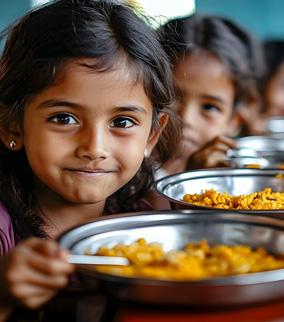
School feeding programmes reach over 450 million children globally, making them one of the largest public food system interventions and a primary tool for addressing child hunger and poverty. Well-designed school meal programmes can further catalyze broader food systems change by providing children with healthy, equitable meals produced sustainably, protecting biodiversity, and minimizing environmental impact. A key, underutilized lever for achieving such “planet-friendly” meals is agrobiodiversity. Agrobiodiversity is the variety and variability of animals, plants and micro-organisms that are used directly or indirectly for food and agriculture, including crops, livestock, forestry and fisheries. Integrating diverse, locally adapted foods into school menus can improve nutrition, support resilient farms and livelihoods, and contribute to environmental sustainability.
The Biodiversity–Food Systems Challenge
Current food systems rely on just 12 plant and animal species for 75% of global food needs, while thousands of traditional crops disappear from fields and plates. This dramatic diet simplification threatens both human nutrition and local ecosystem resilience. Climate change compounds these challenges by reducing crop yields and nutritional quality of staple grains, with the greatest risks facing the world’s most vulnerable populations. Yet the large diversity of indigenous and traditional food species and varieties, typically nutrient-rich, locally adapted, and climate resilient, remain largely disregarded by current agricultural and food systems.

KEY TERMS
Agrobiodiversity:
The variety and variability of animals, plants and micro-organisms that are used directly or indirectly for food and agriculture, including crops, livestock, forestry and fisheries.

BIODIVERSITY ENTRY POINTS
Species diversity: Planet-friendly school meals interventions focus largely on enhancing species and varietal diversity through strategic integration of neglected and underutilized indigenous food into institutional food systems. Enhancing agrobiodiversity in local farms and landscapes simultaneously delivers more stable yields, healthier soils, reduced pollution, and greater resilience while supplying the varied foods needed for healthy, culturally appropriate school meals.
FOOD SYSTEM ENTRY POINTS
y Policy and Governance: Existing policy frameworks, for example public procurement policies, food security policies, and decentralized governance systemts, are leveraged to drive change at different scales (e.g., public procurement policies, food security policies or decentralized governance systems).
y Shifting diets: Experiential education such as school gardens, combines cultural rehabilitation of traditional foods, food preparation skills, and social learning that transform the negative perception of indigenous foods, such as leafy greens once dismissed as “weeds” or poor people’s food, into valued nutritious options.
y Social organization: Schools serve as convening spaces for advancing the well-being and futures of the most vulnerable such as children and farmers. They can foster discussions on food system transformation, generating practical, tangible impacts locally while contributing to changes in food systems.
School Meals Coalition (SMC):
A network of governments and partners promoting universal access to healthy, sustainable school meals.

Integrated Biodiversity–Food Systems Approach
School meals have evolved from an education and hunger intervention into a strategic platform for sustainable food system transformation. The Biodiversity for Food and Nutrition (BFN) multi-country programme broke new ground by providing evidence on how school meals could mainstream biodiversity conservation while improving nutrition security and local economic development. Funded by the Global Environment Facility (GEF) and coordinated by Bioversity International with the Food and Agriculture Organization of the United Nations (FAO) and the United Nations Environment Programme (UNEP), this programme established critical precedents. Momentum accelerated after the UN Food Systems Summit (2021), with 111 governments joining the global School Meals Coalition (SMC).
Around the world, many initiatives are advancing planet-friendly school meals, yet few explicitly focus on leveraging agrobiodiversity. The Alliance of Bioversity International and the International Centre for Tropical Agriculture (CIAT) (The Alliance) and partners have been working across continents and context to mainstream agrobiodiversity in public procurement of foods for school meals. A growing amount of evidence thereby demonstrates how increasing agrobiodiversity - and in particular local indigenous and traditional foods - in school meals, can strengthen nutrition, local livelihoods, and biodiversity in synergy. This is done through various integrative pathways of which some are elaborated on below.
Integrative Pathways: Country examples of School Meals Linking Biodiversity to Food Systems
1 BRAZIL: EMBEDDING BIODIVERSITY IN NATIONAL PROCUREMENT
Brazil has institutionalized biodiversity-positive procurement through its National School Feeding Programme (PNAE). This was achieved by sustained policy engagement. The country leveraged existing federal policies requiring 30% of school food procurement from family farmers.
This created direct market incentives for biodiversity conservation. Brazil’s Interministerial Ordinance N. 284/2018 established an official list of 101 native species with nutritional value and documented 70 edible species. These indigenous fruits, vegetables, and traditional grains were integrated into the PNAE serving over 40 million children. The approach did not require additional funding streams but instead redirected existing school meals expenditures toward local suppliers for maintaining greater species diversity. This created direct market access for family farmers growing native species.
2 KENYA: COUNTY-LEVEL INNOVATION LINKING FARMERS TO SCHOOLS
Kenya has developed county-level models that integrate biodiversity-positive procurement into school meals. Indigenous vegetables such as spider plant, nightshade, and amaranth are procured and used in school feeding systems. The school meals programme also incorporates educational components including open days for families and local organizations that help increase community appreciation for traditional foods.
At the same time, the approach strengthens value chains by creating county-level partnerships, linking smallholder producers to institutional markets, and building local processing and distribution capacity. In Busia County, this work led to the first Biodiversity Conservation Policy that specifically recognizes the importance of traditional foods for food and nutrition security. This is further supported by building farmer business schools to support the commercialization of these indigenous species.

3 INDIA: COMMUNITY-LED INTEGRATION OF FOREST FOODS
In Madhya Pradesh, India, a project, co-led by the Alliance and the Research Consortium for School Health and Nutrition (LSHTM), aims to enrich the state’s school meal programmes using local agrobiodiversity. It focuses on re-introducing neglected and underutilized crops into both farming systems and institutional food procurement.
By linking local livelihoods, community knowledge, and India’s food heritage, the project seeks to improve child nutrition while embedding sustainability in public food procurement systems. It also proposes rethinking menu design and procurement policies to better reflect environmental, cultural, and nutritional goals.
©NESFAS / Antony Lyngdoh
The Economic Model
The school feeding economic model operates through strategic alignment of existing public procurement budgets with biodiversity conservation incentives, eliminating the need for additional funding streams. This approach redirects current school feeding expenditures toward suppliers and production systems that contribute to larger species diversity and the conservation of local indigenous and traditional foods.
Imperative for Transformation
Within the context of urgent needs for systemic change in food systems, innovative school meal programmes serve as an example that bring together new partnerships, innovative and coherent financing mechanisms and cross-sectoral policies. Further, schools have shown that they can play a pivotal role in engaging youth and future generations towards more sustainable futures. Aligned efforts such as school gardens, nutrition and environmental education, agroecological learning, and cultural storytelling have demonstrated their potential to contribute to biodiversity and food security stewardship. Taken these elements together, it is thereby increasingly recognized that school meal programmes, can serve as a leverage point for systemic change.
Measuring Change and Impact
Mainstreaming agrobiodiversity in planet-friendly school meals represents a shift from measuring conventional education and nutrition outcomes to tracking pathways that deliver multiple Sustainable Development Goals (SDGs) –improved child nutrition, smallholder farmers livelihoods, biodiversity conservation, and climate-resilient food systems. This requires a systems lens that combines standardized metrics with locally relevant indicators. Processes should also be rooted in participatory learning and broad stakeholder engagement so that monitoring directly informs adaptive management.
In recent years, several global measurement frameworks have been developed to standardize the assessment of impacts in agrobiodiversityfocused school meals programmes. The Agrobiodiversity Index provides broad food system assessment using 22 indicators covering consumption patterns, production systems, and genetic resource conservation. FAO’s biodiversity indicators track the availability of nutrient data for biodiverse foods and their inclusion in dietary surveys.
The Periodic Table of Food Initiative advances standardized food composition analysis. This enables comparison of nutrient diversity across farming systems and regions. While these frameworks provide valuable foundations, their adaptation to school feeding contexts requires further development. The planet-friendly school meal framework, with 21 indicators, is being pilot-tested in Kenya, Rwanda, and Uganda, with plans for broader adoption through the School Meals Coalition’s member states.
LEARNINGS
Political transitions or crises can create opportunities for mainstreaming agrobiodiversity in school meals if actors are ready to respond.
Multi-stakeholder platforms linking production, policy, education, and markets are most effective when fostering cross-sectoral and unconventional partnerships.
Ensuring healthy, culturally appropriate meals daily is a complex task that requires greater support for cooks, to access the right ingredients, for menu design, and for developing reliable procurement mechanisms that guarantee sufficient, timely, and high-quality foods. Innovative financing mechanisms are therefore central to well-functioning school meals.
Local champions and sustained community engagement drive delivery, while embedding programmes in existing policy frameworks enables scaling.
Infrastructure gaps like storage, processing, and market access continue to constrain the use of Indigenous and traditional/local species and varieties
Coordination across education, agriculture, and health sectors remains difficult due to competing priorities and timelines.
Transaction costs for sourcing diverse species remain high, highlighting the need for innovative financing.
Repositioning traditional foods from stigmatized “poor people’s food” or “weeds”
requires
education.
School meals serve as strategic platforms for food system transformation, with institutional procurement creating reliable markets for diversified and healthy foods beyond what individual consumers cannot sustain. A systems approach, spanning production, education, health, and environment, shows promise to deliver greater impact.
Measuring impact requires indicators that go beyond food groups, it should include species counts by farmer incomes, soil health, student performance, and community participation. Long-term monitoring must track changes in food culture, ecosystem health, and social outcomes to capture the full transformative potential mainstreaming agrobiodiverse school meals.
An evidence-based foundation for food systems transformation is essential for scaling healthy and diverse school meals programmes. Standardized yet locally relevant indicators can guide policymaking, demonstrate return on investment, and provide practitioners with flexible tools.
Pilots in Brazil, Kenya, and India serve as lighthouse models. They demonstrate scalable pathways for mainstreaming Indigenous and traditional/local species and varieties in school meals that inspire adaptation to different political, cultural, and agricultural contexts.
Digital agricultural platforms, which take into account social and gender equity dimensions, can integrate local knowledge and agroecological data to support adaptation and enable communities to contribute to and directly benefit from available data.

SCALING OPPORTUNITIES
There is strong potential to mainstream agrobiodiversity through indigenous and traditional/local foods in school meals across South Asia, Sub-Saharan Africa, Southeast Asia, the Pacific, and the Americas. This can be done by building on policy frameworks and networks already showing success. Ongoing work in Brazil, Indonesia, and through the Australian Centre for International Agricultural Research (ACIAR) in the Pacific demonstrates this momentum. The SMC provides a key platform for knowledge transfer and technical support, with digital tools that align nutrition, biodiversity, cost, and cultural preferences.
Building on past and ongoing work and leveraging the networks of key school meal ambassadors, such as the World Food Programme (WFP) and SMC will be central to improving financing, connecting practitioners, enhancing technical support, and strengthening national programmes. At the same time, special emphasis on indigenous and traditional/local species and varieties is essential. It serves as a lever for these programmes to promote healthy diets—not just food security—while advancing global goals related to conservation, climate, water, and land. As well as supporting farmers and landscapes to become more resilient and sustainable.
Linkages with other food system coalitions, such as the Agroecology Coalition, are central for identifying practices and farm configurations that maximize public benefits for water, soil, land, and air.
STRATEGIC COLLABORATION NEEDS
Change is possible when policies are coherent and actively promote cross-sector dialogue for coordinated action. Crosssector coordination further enables effective global-to-local and local-to-global alignment of efforts. For example, global funding mechanisms for biodiversity or climate change can be invested in landscapes that simultaneously support national goals and produce healthy, sustainable foods.
Further, multi-stakeholder platforms facilitate the sharing of responsibilities, expectations, and roles. They help align goals among farmers, schools, social and community entrepreneurs, research organizations, development agencies, children, parents, and other actors. Such processes are essential for achieving lasting, transformative change. Investments in those collaborations and processes are often neglected yet are at the core of any transformation and collective action.
Biodiversity–Food Systems Use Cases







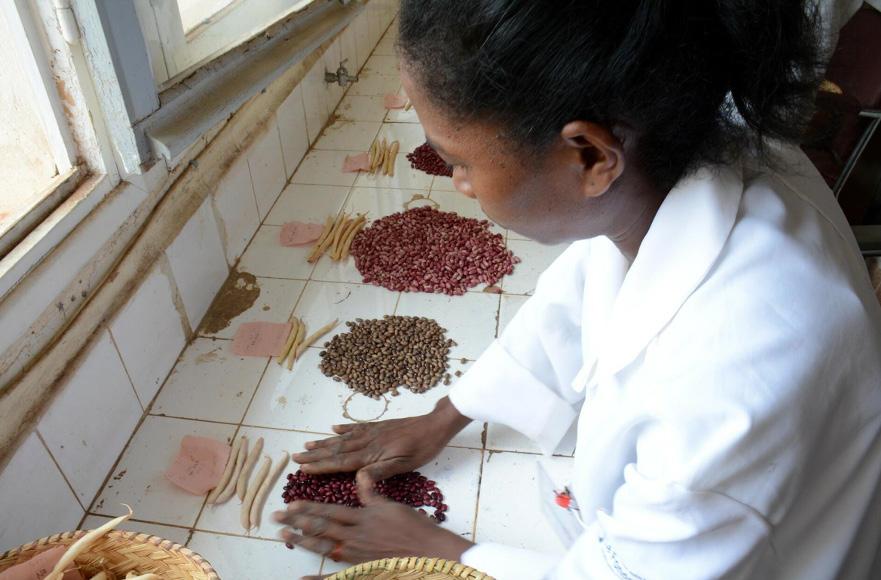
©CIAT/Stefanie Neno