WORLD ECONOMY of the past 30 years are only allowing China to regain its rightful place,” he asserts. “Even if China’s economy becomes larger than that of the US, its standard of living will still be only one-quarter of that enjoyed by Americans.” Analysis of different types of enterprises showed that in the first two months of 2011, the year-on-year growth of state-owned and state holding enterprises went up by 10.6 per cent; collective enterprises, 10.5 per cent; shareholding enterprises 15.6 per cent; and 12.2 per cent growth for enterprises funded by foreign investors or investors from Hong Kong, Macao and Taiwan province. The year-on-year growth of heavy industry in the first two months was 14.4 per cent, and 13.3 per cent for light industry. “That these improvements involve one-fifth of the world’s population highlights the vast human scale of the achievement. Several hundred million people have been lifted out of poverty, and living conditions have improved for many more people in a shorter period of time than ever before,” conclude Arora and Vamvakidis. BROOKING INSTITUTE policy analyst and contributor Willy Lam, also a senior fellow at the Jamestown Foundation, a professor of China Studies at Akita International University, Japan, and an adjunct professor of history at the Chinese University of Hong Kong, describes the country’s momentum in his report China’s Quasi-Superpower Diplomacy, Prospects and Pitfalls. “The diplomatic and geopolitical implications of China’s precipitous rise are thoroughly appraised. With its economy predicted to grow at eight per cent despite the world financial crisis, China is widely regarded as a prime locomotive for economic recovery worldwide,” he says. “The People’s Liberation Army is building nuclear submarines and aircraft carriers, and the country’s first astronaut is expected to set foot on the moon before 2015. Taking advantage of the damage that the financial crisis has dealt the American laissez-faire system, the Chinese Communist Party is also gunning for a novel international financial architecture, or one that is not dominated by the US.” EU nations and the US have expressed great concern about the rapid rise of China’s economy, often citing the abundance of exports and an increasing trade deficit as legitimate threats to their own economies. But as Griswold suggests, there is a difference between what lawmakers claim is a healthy economic policy that will protect domestic economies and the actual spending patterns of consumers in those countries. “Imports from China arouse political opposition because they are so visible to consumers, and they do compete against such powerful, entrenched interests as steel and textile companies and their unions,” he says. “It doesn’t help that China is so big and its government so oppressive of political and civil freedoms. Politicians in the US often look for foreign scapegoats to distract attention from their own domestic policy mistakes. Japan was the target 20 years ago. Now it’s China’s turn.” Stereotypes about the Chinese are also a driving force behind recent scandals in the luxury goods community. Many companies, including 046
1
2
Prada and Gucci are still recovering from reports of merchandise being made in China instead of in EU countries such as France and Italy, the presumption being that when goods are crafted in China, they are automatically inferior. Chinese immigrant communities in Italy are also being eyed suspiciously, although their presence is largely due to the fact that they work for less than typical wages and that Chinese entrepreneurs are buying formerly Italian-owned businesses largely because the owners were looking to sell at a high rate, regardless of the buyer. Griswold notes: “While politicians and voters express worry about imports from China, American consumers have voted with their dollars to embrace lower-cost goods from China. Access to low-cost imports from China helps Western countries keep a lid on inflation. Those goods are especially important in the budgets of lower-income workers. Income inequality would actually be greater in the US if poor families could not buy more affordable clothing, shoes, and consumer goods from China.” The IMF research by Arora and Vamvakidis also supports the claim
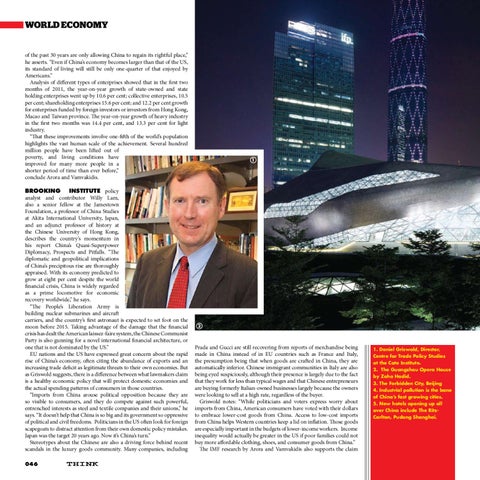
1. Daniel Griswold, Director, Centre for Trade Policy Studies at the Cato Institute. 2. The Guangzhou Opera House by Zaha Hadid. 3. The Forbidden City, Beijing 4. Industrial pollution is the bane of China’s fast growing cities. 5. New hotels opening up all over China include The RitzCarlton, Pudong Shanghai.