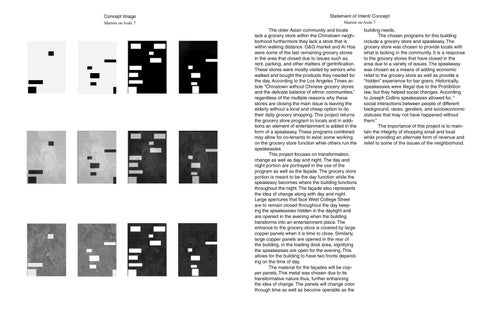
Concept Image
Statement of Intent/ Concept
Martini on Aisle 7
Martini on Aisle 7
The older Asian community and locals lack a grocery store within the Chinatown neighborhood furthermore they lack a store that is within walking distance. G&G market and Ai Hoa were some of the last remaining grocery stores in the area that closed due to issues such as, rent, parking, and other matters of gentrification. These stores were mostly visited by seniors who walked and bought the products they needed for the day. According to the Los Angeles Times article “Chinatown without Chinese grocery stores and the delicate balance of ethnic communities,” regardless of the multiple reasons why these stores are closing the main issue is leaving the elderly without a local and cheap option to do their daily grocery shopping. This project returns the grocery store program to locals and in additions an element of entertainment is added in the form of a speakeasy. These programs combined may allow for co-tenants to exist; some working on the grocery store function while others run the speakeasies. This project focuses on transformation, change as well as day and night. The day and night portion are portrayed in the use of the program as well as the façade. The grocery store portion is meant to be the day function while the speakeasy becomes where the building functions throughout the night. The façade also represents the idea of change along with day and night. Large apertures that face West College Street are to remain closed throughout the day keeping the speakeasies hidden in the daylight and are opened in the evening when the building transforms into an entertainment place. The entrance to the grocery store is covered by large copper panels when it is time to close. Similarly, large copper panels are opened in the rear of the building, in the loading dock area, signifying the speakeasies are open for the evening. This allows for the building to have two fronts depending on the time of day. The material for the façades will be copper panels. This metal was chosen due to its transformative nature thus, further enhancing the idea of change. The panels will change color through time as well as become operable as the
building needs. The chosen programs for this building include a grocery store and speakeasy. The grocery store was chosen to provide locals with what is lacking in the community. It is a response to the grocery stores that have closed in the area due to a variety of issues. The speakeasy was chosen as a means of adding economic relief to the grocery store as well as provide a “hidden” experience for bar goers. Historically, speakeasies were illegal due to the Prohibition law, but they helped social changes. According to Joseph Collins speakeasies allowed for, “ social interactions between people of different background, races, genders, and socioeconomic statuses that may not have happened without them.” The importance of this project is to maintain the integrity of shopping small and local while providing an alternate form of revenue and relief to some of the issues of the neighborhood.