Case study: Stroud Green Housing Centre Owain Williams Architects transforms a bijou former garage into a smart HQ for Stroud Green Housing Co-operative
Case Study: Victoria Riverside Jolie brings sensoryled design and citycentre community to one of Manchester’s most promising new neighbourhoods
74 Case Study: HYLL
The new Cotswolds boutique hotel eschews cliches and brings minimalism to the countryside
82 Building Narrative
Co-founder and CEO of Artiq, Patrick McCrae, asks: Where do you get your inspiration?
84 Positive Impact
We turn to the designers, architects and makers who have shaped our pages in 2025, asking them to reflect on defining industry changes and to speculate what brighter possibilities could be on the horizon
92 Fast Forward: STAR strategies + architecture
The founders of STAR strategies + architecture mull on what would happen if the housing of the future adapted to the lifestyles of today
100 Events: Mix Awards North 2025
Celebrating design in the north, we look back on one of the biggest events on the design calendar
118 Events: Mix Awards 2025: Winners’ Dinner
Our debut event, we invited Mix Awards 2025 project winners to an intimate supper in a Covent Garden hotspot
122 Events: Hotel Experience 2025
We reflect on the highlights from Athens’ global hospitality design forum
124 Events: Workspace Design Show
Returning to London’s Business Design Centre, we cast our gaze forward to Workspace Design Show 2026
128 Mix Talking Point: Play in the public realm
London-based design studio McCloy + Muchemwa
proclaim that play shouldn’t just be relegated to childhood, it should be a fundamental aspect of design
132 The Making of… Florim
The history and evolution of the Italian surfaces maker
136 Material Matters
Leading sustainability and regenerative design at Haworth Tompkins, Sophie Emerson selects which materials have impacted her life and work
137 Material Innovation
Graduate industrial designer, Laia Balart Fenollosa presents a solution for the fashion industry’s vast amounts of denim waste
137 Innovative Thinking
Head of Strategy at M Moser Associates, Steve Gale applies chicken and egg theory to workplace flexibility, hybrid models and Return to Work initiatives
THE SISAL EDIT
Inspired by the timeless beauty of natural materials, this capsule collection reinterprets organic textures for today’s work and living spaces
Marketing Manager Paul Appleby paul@mixinteriors.com
Head of Operations Lisa Jackson lisa@mixinteriors.com
Advertising and Events Operations Manager
Maria Da Silva maria@mixinteriors.com
Art Director Marçal Prats marcal@mixinteriors.com
Founding publisher Henry Pugh
Founded in 1981, M Moser Associates is one of the leading practices in workplace design, building a reputation for crafting projects that drive performance, improve employee wellbeing and which place ‘the office’ as an incubator for change. Having completed pioneering headquarters for the likes of HSBC, AstraZeneca and Sony Music, M Moser continue to be at the forefront of design innovation, leaning on data, tried and tested methodologies and advancing technologies to deliver futureproof concepts.
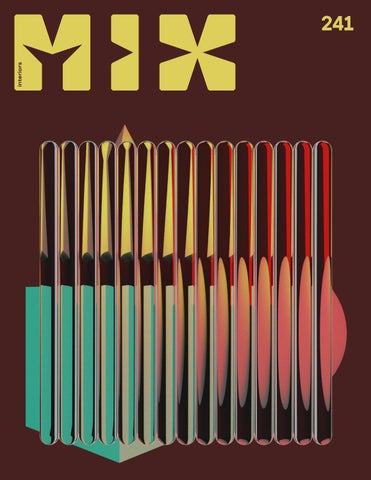
Celebrating Mix Interiors on its 25th anniversary, for issue #241, M Moser drew heavily from the industry’s most fundamental forms – square, circle and triangle – as seen through the distorted and tactile lens of fluted glass. M Moser Associates allowed Mix’s key milestones to dictate the perimeter, rotation, scale and colour of the geometries, each shape became a vessel for meaning and allows the viewer to interpret information though visual abstraction.
Subscription
To ensure that a regular copy of Mix Interiors reaches you or to request back issues, call +44 (0) 1161 519 4850 or email lisa@mixinteriors.com
Annual Subscription Charges UK single £45 50 Europe £135 (airmail) Outside Europe £165 (airmail)
As I write this, it’s the morning after the night before – the night before being more explicitly, Mix Awards North 2025. It’s always a particular highlight for the Mix Interiors team, and I know so many of you, because it’s not just a party, not even simply an awards presentation, but a unique testament to the sheer breadth and quality of design emanating from the north of the UK and the island of Ireland. And so we came together, as we always do at this time of year, to recognise the most exceptional projects and products of the last 12 months, as well as the people behind them.
Of course, there’s a certain personal pleasure in seeing the revelry that accompanies a win. It’s a reminder of the core purpose of Mix Awards, and indeed Mix Interiors as a whole – to celebrate, uplift and inspire the community of designers, architects, makers and creatives of which we are a part. And we’ve been doing that for a remarkable quarter century, with 2025 marking 25 years of Mix Interiors. Across that time, we’ve welcomed over 50,000 people to our events, reached millions of readers and platformed projects and products on a truly global scale. We’ve evolved with the times,
to reflect the world in which we live, the changing face of design and to meaningfully address the topics that matter to you.
As we close out our anniversary year then, this issue, our 241st in print, is undoubtedly a milestone. It’s one we’ve achieved together, thanks to your support – our partners and our readers. And as we aim towards our next 25, we’ll continue to strive to deliver compelling content and build connections, sometimes in new ways. 2026 will see the same focus on platforming the stories that matter in print and online; we’ll be with you on the go with our podcast series; bringing you into projects and conversations in dynamic fashion with new video strands; and there will be exciting announcements about the development and expansion of our awards. So whether you’ve been with us since the beginning, or discovered us last week, we look forward to moving forward, not only as a lens into the design industry, but as part of it – shining a spotlight on your work and, as always, bringing people together.
Harry McKinley Managing Editor
With 4+ million arms sold, the world leading best seller just got even better.
The new Flo is designed to accommodate the latest generation of flat or curved screens (up to 34 inches and 7kg). With improved cable management for ultimate control, Dual Rate Spring Technology and a colour drenched design, Flo provides the ergonomic excellence you need to work comfortably – improving posture, concentration and well-being.
Contemporary multi-zone configurations.
Scan the QR code to see the full Harp range.
brunner-uk.com
Saint Edicola
In a country jewelled in grand basilicas, sweeping amphitheatres and monolithic temples, the kiosk – or as it’s locally known, the edicola – stands as one of the most important archetypes of Italian architecture. For millennia, the structures have acted as informal gathering points and community hubs; places where residents do more than just purchase their morning newspaper but spend prolonged periods catching up with neighbours on politics, sport and the weather.
Reimagining the time-honoured kiosk for a modern era, SANTEDICOLA is a newsstand and micro-gallery concept, located in the heart of Rome’s San Giovanni district. Created by Gaetano Orefice, the space is part of a broader local regeneration effort that hopes to restore meaning to the kiosk as a cultural and social pillar.
Formed around a traditional eightsided volume, SANTEDICOLA brings editorial culture, design and creative entrepreneurship together, with images by photographer Mariano Doronzo’s Lanterna Beach: I volti del Braccio (The Faces of the Braccio) on the outside and custom restyling by Dispensabile and Cantiere Galli Design within. Lacquered wooden surfaces are crafted by an artisan workshop and a timeless array of furnishings – such as seating by Ferm Living and lighting from HAY – creates a contemporised backdrop for the printed matter and design objects for sale.
Throughout, the visual identity, developed with brand designer Jonathon Dominic Spada, draws inspiration from the iconography of votive shrines (small urban altars) to capture the symbolism and sacredness of the project.
A clear response to a lull in community spirit, the project is living proof that urban iconography can reinvent itself without losing its essence as the project plays an essential role in curating unexpected experiences, sparking conversations and building new relationships in the neighbourhood.
Image:
Edi
Solari
www.intra-lighting.com/ #Lysabel
Lysabel
Walk the Sky
Characterised by its popular bars, restaurants and shops, Stockholm’s main high street Hornsgatan once attracted hordes of international tourists and local day-trippers alike.
Today, it’s a different story. During 2025, there has been a reported 20% increase in vacant retail units – as trade isn’t enough for businesses to cover even the most basic costs (never mind turn a profit) –with pavements becoming more thinly spread as a result. It’s not just the real world that’s struggling either. Big budget campaigns and targeted ads in pixel land
are becoming increasingly ineffective, as digital fatigue and the paradox of choice has become the plight of all.
With ‘the death of retail’ playing on its mind, Craft sportswear tapped creative agency The Great Exhibition to realise the launch of its latest shoe, Kype – the intention: to make the featherlight (198g) runners into a full body experience and return shopping to its physical heyday.
Entitled 'Walk the Sky', The Great Exhibition designed and constructed an interactive inflatable environment,
inspired by the aeration of Kype’s prograde soles and the supreme comfort of their Xx Foam™ technology. Cobalt blue and smattered in idyllic cloudscapes, customers were invited for one day only to bounce from room to room, coming back to the senses whilst experiencing the shoe – not as product specs or an object in hand – but as all-encompassing physical sensation. Walk the Sky goes beyond trying Kype on for size: it represents how purchase and play can still be mutually enjoyed through the power of design, even in a struggling market.
Image: Noah Fernström
No diving
After building its hempcrete community centre, Studio DERA was invited by Waltham Forest College (WFC) to repurpose the school’s long disused swimming pool into an alternative learning environment for a diverse and ever-expanding student body. With the vision to capture the students’ imaginations, the founders of Studio DERA, Max Dewdney and Marcel Rahm, were tasked by Principal Jane Gardner to adaptively reuse the 994 sq m hall, accommodating the educational and extracurricular needs of all.
From the outset, Studio DERA heard from both educators and students to build a picture of what types of activities would occur in the new space and the zoning required for these to unfold efficiently. In addition, the design team asked for ideas of how The Pool – a space once dedicated to lane swimming and 100 m races – could be reconfigured into a multi-purpose educational facility most sustainably.
Informed by the feedback, since, Studio DERA has crafted a versatile, light-filled space that works with the shape of the original structure, utilising natural and recycled materials to subdivide the basin into five distinct areas. A raised stage positioned at the ‘deep end’ is primed for lectures, performances and assemblies while, tucked beneath, a new IT room uses the additional headroom to deliver high-performance digital learning infrastructure. For solo study and small group work, integrated window seating perimeters the old concourse, with fixed desks being reserved for more focused work.
Through fluctuations in spatial hierarchy and intermittent biophilia, The Pool is a four-sided interior terrain that challenges the effectiveness of conventional classroom layouts in their essence. Here, Studio DERA’s working within the parameters of a former leisure space garners a refreshed and novel attitude to learning, catering to different styles of knowledge acquisition.
Image: Lorenzo Zandri
RAK-DES
The award-winning RAK-Des collection is inspired by Bauhaus design principles and features minimalist sanitary fixtures, including countertop and freestanding washbasins with clean, sleek lines. Now available in a range of matt colours – Black, Grey, Cappuccino, Greige, and White.
Camping out
A joint venture for Ennismore and global investment firm Dubai Holding, Caravan Hatta by Our Habitas marks the hotel group’s UAE debut, slated to open in December 2025. Situated south of the border, where Dubai meets Oman, the concept walks in the footsteps of Caravan AlUla – Our Habitas’ first luxury caravanning experience for Saudi Arabia, which filled a gap in the global hotel market in early 2022.
Almost double the size of its Saudi predecessor, Caravan Hatta’s 50 Airstreams are oriented cyclically to capture views of Hatta’s famed Dam as well as the majestic Hajar mountains. Inside, each bespoke trailer comprises a mix of low-impact design, locally sourced
materials and organic textiles, selected simply, for comfortability and their appropriateness to place. A stripped-back design language has been intentional throughout, shifting guests’ attention from material extravagance towards a hospitality rooted in self-expression, adventure and environmental connection.
Grandeur, instead, comes in the form of Our Habitas’ experiential programming, influenced by the remote town’s natural beauty and cultural heritage. Holistic wellness offerings – including an infinity pool, a contrast therapy area and a private jetty equipped with kayaks and paddleboards – are offset by Ennismore’s food truck and live barbeque concept, which is set to celebrate regional flavours in a relaxed, open-air setting.
Restorative rituals and creative workshops will also be part of the package, drawing on themes represented by the revered matriarch, Hajar – a figure in Abrahamic religion who has strong links to pilgrimage and travel as an important rite of passage. Though a static site, Caravan by Our Habitas satiates the needs of a specific type of contemporary traveller who, in an increasingly complicated modern world, hankers for a return to a nomadic lifestyle – a time before agricultural industrialisation and resource scarcity anchored us to just one place.
Sky river
Like a lot of inner-city construction firms, Kitaoka Group is headquartered in a prefabricated, corrugated steel building – the type of structure that is easily assembled and expansive enough for prototyping large-scale civil engineering projects. Located in Mima City, Japan, though atypical, the 40-year-old building was dark and disconnected in layout, and Kitaoka wanted to improve conditions for its employees and their families, whilst bringing the local community into a new era for the company. Tapping Tokyo-based Wataru Architects, the space has been reimagined with a brandnew, people-centric focus, thanks to a clever combination of biomimicry and structural know-how.
Mirroring the forms of the nearby Yoshini River valley, a 50m skylight and adjoining glass facade now slices the building lengthways, creating a luminous void which not only improves visibility, but also encourages air flow through operable glass sashes. Inside, a strippedback interior with warm red accents allows for the new light and ventilation strategies to be fully appreciated, with a central, 7m-tall Benjamin tree bringing further life and oxygenation to offices and communal spaces. Beyond the entrance, the landscape has been transformed into a park complete with layered vegetation an oversized 3D-printed vase sculpture for staff and the local community to enjoy together.
For Kitaoka Group HQ’s rebirth, retaining the existing building fabric was an essential aspect of the studio's approach for two reasons. One, to minimise environmental impact by avoiding demolition or major upheaval to the landscape; two, to ensure the structure’s industrious past – by way of formed steel sheeting and exposed girders – remained obvious and in no way denied. By taking pointers from the local land and waterways, Wataru Architects have merged business and landscape to ensure a better future for the people that keep Kitaoka afloat.
THE TRINITY COLLECTION ISN’T JUST A FLOORING SOLUTION. IT’S A STATEMENT. A COMMITMENT TO SUSTAINABILITY, INNOVATION, AND COMFORT.
Guy Smith
Things I've learnt
Guy Smith is Global Creative Director at JLL’s Design Lab, with over 20 years’ experience shaping environments for some of the world’s best-known brands. His work spans workplace, retail and brand design, with a focus on creating spaces that connect people to purpose and elevate business performance.
jll.com
Protect the butterfly
We’re incredibly fortunate to be designing in a data-rich environment, able to measure how people move through a space, what they look at and where they pause. But too often I’ve seen the infinite complexity of a built experience reduced to a handful of abstract data points. Embrace that complexity and never reduce the beauty of a butterfly to dust and bits.
Brutal égalité
At the inception of a project, in the ideation phase, every voice matters. The intern's wild idea is every bit as valuable as the senior director’s seasoned insight. But as you begin to edit and refine, sentiment becomes the enemy of excellence. As a creative, you are paid to have ideas, so if something isn’t working, kill your darlings and move on. The ideas that make it through this brutal editing process will be stronger for it.
Chase the buzz
Time to move on from measuring the efficiency of remote vs in-office work. As a creative, the best times in my career have been those moments where we’ve been up against it, the electricity of a group, working together in a room, under pressure and to a deadline. Those are the moments when talent shines, when breakthroughs are forged and memories created.
Design in the cracks
Those precious moments, the surprise and delight when a small thing is better than it needs to be. That awkward corner, the underused corridor, the framed vista that everyone overlooks. These ‘leftover’ spaces often have the most potential because they’re free from preconceptions and design by committee. Yes, working on major landmark projects is fun, but some of my most celebrated projects started as afterthoughts.
Tools rust
The software package or skill that gave you the edge is now holding you back. Whether it’s ideation tools, visualisation, research methods or presentation techniques, what once felt cutting edge becomes an invisible constraint. As technology moves forward, societies evolve and the context our work is viewed in changes. Stay curious about new tools and keep challenging yourself and your teams to ask, ‘is there a better way?’
The height of design
Tim Hatton is an interior design principal at HOK, overseeing all workplace and interior design aspects of each project, ensuring design excellence from concept to completion. He brings extensive crosssector experience and a deep commitment to innovation, particularly in creating inclusive, neurodiverse work environments that support wellbeing and performance.
hok.com
The item First Gen iPhone.
The why
The first gen iPhone marked a turning point in design, not because it was the most advanced, but because it was the most intentional. Every decision, from its compact form and smooth aluminium back to the absence of a physical keyboard, was driven by purpose. Its multi-touch interface introduced a more human way to interact with technology, one that felt effortless and personal. The design wasn’t about visual flair, but about removing the friction until only clarity remained. It captured Apple’s belief that true innovation lies in restraint. It defined how we relate to the objects we use every day, proving that design at its best is not decoration.
The inspiration
It reminds us that design isn’t about adding features for the sake of it, but about clarity and experience. It also teaches the value of consistency and detail. From its tactility to its intuitive function, the experience is cohesive, something every designer strives for in a project, whether digital or physical. Finally, it’s a lesson in emotional connection: great design doesn’t just function, it delights!
The impact
It reshaped technology, communication and culture. It collapsed the boundaries between phones, computers and music, creating the ‘smartphone’ as we know it. Beyond technology, the iPhone transformed industries: redefining product design through simplicity and material honestly, setting new standards for user experience, and inspiring an entire ecosystem of apps that reshaped commerce, media and social connection.
The iPhone also changed expectations; people began to demand elegance, fluidity and integration from every digital experience. In essence, the first iPhone didn’t just introduce a product, it introduced a philosophy.
The personal connection
We were the latchkey generation, kids who knew the streetlights signalled it was time to go home and that drinking from the garden hose in summer was perfectly safe. Way before mobile phones and 5G, so you’d think I’d know how to function without an iPhone… Yet take it away and I turn into a confused zombie, swiping at thin air and praying for signal just to find the nearest decent coffee shop.
Building for our inner world
When we stop at a road crossing, why do we so often reach for our phones? That small reflex reveals something profound: our discomfort with stillness. In science-informed design, there is a popular narrative about stimulation and wellbeing. The first part begins with rats. Studies of enriched environments – in this case, cages filled with objects to explore and manipulate – show that stimulation strengthens memory and learning. The second part takes us to Jan Gehl’s observation that people walk faster in front of bland facades. From these findings, one could easily draw a simple conclusion: unengaging environments are aversive and unhealthy.
Both pieces of evidence deserve more nuanced framing. Rats, after all, are not philosophical creatures. Their enrichment needs are sensorial, not existential. And while Gehl’s observation remains true – we do rush because we crave stimulation – that doesn’t mean it’s what we need. We often resist introspection to avoid discomfort, but it remains essential to our wellbeing.
The question is not whether a space engages us enough, but how intentionally and to what degree. In a culture conditioned by constant input, quietness can feel like neglect. We often interpret calm as emptiness; unprogrammed time as waste. Yet environments that never risk quiet might keep our senses busy while leaving our inner lives starved, much like the algorithms that create and feed our addiction to information.
Intentionally unengaging places should not be seen as failures of design, but as generous pauses. Through this lens we can learn to celebrate environments that forgo attention-seeking in order to make space for our internal worlds. The lesson is subtle: movement and stillness must coexist, and both should feel valid and comfortable at the same time.
Some cultures have different approaches to what we might call inaction, offering the agency to make it an intentional act. The Dutch concept of Niksen –purposefully doing nothing – gives name and legitimacy to the conditions needed for
introspection. Its recognition invites an architectural question: what kinds of places become people’s go-to for Niksen?
Spaces that invite reflection do so not through emptiness, but through an atmosphere of encouragement and acceptance of stillness. They use proportion, texture and rhythm to slow perception, and hold a balance between coherence and curiosity. A soft transition of light, a framed view, a corner that allows pause without performance –these are the conditions that make inaction feel safe and where introspection quietly takes root.
As designers and clients aspire to foster deeper connections with environments, understanding this to be the reason people build affinity, can we resist the urge to fill every silence? The places that host us with equal grace in our extroverted and introverted states are the ones we trust enough to return to in any mood. Like a good friend, such a place does not rush to fill the silence; it holds it for us, and in doing so, helps us hear ourselves more clearly.
Itai Palti is a practicing architect, researcher, and multidisciplinary artist focusing on the relationship between people and place. He is director of Hume, a science-informed architecture and urban design practice. hume.space
Space Copenhagen leads Peter Bundgaard Rützou and Signe Bindslev Henriksen on being selective, choosing feelings over aesthetics and why the world needs more slow thinking.
Words: Becky Sunshine
Photography: Courtesy of Space
Copenhagen
“We’ve reached a stage where we don’t necessarily have to tell the same story 10 times a year,” says Peter Bundgaard Rützou, one half of the leading duo of Danish design studio Space Copenhagen, on a current reluctance to promote their studio. “We both feel it’s time to think differently about what we communicate and why. It can be all devouring. So, we ask ourselves, is it vanity? Is it because we’re looking for business? Or is it because we have a real message?”
It’s a fitting sentiment for a practice marking two decades in motion — a quiet reckoning from a pair who have spent the past 20 years shaping some of the most resonant interiors, architecture, furniture, lighting and product design
around the world. Founded in 2005 by Rützou and Signe Bindslev Henriksen, both graduates of the Royal Danish Academy of Fine Arts’ School of Architecture, Space Copenhagen –known for projects including The Stratford Hotel in London, the original Noma restaurant in Copenhagen, as well as furniture and lighting for &Tradition, Gubi, Stellar Works, Mater and Fredericia – has somewhat resisted the noise of its success; instead choosing to be measured and forward-gazing. Theirs is a practice built on an interplay between restraint and warmth, precision and emotion, intellect and instinct — an approach that feels increasingly rare in a culture seeking high profile and showstopper display.
Space Copenhagen Interview
Space Copenhagen is in a moment of deliberate reflection. “We’ve been working really hard for 20 years,” Henriksen says. “And it’s not that we don’t want to talk about that, but we couldn’t find ourselves authentically diving into a year-long celebration. We’re too focused on what’s next, on the work itself.” Rützou agrees: “We’re not hesitant about appreciating the time that’s gone by, but we don’t need a big party to mark it. These days, when the smallest reaction gets exposure, there’s a certain reflex to do the opposite.”
The work they’re speaking of is as varied as ever. The studio’s recent projects include the renovation of Schloss Schauenstein, a 12th century castle in the Swiss village of Fürstenau, now a nine-bedroom home to chef Andreas Caminada’s three-Michelinstarred restaurant. “It felt almost like a private project,” says Rützou of the stonewalled, timber beamed castle and adjacent building that makes up the place. “It’s this couple’s home, their life, their story. Each room is different, each has its own spirit. Even though it’s high-end hospitality, it’s intimate. We could invent a little story for every space — that it had been curated over time, collected slowly.”
That sense of intimacy, of human proportion and patience, remains the thread throughout their work, whether in private homes or international hotels, yet the pair are increasingly selective about where they direct their energy. “We’ve done a lot of international hospitality,” Rützou explains, touching on projects including multiple restaurants, showrooms and hotels. “But those are long processes — four years, six years, sometimes more. You start to realise that every ‘yes’ is a commitment to a decade ahead. So, we’re asking ourselves: how do we want to work? What feels meaningful now?”
Left:
The design team renovated the 12th century Swiss castle, Hotel Schloss Shauenstein
Right: A guestroom at Hotel Schloss Shauenstein
What does that mean for the studio’s output? “We feel that the world is moving in two directions,” says Rützou. “One is accelerating, bigger projects, faster, more. And then there's sort of this slow movement, which is not meant to be slow or working less, but perhaps with more care and interest. Not just connection to the actual product you're making, but also with the people you're working with. And then you have the bigger projects which are amazing opportunities, but also can be a monster with lot of decisions that perhaps you don't have the same kind of influence over. So, our world is bouncing a little bit back and forth between these two types of projects.”
For Henriksen, the question extends beyond scale. “We’ve started taking on more private residential projects again,” she says. “It brings you closer to every decision — every handle, every wall finish, every conversation about how someone cooks or sleeps. It’s a nice way to balance the bigger, more complex work with something that’s personal and value based. You learn so much from that closeness.”
That reflection has already shaped part of their next chapter. As creative directors of St Leo, the Copenhagenbased bio-paint and surfaces company, the duo is exploring design from another
“We could invent a little story for every space — that it had been curated over time, collected slowly.”
vantage point. “It’s been refreshing,” says Rützou, “to step back from creating every output ourselves and instead compose strategy — to help shape collaborations with other creatives. It’s a different kind of authorship.” Their collaboration with St Leo culminated earlier this year during 3daysofdesign, with the opening of the brand’s new building in Copenhagen’s Nordhavn — a chalky, light-filled house that functions as both showroom and living laboratory of sorts. “The whole building is designed by us,” says Henriksen. “We designed the showroom and the apartment, so it’s very close to us.” The project, she explains, evolved naturally out of longstanding trust. “We’ve known Martin
(Kornbek Hansen), St Leo’s founder and the founder of &Tradition, for years.” In this new art direction role, they’re also curating collaborations with designers such as Tina Seidenfaden Busck of the gallery The Apartment, Christian + Jade of the eponymous studio, and Jonas Bjerre-Poulsen of Norm Architects. “It’s incredibly liberating choosing to work with someone for their passion and their universe and it's not necessarily exactly what you would have done yourself,” Rützou says. “We choose collaborators for that passion and create a palette of perspectives. We’re aiming for something more unpredictable — a variety of angles and energies rather than a single, monolithic aesthetic.”
Left: MG dining chair
Below:
Circulation in Hotel Toranomon Hills in Tokyo
Right: The dining room in Restaurant Apothéose, Tokyo
“We’re aiming for something more unpredictable — a variety of angles and energies rather than a single, monolithic aesthetic.”
Henriksen agrees. “There’s so much mono aesthetic out there. We want to build something more complex — still refined, but with surprises, audacity, a bit of tension. The people we choose all share a way of working that’s careful, patient, respectful of craft. That’s what we find precious — that attention to what we see and touch.” They hint that a series of more St Leo products are in the works for next year.
Patience is also recurring theme. Rützou notes that the industry’s tolerance for slow thinking has narrowed. “I also think it's it has to do with something more existential. We're not patient anymore. There used to be more acceptance that
ideas take time,” he says. “Now, everyone is impatient. We’re so used to images that we don't really think about what the reality of the visual concept is. It's like, we just want to see it.” And yet, they are both pragmatic about technology’s role in this shift. “We haven’t hired anyone to work with AI but I wouldn’t rule it out,” Rützou says of their 25-strong team. “We’ve muscled up in terms of generating images in-house. We’ve found it’s very good at replicating what already exists but surprisingly bad at creating what doesn’t. That gives us relief, because then it’s just a tool. I think instead of being defensive about it, we can ask how we can utilise it effectively.”
Space Copenhagen Interview
An insistence on personality, on something decidedly human, work that feels alive, subtle, considered, has helped define and maintain the studio’s aesthetic. Over the years they have refined a vocabulary of texture and light that has become instantly recognisable without managing to lapse into formula. They talk about atmosphere rather than style, empathy rather than minimalism. “There’s a dilemma,” Rützou says, “because everyone feels the need for emotional resonance, but not everyone is comfortable discussing it. It threatens certain conventions – that things aren’t perfect. To create something that really resonates, you must accept there are things you can’t do, it’s a commitment; the conversations have to be handled with sensitivity.”
Henriksen nods. “There’s a lot of talk — everyone using the right words about empathy and sustainability — but for it to have substance is another matter. You have to feel it, not just market it.” That emotional intelligence extends to their choice of clients. “We’re lucky,” says Rützou. “Most people who approach us want to create something meaningful.”
Their upcoming calendar reflects this selective focus: new projects for Rosewood in South Korea and Japan; a commission for developers MORI, having already designed a hotel in Tokyo; and, closer to home, a flurry of food and beverage spaces in Copenhagen. “It’s lovely to be here,” Henriksen says. “We’ve been travelling so much, but now we’re working on four restaurants in the city, all opening within six months. It’s been amazing to see how the food scene has evolved — 20 years ago, Denmark didn’t have this diversity. Now, it’s full of international energy. It feels worthwhile to be part of that.”
“Everyone feels the need for emotional resonance, but not everyone is comfortable discussing it.”
Still, the pair remain grounded in a world that is, as they put it, “slightly falling apart”. When asked if they feel optimistic, Rützou answers simply, “Yes.” He pauses. “There are two major forces at play — one encouraging overproduction, the other moving towards purpose and care. The second might be smaller, but it’s stronger in spirit. You have to keep your chin up, elevate the conversation, be serious about it, but not judgemental. That’s how things change.” In an era of accelerating design cycles and visual noise, their restraint reads as a radical act. “We don’t need to be louder,” Rützou says quietly. “We just need to be clear.”
www.spacecph.dk
Left: The lounge area of one of Hotel Largo’s suites
Right: Dining in the courtyard of Hotel Largo, Lisbon
Happily ever after
Linda
Boronkay on modelling, meeting
your heroes and the importance of not resisting what life has planned for you.
Words: Katie Treggiden
Photography: Courtesy of Linda Boronkay
I’m not sure what I’m expecting when I reach the third floor of a shared workspace on London’s Gray’s Inn Road, but it’s not what I see as Linda Boronkay welcomes me in. The former design director of Soho House is now founder and creative director of her own interiors practice, Boronkay Studio. Her signature style is place-based, richly layered and populated with antiques and drama — and yet, I don’t see that here. Computers, sample racks and the odd coffee machine populate a clean and functional office. Boronkay leads me to a glass-walled meeting room, where coral tones and
textured artworks offer a glimpse into the mind of this brilliant, young, Budapest-born designer. I’m still not quite connecting the dots, but she’s squeezing me in between client meetings, so we get right down to business.
Boronkay grew up in between city and country homes both filled with contemporary art and vintage finds. “My mum’s passion was going to every antique shop or market to find treasure,” she says. “She had amazing, experimental taste. She didn't study design, but she was brave and confident.” People often assume
“The designer’s role is about empowering people and their sense of expression.”
Boronkay followed in her architect father’s footsteps but, while he has certainly been supportive, she credits her mother — an art teacher turned fashion journalist — as her biggest influence. “Ever since I was little, I have loved drawing,” she says. “I wanted to be a fashion designer and would doodle dresses in the margins of my school books.” Aged 15, she went along to a modelling competition to support a friend and was scouted by a Parisian agency. She turned them down to complete her education, but moved to Paris with them as soon as she’d finished school, realising that modelling would give her unparalleled industry access, travel opportunities and a way to fund her ongoing studies. She lived in Sydney, Tokyo, Taipei, New York and Milan before becoming disillusioned. “I wanted to use modelling as a passport, but that world soon swept me up,” she says. “I loved the travel, but I saw a side to the industry that I wasn't comfortable with.” Modelling exposed Boronkay to fashion, but also to interior design. “I got the chance to see cities not just from the outside, but from the inside, and from a very privileged point of view. As models, we got invited to parties in the most amazing homes and hotels.”
She decided to change course and applied to study interior design at London Metropolitan University. In the next of what is starting to feel like a fairytale series of events, she won
Image on previous page: Linda Boronkay
Below left: Soft seating in hotel SIR Prague
Above right: Luxury residence at The Whiteley, London
the British Institute of Interior Design (BIID) award for Britain's Best Emerging Interior Designer in her second year. “That was incredible because, coming from Eastern Europe, I always felt I had to justify my worth. It gave me a huge amount of confidence.”
With her model looks, glamorous lifestyle and illustrious career, it’s hard to imagine Boronkay ever doubting her place in the industry, but she still sounds star-struck reflecting on this time. The award was judged by Tom Dixon — who she describes as her hero — and resulted in media coverage that launched her second career before she’d even finished her degree. London Metropolitan released her from day-to-day studies to set up her own studio and accept the opportunities that flooded in, allowing her to just sit
her final exams. She and Dixon stayed in touch — he was working on projects in Budapest and she was a useful source of insider info — but one day, when visiting his studio, everything changed. “I clearly couldn't contain my excitement, because he asked me if I’d ever consider working for him. I mean, are you kidding me? I would have died to work there, so I closed my studio and started an internship. Without that award, so many things would have gone differently.”
From Tom Dixon, she went on to work for Martin Brudnizki, Tara Bernerd & Partners and Woods Bagot, before receiving an out-of-the-blue, two-line email on her birthday: “We're looking for a design director for Soho House. Would you be interested?” It was such a dream opportunity that she assumed it was a
“I always want to create something singular that wouldn’t make sense anywhere else.”
“Sometimes life has a plan for you”
joke; a fantasy birthday gift from one of her friends. She tentatively replied in the affirmative and a date was proposed for her to meet Global Design Director Vicki Charles. However, she already had plans — a backpacking trip around India — so she declined, assuming she would miss out on the role. To her surprise, they appointed her on her return. “Within six months, I was promoted to UK design director, then it was UK and Europe, then they added Asia. They wanted to give me America too, but I put the brakes on that one! I worked closely with the founder Nick Jones — another visionary. He would tell us what he wanted in terms of energy and it was up to us to translate that into colours, textures and lighting. That was really formative. We were a team of 15 when I started and, within four years and 20 projects, we were almost 100. Some people don’t get to work on 20 projects in their whole career, so you can imagine how much I learnt.”
In 2020, she was on maternity leave in Sydney, with every intention of coming back to Soho House, when the world went into lockdown and she watched project after project grind to a halt from the other side of the world. “Sometimes life has a plan for you,” she says. “All the signs are pushing you towards something and all you have to do is not resist it. There was all this uncertainty and suddenly I got the opportunity to design a hotel in Australia. I had no plans to re-open my own studio, but it was one of those now-or-never moments.”
Left: The bar area at Beihouse, Beirut
Right below: Fireplace at a Victorian villa in Kew Gardens, London
“I just want to challenge people about the way they think about design.”
In the five years since, she has designed a ‘speakeasy’ for Claridges in London, rooms for the historic Palais de la Méditerranée in Nice, and Beirut’s Beihouse. “I love the theatre of interior design and transporting people to another world through, not just the design, but the uniform, the music, the scent…” In commercial design this enables people to step outside their day-to-day reality, but she also works on residential projects.
“There, the designer’s role is about empowering people and their sense of expression — your home is an extension of your identity. It’s like a mirror. Getting that right can be really powerful.”
While Boronkay might once have felt self-conscious about her Hungarian roots, her global outlook — informed by such extensive travel at such a young age — gives her a unique perspective.
“I have such vivid memories of place, so I always want to create something singular that wouldn’t make sense anywhere else,” she says. The team achieve this with a narrative-driven approach in which stories are created for each of three pillars — architecture, FF&E and the ‘muse’. “We have just finished a hotel project in Prague where our muse was
Above: Boucle upholstered chairs in Kew Gardens villa
Centre: Sunken seating in a lounge area of Kew Gardens
Right:
Four poster bed in the Welsh boutique hotel, Osborn House
Libuše, the folkloric princess who ran away and prophesied that the land she stumbled upon would become the most majestic city in the world — Prague,” she explains. “Whereas, our architectural pillar was Czech cubism and so that juxtaposition gave us a unique design language. It wouldn’t work in London, it wouldn’t work in Paris or Mumbai, but in Prague, it's a layered and nuanced story for a traveller who really wants to understand local culture.”
I ask her about the role of antiques and vintage furniture in creating narratives such as these and, as she answers, she runs her finger along the stitched leather seam of the chairs we are sitting in and I notice, for the first time, that these are not just any boardroom chairs, but exquisitely handcrafted vintage pieces.
“People just don't make these kind of details anymore,” she says. “There's a continuity in them; a humanity; a story.
Inside of me is still the little kid who used to talk to elevators, stones and toys — I see the story in everything.” And suddenly, I see this space through entirely new eyes.
We start to talk about what the future holds; what her dream project might be.
“Of course, I would love to do a Palazzo in Venice or a project in Tokyo, but really I just want to carry on working with visionary clients and my amazing team, to challenge people about the way they think about design. I will be grateful if we can carry on doing what we do best and see what the future brings.” For all her accolades and accomplishments, it’s not hard to imagine the inner child she describes: still doodling in margins, listening to the stories objects tell and trusting the universe to lead her in the right direction. It’s an approach that has brought her this far — and it’s one that, I have no doubt, will ensure that this fairytale has a happy ending.
More-thanhuman colour
Laura Perryman is a colour designer and forecaster with over 18 years of experience in CMF design across multiple industries. The author of The Colour Bible, she is interested in material and sensorial experiences of colour. She directs Colour of Saying, a UK-based colour and material futures consultancy.
colourofsaying.com
@colour_of_saying
In the coming years, specifying commercial interiors without ecological impact assessments will look as outdated as designing without accessibility compliance. The shift is already beginning. Not because designers and businesses have suddenly developed environmental consciousness, though many have, but because the economic and regulatory landscape is changing. Living Building Challenge requirements and WELL certification's expanding criteria of six directional areas – air, water, nourishment, light, fitness and comfort – set the framework for a connected system for wellbeing. The drive for genuinely functioning biophilic installations, not just visually enhancing ones, will increase.
The colour and material specification process is being rewritten by necessity. From a colour point of view the new book 'What the Bees See: A Honeybee's Eye View of the World', by Craig Burrows, offers a glimpse of where we're headed. Viewing environments through ultraviolet-induced fluorescence – the bee's perspective – reveals how nature’s palettes function for other species. It's diagnostic, not decorative. It highlights
how future specifications could routinely include multi-spectrum analysis. We'll stop guessing whether our biophilic designs work and start measuring them.
The technology already exists: lighting systems that serve both human circadian wellness and plant photosynthesis; glass treatments with UV-reflective patterns that prevent bird collisions while maintaining human views; colour contrast analysis that considers both human wayfinding needs and service animal stress reduction. These aren't innovations, they're available specifications we're not yet routinely employing.
Materials are also evolving. Sebastián Beltrán's bacterial cellulose Lapso lamp demonstrates what 'living material' actually means, surfaces that shift with context, time and light; while Marjan van Aubel’s solar interior artefacts turns photovoltaic films into tactile design elements. These materials don't degrade; they participate. They're not products, but presences that are contributing to the ecosystem.
The commercial implications are straightforward. Healthcare facilities will specify therapeutic gardens that support plant health, not just a human perception of nature. Workplaces will install living walls designed for the plants' success, not just kerb appeal. Care environments will consider how companion animals experience colour contrast, because those animals directly affect resident outcomes.
This isn't altruism. It's specification that acknowledges reality: our buildings function as ecosystems whether we design them that way or not. The question shifts from aesthetic success to ecological viability: does this space actually work for everything living in it or around it?
I believe the palette brief is already changing. Forwardthinking projects are asking not ‘what colours look good?’ but ‘what allows all occupants to thrive?’ The shift from anthropocentric to ecological design isn't theoretical – it's already happening.
A more-than-human palette isn't about abandoning human needs. It's about finally designing for the complete multi-species reality of what our buildings genuinely sustain.
Diggs
Product of the Year – Furniture
Designing for the people-centred workplace
Words: Ellie Foster
Photography: Josh Kemp-Smith
Two Faced
Thanks to AXI’s design intervention, 3 Hardman Street’s new entrance experience doesn’t have a bad side.
From suits gesticulating into iPhones to the clack of stiletto-heeled gaits, anyone that finds themselves in Spinningfields at 8:00am on a weekday will understand that they’ve stumbled upon Manchester’s professional services district, dubbed by many as ‘the Canary Wharf of the North.’ Stroll a little further and one arrives at the choppiest intersection of Hardman Square – a crossroad where The Ivy’s leafy pavilion abuts the chrome of the city’s most sought-after workplace rentals.
Amongst them, 3 Hardman Street stands 16-storeys from the pavement, once prized for being the largest speculative office development outside of London. The building, designed by Sheppard Robson in 2009, was ostensibly greenlit with zero tenants in mind, however – on account of its spacious floorplates and ample natural light – was 80% let before the last tool was downed.
Sixteen years later, and at 395,000 sq ft, 3 Hardman Street still operates as a destination workplace as much today as it did at its inception, with the likes of international lawyers, asset financiers and investment bankers passing through its doors every day.
Naturally, with many occupants comes many entrances, and the reception areas to the east and west were crying out for an uplift. To bring the arrival sequence out of the noughties, global property management company Mapletree enlisted AXI to provide employees (approaching from both sides of the street) with a warmer welcome as well as an array of elevated, hospitality-inspired amenities.
AXI’s ethos is manifest in interiors that flow with an existing architectural framework, drawing influence from what already ‘is’ to bring forth
Image on previous page: Fluted coworking booths in the east
Above:
The east’s dedicated library corner
something both considered and new. All lightwells and bright white walls, AXI worked with the westside’s vertical volume as a starting point, transforming the clean-cut threshold into an inviting, contemporary hub for staff to wait, meet or collaborate. At its core, a whirling sculptural form, smudged in handtrowelled plaster, conceals the staircase to the mezzanine level; the same contours are mirrored in the new front desk across the way, which channels employees to the lift foyer beyond.
The decision to keep the space between the interacting masses open was intentional, stemming from the types of activities observed in an early site visit.
Co-Founder of AXI Sarah de Freitas explains, “When we first visited, there was a community event [happening] with stands lining the reception walls. This became one of the key drivers, as the
client wanted a place where they could hold events easily and where participants could set up real stalls rather than just flip-flop tables.” As indoor markets and charity fundraisers had previously brought brokers from behind their desks, an unobstructed throughway meant that building management could continue to appropriate the space as before, encouraging dwell time and B2B interactions.
With harlequin-like fabrics, punchy jewel tones and velvet drapery – off centre, a network of seating enclaves wrap the staircase, providing private and more exposed nooks for solo tasks, relaxation or small group work. The den-like quality of this area contrasts the canopy above. A resident medical examination board swayed AXI’s approach for the upper level, with lecture hall-style seating and sufficient space for standing (on
“The general feel for this space was a lot more open and airier to accommodate larger social events.”
a mesmerising surface pattern by Ege carpets, no less) being baked into the design. Up to 30 students at a time are expected to congregate here, de Freitas shares, so a designated area for last minute cramming sessions was crucial.
Building occupants can also make use of the west’s meeting room – an area primed for formal discussions and presentations. With views across Hardman Square, AXI stopped the mezzanine short of the glazed façade, creating a double height space within what is actually compact square footage. Rammed earth-effect wallpaper and a custom chandelier by Tyson Lighting, the space acts almost as a retailer’s window display, advertising an opulent new era for the 3 Hardman Street brand.
Panning easterly, the second entrance offers an entirely different mood, but maintains AXI’s community-focused intent. When asked about how the design compared to the project’s westside story, de Freitas offers, “Over in the east –given its lower ceiling heights but more expansive footprint – the general feel for this space was a lot more open and airier to accommodate larger social events.”
Left: Banquette seating with Tyson Lighting fixtures
Centre: Unfixed tables can be moved for events
Right: Tiered seating on the mezzanine in the west
Flooring
Casa Ceramica
Ted Tod
Domus
Ege
Furniture
CubicWorks
Surfaces
Casa Ceramica
EGGER
Versatil
Romo
Sunbury
Tektura
Forezzo
The Collective Paperstone
Vescom
Dekton
Lighting
Tyson Lighting
Below:
The east has a business lounge functionality
A library corner was an integral part of the brief, with the east being identified not only by its reception utility but also by wholesome book swapping rituals between tenants. “In the east, a free-standing [book shelving] unit was isolated within the space with no consideration of user interaction or a place to enjoy the books,” de Frietas comments, “We ensured an intentional space was recognised, creating a place where people were able to read while allowing for easy communication and connections between tenants.” Now, bespoke millwork, boucle upholstered chairs and swirling impasto works by artist Millie Buckland set the scene.
Divided by the path to wider circulation, the east’s coworking and events space is laterally designed and flexible, with
custom-built elements fixed around the perimeter and a moveable mix of FF&E at the centre. Underfoot, Tedd Todd reclaimed timbers transition to jauntily arranged pink tiles, creating passive zoning in a floorplan designed for adaptability.
Formerly characterised by its corporate gleam, AXI have crafted two grounded frontages that are imbued with the warmth and comfort of a boutique hotel, catering to professionals’ shifting appetite for plush upholstery and mobile workflows more than, say, swivel chairs and rigid monitors. With 3 Hardman Street, the team have demonstrated a deep understanding of the wonts of a post-pandemic workforce, delivering a project that truly represents ‘the new face of working.’
Start spreading the news
At Hotel Park Ave, New York, Lore
Group’s Jacu Strauss unveils a design in conversation with the city.
It’s almost trite to say, but few skylines are as evocative as that of New York City. To borrow from the Bernstein musical, it is ‘a helluva town’ – the Deco silhouettes of the Empire State and the Chrysler as universally recognisable as any ancient wonder. No matter how many times one treads its sidewalks or peers upwards through the window of a yellow cab, its particular brand of magic refuses to dull. It is at once both timeless and perennially surprising, as even familiar views snag on the imagination, revealing new angles; a reminder there’s always more to notice.
Against this backdrop, Lore Group has opened Hotel Park Ave – having taken over the former Mondrian Park Avenue at the tail end of 2024. It’s in a particularly nifty spot, clutching the spine of Manhattan (Park Avenue) on the southern edge of NoMad, away from the more taxing tourist throngs, but with Madison Square Park, the Flatiron and the Empire State all within close proximity. Koreatown hums just to the west and Gramercy offers a softer residential counterpoint to the south. It’s lively in the day, but reasonably gentle by night – at
Words: Harry McKinley
Photography: James McDonald, Nicholas Ruiz
Hotel Park Ave Case Study
least compared to the riot of neighbouring Times Square, a 15-minute stroll away through Midtown.
Jacu Strauss, Lore Group’s creative director, led on the redesign, which is being rolled out in successive stages. A new lobby, revamped rooms and a ritzy basement speakeasy set the tone, with a rooftop terrace still to come. Park Rose, the hotel’s street-level restaurant is also new and, though not designed by Strauss, is set to evolve in offer as the full F&B programme develops and then settles.
“Hotel Park Ave sits in such a vibrant part of New York, but the building has a subtlety to it. So the story became one of contrast: the energy of NoMad outside and an understated sense of calm and intimacy inside. Each space within
Hotel Park Ave is designed to feel like a metropolitan haven, connected to the city, but not consumed by it,” Strauss explains. “Because New York has this remarkable ability to energise and overwhelm in equal measure – so my approach was to create a conversation with the city rather than compete with it.”
In the welcome spaces, there’s a curious play with scale. The lobby, though comparatively neat in floorspace, is afforded a sense of height and grandeur, with a 12 ft-tall sculpture holding court, created in collaboration with Jan Hendzel and ringed with check in screens.
“It marks the studio's first US commission,” comments Strauss, on the piece, “but we’ve worked with Jan on sculptures for Sea Containers London
and One Hundred Shoreditch in the past. The structure in Hotel Park Ave seems to defy gravity and reflects the hotel's wider design narrative, that embraces tradition with a twist.”
Where Hendzel’s centrepiece draws the eye inwards, Strauss’s own artwork frames the space – his paintings lining the walls and reflected in the mirror ceilings, their block colours and geometric forms nodding to the city’s serrated skyline.
This emphasis on art as a key design component filters through to the 189 guestrooms – including nine suites – spread over 20 floors. The suites in particular work in keen dialogue with the surrounding cityscape, elongated windows offering views out to the Manhattan sprawl; its rigid lines replicated in a mix of vintage and bespoke furnishings, including glossy USM Haller cabinets and sideboards. Rugs are emblazoned with newspaper-style typography that references landmarks or key thoroughfares.
Centre:
Right:
“My approach was to create a conversation with the city rather than compete with it.”
Left: Premier Studio guestroom. Credit: James McDonald
Seating in Seed Library. Credit: Nicholas Ruiz
Nomad Penthouse lounge with original artwork. Credit: James McDonald
“Exciting shades of red and deep hues of blue, representing the urban patriotism of New Yorkers.”
“Exciting shades of red and deep hues of blue balance out an otherwise understated palette, representing the urban patriotism of New Yorkers, and those graphic rugs, found in the suites, capture the outspoken spirit of the city,” continues Strauss. “Like New York itself, I think the suites and bedrooms carry a lot of personality. They are full of bold artworks and bespoke pieces; some with balconies that allow a connection to the chaos below. The Nomad Penthouse is also a highlight. It has that Manhattan loft feeling – vast space, layered textures and energising views. It’s a space I hope guests will remember long after they leave.”
Set across an expansive 1275 sq ft, the Nomad Suite features balconies overlooking Park Avenue, a king size master bedroom with separate living space, a dining table for six, a wet bar and a library wall curated in partnership with Phaidon.
Where the somewhat exclusive Nomad Suite crowns the building, then – lofty by design and lofty by attitude – the basement speakeasy-style cocktail joint, Seed Library, brings the verve of NYC down to earth, channelling the restless pulse of its streets into a low-lit, vinyl-lined hideaway. It’s the first New York bar by Mr Lyan, the boundarypushing mixologist whose London projects set a new benchmark for inventive drinking, and whose Lyaness bar at fellow Lore property Sea Containers has won various plaudits – including, in 2022, World’s Best Bar at Tales of the Cocktail.
Here, upholstered booths in velvety textures curve along the walls, meeting clusters of mid-century-leaning armchairs in caramel leather and heavy-weave fabric. Brass-trimmed table lamps and low, warm ceiling spots create pockets of light, while the bar itself mixes dark-stained timber with a slightly reflective counter that catches what little glow the room offers.
“I wanted it to feel like a discovery; a hidden escape beneath the hotel,” explains Strauss. “The inspiration was a 1970s living room: analogue, low-tech, warm and a little nostalgic. We leaned into organic textures and materials that feel honest and lived in, [so the] space feels familiar, comforting and quietly inventive all at once.”
Left: Sculptural artwork in the lobby
Centre: Bedroom in the Nomad Penthouse suite
Right: The kitchen and dining area in the Nomad Penthouse
Words: Natasha Levy
Photography: French+Tye
Owain Williams Architects transforms a bijou former garage into a smart HQ for Stroud Green Housing Co-operative.
Working on projects with small footprints is often an exercise in reduction, where architects have to shrink down, conceal, or altogether remove some of the features that make a space effective. This was not the case, however, for London-based practice Owain Williams Architects, which has converted a modest 38 sq m garage into a HQ for Stroud Green Housing Co-operative that has the functionality and visual confidence of a full-scale civic building.
The office is tucked down a quiet terraced street, a stone’s throw from the cooperative’s old base. After decades of use it had become unfit for purpose, prompting them to task Owain Williams Architects with creating a new, more flexible workspace with enough room for permanent staff to work, tenants to drop-in and for annual group gatherings to be held. “The focus was about making people feel accommodated,” confirms the
practice’s eponymous director, Owain Williams. “Sometimes there will be 20 people in there for a meeting, other times there’ll be one person – how could we make a single adaptable space?”
Seeking an answer to this question, the practice spoke extensively to the cooperative’s members and stakeholders to gain insight into what day-to-day life was like in the office and the people who passed through its doors. “Most of our work has been for private individuals, so working with divergent voices as part of a community introduced new challenges to us,” Williams says. “Because [the co-operative] is dealing with vulnerable people, it was really important that there was a sense of optimism to the space – it didn’t have to lean too much into being humble,” he continued. “We also didn’t want this project to be too economical. Even though it was low cost, it still feels like somebody's thought about it.”
Image on previous page:
Plans for the HQ started being developed in 2020, but delays in the co-operative securing funding meant that building works couldn’t begin until 2024. The practice had considered three different sites for the office, but a dilapidated concrete garage was ultimately the location of choice, thanks to its northfacing orientation and uncomplicated interior that could be easily modified to the co-operative’s brief.
Battens of durable Scots larch wood now clad the facade, which cuts a distinctly lighter figure against the neighbouring brick houses. Given that the side elevation of the building faces the back garden of a nearby property, Williams also thought a timber exterior would be less visually intrusive and almost have the appearance of an “elaborate fence”.
Left: The entrance with a bench for waiting Centre: The adjoining garden space
Right: Overhead window allows light to enter the office from above
The office’s design makes no concession to its diminutive size, and conversely some of its features – such as the wide entrance gate – are joyfully oversized. When the gate is closed it gives the building a sense of privacy, but when left open it eradicates the boundary between office and street, encouraging visitors to step into a vestibule that lies just beyond. If staff need to have private conversations or there’s an excess of visitors, the vestibule can also serve as a spill-over space; its shiny mirrored ceiling keeps anyone standing within sheltered from the elements.
Inside the office there’s a waiting area, demarcated by teal vinyl flooring. This changes to mint green in the adjacent workspace, where there’s a desk for staff and tall, fluted storage units that hold the co-operative’s archival documents. The upper half of the walls have been painted white and finished with vertical batten detailing in a nod to the building’s facade, while the dado is pale grey. At the midpoint of the office, the ceiling steps upward to make way for a row of six clerestory windows that bring in swathes of light. Each of them is operable and can be opened for ventilation, or to passively cool the office during the warmer summer months.
“Because [the cooperative] is dealing with vulnerable people, it was really important that there was a sense of optimism to the space.”
The ceiling then slopes down towards the rear of the building where a kitchen has been created, featuring butter-yellow cabinetry and a grey tile splashback. There’s also a generously proportioned accessible bathroom (accounting for around 15% of the total footprint), accessed via a mint-green door that matches the office floor. “Architects often use exposed materials or natural finishes, and that looks great, but for lots of the public that's the architecture of austerity,” explains Williams when asked what inspired this characterful palette. “We wanted to avoid that, and use some rhythm and colour.”
Since the HQ was completed in May of this year, Williams says the honey-hued facade has weathered slightly and taken on a pleasant silvery tinge. Staff have also fully settled in, and tweaked the furniture arrangement to their liking; it seems this is just the beginning of the building’s evolution. “The responsibility of an architect extends beyond those who are in the room delivering the brief,” Williams concludes. “We also have to serve people who haven’t had their voices heard, and those who will occupy our buildings long into the future.”
Above left: A kitchen nook for staff
Above right: Bathroom with green accents
Down by the riverside
At Victoria Riverside, Jolie brings sensory-led design and city-centre community to one of Manchester’s most promising new neighbourhoods.
Words: Charlotte Slinger
Photography: Jasper Fry
Jolie
With a new skyscraper joining the skyline of the UK’s second city seemingly every week, Manchester is undergoing a veritable development boom as it continues its trajectory as the UK’s fastest growing region. Scaffolding and cranes have become familiar fare for locals, with glossy high-rises being built at a rapid pace – many under the remit of the £1 billion growth plan recently announced by Greater Manchester Mayor, Andy Burnham. To keep up with this pace of development – spanning restaurants, hotels, trendy cafés and swish cocktail bars – one of the main drivers behind this construction is the need for new housing: something Manchester-based design studio Jolie addresses with its latest buildto-rent concept, Victoria Riverside.
Designing the social spaces and resident amenities during the height of the COVID-19 lockdowns, Jolie’s founder and CEO Franky Roussell was also inspired to tackle one of the other key issues emerging in most cities: loneliness and a lack of community. “The project became an expression of something deeply felt at the time: the collective longing for togetherness,” explains Roussell. “Every decision was rooted in the desire to bring people back into shared spaces that are not only beautiful, but deeply human and full of spirit.” As well as this sense of urban disconnect (with all our digital conveniences removing the need to actually speak to our neighbours), this desire also responds to the fledgling identity of the site itself. Once an otherwise neglected pocket of the city, tucked between Manchester Victoria Station and a surprisingly large swathe of urban woodland, the area is undergoing a significant investment by developers Far East Consortium (FEC). Neighbouring NOMA, the city’s hip, mixed-use business district, Victoria Riverside will eventually become part of an entirely new town planned by FEC, to be known as Red Bank.
“Differentiation keeps every sense alert and engaged.”
“The ambition for the site was significant and the interiors needed to reflect that: offering an experience that feels immersive, culturally curious and warm in a way that resonates with both local residents and those arriving from further afield,” continues Roussell. “At its heart, the vision was to evoke a sense of ‘homecoming’ through rich, inviting atmospheres layered with depth and soul.”
Following this intentionally global approach, when crafting the lounges, receptions and amenities (including a gym, yoga studio and podium gardens), Roussell looked to traditional Milanese lobbies and the warmth and textural richness of residential entrances in
New York. Vertical bronze mailboxes were intentionally placed close together, either along main entrance corridors or on a central podium in each lounge, to encourage these touchpoints for neighbourly interaction – with these small daily conversations playing a deceptively large part in fostering a sense of community. Opening its doors to tenants in July 2025, FEC also plans to launch a ‘speed dating’ initiative to facilitate flat shares, giving residents the chance to meet potential roommates and create cohabiting groups for the two- or threebedroom apartments.
Despite maintaining a consistent design language throughout, the three towers that make up Victoria Riverside – City View, Park View and Crown View – were each given their own unique colour scheme. Starting any new project by considering the feeling and atmosphere it should evoke (informed by research into colour theory and sensory design principles), Jolie approached the resident’s lounge with a view to curating a joyful, confident and welcoming feel. Working with procurement agency The Furniture Practice, the studio introduced warm, soft and tactile materials to the main residents’ lounge including a wraparound ochre corduroy banquette, limewash ceilings and subtle room partitions made with wood and linen, with these lighter honey tones balanced by deep blue soft furnishings, warm timber panelling and abundant indoor greenery. Soft, organic silhouettes dominate, such as the curved ceiling installation above a shared kitchen island, its recessed lighting
Image on previous page: Booth seating in the lounge area
Left: Crown View reception area with scalloped front desk
Above right: Soft seating and mailboxes in Park View
evoking the shimmering ripples of a pool. Throughout the lounge, where residents are already coworking regularly from their laptops (enveloped by plush Moroso armchairs), timber-clad booths also offer a quiet spot to focus on work-from-home days. Here, Jolie paired this cosy lounge atmosphere with warm sandalwood aromas – across each tower, bespoke, ecofriendly scents are installed directly into the air conditioning vents, which can be removed and customised as needed.
“If the same palette were carried seamlessly across all three towers, the experience risked becoming visually flat, similar to how 'nose blindness' works with fragrance,” explains Roussell. “When everything feels the same, people stop
noticing the small details that give a place its personality. Differentiation keeps every sense alert and engaged.” Over in the lighter, brighter concierge of Crown View, for instance – with its custom cream reception desk, pale ash timber panelling and cloud-like Northern Lights pendants –the studio wanted this space to feel fresh and exciting, pairing splashes of orange conglomerate marble and shelves of chic coffee table books with uplifting bergamot and tea scents. Park View’s reception, on the other hand (where high ceilings are maximised with another Northern Lights fixture, this time an industrial, loft-style lighting rail) pairs a moodier backdrop of deep green stone, burnt orange and black edging with a rich fig aroma.
“The vision was to evoke a sense of ‘homecoming’ through rich, inviting atmospheres layered with depth and soul.”
With such a competitive, rapidly developing built-to-rent landscape around them, the studio’s considered, sensory-led take aims to set the project apart from both the impersonal, cookiecutter apartment complexes and some of the more predictable or clichéd interpretations of 'Manchester design’. “The city already has its own eclectic character, but it is often reduced to overly literal design gestures that reference its industrial story in very surface-level ways,” concludes Roussell. “We saw an opportunity to build something more culturally curious, something that speaks to Manchester’s evolution into a diverse, internationally appealing city.”
Flooring
Strata Tiles
Amtico
Tarkett
Domus
Furniture
The Furiture Practice
Surfaces
CVT Tiles
Lighting
Northern Lights
Other
J Carey Joinery
GAN Drylining
Cubicworks Mechanical
Left: On site fitness lounge
Below: High stools in residents' lounge
Right: Northern Lights pendant in Crown View lobby
and subtraction Addition
Words: Harry McKinley
Photography: Courtesy of YOUTH
At Cotswolds boutique hotel HYLL, YOUTH Studio swap country cliches for restraint
HYLL, the recently opened Cotswolds boutique hotel, is a work in progress. Though already looking smart, arriving guests may yet catch glimpse of the construction underway on a new wing –set to provide a home for weddings and, in time, to be offered to the local community for their own small-scale events. An orangery, with bucolic views across the surrounding countryside, will, I’m told, become a breakfast room – croissants and coffee to be accompanied by the sun breaking over the horizon.
In many ways it has always been thus. Though the main building, formerly Charingworth Manor, is billed as a 17th century manor house, it displays all of the enticingly patchwork qualities of history in motion – some elements older, while owners from the 18th century through to present day have left their marks; adding, subtracting and reimagining across the years.
The founders of Madfabulous Hotels, Paul Baker and Sarah Ramsbottom, are the latest custodians in a long line then – taking the Grade II listed property, set amongst almost 60 acres of meadow and farmland, and transforming it into a hospitality offer that speaks to today.
On an autumn afternoon, I’m greeted by the heady scent of burning wood and the comforting crackle of an open fire from a lounge off the entryway. There’s no formal reception desk; no hovering concierge to snatch away luggage. Instead, the atmosphere is one of homely informality – technicalities traversed in an adjacent boot room where waxed jackets and Le Chameau wellingtons stand ready to receive those who forgot to pack their own. So far so Cotswolds perhaps, and yet, as Baker stresses, it’s in the lack of pretension that HYLL aims to stand apart. Baker is based on the periphery of Manchester and it was always his intent to imbue the hotel with the kind of easy warmth associated with the North. “But not quite like being at home,” he quips, easing into an armchair in one of the three lounges. “It should feel better than home. So, relaxed and comfortable, but also with those luxuries and the service you want when escaping to a stay in the country.”
Image on previous page: A guestroom with earthtoned bed linen
Above: Outdoor seating with views over the landscape
THE FUTURE OF BEAUTIFUL, SAFE SPACES.
The next evolution of Karndean’s Opus collection brings slip resistance and style together, helping you create spaces where wellbeing matters most.
Coming 10.03.2026
Scan to be the first to see what’s next.
T.S. Elliot reportedly used to frequent the former Charingworth Manor and, it’s claimed, wrote the first of his Four Quartets at the house. Today, the property frames a visit as ‘an invitation to pause’. And so, while the majority of guests are unlikely to pop out a poetry tome, the driving ethos nonetheless still places a shift of pace at the core –a theme echoed in the design.
“The narrative is built around a connection to self and place – a slowing down, a sharpening, a deliberate paring back,” explains Liam McGroarty, cofounder at YOUTH Studio. “It’s about stripping away the noise and shaping a feeling of presence. HYLL isn’t decorated; it’s composed.”
Also based in Manchester, the studio was tapped, in part, for its propensity for clean, unfussy spaces; an aesthetic that eschews the fripperies one might more commonly associate with the Cotswolds. Anyone expecting a cacophony of pattern or walls lined with pastoral paintings is likely to be disoriented by a scheme which is as much about what’s left out, as what’s included.
“Instead of leaning on the obvious — the mid-century manor clichés you see all over the Cotswolds — we stripped it back to what actually matters: the tones, textures and quiet gradients of the landscape itself,” continues the other
“It should feel better than home.”
half of YOUTH’s co-founding duo, Oliver Collinge. “The design lets the inside and outside speak to each other, so the atmosphere shifts with the light and the time of day. It’s less about nostalgia and more about a living, breathing connection to place which swaps rustic charm for restraint.”
The restaurant, housed in the main building, veers towards minimalism – the stone-walled, grey-toned dining room more classically Copenhagen than Chipping Camden. Linen drapery, matte ceramics and natural fibres add depth. The palette is quiet, but not necessarily flat and, despite the discipline of the design, there remains an attitude of approachability. On a weekday evening, service is a mix of guests and locals; I overhear a couple chatting to the sommelier, now on their third visit.
YOUTH carry the same understatement through the 26 guestrooms, some of which are in the manor, while others occupy former work buildings surrounding. “One of our favourite moments is the deep brown rooms,” emphasises McGroarty. “Low-level wall lighting and a deep, natural wall finish curates a cocoon-like calm as you look out across the landscape. The bespoke headboards were designed lower, with a gentle rake, so you can sit up with a morning coffee or a glass of wine.”
“The inside and outside speak to each other, so the atmosphere shifts with the light and the time of day.”
Left: Fireplace in guests' lounge
Right: The restaurant set up for evening service
The lighting, almost all custom, is one of the most defining characteristics of the rooms – deliberately muted and ambient. When married with the abundant natural materials – stained oak wardrobes, stone and tactile fabrics – it feels like something of a nocturne in wood and earth.
“The palette was also a key part of the design,” continues Collinge. “It was taken directly from the surrounding landscape — the rolling hills, the softened greens, the earth tones. It’s present but quiet: neutrals, soft chalk, warm shadows. The
interest comes from tone-on-tone layering and depth rather than pops or gestures. It’s about atmosphere, not accents.”
Outside, the odd monument peppers the grounds, including a balancing stone by Adrian Gray. In time, more pieces will be deployed, Ramsbottom mulling something akin to a sculpture park. A pond, off the main drive and close to the gates, is currently overgrown but will be trimmed back. Plans plentiful, then – HYLL not so much a new book but a fresh chapter for the storied pile and its estate.
Below left: Restrained fittings in a guestroom batrhoom
Below right: The bar area with high stools
Where do you get your inspiration?
Patrick McCrae is the co-founder and CEO of Artiq, a London-based art agency that puts art to work in settings outside of the gallery; from workplaces to hospitality.
artiq.com @artiqgram
Recently, as Artiq turned sixteen, someone asked me directly: What still inspires you, after all this time? It’s a fair question.
In previous columns I’ve written about imagination, creativity and how to build great creative teams. But what is any of that without the urge to do it in the first place – without feeling inspired enough to care, to try, to keep going? Inspiration is the fuel; narrative is what you build from it.
I’ve learned that inspiration is rarely an accident. It’s something you have to design into your life and your business. Part of that is deliberately seeking it out. David Allen, of Getting Things Done, talks about “horizons of focus” – from the runway of today’s tasks all the way up to 50,000 ft, where you’re thinking about life’s purpose. Most of us live, often by means of practicality, at the runway. Creativity, however, lives higher up. To build a coherent story for a project, a space, even a career, you have to move between those levels: doing the regular day-to-day tasks, then zooming out
to ask, ‘What is this really about? What are we trying to say here?’ That kind of altitude requires calm and a bit of quiet, not a sabbatical, just small pockets in the day where we’re not being shouted at by notifications.
I’m very aware of how lucky I am to be surrounded by artists. Their way of looking at the world is a constant reminder that inspiration is something you need to construct, patiently, from observation and feeling. I recently spent two hours on a judging panel for an art competition with colleagues and an artist friend. It was, without exaggeration, the best two hours of my week: calm, introspective and occasionally very challenging. We weren’t just picking ‘the best piece’, we were trying to understand what each work was really saying, how it connected to its context, whether its internal story held together. The process of slowing down, listening, debating meaning is exactly the mindset we need to be in when curating space, but also when we want to solve problems, think about the next big thing or create change.
If artists help me see the world differently, my team and our collaborators make me act differently. The best inspiration is often just being around people who quietly expect a bit more of you. Those who care about the work, ask better questions and won’t let you get away with the lazy answer. At Artiq, that can look very ordinary from the outside: someone pushing for fairer terms for an artist, challenging a brief that doesn’t quite add up, or insisting that a project’s story connects back to the client’s values, not just the mood board. Those little acts of encouragement and challenge shape the narrative of the business as powerfully as any strategic away-day. They’re the proof that inspiration isn’t just an idea, it’s a standard we hold each other to.
So when I’m asked, ‘Where do you get your inspiration?’ my answer now is simple: from deliberately changing altitude, from artists and their ways of seeing, and from doing good work with a good team. As the year ends, I’m less interested in discovering a brand-new muse for 2026, and more focused on tending to those sources – so that when the next narrative needs to be written, the material is there.
Positive Impact Reflections for 2025 and aheadlooking
As we close one year and welcome another, we turn to the designers, architects and makers who have shaped our pages in 2025, asking them to reflect on defining industry changes and to speculate what brighter possibilities could be on the horizon.
Positive Impact 2025 design industry reflections
Luiz Albisser
Studio Luiz Albisser
For you, what has been the greatest positive impact on the industry in the past year? Seeing bioregional materials move past their old aesthetic stereotype. Waste wool, plant fibres, mycelium, even bacterial cellulose are starting to look genuinely high-end. That leap is making regenerative materials competitive across scales – from objects to architecture.
What do you hope to see in terms of change or impact for the year ahead?
A proliferation of production models where research feeds directly into local industries and waste streams. By testing new techniques through concrete projects hand in hand with material researchers and manufacturers, we believe research and design grow together through continuous feedback.
For you, what has been the greatest positive impact on the industry in the past year? I've noticed enquiries and projects shifting; there's increased appreciation for creativity and our opinions. That may reflect the studio’s maturity, but my gut says it’s also a response to AI: when anyone can ‘create’ anything, taste and experience increase in value.
What do you hope to see in terms of change or impact for the year ahead?
Speaking selfishly as an industrial designer, I hope excitement for hardware returns. It’s lagged behind software as investors shifted focus, slowing innovation. But this feels temporary – in fact, I can see a world where many of the exciting software startups evolve their offerings into physical products.
James Melia BLOND
Johannes Karlström Note
Design
Studio
For you, what has been the greatest positive impact on the industry in the past year?
This past year has been turbulent, but it has emphasised the importance of collaboration and shared values. In our industry, clients seek deeper connections beyond business, highlighting a focus on meaningful relationships during challenging times.
What do you hope to see in terms of change or impact for the year ahead?
I hope this trend continues next year, fostering increased interaction among industry professionals across borders, both internationally and across different fields.
Fyra Studio
High-quality interior design with a smaller carbon footprint. Achieving a sustainable future requires rethinking visuality entirely, and we hope to see even more ambitious approaches: both from our own work and across the industry. Positive Impact 2025 design industry reflections
For you, what has been the greatest positive impact on the industry in the past year?
A shift in mindset towards sustainability. In our home country Finland, discussions about building emissions have been ongoing for some time, but the fast cycles of interior design are only now receiving real attention. Genuine efforts in resource-wise use of material and life-cycle thinking are reshaping how interior design is approached.
What do you hope to see in terms of change or impact for the year ahead?
Volar Bio Reimagined
Blending recycled, FSC/PEFC-certified, and biobased resources, it’s the performance fabric of the future built for today. Now reimagined with a richer colour palette, Volar Bio delivers effortless sophistication without compromise.
Positive Impact
2025 design industry reflections
Duncan Carter Designer, Maker & Engineer
Paola Garnousset Co-Founder, Blast Studio
For you, what has been the greatest positive impact on the industry in the past year? If not the greatest, the most surprising positive impact for me has been how Donald Trump's infamous interior aesthetics have sparked so many excellent conversations with non-designers about what good taste and honesty in design really mean.
What do you hope to see in terms of change or impact for the year ahead?
After several high-profile court cases against AI companies this year, I am optimistic that in 2026 we will see far more successful campaigns in the fight to defend our rights as creative practitioners and copyright holders.
For you, what has been the greatest positive impact on the industry in the past year? This year, we’ve seen a real shift in how sustainable materials are understood. There is growing demand for transparency, health-conscious design and genuine circularity. Designers are becoming more critical and informed about what materials do in a space, not just how they look.
What do you hope to see in terms of change or impact for the year ahead?
Now I hope to see that understanding turn into real commitment. Large-scale projects need to start adopting circular materials, even when it feels risky. Without that shift from pilot projects to large-scale application, sustainable design cannot meaningfully address the scale of the problem.
Jonas Bjerre-Poulsen Norm Architects
Jacu Strauss Lore Group
For you, what has been the greatest positive impact on the industry in the past year?
The industry has increasingly embraced green building practices, from mass timber and seagrass to locally sourced, heritage materials. Designers are crafting spaces that restore ecological balance, heighten sensory experience, enhance wellbeing and honour local ecosystems – demonstrating a truly regenerative approach.
What do you hope to see in terms of change or impact for the year ahead?
I hope to see design deepen its regenerative impact –creating projects that restore ecosystems, nurture human wellbeing and employ materials responsibly. The focus should be on enduring environments that connect people with nature while respecting both cultural and ecological context.
For you, what has been the greatest positive impact on the industry in the past year?
I feel design has split in two directions over the past year. One side has moved towards plain, sometimes overly stripped-back spaces that can lose function, comfort and character. The other group has gone the opposite way, with pockets of the hospitality sector embracing much more personality through colour, pattern and detail.
There is also increased appetite for a more integrated, meaningful hotel experience instead of something that feels overly corporate.
What do you hope to see in terms of change or impact for the year ahead?
I’d like to see more design that starts with the basics – comfort and context – and allows everything else to build naturally from that foundation. When interiors are designed this way they rely less on gimmicks and tend to have more longevity. Getting the basics right means hotels, restaurants and bars can resonate with both customers and designers for longer.
I also hope for a bit more bravery in creating and executing ideas that genuinely delight guests without feeling forced. Simplicity doesn’t have to be minimal or dull; it’s about getting the essential touchpoints right and then building on considered, exciting twists from there. Let’s embrace low-tech details and bring back the ‘old-school hospitality’ warmth that guests really appreciate.
Positive Impact
2025 design industry reflections
Olga Gomez Squire & Partners
Sevil Peach Architect & Interior Designer
For you, what has been the greatest positive impact on the industry in the past year? With development slowing in some European cities, there is now a new appreciation for refurbishing existing buildings. This has enabled architects to reinvigorate historic buildings of different styles, from Brutalist, Art Deco and classical, providing renewed purpose to exemplar architecture.
What do you hope to see in terms of change or impact for the year ahead?
Fast-growing emerging cities are in pursuit of architectural identity. These cities miss the gradual evolution that traditionally shapes architectural character. Universal styles are applied, and architectural styles are artificially imposed rather than naturally forming over time and rooted in place.
For you, what has been the greatest positive impact on the industry in the past year? It has been great to see that user needs have come to the foreground in the design of the workplace. However, my concern is that many of the projects I see are veering towards being formulaic responses, that distribute a set of ‘proven elements’ without due regards to the spaces they are introduced into, nor seem to reflect an individual company’s identity and needs.
What do you hope to see in terms of change or impact for the year ahead?
As furniture manufacturers have now also entered this market, with ‘supportive products’, it is increasingly important for the designers to champion the themes of individuality, appropriateness and originality.
What if the housing of the future simply adapted to the lifestyles of today?
Words: Beatriz Ramo
Photography: Nicolas Grosmond, Kamel Khalfi and Vladimir Partalo
The inhabitant: the missing
dimension in housing
For as long as I have practised architecture – nearly two decades now – one topic has never left the debate: the housing crisis. Production remains alarmingly low, demand continues to rise and between the two, an administrative landscape of exhausting procedures, consultations and approvals that too often blocks more than helps. I know the French context well, but this reality is shared by many other countries today.
As an architect – and one who considers collective housing the most meaningful commission of all – I asked myself: how can we contribute to improve this situation? I spoke with the French housing minister, politicians and professional organisations; I shared my views on regulations and policies; I participated in debates and working groups. But policymaking moves at a frustratingly slow pace and, ultimately, the levers of change do not sit in architects’ hands.
So I turned the question around: what can architects do now, without waiting for legislative reform or the next political cycle? Where can we act immediately with our architects' tools?
I then began to examine the contemporary housing production – not the materials or the façades, but the basic distribution of the dwellings themselves. The results were disappointing; mediocre, unacceptable, to be more clear. It quickly became evident that there was a second crisis: a quality crisis. And this one was a rather ‘silent’ one: behind very photogenic façades and ambitious energy labels there lay shockingly ordinary, mediocre and standardised dwellings – no matter where they were built: in the capital or the provinces, for social housing corporations or private developers –the same dysfunctional standardised plan, again and again.
A plural society faced with standardised plans
The standardised plan is the literal translation of a financial equation, a large pile of questionable regulations and very mediocre pragmatism. Dwellings have turned into three-dimensional Excel sheets and yet a dwelling does not primarily host numbers, but people – and not just in the form of nuclear heterosexual families. It hosts single parents and reconstituted families, students and seniors, with or without assistance, divorced parents, nonfamily cohabitations, boomerang kids, commuters, people who work from home and people who work night shifts. In other words: it hosts life in all its unpredictable, disorderly, non-standard formats. Contemporary society, with all its contradictions and diversity, cannot be captured in the uniformity of a standardised plan.
Households and housing have evolved along entirely different logics, creating a paradoxical mismatch between spaces and the people who live in them. What has happened to the intelligence of the plan? Where is the architectural mastery capable of translating the richness and complexity of today’s society into floor plans that are equally rich and diverse?
Some misunderstandings about adaptable housing
It’s important to clarify what adaptability in housing means because it’s often misunderstood. One common confusion is reducing it to a dwelling where partitions or components can move. There are countless examples of solutions that are ‘mobile’, which too often – besides being more expensive and complex – create acoustic and maintenance problems and are ultimately replaced or simply never used. I have even been offered systems for movable toilets. Who needs to relocate their toilet five times a month? No one.
A second confusion is to assume that adaptable housing consists of formal or compositional exercises in plan. These projects – very popular today – are more concerned with the photogenic quality of the drawing than with the actual needs of inhabitants. The real step forward is not to force people to live in triangular or hyper-gridded plans, but to design layouts that are genuinely versatile, functional and capable of responding to the diversity of contemporary households. Many of the schemes
Image on previous page: Concept sketch of residential scheme START-Ivry, France
Above: Exterior of the apartment complex START-Ivry. Credit: Kamel Khalfi
promoted as ‘adaptable housing’ or even ‘housing adapted to society’ are in fact driven by geometric rhetoric – diagonals, grids, cubes, triangles – that may look compelling on paper and in magazines, yet remain just as blind to real needs as the conventional developer’s layout.
I have seen dazzling, very ‘school-like’ plans that offer a single bathroom for a dwelling of six people, or a living room the same size for an apartment of one person, two, four or six; or bedrooms where diagonal walls or position of doors and windows make it impossible to place a wardrobe and a study-table – while being generous in size. That is the symptom of a rigid formalism that prioritises composition over everyday life. Just as developers’ standardised plans primarily served the developer’s financial logics rather than residents’ lives, these ‘beautiful’ plans mainly indulge the architect’s formal dreams.
What is the point of climate-adapted housing if housing is not adapted to the people who live in it?
Today, a building can collect certifications while failing to respond to the realities of contemporary life. The notion of sustainability has been completely overshadowed by its environmental dimension (and ruled by its economic one). The current obsession with energy labelling and in general with everything measurable, makes unmeasurable issues secondary: an adult child moving back in, a live-in carer, empty bedrooms after children leave, the difficulties of a single parent, a divorce, a blended family, remote work… yet housing must adapt to these situations to be truly sustainable.
Numbers bring points, subsidies and marketing value. The social dimension is difficult to quantify. And what is not measured is not prioritised. We must place the inhabitant and their evolving spatial needs at the heart of housing design.
Reconciling the gap between households and housing
Our approach to adapting dwellings to their inhabitants does not rely on technical gadgets or hype geometric exercises. Instead we conducted meticulous research on today’s diverse society.
We began by analysing the wide range of household types and contemporary lifestyles. For each, we examined their spatial needs, their temporal patterns and how these evolve over time. For example, it’s not the same to require a space only at weekends as it is to need a daily workspace at home. Then, we developed specific spatial solutions for
each need. We ended up with a vast table: what initially felt overwhelming became manageable once we realised, after extensive analysis, that often one spatial configuration could address multiple situations and requirements. These spatial responses were then distilled into our 10 Principles of Adaptability. Examples include: divisible and groupable dwellings; ‘plus’ alcoves designed for single-parent families or those who work from home; modular living rooms; super-adaptable two-bedroom dwellings; balconies that can be transformed into rooms; coresidences for those who opt for flatsharing; and moveable kitchens to make space for a new room.
In parallel, we formulated 8 Principles of Quality, because basic standards are increasingly neglected, especially now that dwellings tend to be smaller. Some examples include: multiple orientations, kitchens and bathrooms with natural light, adequately dimensioned storage, kitchens with flexible enclosures, functional layouts for furnishing, optimised use of space and activated circulation zones.
“In this project, it is the housing that adapts to its inhabitants, not the other way around.”
START-Ivry: Form follows life
These sets of principles guided the conception of our built case study: 288 apartments in our experimental collective housing project START in Ivry-sur-Seine, Greater Paris. START combines social, intermediate and free-market dwellings in five towers. Some of our most adaptable floor plans in START are not even meant to change over time; instead, they are so versatile today that they can already accommodate a wide range of households and lifestyles. These include, in particular, our super-adaptable two-bedroom dwelling, especially designed for the many types of cohabitations.
Overall, we have developed an adapted and versatile collection of plans, capable of hosting a diversity of households now and ageing well alongside their inhabitants. We also have dwellings that can be enlarged in anticipation of a child; kitchens that can be relocated to create an extra bedroom; children’s rooms that can be transformed into a rental studio; neighbouring units that can be purchased to extend the current one etc. In this project, it is the housing that adapts to its inhabitants, not the other way around.
Even the geometry of the buildings, the rhythm of the windows, and the colour accents – all central to START’s identity – originate from its internal world. Here, the richness within shapes the exterior. The result is a vibrant architecture in which form, use and meaning are inseparable.
Inverse Method: challenging the status quo
Anyone who has ever designed and built a collective housing project will be wondering: how was this ever possible to build? Indeed, all this research would have remained on paper without a way to pierce the rigid, closed system of housing production. We knew that if we wanted to achieve a completely different result, we had to use a completely different method.
Nowadays, through an invited competition, a developer chooses an architect who must simply deliver the developer’s brief, in most cases piling up standardised floor plans and designing the façades. In that model, there is no real room for a paradigm shift.
Left: Street view of START-Ivry. Credit: Nicolas Grosmond
Below right: Balconies overlook the neighbourhood of Ivry-sur-Seine. Credit: Vladimir Partalo
Below right: Mission statement of START-Ivry
Defying convention, START-Ivry began thanks to a pioneering process – the Inverse Method – that we devised together with the municipal land developer. Contrary to standard practice, we, the architects, were selected first – based on a housing methodological proposal, not simply renderings – and the developers were then invited to compete based on the architect’s project. The brief was therefore not written by the developer, but by us: our set of housing principles. The radical shift in the usual power dynamics – placing developers in competition under an architect-led brief – pushed them out of their comfort zone, making them far more open to dialogue and constructive thinking.
For 8 months, monthly design workshops – where we set the agenda – brought together all stakeholders: the land manager, we as architects, the municipality, urban planners, future developers (with their contractors and consultants) around a shared project. All aspects were addressed collectively: design, construction, management, lifestyles...
The winning developer was selected for their ability to align with our vision and project. Our architect’s contract was transferred to them, while the land manager retained an active role to ensure continuity, embedding the design principles into the sale agreement and safeguarding the architect’s central role. Without the Inverse Method, START simply could not have come into being.
START-Ivry sets out to redefine housing culture. It rejects the prevailing standardisation of housing production and responds to the growing diversity of contemporary lifestyles. It achieves a triple transformation: housing is rethought from the inside out, starting with the inhabitant; it restores the central role of the floor plan; and it boldly reverses the conventional process by starting with architecture: the architect is selected first, and developers are then invited to compete. START embodies a genuine paradigm shift.
START stands for Social, Transformable, Affordable and Resilient Typologies – housing solutions that respond to contemporary life. Located in Ivry-sur-Seine, a city historically linked to architectural innovation, START paves the way for a new cycle of experimentation in housing. START is both a manifesto and a demonstration: it proves that much better housing can be achieved from today without increasing surface areas and within very constrained budgets. At a time of crisis, we cannot afford to wait.
www.st-ar.nl
Below left: Circulation at START-Ivry
surface trace® aspect & echo
NEW surface trace® carbon neutral carpet tiles
Made using Universal Fibers® Thrive® matter yarn, the world’s first carbon negative recycled yarn, which is C2C Certified Material Health Certificate™ Silver and our unique BioBase® recycled backing, NEW surface trace® is carbon neutral.
NEW surface trace® delves into our traditional roots and reflects the tactile craft of weaving, available in 12 colours.
Made in the UK with high stock levels and rapid delivery.
2 To learn about our sustainability principles , find inspiration and order samples visit www.burmatex.co.uk/product/surface-trace-carpet-tiles/
Mix Awards North 2025
On 3rd December, we raised a glass (or two) with the commercial interior design industry’s best and brightest at an unforgettable evening, with Mix Awards North 2025 returning to Manchester Central for one of the most anticipated events in the design calendar. This year we received yet another record-breaking number of submissions, all championing future-forward, industry-leading and environmentally conscious design in the North. Our expert judging panel painstakingly selected 20 winners from
an incredibly high calibre of projects, products and studios – sending our lucky cohort home with a Mix Award custom designed by MASS Concrete.
Once we crowned this year’s winners, the afterparty went on until the wee hours with DJ Justin Robertson on the decks – rounding off another celebration to remember.
For the full gallery of event photography, visit mixinteriors.com
Design Practice of the Year Manufacturer of the Year
Sponsored by MillerKnoll
Winner Winner
Project Studio Ege Carpets
Project Studio is a Manchester interior architecture practice known for narrative-led, contextually sensitive work across residential, commercial and hospitality sectors. Focusing on build-to-rent and urban regeneration, the studio revitalises heritage and underused buildings through sustainable materials and collaborations with local makers. Projects like the Sunbeam Factory and Bankside highlight its blend of human-centred, adaptable and enduring design.
What the judges said
“Project Studio embodies the energy and clarity of a new generation of design practice, commercially astute, narratively rich and deeply connected to place; work that shows maturity, translating context and craft into spaces that feel lived-in and human.”
Ege Carpets, founded in 1938 in Herning, is a leading European carpet manufacturer combining design quality, advanced technology and sustainability.
Producing carpets, rugs and tiles for workplaces and luxury hotels, it holds an EcoVadis Platinum rating and offers fully Cradle to Cradle Certified products. Continual innovation supports lower emissions, reduced waste and high-performing interior environments worldwide.
What the judges said
“A manufacturer that has long been a sustainability leader. I also love Ege's Go2Work programme, employing refugees and those with special needs.”
Finalists Finalists
Jolie
MLA
tp bennett
Ekho Studio
Oktra
Project Studio
ID:SR
B A Joinery Bolon
Ege Carpets
EGGER
Sponsored by Bluestone
Bathroom
Duravit
Balcoon
Duravit’s Balcoon collection by Patricia Urquiola blends timeless design with functional innovation, offering an accessible yet premium bathroom concept for homes and projects. Centred on simple geometries and natural materials, it includes ceramics, furniture, bathtubs and faucets in cohesive, sculptural forms. Layered textures, warm tones and water-saving technology enhance sustainability, creating contemporary, tactile and enduring everyday luxury.
What the judges said
“Gorgeous product range, with a well-considered range of styles and finishes. Appeals to the broadest range of projects and crosses sectors.”
Flooring
Sponsored by Gresham
Tarkett
iD Square
Tarkett’s iD Square is a luxury vinyl tile range designed for creative, sustainable and functional workspaces. Inspired by wood, stone and textile finishes, it offers versatile combinations, while the Tektanium surface ensures durability and easy upkeep. Made in France using green energy with recycled content, it supports circularity through ReStart. Class A acoustic performance and adhesive-free installation provide comfort, flexibility and low-impact efficiency.
What the judges said
“Demonstrates a genuine commitment to sustainability, without compromising on design. An elegant solution that blends seamlessly with a range of aesthetic styles.”
Diggs by Orangebox is a single-person booth offering comfort, privacy and acoustic support for focused work. Part of the Beyond the Desk range, it includes a solid oak work surface, optional raised shelf and pivoting desk for ergonomic use. Its compact footprint suits busy workplaces. Sustainable design features include minimal materials, glue-free upholstery and responsibly sourced components throughout its construction.
What the judges said
“Feels human-centric and inclusively designed. Good acoustic and ergonomic design. The social story and material simplicity are exemplary.”
Finalists
Berlin Acoustics – WORK
Glimakra of Sweden – Sail
Humanscale – eFloat Quattro
Knoll – D’Urso Occasional Tables
Modus – Climb
Normann Copenhagen – Delta Proust Side Table
Offecct by Flokk – Circulus
Orangebox – Diggs
Pedrali – Rizz Workstation
sixteen3 – Camino
Tom Dixon – Groove Round Table
TreCe AB – Lilli
Vepa – Wireworks
William Hands – Mura Sideboard
Intra Lighting
Lysabel
The Lysabel luminaire by Intra Lighting features a slim, evenly illuminated tube that provides shadowfree light and a refined, minimalist look. Mounted vertically, horizontally or at an angle via a simple suspension ring, it supports dynamic arrangements in residential or commercial settings. Available in multiple sizes, it combines durability, versatility and visual finesse, offering a contemporary, elegant lighting solution.
What the judges said
“A modern feeling, almost sculptural design that not only serves a practical purpose but adds a genuine design focal point to a space.”
Finalists
Curiousa – Carnival
Flexxica – Globe
FLOS – Glowing Track
Georgious – The Slide Light
HAY – Ava Lamp
Intra Lighting – Lysabel
Raw-Edges Design Studio – LightMass
Lumenear Acoustic Lighting – JoJo Light Pendant 600
Normann Copenhagen – Reb Lamp
Tala x Thomas Heatherwick – WAKE Sleep Light
Vibia – Class
XAL Ltd – ENVIVA
Seating
Isomi
Knit One
Knit One by Isomi is a modular seating system that replaces traditional foam with advanced 3D-knitted textiles made from recycled post-consumer materials, using air for softness and volume. Lightweight and sustainable, it sits on a minimal metal frame for flat-pack shipping and easy assembly. The result is a circular, materially efficient design that redefines environmentally responsible upholstered furniture.
What the judges said
“Championing innovation, the most impressive quality is how it removes foam and replaces it with air. Even the knit is made from fabric that utilises marine plastics –truly a product of the future.”
Surfaces
Low Carbon Industrial
Elenite
Low Carbon Industrial (LCI) by Elenite is a solid surface material with 29% lower embodied carbon than standard products, advancing sustainable design without sacrificing performance. Made from natural waste materials such as walnut shell and bamboo fibre, it is warm, durable and versatile for kitchens, bathrooms and furniture. Silica- and formaldehydefree, fully recyclable and Greenguard Gold certified, it exemplifies design-led decarbonisation.
What the judges said
“Terrific sustainability credentials and fully embracing circularity.”
Flo is a precision-engineered monitor arm by Colebrook Bosson Saunders that delivers effortless movement and ergonomic control. A patented tilt head supports flat and curved screens, while a dual-rate spring enables smooth, fingertip adjustment. With integrated cable management, minimal aesthetics and a 12-year warranty, Flo is lifecycle-tested for durability and reflects circular design principles through longevity, adaptability and refined functionality.
What the judges said
“Clever, easy to use and with unfussy, discreet design that would blend seamlessly into most professional spaces.”
Rise Brunch, Liverpool
Jolie transformed a compact 140 sq m Liverpool site into Rise Brunch, a warm, tactile daytime venue for a young, social audience. Soft pastels, warm timbers and layered textures create a calm but lively atmosphere, enhanced by bespoke art and playful details. Prioritising timelessness to reduce future waste, the design delivers a holistic, multi-sensory experience that strengthens the brand’s identity.
What the judges said
“Understated, restrained materiality in a soft, warm and welcoming space. Thoughtful detailing creates a space that is simple yet full of personality.”
Finalists Finalists
Blocks – Blocks smart lockers
Colebrook Bosson Saunders – Flo Monitor Arm
Do Digital – SoDA Suite
HAT Collective – E5 Power
Humanscale – NeatSuite
Normann Copenhagen – Hide Collection
Black Ivy Design – Hush, Warwickshire
NCstudio – The Northern, Manchester
Jolie – Rise Brunch, Liverpool
Jump Studios – Co-op Live, Manchester
Other Side – Bubala, London
Faber and Company – Folde, London
Studio Two Interiors – The Cut & Craft, Manchester
B3 Designers – Lina Stores & Bar Lina, Manchester
BDP – Egyptian Room Oldham, Manchester
Sponsored by Lumenear
AIME Studios
The Hoxton, Edinburgh
The Hoxton Edinburgh marks the brand’s Scottish debut, transforming 11 Georgian-inspired townhouses in the West End into a 214-room hotel that blends heritage with contemporary character. With vibrant interiors, a brasswrapped bar, Patatino restaurant and a boutique cinema, it serves both visitors and locals. Flexible event spaces and townhouses for longer stays sit alongside collaborations, art showcases and community partnerships.
What the judges said
“Just what you would expect from the Hoxton team, a solid and well executed project. The design has the flavour of the Hoxton brand and transfers well to cities such as Edinburgh.”
Finalists
DLA Architecture – Hyatt, Leeds
Mookerjee Design – Borradill, Scottish Highlands
YOUTH – HYLL, Cotswolds
EPR Architects – King Street Townhouse Hotel, ESPA Suite, Manchester
Treehouse Hotels – Treehouse Hotel, Manchester
AIME Studios – The Hoxton, Edinburgh
Jolie – The Reserve at Chester Zoo, Chester
Sponsored by Johnson Tiles
BondBryan:Interiors
Centre Court, Nottingham
Centre Court is a 790-bed student accommodation scheme in central Nottingham by BondBryan:Interiors, designed as a contemporary ‘clubhouse’ to support community and wellbeing. Double-height communal areas, glazed walkways, lounges, study zones and wellness spaces encourage both connection and quiet focus, complemented by a padel court, yoga studio, gym and roof terrace.
What the judges said
“A nice contrast to stereotypical student accommodation experiences, with its clubhouse feel. A mature and nicely executed project.”
Finalists
Jasper Sanders + Partners – Milliners Yard, Liverpool
Ekho Studio – The Place, Nottingham
Leonard Design – Fabric PBSA, Nottingham
Jolie – Victoria Riverside, Manchester
BondBryan:Interiors – Centre Court, Nottingham
KKA – Square Gardens, The Acer, Manchester
5plus – Spinners Yard, Leeds
Project Studio – Bankside, Salford
Project Studio – Sunbeam Factory, Wolverhampton
21SPACES – Alta Verde, Dublin
Lister + Lister – Soho Yard, Sheffield
Winner Winner
Positive Impact
Sponsored by EGGER
SpaceInvader
The Renold Building, Manchester
The Renold Building in Manchester has been reinvented by SpaceInvader for Bruntwood SciTech as a 110,000 sq ft innovation hub within the new Sister district. Designed for collaboration between start-ups, researchers and global tech firms, it follows a rigorous circularity strategy, reusing materials for furniture and lighting. The result is a vibrant, low-impact workspace that celebrates Manchester’s scientific and creative heritage.
What the judges said
“Demonstrates that a truly sustainable approach does not have to feel compromised. Fresh and clean, a cohesive design scheme that quietly tells the story of how it was conceived.”
Sadler’s Wells East, designed by O’Donnell + Tuomey, is a BREEAM Excellent performing arts venue in Stratford’s Queen Elizabeth Olympic Park, providing a new home for contemporary dance. Featuring a flexible theatre and six choreography studios, it balances generous performance spaces with intimacy. Part of a wider cultural terrace, it promotes education, community engagement and regeneration on a former industrial brownfield site.
What the judges said
“Sadler’s Wells East is a tour de force of technical precision and cultural purpose. Every detail demonstrates mastery and intent. Designed to nurture creativity and community in equal measure, it’s an extraordinary new home for dance that embodies both performance and craft.”
Finalists
Ryder Architecture – Durham University Business School, Durham
HLM Architects – Health Sciences Library, University of Leeds, Leeds
Ekho Studio has refurbished AstraZeneca’s Cambridge workplace into a warm, tactile and collaborative environment with The Sky Lounge. The project unites a previously fragmented, acoustically poor space into a flexible setting that promotes focus, connection and community. Recycled acoustic panels, durable local materials and adaptable layouts support sustainability, while multifunctional lounges, banquettes and collaboration zones enable diverse workstyles, and meaningful interaction.
What the judges said
“An elegant design that places the end user at the heart of its approach. Thoughtful material selection and well executed.”
Finalists
‘kin – JD Sports, The Canteen, Manchester
AXI – The Tootal Buildings, Manchester
CBRE Design Collective – CBRE, Liverpool
Ekho Studio – The Sky Lounge at Academy House, Cambridge
TMT Group’s new Stockport headquarters by Sheila Bird Studio explores “the art of construction” through sustainability, craft and innovation. Split between a main office and a Construction Lab for prototyping and testing, biophilia, natural light and adaptable social spaces support wellbeing and industry engagement.
What the judges said
“A regenerative and culture-first workplace that goes beyond aesthetics, embedding reuse, experimentation and long-life thinking. Materials and spatial typologies work together to foster belonging and creativity. Very unique to the occupier and a good example of a space solving a specific problem rather than being generic.”
Finalists
Sheila Bird Studio – TMT Group HQ, Stockport
BDP – BDP Glasgow Studio, Glasgow
The Bon Collective – Liberty Blume, Leeds
AXI – 3 Hardman Street, Manchester
Oktra – CBTax, Manchester
SpaceInvader – Chancery Place, Manchester
Hawkins\Brown – Multistory, Birmingham
Mute – Mute's Warsaw Office, Warsaw
ID:SR – Leading professional services organisation, Belfast
Chapman Taylor – 3 Arlington Square, Bracknell
ADT Workplace – Womble Bond Dickinson, London
Winner Winner
Workplace Interiors
15,000 – 30,000 sq ft
Sponsored by JDD Furniture
ID:SR
Project of the Year
Workplace Interiors
30,000 – 70,000 sq ft
Sponsored by Pedrali
Leading professional services organisation, Leeds Reddy
ID:SR’s design for a leading professional services firm at 12 Wellington Place converts two CAT A floors into a contemporary CAT B workplace aligned with the brand’s work standards. A hospitality-led client suite provides flexible meeting and event areas, with varied settings supporting focus, collaboration and wellbeing. Calm palettes, refined acoustics, intuitive wayfinding and a dedicated wellness suite create an inclusive and sustainable hybrid-working environment.
What the judges said
“A well-appointed project with smart use of materials. The design narrative is subtly woven into the end project, which reflects a mature approach to the design solution.”
A+U
Eastpoint P2, Dublin
Reddy Architecture and Urbanism has transformed Eastpoint P2 in Dublin for Reil Investments into a state-of-the-art sustainable workplace, delivered within a €4.6m budget and 14-month programme. Retaining the 1996 Scott Tallon Walker façade preserved embodied carbon while natural materials, biophilic planting and human-centred details strengthen Eastpoint’s regeneration.
What the judges said
“A striking lobby, creating a welcoming and relaxing entrance. Thoughtful attention to detail by framing the desk with the arched backdrop, highlighted by soft LED lighting. Nice choice of FF&E, introducing the tactile curved furniture to soften the space and create more intimacy within the atrium.”
ID:SR – Leading professional services organisation, Leeds
ID:SR – DLA Piper, Leeds
Workspace Design and Build – Wigan Civic, Wigan
AXI – 117-119 Portland Street, Manchester
CBRE Design Collective – One Le Pole Square, Dublin
Osana Studio – Betfred HQ, The Spectrum, Warrington
Claremont – Heineken, Edinburgh
Ekho Studio – Gilbanks St Michael's, Manchester
EPR Architects – King's House, Manchester
CubicWorks – ARNE Headquarters, Warrington
BW: Workplace Experts – Skyscanner, Edinburgh
Reddy A+U – Eastpoint P2, Dublin
Winner Winner
Workplace Interiors over 70,000 sq ft
Sponsored by Milliken
EPR Architects
Island, Manchester
Island, designed by EPR Architects for HBD, is a 100,000 sq ft net zero carbon workspace in central Manchester. Offering Class A offices and hotel-style amenities including a rooftop terrace, F&B outlets and event spaces, the interiors feature co-working zones, breakout areas and adaptable meeting rooms. Natural materials, planting and warm tones support wellbeing, with EPC A, BREEAM Excellent and NABERS 5.5-star targets.
What the judges said
“The public spaces have a warmth, feeling like welcoming hospitality spaces. I like the waffle grid ceiling in timber, it adds to that sense of warmth and nods to nostalgia.”
Finalists
Bridge Architects – No.3 Circle Square, Manchester
Bruntwood SciTech – West Village, Leeds
SpaceInvader – Oldham Spindles, Manchester Department – Campfield Campus, Manchester jmarchitects – Aviary, Manchester
Reddy A+U – BNY Mellon, The Shipping Office, Dublin tp bennett – BT, 4 New Bailey, Salford
EPR Architects – Island, Manchester
The Marcie Incarico Emerging Talent Award
Sponsored by Casa Ceramica
Katie Backhouse
Interior Designer, Jolie
Embodying the creativity and passion of the North, Katie Backhouse graduated with First Class honours in Interior Design from Manchester Metropolitan’s Manchester School of Art, where she garnered recognition for her work exploring sustainable design. Backhouse went on to join tp bennett’s Manchester office, before landing at Jolie at the beginning of this year.
At Jolie, Backhouse hit the ground running, working on a landmark five-star hotel in Covent Garden and expanding her portfolio internationally, as she steps into a significant milestone project in the Middle East.
As her peers at Jolie say
"What makes Katie such a standout presence is not just her experience, but the way she channels it: with curiosity, positivity and a collaborative spirit that enhances the entire studio."
Winner Winner
Mix Awards 2025: Winners’ Dinner
This autumn, we hosted our first Winners’ Dinner, inviting the year’s cohort of Mix Awards 2025 project winners to an intimate supper in a Covent Garden hotspot.
In partnership with
For the first time since the inception of our industry-leading Mix Awards, this autumn we held our inaugural Winners’ Dinner, hosting the project winners from this summer’s Mix Awards at one of Covent Garden’s most popular dining spots. With the glitz and glamour of the big night often passing by all too quickly in a blur of excitement, we wanted to give this year’s winning design studios and architecture practices the chance to connect with one another and celebrate their achievements in a more intimate setting – recognising that alongside the grand spectacle that is Mix Awards, it’s just as important (and arguably, more important than ever) to connect on a more human scale.
Under the shimmering mirrored ceilings of Ave Mario – hospitality giant Big Mamma Group’s largest location in London – our guests bent in elbow to enjoy cocktails, appetisers and abundant bowls of freshly made pasta, while catching up with industry friends old and new. A special thanks to all our guests for sharing a night to remember, and, of course, an equally special thank you to this year’s sponsors Specialist Group and Archi.tile.
Look back at the winning Mix Awards 2025 projects at mixinteriors.com
Hotel Experience 2025
Highlights from Athens’ global hospitality design forum
Taking place 18-19 October, Hotel Experience returned for its second year, blending talks, conferences and installations under one scenographic umbrella. Curated by The Design Ambassador, Archisearch and Aris Marinakis Architectural Editions, this year’s event attracted over 8,000 visitors, platformed 120 unique voices and unveiled product innovations from around 70 exhibitors from the FF&E sector.
Visitors to 2025’s Hotel Experience walked away with a comprehensive picture of tourism realism; the idea that hospitality offerings in both Greece and the rest of the world shouldn’t exist as a tourist consumable but as a spatial opportunity for connection and cultural immersion. Once again, Hotel Experience strived to challenge misconceptions of hospitality by placing the industry’s key players at the centre of a global dialogue.
Installations
Hosted at the Athens Observatory in 2024, Hotel Experience migrated to the equally iconic Technopolis – Athens’ celebrated cultural hub – which was transformed into a captivating hospitality universe under the creative direction of Thanasis Demiris (FLUX Office) and architect and set designer, Eva Manidaki. The pair reimagined the site’s industrial character, lending it the theatricality of an experiential film set.
The resulting installation unfolded as an immersive narrative journey, drawing upon popular hotel environments immortalised by world cinema. Notable installations included a front desk –evoking the atmospheric quality of Luchino Visconti’s Death in Venice (1971) – that functioned as a ‘check-in’ to the exhibition and auditorium beyond. Nearby,
an inviting beach-themed lounge, also inspired by the cult classic, added a playful counterpoint and provided a relaxation place for Hotel Experience visitors.
Throughout the exhibit, each space spoke to the effect of compelling storytelling on the user, revealing the ways in which designers, much like film directors, can induce atmospheres and guide emotional responses.
Conversations
With an aim to platform Greek hospitality as a testing ground in the global arena, the principal pull was the curated talks segment, which spotlighted how architecture, design and investment strategies can converge to shape a new era for the industry.
In the main auditorium, Mix Interiors
Managing Editor Harry McKinley was joined for a quartet of dynamic conversations, beginning with a oneto-one with Thessaloniki-born Londonbased designer, Afroditi Krassa. The pair unpacked designing ground-breaking hospitality settings and the need to have a clear point of view – one informed less by cliched tropes and instead by the strength of the concept.
Later, Krassa joined Studio LOST’s Constantina Tsoutsikou and Despina Kalapoda of 'Mariott International for Post luxury in the land of gods: What comes after infinity pools?' to consider the shifting tectonics of hospitality. The talk illuminated how travellers seem to be in a transitory stage between an outdated version of luxury – exhuming the most out of an overseas venture – and the prestige of hospitality that allows you to
simply ‘be.’ Commenting on this changing behaviour, Krassa quiped, “I met with an American client and he spoke about going to Santorini and, after a day, he complained about having ‘nothing to do,’”. She closed the session by offering a native attitude for spending time in the Greek islands, “For me, Greece stands for the idea of you’re just ‘there’. It’s the people and the culture and the freedom of the Greek spirit that we need to sell.”
McKinley then sat down with architect Flaviano Capriotti and award-winning design studio 1508 London’s Hamish Brown to how classical rigour can also be blended with contemporary elegance for 'International lessons for heritage and growth'. The trio explored how heritage should be its own design field and whether there’s a tipping point between storytelling and gimmickry.
Nodding to the upcoming, and much anticipated Four Seasons Mykonos, the final Mix session saw Rachel Johnson of Wimberly Interiors and Double Decker founders Wilhelm Finger and Melita Skamnaki reflect on their collaborations with the brand. The panel took a deep dive into Four Seasons’ lofty hospitality standards acting, not as a creative hurdle, but as a means of guaranteeing guest experience. On how daring art choices are made for a long-established hotel group, Skamnaki mused, “Four Seasons is a classic brand, but it doesn’t mean that it’s not open to bold art collections.” Wimberly’s Johnson echoed this by saying that, even though the brand prides itself on upholding technical standards, guests should be surprised at every corner, whether through visual art or material choices.
hotelexperience.gr
Workspace Design Show
We look ahead to the 2026 edition of Workspace Design Show, London. Theme
Few events capture the changing pulse of the office like Workspace Design Show (WDS). Returning to London’s Business Design Centre on 25–26 February, the 2026 edition embraces the future-leaning concept, Connected Realities, inviting visitors to examine what happens when the built environment and digital realms collide.
With its signature trade fair and more than 140 guest speakers, WDS 2026 aims to explore how hybrid models, accelerating technologies and smart environments are reshaping the office, not only as environments that increasingly demand more, but the ways in which design digitisation can change the ways we react, interact and operate on a human level.
To bring this new paradigm to life, Workspace Design Show organisers have partnered with Gensler, Peldon Rose, MCM Architecture, M Moser Associates and Area to realise a series of immersive touchpoints which will fuse spatial and pixelated boundaries. Visitors to 2026’s edition can expect experiential lounges for relaxation, as well as installations teamed with virtual overlays, from adaptive materials and sensory surfaces to interfaces that intuitively respond to changes in human behaviour. London: 25–26 February
New for 2026, the overarching theme of Connected Realities was chosen to signal the shift in how designers are being forced to rethink workplaces with the rise of AI. Oscillating between hands-on refurbishment and hightech systems, the ‘future of work’ has been previously discussed as though on two separate tracks. More recently, however, the distinctions between these tracks have seemingly blurred as the A&D community embraces digital augmentation, not just as an optional feature, but a fundamental design layer.
Exhibit Talks
Rather than treating the theme as a backdrop, Workspace Design Show has asked exhibitors to interpret Connected Realities through the design and construction of their stands. Whether through AR-enabled product demos, live data walls or intuitive wellbeing-driven displays, the show floor is set to become a living prototype of tomorrow’s workplace, demonstrating how product and interior design practitioners might embrace this new technological era.
Delivering a dynamic landscape of inspiration and ideation, the industry’s major specifiers will gather to display innovative collections, spanning furniture, lighting, acoustics, flooring and digital workplace tools for next-gen office settings. Ticket holders can anticipate new product reveals from König + Neurath, Sedus, Kvadrat, Pedrali, Interface and Forbo, just to name a few.
For 2026, the talks segment joins the dots of what Connected Realities really means. From designers and strategists to authors and critical thinkers, WDS 2026 will bring together 140 unique voices in 40 dynamic sessions to discuss how today’s office might move with a changing world. As usual, the content programme will span the full spectrum of workplace design and theory, with interviews and panels discussions cutting across architecture, corporate real estate and product design.
Moderated by Mix Managing Editor Harry McKinley, a panel entitled 'If the office is dead, why are we still designing it?' will question what it means to continue to design a space that has been controversially slated for obsolescence. Steve Gale of M Moser; Neil Usher, workplace author and VP Places at Sage; Gensler’s Design Director Becky Spenceley; and dMFK’s Julian de Metz
will form the expert lineup, answering ‘are we just decorating nostalgia or is the workplace where culture, identity and belonging genuinely thrive?’
Workspace Design Show continues to serve as the UK’s annual meeting point for industry leaders across architecture, design, development, construction and workplace experience. The 2026 edition will provide a richer and more integrated perspective on how work environments are designed, built and experienced at a time when businesses are rethinking the role of the workplace more seriously than ever.
For more information and to register, visit workspaceshow.co.uk
Words: McCloy + Muchemwa
Photography: Courtesy of McCloy + Muchemwa
Play isn’t something that should be relegated to childhood, it’s a fundamental aspect of design
We have been working on public 'playscapes' since we started McCloy + Muchemwa in 2017. Our first realised project was for a temporary pavilion as part of Leeds Art Gallery's 'Park Here and Play' initiative and involved transforming a major urban square into a labyrinth of pavilions and low walls, built from red road traffic barriers. In subsequent years we created a series of playful and brightly coloured installations for the London Festival of Architecture (LFA) which were an avenue for us to pursue design experimentation.
It's pretty famous, on the verge of cliché, that architects use the design of chairs to experiment with and refine their wider manifestos and dreams of stylistic expression, whilst also designing full-scale buildings. We love this pedigree, however to-date we've done more communal pieces of furniture: benches, tables, and play-structures. These projects get people talking together, being together
and playing together – and with more people coming to the table, physically and metaphorically, our process as designers expands to include the role of facilitator. The remaining X factor in our work is our own play. Playing with our architectural tools, practicing the art of sketching and comics, having fun visiting sites, chatting idlily with our clients about normal human things, putting curves in the designs, splashing colour and so on.
We were not fully expecting the interest that these works would generate and how we would be pretty-quickly finding ourselves collaborating with established firms on high profile projects. One of the most surprising and rewarding of these was being invited by Diller Scofidio & Renfro to join them on their (unpublished) entry to the Barbican Renewal competition. We were impressed that the legendary New York office took on ideas, concepts, sketches and strategies that we had contributed, whilst simultaneously giving
us a masterclass on their highly playful and intuitive process which would ultimately lead to a series of extraordinary and radical proposals to transform the famous arts centre. Since we have gone on to work with several galleries and other public clients, including recently winning a high-profile competition for a new play sculpture at Dulwich Picture Gallery in South London alongside collaborators HoLD Collective.
A great piece of wisdom we uncovered by following our preoccupation with experimentation, is that ‘playing’ with others in a free and open design process is incredibly rewarding. It’s great both in a collaboration and in community engagement scenarios. ‘Playability’ is a key factor in the design of multi-sensory and multi-generational buildings, interiors and urban landscapes, whilst playful design processes can, and will, lead to unexpected and exciting new opportunities. In design you shouldn’t go anywhere that is too well known or formulaic – some of our architectural heroes have proven unequivocally that experimentation can lead to design innovation and that play can be used to develop repertoire, shorthand and understanding of social interactivity. Zaha Hadid is such a great example of someone who developed greatly, through experimentation, to build a practice that would eclipse the capability and success of her peers – in the process marking a turning point in modern architecture.
So far, we have been lucky to work with clients who are advocates for experimentation. They demand that attention needs to be given to the actual function of play itself. Play is definitely an expertise, so where we have gaps in our experience and knowledge, we take care that McCloy + Muchemwa is working alongside the right people. Playfulness in children is mostly natural and unstructured, whereas adults need some sort of psychological permission to interact with their environment in playful ways, such as games. Play also needs to be both of a cognitive and a physical nature in various mixes, and here there is a parallel between both how children learn and how playful design can actually be produced. A skilled architect can scale-up the experiment from a small project to a public building if they keep certain things in focus. Firstly, facilitating conversations and drawing-out opportunities and secondly, investing in the playful reinvention of the functional, aesthetic and organisational aspects of the project. So, whether we’re reinventing an urban bus station, designing a plant-filled conference table, or specifically trying to create a sculpture for children to interact with, we (and our collaborators) take the risk to reimagine and find time to play with our own tools and processes in the name of experimentation.
Image on previous page: Urban playground. Credit: Luke O’Donovan
Left:
Partly Cloudy tables by McCloy
Credit: Joe Horner
Below left: The Buoys are Back in Town by
This page left: A Bench for Everyone by McCloy + Muchemwa. Credit: Simon Kennedy
Below: The Orangery, Norwich by McCloy + Muchemwa. Credit: Simon Kennedy
+ Muchemwa.
McCloy + Muchemwa. Credit: Luke O’Donovan
Words: Charlotte Slinger
Photography: Courtesy of Florim
Florim: the history shaping tomorrow
Fusing the latest design innovation with its roots in Italy’s Sassuolo craft district, for over 60 years Florim has been redefining the world of ceramics with its narrative-driven collections, elevating surfaces to a design language in their own right.
Founded in 1962 by mining engineer Giovanni Lucchese, leading ceramics brand Florim has forged a proud legacy within Italy’s craft industry since its origins in the country’s storied Sassuolo district. This region in Northern Italy has been known as the ‘world capital of ceramics’ for its production of tile and terracotta since as early as the 17th century, with this heritage of expertise and enduring, high-quality craftsmanship helping the family-owned brand flourish into the industry giant we know today. Now operating for over six decades, Florim continues its goal of evolving the
very concept of surfaces into their own contemporary design language: positioning ceramics as no longer just a functional material, but as a true design tool that can communicate the narrative and storytelling behind each of its collections.
Establishing himself a champion of design innovation and cutting-edge craft, Lucchese first introduced Italy to the technique of extruded clinker production in 1962, creating tiles that were not only more durable and suitable for outdoor use, but also more aesthetically sleek and seamless. The introduction of technique
would launch Floor Gres, the fledgling company’s first product line, which would later become Florim. Becoming the first Italian company to produce white-body single-fired tiles in 1967, Floor Gres would later make history again as one of the first companies in the world to produce porcelain stoneware in 1981. Following the unexpected death of his father in 1984, Claudio Lucchese would then take the reins as president of the growing brand, securing the company under dedicated family ownership which endures to this day. He continued his father’s passion for growth and innovation by expanding the company’s reach throughout the ‘90s, with the acquisition of – and merger with – Cerim Ceramiche in 1990 birthing the Florim brand as it is known today.
Expanding its reach internationally for the first time at the turn of the millennium, in 2000 Florim unveiled its landmark production plant in Tennessee, which was followed by a series of partnerships across Europe, America and Asia. The brand now operates flagship stores in all the major design capitals of the world, including
London, where it has been present since 2020 and launched a dedicated brand showroom in Clerkenwell’s vibrant architecture and design district in 2024. Today, there are now ten global showrooms exhibiting Florim’s ceramics to key design communities across the world, allowing architects and designers to explore up close the creative and application potential of large-format ceramic surfaces – with flagship locations in Milan, New York, Moscow, Singapore, Frankfurt, London, Abu Dhabi, Rome, Los Angeles and Seoul. Having therefore established itself as a global leader in ceramics for over 60 years, Florim continues to distinguish itself in the industry as a heritage brand with an eye on the future – dedicated to innovation and staying on the cutting edge of design and production, by uniting vision and roots with technology and culture. First and foremost, the company is blending modern technological innovation with its deep knowledge of Italian aesthetics, offering its own take on ‘Made in Italy’ (the descriptor long synonymous with craft, style and high-quality design) with the philosophy of ‘Made in Florim’. “This summarises our
vision of enterprise, which combines the quest for beauty typical of ‘Made in Italy’ with the ability to innovate, with an eye always attentive to the overall sustainability of our processes and our products,” explains Lucchese. “The combination of these elements has led us to challenge the clichés and succeed in transforming what everyone calls a tile from a functional object into a true design element.”
Embodying this ethos, its two ‘Factory 4.0’ sites – located in the provinces of Bologna and Modena – are among some of the most advanced industrial hubs in the sector, as fully automated facilities spanning across 56,000 sq m and 48,000 sq m respectively. Making history again, this approach earned Florim its B-Corp certification in 2020, a first for any company in the ceramics industry, thanks largely to an investment of over €77 million into its factories since 2011 –now proudly generating up to 100% of the electrical energy needed for its Italian HQ and production sites, reusing 100% of its wastewater and recycling 100% of its raw production waste.
Rinascenza by Nicola Gallizia x Florim and Segnature by Cristina Celestino x CEDIT
“A genuine paradigm shift: we gave ceramics the possibility to dialogue with architecture in a new way.”
As well as investing in future-forward production technology, Florim continues to cement its position as a tastemaker and creative voice in the surface design industry, aiming to elevate the sector’s standards at large. In recent years, creative collaborations include a roster of internationally renowned
designers, architects and artists, from household names such as Matteo Thun, Cristina Celestino and Federico Peri to global architecture giant Gensler and research-based design studio (and Milan Design Week regular) Formafantasma. “When we started to produce porcelain stoneware slabs in various thicknesses, with an aesthetic at the level of the most refined natural materials, we redefined the design and application horizons of our surfaces,” outlines Beatrice Lucchese, who represents a third generation of the Florim family as Chief Commercial Officer and Project Director.
“This was not merely an industrial milestone, but a genuine paradigm shift: we gave ceramics the possibility to dialogue with architecture in a new way.”
Continuing to adapt with our contemporary design landscape, the next step for Florim is redefining the very way it thinks about its products: particularly, in response to the growing demand for fluid, multifunctional spaces. This has pushed the brand to reimagine
not only the technical performance of its collections, but their composition, designing its surfaces in such a way to guarantee a visual and material continuity between indoor and outdoor, creating schemes that are both immersive and coherent. “The demand for continuity between interior and exterior – visual, material and functional – has for several years now driven us to rethink the way we conceive the product,” concludes Beatrice. “We work on a wide range of thicknesses and finishes, develop anti-slip versions certified to multiple standards, and test every surface to ensure durability, resistance to weathering and ease of maintenance. This approach also responds to the principles of biophilic design, encouraging a more sensitive design approach attentive to human wellbeing through a renewed connection with the natural world. Our surfaces have thus become mediators between built space and landscape, strengthening the deep dialogue between man and nature.”
florim.com
Segnature by Cristina Celestino x CEDIT
SensiColore by Matteo Thun and Benedetto Fasciana x Florim
Haworth Tompkins
Material Matters
Sophie Emerson leads sustainability and regenerative design at Haworth Tompkins, an award-winning practice known for its sustainable work across the cultural and educational sectors.
haworthtompkins.com
@haworthtompkins
IndiNature
A natural fibre thermal and acoustic insulation made from local hemp, a historic crop in the UK used for its durability and strength for Navy rigging, anchor ropes and sails, this zero-waste product provides passive regulation of temperature and humidity for added indoor comfort and health.
indinature.co
K-BRIQ
We are always exploring opportunities to reuse materials onsite – and made from 96% recycled materials including inert construction and demolition aggregates (old bricks, old rubble, old mortars), plasterboard (gypsum) together with recycled pigments, K-BRIQ offers a fully circular solution as an architectural façade or interior surface material.
kenoteq.com
Wheatex
A world first circular thermal and acoustic insulation from agricultural straw fibre, Agreka Build are pioneering unused agricultural biproduct in the production of an innovative, biogenic construction materials, Wheatex. Viewing waste as a valuable resource and going beyond purely mitigating environmental impact, they aim to strengthen rural economies – aligning perfectly with our values.
agrekabuild.com
Sugarcrete
Sugarcrete combines biowaste of sugar production (bagasse) with sandmineral binders to produce an ultralow carbon alternative to brick and concrete blockwork. Early tests have demonstrated its compatibility for insulation panels, lightweight blocks, load-bearing blockwork and structural floor and roof slabs. We’re excited to see it develop further.
uel.ac.uk/sugarcrete
Good jeans
MUTUS
Emerging from the prestigious Elisava School of Design and Engineering, Spanish industrial designer Laia Balart Fenollosa presents a solution for the fashion industry’s vast amounts of denim waste.
Barcelona’s ELISAVA School of Design and Engineering was founded in 1961 and was the first dedicated design school to be established in Spain. This is where standout industrial designer Laia Balart Fenollosa completed her studies earlier this year, with her final degree project, MUTUS, exhibited at ELISAVA’s graduate showcase in June. “During my degree, I became increasingly interested in how design can intervene in industrial processes to reduce waste and promote circularity,” explains Fenollosa. “The concept emerged during my final year at ELISAVA while researching the environmental impact of denim production. I was particularly interested in denim waste containing elastane, which cannot be recycled through conventional systems. My goal was to give this waste a second life by transforming an unusable material into a valuable new one.”
MUTUS is a composite material made from denim waste with over 2% elastane, combined with natural binders to create a sustainable acoustic panel that can be used across a varied range of interior design, retail and architectural projects. Fenollosa hopes to tackle a
specific recycling gap and challenge leading figures in fashion to think more critically about product lifecycles, with the clothing industry sending up to 92 million tonnes of fabric to landfill every year. Despite fashion brands beginning to make advances in sustainable innovation, the presence of elastane remains a major barrier to much of textile recycling, with even minimal quantities preventing fabrics from being processed. MUTUS addresses this gap by proposing a practical, value-generating use for waste denim material.
“At present, MUTUS remains a conceptual project, but one that continues to shape my approach to design,” adds Fenollosa. “My next goal is to collaborate with companies in the textile or construction sectors to explore how this solution could integrate into existing waste management strategies.” Following a graduate internship, the emerging designer is currently working for fashion giant Louis Vuitton in industrialisation and product development, gaining a deeper understanding of the industry’s challenges with the goal of creating tangible solutions for a more sustainable future.
Chicken and egg
Be in no doubt that the hybrid working debate will burn hot for a while yet, as organisations try to work out the best shape of their future workplaces.
The remote working boom that exploded during the pandemic refuses to die out. While most employees still favour the choice and flexibility of hybrid, many companies are slowly requesting a return to the office, or RTO in the jargon. Managers often claim that RTO encourages interaction and face-to-face collaboration, which improves productivity, but this does not always convince employees who might see it as a way to control workers they do not trust on their own.
Winston Churchill’s comment on the rebuilding of the commons chamber in parliament was, “we shape our buildings and afterwards our buildings shape us” – so who shapes our clients’ buildings? Is it real estate people, corporate management, or regular employees? Who is the chicken, what is the egg?
The employee voice frequently goes unheard, and other forces take precedence.
Kory Kantenga, LinkedIn’s head of Americas economist, finds that RTO is often driven by a need “to make use of expensive corporate real estate”. This is like wearing a thick winter coat in high summer just because it is in your wardrobe. A truly desperate rationale. No wonder that employees sometimes smell a rat.
As a rule of thumb, RTO strategies are hatched in boardrooms and hybrid versions are more likely to come from employees, so the adopted plan will depend on who has the whip hand, and this can change.
Now, five years after the pandemic, the pendulum of power has swung back to employers away from those employees who worked at home for the first time and worried about commuting and healthy air, but still not near where it was in 2019. Hybrid working turns out to be very sticky.
Now we have working patterns along every part of a spectrum from 100% remote to full-time office presence, with all the hybrid permutations in between.
If buildings shape us, as Churchill thought, then the RTO initiatives will be designed to cultivate productive behaviour, but the workplace can only shape people if they actually occupy it, which happens if employees are encouraged or forced into the office to be ‘shaped’, like at Amazon and Goldman Sachs.
There are rare organisations that actively avoid offices and they teach us an important lesson. An example is Coinbase, a crypto trader, which has no physical HQ, with all employees allowed to work remotely. Their office is completely virtual, consisting of technology tools, a high trust culture, and access to unbranded shared space if needed for meetings or a desk. Employees could have feasibly shaped a building, but they were happy not to, so they shaped a virtual workspace instead. The company ditched corporate real estate and the business still stands, strong as ever.
Is this a threat to our workplace sector? No, not from an extreme beast like Coinbase, they are too few, but the truth is out, the virtual workplace has been tried and tested by employees and it works, office or no office. It is real.
Steve Gale is head of technology strategy at M Moser Associates
The new podcast in which we explore how the inner worlds of designers, architects and creatives shape the world around us.
Listen and subscribe on Spotify and Apple Podcasts
For the past 25 years at Mix Interiors, no two covers have been alike. Each issue, we hand over the reins to a different designer and manufacturer to collaborate on a unique piece of artwork – bringing their distinct style and expertise to life.
M Moser x Mix 25th Anniversary
The designer The concept
M Moser Associates is one of the leading global practices in workplace design, having completed pioneering headquarters for the likes of HSBC, AstraZeneca and Sony Music. Founded in 1981, the studio has built a reputation for its human-centric vision, remaining at the forefront of design that drives performance, improves employee wellbeing and places ‘the office’ as an incubator for change.
With spatial design becoming more experiential, M Moser Associates leans on the power of data to deepen connections between people and their environments, interpreting information relating to workplace effectiveness to deliver futureproof projects where businesses and the teams behind them can truly thrive.
Celebrating Mix Interiors on its 25th anniversary, for issue #241, M Moser drew heavily from the A&D industry’s most fundamental forms – a square, a circle and a triangle – as seen through the distorted and tactile lens of fluted glass.
Known in the industry for crafting meaningful, layered experiences as well as its passion for data-led artwork, the studio’s design team seized the opportunity to translate statistics into an abstract visual cover, allowing the viewer to feel, not read, information with story, depth and resonance.
M Moser Associates allowed Mix’s key milestones to dictate the perimeter, rotation, scale and colour of the geometries. In this way, each shape became a vessel for meaning, the square representing print; the circle, our digital presence; and finally, the triangle, which conveys the publication’s in-person presence and engagement within the industry.
Striving for better means never standing still
Our Better World report tells the stories of the individuals, teams, suppliers, and partners whose hard work and dedication power our success as we embrace our responsibilities to the planet, our communities, and our people.
Read the 2025 report at millerknoll.com/sustainability