coincided with the conversion from 10-gallon cans to bulk farm tanks beginning in the mid 1950s. After that, the country receiving stations were no longer needed and closed. Replacing them were pump-over stations where milk was transferred from smaller farm bulk pick-up trucks to larger over-the-road tankers. At the same time, advances in refrigeration accompanied by improved roads allowed milk to move longer distances whether raw or processed. Small dairy processors couldn’t compete and started going out of business. The elements were all in place for dramatic changes in what was considered a market. Processor plants closed and consolidated. Companies like MMPA customers Sealtest and Borden consolidated production into large, centralized facilities and closed their plants in outlying areas.
Moving Milk In the early 1960s, the cooperative’s hauling fleet includes larger tractors and trailers, making it possible to transport milk more efficiently from receiving stations to customers or co-op plants.
MMPA was selling milk to about
175
processors in 1946.
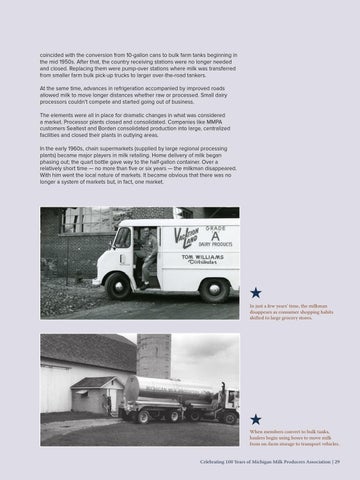
In the early 1960s, chain supermarkets (supplied by large regional processing plants) became major players in milk retailing. Home delivery of milk began phasing out; the quart bottle gave way to the half-gallon container. Over a relatively short time — no more than five or six years — the milkman disappeared. With him went the local nature of markets. It became obvious that there was no longer a system of markets but, in fact, one market.
Jack Barnes, former MMPA general manager, explains how milk moved from farms to consumers in the two decades following World War II. MMPA and its members were selling to about 175 processors in 1946. Yes, this seems high, but there were eight in the Ann Arbor-Ypsilanti area and five in Pontiac. Plus, there were at least 60 separate processors in Grand Rapids and about the same number in Detroit. Milk was delivered directly to processor plants in the so-called secondary markets, but nearly all the milk for Detroit processors was delivered in cans to MMPA receiving stations scattered across southern Michigan. From the receiving stations, the milk was loaded into over-the-road tankers for shipment to the processing plant. MMPA had established a hauling operation during the Great Depression to move milk from the country stations to market. In the 1950s, changes in processing and distribution of milk as well as in consumer tastes profoundly affected how and where milk moved. The most dramatic change
Milk cans ready to be returned to farms are lined up behind the Ovid receiving station in the 1950s. The last can of MMPA member milk was delivered in early 1967, but most farms had long since made the switch. 28 | Celebrating 100 Years of Michigan Milk Producers Association
In just a few years’ time, the milkman disappears as consumer shopping habits shifted to large grocery stores.
When members convert to bulk tanks, haulers begin using hoses to move milk from on-farm storage to transport vehicles. Celebrating 100 Years of Michigan Milk Producers Association | 29