www.CAMpLejeUnegLobe.CoM
Volume 76, edition 10
Gl be The
Serving CAMp LejeUne And SUrroUnding AreAS SinCe 1944
Cold calculations
2nd Supply Bn. prepares for Arctic training | 3A
Marines volunteer at local Ugandan school | 4A
ThurSdAy, MArCh 13, 2014
www.LejeUne.MArineS.MiL
1/9 Marines remember Lance Cpl erickson CpL. joShUA yoUng regional Command Southwest
photo by Staff Sgt. Steve Cushman
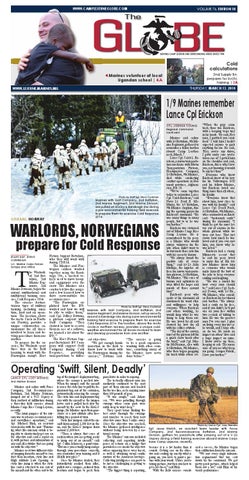
Marines with golf Company, 2nd battalion, 2nd Marine regiment, 2nd Marine division, are pulled on skis by a bandvagn 206 during a pre-environmental training field exercise to prepare them for exercise Cold Response 2014.
giSKAAS, norwAy
Warlords, NorWegiaNs
prepare for Cold response
StAff Sgt. Steve CUShMAn
u.S. marine Corps Forces europe and Africa
T
he Warlords of 2nd Battalion, 2nd Marine Regiment, 2nd Marine Division, began the annual multinational and multilateral training exercise, Cold Response 2014. The exercise features various types of military training including maritime, land and air operations. The location, above the Arctic Circle in Northern Norway, provides a unique cold-weather environment for all forces involved to learn and develop procedures from one another. To prepare for the exercise, the Warlords spent three days in the field learning to work with the Norwegian Army’s Host
Nation Support Battalion, who they will work with during CDR14. The Marines and Norwegian soldiers worked together using the Bandvagn 206, a tracked vehicle used to move troops and equipment over the snow. The Marines also conducted live-fire ranges and a few learned how to drive snow-mobiles for reconnaissance. “The Norwegians explained how the BVs worked and how we will be able to utilize them,” said Cpl. Jeffrey Dittmar, a platoon sergeant with Golf Company. “They showed us how to recover them in case of a rollover, we learned a lot about the BVs.” The Host Nation Support Battalion’s BV Company will support Golf Company during Cold Response, providing transportation to differ-
photo by Staff Sgt. Steve Cushman
Marines with golf Company, 2nd battalion, 2nd Marine regiment, 2nd Marine division, set up security around a bandvagn 206 during a pre-environmental training field exercise to prepare them for exercise Cold response 2014. the location, above the Arctic Circle in northern norway, provides a unique coldweather environment for all forces involved to learn and develop procedures from one another. ent objectives. “We got enough familiarization in the field to know how to work with the Norwegians during the exercise,” Dittmar said.
“The exercise is going to be a good experience working with other countries, something many of the Marines have never done before.”
Marines and sailors with 1st Battalion, 9th Marine Regiment, gathered to remember a fallen brother aboard Camp Leatherneck, March 7. Lance Cpl. Caleb L. Erickson, a motor transportation mechanic with Motor Transportation Platoon, Headquarters Company, 1st Battalion, 9th Marines, died while conducting combat operations in Helmand province, Afghanistan, Feb. 28. “We’ve come together today to remember Lance Cpl. Caleb Erickson,” said Navy Lt. Doyl E. McMurry, the 1st Battalion, 9th Marines chaplain, during the opening prayer for Erickson’s memorial. “He was many things to many people, but to us he was our brother.” Erickson was stationed out of Marine Corps Base Camp Lejeune. He is remembered by his peers as a Marine who would always volunteer for the jobs others didn’t want to do but made those jobs fun with his sarcastic humor. “He always found the positive side of everything,” said 1st Lt. John Matlaga, the logistics officer for motor transportation platoon, 1st Battalion, 9th Marines. “His sense of humor and optimism always lifted the hopes and moods of those around him.” Erickson’s peers who spoke at his memorial all mentioned his work ethic and willingness to help everyone. When Erickson saw others working, he would drop what he was doing to help them out. He was loved by all and showed his love for all with his selfless attitude. “The day of the convoy, most of the platoon left for a quick chow break after the brief,” said Cpl. Martin McNamara, also with 1st Battalion, 9th Marines, who then began prepping his truck while others ate.
“When the guys came back, there was Erickson, with a heaping to-go tray in his hands. ‘He said, Hey man, I grabbed you some food.’ I told him I hadn’t expected anyone to grab anything for me. He said, ‘Hey, you’re my driver, I gotta make sure you’re taken care of.’ I patted him on the shoulder and said, Erickson, this is why I love you, not knowing it would be my last time.” Everyone who knew Erickson knew of his love for his Volkswagen GTI and his fellow Marines, but Erickson loved one thing more than all others, his family. “Everyone knew that about him, how close he was with his family,” said Lance Cpl. Derek Feick, 1st Battalion, 9th Marines, who commented on Erickson’s “trademark smile” during the memorial. “I think he got the most letters out of anyone in the whole platoon while we were out here. That just shows how much he was loved and if you ever met him, you knew why he was loved.” Erickson had a strong Minnesota accent that he and his peers loved to make fun of. His fellow Marines knew him as someone who would make himself the butt of the joke to keep everyone smiling and laughing. “He was a model for how every man should be,” said Lance Cpl. Zachary Dewar, with 1st Bn., 9th Marines, who considers Erickson his best friend and brother. “He always had a smile on his face, and if you didn’t, he’d put one on your face within two seconds of talking to him. He was the greatest man I’ve ever met. I plan on living every day just as he would, and I hope others do too. He made an impact on others’ lives and a huge impact on mine. I know you’re up there, keeping us safe. The memories of you are what keep me going. Semper Fidelis, I love you brother.”
operating ‘Swift, Silent, deadly’ LAnCe CpL. joey Mendez 2nd marine division
Marines and sailors with Force Company, 2nd Reconnaissance Battalion, 2nd Marine Division, jumped out of a V-22 Osprey as their method of infiltration during a three-day field exercise aboard Marine Corps Base Camp Lejeune, recently. “The main purpose of the mission was to rehearse reconnaissance and surveillance operations,” said Sgt. Michael Blair, an assistant team leader with the unit. “Primarily, what (the mission) entails is being able to clandestinely get eyes on the objective and send a report on it, with pictures and information of any and all activities that are going on with the objective.” Marines used two different styles of jumping from the aircraft to conduct their insertion, static line and High Altitude Low Opening. A static line jump is when the static line cord is attached to one end of the aircraft and the other end to the
top of the jumper’s deployment bag, where the canopy is packed into. When the jumper exits the aircraft it causes the static line to pull the deployment bag out of the container, automatically releasing the canopy. The static line and deployment bag stay with the aircraft as the jumper leaves and is pulled back into the aircraft by the crew. In the HALO jumps, the Marines open their parachutes at a low altitude after freefalling for a period of time. Static line jumpers exited the aircraft from around 1,500 feet in the air, and the HALO jumpers from around 12,000 feet. “There is always that sense of realism when you are getting ready to jump out of an aircraft,” said Sgt. Collin Johansen, a point man. “But once you actually jump and go through your procedures correctly, you remember your training and it all falls into place.” Once the Marines landed, they immediately readied their rifles, pulled out a compass, radioed their location and began to pack their
parachutes in order to regroup. The tactically efficient men immediately continued to the next part of their mission and headed for the tree line, each carrying more than 100 pounds of gear. “It was rough,” said Johansen. “We were patrolling through swamps where some parts were ankle deep to waist deep.” They spent hours finding the best route through the swamps and marshes to reach their next objective more than 5 miles away. Once the objective was reached, the Marines gathered intelligence without being detected by a notional enemy. The Marines’ mission included collecting and reporting intelligence of actions on a bridge that provided access inside the objective where opposing forces were based, as well as obtaining visual confirmation of the American hostages. Collecting intelligence can prove to be just as challenging as getting to the objective. “The biggest thing is reporting,
photo by Lance Cpl. joey Mendez
Sgt. jesse welch, an assistant team leader with force Company, 2nd reconnaissance battalion, 2nd Marine division, gathers his parachute after jumping out of a v-22 Osprey during a field training exercise aboard Marine Corps base Camp Lejeune, recently. because it is a lot harder than it sounds. Getting eyes on the objective and sending up exactly what is going on; you have to paint a picture with your words. Unless you’re taking pictures, but then you have to get a lot closer,” said Blair. With the field exercise consid-
ered a success, the Marines began their exfiltration from the mission. “We met every single information requirement that was sent down by the command. We got pretty good pictures, which helped them out a lot,” said Blair of his team’s performance.