70
th
Anniversary Edition
This month is the 70th anniversary of The Globe. In celebration, this edition features a special cover with archive articles that highlight Marine Corps Base Camp Lejeune from the 1940s through the 1970s.
vol. 76
Jacksonville, n.c., Thursday, February 27, 2014
no. 8
Published: February 28, 1945
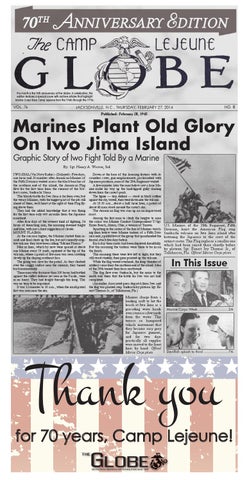
Marines Plant Old Glory On Iwo Jima Island Graphic Story of Iwo Fight Told By a Marine By: Sgt. Henry A. Weaver, 3rd. IWO JIMA (Via Navy Radio) - (Delayed) - Five days, one hour and 30 minutes after American Marines of the Fifth Division waded across the black beaches of the southern end of this island, the American Flag flew for the first time from the summit of the 566foot crater, Suribachi Yama. This bloody battle for Iwo Jima is far from over, but the weary Marines, with the biggest part of the job still ahead of them, took heart at the sight of their Flag flying above them. They had the added knowledge that it was flying for the first time only 660 air miles from the Japanese mainland. After four days of the severest kind of fighting, 24 hours of drenching rain, the morning dawned bright and blue, with just a faint suggestion of clouds. MOUNT PLASMA As the sun rose higher, the Marines started their assault and final climb up the live, but not currently eruptive volcano they have been calling “Mount Plasma.” Men in lines, which by now were spaced at about one Marine every 25 yards, squinted at the top of the volcano, where a patrol of five men was seen crawling slowly up the sloping southeast face. The going was slow for the patrol. As they climbed over the craggy surface near the summit, they turned back momentarily. These men who for more than 100 hours had battled against the stiffest defense yet seen in the Pacific, were in no hurry. They had fought through this long. This was no time to be impatient. It was 13 minutes to 10 a.m., when the small patrol first was seen near the rim.
Down at the base of this looming fortress with its countless caves, gun emplacements, pockmarked with Japanese positions, men of the 28th Regiment waited. A few minutes later the men below saw a lone Marine make his way up the hard-lipped gully slanting down from the crater’s peak. The figure — tiny, defiant — stood in black outline against the sky, waved, then went down into the volcano. At 10:30 a.m., about a half hour later, a patrol of about 40 men stood around the crater’s rim. The American flag was run up on an improvised mast. Among the first men to climb the heights to raise the colors was Marine Combat Correspondent T/Sgt. Keyes Beech, Akron, Ohio, a veteran of Tarawa. Squatting in the center of the line of Marines watching from below were Marine tankers of a Fifth Division unit, a pitiful few of the group that spearheaded the frontal attack five days before. Each day their ranks had been depleted dreadfully. But this morning the tankers were there to be in on the finish. This morning there were few left to fight, but they still stood sturdily, their guns pointed up the volcano. While the flag waved overhead, the deep thunder of artillery came from the northern end of the island. Men of the 28th turned their faces northward. The flag flew over Suribachi, but the noise to the north told them that the battle for Iwo was not half completed. (An earlier Associated press dispatch from Iwo said the flag was planted atop Suribachi by platoon Sgt. Ernest Thomas Jr., of Tallahassee, Fla.)
Marines charge from a landing craft to hit the beach at Iwo Jima as a preceding wave heads over a terrace a few yards from the water. This terrace so hampered vehicle movement that they became easy prey for Japanese gunners, and for two days practically all supplies were moved to the front lines by hand. Official Marine Corps photo.
U.S. Marines of the 28th Regiment, Fifth Division, hoist the American Flag atop Suribachi volcano on Iwo Jima island after battering the Japanese to the crest of the extinct crater. This Flag replaces a smaller one which had been raised there shortly before by platoon Sgt. Ernest Ivy Thomas Jr., of Tallahassee, Fla. Official Marine Corps photo.
In This Issue
Marine Corps Week .............................2A
Thank you
Devilfish splash to third ...................... 7A
for 70 years, camp lejeune!