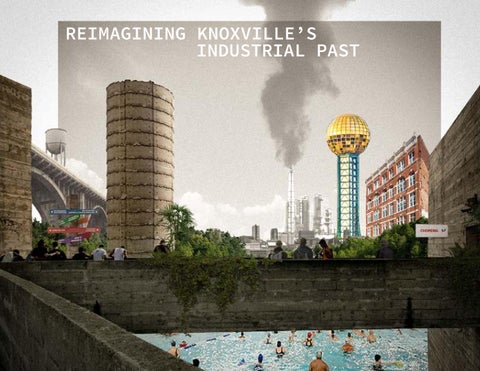
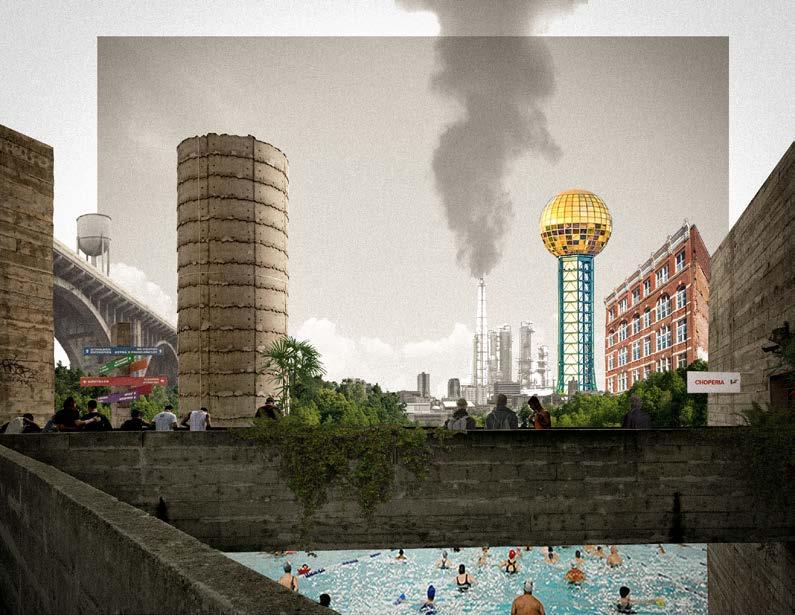
REIMAGINING KNOXVILLE’S INDUSTRIAL PAST

REIMAGINING KNOXVILLE’S INDUSTRIAL PAST

Made by
JSa Arquitectura
Univesity of Tennessee at Knoxvlle´s School of Architecture, School of interior Architecture and School of Landscape Architecture
FALL2024
BMA endowed Professor Javier Sánchez
in collaboration with visiting professor Aisha Ballesteros
Students: Ashlea Bills, Cameron Dodzik, Kat Duprée, Abby Eckl, Winn Gramling, Mary Margaret Guzik, Lauren Hall, Olivia Hicks, Marry Huffard, Thomas Miller, Katherine O´Neil, Lucy Pirtle,Cecilia Torres-Panzera, Kelsey Shockly, Callie Walmsley, Julia Warner.
INTRODUCTION
Ashlea Bills & Julia Warner
Cameron Dodzik & Lauren Hall
Kat Duprée & Winn Gramling
Abigail Elizabeth Eckl & Katherine O’Neil
Mary Margaret Guzik & Marry Huffard
Olivia Hicks & Kelsey Shockly
Thomas Miller & Lucy Pirtle
Cecilia Torres-Panzera & Callie Walmsley
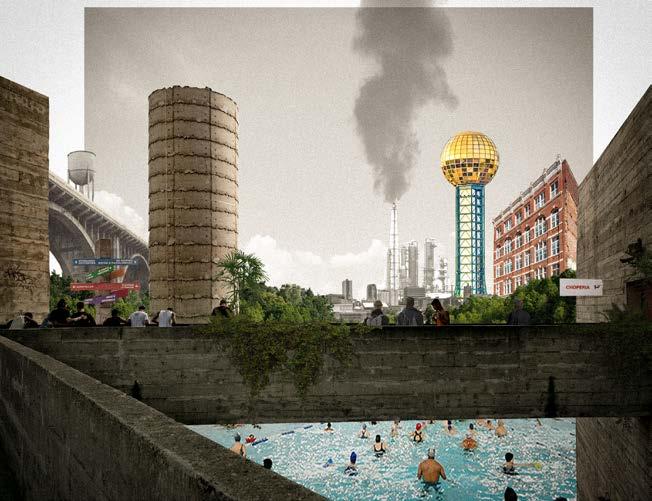
1.INTRODUCTION
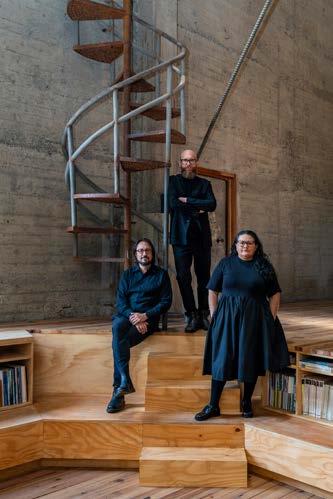
This studio is a course of The University of Tennessee, Knoxville. Each course the University invites a recognized architect to be “The University of Tennessee BarberMcMurry Visiting Professor in Design”: this time, in fall 2024, Javier Sánchez was the chosen one to impart this design exercise. At the same time his partner Aisha Ballesteros is invited to collaborated in this course as visiting professor.
This course analized the industrial phenomenon of Knoxville with a local and a transdisciplinary research. The objective was to develop projects with a multipurpose program inspired in the case of study: SESC Pompéia by Lina Bo Bardi in Sao Paolo, Brazil. In this project Lina Bo Bardi decided not to demolish the original industrial spaces and complement the ensamblage of buildings with new ones. This spirit of recycling and integration was directive of the course. Also the format and dynamics of the studio allowed to design in different scales includimg urban, landscape, architectural and interior architecture.
The key of the studio was to understand and develop a complex space with mixed-use in relation with the Tennessee River, specifically with a industrial ensamblage of buildings called The Shale.
JSa AND ADAPTIVE REUSE 2.
2.1 JSa sinopsis
JSa is an architecture studio founded in 1996 by Mexican architect Javier Sánchez (b. 1969), with urban acupuncture as a vision to conceive comprehensive architectural interventions that contribute to the reconversion, rehabilitation and restoration of the urban fabric.
Today, partners Aisha Ballesteros (b. Mexico, 1978) and Benedikt Fahlbusch (b. Germany, 1976) —alongside Sánchez— are the core of the practice. And together lead a team of 60+ architects, designers, urbanists and engineers based in Mexico City, and a secondary studio in Lima, Peru overseen by Irvine Torres (Puerto Rico, 1974).
Stemming from the French tradition of the atelier, the studio approaches design as a collective process immersed in a continuous cycle of research, urban approximation, architectural project, value proposal and adaptability to the ever-evolving social, urban and environmental challenges. Perceiving each project as an opportunity to foster sustainable environments, enhance the collective quality of life, and support the continuous rehabilitation of the urban fabric.
With this philosophy, the studio gained early international recognition through a series of influential projects in the Roma and Condesa neighborhoods, catalyzing the renewal of central areas in Mexico City during the mid-1990s.
Since then, and over the past three decades, JSa’s practice has evolved organically into a broader scope, encompassing: the recovery of heritage and promotion of culture; the conception of unique hospitality experiences; the development and integration of sustainable solutions; the design of multidisciplinary community and workspaces, and the continuous exploration of housing as the foundation of the urban ecosystem.
Design strategy
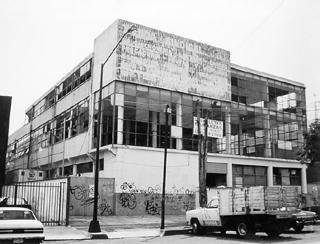
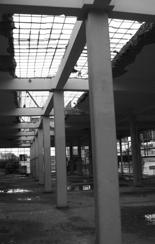
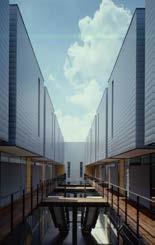
Demolition of the center of the slab of the original building to create a yard.
Extend the 3rd level around the new patio along the entire floor.
Construction of a recessed fourth level to create private terraces.
1.-13 de septiembre
2.2 Examples of adaptive reuse
The studio’s diverse portfolio of over 180 built projects in Mexico, South America and Europe, some of them are examples of adaptive reuse such as: 13 de septiembre(1), María Ribera(2), The Ice Factory(3).
13 de septiembre is an excellent example of structural understanding and adaptive reuse The store bulding is transformed into a cluster of apartments with few gestures like opening a roof creating a central yard.
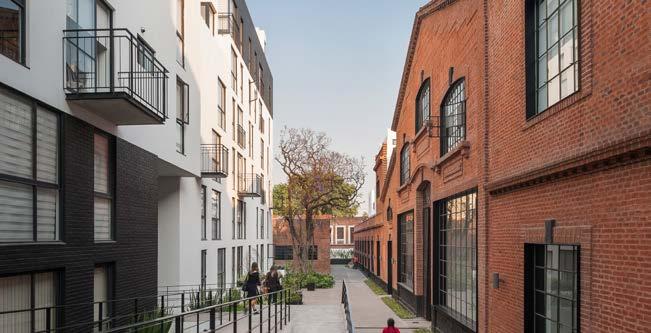
María Ribera is another complex of apartments in which the historical building integrates harmonically with the new architecture. The density and the architectonic language (rhytm, materiality, etc.) were conceived to co-exist with the heritage buildings.
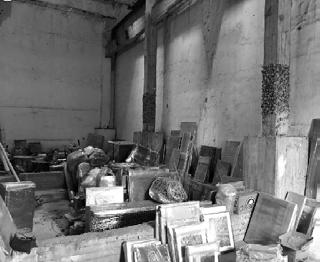
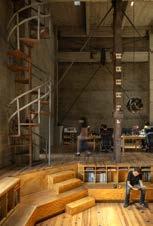
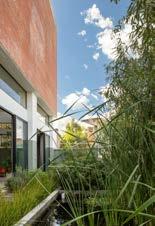
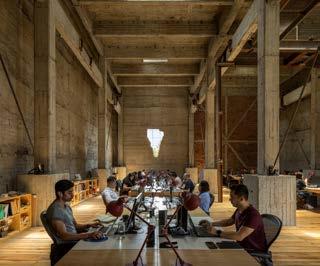
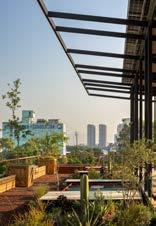
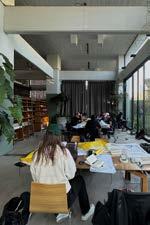
The Ice Factory is where JSa decided to transform and old industrial building into a innovative self-sustainable ecosystem. The open space and large dimensions are ideal to have an architectural studio that many times is used as school. We receive students from Latin America and U.S.A, specifically from Harvard or in this case The University of Tennessee.
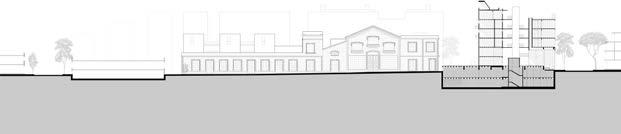
SECTION
Nogal St.
Cedro St.
2.- María Ribera
3.- The Ice Factory
ABOUT THE STUDIO BY THE PROFESSORS 3.
We would like to begin by saying that this studio was a magnificent and profound mutual learning experience for both faculty and students. The course was attended by students from the architecture, landscape, and interior design programs. This studio was designed with the lakeside origins of Mexico City as a frame, where we (JSa) are from and where we our practice is based. We have always been interested in adapting and reusing existing structures that have either fallen into disuse or disrepair, or that have additional potential in our present world. Similarly, our concern for the social, cultural, and environmental surroundings has inspired us to work that interacts with the city in an innovative and positive way. Thus, the course was structured around three axes of understanding and design: water, adaptive reuse, and social, cultural, and ecological intervention.
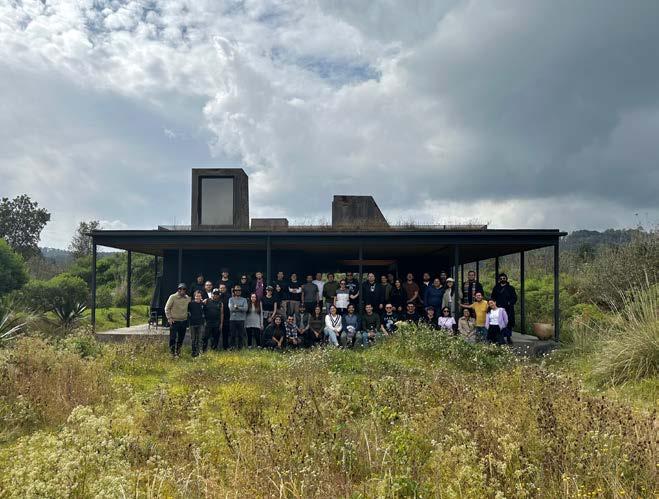
The visit to Mexico and Oaxaca cities helped introduce the students to the design pillars of the course. They were exposed to important projects to inspire them and to make them conscious of the possibilities back home. Highlights on the trip included the Ice Factory (JSa) a project that addresses the three pillars; the Museum of Anthropology and History with Ramírez Vázquez’s monumental umbrella fountain that celebrates water and the culture; and María la Ribera (JSa), a historic chocolate factory converted into a housing project. We also had a colleague from Sao Paulo, Sol Camacho present the case of Lina Bo Bardi and her Cesc Pompeia project from 1982. While in Mexico the students worked on a first deliverable: a manifesto and a collage that would kick start them into the design process.
Back in Knoxville, we worked with a site with enormous potential, which could be addressed through the before mentioned three design axis: the General Shale factory sitting on the Tennessee River waterfront. Coming from Mexico City, where rivers have been piped, represented for us as faculty a beautiful opportunity to
design work that could celebrate water. The conversations with the students focused on water and its cycles, and the importance of its integration with the city. The design enabled us to understand architecture as the link between the artificial and the natural (those two poles of the schism in modern thought): as a reconciler. Following the same line of thought with the second axis, adaptive reuse reconciles the potential of a space with reality, updating it and bringing it out of neglect: an economically intelligent and responsible action. Finally, the first two axes come together in the third, which is social, cultural, and ecological integration. The exercise had to address its connection to the city through usage strategies (sports, cultural, environmental), generating a powerful focal point to revitalize this urban space and engage the citizens of Knoxville.
We would like to thank all the people who made this course possible: Jason Young, Milagros Zingoni, Carl Lostritto, Gale Fulton, Rebekah Jane Justice, Brad Colette, Patrick Osborne, Sara Bolivar, Sol Camacho, Loreta Castro and Mariana de la Fuente. This studio was possible thanks to the Barber McMurry Visiting Professor in Design Grant for their generous support, to Ryan Dobbs, Chuck Griffin and Kelly Headden.


TRIP IN MÉXICO
THE SITE:GENERAL SHALE 5.
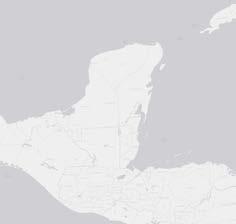
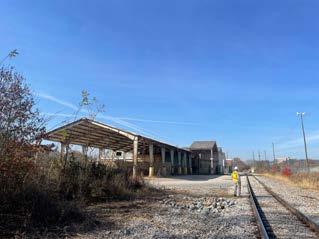
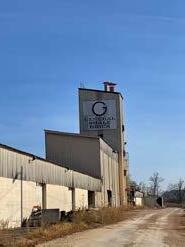
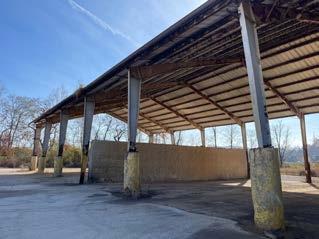
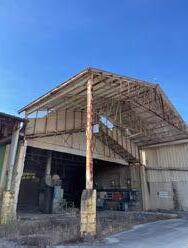
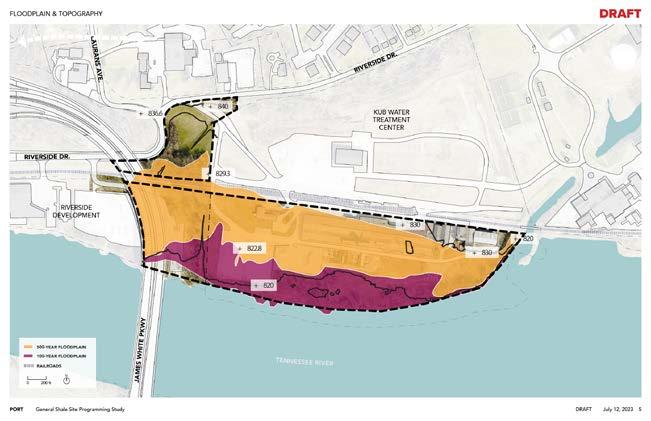
The former General Shale factory in Knoxville, Tennessee, has a rich history tied to the industrial development of the region. Founded in 1928, General Shale was one of the largest producers of bricks and building materials in the United States, playing a crucial role in the growth of infrastructure and urbanization in the country.
The factory, which was located in south Knoxville, operated for several decades, being an economic pillar for the community. Its strategic location and ability to produce high-quality bricks allowed General Shale products to be widely distributed, contributing to the construction of residential, commercial buildings, and even government projects in various parts of Tennessee and beyond.
Over time, the factory went through several technological upgrades to stay competitive in a market that was rapidly adopting new production methodologies. However, in the 1980s, the decline of the brick industry and the modernization of construction methods led to the gradual closure of many plants, including the one in Knoxville.
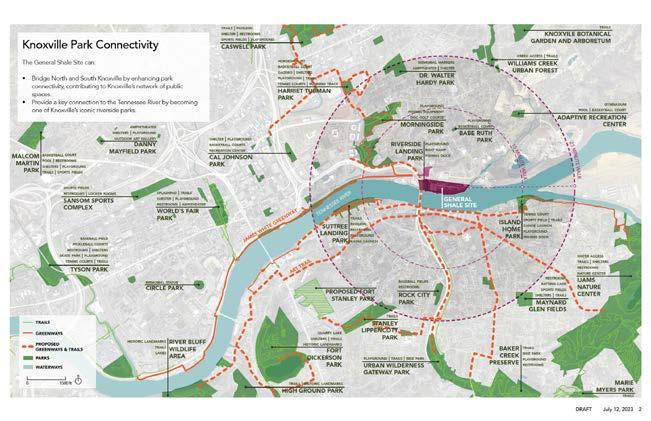
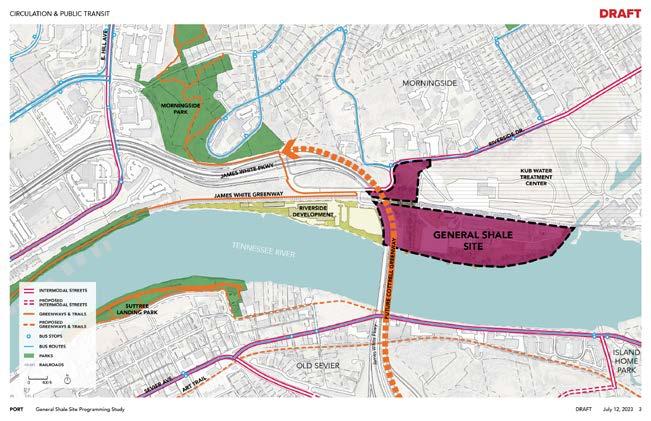
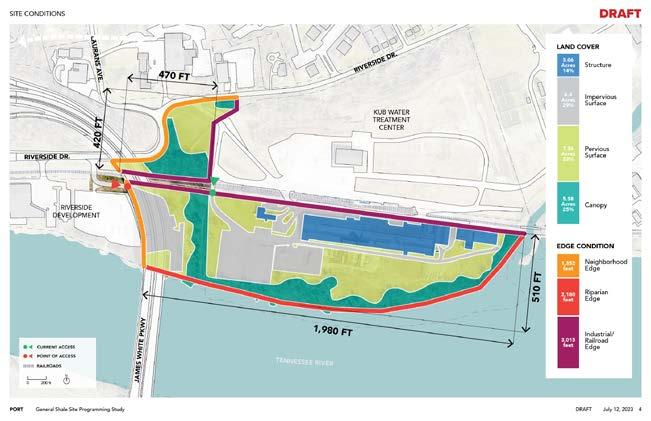
Today, the former General Shale factory is just a vestige of Knoxville’s industrial past, though some plant structures still remain, offering a glimpse into the history of local industry.However, the strategic location of the former plant next to the Tennessee Riverfront give us the opportunity of imagine a new life for these structures.
The General Shale factory is an iconic example of how early 20th-century industrial development left a significant mark on the urban landscape and the lives of Knoxville residents. Although the factory is no longer in operation, its legacy continues to be an integral part of the city’s history.
FINAL PROJECTS 6.
All the projects have in common the awareness of water and the river. The architectural programs are characterized by cultural and artistic activities. The recycling and intervention of the structure of the old factory is very versatile and diverse depending on each team and its interpretation. Below we can see the most outstanding graphic material of the different projects.
Artesania is a project that took inspiration from the crafters and artists witnessed during our trip in Mexico, with not only their finished product, but relationship to the land. The goal of Artesania is to connect the Knoxville community not just to craft, but to the process of craft, and the timing and movement of material from the landscape to the building.
Each workshop prioritized the connection of water to the crafting process, embedding our working relationships and responsibility to care for the resource.
6.1 Ashlea Bills & Julia Warner
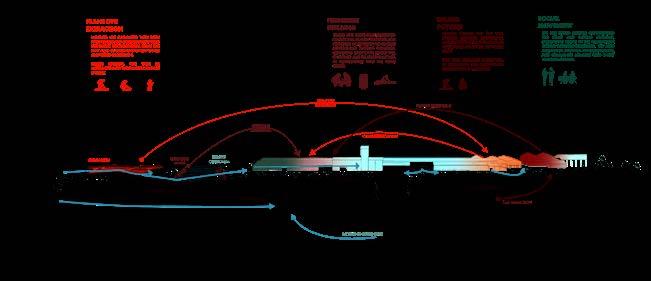
Mouvement of Craft white
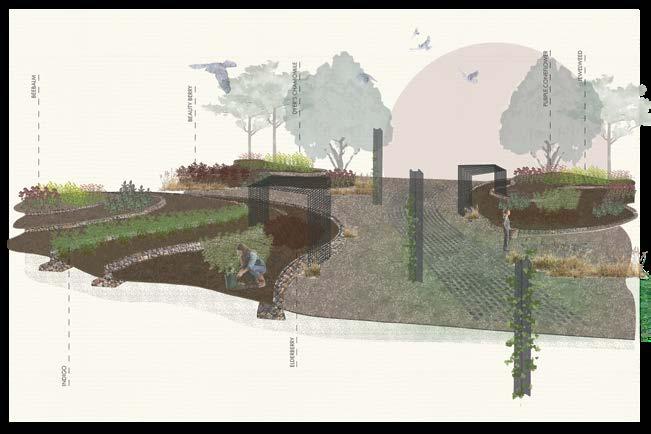
Garden render
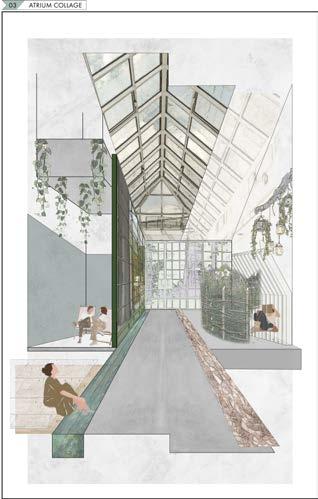
Atrium
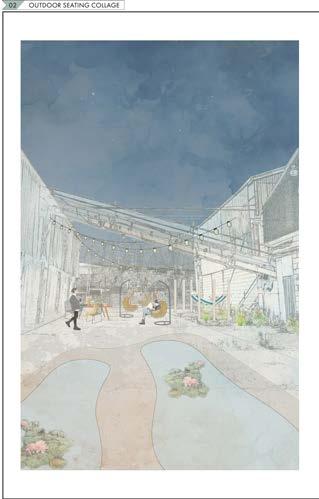
Outdoord seating
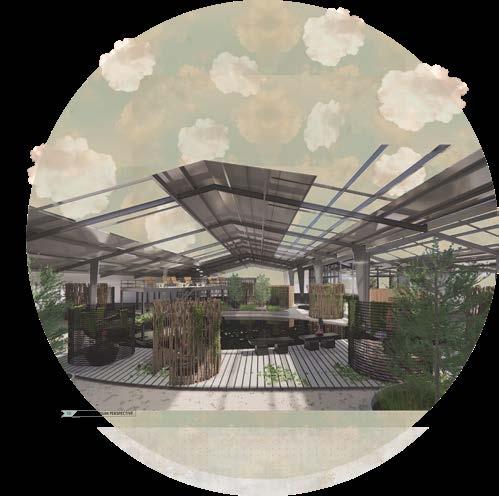
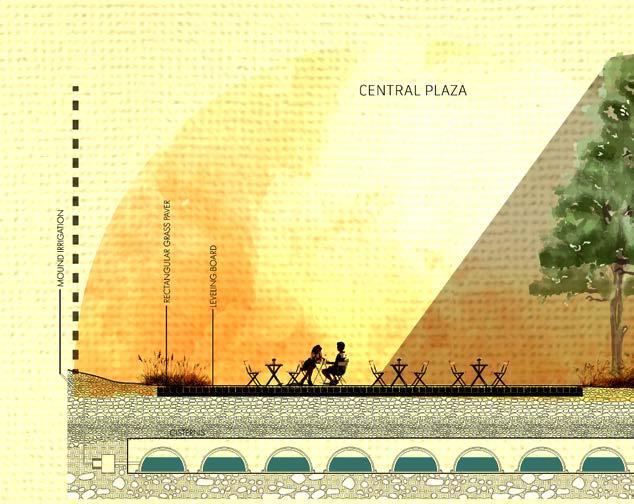
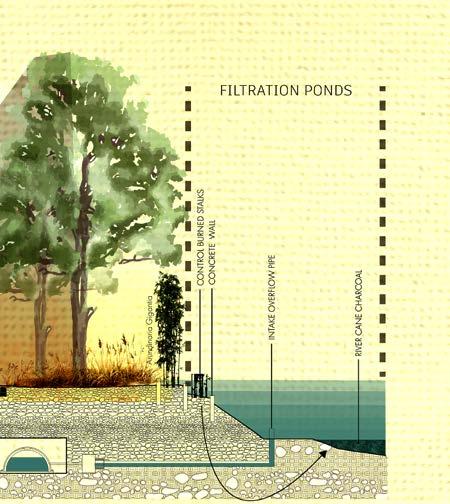
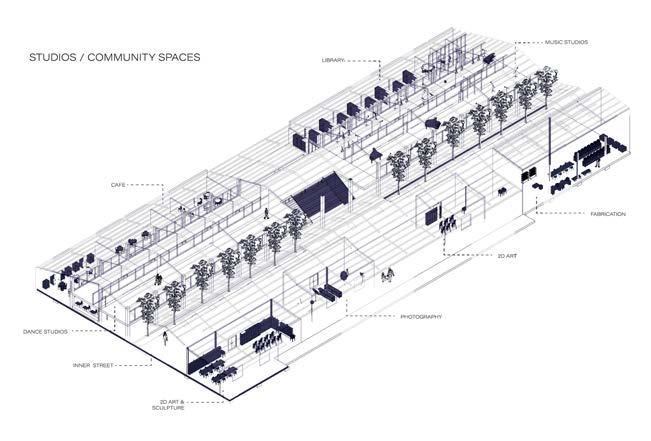
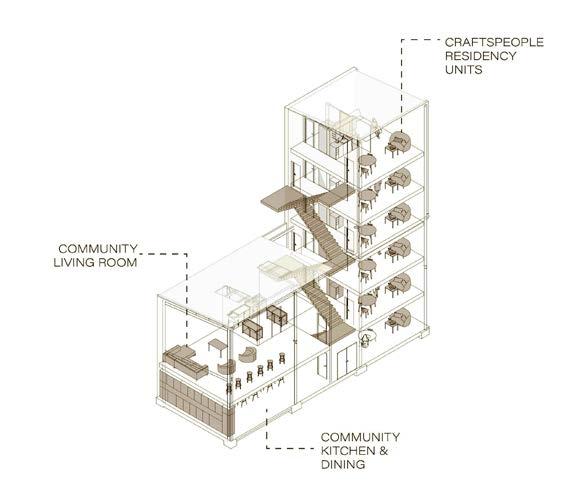
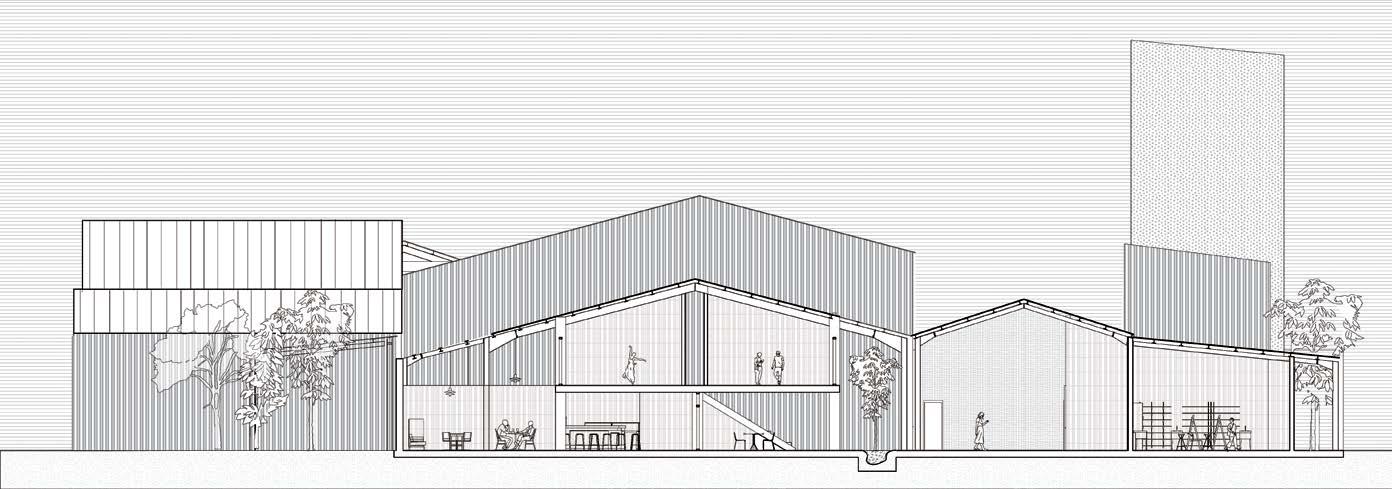
This creative and cultural arts center is a dynamic space designed to unite the Knoxville community by celebrating creativity, and connection. Anchored by a central circulation spine that functions as an indoor-outdoor “main street,” the project seamlessly integrates walking trails and natural elements, fostering a deep connection between the structure and the surrounding landscape. By conditioning only programmed spaces and leaving circulation areas open, the center creates a harmonious flow between indoor and outdoor experiences, enriched by vegetation that weaves through the interior and exterior spaces. The design honors the site’s history by preserving the existing structure while introducing a modular heavy timber framework, representing the evolution of the space. The center offers a rich array of programs, including art, craft, dance, music, and agriculture, with resources like fabrication labs, community gardens, and an artist residency housed in a six-story tower. Flexible live event spaces—ranging from a formal theater to a waterfront amphitheater—invite people to gather, share, and engage. A restaurant, bar, and beer garden highlight farm-to-table practices, sourcing ingredients from on-site gardens, while community gardens educate residents on sustainable food practices. With its modular design, connection to nature, and immersive opportunities, the center becomes a hub for creative expression, education, and community building, engaging all ages and backgrounds in meaningful ways.
6.2 Cameron Dodzik & Lauren Hall
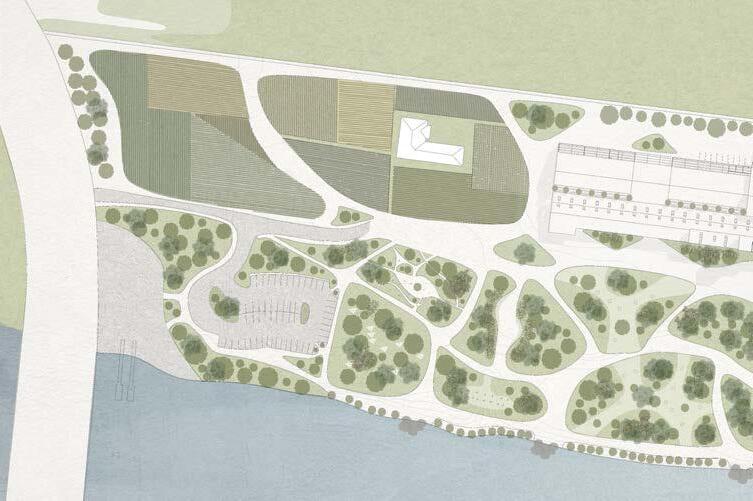
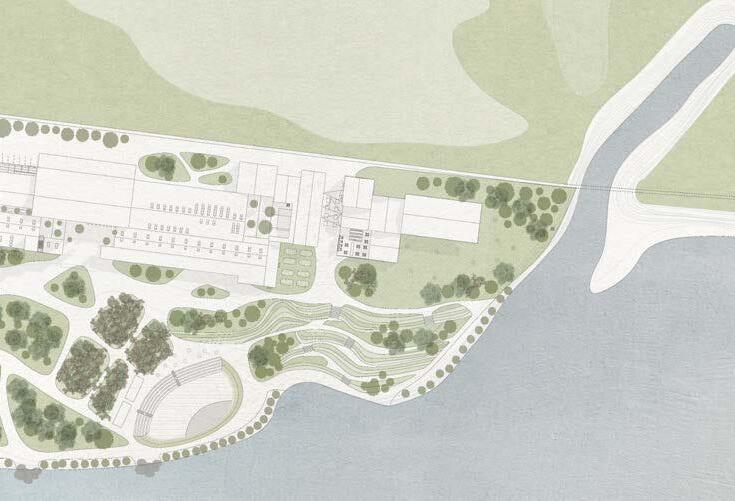
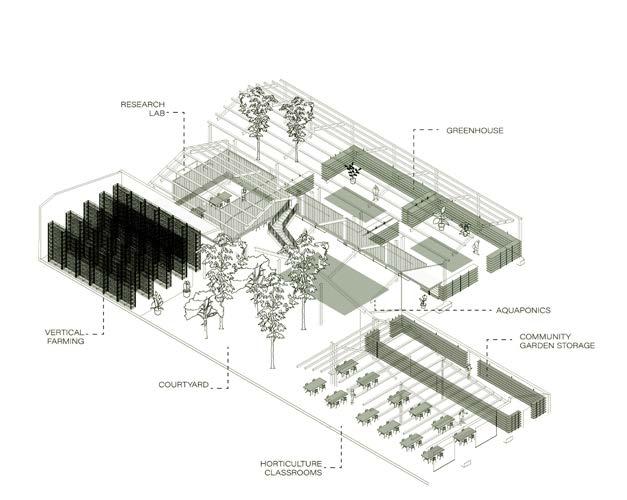
AGRICULTURE AXON
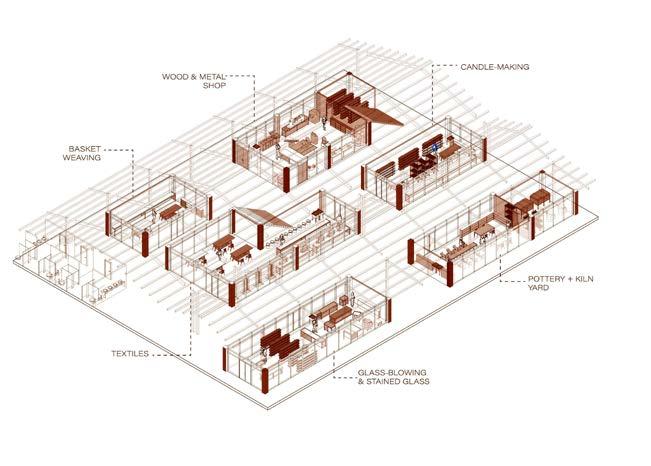
OPTIMIZED STUDIO AXON
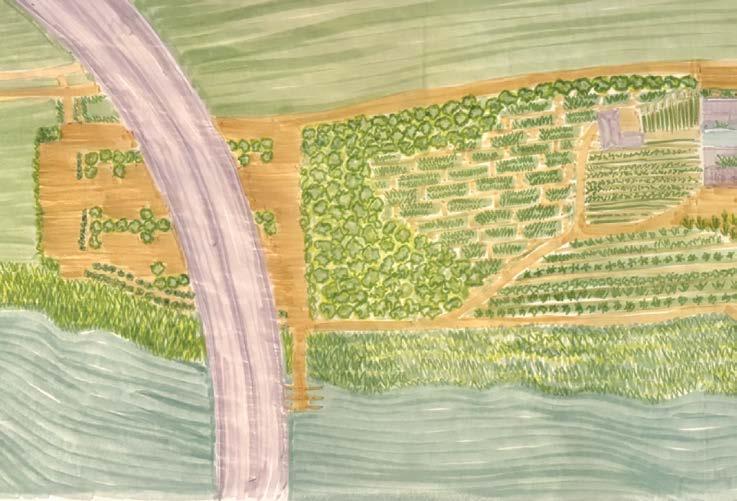
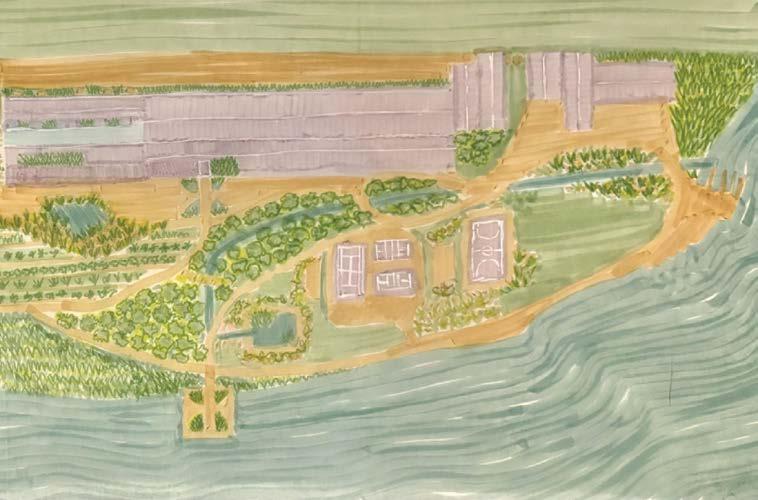
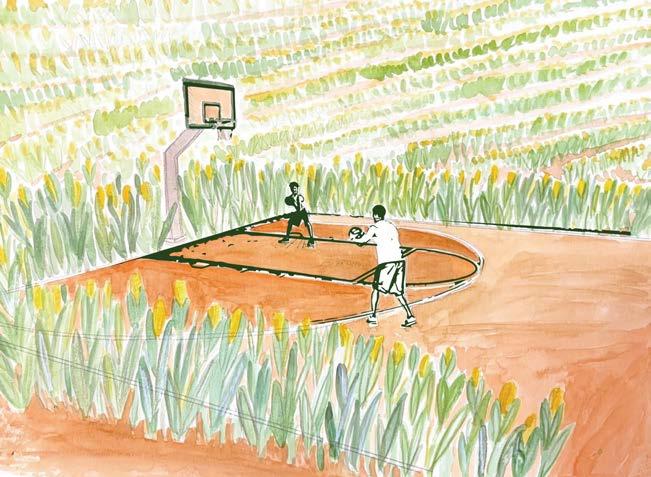
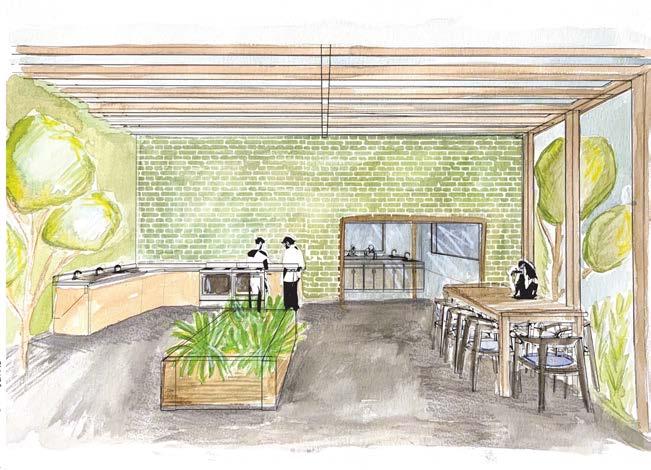
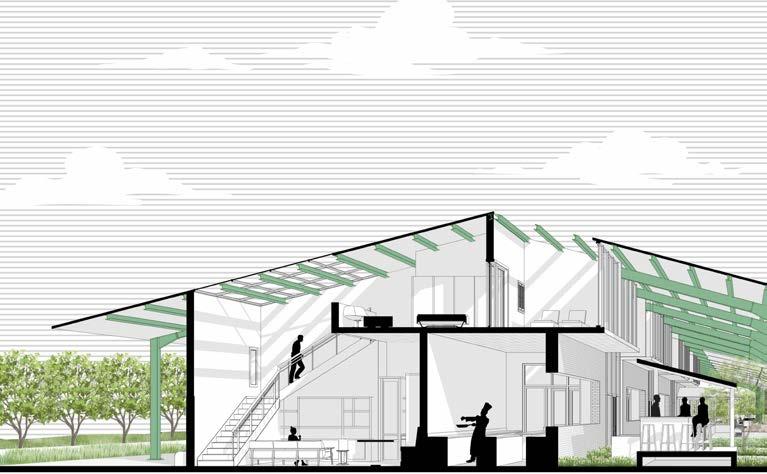
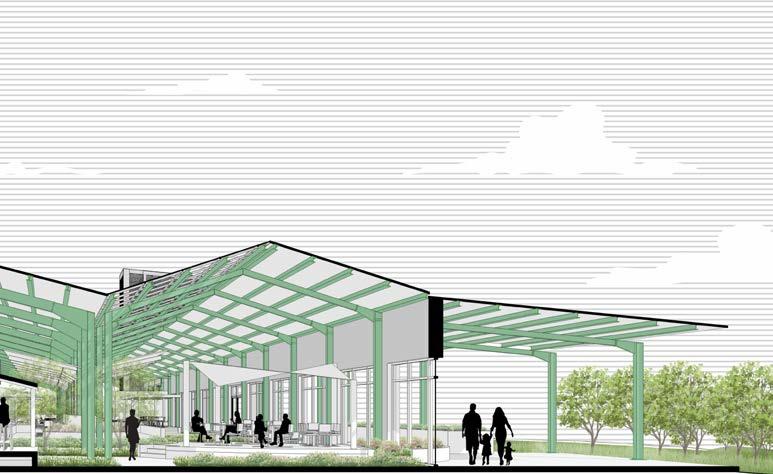
This center designed to cultivate a spirit of wellness through connection with nature, interactive learning experience, a variety of exercise opportunities, and to promote restoration through water. Located on the site of an abandoned General Shale brick factory, the park sits beneath a historically underserved neighborhood where access to healthy food options is often limited. Its central location near downtown Knoxville makes it an ideal destination and a fitting endpoint for the city’s greenway. The Knoxville Life and Wellness Park offers a variety of programs and amenities, including a farm-to-table restaurant, community gardens, farmland, residential spaces, indoor and outdoor pavilion areas, a gym, tennis courts and club, a bathhouse, and a park. The park’s mission is to empower citizens with wellness education and opportunities, fostering a healthier and more connected community. With its transformative potential, the Knoxville Life and Wellness Park aims to create a lasting positive impact on the city of Knoxville.
6.3 Kat Duprée & Winn Gramling
6.4
Abigail Elizabeth Eckl & Katherine O’Neil
We chose to program this space into 6 different programs: Market space, four sunken restaurants, two flexible event spaces with a day to day full functioning bar, a sculpture garden, and an art school on the far east end. Although the art school is on the furthest end of the building the art produced permeates throughout the entire building in different ways creating a curious and artistic experience in the entirety of the building. The sculpture garden still leaves the original steel framing while removing all the rest of the original structure, showing a “ghost” of the building that once existed. The main landscape feature connects with the main building cut out and pulls you directly to the water. This stair and platform addition fits along with the original topography that navigates down towards the water in different pathways. This feature can be used for sculptures and installations, concerts and other gatherings, workout space, or to sit and reflect. Other small steps and pathways can be found in other points of the landscape and can lead you into the water. Another consideration of this feature is the flooding tendency of the landscape, as it sits on a 500 year flood plain. As the water rises and falls, the feature can highlight the water levels instead of the water consuming it.
Aside from the sculpture garden, the building is broken into pieces to respond to the building’s original density. These framing systems create breezeway moments that allow the occupants to pause, refresh, and get fresh air before continuing through the building or returning to what they were doing. It also is intended to create a moment in the façade where you can easily pass completely through the building and reach the north pathway or south side landscape features.The building is entered on the west side of the site and immediately into the market and restaurant spaces. The markets circulate around the restaurants as well as the northern and southern exterior walls to create a connection with the outdoors. The restaurant and door placement aligns with the original grid structure
Each restaurant drops down one step with dining and seating space, and then continues to drop down three more feet into the main restaurant spaces. Above the restaurants sits the mezzanine area where there are rentable art studio spaces for local and visiting artists can come and paint, collaborate, and enjoy the scenery. The spaces can also be flexible for an art supplies store and other retail marketed towards the arts. As you continue through the building the next spaces are the event spaces. The two main spaces can be broken into 4 separate ones through foldable partition walls. The partition walls have interchangeable panels that can display art installations from the art school or the community. In the first event space, there is a full functioning bar that is open to the public in its day to day operation unless it is rented out for an event. The framing systems divide up the two main event spaces and the doors can be opened to make one large space. Both are equipped with storage, catering kitchens, and bathrooms, as well as access to an exterior wall for loading and unloading equipment. The event space bar also engages the original tower structure as a mezzanine balcony to overlook the event spaces, and if you continue up there is an observatory that overlooks the river and landscape features. On the other side of the sculpture garden lives the exhibition space. It’s simplicity allows for the art to speak for itself and be highlighted among the other pieces. The installations can be hung from the exposed structures or from the moveable white walls. The upstairs balcony space is for admin and other students to walk around and observe from above. On the far east side of the site sits the art school which is the brain of the entire building. You can access the art school through the upper mezzanine and a bridge breezeway that mimics an old industrial piece that currently lives on the site. You can also travel along the exterior path on the north side of the site for a more formal entry. The art school contains classrooms, studios, offices, photography studios, an auditorium, and an outdoor makerspace. The outdoor makerspace allows for creative freedom and inspiration from the outdoors. Overall, this project proposes an art driven district in Knoxville that can engage all different types of people and communities
Art school section
Artboard
Axon diagram
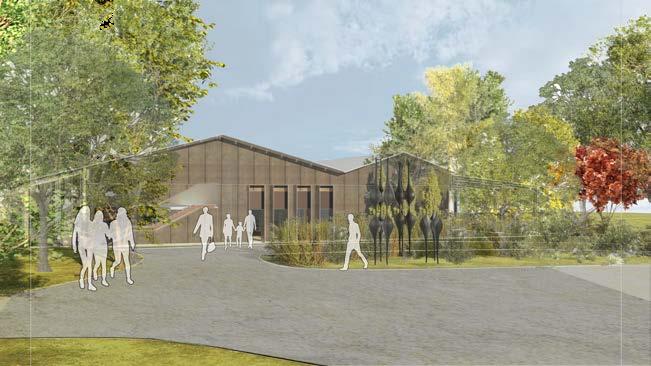
Front façade
Section perspective
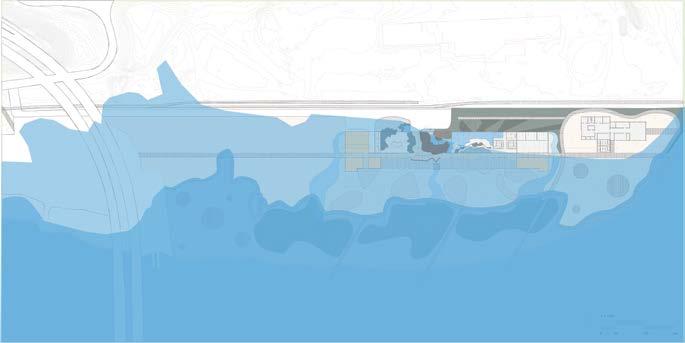
In our project we incorporated the 100 year flood line represented in this image where we allow for storm water to freely become part of our landscape design...
In our project we incorporated the 100 year ood line represented in this image where we allow for storm water to freely become part of our landscape design...
6.5 Mary Margaret Guzik & Marry Huffard
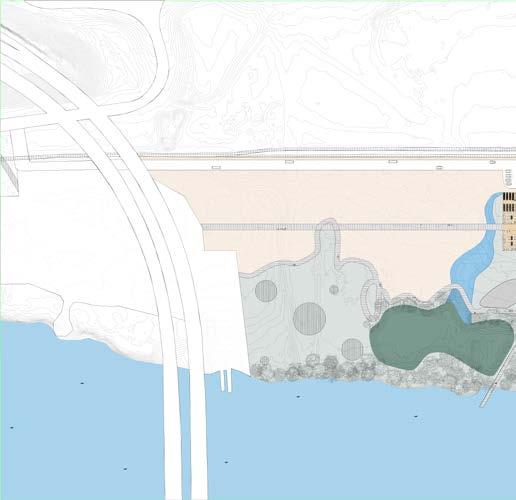
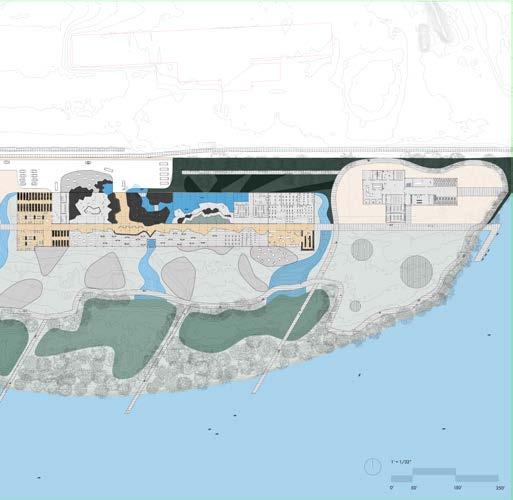
Site plan
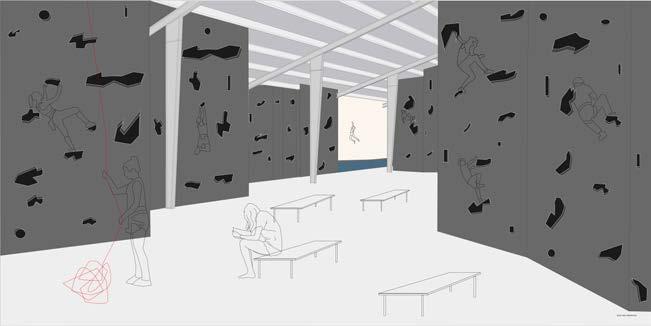
Rock wall perspective
4
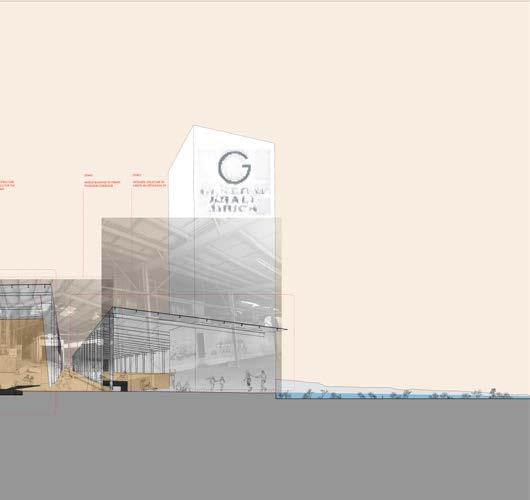
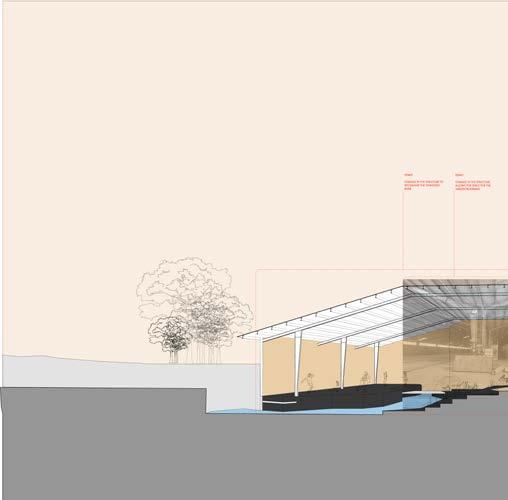
1.- Change in the structure to recognized Tennessee River.
2.- Change in the structure allows for space for larger programs.
3.-Middle building to create outdoor corridor.
4.-Extended structure.
Section perspective
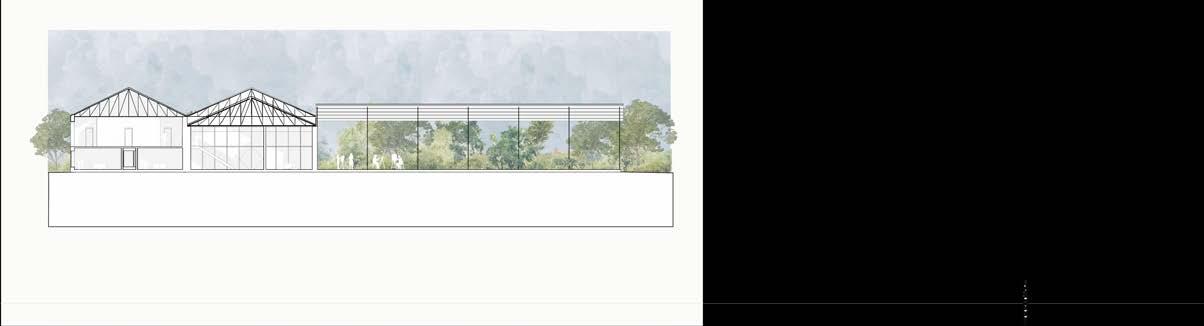
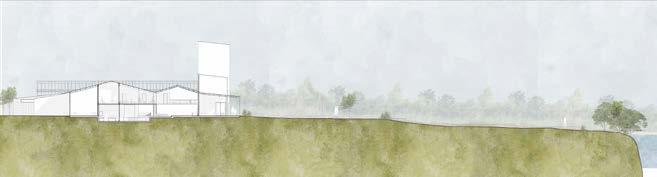
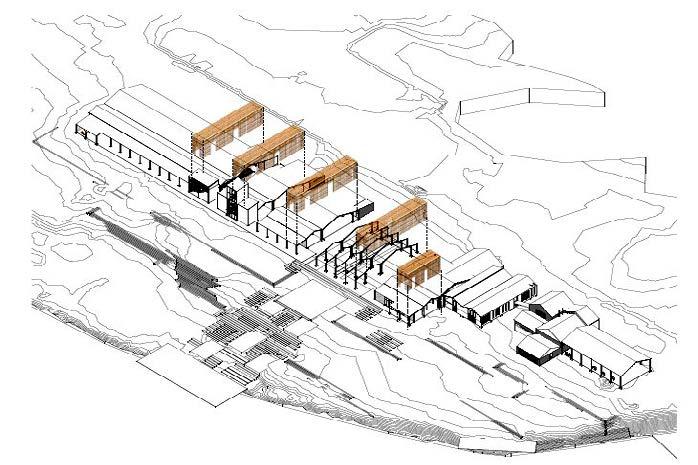
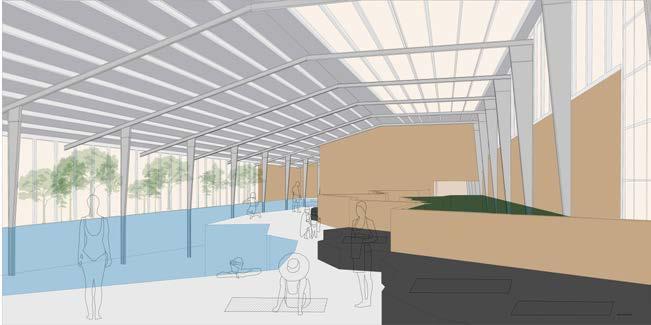
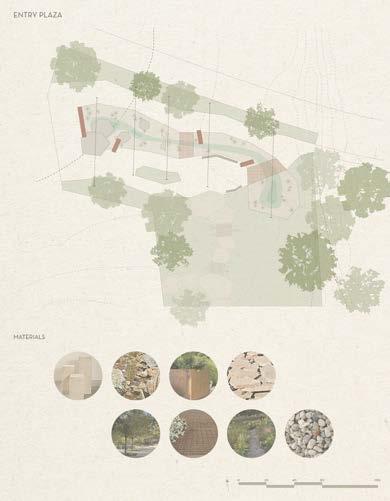
Nestled along the Tennessee River in Knoxville’s Morningside neighborhood, Morningside Wilds transforms the abandoned General Shale Brickyard into a dynamic urban birding park that celebrates the interplay of nature, history, and community. Once an industrial hub, the site is now a haven for biodiversity, where spontaneous vegetation and bird life have reclaimed the landscape.
The design draws inspiration from the migratory flyways connecting North and South America, creating a mosaic of woodland, meadow, and shrubland habitats. These ecologies transition across the site, guiding visitors through an immersive experience that blends human interaction with ecological stewardship. Key interventions include bird blinds, a viewing tower, and re-programming of the existing building designed for education and observation, featuring classroom spaces, a library, and an aviary that mirrors the surrounding habitat. Open programming encourages handson engagement, while the site’s targeted design minimizes human disturbance to wildlife. By preserving its industrial past and enhancing its ecological future, the park offers a compelling vision for rewilding and extension of the urban wilderness, where education, recreation, and habitat coexist to inspire appreciation and stewardship of our shared environment.
6.6 Olivia Hicks & Kelsey Shockly
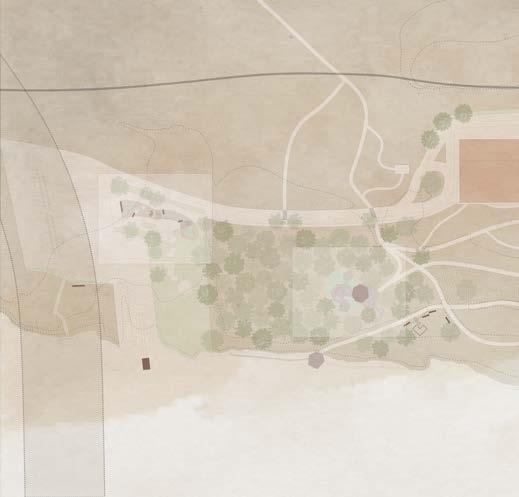
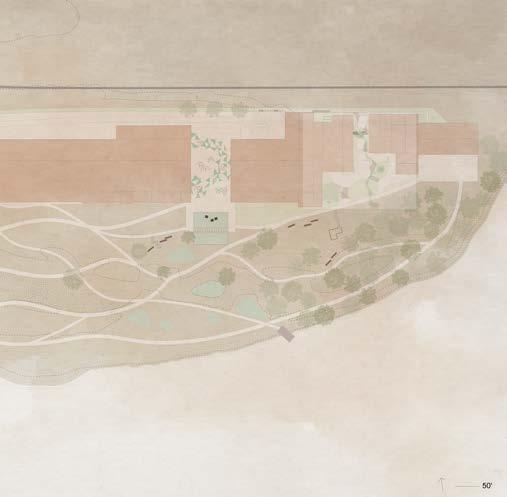
Site plan
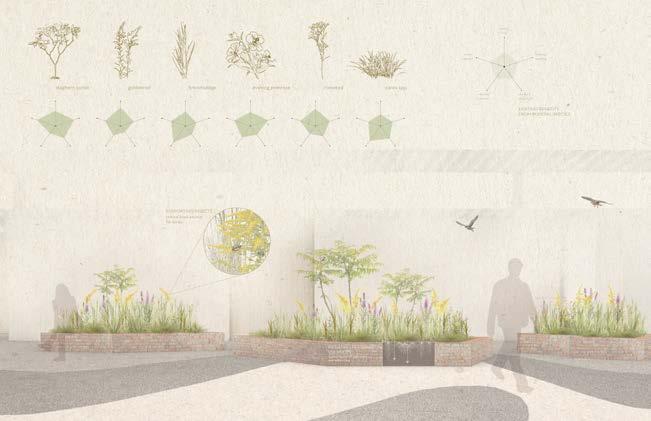
Ruderial plantings
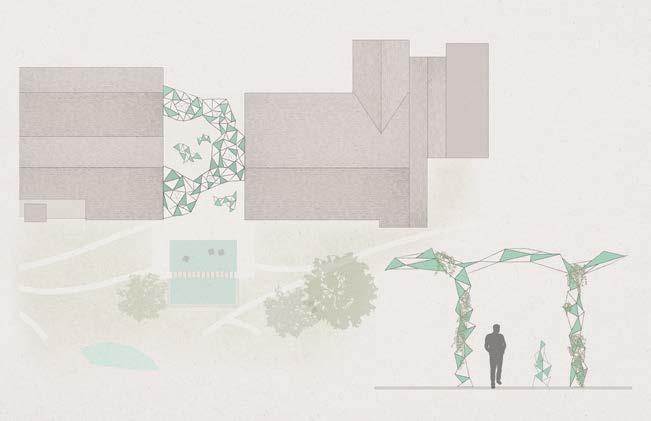
Atrium
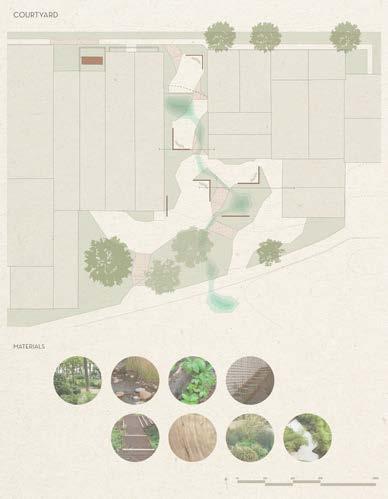
Courtyard plan
Entry plan
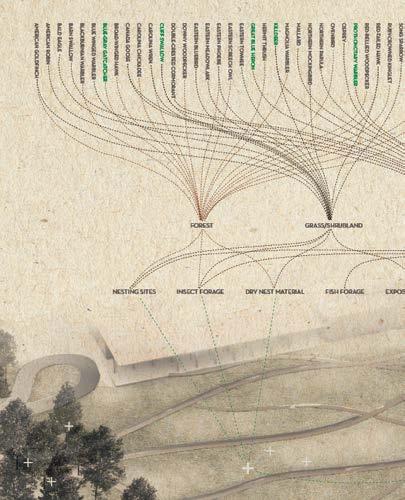
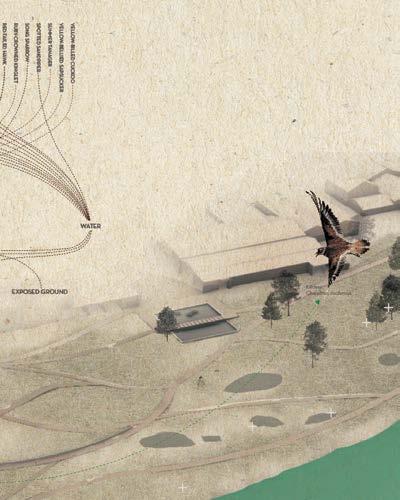
Target species
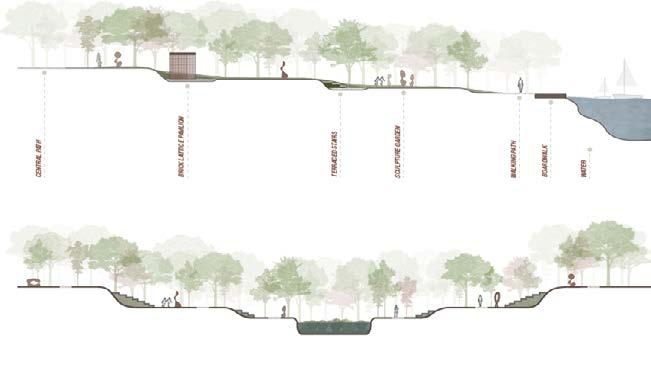
Landscape sections
6.7 Thomas Miller & Lucy Pirtle
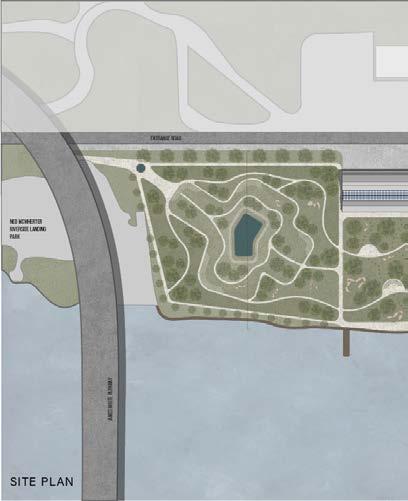
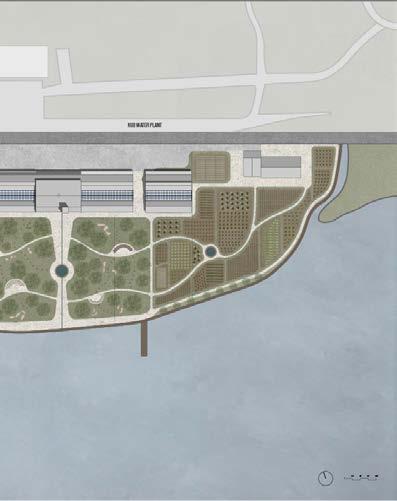
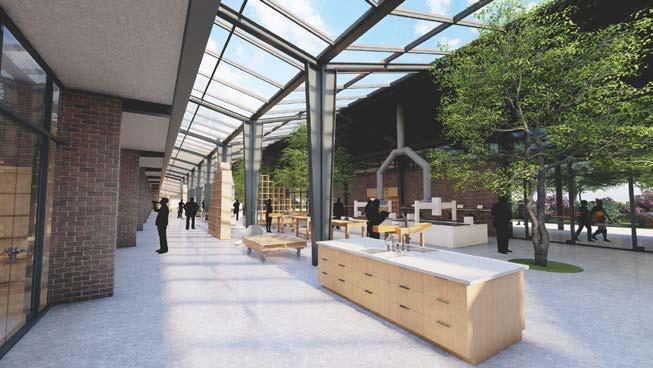
Woodshop perspective
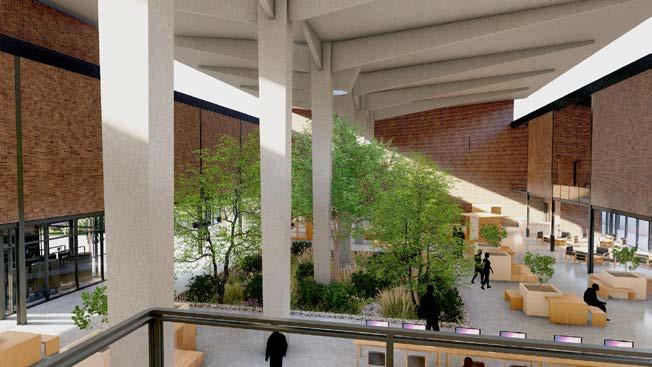
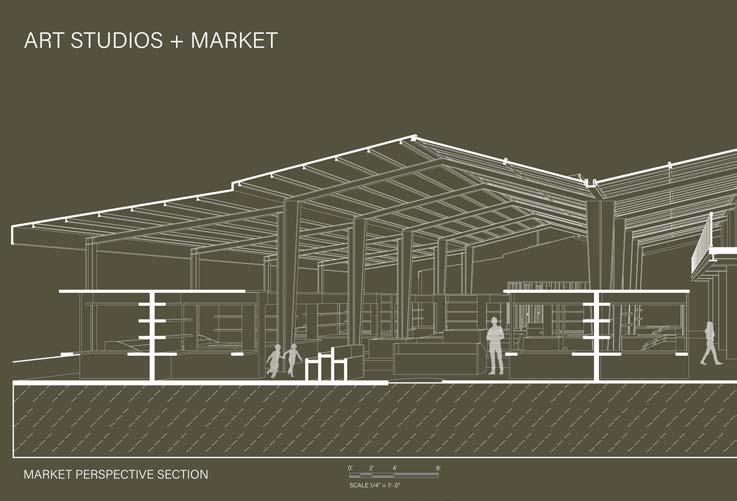
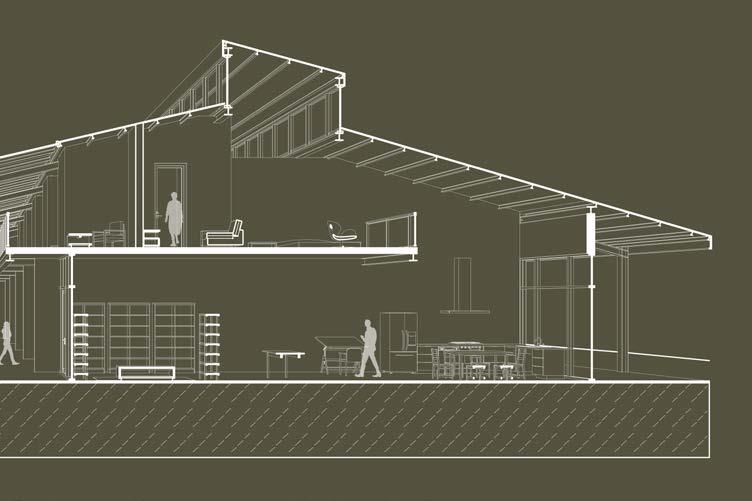
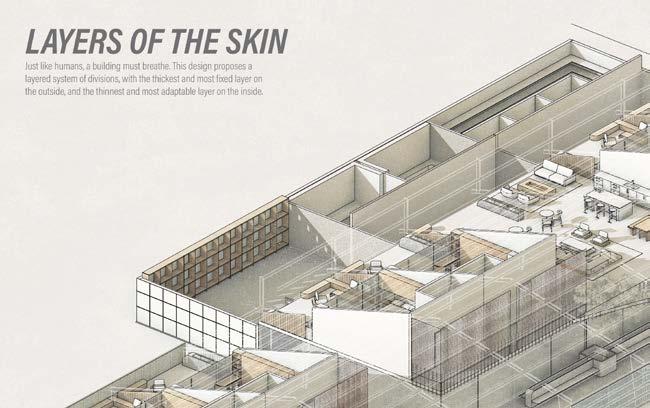
Gallery perspective
6.8 Cecilia Torres-Panzera & Callie Walmsley
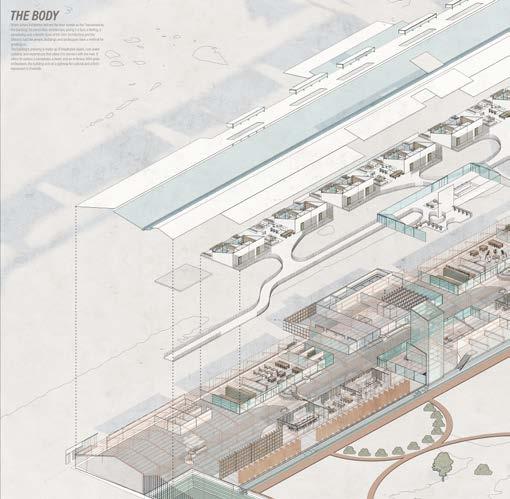
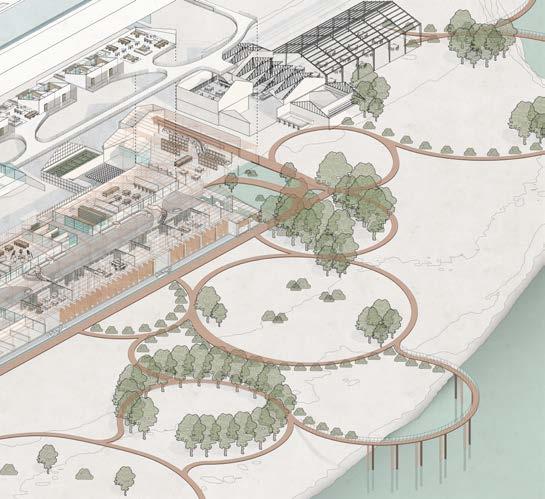
Axon exploded
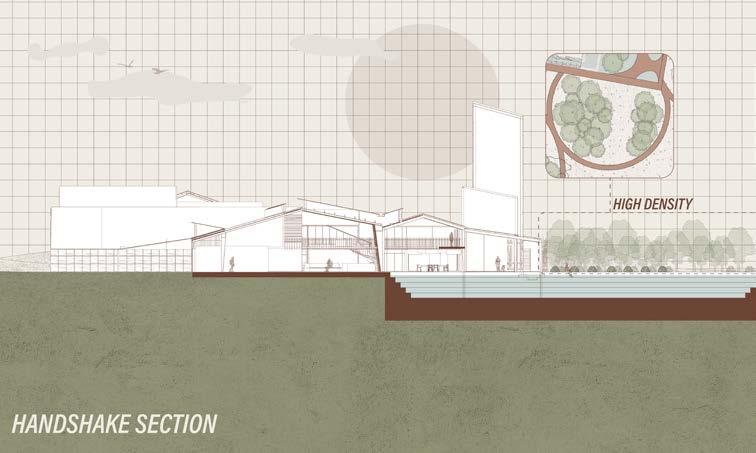
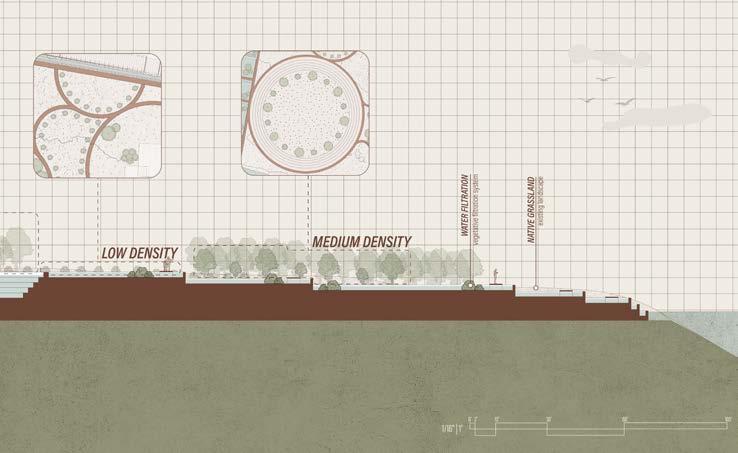
River section
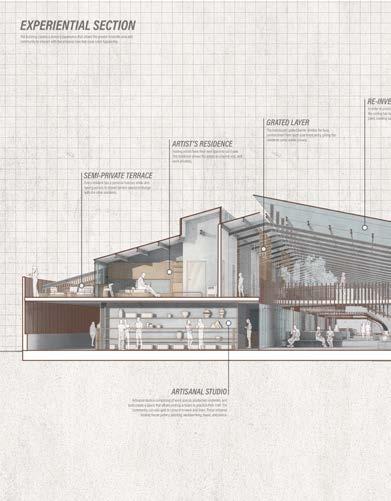
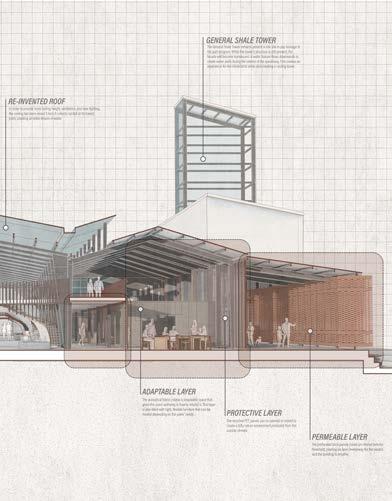
Section perspective