Ann Arbor, Michigan
UMich named
Thursday, October 16, 2025
michigandaily.com
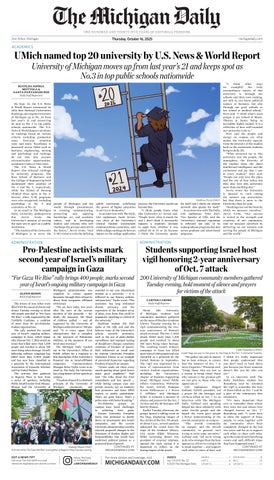
top 20 university by U.S. News & World Report University of Michigan moves up from last year’s 21 and keeps spot as No.3 in top public schools nationwide
MATILDA SOPHIA MOTTOLA & AANYA PANYADAHUNDI
Daily Staff Reporters
On Sept. 23, the U.S. News & World Report announced its 2026 Best National Universities Rankings, moving the University of Michigan up to No. 20 from last year’s 21 and preserving its spot as No. 3 in top public schools nationwide. The U.S. News & World Report calculates its rankings based on various criteria including graduation rates, first-year retention rates and more. Excellence is measured across fields such as business, engineering, nursing and psychology and rankings do not take into account extracurricular opportunities, acceptance rates or class sizes.
The U.S. News & World Report also released rankings by university programs. The Ross School of Business and the College of Engineering both maintained their position of No. 4 and No. 5, respectively, while the School of Nursing climbed three spots to No. 6. Several other U-M programs were also recognized, including psychology at No. 5 and economics at No. 14.
In an email to The Michigan Daily, University spokesperson Kay Jarvis wrote the University’s mission of serving the state sets it apart as a public institution.

“I think other ways we exemplify the truly extraordinary nature of this university is through our schools and their own ranking, not only in, you know, political science or business, but also through our grad schools or law school or medical school,” Hart said. “I think what’s most unique is our School of Music, Theatre & Dance being so incredibly highly ranked. It is a reflection of how well-rounded our university truly is.” Hart said the people and energy on campus are what makes the University special, from the diversity of the student body to the excitement students bring to daily life.
“What attracted me to this university was the people, the atmosphere, the diversity of the student body, the sheer intellectual intelligence and the excitement and joy that I saw in every student,” Hart said. “People not only love the place and the city of Ann Arbor, but they also love this university more than anything else.” Jarvis wrote the University is pleased to rank among the nation’s top universities, but that there is more to the University than its rank.
“The mission of the University of Michigan is to serve the people of Michigan and the world through preeminence in creating, communicating, preserving and applying knowledge, art, and academic values, and in developing leaders and citizens who will challenge the present and enrich the future,” Jarvis wrote. “And U-M’s vision is to be the defining public institution, redefining the power of higher education in service to humanity.”
ADMINISTRATION
In an interview with The Daily, LSA sophomore Jacob Avram, vice chair of the University’s Central Student Government communications committee, said while college rankings do have an impact on the college application
Pro-Palestine activists mark second year of Israel’s military campaign in Gaza
“For Gaza We Rise” rally brings 400 people, marks second year of Israel’s ongoing military campaign in Gaza
Michigan’s administration was complicit in crimes against humanity through their refusal to divest from companies affiliated with Israel.
The streets of Ann Arbor were filled with the sound of chants and drums Tuesday evening as about 400 people marched in “For Gaza We Rise,” a rally organized by the TAHRIR Coalition, a coalition of more than 90 pro-Palestine student organizations.
The rally marked the second year of Israel’s ongoing military campaign in Gaza, which began after Hamas’ Oct. 7, 2023 attack on Israel that killed more than 1,200 people and resulted in about 250 more being taken hostage. Israel’s following military campaign has killed more than 67,000 people and has now been classified as a genocide by the International Association of Genocide Scholars and the United Nations.
The activists first gathered at Regents Plaza to hear from a series of speakers, including Public Health senior Erek Mirque. Mirque said the University of
“We are here today, two years after the start of the current iteration of this genocide — the death, the massacre, the blood of children spilled — and all supported by the University of Michigan administration,” Mirque said. “It is every upper level administrator that is complicit in the massacre of Palestinian children, in the massacre of our loved ones overseas.”
The Michigan Daily reached out to the University’s Office of Public Affairs for a response to this description of the University’s financial ties to Israel-affiliated companies. Communications Manager Brian Taylor wrote in an email to The Daily the University has a long history of free speech on campus.
“Freedom of speech is a bedrock principle of the University of Michigan community and


essential to our core educational mission as a university — it is reflected in our history, policies and practices,” Taylor wrote. “The university has long welcomed dissent, advocacy, and the expression of the broadest array of ideas, even those that could be unpopular, upsetting or critical of the university.”
Rackham student Nia Hall spoke at the rally and said she believes some of the University’s actions towards protesters, such as the use of plain-clothes surveillance and repeated issuing of disciplinary charges, constitute violations of freedom of speech. Hall referenced an email sent by Interim University President Domenico Grasso as an example of perceived hypocrisy regarding freedom of speech on campus.
“Grasso sends out those corny emails quoting about ‘good fences make good neighbors’,” Hall said. “He talks about the First Amendment and free speech … while letting campus cops and private security spy on students, beat protesters and share DPSS reports to justify punishment. That’s not good fences. That’s a police state with better branding.”
Pro-Palestine groups on campus have faced challenges in achieving their goals.
Former University President Santa Ono promised to double down on investments into Israeli companies, and the current University administration recently rejected proposed changes to the Statement of Student Rights and Responsibilities that would have enshrined political protest as a protected form of speech.
CONTINUED AT MICHIGANDAILY.COM
process, the University stands out beyond that.
“I think people know what (the University) is,” Avram said. “People know what it stands for and I don’t think it necessarily impacts a student’s decision to apply here, whether it was ranked 20 or 15 or 25, because I think the University speaks for itself and I think our alumni network also speaks for itself.”
ADMINISTRATION
In an interview with The Daily, LSA sophomore Tyler Hart, Vice Speaker of CSG, said the University’s national reputation is reflected not only in its undergraduate programs but also across graduate and talent-based programs.
“Rankings are not the basis by which we measure ourselves,” Jarvis wrote. “Our success is rooted in the strength and creativity of our community. And we measure ourselves by delivering on our mission and serving the people of Michigan and the world.”
Students supporting Israel host vigil honoring 2-year anniversary of Oct. 7 attack
200 University of Michigan community members gathered Tuesday evening, hold moment of silence and prayers for victims of the attack
About 200 University of Michigan students and community members gathered on the steps of Hatcher Graduate Library Tuesday evening for a vigil commemorating the twoyear anniversary of Hamas’s attack on Israel. The Oct. 7, 2023 attack killed more than 1,200 people and resulted in about 250 more being taken hostage. The resulting Israeli military campaign in Gaza has killed more than 67,000 people and was classified as a genocide by the United Nations in September. The vigil was organized by a team of representatives from various student organizations, including the University’s chapter of Students Supporting Israel, Michigan Israel Public Affairs Committee, Wolverine For Israel, iLEAD, Dialogue Across Differences: a J Street U Affiliate, and Michigan Hillel. It included a moment of silence and prayers for the Oct. 7 victims and the 48 hostages still held by Hamas.
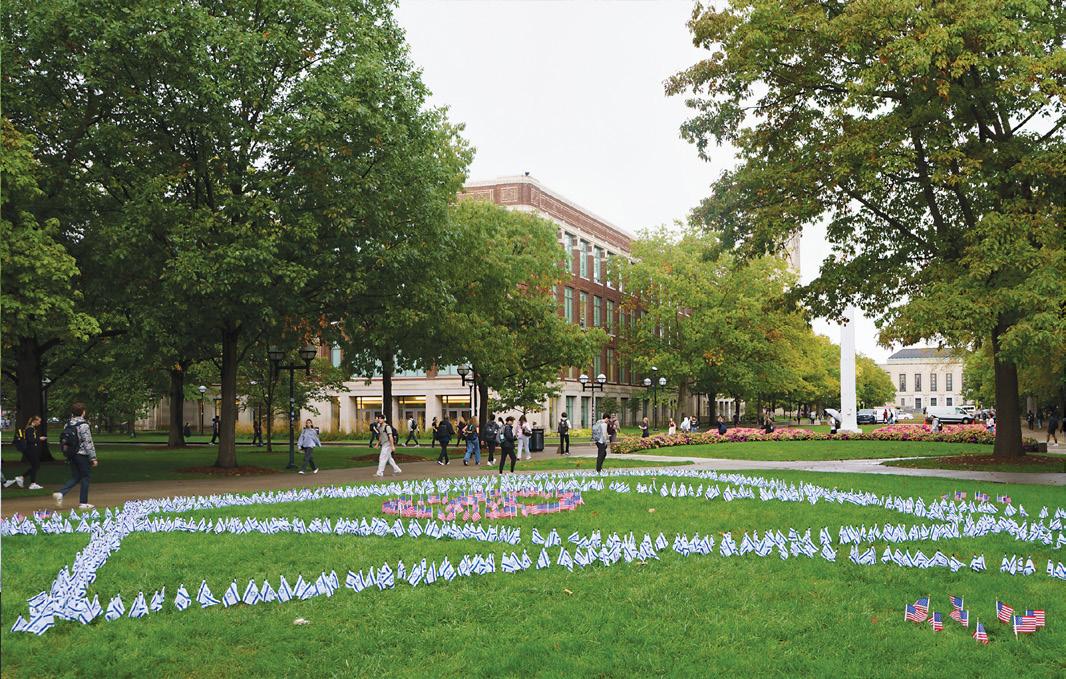
Earlier Tuesday afternoon, the groups hosted a tabling event on the Diag, displaying images of the victims of the Oct. 7th attack.
At about 6 p.m., several speakers addressed the crowd from the steps of the Graduate Library.
LSA senior Elijah Wiseman, Hillel Governing Board vice president of external relations, opened the vigil, saying it is important to reflect on the lasting impact of the attack.
“We gather not only to mourn but to bear witness, to ensure that the memory of Oct. 7 is never forgotten,” Wiseman said.
“Using those who are lost as a reason to bring closer those who remain is the greatest gift we can give to those who can appreciate it.”
LSA sophomore Abigail Gelfand, iLEAD president, led a prayer for the hostages and civilians killed on Oct. 7. In an interview with The Michigan Daily, Gelfand said speaking helped her show solidarity with other Jewish people and she hoped the event gave people a better understanding of the Jewish community on campus.
“The Jewish community on campus, and the Jewish community in general, isn’t trying to twist some narrative,” Gelfand said. “All we’re trying to do is be stronger than the hate against us. All we’re trying to do is stand together … and support each other in times of hate, and
I think it’s really important that people understand that you don’t need to back down just because you know someone doesn’t like you for who you are.” In an interview with The Daily, Rackham student Ian Rosenberg said he attended the vigil to remember the lives of those killed on Oct. 7 and be a part of the community that attended it.
“It’s more important than ever to remember those whose lives were lost and whose lives changed forever on Oct. 7,” Rosenberg said. “I came here to show the support of those people, to come together with my community who’s been completely changed in the last two years and for us to support each other, to cheer each other up in the wake of such horrifying events and such difficult times that have happened since.”
CONTINUED AT MICHIGANDAILY.COM
Matthew Prock/DAILY
GLENN HEDIN Daily Staff Reporter
CARTER CARINO Daily Staff Reporter
Madalyn Braun/DAILY
Activists at the “For Gaza We Rise” event gather at Regents Plaza Tuesday evening.
Caleb Rosenblum/DAILY Israeli flags are put on the grass by the Diag at the Oct. 7 memorial Tuesday.

A new era in health care: How Michigan Medicine is using AI
Artificial intelligence provides physicians feedback in detecting higher risk in patients, potential to address shortage in nurses and physicians
of Emergency Medicine, said physicians carefully review documentation generated by AI, such as notes on a patient’s history.
Artificial intelligence tools are now used in a variety of different ways in Michigan Medicine’s emergency department, from helping physicians give feedback to detecting patients at higher risk for critical illness. By beginning to use AI into clinical settings, Michigan Medicine has raised questions among physicians about AI’s impacts on the quality of patient care and medical education.
Despite concerns about AI’s potentially negative impact on patients, physicians at Michigan Medicine have taken measures to ensure AI’s accuracy and reliability.
In an interview with The Michigan Daily, Laura Hopson, associate chair for education in the Department
“If I’m using a voice transcription system, sometimes there are very interesting permutations of what I have said,” Hopson said. “I may need to go back and look up a detail in the medical record. I’m going to have to review what is being put out in any type of ambient AI systems before finalizing and signing off on it.”
There are several AI software systems that are already in use throughout the hospital. Hopson said these tools, namely DAX Copilot, are for efficiency and to provide possible treatment plans for patients.
“The one we’re using more within Michigan Medicine system is called DAX, which interfaces
with the electronic medical record,” Hopson said. “(DAX) listens to the conversations that you are having with a patient and then it creates a summary. You may or may not choose to use some of the medical decision-making tools that come along with it.”
Educators too have expressed concern about when to allow medical students to engage with these systems. However, not all programs related to the medical field have opened up to AI. Though AI is used increasingly in Michigan Medicine’s clinical settings, for example, it is not included in the nursing school’s curriculum.
Nursing junior Ethan Chiu said that despite the popularity of AI, his educational experience has not changed.
“In the core curriculum, we don’t really get any exposure to AI
use in our clinicals or didactics,” Chiu said. “If they talk about AI, it’s always just been about reasonable and appropriate use for academics.”
Max Spadafore, director of clinical assistant professor in the Department of Emergency Medicine, told The Daily in an interview the University of Michigan’s Medical School aims to make sure students have important practical skills while also being proficient in AI systems.
“(Medical students) have to learn to use these tools because as soon as they get out into practice, they are going to use these ambient AI tools,” Spadafore said. “But they also have to know how to clinically reason and to think like a doctor. It’s a really tough tension.”
CONTINUED AT MICHIGANDAILY.COM
UMich introduces new Integrated Business and Engineering Program
New program will begin accepting applicants during fall 2026 admissions cycle
The University of Michigan recently announced their new Integrated Business and Engineering Program, a collaboration between the Ross School of Business and the College of Engineering to prepare students for careers in technological fields such as biotechnology. The program aims to combine business coursework with any of the 18 existing engineering disciplines that already exist at the University.
The program is a joint admissions effort between the two schools, requiring applicants to meet admissions requirements and be accepted to both the
Business School and College of Engineering. The program is currently only available for incoming freshmen and will not be accepting cross-campus or external transfer applicants. It is expected to start accepting applicants during the fall 2026 admissions cycle.
In an interview with The Michigan Daily, Stephen Leider, professor of business administration and technology and operations, said combining the two programs will give students unique educational opportunities.
“The new integrated program allows students to have a better blending between the curriculum of each school, a combined cohort and dedicated capstones and co-curriculars,” Leider said.”
In an interview with The Daily, Bryan Enochs, director of undergraduate recruitment at the Business School, said he expects the program to be competitive and have a small cohort of students.
“Applicants should meet the academic requirements for both (the Business school) and the (College of Engineering) and be highly proficient in both quantitative and natural science coursework,” Enochs said. “High school business coursework is not required, but the admissions team will look for business-related involvement in extracurricular activities.”
Enochs said he thinks the program will help students interested specifically in the evolving fields of artificial intelligence and technology.
“Graduates of this program enter the job market with a unique skill set, ready to lead across a wide range of industries, from tech startups and consulting firms to manufacturing and finance,” Enochs said. “This program provides a range of opportunities for students to tailor their educational focus to their interests, whether that is in emerging fields or more established ones.”
In an interview with The Daily, Dan Adler, assistant professor of computer science and engineering, said this new program could be demanding considering the existing difficulties of studying either engineering or business at the University.
CONTINUED AT MICHIGANDAILY.COM
UMich expands backup care services to students through Bright Horizons partnership
“The goal is to support students who are also caregivers, providing a safety net when they need to balance their academic responsibilities with family care needs.”
EMMA SPRING Daily News Editor
The University of Michigan has expanded access to its subsidized backup care program as of August, making it available to all currently enrolled students. Offered in partnership with Bright Horizons, a national provider of employer-sponsored care, the program provides up to 15 days annually of lower-cost care for children, adults and elderly family members.
In an email to The Michigan Daily, Matt Snyder, University human relations
communications specialist, wrote the expansion of the program is designed to support student caregivers as they juggle both academic commitments and family caregiving responsibilities.
“This service provides access to backup child, adult, and elder care resources at low cost,” Snyder wrote. “The goal is to support students who are also caregivers, providing a safety net when they need to balance their academic responsibilities with family care needs. We believe this is a critical resource, especially for student parents and those supporting family members.”
Through the program, participants can reserve in-home care or space at a Bright Horizons child care center. Co-pays are set at $15 per child or $25 per family per day for center-based care, or $8 per hour for in-home care.
Stanford Lipsey Student Publications Building 420 Maynard St. Ann Arbor, MI 48109-1327 734-418-4115 www.michigandaily.com
ZHANE YAMIN and MARY COREY Co-Editors in Chief eic@michigandaily.com
ELLA THOMPSON Business Manager business@michigandaily.com
NEWS TIPS tipline@michigandaily.com
LETTERS TO THE EDITOR tothedaily@michigandaily.com
EDITORIAL PAGE opinion@michigandaily.com
PHOTOGRAPHY SECTION photo@michigandaily.com NEWSROOM news@michigandaily.com CORRECTIONS corrections@michigandaily.com
ARTS SECTION arts@michigandaily.com
SPORTS SECTION sports@michigandaily.com
ADVERTISING wmg-contact@umich.edu
Editorial Staff
CECILIA LEDEZMA Joshua Mitnick ’92, ’95 Managing Editor cledezma@umich.edu
FIONA LACROIX Digital Managing Editor flacroix@umich.edu
tothedaily@michigandaily.com
Gabe Efros, Elena Nicholson
JONATHAN WUCHTER and ZACH EDWARDS Managing Sports Editors sports@michigandaily.com
Senior Sports Editors: Annabelle Ye, Alina Levine, Niyatee Jain, Jordan Klein, Graham Barker, Sam Gibson
CAMILLE NAGY and OLIVIA TARLING Managing Arts Editors arts@michigandaily.com
Senior Arts Editors: Nickolas Holcomb, Ben Luu, Sarah Patterson, Campbell Johns, Cora Rolfes, Morgan Sieradski
GEORGIA MCKAY and HOLLY BURKHART Managing Photo Editors photo@michigandaily.com
Senior Photo Editors: Emily Alberts, Alyssa Mulligan, Grace Lahti, Josh Sinha, Meleck Eldahshoury
ANANYA GERA Managing Statement Editor statement@michigandaily.com
Deputy Editors: Graciela Batlle Cestero, Irena Tutunari, Aya Fayad
ALENA MIKLOSOVIC and BRENDAN DOWNEY Managing Copy Editors copydesk@michigandaily.com
Senior Copy Editors: Josue Mata, Tomilade Akinyelu, Tim Kulawiak, Jane Kim, Ellie Crespo, Lily Cutler, Cristina Frangulian, Elizabeth Harrington
AHTZIRI PASILLAS-RIQUELME and MAXIMILIAN THOMPSON Managing Video Editors video@michigandaily.com
Senior Video Editors: Kimberly Dennis, Andrew Herman, Michael Park
AVA CHATLOSH and MEGAN GYDESEN Managing Podcast Editors podeditors@michigandaily.com
Senior Podcast Editor: Quinn Murphy, Matt Popp, Sasha Kalvert
MILES ANDERSON and DANIEL BERNSTEIN Managing Audience Engagement Editors socialmedia@michigandaily.com
Senior Audience Engagement Editors: Dayoung Kim, Lauren Kupelian, Kaelyn Sourya, Daniel Lee, Quinn Murphy, Madison Hammond, Sophia Barczak, Lucy Miller, Isbely Par SARA WONG and AYA SHARABI Michigan in Color Managing Editors michiganincolor@michigandaily.com
SAYSHA MAHADEVAN and EMMA SULAIMAN Culture, Training, and Inclusion Co-Chairs accessandinclusion@michigandaily.com
ANNA MCLEAN and DANIEL JOHNSON Managing Focal Point Editors lehrbaum@umich.edu, reval@umich.edu
Business Staff
In an interview with The Daily, Christine Snyder, director of child and family care in University HR, said the decision to partner with Bright Horizons came after a yearlong review and requestfor-proposal process that sought to expand access beyond Southeast Michigan and address equity issues in care options. CONTINUED AT MICHIGANDAILY.COM
The University will also now provide students and employees with free access to Sittercity, where they can search and pay for babysitters, housekeepers and other caregiving resources, replacing the University’s former partnership with Care. com. Services can be accessed through the University’s Bright Horizons website, a mobile app with 24-hour phone support for reservations and questions. Students whose family members live outside Michigan can access the program across the U.S., though international use is not yet available.
OLIVIA VALERY Marketing Manager
SARA GARCIA Daily Staff Reporter
DREW EBNER Daily Staff Reporter
Emily Alberts/DAILY
Three USC defenders tackle sophomore running back Jordan Marshall Saturday.
Glenn Loury begins Open Inquiry Week
Trump administration’s
sparks concerns about international student employees
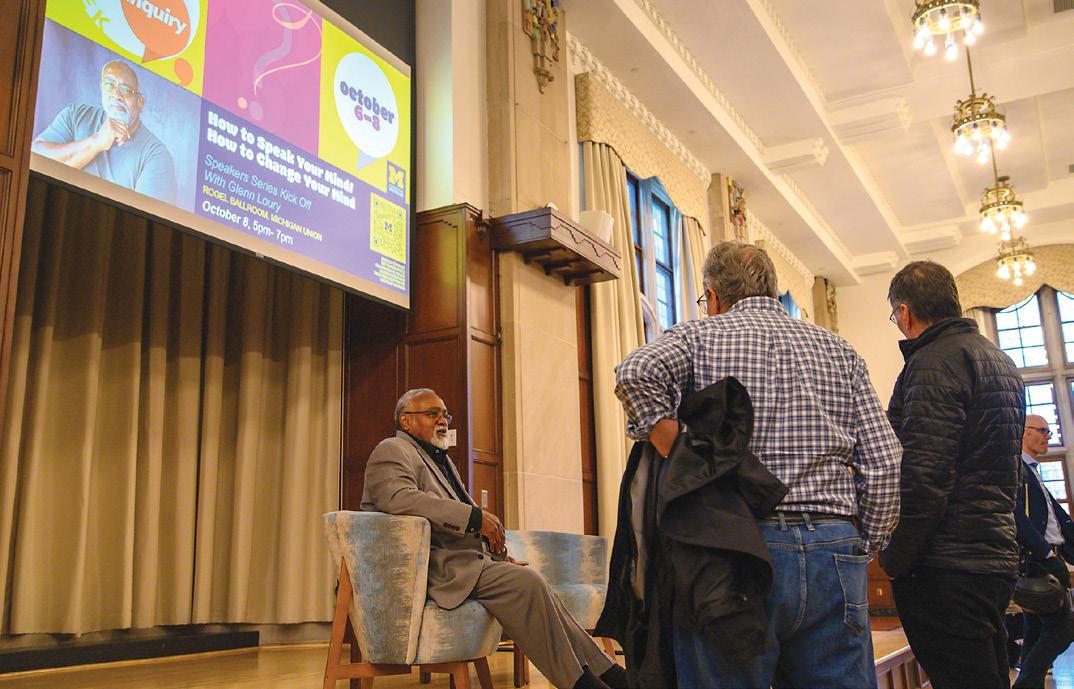
About 400 of University of Michigan community members packed into the Rogel Ballroom in the Michigan Union Wednesday evening to hear from Glenn Loury, author, podcaster and Brown University economics professor, for the event “How to Speak Your Mind/How to Change Your Mind.” The conversation was hosted by the Ford School of Public Policy and kicked off Open Inquiry Week.
Open Inquiry Week aims to encourage the University community to develop and defend informed opinions, as well as to listen thoughtfully to others and expand their thinking when presented with different perspectives. The week is co-sponsored by multiple campus organizations including Talking Maize & Blue, the Life Changing Education Theme Year and Office of the Provost.
Open inquiry week will continue Thursday, Oct. 16, with a screening of the documentary “True False Hot Cold.” Angela Dillard, vice provost for undergraduate education and current interim vice provost for access and opportunity, moderated the event and joined Loury onstage to talk about self censorship.
“Restraining one’s own ideas of opinions of speech, (stems from) a concern for potential … social and professional consequences,” Dillard said. “(Self censorship) is when we consciously withhold our true opinions on controversial issues due to social pressure — in positive ways out of the desire for belonging to being in the community, and in negative ways because we fear condemnation.”
Loury said self censorship can
lead people to be strategic about when to express their opinions to avoid ostracization. He said no matter what the sentiment, free speech comes at a price.
“There is no free speech,”
Loury said. “Speech is costly. Even if there’s no law prohibiting what you say. Because people, when they hear you say it, draw conclusions about the speaker based upon your willingness to say whatever it is that might be controversial or outside of the agreement of the redefining consensus.”
Loury said in 2024 he was invited to a synagogue in Palm Beach to discuss relationships between the Black and Jewish communities. While they did not invite him to discuss the ongoing Israeli military campaign in Gaza, he said it was on his mind going into the event. Ultimately, he made the decision to censor himself and did not bring up the conflict due to the anticipation of backlash.
Loury shared he experienced fallout after publicly criticizing Israel online. Notably, he said he was dropped from the Manhattan Institute, a non-profit conservative think tank, although they did not explicitly say they were severing ties with Loury because of his stance against Israel.
“I’m appalled … by the
discursive environment here in the United States, in which an acknowledgment and expression of critical reaction against it is less robust than I would like,” Loury said.
He also highlighted the importance of mindful communication.
“Responsible discourse is not simply saying everything that you think might be true that’s on your mind,” Loury said. “It’s managing your presentation in a way that is consistent with a wiser assessment of what the political landscape is that you’re operating in right now.”
In an interview with The Michigan Daily, Business freshman Isaac Shapiro who attended the event said he appreciated the advice to not self censor even when it may be more appealing to authority figures.
“If you hear something from someone, that person that might be in a higher position than you, have more authority than you, but if that’s putting you down or motivating you not to speak your mind, then they’re not the person for you,” Shapiro said. “You need to seek out someone else, like another professor, to give you guidance.”
“This change could lead to
On Sept. 19, President Donald Trump’s Administration published a proclamation that significantly increased the cost for employers to sponsor highly skilled foreign workers on H-1B visas. Employers are now required to pay an additional $100,000 fee per application, in addition to the existing $2,000-$5,000 processing and training fees.
This new fee will specifically impact research universities, as many universities, including the University of Michigan, use H-1B visas to hire global talent for research opportunities. The University hired 359 people this year under H-1B visas, the second-highest among research universities after Stanford University, which hired 500 workers in 2025.
An H-1B visa allows nonAmerican citizens to work in the United States for three to six years in a job that requires specialized skills. However, the Trump administration’s proclamation states H-1B visas are often abused and enable highdemand industries to hire foreign workers at lower wages, thereby displacing U.S. graduates.
The fee took effect at 12:01 a.m. Sept. 21 and will last through Sept. 21, 2026, unless federal agencies recommend an extension. The proclamation does not affect current H-1B visa holders, renewals or those who filed before the effective start date.
The University’s Office of PublicAffairsreleasedastatement

highlighting the importance of H-1B visas in maintaining global competitiveness. It stated that the University will continue to provide updates regarding the new restrictions.
“At U-M, the H-1B program is an essential tool for maintaining global competitiveness in research and education,” the statement reads. “The program allows us to attract and retain the world’s top talent—scholars, researchers,










GIA VERMA Daily Staff Reporter
Bela Fischer/DAILY
Hollow Knight: Silksong has finally arrived after six years of teasers and info drops by its developer and publisher, Team Cherry. Silksong serves as the sequel to the indie studio’s breakout hit Hollow Knight, which was released in 2017 and received high critical praise. Even though the game is a sequel, it would be a disservice to view it as only a continuation of the first. Silksong is an evolution of its older sibling, taking Hollow Knight’s best parts and spinning them into something that may surpass the high bar the previous game set.
Silksong approaches its story in a very different way than Hollow Knight. The story follows Hornet, a prominent character from the original game, as she explores an unknown land and uncovers its mysteries. The original Hollow Knight was often cryptic and hid lore details all around its map. Silksong does the same, but also offers much more characterization of the game’s protagonist. Her new ability to speak allows players to immerse themselves in the world in a way that did not exist in the original. This change emphasizes dialogue and storytelling, and creates a story that keeps players moving forward to see what happens next. Hornet’s personality shines through in the dialogue, creating memorable interactions with other characters that help players engage with the game’s world. Exploration is a pillar of the game, and as such, you’ll
Hollow Knight: Silksong is more than a sequel

be doing it a lot. Fortunately, this aspect of Silksong is very strong. Hornet has many movement options, unlocked over the course of the game, that make exploration extremely fluid. Hornet’s vast moveset allows it to become an improvised dance that flows from combat to climbing to dodging in a satisfying flurry of dashes and jumps. The whole map is littered with side routes and secret passages that connect the world in surprising ways, creating a map that feels complex without becoming confusing. Hornet is a very versatile and capable character. The same movement techniques used to traverse the world become invaluable combat tools that weave Hornet through the battlefield. She is also very customizable, as she can equip
an array of secondary weapons and “crests” to change the way she fights. This creates a user-tailored experience that allows players to choose how they approach combat by picking their loadout, encouraging creativity and experimentation. Compared to the Knight’s moveset, Hornet provides an absolute treasure trove of options that allow for greater maneuverability and variety in and out of combat, allowing the player to experiment in new ways they couldn’t before. In general, Silksong is a more difficult game than Hollow Knight because the player is more capable now. The game’s difficulty has to rise to meet the player, creating an experience that asks players to use all the tools available to them. A good example is how
healing works in Silksong. In the original Hollow Knight, you could only heal one hit point at a time, but in Silksong, you can heal three at once. To compensate for this change, a large number of enemies and hazards do extra damage, which itself is balanced by Hornet’s increased mobility. If you’re coming off the heels of Hollow Knight, this game will be harder because it asks the player to use a different mindset. You are a different character with different skills, and the game makes sure you know it. The game is difficult on its own merits, not just in comparison to Hollow Knight. It asks for different responses from players based on the unique toolkit it provides, creating a satisfying challenge that asks players to engage with the game. It may be its sequel
by definition, but it should also be considered its own beast.
However, Silksong does have a few notable problems that seem out of place given its high quality overall. An important addition to Silksong are side quests, called “Wishes,” which allow for more diverse side content to accompany the main story. Not all of the side quests are inherently low quality (the quests that require tracking down bosses stand out among the rest), but many of them involve menial or repetitive tasks that don’t add much to the game. This includes quests like donating resources or killing certain types of enemies to gather items, which wouldn’t matter as much if the quests were optional, but a large chunk of the main story is locked behind their completion.
In addition to the quests,
Silksong also struggles with difficulty spikes. There are a few significant occasions where enemy encounters feel like they are out of place based on their intense difficulty. This challenge may be welcomed by some, but could be a major roadblock for others who aren’t prepared. These flaws can be exacerbated by long distances between bosses and save points, making the shameful run back to a boss after failure sometimes take longer than the fight itself. None of these problems ruin the experience on their own, but they coalesce to create moments of potential frustration for the player. Silksong will be endlessly compared to Hollow Knight. Even in this article, Hollow Knight has been used to measure the game’s aptitude. Still, even though it is convenient to do so, it would be a true disservice to see Silksong solely through the lens of its predecessor. After years of development, Silksong has come far from the roots established by Team Cherry’s first game, and it deserves analysis independent from Hollow Knight. It is a difficult and rewarding game, but not just because the game that came before it is slightly easier. The story is strong thanks to its unique characters and storied world. The game is beautiful thanks to its stunning landscapes and wonderful soundtrack, both sure to stick in players’ memories. Team Cherry didn’t make Hollow Knight two; they made Silksong. It is important to see how things have changed, but it is equally important to judge the game based on its own merits.
‘The Girlfriend’: Yawn Girl
“The Girlfriend” is the biggest fraud in recent TV memory. It wears its influences like a badge of honor, but don’t be fooled by its hot young stars, exotic locations and high production values. Beneath the surface, there is an extraordinary amount of nothing.
Laura Sanderson (Robin Wright, “House of Cards”) is a wealthy London art gallery owner and doting mother to her son Daniel (Laurie Davidson, “A Cruel Love: The Ruth Ellis Story”). Daniel’s got a new girlfriend, Cherry (Olivia Cooke, “House of the Dragon”), and she’s got everything going for her. She’s a successful real estate agent that is also smart, funny and beautiful.
But Laura knows something’s up with Cherry. She lies about having attended a prestigious secondary school, loves to spend Daniel’s money and (GASP) can’t play tennis. Laura is determined to keep Daniel and Cherry apart.
The two views above encapsulate what it’s like to watch an episode of “The Girlfriend.” The show is told from the perspective of both women, with the first half of each episode highlighting one’s perspective and the second recapping the same events from the other’s. It is a miniseries about two women fighting over the most important man in their lives through increasingly high-stakes humiliation, backstabbing and cancelling. It’s a fun premise, but it ultimately suffers from horrible execution.


for a nail-biting ride, desperately trying to figure out how these two characters will hurt each other next, the viewer sits back, waiting to see how the next in a series of convoluted schemes will fall apart. “The Girlfriend” is not a high-wire act; it’s a series of increasingly implausible falls.
If “The Girlfriend” was aware of how dumb its central characters are, it might derive some humor from the comical failures of its antiheroines. But the show takes itself religiously seriously: In ping-ponging between the perspectives of Cherry and Laura, the show attempts to shift our sympathies as well. In Laura’s sections, we are expected to see Cherry as a manipulative golddigger, while in Cherry’s sections, we are expected to see Laura as a smothering prude. “The Girlfriend” wants, more than anything, for us to relate to both characters at once, with each segment framing interactions differently in order to force us to consider both women’s perspectives. Unfortunately, it never feels like anything more than a cheap gimmick.
markedly different ways. It plays as if the show is embarrassed by its perspective-swapping, a gimmick which would have been unnecessary if the show was capable of writing better characters, or at least functioned as a simple thriller.
Aside from the terrible writing, everything else in the show is fine. Laura, Cherry, Danny and the show’s perfunctory supporting cast spend two episodes in Malago, and the camera department gets the opportunity to shoot naturally beautiful locations with no depth, flat studio lighting and boring compositions. There are a few sex scenes, including a pretty grossly porn-y recreation of the balcony scene from “Romeo and Juliet,” but Davidson and Cooke have so little chemistry that the scenes get by more on their (pretty low) shock value than any real eroticism.
Cherry and Laura are both liars, but not particularly skilled ones. The two construct unbelievable lies — fabricating a character’s death, creating fake social media posts in the other’s name, etc. — that are easy to pick apart with any level of critical thinking. Instead of being strung along
Worse than being blatantly manipulative, it’s poorly structured and even more poorly executed. The show rushes through the second half of every episode, playing music over irrelevant dialogue and only slowing down for moments in which Laura and Cherry experience an event in
“The Girlfriend” is the sort of show that was designed by a marketing committee and formed by studio executives who watched better works succeed before telling writers to “Do that!” It’s so infuriatingly tepid that the only true moments of joy come from watching characters make mistakes, fail in their schemes and deliver bad dialogue. It won’t turn you on, thrill you or leave you with anything to think about.
JACK CONNOLLY Daily Arts Writer
HUDSEN MAZUREK
Official image from Hollow Knight: Silksong distributed by Team Cherry.
Courtesy of Amazon Prime.
‘Vera, or Faith’ balances sharp and sweet

A narrator can make or break a book. Holden Caulfield from “The Catcher in the Rye” is too whiny for some; Humbert Humbert of “Lolita” fame is almost too effective in his perversion for others. Author Gary Shteyngart clearly takes inspiration from the exacting diaristic narration of authors like Vladimir Nabokov. But what propels his form of narration in his latest novel, “Vera, or Faith,” beyond even Humbert’s and Hermann’s, is the direction Shteyngart brings his lens. That is, down. “Vera, Or Faith,” which is told from the perspective of a precocious 10-year-old named Vera, throws itself fully into its limited point of view. Vera is extremely internal. She catalogs the world around her, an outsider who is desperate to feel included by the people in her life. Keeping a “Things I Still Need to Know” diary, she dutifully logs her cerebral father’s political spitfire, itching to be more like him. She seeks friends at school, returning home to her AI-chessboard companion, and she searches for the truth about her birth mother, looking for a bond that transcends that of her
mixed family. Vera loves her stepmother and half-brother, but feels isolated by them. This feeling only grows over the course of the novel, as the political ire of the world starts to leak into her home and her life.
In school, friendless Vera is assigned a debate partner, and they are given the task to debate a recently proposed amendment. Colloquially called five-three, the amendment would grant Americans whose families have been in the country longer (“five-threes”) a vote that counts for five-thirds of everyone else’s. Russian-Korean Vera steps up to the task of navigating her family’s academic expectations, staunchly and innocently eager to defend what amounts to her own disenfranchisement.
Vera’s lack of awareness of the weight this class assignment holds, despite the knowing glances of the adults around her, adds to the casual dystopia that Shteyngart creates. It’s eerie to watch Vera defend a bleak future for herself — one that doesn’t feel too far off from our own reality — in a completely uncritical manner. Vera is unaware of what she is denigrating, unaware of the complexities that cross even the threshold of her own home. She is focused solely on more age-appropriate concerns:
winning a friend in her debate partner and receiving positive attention from her father.
It’s these dilemmas Shteyngart uses in order to envelop you in Vera’s world, to endear her to his reader. By muffling the problems pushing against her personal bubble and focusing on her humorous misreadings and low-stakes schemes, Vera becomes impossible not to root for. “Vera, or Faith” omits and enthralls; the questions you most want answered about the book’s imagined America aren’t lingered on, instead bumped for the melodrama of her small life. But what Vera cares about, we care about. The dynamics between her and her five-three half-brother and what has happened to her Mom Mom, take precedence over the shifted borders and amendment conventions in her periphery. That is, until the politics ultimately cannot be ignored, and they collide with Vera’s world in a caustic way.
“Vera, or Faith” expertly navigates the complex dynamics of mixed families in the face of a scarily plausible future, but never loses sight of its emotional core. Its climactic scene is heartbreaking and beautiful, the pressure cooker of Vera’s internal world finally bursting, and her understanding of the world with it.
CARLEY ANDERSON & CAROLYN LIRA
Ethel Cain: known for using cannibalism as a metaphor for love, depicting the toils of religious trauma in the conservative South and hating this Lana Del Rey Instagram post. What some listeners may not know, however, is that Ethel Cain is simply the fictional character her creator, Hayden Anhedönia, becomes in concept albums and performances. Released on Aug. 8, 2025, Willoughby Tucker, I’ll Always Love You prequels the plotline Cain traced in her debut album, Preacher’s Daughter. Cain’s first love, Willoughby Tucker, is introduced in Preacher’s Daughter’s third track, “A House in Nebraska.” This latest album chronicles years of their relationship to listeners, or so say dedicated fans on Reddit.
Anhedönia performed as Ethel Cain on Sept. 17, 2025, at the Masonic Jack White Theatre in Detroit, Michigan. After the opener 9million concluded, people decorated in camo print, white lace, septum piercings and mustaches sat in anticipation.
Seated in the middle of a friend group, conversations were had over me and smelling salts were sniffed beside me. The demographic seemed right.
“Willoughby’s Theme” began and someone a row behind me let out a sob. Screams of “Hayden we love you!” rang out over the bass. The stage became a rural country scene, one plucked out of Cain’s Southern gothic universe.
‘The Long Walk’: We walk still
MAYA RUDER
“The Long Walk” is blood, gunshots, more blood and death. Over and over again. The film’s premise is simple: walk or die. But a muddy underfoot lurks beneath — a society impregnated by a draconian parasite that quickens the step, the heavy burden of memory that slows it and the call to brotherhood and home that stops it altogether.
Francis Lawrence (“Constantine”) is no stranger to shooting a dystopian landscape. He returns to the wastelands of “I Am Legend” and “The Hunger Games” in “The Long Walk,” achieving perhaps the grimmest adaptation of any Stephen King novel. First penned between 1966 and 1967, when King was only a freshman in college, “The Long Walk” sits within the context of the Vietnam War, a time when a military draft swept millions of young American men into the horrors of combat. This was an era marked by sacrifice and masculinity in conflict, fathers and sons divided and nationalism at odds with morality.
Both the novel and film open with the same scene: a car ride shared by Raymond “Ray” Garraty (Cooper Hoffman, “Licorice Pizza”) and his mother (Judy Greer, “Jurassic World”). Ginnie Garraty is driving her son to the starting line of The Long Walk: An annual competition in which 50 boys must maintain a walking speed of three miles per hour — a rule break punished by execution — until only one boy remains.
To amend a previous statement, Ginnie is effectively driving her son to his death.
Sitting in wait before their military escorts, the boys appear calm and resolute, save for a panicked few, revelling in their collective masculine triumph. The walk is the ultimate test of endurance — of being man enough — a trial you pass simply by participating, even in failure.
In the words of the Major (Mark
Hamill, “Star Wars: A New Hope”), a true manifestation of evil: “It takes heavy sack to sign up for this contest.” Hamill, who alters his voice beyond recognition for this role, brings an eccentricity to the Major that makes him entirely inaccessible and unpalatable.
Lawrence frames the Major, eyes hidden behind thick, impenetrable sunglasses even in the night, as a man swallowed by grandeur and tyranny who arouses existential dread transcendent of acute fear.
The boys march to their deaths as willing sacrifices at his command, each of their own accord and each deceived by a totalitarian regime that promises salvation and glory. In return, this regime asks only for performances of bravery in the name of combating laziness. The Major offers a foreboding valediction: “For some, your heart will stop. For others, your brain. And the blood will flow suddenly. There’s one winner and no finish line.”
And so, doom plants itself to stay for The Long Walk.
Enter Peter McVries (David Jonsson, “Alien: Romulus”): strong-willed in both constitution and spirit, charm pulsing through his veins and the wisest of them all. Peter and Ray form a bond of mutual respect, affection and shared trauma — holding each other up physically and emotionally. Jonsson and Hoffman both deliver standout performances, their on-screen collaboration reminiscent of the representations of male intimacy found in “Stand By Me” and “The Shawshank Redemption.”
“The Long Walk” finds its strength in its characters — each assuming a unique nature with verisimilitude worthy of empathy. The common thread of humanity that connects each young man to one another, and each of us to them, eclipses the natural necessity of moral decay in this pressure cooker of survival.
Lawrence treats each boy with gentle tolerance, the camera taking in their sharp edges and hardened dispositions with a knowing, tender eye. As time drags
Ethel Cain’s haunting night at the Masonic Temple
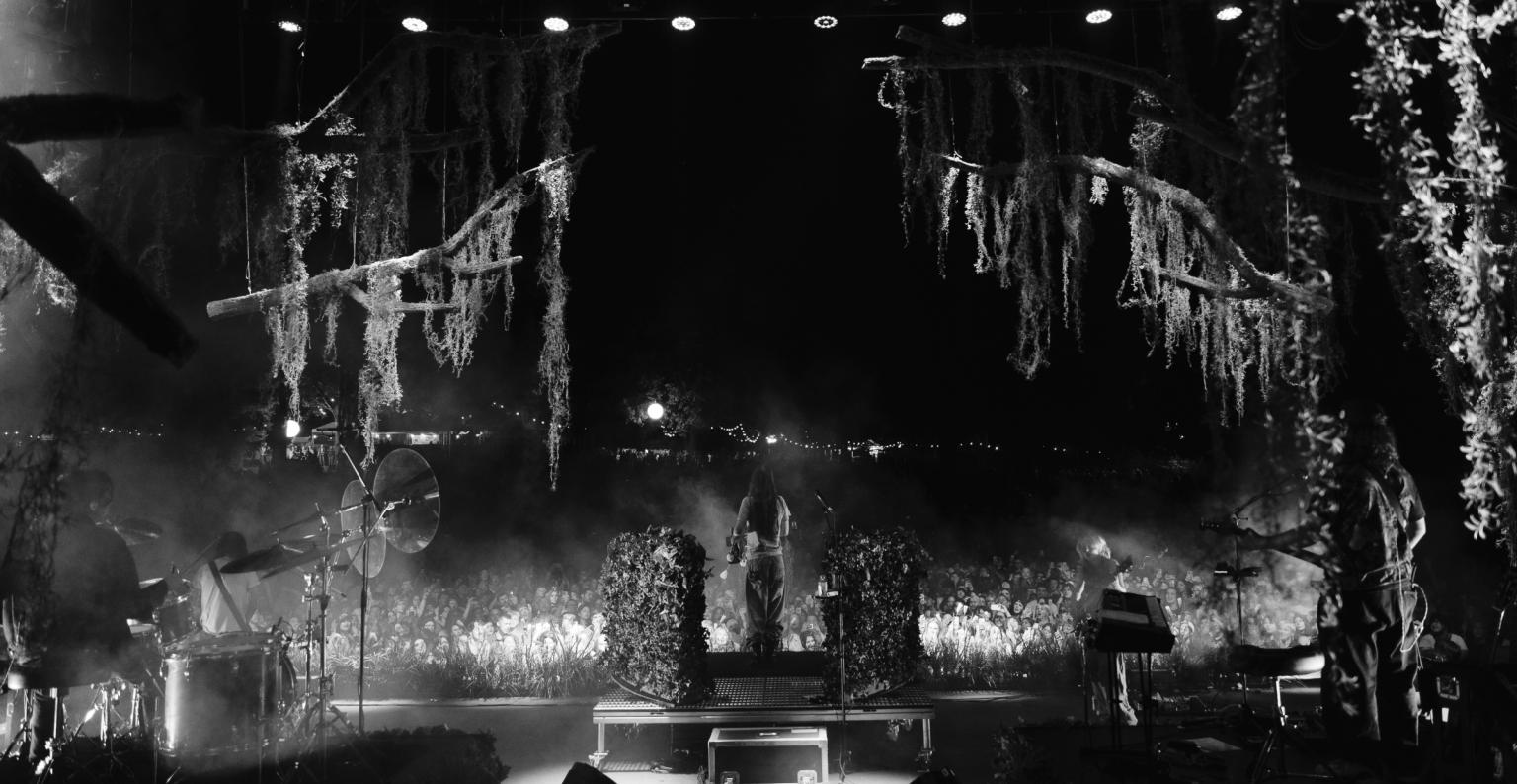
Drooping willow branches hung from above, fog billowed across the stage and the guitarist began to strum. Green lighting and fog merged to cloak Cain; the audience screamed as the mist parted to reveal her silhouette propped against a cross-shaped microphone stand. She stood on a raised platform not unlike an altar — she became a preacher’s daughter. Fans in the audience idolized her; the silence between songs was filled with shouts of love, lyrics were belted so violently that voices cracked and hiccuping sobs didn’t cease after the first song. Fog rolled around red velvet curtains and the stage lights flickered hues of blue, green, pink and red throughout the show. Cain’s appearance was obscured for most of her performance, with only the
eclipsed outline of her figure working to persuade the crowd that this was Ethel Cain — not Hayden Anhedönia. This was her fictional persona performing for us.
“Willoughby’s Theme” opened the show with unsettling dissonance, setting a mood of eerie anticipation. While the first track didn’t energize the audience like it might at a traditional concert, it firmly established the intimate yet haunting atmosphere that defines the world of Ethel Cain. The piano played through the refurbished church as a careful guide through the song. Over the foundation of the emotionally rich lullaby, static slowly broke through, disorienting the simple piano that played over the audience. The strings added another layer of uneasiness,
scraping and screeching like nails on a chalkboard, creating a tension that traveled through the room. The dynamics were striking as moments of quiet reflection suddenly burst into a shrill tone that pulled the entire venue into the disquieted mind of the singer on stage. Cain was here to remind the audience that they weren’t simply attending a show, but stepping into the retelling of a dark and intimate story.
Maintaining the emotional intensity, Cain seamlessly transitioned into the next song, “Janie,” which introduced the audience to Ethel Cain’s high school best friend. It’s a song steeped in mourning, as Cain grieves the slow loss of their closeness after Janie fell in love and began spending all her time with her boyfriend,
on like a broken limb on gravel, we grow fond of each boy and dread their cries of pain, pleadings for mercy and deaths with painful anticipation. We spend nearly 120 minutes watching them walk, finding ourselves searching for emotion in posture, gait and the eyes. It is their faces and frames that become the landscape, ones we part with mournfully. Paired with an understated score composed by Jeremiah Fraites (“Springsteen: Deliver Me from Nowhere”) with metronomic pizzicato akin to the clicking of a telegraph, “The Long Walk” is minimalistic in all but gore. It is this minimalism that allows poignancy to soar, weight to build and mystery to leave the audience in the dark — just where Lawrence wants us.
Near the end of the film, civilians gather in crowds to spectate when only two boys remain, hoping to catch a glimpse of the final kill and the crowning of the winner. They cheer at the eventual bloody headshot, celebrating as a boy lies on his stomach, the rain pummeling his dead body, his last words for his mother.
A question will inevitably enter your mind as you watch “The Long Walk.” Would I survive? How long would I last before my legs give out or my lungs fill with fluid? But the question of “The Long Walk” is not one of physical endurance; it is, rather, one of human nature. We see, in this dystopian world, an impoverished civilization desensitized to violence and unflinchingly obedient to a system blinded by fantasies of eternal power reserved for the ruling class. We witness 50 young men compete with their lives in the name of honor before a national audience, all but one of them suffering death without dignity. We witness the same young men, at first unwavering in their efforts, experience horror and grief at the deaths of their competitors — competitors who soon became companions, and even brothers.
CONTINUED AT MICHIGANDAILY.COM
leaving Cain behind. This song captures the gut-wrenching experience of people moving forward into the future without you. Cain’s fragile voice, as she sung “You’ll keep changing, I will stay the same,” paired with the slow, trembling strum of a guitar, mirrored the weight of the feeling of powerlessness during uncontrollable change. This quiet heartbreak ended with Cain singing, “I know you love her / But she was my sister first,” leaving a sense of yearning lingering in the air as Cain transitioned into the next song, “Fuck Me Eyes.” The tempo shifted dramatically as an electric synthesizer slowly pulsed into the room, and the crowd responded immediately with high-pitched screams. “Fuck Me Eyes” retains the echo-like
harmonies that characterize Ethel Cain’s music, but this performance was even better than those of her other tracks, as Cain sang about a promiscuous woman whispered about in her small town. Lyrics like “They never see her wipin’ her ‘fuck me’ eyes” dig into the misunderstandings that dominate girlhood, and the crowd felt every word. As Cain stood before the microphone, the instrumentation swelled with crashing cymbals and the quick rhythm of the synthesizer. The audience’s voices rose with hers, not to overpower but to echo her conviction, magnifying the song’s sense of defiance as she belted, “I’ll never blame her for trying to make it.” The song is both compassionate and intense with judgment, and the audience hung on every twist and turn.
“Dust Bowl,” the album’s third most-streamed song with seven million plays on Spotify, was one of the night’s most anticipated moments. Stretching strings and crackling strumming filled the venue, the subtle roughness of these sounds creating a warmth that enveloped the audience. The song’s instrumentation hummed with a grainy, lived-in texture as if being played through an old amp buried in sand.
Cain’s vocals floated above it all with a delicate vibrato, illustrating sun-bleached landscapes and endless horizons. The crowd leaned into the strong fragility of this track, singing along in awe.
Daily Arts Writers
Courtesy of Random House.
CORA ROLFES Senior Arts Editor
Courtesy of Enoch Chuang.
Daily Arts Writer




















LThe Wolverines found momentary success on the defensive end, forcing two first-half fumbles, one recovered by Michigan and the other setting up a third-and-17.
But the Trojans bookended the first half with efficient sustained drives that were capped off by touchdowns from their top receivers
manageable.
FORCE
ZHANE YAMIN
EDITORIAL BOARD MEMBERS
Lucas Feller Liv
Make Ann Arbor affordable again

Lara Ringey/DAILY
After spending the last three years of my life in Ann Arbor, I can say that it’s my favorite place I’ve ever lived. I love the local culture, small businesses, parks, nature areas and public transportation. But the city I love is outgrowing itself, which is leading to an affordability crisis, namely in housing but in most other aspects as well. One part of the potential solution to this problem is Ann Arbor’s newest draft of the Comprehensive Land Use Plan.
The Comp Plan is a document required by the state of Michigan to inform Ann Arbor’s infrastructure, land use, zoning and transportation policy in the coming decades. It’s created by Ann Arbor’s city planning commission alongside community input and ultimately adopted by the city council.
The plan is currently in its second of three drafting stages, with the third draft to be released for city council approval on October 20th. In each drafting stage, the community is asked for feedback, and edits are made based on said feedback.
It’s also important to note that this document itself is not law, but rather a mechanism to inform the city council where citizens think new regulations ought to be made. It’s important to note that this document itself is not law, but rather a mechanism to inform the city council where citizens think new regulations ought to be made. But this document presents a pivotal opportunity to address the city’s housing challenges. By embracing rezoning and increased density, this plan can foster affordability, sustainability and inclusivity.
This document is critical to the future of Ann Arbor because local governments are the ones issuing permits, zoning and property taxes. These all affect the affordability of Ann Arbor, including how many new housing units are built, what kinds and where businesses can locate. The current Comp Plan was passed in 2009,
and the city is in desperate need of an upgrade.
The greatest impact the Comp Plan will have is on the housing market. Currently, most neighborhoods are limited to single-family homes, which restricts the supply and drives up rents and housing prices. By expanding housing options through rezoning for duplexes, triplexes and apartments, housing options would increase for students, workers and families.
Ann Arbor currently is missing the “middle” housing market, meaning small to midsize residences that middle-class families can afford. The average cost of a house in Ann Arbor is $515,627, whereas the average cost of a house in Michigan is $257,784. For reference, the average middle-class family makes $68,505. This means that middle-class families are being priced out while also not qualifying for low-income housing. Rezoning the city will create more housing opportunities, thus lowering the overall cost of a house to something more affordable for the average family.
Evidence from other similar-sized cities also suggests that rezoning and an increased housing supply will have a positive impact. Minneapolis eliminated single-family zoning in 2019 and has since seen an increase in middle-class housing. The plan also addresses Ann Arbor’s climate goals in the A2 Zero plan, which sets a goal for Ann Arbor to be carbon neutral by 2030. To achieve this, the plan calls for a 50% reduction in vehicle mileage. This goal will be hard to reach if the city keeps expanding outward or if people are forced to commute due to a lack of housing. Mixed-use housing makes it easier to walk, bike or use public transportation, which overall reduces carbon emissions and congestion. The Comp Plan also would into consideration green infrastructure, storm management systems, enhancement of biodiversity, solar site identification and an expanded transportation system.
In the long term, these steps will reduce Ann Arbor’s reliance on carbon-dense materials and natural gases while allowing its com-
munity to grow. These materials tend to be limited, so planning around replenishable materials is vital in projecting the long term sustainability of the city. It’s also important to highlight that zoning itself has exclusionary roots. It was historically designed to limit access to certain predominantly white and wealthy neighborhoods. Continuing to enforce these restrictive policies means perpetuating inequality. The Comp Plan offers a chance to correct this past zoning to make the city more inclusive professionally, racially and economically diverse.
Opponents argue that rezoning will not help the affordability crisis and that the city council’s predicted growth in housing and population is off; thus, there is less need for new housing. This coalition is called “A2 Pause the Plan.” It claims that the Comp Plan data projections are off, the plan will burden vulnerable residents, feedback is underrepresented and that the plan calls for the city to sell off nature areas and golf courses. The Ann Arbor city council has responded to the last claim, stating that they do not intend to reclassify or sell any land in order to preserve biodiversity as called for in the Comp Plan. While they also argue that predicted growth is off, they still aren’t addressing the reality of the current situation. Students are crammed into overpriced apartments, young professionals are paying absurd amounts of money to start a family here and essential workers commute from outside the city because they cannot afford to live here. Even if population growth were to slow, Ann Arbor is facing an affordability crisis now. The Comp Plan is not about chasing growth, but rather making the city a place for those who are already in it to thrive. Ultimately, the choice before Ann Arbor is not between growth or no growth. The city will change regardless. The real choice is whether that change will be managed in a way that reflects Ann Arbor’s values of equity, sustainability and inclusion or whether the city will cling to outdated policies that make it increasingly unaffordable and exclusive.
Shutdown sympathy
UMich says the Ypsi Data Center won’t “manufacture nuclear weapons.” What does Los Alamos think?
The University of Michigan plans to build the world’s fastest supercomputer with Los Alamos National Labs through a $1.2 billion project in Ypsilanti, Michigan. This is a massive undertaking and would be the largest government-run high-performance computing facility ever — twice as expensive and twice the power consumption of the next largest. At its peak, it would use enough energy to power more than 90,000 homes.
In marketing materials to assuage community concerns about the data center’s numerous harmful impacts, the University frames the data center as a useful tool for scientific research and national security, using the FAQ to reassure the public that it will not be used to create nuclear weapons. In a press release, the University laid out the purpose of the plant.
“It will focus on scientific computation to address various national challenges, including cybersecurity, nuclear and other emerging threats, biohazards, and clean energy solutions.”
Of course, the facility won’t manufacture nuclear weapons — it’s a data center, not a nuclear plant. The reassurance is an unconvincing distraction from the University’s role in supporting the development and production of nuclear weapons, a function placed into sharp focus by LANL Director Thom Mason’s commentary on their goals for nuclear weapons development and American nuclear supremacy.
National security, much more than anything else, is LANL’s primary mission.
LANL Director Thom Mason clearly contrasts the lab from other Department of Energy sites.
“Los Alamos is clearly, front and center, a national security lab, although it has a lot of outstanding science and energy technology work,” Mason stated in an interview with the National Security Sciences staff.
According to Mason, around 80% of the budget supports the nuclear deterrent of the U.S. in the form of maintenance and modernization around the nuclear stockpile. LANL spends significantly more
money on weapons activities than on science research. Additionally, weapons research accounts for the massive increases in the lab’s recent activity, with Mason citing a rise in national security missions as the primary driver of a $1.5-billion-per-year increase in their 2022 budget.
LANL stockpile stewardship occurs through two main mechanisms, both of which the upcoming Ypsilanti data center is likely to be crucial in supporting. The first is in its process of assessment, maintenance and certification of the existing stockpile, a computing-intensive process of ensuring the warheads inside of the stockpile are safe and, in quite a jarring oxymoron, “reliable” in being able to bomb a site when deemed necessary. That systematic assessment process is essential for ensuring the U.S. can intimidate other countries with its nuclear weapons stockpile.
Certification also manufactures excuses for the second mechanism through which Los Alamos pursues U.S. nuclear supremacy: the expansion and upgrade of its nuclear weapons stockpile through the development of new plutonium pits (the nuclear fuel at the core of each warhead).
Although LANL and U-M researchers are working hard to prevent other nations from developing nuclear weapons through enforcement of the Nuclear Non-Proliferation Treaty, the U.S. is continuing to develop and manufacture its own weapons through increasingly advanced simulations of both weapons trajectories and materials during explosions.
In 2018, President Donald Trump directed the Department of Energy to develop 80 plutonium pits per year, leading to a massive buildout of infrastructure for nuclear weapons development at LANL. As a result, LANL and other national labs are working today on the W87-1 plutonium pit, a new pit that the department hopes to produce by 2030.
According to LANL, “The W87-1 Modification Program marks the first time since the end of the Cold War that the nation’s NSE will be putting a 100 percent newly manufactured nuclear warhead into the stockpile.”
High-performance computing is critical for the design
and production process of these warheads. It is needed in hydrodynamic experiments simulating the detonation of the warhead, flight simulations of ballistic missiles and the identification of mechanisms to avoid antiballistic missile counterattacks. It is also necessary in ensuring nuclear weapons hit their target. To what extent will the Ypsilanti data center be implicated in LANL’s weapons mandate? We can’t say for sure: It’s classified. However, judging from the lab’s activity as a whole, as well as the fact that the data center requires 15 times as much money as LANL’s annual spend on all of science research, there seems to be no reasonable possibility that the data center will be independent from LANL’s primary mission of nuclear weapons development.
We’re left then to consider the University’s words once more: The data center will not manufacture nuclear weapons. This is a stark contrast from the understanding of LANL, in fact, manufacturing nuclear weapons is the utmost reason for its investment in high-performance computing.
So, the University administration must make a choice: Will it side with the public and live up to its stated ideals of serving the public good and public interest? Or will it side with LANL and spend hundreds of millions of taxpayer dollars to advance the production of nuclear weapons? Fortunately, a strong community movement against the data center has emerged, grounded in concerns around the data center’s use for war, dangers to the environment and the misuse of public resources. Despite continued dismissal of community demands, the movement has succeeded in pushing back the construction timeline by a year and moving the location of the data center away from South Hydro Park in Ypsilanti. Now it’s time for U-M faculty and students to join the fight and build the pressure needed to stop the project. Join your coworkers and fellow students Oct. 28 at 7 p.m. at the Friends Meeting House for a convening of the U-M community against the data center (RSVP here). Let’s stop the University from investing in nuclear weapons, and instead
NATHAN KIM Opinion Contributor
ELIZA PHARES Opinion Columnist
ERIN COLEMAN Opinion Cartoonist
AI is coming for our jobs
JACK VERRILL Opinion Analyst
It’s April 1912. The Titanic, the world’s first “unsinkable” ship, collides with an iceberg. In the Grand Dining Room, a raucous crowd is drinking champagne as water seeps into the lower decks. While the band plays festive music, the ship’s engineers realize it will sink. With the lifeboats being lowered into the Atlantic, most people keep on dancing. The advent of commercially available artificial intelligence is our generation’s iceberg. Current models are already producing work that is indistinguishable from human output, and companies are slowing down hiring to jump on the AI train. With the supply of jobs beginning to stagnate, recent college graduates are getting hit the hardest: Applications for entry-level positions are up 30% per-post. As students continue taking the same classes and applying to the same clubs, they sleepwalk into a treacherous job landscape. The music is still playing, but the water is seeping in.
Meanwhile, college is more or less the same. Professors assign less at-home essays, your work might be run through an AI detector and the biggest difference is that many students use AI to complete their assignments — which is hardly a cause for optimism.
But the content of what you’re learning hasn’t really changed. Nor have your goals. Students still pursue jobs in finance at the University of Michigan at higher rates than nearly any other school, with legal and tech careers also taking top spots for ambitious U-M graduates.
Unfortunately, these are some of the industries most prone to AI disruption. Their emphasis on aggregating data — in spreadsheets, slideshows and even legal briefs — is the exact sort of work ripe for automation. This especially hurts junior-level employees, whose jobs consist mainly of these rote tasks. For companies looking to replace humans with AI, axing recent grads is the most logical place to start.
Beyond that, the macroeconomic data paint an even bleaker story. Federal Reserve
statistics put unemployment for recent college graduates at 5.3%, or 25% higher than the workforce at large. And the situation is rapidly deteriorating — the unemployment rate for recent grads is increasing significantly faster than their non-college educated counterparts. Most startling of all, job listings for entry-level positions are down 35% since 2023. College students looking for jobs are going into an environment that is statistically more perilous than before.
And it’s not just the macroeconomic data that’s concerning. Individual companies are scaling back hiring too. Professional services firm PwC announced a 33% decrease in entry-level hires, citing rapid technological change. Not to be outdone, online marketplace Fiverr announced a 30% workforce reduction in order to become “AI-first.” Worst of all, the nation’s 15 largest tech companies have collectively reduced hiring of new grads by 50% since 2019.
But in order to grasp the severity of this iceberg moment, we need to hear from AI leaders in their own words. Chief among them is Anthropic CEO Dario Amodei, who warned last spring that AI could eliminate half of entry-level white collar positions, potentially spiking unemployment to 20% nationwide.
Tesla CEO Elon Musk took Amoedi’s claim further, suggesting AI will eventually replace all jobs, including his own. This doesn’t even include the troves of researchers and economists who voice dystopian outlooks for the future.
That said, there is some hope for college students. First off, major technological progress typically displaces jobs only in the short-term. This could be the case, as we are already seeing examples of companies re-hiring employees after failed attempts to automate away their positions. Furthermore, this is not the first time people predicted that AI will take everyone’s jobs. In 1966, computer scientist Joseph Weizenbaum invented Eliza, a chatbot designed to be a therapist. Despite the primitive nature of Eliza, many felt a human-like connection to the computer, leading to early warnings of AI job takeovers.
Almost 60 years later, we are having the same conversation.
But this time feels different. AI now rivals human intelligence, and the normal rules around technological progress don’t seem to apply. When cars were invented, they still needed a human driver. When light bulbs were first put to use, they could only get so bright. But with AI, there is no telling what it could do. It could soon make most things humans do completely obsolete or unnecessary. A few companies poorly implementing AI does not mean the technology itself is overhyped. And, while there were AI scares in the past, nothing comes close to the attention and money behind this one. We’ve hit the iceberg.
So how do you get a lifeboat? The best way to hedge against AI upheaval is to develop a more diverse skillset. If you are inclined toward the humanities and are afraid of touching AI, then incorporate large language models into your everyday workflow. Try vibe coding, an app, customizing your own agent or if you’re really ambitious, building a proprietary model. The barrier to entry surrounding technical skills is crumbling, and people of all backgrounds can use AI to do things that once required years of computer science training. If you are an AI-native STEM major who can map neural networks in your head, then try to embrace what makes you distinctly different from artificial intelligence. Billionaire entrepreneur Daniel Lubetzky endorses this path, encouraging Gen Z to study Greek philosophy in order to obtain the critical thinking skills needed to get ahead. You don’t have to stick to Aristotle or Plato, just lean hard into whatever it is that intellectually challenges you, independent of computers. When you enter the workforce, those critical thinking skills will augment your AI fluency to make you irreplaceable. The point is that the ship is sinking, but there are lifeboats for those who acknowledge the predicament we are in. It might look strange to stop dancing, put on a life jacket and escape to the deck. After all, the band is still playing. But the music is beginning to quiet, and the water is beginning to rise. Act accordingly.

Pete Hegseth and DEI
JOVANNA GALLEGOS Opinion Analyst
Six weeks into my internship at Alpine F1, most operations came to a stop due to the Formula I Academy-mandated summer shutdown, which meant two weeks of vacation for almost every employee. The majority of my coworkers were prepared to return to lifestyles established outside the city since they had relatives nearby or other destinations to visit. As a new transplant to England, with family across the Atlantic Ocean and not many close friendships on this continent, my calendar was empty, and I was anxious about how to spend that time. Being at my house didn’t appeal to me since it was too quiet, so I decided to take myself on a trip — not because I felt bold or anything but because standing still felt worse than stepping outside my comfort zone.
In full honesty, I had always felt a bit uncomfortable being solo in places that seemed to be designed for couples and groups. At first, being alone in public felt performative, like I was on display for everyone to silently judge me. Once, at a Parisian cafe, I tried to focus on my writing but convinced myself that I looked awkward and out of place. I viewed my own presence in these areas as this sort of anomaly that required an explanation to exist. It took some time for that uneasiness to go away, but eventually I realized that no one was really paying attention to me. People were so preoccupied with themselves that they hardly noticed a stranger writing quietly in the corner.
It took some effort to get used to being in public, but spending time alone quickly stopped feeling vulnerable and instead felt liberating as I enjoyed more and more of my surroundings on my own terms. Anyone who is hesitant should try going out by themselves; you could be surprised.
The exploration of a new place will carry a certain amount of anxiety. When I started traveling alone, I only went to places where I knew the local language, which at least eliminated one factor. In addition, I allowed myself to settle in gradually by spending the first few hours exploring the area on foot, researching for my itinerary and trying local food. I would sometimes listen to my favorite playlist and go for a run around the neighborhood, allowing my habits to follow me to foreign places. Spending time alone is
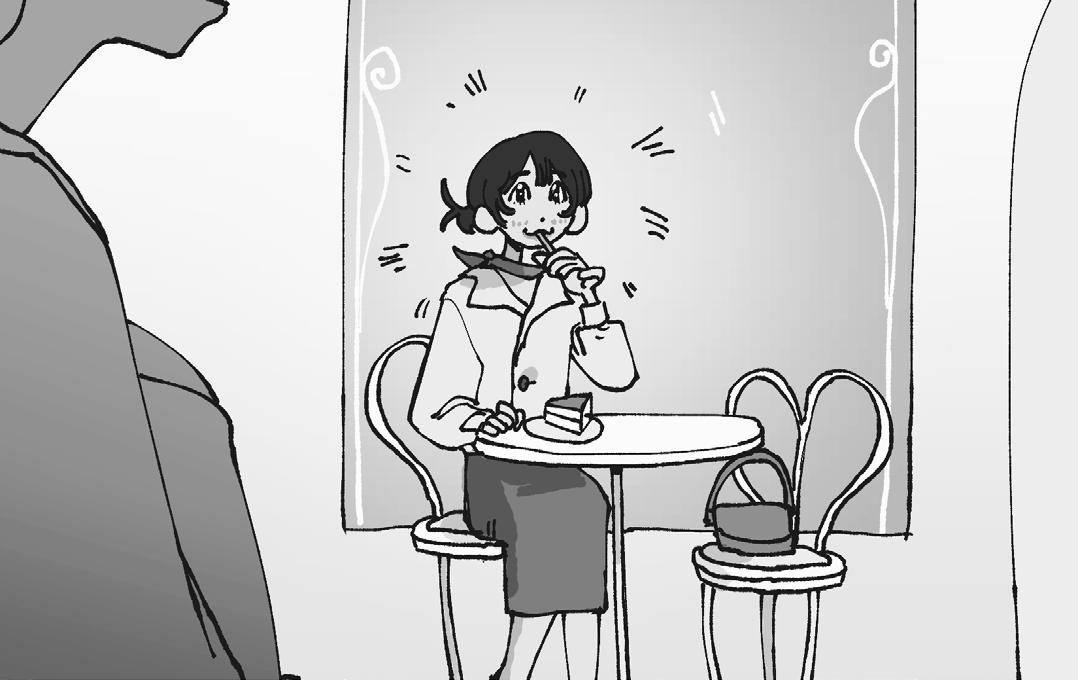
an opportunity to determine my own pace rather than test my isolation. It’s often treated like a consolation prize or something to be endured, but I’ve found real enjoyment in it. The freedom to move through a place on my own terms makes solo time feel less like a burden and more like a privilege.
Traveling solo also opened space for connecting with others in unexpected ways. When I went to Marseille in May, the train ride held its own set of surprises. With the help of our phones and a translation app, I had an entire discussion with a woman who sat next to me about her trip to the Bruce Springsteen concert and my upcoming year in Europe. On the journey back, my seatmate happened to be close to my age, and we talked about the differences between university in France versus the U.S., and our favorite movies. As a local, he also gave me recommendations for what to do in Paris, like to go visit Parc des Buttes-Chaumont and the Hôtel National des Invalides. Even though I’ll probably never see them again and the conversations weren’t really profound, they left me with new ideas and a newfound sense of humanity. There’s something quietly remarkable about sharing a moment with someone whose daily life is wildly different from your own, yet finding common ground in a story. These few conversations made me realize how much everyone wants to be seen and understood, even for a brief moment. If I had travelled with someone else, I would have been locked in our own little world and missed those small and genuine conversations. Traveling alone, however, I could shut out the world when I needed to or connect with others when I wanted to. Both choices were mine, determined by my feelings rather than by having to fit in with someone else’s interests.
I won’t pretend loneliness never followed me on those days abroad. Sometimes walking along the Seine as the sun set or wandering the streets
of Oxford, I would think that this moment would be a really great memory to share with someone. Acknowledging that these thoughts happen and impact my mood are normal experiences while living abroad. But when they did happen, I started to write the experience down, saving it for later, because they would someday become stories I shared with others or memories I revisited by myself. While I am so grateful to have the opportunity to solo travel, traveling with a friend encourages individuals to attempt new activities they may not otherwise do. However, I’m also aware of the quiet satisfaction that comes from making my own decisions, following my gut, taking my time and allowing each day by myself to unfold as I like it. Nevertheless, exploring cities alone is not limited to trips across Europe. Back in Ann Arbor, I built the same confidence in smaller steps. I would go for a walk downtown on the weekends, choosing an area that I hadn’t been to in a long time. Sometimes I’d try a new coffee shop and study there for a bit. Once in a while, I would treat myself to a movie at the State or Michigan Theater, where I would be in my own solitude but in a community of moviegoers. These solo outings taught me that making memories alone may be just as fulfilling as sharing them, if not more so, since I had complete control over every decision.
Whether at home or halfway around the world, the same dread still precedes any solo travel or date. Although the first outing is scary, I would much rather do it alone than not do it at all. What started off as a way to get through two weeks alone turned out to be one of the greatest presents I’ve ever given myself. I have become the type of person who I hoped to meet, one with stories worth telling and experiences worth sharing. And now, whenever I’m given the option, I always choose to face things alone rather than let fear stop me.
Michelle Peng/DAILY
LAURA CENCER Opinion Cartoonist
Selena Zou/DAILY
My friends and I have a running joke where we describe certain people as “real people”: those who have jobs, houses, families, lives. Those who know what to say (and when to say it), how to dress, how to belong. Who lack all the awkwardness and somehow, feel at ease within their own skin. By that definition, I’m not a “real person” yet.
Likewise, I spent my teens idolizing my 20s yet simultaneously fearing them. I believed that your 20s were the beginning of the end — as if it were a cliff you are shoved off of, where all your whimsy and spontaneity and life drain away the moment you hit the ground, and you have no choice but to land a nine-to-five job and stay there forever. Yet that was okay, because once I hit 20, I would have it all figured out and somehow cross the threshold between who was “real” and who was not.
I’d make my first year of college? And why do I feel more childish than ever, despite being the oldest I’ve ever been?
I recently told my girlfriend that the very first thing I had noticed about the rushees of her sorority was that they definitely had friends in high school. They seemed put together in a way I wished to be, lacking the awkwardness and hesitation that stubbornly clung onto me.
I don’t know if this was coming out of bitterness and jealousy, a comment purely born out of my own insecurity, given that I had close to none, but I couldn’t help fixating on the disparity between us two: a towering gap between who I want to be, and who I am. How unwittingly lost

I am in the very act of comparing myself to others. How pitiful it was to feel almost inferior to these girls years younger than me. I keep measuring myself against these thresholds,
almost searching for proof that
I am behind. I think about the unfunny joke I told last week, the awkward silence between my classmate and I, the coffee chat I absolutely bombed. I think about how small and unfinished my life
feels next to the people around me, how I want to leap straight to the end — the solution, the “realness” — without enduring the stages in between.
But I also think about how I would not be here if I hadn’t burst out crying in front of my roommate last week over postgrad plans. Or fallen down the Michigan League stairs and sprained my ankle for seven months (and counting). Or let go of someone I outgrew. Or lived every mistake, every jagged little moment that has woven itself into the formula of my being.
Georg Hegel’s theory of history rests on the idea that we move through stages, each one necessary for what comes after. Nothing can be skipped;
we cannot step outside time. Every step carries traces of the past, folded into the present as it shapes the future. And maybe the same is true of living: We cannot truly move forward unless we feel — live — everything that lies before us. We have to move through these stages, feel them fully — the embarrassment, the jealousy, the fear — because each one lingers inside the next. Your 20s, then, are not about already being complete, but about collecting these fragments of experience and carrying them forward. And so, I think about my “realness” as waves that come and go: a first credit card, a joke that lands, an outfit wellmatched, a friend from long ago.

















Yet, as I sit here, typing on my dusty laptop, shriveled up in fear of my own future, I am nothing but disappointed. My friend turned 21 about two weeks ago and it was only then that I began thinking of my own age and place in life, despite having been 21 since April. Somehow her birthday jolted me into realizing just how much time had passed, how much I’ve changed and how much I’ve stayed the same.







































Where is the cool, composed persona I once imagined for myself at age 13? What happened to the meticulous life plan that I promised myself
































































































































































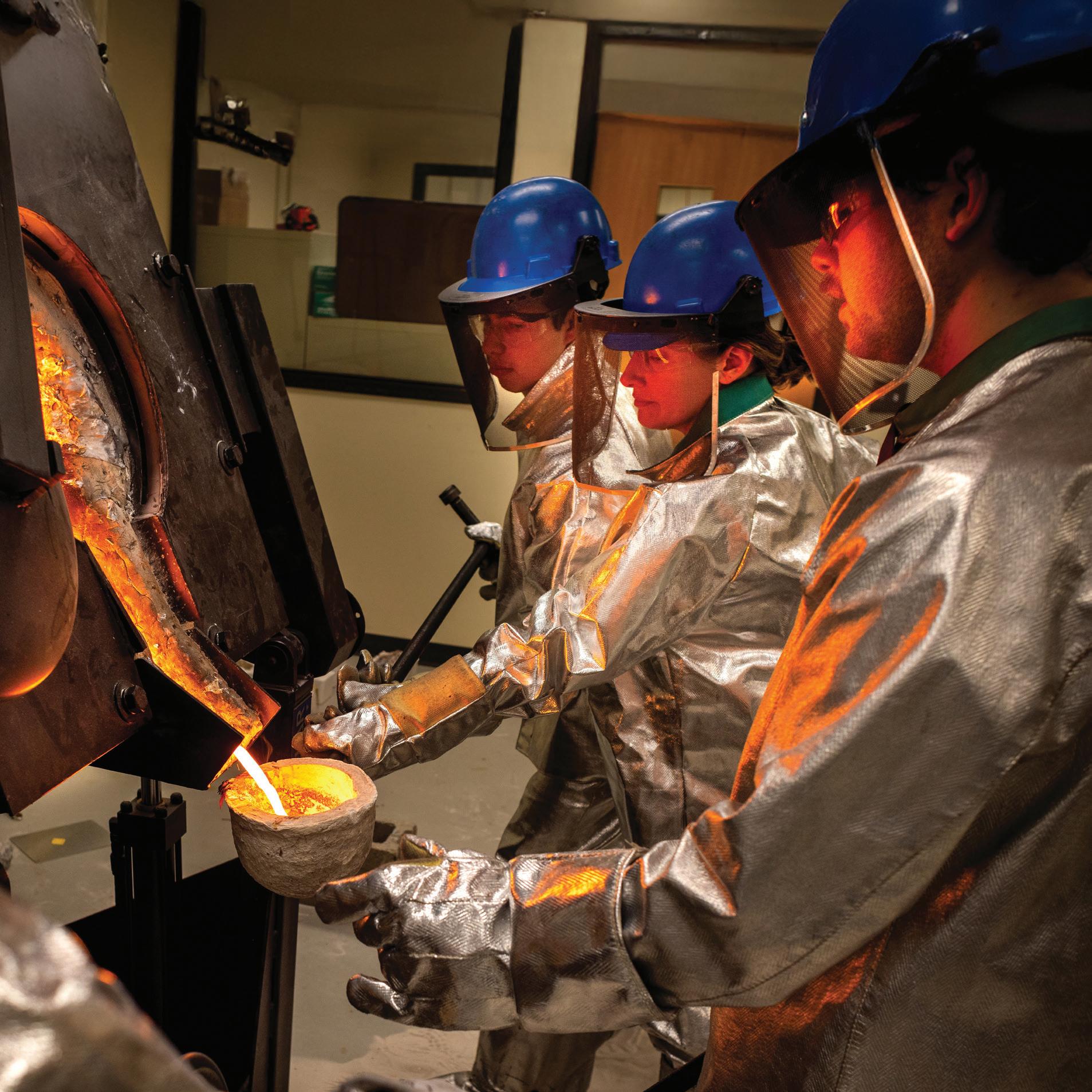
Alina Levine: USC offense is exactly what Michigan has been seeking
Saturday night, under the lights of the Coliseum, the No. 15 Michigan football team fell to Southern California. The Wolverines could have been bitter for a multitude of reasons. It might’ve been the fact that the Trojans are unranked or that Michigan’s defense was subpar. It also could be that the Wolverines’ path to the College Football Playoff
WOMEN’S BASKETBALL
just became exceedingly difficult due to the loss.
Those are all good reasons. But what especially makes Michigan’s loss to the Trojans sting is that USC’s offense, or at least the offense that beat the Wolverines on Saturday, is exactly what Michigan wants to be — but simply isn’t.
Before the season even commenced, the Wolverines wanted to revamp their offense, starting with the addition of a new offensive coordinator: Chip Lindsey.
Prior to joining the program, Lindsey was the offensive coordinator for North Carolina. During his time with the Tar Heels, Lindsey implemented a dynamic offense that passed for an average of 292.2 yards per game and rushed for an average of 192.1 yards per game in 2023. When combining his talents with roster additions like freshman quarterback Bryce
Underwood, junior running back Justice Haynes and graduate wide receiver Donaven McCulley, Michigan was eager to deploy a balanced offense onto the field.
“(We) feel good about where the guys are,” Moore said March 25. “Feel like we’re going to be explosive in the run and pass, but you know, we’ll see how it all looks when it gets to fall.”
Well, fall has arrived, the season is in full swing, but things aren’t quite shaping up to be what the Wolverines had hoped. So far, Michigan’s offense has shown flashes of what it wants to be. However, the rhythm, the balance and consistency that define elite offenses have either made sporadic appearances or been missing completely. But on Saturday, the Wolverines watched the Trojans execute it in real time.
USC’s 489 yards of all-purpose offense Saturday aren’t a surprise.
Michigan strengthens core roster as experience and expectations rise
VILY SOURIS Daily Sports Writer
With three formidable returning starters populating its roster, the Michigan women’s basketball team faces high expectations going into the season.
“We still have three freshmen and two transfers, so five new people,” Wolverines coach Kim Barnes Arico said Wednesday at Big Ten Media Days. “But our returning core is much deeper, and I think that allows our practices to move a little faster.”
Shifting away from a complete overhaul of last season’s roster, Michigan’s approach and projection rises with the status of its preestablished sophomore trio. Guards Olivia Olson, Syla Swords and Mila Holloway shocked the Big Ten veterans in their freshman season and, alongside graduated teammates Jordan Hobbs and Greta Kampschroeder, constructed a solid starting five.
While Olson, Holloway and Swords expected to provide the roster with the bulk of the Wolverines’ minutes, this season’s transfers bring a diversified background. Junior forward Ashley Sofilkanich and sophomore guard Kendall Dudley are promising additions with their thorough collegiate experience.
Dudley made the move from the reigning Big Ten champions UCLA, where she was a transformative figure for its defense. Her height and versatility make her a promising addition to Michigan’s defense in particular. Most crucially for Swords and Olson’s ambition,

Dudley knows what it’s like to play on a championship team.
She’s competed against WNBA first-round draft picks and been under the crushing tension of the Final Four. Dudley’s familiarity with adversity under pressure may equip the Wolverines with the experience they need for their championship aspirations.
Alongside Dudley, Sofilkanich made the jump to Michigan after two impressive years at Bucknell. The Patriot League Player of the Year Sofilkanich will utilize her height to increase action on the post and, along with her utter determination to score, help the Wolverines operate near the basket.
“We needed an inside presence,” Barnes Arico said.
“We needed someone that could come in, tour the basketball down low and rebound the basketball inside. (Sofilkanich) can be a rim protector and can block shots. … She’s going to give us a presence that we definitely needed inside on the offensive and defensive ends.”
As the sophomores and transfers’ collegiate experience make for a smoother transition into this season compared to last year, the Wolverines’ returning bench players have room to
develop. Senior guard Brooke Quarles Daniels averaged over 18 minutes per game last season and contributed in all contests. Quarles Daniels was a driving force during her freshman and sophomore years at Oakland before joining Michigan last season.
“Coming into her senior year, she’s made an impact in every single practice,” Swords said. “Her presence is felt on the offensive and defensive end, alike. Her team is working consistently. You look at the stat sheets, Brooke’s team is winning. Whoever her teammates are, she finds a way to win.”
Under the pressure of expectations and conference rankings, reliable players like Quarles Daniels look to build on their own experiences and open opportunities for their team, while Swords, Holloway and Olson have the space and support to build upon their remarkable freshman performance.
As the new roster starts to take shape ahead of the season, the Wolverines’ varying types of NCAA exposure gives Michigan a much different look from a year ago.
The Trojans boast the best offense in the conference and the secondbest in the nation when it comes to yards per game. And game to game, USC has continuously found ways to excel both in the air and on the ground.
Michigan, on the other hand, hasn’t yet figured that out. Saturday’s game is indicative of that trend.
When comparing the team’s passing games, there wasn’t too stark a difference on Saturday. The Wolverines passed for 207 yards while USC notched 265. The separation instead stems from who was making the catches, or rather, how often they can be counted on to do it.
Michigan’s top-two receivers were freshman wide receiver Andrew Marsh and McCulley. Marsh had a great night, totaling 138 yards on eight receptions, including a touchdown. But
MEN’S BASKETBALL
that kind of production was an exception for Marsh, not the norm.
Before Saturday, Marsh had tallied just five receptions this season. And while he may be emerging as a playmaker for the Wolverines, he’s not yet a consistent one.
So far, that label still belongs to McCulley. While he’s Michigan’s go-to wide receiver at the moment, he’s not yet consistently performing at the level the Wolverines need from a true No. 1 target.
If he were, he’d likely look more like the Trojans’ wide receiver Makai Lemon. Lemon is the best receiver in the conference with 682 receiving yards and an average of 15.5 yards per reception. Both Lemon and McCulley lead their respective teams in receiving yards, but Lemon has more than double McCulley’s yardage. While Lemon’s string of performances have exuded stability, McCulley’s are far more shaky. That, more
than any stat, underscores the difference between USC and Michigan: one program’s receivers are already trusted weapons while the others are still trying to prove that they can be. The Wolverines’ passing game wasn’t what they had hoped, and their ground game served as a glaring example of the inconsistencies that have held them back.
Michigan has strived for a balanced offense, but it has repeatedly fallen short, with one aspect of the offensive game giving way to the other. Saturday, it was the run game. For a program that prides itself on physicality and a “smash” philosophy, the Wolverines were outmuscled and outgained by a USC rushing offense that doubled their yardage, 224 to 109 yards.
CONTINUED AT MICHIGANDAILY.COM
By accepting ‘weird’ identity, Dusty May has set Michigan apart
DREW LENARD Daily
Sports Writer
Dusty May has a “weird mind.”
At least, that’s what senior guard Roddy Gayle thinks. When asked Thursday at Big Ten Media Days about his coach’s recent unorthodox playcalls in practice, Gayle used that exact phrase.
“He has a very weird mind, he likes to do stuff that people haven’t thought of before,” Gayle said. “Like, who would have thought to put two 7-footers in a pick and roll and play a guard at the dunker? … It’s those kind of unique things Dusty comes up with, and it’s just mind boggling.”
The four-five pick-and-roll the Michigan men’s basketball team ran last year with former center Vlad Goldin and former forward Danny Wolf certainly qualifies as unconventional. But it was crucial to the Wolverines’ winning ways. It was a play most coaches weren’t used to prepping for, and they often paid for it on a poster from Goldin or a commanding drive to the rim from Wolf. May is making that kind of unconventionalism his identity, and this past offseason has only made that easier for him to do so.
While the two players vital to May’s go-to play last year are gone, the plethora of talent coming in
from the transfer portal means May is far from done orchestrating ways to throw off his opponents. In fact, he’s never been more encouraged.
“Absolutely,” May said when asked if the incoming transfers offered room for experimentation.
“The only way it works is if you have talented players who are also very intelligent and adaptable to the situation. And our basketball IQ on this year’s squad is extremely high.”
According to his players, May has wasted no time putting that elevated intelligence to use. Gayle shared that May has been having him set screens for transfer sophomore center Aday Mara in practice.
Mara is 7-foot-3, and May is letting him run point on a ball screen like any shifty guard. It’s a move that, if mastered in the preseason, can cause headaches in opposing film sessions once the season begins.
May has also been trusting Mara alongside two fellow big man transfers, graduate forward Yaxel Lendeborg and sophomore forward Morez Johnson to run an atypical offense. All three players stand at 6-foot-9 or taller, and when all are on the court at the same time, it may be difficult for any defense to defend that kind of height and talent simultaneously. As the season nears, that formation has been hinted at as the one May could roll out come the season opener.

Regardless of whether or not either experiment is consistently utilized this season, May’s desire to run them in the first place implies that Michigan is willing to run just about anything with just about anyone on the uber athletic squad he has put together. Just as long as they stay out of the corners.
“One unique thing that I’ve seen is just that he doesn’t want you deep in corners,” graduate guard Nimari Burnett said. “Like, he hates the corners a lot. Usually, you space all the way to the corner, but he just wants you to space a little bit, so it allows you to rip drive to the baseline and create opportunities like that.”
Getting to the corners is a fundamental convention of the modern game, but it’s by breaking those conventions that May seems to find his competitive edge. And he’s on a never-ending quest to find which rules can be broken most successfully. Burnett decided he couldn’t disclose any more specifics than he already had on Thursday, but he still had to comment on what it’s like watching May’s ‘weirdness’ unfold in front of him.
“I can’t go into any specifics, but his ability to be like ‘We want you to pass it opposite and just like, sprint off of a screen, and you’re gonna be open,’ ” Burnett said. “And then you think about it and it’s like, ‘How would I be open?’ But then it just works pretty much every time.” May is constantly backing up the validity of his methods in practice, and that leads to his athletes backing him up in return.
When asked what he thought about the “weird” moniker his athletes gifted him, May just flashed a smile and gave a swift response: “I’ve heard worse.” It seems his athletes aren’t the only ones who have embraced it.
MIELKE
The No. 9 Michigan hockey team found its players as frequent visitors of the penalty box in an attempt to match No. 7 Providence’s level of physicality. Rather than dwelling on their man-disadvantage, the Wolverines relied on their penalty kill unit to make use of the shorthanded play.
The success of Michigan’s penalty unit became the foundation of its victory as the Wolverines (4-0) triumphed over the Friars (0-2), 3-1, for the series sweep. While Providence attempted to capitalize on its power play opportunities, Michigan’s ability to both kill the penalty and score shorthanded outlasted the Friars’ offensive endeavors.
“It feels great,” Michigan coach Brandon Naurato said. “We have a lot of respect for their program and it was against a top-10ten team on the road. It was a great early test for us and the boys passed.” Early in the first period, the Wolverines looked to corral control as they hoped to snag a goal in the first few minutes to set the tone. However, it looked as if that plan was going astray when they earned two penalties halfway through the first period, leaving a five-onthree opportunity for Providence to seize. Michigan held the threshold long enough for freshman forward Macolm Spence to return from the penalty box. Spence barreled down the left side to backhand the puck into the net for the shorthanded goal.

period, Providence ripped a shot on the power play that bounced off the pipes but managed to not cross the goal line. Moments after freshman goaltender Jack Ivankovic’s save, senior forward Josh Eernisse saw his opening as he traveled the puck down to put away the Wolverines’ second shorthanded goal of the night. Despite Michigan putting itself in jeopardizing moments with each acquired penalty, its penalty-kill units were determined to correct those moments while notching a goal or two.
their first goal of the night on the power play.
The third period stalled in scoring, but kept up the same fast and physical style of play. While Providence and the Wolverines battled on the boards for possession, Eernisse decided to take matters into his own hands to notch Michigan’s third goal of the game.
With only one goal collectively on the board, the Wolverines and the Friars returned to the second period looking to earn an advantage. However, rather than gaining the edge on Providence, Michigan continued to put itself into the penalty box.
In lieu of having to see the Friars put one into the net, Michigan decided to beat them to it.
But instead of scrambling, the Wolverines showed once again the versatility of their penalty-kill unit.
“There were a lot of positive takeaways,” Eernisse said. “We had some (penalty) kills in the first that really helped us build momentum and big saves when we needed it.” Five minutes into the second
However, even with producing two shorthanded goals, the Wolverines’ were killing off penalties for six minutes through the first two periods and eventually that caught up to them. When Michigan was depleted a little more than halfway through the second period, the Friars struck to notch
“We talked early on before the season started about taking a lot of pride in our (penalty) kill,” Eernisse said. “We call ourselves the power kill and I think we’re living up to that name right now.” The Wolverines’ two shorthanded goals and penalty-kill units served as the groundwork of Michigan’s offensive success. Rather than fearing the penalty box, the Wolverines embraced its consequences and even prevailed because of them.
Ava Farah/DAILY
Mahi Garg/DAILY
Bridgette Bol/DAILY
ALINA LEVINE Daily Sports Editor




3 MONTHS FREE


x arts
SEASONS EDITION
Design & Illustrations by Maisie Derlega


what her appeal as an influencer is. I don’t really understand what is so enthralling about the content she provides. She doesn’t have a unique perspective on the season itself. She just posts pictures. I suppose some people like that “Christian girl autumn” is a proximate juxtaposition to “hot girl summer.” At least, I thought I understood that to be some of the appeal. But really, that’s not why I personally come back to her posts year
See, I remember seeing her post announcing when “Christian girl autumn” would start, but I don’t remember what location she picked this year. I don’t remember what her perfectly curated fall outfits looked like this year, nor do I remember what the leaves looked like in her photos. I don’t even remember when she signified the start of “Christian girl autumn.” I don’t remember anything about “Christian girl autumn” itself, happening, despite the
There is no bigger commentary on fall’s disappearance — just pictures. Her shtick might be simple, but it is I come back every year.
Photos Courtesy of Gabe Efros
Seasons: Who needs them anyway?
IAN GALLMORE Daily Arts Writer
It’s that time of year again. Squirrels run amok burying their acorns. Closets become stocked with sweaters, infinity scarves and oversized coats, waiting for the weather to stop teasing a crisp temperature and actually commit. The leaves from the trees fall on the sidewalk in a surrealist brushstroke of warm hues — autumn’s snowfall that imbues fall with its namesake. Plus, for any season traditionalist, the passing of Sept. 22 means that fall (autumn for those who wish to embrace a more refined view of their seasons) is finally upon us.
But in addition to the natural changes spurred by the shift in climate, other things begin to shift, too. My roommate has placed fake cobwebs over our stair railing, and Meijer is putting pumpkins on display at the front of their store. Friends discuss their Halloween costume lineup, lamenting the poor soul who has to be the Tin Man in the group costume. I count down the number of days until I can raid the grocery store for its leftover candy, refilling my stash that has been empty since the post-Easter restock. While only one day, you could also argue Halloween has asserted itself as a season in its own right, ringing in fall with a spooky, “Boo!” Alongside the decorations and deliberations, Saturdays are still a gamble as to whether you’ll be able to get anywhere in Ann Arbor without waiting in crazy traffic or having groups of maizeand-blue clad pedestrians stroll in front of you. Football season brings in more than 100,000 people to the Big House each home game, swelling the city for the chance to scream “You suck, BITCH!” without the typical consequences. And of course, with the bite of winter accompanied by seasonal depression just around the corner, it might be time to lock down that summer situationship during cuffing season.
Despite the fact that fall, winter, spring and summer hold the monopoly on being considered “the seasons” for
most Americans, in reality, a season is just a period of time associated with particular characteristics or activities. The most familiar seasons rely on natural observations; primarily changes in the weather, and with them the accompanying shifts
Essentially, seasons are pockets of time that become indicators of change, inspiring some type of social action.
I had the opportunity to pull apart the myth of seasons in 2024 during my time at the Department

in temperature and sunlight. But we also have holiday seasons that bring their own shifts in behavior (somehow everyone becomes “America’s No. 1 Fan” during those first days of July) or certain actions that take precedence at certain times of the year, like hunting season or a specific sport season.
the outside world except through oldfashioned letters or walking an hour to the nearest corner store to pick up a newspaper. The thought of 40 college students escaping to the woods sounds comical, until you realize they take it seriously — we bake our own bread for the entire session, emulating the life of Henry David Thoreau in his seminal piece of writing, “Walden.” And that’s just the tip of the iceberg. NELP consists of all kinds of quirks that don’t completely make sense until you’re there, and even then leave you questioning the sheer point of it all.
One way in which NELP challenges students is its process of temporal dislocation. Time moves differently at NELP: Weeks are nine or 10 days tracked through Roman numerals, “weekends” consist of two or three days and feature hiking trips across New England and holidays celebrate the idea of “living deliberately” as outlined by Thoreau. I even tried to disassociate myself from time, refusing to bring a watch and instead relying on my “natural inclination” to determine when I had to be places. After arriving to class late three days in a row and almost missing a meal, I quickly caved and bought one.
of English Language and Literature New England Literature Program, lovingly abbreviated to NELP. One of the goals of NELP is to experience life beyond the confines of society. In practice, this looks like living in a repurposed summer camp for 45-ish days, devoid of any way of contacting
Another facet of temporal dislocation arises from the reality of physically moving across the country. When you first arrive at NELP in early May, you’ve just taken yourself from the burgeoning spring of Southeastern Michigan to the chilly end of winter in New Hampshire. You set yourself back in seasonal time, watching the grass reclaim its frosty tips each morning and trees return to their barren branches. Later on in the program, as you hike up different locations across the White Mountain Range, you’ll be taught about a similar phenomenon that happens as you scale upward in altitude. Essentially, your physical location has a stronger effect on the season you’ll experience than the day on the calendar. Those old things quickly lose their value as you learn to intuit the coming days’ temperature (or just wear a lot of layers to prepare for any outcome). In this way, seasons lose their grip on you.
CONTINUED AT MICHIGANDAILY.COM
ISHA JAYADEV Statement Correspondent
It’s been two months since I last saw you — the echoes of kisses still lingering on my skin, darkening it from chestnut to espresso, so much so that people see me after a day with you and comment on the effect you’ve had on the apples of my cheeks. Like that, you stay with me long after the leaves on the trees wilt and snow softens the steps under my weathered boots. I wait for you, every year, no matter how dark it gets. I know you’ll come back.
I don’t remember exactly when we first met. Instead, I grew up with the knowledge of you, summer, embedded in my psyche — treating you like a given. Maybe that’s where I went wrong: so sure of your existence that I must have taken you for granted.
When the sun hits
We spent many days biking through the neighborhood together. I liked my training wheels, but you eventually coaxed me into getting rid of them, placing my tiny feet on the pedals and pushing me to just GO. You said I’d thank you later, and you were right. Since then, we’ve spent countless hours speeding down narrow streets, the air thick with the scent of asphalt still warm.
My mother’s voice would always find me, calling me to say that dinner was ready, but I always lingered, hoping to prolong our goodbye, knowing my time with you was short-lived.
It was May 2007 when you met my little sister — just born, not yet rid of the newborn wrinkles and the deep, chasmic eyes. That quiet, darling child soon became our playmate, and it wasn’t until many years later, after I moved away for college, that our trio settled back into the original duo of
just you and me. Until then, though, she’d be part of every memory of you and me, and it was only time shared with her that would give me the feeling of serenity I used to have with just you around. Together, we’d read books and use the inspiration they fashioned to write stories; inevitably, we’d fight like siblings do, but we would always stay together, knowing you were beckoning us to come outside and make the most of the time we had with you.
You opened my world to experiences I’d never had; you took me to the beach for the first time, sand warmed by the sun nestling itself in the space between my toes. I wailed when the sea first touched me, but you insisted I stay, to let the salt water circle my ankles and the wind tangle itself in my hair. Still, you never forced me — instead, you coaxed me out of my shell each time we saw each

other, until going to the beach with you became my favorite thing to do. And although I love the gentle hum of the ocean, the cascading waves and the feeling of being a speck in the ecosystem of this giant, generous, yet unrelenting being, I can’t stand to be there without you. It was your warmth, your energy that made it memorable. The beach was forever tied to you.
In 2016, when I was 12 years old, after years of shared childhood memories, you were about to visit me when my parents broke the news. We were moving to Georgia. I was heartbroken. I couldn’t leave my friends or my school — but most of all, I couldn’t leave you. I knew you would still visit me if I was in Georgia, but would it be the same? Was the significance of our relationship tied to Wisconsin — the kite festival on Lake Michigan, the Milwaukee

Brewers games and the frequent art museum visits? Would we still love each other the same way?
To an extent, my fears weren’t unfounded. Things were different in Atlanta. The usual childlike wonder you seemed to produce in me was replaced by something else — a maturity you hadn’t inspired in me until now. With you around, I finally had a break from school and the time to think clearly about what I wanted my future to look like and how I would achieve it. I could feel myself growing older with you, using the peace your visits gave me as an opportunity to plan ahead. I spent the summer mapping out the goals I had for the rest of middle school, planning which clubs I’d join and what classes I’d take and, eventually, what colleges I’d apply to.
In 2019, we went to Washington, D.C. together. You watched me run onto the Big Bus, excited to see monuments I’d only ever seen in pictures. I fell in love with the

cherry blossoms, the rich history of our nation’s capital and the world of opportunity this city could provide for me. Always interested in politics, I excitedly rambled to you about what my life could be like if I lived here. You smiled, but I could feel an aura of melancholy in your voice when you encouraged me to follow my dreams. That was the first time I realized: You wouldn’t come with me. Not really, anyway — after graduating from college, I’d only get to enjoy our time together on the weekends, with no real break from life or work. We were at the Lincoln Memorial at sunset when that realization finally dawned on me, and I put my head on your shoulder while we watched the yellow sun roll down the crimson sky. By the time darkness had swallowed the last of the tourists, my tears had already soaked your shirt.
As school started to pick up, being with you was my only real taste of freedom. In July 2022, we took one last month-long trip to India together.
It was something we had been doing for years, but because I was leaving for college in the fall, I knew this would be our last. After this, I’d be expected to find an internship or a job during what was meant to be our time together. For now, though, we rode on our rickshaws through the busy streets of India, canopied by big, beautiful banyan trees. We held hands as we watched wild elephants bathing in the mucky water. You fed me pani puri from a street cart, the spicy pani dripping down my chin, which you wiped away with a smirk on your face. We visited my extended family and everyone loved you — mainly because your presence always meant my presence would follow shortly after. I couldn’t look at you for too long. I was desperate to hold on to this moment, and the more I felt you drifting away, the deeper the sorrow felt.
In 2023, after my freshman year at the University of Michigan, I only had one month to spend with
you before my work started. My cultural organization was having a convention, and since I usually had plenty of time when you were around, we decided to choreograph a dance for it. For a second, it felt like old times again, you and me in the basement of my childhood home, putting together Bollywood songs and creating dances to them with my sister. The three of us spent the days letting our creativity take us wherever it wanted to go, taking breaks from dancing to paint, sing or play the piano or violin. At the convention, we danced our hearts out, and it was the first time I’d done something like that simply for the sake of enjoyment, without the burden of obligation. That’s what I’ve always loved about you — you always bring out in me the most random interests, hobbies I’d never get to pursue without the time you afforded me when you visited.
CONTINUED AT MICHIGANDAILY.COM

Photos Courtesy of Isha Jayadev
The summer we brought back watch parties
MICHELLE WU Daily Arts Writer
Watching TV has a reputation for being a lazy and lonely pastime — so much so that when you Google it, most of the photos that appear are of someone sitting on a couch by themselves, legs crossed and staring at a screen. Unsurprisingly, the top three tagged image suggestions when I looked this up were family, alone and couch. What better way to escape from the stressors of daily life than by hiding in a comfy corner and transporting yourself to another universe with the press of a button? I know I’m guilty of this.
It makes sense why this stereotypical image is the one that comes to mind. With the rise of entire series releases on streaming platforms like Netflix, HBO Max and AppleTV+, the ability to binge-watch a season of television in a single sitting has become standard. With on-demand options and an increasing variety of shows to peruse, people can view whatever they want, whenever they want, on any device of their choosing. Hence, there’s been a rise in solo watching and a decline in communal viewing. After all, who has time to wait for watch buddies to be available when
you can watch the whole show right now? While some will commend bingewatching’s ability to engage viewers in rich and fulfilling storytelling, others warn of its isolating perils and how it encourages sedentary lifestyle choices. Either way, one thing is certain — we constantly shift our viewing habits alongside the evolution of TV.
So, will TV remain a solitary experience? Will the social aspect of television forever remain a nostalgic memory from the past? With the newfound ability to watch entire shows in one sitting (and without having to align your busy schedule with your friends), who wouldn’t take advantage of the benefits conferred by streaming? With the direction TV is headed recently, it feels like solitary streaming has become the new norm.
If there’s anything this summer showed us, however, it’s that TV has been doing anything but separating viewers — particularly when it comes to dating shows and romantic comedies. With the rising popularity of shows like “Love Island USA” and “The Summer I Turned Pretty,” watch parties of all sizes began cropping up nationwide to cheer on beloved cast and characters. In an effort to create a sense of community around the sensation that was “Love Island USA”

season seven, a rooftop bar in central Los Angeles revamped the typical sports programming to instead act as a “Reality Bar” for obsessed fans.
But it doesn’t stop there. After this year’s season finale of “Love Island USA” was released, another show took the world by storm: season three of “The Summer I Turned Pretty.” From coastal-themed Pinterest boards to invitations on Eventbrite in major cities, these watch parties practically had as much life as the show itself (which, if you didn’t know, is pretty hard to top). A New York City sports bar even dubbed their watch parties “the Super Bowl every Wednesday” based on the sheer size of the crowds of girls outside their doors, giddy at the prospect of watching the next episode of “The Summer I Turned Pretty” with a sparkly drink in hand.
Though I never had a chance to attend any of these watch parties, I saw my peers celebrating the season finales of these shows with cute dessert bars, charcuterie board spreads and, in some cases, entire picnics. I even had a friend so dedicated she booked a room in the Ross School of Business every Wednesday evening to project “The Summer I Turned Pretty” on a big screen. Even if I was just observing from the outside, seeing how television has returned to its communal roots was heartwarming, to say the least.
I didn’t grow up with cable, so I either watched PBS KIDS (“Wild Kratts” for the win!) or DVDs checked out from the library with my sister. To say that I long for the days of cable television would be a lie, but what I can say is that I miss consuming media with someone else at my side. I remember the days when my family would turn on the small TV in our kitchen and we would laugh at “America’s Funniest Home Videos” over dinner. With both my sister and me in college now, we all watch shows asynchronously, and it feels like just another way my family and I have grown apart over the years. Humans are naturally drawn to socialization, but technology has made it easier than ever for us to lead solo lives, especially in an era where we constantly feel crunched for time. The loneliness epidemic became a forefront mental health concern during the COVID-19 pandemic but many people were already reporting feeling lonely before then according to a 2024 Harvard study. Of the surveyed individuals, 73% of them
cited technology as a main cause of rising loneliness in the United States. And yet, when technological advances try to do something that brings people together, like streaming services releasing episodes weekly to emulate watching habits during the cable era, it receives backlash for being “money hungry” and “killing the Netflix binge.” While I acknowledge that in our current economy streaming services do have commercial interests, I also can’t help but wonder if they wanted to do something more with this summer’s watch-party craze.
Even before the start of the summer, when watch parties really took off, TV hits like “Severance” season two, “The Pitt” and “White Lotus” season three unfolded over several weeks. Although there was initial backlash against this slower release rate, with some even speculating it was a ploy for people to stay subscribed for longer, others argued that this allowed them to better absorb and process the plot. The same can be said of “The Summer I Turned Pretty” season three: Due to it being a slower-paced rom-com, the weekly drops were critiqued as being a frustrating element that further slowed and ruined the timely development of the love triangle storyline. Admittedly, I was disappointed to hear about the weekly releases at first, but as the summer went on, I quickly realized that perhaps it was the right thing to do.
By swapping the convenience of bingewatching the entire show in a single sitting with watching one episode per week, we discovered something better than which brother Belly (Lola Tung, debut) would end up with: community. If the jam-packed bars I mentioned earlier weren’t enough to convince you, look to social media and count how many threads there are dissecting a weekly episode of “The Summer I Turned Pretty.” Or, better yet, look to TikTok reenactments, parodied recaps or predictions backed up by fan-made theories about the most recent season of “Love Island.” Who knew that people could form friendships online over a common dislike of the same character? Indeed, the watch party continues through discourse even after we’ve logged out from our streaming sites for the day.
CONTINUED AT MICHIGANDAILY.COM

Summer’s call
ISABELLE DENG
Statement Columnist
I’ve just finished a six-hour shift at Sweetgreen, and I’m cruising down the road on my way back home. It’s 11 p.m. on a Tuesday in July, and with no one else on the four-lane road, I feel like the only person in the world.
I know I should resent this at least a little — spending my summer nights working. Or should I?
Growing up, summer meant taking long walks with my family during which my parents walked too slowly and my siblings and I sped ahead on our cartoon-themed bikes. It meant sitting at my desk, doing nothing and staring out the window as the sunset produced a scene so wondrous that Hollywood never stood a chance reproducing the real-time miracles of the present. It meant playing badminton with my younger brother after the mosquitoes had come out at night, using only the dim light of our open garage to follow the shuttlecock’s path as it whizzed back and forth.
Over the years, however, I’ve done these things less and less. I would have to observe my life more closely if I wanted to figure out all the reasons why, with every summer, these things happened less frequently, but I’ve narrowed it down to two primary reasons: I’ve developed different priorities, and the company that I did these things with have different priorities, too. I’ve been socialized to spend my summers in pursuit of more “productive” hobbies (like getting an internship), and my brother, similarly, now always seems to be at band practice. As for the rest of my family, they no longer seem to love the outdoors as much as they do the comfort of our home.
This past summer, I worked part-time at Sweetgreen, so I had a more valid excuse for forgetting to indulge in my summer traditions than the bed-rotting of years past. Weirdly, I enjoyed working there. It was so far removed from the mental work of college, and it gave me the opportunity to see what it’s like being in the direct service of others. There
are no bells and whistles, like there are in academics; the salad determines whether the customer walks away feeling satisfied or not.
Additionally, working there helped me avoid the guilt of feeling like I’ve wasted my summer. Typically, when the second week of August approaches, and certainly by the third, everything I do in the couple of weeks leading up to my return to school is tinged with regretting that I hadn’t capitalized on the freedom of the past several months more, although freedom is terribly easy to take for granted when one is surrounded by it.
If each season stands for something distinctly its own, and I think they do — fall as sweater weather, winter as cuffing season (and the holidays, I guess) and spring as rebirth — then summer is understood as a time of yearning.
For most students, from preschool (or whenever it is that children realize that school isn’t all that fun) to college, summer is yearned after for a particular reason: It’s a release from the monotony and rigidity of school. The 7 a.m. alarms and six-minute bathroom breaks are out, and 11 a.m. mornings and spending too long in the bathroom are in.
For a night owl, waking up to a 6:20 a.m. alarm from Monday to Friday was a special kind of hell (and 6:20 a.m. was pushing it), especially since I’d usually stay up until 1 a.m. the night before nervously finishing up assignments last-minute or pacing my room in a bout of stress-induced paranoia. I’d wake up disgruntled and when I got home, the “recovery” hours passed too quickly.
This sensation — that how I spent my time was largely out of my control — wasn’t assuaged by the long stretch of time between coming home from school and going to sleep, during which I was free to do pretty much anything. This was because the knowledge that I’d inevitably end up going to sleep too late that night and then wake up by the sheer force of my iPhone alarm served as a constant reminder that, for as long as I was in school, my time wasn’t fully my own.
CONTINUED AT
EMILY KIM Daily Arts Writer
White sounds of silence
We all know when to start breaking out the puffers and winter boots. We know when it’s time to change the thermostat setting to heat instead of air conditioning. We know when it’s time to drain the pools, put away the flowerpots and start lugging the big bags of salt into the garage to prepare for when the driveway freezes overnight. The leaves crisp up and gather around the bases of trees, waiting to be raked up and tossed away for the season. The trees prepare to be bare for a few months. The grass anticipates a nice, fluffy white blanket to cover up their green until next year.
What arrives with the first chill isn’t always tangible. Just like how nature knows when it’s time, I know too. Sometimes it’s not a loss you can name, but a slow, familiar heaviness that settles in your chest. For me, though, that
heaviness does have a name: depression. Depression was hardly a new concept to me. I had read about it online, seen brief and fleeting mentions of characters dealing with it in books and analyzed song lyrics that hinted at how paralyzing and consuming the mental illness is. I perused the little questionnaires on depression symptoms nurses typically give out before each doctor’s visit, thinking to myself that the descriptions could apply to me but choosing to circle the zero each time. I wasn’t overly surprised or relieved or disappointed when my therapist took one look at her notes after I explained to her how I was feeling and asked, “Have you ever considered that you might have depression?” It felt as if my feelings finally had an explanation attached to them, another way of assuring myself that I wasn’t completely crazy. However, that day I experienced more than just a diagnosis. I felt a part of me slip away, the crystal clear view I once had of the world disappearing under my feelings of
helplessness and unworthiness. I haven’t been able to find that part anywhere since. After the day I was diagnosed, everything felt altered, as if the world itself had dimmed. It was like walking around with sunglasses that brought the brightness of the world down by at least 50%. Not enough to show everyone that there was something visibly wrong with me, but enough to justify the unending hours spent in bed, refusing to go out into the world and risk only seeing everything at half brightness. The world’s light, once something I’d looked forward to, became almost mocking. That’s how I grew to despise summer.
I felt like a failure lying in bed during summer break, incapable of getting up only to see the sun shining and hear the sound of children laughing and playing through my window. I felt as if the whole world was spinning, poking fun at me and not caring one bit that my bed was trapping me in with the sheets as I watched the limited beautiful days pass by without me. Each time I stepped outside and attempted to cure whatever was rotting inside me, the sunshine would penetrate my skin without reaching my heart. I saw tan lines form across my chest from helping my dad wash cars, I felt the pebbles in my running shoes stuck between my toes during my weekly run and I let the ocean swallow me whole, hoping to just float in the water for a second during our yearly family vacation to Clearwater Beach. Yet, no matter how well they seemed to work for everyone around me, none of nature’s attempts to heal me were successful.
While summer’s light only ended up exposing the emptiness I felt within, winter’s darkness offered me something else: understanding. That is how winter became different to me. I could finally spend days in bed and blame it on the cold, the frost that was tattooing little shapes on my window, the tiny bits of hail that attached themselves to individual eyelashes on students walking to class and the wind that bit at whatever bare skin it could find. Winter was harsh and angry and bitter and full of sadness, just like me. Except, winter had a reason, and I didn’t. Winter suffered because it had to — it was part of the rhythm that allowed life to return come spring. My misery felt endless and self-made in comparison, the product of a mind I’m still trying to understand.
Like any season, my winters come with their own rituals — the little things that remind me I’m still moving through time even when I feel stuck. Every year, the same songs play in my ears as I trudge through the brutal Michigan snow to class. I can finally hit shuffle on the playlist I lazily titled “My winters,” filled with songs that define each winter season for me. When the first beats play, no matter if I am listening in June or January, they always bring me back to winter and the same sense of comfort and assurance that, while I may be suffering and grieving, nature is, too.
The one song I have forever associated my winters with is “Saturn” by Sleeping At Last. Its intricate melodies, brought to life by piano, violin and cello chords in unison, is what, to me, sounds like heartbreak, grief and loss. But it crescendos into something more. Ryan O’Neal, the artist behind Sleeping At Last, sings in the final half of the song as the instruments play in harmony, “How rare and beautiful it is to even exist.”
Whenever I need a push and reminder of the beauty and underrated simplicity of life — expectedly falling when nature and I are both grieving — I play “Saturn.” I play it over and over and over again until my AirPods die and I’m left alone once again, the bed’s mattress now molded to the shape of my body.
Eventually, even the saddest songs fade into silence, and time pulls me forward again. I blink, and it’s spring. The sun stays awake for a little longer. The moon acknowledges its lengthier appearances are now needed on the other side of the Earth. The grass finally peeks from under the slosh that was once snow. The trees are finally free to breathe, and the buds slowly start emerging, indicating it’s their time to flourish. When I smell the warmth of spring approaching, I know it’s time to pick myself up little by little, just like the trees do.
Winter is my favorite season, and I think it always will be. While the comfort of the frost and frigid outdoors are the reasons I give to anyone who asks why, I find myself picturing spring alongside those truths. Just as I began, I return to the seasons. Nature always finds its way back to spring after a long, harsh winter. Each year, I hold onto that hope — that my own thaw will eventually come too.