Thursday, May 13, 2021
ONE HUNDRED AND THIRTY YEARS OF EDITORIAL FREEDOM
inside
michigandaily.com
U-M athletic department implicated in Anderson sexual misconduct report
NEWS
COVID Rescue Fund
JOSH TAUBMAN AND MAX WADLEY
Former owner helps support struggling small businesses >> SEE PAGE 2
Summer Managing Sports Editors
OPINION
College Experience Students experience college without the physical component >> SEE PAGE 5
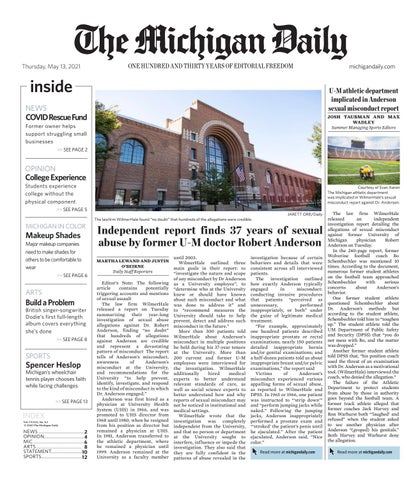
Courtesy of Evan Aaron The Michigan athletic department was implicated in WilmerHale’s sexual misconduct report against Dr. Anderson. JARETT ORR/Daily The lawfirm WilmerHale found “no doubt” that hundreds of the allegations were credible.
MiCHIGAN IN COLOR
Makeup Shades Major makeup companies need to make shades for others to be comfortable to wear >> SEE PAGE 6
ARTS
Build a Problem
British singer-songwriter Dodie’s first full-length album covers everything she’s done
>> SEE PAGE 8
SPORTS
Spencer Heslop
Michigan’s wheelchair tennis player chooses faith while facing challenges >> SEE PAGE 13
INDEX Vol. CXXIX, No. 112 © 2020 The Michigan Daily
NEWS .................................... 2 OPINION................................ 4 MiC......................................... 6 ARTS..................................... 8 STATEMENT..........................10 SPORTS.................................12
Independent report finds 37 years of sexual abuse by former U-M doctor Robert Anderson
MARTHA LEWAND AND JUSTIN O’BEIRNE Daily Staff Reporters
Editor’s Note: The following article contains potentially triggering accounts and mentions of sexual assault The law firm WilmerHale released a report on Tuesday summarizing their year-long investigation of sexual abuse allegations against Dr. Robert Anderson, finding “no doubt” that hundreds of allegations against Anderson are credible and represent a devastating pattern of misconduct The report tells of Anderson’s misconduct, awareness of Anderson’s misconduct at the University, and recommendations for the University “to help prevent, identify, investigate, and respond to the kind of misconduct in which Dr. Anderson engaged.” Anderson was first hired as a physician at University Health System (UHS) in 1966, and was promoted to UHS director from 1968 until 1980, when he resigned from his position as director but remained a physician at UHS. In 1981, Anderson transferred to the athletic department, where he remained a physician until 1999. Anderson remained at the University as a faculty member
until 2003. WilmerHale outlined three main goals in their report: to “investigate the nature and scope of any misconduct by Dr Anderson as a University employee”, to “determine who at the University knew or should have known about such misconduct and what was done to address it” and to “recommend measures the University should take to help prevent, detect and address such misconduct in the future.” More than 300 patients told WilmerHale about Anderson’s misconduct in multiple positions he held during his 37-year tenure at the University. More than 200 current and former U-M employees were interviewed for the investigation. WilmerHale additionally hired medical experts to better understand relevant standards of care, as well as social science experts to better understand how and why reports of sexual misconduct may not be noticed in institutional and medical settings. WilmerHale wrote that the investigation was completely independent from the University, and that no person or department at the University sought to interfere, influence or impede the investigation. They also said that they are fully confident in the patterns of abuse revealed in the
investigation because of certain behaviors and details that were consistent across all interviewed patients. The investigation outlined how exactly Anderson typically engaged in misconduct: conducting invasive procedures that patients “perceived as unnecessary, performed inappropriately, or both” under the guise of legitimate medical treatment. “For example, approximately one hundred patients described inappropriate prostate or rectal examinations; nearly 150 patients detailed inappropriate hernia and/or genital examinations; and a half-dozen patients told us about inappropriate breast and/or pelvic examinations,” the report said Victims of Anderson’s misconduct experienced various appalling forms of sexual abuse, as reported to WilmerHale and DPSS. In 1965 or 1966, one patient was instructed to “‘strip down’” and “perform jumping jacks while naked.” Following the jumping jacks, Anderson inappropriately performed a prostate exam and “‘stroked’ the patient’s penis until he ejaculated.” After the patient ejaculated, Anderson said, “Nice color.” Read more at michigandaily.com
The law firm WilmerHale released an independent investigation report detailing the allegations of sexual misconduct against former University of Michigan physician Robert Anderson on Tuesday. In the 240-page report, former Wolverine football coach Bo Schembechler was mentioned 10 times. According to the document, numerous former student athletes on the football team approached Schembechler with serious concerns about Anderson’s behavior. One former student athlete questioned Schembechler about Dr. Anderson’s methods but according to the student athlete, Schembechler told him to “toughen up.” The student athlete told the UM Department of Public Safety and Security (DPSS) that “you do not mess with Bo, and the matter was dropped.” Another former student athlete told DPSS that, “his position coach used the threat of an examination with Dr. Anderson as a motivational tool. (WilmerHale) interviewed the coach, who denied the allegation.” The failure of the Athletic Department to protect students from abuse by those in authority goes beyond the football team. A former track athlete alleged that former coaches Jack Harvey and Ron Warhurst both “‘laughed’ and refused” when the student asked to see another physician after Anderson “(groped) his genitals.” Both Harvey and Warhurst deny the allegation. Read more at michigandaily.com
2 NEWS
Thursday, May 13, 2021 The Michigan Daily — michigandaily.com
Former Espresso Royale owner What the pandemic has taught U-M faculty about virtual learning establishes ‘COVID Rescue Fund’ for struggling small businesses EMILY BLUMBERG Daily Staff Reporter
MICHAEL BAGAZINSKI/Daily
Faculty have had to adapt to new teaching methods.
MAANASA BOMMINENI Daily Staff Reporter
Social distancing requirements and remote learning have substantially altered previous conceptions concerning how education can be accessed by students, facilitated by faculty and applied beyond the classroom. From primary school teachers to the deans of graduate programs, educators and administrators have learned a lesson or two themselves about adapting education methodology to best meet the needs of their students. The Michigan Daily spoke with teaching faculty from the University of Michigan’s various schools and colleges about the past months of virtual and hybrid learning and what they are taking away from it all going forward. As COVID-19 cases among the campus community increased in the late fall and into the winter term, in-person learning was rarely a viable option. However, some professors had the opportunity to experiment with a hybrid classroom in the fall. In this format, professors simultaneously teach students online and in person. Typically, small cohorts of students rotate in and out of the physical classroom during certain days or times to reduce class sizes, while the remainder of the class attends virtually. Dennis Oswald, an accounting lecturer and visiting assistant professor, adopted a hybrid teaching style at the start of the year. Although hybrid teaching can be difficult in practice, Oswald said for him, the benefits outweighed
the drawbacks. He enjoyed delivering lectures in person to students in a classroom setting. “I was still teaching in person, I was still in a classroom,” Oswald said. “I didn’t make a lot of changes in terms of the way in which my material was being delivered because I was still teaching it, just I was teaching to a camera (too).” While Oswald did not have to make drastic changes to his teaching style, he admits the sudden shift to hybrid teaching was not ideal. “I’ve been teaching for 20 years,”Oswald said. “This is the first time I’ve ever had to do hybrid, so I didn’t have the skills of 20 years of hybrid teaching behind me.” The majority of professors at the University taught completely remote with either synchronous live instruction or asynchronous pre-recorded activities—or in some cases, a mix of both. Mary Gell, a lecturer in the German department, said she switched to remote learning as soon as the University sent students home last March and has not physically taught in the classroom since then. She said the transition to virtually teaching a foreign language was stressful because she had to quickly reevaluate how to present several aspects of her usual curriculum. “There’s so much to think about,” Gell said. “You have to rethink your whole course. That’s what can be so overwhelming, just thinking, ‘how do I have this make the most sense for this (online) format.’” Read more at michigandaily.com
Former Ann Arbor coffee shop Espresso Royale and boba shop Bubble Island both closed in April 2020 due to financial constraints caused by the COVID-19 pandemic. David Lin, former owner of both of these Ann Arbor staples, has since dedicated his time to assisting other small businesses in the endless fight to remain open and continue to generate revenue amid changing COVID-19 restrictions. Lin’s fundraiser, the COVID Rescue Fund, holds the goal of helping to bring back 100 small businesses across the United States through community donations. On the fund’s website, visitors are able to vote for a small business they believe deserves financial assistance. Based on the amount of votes they receive and their current financial situations, businesses can be granted up to $100,000 to make up the revenue they have lost in the last 14 months. These grants are awarded monthly based on a variety of eligibility requirements, such as having fewer than three locations in 2019. From his own experiences with Bubble Island and Espresso Royale, Lin said he has a great deal of empathy for similarly struggling business owners. Lin said he knows first hand that entrepreneurs who have dedicated their lives to their establishments can be left empty-handed and emotionally distraught. “Most of these people have been hit so hard financially that they don’t have resources to go start a new business, and their credit might be so destroyed that no one will loan the money,” Lin
said. “So the only outcome for most of these people is to go work minimumwage jobs, and it’s just a huge mismatch of what their talents are, and I think that’s a huge tragedy.” Businesses across the country, from dance studios to coffee shops, have applied for the potentially life-altering grant Lin is offering. Lin highlighted a Tae Kwon Do instructor from Texas who is on the brink of permanent closure of his studio. “(The instructor) has trained Olympians, he has trained U.S. national team members, his son was one of the coaches of the U.S. national team,” Lin said. “He’s been doing this his whole life, and his dojo is about to go out of business. We need to help people like that, who are excellent at what they do, get back to work so they can be productive and help society.” One of the fund’s current featured applicants is Ann Arbor’s very own aUM Yoga, which formerly had studios on North University Avenue and South University Avenue. The owner, Jessie Lipkowitz, is a University of Michigan alum who is deeply invested in the Ann Arbor community. Lipkowitz said she hopes to receive a grant from the COVID Rescue Fund in order to continue to provide a space for improving health and wellness in Ann Arbor. “I care wholeheartedly about the demographics that I work with and the communities that I serve,” Lipkowitz said. “I do a lot of community work through the yoga studio, and I hope that I’m given an opportunity so that I can continue the mission statement of this business.” Read more at michigandaily.com
420 Maynard St. Ann Arbor, MI 48109-1327 www.michigandaily.com
CALDER LEWIS Editor in Chief eic@michigandaily.com
KATIE LYNGKLIP
Business Manager business@michigandaily.com
CONTACT INFORMATION News Tips Corrections Letters to the Editor News section Photo Department Arts Section Editorial Page Sports Section Advertising
tipline@michigandaily.com corrections@michigandaily.com tothedaily@michigandaily.com news@michigandaily.com photo@michigandaily.com arts@michigandaily.com opinion@michigandaily.com sports@michigandaily.com wmg-contact@umich.edu
EDITORIAL STAFF Madison Gagne Managing Editor mbgagne@umich.edu
Allison Engkvist Digital Managing Editor
Christian Juliano and Shannon Stocking Managing News Editors news@michigandaily.com
Josh Taubman and Max Wadley Managing Sports Editors sports@michigandaily.com
Rosa Sofia Kaminski and Julian Wray Managing Arts Editors arts@michigandaily.com
Becca Mahon and Dominick Sokotoff Managing Photo Editors photo@michigandaily.com
Sarah Chung and Allison Yih Managing Design Editors design@michigandaily.com
Ethan Patrick and Caroline Atkinson Managing Copy Editors copydesk@michigandaily.com
Eliya Imtiaz and Lola Yang Managing Michigan in Color Editors michiganincolor@michigandaily.com
Amelia Duffy and Zoe Storer Managing Social Media Editors socialmedia@michigandaily.com
Mary Rolfes Editorial Page Editor opinion@michigandaily.com
Margaret Rudnick Managing Video Editor video@michigandaily.com
Samantha Cole Managing Statement Editor statement@michigandaily.com
The Michigan Daily (ISSN 0745-967) is published Monday through Friday during the fall and winter terms by students at the University of Michigan. One copy is available free of charge to all readers. Additional copies may be picked up at the Daily’s office for $2 per issue. Subscriptions for September - April are $250, and year-long subscriptions are $275. University affiliates are subject to a reduced
JARETT ORR/Daily
David Lin hopes to bring back 100 small businesses.
subscription rate. Subscriptions must be prepaid.
Thursday, May 13, 2021 The Michigan Daily — michigandaily.com
NEWS 3
Over 700 U-M instructors call for campus- State House proposes new funding model for higher education wide vaccine mandate KAITLYN LUCKOFF Daily Staff Reporter
Over 700 University of Michigan instructors are calling on the University to mandate COVID-19 vaccinations for all students attending in-person classes next fall, as well as all employees, according to a petition that began circulating Wednesday. If the University does not institute a mandate, the petition requests that any instructor be able to opt out of in-person teaching and engagement with students. The petition cites the 228 peer institutions that have mandated vaccines for the upcoming school year, 76 of which are public. “We are concerned that students who refuse to be vaccinated may be overrepresented among our incoming class precisely because we do not mandate vaccination, while students and parents who are concerned about COVID safety would prefer to attend a school with more safety precautions,” the petition reads. The instructors petition that the hypothetical vaccination requirement go into effect on the first day of Fall 2021 classes if the FDA has given full approval to at least one COVID-19 vaccine by then. Pfizer is expected to file by the end of May for full FDA approval. The instructors are also petitioning for exemptions to in-person teaching regardless of a vaccine mandate for those with unvaccinated children, citing expectations that the FDA will likely not approve vaccines for young children until the end of 2021 at the earliest. This request also stems from the concern that faculty will still face some pandemic-related issues such as childcare and/or family members with underlying conditions, the petition says. The instructors suggest only the University only grants vaccine exemptions required by law. “Any person who is not vaccinated endangers the community, especially those who are prevented from getting vaccinated for medical reasons,” the petition reads. “The approach used by the State of Michigan for K-12 should be used as a guide: The state requires childhood immunization for those who attend public schools, and parents who claim a non-medical exemption are required to meet with a health educator.” The University announced in March that the vast majority of small and medium-sized classes would
be delivered in-person. The petition claims one of the University’s schools had indicated courses would be hybrid or virtual before changing the format to in-person without the consent or knowledge of the instructors. It also states that instructors at another school were given the choice between teaching in-person and taking medical leave. Lastly, the petition calls for the University to “provide full financial support for each school to test and repair ventilation systems in their respective classrooms to ensure safe/ sufficient ventilation for instruction.” The petition comes just weeks after the University announced a vaccination requirement for students living in on-campus housing for the fall semester. Oakland University is so far the only other college in Michigan to announce any such requirement. In an email to The Daily, U-M spokesperson Rick Fitzgerald wrote that while the University is continuing to strongly encourage all
effective than a mandate to achieve the goal of maximizing vaccinations against COVID-19 in the months ahead.” Fitzgerald further explained the University’s thought process for only requiring vaccinations for students in on-campus housing. “We do not require students to live in residence halls, so students who object have other options,” Fitzgerald wrote. “Also, the public health benefits of a vaccinated residence hall community are compelling because of the densely populated conditions of residence-hall living.” Fitzgerald also noted an effort in the Michigan Legislature seeking to prohibit public universities from requiring vaccinations to enroll or attend classes. “While we oppose such a measure, we must respect the legislative process as it plays out,” Fitzgerald wrote. After choosing to receive the vaccine, LSA freshman Emma Kortmansky expressed excitement
MADDIE FOX/Daily An Ann Arbor resident receives a COVID-19 vaccine at Meijer in Ypsilanti.
members of the campus community to receive a COVID-19 vaccination, the University currently has no plans to institute a campus-wide vaccine mandate beyond the requirement for residence halls. Fitzgerald wrote students and employees who do not get a vaccination will be subjected to similar virus mitigation strategies that were implemented in the Winter 2021 semester (such as weekly COVID-19 testing). “We remain confident that as we progress together toward a residential fall term experience with most classes offered with in-person instruction, we will have a sufficiently high percentage of our community vaccinated.” Fitzgerald wrote. “Encouragement may be more
as she prepares to attend in-person classes for the first time this upcoming fall semester. “In the fall, there are going to be a lot of changes with students attending classes in person for the first time,” Kortmansky said. “I think it is really important that everyone attending classes or in person activities is vaccinated to protect everyone on campus, especially those at high risk.” In an interview in March with The Daily, U-M President Mark Schlissel displayed optimism about the fall semester and said that much of what the fall semester will look like will depend on how many students are vaccinated. Read more at michigandaily.com
DOMONIC COLETTI Summer News Editor
The Michigan House Appropriations Committee released a proposal on Monday to change how the state allocates funding to public colleges and universities. The proposed legislation would assign operational funding increases to universities based on student population instead of six performance metrics. This would effectively redistribute money from the University of Michigan’s Ann Arbor campus and other institutions that previously received large performance increases to universities that received lower increases but have comparable student body sizes, including the University of Michigan’s Flint and Dearborn campuses. The Republican-led House Appropriations Committee released the draft as part of the ongoing budget negotiation process that began Feb. 11 when Gov. Gretchen Whitmer first presented her budget proposal for fiscal year 2022 to the state legislature. Legislators must send their finalized budget for Whitmer to sign by July 1, as the new fiscal year starts Oct. 1. The proposal would alter the distribution formula for state appropriations, which currently determines annual increases to funding at public universities based on a number of performance metrics including research expenditures, sixyear graduation rates and total degree completions. Under the new House proposal, the funding each university receives would instead be determined by the size of the student body, with each student earning their university an average of $6,299. If passed, the University of Michigan-Ann Arbor would receive 12.2% less state funding — about a $40 million decrease — in fiscal year 2022. Meanwhile, some institutions that have traditionally received less state money in the past, including the University of Michigan-Flint and the University of MichiganDearborn, would receive a 10% increase — about $2.5 million for each campus.
The Appropriations Committee capped increases in funding at 10% for each university. A May 4 version of the bill released by the Appropriations Subcommittee on Higher Education and Community Colleges did not include the cap, and universities received funding increases as high as 33%. The recent proposal would take any increases larger than 10% and reallocate those funds to universities who saw smaller increases or even decreases in the subcommittee proposal. If that proposal had passed, the Ann Arbor campus would have lost over 13% of its 2020-21 funding. Whitmer’s proposed budget called for the state to increase higher education funding by over $29 million. Each university would be given a one-time 2% increase over its FY2020-21 funding. The House proposal would remove the one-time increase, funding only the mandatory increase in funding for the state’s Michigan Indian Tuition Waiver program, which waives tuition for eligible Native American students. Funding based on student enrollment, also known as formula funding, has been criticized in the past for incentivizing high enrollment rates rather than encouraging high-quality education. University President Mark Schlissel wrote in a letter to House Appropriations Chair Thomas Albert, R-Lowell, that if passed, the proposal would hurt the University’s ability to provide quality education to lower-income Michiganders through financial aid programs such as the Go Blue Guarantee. “Michigan ranks below the national average in postsecondary degree attainment and 33rd in median household income,” Schlissel wrote. “This is not coincidental. The data have shown consistently that workers with higher levels of education earn higher wages, yet Michigan ranks 44th in per-capita support for higher education.” Albert was not immediately available for comment at the time of publication. Read more at michigandaily.com
4 OPINION
Thursday, May 13, 2021 The Michigan Daily — michigandaily.com
MEERA KUMAR | OPINION COLUMNIST
Edited and managed by students at the University of Michigan since 1890. 420 Maynard St. Ann Arbor, MI 48109 tothedaily@michigandaily.com
MARY ROLFES
CALDER LEWIS
Editorial Page Editor
Editor in Chief
EDITORIAL BOARD MEMBERS Julian Barnard Zack Blumberg Brittany Bowman Elizabeth Cook
Brandon Cowit Jess D’Agostino Andrew Gerace Jessie Mitchell
Mary Rolfes Gabrijela Skoko Jack Tumoowsky Joel Weiner
Unsigned editorials reflect the official position of The Daily’s Editorial Board. All other signed articles and illustrations represent solely the views of their authors.
THEODORA VORIAS | OPINION COLUMNIST
L
Yes, college is still worth it
ike many American students, I grew up being told by my parents that attending college was not optional — it was mandatory. Because of this, I had no plan B for what to do after high school. My parents believed in the power of education to serve as a vessel of social mobility and to provide me and my siblings with a more fulfilling life than we would have otherwise had. The question of whether college is still worth it, especially with the rise in student debt and increasing tuition costs, is hotly debated. After a few minutes of scrolling through any social media platform, you will find an abundance of day traders, entrepreneurs and influencers claiming that college is a waste of time. Even Elon Musk has questioned whether the workforce needs college graduates. As a recent college graduate who has often contemplated the value of my University of Michigan undergraduate degree, I can confidently answer that yes, college is still worth it. While there are people like Bill Gates, Steve Jobs and Mark Zuckerberg who have led extremely successful careers without earning a college degree, their stories are exceptions to the rule. For the average person, earning a college degree, including a two-year degree, results in higher annual earnings, a lower chance of being unemployed, a lower chance of living in poverty and higher job
satisfaction compared to those with no postsecondary education. Additionally, the median annual earnings has continued to climb for people with Bachelor’s degrees, while those without are not experiencing these increases. Of course, there are people who have been financially successful without going to college, but if the pandemic economy and the Great Recession taught us anything, it’s how insecure the job market is. While business ventures may fall apart, a college degree never expires. Whether it is ethical to judge someone’s abilities or intellect based on a college degree is a separate issue. From an economic standpoint, a college education can be one of the greatest investments a person makes. There are caveats, including the long-term return-on-investment when high student debts are considered, but overall, there is still clear evidence that a college degree is worth it. The financial benefits of a college degree are not the only things that make college worth it. We often treat college as a means to an end — typically a high-paying job — but there is so much more we can take away from the experience. College provides an abundance of opportunities that give us new passions, new skills and new perspectives. Clubs, Fraternity & Sorority Life and on-campus job opportunities give students the ability to explore
new and varied interests in a way they wouldn’t be able to otherwise. Student organizations can serve as creative outlets, opportunities for humanitarian activities and resources for developing skills that are vital in and out of the workforce. The skills we learn and develop in college are necessary for every aspect of life. Embedded in college curriculums are the coursework and projects which provide tools that help us navigate the world. Though I hated each and every one of the presentations I had to give in front of a lecture hall filled with my peers, I developed the ability to effectively communicate big ideas concisely to a variety of audiences. Even though group projects are usually dreaded, they provide the perfect opportunity to progress our ability to work with others and manage multiple tasks simultaneously. The exorbitant amount of reading and writing that is required for many classes expands our ability to problem solve, think critically and analytically and identify the main points of an argument. If any of those sound like lines from a job posting, it’s because those are the skills employers want and that colleges provide. Read more at michigandaily.com Theodora Vorias is an Opinion Columnist and can be reached at tvorias@umich.edu.
Design by Madison Grosvenor
Nothing matters, hopefully
A
s a child, I assumed I would be a much more interesting college student than I really am. I thought life would be full of swashbuckling adventures and huge declarations of love — with a few musical numbers thrown in, of course. Now, I view existence differently: I’ve fallen in love with the mundanity and meaninglessness of the world around me. I don’t dislike having a “boring” life — I value tranquility. The moments I remember are the quiet ones: watching the clouds drift by, trading hesitant laughs with soonto-be-not-strangers and gazing out the window on long drives with my mother. I expect my “future” to become more boring: I’ll work a mediocre nine-to-five job to support myself, take my dog for walks and read. Genuinely, I can’t wait. As I grow older and days slip by at startling speeds, I can’t help but notice how my life is, for lack of a better word, unremarkable. This seems especially true when I speak to my friends, who all effortlessly bag internships, maintain their 4.0 grade point averages and travel voraciously around the world — all of which is faithfully documented on social media. I suppose it makes sense; the communities many of us come from are filled with expectations of medical school, McMansions and the (false) meritocracy. It prides the fruits of “productivity” above all else. I would be considered a failure by any of these standards — I haven’t given my parents much to brag about. However, I don’t think of myself as a failure, and I don’t think of anyone as a failure. Recently, I’ve begun reading basic philosophy. I know, another classic college kid trying to philosophize their way out of existential dilemmas while having fake-deep conversations in their residence hall room. But hear
me out: I refuse to ascribe meaning and purpose to existence. Nihilism, absurdism and existentialism are three similar schools of thought you might be familiar with. They all operate under the same basic principle — that life has no meaning — but have notable differences. As someone who has anxiety, embracing the meaningless and the mundane was the kindest thing I could do for myself. I used to spend nights awake agonizing about the past, being anxious about the future I felt locked into and figuring out how to finish the puzzle of what I was supposed to be. Especially during the pandemic, when my world became confined to my residence hall room, I felt so overwhelmed by anxiety that my hands often shook with fear. Put simply, I needed to “touch grass” to be reminded of my insignificance. Thus, after a breaking point, I decided to reevaluate my worldview. After researching different schools of thought, nihilism, which says that existence is completely meaningless and therefore futile, seemed like the obvious choice for further research. However, upon discovering that all three philosophies are also known for their lack of societally accepted “morality,” I felt lost again. As much as I wanted to abandon all concern for the conventions of societal existence, I was hesitant to fully accept these philosophies. I believe in the importance of treating others with kindness and a general concept of socially accepted “morality” — whatever that could mean. Read more at michigandaily.com Meera Kumar is an Opinion Columnist and can be reached at kmeera@umich.edu.
Thursday, May 13, 2021 The Michigan Daily — michigandaily.com
OPINION 5
SIDDHARTH PARMAR | OPINION COLUMNIST
I
The college experience without the physical component
t’s Dec. 19, 2019, 11 p.m. Indian Standard Time, and the early action decisions for the University of Michigan undergraduate class of 2024 aren’t out yet. I’m not superstitious, but the last few times I stayed up to wait for an application result, I received a rejection. All of them stated how “large this year’s applicant pool was” and how they “couldn’t accept all of the talented people who applied.” I also have school the next day, so I call it a night. A few hours later, I wake to the sound of my parents bursting in to tell me that the result came out. I got in! March rolls around, and with it comes an almost overwhelming bout of senioritis. I spend hours reading about campus life — about the different residence halls in the cardinaldirection quadrangles, the apparently cockroach-infested Mary Markley Residence Hall (mental note: avoid Markley at all costs!), the libraries with nicknames like the “UGLi” and
the “Dude” and outdoor spaces like “the Arb.” These daydreams sadly coincide with my high school’s final exams. After a quick search and panic about
Design by Tejal Mahajan
rescinding offers, my focus returns to my studies. Then, this novel virus that had seemed too distant to cause any trouble hits home. India goes into a nationwide lockdown two days before my last exam. Just like that, we enter a state of limbo, learning more with each passing day. As someone who only vaguely remembers the 2009 H1N1 pandemic, I watch in horror as stories of overwhelmed hospitals and
mass graves spread online. Masks, hand sanitizer and social distancing are all part of the new normal. Amid this chaos, the University still has inperson course listings for the fall. A nagging voice tells me that surely we wouldn’t be in person come August. Orientation rolls around. The guides emphatically proclaim that “college is what you make of it!” Nonetheless, rumor has it that instruction might be mostly, if not completely, virtual. I have to create a schedule that will be doable regardless of whether I’m in Ann Arbor or Bangalore. I settle for a course load that won’t be too early for an in-person semester or too late if I stayed home. A few days later, the courses are updated to reflect their new, virtual status. Reality truly sinks in when I cancel my housing contract, knowing then that there is no turning back. A few months later, freshman year starts at my desk while awkwardly engaging in Zoom icebreakers.
Now, on the other side of my virtual freshman year, I’m still thinking about a few questions that I, like many others, have wrestled with since starting class: What can I make of college without being in college? What does it mean to be a Wolverine? Is it in academics? I had newfound freedom in crafting my course schedule this year. My classes challenged me in a way that I had never experienced before. I was exposed to new ideas, new pedagogical methods and incredible peers. At the same time, I experienced these things at either 3 a.m. or via sets of pre-recorded videos. Maybe it lies in the many student organizations and clubs. I heard of events like Festifall and Winterfest, featuring hundreds of clubs. Typically, they would be ripe examples of how each student individualizes their experience. However, they held virtual meetings at times inaccessible to me. Then again, I applied on a whim to The Michigan Daily and now find
myself in the middle of another column. I am an avid sports fan. Perhaps sports are the secret ingredient? I remember hearing about the magic atmosphere on campus during game days, be it in tailgating or joining thousands of fans in the Big House. COVID19 ensured that none of that happened. The pandemic couldn’t, however, stop me from following Michigan basketball. I was delighted when we beat the Ohio State University in Columbus, Ohio. I was exasperated with the University of Illinois over their efforts to undermine our regular-season championship. I was gutted when Isaiah Livers became injured just before March Madness. All for a sport, mind you, I had never watched regularly before this year. Read more at michigandaily.com Siddharth Parmar is an Opinion Columnist and can be reached at sidpar@umich.edu.
BENJAMIN DAVIS | OPINION COLUMNIST
I
Let America’s educators teach science without the stigma
once had an interaction with my high school physics teacher that has stuck with me ever since. During one of the weekly chats we’d have in her classroom after school, I wondered out loud why neither evolution nor the Big Bang theory were covered in the biology or physics curricula. My teacher explained to me that being in a town drenched in parochial ideology, there was a don’t ask, don’t tell policy covering the teaching of evolution. Science instructors were encouraged to not teach the subject and to only field questions when asked. While not surprising to me in light of the culture of my hometown — Ortonville, Mich. — it was infuriating to know that social pressure was pushing my science teachers to avoid evolution in their general science courses. No law was restricting them. Only the fear of becoming a social pariah was in the way of them providing students with a scientifically complete education. What is happening in my hometown is not an anomaly in the contemporary United States. A 2019 survey reported that only 67% of public high school biology teachers present Charles Darwin’s theory of evolution by natural selection as the scientific consensus. This is an increase from past surveys, but still quite low given that the theory of evolution is one of the most champi-
oned theories in all of biology. One out of every three teachers is not portraying evolution by natural selection as the robust scientific theory that it is — a theory that has been fortified with new evidence every year since it was first proposed. This presents obstacles to students who wish to further their science education at postsecondary institutions. More worrisome is that evolution denial propagates ignorance and scientific illiteracy — issues all the more pertinent in light of the COVID19 pandemic. Legal prohibitions on the public instruction of evolutionary theory do not hold anymore, but teachers’ apprehension about teaching evolution as agreed-upon science indicates that traditionalist mores still weigh down the American public education system. Bans on teaching evolution in public schools is as old as the theory itself. One of the first major conflicts between scientific educators and conservative policy makers in U.S. history was the Scopes Trial of 1925. This legal case concerned a Tennessee public school teacher who taught evolutionary theory despite a Tennessee law prohibiting instruction of human evolution in any school that received state funding. This trial catalyzed the debate between creationism and evolutionary theory. From then on, legal challenges to the
instruction of evolution and natural selection in public schools have been mounted by many Christian groups — usually those from evangelical traditions — with varying degrees of success. Now, I cannot criticize those 1920s Tennessee creationist policy makers too virulently, as at that time evolution was not a majority-held belief among Christians nor society at large. But criticism is warranted for contemporary teachers and education boards who are still reluctant to teach evolutionary theory and natural selection in light of the now 160 years of evidence — including the crucial discovery of DNA and genes — that provide robust support for evolution. And while I understand that some regions of the country have intense negative social sanctions against anticreationist rhetoric that can be hard for teachers to overcome, it is more important that teachers plan science curriculum around empirical observations than socially-pressured traditional beliefs. This is not to say that learning about religious practice has no room in education — just that it does not belong in scientific curriculum at the expense of silencing scientific fact. A more apt place would be in the domain of social studies, with an emphasis on the diversity of religious practice. But
having evolutionary theory not presented to students within their science courses promotes widespread ignorance and scientific illiteracy, two issues detrimental if a society wishes to better itself. Denying students the knowledge that many biologists view as foundational to their discipline serves ideology much more than it serves education. If the American educational system is to ever become the best it can be, a thorough vetting of educational policies has to be conducted. Creationism can be taught to students as one of many spiritual beliefs, but not as empirical fact. Censoring evolution in favor of creationism in public education not only sustains ignorance, but is a violation of the civil liberties of freedom of religion guaranteed in the Constitution, as the teaching of creationism as fact promotes a Christian-centric ideology within the walls of an institution of the state. While the trend is moving in the right direction, more teachers must embrace evolution by natural selection as a well supported scientific theory instead of tacitly mentioning it or not even discussing the subject. Parts of the U.S. education system are hell-bent on sustaining a pre-Scopes trial evangelical worldview. Again, the pushback of 1920s creationists is not without war-
rant as the debate over fundamentalism and modernity were in their infant stages. However, for teachers and education boards to still deny evolution in the 21st century is downright asinine. This will only lead to continued ignorance among the American public. If the United States wants to keep progressing, Americans must first reckon with the rejection of fact that is occurring within their educational institutions. Benjamin Davis is an Opinion Columnist and can be reached at bendav@umich.edu.
ANYA SINGH | CARTOONIST CAN BE CONTACTED AT ANYAS@UMICH.EDU
6 MICHIGAN IN COLOR
Thursday, May 13, 2021 The Michigan Daily — michigandaily.com
The Ominous Red Button
ANDY NAKAMURA MiC Columnist
When I arrived in Ann Arbor in January, I embarked on a quest to survive my second semester of college. Along my epic journey, I faced powerful foes such as Calculus 2 and second year-level Japanese. Night after night, I crossed swords with Taylor polynomials and kanji characters. Despite several defeats over the course of the semester, I vanquished my last final exams and claimed the ultimate treasure,
an ancient relic I had long since forgotten: free time. Immediately after my Calc 2 final, I swiftly exited Gradescope and navigated over to Steam; it was time I enjoyed myself with a good video game after months of non-stop work. Combing through my backlog of games, I stumbled across “Omori,” a psychological horror game set in a deceptively bright and colorful, nostalgic, 8-bit fantasy world brimming with amusing characters and heartfelt moments. I bought Omori just a few days after its release after seeing a video
Courtesy of Andrew Nakamura
showing the game’s cute art style on Tiktok. I had anticipated the game’s horror elements from its description on Steam; nevertheless I was still a little shocked when my player character began in a sparse, eerie white room called Whitespace. After poking around the area and obtaining a knife as a weapon, a door became accessible and let me venture through the world with other friendly characters I met. The pastel world design and charming characters were so adorable that I pretty much forgot that this was a horror game. And because I was familiar with the fairly simple combat system found in other turn-based role-playing games like “Pokémon,” I was immediately comfortable with Omori. As a result, I never wondered why there was an inaccessible menu option labelled “???” on the top-left corner of my screen (Since I was still in the tutorial, I figured this would be a normal tool that would open up to me later). And when my character learned a combat skill bluntly labelled “stab,” I never viewed it as anything more than a basic element Read more at michigandaily.com
The Power of Storytelling LEENA SHARBA MiC Columnist
One Friday morning, as I exited my anatomy class, a tall brunette with a black backpack nudged me and asked, “Wait, you listen to The Moth?” I was taken aback because I was in fact listening to an episode of “The Moth Radio Hour” podcast. “The Moth” was founded in 1997 by novelist George Dawes Green, “who wanted to recreate in New York the feeling of sultry summer evenings in his native Georgia, when moths were attracted to the light on the porch where he and his friends would gather to spin spellbinding tales.” “The Moth” holds a variety of events from “StorySLAMs,” an open-mic setting where any attendees can tell a story in front of a small audience, to the “Mainstage,” where tellers spend time with producers from “The Moth” to develop their stories and curate them for a large audience. The podcast features selected stories recorded at those events with commentary from the hosts as well as behind-the-scenes details. That day, The Moth’s logo was
visible on my phone — sparking a conversation between us about “The Moth,” our love for stories and why storytelling is so important to us. We spoke about our favorite episodes and shared more podcast recommendations with each other. She loved the Ed Gavagan episodes, where he speaks about a horrific stabbing accident he went through and its aftermath. I recommended to her my favorites: Moran Cerf’s story in “The Call” and Janna Levin’s “Life on a Möbius Strip.” After that, I would go on to attend different StorySLAMs, become a Hall Of Flame member, even pitch my own story to “The Moth” and continue listening till this day. I have always been interested in people’s stories and lived experiences. To deal with my culture shock after moving here from Syria, my first steps of acclimating consisted of observing people’s behavior around me and writing about things that seemed different, new and strange to me. I remember one of the first things that puzzled me is how students behaved in the classroom. Read more at michigandaily.com
From Boxed Cakes to Confections REEM HASSAN MiC Columnist
My passion for baking started at a very young age. I can’t tell you about the very first time I ever baked because I quite honestly don’t remember, but I do remember what became a weekly ritual at my house starting when I was about five years old. Every Sunday, my dad and I spent our afternoons in the kitchen whipping up some sort of dessert. As he and I sped through our tiny kitchen, my sisters blasted Nancy Ajram (only one of the most iconic Arabic singers) in the living room while my brothers played video games and my mother tried to remain ahead of of the disaster the kitchen would soon become. It was beautiful chaos. We measured, whipped, mixed, frosted and sprinkled our way through our Sunday. But do not be fooled. After all our efforts, we were always left with nothing more than a prepared Betty Crocker vanilla cake mix that was topped with heaping amounts of pink frosting and rainbow sprinkles. But, in my five-year-old eyes, it was
worth more than the entire world. My affinity for baking grew with me throughout the years, and I often think back to those Sunday afternoons with feelings of nostalgia as I consider what initially set my love for baking into motion. After informally taking orders from customers all over Ann Arbor for years, I launched my independent baking business, Confections by Reem, during the summer before my senior year of high school. I was motivated by a mixture of boredom and finally pulled the trigger on something I had wanted to do professionally for years — but it was no smooth-sailing journey. As any small-business owner would, I experienced great highs but also very low lows. There were times when I absolutely thrived and reached heights I never thought I could, and there were times I failed. Over time, I watched my order counts double, triple and even lead me to book out full weekends. Simultaneously, I watched my social media presence grow and gain more traction within my community and beyond. These, as well as countless other achievements,
were highs. However, things like the occasional failed cake or various attempts to navigate the complexity of Instagram marketing with its foreverchanging algorithm seemed to drown out all previous joy and pride. Running my small business spurred and intensified notions about myself that I never knew I had. Through all the roses and thorns, one persisted: I never felt qualified or worthy to be in my position. I didn’t feel like I deserved the title of “entrepreneur” or “small-business owner” and quite honestly felt like my achievements were more of a product of luck rather than my own hard work. I allowed my minor failures to define my capabilities and refrained from talking about my business to strangers and even friends and family. But at the same time, I also could not help but question the paradox in my own struggle: How could I be hyperaware of the fact that I was doing so well with my business yet still approach it with so much self-doubt? Out of frustration, I connected with other small-business owners on Instagram, particularly those who carried similar identities
as me and were in the same field as me. By interacting with these likeminded women of color and hearing their experiences, I discovered that my feelings were purely a result of imposter syndrome. People of color, some of who carry multiple marginalized identities, are prone to experiencing an increased sense of imposter syndrome. Connecting with these small-business owners helped me understand these insecurities but also motivated me to fight back against them. I actively sought to minimize the extent to which I allow my imposter syndrome to stunt the growth and potential of my business. Easier said than done? Most definitely. I would be lying if I said that my impostorism has disappeared entirely because every day is a constant battle. I began by implementing small goals in my everyday actions and thoughts. While I initially found it challenging to refer someone to my page, I now shamelessly plug my business in any social setting and rant about the work I do to any person who is willing to listen. And although I initially struggled with delegating and asking
for help when I needed it, I now take full advantage of any resource that I cross paths with. I take immense pride in the fact that I am an entrepreneur of color. By recognizing my self-worth and my business’ potential, I regained excitement to do what I do, and it has even managed to spill over into other spheres of my life. Read more at michigandaily.com
Courtesy of Reem Hassan
Thursday, May 13, 2021 The Michigan Daily — michigandaily.com
MICHIGAN IN COLOR 7
Small Town (Arab) Girl MARIAM ODEH MiC Columnist
English is my second language. Because of this, I didn’t learn how to write properly or put my thoughts into coherent English words until the end of elementary school, and even then I still struggled immensely. Before moving from Urbana, Illinois to Dearborn, Michigan, my brothers and I were the only Arabs at my elementary school. During first grade, I would always beg my mama to stop packing the wild thyme and olive oil sandwiches she would wake up early to make for me. Instead, I would ask for a peanut butter grape jelly sandwich (even though I hated the taste of grape jelly) because I couldn’t find the English words to explain the “green oily stuff” to my classmates when I took it out at lunch. When third grade rolled around and classmates wanted to have playdates with me, I pleaded with my baba to take down the wheat woven trays and calligraphy pieces hung up on the walls of our home and replace them with family picture frames and “normal” paintings. At school talent shows and science fairs, I would inwardly cringe at my mama’s
broken English as she greeted my friends and would quickly change the subject at the mere sound of my baba’s “Ana fakhour fiki.” I would have much rathered the regular “I’m proud of you’s” everyone else was receiving. By the time I was a fifth grader, I never fully understood the extent of what I was giving up to fit in with my classmates, not until I sauntered back inside one summer night after picking mint from my mama’s prized mini herb garden, which reminded her of home. The garden filled with aromatic greens was complimented by all our neighbors when she’d offer them the fragrant samples. With her improved yet still imperfect English, she’d instruct, “Drink with tea” or “Sprinkle on chicken” — all paired with her pleased smile. Coming back into the house, I found my parents resting as my three brothers were throwing a ball around the sacred guest living room filled with priceless, fragile pieces, each with a half-finished mango drink on the table. My baba’s cup of evening tea awaited the fresh mint leaves I carried in my basket as the sage we had dried and stored the night before sank to the bottom of my mama’s cup. My eyes scanned the room and finally landed on my mama’s
as if asking “this must be huge if you’re allowing Ali, Ahmed and Amin to step foot into the precious guest room and aimlessly toss a ball around as their mango juice itches to be spilled.” Her simple nod left me in a puzzled state, but I went to wash the mint leaves. Walking back with my own mango drink, I handed my dad the mint. He took a sip of his tea and dropped the bomb: we were moving. After the initial shock had passed and many tear-filled conversations with my mom, I eventually came to accept the move. Packing the few books I had into one of many boxes, I could barely remember a thing about my classmates or their lives for that matter. “No one will miss me, they won’t even know I left” I convinced myself. Boy did I speak that one into reality because on July 4, 2013, all of my family’s life possessions were packed into a UHAUL and we were on our way to Michigan. I quickly came to realize the beauty behind the madness of uprooting and starting new as not a “friend” came to say goodbye. Three months later, as I arrived at the steps of my new school for the first time, I wasn’t sure what to expect. My heart was racing as I walked through the front doors. On my way
MiC Columnist
The bitter gourd dances across the sharp blade of a mandolin, uniform slices falling from the vegetable and landing silently on the cutting board below. Its gatorlike, green skin flashes brightly against the utensil’s yellow plastic. With every stroke, the vegetable gets smaller and smaller, until I hold just the stubby stem in my hand. Karela, or bitter gourd in English,
meant she had some serious muscle gains and she laughed and told me all about how much the “Percy Jackson & the Olympians” series had changed her life over the summer. She spent so much time in Lebanon reading instead of enjoying the scenery and food, that her mother thought she was taking summer classes. By lunch time, we had figured out our schedules were identical and she introduced me to her friends. They were all on a different point in the series, pleading with Zeinab not to spoil the next book for them. The shine in their eyes as they discussed the contents of the series with me, their descriptions laced with the slightest hint of an enthralling lifechanging experience motivated me as I skipped lunch with them to peruse the school library’s odd assortment of books. Excitedly, I checked out their recommendation of the first book in the series, “The Lightning Thief.” As the end of the school day drew near, Zeinab expressed how wonderful it had been to meet me and how she was looking forward to discussing more about Percy Jackson tomorrow. On my way home with my mama, I was nearly jumping in my seat, happier than ever. I proudly explained to my mom in Arabic, I finally belonged.
The Dessert Aisle
Karela SAFURA SYED
to my first class, the hallways were bustling with noise and I could faintly make out some Arabic greetings and jokes in the process. Walking into my math class, I was stunned, thinking, They’re speaking Arabic in school? Why would they do that — aren’t they afraid people will make fun of them? An assigned seat chart was taped to the wall and I could see my name near the back row, sitting next to a girl whose name sounded Arabic too. As a matter of fact, most of the kids in my class were Arab themselves and even though they didn’t know me like their childhood friends, they were all so funny and kind and welcoming. From math to language arts to history to science class, there were a plethora of Arabic words casually being used. Even some of the teachers slipped a few in as they introduced themselves and went over their syllabi. My table partner didn’t show up that first week because she was still visiting her family overseas, but on the day that she came back, I walked into class to find “The Mark of Athena” on my desk and “The Son of Neptune” on hers. She apologized and stacked them both on her desk, introducing herself as Zeinab. I commented on how carrying all that book weight probably
is a controversial vegetable. Most people don’t like its sour taste or ragged exterior, but my siblings and I love it — so did my grandfather. It smells like clean water and eating it makes my mouth pucker, but in a good way. After frying in hot oil for half an hour, the slices shrivel like spinach and become crispy on the outside but stay soft on the inside. I love karela, but I hate the seeds. They are more bitter than the vegetable itself and are practically pebble-like when cooked. Read more at michigandaily.com
Design by Sarah Chung
ROSHNI MOHAN MiC Columnist
I have been using makeup ever since I was in fourth grade. In reality, I did not have much of a choice since my dance teacher required it for our performances. My mother was never a fan of this idea, but I didn’t really mind it. I liked wearing it. I would spend my free time watching tutorials and reviews, making desperate attempts to recreate looks with the few products on my mother’s vanity. It was only when I entered high school that my mother would let me buy my own makeup instead of using hers. Out of a sense of newfound independence and excitement, I started shopping for products through websites and in stores. I would spend hours browsing through each foundation and concealer shade, reading off their pretty names: Cloud, Swan, Snow, Pearl, Porcelain, Seashell… But all this did was disappoint me, since none of these shades were even remotely close to my brown skin. If
I wanted to get one that matched, I had to walk through the dessert aisle: Butter Pecan, Caramel, Praline, Chai, Cocoa, Tiramisu, Ganache, Truffle… I was always annoyed that the shades I had to choose from were not as pretty and delicate as the lighter shades. But, at the time, I did not realize how problematic these sweet-inspired names actually were. The association of dark skin tones with chocolate and other foods is so normalized and deeply entrenched in our society through makeup, dating and daily conversations. Many people find it flattering to compare our skin to caramel or mocha, but it is blatantly dehumanizing. And yes, white skin is occasionally labeled as white chocolate, but only when the context includes brown or Black people. These dessert based labels were likely popularized as a way to show people that brown and Black skin can be beautiful, since they resemble foods we crave so much. But it has gone too far and reduced us to just those labels. When I see these names, I start to feel as if people can only see me as beautiful if they
compare my skin to desserts. My skin should not have to be compared to food to be seen as attractive. It’s attractive on its own. This verbiage is dehumanizing because it implies that dark-skinned women are consumable products. While lighter shades are marketed as abstract and intangible, darker shades are named after purchasable items. All the shade names are also unhealthy desserts that people refer to as guilty pleasures. I felt as though even if people liked my skin color, the same people would still feel embarrassed by it. These shade names are a textbook example of fetishization, reducing people of color to merely their race and its corresponding stereotypes. It contributes to the idea that the lives of people of color must center around white people, implying that whiteness is the norm and thus dessert-based comparables are necessary context for darker skin tones. By reducing our skin color to just something to be consumed, the beauty industry is fetishizing us. Read more at michigandaily.com
8 ARTS Dodie’s ‘Build a Problem’ celebrates where she’s been and where she’s going Thursday, May 13, 2021 The Michigan Daily — michigandaily.com
KATRINA STEBBINS Daily Arts Writer
The day before the release of her debut album Build a Problem, British singer-songwriter Dodie marked the 10 year anniversary of her YouTube channel with a cover of ABBA’s “Thank You For the Music.” Over the last decade, Dodie has established herself as a steady presence on the platform, an exceedingly rare kind of content creator who never left to focus on other ventures, avoided controversy and grew up right alongside her audience. Those who have followed her over the years know about her mental health struggles, who her friends are and have already celebrated the release of multiple EPs with her. Her work as a musician and an online creator is linked in a way that her contemporaries (for example, Troye Sivan, who also found fame through YouTube but stopped posting vlogs leading up to the release of his debut album Blue Neighborhood) have actively rejected. This is part of what makes her celebration of 10 years on YouTube so notable. Unlike the shallow, cash-grabbing music of YouTubers and influencers like Jake Paul and Addison Rae, Dodie’s music
has always been honest and grounded. The core of her fan base — those who have been around since her breakout song “Absolutely Smitten” or even longer — is loyal and was earned slowly but organically. Her songs often touch on dependency in love, her deepseated feelings of inadequacy, and her struggles with fame and her mental health — topics she’s never shied away from talking about online. Build a Problem, Dodie’s first fulllength album, comes after 10 years and three EPs, and it manages to feel both like a culmination of everything she’s done so far and the very beginning of something big. References to her previous work are scattered through the album and act both as easter eggs for her fans and reflections of her growth as an artist. Three songs on her new album — “Air So Sweet,” “Cool Girl” and “Rainbow” — had been previously released on her YouTube channel as one-take, unpolished videos in which she’s accompanied by little more than her ukulele. The clearest reference and the thing that makes the album feel most like Dodie’s work coming full circle is “When,” a reworked version of the track which closed Intertwined. In the song, Dodie confesses to living life
with one foot in the present and one in the past, “busy begging the past to stay.” The lyrics in the new version are unchanged, but Build a Problem’s “When” is noticeably fuller. The single piano, violin and cello which accompanied Dodie in the original version are replaced by a thirteen-piece orchestra that creates a rich, cresting, almost Disney-like wall of sound behind her voice, which has clearly matured since 2016. Dodie’s intelligence as a songwriter and musician is emphasized by the changes she has made. The new orchestrations make the song feel fuller and effectively underscore the longing at the core of the song. The presence of “When” on both her debut EP and debut album feels like the loveliest of bookends, marking the beginning of an era and then ushering it out lovingly. Even though Dodie tells us that she’s still stuck in the past, the clear development in her skill as a producer from one “When” to another shows us how much she continues to grow. Many of the album’s musical elements will also feel familiar to fans. Dodie, who through her career has fallen into and then elevated the “white girl with a ukulele” trope, employs a baritone ukulele as a centerpiece of multiple songs. It’s a trademark of hers,
Courtesy of Dodie
but it never feels quirky or gimmicky; instead, it purposefully creates a throughline in the album. However, where her YouTube videos tend to stick to a more minimal sound, she’s joined by a full set of strings on multiple tracks, a well-placed cello and clarinet in “Special Girl” and heavy percussion in “Boys Like You” that adds to the groove of the album. Thematically, Build a Problem is rife with uncertainty and regret. “Hate Myself” and “Sorry” are the most obvious examples. The former is an upbeat, one-sided conversation with
a partner who is prone to going silent during arguments, and the latter feels like it takes place in the immediate aftermath of a brutal falling out in which both parties have said things they wish they could take back. Still, there are pockets of hopefulness. “Rainbow” is an acknowledgment of Dodie’s bisexuality and her frustration with the label and public misunderstanding of it, but also a recognition of belonging to the queer community and refusal to change who she is. Read more at michigandaily.com
“New Pokemon Snap” is the Summer Vacation I Didn’t Know I Needed HARPER KLOTZ Daily Arts Writer
I wasn’t particularly into “New Pokémon Snap” for the first couple of hours. I’ve been a fan of the franchise since I got my first Pokémon card on the playground in first grade, but the spinoff games have historically been hit-or-miss. Although Game Freak’s most recent release “Pokémon Mystery Dungeon: Rescue Team DX” left me utterly disappointed, I had very high hopes for “New Pokémon Snap”. These hopes led to me to unrealistic expectations, and upon starting the game it felt repetitive to a fault and overall unremarkable. However, about two and a half hours in, I had a realization — this game was never meant to be a grand undertaking, it was meant to be simple and relaxing. As soon as I let go and let myself enjoy the simplicity, I was positively hooked. “New Pokémon Snap” is the sequel to 1999’s “Pokémon Snap” for Nintendo 64. The game follows the
same formula as its predecessor: take pictures of Pokémon while riding along a set path, this time in one of the wide range of natural environments
the photos based on a four star system that’s organized by the quality of the Pokémon’s pose, placement, and size, among other categories. These photos
Courtesy of Nintendo
in the all-new Lental region. Once the player returns to the appropriately named Laboratory of Ecological and Natural Sciences (L.E.N.S.), biological researcher Professor Mirror judges
are then saved in the “Photodex,” documenting each Pokémon in the game. The goals are simply to take photos that qualify for each of the star categories and to capture the “Illumina
phenomenon,” which causes plants and Pokémon to glow. There’s a story to pull the player through the game, which boils down to taking photos that provide Professor Mirror with more information on the phenomenon he’s investigating. With help from the professor’s assistant, Rita, and a few tools — including Fluffruits, a melody player, and a scanner — the player can gain enough trust with Pokémon to raise their research level and discover exciting new Pokémon behaviors. If you’re looking for an intense and complex adventure, this isn’t that game, but it’s still well worth your time. “New Pokémon Snap’’ feels like taking a vacation without an itinerary: just sit back, enjoy the ride, and observe cute Pokémon in their natural habitats. In a world that typically presents its creatures as having some sort of purpose or benefit to humans, it’s a breath of fresh air to watch an ecosystem do nothing but exist. There’s no doubt that it’s repetitive, but it’s a joyful escape that’s surprisingly
addicting. It also happens to have the most impressive graphics of any Pokémon game to date, so each picture can more accurately represent Lental in all its bright, colorful glory. Due in part to the quality graphics, the game is also perfect social media bait. Sharing photos is explicitly encouraged both in-game and in reality. Online features include a built in hub to share your own photos and view your friends’. Pictures can also be enhanced with the game’s editing capabilities, which allow the player to retake photos or add filters and stickers. Players can view their total Photodex score and see how their photography skills stack up against their friends and players worldwide. With the ability to save photos onto the Nintendo Switch’s album and then share them on social media, “New Pokémon Snap” is sure to explode online. The entire world needs to see Bouffalant in a flower crown, and I now have the power to grant that wish. Read more at michigandaily.com
ARTS 9 What the modern blockbuster can learn from ‘Interstellar’ Thursday, May 13, 2021 The Michigan Daily — michigandaily.com
MITCHEL GREEN Daily Arts Writer
The current state of the moden blockbuster can be a bit tricky to pin down at the moment. Due to the fact that most big-budget projects have been pushed back into the next couple of years, only a handful of blockbusters have been released over the past year or so. But those few releases are still able to key us into where the genre is headed. Almost all were sequels or remakes for existing films, and the reception settled around a consensus of “it’s good to distract from the world, but it could be so much more.” This has been a trend for a while now. Of the thirty most expensive movies ever made, just one is not based on a pre-existing property (though you could say two if you don’t count the Rapunzel fairytale). It is very clear what Hollywood’s money is being pumped into, and from a business perspective it makes sense. If you’re going to spend hundreds of millions of dollars making a film, you want to be sure people want to see it, and one of the easiest ways to
do that is by basing it off of something that already exists and people enjoy. It’s worked out well so far for the studios, as only about three of the films could really be considered failures (all by Disney who has more than made up the profits). They don’t really care that the reception among critics and audiences ranges from “that was bad” to “that was surprisingly good.” As long as the money keeps rolling in, they’ll keep putting most of their eggs in safe baskets. Not to respark the Scorsese vs. Marvel debate, but his criticisms are relevant to discussions about the medium of film as an art form. Most of the money in the film industry isn’t currently going into art, it’s going into products. Studios aren’t interested in telling meaningful stories or pushing the technical limits of film, they are solely interested in making money. And when you’re solely interested in making money, you’re much less likely to take chances on films that don’t satisfy the largest demographic possible. But original films that take big risks can be very successful. Up until 2019, the two highest grossing films of all
time were “Avatar” and “Titanic”, two original films that pushed the boundaries of what was possible with film technology at the time. Sure, the hit rate might not be as high, and the return isn’t always going to be as much
James Cameron — who directed the aforementioned highest grossing films of all time, and who doesn’t appear to be working on any non-Avatar sequels in the foreseeable future — there’s really only one filmmaker who can get
Design by Jessica Chiu
as an Avengers film, but if invested in and marketed well, these riskier films can be very successful commercially and critically. Unfortunately, at the moment, these films and potential filmmakers aren’t being given the chance. Apart from
risky, original, big-budget films made: Christopher Nolan. Whether he can still do that after the pandemic-induced failure of his latest release “Tenet” is to be determined, but his track record suggests that the big-budget features that Hollywood
doesn’t want to make can be extremely successful at the box office, as well as thought-provoking pieces of art. After the success of his Dark Knight Trilogy, based on the characters from Batman comics and previous movies, Nolan was given a blank check to make whatever he wished. The first was “Inception”, a heist film that dealt with ideas of dream states and alternate realities. It was a smash at the box office, and it even found itself among that year’s Oscar nominees for Best Picture, indicating that despite its large budget it was able to garner a sense of prestige not typically associated with bigger, blockbuster features. “Inception” is a fantastic film, but it probably falls a bit more on the side of “The Avengers” than “Citizen Kane.” That’s not a bad thing necessarily, and was probably part of the reason it was so successful, but despite all of the interesting things Nolan and his crew do with structure and visual effects, it still lacks the emotional resonance of something that Martin Scorsese might describe as “cinema.” Read more at michigandaily.com
“Ariadne”: The woman left behind BRENNA GOSS
Daily Arts Contributor
“Ariadne” by Jennifer Saint is, at first, a retelling of the Greek myth of Theseus, but it doesn’t stay that way for long. Saint has not written another tale of men performing great feats of bravery and strength, but a portrait of the lives left devastated in their callous wake. The women that fill these pages are painted with an incisive brush, the result of which is female characters that are full of nuance and complexity rarely afforded to historical women. Saint takes a well-known myth that exalts the exploits of men and draws from it a stunning story of female resilience and solidarity. For those unfamiliar with the myth of Theseus, the basic premise is as follows: Theseus is an Athenian prince and demigod who travels to Crete to slay the minotaur, a monster that dwells in the labyrinth and feasts on live human sacrifices brought from Athens. The princess of Crete, Ariadne, betrays her father to help Theseus on this quest. Theseus, having freed the Athenians from the horror of sacrificing their children, goes on to become the king of Athens and a legendary hero. Even for most of us who know the story, Ariadne
fades into obscurity as soon as Theseus is no longer in need of her assistance. Jennifer Saint is determined to change that — to carve a place for women amongst tall tales of men’s heroics and glory. This book does not shy away from explicitly feminist themes. The early lives of the two female protagonists
(Ariadne and her younger sister, Phaedra) are entirely defined by the whims of proud, power-hungry men, from their father King Minos to Poseidon himself. They feel themselves to be little more than tools, important only as a means by which to further the ambitions and desires of men. But though they know themselves to
Courtesy of Jennifer Saint
be helpless in the face of the world’s demands, they struggle to resign themselves to this fate. As a young woman, Ariadne swears to never go down without a fight, to never be the broken victim she sees in her mother: “I would be Medusa, if it came to it, I resolved. If the gods… came for me to punish a man’s actions, I would… wear that coronet of snakes, and the world would shrink from me instead.” It is this resoluteness, then, that motivates her to help Theseus. She isn’t just lovestruck, as is commonly depicted (though she’s certainly that too) — she’s also desperate to claim her own destiny and to escape from under the crushing thumb of her father. She falls hard and fast, not just for Theseus’s handsomeness and bravery, but for the possibilities he presents to her. And though she is foolish in her trust more than once, as she readily admits in hindsight, she is equally fierce in her loyalty to her fellow women and her love and protection of the vulnerable and suffering. This is her strength, and though she does not wield a club to crush monsters or gallivant through cities parading her godly heritage as Theseus does, it easily rivals Theseus’s power in its own, quiet way. Ariadne develops into a hero in her own right, and in doing so she challenges our
assumptions about who and what heroes have to be and want. Phaedra, on the other hand, is stubborn and daring; if she had been born a boy, she would have been the one slaying monsters. She is determined to make her mark on the world and incapable of watching as it passes her by, even while inexorably relegated to the sphere of hospitality and childcare. Just a girl when the story begins, she, too, finds a way to loosen the ropes that bind her to her lowly station of “woman.” But try as they might, and despite their differences, each sister will learn in turn that they can never truly be free of them. “Ariadne” toys with the heart and stomach. Horror, dread and anger — so much anger — are interspersed with relief and joy in a loop that grinds to a halt only in the very last paragraph. Ariadne and Phaedra feel real, even though their life circumstances are so fantastical. They are at once surrounded by gods and magic and torn by the same forces women across the world and throughout time have been burdened with. They know the unsteadiness of finding one’s own two feet and the determination to take fate by the reigns anyway. Read more at michigandaily.com
10 STATEMENT
Thursday, May 13, 2021 The Michigan Daily — michigandaily.com
Billy Magic and the internet’s unabashed enthusiasm for public transit BY ANNIE RAUWERDA, STATEMENT CONTRIBUTOR
Design by Brianna Manzor
“
Americans only love the college Michigan Transportation Musical was experience because it’s the only created. Breaking the fourth wall, Billy time in their lives they live in a Magic looks straight into the eyes of the walkable community,” reads a viral eighteen-year-olds packed into lecture January 2020 tweet. Ann Arbor fits halls and preaches a gospel of new the bill, hosting most campus buildings urbanism. and housing within about a one-mile “The masses… need to know that safe radius and offering free transit to ride offers a variety of free and low-cost students. I’ve always found pleasure in options for a ride home!” Magic says. proximity. With its slightly censorious I like to imagine the buildings on cheerfulness and ever-changing campus opened up like Richard Scarry ratio of irony and sincerity, the video books to allow peeks into what goes has built a cult-like obsession for the on. Scientists bait lab rats a short walk campus’s decidedly unsexy fleet of blue from where swimmers count down to diesel buses. How did this happen? the Olympics a step away from where a mother delivers a baby a hallway Baby you can drive my bus across from where a loved one is lost to an incurable disease. Elementary tracked down the writer behind schoolers learn addition a block from the 12-minute musical, a Brooklynwhere frat brothers play daytime based director and social-impact pong; a world-class map collection sits storyteller named Emily Lyon. When I steps away from the spot where I once asked how the character of Billy Magic laughed so hard that coffee came out of was born, she responded carefully. my nose. “I was staring at a blank page and In a dense area like Ann Arbor, realized that my script about the magic the marvelous and the mundane are bus needed a guide,” Lyon told me over neighbors, and you can catch peeks of the phone. “And then Billy Magic just them from the windows of the Blue came to me.” Bus. What a joy it is to get around. She paused, deliberating. Luckily, I’m not alone in my love for “I can’t attribute it to anything except transportation. Bus sentiment varies, … inspiration from the gods,” Lyon said. but a community of half-serious transit The former Music, Theatre & Dance enthusiasts has risen up around an student had made informational eminently meme-able transportation PSA-style videos for the University guru named Billy Magic. before with a student-run production Residing among University of company called Filmic, but no project Michigan meme royalty like Reggie had been this big. Tasked with Bee and Big Flappo, Billy Magic has replacing the previous transportation become an integral figure of freshman video, Lyon knew she wanted to use orientation in the nine years since the humor.
I
She felt an obligation to preserve the endearing cringe-worthiness of the video’s precursor, a late-nineties production that was memorable for its lack of self-awareness. Lyon described it as a “run-of-the-mill PSA video” “But sort of dramatic, like D.A.R.E,” she said. “I loved it,.” With that in mind, she and a team from Filmic let goofy ideas fly. “We were aware that this was a ridiculous topic, and our audience is teenagers who are dubious of content … we decided to play into it,” Lyon said. “Few people show up to orientation thinking, ‘You know what I want to talk about? Buses!’ … Except maybe Billy Magic.” The video’s three days of filming were chock-full of improvisation. Boundaries were pushed. “We had a lot of fun with it … a lot,” recounted Lyon. Others agreed, including co-star Nick Skardarasy. I called him on the phone to discuss his reflections on the project nearly nine years after he co-starred as a kid — “The Kid,” according to the credits — to whom Billy Magic explained campus transportation. Skardarasy told me that the team had a good time. He also hinted that some scenes were cut on account of their suggestive content. One of those deleted scenes stuck with him for nearly ten years, and though he couldn’t tell me exactly what it was, he disclosed that it implied a sexual relationship between Billy and a bus. As a creator, Lyon still has a knack for
using humor to make dry but important topics palatable. I asked her what PSAs should be revamped to be funny, and her immediate response was “all of them.” Specifically, she’d like to see more jokes and gags in “Terms and Conditions” (the average American’s digital contracts would take 250 hours to read!). “One of my favorite quotes is this: ‘Laughter is the sound of recognition,’ meaning that an audience that laughs is still with you,” Lyon explained. Meme page fame
T
here’s a contagiousness to Billy Magic’s pure and uncomplicated adoration for buses that catapulted the video to meme fame almost immediately. Skardarasy recalls freshmen pointing at him and approaching him after the video’s first showing in fall 2012; nearly eight years later, C.J. Eldred (who played Billy) was repeatedly asked to sign autographs on the Diag during a recent visit. Borderline evangelical zeal for the short film continues to this day. In the poll the Facebook group UMich Memes for Wolverteens used to determine its official endorsement for 2020 Democratic nominee for president, Billy Magic got 11.52% of the vote, coming in third place only behind Reggie Bee and Bernie Sanders. He later appeared in a meme captioned “AND WITH 100% OF PRECINCTS REPORTING, BILLY MAGIC HAS WON THE 2020 PRESIDENTIAL ELECTION!” Meme page admin
Zachary Wernet made the short film its own IMDB page. A Billy Magic design for wall art in Animal Crossing got over 450 likes. Seniors get graduation photos in front of M-buses in honor of the video, and the team behind the video even reunited to speak at the virtual 2020 graduation. A quirky 12-minute informational video has made buses, of all things, inexplicably cool for almost ten years. Over the phone, Lucas Renno, renowned admin of UMich Memes for Wolverteens, recounted to me his first impression of Billy Magic. “I remember sitting turning to the girl next to me in the auditorium and saying ‘What the hell did I just watch?’” Renno told me. In his opinion, the Michigan Transportation Musical is great because it tries just hard enough. “Too many big institutions try too hard,” Renno said. “They make communications that are obviously intended to be funny or ‘hip with the youths,’ and they fall flat on their face. It’s clear from the beginning that this video was written and directed by students rather than school bureaucrats.” Planes, trains, not automobiles The Michigan Transportation Musical isn’t the only corner of the internet where deliberately overthe-top enthusiasm for public transportation runs free. Read more at michigandaily.com
Thursday, May 13, 2021 The Michigan Daily — michigandaily.com
STATEMENT 11
An incomplete journey of identity and self-acceptance
BY MACKENZIE HUBBARD, STATEMENT COLUMNIST
Design by Erin Ruark
Trigger Warning: Homophobia; internalized homophobia hen I was 12 years old, my mother told me to unbutton my collar because I looked like a lesbian. She assured me only a moment later, after I had undone two of the buttons, that it wasn’t bad to be a lesbian — I just shouldn’t misrepresent who I was. Years later, she would call me a “d*ke,” but I would laugh it off and pretend it didn’t haunt me all the way into adulthood. When I was 16 years old, my grandmother asked my mother if I was a lesbian because I had never had a long-term relationship with a boy. My mother assured her I was no such thing; I was just focusing on my grades. I didn’t have time for a relationship – I was trying to get into a good college, and that required most of my attention. Growing up, words like “gay” and “lesbian” were never intrinsically linked with being “sinful” or “amoral” despite my Christian upbringing and
W
eight-year attendance to a Christian school. But those words were treated as something you shouldn’t say, something you should never assume about someone. They were treated as the ultimate marring of character, but never a sin. That is to say, I was never told I was going to Hell nor that I would be disowned, but it was still thought of as an unfortunate affliction. It was still something to feel shame over, not take pride in. I truly believed that I hadn’t grown up in a homophobic environment because I knew my family wouldn’t kick me out for being different — and don’t get me wrong, I’m incredibly privileged in that way. I am incredibly privileged to know that my parents would still accept me no matter who I loved. But, that being said, I’ve still spent the last several years of my life trying to come to terms with who I am and trying to unlearn the harmful words that my family used around me during my adolescence. I was 15 years old when I first
started questioning my sexuality. My best friend of 10 years had just come out, and he’d explained to me some of the experiences he’d had. I found myself relating more than I thought I would. The way he described his feelings towards girls was exactly the same feeling I’d had toward boys my whole life: this utter lack of desire to have any sort of romantic or sexual relationship with them. But I had also convinced myself that I felt the same way towards women. I hadn’t even thought about the possibility of being attracted to women — I also don’t remember seeing a wlw (woman-loving-woman) couple on television, in the books I was reading or in my real life until late into my teenage years. And any same-sex relationship I had seen was treated as something different. Something other. Something I knew I needed to avoid for myself. The outcome of the 2015 Obergefell vs. Hodges Supreme Court case, legalizing same-sex marriage
nationwide, sent a barrage of mixed emotions through me. At the time, I was still deeply rooted in my family’s religion and hadn’t yet come to understand any of my own views – I was simply parroting theirs. I knew my parents weren’t thrilled about the outcome, but they also didn’t think it was going to cause “America’s moral downfall,” or any of the other things I’d heard many Christians in my own church say. However, I also believed that the court case was never supposed to be something that affected me personally – it was something others were allowed to take pride in. So, for the entirety of high school, I distanced myself from any possible bi-curious tendencies. I used the label asexual – a person who doesn’t experience sexual attraction to anyone, regardless of gender. I knew this wasn’t quite true, but it was a good enough fit for the time.
***
I
still have so much pride associated with the label asexual, despite no longer identifying with it as closely as I once did. It was my first connection to the LGBTQ+ community and to the word “queer.” It was my first experience with separating different types of attraction and understanding the complexities of human love. We are not told that there is more than one way to love someone — that there are more than two ways to love someone. Sexuality is not as clean and simple as some people think it is. At some point in my life, my mother told me that she didn’t understand bisexuality. You either liked men or you liked women, she believed. I knew then that I would never try to explain asexuality to my family. They didn’t need to know about it, I reasoned — only my partner and I would need to know about it. However, it was still pivotal to my understanding of my identity. Read more at michigandaily.com
12 SPORTS
Thursday, May 13, 2021 The Michigan Daily — michigandaily.com
Frontline starters showcase potential against MSU STEEL HURLEY Daily Sports Writer
Redshirt sophomore lefthander Steven Hajjar hopped out of the dugout to congratulate sophomore right-hander Cam Weston as Weston strolled off the field against Michigan State. The pair allowed just two hits between them as they dominated the Spartan hitters and led the Wolverines to 5-1 and 3-1 victories, respectively. Hajjar has gotten much of the plaudits this season, but he put together his best outing of the season on Friday with six scoreless innings. Hajjar racked up a whopping 13 strikeouts, allowing just one hit and one walk. a lot of strong arms,” Weston said. “We just have trust in our guys to put up zeros when it matters, to have shut-down innings, getting a lot of strikeouts,
things like that.” Yet his performance was oneupped by his rotation-mate, Weston. Weston threw a complete game, allowing just one hit while striking out nine. He was dominant for large parts, including a stretch where he retired 20 consecutive batters. “He throws hard,” Michigan coach Erik Bakich said. “He has good stuff and he usually is a guy that gets strike one and strike two very quickly. He’s one of the best pitchers in not just the conference but the country, so we’re very glad he’s on our team.” Weston has had several strong outings earlier this year, including a three-game stretch in which he tossed 18.2 scoreless innings in a row. Weston now has a 2.93 ERA over 61.1 innings. Hajjar has been consistent as well, sporting a 2.88 ERA and a 3-0 record over 56.1 innings. While Michigan dropped
the final game of the series to Michigan State, 10-2, the performance of its top two pitchers was very encouraging. “Hajjar’s just been very consistent, Weston’s been pretty consistent,” Bakich said. “Using those other three guys in Jacob Denner and Ben Dragani and Blake Beers, we’ve mixed and matched after (Hajjar and Weston).” In the NCAA tournament, the first two starters are vital. If the Wolverines can stay in the winner’s bracket in the regional round, a 2-0 start in the double elimination format would force opponents into a tough spot. In the 2019 tournament, 12 of the 16 regional champions started 2-0 — including Michigan. “We know that Hajjar and Weston will go game one and game two,” Bakich said. “We’ll have to figure out, based on the numbers and the data and information that we have, who’s going to be the best
GRACE BEAL/Daily Cameron Weston is one of Michigan’s aces who gives it a chance to win in the postseason.
third starter and who’s going to be best coming out of the bullpen.” Those first two games — and the first two starters in those games — will prove vital, particularly as the Wolverines will likely face a higher-seeded team in the second
round, based on current rankings and projections; Baseball America currently projects Michigan to be a two seed in the South Bend regional. Read more at michigandaily.com
Michigan wins three of four at Minnesota, clinching Big Ten title PAUL NASR
Daily Sports Writer
A battle between the top two teams in the Big Ten conference ensued over the weekend, with No. 23 Minnesota (26-10 Big Ten) playing host to the No. 19 Michigan softball team (32-6) in a four-game series. With the Golden Gophers only four games behind the top spot entering the series, the stakes were high, but the Wolverines prevailed. They clinched the Big Ten regular season championship by winning the first three games of the series, before dropping the finale on Sunday. “I think (winning the Big Ten championship) is a great accomplishment by this group,” Michigan coach Carol Hutchins said. “It’s a great accomplishment in a season that was difficult.” Senior first baseman Lou Allan opened the series with a bang on Friday night. She clobbered an inside pitch from Minnesota’s Amber Fiser in the top of the first inning, redirecting it high over the left-centerfield fence for a solo home run to give Michigan a lead it would not relinquish, going on to win 3-0. “As soon as she hit that we
were like, ‘man this is going to Allan gave Michigan a sizable 5-0 seventh. be a great start to everything,’” advantage in the fourth. Saturday’s second game was a sophomore second baseman Julia In the top of the sixth, freshman pitcher’s duel between Beaubien Jimenez said. “We just wanted to catcher Keke Tholl recorded the and the Golden Gophers’ stud attack right after that … so it gave first RBIs of her career, pinch right-hander Autumn Pease. us a good start.” hitting with the bases loaded, and Although Minnesota struck Despite the early miscue, Fiser dropping a single into right field first, jumping to a 1-0 lead in the held her own throughout the tilt. to score two. second inning, Beaubien went She allowed only four hits in the The Wolverines led 10-0 when the rest of the game unscathed. complete game performance, but Minnesota responded offensively The Michigan offense slowly got each mistake she made proved in the bottom of the sixth. Storako to Pease, and a sacrifice fly from costly. With the combined — who posted nine strikeouts Blair in the sixth proved to be the performance of the Wolverines’ in her five innings— and senior winning run in the conference co-aces, who pitched a 14 strikeout right-hander Sarah Schaefer saw title clinching affair. shutout, the three runs were more four runs (two earned) come The Wolverines, though, were than enough. across in the frame, leaving unable to carry their momentum Senior left-hander Meghan Beaubien to close the door in the into the series closer on Sunday. Beaubien, who saw action in each game of the series, started the game and commanded the circle early. After allowing a leadoff single in the bottom of the sixth, junior right-hander Alex Storako came in for relief. She struck out all six batters faced, securing the opening game victory for Michigan. The series shifted to a double header on Saturday, where the Wolverines took care of business, winning the first game 10-4, and the second 3-1. A two run home run to right field by Jimenez put the Wolverines up 3-0 in the top of the third inning TESS CROWLEY/Daily in the day’s opening game, and a Lou Allan was an offensive catalyst for the Wolverines in the series against two RBI single up the middle by Minnesota.
They fell 7-3 in a wire-to-wire defeat — losing their 11-game win streak in the process. After an Allan double put Michigan up 1-0 in the top of the first, Minnesota took control, handing Storako her worst outing of the season. After allowing four total home runs all season prior to the game, the Gophers blasted three home runs off the righthander in the first two innings to go up 4-1. Storako then hit Natalie Denhartog with the first pitch of the top of the third, and walked Katelyn Kemmetmueller the very next at-bat, ending her uninspiring day. She went two plus innings, allowing five earned runs in her third loss of the season. By the game’s end, Minnesota would end up plating seven runs, and the Wolverines were unable to rally. Despite the lackluster final game, Michigan managed to win a key road series against the Golden Gophers to secure its third straight conference title. “The goal is to be able to compete and win against the quality opponents,” Hutchins said. “It’s what we’re trained to do, and we executed it three out of four … so (it feels) pretty good, pretty darn good.”
Thursday, May 13, 2021 The Michigan Daily — michigandaily.com
SPORTS 13
For Spencer Heslop, commitment to faith requires difficult decisions GRAYSON BUNING Daily Sports Writer
For Michigan’s wheelchair tennis team, their competitive debut went about as well as anyone could’ve hoped. In the team’s first ever appearance at the Collegiate Wheelchair Tennis National Championships, the Wolverines’ athletes were finalists in the team competition and all but one of the individual competitions. The team racked up other accolades as well, bringing home three academic allAmerican awards in addition to Graduate Student Chris Kelley’s sportsmanship honor. In doing so, Michigan established itself as a force to be reckoned with on the collegiate adaptive sports scene, gaining respect and recognition from competitors and doubters alike. Still, a sense of “What could’ve been?” lingers. A pesky asterisk sits alongside one of the Wolverines’ finalist
designations. Graduate student Spencer Heslop forwent his chance to potentially be crowned a champion in both his and the Wolverines’ first competitive wheelchair tennis appearance. Heslop didn’t really know what to expect coming into the tournament. Primarily a wheelchair basketball player — Heslop played basketball for four years at the University of Illinois — he only began training seriously for wheelchair tennis within the past year. Truthfully, all that mattered to Heslop before his debut is that he gave it his all. And that he did. In Tier 2, the intermediate-level individual tier, the unknown Heslop shocked his more experienced opponents, performing dominantly in each of his three matches. In all, Heslop dropped only a single set on his path to the Tier 2 final. In the team competition, Heslop partnered with Kelley, Michigan’s highest-ranked and most experienced player,
Spencer Heslop chose faith, forgoing his shot at winning a championship.
loving in terms of reaching out to others and helping them feel loved.” Undoubtedly, setting aside an entire day each week to observe the Sabbath is a significant commitment, and it hasn’t come without its challenges for Heslop. A lifelong athlete, Heslop has sat out a considerable number of games throughout his life to uphold the commitment to his faith. “Especially when I was younger, it was even harder than it is now. It was important for me to find out if this is what I truly believed, if I was committed to this personally,” Heslop said. “I did a lot of soul searching. But ultimately, I made this commitment and I feel like I’ve become a better person because of it.” “It’s not that he says ‘thou So, while Heslop’s decision to shalt not play on Sundays,’” sit out the Tier 2 and team finals Heslop said. “It’s something that may incite disbelief for some, his I’ve chosen to do as a sign of mind was made up a long time my commitment to try to follow ago. Going into the tournament, him, to take a day to try to be a Heslop knew that if he played well little bit more kind, a little more enough to make it to the final day, he would have to accept finishing as the Tier 2 runner-up by default and watch the team final from the sidelines. For some, knowing that they couldn’t win the championship even if they played well enough to deserve it would significantly impact their performance. But for Heslop, competition is about far more than individual accolades. “It definitely weighs on my mind a little bit, but at the end of the day, it’s for the team. In the individual competition, I just wanted to perform as well as I could, and as far as that got me, so be it,” Heslop said. “And as much I’d like to be able to take part in the team final, I also know that my teammates want to and deserve to, and I think that strengthened my resolve to get us (to the final). “I can’t say that there aren’t moments where Courtesy of Manuela Davies I don’t wonder ‘what if’, but focusing on admirably well. The pair blew away Biola University’s duo before upsetting the second-ranked San Diego State University in a thrilling contest, setting Michigan up for a final showdown against the five-time champion University of Alabama. But for Heslop, this was the end of the road. The Tier 2 trophy was handed to Clemson’s Jeff Townsend, and Michigan’s Caiden Baxter would take Heslop’s place in the team final. Heslop, a lifelong member of the Church of Jesus Christ of Latter-Day Saints, is a committed observer of the Sabbath. While different people and religious groups observe the Sabbath in different ways, for Heslop, it means that he doesn’t study, work, or compete in any athletic competitions on Sundays.
those moments doesn’t get you anywhere other than in a tougher place. So I try to channel that energy to being a voice of support from the sideline.” While Heslop has been committed to observing the Sabbath for a long time now, the experience of having to sit Sundays out hasn’t become any easier. The team, however, stands proudly behind Heslop and his beliefs. “We talked about this possibility at the beginning of the season and they’ve been behind me this whole time,” Heslop said. “As we ourselves are trying to find our recognition within the University and in our sphere of DEI, they turned around and extended that same welcoming atmosphere to me as far as religion is concerned. “That goes a long way into demonstrating the character of the people we have on our team.” While Michigan had been in talks with the tournament’s organizer, the United States Tennis Association (USTA), to get the finals moved back to Saturday, they were ultimately unsuccessful. With Heslop on the sidelines, Michigan’s Baxter and Kelley put up a valiant fight against Alabama’s heavyweights in the team final, but fell short in the end. Heslop’s would-be opponent in the Tier 2 final, Clemson’s Townsend, was willing to try to work out a schedule change — the two are former teammates and members of the same church — but concluded that a Saturday final would be too quick a turnaround time after already playing three matches that day in the scorching Orlando heat. So, for Heslop and for Michigan, despite performing better than anyone had expected, there will always remain a small sense of what might have been. For Heslop, though, that’s quite alright. “I feel like I left it all out there in the matches I got to play in,” Heslop said. “I don’t think I left anything unsaid, so to speak. And that’s what I focus on more — what I did accomplish, instead of worrying too much about what I could have accomplished.”
14 SPORTS
Thursday, May 13, 2021 The Michigan Daily — michigandaily.com
Michigan falls in overtime to North Carolina in National Championship MAX WADLEY
Daily Sports Writer
The 2nd-ranked Michigan field hockey team knew it had its work cut out for itself in the National Championship game. The Wolverines (15-2 overall, 6-0 Big Ten) faced off against the top-ranked University of North Carolina (19-1, 9-1 ACC), one of the best teams in the history of NCAA field hockey. The Tar Heels were chasing their third consecutive national championship and secured it after beating Michigan in overtime, 4-3. Carolina has maintained a 37-0 record at home — where the championship game was played — since 2018, and has only lost one game in the past three years. Regardless, the Wolverines left their hearts out on the field and did what they’ve done well all season long: persevere. Unlike the Tar Heels in the ACC, Michigan didn’t play a fall season, and were forced to play
in the spring due to the COVID19 pandemic. The Wolverines’ didn’t let that get the best of them, going on to earn an undefeated conference record and winning the Big Ten Tournament. One of the most impressive parts of the team was the season-long performance of junior goalkeeper Anna Spieker, who allowed only seven goals all season until the national championship game. Michigan is considered a blue-chip field hockey program, qualifying for the NCAA tournament eight times since 2010 under the leadership of coach Marcia Pankratz, but the team hadn’t made it to the championship game since 2001. “I just couldn’t be more proud of how hard (the team) worked all season,” Pankratz said after the overtime loss. “(They) learned a lot and grew and came together as a team and respected each other.” The Wolverines drew first blood in the first period as redshirt junior forward Kate Burney was able to score off the foot of an opposing
player. Carolina was quick to follow-up, scoring 33 seconds later. The Tar Heels scored again in the second period off of a corner
After trimming the deficit to one, sophomore forward Sarah Pyrtek reacted to a wild ball off of a Carolina stick and scored, tying
BECCA MAHON/Daily Michigan forced overtime in the National Championship against North Carolina, but ultimately fell short.
and built up a 3-1 lead in third. Where other teams would have staggered, Michigan rose up to the challenge. The team dug their heels in and engineered a comeback against the defending champs.
the game at three and forcing overtime. “They’re opportunistic. We knew it was going to be a hardfought battle,” Carolina coach Karen Shelton said. “Credit to
them for not folding when they got down two goals. They almost got better (the more they trailed).” The Wolverines had a strong opportunity to end the game in overtime but missed the gameending goal by a few feet. In response to the threat, the Tar Heels pushed back immediately and were able to draw a penalty corner. Carolina controlled the ball and fired a backhanded shot that found its way to the back of the goal — ending Michigan’s championship hopes in devastating fashion. Still, the future is bright for the Wolverines. When a normal fall season gets underway in a few months, Michigan expects to be right back to competing for a national championship. “We didn’t give up and we kept fighting. And I mean, what more can you ask for?” senior fullback Halle O’Neill said. “We are such a young team. And thankfully, we get to get back at it in three months.” Read more at michigandaily.com
Michigan falls to Maryland in Big Ten Tournament semis, 16-8 DREW COX
Daily Sports Writer
STATE COLLEGE, Pa. — There’s an old adage in sports that it’s hard to beat a team three times in a season. Heading into its matchup against undefeated Maryland, the Michigan men’s lacrosse team hoped that that adage would once again rear its head. After a historic win over Ohio State in the first round of the Big Ten Tournament, the Wolverines were primed to catch the Terrapins — who had not played in over a week — dozing. Against Michigan’s best wishes, though, the abilities of Maryland’s usual suspects were on full display on Thursday afternoon. On the back of a career-high 10-point, eight-goal outing from attackman Jared Bernhardt, the No. 1-ranked Terrapins (11-0 Big Ten) ended the Wolverines’ (3-9) season in the semifinals of the Big Ten Tournament, defeating them, 16-8. “I think (our last) game, the last game of the year, maybe we walked off the field feeling like we didn’t play our best game,”
Maryland coach John Tillman said. “Having that week off, I thought was really helpful for our guys just to kind of step away and catch their breath. … They were really excited (today).” The Wolverines’ offense began the contest with the same tenacity and confidence that propelled it to victory against the Buckeyes. Three minutes in, Michigan sophomore attackman Josh Zawada opened the scoring when he dodged from behind the crease and snuck a goal past Terrapins’ goalkeeper Logan McNaney. Just minutes later, graduate transfer midfielder Tyler Papa dodged hard down the right alley and fired a low-angle shot to the top left corner, extending the Wolverines lead to two. Meanwhile, Maryland was kept silent for the first half of the opening quarter: partly due to a string of saves from Michigan junior goalkeeper John Kiracofe, partly due to the fact that a trio of its shots ricocheted off the post. The Wolverines’ composure, and the Terrapins’ dormancy, would only last for so long, though. As a 16-minute scoring drought ensued for Michigan, largely a
consequence of several errant passes on offense, Maryland began to capitalize off its own possessions. Using speed to their advantage, the Terrapins picked apart a disjointed Wolverines’
defense and rattled off six-straight goals — four of which came from Bernhardt. “The ball just zips, and (Bernhardt) is just too dynamic,” Michigan coach Kevin Conry said.
“We just didn’t have the guy to really keep up with them. … He’s just special. He’s the best player in the country.” Read more at michigandaily.com
BECCA MAHON/Daily Despite a solid start, Michigan fell to No. 1 Maryland in the Big Ten Tournament.