no easy choice
How student survivors of sexual assault manage the maze of options before them.
» INSIDE
ONE-HUNDRED-TWENTY-FOUR YEARS OF EDITORIAL FREEDOM Wednesday, October 30, 2013
Ann Arbor, Michigan
michigandaily.com
PROJECT HORIZON
ITS project to evaluate technology services
SPORTS >> PAGE 8A
Affected users to be alerted of impending changes
TODD NEEDLE/Daily
Sophomore guard Caris LeVert reacts during Tuesday’s game against Concordia at Crisler Center .
ADMINISTRATION
Provost forum focuses on tech Students discuss ways to use tech to improve learning By YARDAIN AMRON Daily Staff Reporter
Are you struggling to remain engaged in a large lecture? The University feels your pain. Tuesday night in the Union,
students and faculty engaged in roundtable discussions during the Provost’s Town Hall meeting to explore how the University can best use technology to transform education into a more engaged learning experience. Though invitations sent to students suggested University Provost Martha Pollack would host the event, she was not present. Dean of Libraries James Hilton — who is also vice pro-
vost for digital education — told attendees that Pollack was busy. Students at the event were quick to defend the value of social interaction within the classroom setting, and did not advocate moving the classroom completely online. Instead, most of ideas focused on ways to enhance the experience already in place rather than replace it. One table thought live demonstrations of concepts are highly
underutilized. If professors presented information in dynamic ways, the students said, the lessons might flow better and reengage students snoozing or scrolling through social media. “(They’re) viewed as a luxury, as a chocolate after dinner,” said LSA junior Paul Hanona. Hilton envisioned technology as the catalyst for a bright future where instead of sitting in a lecSee FORUM, Page 3A
By MAX RADWIN Daily Staff Reporter
This week, the University began the second phase of Project Horizon, an initiative that aims to improve all programs administered by Information and Technology Services by 2015. ITS employees began evaluating services in April, deciding whether to upgrade them, support them on a limited basis or retire them completely. Throughout January, ITS will alert users to impending changes that will be implemented in 2014. The project is part of NextGen, an initiative that plans to reduce the costs of ITS for the University and improve quality
ANN ARBOR
MEDICINE
Professors save life using object from 3D printer Popular Mechanics recognizes faculty members as ‘worldchanging’ innovators By RACHEL PREMACK Daily Staff Reporter
Two University professors are honored in this month’s issue of Popular Mechanics magazine as one of the 10 most world-changing groups of innovators in 2013. The honor follows the professors’ unprecedented treatment of a rare type of tracheal collapse: using a 3D printer to produce a customized, tailored splint to correct medical problems. Glenn Green, associate professor of pediatric otolaryngology, and Scott Hollister, professor of biochemical and mechanical engineering and associate professor of surgery, produced what may be the first instance of 3D printing saving a life. The University got a mention in the list last year for the MABEL robot, which was built with the ability to walk more like
WEATHER TOMORROW
HI: 61 LO: 50
humans than most other robots. Logan Ward, a senior correspondent for Popular Mechanics, selects the Breakthrough Awards and said the honored technologies are not necessarily the flashiest and most complex of the year, but are making the biggest changes in impressive ways. Ward added that Green and Hollister are particularly notable because they applied innovative technology to save a life. “As magazine editors, we tell stories, and this is a dramatic story with a happy ending,” Ward said. Green took the honor as an acknowledgment of his and his team’s effort to help children in innovative ways. “They look at this as being a harbinger of the future,” Green said. “The potential of 3D manufacturing to help children and help everyone is recognized by them, and they wanted to showcase the way that 3D printing can revolutionize medical care.” Green and Holister’s invention helped 2-year-old Kaiba Gionfriddo, who, at a very early age, faced great difficulty breathing. See 3D, Page 3A
of service by providing modern, standardized offerings like storage and server infrastructure. Terry Houser, interim assistant director of Infrastructure Projects for ITS, said a main goal of Project Horizon is to reduce the confusion on campus caused by redundant ITS products, moving to offerings that meet a standard set of performance and quality requirements. Houser said cutting costs is a priority “first and foremost,” but could not provide an exact goal or figure. “We have services that are, in many cases, old, and they’re in need of retirement,” he said. Obsolete programs such as the University’s blogging platform, MBlog, will be retired permanently. Houser offered Google’s Blogger platform as one of several alternatives to the site. Computer Power & Patch Management, which is part of See HORIZON, Page 3A
City Council candidate aims at city’s budget Hayner says he’ll increase efficiency and cut costs By WILL GREENBERG
ERIN KIRKLAND/Daily
LSA sophomore Avery Popofsky poses at a photo booth during the launch party for the local branch of Spoon University. Originally founded at Northwestern, Spoon University is an online publication that writes about local restaurants and recipes.
Students can now ‘spoon’ to satisfy campus cravings Online publication woos students at local event By SYDNEY BERGER Daily Staff Reporter
Spoon University, an online food publication, welcomed students in packs to support the launch of its University of Michigan site at World of Beer on Tuesday evening. The creators of Spoon Uni-
GOT A NEWS TIP? Call 734-418-4115 or e-mail news@michigandaily.com and let us know.
versity say the site seeks to facilitate the exploration of food around college campuses, from recipes to personal food experiences and the best local restaurants. The organization prides itself on its three main goals: to motivate students to construct something meaningful; to expose students to food, journalism and online media and marketing; and to create a strong community on campus focused on food. Since it was founded in 2011
NEW ON MICHIGANDAILY.COM The Tangent: Trending: #FiftyShadesofOWOW MICHIGANDAILY.COM/BLOGS
INDEX
at Northwestern University it has expanded to 10 campuses across the country, including the University of Chicago, New York University and the University of Pennsylvania. Amy Henson, editor-inchief for the local site, works with a team of more than 50 people on campus. Henson emphasized the importance of being a publication geared toward students. “We are a college website. We focus on affordability and See SPOON, Page 3A
Vol. CXXIV, No. 19 ©2013 The Michigan Daily michigandaily.com
Daily Staff Reporter
University alum Jeff Hayner, a small-business owner, is running for city council, and he’s got his crosshairs set on the city’s finances. Hayner is running in Ward 1 as an independent against current council member Sabra Briere (D–Ward 1). Originally from Saginaw, he received a degree in industrial design from the University in 1987. During his time in school, Hayner was a resident adviser in Bursley Residence Hall and a member of the biking team. After graduating, Hayner worked various design jobs in Midland and Ann Arbor. Hayner and his wife Lea now live in Ann Arbor with their two children. He said his interest in politics came from an interest in the city, involvement in local schools and See BUDGET, Page 3A
NEWS......................... 3A OPINION.....................4A SPORTS......................6A
SUDOKU.....................2A CL ASSIFIEDS...............6A S TAT E M E N T. . . . . . . . . . . . . . . . .1 B
News
2A — Wednesday, October 30, 2013
MONDAY: This Week in History
TUESDAY: Professor Profiles
WEDNESDAY: In Other Ivory Towers
The Michigan Daily — michigandaily.com
THURSDAY: Alumni Profiles
FRIDAY: Photos of the Week
CARVE IT OUT
NEW EXAM EXPECTED TO TAKE OVER SIX HOURS TO COMPLETE
UCLA students hold affirmative action bake sale A chapter of Young Americans for Liberty at the University of California, Los Angeles hosted an “affirmative action bake sale” last Friday, where items bore different costs based on the buyer’s race, The Daily Bruin reported Friday. The event was a response to a series of protests during the prior week in opposition to a California law that prohibits the consideration of race, sex or ethnicity in areas of public employment, contracting and education. The law was passed in 1996 as Proposition 209, and has been challenged in
CRIME NOTES
several court cases since. The club charged AsianAmericans $2.50 per baked good, whereas White students were charged $2, Latino students $1.50, Black students $1 and Native American students 50 cents in a “satirical representation” of its stance against affirmative action, YAL chapter co-president Tyler Koteskey explained. Asian American Studies student Jazz Kiang protested the event, claiming that the bake sale imposed a dangerous ideology about affirmative action.
Bump the bus
WHERE: East Quadrangle Residence Hall WHEN: Monday at about 6:30 p.m. WHAT: Two subjects were reportedly screaming, according to University Police. Officers determined the dispute to be two subjects tickling each other. No report was filed.
WHERE: Bishop Ave. near Northwood II WHEN: Monday at about 10 a.m. WHAT: Two University Blue Buses scraped mirrors, University Police reported. The traffic incident between the two vehicles resulted in minor damage and no injuries.
Window break A valet snafu WHERE: Medical Center WHEN: Monday at about 2:30 p.m. WHAT: A vehicle parked at the Medical Center had its windows broken between 1:40 p.m. and 2:30 p.m., University Police reported. No property was reported taken and there are no suspects.
Engineering sophomore Meghan Jacobs carves pumpkins at an event held on North Campus Tuesday.
LinkedIn workshop
Lunchtime organ concert
WHAT: Career Center experts will explore the professional social media site LinkedIn during this event. WHO: The Career Center WHEN: Today from 5:30 a.m. to 6:30 p.m. WHERE: Student Activities Building
WHAT: Local musician Brandon Spence will provide a block of lunchtime organ music. WHO: School of Music, Theatre & Dance WHEN: Today at 12:15 p.m. WHERE: School of Public Health Building 1, Community Room
Expert talks royal women
WHERE: East Medical Center WHEN: Monday at about 10:30 p.m. WHAT: While parked with a valet service, a vehicle reportedly sustained damage to a passenger door, University Police reported. The incident occurred between 6:30 p.m. and 10:30 p.m. There are no suspects.
WHAT: Join archaelogist Piotr Michalowski of the Department for Near Eastern Studies for a lecture on royal women in ancient Mesopatamia. A reception will follow the lecture. WHO: Kelsey Museum of Archaelogy WHEN: Today from 5:30 to 7:30 p.m.
MORE ONLINE Love Crime Notes?
WHERE: Kelsey Museum Lecture Hall
Get more online at michigandaily.com/blogs/The Wire
Newsroom
News Tips
734-418-4115 opt. 3
news@michigandaily.com
Corrections
Letters to the Editor
corrections@michigandaily.com
tothedaily@michigandaily.com
Arts Section
Editorial Page
arts@michigandaily.com
opinion@michigandaily.com
Sports Section
Photography Section
sports@michigandaily.com
photo@michigandaily.com
Display Sales
Classified Sales
dailydisplay@gmail.com
classified@michigandaily.com
Online Sales
Finance
onlineads@michigandaily.com
finance@michigandaily.com
Matthew Slovin Managing Editor Adam Rubenfire Managing News Editor
CAMPUS EVENTS & NOTES
Tickle fight
KIRBY VOIGTMAN
EDITORIAL STAFF
VIRGINIA LOZANO/Daily
— MICHAEL SUGERMAN
ANDREW WEINER
Editor in Chief Business Manager 734-418-4115 ext. 1252 734-418-4115 ext. 1241 anweiner@michigandaily.com kvoigtman@michigandaily.com
Redesigned MCAT adds almost three hours More than 40 percent of medical school admissions officers think the revitalized Medical College Admission Test will be harder than the current one, according to a Kaplan Test Prepsurvey featured in The Daily Northwestern on Monday. The new exam will be six hours and 15 minutes, nearly three hours longer than its current duration. Students will likely need to take more prerequisite courses if they wish to succeed in the face of additional questions about biochemistry, psychology and sociology. The updated test will also include two new question types: research design and graphical analysis.
420 Maynard St. Ann Arbor, MI 48109-1327 www.michigandaily.com
CAPS common concerns series WHAT: Counseling and Psychological Services will host the second in a series of events to address the top concerns of members of the University community struggling at school or work. WHO: Counseling and Pyschological Services WHEN: Today from 4:15 p.m. to 5 p.m. WHERE: Michigan Union
THREE THINGS YOU SHOULD KNOW TODAY
1
On Monday, Hawaiian Gov. Neil Abercrombie said he predicts samesex marriage will pass in Hawaii within the next few weeks, Al Jazeera America reported. If passed by legislature, marriages could commence on Nov. 18.
2
Why do only 6 out of 100 rapists ever face jail time? For survivors of sexual assault, holding an alleged perpetrator accountable isn’t an easy feat. >> FOR MORE, SEE STATEMENT INSIDE
3
Multiple cases of polio have broken out in Syria, mostly among children, BBC News reported. The World Health Organization says vaccinating the population has become more difficult since civil war broke out in 2011.
mjslovin@michigandaily.com arube@michigandaily.com
SENIOR NEWS EDITORS: Alicia Adamczyk, Katie Burke, Peter Shahin, K.C. Wassman, Taylor Wizner ASSISTANT NEWS EDITORS: Ariana Assaf, Jennifer Calfas, Hillary Crawford, Ian Dillingham, Will Greenberg, Sam Gringlas, Matt Jackonen, Rachel Premack, Stephanie Shenouda, Christy Song
Melanie Kruvelis and opinioneditors@michigandaily.com Adrienne Roberts Editorial Page Editors SENIOR EDITORIAL PAGE EDITORS: Dan Wang, Derek Wolfe ASSISTANT EDITORIAL PAGE EDITORS: Aarica Marsh, Megan McDonald
Everett Cook and Zach Helfand Managing Sports Editors
sportseditors@michigandaily.com
SENIOR SPORTS EDITORS: Alejandro Zuniga, Jeremy Summitt, Neal Rothschild, Rajat
Khare, Daniel Wasserman, Liz Vukelich ASSISTANT SPORTS EDITORS: Greg Garno, Alexa Dettlebach, Daniel Feldman, Erin Lennon, Lev Facher, Max Cohen
Kayla Upadhyaya
Managing Arts Editor
kaylau@michigandaily.com
SENIOR ARTS EDITORS: Elliot Alpern, Brianne Johnson, John Lynch, Anna Sadovskaya ASSISTANT ARTS EDITORS: John Bohn, Sean Czarnecki, Max Radin, Akshay Seth, Katie Steen, Steven Tweedie
Adam Glanzman and Terra Molengraff Managing Photo Editors
photo@michigandaily.com
SENIOR PHOTO EDITORS: Teresa Mathew, Todd Needle ASSISTANT PHOTO EDITORS: Katherine Pekala, Paul Sherman, McKenzie Berezin, Ruby Wallau, Patrick Barron
Kristen Cleghorn and Nick Cruz Managing Design Editors Haley Goldberg Magazine Editor
design@michigandaily.com statement@michigandaily.com
DEPUTY MAGAZINE EDITOR: Paige Pearcy
Josephine Adams and Tom McBrien Copy Chiefs
copydesk@michigandaily.com
SENIOR COPY EDITORS: Jennie Coleman, Kelly McLauglin
Austen Hufford
Online Editor
ahufford@michigandaily.com
BUSINESS STAFF Amal Muzaffar Digital Accounts Manager Doug Soloman University Accounts Manager Leah Louis-Prescott Classified Manager Lexi Derasmo Local Accounts Manager Hillary Wang National Accounts Manager Ellen Wolbert and Sophie Greenbaum Production Managers The Michigan Daily (ISSN 0745-967) is published Monday through Friday during the fall and winter terms by students at the University of Michigan. One copy is available free of charge to all readers. Additional copies may be picked up at the Daily’s office for $2. Subscriptions for fall term, starting in September, via U.S. mail are $110. Winter term (January through April) is $115, yearlong (September through April) is $195. University affiliates are subject to a reduced subscription rate. On-campus subscriptions for fall term are $35. Subscriptions must be prepaid. The Michigan Daily is a member of The Associated Press and The Associated Collegiate Press.
N.Y.’s stop and frisk policy Russia breaks Olympic ruled an invasion of privacy pledge with 100 days to go Judges rule that ‘passive’ crime deterent is unconstitutional
ised to reform the police department’s stop-and-frisk technique, saying it unfairly targets minorities. Attorney Celeste L. Koeleveld, arguing for the city, said officers are “hesitant, unfortunately” to use the tactic anymore. Attorney Daniel Connolly, making legal points on behalf of former Mayor Rudolph Giuliani and former U.S. Attorney General Michael Mukasey, told judges that city officers were “defensive, passive and scared” about using the technique. “This decision is bad law,” he said. “No one counts on federal judges to keep us safe on the streets.” Attorney Courtney Saleski, arguing on behalf of the Sergeants Benevolent Association, noted that stop and frisks were down 50 percent in the first six months of this year compared with a year earlier. She said officers were afraid stops violate the
NEW YORK (AP) — A federal judge’s conclusion that New York City police officers sometimes violate the constitution when they stop and frisk people has made officers “passive and scared” to use the crime-fighting tactic, lawyers warned a federal appeals panel Tuesday as they asked that the ruling be suspended while it is appealed. The three-judge 2nd U.S. Circuit Court of Appeals asked plenty of questions but did not immediately rule in a case that may be affected in a major way by next week’s mayoral election. Democratic candidate Bill Sudoku Syndication de Blasio, who is leading in polls, has sharply criticized and prom-
SUDOKU MEDIUM
1 3 3
9
8
1
7
6 9
8 2
9 9
4
6
6 3
5
5
6
6 7 8 5
3
4
4 1
4
7
6
6 HAUNTING CHALLENGE.
© sudokusolver.com. For personal use only. puzzle by sudokusyndication.com
Landfill in Sochi violates no-waste promise to deliver ‘clean’ Olympics
constitution. “That means constitutional stops are being chilled and that’s not good for the safety of the community,” she said. But lead plaintiffs’ attorney Darius Charney for the nonprofit legal advocate Center for Constitutional Rights noted that the AKHSHTYR, Russia (AP) — drop in stop and frisks came even Trucks rumble to the edge of before the judge ruled and said it a gigantic pit filled with spray was accompanied by a drop in cans, tires and foam sheets and murders and other crimes. dump a stream of concrete slabs And Christopher Dunn, assothat send up a cloud of limestone ciate legal director of the New dust. Other trucks pile clay on top York Civil Liberties Union, said and a bulldozer mixes everything it would be premature for the together in a rudimentary effort appeals court to stay the effect of to hide the mess. This landfill the lower-court ruling because outside Sochi, which will host the police department thus far the Winter Olympics in 100 days, has not been required to make is smack in the middle of a water any changes to the program. protection zone where dumping He said that if police officers industrial waste is banned. on their own are engaging in As a centerpiece of its Olympic fewer unconstitutional stops, bid, Russia trumpeted a “Zero “that’s a good thing.” Waste” program that promised http://sudokusyndication.com/sudoku/generator/print/ During legal arguments that the cleanest games ever, saying it lasted nearly three hours, two would refrain from dumping conof the three judges seemed construction waste and rely on reuscerned about the manner in able materials. which Judge Shira A. Scheindlin But on a visit last week to Akhreached her August findings that shtyr, just north of Sochi, The the police officers have systemAssociated Press found that Rusatically violated the civil rights sia’s state-owned rail monopoly of tens of thousands of people is dumping tons of construction by wrongly targeting black and waste into what authorities call Hispanic men. She appointed an an illegal landfill, raising conoutside monitor to oversee major cerns of possible contamination changes, including reforms in in the water that directly supplies policies, training and superviSochi. sion, and she ordered a pilot proThe finding shows how little gram to test body-worn cameras Russia has done to fulfill its ambiin some precincts where most tious green pledges. Its $51 billion stops occur budget for the Olympics contains Circuit Judge John Walker no provisions for treating consaid Scheindlin responded to struction waste. the city and police department’s In a letter obtained by the staunch defense of the program AP, the Environmental Protecas if they were former Alabama tion Agency in the area where Gov. George Wallace standSochi is located told the Black Sea ing in a schoolhouse door at the resort’s environment council in University of Alabama in 1963 late August that it had inspected to block the arrival of two black the Akhshtyr landfill and found students. “unauthorized dumping of conHe said reforms she ordered struction waste as well as soil as part of her findings were from excavation works.” The broad and of the kind that might agency said it fined Russian Railresult when the judiciary is facways, whose Sochi project costs ing “total hostility on the part of billions of dollars, $3,000 for the authorities.” the dumping. It didn’t order the
Generate and solve Sudoku, Super Sudoku and Godoku puzzles at sudokusyndication.com!
dump closed. The EPA’s Sochi representative visited the site earlier this month and insisted it was being cleaned up, villagers and activists who were present at that meeting said. The agency was unavailable for comment this week. The main health concern surrounding the landfill is to the water supply. Authorities confirm that Russian Railways operates the Akhshtyr dump without a license — but it wouldn’t be able to obtain one even if it tried. That’s because the village lies in an area where dumping construction waste and soil is forbidden under the Russian Water Code. Moisture from the landfill seeps through porous karst rocks into underground springs that feed the nearby Mzymta River, which provides up to half the water supply in Sochi. “Water from here will be contaminating Sochi’s fresh water springs for the next 10 to 15 years,” said Vladimir Kimaev, a member of the Environmental Watch on North Caucasus. Boris Golubov, a geologist with the Russian Academy of Sciences, said it is impossible to accurately judge the impact of the Akhshtyr dump without a chemical breakdown of the waste and a full geological survey of the rocks. He said, however, that the landfill’s location on karst is potentially hazardous. “Whenever you start dumping something or dig, you’ve got to think twice,” Golubov said. Russian Railways is building the most expensive piece of Sochi infrastructure, a 48-kilometer (30-mile) highway and railroad link between the airport and the Alpine venues that has already cost the government 270 billion rubles ($8.5 billion). President Vladimir Putin was in Sochi this week to inaugurate a train station that serves as a hub for the link ahead of celebrations Tuesday marking exactly 100 days before the opening ceremony.
The press office of Russian Railways’ construction unit, which is responsible for the road and manages the limestone quarry-turned-waste dump in Akhshtyr, told AP that it paid the $3,000 fine in August. The company blamed the dumping on a subcontractor, insisting that the waste management firm had “rectified the violations” — even after being told that AP had seen trucks dumping concrete and that the pit was still filled with construction waste. Outside the crater the size of three football fields, villagers complain that trucks continue to bring in construction waste by night and soil by day — as they have been doing for at least three months. Russian Railways isn’t only dumping in the pit: Just outside the quarry’s fence, a plot of land it leases is strewn with broken helmets, plastic tubes, foam sheets and tires. Residents say they have been complaining to authorities about the dumping for months. “Authorities are telling us that this quarry is illegal and that it has been closed, but you can see that it’s still here,” said village chief Alexander Koropov. “We don’t know what to do. We would like to petition God, but we haven’t got his address. He’s the only person we haven’t petitioned yet.” To compound Akhshtyr’s problems, the village’s wells dried up as the road project got underway, depriving it of its own water source and forcing it to rely on weekly deliveries in large cisterns. Local officials concede that wells began to go dry as soon as construction started, but won’t place blame. Dmitry Kozak, the deputy prime minister in charge of the preparations for the games, has persistently dismissed claims that Sochi is failing on its green commitments. Speaking to reporters this year, he admitted “certain violations,” but denied claims that trash still gets dumped in illegal landfills.
The Michigan Daily — michigandaily.com
NEWS BRIEFS
HORIZON From Page 1A
LANSING, Mich.
Snyder postpones cigarette tax vote A state board delayed voting on Michigan’s new cigarette tax collection contract Tuesday at the request of Gov. Rick Snyder’s administration, which is reviewing complaints about the selection process and a competitor’s offer to do the work for less. The five-year $9.6 million contract was expected to be awarded to Xerox State & Local Solutions, since it won preliminary approval from a committee last week and is the Treasury Department’s recommended winner of the bid. It was not clear exactly why. Kurt Weiss, spokesman for the Department of Technology, Management & Budget, said the governor’s legal office advised the agency to remove the item and that he was still checking into the reasons late Tuesday.
AUSTIN, Tex.
Texas abortion battles continue A federal appeals court weighed whether to grant an emergency motion Tuesday that would allow some new Texas abortion restrictions to take effect, the latest step in a lengthy battle activists on both sides predicted would end up before the U.S. Supreme Court Texas leaders urged the panel to quickly hear their appeal of a judge’s ruling Monday striking down a requirement that doctors performing abortions must have admitting privileges at a hospital within 30 miles of their clinic. He agreed with abortion-rights activists that the restriction, which was to be enforced starting Tuesday, placed an unconstitutional burden on women seeking an abortion and didn’t make the process safer, as state officials had argued.
WASHINGTON, D.C.
Obama apologizes for website woes Lawmakers confronted the Obama administration Tuesday with a difficult new health care problem — a wave of cancellation notices hitting individuals and small business who buy their own insurance. At the same time, the federal official closest to the website apologized for its dysfunction in new sign-ups and asserted things are getting better by the day.
MOUNT VERNON, Wash.
Adoptive parents guilty of murder A Washington couple accused of starving, beating and forcing their adopted daughter outside as punishment were sentenced Tuesday to decades in prison for her death. Larry and Carri Williams were convicted Sept. 9 of manslaughter in the death of a teenage girl they adopted from Ethiopia. Hana Williams was found dead May 12, 2011, in the backyard of the family home in Sedro-Woolley, about 60 miles north of Seattle. The autopsy said she died of hypothermia, with malnutrition and a stomach condition as contributing factors.
DAMASCUS, Syria
Polio outbreak in Syria confirmed The U.N. confirmed an outbreak of polio in Syria for the first time in over a decade on Tuesday, warning the disease threatens to spread among an estimated halfmillion children who have never been immunized because of the civil war. Meanwhile, hopes for a negotiated settlement to the three-year conflict appeared ever more distant as Syria’s President Bashar Assad sacked a deputy prime minister for meeting Western officials to discuss the possibility of holding a peace conference.
—Compiled from Daily wire reports
the MiWorkspace project — a collection of desktop services for University employees — will also be retired. Whenever possible, Project Horizon will transition other ITS services to their NextGen alternatives. Both the database hosting and custom server services transition to the next generation products, MiDatabase, and MiServer. According to the Project Horizon website, programs placed under “containment”
3D From Page 1A Six weeks after his birth, his parents discovered he had trouble eating. Two months later, a tube was inserted in his trachea to prevent chest contractions and other cardiopulmonary reactions. The Youngstown, Ohio resident was born with tracheobronchomalacia, a rare condition where the windpipe’s tissue is so soft it can collapse over time. Kaiba’s case was especially severe; a tracheostomy — a tube that’s inserted into a patient’s windpipe and exits outside of the neck — and other common treatments were not helping. Green and Hollister had already formed a partnership in experimenting with new solutions to tracheobronchomalacia. A call from a surgeon from Akron Children’s Hospital to University Hospital provided the chance to use the experimental device. The splint that saved Kaiba’s life is about the size of a thimble. It’s made from a biodegradable material that will dissolve in his trachea in two years according to Hassan Nasser, a medical student who researches in Green’s lab. The splint gives Kaiba’s tracheal tissue additional time to
SPOON From Page 1A simplicity,” Henson said. “People are really excited to talk about food, read about food and most importantly eat food. We aren’t expecting chefs to come to the site.” LSA senior Jordan Korn, Spoon’s business director, said they have resorted to social media platforms and events to draw attention to the Ann Arbor site. “We are still establishing ourselves editorially,” Henson said. “A classic startup — with minimal money involved because we are not in print. Writers contribute as volunteer foodies—for the love of food,
News will have limited new users, and will eventually be replaced with an ITS or third-party alternative. They will continue to be supported, and security patches and version upgrades will still be applied. Notable programs being placed under containment include AFS Group Storage, Web Application Hosting, Drupal and Oracle Hosting and faculty HTML Web Pages. A reference table on the ITS website provides information on all plans for ITS services. Houser said students may not feel the effects of these changes because most of the services assessed by Project
Horizon aren’t used by students, with the exception of faculty HTML web pages. Houser said professors who want to keep their personal websites will have to explore alternatives, such as maintain their own sites. He added that analysis by University IT professionals found that it was not cost-effective for the University to provide such a service. Rex Holland, vice chair of the Senate Advisory Committee on University Affairs, said he doesn’t foresee the discontinuation of HTML Pages as being a problem for most faculty.
strengthen; his windpipe will be strong enough in two years to function when the splint dissolves. “Kids still have the ability to grow and develop their own cartilage,” Nasser said. “The splint buys him a couple years for his own cartilage to grow.” This support for Kaiba’s trachea was lent by the customized nature of the splint. David Zopf, a fifth-year otolaryngology resident in Green’s lab, said the use of 3D printers allows doctors to custom fit and design a device like Kaiba’s with precision. “The whole process really provides a tool that provides a customized microdevice in a matter of time that wasn’t seen before,” Zopf said. The production of an individual splint itself takes about a minute, and designing an individual tube is similarly straightforward. Nasser described how doctors took a CT scan of Kaiba which allowed a comprehensive, 3D view of his chest. Examining CT scans, which combine a series of X-rays from multiple angles, is like analyzing a loaf of bread by looking at individual slices of bread. This CT scan revealed the worst case of tracheobronchomalacia Green had ever seen. From a scan, the already cre-
ated blueprint for the splint design can be customized for the patient’s body on a computer. Ward said 3D printers are following the same trajectory as personal computers, which were once only found in industrial and research institutions, but now can be found in over 75 percent of American households, according to the U.S. Census Bureau. In the next 50 years, he said, these machines will likely be ubiquitous in American households. “I think 3D printing has arrived. It’s way more than a fad,” Ward said. “In the notso-distant future, people will download CAD drawings and print products at home. They will design their own stuff and sell it. And more and more people like Glenn (Green) and Scott (Hollister) will use it to do good.” The treatment has not been disseminated to other tracheobronchomalacia patients. But, when the time comes for mass production, a printer can produce 200 splints in four hours — approximately 1.2 minutes for one splint. “I’m always impressed when you look at the splint and you look at what it does,” Nasser said. “It’s a fairly simple solution that’s really had a dramatic impact and could potentially have more.”
and to gain experience in a digital space.” World of Beer co-owner Chad Wilson, said the event gave him a good opportunity to connect with students. “It’s not so important for me to have a great sales night,” he said. “It’s more important for me to connect with our customer base and give back to the community because that’s what we like to do.” For a $5 cover fee, students tasted food from Frita Batidos, Ali Baba’s, Mrs. Fields, the Wafel Shop, Firehouse Subs and Tíos Mexican Cafe. Live music at the event featured student performers Hannah Elizabeth, Aaron Dombey, a cappella group Kol Hakavod and DJ Dan Hoffmann. Other entertain-
ment included a photo booth and a guessing-game contest to win gift cards to Mani and Isalita. Students expressed their excitement about how they plan to utilize Spoon UM’s website and the resources it has to offer. LSA senior Kyle Jonna said she’s looking forward to exploring Spoon University’s website for the first time. “What I think is really interesting is that I can go on there, look at any restaurant, and really get a full view of the restaurant before I go so I don’t spend any extra money on something I don’t want,” Jonna said. “I think in the long run, it will help me and the entire student body by making the restaurant selection easier.”
Man arrested for Texas killing spree after hiding from police Criminal’s attacks leave five dead including mother TERRELL, Texas (AP) — Fear and confusion gripped a rural North Texas community for several hours until an early-morning arrest Tuesday, as investigators sought desperately to stop a series of attacks that left five people dead, including the suspect’s mother. Charles Everett Brownlow Jr. was arrested at about 1:30 a.m. Tuesday after running into the woods following a high-speed chase, authorities said. Terrell police Chief Jody Lay said he thinks Brownlow might have attacked others if an off-duty officer hadn’t spotted his car. Brownlow, 36, was being held on one preliminary count each of capital murder and evading arrest, although additional charges were expected. Prosecutors referred calls to the police in Terrell, which is about 30 miles east of Dallas. “We’re all in a state of shock,” Lay said at a news conference hours after Brownlow’s arrest. “You have a tendency to think,
‘How can that happen here?’ This is a country community, a rural community, people are real close. This is going to be, it’s going to have a really big impact on us.” Lay declined to discuss a possible motive. He identified the victims as Brownlow’s mother, Mary Brownlow, 61; his aunt, Belinda Walker, 55; Jason Michael Wooden, 33; Kelleye Lynnette Sluder, 30; and Luis Gerardo Leal-Carrillo, 22. Lay said that Brownlow “hung out occasionally” with Wooden and Sluder. It wasn’t immediately clear whether he knew Leal-Carrillo. Brownlow’s brother, Terrence Walker, said Brownlow struggled with drug addiction and “always wanted to take something that wasn’t his.” He said Brownlow had been living at their mother’s home and that she continued to look after him. “I was hoping my mom would open her eyes and realize that she needed to let him grow up, put him out,” said Walker. He said his own family spent the night at a hotel instead of their home in Forney, and that he was armed with a pistol in case his brother came after him.
Brownlow’s criminal record dates back to 1995 and includes convictions for drug possession, burglary and assaulting a family member in 2011. Records indicate Brownlow was accused of striking a woman he had a relationship with. In 2009, he was sentenced to three years in prison for being a felon in possession of a firearm, and was paroled after seven months. The attacks began around 5 p.m. at the home of Belinda and Robert Walker. He said he arrived home to find his wife lying on the floor of his 15-year-old son’s room. “I just went in calling my wife’s name and she never did answer,” Robert Walker said. About 30 minutes later, fire units responded to a blaze at Mary Brownlow’s house a few blocks away. When the fire was extinguished, crews found her body in the smoldering wreckage. Lay said it was clearly arson. At about 10:30 p.m., police responded to a report of a shooting at another home and found Wooden and Sluder dead. A 3-year-old boy in the home was unharmed and was released to relatives.
Wednesday, October 30, 2013 — 3A
FORUM From Page 1A ture hall, students would more frequently be out in the field — helping the community, working in labs and even partnering with artists. “If 10 years from now we have students that characterize their first year as sitting in class, that just feels like this wasted opportunity to me,” Hilton said. At the conclusion of the meeting, Hilton announced plans to implement a task team to further explore all of the ideas and discuss how they might be implemented on a University-wide scale. The team will be composed of faculty and students selected from Tuesday’s event. Many students are already stepping out of the classroom and into massive open online courses, or MOOCs. From the comfort of home, students can enroll in courses and interact with a global community learning the same material. Late last year, the University partnered with major MOOC provider Coursera and currently offers 10 courses. Currently, students can’t take courses for credit, and Hilton said the University has no plans to offer a for-credit option any time soon. Nonetheless, many students find MOOCs helpful. Steve Howland, a first-year Engineering
BUDGET From Page 1A a will to make a difference in the city. “I’d be on jobs at people’s houses and talks would turn to politics and people would always say, ‘Hey, you know more about this than anybody; you should run for city council,’ ” he said. Hayner’s top priority is the city’s revenue and budget — he hopes to enhance funding for areas such as the fire department and pension fund while examining areas that may be overfunded. Overall, Hayner wants to improve efficiency of all city services, eliminating areas of overlap with other providers. He said finding ways to increase community involvement in city efforts and planning is also important. Another relevant issue for Hayner is “sensible development” in the city — namely, providing sufficient housing throughout Ann Arbor at reasonable prices. He said the larger apartment complexes primarily used by students have in fact done more harm than good as prices have yet to decline as promised. Similar to mayoral candidate Stephen Kunselman, currently
graduate student, has already taken five online classes, two through the University. Howland liked that he could rewind and review complex material that otherwise would have remained confusing. “I’m excited that Michigan is involved in educating more people than just the ones taking degrees through the University,” Howland said. Online media was another point of emphasis during the event. Students saw the potential integration of resources such as Khan Academy and YouTube into curriculum as beneficial for both struggling and high-achieving students. Such tools would bring in alternative perspectives students are for the most part unaccustomed to in a formal classroom. Websites with large amounts of traffic, like Facebook, were proposed as an untapped gold mine that could be adapted for educational purposes. Hanona said professors could easily create a group for each of their classes and post provocative questions, links and related class material that would pop up on students’ Facebook News Feeds. “You’re learning even when you don’t want to learn,” Hanona said. “But it’s a nice thing because you’re always exposed to things you’re eventually going to need to know.”
the Democratic council member for Ward 3, Hayner supports imposing a strict ethics policy for elected officials to eliminate conflicts of interest and avoid questionable appointments. “We’re just starting to get a mix of interests, I guess you could say, between the public and the people on city council that they’re actually starting to debate these appointments saying, ‘Is this the best person for the job?’” he said. With regards to Ann Arbor’s relations with the University, Hayner would like to see improved communication between the two institutions, especially concerning new construction. Council members have expressed concern that the University’s persistent purchasing of land is robbing the city’s tax roles. Hayner said he wants to explore implementing the Payment in Lieu of Taxes program, where the city would collect payment from lands that are otherwise tax exempt such as federal lands or nonprofit organizations like the University. “We’re all living here together,” Hayner said. “Students are here; we’re all here together, so you don’t have to enter into it and it’s not something we’re saying, ‘We demand this or that.’ It’s just a conversation.”
FOLLOW US ON TWITTER @MICHIGANDAILY
Opinion
4A — Wednesday, October 30, 2013
The Michigan Daily — michigandaily.com
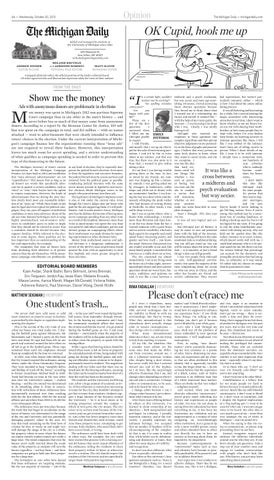
OK Cupid, hook me up Edited and managed by students at the University of Michigan since 1890. 420 Maynard St. Ann Arbor, MI 48109 tothedaily@michigandaily.com MELANIE KRUVELIS ANDREW WEINER EDITOR IN CHIEF
and ADRIENNE ROBERTS
EDITORIAL PAGE EDITORS
MATT SLOVIN MANAGING EDITOR
Unsigned editorials reflect the official position of the Daily’s editorial board. All other signed articles and illustrations represent solely the views of their authors.
FROM THE DAILY
Show me the money Ads with anonymous donors are problematic in elections
M
ore money was spent in Michigan’s 2012 non-partisan Supreme Court campaign than in any other in the state’s history — and never before has so much of that money come from anonymous donors. According to a report by the Brennan Center for Justice, $19 million was spent on the campaign in total, and $13 million — with no names attached — went to advertisements that were clearly intended to influence voters’ choices in the election. Under the current interpretation of Michigan’s campaign finance law the organizations running these “issue ads” are not required to reveal their backers. However, this interpretation leaves too much room for secret spending, and a stricter understanding of what qualifies as campaign spending is needed in order to prevent this type of electioneering in the future. The Michigan Secretary of State’s current interpretation of the Michigan Campaign Finance Act dates back to 2004 and establishes that “issue advocacy advertisements” are not “expenditures.” This means that as long as an ad doesn’t use words that specifically advocate for or against a certain candidate, such as “elect” or “vote,” their buyers have the option to remain anonymous. However, the kinds of advertisements that ran during the 2012 election clearly don’t meet any reasonable definition of an “issue ad.” While these kinds of ads may be legal and even typical for political campaigns, they, too, pass off support of individual candidates as mere issue advocacy. Many of the ads use time-honored techniques such as using highly emotionalized, out-of-context references to candidates’ pasts in order to imply that they should not be elected or assert that a candidate should be elected because they support families. While relevant to the election to some degree, these qualities are far less important than an understanding of the law and impartiality, for example. The exemption that issue ad buyers have from disclosing their identities is of greater concern than the ads themselves. While anonymous campaign contributions are problematic
in any kind of election, they’re especially dangerous for judicial branch elections. Even more so than the legislative and executive branches, the judicial branch must be as non-partisan and removed from the political game as possible. Conducting judicial elections with the same secret money present in legislative and executive elections blinds Michigan voters to the people who poured money into these ads. The legitimacy of Michigan’s Supreme Court is also at risk under the current rules. Even though the Court’s judges may not know who paid for the ads supporting them, it’s still problematic. And to make matters worse, Michigan now has the dubious distinction of having more secret campaign spending than any other state as a result of the loophole. Moreover, more than twice as much money was spent this way than was spent by individual candidates, parties and interest groups on campaigning efforts where their involvement was made obvious by reporting requirements or other disclosure laws. Money from undisclosed sources and judicial elections is a dangerous combination. A review of the MCFA’s issue ad provision would present the state with an opportunity to close this loophole and create greater integrity in these elections.
EDITORIAL BOARD MEMBERS Kaan Avdan, Sharik Bashir, Barry Belmont, James Brennan, Eric Ferguson, Jordyn Kay, Jesse Klein, Melanie Kruvelis, Maura Levine, Aarica Marsh, Megan McDonald, Victoria Noble, Adrienne Roberts, Paul Sherman, Daniel Wang, Derek Wolfe
MATTHEW SEIGMAN | VIEWPOINT
One student’s trash... “No person shall store solid waste or solid waste containers on property except at locations as permitted by this chapter or regulations implementing this chapter.” This is the section of the City Code of Ann Arbor my house was cited under Oct. 5 during the football game against Minnesota. My housemates and I hosted a party on the front lawn and about 50 cups had been left on our porch and scattered around the lawn when we all left to go to the football game. Those cups remained there until city employees cleaned them up completely by the time we returned. In 2002, Ann Arbor Mayor John Hieftje and the City Council enacted this ordinance, among others, under the Clean Community Program. They were intended to keep “unsightly debris and buildup of trash off the lawns,” according to former councilman Michael Reid in 2005. Trash had become an issue in the Ann Arbor area near the University’s campus — student housing — and the city council was determined to do something about it. Fines in association with infractions of these ordinances have incrementally increased over time, reaching $250 for the first offense, $500 for the second offense and anywhere from $500 to $1,000 for every subsequent offense. The ordinances were put into place because the trash that had began to accumulate on the lawns of houses was detrimental to the image of the city and University and was potentially damaging property values in the area. It’s true that trash remaining on the front lawn of a house for days or weeks on end might very well damage the image of the city as a whole, but property values in areas where the houses are almost entirely student rentals isn’t really a huge issue. The rental companies that own the houses aren’t really worried about the resale value of the property, as students will rent the houses regardless — not buy them — and these companies are going to hold onto their properties for a long time. The lawmakers in Ann Arbor have denied that these ordinances are targeting students, but the vast majority of citations — 196 of the
261 — in the year 2007 were issued during football season, from September through November. In the hearing my roommates and I had, the community standards officer that issued the citation said that she was tol d to go around during the football game on Oct. 5 and issue citations — conveniently when the majority of the students will be at the game and not be able to either clean the property or speak with the issuing officer. While I agree that littering tickets should be issued when waste is left on lawns or property for extended periods of time, being tasked with going out during the football games and seeking out offenders causes citations to be disproportionately issued to students. The magistrate dealing with my ticket said that there was no timeframe for the littering ordinance, meaning the ticket can be issued no matter how short of a time the trash has been on the property. The students and the University itself bring Ann Arbor a huge amount of economic activity. If this ordinance is centered on increasing revenue for the city, they shouldn’t attempt to get that revenue from students. Students support a huge amount of the business around the University — be it at local stores or by renting properties around the campus — which in turn gives the city money. The city exists at its current state because of the University and can get revenue from other sources. Ann Arbor has lower property taxes than Detroit and, should they need revenue, could raise those property taxes. Attempting to get revenue from students, who most likely don’t have excess funds, is wrong. The ordinance could have been dealt with in other ways. For example, the city could have started this process with a warning system for houses that aren’t repeat offenders of the ordinance, telling the residents to clean their property within 24 hours or otherwise receive a citation. The city should respect the students of the University and not specifically target them with punitive legislation. Matthew Seligman is an LSA junior.
CONOR ANDERSON/Daily
“I
n a certain light, wouldn’t nuclear war be exciting?” “Do spelling mistakes annoy you?” “Are you happy with your life?” These are a few of the first questions I answered when I filled out my EMILY OKCupid profile PITTINOS in August. I told friends, and myself, that I set up my OKCupid for the sake of entertaining journalism. I said it’d be fun to write about in my column. And that was true, but there was also more to it than that; I wanted to give online dating a shot. It’s not that I was having trouble getting dates at the time. In fact, as noted by my friends, my summer was shaping up like a romantic comedy. I was getting asked out by strangers in bookstores, coffee shops and while out to dinner with my roommates’ families. I was kissing the boy next door while simultaneously schtüping the punk rocker who had dreams of writing fiction in Nashville. In other words, I was ankle-deep in trysts. But I was at a point where, after a hiatus from relationships, I wanted more than flirtation and tipsy kisses on the way home from the bar. I wanted someone with a great brain and an artistic sensibility, who had a high capacity for empathy and could spend hours discussing poetry and gender and love itself — you know, the usual. However, that person was not readily available to me and, like many lonely people, I considered the Internet as a viable short cut to love. The site consumed me almost immediately. I sat in my living room for hours on a Friday night, answering multiple choice and short answer questions about my worst fears, fantasies, ambitions and opinions on God. It was like a cross between a
midterm and a psych evaluation, but way sexier and more ego-nourishing. Of course, I loved answering these obscure questions because they forced me to think about what I wanted out of a relationship, my future and myself. It seemed like — with the help of my trusty guide, the Internet — I was learning a lot about who I was. Clearly, I was totally buying it all. OKCupid also inserted my responses to these questions into complex algorithms and then spit out objective judgments on my personality in the form of graphs and percentages. I believe that every person, on some level, desires to know where they stand in social circles, and I’m no exception. I was into the idea that hard evidence could tell me things like whether I was cool, or pretty, or boring. You can even ask the site to conduct a survey that will determine whether or not your pictures make you seem bone-able to complete strangers. Neat! I thought. This data says I’m hot. It was all very logical and science-y. But OKCupid isn’t all flattery. It may be easier to suss out potential dates with the help of the Internet, but online dating still incurs the same emotional risks as traditional dating. You can still get stood up. You can still be unsure about the terms of the date — is it romantic, or just a friend thing? A date can still go poorly. I met two people from OKCupid in safe, well-populated environments. One spent the majority of the time complaining about his recent ex who ran away to China, and the other has become my friend and artistic collaborator. They weren’t
bad experiences, but weren’t particularly romantic, either — which is how I feel about the entire online dating process. It was all flattering and fascinating for a while, but I started missing the magic associated with discovering attraction in real time. I don’t want to know whether or not my future lovers are OK with sharing their toothbrushes, or how many people they’ve slept with, before I’ve even shaken their hands. By knowing answers to intimate questions like those, I felt like I was robbed of the intimacy that’s born out of telling secrets in person. When I share details of my life, I want it to be with someone I already have a connection with, not hundreds of Ann Arborites who’ve suddenly become candidates for future coitus. I don’t doubt that sites like OKCupid work for some people. It’s proven that they lead to happier marriages, and I’m sure they’re handy if you’re looking to get life-long serious. Even if you’re young, this method may be a convenient way of evading loneliness, or finding a hook up near-by, but it’s all too logical for my taste. If I’m going to risk the other humiliations associated with dating anyway, why not hold out for sparks? Sites like this reduce romance to an exact science, which doesn’t settle well with me. I could find someone who is a 94-percent match for me, but there’s no way the science behind that percentage can account for the chemistry and intangible attractions that fuel young love. As schmaltzy as it may sound, I’d rather take my chance on magic than be guaranteed a date.
It was like a cross between a midterm and psych evaluation but way sexier.
— Emily Pittinos can be reached at pittinos@umich.edu.
RIMA FADALLAH | VIEWPOINT
Please don’t e(race) me
If I were a chameleon, many people may think that I have horrible survival techniques due to my inability to blend in with my surroundings. But they’re wrong. What they misunderstand is that chameleons don’t actually change color to remain inconspicuous — they change color to communicate. What many misunderstand about me is that I, too, am not trying to hide from anything or anyone. All my life, the identities that I consider most salient are the same ones that make me different from everyone around me. I am a Lebanese-American woman who, despite being a dual citizen, has never really felt that I teetered toward one end of the hyphen. So I sit here, like the surprisingly effective chameleon that I am, and change colors depending on where I am and who is around me. I change colors to communicate, to be seen, and to be heard for who I am. I change colors because I can. I change colors because I get to determine what it means to be me. After three years of being defined by others at this University, I’ve learned to claim ownership of my identities — both marginalized and privileged. In Lebanon, I proudly represent America, and at the University, I proudly represent my Lebanese heritage. I’ve accepted that no number of hyphens will be all-encompassing of the complexity that is me. I’ve come to realize that, while labels can be dehumanizing and dismissive at times, they allow for some degree of visibility and recognition. So don’t you dare obliterate what I have so proudly cultivated. Too often at this university I hear ignorant comments such as, “Race is not biologically a thing; it’s a social construct; therefore, race doesn’t
matter,” and “I think diversity education is unnecessary; I don’t understand how it’s supposed to enhance my experience here.” If you think these things, I’m talking to you. Perhaps you don’t get it because you’re blinded by your white gaze. Let’s take a look through my eyes, shall we? Of the plethora of issues embedded in your ignorant statements, I will emphasize two main points: First, in saying, “race doesn’t matter,” you’re essentially denouncing my very existence as a person of color. You’re dismissing my emotions, my experiences and my choices that are often attributed to this identity that is apparently invisible to you. But forget about me — do you seriously believe that the experience of a Black, Latino, Arab or Native American is no different than that of a white American? Race matters. There are books on that very subject — enlighten yourself. And second, when you deem diversity education “unnecessary,” you’re pretty much ridiculing our history and experiences as people of color. I’m sure I’m not alone in saying diversity education has been everything to me. It has been my frustration, my validation and my empowerment as a woman of color navigating an overwhelmingly white institution. Just a general tip to be a more worldly person: Issues and affairs shouldn’t have to affect you directly for you to have an interest in learning about them. Be inquisitive. Be empathetic. Because counterarguments to “controversial” topics such as race and ethnicity have become so painfully predictable, I’ll be proactive and try to address them here. Your angry tone is not conducive to effective dialogue. That’s fine by me because, one, this is not a dialogue,
and two, anger is an emotion to which I am entitled when faced with bigoted, racist or sexist remarks. Don’t get me wrong — there is certainly a time and place for everything; I have engaged in my fair share of productive dialogues over the past few years. But at this very time and place, this chameleon just wants to be seen — riled or not. Too often in our diversity or social justice conversations we are afraid of making the privileged feel uncomfortable. Those who are excluded from the dominant narrative are arguably always uncomfortable. Your comfort is not more important than mine — especially when it’s my identity that is at stake. Or to those who say, “I don’t see race! I’m honestly color-blind!” No you’re not; stop lying. I don’t want you to be color-blind. Colorblindness is a fallacy that far too many people try hard to believe because it sounds politically correct. Much like my cold-blooded counterparts, I don’t want to blend in. I don’t want to assimilate, and I despise the bigoted implications of a “big melting pot.” I want to be seen for who I am. I want my unique voice to be heard. My olive skin is very much a part of me — more than ever amongst the sea of white at Michigan — and I’m proud of it. What I’m saying is that I’m trying to communicate, so please stop pretending that I’m not here. Instead, recognize, respect and embrace the different individuals around you for who they are. If you don’t already, ask questions. Take a step out of your comfort zone and engage in random conversations with people who don’t look like you. Who knows, you just may learn something about yourself. Rima Fadlallah is an LSA senior.
The Michigan Daily — michigandaily.com
Arts
ALBUM REVIEW
Wednesday, October 30, 2013 — 5A
MUSIC NOTEBOOK
MERGE
Raising that roof.
Arcade Fire makes dark masterpiece Country music lives on
ARISTA
“I know everything about you.”
Tortured ‘Reflektor’ subverts expectations By ADAM THIESEN For the Daily
Reflektor is a 75-minute sprawling mess of genius, the sound of young, creative people gathering in some dark, abandoned loca- Ation and drinking and dancing Reflektor and not giving a Arcade Fire shit about what anyone else Merge thinks. This time around, having scratched “Win Album of the Year at the Grammys” off its bucket list, Arcade Fire seems confused about what it represents and what it wants to do next, and all this results in a tortured masterpiece. Though often an inconsistent experiment, Reflektor shines as a one-of-a-kind work from an inimitable band. With influences culled from diverse styles ranging from producer James Murphy’s indie dance work to traditional Haitian music, Arcade Fire sounds very different from what fans are used to. Gone are the softrock singles of 2010’s The Suburbs or the heart-on-sleeve anthems of its early work. Now, the band cloaks its rawest emotions behind studio tricks and adventures into atmospheric synth music. The group even
needlessly stretches the first half’s best two songs (the title track and “Here Comes the Night Time”) beyond six minutes each, adding to the album’s mood at the expense of immediate impact. Reflektor often sounds like a glimpse into frontman Win Butler’s psyche, and the peek into his private world reveals Butler as a man extremely uncomfortable with himself. The lyrics are a constant onslaught of modern alienation, with every song featuring lines like, “I can’t tell if I’m a normal person,” and references to being “trapped in a prison.” Butler’s voice sounds agonized when he sings these words, like he’s a confused facsimile of himself struggling to be real again. The blunt dread of these lyrics can quickly become tiring, and they continue a depressing trend for a band that nearly 10 years ago opened its debut album with “Tunnels,” one of the greatest love songs ever written. None of these songs would be comfortable on the radio. Many of the album’s tracks are danceable, but not in a nightclub, EDM way. The ghostly, minimalist style recalls 1980s new wave, and the bassline to “We Exist” even brings to mind “Billie Jean.” The disappointment, though, comes when Arcade Fire doesn’t have the pop sensibilities and melodies to elevate the songs beyond moodiness. When not sounding like 1980s hits, the band tries out punk rock with songs like “Nor-
mal Person,” earning decent but unspectacular results, and heartfelt, slowed-down songs, which are more successful. Reflektor feels like a very conscious step in an anti-commercial direction. The band jokingly plays with fans’ expectations by starting songs one way, only to completely change the tempo and style 20 seconds later. As a journey, the album travels a little choppily from arty, experimental music to driving garage rock to slow, reflective songs to, finally, a glorious threesong conclusion that makes the whole trip worth it. “Porno,” “Afterlife” and “Supersymmetry” showcase Arcade Fire at its strongest, pushing boundaries while still playing to its anthemic strengths, and each track will certainly please fans confused by the rest of the record. At its double-album length, Reflektor can often seem like it needs a good amount of cutting, but really, the record wouldn’t work if it was just cut down to its best bits. Reflektor satisfies because of the greatness that continually pokes through the album’s smokescreen. This latest effort will definitely never be Arcade Fire’s most popular work, but it feels destined to be a cult classic, an album treasured by hardcore fans who identify with its uniqueness. Arcade Fire’s experiments don’t always succeed, but the band is still hugely influential, and Reflektor’s unconfined ambition has the potential to be legendary.
By GREGORGY HICKS Daily Arts Writer
In a musical decade characteristically overrun by abstract electronic, pure pop, R&B and rap, it’s shocking that country music stakes such an enormous claim. Country and folk artists snatched up half of the spots for Billboard’s 10 best-selling albums of 2012 in the United States, with Jason Aldean’s Night Train holding the 11th spot. Zac Brown Band, Eric Church and Lady Antebellum were other contenders, with over half a million in album sales by the year’s end. These Nashville superstars neutralize their successes, however, from an absence on the top-tier singles chart. Don’t get me wrong, there’s a high level of attendance for country artists at the Top40 party, but the VIP section is consistently claimed by tailoredfor-Top-10 pop artists and onehit-wonders. That’s a debate for another time, though — the tussle between the importance of selling a record and the importance of selling a single. The album v. single battle isn’t totally unrelated though. Look at any period of music — baroque and classical, ’70s and ’80s, etc. — and you’ll find a popular retaliation to contemporary trends. Unless your eyes have been closed and ears
covered for the past decade, you’ve most likely noticed an explosion of singles sales and a tremendous downturn in album sales. Country’s lucrative market for record sales is likely to be a result of this dissent from the conglomerately written and produced music of singles artists. It’s fascinating to witness a sizable market for modern artists releasing (generally) self-written albums that see the record in its entirety, rather than a package of singles.
The genre is evolving. Discounting lyrics that come nothing short of vapid — Capitol Records Nashville probably pays Luke Bryan a hundred bucks to use the word “beer” in a song, and two hundred to put it in the title — the comfortably straightforward melodies of acoustic tracks are equally refreshing for the mainstream 2010s. Contrast an acclaimed but simple Lady Antebellum piano ballad against the mind-boggle of Zedd’s abstract electronica or Lady Gaga’s profound symbolism and style. Also note that Lady Antebellum
walked away from the 2011 Grammy Awards with five Grammys, including Record of the Year and Song of the Year — two awards not exclusive to country music. Now, before I’m labeled completely naïve, I will concede to a lack of complete authenticity with popular country. Taylor Swift had the best-selling album of 2009. Was it full-blown country? Absolutely not. Was it country enough? Absolutely. The instrumentation and storytelling lyricism is sufficient for this label. Does Eric Church use too many rock instruments? Yes. Does Florida Georgia Line use beats that are too thick? Yes. Did Jason Aldean once feature Ludacris in a song? Yes. It’s 2013. George Strait-country is not going to be blazing a trail. Expect crossover. Country thrives as long as it continues to compromise. Carrie Underwood, Luke Bryan, Taylor Swift and the rest of the pop-country gang take quite a hit for their successes — words like “sellout” and “not even country” are thrown around quite a bit — but the genre needs these pop crossovers. Country’s contemporaries fuel the promotion necessary to continue its stunning amount of album sales for the genre as a whole — a genre that technically should have washed up years ago.
FROM THE FILTER
Musical moments with Lou By HANNAH WEINER Daily Arts Writer
TV NOTEBOOK
Why you should watch TV By MADDIE THOMAS For the Daily
Since the dawn of time, mothers have been warning children that TV will “melt their brains,” and lately it seems like more people agree. It’s almost becoming trendy to denounce TV in the same way it has recently become trendy to eat “gluten-free.” The other day, I overheard a girl in my Economics 101 lecture bragging with an upturned nose: “Oh, I don’t watch TV. I don’t really have time for that.” Though there are currently no official reports of brain-melting as a side effect of television watching, many believe that watching TV can stunt creative growth and expression and, through advertisements, groom viewers to become mindless consumer-zombies. Of the contributors to debate. org, an online forum for discussing and debating relevant topics, 57 percent believe that television is a “bad influence.” A simple Google search reveals the existence of an extensive 15-step guide to quitting TV, as if TV is a drug which, through rehabilitation, one must shake their addiction. The recently refreshed stigma surrounding television may be due to the “binge-watching” culture that has grown out of streaming services like Netflix and Hulu Plus. Now, TV is more accessible than ever, and a lot of people take advantage of that by spending hours in front of their computer screen, consuming the latest addition to Netflix’s “Instant Watch” section. But it’s
important to keep in mind that, while it’s totally possible to watch the entirety of “Mad Men” in a week (trust me on this one), it’s also possible (and a lot healthier) to keep up with a TV show at a much slower pace. Tuning in to a show once a week allows viewers to designate a time to relax and de-stress from work or school or daily life in general.
Despite what your parents tell you, watching TV isn’t so bad. The beauty of TV is that it lets you access all the joy and entertainment of a movie or a play, but over a much longer stretch of time. It keeps you guessing, it gives you something to wonder about or think about week to week, and if it’s quality television, it will provide its own opportunities to be analyzed in the same way any other more “sophisticated” medium could. When done right, a television show can be enjoyed by anyone on any level. “Breaking Bad” is a perfect example of this; some people will tune in to admire Vince Gilligan’s deft, almost Shakespearian writing style, while others will tune in just because they think murderous drug dealers are cool. With all the advancements
in television distribution going on lately, the quality of programming has only improved. Big-name filmmakers are exploring the opportunities of the small screen (see: David Fincher’s “House of Cards” or Joss Whedon’s “Agents of S.H.I.E.L.D.”), and well-made niche shows like “Arrested Development” are getting the chance to exist outside of network broadcasting. There’s no denying that there are still mindless shows out there — like TLC’s “Four Weddings” or MTV’s infamous “Jersey Shore” — but in moderation even some reality TV can serve a beneficial purpose, if the mindlessness is exactly what a viewer wants after a long day of work. A Netflix or Hulu Plus account is a wonderful thing to have in your life, as long as it’s used for good and not evil. Having a little something extra to look forward to every week adds a healthy consistency to your life. It’s fun to get caught up in cliffhanger plotlines and connect with characters. TV shows come in so many varieties that there’s pretty much something for everyone. Even the busiest person in the world couldn’t argue against a 30-minute time commitment once a week. Whether it’s something mentally stimulating like a critically acclaimed drama or an easy watch like a goofy sitcom, having a television show in your life forces you to take some time to kick back, relax and wonder what’s going to happen this week.
As a seventh grader, I scavenged through my dad’s album collection and pulled out The Best of The Velvet Underground: Words and Music of Lou Reed. While it surely terrified my parents that I listened to the songs “I’m Waiting for the Man” and “Heroin” on repeat, thus began my relationship with Lou Reed. Obsessions with certain musicians come and go, but Lou Reed has always remained a constant friend to my music collection. In high school, he sang me through moments of angst and frustration; my soundtrack to and from school usually involved a song from White Light/White Heat or Loaded. I felt I was Ginger Brown, Polly May and Joana Love, who “ain’t got nothing at all” in “Oh! Sweet Nothin’.” The truth is: I had a lot more than nothing, but I wanted Lou Reed to show me what it meant to feel like I had nothing at all. Lou Reed was my gateway drug into loving music. He never pretended to sing, nor did he pretend to ignore the hardships involved in being alive. He wrote poetry — profoundly simple lyrics that help me pinpoint exact moments in my life based on which song by Lou Reed played as the soundtrack. I fell in love with Lou Reed listening to “Walk on the Wild Side.” He explained to me, very simply, that there’s so much in the world that I hadn’t yet experienced. It didn’t make sense to me when my parents and teachers tried teaching me that lesson, yet when Reed sang about the “wild side,” I felt one step closer to discovering what I was looking for. When I broke First seen on up with my high
the filter
WARNER BROS
Linger on, Lou.
school boyfriend, “There She Goes Again” and “Rock and Roll” played (loudly) in the car on the ride home. Because, after a dramatic teenage break-up, it felt like my life was not only being saved by rock ‘n’ roll — more specifically, my life was being saved by The Velvet Underground.
Going through life with Lou’s lyrics. When I left for college, “Sweet Jane” played in my mind while I pulled up to my dorm for the first time. Reed sang me advice my parents weren’t going to tell me: “Everyone who ever had a heart / They wouldn’t turn around and break it.” He told me it was going to be okay just by singing “La la la” over and over again. And he was right: College turned out to be great.
When I fell in love (for real, this time), “Pale Blue Eyes” rang in my ears for days. My boyfriend didn’t “make me mad,” but I wanted him to “linger on” with his “pale blue eyes.” Now, listening to that song reminds me of that feeling of falling in love once more. And I find myself listening to “I’ll Be Your Mirror” more and more immediately after hearing about pale blue eyes. Lou promised me all the things that came true. His voice has undeniably soundtracked my life, for the better. In my teenage wisdom, it felt profound to claim that Lou Reed saved my life. He didn’t — not even close. Lou did, however, start a musical obsession with fitting songs to speak truths about my life. I, and the rest of the world, will deeply miss Lou Reed’s honesty, but he will never stop singing realities about life that take years to finally figure out. — A version of this article originally appeared on the Daily Arts blog, The Filter, on Oct. 27.
Sports
6A — Wednesday, October 30, 2013
LeVert 2.0 is bigger, better in exhibition
Chance at revenge against Akron
By DANIEL FELDMAN Daily Sports Writer
By MINH DOAN Daily Sports Writer
A little less than a year ago, the Michigan men’s soccer team walked off the field, heads down, as the team across the field celebrated its NCAA second-round victory that ended the Wolverines’ season. That team across the field was Akron, and Michigan will get the chance to avenge that loss at home Wednesday night and continue the budding rivalry between the two schools. “(The loss) is always on my mind,” said senior defender Ezekiel Harris. “Throughout the years, it’s always been Akron that’s been our biggest enemy” Akron at The Wolverines (3-2 Big Michigan Ten, 7-4-2 over- Matchup: all) will look to Akron 11-4-1; continue a very Michigan 7-4-2 strong home- When: stand during Wednesday which they have 7 P.M. beaten then-No. Where: 12 Creighton, U-M Soccer Wisconsin and Stadium Indiana, and TV/Radio: have scored MGoBlue.com timely goals in all three matches. With those wins, Michigan gained important points in the Big Ten race, moving into second place in the standings. The Wolverines will look to get a win against a perennial powerhouse, extending a tough rivalry between them and the Zips. The two teams have played each other every season since 2003 and have met in the postseason three times within that span. While Akron got the better of the Wolverines twice last season — once in the regular season and once in the postseason — Michigan upset the fourth-ranked Zips in a thrilling overtime game two years ago. The Wolverines and the Zips also met in the NCAA College Cup semifi-
PAUL SHERMAN/Daily
Senior defender Ezekiel Harris said Akron had been Michigan’s “biggest enemy.”
nals three years ago, with Akron coming out on top, 2-1. “There’s always a lot of banter going back and forth in the games against Akron because everyone wants to win the game,” Harris said. “Whenever we play (Akron), there are at least a couple yellow cards and a few red cards too.” But this Zips team is very different from the one that ended Michigan’s season last year. Akron lost six starters from last year’s team including all four All-Americans to professional leagues. The Zips also lost their coach, Caleb Porter, to the Portland Timbers of Major League Soccer. “They still have a lot of good pieces,” said Michigan coach Chaka Daley. “Maybe the personalities are a bit younger, but they still have the same style of play and formidable players and staff.” Akron (4-1 Mid-American Conference, 11-4-1), led by first-year coach Jared Embick, has played very good soccer as of late. The Zips have rattled off their own unbeaten streak with five wins and a tie in their last six games, beating No. 12 Wake Forest and tying No. 22 Michigan State along the way. Akron’s offense is led by AllMAC first-team forward Reinaldo Breines and midfielder Adam Najem, who lead the team in scoring with four goals apiece. The Zips offense will look to make quick passes and win the possession battle. “(Akron) always seems to have very shifty players who are good one-on-one and very technically skilled,” Harris said. “They always move the ball really quick-
ly so we can’t be caught sleeping or ball watching.” The Michigan offense has been playing very impressively. Timely goals, quick movements off the ball and high pressure have led to an increase in goals for the team that had a tough time putting one goal in the back of the net early on in the season. Against Indiana, the game-winning goal came after high pressure by freshman defender Rylee Woods led to the cross and goal by junior midfielder TJ VanSlooten. The Wolverine offense will need to continue this impressive offensive play to score on Akron goalie Fernando Pina, who has a MAC-leading eight shutouts this season. Michigan’s hopes for an NCAA bid have been looking up with the successful homestand, but it will need to keep up the play to beat Akron and solidify its place in the tournament. “Akron is what we aspire to be,” Daley said. “They are ahead of us in the rankings, and we feel we need to win this game to deserve a place in the NCAA Tournament.” Note: The Michigan Athletic Department is holding a “zerowaste event” during the soccer game on Wednesday night. All fan-related waste from the game will be either recyclable or compostable. Concessions will be served in recyclable or compostable packaging, and trash cans will be turned into compost bins. Members of Michigan Student-Athletes for Sustainability (M-SAS) will be waste-station attendants to assist fans with questions.
RELEASE DATE– Wednesday, October 30, 2013
Los Angeles Times Daily Crossword Puzzle
When the Michigan men’s basketball team opened last season, the hope was for then-freshman guard Caris LeVert to redshirt and put more muscle on his then6-foot-5, 170 pound frame. It wasn’t until the Wolverines’ seventh regular-season game – at Bradley – that LeVert saw the court for the first time, excluding the team’s exhibition game. Besides a start against Central Michigan, when he played 32 minutes in late December due to an injury to former Wolverine Tim Hardaway Jr., LeVert only had one other game in the regular season in which he even played more than 16 minutes. Then, against Syracuse in the national semifinals, LeVert played 21 minutes, scoring eight points, including two 3-pointers. For context, LeVert had seven 3-pointers all of last season. With Hardaway struggling from the field that game – he shot 4-for-16 from the field – LeVert played arguably his best game of the year. This year, with Hardaway and Trey Burke gone, and about 25 shots “out there for other people right now,” according to Michigan coach John Beilein, it made sense that LeVert – now 6-foot6, 185 pounds – would be playing a larger role on the team. After being the most under-utilized freshman last year, LeVert’s classmate Glen Robinson III noted he was looking forward to LeVert playing more minutes this year. “As sophomores, we’ve been waiting for this moment where we can get a chance to play together for a long time,” Robinson said. “We’ve been talking about this for a year now, and we just couldn’t wait.” Against Concordia on Tuesday, LeVert looked like a man ready to take advantage of the moment. Playing minutes at both the offguard and point guard in transition, LeVert scored 16 points in
Call: #734-418-4115 Email: dailydisplay@gmail.com
FOR RENT
HELP WANTED
*AVAILABLE FALL 2014* Large 3 bdrm. house. On Campus. 945 Woodlawn. Contact Mike at 734‑276‑3876.
COMPUTER SCIENCE TUTORING. Looking for Tutor for AP Com‑ puter Science (Java) for high school stu‑ dent, twice a week. Competitive rates. Please contact Prof. Reuven Avi‑ Yonah at aviyonah@umich.edu w/ CV.
Edited by Rich Norris and Joyce Nichols Lewis
DOWN 45 Keys in 33 Tuck away 1 Fruity cocktail 46 Stravinsky and 34 “I’ve got proof!” 2 Butler in the Sikorsky 35 Elegantly Batcave 48 Native New feminine 3 Awards for ads Zealander 36 Infernal 4 “How Life 50 Enclose, as pigs 37 Greeting from Imitates Chess” 52 Parcel (out) Down Under author Garry 38 Physicians’ org. 53 Airline to 5 Earl with a tea Amsterdam 41 Id controller 6 Above, to Keats 42 Chris of “Tommy 54 Xbox 360 7 Start of some competitor Boy” Keats titles 56 Quick snooze 44 Dented 8 Having little talent for ANSWER TO PREVIOUS PUZZLE: 9 H.G. Wells’ island physiologist 10 “Darn tootin’!” 11 Small cask 12 Golf star Ernie 13 Off, in mobspeak 17 Royal seat 21 Exiled Amin 23 Google-owned video site 24 Yank since 2004 25 Bert Bobbsey’s sis 28 Hot-sounding European capital 10/30/13 31 Elbow xwordeditor@aol.com
6 BR HOUSE 417 N. Thayer avail. May 2014 ‑ 3 bath, 3 prkg. LOCAL ANN ARBOR Restaurant spaces, wshr./dryer. No smoking, no seeking MANAGERIAL help. Please pets. 734‑996‑1991 send resume to P.O. Box 468 Chelsea, MI 48118 811 S. DIVISION 4 bedrooms, 1 bath, parking, laundry, $2000/month. Avail Fall 2014. dklemptner@comcast.net CENTRAL CAMPUS LARGE and Small Houses www.CappoManagement.com CENTRAL CAMPUS 6 and 7 bedroom houses great furniture/decor ethernet and wireless free laundry and parking for rent NOW for May 2014 www.horvathproperties.com or call (734) 972‑7368 THE 2ND FLOOR NEW Luxury Apartments, Right on S. U. / Central Campus. Apartments come with the BEST Service, Amenities and All at REASONABLE RATES www.The2ndFloorSU.com UNIVERSITY TOWERS *NOW TAKING RESERVATIONS* Rent a FULL 2 bedroom w/ FREE HEAT as low as $1629.00. Great Loca‑ tion, Great Service and Great RATES!! www.universitytowers‑mi.com 734‑761‑2680
SERVICES
By Jeff Chen (c)2013 Tribune Content Agency, LLC
10/30/13
TODD NEEDLE/Daily
Sophomore guard Caris LaVert scored 16 points in Michigan’s 117-44 victory.
Michigan’s 117-44 victory. “He, as you can see, (has) got a gear that some people don’t have so we want him to do as much as he can to push the ball on the court if he gets a rebound,” Beilein said regarding the duality of LeVert’s play. “And I like that he’s getting bulked up – he doesn’t look bulked up – but for him, he has put on weight. But if he can go crash as an off-guard, you know just take the ball up the floor, then that really helps us.” Entering the game after about 3.5 minutes of play, LeVert looked more confident on the floor than he ever did last season. On the court with freshman point guard Derrick Walton Jr., LeVert helped spread the floor with three other teammates standing at least 6-foot-6 — sophomore guard Nik Stauskas, redshirt sophomore forward Max Bielfeldt and sophomore forward Glen Robinson III.
With a height advantage, even without the Wolverines’ two starting big men, Michigan was able to play fast and big, creating chances in the half-court and transition offenses. For LeVert, his first scoring chance came with 13:32 remaining in the half with some nice ball movement by the Wolverines. With the ball at the top of key, freshman forward Zak Irvin found Robinson under the basket. Though he could have taken a quick shot underneath the hoop, he insetad found a wide-open LeVert in the corner, who nailed the shot for his first three points of the game. For the rest of the first half, as Michigan pulled away from the Cardinals, LeVert and the Wolverines looked at ease. Playing with the ball in his hands for the first time, LeVert See LEVERT, Page 8A
CLUB HOCKEY
Classifieds ACROSS 1 Big name in big trucks 5 Gunk 9 TV’s Dick Van __ 13 When doubled, a Northwest city 14 Give a makeover 15 Line holder 16 Home sound system 18 Texts: Abbr. 19 Decline from disuse 20 Some Beethoven works 22 “Veni, vidi, vici” man 23 Memorable “Rocky” line 26 Little Leaguer, say 27 Automated intro? 29 __ del Fuego 30 Stay a step ahead of 32 Many millennia 33 Eloquent 38 “__ baby!” 39 Zapped 40 Rapper who played Left Ear in “The Italian Job” 43 Software test version 44 Agnus __ 47 Reason to pile onto the team bus 49 Promoting 51 Botanist’s study 52 Nostalgic souvenir 53 River in a 1957 Best Picture title 55 Hero whose catchphrase begins 16-, 23-, 33- and 47Across 57 Work on, as a popsicle 58 Q.E.D. part 59 Levels 60 Tiny arachnid 61 “Gadzooks!” 62 Puts the kibosh on
The Michigan Daily — michigandaily.com
THESIS EDITING. LANGUAGE, organization, format. All Disciplines. 734/996‑0566 or writeon@iserv.net
WWW.STUDENTPAYOUTS.com Paid survey takers need in A2. 100% FREE to join. Click on Surveys.
Three to play for Team USA in Italy By BEN FIDELMAN For the Daily
The women’s club hockey team gets all the perks of playing at Michigan — home ice at Yost Ice Arena, world-class coaching, winged helmets — and now some of the team’s players will have the opportunity to participate in international competition. Junior defenseman Kalli Bates, graduate student forward Kristin Griebe, senior forward Monica Korzon and coach Rob Blackburn will travel to Trentino, Italy to join Team USA in the World University Games. The club players have the opportunity to participate because they play in the American Collegiate Hockey Association, which is where Team USA draws its WUG players. “It’s always been a goal of mine to put on a USA uniform,” Korzon said. “I’ve always dreamed of being on the Olympic team, but that was pretty lofty. This is the next best thing.” USA Hockey — the host organization for the team — had to cut some of the program’s funding this year, so the coaches had to use an unorthodox method of selecting players for the WUG team. Instead of holding a tryout as in the past, the coaches had to scout players in person. Coaches have seen each of the 17 players on the roster play in person over the last year. The major downside of the new system was that the coaches couldn’t compare players on the same scale because they are playing against different talent levels in each game. In a controlled tryout, players are competing against other high-skill-level players, which is what the coaches need to
see before sending players to go up against the best in the world. One of the trade-offs for not allowing checking in women’s hockey is that the game gets substantially faster. This is even more the case in the WUG where games are played on Olympicsized ice, which is 15 feet wider than Michigan’s home ice at Yost. “It’s going to be a lot quicker,” Korzon said. “We are going to have to be a lot faster and have a lot smoother flow.” “This is the second time that the U.S. has sent a women’s team to the WUG,” Blackburn said. “Two years ago in Turkey, we learned that we need a fast team. Our criteria (this year) was fast with a lot of skill.” Leadership is another attribute that the coaches are looking for from the three Wolverines on the roster. Two of the three — Korzon and Griebe — are co-captains of the Michigan club team. Bates will be working closely with Blackburn, the assistant coach in charge of Team USA’s defense. Bates isn’t afraid to leave her position on the point and play a major role in the team’s offense, which is just what Blackburn is looking for. Team USA doesn’t have any practices before leaving for the tournament, so how it comes together in those few weeks could very well determine its success. “We’re all coming from different backgrounds and in such a short time,” Griebe said. “We have to bring everyone together and see what people’s strengths are individually.” Team USA will meet in Chicago on Dec. 3, and then make its way to Italy for its first game of the tournament on Dec. 10 against Russia.
Sports
The Michigan Daily — michigandaily.com
Wednesday, October 30, 2013 — 7A
FOOTBALL
Hoke tries to crack Spartan defense By LIZ VUKELICH Daily Sports Editor
ERIN KIRKLAND/Daily
Redshirt junior midfielder Lauren Hauge tore her anterior cruciate ligament, then her medial collateral ligament, then her ACL again, before her return this season.
Lauren Hauge: Staying made her stronger By SIMON KAUFMAN Daily Sports Writer
O
n Oct. 6, the Hauge family went out to dinner to celebrate a family birthday when Lori Hauge took out her phone to record a video of the family — 20 in all. It wasn’t to capture the waiter bringing out a special birthday dessert with a candle in it. It was a congratulatory video for her daughter, Lauren, a redshirt junior on Michigan’s field hockey team. Lauren had just scored her first collegiate goal by knocking in a rebound late in a game against Ball State. 900 miles away back home in Tulsa, Okla. her family had been following the game online. Hauge made her college debut earlier this year in the Wolverines’ first regular-season game against Massachusetts. Hauge won’t remember the details of either game though — she’ll remember that, for the first time in her college career, she got to be out on the field. Playing for the first time and scoring her first college goal four years after she graduated from high school wasn’t Hauge’s plan, but injuries didn’t adhere to her schedule. *** Hauge made a hobby of collecting varsity letters on the fields and A’s in the classroom in high school. The four-year honor-roll student earned 12 total varsity letters in soccer, field hockey and track and field. For a while, she thought that soccer would be the sport she would pursue in college. The three-sport athlete had the opportunity to stay close to home in Tulsa, where she could have played soccer at Tulsa or Oklahoma. She would have been able to go to school where she grew up, close to friends and family. “As my senior year rolled around, I was like, I kind of want to get away, and see the world and do all that,” Hauge said. And with that see-the-world mindset, she decided to forgo soccer — a sport she’d played since she could walk — and instead pursue field hockey, which she’d only played during high school. She took an official visit to Michigan in January 2010, and being on campus was a “game changer” for her. She watched the men’s basketball team take on Indiana, met former Michigan football coach Lloyd Carr and went to a field hockey morning workout. A basketball win over Indiana and a handshake with Carr were enough to convince Hauge that Michigan was the place for her. She eventually left home and headed to Ann Arbor. *** Hauge elected to redshirt her freshman year in order to develop as a player. “Lauren’s very competitive,”
said Bob Hauge, Lauren’s dad. “So I think the mindset of her redshirting her first year there was that if (Michigan coach) Marcia Pankratz could teach her the skills that she would need to play at that level, what Lauren (already) had engrained in her was the competitive spirit or that drive. … I think Lauren wanted to get her skills up to a place where she would be a contributing member of the team.” She didn’t know at the time, though, that she’d be on the sideline for another two years after that because of injuries. The summer before her redshirt freshman year, Hauge got hurt during a summer scrimmage at a field hockey camp she was at in Michigan. A player fell on her knee the wrong way, causing it to swell up so much that the training staff couldn’t even tell the extent of her injury. Hauge didn’t know it at the time, but she had torn her anterior cruciate ligament. “I actually didn’t think it was torn,” Hauge said. “I went up north with one of my teammates that weekend, and I kayaked and talked about water skiing and then I was like, ‘You know, my knee hurts. I probably shouldn’t do that.’ Then the next week, I went to the doctor and found out I had torn my ACL.” Just like that, her season ended before it even began. She had to turn her attention from refocusing on field hockey to rehabbing her knee. She went back home to Tulsa for surgery, where doctors completely immobilized her knee, forcing her to use crutches. “It was really hard,” Hauge said. “Because you redshirt and you make that decision that you’re going to develop as a player, and I felt like I made some really great strides my freshman year. So to have (the injury) happen in the summer before I even got a chance to show what I can do was really hard.” Despite the setback, Hauge didn’t give in. She got up, worked hard during her rehab as she was forced to learn to walk again, prepared for her junior season and was back practicing just four and a half months later. *** But injuries would hinder her progress again. During the preseason of her junior year, she tore her medial collateral ligament. She continued to play, though, because an MCL injury heals by itself over time. But it weakened her recently recovered knee, and while warming up for a game at Bucknell, Hauge felt the same knee pop. Another torn ACL. Another season on the sideline. “It was just complete disbelief, and I had second guesses about what my body could do which is scary,” Hauge said. “Because when sports is your life and sports is what you do, you almost feel like your body is betraying you,
and when you can’t do the thing that you love the most, it’s really scary. The second time (the injury) happened, it felt completely out of my control.” Hauge chose field hockey over soccer. She chose Michigan over staying close to home. But now, for the third year in a row, she could only watch. What if she had stayed in Oklahoma? What if she had chosen soccer? “I feel like everybody sort of wonders, and it’s sort of the whole ‘the grass is greener,’ ” Hauge said. “When you’re in the darkness of your rehab, you might think about it a little bit. … I made the right choice because even going through all of this has made me a better person. Is it unfortunate, and would it have happened if I was playing a different sport? I don’t know. I think it made me stronger at the end of the day.” *** It did make her stronger. The injury made her a better teammate and a better person. Unable to play and stuck on the sideline for the third consecutive year, Hauge did what she knew best: recovered and supported her teammates. During her injuries, she traveled with the team to all their games except for one that directly followed her surgery. She was also designated as the unofficial warm-up music selector. Pankratz doesn’t like her players each plugged into their own worlds on long bus rides. She likes them listening to music as a team. Hauge was in charge of providing the bus mixtape for trips to away games — a job that allowed her to feel like a part of the team and that she was contributing. “I think that if you’re injured and you can’t do your first-best thing, which is being successful yourself,” Hauge said, “at least having your best friends (around) and seeing your best friends be successful is great.” *** Recovering from an ACL injury isn’t easy — recovering from two of them is an even greater challenge. “To have that devastating injury once is really hard,” Pankratz said. “And the ability to be resilient, persevere, train like she did and be focused on getting back — she really was remarkable in her rehab, and I admire her fortitude and her strength to be able to do that. To have it happen again and start all over was super tough.” After surgery she worked hard to recover again with hopes of playing during her redshirt junior year — and earlier this season she finally did. More than three and a half years, two ACL injuries and countless hours spent rehabbing later, Hauge made her college debut against Massachusetts. Pankratz entered Hauge as a sub, and it was as if the clouds that had hovered above the field
for the game in Orono, Maine had suddenly cleared away. “We have this whole thing that we talk about all the time,” Hauge said. “It’s representing the block ‘M.’ So going in against Massachusetts was the first time I actually got to represent and wear the block ‘M.’ I can’t even describe the elation. I didn’t even feel tired. I was just running all over the place. I wasn’t even thinking. I felt so honored, and it was such a long time coming.” Since her debut, Hauge has appeared in 11 games this season for Michigan (1-2 Big Ten, 8-6 overall). One of the things she is most excited about now is getting the opportunity to play with her class — the fellow seniors on the team. “I want to make an impact. I want to play the role that I’m meant to play,” Hauge said. “I want to put some points on the board. That would be great. I can’t wait for the first time my name shows up on the stat sheet as far as goals and assists. I think that’s the next big milestone coming forward.” And on Oct. 6, with her family following back home, she checked that off her list. *** Every year the Wolverines win the Big Ten, the team gets championship rings. Each player can choose something to engrave into the ring. Hauge’s freshman year, she and the other members of her class chose “Those who stay” as the words to adorn their Big Ten championship ring. They hoped to finish the saying on their senior rings. After winning the Big Ten again her sophomore year, Hauge chose to engrave “It made me stronger” on her ring. “I put that in there because, even though I wasn’t on the field and playing in the games, I felt like I played a role in our success,” Hauge said. “I felt like I supported everybody else’s successes, and even though it’s definitely not the way you want a season to turn out, just being a part of anything like that, when it doesn’t go your way, makes you stronger.” Hauge was stronger, and so was Michigan. Her presence on the field and not on the sideline will matter that much more this season, and she won’t get tired anytime soon of going out to play. “At the end of the day, you’re playing for Michigan, and what you’re doing is so much bigger than you,” Hauge said. “Because you’re on the team — not only are you on the team, you’re on the Michigan team. At the end of the day that’s just something that’ll put fire in your belly no matter what.” She could’ve chosen a different sport, or given up, but now, with two Big Ten championship rings engraved with “Those who stay” and “It made me stronger,” Hauge is working for one more that will read “Will be champions.”
Monday, Michigan football coach Brady Hoke — who had spent the earlier part of his press conference admiring the Michigan State defense — was asked, if given the opportunity, would he switch the Wolverines’ defense with that of the Spartans? Hoke looked incredulously at the reporter. “No, no,” he said. “I love these kids.” Few coaches would probably want to swap their team for another. But for as frequently as he used the word “consistency” when describing how the defense would ideally perform, there have to be times where the defensiveminded Hoke wouldn’t mind if the Michigan defense took a page out of the Spartans’ book. Michigan State boasts arguably the top defense in the nation, ranking in the top five for all major defensive categories with nine upperclassmen starting. “They’ve done a nice job,” Hoke said. “Probably five or six pro players on that defense that they do a nice job with.” And how many NFL-caliber players do the Wolverines have on their defense? “Less than five or six,” Hoke said. Come Saturday, Michigan will be up against that staunch Spartans defense, and all eyes will be on how the matchup between that defense and the Wolverines’ electric offense plays out. For as many big offensive plays the Wolverines make, there are an equal number of big mistakes in execution. “Turnovers” and “ball security” have once again become buzzwords associated with the key to beating the Spartans’ defense. Offensive coordinator Al Borges talked Tuesday about how frequently and effectively Michigan
State capitalizes on turnovers, saying that if Spartans are able to force redshirt junior quarterback Devin Gardner into making a mistake, it could easily turn “a bad play (into) a disaster.” “You’re going to have a certain number of plays during the course of a game that are a little ugly,” Borges said. “As much as you’d like to think that everything’s going to turn out exactly as you planned, that’s just not the real world of football.” The Spartans allow just 3.55 rushing yards per attempt — the second-lowest number in the nation. Michigan has spent most of this season tinkering with its offensive line to try and maximize the ground game even more. Fifth-year senior running back Fitzgerald Toussaint guaranteed that the interior line would be ready to show up on Saturday to help him run the ball. Freshman guard Kyle Bosch got into a skirmish with junior linebacker Jake Ryan on Sunday, so Toussaint and the coaches know the line is prepared to be aggressive enough to counter Michigan State. Scuffles during practice aside, the rest of the Wolverines are doing as much as they can to prepare for the weekend. Fifth-year senior left tackle Taylor Lewan said he has already watched 12 hours of film on the Spartans’ defense, defensive end Shilique Calhoun in particular. Fifth-year senior wide receiver Jeremy Gallon said the receivers have an increased emphasis on blocking this week to try and create even more opportunities for Toussaint. Hoke said he’s liked the focus from practice so far this week, and that the other major key to cracking Michigan State will be the coaching staff making the right play calls. “We’ll have a plan that will give our guys the best chance to win,” he said.
ICE HOCKEY
A call for offense from Michigan’s ‘D’ By GREG GARNO Daily Sports Editor
Fact: The Michigan hockey team has scored more than three goals once this season — in a 7-4 win over the Rochester Institute of Technology. Fact: The Wolverines’ offense sits exactly in the middle of the nation in total team offense with 2.83 goals per game. Fact: Michigan’s defense hasn’t scored a goal this season. “We know right now that goals are at a premium,” said Michigan coach Red Berenson. “We can’t afford to give many goals up because we can’t score many goals.” Despite the defense’s lacking role in the production, the fourth-ranked Wolverines still hold a 4-1-1 record. But with only five assists, one of which came this weekend, Michigan will be looking for more production from its blue-line pairings against Michigan Tech. But signs like senior defenseman Mac Bennett’s pass this weekend show just how important the defense’s role on offense is to the team’s success. Just above the left circle in Friday’s game against Boston University, Bennett stood handling the puck amid a flurry of traffic in the middle of the ice. In a matter of seconds, Bennett looked to his left, drawing the defense like a quarterback draws a linebacker, and slipped a pass between traffic to his right. He found freshman forward Tyler Motte standing alone with an open net, and he got the credit for a goal that Bennett developed. For the Wolverines, these plays can be just as important as a goal but won’t show up on the scoreboard. Those plays have also been few and far between. “We’ve got to take more pride and be smarter about what we’re doing with the puck,” said Michigan assistant coach Billy Powers.
“If the shooting lane is blocked, we have to find a passing lane. We’ve got to get the puck behind the first layer of forwards and get it to the net.” Freshman defenseman Nolan De Jong and Bennett stand out as the Wolverines’ top offensive defensemen among the six that have seen time thus far. Bennett, who excels in bringing the puck up the ice, has given his team the best chances to score by not only sparking oddman rushes, but also pushing his own team down the ice faster. “The good thing about the defense is that it’s our job to play defense,” Bennett said. “But at the same time, I think if you kind of be like a fourth forward in the zone, that can cause trouble for a lot of teams.” De Jong, younger and lankier than most of his teammates, uses his powerful shot for a leg up but has struggled to tally shots consistently. This weekend against Boston University and UMassLowell, De Jong combined for just two shots, and most of his attempts never made it to the goaltender past the traffic. But don’t fault De Jong for the lack of offense. Along with freshmen teammates Michael Downing and Kevin Lohan, the focus has been on playing sound defense, the primary role they were brought in to perform. “I’m still getting a feel for getting pucks at the net,” De Jong said. “I think I’m being put in a good position right now to help produce offense, but I think there’s a lot of guys who can do that.” Part of the slow start is due in part to the forwards up front, who as a collective group need to find the defense more. But for an offense that hasn’t been able to find the back of the net without a bit of luck, any type of production is welcome. If the offense can increase its scoring this weekend, the defense should likely fall in line.
8A — Wednesday, October 30, 2013
Sports
The Michigan Daily — michigandaily.com
Where’s the mercy rule? Michigan soars in exhibition against tiny Concordia
reels, his efficient mid-range mark and improved ball handling — which resulted in terrifying drives to the basket — will encourage the Michigan coaching staff the most. “If they keep finding me open, I’m going to keep knocking down the shots,” Robinson said. “I’ve just got to keep getting reps up and keep doing what I do.” Concordia kept the game close in the first seven minutes, but after Michigan’s lead was reduced to five, last season’s national run-
ner-up took control. The Wolverines scored the next 19 points to pull away, and closed the half on a 46-10 run to take a 60-19 lead into the break. Much of the run came with Walton quarterbacking the offense. With such dangerous weapons spread across the floor, Walton described his situation as a “point guard’s dream,” but at times, he did much of the work on his own. In a consecutive sequence, he knocked down a 3-pointer, fin-
ished an easy transition layup and then turned his own steal on the ensuing possession into another finger roll. “It’s exciting to get the jitters out, the pregame jitters,” Walton said. “Going out there and making those plays just boosted my confidence going forward.” Robinson and LeVert closed the half with a pair of monstrous slams. Robinson then picked up right where he left off, opening his 20-point second half with a pair rim-rockers separated by just 20 seconds of each other. Even with the contest easily in hand, Michigan left its starters and significant contributors in the lineup until the game’s closing minutes, giving the program one of its most lopsided victories (unofficially) of all time. Michigan coach John Beilein waited until the final official timeout to insert his trio of freshmen walk-ons. The Wolverines shot 81.5 percent from the field in the first half, and finished the game with a 65.1-percent mark. And though the crooked numbers probably say more about Concordia’s deficiencies than Michigan’s offense, Beilein was pleased with his team’s decision making — a factor he stressed can be independent of the opponent. The Wolverines’ 26 assists a sign of the team’s unselfishness and willingness to pass up a good look — which it had plenty of — for a better one. The headman was even pleased with the missed field goals he saw. “It’s a great selling point for our team that you score over 100 points and I can recall two or three shots that I have to go talk to somebody that, you know, we could get better than that,” Beilein said.
Playing eight minutes in the second half, LeVert racked up eight assists to complete a double-double of 16 points and 10 assists. In comparison, the Wolverines’ two designated point guards, sopho-
more Spike Albrecht and Walton, combined for eight assists. But LeVert didn’t even know he had that many. He was just happy to be making an impact for his team.
“I don’t remember having any of the assists,” LeVert said. “They did a great job —our team of knocking down shots. I really didn’t even know until I came out of the game.”
By DANIEL WASSERMAN Daily Sports Editor
At 7:03 on Tuesday night, the Michigan men’s basketball team finally laid last year’s Final Four squad to rest — unofficially at least. The Wolverines won the exhibition’s opening tip — and everything else — in a 117-44 shellacking over Concordia of the NAIA. “Offensively, we knew things were going to come for us,” said sophomore guard Nik Stauskas. “It was a lot of fun out there. It feels like a CONCORDIA 44 year since MICHIGAN 117 that Louisville game, so just to get back out there…it was just a great feeling.” For the second time in as many years, sophomore Spike Albrecht was the starting point guard in Michigan’s exhibition opener. But unlike last season, when he was merely a fill-in for the suspended TODD NEEDLE/Daily Trey Burke, fans got a real taste of Sophomore guard Nik Stauskas outscored the Cardinals for part of the first half. the Wolverines’ backcourt — or at least as much as their Washtenaw- the Cardinals by himself, 12-9. weekend-esque clinic, winning county neighbors could muster. Guard Caris LeVert picked up the night’s dunk and 3-point Freshman point guard Derrick where Stauskas left off, racking up shooting contests. The forward’s Walton Jr. — Burke’s replacement a game-high 14 first-half points. athleticism was always there, but — made his unofficial collegiate Proving that he can be more than after blowing away players and debut, doling out two assists in his just a defensive specialist off the coaches in preseason practices, first stint on the floor after check- bench, LeVert flashed athleticism he publicly revealed a smooth ing in at the 16:27 mark of the first that he simply didn’t have last sea- jump shot that could make him half. The freshman finished with son, driving through the lane with one of the most dangerous, well11 points and four assists, but it authority while also displaying rounded players in the country. was a trio of sophomores that cap- impressive touch from inside and Robinson led all scorers with 33 tured the night’s spotlight. outside the arc. points, knocking down four of his Stauskas scored 12 first-half Meanwhile, forward Glenn six long-range attempts. While points — at one point outscoring Robinson III put on an all-star his dunks will make the highlight
LEVERT From Page 6A looked confident and relaxed.
Using a crossover and his tall, lanky frame, LeVert was able to weave through traffic on several occasions in the first half. To put an exclamation mark on his perfect 6-for-6 shooting display for 14
points in the first stanza, LeVert took a fast-break pass from Stauskas with less than 10 seconds left and hammered home a furious dunk to cap off Michigan’s 46-10 run to end the half.
TODD NEEDLE/Daily
Sophomore forward Glenn Robinson III led all scorers with 33 points Tuesday.
statement OCTOBER 30, 2013
for survivors, it’s more complicated than “report it” or “try to forget”
2B Wednesday, October 30, 2013 // The Statement
online comments
issue 10/23/13
feast your eyes: when the craving strikes
Generation Snap Me By Carlina Duan “a story about snapchat without reference to sexysnaps?” – USER: stapler The ‘U’ in the ‘D’ By Adam Rubenfire “Sorry, but I had to stop reading this article by the second paragraph. The writer lost all credibility with me as the reader for presenting false information. The writer mentions that UofM was in Detroit in 1817 and then moved to Ann Arbor 20 years later, which would make it 1837, because the city lost it’s economic activity and became a national eyesore. That is far from the truth the Ford Model T just finished production and there was various businesses and population. The eyesore didn’t become a reputation until after the 67 riots. U of M should have a journalism major, because obviously the writers aren’t doing research before they write.” – USER: Aaron Taylor Amos “I think the idea of that paragraph was that over the last approx. 200 years that downfall has happened. I encourage you to read the rest of the article, its a good read! I like that the author mentions that UofM has a minor presence when compared to MSU and even GVSU and does an even lesser job of promoting its presence and interest in the city. The fact that the Detroit center is only part of a floor in one building is actually pitiful in my opinion. But its a start and gives us something to build off of as Detroit becomes a hot topic on campus- with groups like Crowd 313, the new Detroit Engagement Commission, the numerous educational and service student orgs who work in the city, the new Connector, that as it has been piloted can be used by students, student orgs, and faculty alike to grow and learn from Detroit- with all this... Michigan has an obligation to its student body, which has become massively less diverse, to use Detroit as a spark and center-point for the type of education that Michigan has always claimed to want to impart ...” – USER: Michael Chrzan
THE
statement
Magazine Editor: Haley Goldberg Deputy Editor: Paige Pearcy Design Editor: Alicia Kovalcheck
Photo Editor: Teresa Mathew Illustrator: Megan Mulholland Editor in Chief: Andrew Weiner
Managing Editor: Matt Slovin Copy Editor:
It was nearly 9 p.m. on a frigid February night, and I was more or less trapped in the depths of the Shapiro Undergraduate Library. My mind began to wander away from taking notes and toward the restless itch that had grown in my stomach. I had a bad feeling that this was no ordinary snack attack. No, this was the type of hunger that spreads like weeds in a garden, seemingly sprouting up out of nowhere. It was the type of hunger born from too many hours spent hunched over my laptop, too many hours spent highlighting study guides and scribbling on index cards. I knew the handful of nuts and fruits I had stored in my backpack as an emergency snack would provide no relief from the aching feeling of my stomach was eating itself inside out. I knew this was serious. Perhaps what I needed was a fine culinary creation of frozen yogurt and a slew of Butterfinger, brownie bits, caramel sauce and pretzels (my secret ingredient — the sweet and salty combo is a tried and true winner) from Rod’s Diner — Sir Rod’s; a creation known to many as the Collider. After all, what is not to love about being up to your eyeballs in frozen yogurt, having at your disposal any and all of your favorite candies and treats? You don’t have to choose (except if you want more than five). You can have it all without the inevitable fatigue of eating the same thing over and over that arises when forced to pick one top-
ping and one topping alone. I dug deeper. My sweet tooth has my dentist on the edge of his seat, but I knew deep down that even the most sugary of treats would not silence my grumbling gut. Perhaps I needed the perfect trifecta of cheese, sauce and bread. Yes, my friends, I am talking about the mecca of late night food, the be-all and end-all of snacks known as pizza. From tailgaters flocking like moths to a flame to the $5 deals Cottage Inn waves above their heads on football Saturdays or the century-long rivalry between South University Pizza and Backroom slices, there is nothing that brings people together and tears them apart again quite like pizza. But even imagining the way a perfectly crisped crust would catch the sweetness of a stewed marinara sauce and the oozing buttery-ness of browned mozzarella did not calm the raging sea of hunger that intellectual exhaustion had brought me. Perhaps I wanted something more along the lines of a simple childhood favorite, something that didn’t ask too much of me. A sandwich, I thought, a turkey sandwich on freshly baked bread,
accompanied by a crunch of fresh lettuce, some juicy tomatoes and a little something special, maybe creamy avocado or burst of flavor in the form of a fine Italian dressing. But even Jimmy John’s wouldn’t quite satisfy my study
by siena witte
hunger. My fists clenched with anger as I saw myself being cast into a quintessential coming-ofage movie, where I was the young grasshopper stumbling along blindly through the challenges, and my body was the silent, brooding master, unable to determine what exactly it wanted as a damn snack! With this frustration in my eyes I nearly screamed out in the shadows of the library, “What is it that you want?!” Try again, my body asked. Be patient. It will come to you. Well if it wasn’t sweets and it wasn’t cheesy pizza and it wasn’t Mr. John’s, then there must be another player, someone else I’m overlooking but is staring me right in the eyes. It must be savory and flavorful, the right balance between protein, carbs and fats. Perhaps I couldn’t get the sweetness of the brownie, but I could certainly get the creaminess of the yogurt with maybe, some sour cream. And the warmth of the pizza could be found with some chicken, or beans. And something special could come in the form of guacamole and salsa. It could all be mine, and with a side of chips too. And like an angel from above, the neon sign for BTB came streaming into my mind, with promises of everything I had ever dreamed of. I looked back up at the screen, the screensaver now panning over snow-topped mountains and golden prairies. I nestled down deeper into my down coat, a smile on my face. What a beautiful night to be studying.
Tom McBrien Josephine Adams
THE
Jennie Coleman
No. 501:
The start of the basketball season means a decrease in Mitch McGary sightings at Skeeps.
No. 502:
Scrambling to find a blue book before a midterm is the ultimate Halloween scare.
rules
No. 503:
Time to show more skin during the month of October than you did all summer.
Wednesday, October 30, 2013 // The Statement 3B
sexual assault resource guide
[
Disclaimer: The lead story of The Statement on pages 4B-7B contains detailed information about sexual assault. Content may be emotionally upsetting or triggering to some people. Please read with caution.
No one should cope with sexual assault alone. Use the resources below to find support, report an incident or collect evidence: Confidential support
Sexual Assault Prevention & Awareness Center Michigan Union, Room G509 24-Hour Crisis Line: 734.936.3333 Speak with an advocate online: theAdvocate@umich.edu To make an appointment: 734.764.7771 Counseling and Psychological Services Michigan Union, Room 3100 Counselor-on-duty: 734.764.8312 24-Hours U-M Psychiatric Emergency: 734.996.4747 Office of the Ombuds 6015 Fleming Admin. Building 734.763.3545 SafeHouse Center 4100 Clark Road, Ann Arbor 24-hour HelpLine: 734.995.5444
Rape, Abuse & Incest National Network National Sexual Assault Hotline 1.800.656.HOPE
Other support
University Dean of Students Office 3000 Michigan Union 734.764.7420
Confidential forensic rape examination
Under the Violence Against Women Act, the state of Michigan is required to offer free, emergency-room forensic rape examinations. Survivors who wish to collect physical evidence up to 96 hours after experiencing sexual assault can receive a free examination. St. Joseph Mercy Health System in Ypsilanti and the University of Michigan Health System offer examinations.
Medical care after an assault
File a police report
University of Michigan Police Department Emergency: 911 Non-emergency: 734.763.1131 or text 377911 Anonymous tip line: 800.863.1355 Ann Arbor Police Department Emergency: 911 Non-emergency: 734.994.2911 Tip-line: 734.794.6939
University Health Service 207 Fletcher St. 734.764.8320
File a complaint with the University Office for Institutional Equity 1009 Greene Street, Ann Arbor 734-763-0235
University’s Student Sexual Misconduct Policy http://studentsexualmisconductpolicy.umich.edu/
trending #FiftyShadesofOWOW #HalloWeek #WorldSeries
]
THEBERRY.COM
The Brit Jamie Dornan was officially named as the new Christian Grey in the upcoming cinematic version of the bestseller “Fifty Shades of Grey.” His bare chest The film, is scheduled for release next August.
AP PHOTO/Matt Rourke
On Monday, Penn State reached a $59.7-million settlement with the survivors sexually assaulted by former football coach Jerry Sandusky, according to the Los Angeles Times. 26 male victims are involved in the settlement and the university still has six other claims to address.
#OSUMarchingBand #PennStatePayout #15caratclub #selfiesatfunerals #FusionChannel
CIARA ON VIBE.COM
Ciara and Kim Kardashian are two new members after their separate engagements over the past week. Kardashian’s to Kanye West took place in San Francisco and Ciara’s to producer Future six days later. Both happened on the ladies’ birthdays. Twinners!
This week, ABC Television and Univision Communications joined forces in a 50-50 venture to create Fusion, a new Englishspeaking channel aimed at young Latinos. The channel was launched on a limited basis, in only in about 20 million homes, according to The Los Angeles Times.
AP PHOTO/Wilfredo Lee
4B
Wednesday, October 30, 2013 // The Statement
Why do only 6 out of 100 rapists ever face jail time? For survivors of sexual assault, holding an alleged perpetrator accountable isn’t an easy feat. By Haley Goldberg
W
e sat on the cold concrete floor between the bathroom and front door of a luxury apartment on campus. It was one of the first nights of summer before our senior year, and we had left the bar on South University abruptly when my friend insisted she had to leave, visibly upset. Leaning back against the wall, she caught her breath and began to tell her story, stressing that few people knew. It happened her freshman year in the fall, and he was an acquaintance and fellow student. A night out led to her looking for her friend, which led to him suggesting they should check in his room. There, he raped her. She described to me her initial actions after the assault happened, speaking slowly as if unpacking a memory she had tried to tuck away: She made her way back to her residence hall, a journey that still isn’t crystal clear, which she attributed to her body’s natural defense mechanism and not alcohol. She was sober when it happened. She told her closest friend soon after, and the friend didn’t believe her. She couldn’t bring herself to tell her parents, go to the police or go to the University’s Sexual Assault Prevention and Awareness Center for help. So she kept quiet, not wanting to seem weak even though she felt powerless. She tried to move on. That summer night was the first time she saw him in person, three years since the assault. She had seen his face the fall of her sophomore year in the background of a video highlighting his athletic team, played on the big screens in Michigan Stadium. At the bar, she confided in another friend about the situation. That’s when she found out the same male student had allegedly sexually assaulted another woman on campus, too — a friend of a friend. She didn’t know if the other assault happened before or after her incident, but she began blaming herself for not reporting the rape to the police, a fresh layer of guilt falling over her. I looked at her, watching the wheels in her head turn anxiously as she weighed the options of what happens next. It was easy for me — someone unfamiliar with sexual assault — to say what she should do: Turn him in. It seemed simple. He needed to face the consequences of his actions. But the decision isn’t black and white; it isn’t “turn him in to face justice” or “let him go free.” For student survivors of sexual assault, it’s much more complicated.
ONE IN FOUR My education on sexual assault began, like most University students, at freshman orientation. In between selecting courses and learning how to use the campus bus system, the statistic, “Over a five-year stay, a college woman’s risk of experiencing a sexual assault or attempted sexual assault is between one in five and one in four,” is shared repeatedly.
Wednesday, October 30, 2013 // The Statement
The numbers come from the SAPAC website, calculated by the U.S. Department of Justice in 2000. While about 20 to 25 percent of the female student population will experience a sexual assault or an attempted sexual assault — and 10 to 20 percent of men will be sexually violated in their life, according to most research — it’s often unknown that the crime is one of the least likely to be reported to law enforcement. “This is one of the most underreported crimes on our campus, on campuses nationally and in communities nationally,” Holly Rider-Milkovich, SAPAC director, said. According to the 2012 U.S. Department of Justice Criminal Victimization Survey, 72 percent of rapes and sexual assaults went unreported to law enforcement nationally last year. The reasons behind the low reporting, Rider-Milkovich said, are expansive, including a survivor’s fear he or she will not be believed, shame, shock, denial and fear that they will be blamed for the incident — a key difference between sexual assault and other crimes. “We have all kinds of messages in our culture that are victim-blaming messages that tell women, especially, that if they’re sexually assaulted, they bear some of the responsibility for that, which is absolutely not true,” Rider-Milkovich said. “But many survivors believe that.” A survivor’s fear they won’t be believed can stem from the nature of the crime, which is often misperceived on campus. SAPAC works to educate the campus community about sexual assault. The University office also offers confidential support and advocacy for survivors, including a 24-hour crisis line. Until hearing the story of my own friend, I envisioned the statistic “one in four” differently: a female student walking home alone from a late night at the library, when a man jumps out from behind a building and assaults her. It’s a common misconception, according to Margie Pillsbury, a University Police officer and detective who investigates sexual assaults reported to police on campus. “We have it backwards in our thinking, and that really affects how we respond to people who were sexually assaulted,” Pillsbury said. “When (survivors) tell me how their best friend or their mom or their sister responded, it’s not good because we all have this misconception that it’s the guy in the bushes.” According to statistics from the 2005 U.S. Department of Justice Criminal Victimization Survey, about two-thirds of rape and sexual assault crimes involved an already established relationship between a female survivor and perpetrator. This only further complicates a survivor’s emotions and decisions after the incident. S.B., a survivor of sexual assault and recent University alum, faced that difficult situation almost three years ago when a male student and former partner sexually assaulted her.
THE STORY OF S.B. “It sounds silly, but I didn’t recognize that I was actually sexually assaulted,” S.B. said. “I think it had a lot to do with the fact that I knew the person and that I had previously trusted him and I cared about him.” Her sophomore year, S.B. was raped in her residence-hall room by a former partner. Sixty percent of on-campus rapes occur in the victim’s own residence, according to the U.S. Department of Justice statistics. S.B. asked not to have her full name published due to the sensitivity of the matter. Confused and unable to process the incident, S.B. kept it to herself for three months, not knowing the right words to use — a stark difference from now. She prefaces her story as “long and complicated,” and speaks honestly and confidently. Survivors of sexual assault often don’t recognize the gravity of the experience they went through, according to Pillsbury. She has met with survivors in the very building where we spoke — the Campus Safety Services Building, tucked away on South Campus next to the Big House and Crisler Center — who aren’t even sure that they were assaulted. “They come in and talk to you and, I’ve been a cop for 20 years, and I will be stunned because they were a victim of such a serious, terrible crime but in their mind they weren’t sure that it was even a crime,” Pillsbury said. S.B. felt immobilized after the incident, scared to tell her friends, fearing she wouldn’t be believed. She felt manipulated, and that both her privacy and sexuality were taken from her. “It kind of put me in a powerless position where I felt like he had complete control over me,” she said. When S.B. finally told a family member, they encouraged her to reach out to a sexual-assault counselor. “Going to SAPAC was probably the best decision that I made and starting on my path to recovery,” S.B. said. “They were just so supportive in this place where I didn’t feel like I had anyone to talk to.” The role of SAPAC is to neither encourage survivors of sexual assault to report or not report their experience. The organization is a confidential source, meaning full reports are not passed along to the University or police for investigation without the survivor’s consent. “What we really strongly encourage is for them to know what their options are and to make decisions that are the best for them based on clear information and the ability to really talk about it with somebody,” RiderMilkovich said. The University’s annual security report shows that SAPAC received 34 reports of sexual assault in 2012, incidents that may have occurred at any time in the course of a survivor’s life. S.B.’s choice might seem simple: She could either keep the incident to herself, or report it to the police, the University or both. But each path brings its own set of issues.
5B
SEEKING JUSTICE For a survivor reporting sexual assault to police, the statistics are staggering. According to The Rape, Abuse & Incest National Network — which operates a 24/7 crisis hotline and affiliate centers with counseling services for survivors — “about 6 percent of rapists — 1 out of 16 — will ever spend a day in jail. 15 out of 16 will walk free.” The investigation of a report starts with the local police — either UMPD or the Ann Arbor Police Department, depending on the crime location. Throughout this process, a survivor can stop the investigation at any time. But, ultimately, a report will still get passed along to the county prosecutor, who will review it and decide if there is enough evidence to charge an alleged perpetrator. Getting convictions, however, is difficult. RAINN calculated the statistics throughout the process: For rapes reported to the police, there is a 50.8-percent chance an arrest will occur, an 80-percent chance of prosecution from that arrest, and a 58-percent chance of a final felony conviction. Robyn Liddell, assistant county prosecutor for Washtenaw County, attributes this challenge to a lack of physical evidence, which juries often demand. With these crimes, evidence is usually just words. “Typically in these cases, there’s only two witnesses: There’s the victim and there’s the suspect,” Liddel said. “In a lot of cases, you don’t have that supporting evidence. You don’t have that corroborating evidence.” For this reason, Pillsbury said the prosecutor’s office often turns down cases that can’t be argued to the “without reasonable doubt” standard of proof in a courtroom. In the room where we spoke — a plain, grey, conference room with inspirational posters on the wall, one with eagles telling the reader to “Dare to Soar,” — survivors have learned their cases would not be prosecuted. “I’ve had prosecutors meet with survivors in this very room and talk to them and tell them, ‘I’m really sorry about what happened to you, I absolutely believe you, but we do not have enough evidence to proceed,’ ” Pillsbury said. “The prosecutor has to weigh out charging a case because they believe that something occurred and what it is the victim is going to have to go through in the court process to possibly end up not with the outcome they wanted. They don’t make those decisions lightly.” When deciding to prosecute a case, Liddell not only has to weigh if there’s enough evidence to prove the defendant guilty beyond reasonable doubt, but also the experience a survivor will go through: reliving the incident in an environment where the focus is shifted on the actions of the survivor rather than the alleged perpetrator. “It’s all about, well, what (was the survivor) doing there? Were you drunk? What were you wearing?” Liddell said. “It’s hard enough and difficult enough to tell somebody who’s close to you about what happened, let alone … a courtroom full of Continued on Page 6B
6B
Wednesday, October 30, 2013 // The Statement
people, and knowing that that’s going to be the scrutiny that they’re going to be put under.” Oftentimes, juries aren’t educated on the intricacies of a sexual assault crime, according to Washtenaw County prosecuting attorney Brian Mackie. In court cases, prosecutors find it difficult to show the jury that delayed reporting and a lack of physical evidence are typical in cases. “The worst thing jurors can say, sometimes they really want to talk to you after (a trial), it’s usually after a not guilty, they just can’t wait to talk. And first thing out of their mouth is, ‘We all agreed that he did it.’ Ok? … but (the verdict was) not guilty because they wanted more,” Mackie said. Surprisingly, Liddell and Mackie both say that female jurors are more critical towards survivors, arguing that they would have acted differently to avoid the incident — a form of survivor blaming. “It’s pretty scary. It’s a defense mechanism,” Mackie said. “If you admit that this happened to this person who’s in front of you, that means it could happen to you. And we all like to think of ourselves as, not invincible, but, ‘I just wouldn’t be in that situation.’ When you talk to victims, you get similar statements from them, ‘It was a nightmare. It seemed like this couldn’t be happening,’ but it was.” Pillsbury also stressed that if a survivor doesn’t wish to go forward with a case passed along to the prosecutor, their request is usually respected by the prosecutor’s office — not because the case isn’t serious, but out of respect to the survivor’s wishes and wellbeing. So why report to the police if it’s possible the case can’t be pursued? For one, making a report can help identify repeat offenders, a phenomenon that both Pillsbury and University Police spokeswoman Diane Brown have experienced in their careers. Reports can be linked, and survivors will be re-approached and notified that another survivor has come forward, which can distribute the burden of going forward with an investigation. “Frequently, people who commit this crime commit it over and over again over the course of their lifetime until they’re held accountable,” Pillsbury said. Pillsbury added a survivor could gain strength just from police validation that what they experienced was a crime, even if the police can’t hold the alleged perpetrator accountable. To be believed by the system, Pillsbury said, is powerful. Liddell, Mackie, Brown and Pillsbury all said that it’s up to a survivor whether reporting or not reporting to the police is the best way for them to heal. But it becomes complex since law enforcement wants to see alleged perpetrators held liable. “That’s the struggle. You don’t want to be one more person saying, ‘This is what you have to do. Here are your options, here are your choices,’ ” Liddell said. “You want to give them as much power as possible to
help them reclaim what was taken from them. But, you counter that with wanting to see justice done and wanting to see someone held accountable and responsible.” The Washtenaw County prosecutor’s office deals with 90 to 126 criminal sexual conduct charges per year, but the majority of cases involve child survivors. In her three years as an assistant prosecutor, Liddell has not had a single case involving a University student. S.B. has not made a report with the police. Four months after she was raped, she filed a complaint with the University, a process that brought about its own emotional difficulties and deterred her from reporting to the police. “I definitely thought about (reporting to the police), and I actually thought about
instances of sexual misconduct they learn about through non-confidential sources. Previously, when S.B. filed her complaint, investigations had to be driven forward by the complainant, putting more responsibility on the survivor. Per the new policy, SAPAC, the University’s Counseling and Psychological Services and the Office of the Ombuds are the only confidential sources for survivors. Any reports shared with other University officials, including residence hall advisors, should be passed along to the University’s Title IX coordinator for investigation. If the complaint constitutes a crime, the Title IX coordinator is obligated to inform law enforcement. The police, however, cannot proceed with a criminal investigation without a report from the survivor unless the case
“If you admit that this happened to this person who’s in front of you, that means it could happen to you. And we all like to think of ourselves as, not invincible, but, ‘I just wouldn’t be in that situation.’ When you talk to victims, you get similar statements from them, ‘It was a nightmare. It seemed like this couldn’t be happening,’ but it was.” — Brian Mackie, Washtenaw County prosecuting attorney pressing charges against the University, because I did not think the way that they handled the (complaint) was just at all,” S.B. said. “But after the (University) hearing and everything, I just didn’t want to deal with it anymore … It’s even popped into my head now, like, what would have happened if I had pressed charges? But I think it would have just been too emotionally draining.”
SEEKING ‘U’ SANCTIONS Separate from a criminal investigation, the University also has an internal policy to review possible violations of the Statement of Student Rights and Responsibilities, which prohibits sexual misconduct. If a student is found in violation of the statement, non-criminal sanctions range from a formal reprimand to expulsion. S.B.’s complaint was reported at a time when the University addressed violations of sexual misconduct differently than today. In the current policy — which went into effect August 2013 — the University itself is now required to investigate all
involves domestic violence, according to UMPD Officer Pillsbury. At the University, if a student does not wish to be involved with the internal investigation, the Title IX coordinator and a panel of University members decide if the investigation should continue. But S.B.’s case occurred before the new policy, meaning she had the responsibility of pushing her complaint forward for internal review. She chose to drive the case forward for a specific reason: the alleged perpetrator was signed up to go on the same study abroad trip as her that summer. “I didn’t want him to be on my study abroad trip because I didn’t feel comfortable and I didn’t feel safe,” S.B. said. “I didn’t think that it would allow me time to heal and give me the space that I needed, and I didn’t want to have to sacrifice a study abroad trip because of something that he had done and that was his responsibility.” S.B. submitted a complaint to the University’s Office of Student Conflict Resolution, the branch of the University that
dealt with all violations of the statement at the time. Now, the University’s Office of Institutional Equity investigates sexual misconduct violations. S.B. said OSCR asked if she wanted to go forward with “Formal Conflict Resolution” — a hearing — or “Adaptable Conflict Resolution,” which involved more of a negotiation setting. For S.B., there was nothing to negotiate. “I was so conflicted, I didn’t know what to do and they would relay back to me, ‘You know, the assailant wants to sit down with you and apologize,’ and that was really hard for me to hear,” S.B. said. “I wanted to hear an apology but then I thought about it and … that doesn’t repair the damage and that can’t come anywhere close to repairing the damage.” Under the new policy, informal resolution is still an option for resolving some sexual misconduct cases, but the policy now specifies “never in sexual assault cases.” The investigations now primarily consist of private interviews and written statements — not hearings where the two parties face each other. Six months after the incident, a hearing took place, which S.B. described as a draining 12-hour process. An objective individual who worked for the University heard the case. The respondent and S.B. were in the same room, and she said they were able to ask each other questions through an OSCR moderator. S.B. brought her SAPAC advocate, and the respondent brought an advocate, too. “I just felt like he was drilling me, drilling me asking me all of these questions, like, asking me to relay in super intense detail exactly what happened,” S.B. said. Through the moderator, the perpetrator asked S.B. to describe what she wore at the time of the assault, a question that especially upset her, she said, since her attire is irrelevant to his actions. OSCR ruled the respondent in violation of the University’s statement. While the University agreed he was guilty of sexual misconduct, what still shook S.B. was what happened at the end of her hearing, her voice becoming noticeably frustrated as she spoke about it. She was approached by OSCR and pressed to say what sanctions she felt were appropriate. The respondent was still in the room reacting to the verdict, an upsetting sight for S.B. Overcome with emotion as she watched the perpetrator react, she spoke opposite of how she really felt. “I didn’t have time to think about it, I panicked … So at the time I was just like, ‘Don’t take him off of the study abroad trip.’ Which was the dumbest thing I could have ever said, but I didn’t know what to say,” S.B. said. She later learned that she wasn’t obligated to comment after the hearing. The sanctions stemming from the hearing further upset S.B. While the University ruled that the respondent was in violation of the statement, he was still able to go on Continued on Page 7B
Wednesday, October 30, 2013 // The Statement
Continued from Page 6B her study abroad program that summer. A “No Contact” sanction was put in place where the respondent was not allowed to be in the same area as S.B. or contact her. Under the new policy, sanctions still are determined by OSCR using the information from OIE’s investigation. Input is sought from both parties privately on potential sanctions. When S.B. arrived in her study abroad location, the sanctions brought a new set of complications. “A woman from the study abroad office e-mails me and goes, ‘If you come in contact with him and you don’t leave his presence, we will send you home.’ And I was like, excuse me, what?” S.B. said. “I don’t have any sanctions. I’m not supposed to have any punishments or sanctions on me, I was not found guilty for anything. I’m here to enjoy my trip, and I don’t want to have to think about this.” Her study abroad program became occupied by anxiety and exhaustive planning, hoping to avoid her perpetrator and the consequences she could face. The situation left her feeling frustrated, especially when she reported that the perpetrator violated the no-contact order, but the University told her they couldn’t prove the violation occurred. “I didn’t feel like (the University) took it seriously and really followed through with what they had put in place, and that also goes with how the survivor is doubted or not really believed,” S.B. said. “It created a more extreme power dynamic where I felt like I had no control over the situation, no control over my safety and my wellbeing, which made that very difficult.” The perpetrator submitted an appeal to the University that summer, which S.B. had to respond to during her time abroad. After that, she asked not to find out the results of the appeal, emotionally drained and done with the process. Though S.B. had finished formally dealing with the matter, it still affects her today. “Just randomly around campus, I’ve seen him while I’m going for a run or just walking down the street or in the Union,” S.B. said. “(It’s) pretty gut-wrenching, and really awkward. It’s just my mind starts going a mile a minute, not even thinking, just … panic mode, basically.” S.B. said she supports the changes in the new sexual misconduct policy, since it puts less pressure on a survivor to decide if an investigation should go forward. The University investigated only two cases of sexual assault from 2009 to 2010 under the complaint-driven policy. From 2011 to 2012 — with the investigative model in effect — 38 cases were investigated. University administrators interviewed at the time believed this shift came from the policy change rather than an increase in sexual assault. But for S.B., she said it was difficult to learn that her own struggles specifically influenced the changes. “I g uess I was kind of a g uinea pig,”
S.B. said. “That sounds really bad, and I g uess it frustrated me because I felt like a university should kind of be more prepared or have more tools to address these issues better.”
A THIRD WAY TO HEAL My friend who confided in me about her own experience with sexual assault illustrates the third option that S.B. and all survivors of sexual assault have: to not report an assault to the University or law enforcement. Barbara Niess-May, executive director of the SafeHouse Center of Washtenaw County — an organization that serves about 5,000 women, children and men each year who experienced sexual assault and domestic violence — said reporting sexual assault to police is not just emotion-
Organization, sexual assault can affect survivors not only physically but mentally and socially, leading to depression, post-traumatic stress disorder and sometimes ostracism from their communities. SA PAC a nd t he SafeHouse Center of fer counseling a nd suppor t ser v ices for sur v ivors t hrough t heir recover y process, ensuring people do not ta ke t he journey a lone. In t he pat h to hea ling, sur v ivors a re never pushed into ma king a cer ta in decision a nd t hey a re of fered unbia sed suppor t, t hough Neiss-May sa id overa ll, t he SafeHouse Center believes in repor ting. Today, S.B. has regained her power. She still gets nightmares every once in a while about the incident, but she believes she’s healed through telling her story, reporting the incident and pursuing her study abroad trip regardless of
“I was so conflicted, I didn’t know what to do and (OSCR) would relay back to me, ‘You know, the assailant wants to sit down with you and apologize,’ and that was really hard for me to hear. I wanted to hear an apology but then I thought about it and … that doesn’t repair the damage, and that can’t come anywhere close to repairing the damage.” — S.B., University alum and sexual assault survivor ally draining, but time consuming, which can deter survivors from reporting. Niess-May said there are often 30 to 50 steps in a conviction, and survivors might make a practical decision to forgo the long, emotional process. Survivors might fear their parents finding out or fear the assailant, especially if they are a high-profile person. Assistant county prosecutor Liddell said getting a case on trial is a process that can take anywhere from six months to a year after the police report is passed along to the prosecutor. County prosecutor Mackie was quick to point out that even without reporting, the crime occupies a survivor’s time. “When you say time commitment, if it’s never reported, there’s a huge time commitment on behalf of the victim because this is on her mind,” Mackie said. “So, I hesitate to even think about time commitment. It can occupy most of a person’s waking hours when they’re traumatized by something.” S.B. said she became severely depressed after she was sexually assaulted. According to the World Health
the perpetrator’s presence. “I think I’ve been able to kind of surpass it, actually,” S.B. said. “Obviously, I would never wish this upon myself or anyone else, but I feel like the kind of strength that I had to gather and the way that I had to stand up for myself is something that I would never have had to do in any other situation. I feel like I’ve gained a greater sense of self.” But she recognizes her path isn’t for every survivor. After listening to a survivor panel at an advocacy event, she realized that each survivor’s healing process is unique, but giving time to heal and knowing you’re not alone is most important. “I g uess in a way it made me feel less isolated, because I’m just thinking, ‘Why am I still thinking about this three years later?’ ” S.B. said. “Everyone’s path to recovery is so different, and they just said don’t worry about why you’re thinking about this and allow yourself that time and that space to heal.”
WHERE DO WE GO FROM HERE?
7B
I think back to sitting on the concrete f loor with my friend, hearing her story. I wanted to give her an answer, a remedy for her anxiety and guilt. But knowing what I do now, there isn’t one right answer or solution. Each path — reporting, not reporting — brings challenges, whether from the justice system, society’s misconceptions or one’s own emotions. The University security report shows an increase in forcible rapes reported to the police or other campus security groups, with 10 incidents reported in 2011 and 21 in 2012. But is this number showing that the occurrence of the crime has increased, or could it just mean more reports have been made out of the estimated 72 percent that go unreported each year? It’s difficult to know. I asked each person I interviewed the same question: How do we fix this on campus? The answers were endless: improving the justice system to work more effectively for survivors, educating society so jurors have a better understanding of the crime, removing insensitive cultural representations of rape and sexual assault. For law enforcement, like assistant county prosecutor Liddell, it’s a particularly frustrating question. “I think sometimes we’re just climbing uphill, because there are these cultural perceptions and a lot of victim blaming,” Liddell said. “I always tell the victim, ‘You’re the brave one’ … For every one of you, there are 30 that don’t come forward at all. Just to go through this process, whatever the outcome may be, hopefully it’s a conviction, but nine times out of ten it’s not. For them to stand up, that’s what impresses me. That’s what makes me do this job.” It’s easy to sit at freshman orientation, the words “one in four” projected on screens and printed on pamphlets, to brush aside the reality of that statistic. I did. S.B. did. “Before, I would have never thought that this would have happened to me,” she said. “I come from a good town, I’m smart, I’m a college student. But it can happen to anybody, and none of those factors necessarily matter.” When you meet multiple people and friends who are part of these statistics, you can see the meaning of those numbers change before your eyes. And those numbers are difficult to gather themselves due to the nature of the crime. For SA PAC director R ider-Milkovich, she’s most anxious to see those statistics change and a decline in the number of Universit y students who even enter the diff icult maze of coping with sexual assault. “What I really get out of bed every morning excited to do is working towards preventing it from ever happening to begin with, to never have a student have their lives and their learning interrupted by a traumatic experience
8B
Wednesday, October 30, 2013 // The Statement
I N S TA G R A M S H O O T- O U T
Two Daily photographers visit Wiard’s Cider Mill armed with appetites and iPhone cameras
Allison Farrand Adam Glanzman