CELEBRATING OUR ONE HUNDRED AND TWENTY-FIFTH YEAR OF EDITORIAL FREEDOM Friday, April 17, 2015
Ann Arbor, Michigan Median donation total of highest recieving 20 schools in country
University of Michigan donation total
‘U’ donors by region
Median university donations
$500,000,000
michigandaily.com
39.90%
RAISING THE FUNDS:
$375,000,000
13.70%
18.15%
15.41%
$250,000,000
INTERNATIONAL
DEVELOPMENT AND DONORS AT MICHIGAN
$125,000,000
2004 2005 2006 2007 2008 2009 2010 2011 2012 2013
1.85%
10.93%
$120,280
$119,168
$113,764
04
20
05
20
06
20
07
20
08
20
09
20
10 011 20 2
12 20
13 20
14 20
Design by Shane Achenbach and Miranda Riggs
10 20
11 20
12 20
$53,093
UM Alumni
Non-Alumni
$66,075
$55,913 $64,367
$54,660 $59,104
10%
$55,438
20%
$53,286
Stanford University Harvard University Michigan State University University of Michigan Ohio State University University of Iowa Indiana University University of Maryland University of Illinois (Urbana Champaign) University of Minnesota
$103,754
$55,365
Development participation rates of alumni
$48,388
30%
Total number of donors who donated an amount under $25
$108,724
14 20
13 20
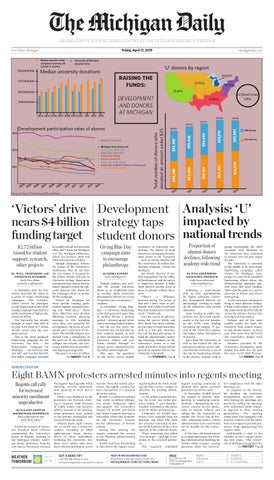
‘Victors’ drive Development Analysis: ‘U’ impacted by nears $4 billion strategy taps funding target student donors national trends $2.72 billion raised for student support, research, other projects By WILL GREENBERG and GENEVIEVE HUMMER Daily News Editor and Daily Staff Reporter
In November 2013, the University launched the latest in a series of major fundraising campaigns. This initiative, called Victors for Michigan, set the largest goal of any fundraising campaign launched by a public institution of higher education: $4 billion. The University has already brought in more than half of its goal, with about $2.7 billion already raised since the campaign started. This is the third landmark fundraising campaign for the University. The first — the billion-dollar Campaign for Michigan — ran between 1991 and 1997 and was the first billion-dollar campaign launched
by a public school. Between that effort and Victors for Michigan was The Michigan Difference, which ran between 2000 and 2008 and raised $3.2 billion. Though campaigns refocus the energy of the University’s fundraisers, they do not alter the way money is accepted by the school. Donors still give to whichever college, department or program they choose, but any money donated within the officially denoted time frame for the campaign counts as money for the campaign. Victors for Michigan set three specific funding goals: student support, engaged learning and “bold ideas.” These three objectives were decided following extensive planning meetings in 2011 including Jerry May, vice president for development, the deans of each school and a collection of students. The $4 billion figure was derived from a compilation of the goals set by the individual colleges and schools, the University Health System and other non-degree granting units. The goal is to raise $1 billion See TARGET, Page 3
Giving Blue Day campaign aims to encourage philanthropy By EMMA KINERY Daily Staff Reporter
Though students may envision the average University donor as an established alum or wealthy adult, University development officers are trying to tap into a new constituency — students. In December, Giving Blueday — a University fundraising event that generated more than $1 million during a 24-hour period — devoted special attention to reaching student donors. For the last five years, the University has tracked data on how students donate, as well as their knowledge of how the University collects and uses funds, namely through an annual survey administered by the Office of Development. This year, the questions on the survey access student
awareness of University fundraising, the impact of small donations and ongoing development events at the University — such as Giving Blueday and the University’s $4 billion fundraising campaign, Victors for Michigan. Kat Walsh, director of student engagement for the Office of Development, said the survey is important because it helps them identify specific areas of focus to prompt student donations. “There’s a difference between saying ‘I’m aware of that and I don’t want to participate’ and ‘I didn’t even know that that existed and I wish that I had,’ ” Walsh said. Over the course of administering the survey, Walsh said she’s found that more students see the value in small donations, such as a $20 gift. However, she said the data also points to room for improvement, including educating students on the University’s status as a non profit institution. Walsh said 40 percent of students believe the University is for profit. See STUDENTS, Page 3
Proportion of alumni donors declines, following academy-wide trend By WILL GREENBERG and RACHEL PREMACK Daily News Editor and Daily Staff Reporter
Following a multi-decade slide in state appropriations for higher education, University development officials are increasingly working to make up the difference with private donations. State funding to public universities has decreased significantly in the last few decades. In the 1970s, state funding accounted for roughly 75 percent of the University’s operating budget. Today, that figure is 16 percent. Data from the University, as well as the Council for Aid to Education national survey, indicate that the University is one of the top 20 fundraising schools in the country. Despite a dip in
giving surrounding the 2008 recession, total donations to the University have continued to increase over the past couple decades. The University is currently in the middle of its sixth major fundraising campaign, called Victors for Michigan. Campaigns are a period of redoubled fundraising efforts where the administration identifies specific areas that need funding. Those specific goals are used to advertise to donors and attract more giving. As the University continues to bring in more donation dollars, it finds itself subject to many of the same trends faced by schools across the country that are also turning to private money. Perhaps one of the most notable trends has been the transition from alumni donors to non-alumni donors. In fiscal year 2014, more than half of all the University’s donors were non-alumni. Numbers provided by the University’s development office display this shift over the past five years. In FY 2010, 53.4 perSee TRENDS, Page 2
ADMINISTRATION
Eight BAMN protesters arrested minutes into regents meeting Regents call rally for increased minority enrollment unproductive By ALLANA AKHTAR and MICHAEL SUGERMAN Daily Staff Reporter and Daily News Editor
Within 30 seconds of University President Mark Schlissel commencing the University’s Board of Regents meeting in the Michigan Union’s Anderson Room, protesters from By Any Means Necessary stormed
WEATHER TOMORROW
HI: 71 LO: 39
the regents’ meeting table while shouting, “On-site admissions now; open up, or we’ll shut it down.” Tables were displaced as the protesters ran forward, drawing a response from Division of Public Safety and Security officers present at the meeting. Some protesters were tackled to the ground, handcuffed and escorted from the room. Officers made eight arrests, one of which was a University student, according to DPSS spokesperson Diane Brown. Seven of these individuals, including the University student, were adults who have been released pending an arrest
warrant from the county prosecutor. The eighth, a minor, has been transported to a juvenile detention center. BAMN is a national coalition that works to defend affirmative action, immigrant rights and equality. The University’s chapter of BAMN previously shut down a regents meeting in November, where they demanded the University exercise on-site admissions at Detroit schools. During that meeting, the regents relocated the session to the Fleming Administration Building. BAMN had been threatening to shut down the regents meet-
GOT A NEWS TIP? Call 734-418-4115 or e-mail news@michigandaily.com and let us know.
ing throughout the week, handing out fliers across campus to advertise the pending demonstration. As the police responded during the event, one fallen protester yelled, “I can’t breathe.” Another screamed at the police to let her fellow protesters go. Ultimately, all BAMN protesters were expelled from the meeting, and those who were not arrested continued to protest in the hallways of the Union adjacent to the Anderson Room. Those remaining also yelled “Let them go” — perhaps in reference to the arrested protesters. The regularly scheduled
NEW ON MICHIGANDAILY.COM Researchers study toxi species in Lake Erie MICHIGANDAILY.COM/SECTIONS/NEWS
INDEX
regents meeting continued as planned after police escorted protesters out of the room. In November, BAMN forced the regents to relocate their meeting by employing similar methods — demanding the University exercise on-site admissions at Detroit schools and calling for the University to employ the “Texas Top 10 Percent” admissions policy, which administrators have said would not be feasible for the University. At the time, the board moved to a closed meeting in the Fleming Administration Building for “public safety reasons,” raising questions about the Universi-
Vol. CXXIV, No. 105 ©2015 The Michigan Daily michigandaily.com
ty’s compliance with the Open Meetings Act. In response to the November incident, the University strengthened security measures during the meetings, primarily by staffing the meetings with uniformed DPSS officers as opposed to those wearing plainclothes. The meeting rooms were also equipped with security cameras and the tables were rearranged to prevent protesters from approaching the regents’ table. Additionally, a sign in the entrance to each regents meeting now reads, “The University of Michigan recognizes the See PROTEST, Page 3
NEWS.........................2 OPINION.....................4 ARTS....................5
SPORTS......................7 SUDOKU.....................2 CLASSIFIEDS...............6
The Michigan Daily — michigandaily.com
2 — Friday, April 17, 2015
MONDAY: This Week in History
TUESDAY: Campus Voices
WEDNESDAY: In Other Ivory Towers
THURSDAY: Twitter Talk
FRIDAY: Photos of the Week
420 Maynard St. Ann Arbor, MI 48109-1327 www.michigandaily.com JENNIFER CALFAS DOUGLAS SOLOMON
Editor in Chief 734-418-4115 ext. 1251 jcalfas@michigandaily.com
Business Manager 734-418-4115 ext. 1241 dougsolo@michigandaily.com
Newsroom
News Tips
734-418-4115 opt. 3
news@michigandaily.com
Corrections
Letters to the Editor
corrections@michigandaily.com
tothedaily@michigandaily.com
Arts Section
Editorial Page
arts@michigandaily.com
opinion@michigandaily.com
Sports Section
Photography Section
sports@michigandaily.com
photo@michigandaily.com
Display Sales
Classified Sales
dailydisplay@gmail.com
classified@michigandaily.com
Online Sales
Finance
onlineads@michigandaily.com
finance@michigandaily.com
EDITORIAL STAFF Lev Facher
Managing Editor
Sam Gringlas
lfacher@michigandaily.com
Managing News Editor
gringlas@michigandaily.com
SENIOR NEWS EDITORS: Shoham Geva, Will Greenberg, Amabel Karoub, Emma Kerr, Emilie Plesset, Michael Sugerman ASSISTANT NEWS EDITORS: Anastassios Adamopoulos, Tanaz Ahmed, Neala Berkowski, Alyssa Brandon, Nabeel Chollampat, Genevieve Hummer, Emma Kinery, Lara Moehlman, Carly Noah, Irene Park
More Photos of the Week online
LEFT Ann Arbor resident Paul Majar makes bubbles at the Fool Moon event on Washington Street on Friday. (Robert Dunne/Daily) RIGHT Mimes Kyle Watts and Jenny Choate perform during the Festifools parade on Main Street on Sunday . (Connor Bade/Daily)
Aarica Marsh and Derek Wolfe Editorial Page Editors
opinioneditors@michigandaily.com
SENIOR EDITORIAL PAGE EDITORS: Claire Bryan and Matt Seligman ASSISTANT EDITORIAL PAGE EDITORS: Regan Detwiler, Michael Paul, Melissa Scholke, Michael Schramm, Mary Kate Winn BLOG EDITOR: Tori Noble
Max Cohen and Jake Lourim Managing Sports Editors
TARGET From Page 1 cent of the 103,753 donors giving less than $25,000 were alumni; last year only 44.6 percent of the 119,168 donors were alumni. This is significant given the fact that the majority of donors give within this range. Additionally, over the past decade the University’s alumni participation rate has declined. While total donations have continued to rise, the percentage of alumni that donate each year decreased from 15.2 percent in 2005 to 9.9 percent in 2014. Michigan is not alone in this trend. In fact, nearly all schools in the Big Ten have seen a decrease in alumni participation since 2004, with the average dropping from 13.8 percent to 10.1 percent over 10 years. Megan Doud, director of the University’s Annual Giving program, spends most of her time looking at these numbers. Doud explained that the University has focused more attention on groups affiliated with the University who are not necessarily alumni. In particular, individuals tied to non-degree granting units —
STUDENTS From Page 1 She said the development team sees value in collecting the data because it helps them understand ways to better inform students on the importance of philanthropy. “We know that a lot of students are unaware of the roles that private philanthropy plays at the University, and how private philanthropy impacts students experiences,” Walsh said. “It’s really important for us to understand what students are aware of, what they’re not aware of, what their opinions are because it’s important to us to develop programming that will help benefit students’ education and their involvement in philanthropy.” During the Giving Blue Day fundraiser, students were encouraged to donate to University units, including student organizations, to receive matching gifts from private donors. About 80 student organizations fundraised more than $157,000. The top five fundraisers were Dance Marathon, the Michigan Marching Band, the Medical
such as the hospital, libraries, botanical gardens and others — have been an increasing source of funds. “A shift to broader perspective on population and then more emphasis on these areas that are really more community-based, or almost more like a separate nonprofit even though they’re from the University of Michigan, has really increased that nonalumni support,” she said. Tom Baird, assistant vice president of development and campaign strategy, said some donors within that category are also attracted to the “marketable” work done at the hospital. The prospect of curing a disease is particularly enticing to donors, he said, and is able to attract donors with little prior connection to the University. “Research is huge,” Baird said. “People make gifts to help facilitate patient care; there’s a whole variety of things people can give to.” Doud added that this year’s Giving Blue Day also played a large role in donation totals for the year. Of course, alumni still provide a large portion of the donation base. Of the University’s total alumni,
School’s Student-Run Free Clinic, Alternative Spring Break and MUSIC Matters. Though student donors may have been most prominently featured during Giving Blue Day, Walsh said student donors have long contributed to the University’s development efforts. Walsh’s job is to help student organizations fundraise, and in particular, help them appeal to potential student donors on campus. “Donors range from undergrad to doctoral students, and are representative of the various passions that exist across the campus,” she said. For many students, she said the incentive to donate stems from their interest in the work of the student organizations. “Everyone can’t take care of patients themselves, but they can make a gift that will make that happen,” Walsh said. “They may not be able to go fix up houses in the inner city, but they can support an organization that can do that. That’s what all of our donors do: they make things happen, and our students realize that they can make things happen through philanthropy whether as donors or whether as fundraisers, and,
46.3 percent have given at least once in their lifetime. Of those who have donated, 39.9 percent live in Michigan. California holds the next largest group of donating alumni with 8.17 percent; Illinois has 5.52 percent, New York 4.77 percent and Florida 3.42 percent. By region, the Northeast holds 18.15 percent of donating alumni, the West 15.41 percent. Additionally, according to Judy Malcolm, senior director of executive communications in the Office of University Development, the University has a 70 percent donor retention rate — meaning 70 percent of donors from the previous year gave again. Malcom said this is the highest retention rate in the Big Ten. Further examination of the University’s donation data by the Daily shows the school ranks among the highest in the country in terms of total dollars raised. Since 2004, the earliest year data was available from CAE, the University’s alumni donation totals has placed it in the top 20 amounts of all colleges, except for 2011. The University’s donations have increased by almost 71 percent since
in some cases, both.” However, many organizations find it difficult to track the amount of student donations they receive each year because of the various ways that they raise money, in addition to the fact that most do not keep track of how much specifically students donate. LSA junior Macauley Rybar, the external director of Dance Marathon, said the organization often faces a similar problem. Because of the way DMUM is set up, where dancers are personally responsible to meet an individual funding goal of $300, he said there is really no way to track who donates what amount. In contrast, Giving Blueday provided them the unique opportunity to track donations because the student-donated funds were matched. “The first time we received anything close to (trackable funds) was on Giving Blueday of this year, because we were able to track student donation due to the student matching funds available for student organizations,” Rybar said. Some student organizations also allow students to donate directly to other students, as opposed to external causes or activities. MUSIC Matters, founded in 2011, holds an annual charity concert each year as well as SpringFest. Together, the events raise money to not only bring in popular artists, but to give back to various aspects of the University community. In their first year, the group raised $10,000 to donate to Mott Children’s Hospital. In their second year, they raised $50,000 to create a need-based scholarship for in-state students entering the University. For the past two years, the organization allocated donations toward the creation of a camp for underserved Detroit youth. MUSIC Matters President Darren Appel, a Business senior, said the group employs a twotiered approach: continuing to support the scholarship, while also supporting a separate cause each year. See STUDENTS, Page 3
2004, whereas the median donation total for the top 20 has increased by 61 percent. Ann E. Kaplan, the Voluntary Support of Education survey director of CAE, said while alumni participation is generally declining across the country, average gift sizes are increasing — this year by 7 percent. Kaplan said public institutions are increasingly joining the ranks as top fundraisers. She added that while public universities have had to catch up to private schools, which have historically relied more on philanthropy for funding, all large schools have the capacity to become top-tier fundraisers. “A lot of the increase in giving in this particular year was due to a resurgence of major gifts for positions of wealth,” Kaplan said. “So that’s where you might see fewer donors but you’ll see more contributions at greater values.” The Daily’s data analysis focuses on 2013, the latest available year. The University was 14th highest in donations that year, bringing in more than $351 million. To understand how difSee TARGET, Page 3
sportseditors@michigandaily.com
SENIOR SPORTS EDITORS: Max Bultman, Daniel Feldman, Rajat Khare, Erin Lennon, Jason Rubinstein, Jeremy Summitt ASSISTANT SPORTS EDITORS: Chloe Aubuchon, Minh Doan, Jacob Gase, Kelly Hall, Zach Shaw, Brad Whipple
Adam Depollo and Chloe Gilke Managing Arts Editors
adepollo@michigandaily.com chloeliz@michigandaily.com
SENIOR ARTS EDITORS: Jamie Bircoll, Kathleen Davis, Catherine Sulpizio, Adam Theisen ARTS BEAT EDITORS: Alex Bernard, Karen Hua, Jacob Rich, Amelia Zak
Allison Farrand and Ruby Wallau Managing Photo Editors
photo@michigandaily.com
SENIOR PHOTO EDITORS: Luna Anna Archey and James Coller ASSISTANT PHOTO EDITORS: Amanda Allen, Virginia Lozano, Paul Sherman
Emily Schumer and design@michigandaily.com Shane Achenbach Managing Design Editors Ian Dillingham Magazine Editor statement@michigandaily.com DEPUTY MAGAZINE EDITORS: Natalie Gadbois STATEMENT PHOTO EDITOR: Luna Anna Archey STATEMENT LEAD DESIGNER: Jake Wellins
Hannah Bates and Laura Schinagle Managing Copy Editors
copydesk@michigandaily.com
SENIOR COPY EDITORS: Emily Campbell and Emma Sutherland
Amrutha Sivakumar
Online Editor
amrutha@michigandaily.com
Kaylla Cantilina Managing Video Editor Carolyn Gearig Special Projects Manager
BUSINESS STAFF Madeline Lacey University Accounts Manager Ailie Steir Classified Manager Simonne Kapadia Local Accounts Manager Olivia Jones Production Managers Jason Anterasian Finance Manager
The Michigan Daily (ISSN 0745-967) is published Monday through Friday during the fall and winter terms by students at the University of Michigan. One copy is available free of charge to all readers. Additional copies may be picked up at the Daily’s office for $2. Subscriptions for fall term, starting in September, via U.S. mail are $110. Winter term (January through April) is $115, yearlong (September through April) is $195. University affiliates are subject to a reduced subscription rate. On-campus subscriptions for fall term are $35. Subscriptions must be prepaid. The Michigan Daily is a member of The Associated Press and The Associated Collegiate Press.
ALLISON FARRAND/Daily
LSA juniors Michelle Shumunow and Polina Fradkin read a prayer at Conference on the Holocaust’s annual Reading of the Names ceremony on the Diag Wednesday evening.
Students hold vigil on Diag for Holocaust Remembrance Day Closing ceremony features prayer of mourning, remarks from survior By ALYSSA BRANDON Daily Staff Reporter
In honor of Yom HaShoah, the National Holocaust Remembrance Day, students gathered on the Diag on Wednesday and Thursday for an annual 24-hour reading of the names of those killed during the Holocaust. Members of Hillel’s Conference on the Holocaust invited passersby to read quotes from several Holocaust survivors while student volunteers read a number of victims’ names every hour. The event also featured a special ceremony Wednesday evening, in which student volunteers sang traditional Hebrew songs and prayers. Students who attended the ceremony also lit six candles in honor of the 6 million Jews killed during the Holocaust. Two COTH volunteers additionally shared stories of family mem-
bers who survived the Holocaust. LSA freshman Shira Kitay, COTH’s assistant survivor relations chair, shared her grandfather’s story, involving how he and his family went into hiding after the Nazi’s invaded Poland. “My grandfather barely evaded death in so many instances,” she said during the ceremony. “His story is one of strength, perseverance and a lot of luck.” In an interview following the event, Kitay said talking about the Holocaust is important in keeping the testimonies of survivors alive. “The Holocaust is the biggest failure of humanity,” she said. “It’s important to carry on these stories, especially since we are the last generation that will hear them from survivors.” Kitay also said talking about her grandfather’s struggle is a way for her to honor his determination to survive. “He suffered through all that so we could have a family,” she said. “I’m here today because my grandfather persevered. I would not be alive if he had given up.” In the closing ceremony of the vigil Thursday afternoon, Holocaust survivor Irene Butter spoke to
students about ongoing Holocaust Remembrance projects in Europe. Butter, who is also a professor emerita in the School of Public Health, was 12 years old when she was taken from her home in the Netherlands and sent to work in two concentration camps. She was 14 when she was liberated. During the ceremony, Butter stressed the importance of honoring the lives lost during the Holocaust. “When these people were murdered, they were not given a proper burial, and their names and identities were lost,” she said. “We depend on you, the future generations, to tell these stories and read the names.” In an interview after the ceremony, Butter said she returns to the University to share her story and teach the younger generations lessons from the Holocaust. “It’s not just important that they learned what happened, but it’s important that they also learn the lessons,” she said. “You can’t be a bystander, because we have to be vigilant about stopping and preventing discrimination and oppression any types of inequality because people are all the same.”
News
The Michigan Daily — michigandaily.com
PROTEST From Page 1 right of dissent, but we also recognize the right of speakers to be heard.” “I certainly respect the right of the group to speak up and tell us their opinion about something important,” Schlissel said in an interview with The Michigan Daily after the November meeting. “I’m disappointed that they chose to disrupt the meeting, but we were able to conduct the business of the University in this separate venue as needed.” Toward the end of the Thursday’s regents meeting, both Schlissel and a number of regents expressed their frustration with the protest. Regent Mark Bernstein (D), who previously served as the chair of the Michigan Civil Rights Commission and helped established the Michigan Civil
Rights Academy, said the protest did a disservice to the cause of diversity on campus. “On a personal level, I am deeply frustrated and disappointed in some of our students and other people, not because it was moderately disruptive, but because they are so misguided and damaging an important cause,” he said. Black undergraduate enrollment at the University has hovered around 4 percent in recent years. Aside from BAMN, other groups have lobbied for increased diversity on campus. In January 2014, members of the University’s Black Student Union called on the University to address undergraduate minority enrollment, among other issues. In addition to campus activism, the BSU has opted to work with administrators to implement changes, whereas BAMN has largely focused on protest. In November, E. Royster Harper,
vice president for student life, said BAMN had not attempted to schedule a meeting with University officials. Regent Andrea Fischer Newman (R) said she, too, was disappointed in the protest and added that BAMN’s demonstration turned the narrative away from important issues. “I don’t think rushing the table and storming the meeting helps make the point,” she said in an interview after the meeting. Schlissel echoed this sentiment, calling for constructive dialogue and plugging the launch of a University-wide diversity plan. Schlissel has said he plans to announce details in the fall. “I hope we continue to work together to construct some civil discourse and constructive action,” he said. “The University’s commitment to diversity does not waver.”
TRENDS From Page 2 ferent factors correlate with donations, the analysis compares donations with each of the 20 college’s U.S. News and World Report rankings, holistic sports ranking and student body. One area lacking variance was academic prestige; almost all schools on this list are renowned for their scholastic and research excellence. U.S. News and World Report ranking of each school was measured to assess the school’s academic quality. These rankings account for undergraduate academic reputation, student retention, faculty quality and other features. Being a top-20 fundraiser puts the University among the company of schools with higher academic rankings. The median U.S. News ranking for a top 20 donor school in 2013 was 14, comparable to Cornell or Northwestern. The University is 29th — the 15th lowest among the top 20 donors. Most schools with lower academic rankings were in the bottom half of the top 20 list. Six of the top 10 donor schools were also in the top 10 of U.S. News rankings — such as Harvard University and the University of Pennsylvania — while only two of the bottom 10 schools were in U.S. News’ top 10.
STUDENTS From Page 2 ANDREW COHEN/Daily
Members of By Any Means Necessary (BAMN) protest for increased minority enrollment outside of the Board of Regents meeting at the Michigan Union on Thursday.
TARGET From Page 1 for student support — financial aid, scholarships, fellowships, internships and travel funding. The University already directs considerable funds toward student support. During the 20132014 academic year alone, the University awarded more than $900 million in financial aid to 32,133 students. So far, $450 million has been raised for scholarships alone during the Victors for Michigan campaign. A number of factors make it difficult to predict exactly where that money will go. For one, most donors specify exactly what specific school, program or fund they want their money going toward. Further, many donations are paid over a period of time, meaning the University might not receive the full amount for several years. For their part, the students have been involved in Victors for Michigan since the beginning. During the campaign’s original planning, a student committee joined the deans and other administrators to help craft the campaign’s three goals. Like the fundraising campaign, the Central Student Government has also worked to provide student support during the past year. Former CSG President Bobby Dishell, a Public Policy senior, attempted to fund a LEAD scholarship — a merit-based scholarship for minority students — through the Alumni Association in the fall. The effort ultimately fell through because of Proposal 2 restrictions in Michigan, which prevent the school from giving scholarships based on race. Still, recently elected CSG President Cooper Charlton, an LSA junior, said he wants to work closely with administrators to pursue other creative avenues to increase student support. Charlton said he plans to learn more about fundraising and work closely with administration on this issue. “Are we creatively thinking of different ways to find scholarships, to decrease tuition? Yes; kind of one of those longer conversations I will be having over the summer to really, really nail down some target ideas,” Charlton said. In addition to student support, another goal of the campaign is to attract donations for faculty research. To that end, deans of each school have been marketing their research projects to potential donors as part of the campaign. These projects are generating interest even among
non-alumni donors — a group that, in recent years, has grown larger in number than the alumni donor base. Deborah Loewenberg Ball, dean of the School of Education, said she wants funding for the school’s work in improving K-12 education in the state and elsewhere. Programs like the Center for Education, Design, Elevation & Research have attracted the support of non-alumni, Ball said, and people are excited to see the results the School of Education can produce. “It’s been a moment, I think, of opportunity for people working in education that there are people interested in giving money,” she said. James Woolliscroft, dean of the Medical School, and Dave Munson, dean of Engineering, said because faculty of both schools work so closely on research, neither of them mind which of the two schools donors give to since it’s all going to the same place. This notion resulted in a fundraising partnership between the College of Engineering and the Medical School “Maybe it’s in an account that’s controlled by engineering, maybe it’s in an account that’s controlled by medicine, maybe it’s in an account that’s controlled by the vice president for research,” Munson said. “We don’t really care as long as it in some way benefits our faculty and our students and I think it’s a somewhat new way of thinking about this.” “Dave and I did a little presentation to literally a room full of interested attendees and donors. One of the stories told was about the tracheal splint,” Woolliscroft said, referring to the 3-D printed device used to save a baby’s life two summers ago. “It’s that sort of thing that’s very real, very powerful and can’t be done by either school alone.” The Medical School has also worked closely with UMHS in its fundraising efforts. Tom Baird, who serves as the interim associate vice president for medical development and alumni relations, said the hospital is a major attraction for non-alumni donors. He said a large portion of the donor base comes from former patients hoping to give back to the hospital after treatment. “You have grateful patients where they had a family member, or friend, or some type of relationship where the health system helped them and they just feel so strongly about the care that they received that they want to make a gift to support that area,” he said. The Victors for Michigan campaign relies on a broad network
of volunteers and donors. Volunteers are charged with hosting fundraising events, participating in campaign meetings and advocating for the University’s initiatives, among other tasks. University alum Mary Petrovich wrote in an e-mail that she has participated in a wide range of volunteer activities. “I have been involved in possibly the deepest and most diverse sets of activities of any volunteer in terms of my time and money,” she wrote. “I currently serve as a member of the President’s Advisory Council, but that is the tip of the iceberg.” Petrovich has donated funds to support the construction of a new mechanical engineering building and an engineering scholarship and recruiting program, as well as the softball and men’s basketball locker rooms. She plans to support projects to improve gastroenterology care in the coming year. “Michigan means so much more to me as the springboard for my success given the underprivileged background that I came from and the confidence I derived from my four years of success at Michigan,” she wrote. “My life has been enriched by the many lessons that I have learned in the classroom and on the playing field. Those experiences have been priceless and formidable building blocks to my career success.” University alums Laura McTaggart and Tom Nolan, campaign volunteers who each earned graduate degrees from other universities, wrote in an e-mail their undergraduate experience at the University motivated them to support the Victors for Michigan campaign. “Michigan plays a much bigger role in our philanthropy because for us, the undergraduate experience was so important and lifechanging,” they wrote. “We are strong believers in public education and the mission of great public schools. In addition, our graduate school experiences did not include watching football and singing a rousing fight song every Saturday surrounded by over 100,000 like-minded souls. That’s the community we want to stay a part of.” McTaggart and Nolan cited the need to improve the affordability of higher education as their motivation for getting involved with the campaign. “We want to help students afford college, period,” they wrote. “We both had help getting through school and this is our way of paying that back.”
“When you endow a scholarship at U of M, the money you donate goes into the investment fund at the University, and the interest made off of that gets donated each year,” Appel said. “The first year will be just one student, but our plan longterm is to keep donating. We’ll have a major cause each year for the concert, but then as we keep growing and making more money, we can keep dumping money into the fellowship each year, so it will keep growing.” However, regardless of family wealth, many students report finding themselves without extra money to donate. First-year Medical student Molly Laux, who heads outreach and public relations for the Student-Run Free Clinic, said the donations are even more meaningful when students with limited funds still choose to give back. “Even when they are small donations, we feel really privileged to receive them,” she said. “I think that because of that, it makes us work very hard to make sure that student voices are heard in things that we do, and for that we always try to make sure that we can keep as many volunteer positions open as possible, get as many students in. We bring students in as interpreters sometimes. We understand that when students do give us that extra money that they maybe saved for a few days or a few weeks, that we really do our best to make sure that we can do something in return.” Laux added that by donating their time as well, students have an enhanced chance to see the importance of their contributions. “When the students are able to come in and kind of see where their money goes, they can see our patients and see how grateful they are for the services that we provide,” Lauz said. Not only does that make them feel proud of the donation that they originally gave, but I think that gives them a greater incentive to donate more when they can.” Most donations to the Stu-
follow us @michigandaily
Friday, April 17, 2015 — 3 Finally, notable differences exist among public and private colleges. Eight public schools were on the top 20 list, and all were in the bottom 10. Their U.S. News and World Report median score was lower, and their athletic score tended to be higher. The median public school donation in 2013 amounted to $338 million as opposed to $490 million for private schools. Among public schools, the University’s donation amount in 2013 was 4 percent higher than the median public school, but 28 percent lower than the median private school amount. That could signify that the University, despite its lowered state appropriations, still has more in common with public rather than private schools when it comes to funding. As state funds have experienced declines over the past couple decades, the University has had to reevaluate the role of state and private money. Still, Jerry May, vice president for development, said while it’s “conceivable that for some reason (the University) decides to ‘go private’ ” somewhere down the line, there is no point in exploring that route right now. He said the idea was discussed decades ago, but is not a topic today. May explained that any money coming from a source like donations can be used to help fund operating costs like scholarships, which frees up
state funding for other areas. The state of Michigan currently only provides 16 percent of the University’s general fund budget, which May described as an unrestricted endowment. Malcolm said the University would need an additional $700 million added to the current $9.7 billion endowment to offset the loss of state funding if it were to indeed go private. May said the reason private money has become so important is because of the University’s increased efforts to provide scholarships. He said scholarships should help slow the increases in tuition rates, and that the University has made a dent in that effort over the past few years. “We put our first amount of money on in-state tuition for in-state students. We now can guarantee that we will meet the need of an in-state student,” May said. “We’re probably $12,000 short per-student to be able to meet the need of an outof-state student.” Still, May said, given the status of state appropriations and the financial goals of the University, the development office will be full steam ahead for the foreseeable future. “We will always need buildings, we will always need to replace buildings,” May said. “We will always have new program ideas and technology will change us so that we’re teaching you something different.”
dent-Run Free Clinic go toward renting out the space for their medical center; the rest funds equipment, medications and other supplies. The organization raised $13,528 on Giving Blueday. Laux said she attributed much of that to the work of the Office of Development, noting the ability to work both with Walsh’s team and another specifically for medical students. “They’ve been such a great help,” Laux said. “(They) helped me figure out what the best ways of strategizing the posts, and she helped me find personal stories we could use, and helped me find the most effective means of transmitting information in time, drawing attention to our e-mails. They were completely fantastic.” Business senior Kimberly Cui, finance and fundraising team leader for Alternative Spring Break, also noted the advantages of having access to Office of Development resources. “(Walsh) and her team are definitely really helpful,” she said. “They’re really open to meet up with even student organizations about fundraising ideas and kind of the best way to fundraise. We’re definitely hoping to work more with them in the future.” MUSIC Matters also works closely with the Office of Development. “Our model is more teaching students how to fundraise as a whole,” Appel said. “We do a lot of fundraising at the University, we reach out to corporate sponsors, we have a lot of students learning how to make a pitch book, learning how to present an idea to a corporation, things like that.” In the future, Walsh said her team is interested in continuing to work with organizations through initiatives like Giving Blueday. In this year’s version of the annual student survey, two questions were added specifically on Giving Blueday with the
aim of improving involvement next year. In addition, University representatives met with student organizations to garner feedback after the event. “What we learned from our sessions with student orgs was they thought the energy of the day was really great,” Walsh said. “They felt that the training and the resources that we provided was really great, and they loved the challenges. Some of the things they felt we could improve on are, for instance, making sure that our training is available online, because they come and attend and they want to share it with members of their organizations.” Cui also noted the importance of students developing a habit of donating early on. “For us, it’s almost more important that students are giving,” Cui said. “We really value their donation, because when you start while you’re in college, you really care about the issue, you want to be active about that issue in the community. So for us, starting young, it shows that you’re passionate about the issue, you’re empowered to support programs that you believe in, and then we also believe that if you start now, the likelihood that you’ll continue to be involved in the future is a lot higher.” Cui said the majority of ASB funds go toward the vehicles that are used on the trip, but the funds are also used to cover housing for volunteers as well as gas. Appel said student donations not only play an important role in University development, but also provide chances for students to contribute to the University community. “As a whole, there’s a really great opportunity for students too,” he said. “It doesn’t matter how much they donate, but being able to donate and give to a cause, I think it’s important for the University and it just leaves people with a good feeling.”
Opinion
4 — Friday, April 17, 2015
Edited and managed by students at the University of Michigan since 1890. 420 Maynard St. Ann Arbor, MI 48109 tothedaily@michigandaily.com JENNIFER CALFAS EDITOR IN CHIEF
AARICA MARSH and DEREK WOLFE EDITORIAL PAGE EDITORS
LEV FACHER MANAGING EDITOR
Unsigned editorials reflect the official position of the Daily’s editorial board. All other signed articles and illustrations represent solely the views of their authors.
SAM MYERS | VIEWPOINT
Don’t be afraid to criticize the police
Michael Brown. Eric Garner. Now Walter Scott. With yet another instance in which a white police officer has killed an unarmed Black man, and amid growing concerns about racial tensions between citizens and police and the Department of Justice’s report that found the Ferguson Police Department to be guilty of sustaining systemic racism, it is safe to say that we have reached a crisis in our country. Simply put, on average, we have overwhelmingly white police departments in charge of protecting communities of color. But they don’t seem to be doing much protecting. As an undergraduate here, I took courses in American history and Black studies primarily. My thesis was on the 1967 Detroit “riot.” I put quotation marks around “riot,” because my research concluded that the civil unrest and violence in 1967 transpired because of police agitation and abuse, and longstanding racial divides and hostility between the 95 percent white department and the more than 50 percent Black citizenry. This is a view shared by many in the fields of Black studies and American (especially Detroit) history. In fact, Illinois Gov. Otto Kerner and the other 10 members of the investigative commission, whom President Lyndon Johnson charged with understanding the bloody conflict in Detroit, initially forwarded this view in 1967. The racial divide in Detroit, between the white police officers with guns and the Black citizens generally without them, was potent enough to cause a conflict that resulted in tens of deaths and millions of dollars in damage. The police department in Ferguson is disproportionately white. According to The New York Times, the police department in North Charleston is 80 percent white while the population there is 47 percent Black. Historically speaking, it is not all that surprising that there are instances of extreme violence in these places. The fact that this has continued, more than 50 years after the Kerner Commission pointed out this problem, is incredibly difficult to stomach. What are we to do? First, it is probably best to have this discussion and to point out the consistencies in these police-caused conflicts. Hopefully, that can bring about an effort to construct police departments that
more accurately reflect the constituencies that they’re intended to protect. Police need to be familiar with and respectful of their communities — not afraid, like Eric Garner’s killers admitted to being. There must be more of an emphasis on community policing. But second, and because that first movement will take a long time to implement (assuming people are on board), it is important that we learn to assess, criticize and hold accountable our police departments. Evident in the endless acquittals and notguilty verdicts in Garner and Brown’s cases — don’t forget that George Zimmerman was found not guilty — the police simply have too much power with too little oversight. And really, who can hold the police accountable? I’ve had interactions with police, and during them all I’ve felt totally powerless and at the mercy of someone who clearly felt superior and like he had total authority over me. I can only imagine what it must be like to be a Black man interacting with a white police officer. Not only do the police assume authority and superiority over Black people — especially men — but they assume legal use of lethal force with impunity. Walter Scott’s case, for which the police officer is charged with murder, is an exception for now — we shall see what verdict comes — but there is too much evidence on the other hand. And people continually and unequivocally come to the defense of police departments in this country, as if they, the ones with guns, are the people in danger, and not the people, overwhelmingly Black, who are shot and killed daily it now seems. Police do take great risks in their jobs, but it increasingly seems that they are not more at risk than people. There are no police for the police, only we, the people. If we do not speak up against police misdeeds — which are often criminal misdeeds — and wrest some of the power that they hold, then instances like these will continue. If they continue, it will not only be a blemish in the history of the United States, but it will be a piece of evidence in the argument that our great nation is descending into the likes of a police state.
Advice on defining your own success and quieting the self
O
n April 11, New York Times columnist David Brooks wrote a piece called “The Moral Bucket List.” In it, he alludes to the unfulfilling nature of external achievement. In other words, career success, recognition and money have ABBY afforded him little TASKIER depth of spirit. The timing of this piece feels oddly perfect in that, as a senior embarking upon who knows what, I find myself incapable of defining what I want success to mean. Success is subjective, but as we know it, it is defined by environment. And I can say, having been in a university environment for four years, that success in this environment is defined in terms of external achievement. I believe that in order to achieve personal success, a success defined by you and only you, you must distance yourself from preconceptions, from the notion that to be happy is to be the best. What I’ll pose now is a distillation of life advice I’ve absorbed from friends, family, teachers, books and from myself in times of needed self-assurance. Hopefully, what this compilation of both generic and what I believe to be original advice will do, is remind you that the formation of a good and honest self is what will aid you in your definition of success. And that success, the kind that comes from the inside, as Brooks suggests, is the kind that makes you happy. Maybe not happy as we know it, but happy in deeper terms. Happy to be living. Worthy of our lives. 1) You are not special. I have to say, I don’t like this one. I’m sure you have heard it before and have decided that it doesn’t apply to you because you are, in fact, special. Well, that’s just the point. You are special, and so am I, and so is your neighbor, and so is your super annoying classmate. We’re all special in our own rights, and therefore none of us are. Our grandparents’ generation was taught to think that they were just cogs in a machine, and we, unlike that generation, have been taught to think that sunshine comes out of our asses. In the crudest of terms, you have to make the
Africa isn’t a spectator sport
You have seen the images and heard the stories. You may have liked these posts or posted a few statuses of your own. Unbeknownst to you, you’re supporting a dehumanizing production — the exploitation of human narratives, the perpetuation of suffering, the continuation of neo-colonialism — the white-savior industrial complex. I entered a community that was not my own without invitation. I “helped” myself to the people — bought more kente cloth than my bag could hold, ate more jollof than I could actually stomach and cried for every child I deemed neglected, impoverished or underprivileged. I was the unconscious and yet unconscionable oppressor; ignorant to the way I imposed my beliefs on the community I desired to help. I had honest intentions, truly, but I didn’t fully understand the history of humanitarian aid and development like I do now. I am now beginning to see the correlation and resulting parallels between historical Western aid programs in the Global South and my own summer trip. The staging of voluntourism images is reminiscent of colonial photography. Melanie Tanielian, a human rights scholar, discussed the dangers of colonial images and their attempt to convey “the scope of humanitarian activity on the ground.” She argued that human aid has turned abstract bodies into a nameless source and only particular individuals have the privilege of being named. The same framework is present in images uploaded by volunteers. How many uploaded photos include the names of all photo participants? Think of the children who go nameless — leaving only their eyes to speak. Why must they continue to go unacknowledged? Just as Tanielian demonstrated colonial photography was no more than a way to “show the scope of humanitarian activity, provide facts and figures, and fulfill the body count,” the voluntourism pictures are harmful, demoralizing and full of misplaced sympathies. There’s a great and urgent need for millennials to understand the perpetuation of damaging and dangerous depictions of “African life.” Playing the savior destroys the agency and autonomy of those you are
sunshine spill out of your ass. Specialness isn’t inherent. Talent can be, intelligence certainly is, but it doesn’t make one special. Special implies that you’re more deserving, which you aren’t. It’s because we have opportunity and live in an insulated bubble that we think of ourselves as special. But I can say from the experience I have had volunteering within prisons, a forgotten place, that the people inside are truly special. They are as special as my friends, my family — maybe not to me but to their own families and to themselves. 2) As flies to wanton boys are we to th’ gods. They kill us for their sport. Thanks to John Rubadeau for introducing me to this quote and to William Shakespeare for writing it. Its meaning — that life happens for no other reason than that it does — is something I sit with often. Shitty things will happen to us in our lives. Shitty things have happened to us. But to dwell on those things, to constantly terrorize ourselves over the whys, is to miss out on time. All we can do is accept our stories, have our traumas become parts of our identities and move on without questioning our pasts, rather letting them shape us in ways we wouldn’t have necessarily imagined for ourselves. 3) Stop feeling guilt over your privilege. This advice is intended for my peers in the social justice world who so badly want to be good that they in fact put themselves and others down in the process. Privilege is a buzzword of the time, but for good reason — it has prompted severe racial and social inequalities universally. However, we have made privilege mean something bad, when it by definition means advantage. It’s not that we should wish to be disadvantaged, but rather wish advantages for everyone. We therefore don’t need to feel guilt about our own situations of privilege, constantly putting ourselves and others down due to our class and race based situations. Rather, we should fight for those who don’t have those same privileges, so that race and class no longer harbor such extreme weight. If you are white, you’re white. If you come from wealth, you did. You can’t relinquish your past or your identity because you’re embarrassed or guilty. However, you can work toward a world in which those
identities don’t create unjust barriers for others. 4) Be alone. Don’t jump into relationships just because. Don’t constantly seek out company because you don’t want to sit with your own thoughts. Those thoughts will be the ones that make you understand what you need from a partner or a friend. If you don’t know yourself before being with someone, you’ll never know yourself. And settling right now is no option at all. It’s like the Michigan winter causing you to appreciate the summer so much more. Being alone, at least for some time, will make you appreciate the benefits of real love, like a beautiful, perfect summer that needs waiting for. 5) Don’t define yourself or anyone else by the worst thing you’ve ever done or the worst thing about you. Recently, when discussing incarceration with a group of thoughtful, kind people, one woman said about incarcerated people: “Why are they defined by the worst thing they’ve ever done? We aren’t.” It was revelatory. I have been working with incarcerated populations for over two years, and I hadn’t been able to articulate that thought so succinctly. It’s revelatory because no one should be defined by the worst thing they’ve done, and this is because we don’t measure ourselves by that same standard. We naturally define ourselves by our best qualities. But to define others by their worst qualities, sometimes a natural inclination, is to make the playing field uneven. You can’t judge someone by their worst qualities and by the worst things they’ve ever done while judging yourself by your best qualities and the best things you’ve ever done. Instead, we should define ourselves and everyone around us by our goodness. I hope that one of these points speaks to just one of you, even if just for a moment. These abstract, lifestyle choices won’t make you a living or find you a passion. But perhaps if you follow one of these guidelines, intended to quiet the self, you’ll start to understand what you define as success. And that will give you peace, I believe. As it goes, I’m still waiting for it, but it’s coming. — Abby Taskier can be reached at ataskier@umich.edu.
Sam Myers is an LSA senior.
EDITORIAL BOARD MEMBERS
JAYLA JOHNSON | VIEWPOINT “Would you still want to travel to that country if you could not take your camera with you?” — a question of appropriation, Nayyirah Waheed
The Michigan Daily — michigandaily.com
attempting to help. Carrie Kahn’s NPR article, “As Voluntourism Explodes, Who Is It Helping Most?” presents an alternative perspective. She mentions, “More and more Americans are no longer taking a few weeks off to suntan and sightsee abroad. Instead they’re working in orphanages, building schools and teaching English.” She cites an estimated 1.6 million volunteer tourists are spending about $2 billion dollars on this new traveling trend. For recent graduates, the voluntourism industry is great for establishing a foundation in aid organizations and obtaining relevant work experience to add to graduate applications and resumes. However, servicing a community has to go further than temporary fixes and shallow promises. Ask yourself, is a five-day, 10-day or 14-day trip creating self-sustaining models of development that can be implemented in multiple settings? Furthermore, consider the space you occupy and the power you have within your assigned tasks. For example, when you impose your language on a nonnative speaker or train locals to administer medical treatment in a way influenced by Western-centric ideals, you’re being an aggressor. You are inflating your self-worth while simultaneously conflating many of the complex problems faced by African nations into one singular, problematic image. This behavior must stop. To those who fail to see the voluntourism industry’s dangerous connection to neo-colonialism, I offer you this: I was once someone who didn’t understand the politics of speech, imagery and power in this setting. I was naïve — looking to do good, not exactly knowing how. Yet, I now adhere to the old saying, “Leave something better than you found it.” Ron Krabill, author of “American Sentimentalism and the Production of Global Citizens”, clarifies that, “The White Savior Industrial Complex is not about justice. It is about having a big emotional experience that validates privilege.” Use your privilege to inform others of all the joys of Africa, a beautiful continent of 54 diverse nations, each with a rich history and culture. Tell your friends of the scenery, weather, music and food. Educate them on culture, community and the kindness of strangers. But please, in all that you do, leave your camera at home. Jayla Johnson is an LSA senior.
Claire Bryan, Regan Detwiler, Rabab Jafri, Ben Keller, Payton Luokkala, Aarica Marsh, Victoria Noble, Michael Paul, Anna Polumbo-Levy, Allison Raeck, Melissa Scholke, Michael Schramm, Matthew Seligman, Stephanie Trierweiler, Mary Kate Winn, Jenny Wang, Derek Wolfe
I
lost my last good pair of headphones the other day. I don’t really know where they went. At one point they were in my ears, and then in my pocket along with my phone and then at a later moment in neither place. I might have kicked DAVID them under my HARRIS bed accidentally. Maybe left them somewhere on a table in the Law Library. If you’re currently reading this while listening to music through some black Klipsch earbuds, then they are mine and you should probably give them back to me. I didn’t even notice I had lost them until I stepped outside to walk to class, went to go plug the invisible headphones into my phone in my sleepless stupor and then realized that my hands were grasping at nothing and I should probably go to bed before three in the morning. I had another pair lying around somewhere, but they went through the wash sometime in the past and I wasn’t really in the mood to listen to music playing into only my left ear. So I embarked on the journey to class without anything in my ears, and immediately noticed the unnerving silence. I’ve grown up with portable music players as a normal part of my life. The iPod was released when I was in ele-
Silence mentary school, and I still remember standing at my safety guard post at the street corner before school listening in awe on my friend’s new iPod to the entire album of Songs About Jane as my friend endlessly showed off how cool this thing called the click wheel was. Ever since then, whenever there was some time to be spent traveling between two places, or really any time spent not directly talking to someone else, the space was filled with some unnatural soundtrack. Walking outside without the normal buffer of headphones is immediately unusual. The sounds are different. The entire scene feels different. There’s nothing between me and the outside world, no playlist to absorb myself into during the trek. I watch squirrels scamper around and up and down trees as a means to distract myself, becoming not so different from the squirrels themselves. I get a few blocks before my phone vibrates; someone else has announced they’re running for president. So I pull up the news story and walk with my head down while crossing a few streets because this is Ann Arbor and as a pedestrian I am untouchable. And at this moment, any type of diversion from the quiet walk is better than being forced to actually acknowledge the silence. Silence can be uncomfortable. Because on that walk to class without headphones, there is nothing left to do but to think. To think of meaningless things like what sandwich I’ll order at Jimmy John’s when I get
sidetracked on my walk to class. Of slightly more important things like the exam I have later that night I’m not sure if I had enough time to study for. Of the looming prospects of preparing for whatever life after graduation might look like. The 15-minute walk usually accompanied by explorations of the New Releases section of Spotify was quickly replaced with more introspective explorations. The Digital Age, or whatever cliché term is being used to describe it, brings with it the consequence that such moments are rare. The math student in me likens it to statistical noise, the random variations that get in the way of what is trying to be measured. Such is the noise that we have thrown into our world, in media and in other forms, which prevents us from the moments we just get to think. Something else had to get in the way of the usual routine, that being losing my headphones, just to find this out. I never ended up getting a new pair of headphones. I never needed to. I learned to enjoy the moments, the walks, the only time in days not filled with studying and meetings and occasionally sleep. The space in my pocket once used for headphones replaced with a rosary, lyrics replaced with time of serenity, anything to enjoy the fleeting moments of calmness in the life of a college student. The silence that was once unsettling is no longer so. — David Harris can be reached at daharr@umich.edu.
Love giving your perspective to others? Want to complement your summer internship with something that’s actually cool? Apply to be a summer opinion columnist! For more information, e-mail Melissa Scholke at melikaye@umich.edu.
The Michigan Daily — michigandaily.com
Arts
EVENT PREVIEW
Friday, April 17, 2015 — 5
EVENT PREVIEW
Marc Maron talks Men’s Glee performs on creative process By GRACE HAMILTON Daily Arts Writer
Comedian/TV star discusses stand-up and the age of the podcast By AKSHAY SETH & ERIKA HARWOOD Daily Arts Writers
“Yeah, hold on a second,” comedian Marc Maron said. “I think maybe I’ll get a big bag of that litter.” While running some Marc errands, includ- Maron ing stocking up on cat supplies @ Royal for his two pets, Oak Music Monkey and Theatre Lafonda, Maron squeezed in Sat., April 18 time for a phone $50 conversation with The Michigan Daily. With strained instructions to a pet store employee serving as background music, Maron discussed his April 18 show at the Royal Oak Music Theatre, his groundbreaking podcast “WTF With Marc Maron,” which helped establish the medium’s relevance and, lastly, his recent interview with Mick Jagger. “Then the next day, when Keith (Richards) called — you know, Keith’s really my guy,” Maron said. “With Keith, I definitely wanted to try to be cool and ask some of the right questions, to get him to connect with me. And with Mick, I just wanted him to be Mick. With Keith there was more at stake.” Though Maron initially attracted attention at the height of the late ’80s, early ’90s comedy boom, that prominence quickly faded as the club circuit became oversaturated with lukewarm talent. With too many amateur stand-ups putting out a steady stream of lackluster material, career comedians like Maron fought to cut through the white noise. Other fledgling road comics of the time, including nowhousehold names like Louis C.K. and Sarah Silverman, went on to find writing careers in sitcoms and late night shows as the ’90s wound down. Meanhwhile, Maron struggled. “When things got really rough for comedians, after the (first) boom, when there was a lot of us out there, they just sought to lowball everybody because they knew
COURTESY OF MARC MARON
Clearing his porn history.
we were desperate,” Maron said in a recent interview with Vulture, explaining his relationship with comedy club owners. Maron’s troubles with alcoholism, depression and drug abuse further inhibited his ability to stay relevant. Listening to any one of the opening monologues in his 530 episodes as the host of “WTF,” there’s a vivid yet insulated window into some of the anger so visible in his early material. In “Thinky Pain,” Maron’s most recent Netflix special, he describes that technique as “grunting incoherently at the audience, giving someone the finger, then crying in a hotel room.” “Previous to the era that we’re living now, I really couldn’t sell tickets so I would do club dates. As an unknown headliner there’s no reason for clubs to book you unless they believe in you, and I burned a lot of bridges,” he said. “People didn’t really give a shit about me ... so my experience for all those years previous to the podcast and the TV show, I was always a pretty respected comic, but I just didn’t have the draw.” Broke and unable to book shows, and with little to no career prospects, Maron bottomed out. As he struggled to achieve the success he initially found as a stand-up, he saw an opportunity in trying to talk about his problems with other comics. The most intimate and economical format for this became a pre-recorded podcast that eventually grew into what is now considered one of the greatest podcasts of all time. “You have to enjoy the process,” Maron said. “All that confidence that I didn’t have through most of my life, the self-esteem I didn’t have through most of my life was now actually occurring.” The podcast’s success gave
Maron’s career second wind, as did a more tempered and conversational tone in his standup. “Maron,” his television show on IFC, recently finished filming its third season, which will premiere this spring. As he continued maintaining his sobriety, “WTF” served as ongoing therapy with a network of peers, many of whom Maron had known since his start 30 years ago. In what is arguably the podcast’s best episode, Maron spends nearly two hours talking and eventually making amends with Louis C.K., with whom he had a falling out as their careers took opposite trajectories. “I saw the podcast as a community service for a community of comics. These are my peers, this is my life, this is my community, this is my neighborhood,” Maron said. “The fact that comics were coming in and talking and ... were listening and catching up with other comics they hadn’t talked to in a while. It was very gratifying.” Since the resurgence of his career, Maron’s approach to stand-up has become more methodical. Rather than just showing up on stage and bitterly screaming at audience members, Maron’s recent approach to performance has mellowed out. He spends the months leading up to tours writing and workshopping material at local Los Angeles venues, then chiseling it into shape on the road. The most discernible characteristic of his work, which will likely be apparent in Saturday’s show at Royal Oak, is openness with a sense of control. As for what’s next, Maron doesn’t want to get stuck trying to understand where his career will guide him. “I would like to figure out how to enjoy life,” said Maron. “That’s my goal.”
COMMUNITY CULTURE NOTEBOOK
Four lessons for the first- time director By REBECCA GODWIN Daily Arts Writer
For almost six weeks in February and March, I did something I never saw myself doing. I directed a play. But it wasn’t just any play; it was <em>my play</em>. Over the past year, I wrote, rewrote, edited and finally finished my full-length comedy, “Once Upon A … Oh Crap.” When I began the directing process, I had absolutely no experience and no idea what to expect. And now that I’ve finished, I want to share some of the things I learned. So here goes. First: You’ll be tired — perpetually tired. And this won’t necessarily be from a lack of sleep, though that will certainly play a part. No, this exhaustion will come from trying to keep track of every component of the production. It’ll get to the point where you forget what it feels like to be well rested. And then one day, you’ll turn off your alarm in your sleep and wake up at 3:30 p.m. and wonder what happened and how you lost control of your life. Second: Almost all of your time will be dedicated to the show. Even when you’re not specifically working on the show, you’ll
be thinking about the show — thinking about what props still need to be purchased or collected, what scenes you need to go over in rehearsal or what costume pieces need to be made. And when your time isn’t consumed by the show, you’ll be spending it catching up on homework and projects and class. You won’t realize how much time you’ve given to the show until you’re at a party and a song comes on that everyone but you seems to know, and then you’ll go off to reflect on your life choices. Third: You are nothing without a good production team. Seriously. I can’t stress this any more. These are the people you’ll be working with the most, so it’s absolutely vital you all get along. I know that my show wouldn’t have been nearly as good as it was without those amazing people, so make absolutely sure you can stand being around your production team. If you don’t have the right team, what should be a fun and exciting challenge will just be a challenge. And then you’ll end up hating them and then you’ll hate yourself for picking them, and that’s just messy. Last: No matter how tired you get or how behind you are
on homework, nothing is as rewarding as seeing your hard work pay off on opening night. When all of the pieces fall into place, and you hear the audience laugh and applaud, everything — every late night, every frustration, every moment when you felt completely exhausted and hated — will be forgotten and it will all be worth it. There are few moments that compare to seeing your words brought to life. As cliché as it sounds, I wouldn’t hesitate to put myself through everything again just for that moment. So yes, my grades slipped a little and OK, I’ve fallen behind on pop culture and have no clue what’s happening on most TV shows (who knows what Olivia Pope is up to), and sure I’m still trying to retrain my body so I can go to bed before 3 a.m. every night, but all of these things pale in comparison to what I pulled off. I took my own play, directed it and, with the help of a group of incredibly talented people, staged it in just five weeks. And everything I lost during the directing process means absolutely nothing when I think about what I won. Now reread these lessons, pull out your laptop, face that blank screen and think about what you might win.
Have you ever had a moment when you’re singing in the car with your friends (or maybe it’s the living room), and things Men’s Glee come together Club 155th for a second? “That Spring Hill sounded good,” someone says. Concert You agree, and 8 p.m. perhaps discuss how you Hill Auditorium wish you were $5 for students singers. Maybe this analogy doesn’t work for you. Maybe you just really enjoyed “Glee.” For some reason, you found the stylized group renditions preferable to their superior originals. If this doesn’t resonate either, maybe it’s because you’ve been lucky enough to understand the unique pleasure and pull of a group of voices in person, at a concert or, in my case, to my parents’ driving music. Finally, if you are in the group to whom the beauty of choral harmony is unfamiliar entirely, then an introductory opportunity awaits you. “Choral music has the ability to tap into folk music from every culture, because every culture sings and has done so for thousands of years,” said Eugene Rogers, University of Michigan Men’s Glee Club director. “The ability to connect our world, that’s what makes choir singing unique.” The Men’s Glee Club is 155 years old, making it the oldest studentrun organization on campus and of one of the oldest collegiate choirs in the nation. The choir is made up of 100 men, ranging from 17 to 27 years old. Rogers, who studied choral music education at the University of Illinois and conducting at the University of Michigan, has led the Glee Club for four years now. In this time, the choir has continued to grow in musical excellence. “This year has been an epic year for us,” Rogers said. “We were just
selected through blind audition to perform at the National Choral Directors Association Conference in Salt Lake City, Utah.” The Glee Club is one of two collegiate choruses selected for this honor. All 100 choristers will be attending this six-day tour, entirely free of charge, due to the club’s extensive fundraising efforts and alumni support. LSA Senior, Patrick Pjesky, the Glee Club’s current president, was in Dr. Roger’s first graduating class. Pjesky and Rogers work as a team, with Rogers handling all matters musical and Pjesky and the rest of the board managing publicity, alumni relations and other business matters. Pjesky said his involvement in the choir is what helped him land a job working in development. “It’s a unique combination of faculty and students together running this group. If it was just one or the other, it wouldn’t be the same,” Rogers said. “That’s what makes it so strong. These guys are like my brothers.” Pjesky added, “It’s not uncommon that I receive a call from DR (Dr. Rogers) at 11:30 on Friday night.” Aside from the powerful camaraderie of the choir, the Glee Club is a support base for students. Each year, the Glee Club gives away over $30,000 in scholarships, made possible by the continuous involvement of over 2,500 living alumni. Chorister needs from travel expenses to tuxedo costs are covered. The choir has always been strong in providing its students with support, financial and otherwise. “Leadership and social outreach have always been very strong within the Glee Club. Our goal is maintaining student leadership and engagement as well as the highest level of musical excellence possible,” Rogers said. “To push our musical excellence, achieving national recognition was huge, as well as exploring as many different types of male choral singing as possible.” Constructing a diverse and meaningful repertoire is challenging. Rogers tends to organize
repertoires around certain broad themes that can be applied to many occasions. This year’s theme is “homeland.” “We focus on pieces that deal with distant and foreign lands, as well as the heart,” he said. “The word is being used in both a specific and a very general sense.” With an entire fund dedicated to commissioning new pieces, the choir is constantly adding new music. At this year’s spring concert, the men will premiere two new pieces. “One piece by a former University of Illinois professor is set to a David Woodsworth text. It connects to the land idea by exploring the contradictory way in which we appreciate so many things around us, yet forget the very essence of beauty in nature,” Rogers said. Another piece is written by a Detroit native, Brandon Waddles. This gospel-inspired piece, “Come and Go to that Land,” is dedicated to Detroit Public Schools and their long tradition of musical excellence. The wide contrast between the two pieces is typical of one of the choir’s concerts. This Saturday, the University’s Men’s Glee Club will also be joined by the men’s glee club from the University of Miami Ohio. The two groups together will total to about 180 performers. “It’s not common to have this many men singing at such a high level,” Rogers noted. In addition to friends, family, administrative regulars and Ann Arbor fans, the Glee Club is looking to expand its audience, and Pjesky is helping to lead this mission. “I am convinced that choral music is the way to bring this world together,” a Persian audience member said to Rogers after hearing his chorus sing Persian music. Singing together creates solidarity. Music breaks barriers. The audience becomes a part of the sound and the sound a part of everything else. So, unplug your headphones and plug in to something special.
MUSIC NOTEBOOK
Kendrick’s ‘i’ power By CLAIRE WOOD Daily Arts Writer
The other day, I had a friend tell me hip hop was deep. I laughed — the hip-hop jams I had heard up until that point had dwelled in the shallower parts of the puddle. I mean, yeah, I’ll dance to the stuff (the bass is popping, quite frankly). But am I beckoned by some hidden form of intellectual insight? Mm, nope. You can’t blame me — my hiphop listenings are, quite honestly, few and far between. Neither Lil Wayne’s “she lick me like a lollipop” or Sage the Gemini’s “wiggle like you trying to make your ass fall off” leave much to think about. That was hip hop for me: “pussy on my mind” and “ganja in my sweat glands.” Pumping, thumping, sensual and shallow. And then I heard Kendrick Lamar. The first song I listened to from To Pimp a Butterfly was “i.” It starts off with a magical texture — light guitar over intricate rhythms. “I done been through a whole lot,” Lamar dives in. “Trials, tribulations, but I know God.” The words are genuine, spoken with
hope for the future. Electric guitar wails out over the mix; I feel it deep inside me, happy and free. “And I love myself.” Intricate rhythms leap as the chorus unfolds. The song is rapping, tapping in my ear drums with an irrevocable fervency that shakes in your bones. “I love myself.” Lamar speaks again, and I breathe in the words. It’s a contagious sense of movement, of vitality. “I love myself.” Lamar declares a third time. It’s drums, guitar, and confident, absolute self-acceptance — and it’s beautiful. But beneath the lightheartedness, I hear something else. “Life is more than suicide,” the rapper spits in the chorus. The guitar and tapping percussion continue. “The world is a ghetto with big guns and picket signs,” Lamar raps. It floats out of smiling rhythms and strums, and I hear it: pain. Pure and brazen, lifting out of a chorus of happiness and hope. I hear lines of torment, woven into the words like scarlet thread in a tapestry. “It’s a war outside, bomb in the street, gun in
the hood, mob of police,” Lamar persists. The electric guitar wails out once more, but the strings scream no longer in joy, but in anguish. It’s Lamar’s world — the land of big guns, picket signs, gang violence and suicide. It goes on and on, the pain in this song, masked in a spinning melody of acceptance and aspiration. It’s “i” that disproved my belief that hip hop was strictly shallow, lollipop-licking music. Yes, some songs embody this style (the frat party-esque songs of Lil Wayne and B.o.B.). But in “i,” Lamar makes a statement. It’s a sharp juxtaposition that embodies the artist’s point — the piercing starkness of harsh brutality against unadulterated self-love. Lamar’s is a message of optimism in the midst of struggle. We must love ourselves despite those that stand in our way. We can’t let others bring us down. It is a message of strength and confidence, one that opened my eyes to a world of hip-hop unlike the shallow verses I had known before. In the words of Lamar, “The sky can fall down, the wind can cry now, The strong in me — I still smile.”
Arts
6 — Friday, April 17, 2015
The Michigan Daily — michigandaily.com
FILM REVIEW
TV REVIEW
Banal ‘Unfriended’ By CHRISTIAN KENNEDY Daily Arts Writer
Waiting on his lap dance from Mary Todd.
‘Living with Lincoln’ lacks cohesive style By SOPHIA KAUFMAN Daily Arts Writer
The problem faced by historical documentaries is the difficulty in capturing the three-dimensional complexity of the figures involved. Abra- C ham Lincoln is one of the Living with most polarizing Lincoln figures of the 19th century; HBO it’s difficult to Documentary find the balance between recog- Special nizing him as a mogul for social and political change, yet not perceiving him as the revolutionary spearheader for racial equality. He must be analyzed critically through the lens of his time — not retrospectively. HBO documentary “Living with Lincoln” didn’t face that problem; it barely mentioned slavery at all. “Living with Lincoln” is the story of its director Peter Kunhardt’s family, and their relation to Lincoln — not by blood, but through an intense family obsession which began at the time of Lincoln’s presidency and has trickled down to the present. Kunhardt narrates the entire piece, explaining why his family (previously under the name Meserve) has the largest collection of Lincoln photographs and
memorabilia. He speaks especially of his father and paternal grandmother and how their lives revolved around preserving Lincoln’s memory. Their family collection continues to play a role in developing Lincoln’s image in American society; the images used for the penny, the five dollar bill and Mt. Rushmore were chosen from their collection. The most interesting parts of the documentary are the shots of Kunhardt family’s rooms — overflowing with research, faded letters, crumbling journals, old glass plate negatives, daguerreotypes and salt prints, and more of the same packed away in boxes. The documentary was aesthetically pleasing in terms of cinematography, but that’s the most that can be said for it. While this family does have a unique and intimate knowledge of Lincoln, they seem to have forgotten what is most interesting for us to see. Instead, we’re given personal family background that often feels extraneous. Kunhardt juxtaposes the “darkness” surrounding Mary Todd with his own grandmother’s depression, making for an awkwardly forced comparison. Had the documentary been solely about Dorothy Kunhardt instead of Lincoln, or only about Lincoln without the extra family background, it would have felt much more grounded. While it’s true that the purpose of the documentary isn’t to
tell Lincoln’s story but how his story intertwines with that of the Kunhardt family, the lack of historical details and nuances is still surprising. There’s a lack of new information, give or take a couple amusing anecdotes. Kunhardt doesn’t even say the word “slavery” until halfway through the documentary. He refers to the Emancipation Proclamation and the 13th Amendment in one breath, too simply referring to the latter as the measure that “abolished slavery forever.” This is a gross simplification of what actually happened, as the Emancipation Proclamation wasn’t just a precursor to the 13th Amendment. It had its own stipulations and didn’t actually set all the slaves free as is so often assumed. It was just as much a military maneuver as it was a social statement, and all of this is completely glossed over in the documentary. The point of “Living with Lincoln” would have been easier to grasp if Kunhardt had chosen a style and stuck to it, like he has in his other works — either as strong a visual presence on screen, or an auditory presence or a completely distance from the story. His narration sounds too practiced and detached when talking about his own family and too familiar when speaking about Lincoln. His attempt at being both professional and the single voice of authority in a family project doesn’t work.
There’s that moment when your few-years-too-old laptop stutters and you impatiently wait for it to get it together Cso you can continue Unfriended trolling Universal BuzzFeed, the depths Pictures of Reddit or Rave and whatever your weird Internet Quality 16 obsession is. You want so desperately to walk away and do something productive, yet you sit and pray for the situation to get better. “Unfriended” feels like this, except it never gets better and your computer murders you and your close friends. It’s a fear that most normal people have at some point. You’ve said something unflattering about a friend and if they hear about it, it is not going to be pretty. Only in this case, you’ve posted a video of your passed-out-drunk friend, covered in her own feces, and anonymously told her to kill herself online. And now, instead of some throwing some serious shade, she comes back to murder you and your friends via Skype. The video chat originates with some typical teen horror film Skype-stripping between good girl “virgin” Blaire (Shelley Hennig “Teen Wolf”) and her wants-to-have-sex jock boyfriend Mitch (Moses Jacob, “LITERALLY NOTHING?”). Not before long, slightly overweight gamer Ken (Jacob Wysocki, “Pitch Perfect”), slutty party girl Jess (Renee Olstead, “The Secret Life of the American Teenager”), sexy trust fund baby Adam (Will
UNIVERSAL PICTURES
“What’s your away message?” “***Blender-slaughtered. Ded.***”
Peltz, “The Collection”) and the bitch that for some reason everyone keeps around, Val (Courtney Halverson, “General Hospital”), crash their cyber date. Over the next 80 minutes, a daring game of “never have I ever” ensues, led by an anonymous Skype creeper — revealed through Facebook chat to be Laura Barnes, their “friend” who killed herself a year ago to the day. Slowly, fingers are put down, computer screens go black and every character is revealed to be equally awful human beings; so much so, that it is hard to feel any remorse for their gruesome deaths.
Original? Yes. Enjoyable? Meh. Stylistically, the movie is shot 99.9 percent as a screenshot of Blaire’s computer. Original? Yes. Enjoyable? Meh. She takes an annoyingly long time to click
TV REVIEW
Creative ‘Face Off’ By KIM BATCHELOR Daily Arts Writer
Classifieds RELEASE DATE– Friday, April 17, 2015
Los Angeles Times Daily Crossword Puzzle
Call: #734-418-4115 Email: dailydisplay@gmail.com
FOR RENT
Edited by Rich Norris and Joyce Nichols Lewis
ACROSS 1 Year in which Salieri was born 6 Spunkmeyer of cookie fame 10 Sports __ 13 Key artery 14 Seattle’s __ Place Market 15 Hazmat suit hazard 16 Nail the Miley Cyrus impression? 19 “Madam Secretary” star 20 “Family Feud” source 21 Stately tree 22 “... __ the set of sun”: “Macbeth” 23 Disney title girl from Hawaii 24 Permanently deleted electronic message? 30 Cinch 32 “Ah, broken is the golden bowl! the spirit flown forever!” poet 33 GPS suggestion 34 Prod 35 Michaels et al. 36 End notes? 38 Pay extension? 39 It goes around in winter 40 Antarctic transport 41 Minor trade adjustment? 45 Majestic quality 46 Playboy nickname 47 Kentucky Colonels’ org. 50 “The Caine Mutiny” Oscar nominee 53 Genealogical record 55 “The spasm preceded the other symptoms, Doc”? 57 Used to be 58 Hendrix hairdo 59 Royal __: scheduled 2016 British Open site 60 Unmatched 61 The Taj Mahal, e.g. 62 Garden plant that thrives in shade
DOWN 1 Lackluster finish 2 Wooden pin 3 Vanilla treats 4 Key not used alone 5 Bass Islands locale 6 Wrote an essay, maybe 7 Polynesian carving 8 Turner of entertainment 9 Vacation area 10 Oregon State athlete, for short 11 Rather red 12 Legion 15 Lose illegally 17 Winner of six David di Donatello acting awards 18 __ film 23 Some August babies 25 Be selfish about, in a way 26 Low grade 27 Fox commentator who was the 1992 N.L. Rookie of the Year
28 Singer James 29 Try 30 Self-appointed expert 31 Online TV giant 35 Moreover 36 Common liquor purchase, once 37 Scary squeezer 39 Homburg, for one 40 Nobel, for one 42 “__ when that happens”
43 Buster? 44 Tough syndicate 48 Get drunk 49 Insurance giant 50 USAF stealth plane 51 Due 52 Prepare, as for action 53 Chicken __ 54 Early copter 56 One may be a CPA
ANSWER TO PREVIOUS PUZZLE:
! NORTH CAMPUS 1‑2 Bdrm. ! ! Riverfront/Heat/Water/Parking. ! ! www.HRPAA.com !
04/17/15
2 BED. AVAIL. April 1st‑August 21st Furnished, Heat & Water & Free Internet 734‑761‑8000 primesh.com
SUMMER EMPLOYMENT
EFF, 1 & 2 Bedrooms Avail Fall 2015‑16 $750 ‑ $1420. Most include Heat and Water. Parking where avail: $50‑80/mo. Coin Laundry access on site/nearby. www.cappomanagement.com Call 734‑996‑1991 NOW AVAIL. FOR FALL 2015! Spacious fully furnished 1 & 2 bdrm apts‑ heat, water, and parking included. A/C and laundry avail. Contact 734‑904‑6735. ONE BEDROOM APARTMENT now available close to Ross & Law School 1 year lease May 2015 ‑ April 2016 $875 utilities included. Call: (734)834‑5021
SERVICES I EDIT THESES & ACADEMIC papers. OntheMarkEditing.com or loismah@comcast.net. Modest rates
By Samuel A. Donaldson ©2015 Tribune Content Agency, LLC
04/17/15
HELP WANTED HOUSE CLEANING FORRetired Pro‑ fessor. $15 per hour. Flexible hours. 668‑8850
ARBOR PROPERTIES Award‑Winning Rentals in Kerrytown, Central Campus, Old West Side, Burns Park. Now Renting for 2015. 734‑649‑8637. www.arborprops.com
xwordeditor@aol.com
THESIS EDITING. LANGUAGE, organization, format. All Disciplines. 734/996‑0566 or writeon@iserv.net
2 & 3 BDRM APTS IN A HOUSE South Campus Fall 2015‑16 1015 Packard ‑ $1370‑$1930 + Utilities Call 734‑996‑1991 to sched a viewing
4 BEDROOM HOUSE Fall 2015‑16 North Campus: Off Fuller by UM Hospital 2 Baths, Wshr./Dryer, 3 Prkg spaces, Pet & Smoke free. $2300 + utilities 1010 Cedar Bend Dr. 734‑996‑1991
STUDENT SUMMER STORAGE Specials ‑ Closest to campus ‑ Indoor Clean ‑ Safe ‑ Reserve online now annarborstorage.com call 734‑663‑0690
buttons, retypes messages more than any person should and her messages to her boyfriend are borderline painful. Secondhand embarrassment is rampant throughout, not to mention that her computer freezes and caused audible groans throughout the theater. The trend of modern horror movies focusing on technology isn’t a revolutionary idea (see: “One Missed Call,” “Pulse” or “The Ring”), but for whatever reason “Unfriended” chose to ground its cinematography in technology, yet its story explicitly outside of technology. The take-away isn’t focused on how Internet bullying is a tragic occurrence, but rather simply to not be an asshole. Don’t steal money from your friends; don’t start rumors about them; don’t have sex with your boyfriend’s best friend. You know, the simple things in life. Oh, and don’t anonymously tell your friend to kill herself on the Internet. Do these things really need to be said? No. Did “Unfriended” really need to be made? No. However, if you’re looking for some cheap thrills, a good hatewatch or enjoy hearing a middleaged man scream at a computer screen projected on a movie screen, this is it.
WORK ON MACKINAC Island This Summer – Make lifelong friends. The Is‑ land House Hotel and Ryba’s Fudge Shops are looking for help in all areas be‑ ginning in early May: Front Desk, Bell Staff, Wait Staff, Sales Clerks, Kitchen, Baristas. Housing, bonus, and discounted meals. (906) 847‑7196. www.theisland‑ house.com
The season eight finale of Syfy’s “Face Off” did not disappoint. Each year, it seems like the quality of work improves. This means a Afinale full of detailed and Face Off imaginative creSyFy ations. This season’s final epi- Season 8 finale sode brought the three final contestants: Darla Edin (28, Minnesota), Emily Serpico (18, Florida) and Logan Long (29, Utah) up against the biggest challenge to date. The three, along with a team built from eliminated contestants, were charged with creating four complete looks. The challenge was inspired by blockbuster movies such as “The Avengers” and “Guardians of the Galaxy.” This meant the four looks must have been the products of a cohesive team and fit within the genre of a film — certainly one of the most daunting tasks required of contestants to date. Additionally, their creations were put on display for the general public at a special viewing event. This is also unprecedented in the history of “Face Off.” Darla was given the theme of “fantasy,” and created a set of characters based off of the four major elements. Emily received “post-apocalyptic” and decided on an imagination of “The Wizard of Oz,” choosing to fuse the characters with four different materials — wood, glass, leather and metal. Logan created a “Science Fiction” space team of humanoid animals. The results were some of the most detailed and unique creations ever produced on the show, and certainly some of the best quality. Darla’s fantasy spirits were delicate and detailed with swirled filigree and attention to makeup. Emily, the youngest contestant to make the final round, shone in her color work. All her characters were well painted, and she demonstrated ingenuity in her creation of shattered glass by mixing plastic and silicon. Logan created the most cohesive and charismatic team.
His animal teams each had their own personality and you could almost hear the witty banter that would ensue between the characters if given their own movie. He was praised by the judges for creating something that would inspire potential actors. Additionally, his team showed strong fabrication work on the shell of the armadillo character. The most tense part of this “Face Off” finale was not any crazy lights or neon dance routines, but the way which the artists’ work was put under intense scrutiny, allowing us to get up close and personal. Unlike some seasons, there was no clearly superior or favorite work. This kept the audience in suspense. Additionally, another layer was added through this season’s implementation of alumni mentors. These mentors were the team leaders of one or two of the final three contestants, and were competing to become a two-time winner of “Face Off.” This meant that the audience was not only rooting for one winner, but for two. The one aspect that lacked was the slow, underwhelming nature of the public gallery. It would have been more interesting to see these big blockbuster characters acting out scenes from their would-be movie. In the past, the costumes and designs have had to stand up under glow lights, battle conditions, circus performances and even water elements. The finale would have benefited from a little more grandeur, especially on a show all about pushing the limits of the imagination. In the end, it was Darla’s team who won, though all teams were impressive this season. The judges picked hers in large part due to a standout piece which stole the show. Her wind fawn showed incredible finesse and thought. Her decision to include an element of a wind instrument into the design of the fawn’s horns was unprecedented, yet still integrated well in her design. It is impossible to fault the judges for choosing the team that showed the most technical skill, craftsmanship and imagination. She received the audience’s vote for a reason.
The Michigan Daily — michigandaily.com
Sports
Friday, April 17, 2015 — 7
Robinson finally ready to play Michigan to host SOFTBALL
underdog Purdue
By DANIEL FELDMAN Daily Sports Editor
Duncan Robinson knew the transition would be difficult. After transferring from Williams College to Michigan in late August, the sophomore guard had to mentally and physically prepare for life at the Division I level. He helped lead Williams to the NCAA Division III championship game his freshman year — averaging 17.1 points and 6.5 rebounds per game — but NCAA transfer rules forced the 6-foot-8 swingman to sit out a season for the Wolverines. “Sitting out is an adjustment,” Robinson said. “I knew coming into the year, obviously, I wasn’t going to be able to play, so I had to mentally prepare myself for that. … It has been an adjustment, but this year has been really helpful for me.” Robinson wasn’t the only player on Michigan’s roster to sit out a season due to a noninjury related reason. Redshirt freshman forward Mark Donnal sat out the 2013-14 season to help improve his strength and conditioning. “He said, ‘It has its benefits, buts it’s also really hard,’ ” Robinson said. “He kind of paved the way for that.” Freshman forward D.J. Wilson sat out almost all of the 2014-15 season as well. Robinson said it was good to have another player who should see significant playing time next year sitting alongside him. In order to best prepare himself for next season, Robinson spent this year working with Michigan strength and conditioning coach John Sanderson. The pair will hope to accomplish many of Robinson’s goals when they work together at
By KEVIN SANTO Daily Sports Writer
TERESA MATHEW/Daily
Duncan Robinson will look to make an impact for the Wolverines next season after spending last year on the bench.
Camp Sanderson — the coach’s legendary, annual conditioning camp — during the spring and summer in Ann Arbor. Robinson said Sanderson set many goals for him, which he will continue to work toward before the fall. On top of purely gaining strength, Robinson served as a vital cog on the scout team this year. With the ability to play the ‘2,’ ‘3’ and ‘4’ positions, Robinson was able to model multiple opposing players. Though he primarily played the ‘3’ at Williams, Robinson will likely get the opportunity to play at the two other spots on the floor for the Wolverines next year. “It kind of depends on this summer (and) how much gains I can make strength-wise,” Robinson said. “I’ll know a lot more in the fall.” An additional factor that will play into Robinson’s positioning next year is whether junior
guard Caris LeVert returns for his senior year. Like Robinson, LeVert has the versatility to play three different positions — the ‘1,’ ‘2’ and ‘3’ — but with his status still up in the air, all Michigan coach John Beilein can do is speculate about next season. “Obviously, if he’s with us, that’s a really solid piece,” Beilein said. “(It raises the question of ) where do we play him because he can play three different positions. So, those are all factors. There are so many factors. I know it’s late and everyone wants to have answers. “Nobody wants it more than me. You’ve just got to embrace the process and do the best we can.” Until LeVert’s situation is resolved, Robinson will just have to continue doing what he was doing throughout the last year: learn the offense, get stronger and continue to break
shooting records in practice, though he has already broken Nik Stauskas’ 3-point shooting record. While Robinson has been involved in team camaraderie throughout the year, he’ll have an even bigger opportunity to bond with his teammates and hone his skills this summer. The entire freshman class of Ricky Doyle, Aubrey Dawkins, Kameron Chatman, Muhammad-Ali AbdurRahkman, Wilson and Donnal will join him this summer at Camp Sanderson. Robinson likes how many players will be taking part in an optional offseason program. With nearly everyone returning to next year’s squad, Robinson can’t wait for the new season to begin. “That right there shows how invested everyone is in the program,” he said. “I think Coach Beilein is excited, and I know we’re all really excited.”
The Michigan softball team isn’t invincible. It has lost six games this season, including two at home to unranked Kent State and Iowa. Though fans Indiana at are already chalking up Michigan three wins in Matchup: this weekend’s Indiana 14-28; series against Michigan 38-6 Indiana, the When: FridaySunday Wolverines (11-2 Big Ten, Where: 38-6 Overall) Alumni Field won’t be taking the competition lightly. Michigan is coming off a dominant 10-0 win against Michigan State, and sophomore left fielder Kelly Christner hopes the Wolverines carry a relaxed mentality into the weekend’s matchup. “Honestly, (we want to keep) having fun,” Christner said. “Our captains pulled us aside before the game and they were like, ‘I know lately we just haven’t been having as much fun.’ ” The Hoosiers (5-7, 14-28) could quickly kill the buzz, as they possess some threats at the plate that could deliver and put Michigan on upset alert. Outfielders Shannon Cawley and Rebecca Blitz both boast .338 batting averages in 41 and 42 games, respectively. Cawley is second on the team in home runs with nine, behind catcher Kelsey Dotson, who has tallied 10 homers of her own. She has accounted for 35 runs batted in while accumulating a .330 batting average. But Indiana’s dominant sluggers will be faced with two formidable opponents in the circle:
sophomore right-hander Megan Betsa and senior left-hander Haylie Wagner. Betsa is fresh off a five-inning no-hitter against Michigan State in which she struck out six batters. In the ace’s last three outings, she has not allowed a run and has racked up 29 strikeouts through 19 innings. The right-hander acknowledged that the midweek Big Ten matchup served as good preparation for the upcoming series. “(The midweek game) gets us loosened up for this coming weekend,” Betsa said Wednesday after the win. “It’s nice to get out of the same old practice routine to come up here and play a good team.” As for the Hoosiers, they’re likely to lean on right-hander Lora Olson in the circle. Olson has been laboring for Indiana, pitching in 30 games while recording a 6.11 earned-run average, and she will need to improve on her performance so far to be a difference maker against Michigan. Olson will likely have to face a Wolverine starting lineup that has just three batters hitting below .300. And though junior second baseman Sierra Romero is the heralded threat in the batting order, boasting a .490 batting average, Christner’s performances as of late have thrust her into the role as Michigan’s Goliath. In the past 12 games, Christner has hit 10 home runs. As the Wolverines prepare to host Indiana at Alumni Field this weekend, Michigan coach Carol Hutchins is sticking to the usual game plan. To her, it doesn’t matter who’s wearing the other uniform. “I can tell you this about (the Hoosiers),” Hutchins said. “They’re in our way.”
Wolverines prepare for ‘M’ looks to cement legacy Purdue, hope to end rut WOMEN’S GYMNASTICS
By CINDY YU
Daily Sports Writer
By ISAIAH ZEAVIN-MOSS Daily Sports Writer
After winning nine of 12 games, including a pair of series wins against Maryland and Indiana, the Michigan baseball team has suddenly found itself in a rut. In the Wolverines’ Purdue at two most recent Michigan midweek Matchup: contests, Purdue 12-24; their once- Michigan 21-16 consistent When: Fridayoffensive Sunday production Where: Ray stagnated, Fisher Stadium compiling just four total runs in losses to Michigan State and Eastern Michigan — two bitter in-state rivals who, on paper, appear inferior to Michigan. It’s evident that the Wolverines’ problems lie with batting, and the bounceback toward a winning path starts there. “We’ve definitely pitched well enough to win,” said Michigan coach Erik Bakich. “We’ve got to get back to having more of a line drive approach and generating two-out, clutch hits. We haven’t taken advantage of scoring opportunities.” According to Bakich, the recent offensive slump can be attributed to other teams changing their approach from the mound. “(Opposing teams) aren’t giving us as many fastballs,” Bakich said. “But that’s fine, because we’ve got great hitters. And good hitters make adjustments at-bat to at-bat, great hitters make adjustments pitch to pitch, and we’ve got to do a better job with making those adjustments.” But this weekend, the Wolverines (6-6 Big Ten, 21-16 overall) get a chance to once again find their winning ways
with a series against Purdue (1-8, 12-24). The Boilermakers have won just three of their last 16 games. In the losses, Purdue was defeated by more than four runs per game and scored more than three runs only once. Leading the way for Purdue is shortstop Kyle Wood, who is third in the Big Ten with a .366 batting average and is tied for third in the conference with five home runs. Outside of Wood, the Boilermakers don’t present much of a threat. They rank second-tolast in team batting average and sit within the bottom three of all major pitching categories. As for every Purdue pitcher who has made a start this season, only one has an earned-run average below 3.00. But Bakich is not going into this weekend’s series especially confident about pulling out a victory, the Boilermakers unsuccessful campaign notwithstanding. “It has nothing to do with the opponent. You put the focus on yourself and playing the game to the best of your ability,” Bakich said. “Purdue may not statistically stand out, but we’re certainly not going to overlook
the importance of Friday night.” On the mound for Michigan will be the regular weekend rotation: junior right-hander Jacob Cronenworth, freshman right-hander Ryan Nutof and sophomore left-hander Brett Adcock. This weekend’s series marks the beginning of the second half of Big Ten play for Michigan. Currently, the Wolverines are sixth in the conference, leaving plenty of work to be done for a team that still has conference championship aspirations. Bakich is confident in his team’s ability to bounce back from what has thus far been a disappointing and frustrating week and to move forward with confidence and success. “We had a setback Tuesday and Wednesday, there’s no question about that,” Bakich said. “But we had one of the best training sessions of the year (on Thursday night), and I feel really good. They’re going to be very motivated internally to come back this weekend to play their best baseball.” With the final stretch of the season around the corner, it’s even more vital for Michigan that Bakich’s encouraging prediction is correct.
JAMES COLLER/Daily
Jacob Cronenworth will take the mound for Michigan this weekend.
The No. 6 Michigan women’s gymnastics team has one final item to check off its bucket list: to qualify for the NCAA Super Six. To accomplish this feat, the Wolverines must have a topthree finish in the first semifinal session on Friday to advance to Saturday’s coveted team NCAA competition. Championships Michigan (9-0 Big Ten, When: Friday25-3 overall) Sunday has already Where: Fort set program Worth, Texas records in total meets with scores of 197.000 and higher, as well as consecutive competitions that meet the aforementioned scoring threshold. It is on pace to set records for the highest singleseason scoring average in the team and balance beam categories with scores of 197.154 and 49.283, respectively. Additionally, the Wolverines have counted zero falls in competition. They are also the only team in the nation to score at least a 49.000 in every rotation this season. Michigan clinched the Big Ten Championships with a score of 197.825, the second-highest in program history. While these accomplishments are impressive, Michigan must maintain its consistency and confidence as it heads to the NCAA Championships Friday through Sunday inside the Forth Worth Convention Center in Texas. Scores will not carry over, and the Wolverines will have a clean slate. “Now is the time to enjoy and reap the benefits of all the hard work that we’ve put into everything we’ve done this year,” said Michigan coach Bev Plocki. “Our most successful times are when we’re the most relaxed and really just having fun performing.”
In the first semifinal session, Michigan will face No. 2 Florida, No. 3 Utah, No. 7 UCLA, No. 10 Georgia and No. 11 Stanford. The showdown will be a rematch of sorts, as the Wolverines have faced half of the competition before. The Bruins outscored the Wolverines, 197.500-197.000, at the NCAA Regionals, while the Utes bested them before the sport’s largest crowd ever in a dual meet, 198.250-197.675. Michigan defeated Georgia earlier this season, 196.600-195.600. “I think it’ll be really fun to rematch against the teams we’ve competed against, especially the ones we lost to,” said senior Brooke Parker. “It gives us more drive to go out there and beat them.” Scheduling meets against top teams from other conferences such as the SEC and the Pac12 is part of Plocki’s strategy. By putting her team in highpressure situations throughout the season, it not only challenges the gymnasts but also prepares them for high-caliber meets such as nationals. At the same time, the team is trying to not let the level of competition become a distraction. “There’s not an offense and a defense, so we’re not focused on the teams that are in our session,” Plocki said. “We’re focused on us.” One key characteristic that has helped this squad succeed all season long is its determination. After graduating six seniors and replacing nearly half of its routines in the lineup, 2015 was expected to be a rebuilding year for Michigan. Though the Wolverines may lack depth, they make up for it with a strong core group of eight gymnasts that have consistently competed throughout the season. “They have a very high level of faith and trust in each other,” Plocki said. “I think one of the keys to our ability to be as consistent overall has been that when there’s been a mistake,
nobody’s panicked.” In previous years, that had not always been the case. At last year’s NCAA Semifinals, the Wolverines were unable to recover from a fall that resulted in their worst beam performance of the season. Several gymnasts have stepped up to contribute to this effort. Parker, junior Briley Casanova and junior Lindsay Williams combined for a total of 87 routines this season. Last season, that total was just 25 routines. Senior Sachi Sugiyama, currently ranked eighth in the all-around and recently named a regular-season All-American, was selected as one of the six national finalists for the 2015 AAI Award, which is given to the nation’s top senior collegiate gymnast. Sophomore Nicole Artz and freshman Brianna Brown have also received regular-season All-American honors. Artz is on pace to surpass former Olympian Elise Ray for the program record of highest single-season scoring average in both the all-around and the balance beam. Brown is the Big Ten Co-Freshman of the Year and has contributed on all four events in every meet this season. The team has the opportunity to make history by becoming the first in Michigan history to win a national team title. At the conclusion of the last practice in the Donald R. Shepherd training center, the gymnasts chanted, “Go blue, beat everybody.” “I know everyone wants to do that, but I really think we can do it this year,” Casanova said. “This is the greatest group of talent that we’ve had in a while, so I’m really excited to be a part of it.” To accomplish this feat, the Wolverines will have to first qualify for the Super Six competition. While none of them have competed in one before, this team has proven week after week that it belongs.
8 — Friday, April 17, 2015
Sports
The Michigan Daily — michigandaily.com COURTESY OF THE CANISIUS GRIFFIN
ALLISON FARRAND/Daily
Afte r 19
rs, yea
still the same
JAMES COLLER/Daily
Beilein COURTESY OF THE CANISIUS GRIFFIN
a different game than everyone else at the elite level. In many ways, he’s playing the same game he played at Canisius in 1996.
John Beilein has found success at Michigan with the same methods he has used throughout his entire coaching career.
By JAKE LOURIM Managing Sports Editor
John Beilein gathered his team in his suite at the Crowne Plaza in Albany, New York, and did something you don’t normally think about John Beilein doing. It was March 1, 1996, the day before his Canisius team opened the Metro-Atlantic Athletic Conference Tournament against Loyola (Maryland). “And he told us, ‘We’re going to win,’ ” recalled Mike MacDonald, then an assistant coach at Canisius. “He told them to believe, and they believed in him.” But no one else did. As a No. 5 seed that hadn’t made the NCAA Tournament since 1957, Canisius was already a long shot. Then, the Monday before the tournament, MacDonald was on a recruiting trip when he called back to Buffalo to see how things were going. He got even worse news: the team’s star player, Darrell Barley, had broken his thumb. He would miss the conference tournament, and the Golden Griffins had just become an even bigger underdog. Still, Beilein thought they were going to win. “We go into the tournament,” MacDonald said, “and it was just like, ‘Alright. This is what we got.’ ” What they had was an unproven program with unproven players and an unproven coach in Beilein who still had never made the NCAA Tournament. “Everybody was really down,” MacDonald said. “John was pretty down too. I remember (another assistant) Phil Seymore talking to him, saying, ‘Hey, we gotta rally these guys. We gotta get them going.’ ” But history hadn’t been on their side. Two years earlier, Beilein’s Canisius team had gone into the conference tournament on a 15-game win streak but lost in the semifinals to Loyola, 88-70. The next year, his team won at Cincinnati and Charlotte in the regular season and made the NIT semifinals, but again lost in the conference tournament semifinals against Saint Peter’s, 60-56. Still, Beilein thought he would win. He was determined not to let history repeat itself. “We knew the window was getting closed, and we had to win,” MacDonald said by phone earlier this month. “And we did. It was amazing. Unbelievable coaching job. Classic case of taking the guys and putting them in position to play to their strengths and letting the guys go, letting them do their thing.” The day after the team meeting, Canisius topped Loyola, 74-67, in the first round of the MAAC Tournament. The next day, the Golden Griffins upset top-seeded Iona in the final seconds, 63-62, to reach their first conference final. Finally, they booked Beilein’s first trip to the NCAA Tournament with a 52-46 win over Fairfield in the final. Beilein’s March magic was born. He has since recaptured that magic at Richmond, at West Virginia and, most recently, at Michigan. But if he hadn’t made that run through the MAAC Tournament in 1996, there’s no telling what would have happened. The senior class that included Barley would have departed without making the NCAA Tournament, and Beilein might never have made it to Ann Arbor.
Through the years, the players have changed, the opponents have changed and the scheme has changed. But one thing remains constant: John Beilein. Making the NCAA Tournament at Canisius in 1996 started a run of success that allowed him to go to Richmond in 1997, West Virginia in 2002 and finally Michigan in 2007. But after years of changing locations, Beilein is the same coach. “We start off every single year reviewing how to pass and catch a ball,” said Sean Lonergan, a sophomore on this year’s team. “Catch on two feet. Pass with the seams so shooters can shoot. Everybody gets one-on-one instruction with their jump shot to make sure that you’re lifting up.” Yes, at Michigan, Beilein starts the season by teaching his players to catch the ball on two feet. It was no different 19 years ago. Barley remembers
doing the same drill for 40 minutes. Ask that team’s point guard, Javone Moore, what he recalls from Beilein’s practices, and his answer is eerily similar to Lonergan’s almost two decades later. “I remember every single thing he’s ever taught us,” Moore said. “When you’re passing the ball, pass with two hands. When you’re catching the ball, give the guy a target with your outside hand so the guy can’t steal it.” When Barley and Moore get a chance to watch Michigan practice today, they still recognize the drills they did almost two decades ago. The same process earned Beilein his first NCAA Tournament at Canisius in 1996, and it has brought his Michigan program to the highest level of college basketball today. He has his way. And he won’t give in to outsiders who want him to deviate from it. “You’ve got to have your beliefs as a coach,” MacDonald said. “He has a reason for it, and he does it. They’ve worked over time. He’s won a hell of a lot more than he’s lost.” That’s not to say Beilein is stubborn. He adjusts his scheme and tweaks concepts to fit his players. Barley doesn’t ever remember playing zone defense in 1996, while Beilein’s teams have used it on and off since then. But the basic tenets, both broad and subtle, remain constant. He won’t leave a player in with two fouls in the first half. He won’t foul up by three points in the closing seconds of the game. And he won’t rush a team’s development, sacrificing future wins for an extra one this year, no matter how much people want him to. That would mean abandoning the process that has gotten him here.
Two weeks before Canisius began the MAAC Tournament in 1996, the Golden Griffins faced Loyola, their eventual first-round opponent. That night, they lost 64-63 after senior Mickey Frazier missed a shot in the final seconds. That kicked off a three-game losing streak to end the regular season that sent Canisius down to the middle of the conference. “Mickey was a kid who at the beginning of the season had said he wanted to sit on top of the rim,” MacDonald recalled. Two years earlier, it had been a Loyola player who did it after winning the conference title. Now, Frazier wanted it to be his turn. The following week, Canisius played at Manhattan to cap the regular season. Frazier had been struggling down the stretch. Beilein was determined to reverse that, no matter how crazy his methods were. Early in the first half, Frazier hit a 3-pointer. Then, Beilein did the unthinkable: He sat a senior for the rest of the night so he would go into the conference tournament on a high note. A week after that, Frazier was sitting on top of the rim as a champion. Beilein’s confidence in his players has never wavered through the years. He has used it to bring the best out of players from Canisius to Richmond to West Virginia to Ann Arbor. This season, days after Michigan upset Ohio State to snap a tough five-game losing streak, Beilein maintained that confidence despite the circumstances. “You recruit high-character kids, and they get better and they don’t point fingers at each other — we’ve been united through the whole thing,” Beilein said on Feb. 27. “When you see other teams, locker rooms get torn apart mentally because of stretches like that. We’ve had none of that. “They understand we’re not good enough yet — we’ve got to keep working, we’ve got to keep working. Just reinforce that idea: There may be great players out there, but you can still accomplish something and keep the foundation going if you have the right people on the bus.” Moore couldn’t recall having any off-the-court issues on the 1996 team. Yes, that team was on a losing streak. Yes, its star player was injured. Yes, it had struggled in the conference tournament in the past. But at the end of that weekend, Mickey Frazier was the one sitting on top of the rim.
ALLISON FARRAND/Daily
After 18 years, Javone Moore can still hear John Beilein’s voice in his head. “ ‘You can never get in trouble for being early,’ ” Moore recalled his old coach saying. “The things he teaches you basketball-wise are things you carry over into life. Little things like being on time and valuing someone’s time are very important.” There was another part of Barley’s career that he never forgot: He started his last three years and parts of his freshman year, injuries and all, just as Beilein promised he eventually would. “One thing about (Beilein),” Barley said, “he was from the old school. If he tells you something, he’s going to do it. And that’s what I always respected about him.” For Beilein’s way to work, he needs players who will buy in — guys who will show up on time, who will put up with passing and catching on the first day of practice, who will appreciate the process of getting better. He needs the right people on the bus. “You can see it in each player that he recruits that they have similar things in common,” Moore said. “They’ve probably all been winners at their high school. He recruits winners. They’re good in the classroom. They’re all coachable. They can shoot. He knows what each individual needs by the time he steps on campus, and when he gets there, that’s what they’re going to be working on.” Throughout his career, Beilein has been well-known for winning with unheralded recruits. But MacDonald contests the notion that Beilein “does more with less.” Rather, he does more with the right guys. If those guys are top recruits and Mr. Basketball finalists, that’s great. If not, he’ll take them anyway. “He’ll see something in a guy that others may not see,” Barley said. “I don’t think he falls into that ‘I need to have this five-star guy.’ I think he would rather have a four-star or a three-star and mold them into an NBA player or mold them into an All-American.” Beilein enjoys not only the winning that comes with having great teams, but also the process of forming them. He enjoys molding players like Trey Burke and Nik Stauskas at Michigan just as much as he did Darrell Barley at Canisius. “He knows college basketball isn’t a one-year thing,” Lonergan said. “You always have the opportunity to grow, and there’s always going to be teams that are older and more experienced, stronger, faster, whatever it may be.” Beilein may think college basketball isn’t a one-year thing, but many of his counterparts think it is. He doesn’t have 7-foot firstround NBA draft picks. He’s playing
Nineteen years, three stops and hundreds of wins later, at a higher level with more pressure and better competition, Beilein faced an even tougher situation in 2014-15. More than half of his team missed at least one game with an injury or illness. The Wolverines — none of whom had ever missed the NCAA Tournament — suffered loss after devastating loss in January and February, yet they never hung their heads, a product of their even-keel coach. “The biggest thing is the coaches just sticking with everybody and realizing it might not come as easy as it has in the past, because the older guys have just had more opportunities and more reps at it,” Lonergan said. “We’re just going to keep working and get there.” But 19-year-olds can’t always have the same perspective as a 62-year-old veteran who had to lose twice in the MAAC semifinals before making his first NCAA Tournament. Lonergan is asked if Beilein’s mindset trickles down to his team. He pauses. He’s honest. “Yeah, it’s tough,” Lonergan said. “Situations like that are tough. … It’s really easy to put your head down and be like, ‘We’re still not there.’ But those little things are what you really have to realize the team’s going to grow on.” The team did grow, to the point where it lost to Wisconsin in overtime on Jan. 24, then at Michigan State in overtime a week later, then at Indiana at the buzzer a week later, then at Illinois in overtime four days later. Four essentially one-possession losses in three weeks, yet the Wolverines kept coming back. Reflecting on this year, MacDonald recalled a conversation he had with Beilein in the middle of this season. “Sometimes you do your best coaching in years like this,” Beilein told MacDonald. “You go to the National Championship Game, everyone thinks you’re a great coach, but sometimes you’re letting Trey Burke do his thing and you’re not coaching as much. “It’s years like this when you really earn it.”
Beilein had gone through the same process with this team as he has with any other. He started the season with tireless attention to the fundamentals, prepared for each game with exhaustive scouting reports and kept his team improving all season. In the last few weeks of the regular season, freshman guard Aubrey Dawkins, one of the best athletes on the team, had thrown down thunderous dunks but also missed some. Beilein had talked with him about going up for an easy layup rather than a highlight-reel slam, the fundamental play rather than the flashy one.
Finally, almost eight minutes into Michigan’s Big Ten Tournament opener, Dawkins stole the ball and sprinted down the court with an easy look at the basket. That time, he drove to the hoop for a layup — and it rimmed out. But then Beilein did what no coach in college basketball ever does after a missed layup: He turned around to his bench and yelled, “That’s good, though!” He was still yelling “Great job, Aubrey!” when the Wolverines came back on defense. The comment seemed odd: The way Michigan’s season went, that miss easily could have been the difference between moving on to play No. 1 seed Wisconsin and going home for the offseason. But Beilein saw positives, even if he didn’t see results. A day later, Dawkins — sitting at his locker, head down, after a season-ending loss to the Badgers — took a minute to reflect on the play. “He wants us to grow and keep being aggressive,” he said. “That’s all we gotta do. You can’t make every shot. That’s just basketball. But the fact that we’re making the play still, it shows our ability to see the game and just grow.” When told about Beilein’s reaction to a missed layup, MacDonald saw the same coach he worked for in 1996. “That’s what a good teacher does,” he said. “You’re a little kid and you’re learning how to ride a bike, and you pedal once or twice and then you fall over. What did your mom and dad do? They didn’t yell at you. (They said), ‘Good job, good try, you’re learning.’ ” “It’s the same thing. (Beilein) is a persistent teacher. He really will zero in on what guys need to do.”
Before he hangs up the phone, MacDonald has one more story to tell about 1996. When Canisius finally won the MAAC Tournament, cut down the net and reached the NCAA Tournament, its first matchup was No. 3 seed Utah. The Utes were coached by the late Rick Majerus and led on the floor by Keith Van Horn, Michael Doleac and Andre Miller, all future NBA players. There were some challenges that Beilein’s four-year plan couldn’t yet meet. “We got freaking drilled,” MacDonald said. “They killed us.” The game was, however, at the same time as a 14 vs. 3 upset that did end up happening — Princeton vs. UCLA. Canisius’ magic ran out, so the nation stopped watching. “The entire country, even Buffalo, got switched off our game, we were getting killed by so much, and (they) went to the PrincetonUCLA game,” MacDonald said. “The bubble pops sometimes.” That happened again this year. Beilein went through the same process that has brought him to the top of college basketball before. He just ran out of magic. But as Lonergan said, Beilein knows college basketball isn’t a one-year thing. He’ll get his guys back in the gym again next year, passing, dribbling and catching just like always. He’ll give his team a chance in the end. That will be enough. It always has been.