Task 4 - Social Science Lesson Planning
Students:
Marelin Dahiana Pineda Arias
Mercy Maria Contreras Ortega
Lauren Esther Anaya Castro
Ibeth Del Carmen Urango Mora
Eneida Trinidad Iriarte Soto
Tutor:
Eleazar Salcedo Gallardo
Group: 551034_5
Universidad Nacional Abierta y a Distancia – UNAD
Escuela de Ciencias de la Educación – ECEDU
Licenciatura en Lenguas Extranjeras con énfasis en inglés – LILEI
Didactics of Social Science - (551034A_1701)
15/05/ 2024
SOCIAL SCIENCE LESSON PLAN
GRADE: 3° TEACHER: _MARELIN DAHIANA PINEDA_ TOPIC: _CARDINAL POINTS_ TIME: 2 HOURS SKILL: LISTENING, SPEAKING, READING, AND WRITING.
SOCIAL SCIENCE DBA (Basic Learning Right):
The student is located in the space, inhabits, taking as a reference his own body and the cardinal points.
RESOURCES:
Large compass rose diagram/chart
Flashcards with images representing each cardinal point
Picture cards with scenes (e.g., a house, a park, a school)
AIM:
Identify and understand the four cardinal points (north, south, east, west) and their relevance in spatial orientation."
SKILLS:
Listening: Playing interactive listening games such as "Simon Says" or "What's that Sound?" These games help build listening comprehension in a fun way.
Speaking: Encouraging paired and small group activities. This could include collaborative projects, discussions, or simple dialogues related to cardinal points.
Reading: Practicing shared reading, where students read along with the teacher. Using finger-pointing and encouraging them to identify simple words or cardinal directions in the text.
Writing: Conducting dictation exercises where the teacher reads simple sentences related to cardinal points, and students write down what they hear.
ACHIEVEMENT INDICATORS PROCEDURES / COMMUNICATIVE ACTIVITIES
Classroom Routines:
Initial greeting to students when they enter the classroom.
A brief circle where students can share something related to the topic or discuss any questions they may have.
10 minutes 15 minutes
A chart with simple tasks like hanging up backpacks, placing any notes in a designated area, and a quick morning activity related to cardinal points to set the tone for the day.
Begin with a discussion about directions, asking students if they know what "north," "south," "east," and "west" mean. Show a large compass rose diagram/chart and explain each cardinal point using simple language and visuals.
Use flashcards with images representing each cardinal point to reinforce understanding.
Assign simple classroom tasks to students (e.g., line leader, door handler, materials helper).
PRESENTATION STAGE
Show picture cards with scenes (e.g., a house, a park, a school) and ask students to point to the cardinal direction mentioned (e.g., "Point to where the house is. Is it to the north, south, east, or west?").
Encourage students to use directional language when answering.
PRACTICE STAGE
Have groups take turns giving directions to a specific location in the classroom using the cardinal points.
Rotate the groups so that each student has a chance to practice giving and following directions.
In pairs, have students create a simple map of a fictional place (e.g., a treasure island) using the cardinal points.
Encourage them to include landmarks and label them with the corresponding cardinal directions.
Distribute a worksheet with simple maps or scenes and ask students to label the cardinal points for different objects or locations.
PRODUCTION STAGE
Each pair presents their map to the class, explaining the cardinal points and the locations of landmarks.
15 minutes Reviewing key concepts from previous lessons.
Rotate these jobs regularly to promote a sense of responsibility.
20 minutes
30 minutes
Use questioning to verify students' understanding. For example, ask individual students to point to a specific cardinal direction on the compass rose.
30 min
Review the worksheets together, discussing the correct placement of cardinal points. Allow students to share their answers and reasoning.
Ask questions to assess the understanding of cardinal points in the context of the creative maps. Encourage students to explain their choices.
HOMEWORK: Students need to draw a map of their bedroom or home, labeling key objects with the appropriate cardinal points.
GRADE: 9° TEACHER: MERCY MARIA CONTRERAS ORTEGA TOPIC: CLIMATIC CHANGE AND FUTURE RICKS IN OUR COUNTRY TIME: 2 HOURS SKILL: LISTENING, SPEAKING, READING, AND WRITING.
SOCIAL SCIENCE DBA (Basic Learning Right):
Analyzes the environmental situation of Colombia's most biodiverse geosystems (forests, paramos, coral reefs) and the problems they are currently facing due to the exploitation to which they have been subjected.
RESOURCES:
Watch the video: https://youtu.be/6X1HRbS2g-Q
Reading document: The Relationship between Disaster Risk Management and Climate Change, retrieved from: https://www.minambiente.gov.co/cambio-climatico-y-gestion-delriesgo/la-relacion-entre-la-gestion-del-riesgo-de-desastres-y-elcambio-climatico/
Flashcards with images depicting the destruction of biodiversity.
ACHIEVEMENT INDICATORS
PROCEDURES / COMMUNICATIVE ACTIVITIES
Classroom Routines: Warm up Greeting and welcome Introduction of the topic.
Understand the main topic on climate change.
Introduce the video and initiate questions and answers.
AIM:
Understand the problem situation and summarize it.
Present an informative PPT about the problem and its possible solutions.
SKILLS:
Listening: students will listen and watch the informative video.
Speaking: Present what they understood from the video and give possible solutions to climate change.
Reading: Read the document and take notes.
Writing: Write a collaborative PPT based on the above mentioned topic.
TIME ASSESMENT
10 minutes
PRESENTATION STAGE
Explain the topic and then answer some questions.
1. What is climate change?
2. Why should we care about the planet?
3. Does climate change benefit some areas of the planet?
4. What changes have been observed to date?
5. What are the first observed impacts of these climate changes?
30 minutes
The students will do physical exercises following a song that they will listen to.
Students will present questions that respond to the aspects presented in the main theme of the observed video.
Give opinion on the topic in class.
Pay close attention to new knowledge for acquisition
Acquire knowledge about the topic in class.
Present information on possible solutions to this current problem in our country.
Shows the knowledge acquired in the class.
Presents current information for problem solving
PRACTICE STAGE
All students will read the document and highlight the main points.
Summarize the suggested reading as a group and share it.
Make a presentation and show the possible solutions to this problem about climate change in the country
40 minutes Reads, organizes, develops, and presents information in a clear way, taking into account the spelling and grammar of the language to have coherence and cohesion in the writings.
Use effective tools for the realization of the PPT.
Don't be discouraged: speak clearly and precisely about the central theme
PRODUCTION STAGE
Each group will present their PPT based on the topic.
Students should ask questions of their peers based on their presentations.
All students must speak and explain each part of the work done in the designed presentations.
Be respectful of presentations made by classmates
40 minutes
Demonstrate individual ownership taking into account individual and group participation in the classroom.
The student responds persuasively to the questions addressed.
The student makes critical comments to his/her classmates when presenting the work done.
HOMEWORK:
Investigate which are the forests, paramos and coral reefs affected in Colombia by climate change.
Argue about the conditions of other Colombian geosystems such as mangroves, savannas, rivers, swamps, wetlands, dry forests, reservoirs and estuaries.
Describes the levels of deforestation observed in Colombian forests and the decrease of paramo areas in our country, as well as its incidence in the deterioration of water sources in Colombia.
GRADE: 4° TEACHER: LAUREN ANAYA CASTRO TOPIC: _VOCABULARY OF THE UNIVERSE AND THE SOLAR SYSTEM TIME: 2 HOURS SKILL: LISTENING, SPEAKING, READING, AND WRITING.
SOCIAL SCIENCE DBA (Basic Learning Right):
Basic learning Rights (DBA) in the area of English are a fundamental tool to ensure educational quality and equity for all children and young people in the country.
RESOURCES:
Playful pedagogical activities
Video beam
Notebooks
Recyclable teaching materials
ACHIEVEMENT INDICATORS
AIM:
Students learn vocabulary of the universe
Students learn about the solar system
Students recognize the elements of the universe in both English and Spanish and recognize the components of the solar system
SKILLS:
Listening: This skill is practiced by listening to the videos presented in the warm-up step. The listen to the pronunciation of each element.
Speaking: This skill is practiced when they pronounce the elements and concepts seen.
Reading: This skill is used to read the proposed tasks and the workshop that they must develop.
Writing: This skill is used when writing all the concepts proposed in class. Students must write each item
PROCEDURES / COMMUNICATIVE ACTIVITIES
Classroom Routines: Warm-up activity: Is carried out with the song head, knee and foot to activate the body and be more active during the activity
PRESENTATION STAGE
TIME ASSESMENT
10 Minutes With the aim of keeping students awake, recreational activities motivate the interaction between the teacher and the student
Students learn to recognize the elements of the
Students watch two videos with which they learn to recognize the elements of the universe and the solar system. 30 minutes
Each student says at least one element of the universe and one of the solar system in English. In this
universe and those of the solar system, both in Spanish and English. The videos are the following: The universe: https://www.youtube.com/watch?v=-qN5UkMEZ-s The solar system: https://www.youtube.com/watch?v=km63lriW7Mo
Students learn and practice the elements of the universe and learn the elements of the solar system, with some characteristics
PRACTICE STAGE
Students will write in their notebooks the elements of the universe:
40 minutes
way the pronunciation of all the elements seen in the videos is practiced.
Each student must answer the following questions in the notebook.
TRUE OR FALSE.
- The elements star, Venus and meteorite are from the solar system (F) or (V)
-Saturn and Uranus are elements of the solar system (F) or (V)
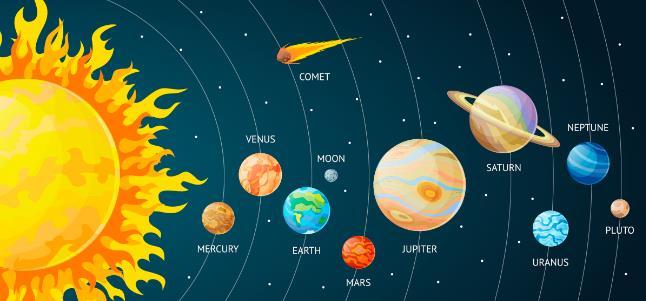
-Venus is the coldest planet in the solar system (F) or (V)
-Galaxy and satellite are elements he universe (F) or (V)
-Jupiter is the largest planet in the solar system (F) or (V)
Students reinforce what they have learned in practice and continue with a workshop that helps them memorize what they learned in the previous steps.
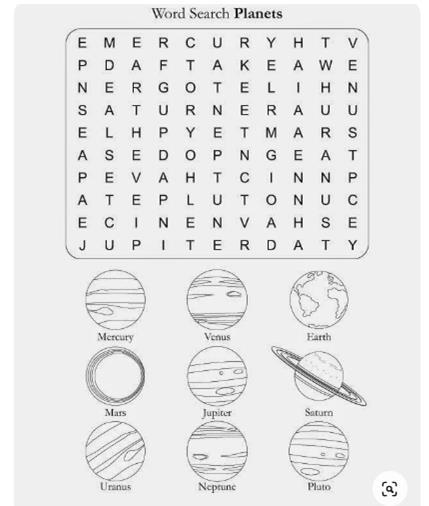
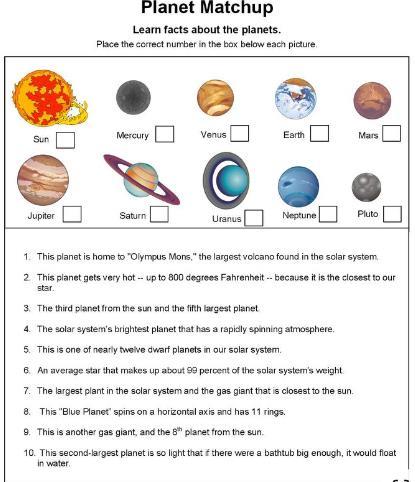
Elements of the solar system:
Sun: is the center of the solar system
Mercury: is the closest planet to the sun
Venus: is the hottest planet in the solar system
Earth: Is the planet where we live
Mars: is smaller than earth
Jupiter: is the largest planet in the solar system
Saturn: is the second largest planet in the solar system the solar system Uranus: is the coldest planet in
Neptune: : is the farthest planet from the sun
PRODUCTION STAGE
WORKSHOP
Carried out the activity according to the callsign
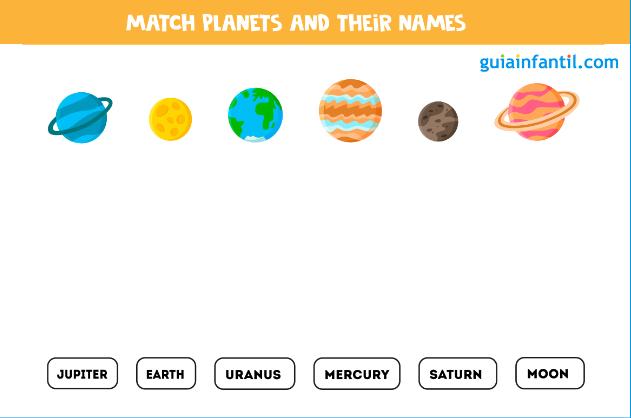
Made the crossword puzzle organizing the name according to the sequence
40 minutes Each student goes to the board and writes 2 elements of the solar system and 3 elements of the universe.
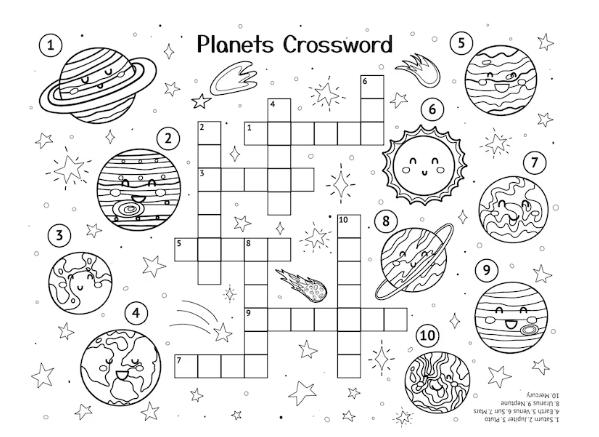
Look for the lost words in the word search
HOMEWORK:
How many planets are there?
Which is the smallest?
Which one is closest to the Sun?
And the one that is furthest away?
Which one is called the red planet?
Who has lost their planet category?
Which of them has the most rings?
GRADE: 7º TEACHER: IBETH DEL CARMEN URANGO MORA TOPIC: ENVIRONMENTAL IMPACT IN THE TECHNOLOGICAL ERA TIME: 2 HOURS SKILL: LISTENING, SPEAKING, READING, AND WRITING.
SOCIAL SCIENCE DBA (Basic Learning Right):
Understand that representations of the world change due to the visions of those who create them and technological advances.
RESOURCES:
Audio
Work book
Drawings
Board
ACHIEVEMENT INDICATORS
AIM:
Analyze and understand the various visions of the world that people have built over time, through reading map spheres from different periods.
SKILLS:
Listening: The audio improves the student's English ability to capture concepts and ideas about the six main environmental problems in the world today.
Speaking: Able to produce the main concepts of the lesson using the appropriate grammatical structure of the present perfect.
Reading: Read the task to understand the ideas proposed in the lesson by capturing the proposed vocabulary.
Writing: Able to write about environmental issues using correct structures and grammar
PROCEDURES / COMMUNICATIVE ACTIVITIES TIME ASSESMENT
Classroom Routines: Warm Up: Watch a short video of the impact of technology
https://youtu.be/lkd2mSEqxNE
PRESENTATION STAGE
Students will listen to and understand the description of the six main To tune students into English, I will greet them, then talk about the weather, and finally sing a short welcome song together.
10 Minutes Reflect on this technological impact today.
40 minutes Review the answers to the activity to ensure that the concept is correctly understood. If necessary,
environmental damages in today's world, improving listening, and vocabulary and comprehension skills.
To introduce the current lesson, I will begin talking to students about how protecting the environment is crucial to human survival; we must learn to use them correctly to avoid their scarcity and destruction also pointing out that all of us must be involved using strategies to achieve the goal.
FIRST ACTIVITY: Students will read, copy, and understand the word bank and the text to be filled out, afterwards they will listen the audio recording about the six main environmental problems in the world then complete the sentences with the words from the Word Bank.
Word Bank:
Climate, change, pollution, water, loss of biodiversity, Scarcity, deforestation, sol erosion
https://yoce.ro/1b00nSZ2hiaY
1. Is due to an increase in the Earth's temperature. It causes the polar ice caps to melt and the sea level to rise.
2. Is due to the cutting down of trees. It damages the land and causes soil erosion.
3. Happens when the ground gets very dry, and the wind blows away.
4. Refers to the damage caused to the air, water, or land through the use of chemicals or other toxic substances.
supplement them with additional explanation.
Besides strengthen the environmental Issues concepts students will practice the present perfect in their answers
5. Is when there is very little, or a complete lack of a very Important liquid.
6. Refers to the process of extinction of a variety of species.
PRACTICE STAGE
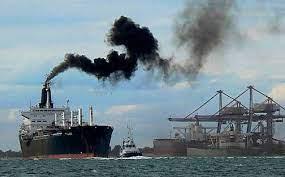
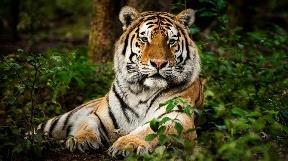
SECOND ACTIVITY: Students do write labeling the pictures using the previous word bank in exercise
1. Then answer the questions 1-3 using present perfect afterwards they discuss answers pairs.
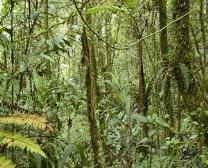
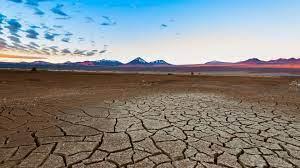
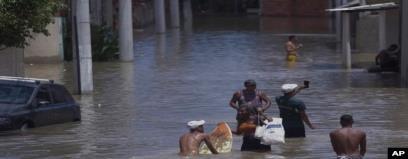
1. Have you ever experienced any of these problems? Where?
2. Have you ever heard of these problems? What did you hear?
3. Have you ever thought about how we can prevent them? How can you help
PRODUCTION STAGE
40 minutes Check appropriate vocabulary, grammar and structure, give feedback needed.
First, the understanding of the environmental
THIRD ACTIVITY: in pairs students will produce a two lines dialogue (one students produce an 30 minutes Verify students' vocabulary, expressions, grammar and also, the appropriate
Issues, secondly the ability to engage in a short conversation producing grammar structure of their ideas in their speaking skill.
affirmation about the issue, the other answering or giving his opinion about it).
Discuss the environmental problems in the pictures (1-4).
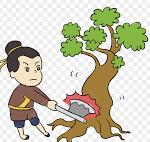
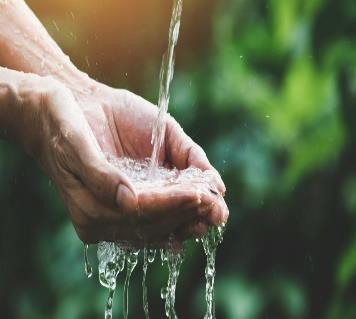

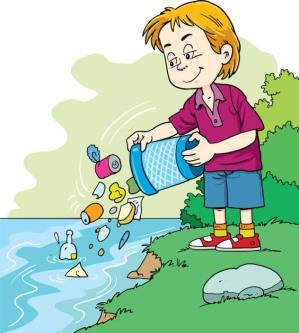
Students will answer to the question what are the people doing in the pictures?
HOMEWORK:
Look for places in your neighborhood school where there are environmental issues.
description of the environmental issue they are speaking about.
Assess and give feedback about the proper and correct students' speech and answers
Make some banners to make students aware of those issues and how to resolve and protect the environment.
GRADE: _8° TEACHER: ENEIDA TRINIDAD IRIARTE SOTO TOPIC: IMPACT PRODUCED BY TECHNOLOGICAL ADVANCES ON THE SOCIAL AND ECONOMIC DEVELOPMENT OF COLOMBIAIN THE 19TH CENTURY TIME: 2 HOURS SKILL: LISTENING, SPEAKING, READING, AND WRITING.
SOCIAL SCIENCE DBA (Basic Learning Right):
Evaluates the impact produced by technological advances on the social and economic development of Colombia in the 19th century.
RESOURCES:
The Telegraph https://www.youtube.com/watch?v=csBQA9yy410
https://www.youtube.com/watch?v=HltJXyWYhiQ
The mail https://www.youtube.com/watch?v=3c9hMAA4tqY
The railway in Colombia https://www.youtube.com/watch?v=PcGnfMYepGg
The Steamboat https://www.youtube.com/watch?v=F3icDK4hUOU
AIM:
Describe the role of the telegraph, mail, railroad, steamship, textile industry, and electricity in Colombia's economic development.
SKILLS:
Listening: Observe and listen carefully to the videos, to later collect necessary information for the development of the activities.
Speaking: Answer questions associated with the videos and suggested readings.
Reading: Reading the suggested documents.
Writing: Write the unknown words that you heard in the videos and the suggested readings and look up their meaning in the dictionary.
The Textile Industry
https://www.youtube.com/watch?v=zZRto9DQM_Q
Electricity
https://www.canalinstitucional.tv/historia-electricidad-en-colombia
ACHIEVEMENT INDICATORS
Classroom Routines: Greetings: The student is greeted and called to roll. .
Warm up: Using the project, students are presented with images related to the topic so that they can identify them and, in this way, determine how much they know about the topic:
Do you know what it is?
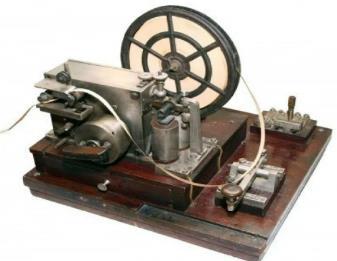
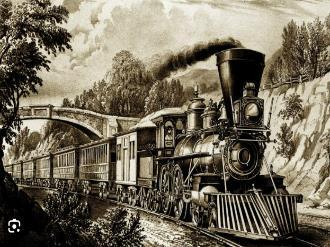

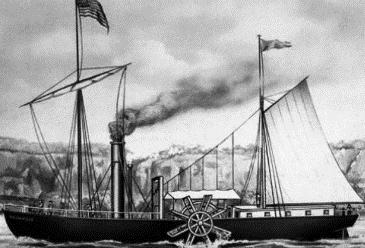
5 minutes
10 minutes
Participation in class is the most relevant thing in this space, beyond the knowledge that students possess.
Students are expected to identify vocabulary, present their concerns about what they do not understand and maintain a good disposition while the information on the topic is presented through the introductory reading and the presentation of the videos.
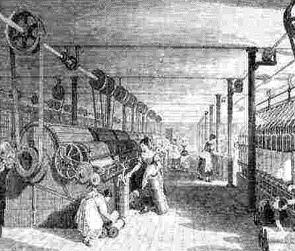
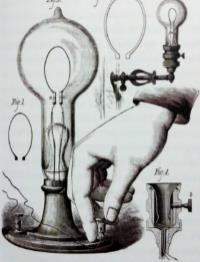
PRESENTATION STAGE
After the greeting and warm up, the presentation of the topic begins and the following information is presented to the students:
“The 19th century was a very difficult time for the population and economic development of the country, civil wars, diseases, lack of infrastructure and communication routes, added to a hostile and unknown geography, were determining factors in slowing down the progress of the nation.
Public health, festivals, religious festivities, leisure activities, trades, illiteracy, topography, means of transportation and travel, among others. It is the infographic of that extraordinarily diverse Colombia then and now.
Population growth was seriously affected by diseases and wars, so much so that life expectancy reached 37 years, aspects such as education, which gives us a revealing illiteracy rate that reached 90%, and aspects such as economy of which it is indicated that the vast majority of inhabitants lived from agriculture while crafts, which were driven mainly by women, were the second line of the economy.
While the topic is explained and the relevant information is broken down, students respond to questions related to the topic. .
Students are interested in the information that
It should be noted that there were a multitude of jobs that were performed informally such as: peddlers, carriers, lumberjacks, errand boys, midwives, saddlers, bleachers, lamplighters, shoemakers, cobblers, globe-trotting muleteers, awning workers, campers, musicians, tame workers, businessmen of wonders. , among many others, that disappeared in the current era.
Another aspect that hindered the development of the nation was the lack of road infrastructure, since the roads that had to be traveled were difficult in drought, and practically impossible in the rainy seasons, horses were of little use for these journeys and mules were preferred. , oxen and even saddle carriers to carry people.
Among the leisure activities were conversations in chicherias or in the atriums of churches, and playing bowling or ombre. During the holiday seasons, especially Corpus Christi, celebrated in June, there were dances in the houses and in the squares, there were fireworks, bullfights and other entertainment.
This information can complement the knowledge there is about Colombia or the independence process, as it reveals what the territory and the population were like at that time.”
Taken from:
https://www.banrepcultural.org/noticias/colombia-delsiglo-xix-explicada-en-5-minutos
PRACTICE STAGE
In this space, students create a vocabulary with words unknown to them, which they heard while reading and while watching the videos.
Reading word meanings
Respond coherently to the questionnaire.
has been presented to them.
They ask questions related to the inventions that revolutionized the economy in Colombia, such as: telegraph, mail, railroad, steamship, textile industry and electricity, after Colombia remained behind in its development.
• Students are expected to have their own questions about the topic, to feel curiosity that leads them to investigate the topic in more depth when they leave their classes. May the desire for knowledge accompany you even outside the classroom?
Each student reads a meaning found in the dictionary.
They answer a questionnaire with the following questions:
1. What were the inventions that helped economic advancement in Colombia at the end of the 19th century and beginning of the 20th century?
2. What were the events that affected population growth during the 19th century in Colombia?
3. When the International Day of Light is celebrated.
4. What was the name given to the railway in its beginnings?
5. How each of these inventions helped economic advancement in Colombia.
PRODUCTION STAGE
They present the developed vocabulary and compare with their classmates the words that each one chose, identifying those that they have the same and those that the others do not have.
Shows interest in the class.
The prepared exercises are reviewed by going to the board, this is where they compare the answers with each other and make the pertinent corrections.
Each student presents his or her notebook to review the questionnaire developed in class.
HOMEWORK: Six groups are created divided between the number of students in the classroom and each group creates a poster showing what each of these elements was like in the beginning and how they are today: group number one the telegraph, group number two the mail, group number three the railway, group number four the steamship, group number five the textile industry, group number six electricity.
References
Ministerio de Educacción Nacional. (2016) Derechos Básicos de Aprendizaje Ciencias
Sociales.Open this document with ReadSpeaker docReader https://colombiaaprende.edu.co/sites/default/files/files_public/202206/DBA_C.Sociales-V2.pdf
Dejusticia. (2018, 29 enero). Colombian Youth File the First Climate Change Lawsuit in Latin America: ¿What it is about? [Vídeo]. YouTube. https://www.youtube.com/watch?v=6X1HRbS2g-Q
La Relación entre la Gestión del Riesgo de Desastres y el Cambio Climático - Ministerio de Ambiente y Desarrollo Sostenible. (2022, 18 enero). Ministerio de Ambiente y Desarrollo Sostenible. https://www.minambiente.gov.co/cambio-climatico-ygestion-del-riesgo/la-relacion-entre-la-gestion-del-riesgo-de-desastres-y-el-cambioclimatico/
Happy Learning Español. (2018, 7 agosto). Vocabulario del universo en ingles | Videos educativos para ninos [Vídeo]. YouTube. https://www.youtube.com/watch?v=qN5UkMEZ-s
Inglés para niños con Mr Pea. (2021, 23 agosto). EL SISTEMA SOLAR EN INGLÉS ( THE SOLAR SYSTEM) - INGLÉS PARA NIÑOS CON MR.PEA - ENGLISH FOR KIDS [Vídeo]. YouTube. https://www.youtube.com/watch?v=km63lriW7Mo
Dana mtz. (2021, 28 marzo). Impacto de la Tecnología en la actualidad [Vídeo]. YouTube. https://www.youtube.com/watch?v=lkd2mSEqxNE
TeoCom. (2021, 16 abril). Historia del TELÉGRAFO i Historia de los MEDIOS DE
COMUNICACIÓN #7 [Vídeo]. YouTube.
https://www.youtube.com/watch?v=csBQA9yy410
Señal Memoria. (2022, 27 abril). El telégrafo en Colombia [Vídeo]. YouTube.
https://www.youtube.com/watch?v=HltJXyWYhiQ
UNIMINUTO Radio. (2021, 9 febrero). Conozca la historia del correo postal [Vídeo]. YouTube. https://www.youtube.com/watch?v=3c9hMAA4tqY
Canal Trece Colombia. (2017, 15 junio). La llegada del ferrocarril - Cronografía T3 Cap 01 [Vídeo]. YouTube. https://www.youtube.com/watch?v=PcGnfMYepGg
Canal Trece Colombia. (2017b, junio 16). Barco a vapor - Cronografía T3 Cap 04 [Vídeo]. YouTube. https://www.youtube.com/watch?v=F3icDK4hUOU
I.A Ivan Darío Lopez Rubio. (2019, 18 noviembre). DESARROLLO DE LA INDUSTRIA
TEXTIL EN COLOMBIA [Vídeo]. YouTube.
https://www.youtube.com/watch?v=zZRto9DQM_Q
¿Sabes cómo llegó la electricidad en Colombia? Te contamos la historia. (2023, 18 noviembre). RTVC. https://www.canalinstitucional.tv/historia-electricidad-encolombia
Radware Bot Manager Captcha. (s. f.-b).
https://www.banrepcultural.org/noticias/colombia-del-siglo-xix-explicada-en-5minutos